Upgrade to Pro
— share decks privately, control downloads, hide ads and more …
Speaker Deck
Sign up for free
Menu
Search
Features
All features
Private URLs
Password Protection
Custom URLS
Scheduled publishing
Remove Branding
Restrict embedding
Deck Collections
Notes
Features
All features
Private URLs
Password Protection
Custom URLS
Scheduled publishing
Remove Branding
Restrict embedding
Deck Collections
Notes
Explore
Featured decks
Featured speakers
Programming
Technology
Storyboards
Explore
Featured decks
Featured speakers
Programming
Technology
Storyboards
Pricing
Search
Sign in
Sign up for free
The simplest gem you'll ever use
Search
Sponsored
·
Your Podcast. Everywhere. Effortlessly.
Share. Educate. Inspire. Entertain. You do you. We'll handle the rest.
→
Grzegorz Witek
February 25, 2016
160
0
Share
Embed
Copy iframe code
Copy JS code
Copy link
Start on current slide
The simplest gem you'll ever use
Grzegorz Witek
February 25, 2016
More Decks by Grzegorz Witek
See All by Grzegorz Witek
One Year with Hanami
arnvald
0
120
Coercion in Ruby
arnvald
1
200
Writing config files in Ruby
arnvald
0
190
Speaking at RDRC
arnvald
0
190
Read more
arnvald
2
150
Your API is too slow!
arnvald
0
770
International to global
arnvald
0
160
Patterns, patterns everywhere
arnvald
0
170
Nomadic programmer - Baruco 2014 edition
arnvald
0
150
Featured
See All Featured
The Cost Of JavaScript in 2023
addyosmani
55
10k
The agentic SEO stack - context over prompts
schlessera
0
970
GraphQLとの向き合い方2022年版
quramy
50
15k
Rebuilding a faster, lazier Slack
samanthasiow
85
9.7k
Color Theory Basics | Prateek | Gurzu
gurzu
1
490
Building the Perfect Custom Keyboard
takai
2
910
What the history of the web can teach us about the future of AI
inesmontani
PRO
2
740
Google's AI Overviews - The New Search
badams
0
1.6k
More Than Pixels: Becoming A User Experience Designer
marktimemedia
3
570
Refactoring Trust on Your Teams (GOTO; Chicago 2020)
rmw
35
3.9k
ラッコキーワード サービス紹介資料
rakko
1
5.4M
How To Stay Up To Date on Web Technology
chriscoyier
790
250k
Transcript
The simplest gem you’ll ever use @arnvald, 2016
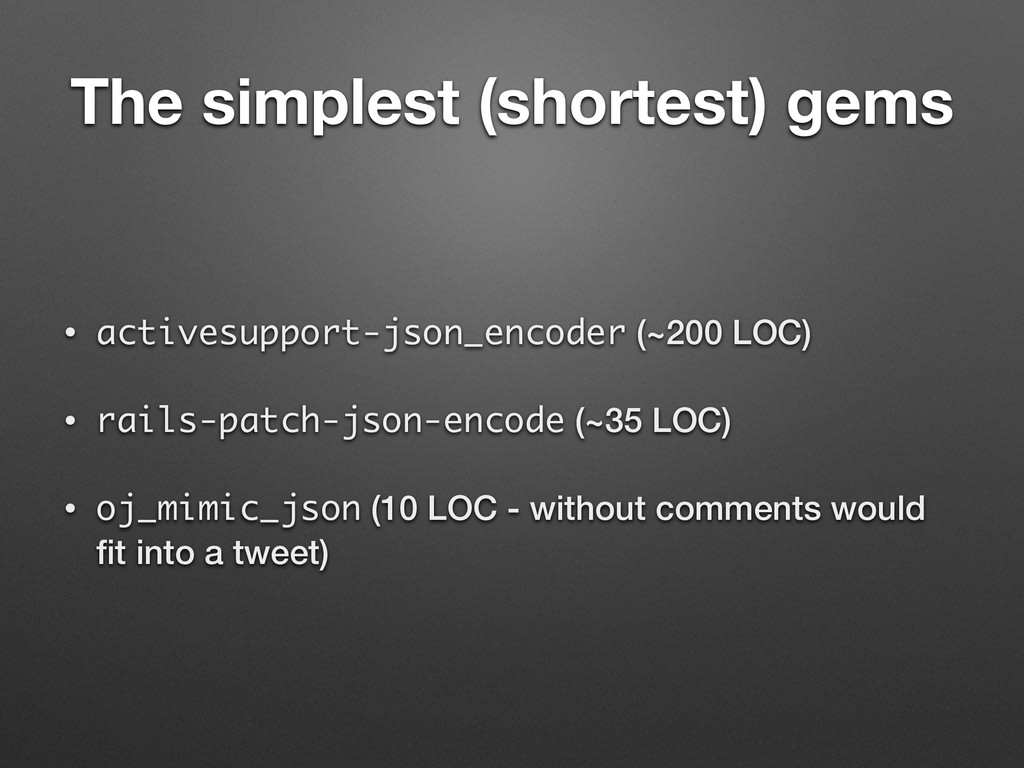
The simplest (shortest) gems • activesupport-json_encoder (~200 LOC) • rails-patch-json-encode
(~35 LOC) • oj_mimic_json (10 LOC - without comments would fit into a tweet)
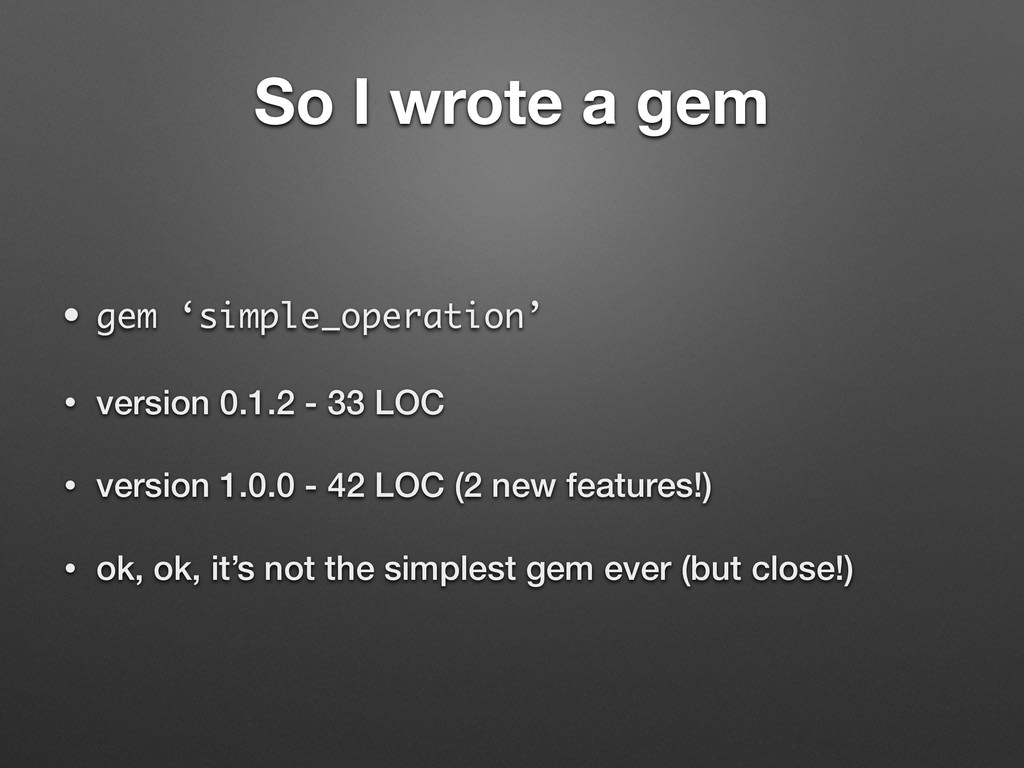
So I wrote a gem • gem ‘simple_operation’ • version
0.1.2 - 33 LOC • version 1.0.0 - 42 LOC (2 new features!) • ok, ok, it’s not the simplest gem ever (but close!)
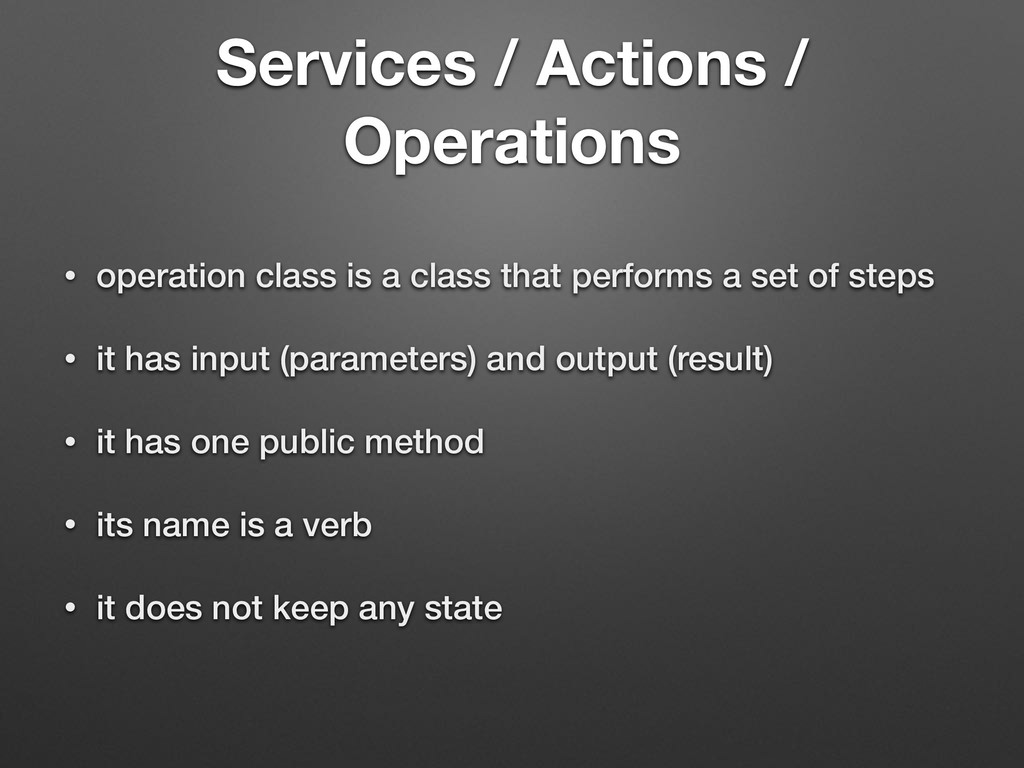
Services / Actions / Operations • operation class is a
class that performs a set of steps • it has input (parameters) and output (result) • it has one public method • its name is a verb • it does not keep any state
Example - validate records class SelectValidRecords < SimpleOperation.new(:records) def call
records.select {|r| valid?(r) } end private def valid?(record); …; end end ValidateRecords.([invalid, invalid2, valid]) # => [valid]
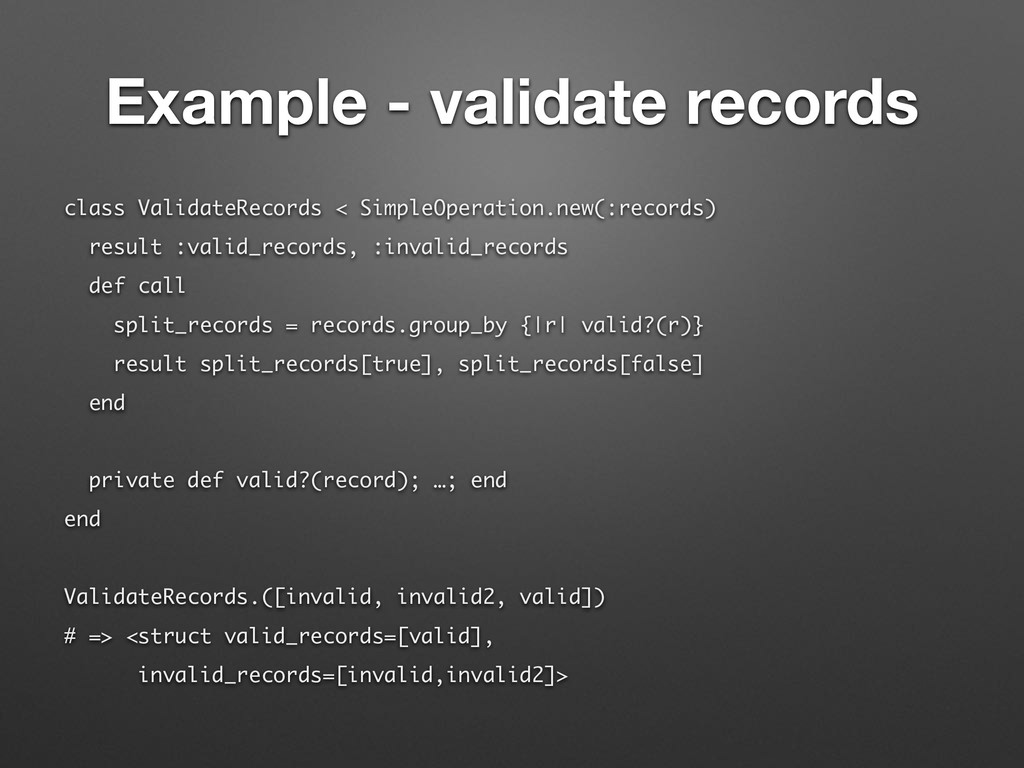
Example - validate records class ValidateRecords < SimpleOperation.new(:records) result :valid_records,
:invalid_records def call split_records = records.group_by {|r| valid?(r)} result split_records[true], split_records[false] end private def valid?(record); …; end end ValidateRecords.([invalid, invalid2, valid]) # => <struct valid_records=[valid], invalid_records=[invalid,invalid2]>
Let’s see the code
Ruby “tricks” used • overriding Class.new • using class_eval •
using class name as a method name (in extension) • assigning class to a constant • using sugar syntax for call method
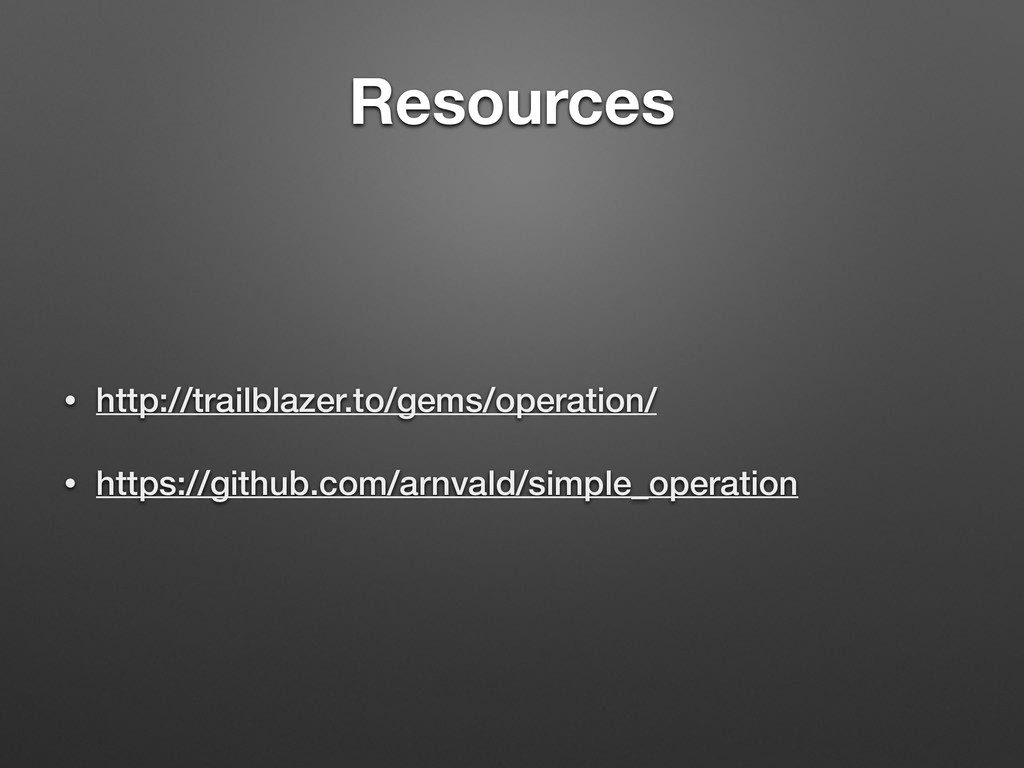
Resources • http://trailblazer.to/gems/operation/ • https://github.com/arnvald/simple_operation
We’re hiring! http://bit.do/kaligo-dev
Questions?
The simplest gem you’ll ever use @arnvald, 2016


 arnvald
 addyosmani
 schlessera
 quramy
 samanthasiow
 gurzu
gurzu
 takai
takai
 inesmontani
 badams
 marktimemedia
 rmw
rmw
 rakko
rakko
 chriscoyier