Share
Embed
A tale of two cities: blocking code vs. non-blocking code
In this session, the evolution of non-blocking code strategies will be explored, highlighting how they can enhance application throughput. Beginning with Java's concurrency model's inception, the discussion will cover Future/Callable, CompletableFuture, a glimpse into reactive programming, and conclude with Project Loom's introduction to Java 21.
The talk will shed light on the various approaches to writing non-blocking code.
A N M Bazlur Rahman
February 22, 2024
Transcript
37 slides
-
A Tale of Two Cities: Blocking Code VS Non-Blocking Code
Bazlur Rahman Staff Software Developer DNAStack -
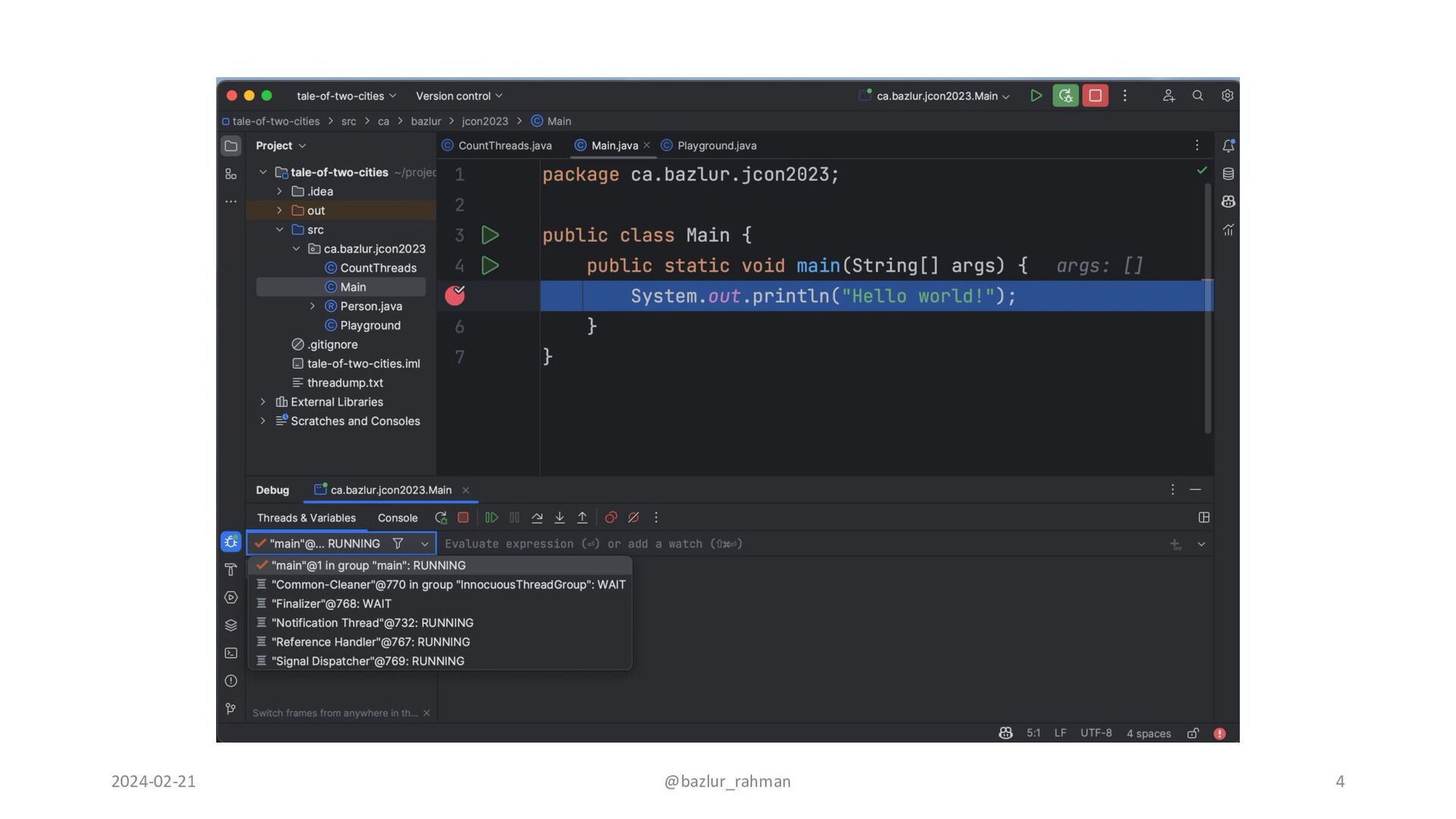
Threads—The Foundation of Java Concurrency • Java is born with
threads! When a Java program starts, the "main" thread is the birthplace of execution. • Threads give birth to threads - Method calls spawn execution within the caller's thread • Benefits we take for granted: • Structured control flow (think about how 'easy' writing sequential if/then/else logic is...) • Local variables for methods • Stack traces to solve problems • Ability to schedule work across CPUs @bazlur_rahman 3 2024-02-21 -
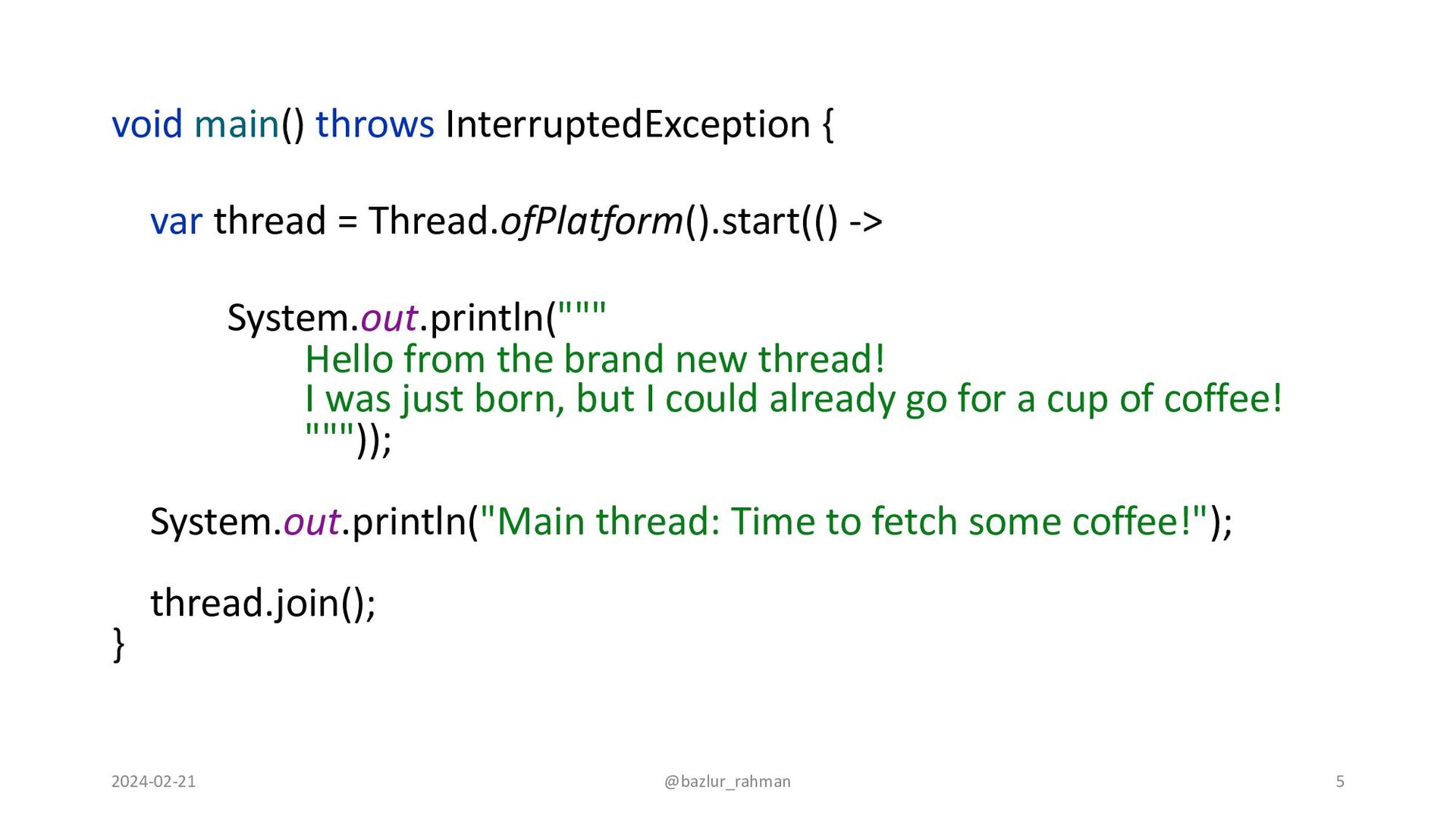
void main() throws InterruptedException { var thread = Thread.ofPlatform().start(() ->
System.out.println(""" Hello from the brand new thread! I was just born, but I could already go for a cup of coffee! """)); System.out.println("Main thread: Time to fetch some coffee!"); thread.join(); } @bazlur_rahman 5 2024-02-21 -
Java Threads: A Wrapper Around OS Threads • Java threads
rely on operating system threads. • OS-managed threads are often called "Platform threads." • Pre-JDK 21 had a one-to-one correspondence between Java threads and OS threads. • This approach could limit performance. @bazlur_rahman 6 2024-02-21 -
The Cost of Platform Threads • OS thread creation takes
time and significant resources. • Large "pre-commitment" needed for stacks - often megabytes in size (can sometimes be tuned, but with risks). • This introduces a practical cap on the number of concurrent threads in an application. @bazlur_rahman 7 2024-02-21 -
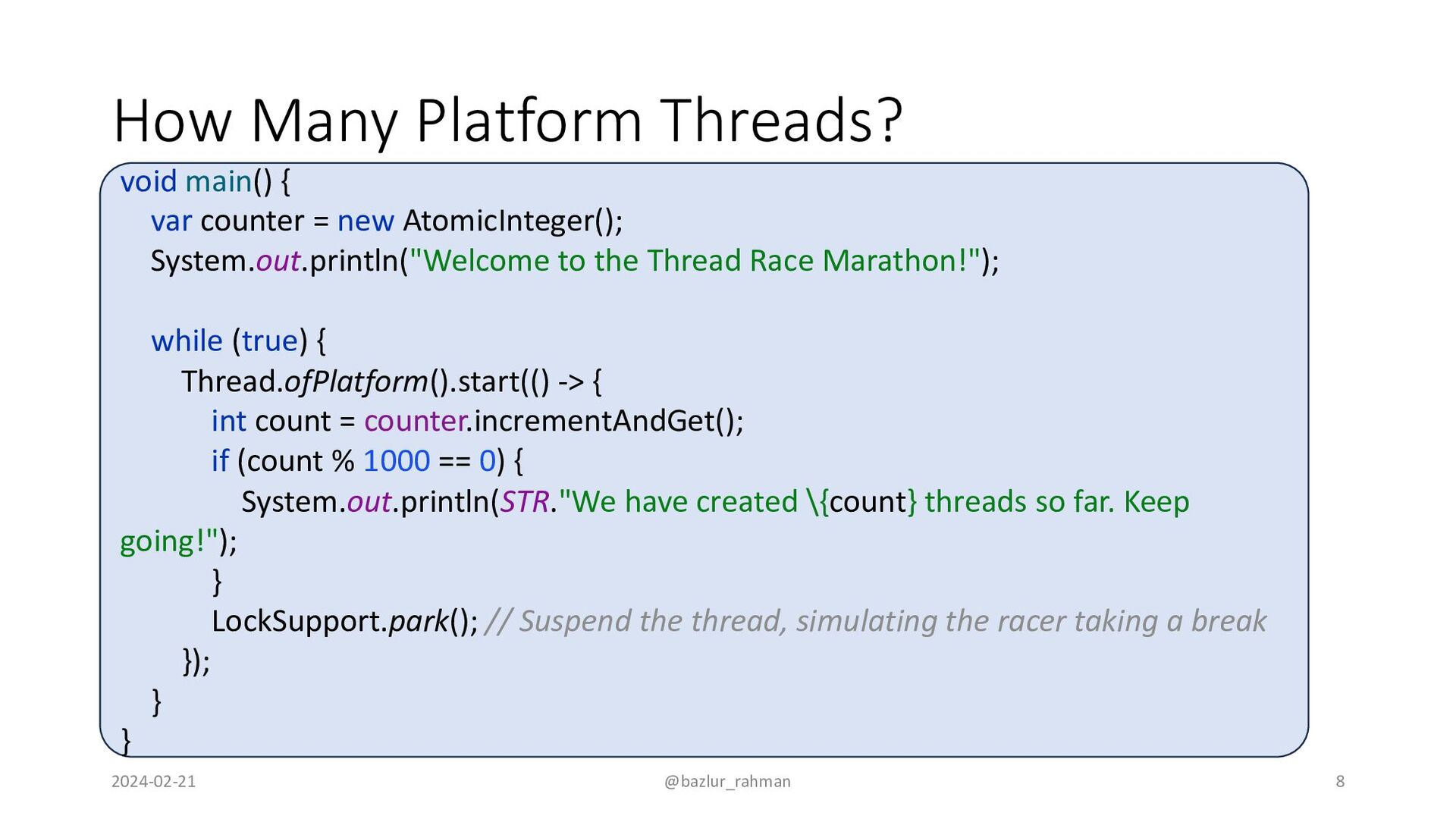
How Many Platform Threads? void main() { var counter =
new AtomicInteger(); System.out.println("Welcome to the Thread Race Marathon!"); while (true) { Thread.ofPlatform().start(() -> { int count = counter.incrementAndGet(); if (count % 1000 == 0) { System.out.println(STR."We have created \{count} threads so far. Keep going!"); } LockSupport.park(); // Suspend the thread, simulating the racer taking a break }); } } @bazlur_rahman 8 2024-02-21 -
The Challenges of Shared- State Concurrency • While invaluable, threads
become challenging when we manipulate shared data across threads. • Issues to keep in mind: • Memory visibility (ensuring one thread sees another's changes) • Safeguarding against race conditions and data corruption • Mastering locks and synchronization for protection. @bazlur_rahman 9 2024-02-21 -
Beyond the Basics • Despite thread complexities, a huge amount
of what we accomplish day-to- day relies on them working silently... • Java concurrency is rich - we only highlight a part of the landscape today. • Our focus today... how do we manage tasks that might take a while without tying up our precious threads? @bazlur_rahman 10 2024-02-21 -
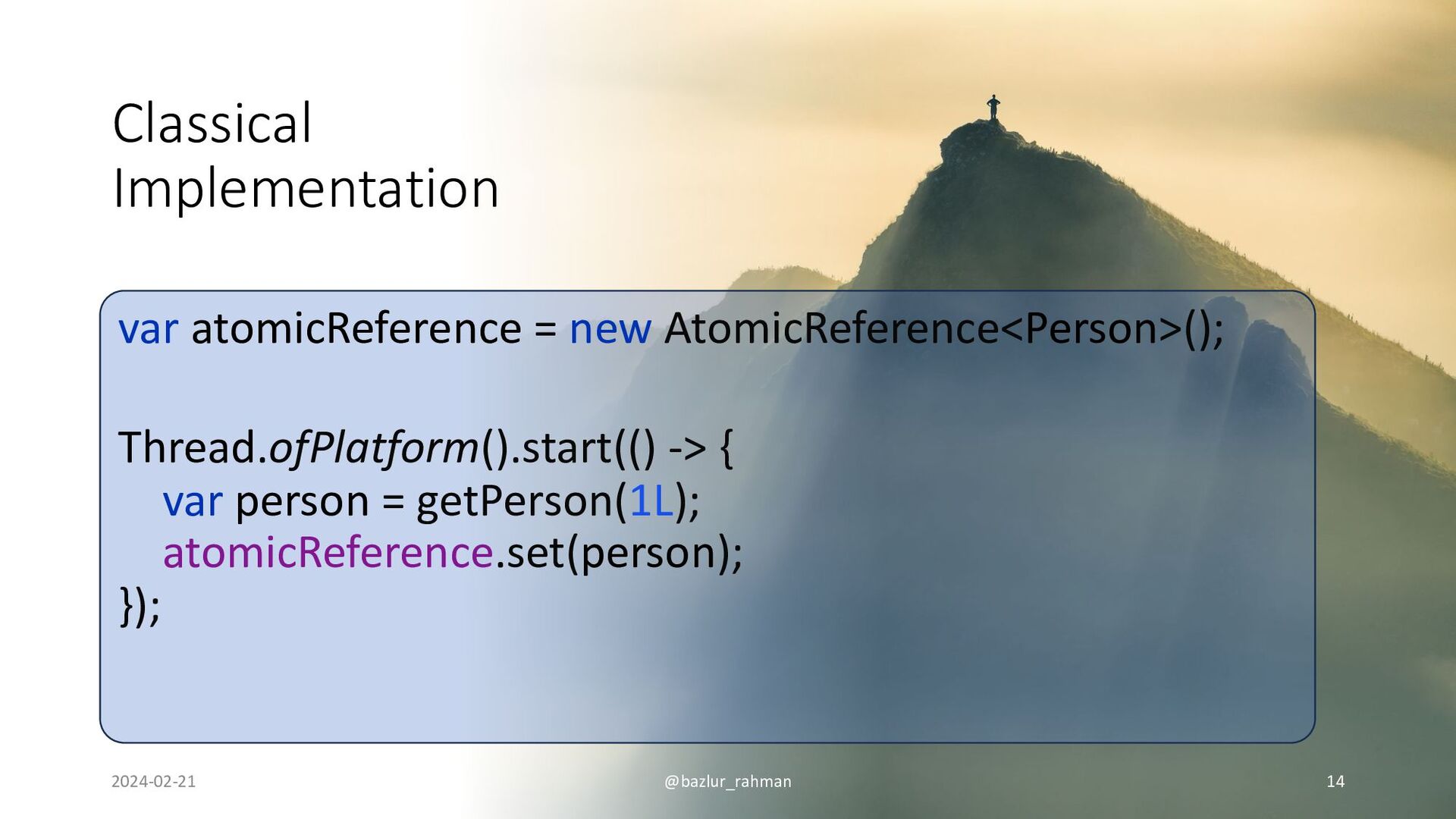
Classical Implementation var atomicReference = new AtomicReference<Person>(); Thread.ofPlatform().start(() -> {
var person = getPerson(1L); atomicReference.set(person); }); @bazlur_rahman 14 2024-02-21 -
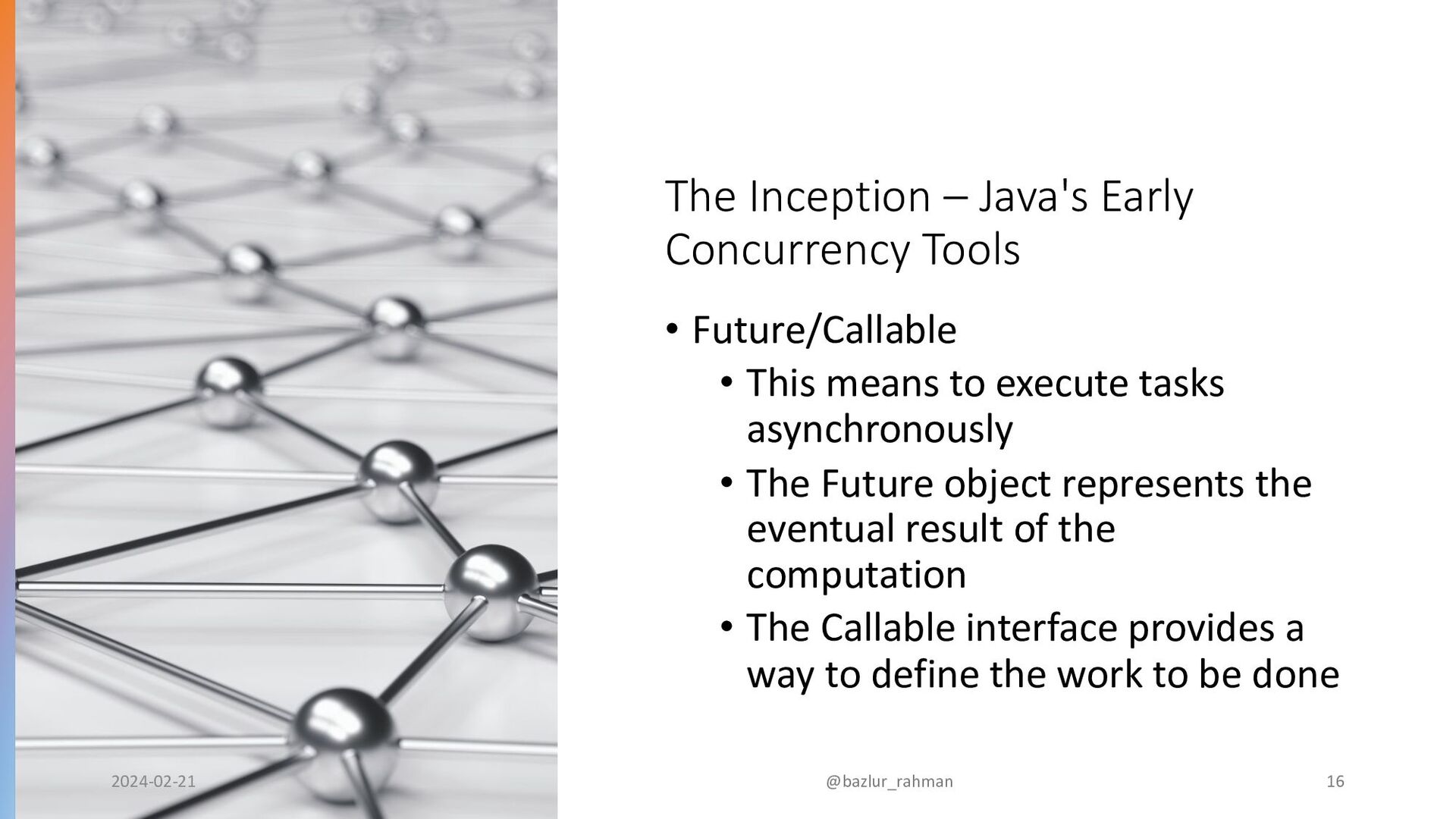
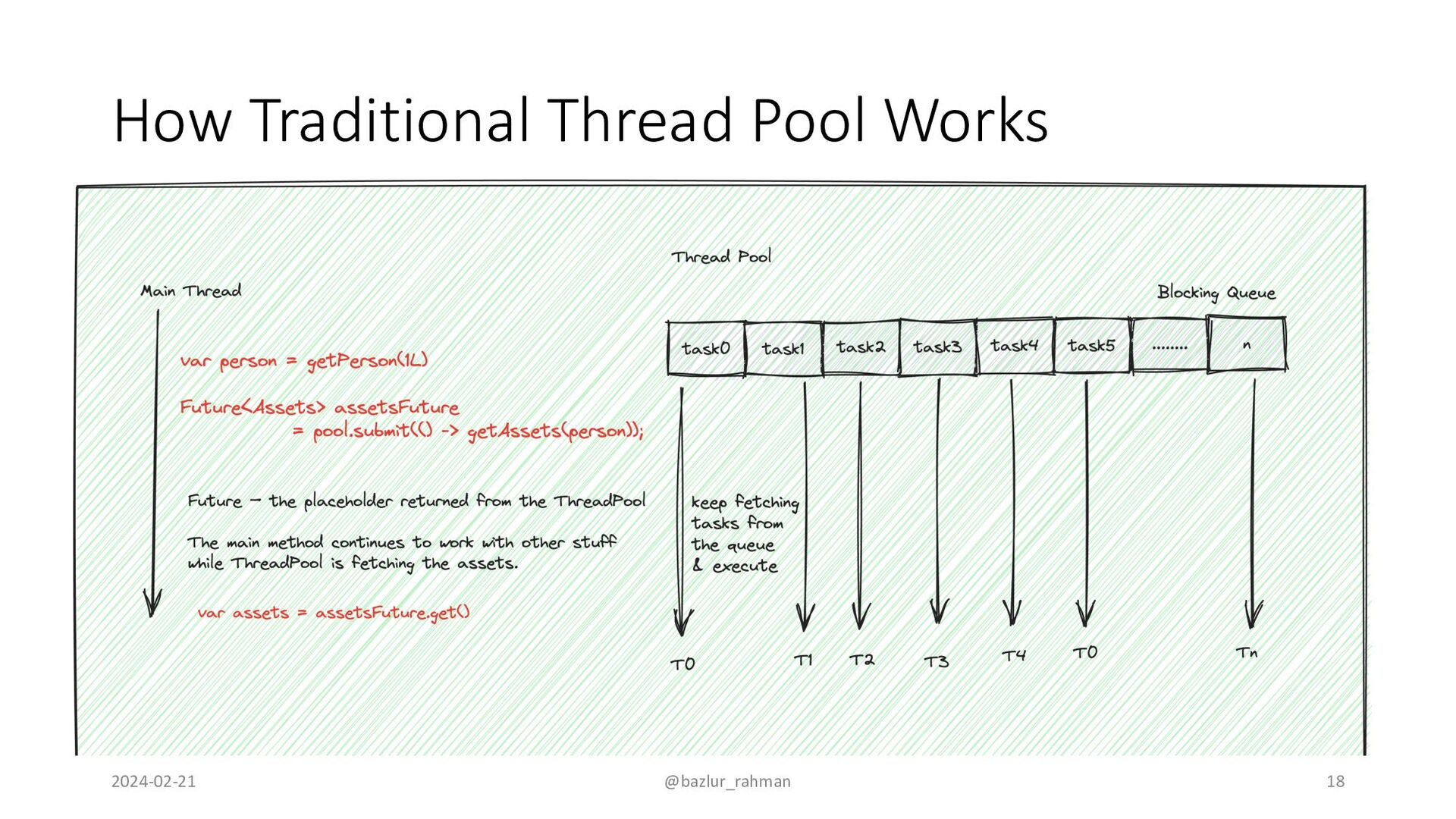
The Inception – Java's Early Concurrency Tools • Future/Callable •
This means to execute tasks asynchronously • The Future object represents the eventual result of the computation • The Callable interface provides a way to define the work to be done @bazlur_rahman 16 2024-02-21 -
Challenges with Executors and Future/Callable • Awkward Composability: Chaining dependent
asynchronous operations leads to cumbersome nesting. • Blocking Future.get(): Retrieving results can potentially block threads, negating some non-blocking gains. • Limited Error Handling: Propagating exceptions across asynchronous stages can be tricky to manage. • Executor Management: Tuning thread pools for optimal performance requires careful consideration. @bazlur_rahman 19 2024-02-21 -
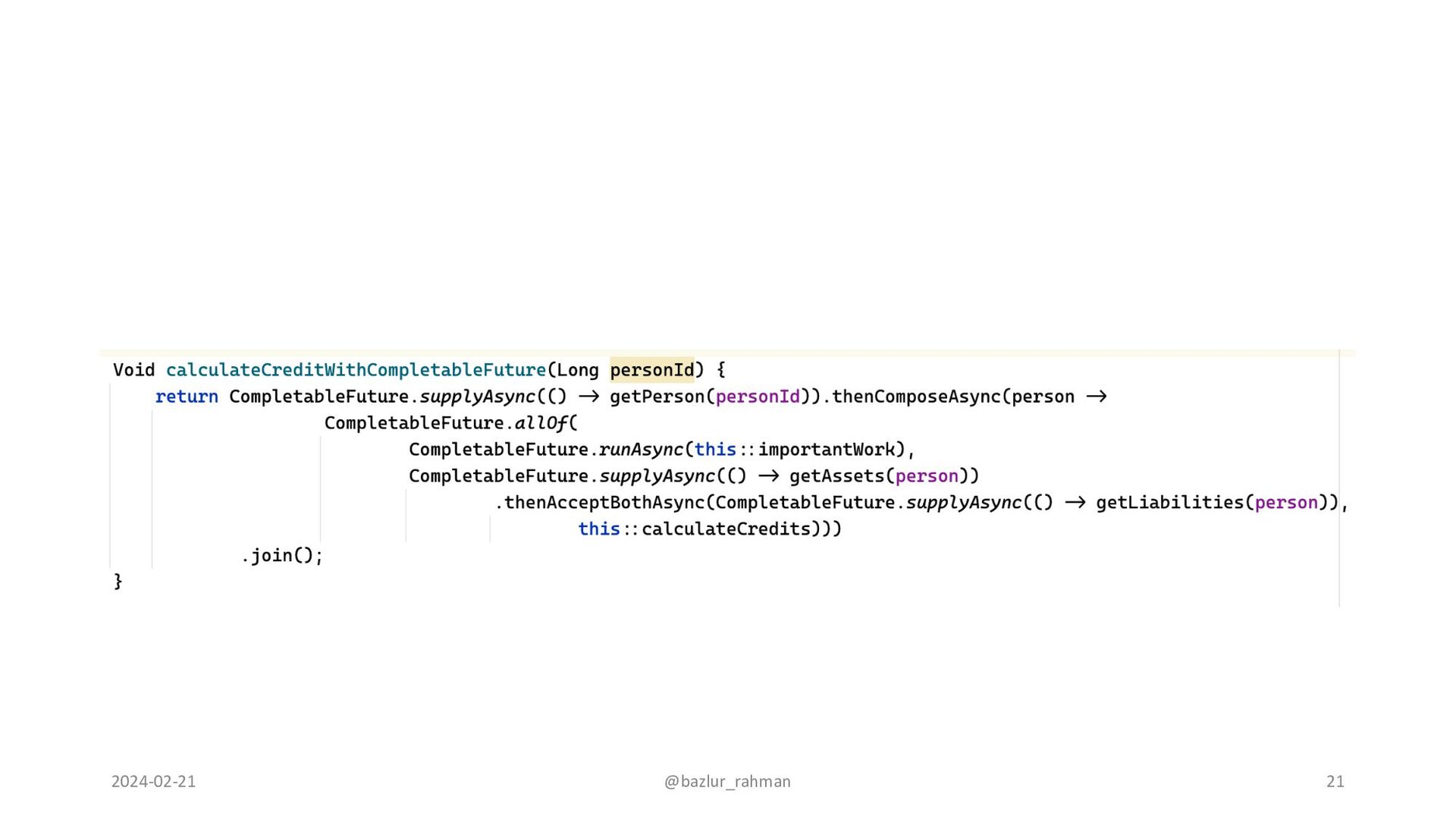
CompletableFuture to the Rescue • Methods like thenApply, thenCombine, and
handle enable fluent chaining of asynchronous operations without awkward nesting. • The chaining pattern remains non-blocking; subsequent dependent tasks are asynchronously queued. • Fine-grained control with exceptionally and similar methods provides more robust exception management across asynchronous tasks. • While granular control is possible, many common operations have defaults, making it less of a required upfront burden. • The chaining style starts to bridge non-blocking execution with syntax that feels closer to sequential code for many developers. @bazlur_rahman 20 2024-02-21 -
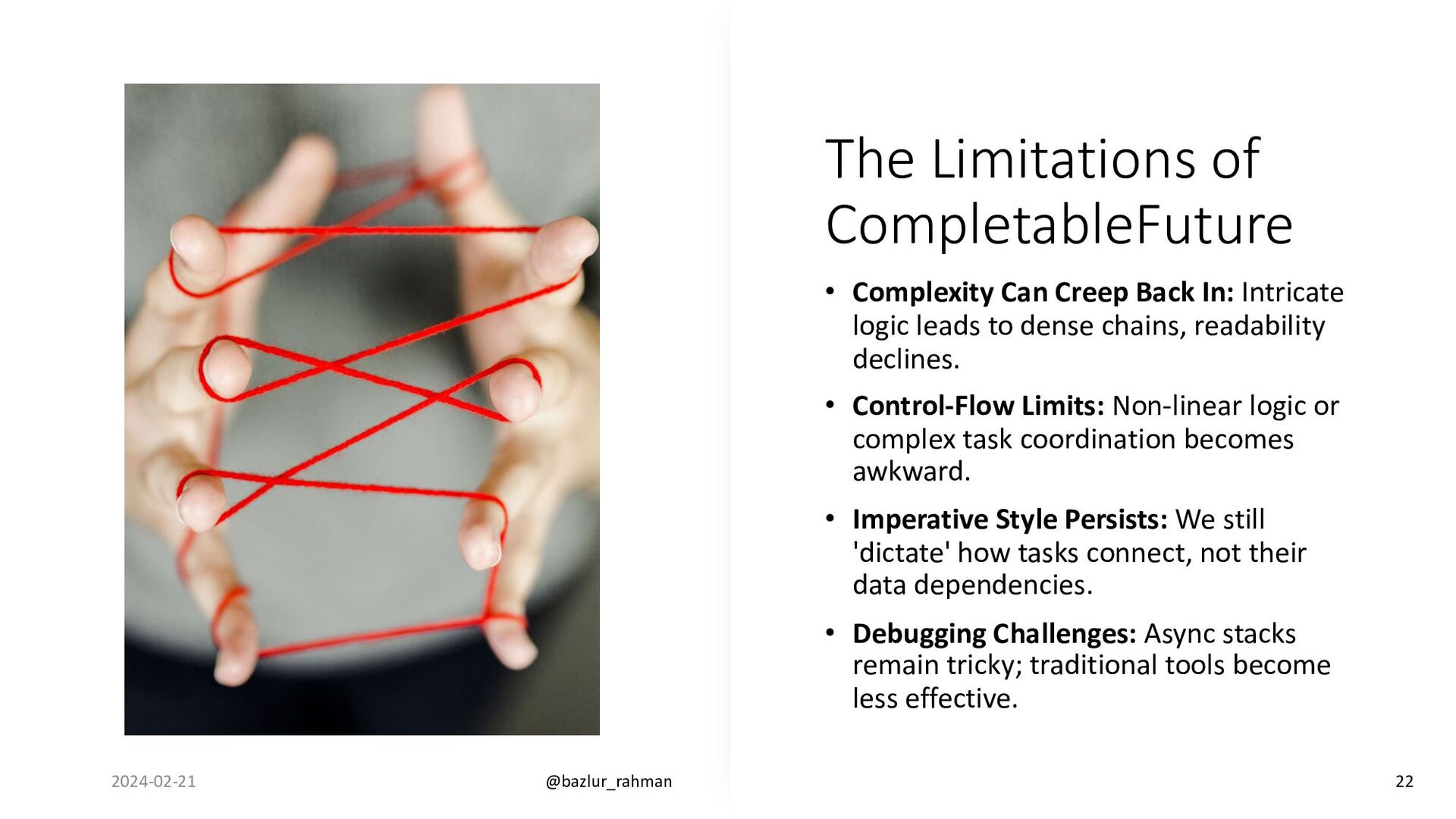
The Limitations of CompletableFuture • Complexity Can Creep Back In:
Intricate logic leads to dense chains, readability declines. • Control-Flow Limits: Non-linear logic or complex task coordination becomes awkward. • Imperative Style Persists: We still 'dictate' how tasks connect, not their data dependencies. • Debugging Challenges: Async stacks remain tricky; traditional tools become less effective. @bazlur_rahman 22 2024-02-21 -
The Reactive Stack – Benefits • Flow Control (Backpressure): Publishers
and subscribers negotiate data rates, preventing components from being overwhelmed. • Declarative Composability: Build complex stream transformations through chaining expressive operators (e.g. filter, map, combine). • Asynchronous by Design: Optimized for concurrency and handling events that come at unpredictable intervals. • Resilience: Gracefully handles errors and inconsistencies within data streams. • Popular Framework: RxJava, Akka, Eclipse Vert.x , Spring WebFlux, Slick @bazlur_rahman 23 2024-02-21 -
The Reactive Stack – Considerations • Learning Curve: The shift
to data-flow thinking involves mastering new concepts and patterns. • Debugging: Asynchronous data-flows can pose unique debugging challenges. • Code Readability: Complex transformations may benefit from careful documentation for maintainability. • When to Choose: Best suited for highly asynchronous, event-driven scenarios or problems that map naturally to a data- stream processing model. @bazlur_rahman 24 2024-02-21 -
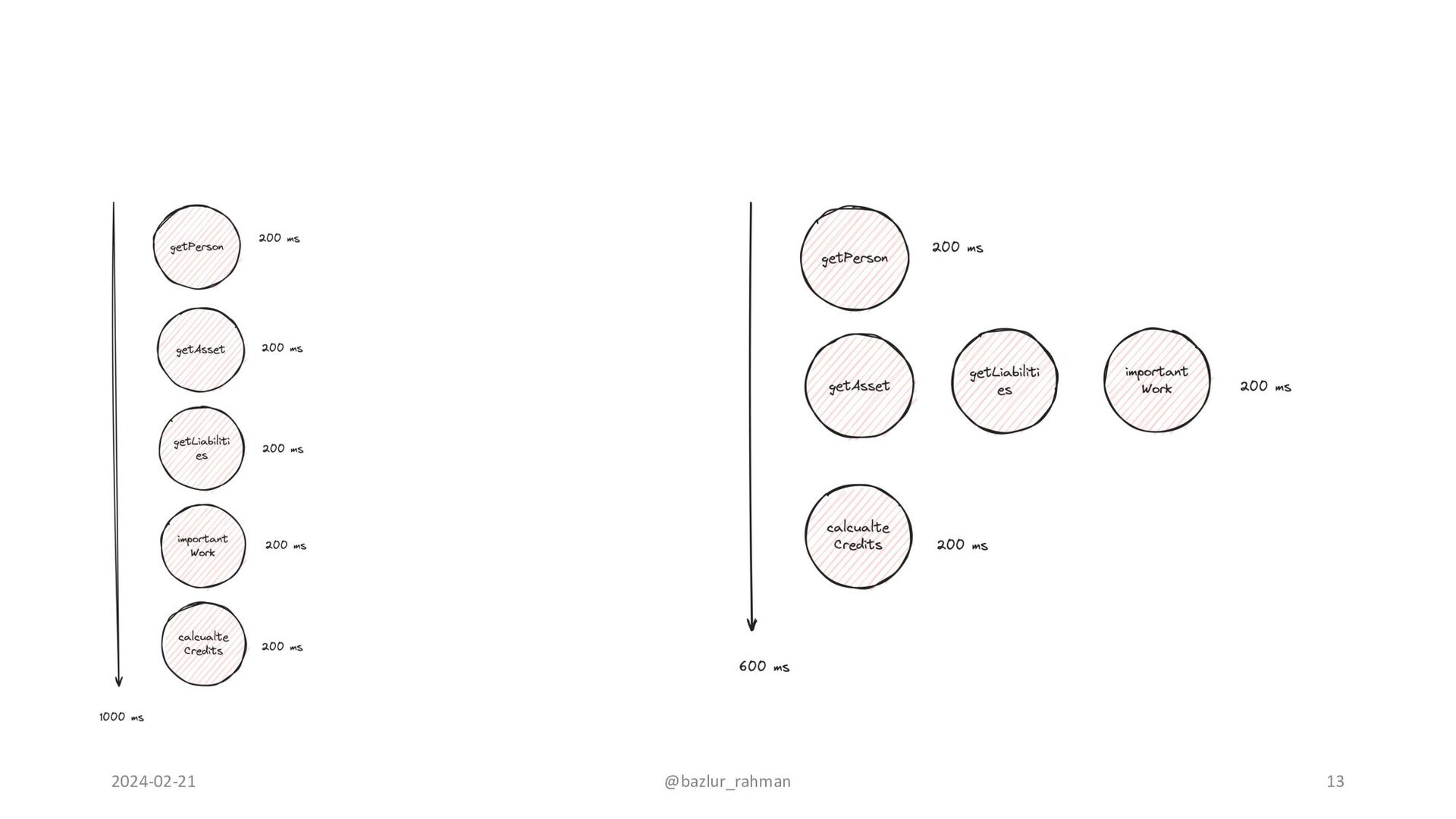
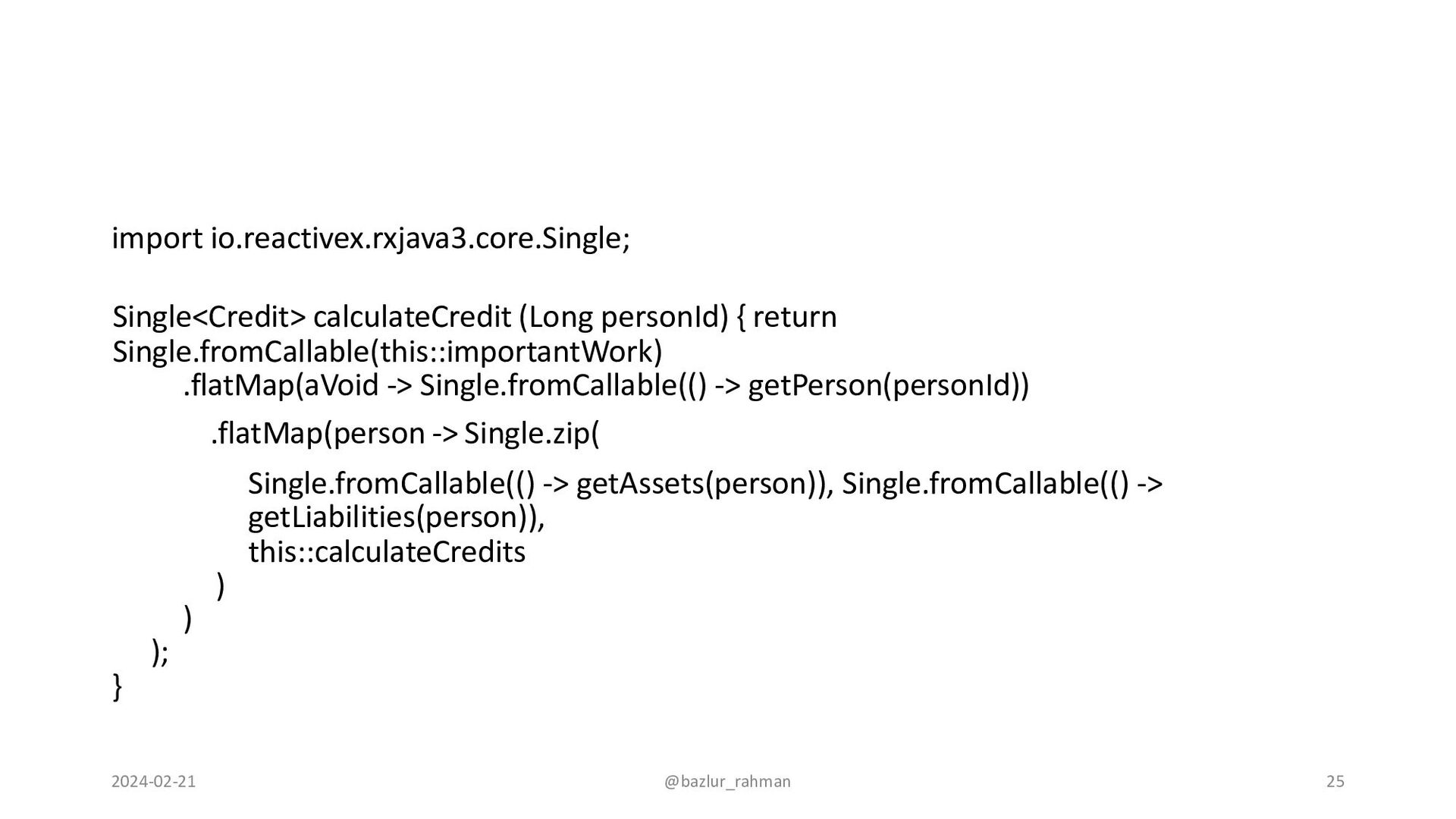
import io.reactivex.rxjava3.core.Single; Single<Credit> calculateCredit (Long personId) { return Single.fromCallable(this::importantWork) .flatMap(aVoid
-> Single.fromCallable(() -> getPerson(personId)) .flatMap(person -> Single.zip( Single.fromCallable(() -> getAssets(person)), Single.fromCallable(() -> getLiabilities(person)), this::calculateCredits ) ) ); } @bazlur_rahman 25 2024-02-21 -
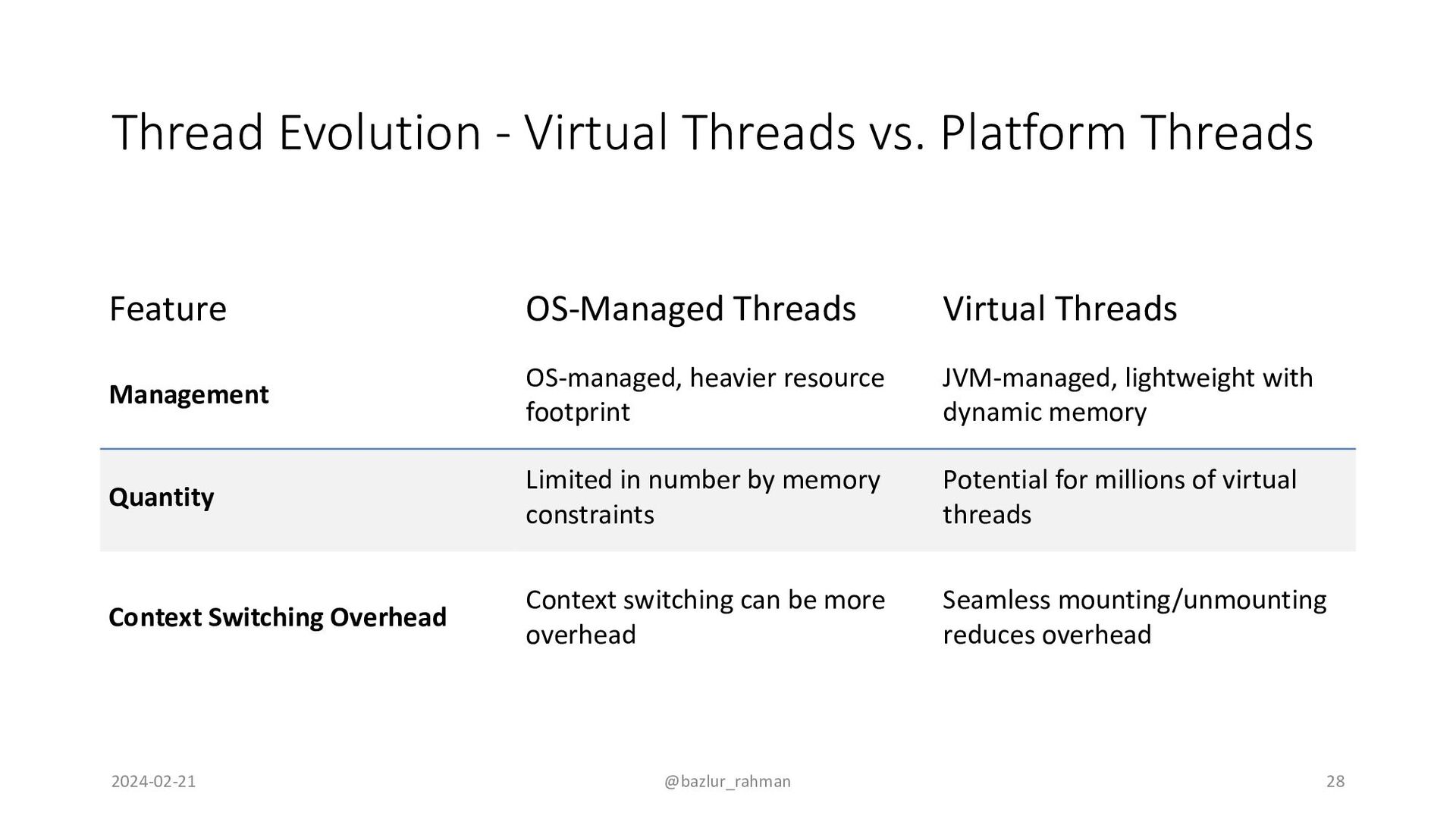
Thread Evolution - Virtual Threads vs. Platform Threads Feature OS-Managed
Threads Virtual Threads Management OS-managed, heavier resource footprint JVM-managed, lightweight with dynamic memory Quantity Limited in number by memory constraints Potential for millions of virtual threads Context Switching Overhead Context switching can be more overhead Seamless mounting/unmounting reduces overhead @bazlur_rahman 28 2024-02-21 -
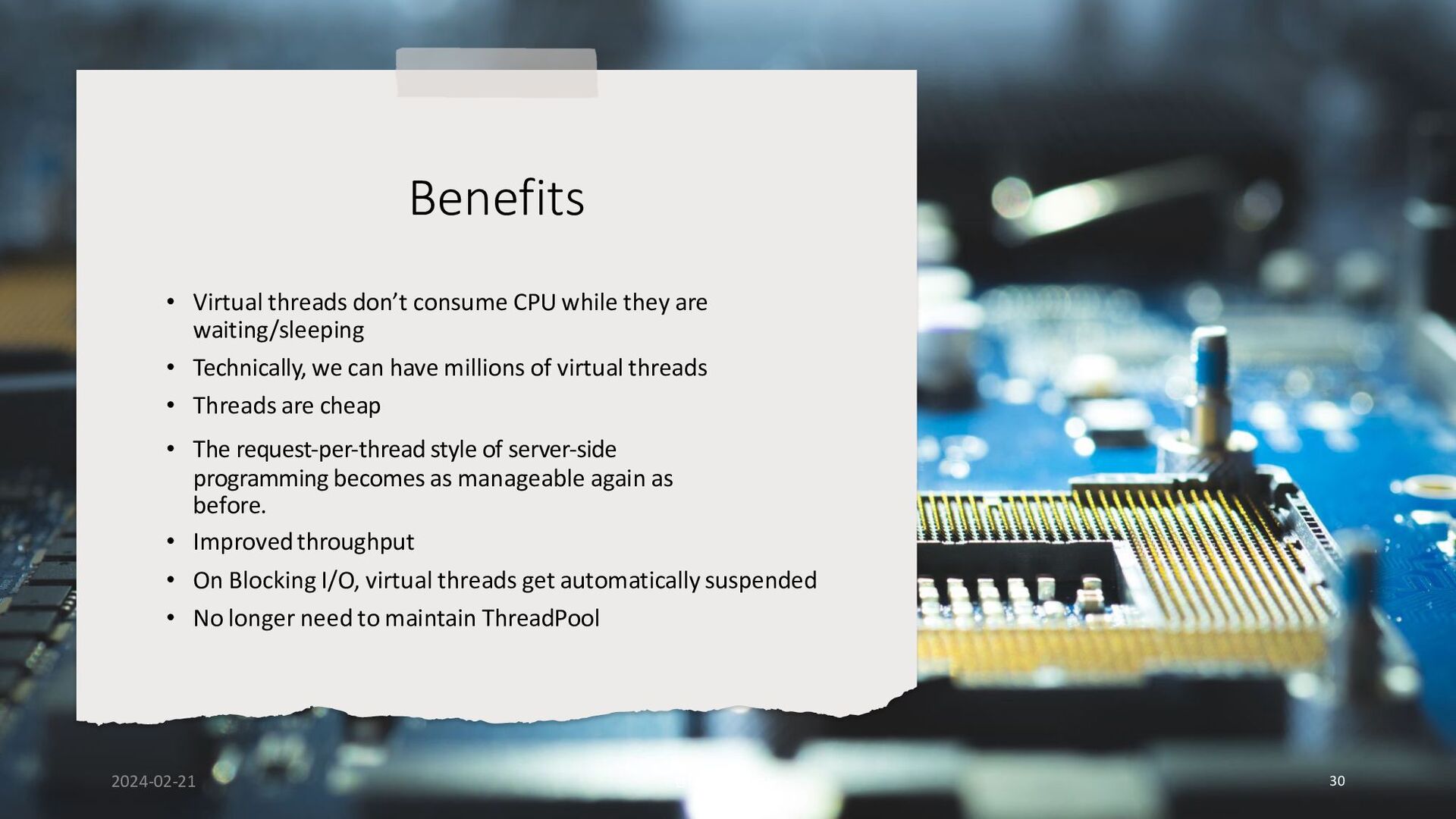
Benefits • Virtual threads don’t consume CPU while they are
waiting/sleeping • Technically, we can have millions of virtual threads • Threads are cheap • The request-per-thread style of server-side programming becomes as manageable again as before. • Improved throughput • On Blocking I/O, virtual threads get automatically suspended • No longer need to maintain ThreadPool @bazlur_rahman 30 2024-02-21 -
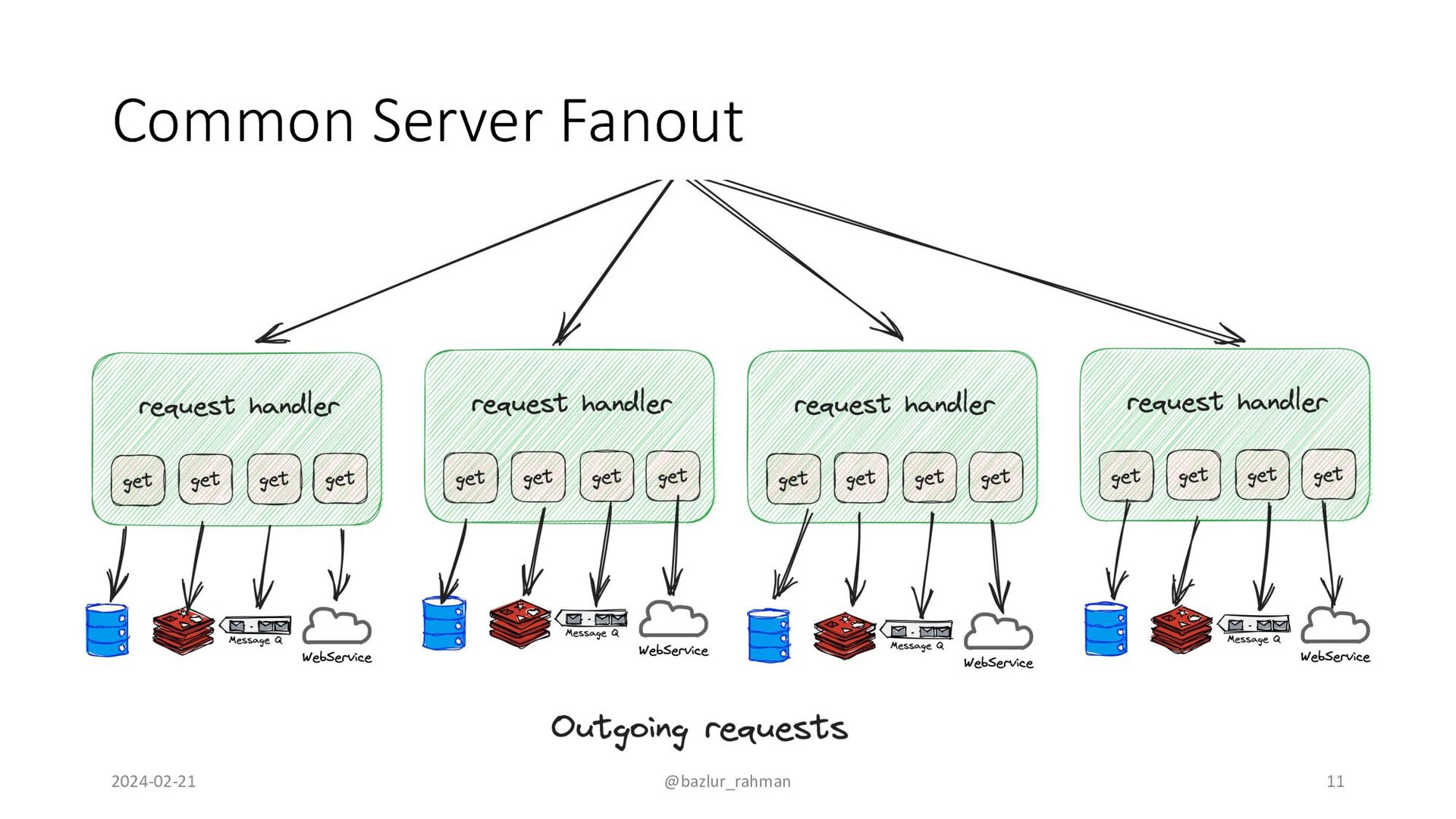
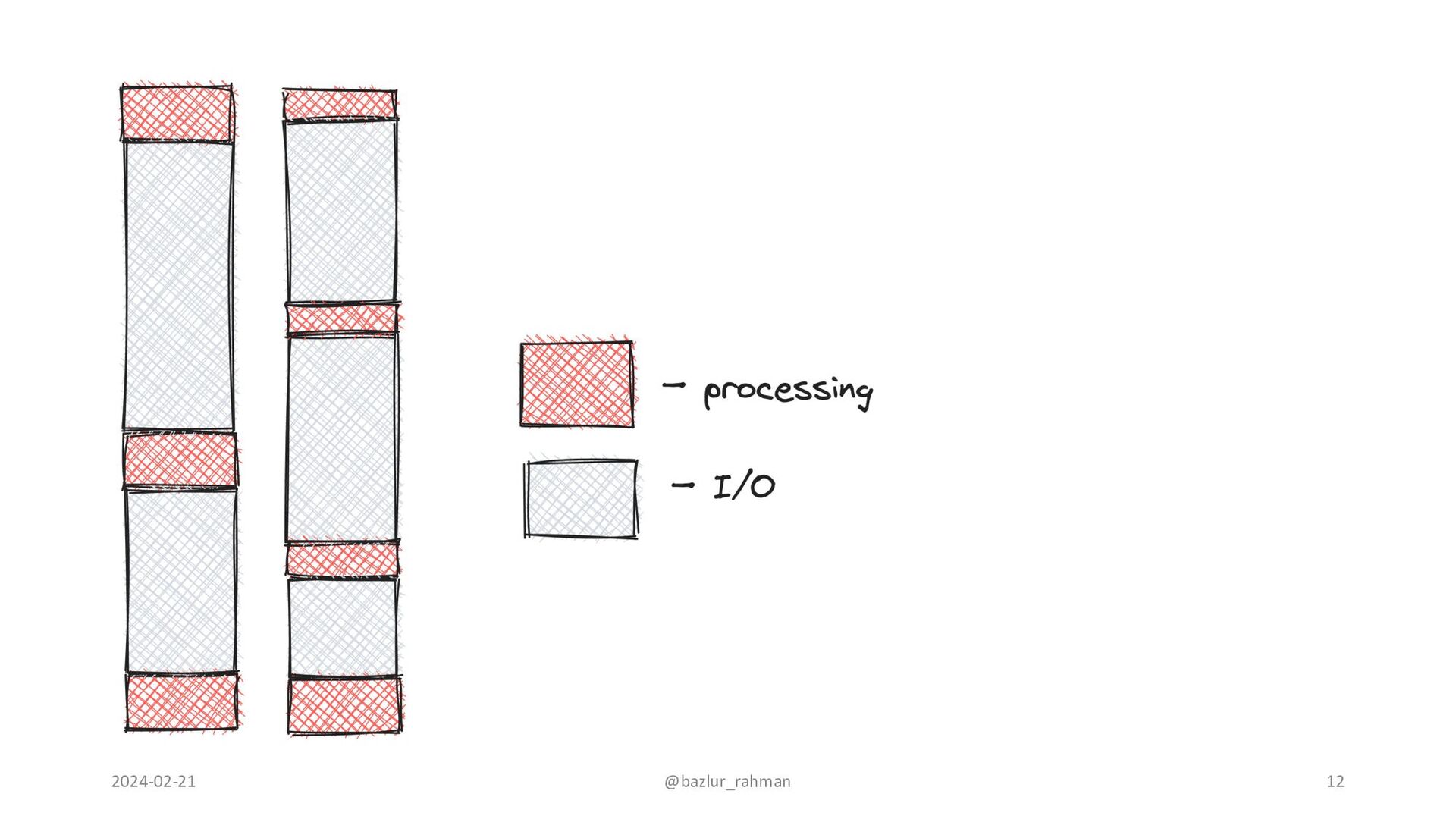
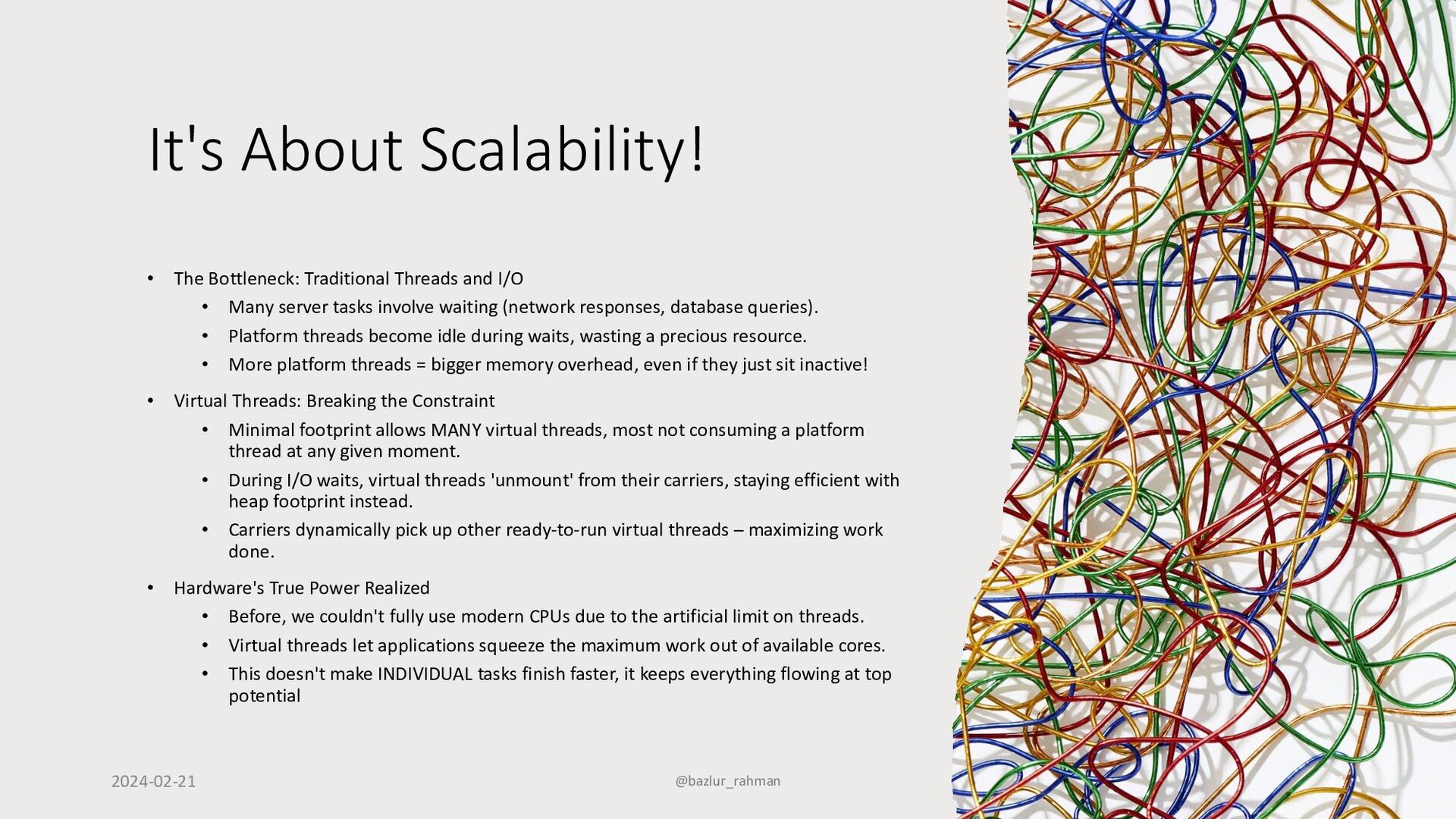
It's About Scalability! • The Bottleneck: Traditional Threads and I/O
• Many server tasks involve waiting (network responses, database queries). • Platform threads become idle during waits, wasting a precious resource. • More platform threads = bigger memory overhead, even if they just sit inactive! • Virtual Threads: Breaking the Constraint • Minimal footprint allows MANY virtual threads, most not consuming a platform thread at any given moment. • During I/O waits, virtual threads 'unmount' from their carriers, staying efficient with heap footprint instead. • Carriers dynamically pick up other ready-to-run virtual threads – maximizing work done. • Hardware's True Power Realized • Before, we couldn't fully use modern CPUs due to the artificial limit on threads. • Virtual threads let applications squeeze the maximum work out of available cores. • This doesn't make INDIVIDUAL tasks finish faster, it keeps everything flowing at top potential @bazlur_rahman 31 2024-02-21 -
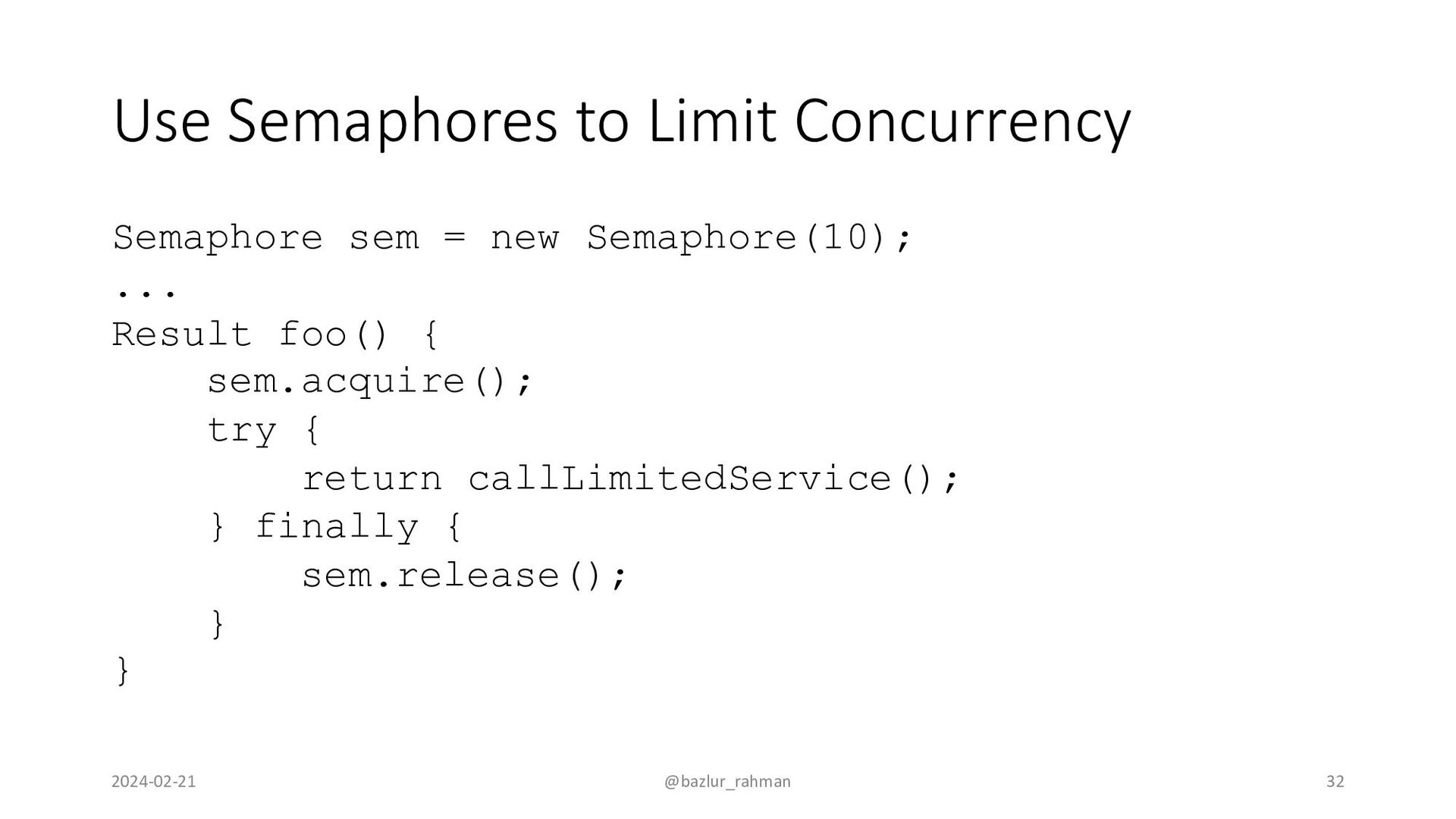
Use Semaphores to Limit Concurrency Semaphore sem = new Semaphore(10);
... Result foo() { sem.acquire(); try { return callLimitedService(); } finally { sem.release(); } } @bazlur_rahman 32 2024-02-21 -
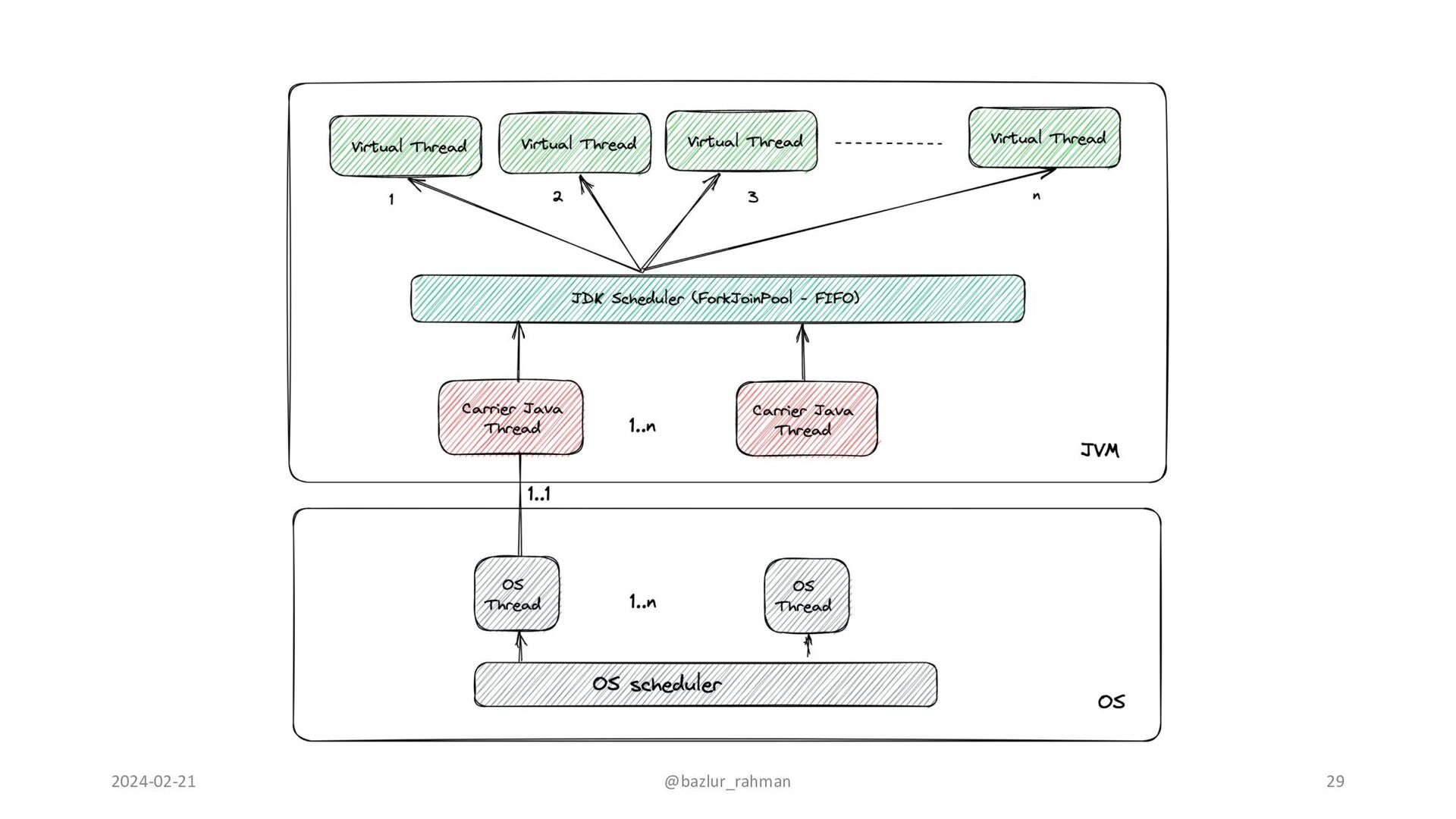
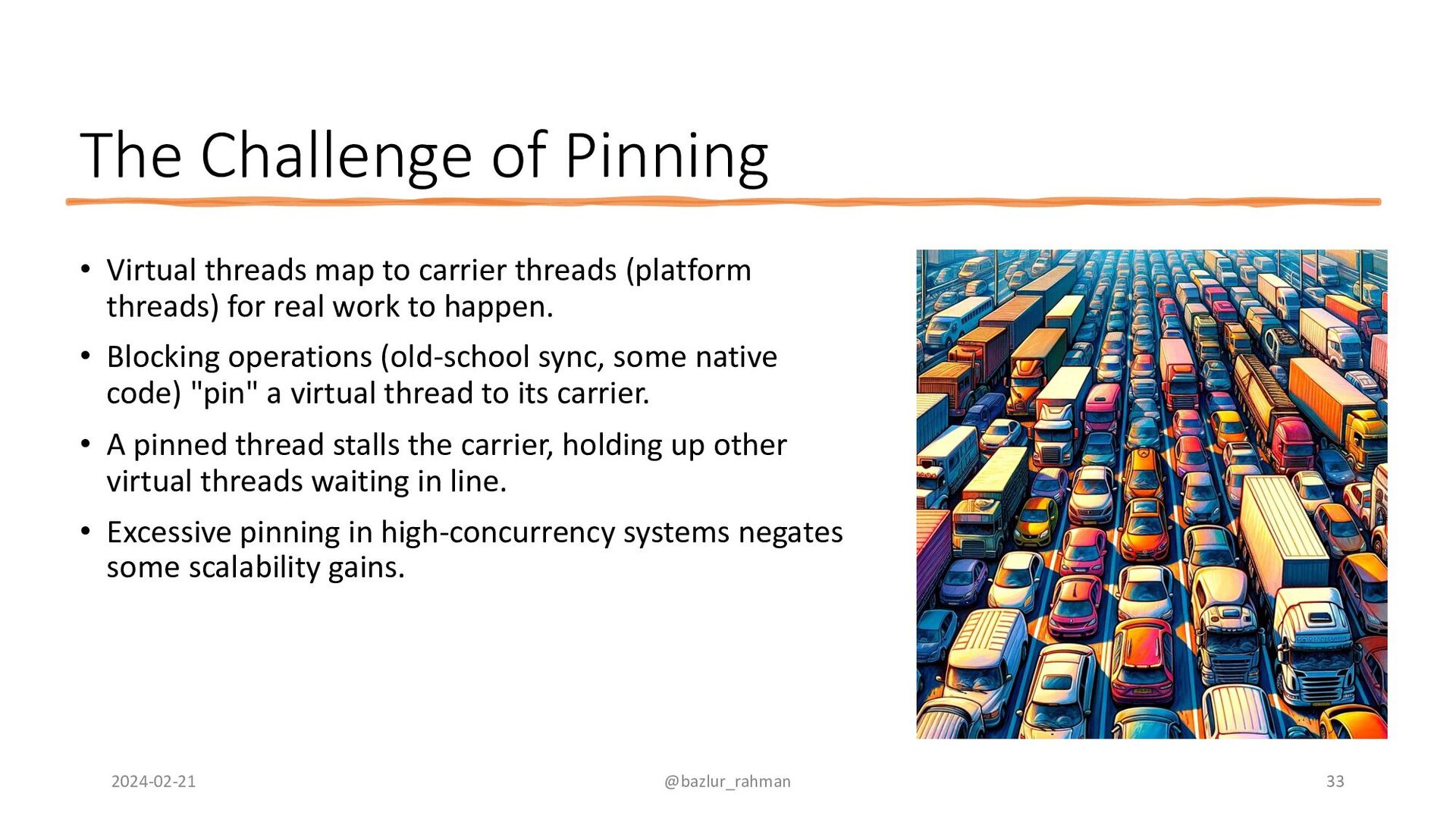
The Challenge of Pinning • Virtual threads map to carrier
threads (platform threads) for real work to happen. • Blocking operations (old-school sync, some native code) "pin" a virtual thread to its carrier. • A pinned thread stalls the carrier, holding up other virtual threads waiting in line. • Excessive pinning in high-concurrency systems negates some scalability gains. @bazlur_rahman 33 2024-02-21 -
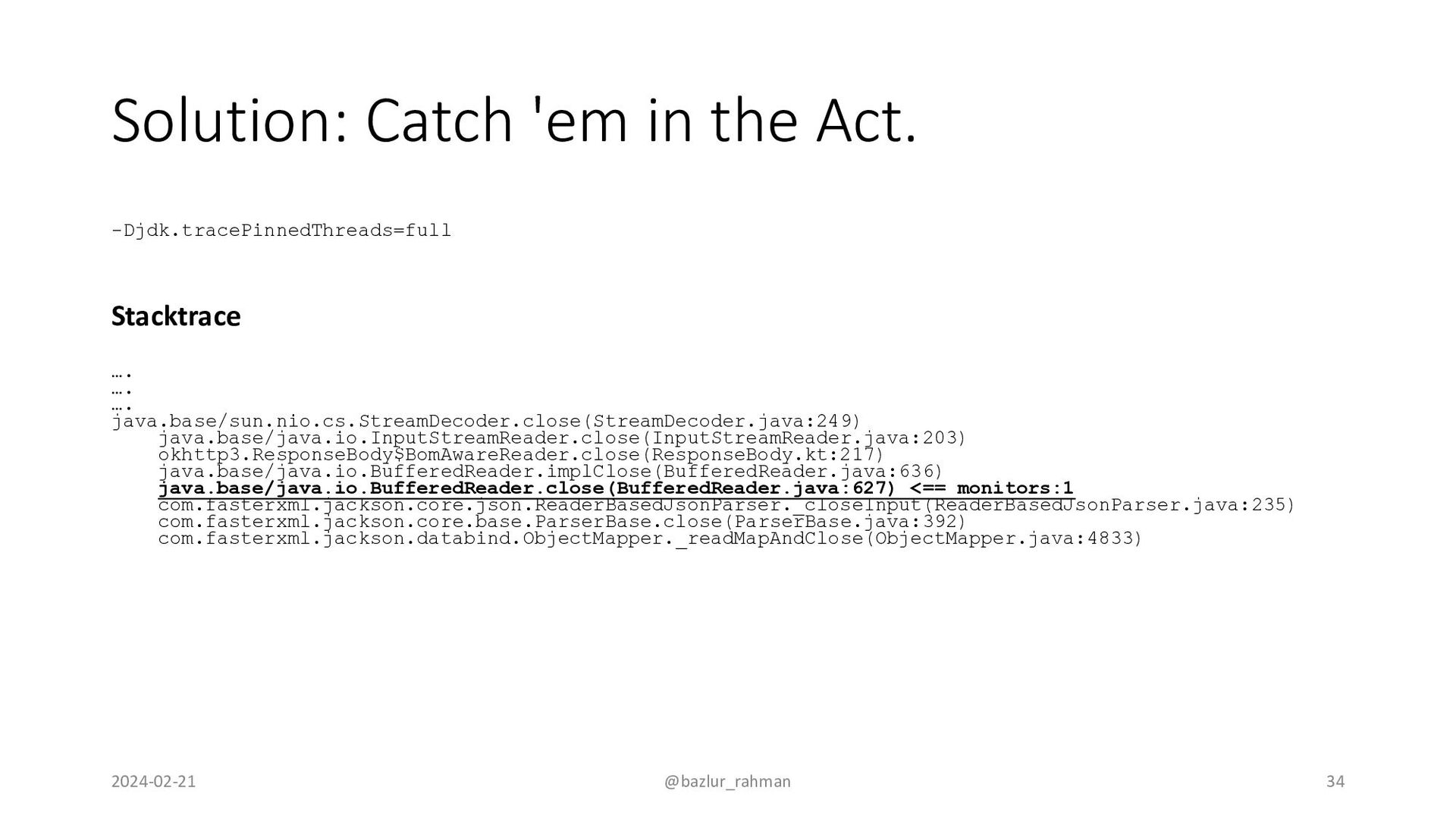
Solution: Catch 'em in the Act. -Djdk.tracePinnedThreads=full Stacktrace …. ….
…. java.base/sun.nio.cs.StreamDecoder.close(StreamDecoder.java:249) java.base/java.io.InputStreamReader.close(InputStreamReader.java:203) okhttp3.ResponseBody$BomAwareReader.close(ResponseBody.kt:217) java.base/java.io.BufferedReader.implClose(BufferedReader.java:636) java.base/java.io.BufferedReader.close(BufferedReader.java:627) <== monitors:1 com.fasterxml.jackson.core.json.ReaderBasedJsonParser._closeInput(ReaderBasedJsonParser.java:235) com.fasterxml.jackson.core.base.ParserBase.close(ParserBase.java:392) com.fasterxml.jackson.databind.ObjectMapper._readMapAndClose(ObjectMapper.java:4833) @bazlur_rahman 34 2024-02-21 -
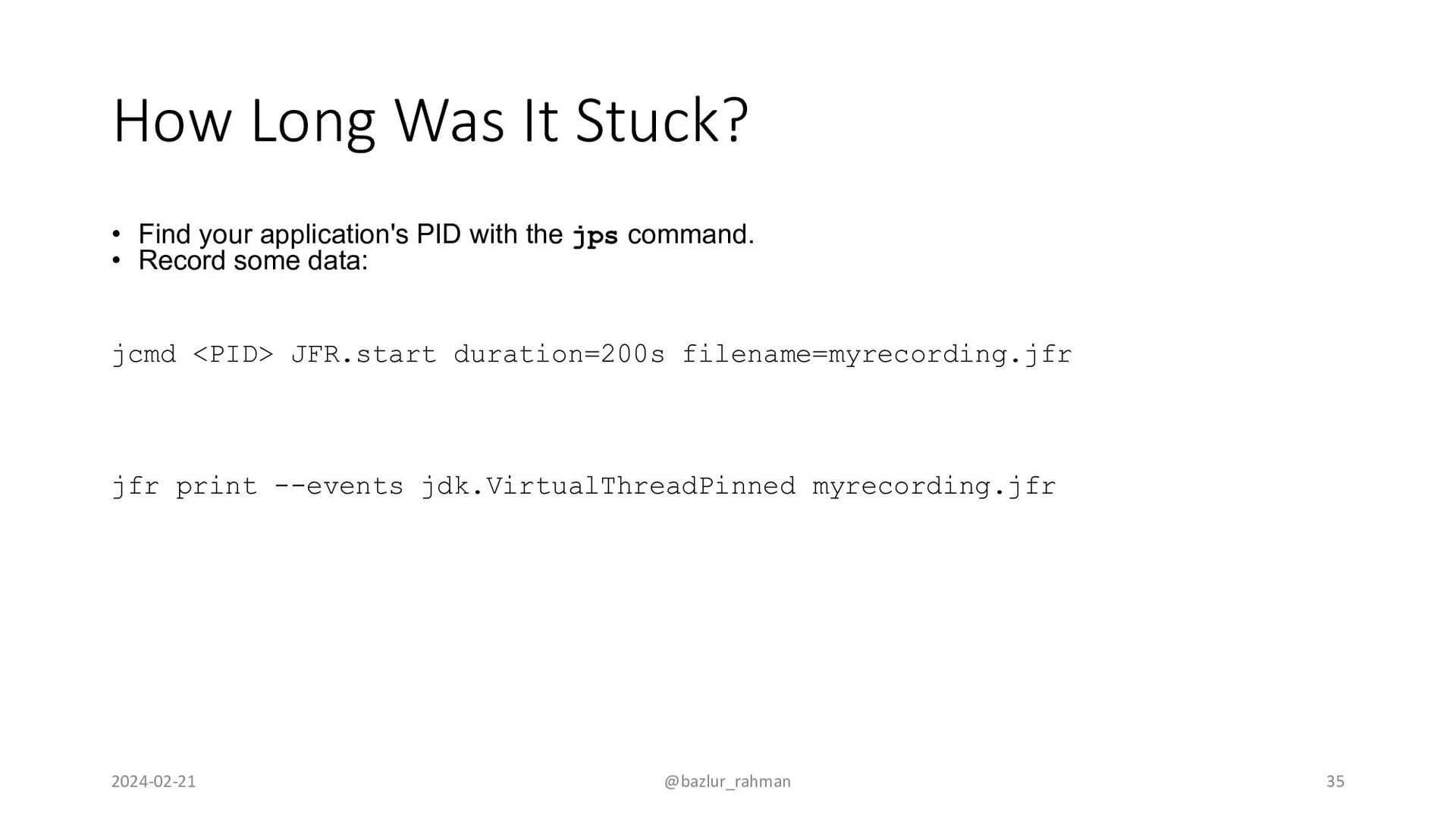
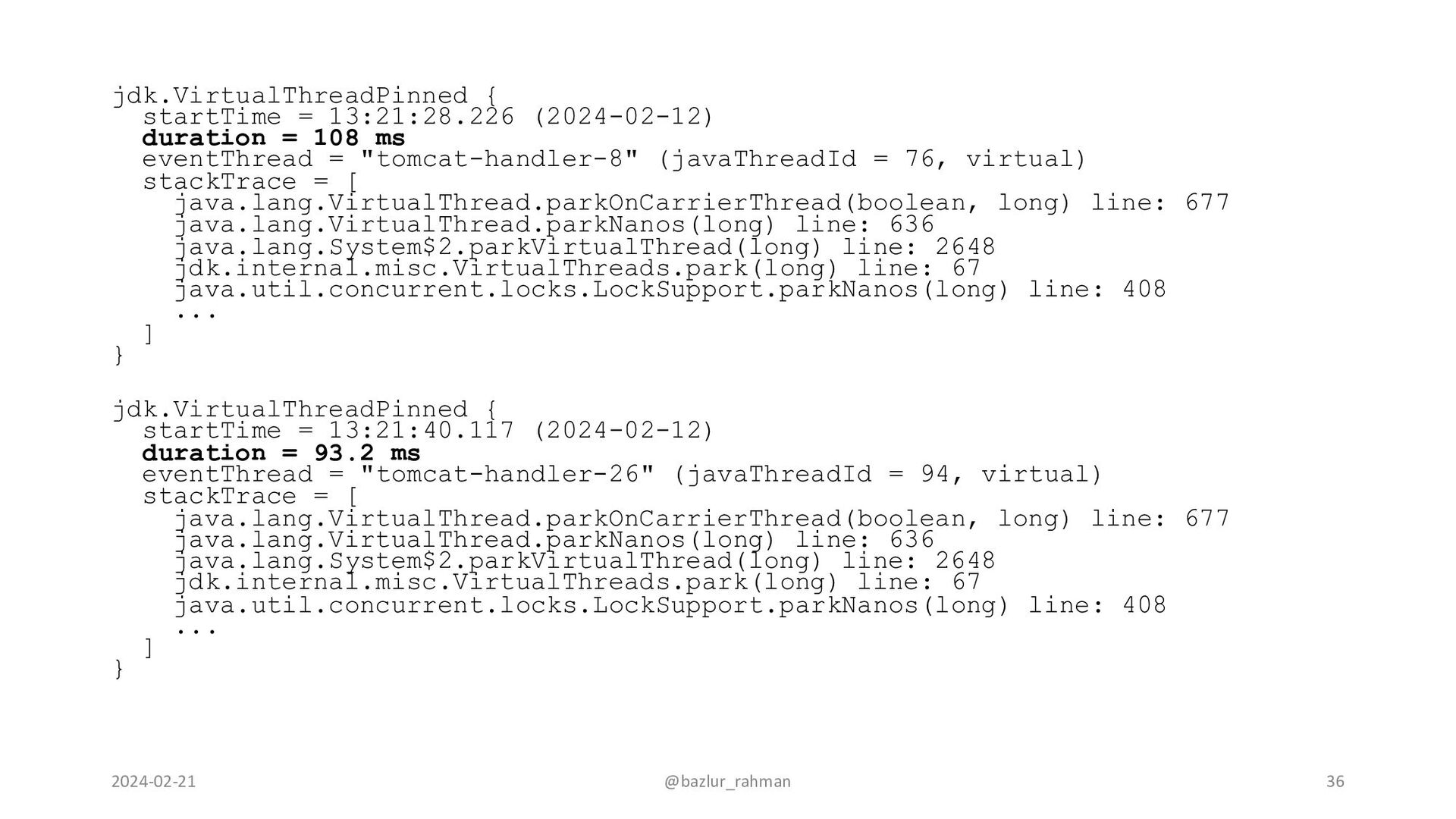
How Long Was It Stuck? • Find your application's PID
with the jps command. • Record some data: jcmd <PID> JFR.start duration=200s filename=myrecording.jfr jfr print --events jdk.VirtualThreadPinned myrecording.jfr @bazlur_rahman 35 2024-02-21 -
jdk.VirtualThreadPinned { startTime = 13:21:28.226 (2024-02-12) duration = 108 ms
eventThread = "tomcat-handler-8" (javaThreadId = 76, virtual) stackTrace = [ java.lang.VirtualThread.parkOnCarrierThread(boolean, long) line: 677 java.lang.VirtualThread.parkNanos(long) line: 636 java.lang.System$2.parkVirtualThread(long) line: 2648 jdk.internal.misc.VirtualThreads.park(long) line: 67 java.util.concurrent.locks.LockSupport.parkNanos(long) line: 408 ... ] } jdk.VirtualThreadPinned { startTime = 13:21:40.117 (2024-02-12) duration = 93.2 ms eventThread = "tomcat-handler-26" (javaThreadId = 94, virtual) stackTrace = [ java.lang.VirtualThread.parkOnCarrierThread(boolean, long) line: 677 java.lang.VirtualThread.parkNanos(long) line: 636 java.lang.System$2.parkVirtualThread(long) line: 2648 jdk.internal.misc.VirtualThreads.park(long) line: 67 java.util.concurrent.locks.LockSupport.parkNanos(long) line: 408 ... ] } @bazlur_rahman 36 2024-02-21 -
About Me • Staff Software Developer • Java Champion •
Jakarta EE Ambassador • JUG Leader • Published Author • InfoQ Editor of Java Queue • Editor of Foojay.io @bazlur_rahman 37 2024-02-21