Upgrade to Pro
— share decks privately, control downloads, hide ads and more …
Speaker Deck
Sign up for free
Menu
Search
Features
All features
Private URLs
Password Protection
Custom URLS
Scheduled publishing
Remove Branding
Restrict embedding
Deck Collections
Notes
Features
All features
Private URLs
Password Protection
Custom URLS
Scheduled publishing
Remove Branding
Restrict embedding
Deck Collections
Notes
Explore
Featured decks
Featured speakers
Programming
Technology
Storyboards
Explore
Featured decks
Featured speakers
Programming
Technology
Storyboards
Pricing
Search
Sign in
Sign up for free
Atomic CSS with Fela
Search
Sponsored
·
Your Podcast. Everywhere. Effortlessly.
Share. Educate. Inspire. Entertain. You do you. We'll handle the rest.
→
Ben Smithett
July 01, 2020
Programming
140
0
Share
Embed
Copy iframe code
Copy JS code
Copy link
Start on current slide
Atomic CSS with Fela
Ben Smithett
July 01, 2020
More Decks by Ben Smithett
See All by Ben Smithett
Objects in Space: A practical guide to CSS display, position & z-index
bensmithett
0
77
The 12MB Web Page: A tale of perfect PageSpeed scores & developer happiness
bensmithett
1
360
The UI is an Application
bensmithett
0
1.2k
Hands on with the modern front end stack
bensmithett
0
1.3k
The New Front End Stack: A really really really high level introduction
bensmithett
1
560
Smarter Sass/Less Builds with Webpack (MelbJS Edition)
bensmithett
0
350
Smarter Sass builds with Webpack
bensmithett
1
270
Faking Real Time: Optimistic Updates & Eventual Consistency (Decompress 2015)
bensmithett
0
520
Other Decks in Programming
See All in Programming
KiroのSpecで「五目並べ」を作ってみる
satoshi256kbyte
1
330
テストを司るデーモンに会いに行く 〜隔離した仮想マシンでテストを通すまで〜
h1d3mun3
1
600
Apple Intelligence を用いた個人情報誤送信防止、及びユーザーリクエスト体験の改善について
yukiny
0
270
Androidだけじゃない、DroidKaigiで広がった私の技術スタック
akkeylab
0
110
速習iPhone Duo対応
yuukiw00w
2
930
[2026-09-26]空論ジェネリックプロセス~テスト資産とAIで紡ぐ、再現可能なパフォーマンスチューニングの話~
tosite
0
250
Webの地図
yosuke_furukawa
PRO
6
5k
Intent as Code
shoppingjaws
6
1.1k
ソニーのクラウド共通基盤の変遷と AI時代の開発スタイルに合わせた進化 / The Journey of Sony’s Common Cloud Platform and Its Evolution for AI-Native Development
kenjiyoneyama
0
210
Turning Architecture into Unit Tests in the AI Era (NSSpain XIV)
steliosf
PRO
1
120
Simple Storage Service(S3) is not simple
iwatsukayura
0
120
すこし踏み込む CancellationToken
htkym
2
1.6k
Featured
See All Featured
Google's AI Overviews - The New Search
badams
0
1.6k
How Software Deployment tools have changed in the past 20 years
geshan
2
34k
Building Applications with DynamoDB
mza
96
7.2k
"I'm Feeling Lucky" - Building Great Search Experiences for Today's Users (#IAC19)
danielanewman
230
23k
VelocityConf: Rendering Performance Case Studies
addyosmani
331
25k
Site-Speed That Sticks
csswizardry
13
1.5k
Ten Tips & Tricks for a 🌱 transition
stuffmc
1
240
Being A Developer After 40
akosma
91
590k
A brief & incomplete history of UX Design for the World Wide Web: 1989–2019
jct
2
520
Unsuck your backbone
ammeep
672
58k
Money Talks: Using Revenue to Get Sh*t Done
nikkihalliwell
0
510
Typedesign – Prime Four
hannesfritz
42
3.2k
Transcript
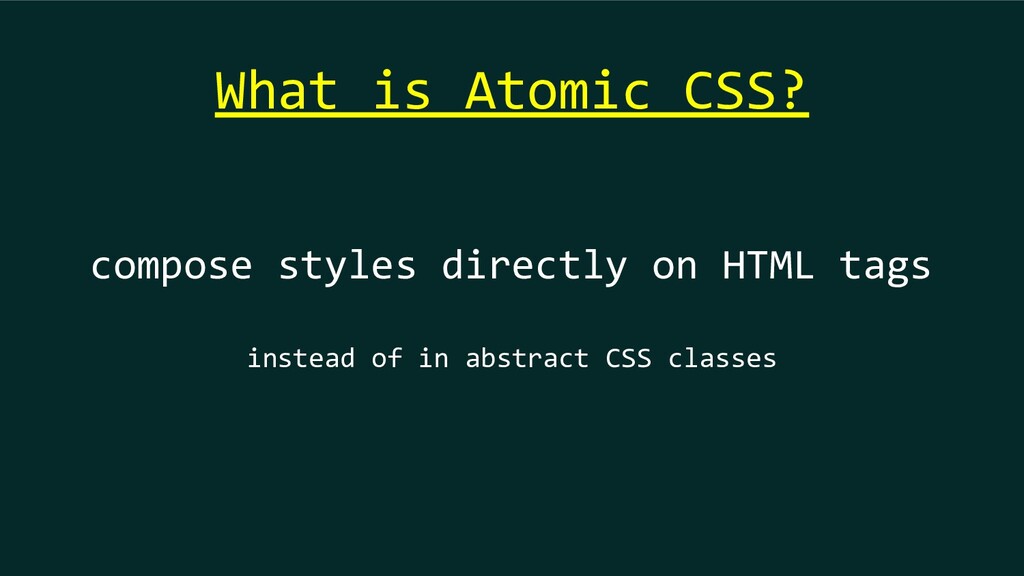
Atomic CSS with
What is Atomic CSS? compose styles directly on HTML tags
instead of in abstract CSS classes
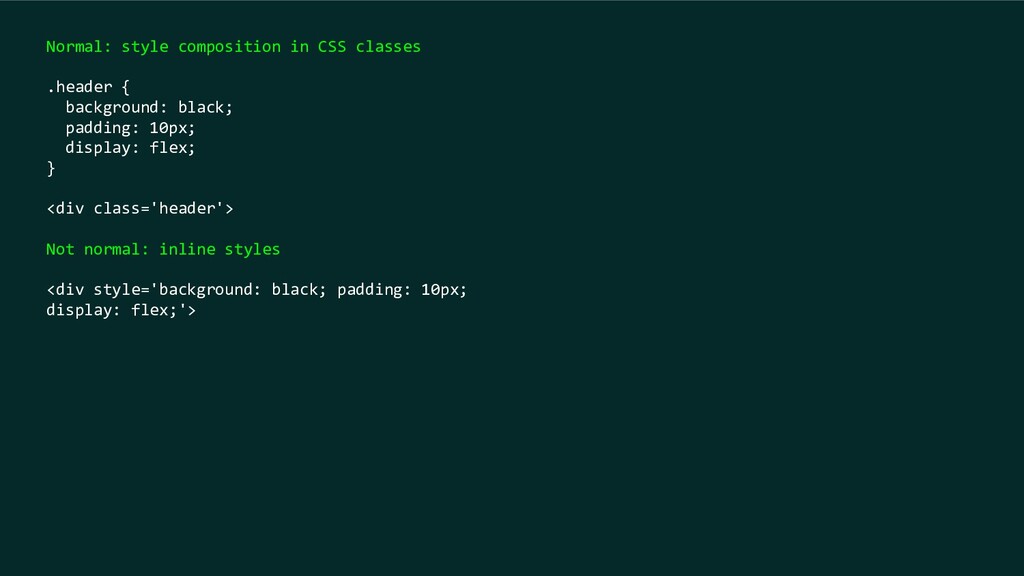
Normal: style composition in CSS classes .header { background: black;
padding: 10px; display: flex; } <div class='header'>
Normal: style composition in CSS classes .header { background: black;
padding: 10px; display: flex; } <div class='header'> Not normal: inline styles <div style='background: black; padding: 10px; display: flex;'>
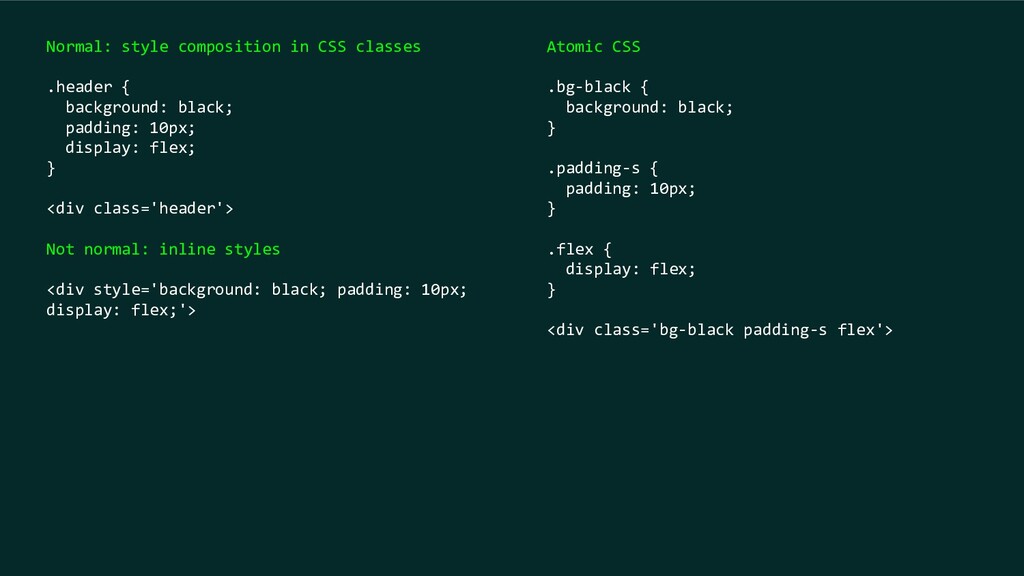
Atomic CSS .bg-black { background: black; } .padding-s { padding:
10px; } .flex { display: flex; } <div class='bg-black padding-s flex'> Normal: style composition in CSS classes .header { background: black; padding: 10px; display: flex; } <div class='header'> Not normal: inline styles <div style='background: black; padding: 10px; display: flex;'>
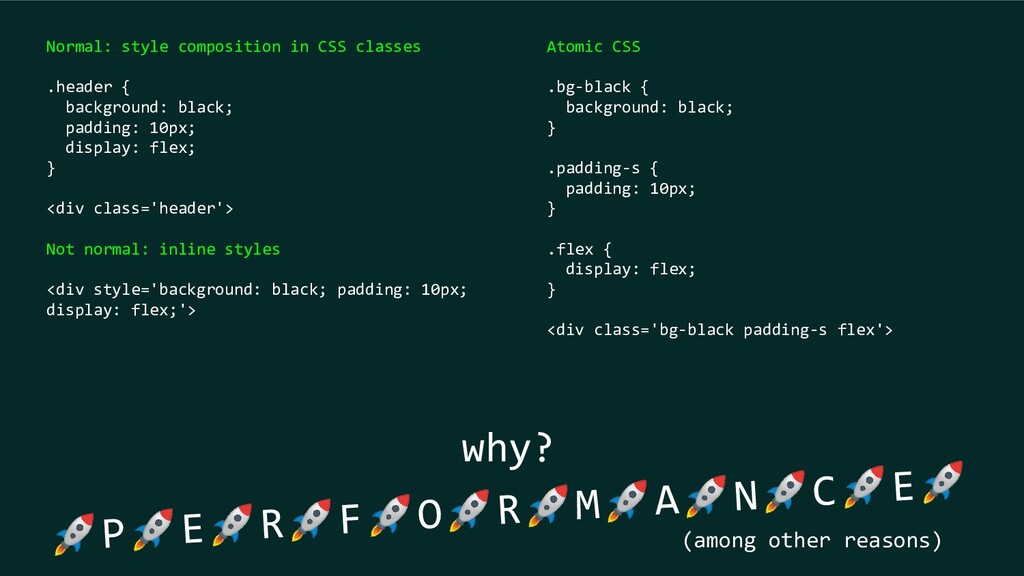
why? Atomic CSS .bg-black { background: black; } .padding-s {
padding: 10px; } .flex { display: flex; } <div class='bg-black padding-s flex'> Normal: style composition in CSS classes .header { background: black; padding: 10px; display: flex; } <div class='header'> Not normal: inline styles <div style='background: black; padding: 10px; display: flex;'> 🚀P🚀E🚀R🚀F🚀O🚀R🚀M🚀A🚀N🚀C🚀E🚀 (among other reasons)
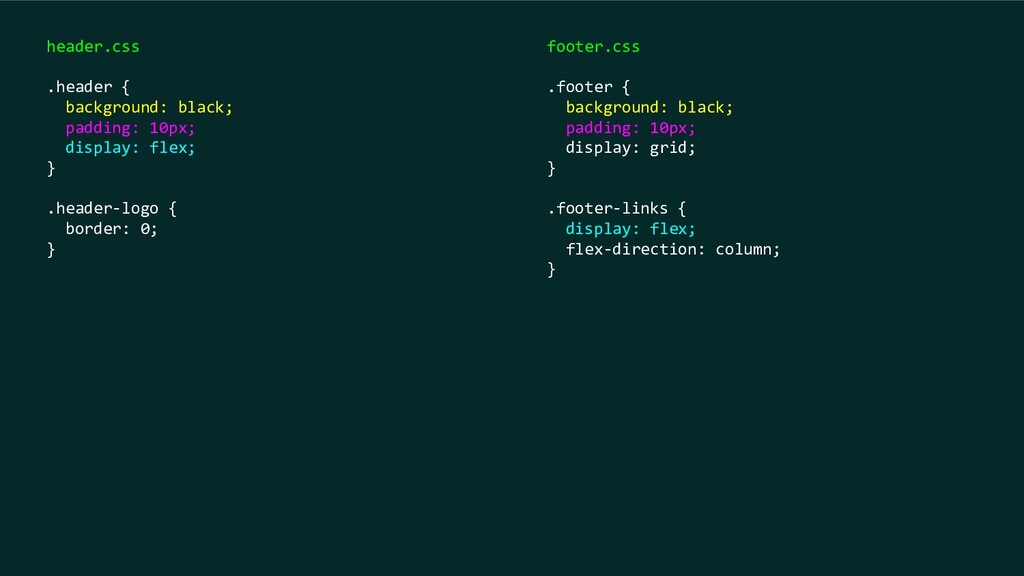
developing new features the normal way:
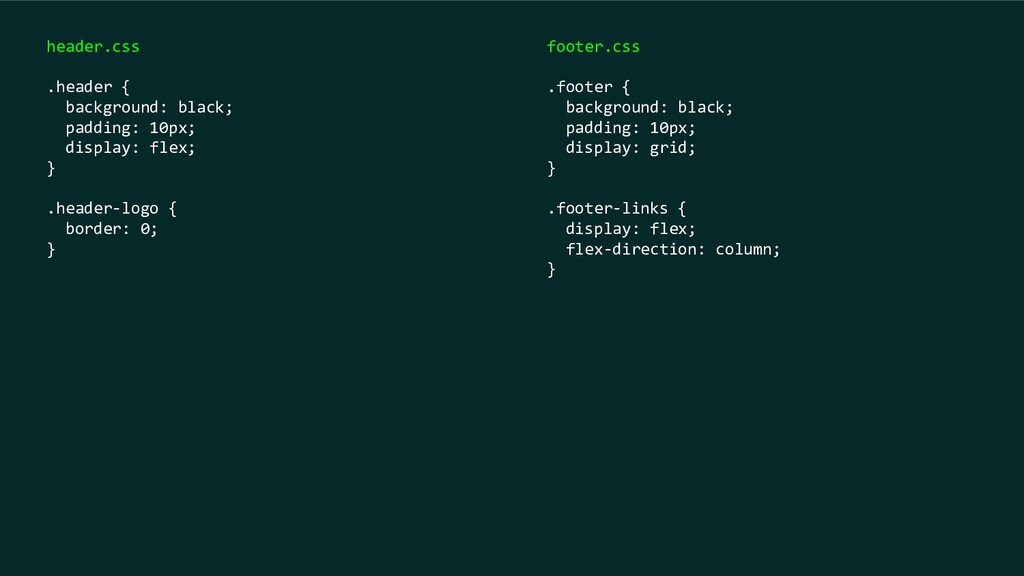
header.css .header { background: black; padding: 10px; display: flex; }
.header-logo { border: 0; }
header.css .header { background: black; padding: 10px; display: flex; }
.header-logo { border: 0; } footer.css .footer { background: black; padding: 10px; display: grid; } .footer-links { display: flex; flex-direction: column; }
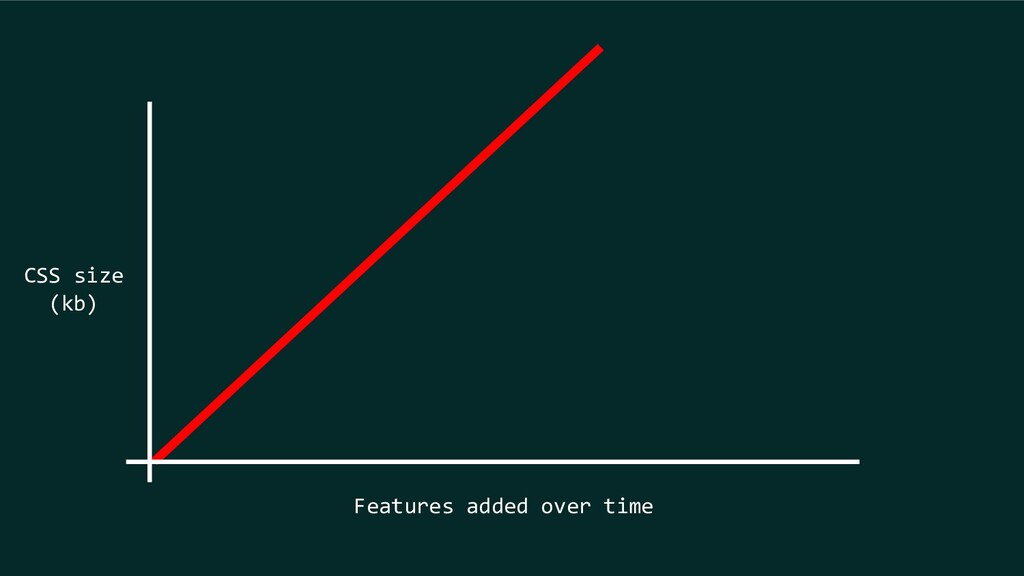
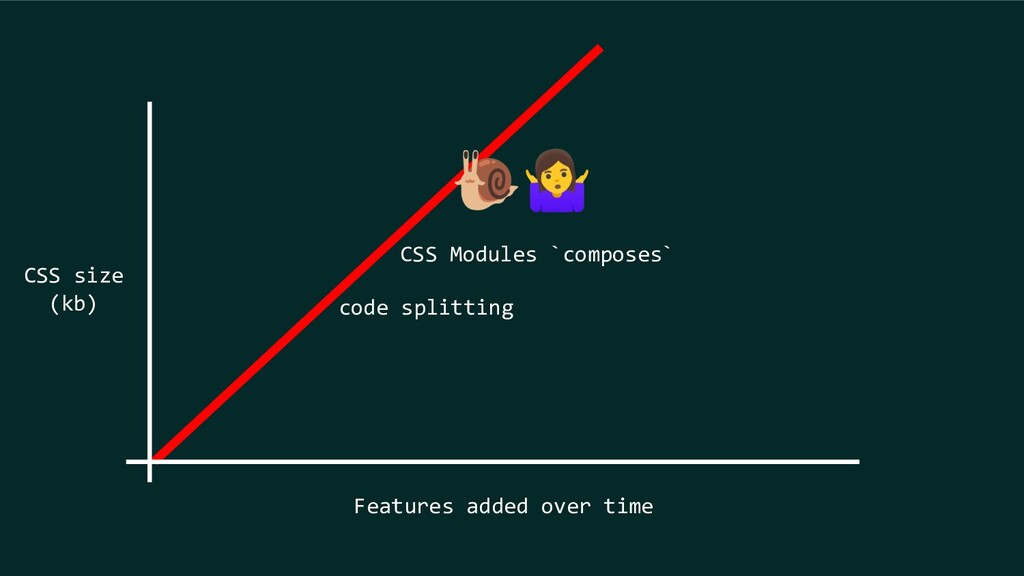
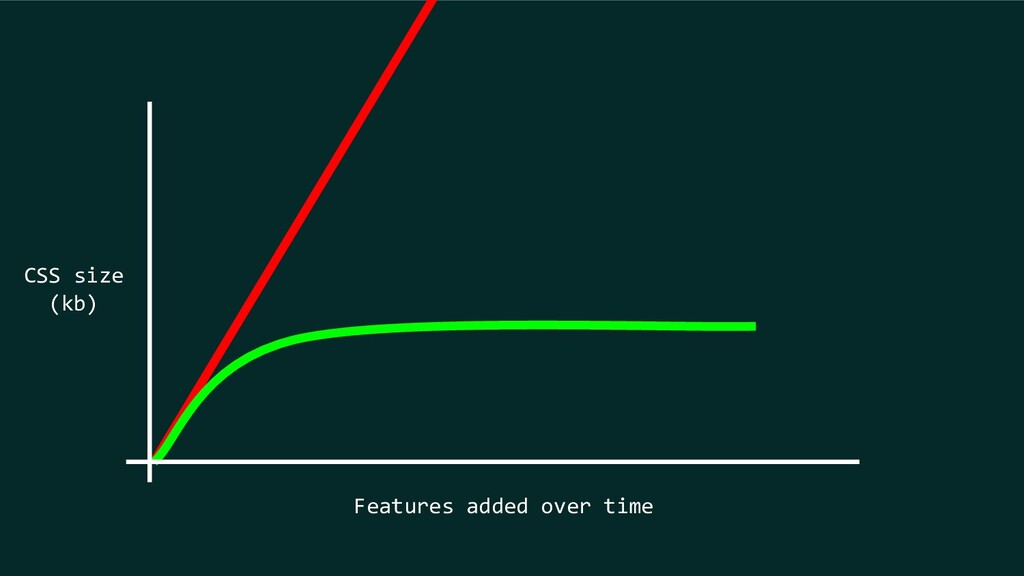
CSS size (kb) Features added over time
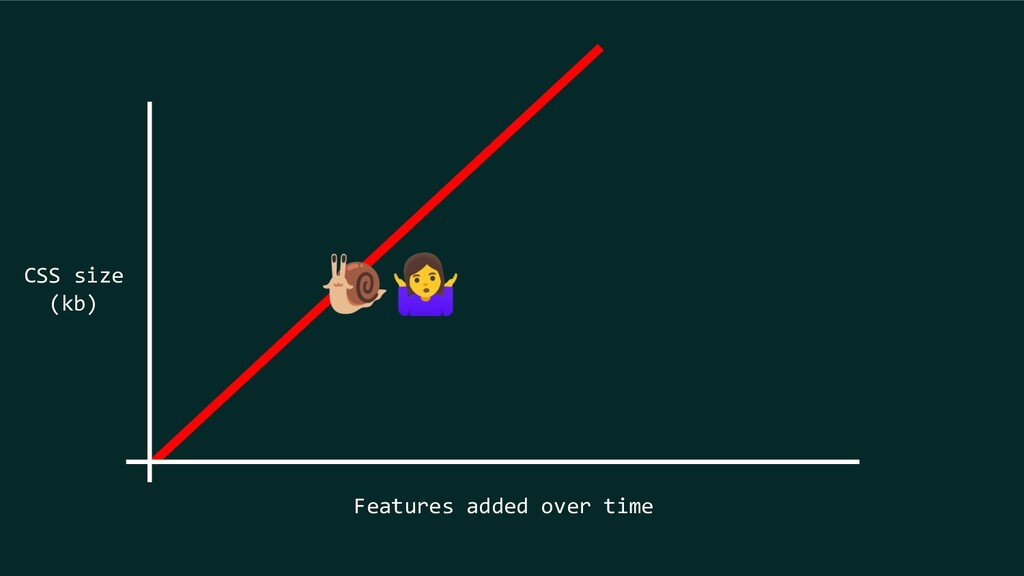
CSS size (kb) Features added over time 🐌
CSS size (kb) Features added over time 🐌 code splitting
CSS size (kb) Features added over time 🐌 code splitting
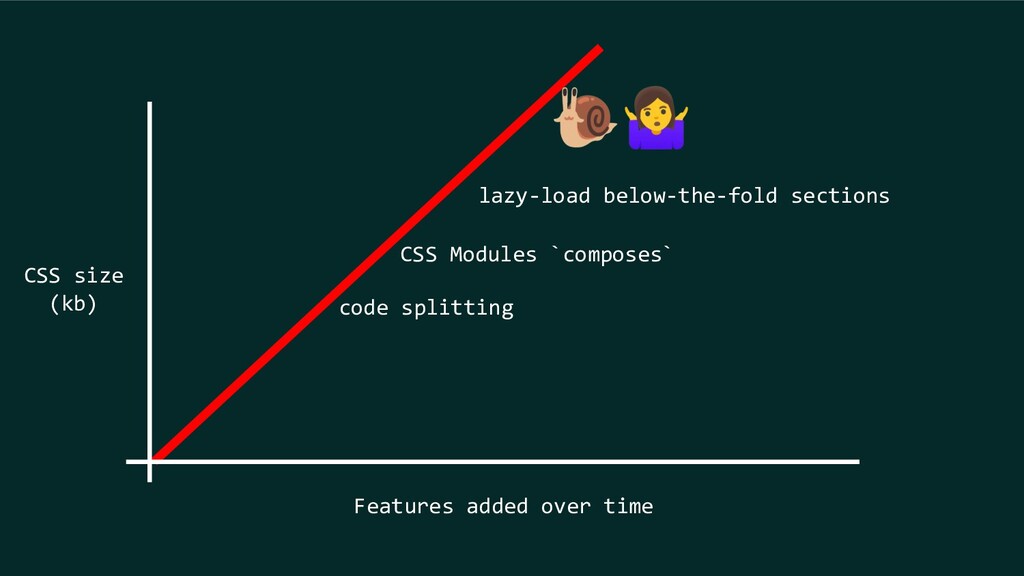
CSS Modules `composes`
CSS size (kb) Features added over time 🐌 code splitting
CSS Modules `composes` lazy-load below-the-fold sections
header.css .header { background: black; padding: 10px; display: flex; }
.header-logo { border: 0; } footer.css .footer { background: black; padding: 10px; display: grid; } .footer-links { display: flex; flex-direction: column; }
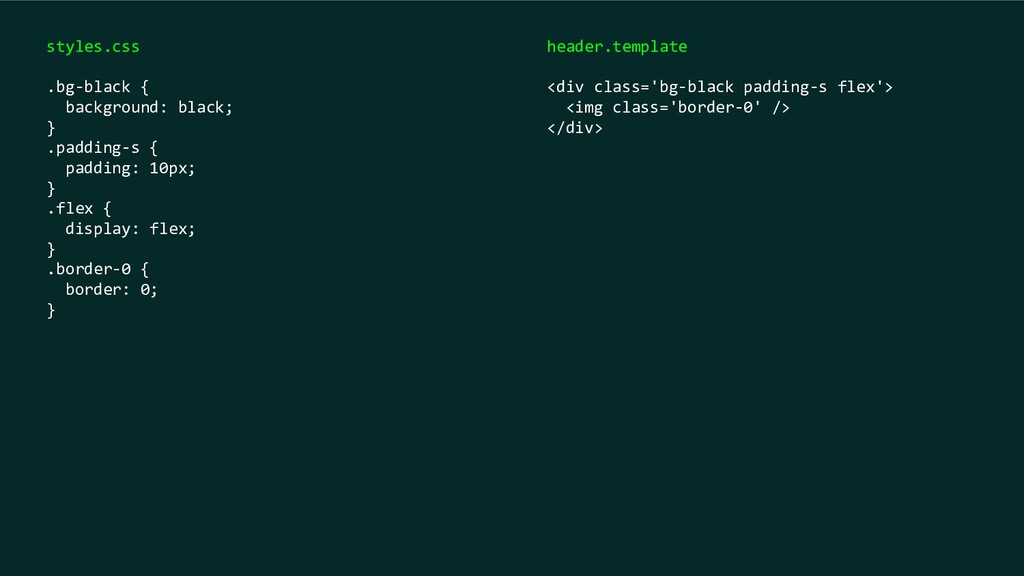
developing new features with Atomic CSS:
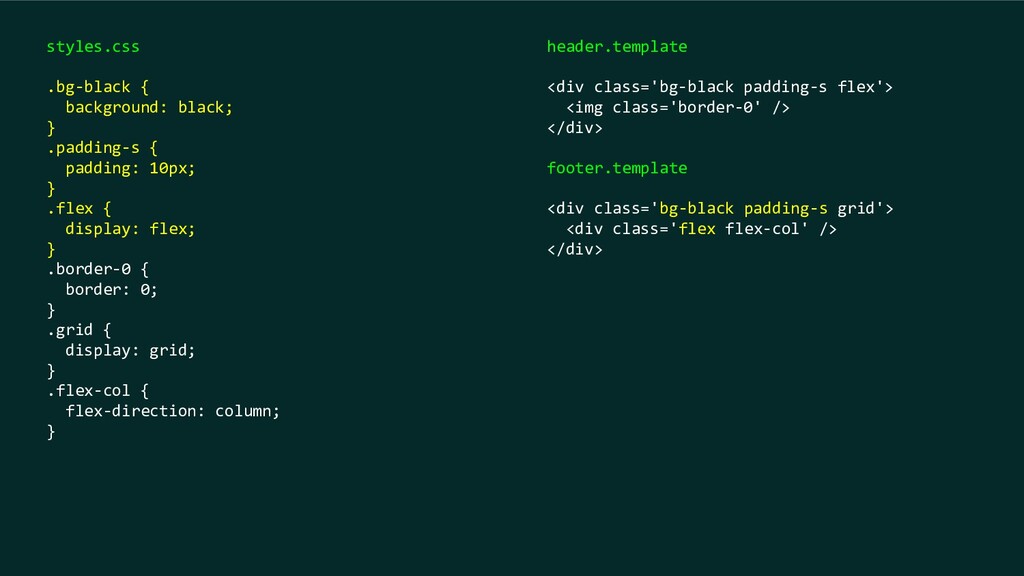
styles.css .bg-black { background: black; } .padding-s { padding: 10px;
} .flex { display: flex; } .border-0 { border: 0; } header.template <div class='bg-black padding-s flex'> <img class='border-0' /> </div>
styles.css .bg-black { background: black; } .padding-s { padding: 10px;
} .flex { display: flex; } .border-0 { border: 0; } .grid { display: grid; } .flex-col { flex-direction: column; } header.template <div class='bg-black padding-s flex'> <img class='border-0' /> </div> footer.template <div class='bg-black padding-s grid'> <div class='flex flex-col' /> </div>
styles.css .bg-black { background: black; } .padding-s { padding: 10px;
} .flex { display: flex; } .border-0 { border: 0; } .grid { display: grid; } .flex-col { flex-direction: column; } header.template <div class='bg-black padding-s flex'> <img class='border-0' /> </div> footer.template <div class='bg-black padding-s grid'> <div class='flex flex-col' /> </div>
CSS size (kb) Features added over time
yay! but...
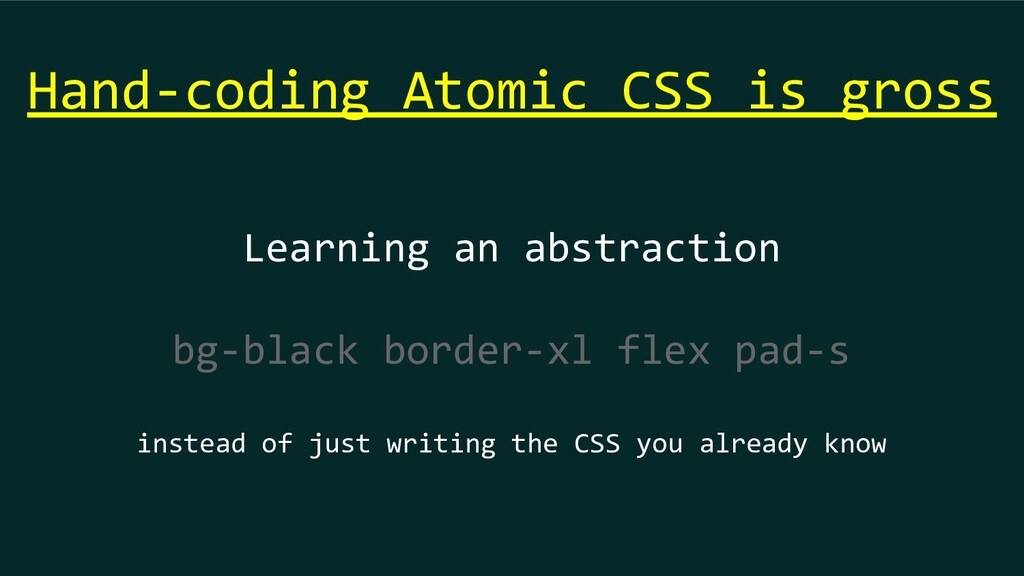
Hand-coding Atomic CSS is gross Learning an abstraction bg-black border-xl
flex pad-s instead of just writing the CSS you already know
Hand-coding Atomic CSS is gross bg-black border-xl flex pad-s not
CSS not on MDN
what if we could write dev-friendly not-very-performant-looking real CSS ...but
ship atomic classes?
write the CSS you know generate atomic classes
header.js <div className={css({ background: 'black', padding: 10, display: 'flex' })}>
<img className={css({ border: 0 })} /> </div>
header.js <div className={css({ background: 'black', padding: 10, display: 'flex' })}>
<img className={css({ border: 0 })} /> </div> footer.js <div className={css({ background: 'black', padding: 10, display: 'grid' })}> <div className={css({ display: 'flex',( flexDirection: 'column' })} /> </div>
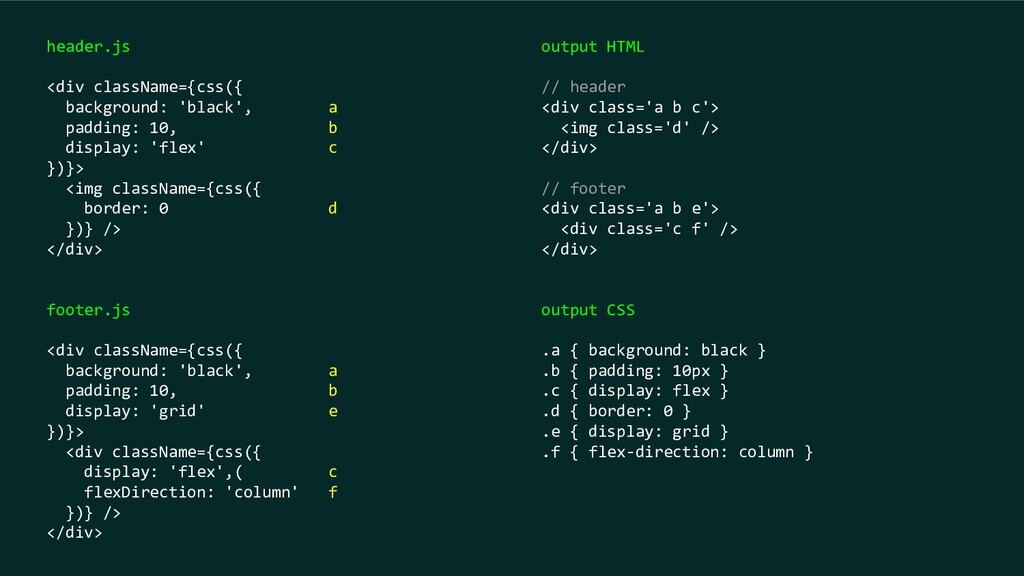
header.js <div className={css({ background: 'black', a padding: 10, b display:
'flex' c })}> <img className={css({ border: 0 d })} /> </div> footer.js <div className={css({ background: 'black', a padding: 10, b display: 'grid' e })}> <div className={css({ display: 'flex',( c flexDirection: 'column' f })} /> </div>
header.js <div className={css({ background: 'black', a padding: 10, b display:
'flex' c })}> <img className={css({ border: 0 d })} /> </div> footer.js <div className={css({ background: 'black', a padding: 10, b display: 'grid' e })}> <div className={css({ display: 'flex',( c flexDirection: 'column' f })} /> </div> output HTML // header <div class='a b c'> <img class='d' /> </div> // footer <div class='a b e'> <div class='c f' /> </div> output CSS .a { background: black } .b { padding: 10px } .c { display: flex } .d { border: 0 } .e { display: grid } .f { flex-direction: column }
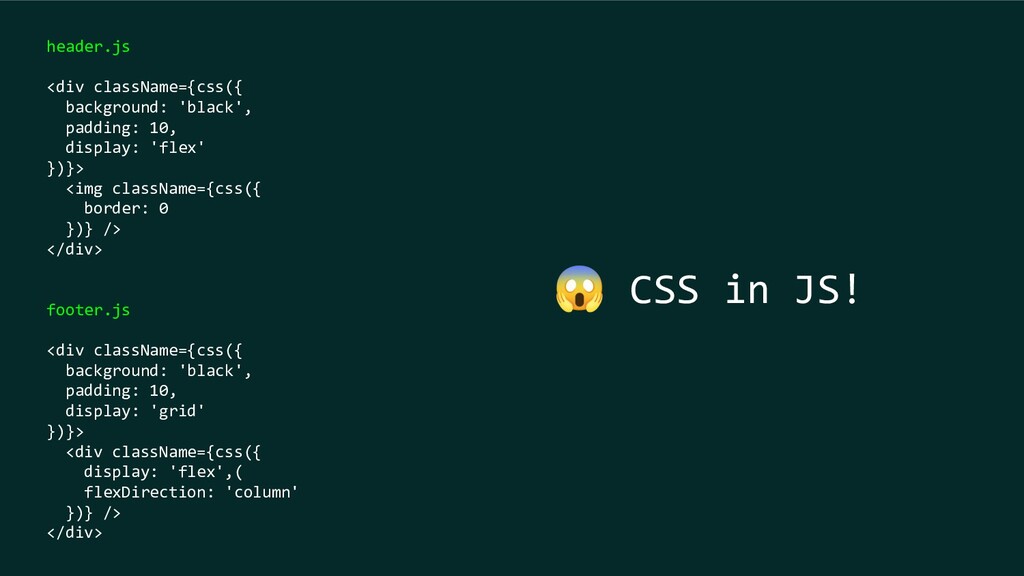
header.js <div className={css({ background: 'black', padding: 10, display: 'flex' })}>
<img className={css({ border: 0 })} /> </div> footer.js <div className={css({ background: 'black', padding: 10, display: 'grid' })}> <div className={css({ display: 'flex',( flexDirection: 'column' })} /> </div> 😱 CSS in JS!
It's the output that matters Authoring style is flexible 🙂
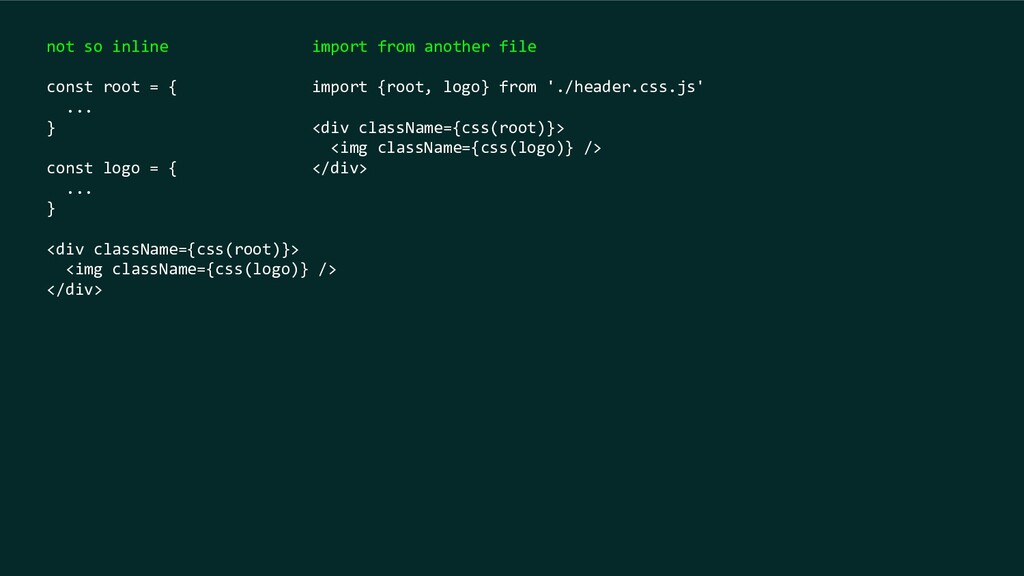
not so inline const root = { ... } const
logo = { ... } <div className={css(root)}> <img className={css(logo)} /> </div>
not so inline const root = { ... } const
logo = { ... } <div className={css(root)}> <img className={css(logo)} /> </div> import from another file import {root, logo} from './header.css.js' <div className={css(root)}> <img className={css(logo)} /> </div>
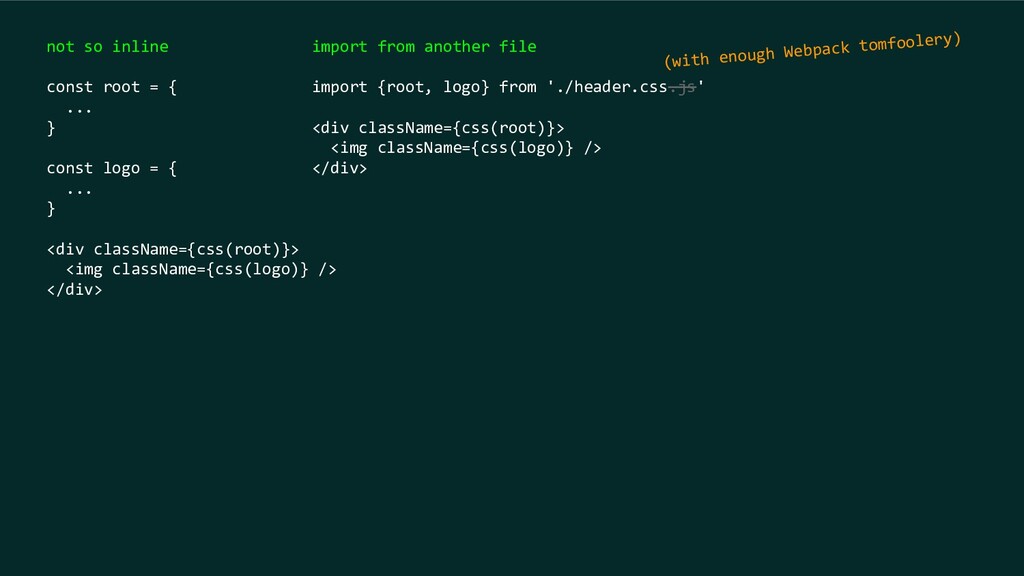
not so inline const root = { ... } const
logo = { ... } <div className={css(root)}> <img className={css(logo)} /> </div> import from another file import {root, logo} from './header.css.js' <div className={css(root)}> <img className={css(logo)} /> </div> (with enough Webpack tomfoolery)
not so inline const root = { ... } const
logo = { ... } <div className={css(root)}> <img className={css(logo)} /> </div> import from another file import {root, logo} from './header.css.js' <div className={css(root)}> <img className={css(logo)} /> </div> (with enough Webpack tomfoolery) Styled Components const Root = styled.div` background: black; padding: 10px; display: flex; ` const Logo = styled.img` border: 0; ` <Root> <Logo /> </Root>
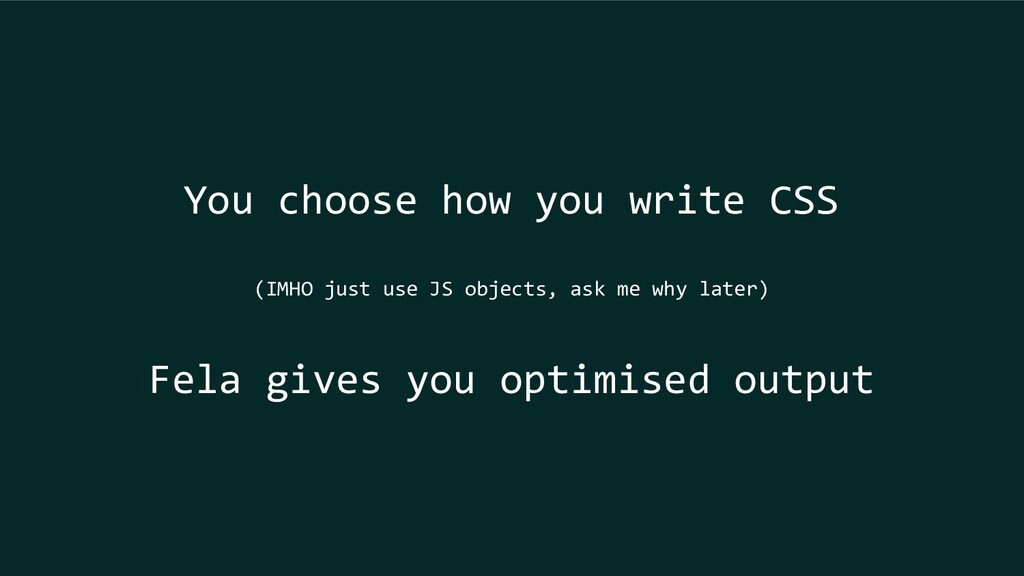
You choose how you write CSS (IMHO just use JS
objects, ask me why later) Fela gives you optimised output
Unlearn "clever" optimisations
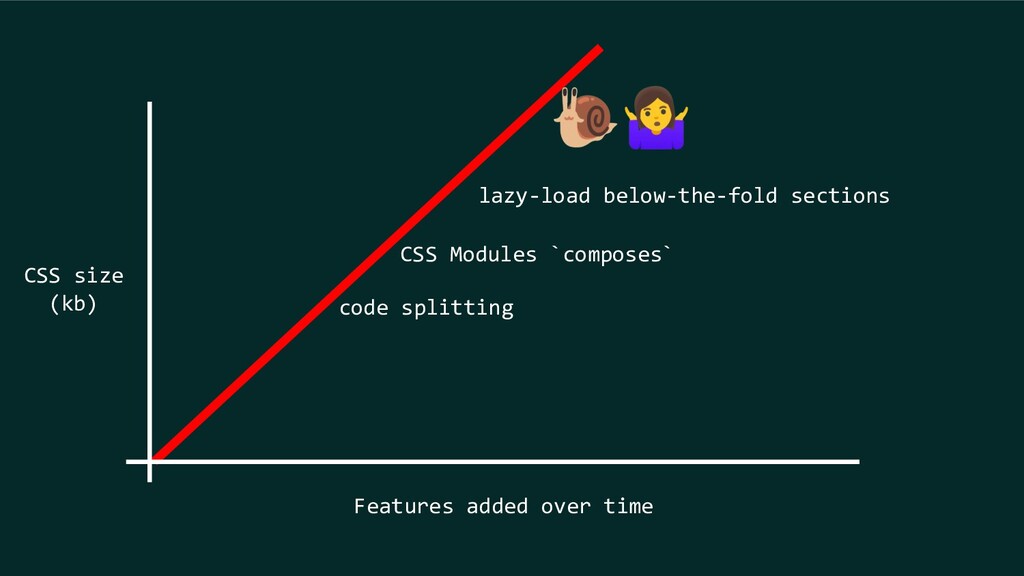
CSS size (kb) Features added over time 🐌 code splitting
CSS Modules `composes` lazy-load below-the-fold sections
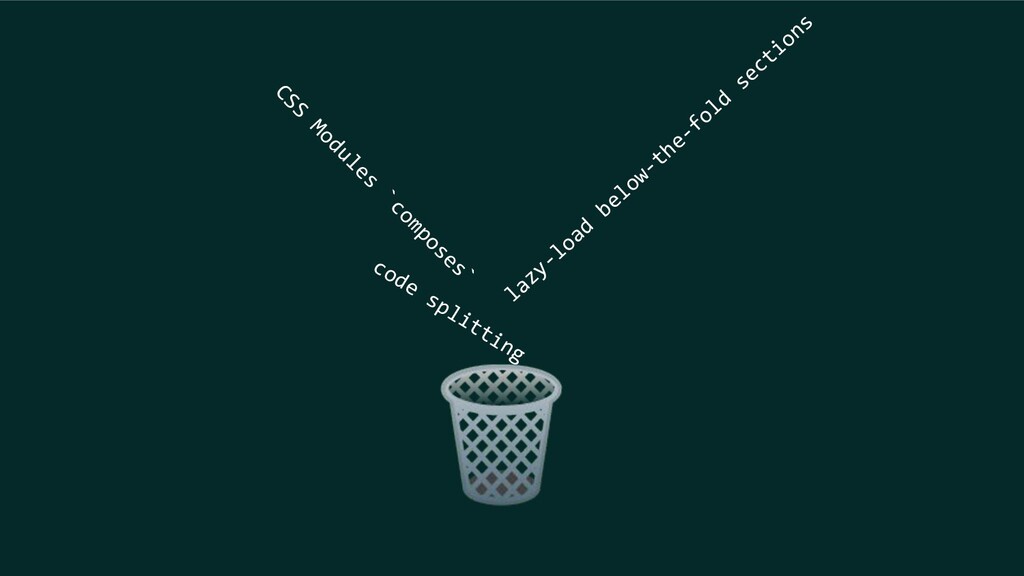
CSS Modules `composes` code splitting lazy-load below-the-fold sections 🗑
🗑 📄 📄 📄 CSS files
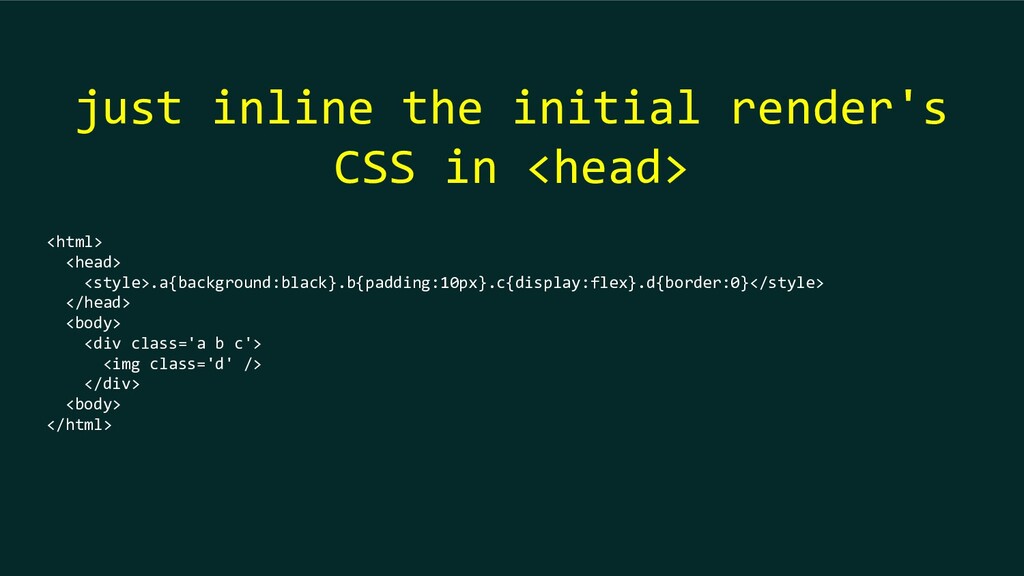
<html> <head> <style>.a{background:black}.b{padding:10px}.c{display:flex}.d{border:0}</style> </head> <body> <div class='a b c'> <img
class='d' /> </div> <body> </html> just inline the initial render's CSS in <head>
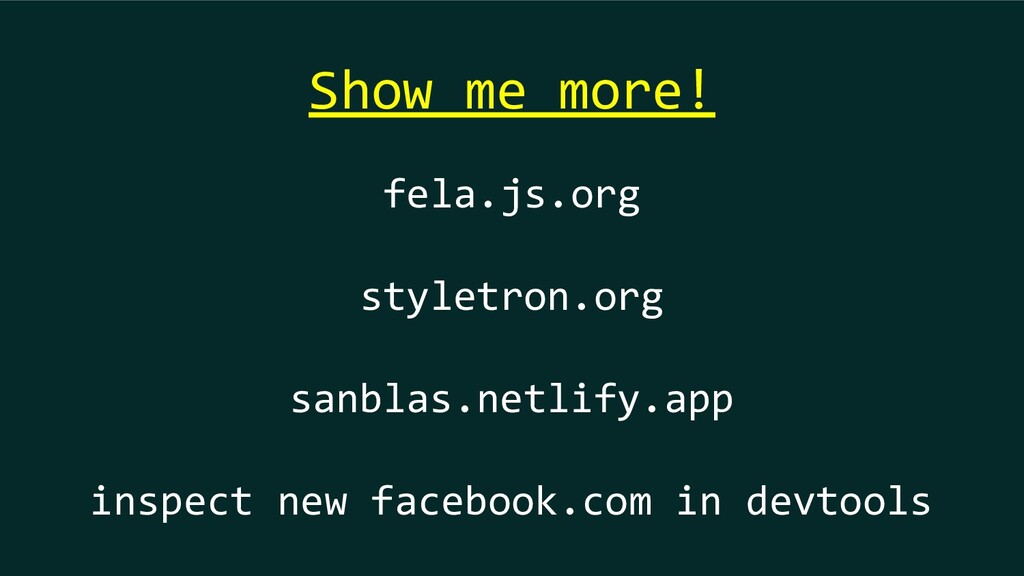
fela.js.org styletron.org sanblas.netlify.app inspect new facebook.com in devtools Show me
more!


 bensmithett
 satoshi256kbyte
 h1d3mun3
 yukiny
 akkeylab
 yuukiw00w
 tosite
 yosuke_furukawa
 shoppingjaws
 kenjiyoneyama
 steliosf
 iwatsukayura
 htkym
htkym
 badams
 geshan
 mza
mza
 danielanewman
 addyosmani
 csswizardry
 stuffmc
 akosma
 jct
jct
 ammeep
 nikkihalliwell
 hannesfritz