Upgrade to Pro — share decks privately, control downloads, hide ads and more …

Design Pattern Reloaded

Sponsored · Ship Features Fearlessly Turn features on and off without deploys. Used by thousands of Ruby developers.
Avatar for forax forax
March 13, 2015

Design Pattern Reloaded

About the Implementation of some GoF design patterns in Java 8

Avatar for forax

forax

March 13, 2015
Tweet

More Decks by forax

Other Decks in Programming

Transcript

  1. Design Pattern Reloaded Rémi Forax TourJUG march 2015 with Java8

    inside https://github.com/forax/design-pattern-reloaded
  2. Me, Myself and I I'm a Schizophren, so am I

    Assistant Prof at Paris East University Expert for JSR 292, 335 and 376 Open source dev: OpenJDK, ASM, Tatoo, etc Father of 3
  3. Design Pattern - 1994 Two big principles: – Program to

    an interface, not an implementation – Favor object composition over class inheritance Side note: The Gof doesn't respect its own principles => abstract classes are harmful !
  4. SOLID principles - 2000 Single Responsability Principle Open/Close Principle Liskov

    Substitution Principle Interface Segregation Principle Dependency Inversion Principle
  5. Functional Interface - 2014 Single Responsability Principle Open/Close Principle Liskov

    Substitution Principle Interface Segregation Principle Dependency Inversion Principle @FunctionalInterface interface DoIt { int apply(int val1, int val2); } a functional interface has only one abstract method
  6. Functional Interface - 2014 @FunctionalInterface interface DoIt { int apply(int

    val1, int val2); } a functional interface has only one abstract method Conceptually equivalent to typedef DoIt = (int, int) → int DoIt add = (x, y) -> x + y; DoIt mul = (a, b) -> a * b;
  7. A simple Logger public interface Logger { public void log(String

    message); public static void main(String[] args) { Logger logger = msg -> System.out.println(msg); } } No parenthesis if one argument
  8. Filtering logs public interface Logger { public void log(String message);

    } public interface Filter { public boolean accept(String message); } I want a Logger that only log messages that are accepted by a filter
  9. GoF Template Method ! public interface Logger { public void

    log(String message); } public interface Filter { public boolean accept(String message); } public abstract class FilterLogger implements Logger, Filter { private final Logger logger; public FilterLogger(Logger logger) { this.logger = Objects.requireNonNull(logger); } public void log(String message) { if (accept(message)) { logger.log(message); } } public abstract boolean accept(String message); }
  10. GoF Template Method :( public interface Logger { public void

    log(String message); } public interface Filter { public boolean accept(String message); } public abstract class FilterLogger implements Logger, Filter { private final Logger logger; public FilterLogger(Logger logger) { this.logger = Objects.requireNonNull(logger); } public void log(String message) { if (accept(message)) { logger.log(message); } } public abstract boolean accept(String message); }
  11. Favor object composition ! public class FilterLogger implements Logger {

    private final Logger logger; private final Filter filter; public FilterLogger(Logger logger, Filter filter) { this.logger = Objects.requireNonNull(logger); this.filter = Objects.requireNonNull(filter); } public void log(String message) { if (filter.accept(message)) { logger.log(message); } } }
  12. High order function / function composition public class Loggers {

    public static Logger filterLogger(Logger logger, Filter filter) { Objects.requireNonNull(logger); Objects.requireNonNull(filter); return message -> { if (filter.accept(message)) { logger.log(message); } }; } } Logger logger = msg - > writer.write(msg); Logger filterLogger = Logger.filterLogger(logger, msg -> msg.startsWith("foo"));
  13. Function composition using instance (default) method public interface Logger {

    public void log(String message); public default Logger filter(Filter filter) { Objects.requireNonNull(filter); return message -> { if (filter.accept(message)) { log(message); } }; } } Logger logger = msg - > writer.write(msg); Logger filterLogger = logger.filter(msg -> msg.startsWith("foo")); g.filter(f)
  14. With Java 8 predefined interfaces public interface Logger { public

    void log(String message); public default Logger filter(Predicate<String> filter) { Objects.requireNonNull(filter); return message -> { if (filter.test(message)) { log(message); } }; } } package java.util.function; @FunctionalInterface public interface Predicate<T> { public boolean test(T t); }
  15. FP vs OOP from 10 000 miles FP can be

    seen through GoF Principles: – Program to an interface, not an implementation – Favor object composition over class inheritance => no class, no inheritance, only functions => function composition <=> object composition
  16. Structural Patterns Adapter, Bridge, Decorator, Composite, Proxy, Flyweight, etc most

    of them derive from “Favor object composition over class inheritance”
  17. Yet Another Logger public enum Level { WARNING, ERROR }

    public interface Logger2 { public void log(Level level, String message); } Logger2 logger2 = (level, msg) -> System.out.println(level + " " + msg); logger2.log(ERROR, "abort abort !"); // how to adapt the two loggers ? Logger logger = logger2 ??
  18. Partial Application Set the value of some parameters of a

    function (also called curryfication) interface DoIt { int apply(int x, int y); } interface DoIt1 { int apply(int x); } DoIt add = (x, y) -> x + y; DoIt1 add1 = x -> add.apply(x, 1); DoIt mul = (a, b) - > a * b; DoIt1 mulBy2 = a - > mul.apply(2, a);
  19. Partial Application log(msg) == log2(level, msg) with level = ERROR

    public interface Logger { public void log(String message); } public interface Logger2 { public void log(Level level, String message); public default Logger error() { return msg -> log(ERROR, msg); } }
  20. Adapter public interface Logger2 { public void log(Level level, String

    message); public default Logger error() { return msg -> log(ERROR, msg); } } Logger2 logger2 = ... Logger logger = logger2.error(); logger.log("abort abort !");
  21. Method Reference in Java 8 The operator :: allows to

    reference an existing method BiConsumer<PrintStream, Object> cons = PrintStream::println; type package java.util.function; public interface Consumer<T> { public void accept(T t); } public interface BiConsumer<T, U> { public void accept(T t, U u); }
  22. Partial Application & Method Ref. The operator :: also allows

    to do partial application on the receiver BiConsumer<PrintStream, Object> consumer = PrintStream::println; PrintStream out = System.out; Consumer<Object> consumer2 = out::println; type instance
  23. Command A command is just a function interface Command {

    public void perform(); } Command command = () - > System.out.println("hello command");
  24. Sum values of a CSV ? public class SumCSV {

    public static double parseAndSum(Path path) throws … { try (Stream<String> lines = Files.lines(path)) { return lines .flatMap(line -> Arrays.stream(line.split(",")) .mapToDouble(token -> Double.parseDouble(token)) .sum(); } } }
  25. Sum values of a CSV ? (using method reference) public

    class SumCSV { public static double parseAndSum(Path path) throws … { try (Stream<String> lines = Files.lines(path)) { return lines .flatMap(Pattern.compile(",")::splitAsStream) .mapToDouble(Double::parseDouble) .sum(); } } } Partial application
  26. Observer Decouple work in order to close the CVSParser (as

    in Open/Close Principle) public interface Observer { public void data(double value); } public class CSVParser { public static void parse(Path path, Observer observer) throws … { ... } } public class SumCSV { public double parseAndSum(Path path) throws … { CSVParser.parse(path, ...); ... } }
  27. Observer – Client side public interface Observer { public void

    data(double value); } public class CSVParser { public static void parse(Path path, Observer observer) throws … { ... } } public class SumCSV { private double sum; public double parseAndSum(Path path) throws … { CSVParser.parse(path, value -> sum += value); return sum; } } side effect
  28. Observer The closed module public interface Observer { public void

    data(double value); } public class CSVParser { public static void parse(Path path, Observer observer) throws … { try (Stream<String> lines = Files.lines(path)) { lines.flatMap(Pattern.compile(",")::splitAsStream) .mapToDouble(Double::parseDouble) .forEach(value -> observer.data(value)); } } }
  29. Functional Interfaces conversion DoubleStream.forEach() takes a DoubleConsumer as parameter public

    interface Observer { public void data(double value); } public class CSVParser { public static void parse(Path path, Observer observer) throws … { try (Stream<String> lines = Files.lines(path)) { lines.flatMap(Pattern.compile(",")::splitAsStream) .mapToDouble(Double::parseDouble) .forEach(value -> observer.data(value)); } } } DoubleConsumer
  30. Functional Interfaces conversion :: can be used to do interface

    to interface conversion public interface Observer { public void data(double value); } public class CSVParser { public static void parse(Path path, Observer observer) throws … { try (Stream<String> lines = Files.lines(path)) { lines.flatMap(Pattern.compile(",")::splitAsStream) .mapToDouble(Double::parseDouble) .forEach(observer::data); } } } DoubleConsumer
  31. Iteration 2 kinds – Internal iteration (push == Observer) –

    External iteration (pull == Iterator) List<String> list = … Internal: list.forEach(item -> System.out.println(item)); External: for(String item: list) { System.out.println(item); }
  32. External iteration is harder to write forEach is easier to

    write than an Iterator public class ArrayList<E> { private E[] elementData; private int size; public void forEach(Consumer<E> consumer) { for(int I = 0; i < size; i++) { consumer.accept(elementData[i]); } } public Iterator<E> iterator() { return new Iterator<E>() { private int i; public boolean hasNext() { return i < size; } public E next() { return elementData[i++]; } }; } }
  33. Internal Iteration is less powerful in Java No side effect

    allowed ! List<Double> list = … Internal: double sum = 0; list.forEach(value -> sum += value); External: for(double value: list) { sum += value; } sum is not effectively final
  34. Visitor ? Given a hierarchy public interface Vehicle { …

    } public class Car implements Vehicle { … } public class Moto implements Vehicle { … } want to close it but allow to add new operations and new subtypes !
  35. Destructured Visitor API API I want Visitor<String> visitor = new

    Visitor<>(); visitor.when(Car.class, car -> "car") .when(Moto.class, moto -> "moto"); Vehicle vehicle = ... String text = visitor.call(vehicle); package java.util.function; public interface Function<T, R> { public R apply(T t); public default <V> Function<V,R> compose(Function<V,T> f) {} public default <V> Function<T,V> andThen(Function<R,V> f) {} }
  36. Destructured Visitor public class Visitor<R> { public <T> Visitor<R> when(

    Class<T> type, Function<T, R> fun) { … } public R call(Object receiver) { … } } Visitor<String> visitor = new Visitor<>(); visitor.when(Car.class, car -> "car") .when(Moto.class, moto -> "moto"); Vehicle vehicle = ... String text = visitor.call(vehicle);
  37. Destructured Visitor Java has no existential type :( public class

    Visitor<R> { private final HashMap<Class<?>, Function<Object, R>> map = new HashMap<>(); public <T> Visitor<R> when(Class<T> type, Function<T, R> f) { map.put(type, f); return this; } public R call(Object receiver) { return map.getOrDefault(receiver.getClass(), r -> { throw new ISE(...); }) .apply(receiver); } } Doesn't compile !
  38. Destructured Visitor Java has no existential type :( public class

    Visitor<R> { private final HashMap<Class<?>, Function<?, R>> map = new HashMap<>(); public <T> Visitor<R> when(Class<T> type, Function<T, R> f) { map.put(type, f); return this; } public R call(Object receiver) { return map.getOrDefault(receiver.getClass(), r -> { throw … }) .apply(receiver); } } Doesn't compile !
  39. Destructured Visitor All problems can be solved by another level

    of indirection :) public class Visitor<R> { private final HashMap<Class<?>, Function<Object, R>> map = new HashMap<>(); public <T> Visitor<R> when(Class<T> type, Function<T, R> f) { map.put(type, object -> f.apply(type.cast(object))); return this; } public R call(Object receiver) { return map.getOrDefault(receiver.getClass(), r -> { throw … }) .apply(receiver); } }
  40. Destructured Visitor + function composition And using function composition public

    class Visitor<R> { private final HashMap<Class<?>, Function<Object, R>> map = new HashMap<>(); public <T> Visitor<R> when(Class<T> type, Function<T, R> f) { map.put(type, f.compose(type::cast)); return this; } public R call(Object receiver) { return map.getOrDefault(receiver.getClass(), r -> { throw … }) .apply(receiver); } }
  41. Creational Patterns Static Factory Factory method Singleton Abstract Factory Builder

    Monad ? Same problem as template method Who want a global ?
  42. Instance Creation public interface Vehicle { … } public class

    Car implements Vehicle { public Car(Color color) { … } } public class Moto implements Vehicle { public Moto(Color color) { … } } I want to create only either 5 red cars or 5 blue motos ?
  43. Instance Factory public interface VehicleFactory { public Vehicle create(); }

    public List<Vehicle> create5(VehicleFactory factory) { return range(0,5) .mapToObj(i -> factory.create()) .collect(toList()); } VehicleFactory redCarFactory = () -> new Car(RED); VehicleFactory blueMotoFactory = () -> new Moto(BLUE); List<Vehicle> redCars = create5(redCarFactory); List<Vehicle> blueCars = create5(blueCarFactory);
  44. With Java 8 predefined interfaces public List<Vehicle> create5(Supplier<Vehicle> factory) {

    return range(0,5) .mapToObj(i -> factory.get()) .collect(toList()); } Supplier<Vehicle> redCarFactory = () -> new Car(RED); Supplier<Vehicle> blueMotoFactory = () -> new Moto(BLUE); List<Vehicle> redCars = create5(redCarFactory); List<Vehicle> blueCars = create5(blueCarFactory); package java.util.function; @FunctionalInterface public interface Supplier<T> { public T get(); }
  45. Instance Factory == Partial application on constructors public List<Vehicle> create5(Supplier<Vehicle>

    factory) { return range(0,5) .mapToObj(i -> factory.get()) .collect(toList()); } public static <T, R> Supplier<R> partial( Function<T, R> function, T value) { return () -> function.apply(value); } List<Vehicle> redCars = create5(partial(Car::new, RED))); List<Vehicle> blueCars = create5(partial(Moto::new, BLUE))); Method reference on new + constructor
  46. Constructor circular dependencies ? public class A { private final

    B b; public A(B b) { this.b = b; } } public class B { private final A a; public B(A a) { this.a = a; } } A a = new A(new B(...));
  47. Constructor circular dependencies public class A { private final B

    b; public A(Function<A, B> fun) { this.b = fun.apply(this); } } public class B { private final A a; public B(A a) { this.a = a; } } A a = new A(B::new);
  48. Static Factory public interface Vehicle { public static Vehicle create(String

    name) { switch(name) { case "car": return new Car(); case "moto": return new Moto(); default: throw ... } } } Quite ugly isn't it ?
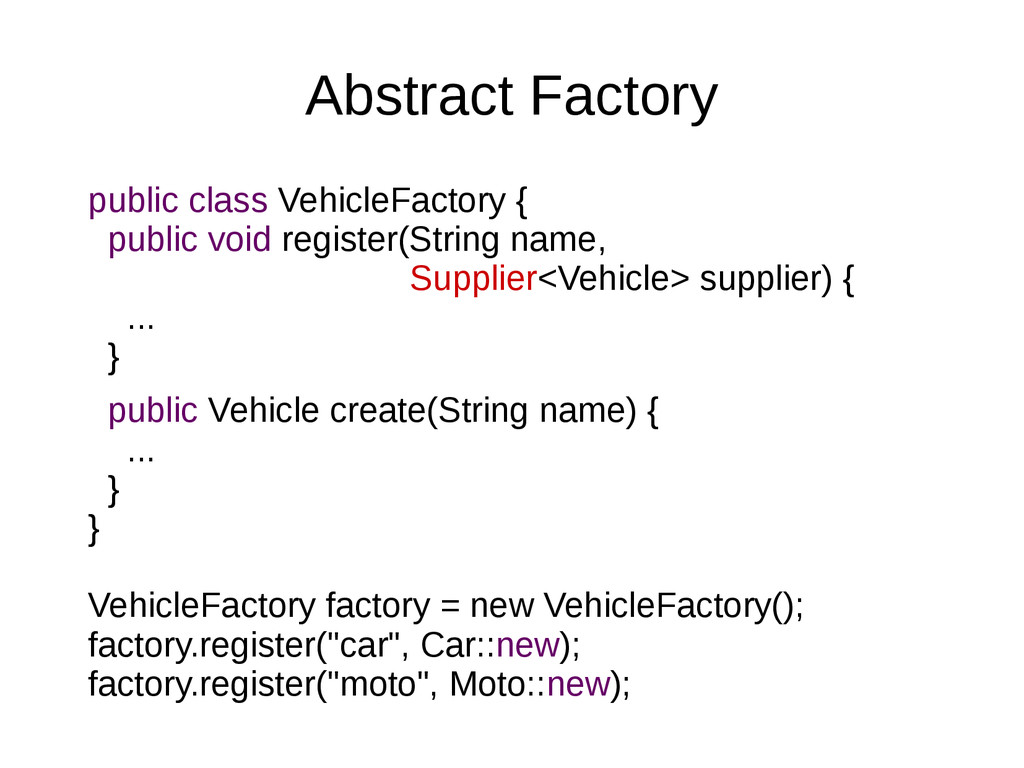
  49. Abstract Factory public class VehicleFactory { public void register(String name,

    Supplier<Vehicle> supplier) { ... } public Vehicle create(String name) { ... } } VehicleFactory factory = new VehicleFactory(); factory.register("car", Car::new); factory.register("moto", Moto::new);
  50. Abstract Factory impl public class VehicleFactory { private final HashMap<String,

    Supplier<Vehicle>> map = new HashMap<>(); public void register(String name, Supplier<Vehicle> supplier) { map.put(name, fun); } public Vehicle create(String name) { return map.getOrDefault(name, () - > { throw new ...; }) .get(); } } VehicleFactory factory = new VehicleFactory(); factory.register("car", Car::new); factory.register("moto", Moto::new);
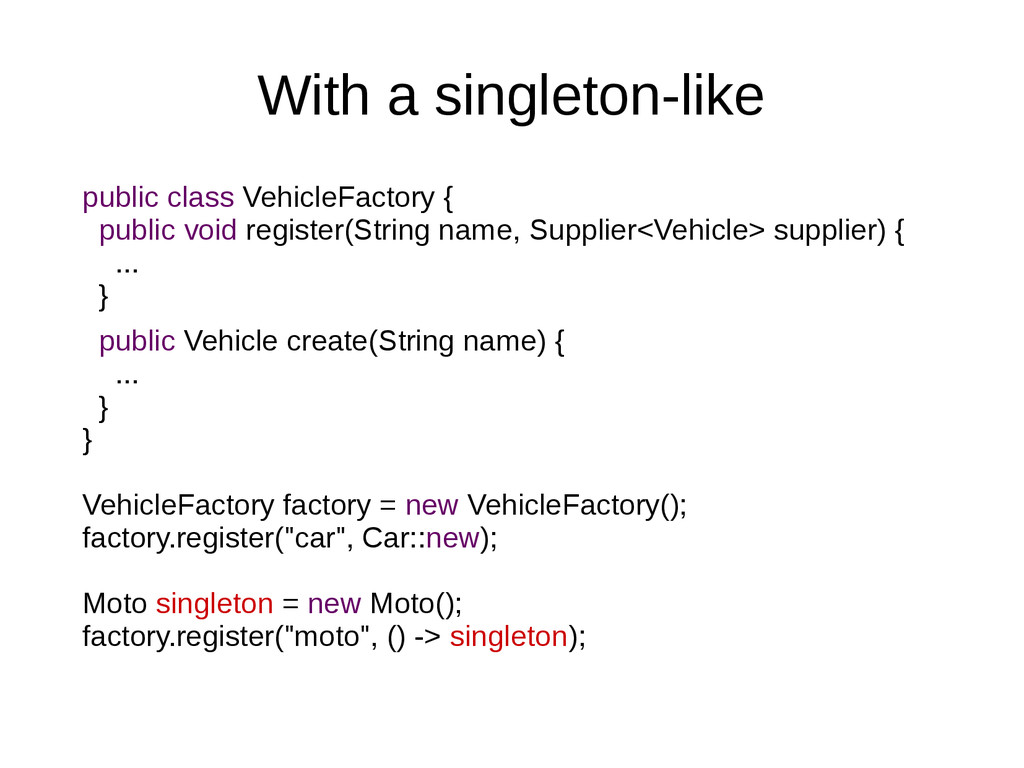
  51. With a singleton-like ? public class VehicleFactory { public void

    register(String name, Supplier<Vehicle> supplier) { ... } public Vehicle create(String name) { ... } } What if I want only one instance of Moto ?
  52. With a singleton-like public class VehicleFactory { public void register(String

    name, Supplier<Vehicle> supplier) { ... } public Vehicle create(String name) { ... } } VehicleFactory factory = new VehicleFactory(); factory.register("car", Car::new); Moto singleton = new Moto(); factory.register("moto", () -> singleton);
  53. From Factory to Builder public class VehicleFactory { public void

    register(String name, Supplier<Vehicle> supplier) { ... } public Vehicle create(String name) { ... } } How to separate the registering step from the creation step ?
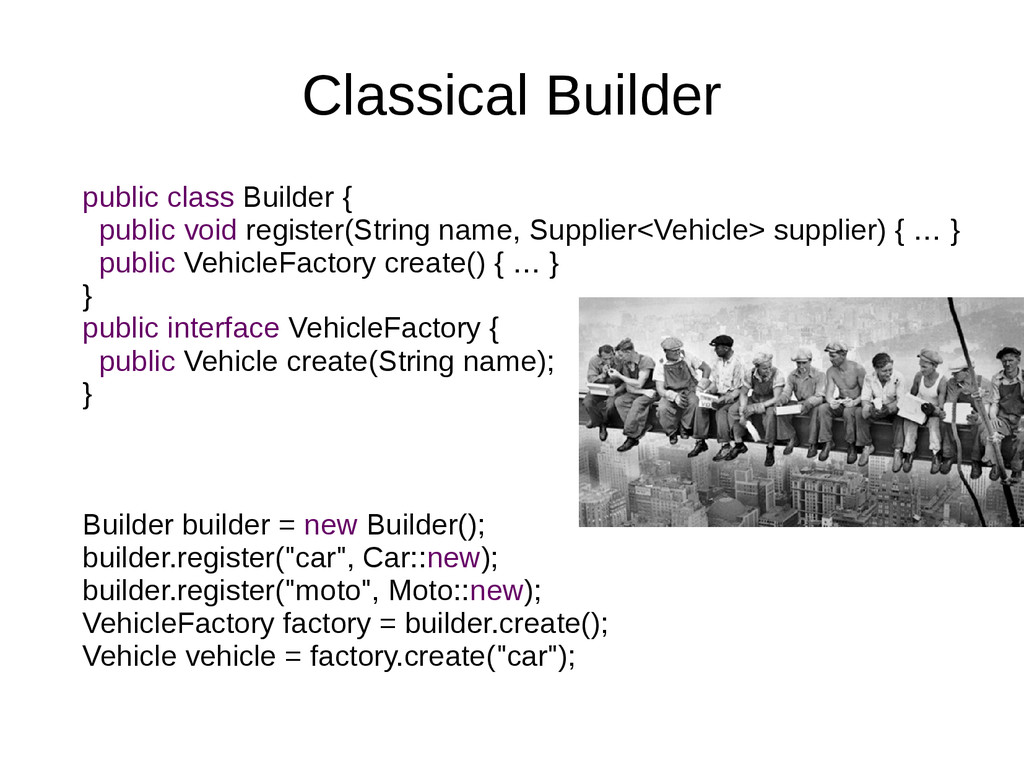
  54. Classical Builder public class Builder { public void register(String name,

    Supplier<Vehicle> supplier) { … } public VehicleFactory create() { … } } public interface VehicleFactory { public Vehicle create(String name); } Builder builder = new Builder(); builder.register("car", Car::new); builder.register("moto", Moto::new); VehicleFactory factory = builder.create(); Vehicle vehicle = factory.create("car");
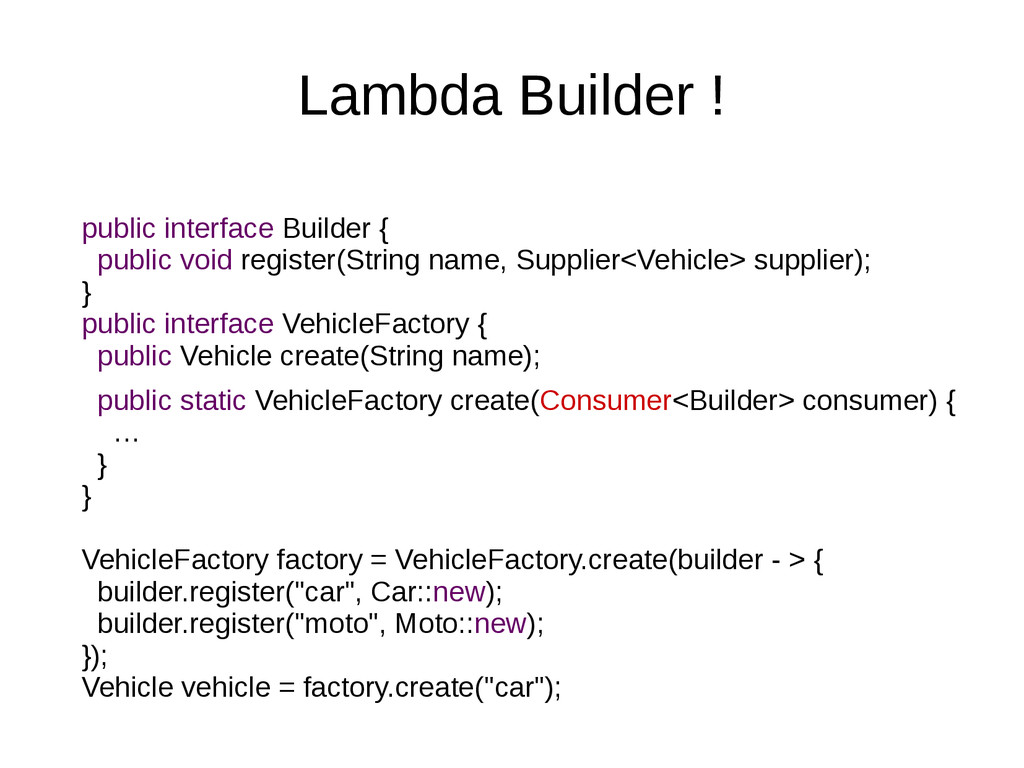
  55. Lambda Builder ! public interface Builder { public void register(String

    name, Supplier<Vehicle> supplier); } public interface VehicleFactory { public Vehicle create(String name); public static VehicleFactory create(Consumer<Builder> consumer) { … } } VehicleFactory factory = VehicleFactory.create(builder - > { builder.register("car", Car::new); builder.register("moto", Moto::new); }); Vehicle vehicle = factory.create("car");
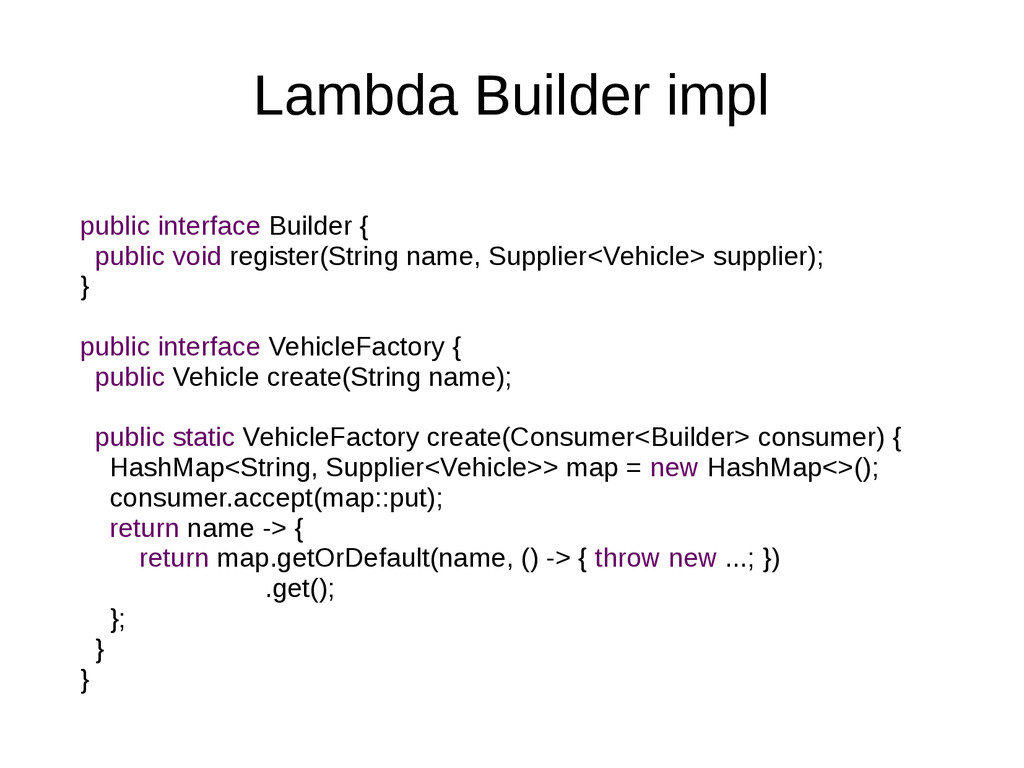
  56. Lambda Builder impl public interface Builder { public void register(String

    name, Supplier<Vehicle> supplier); } public interface VehicleFactory { public Vehicle create(String name); public static VehicleFactory create(Consumer<Builder> consumer) { HashMap<String, Supplier<Vehicle>> map = new HashMap<>(); consumer.accept(map::put); return name -> { return map.getOrDefault(name, () -> { throw new ...; }) .get(); }; } }
  57. Validation ? How to validate a user ? User user

    = new User("bob", 12); if (user.getName() == null) { throw new IllegalStateException("name is null"); } if (user.getName().isEmpty()) { throw new IllegalStateException("name is empty"); } if (!(user.getAge() > 0 && user.getAge() < 50)) { throw new IllegalStateException("age isn't between 0 and 50"); } public class User { private final String name; private final int age; ... }
  58. Monad Represent 2 (or more) states has a unified value

    in order to compose transformations public static User validateName(User user) { if (user.getName() == null) { throw new IllegalStateException("..."); } return user; } validate User User Exception
  59. Monad public class Validator<T> { public static <T> Validator<T> of(T

    t) { ... } public Validator<T> validate(Predicate<T> validation, String message) { ... } public T get() throws IllegalStateException { ... } } User validatedUser = Validator.of(user) .validate(u -> u.getName() != null, "name is null") .validate(u -> !u.getName().isEmpty(), "name is empty") .validate(u -> u.getAge() > 0 && u.getAge() < 150, "age isn't between ...") .get();
  60. Monad impl public class Validator<T> { private final T t;

    private final IllegalStateException error; private Validator(T t, IllegalStateException error) { this.t = t; this.error = error; } public static <T> Validator<T> of(T t) { return new Validator<>(Objects.requireNonNull(t), null); } public Validator<T> validate(Predicate<T> validation, String message) { if (error == null && !validation.test(t)) { return new Validator<>(t, new IllegalStateException(message)); } return this; } public T get() throws IllegalStateException { if (error == null) { return t; } throw error; } }
  61. Separate attribute from validation public class Validator<T> { public Validator<T>

    validate(Predicate<T> validation, String message) { … } public <U> Validator<T> validate(Function<T, U> projection, Predicate<U> validation, String message) { ... } } User validatedUser = Validator.of(user) .validate(User::getName, Objects::nonNull, "name is null") .validate(User::getName, name -> !name.isEmpty(), "name is ...") .validate(User::getAge, age -> age > 0 && age < 150, "age is ...") .get();
  62. High order function public static Predicate<Integer> inBetween(int start, int end)

    { return value -> value > start && value < end; } User validatedUser = Validator.of(user) .validate(User::getName, Objects::nonNull, "name is null") .validate(User::getName, name -> !name.isEmpty(), "...") .validate(User::getAge, inBetween(0, 50), "...") .get();
  63. Monad impl public class Validator<T> { public Validator<T> validate(Predicate<T> validation,

    String message) { ... } public <U> Validator<T> validate(Function<T, U> projection, Predicate<U> validation, String message) { return validate(t -> validation.test(projection.apply(t)), message); } }
  64. Monad public class Validator<T> { public Validator<T> validate(Predicate<T> validation, String

    message) { ... } public <U> Validator<T> validate(Function<T, U> projection, Predicate<U> validation, String message) { return validate( projection.andThen(validation::test)::apply, message); } } Function Predicate
  65. Gather validation errors public class Validator<T> { private final T

    t; private final ArrayList<Throwable> throwables = new ArrayList<>(); public Validator<T> validate(Predicate<T> validation, String message) { try { if (!validation.test(t)) { throwables.add(new IllegalStateException(message)); } } catch(RuntimeException e) { throwables.add(e); } return this; } public T get() throws IllegalStateException { if (throwables.isEmpty()) { return t; } IllegalStateException e = new IllegalStateException(); throwables.forEach(e::addSuppressed); throw e; } }
  66. TLDR; Functional interface – bridge between OOP and FP Enable

    several OOP techniques – High order function, function composition, partial application UML is dead ! – abstract classes are dead too !