Share
Embed
A Layered Architecture for EV Charging Stations Based on Time Scale Decomposition
Ke Ma (TAMU), Grid-X Program Presentation on Day 1 (Nov.3) of Workshop on Architecture and Economics of the Future Grid
gridx.tamu
November 03, 2016
Transcript
20 slides
-
1/21 A Layered Architecture for EV Charging Stations Based on
Time Scale Decomposition Ke Ma, Le Xie and P. R. Kumar Dept. of Electrical and Computer Engineering Texas A&M University Email: [email protected] -
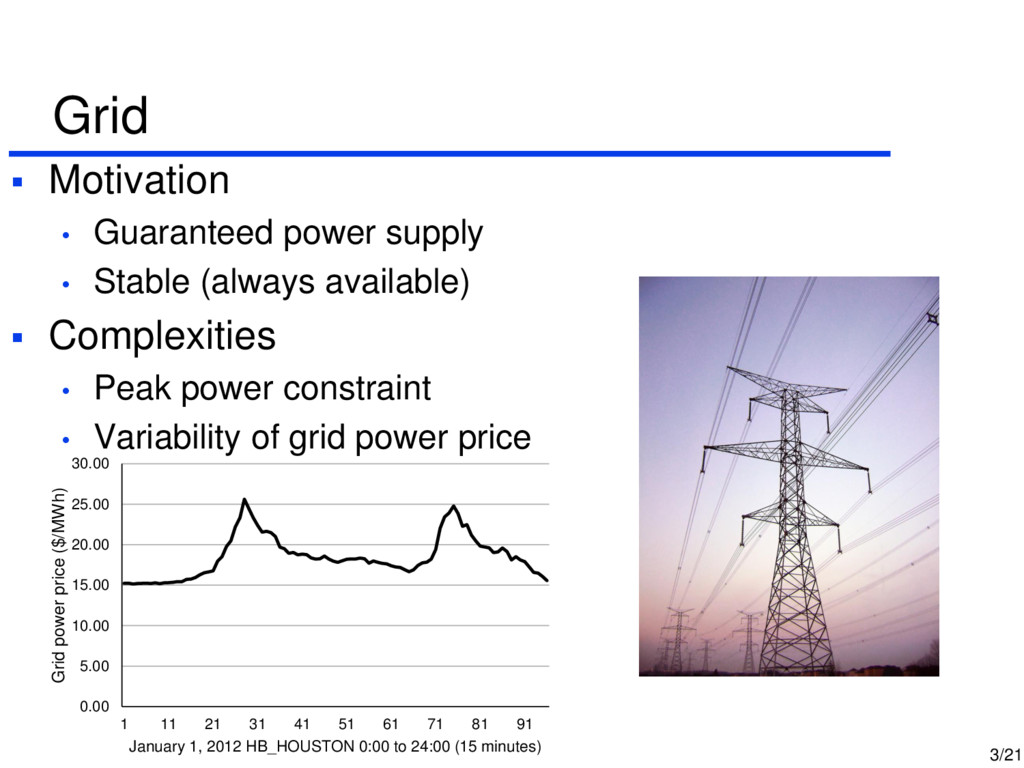
3/21 Grid Motivation • Guaranteed power supply • Stable
(always available) Complexities • Peak power constraint • Variability of grid power price 0.00 5.00 10.00 15.00 20.00 25.00 30.00 1 11 21 31 41 51 61 71 81 91 Grid power price ($/MWh) January 1, 2012 HB_HOUSTON 0:00 to 24:00 (15 minutes) -
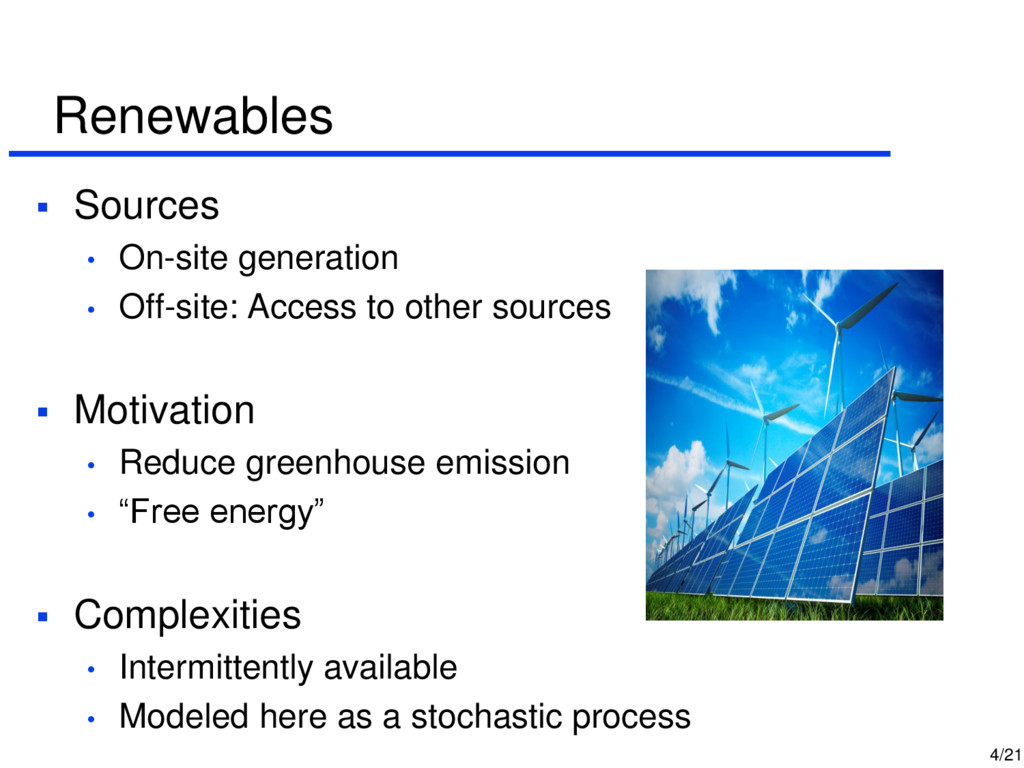
4/21 Renewables Sources • On-site generation • Off-site: Access
to other sources Motivation • Reduce greenhouse emission • “Free energy” Complexities • Intermittently available • Modeled here as a stochastic process -
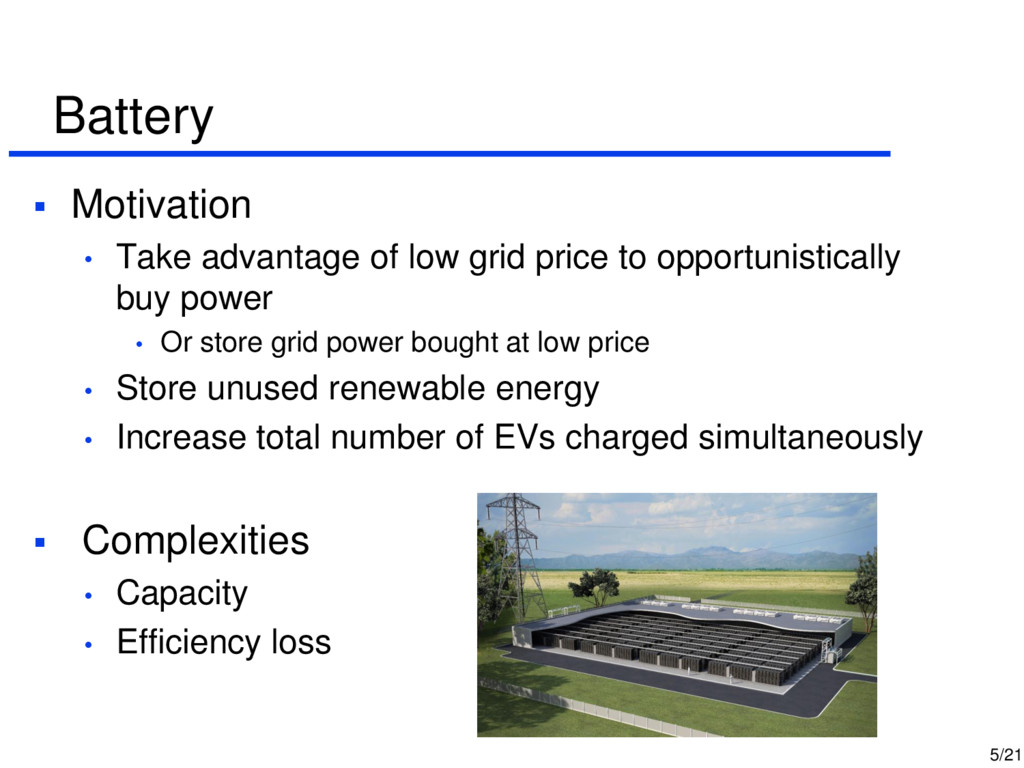
5/21 Battery Motivation • Take advantage of low grid
price to opportunistically buy power • Or store grid power bought at low price • Store unused renewable energy • Increase total number of EVs charged simultaneously Complexities • Capacity • Efficiency loss -
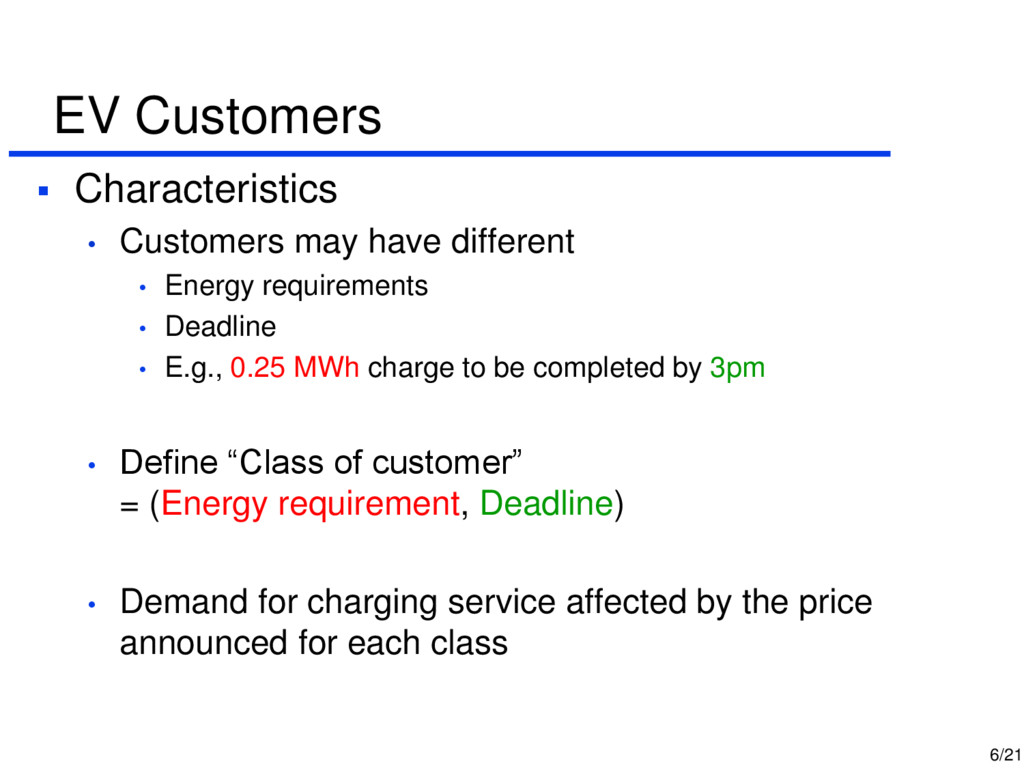
6/21 EV Customers Characteristics • Customers may have different
• Energy requirements • Deadline • E.g., 0.25 MWh charge to be completed by 3pm • Define “Class of customer” = (Energy requirement, Deadline) • Demand for charging service affected by the price announced for each class -
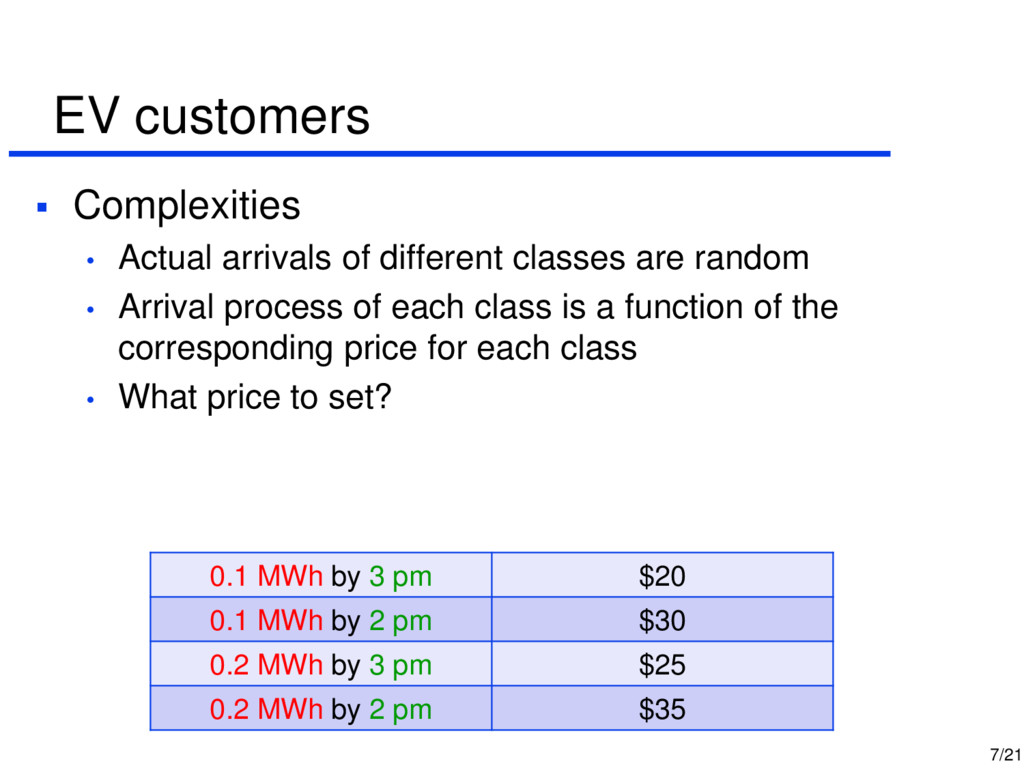
7/21 EV customers Complexities • Actual arrivals of different
classes are random • Arrival process of each class is a function of the corresponding price for each class • What price to set? 0.1 MWh by 3 pm $20 0.1 MWh by 2 pm $30 0.2 MWh by 3 pm $25 0.2 MWh by 2 pm $35 -
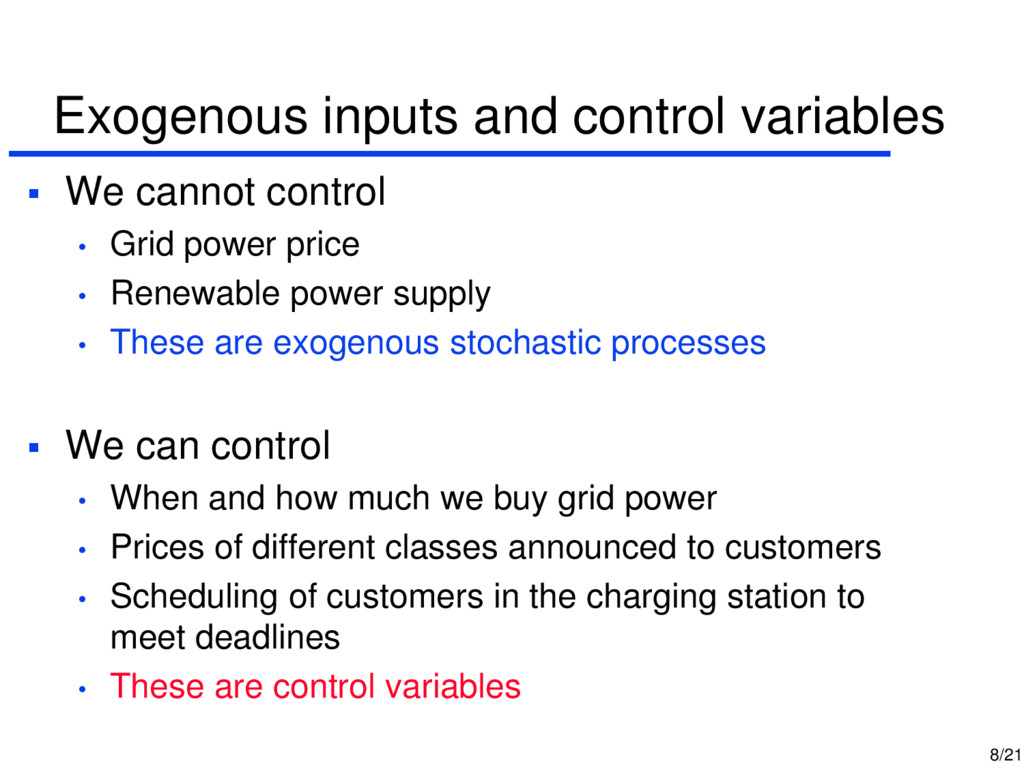
8/21 Exogenous inputs and control variables We cannot control
• Grid power price • Renewable power supply • These are exogenous stochastic processes We can control • When and how much we buy grid power • Prices of different classes announced to customers • Scheduling of customers in the charging station to meet deadlines • These are control variables -
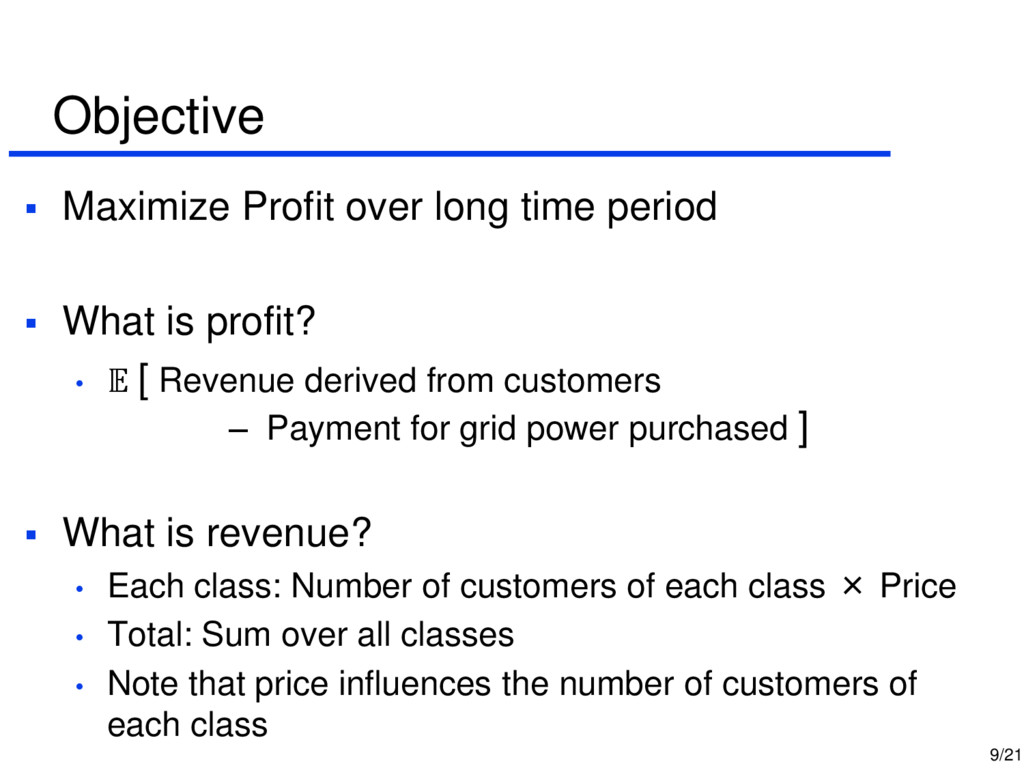
9/21 Objective Maximize Profit over long time period
What is profit? • [ Revenue derived from customers – Payment for grid power purchased ] What is revenue? • Each class: Number of customers of each class × Price • Total: Sum over all classes • Note that price influences the number of customers of each class -
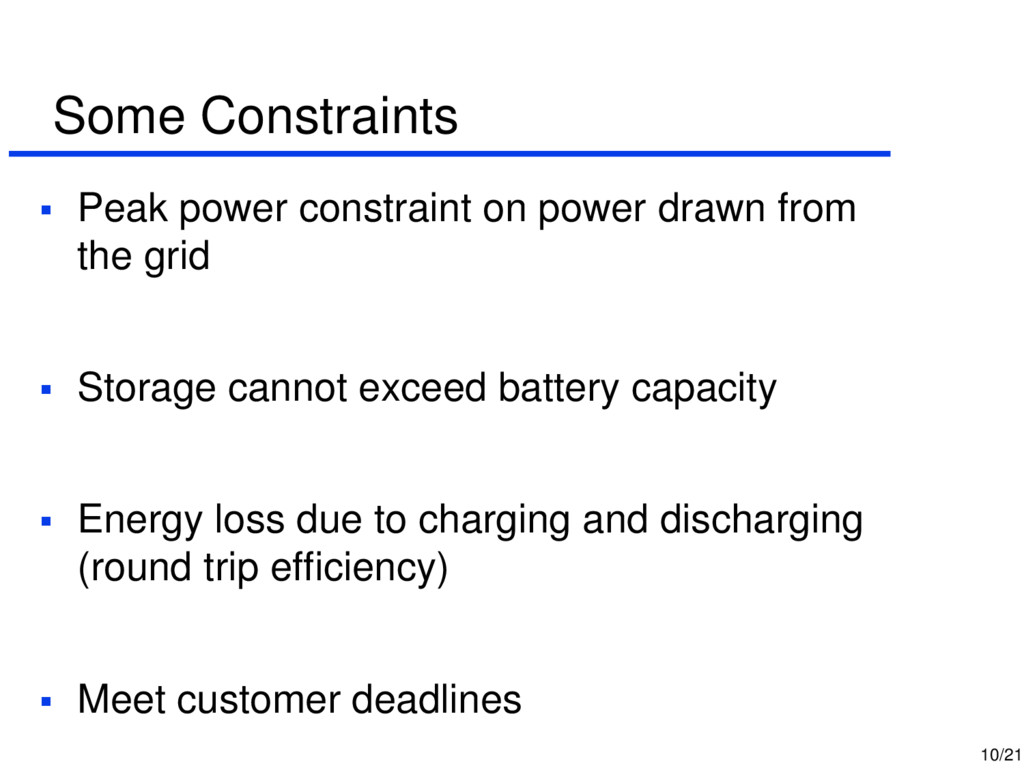
10/21 Some Constraints Peak power constraint on power drawn
from the grid Storage cannot exceed battery capacity Energy loss due to charging and discharging (round trip efficiency) Meet customer deadlines -
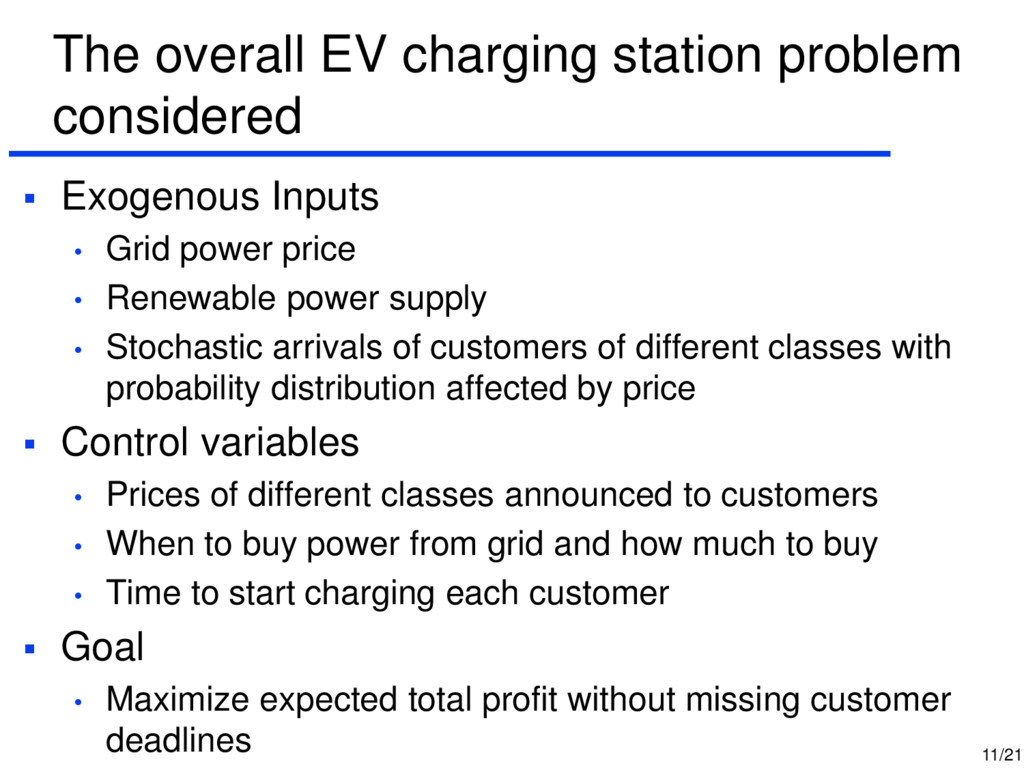
11/21 The overall EV charging station problem considered Exogenous
Inputs • Grid power price • Renewable power supply • Stochastic arrivals of customers of different classes with probability distribution affected by price Control variables • Prices of different classes announced to customers • When to buy power from grid and how much to buy • Time to start charging each customer Goal • Maximize expected total profit without missing customer deadlines -
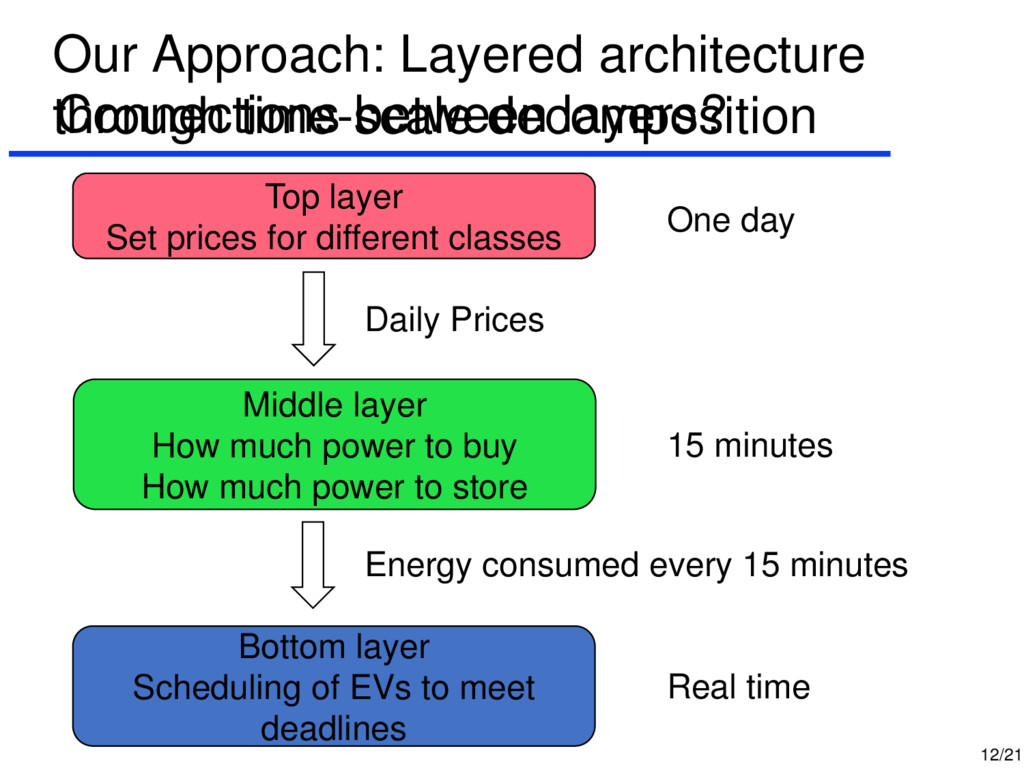
12/21 Our Approach: Layered architecture through time-scale decomposition Daily Prices
Energy consumed every 15 minutes One day 15 minutes Real time Top layer Set prices for different classes Middle layer How much power to buy How much power to store Bottom layer Scheduling of EVs to meet deadlines Connections between layers? -
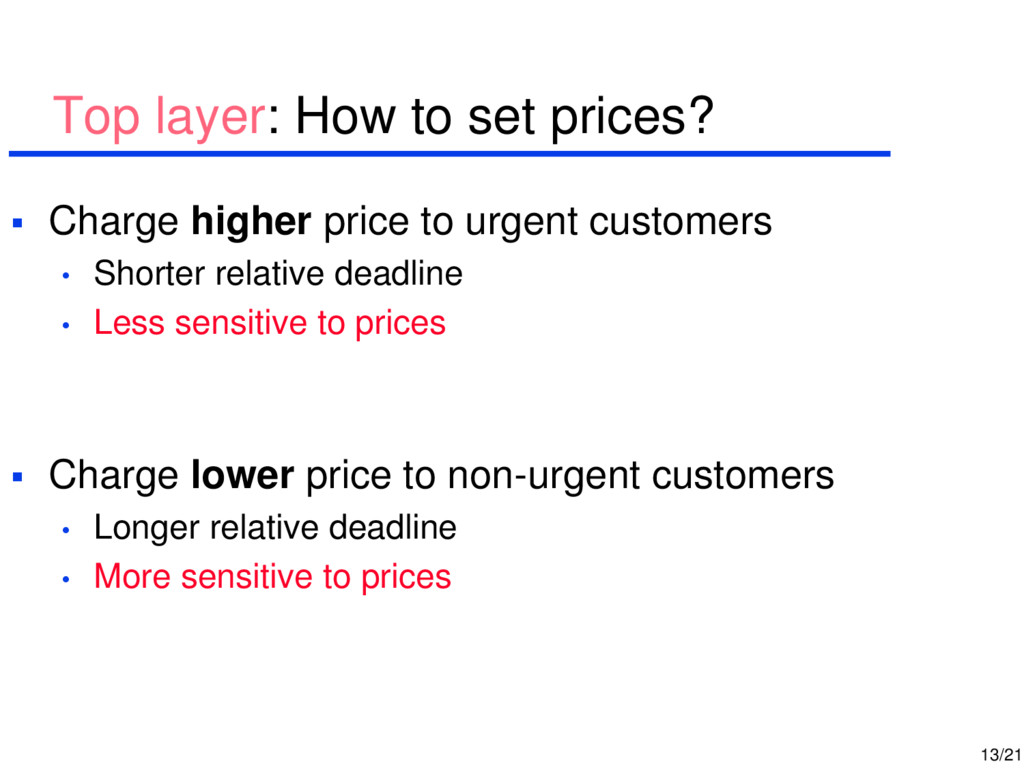
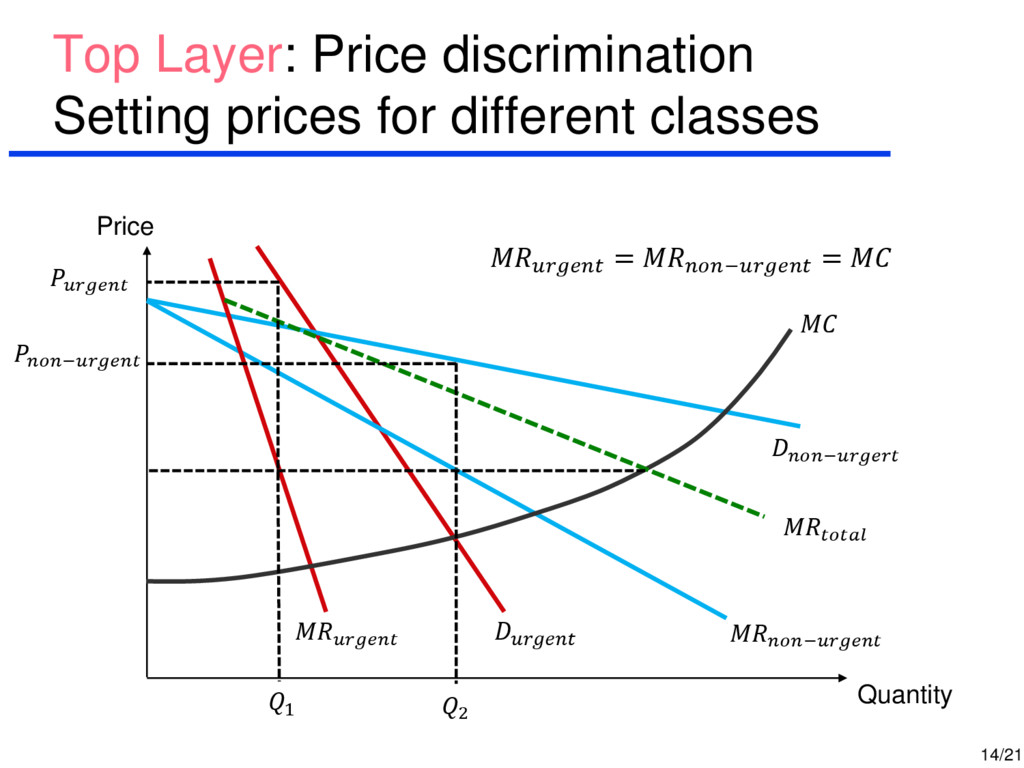
13/21 Top layer: How to set prices? Charge higher
price to urgent customers • Shorter relative deadline • Less sensitive to prices Charge lower price to non-urgent customers • Longer relative deadline • More sensitive to prices -
14/21 Top Layer: Price discrimination Setting prices for different classes
Price Quantity − − 1 − 2 = − = -
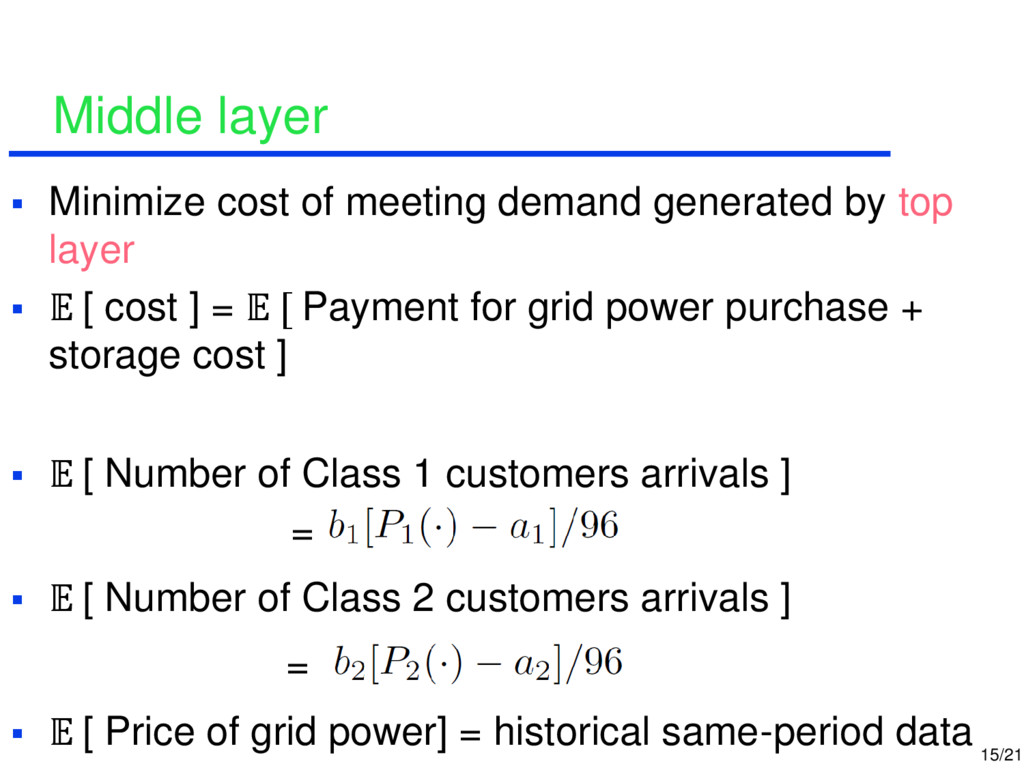
15/21 Middle layer Minimize cost of meeting demand generated
by top layer [ cost ] = [ Payment for grid power purchase + storage cost ] [ Number of Class 1 customers arrivals ] = [ Number of Class 2 customers arrivals ] = [ Price of grid power] = historical same-period data -
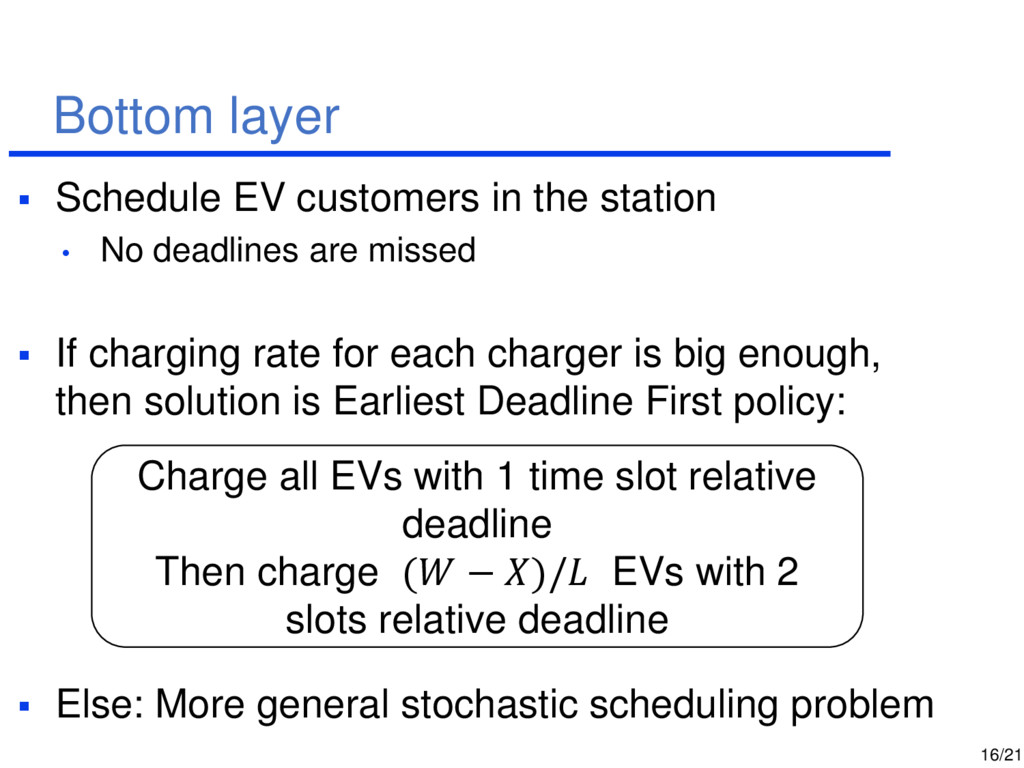
16/21 Bottom layer Schedule EV customers in the station
• No deadlines are missed If charging rate for each charger is big enough, then solution is Earliest Deadline First policy: Else: More general stochastic scheduling problem Charge all EVs with 1 time slot relative deadline Then charge ( − )/ EVs with 2 slots relative deadline -
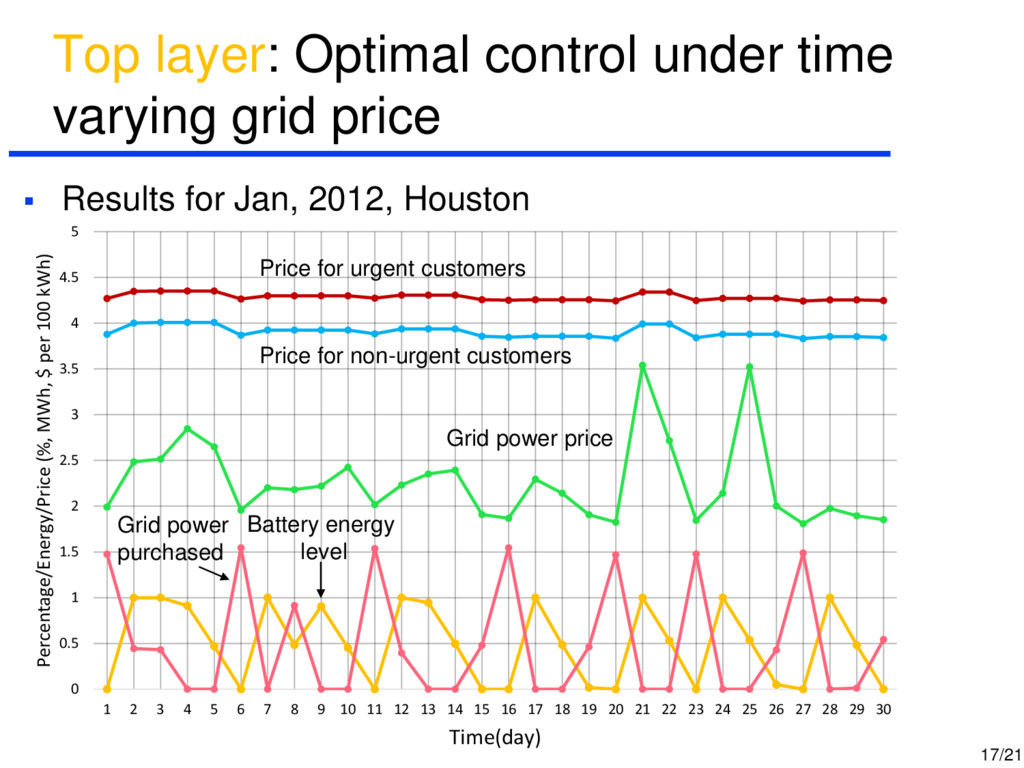
17/21 Top layer: Optimal control under time varying grid price
Results for Jan, 2012, Houston 0 0.5 1 1.5 2 2.5 3 3.5 4 4.5 5 1 2 3 4 5 6 7 8 9 10 11 12 13 14 15 16 17 18 19 20 21 22 23 24 25 26 27 28 29 30 Percentage/Energy/Price (%, MWh, $ per 100 kWh) Time(day) Grid power price Price for urgent customers Price for non-urgent customers Grid power purchased Battery energy level -
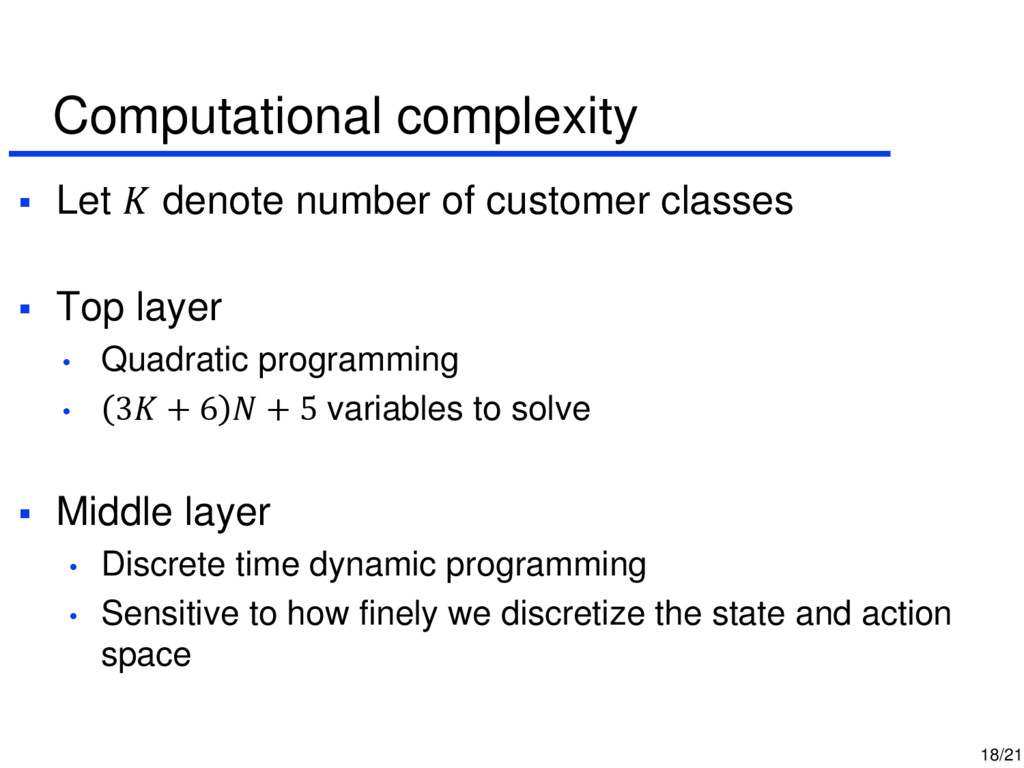
18/21 Computational complexity Let denote number of customer classes
Top layer • Quadratic programming • 3 + 6 + 5 variables to solve Middle layer • Discrete time dynamic programming • Sensitive to how finely we discretize the state and action space -
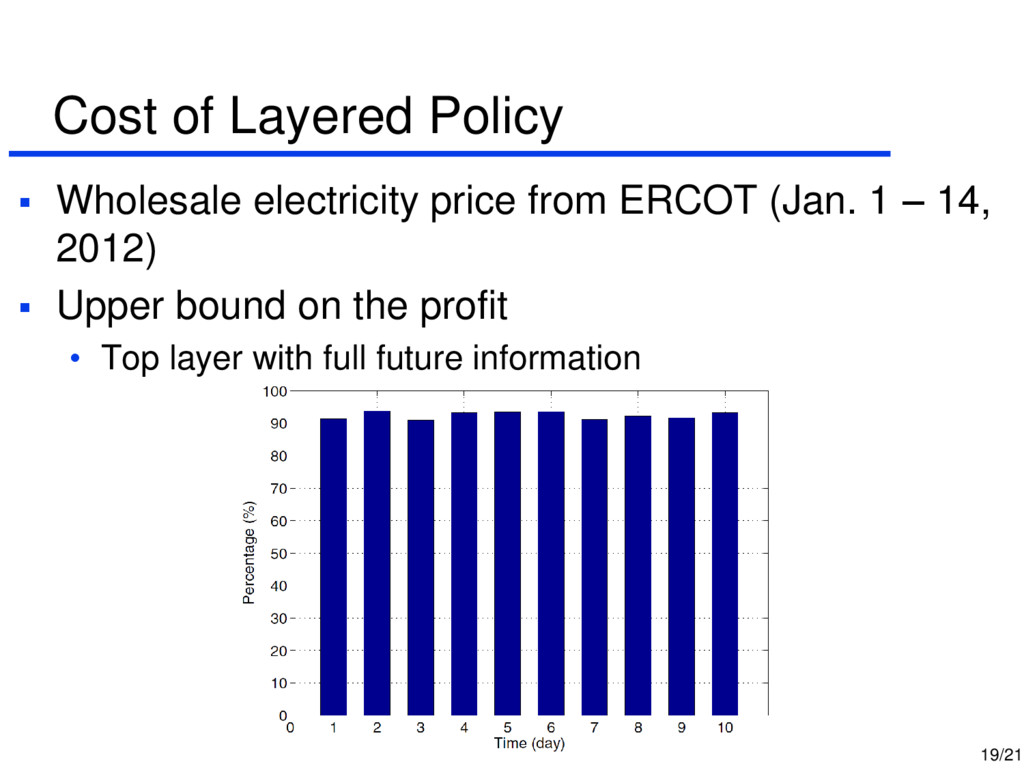
19/21 Cost of Layered Policy Wholesale electricity price from
ERCOT (Jan. 1 – 14, 2012) Upper bound on the profit • Top layer with full future information -
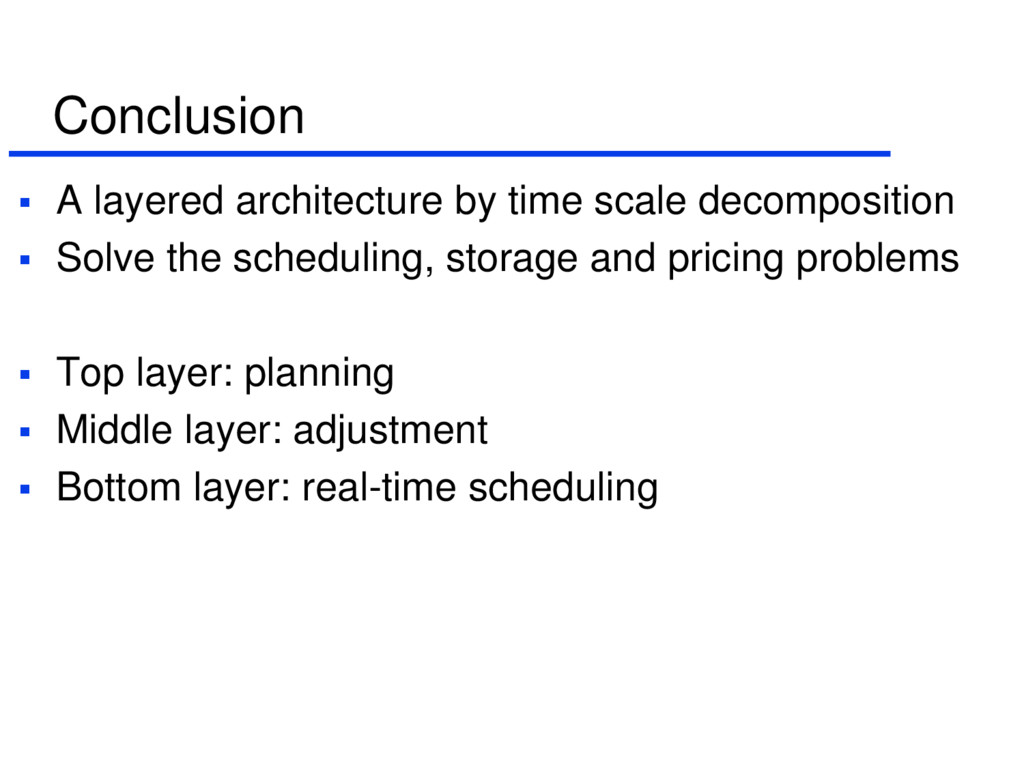
20/21 Conclusion A layered architecture by time scale decomposition
Solve the scheduling, storage and pricing problems Top layer: planning Middle layer: adjustment Bottom layer: real-time scheduling