Upgrade to Pro — share decks privately, control downloads, hide ads and more …

Data QA: The Hidden Layer of Product Quality

Data QA: The Hidden Layer of Product Quality

Data QA is the backbone of reliable digital products. In this session, Kushal explained how Data QA goes beyond traditional testing to ensure the accuracy, completeness, and consistency of data across systems. The talk highlighted real-world scenarios and key practices every team should follow to build trustworthy, data-driven applications.

Avatar for Gurzu

Gurzu

March 31, 2026
Tweet

More Decks by Gurzu

Other Decks in Programming

Transcript

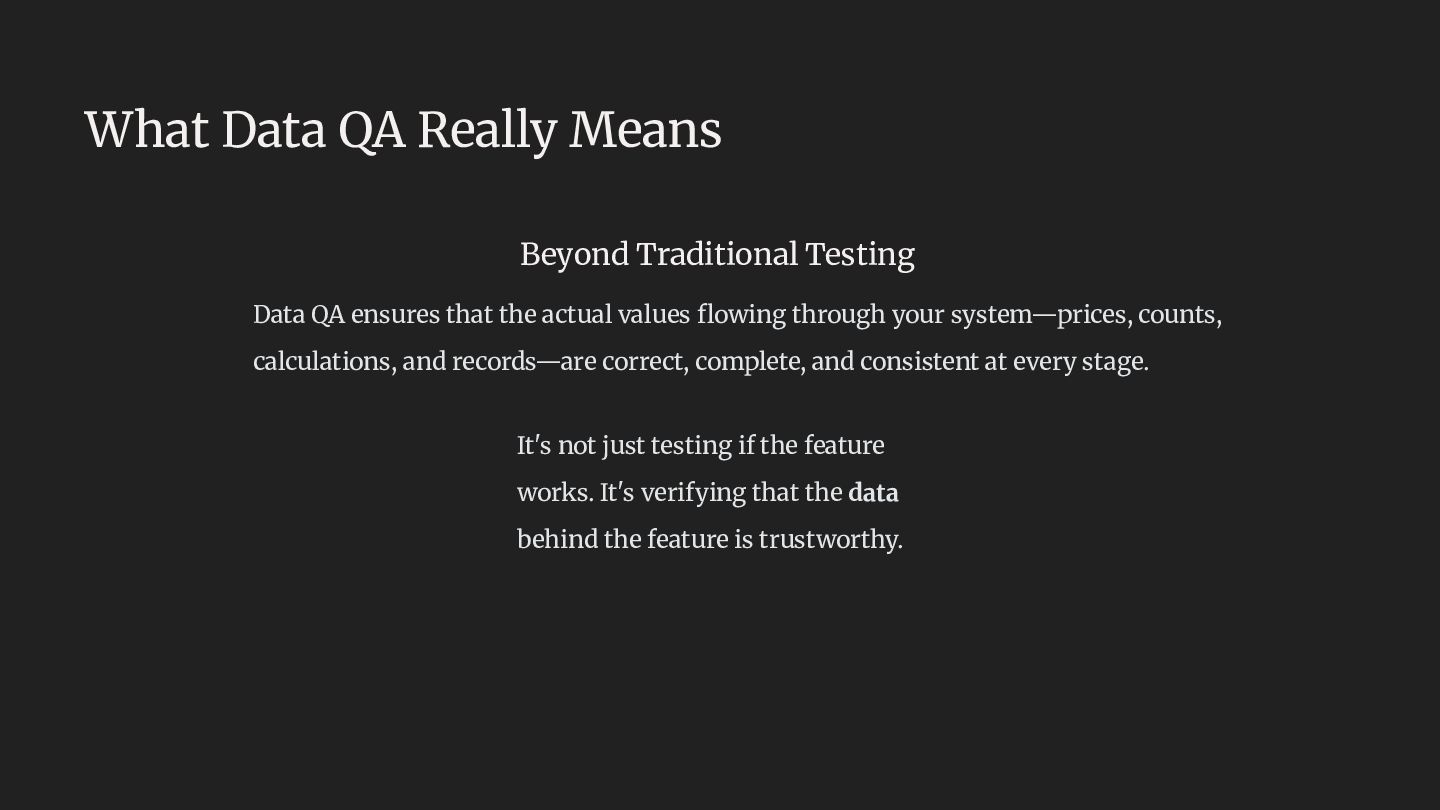
  1. What Data QA Really Means Beyond Traditional Testing Data QA

    ensures that the actual values flowing through your system—prices, counts, calculations, and records—are correct, complete, and consistent at every stage. It's not just testing if the feature works. It's verifying that the data behind the feature is trustworthy.
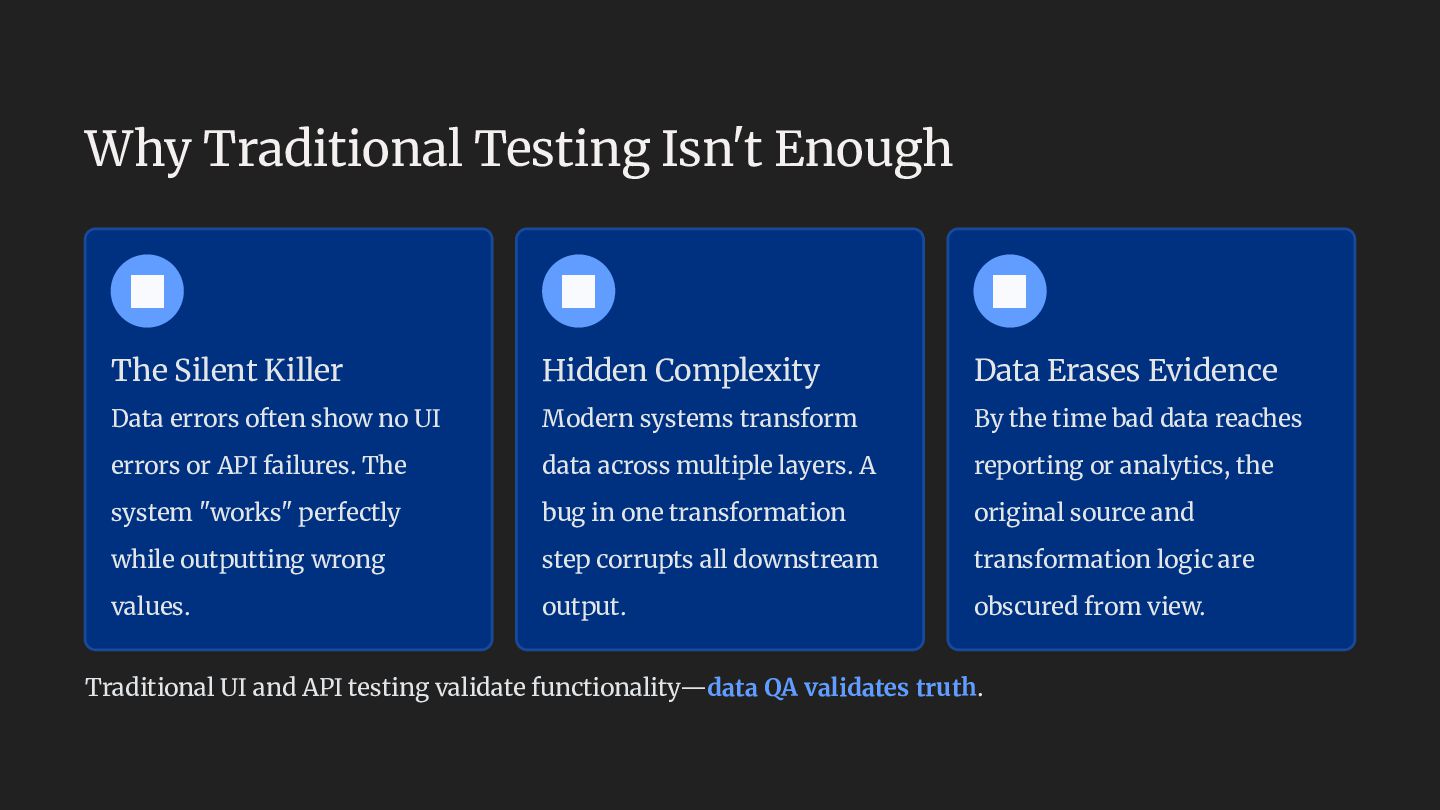
  2. Why Traditional Testing Isn't Enough The Silent Killer Data errors

    often show no UI errors or API failures. The system "works" perfectly while outputting wrong values. Hidden Complexity Modern systems transform data across multiple layers. A bug in one transformation step corrupts all downstream output. Data Erases Evidence By the time bad data reaches reporting or analytics, the original source and transformation logic are obscured from view. Traditional UI and API testing validate functionality—data QA validates truth.
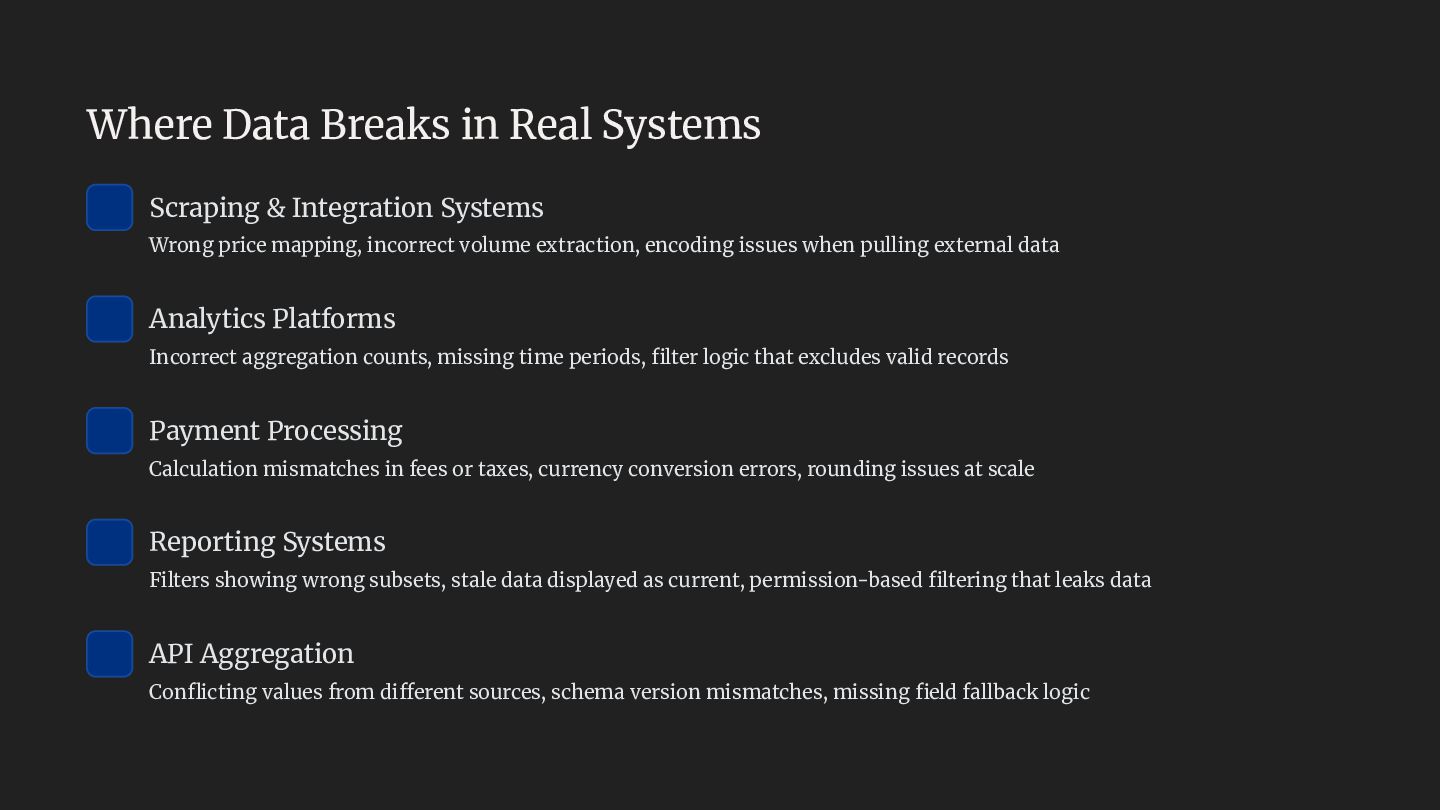
  3. Where Data Breaks in Real Systems Scraping & Integration Systems

    Wrong price mapping, incorrect volume extraction, encoding issues when pulling external data Analytics Platforms Incorrect aggregation counts, missing time periods, filter logic that excludes valid records Payment Processing Calculation mismatches in fees or taxes, currency conversion errors, rounding issues at scale Reporting Systems Filters showing wrong subsets, stale data displayed as current, permission-based filtering that leaks data API Aggregation Conflicting values from different sources, schema version mismatches, missing field fallback logic
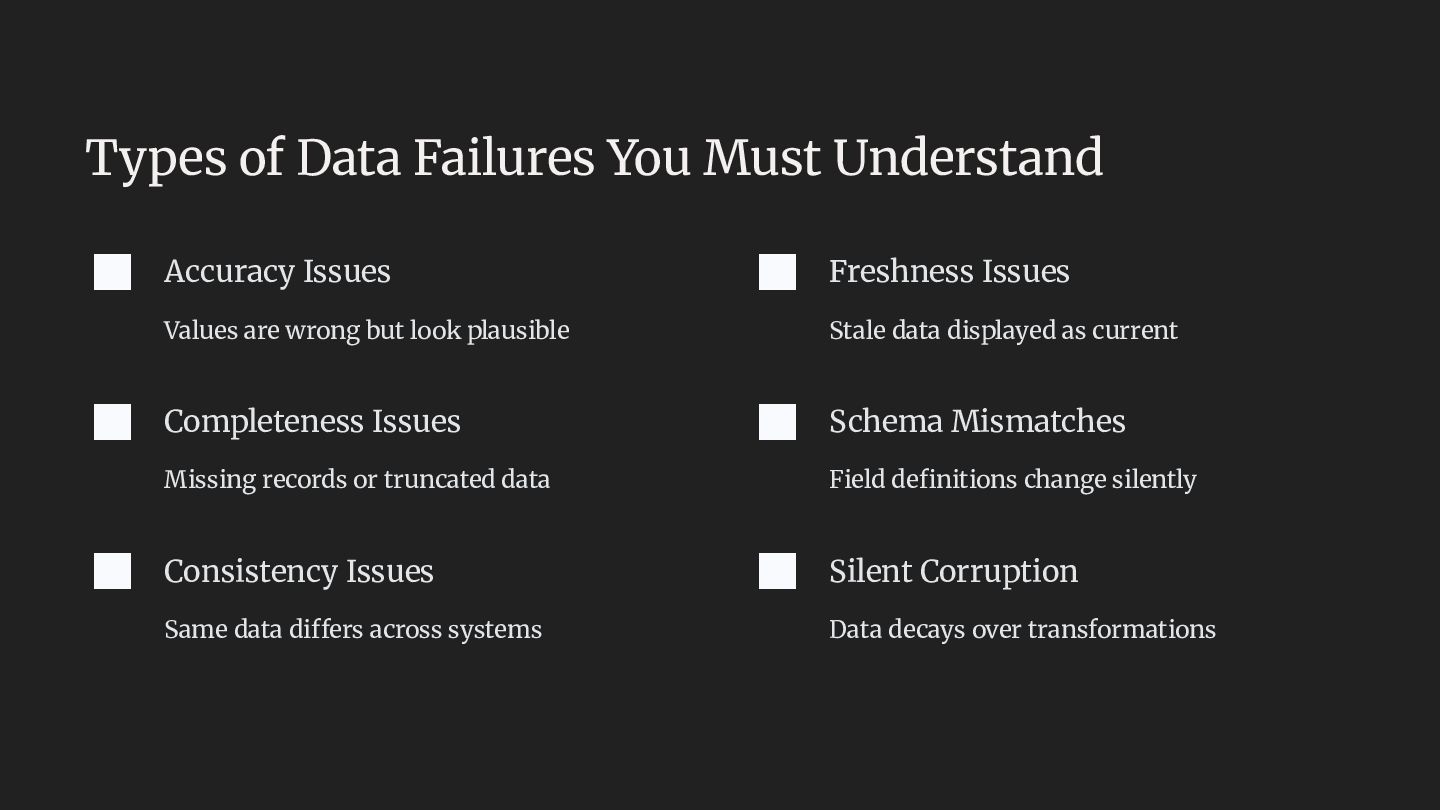
  4. Types of Data Failures You Must Understand Accuracy Issues Values

    are wrong but look plausible Completeness Issues Missing records or truncated data Consistency Issues Same data differs across systems Freshness Issues Stale data displayed as current Schema Mismatches Field definitions change silently Silent Corruption Data decays over transformations
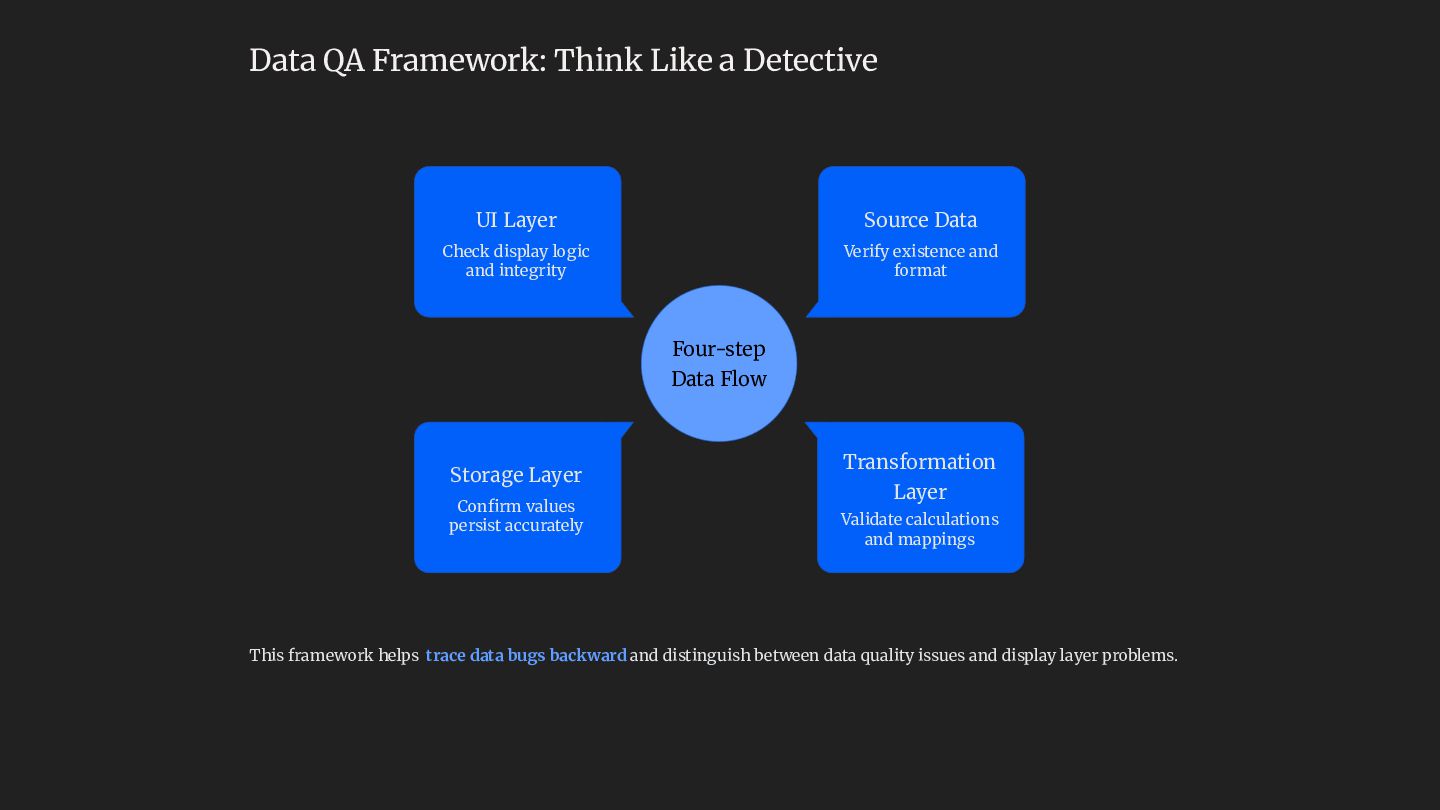
  5. Data QA Framework: Think Like a Detective Four-step Data Flow

    Transformation Layer Validate calculations and mappings Storage Layer Confirm values persist accurately UI Layer Check display logic and integrity Source Data Verify existence and format This framework helps trace data bugs backward and distinguish between data quality issues and display layer problems.
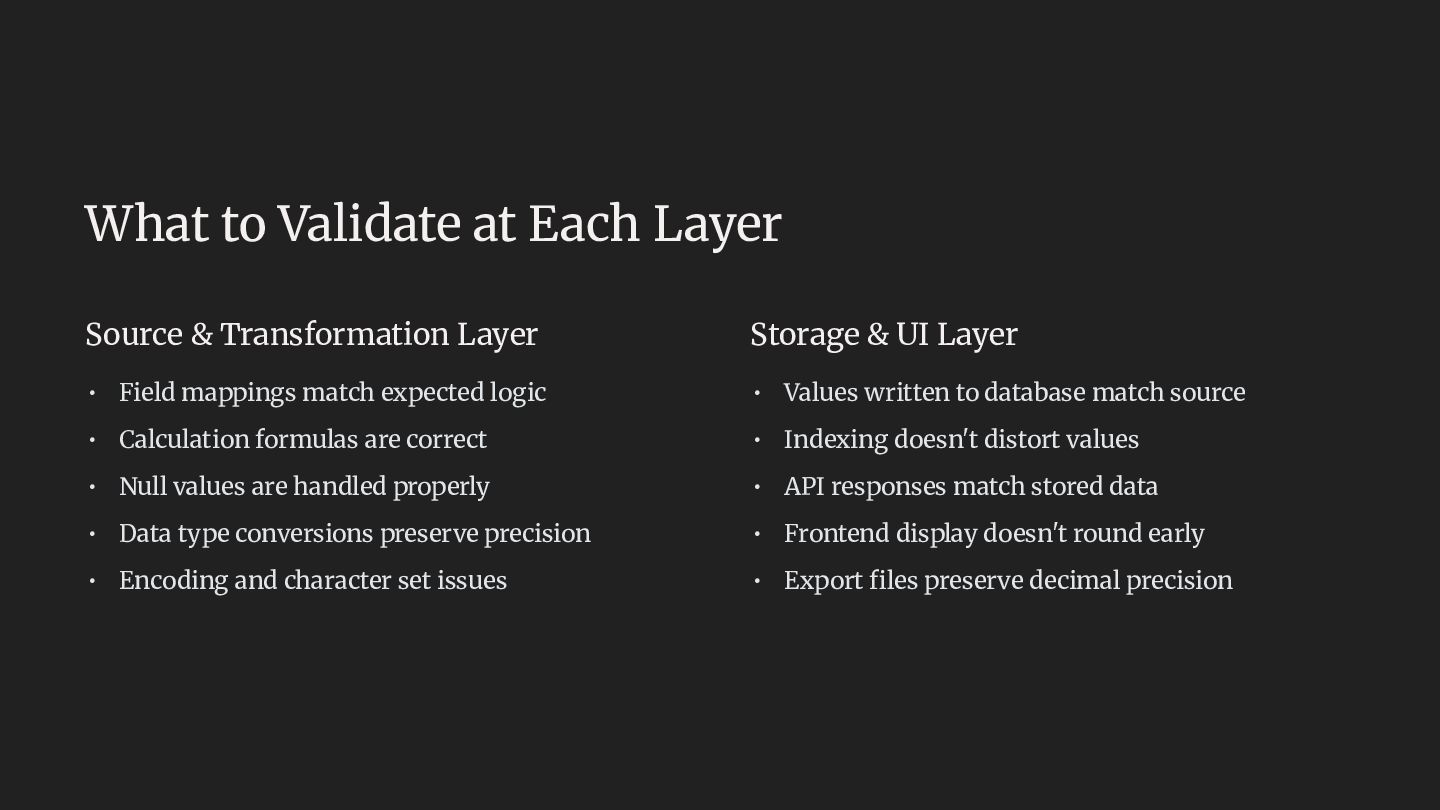
  6. What to Validate at Each Layer Source & Transformation Layer

    • Field mappings match expected logic • Calculation formulas are correct • Null values are handled properly • Data type conversions preserve precision • Encoding and character set issues Storage & UI Layer • Values written to database match source • Indexing doesn't distort values • API responses match stored data • Frontend display doesn't round early • Export files preserve decimal precision
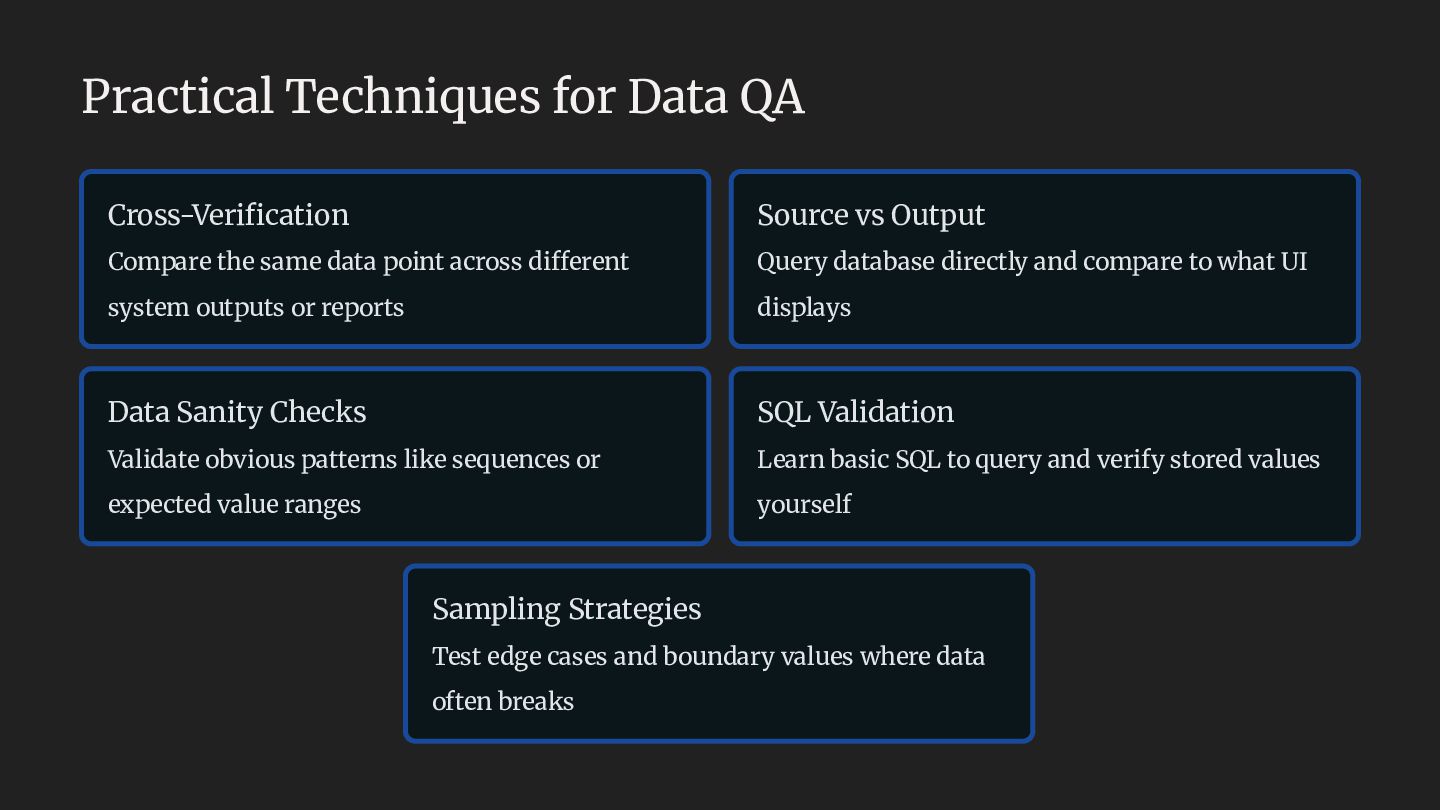
  7. Practical Techniques for Data QA Cross-Verification Compare the same data

    point across different system outputs or reports Source vs Output Query database directly and compare to what UI displays Data Sanity Checks Validate obvious patterns like sequences or expected value ranges SQL Validation Learn basic SQL to query and verify stored values yourself Sampling Strategies Test edge cases and boundary values where data often breaks
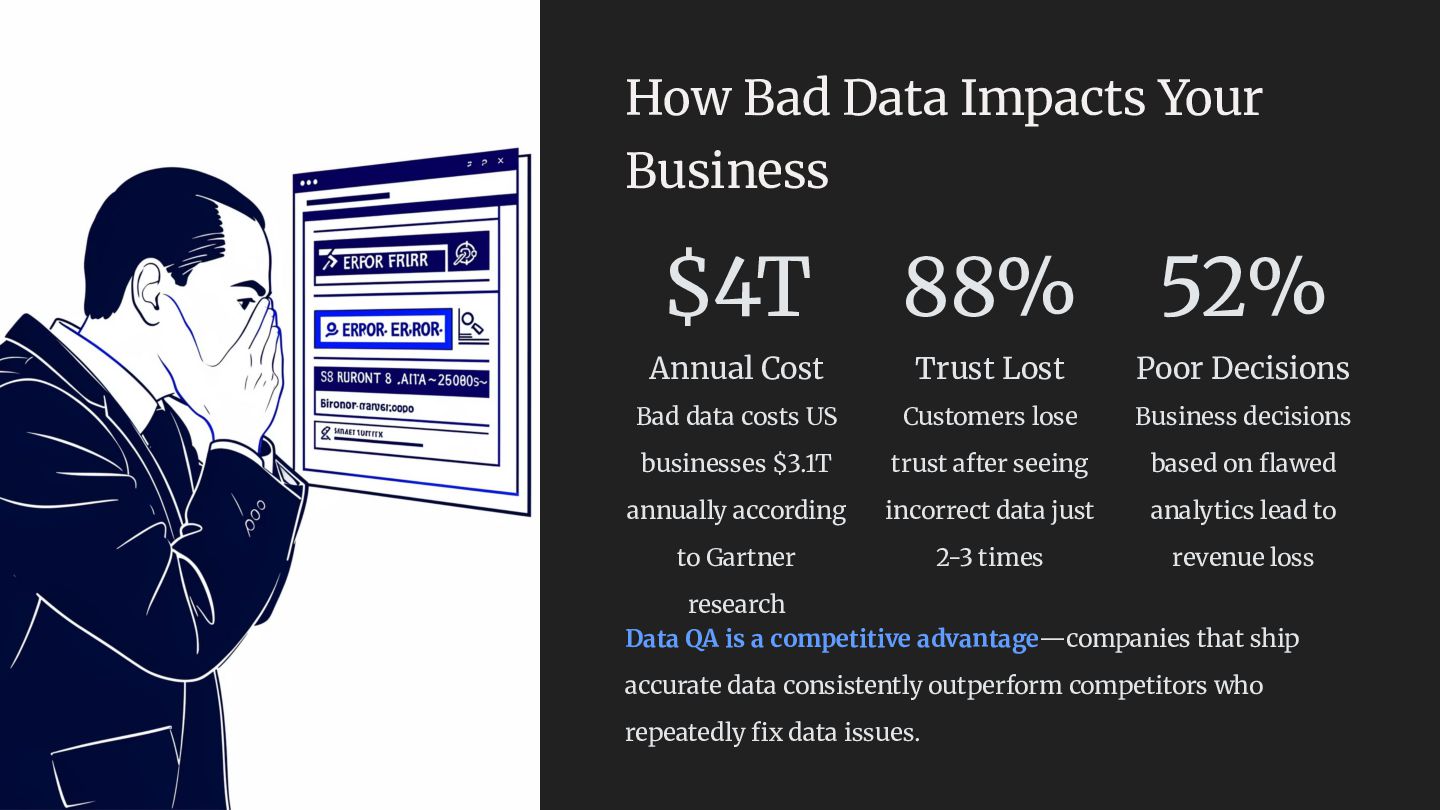
  8. How Bad Data Impacts Your Business $4T Annual Cost Bad

    data costs US businesses $3.1T annually according to Gartner research 88% Trust Lost Customers lose trust after seeing incorrect data just 2-3 times 52% Poor Decisions Business decisions based on flawed analytics lead to revenue loss Data QA is a competitive advantage—companies that ship accurate data consistently outperform competitors who repeatedly fix data issues.