Share-Alike 3.0 license. The full terms of this license are available here: https://creativecommons.org/licenses/by-sa/3.0/ Attribution requirements and misc., PLEASE READ: - This slide must remain as-is in this specific location (slide #2), everything else you are free to change; including the logo ;-) - Use of figures in other documents must feature the below “Originals at” URL immediately under that figure and the below copyright notice where appropriate. - You are FORBIDDEN from using the default slide #3 as-is or any of its contents. (C) Copyright 2014 - Opersys inc. These slides are created by: Benjamin Zores Originals at: http://www.opersys.com/community/docs
Embedded Systems (now Cloud) R&D Architect / Director for Alcatel-Lucent. • Night: • Android “Jack of all trades” for Opersys. • Weekends: • Technical Writer for GNU/Linux Magazine France. • Recurrent ELC/ABS speaker. • Open Source leader/contributor in previous life: • GeeXboX, OpenBricks, uShare, MPlayer, FFmpeg.
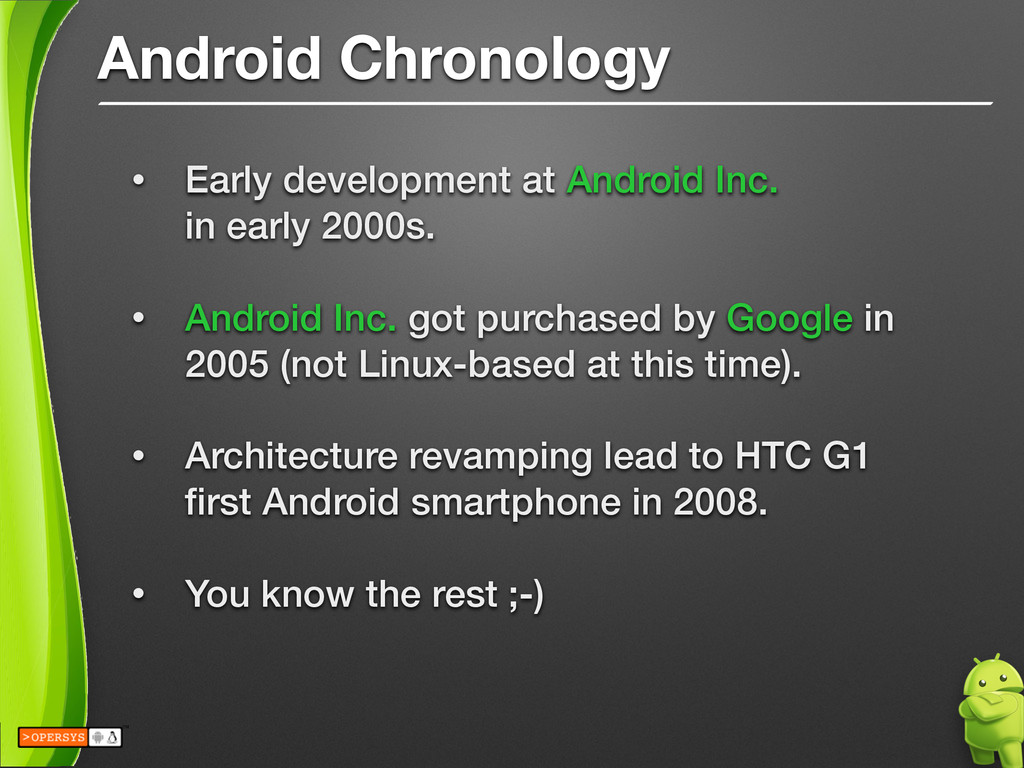
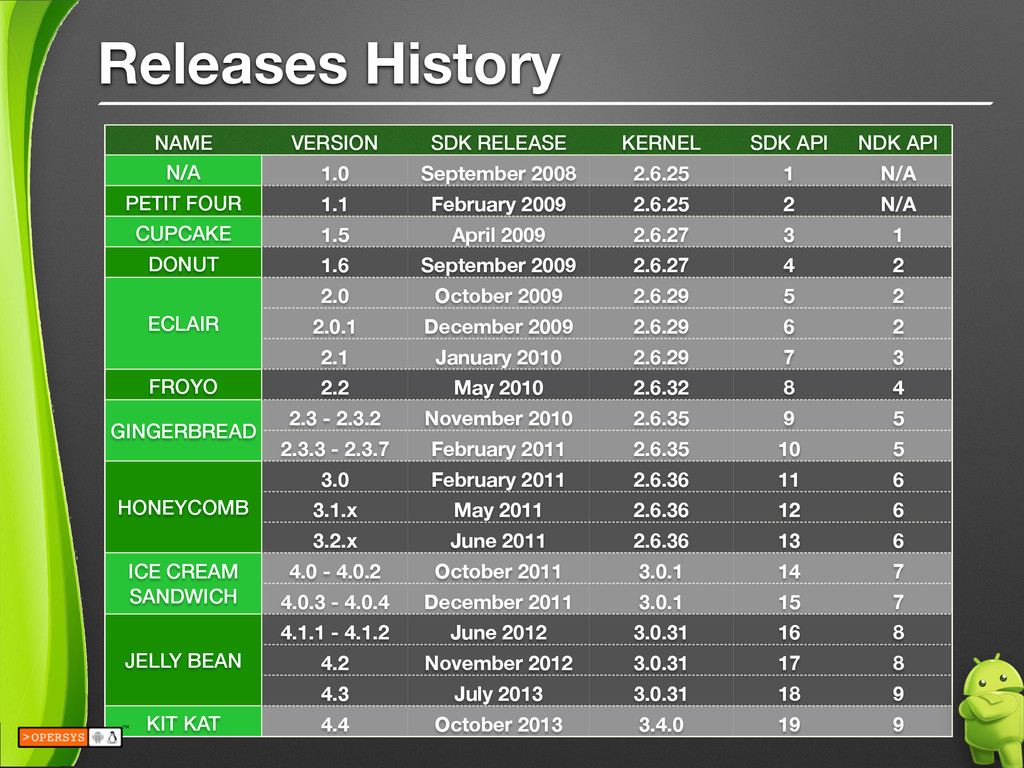
2000s. • Android Inc. got purchased by Google in 2005 (not Linux-based at this time). • Architecture revamping lead to HTC G1 first Android smartphone in 2008. • You know the rest ;-)
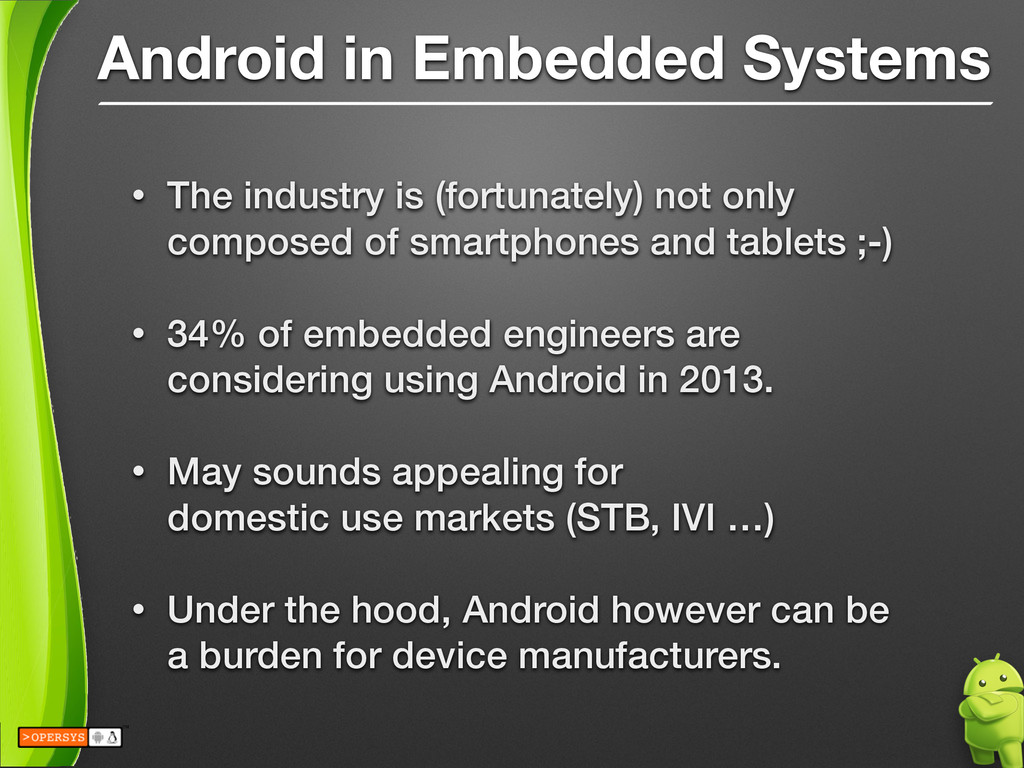
only composed of smartphones and tablets ;-) • 34% of embedded engineers are considering using Android in 2013. • May sounds appealing for domestic use markets (STB, IVI …) • Under the hood, Android however can be a burden for device manufacturers.
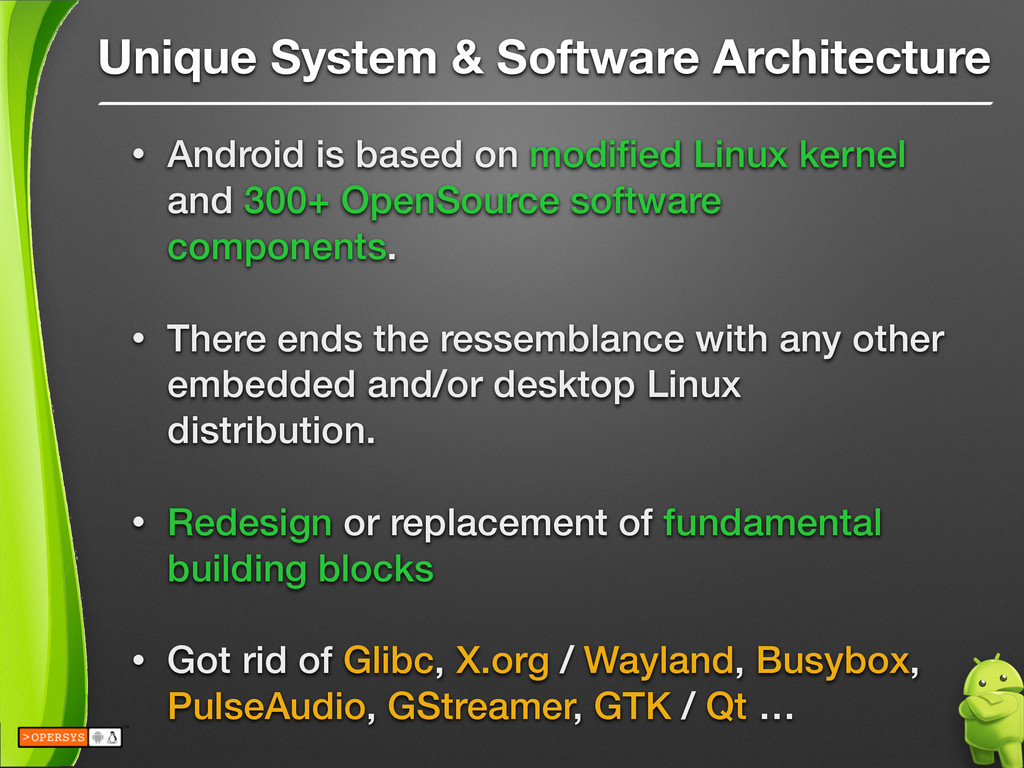
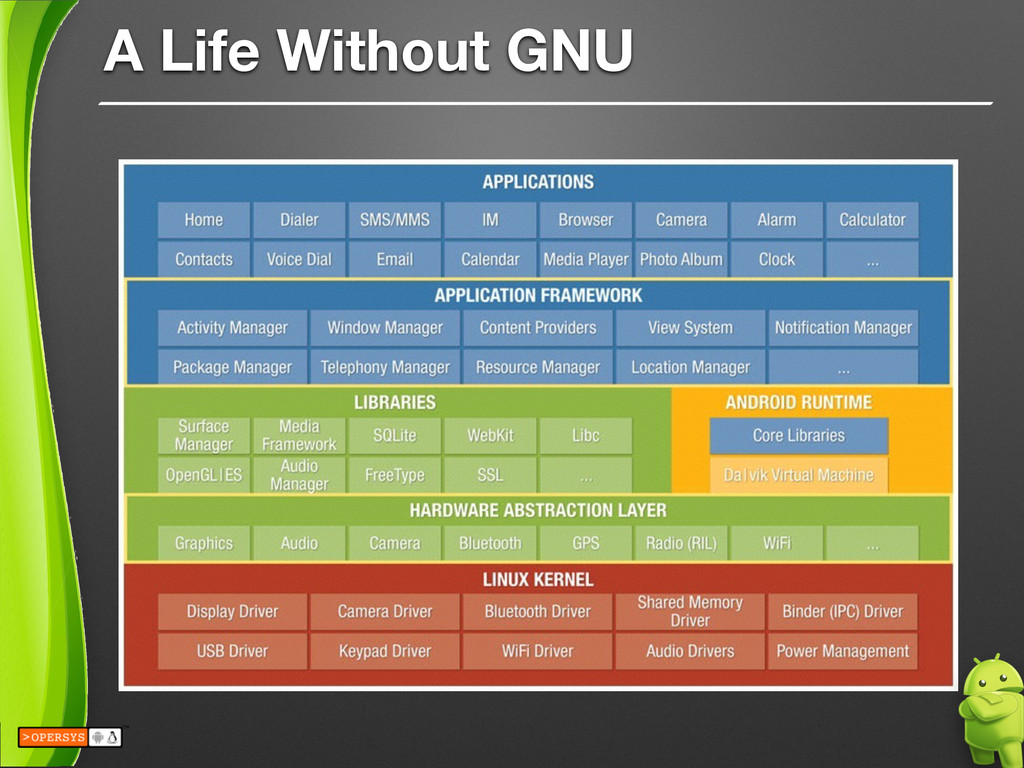
modified Linux kernel and 300+ OpenSource software components. • There ends the ressemblance with any other embedded and/or desktop Linux distribution. • Redesign or replacement of fundamental building blocks • Got rid of Glibc, X.org / Wayland, Busybox, PulseAudio, GStreamer, GTK / Qt …
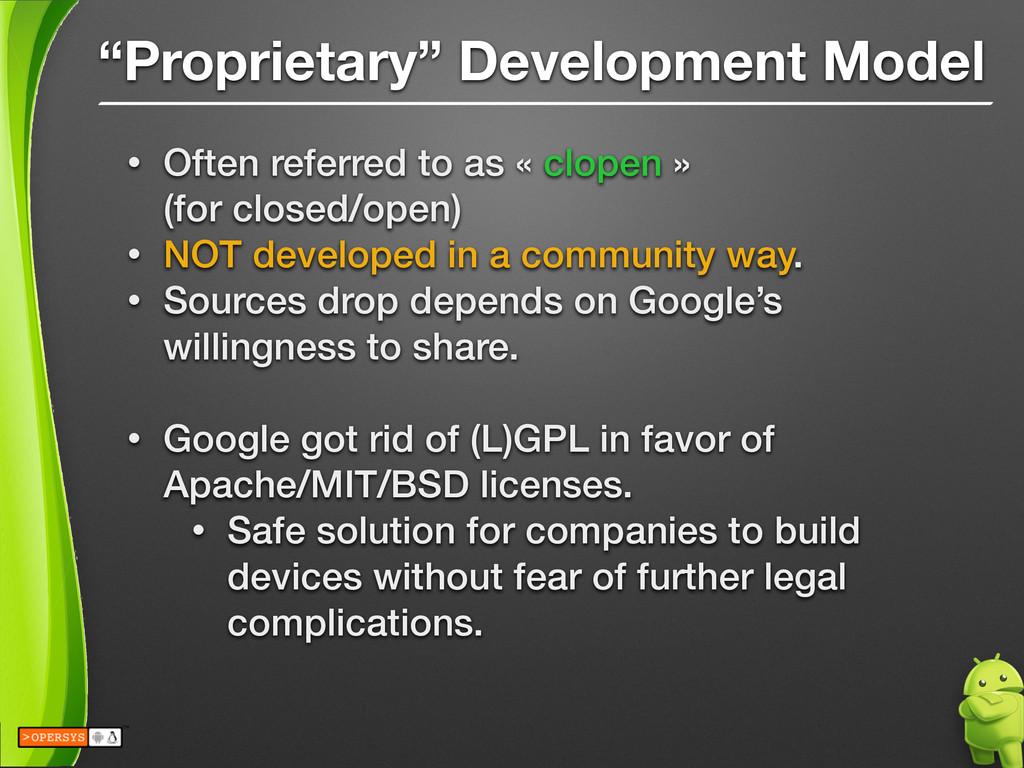
» (for closed/open) • NOT developed in a community way. • Sources drop depends on Google’s willingness to share. • Google got rid of (L)GPL in favor of Apache/MIT/BSD licenses. • Safe solution for companies to build devices without fear of further legal complications.
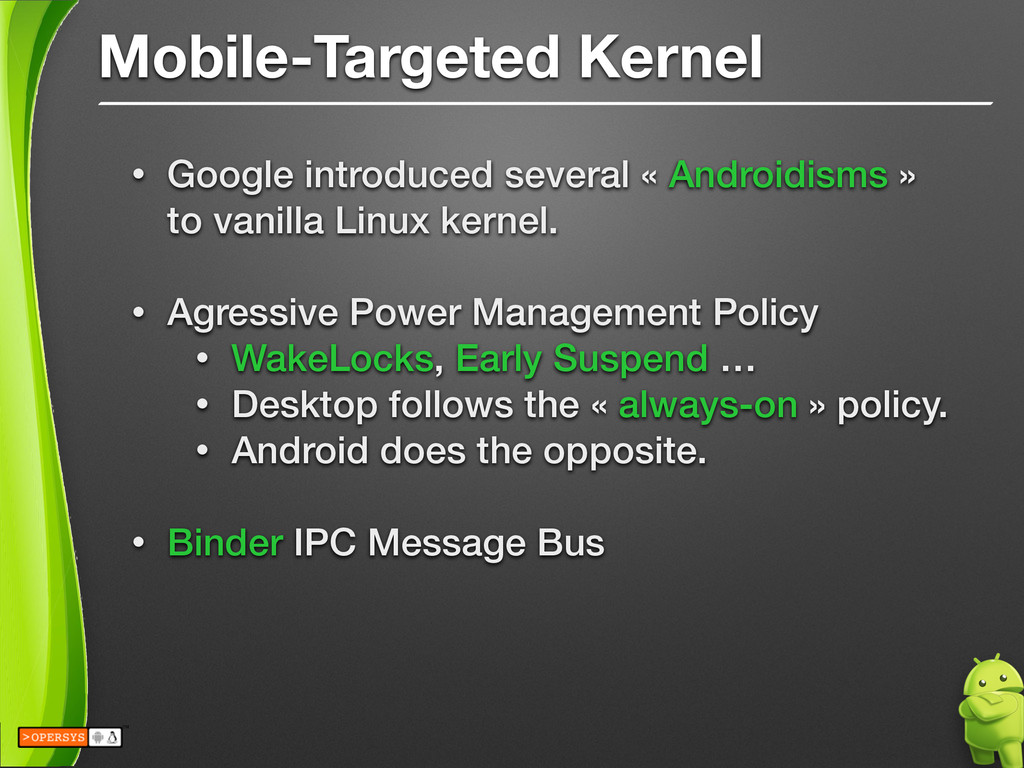
vanilla Linux kernel. • Agressive Power Management Policy • WakeLocks, Early Suspend … • Desktop follows the « always-on » policy. • Android does the opposite. • Binder IPC Message Bus
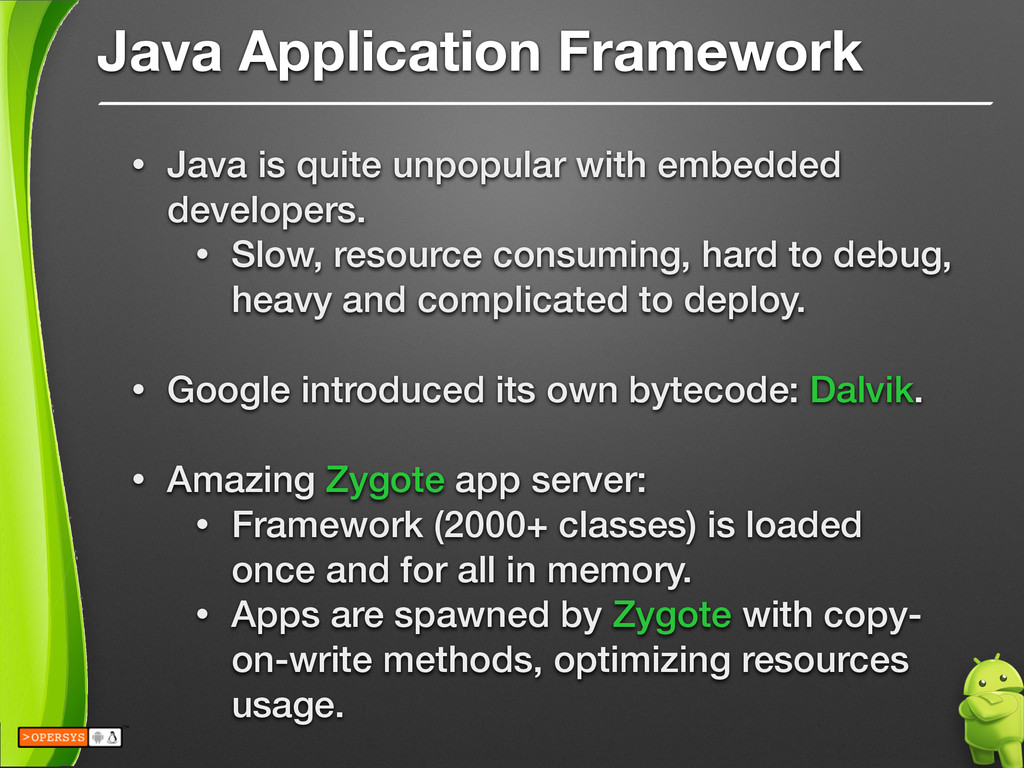
developers. • Slow, resource consuming, hard to debug, heavy and complicated to deploy. • Google introduced its own bytecode: Dalvik. • Amazing Zygote app server: • Framework (2000+ classes) is loaded once and for all in memory. • Apps are spawned by Zygote with copy- on-write methods, optimizing resources usage.
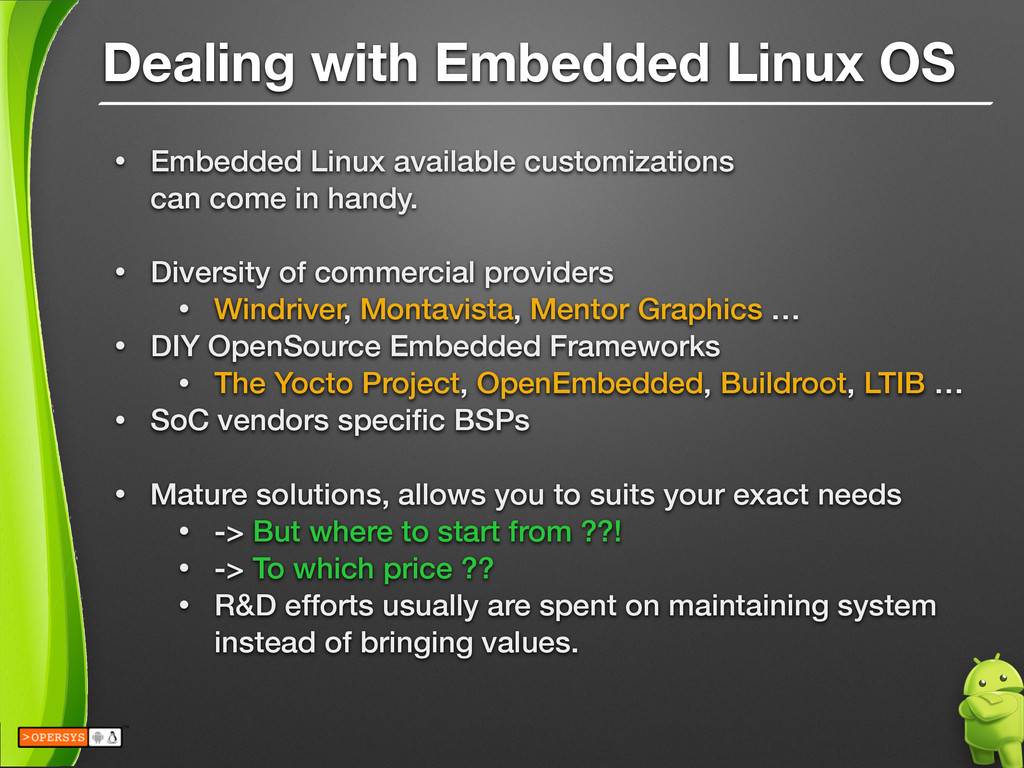
can come in handy. • Diversity of commercial providers • Windriver, Montavista, Mentor Graphics … • DIY OpenSource Embedded Frameworks • The Yocto Project, OpenEmbedded, Buildroot, LTIB … • SoC vendors specific BSPs • Mature solutions, allows you to suits your exact needs • -> But where to start from ??! • -> To which price ?? • R&D efforts usually are spent on maintaining system instead of bringing values.
various groups) is unique. Device manufacturers surely customize it, but there’s only one project you want to be compatible with, and it’s actively maintained for you the Google way.
things at your convenience. • Android comes with a single stable long-term API and excellent SDK. • Standardized Ecosystem for app- developers and 3rd-party partners. • Build apps once for multiple targets to drastically save costs and efforts.
platform and release your new device in a few months ! • Though far from being easy • Requires Android-specific expertise and knowledge of the OS internals !
care about the platform and framework anymore. • Board bring-up is time consuming and no one wants to waste more time re- inventing yet another embedded distribution. • Developers actually only focus on areas that add commercial value (i.e. apps)
developed in a community way. • Provides companies a feeling of safety regarding potential legal threats and licensing. ! • Thanks to Apache/BSD/MIT licensing.
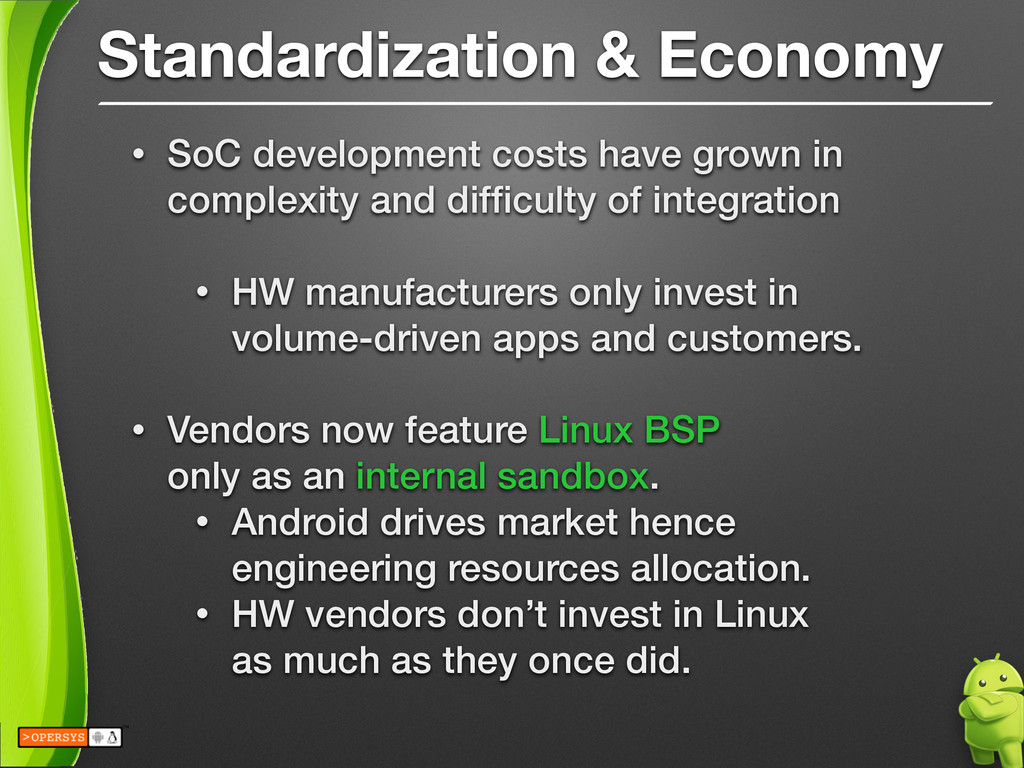
complexity and difficulty of integration • HW manufacturers only invest in volume-driven apps and customers. • Vendors now feature Linux BSP only as an internal sandbox. • Android drives market hence engineering resources allocation. • HW vendors don’t invest in Linux as much as they once did.
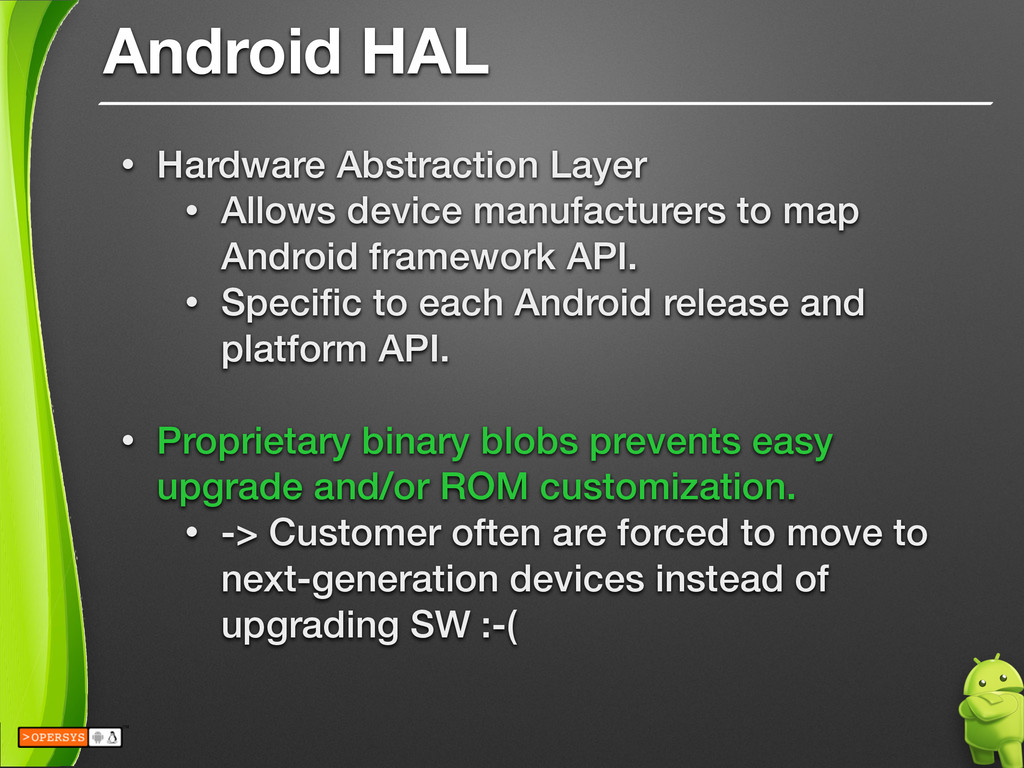
to map Android framework API. • Specific to each Android release and platform API. • Proprietary binary blobs prevents easy upgrade and/or ROM customization. • -> Customer often are forced to move to next-generation devices instead of upgrading SW :-(
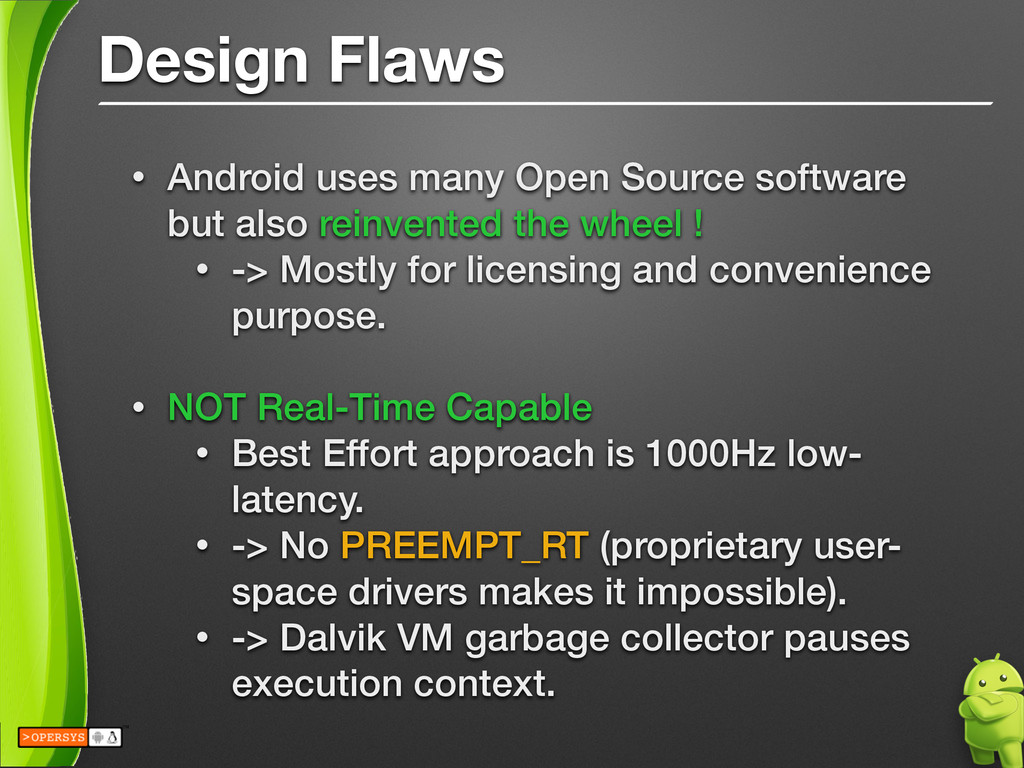
also reinvented the wheel ! • -> Mostly for licensing and convenience purpose. ! • NOT Real-Time Capable • Best Effort approach is 1000Hz low- latency. • -> No PREEMPT_RT (proprietary user- space drivers makes it impossible). • -> Dalvik VM garbage collector pauses execution context.
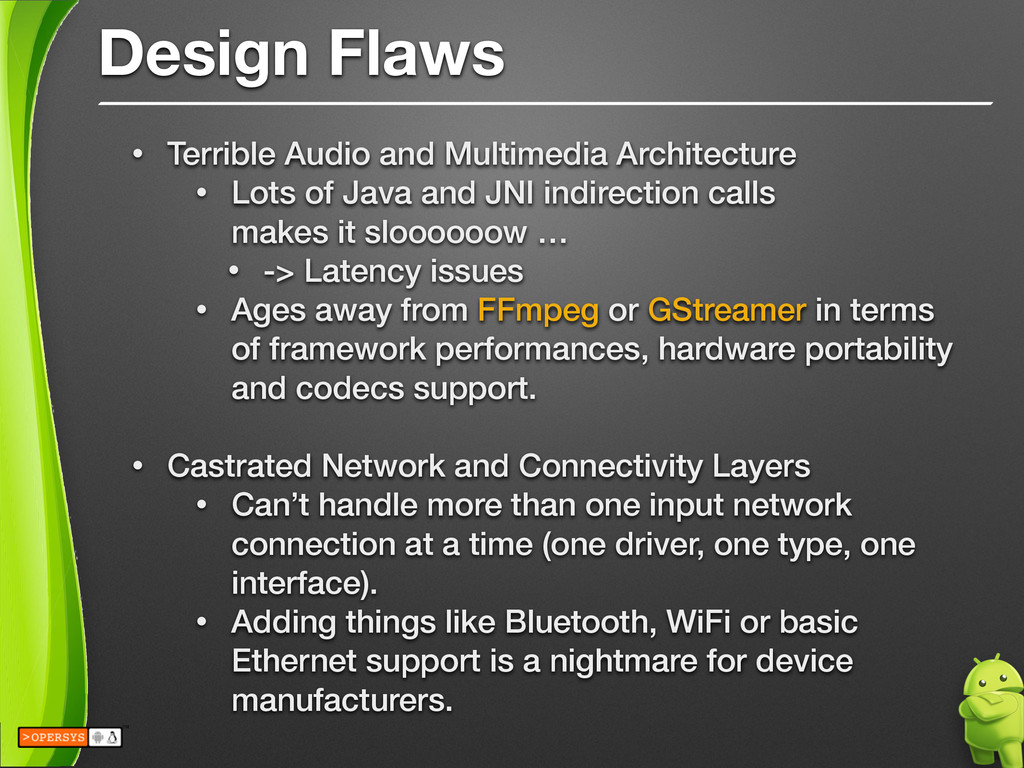
of Java and JNI indirection calls makes it sloooooow … • -> Latency issues • Ages away from FFmpeg or GStreamer in terms of framework performances, hardware portability and codecs support. ! • Castrated Network and Connectivity Layers • Can’t handle more than one input network connection at a time (one driver, one type, one interface). • Adding things like Bluetooth, WiFi or basic Ethernet support is a nightmare for device manufacturers.
write once, run everywhere » framework’s philosophy. • Any serious performance-critical or multimedia app relies on native C/C++ code being done through NDK, cutting down portability.
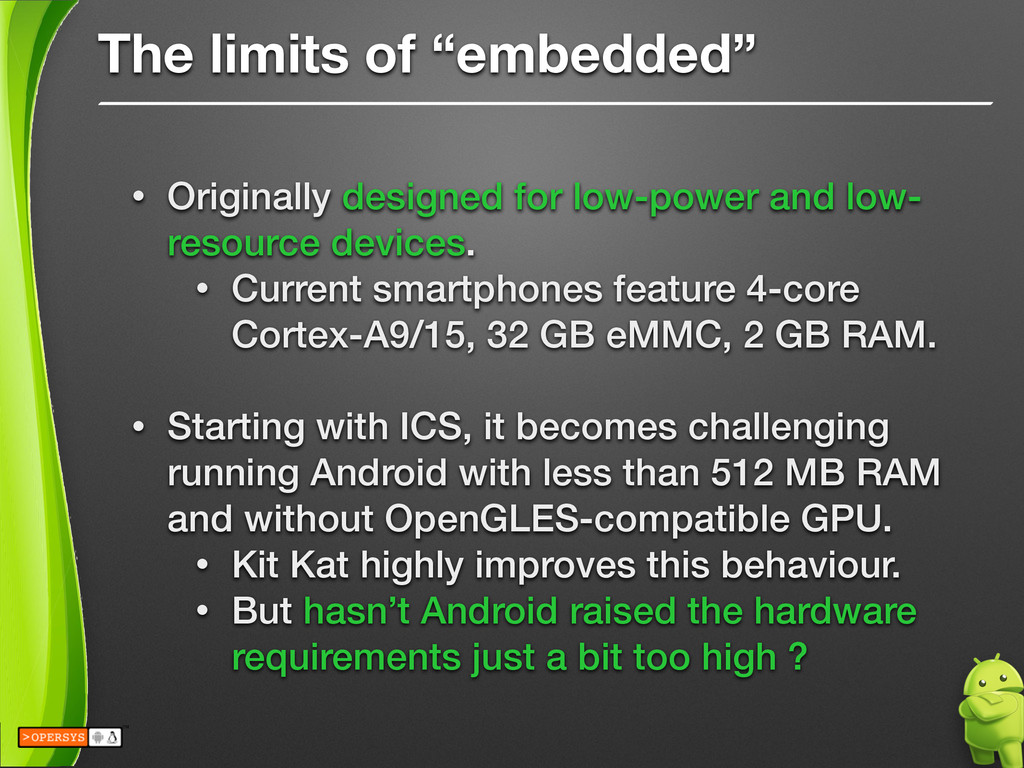
low- resource devices. • Current smartphones feature 4-core Cortex-A9/15, 32 GB eMMC, 2 GB RAM. • Starting with ICS, it becomes challenging running Android with less than 512 MB RAM and without OpenGLES-compatible GPU. • Kit Kat highly improves this behaviour. • But hasn’t Android raised the hardware requirements just a bit too high ?
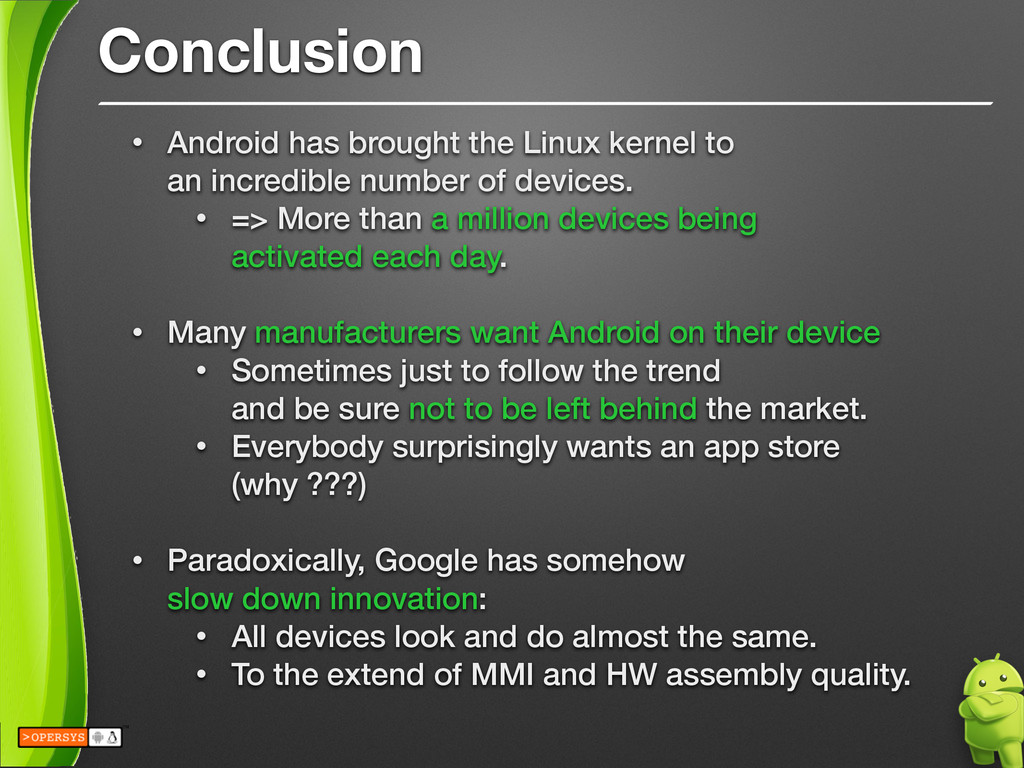
incredible number of devices. • => More than a million devices being activated each day. ! • Many manufacturers want Android on their device • Sometimes just to follow the trend and be sure not to be left behind the market. • Everybody surprisingly wants an app store (why ???) ! • Paradoxically, Google has somehow slow down innovation: • All devices look and do almost the same. • To the extend of MMI and HW assembly quality.
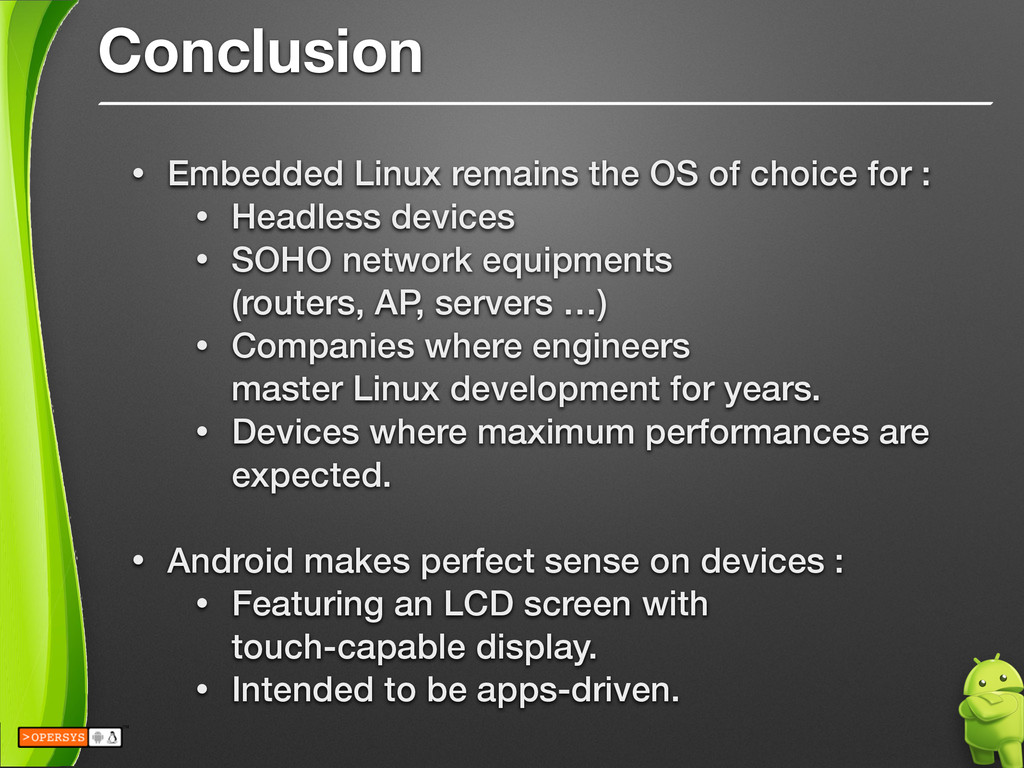
• Headless devices • SOHO network equipments (routers, AP, servers …) • Companies where engineers master Linux development for years. • Devices where maximum performances are expected. ! • Android makes perfect sense on devices : • Featuring an LCD screen with touch-capable display. • Intended to be apps-driven. Conclusion


 gxben
 kinakomoti321
 chigichan24
 kmkim
 nakamizu
 fornewid
 nokonoko1203
 yosuke_furukawa
 l2hyunwoo
 akihisaikeda
 ostk0069
 kasacchiful
 nnaka2992
 marktimemedia
 kevinliebholz
 reverentgeek
 malarkey
 soudai
 inesmontani
 destraynor
 popppiees
 honzajavorek
 sferik
 eileencodes