Upgrade to Pro — share decks privately, control downloads, hide ads and more …

Microservices and Erlang/OTP

Microservices and Erlang/OTP

Talk by Christoph Iserlohn at BOB conference, Berlin, 23 January 2015

innoQ Deutschland GmbH

February 17, 2015

Transcript

57 slides
  1. Attempt of definition >  A system consisting of small, self-
    contained services. All running isolated from each other, communicating only over the network.
  2. Monoliths old and busted “Old Step Van_MG_3279“ by Kool Cats

    Photgraphy over 3 Million Views. Licensed under CC BY 2.0 !
  3. VS.

  4. on the service level: more comprehensible "Nasa earth" by NASA

    ESA - http://www.nasa.gov/. Licensed under Public Domain via Wikimedia Commons - http://commons.wikimedia.org/wiki/File:Nasa_earth.jpg#mediaviewer/File:Nasa_earth.jpg!
  5. on the system level: unable to see the big picture

    "Infant Stars in Orion" by NASA/JPL-Caltech/D. Barrado y Navascués (LAEFF-INTA) - http://www.spitzer.caltech.edu/images/2131-sig07-006-Young-Stars-Emerge-from-Orion-s-Head. Licensed under Public Domain via Wikimedia Commons - http://commons.wikimedia.org/wiki/File:Infant_Stars_in_Orion.jpg#mediaviewer/File:Infant_Stars_in_Orion.jpg!
  6. sophisticated monitoring "Mission control center" by NASAOriginal uploader was Cjosefy

    at en.wikipediaLater version(s) were uploaded by TheDJ at en.wikipedia. - http://spaceflight.nasa.gov/gallery/images/shuttle/sts-114/html/jsc2005e09159.htmlTransferred from en.wikipedia. Licensed under Public Domain via Wikimedia Commons - http://commons.wikimedia.org/wiki/File:Mission_control_center.jpg#mediaviewer/File:Mission_control_center.jpg!
  7. Advantages >  fast development cycle >  it‘s easy to scale

    >  flexibility of implementation >  easy to get started for new developers >  parts of the system can be replaced
  8. Prerequisites >  monitoring the whole system >  central logging > 

    tracing across service boundaries >  automatic deployment >  automatic provisioning
  9. Challenges >  service boundaries >  contracts and governance >  testing

    and refactoring >  fallacies of distributed systems >  support for a dozen technology stacks
  10. Where are we now? "Gartner Hype Cycle" by Jeremykemp at

    en.wikipedia. Licensed under CC BY-SA 3.0 via Wikimedia Commons" http://commons.wikimedia.org/wiki/File:Gartner_Hype_Cycle.svg#mediaviewer/File:Gartner_Hype_Cycle.svg!
  11. What is Erlang / OTP? >  a general purpose programming

    language >  runtime environment and VM >  Open Telecom Platform: libraries, tools and design patterns for building highly concurrent, distributed, fault tolerant systems
  12. fault tolerant to software and hardware errors "BSoD in Windows

    8" by Microsoft - Transferred from en.wikipedia to Commons.. Licensed under Public Domain via Wikimedia Commons - http://commons.wikimedia.org/wiki/File:BSoD_in_Windows_8.png#mediaviewer/File:BSoD_in_Windows_8.png!
  13. distributed systems "BalticServers data center" by Fleshas - I took

    this photo. Licensed under CC BY-SA 3.0 via Wikimedia Commons - http://commons.wikimedia.org/wiki/File:BalticServers_data_center.jpg#mediaviewer/File:BalticServers_data_center.jpg!
  14. non-stop running - continous operation over years "CEV-ISS" by NASA

    - http://www.nasa.gov/mission_pages/exploration/spacecraft/cev_hi_res.html. Licensed under Public Domain via Wikimedia Commons - http://commons.wikimedia.org/wiki/File:CEV-ISS.jpg#mediaviewer/File:CEV-ISS.jpg!
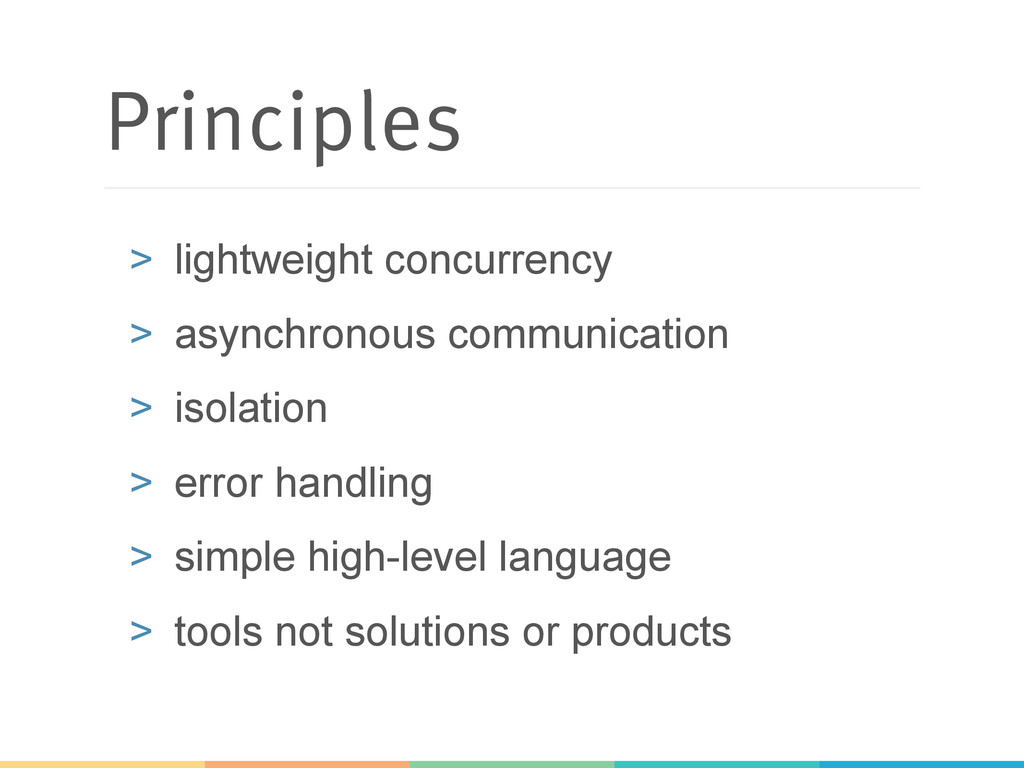
  15. Principles >  lightweight concurrency >  asynchronous communication >  isolation > 

    error handling >  simple high-level language >  tools not solutions or products
  16. Erlang – the language >  high-level functional language >  prolog

    inspired syntax >  dynamically typed / safe >  pattern matching everywhere >  recursion >  immutable data and variables
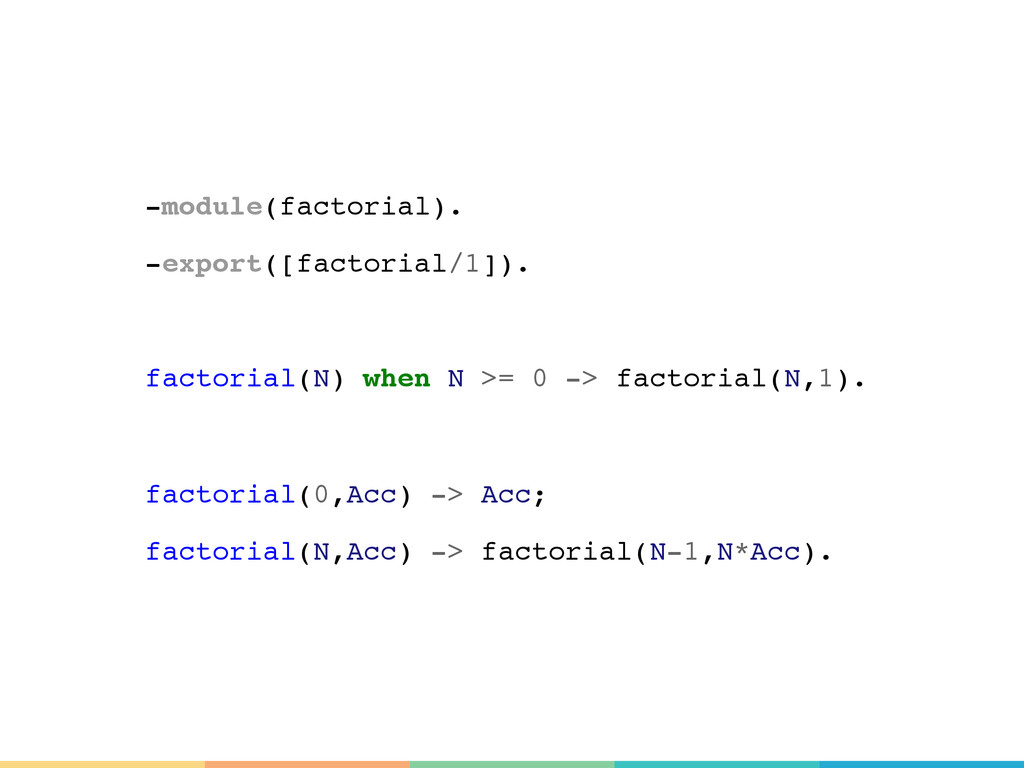
  17. -module(factorial).! -export([factorial/1]).! ! factorial(N) when N >= 0 -> factorial(N,1).!

    ! factorial(0,Acc) -> Acc;! factorial(N,Acc) -> factorial(N-1,N*Acc).!
  18. Concurrency >  millions of processes on one machine >  processes

    are isolated >  processes are used for everything: >  concurrency >  managing state >  parallelism >  no global data
  19. Message passing >  asynchronous >  primitives: >  fire & forget

    send >  selective receive >  more complex interactions can be built on top of these primitives
  20. -module(pingpong). -export([start/1]). start(N) when N > 0 -> Pong =

    spawn(fun pong/0), ping(N, Pong). ping(0,Pong) -> Pong ! exit, ok; ping(N, Pong) -> Pong ! {self(), ping}, receive pong -> io:format("Pid ~p: got pong. ~p pings left~n", [self(), N-1]) end, ping(N - 1, Pong). pong() -> receive {From, ping} -> io:format("Pid ~p: got ping from ~p~n", [self(), From]), From ! pong, pong(); exit -> ok end. !
  21. Error handling >  avoid error checking code everywhere >  let

    it crash >  process based: >  link - bidirectional >  monitor - unidirectional >  supervision trees
  22. OTP >  helps creating: >  servers >  finites state machines

    >  event handler >  supervisors >  releases and upgrades
  23. Hot code loading >  module is unit of code handling

    >  exists in two variants: old and current >  controlled take over
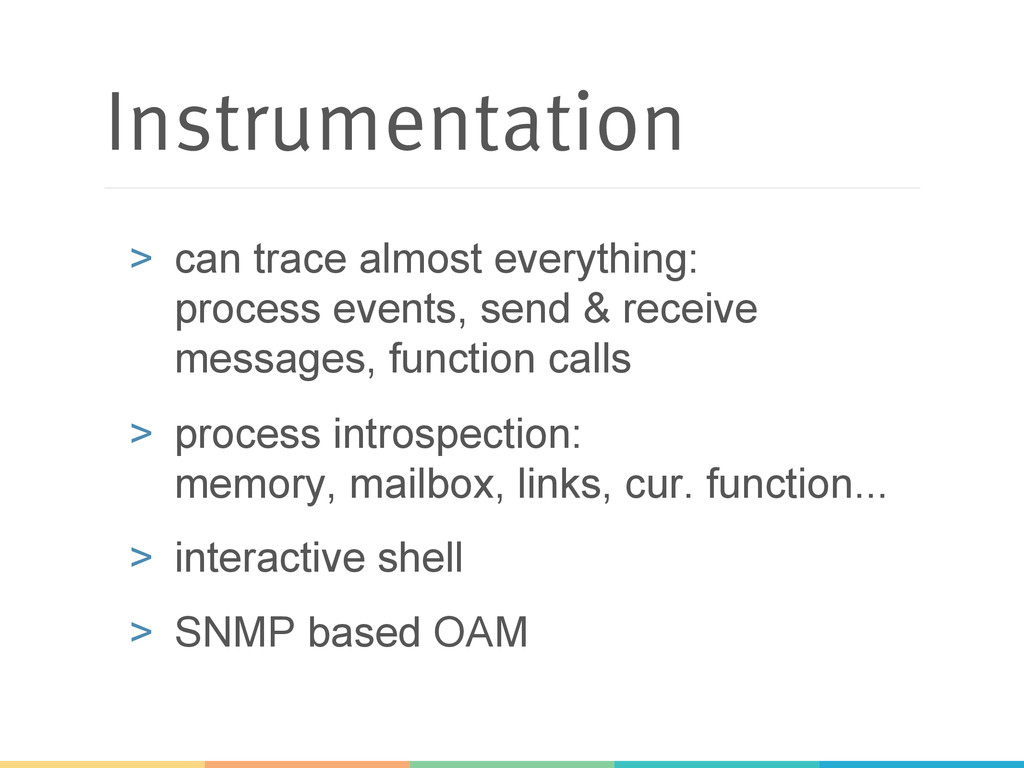
  24. Instrumentation >  can trace almost everything: process events, send &

    receive messages, function calls >  process introspection: memory, mailbox, links, cur. function... >  interactive shell >  SNMP based OAM
  25. Summary >  everything you need for building highly concurrent, distributed,

    robust systems >  but not well suited for number crunching or maximum perfomance requirements
  26. Where are we now? "Gartner Hype Cycle" by Jeremykemp at

    en.wikipedia. Licensed under CC BY-SA 3.0 via Wikimedia Commons" http://commons.wikimedia.org/wiki/File:Gartner_Hype_Cycle.svg#mediaviewer/File:Gartner_Hype_Cycle.svg!
  27. How they fit together >  Erlang / OTP has everything

    you need to build production-ready Microservices
  28. How they fit together >  fault tolerance / resilience > 

    async communication is the default >  amazing monitoring capabilites >  tools for upgrading / downgrading running systems

More Decks by innoQ Deutschland GmbH

Other Decks in Programming