Share
Embed
Interactive Learning – Increasing Student Participation through Shorter Exercise Cycles
Nineteenth Australasian Computing Education Conference
Geelong, Australia 31 Jan - 3 Feb 2017
http://infotech.scu.edu.au/~ACE2017/program.html
Stephan Krusche
February 01, 2017
Transcript
19 slides
-
[email protected] - www.skrusche.de - @skrusche ACE 2017 Conference Stephan Krusche,
Andreas Seitz, Jürgen Börstler, Bernd Bruegge (February 1, 2017) Interactive Learning – Increasing Student Participation through Shorter Exercise Cycles -
Stephan Krusche, Andreas Seitz, Jürgen Börstler, Bernd Bruegge: Interactive Learning
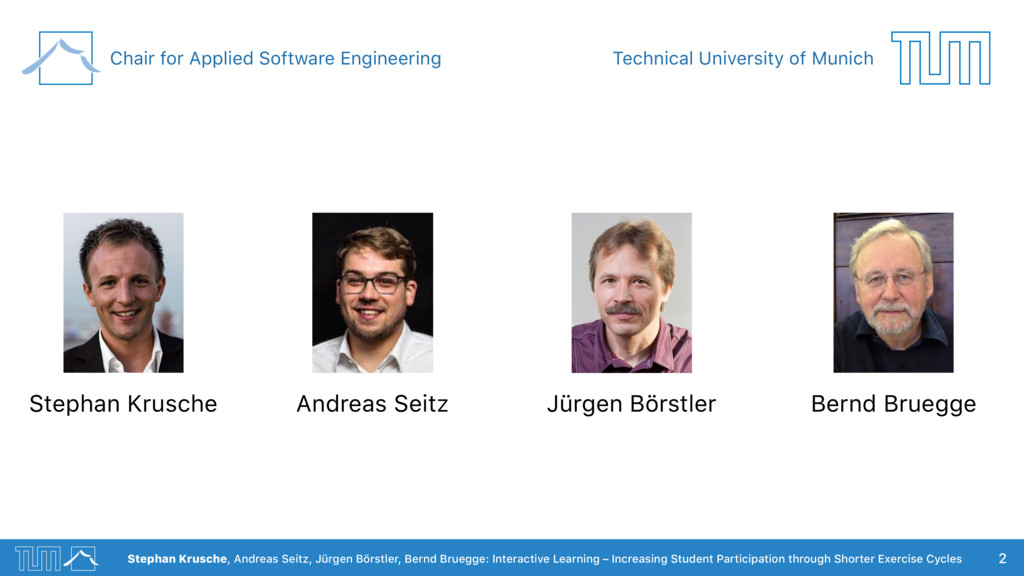
– Increasing Student Participation through Shorter Exercise Cycles 2 Stephan Krusche Jürgen Börstler Bernd Bruegge Andreas Seitz Chair for Applied Software Engineering Technical University of Munich -
Stephan Krusche, Andreas Seitz, Jürgen Börstler, Bernd Bruegge: Interactive Learning
– Increasing Student Participation through Shorter Exercise Cycles Traditional courses with large classes 3 Educator Lecture Exercise Student Delay (week) -
Stephan Krusche, Andreas Seitz, Jürgen Börstler, Bernd Bruegge: Interactive Learning
– Increasing Student Participation through Shorter Exercise Cycles 4 Lecture Educator Exercise Student Computer based and experiential learning Delay (day) -
Stephan Krusche, Andreas Seitz, Jürgen Börstler, Bernd Bruegge: Interactive Learning
– Increasing Student Participation through Shorter Exercise Cycles Interactive learning 5 delay (min) Delay (min) Educator Theory Student Exercise Interactive class ➡ Multiple iterations in one class -
Stephan Krusche, Andreas Seitz, Jürgen Börstler, Bernd Bruegge: Interactive Learning
– Increasing Student Participation through Shorter Exercise Cycles Interactive learning 6 Exercise Example Solution Learner Reflection Theory “Tell me and I will forget. Show me and I will remember. Involve me and I will understand. Step back and I will act.” — Chinese Proverb Immediate feedback Definition: Educators teach and exercise small chunks of content in short cycles. They provide immediate feedback so that learners can reflect on the content and increase their knowledge incrementally. -
Stephan Krusche, Andreas Seitz, Jürgen Börstler, Bernd Bruegge: Interactive Learning
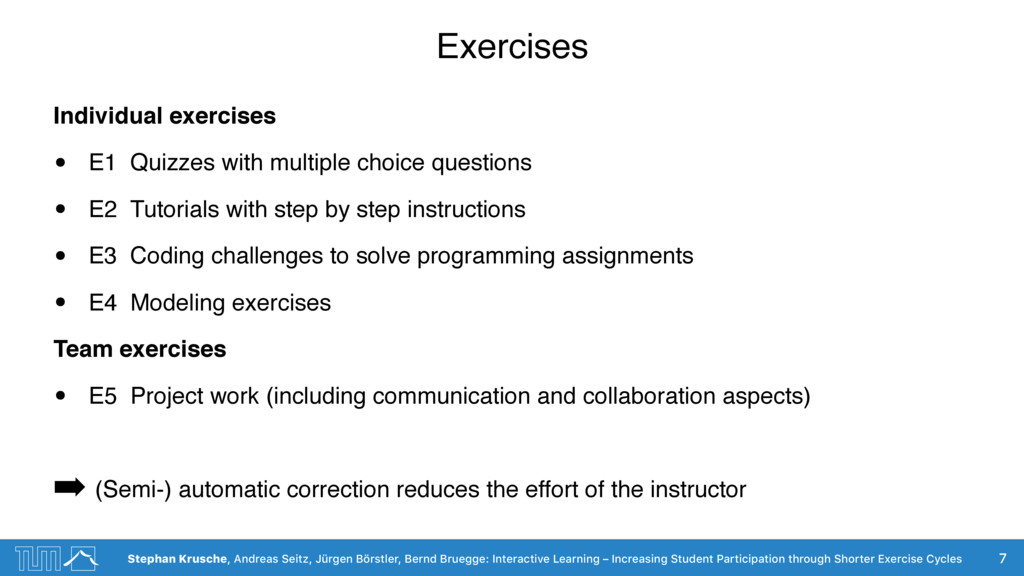
– Increasing Student Participation through Shorter Exercise Cycles Exercises Individual exercises • E1 Quizzes with multiple choice questions • E2 Tutorials with step by step instructions • E3 Coding challenges to solve programming assignments • E4 Modeling exercises Team exercises • E5 Project work (including communication and collaboration aspects) ➡ (Semi-) automatic correction reduces the effort of the instructor 7 -
Stephan Krusche, Andreas Seitz, Jürgen Börstler, Bernd Bruegge: Interactive Learning
– Increasing Student Participation through Shorter Exercise Cycles Example E1: quiz with drag and drop exercise 8 -
Stephan Krusche, Andreas Seitz, Jürgen Börstler, Bernd Bruegge: Interactive Learning
– Increasing Student Participation through Shorter Exercise Cycles Example E2: tutorials with step by step instructions 9 -
Stephan Krusche, Andreas Seitz, Jürgen Börstler, Bernd Bruegge: Interactive Learning
– Increasing Student Participation through Shorter Exercise Cycles Example E3: coding challenge 10 -
Stephan Krusche, Andreas Seitz, Jürgen Börstler, Bernd Bruegge: Interactive Learning
– Increasing Student Participation through Shorter Exercise Cycles Example E4: project work 11 -
Stephan Krusche, Andreas Seitz, Jürgen Börstler, Bernd Bruegge: Interactive Learning
– Increasing Student Participation through Shorter Exercise Cycles Hypotheses • H1 Participation: Interactive learning increases the participation of students in classes. • H2 Improved Learning: Interactive learning leads to an improved learning experience for students. • H3 Scalability: Interactive learning is scalable to large classes with 300 students. 12 -
Stephan Krusche, Andreas Seitz, Jürgen Börstler, Bernd Bruegge: Interactive Learning
– Increasing Student Participation through Shorter Exercise Cycles Case studies 13 1) SE II: Project Organization and Management (POM) • April - July 2015 • 294 students • Computer science master • Information system bachelor • Exercises • E1: Quizzes • E2: Tutorials • E5: Project work 2) Patterns in Software Engineering (PSE) • October 2015 - February 2016 • 324 students • Computer science master • Exercises • E3: Coding challenge • E4: Modeling exercise -
Stephan Krusche, Andreas Seitz, Jürgen Börstler, Bernd Bruegge: Interactive Learning
– Increasing Student Participation through Shorter Exercise Cycles Evaluation 1) Qualitative evaluation with an online survey in POM • July 2015 (directly after the course) • Goal: Find out if students improved their skills and if they are confident to apply the learned concepts in future projects • Response rate: 223 out of 294 (76%) 2) Quantitative evaluations in POM and PSE • Goal: Measure the correlation between exercise participation and final exam grade using a χ2 test 14 -
Stephan Krusche, Andreas Seitz, Jürgen Börstler, Bernd Bruegge: Interactive Learning
– Increasing Student Participation through Shorter Exercise Cycles Finding 1: students perceive to improve their skills 15 0% 20% 40% 60% 80% 100% In the exercises, I was able to improve my skills in agile methods I am confident to apply agile methods in my next team project 2.6% 3.1% 9.3% 11.9% 88.1% 85.1% Agree Neutral Disagree ➡ Similar results for other taught topics -
Stephan Krusche, Andreas Seitz, Jürgen Börstler, Bernd Bruegge: Interactive Learning
– Increasing Student Participation through Shorter Exercise Cycles 16 0 70 140 210 280 350 1 2 3 4 5 6 7 8 9 10 11 12 13 14 15 63 71 62 44 87 109 123 222 104 199 103 149 192 125 199 Participants per class (POM 2014) Total participants: 345 58% 36% 56% 43% 30% 58% 30% 64% 36% 32% 25% 13% 18% 21% 18% 0 50 100 150 200 250 300 2 3 4 5 6 7 9 10 11 12 13 112 128 143 160 149 183 180 191 196 173 154 Participants per class (POM 2015) Total participants: 294 52% 59% 67% 65% 61% 62% 51% 54% 49% 44% 38% Finding 2: higher participation 2014 2015 -
Stephan Krusche, Andreas Seitz, Jürgen Börstler, Bernd Bruegge: Interactive Learning
– Increasing Student Participation through Shorter Exercise Cycles Finding 3: correlation between participation and grade 17 1.5 2 2.5 3 3.5 4 2.0 2.1 2.3 2.5 3.1 2.4 2.5 2.9 3.6 3.9 GPA in POM GPA in PSE Exercise participation 20 % 40 % 60 % 80 % 100 % 0 % POM: χ2 = 82.53 (p < 0.0001) PSE: χ2 = 48.01 (p < 0.0001) (lower grade = better) -
Stephan Krusche, Andreas Seitz, Jürgen Börstler, Bernd Bruegge: Interactive Learning
– Increasing Student Participation through Shorter Exercise Cycles Conclusion about interactive learning • Tighter integration of lectures and exercises leads to interactive classes • Higher participation in classes than in traditional courses • Highly significant correlation between exercise participation and final exam grade • Scalable and applicable to large classes without increasing teaching effort significantly • Future work: • More studies to investigate other influencing variables • Apply interactive learning in online courses (MOOCs) ➡ Want to adopt this approach? Talk to me or send me a mail: [email protected] ➡ More information on www.interactive-learning.org 18 -
ACE 2017 Conference Stephan Krusche, Andreas Seitz, Jürgen Börstler, Bernd
Bruegge (February 1, 2017) Interactive Learning – Increasing Student Participation through Shorter Exercise Cycles [email protected] - www.skrusche.de - @skrusche Thank You!