$30 off During Our Annual Pro Sale. View Details »

Cedar: A rock-solid access control building blo...

Cedar: A rock-solid access control building block for the cloud native ecosystem

Location: Globe of Science and Innovation, CERN, Espl. des Particules 1, 1217 Meyrin, Schweiz
Schedule link: https://sessionize.com/view/rlq5we3p/GridSmart

Abstract: Building fine-grained access controls into your open source project is a difficult challenge.

We can reduce and amortize this challenge by centralizing the complexity in a general-purpose authorization engine. Before Kubernetes, everyone built stacks from the ground up. With Kubernetes, distributed systems complexity is centralized and shared by the community, saving everyone time and effort.

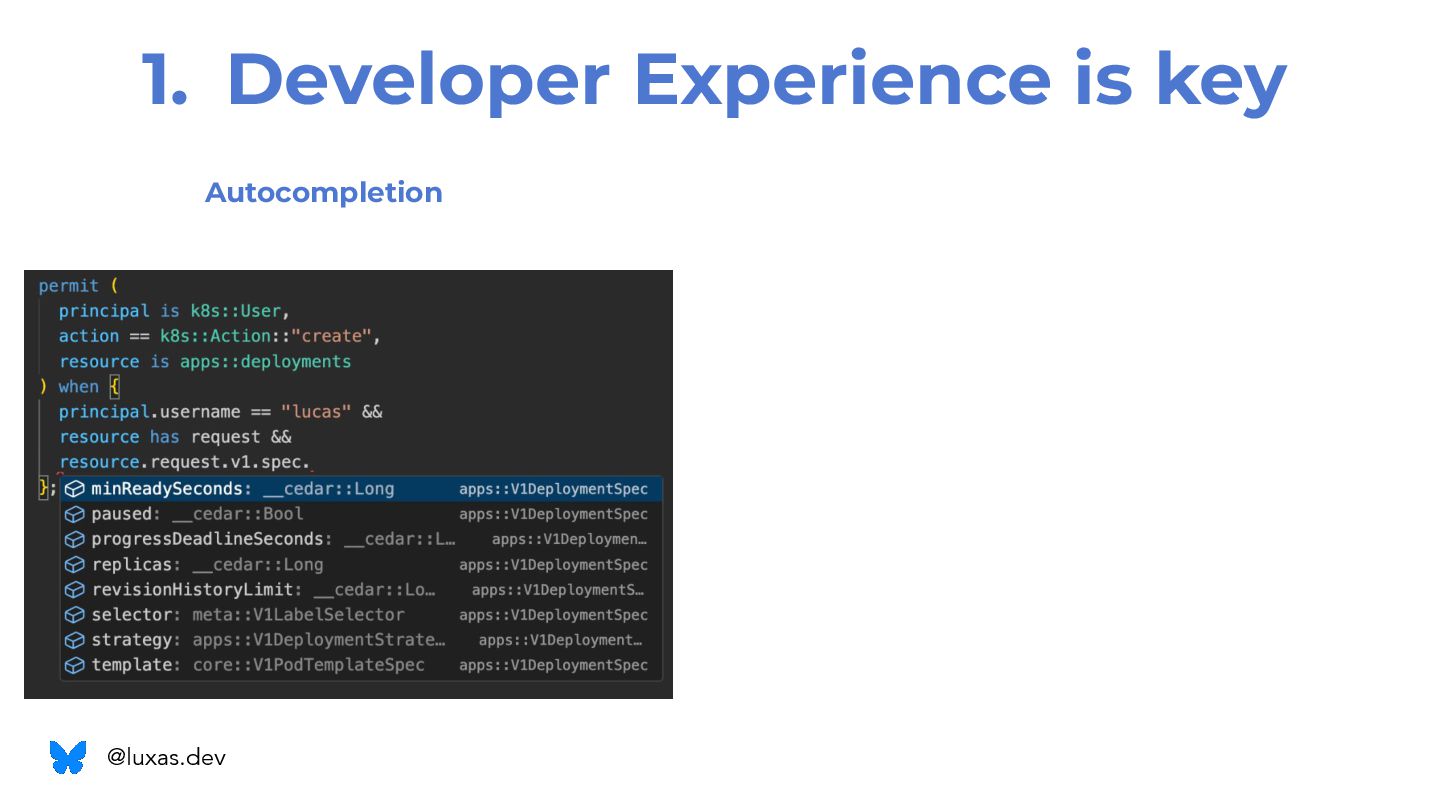
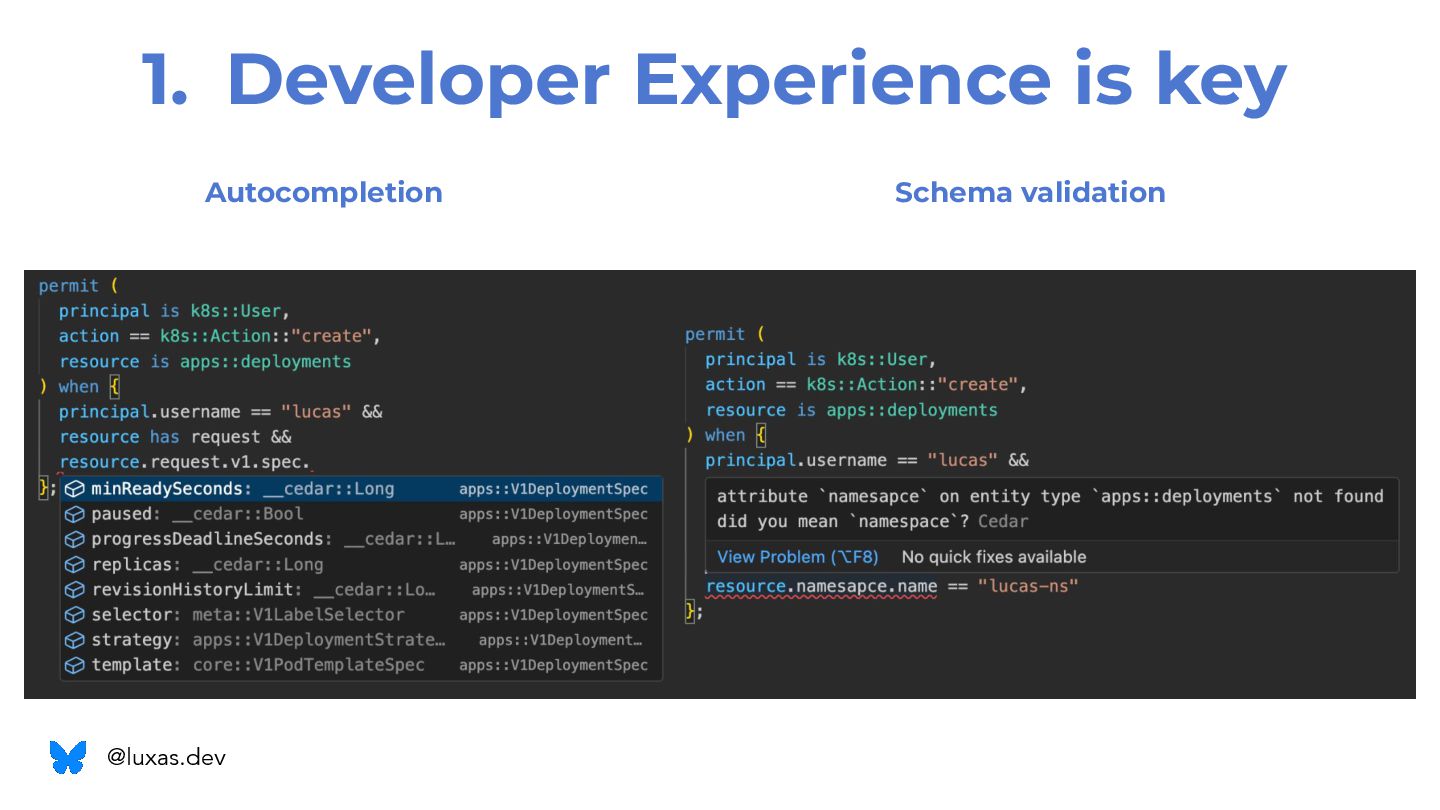
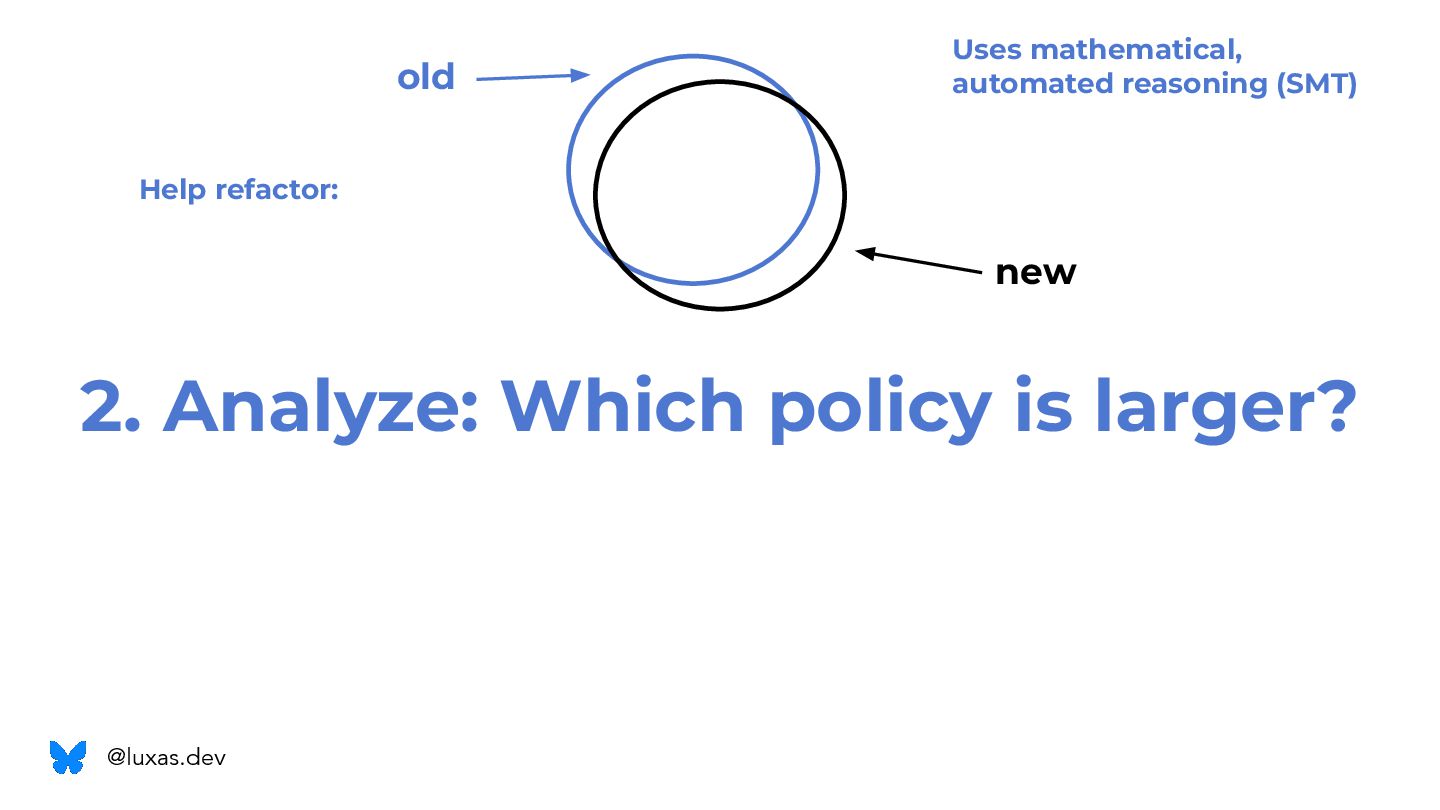
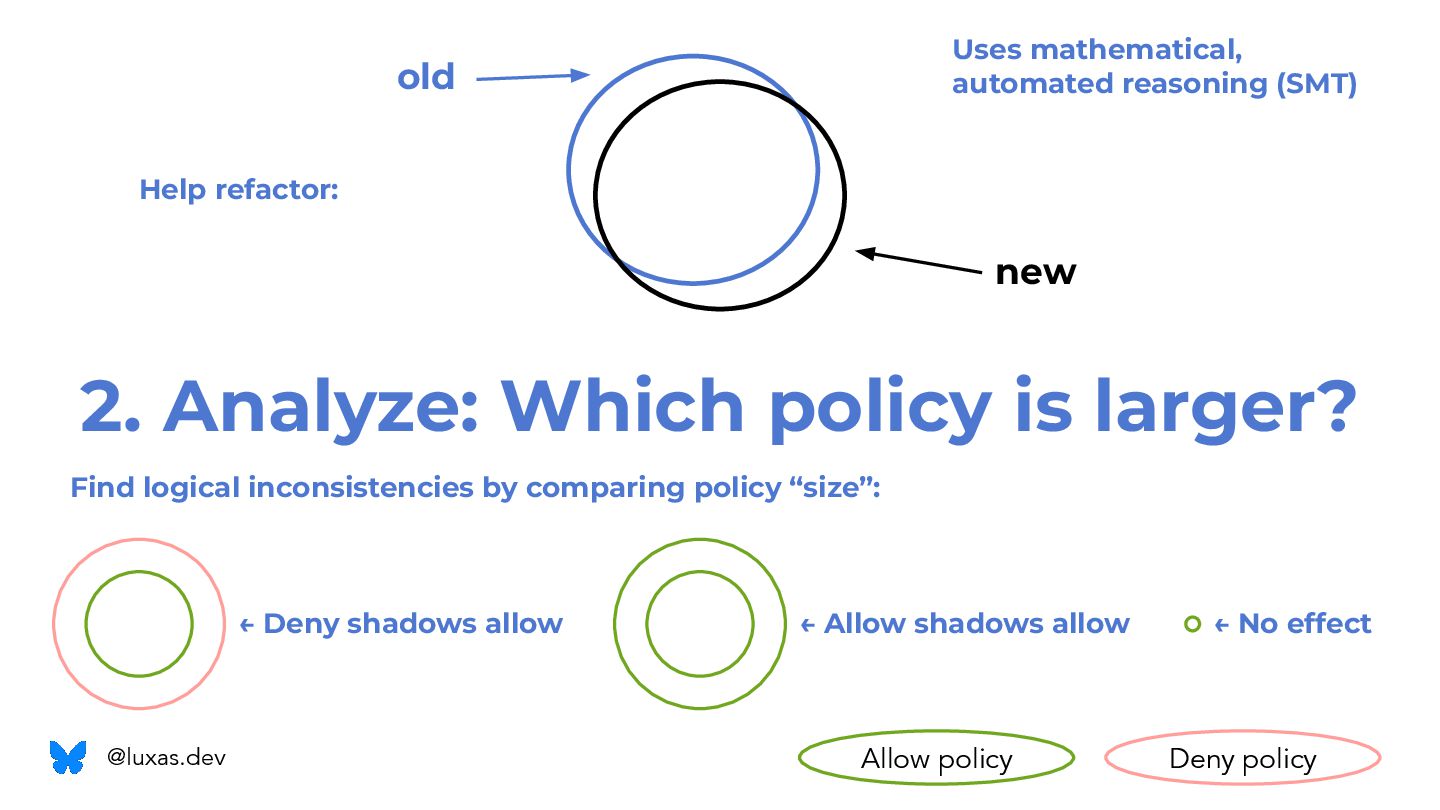
Cedar Policy, an open source project proposed to be donated to the CNCF, aims to remove the heavy lifting of building access controls. Cedar supports role-, relation-, and attribute-based access controls. It can be embedded into any application or run as a service. It has a flexible, typed schema that enables syntax hints in VS Code. Uniquely, Cedar policies are analyzable, allowing answering questions like “is the refactored policy equal to the previous one?”

This talk introduces Cedar and presents a case study on how it can be used in the context of Kubernetes access controls.

Avatar for Lucas Käldström

Lucas Käldström

December 05, 2025
Tweet

More Decks by Lucas Käldström

Other Decks in Technology

Transcript

  1. Cedar: A rock-solid access control building block for the cloud

    native ecosystem Lucas Käldström Kubernetes Contributor Staff Software Engineer, @luxas.dev
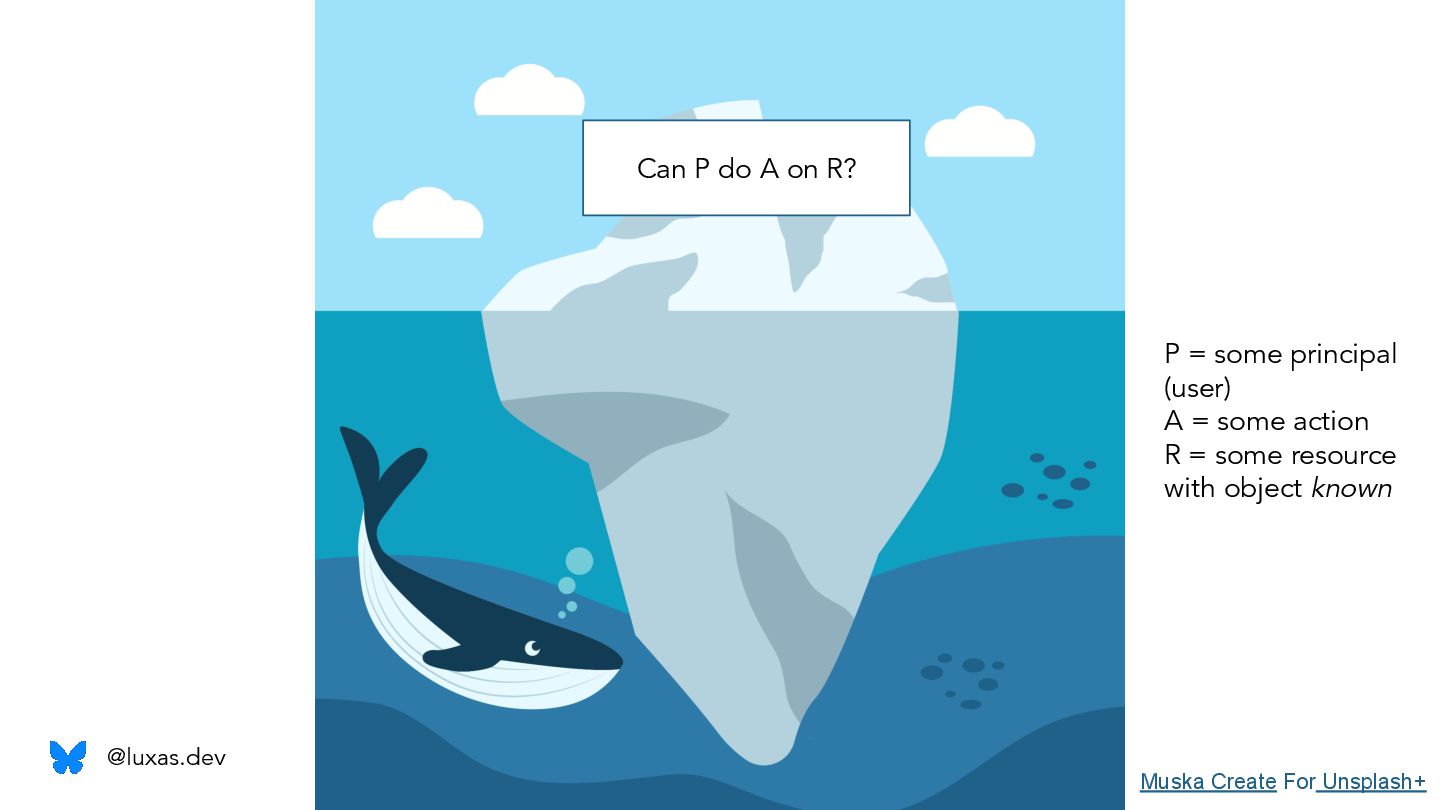
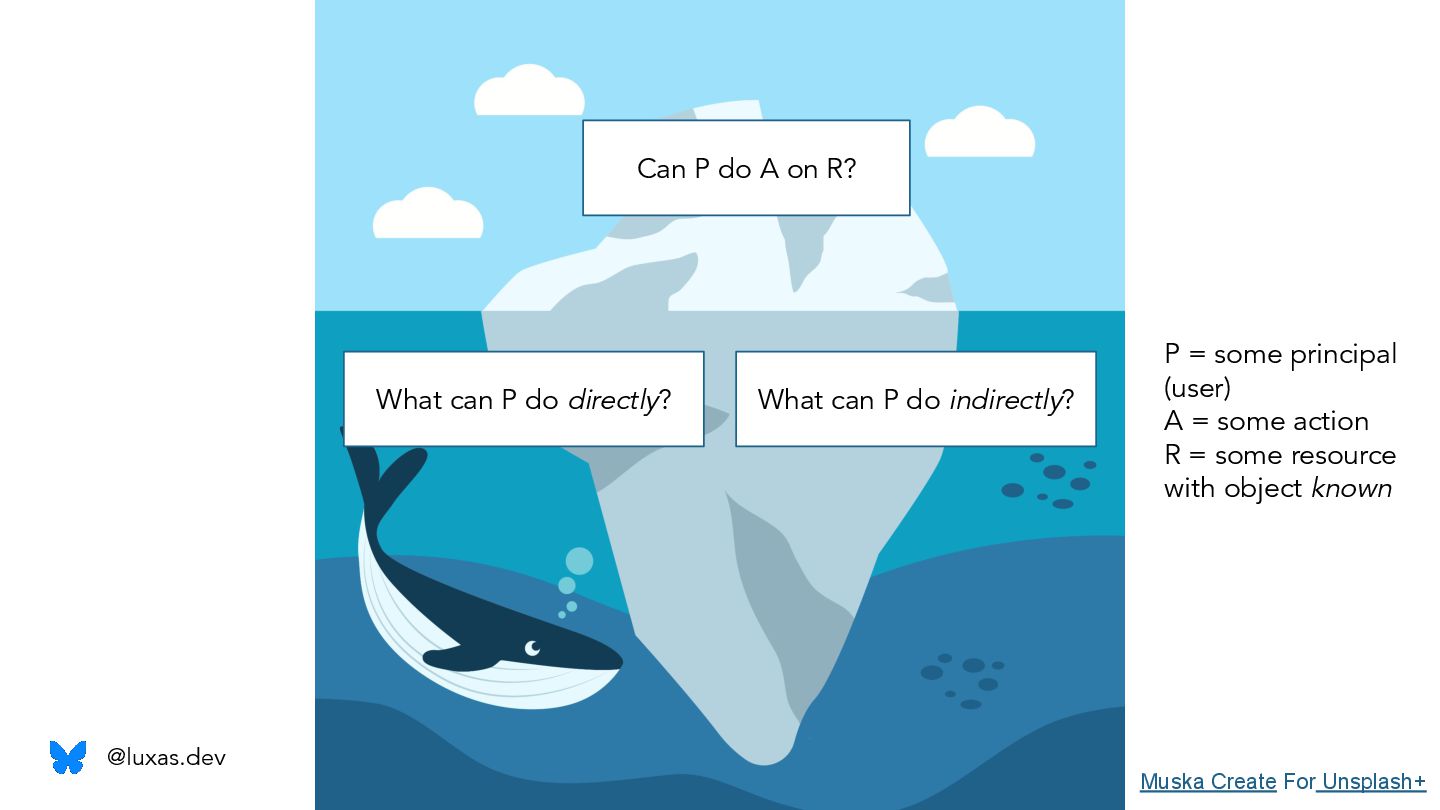
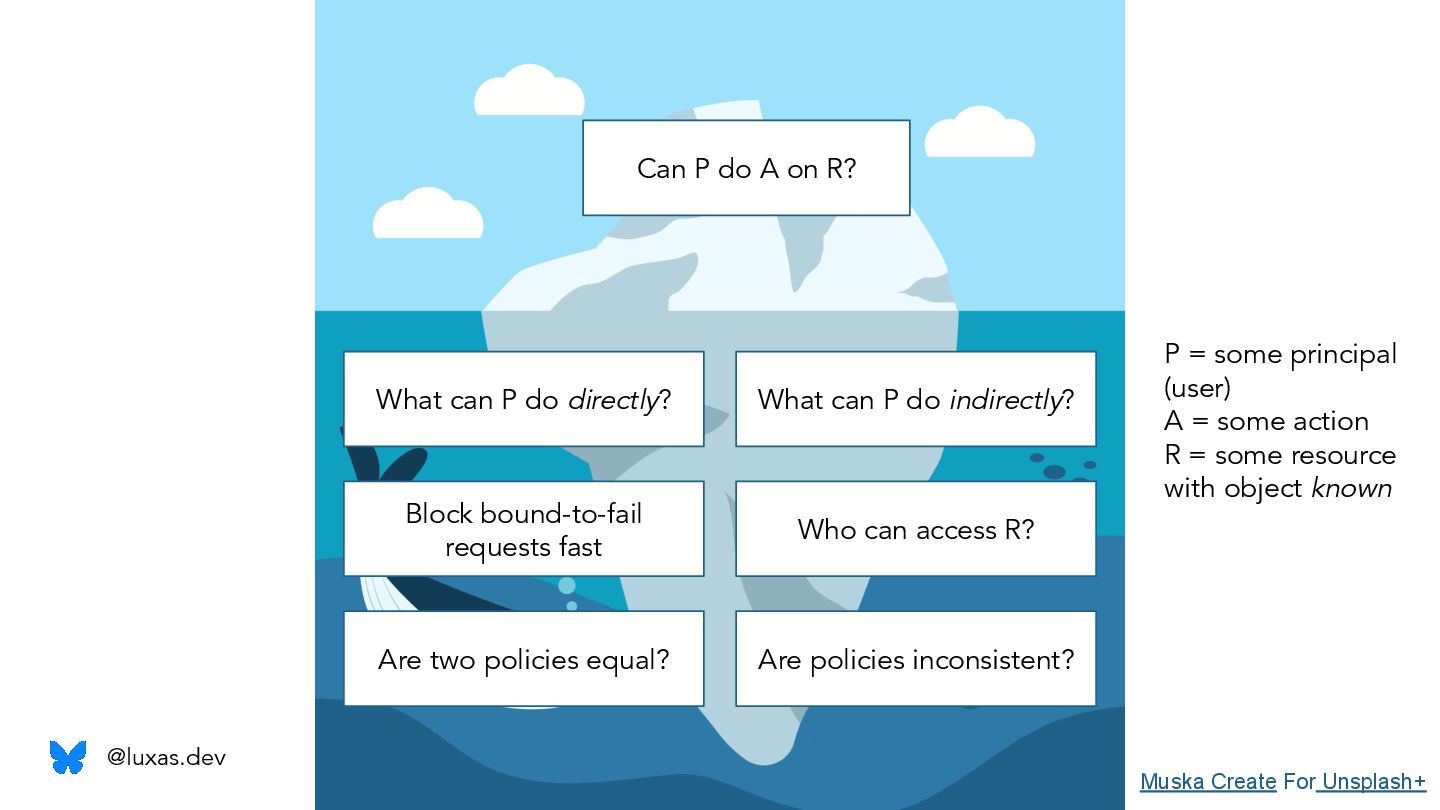
  2. Can P do A on R? P = some principal

    (user) A = some action R = some resource with object known Muska Create For Unsplash+ @luxas.dev
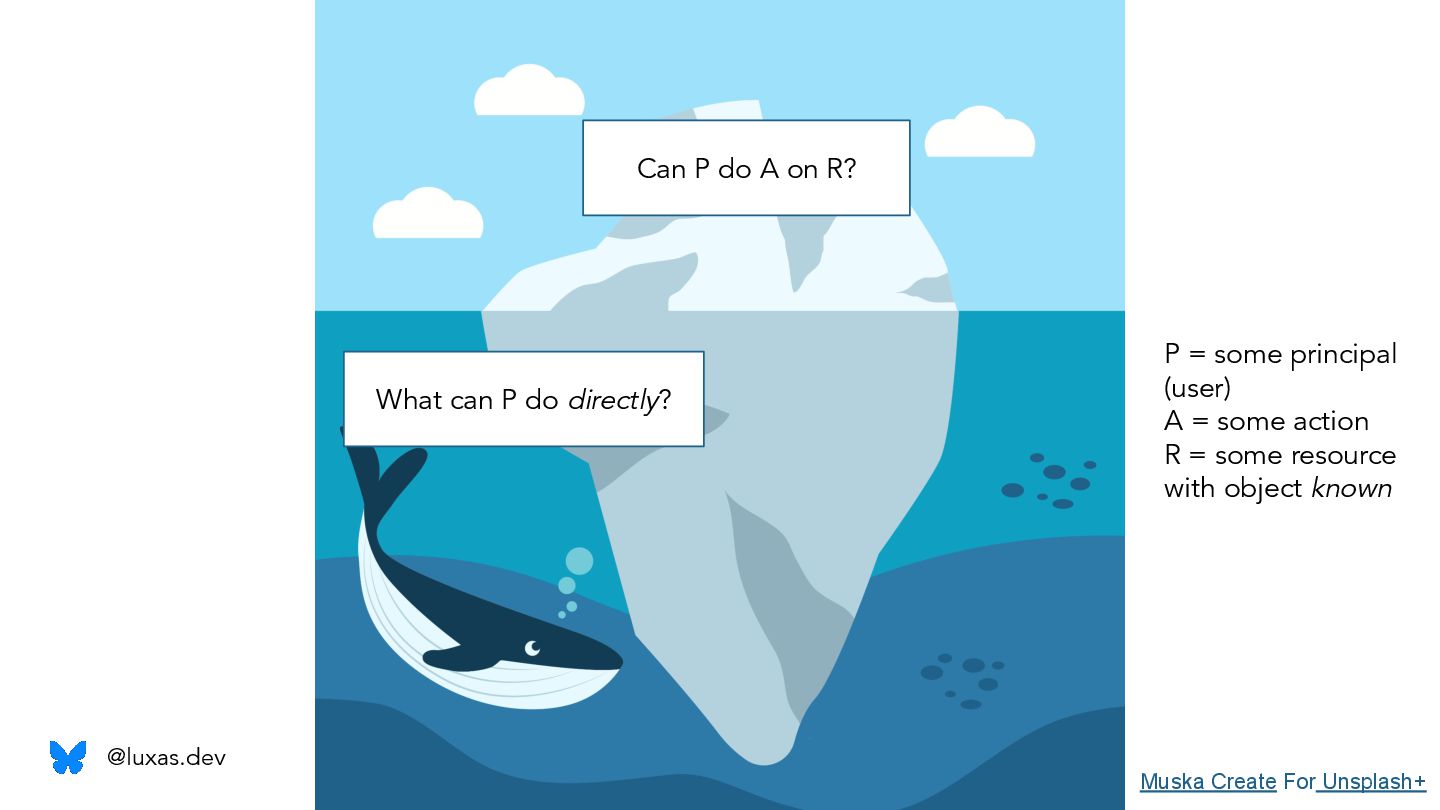
  3. Can P do A on R? What can P do

    directly? Muska Create For Unsplash+ @luxas.dev P = some principal (user) A = some action R = some resource with object known
  4. Can P do A on R? What can P do

    directly? What can P do indirectly? Muska Create For Unsplash+ @luxas.dev P = some principal (user) A = some action R = some resource with object known
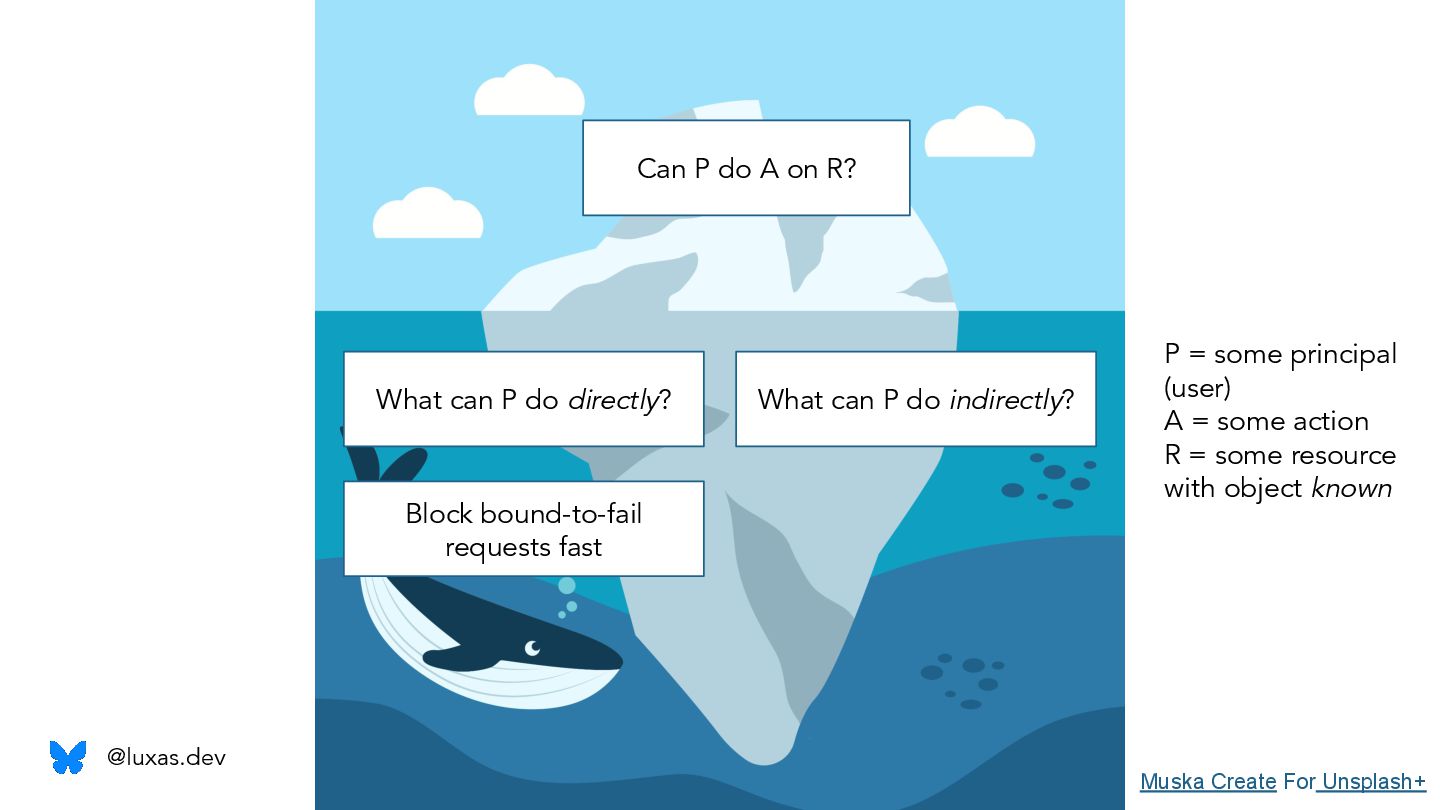
  5. Can P do A on R? What can P do

    directly? What can P do indirectly? Block bound-to-fail requests fast Muska Create For Unsplash+ @luxas.dev P = some principal (user) A = some action R = some resource with object known
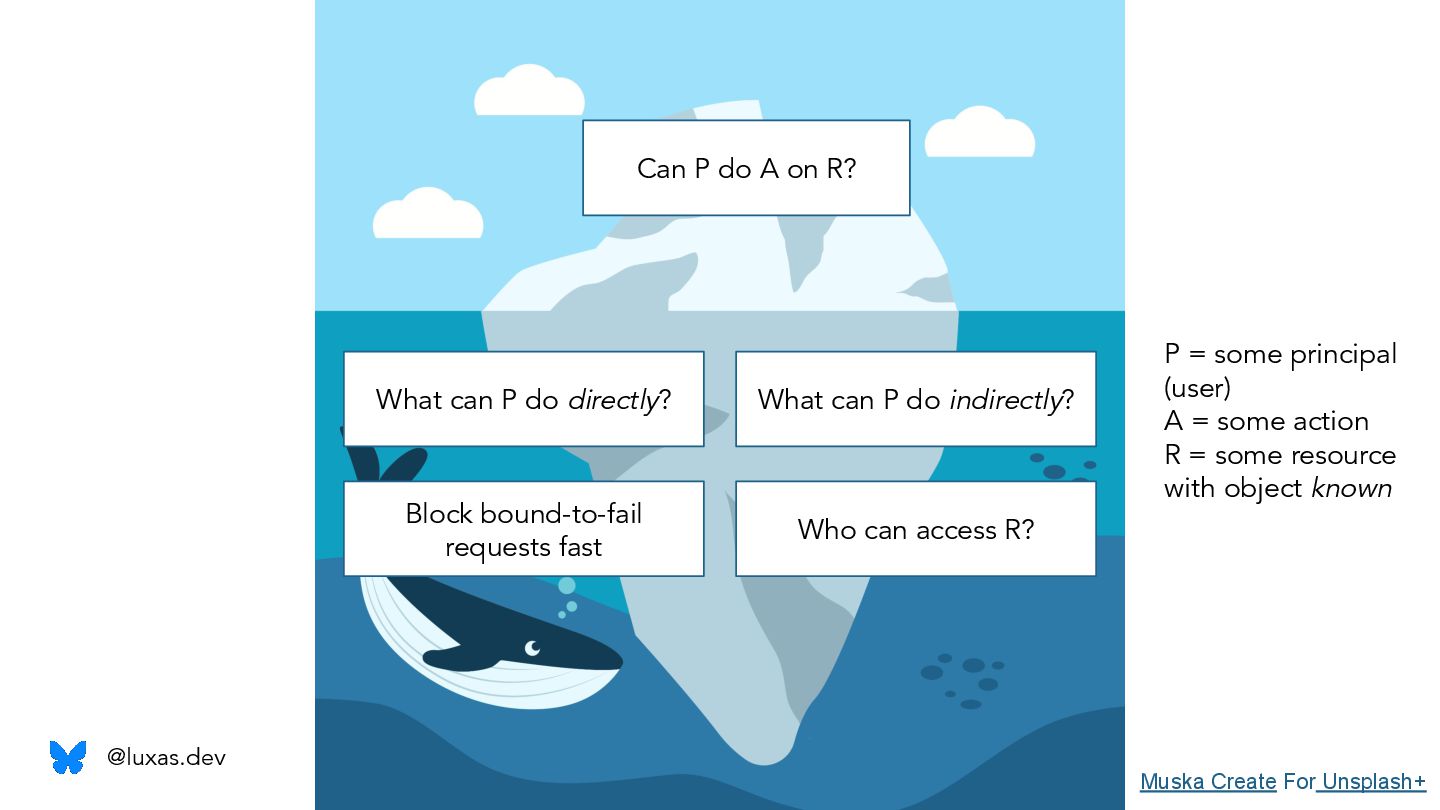
  6. Can P do A on R? What can P do

    directly? Who can access R? What can P do indirectly? Muska Create For Unsplash+ @luxas.dev P = some principal (user) A = some action R = some resource with object known Block bound-to-fail requests fast
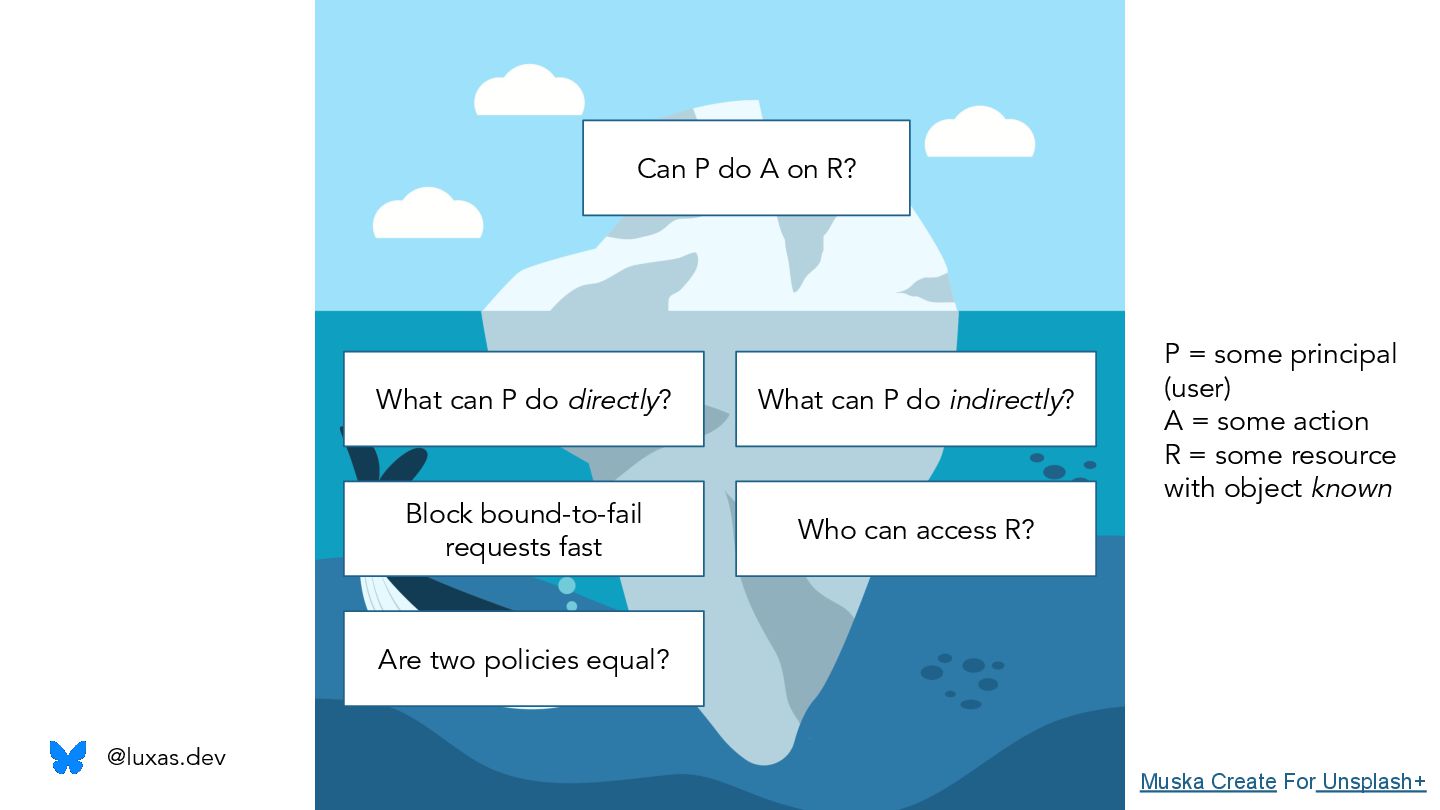
  7. Can P do A on R? What can P do

    directly? Who can access R? What can P do indirectly? Are two policies equal? Muska Create For Unsplash+ @luxas.dev P = some principal (user) A = some action R = some resource with object known Block bound-to-fail requests fast
  8. Can P do A on R? What can P do

    directly? Who can access R? What can P do indirectly? Are two policies equal? Are policies inconsistent? Muska Create For Unsplash+ @luxas.dev P = some principal (user) A = some action R = some resource with object known Block bound-to-fail requests fast
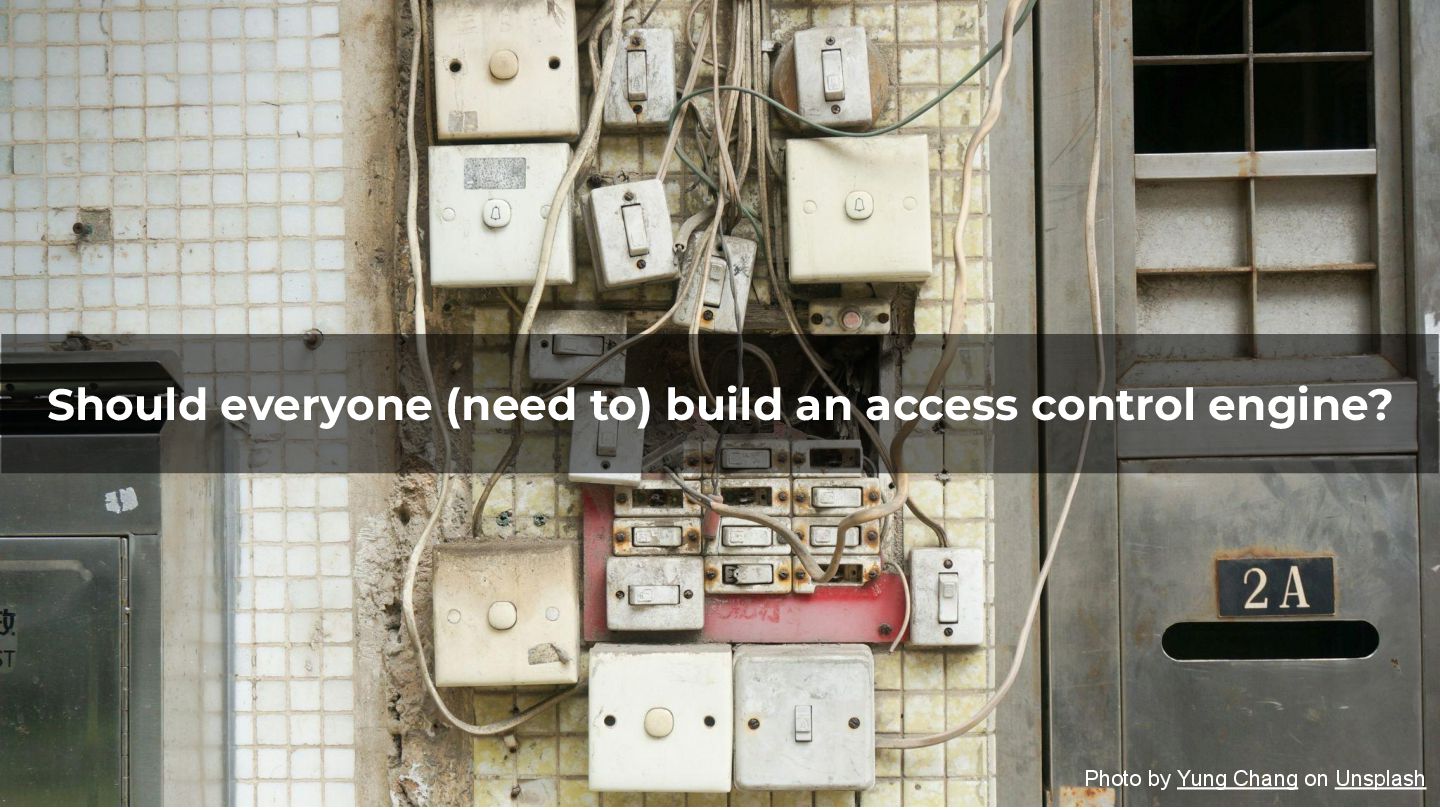
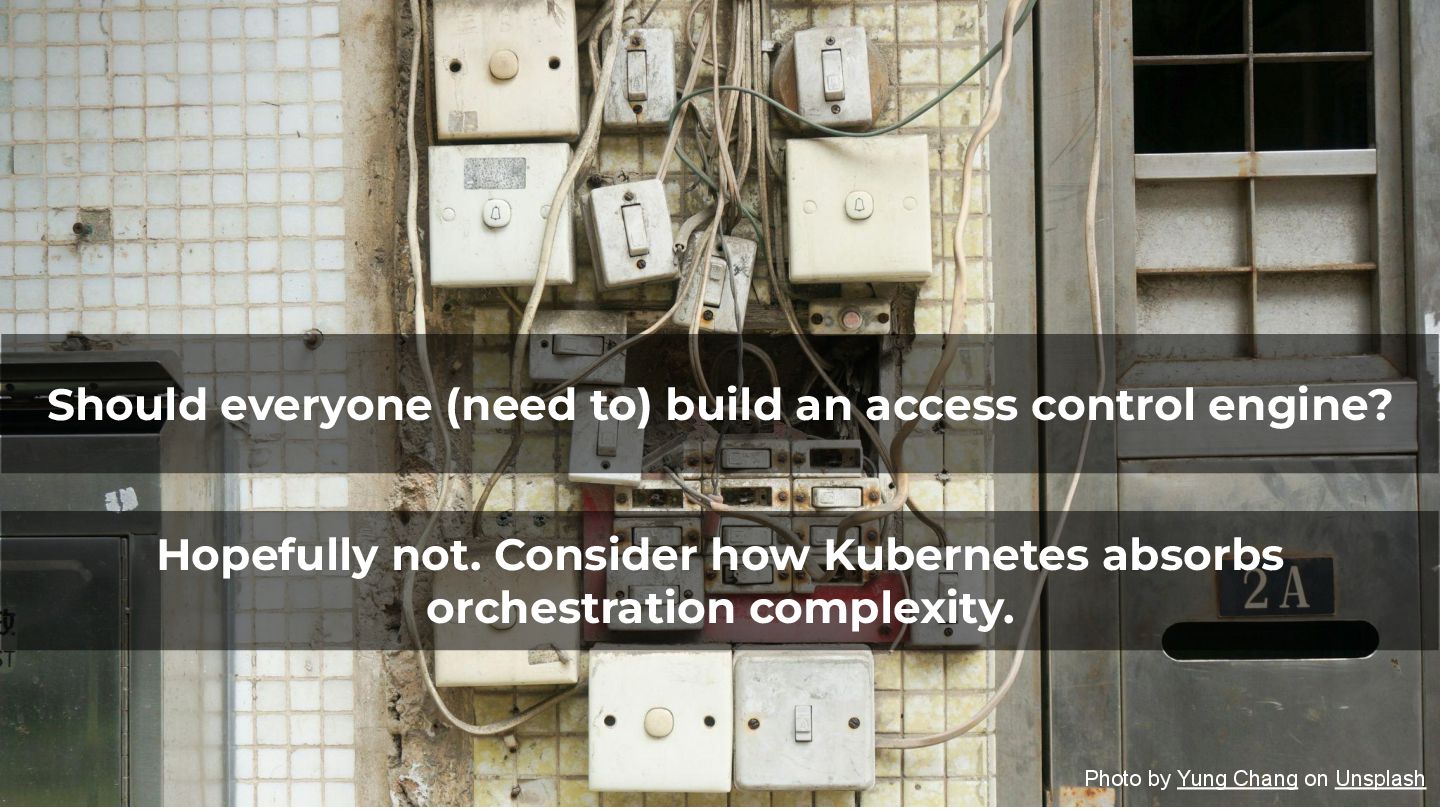
  9. Photo by Yung Chang on Unsplash Should everyone (need to)

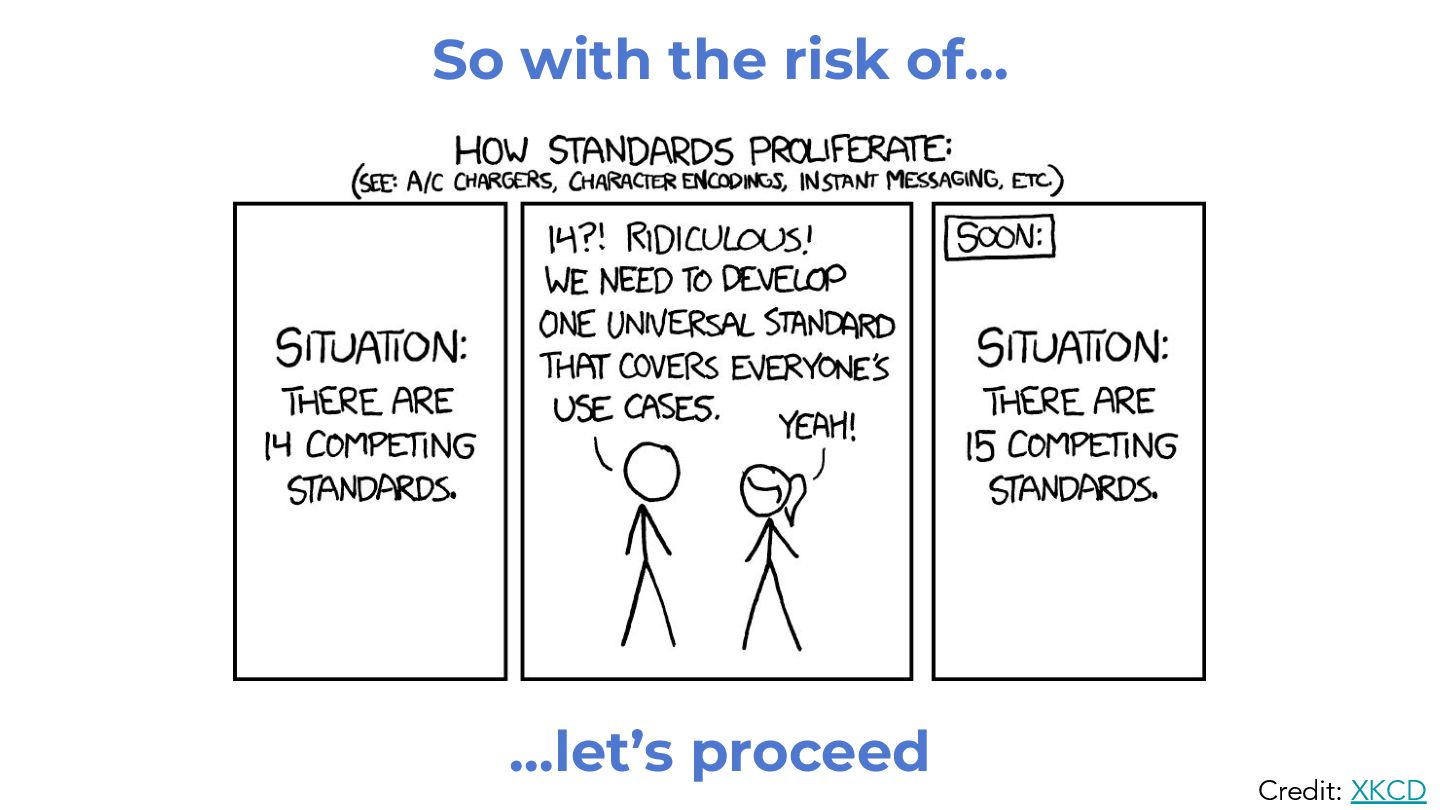
    build an access control engine? Hopefully not. Consider how Kubernetes absorbs orchestration complexity.
  10. Open Source Authorization Engine @luxas.dev Rock-solid: Logic formally verified in

    Lean Supports RBAC, ReBAC and ABAC paradigms AWS has donated Cedar to the CNCF \o/
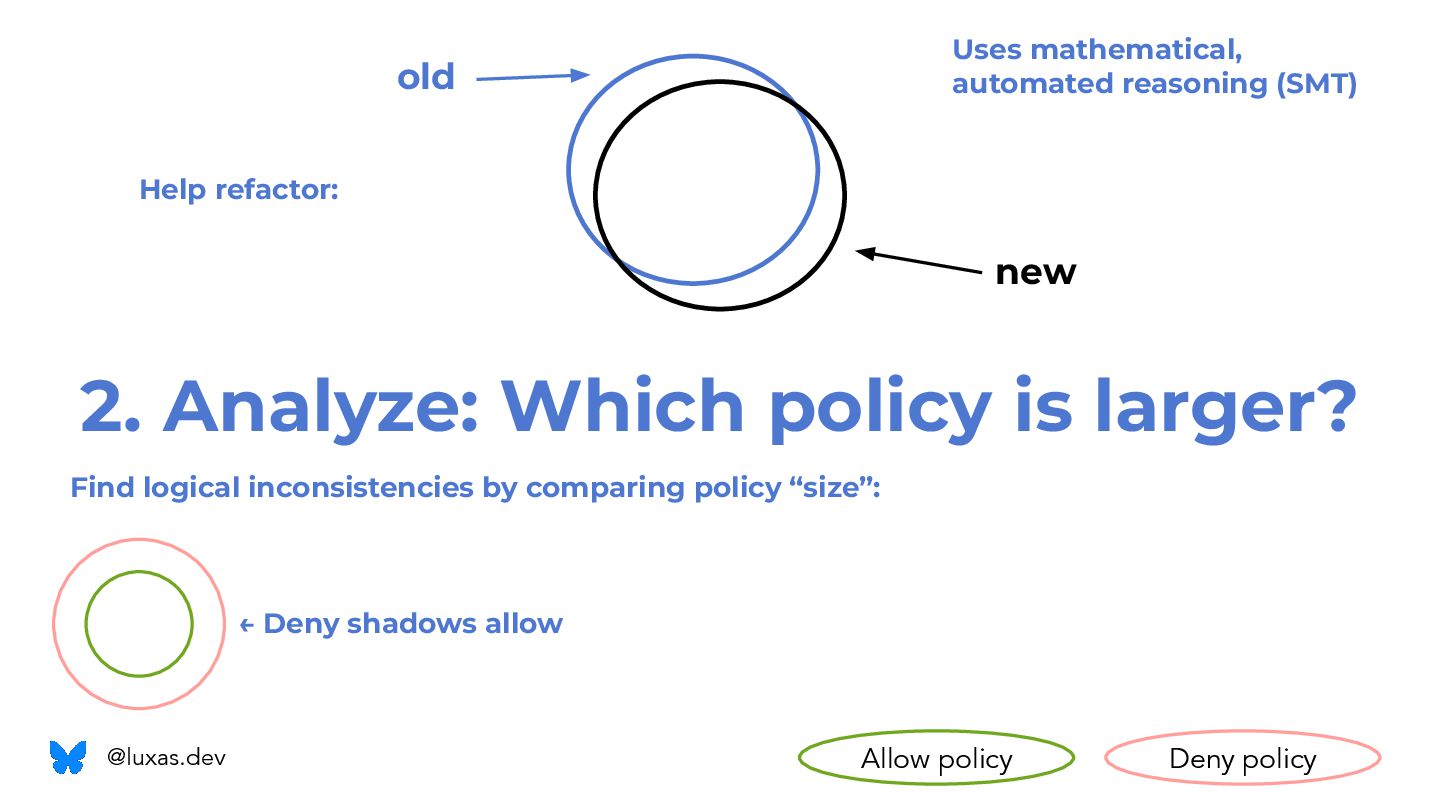
  11. 2. Analyze: Which policy is larger? @luxas.dev old new Help

    refactor: Uses mathematical, automated reasoning (SMT)
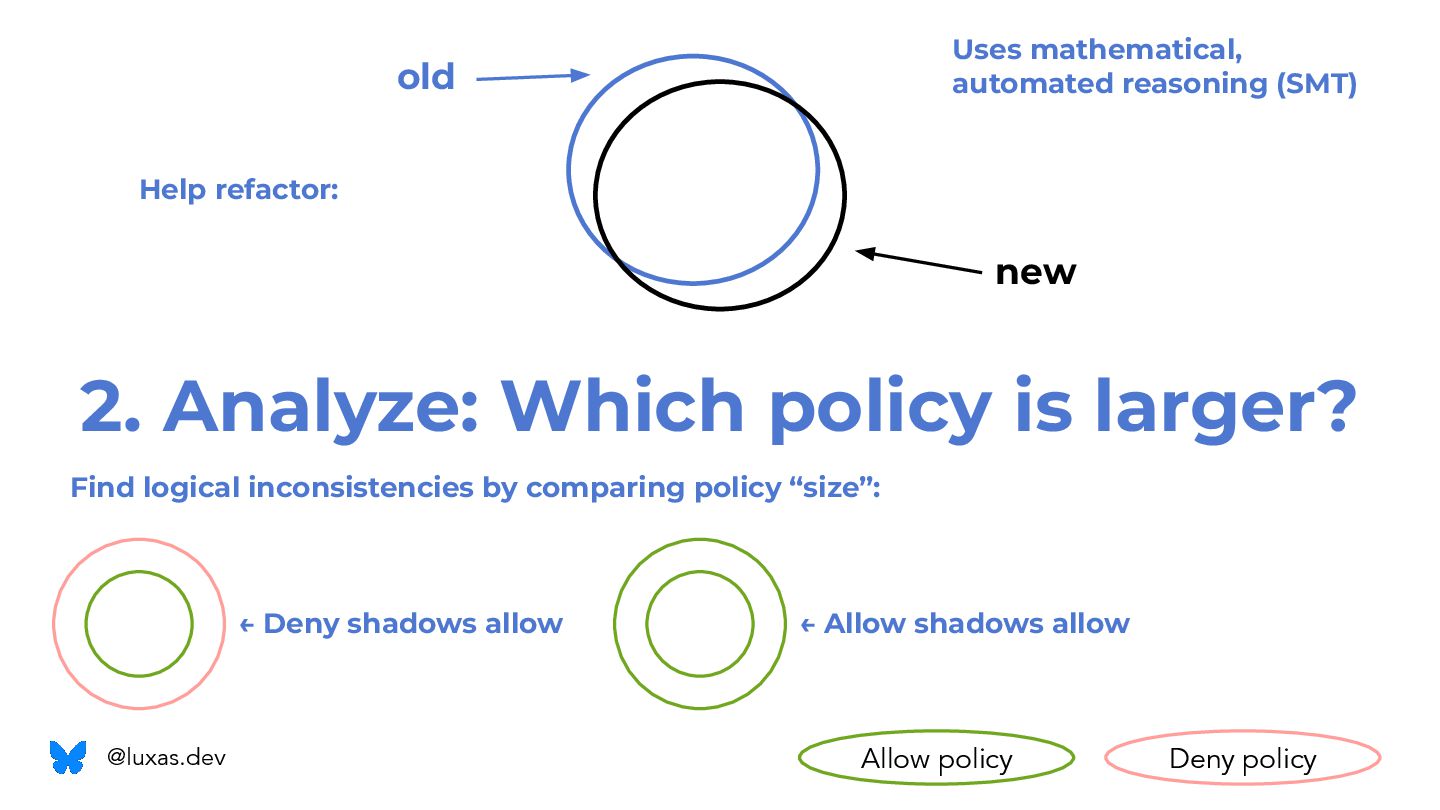
  12. 2. Analyze: Which policy is larger? old new @luxas.dev Allow

    policy Deny policy ← Deny shadows allow Help refactor: Find logical inconsistencies by comparing policy “size”: Uses mathematical, automated reasoning (SMT)
  13. 2. Analyze: Which policy is larger? old new @luxas.dev Allow

    policy Deny policy ← Allow shadows allow Help refactor: ← Deny shadows allow Find logical inconsistencies by comparing policy “size”: Uses mathematical, automated reasoning (SMT)
  14. 2. Analyze: Which policy is larger? old new @luxas.dev Allow

    policy Deny policy ← No effect Help refactor: Find logical inconsistencies by comparing policy “size”: ← Deny shadows allow ← Allow shadows allow Uses mathematical, automated reasoning (SMT)
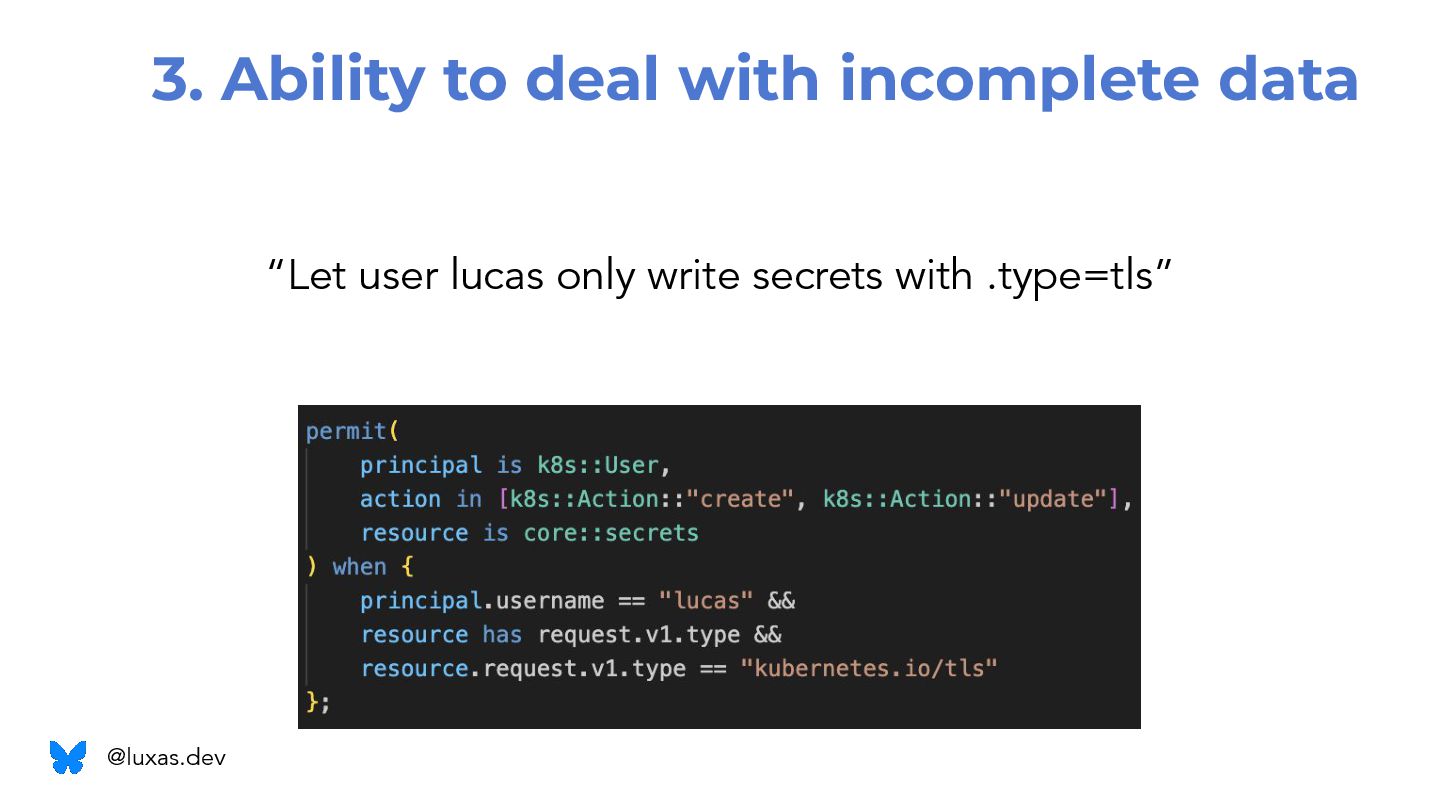
  15. 3. Ability to deal with incomplete data @luxas.dev “Let user

    lucas only write secrets with .type=tls”
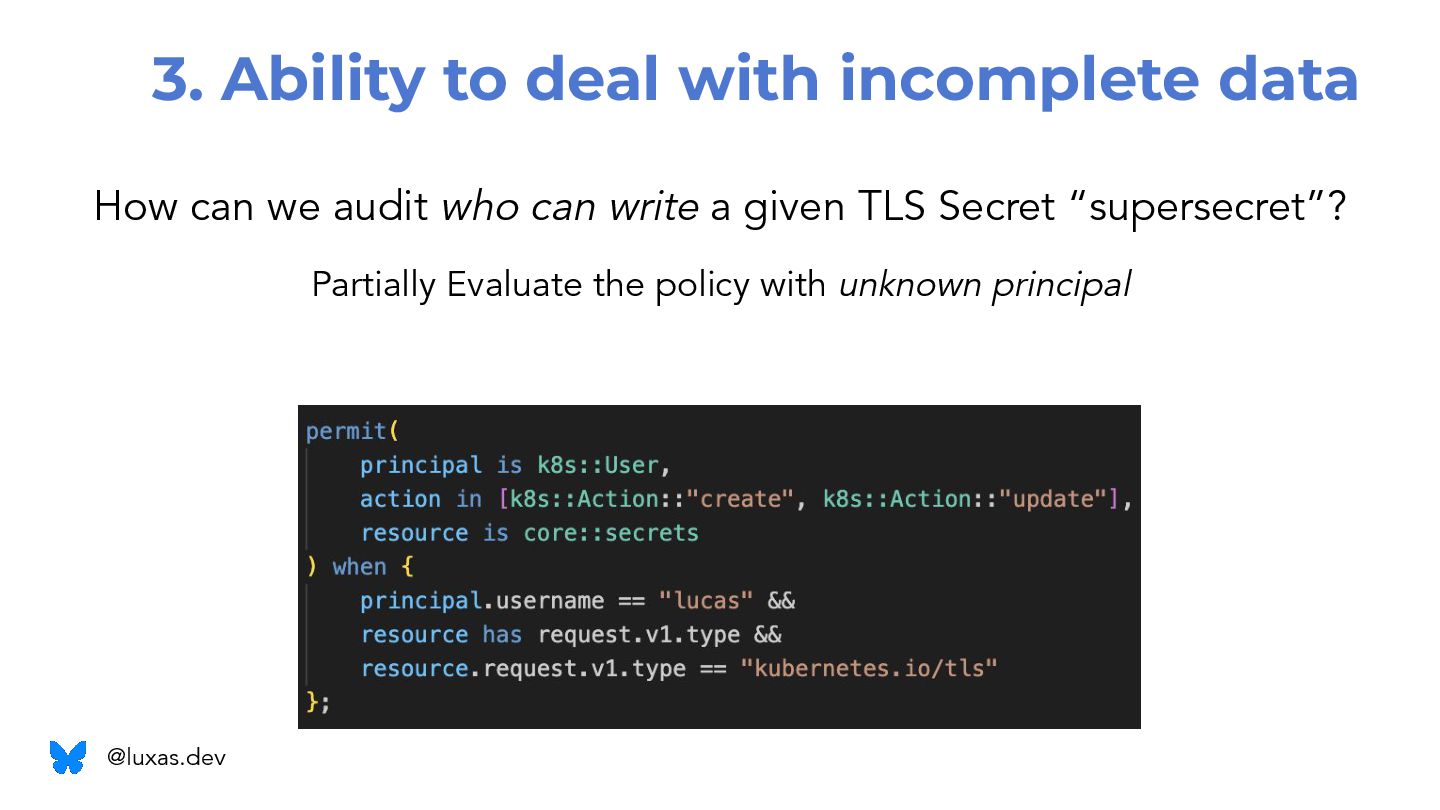
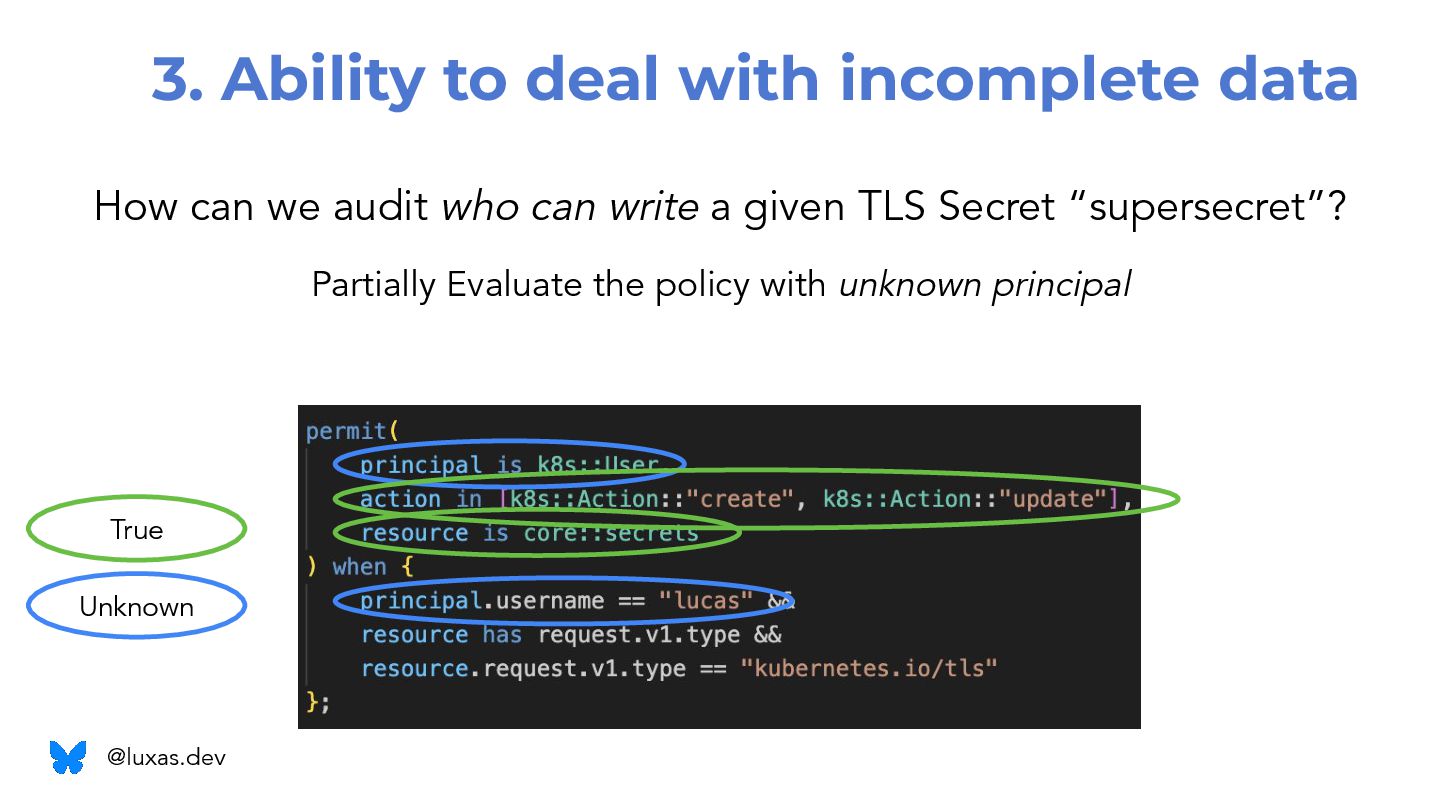
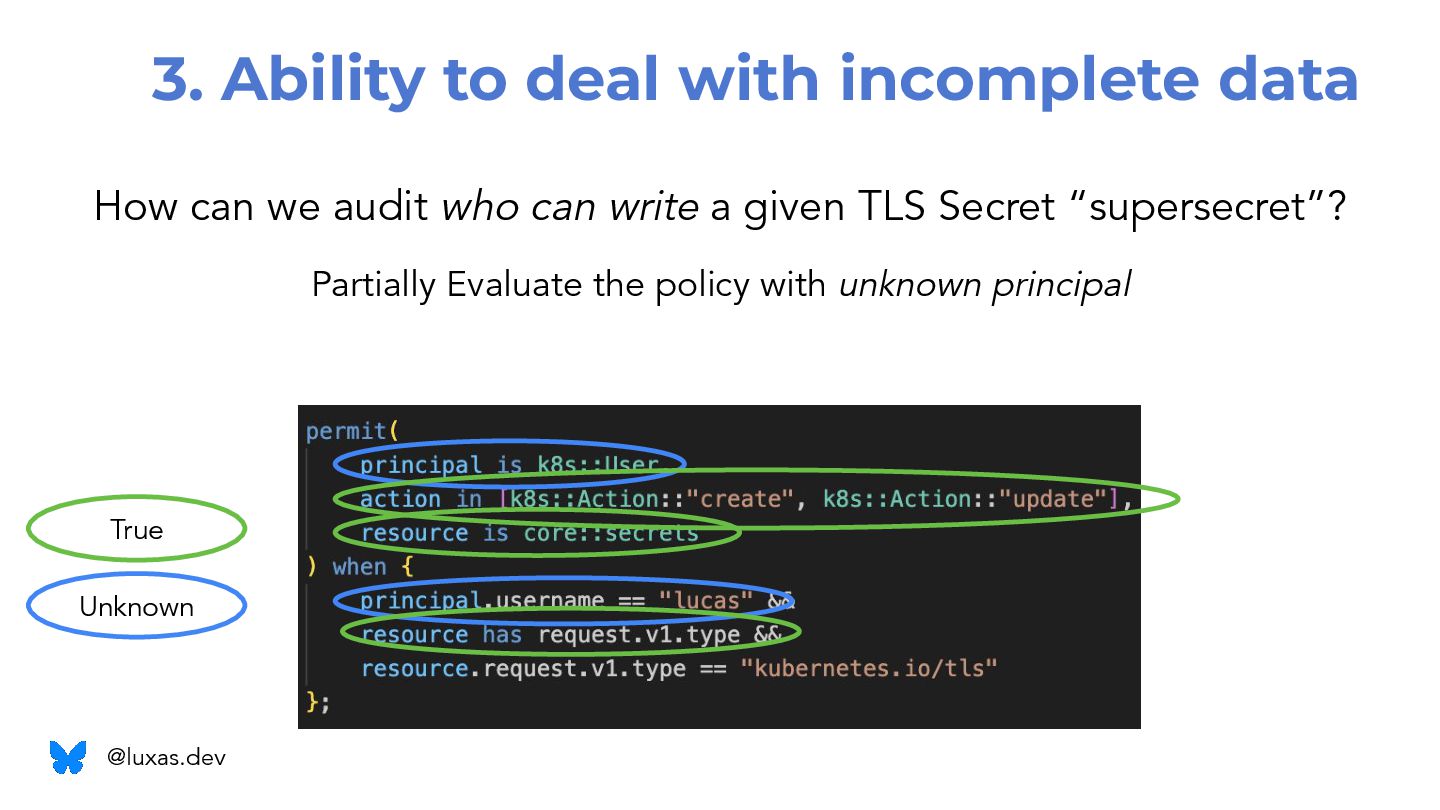
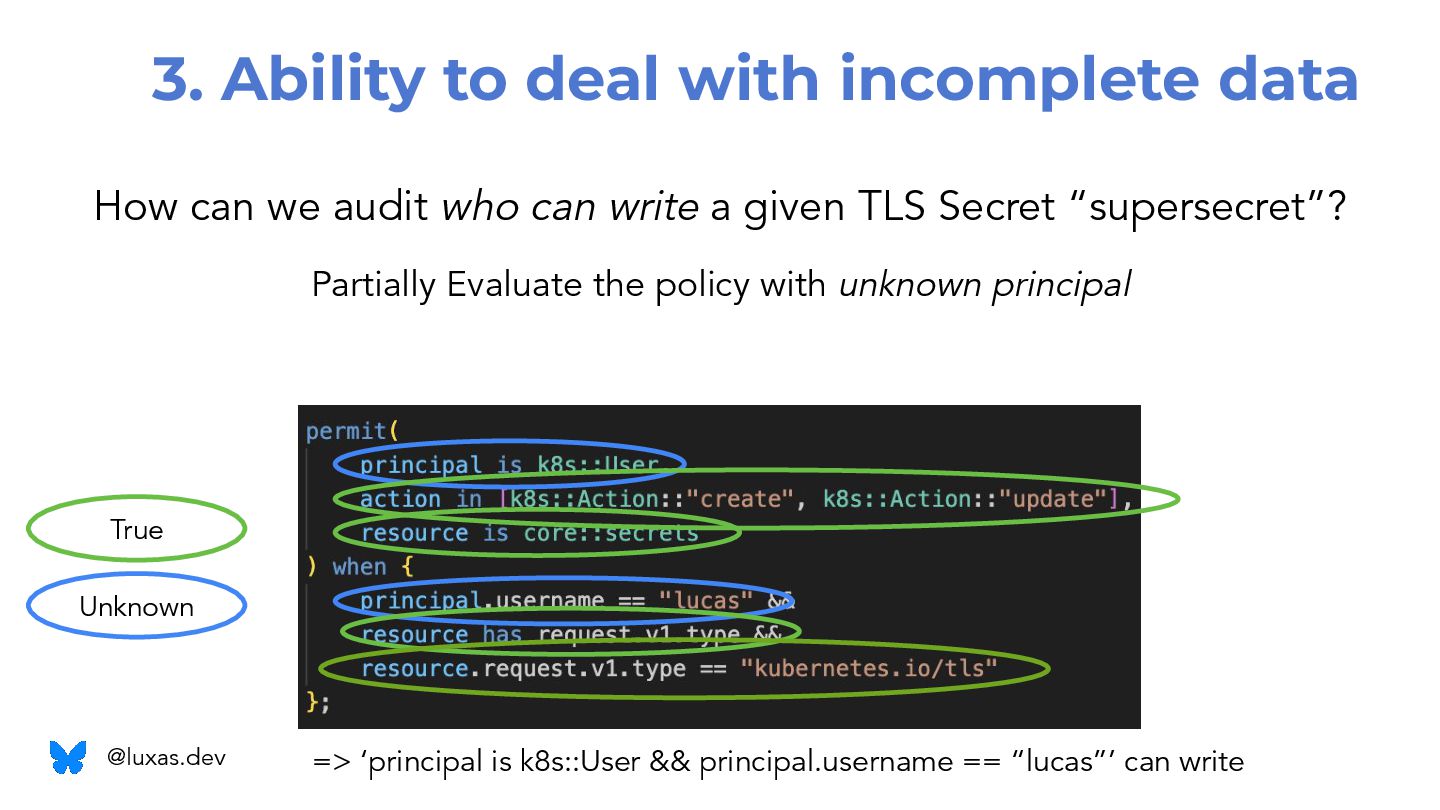
  16. 3. Ability to deal with incomplete data @luxas.dev How can

    we audit who can write a given TLS Secret “supersecret”? Partially Evaluate the policy with unknown principal
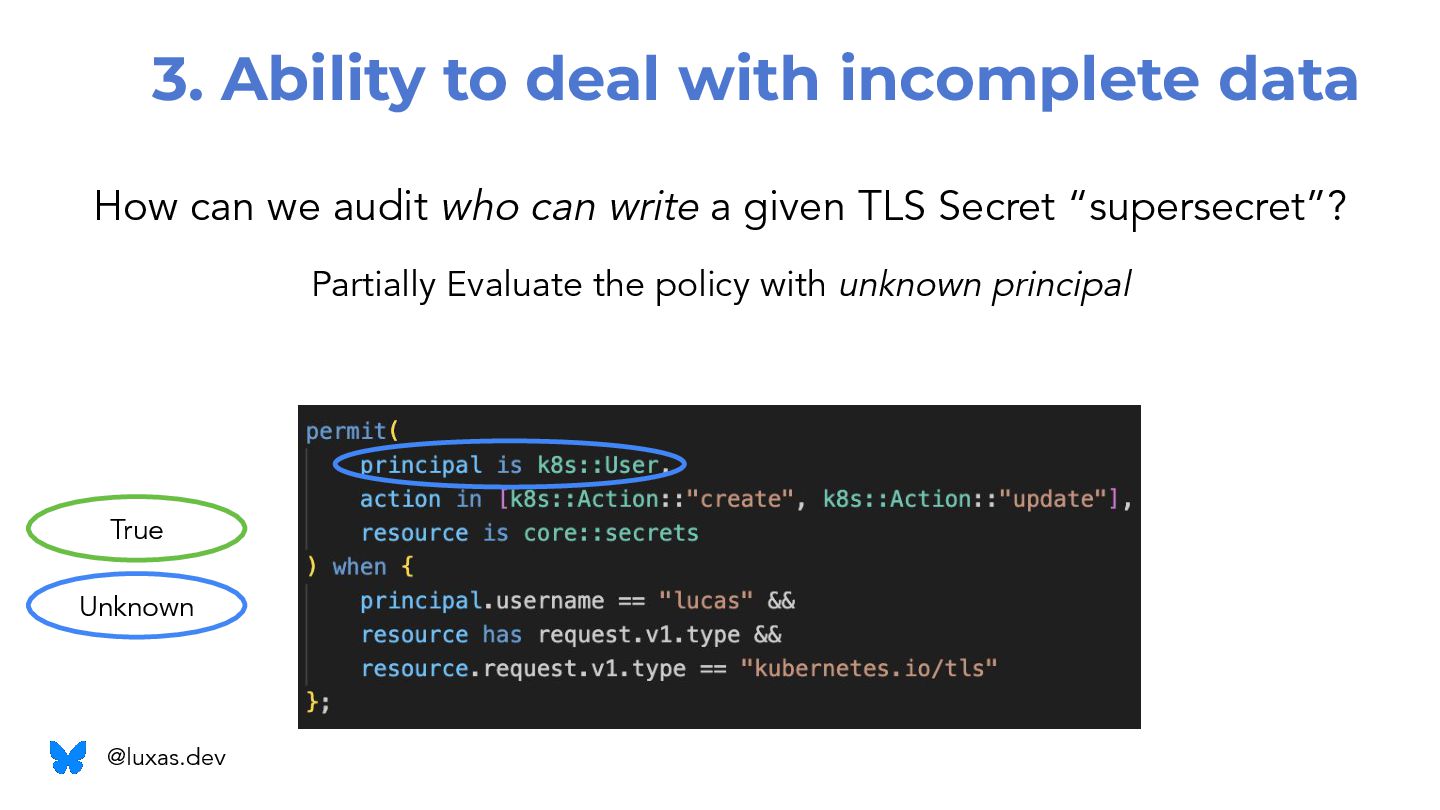
  17. 3. Ability to deal with incomplete data @luxas.dev How can

    we audit who can write a given TLS Secret “supersecret”? Partially Evaluate the policy with unknown principal True Unknown
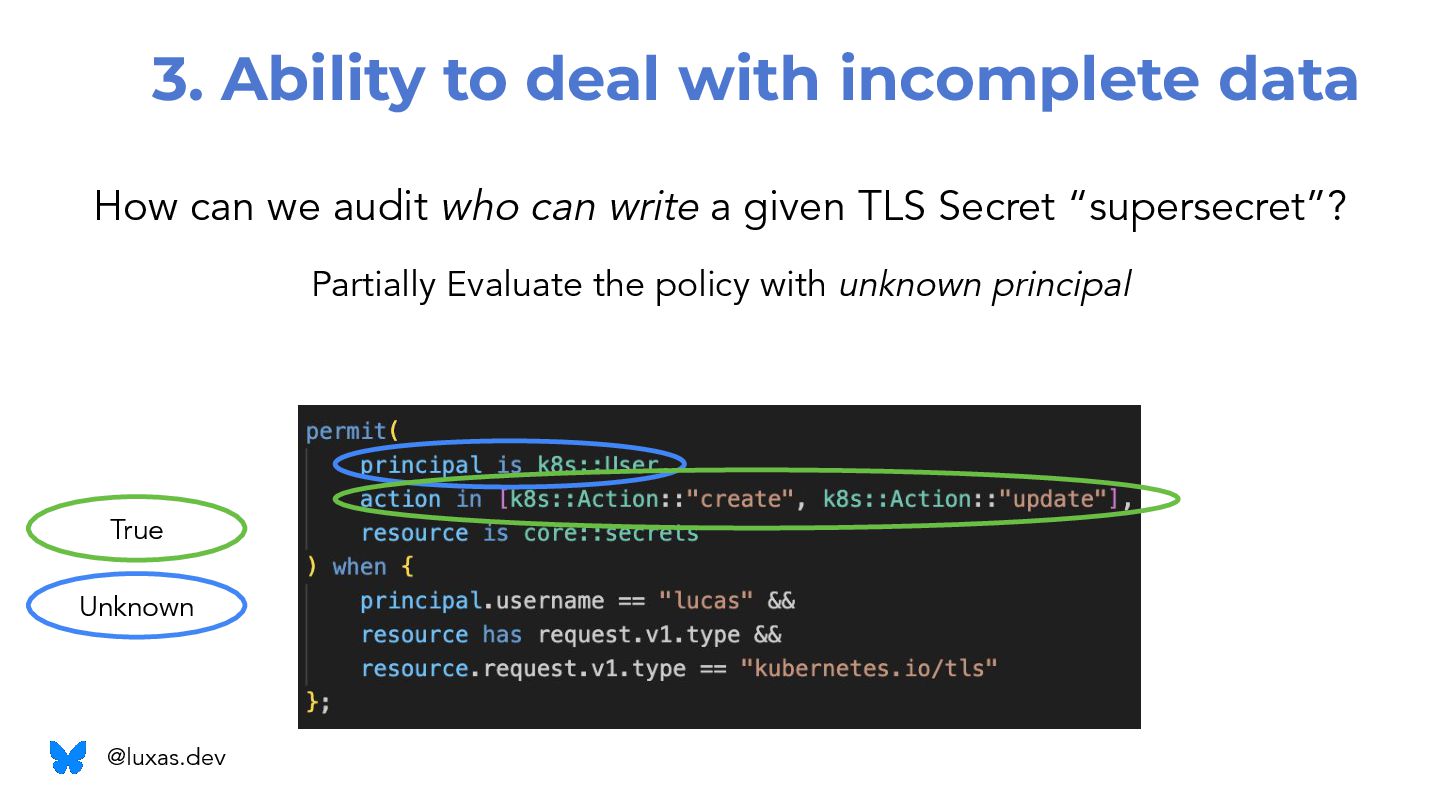
  18. 3. Ability to deal with incomplete data @luxas.dev How can

    we audit who can write a given TLS Secret “supersecret”? Partially Evaluate the policy with unknown principal True Unknown
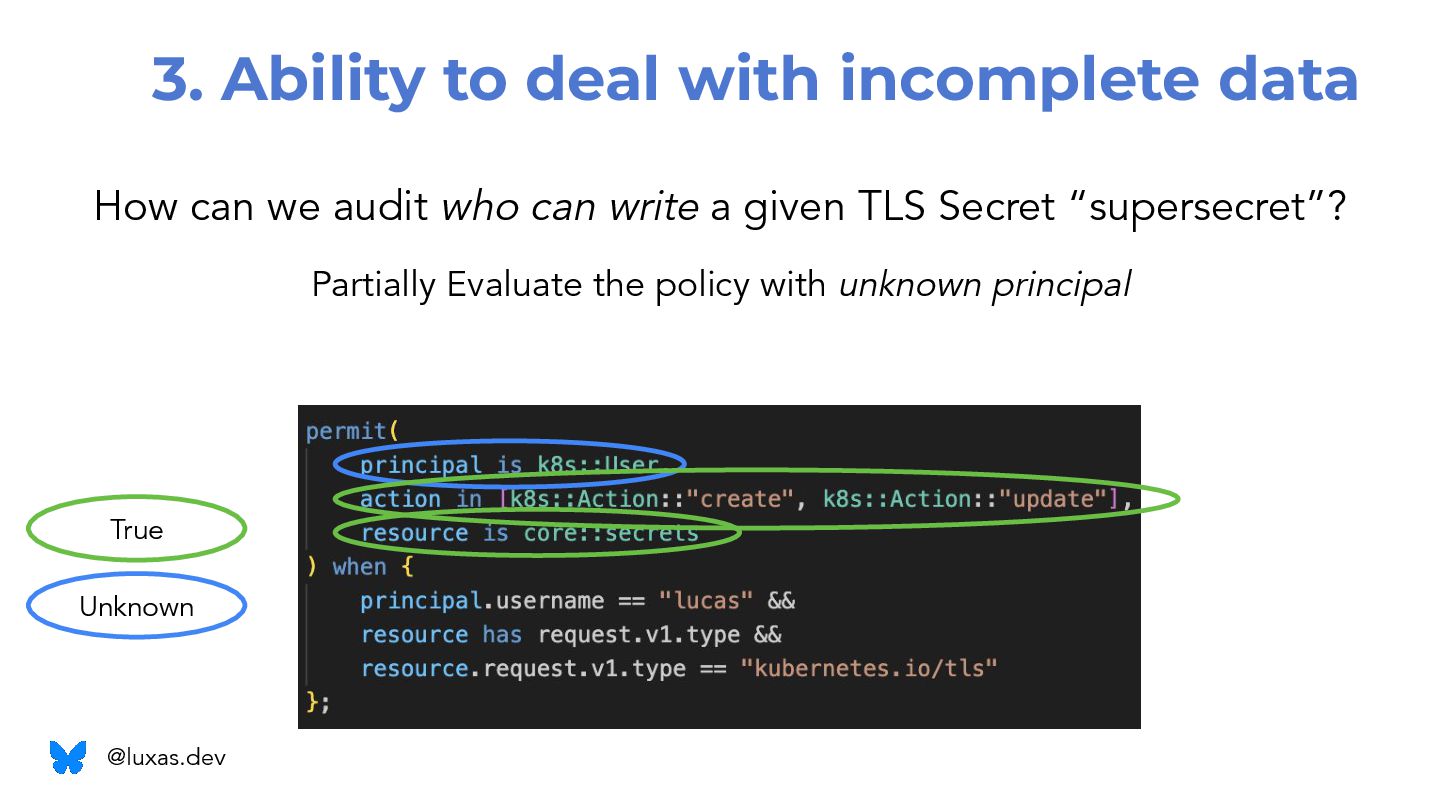
  19. 3. Ability to deal with incomplete data @luxas.dev How can

    we audit who can write a given TLS Secret “supersecret”? Partially Evaluate the policy with unknown principal True Unknown
  20. 3. Ability to deal with incomplete data @luxas.dev How can

    we audit who can write a given TLS Secret “supersecret”? Partially Evaluate the policy with unknown principal True Unknown
  21. 3. Ability to deal with incomplete data @luxas.dev How can

    we audit who can write a given TLS Secret “supersecret”? Partially Evaluate the policy with unknown principal True Unknown
  22. 3. Ability to deal with incomplete data @luxas.dev How can

    we audit who can write a given TLS Secret “supersecret”? Partially Evaluate the policy with unknown principal => ‘principal is k8s::User && principal.username == “lucas”’ can write True Unknown
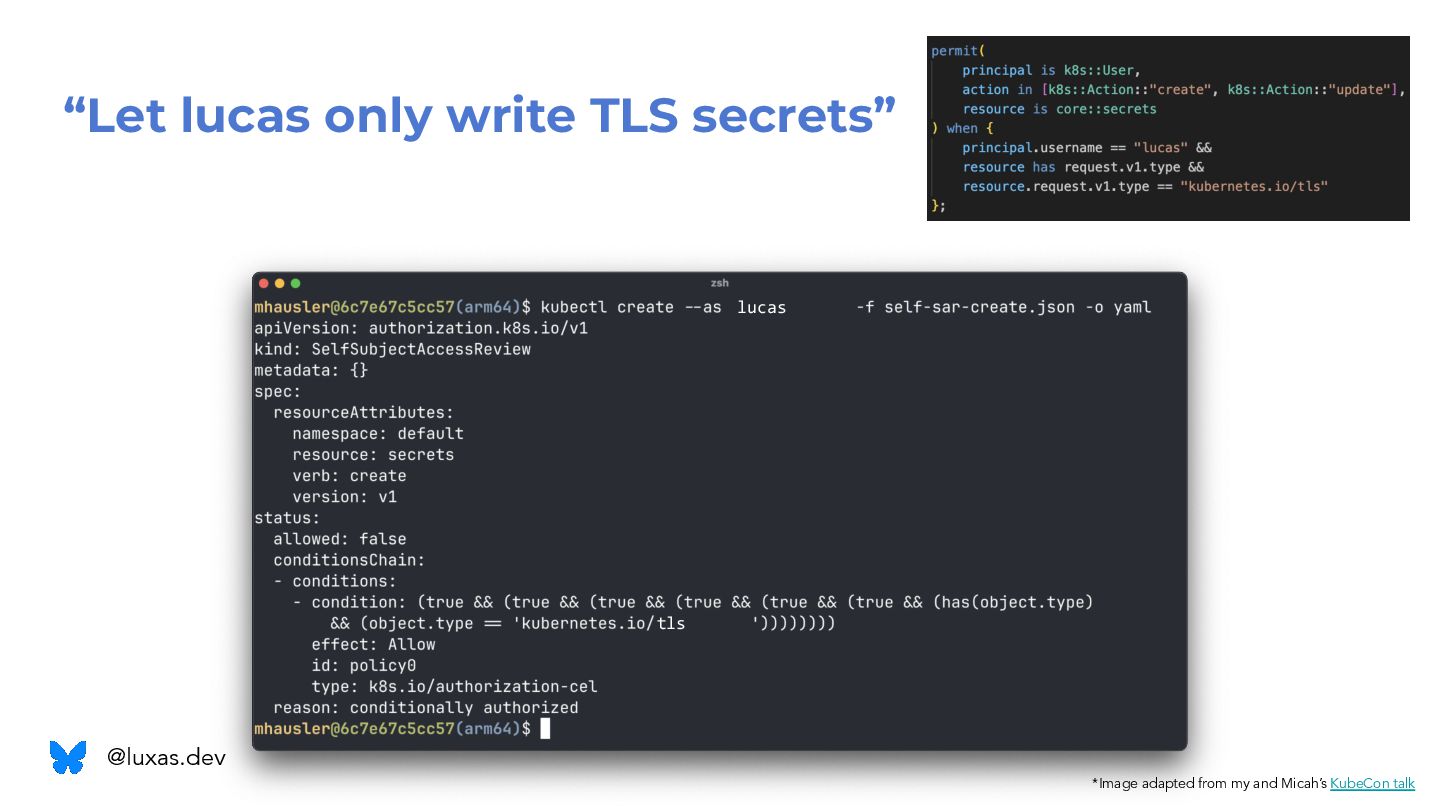
  23. “Let lucas only write TLS secrets” tls lucas *Image adapted

    from my and Micah’s KubeCon talk @luxas.dev
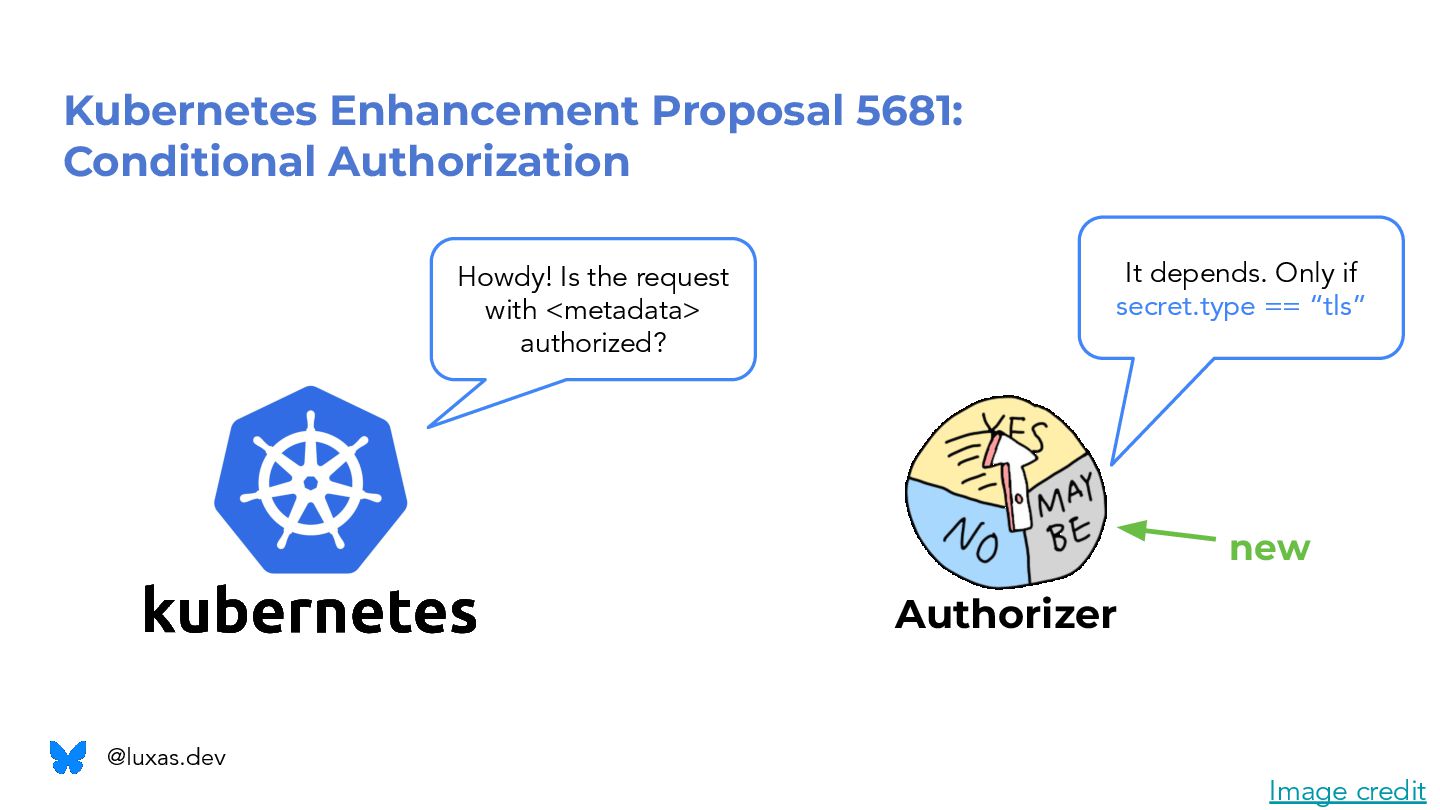
  24. Kubernetes Enhancement Proposal 5681: Conditional Authorization Image credit Howdy! Is

    the request with <metadata> authorized? Authorizer new It depends. Only if secret.type == “tls” @luxas.dev
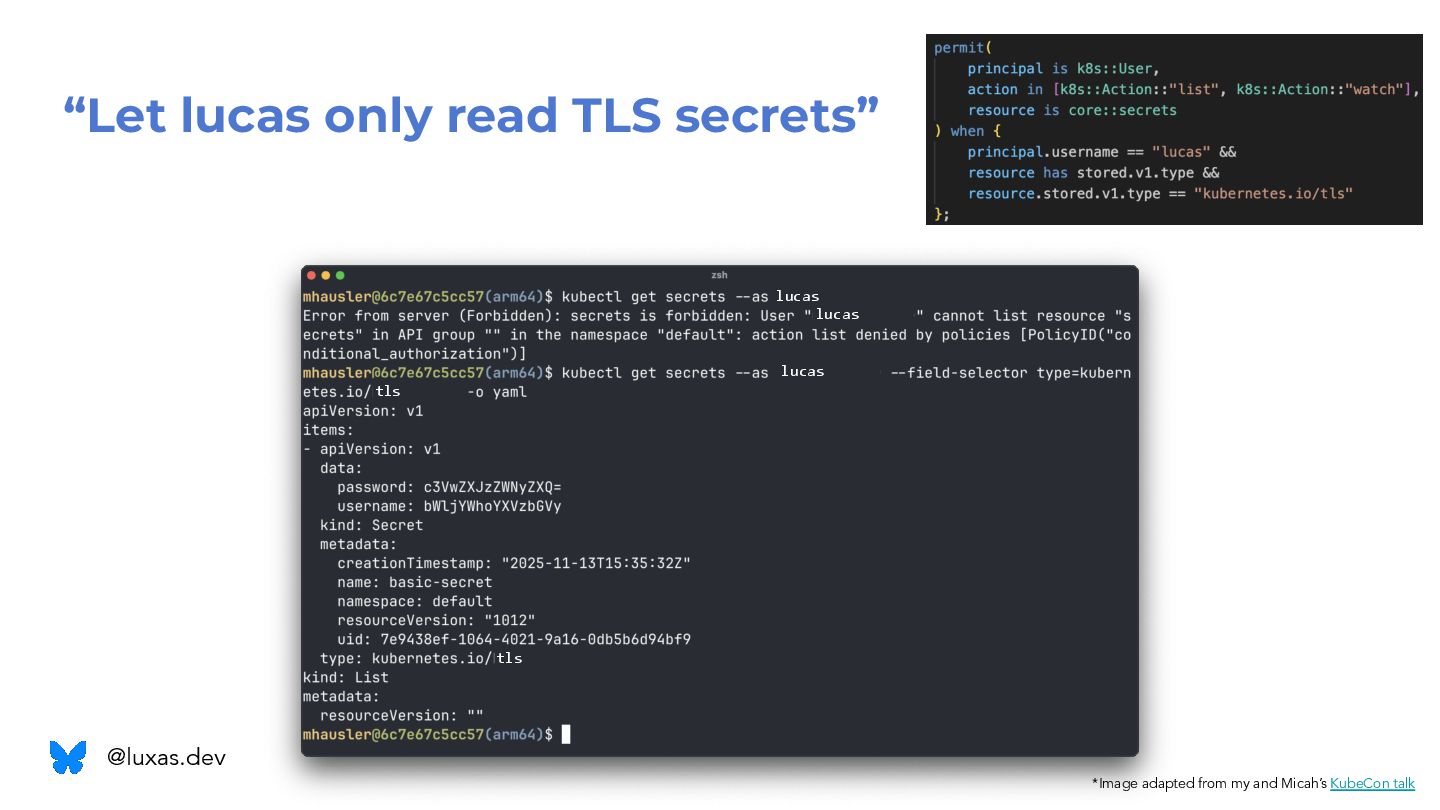
  25. “Let lucas only read TLS secrets” *Image adapted from my

    and Micah’s KubeCon talk lucas lucas tls tls @luxas.dev lucas
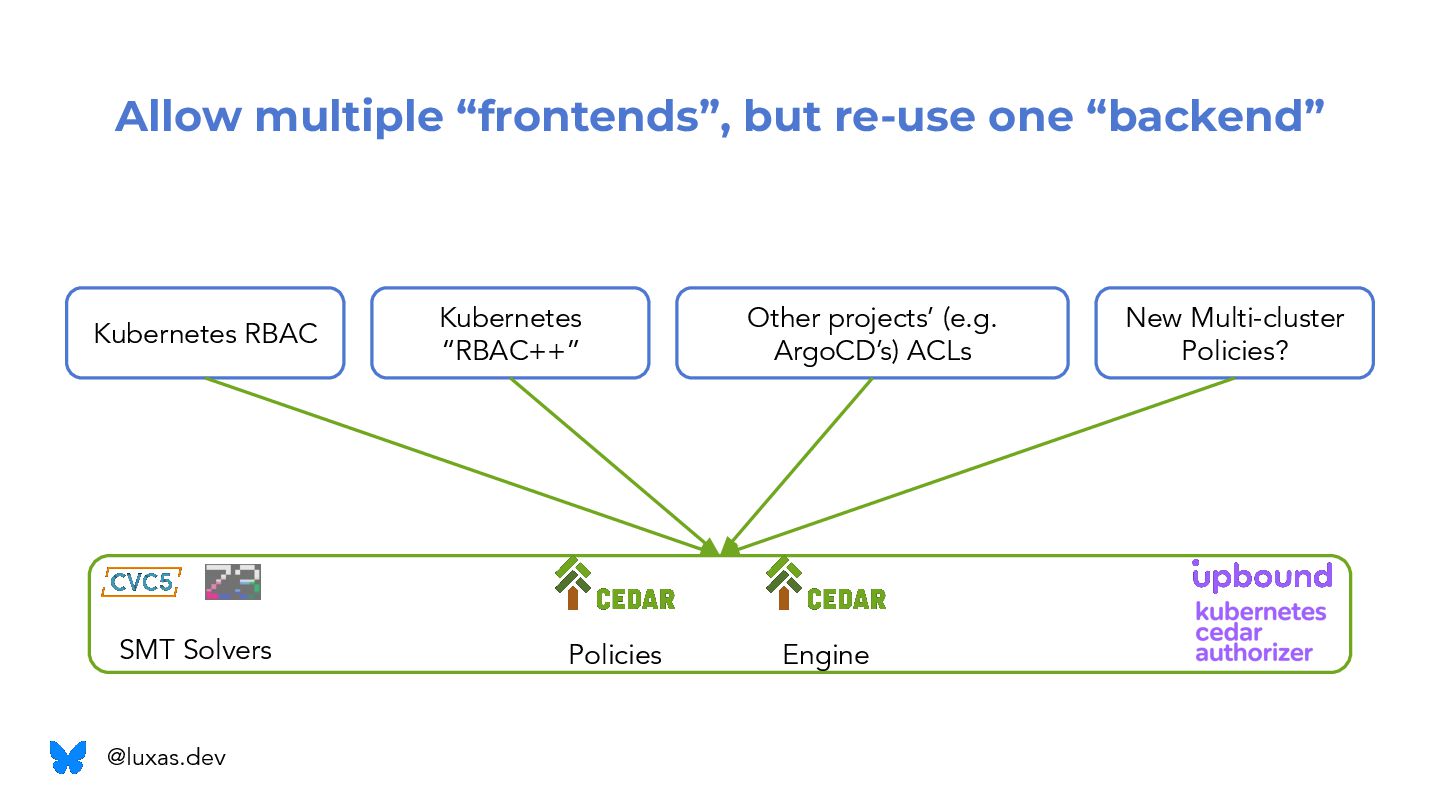
  26. Allow multiple “frontends”, but re-use one “backend” Kubernetes “RBAC++” Kubernetes

    RBAC Other projects’ (e.g. ArgoCD’s) ACLs New Multi-cluster Policies? SMT Solvers @luxas.dev Policies Engine
  27. Thanks! Please reach out to me if you are interested

    in this! @luxas.dev Check out Kubernetes Enhancement Proposal 5681 github.com/upbound/kubernetes-cedar-authorizer