Share
Embed
Delivering High-Availability Web Services with NGINX Plus on AWS
Over 1/3 of websites running on Amazon Web Services (AWS) are delivered and accelerated using NGINX. Join Nginx and Amazon for this live webinar to learn how to get started with NGINX Plus on AWS and how to further increase performance and availability of large, dynamic, cloud-based applications integrating with critical AWS services.
NGINX Inc
November 20, 2014
Transcript
45 slides
-
Delivering High-Availability Web Services with NGINX Plus on AWS Owen
Garrett Nginx, Inc. Scott Ward Amazon Web Services -
Introduc)ons and Agenda • Owen Garre3 Head of
Products, NGINX • Sco3 Ward Solu)ons Architect, Amazon Web Services -
A broad and deep platform that helps customers build sophisticated,
scalable applications © 2014 Amazon.com, Inc. and its affiliates. All rights reserved. May not be copied, modified or distributed in whole or in part without the express consent of Amazon.com, Inc. -
Infrastructure Foundation Services Regions Availability Zones Storage (Object, Block and
Archive) Networking Security & Access Control Platform Services Databases Relational NoSQL Caching Analytics Hadoop Real-time Data warehouse App Services Queuing Orchestration App streaming Transcoding Email Search Deployment & Management Containers Dev/ops Tools Resource Templates Mobile Services Identity Sync Mobile Analytics Notifications Enterprise Applications Virtual Desktops Data Workflows Usage Tracking Monitoring and Logs Compute (VMs, Auto-scaling and Load Balancing) CDN and Points of Presence Collaboration and Sharing -
AWS Services Overview Amazon EC2 – Virtual Servers & resizable
compute capacity Auto Scaling – Scale compute resources up and down Elastic Load Balancing – Load balancer for compute instances Amazon Elastic Block Storage (EBS) – Block storage for EC2 -
AWS Service Overview AWS Identity and Access Management – AWS
Account Access Controls Amazon Route 53 – Scalable Domain Name System Amazon CloudWatch – Resource and Application Monitoring -
Amazon EC2 Container Service Creates and manages clusters made
up of Docker containers. It launches and terminates the containers and maintains complete informa)on about the state of your cluster Automa)cally schedules containers to help find a balance between your resource needs and availability requirements Using EC2 Container Service you can simply launch & manage clusters with thousands of instances and schedule tens of thousands of containers across mul)ple Availability Zones Amazon EC2 Container Service launches your containers on your own EC2 instances, so that you do not share resources with other customers, places your clusters in a VPC, and allows you to use your own VPC security groups and network ACLs. Your applica)ons can make use of AWS features such as Elas)c IP addresses, resource tags, and Virtual Private Cloud (VPC). h3p://aws.amazon.com/ecs/ -
AWS Code Deploy Deploys your released code to a
"fleet" of EC2 instances Accommodate fleets that range in size from one instance all the way up to tens of thousands of instances Automa)cally schedules updates across mul)ple Availability Zones in order to maintain high availability during the deployment Applica)on and Deployment groups described in YAML-‐forma3ed files Deployment groups iden)fy EC2 instances by tags & can also reference Auto Scaling Groups Managed via AWS Management Console, CLI or APIs Can be used in conjunc)on with Chef recipes or Puppet scripts Deploy configura)on from a variety of repositories (S3, GitHub, etc) h3ps://aws.amazon.com/codedeploy/ -
Amazon web applicaCon reference architecture • Route53 DNS
• Elas)c Load Balancer • Autoscaling web and app )ers • Ac)ve/standby databases -
Refactoring the architecture with NGINX NGINX provides basic
load balancing for: – HTTP – FastCGI – uWSGI – SCGI – memcache -
Go further with NGINX Plus NGINX F/OSS
Webserver Accelera)ng Proxy Applica)on Gateway NGINX Plus Advanced load balancing features Health checks, Session Persistence Ease-‐of-‐management Dynamic Configura)on, Extended Status Commercial support -
region region region Elastic Load Balancer Web App 1 NGINX
Plus AMI Web App 2 Web App 3 Route53 hosted zone Web App 1 NGINX Plus AMI Web App 2 Web App 3 -
Relevant NGINX Plus features • Content-‐based rou)ng •
Request Priori)za)on • Health Checks • Session Persistence • PROXY support • Dynamic Reconfigura)on (inc DNS) • Extended Status -
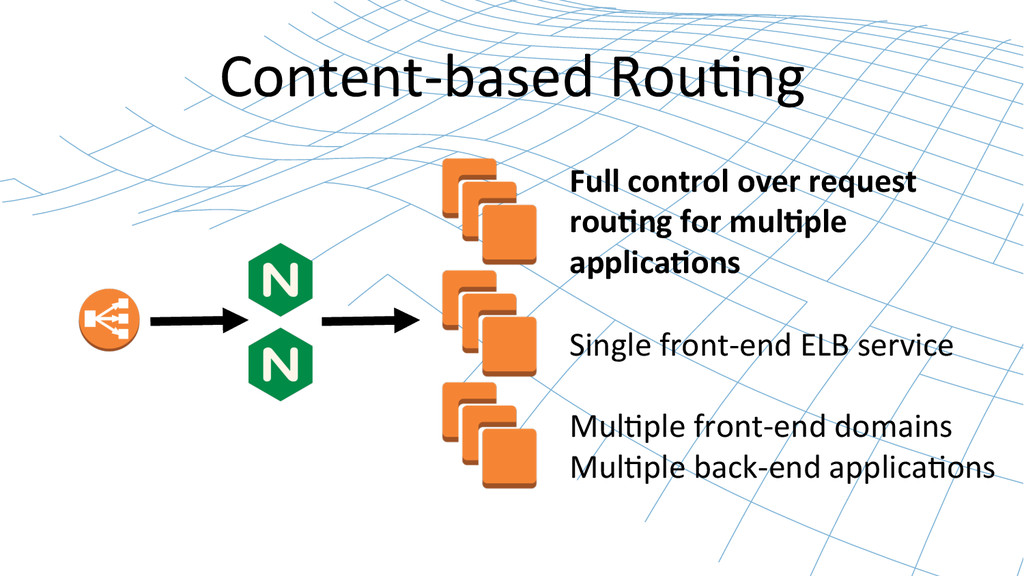
Content-‐based Rou)ng Full control over request rouCng
for mulCple applicaCons Single front-‐end ELB service Mul)ple front-‐end domains Mul)ple back-‐end applica)ons -
Request Priori)za)on Internet Large spike of traffic risks
overwhelming upstream servers NGINX Plus limits concurrent connec)ons to upstream servers and queues addi)onal traffic Upstream servers protected from effects of traffic spike max_conns=150 -
Health Checks SophisCcated, app-‐specific health checks
Detect applica)on failures Orchestrate upgrades -
Session Persistence Per-‐applicaCon session persistence rules
Cookie-‐inser)on, rules-‐based, Learn mode Consistent-‐hash load balancing -
PROXY protocol Internet Amazon ELB (mulCple availability zones)
Load-‐balances TCP with PROXY protocol NGINX proxies WebSockets and terminates SPDY traffic Allows for support for WebSocket proxying and SPDY termina)on -
Dynamic Reconfigura)on Control load balancing configura)on dynamically http
{ resolver 192.168.0.2; upstream backends { zone backends 64k; server api.u.com resolve; } upstream_conf; } DNS Changes in DNS can dynamically update NGINX Plus’ load balancing configura)on API Upstream_conf API gives a simple HTTP API to control configura)on -
Extended Status … with CloudWatch integra)on GET /status/connections/active
17 GET /status/upstreams/ demoupstreams/0/server ”192.168.45.2:80" { checks: 15375, fails: 183, unhealthy: 165, last_passed: true } GET /status/upstreams/ demoupstreams/0/health_checks -
Monitoring with Cloudwatch Know what is going on with your
environment at all times! -
Amazon CloudWatch Default Amazon EC2 metrics CPU Utilization (Percent) Disk
Reads (Bytes) Disk Read Operations (Operations) Disk Writes (Bytes) Disk Write Operations (Operations) Network In (Bytes) Network Out (Bytes) Status Check Failed (Count) 1 or 5 minute intervals -
NGINX Metrics into Amazon CloudWatch status.html à CloudWatch Install Agent
$ sudo yum install nginx-cw-agent $ sudo apt-get install nginx-cw-agent -
NGINX Metrics into Amazon CloudWatch status.html à CloudWatch Update Configuration
$ /etc/nginx-cw-agent/nginx-cw-agent.ini [source1] name=exampleorg url=http://example.org/status [source2] name=examplecom url=http://example.com/status http_user=testuser http_pass=testpass -
NGINX Metrics into Amazon CloudWatch status.html à CloudWatch Start Background
Agent Test -‐ $ /usr/bin/nginx-cw-agent.py –f start All in -‐ $ sudo service nginx-cw-agent start View Metrics -
NGINX with Amazon CloudWatch Logs • Consolidate metrics and alarming
for log files from 1 or many instances • Define filters to parse content from your log files • Measure and alarm on specific attributes • Define retention period for your log files EC2 CloudWatch -
NGINX with Amazon CloudWatch Logs EC2 EC2 EC2
EC2 EC2 EC2 Capture logs from mul)ple instances in one place CloudWatch -
ubuntu@ip-‐172-‐31-‐20-‐254:~$ /etc/init.d/nginx status * nginx is running
ubuntu@ip-‐172-‐31-‐20-‐254:~$ cd /etc/nginx/conf.d ubuntu@ip-‐172-‐31-‐20-‐254:~$ nginx –s reload Is it running…? -
Check out the NGINX Plus on AWS whitepaper
Partner Whitepapers: h3p://aws.amazon.com/whitepapers/ h3p://d0.awssta)c.com/whitepapers/ AWS_NGINX_Plus-‐whitepaper-‐final_v4.pdf