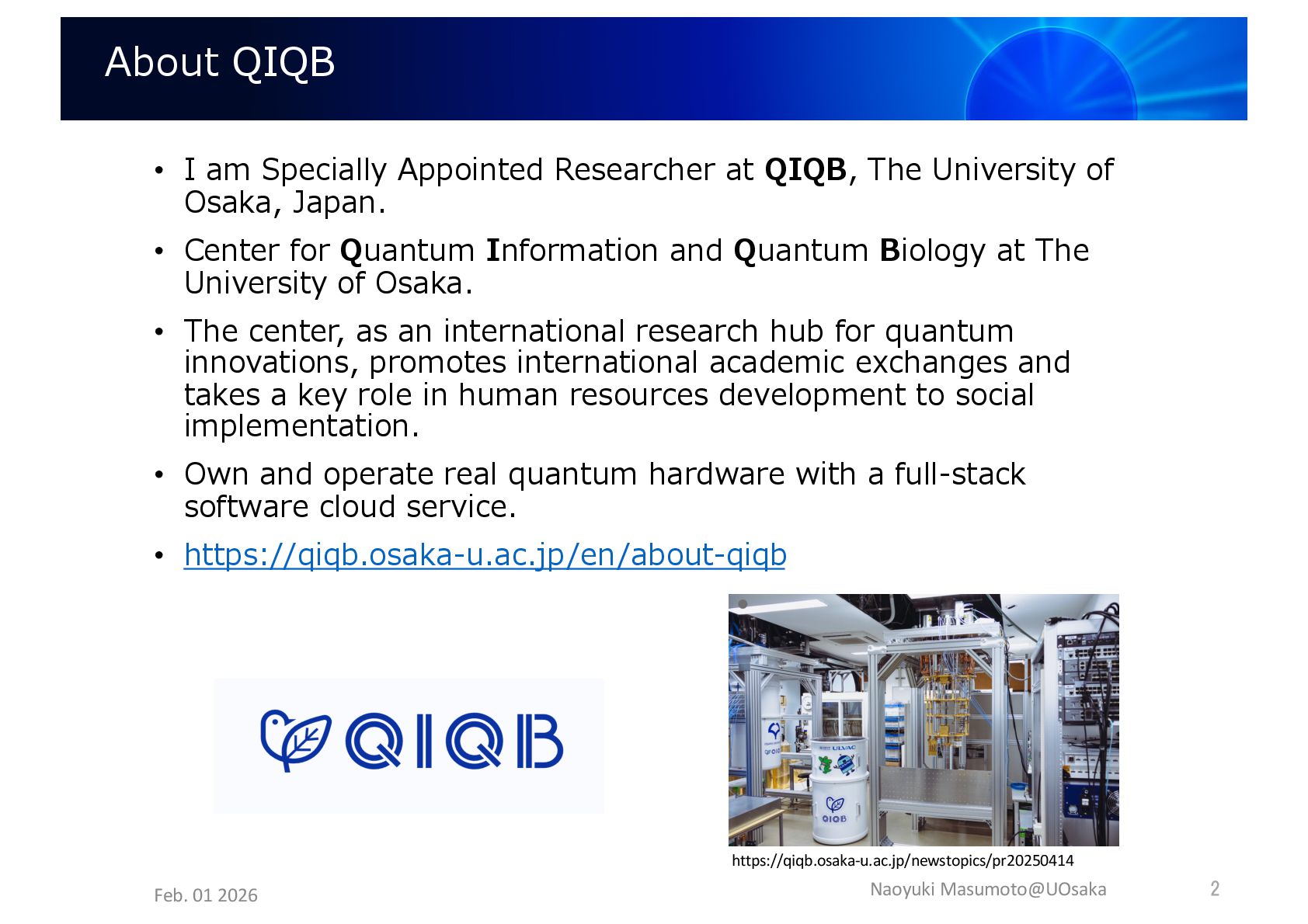
The University of Osaka, Japan. • Center for Quantum Information and Quantum Biology at The University of Osaka. • The center, as an international research hub for quantum innovations, promotes international academic exchanges and takes a key role in human resources development to social implementation. • Own and operate real quantum hardware with a full-stack software cloud service. • https://qiqb.osaka-u.ac.jp/en/about-qiqb Naoyuki Masumoto@UOsaka 2 Feb. 01 2026 https://qiqb.osaka-u.ac.jp/newstopics/pr20250414
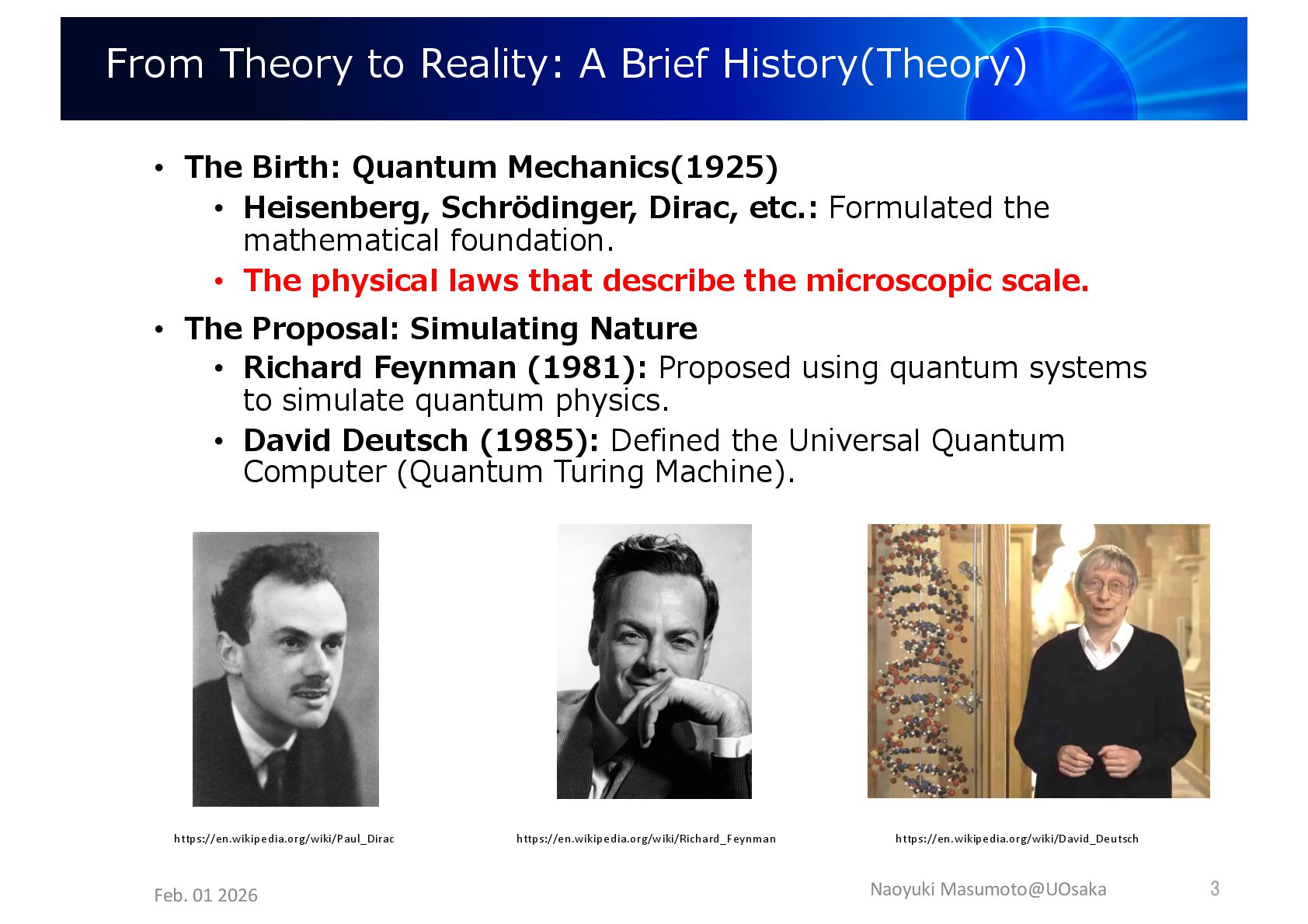
Quantum Mechanics(1925) • Heisenberg, Schrödinger, Dirac, etc.: Formulated the mathematical foundation. • The physical laws that describe the microscopic scale. • The Proposal: Simulating Nature • Richard Feynman (1981): Proposed using quantum systems to simulate quantum physics. • David Deutsch (1985): Defined the Universal Quantum Computer (Quantum Turing Machine). Naoyuki Masumoto@UOsaka 3 Feb. 01 2026 https://en.wikipedia.org/wiki/Paul_Dirac https://en.wikipedia.org/wiki/Richard_Feynman https://en.wikipedia.org/wiki/David_Deutsch
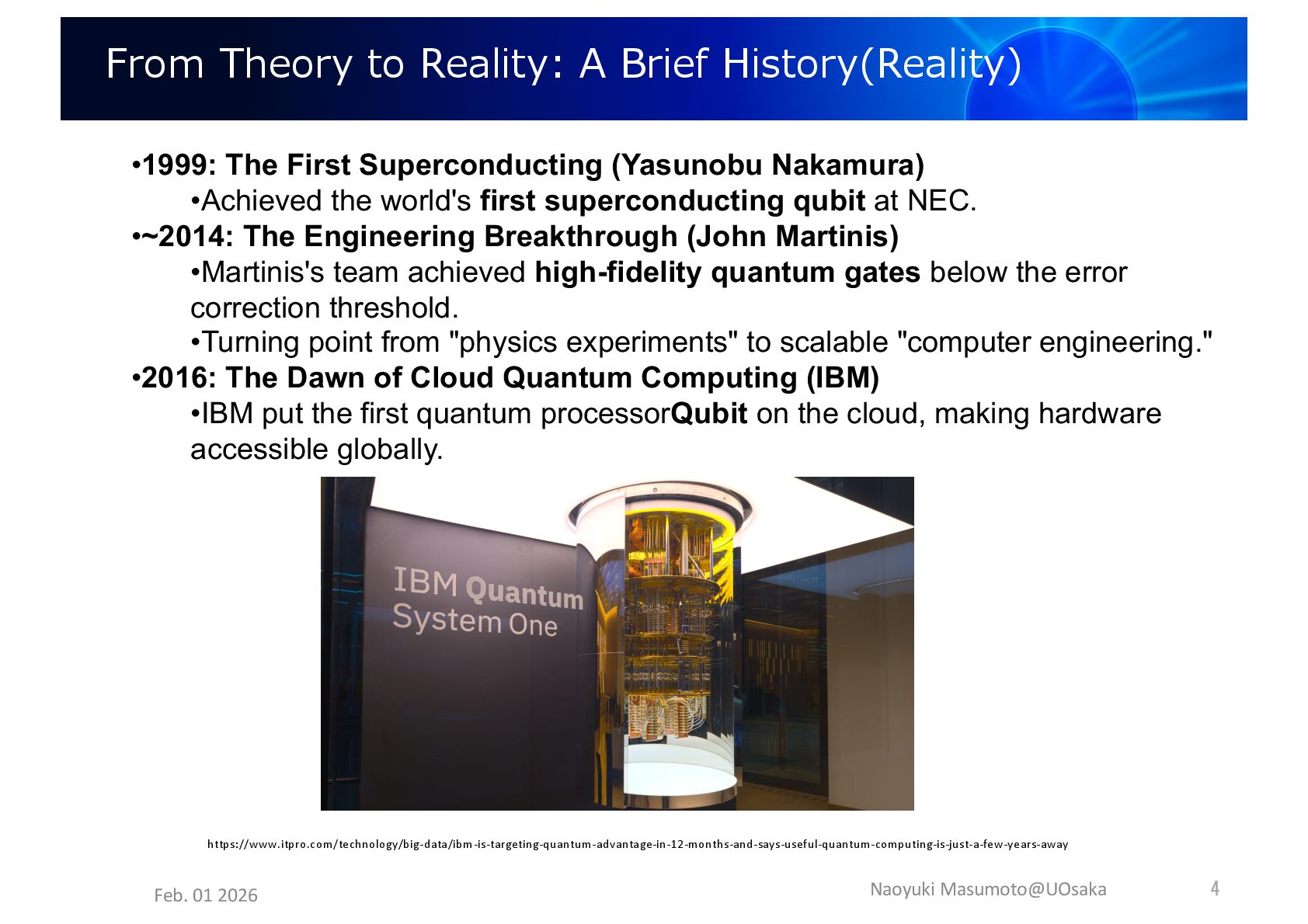
Feb. 01 2026 https://www.itpro.com/technology/big-data/ibm-is-targeting-quantum-advantage-in-12-months-and-says-useful-quantum-computing-is-just-a-few-years-away •1999: The First Superconducting (Yasunobu Nakamura) •Achieved the world's first superconducting qubit at NEC. •~2014: The Engineering Breakthrough (John Martinis) •Martinis's team achieved high-fidelity quantum gates below the error correction threshold. •Turning point from "physics experiments" to scalable "computer engineering." •2016: The Dawn of Cloud Quantum Computing (IBM) •IBM put the first quantum processorQubit on the cloud, making hardware accessible globally.
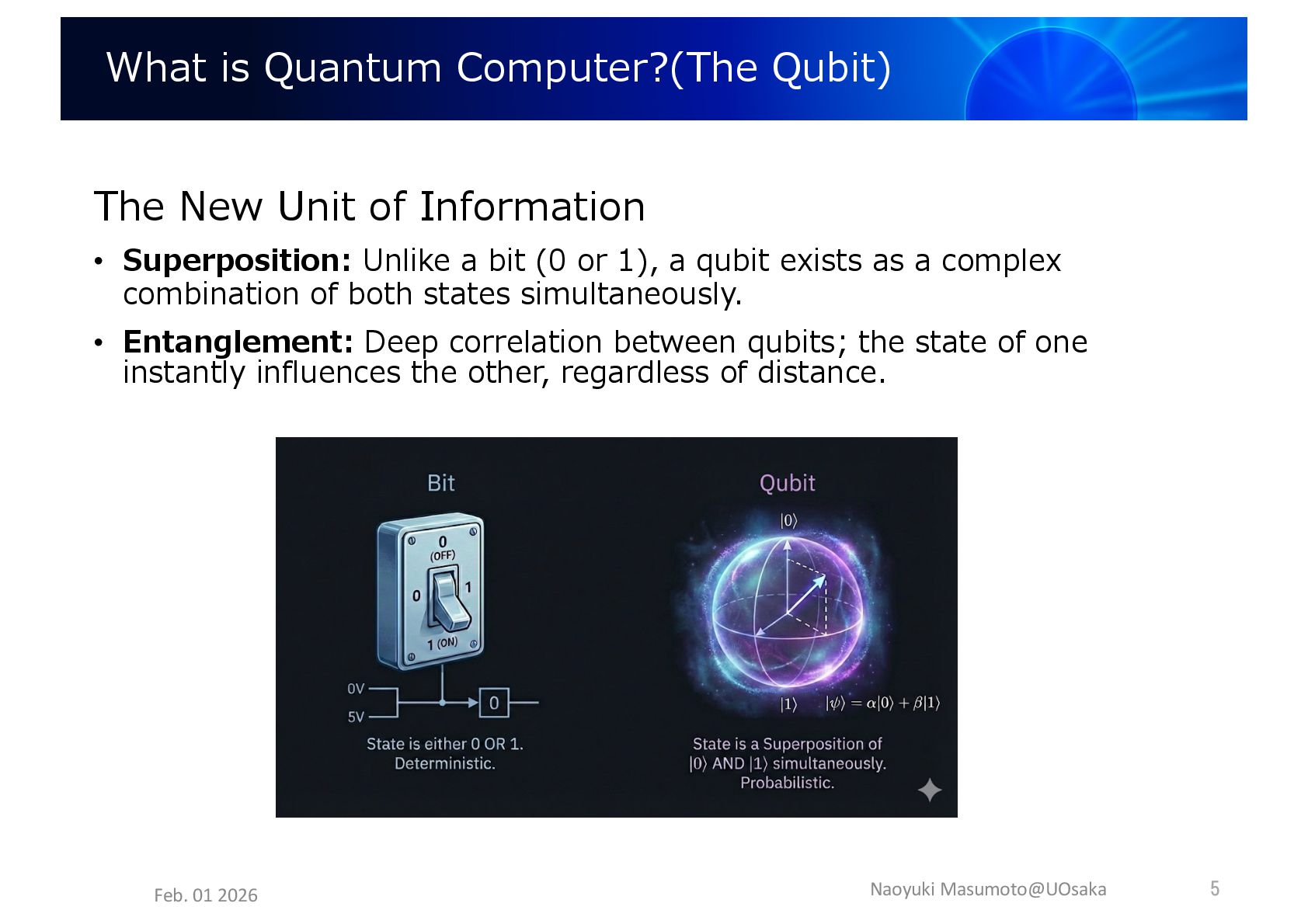
5 The New Unit of Information • Superposition: Unlike a bit (0 or 1), a qubit exists as a complex combination of both states simultaneously. • Entanglement: Deep correlation between qubits; the state of one instantly influences the other, regardless of distance.
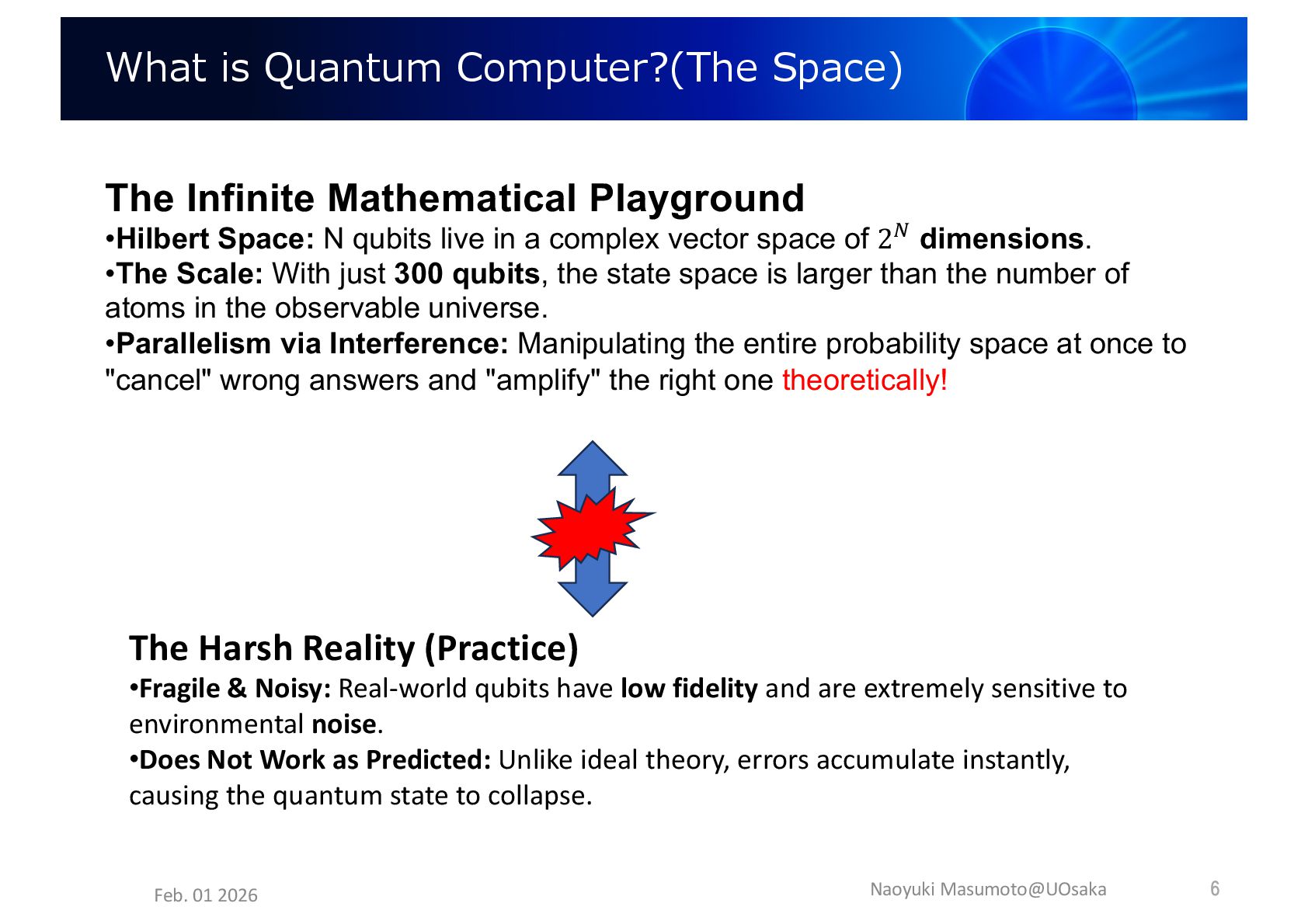
6 The Infinite Mathematical Playground •Hilbert Space: N qubits live in a complex vector space of 2! dimensions. •The Scale: With just 300 qubits, the state space is larger than the number of atoms in the observable universe. •Parallelism via Interference: Manipulating the entire probability space at once to "cancel" wrong answers and "amplify" the right one theoretically! The Harsh Reality (Practice) •Fragile & Noisy: Real-world qubits have low fidelity and are extremely sensitive to environmental noise. •Does Not Work as Predicted: Unlike ideal theory, errors accumulate instantly, causing the quantum state to collapse.
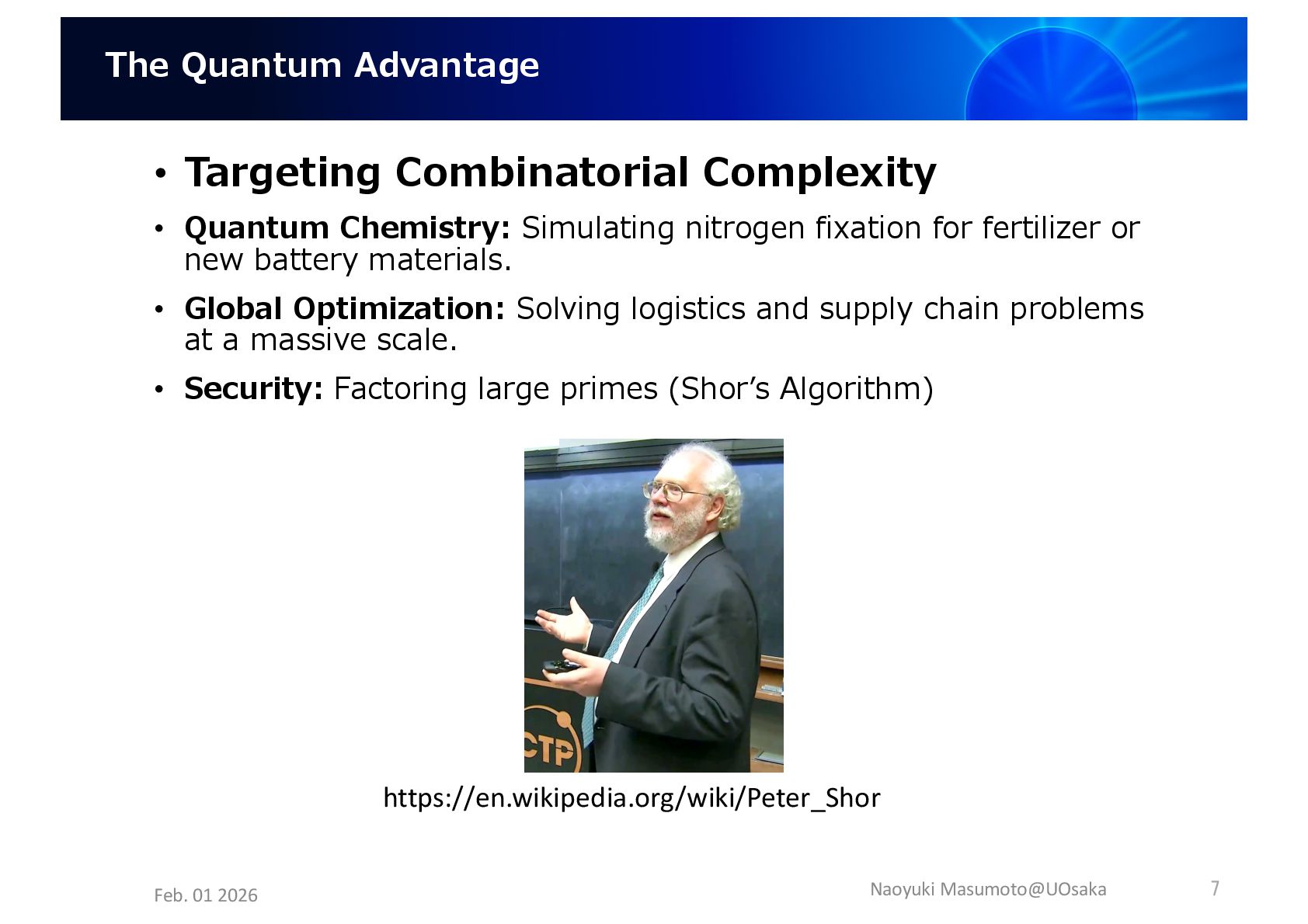
Simulating nitrogen fixation for fertilizer or new battery materials. • Global Optimization: Solving logistics and supply chain problems at a massive scale. • Security: Factoring large primes (Shorʼs Algorithm) Naoyuki Masumoto@UOsaka 7 Feb. 01 2026 https://en.wikipedia.org/wiki/Peter_Shor
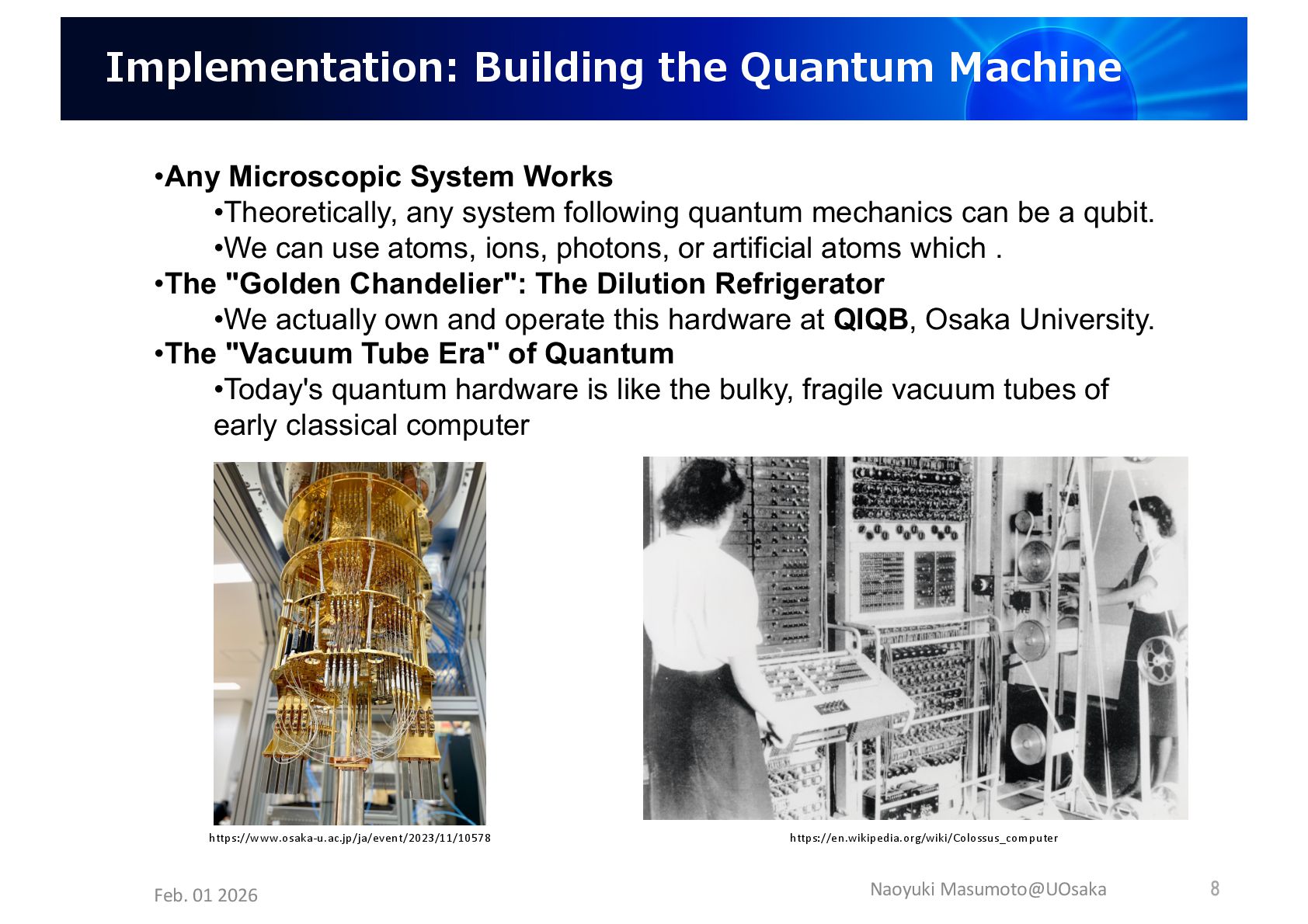
2026 •Any Microscopic System Works •Theoretically, any system following quantum mechanics can be a qubit. •We can use atoms, ions, photons, or artificial atoms which . •The "Golden Chandelier": The Dilution Refrigerator •We actually own and operate this hardware at QIQB, Osaka University. •The "Vacuum Tube Era" of Quantum •Today's quantum hardware is like the bulky, fragile vacuum tubes of early classical computer https://en.wikipedia.org/wiki/Colossus_computer https://www.osaka-u.ac.jp/ja/event/2023/11/10578
2026 •The Current Landscape: Dominated by Closed Ecosystems. •Examples: IBM Quantum and Google Quantum AI offer powerful, but proprietary, cloud platforms. •The Issue with "Walled Gardens": •Vendor Lock-in: Users are tied to a single company's full stack, from SDK to hardware. •Limited Transparency: Researchers cannot fully see how their circuits are compiled or optimized. •No Standard "OS": There is no common, open infrastructure for operators to build their own quantum cloud.
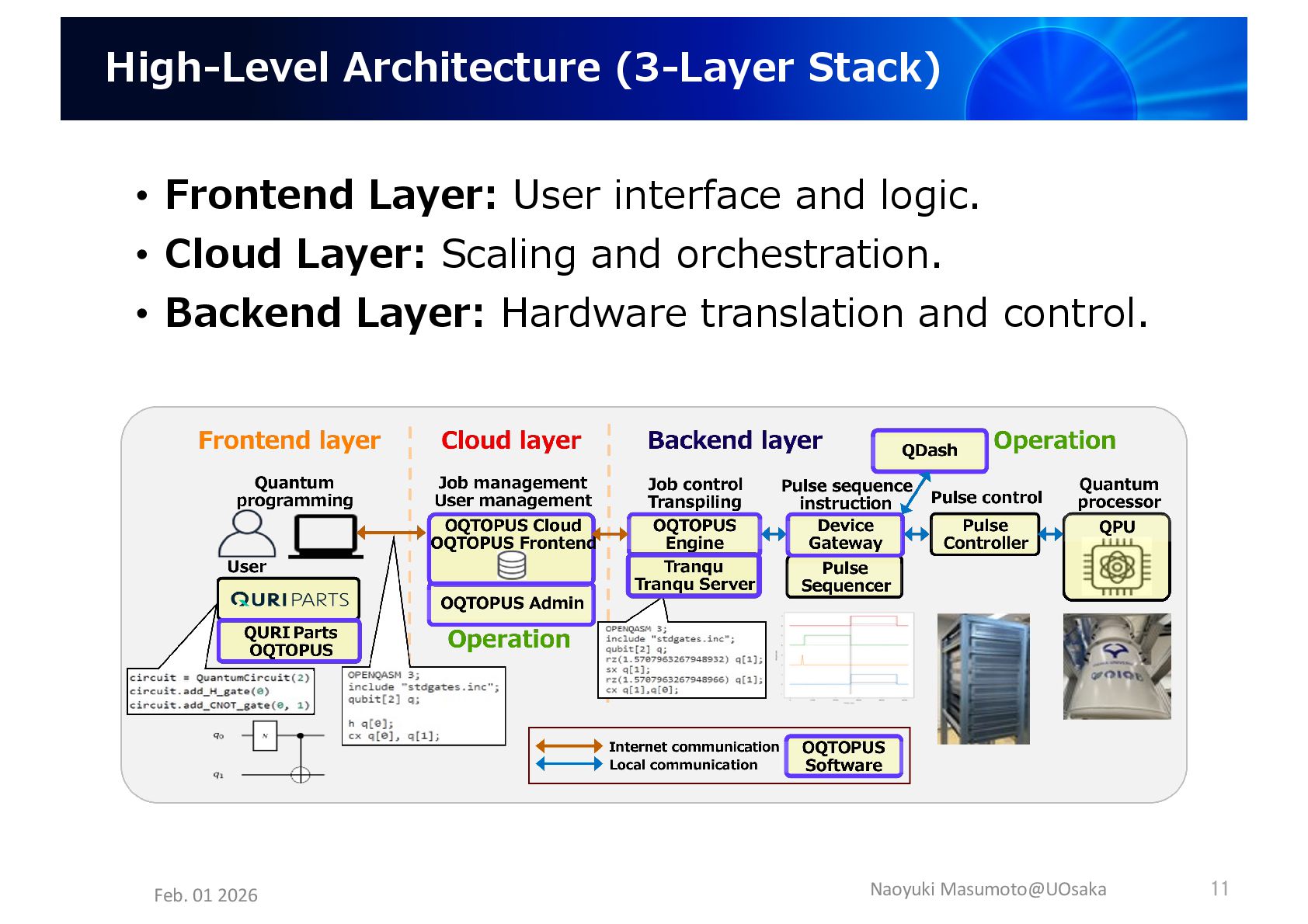
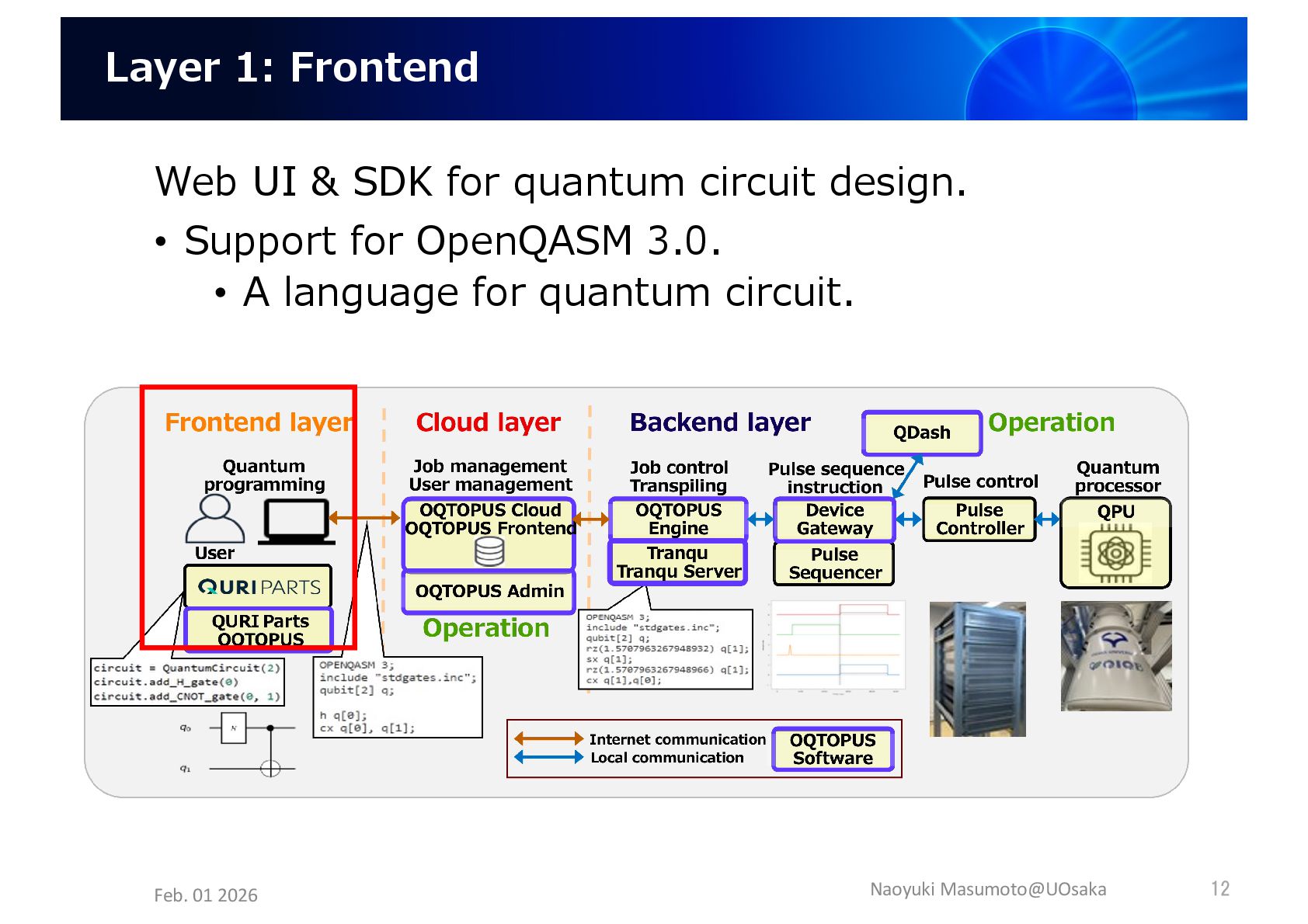
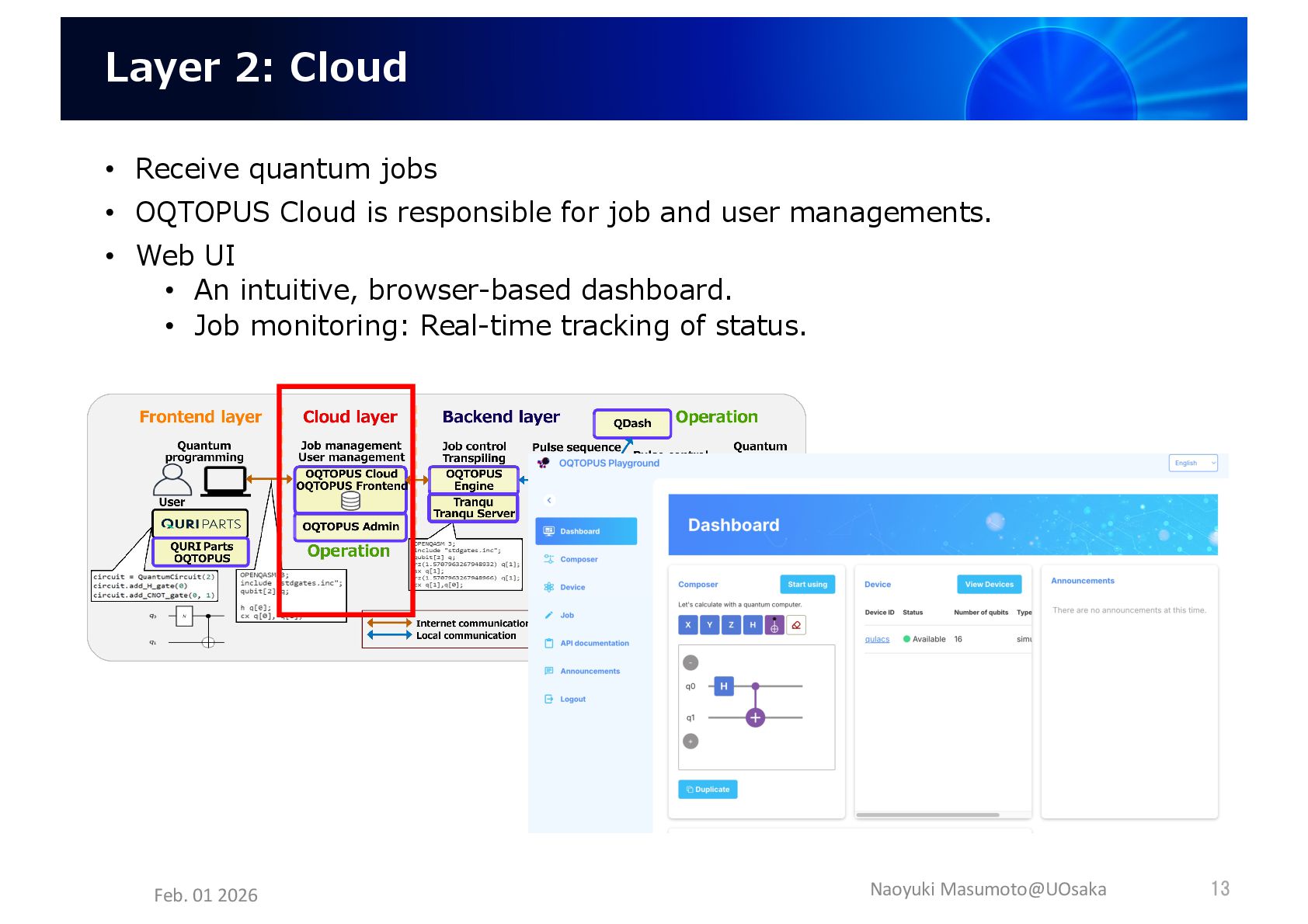
Receive quantum jobs • OQTOPUS Cloud is responsible for job and user managements. • Web UI • An intuitive, browser-based dashboard. • Job monitoring: Real-time tracking of status.
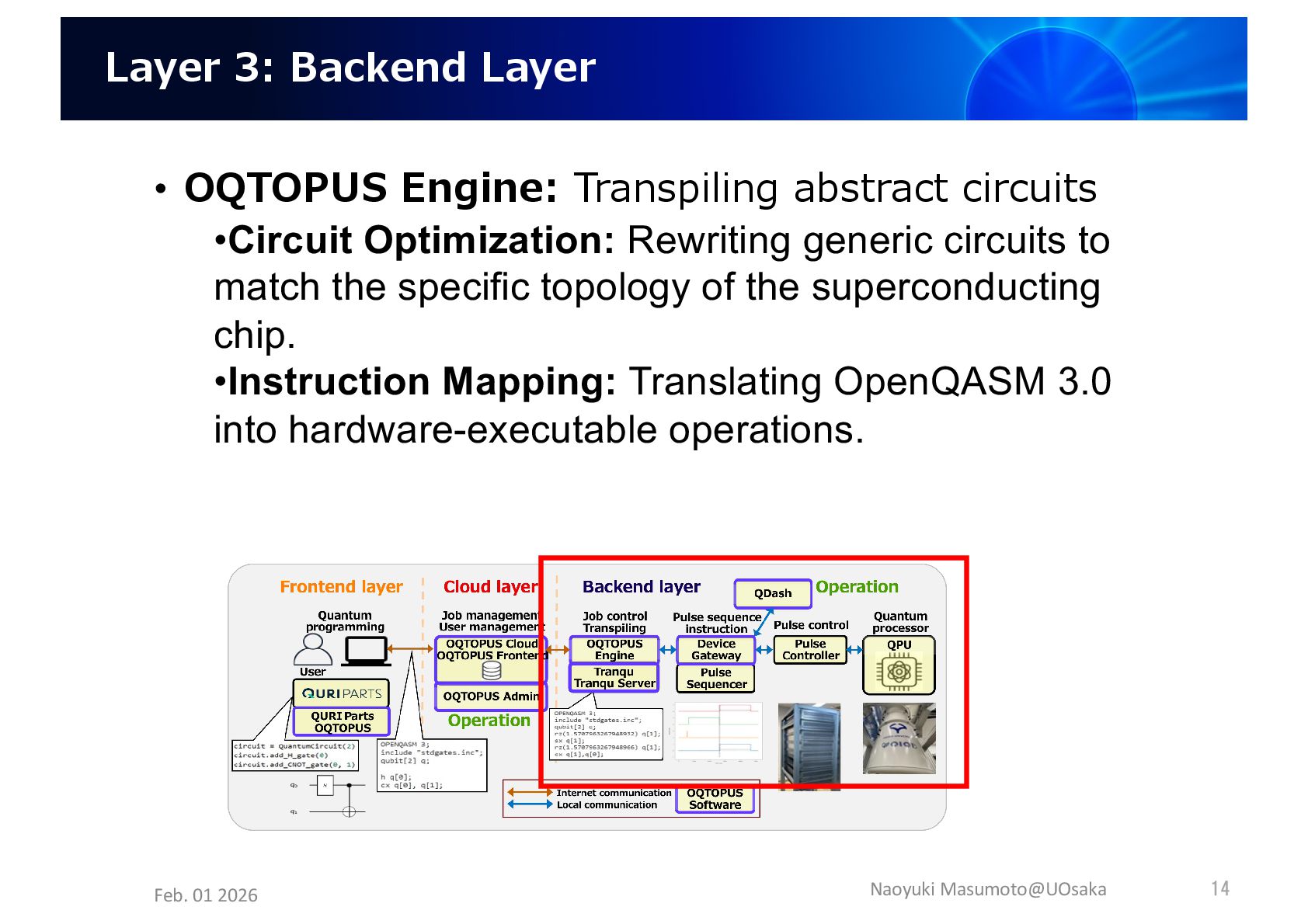
•Circuit Optimization: Rewriting generic circuits to match the specific topology of the superconducting chip. •Instruction Mapping: Translating OpenQASM 3.0 into hardware-executable operations. Naoyuki Masumoto@UOsaka 14 Feb. 01 2026
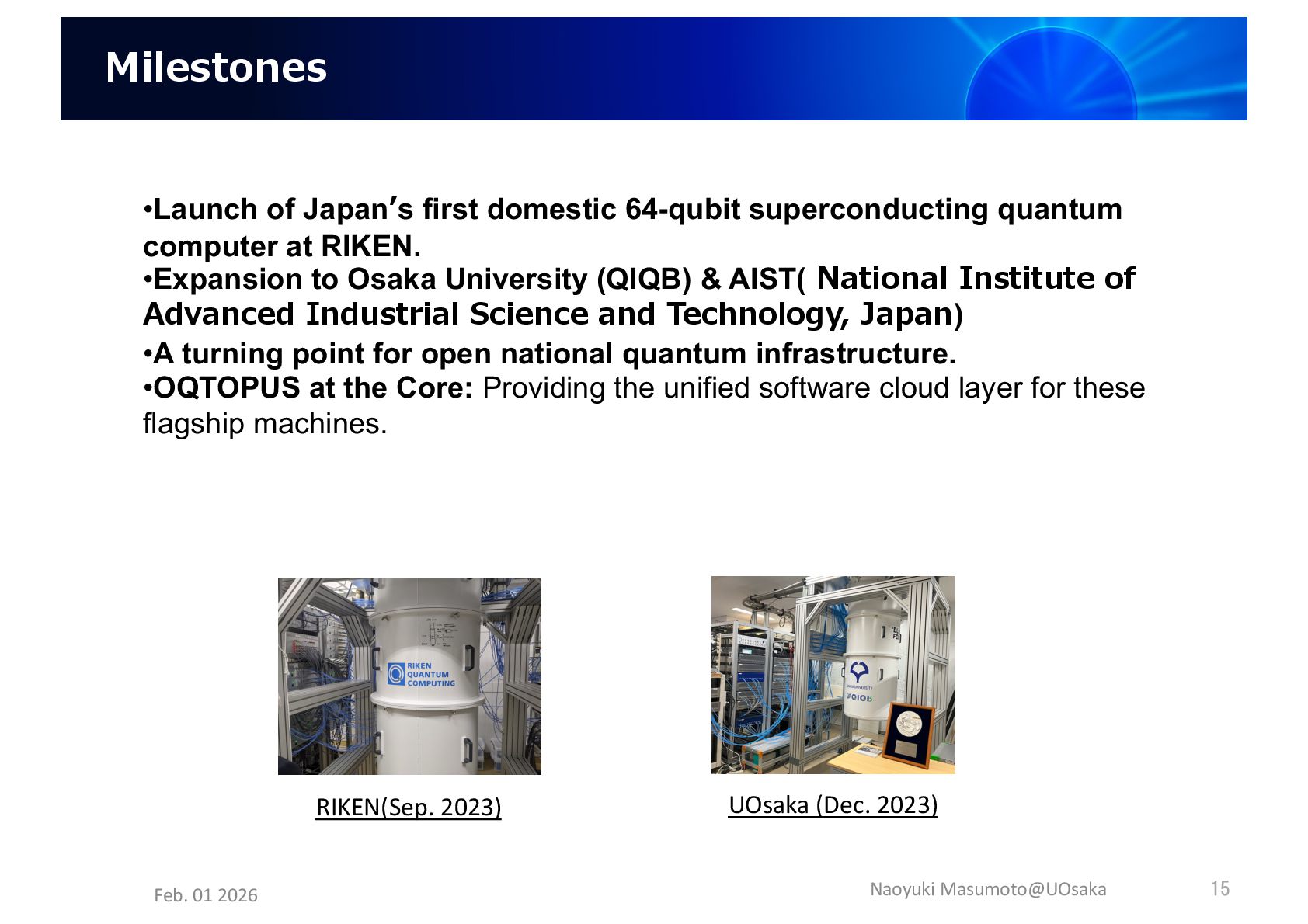
first domestic 64-qubit superconducting quantum computer at RIKEN. •Expansion to Osaka University (QIQB) & AIST( National Institute of Advanced Industrial Science and Technology, Japan) •A turning point for open national quantum infrastructure. •OQTOPUS at the Core: Providing the unified software cloud layer for these flagship machines. RIKEN(Sep. 2023) UOsaka (Dec. 2023)
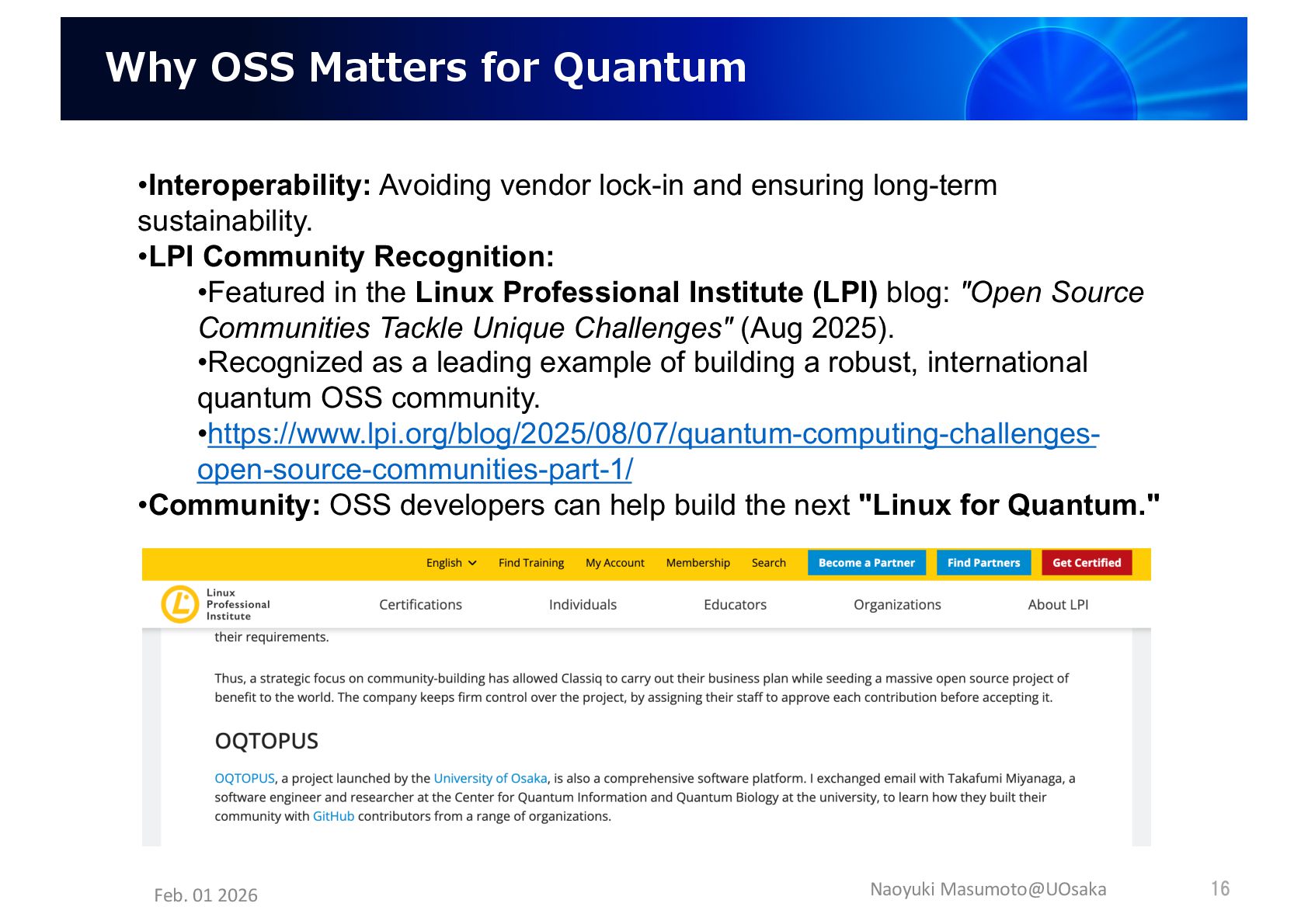
2026 •Interoperability: Avoiding vendor lock-in and ensuring long-term sustainability. •LPI Community Recognition: •Featured in the Linux Professional Institute (LPI) blog: "Open Source Communities Tackle Unique Challenges" (Aug 2025). •Recognized as a leading example of building a robust, international quantum OSS community. •https://www.lpi.org/blog/2025/08/07/quantum-computing-challenges- open-source-communities-part-1/ •Community: OSS developers can help build the next "Linux for Quantum."
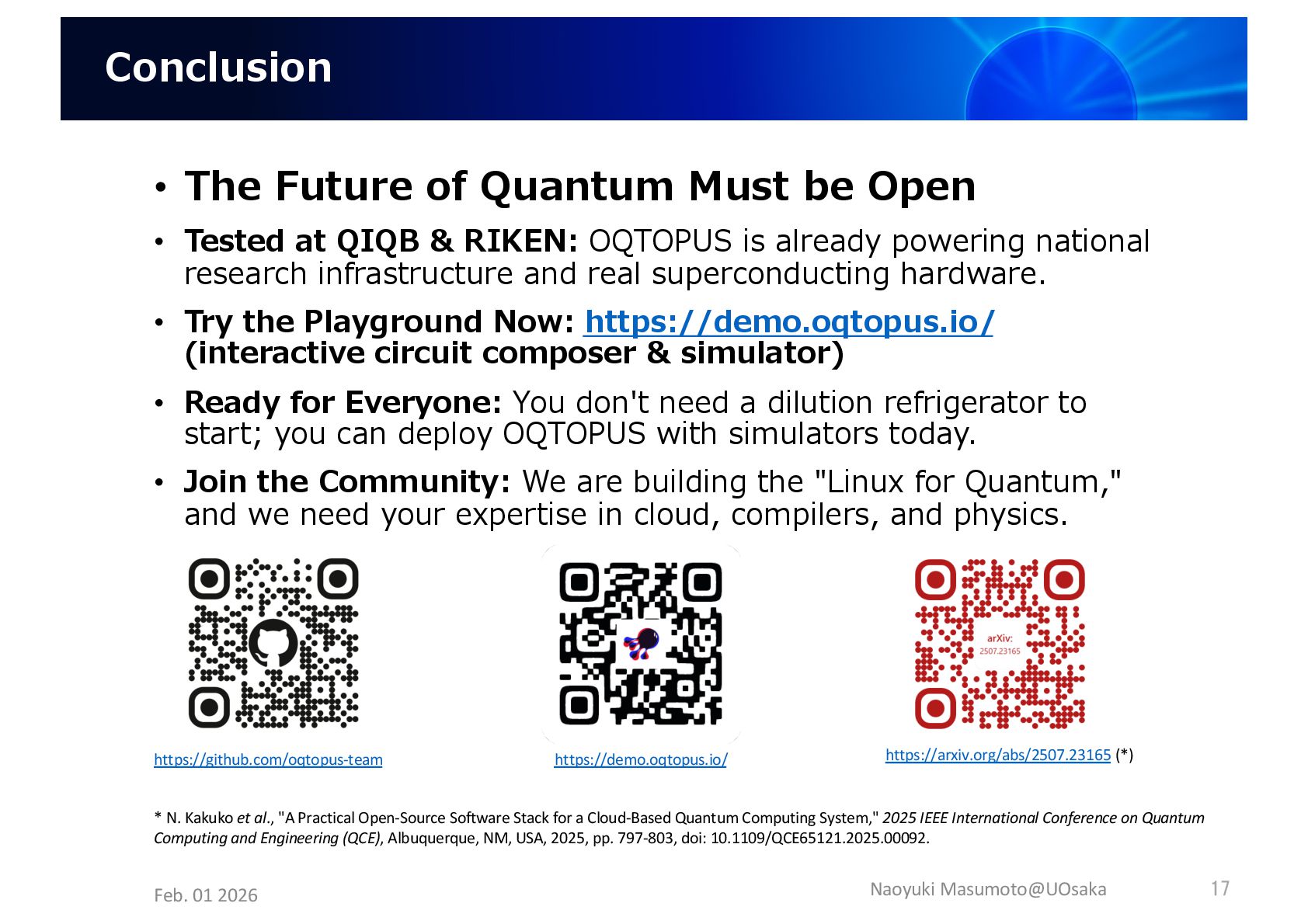
Tested at QIQB & RIKEN: OQTOPUS is already powering national research infrastructure and real superconducting hardware. • Try the Playground Now: https://demo.oqtopus.io/ (interactive circuit composer & simulator) • Ready for Everyone: You don't need a dilution refrigerator to start; you can deploy OQTOPUS with simulators today. • Join the Community: We are building the "Linux for Quantum," and we need your expertise in cloud, compilers, and physics. Naoyuki Masumoto@UOsaka 17 Feb. 01 2026 https://github.com/oqtopus-team https://arxiv.org/abs/2507.23165 (*) * N. Kakuko et al., "A Practical Open-Source Software Stack for a Cloud-Based Quantum Computing System," 2025 IEEE International Conference on Quantum Computing and Engineering (QCE), Albuquerque, NM, USA, 2025, pp. 797-803, doi: 10.1109/QCE65121.2025.00092. https://demo.oqtopus.io/


 oqtopus
 institutdelelevage
 hotchpotch
 rikkabotan7
 dk999
dk999
 datascientistsociety
 mikimhk
 sishi
sishi
 imai448
 fr0gger
 jacobtomlinson
 baasie
 aleyda
 rakko
rakko
 mfonobong
 kimpetersen
 letsgokoyo
 dougneiner
 davidcarrasco
 inesmontani
 lara
lara