Upgrade to Pro — share decks privately, control downloads, hide ads and more …

An Overview of Index Prefetching

An Overview of Index Prefetching

https://postgresql.us/events/postgressummitus2026/schedule/session/2448-an-overview-of-index-prefetching/

PostgreSQL 18 brought asynchronous I/O to most scan types, letting Postgres read ahead and hide storage latency instead of stalling on every page read. But support for "plain" index scans was deferred. Such support requires a fundamental rethink of how the scan orders work internally, making it a large and complicated project in its own right.

Work now targeting PostgreSQL 20 will add support for prefetching during index scans. This talk (giving by one of the authors of the index prefetching patch set) looks at what that means for users: which kinds of queries are faster, and by how much.

Avatar for Peter Geoghegan

Peter Geoghegan

October 03, 2026

More Decks by Peter Geoghegan

Other Decks in Programming

Transcript

  1. Overview 1. Background on Index prefetching project Introduces basic aio/prefetching

    concepts 2. Bitmap scans, plain index scans, and aio How aio works with these two similar scan types 3. Performance of index scans with asynchronous IO Benchmark results showing the bene t of prefetching fi 4. Planner costing of index scans under prefetching How aio affects plan costing, and the implications
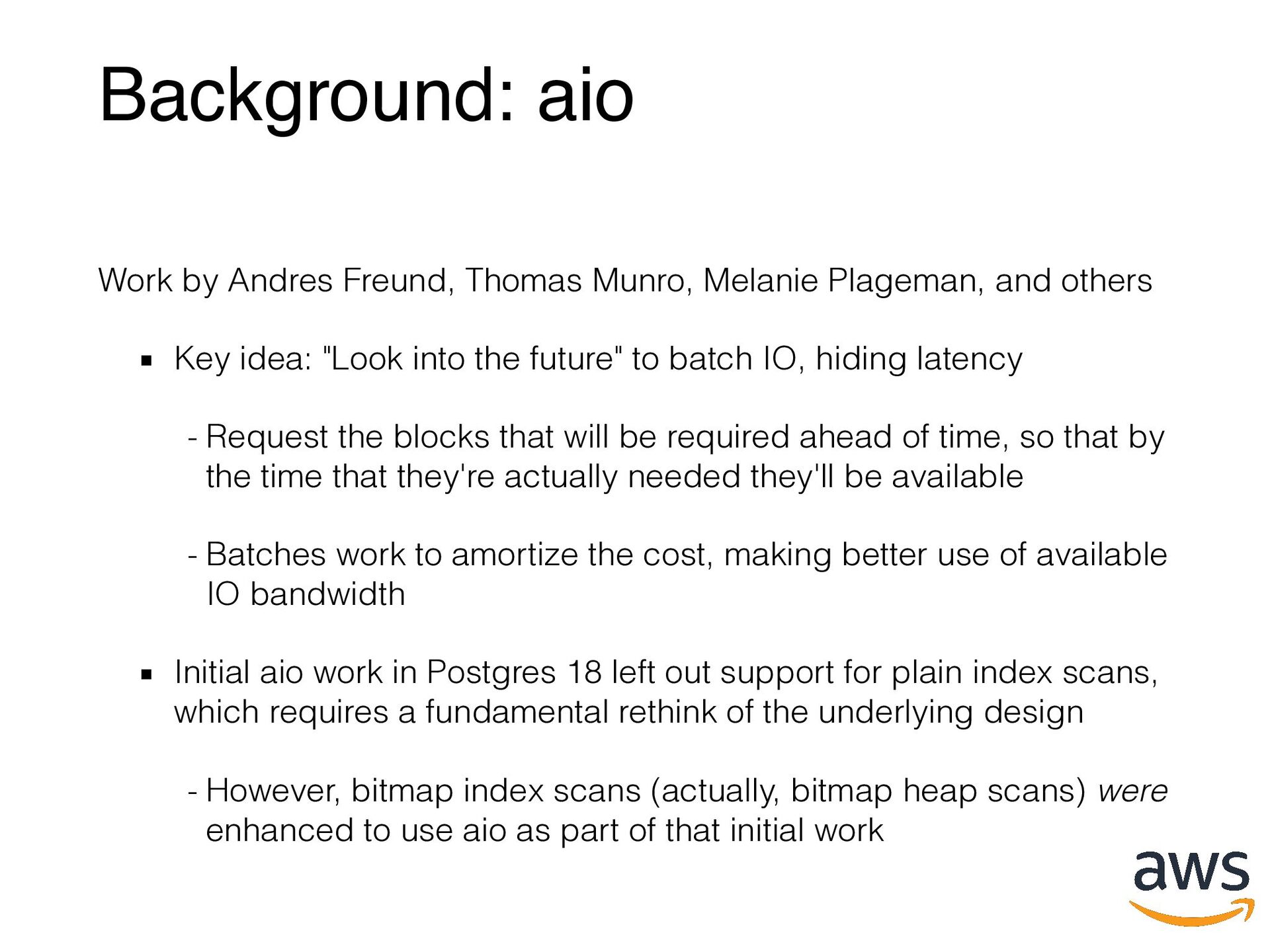
  2. Background: aio Work by Andres Freund, Thomas Munro, Melanie Plageman,

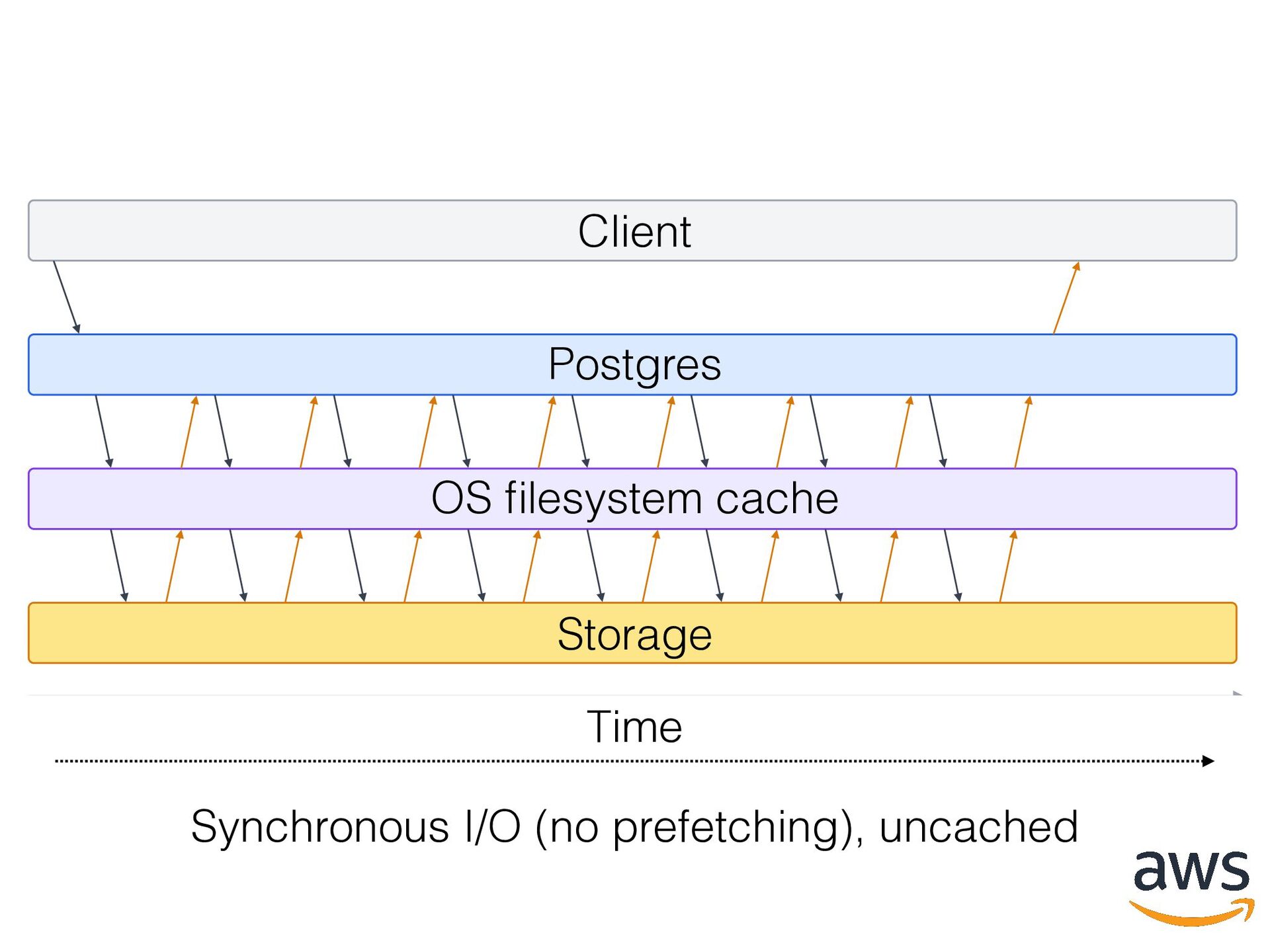
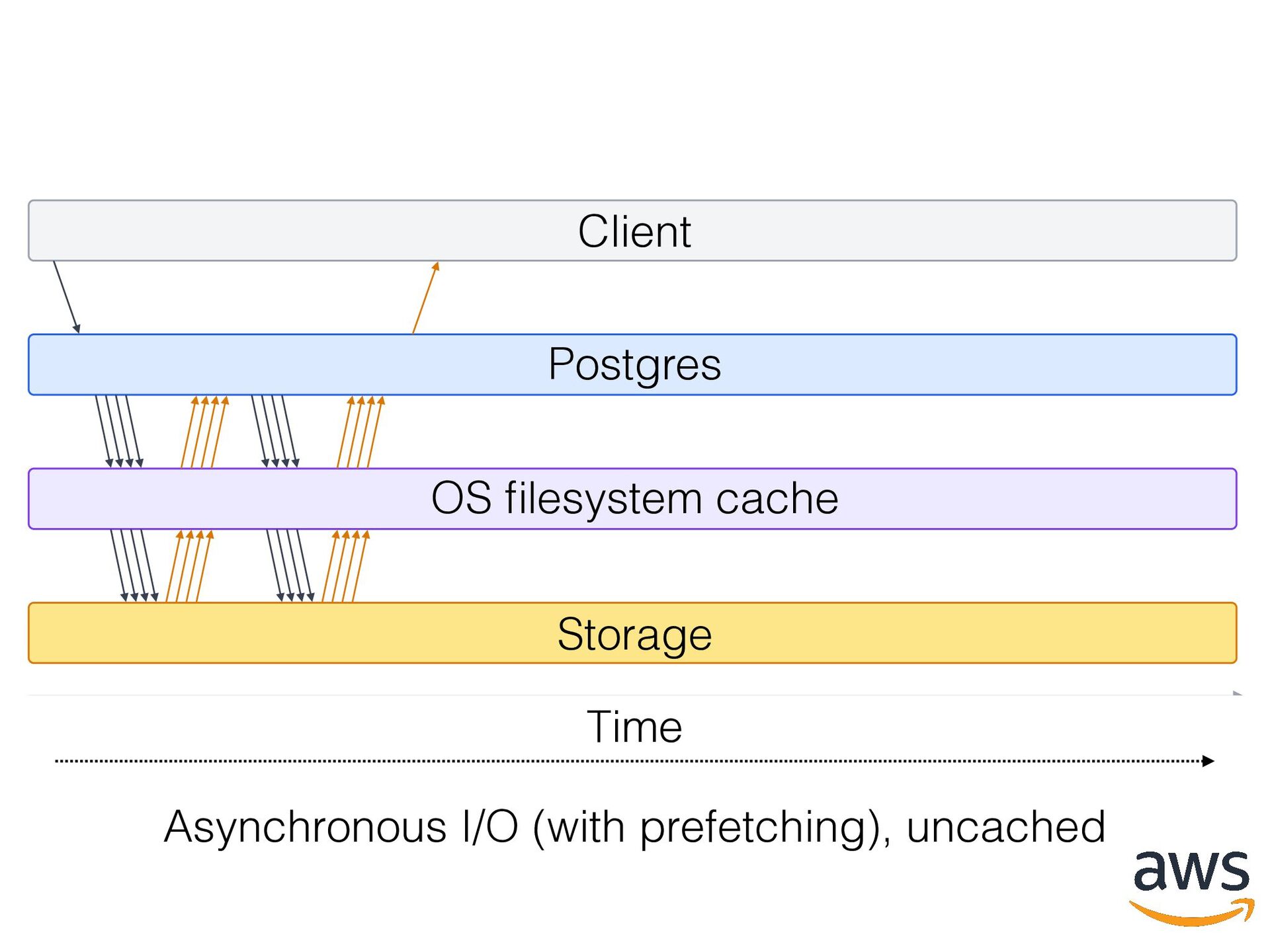
    and others Key idea: "Look into the future" to batch IO, hiding latency - Request the blocks that will be required ahead of time, so that by the time that they're actually needed they'll be available - Batches work to amortize the cost, making better use of available IO bandwidth Initial aio work in Postgres 18 left out support for plain index scans, which requires a fundamental rethink of the underlying design - However, bitmap index scans (actually, bitmap heap scans) were enhanced to use aio as part of that initial work
  3. Read stream aio interface Read streams are used by every

    aio-aware executor node Registered callback requests the next heap block from table AM code - Returns the next required block on each call (called by the read stream) - How the callback determines which heap block will be required next varies; with index prefetching, callback might have to call into the index AM to gure that out Executor nodes call read_stream_next_buffer() to get a buffer containing the next page in line - "Next buffer" request uses same executor node's own registered callback to prefetch more blocks for later, in passing fi Adaptive: A miss increases the prefetch distance, avoiding future IO waits
  4. fi Background: index prefetching project Work by Tomas Vondra and

    myself, started by Tomas in 2023 Builds on the asynchronous I/O infrastructure that rst appeared in Postgres 18 (also uses read stream) Prefetches table/heap blocks (not index blocks) Multiple major design revisions - I'm optimistic that we'll commit a version with the current design before Postgres 20 feature freeze
  5. Background: index prefetching project (cont.) Why did index prefetching take

    so much longer? Index scan I/O requests have challenging characteristics - True random IO, where requests are out of order, and the same heap page can be requested multiple times - Simple point queries (e.g., primary key lookups) cannot bene t and must not pay a price Requires much closer cooperation between index AM and table AM - Interleaved execution (explained in the next section) required to get optimal performance fi - All index access methods need to adopt new batch interface: nbtree, hash, GiST, and SP-GiST all need to be switched over
  6. Other aio/prefetching talks Andres Freund gave a more general and

    less technical talk about aio at this event last year: "AIO in Postgres 18 and beyond" - https://postgresql.us/events/pgconfus2025/schedule/session/ 2079-aio-in-pg-18-and-beyond - Available on YouTube Tomas Vondra and I gave a super technical talk about the underlying design at PGConf.dev 2026: "Update on Index Prefetching" - https://2026.pgconf.dev/session/659 - Also available on YouTube
  7. Overview 1. Background on Index prefetching project Introduces basic aio/prefetching

    concepts 2. Bitmap scans, plain index scans, and aio How aio works with these two similar scan types 3. Performance of index scans with asynchronous IO Benchmark results showing the bene t of prefetching fi 4. Planner costing of index scans under prefetching How aio affects plan costing, and the implications
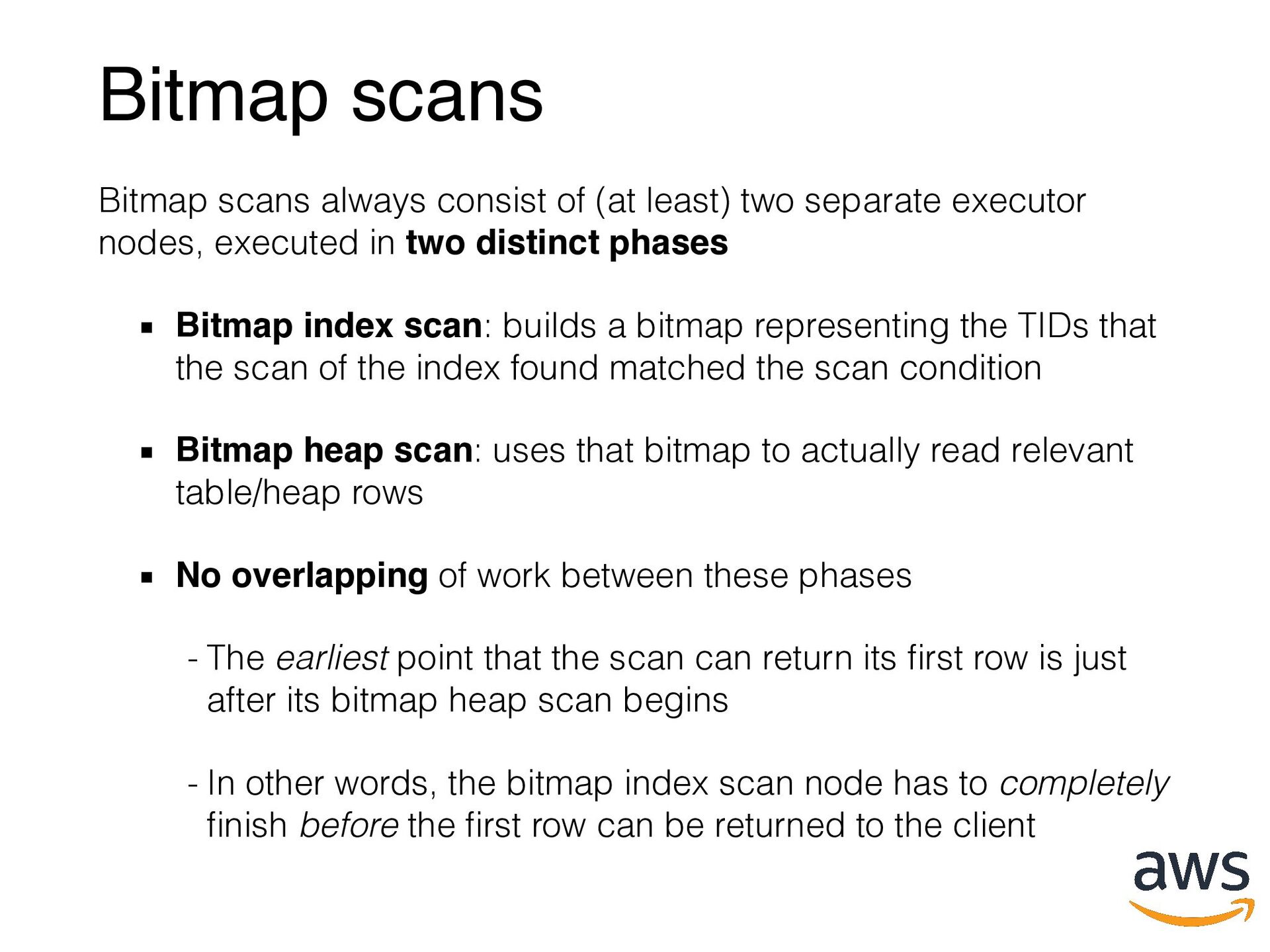
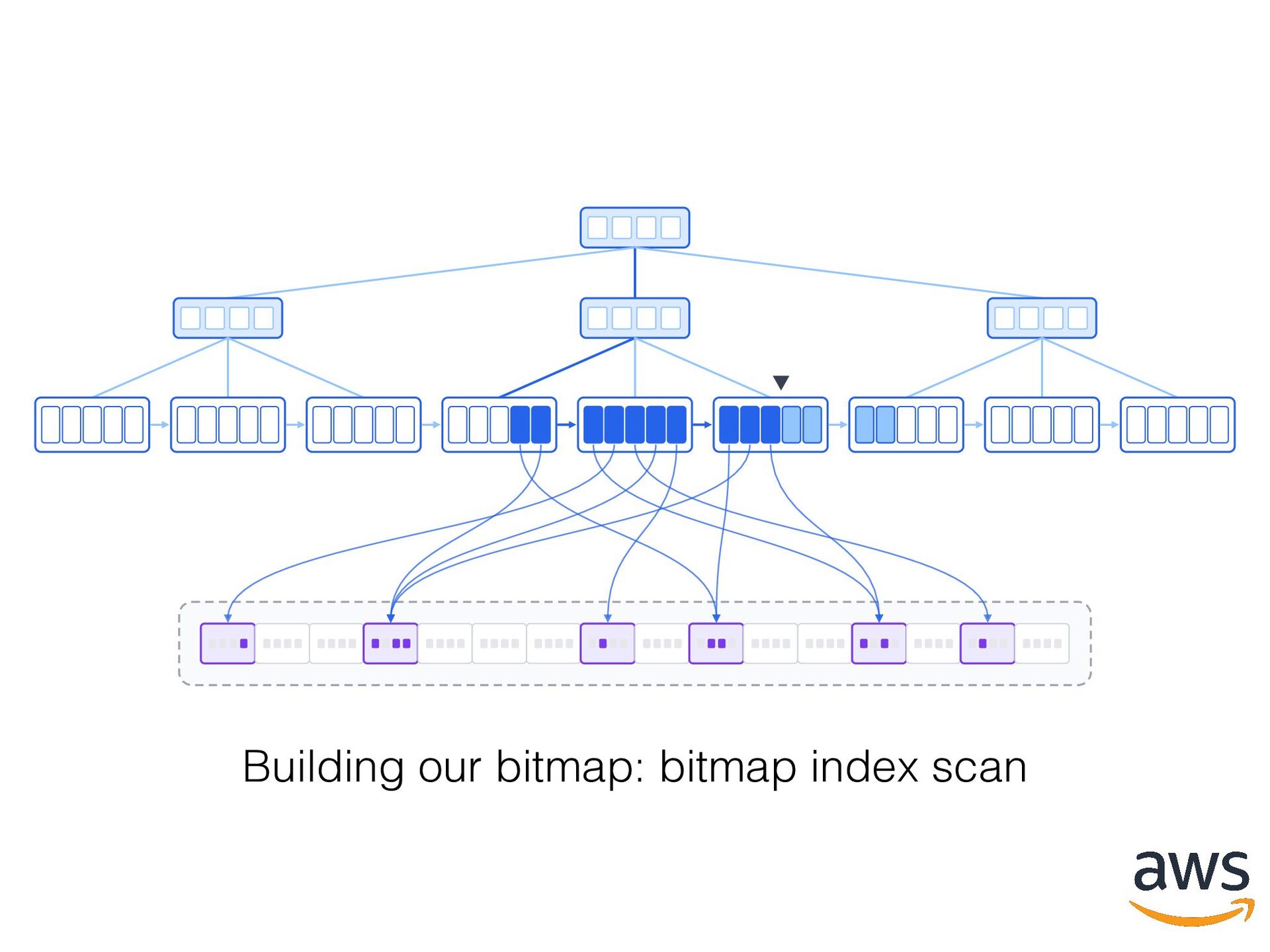
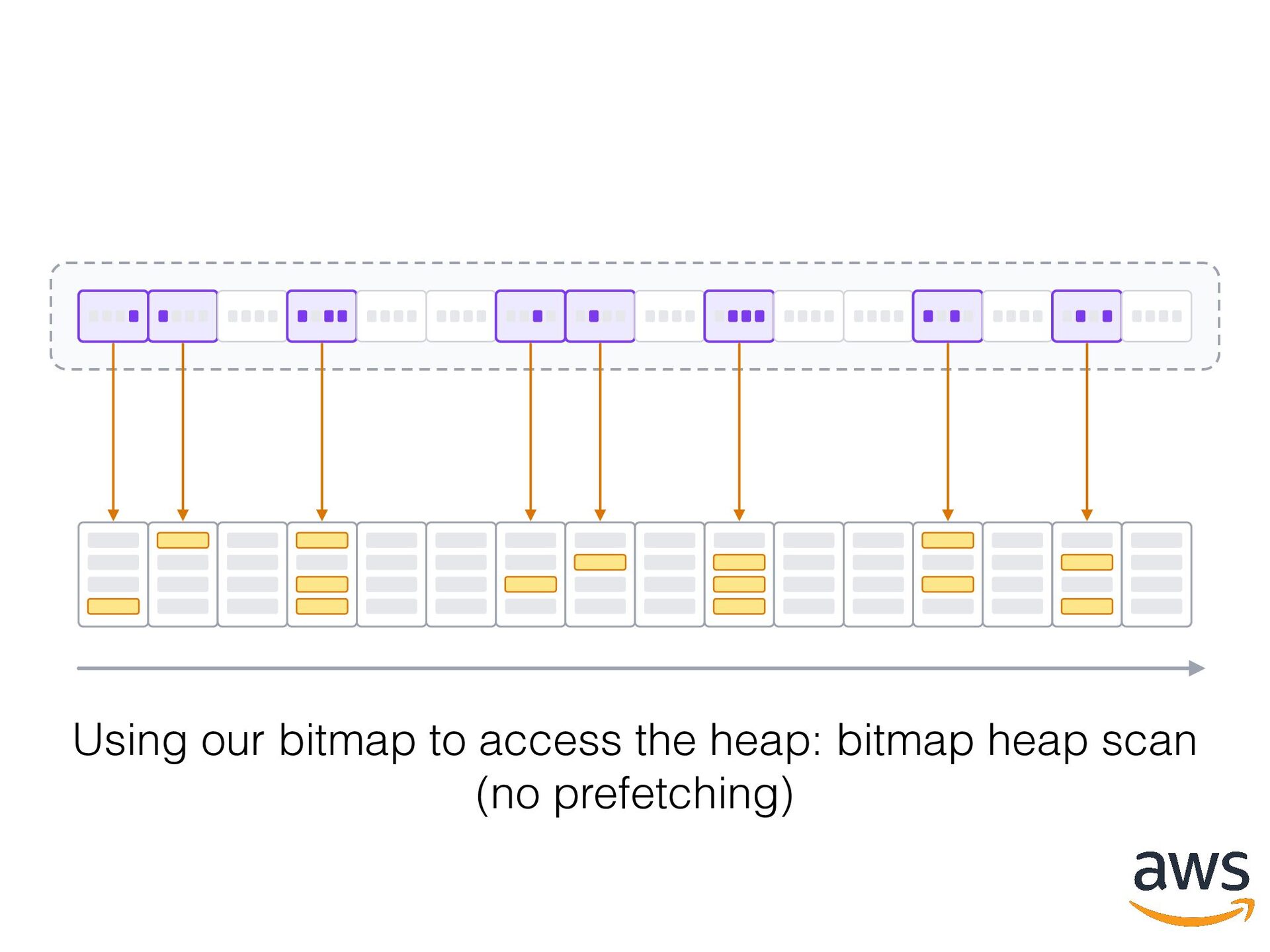
  8. Bitmap scans always consist of (at least) two separate executor

    nodes, executed in two distinct phases Bitmap index scan: builds a bitmap representing the TIDs that the scan of the index found matched the scan condition Bitmap heap scan: uses that bitmap to actually read relevant table/heap rows No overlapping of work between these phases - The earliest point that the scan can return its rst row is just after its bitmap heap scan begins fi - In other words, the bitmap index scan node has to completely nish before the rst row can be returned to the client fi fi Bitmap scans
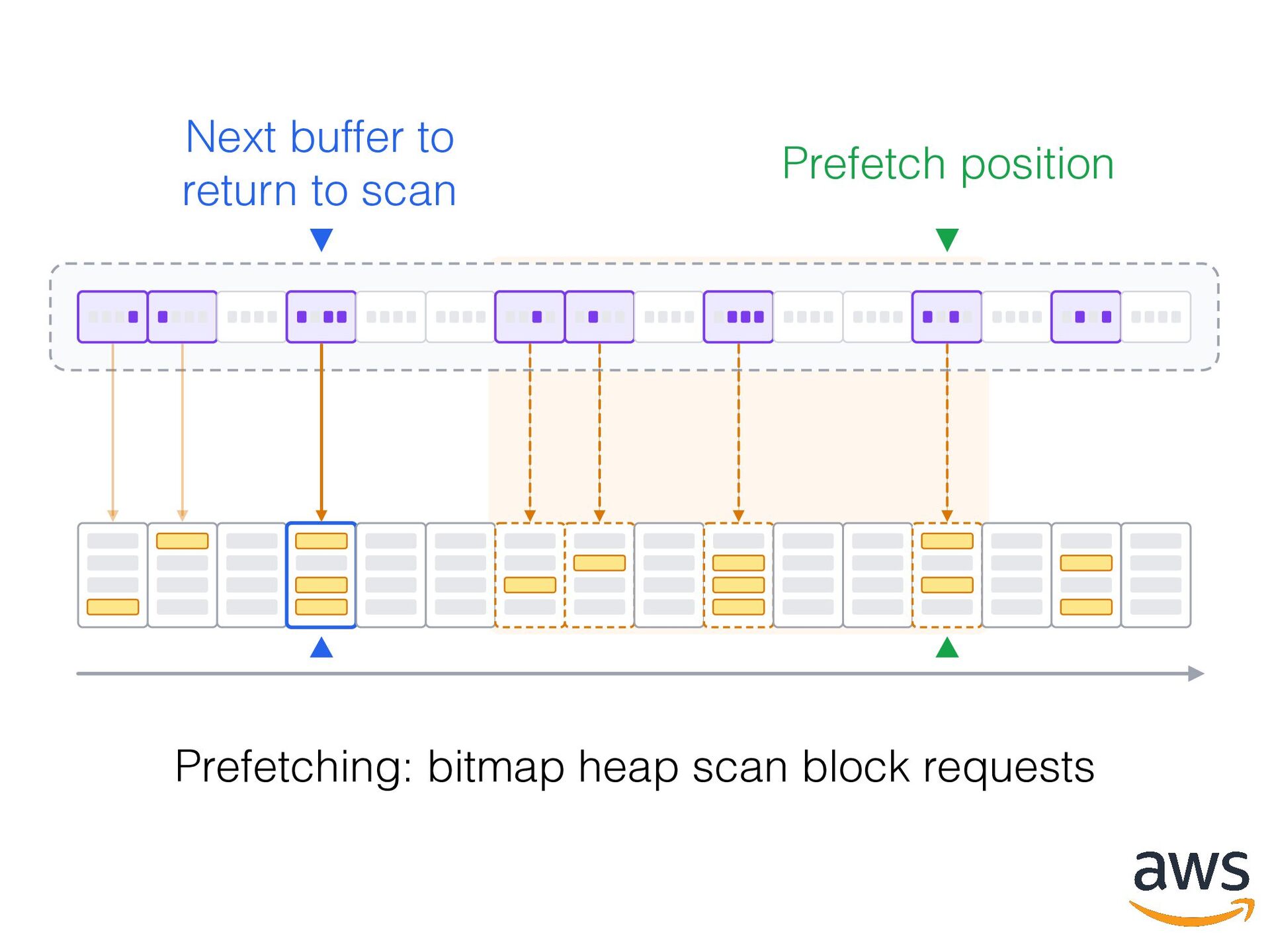
  9. Bitmap scans: prefetching Bitmap heap scans are ideally suited to

    prefetching Much simpler to integrate read stream than with plain index scans - Bitmap index scan node builds bitmap the same way regardless of prefetching - "Looking into the future" therefore only needs to work off of the in-memory bitmap structure; no dependencies that can get in the way Every required heap block is requested exactly once, in ascending physical heap block order; IO is "random" only to the extent that the required blocks are noncontiguous
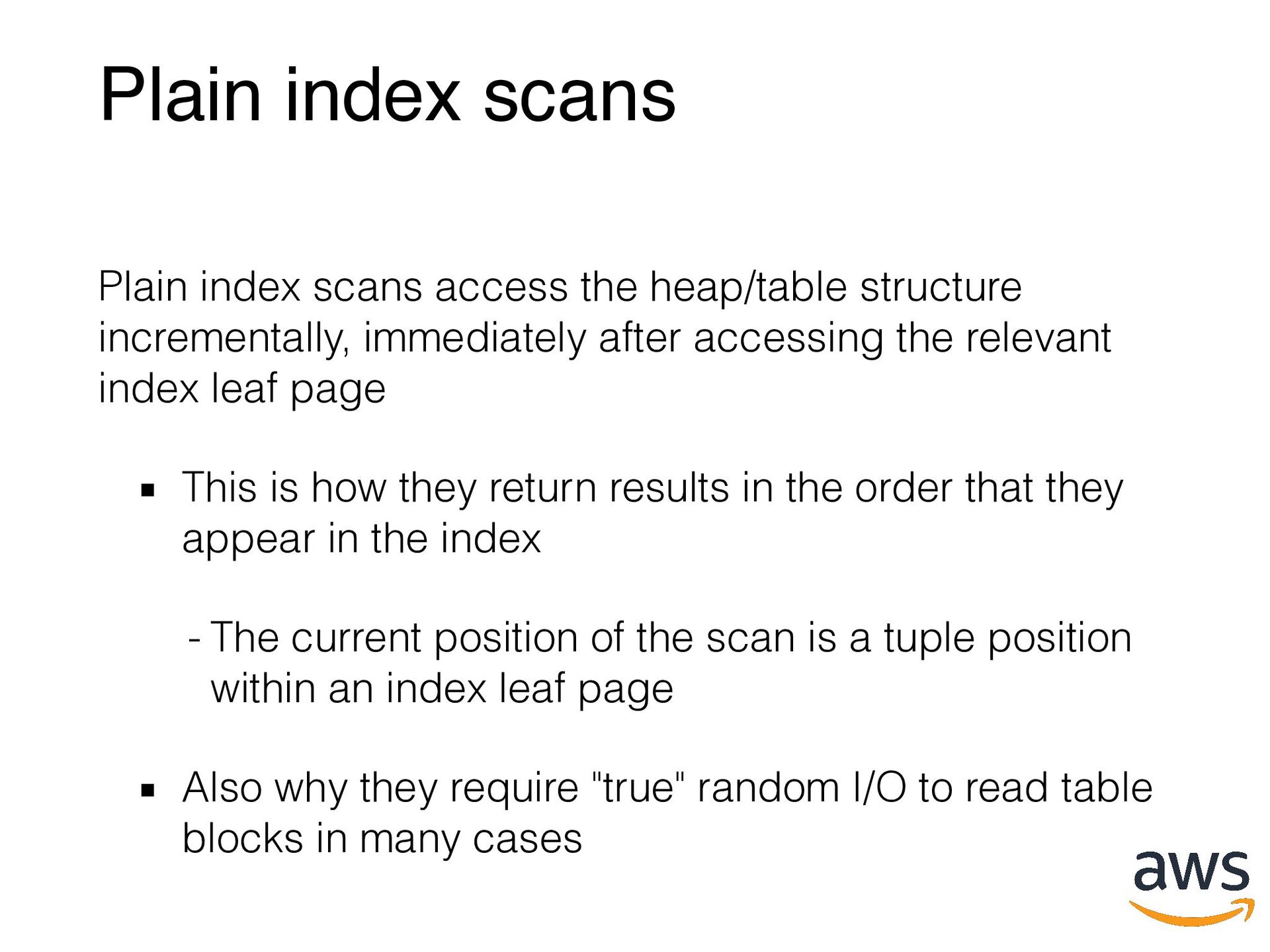
  10. Plain index scans Plain index scans access the heap/table structure

    incrementally, immediately after accessing the relevant index leaf page This is how they return results in the order that they appear in the index - The current position of the scan is a tuple position within an index leaf page Also why they require "true" random I/O to read table blocks in many cases
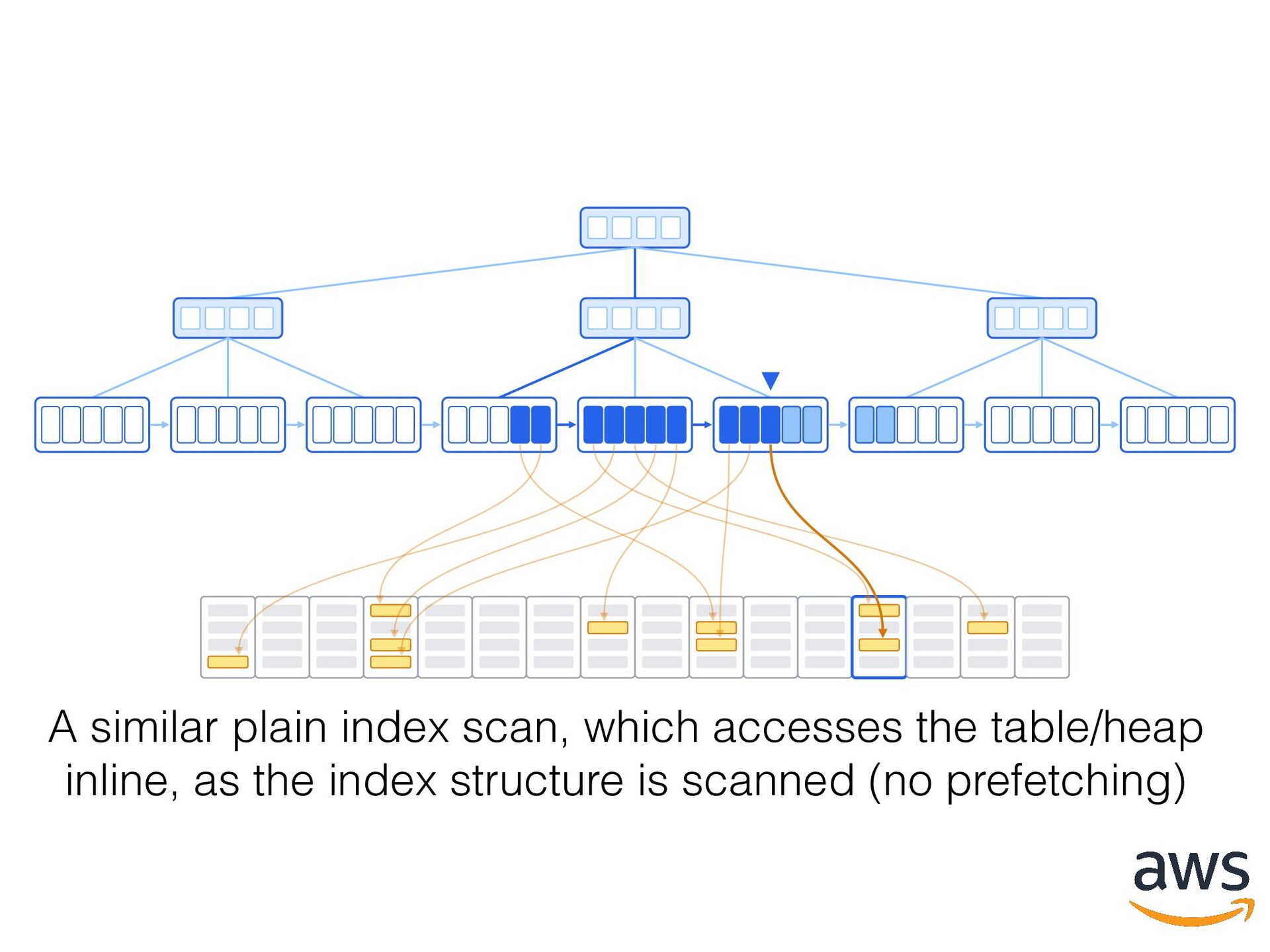
  11. A similar plain index scan, which accesses the table/heap inline,

    as the index structure is scanned (no prefetching)
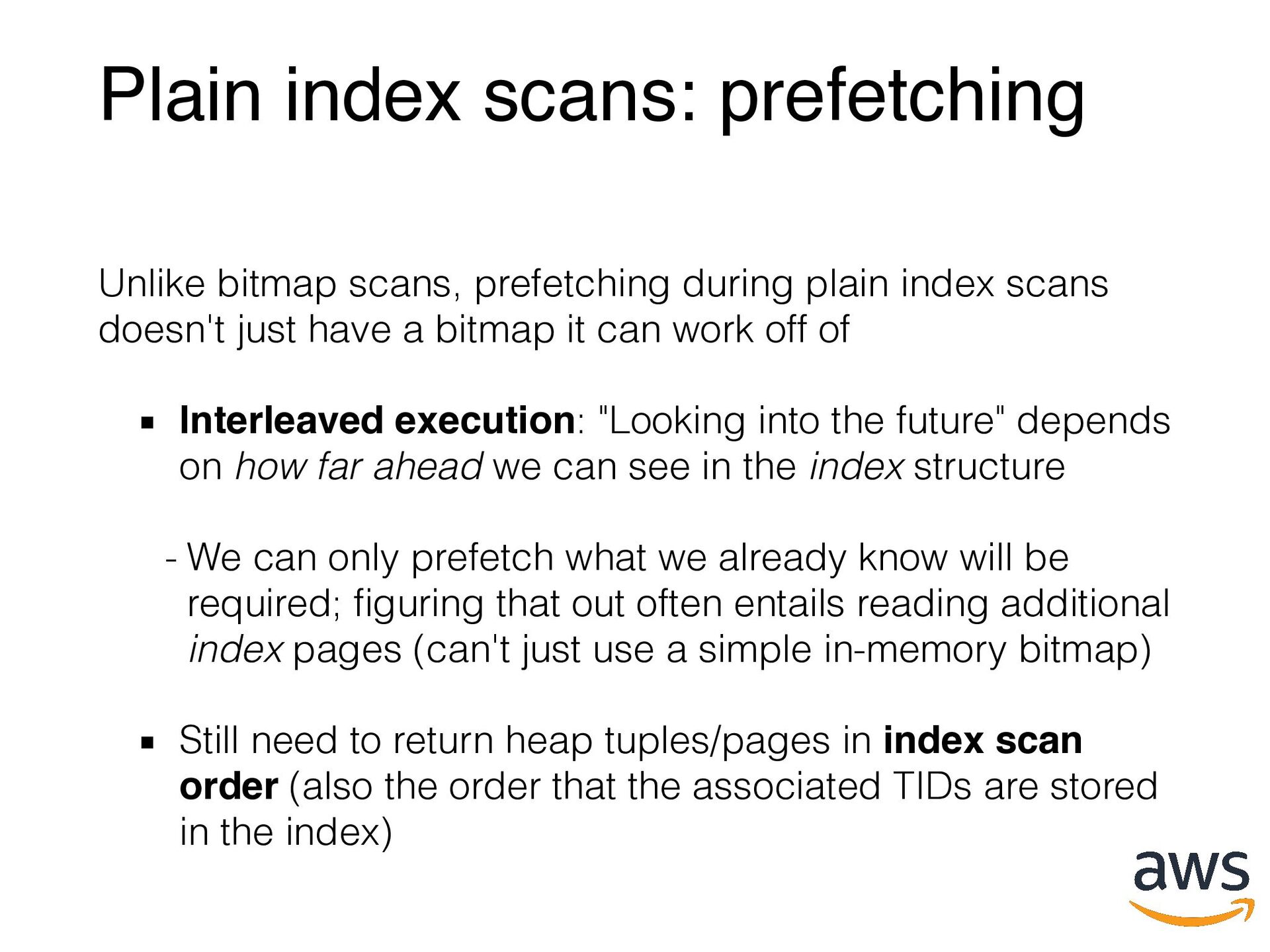
  12. Plain index scans: prefetching Unlike bitmap scans, prefetching during plain

    index scans doesn't just have a bitmap it can work off of Interleaved execution: "Looking into the future" depends on how far ahead we can see in the index structure - We can only prefetch what we already know will be required; guring that out often entails reading additional index pages (can't just use a simple in-memory bitmap) fi Still need to return heap tuples/pages in index scan order (also the order that the associated TIDs are stored in the index)
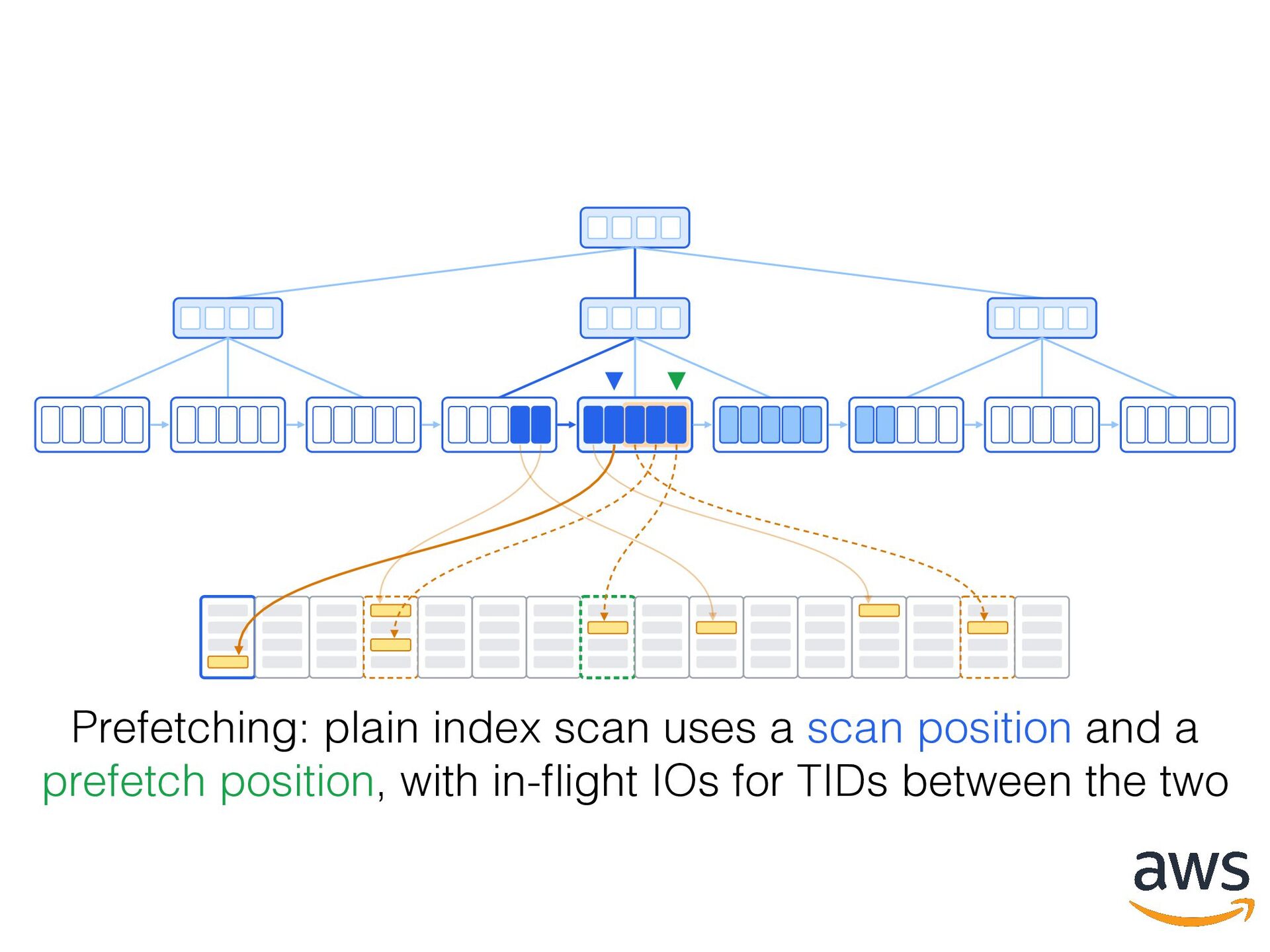
  13. fl Prefetching: plain index scan uses a scan position and

    a prefetch position, with in- ight IOs for TIDs between the two
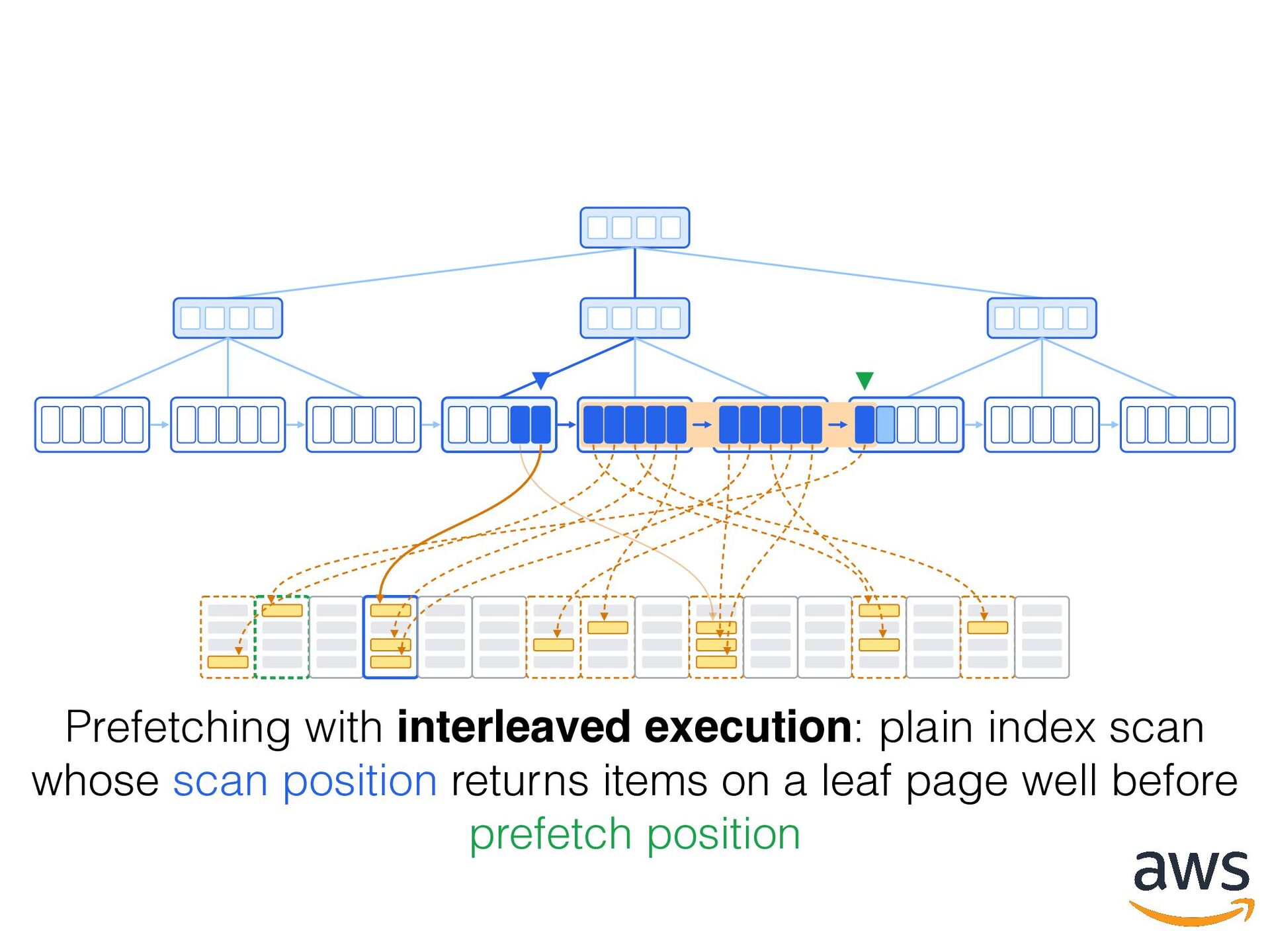
  14. Prefetching with interleaved execution: plain index scan whose scan position

    returns items on a leaf page well before prefetch position
  15. Overview 1. Background on Index prefetching project Introduces basic aio/prefetching

    concepts 2. Bitmap scans, plain index scans, and aio How aio works with these two similar scan types 3. Performance of index scans with asynchronous IO Benchmark results showing the bene t of prefetching fi 4. Planner costing of index scans under prefetching How aio affects plan costing, and the implications
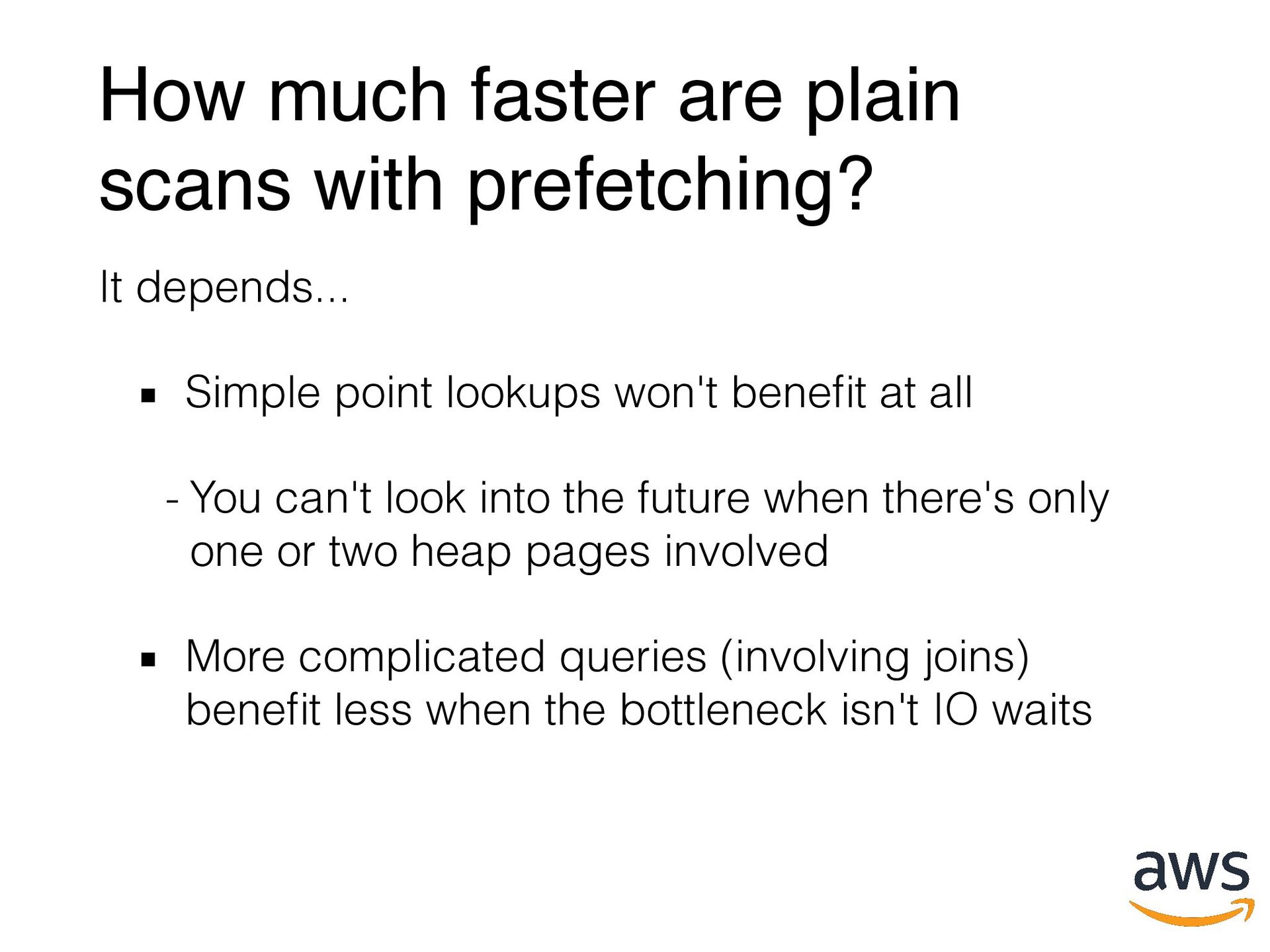
  16. How much faster are plain scans with prefetching? It depends...

    Simple point lookups won't bene t at all - You can't look into the future when there's only one or two heap pages involved fi fi More complicated queries (involving joins) bene t less when the bottleneck isn't IO waits
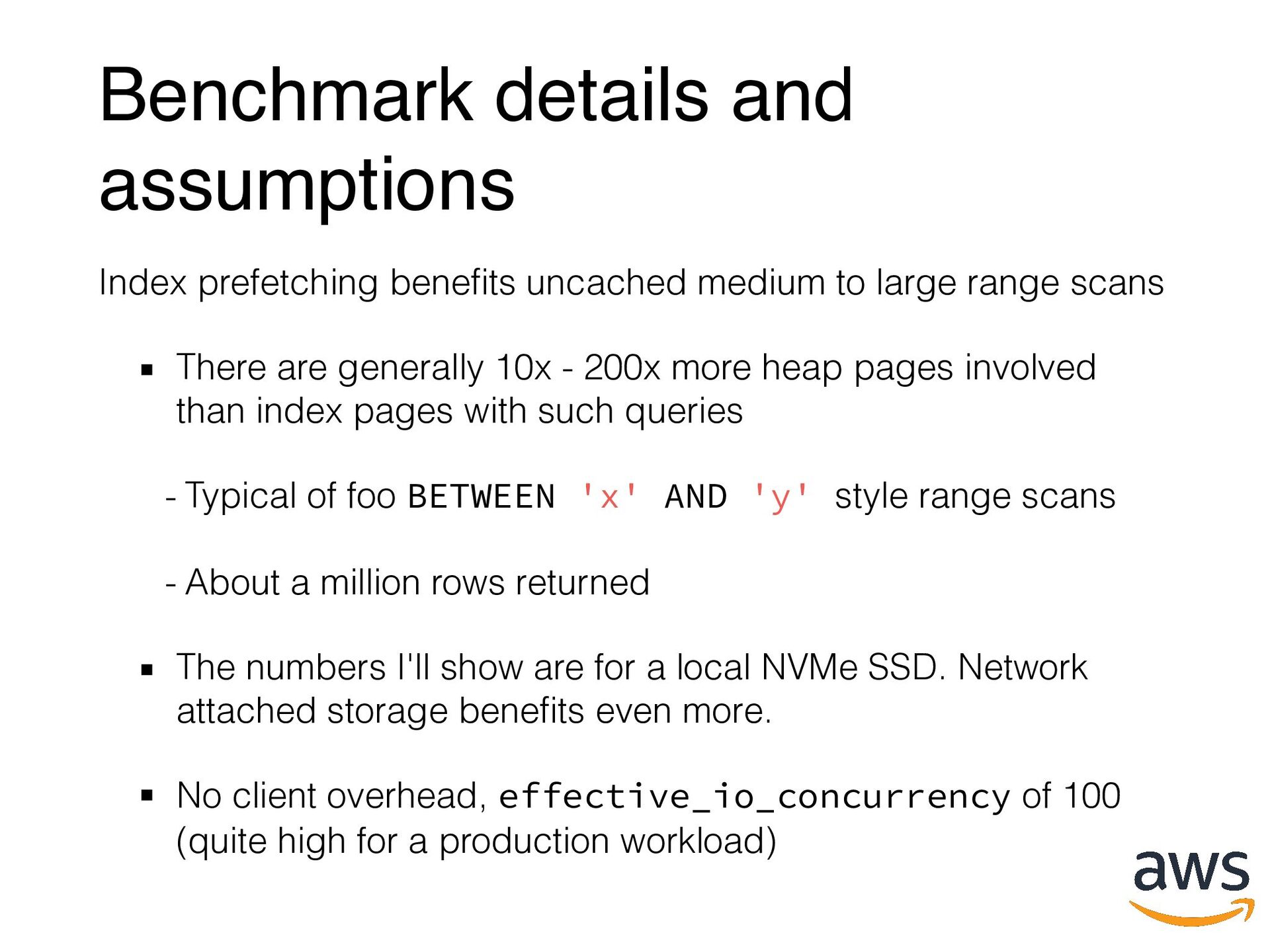
  17. Benchmark details and assumptions Index prefetching bene ts uncached medium

    to large range scans There are generally 10x - 200x more heap pages involved than index pages with such queries - Typical of foo BETWEEN 'x' AND 'y' style range scans - About a million rows returned The numbers I'll show are for a local NVMe SSD. Network attached storage bene ts even more. fi fi No client overhead, effective_io_concurrency of 100 (quite high for a production workload)
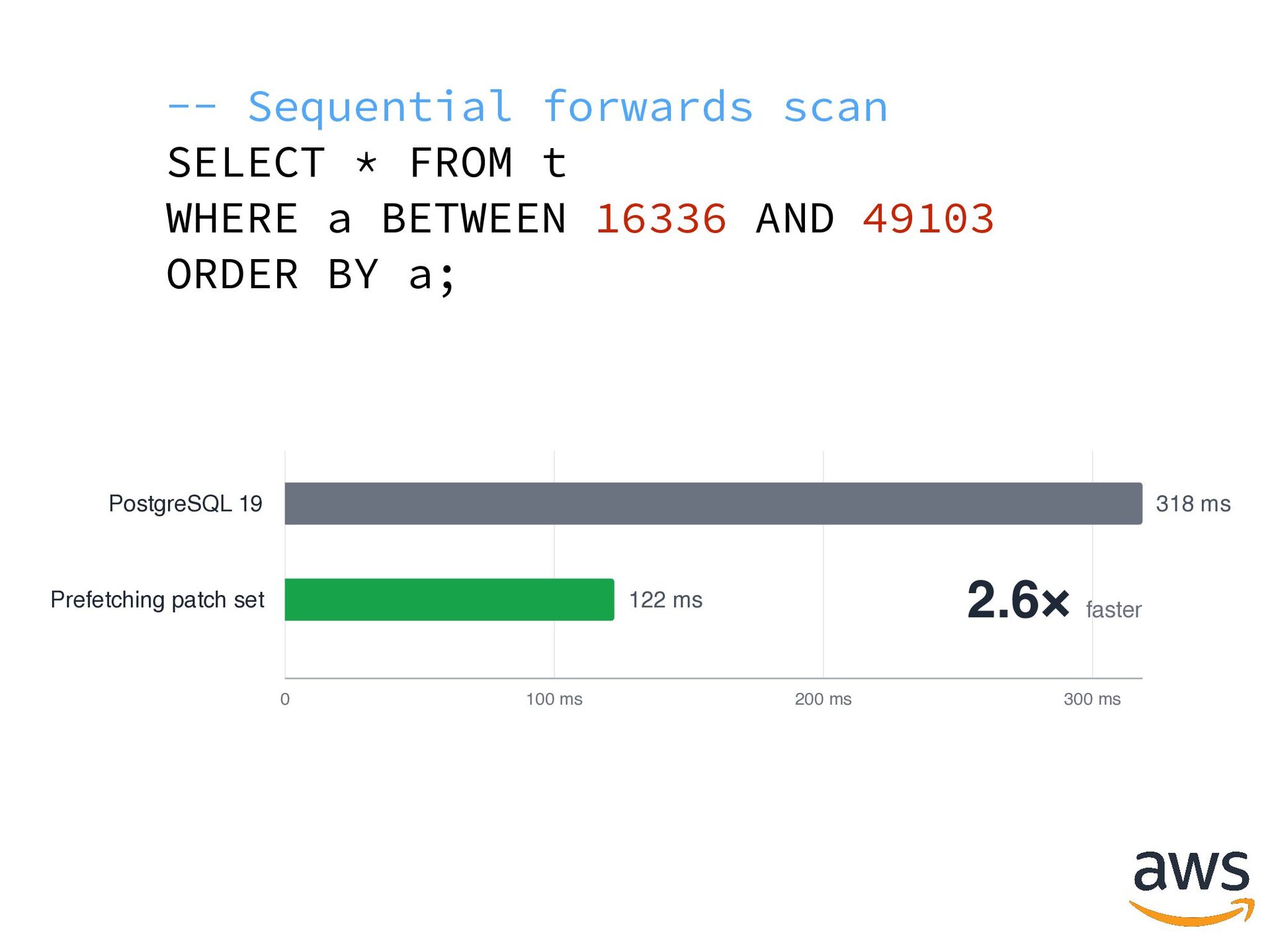
  18. -- Sequential forwards scan SELECT * FROM t WHERE a

    BETWEEN 16336 AND 49103 ORDER BY a; PostgreSQL 19 318 ms Prefetching patch set 2.6× faster 122 ms 0 100 ms 200 ms 300 ms
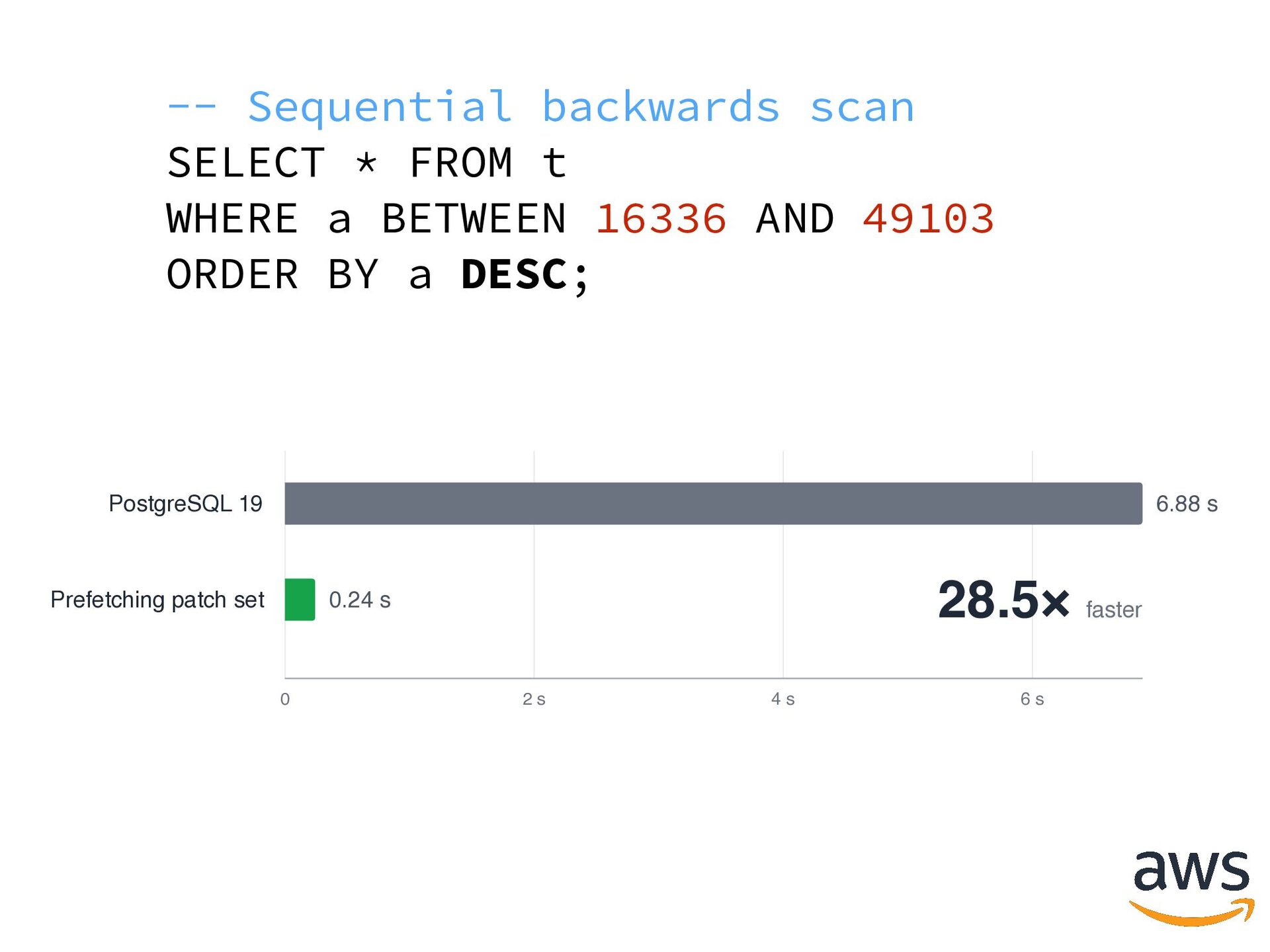
  19. -- Sequential backwards scan SELECT * FROM t WHERE a

    BETWEEN 16336 AND 49103 ORDER BY a DESC; PostgreSQL 19 6.88 s Prefetching patch set 28.5× faster 0.24 s 0 2s 4s 6s
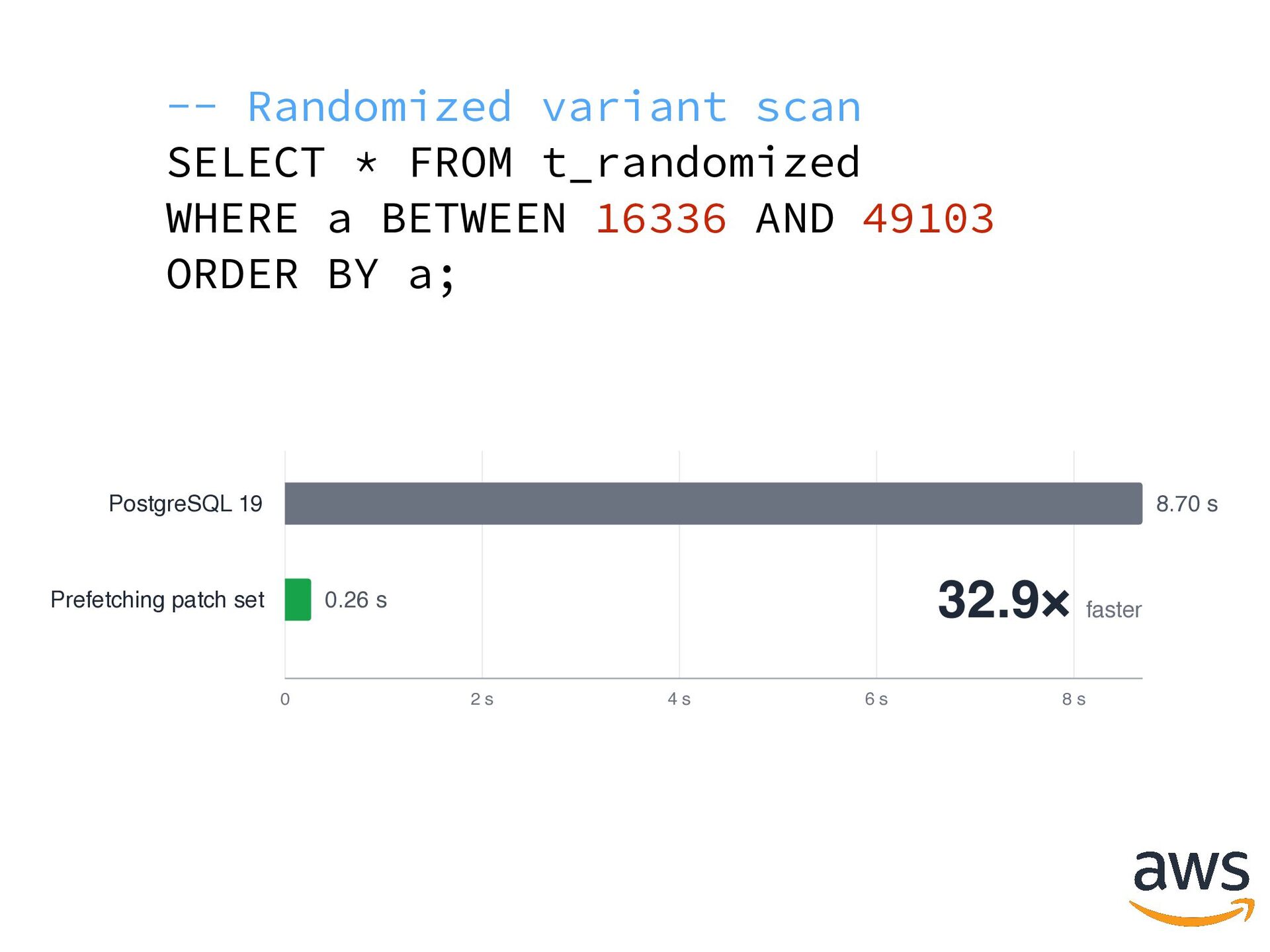
  20. -- Randomized variant scan SELECT * FROM t_randomized WHERE a

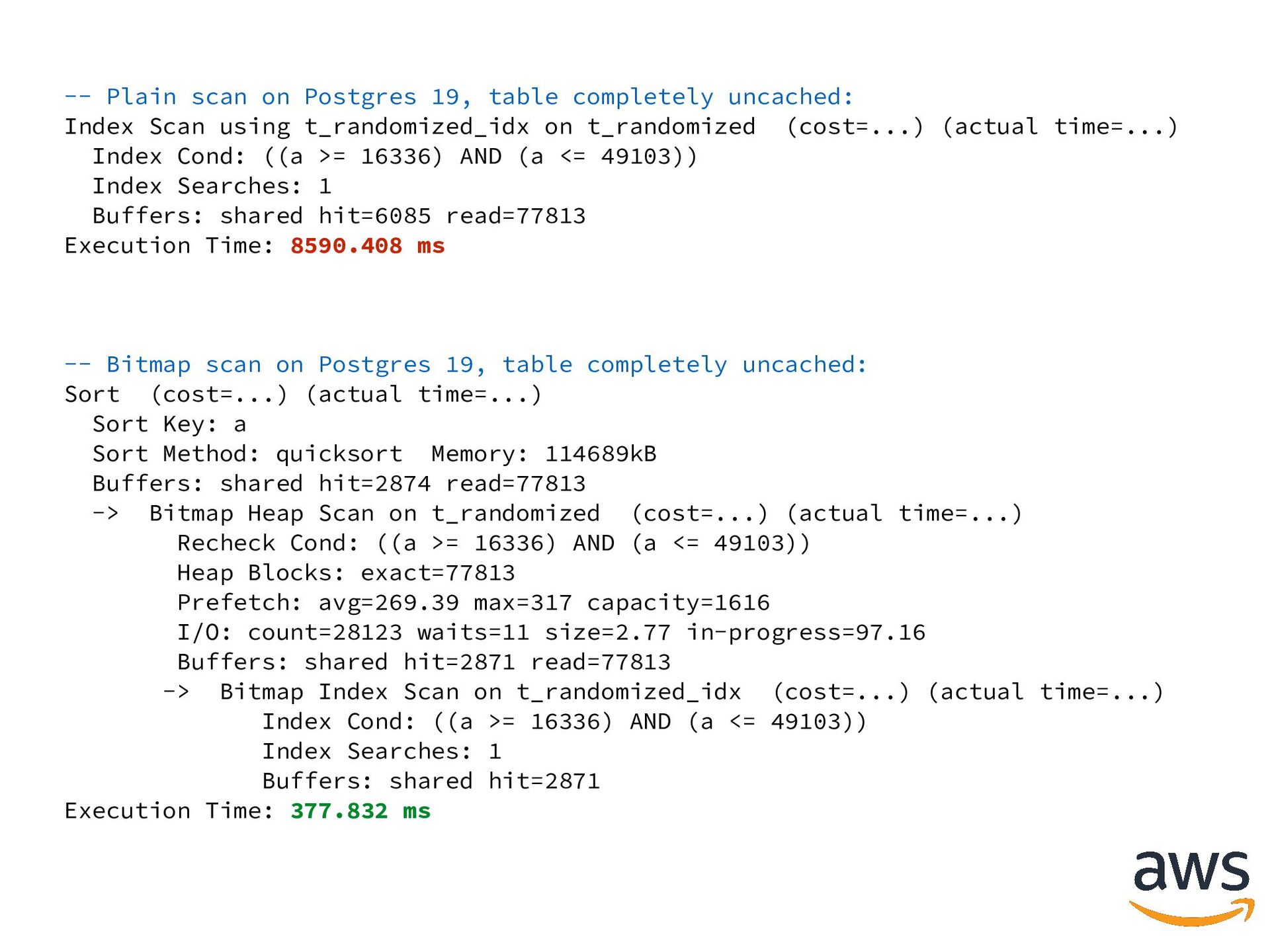
    BETWEEN 16336 AND 49103 ORDER BY a; PostgreSQL 19 8.70 s Prefetching patch set 32.9× faster 0.26 s 0 2s 4s 6s 8s
  21. Overview 1. Background on Index prefetching project Introduces basic aio/prefetching

    concepts 2. Bitmap scans, plain index scans, and aio How aio works with these two similar scan types 3. Performance of index scans with asynchronous IO Benchmark results showing the bene t of prefetching fi 4. Planner costing of index scans under prefetching How aio affects plan costing, and the implications
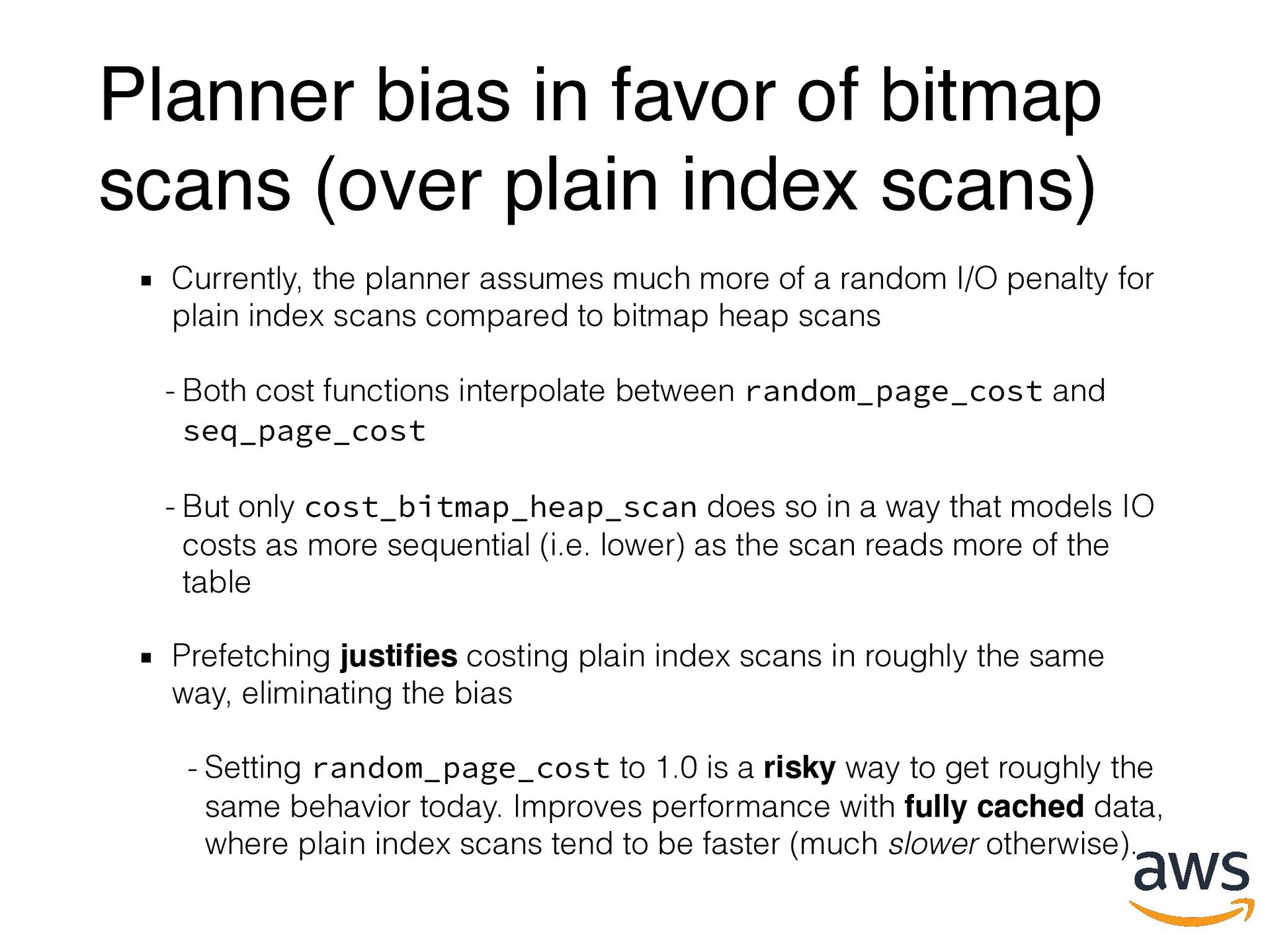
  22. Planner bias in favor of bitmap scans (over plain index

    scans) Currently, the planner assumes much more of a random I/O penalty for plain index scans compared to bitmap heap scans - Both cost functions interpolate between random_page_cost and seq_page_cost - But only cost_bitmap_heap_scan does so in a way that models IO costs as more sequential (i.e. lower) as the scan reads more of the table Prefetching justi es costing plain index scans in roughly the same way, eliminating the bias fi - Setting random_page_cost to 1.0 is a risky way to get roughly the same behavior today. Improves performance with fully cached data, where plain index scans tend to be faster (much slower otherwise).
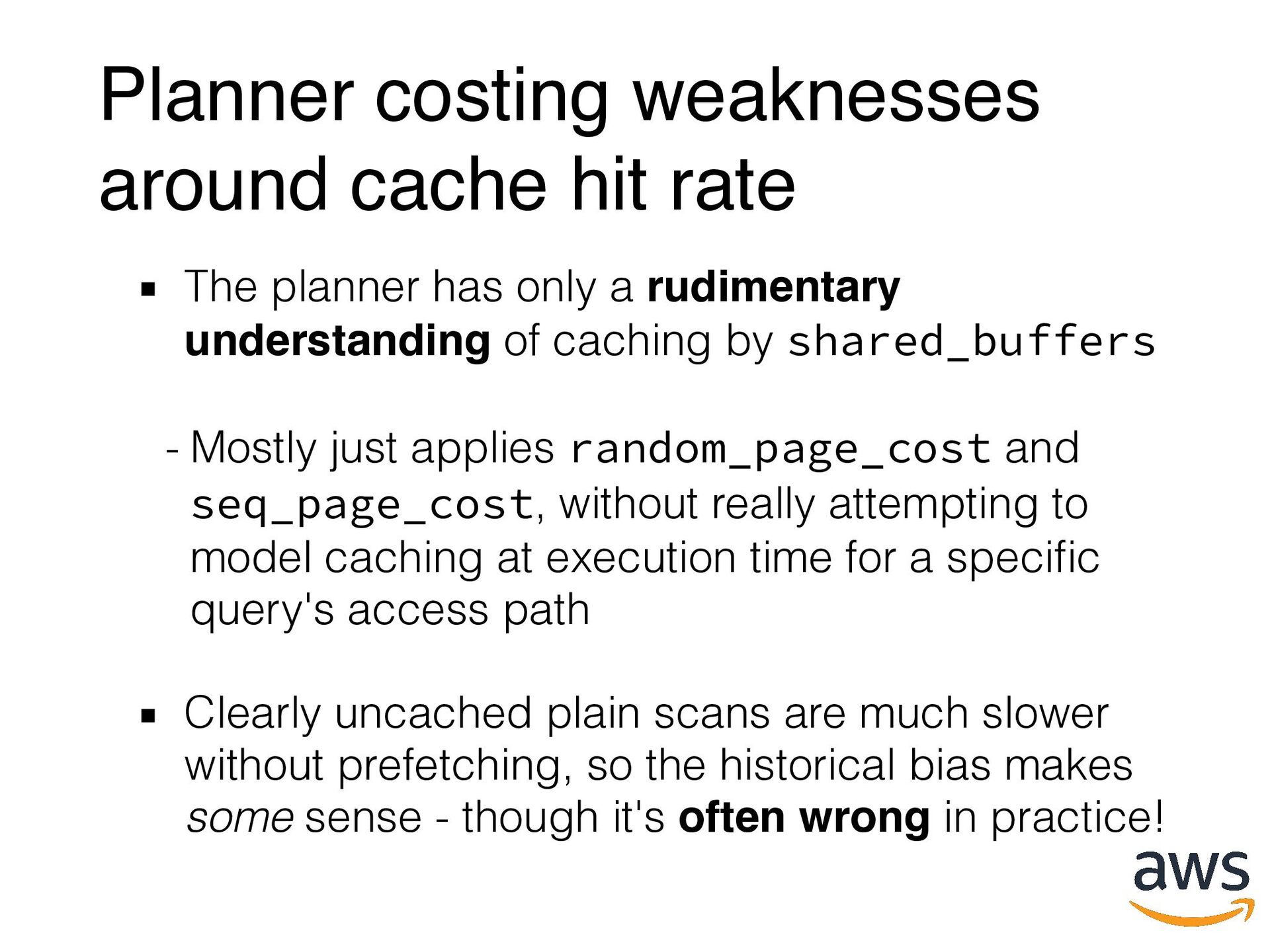
  23. Planner costing weaknesses around cache hit rate The planner has

    only a rudimentary understanding of caching by shared_buffers - Mostly just applies random_page_cost and seq_page_cost, without really attempting to model caching at execution time for a speci c query's access path fi Clearly uncached plain scans are much slower without prefetching, so the historical bias makes some sense - though it's often wrong in practice!
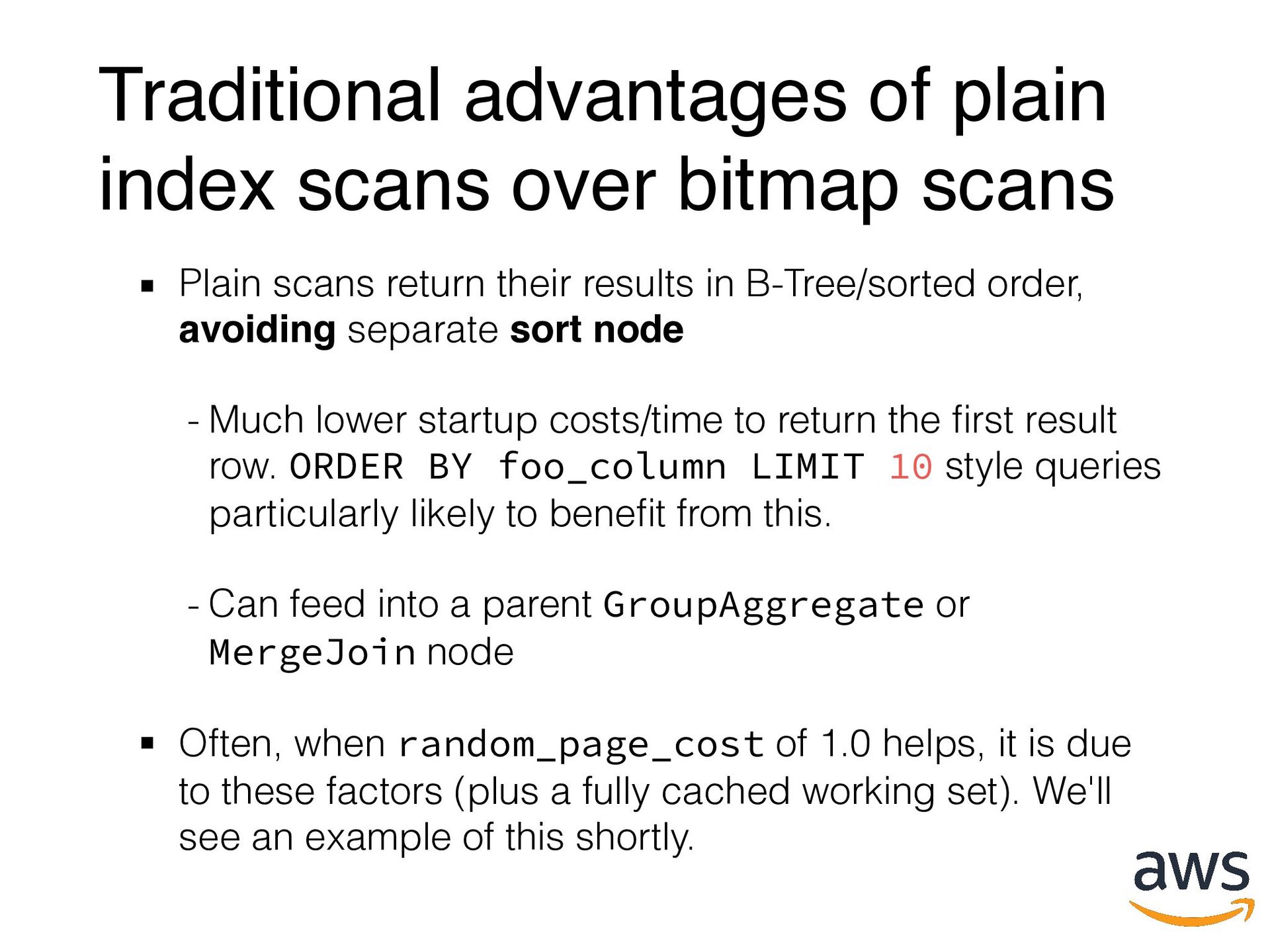
  24. Traditional advantages of plain index scans over bitmap scans Plain

    scans return their results in B-Tree/sorted order, avoiding separate sort node - Much lower startup costs/time to return the rst result row. ORDER BY foo_column LIMIT 10 style queries particularly likely to bene t from this. - Can feed into a parent GroupAggregate or MergeJoin node fi fi Often, when random_page_cost of 1.0 helps, it is due to these factors (plus a fully cached working set). We'll see an example of this shortly.
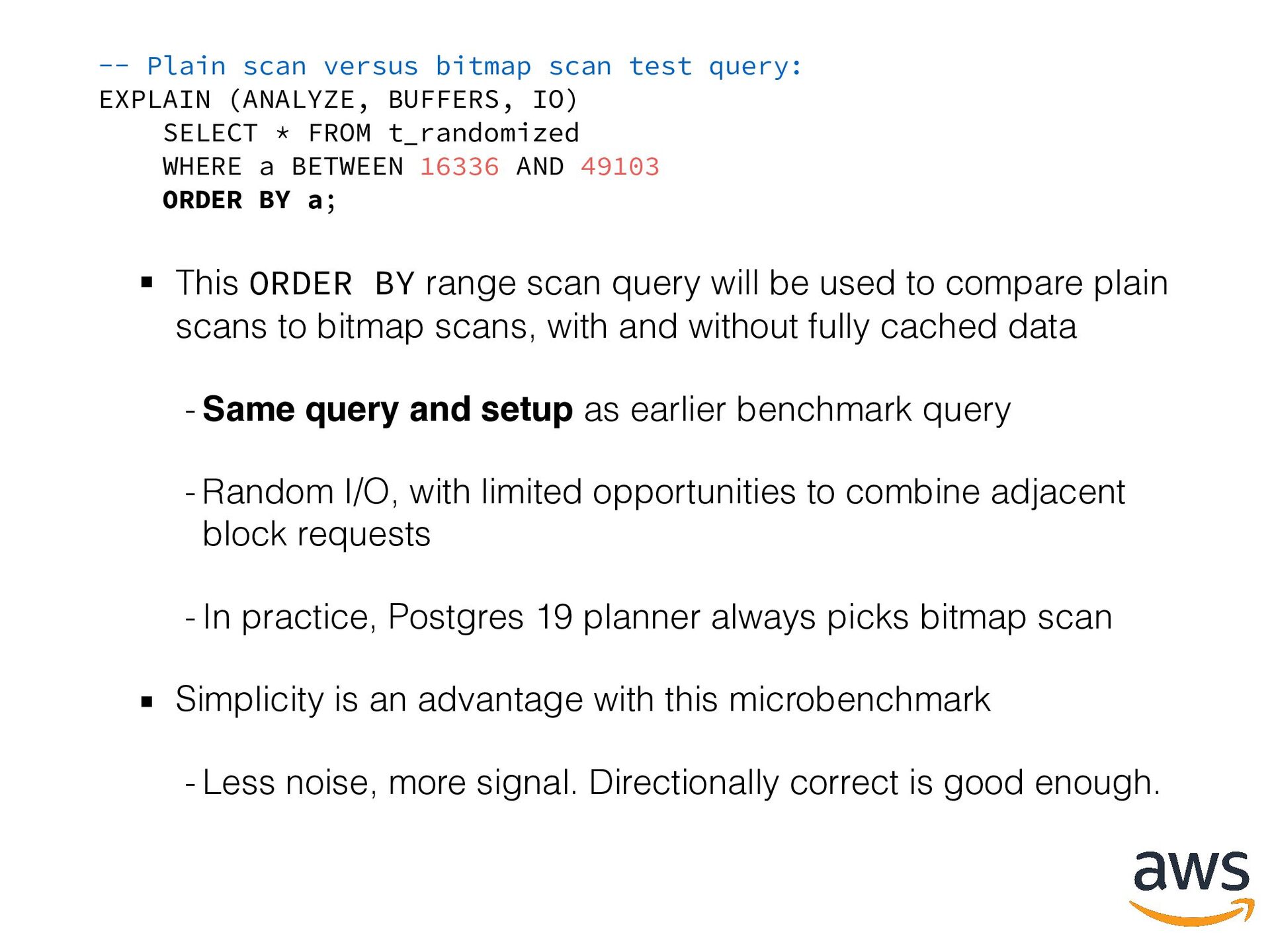
  25. -- Plain scan versus bitmap scan test query: EXPLAIN (ANALYZE,

    BUFFERS, IO) SELECT * FROM t_randomized WHERE a BETWEEN 16336 AND 49103 ORDER BY a; This ORDER BY range scan query will be used to compare plain scans to bitmap scans, with and without fully cached data - Same query and setup as earlier benchmark query - Random I/O, with limited opportunities to combine adjacent block requests - In practice, Postgres 19 planner always picks bitmap scan Simplicity is an advantage with this microbenchmark - Less noise, more signal. Directionally correct is good enough.
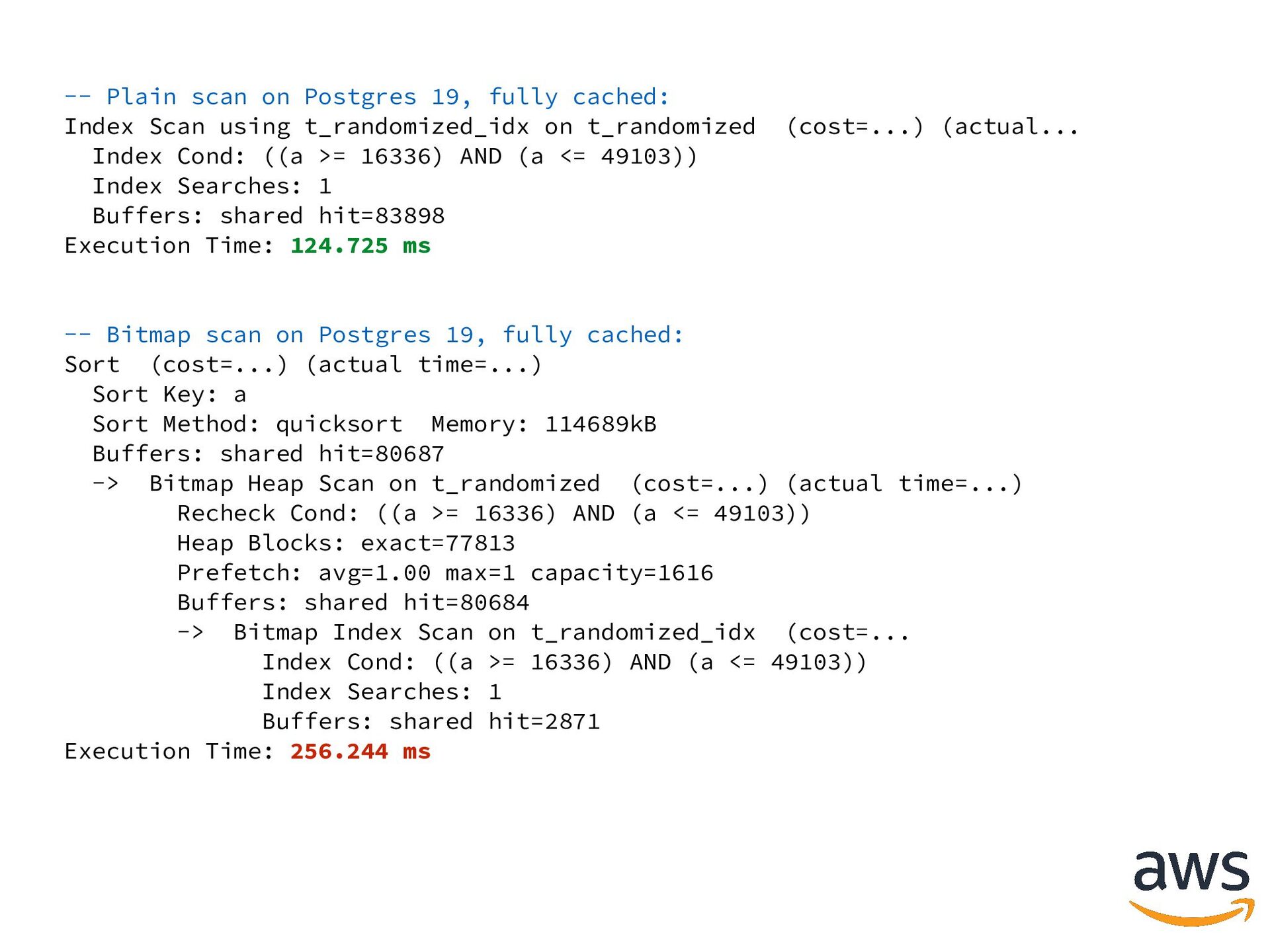
  26. -- Plain scan on Postgres 19, fully cached: Index Scan

    using t_randomized_idx on t_randomized Index Cond: ((a >= 16336) AND (a <= 49103)) Index Searches: 1 Buffers: shared hit=83898 Execution Time: 124.725 ms (cost=...) (actual... -- Bitmap scan on Postgres 19, fully cached: Sort (cost=...) (actual time=...) Sort Key: a Sort Method: quicksort Memory: 114689kB Buffers: shared hit=80687 -> Bitmap Heap Scan on t_randomized (cost=...) (actual time=...) Recheck Cond: ((a >= 16336) AND (a <= 49103)) Heap Blocks: exact=77813 Prefetch: avg=1.00 max=1 capacity=1616 Buffers: shared hit=80684 -> Bitmap Index Scan on t_randomized_idx (cost=... Index Cond: ((a >= 16336) AND (a <= 49103)) Index Searches: 1 Buffers: shared hit=2871 Execution Time: 256.244 ms
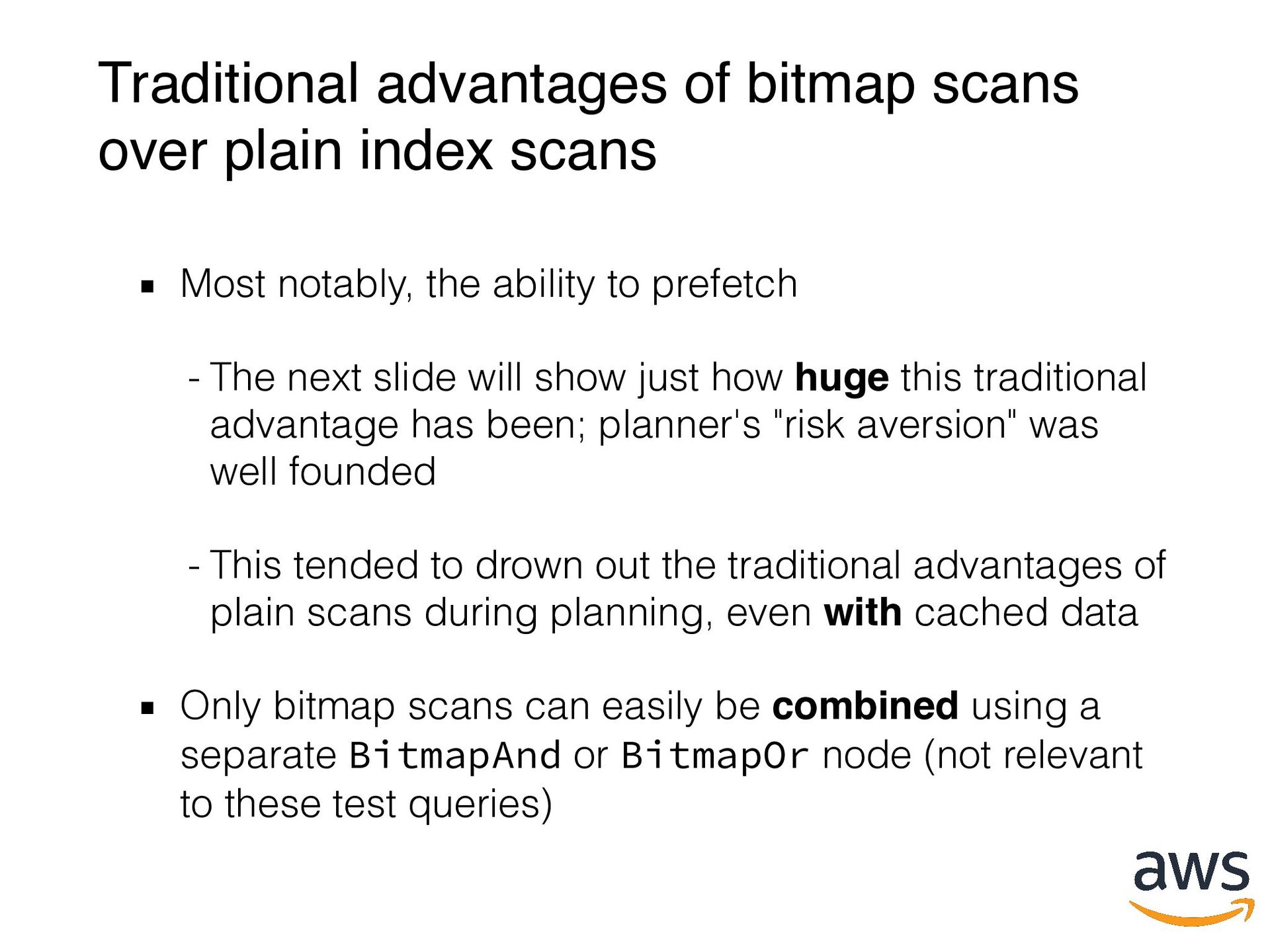
  27. Traditional advantages of bitmap scans over plain index scans Most

    notably, the ability to prefetch - The next slide will show just how huge this traditional advantage has been; planner's "risk aversion" was well founded - This tended to drown out the traditional advantages of plain scans during planning, even with cached data Only bitmap scans can easily be combined using a separate BitmapAnd or BitmapOr node (not relevant to these test queries)
  28. -- Plain scan on Postgres 19, table completely uncached: Index

    Scan using t_randomized_idx on t_randomized (cost=...) (actual time=...) Index Cond: ((a >= 16336) AND (a <= 49103)) Index Searches: 1 Buffers: shared hit=6085 read=77813 Execution Time: 8590.408 ms -- Bitmap scan on Postgres 19, table completely uncached: Sort (cost=...) (actual time=...) Sort Key: a Sort Method: quicksort Memory: 114689kB Buffers: shared hit=2874 read=77813 -> Bitmap Heap Scan on t_randomized (cost=...) (actual time=...) Recheck Cond: ((a >= 16336) AND (a <= 49103)) Heap Blocks: exact=77813 Prefetch: avg=269.39 max=317 capacity=1616 I/O: count=28123 waits=11 size=2.77 in-progress=97.16 Buffers: shared hit=2871 read=77813 -> Bitmap Index Scan on t_randomized_idx (cost=...) (actual time=...) Index Cond: ((a >= 16336) AND (a <= 49103)) Index Searches: 1 Buffers: shared hit=2871 Execution Time: 377.832 ms
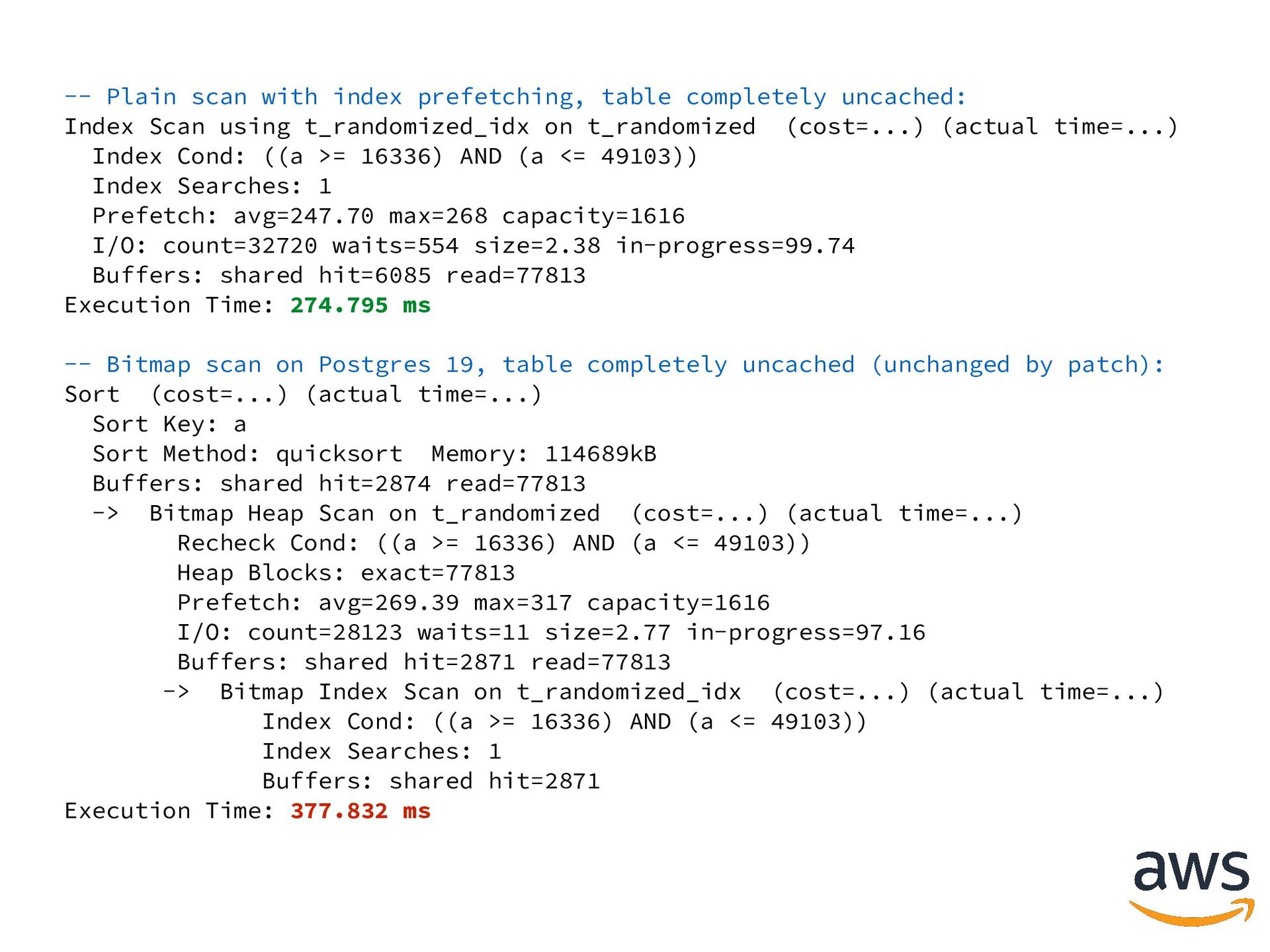
  29. -- Plain scan with index prefetching, table completely uncached: Index

    Scan using t_randomized_idx on t_randomized (cost=...) (actual time=...) Index Cond: ((a >= 16336) AND (a <= 49103)) Index Searches: 1 Prefetch: avg=247.70 max=268 capacity=1616 I/O: count=32720 waits=554 size=2.38 in-progress=99.74 Buffers: shared hit=6085 read=77813 Execution Time: 274.795 ms -- Bitmap scan on Postgres 19, table completely uncached (unchanged by patch): Sort (cost=...) (actual time=...) Sort Key: a Sort Method: quicksort Memory: 114689kB Buffers: shared hit=2874 read=77813 -> Bitmap Heap Scan on t_randomized (cost=...) (actual time=...) Recheck Cond: ((a >= 16336) AND (a <= 49103)) Heap Blocks: exact=77813 Prefetch: avg=269.39 max=317 capacity=1616 I/O: count=28123 waits=11 size=2.77 in-progress=97.16 Buffers: shared hit=2871 read=77813 -> Bitmap Index Scan on t_randomized_idx (cost=...) (actual time=...) Index Cond: ((a >= 16336) AND (a <= 49103)) Index Searches: 1 Buffers: shared hit=2871 Execution Time: 377.832 ms
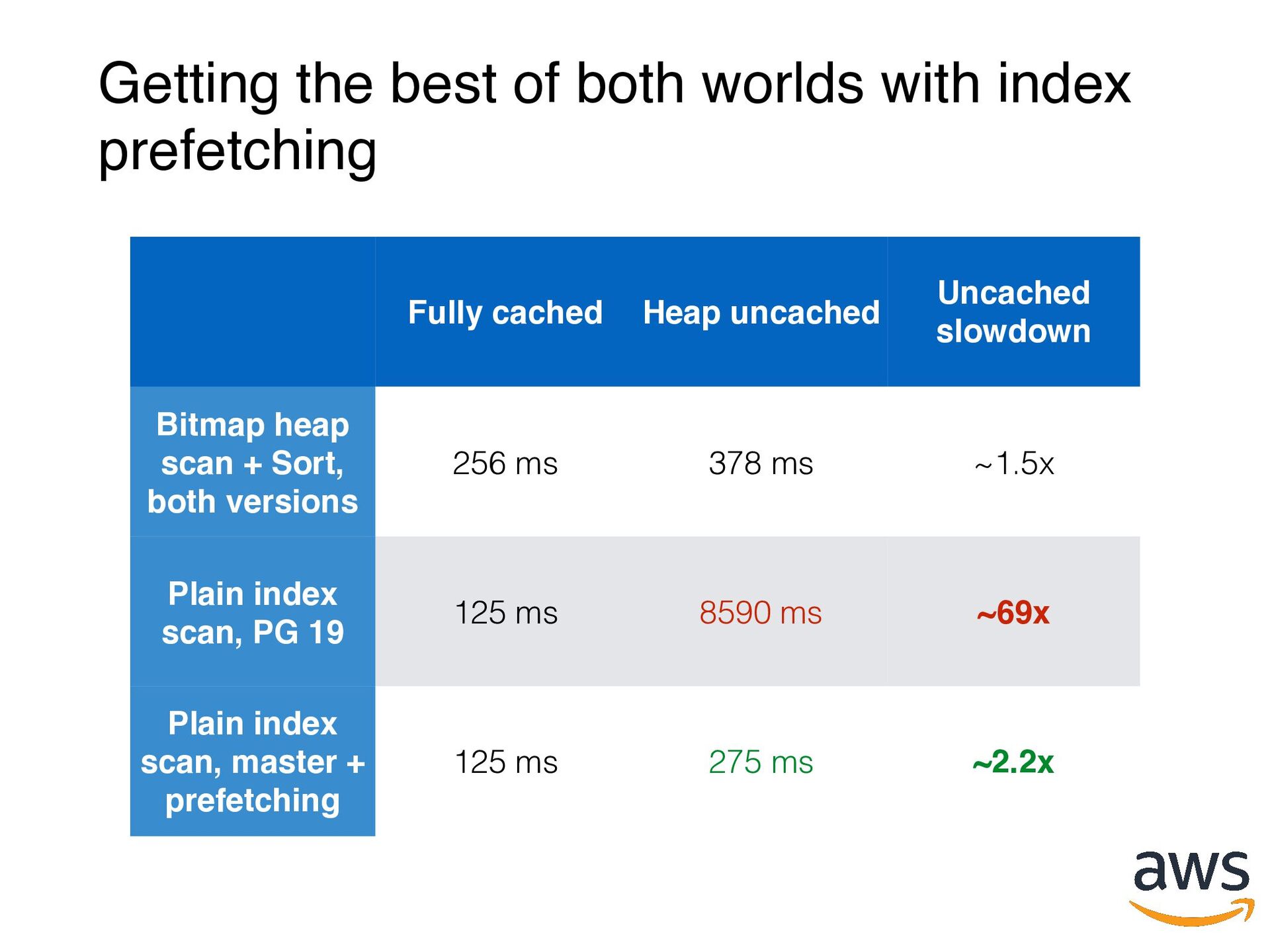
  30. Getting the best of both worlds with index prefetching Fully

    cached Heap uncached Uncached slowdown Bitmap heap scan + Sort, both versions 256 ms 378 ms ~1.5x Plain index scan, PG 19 125 ms 8590 ms ~69x Plain index scan, master + prefetching 125 ms 275 ms ~2.2x
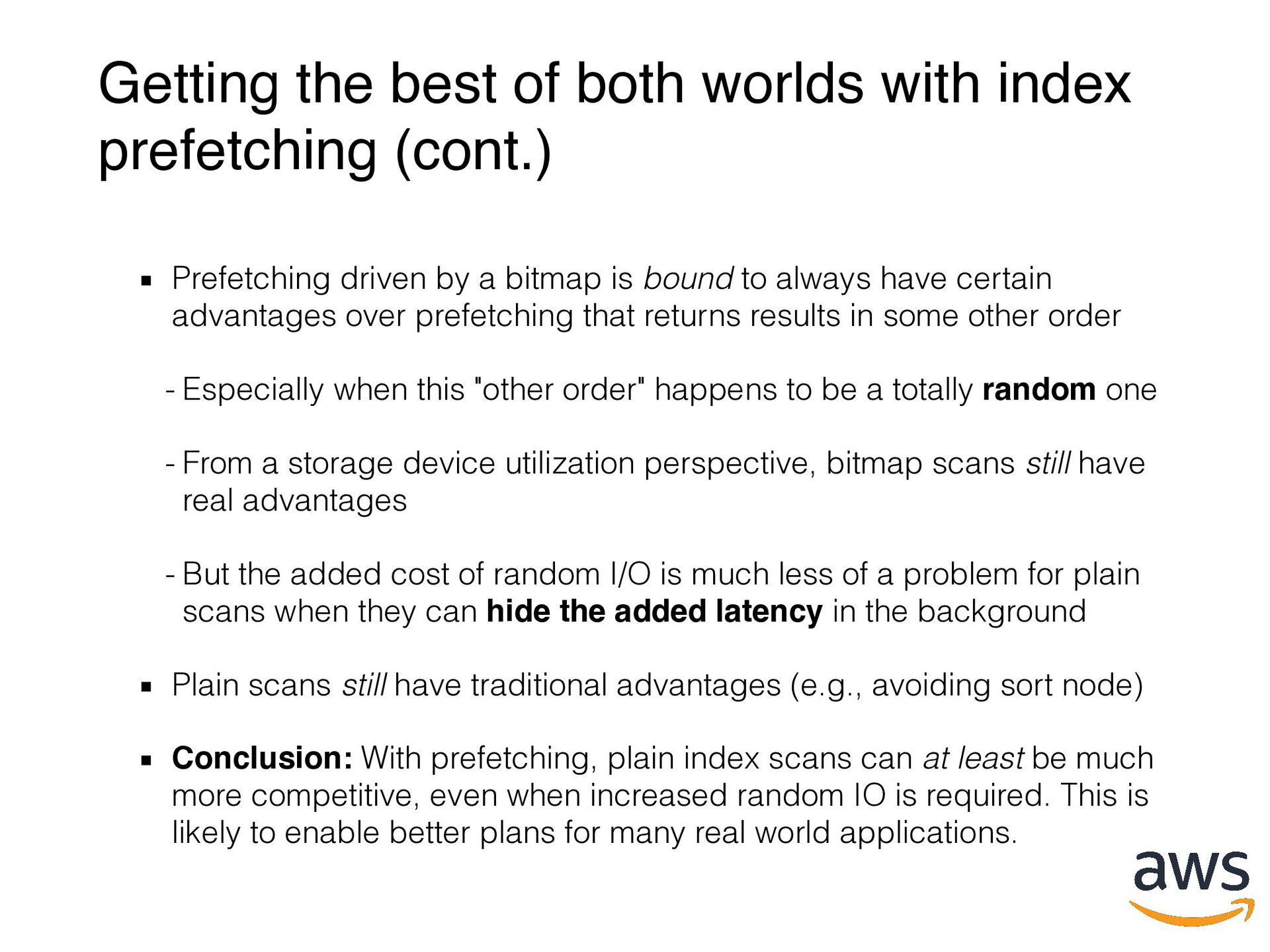
  31. Getting the best of both worlds with index prefetching (cont.)

    Prefetching driven by a bitmap is bound to always have certain advantages over prefetching that returns results in some other order - Especially when this "other order" happens to be a totally random one - From a storage device utilization perspective, bitmap scans still have real advantages - But the added cost of random I/O is much less of a problem for plain scans when they can hide the added latency in the background Plain scans still have traditional advantages (e.g., avoiding sort node) Conclusion: With prefetching, plain index scans can at least be much more competitive, even when increased random IO is required. This is likely to enable better plans for many real world applications.
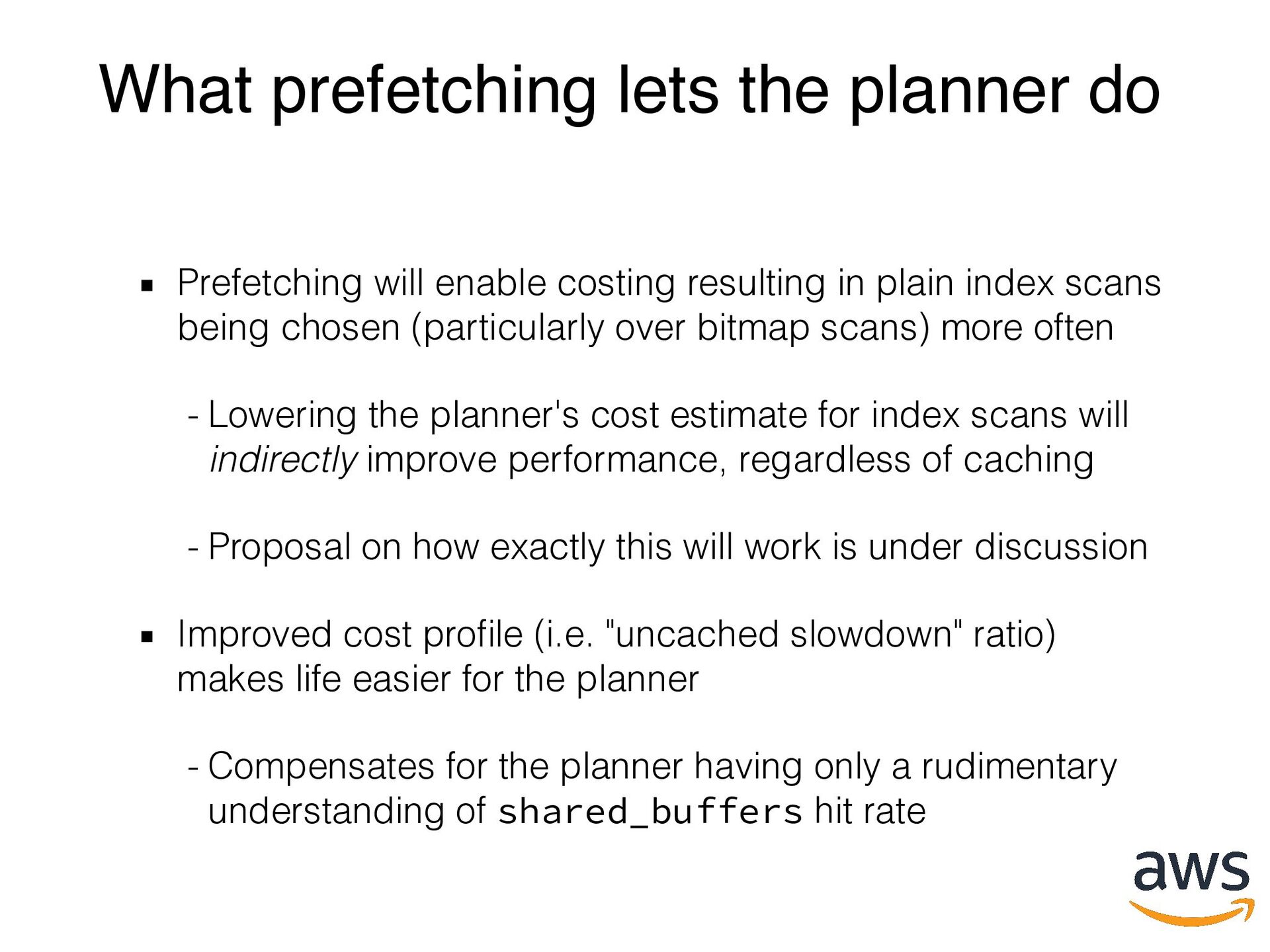
  32. What prefetching lets the planner do Prefetching will enable costing

    resulting in plain index scans being chosen (particularly over bitmap scans) more often - Lowering the planner's cost estimate for index scans will indirectly improve performance, regardless of caching - Proposal on how exactly this will work is under discussion Improved cost pro le (i.e. "uncached slowdown" ratio) makes life easier for the planner fi - Compensates for the planner having only a rudimentary understanding of shared_buffers hit rate
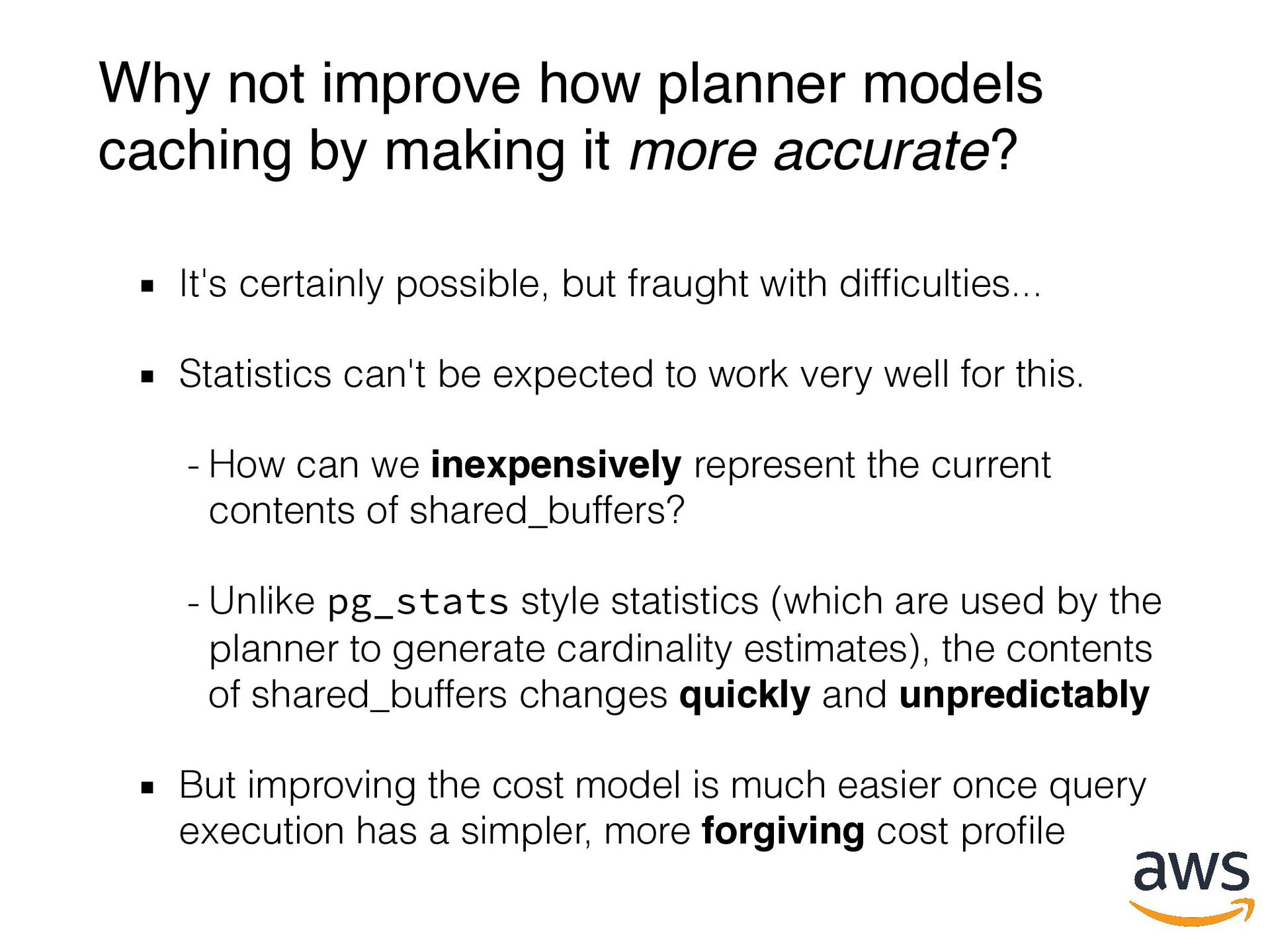
  33. Why not improve how planner models caching by making it

    more accurate? It's certainly possible, but fraught with dif culties... Statistics can't be expected to work very well for this. - How can we inexpensively represent the current contents of shared_buffers? - Unlike pg_stats style statistics (which are used by the planner to generate cardinality estimates), the contents of shared_buffers changes quickly and unpredictably fi fi But improving the cost model is much easier once query execution has a simpler, more forgiving cost pro le
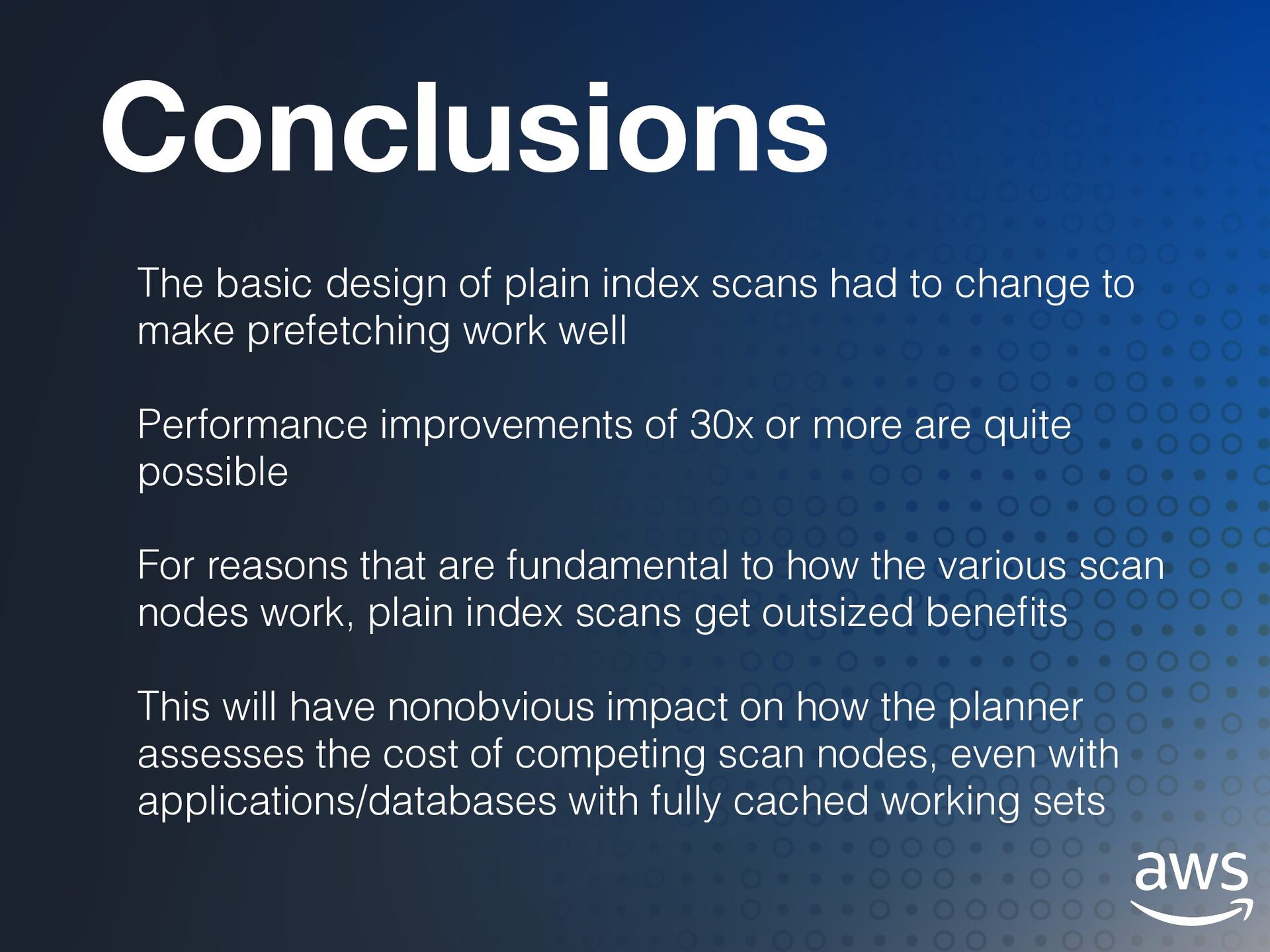
  34. Conclusions The basic design of plain index scans had to

    change to make prefetching work well Performance improvements of 30x or more are quite possible For reasons that are fundamental to how the various scan nodes work, plain index scans get outsized bene ts fi This will have nonobvious impact on how the planner assesses the cost of competing scan nodes, even with applications/databases with fully cached working sets