Common mistakes discovered through code review
Sponsored
·
 SiteGround - Reliable hosting with speed, security, and support you can count on.
→
SiteGround - Reliable hosting with speed, security, and support you can count on.
→

Share
Embed

Transcript
228 slides
-
Agenda • Style and semantics • Language • Code/SDK behavior
understanding • No-tests-ever design • Database misuse • Files management • One target - one love • Model versioning -
Agenda • Style and semantics • Language • Code/SDK behavior
understanding • No-tests-ever design • Database misuse • Files management • One target - one love • Model versioning -
Agenda • Style and semantics • Language • Code/SDK behavior
understanding • No-tests-ever design • Database misuse • Files management • One target - one love • Model versioning -
Agenda • Style and semantics • Language • Code/SDK behavior
understanding • No-tests-ever design • Database misuse • Files management • One target - one love • Model versioning -
Agenda • Style and semantics • Language • Code/SDK behavior
understanding • No-tests-ever design • Database misuse • Files management • One target - one love • Model versioning -
Agenda • Style and semantics • Language • Code/SDK behavior
understanding • No-tests-ever design • Database misuse • Files management • One target - one love • Model versioning -
Agenda • Style and semantics • Language • Code/SDK behavior
understanding • No-tests-ever design • Database misuse • Files management • One target • Model versioning -
Agenda • Style and semantics • Language • Code/SDK behavior
understanding • No-tests-ever design • Database misuse • Files management • One target • Model versioning -
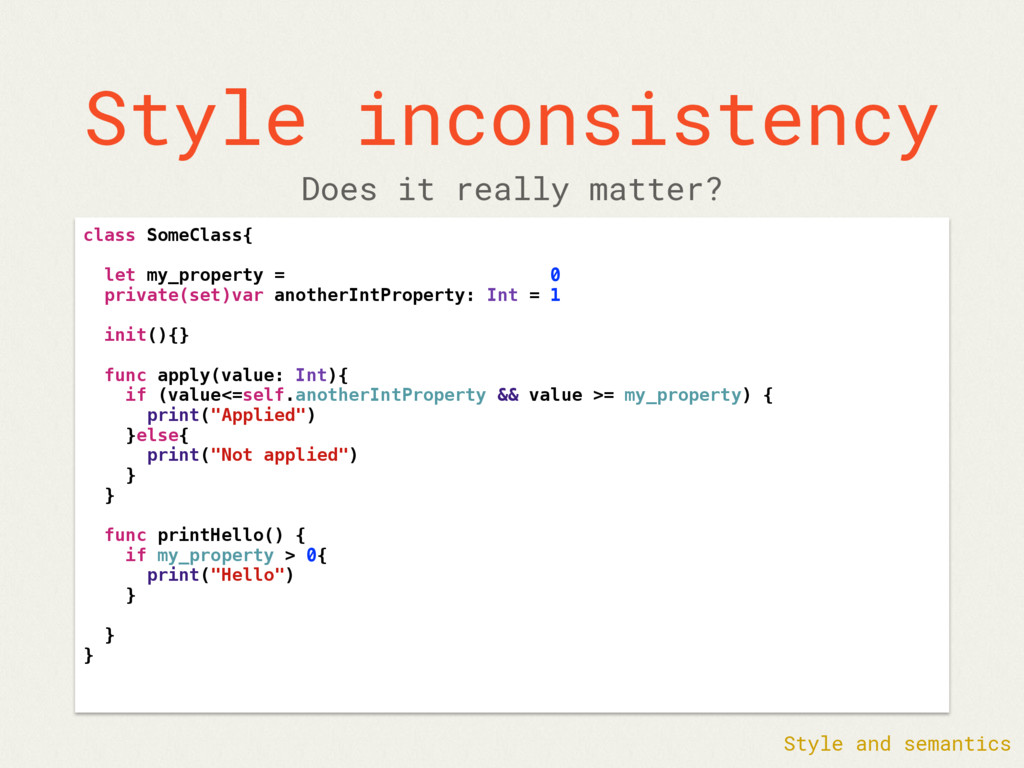
Style inconsistency class SomeClass{ let my_property = 0 private(set)var anotherIntProperty:
Int = 1 init(){} func apply(value: Int){ if (value<=self.anotherIntProperty && value >= my_property) { print("Applied") }else{ print("Not applied") } } func printHello() { if my_property > 0{ print("Hello") } } } Does it really matter? Style and semantics -
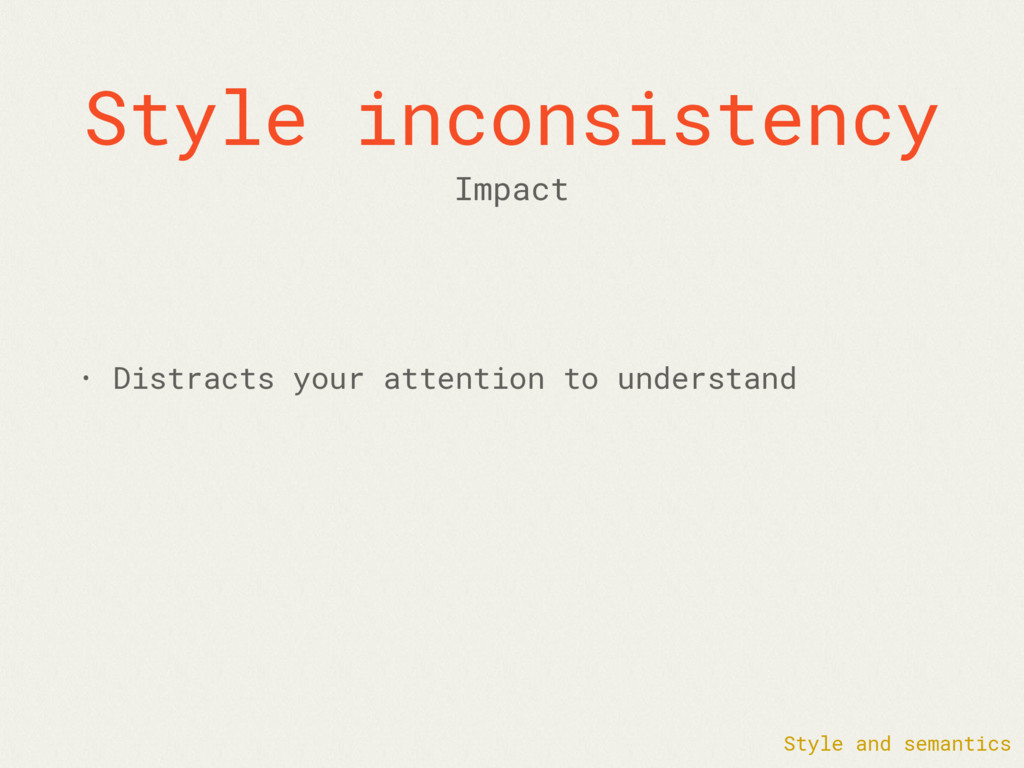
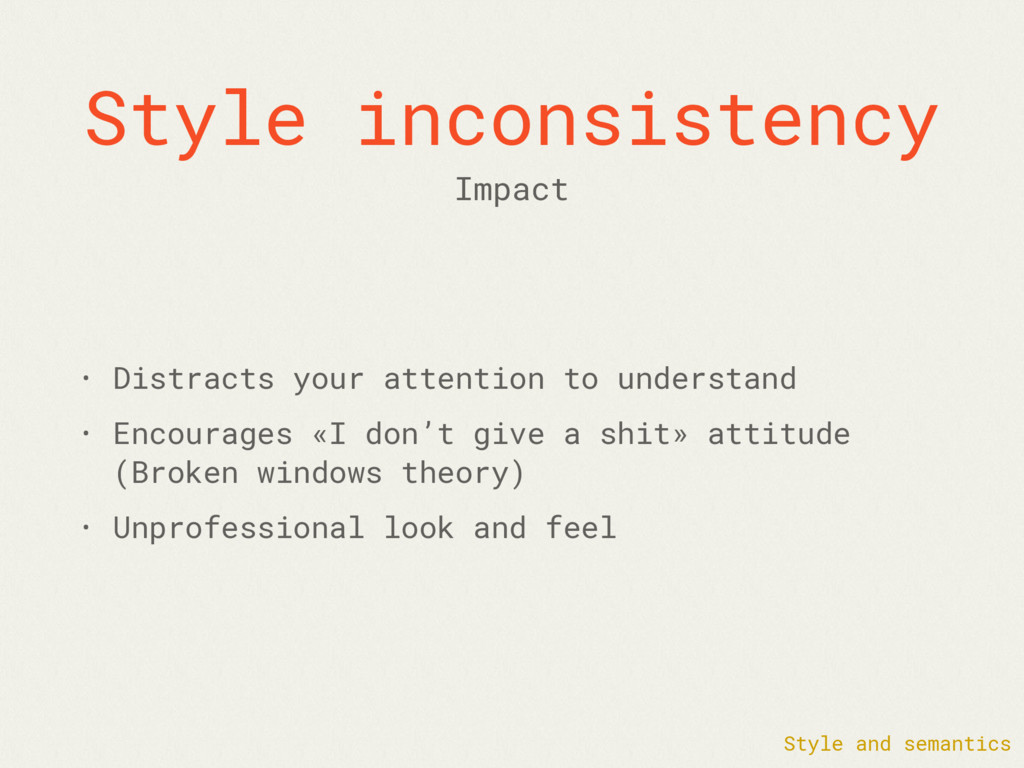
Style inconsistency • Distracts your attention to understand • Encourages
«I don’t give a shit» attitude (Broken windows theory) Style and semantics Impact -
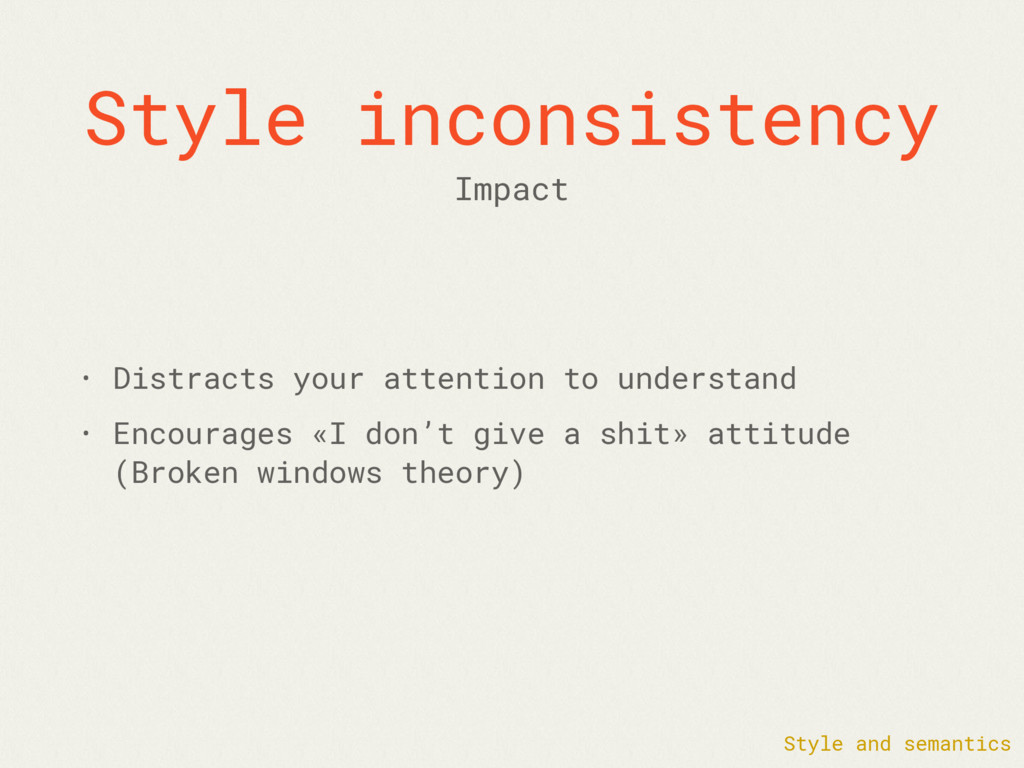
Style inconsistency • Distracts your attention to understand • Encourages
«I don’t give a shit» attitude (Broken windows theory) • Unprofessional look and feel Style and semantics Impact -
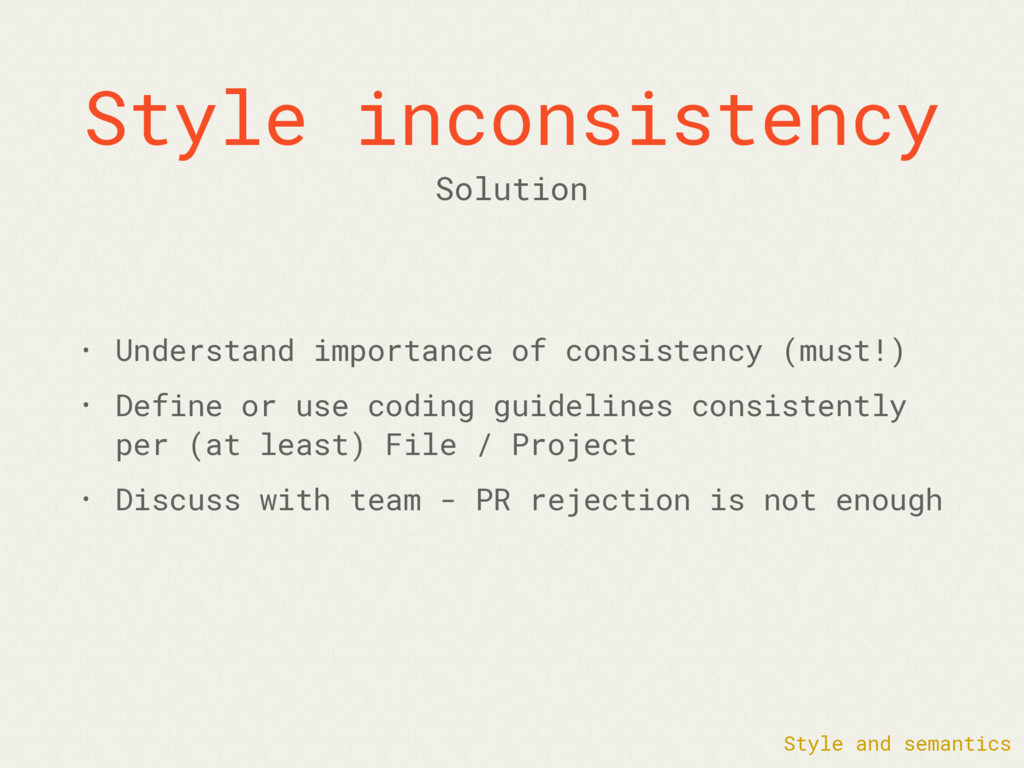
Style inconsistency • Understand importance of consistency (must!) Style and
semantics Solution -
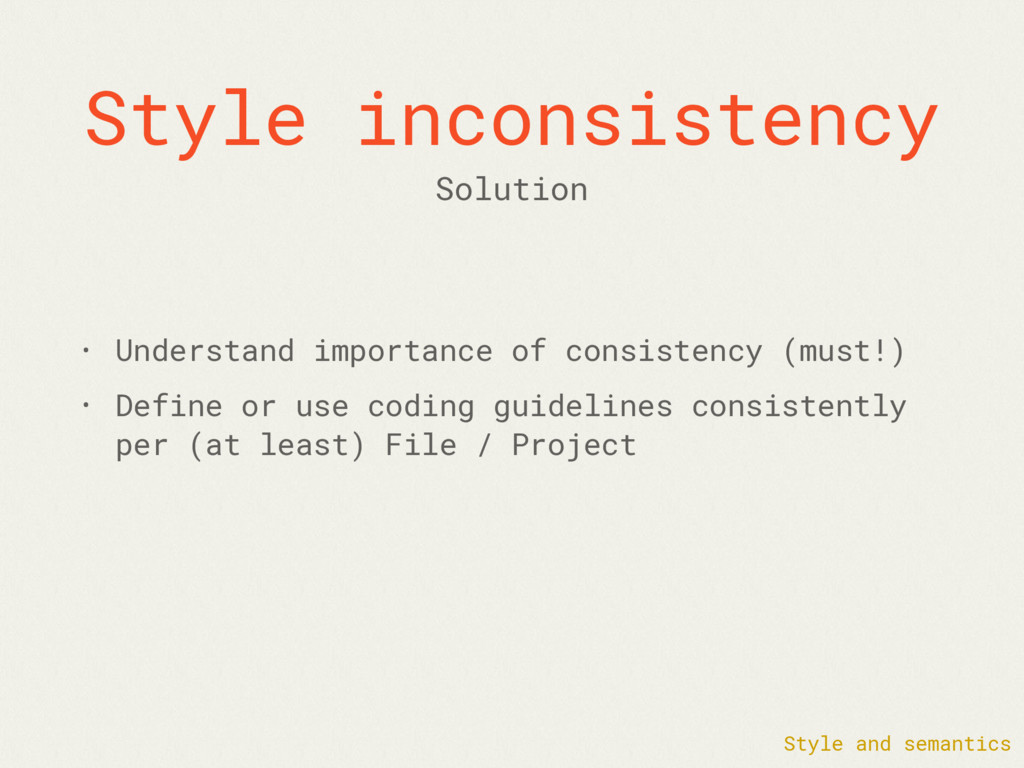
Style inconsistency • Understand importance of consistency (must!) • Define
or use coding guidelines consistently per (at least) File / Project Style and semantics Solution -
Style inconsistency • Understand importance of consistency (must!) • Define
or use coding guidelines consistently per (at least) File / Project • Discuss with team - PR rejection is not enough Style and semantics Solution -
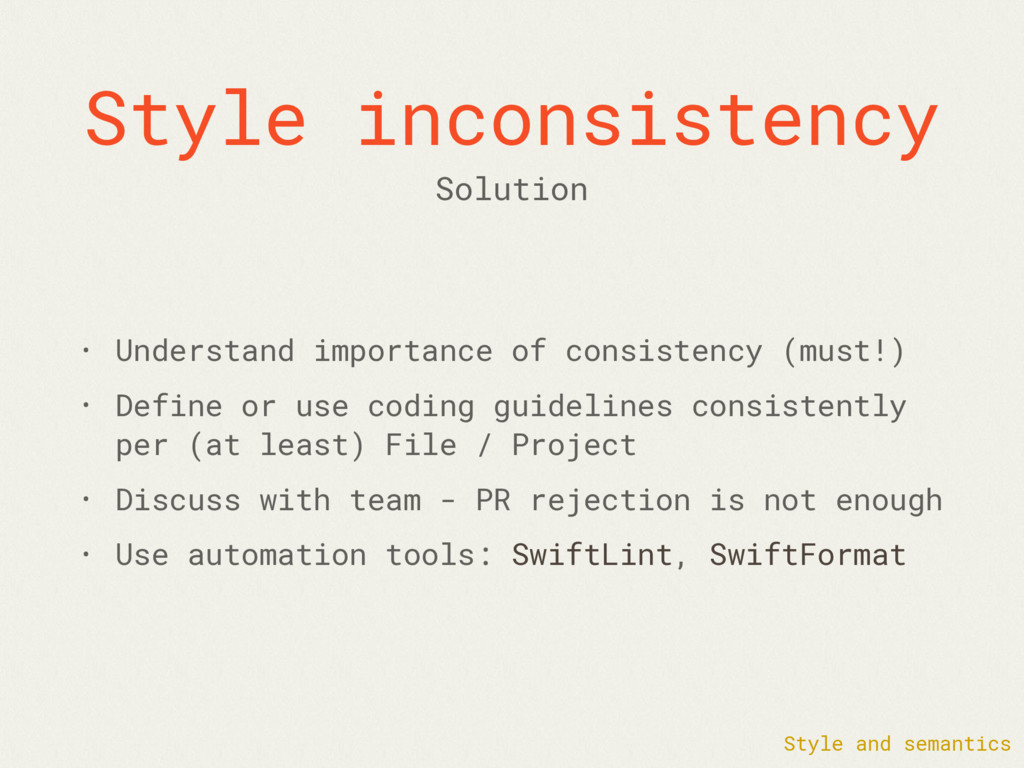
Style inconsistency • Understand importance of consistency (must!) • Define
or use coding guidelines consistently per (at least) File / Project • Discuss with team - PR rejection is not enough • Use automation tools: SwiftLint, SwiftFormat Style and semantics Solution -
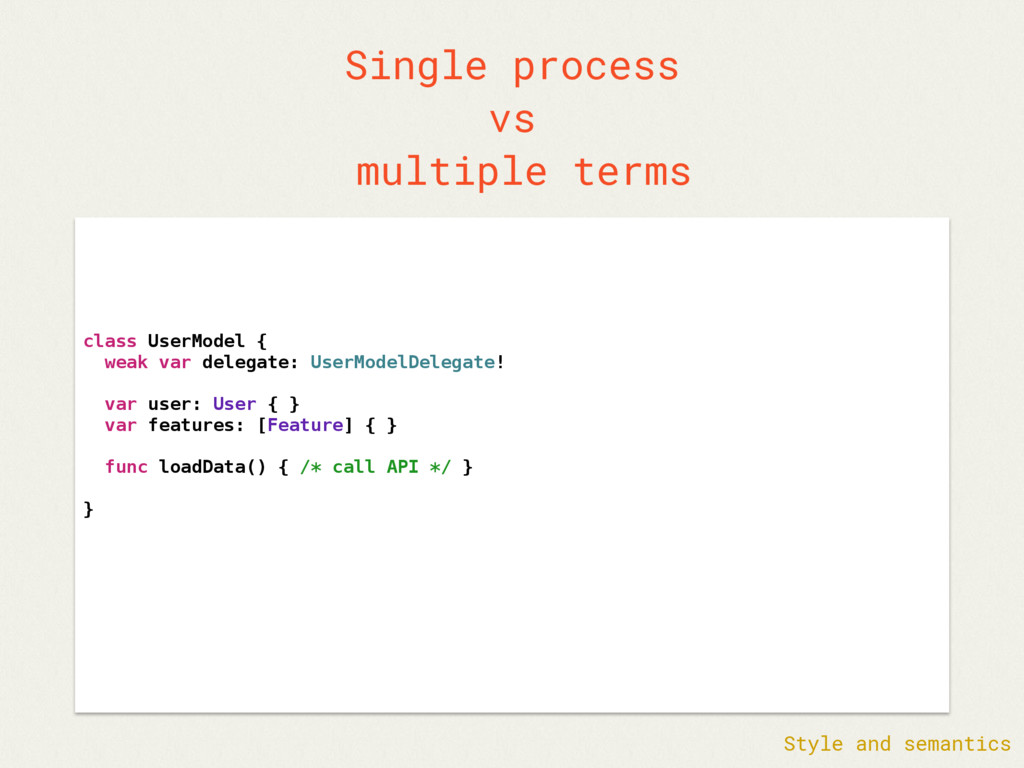
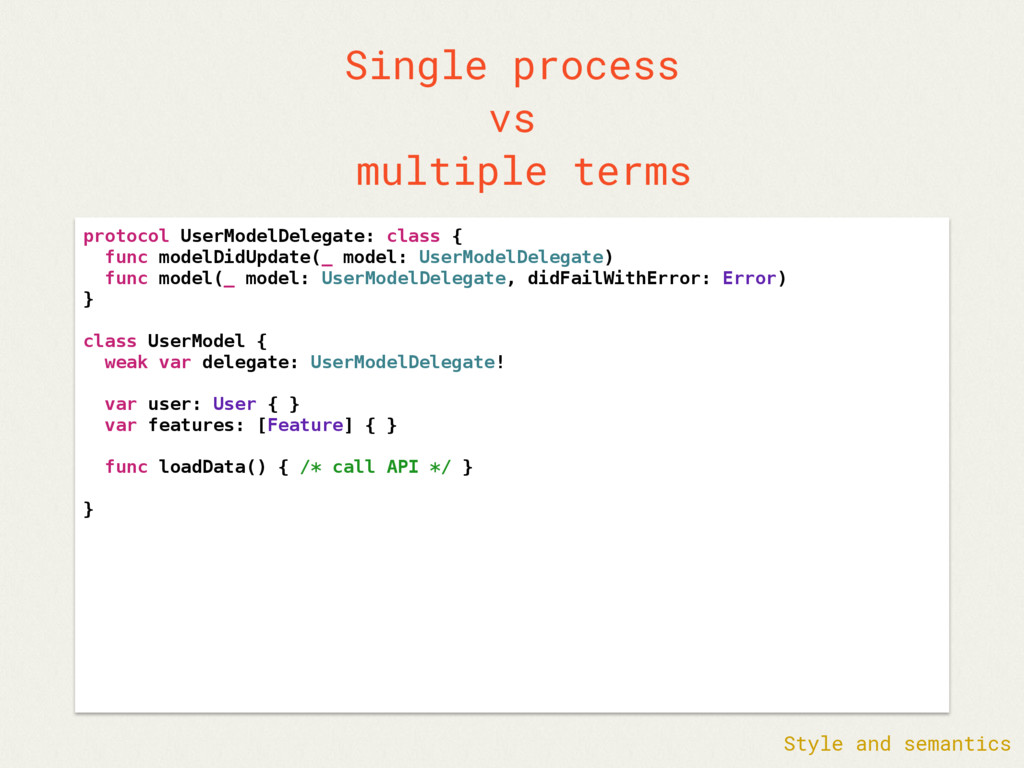
Single process vs multiple terms protocol UserModelDelegate: class { func
modelDidUpdate(_ model: UserModelDelegate) func model(_ model: UserModelDelegate, didFailWithError: Error) } class UserModel { weak var delegate: UserModelDelegate! var user: User { } var features: [Feature] { } func loadData() { /* call API */ } } Style and semantics -
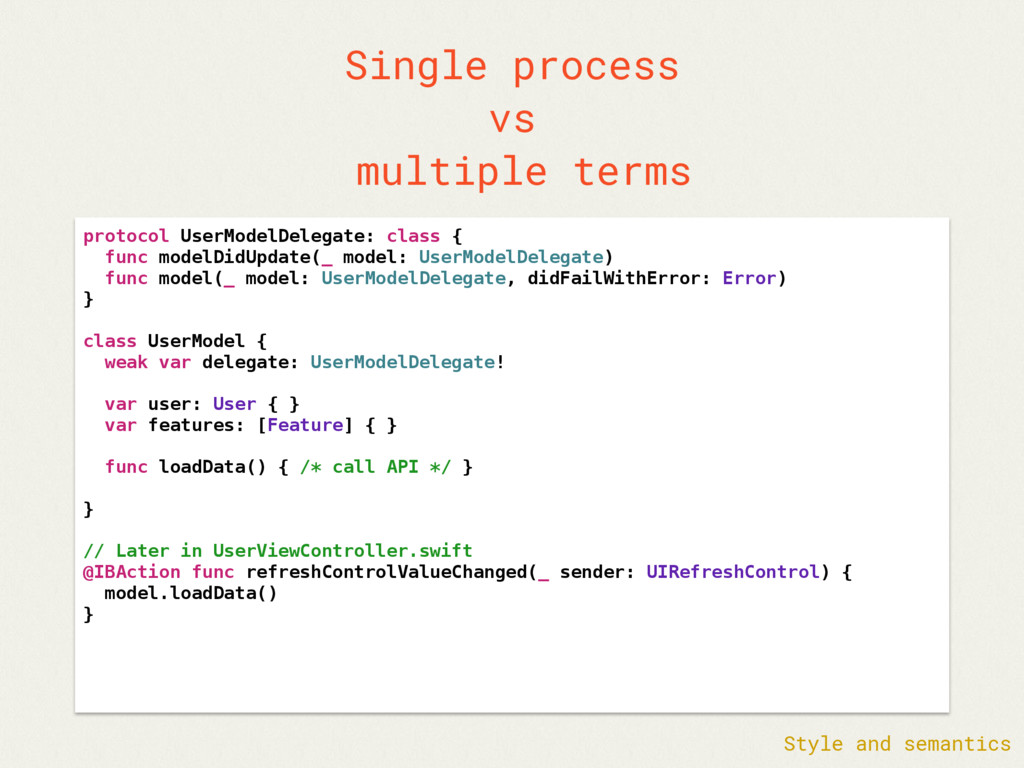
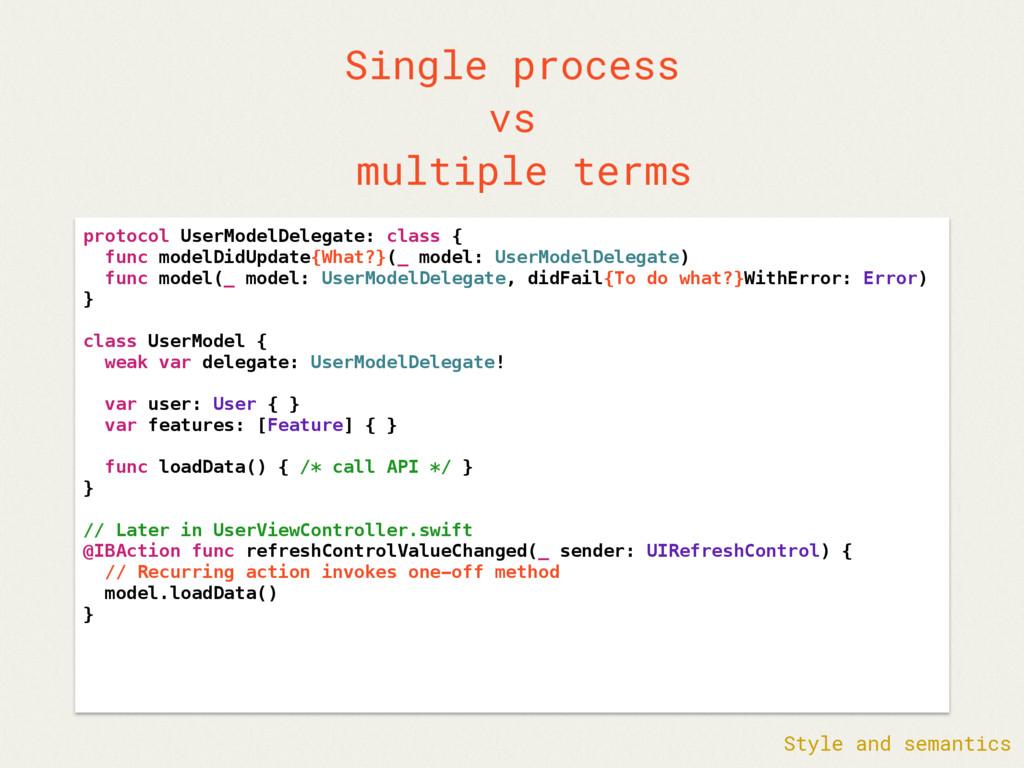
Single process vs multiple terms protocol UserModelDelegate: class { func
modelDidUpdate(_ model: UserModelDelegate) func model(_ model: UserModelDelegate, didFailWithError: Error) } class UserModel { weak var delegate: UserModelDelegate! var user: User { } var features: [Feature] { } func loadData() { /* call API */ } } // Later in UserViewController.swift @IBAction func refreshControlValueChanged(_ sender: UIRefreshControl) { model.loadData() } Style and semantics -
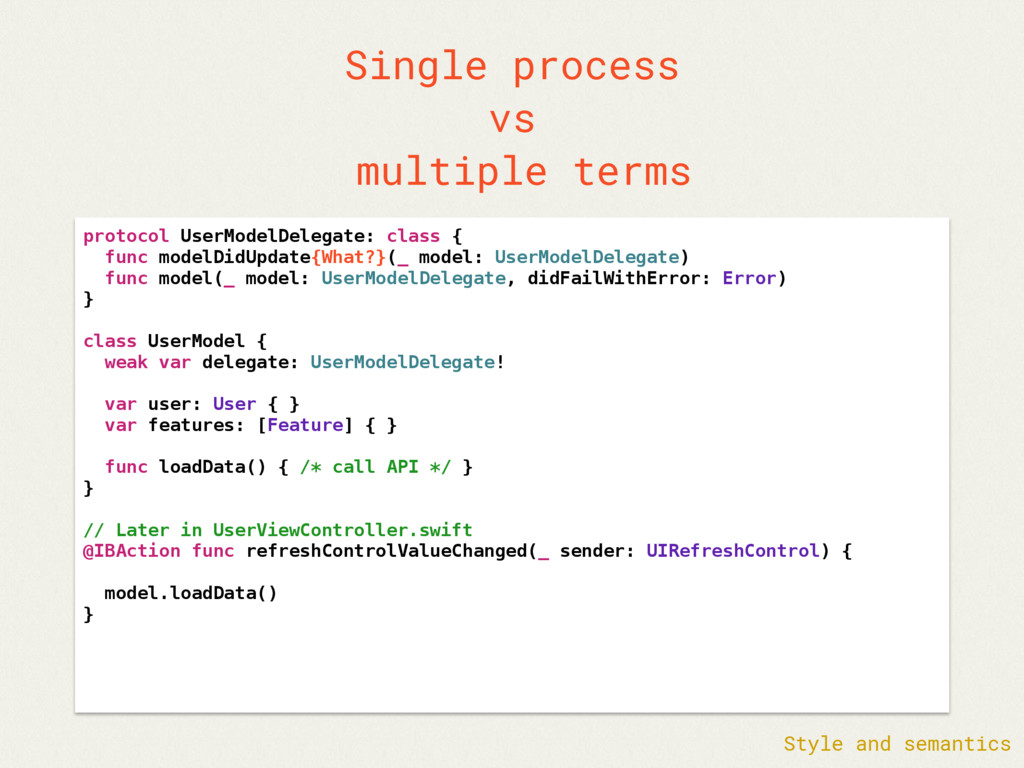
Single process vs multiple terms protocol UserModelDelegate: class { func
modelDidUpdate{What?}(_ model: UserModelDelegate) func model(_ model: UserModelDelegate, didFailWithError: Error) } class UserModel { weak var delegate: UserModelDelegate! var user: User { } var features: [Feature] { } func loadData() { /* call API */ } } // Later in UserViewController.swift @IBAction func refreshControlValueChanged(_ sender: UIRefreshControl) { model.loadData() } Style and semantics -
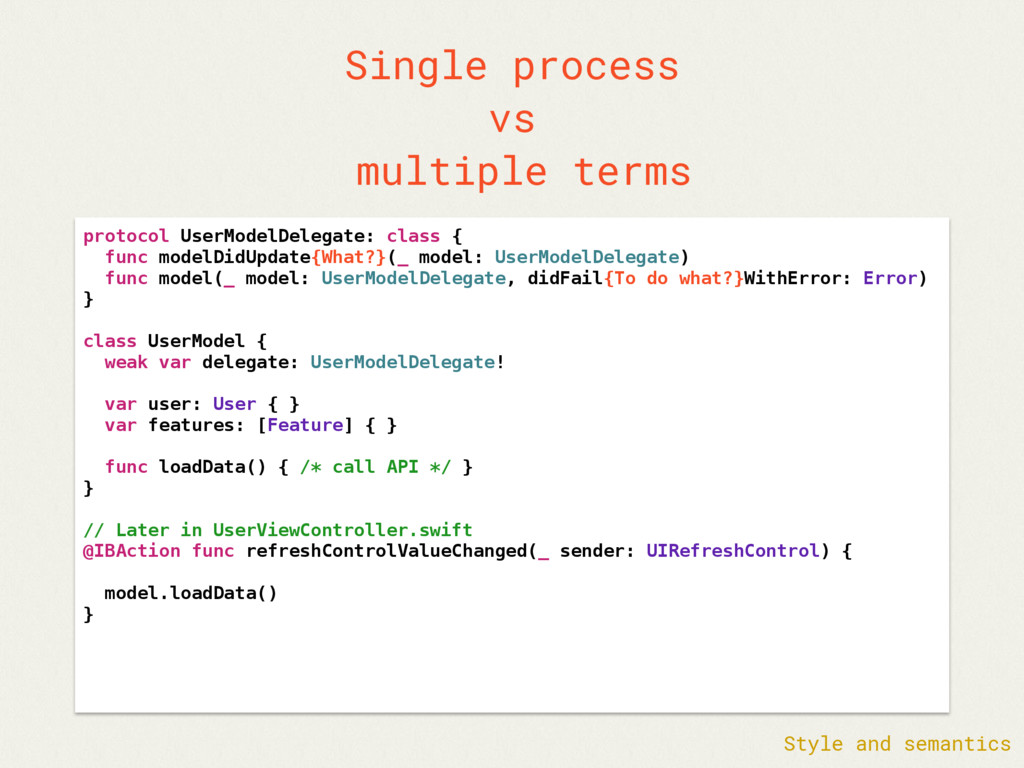
Single process vs multiple terms protocol UserModelDelegate: class { func
modelDidUpdate{What?}(_ model: UserModelDelegate) func model(_ model: UserModelDelegate, didFail{To do what?}WithError: Error) } class UserModel { weak var delegate: UserModelDelegate! var user: User { } var features: [Feature] { } func loadData() { /* call API */ } } // Later in UserViewController.swift @IBAction func refreshControlValueChanged(_ sender: UIRefreshControl) { model.loadData() } Style and semantics -
Single process vs multiple terms protocol UserModelDelegate: class { func
modelDidUpdate{What?}(_ model: UserModelDelegate) func model(_ model: UserModelDelegate, didFail{To do what?}WithError: Error) } class UserModel { weak var delegate: UserModelDelegate! var user: User { } var features: [Feature] { } func loadData() { /* call API */ } } // Later in UserViewController.swift @IBAction func refreshControlValueChanged(_ sender: UIRefreshControl) { // Recurring action invokes one-off method model.loadData() } Style and semantics -
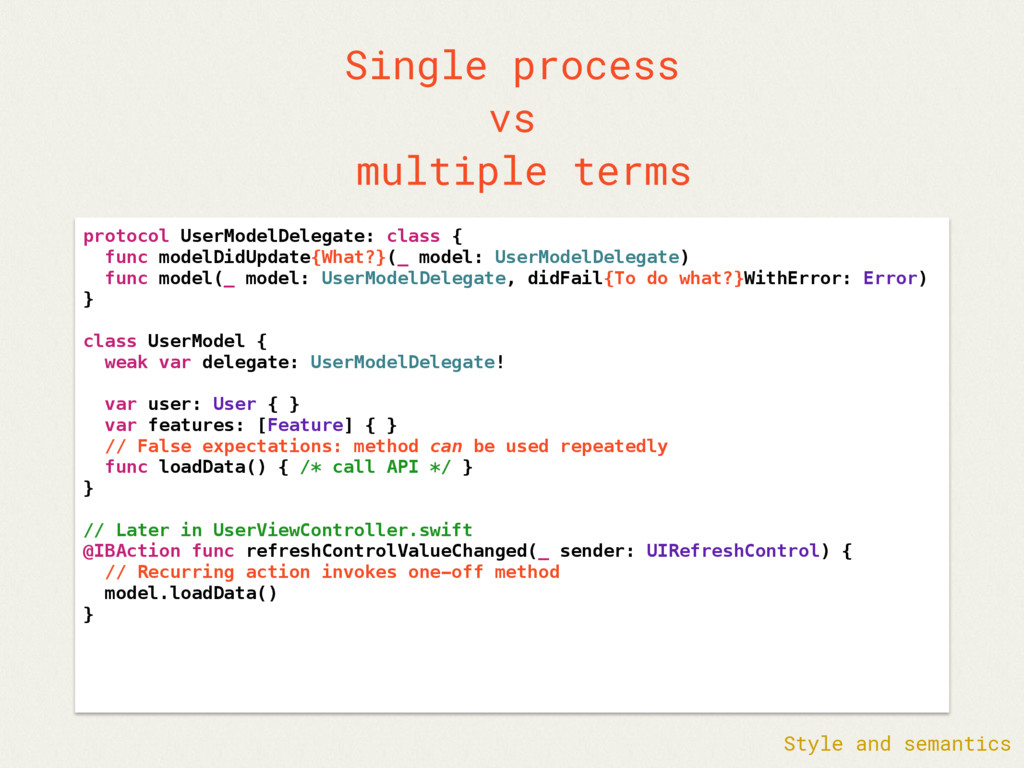
Single process vs multiple terms protocol UserModelDelegate: class { func
modelDidUpdate{What?}(_ model: UserModelDelegate) func model(_ model: UserModelDelegate, didFail{To do what?}WithError: Error) } class UserModel { weak var delegate: UserModelDelegate! var user: User { } var features: [Feature] { } // False expectations: method can be used repeatedly func loadData() { /* call API */ } } // Later in UserViewController.swift @IBAction func refreshControlValueChanged(_ sender: UIRefreshControl) { // Recurring action invokes one-off method model.loadData() } Style and semantics -
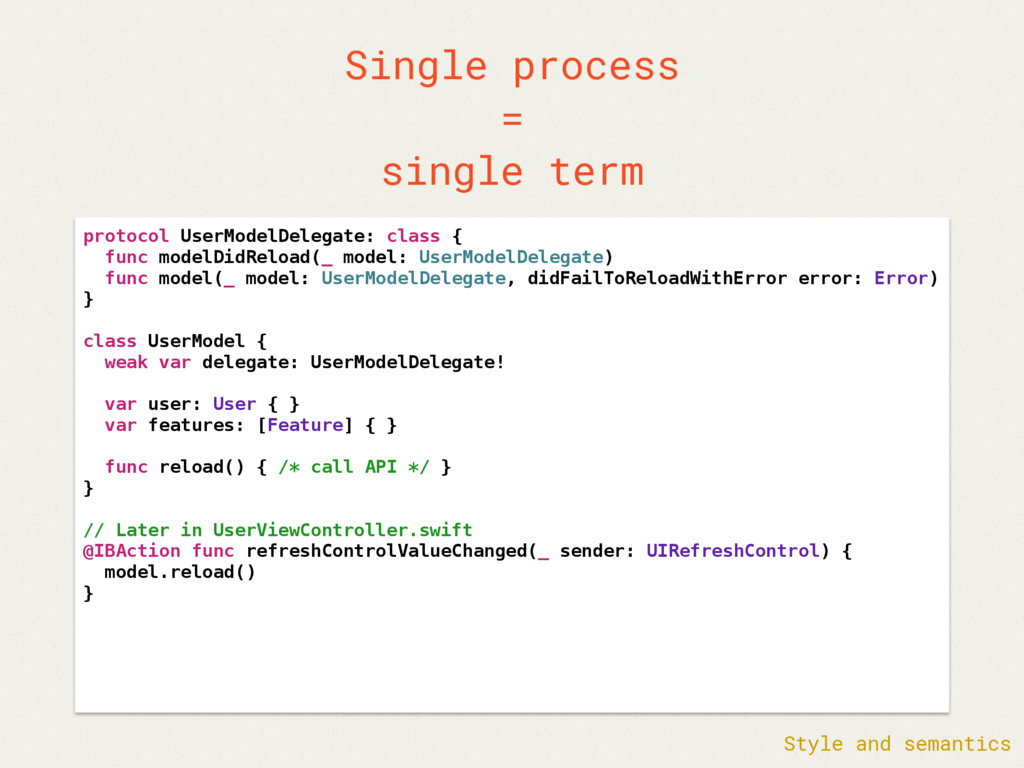
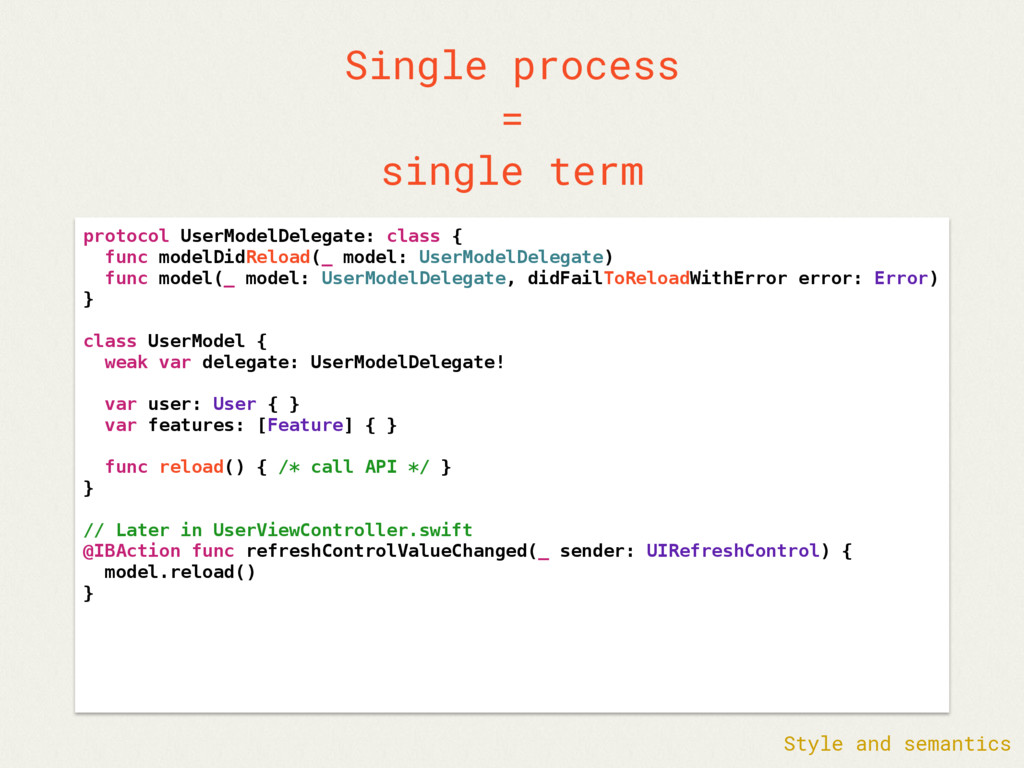
Single process = single term protocol UserModelDelegate: class { func
modelDidReload(_ model: UserModelDelegate) func model(_ model: UserModelDelegate, didFailToReloadWithError error: Error) } class UserModel { weak var delegate: UserModelDelegate! var user: User { } var features: [Feature] { } func reload() { /* call API */ } } // Later in UserViewController.swift @IBAction func refreshControlValueChanged(_ sender: UIRefreshControl) { model.reload() } Style and semantics -
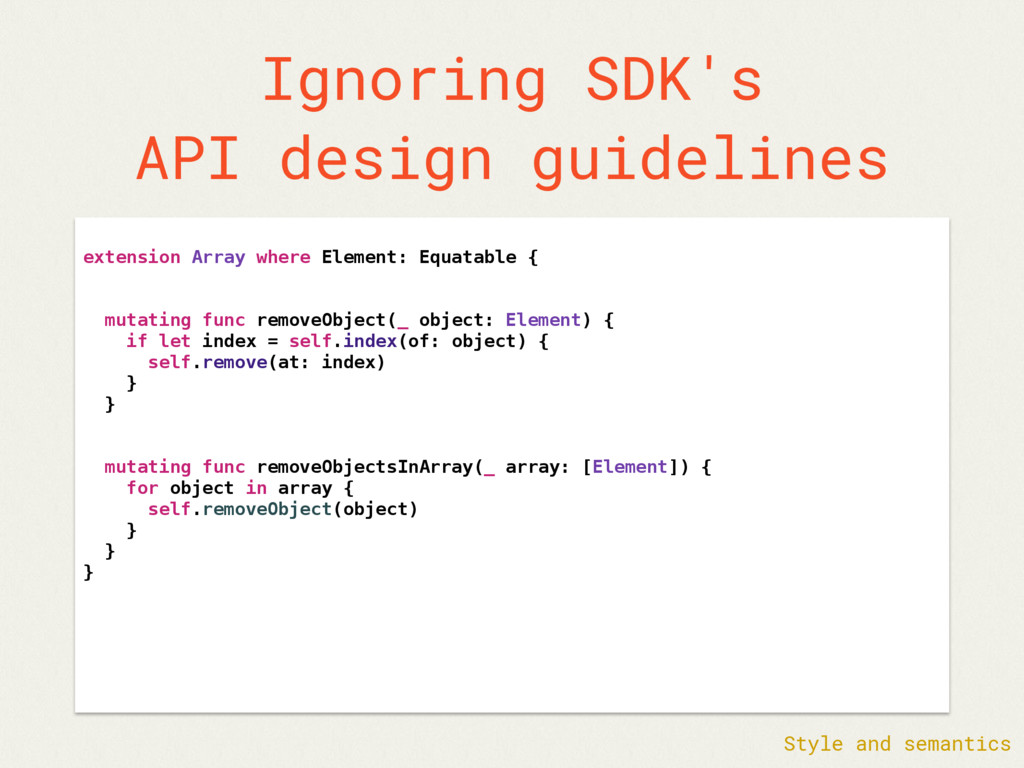
Ignoring SDK's API design guidelines extension Array where Element: Equatable
{ mutating func removeObject(_ object: Element) { if let index = self.index(of: object) { self.remove(at: index) } } mutating func removeObjectsInArray(_ array: [Element]) { for object in array { self.removeObject(object) } } } Style and semantics -
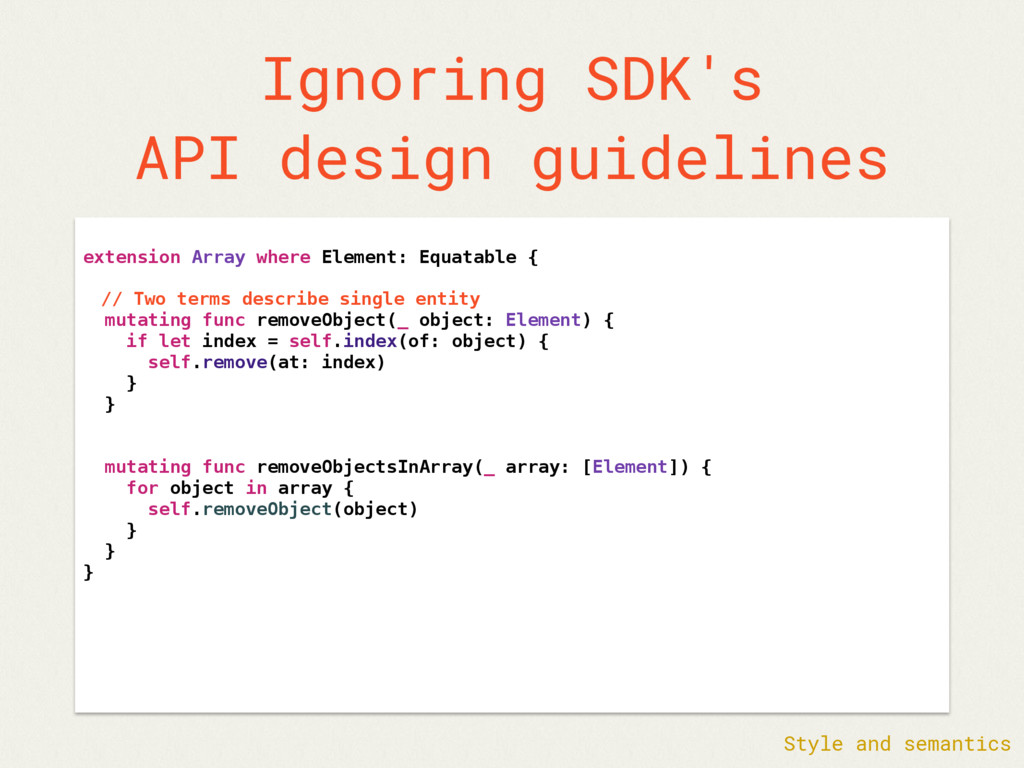
Ignoring SDK's API design guidelines extension Array where Element: Equatable
{ // Two terms describe single entity mutating func removeObject(_ object: Element) { if let index = self.index(of: object) { self.remove(at: index) } } mutating func removeObjectsInArray(_ array: [Element]) { for object in array { self.removeObject(object) } } } Style and semantics -
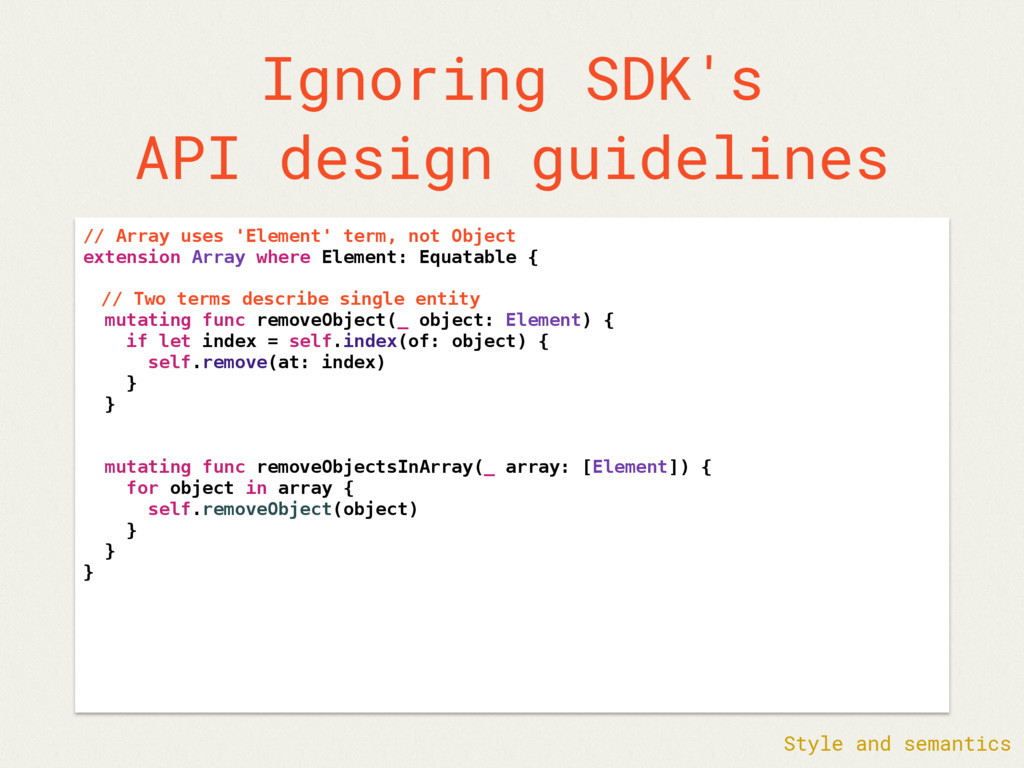
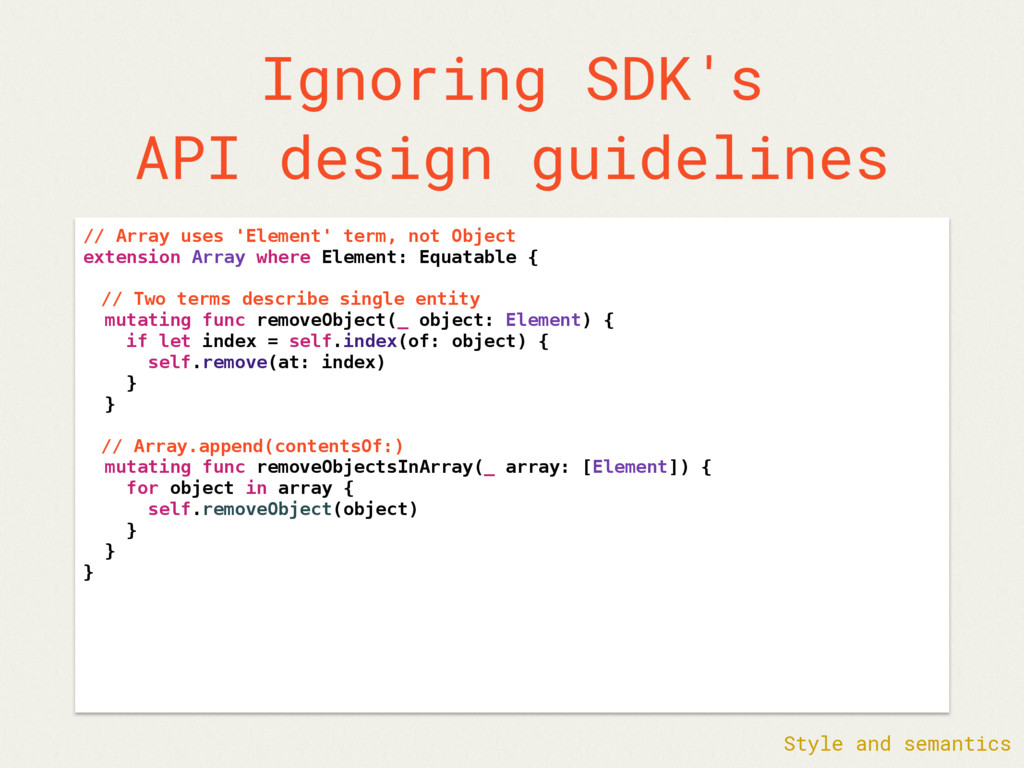
Ignoring SDK's API design guidelines // Array uses 'Element' term,
not Object extension Array where Element: Equatable { // Two terms describe single entity mutating func removeObject(_ object: Element) { if let index = self.index(of: object) { self.remove(at: index) } } mutating func removeObjectsInArray(_ array: [Element]) { for object in array { self.removeObject(object) } } } Style and semantics -
Ignoring SDK's API design guidelines // Array uses 'Element' term,
not Object extension Array where Element: Equatable { // Two terms describe single entity mutating func removeObject(_ object: Element) { if let index = self.index(of: object) { self.remove(at: index) } } // Array.append(contentsOf:) mutating func removeObjectsInArray(_ array: [Element]) { for object in array { self.removeObject(object) } } } Style and semantics -
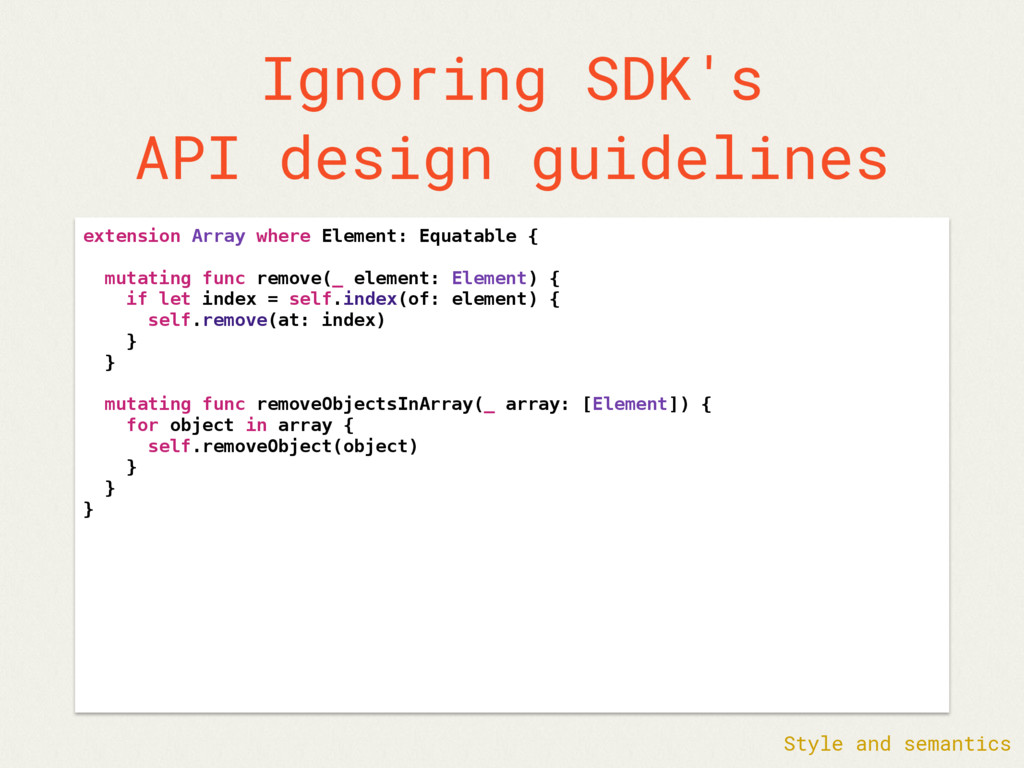
Ignoring SDK's API design guidelines extension Array where Element: Equatable
{ mutating func remove(_ element: Element) { if let index = self.index(of: element) { self.remove(at: index) } } mutating func removeObjectsInArray(_ array: [Element]) { for object in array { self.removeObject(object) } } } Style and semantics -
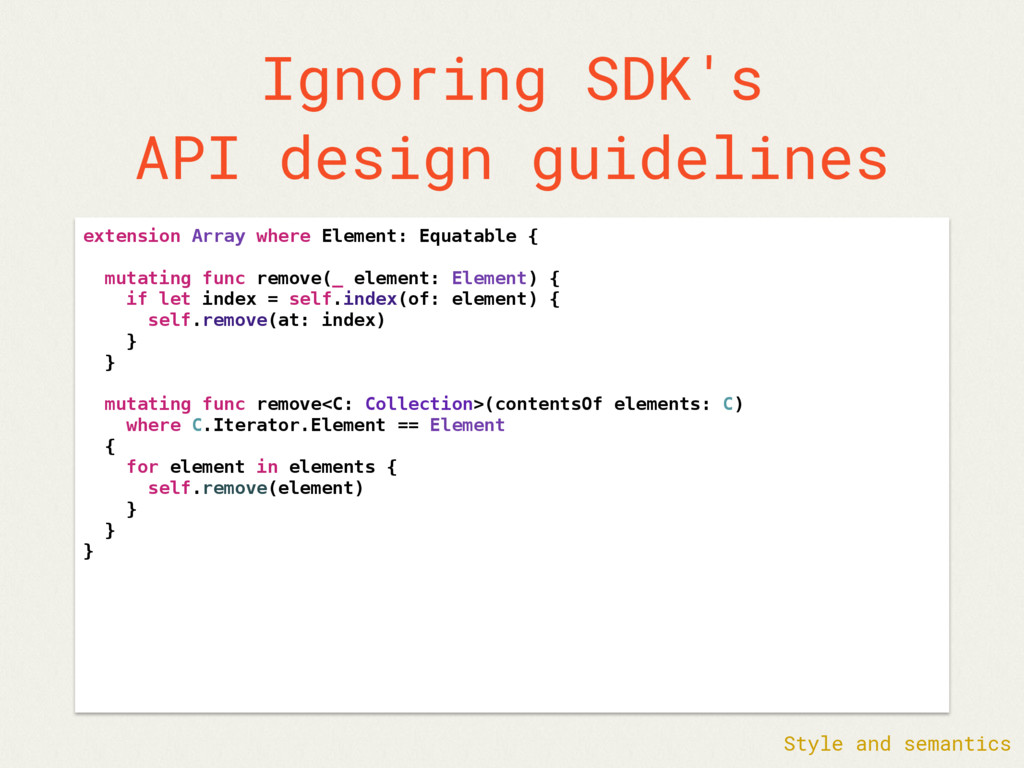
Ignoring SDK's API design guidelines extension Array where Element: Equatable
{ mutating func remove(_ element: Element) { if let index = self.index(of: element) { self.remove(at: index) } } mutating func remove<C: Collection>(contentsOf elements: C) where C.Iterator.Element == Element { for element in elements { self.remove(element) } } } Style and semantics -
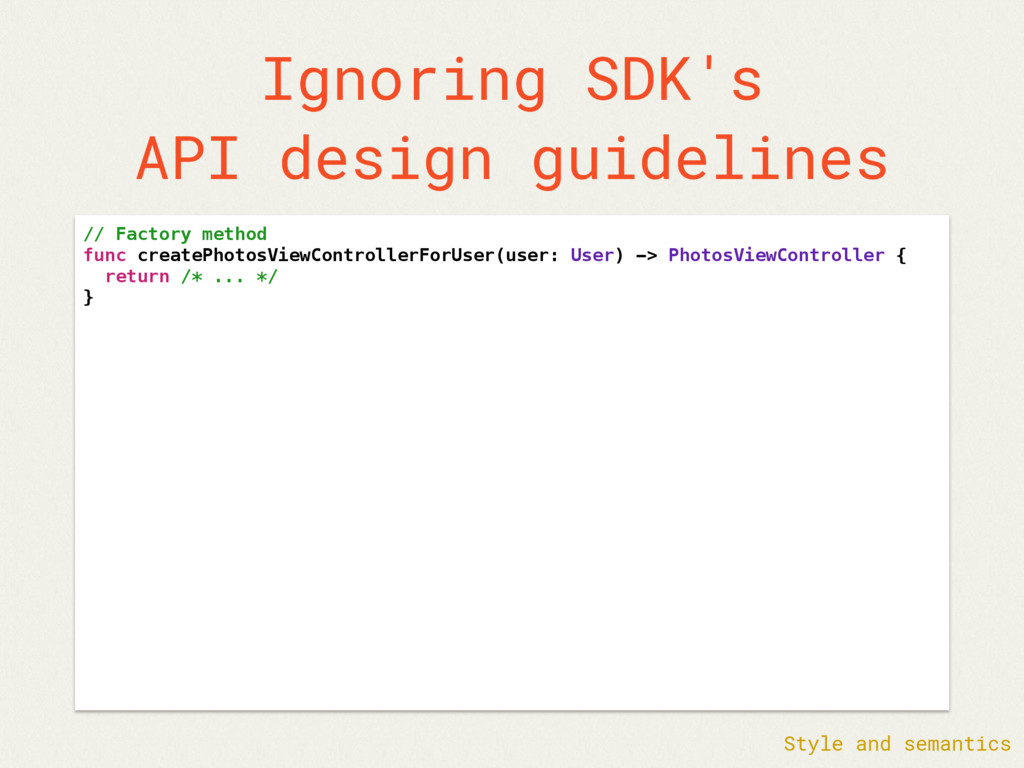
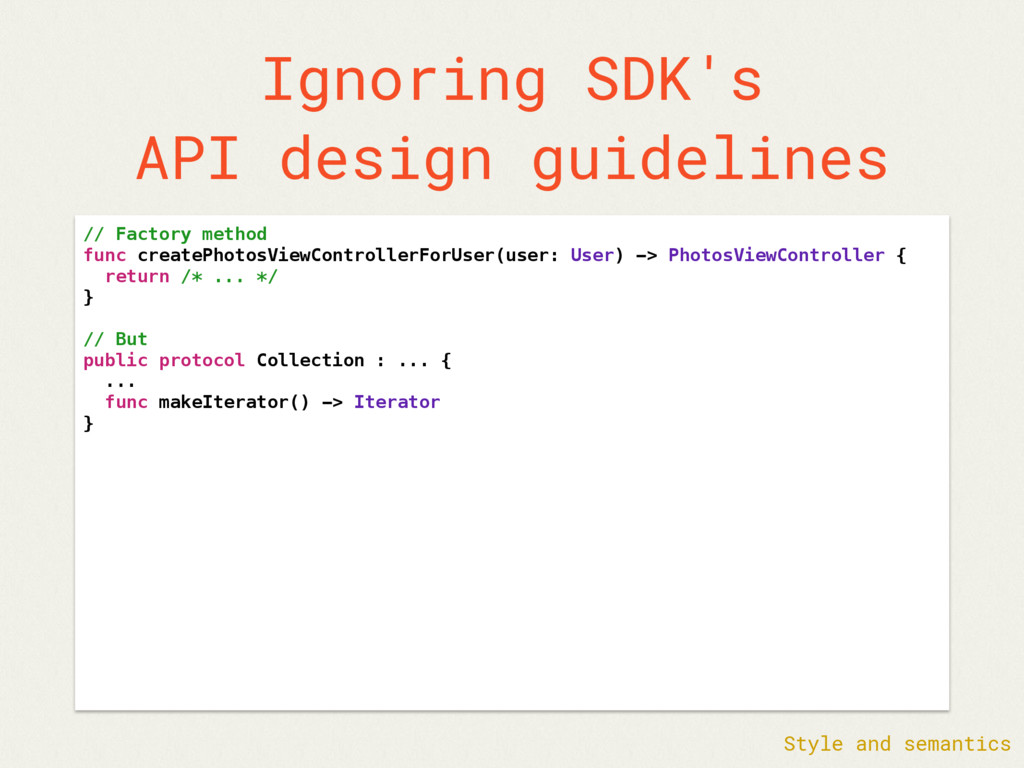
Ignoring SDK's API design guidelines // Factory method func createPhotosViewControllerForUser(user:
User) -> PhotosViewController { return /* ... */ } Style and semantics -
Ignoring SDK's API design guidelines // Factory method func createPhotosViewControllerForUser(user:
User) -> PhotosViewController { return /* ... */ } // But public protocol Collection : ... { ... func makeIterator() -> Iterator } Style and semantics -
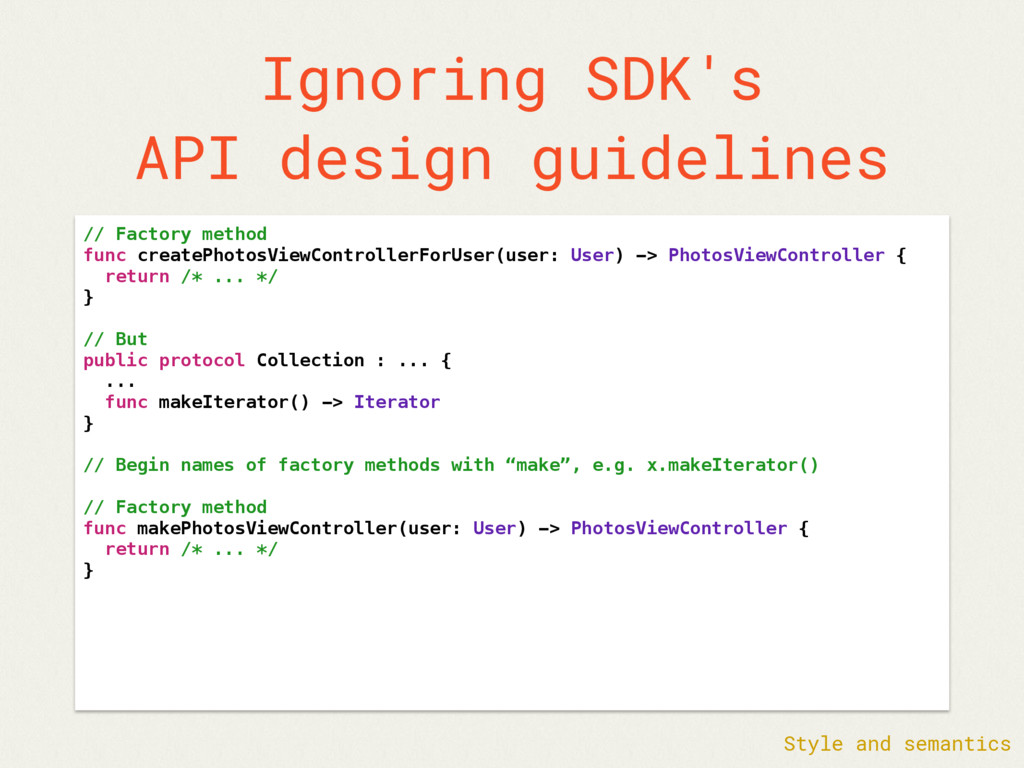
Ignoring SDK's API design guidelines // Factory method func createPhotosViewControllerForUser(user:
User) -> PhotosViewController { return /* ... */ } // But public protocol Collection : ... { ... func makeIterator() -> Iterator } // Begin names of factory methods with “make”, e.g. x.makeIterator() // Factory method func makePhotosViewController(user: User) -> PhotosViewController { return /* ... */ } Style and semantics -
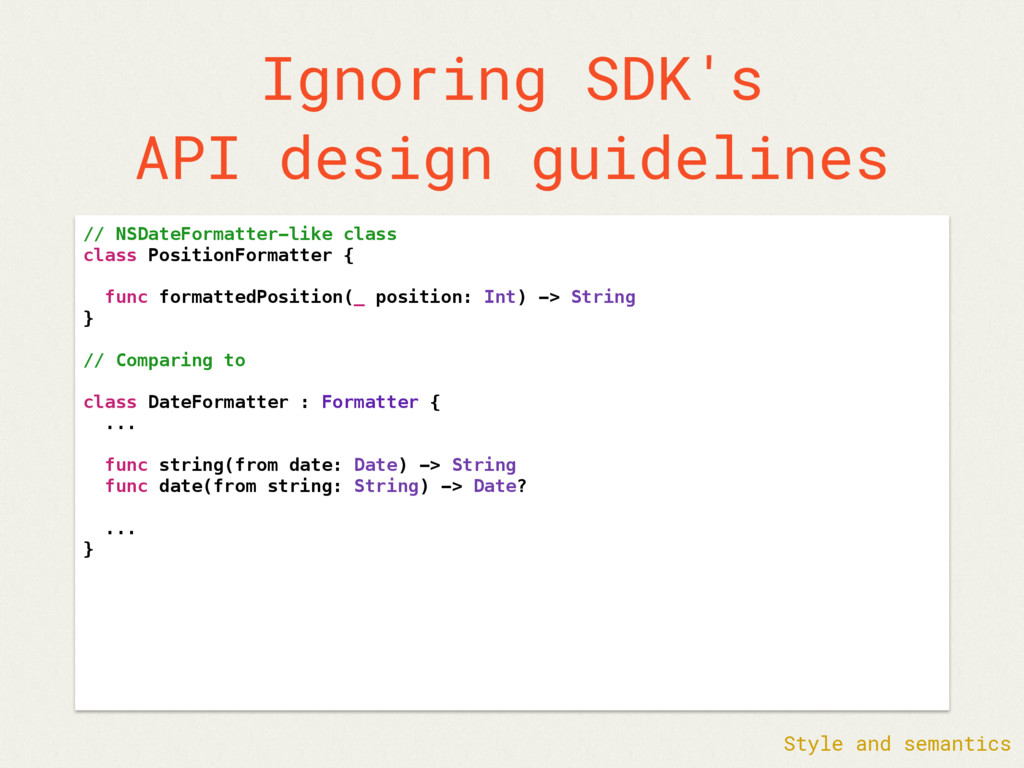
Ignoring SDK's API design guidelines // NSDateFormatter-like class class PositionFormatter
{ func formattedPosition(_ position: Int) -> String } Style and semantics -
Ignoring SDK's API design guidelines // NSDateFormatter-like class class PositionFormatter
{ func formattedPosition(_ position: Int) -> String } // Comparing to class DateFormatter : Formatter { ... func string(from date: Date) -> String func date(from string: String) -> Date? ... } Style and semantics -
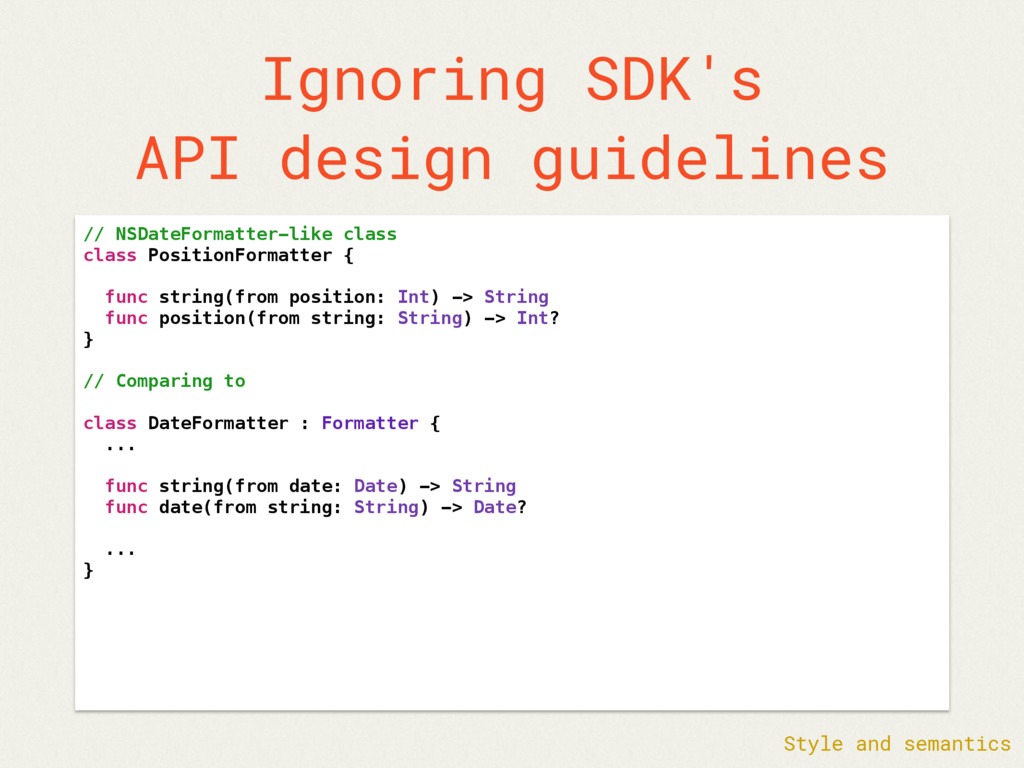
Ignoring SDK's API design guidelines // NSDateFormatter-like class class PositionFormatter
{ func string(from position: Int) -> String func position(from string: String) -> Int? } // Comparing to class DateFormatter : Formatter { ... func string(from date: Date) -> String func date(from string: String) -> Date? ... } Style and semantics -
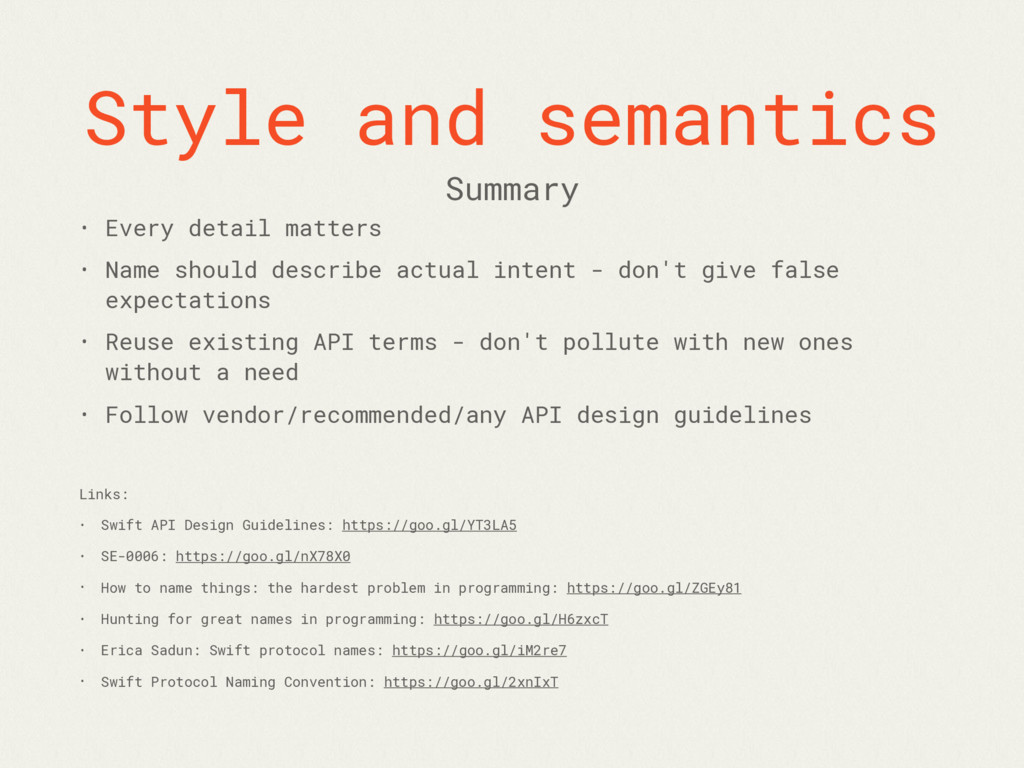
Style and semantics • Every detail matters • Name should
describe actual intent - don't give false expectations • Reuse existing API terms - don't pollute with new ones without a need • Follow vendor/recommended/any API design guidelines Links: • Swift API Design Guidelines: https://goo.gl/YT3LA5 • SE-0006: https://goo.gl/nX78X0 • How to name things: the hardest problem in programming: https://goo.gl/ZGEy81 • Hunting for great names in programming: https://goo.gl/H6zxcT • Erica Sadun: Swift protocol names: https://goo.gl/iM2re7 • Swift Protocol Naming Convention: https://goo.gl/2xnIxT Summary -
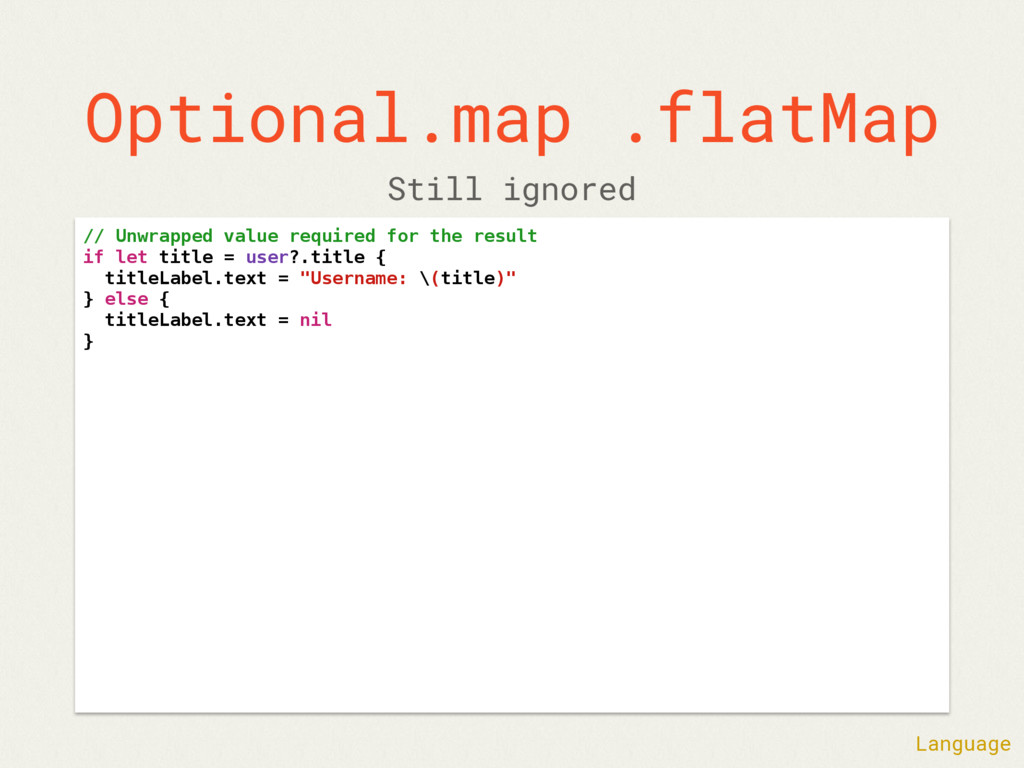
Optional.map .flatMap // Unwrapped value required for the result if
let title = user?.title { titleLabel.text = "Username: \(title)" } else { titleLabel.text = nil } Still ignored Language -
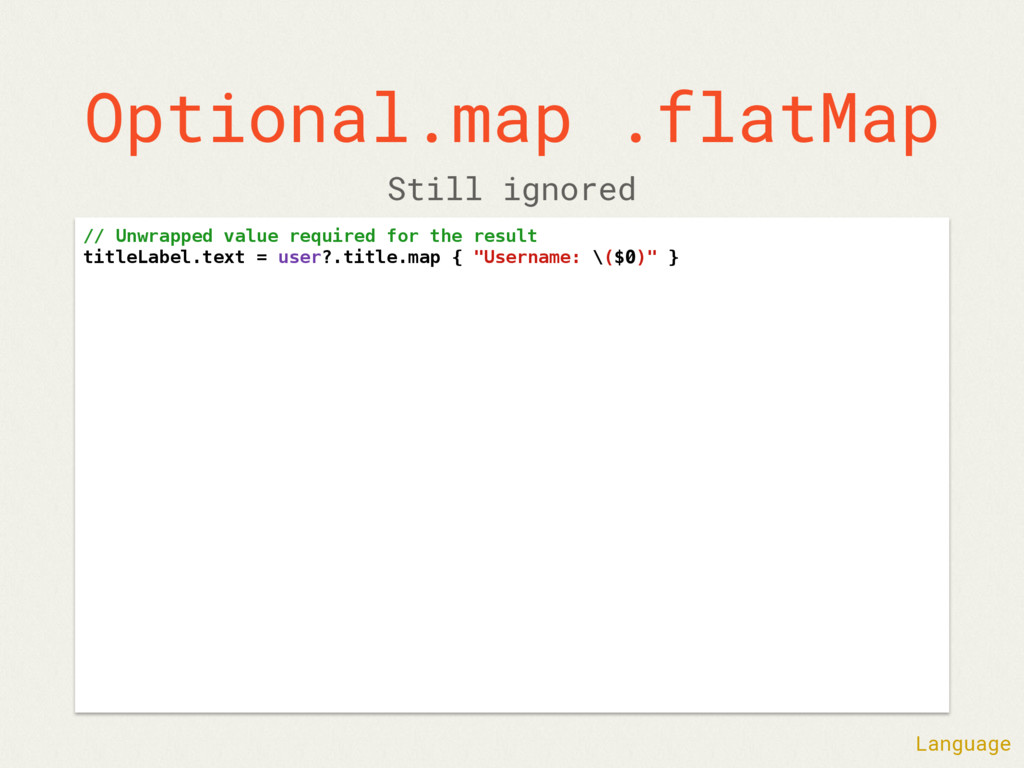
Optional.map .flatMap // Unwrapped value required for the result titleLabel.text
= user?.title.map { "Username: \($0)" } Still ignored Language -
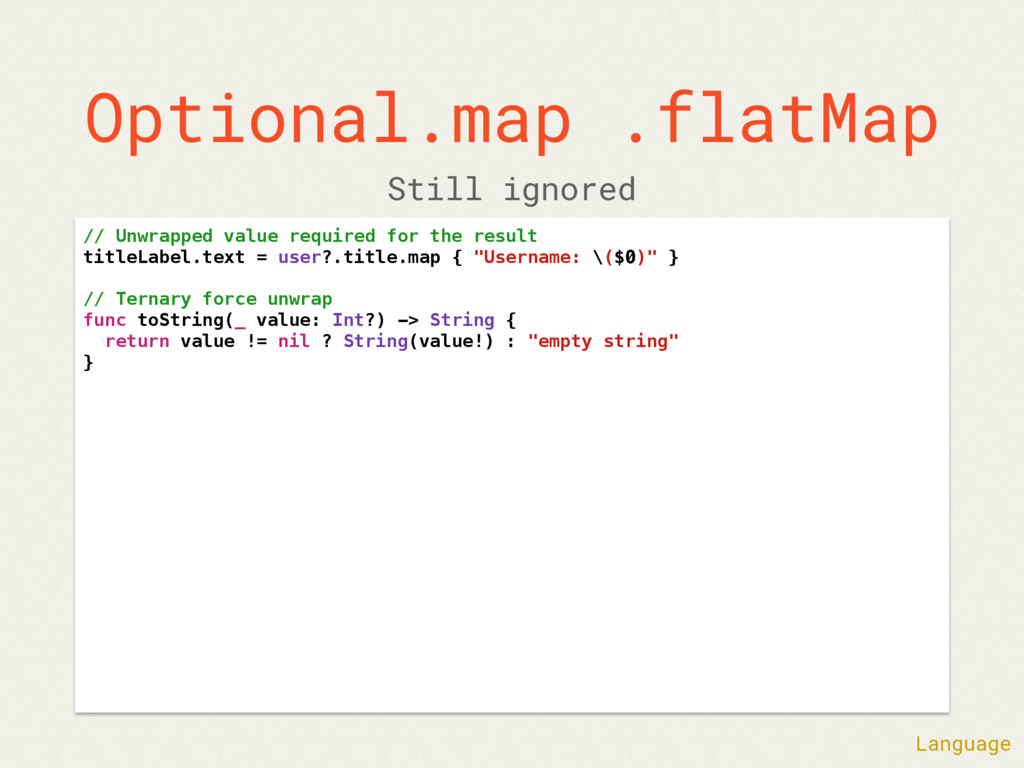
Optional.map .flatMap // Unwrapped value required for the result titleLabel.text
= user?.title.map { "Username: \($0)" } // Ternary force unwrap func toString(_ value: Int?) -> String { return value != nil ? String(value!) : "empty string" } Still ignored Language -
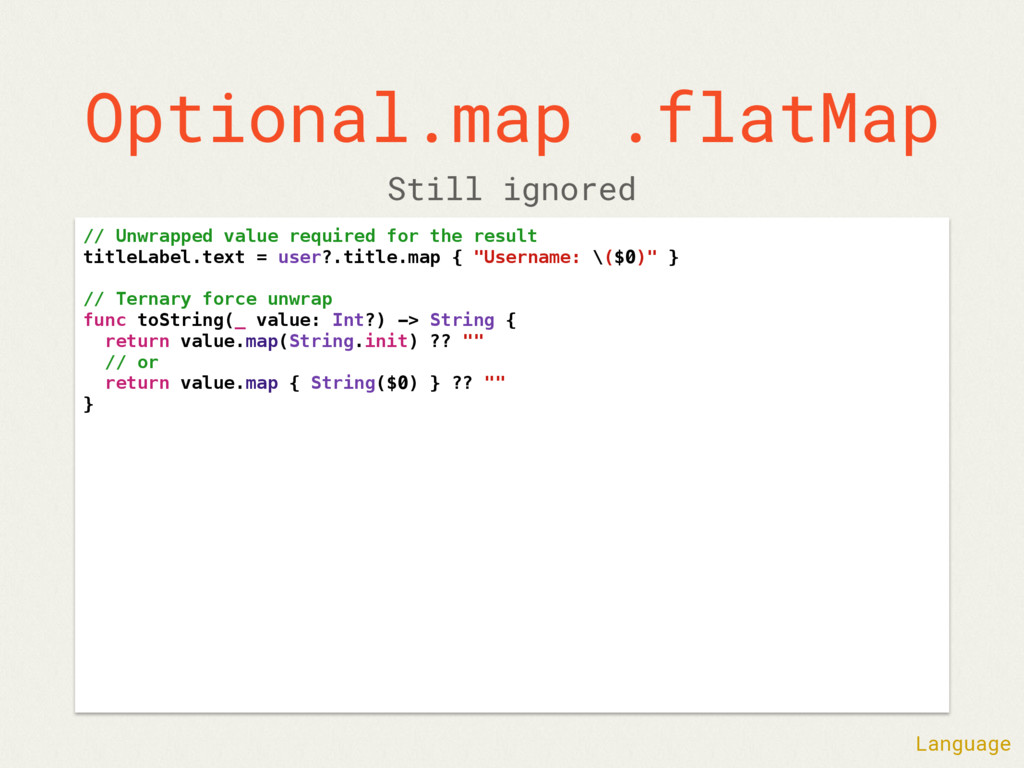
Optional.map .flatMap // Unwrapped value required for the result titleLabel.text
= user?.title.map { "Username: \($0)" } // Ternary force unwrap func toString(_ value: Int?) -> String { return value.map(String.init) ?? "" // or return value.map { String($0) } ?? "" } Still ignored Language -
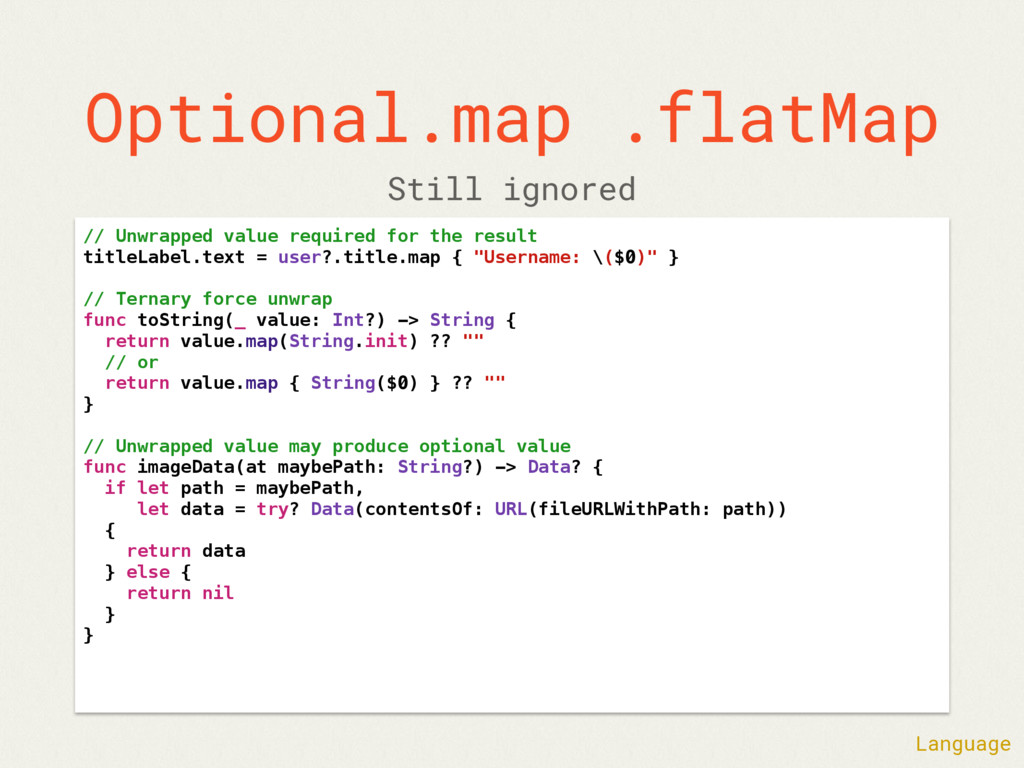
Optional.map .flatMap // Unwrapped value required for the result titleLabel.text
= user?.title.map { "Username: \($0)" } // Ternary force unwrap func toString(_ value: Int?) -> String { return value.map(String.init) ?? "" // or return value.map { String($0) } ?? "" } // Unwrapped value may produce optional value func imageData(at maybePath: String?) -> Data? { if let path = maybePath, let data = try? Data(contentsOf: URL(fileURLWithPath: path)) { return data } else { return nil } } Still ignored Language -
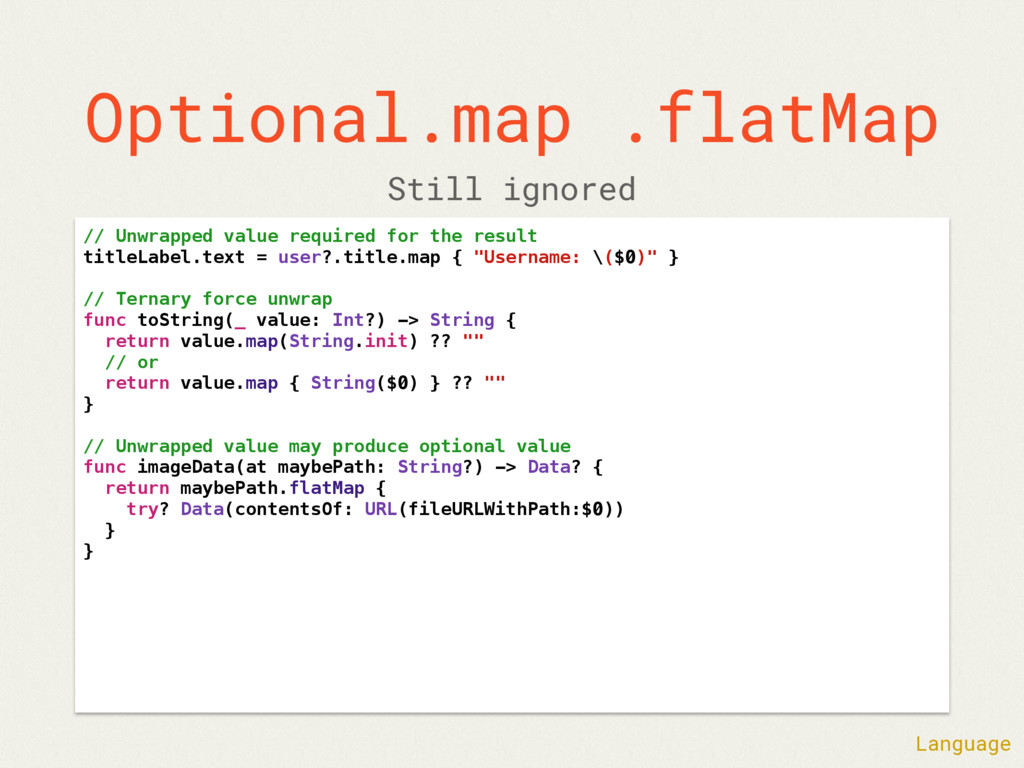
Optional.map .flatMap // Unwrapped value required for the result titleLabel.text
= user?.title.map { "Username: \($0)" } // Ternary force unwrap func toString(_ value: Int?) -> String { return value.map(String.init) ?? "" // or return value.map { String($0) } ?? "" } // Unwrapped value may produce optional value func imageData(at maybePath: String?) -> Data? { return maybePath.flatMap { try? Data(contentsOf: URL(fileURLWithPath:$0)) } } Language Still ignored -
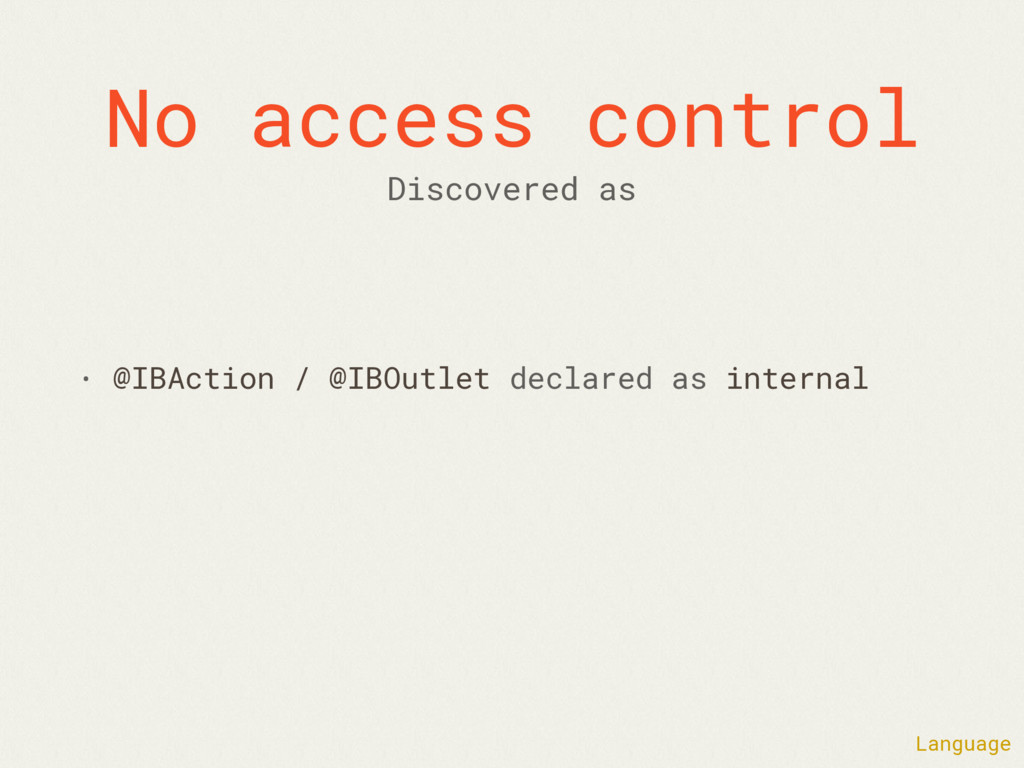
No access control • @IBAction / @IBOutlet declared as internal
• Properties that should be readonly for the client declared as readwrite • Utility methods declared as internal Language Discovered as -
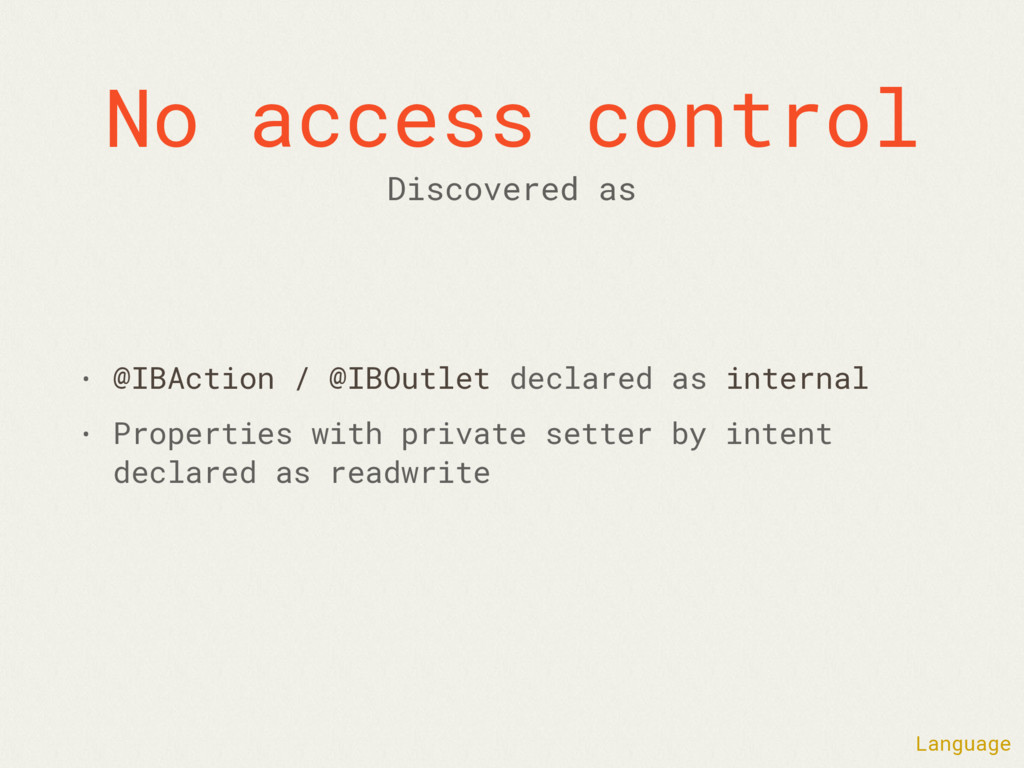
No access control • @IBAction / @IBOutlet declared as internal
• Properties with private setter by intent declared as readwrite • Utility methods declared as internal Language Discovered as -
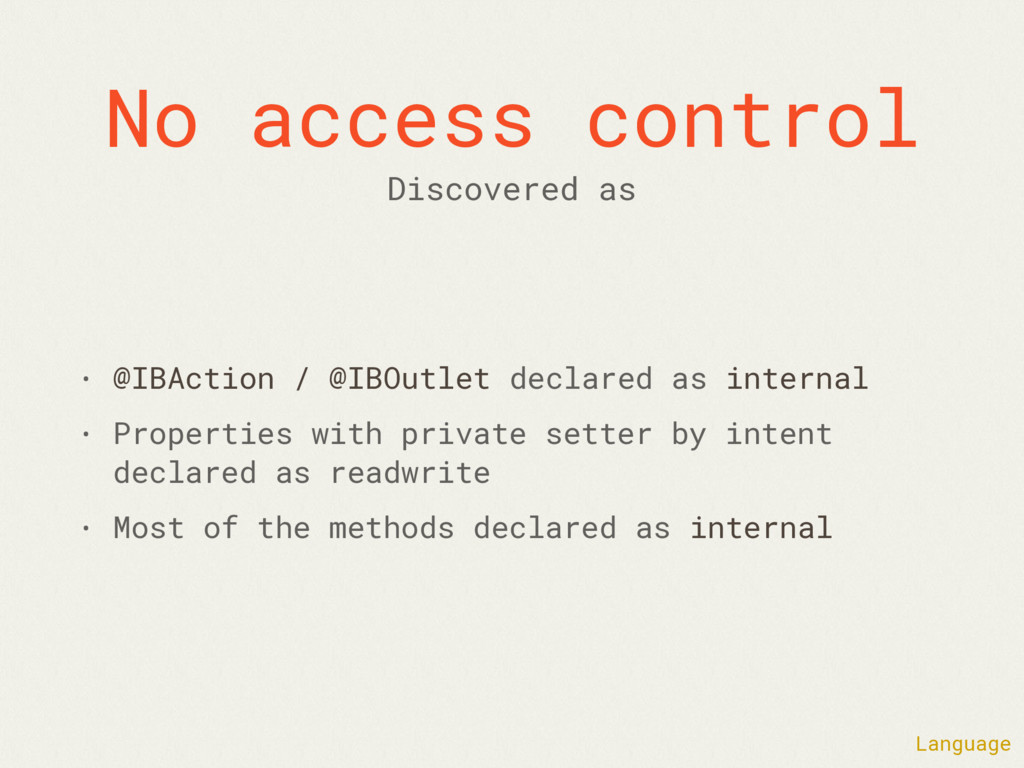
No access control • @IBAction / @IBOutlet declared as internal
• Properties with private setter by intent declared as readwrite • Most of the methods declared as internal Language Discovered as -
No access control • Gives false expectation to your teammates:
no difference between public and private anymore • Breaks "black box" by exposing implementation • Encourages to use fast and dirty workarounds Language Impact -
No access control • Gives false expectation to your teammates:
no difference between public and private anymore • Breaks "black box" by exposing implementation • Encourages to use fast and dirty workarounds Language Impact -
No access control • Gives false expectation to your teammates:
no difference between public and private anymore • Breaks "black box" by exposing implementation • Encourages to use fast and dirty workarounds Language Impact -
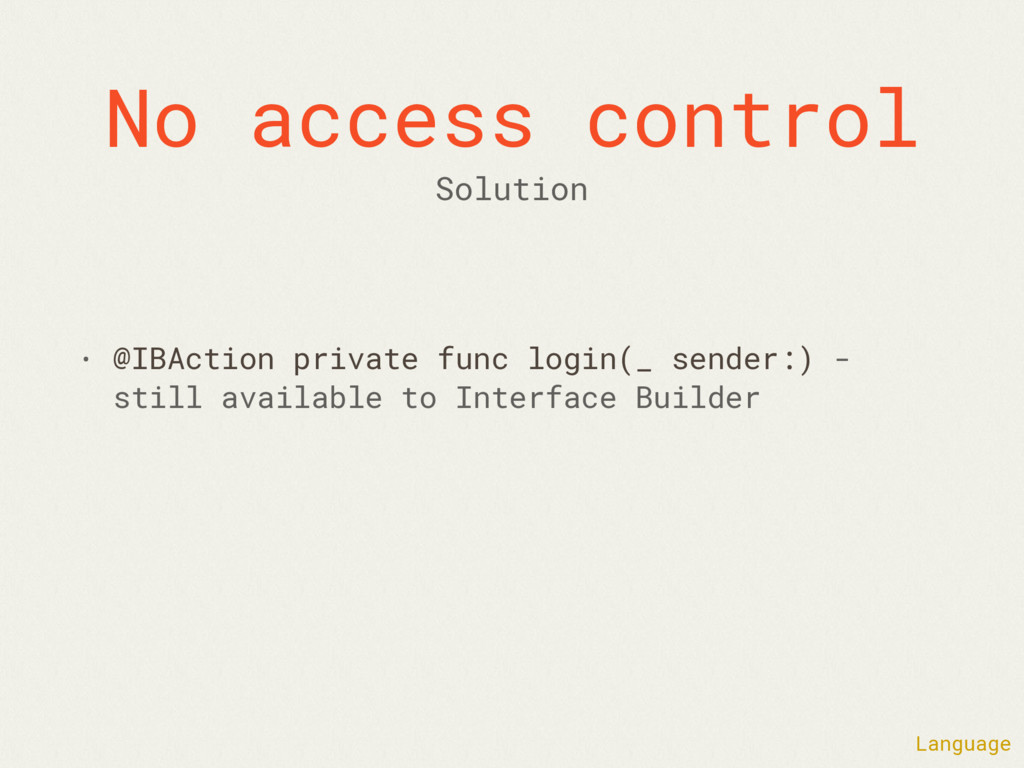
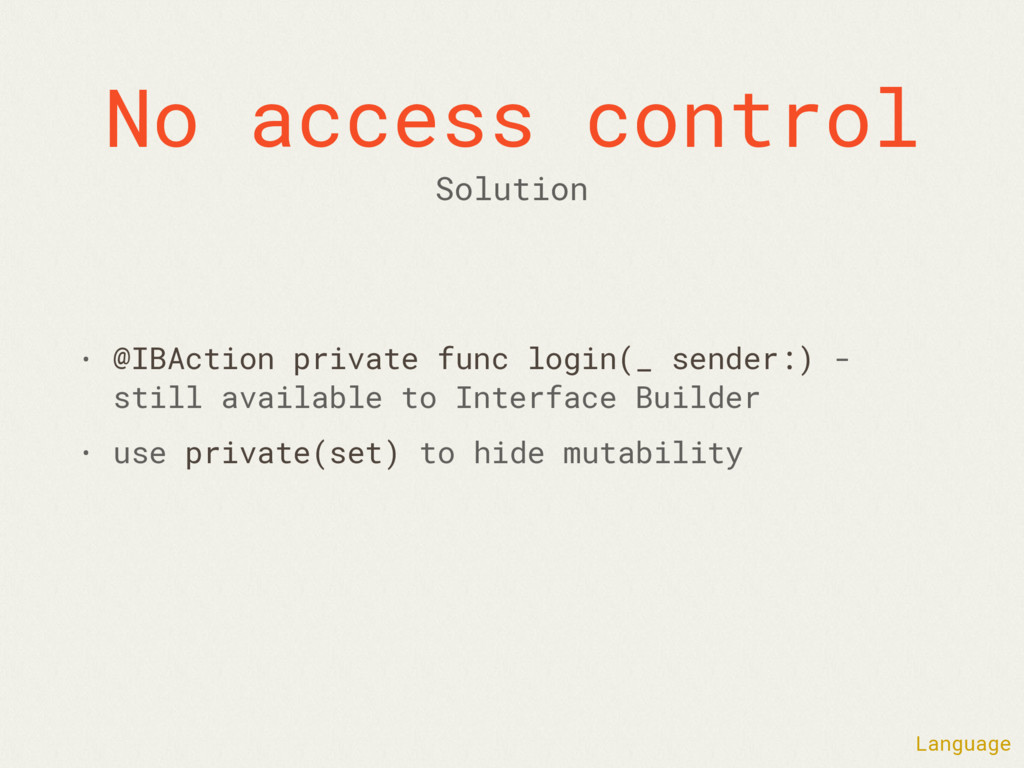
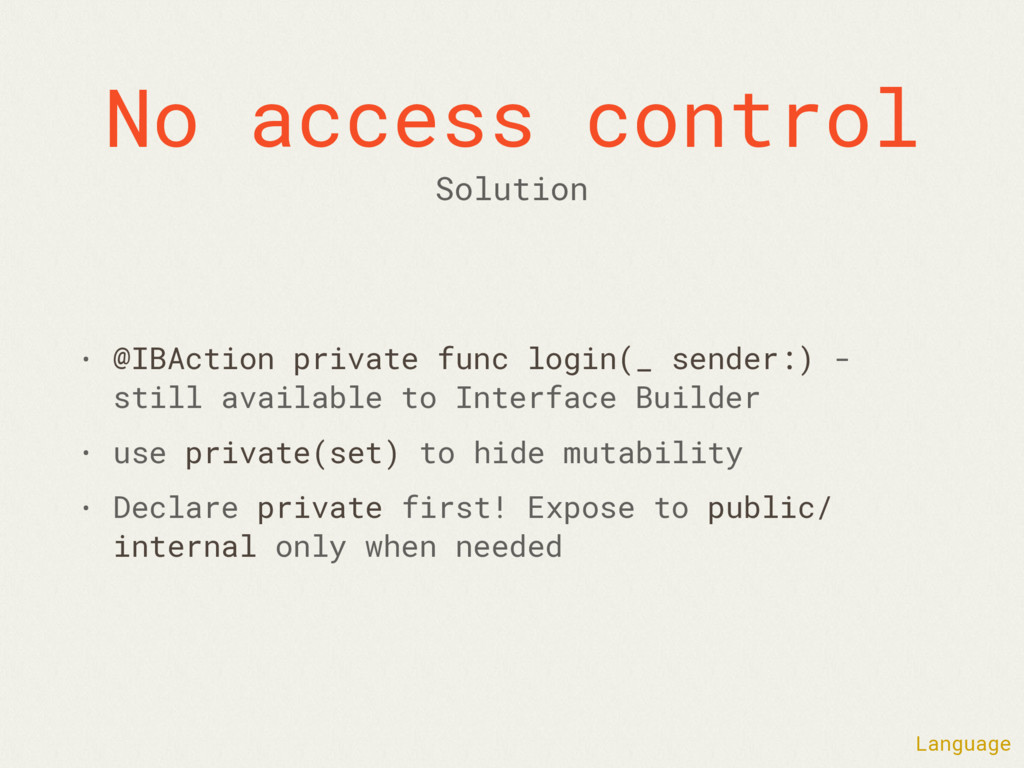
No access control • @IBAction private func login(_ sender:) -
still available to Interface Builder • use private(set) to hide mutability • Declare private first! Expose to public/ internal only when needed Language Solution -
No access control • @IBAction private func login(_ sender:) -
still available to Interface Builder • use private(set) to hide mutability • Declare private first! Expose to public/ internal only when needed Language Solution -
No access control • @IBAction private func login(_ sender:) -
still available to Interface Builder • use private(set) to hide mutability • Declare private first! Expose to public/ internal only when needed Language Solution -
Language • Learn tools you're using everyday via: • Books
• Blogs • Practice! Summary -
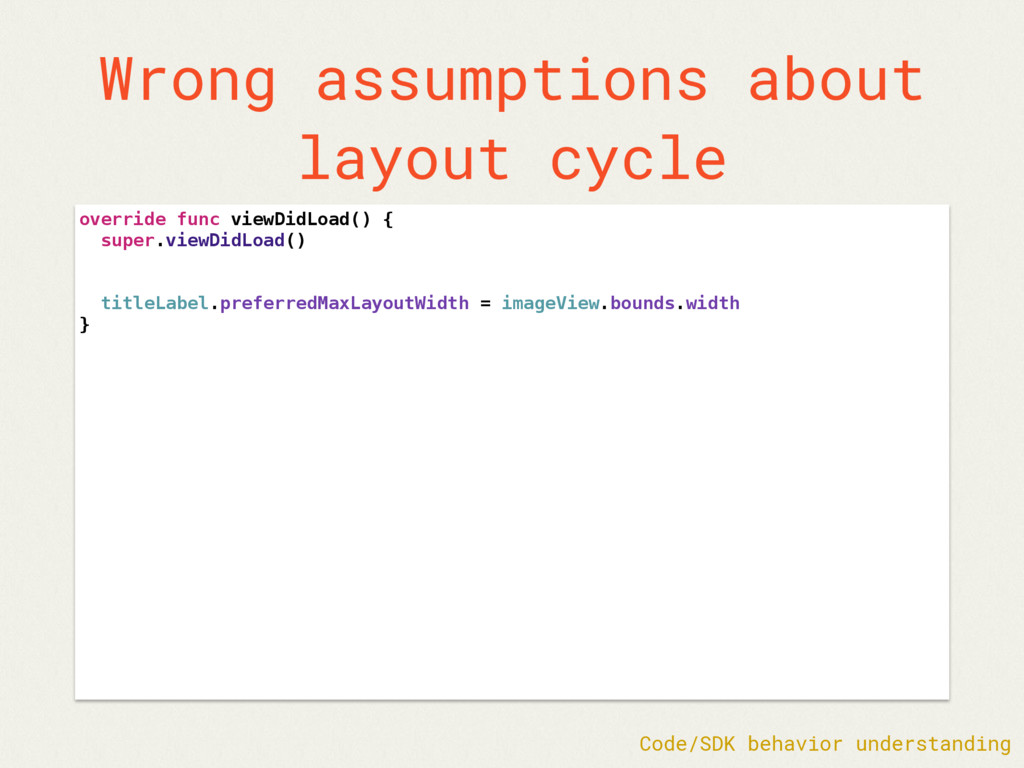
Wrong assumptions about layout cycle override func viewDidLoad() { super.viewDidLoad()
titleLabel.preferredMaxLayoutWidth = imageView.bounds.width } Code/SDK behavior understanding -
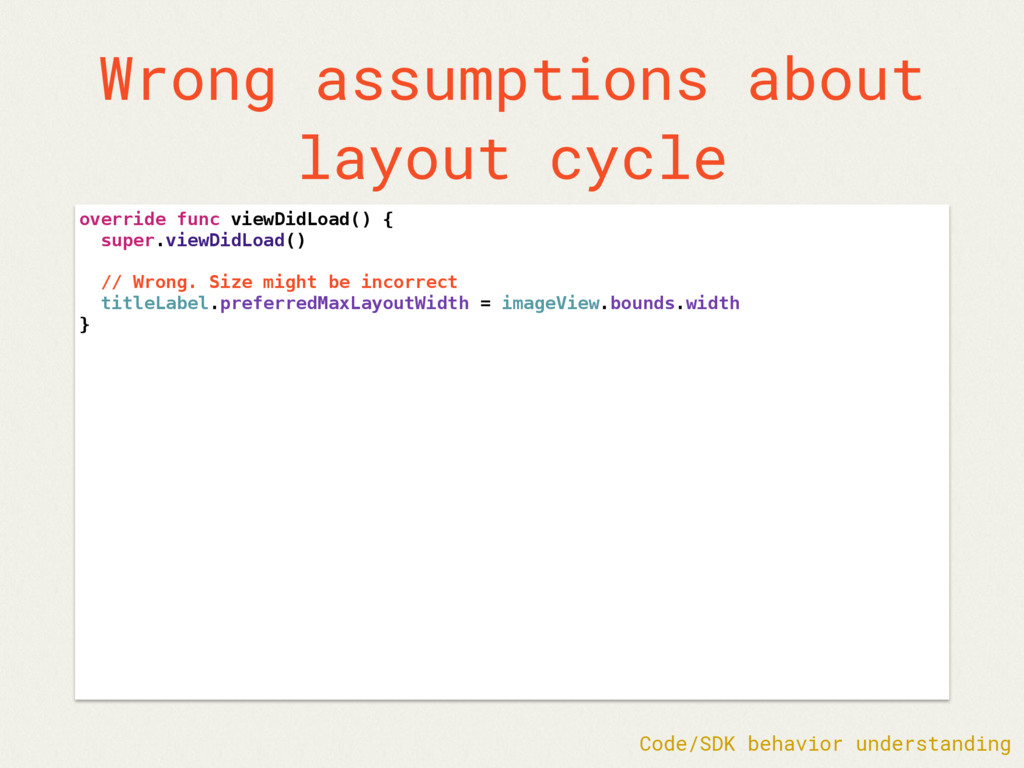
Wrong assumptions about layout cycle override func viewDidLoad() { super.viewDidLoad()
// Wrong. Size might be incorrect titleLabel.preferredMaxLayoutWidth = imageView.bounds.width } Code/SDK behavior understanding -
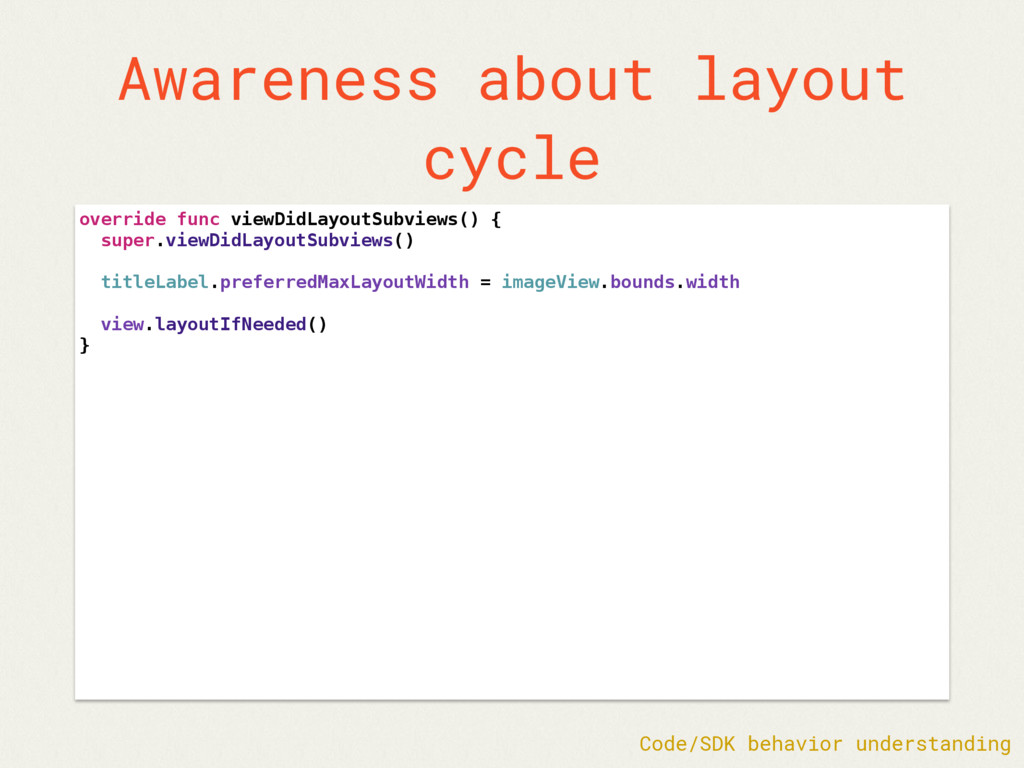
Awareness about layout cycle override func viewDidLayoutSubviews() { super.viewDidLayoutSubviews() titleLabel.preferredMaxLayoutWidth
= imageView.bounds.width view.layoutIfNeeded() } Code/SDK behavior understanding -
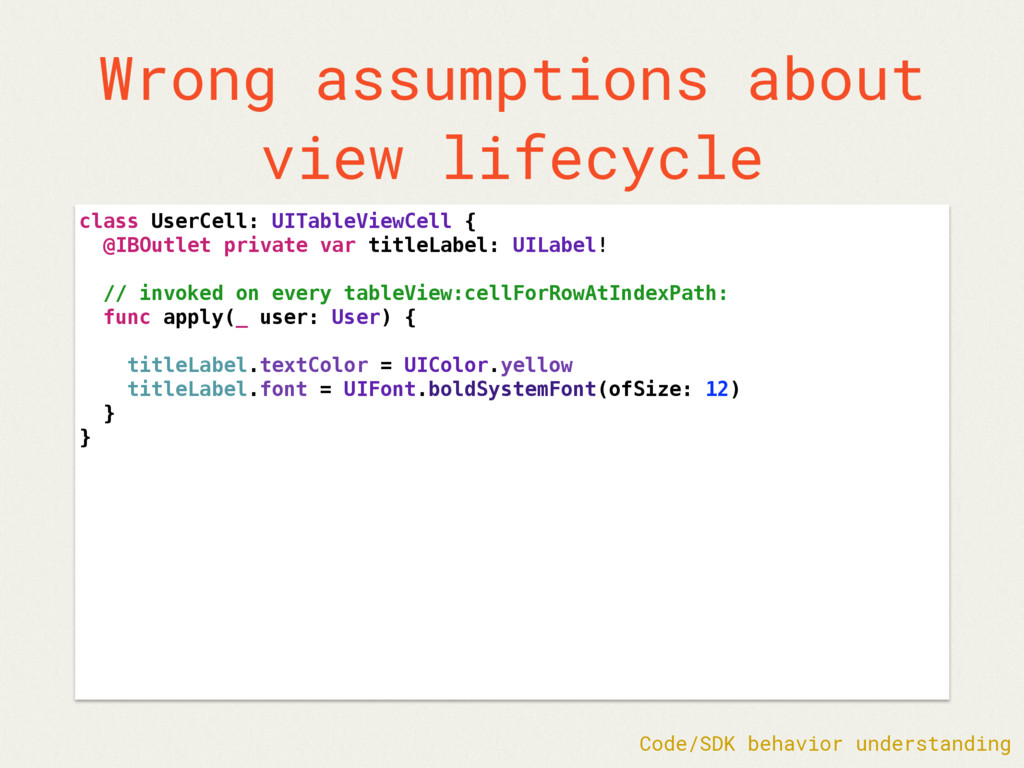
Wrong assumptions about view lifecycle class UserCell: UITableViewCell { @IBOutlet
private var titleLabel: UILabel! // invoked on every tableView:cellForRowAtIndexPath: func apply(_ user: User) { titleLabel.textColor = UIColor.yellow titleLabel.font = UIFont.boldSystemFont(ofSize: 12) } } Code/SDK behavior understanding -
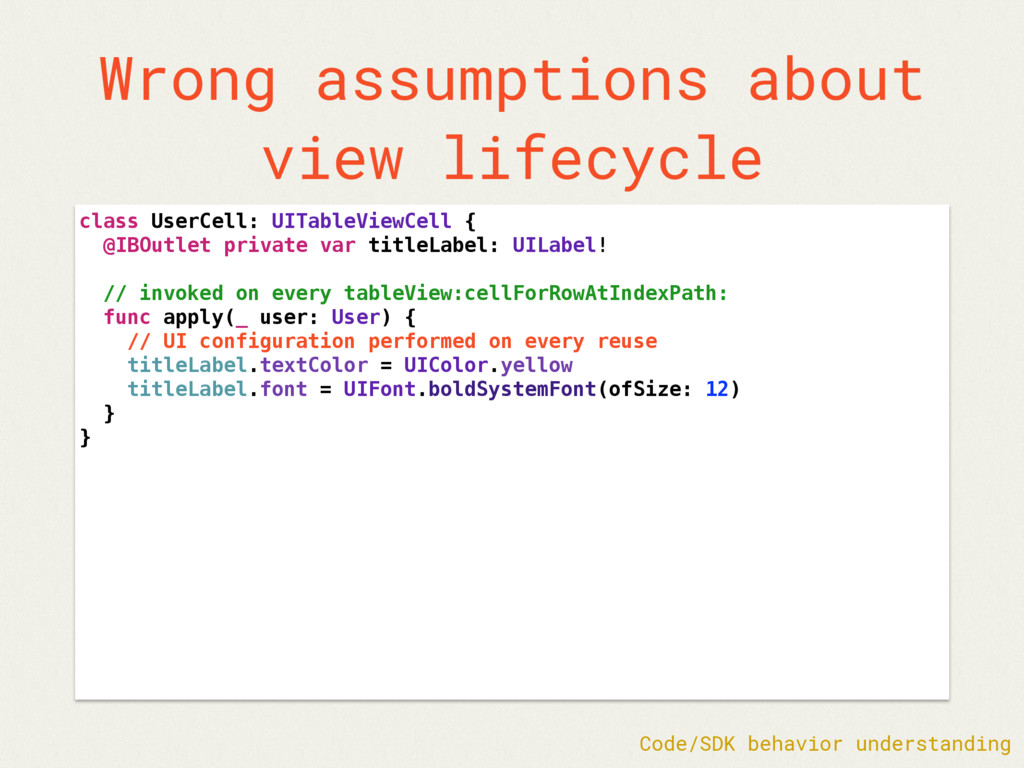
Wrong assumptions about view lifecycle class UserCell: UITableViewCell { @IBOutlet
private var titleLabel: UILabel! // invoked on every tableView:cellForRowAtIndexPath: func apply(_ user: User) { // UI configuration performed on every reuse titleLabel.textColor = UIColor.yellow titleLabel.font = UIFont.boldSystemFont(ofSize: 12) } } Code/SDK behavior understanding -
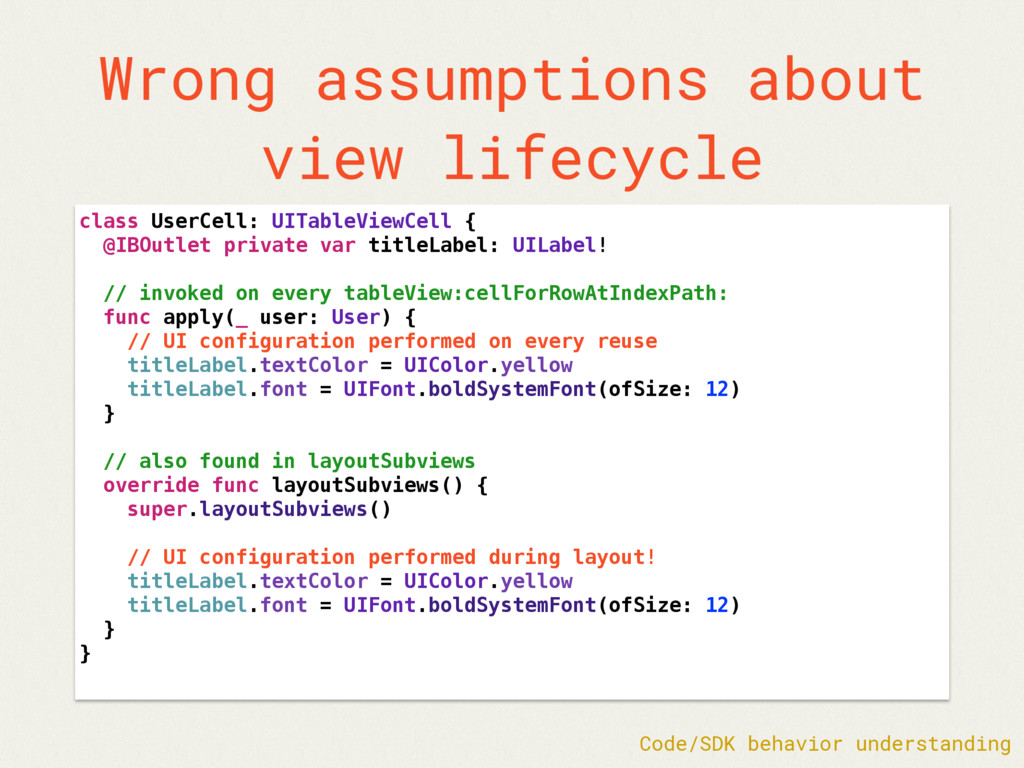
Wrong assumptions about view lifecycle class UserCell: UITableViewCell { @IBOutlet
private var titleLabel: UILabel! // invoked on every tableView:cellForRowAtIndexPath: func apply(_ user: User) { // UI configuration performed on every reuse titleLabel.textColor = UIColor.yellow titleLabel.font = UIFont.boldSystemFont(ofSize: 12) } // also found in layoutSubviews override func layoutSubviews() { super.layoutSubviews() // UI configuration performed during layout! titleLabel.textColor = UIColor.yellow titleLabel.font = UIFont.boldSystemFont(ofSize: 12) } } Code/SDK behavior understanding -
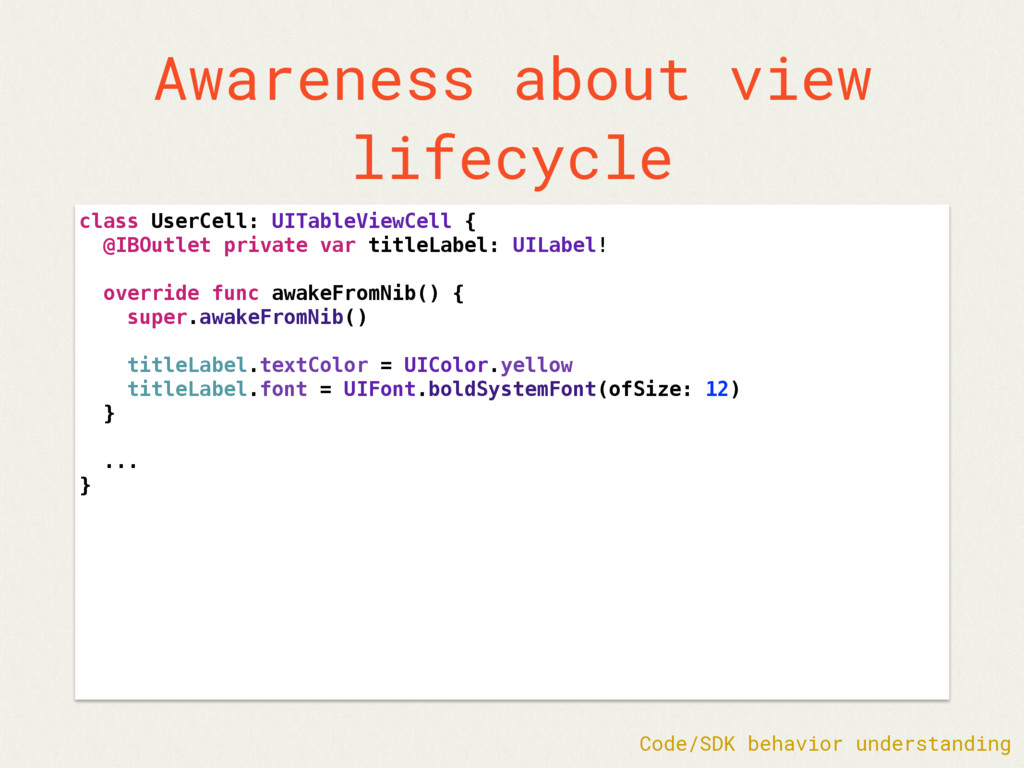
Awareness about view lifecycle class UserCell: UITableViewCell { @IBOutlet private
var titleLabel: UILabel! override func awakeFromNib() { super.awakeFromNib() titleLabel.textColor = UIColor.yellow titleLabel.font = UIFont.boldSystemFont(ofSize: 12) } ... } Code/SDK behavior understanding -
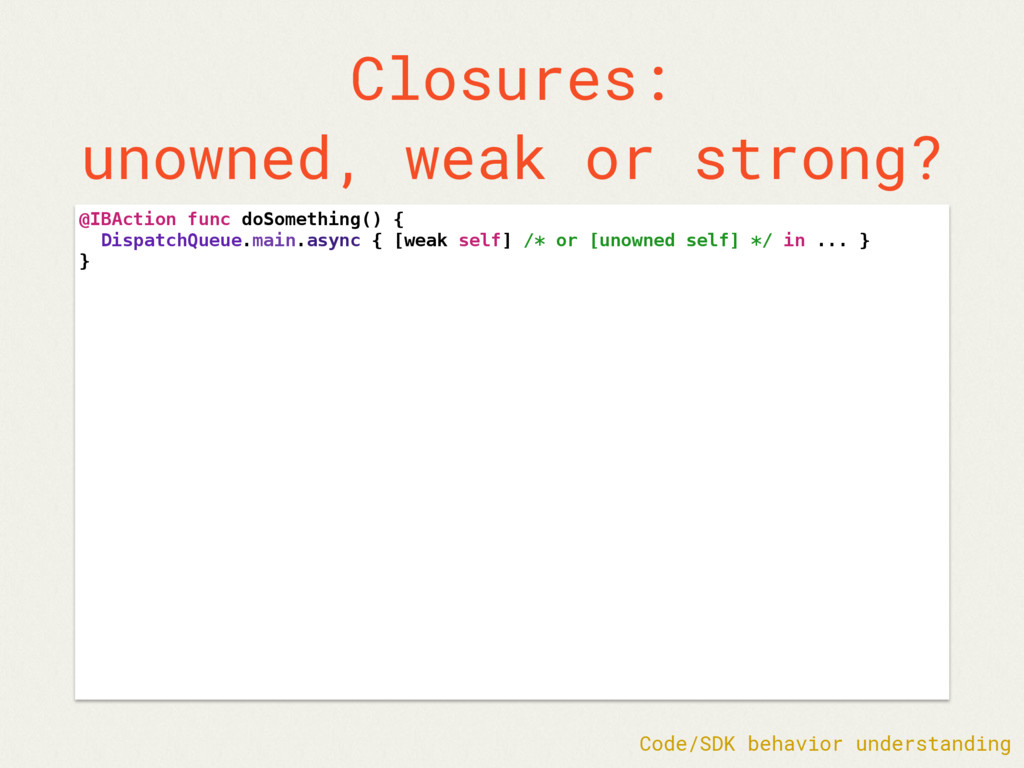
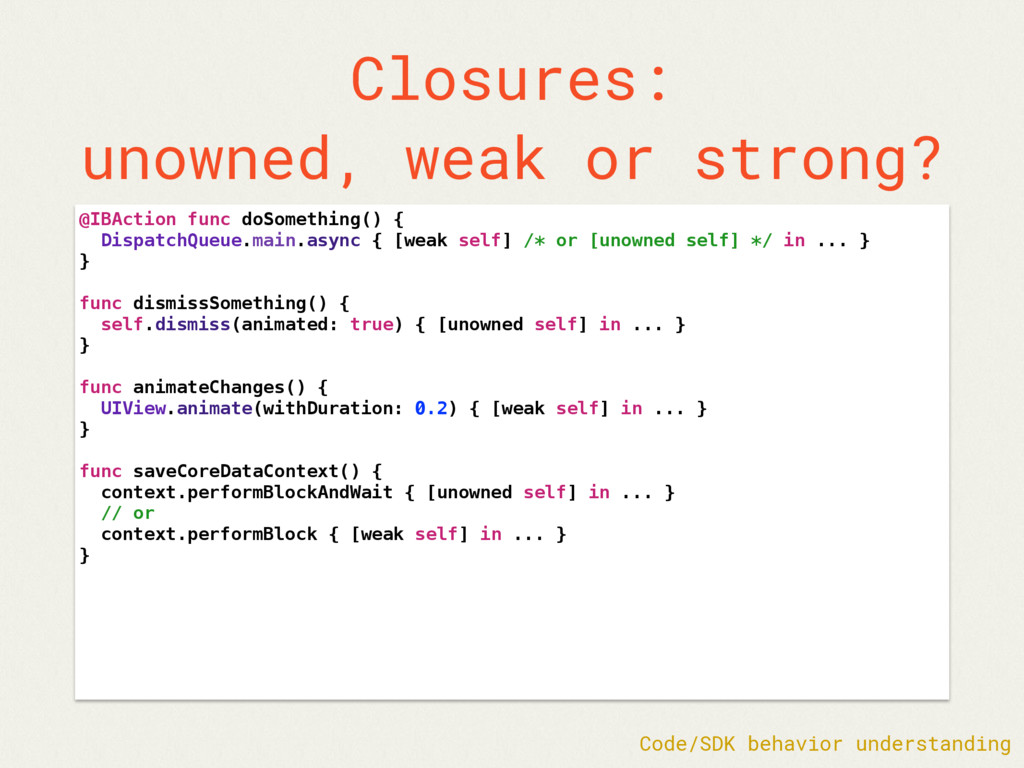
Closures: unowned, weak or strong? @IBAction func doSomething() { DispatchQueue.main.async
{ [weak self] /* or [unowned self] */ in ... } } Code/SDK behavior understanding -
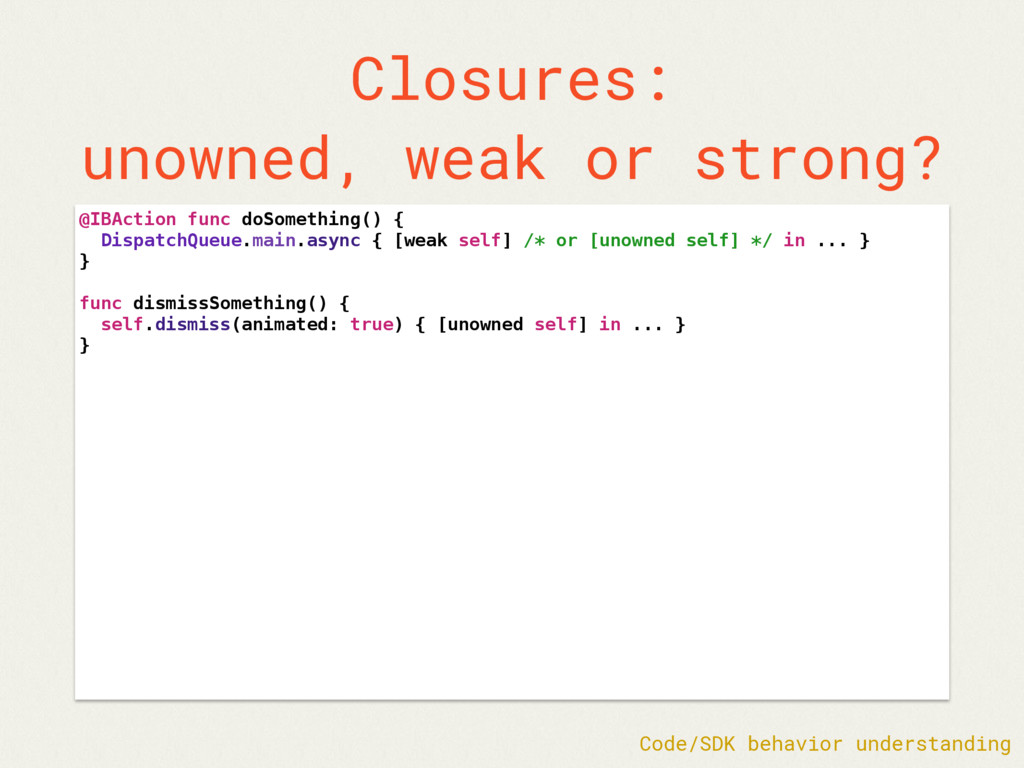
Closures: unowned, weak or strong? @IBAction func doSomething() { DispatchQueue.main.async
{ [weak self] /* or [unowned self] */ in ... } } func dismissSomething() { self.dismiss(animated: true) { [unowned self] in ... } } Code/SDK behavior understanding -
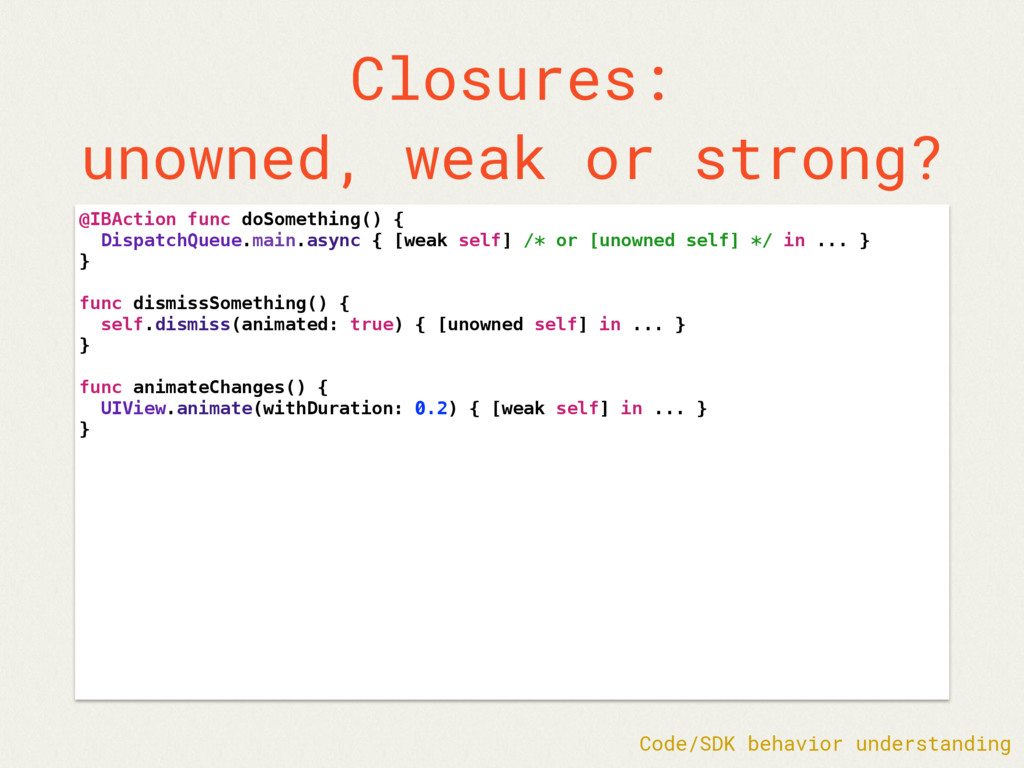
Closures: unowned, weak or strong? @IBAction func doSomething() { DispatchQueue.main.async
{ [weak self] /* or [unowned self] */ in ... } } func dismissSomething() { self.dismiss(animated: true) { [unowned self] in ... } } func animateChanges() { UIView.animate(withDuration: 0.2) { [weak self] in ... } } Code/SDK behavior understanding -
Closures: unowned, weak or strong? @IBAction func doSomething() { DispatchQueue.main.async
{ [weak self] /* or [unowned self] */ in ... } } func dismissSomething() { self.dismiss(animated: true) { [unowned self] in ... } } func animateChanges() { UIView.animate(withDuration: 0.2) { [weak self] in ... } } func saveCoreDataContext() { context.performBlockAndWait { [unowned self] in ... } // or context.performBlock { [weak self] in ... } } Code/SDK behavior understanding -
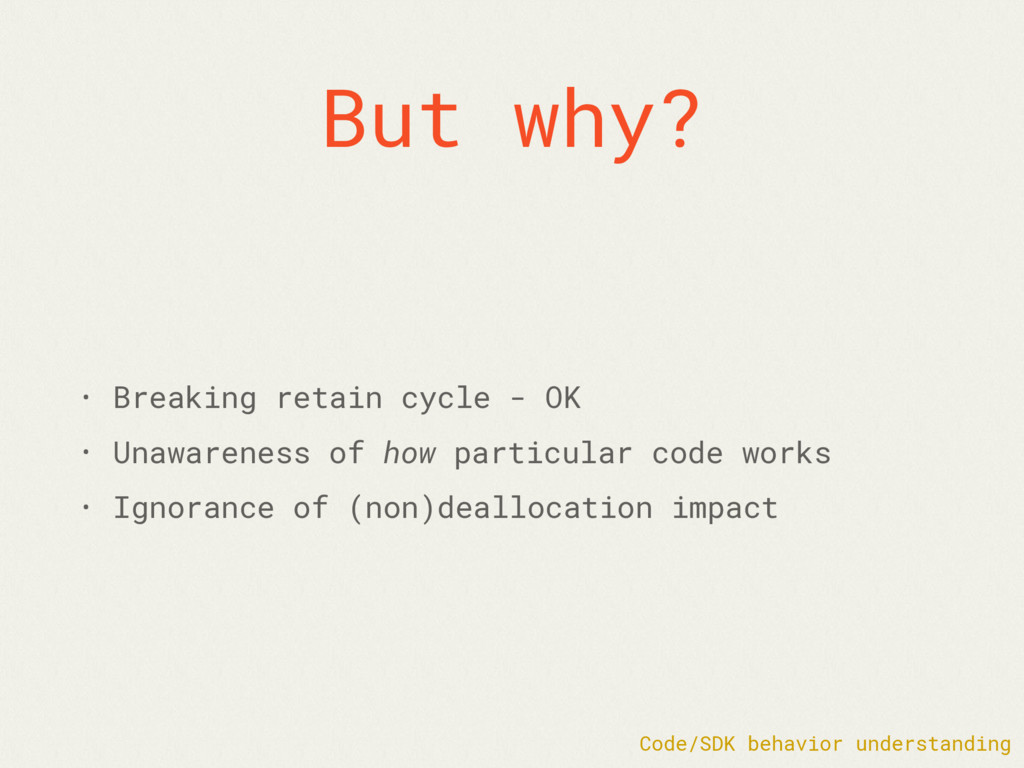
But why? • Breaking retain cycle - OK • Unawareness
of how particular code works • Ignorance of (non)deallocation impact Code/SDK behavior understanding -
But why? • Breaking retain cycle - OK • Unawareness
of how particular code works • Ignorance of (non)deallocation impact Code/SDK behavior understanding -
But why? • Breaking retain cycle - OK • Unawareness
of how particular code works • Ignorance of (non)deallocation impact Code/SDK behavior understanding -
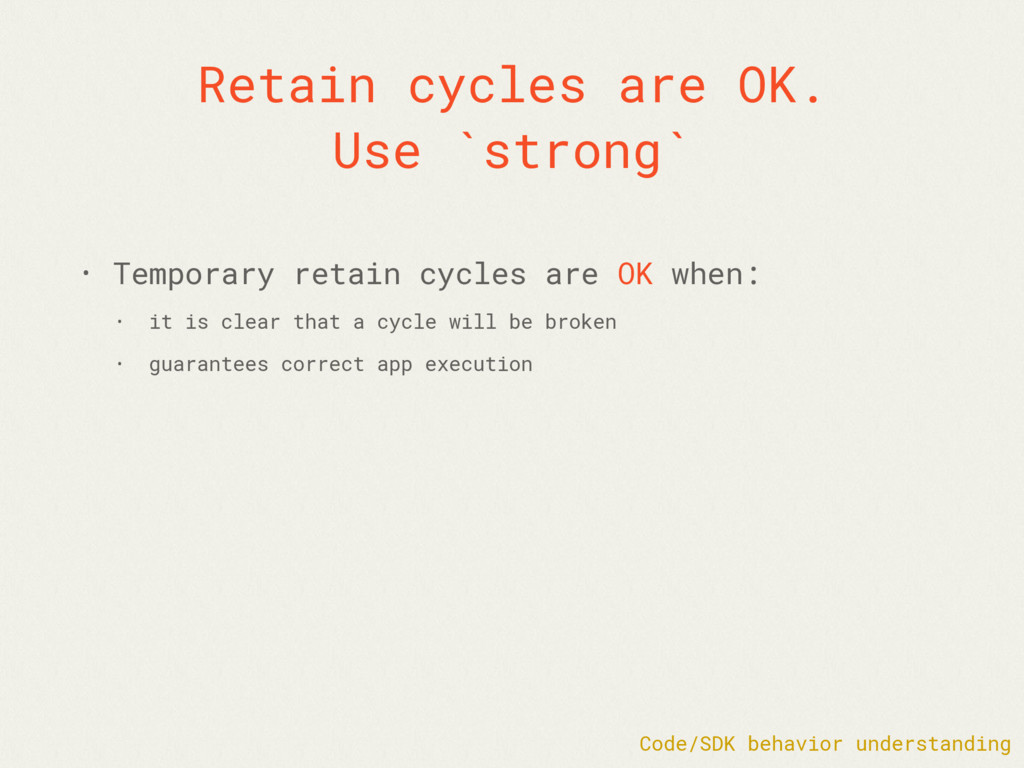
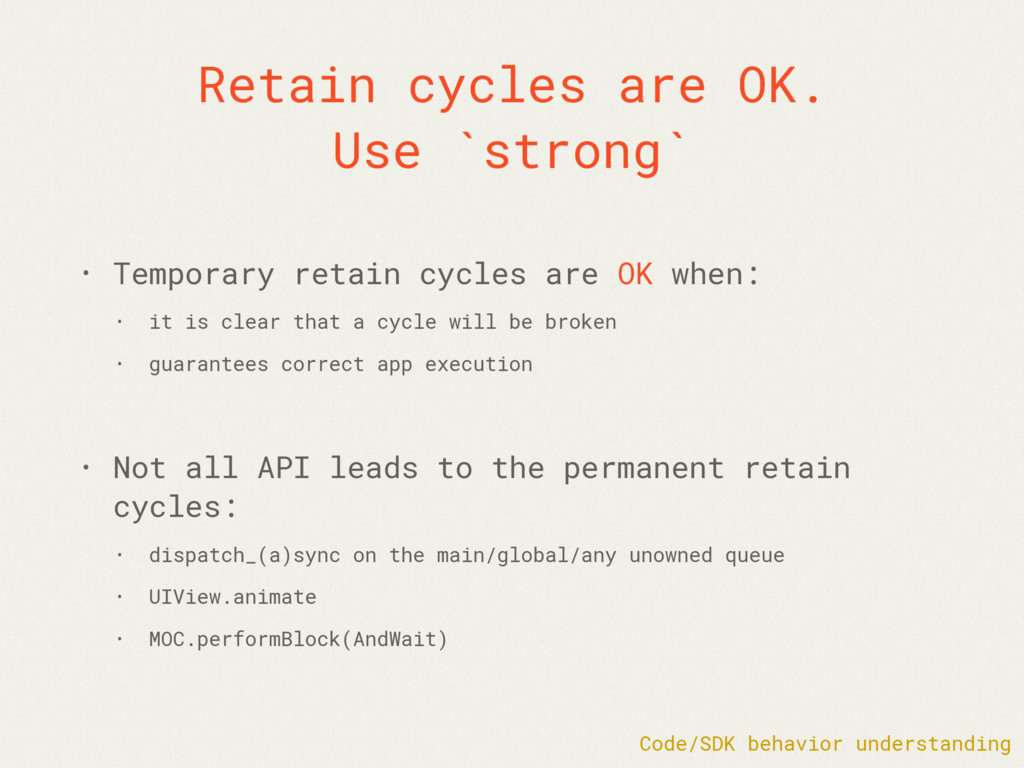
Retain cycles are OK. Use `strong` • Temporary retain cycles
are OK when: • it is clear that a cycle will be broken • guarantees correct app execution • Not all API leads to the permanent retain cycles: • dispatch_(a)sync on the main/global/any unowned queue • UIView.animate • MOC.performBlock(AndWait) Code/SDK behavior understanding -
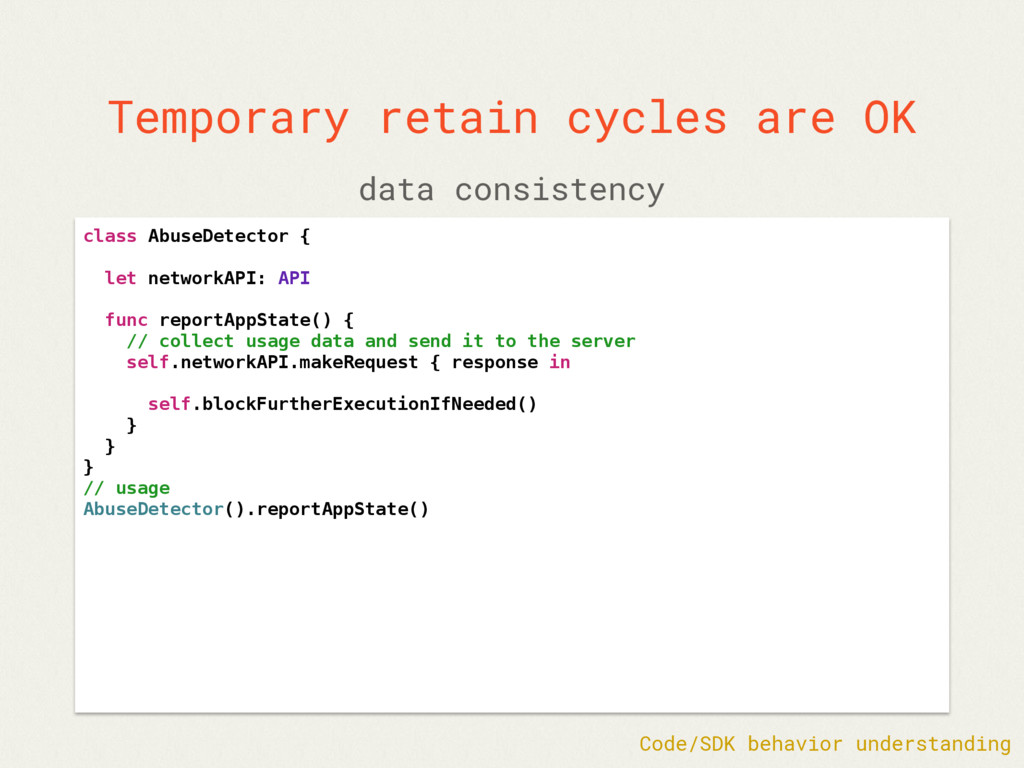
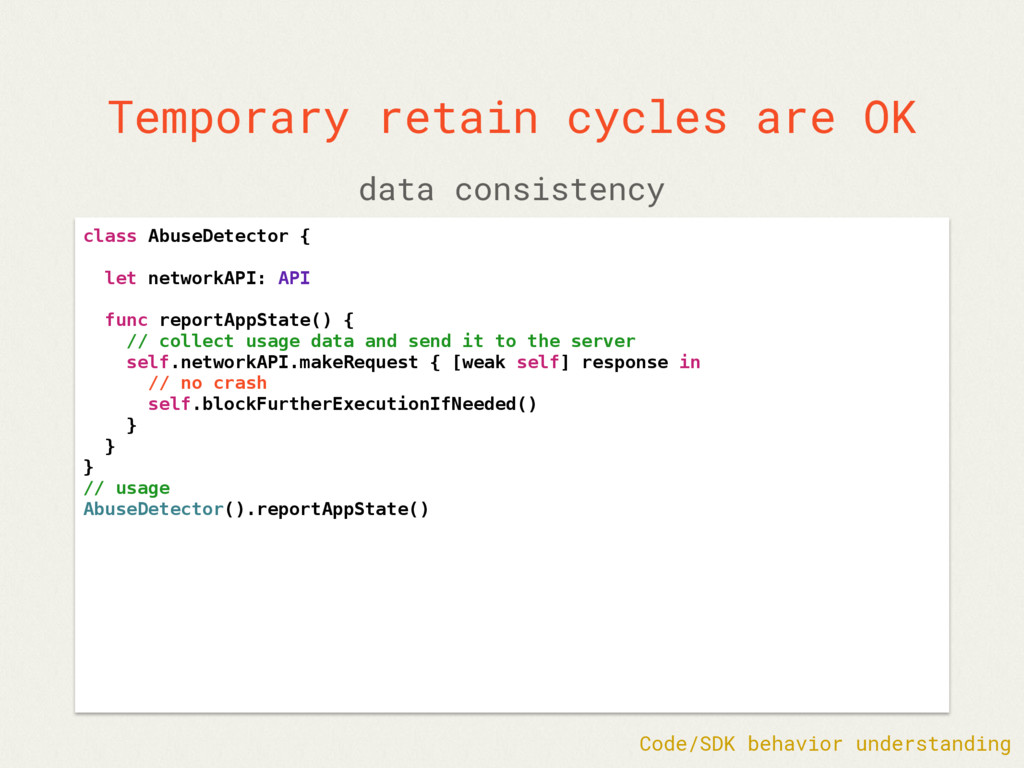
Temporary retain cycles are OK class AbuseDetector { let networkAPI:
API func reportAppState() { // collect usage data and send it to the server self.networkAPI.makeRequest { response in self.blockFurtherExecutionIfNeeded() } } } // usage AbuseDetector().reportAppState() data consistency Code/SDK behavior understanding -
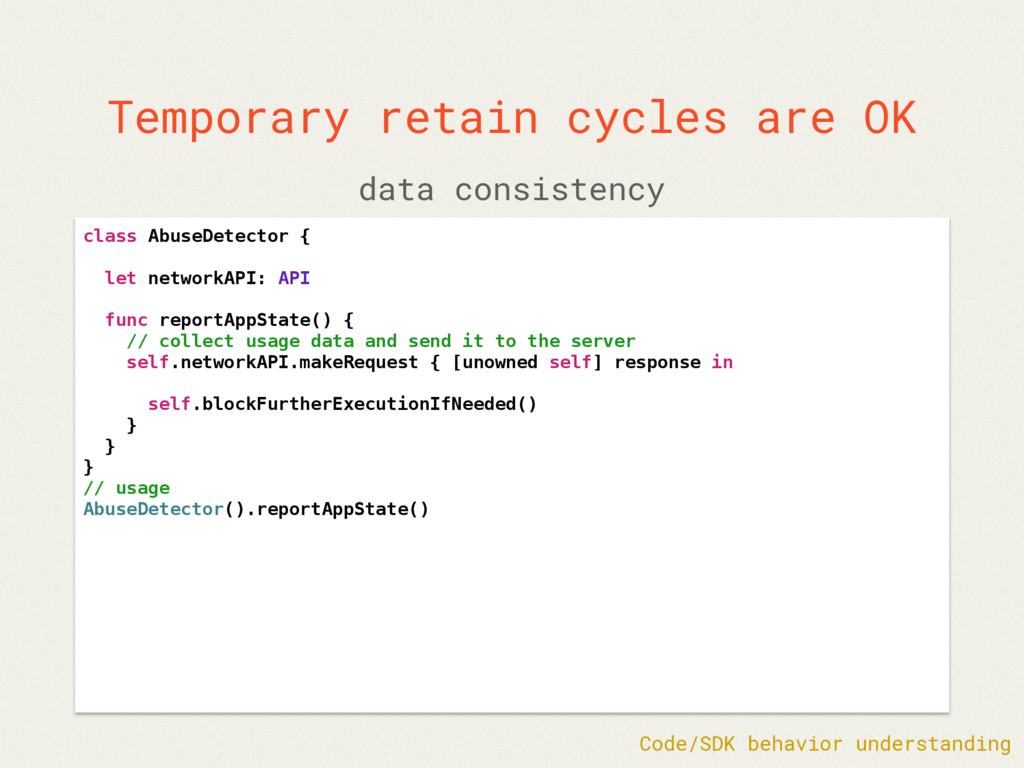
Temporary retain cycles are OK class AbuseDetector { let networkAPI:
API func reportAppState() { // collect usage data and send it to the server self.networkAPI.makeRequest { [unowned self] response in self.blockFurtherExecutionIfNeeded() } } } // usage AbuseDetector().reportAppState() data consistency Code/SDK behavior understanding -
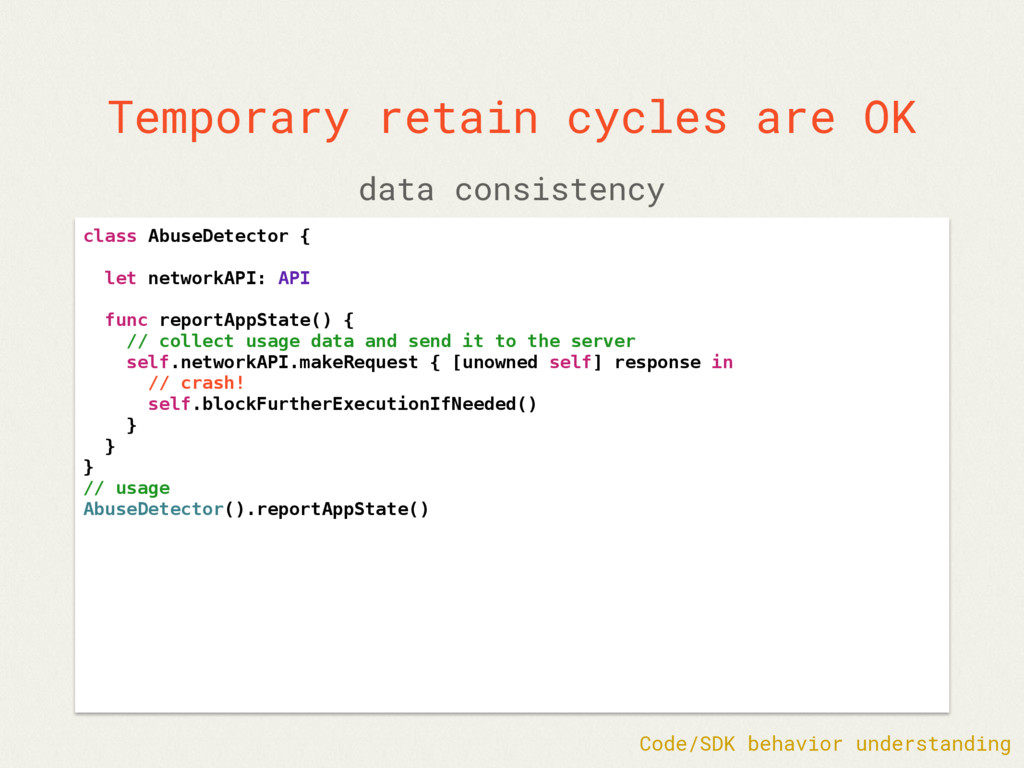
Temporary retain cycles are OK class AbuseDetector { let networkAPI:
API func reportAppState() { // collect usage data and send it to the server self.networkAPI.makeRequest { [unowned self] response in // crash! self.blockFurtherExecutionIfNeeded() } } } // usage AbuseDetector().reportAppState() data consistency Code/SDK behavior understanding -
Temporary retain cycles are OK class AbuseDetector { let networkAPI:
API func reportAppState() { // collect usage data and send it to the server self.networkAPI.makeRequest { [weak self] response in // no crash self.blockFurtherExecutionIfNeeded() } } } // usage AbuseDetector().reportAppState() data consistency Code/SDK behavior understanding -
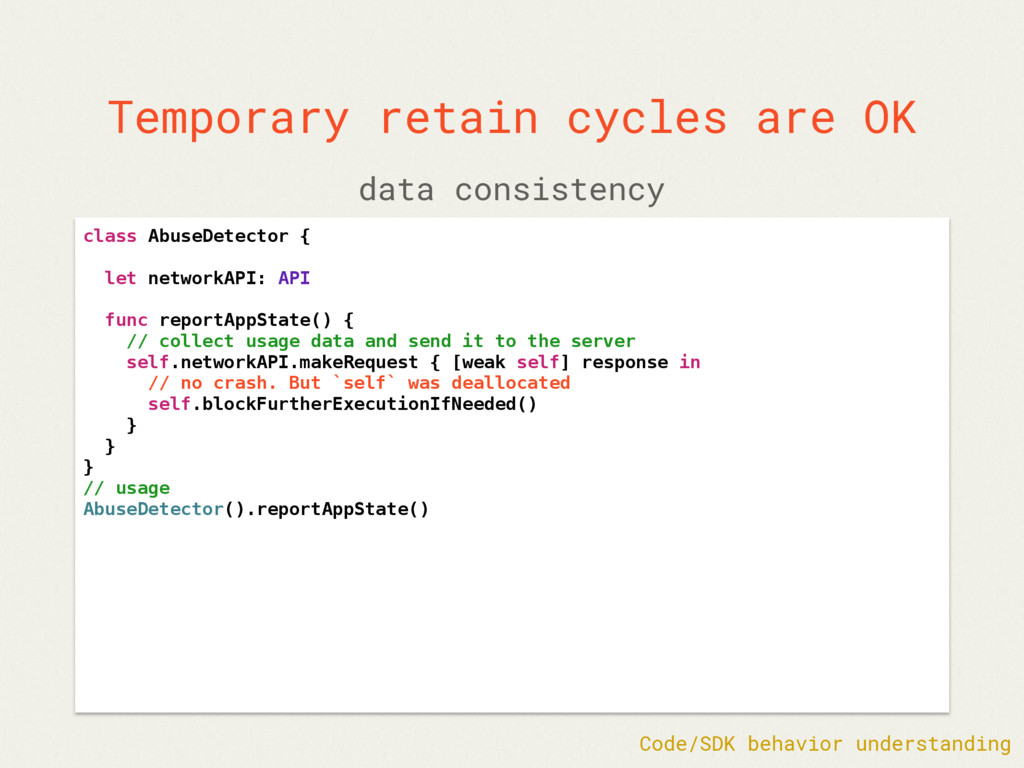
Temporary retain cycles are OK class AbuseDetector { let networkAPI:
API func reportAppState() { // collect usage data and send it to the server self.networkAPI.makeRequest { [weak self] response in // no crash. But `self` was deallocated self.blockFurtherExecutionIfNeeded() } } } // usage AbuseDetector().reportAppState() data consistency Code/SDK behavior understanding -
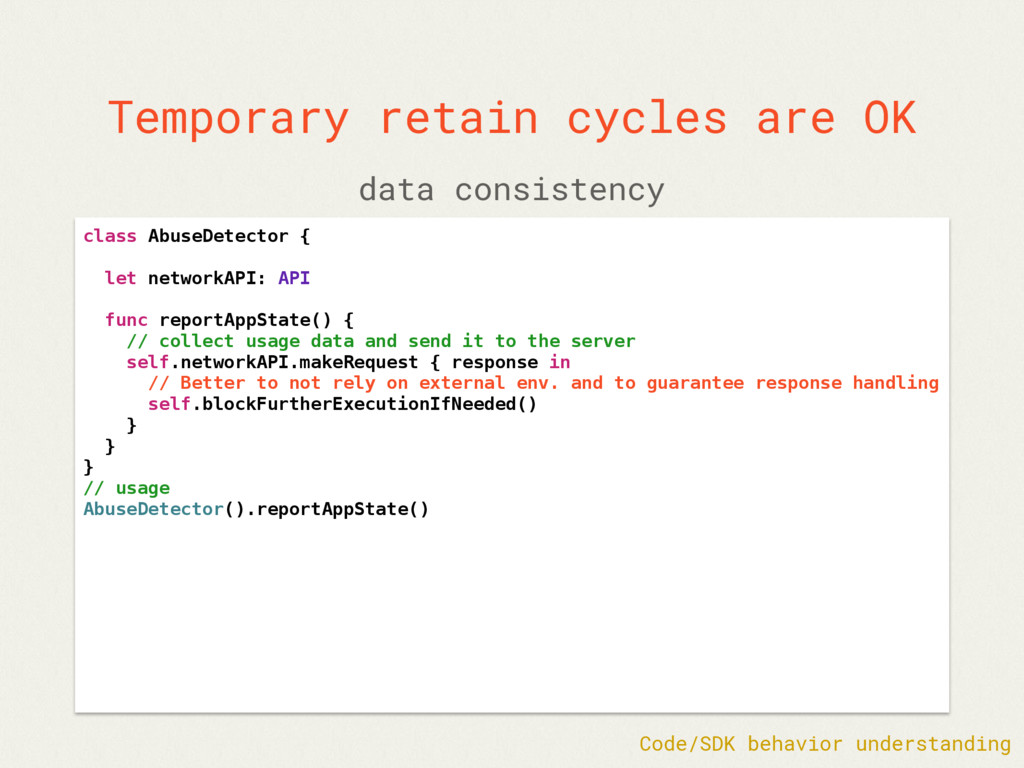
Temporary retain cycles are OK class AbuseDetector { let networkAPI:
API func reportAppState() { // collect usage data and send it to the server self.networkAPI.makeRequest { response in // Better to not rely on external env. and to guarantee response handling self.blockFurtherExecutionIfNeeded() } } } // usage AbuseDetector().reportAppState() data consistency Code/SDK behavior understanding -
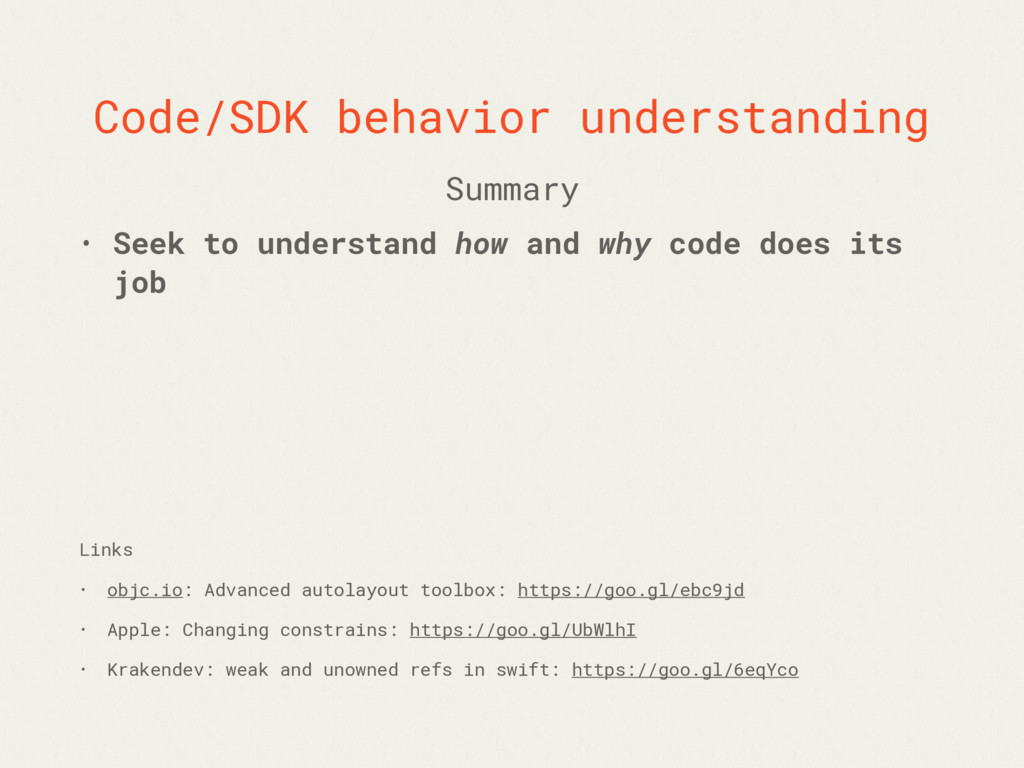
Code/SDK behavior understanding • Seek to understand how and why
code does its job • Learn tools you're using everyday • Layout cycle isn't that straightforward • Fundamentals understanding is a must • Apple Guides is worth reading Links • objc.io: Advanced autolayout toolbox: https://goo.gl/ebc9jd • Apple: Changing constrains: https://goo.gl/UbWlhI • Krakendev: weak and unowned refs in swift: https://goo.gl/6eqYco Summary -
Code/SDK behavior understanding • Seek to understand how and why
code does its job • Learn tools you're using everyday • Layout cycle isn't that straightforward • Apple Guides is worth reading Links • objc.io: Advanced autolayout toolbox: https://goo.gl/ebc9jd • Apple: Changing constrains: https://goo.gl/UbWlhI • Krakendev: weak and unowned refs in swift: https://goo.gl/6eqYco Summary -
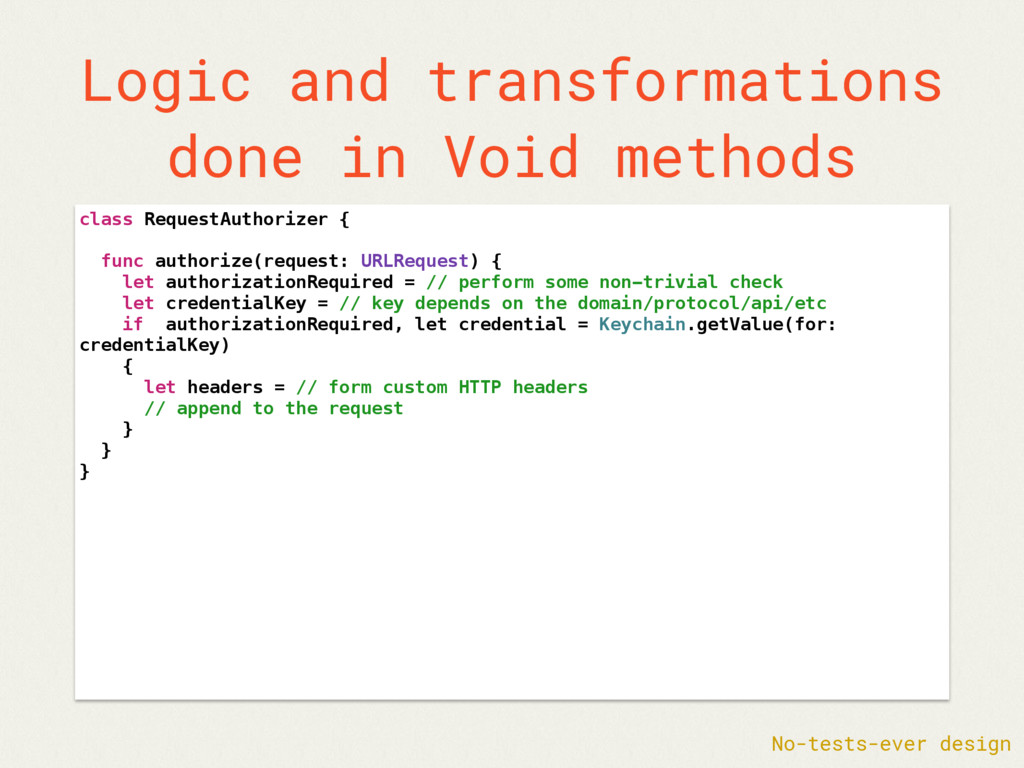
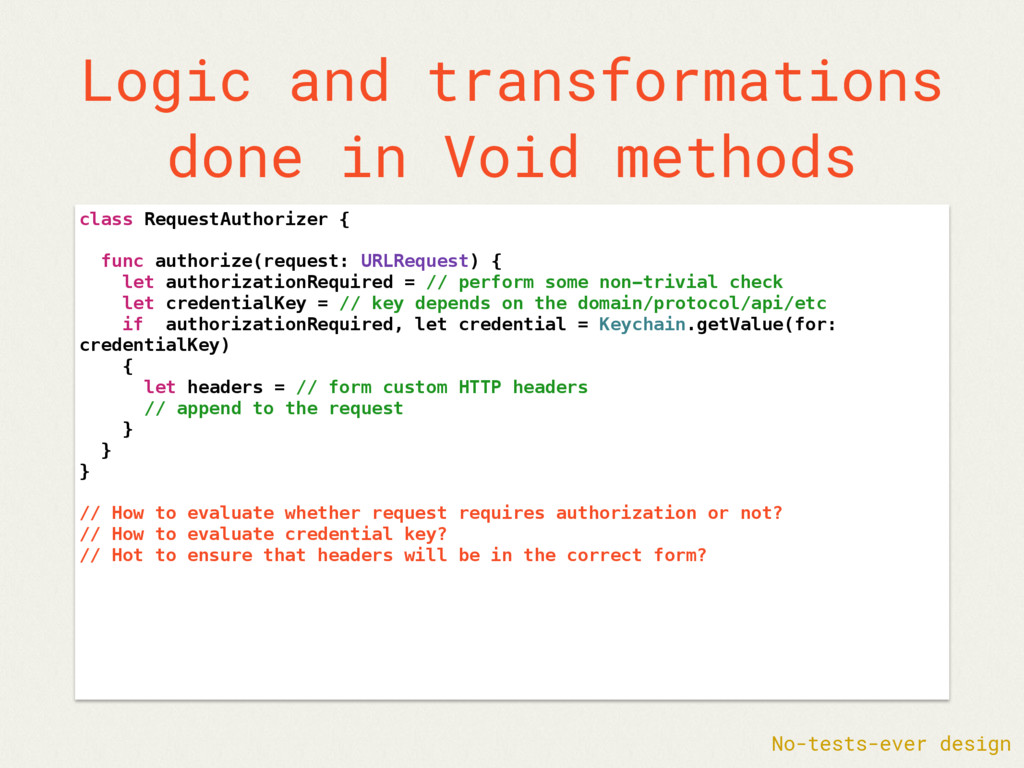
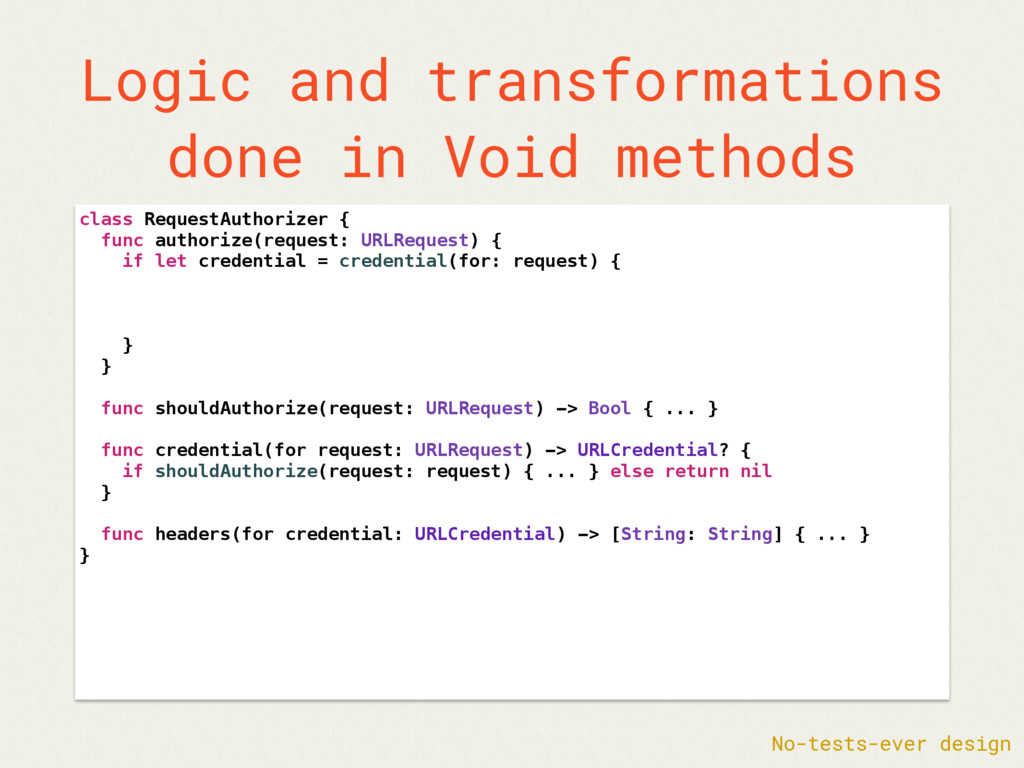
Logic and transformations done in Void methods class RequestAuthorizer {
func authorize(request: URLRequest) { let authorizationRequired = // perform some non-trivial check let credentialKey = // key depends on the domain/protocol/api/etc if authorizationRequired, let credential = Keychain.getValue(for: credentialKey) { let headers = // form custom HTTP headers // append to the request } } } No-tests-ever design -
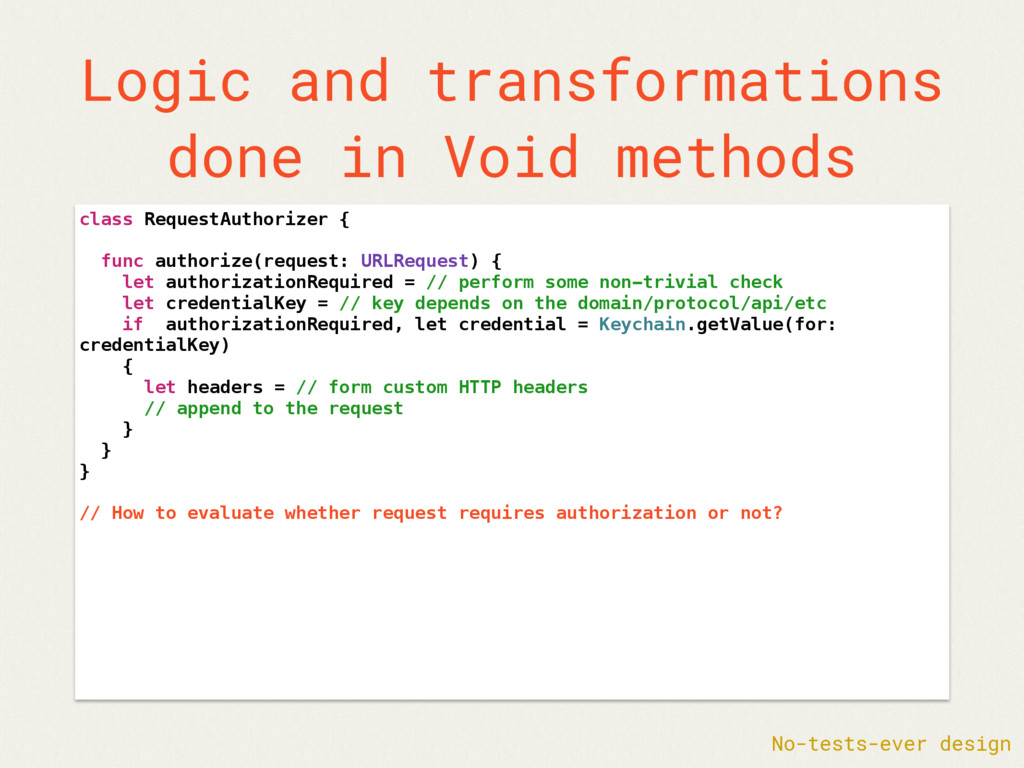
Logic and transformations done in Void methods class RequestAuthorizer {
func authorize(request: URLRequest) { let authorizationRequired = // perform some non-trivial check let credentialKey = // key depends on the domain/protocol/api/etc if authorizationRequired, let credential = Keychain.getValue(for: credentialKey) { let headers = // form custom HTTP headers // append to the request } } } // How to evaluate whether request requires authorization or not? No-tests-ever design -
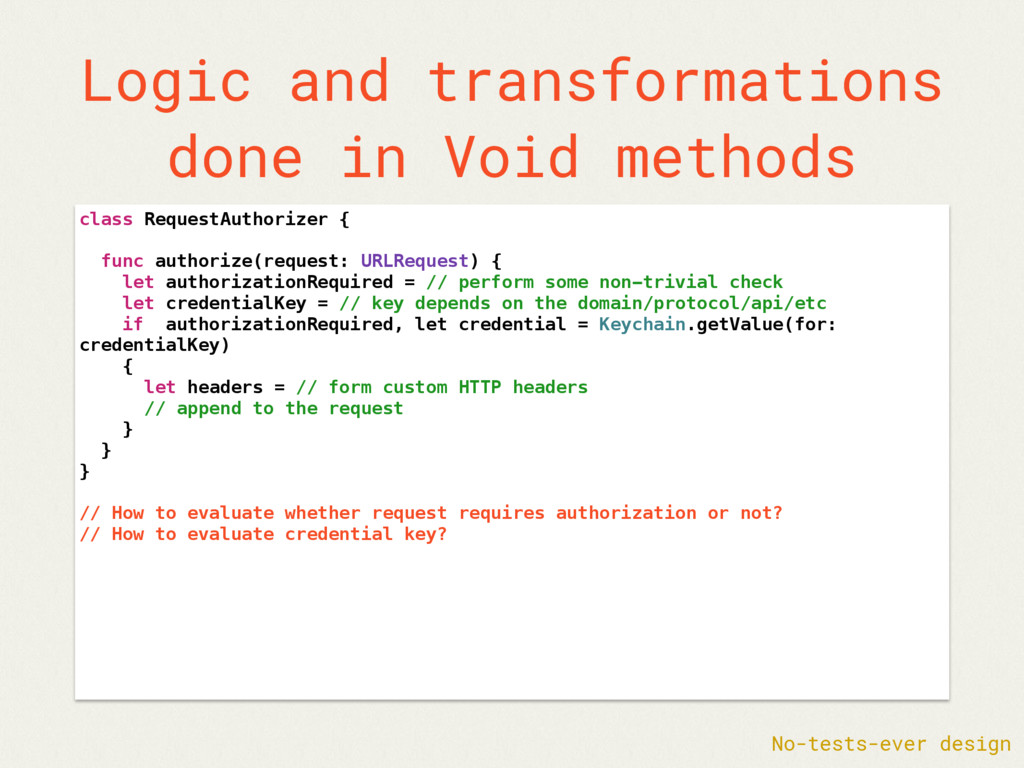
Logic and transformations done in Void methods class RequestAuthorizer {
func authorize(request: URLRequest) { let authorizationRequired = // perform some non-trivial check let credentialKey = // key depends on the domain/protocol/api/etc if authorizationRequired, let credential = Keychain.getValue(for: credentialKey) { let headers = // form custom HTTP headers // append to the request } } } // How to evaluate whether request requires authorization or not? // How to evaluate credential key? No-tests-ever design -
Logic and transformations done in Void methods class RequestAuthorizer {
func authorize(request: URLRequest) { let authorizationRequired = // perform some non-trivial check let credentialKey = // key depends on the domain/protocol/api/etc if authorizationRequired, let credential = Keychain.getValue(for: credentialKey) { let headers = // form custom HTTP headers // append to the request } } } // How to evaluate whether request requires authorization or not? // How to evaluate credential key? // Hot to ensure that headers will be in the correct form? No-tests-ever design -
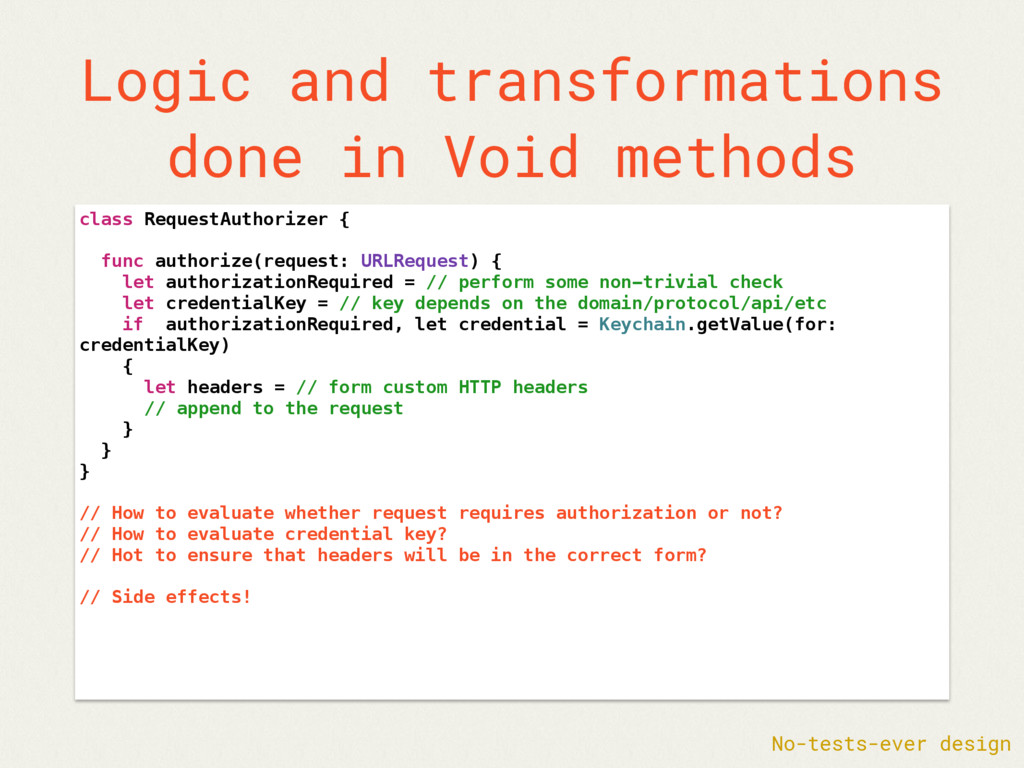
Logic and transformations done in Void methods class RequestAuthorizer {
func authorize(request: URLRequest) { let authorizationRequired = // perform some non-trivial check let credentialKey = // key depends on the domain/protocol/api/etc if authorizationRequired, let credential = Keychain.getValue(for: credentialKey) { let headers = // form custom HTTP headers // append to the request } } } // How to evaluate whether request requires authorization or not? // How to evaluate credential key? // Hot to ensure that headers will be in the correct form? // Side effects! No-tests-ever design -
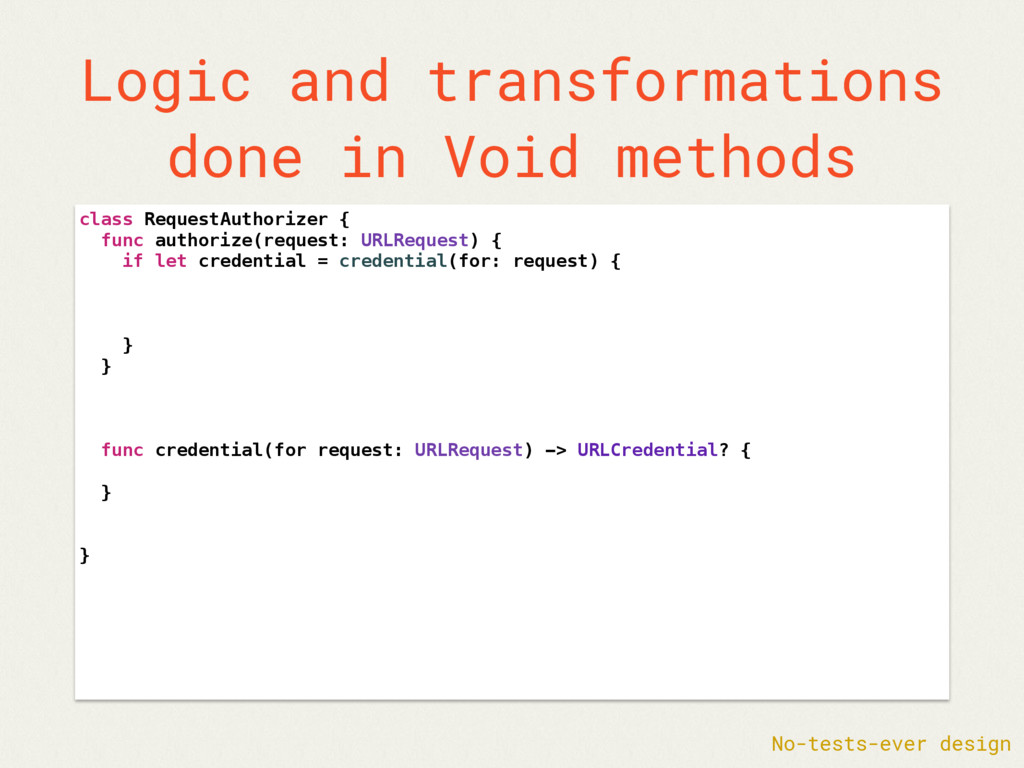
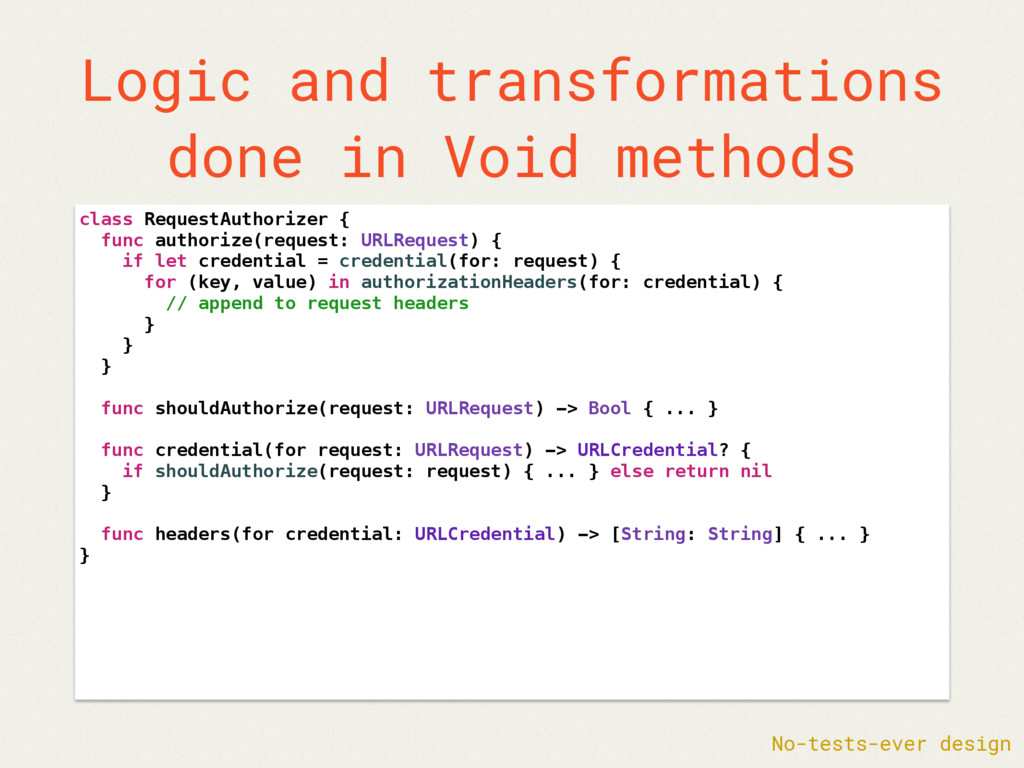
Logic and transformations done in Void methods class RequestAuthorizer {
func authorize(request: URLRequest) { if let credential = credential(for: request) { for (key, value) in authorizationHeaders(for: credential) { // append to request headers } } } func shouldAuthorize(request: URLRequest) -> Bool { ... } func credential(for request: URLRequest) -> URLCredential? { if shouldAuthorize(request: request) { ... } else return nil } func headers(for credential: URLCredential) -> [String: String] { ... } } No-tests-ever design -
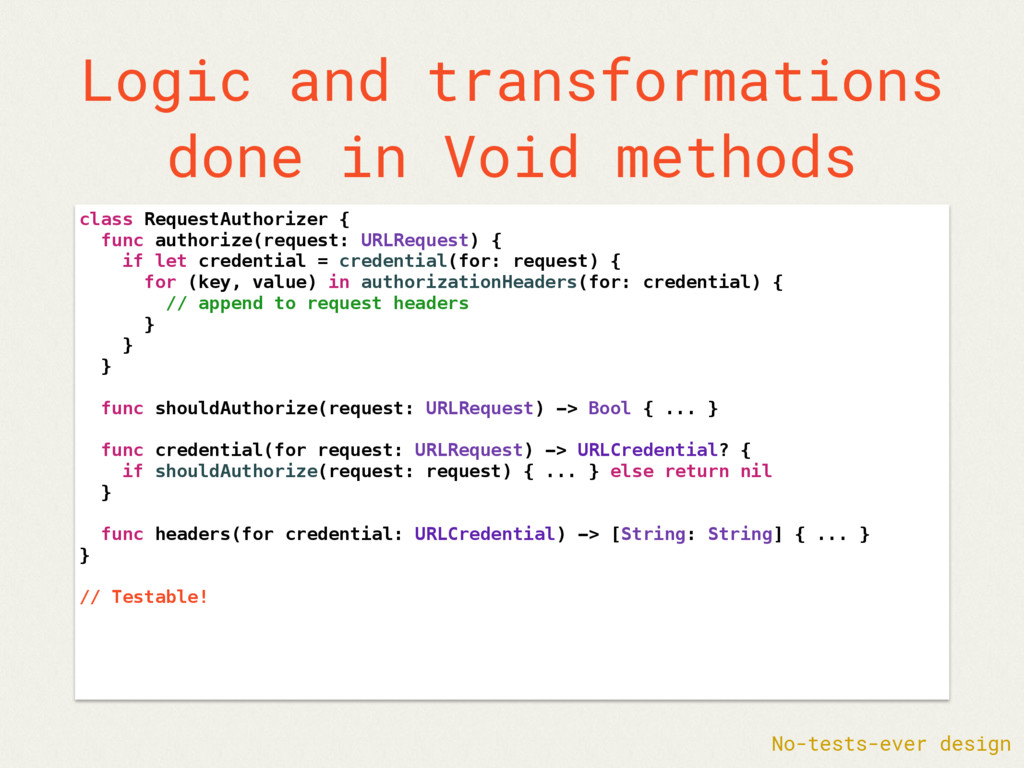
Logic and transformations done in Void methods class RequestAuthorizer {
func authorize(request: URLRequest) { if let credential = credential(for: request) { for (key, value) in authorizationHeaders(for: credential) { // append to request headers } } } func shouldAuthorize(request: URLRequest) -> Bool { ... } func credential(for request: URLRequest) -> URLCredential? { if shouldAuthorize(request: request) { ... } else return nil } func headers(for credential: URLCredential) -> [String: String] { ... } } // Testable! No-tests-ever design -
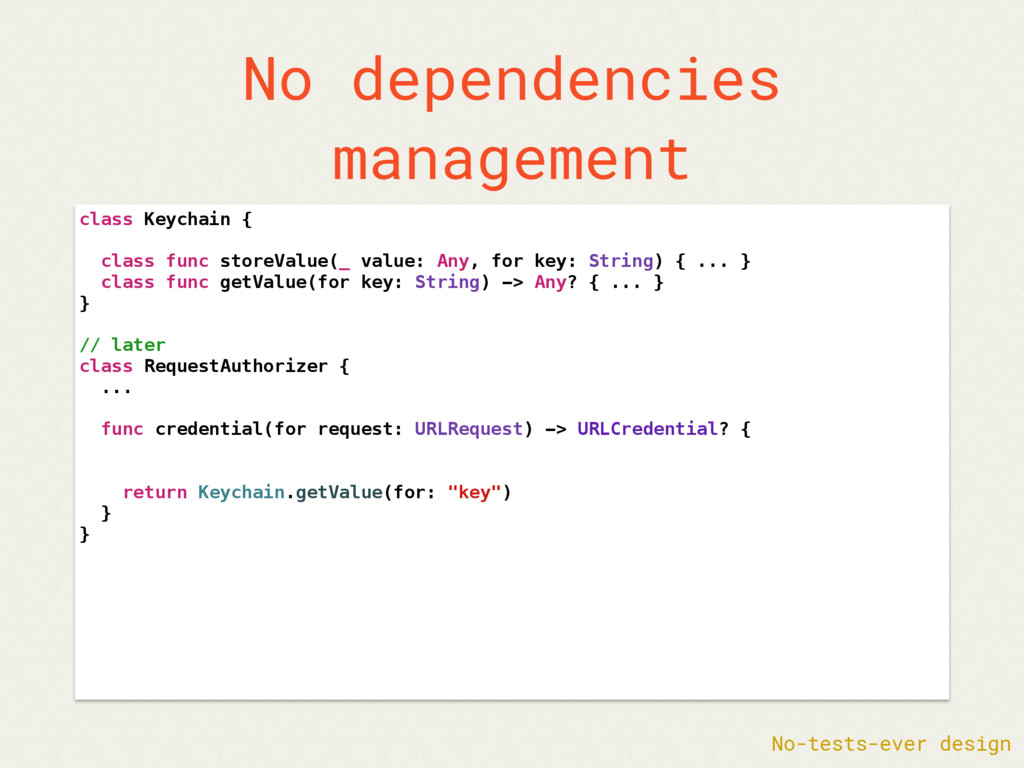
No dependencies management class Keychain { class func storeValue(_ value:
Any, for key: String) { ... } class func getValue(for key: String) -> Any? { ... } } // later class RequestAuthorizer { ... func credential(for request: URLRequest) -> URLCredential? { return Keychain.getValue(for: "key") } } No-tests-ever design -
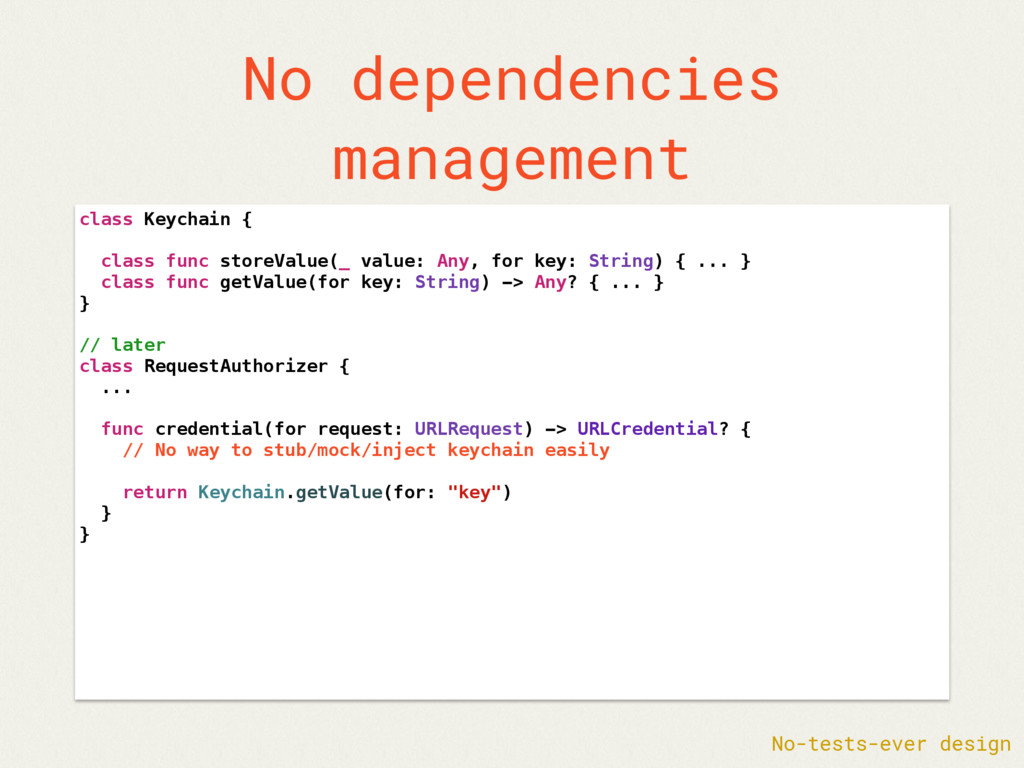
No dependencies management class Keychain { class func storeValue(_ value:
Any, for key: String) { ... } class func getValue(for key: String) -> Any? { ... } } // later class RequestAuthorizer { ... func credential(for request: URLRequest) -> URLCredential? { // No way to stub/mock/inject keychain easily return Keychain.getValue(for: "key") } } No-tests-ever design -
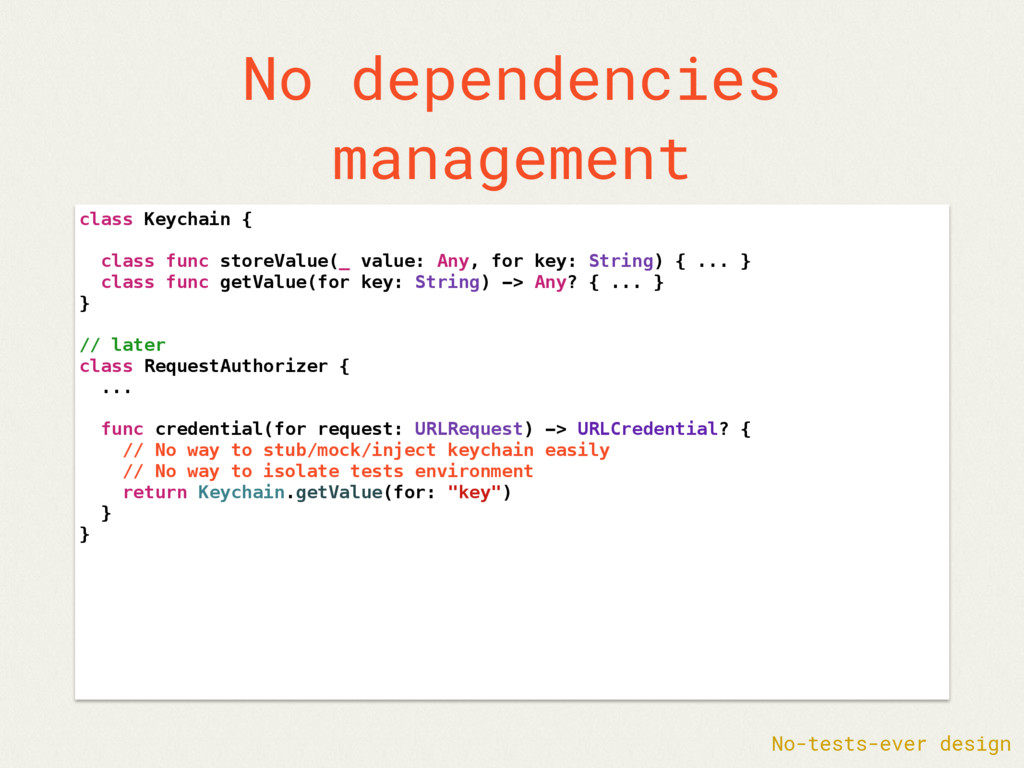
No dependencies management class Keychain { class func storeValue(_ value:
Any, for key: String) { ... } class func getValue(for key: String) -> Any? { ... } } // later class RequestAuthorizer { ... func credential(for request: URLRequest) -> URLCredential? { // No way to stub/mock/inject keychain easily // No way to isolate tests environment return Keychain.getValue(for: "key") } } No-tests-ever design -
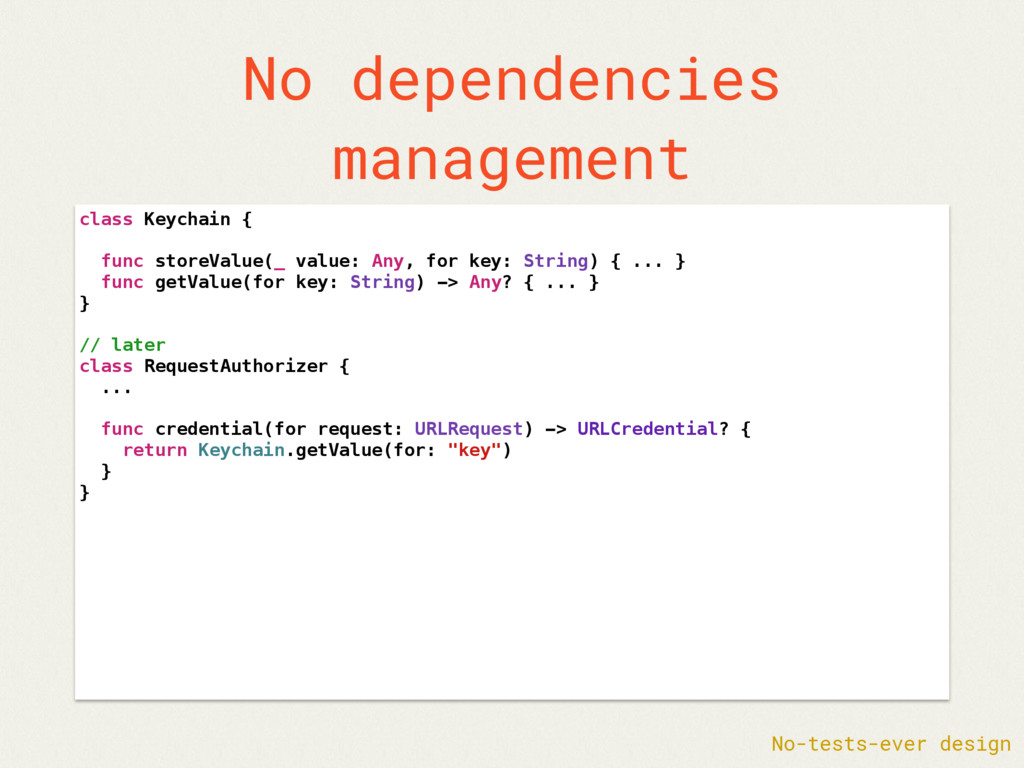
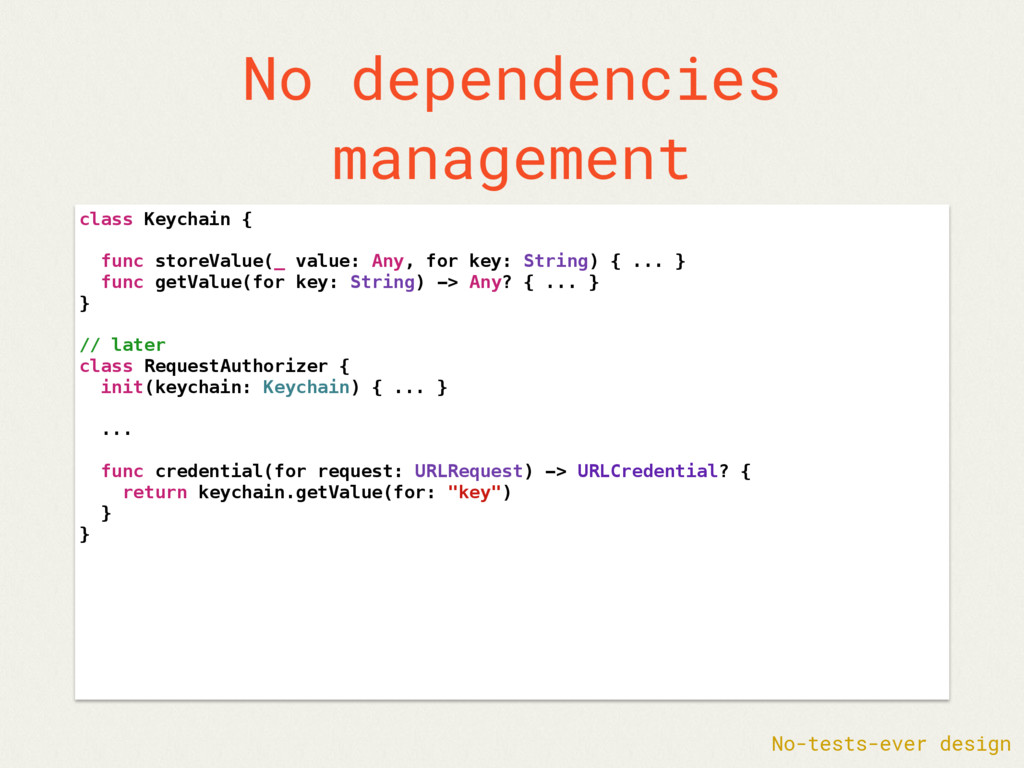
No dependencies management class Keychain { func storeValue(_ value: Any,
for key: String) { ... } func getValue(for key: String) -> Any? { ... } } // later class RequestAuthorizer { ... func credential(for request: URLRequest) -> URLCredential? { return Keychain.getValue(for: "key") } } No-tests-ever design -
No dependencies management class Keychain { func storeValue(_ value: Any,
for key: String) { ... } func getValue(for key: String) -> Any? { ... } } // later class RequestAuthorizer { init(keychain: Keychain) { ... } ... func credential(for request: URLRequest) -> URLCredential? { return keychain.getValue(for: "key") } } No-tests-ever design -
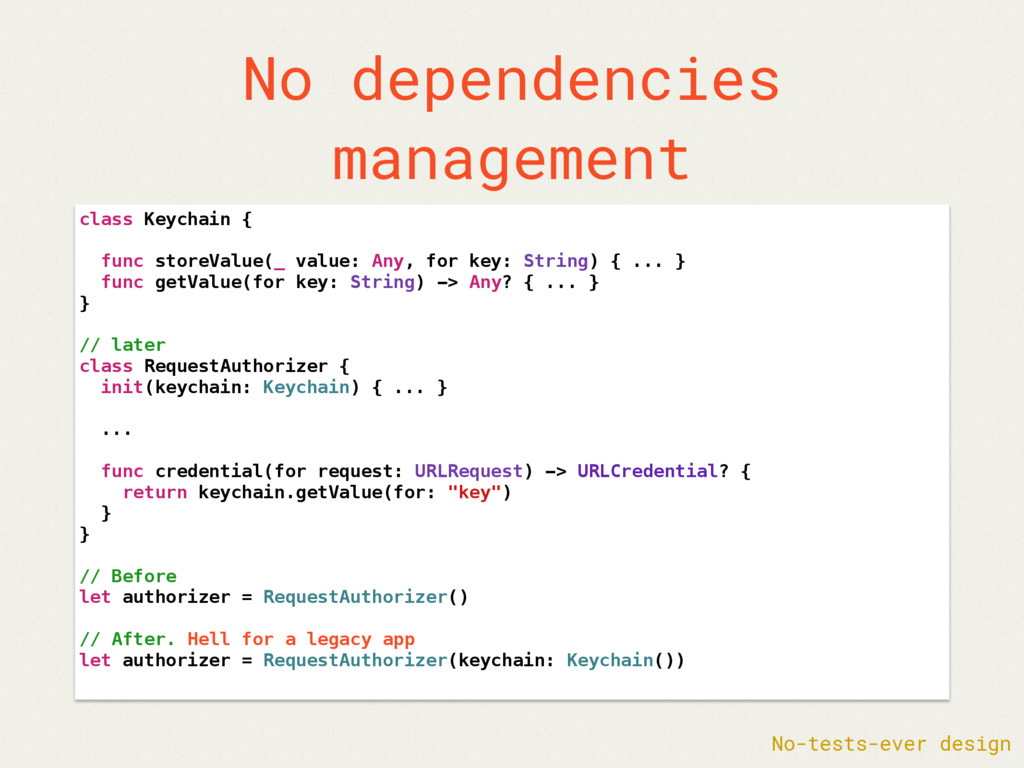
No dependencies management class Keychain { func storeValue(_ value: Any,
for key: String) { ... } func getValue(for key: String) -> Any? { ... } } // later class RequestAuthorizer { init(keychain: Keychain) { ... } ... func credential(for request: URLRequest) -> URLCredential? { return keychain.getValue(for: "key") } } // Before let authorizer = RequestAuthorizer() // After. Hell for a legacy app let authorizer = RequestAuthorizer(keychain: Keychain()) No-tests-ever design -
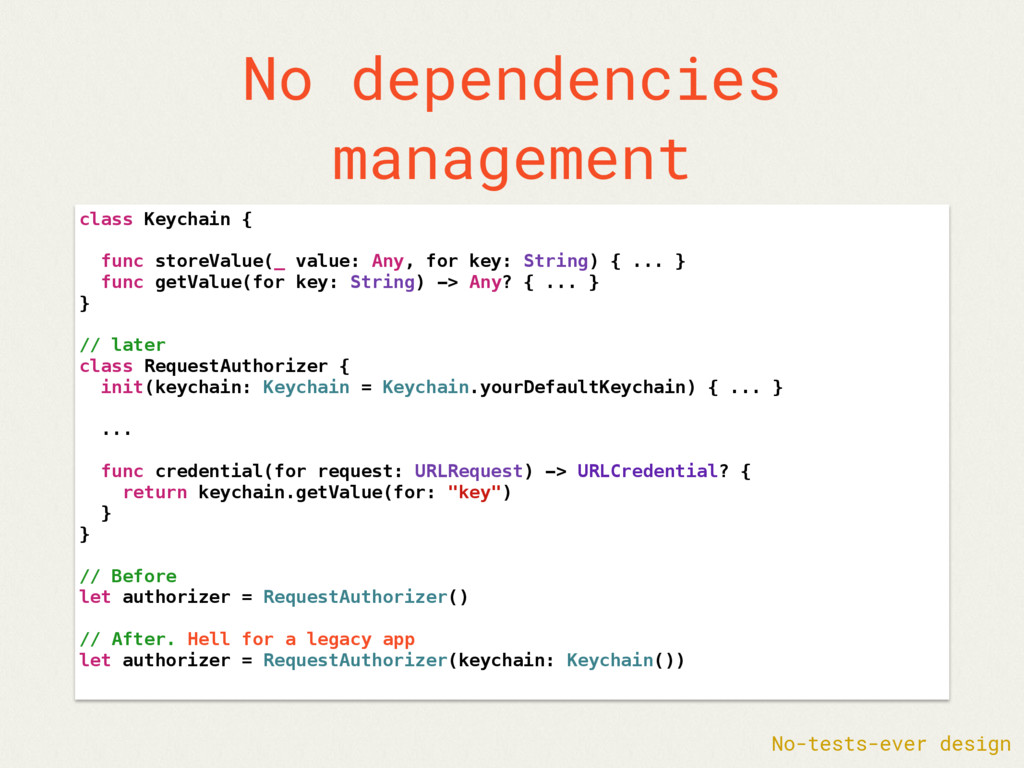
No dependencies management class Keychain { func storeValue(_ value: Any,
for key: String) { ... } func getValue(for key: String) -> Any? { ... } } // later class RequestAuthorizer { init(keychain: Keychain = Keychain.yourDefaultKeychain) { ... } ... func credential(for request: URLRequest) -> URLCredential? { return keychain.getValue(for: "key") } } // Before let authorizer = RequestAuthorizer() // After. Hell for a legacy app let authorizer = RequestAuthorizer(keychain: Keychain()) No-tests-ever design -
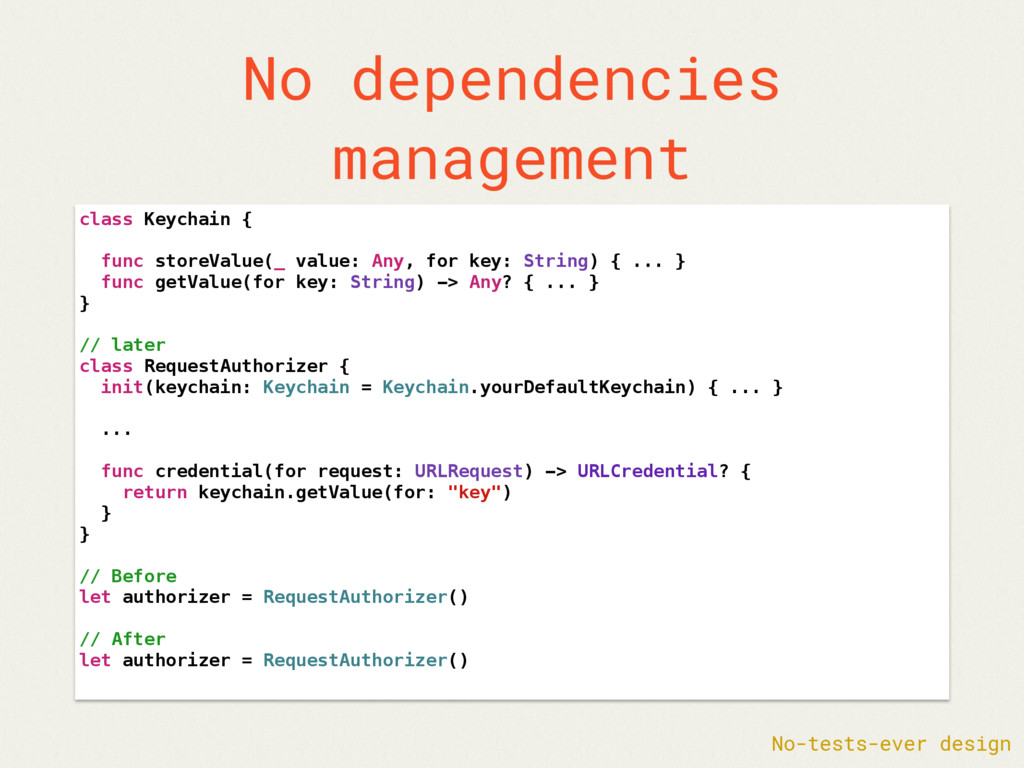
No dependencies management class Keychain { func storeValue(_ value: Any,
for key: String) { ... } func getValue(for key: String) -> Any? { ... } } // later class RequestAuthorizer { init(keychain: Keychain = Keychain.yourDefaultKeychain) { ... } ... func credential(for request: URLRequest) -> URLCredential? { return keychain.getValue(for: "key") } } // Before let authorizer = RequestAuthorizer() // After let authorizer = RequestAuthorizer() No-tests-ever design -
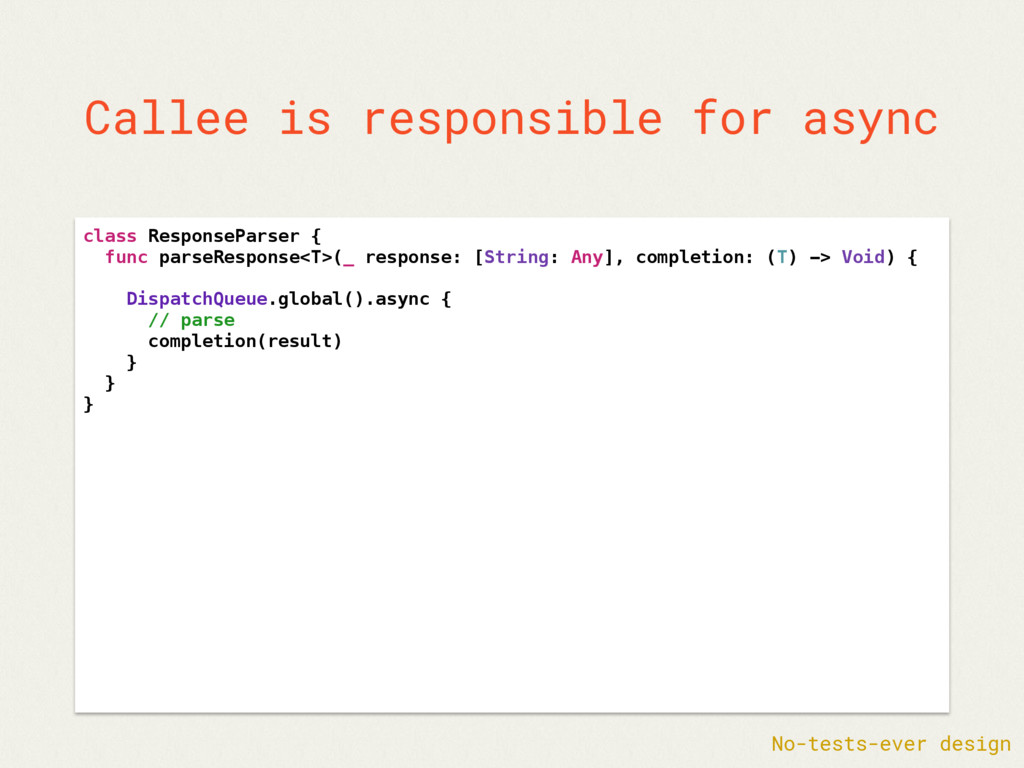
Callee is responsible for async class ResponseParser { func parseResponse<T>(_
response: [String: Any], completion: (T) -> Void) { DispatchQueue.global().async { // parse completion(result) } } } No-tests-ever design -
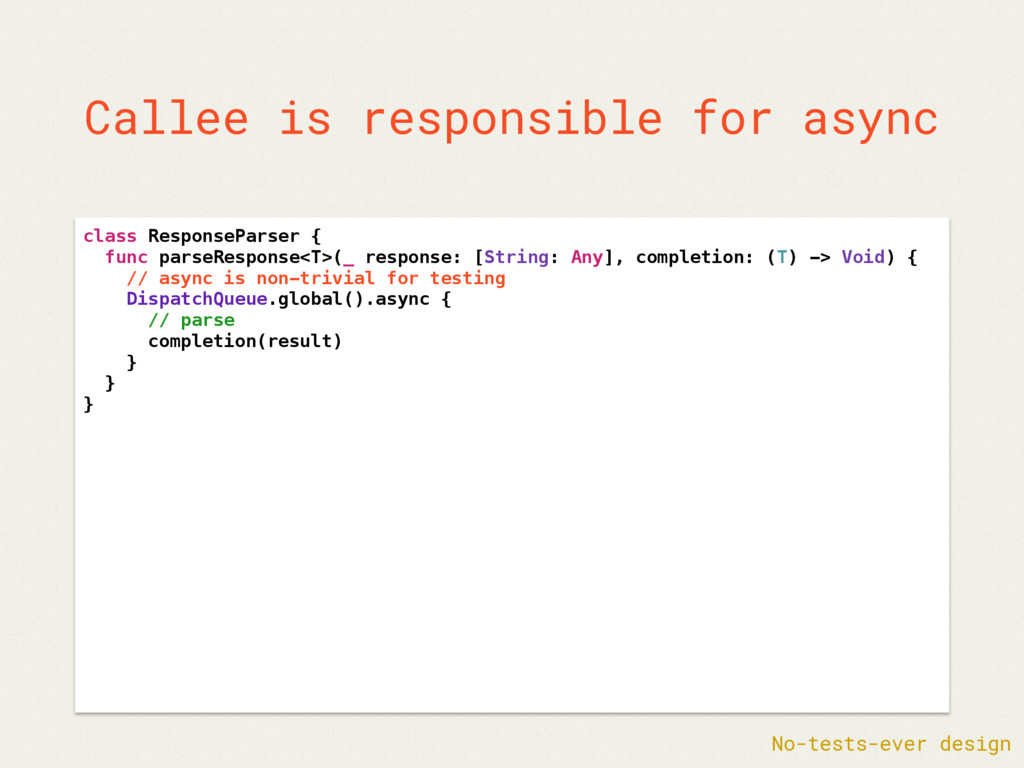
Callee is responsible for async class ResponseParser { func parseResponse<T>(_
response: [String: Any], completion: (T) -> Void) { // async is non-trivial for testing DispatchQueue.global().async { // parse completion(result) } } } No-tests-ever design -
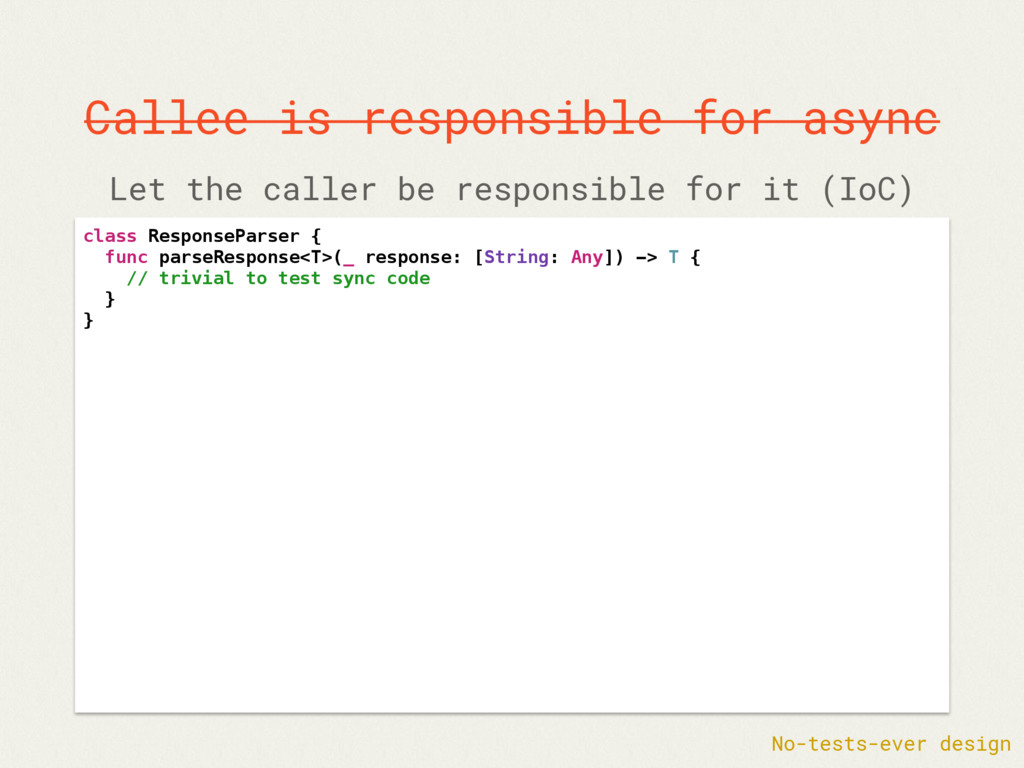
Callee is responsible for async class ResponseParser { func parseResponse<T>(_
response: [String: Any]) -> T { // trivial to test sync code } } No-tests-ever design Let the caller be responsible for it (IoC) -
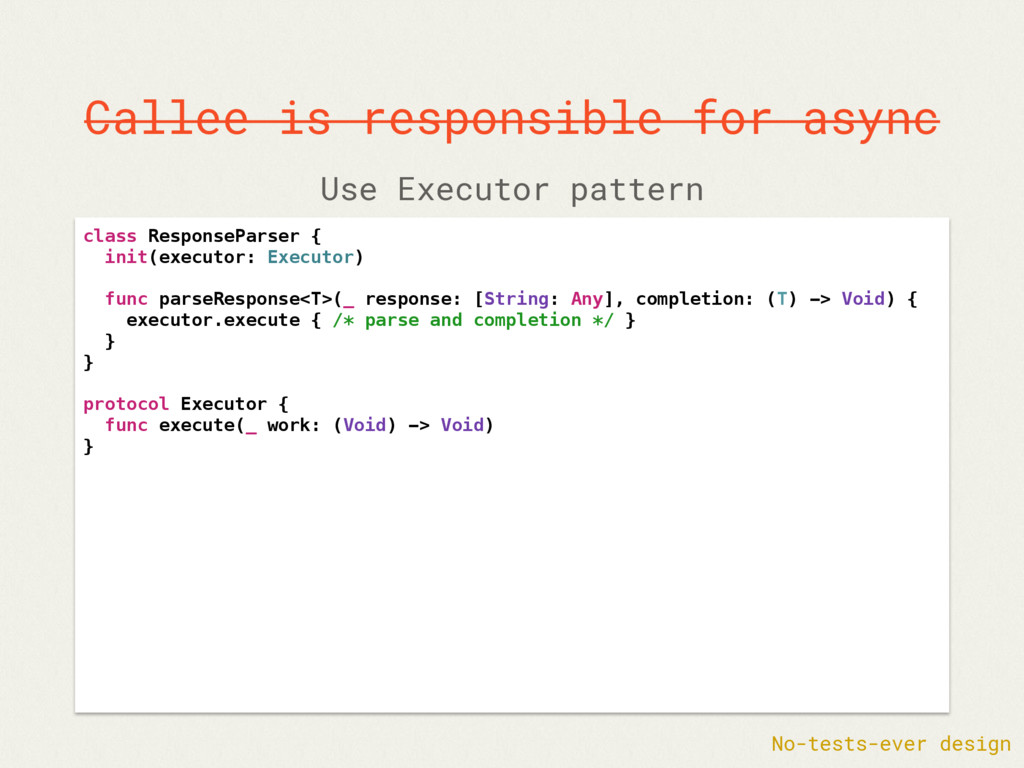
Callee is responsible for async class ResponseParser { init(executor: Executor)
func parseResponse<T>(_ response: [String: Any], completion: (T) -> Void) { executor.execute { /* parse and completion */ } } } protocol Executor { func execute(_ work: (Void) -> Void) } No-tests-ever design Use Executor pattern -
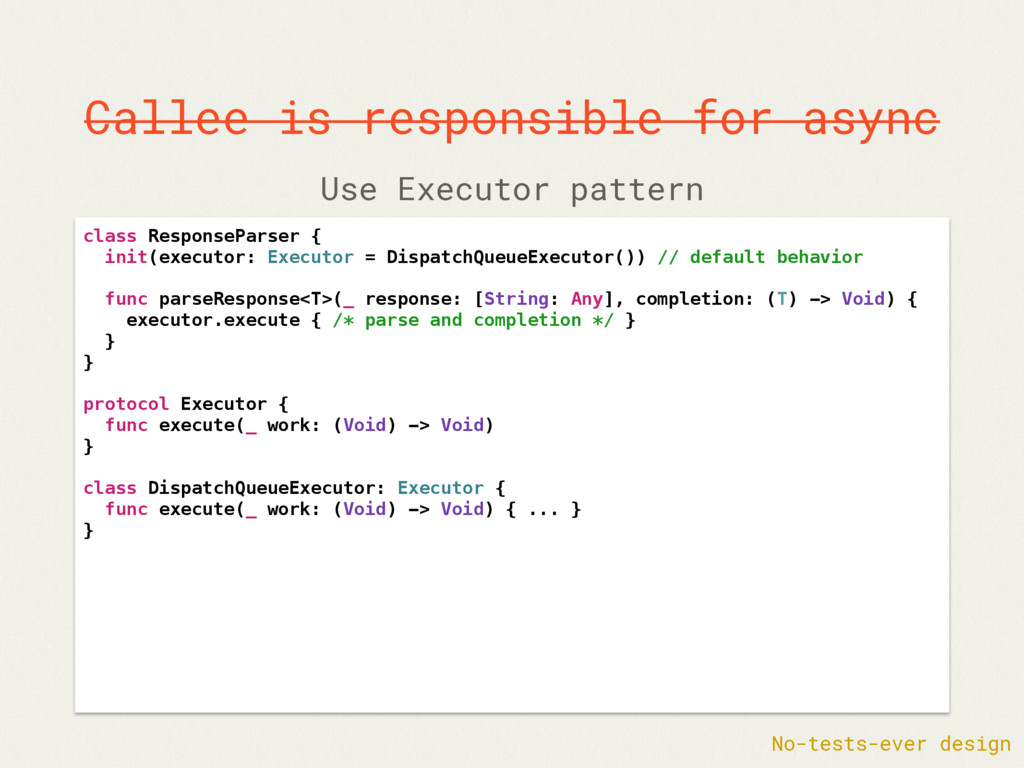
Callee is responsible for async class ResponseParser { init(executor: Executor
= DispatchQueueExecutor()) // default behavior func parseResponse<T>(_ response: [String: Any], completion: (T) -> Void) { executor.execute { /* parse and completion */ } } } protocol Executor { func execute(_ work: (Void) -> Void) } class DispatchQueueExecutor: Executor { func execute(_ work: (Void) -> Void) { ... } } No-tests-ever design Use Executor pattern -
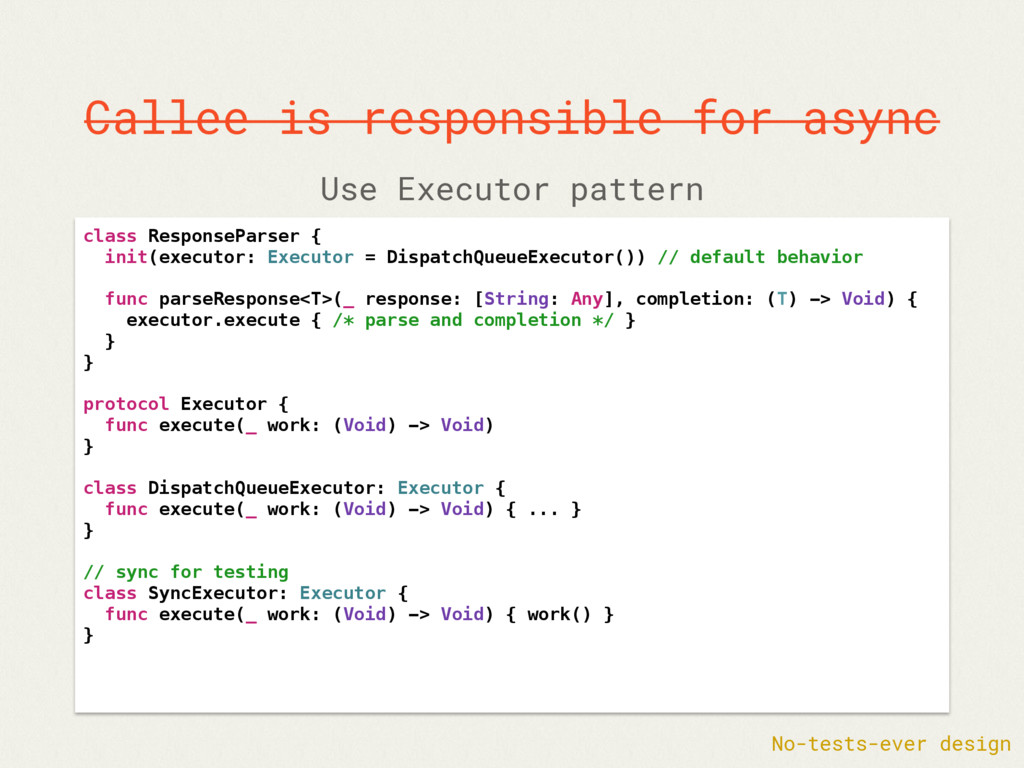
Callee is responsible for async class ResponseParser { init(executor: Executor
= DispatchQueueExecutor()) // default behavior func parseResponse<T>(_ response: [String: Any], completion: (T) -> Void) { executor.execute { /* parse and completion */ } } } protocol Executor { func execute(_ work: (Void) -> Void) } class DispatchQueueExecutor: Executor { func execute(_ work: (Void) -> Void) { ... } } // sync for testing class SyncExecutor: Executor { func execute(_ work: (Void) -> Void) { work() } } No-tests-ever design Use Executor pattern -
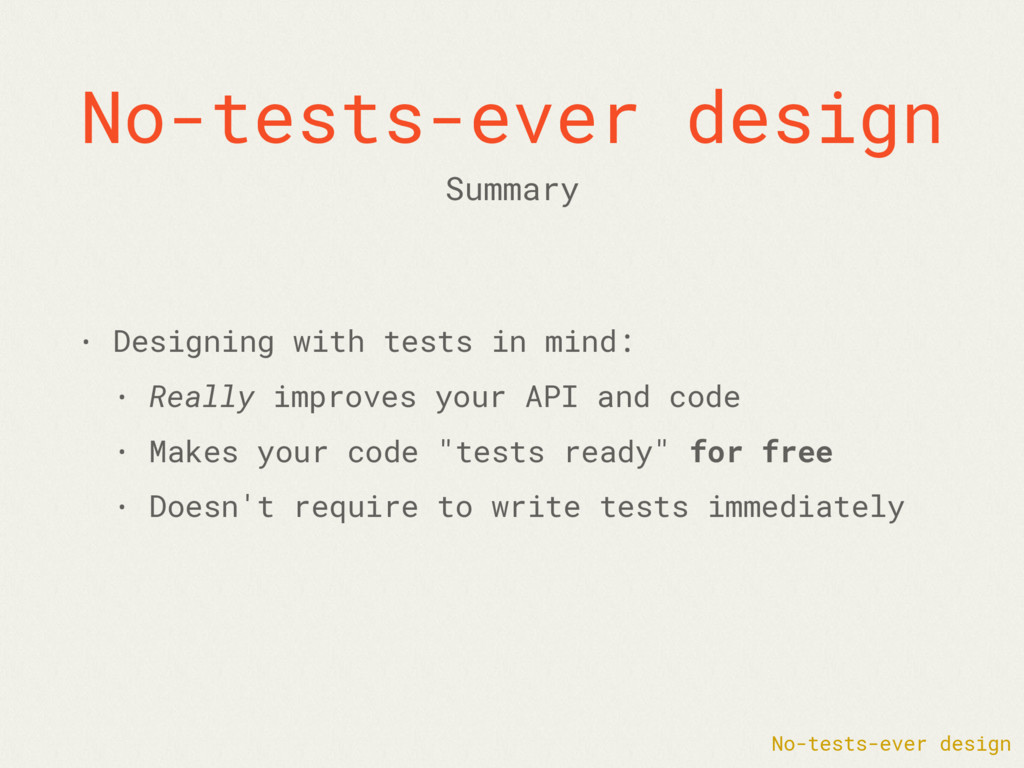
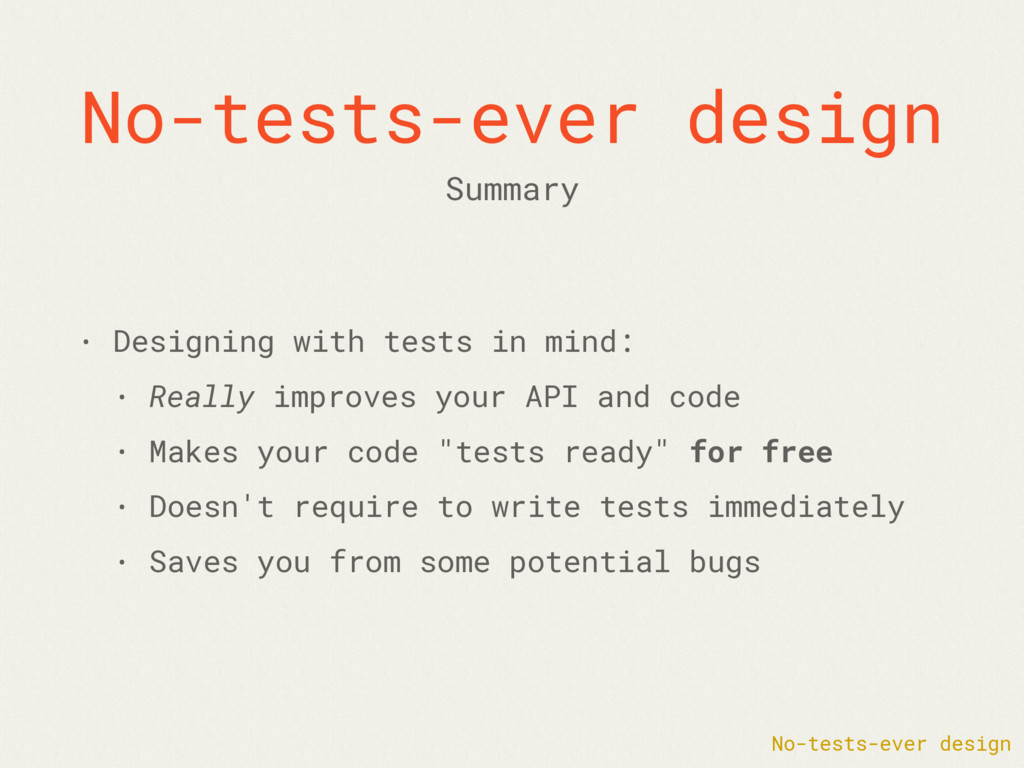
No-tests-ever design No-tests-ever design • Designing with tests in mind:
• Really improves your API and code Summary -
No-tests-ever design No-tests-ever design • Designing with tests in mind:
• Really improves your API and code • Makes your code "tests ready" for free Summary -
No-tests-ever design No-tests-ever design • Designing with tests in mind:
• Really improves your API and code • Makes your code "tests ready" for free • Doesn't require to write tests immediately Summary -
No-tests-ever design No-tests-ever design • Designing with tests in mind:
• Really improves your API and code • Makes your code "tests ready" for free • Doesn't require to write tests immediately • Saves you from some potential bugs Summary -
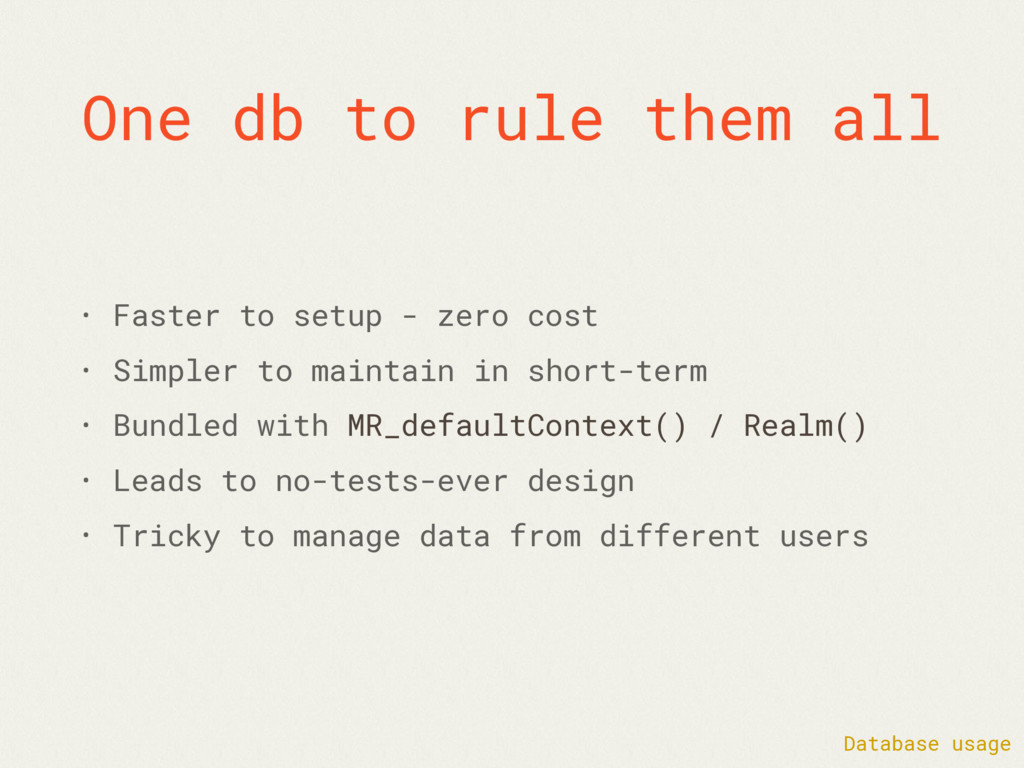
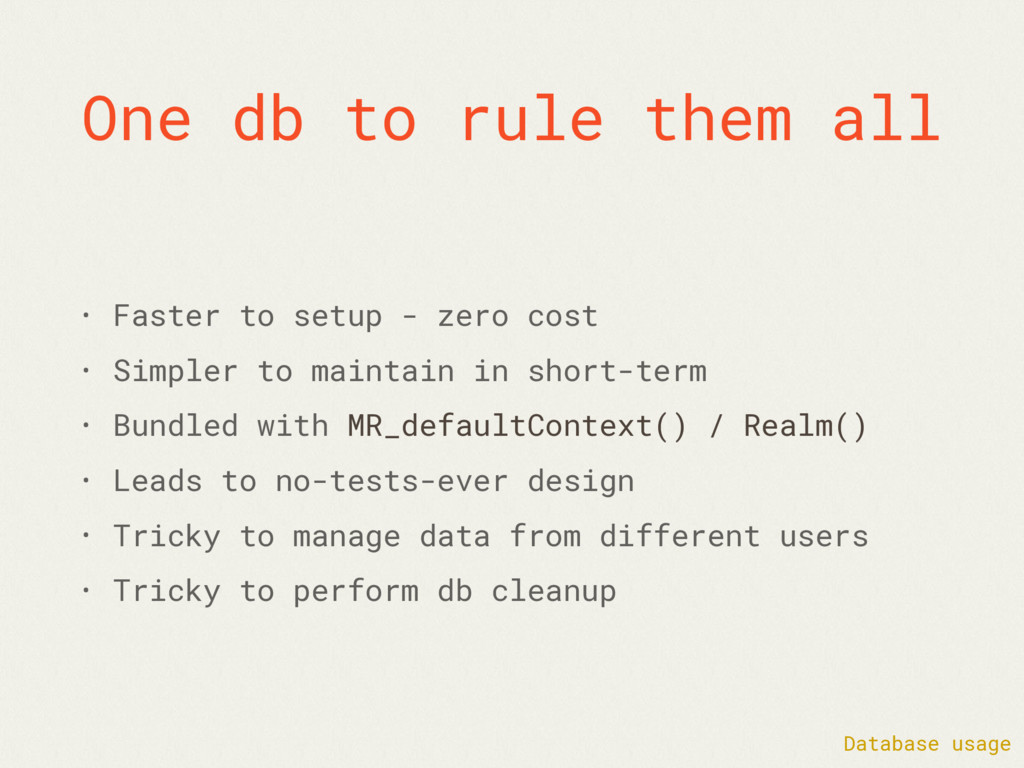
One db to rule them all • Faster to setup
- zero cost Database usage -
One db to rule them all • Faster to setup
- zero cost • Simpler to maintain in short-term Database usage -
One db to rule them all • Faster to setup
- zero cost • Simpler to maintain in short-term • Bundled with MR_defaultContext() / Realm() Database usage -
One db to rule them all • Faster to setup
- zero cost • Simpler to maintain in short-term • Bundled with MR_defaultContext() / Realm() • Leads to no-tests-ever design Database usage -
One db to rule them all • Faster to setup
- zero cost • Simpler to maintain in short-term • Bundled with MR_defaultContext() / Realm() • Leads to no-tests-ever design • Tricky to manage data from different users Database usage -
One db to rule them all • Faster to setup
- zero cost • Simpler to maintain in short-term • Bundled with MR_defaultContext() / Realm() • Leads to no-tests-ever design • Tricky to manage data from different users • Tricky to perform db cleanup Database usage -
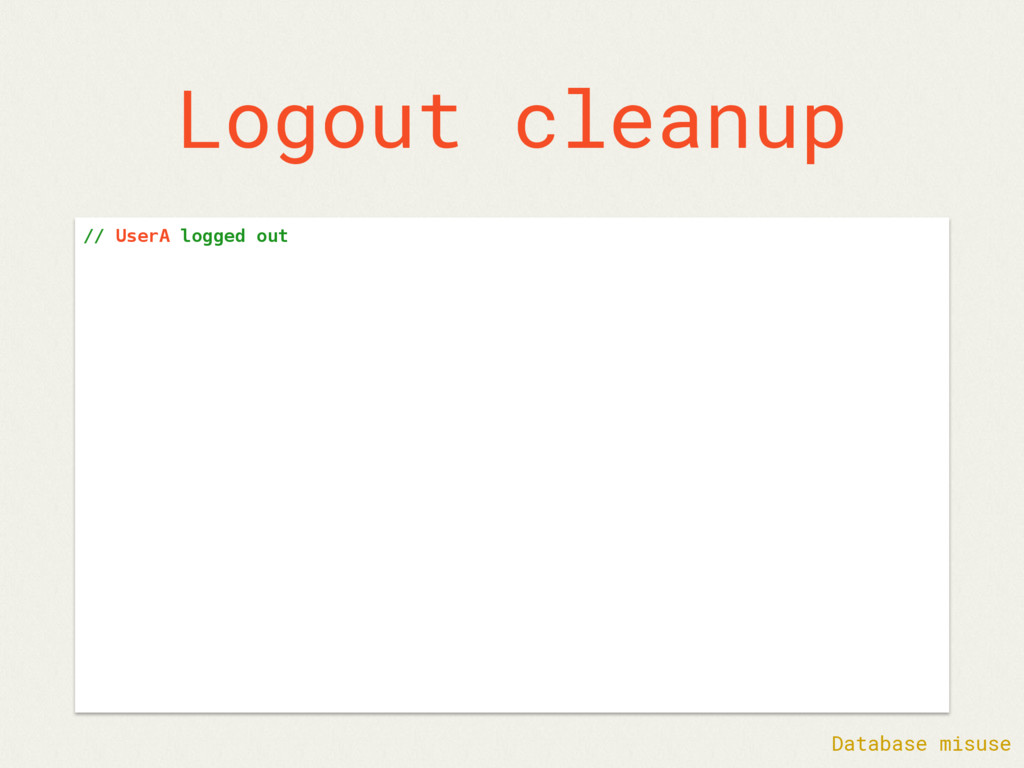
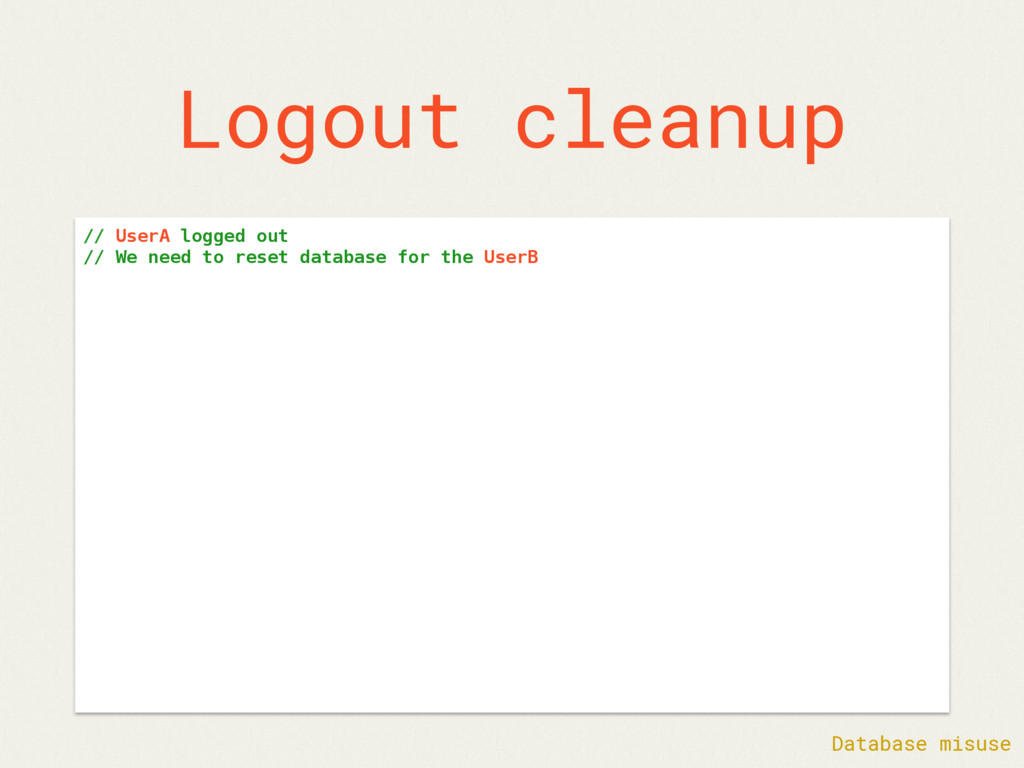
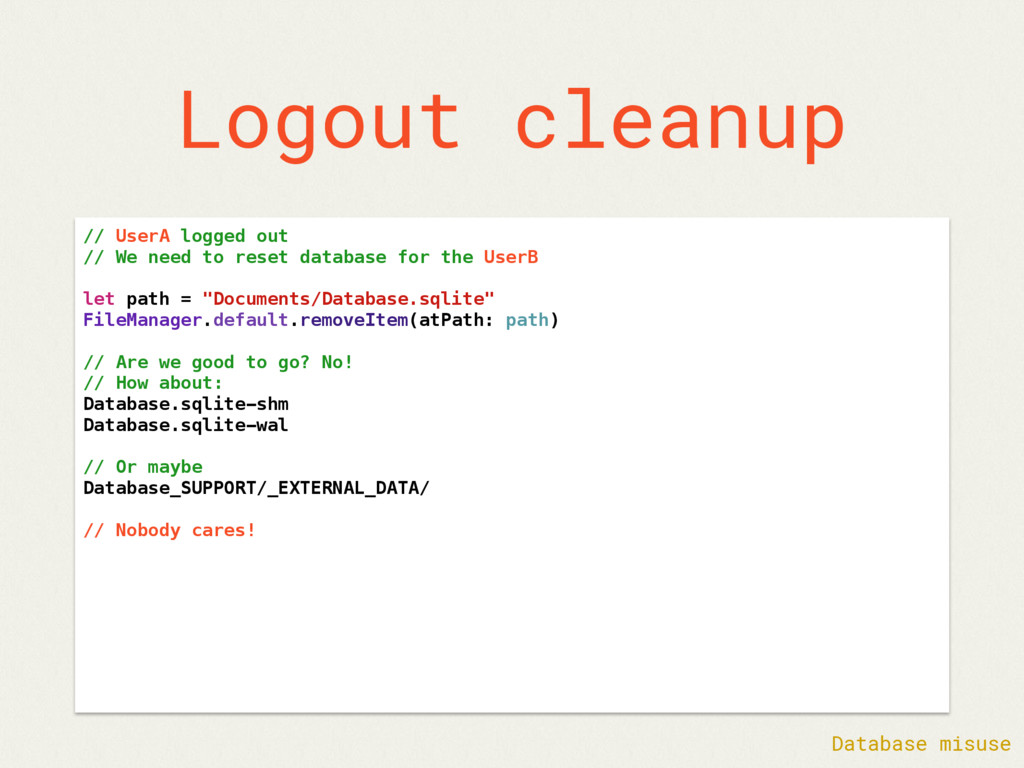
Logout cleanup // UserA logged out // We need to
reset database for the UserB Database misuse -
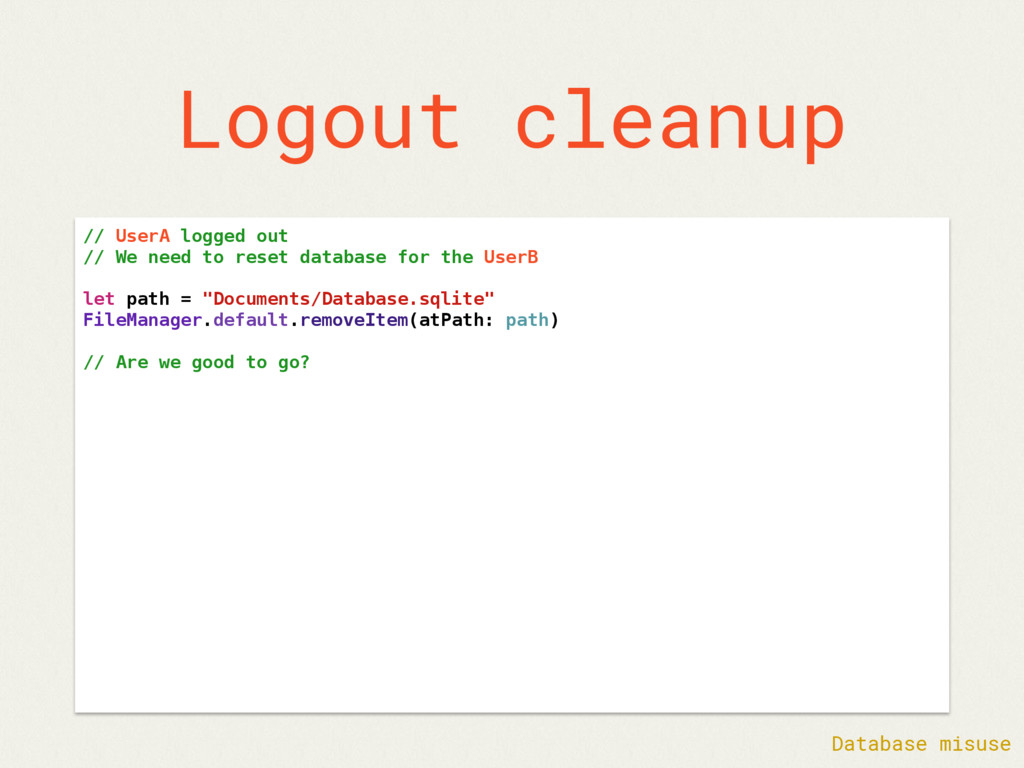
Logout cleanup // UserA logged out // We need to
reset database for the UserB let path = "Documents/Database.sqlite" FileManager.default.removeItem(atPath: path) // Are we good to go? Database misuse -
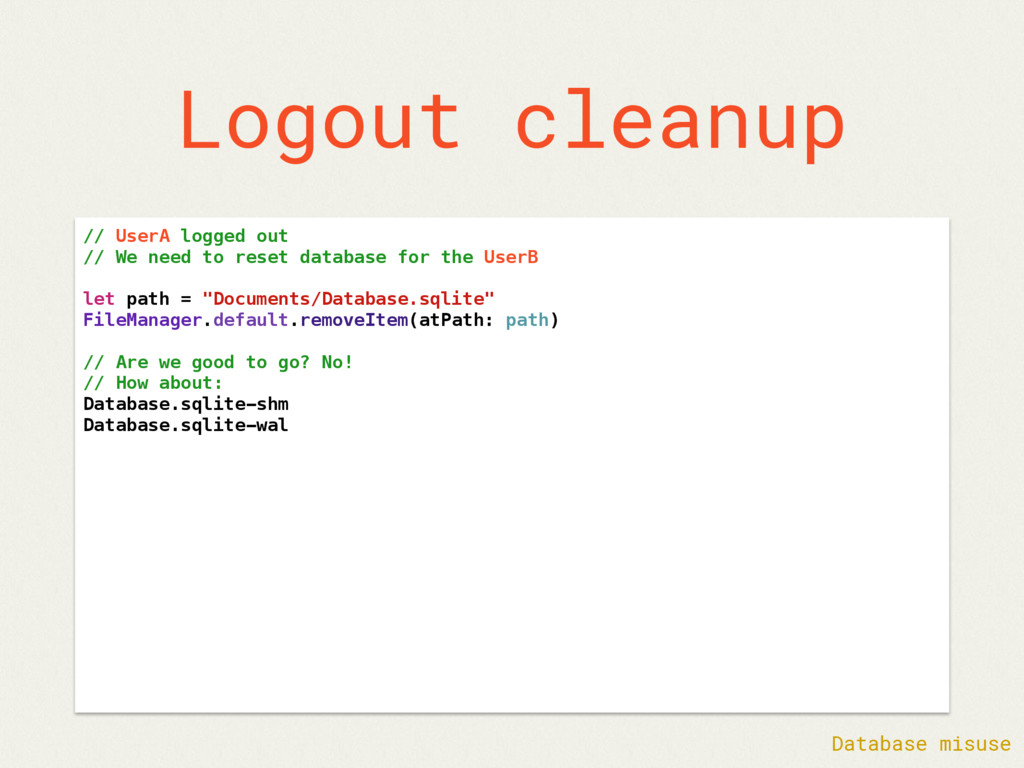
Logout cleanup // UserA logged out // We need to
reset database for the UserB let path = "Documents/Database.sqlite" FileManager.default.removeItem(atPath: path) // Are we good to go? No! // How about: Database.sqlite-shm Database.sqlite-wal Database misuse -
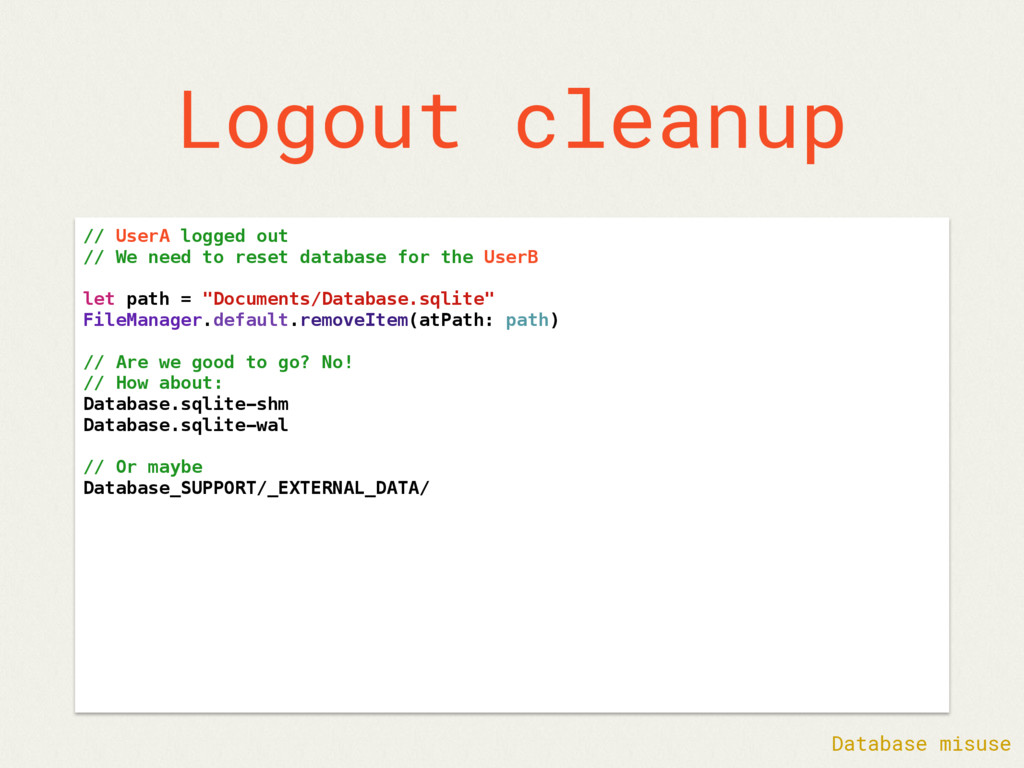
Logout cleanup // UserA logged out // We need to
reset database for the UserB let path = "Documents/Database.sqlite" FileManager.default.removeItem(atPath: path) // Are we good to go? No! // How about: Database.sqlite-shm Database.sqlite-wal // Or maybe Database_SUPPORT/_EXTERNAL_DATA/ Database misuse -
Logout cleanup // UserA logged out // We need to
reset database for the UserB let path = "Documents/Database.sqlite" FileManager.default.removeItem(atPath: path) // Are we good to go? No! // How about: Database.sqlite-shm Database.sqlite-wal // Or maybe Database_SUPPORT/_EXTERNAL_DATA/ // Nobody cares! Database misuse -
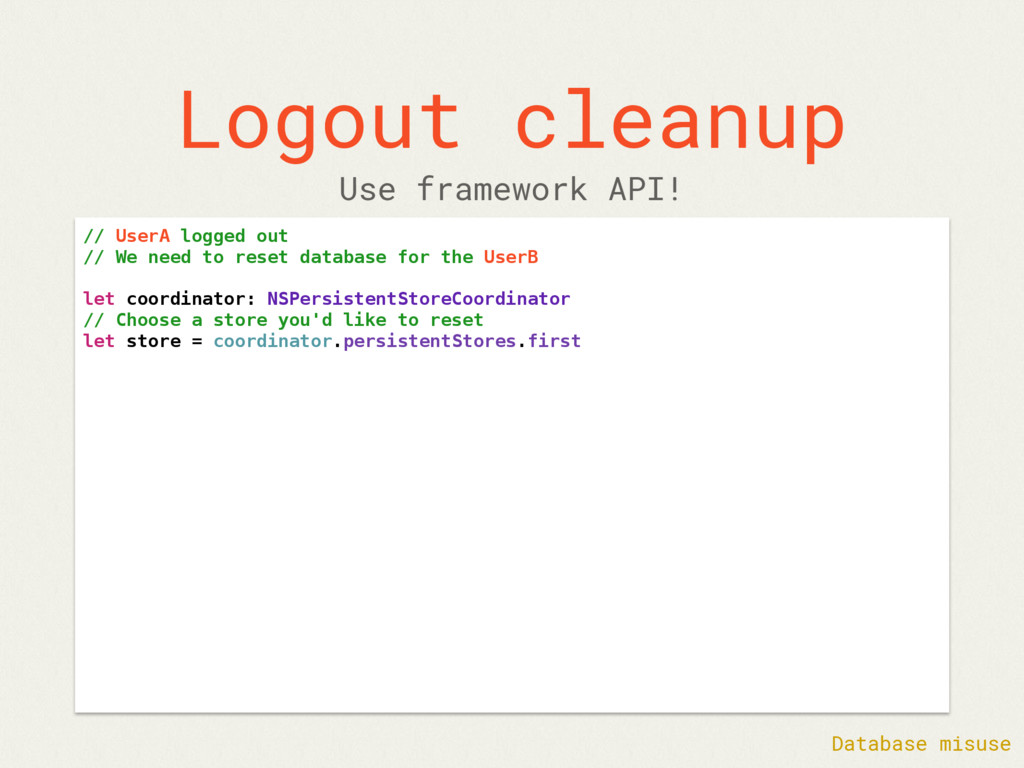
Logout cleanup // UserA logged out // We need to
reset database for the UserB let coordinator: NSPersistentStoreCoordinator // Choose a store you'd like to reset let store = coordinator.persistentStores.first Database misuse Use framework API! -
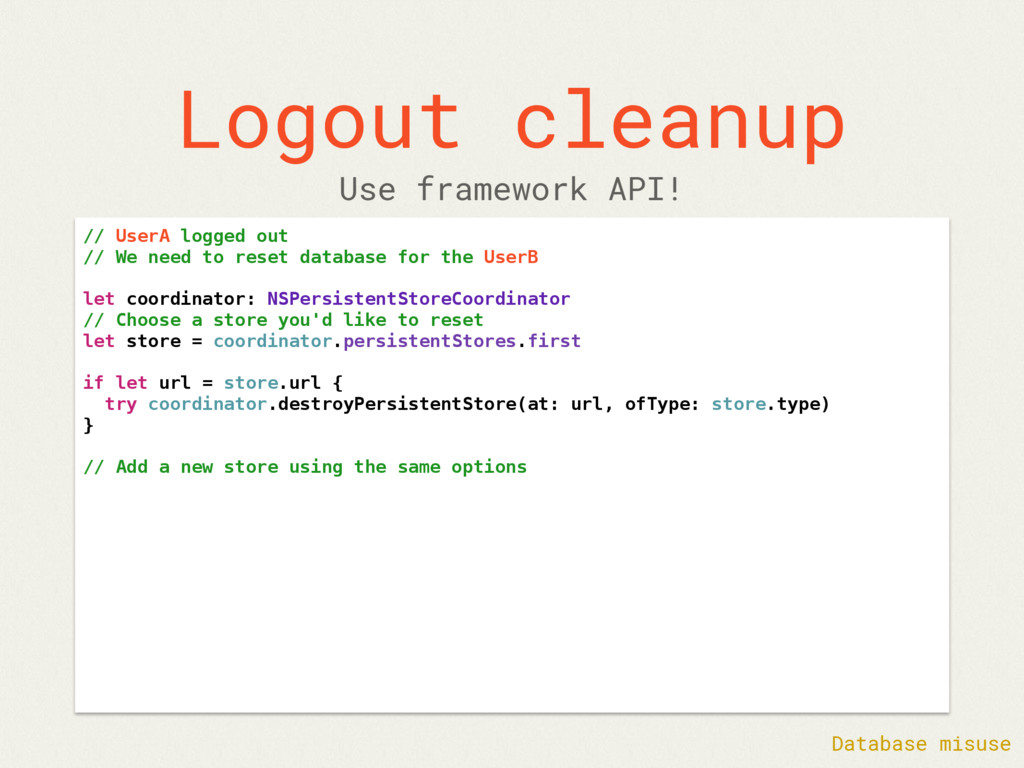
Logout cleanup // UserA logged out // We need to
reset database for the UserB let coordinator: NSPersistentStoreCoordinator // Choose a store you'd like to reset let store = coordinator.persistentStores.first if let url = store.url { try coordinator.destroyPersistentStore(at: url, ofType: store.type) } // Add a new store using the same options Database misuse Use framework API! -
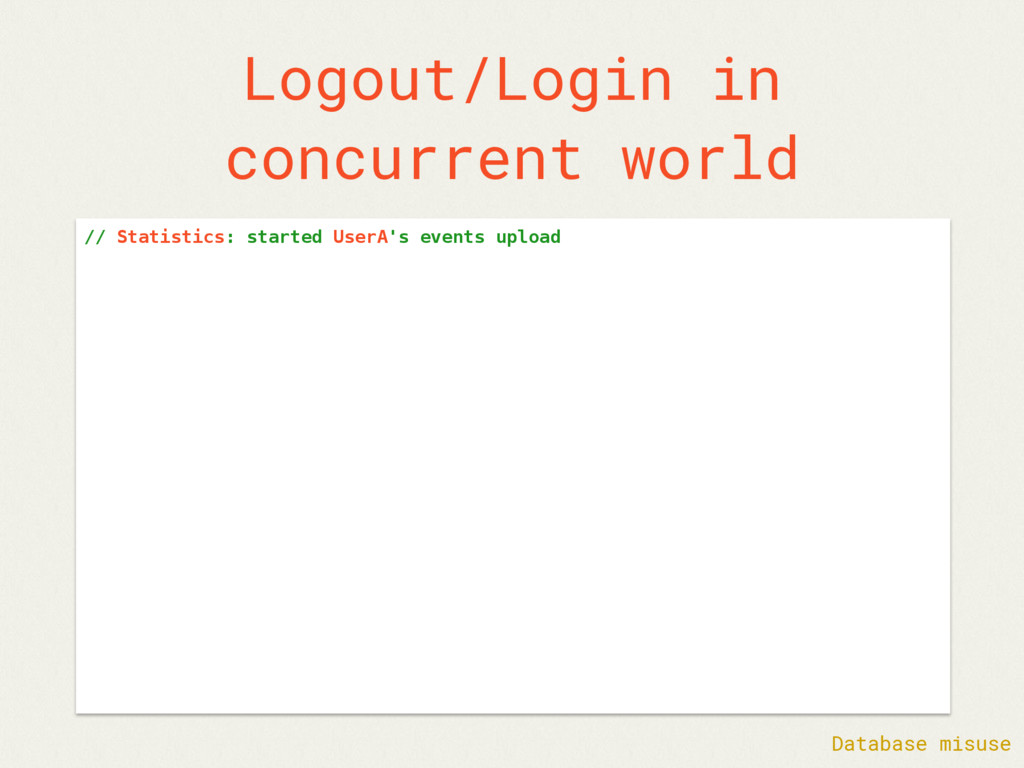
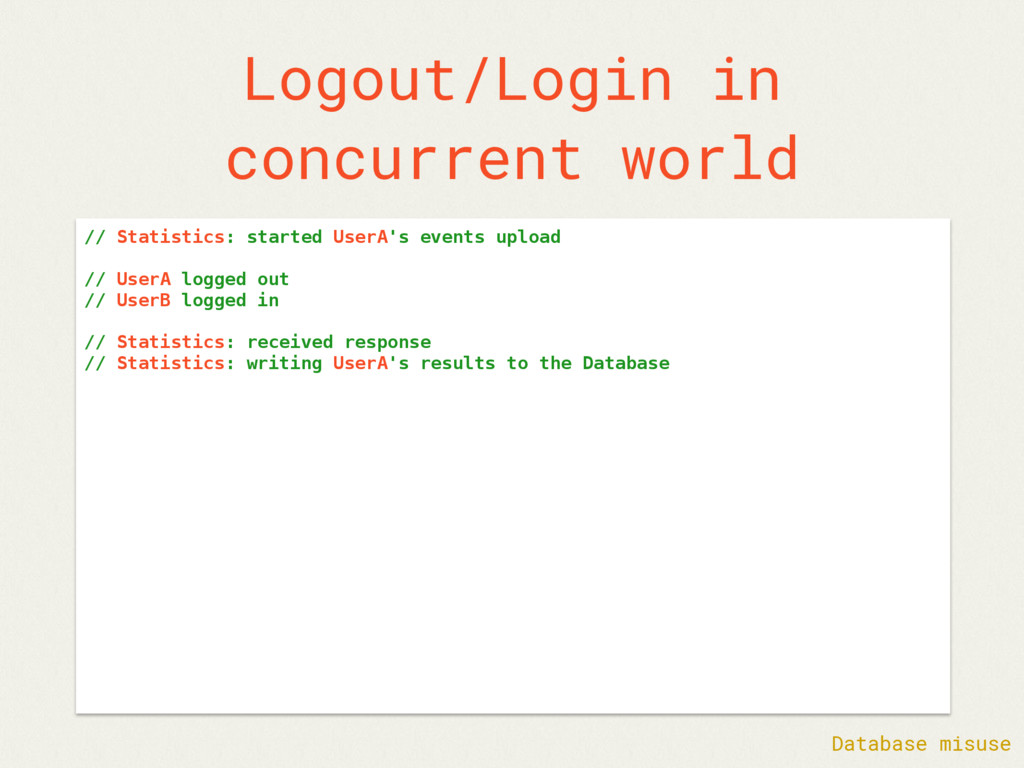
Logout/Login in concurrent world // Statistics: started UserA's events upload
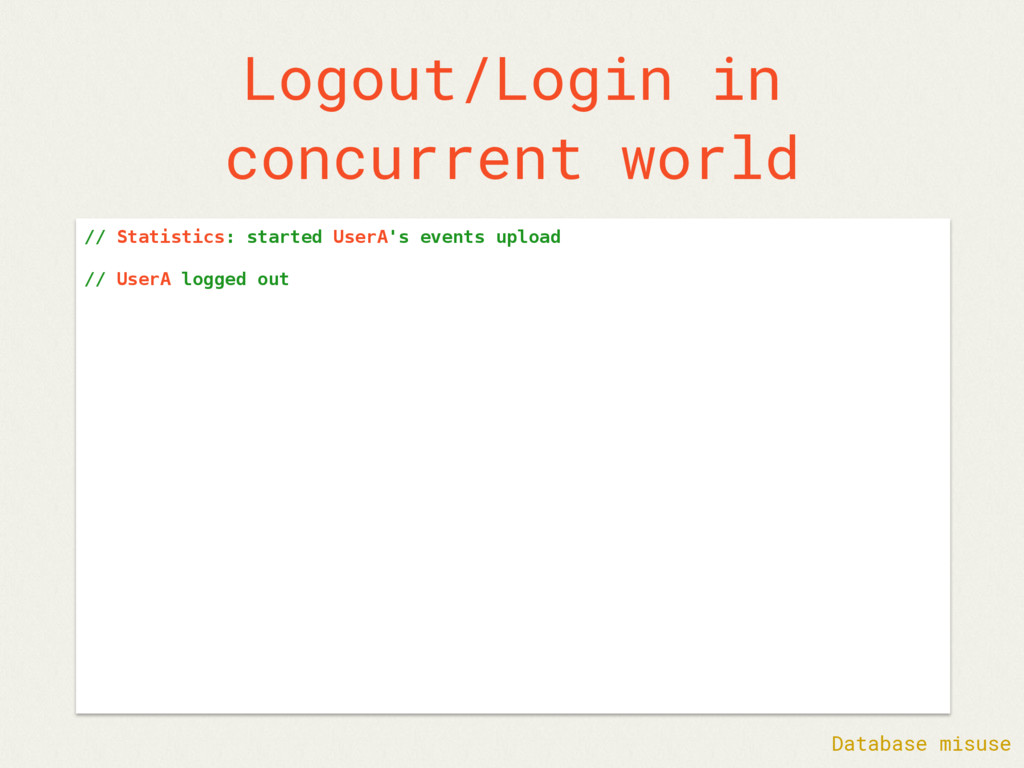
// UserA logged out Database misuse -
Logout/Login in concurrent world // Statistics: started UserA's events upload
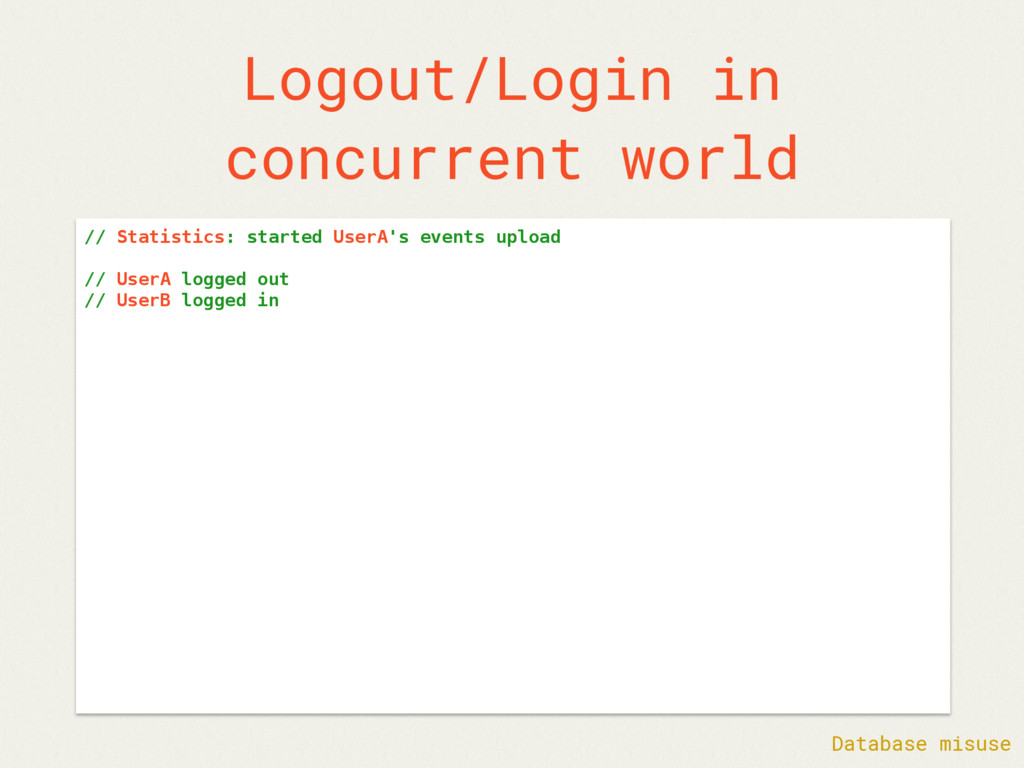
// UserA logged out // UserB logged in Database misuse -
Logout/Login in concurrent world // Statistics: started UserA's events upload
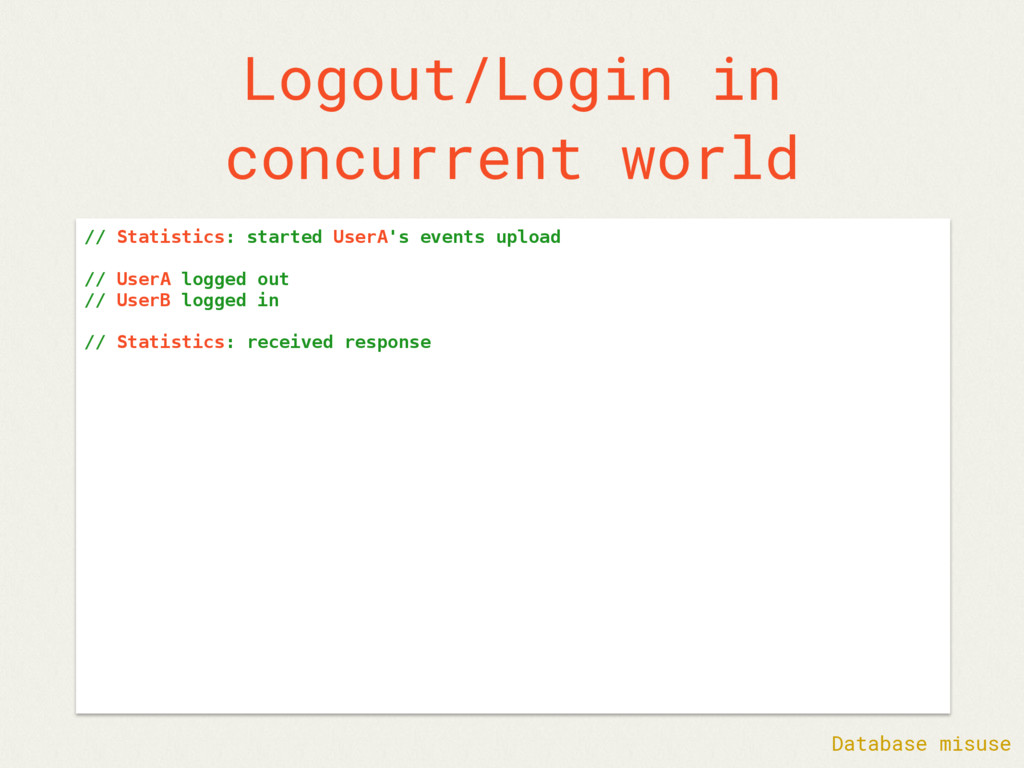
// UserA logged out // UserB logged in // Statistics: received response Database misuse -
Logout/Login in concurrent world // Statistics: started UserA's events upload
// UserA logged out // UserB logged in // Statistics: received response // Statistics: writing UserA's results to the Database Database misuse -
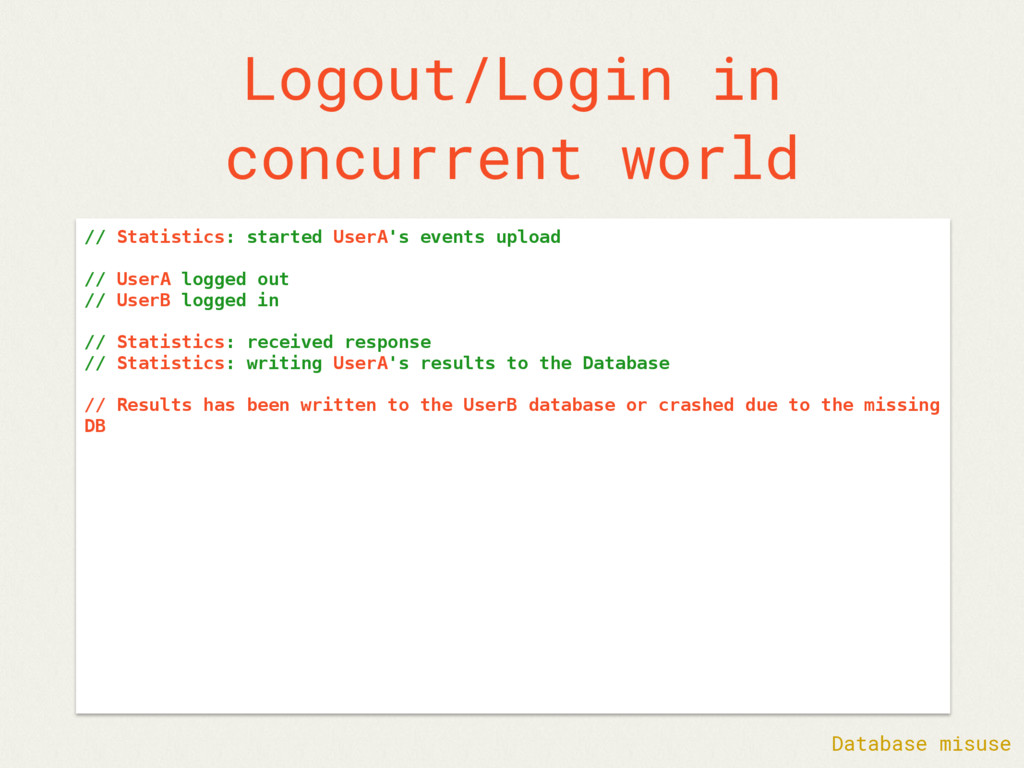
Logout/Login in concurrent world // Statistics: started UserA's events upload
// UserA logged out // UserB logged in // Statistics: received response // Statistics: writing UserA's results to the Database // Results has been written to the UserB database or crashed due to the missing DB Database misuse -
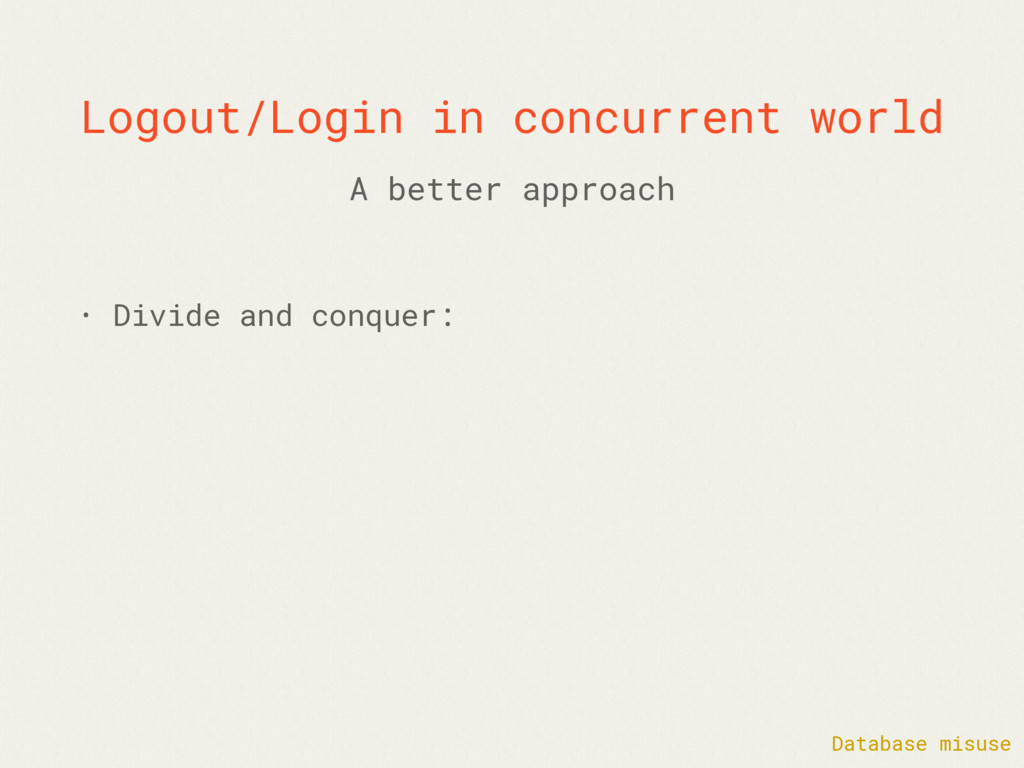
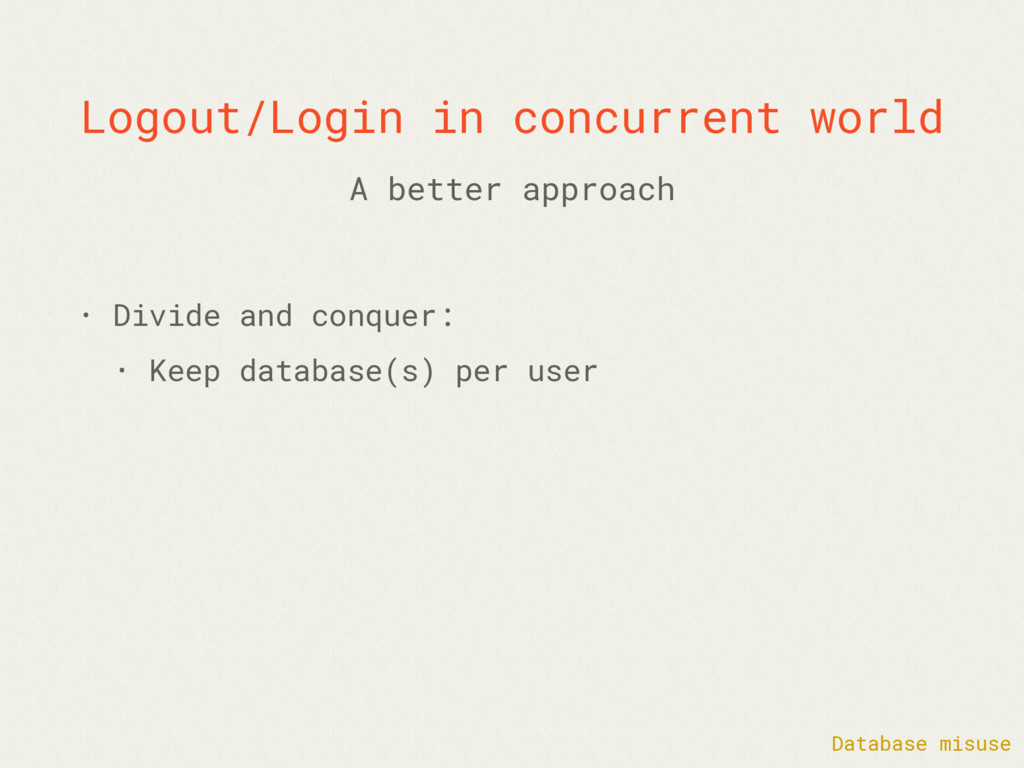
Logout/Login in concurrent world • Divide and conquer: Database misuse
A better approach -
Logout/Login in concurrent world • Divide and conquer: • Keep
database(s) per user Database misuse A better approach -
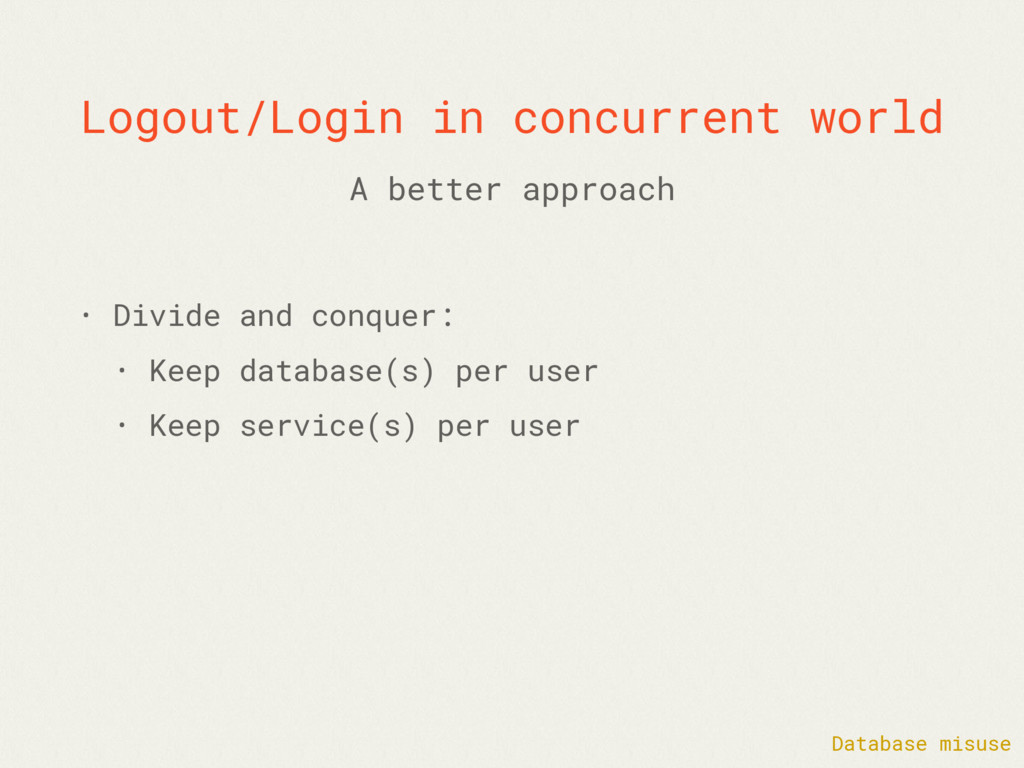
Logout/Login in concurrent world • Divide and conquer: • Keep
database(s) per user • Keep service(s) per user Database misuse A better approach -
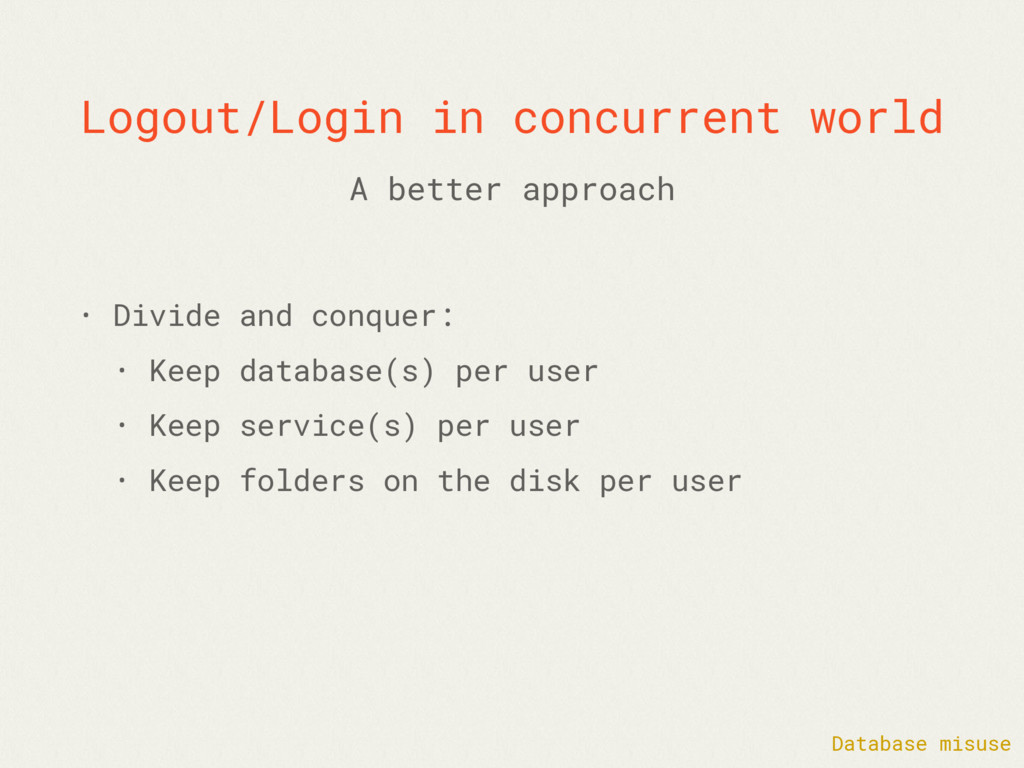
Logout/Login in concurrent world • Divide and conquer: • Keep
database(s) per user • Keep service(s) per user • Keep folders on the disk per user Database misuse A better approach -
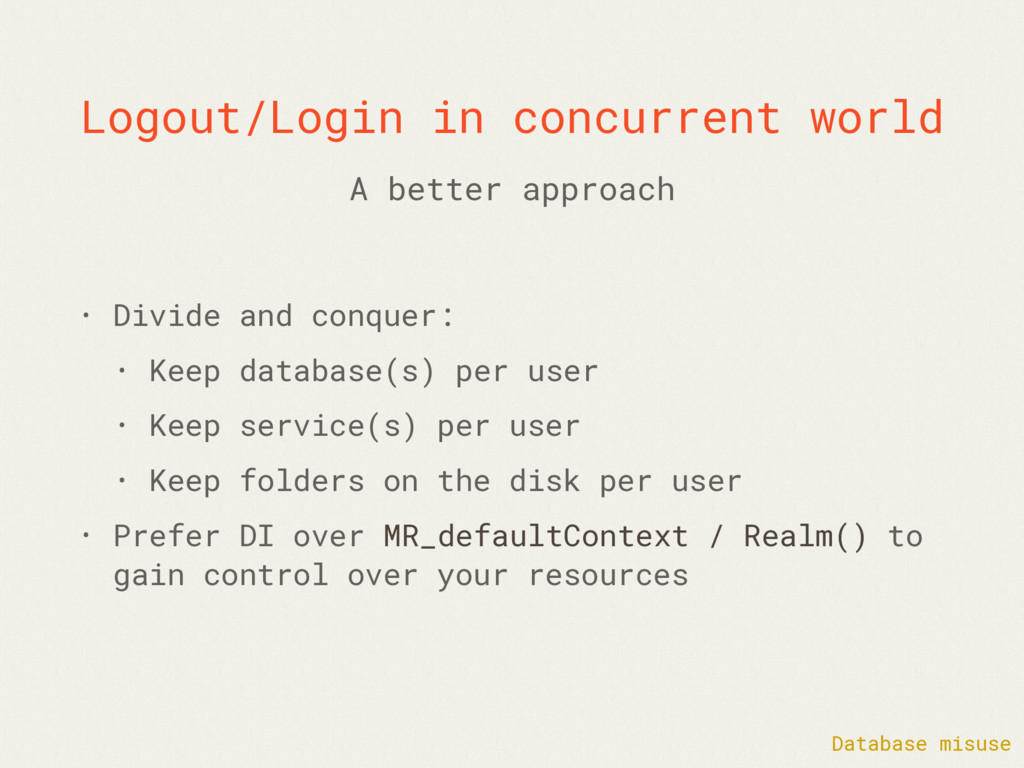
Logout/Login in concurrent world • Divide and conquer: • Keep
database(s) per user • Keep service(s) per user • Keep folders on the disk per user • Prefer DI over MR_defaultContext / Realm() to gain control over your resources Database misuse A better approach -
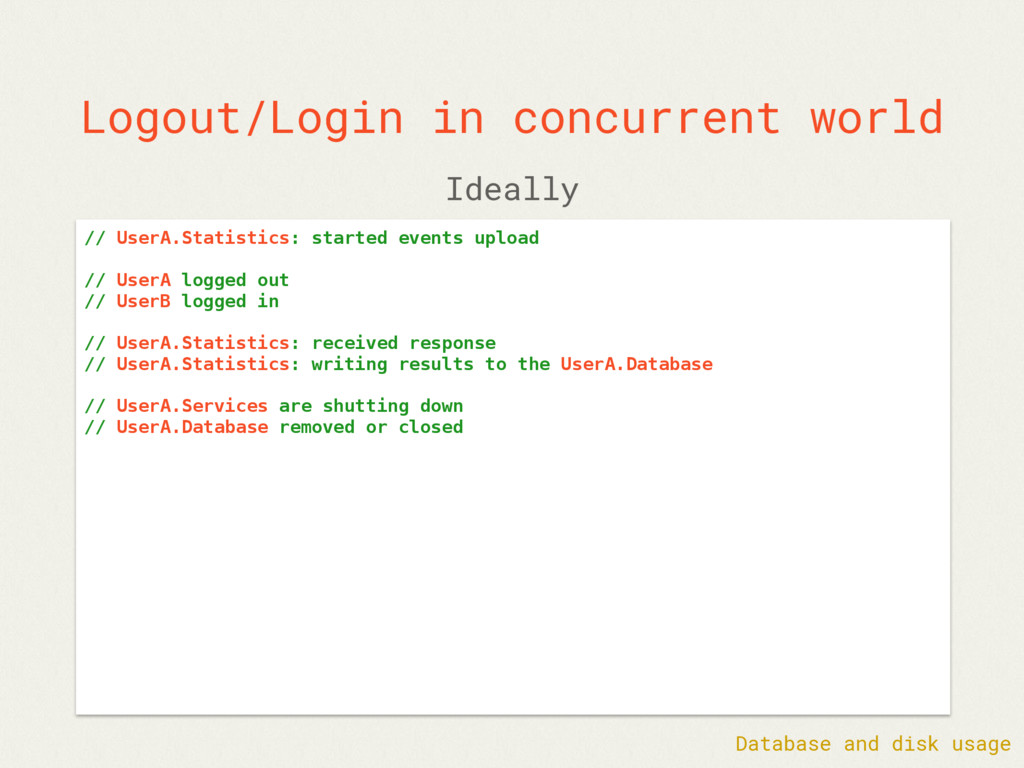
Logout/Login in concurrent world // UserA.Statistics: started events upload Database
and disk usage Ideally -
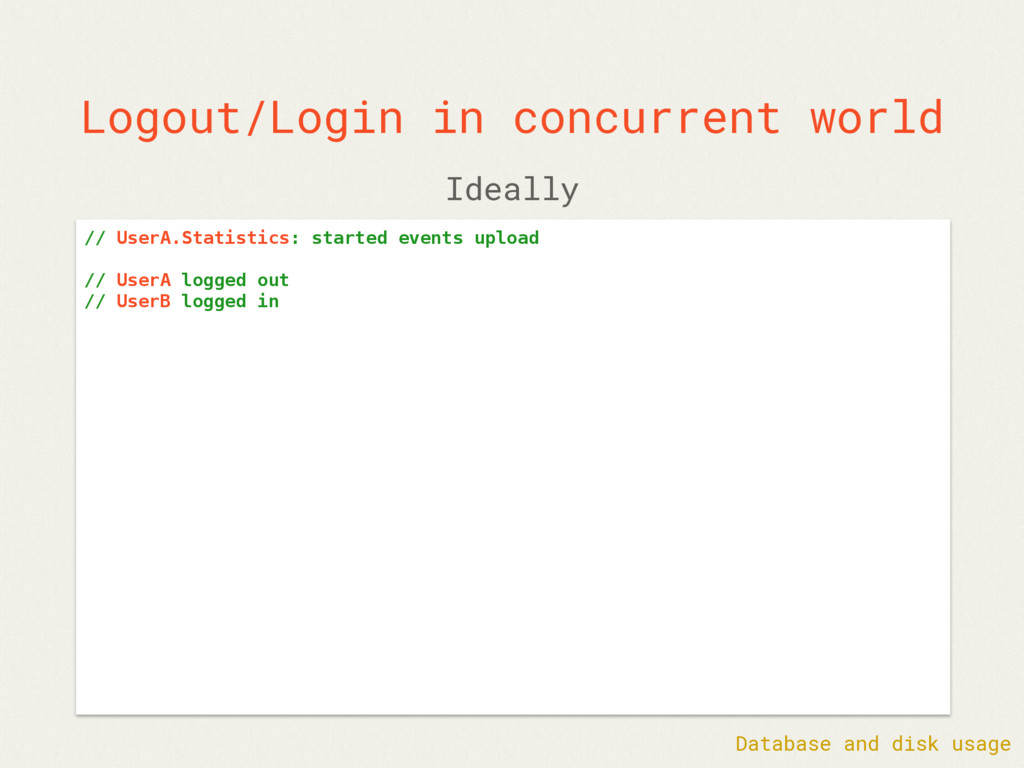
Logout/Login in concurrent world // UserA.Statistics: started events upload //
UserA logged out // UserB logged in Database and disk usage Ideally -
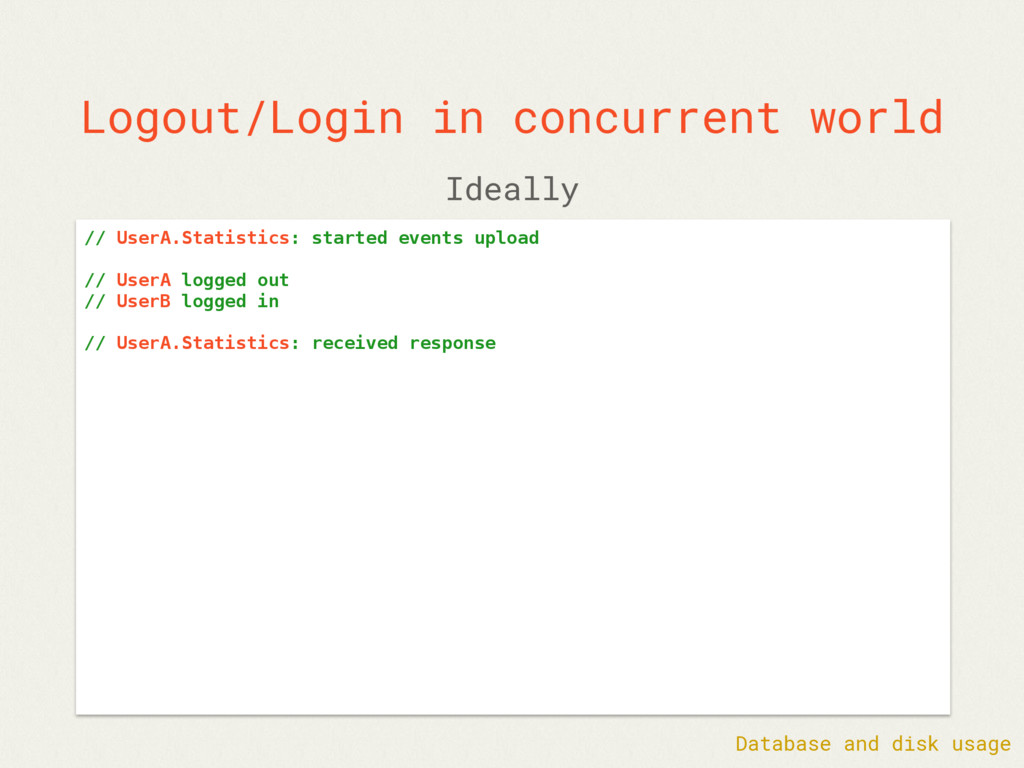
Logout/Login in concurrent world // UserA.Statistics: started events upload //
UserA logged out // UserB logged in // UserA.Statistics: received response Database and disk usage Ideally -
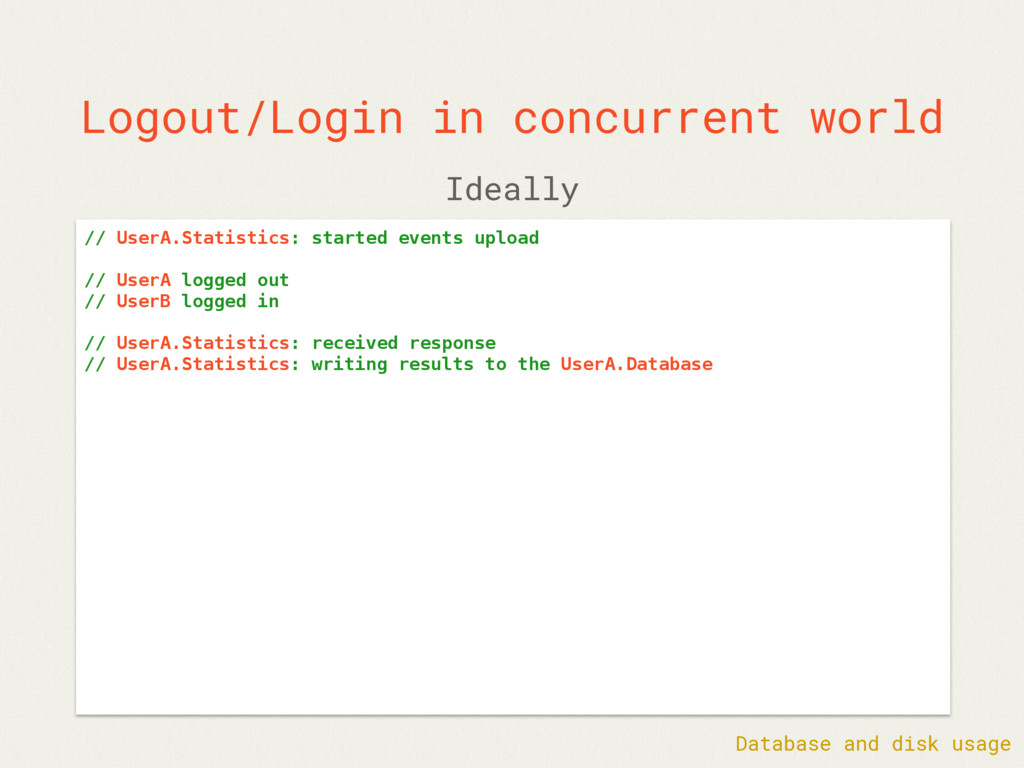
Logout/Login in concurrent world // UserA.Statistics: started events upload //
UserA logged out // UserB logged in // UserA.Statistics: received response // UserA.Statistics: writing results to the UserA.Database Database and disk usage Ideally -
Logout/Login in concurrent world // UserA.Statistics: started events upload //
UserA logged out // UserB logged in // UserA.Statistics: received response // UserA.Statistics: writing results to the UserA.Database // UserA.Services are shutting down // UserA.Database removed or closed Database and disk usage Ideally -
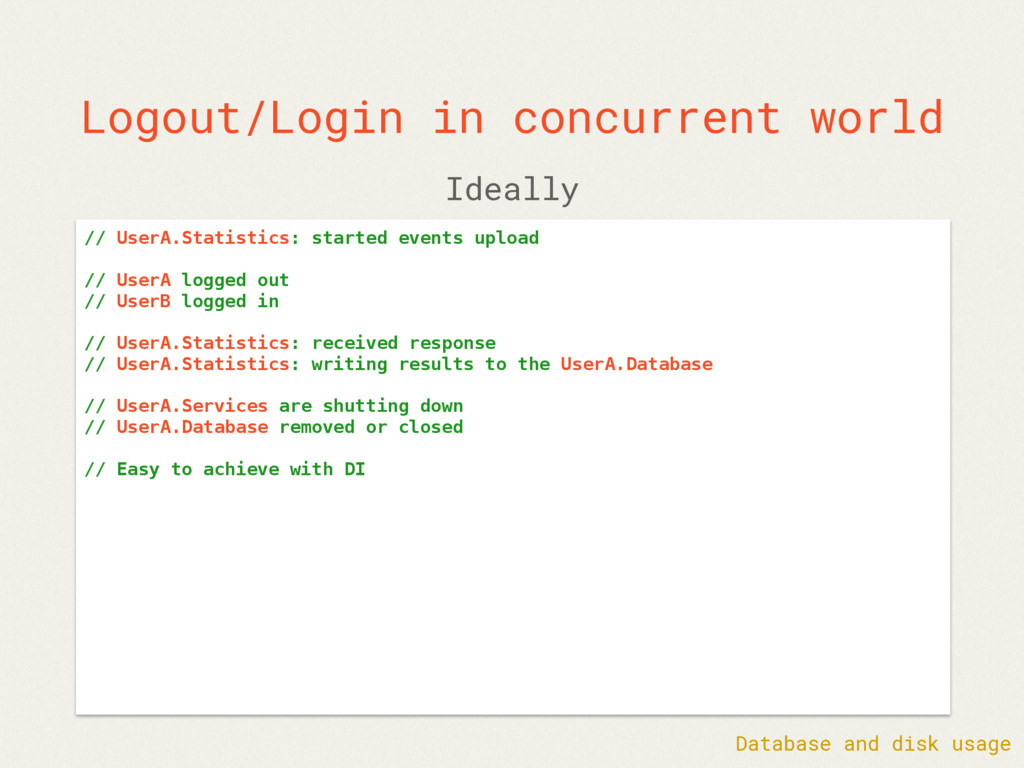
Logout/Login in concurrent world // UserA.Statistics: started events upload //
UserA logged out // UserB logged in // UserA.Statistics: received response // UserA.Statistics: writing results to the UserA.Database // UserA.Services are shutting down // UserA.Database removed or closed // Easy to achieve with DI Database and disk usage Ideally -
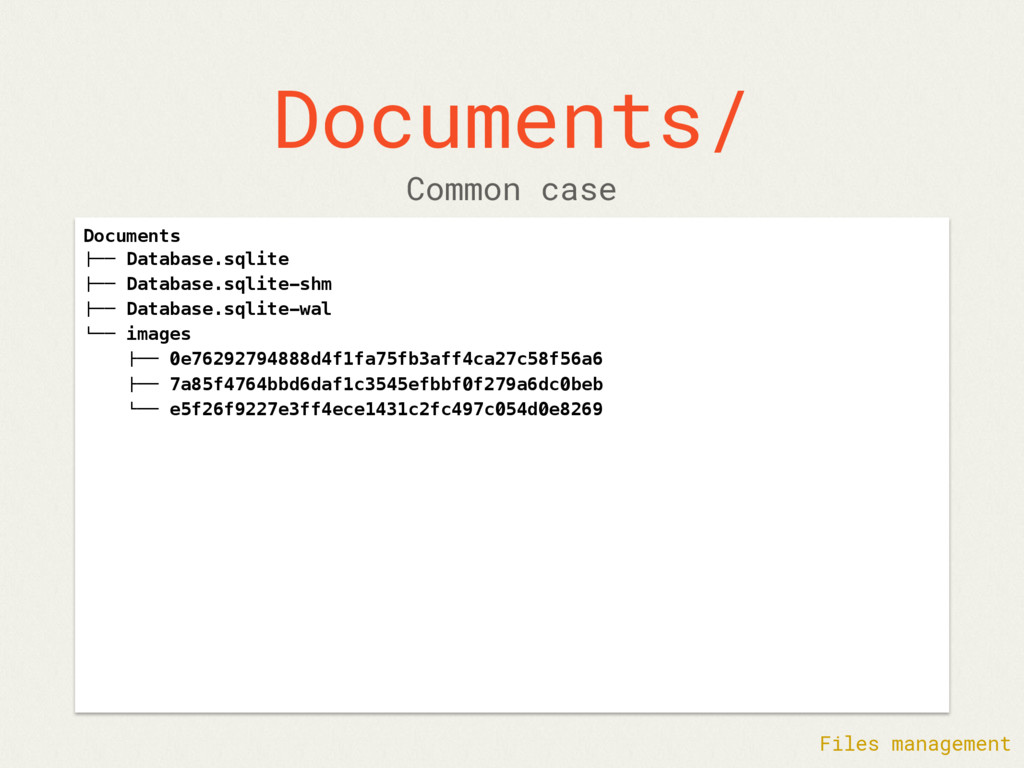
Documents/ Documents !"" Database.sqlite !"" Database.sqlite-shm !"" Database.sqlite-wal #"" images
!"" 0e76292794888d4f1fa75fb3aff4ca27c58f56a6 !"" 7a85f4764bbd6daf1c3545efbbf0f279a6dc0beb #"" e5f26f9227e3ff4ece1431c2fc497c054d0e8269 Common case Files management -
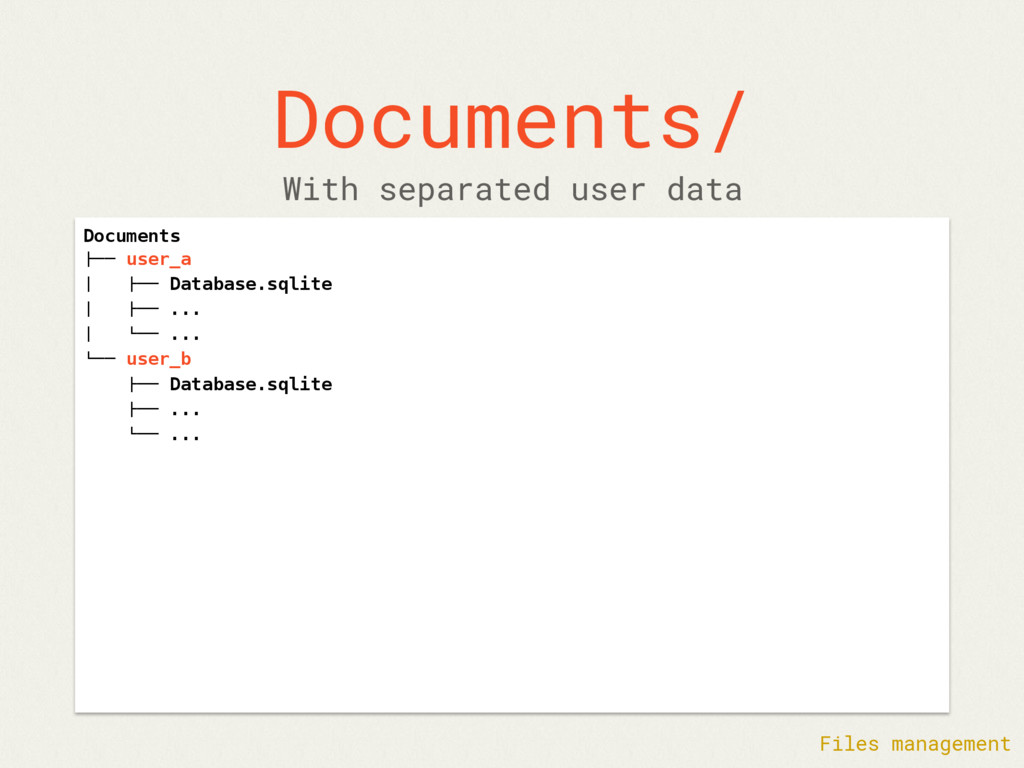
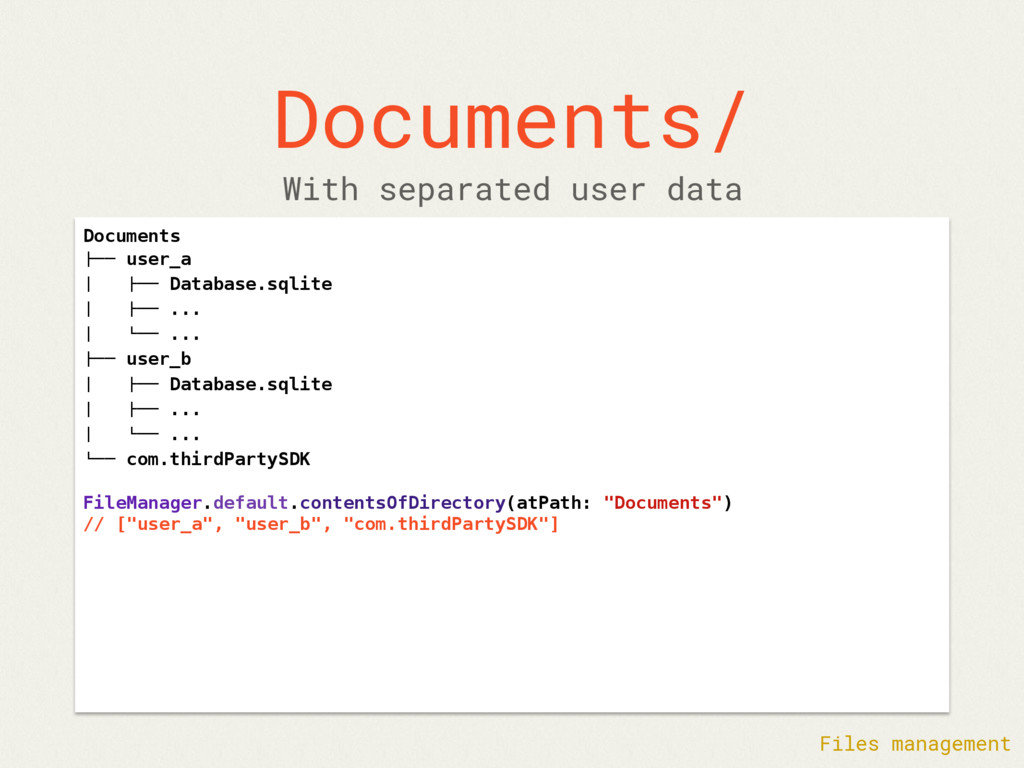
Documents/ Documents !"" user_a $ !"" Database.sqlite $ !"" ...
$ #"" ... #"" user_b !"" Database.sqlite !"" ... #"" ... With separated user data Files management -
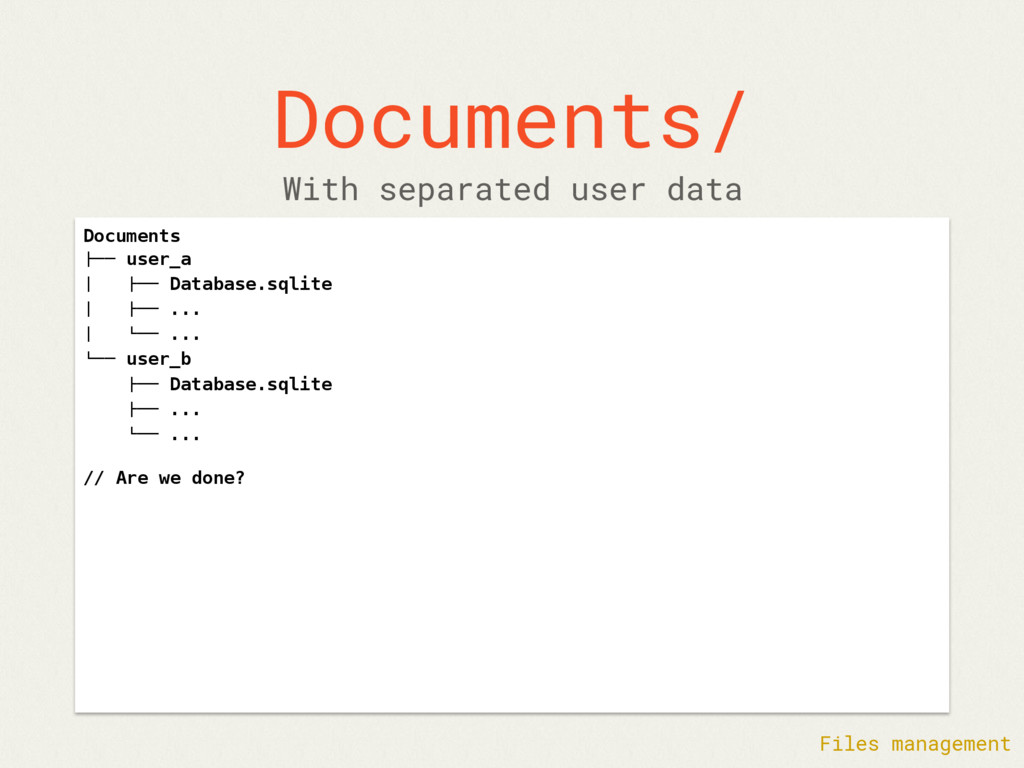
Documents/ Documents !"" user_a $ !"" Database.sqlite $ !"" ...
$ #"" ... #"" user_b !"" Database.sqlite !"" ... #"" ... // Are we done? With separated user data Files management -
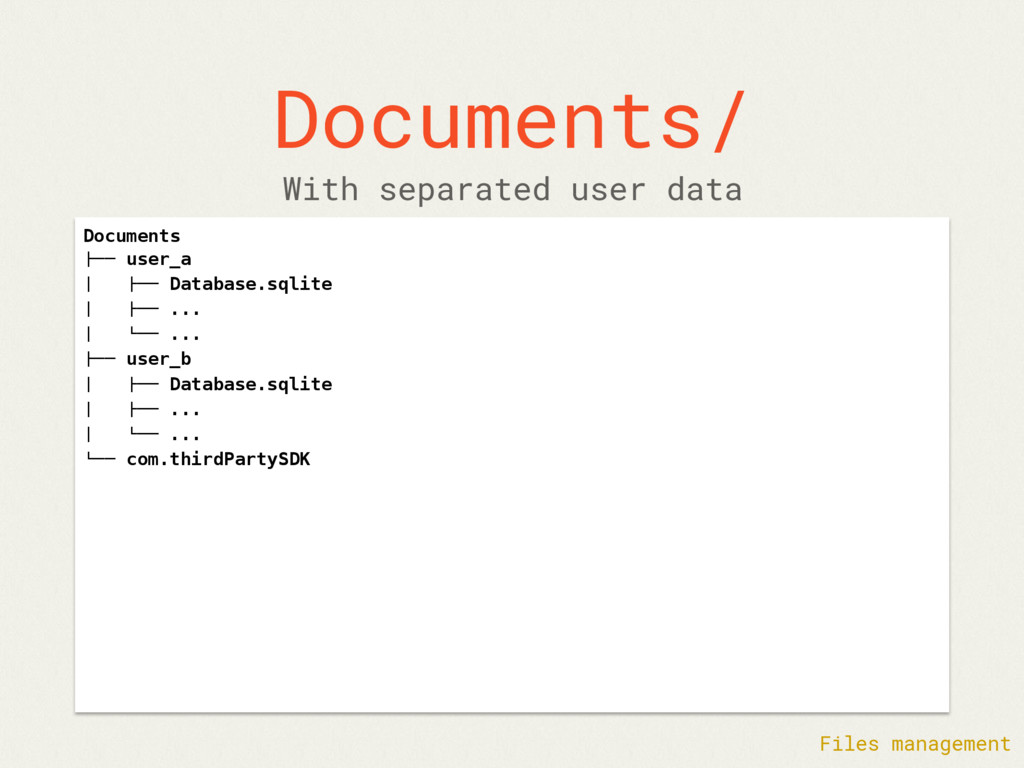
Documents/ Documents !"" user_a $ !"" Database.sqlite $ !"" ...
$ #"" ... !"" user_b $ !"" Database.sqlite $ !"" ... $ #"" ... #"" com.thirdPartySDK With separated user data Files management -
Documents/ Documents !"" user_a $ !"" Database.sqlite $ !"" ...
$ #"" ... !"" user_b $ !"" Database.sqlite $ !"" ... $ #"" ... #"" com.thirdPartySDK FileManager.default.contentsOfDirectory(atPath: "Documents") // ["user_a", "user_b", "com.thirdPartySDK"] With separated user data Files management -
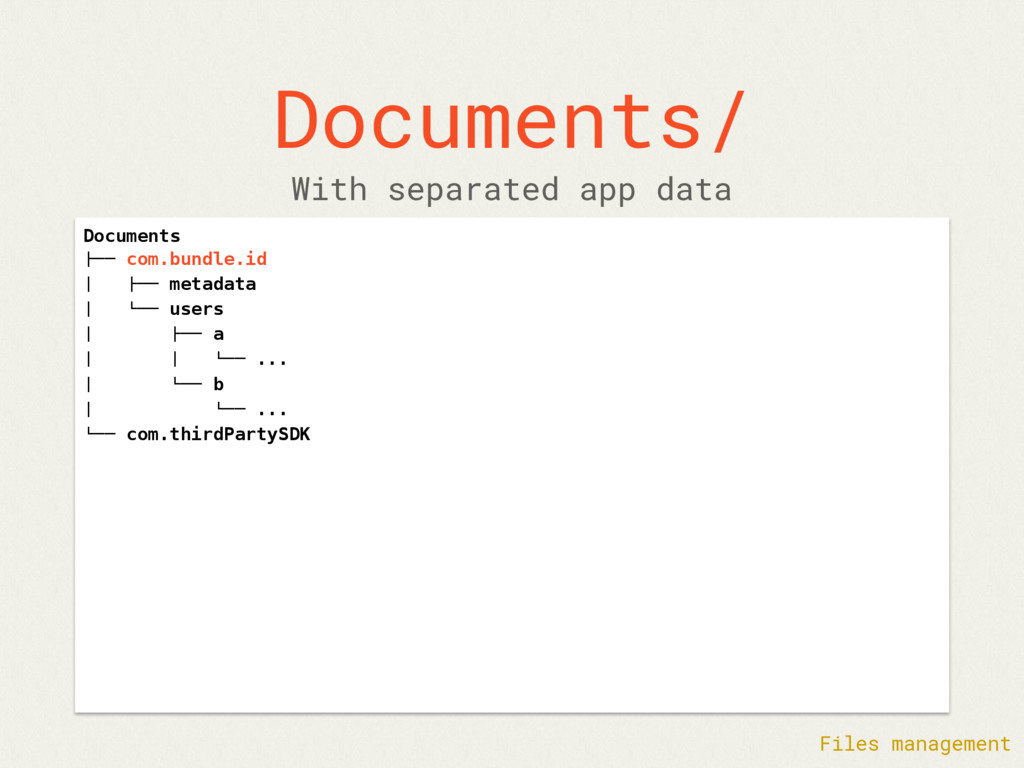
Documents/ Documents !"" com.bundle.id $ !"" metadata $ #"" users
$ !"" a $ $ #"" ... $ #"" b $ #"" ... #"" com.thirdPartySDK With separated app data Files management -
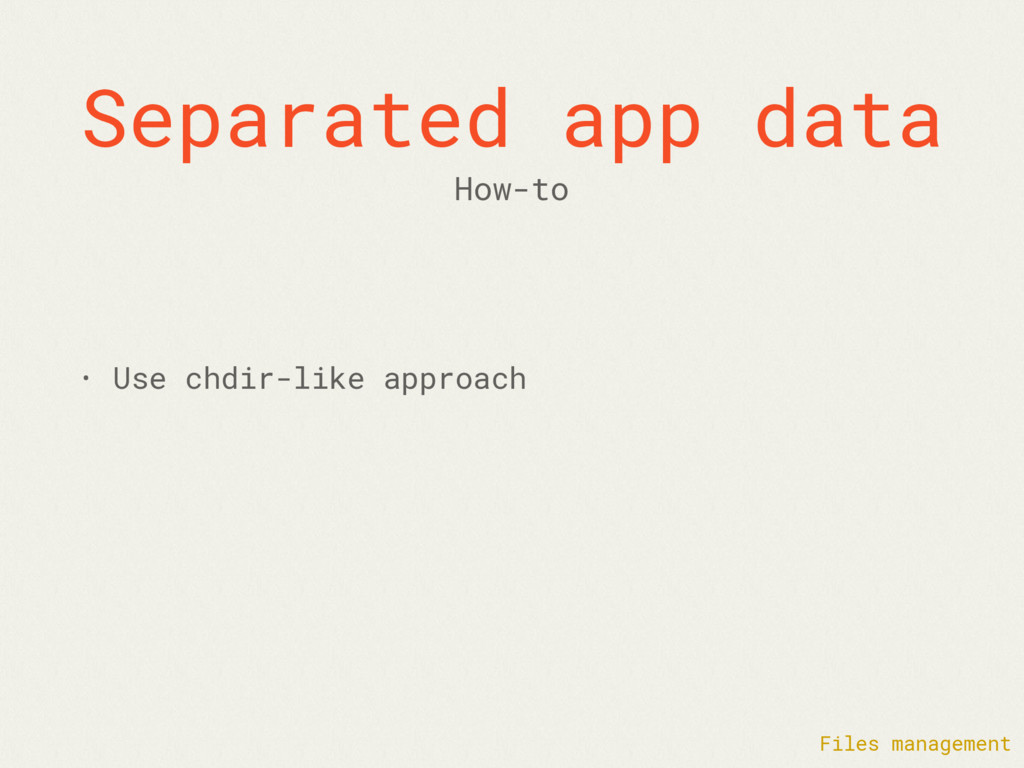
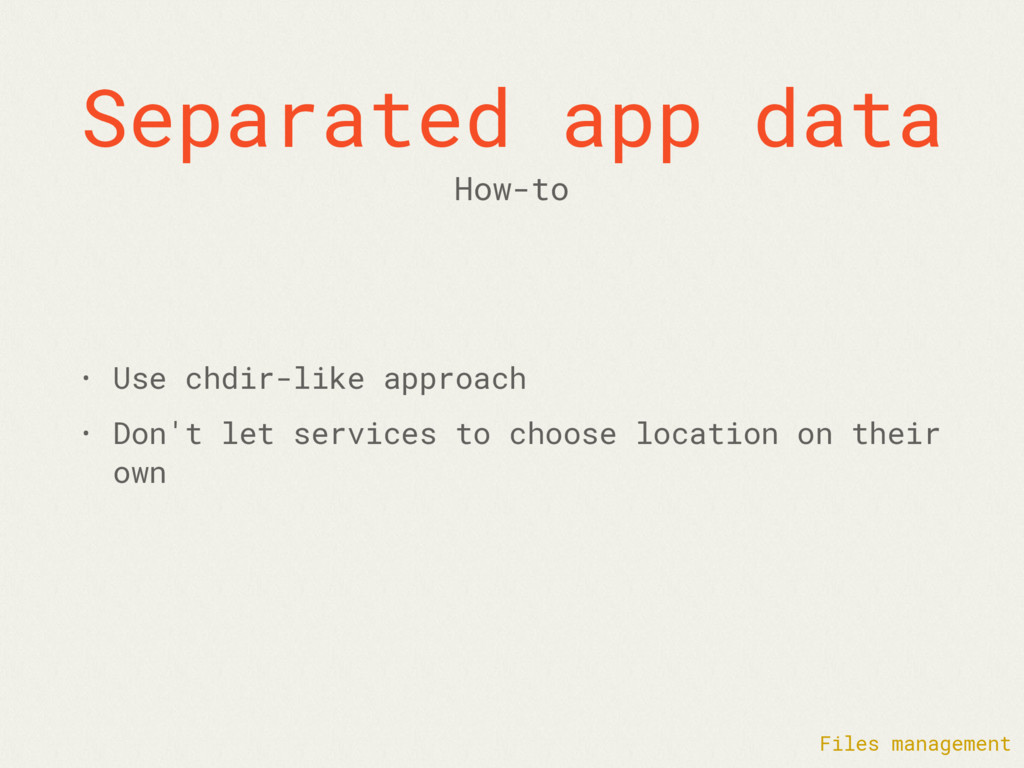
Separated app data • Use chdir-like approach • Don't let
services to choose location on their own Files management How-to -
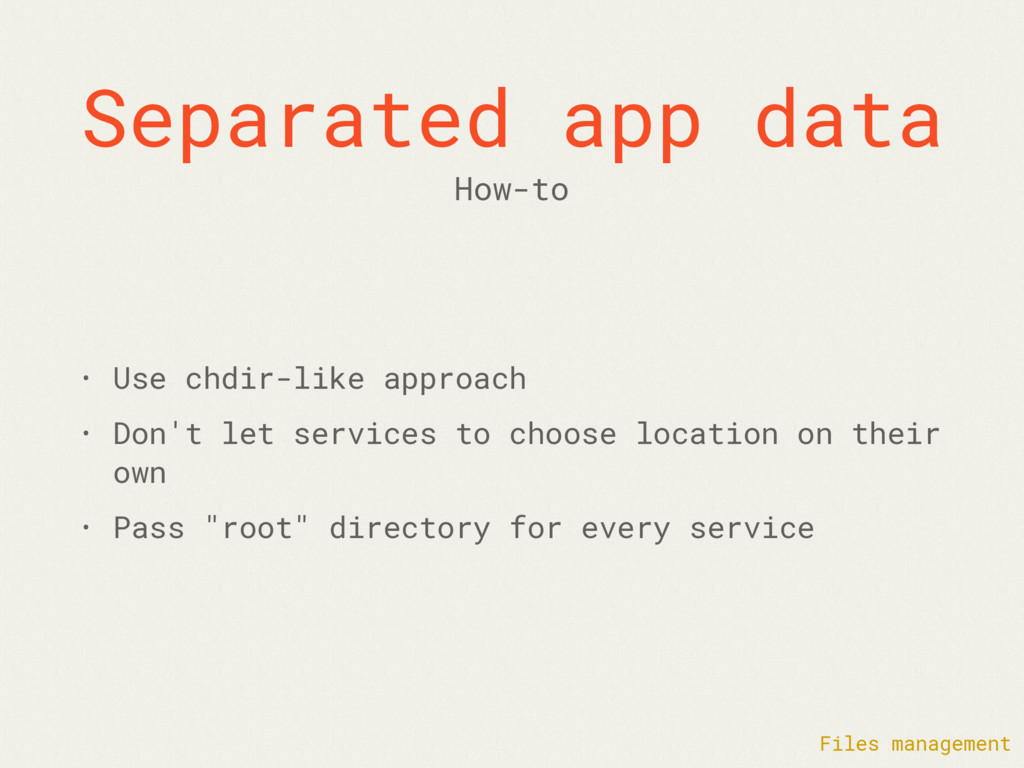
Separated app data • Use chdir-like approach • Don't let
services to choose location on their own • Pass "root" directory for every service Files management How-to -
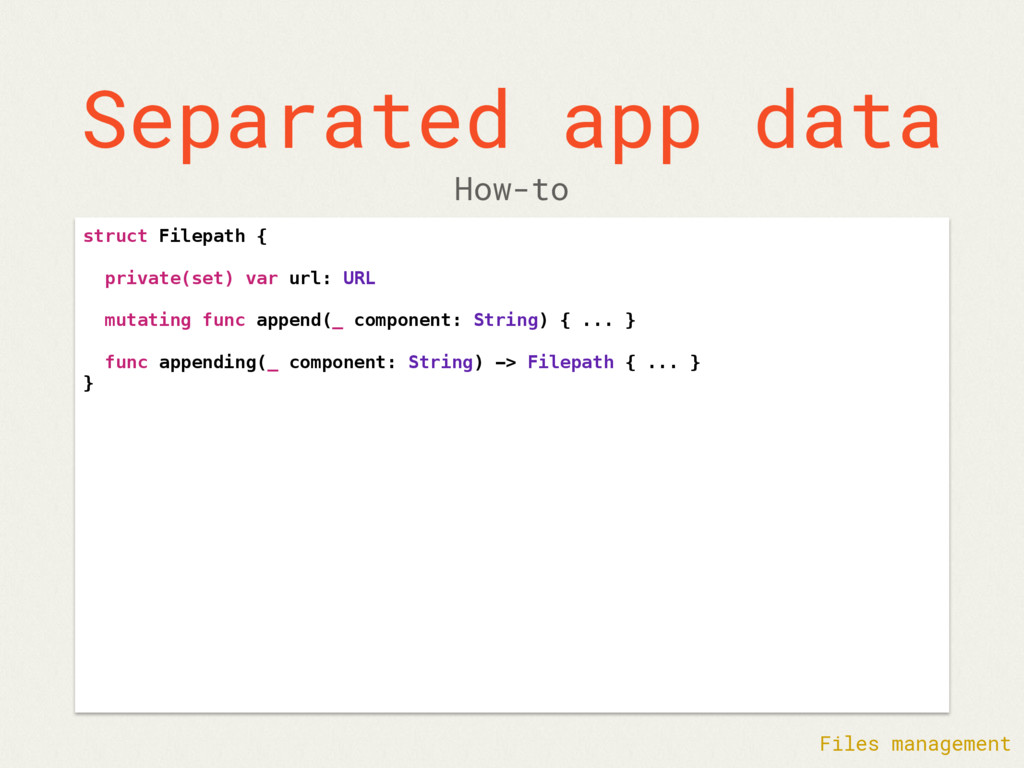
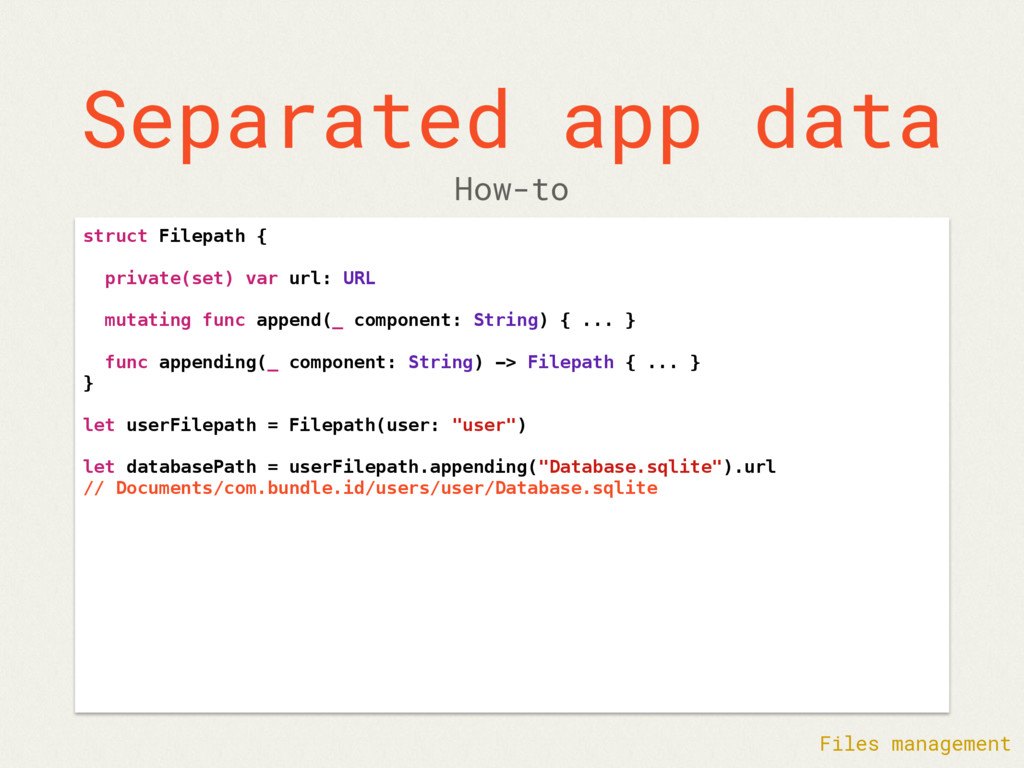
Separated app data struct Filepath { private(set) var url: URL
mutating func append(_ component: String) { ... } func appending(_ component: String) -> Filepath { ... } } How-to Files management -
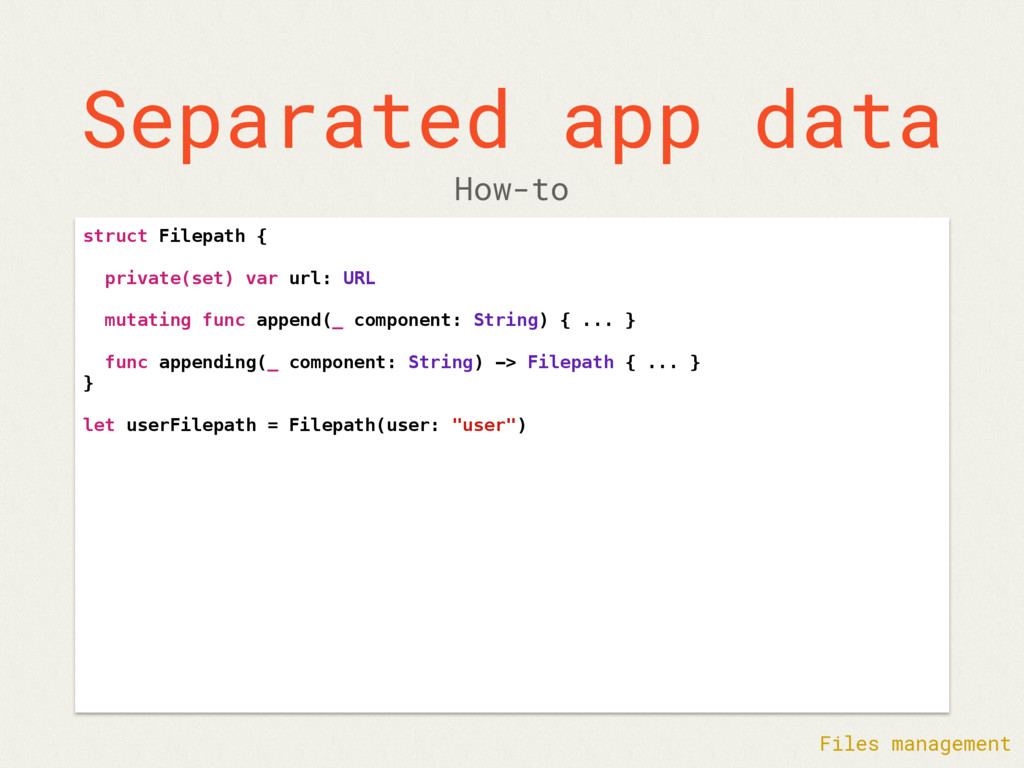
Separated app data struct Filepath { private(set) var url: URL
mutating func append(_ component: String) { ... } func appending(_ component: String) -> Filepath { ... } } let userFilepath = Filepath(user: "user") How-to Files management -
Separated app data struct Filepath { private(set) var url: URL
mutating func append(_ component: String) { ... } func appending(_ component: String) -> Filepath { ... } } let userFilepath = Filepath(user: "user") let databasePath = userFilepath.appending("Database.sqlite").url // Documents/com.bundle.id/users/user/Database.sqlite How-to Files management -
Files management • Simplifies any resources cleanup • Simplifies migration
process Files management When performed -
Files management • Simplifies any resources cleanup • Simplifies migration
process • Isolates resources from different services Files management When performed -
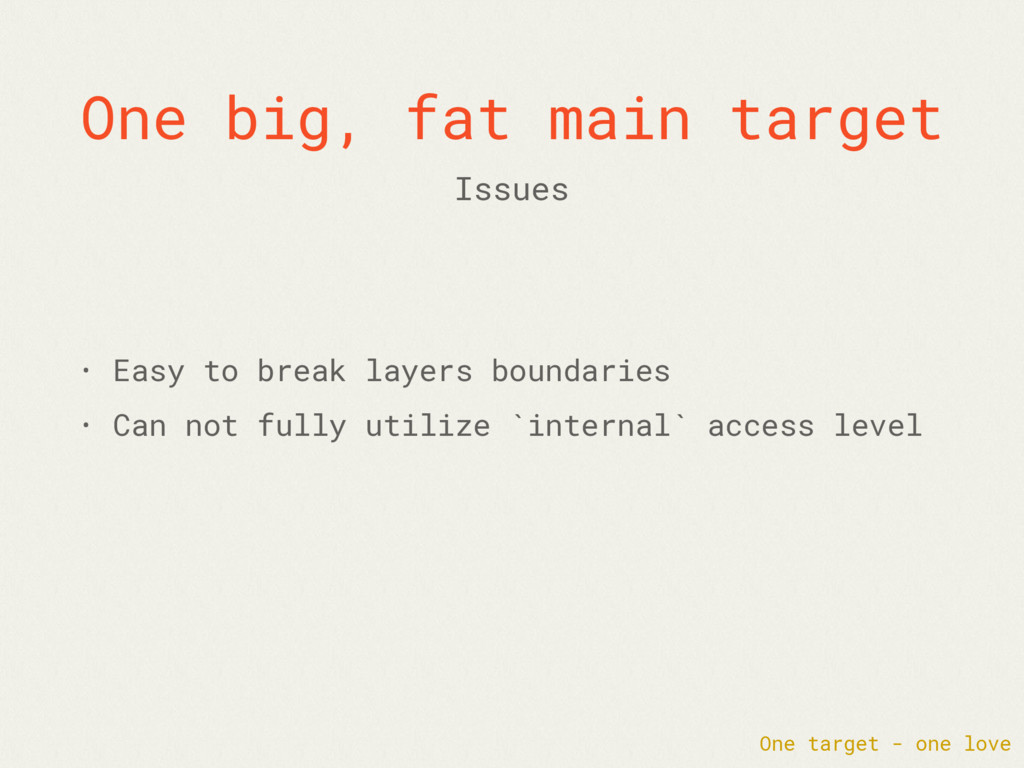
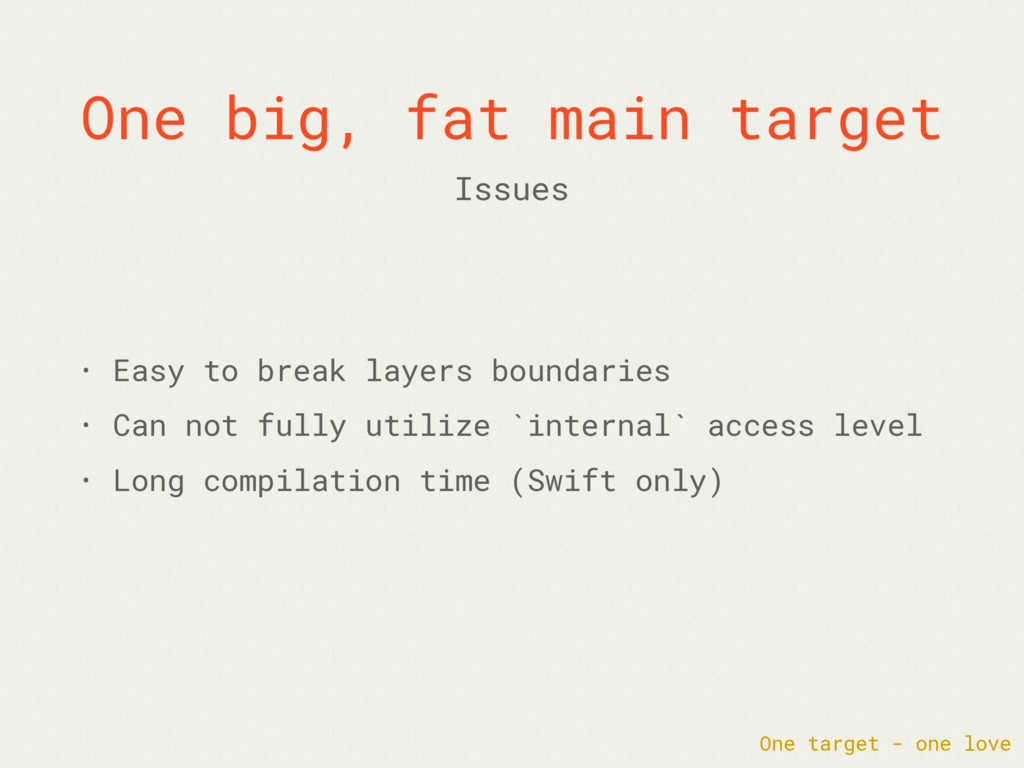
One big, fat main target • Easy to break layers
boundaries • Can not fully utilize `internal` access level • Long compilation time (Swift only) • Single namespace One target - one love Issues -
One big, fat main target • Easy to break layers
boundaries • Can not fully utilize `internal` access level • Long compilation time (Swift only) • Single namespace One target - one love Issues -
One big, fat main target • Easy to break layers
boundaries • Can not fully utilize `internal` access level • Long compilation time (Swift only) • Single namespace One target - one love Issues -
One big, fat main target • Easy to break layers
boundaries • Can not fully utilize `internal` access level • Long compilation time (Swift only) One target - one love Issues -
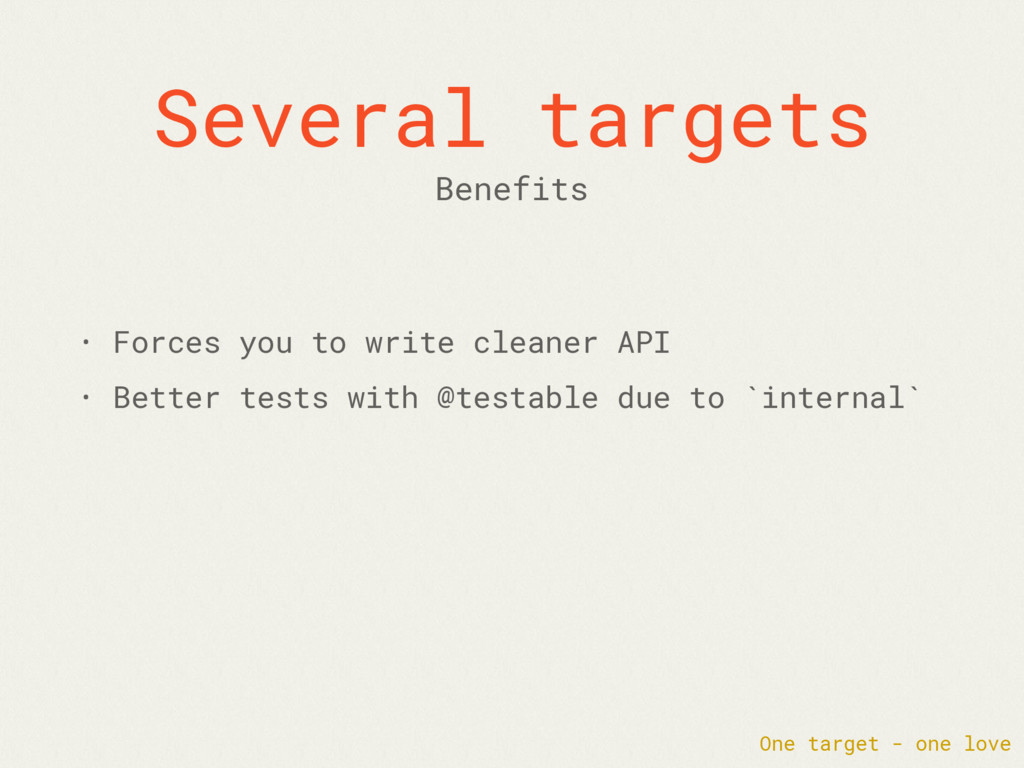
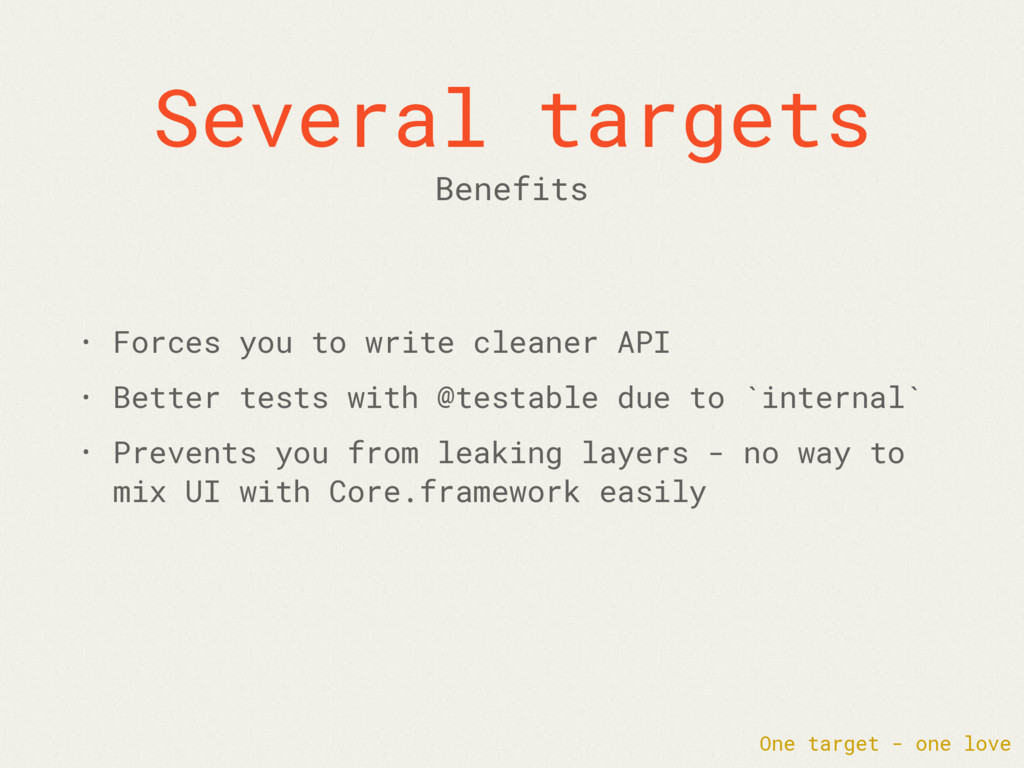
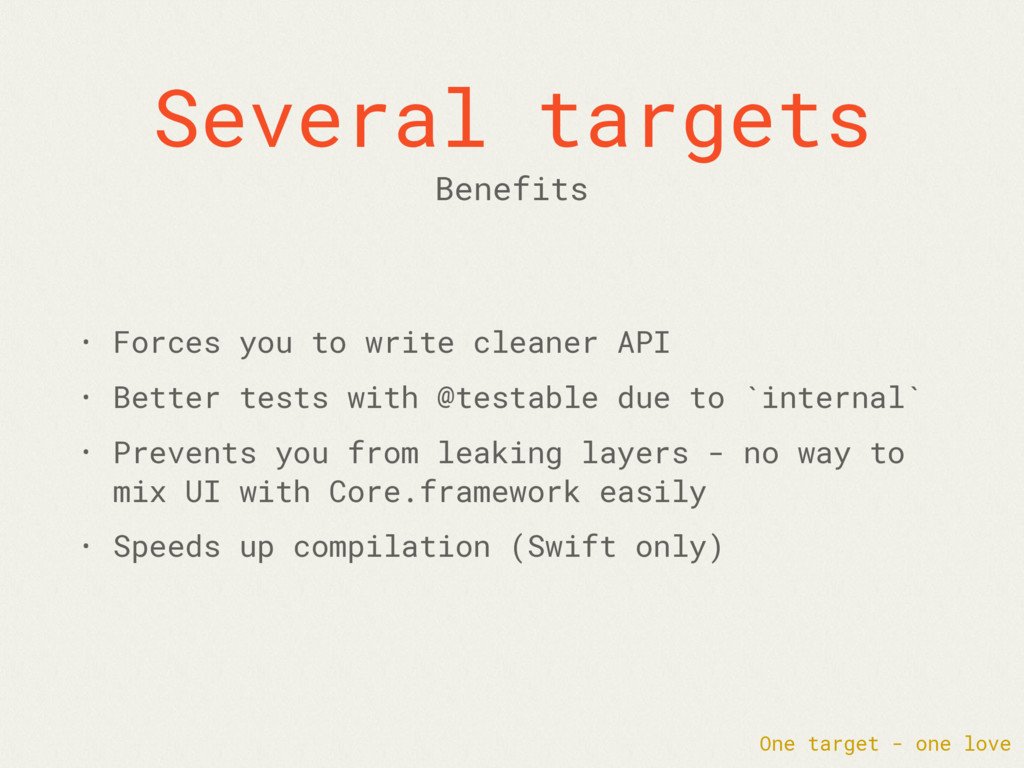
Several targets • Forces you to write cleaner API •
Better tests with @testable due to `internal` • Prevents you from leaking layers - no way to mix UI with Core.framework easily • Speeds up compilation (Swift only) One target - one love Benefits -
Several targets • Forces you to write cleaner API •
Better tests with @testable due to `internal` • Prevents you from leaking layers - no way to mix UI with Core.framework easily • Speeds up compilation (Swift only) One target - one love Benefits -
Several targets • Forces you to write cleaner API •
Better tests with @testable due to `internal` • Prevents you from leaking layers - no way to mix UI with Core.framework easily • Speeds up compilation (Swift only) One target - one love Benefits -
Several targets • Forces you to write cleaner API •
Better tests with @testable due to `internal` • Prevents you from leaking layers - no way to mix UI with Core.framework easily • Speeds up compilation (Swift only) One target - one love Benefits -
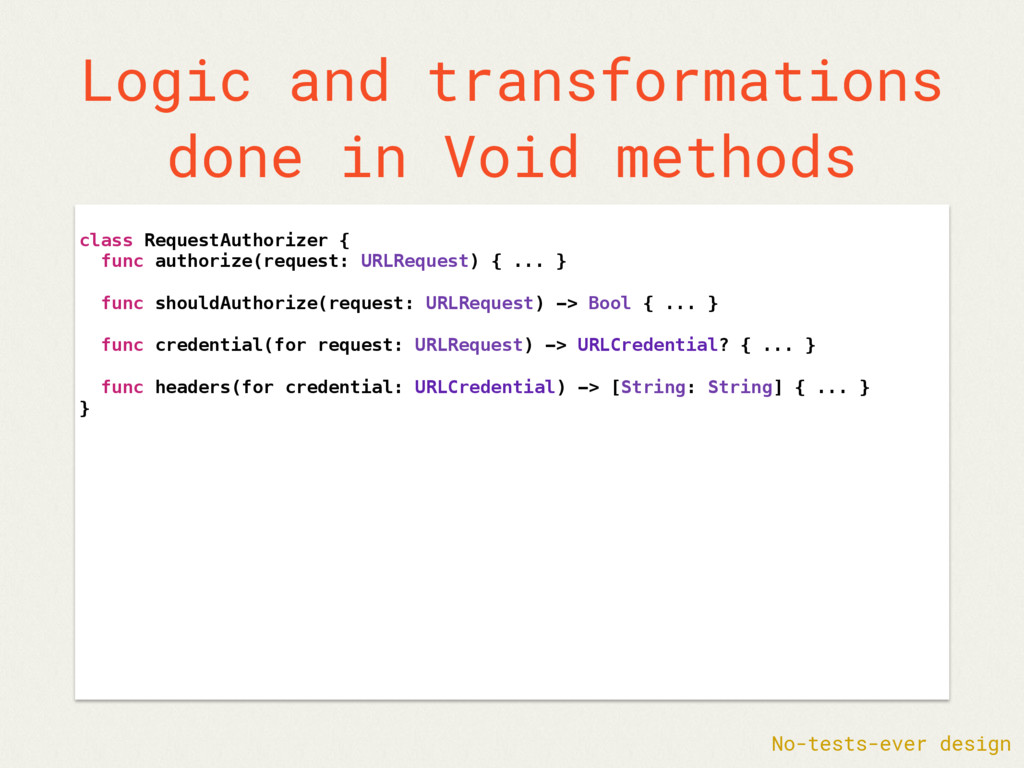
Logic and transformations done in Void methods class RequestAuthorizer {
func authorize(request: URLRequest) { ... } func shouldAuthorize(request: URLRequest) -> Bool { ... } func credential(for request: URLRequest) -> URLCredential? { ... } func headers(for credential: URLCredential) -> [String: String] { ... } } No-tests-ever design -
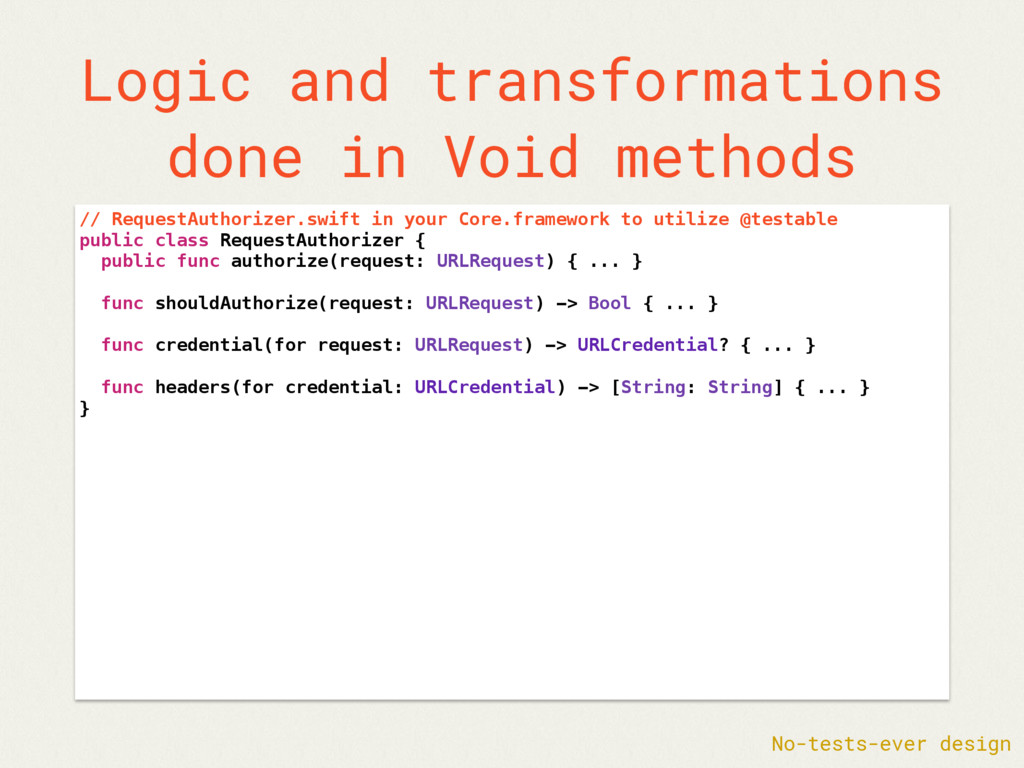
Logic and transformations done in Void methods // RequestAuthorizer.swift in
your Core.framework to utilize @testable public class RequestAuthorizer { public func authorize(request: URLRequest) { ... } func shouldAuthorize(request: URLRequest) -> Bool { ... } func credential(for request: URLRequest) -> URLCredential? { ... } func headers(for credential: URLCredential) -> [String: String] { ... } } No-tests-ever design -
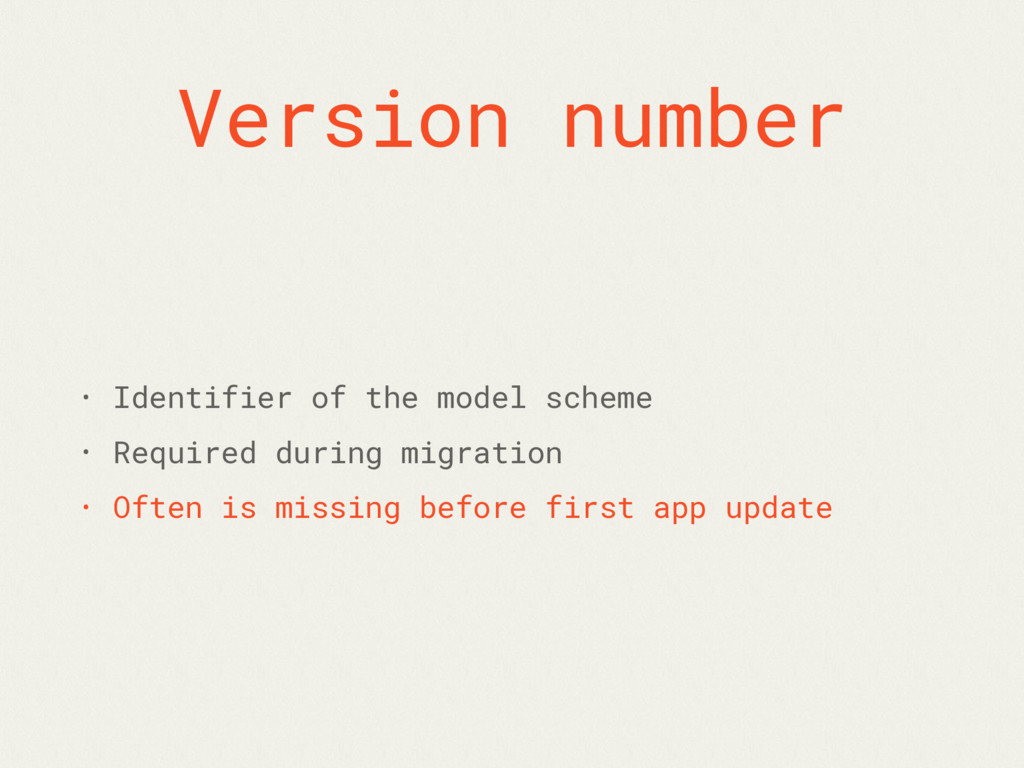
Version number • Identifier of the model scheme • Required
during migration • Often is missing before first app update -
Version number • Identifier of the model scheme • Required
during migration • Often is missing before first app update -
Version number • Identifier of the model scheme • Required
during migration • Often is missing before first app update -
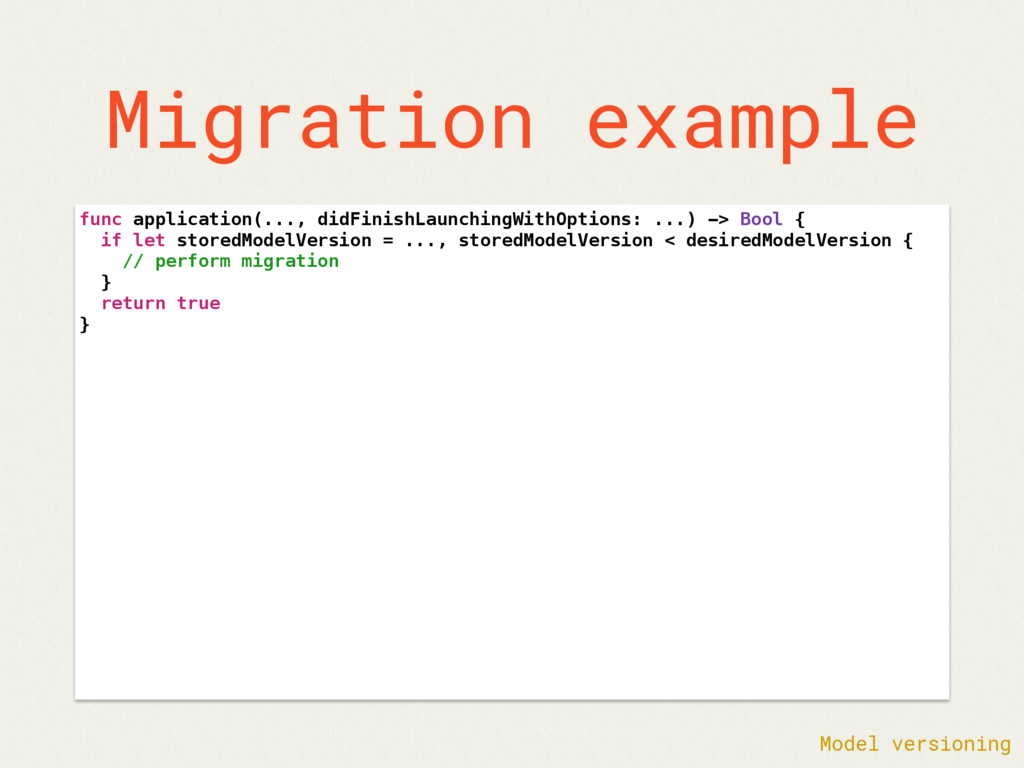
Migration example func application(..., didFinishLaunchingWithOptions: ...) -> Bool { if
let storedModelVersion = ..., storedModelVersion < desiredModelVersion { // perform migration } return true } Model versioning -
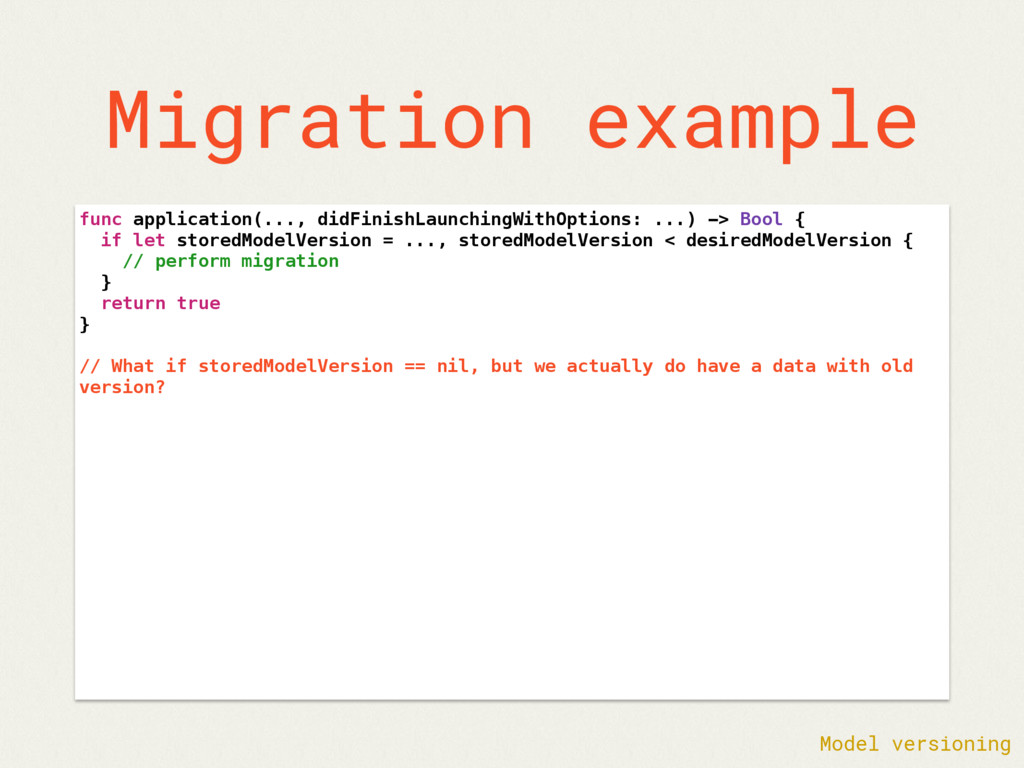
Migration example func application(..., didFinishLaunchingWithOptions: ...) -> Bool { if
let storedModelVersion = ..., storedModelVersion < desiredModelVersion { // perform migration } return true } // What if storedModelVersion == nil, but we actually do have a data with old version? Model versioning -
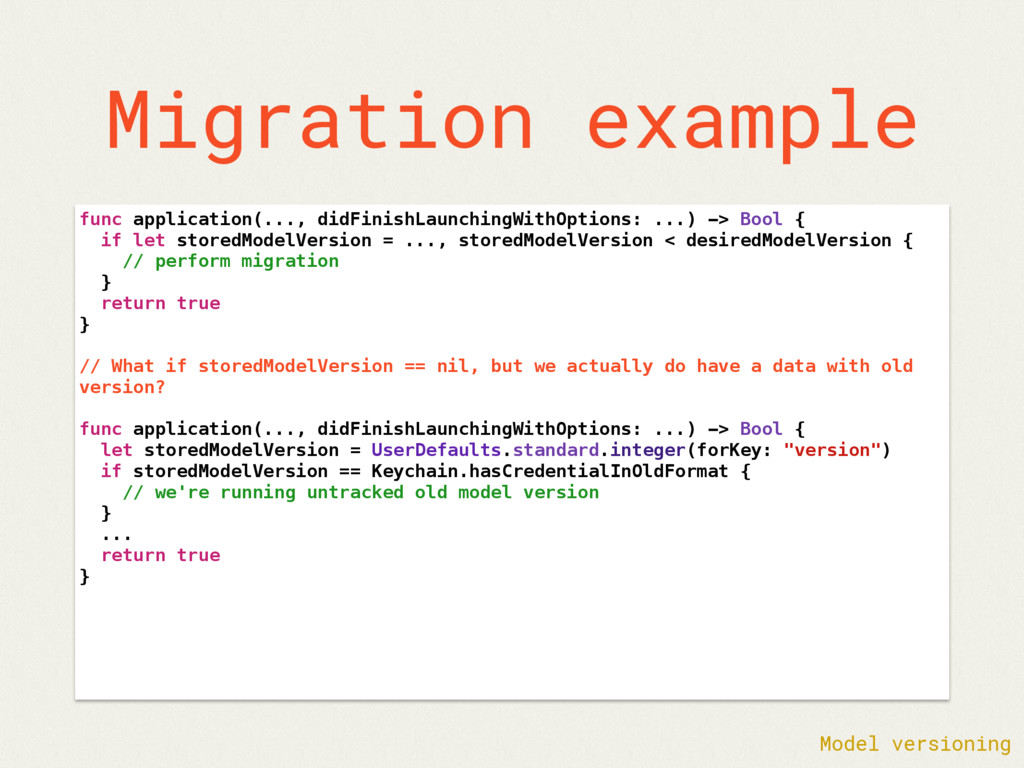
Migration example func application(..., didFinishLaunchingWithOptions: ...) -> Bool { if
let storedModelVersion = ..., storedModelVersion < desiredModelVersion { // perform migration } return true } // What if storedModelVersion == nil, but we actually do have a data with old version? func application(..., didFinishLaunchingWithOptions: ...) -> Bool { let storedModelVersion = UserDefaults.standard.integer(forKey: "version") if storedModelVersion == Keychain.hasCredentialInOldFormat { // we're running untracked old model version } ... return true } Model versioning -
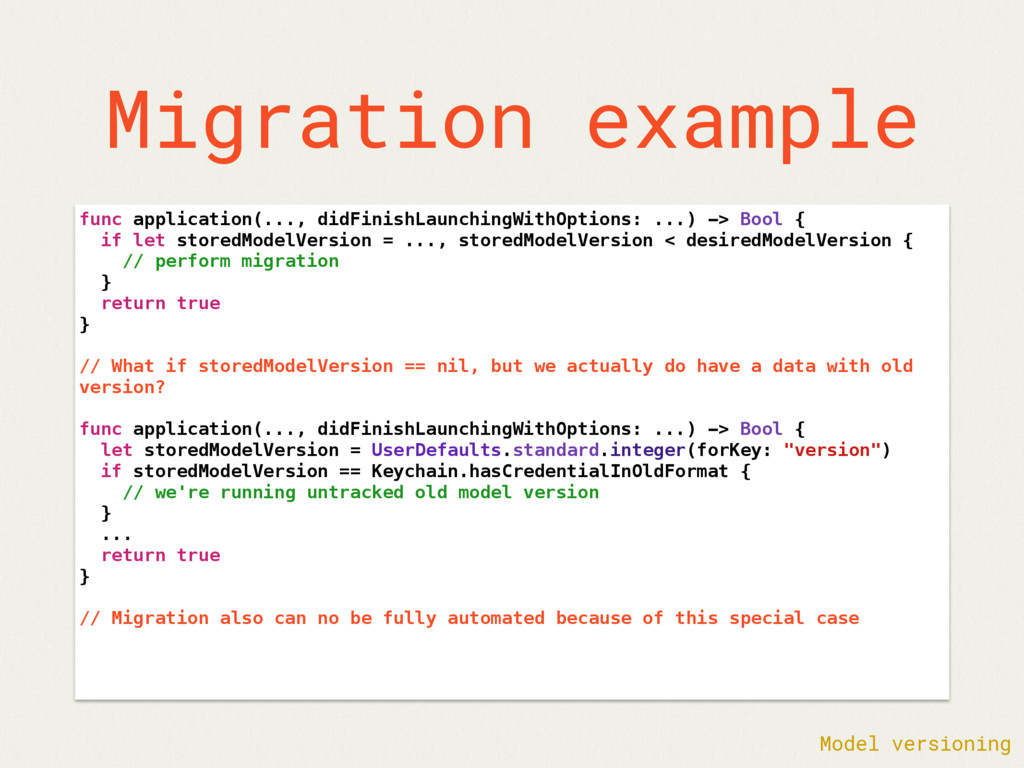
Migration example func application(..., didFinishLaunchingWithOptions: ...) -> Bool { if
let storedModelVersion = ..., storedModelVersion < desiredModelVersion { // perform migration } return true } // What if storedModelVersion == nil, but we actually do have a data with old version? func application(..., didFinishLaunchingWithOptions: ...) -> Bool { let storedModelVersion = UserDefaults.standard.integer(forKey: "version") if storedModelVersion == Keychain.hasCredentialInOldFormat { // we're running untracked old model version } ... return true } // Migration also can no be fully automated because of this special case Model versioning -
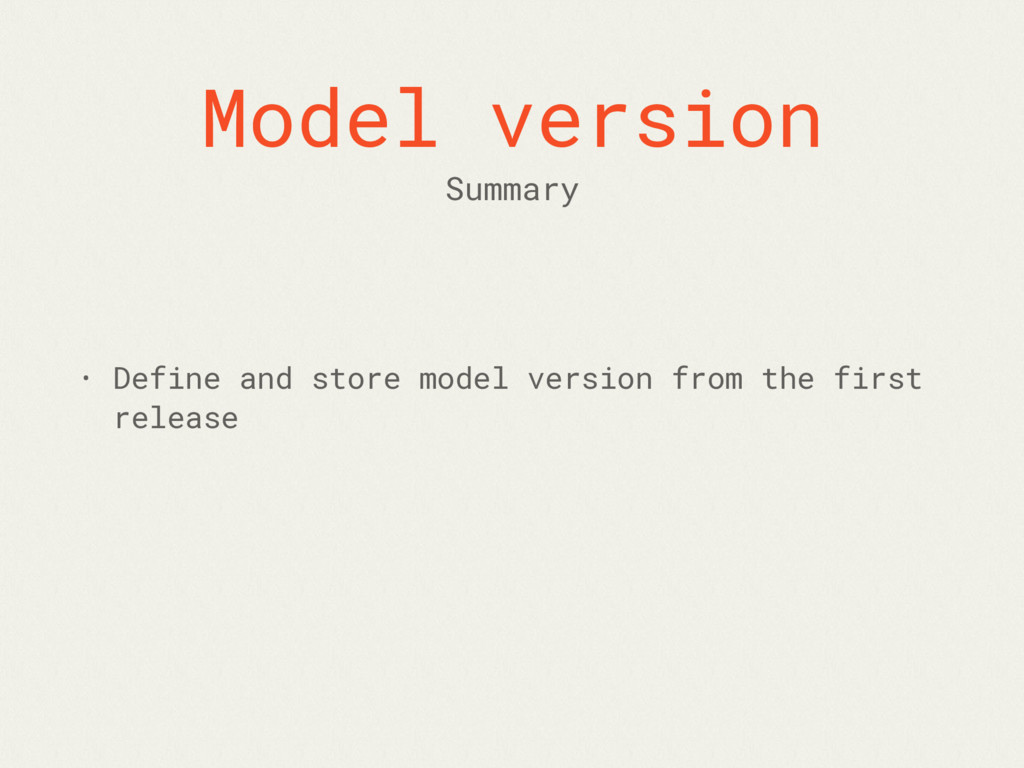
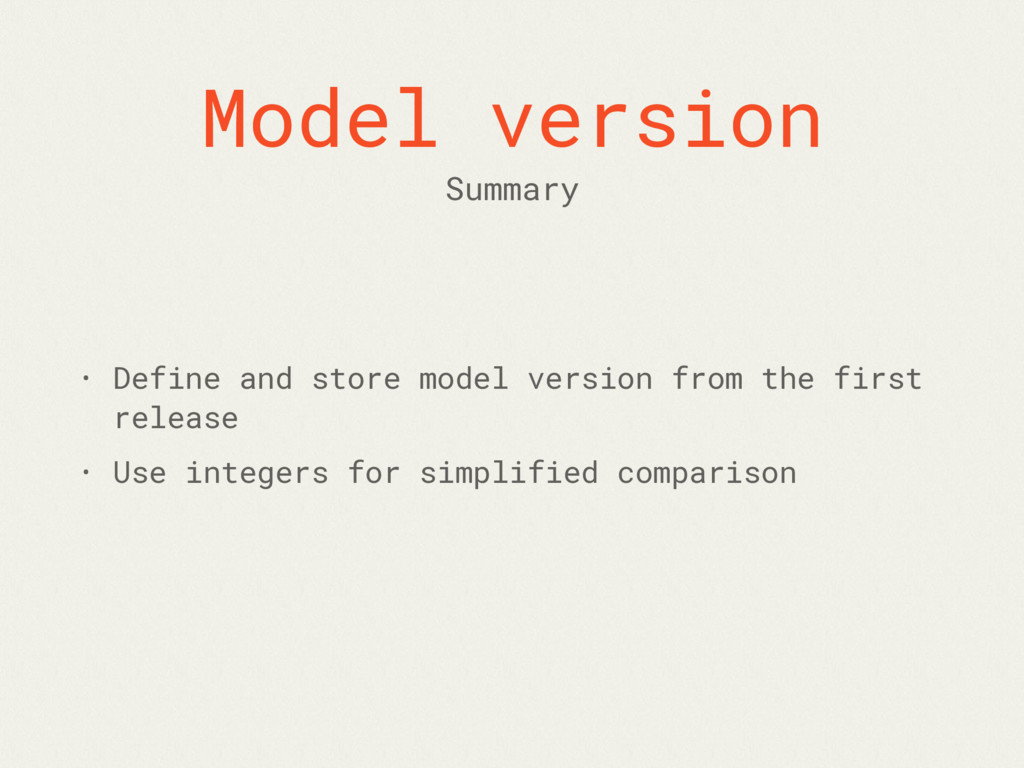
Model version • Define and store model version from the
first release • Use integers for simplified comparison • Model version != app version (810 vs 1.3) Summary -
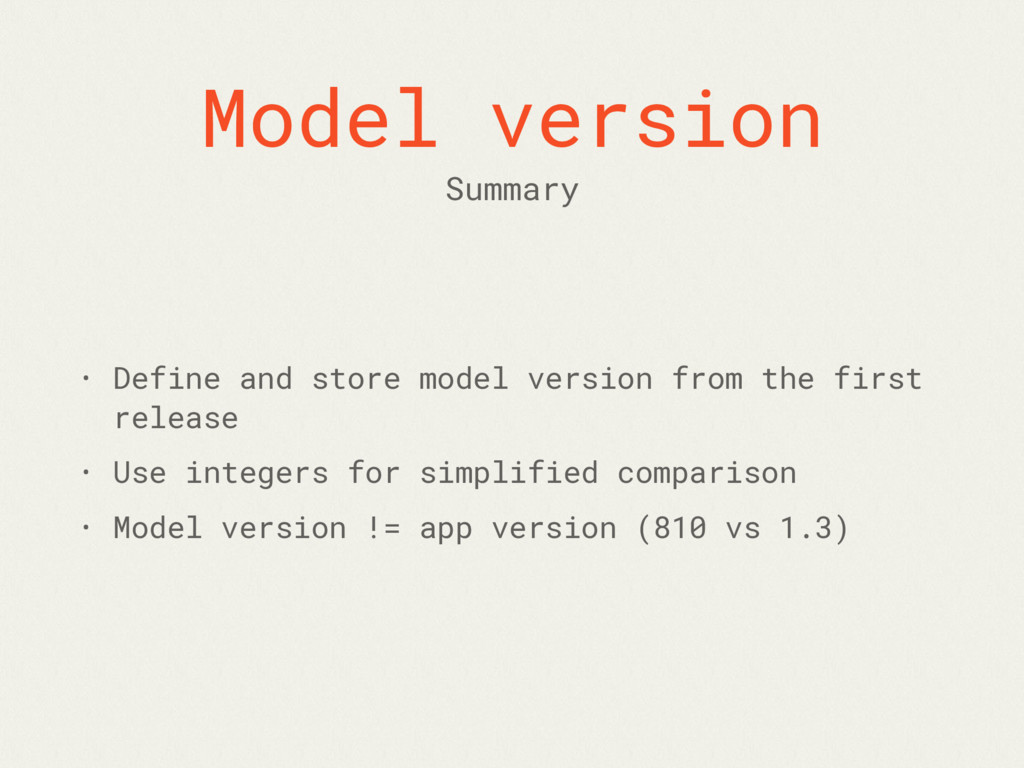
Model version • Define and store model version from the
first release • Use integers for simplified comparison • Model version != app version (810 vs 1.3) Summary -
Model version • Define and store model version from the
first release • Use integers for simplified comparison • Model version != app version (810 vs 1.3) Summary
 poteryaysya
 ostk0069
 hasutosasaki
 har1101
 yasunori0418
 yuuu
 ryunakayama
 rshindo
 omatty198
 kinakomoti321
 utakaha
 nokonoko1203
 kosukesaigusa
 keathley
 62gerente
 pauljervisheath
 chriscoyier
 tammyeverts
 szymonslowik
 lauravandoore
 akosma
 pedronauck
 rkaga
 aarron
 shpigford