Share
Embed
Advanced Dates and Times in Swift (360|iDev 2017)
Some solutions to common problems in date and time APIs.
Jeff Kelley
August 14, 2017
Transcript
33 slides
-
Date A Date is a moment in time, measured in
seconds since January 1, 2001. Those measurements of seconds are TimeIntervals, which are just Doubles under the hood. Jeff Kelley @SlaunchaMan -
Calendar The things we think about when we think about
dates and times— months, days, years, hours, minutes, etc.—are called DateComponents. To get DateComponents from a Date and vice versa, you need a Calendar. A Calendar knows about TimeZones, how many months are in a year, etc. Jeff Kelley @SlaunchaMan -
Calendar.Component public enum Component { case era case year case
month case day case hour case minute case second case weekday case weekdayOrdinal case quarter case weekOfMonth case weekOfYear case yearForWeekOfYear case nanosecond case calendar case timeZone } Jeff Kelley @SlaunchaMan -
Indiana Time Zones • America/Indiana/Indianapolis • America/Indiana/Vincennes • America/Indiana/Winamac •
America/Indiana/Marengo • America/Indiana/Petersburg • America/Indiana/Vevay • America/Indiana/Tell_City • America/Indiana/Knox Jeff Kelley @SlaunchaMan -
Antarctica Time Zones For the most part, daylight saving time
(DST) is not observed in Antarctica because 95 percent of the continent is located south of the Antarctic Circle and the midnight sun phenomenon renders the use of DST unnecessary … a few regions … observe the time and use of DST of the countries they are supplied from. — Wikipedia, Time in Antarctica Jeff Kelley @SlaunchaMan -
Easter Let’s write a method to find the month and
day for Easter in a given year. Easter falls on the first Sunday after the full moon following the March equinox—the “paschal full moon.” Easy, right? Jeff Kelley @SlaunchaMan -
Computus Expression Gregorian Easter 2 April 1961 16 April 2017
“Anonymous Gregorian Algorithm” from Wikipedia Jeff Kelley @SlaunchaMan -
SwiftyComputus extension DateComponents { init(forEasterIn year: Int) { self.init() self.calendar
= Calendar(identifier: .gregorian) // Source: http://en.wikipedia.org/wiki/Computus#Anonymous_Gregorian_algorithm let a = year % 19; let b = year / 100; let c = year % 100; let d = b / 4; let e = b % 4; let f = (b + 8) / 25; let g = (b - f + 1) / 3; let h = ((19 * a) + b - d - g + 15) % 30; let i = c / 4; let k = c % 4; let L = (32 + (2 * e) + (2 * i) - h - k) % 7; let m = (a + (11 * h) + (22 * L)) / 451; self.month = (h + L - (7 * m) + 114) / 31; self.day = ((h + L - (7 * m) + 114) % 31) + 1; self.year = year } } Jeff Kelley @SlaunchaMan -
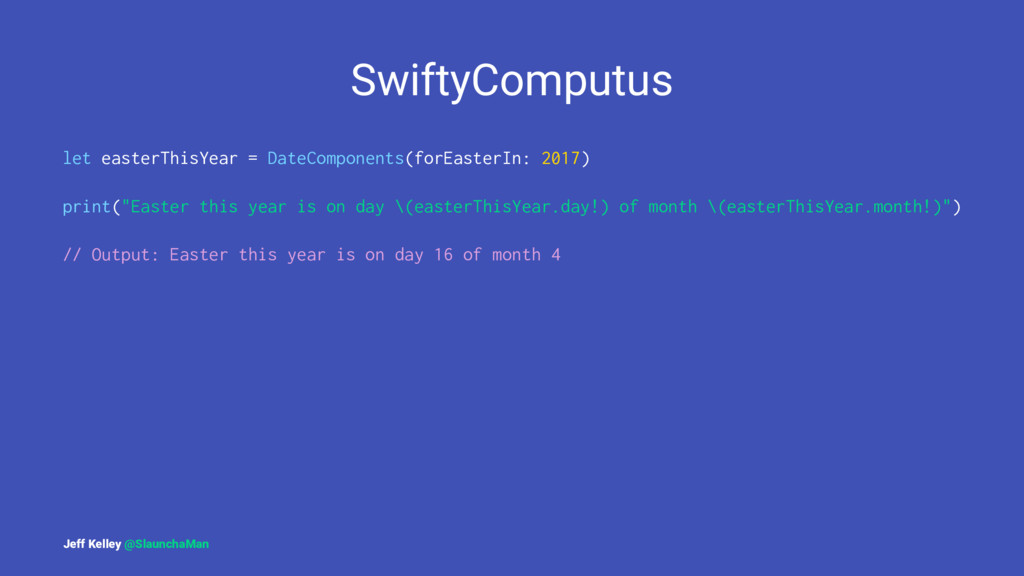
SwiftyComputus let easterThisYear = DateComponents(forEasterIn: 2017) print("Easter this year is
on day \(easterThisYear.day!) of month \(easterThisYear.month!)") // Output: Easter this year is on day 16 of month 4 Jeff Kelley @SlaunchaMan -
DateInterval let calendar = Calendar.autoupdatingCurrent let timeZone = TimeZone(identifier: "America/Denver")!
let talkStart = DateComponents( timeZone: timeZone, year: 2017, month: 8, day: 14, hour: 15, minute: 45, second: 00) let talkEnd = DateComponents( timeZone: timeZone, year: 2017, month: 8, day: 14, hour: 16, minute: 30, second: 00) let startDate = calendar.date(from: talkStart)! let endDate = calendar.date(from: talkEnd)! let talkInterval = DateInterval( start: startDate, end: endDate) Jeff Kelley @SlaunchaMan -
DateInterval talkInterval.duration // 2700 talkInterval.description // "2017-08-14 21:45:00 +0000 to
2017-08-14 22:30:00 +0000" talkInterval.contains(Date()) // true Jeff Kelley @SlaunchaMan -
DateIntervalFormatter let formatter = DateIntervalFormatter() formatter.string(from: talkInterval) // "8/14/17, 3:45
- 4:30 PM" Jeff Kelley @SlaunchaMan -
DateIntervalFormatter var prefix = "" if calendar.isDateInToday(startDate) && calendar.isDateInToday(endDate) {
formatter.dateStyle = .none prefix = "Today " } else if calendar.isDateInYesterday(startDate) && calendar.isDateInYesterday(endDate) { formatter.dateStyle = .none prefix = "Yesterday " } else if calendar.isDateInTomorrow(startDate) && calendar.isDateInTomorrow(endDate) { formatter.dateStyle = .none prefix = "Tomorrow " } else { formatter.dateStyle = .short } prefix + formatter.string(from: talkInterval)! // "Today 3:45 – 4:30 PM" Jeff Kelley @SlaunchaMan -
Converting Between DateComponents // How many days are there in
this month? calendar.range(of: .day, in: .month, for: Date()) // Range(1..<32) Jeff Kelley @SlaunchaMan -
Converting Between DateComponents // How many days are there in
this year? calendar.range(of: .day, in: .year, for: Date()) // Range(1..<366) Jeff Kelley @SlaunchaMan -
How Many Seconds Are in a Year? calendar.maximumRange(of: .second) //
Range(0..<60) calendar.minimumRange(of: .day) // Range(1..<29) Jeff Kelley @SlaunchaMan -
How Many Seconds Are in a Year? // How many
seconds are there in this year? calendar.range(of: .second, in: .year, for: Date()) // Range(0..<60) Jeff Kelley @SlaunchaMan -
How Many Seconds Are in a Year? let monthRange =
calendar.range(of: .month, in: .year, for: Date())! for month in monthRange.lowerBound ..< monthRange.upperBound { let date = calendar.date(bySetting: .month, value: month, of: Date())! let dayRange = calendar.range(of: .day, in: .month, for: date)! for day in dayRange.lowerBound ..< dayRange.upperBound { let date = calendar.date(bySetting: .day, value: day, of: date)! let hourRange = calendar.range(of: .hour, in: .day, for: date)! for hour in hourRange.lowerBound ..< hourRange.upperBound { Jeff Kelley @SlaunchaMan -
Demo How many seconds are in a year? Jeff Kelley
@SlaunchaMan -
When to use range(of:in:for:) • Creating your own date picker
• But you should probably use Apple’s if you can • Creating a calendar view • Find number of months in a year, days in a week, etc. • Enumerating values, e.g. every day in a month Jeff Kelley @SlaunchaMan -
When not to use range(of:in:for) • Credit Card Expiration Date
pickers • No matter what, for US cards, the valid months are 01 through 12 • The actual domain is valid credit card expiration dates Jeff Kelley @SlaunchaMan -
Notifications at Specific Times let beginningOfAnyYearComponents = DateComponents( month: 1,
day: 1, hour: 0, minute: 0, second: 0, nanosecond: 0) calendar.nextDate(after: Date(), matching: beginningOfAnyYearComponents, matchingPolicy: Calendar.MatchingPolicy.nextTime) // "Jan 1, 2018 at 12:00 AM" Jeff Kelley @SlaunchaMan -
Notifications at Specific Times let trigger = UNCalendarNotificationTrigger(dateMatching:beginningOfAnyYearComponents, repeats: true)
trigger.nextTriggerDate() // "Jan 1, 2018 at 12:00 AM" Jeff Kelley @SlaunchaMan -
Notifications at Specific Times let content = UNMutableNotificationContent() content.title =
"Happy new year!" let request = UNNotificationRequest(identifier: "com.slaunchaman.happynewyear", content: content, trigger: trigger) UNUserNotificationCenter.current().add(request) { (error) in if let error = error { NSLog("Error: \(error.localizedDescription)") } } Jeff Kelley @SlaunchaMan