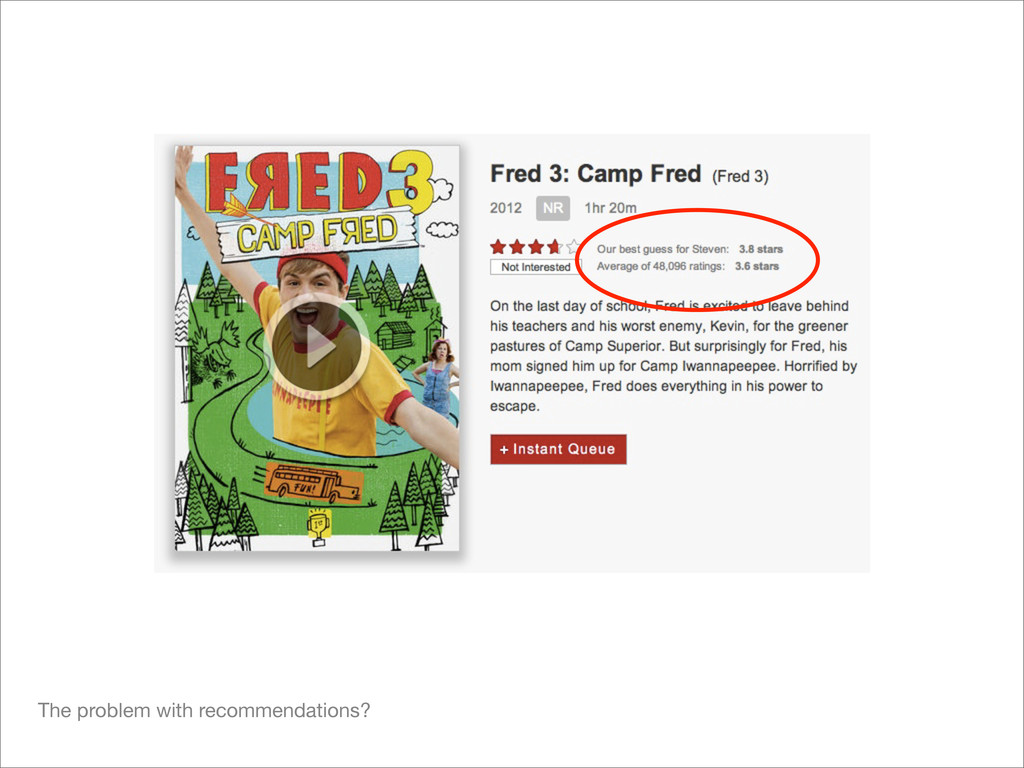
rent as many movies per month, keep them without any late fees. But in order to get a new DVD they need to mail one back to Netflix. • Problem: most customers have a limited number of movies they know about or are interested in watching. This leads to customers quitting the service when they run out of films they want to request. • 1997-2000: No recommendation system (total catalog grows from 1k-5k movies) • 2000: Development of Cinematch Begins
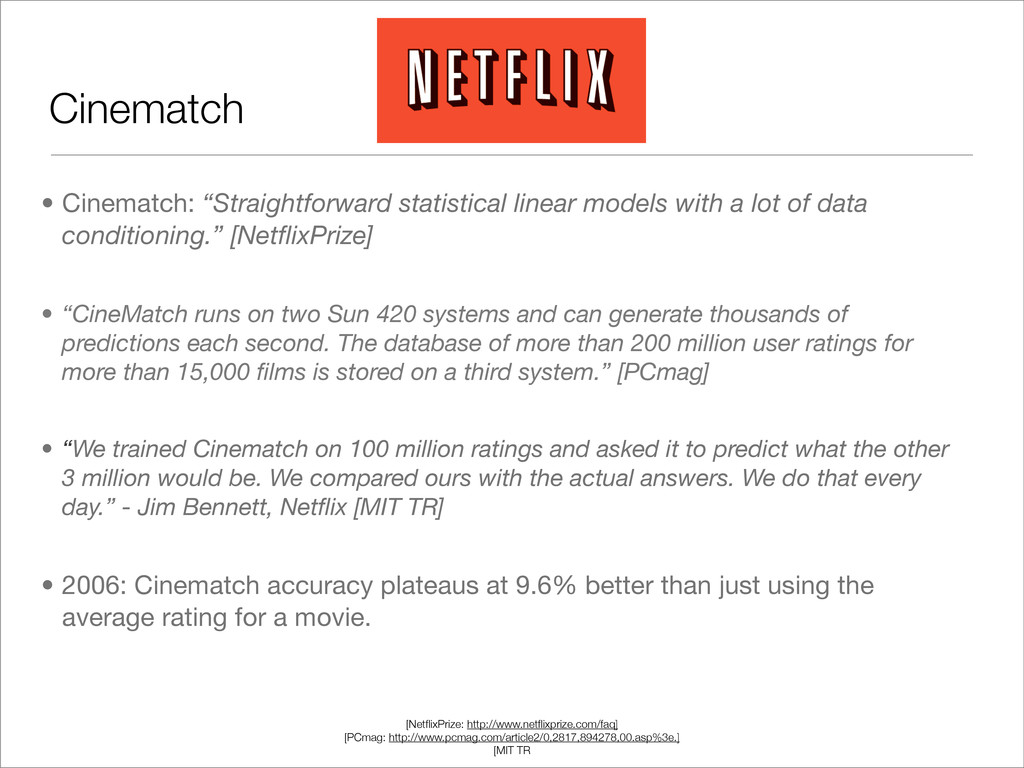
data conditioning.” [NetflixPrize] • “CineMatch runs on two Sun 420 systems and can generate thousands of predictions each second. The database of more than 200 million user ratings for more than 15,000 films is stored on a third system.” [PCmag] • “We trained Cinematch on 100 million ratings and asked it to predict what the other 3 million would be. We compared ours with the actual answers. We do that every day.” - Jim Bennett, Netflix [MIT TR] • 2006: Cinematch accuracy plateaus at 9.6% better than just using the average rating for a movie. Cinematch [NetflixPrize: http://www.netflixprize.com/faq] [PCmag: http://www.pcmag.com/article2/0,2817,894278,00.asp%3e.] [MIT TR
information • $1,000,000 to the competitor than can improve Cinematch by 10% on the same data set. • $50,000 annual “Progress Prize” for the system that most improves the accuracy of the last year’s winner. • Started October 2, 2006. If there is no winner, contest ends October 2, 2011. • Winners must describe to the world how their algorithm works.
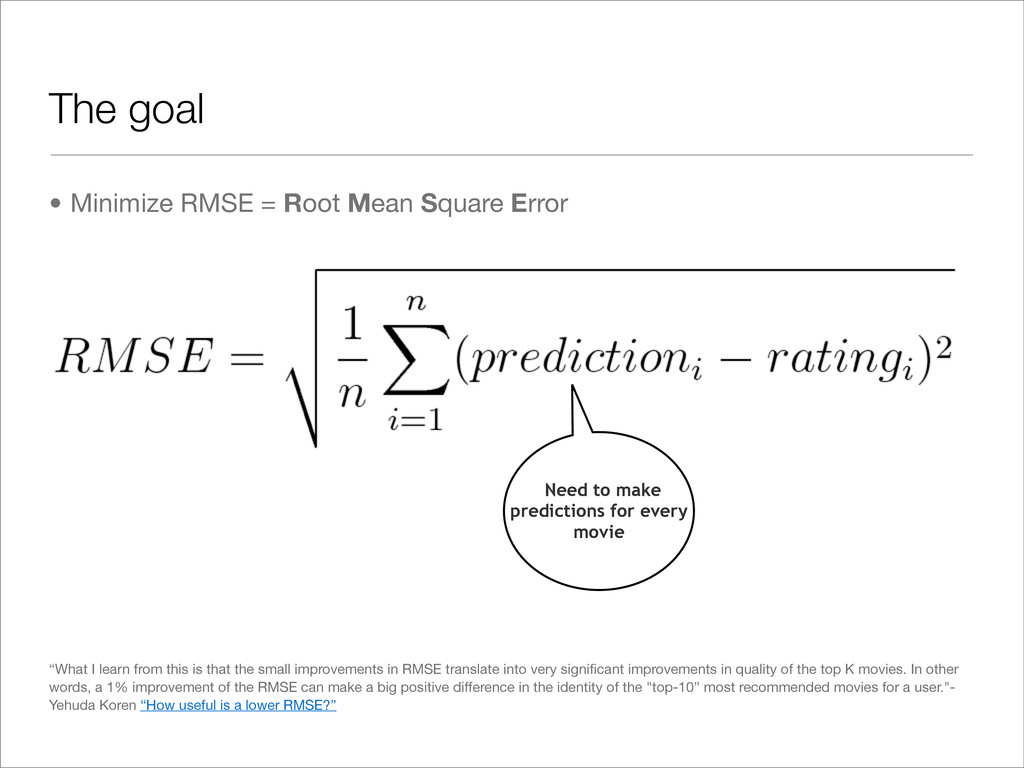
“What I learn from this is that the small improvements in RMSE translate into very significant improvements in quality of the top K movies. In other words, a 1% improvement of the RMSE can make a big positive difference in the identity of the "top-10” most recommended movies for a user."- Yehuda Koren “How useful is a lower RMSE?” Need to make predictions for every movie
set: 480,189 • Training dataset: 100,480,507 ratings, scale of 1-5. The most recent 9 ratings were taken and divided into three buckets: • Probe dataset: 1,408,395 ratings • Two Qualifying data sets: 2,817,131 ratings (divided 50-50 into quiz set and test set; quiz set results posted to Leaderboard) • Rating dates for training set: 10/98 to 12/05 http://www.research.att.com/articles/featured_stories/2010_01/2010_02_netflix_article.html?fbid=gncVF5QUO56
<user_id, date of rating, rating> Composed of ratings from users who made at least 20 ratings Ratings Data Set 104,706,033 entries probe set 1,408,395 ratings <user_id, movie, date of rating, rating> quiz set 1,408,342 entries <user_id, movie, date of rating> test set 1,408,789 entries <user, movie, date of rating> Contestants use to test solution Used for leaderboard Used to determine winners Most recent 9 ratings divided into three groups
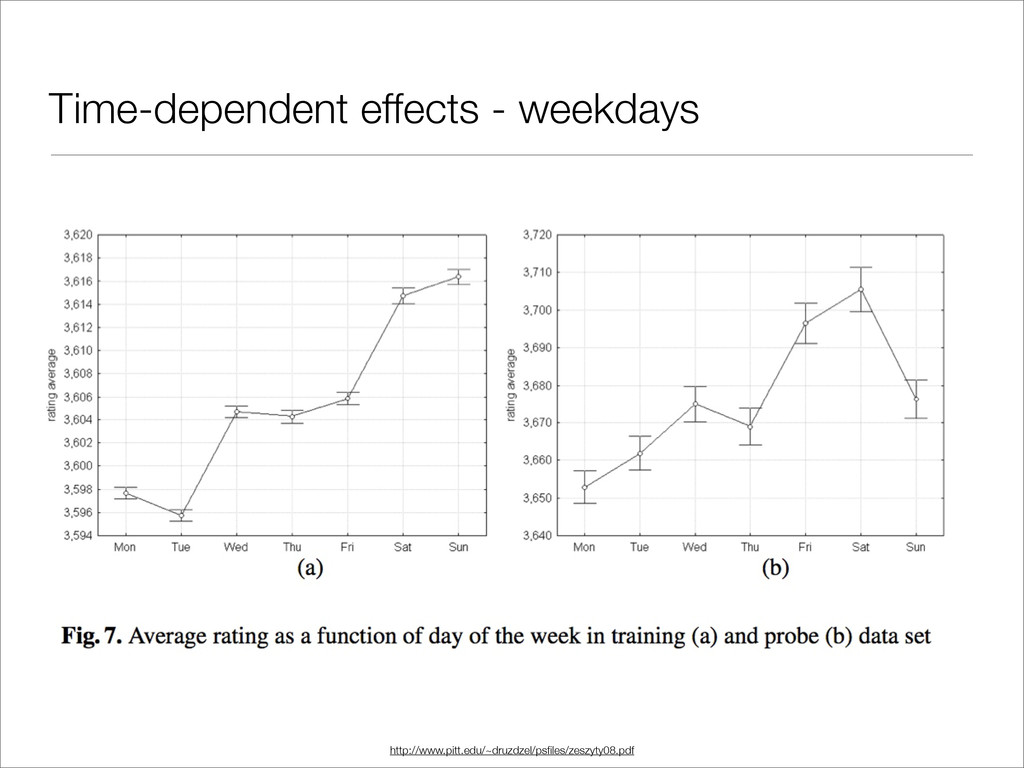
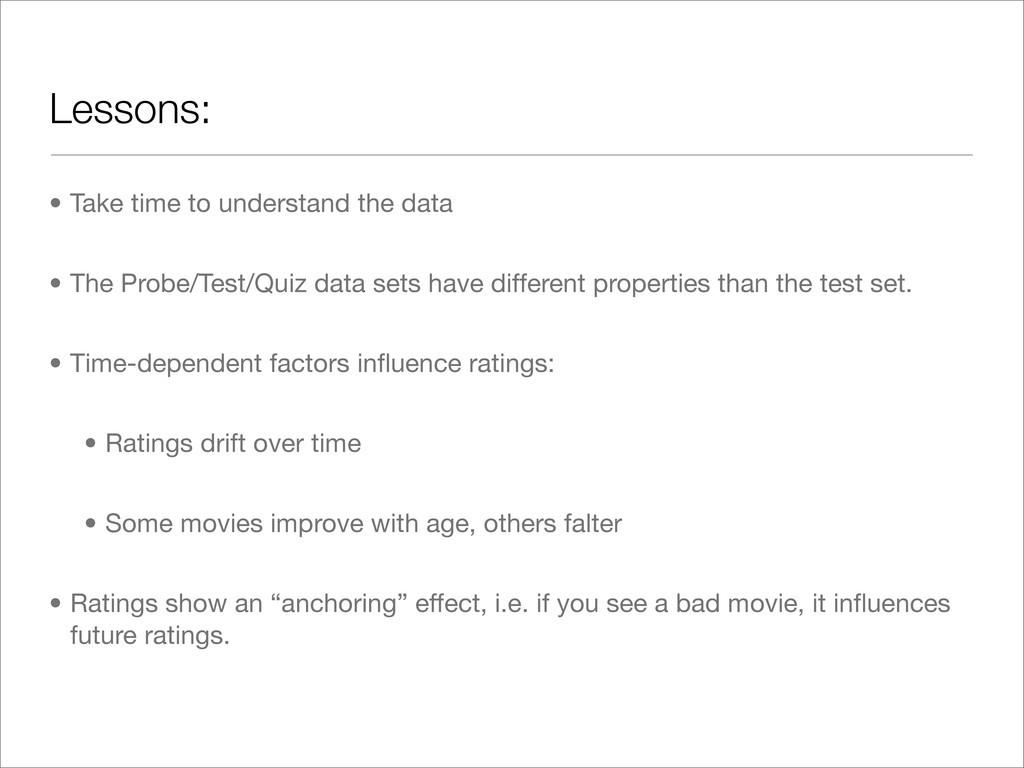
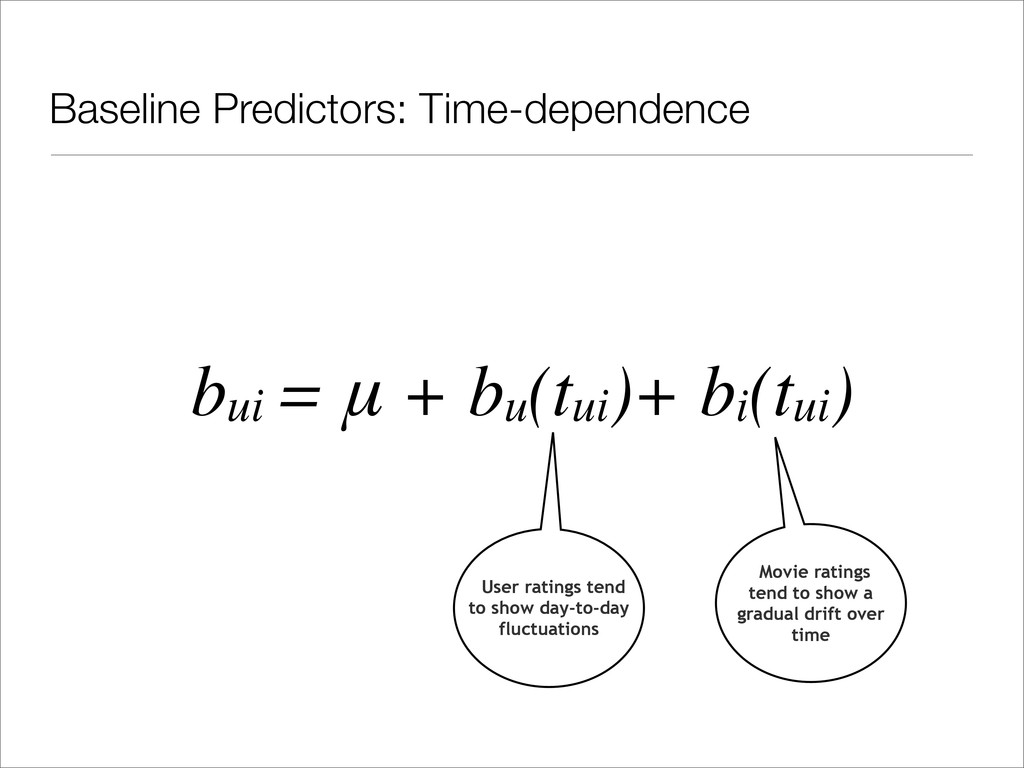
Probe/Test/Quiz data sets have different properties than the test set. • Time-dependent factors influence ratings: • Ratings drift over time • Some movies improve with age, others falter • Ratings show an “anchoring” effect, i.e. if you see a bad movie, it influences future ratings.
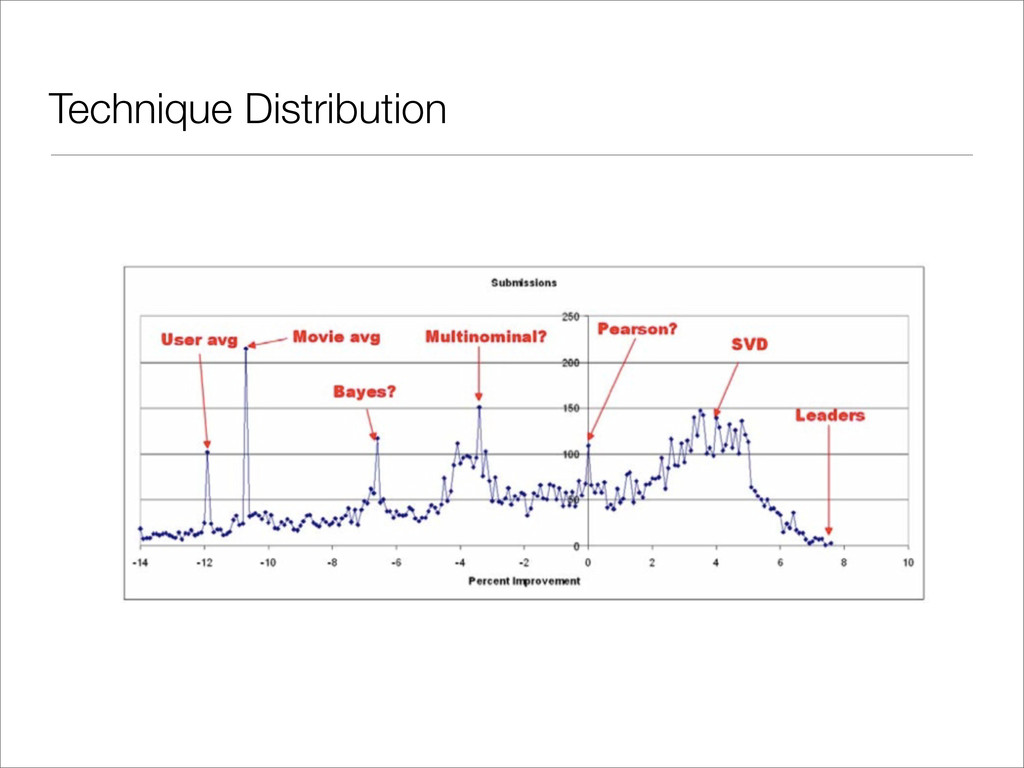
had been beaten by 1% • Within a month, the lead had increased to almost 5%. • Several teams were early leaders: • WXYZConsulting, a team of Yi Zhang and Wei Xu. (A front runner during Nov-Dec 2006.) • ML@UToronto A, a team from the University of Toronto led by Prof. Geoffrey Hinton (A front runner during parts of Oct-Dec 2006.) • Gravity, a team of four scientists from the Budapest University of Technology (A front runner during Jan-May 2007.) • BellKor, a group of scientists from AT&T Labs. (A front runner since May 2007.) http://www.cs.uic.edu/~liub/KDD-cup-2007/proceedings/The-Netflix-Prize-Bennett.pdf http://en.wikipedia.org/wiki/Netflix_Prize
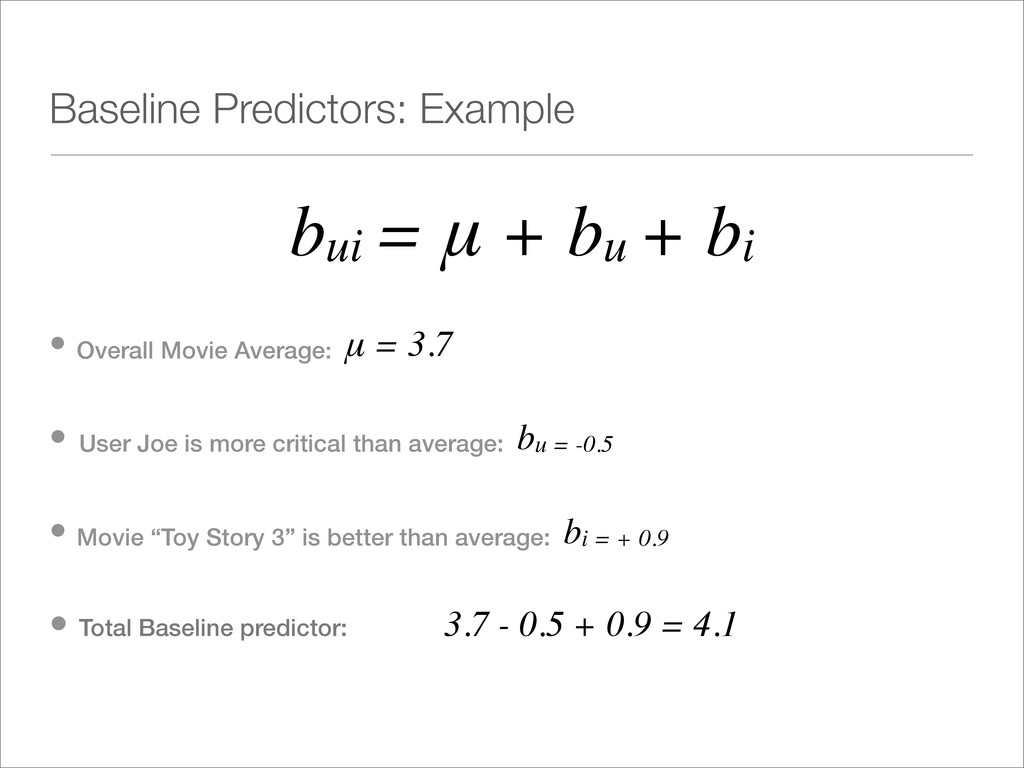
item biases – i.e., systematic tendencies for some users to give higher ratings than others, and for some items to receive higher ratings than others.” - Winning team’s 2009 GrandPrize Paper http://www.netflixprize.com/assets/GrandPrize2009_BPC_BellKor.pdf
rating for all movies (3.6) User bias (rates movies better/worse than other users) Movie bias (rated better/worse than other movies) Baseline prediction for user u on movie i.
• Overall Movie Average: μ = 3.7 • User Joe is more critical than average: bu = -0.5 • Movie “Toy Story 3” is better than average: bi = + 0.9 • Total Baseline predictor: 3.7 - 0.5 + 0.9 = 4.1
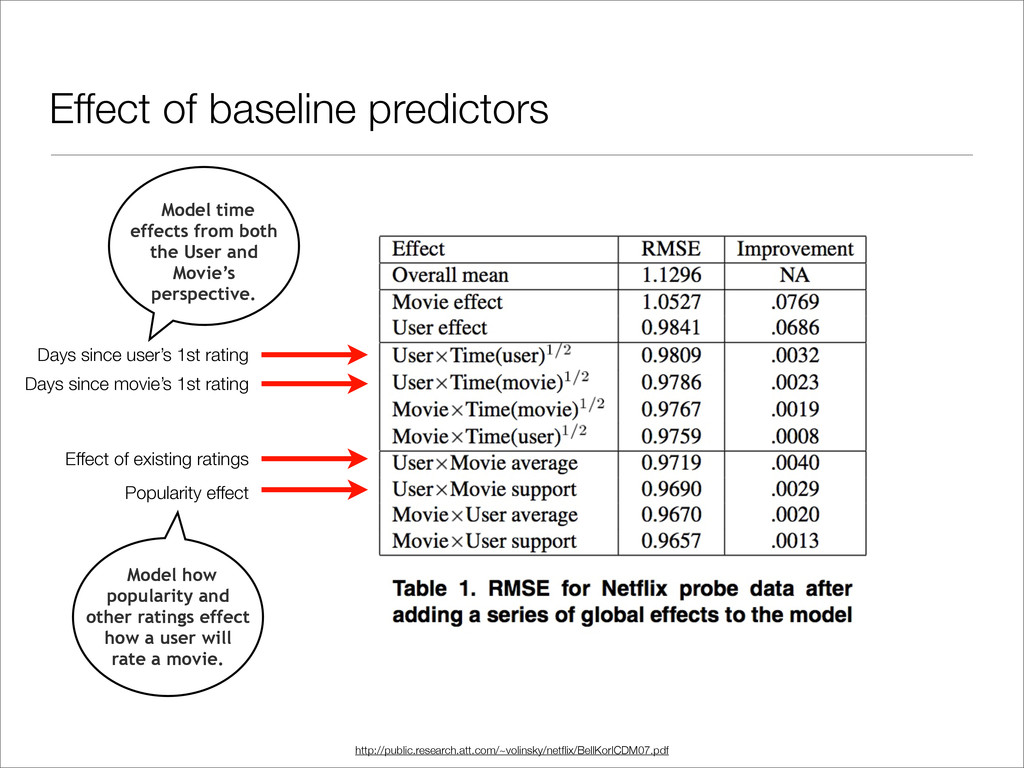
since movie’s 1st rating Popularity effect Effect of existing ratings http://public.research.att.com/~volinsky/netflix/BellKorICDM07.pdf Model how popularity and other ratings effect how a user will rate a movie. Model time effects from both the User and Movie’s perspective.
RMSE of 0.8712, 8.43% improvement • Blended 107 models, used SVD and RBM to model latent factors. http://www.cs.uic.edu/~liub/KDD-cup-2007/proceedings/The-Netflix-Prize-Bennett.pdf http://en.wikipedia.org/wiki/Netflix_Prize
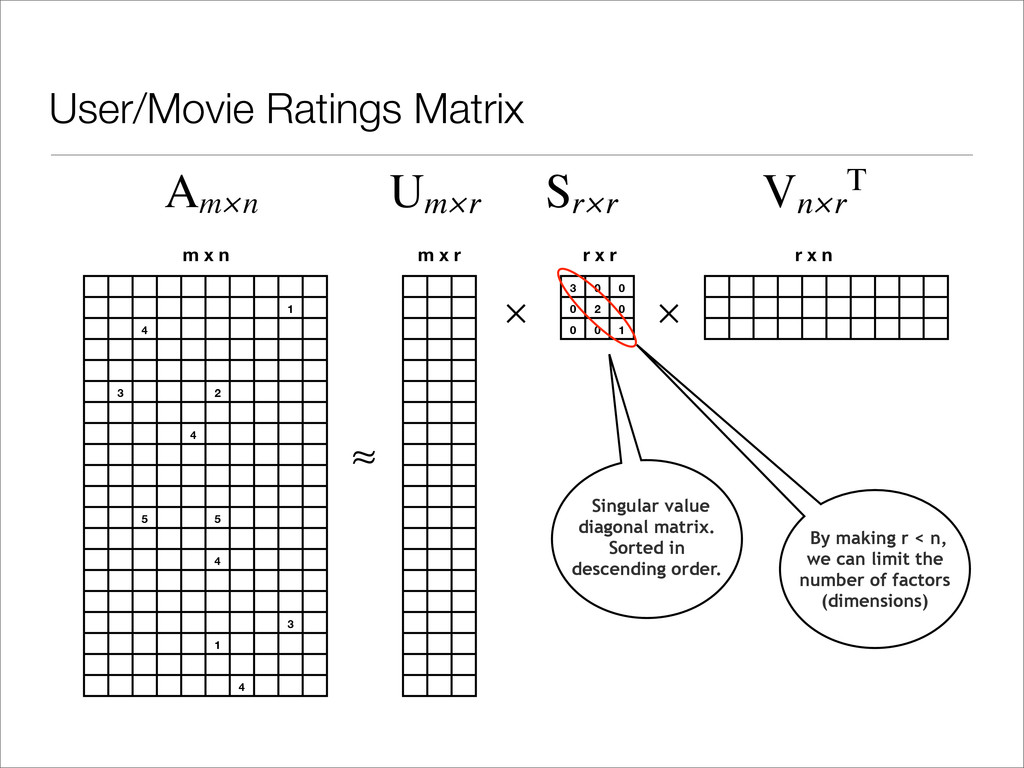
4 3 1 4 n movies (~ 18,000) m users (~ 480,000) • 480,000 * 18000 ~ 8.5 billion entries • Only have 100 million ratings • Matrix is 98.8% empty. • Goal is develop a model for the missing ratings.
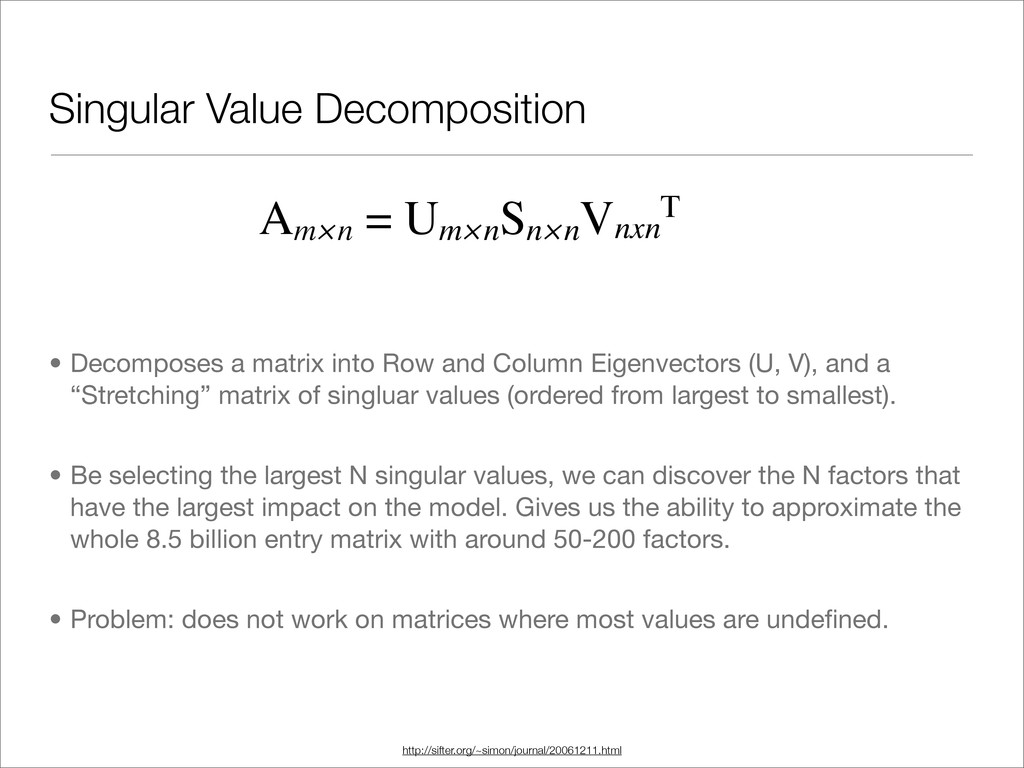
V), and a “Stretching” matrix of singluar values (ordered from largest to smallest). • Be selecting the largest N singular values, we can discover the N factors that have the largest impact on the model. Gives us the ability to approximate the whole 8.5 billion entry matrix with around 50-200 factors. • Problem: does not work on matrices where most values are undefined. Singular Value Decomposition http://sifter.org/~simon/journal/20061211.html Am×n = Um×n Sn×n Vnxn T
4 3 1 4 m x n 3 0 0 0 2 0 0 0 1 m x r r x r r x n × ≈ × Singular value diagonal matrix. Sorted in descending order. Am×n Um×r Sr×r Vn×r T By making r < n, we can limit the number of factors (dimensions)
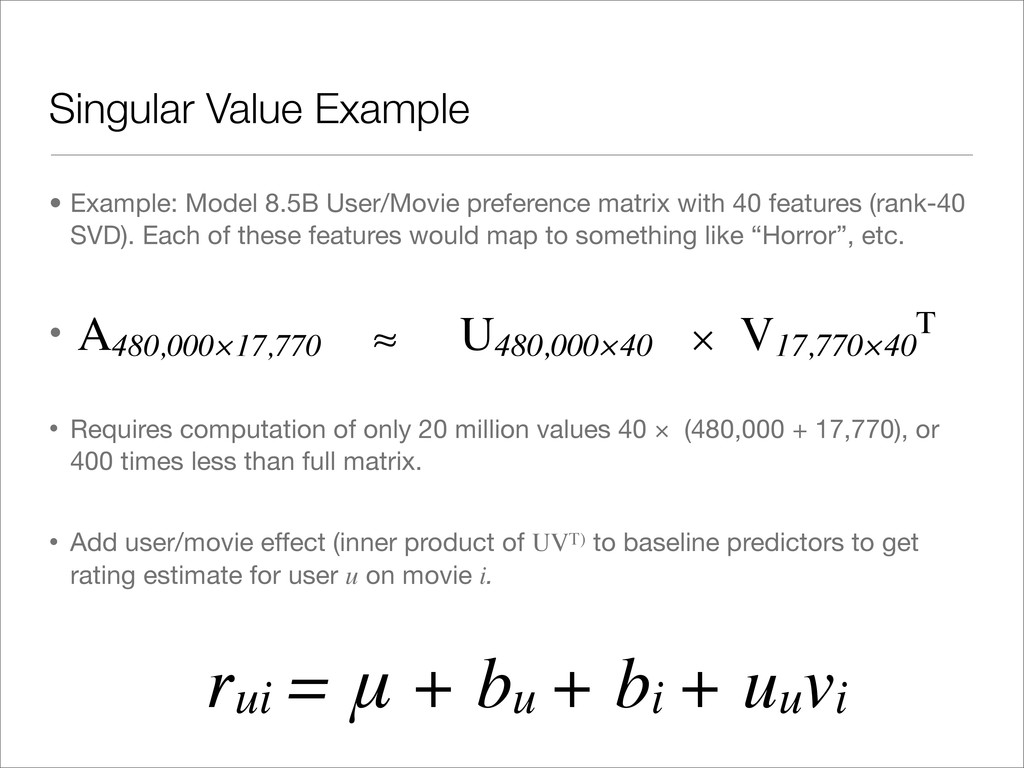
(rank-40 SVD). Each of these features would map to something like “Horror”, etc. • A480,000×17,770 U480,000×40 V17,770×40 T • Requires computation of only 20 million values 40 × (480,000 + 17,770), or 400 times less than full matrix. • Add user/movie effect (inner product of UVT) to baseline predictors to get rating estimate for user u on movie i. rui = μ + bu + bi + uuvi Singular Value Example ≈ ×
Run calculations on existing ratings. Learning rate discovered through testing. • Incremental gradient descent: follow steepest descent of the partial derivative of the error, which is a simple equation. /* * Where: * real *userValue = userFeature[featureBeingTrained]; * real *movieValue = movieFeature[featureBeingTrained]; * real lrate = 0.001; */ static inline void train(int user, int movie, real rating) { real err = lrate * (rating - predictRating(movie, user)); userValue[user] += err * movieValue[movie]; movieValue[movie] += err * userValue[user]; } http://www.infosci.cornell.edu/courses/info4300/2011fa/slides/08.pdf
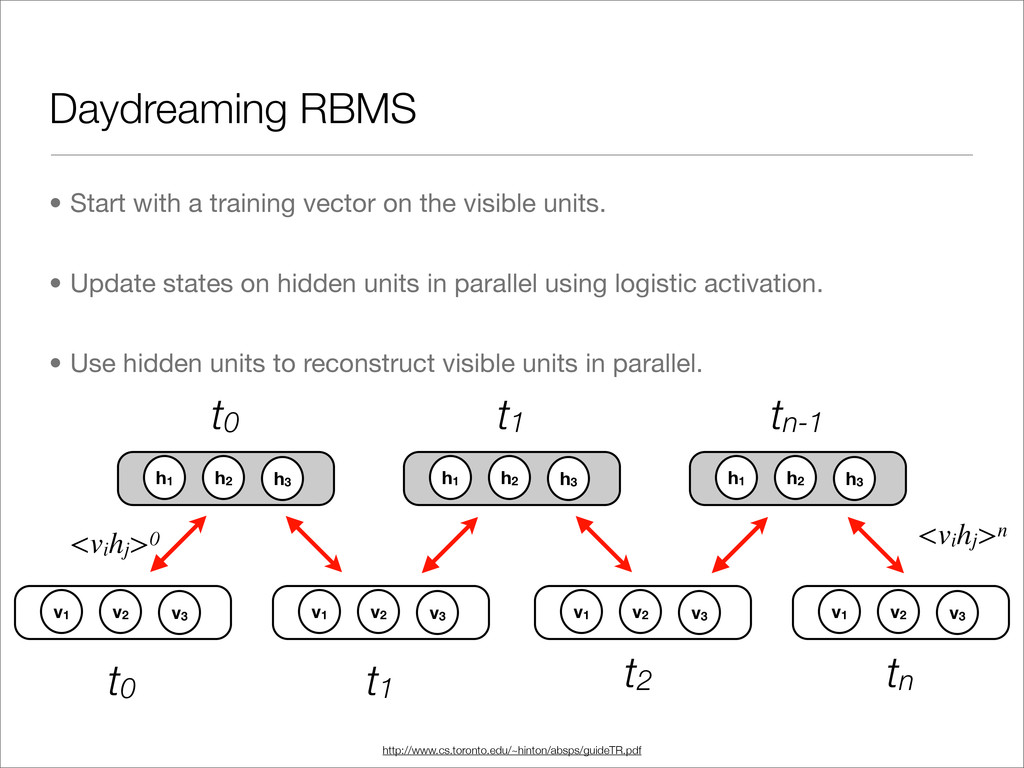
rated movie (we can get value out of quiz/test data!) http://www.machinelearning.org/proceedings/icml2007/papers/407.pdf Rating binary vector: position is set to 1 to match user rating (i.e., 3) Hidden factors we are trying to learn. Factors could be children’s movies, sci-fi, or international films.
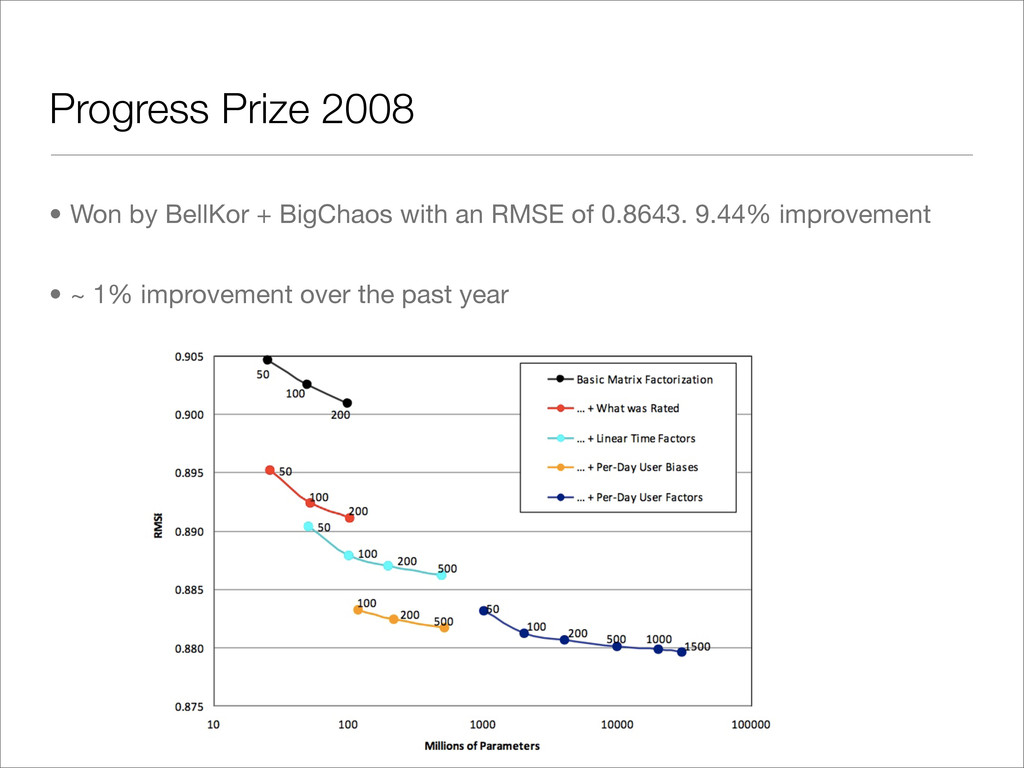
0.8643. 9.44% improvement • ~ 1% improvement over the past year Progress Prize 2008 http://www.cs.uic.edu/~liub/KDD-cup-2007/proceedings/The-Netflix-Prize-Bennett.pdf http://en.wikipedia.org/wiki/Netflix_Prize
way of improving accuracy. An apparently easier way to achieve better accuracy is by blending multiple simpler models.” - BellKor 2008 Progress Prize Solution • Combine model predictions: a blended collection of simple models is often more accurate than a single complex one.
simple decision tree. The tree on the left trains on the raw data. The second tree trains on the residual error of the first; the third tree on the residuals of the second and so on. • Grand prize winners blended over 800 models. Ensemble Methods
the problem • Use regularization at every step to reduce overfitting. Learn regularization weights through trial and error. • Use neighborhood models (k-NN) in combination with latent factors. Take into account relevance of neighbor’s effects. If local similarity is weak, use global factors. • Single models hit an accuracy wall, combining predictors can increase accuracy.
their predictions to the leaderboard. Robert Bell developed a formula to calculate the impact of the noise. • On June 26, 2009 the team “BellKor's Pragmatic Chaos”, a merger of teams “Bellkor in BigChaos” and “Pragmatic Theory”, achieved a 10.05% improvement over Cinematch (a Quiz RMSE of 0.8558). • The Netflix Prize competition then entered the "last call" period for the Grand Prize. In accord with the Rules, teams had thirty days to make submissions. • Another group of teams formed “The Ensemble”. Both teams blended hundreds of models up to the deadline of the contest. Sprint to the Finish
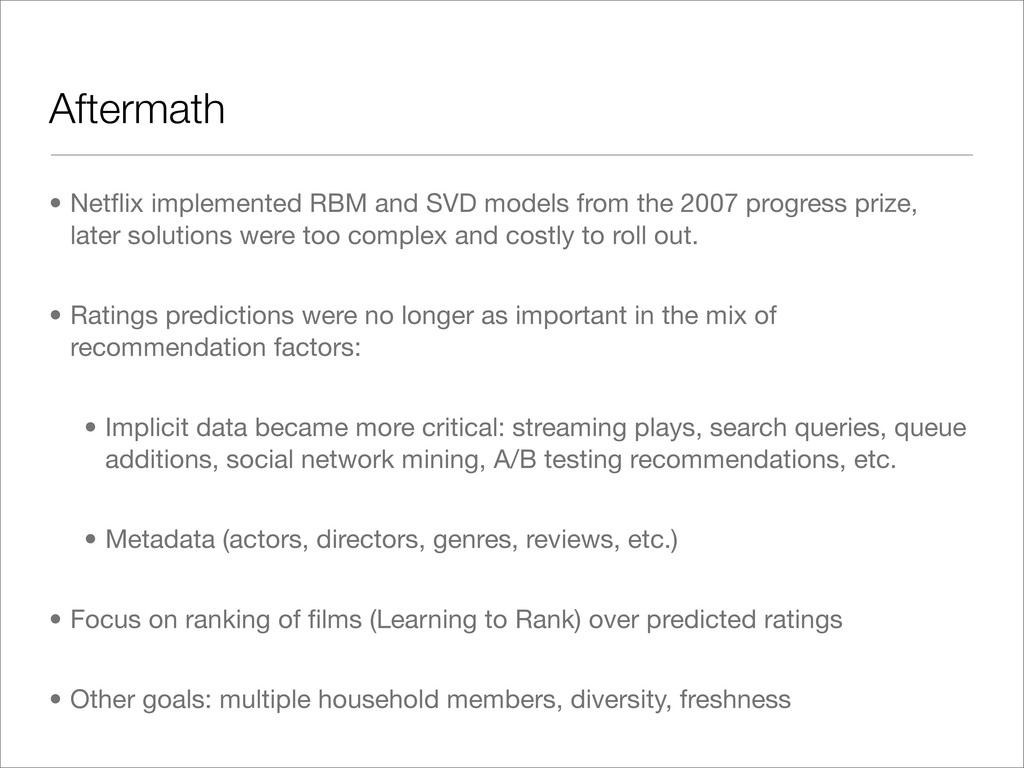
2007 progress prize, later solutions were too complex and costly to roll out. • Ratings predictions were no longer as important in the mix of recommendation factors: • Implicit data became more critical: streaming plays, search queries, queue additions, social network mining, A/B testing recommendations, etc. • Metadata (actors, directors, genres, reviews, etc.) • Focus on ranking of films (Learning to Rank) over predicted ratings • Other goals: multiple household members, diversity, freshness
Sources for the presentation: http://borrelli.org/2012/08/11/netflix-prize-links/ • There are a tremendous amount of open-source tools available: • RStudio: http://www.rstudio.org/ • Python Scikit-Learn: http://scikit-learn.org/stable/ • Apache Mahout: http://mahout.apache.org


 stevendborrelli
 satomasahiro2005
 willnet
 takuroabe
 carta_engineering
 terapyon
 teamlab
 techtekt
 koukihosaka
 kenichiodo
 mohab1
 minorun365
 masakiokuda
 inesmontani
 smashingmag
 rasmusluckow
 cassininazir
 erikaheidi
 tammyeverts
 kneath
 lara
lara
 techseoconnect
 rocio
rocio
 takai
takai