Upgrade to Pro — share decks privately, control downloads, hide ads and more …

HPC Operations and Cost Optimization Designed f...

Sponsored · Your Podcast. Everywhere. Effortlessly. Share. Educate. Inspire. Entertain. You do you. We'll handle the rest. →

HPC Operations and Cost Optimization Designed for Spot Instance Interruptions — Practices and Lessons from Numerical Relativity Simulations

English abridged translation of talk A42 at the OpenCAE Symposium 2026 (Kanazawa, Japan, November 2026). The Japanese deck is the original.

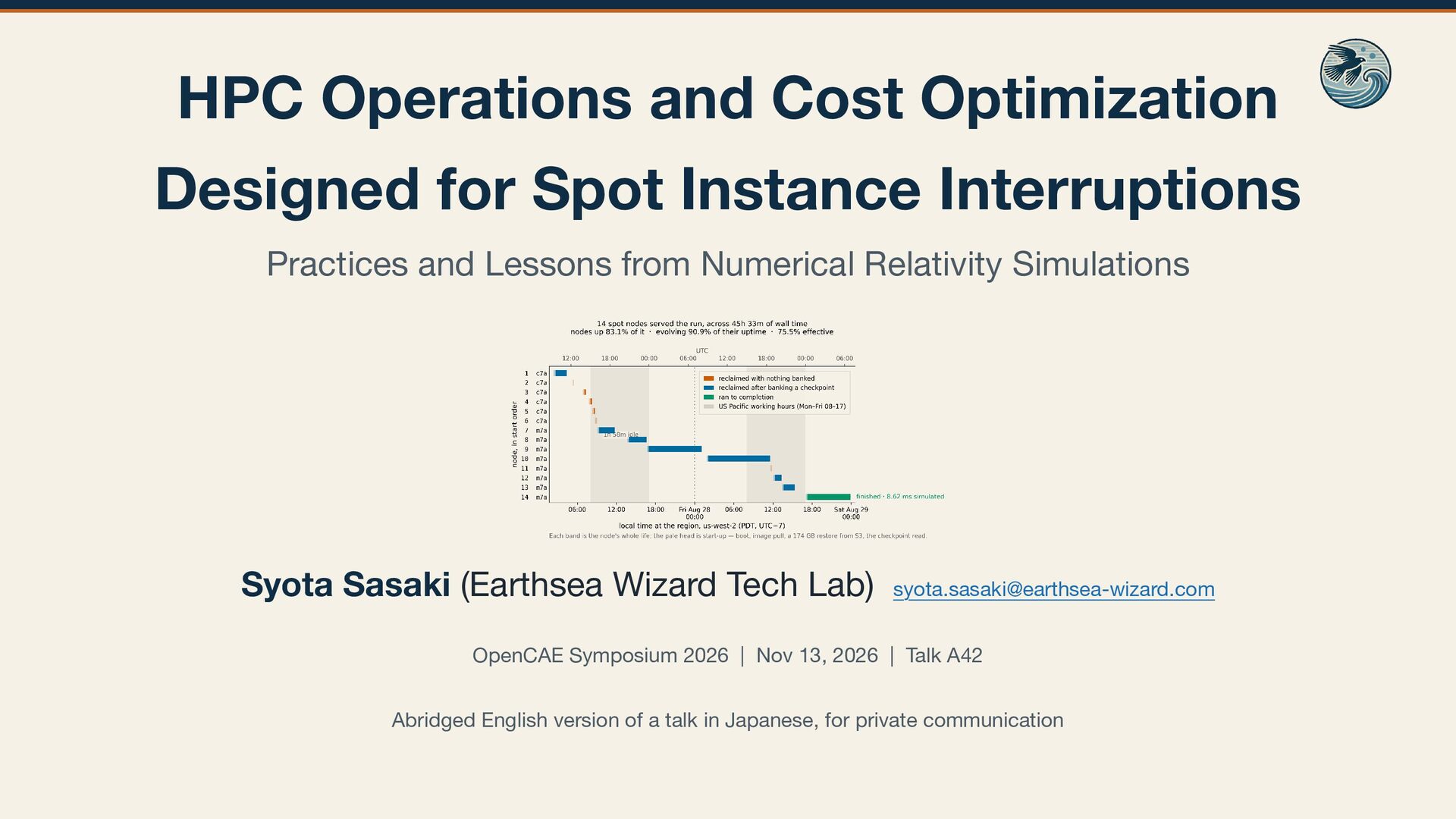
A 45 h 33 min numerical-relativity run (Einstein Toolkit, black hole-neutron star merger) completed on AWS Spot Instances through 13 interruptions and a relay of 14 nodes. It cost 136 USD, about 55% less than on-demand, and matched the reference solution. The infrastructure is plain, open-source Terraform. The approach should transfer to any solver that can restart from checkpoints.

Japanese version: https://speakerdeck.com/syotasasaki593876/slides-73ec3dbb-9cf2-401d-98b2-c135017411bc

Syota-Sasaki

November 22, 2026

Transcript

20 slides
  1. HPC Operations and Cost Optimization Designed for Spot Instance Interruptions

    Practices and Lessons from Numerical Relativity Simulations Syota Sasaki (Earthsea Wizard Tech Lab) [email protected] OpenCAE Symposium 2026 | Nov 13, 2026 | Talk A42 Abridged English version of a talk in Japanese, for private communication
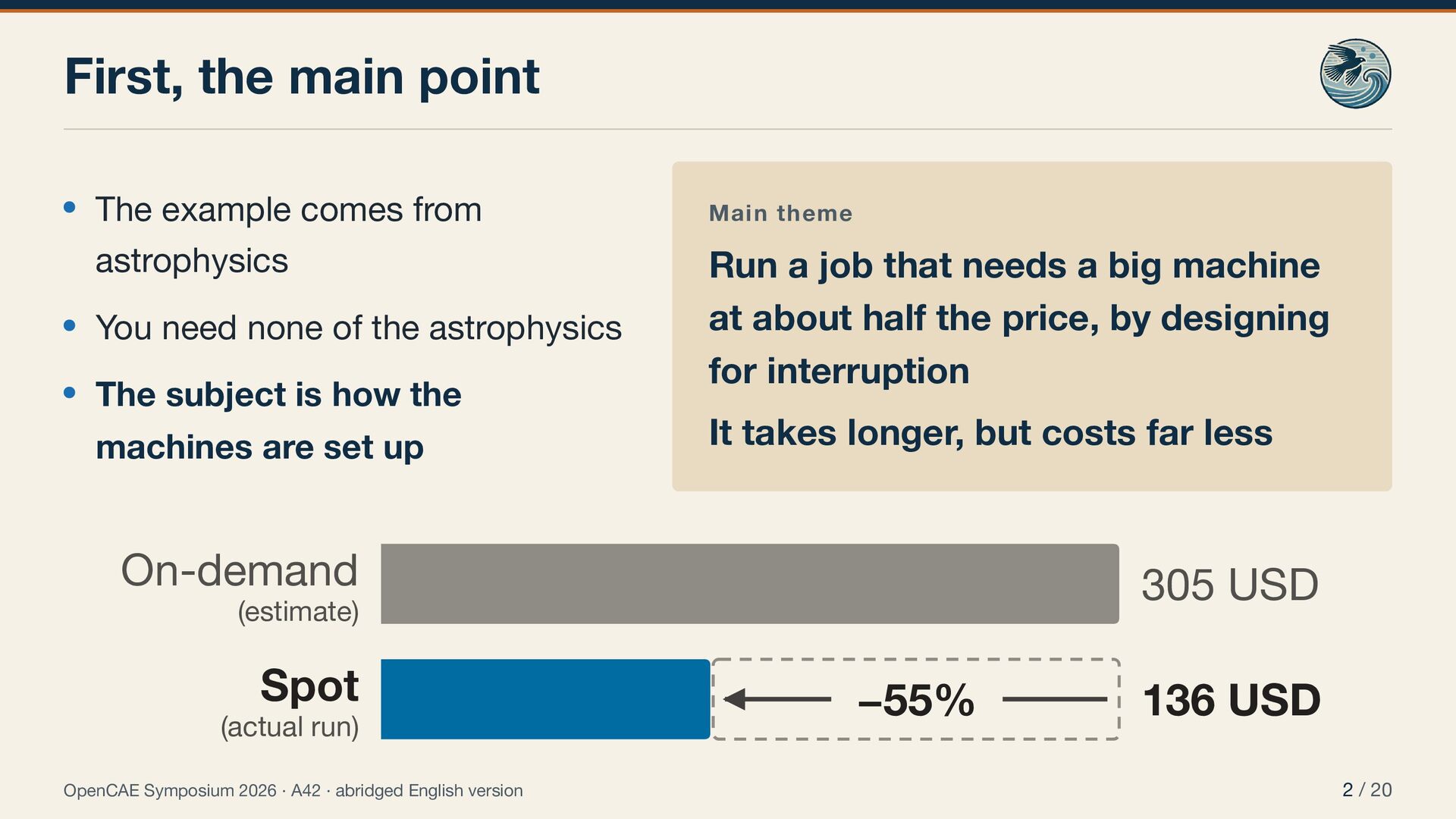
  2. First, the main point The example comes from astrophysics You

    need none of the astrophysics The subject is how the machines are set up Main theme Run a job that needs a big machine at about half the price, by designing for interruption It takes longer, but costs far less On-demand 305 USD (estimate) Spot (actual run) OpenCAE Symposium 2026 · A42 · abridged English version −55% 136 USD 2 / 20
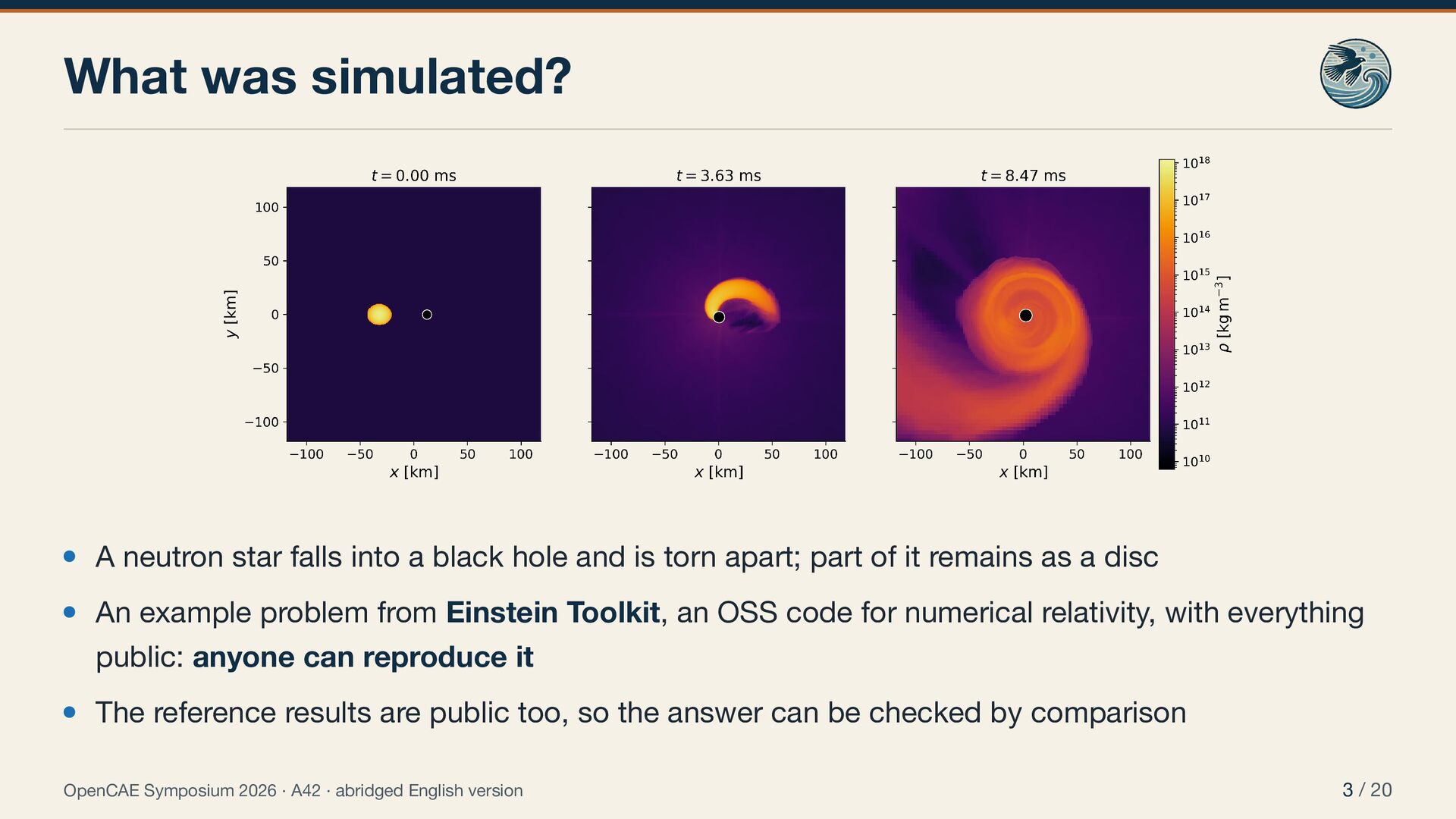
  3. What was simulated? A neutron star falls into a black

    hole and is torn apart; part of it remains as a disc An example problem from Einstein Toolkit, an OSS code for numerical relativity, with everything public: anyone can reproduce it The reference results are public too, so the answer can be checked by comparison OpenCAE Symposium 2026 · A42 · abridged English version 3 / 20
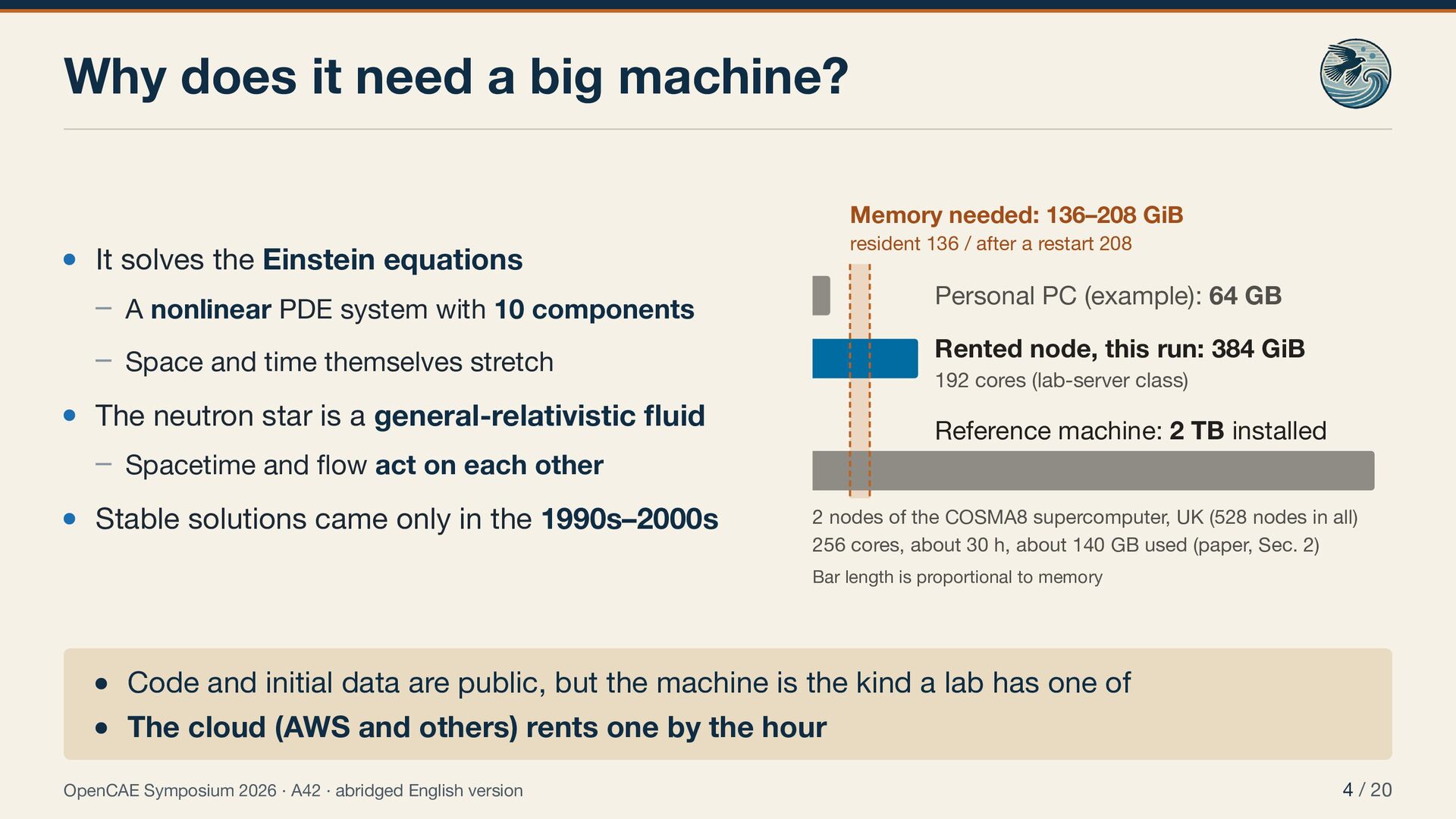
  4. Why does it need a big machine? Memory needed: 136–208

    GiB It solves the Einstein equations resident 136 / after a restart 208 A nonlinear PDE system with 10 components Personal PC (example): 64 GB Space and time themselves stretch Rented node, this run: 384 GiB The neutron star is a general-relativistic fluid 192 cores (lab-server class) Reference machine: 2 TB installed Spacetime and flow act on each other Stable solutions came only in the 1990s–2000s 2 nodes of the COSMA8 supercomputer, UK (528 nodes in all) 256 cores, about 30 h, about 140 GB used (paper, Sec. 2) Bar length is proportional to memory Code and initial data are public, but the machine is the kind a lab has one of The cloud (AWS and others) rents one by the hour OpenCAE Symposium 2026 · A42 · abridged English version 4 / 20
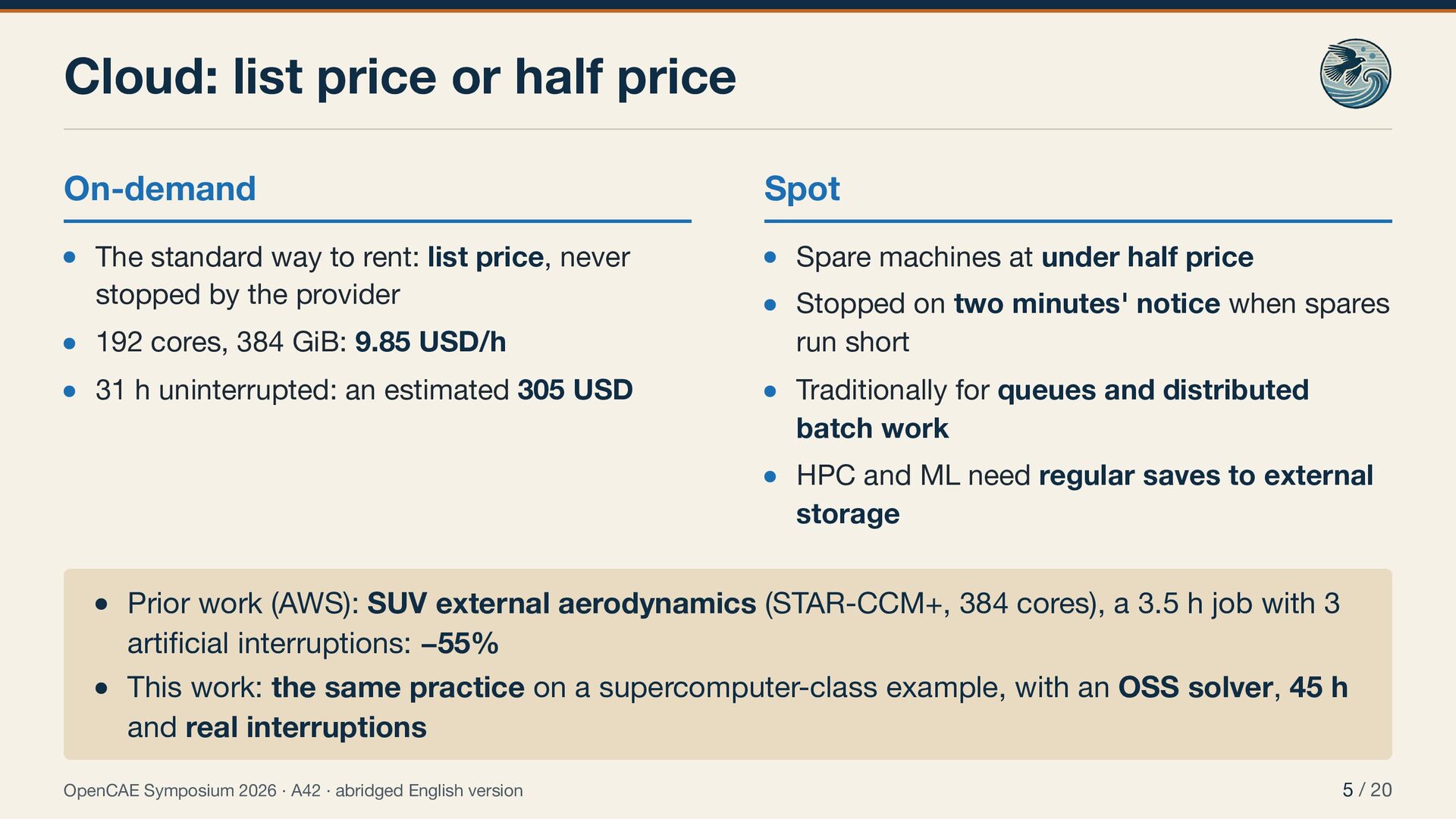
  5. Cloud: list price or half price On-demand The standard way

    to rent: list price, never stopped by the provider 192 cores, 384 GiB: 9.85 USD/h 31 h uninterrupted: an estimated 305 USD Spot Spare machines at under half price Stopped on two minutes' notice when spares run short Traditionally for queues and distributed batch work HPC and ML need regular saves to external storage Prior work (AWS): SUV external aerodynamics (STAR-CCM+, 384 cores), a 3.5 h job with 3 artificial interruptions: −55% This work: the same practice on a supercomputer-class example, with an OSS solver, 45 h and real interruptions OpenCAE Symposium 2026 · A42 · abridged English version 5 / 20
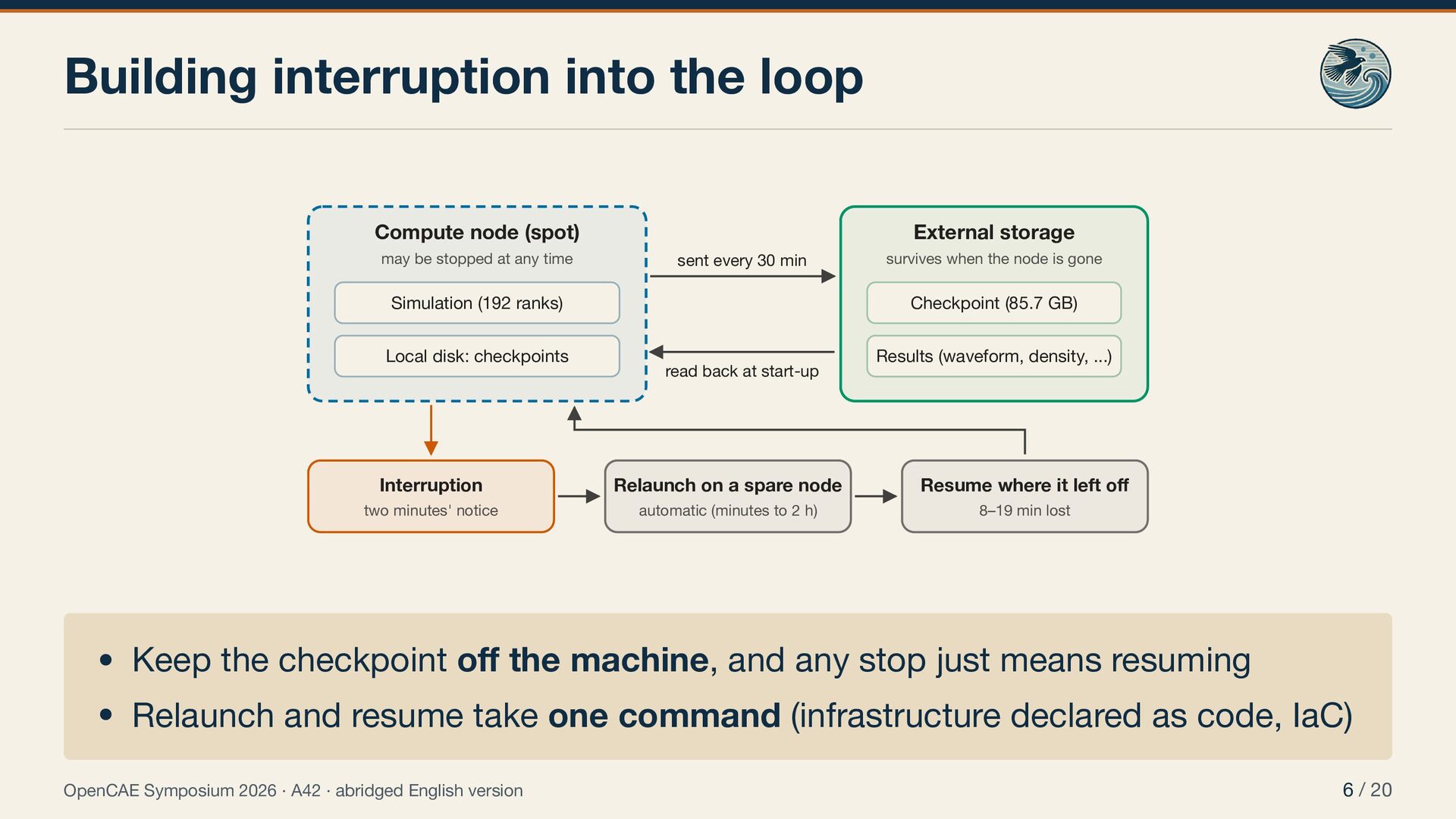
  6. Building interruption into the loop Compute node (spot) may be

    stopped at any time External storage sent every 30 min survives when the node is gone Simulation (192 ranks) Checkpoint (85.7 GB) Local disk: checkpoints Results (waveform, density, ...) read back at start-up Interruption Relaunch on a spare node Resume where it left off two minutes' notice automatic (minutes to 2 h) 8–19 min lost Keep the checkpoint off the machine, and any stop just means resuming Relaunch and resume take one command (infrastructure declared as code, IaC) OpenCAE Symposium 2026 · A42 · abridged English version 6 / 20
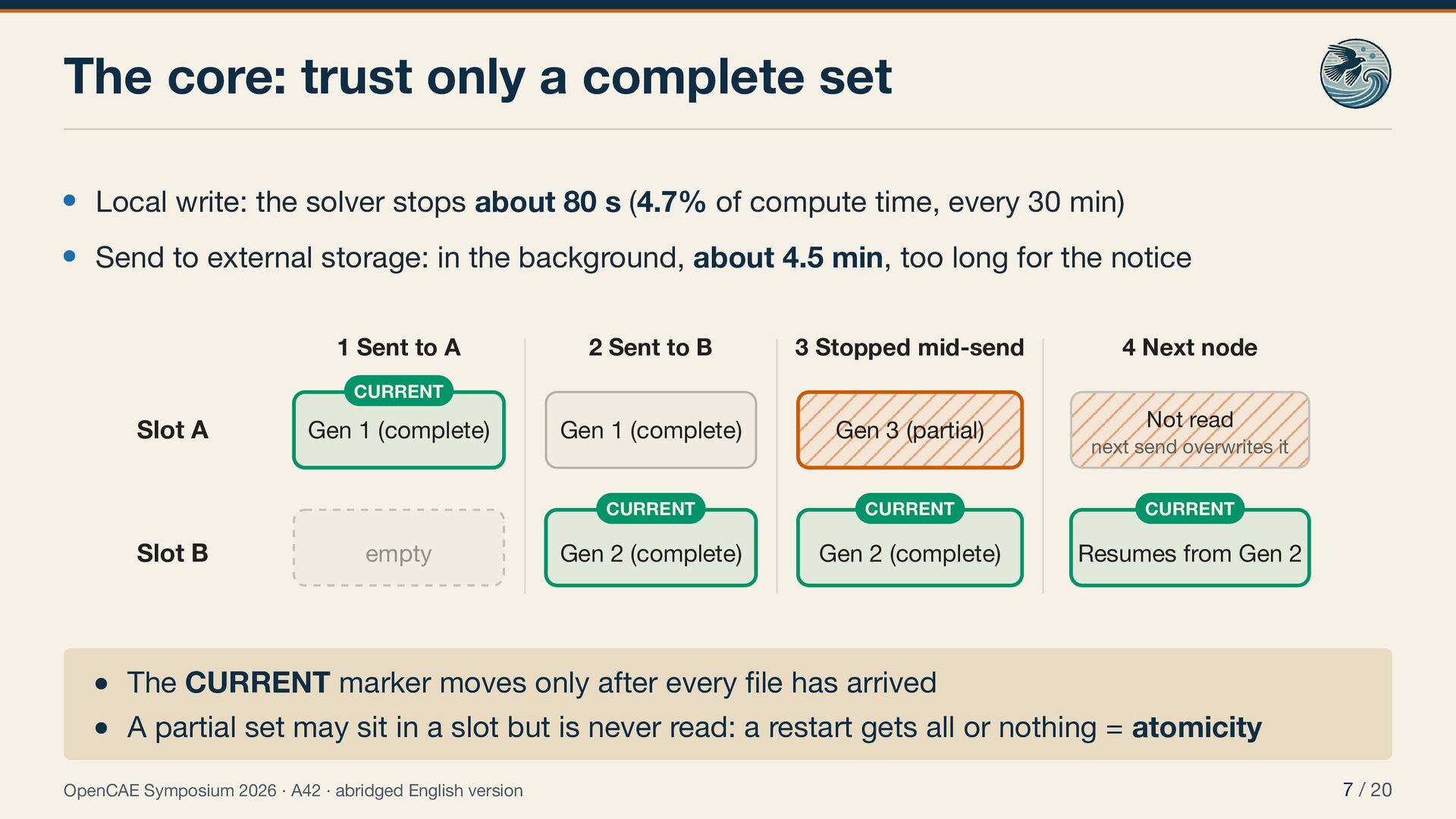
  7. The core: trust only a complete set Local write: the

    solver stops about 80 s (4.7% of compute time, every 30 min) Send to external storage: in the background, about 4.5 min, too long for the notice 1 Sent to A 2 Sent to B 3 Stopped mid-send 4 Next node Gen 1 (complete) Gen 3 (partial) Not read CURRENT CURRENT CURRENT Gen 2 (complete) Gen 2 (complete) Resumes from Gen 2 CURRENT Slot A Slot B Gen 1 (complete) empty next send overwrites it The CURRENT marker moves only after every file has arrived A partial set may sit in a slot but is never read: a restart gets all or nothing = atomicity OpenCAE Symposium 2026 · A42 · abridged English version 7 / 20
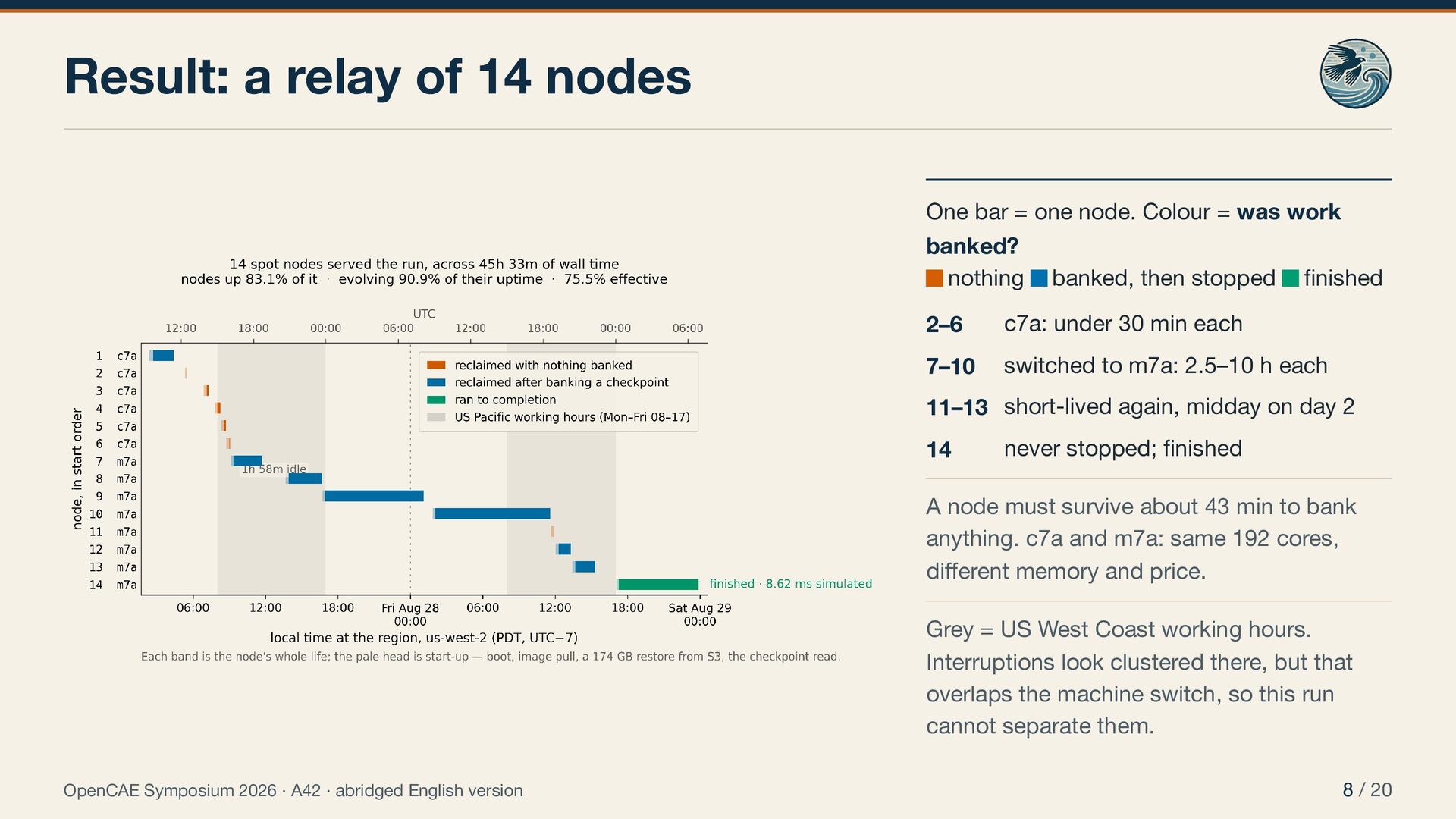
  8. Result: a relay of 14 nodes One bar = one

    node. Colour = was work banked? nothing banked, then stopped finished 2–6 c7a: under 30 min each 7–10 switched to m7a: 2.5–10 h each 11–13 short-lived again, midday on day 2 14 never stopped; finished A node must survive about 43 min to bank anything. c7a and m7a: same 192 cores, different memory and price. Grey = US West Coast working hours. Interruptions look clustered there, but that overlaps the machine switch, so this run cannot separate them. OpenCAE Symposium 2026 · A42 · abridged English version 8 / 20
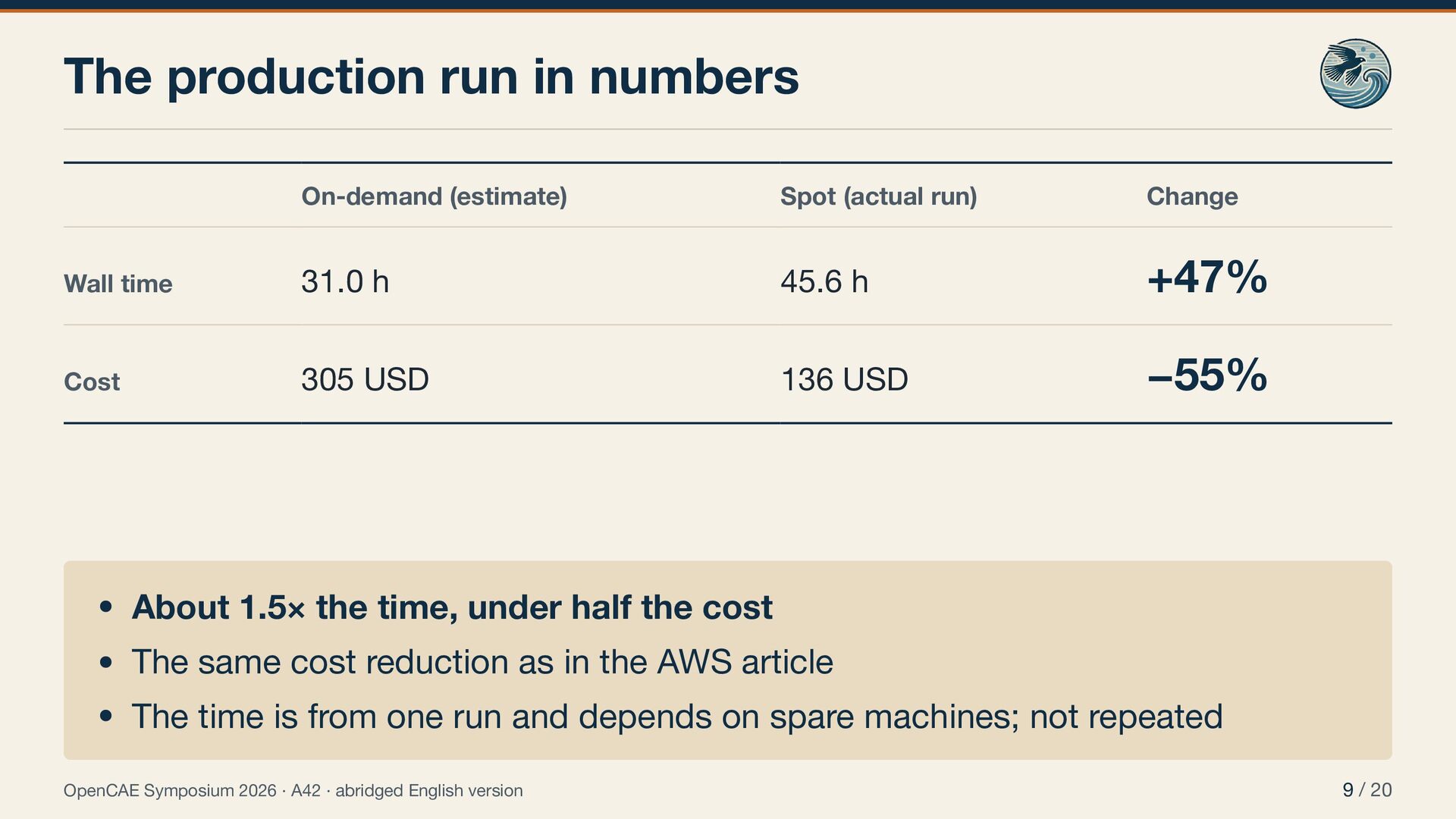
  9. The production run in numbers On-demand (estimate) Spot (actual run)

    Change Wall time 31.0 h 45.6 h +47% Cost 305 USD 136 USD −55% About 1.5× the time, under half the cost The same cost reduction as in the AWS article The time is from one run and depends on spare machines; not repeated OpenCAE Symposium 2026 · A42 · abridged English version 9 / 20
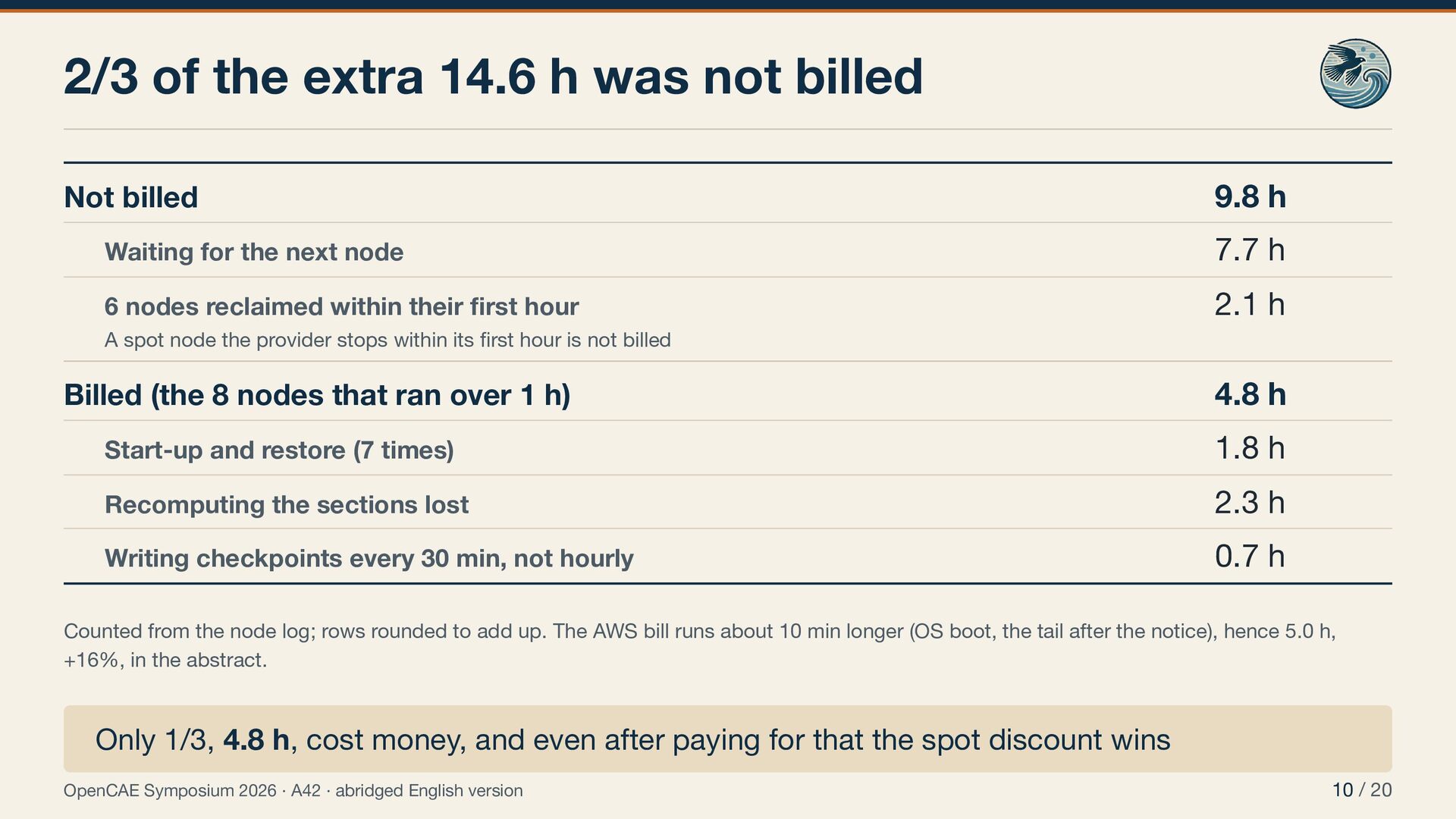
  10. 2/3 of the extra 14.6 h was not billed Not

    billed 9.8 h Waiting for the next node 7.7 h 6 nodes reclaimed within their first hour 2.1 h A spot node the provider stops within its first hour is not billed Billed (the 8 nodes that ran over 1 h) 4.8 h Start-up and restore (7 times) 1.8 h Recomputing the sections lost 2.3 h Writing checkpoints every 30 min, not hourly 0.7 h Counted from the node log; rows rounded to add up. The AWS bill runs about 10 min longer (OS boot, the tail after the notice), hence 5.0 h, +16%, in the abstract. Only 1/3, 4.8 h, cost money, and even after paying for that the spot discount wins OpenCAE Symposium 2026 · A42 · abridged English version 10 / 20
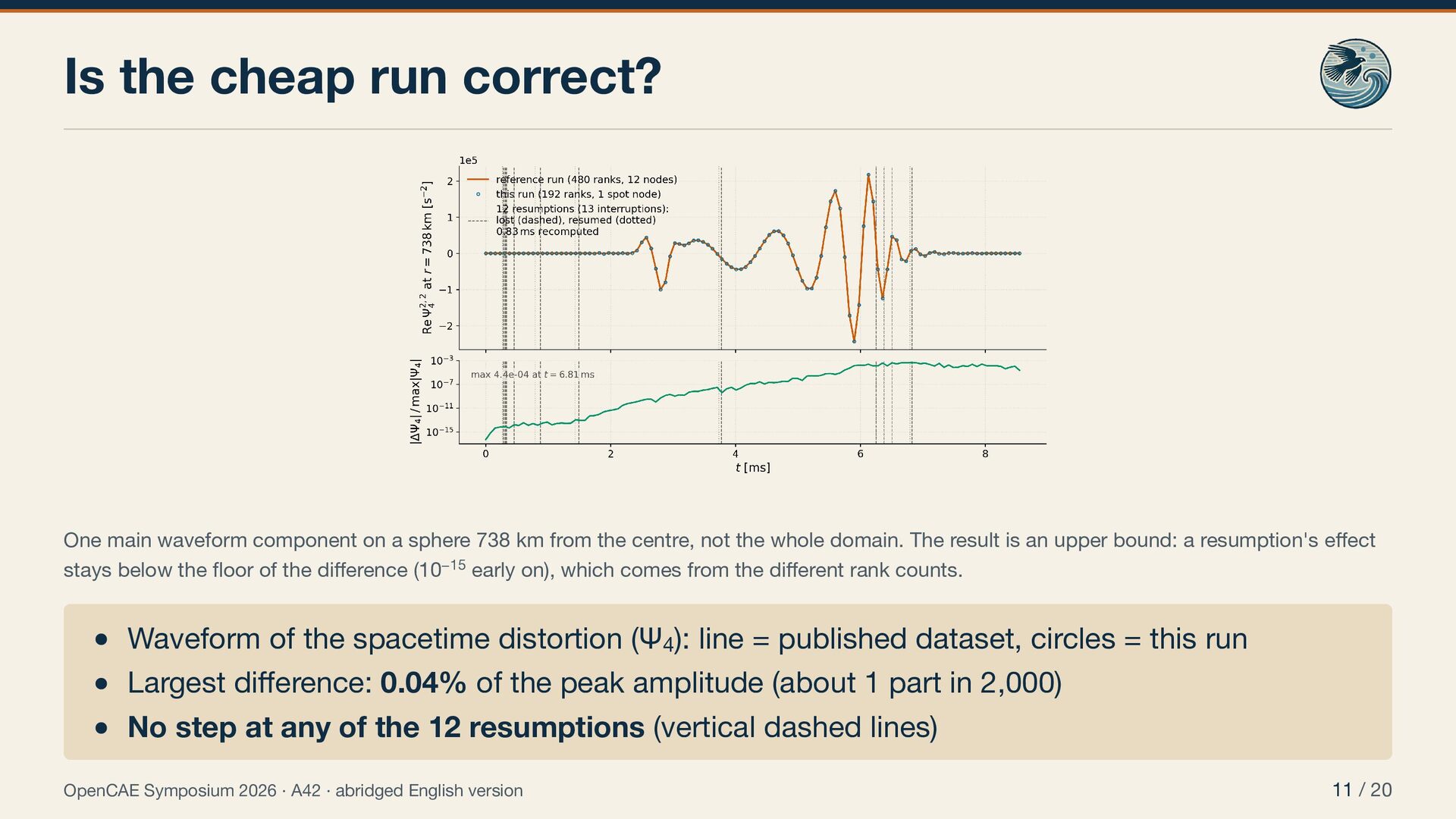
  11. Is the cheap run correct? One main waveform component on

    a sphere 738 km from the centre, not the whole domain. The result is an upper bound: a resumption's effect stays below the floor of the difference (10−15 early on), which comes from the different rank counts. Waveform of the spacetime distortion (Ψ4): line = published dataset, circles = this run Largest difference: 0.04% of the peak amplitude (about 1 part in 2,000) No step at any of the 12 resumptions (vertical dashed lines) OpenCAE Symposium 2026 · A42 · abridged English version 11 / 20
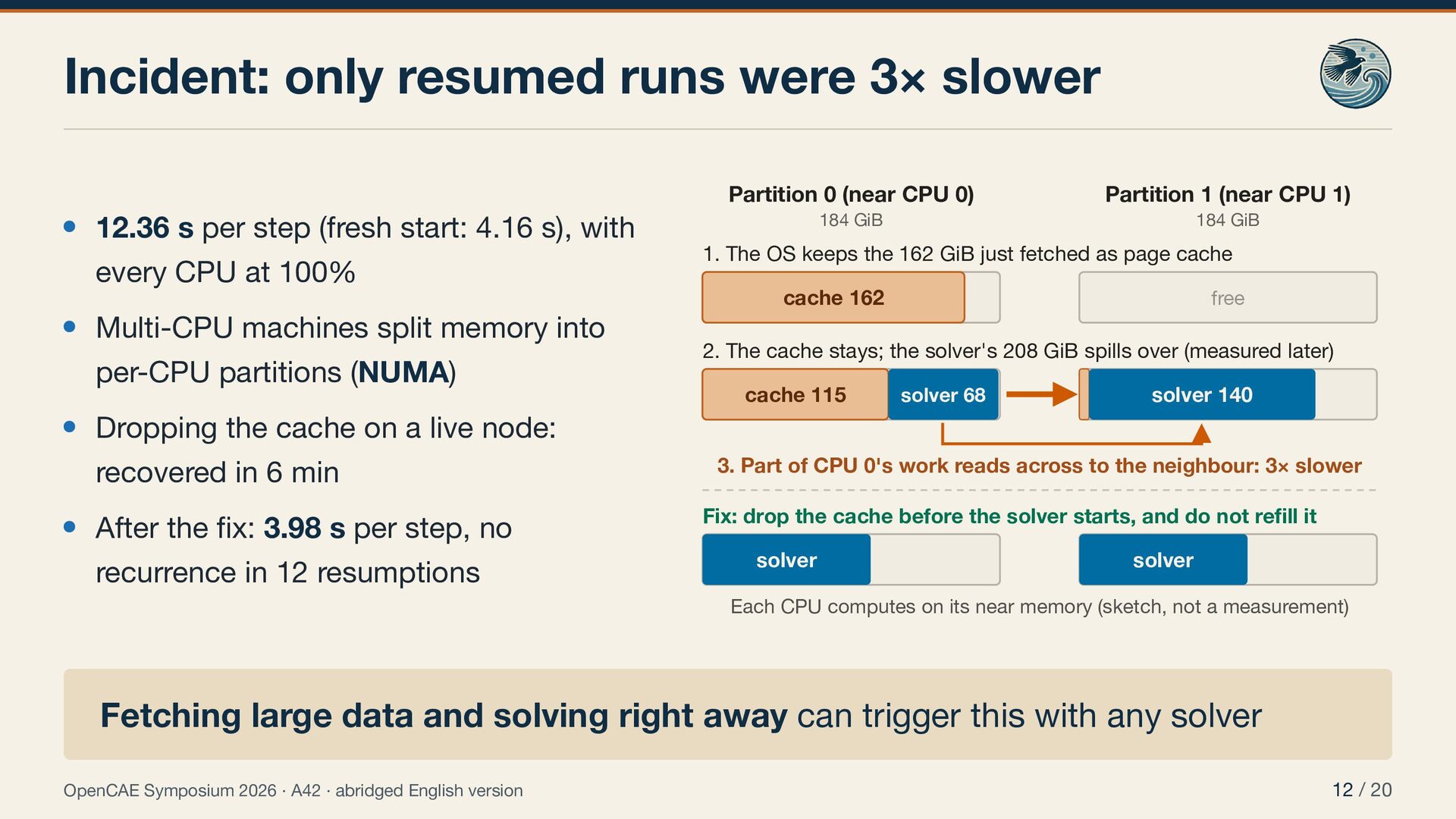
  12. Incident: only resumed runs were 3× slower Partition 0 (near

    CPU 0) Partition 1 (near CPU 1) 184 GiB 184 GiB 12.36 s per step (fresh start: 4.16 s), with every CPU at 100% 1. The OS keeps the 162 GiB just fetched as page cache Multi-CPU machines split memory into per-CPU partitions (NUMA) 2. The cache stays; the solver's 208 GiB spills over (measured later) Dropping the cache on a live node: recovered in 6 min After the fix: 3.98 s per step, no recurrence in 12 resumptions cache 162 cache 115 free solver 68 solver 140 3. Part of CPU 0's work reads across to the neighbour: 3× slower Fix: drop the cache before the solver starts, and do not refill it solver solver Each CPU computes on its near memory (sketch, not a measurement) Fetching large data and solving right away can trigger this with any solver OpenCAE Symposium 2026 · A42 · abridged English version 12 / 20
  13. Near miss: reading “unreadable” as “absent” A failed read of

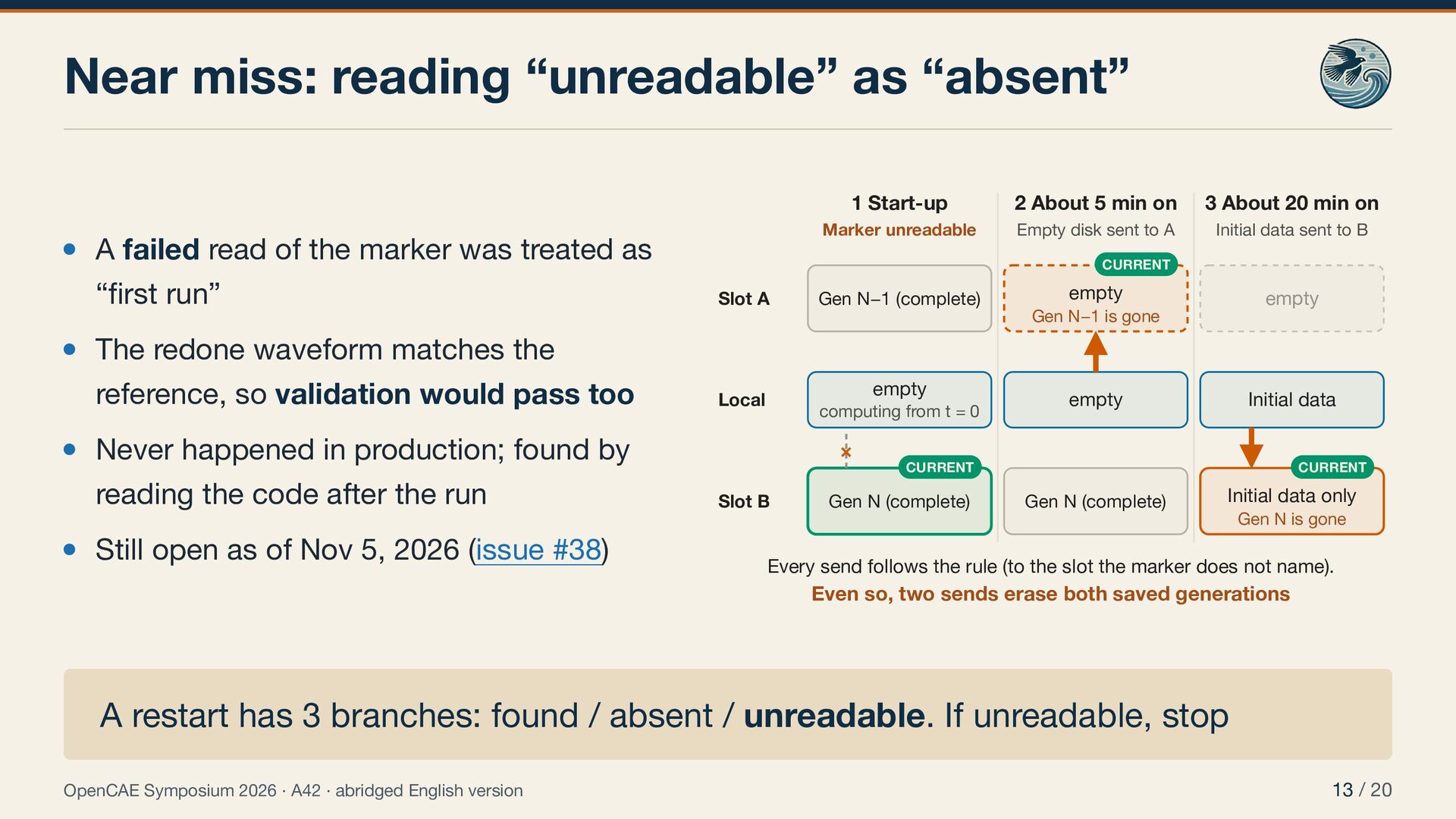
    the marker was treated as “first run” Slot A The redone waveform matches the reference, so validation would pass too Local Never happened in production; found by reading the code after the run Still open as of Nov 5, 2026 (issue #38) 1 Start-up 2 About 5 min on 3 About 20 min on Marker unreadable Empty disk sent to A Initial data sent to B CURRENT Gen N−1 (complete) empty computing from t = 0 × Slot B empty empty Gen N−1 is gone empty Initial data CURRENT Gen N (complete) CURRENT Gen N (complete) Initial data only Gen N is gone Every send follows the rule (to the slot the marker does not name). Even so, two sends erase both saved generations A restart has 3 branches: found / absent / unreadable. If unreadable, stop OpenCAE Symposium 2026 · A42 · abridged English version 13 / 20
  14. Benefits and costs Benefits Cheap (about half) The same answer

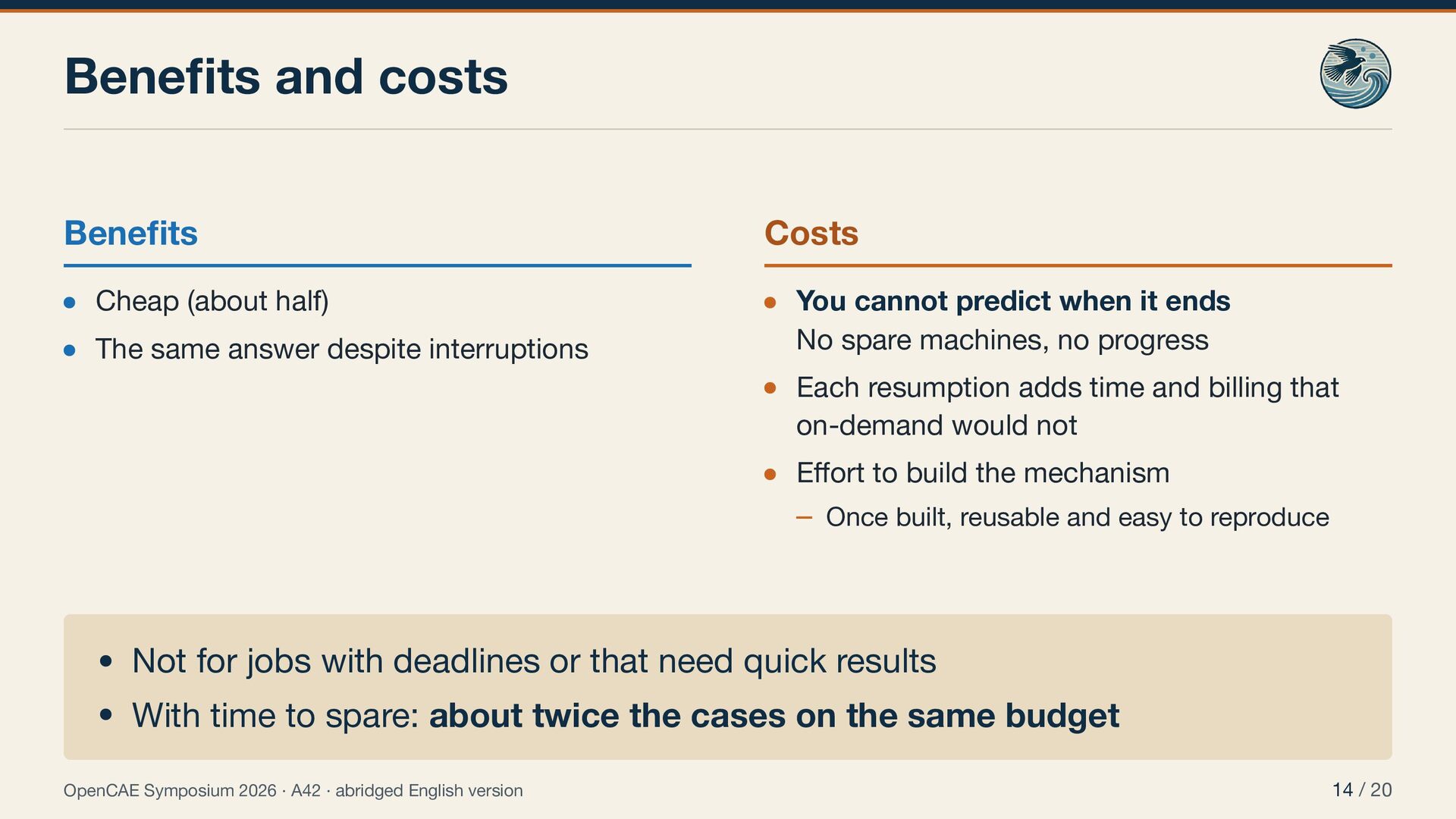
    despite interruptions Costs You cannot predict when it ends No spare machines, no progress Each resumption adds time and billing that on-demand would not Effort to build the mechanism Once built, reusable and easy to reproduce Not for jobs with deadlines or that need quick results With time to spare: about twice the cases on the same budget OpenCAE Symposium 2026 · A42 · abridged English version 14 / 20
  15. When this applies: no special physics The same operation works

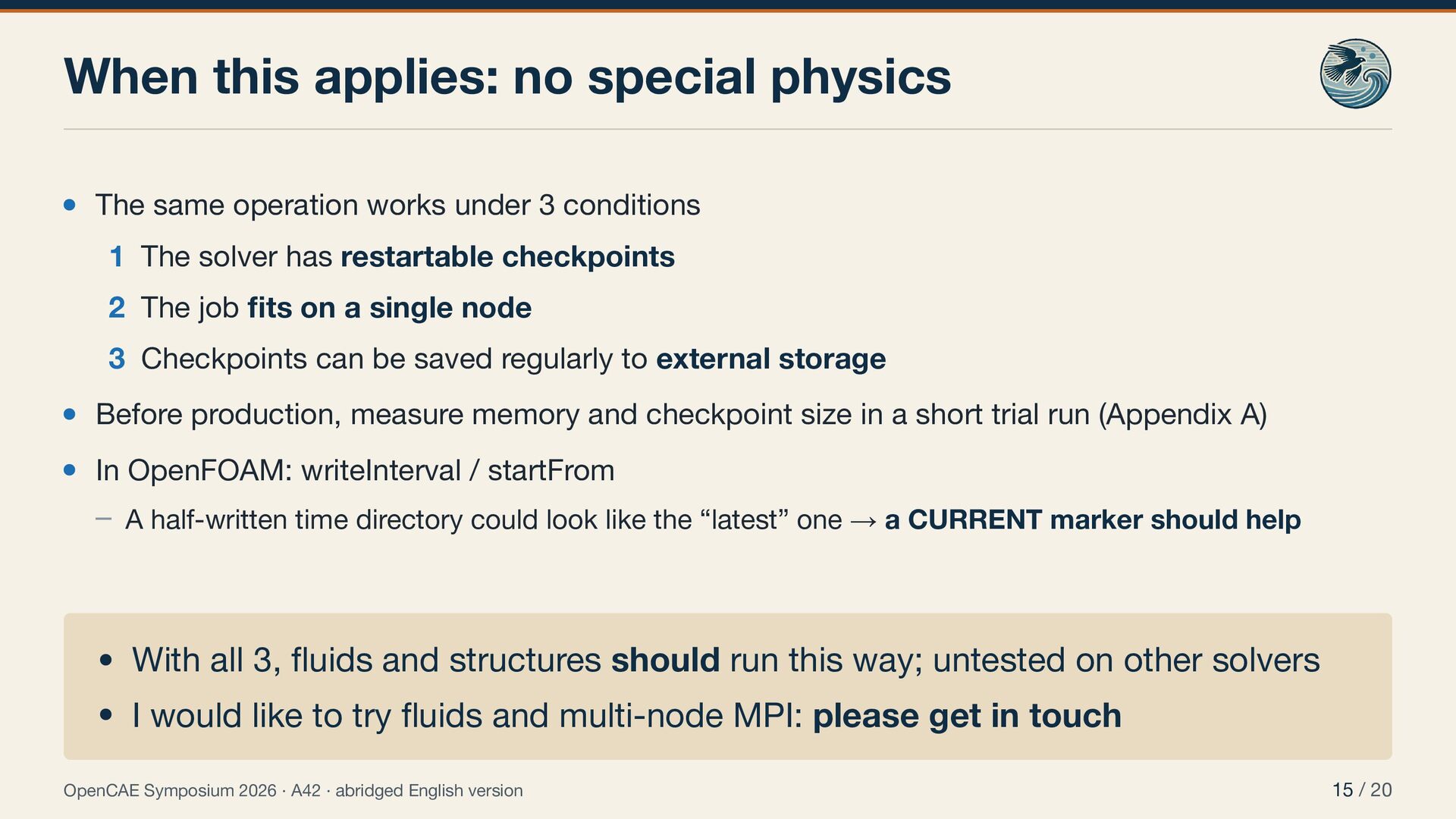
    under 3 conditions 1 The solver has restartable checkpoints 2 The job fits on a single node 3 Checkpoints can be saved regularly to external storage Before production, measure memory and checkpoint size in a short trial run (Appendix A) In OpenFOAM: writeInterval / startFrom A half-written time directory could look like the “latest” one → a CURRENT marker should help With all 3, fluids and structures should run this way; untested on other solvers I would like to try fluids and multi-node MPI: please get in touch OpenCAE Symposium 2026 · A42 · abridged English version 15 / 20
  16. Summary 1 Designed for interruption, long jobs can run on

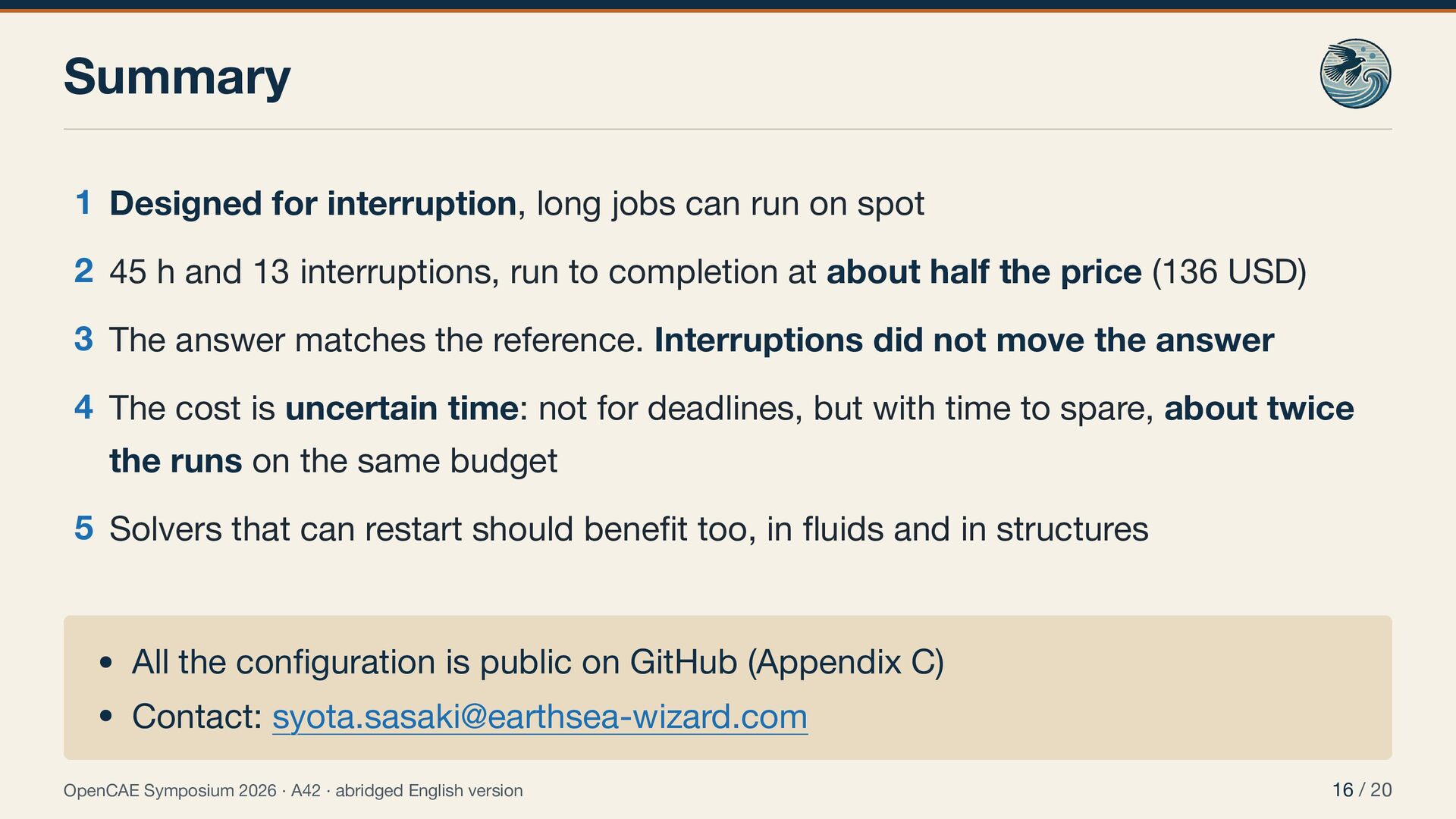
    spot 2 45 h and 13 interruptions, run to completion at about half the price (136 USD) 3 The answer matches the reference. Interruptions did not move the answer 4 The cost is uncertain time: not for deadlines, but with time to spare, about twice the runs on the same budget 5 Solvers that can restart should benefit too, in fluids and in structures All the configuration is public on GitHub (Appendix C) Contact: [email protected] OpenCAE Symposium 2026 · A42 · abridged English version 16 / 20
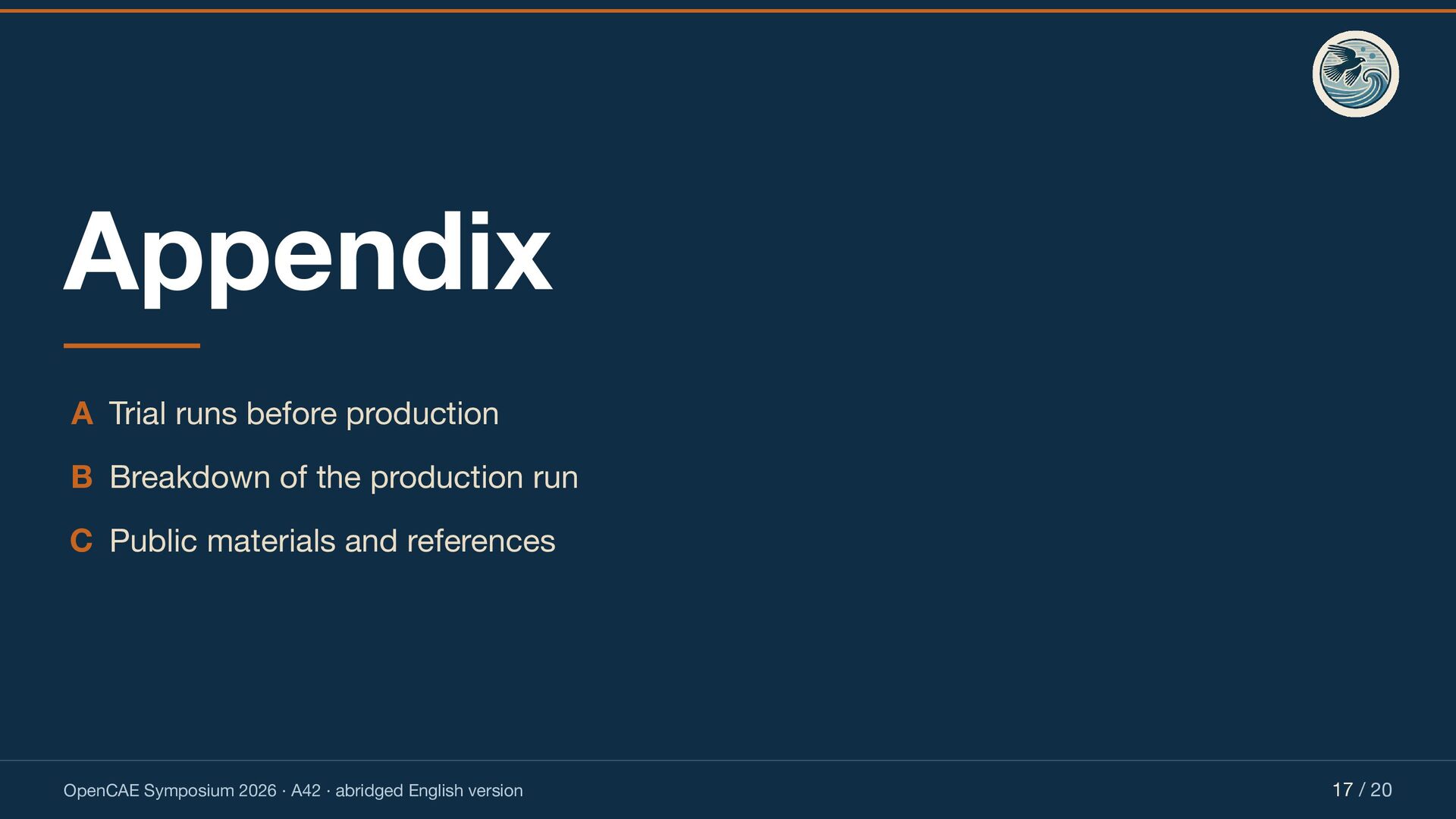
  17. Appendix A Trial runs before production B Breakdown of the

    production run C Public materials and references OpenCAE Symposium 2026 · A42 · abridged English version 17 / 20
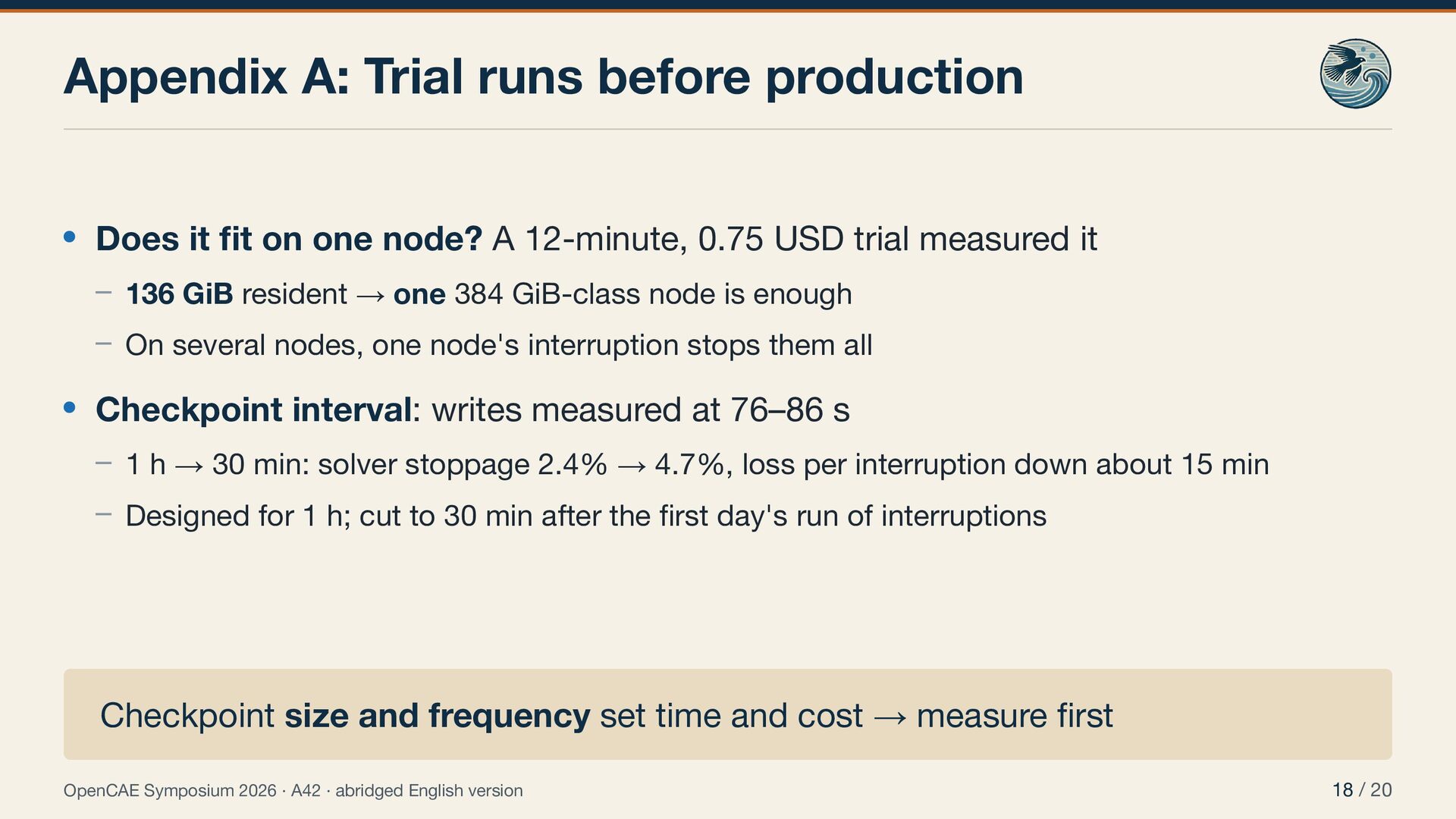
  18. Appendix A: Trial runs before production Does it fit on

    one node? A 12-minute, 0.75 USD trial measured it 136 GiB resident → one 384 GiB-class node is enough On several nodes, one node's interruption stops them all Checkpoint interval: writes measured at 76–86 s 1 h → 30 min: solver stoppage 2.4% → 4.7%, loss per interruption down about 15 min Designed for 1 h; cut to 30 min after the first day's run of interruptions Checkpoint size and frequency set time and cost → measure first OpenCAE Symposium 2026 · A42 · abridged English version 18 / 20
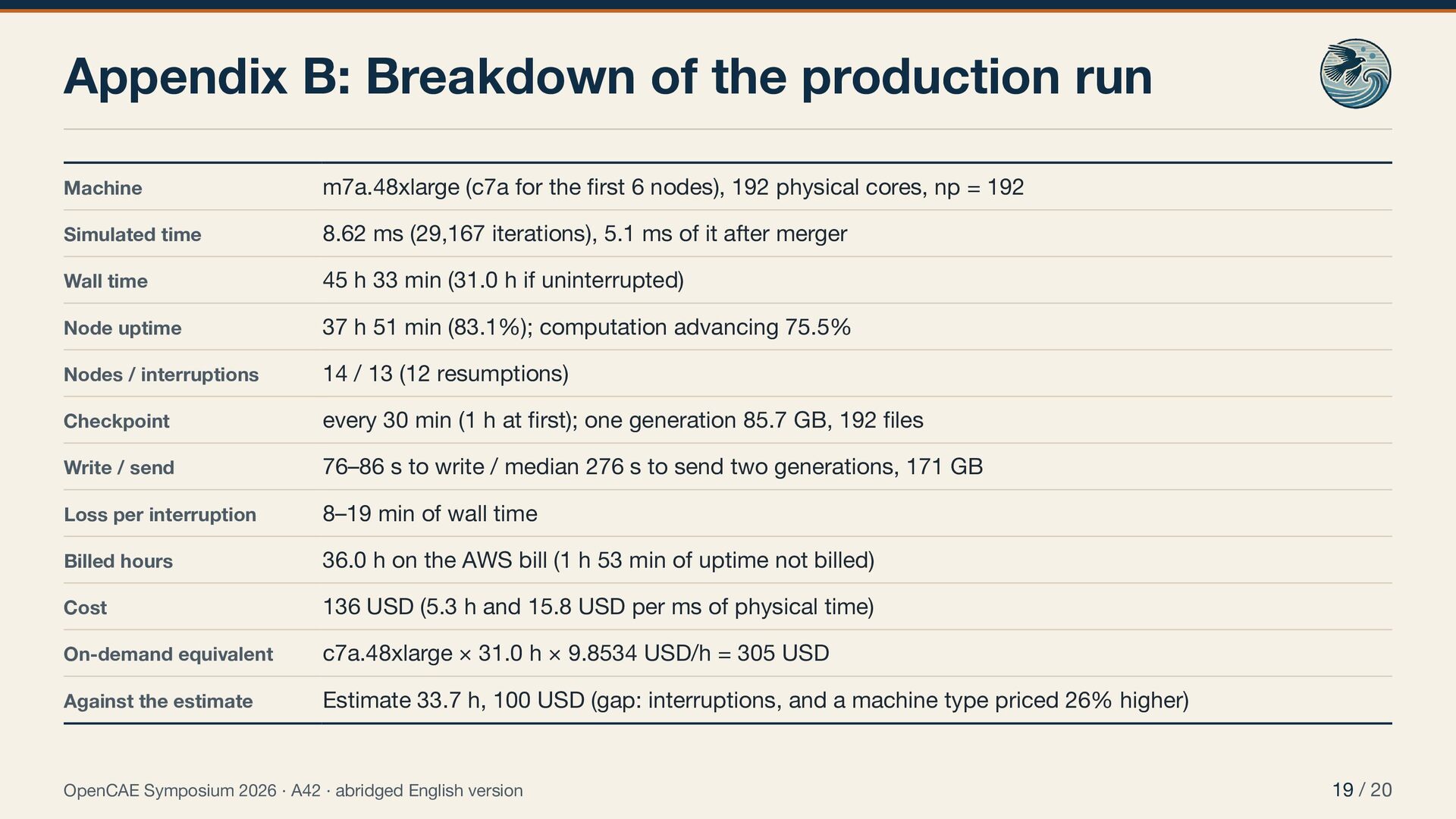
  19. Appendix B: Breakdown of the production run Machine m7a.48xlarge (c7a

    for the first 6 nodes), 192 physical cores, np = 192 Simulated time 8.62 ms (29,167 iterations), 5.1 ms of it after merger Wall time 45 h 33 min (31.0 h if uninterrupted) Node uptime 37 h 51 min (83.1%); computation advancing 75.5% Nodes / interruptions 14 / 13 (12 resumptions) Checkpoint every 30 min (1 h at first); one generation 85.7 GB, 192 files Write / send 76–86 s to write / median 276 s to send two generations, 171 GB Loss per interruption 8–19 min of wall time Billed hours 36.0 h on the AWS bill (1 h 53 min of uptime not billed) Cost 136 USD (5.3 h and 15.8 USD per ms of physical time) On-demand equivalent c7a.48xlarge × 31.0 h × 9.8534 USD/h = 305 USD Against the estimate Estimate 33.7 h, 100 USD (gap: interruptions, and a machine type priced 26% higher) OpenCAE Symposium 2026 · A42 · abridged English version 19 / 20
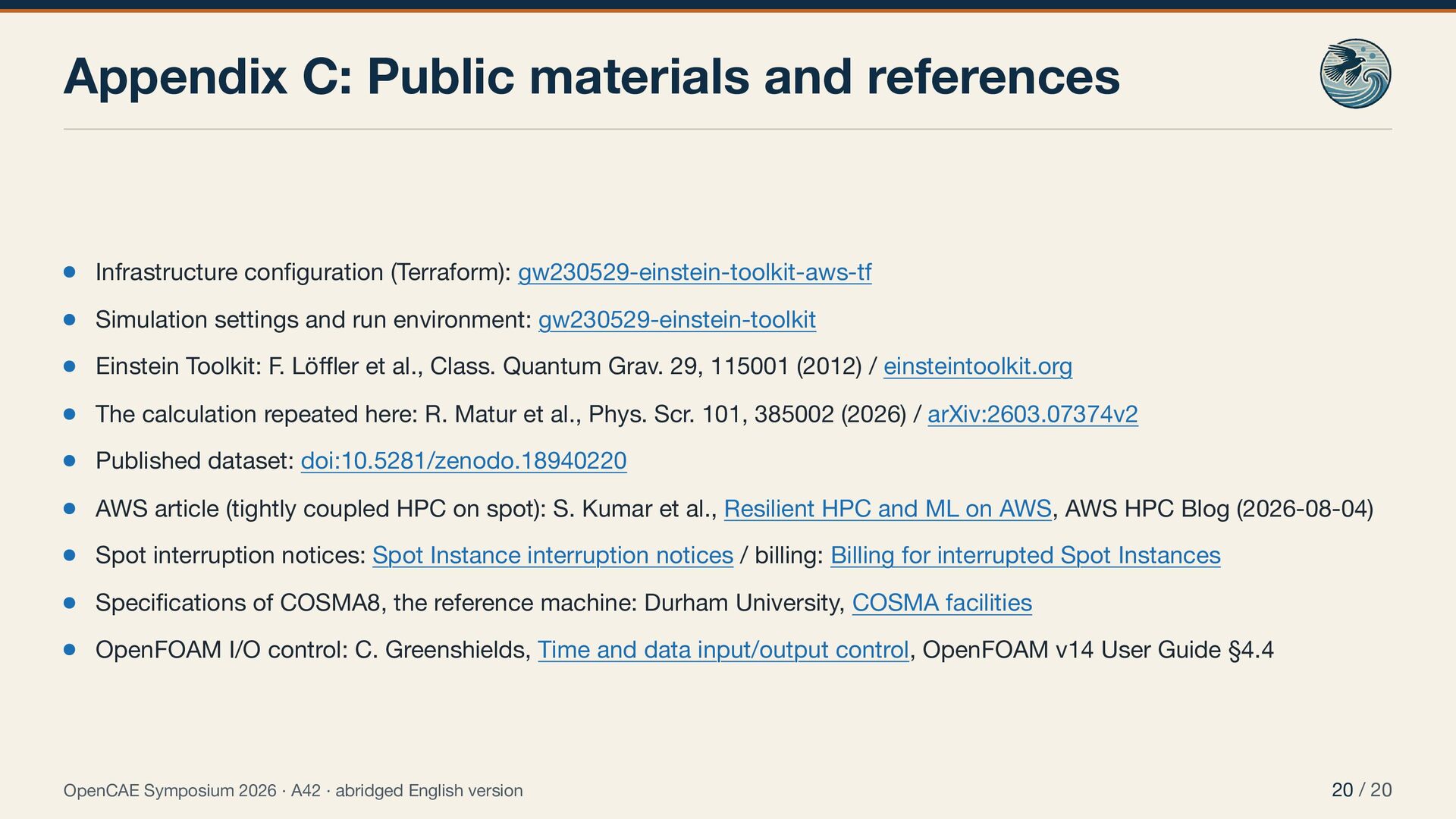
  20. Appendix C: Public materials and references Infrastructure configuration (Terraform): gw230529-einstein-toolkit-aws-tf

    Simulation settings and run environment: gw230529-einstein-toolkit Einstein Toolkit: F. Löffler et al., Class. Quantum Grav. 29, 115001 (2012) / einsteintoolkit.org The calculation repeated here: R. Matur et al., Phys. Scr. 101, 385002 (2026) / arXiv:2603.07374v2 Published dataset: doi:10.5281/zenodo.18940220 AWS article (tightly coupled HPC on spot): S. Kumar et al., Resilient HPC and ML on AWS, AWS HPC Blog (2026-08-04) Spot interruption notices: Spot Instance interruption notices / billing: Billing for interrupted Spot Instances Specifications of COSMA8, the reference machine: Durham University, COSMA facilities OpenFOAM I/O control: C. Greenshields, Time and data input/output control, OpenFOAM v14 User Guide §4.4 OpenCAE Symposium 2026 · A42 · abridged English version 20 / 20

More Decks by Syota-Sasaki

Other Decks in Technology