Upgrade to Pro — share decks privately, control downloads, hide ads and more …

Von-Neumann Machines, Dreams & The Futures of IT

Von-Neumann Machines, Dreams & The Futures of IT

This talk is sort of a "food for thought" talk. It takes the effects, AI currently has on software development, and looks at them from a different angle. When doing so, we realize that we are stuck with Von-Neumann architectures and 3rd Generation Languages as predominant paradigm for more than 70 years meanwhile. From a builder's perspective who want to make their dreams (idea) come true on a computer, this is cumbersome and much more complicated than they would like it to be.

AI making it much easier to bring ideas to life, (re-)raises questions we evaded for many years, like "Why are we still stuck with 3GL?", or "Are there better ways to teach computers our ideas than 3GL?", and "Are there better machines than a Von-Neumann machine?". This talk picks up these questions as well as follow-up questions that result from them, and explores them.

Of course, the voice track is missing. However, I hope that the slides are still of some use for you.

Avatar for Uwe Friedrichsen
Uwe Friedrichsen

September 17, 2026
More Decks by Uwe Friedrichsen

Other Decks in Technology

Transcript

  1. Von-Neumann machines, dreams & the futures of IT Old questions

    raised again by the rise of AI Uwe Friedrichsen – codecentric AG – 2023-2026
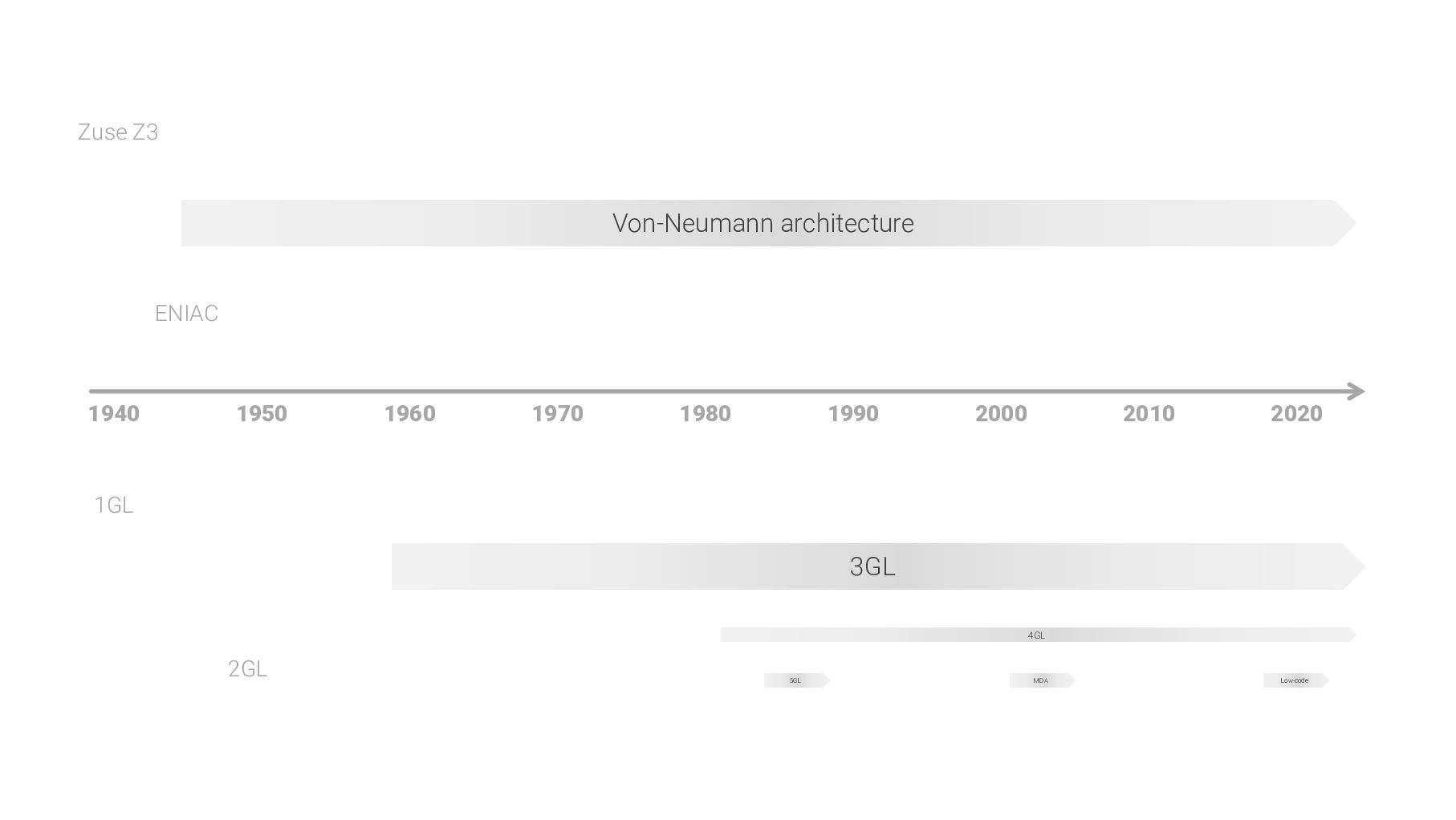
  2. Zuse Z3 Von-Neumann architecture ENIAC 1940 1950 1960 1970 1980

    1990 2000 2010 2020 1GL 3GL 4GL 2GL 5GL MDA Low-code
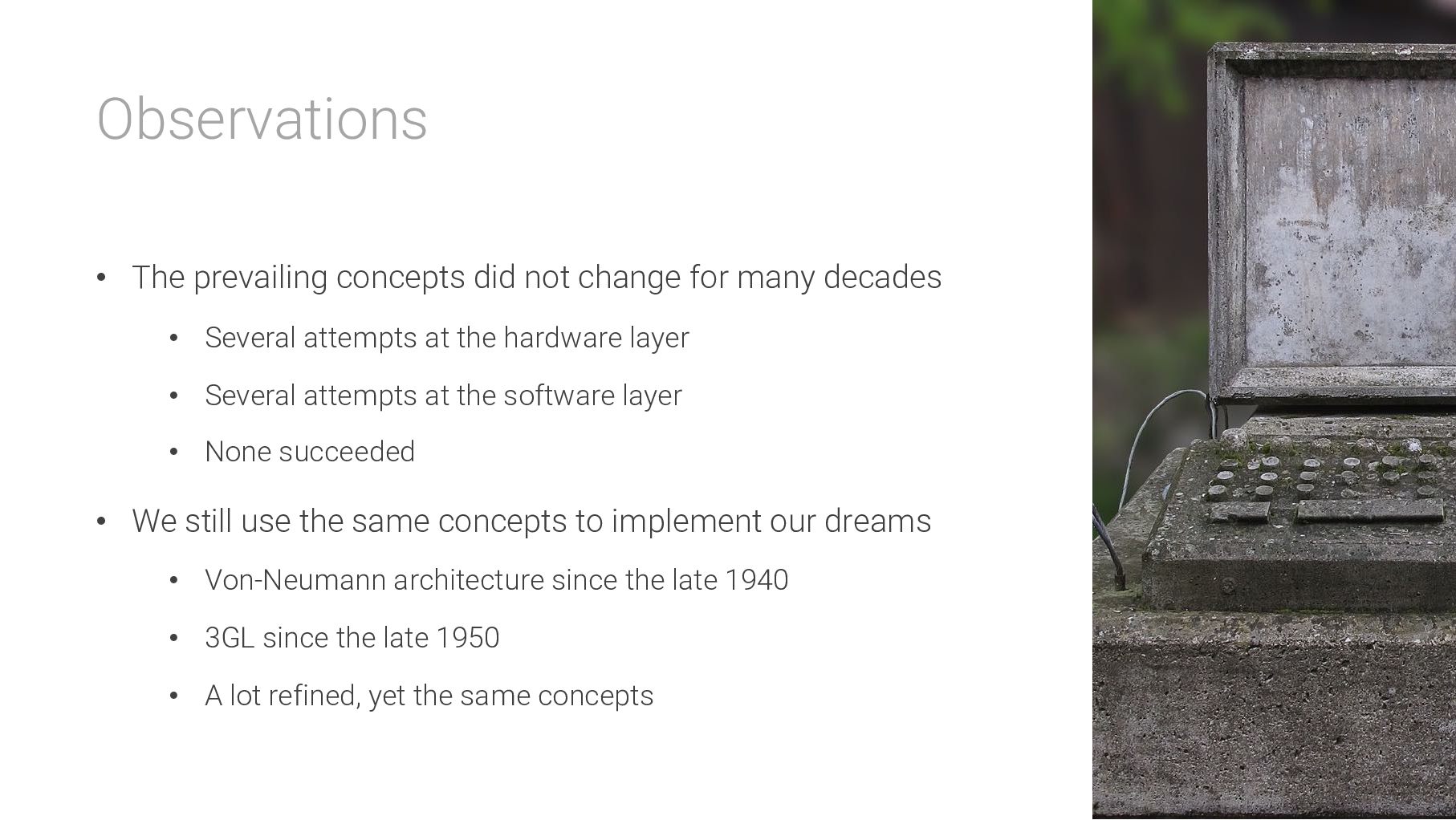
  3. Observations • The prevailing concepts did not change for many

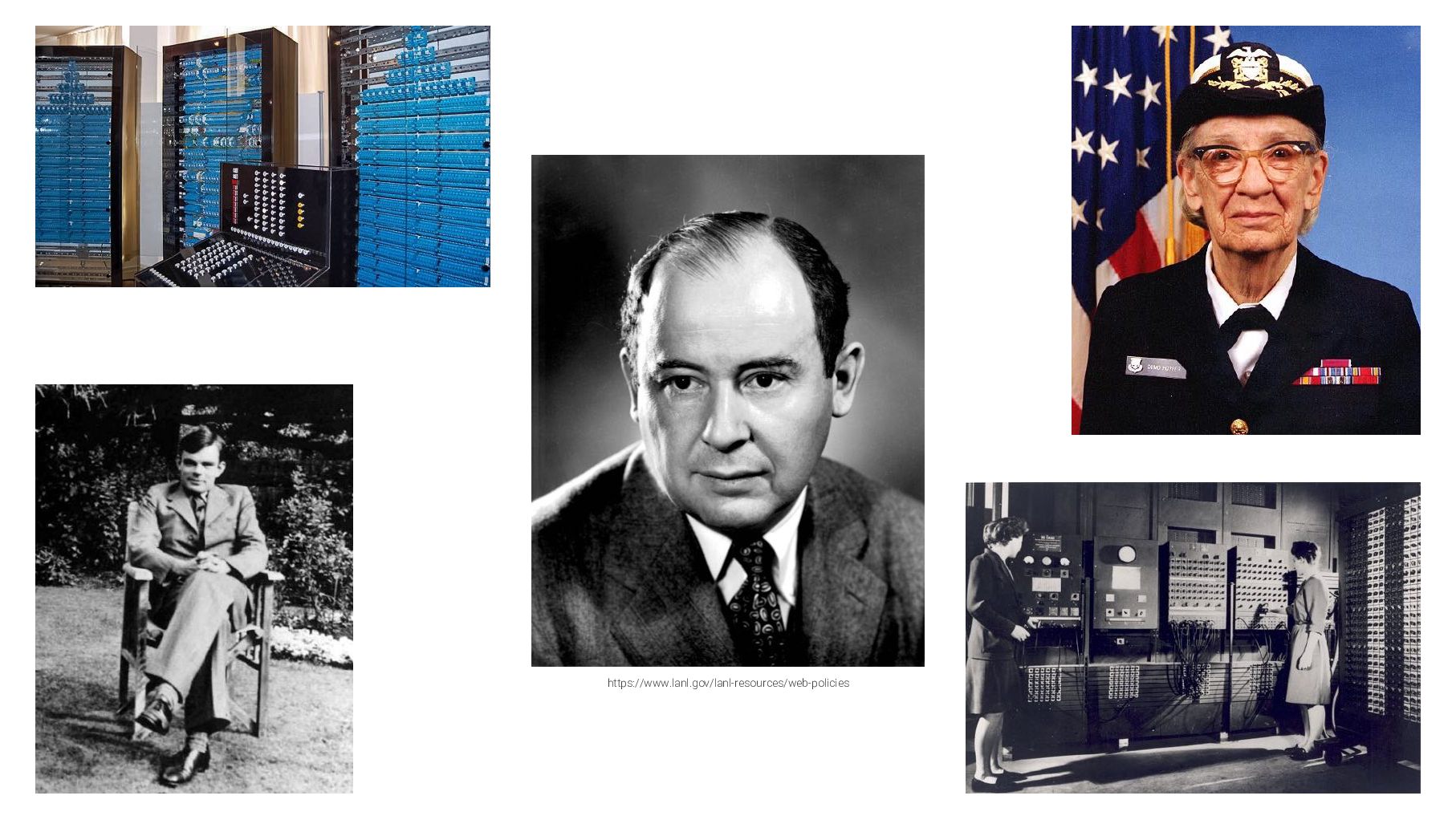
    decades • Several attempts at the hardware layer • Several attempts at the software layer • None succeeded • We still use the same concepts to implement our dreams • Von-Neumann architecture since the late 1940 • 3GL since the late 1950 • A lot refined, yet the same concepts
  4. A builder’s perspective • Still tons of dreams (ideas) •

    Very high barriers for making it their own • Requires learning programming • Requires understanding ecosystems • Requires leveraging platforms • Etc.
  5. A builder’s perspective • Still tons of dreams (ideas) •

    Very high barriers for making it their own • Software is extremely stupid from a human’s perspective • Computers execute exactly what they are told • No commonsense, no ability to deal sensibly with ambiguity • 3GL is how computers “think”, not how humans think • Very cumbersome to translate obvious ideas into 3GL
  6. A builder’s perspective • Still tons of dreams (ideas) •

    Very high barriers for making it their own • Software is extremely stupid from a human’s perspective • Letting other people do the programming does not help • Slow, expensive, cumbersome • Does not solve the problem to bring ideas across • Adds a Chinese whisper layer to the translation problem • Very cumbersome to translate obvious ideas into 3GL
  7. A builder’s perspective • Still tons of dreams (ideas) •

    Very high barriers for making it their own • Software is extremely stupid from a human’s perspective • Letting other people do the programming does not help • Very frustrating from a builder’s perspective • Builders do not care about coding, software, etc. • They only want a computer to run their ideas • It is about dreams (ideas), not code
  8. Effects of (generative) AI • Promises democratization of IT (once

    again) • “Everyone's a builder” • Understands natural language • Impressive results with “vibe coding” • Many “success stories” on social media
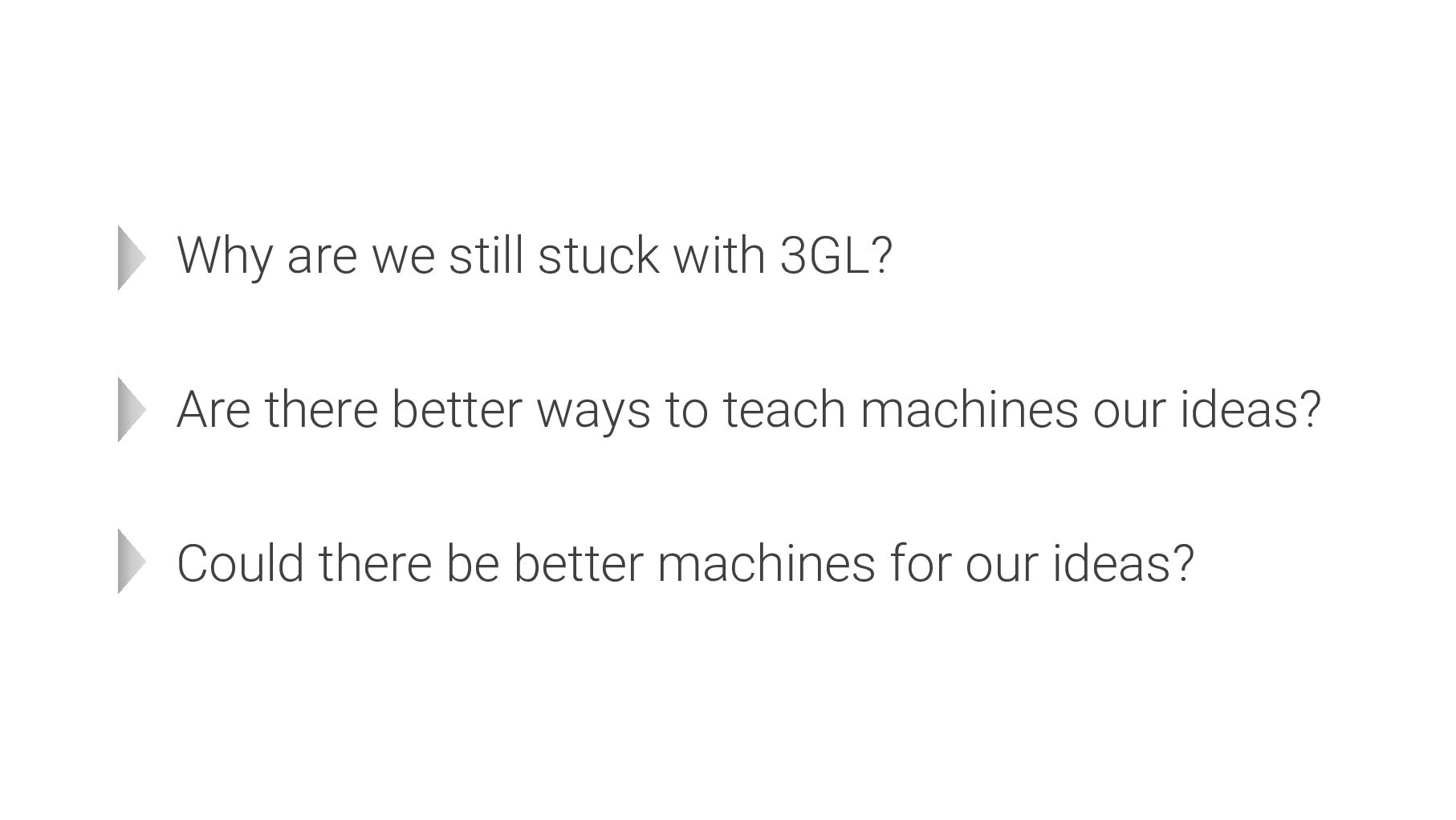
  9. Why are we still stuck with 3GL? Are there better

    ways to teach machines our ideas? Could there be better machines for our ideas?
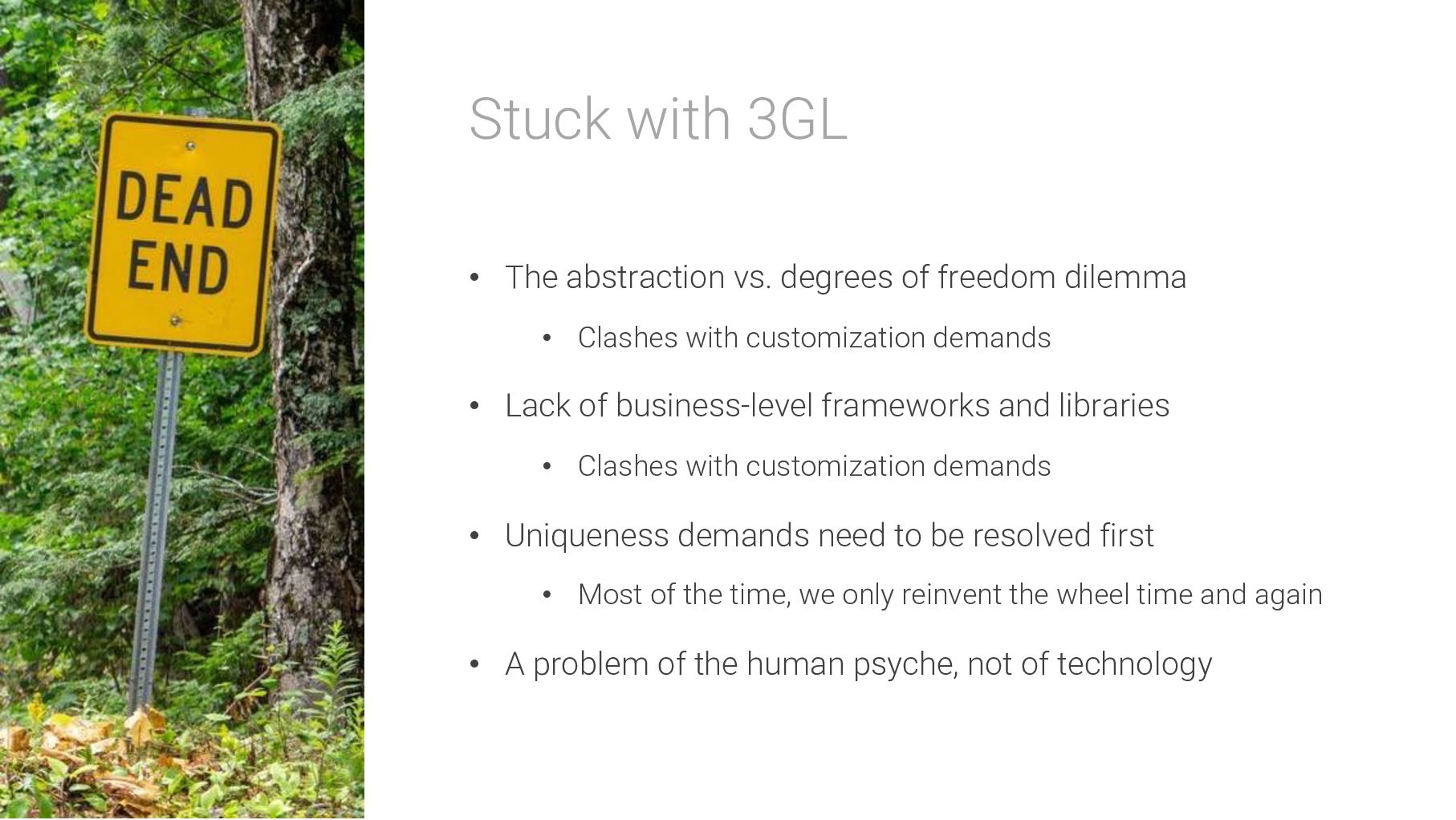
  10. Stuck with 3GL • The abstraction vs. degrees of freedom

    dilemma • Clashes with customization demands • Lack of business-level frameworks and libraries • Clashes with customization demands • Uniqueness demands need to be resolved first • Most of the time, we only reinvent the wheel time and again • A problem of the human psyche, not of technology
  11. Teaching machines our ideas • Gap between human idea and

    computer “understanding” • The LLM “superpower”: It “understands” natural language • Great for builders • How to overcome the ambiguity dilemma? • Express ideas in an easy to learn, non-ambiguous way? • Make machines “smart” enough to resolve ambiguity? • Accept that humans need to sort ambiguity out? • Unsolved issue for more than 70 years
  12. Better machines for our ideas • AI agents • Good

    for “reinventing the wheel” • Unclear how they perform when it comes to novelty • Current LLM implementations incredibly inefficient • Hardware-based LLMs • Electronic components define functions on current • Could be used to implement neural networks • No implementations yet known
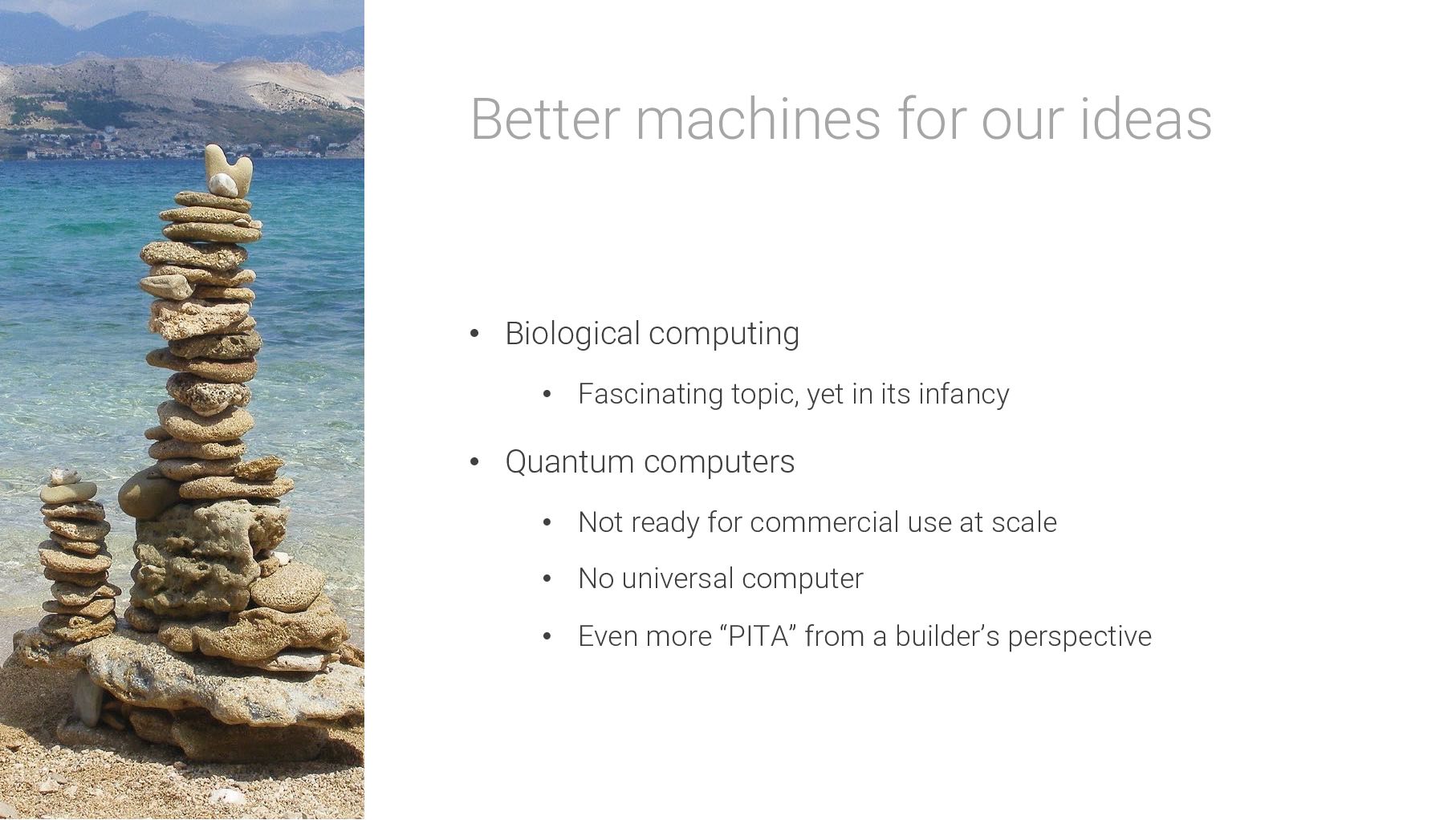
  13. Better machines for our ideas • Biological computing • Fascinating

    topic, yet in its infancy • Quantum computers • Not ready for commercial use at scale • No universal computer • Even more “PITA” from a builder’s perspective
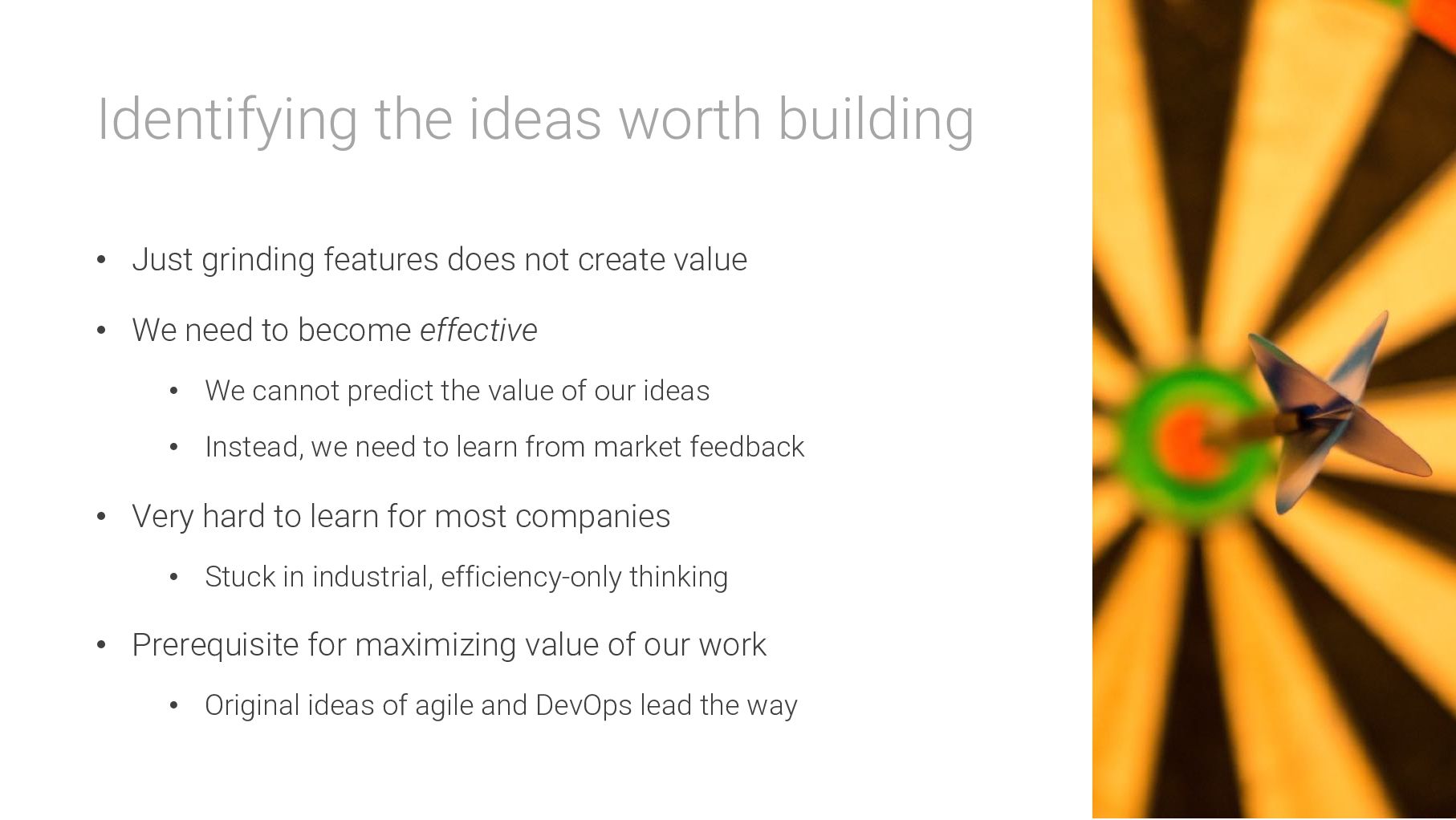
  14. Identifying the ideas worth building • Just grinding features does

    not create value • We need to become effective • We cannot predict the value of our ideas • Instead, we need to learn from market feedback • Very hard to learn for most companies • Stuck in industrial, efficiency-only thinking • Prerequisite for maximizing value of our work • Original ideas of agile and DevOps lead the way
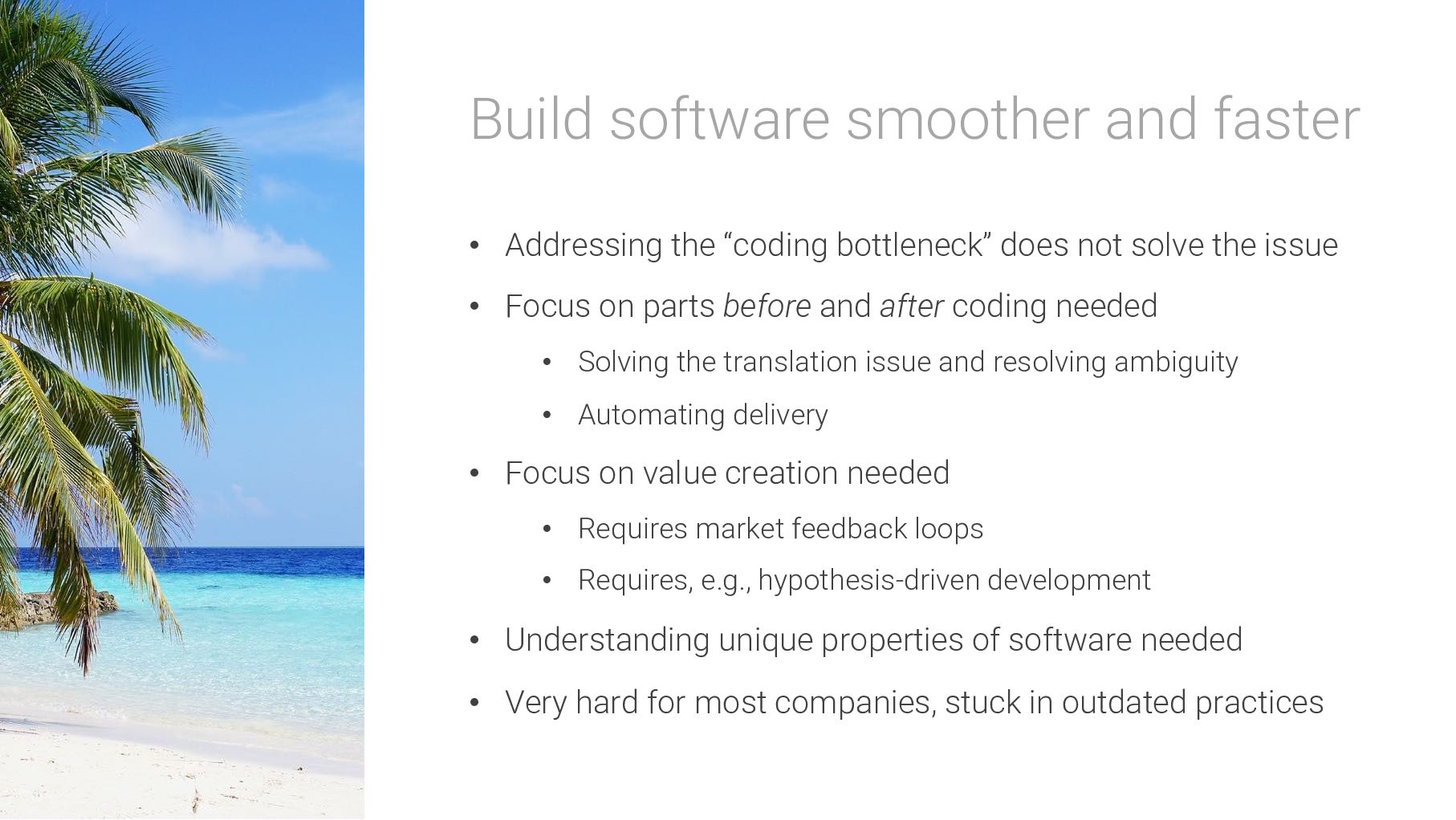
  15. Build software smoother and faster • Addressing the “coding bottleneck”

    does not solve the issue • Focus on parts before and after coding needed • Solving the translation issue and resolving ambiguity • Automating delivery • Focus on value creation needed • Requires market feedback loops • Requires, e.g., hypothesis-driven development • Understanding unique properties of software needed • Very hard for most companies, stuck in outdated practices
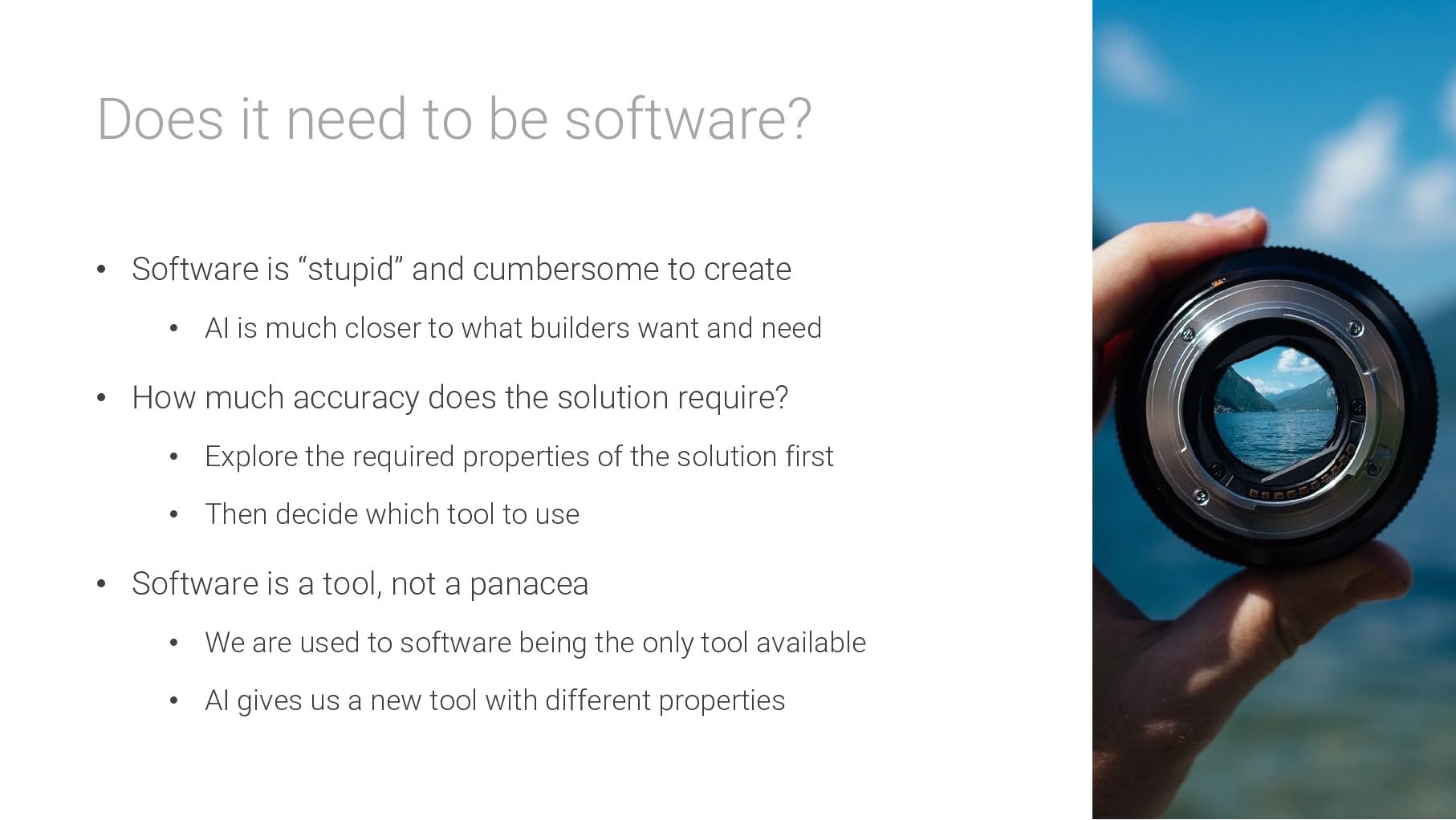
  16. Does it need to be software? • Software is “stupid”

    and cumbersome to create • AI is much closer to what builders want and need • How much accuracy does the solution require? • Explore the required properties of the solution first • Then decide which tool to use • Software is a tool, not a panacea • We are used to software being the only tool available • AI gives us a new tool with different properties
  17. Von-Neumann architecture • Alternatives are available • E.g., combination of

    NVRAM and RDMA • Would have reversed the traditional bottleneck • Would have allowed for completely different architectures • Companies do not pick them up • Probably due to the Innovator’s Dilemma • Maybe a good startup idea? • (Do not forget to add “AI” to the pitch deck)
  18. Less accurate hardware • Less accurate, but more convenient hardware

    • Hardware that would make solution development easier • Completely unexplored topic • We always expected computers to be 100% reliable • From AI, we expect the best from computer and human • Many problems do not require a 100% reliable solution • Maybe a topic worth exploring • Maybe another good startup idea?
  19. The (likely) evolution of AI • Major advances mainly at

    higher layers • Models – Prompt – Agent – Context – Harness – Loop – ... • Compensates for weaknesses of underlying layers • Makes things cumbersome again for a builder • Unclear where it will lead and how far we will get • Currently, collaboration like with traditional offshore partner • World models and symbolic AI could improve capabilities • Questions will most likely remain relevant
  20. Summing up • AI (re-)raises a lot of questions •

    Some have answers • Some do not have answers (yet) • AI will not deliver answers to all the questions • Yet, it forces us to take a step back and ask questions • Creating software is not an end in itself • Software is just a tool – very versatile, yet cumbersome • Maybe it is time to take the next step