Share
Embed
API secured, the modern way
Securing APIs has become more standardized with modern solutions like OAuth2, OIDC, JWT and rate limiting. Now, tools like Keycloak and Symfony’s new features simplify implementing these protocols.
As an API developer, you’ll learn to enhance your API’s security. As an API consumer, you’ll discover how to interact securely with external APIs. Join us to master secure API practices, without the complexity!
Mathieu Santostefano
April 17, 2026
Transcript
106 slides
-
Mathieu Santostefano Tech Expert SensioLabs Symfony Core Team Member Clever
Cloud Ambassador @welcomattic.com @welcomattic Hello! -
🛡 Authorization with OAuth2 🔐 Authentication with OpenID Connect (OIDC)
Agenda to protect your API 3 -
🛡 Authorization with OAuth2 🔐 Authentication with OpenID Connect (OIDC)
⏱️ Rate Limiting Agenda to protect your API 3 -
🛡 Authorization with OAuth2 🔐 Authentication with OpenID Connect (OIDC)
⏱️ Rate Limiting Each topic is explored using Symfony solution and a third-party solution. With a surprise at the end! 🎁 Agenda to protect your API 3 -
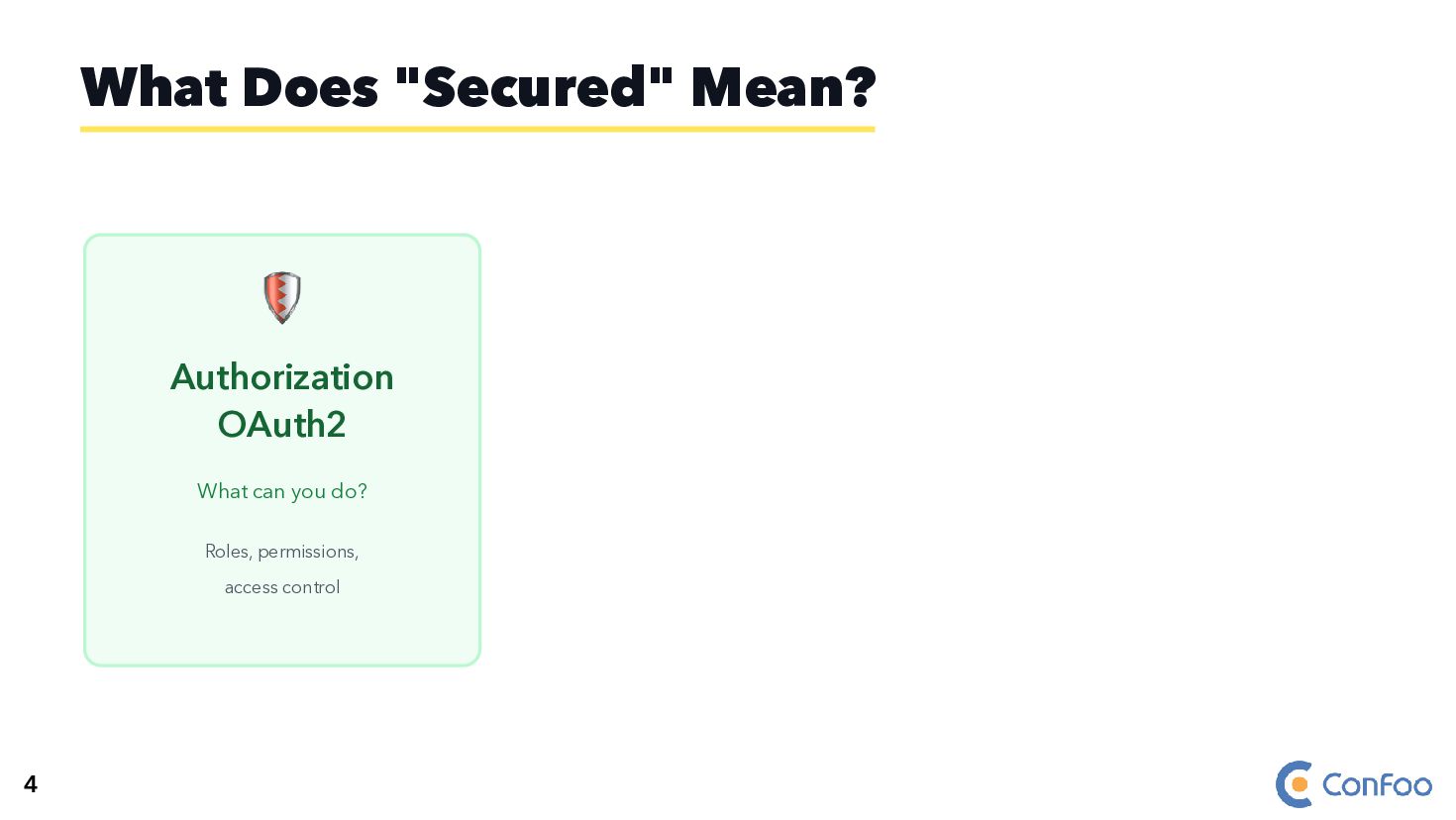
🛡️ Authorization OAuth2 What can you do? Roles, permissions, access
control What Does "Secured" Mean? 4 -
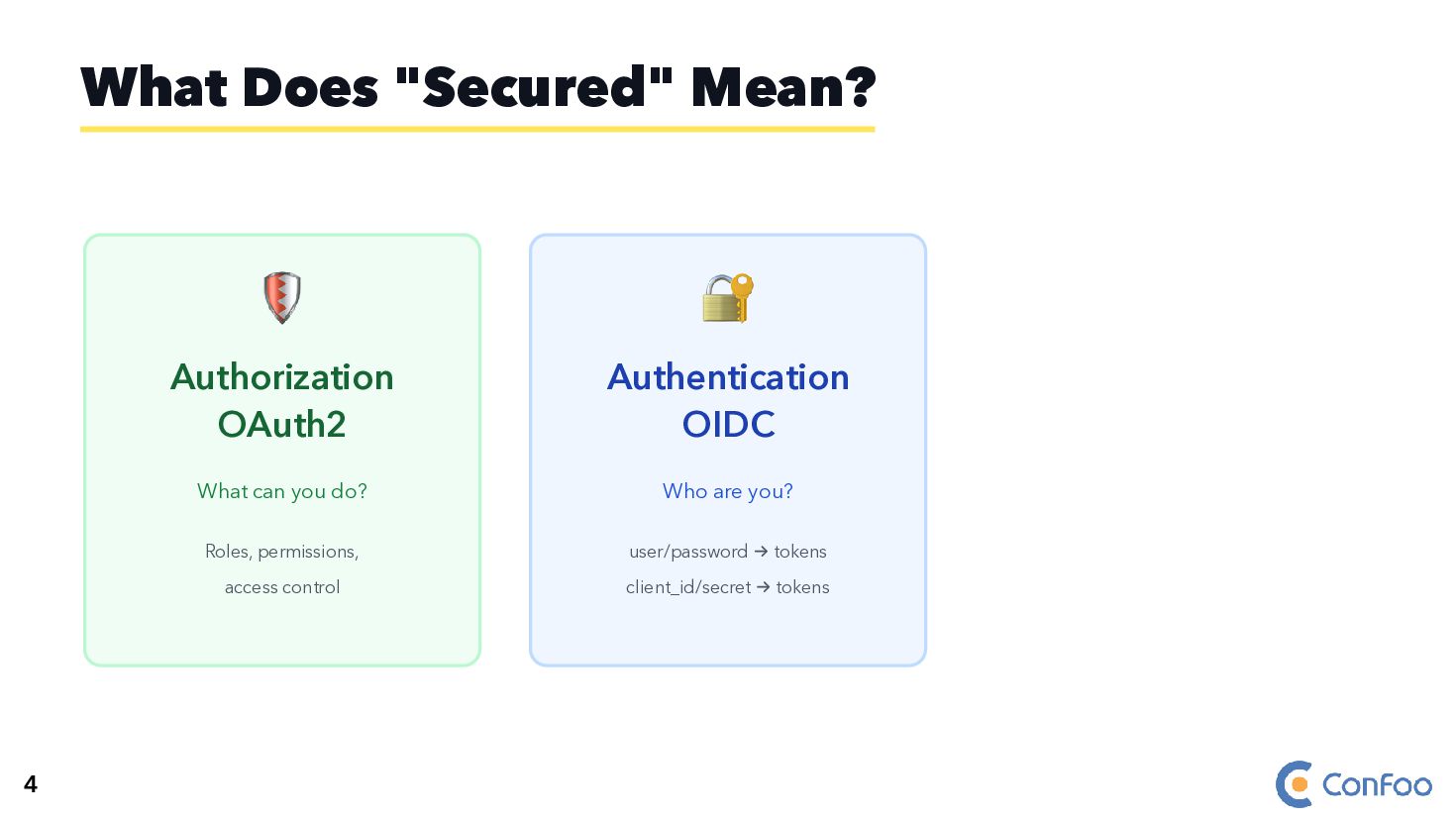
🛡️ Authorization OAuth2 What can you do? Roles, permissions, access
control 🔐 Authentication OIDC Who are you? user/password → tokens client_id/secret → tokens What Does "Secured" Mean? 4 -
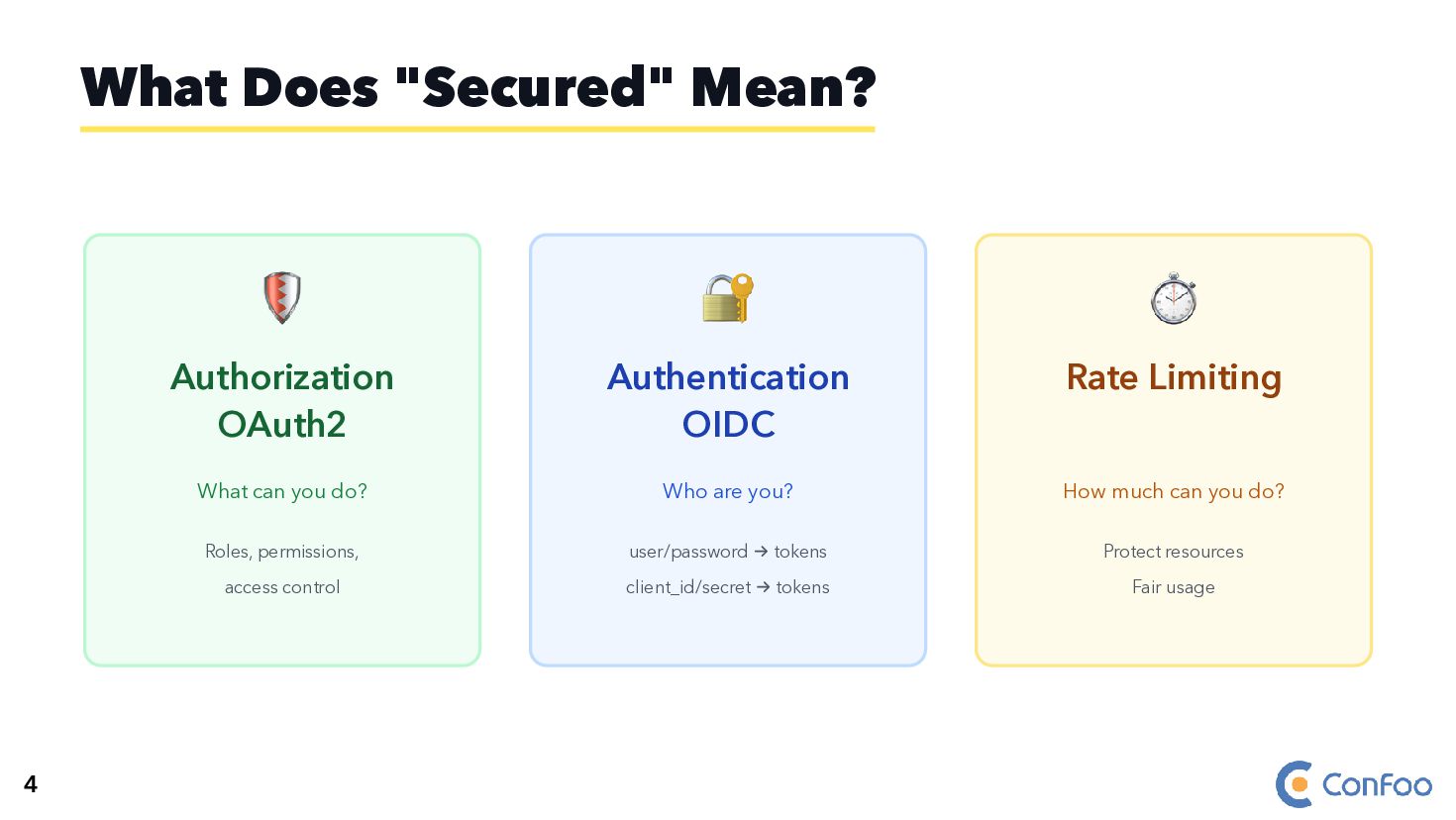
🛡️ Authorization OAuth2 What can you do? Roles, permissions, access
control 🔐 Authentication OIDC Who are you? user/password → tokens client_id/secret → tokens ⏱️ Rate Limiting How much can you do? Protect resources Fair usage What Does "Secured" Mean? 4 -
OAuth2 is an authorization framework that allows users to grant
permissions to applications to access protected resources without disclosing credentials. What is OAuth2? 6 -
👀 Today, focus on "on-behalf of user" scenario, but OAuth2
also supports "client credentials" that is not involving user. Refers to specification RFC 6749 to learn more. What is OAuth2? 7 -
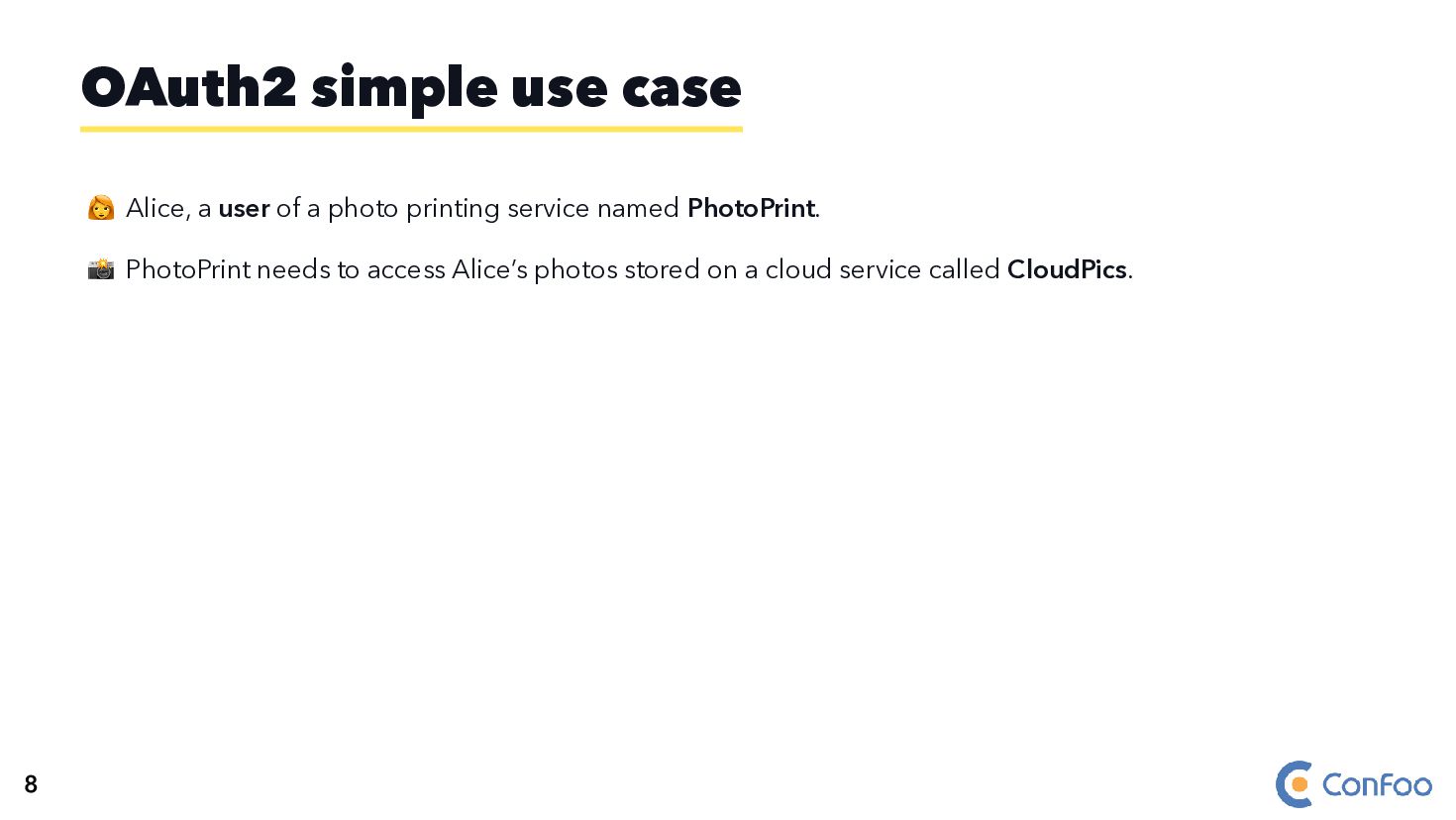
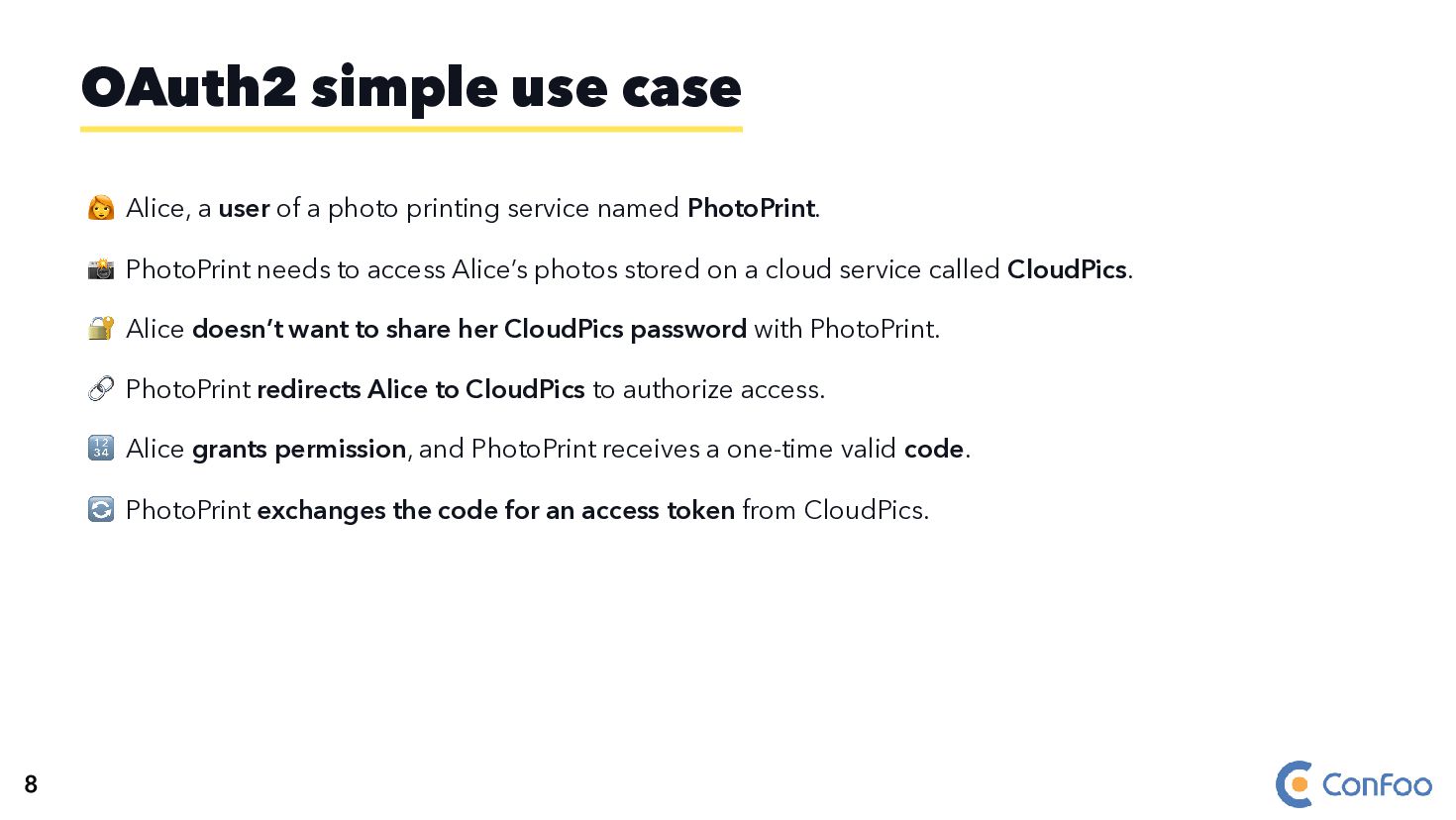
👩🦰 Alice, a user of a photo printing service named
PhotoPrint. OAuth2 simple use case 8 -
👩🦰 Alice, a user of a photo printing service named
PhotoPrint. 📸 PhotoPrint needs to access Alice’s photos stored on a cloud service called CloudPics. OAuth2 simple use case 8 -
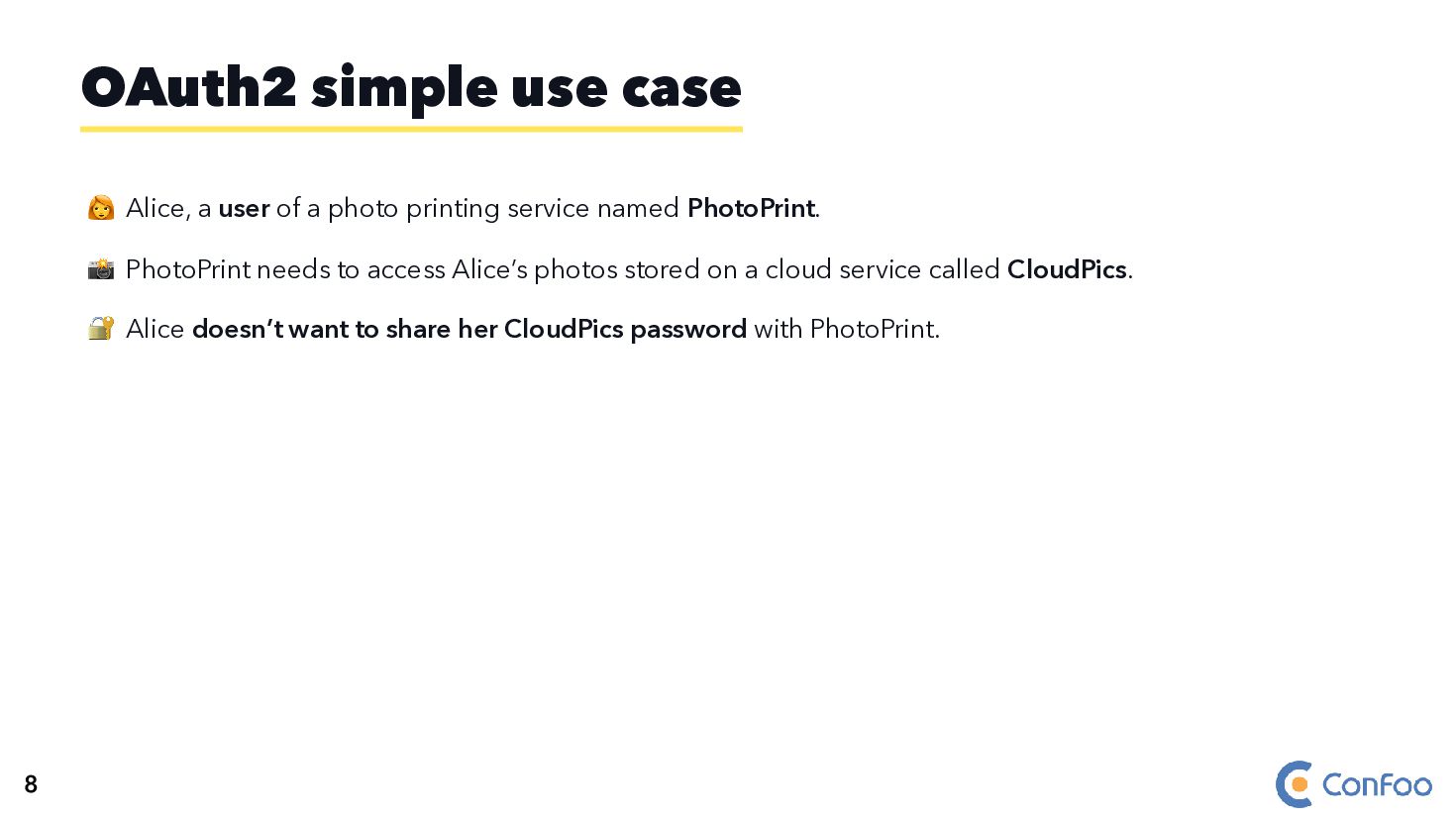
👩🦰 Alice, a user of a photo printing service named
PhotoPrint. 📸 PhotoPrint needs to access Alice’s photos stored on a cloud service called CloudPics. 🔐 Alice doesn’t want to share her CloudPics password with PhotoPrint. OAuth2 simple use case 8 -
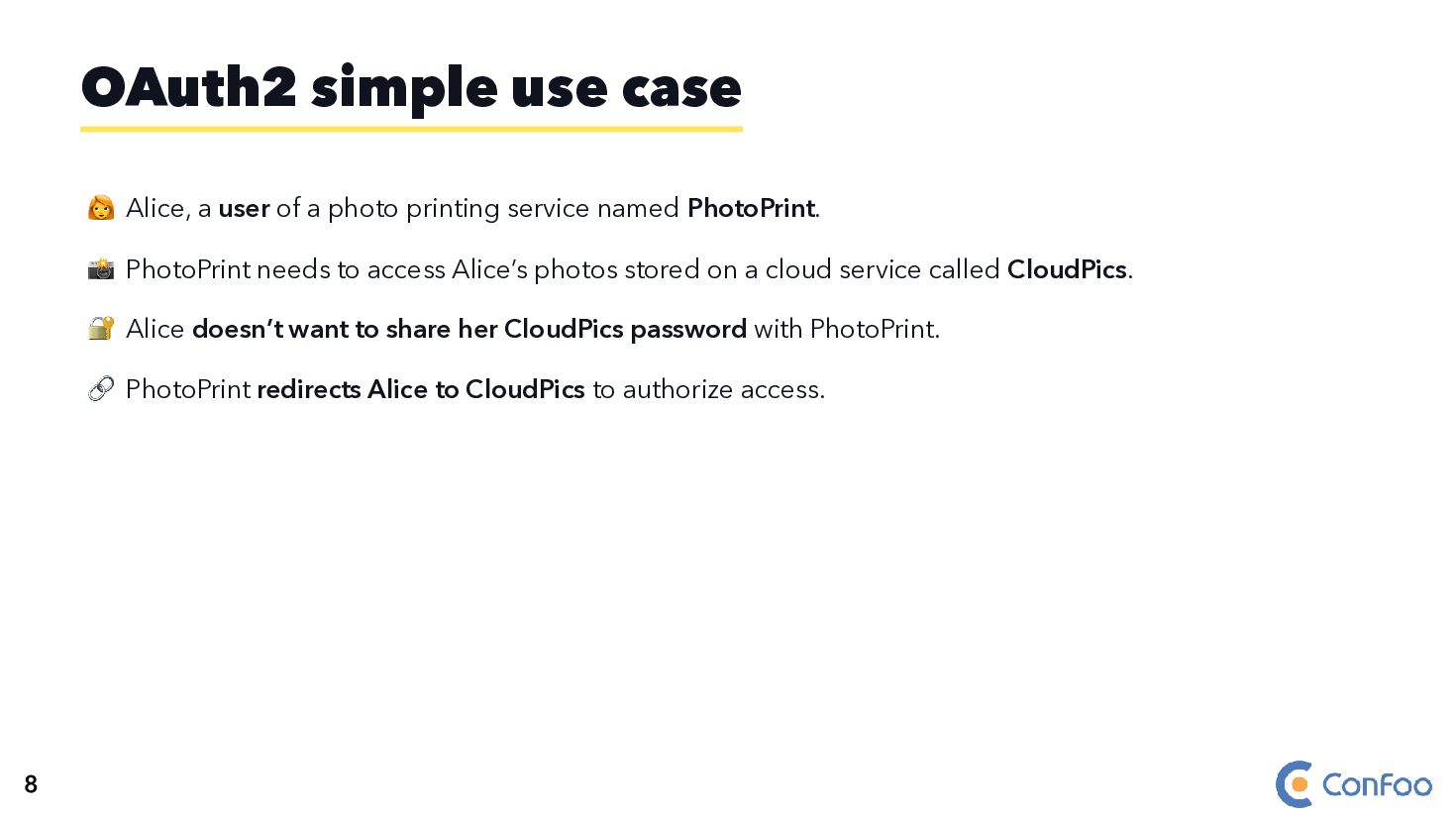
👩🦰 Alice, a user of a photo printing service named
PhotoPrint. 📸 PhotoPrint needs to access Alice’s photos stored on a cloud service called CloudPics. 🔐 Alice doesn’t want to share her CloudPics password with PhotoPrint. 🔗 PhotoPrint redirects Alice to CloudPics to authorize access. OAuth2 simple use case 8 -
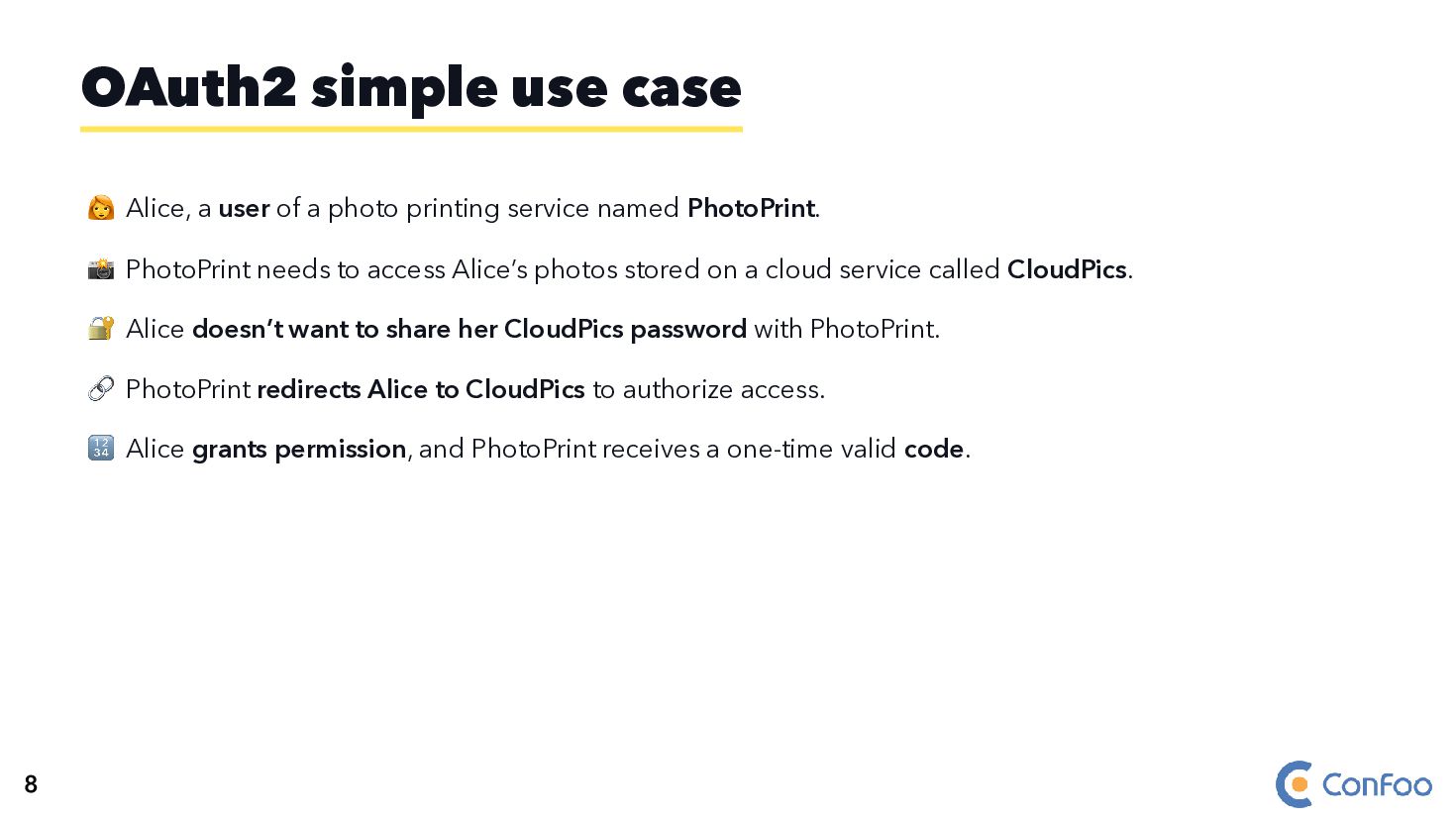
👩🦰 Alice, a user of a photo printing service named
PhotoPrint. 📸 PhotoPrint needs to access Alice’s photos stored on a cloud service called CloudPics. 🔐 Alice doesn’t want to share her CloudPics password with PhotoPrint. 🔗 PhotoPrint redirects Alice to CloudPics to authorize access. 🔢 Alice grants permission, and PhotoPrint receives a one-time valid code. OAuth2 simple use case 8 -
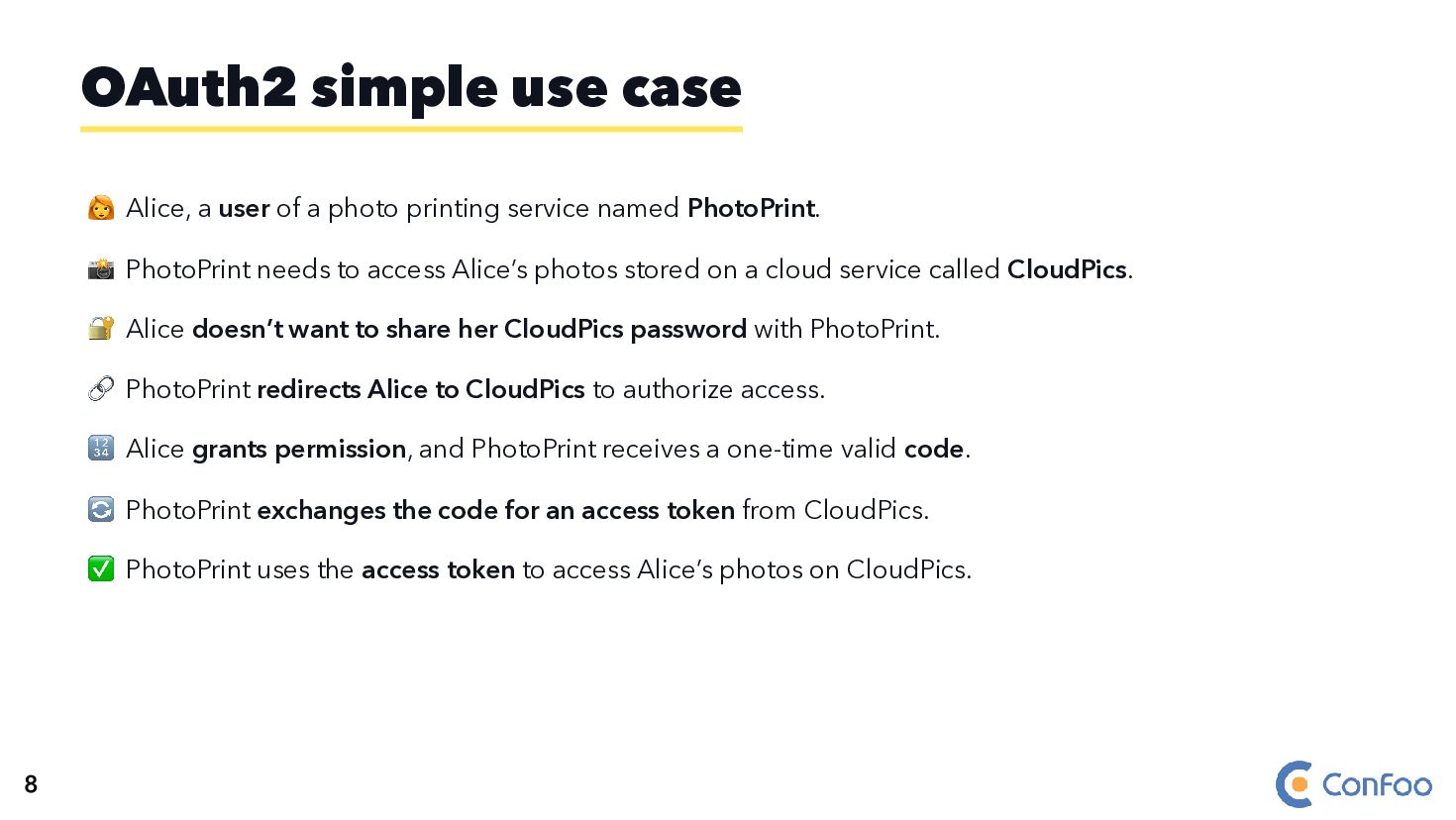
👩🦰 Alice, a user of a photo printing service named
PhotoPrint. 📸 PhotoPrint needs to access Alice’s photos stored on a cloud service called CloudPics. 🔐 Alice doesn’t want to share her CloudPics password with PhotoPrint. 🔗 PhotoPrint redirects Alice to CloudPics to authorize access. 🔢 Alice grants permission, and PhotoPrint receives a one-time valid code. 🔄 PhotoPrint exchanges the code for an access token from CloudPics. OAuth2 simple use case 8 -
👩🦰 Alice, a user of a photo printing service named
PhotoPrint. 📸 PhotoPrint needs to access Alice’s photos stored on a cloud service called CloudPics. 🔐 Alice doesn’t want to share her CloudPics password with PhotoPrint. 🔗 PhotoPrint redirects Alice to CloudPics to authorize access. 🔢 Alice grants permission, and PhotoPrint receives a one-time valid code. 🔄 PhotoPrint exchanges the code for an access token from CloudPics. ✅ PhotoPrint uses the access token to access Alice’s photos on CloudPics. OAuth2 simple use case 8 -
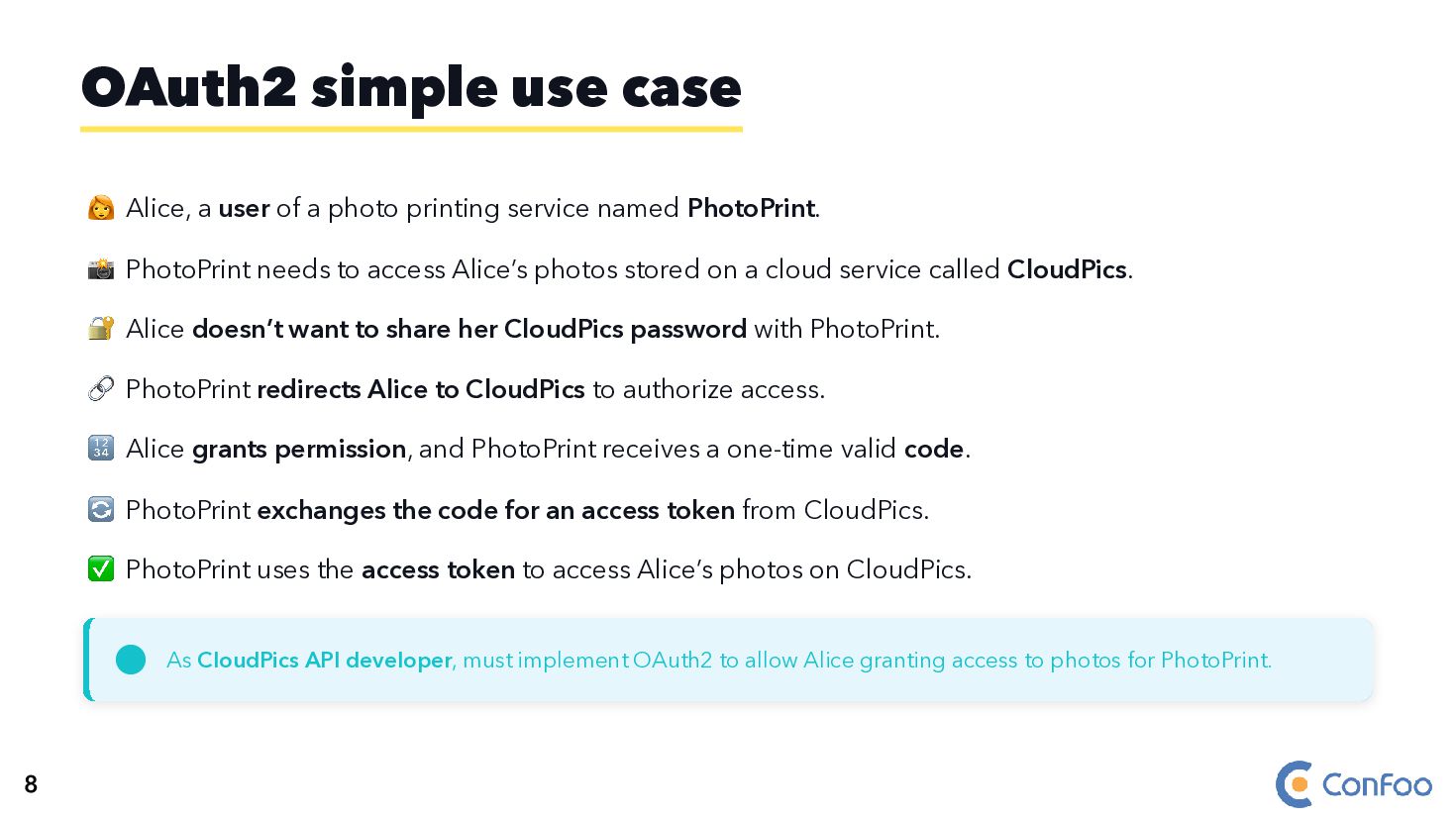
👩🦰 Alice, a user of a photo printing service named
PhotoPrint. 📸 PhotoPrint needs to access Alice’s photos stored on a cloud service called CloudPics. 🔐 Alice doesn’t want to share her CloudPics password with PhotoPrint. 🔗 PhotoPrint redirects Alice to CloudPics to authorize access. 🔢 Alice grants permission, and PhotoPrint receives a one-time valid code. 🔄 PhotoPrint exchanges the code for an access token from CloudPics. ✅ PhotoPrint uses the access token to access Alice’s photos on CloudPics. OAuth2 simple use case As CloudPics API developer, must implement OAuth2 to allow Alice granting access to photos for PhotoPrint. 8 -
In this scenario ☁️ CloudPics is the resource server that
holds Alice’s pics and the authorization server that issues tokens. OAuth2 use case 9 -
In this scenario ☁️ CloudPics is the resource server that
holds Alice’s pics and the authorization server that issues tokens. 🌁 PhotoPrint is the client application that wants to access a protected resource OAuth2 use case 9 -
In this scenario ☁️ CloudPics is the resource server that
holds Alice’s pics and the authorization server that issues tokens. 🌁 PhotoPrint is the client application that wants to access a protected resource 👩🦰 Alice is the resource owner of the photos. OAuth2 use case 9 -
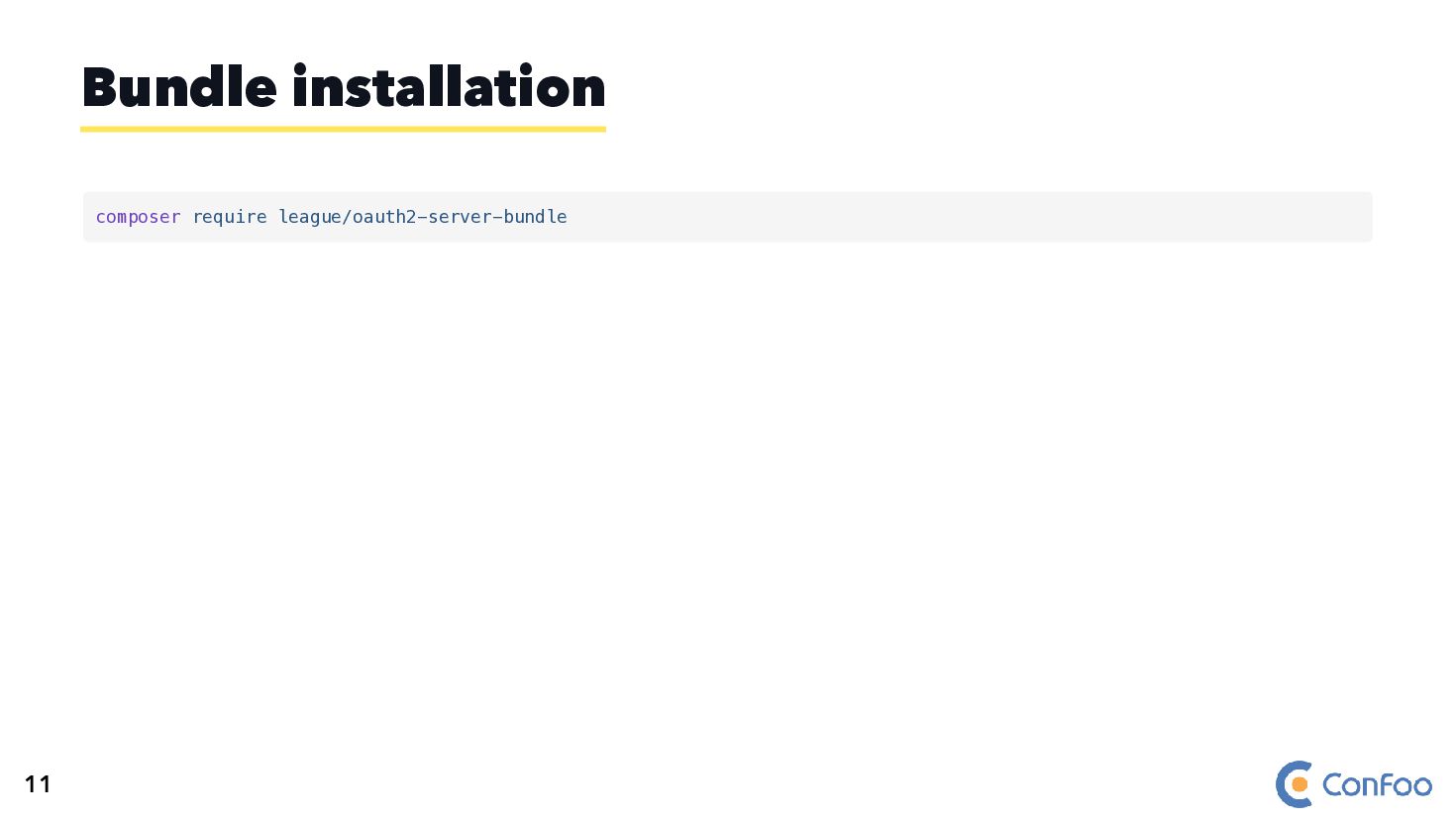
📦 Bundle: league/oauth2-server-bundle 🔧 Integration: Official League OAuth2 server Symfony
bundle OAuth2 implementation in Symfony ` ` 10 -
📦 Bundle: league/oauth2-server-bundle 🔧 Integration: Official League OAuth2 server Symfony
bundle 🛡️ Result: Embed a modern OAuth2 authorization server into your Symfony API OAuth2 implementation in Symfony ` ` 10 -
📦 Bundle: league/oauth2-server-bundle 🔧 Integration: Official League OAuth2 server Symfony
bundle 🛡️ Result: Embed a modern OAuth2 authorization server into your Symfony API ⚡ In action: Your API is the resource server The bundle handles token validation and scope checking for protected endpoints OAuth2 implementation in Symfony ` ` 10 -
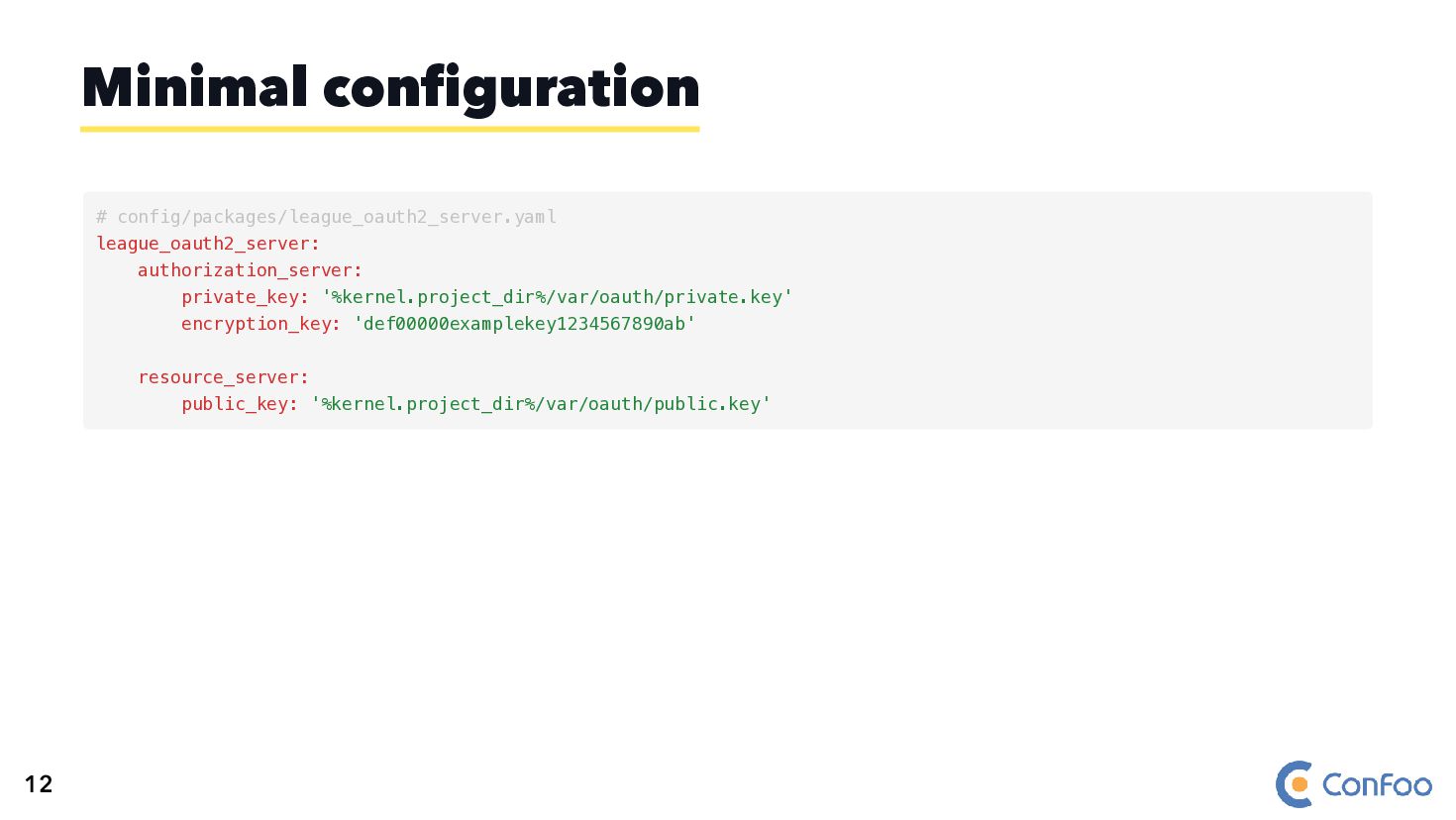
Minimal configuration # config/packages/league_oauth2_server.yaml league_oauth2_server: authorization_server: private_key: '%kernel.project_dir%/var/oauth/private.key' encryption_key: 'def00000examplekey1234567890ab'
resource_server: public_key: '%kernel.project_dir%/var/oauth/public.key' 12 -
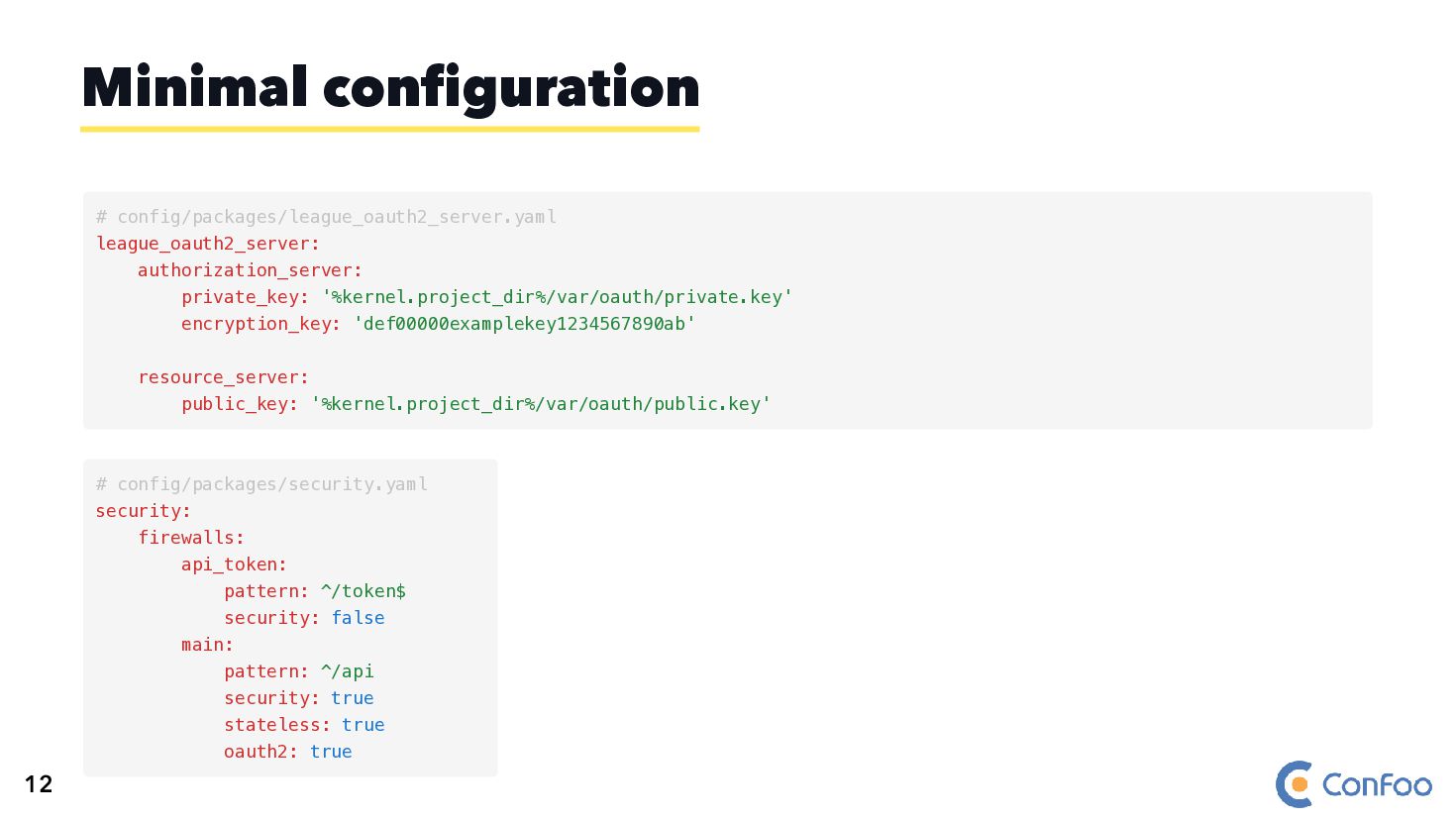
Minimal configuration # config/packages/league_oauth2_server.yaml league_oauth2_server: authorization_server: private_key: '%kernel.project_dir%/var/oauth/private.key' encryption_key: 'def00000examplekey1234567890ab'
resource_server: public_key: '%kernel.project_dir%/var/oauth/public.key' # config/packages/security.yaml security: firewalls: api_token: pattern: ^/token$ security: false main: pattern: ^/api security: true stateless: true oauth2: true 12 -
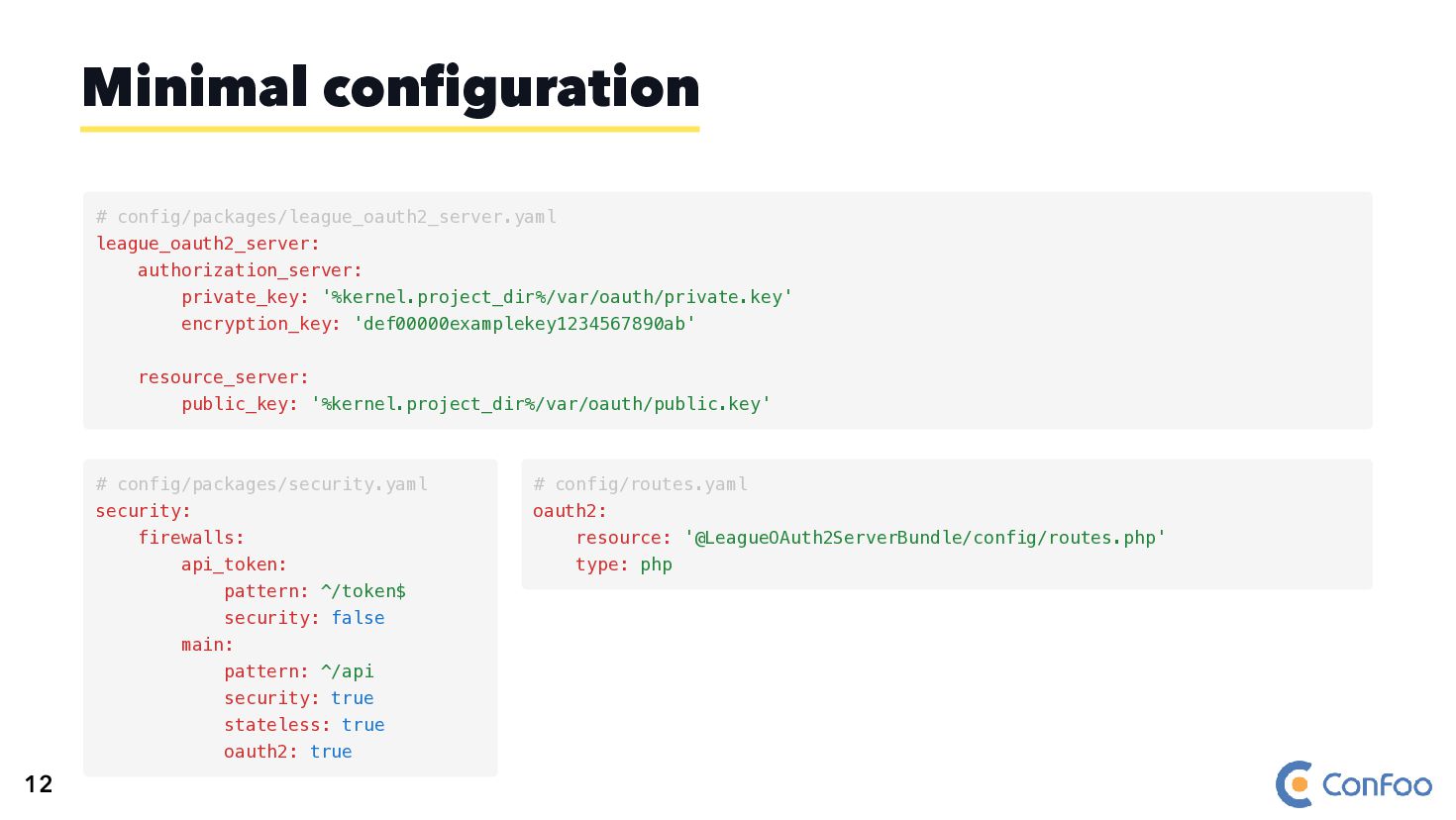
Minimal configuration # config/packages/league_oauth2_server.yaml league_oauth2_server: authorization_server: private_key: '%kernel.project_dir%/var/oauth/private.key' encryption_key: 'def00000examplekey1234567890ab'
resource_server: public_key: '%kernel.project_dir%/var/oauth/public.key' # config/packages/security.yaml security: firewalls: api_token: pattern: ^/token$ security: false main: pattern: ^/api security: true stateless: true oauth2: true # config/routes.yaml oauth2: resource: '@LeagueOAuth2ServerBundle/config/routes.php' type: php 12 -
Client entity use League\OAuth2\Server\Entities; #[ORM\Entity] class Client implements ClientEntityInterface {
#[ORM\Id, ORM\GeneratedValue, ORM\Column] private ?int $id = null; #[ORM\Column(length: 80)] private string $identifier; #[ORM\Column(length: 80)] private string $secret; public function getIdentifier(): string { return $this->identifier; } } 13 -
Access token entity use League\OAuth2\Server\Entities; #[ORM\Entity] class AccessToken implements AccessTokenEntityInterface
{ #[ORM\Id, ORM\GeneratedValue, ORM\Column] private ?int $id = null; #[ORM\ManyToOne(targetEntity: Client::class)] private ClientEntityInterface $client; #[ORM\Column(type: 'json')] private array $scopes = []; public function getClient(): ClientEntityInterface { return $this->client; } } 14 -
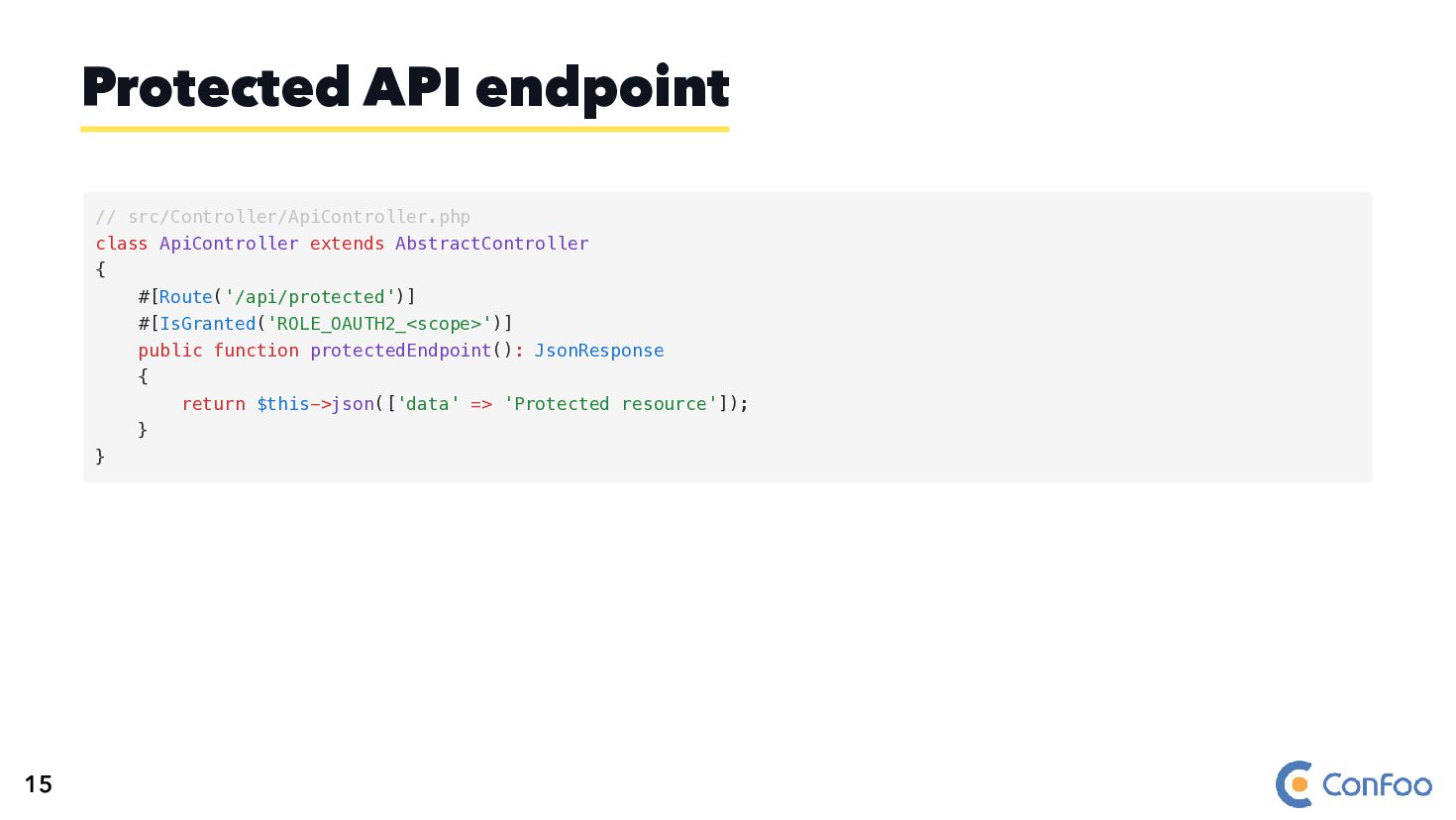
Protected API endpoint // src/Controller/ApiController.php class ApiController extends AbstractController {
#[Route('/api/protected')] #[IsGranted('ROLE_OAUTH2_<scope>')] public function protectedEndpoint(): JsonResponse { return $this->json(['data' => 'Protected resource']); } } 15 -
OpenID Connect standardizes user authentication on top of OAuth2. It
harmonizes the way to retrieve user related resources (i.e. profile, email, etc.) OAuth2 vs OIDC 16 -
You can do authentication using OAuth2, but user data are
returned in a non-standard way. OIDC standardizes this with the concept of ID tokens that provide user information in a consistent format. OIDC 17 -
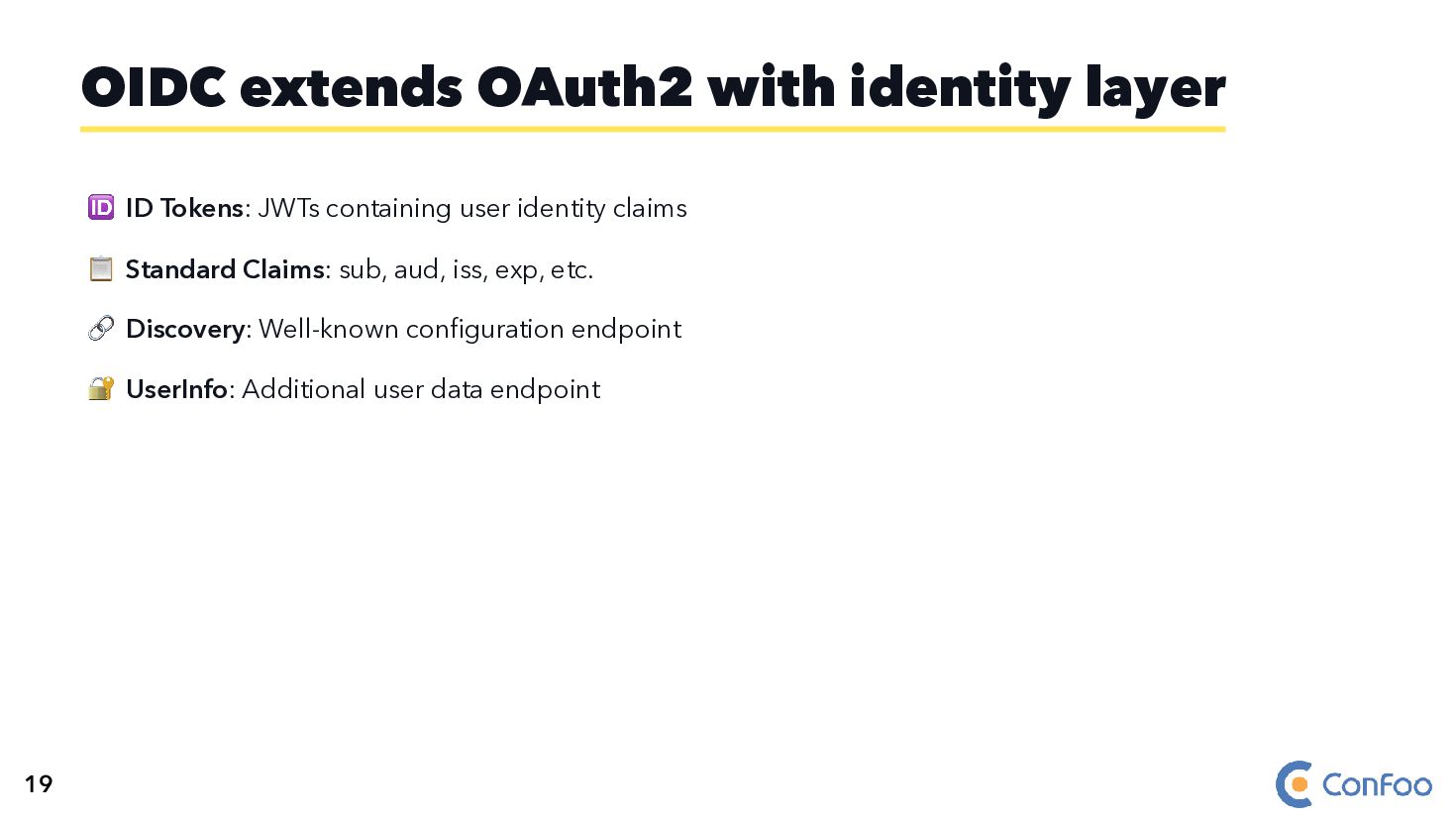
🆔 ID Tokens: JWTs containing user identity claims OIDC extends
OAuth2 with identity layer 19 -
🆔 ID Tokens: JWTs containing user identity claims 📋 Standard
Claims: sub, aud, iss, exp, etc. OIDC extends OAuth2 with identity layer 19 -
🆔 ID Tokens: JWTs containing user identity claims 📋 Standard
Claims: sub, aud, iss, exp, etc. 🔗 Discovery: Well-known configuration endpoint OIDC extends OAuth2 with identity layer 19 -
🆔 ID Tokens: JWTs containing user identity claims 📋 Standard
Claims: sub, aud, iss, exp, etc. 🔗 Discovery: Well-known configuration endpoint 🔐 UserInfo: Additional user data endpoint OIDC extends OAuth2 with identity layer 19 -
Unlike OAuth2 server bundle that integrates an authorization server into
the resource server, OIDC recommends to rely on a separated OIDC Provider that issues ID tokens, user info and access tokens. OIDC Provider 20 -
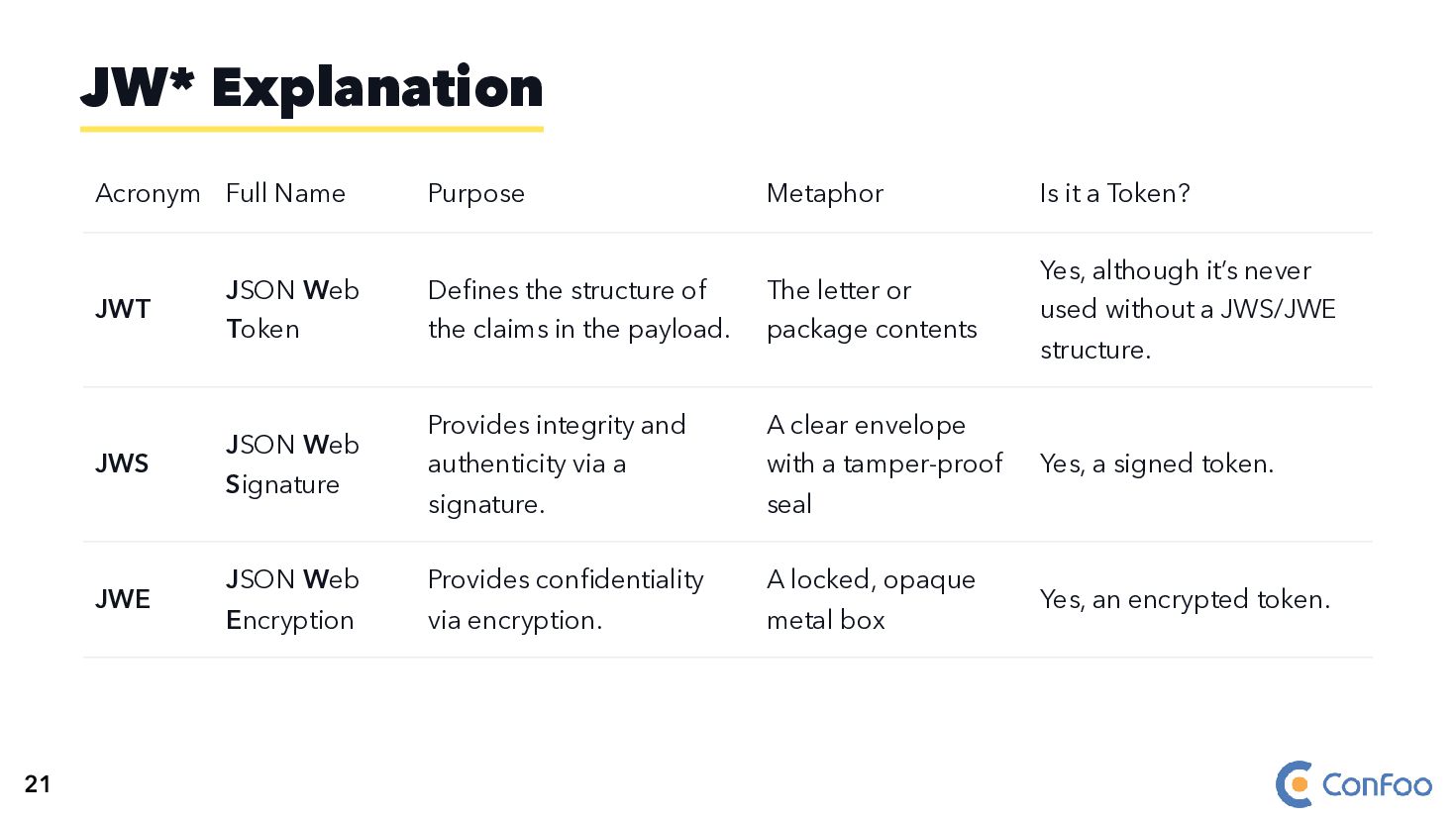
Acronym Full Name Purpose Metaphor Is it a Token? JWT
JSON Web Token Defines the structure of the claims in the payload. The letter or package contents Yes, although it’s never used without a JWS/JWE structure. JWS JSON Web Signature Provides integrity and authenticity via a signature. A clear envelope with a tamper-proof seal Yes, a signed token. JWE JSON Web Encryption Provides confidentiality via encryption. A locked, opaque metal box Yes, an encrypted token. JW* Explanation 21 -
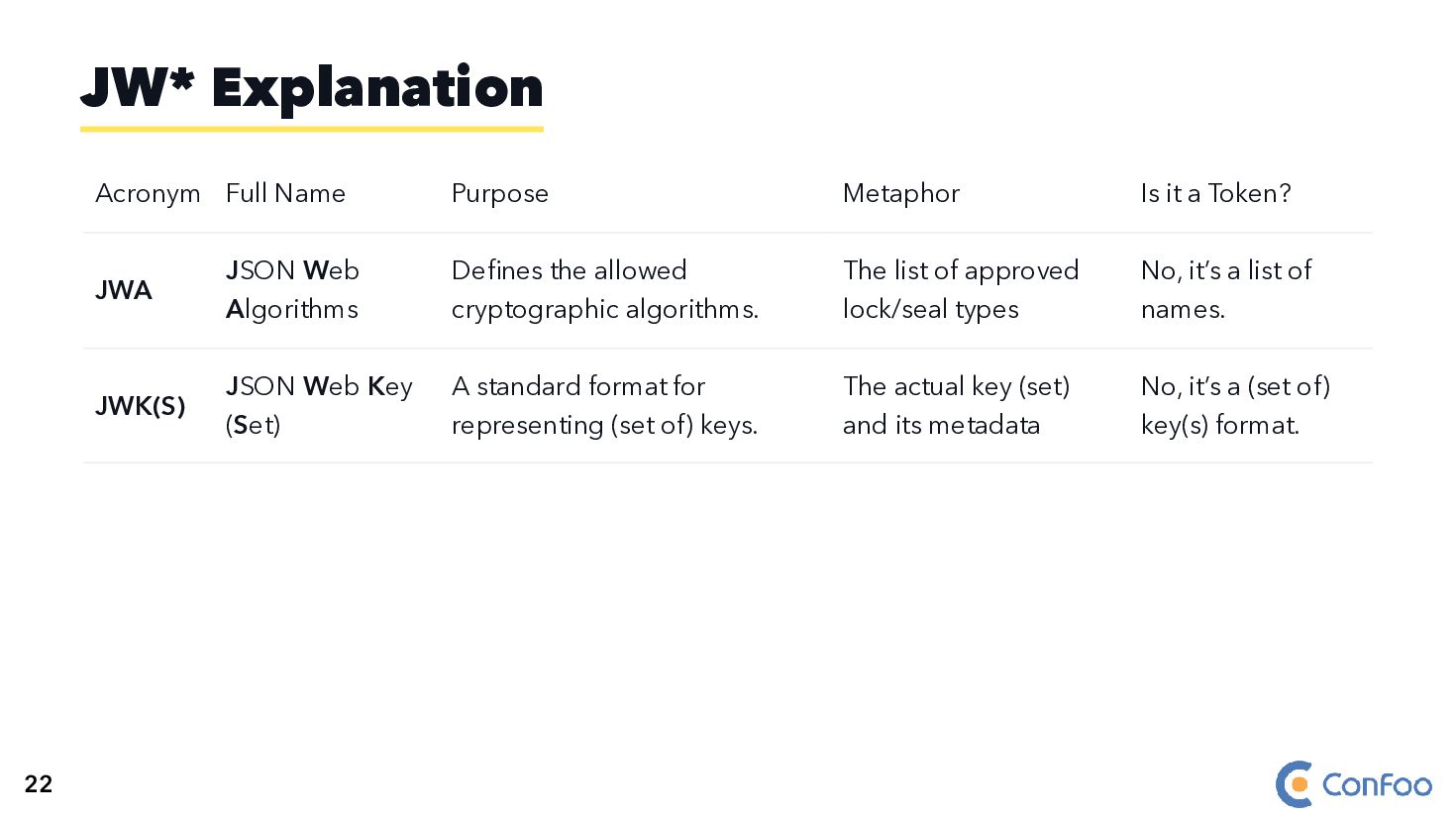
Acronym Full Name Purpose Metaphor Is it a Token? JWA
JSON Web Algorithms Defines the allowed cryptographic algorithms. The list of approved lock/seal types No, it’s a list of names. JWK(S) JSON Web Key (Set) A standard format for representing (set of) keys. The actual key (set) and its metadata No, it’s a (set of) key(s) format. JW* Explanation 22 -
Unlike with OAuth2 server bundle, we are not implementing our
own OIDC Provider. 23 -
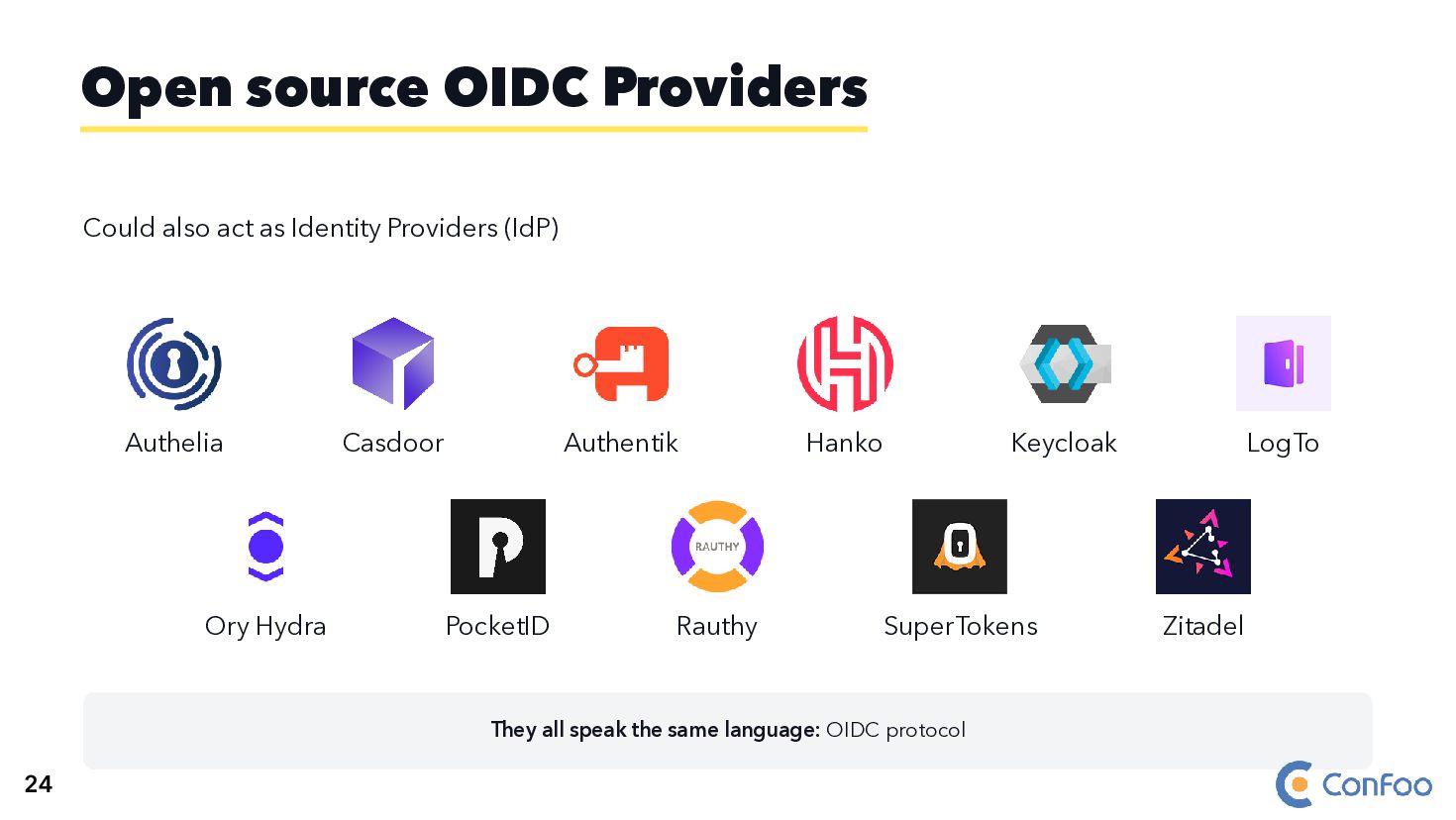
Could also act as Identity Providers (IdP) Authelia Casdoor Authentik

Hanko Keycloak LogTo Ory Hydra PocketID Rauthy SuperTokens Zitadel They all speak the same language: OIDC protocol Open source OIDC Providers 24 -
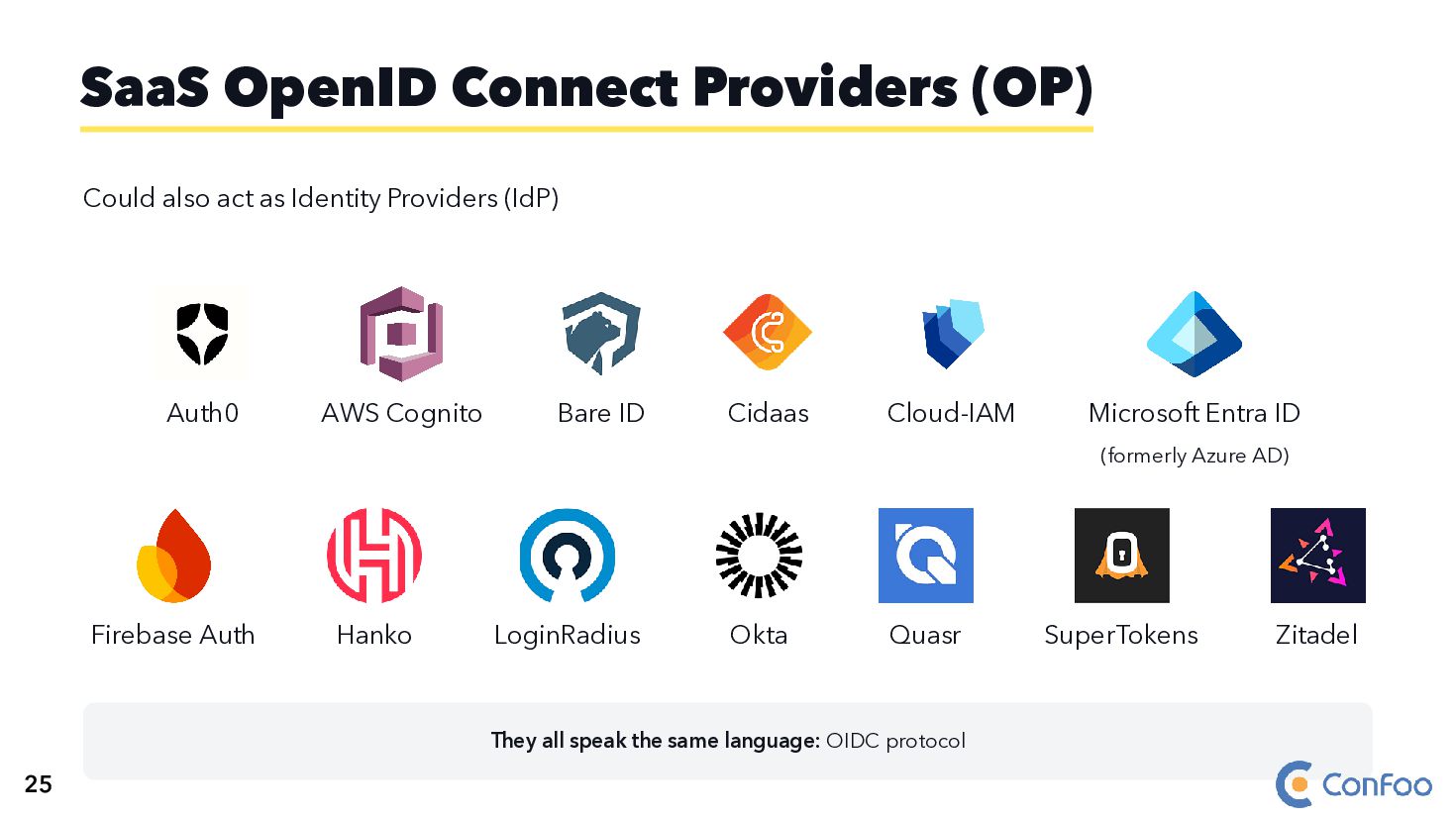
Could also act as Identity Providers (IdP) Auth0 AWS Cognito
Bare ID Cidaas Cloud-IAM Microsoft Entra ID (formerly Azure AD) Firebase Auth Hanko LoginRadius Okta Quasr SuperTokens Zitadel They all speak the same language: OIDC protocol SaaS OpenID Connect Providers (OP) 25 -
Most of listed OIDC providers support social SSO out of
the box, by configuration of client credentials. Need social SSO? 26 -
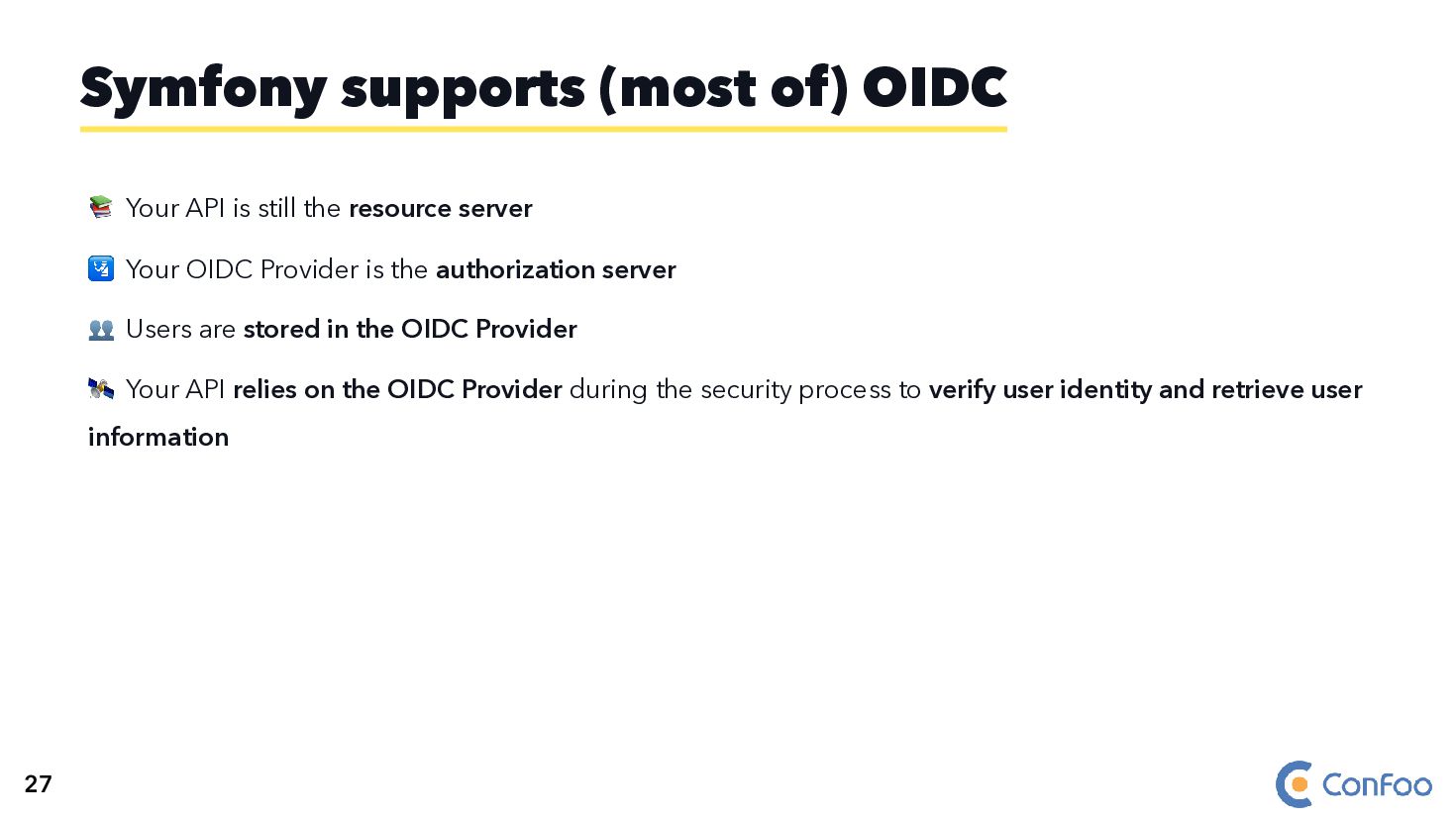
📚 Your API is still the resource server Symfony supports
(most of) OIDC 27 -
📚 Your API is still the resource server 🛂 Your
OIDC Provider is the authorization server Symfony supports (most of) OIDC 27 -
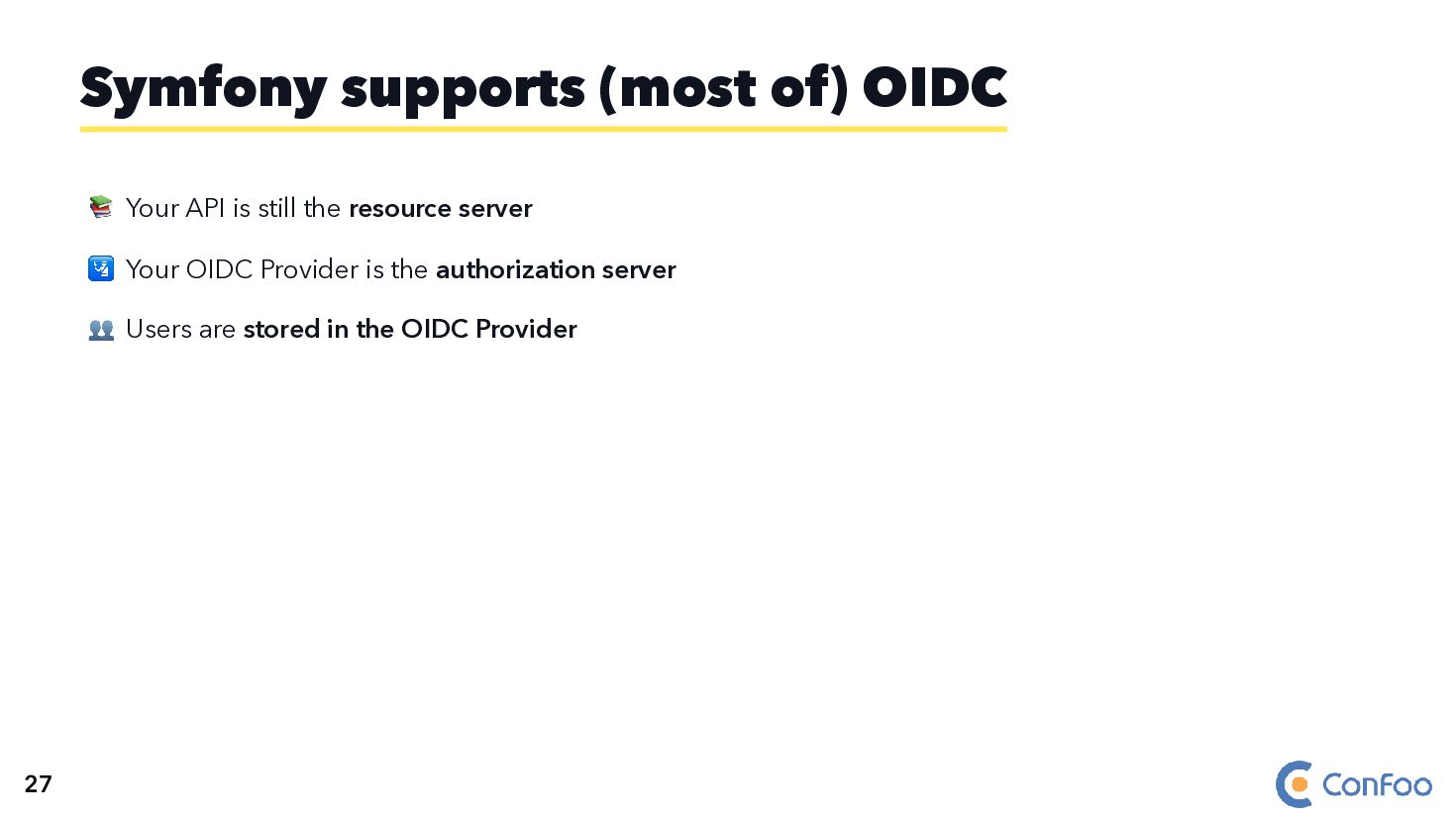
📚 Your API is still the resource server 🛂 Your
OIDC Provider is the authorization server 👥 Users are stored in the OIDC Provider Symfony supports (most of) OIDC 27 -
📚 Your API is still the resource server 🛂 Your
OIDC Provider is the authorization server 👥 Users are stored in the OIDC Provider 🛰️ Your API relies on the OIDC Provider during the security process to verify user identity and retrieve user information Symfony supports (most of) OIDC 27 -
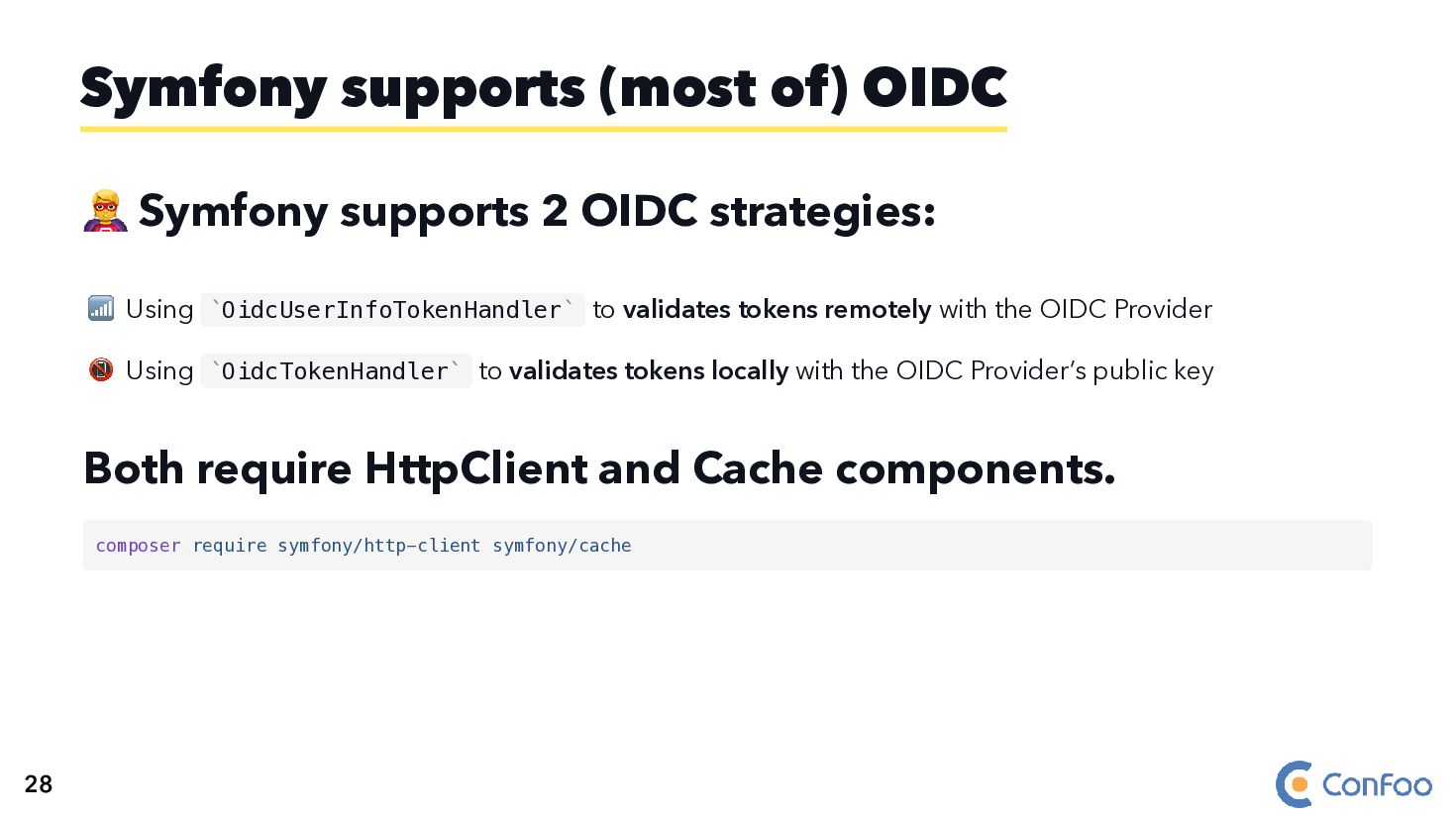
🦸 Symfony supports 2 OIDC strategies: 📶 Using OidcUserInfoTokenHandler to
validates tokens remotely with the OIDC Provider Symfony supports (most of) OIDC ` ` 28 -
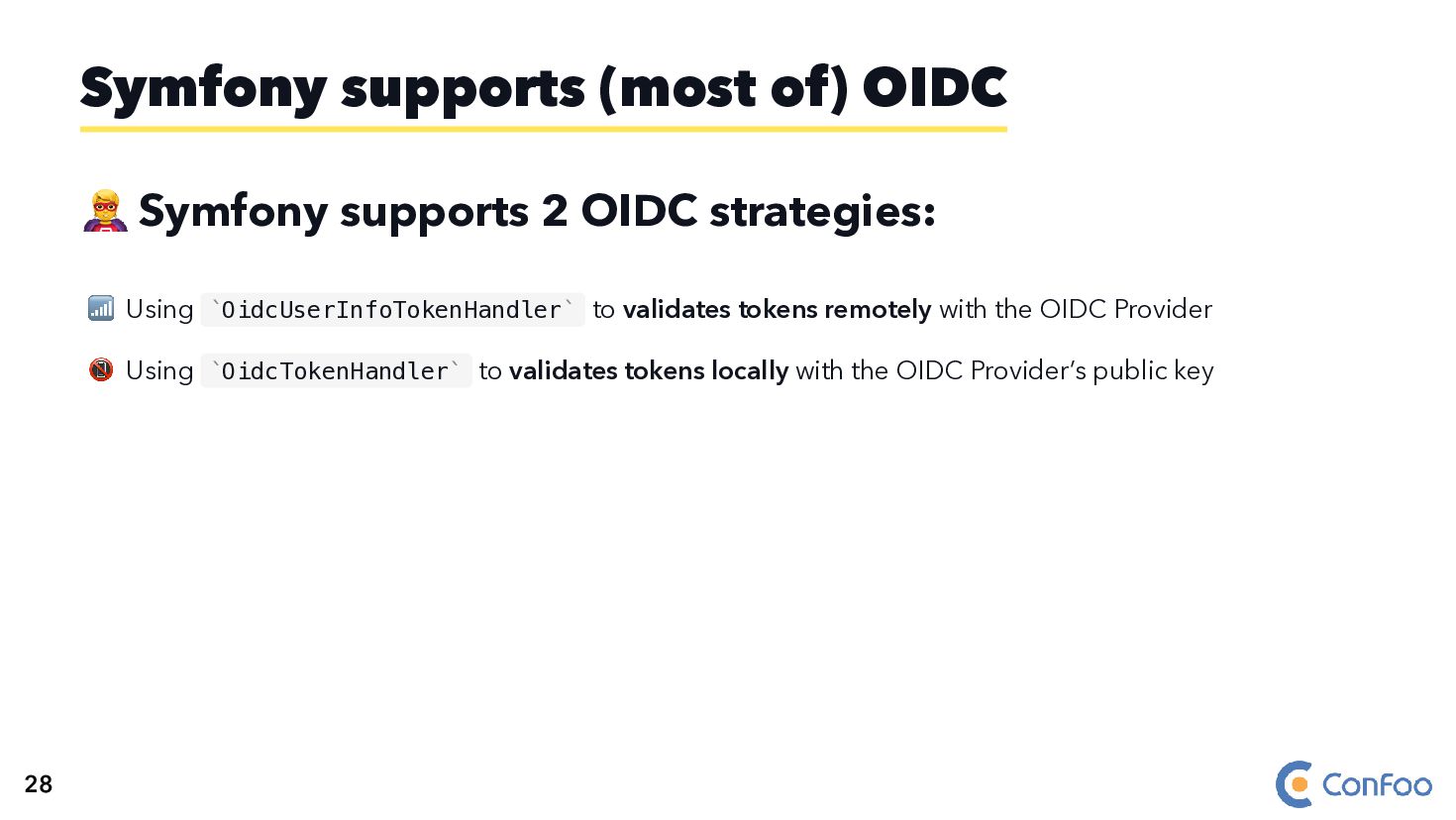
🦸 Symfony supports 2 OIDC strategies: 📶 Using OidcUserInfoTokenHandler to
validates tokens remotely with the OIDC Provider 📵 Using OidcTokenHandler to validates tokens locally with the OIDC Provider’s public key Symfony supports (most of) OIDC ` ` ` ` 28 -
🦸 Symfony supports 2 OIDC strategies: 📶 Using OidcUserInfoTokenHandler to
validates tokens remotely with the OIDC Provider 📵 Using OidcTokenHandler to validates tokens locally with the OIDC Provider’s public key Both require HttpClient and Cache components. Symfony supports (most of) OIDC ` ` ` ` composer require symfony/http-client symfony/cache 28 -
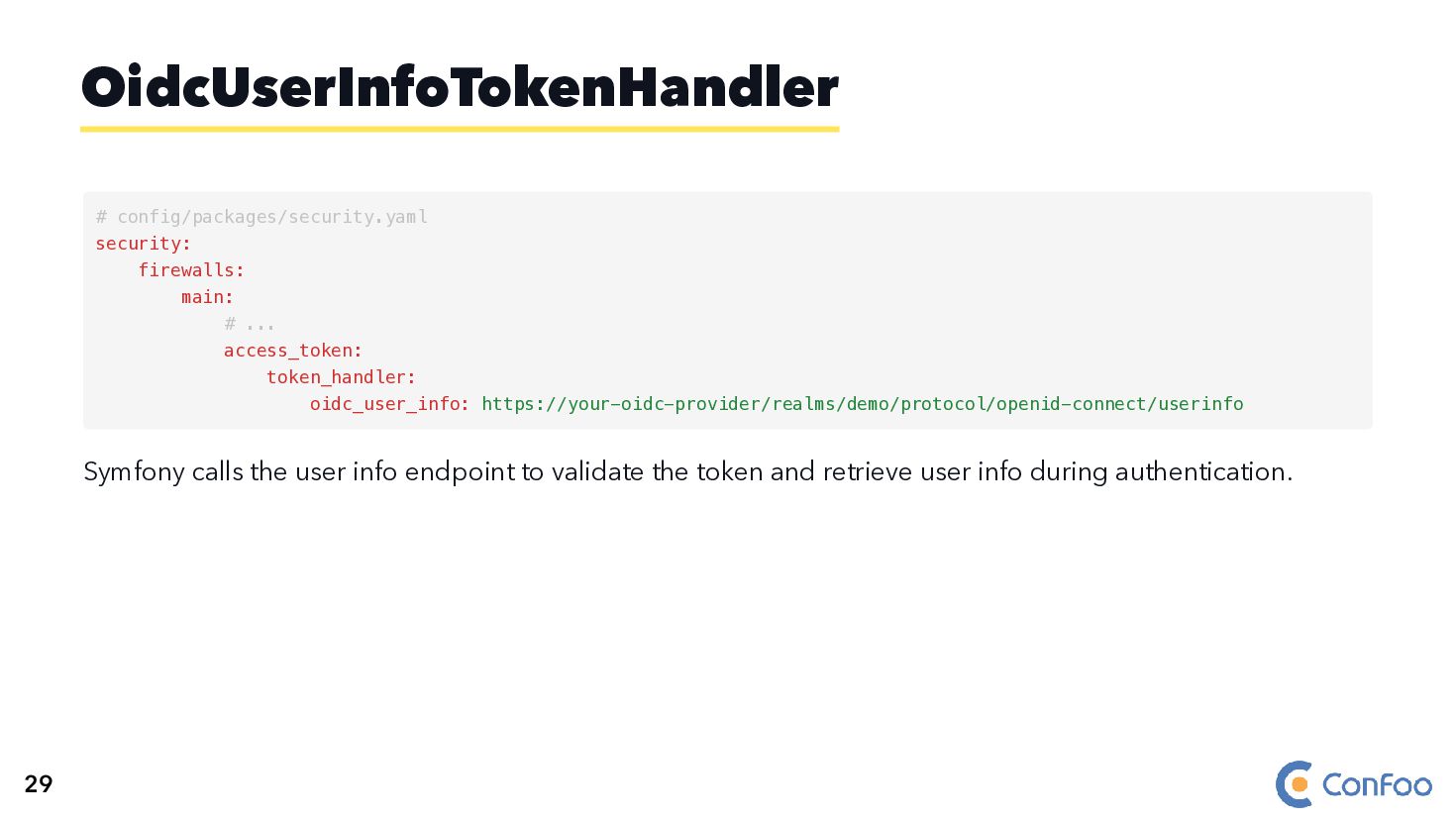
Symfony calls the user info endpoint to validate the token
and retrieve user info during authentication. OidcUserInfoTokenHandler # config/packages/security.yaml security: firewalls: main: # ... access_token: token_handler: oidc_user_info: https://your-oidc-provider/realms/demo/protocol/openid-connect/userinfo 29 -
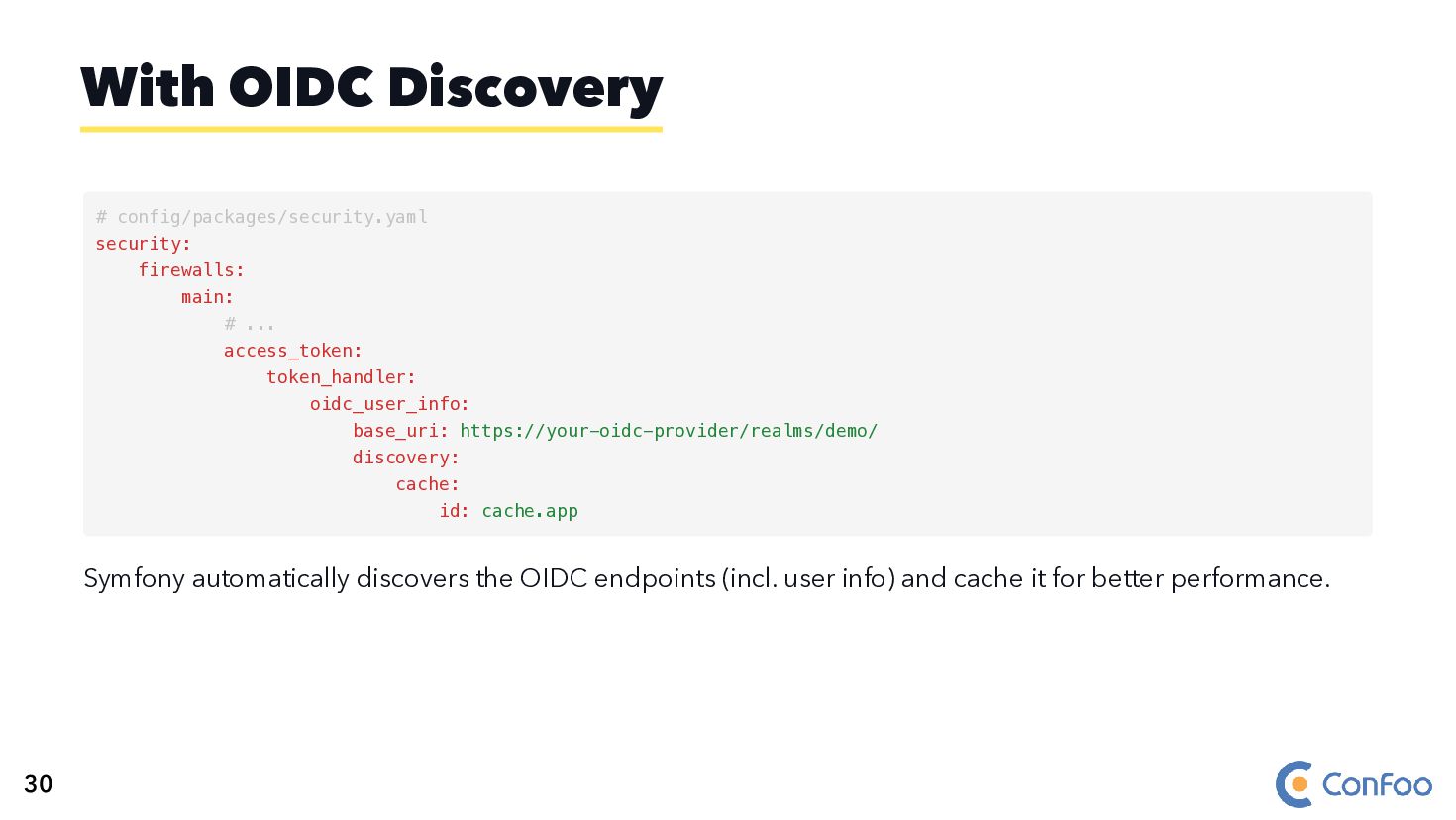
Symfony automatically discovers the OIDC endpoints (incl. user info) and
cache it for better performance. With OIDC Discovery # config/packages/security.yaml security: firewalls: main: # ... access_token: token_handler: oidc_user_info: base_uri: https://your-oidc-provider/realms/demo/ discovery: cache: id: cache.app 30 -
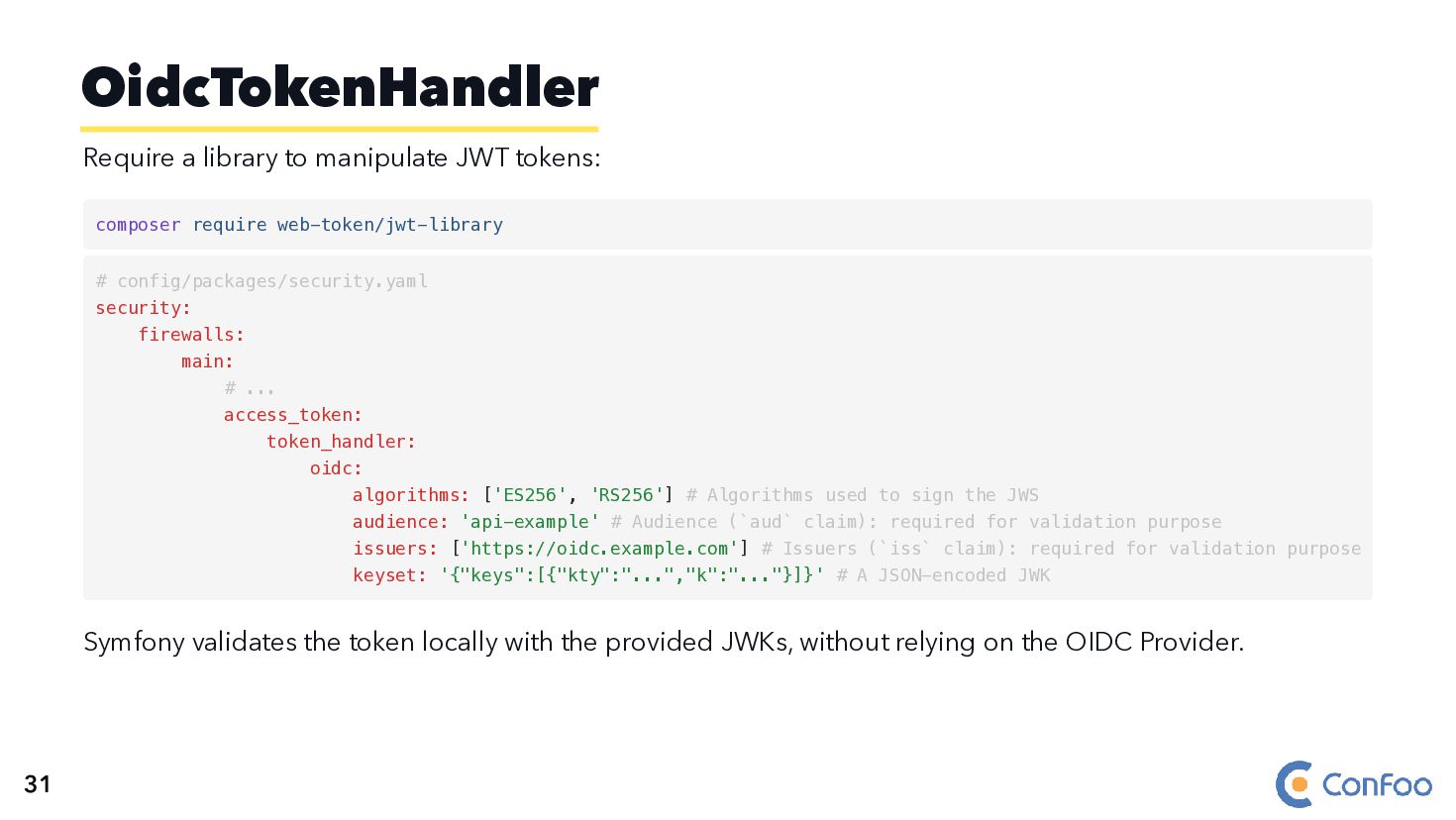
Require a library to manipulate JWT tokens: Symfony validates the
token locally with the provided JWKs, without relying on the OIDC Provider. OidcTokenHandler composer require web-token/jwt-library # config/packages/security.yaml security: firewalls: main: # ... access_token: token_handler: oidc: algorithms: ['ES256', 'RS256'] # Algorithms used to sign the JWS audience: 'api-example' # Audience (`aud` claim): required for validation purpose issuers: ['https://oidc.example.com'] # Issuers (`iss` claim): required for validation purpose keyset: '{"keys":[{"kty":"...","k":"..."}]}' # A JSON-encoded JWK 31 -
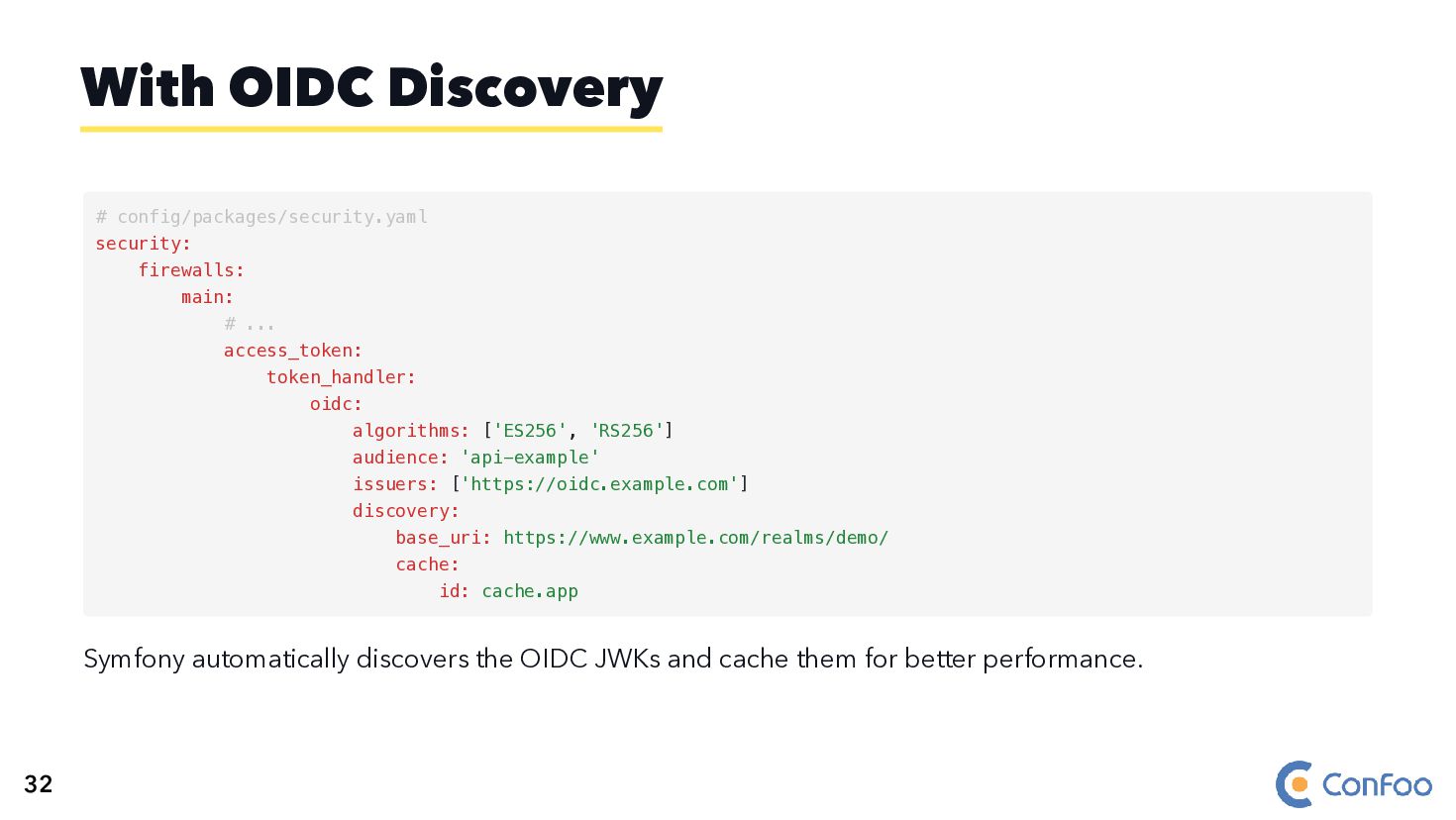
Symfony automatically discovers the OIDC JWKs and cache them for
better performance. With OIDC Discovery # config/packages/security.yaml security: firewalls: main: # ... access_token: token_handler: oidc: algorithms: ['ES256', 'RS256'] audience: 'api-example' issuers: ['https://oidc.example.com'] discovery: base_uri: https://www.example.com/realms/demo/ cache: id: cache.app 32 -
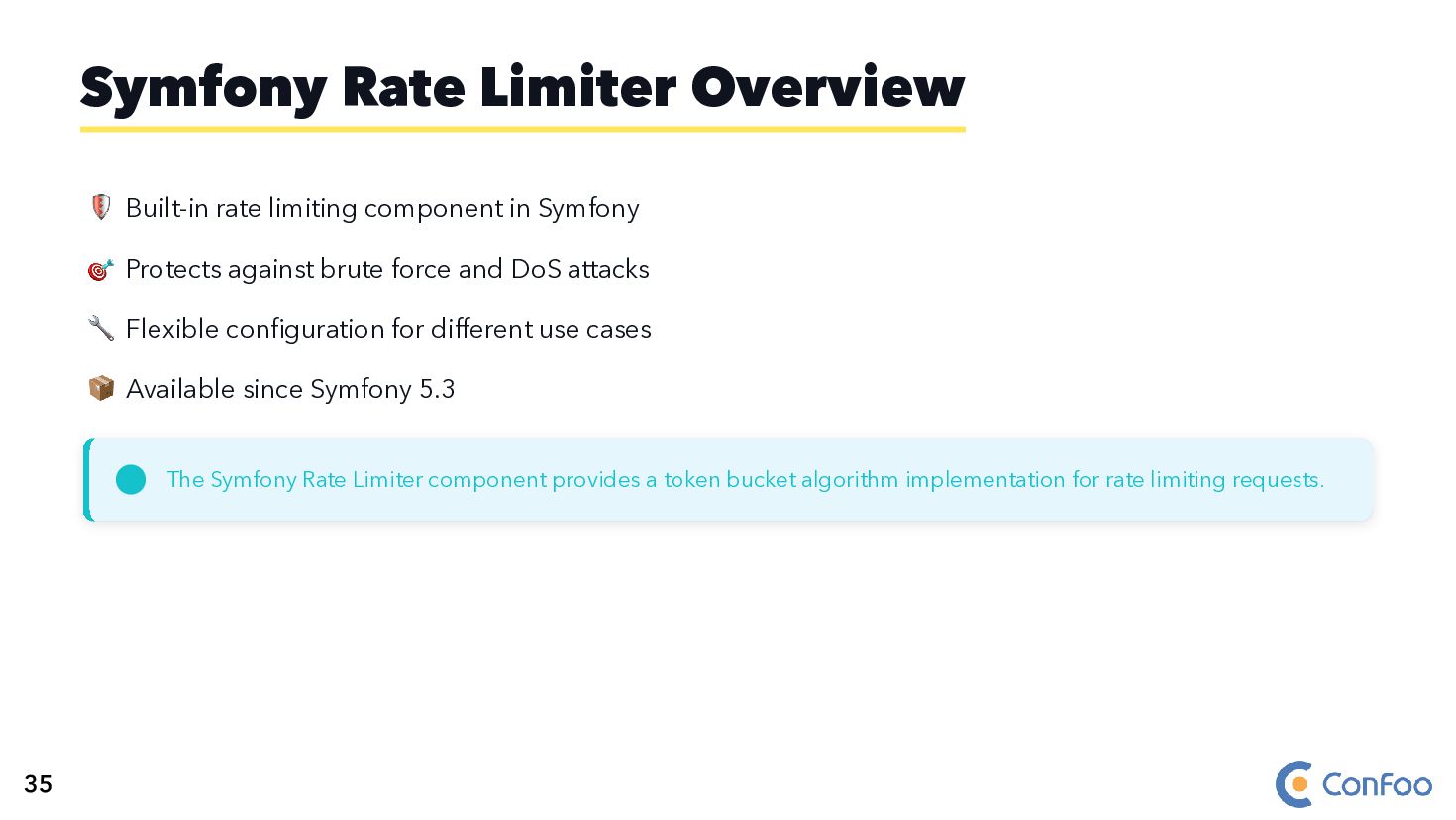
🛡️ Built-in rate limiting component in Symfony 🎯 Protects against
brute force and DoS attacks Symfony Rate Limiter Overview 35 -
🛡️ Built-in rate limiting component in Symfony 🎯 Protects against
brute force and DoS attacks 🔧 Flexible configuration for different use cases Symfony Rate Limiter Overview 35 -
🛡️ Built-in rate limiting component in Symfony 🎯 Protects against
brute force and DoS attacks 🔧 Flexible configuration for different use cases 📦 Available since Symfony 5.3 Symfony Rate Limiter Overview 35 -
🛡️ Built-in rate limiting component in Symfony 🎯 Protects against
brute force and DoS attacks 🔧 Flexible configuration for different use cases 📦 Available since Symfony 5.3 Symfony Rate Limiter Overview The Symfony Rate Limiter component provides a token bucket algorithm implementation for rate limiting requests. 35 -
📝 Define limiters in config/packages/rate_limiter.yaml 🔢 Configure limits, intervals, and
storage Configuring Rate Limiters ` ` 36 -
📝 Define limiters in config/packages/rate_limiter.yaml 🔢 Configure limits, intervals, and
storage 🎯 Different limiters for different endpoints Configuring Rate Limiters ` ` 36 -
📝 Define limiters in config/packages/rate_limiter.yaml 🔢 Configure limits, intervals, and
storage 🎯 Different limiters for different endpoints 🔄 Supports sliding window and fixed window algorithms Configuring Rate Limiters ` ` 36 -
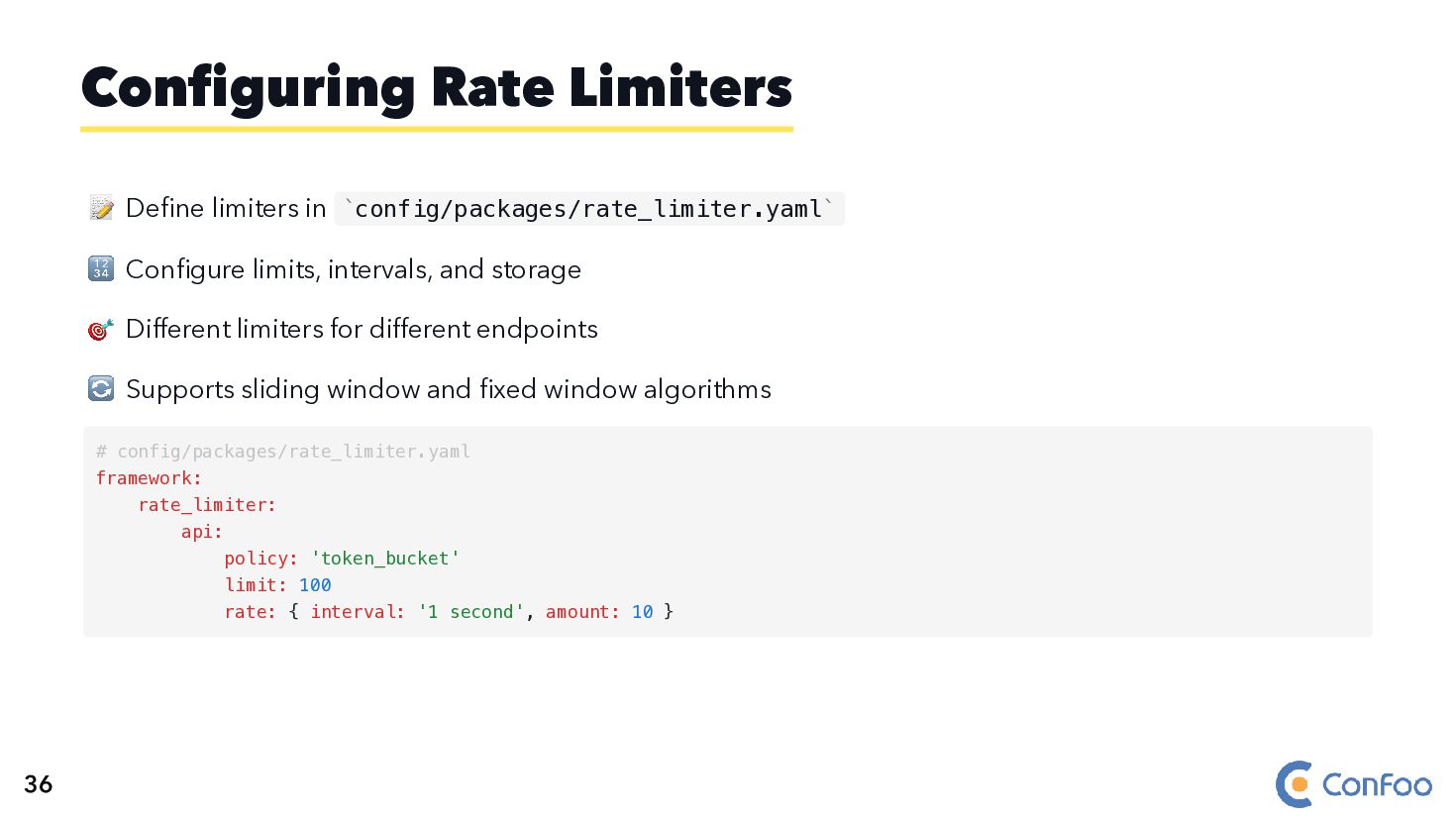
📝 Define limiters in config/packages/rate_limiter.yaml 🔢 Configure limits, intervals, and
storage 🎯 Different limiters for different endpoints 🔄 Supports sliding window and fixed window algorithms Configuring Rate Limiters ` ` # config/packages/rate_limiter.yaml framework: rate_limiter: api: policy: 'token_bucket' limit: 100 rate: { interval: '1 second', amount: 10 } 36 -
🎯 Apply to specific controller actions 🛡️ Automatic HTTP 429
response when limit exceeded Using Rate Limiters in Controllers 37 -
🎯 Apply to specific controller actions 🛡️ Automatic HTTP 429
response when limit exceeded 🔧 Customize response behavior Using Rate Limiters in Controllers 37 -
🎯 Apply to specific controller actions 🛡️ Automatic HTTP 429
response when limit exceeded 🔧 Customize response behavior 📊 Access limiter state and headers Using Rate Limiters in Controllers 37 -
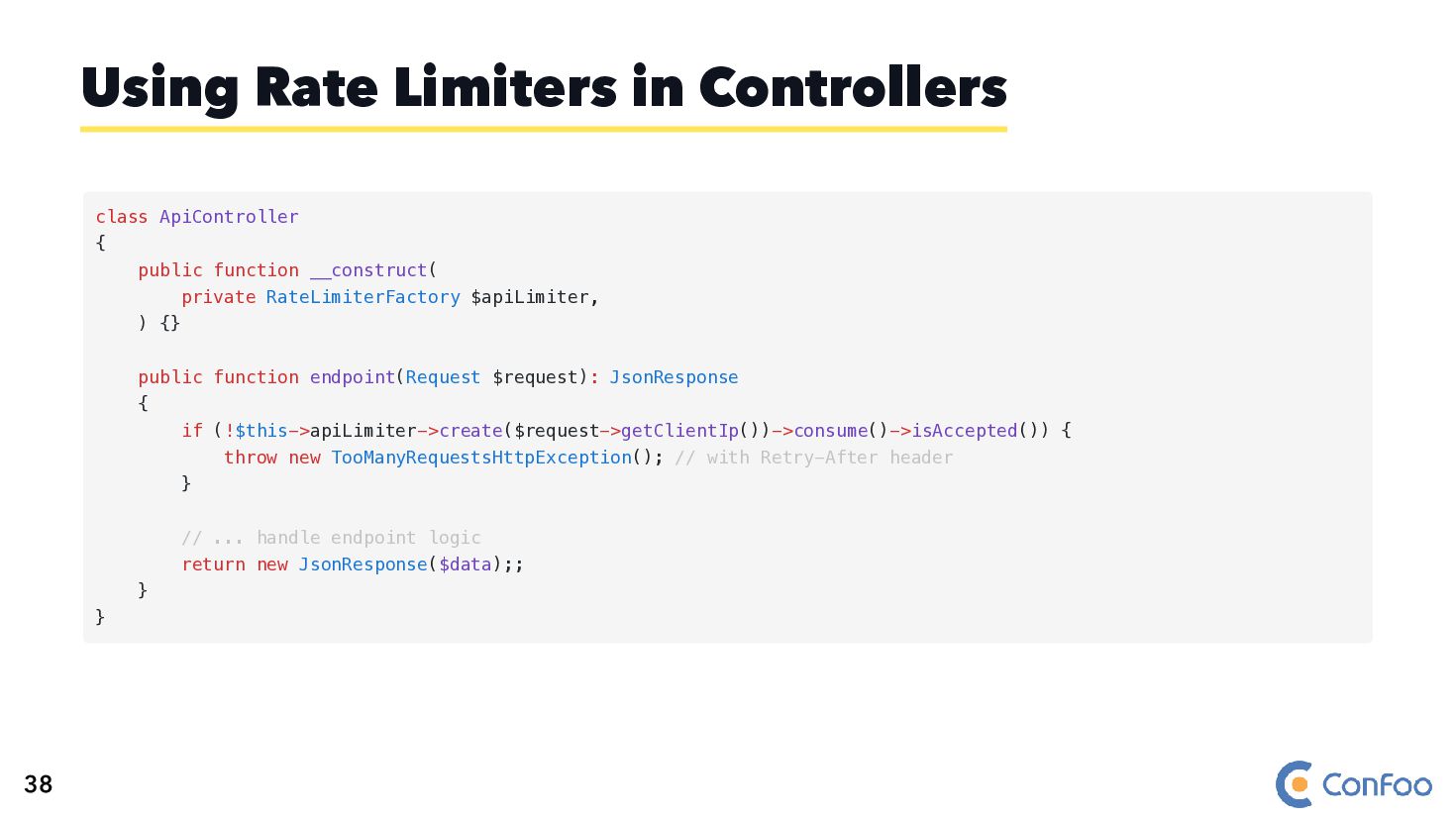
Using Rate Limiters in Controllers class ApiController { public function
__construct( private RateLimiterFactory $apiLimiter, ) {} public function endpoint(Request $request): JsonResponse { if (!$this->apiLimiter->create($request->getClientIp())->consume()->isAccepted()) { throw new TooManyRequestsHttpException(); // with Retry-After header } // ... handle endpoint logic return new JsonResponse($data);; } } 38 -
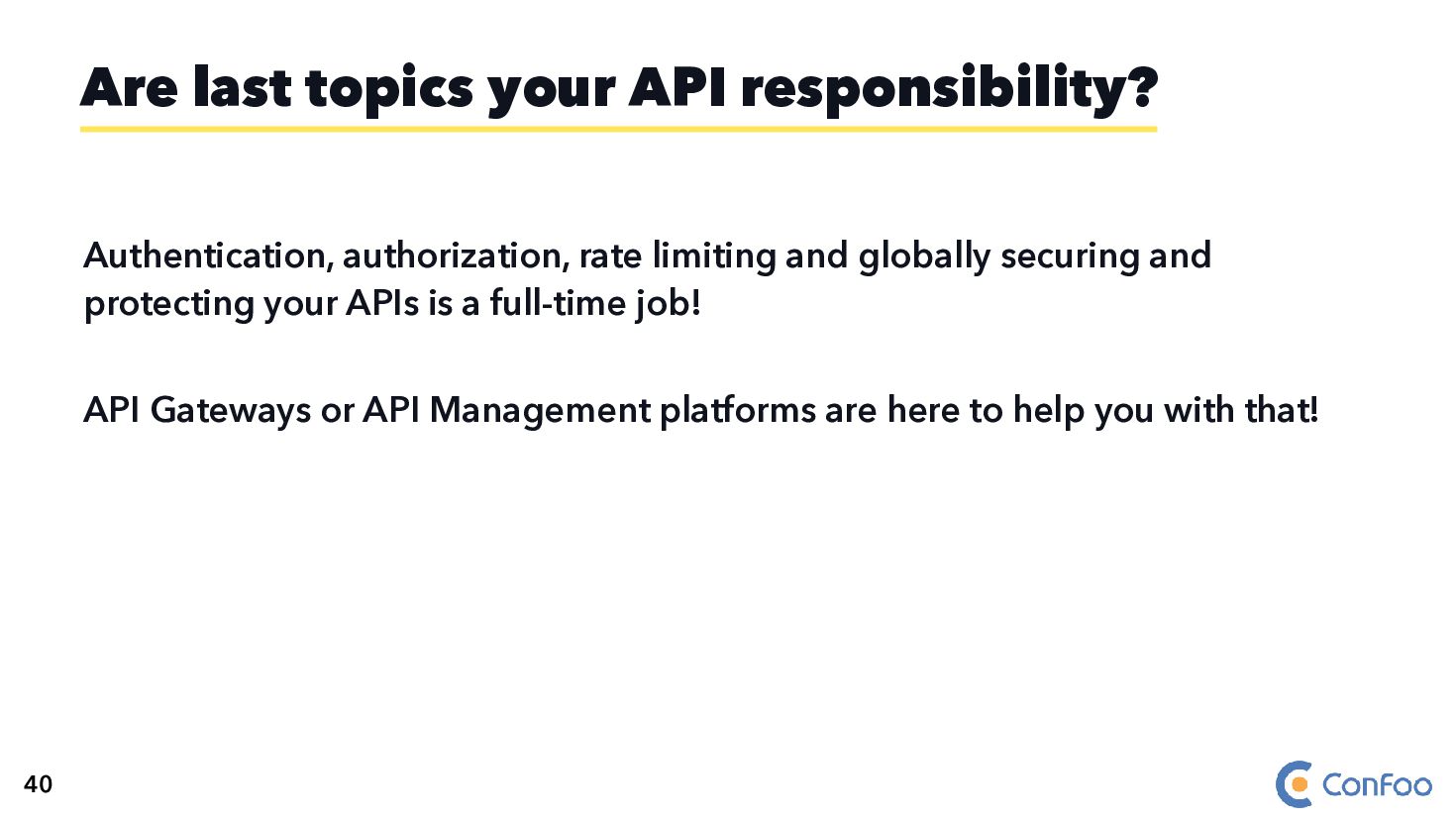
Authentication, authorization, rate limiting and globally securing and protecting your
APIs is a full-time job! API Gateways or API Management platforms are here to help you with that! Are last topics your API responsibility? 40 -
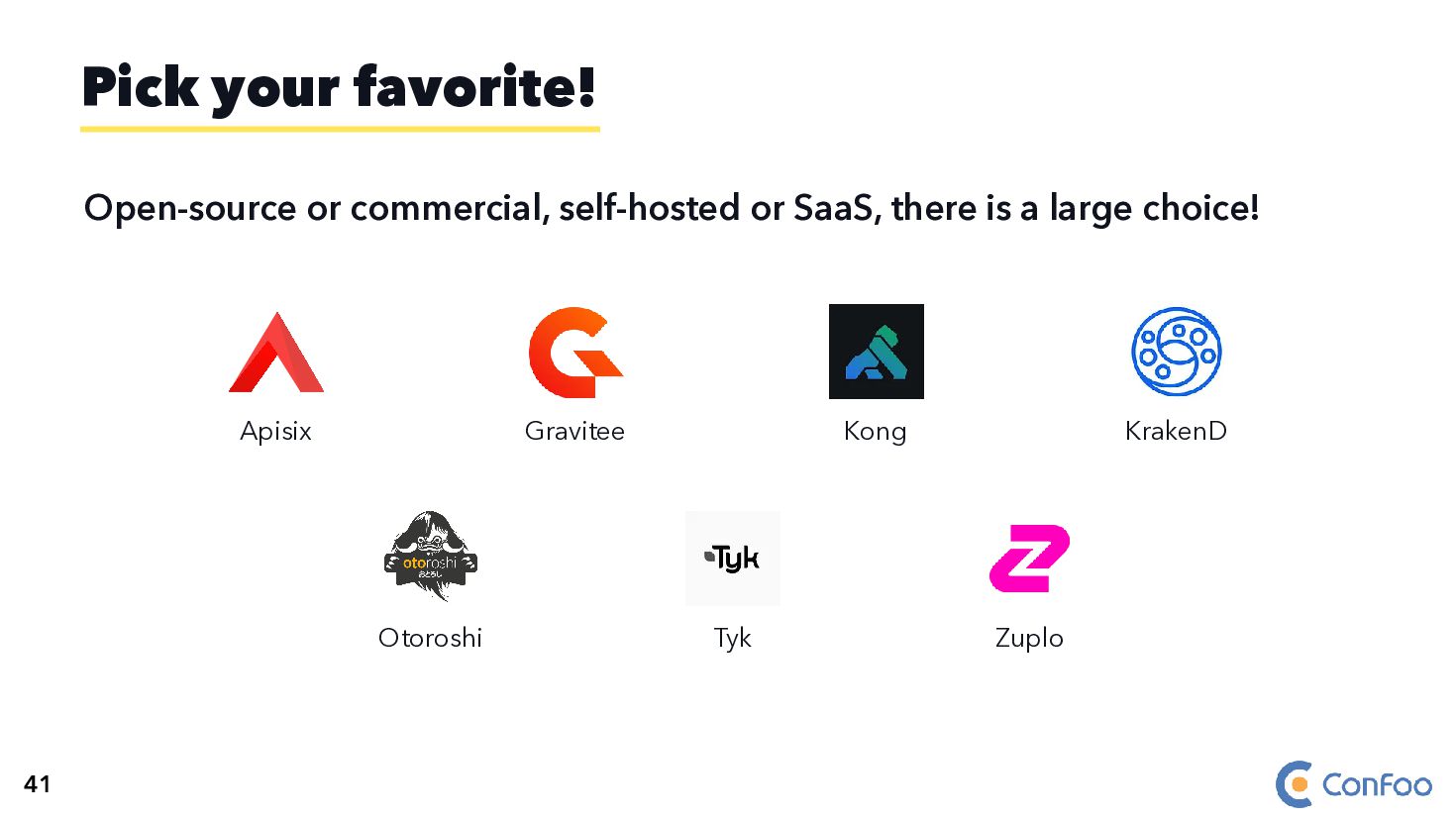
Open-source or commercial, self-hosted or SaaS, there is a large
choice! Apisix Gravitee Kong KrakenD Otoroshi Tyk Zuplo Pick your favorite! 41 -
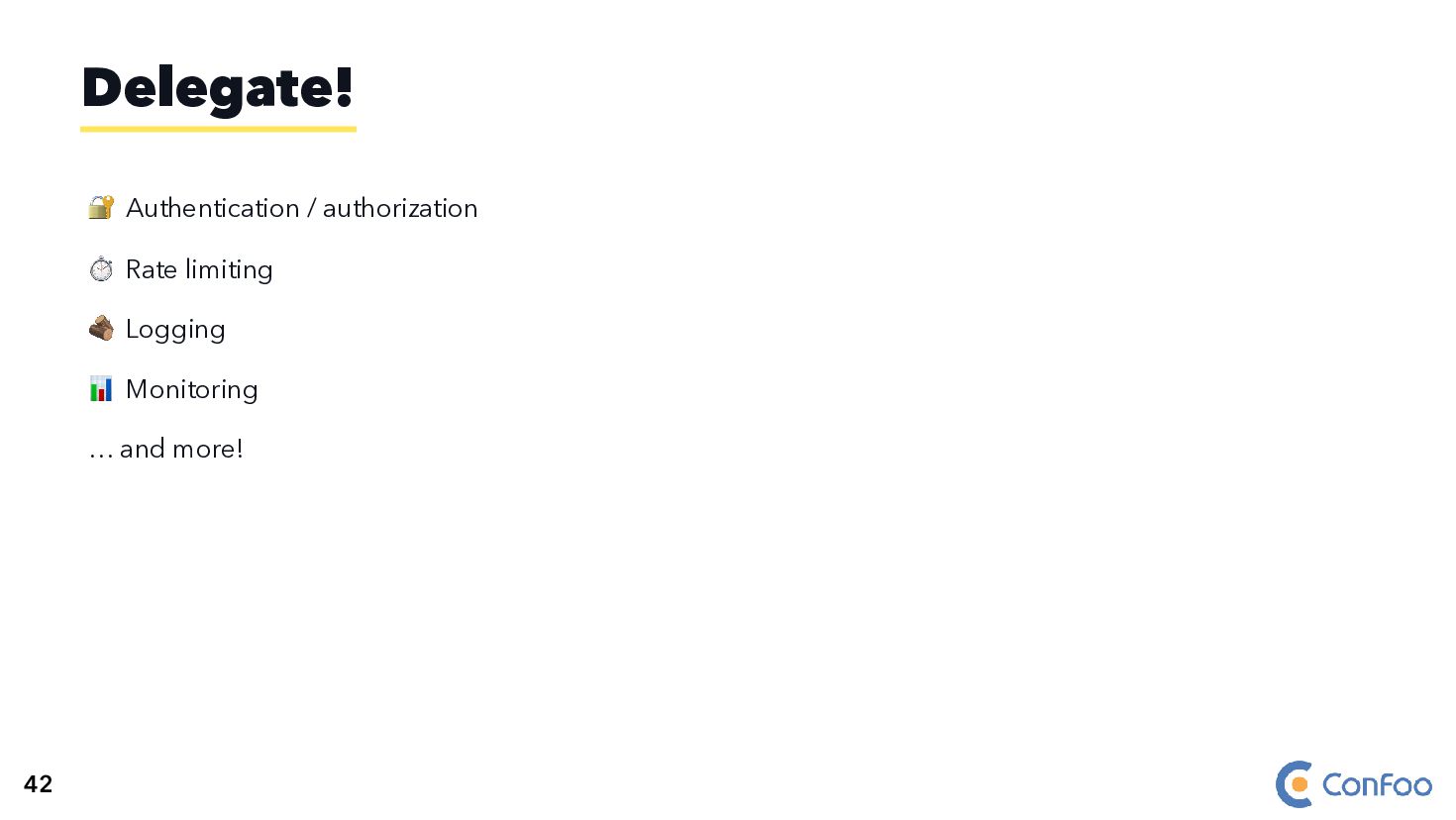
🔐 Authentication / authorization ⏱️ Rate limiting 🪵 Logging 📊
Monitoring Delegate! 42 -
🔐 Authentication / authorization ⏱️ Rate limiting 🪵 Logging 📊
Monitoring … and more! Delegate! 42 -
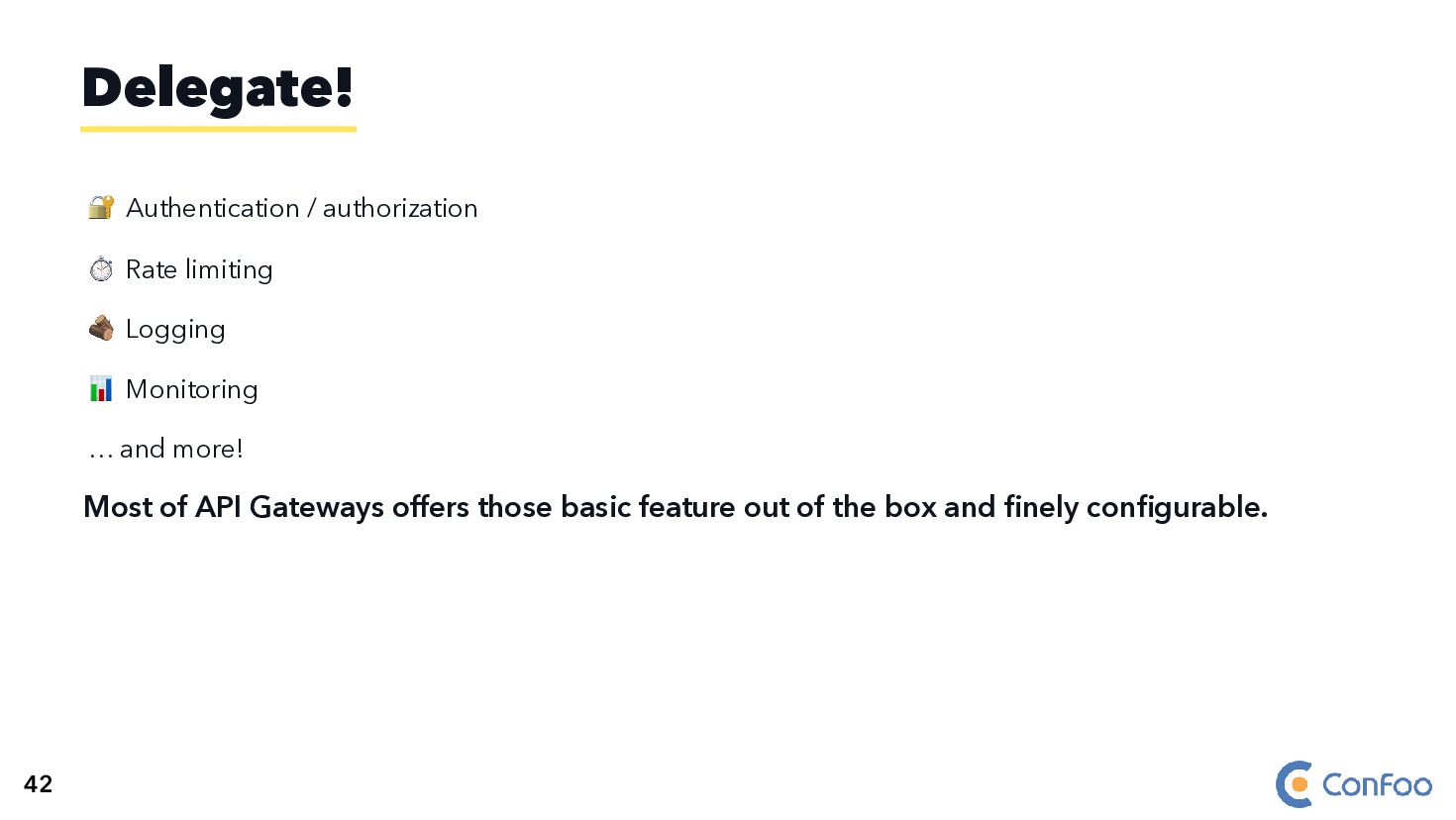
🔐 Authentication / authorization ⏱️ Rate limiting 🪵 Logging 📊
Monitoring … and more! Most of API Gateways offers those basic feature out of the box and finely configurable. Delegate! 42 -
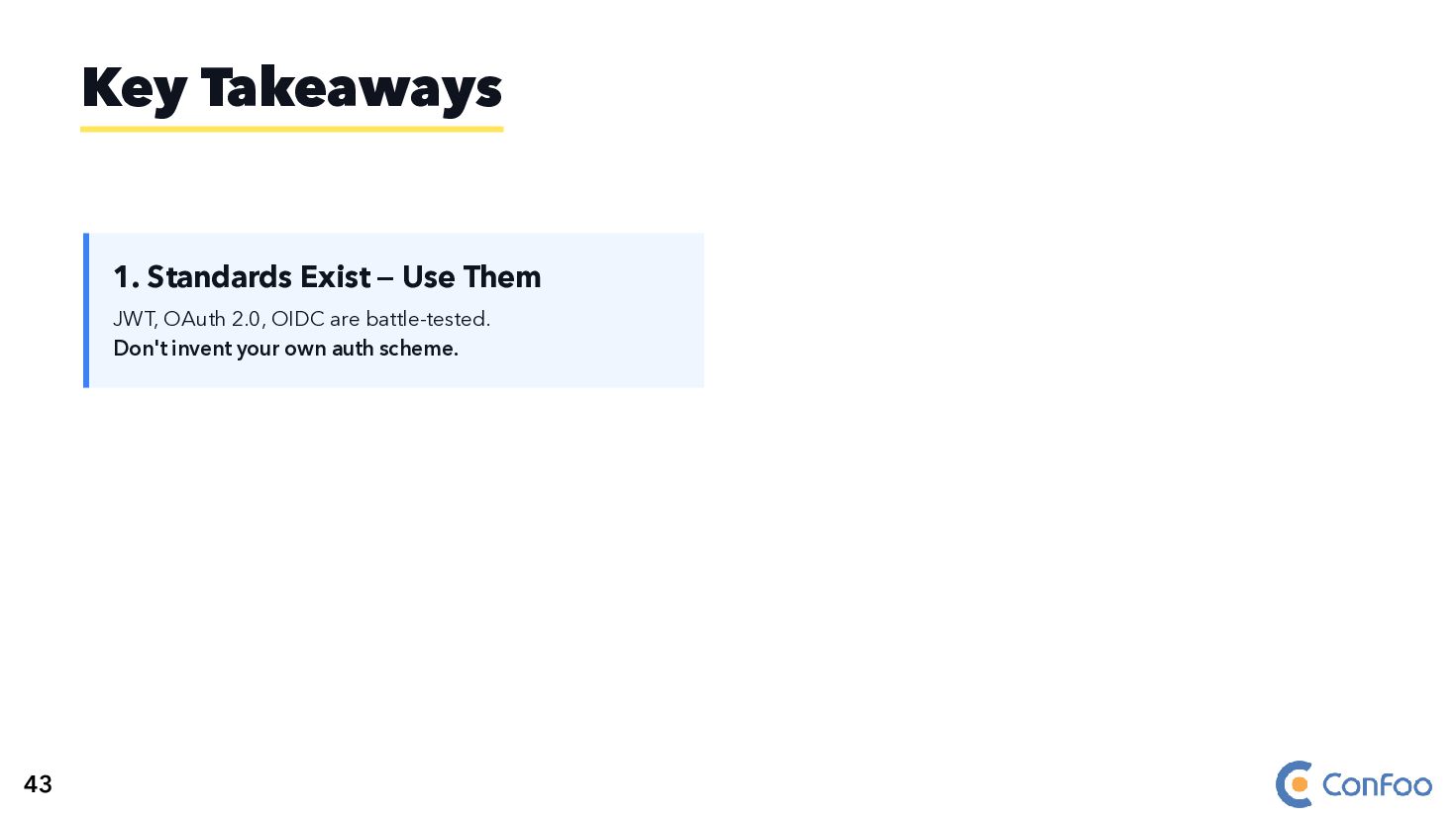
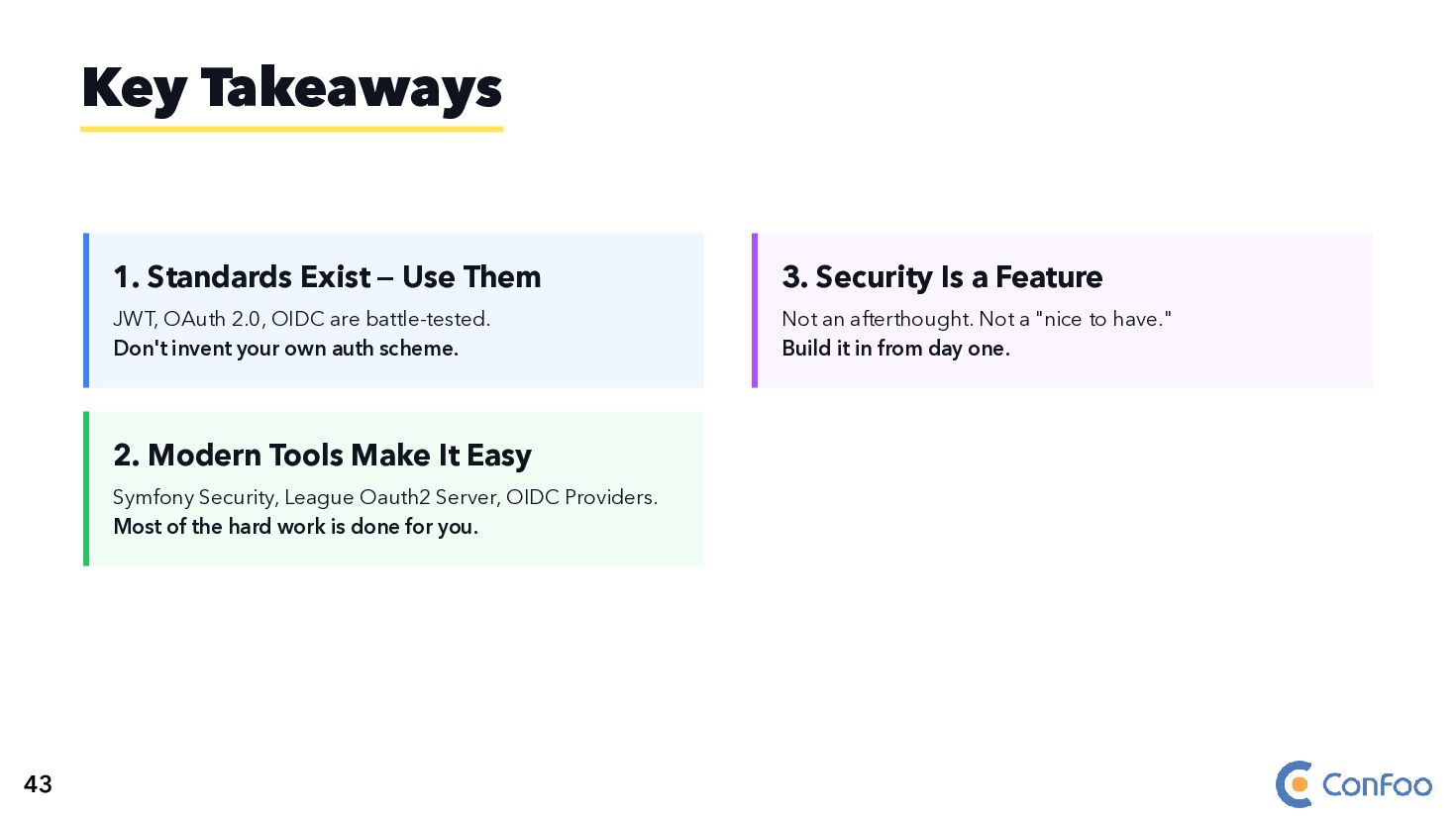
1. Standards Exist — Use Them JWT, OAuth 2.0, OIDC
are battle-tested. Don't invent your own auth scheme. Key Takeaways 43 -
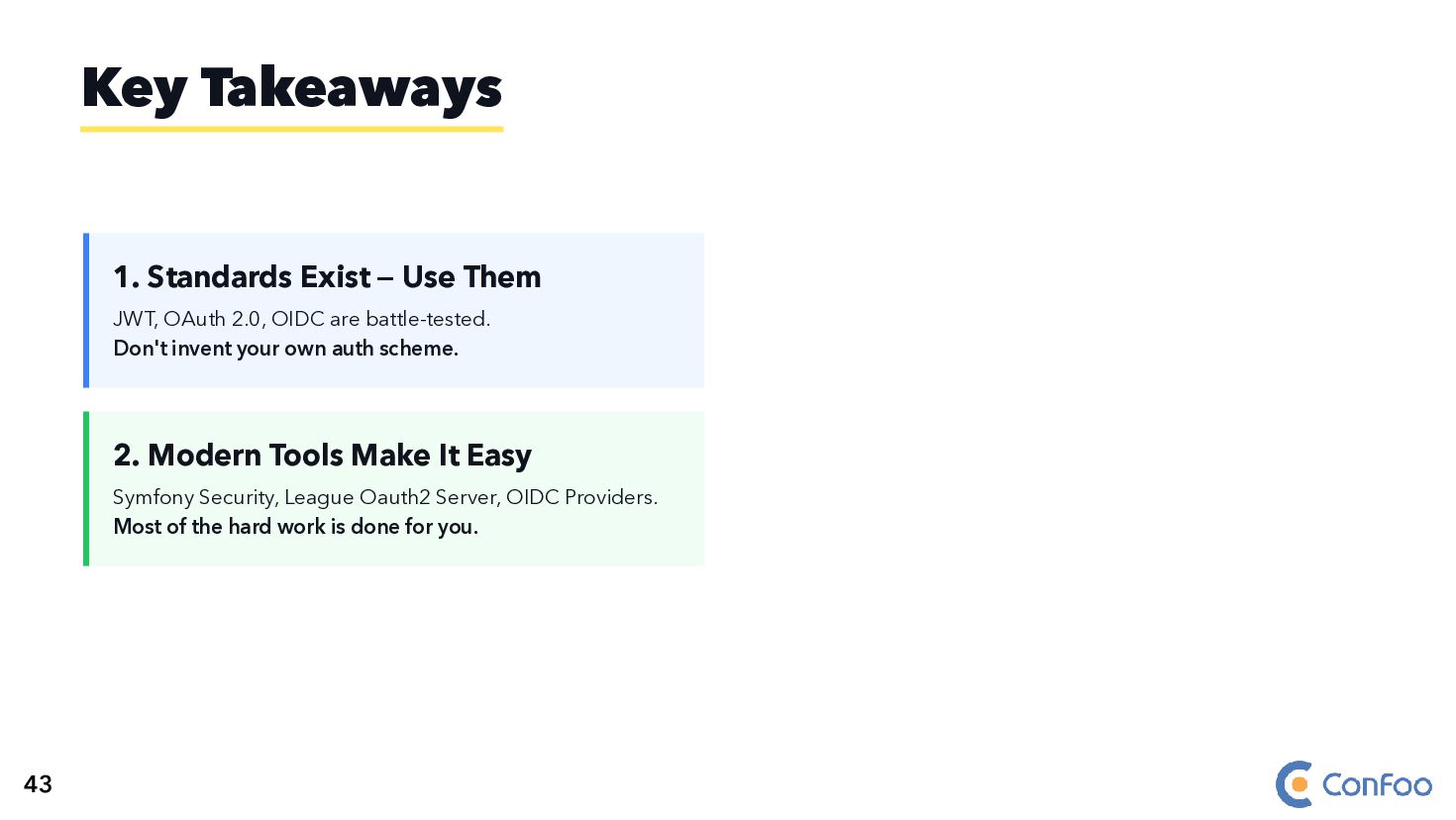
1. Standards Exist — Use Them JWT, OAuth 2.0, OIDC
are battle-tested. Don't invent your own auth scheme. 2. Modern Tools Make It Easy Symfony Security, League Oauth2 Server, OIDC Providers. Most of the hard work is done for you. Key Takeaways 43 -
1. Standards Exist — Use Them JWT, OAuth 2.0, OIDC
are battle-tested. Don't invent your own auth scheme. 2. Modern Tools Make It Easy Symfony Security, League Oauth2 Server, OIDC Providers. Most of the hard work is done for you. 3. Security Is a Feature Not an afterthought. Not a "nice to have." Build it in from day one. Key Takeaways 43 -
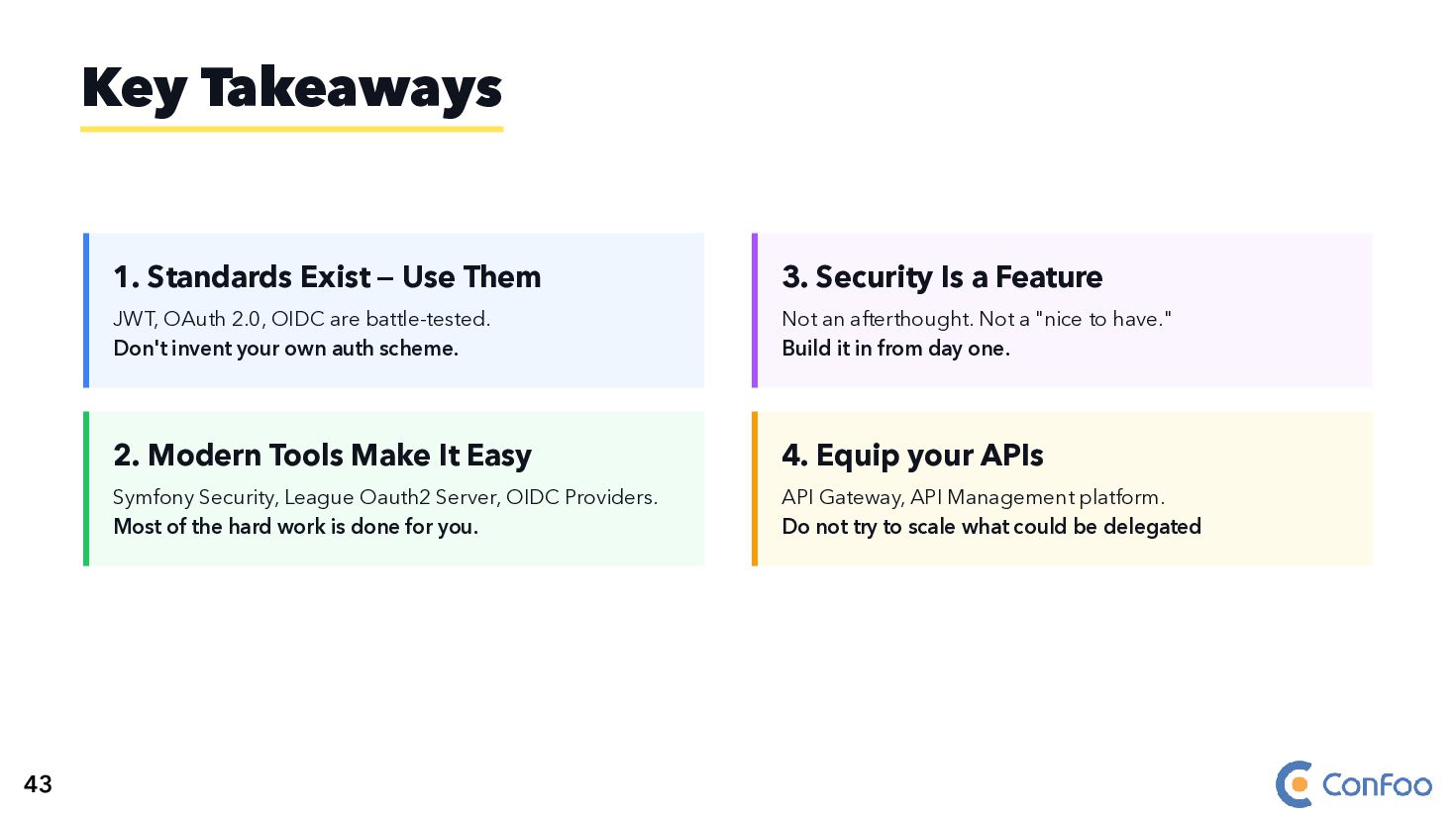
1. Standards Exist — Use Them JWT, OAuth 2.0, OIDC
are battle-tested. Don't invent your own auth scheme. 2. Modern Tools Make It Easy Symfony Security, League Oauth2 Server, OIDC Providers. Most of the hard work is done for you. 3. Security Is a Feature Not an afterthought. Not a "nice to have." Build it in from day one. 4. Equip your APIs API Gateway, API Management platform. Do not try to scale what could be delegated Key Takeaways 43 -
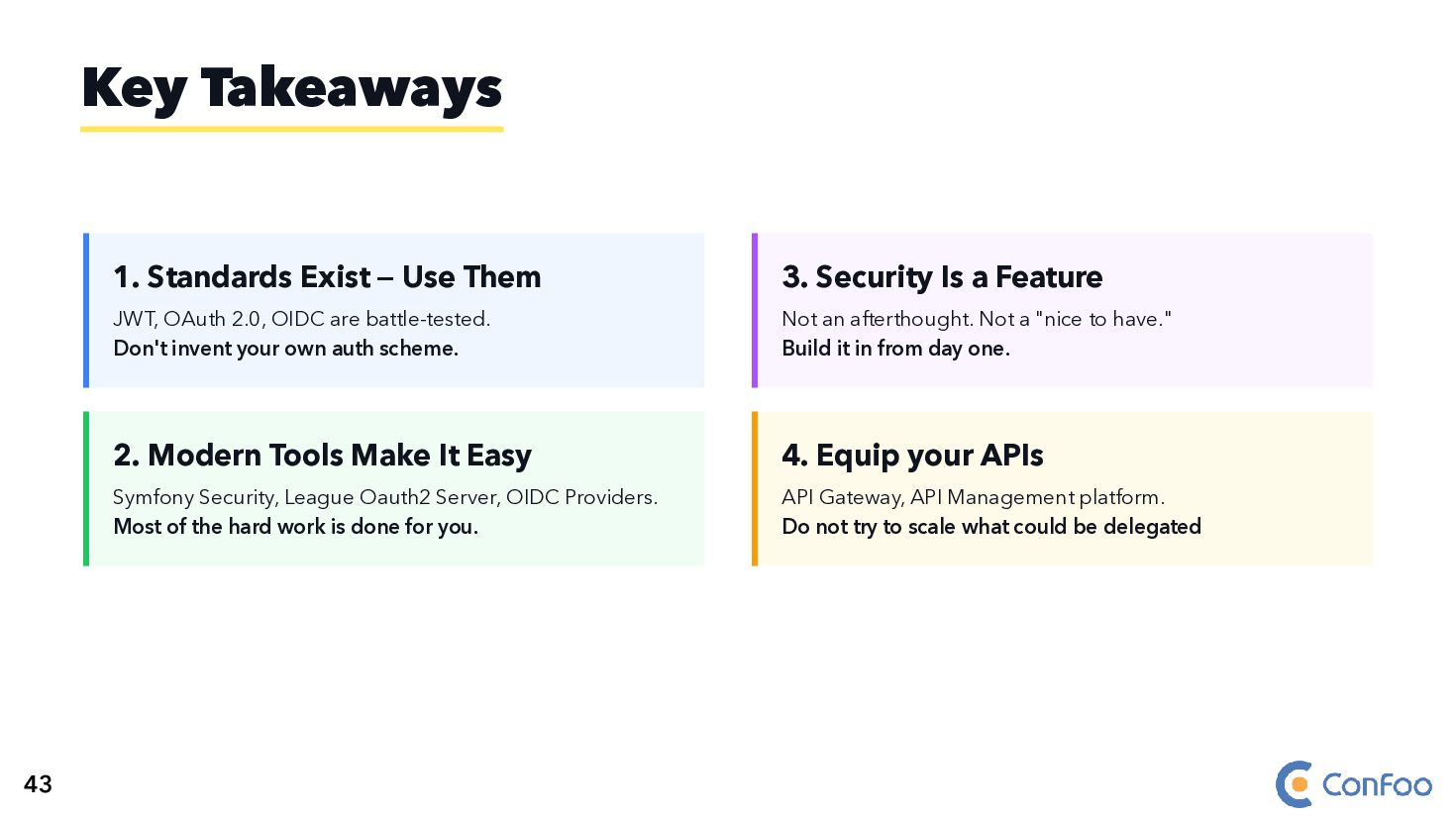
1. Standards Exist — Use Them JWT, OAuth 2.0, OIDC
are battle-tested. Don't invent your own auth scheme. 2. Modern Tools Make It Easy Symfony Security, League Oauth2 Server, OIDC Providers. Most of the hard work is done for you. 3. Security Is a Feature Not an afterthought. Not a "nice to have." Build it in from day one. 4. Equip your APIs API Gateway, API Management platform. Do not try to scale what could be delegated Key Takeaways 43 -
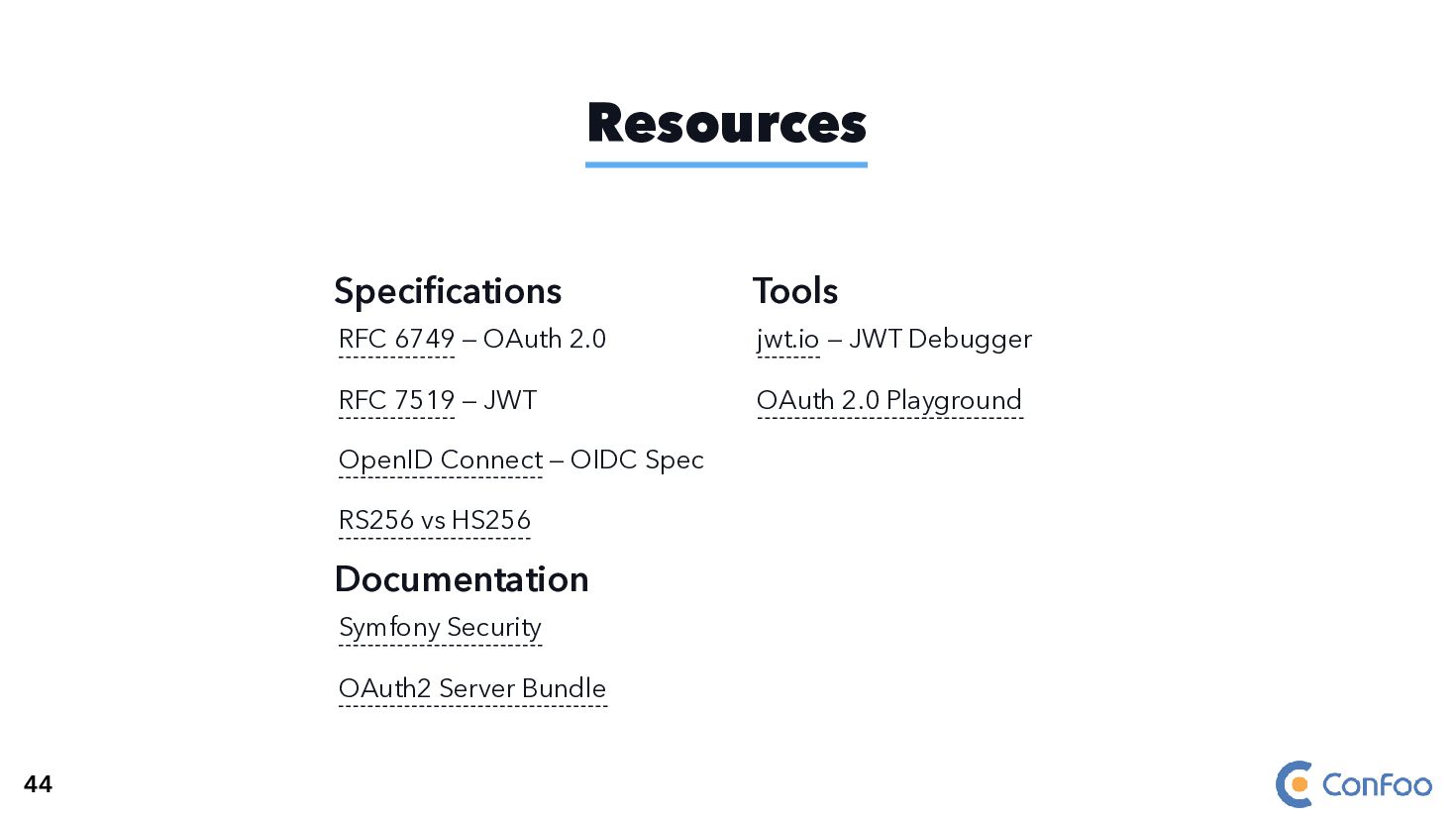
Specifications RFC 6749 — OAuth 2.0 RFC 7519 — JWT
OpenID Connect — OIDC Spec RS256 vs HS256 Documentation Symfony Security OAuth2 Server Bundle Tools jwt.io — JWT Debugger OAuth 2.0 Playground Resources 44