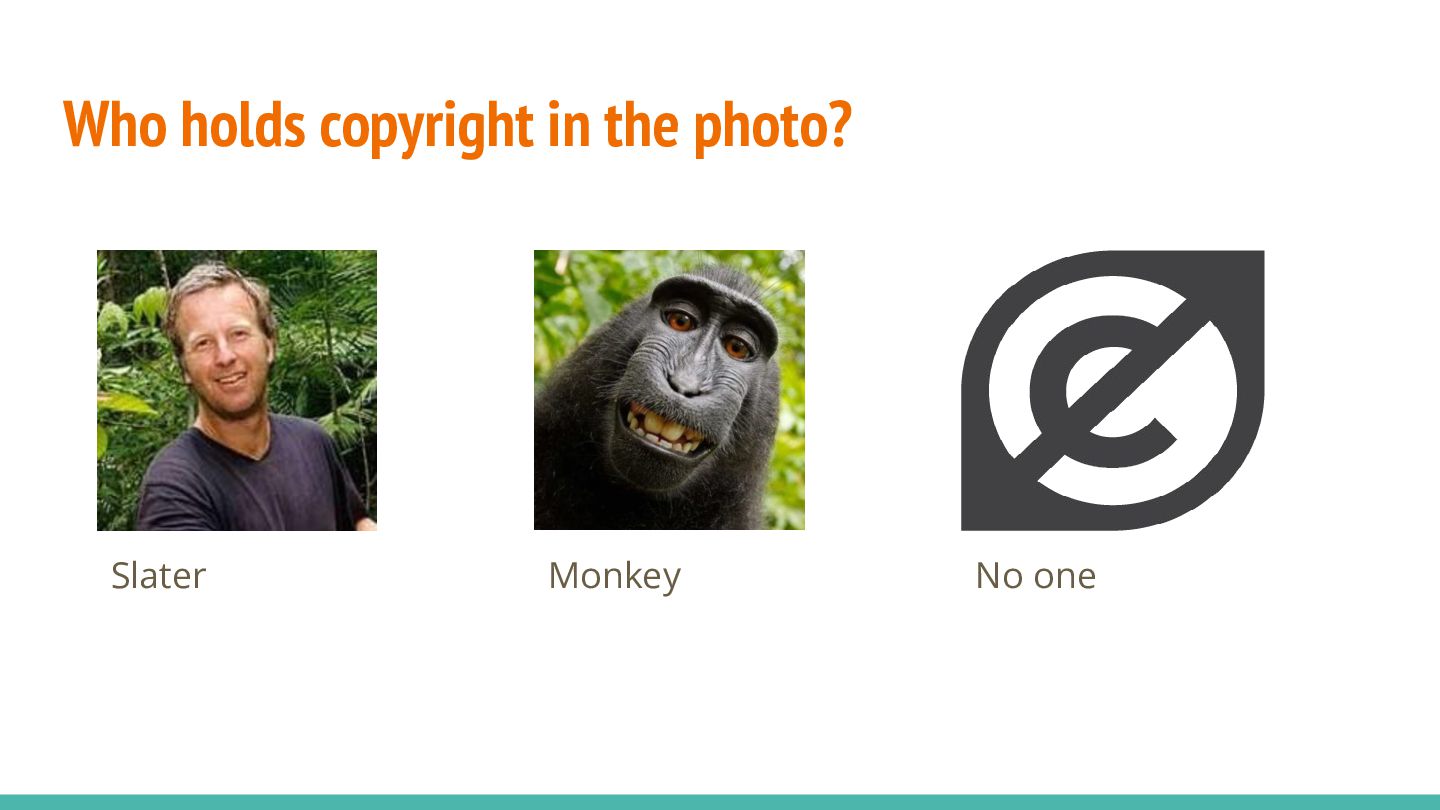
Zimmerman "Copyright Essentials From A to AI: A...

Share
Embed
Zimmerman "Copyright Essentials From A to AI: A 2026 NISO Training Series, Session Seven: Copyright & AI"
This presentation was given by Katie Zimmerman, Director of Copyright Strategy, Massachusetts Institute of Technology (MIT) Libraries, for the seventh session of the NISO training series "Copyright Essentials From A to AI." Session Seven, "Copyright & AI," was held November 12, 2026.

National Information Standards Organization
November 12, 2026
Transcript
46 slides
-
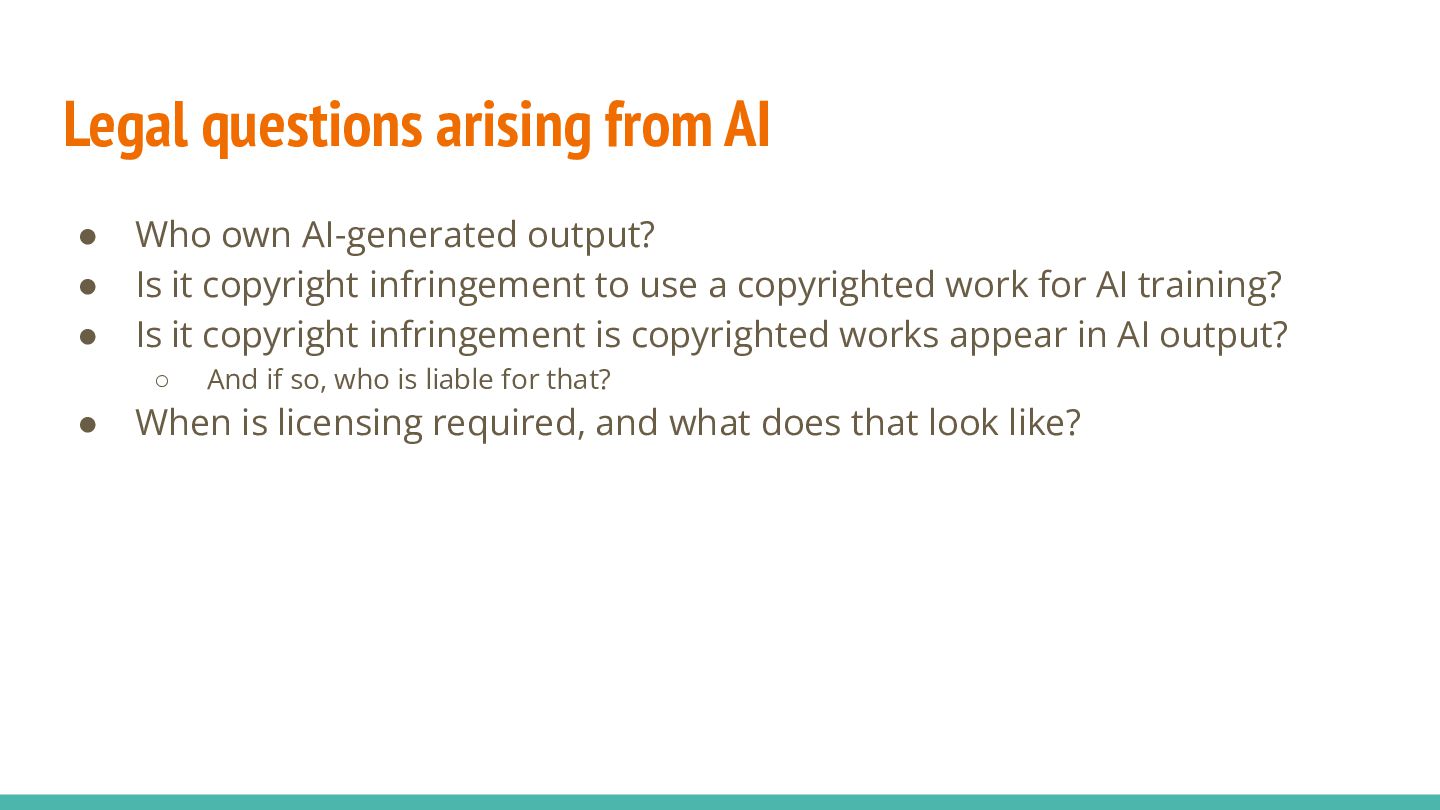
Legal questions arising from AI • • • Who own
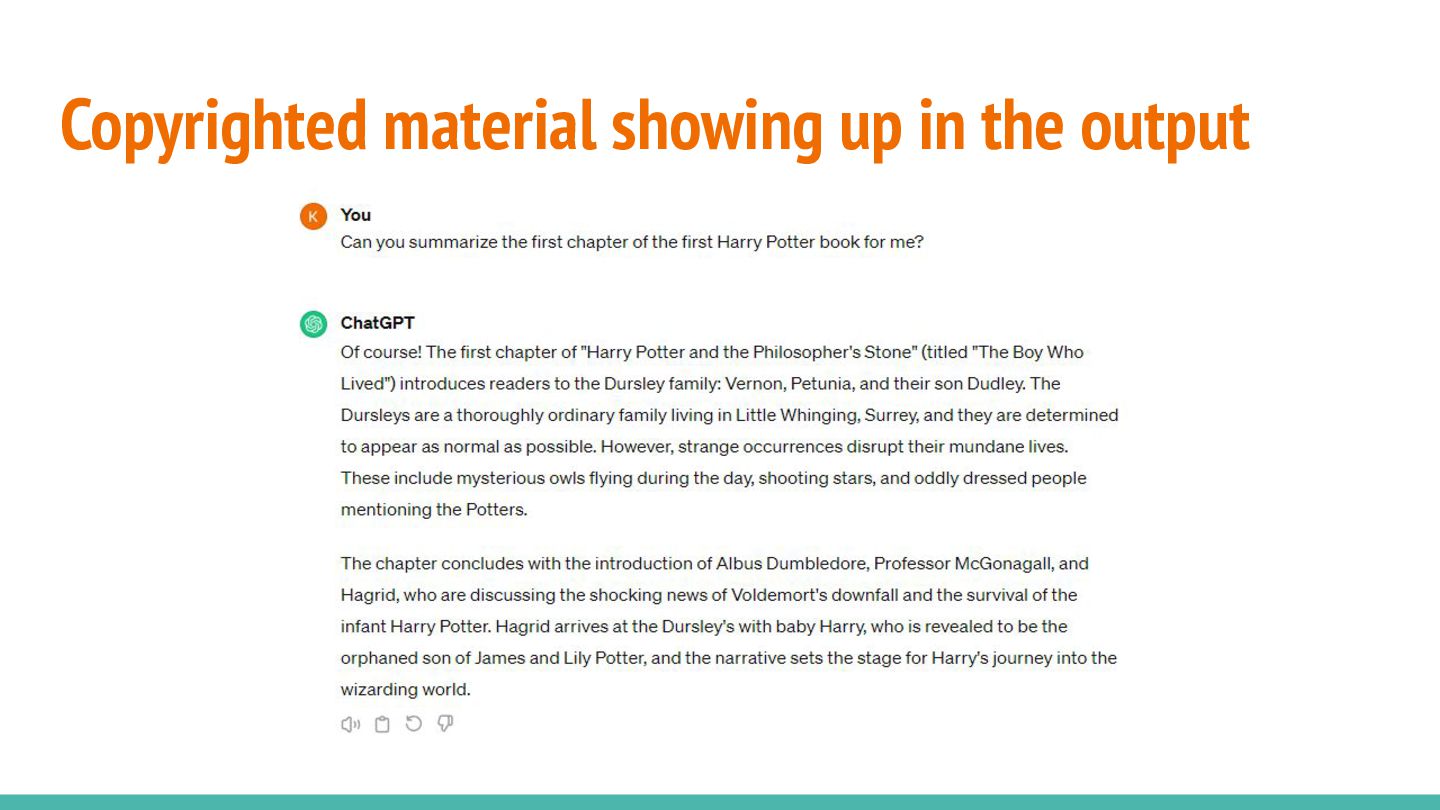
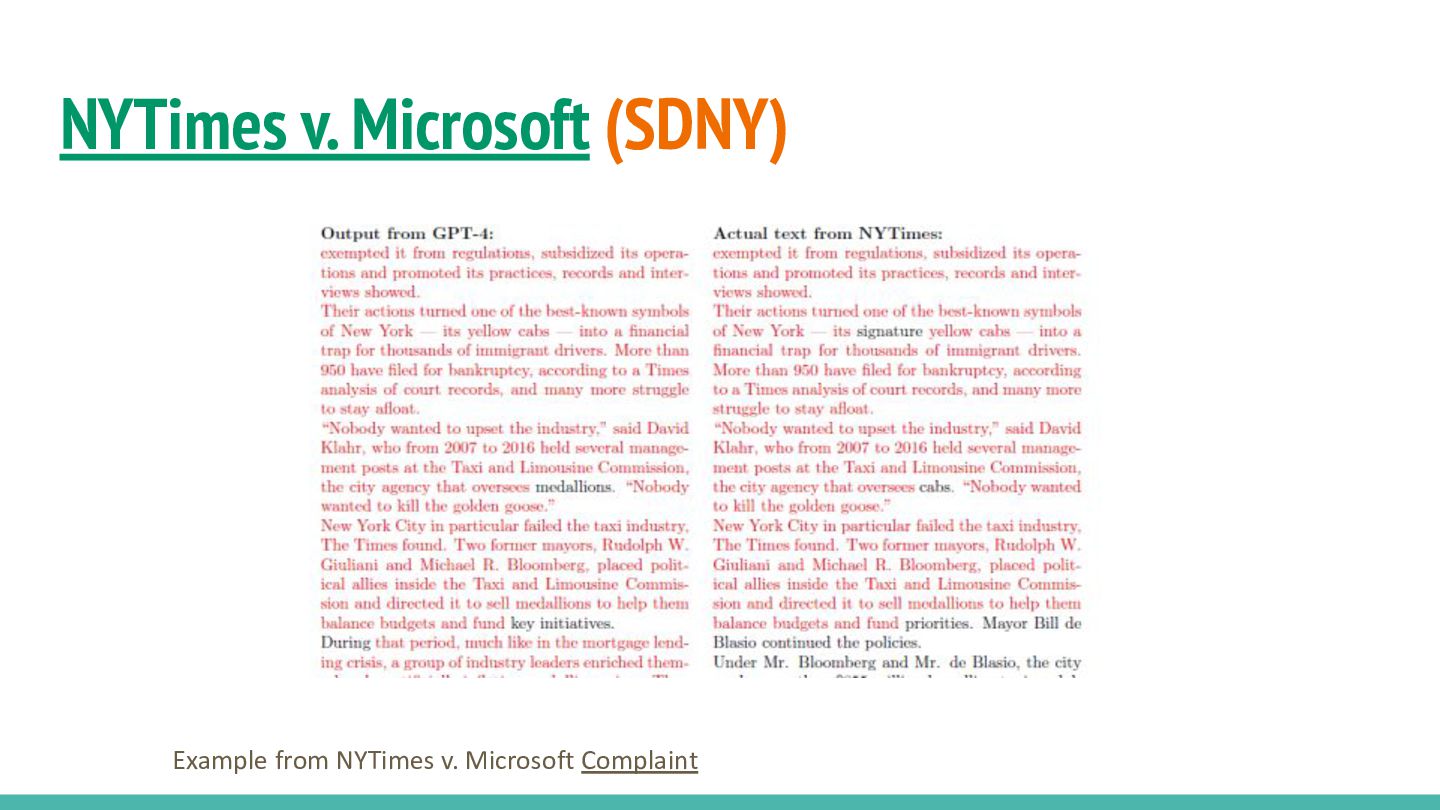
AI-generated output? Is it copyright infringement to use a copyrighted work for AI training? Is it copyright infringement is copyrighted works appear in AI output? ◦ • And if so, who is liable for that? When is licensing required, and what does that look like? -
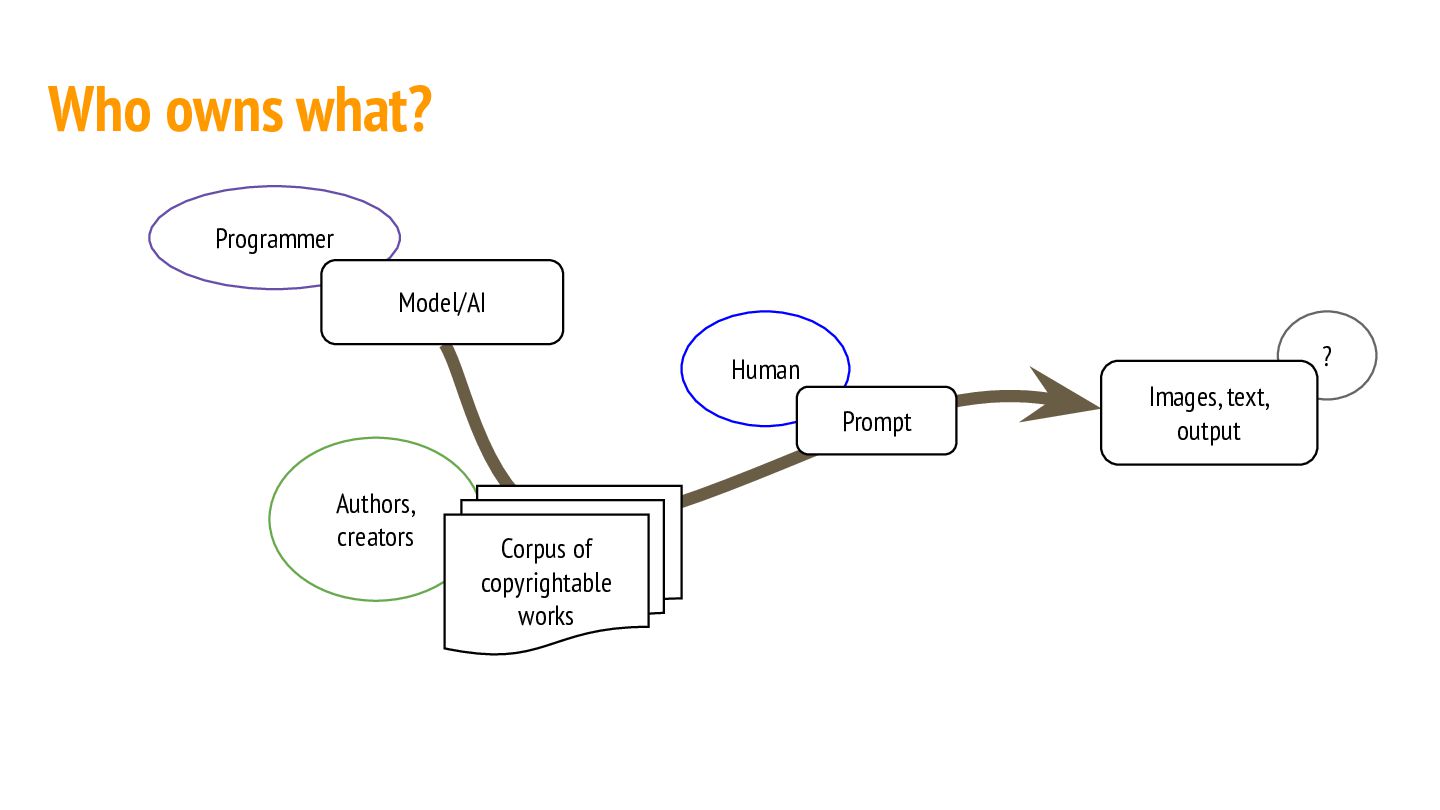
Who owns what? Programmer Model/AI ? Human Prompt Authors, creators
Corpus of copyrightable works Images, text, output -
Should it be protected by copyright at all? • •
Is it “an original work of authorship”? What are the goals of copyright protection, and does protection for AI-generated works further those goals? ◦ “To promote the Progress of Science and useful Arts, by securing for limited Times to Authors and Inventors the exclusive Right to their respective Writings and Discoveries.” US Constitution, Art. 1, Sec. 8, Clause 8. -
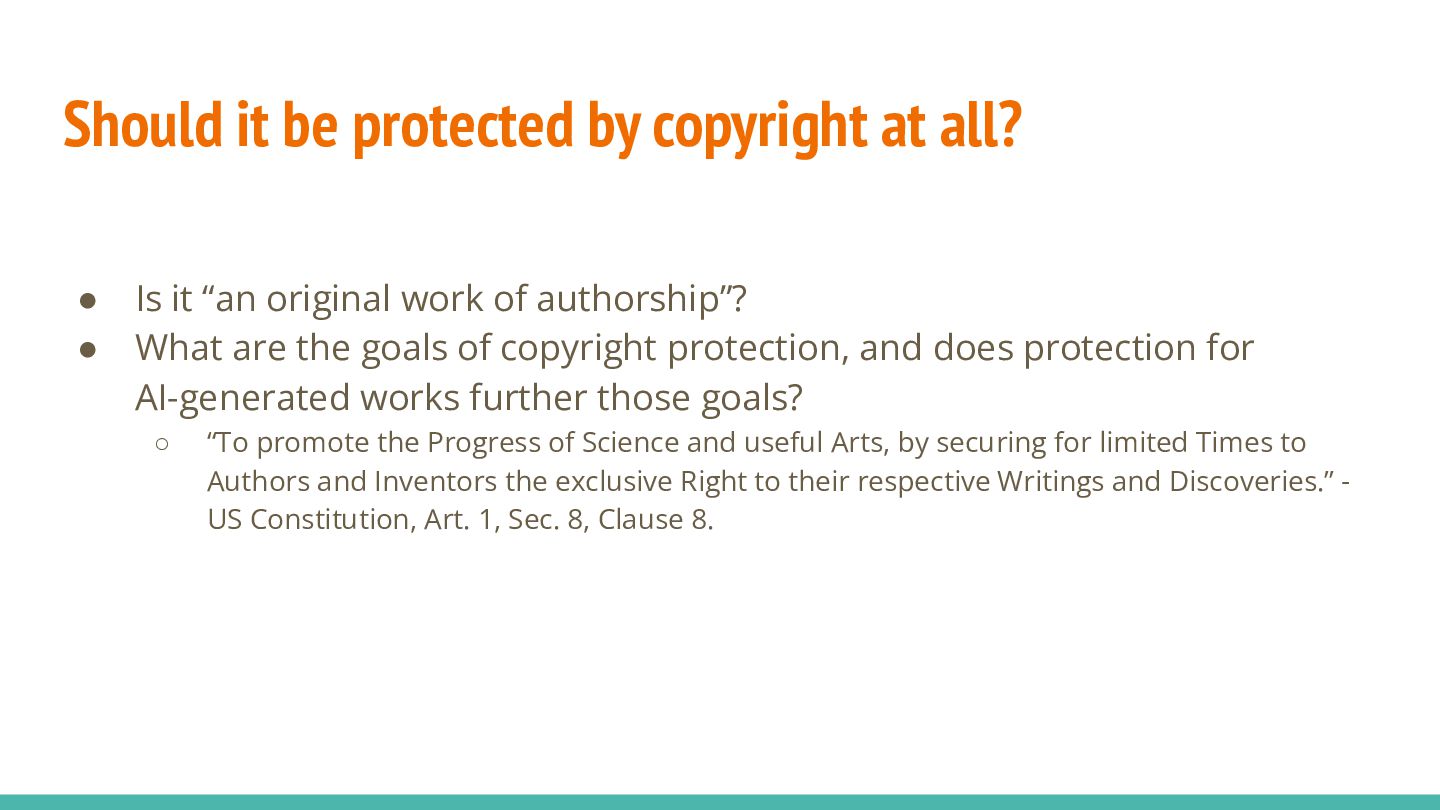
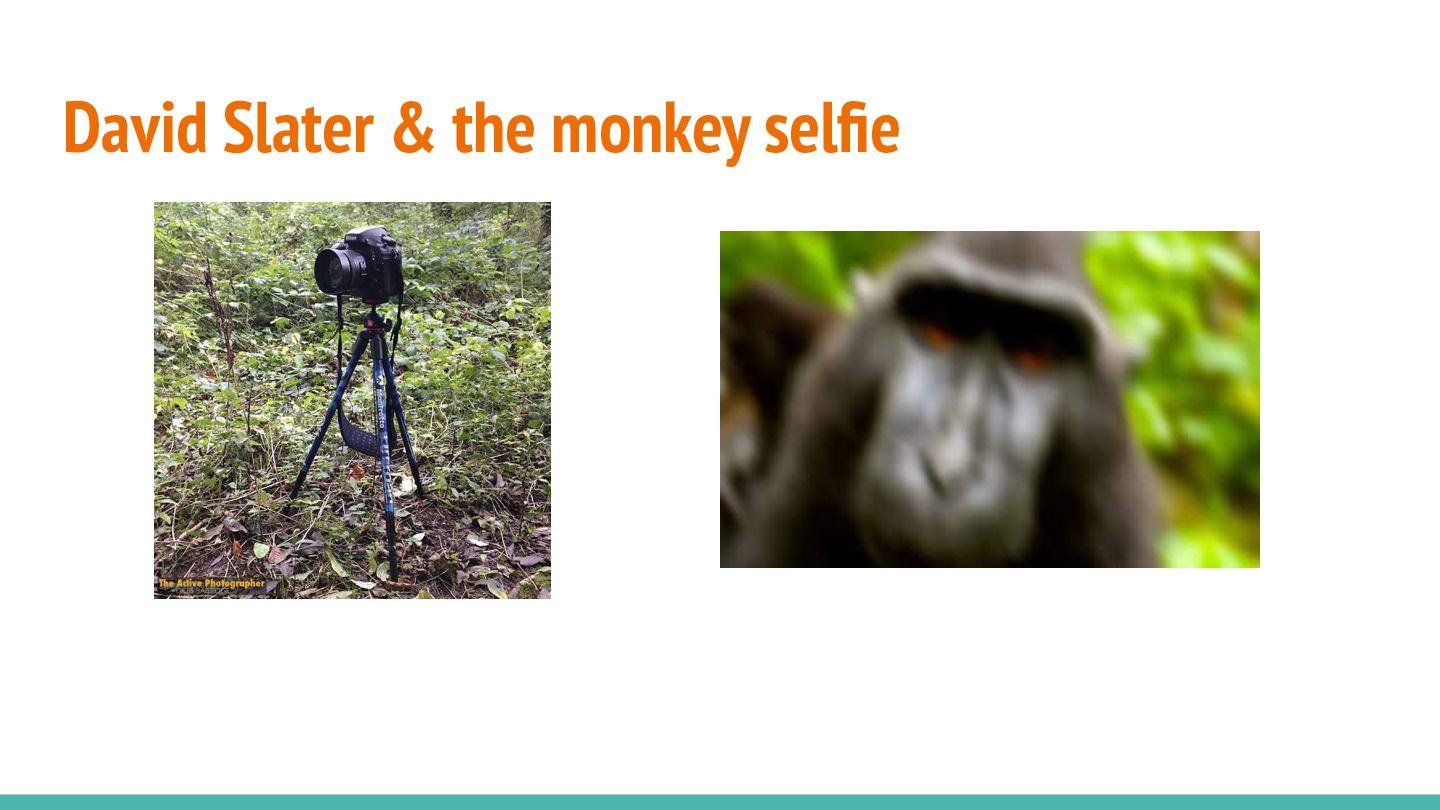
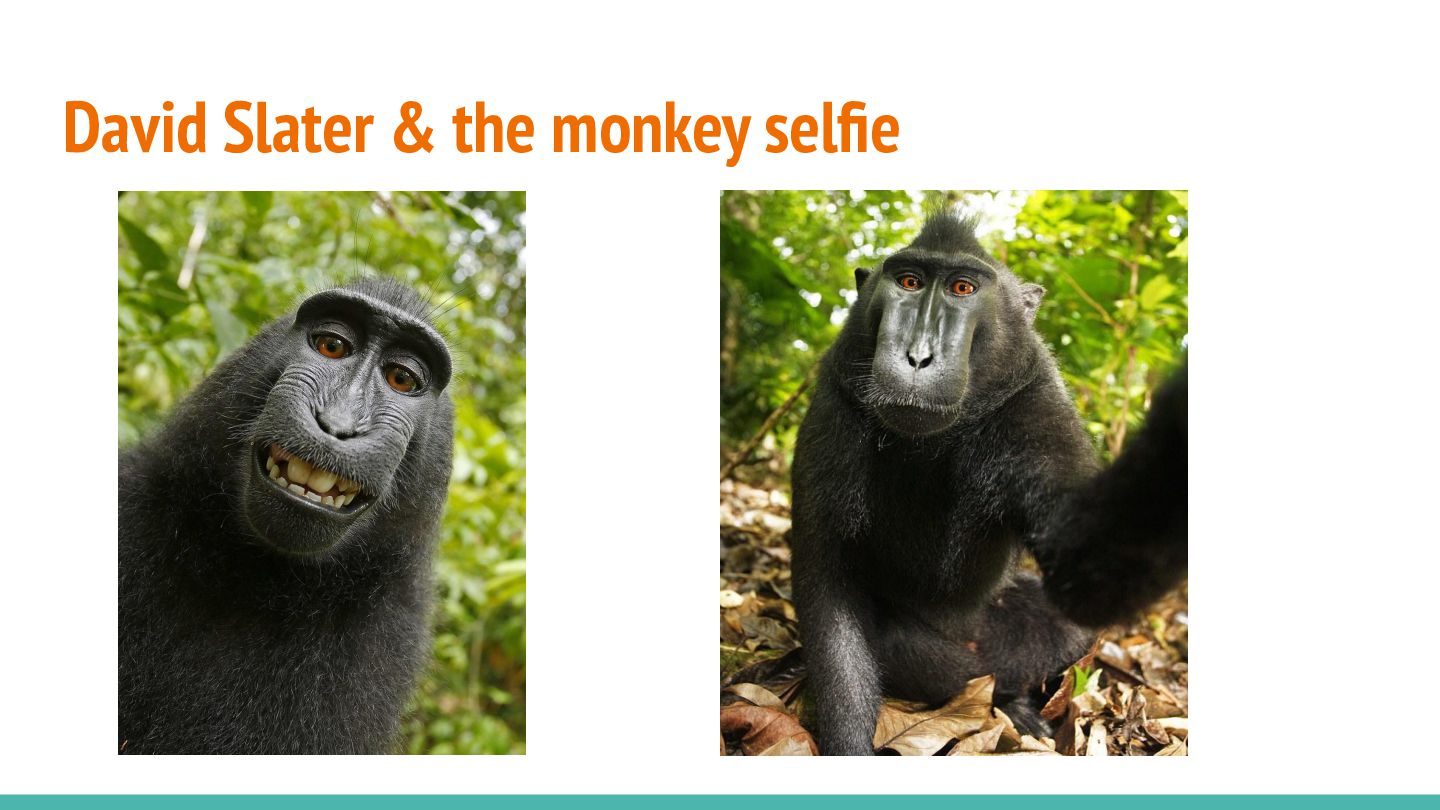
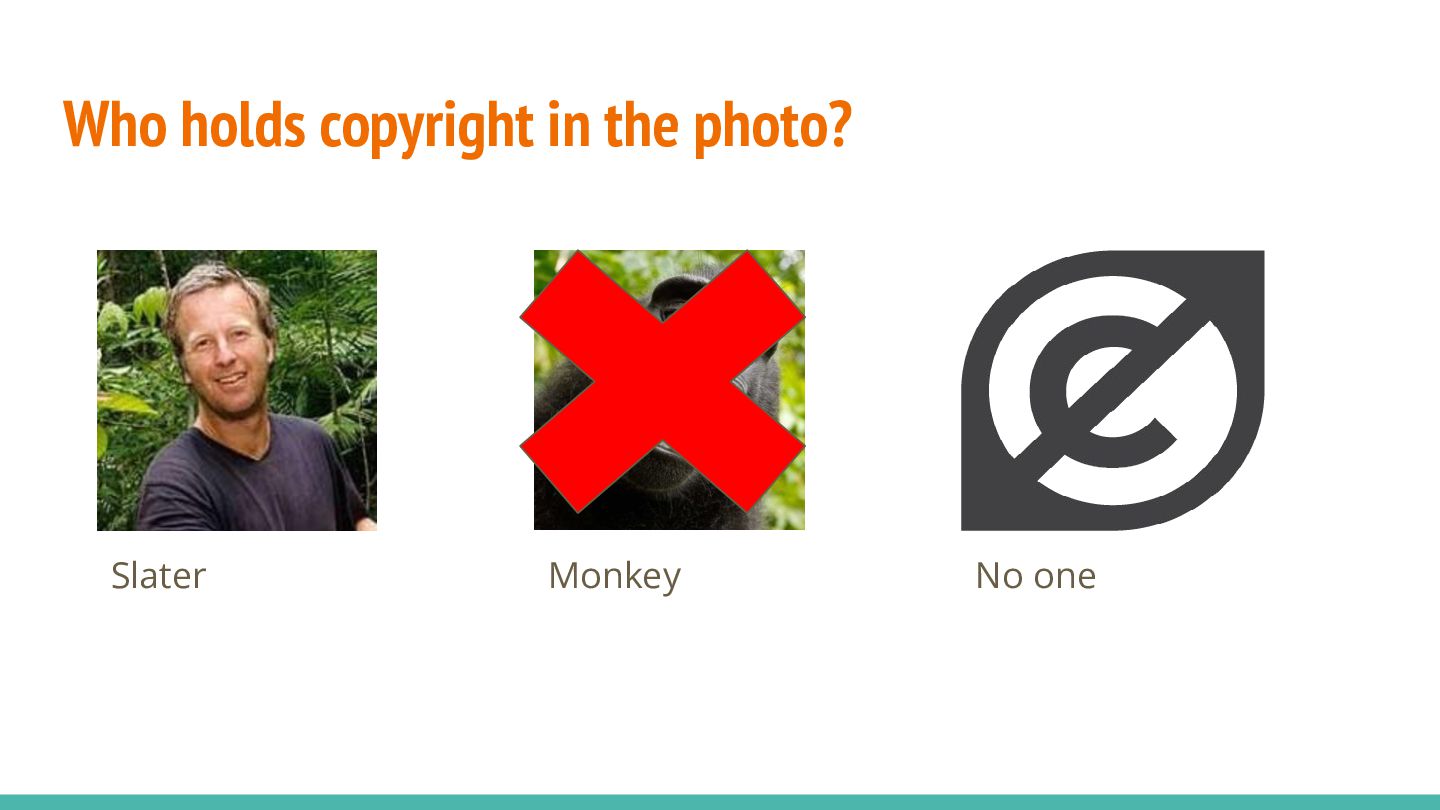
PETA brings suit on behalf of the monkey 9th Circuit,
2018: • • • In order for an animal to bring a suit under a federal statute, the statute must explicitly state that animals can bring suit (Cetacean) The Copyright Act does not say animals have standing, therefore animals do not have standing for copyright lawsuits Also the Copyright Act uses words (“children,” “widow”) that suggest Congress meant humans -
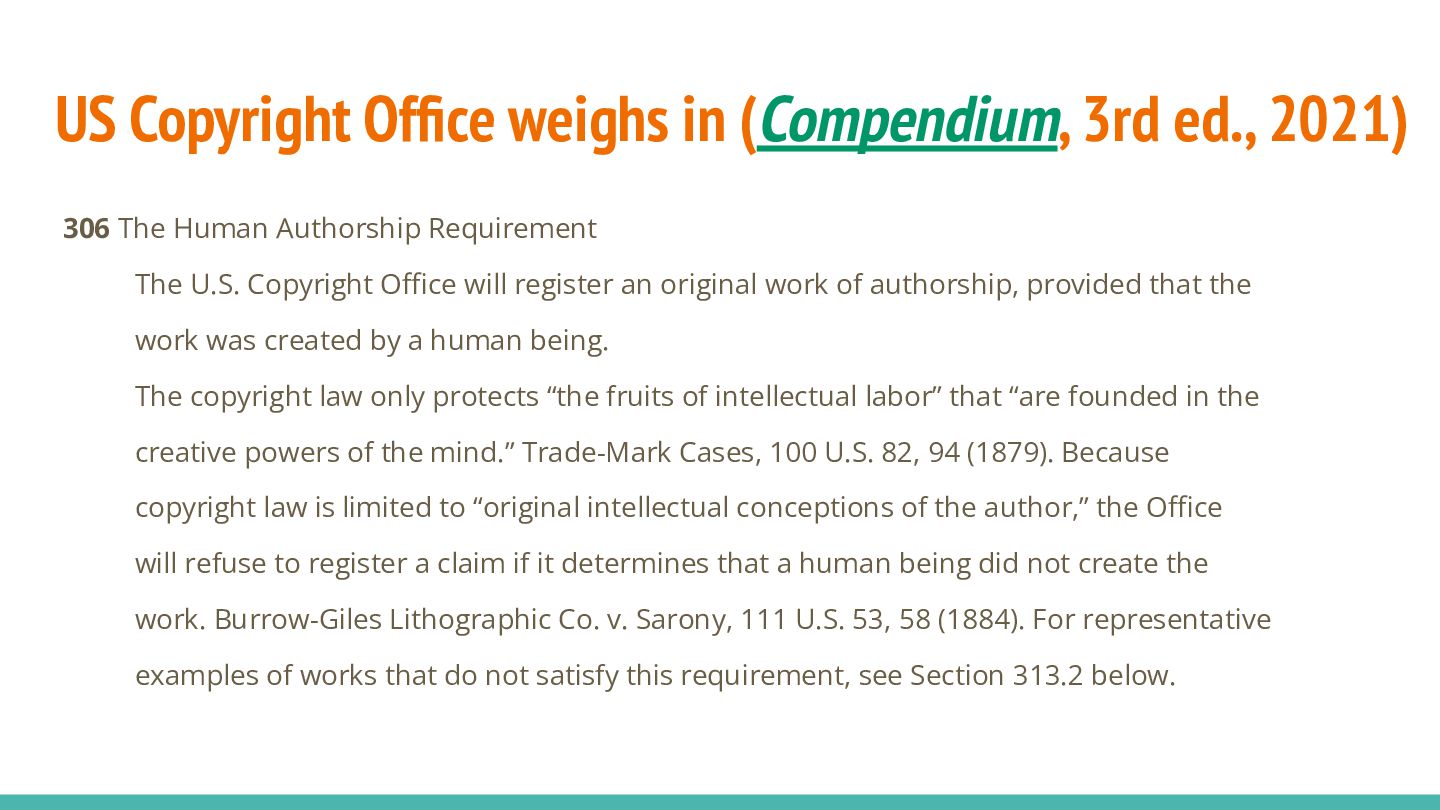
US Copyright Office weighs in (Compendium, 3rd ed., 2021) 306
The Human Authorship Requirement The U.S. Copyright Office will register an original work of authorship, provided that the work was created by a human being. The copyright law only protects “the fruits of intellectual labor” that “are founded in the creative powers of the mind.” Trade-Mark Cases, 100 U.S. 82, 94 (1879). Because copyright law is limited to “original intellectual conceptions of the author,” the Office will refuse to register a claim if it determines that a human being did not create the work. Burrow-Giles Lithographic Co. v. Sarony, 111 U.S. 53, 58 (1884). For representative examples of works that do not satisfy this requirement, see Section 313.2 below. -
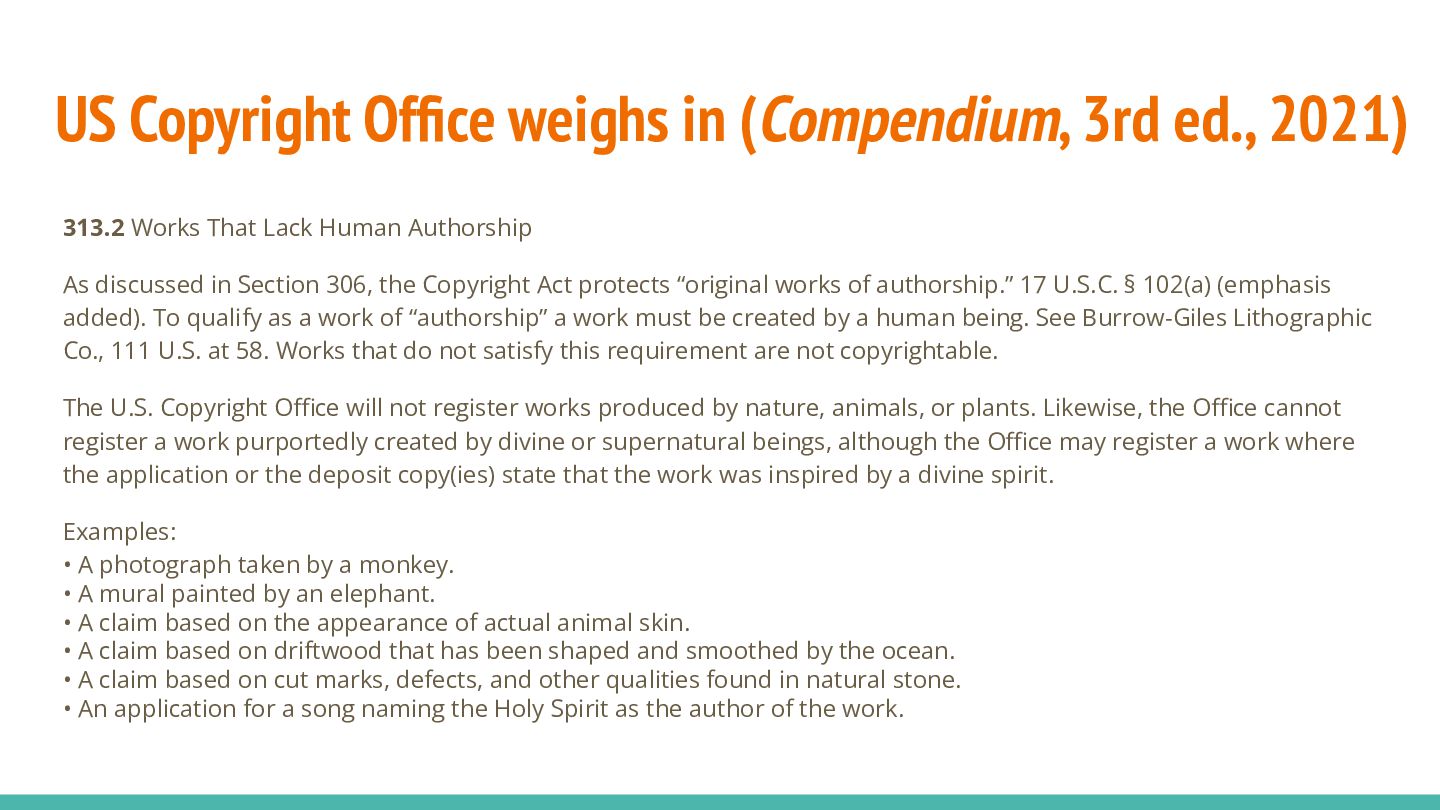
US Copyright Office weighs in (Compendium, 3rd ed., 2021) 313.2
Works That Lack Human Authorship As discussed in Section 306, the Copyright Act protects “original works of authorship.” 17 U.S.C. § 102(a) (emphasis added). To qualify as a work of “authorship” a work must be created by a human being. See Burrow-Giles Lithographic Co., 111 U.S. at 58. Works that do not satisfy this requirement are not copyrightable. The U.S. Copyright Office will not register works produced by nature, animals, or plants. Likewise, the Office cannot register a work purportedly created by divine or supernatural beings, although the Office may register a work where the application or the deposit copy(ies) state that the work was inspired by a divine spirit. Examples: • A photograph taken by a monkey. • A mural painted by an elephant. • A claim based on the appearance of actual animal skin. • A claim based on driftwood that has been shaped and smoothed by the ocean. • A claim based on cut marks, defects, and other qualities found in natural stone. • An application for a song naming the Holy Spirit as the author of the work. -
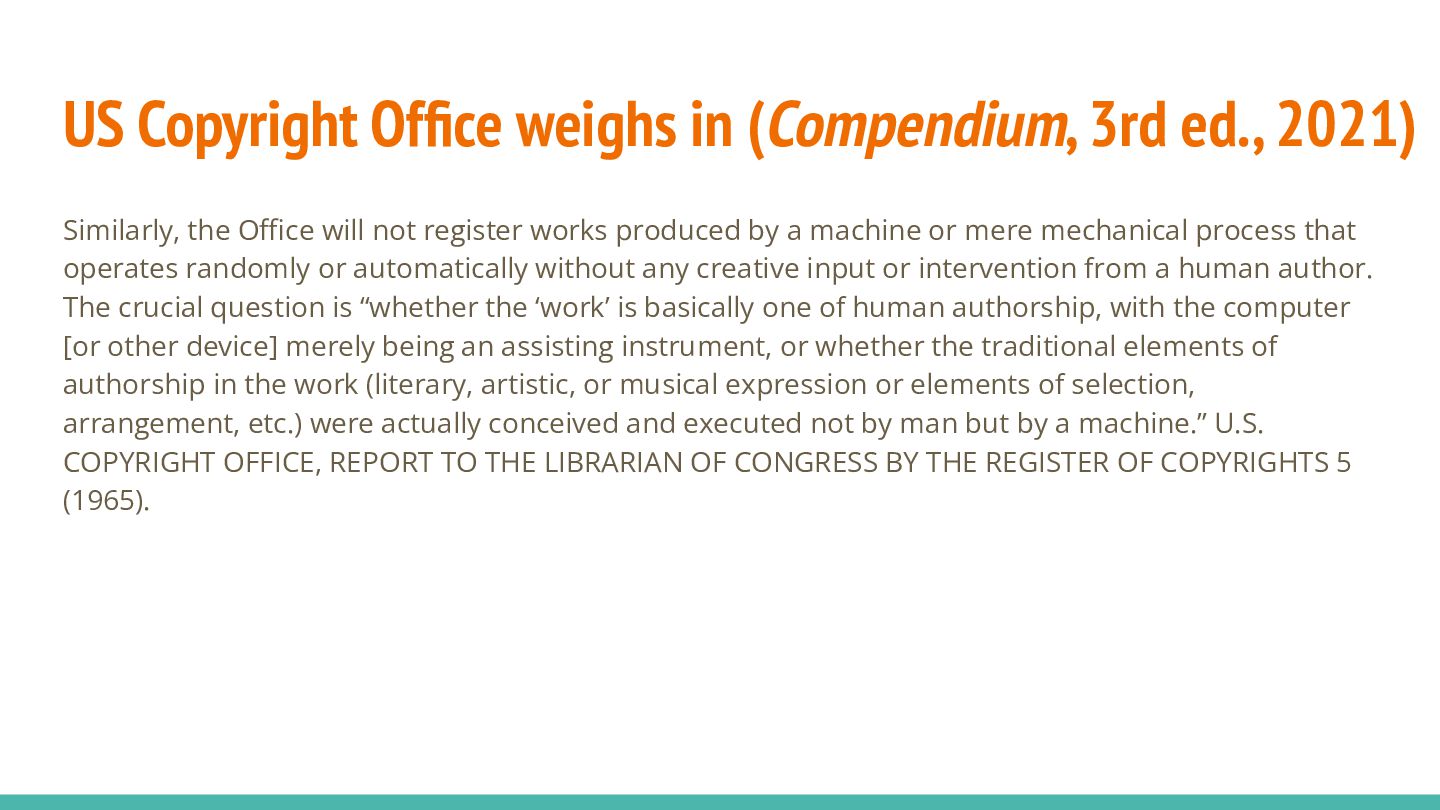
US Copyright Office weighs in (Compendium, 3rd ed., 2021) Similarly,
the Office will not register works produced by a machine or mere mechanical process that operates randomly or automatically without any creative input or intervention from a human author. The crucial question is “whether the ‘work’ is basically one of human authorship, with the computer [or other device] merely being an assisting instrument, or whether the traditional elements of authorship in the work (literary, artistic, or musical expression or elements of selection, arrangement, etc.) were actually conceived and executed not by man but by a machine.” U.S. COPYRIGHT OFFICE, REPORT TO THE LIBRARIAN OF CONGRESS BY THE REGISTER OF COPYRIGHTS 5 (1965). -
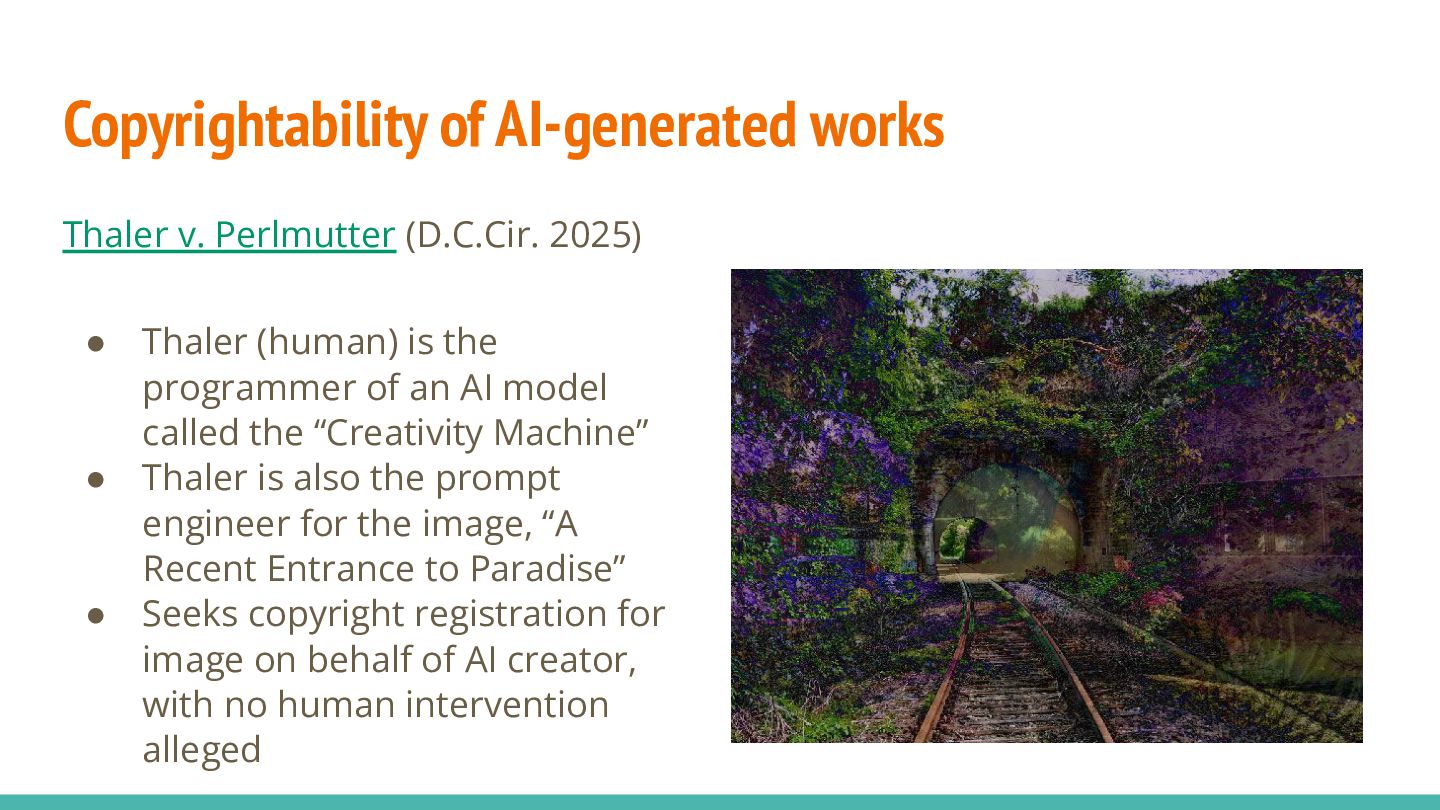
Copyrightability of AI-generated works Thaler v. Perlmutter (D.C.Cir. 2025) •
• • Thaler (human) is the programmer of an AI model called the “Creativity Machine” Thaler is also the prompt engineer for the image, “A Recent Entrance to Paradise” Seeks copyright registration for image on behalf of AI creator, with no human intervention alleged -
Copyrightability of AI-generated works Thaler v. Perlmutter (D.C.Cir. 2025) •
• Registration is denied by the Copyright Office, Thaler appeals DC Circuit court affirms denial of registration - image wholly generated by AI with no human involvement is not copyrightable -
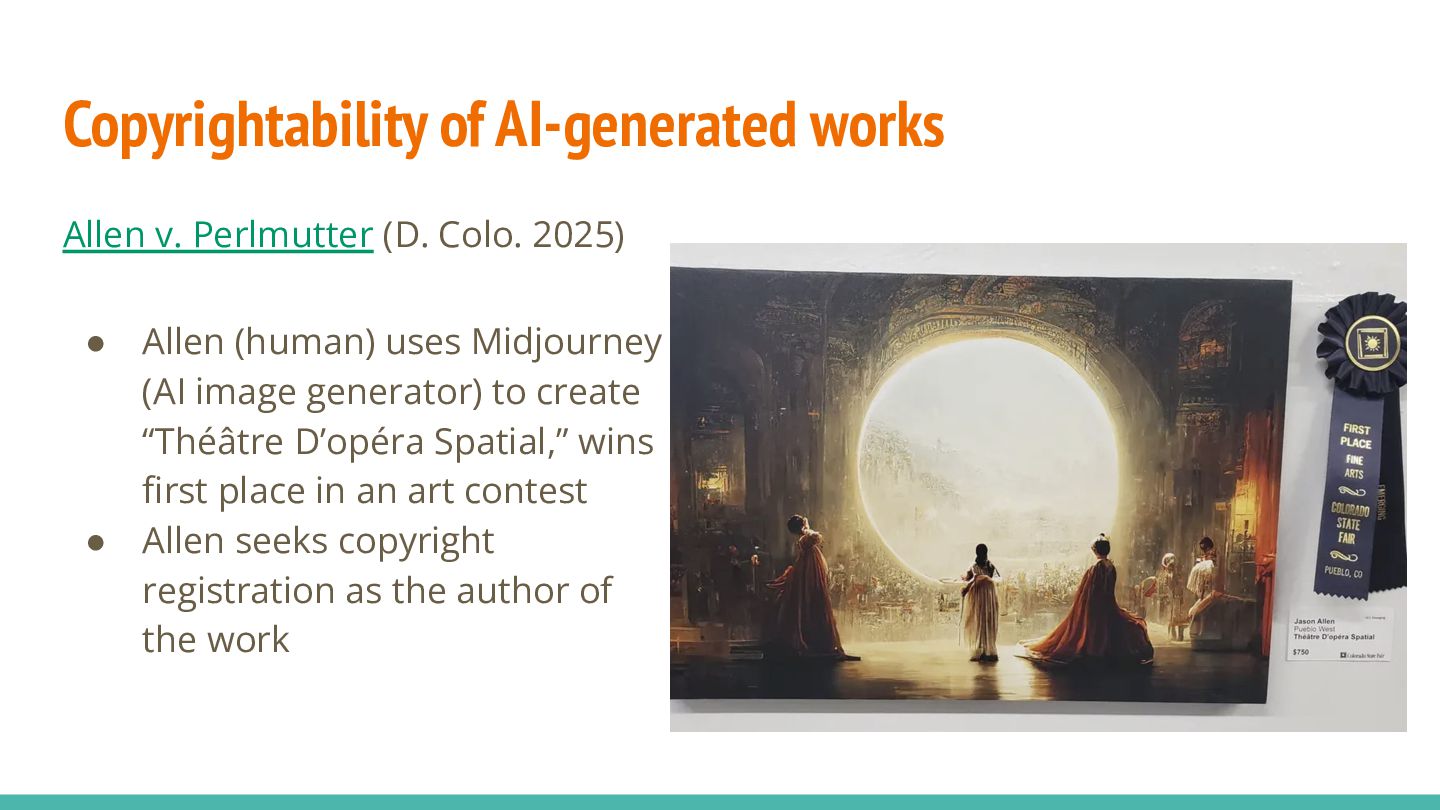
Copyrightability of AI-generated works Allen v. Perlmutter (D. Colo. 2025)
• • Allen (human) uses Midjourney (AI image generator) to create “Théâtre D’opéra Spatial,” wins first place in an art contest Allen seeks copyright registration as the author of the work -
Copyrightability of AI-generated works Allen v. Perlmutter (D. Colo. 2025)
• • Registration is denied by the Copyright Office, Allen appeals Allen argues that his human creative choices and alterations of the image make him the copyright holder ◦ ◦ • • Many iterations of complex and detailed prompting Used additional AI tools and Photoshop to adjust the image, adding detail to the raw output image Case is ongoing What do you think the outcome should be? -
Discussion: • • • What challenges do these registration guidelines
present to creators? Do you agree with the human authorship requirement? How would you handle the copyrightability of AI-generated content? -
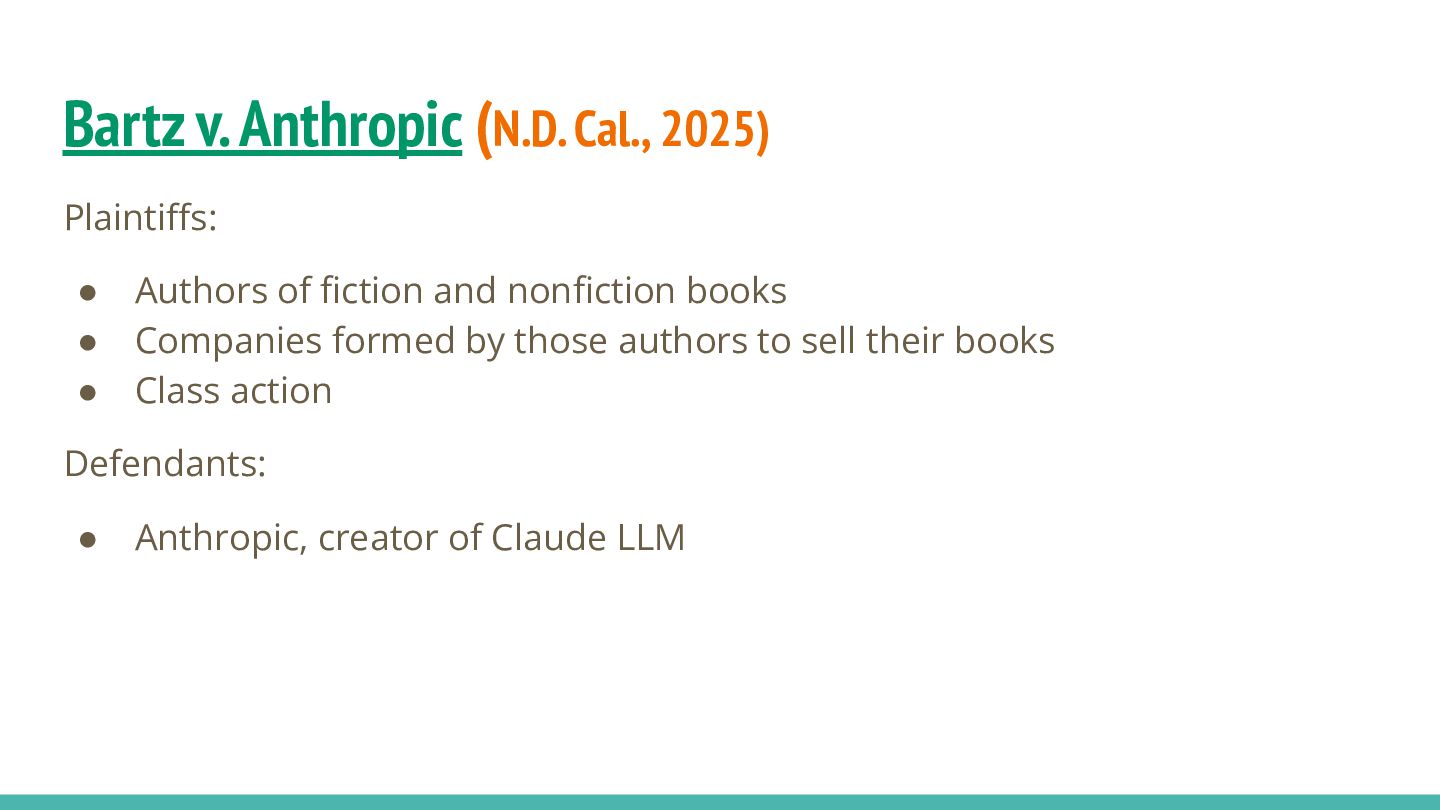
Bartz v. Anthropic (N.D. Cal., 2025) Plaintiffs: • • •
Authors of fiction and nonfiction books Companies formed by those authors to sell their books Class action Defendants: • Anthropic, creator of Claude LLM -
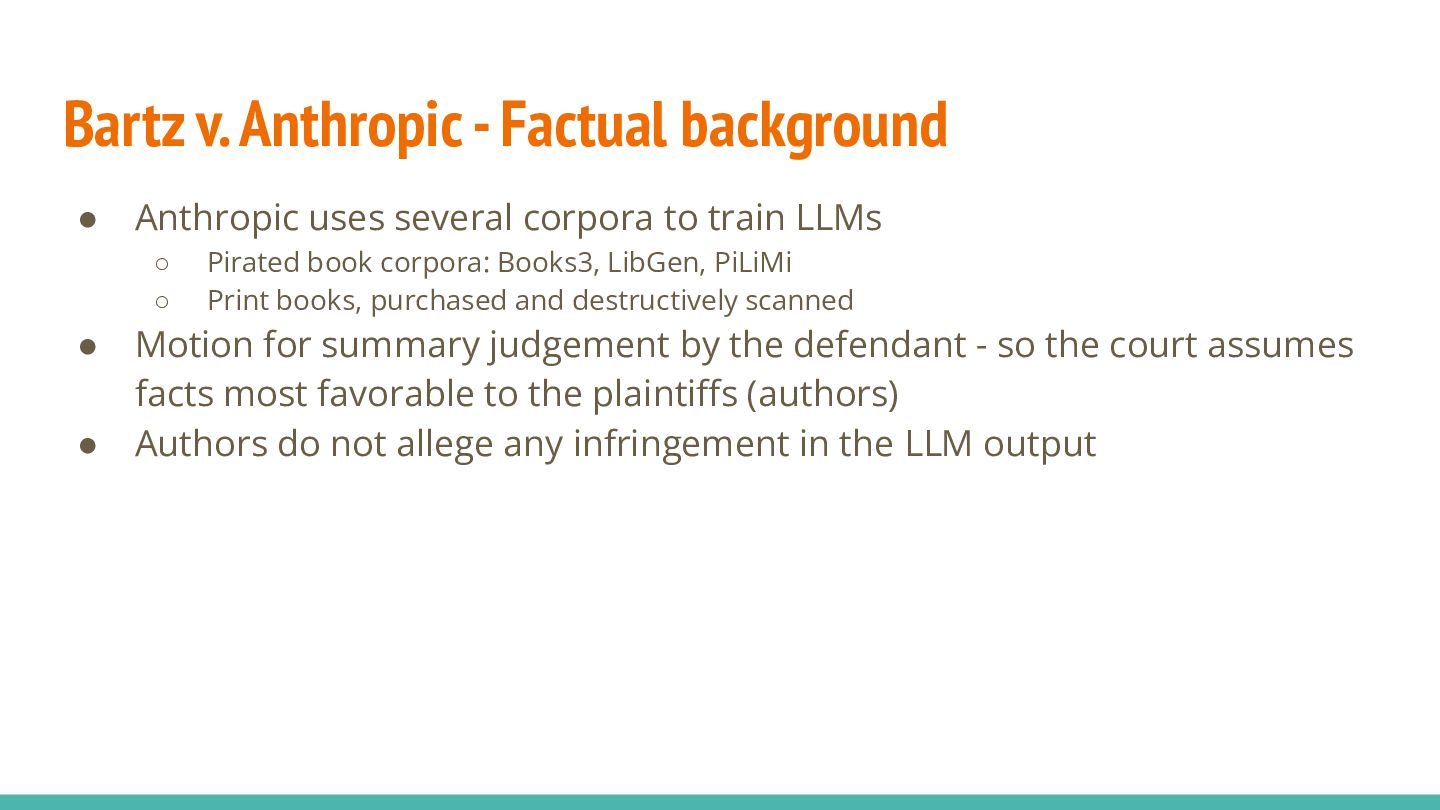
Bartz v. Anthropic - Factual background • Anthropic uses several
corpora to train LLMs ◦ ◦ • • Pirated book corpora: Books3, LibGen, PiLiMi Print books, purchased and destructively scanned Motion for summary judgement by the defendant - so the court assumes facts most favorable to the plaintiffs (authors) Authors do not allege any infringement in the LLM output -
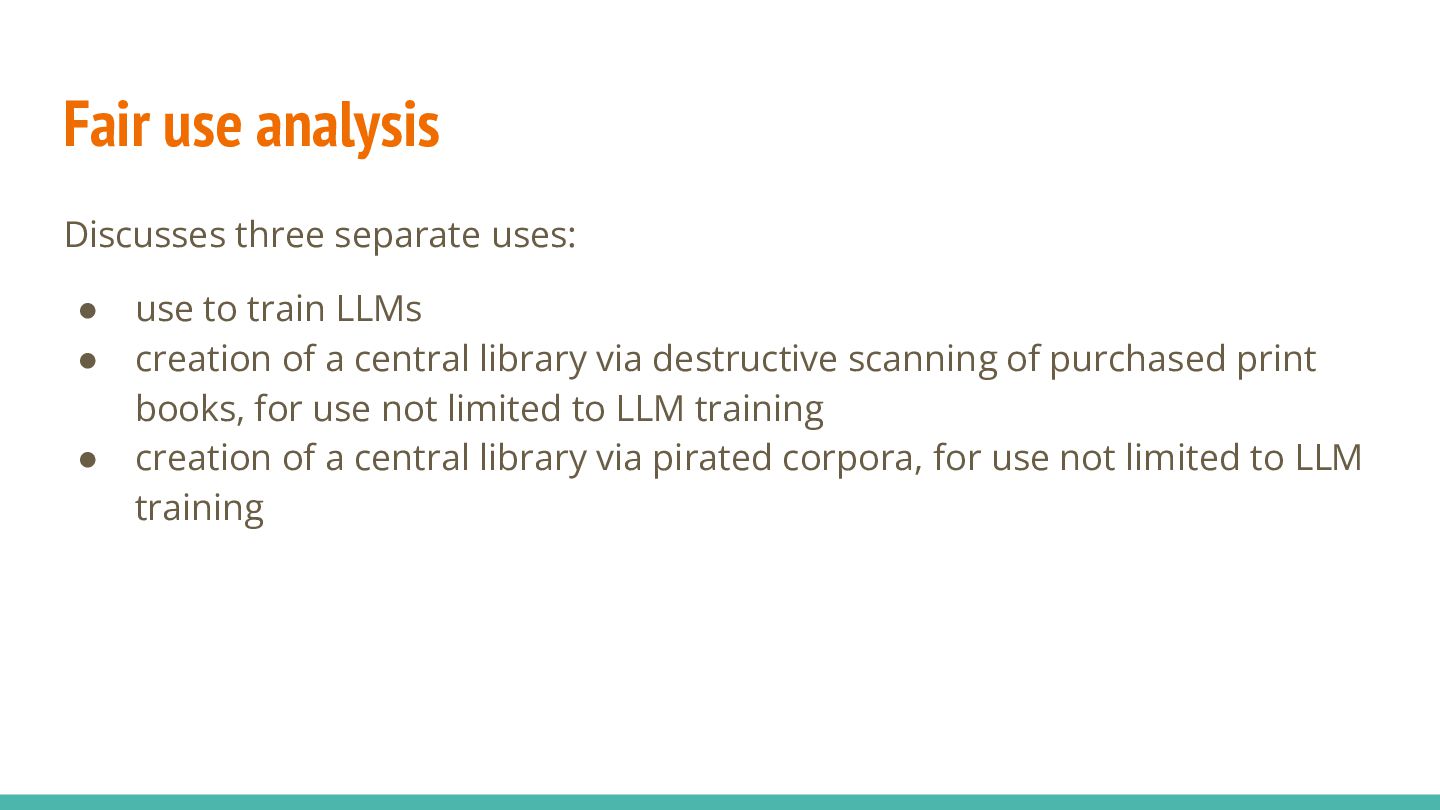
Fair use analysis Discusses three separate uses: • • •
use to train LLMs creation of a central library via destructive scanning of purchased print books, for use not limited to LLM training creation of a central library via pirated corpora, for use not limited to LLM training -
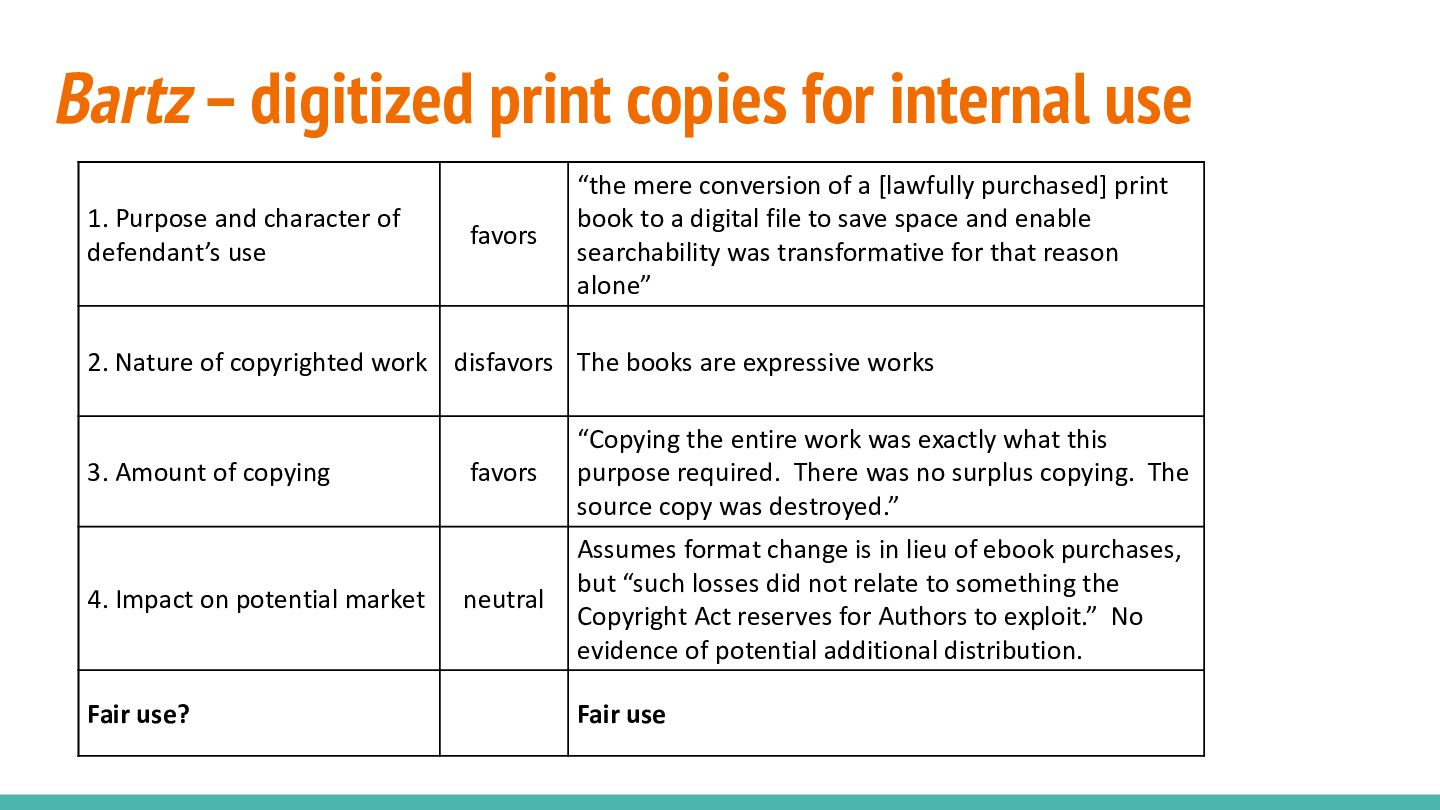
Bartz – digitized print copies for internal use 1. Purpose
and character of defendant’s use favors “the mere conversion of a [lawfully purchased] print book to a digital file to save space and enable searchability was transformative for that reason alone” 2. Nature of copyrighted work disfavors The books are expressive works 3. Amount of copying 4. Impact on potential market Fair use? favors “Copying the entire work was exactly what this purpose required. There was no surplus copying. The source copy was destroyed.” neutral Assumes format change is in lieu of ebook purchases, but “such losses did not relate to something the Copyright Act reserves for Authors to exploit.” No evidence of potential additional distribution. Fair use -
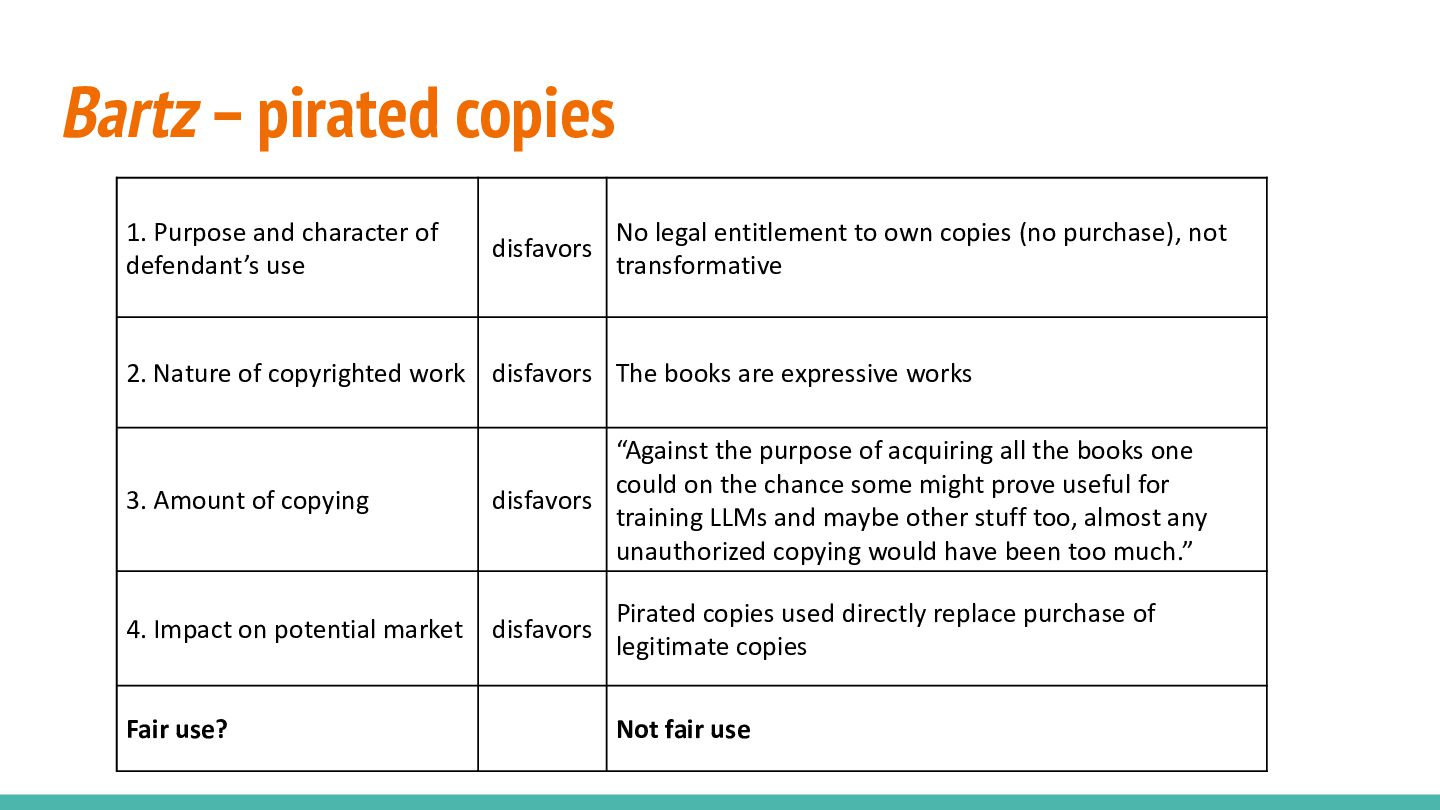
Bartz – pirated copies 1. Purpose and character of defendant’s
use disfavors No legal entitlement to own copies (no purchase), not transformative 2. Nature of copyrighted work disfavors The books are expressive works 3. Amount of copying “Against the purpose of acquiring all the books one could on the chance some might prove useful for disfavors training LLMs and maybe other stuff too, almost any unauthorized copying would have been too much.” 4. Impact on potential market disfavors Fair use? Pirated copies used directly replace purchase of legitimate copies Not fair use -
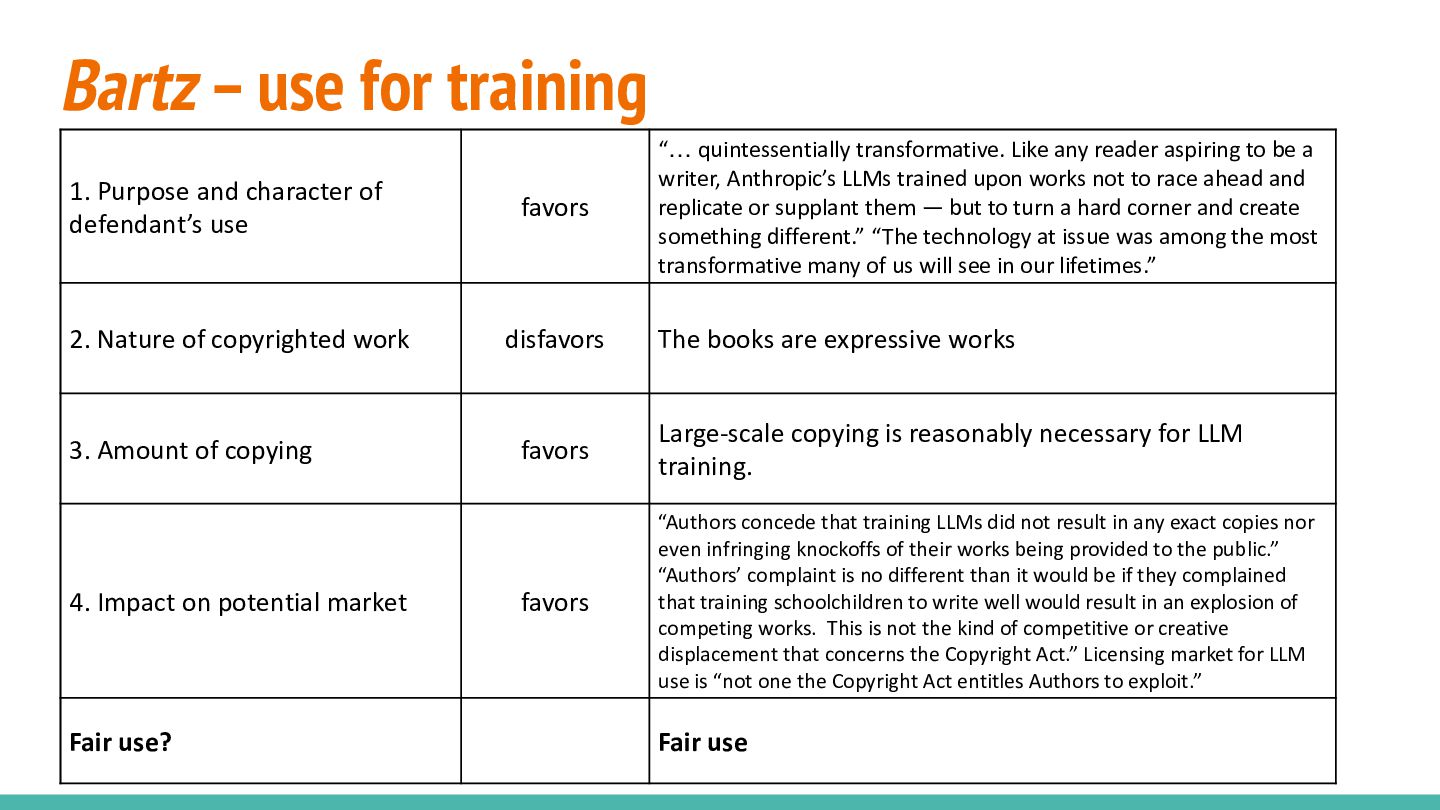
Bartz – use for training 1. Purpose and character of
defendant’s use favors “… quintessentially transformative. Like any reader aspiring to be a writer, Anthropic’s LLMs trained upon works not to race ahead and replicate or supplant them — but to turn a hard corner and create something different.” “The technology at issue was among the most transformative many of us will see in our lifetimes.” 2. Nature of copyrighted work disfavors The books are expressive works 3. Amount of copying favors Large-scale copying is reasonably necessary for LLM training. favors “Authors concede that training LLMs did not result in any exact copies nor even infringing knockoffs of their works being provided to the public.” “Authors’ complaint is no different than it would be if they complained that training schoolchildren to write well would result in an explosion of competing works. This is not the kind of competitive or creative displacement that concerns the Copyright Act.” Licensing market for LLM use is “not one the Copyright Act entitles Authors to exploit.” 4. Impact on potential market Fair use? Fair use -
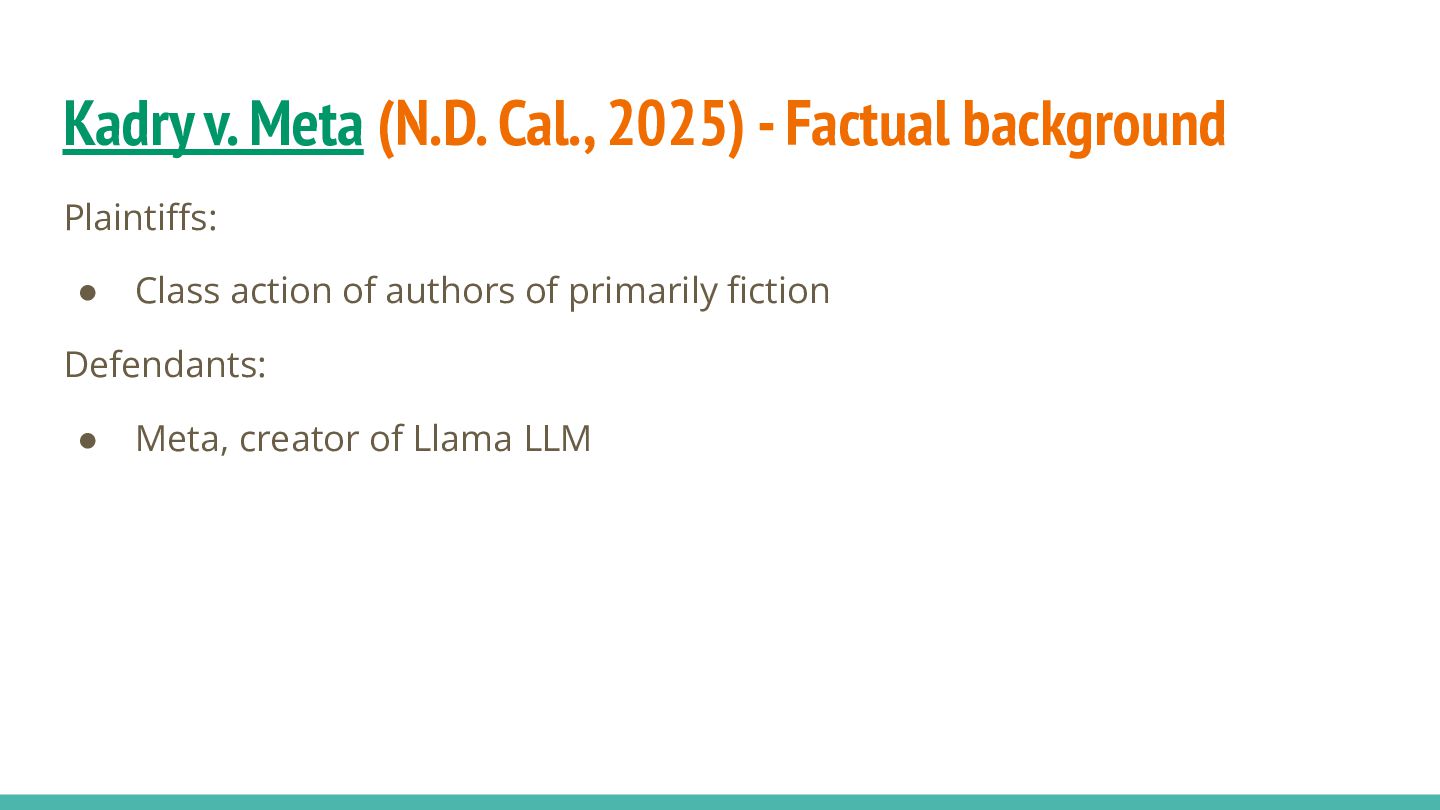
Kadry v. Meta (N.D. Cal., 2025) - Factual background Plaintiffs:
• Class action of authors of primarily fiction Defendants: • Meta, creator of Llama LLM -
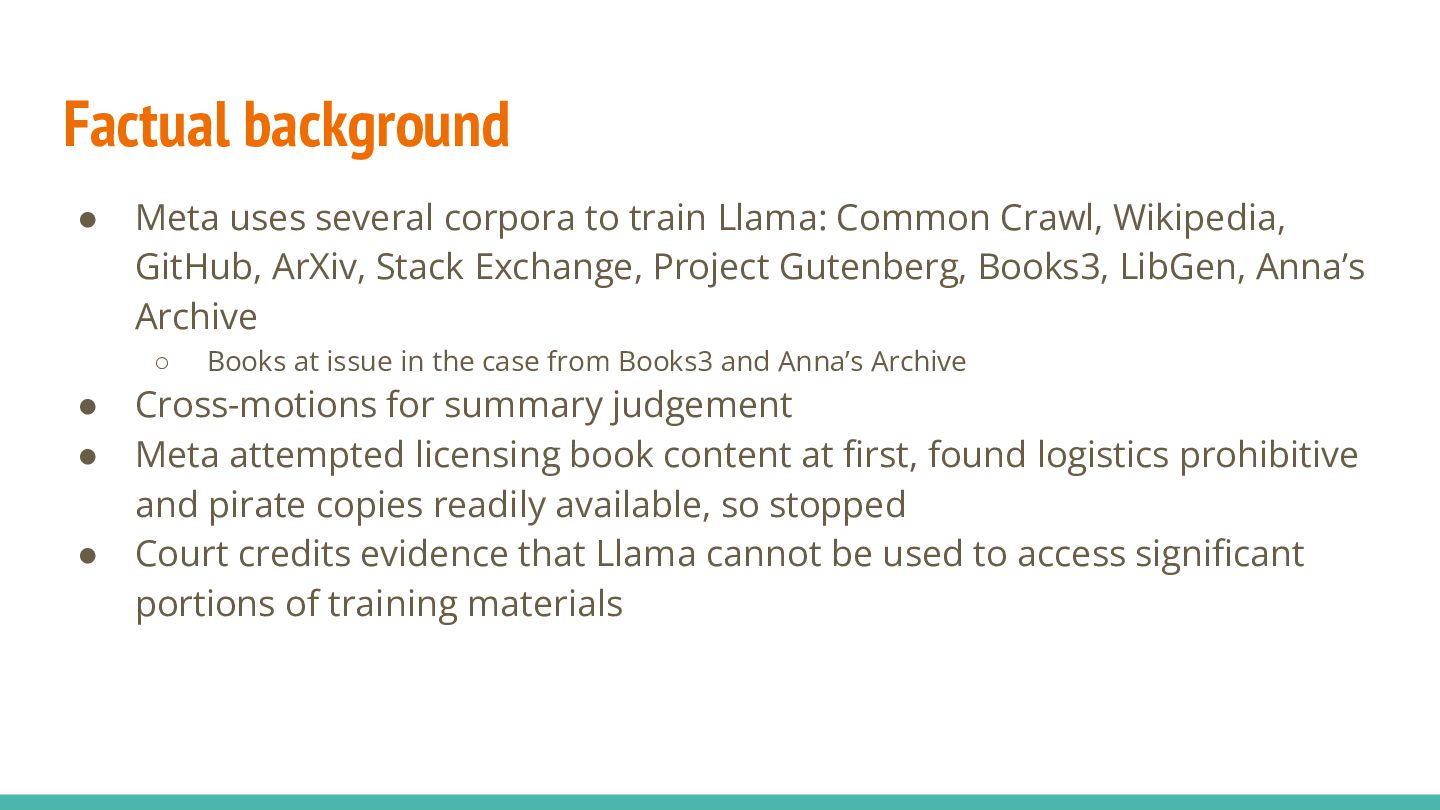
Factual background • Meta uses several corpora to train Llama:
Common Crawl, Wikipedia, GitHub, ArXiv, Stack Exchange, Project Gutenberg, Books3, LibGen, Anna’s Archive ◦ • • • Books at issue in the case from Books3 and Anna’s Archive Cross-motions for summary judgement Meta attempted licensing book content at first, found logistics prohibitive and pirate copies readily available, so stopped Court credits evidence that Llama cannot be used to access significant portions of training materials -
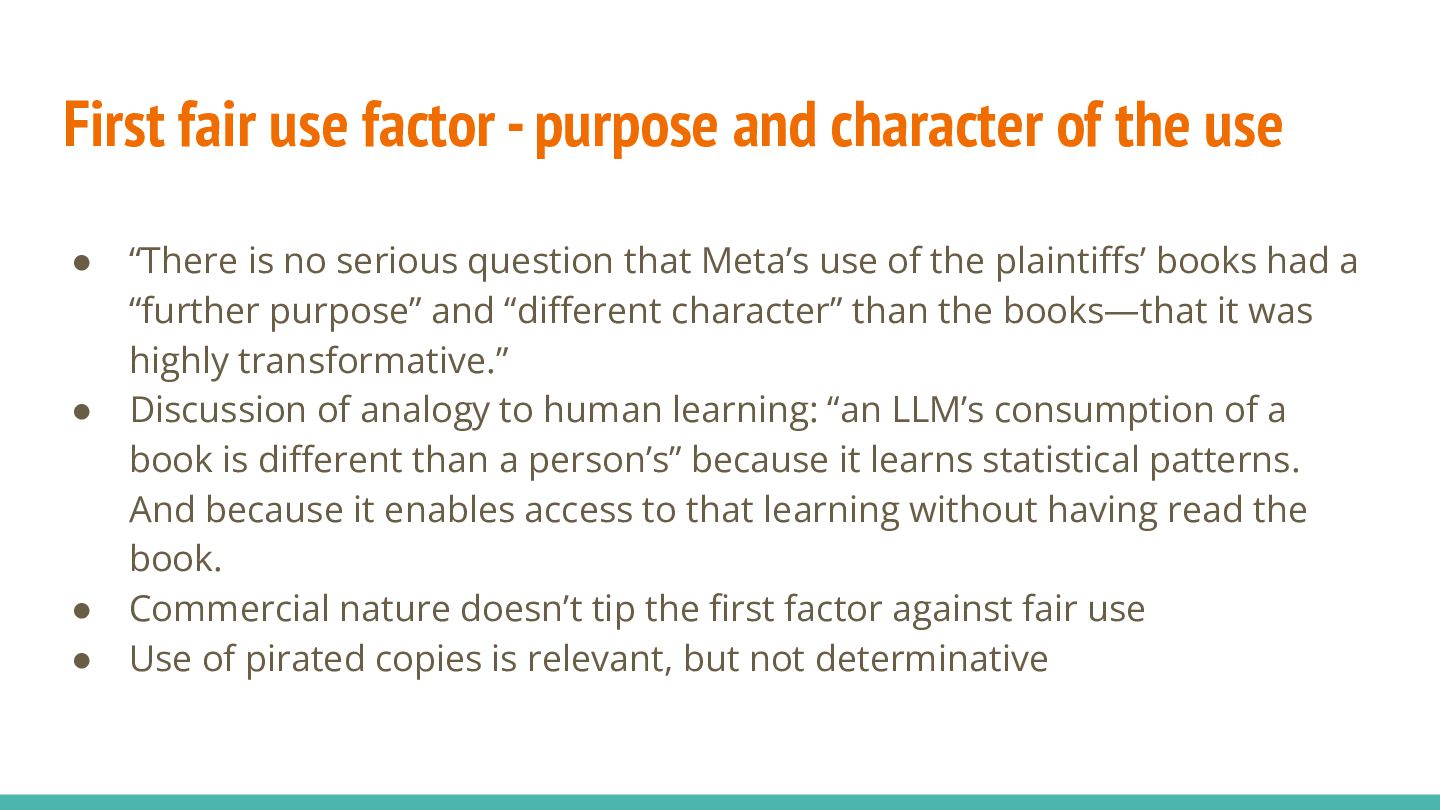
First fair use factor - purpose and character of the
use • • • • “There is no serious question that Meta’s use of the plaintiffs’ books had a “further purpose” and “different character” than the books—that it was highly transformative.” Discussion of analogy to human learning: “an LLM’s consumption of a book is different than a person’s” because it learns statistical patterns. And because it enables access to that learning without having read the book. Commercial nature doesn’t tip the first factor against fair use Use of pirated copies is relevant, but not determinative -
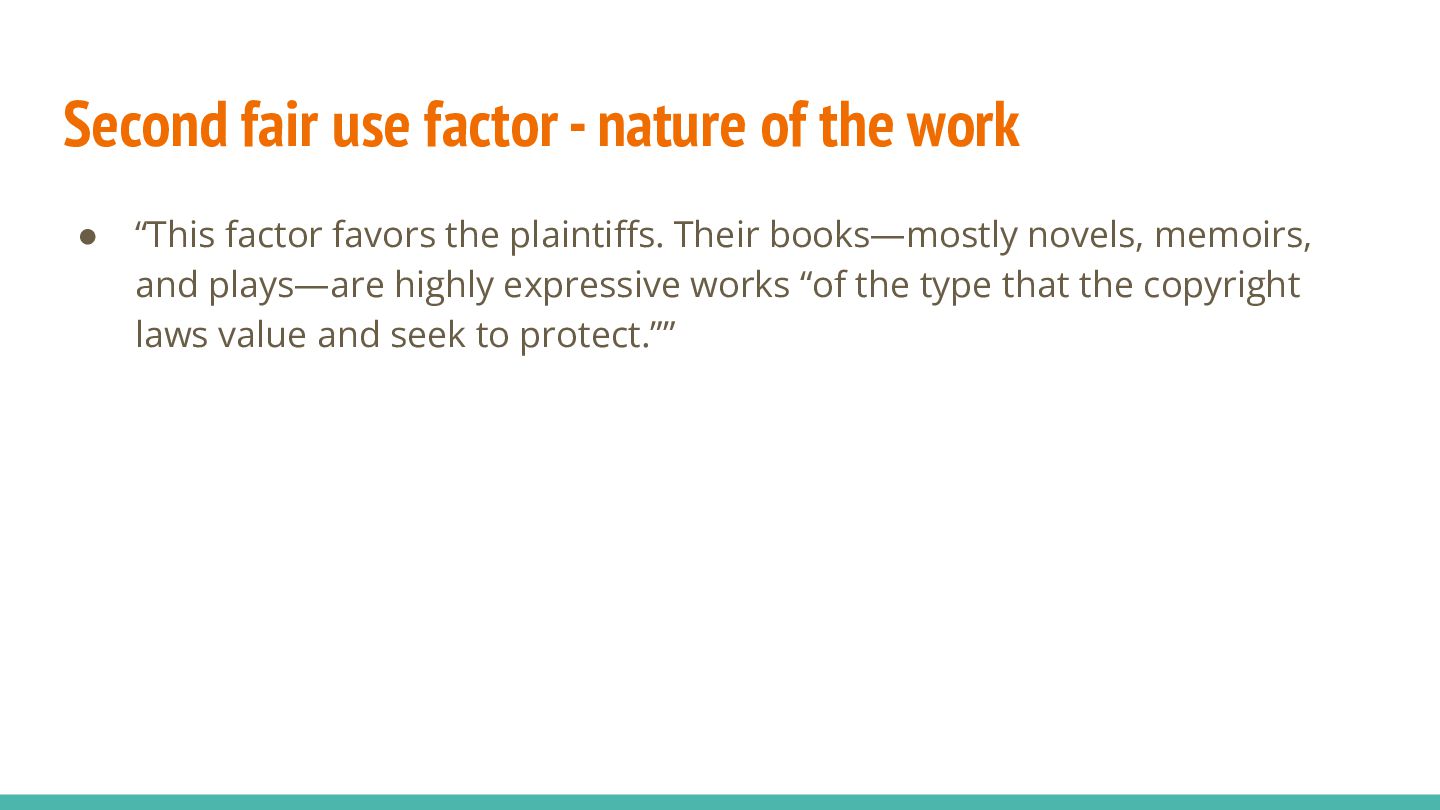
Second fair use factor - nature of the work •
“This factor favors the plaintiffs. Their books—mostly novels, memoirs, and plays—are highly expressive works “of the type that the copyright laws value and seek to protect.”” -
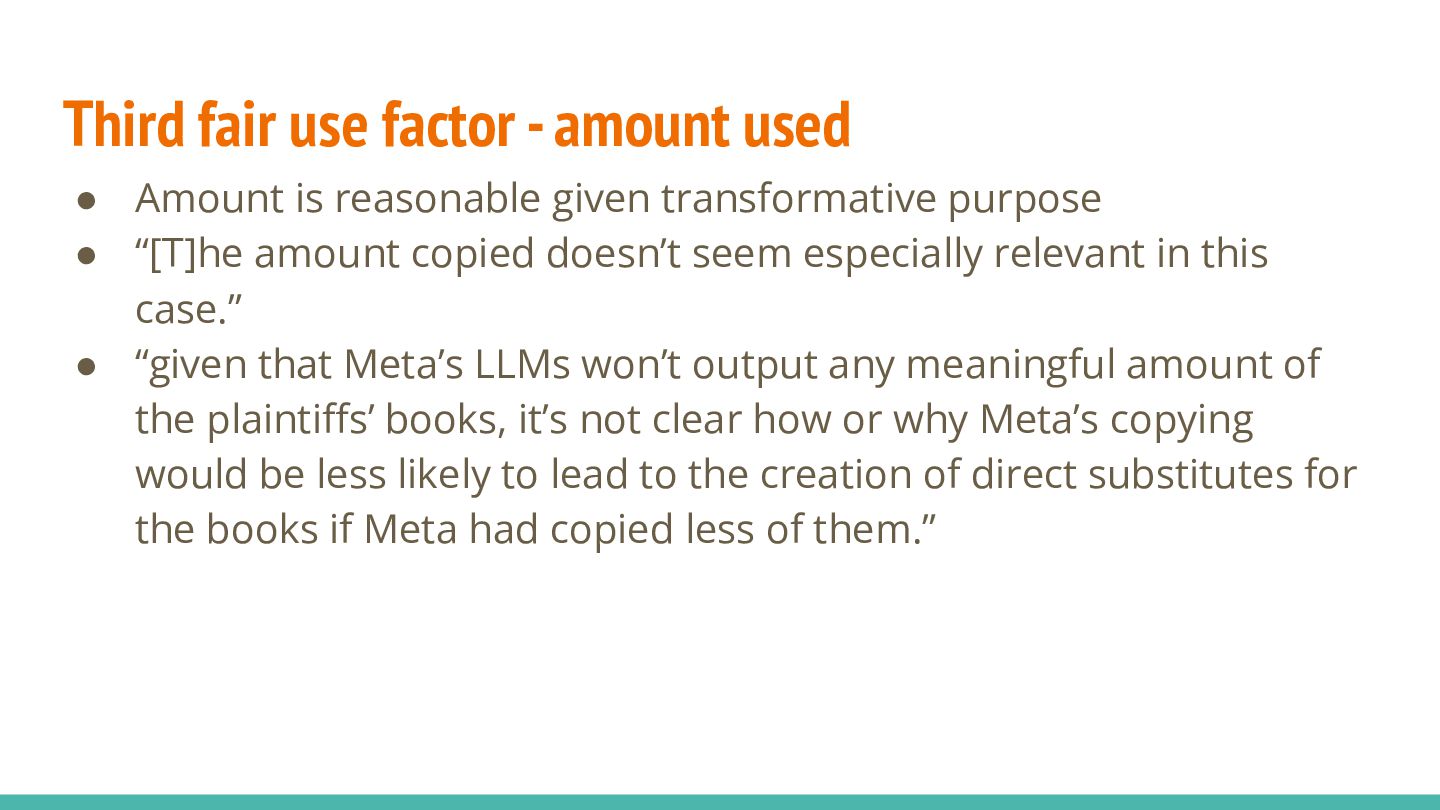
Third fair use factor - amount used • Amount is
reasonable given transformative purpose • “[T]he amount copied doesn’t seem especially relevant in this case.” • “given that Meta’s LLMs won’t output any meaningful amount of the plaintiffs’ books, it’s not clear how or why Meta’s copying would be less likely to lead to the creation of direct substitutes for the books if Meta had copied less of them.” -
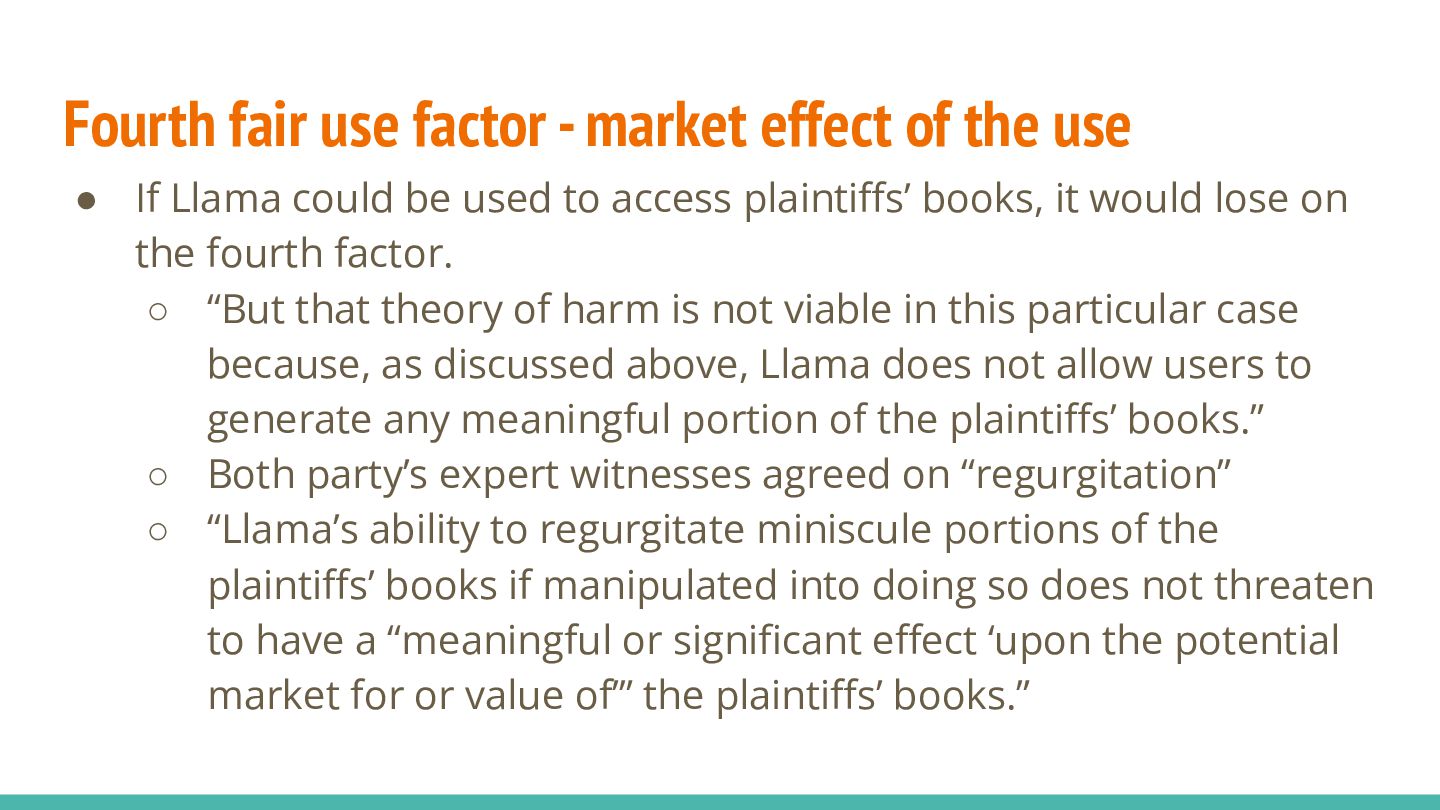
Fourth fair use factor - market effect of the use
• If Llama could be used to access plaintiffs’ books, it would lose on the fourth factor. ◦ “But that theory of harm is not viable in this particular case because, as discussed above, Llama does not allow users to generate any meaningful portion of the plaintiffs’ books.” ◦ Both party’s expert witnesses agreed on “regurgitation” ◦ “Llama’s ability to regurgitate miniscule portions of the plaintiffs’ books if manipulated into doing so does not threaten to have a “meaningful or significant effect ‘upon the potential market for or value of’” the plaintiffs’ books.” -
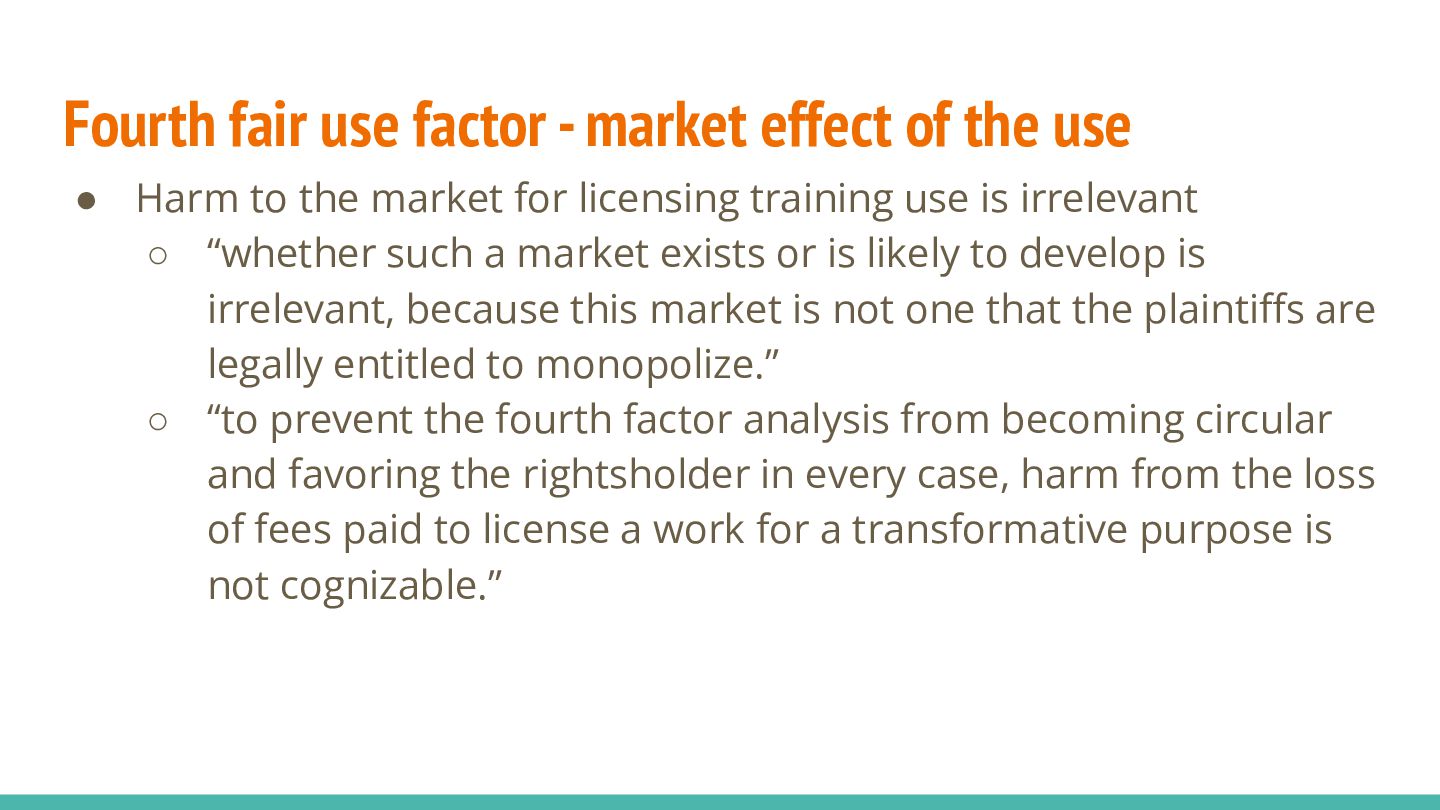
Fourth fair use factor - market effect of the use
• Harm to the market for licensing training use is irrelevant ◦ “whether such a market exists or is likely to develop is irrelevant, because this market is not one that the plaintiffs are legally entitled to monopolize.” ◦ “to prevent the fourth factor analysis from becoming circular and favoring the rightsholder in every case, harm from the loss of fees paid to license a work for a transformative purpose is not cognizable.” -
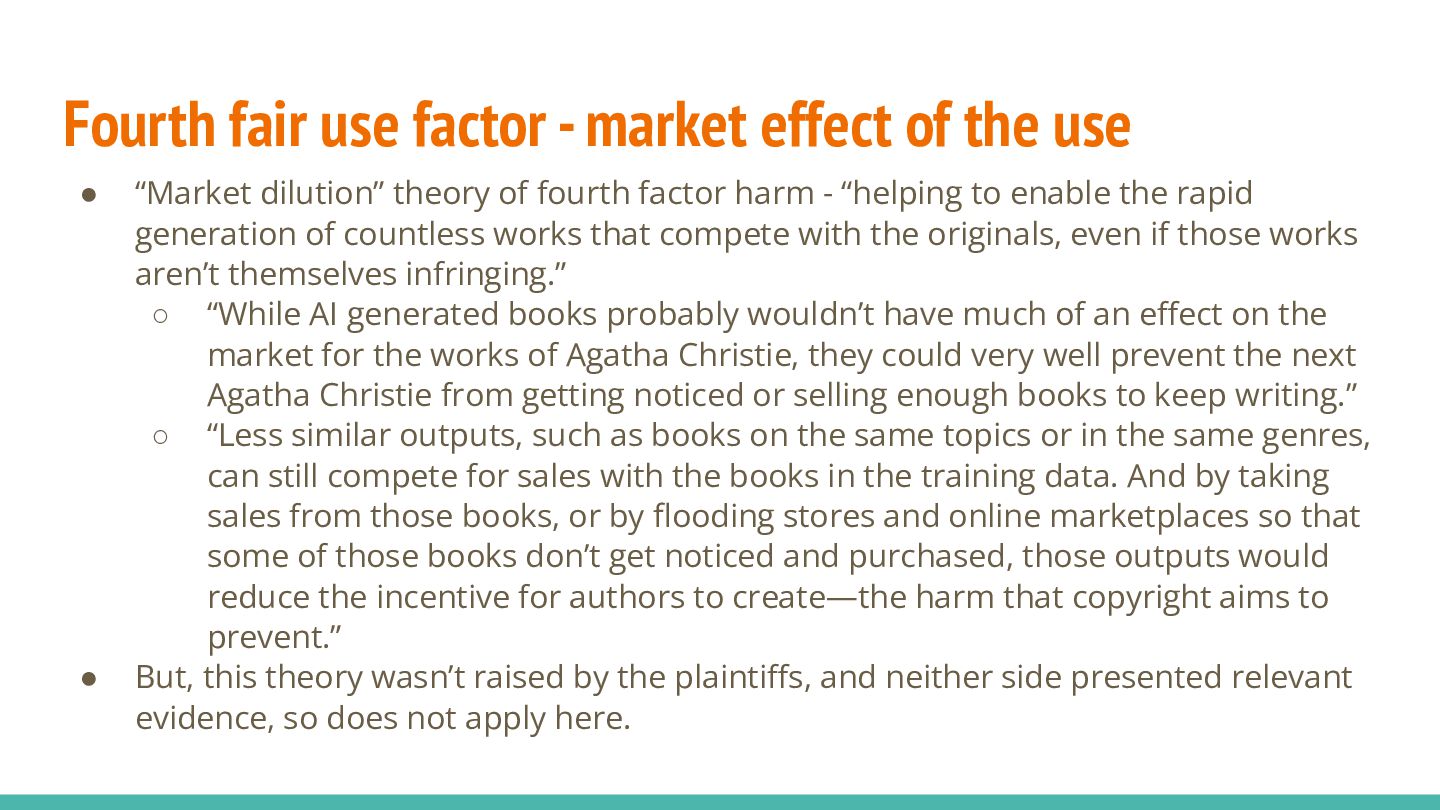
Fourth fair use factor - market effect of the use
• • “Market dilution” theory of fourth factor harm - “helping to enable the rapid generation of countless works that compete with the originals, even if those works aren’t themselves infringing.” ◦ “While AI generated books probably wouldn’t have much of an effect on the market for the works of Agatha Christie, they could very well prevent the next Agatha Christie from getting noticed or selling enough books to keep writing.” ◦ “Less similar outputs, such as books on the same topics or in the same genres, can still compete for sales with the books in the training data. And by taking sales from those books, or by flooding stores and online marketplaces so that some of those books don’t get noticed and purchased, those outputs would reduce the incentive for authors to create—the harm that copyright aims to prevent.” But, this theory wasn’t raised by the plaintiffs, and neither side presented relevant evidence, so does not apply here. -
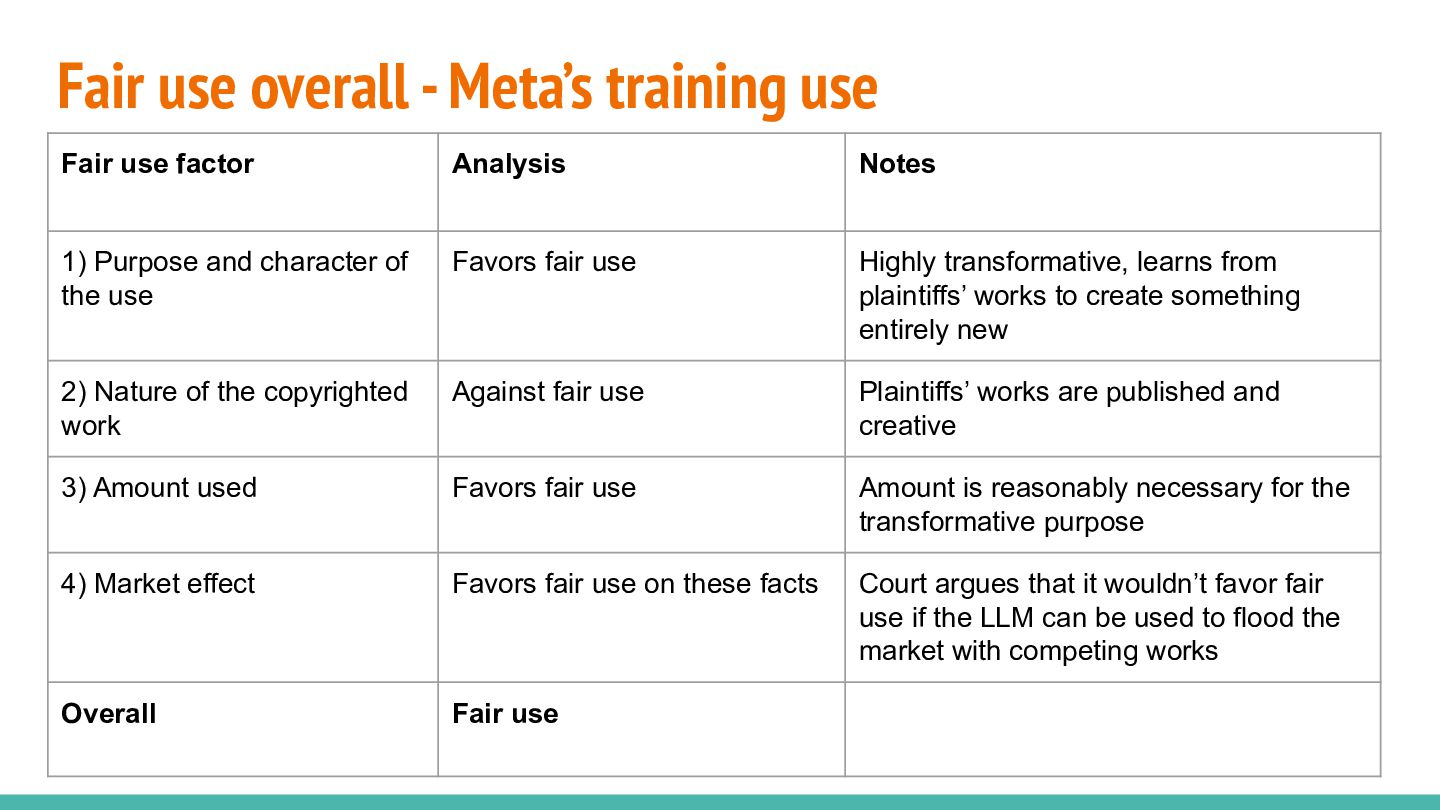
Fair use overall - Meta’s training use Fair use factor
Analysis Notes 1) Purpose and character of the use Favors fair use Highly transformative, learns from plaintiffs’ works to create something entirely new 2) Nature of the copyrighted work Against fair use Plaintiffs’ works are published and creative 3) Amount used Favors fair use Amount is reasonably necessary for the transformative purpose 4) Market effect Favors fair use on these facts Court argues that it wouldn’t favor fair use if the LLM can be used to flood the market with competing works Overall Fair use -
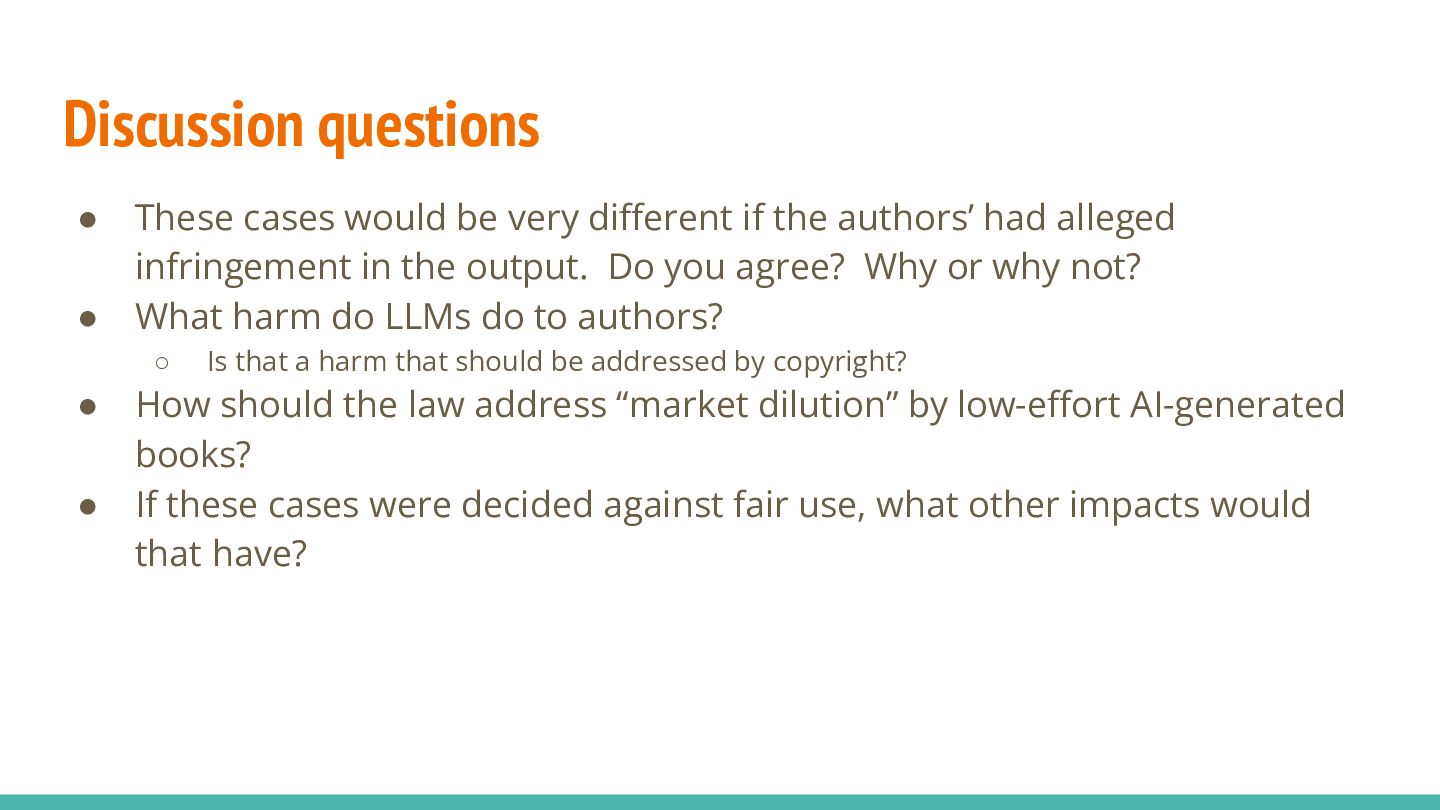
Discussion questions • • These cases would be very different
if the authors’ had alleged infringement in the output. Do you agree? Why or why not? What harm do LLMs do to authors? ◦ • • Is that a harm that should be addressed by copyright? How should the law address “market dilution” by low-effort AI-generated books? If these cases were decided against fair use, what other impacts would that have? -
Questions • • Is this copyright infringement? If so, who
is liable for it? -
Academic library licensing • • Libraries buy physical books and
media, but license digital copies When a library licenses a large collection of ejournals, can the library’s patrons use the articles with AI? -
Depends on the license terms Restrictions we sometimes see on
AI use: • • Completely prohibited Allowed if the provider can see and approve the research ◦ • • For any reason? For violation of the terms? Allowed, but you can never talk about it (publish a paper, publish a dataset, publish an AI model - regardless of whether it’s actually infringing) Allowed, but the provider owns the AI model -
Our position • AI-related uses of library licensed content should
match uses permitted by copyright law.
 baltimoreniso
 signer
 mu7889yoon
 yatabe
 pawan_pharm
 yasulab
 yasslab
 ainischool
 kfujita
 rashwhitman
 ssmedikasda
 koheihasebe
 maggiecrowley
 afnizarnur
 thirion
 malarkey
 axbom
 elsirapls
 cassininazir
 honzajavorek
 akihiro_kokubo
 moore
 jonoalderson