Upgrade to Pro — share decks privately, control downloads, hide ads and more …

Kernel testing frameworks

Sponsored · SiteGround - Reliable hosting with speed, security, and support you can count on. →

Kernel testing frameworks

We can all agree that it is important to test the kernel. There are a number of tools for code coverage, dynamic and static analysis to choose from to test the kernel. Linux kernel provides two testing frameworks to write and run tests. A majority of kernel tests are written using these two frameworks. Having a rich set of tools and frameworks is great. However it can be challenging to know which one to chose.

In this talk, Shuah will give an overview of tools and frameworks and their differences, and how to use them to achieve the your kernel testing objectives and goals.

Shuah KHAN

Avatar for Kernel Recipes

Kernel Recipes PRO

September 29, 2026

More Decks by Kernel Recipes

Other Decks in Technology

Transcript

  1. Kernel testing frameworks Kernel Recipes September 21st, 2026 Shuah Khan

    Kernel Maintainer & Linux Fellow The Linux Foundation LinkedIn - shuah-khan [email protected]
  2. We can all agree that it is important to test

    the kernel. There are a number of tools for code coverage, dynamic and static analysis to choose from to test the kernel. Linux kernel provides two testing frameworks to write and run tests. A majority of kernel tests are written using these two frameworks. Having a rich set of tools and frameworks is great. However it can be challenging to know which one to chose. In this talk, Shuah will give an overview of tools and frameworks and their differences, and how to use them to achieve the your kernel testing objectives and goals.
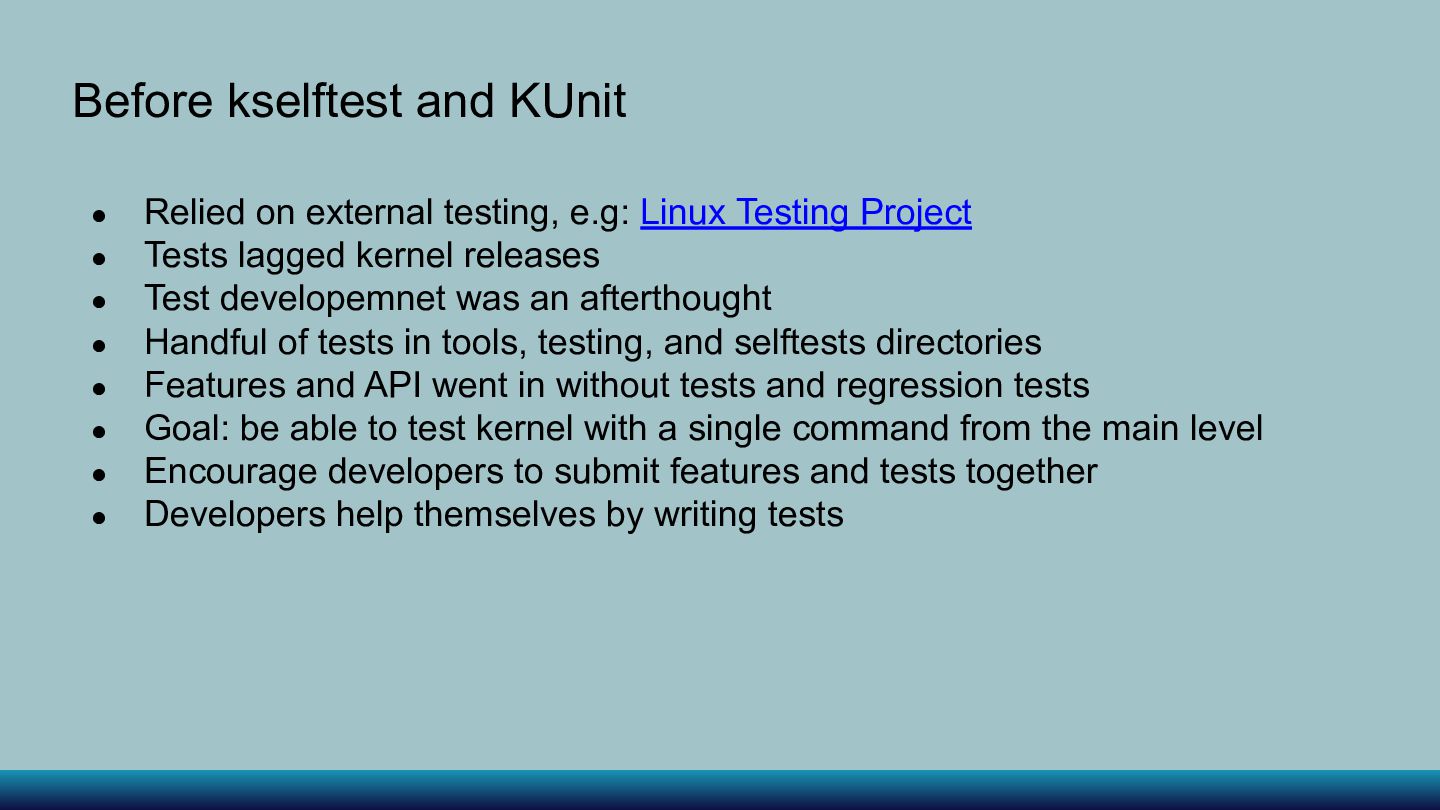
  3. Before kselftest and KUnit • • • • • •

    • • Relied on external testing, e.g: Linux Testing Project Tests lagged kernel releases Test developemnet was an afterthought Handful of tests in tools, testing, and selftests directories Features and API went in without tests and regression tests Goal: be able to test kernel with a single command from the main level Encourage developers to submit features and tests together Developers help themselves by writing tests
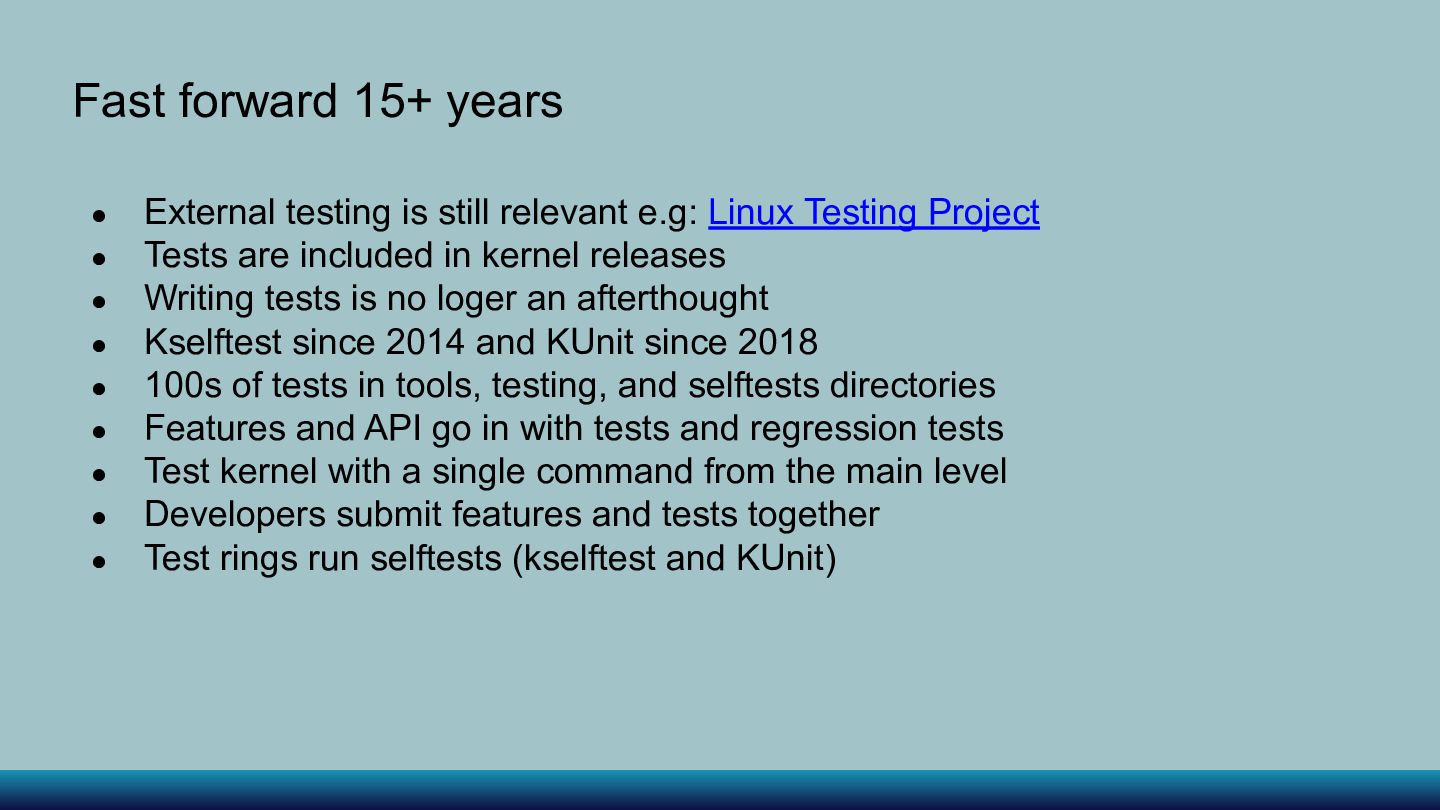
  4. Fast forward 15+ years • • • • • •

    • • • External testing is still relevant e.g: Linux Testing Project Tests are included in kernel releases Writing tests is no loger an afterthought Kselftest since 2014 and KUnit since 2018 100s of tests in tools, testing, and selftests directories Features and API go in with tests and regression tests Test kernel with a single command from the main level Developers submit features and tests together Test rings run selftests (kselftest and KUnit)
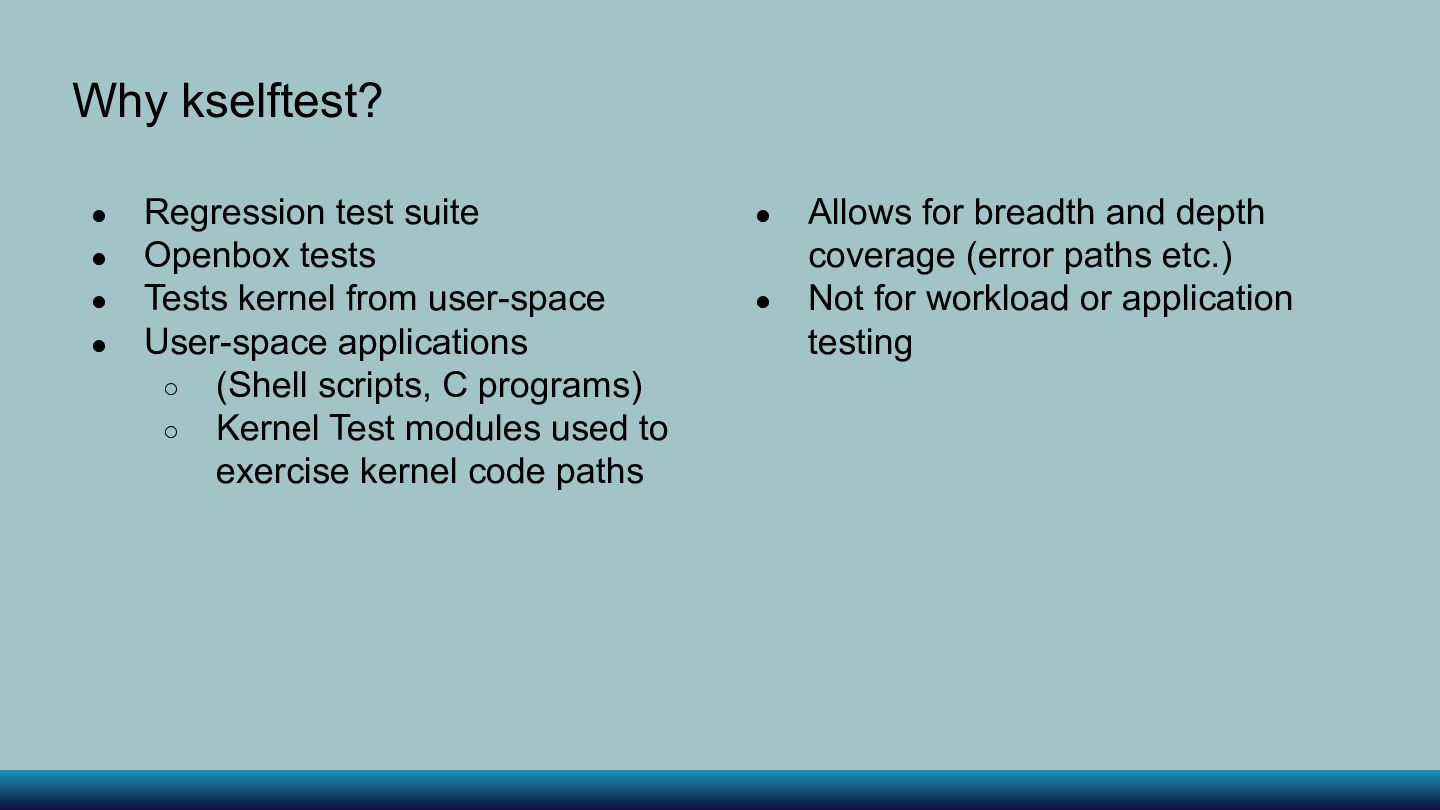
  5. Why kselftest? • • • • Regression test suite Openbox

    tests Tests kernel from user-space User-space applications ◦ (Shell scripts, C programs) ◦ Kernel Test modules used to exercise kernel code paths • • Allows for breadth and depth coverage (error paths etc.) Not for workload or application testing
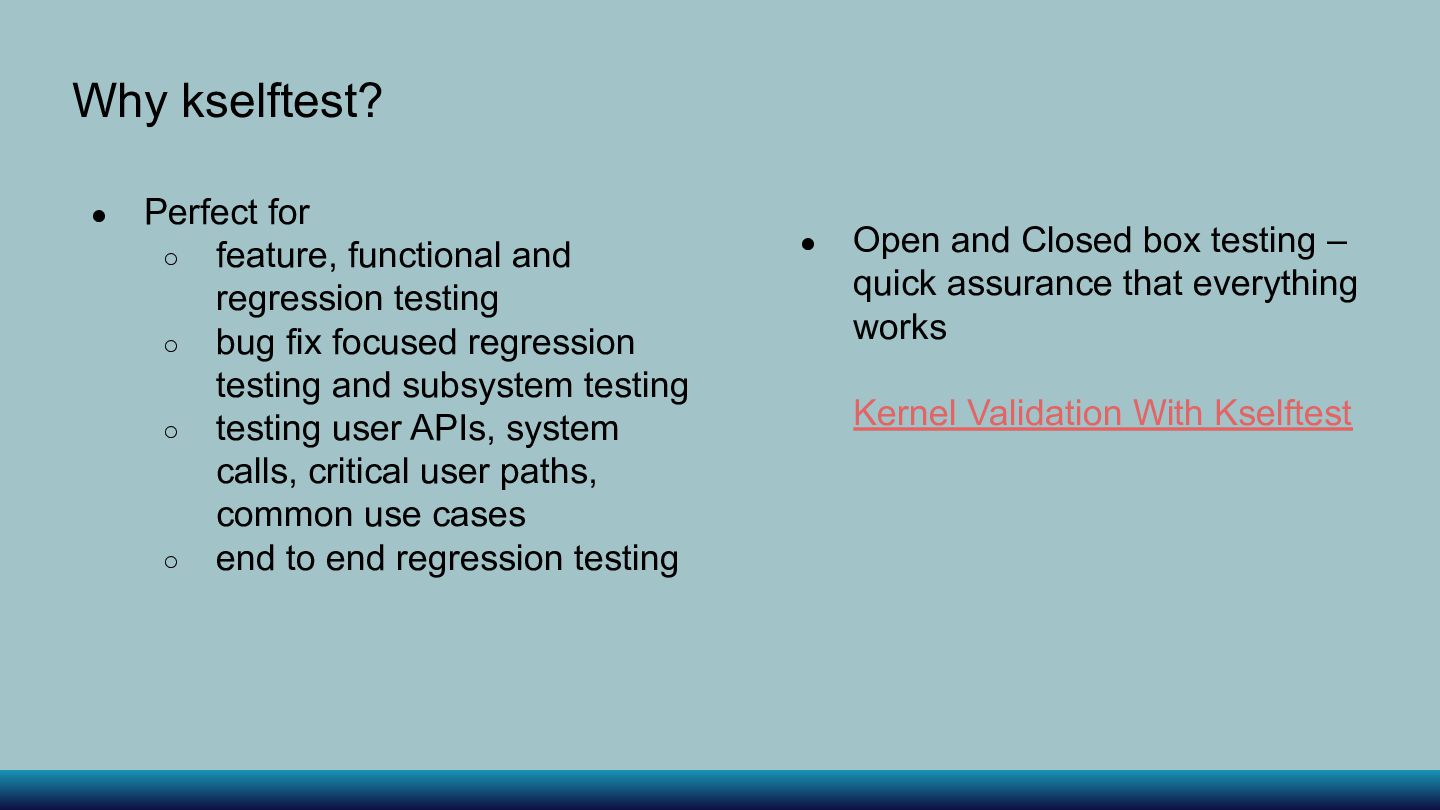
  6. Why kselftest? • Perfect for ◦ feature, functional and regression

    testing ◦ bug fix focused regression testing and subsystem testing ◦ testing user APIs, system calls, critical user paths, common use cases ◦ end to end regression testing • Open and Closed box testing – quick assurance that everything works Kernel Validation With Kselftest
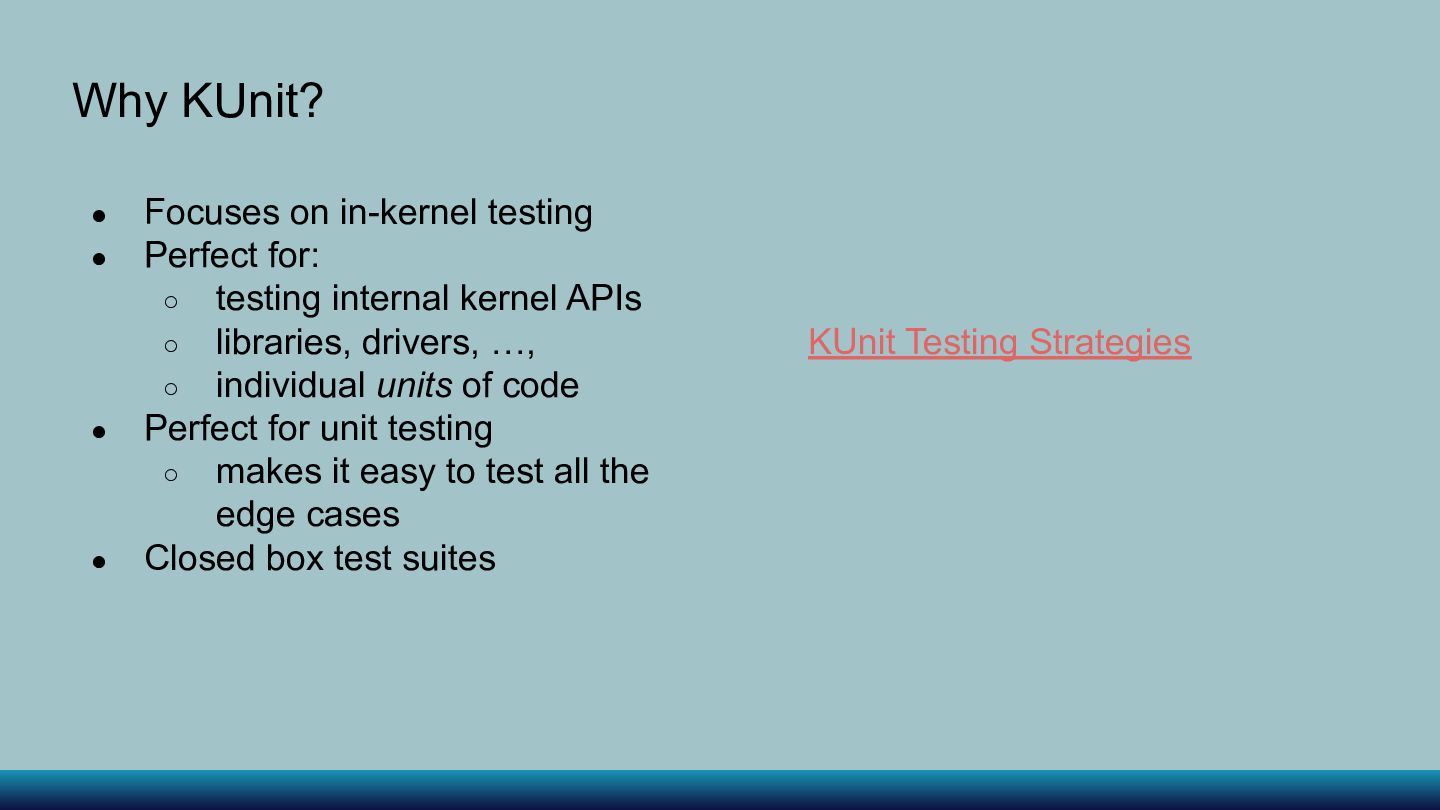
  7. Why KUnit? • • • • Focuses on in-kernel testing

    Perfect for: ◦ testing internal kernel APIs ◦ libraries, drivers, …, ◦ individual units of code Perfect for unit testing ◦ makes it easy to test all the edge cases Closed box test suites KUnit Testing Strategies
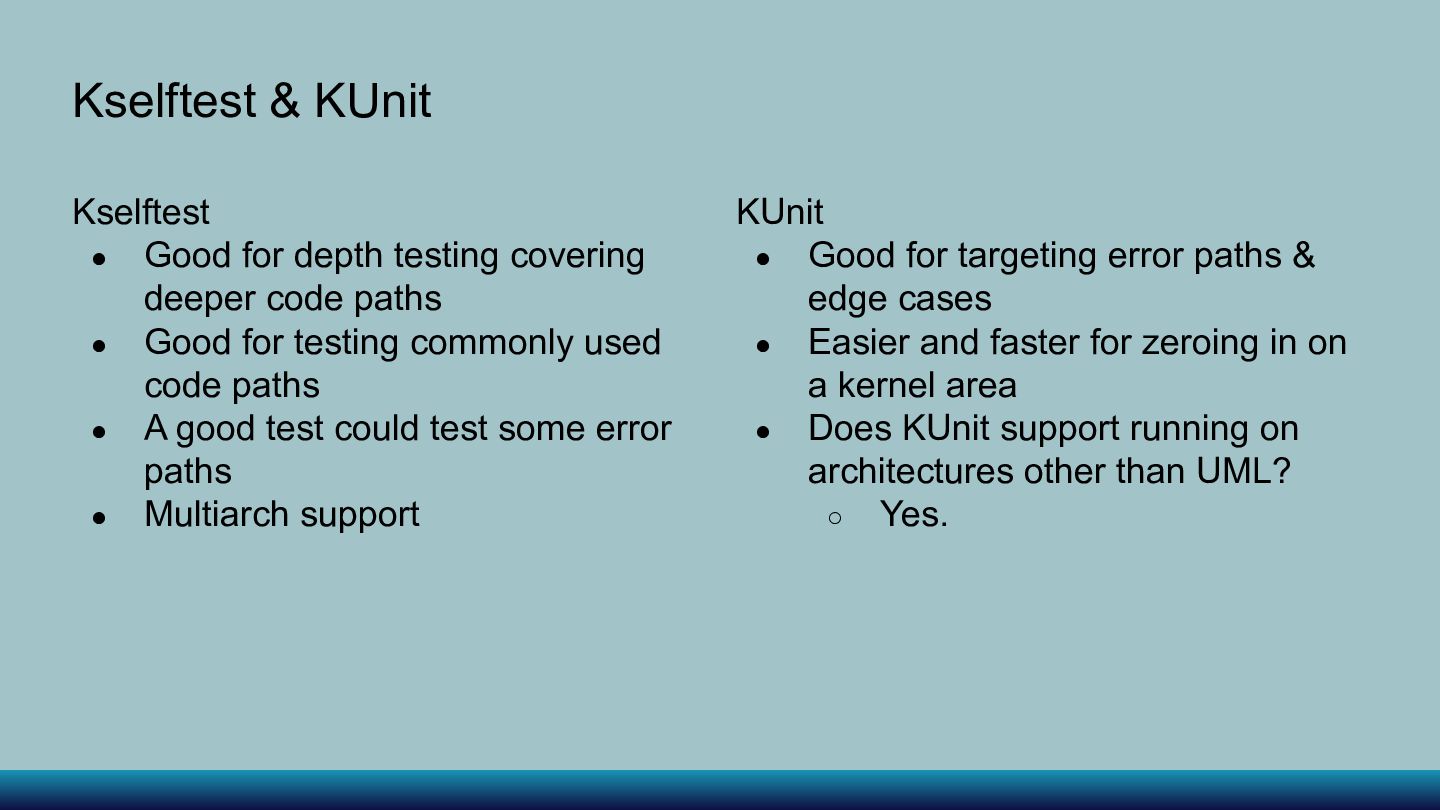
  8. Kselftest & KUnit Kselftest • Good for depth testing covering

    deeper code paths • Good for testing commonly used code paths • A good test could test some error paths • Multiarch support KUnit • Good for targeting error paths & edge cases • Easier and faster for zeroing in on a kernel area • Does KUnit support running on architectures other than UML? ◦ Yes.
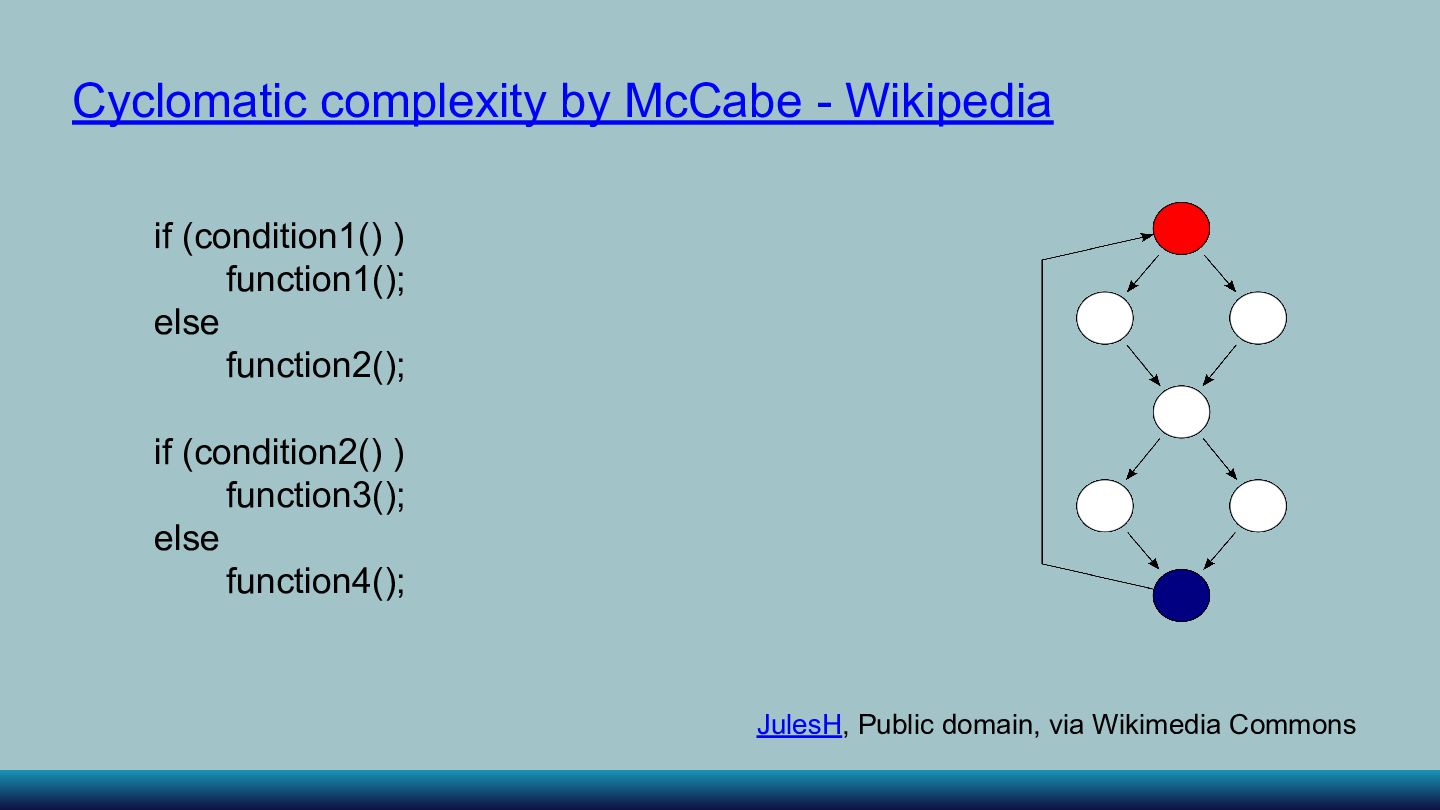
  9. Cyclomatic complexity by McCabe - Wikipedia if (condition1() ) function1();

    else function2(); if (condition2() ) function3(); else function4(); JulesH, Public domain, via Wikimedia Commons
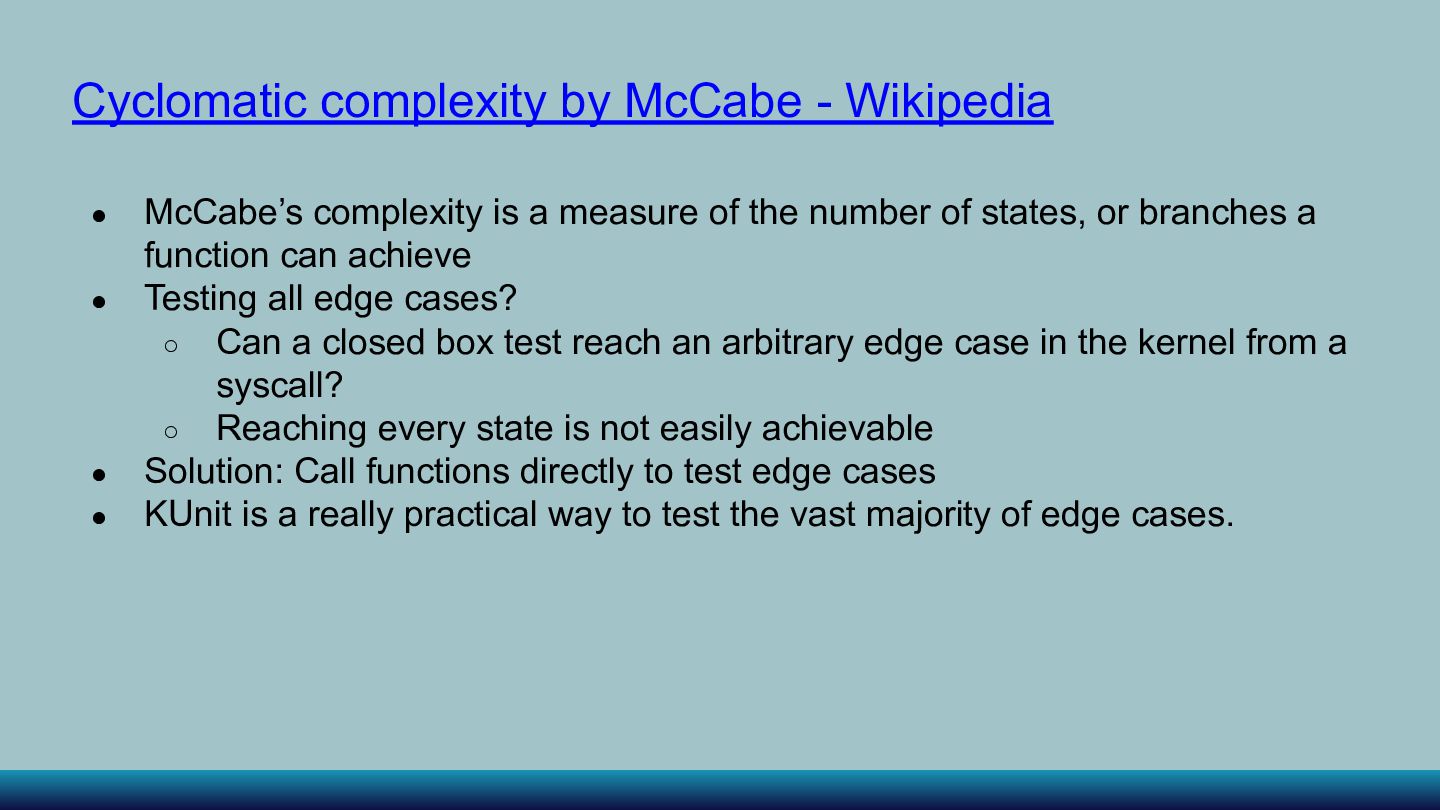
  10. Cyclomatic complexity by McCabe - Wikipedia • • • •

    McCabe’s complexity is a measure of the number of states, or branches a function can achieve Testing all edge cases? ◦ Can a closed box test reach an arbitrary edge case in the kernel from a syscall? ◦ Reaching every state is not easily achievable Solution: Call functions directly to test edge cases KUnit is a really practical way to test the vast majority of edge cases.
  11. Kernel Testing Guide • • • • Writing and Running

    Tests Kselftest vs. KUnit Which one to choose? How to choose?
  12. Choosing a framework • • • • • • •

    What are the goals? Regression testing? Closed or open box Are there any user-space interaction? Is it a unit test? What about multi-arch support? What about code coverage?
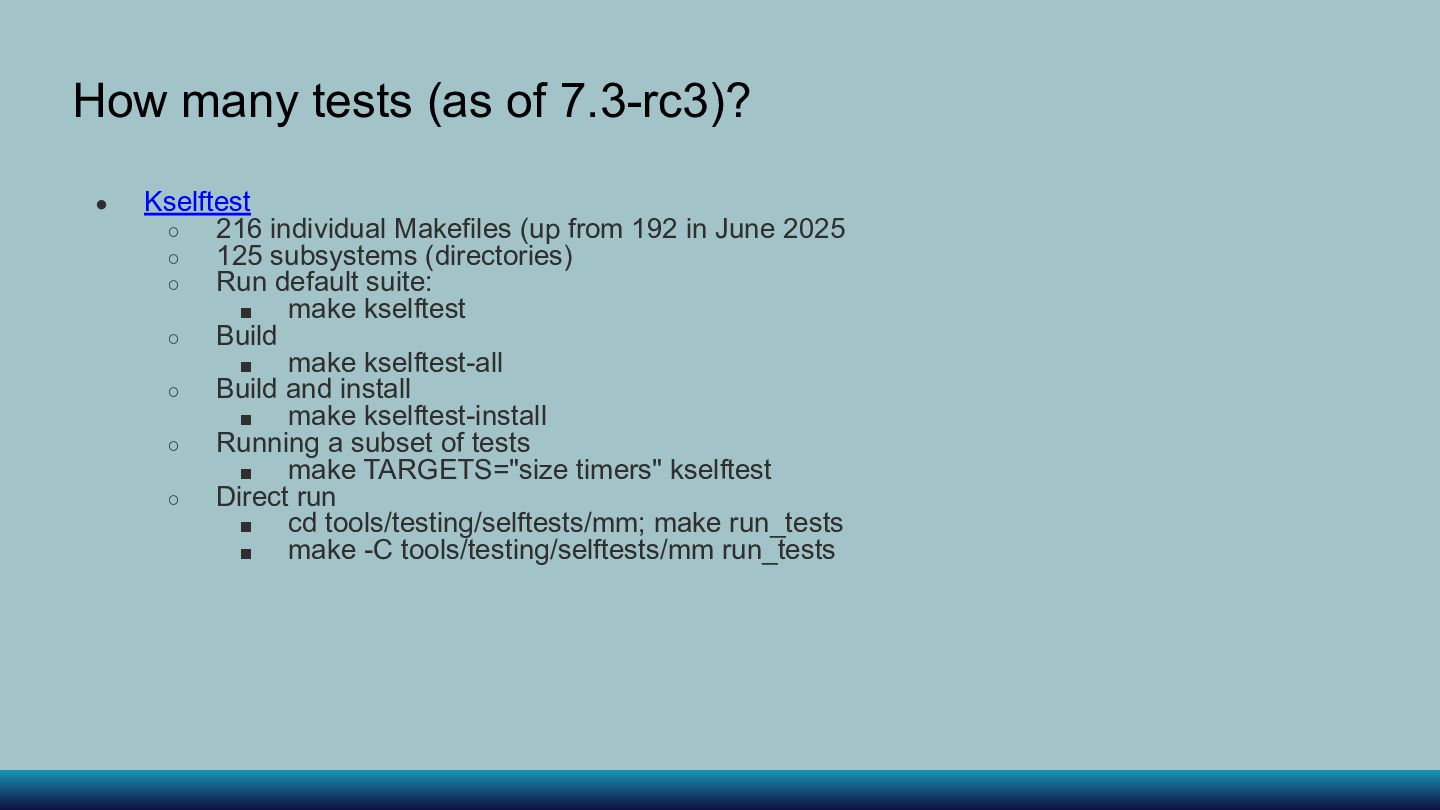
  13. How many tests (as of 7.3-rc3)? • Kselftest ◦ 216

    individual Makefiles (up from 192 in June 2025 ◦ 125 subsystems (directories) ◦ Run default suite: ▪ make kselftest ◦ Build ▪ make kselftest-all ◦ Build and install ▪ make kselftest-install ◦ Running a subset of tests ▪ make TARGETS="size timers" kselftest ◦ Direct run ▪ cd tools/testing/selftests/mm; make run_tests ▪ make -C tools/testing/selftests/mm run_tests
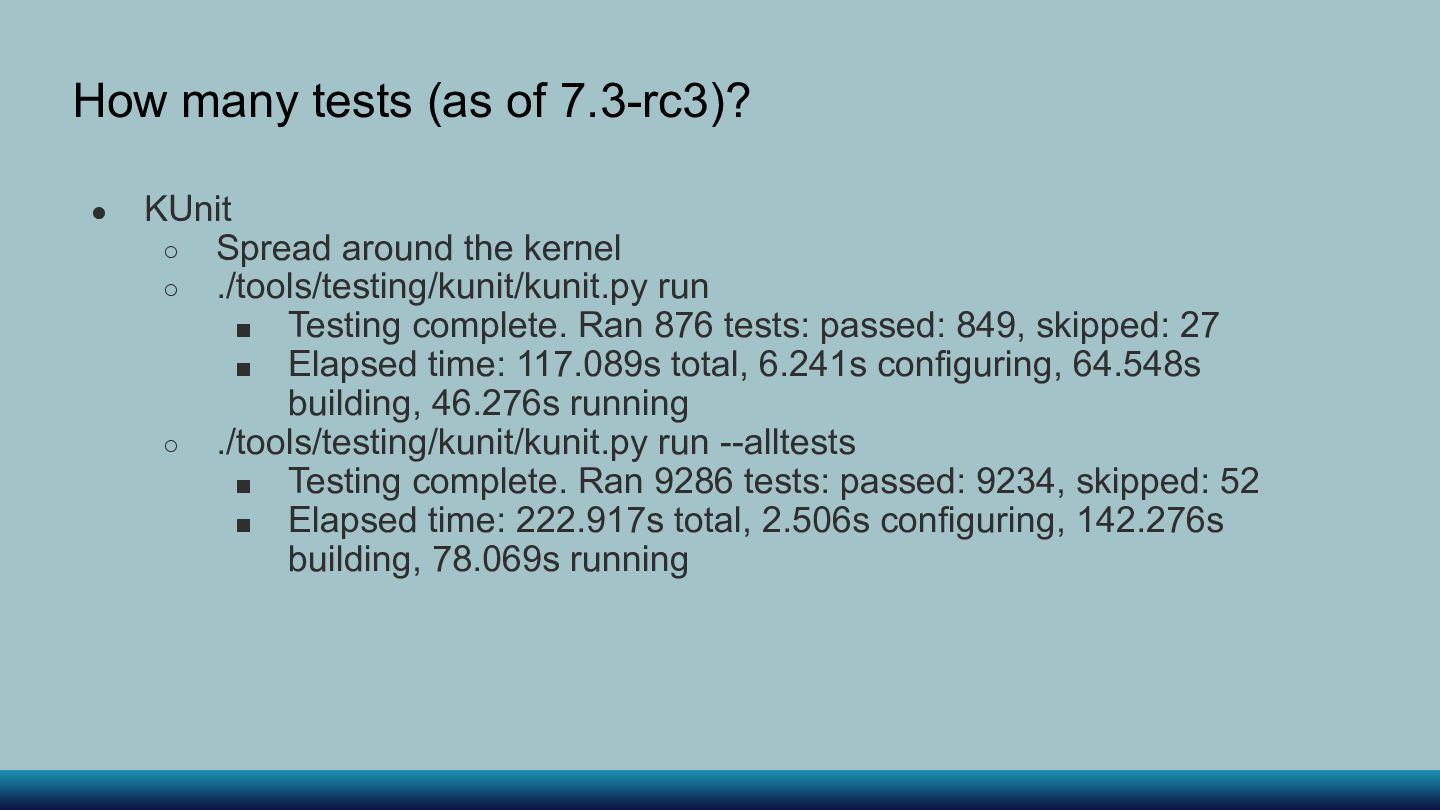
  14. How many tests (as of 7.3-rc3)? • KUnit ◦ Spread

    around the kernel ◦ ./tools/testing/kunit/kunit.py run ▪ Testing complete. Ran 876 tests: passed: 849, skipped: 27 ▪ Elapsed time: 117.089s total, 6.241s configuring, 64.548s building, 46.276s running ◦ ./tools/testing/kunit/kunit.py run --alltests ▪ Testing complete. Ran 9286 tests: passed: 9234, skipped: 52 ▪ Elapsed time: 222.917s total, 2.506s configuring, 142.276s building, 78.069s running
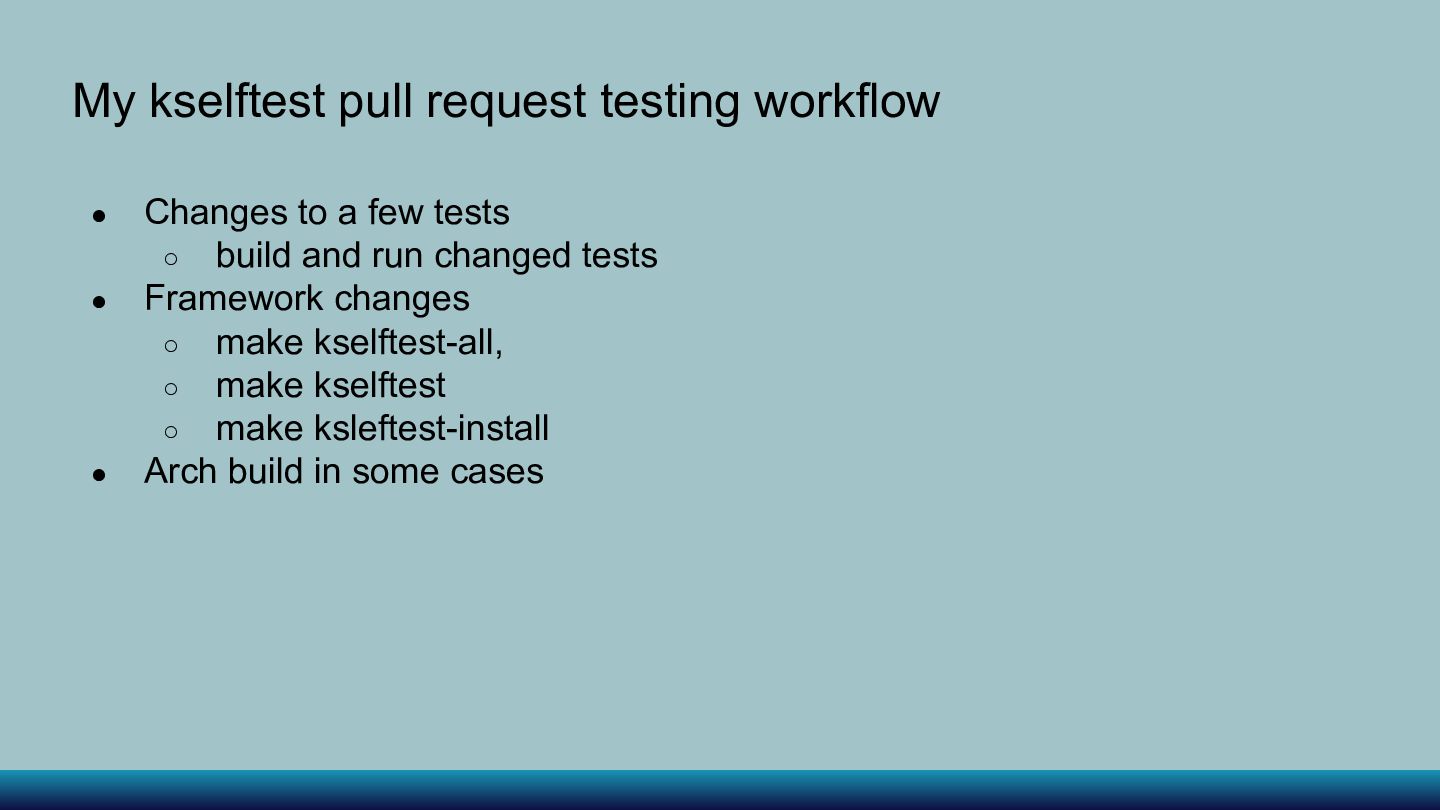
  15. My kselftest pull request testing workflow • • • Changes

    to a few tests ◦ build and run changed tests Framework changes ◦ make kselftest-all, ◦ make kselftest ◦ make ksleftest-install Arch build in some cases
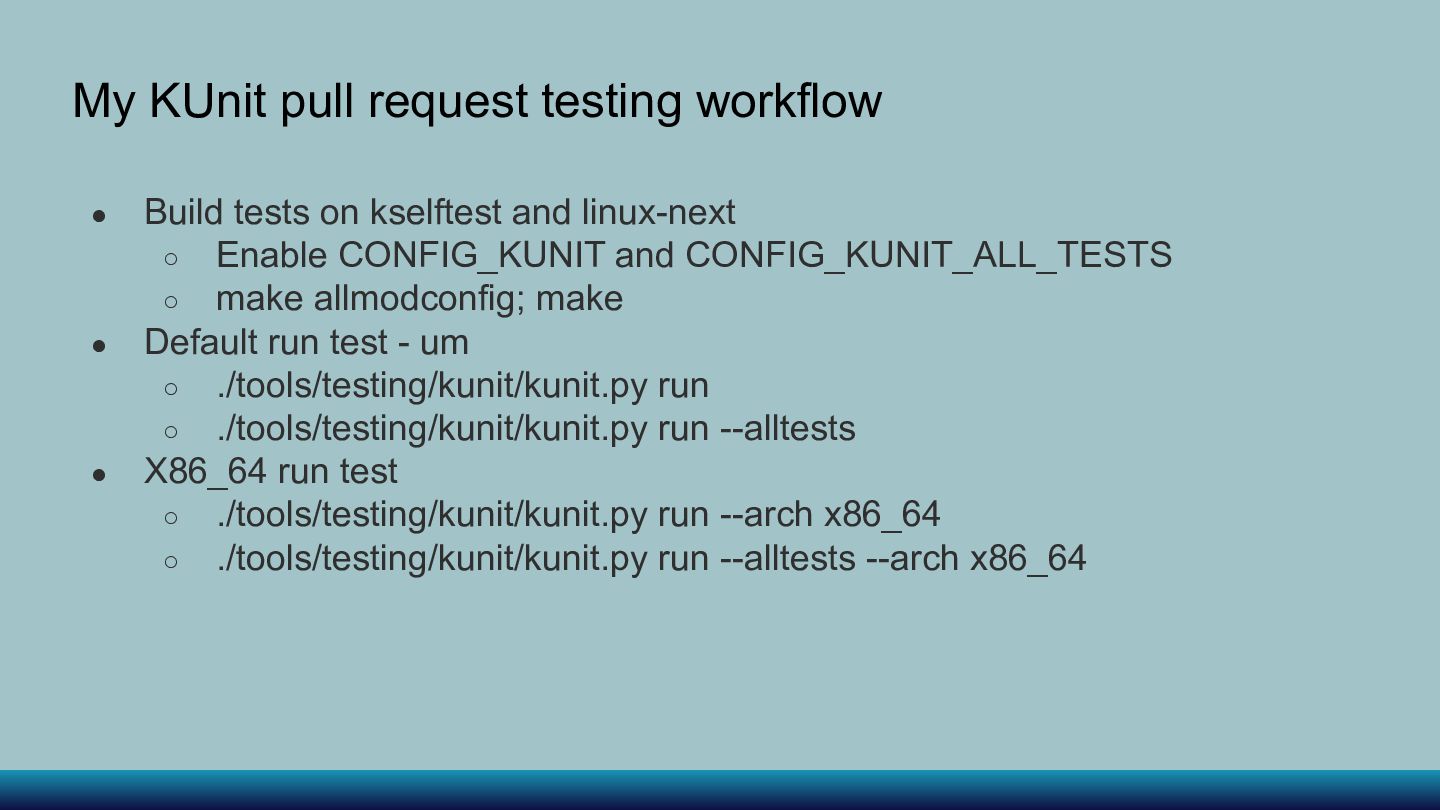
  16. My KUnit pull request testing workflow • • • Build

    tests on kselftest and linux-next ◦ Enable CONFIG_KUNIT and CONFIG_KUNIT_ALL_TESTS ◦ make allmodconfig; make Default run test - um ◦ ./tools/testing/kunit/kunit.py run ◦ ./tools/testing/kunit/kunit.py run --alltests X86_64 run test ◦ ./tools/testing/kunit/kunit.py run --arch x86_64 ◦ ./tools/testing/kunit/kunit.py run --alltests --arch x86_64
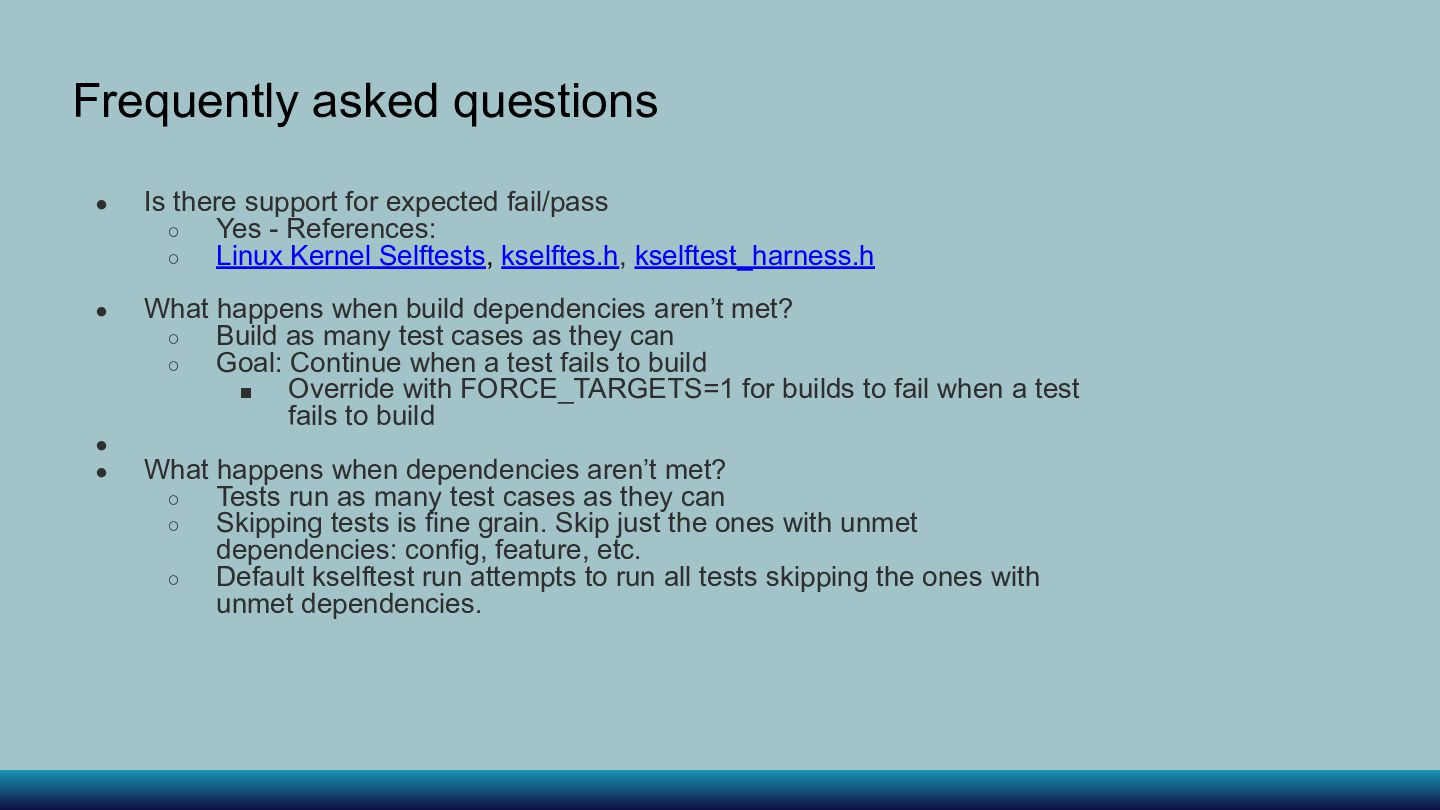
  17. Frequently asked questions • Is there support for expected fail/pass

    ◦ Yes - References: ◦ Linux Kernel Selftests, kselftes.h, kselftest_harness.h • What happens when build dependencies aren’t met? ◦ Build as many test cases as they can ◦ Goal: Continue when a test fails to build ▪ Override with FORCE_TARGETS=1 for builds to fail when a test fails to build • • What happens when dependencies aren’t met? ◦ Tests run as many test cases as they can ◦ Skipping tests is fine grain. Skip just the ones with unmet dependencies: config, feature, etc. ◦ Default kselftest run attempts to run all tests skipping the ones with unmet dependencies.
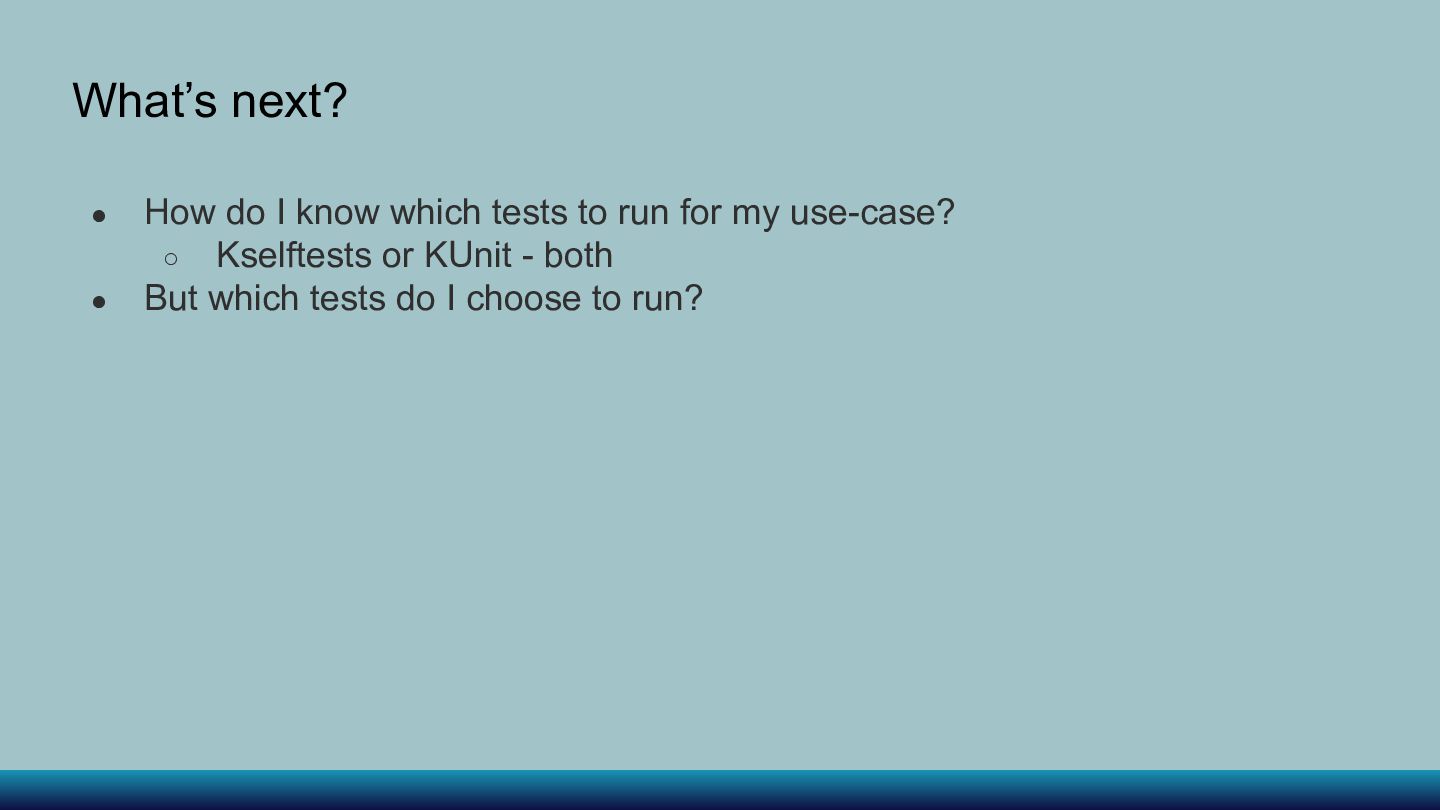
  18. What’s next? • • How do I know which tests

    to run for my use-case? ◦ Kselftests or KUnit - both But which tests do I choose to run?
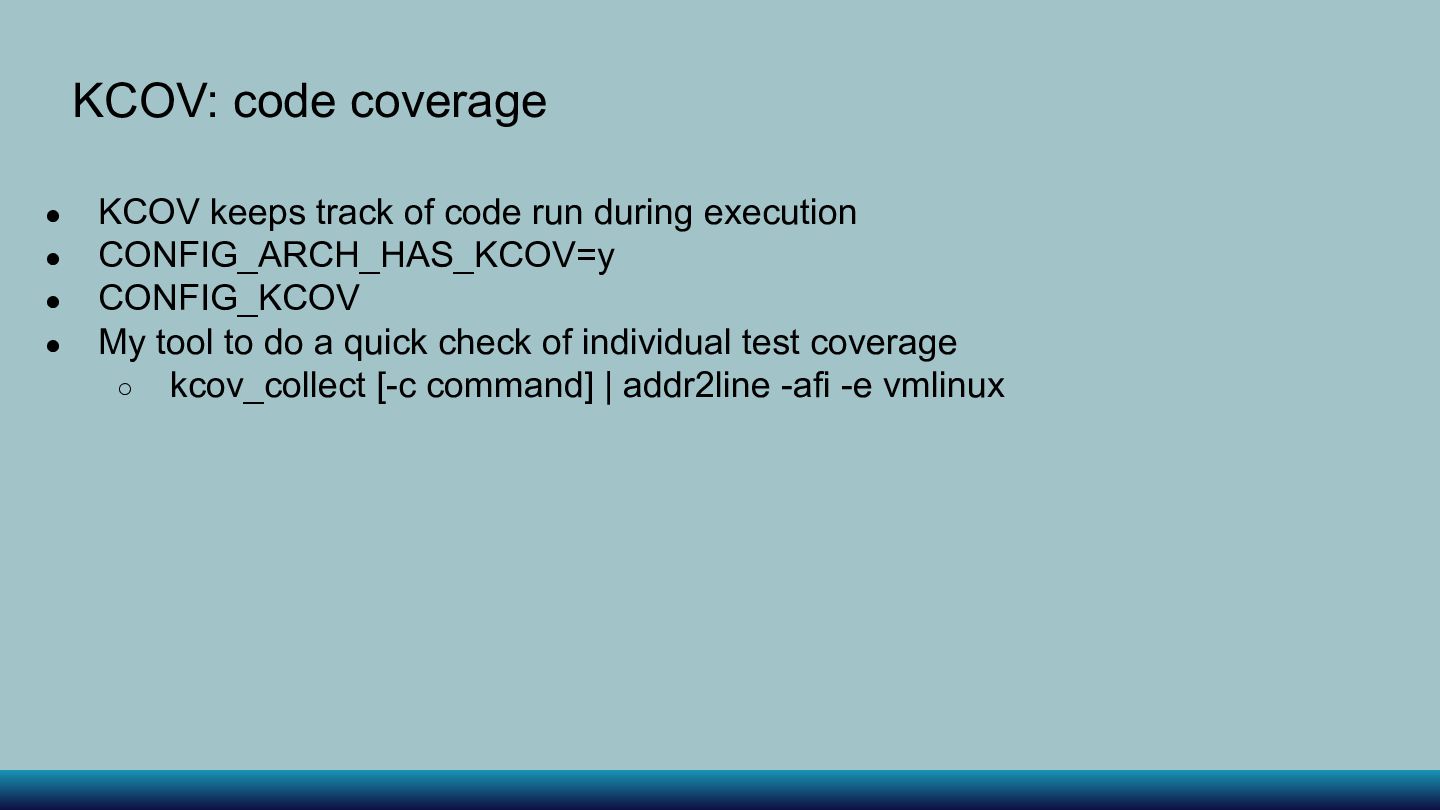
  19. KCOV: code coverage • • • • KCOV keeps track

    of code run during execution CONFIG_ARCH_HAS_KCOV=y CONFIG_KCOV My tool to do a quick check of individual test coverage ◦ kcov_collect [-c command] | addr2line -afi -e vmlinux
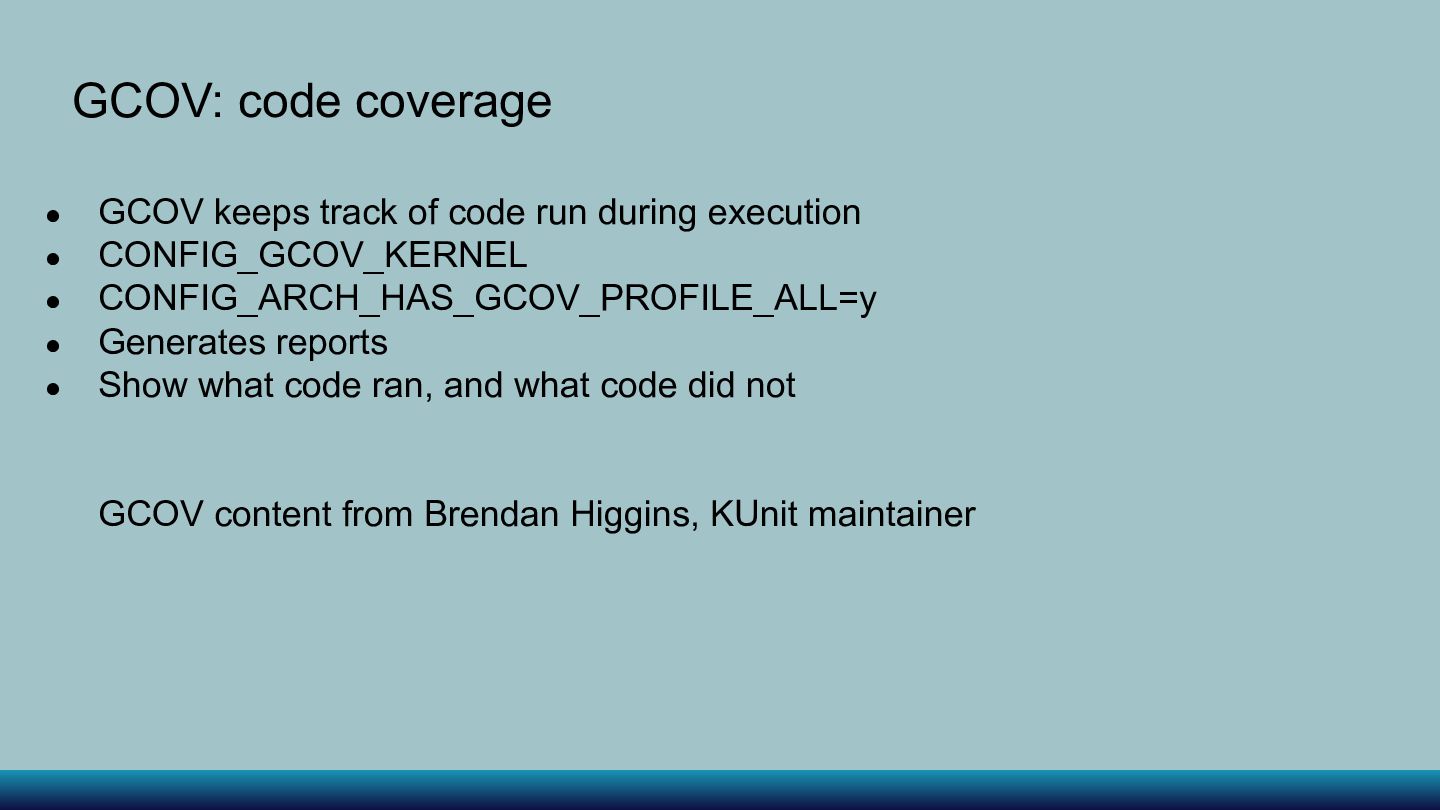
  20. GCOV: code coverage • • • • • GCOV keeps

    track of code run during execution CONFIG_GCOV_KERNEL CONFIG_ARCH_HAS_GCOV_PROFILE_ALL=y Generates reports Show what code ran, and what code did not GCOV content from Brendan Higgins, KUnit maintainer
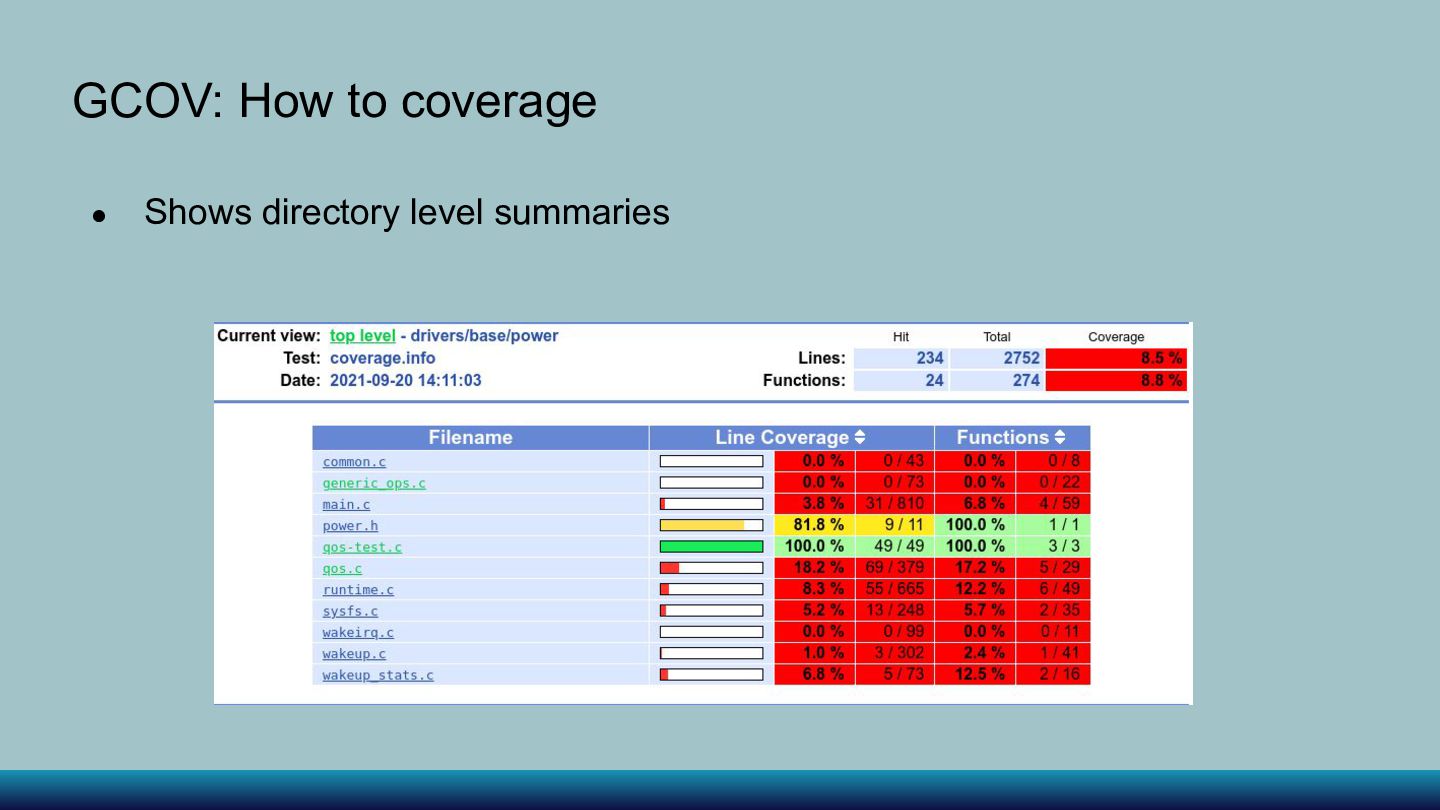
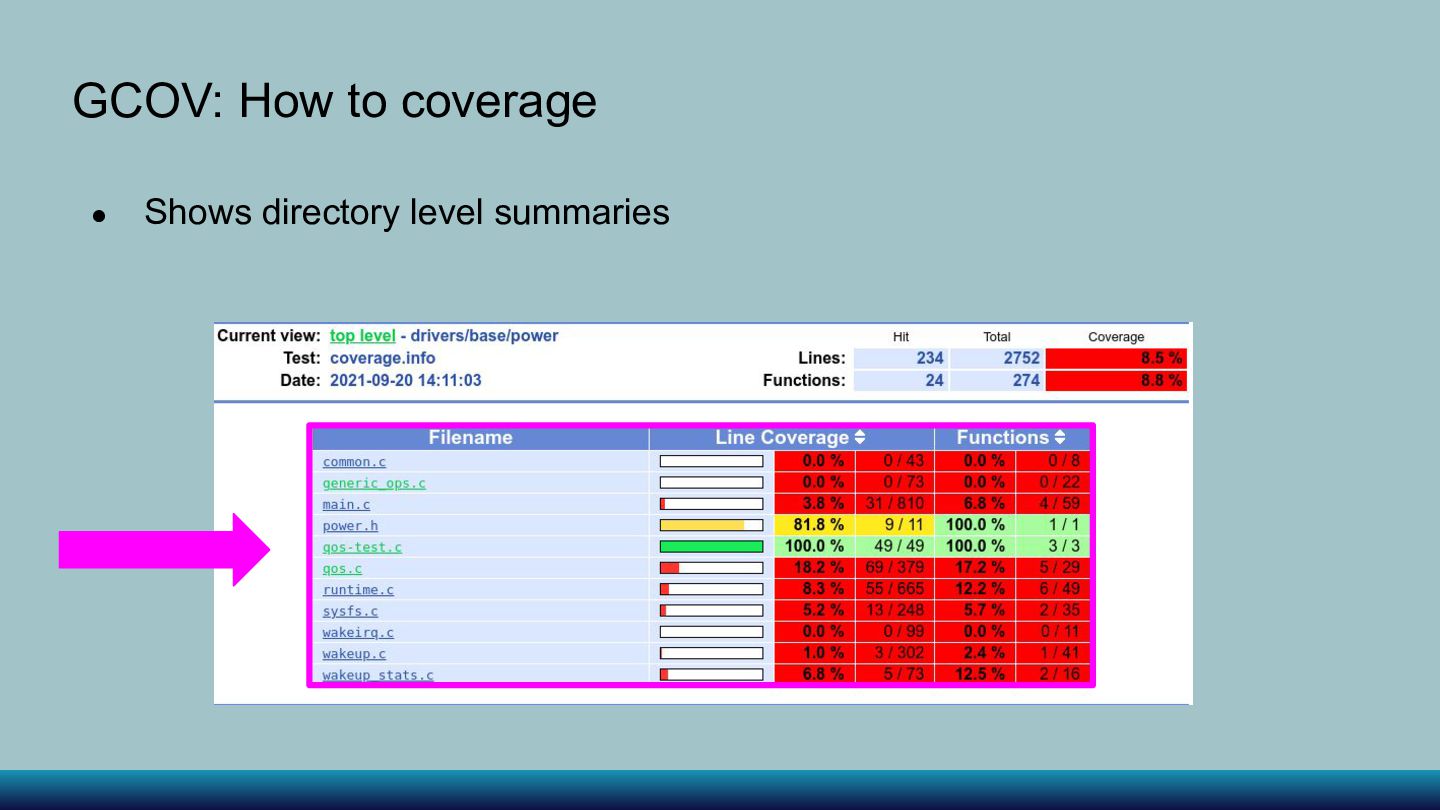
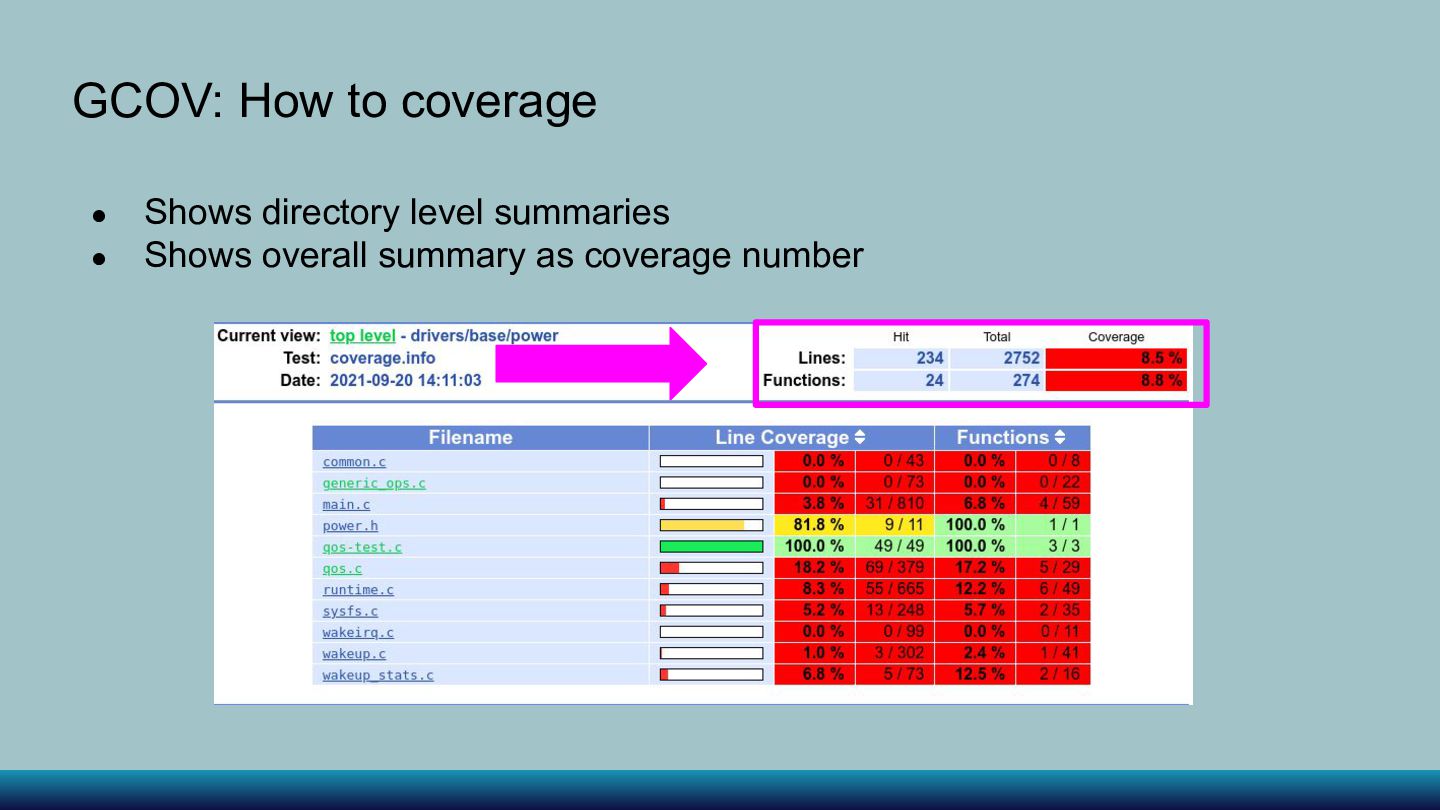
  21. GCOV: How to coverage • • Shows directory level summaries

    Shows overall summary as coverage number
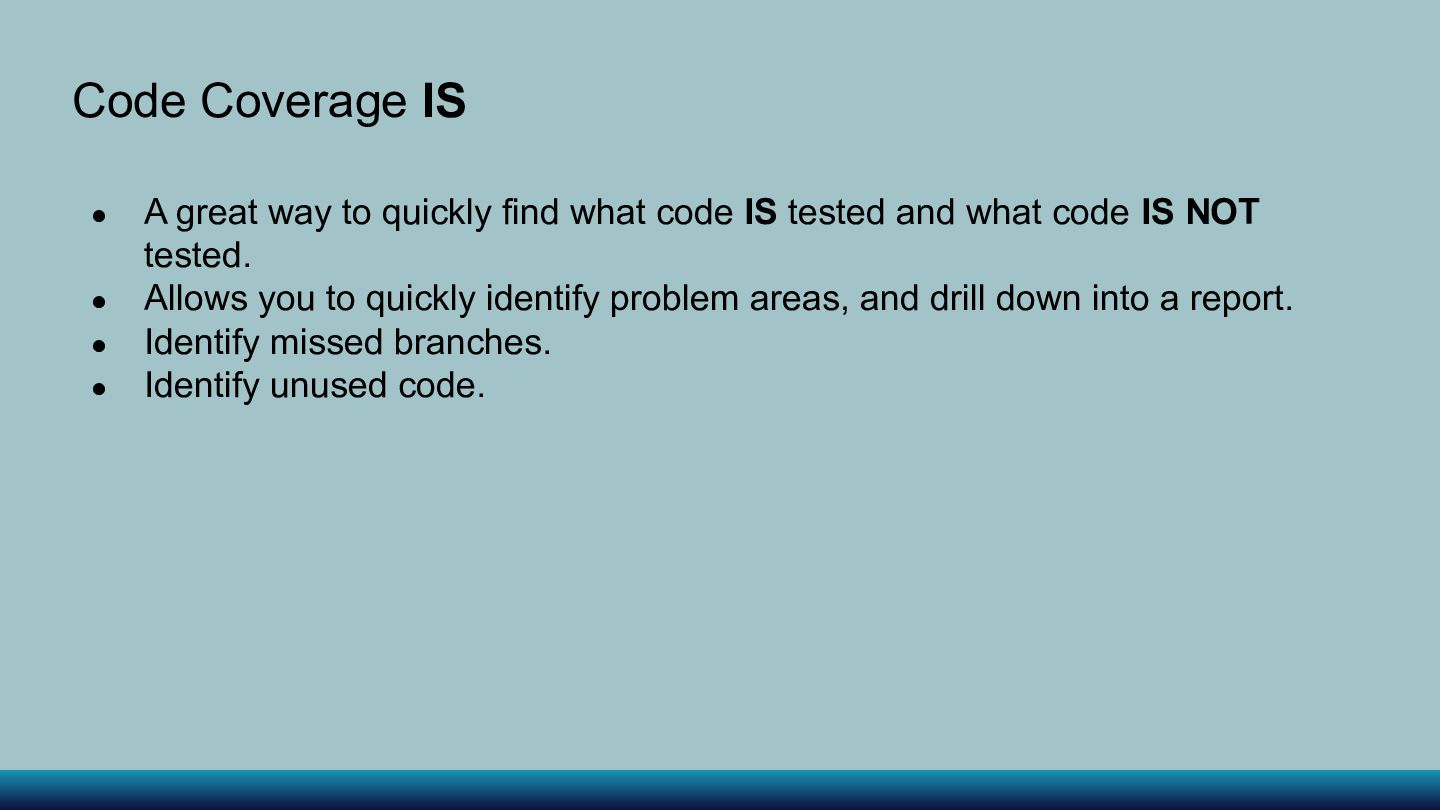
  22. Code Coverage IS • • • • A great way

    to quickly find what code IS tested and what code IS NOT tested. Allows you to quickly identify problem areas, and drill down into a report. Identify missed branches. Identify unused code.
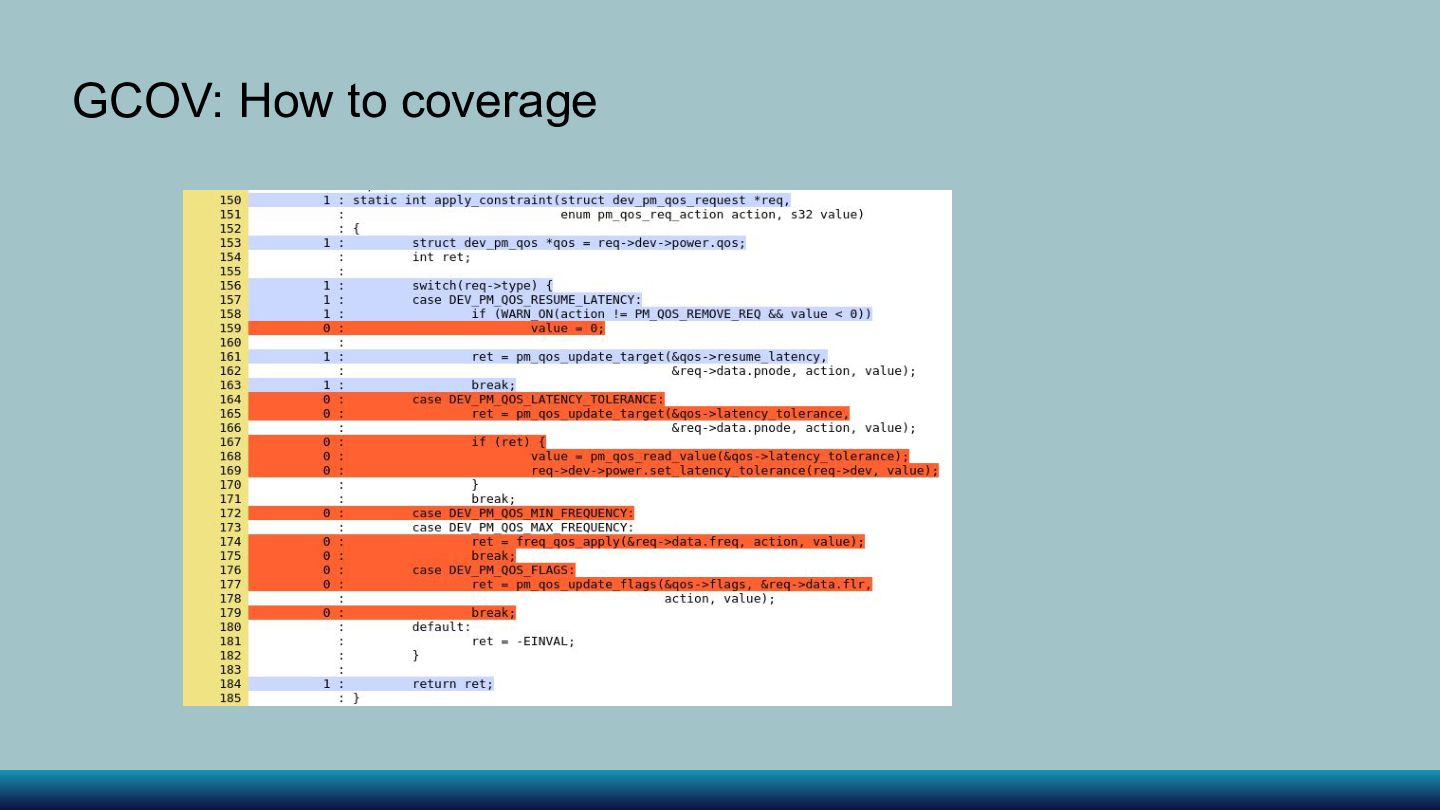
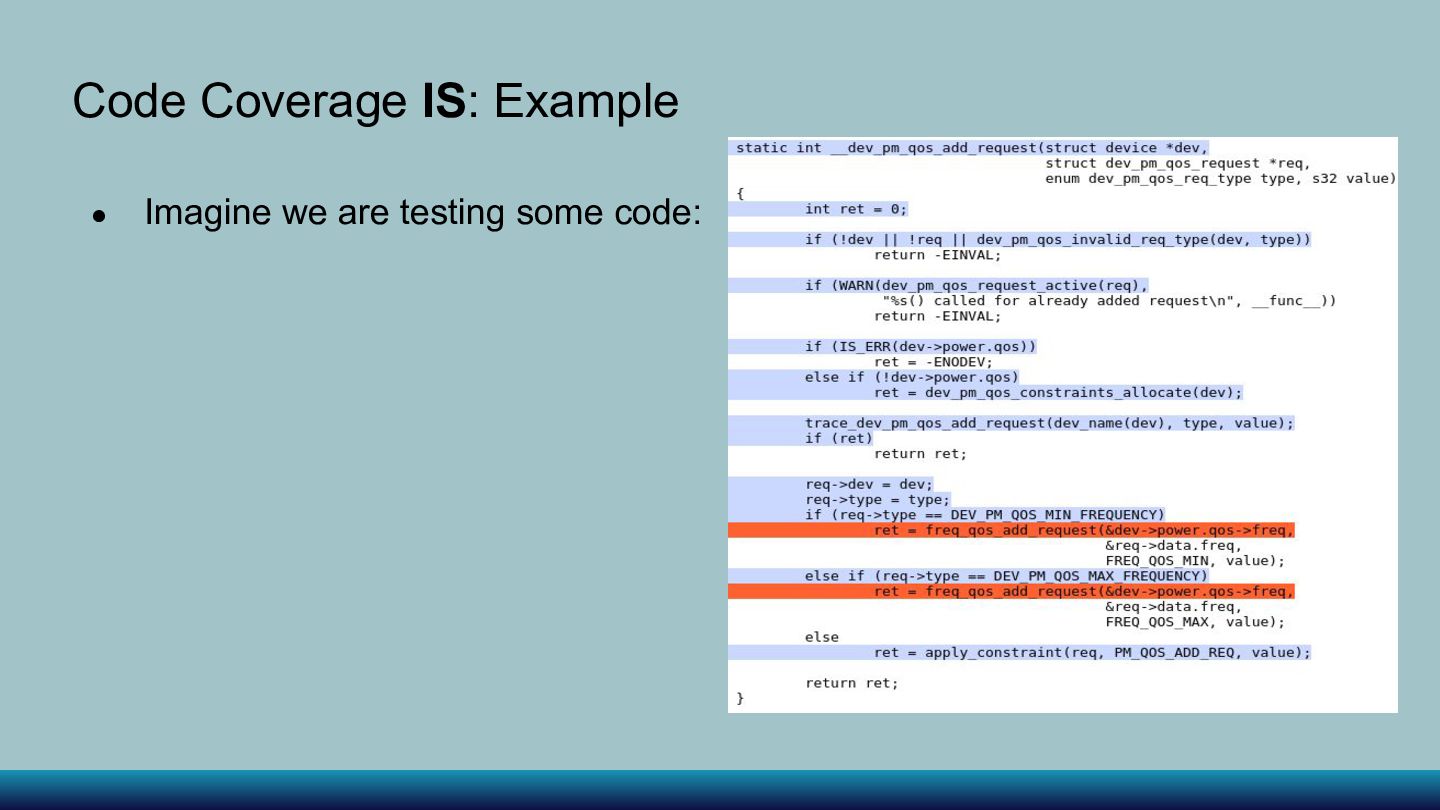
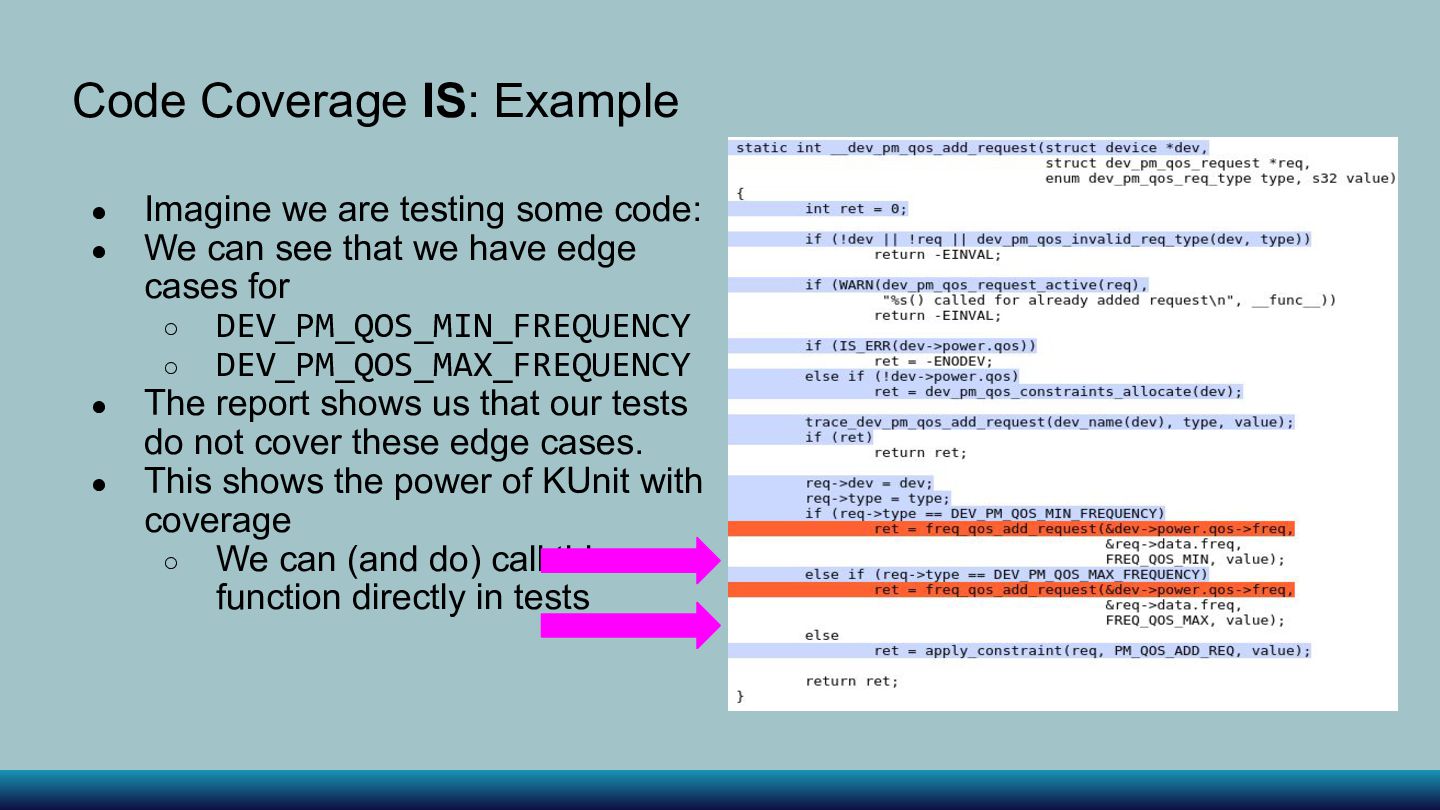
  23. Code Coverage IS: Example • • • Imagine we are

    testing some code: We can see that we have edge cases for ◦ DEV_PM_QOS_MIN_FREQUENCY ◦ DEV_PM_QOS_MAX_FREQUENCY
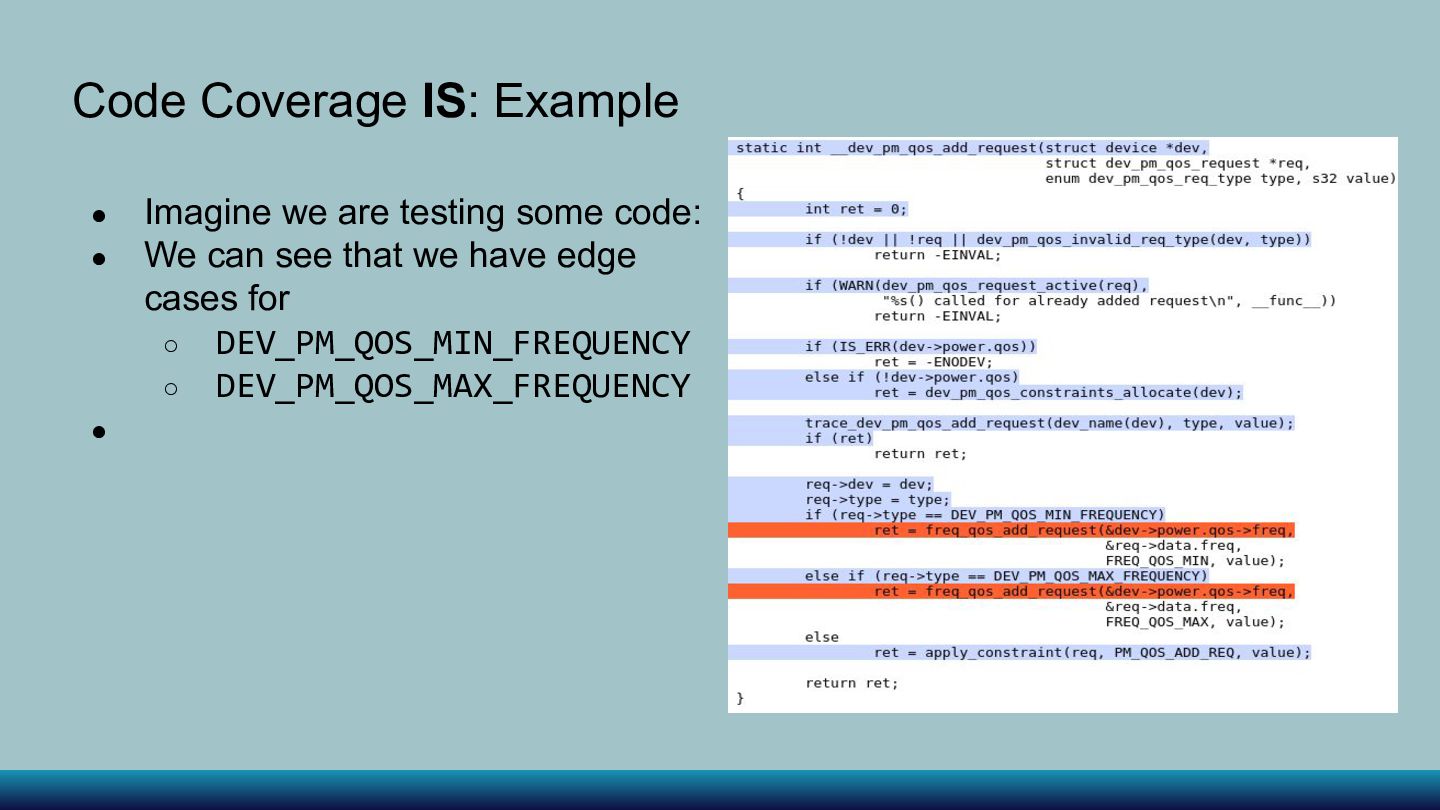
  24. Code Coverage IS: Example • • • Imagine we are

    testing some code: We can see that we have edge cases for ◦ DEV_PM_QOS_MIN_FREQUENCY ◦ DEV_PM_QOS_MAX_FREQUENCY The report shows us that our tests do not cover these edge cases.
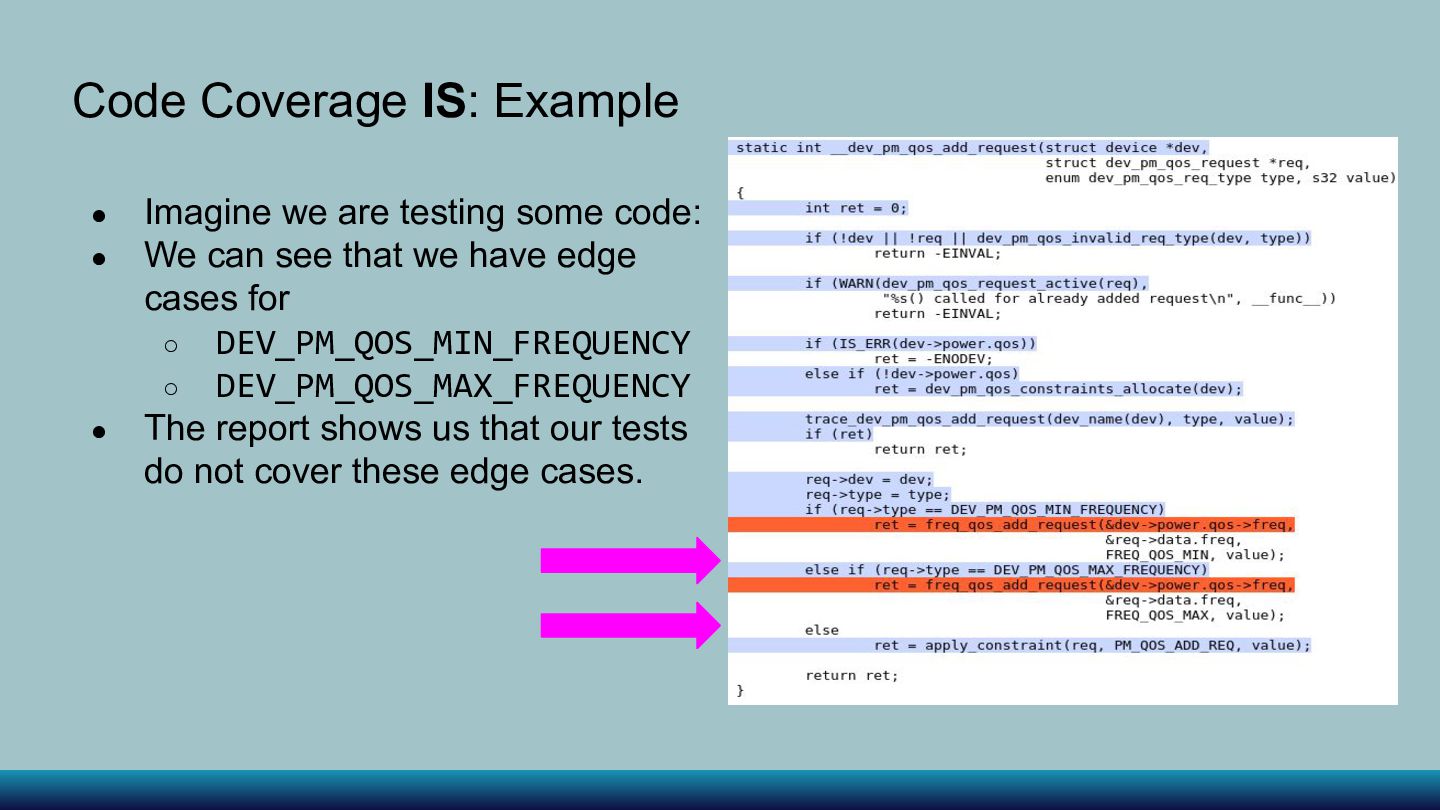
  25. Code Coverage IS: Example • • • • Imagine we

    are testing some code: We can see that we have edge cases for ◦ DEV_PM_QOS_MIN_FREQUENCY ◦ DEV_PM_QOS_MAX_FREQUENCY The report shows us that our tests do not cover these edge cases. This shows the power of KUnit with coverage ◦ We can (and do) call this function directly in tests
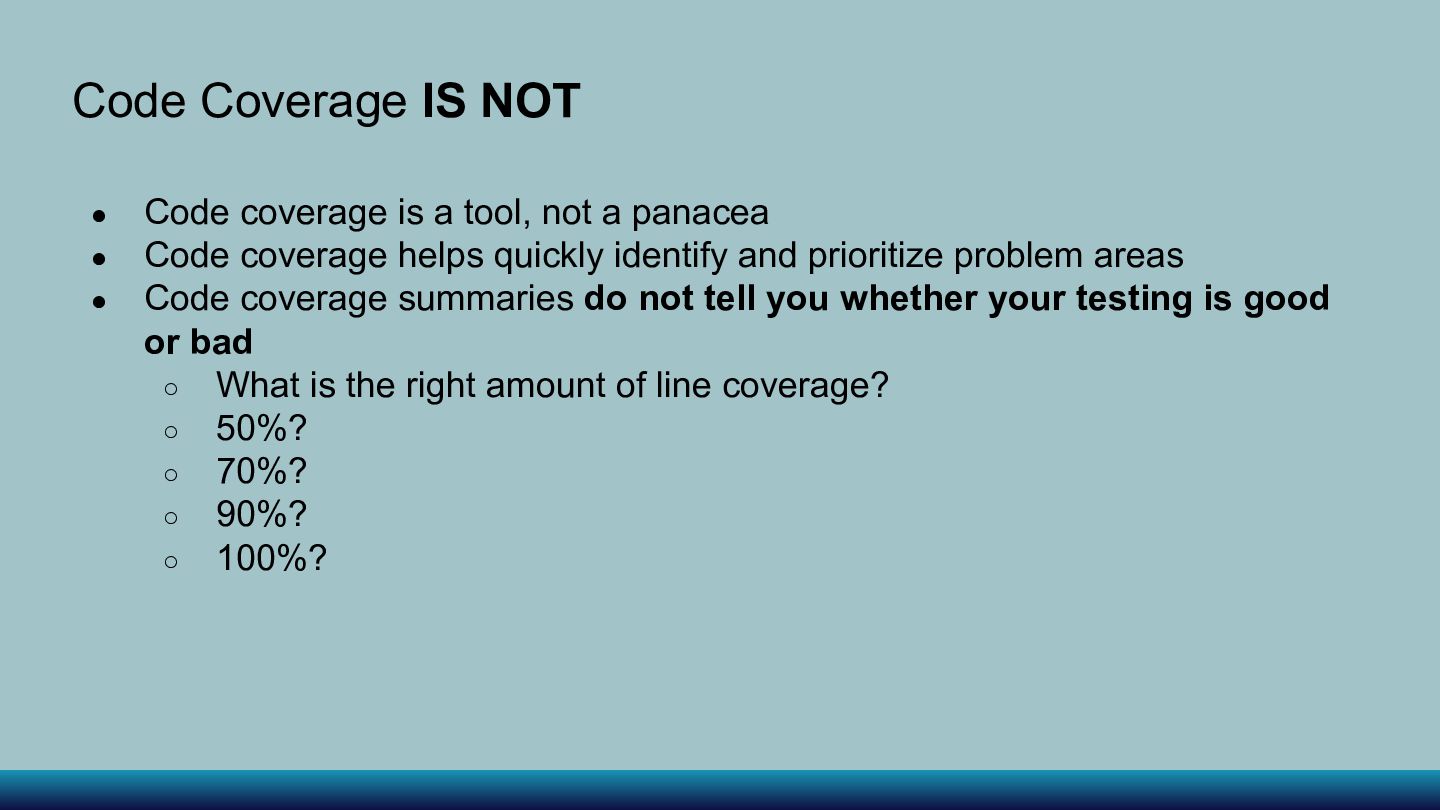
  26. Code Coverage IS NOT • • • Code coverage is

    a tool, not a panacea Code coverage helps quickly identify and prioritize problem areas Code coverage summaries do not tell you whether your testing is good or bad ◦ What is the right amount of line coverage? ◦ 50%? ◦ 70%? ◦ 90%? ◦ 100%?
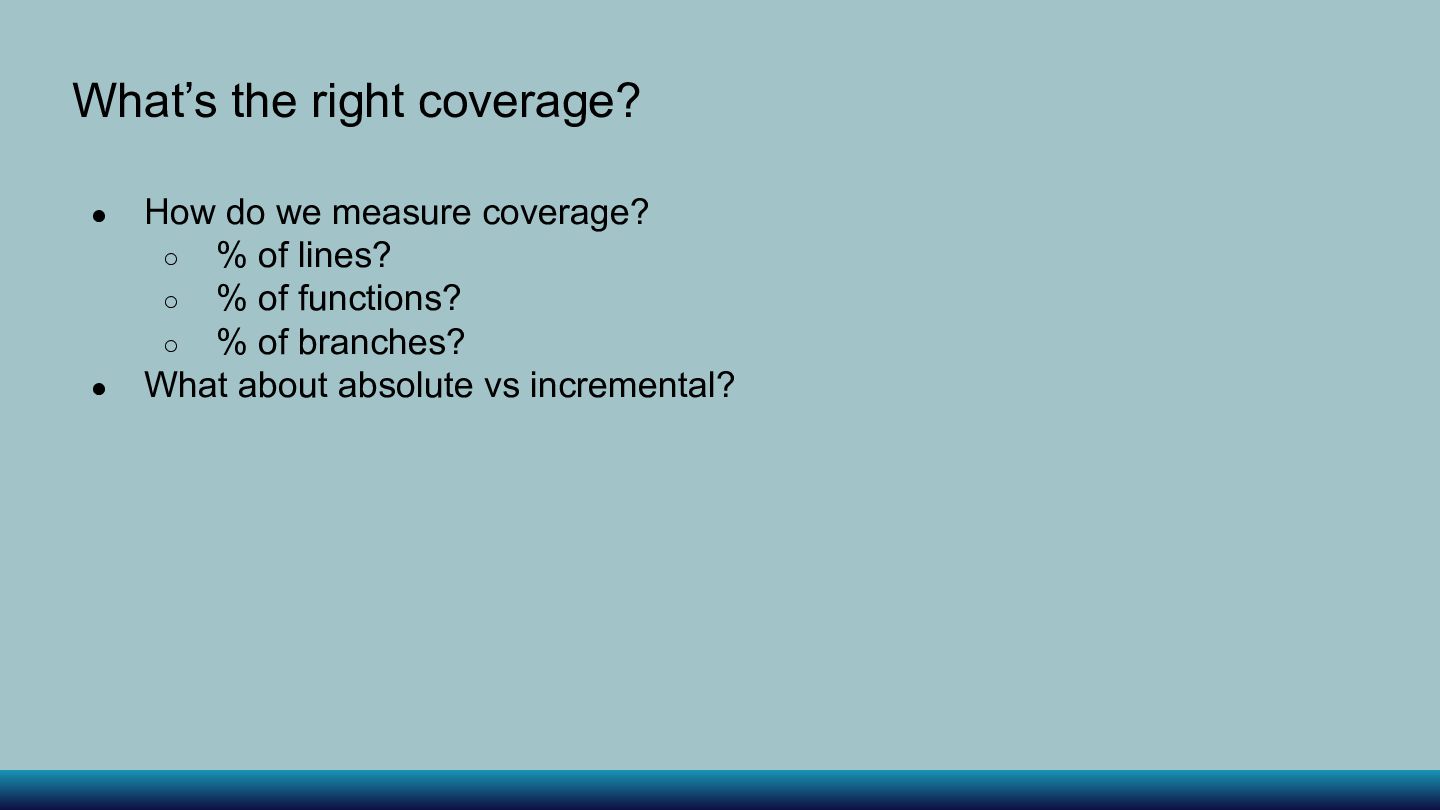
  27. What’s the right coverage? • • How do we measure

    coverage? ◦ % of lines? ◦ % of functions? ◦ % of branches? What about absolute vs incremental?
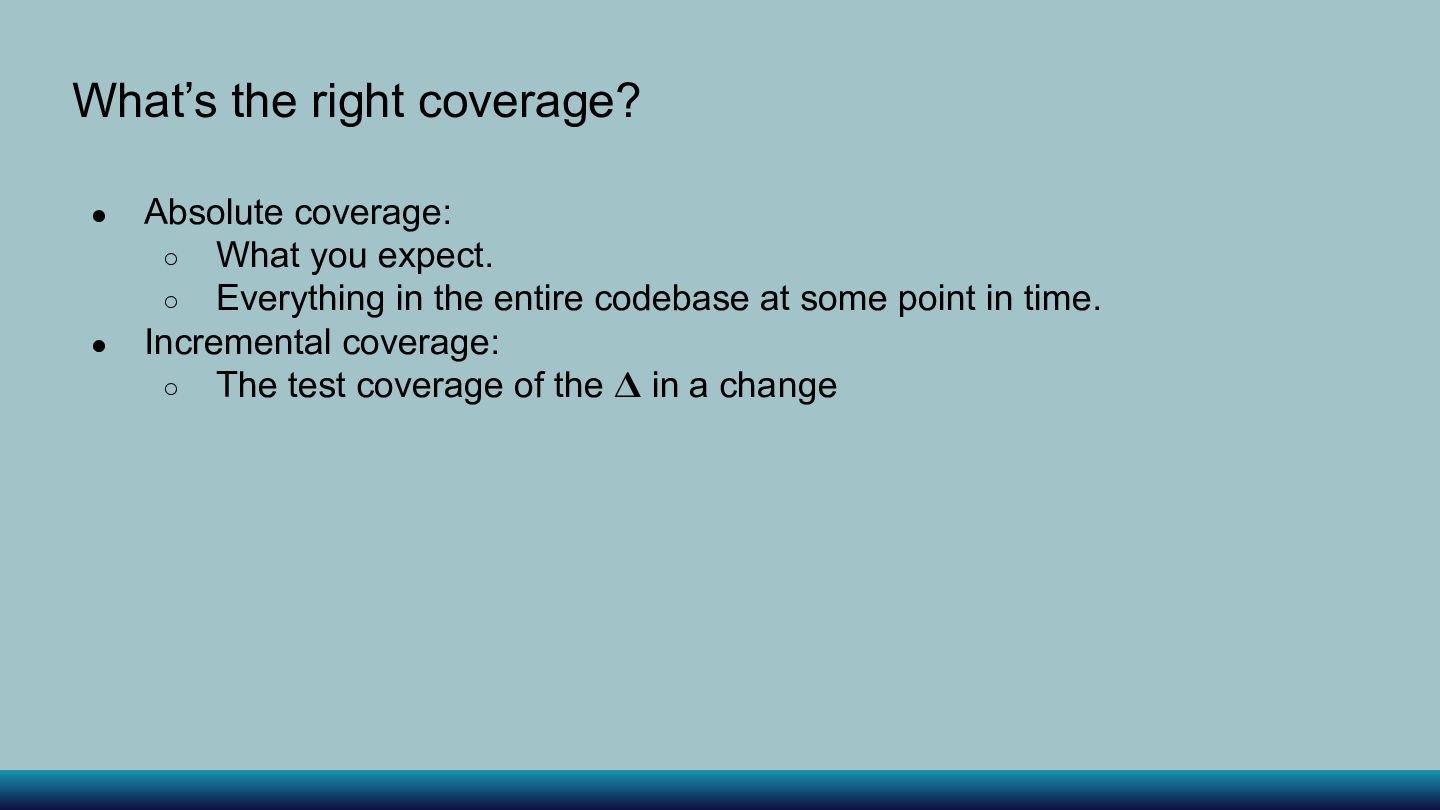
  28. What’s the right coverage? • • Absolute coverage: ◦ What

    you expect. ◦ Everything in the entire codebase at some point in time. Incremental coverage: ◦ The test coverage of the 𝚫 in a change
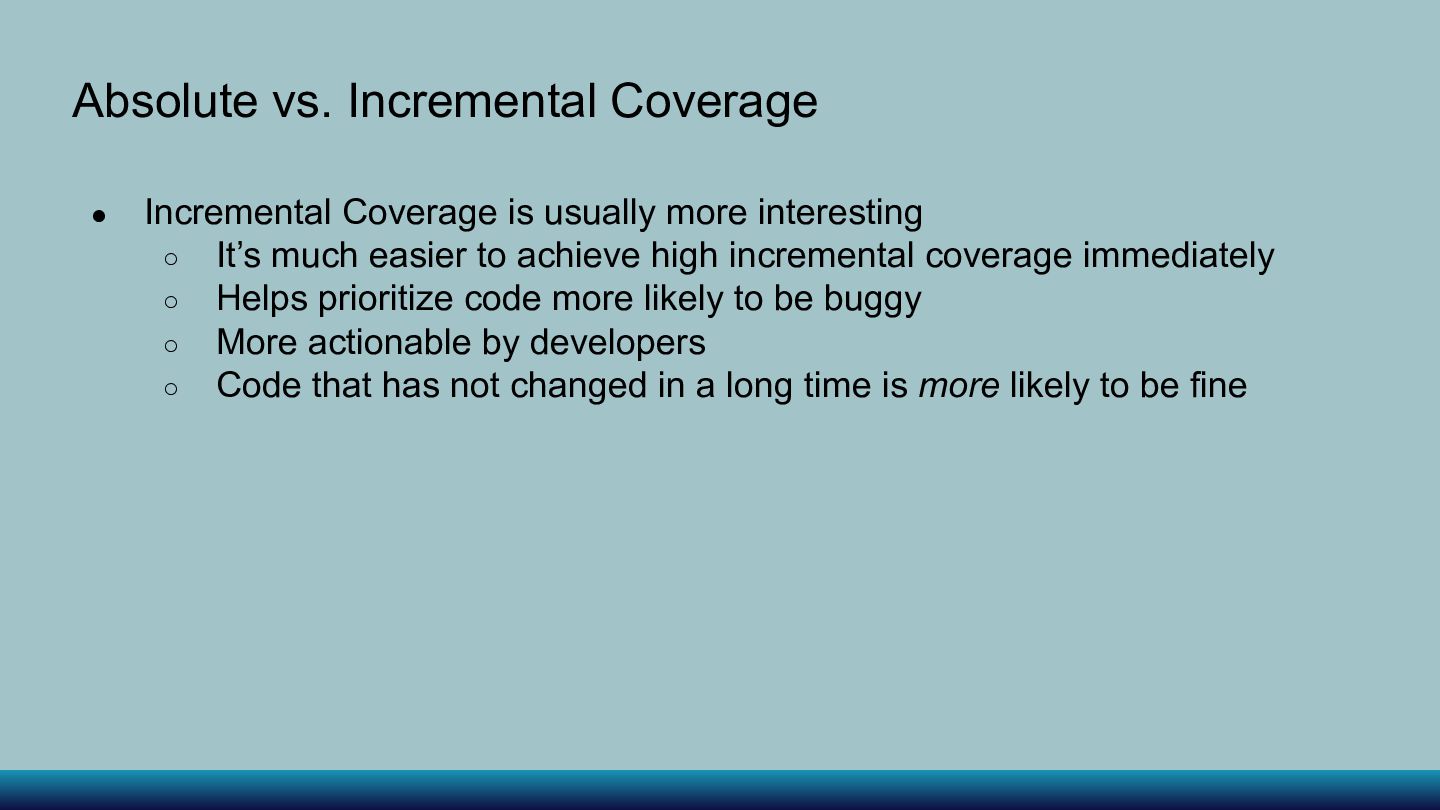
  29. Absolute vs. Incremental Coverage • Incremental Coverage is usually more

    interesting ◦ It’s much easier to achieve high incremental coverage immediately ◦ Helps prioritize code more likely to be buggy ◦ More actionable by developers ◦ Code that has not changed in a long time is more likely to be fine
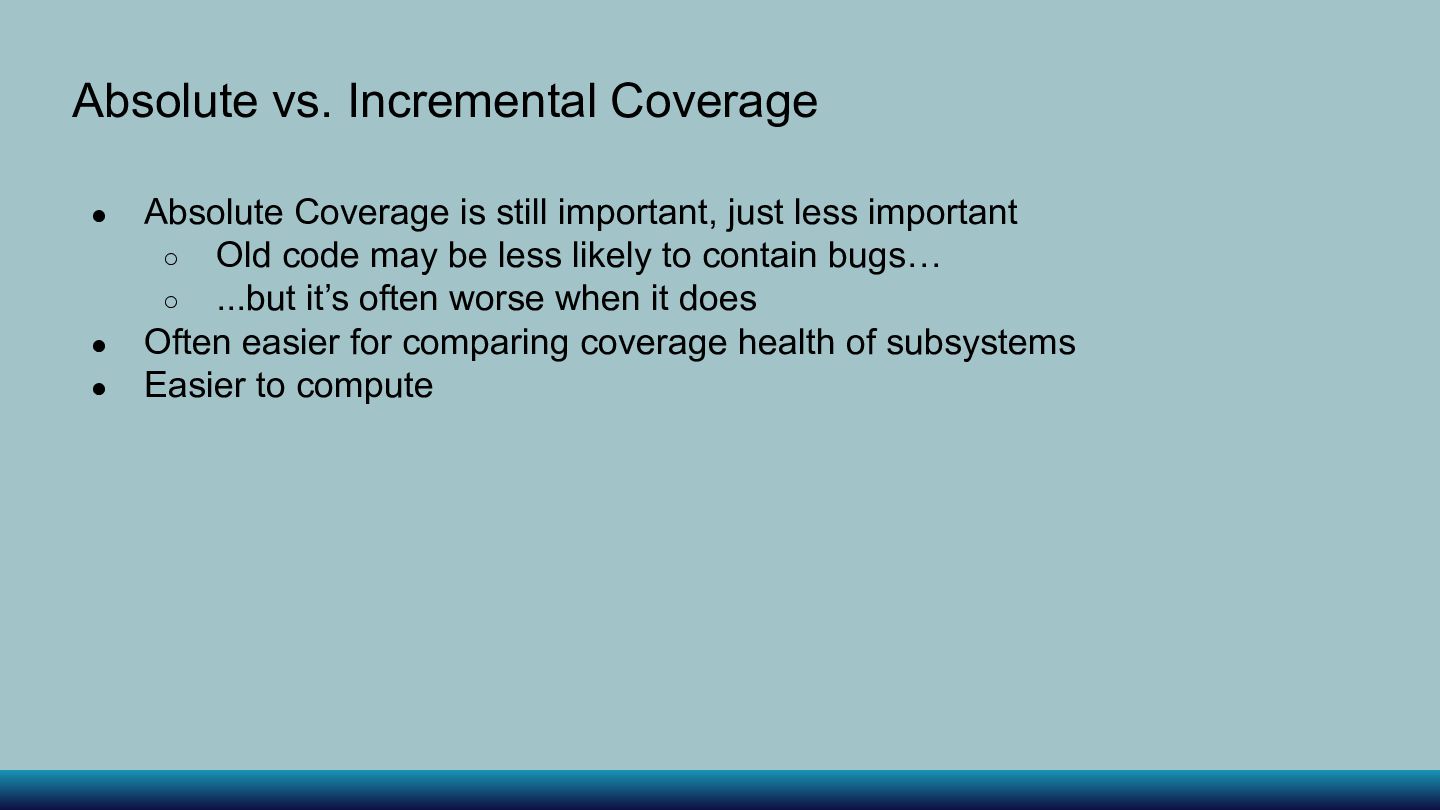
  30. Absolute vs. Incremental Coverage • • • Absolute Coverage is

    still important, just less important ◦ Old code may be less likely to contain bugs… ◦ ...but it’s often worse when it does Often easier for comparing coverage health of subsystems Easier to compute