Share
Embed
QConSF 2012
QCon SF keynote talk. Compared to Ricon2012, this talk is less technical and spends more time on CAP and no time on building up a layered database. Both share the intro on the history of "NoSQL" like systems.
Eric Brewer
November 08, 2012
Transcript
25 slides
-
NoSQL: Past, Present, Future Eric Brewer Professor, UC Berkeley VP
Infrastructure, Google QCon SF November 8, 2012 -
“Navigational” Database Tight integration between code and data Database =
linked groups of records (“CODASYL”) Pointers were physical names, today we hash Programmer as “navigator” through the links Similar to DOM engine, WWW, graph DBs Used for its high performance, but… But hard to program, maintain Hard to evolve the schema (embedded in code) Wikipedia: “IDMS” -
Why Relational? (1970s) Need a high-level model (sets) Separate the
data from the code SQL is the (only) API Data outlasts any particular implementation because the model doesn’t change Goal: implement the top-down model well Led to transactions as a tool Declarative language leaves room for optimization -
Also 1970s: Unix “The most important job of UNIX is
to provide a file system” – original 1974 Unix paper Bottom-up world view Few, simple, efficient mechanisms Layers and composition “navigational” Evolution comes from APIs, encapsulation NoSQL is in this Unix tradition Examples: dbm (1979 kv), gdbm, Berkeley DB, JDBM -
Two Valid World Views Relational View Top Down Clean model,
ACID Transactions Two kinds of developers DB authors SQL programmers Values Clean Semantics Set operations Easy long-term evolution Venues: SIGMOD, VLDB Systems View Bottom Up Build on top Evolve modules One kind of programmer Integrated use Values: Good APIs Flexibility Range of possible programs Venues: SOSP, OSDI -
NoSQL in Context Large reusable storage component Systems values: Layered,
ideally modular APIs Enable a range of systems and semantics Some things to build on top over time: Multi-component transactions Secondary indices Evolution story Returning sets of data, not just values -
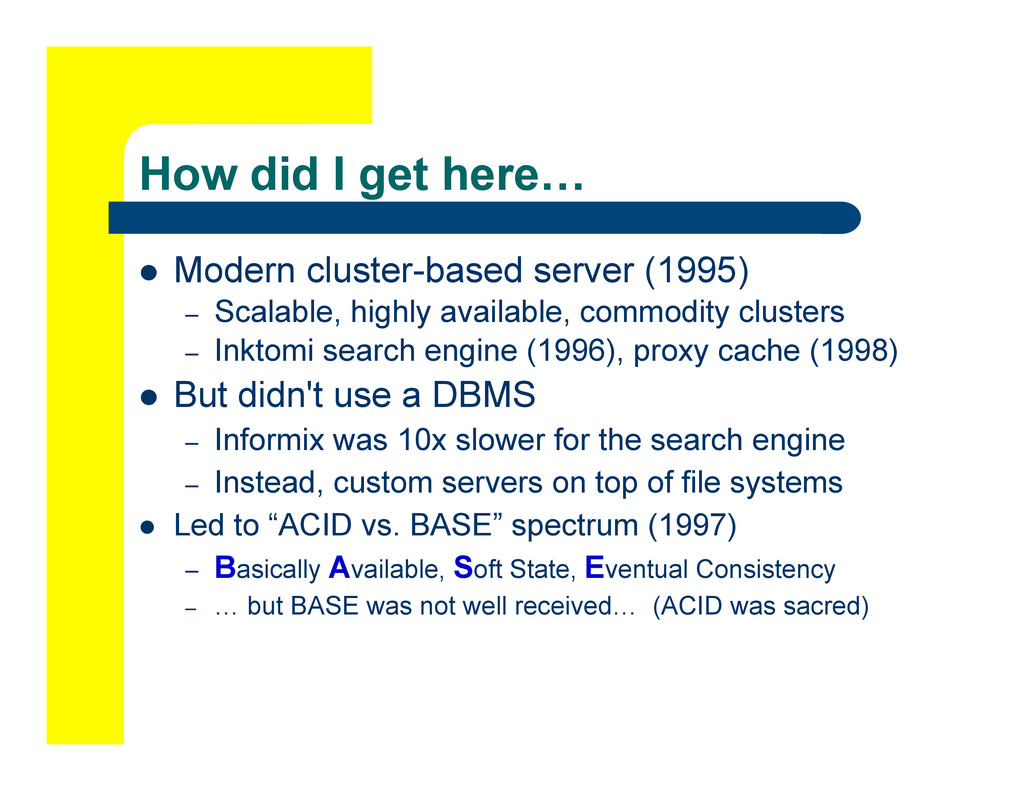
How did I get here… l Modern cluster-based server (1995)
– Scalable, highly available, commodity clusters – Inktomi search engine (1996), proxy cache (1998) l But didn't use a DBMS – Informix was 10x slower for the search engine – Instead, custom servers on top of file systems l Led to “ACID vs. BASE” spectrum (1997) – Basically Available, Soft State, Eventual Consistency – … but BASE was not well received… (ACID was sacred) -
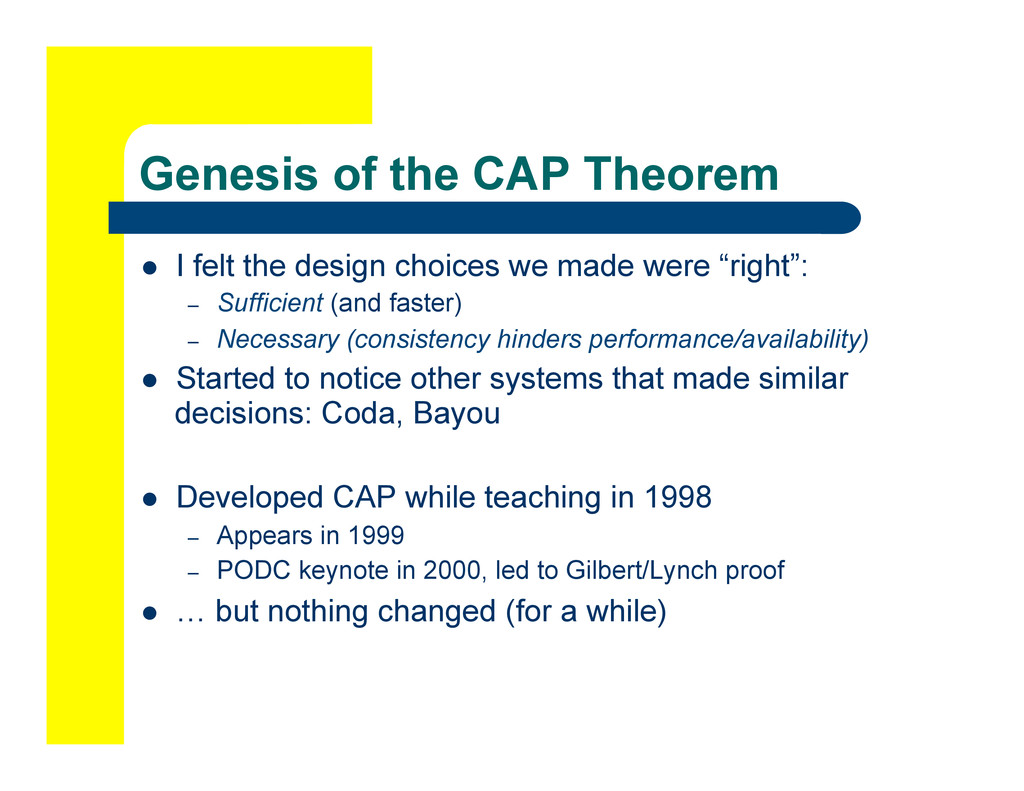
Genesis of the CAP Theorem l I felt the design
choices we made were “right”: – Sufficient (and faster) – Necessary (consistency hinders performance/availability) l Started to notice other systems that made similar decisions: Coda, Bayou l Developed CAP while teaching in 1998 – Appears in 1999 – PODC keynote in 2000, led to Gilbert/Lynch proof l … but nothing changed (for a while) -
CAP Theorem l Choose at most two for any shared-data
system: – Consistency (linearizable) – Availability (system always accepts updates) – Partition Tolerance l Partitions are inevitable for the wide area – => consistency vs. availability l I think this was the right phrasing for 2000 – But probably not for 2010 -
Things CAP does NOT say.. 1. Give up on consistency
(in the wide area) • Inconsistency should be the exception • Many projects give up more than needed 2. Give up on transactions (ACID) • Need to adjust “C” and “I” expectations (only) 3. Don’t use SQL • SQL is appearing in “NoSQL” systems • Declarative languages fit well with CAP -
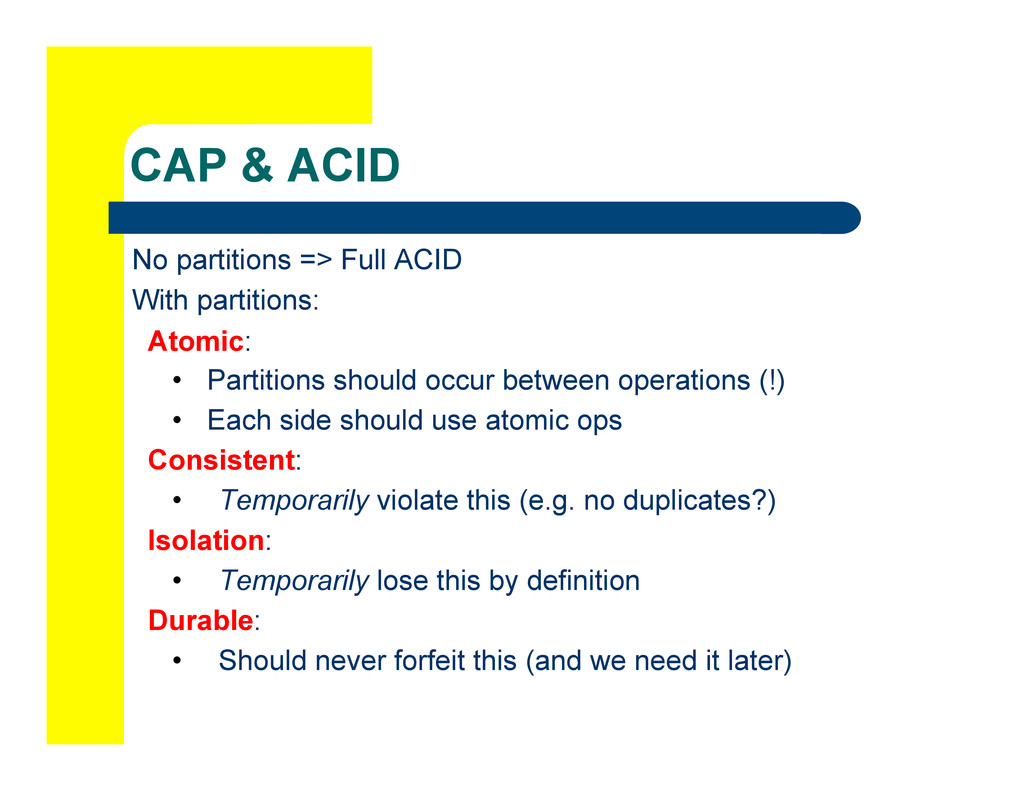
CAP & ACID No partitions => Full ACID With partitions:
Atomic: • Partitions should occur between operations (!) • Each side should use atomic ops Consistent: • Temporarily violate this (e.g. no duplicates?) Isolation: • Temporarily lose this by definition Durable: • Should never forfeit this (and we need it later) -
Single-site transactions Atomic transaction, but only within one site No
distributed transactions Google BigTable: Multi-column row operations are atomic … but that part of the row always within one site CAP allows this just fine: • Modulo no LAN partitions (reasonable) • Google MegaStore spans multiple sites • Slow writes • Paxos helps availability, but still subject to partitions -
Focus on partitions Claim 1: partitions are temporary • Provide
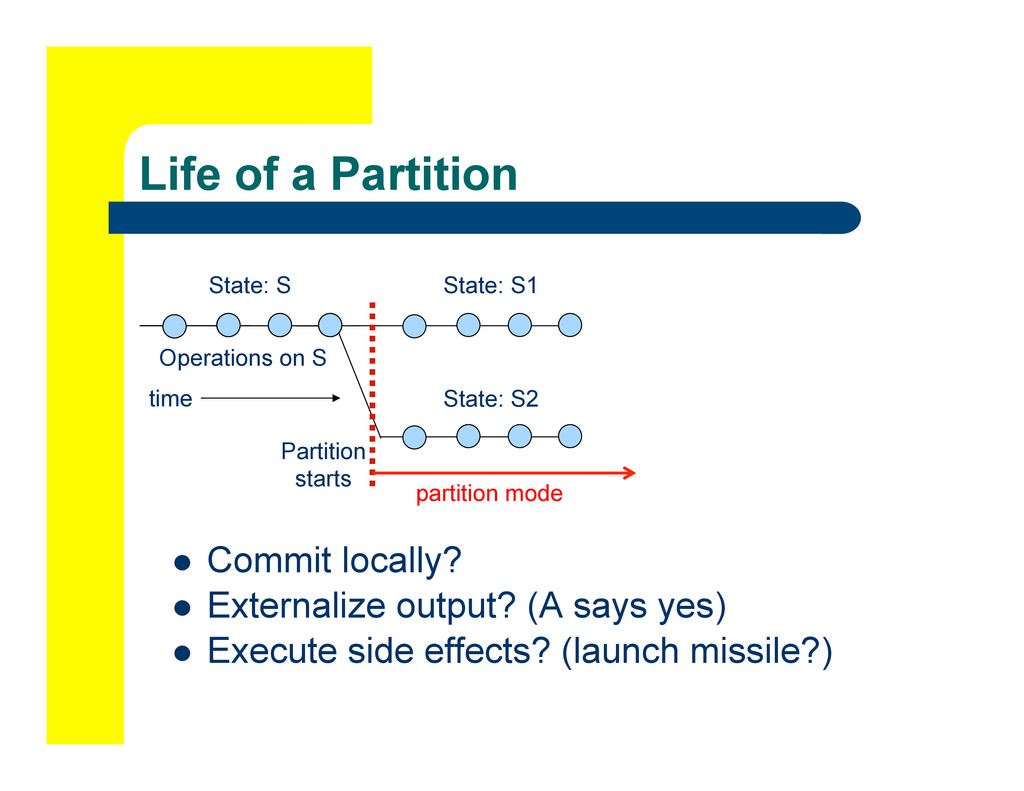
degraded service for a while • Then RECOVER Claim 2: can detect “partition mode” • Timeout => effectively partitioned • Commit locally? (A) => partition started • Fail? (C) • Retry just means postpone the decision a bit Claim 3: impacts lazy vs. eager consistency • Lazy => can’t recover consistency during partition • Can only choose A in some sense -
Life of a Partition l Serializable operations on state S
l Available (no partitions) time Operations on S State: S -
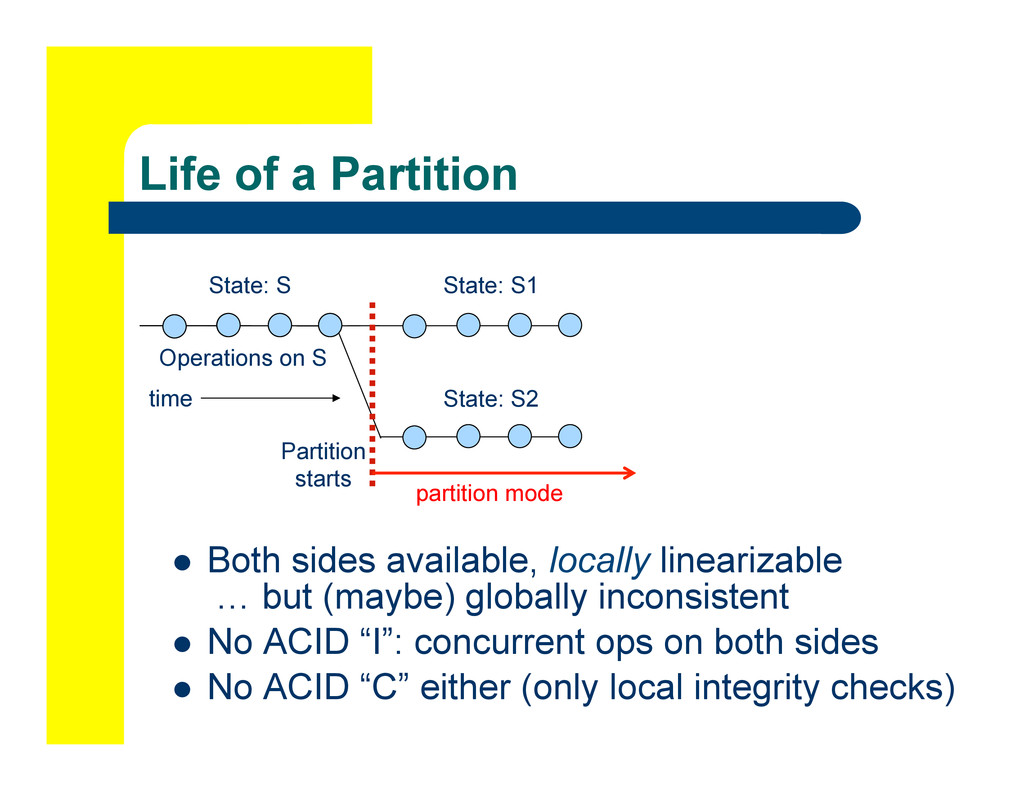
Life of a Partition l Both sides available, locally linearizable
… but (maybe) globally inconsistent l No ACID “I”: concurrent ops on both sides l No ACID “C” either (only local integrity checks) time Operations on S State: S1 Partition starts State: S2 State: S partition mode -
Life of a Partition l Commit locally? l Externalize output?
(A says yes) l Execute side effects? (launch missile?) time Operations on S State: S1 Partition starts State: S2 State: S partition mode -
Life of a Partition Need “Partition Recovery” • Goal: restore
consistency (ACID) • Similar to traditional recovery • Move to some self-consistent state • Roll forward the “log” from each side State: S1 State: S2 State: S Partition ends ? State: S' partition mode -
Partition Recovery State: S1 State: S2 State: S ? State:
S' partition mode 1) Merge State (S’) • Easy: last writer wins • General: S’ = f(S1 log, S2 log) // the paths matter 2) Detect bad things that you did • Side effects? Incorrect response? 3) Compensate for bad actions -
Partition Recovery State: S1 State: S2 State: S ? State:
S' partition mode Amazon shopping cart: 1) Merge by union of items 2) Only bad action is deleted item reappears -
ATM “Stand In” Time l ATMs have “partition mode” –
… chooses A over C – Commutative atomic ops: incr, decr – When partition heals, the end balance is correct l Partition recovery: – Detect: intermediate wrong decisions – Side effects (like “issue cash”) might be wrong – Exceptions are not commutative (below zero?) – Compensate via overdraft penalty l Bound “wrongness” during partition: (less A) – Limit deficit to (say) $200 l When you remove $200, “decr” becomes unavailable -
Define your “Partition Strategy” 1) Define detection (start Partition Mode)
2) Partition Mode operation: Determine which operations can proceed • Can depend on args/access level/state • Simple example: no updates, read only • ATM: withdrawal allowed only up to $200 total 3) Partition recovery • Detect problems via joint logs • Execute compensations • Every allowed op should have a compensation • Calculate merged state (last) -
Compensation Happens l Claim: Real world = weak consistency +
delayed exceptions + compensation – Charge you twice => credit your account – Overbook an airplane => compensate passengers that miss out l This concept is missing from wide-area data systems – Except for some workflow l Compensating transactions can be human response – “We just realized we sent you two of the same item” – Should be logged just like any other xact -
CAP 2010 100% Availability 0% Consistency Single copy consistency Eventual
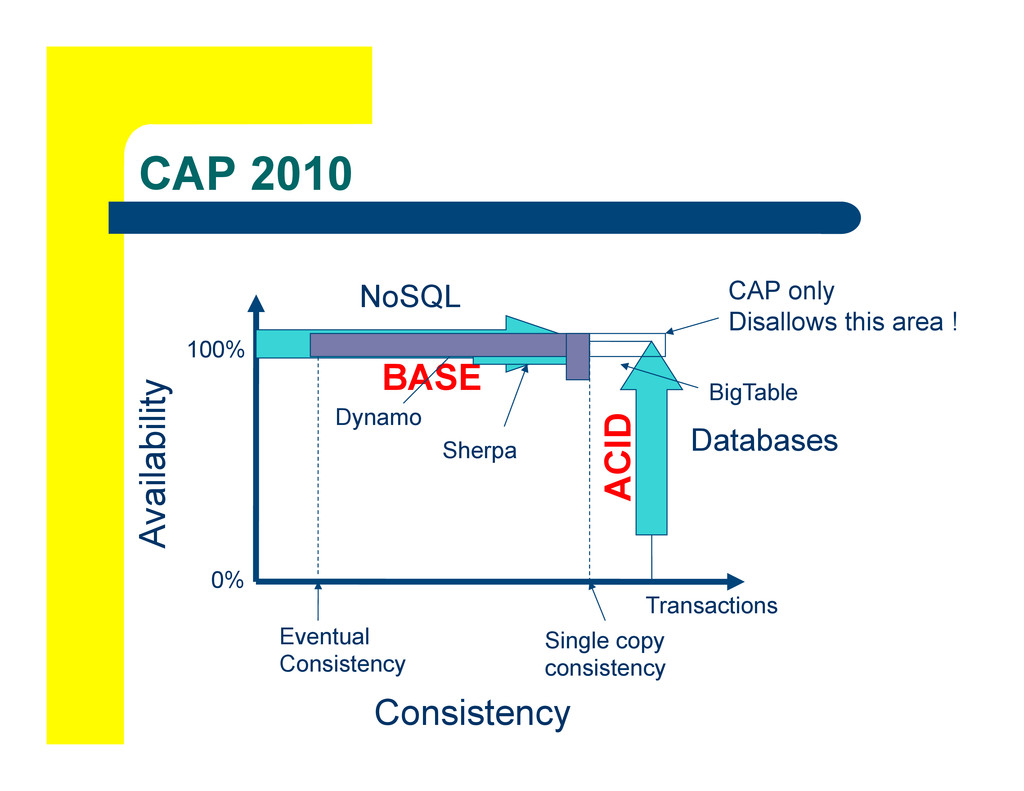
Consistency ACID BASE NoSQL Databases Transactions CAP only Disallows this area ! BigTable Sherpa Dynamo -
Summary l Net effect of CAP: – Freedom to explore
a wide diverse space – Merging of systems and DB approaches l While there are no partitions: – Can have both A and C, and full ACID xact l Choosing A => focus on partition recovery – Need a before, during, and after strategy – Delayed Exceptions seem promising – Applying the ideas of compensation is open