T E A M D E S I G N / F U L L C O U R S E AI that works as a team, designed for non-engineers — 9 sessions: from orientation to co-evolving with AI — 9 sessions, beginner to advanced ※ The real subject is always your own life
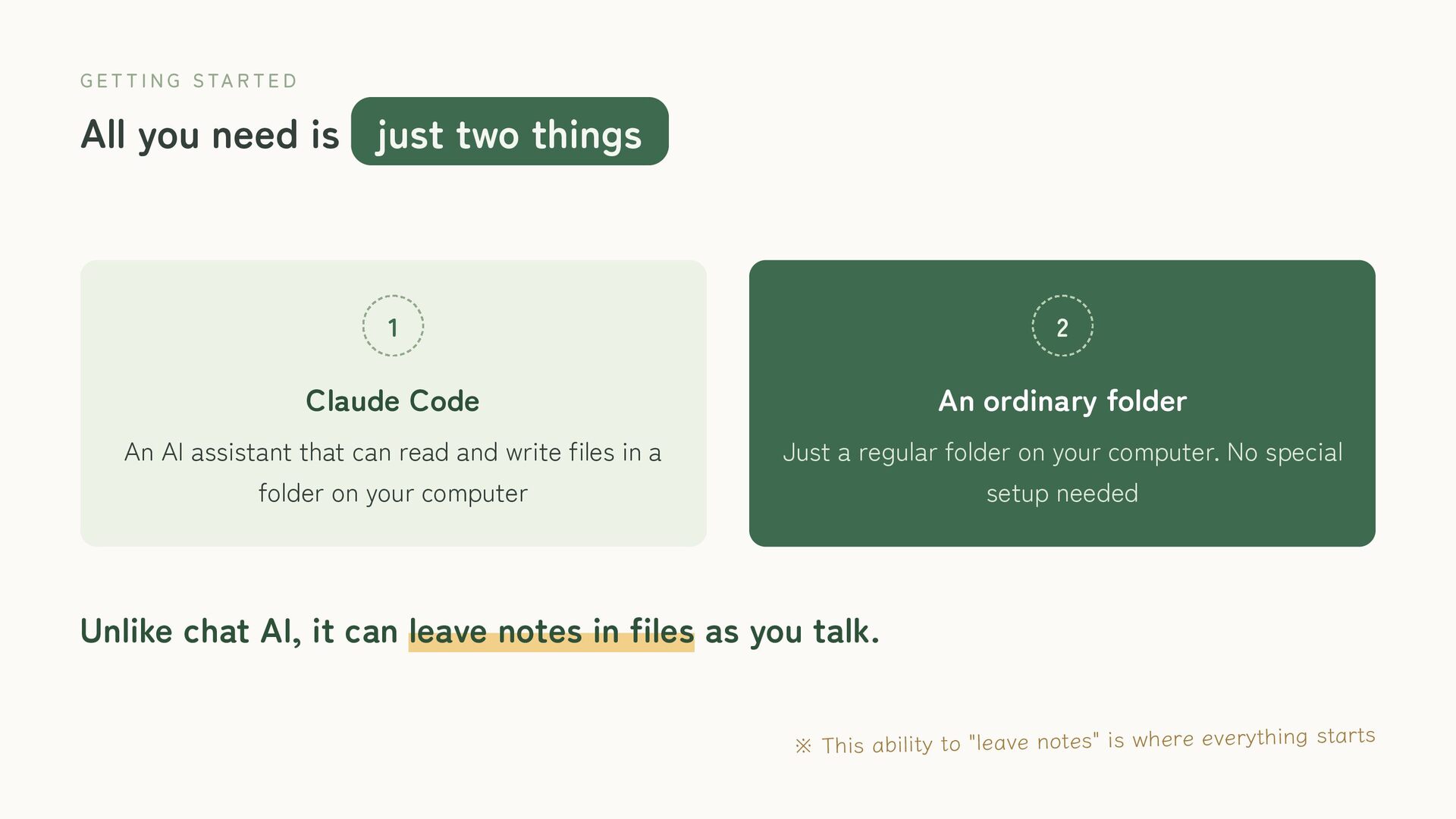
T E D All you need is just two things 1 Claude Code An AI assistant that can read and write files in a folder on your computer 2 An ordinary folder Just a regular folder on your computer. No special setup needed Unlike chat AI, it can leave notes in files as you talk. ※ This ability to "leave notes" is where everything starts
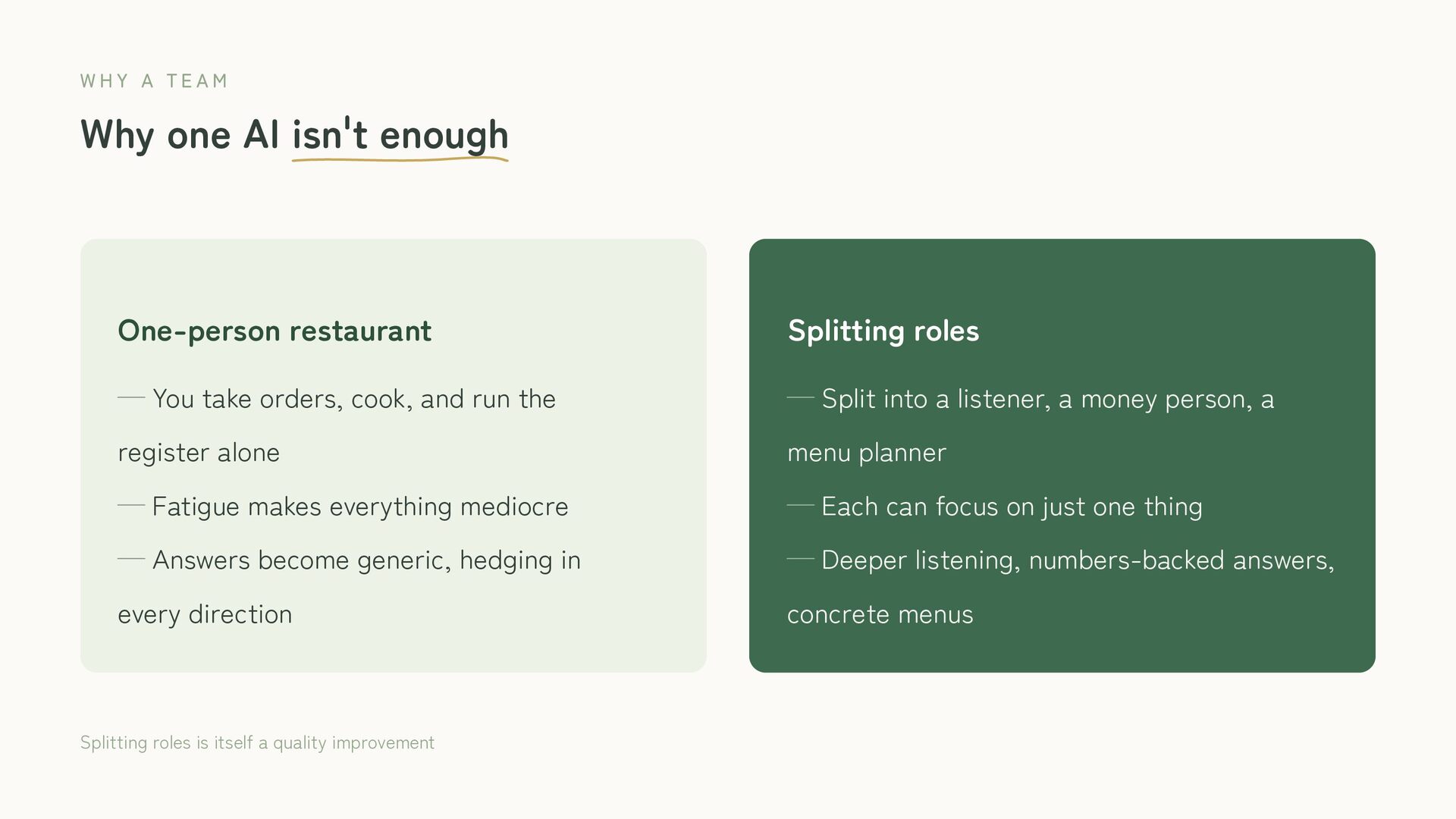
AI One-person restaurant You take orders, cook, and run the register alone Fatigue makes everything mediocre Answers become generic, hedging in every direction Splitting roles Split into a listener, a money person, a menu planner Each can focus on just one thing Deeper listening, numbers-backed answers, concrete menus isn't enough — — — — — — Splitting roles is itself a quality improvement
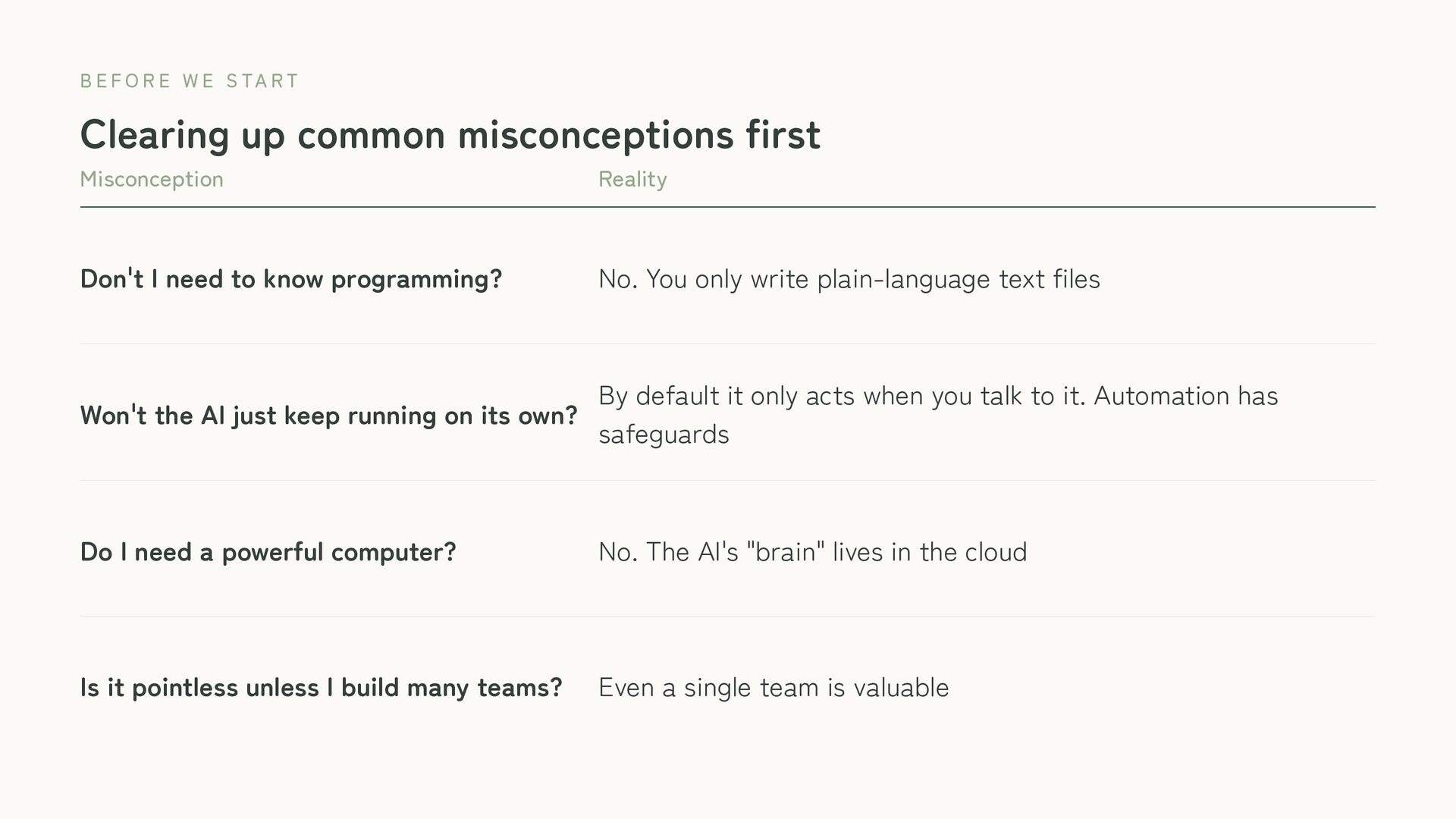
R T Clearing up common misconceptions first Misconception Reality Don't I need to know programming? No. You only write plain-language text files Won't the AI just keep running on its own? By default it only acts when you talk to it. Automation has safeguards Do I need a powerful computer? No. The AI's "brain" lives in the cloud Is it pointless unless I build many teams? Even a single team is valuable
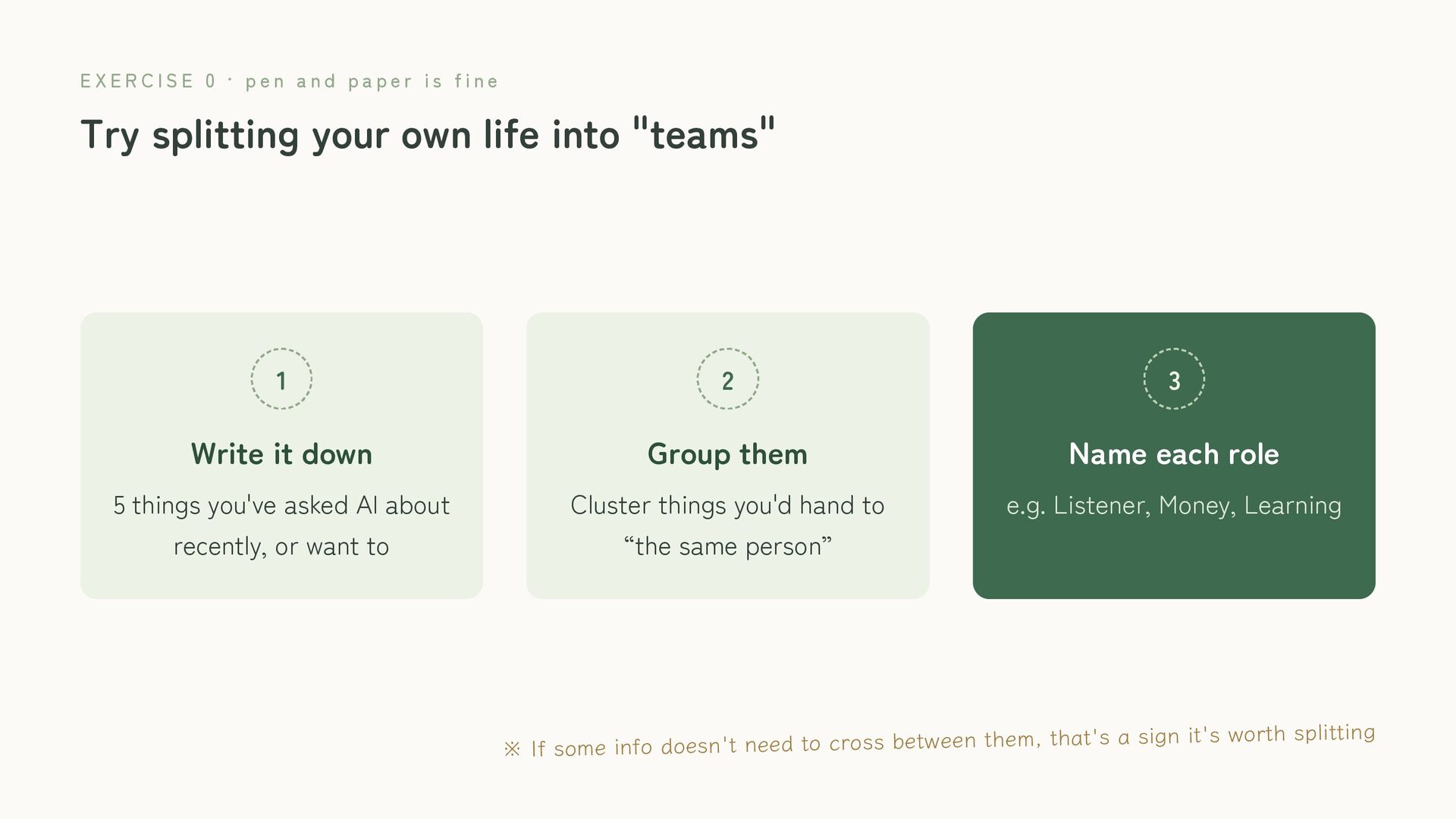
p e n a n d p a p e r i s f i n e Try splitting your own life into "teams" 1 Write it down 5 things you've asked AI about recently, or want to 2 Group them Cluster things you'd hand to “the same person” 3 Name each role e.g. Listener, Money, Learning ※ If some info doesn't need to cross between them, that's a sign it's worth splitting
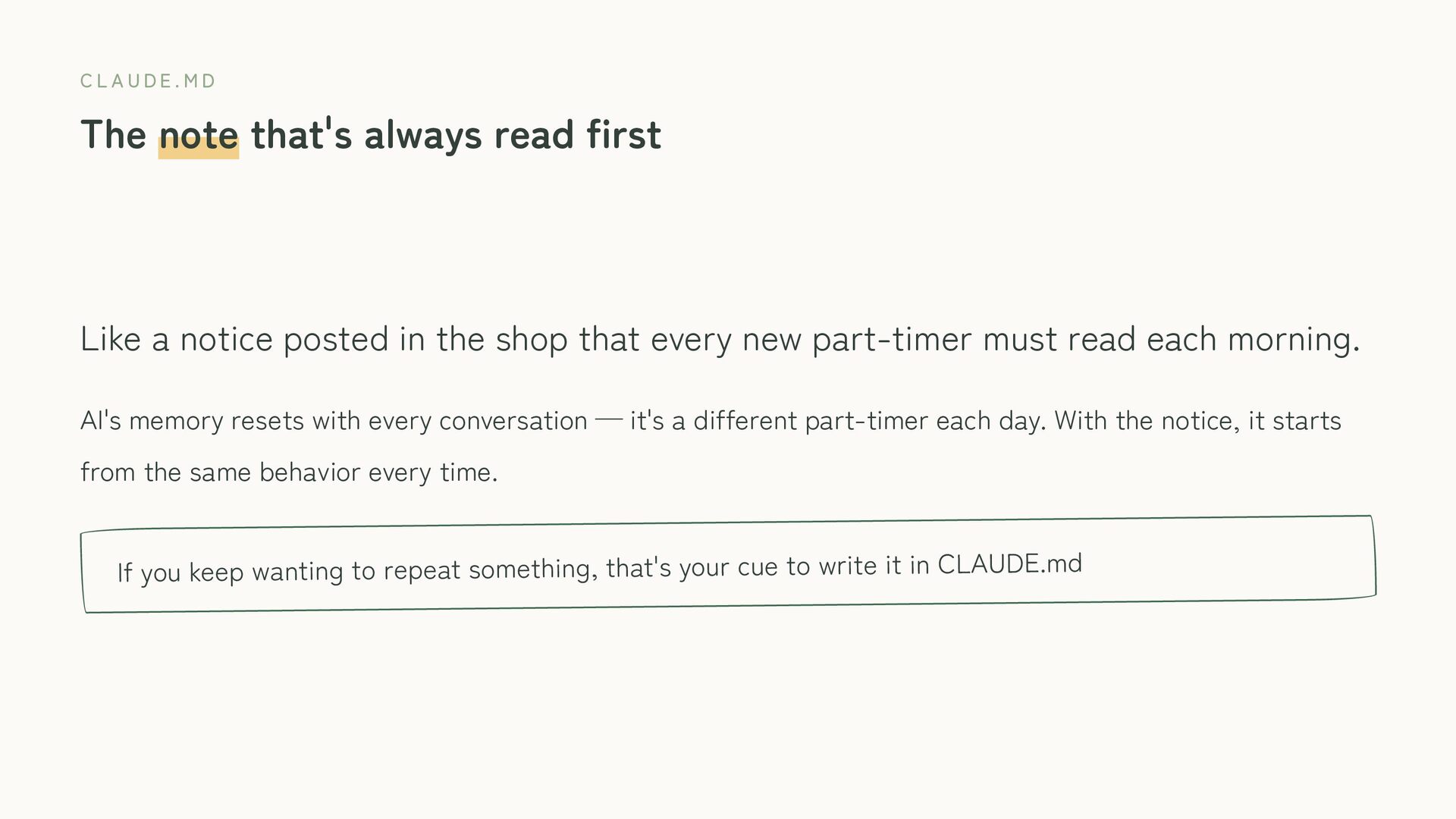
note that's always read first Like a notice posted in the shop that every new part-timer must read each morning. AI's memory resets with every conversation — it's a different part-timer each day. With the notice, it starts from the same behavior every time. If you keep wanting to repeat something, that's your cue to write it in CLAUDE.md
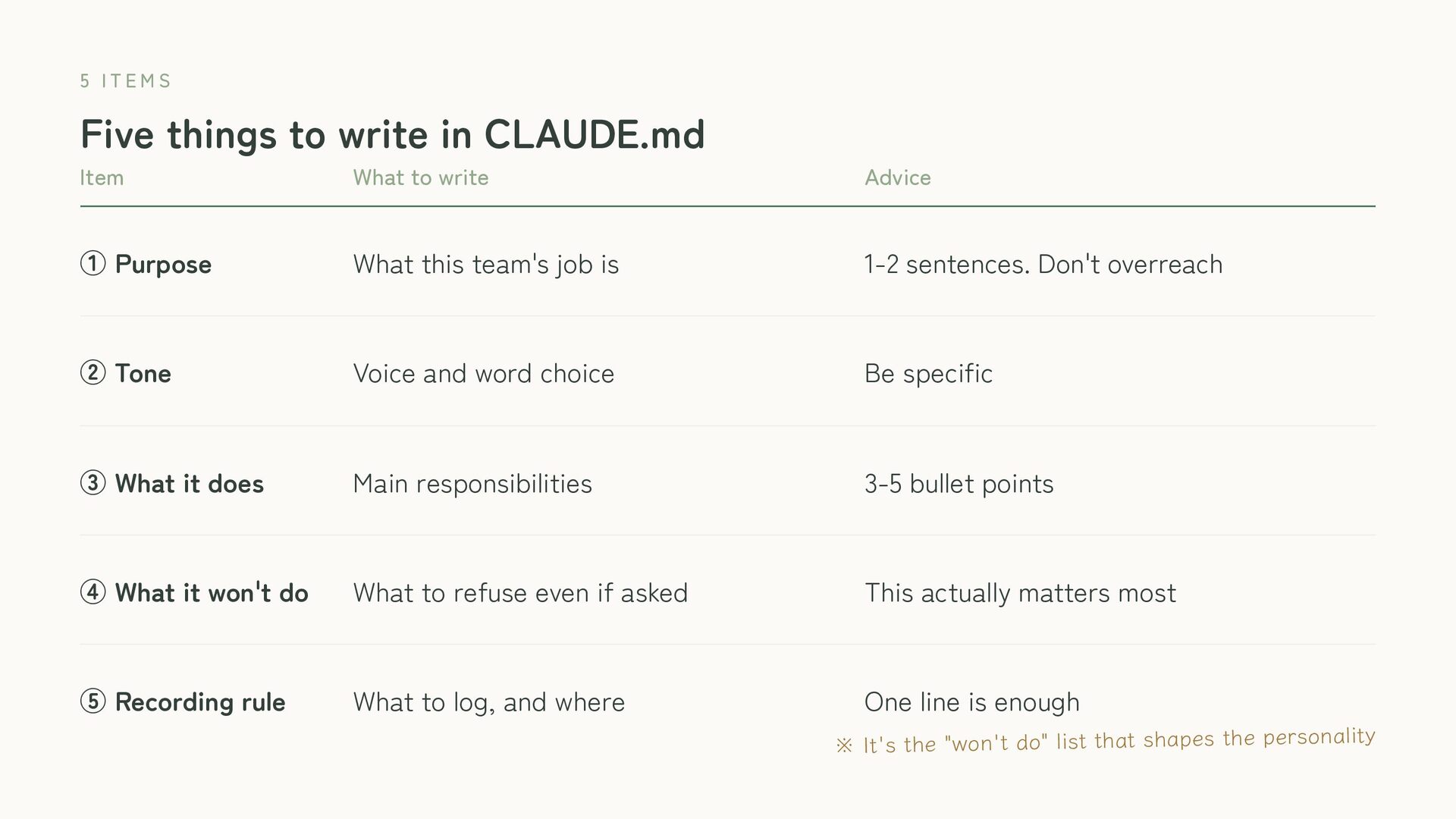
in CLAUDE.md Item What to write Advice ① Purpose What this team's job is 1-2 sentences. Don't overreach ② Tone Voice and word choice Be specific ③ What it does Main responsibilities 3-5 bullet points ④ What it won't do What to refuse even if asked This actually matters most ⑤ Recording rule What to log, and where One line is enough ※ It's the "won't do" list that shapes the personality
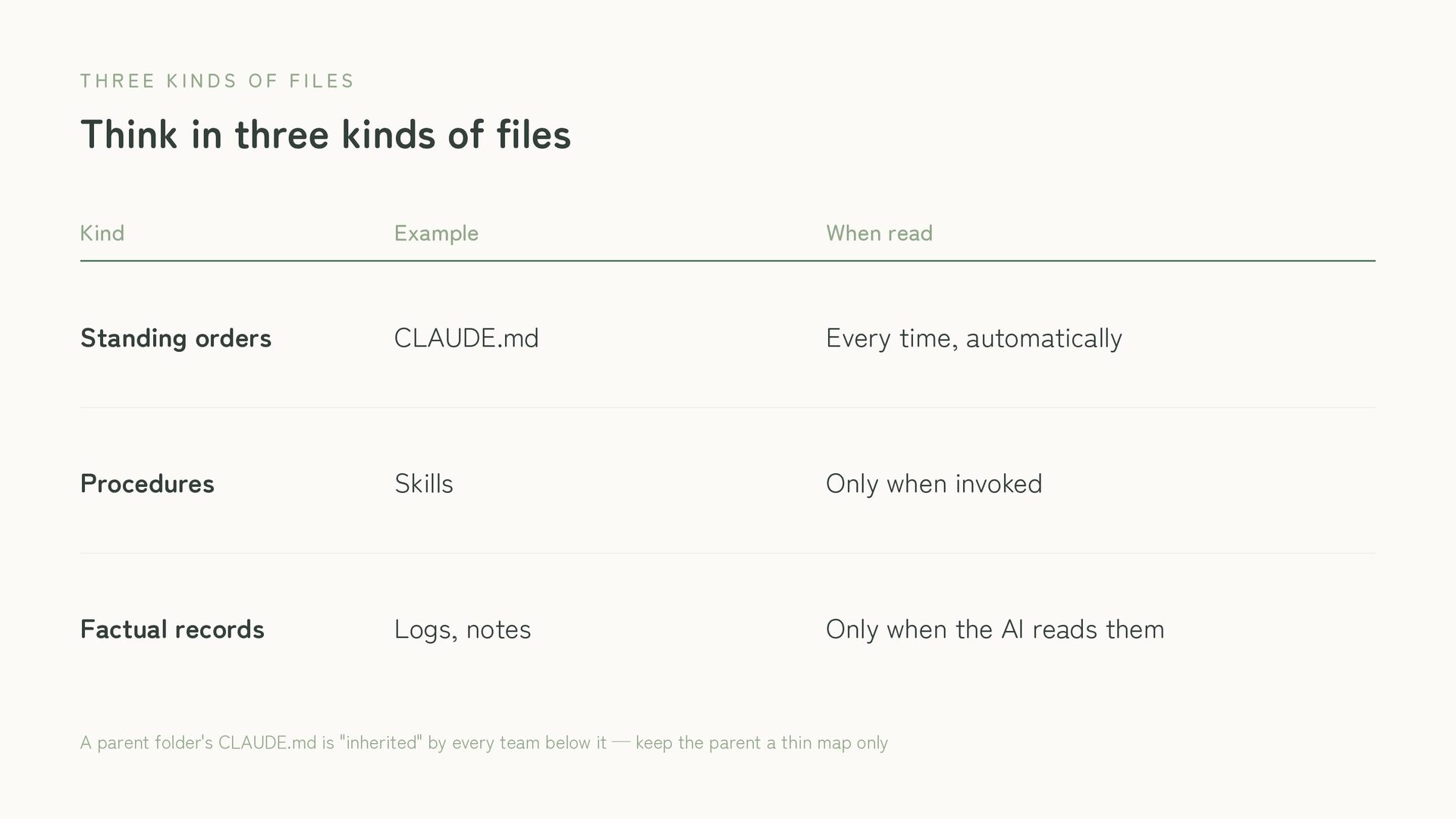
O F F I L E S Think in three kinds of files Kind Example When read Standing orders CLAUDE.md Every time, automatically Procedures Skills Only when invoked Factual records Logs, notes Only when the AI reads them A parent folder's CLAUDE.md is "inherited" by every team below it — keep the parent a thin map only
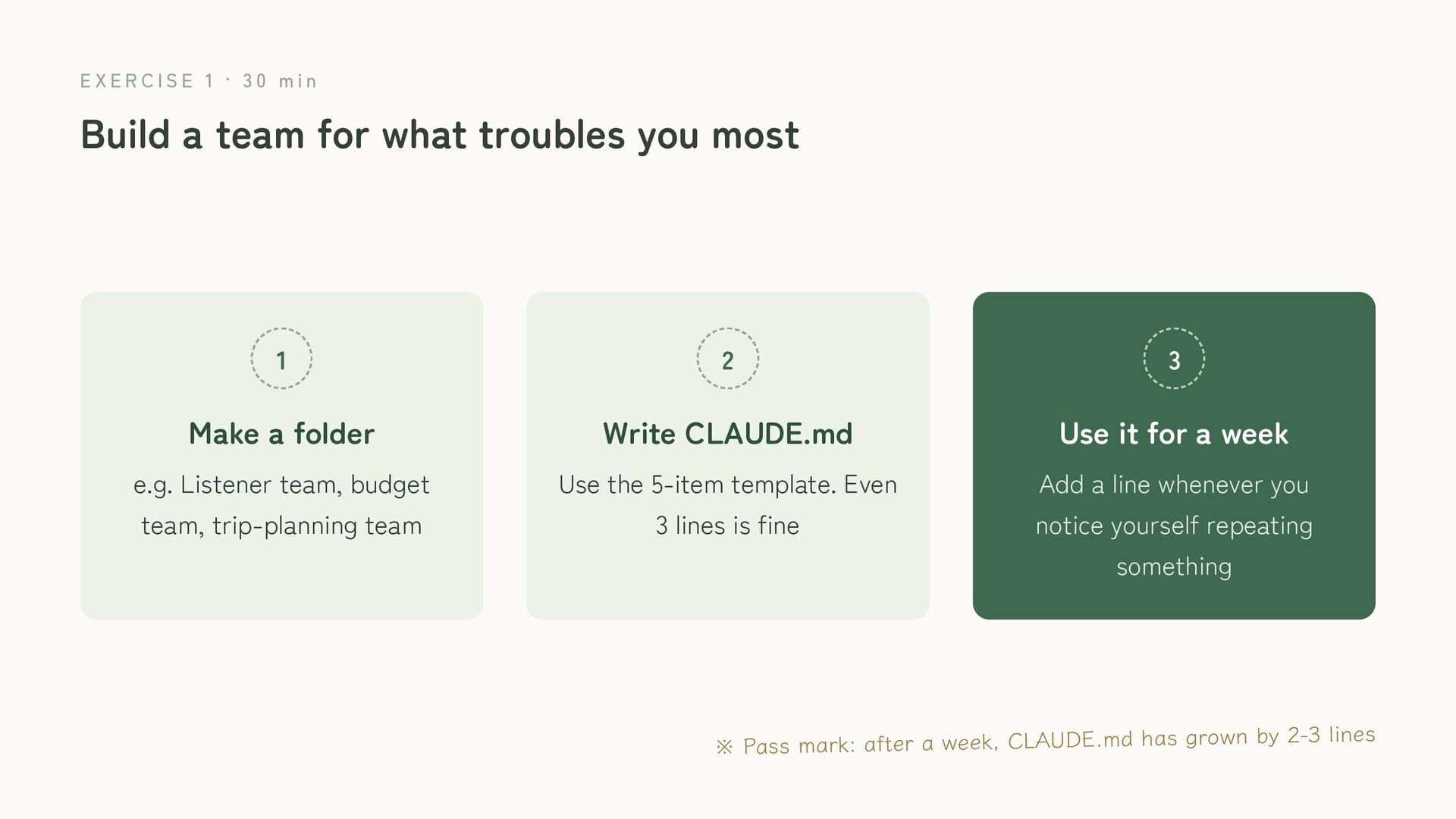
3 0 m i n Build a team for what troubles you most 1 Make a folder e.g. Listener team, budget team, trip-planning team 2 Write CLAUDE.md Use the 5-item template. Even 3 lines is fine 3 Use it for a week Add a line whenever you notice yourself repeating something ※ Pass mark: after a week, CLAUDE.md has grown by 2-3 lines
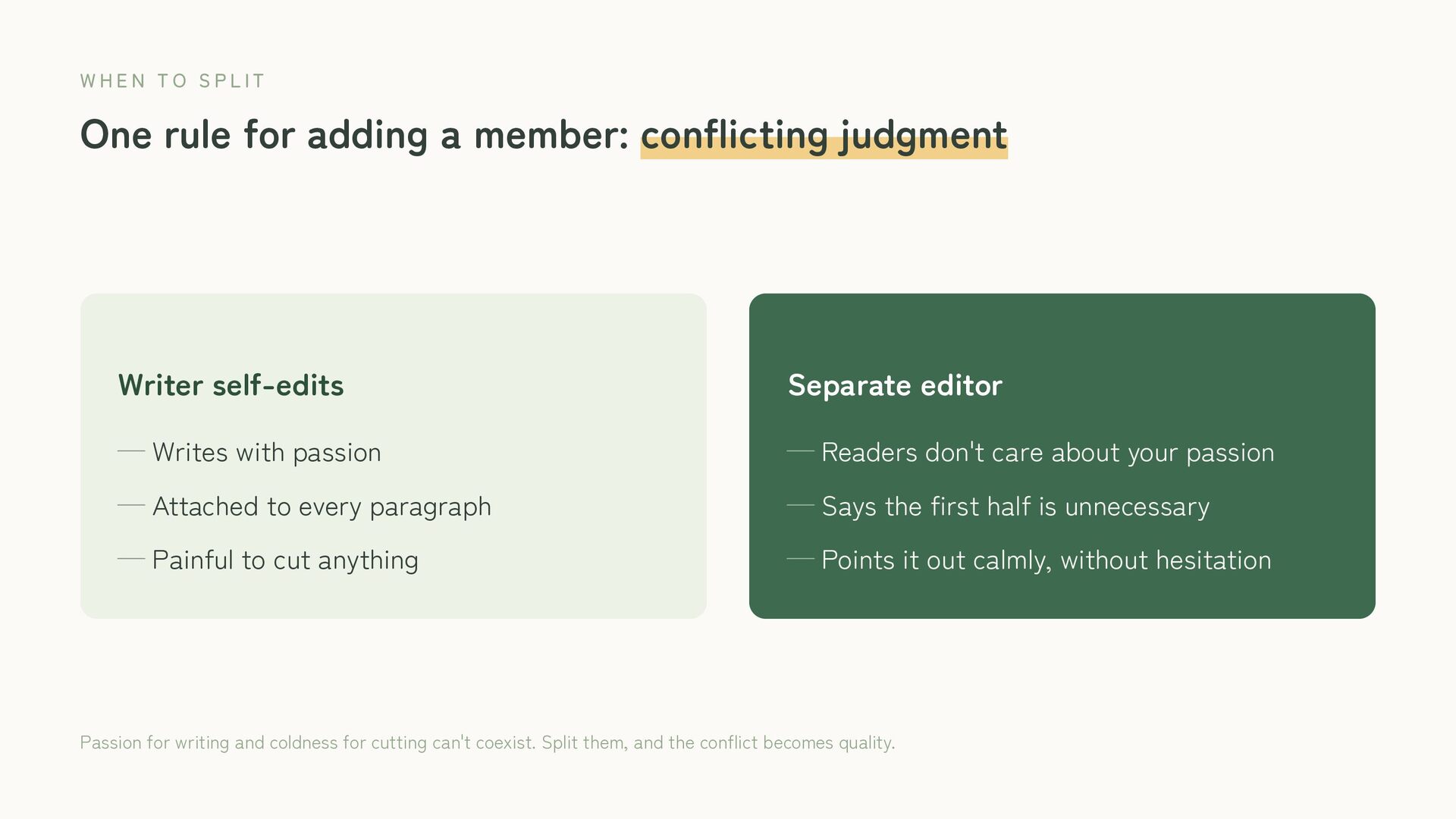
T One rule for adding a member: conflicting judgment Writer self-edits Writes with passion Attached to every paragraph Painful to cut anything Separate editor Readers don't care about your passion Says the first half is unnecessary Points it out calmly, without hesitation — — — — — — Passion for writing and coldness for cutting can't coexist. Split them, and the conflict becomes quality.
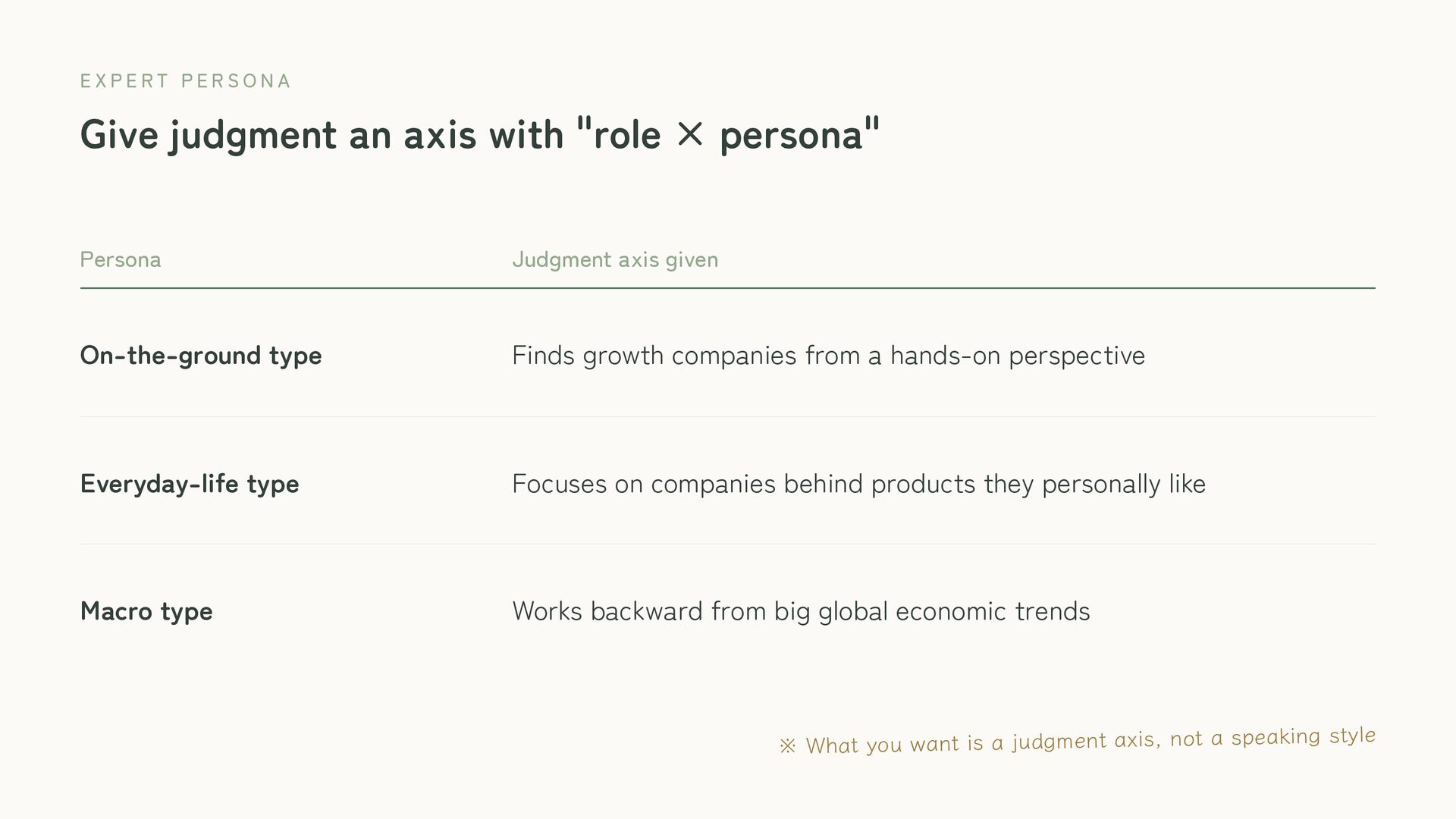
O N A Give judgment an axis with "role × persona" Persona Judgment axis given On-the-ground type Finds growth companies from a hands-on perspective Everyday-life type Focuses on companies behind products they personally like Macro type Works backward from big global economic trends ※ What you want is a judgment axis, not a speaking style
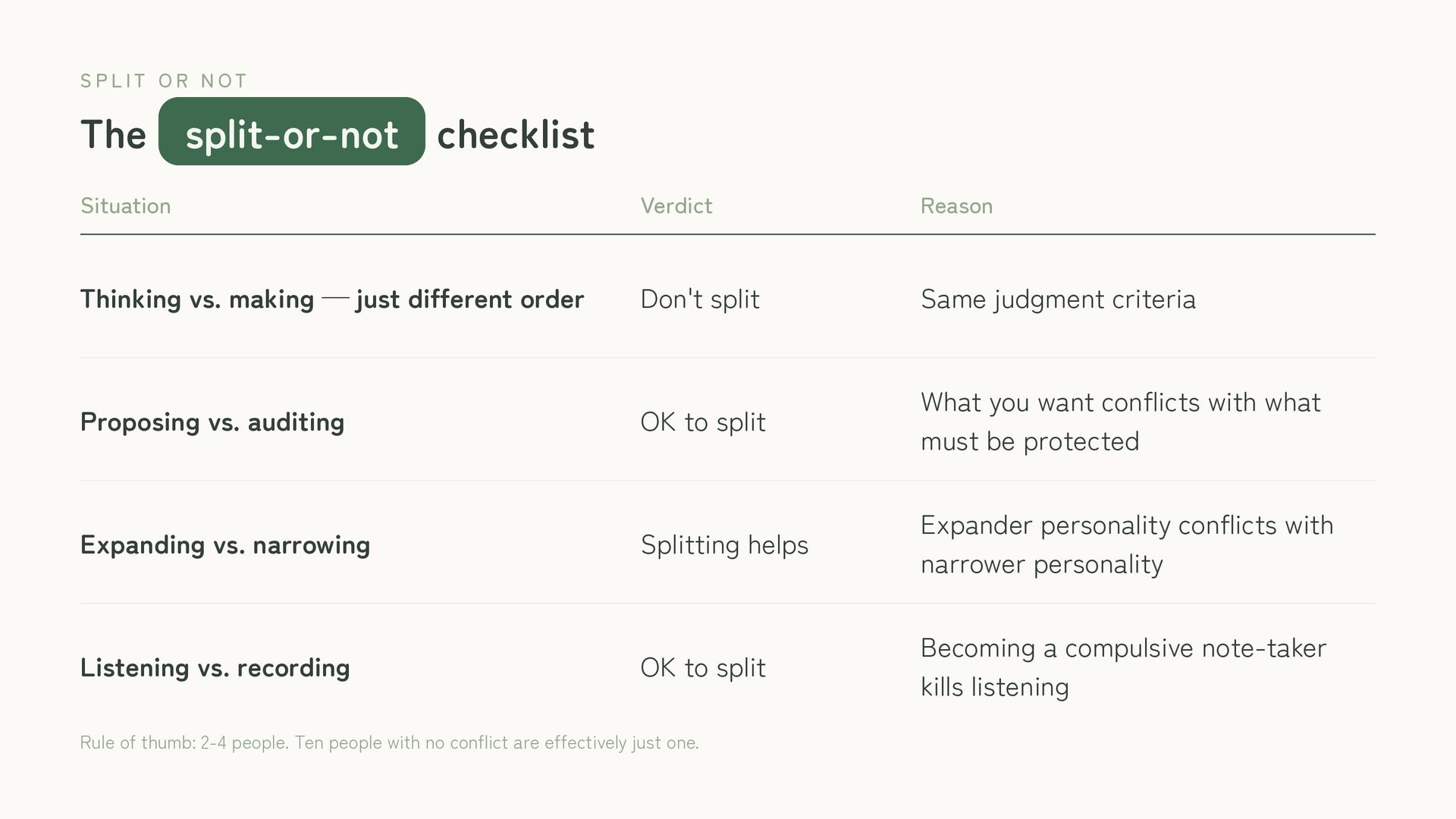
The split-or-not checklist Situation Verdict Reason Thinking vs. making — just different order Don't split Same judgment criteria Proposing vs. auditing OK to split What you want conflicts with what must be protected Expanding vs. narrowing Splitting helps Expander personality conflicts with narrower personality Listening vs. recording OK to split Becoming a compulsive note-taker kills listening Rule of thumb: 2-4 people. Ten people with no conflict are effectively just one.
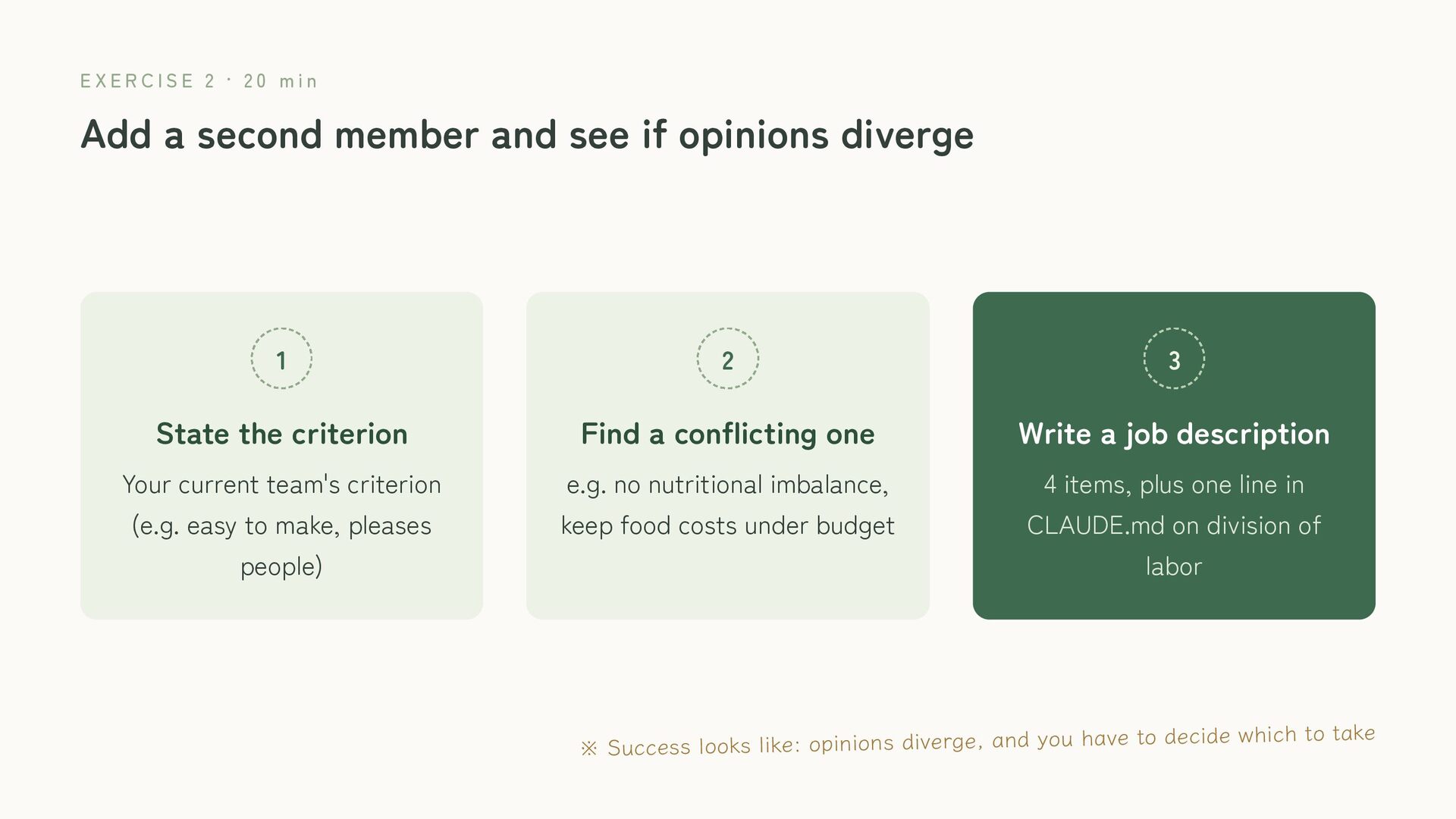
2 0 m i n Add a second member and see if opinions diverge 1 State the criterion Your current team's criterion (e.g. easy to make, pleases people) 2 Find a conflicting one e.g. no nutritional imbalance, keep food costs under budget 3 Write a job description 4 items, plus one line in CLAUDE.md on division of labor ※ Success looks like: opinions diverge, and you have to decide which to take
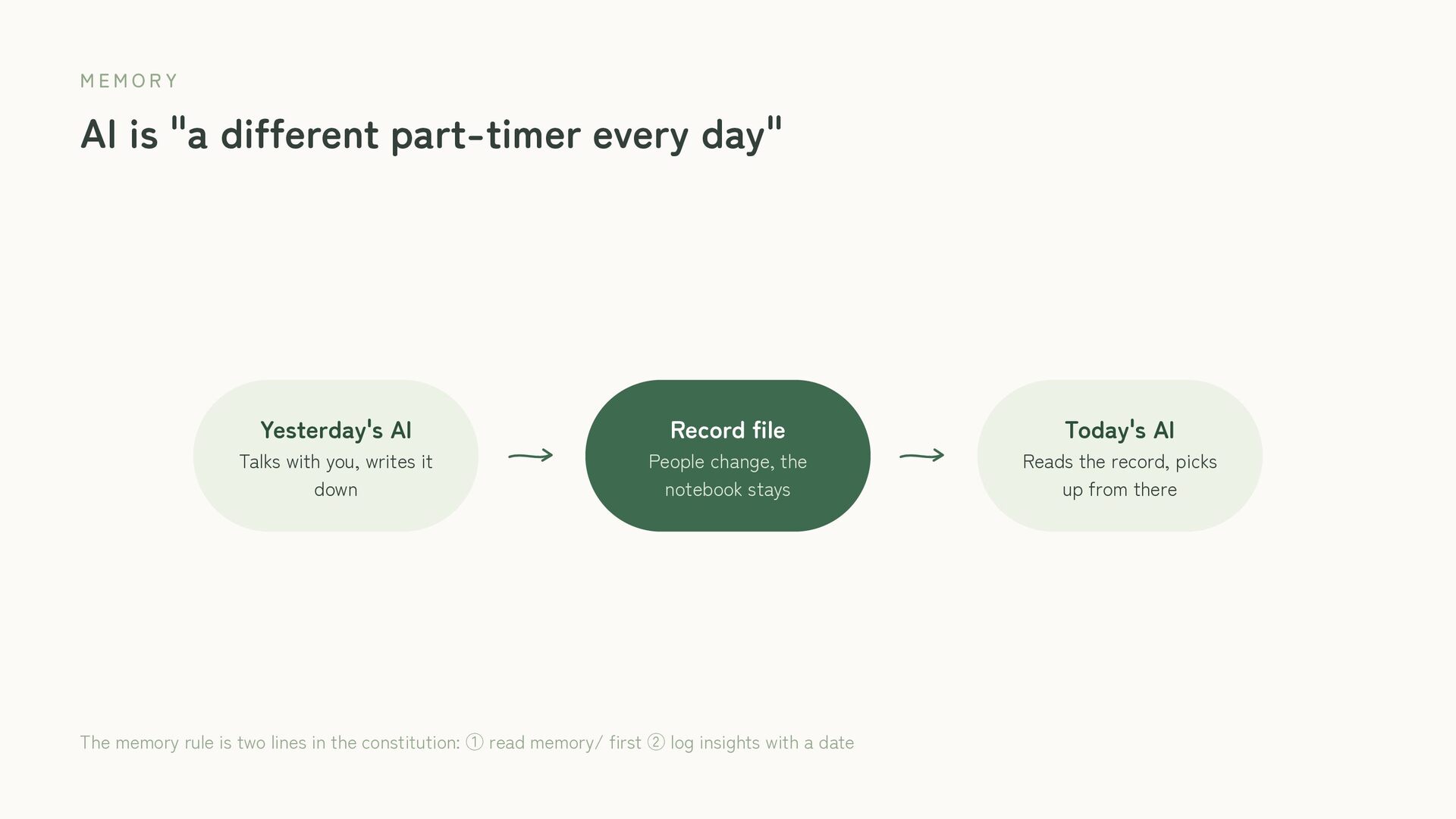
part-timer every day" Yesterday's AI Talks with you, writes it down Record file People change, the notebook stays Today's AI Reads the record, picks up from there The memory rule is two lines in the constitution: ① read memory/ first ② log insights with a date
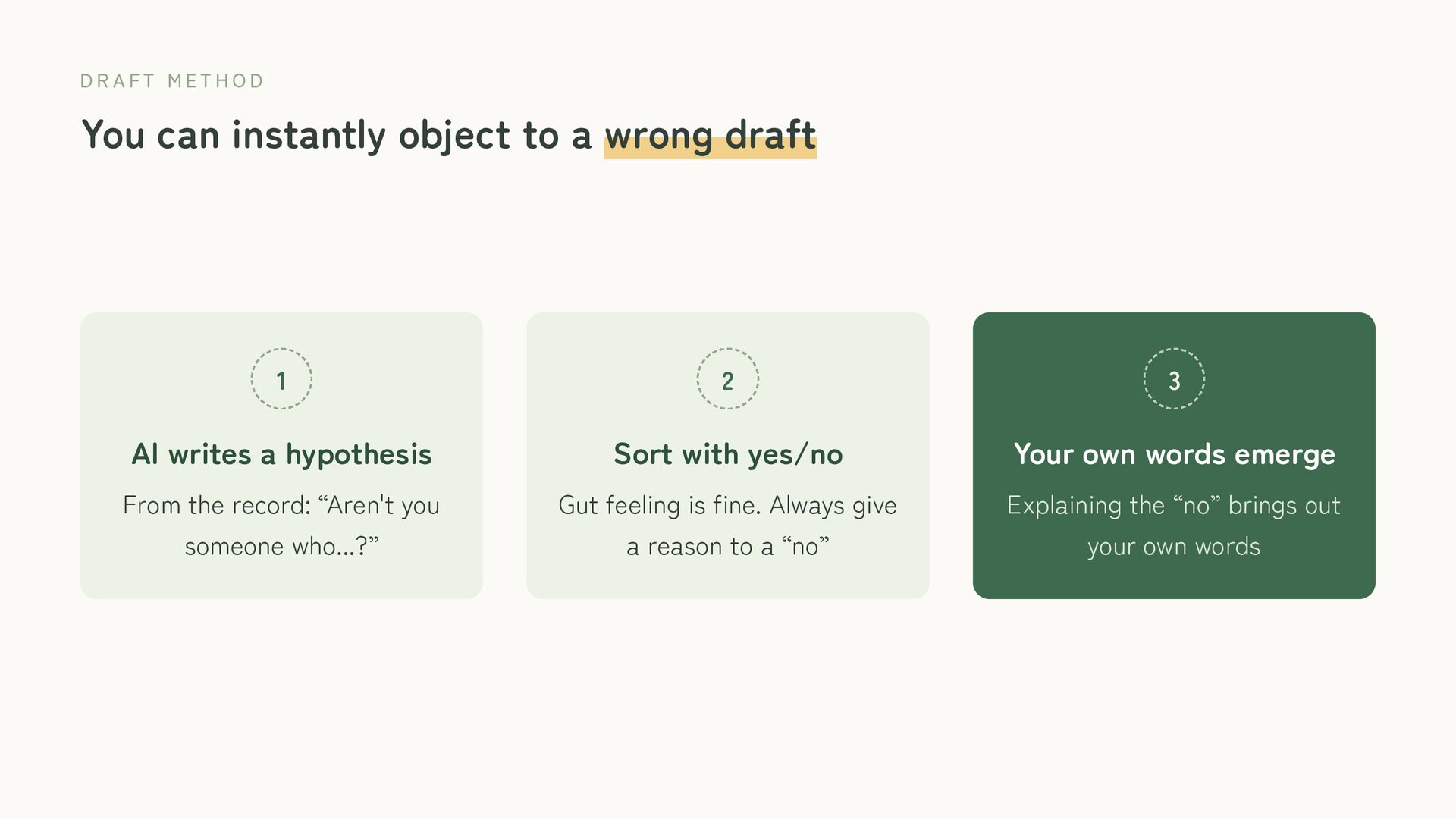
D You can instantly object to a wrong draft 1 AI writes a hypothesis From the record: “Aren't you someone who...?” 2 Sort with yes/no Gut feeling is fine. Always give a reason to a “no” 3 Your own words emerge Explaining the “no” brings out your own words
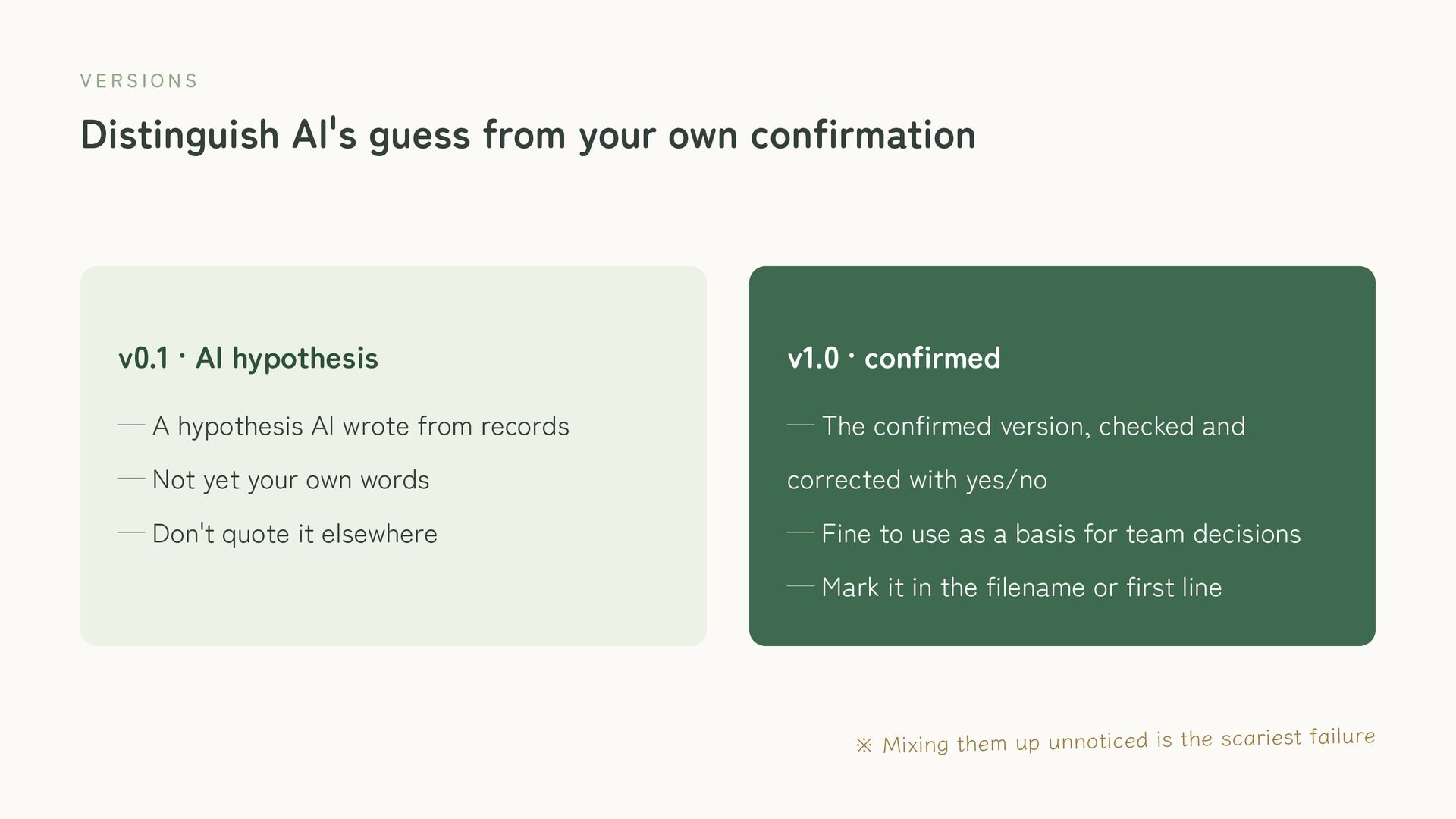
guess from your own confirmation v0.1 · AI hypothesis A hypothesis AI wrote from records Not yet your own words Don't quote it elsewhere v1.0 · confirmed The confirmed version, checked and corrected with yes/no Fine to use as a basis for team decisions Mark it in the filename or first line — — — — — — ※ Mixing them up unnoticed is the scariest failure
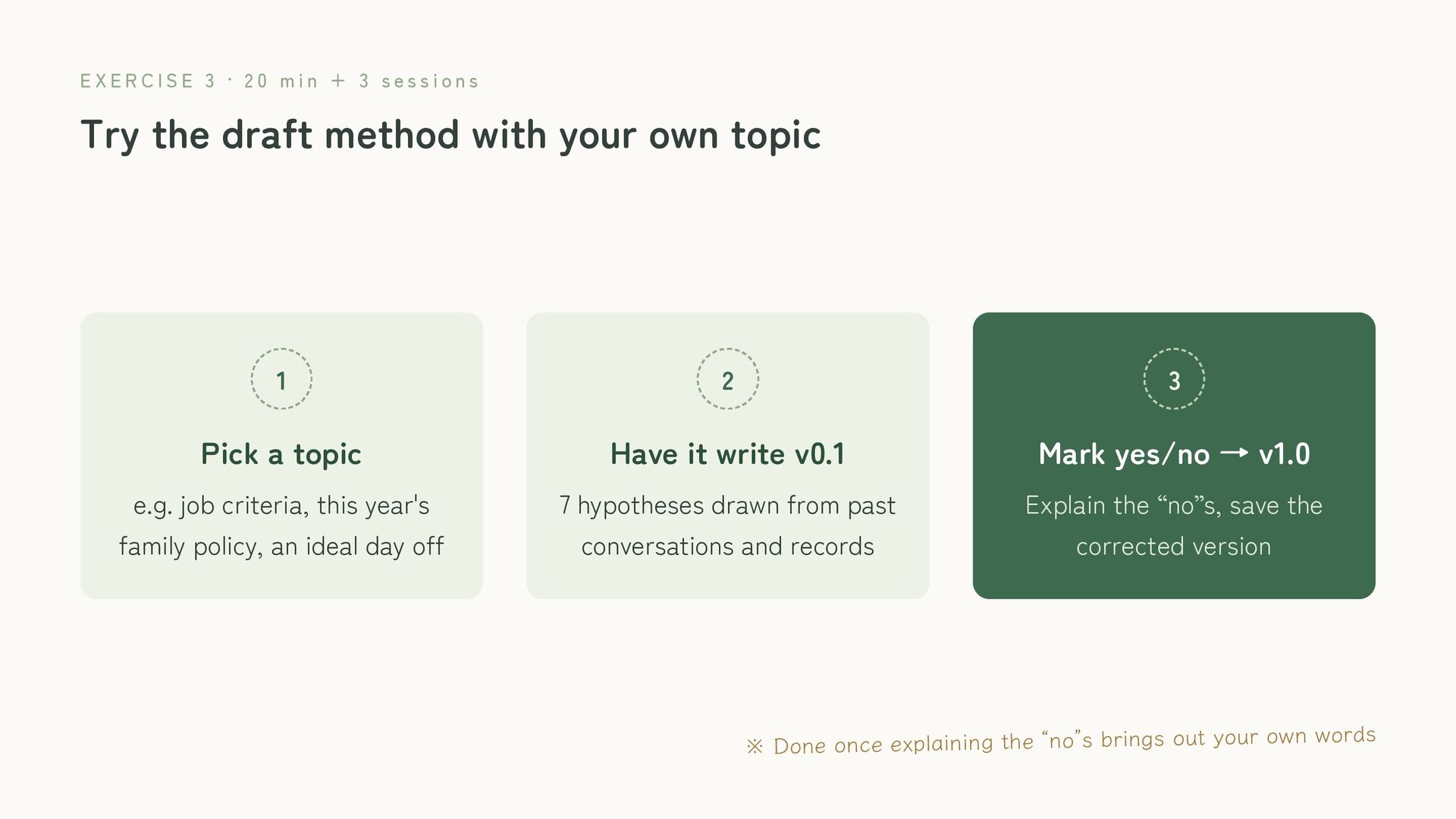
2 0 m i n + 3 s e s s i o n s Try the draft method with your own topic 1 Pick a topic e.g. job criteria, this year's family policy, an ideal day off 2 Have it write v0.1 7 hypotheses drawn from past conversations and records 3 Mark yes/no → v1.0 Explain the “no”s, save the corrected version ※ Done once explaining the “no”s brings out your own words
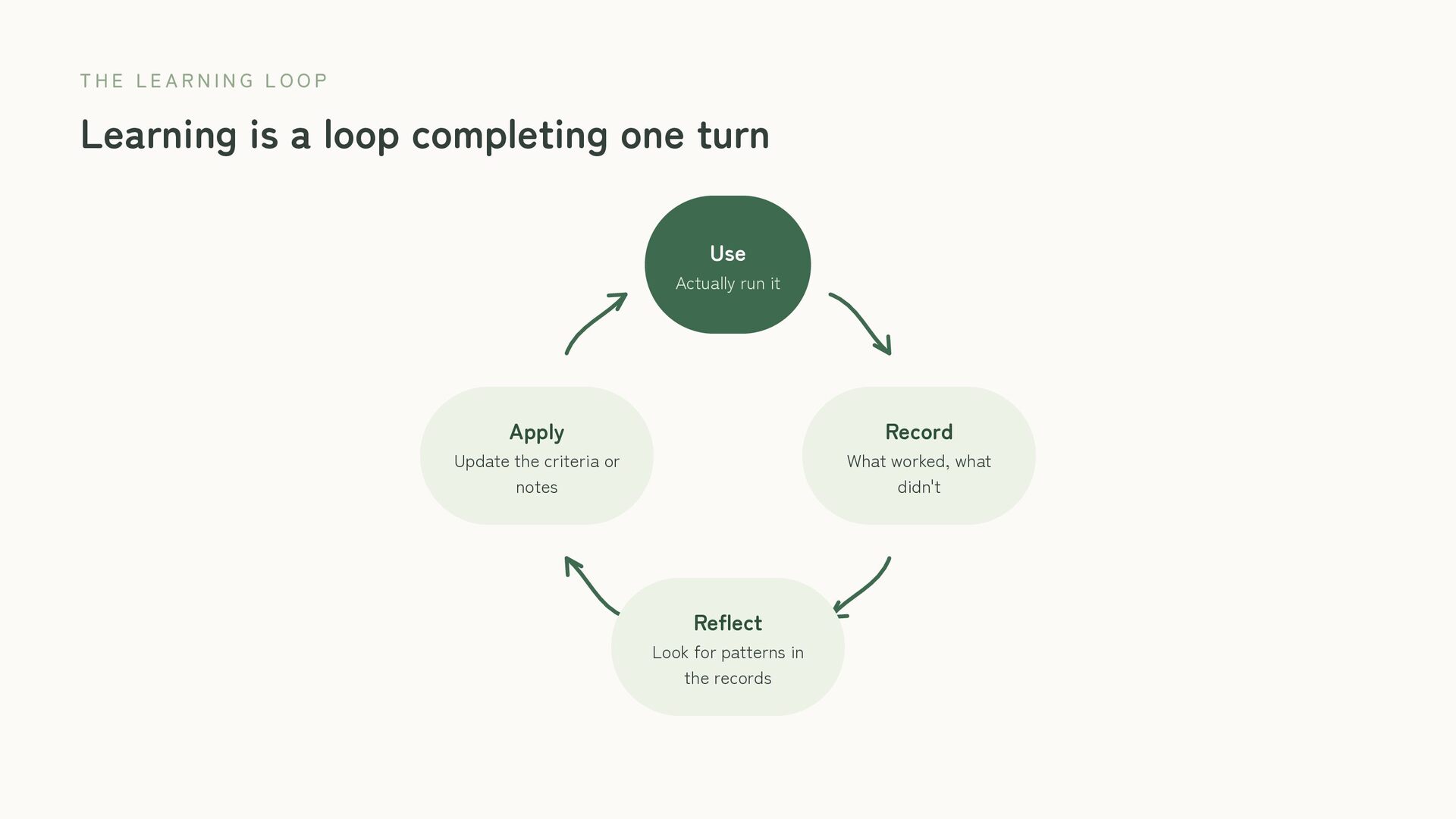
G L O O P Learning is a loop completing one turn Use Actually run it Record What worked, what didn't Reflect Look for patterns in the records Apply Update the criteria or notes
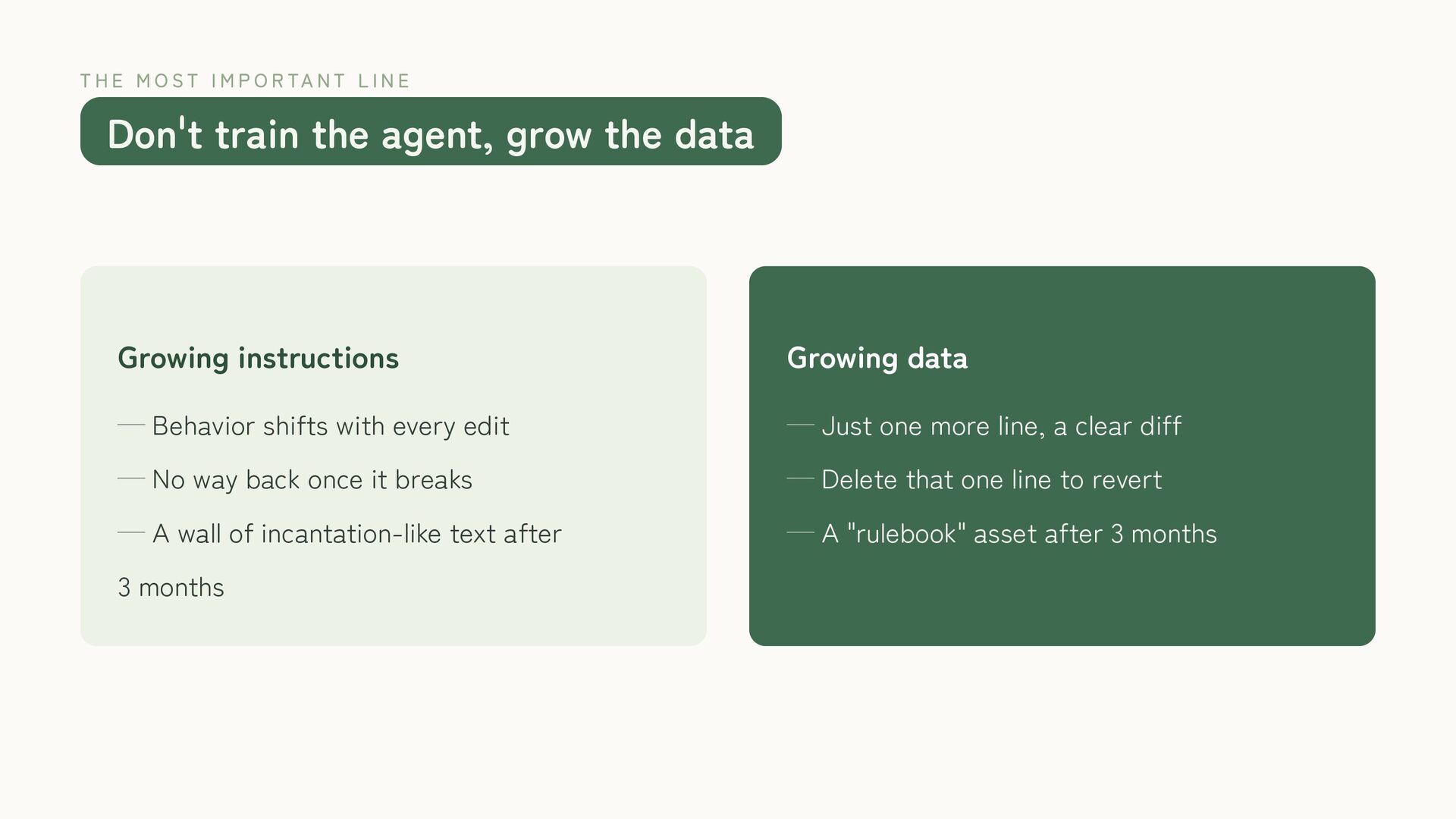
O R TA N T L I N E Don't train the agent, grow the data Growing instructions Behavior shifts with every edit No way back once it breaks A wall of incantation-like text after 3 months Growing data Just one more line, a clear diff Delete that one line to revert A "rulebook" asset after 3 months — — — — — —
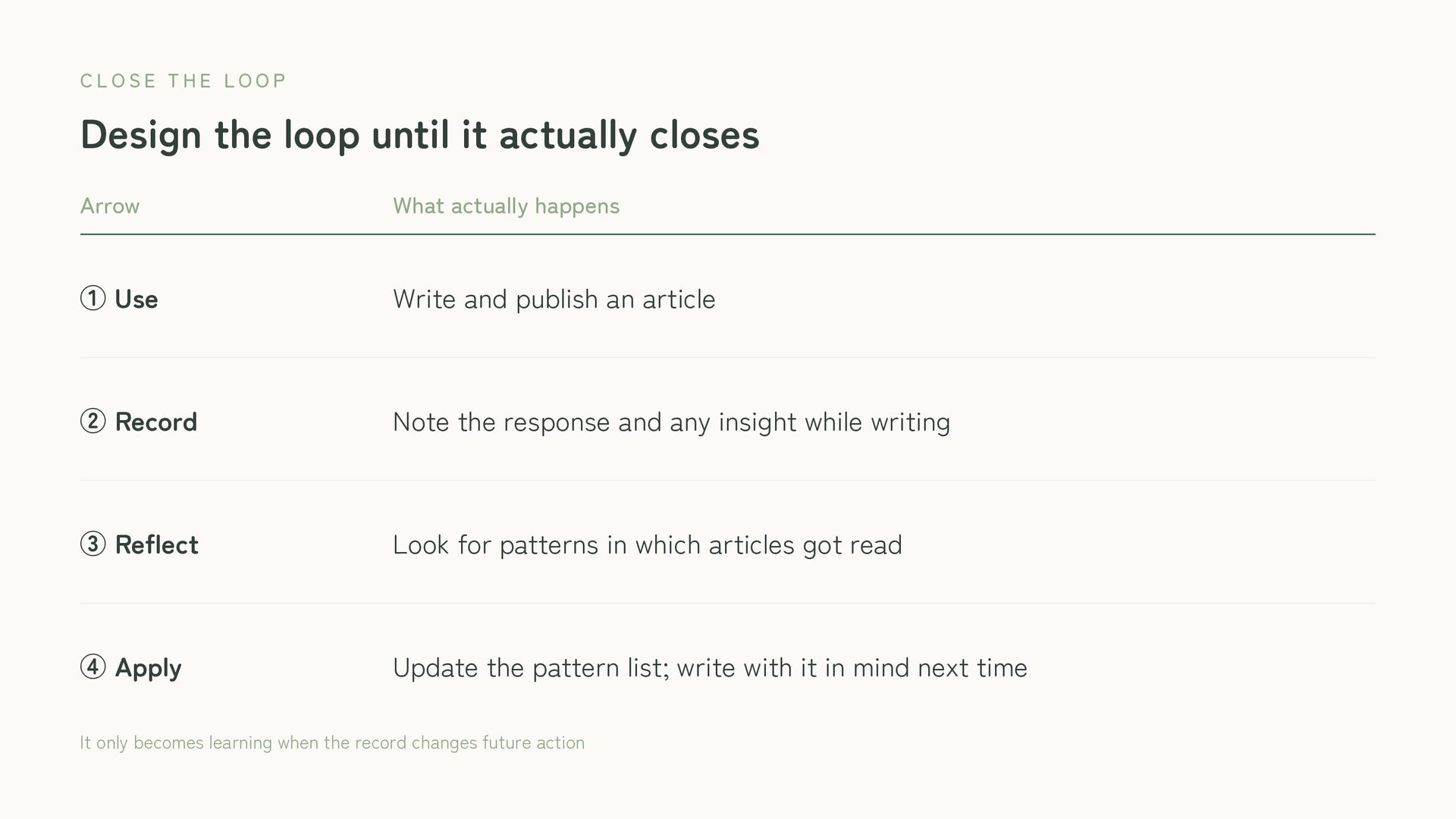
O P Design the loop until it actually closes Arrow What actually happens ① Use Write and publish an article ② Record Note the response and any insight while writing ③ Reflect Look for patterns in which articles got read ④ Apply Update the pattern list; write with it in mind next time It only becomes learning when the record changes future action
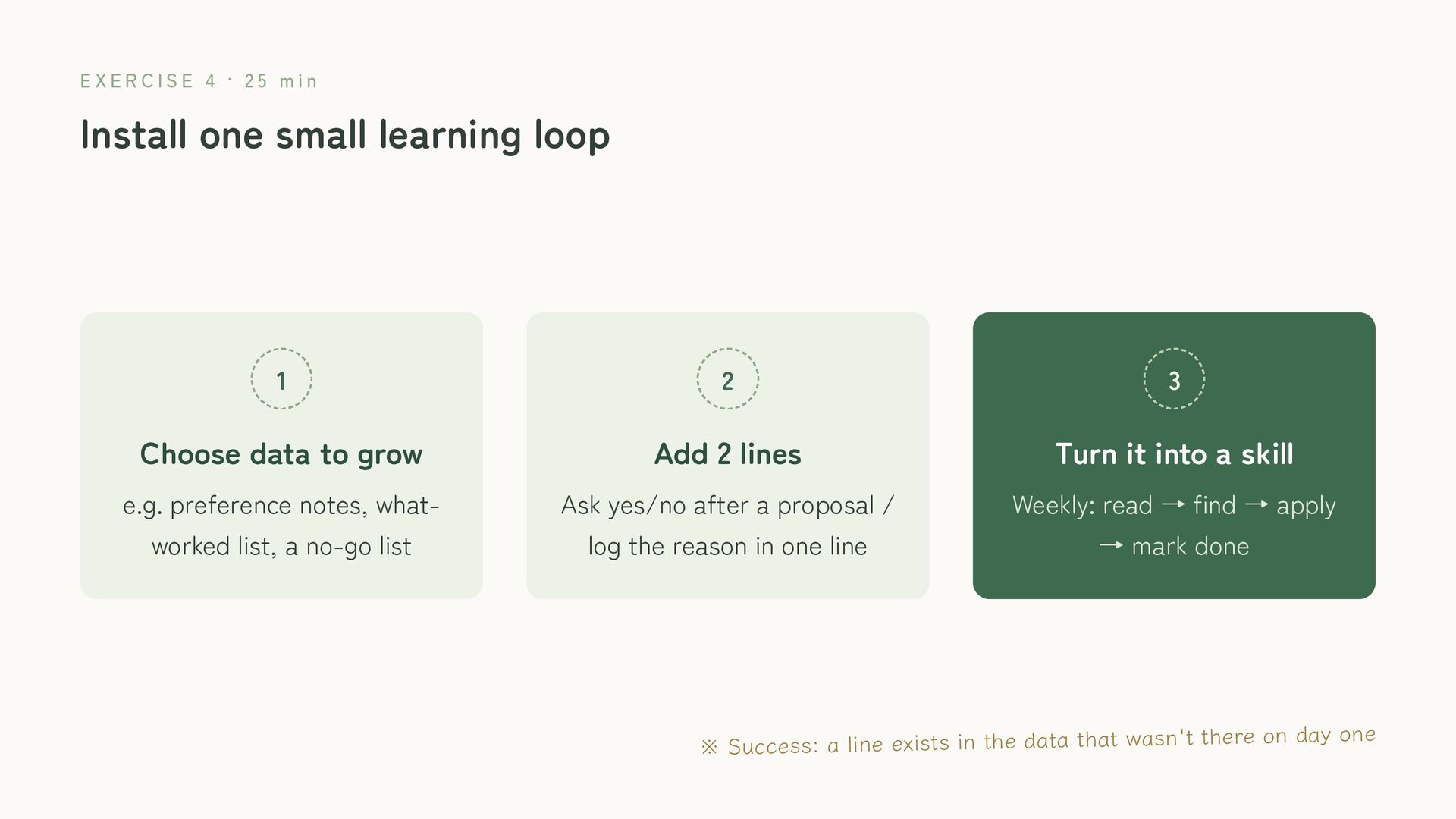
2 5 m i n Install one small learning loop 1 Choose data to grow e.g. preference notes, what- worked list, a no-go list 2 Add 2 lines Ask yes/no after a proposal / log the reason in one line 3 Turn it into a skill Weekly: read → find → apply → mark done ※ Success: a line exists in the data that wasn't there on day one
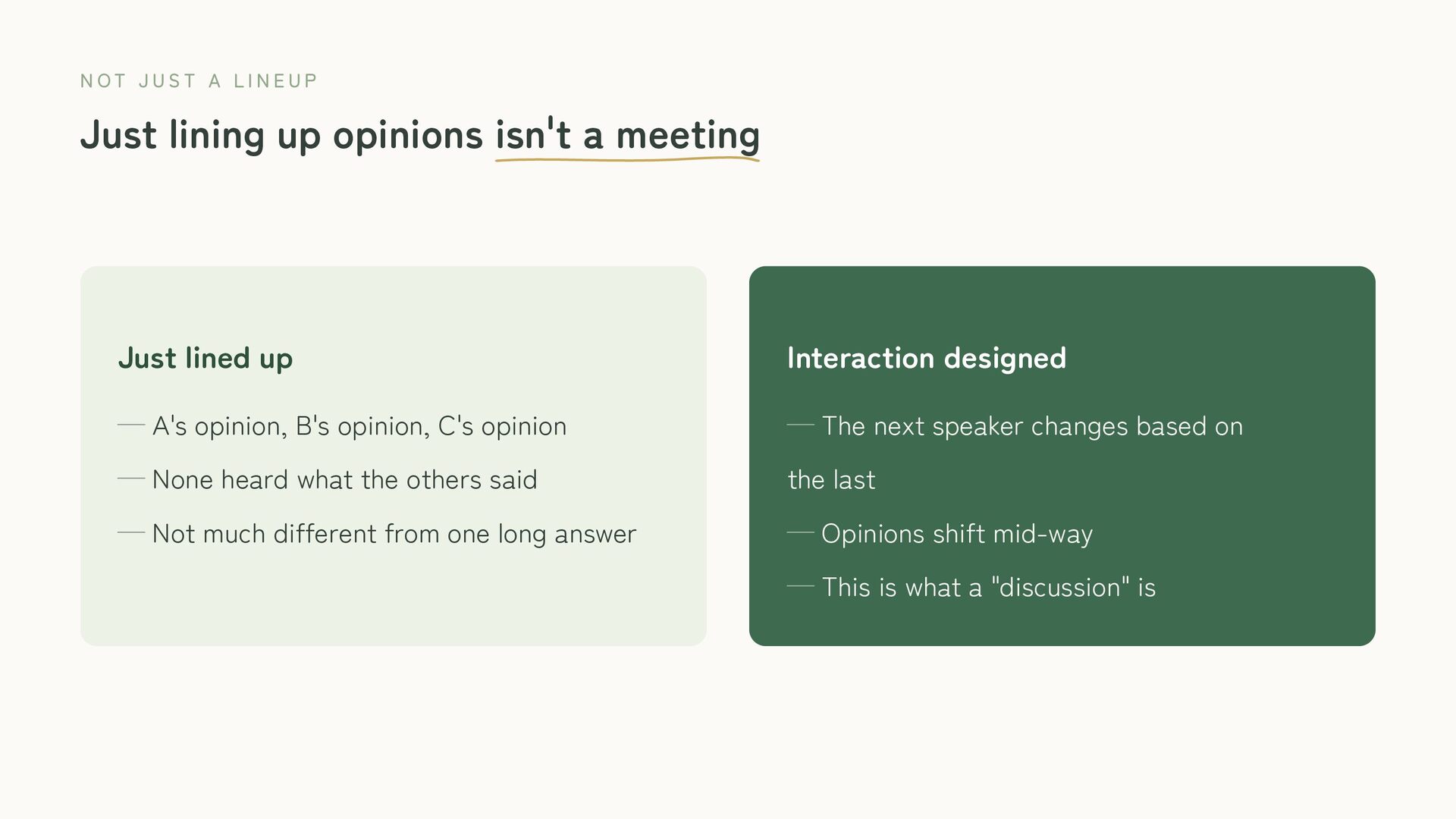
N E U P Just lining up opinions Just lined up A's opinion, B's opinion, C's opinion None heard what the others said Not much different from one long answer Interaction designed The next speaker changes based on the last Opinions shift mid-way This is what a "discussion" is isn't a meeting — — — — — —
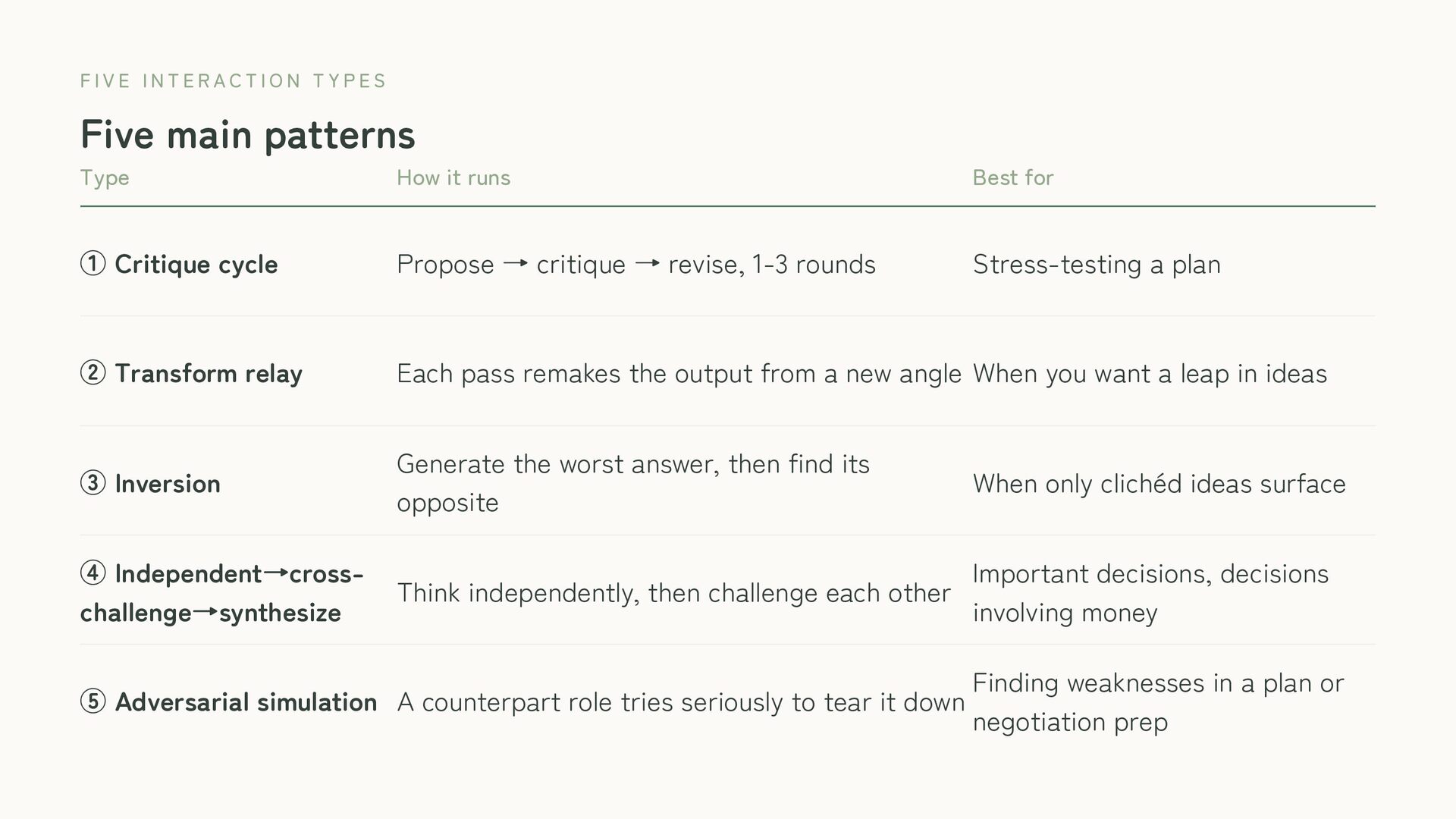
C T I O N T Y P E S Five main patterns Type How it runs Best for ① Critique cycle Propose → critique → revise, 1-3 rounds Stress-testing a plan ② Transform relay Each pass remakes the output from a new angle When you want a leap in ideas ③ Inversion Generate the worst answer, then find its opposite When only clichéd ideas surface ④ Independent→cross- challenge→synthesize Think independently, then challenge each other Important decisions, decisions involving money ⑤ Adversarial simulation A counterpart role tries seriously to tear it down Finding weaknesses in a plan or negotiation prep
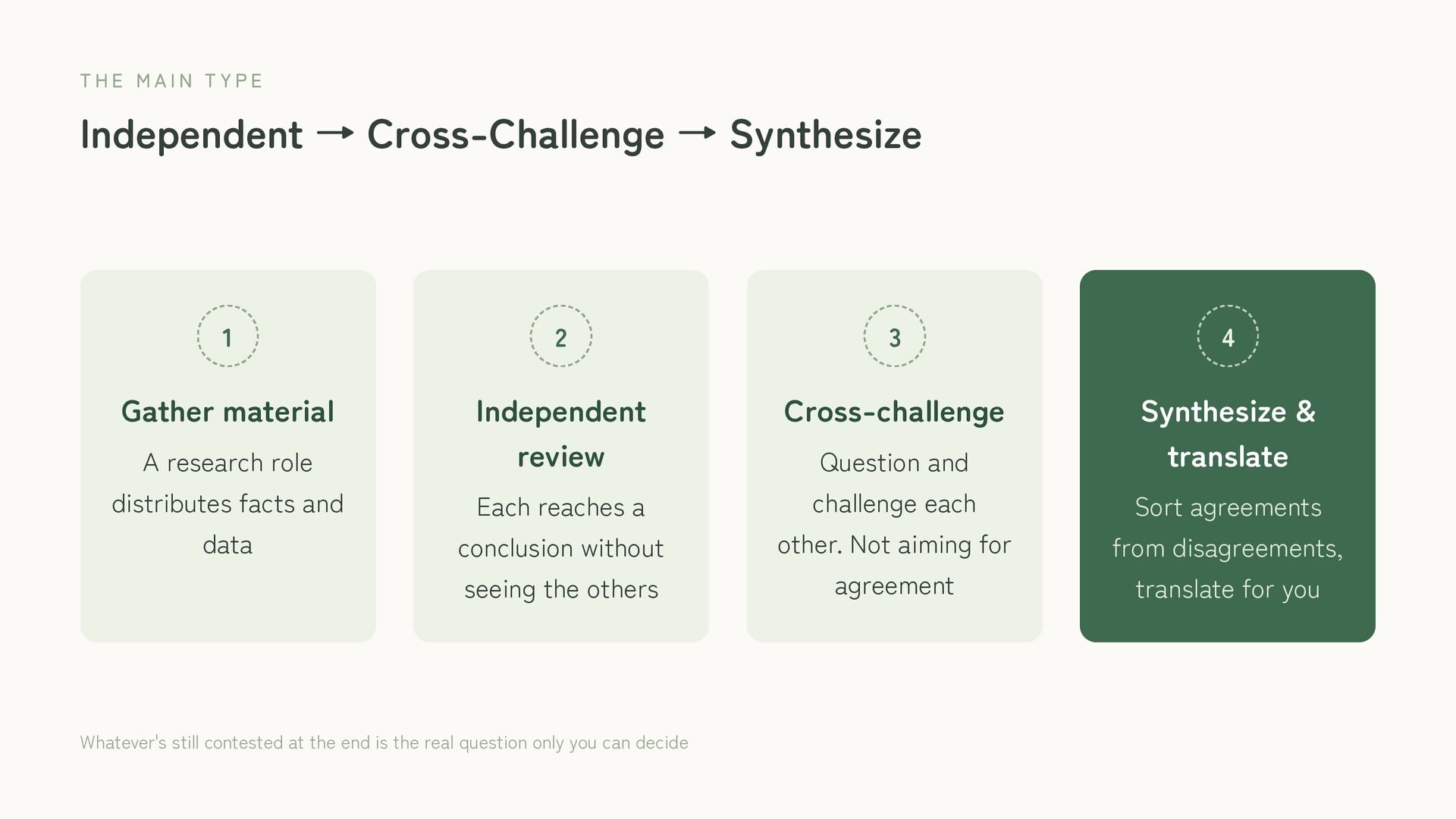
E Independent → Cross-Challenge → Synthesize 1 Gather material A research role distributes facts and data 2 Independent review Each reaches a conclusion without seeing the others 3 Cross-challenge Question and challenge each other. Not aiming for agreement 4 Synthesize & translate Sort agreements from disagreements, translate for you Whatever's still contested at the end is the real question only you can decide
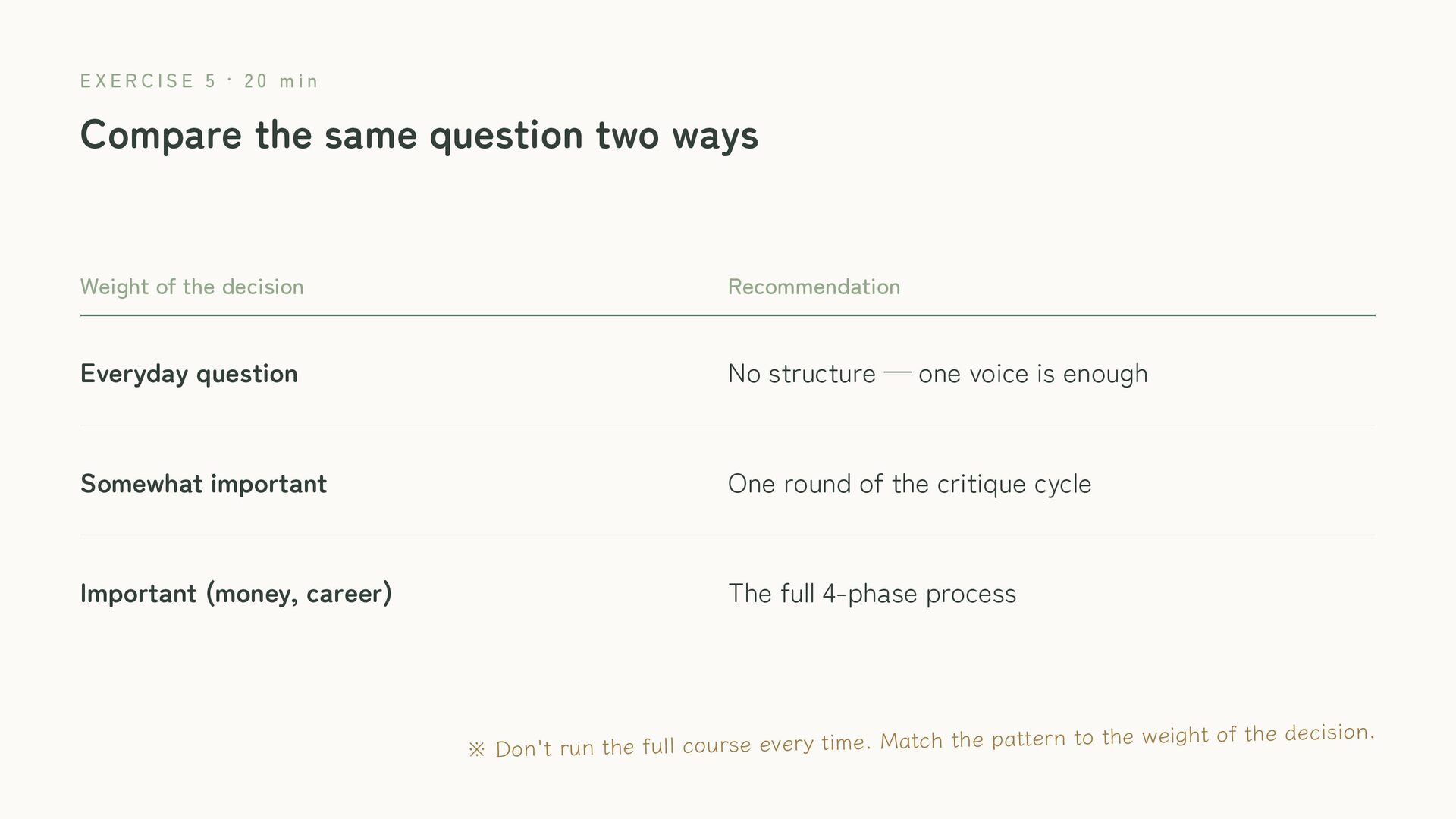
2 0 m i n Compare the same question two ways Weight of the decision Recommendation Everyday question No structure — one voice is enough Somewhat important One round of the critique cycle Important (money, career) The full 4-phase process ※ Don't run the full course every time. Match the pattern to the weight of the decision.
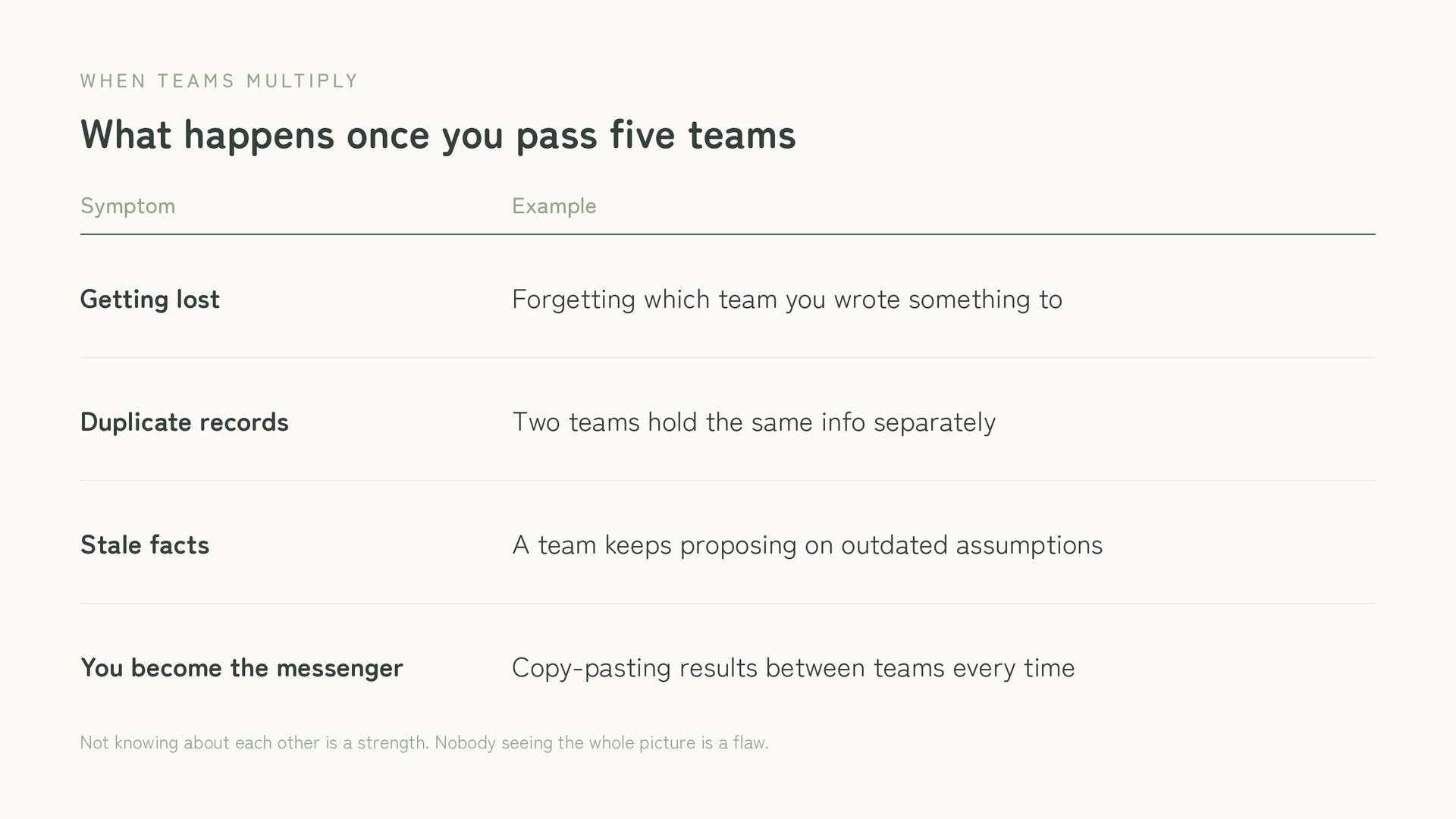
U LT I P LY What happens once you pass five teams Symptom Example Getting lost Forgetting which team you wrote something to Duplicate records Two teams hold the same info separately Stale facts A team keeps proposing on outdated assumptions You become the messenger Copy-pasting results between teams every time Not knowing about each other is a strength. Nobody seeing the whole picture is a flaw.
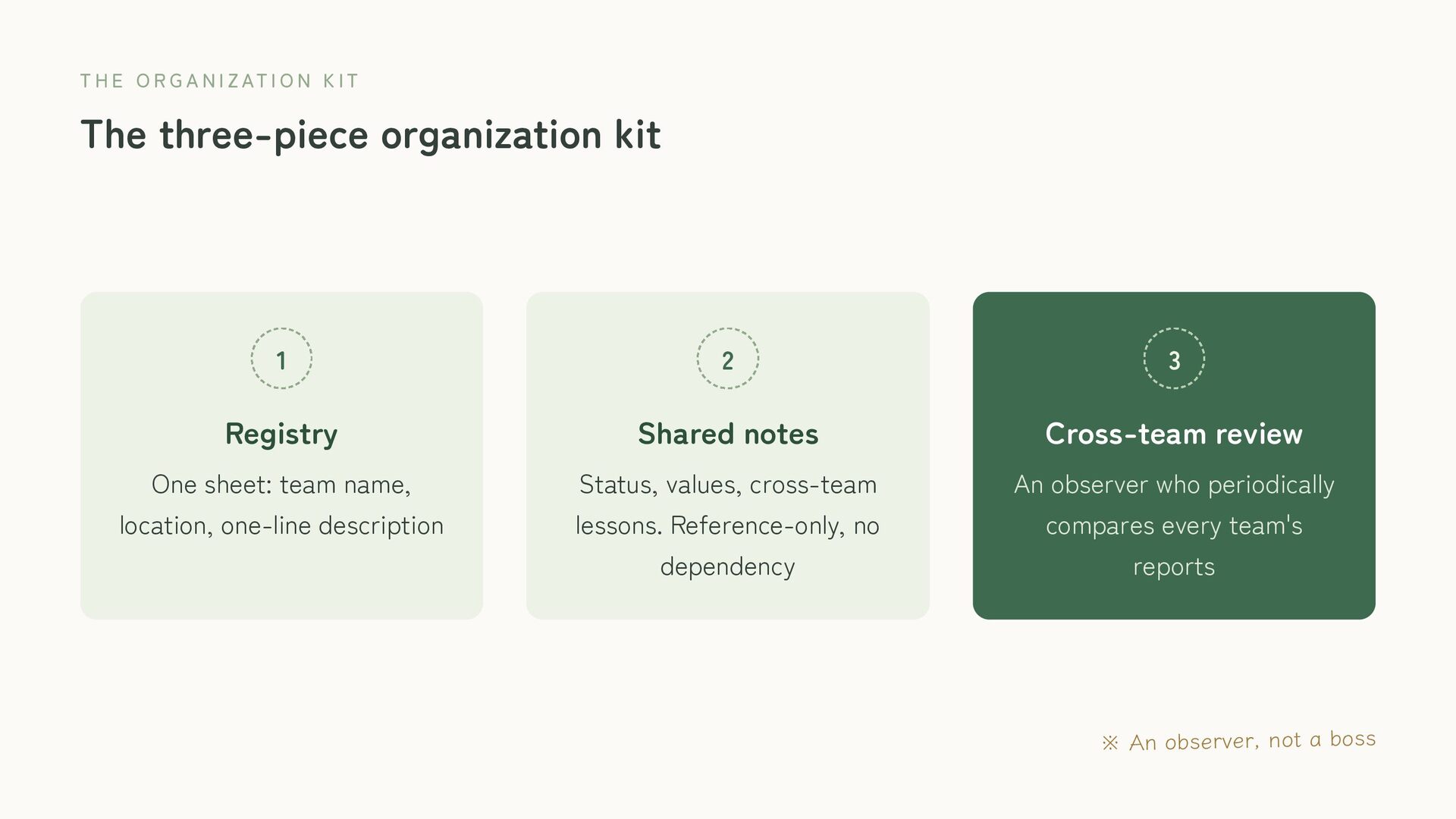
AT I O N K I T The three-piece organization kit 1 Registry One sheet: team name, location, one-line description 2 Shared notes Status, values, cross-team lessons. Reference-only, no dependency 3 Cross-team review An observer who periodically compares every team's reports ※ An observer, not a boss
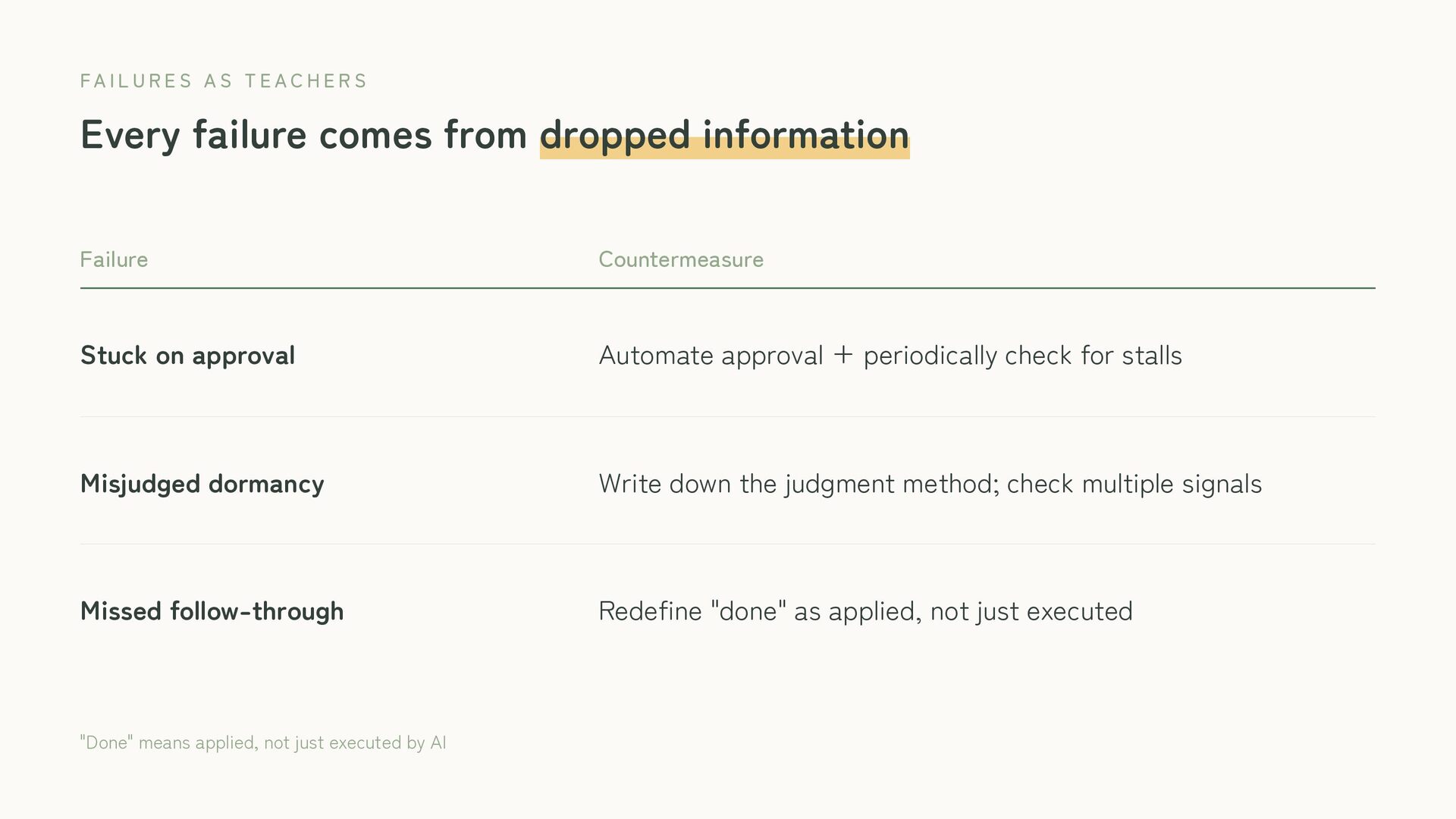
E A C H E R S Every failure comes from dropped information Failure Countermeasure Stuck on approval Automate approval + periodically check for stalls Misjudged dormancy Write down the judgment method; check multiple signals Missed follow-through Redefine "done" as applied, not just executed "Done" means applied, not just executed by AI
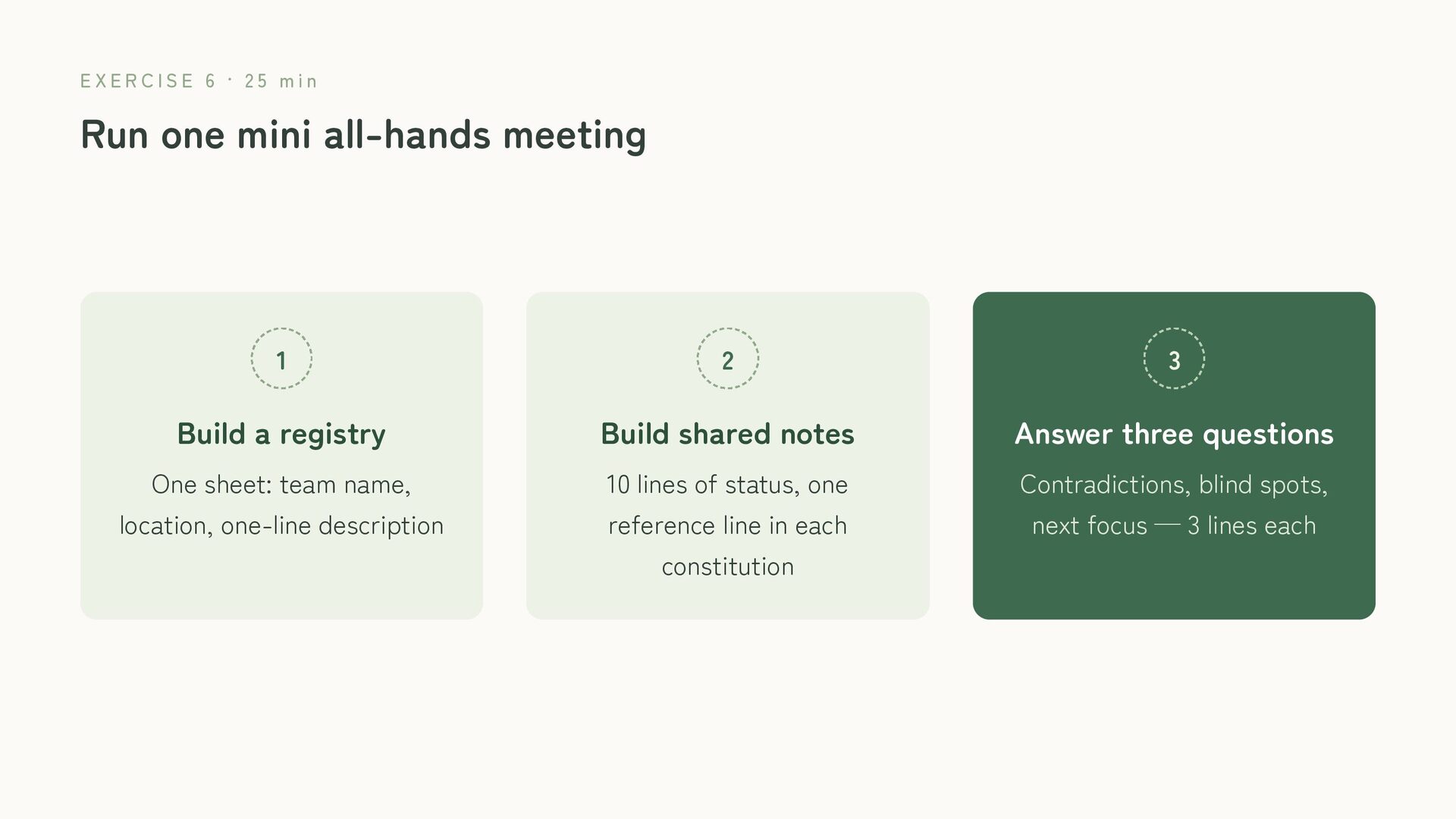
2 5 m i n Run one mini all-hands meeting 1 Build a registry One sheet: team name, location, one-line description 2 Build shared notes 10 lines of status, one reference line in each constitution 3 Answer three questions Contradictions, blind spots, next focus — 3 lines each
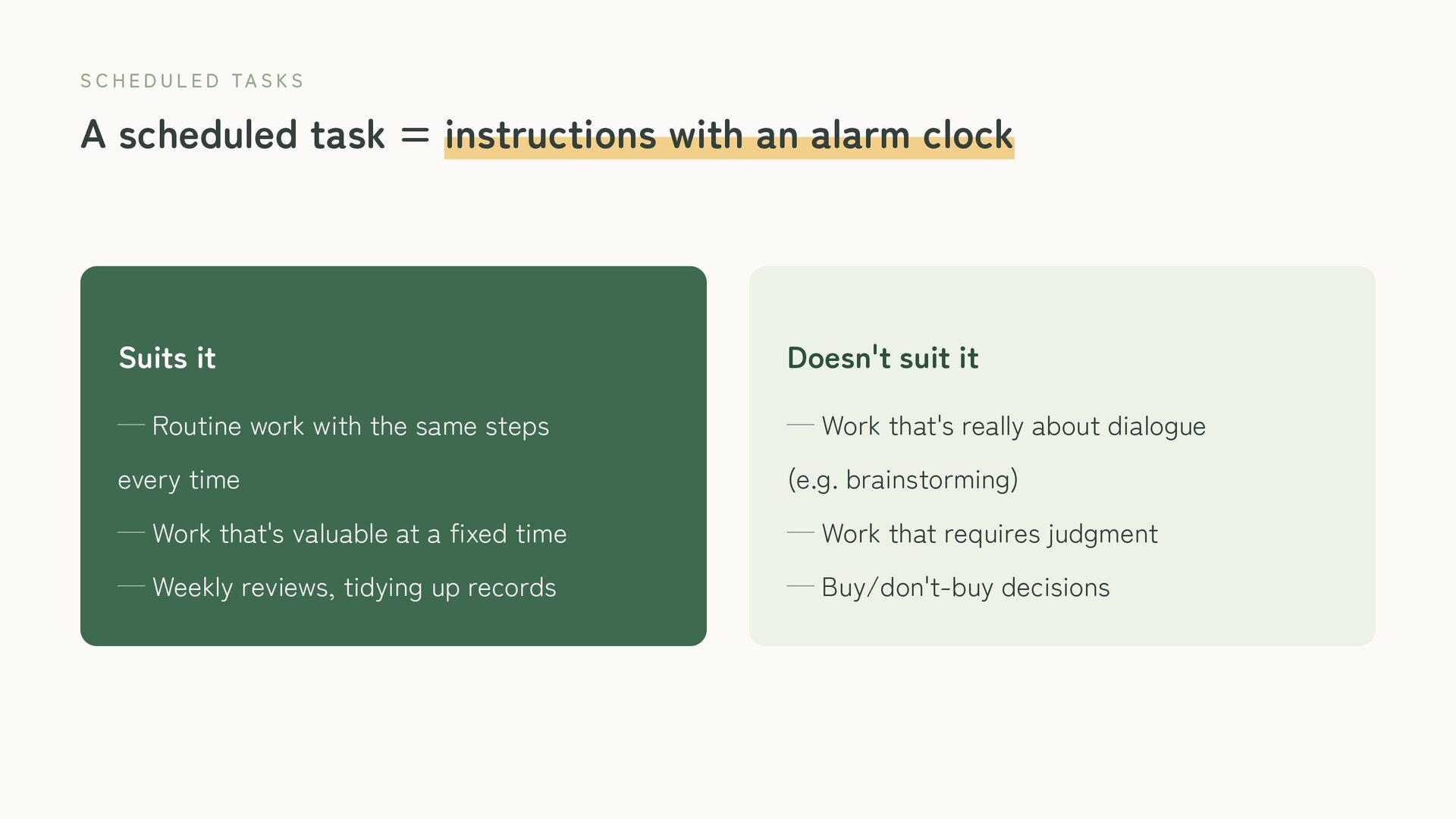
S K S A scheduled task = instructions with an alarm clock Suits it Routine work with the same steps every time Work that's valuable at a fixed time Weekly reviews, tidying up records Doesn't suit it Work that's really about dialogue (e.g. brainstorming) Work that requires judgment Buy/don't-buy decisions — — — — — —
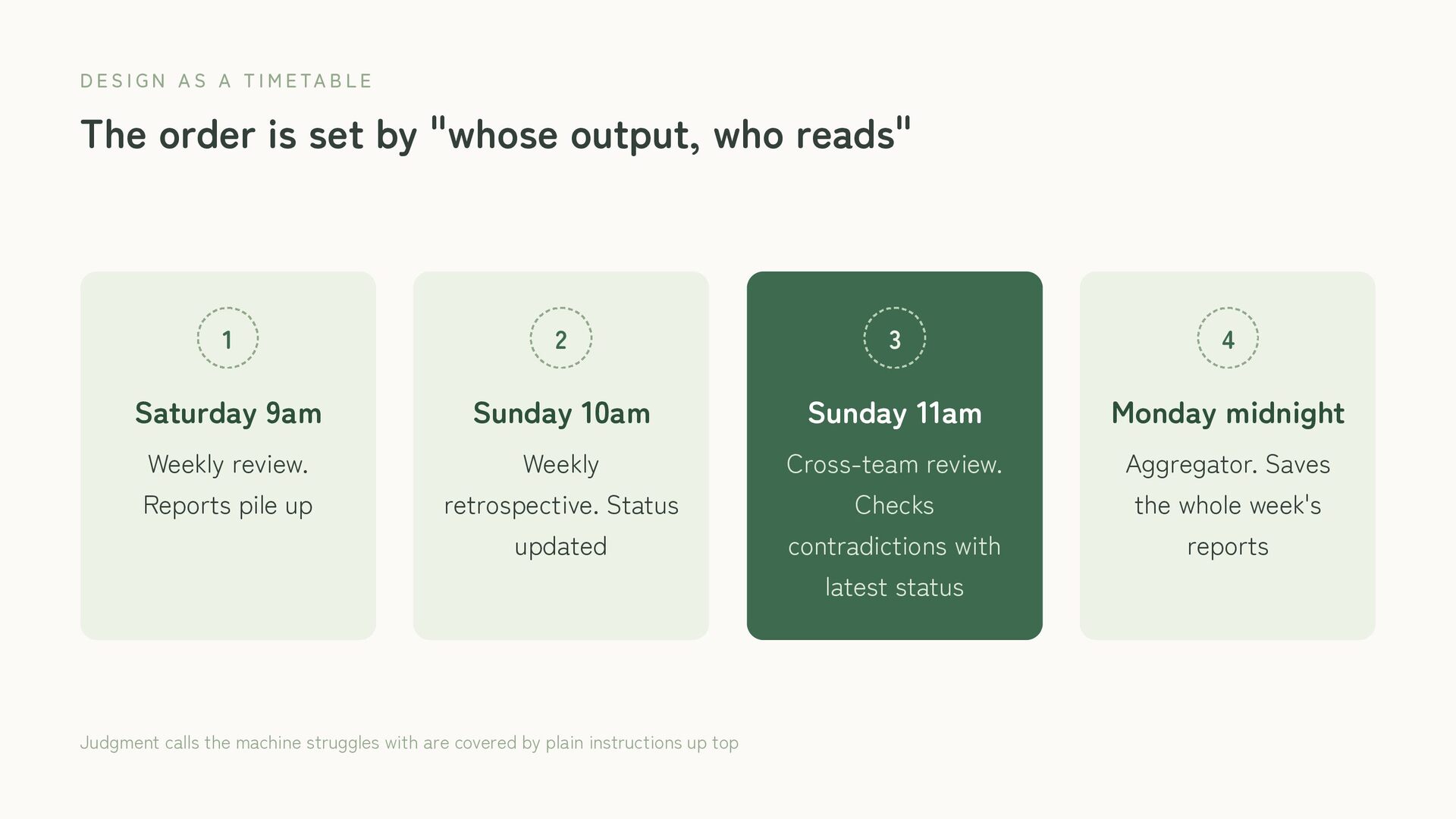
I M E TA B L E The order is set by "whose output, who reads" 1 Saturday 9am Weekly review. Reports pile up 2 Sunday 10am Weekly retrospective. Status updated 3 Sunday 11am Cross-team review. Checks contradictions with latest status 4 Monday midnight Aggregator. Saves the whole week's reports Judgment calls the machine struggles with are covered by plain instructions up top
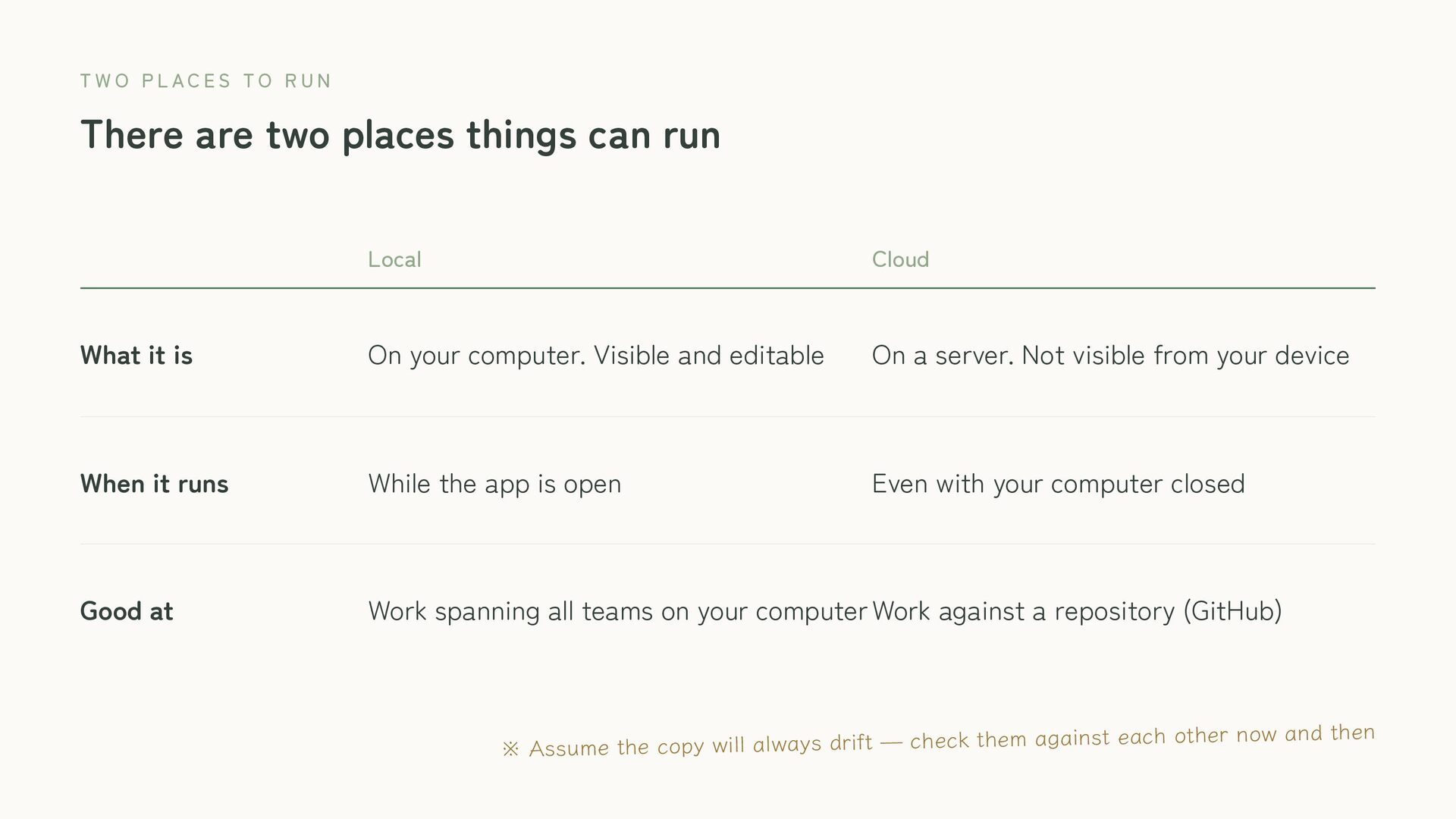
O R U N There are two places things can run Local Cloud What it is On your computer. Visible and editable On a server. Not visible from your device When it runs While the app is open Even with your computer closed Good at Work spanning all teams on your computerWork against a repository (GitHub) ※ Assume the copy will always drift — check them against each other now and then
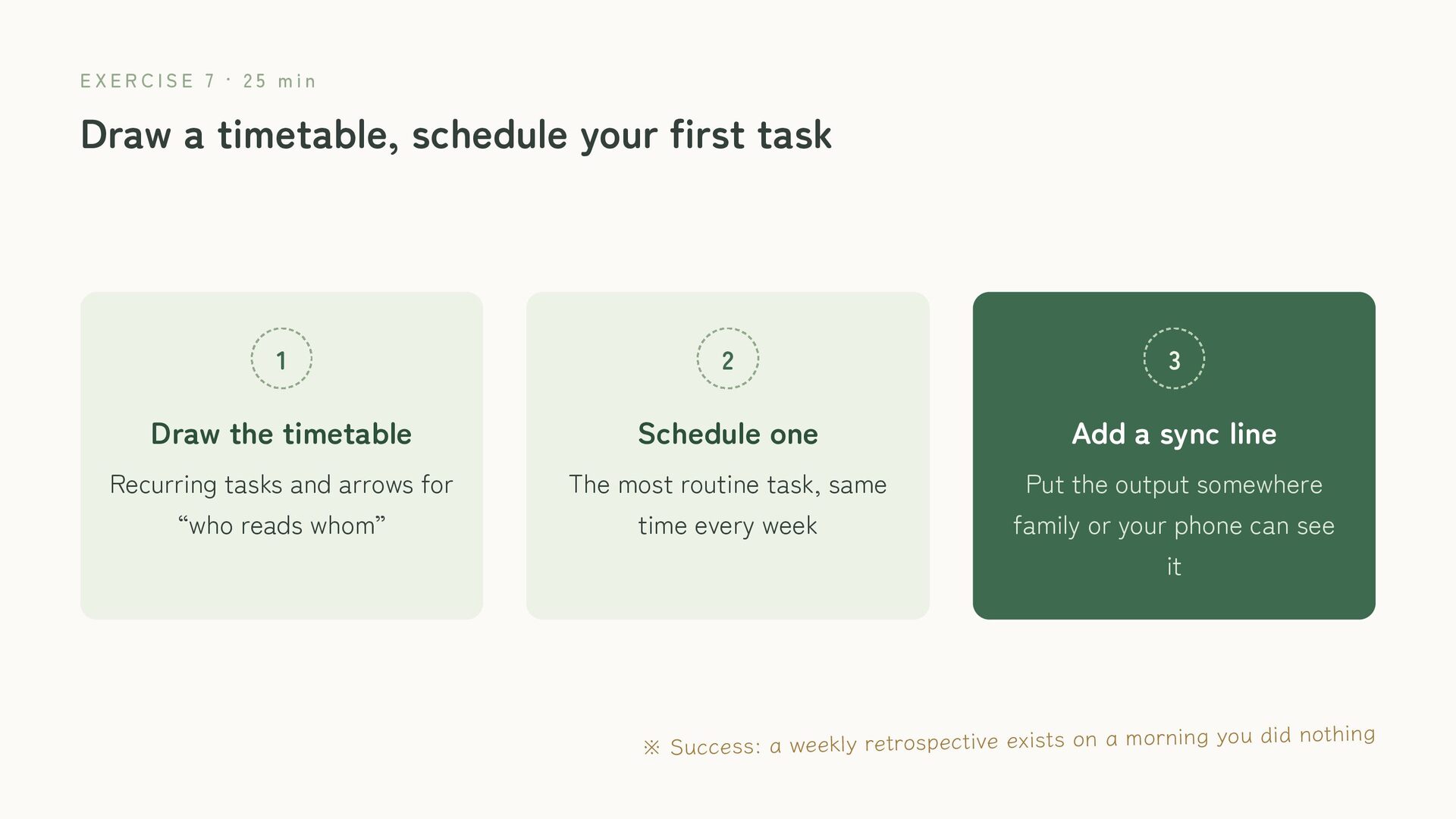
2 5 m i n Draw a timetable, schedule your first task 1 Draw the timetable Recurring tasks and arrows for “who reads whom” 2 Schedule one The most routine task, same time every week 3 Add a sync line Put the output somewhere family or your phone can see it ※ Success: a weekly retrospective exists on a morning you did nothing
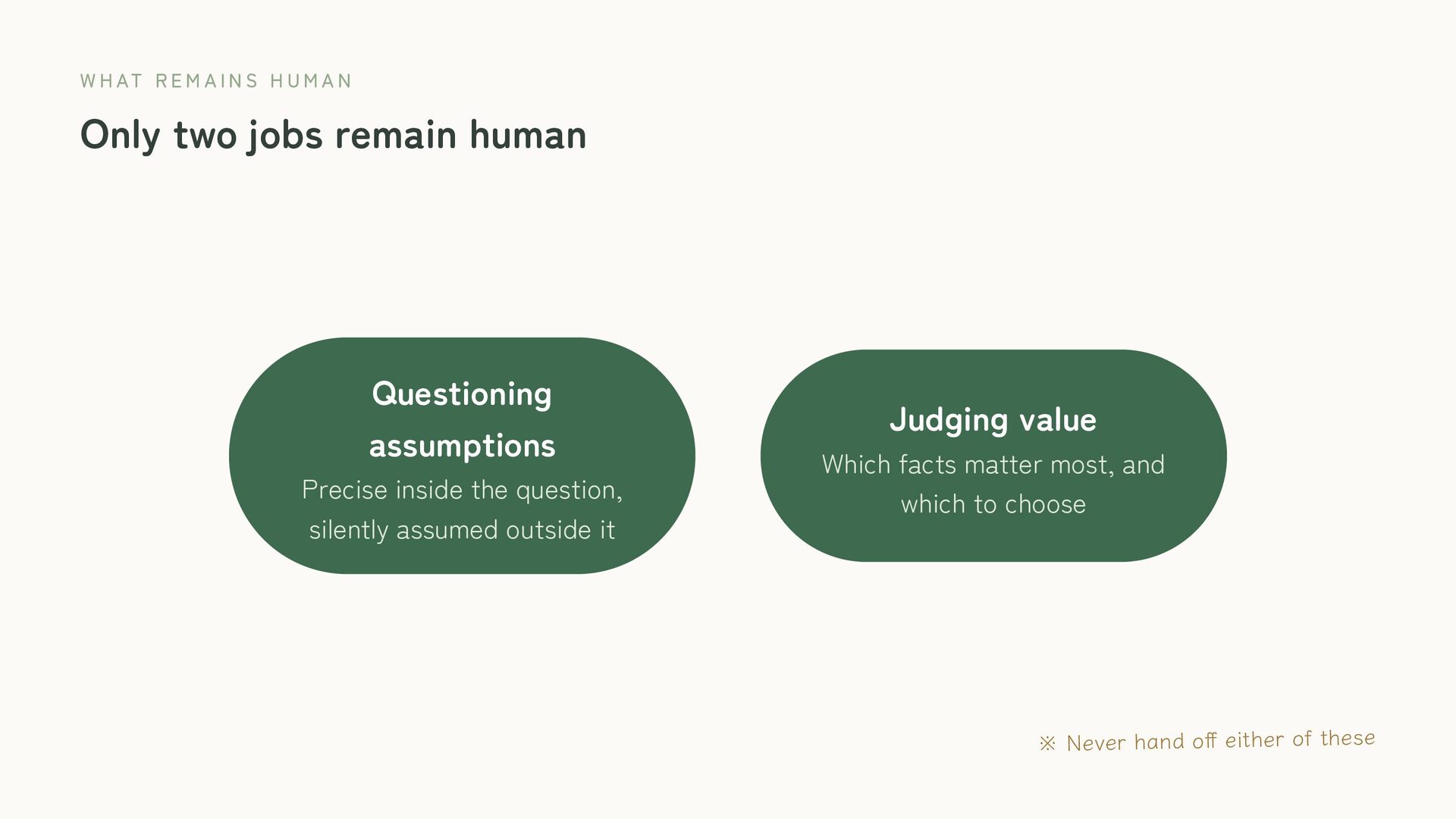
H U M A N Only two jobs remain human Questioning assumptions Precise inside the question, silently assumed outside it Judging value Which facts matter most, and which to choose ※ Never hand off either of these
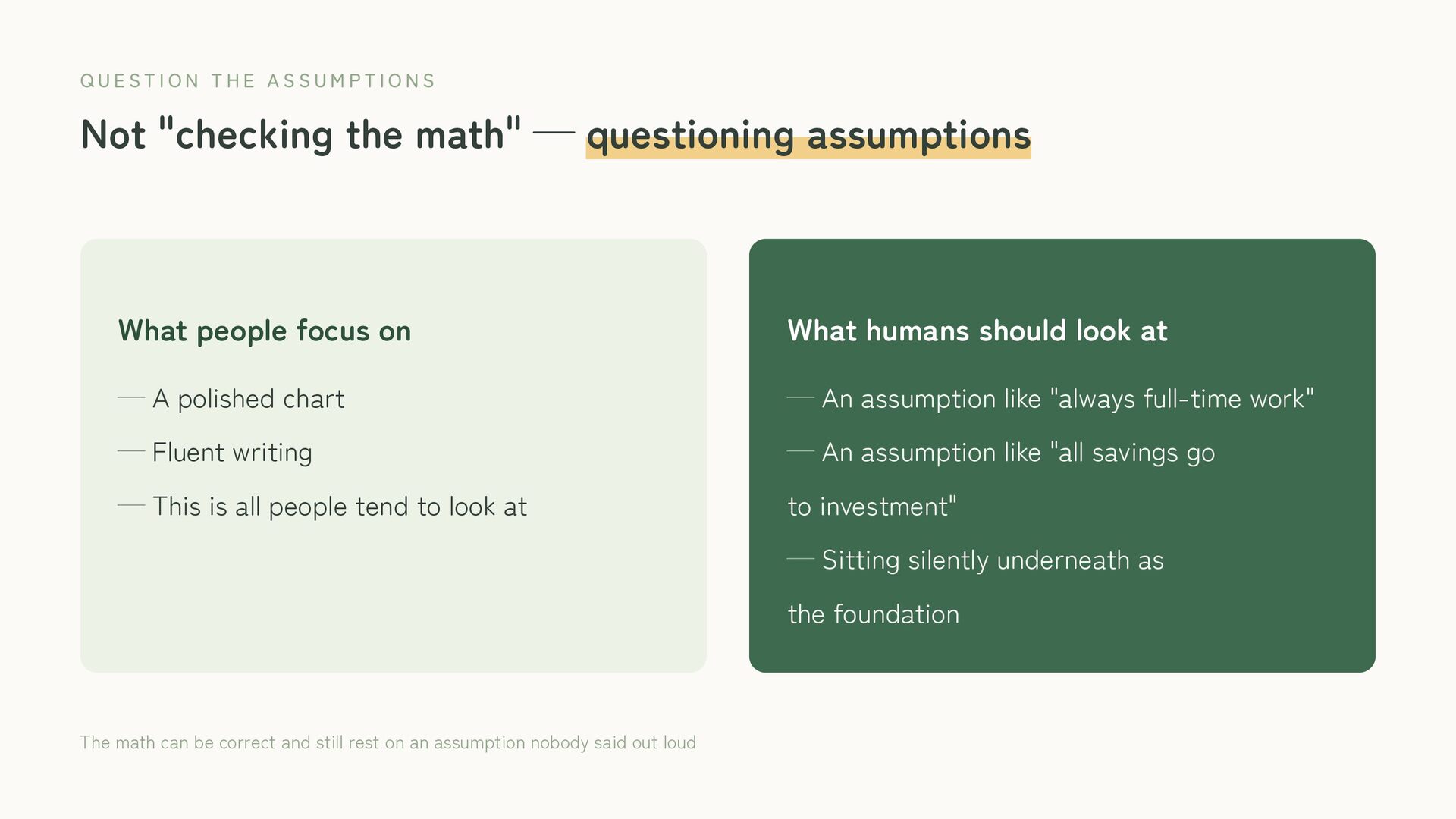
E A S S U M P T I O N S Not "checking the math" — questioning assumptions What people focus on A polished chart Fluent writing This is all people tend to look at What humans should look at An assumption like "always full-time work" An assumption like "all savings go to investment" Sitting silently underneath as the foundation — — — — — — The math can be correct and still rest on an assumption nobody said out loud
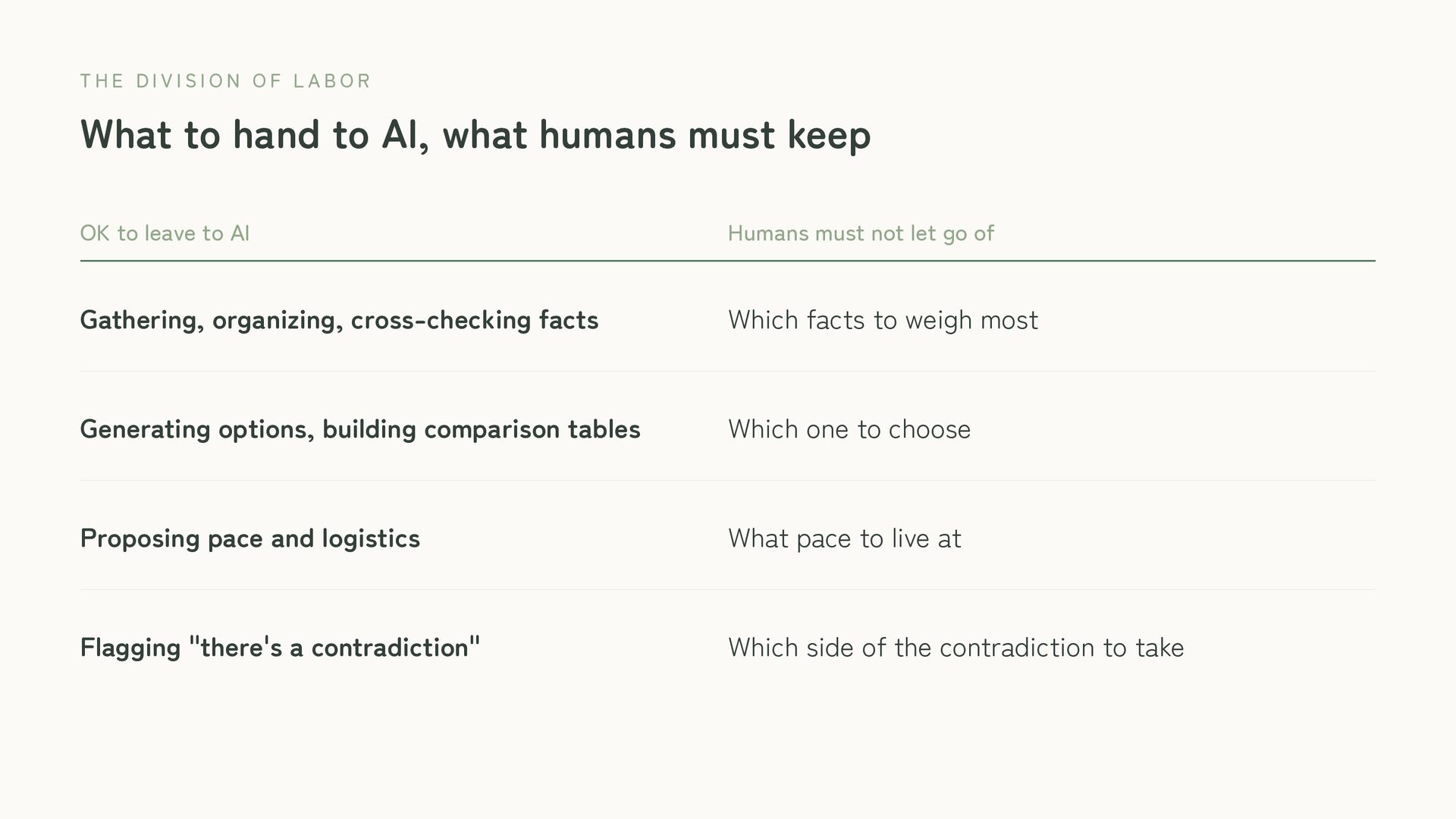
N O F L A B O R What to hand to AI, what humans must keep OK to leave to AI Humans must not let go of Gathering, organizing, cross-checking facts Which facts to weigh most Generating options, building comparison tables Which one to choose Proposing pace and logistics What pace to live at Flagging "there's a contradiction" Which side of the contradiction to take
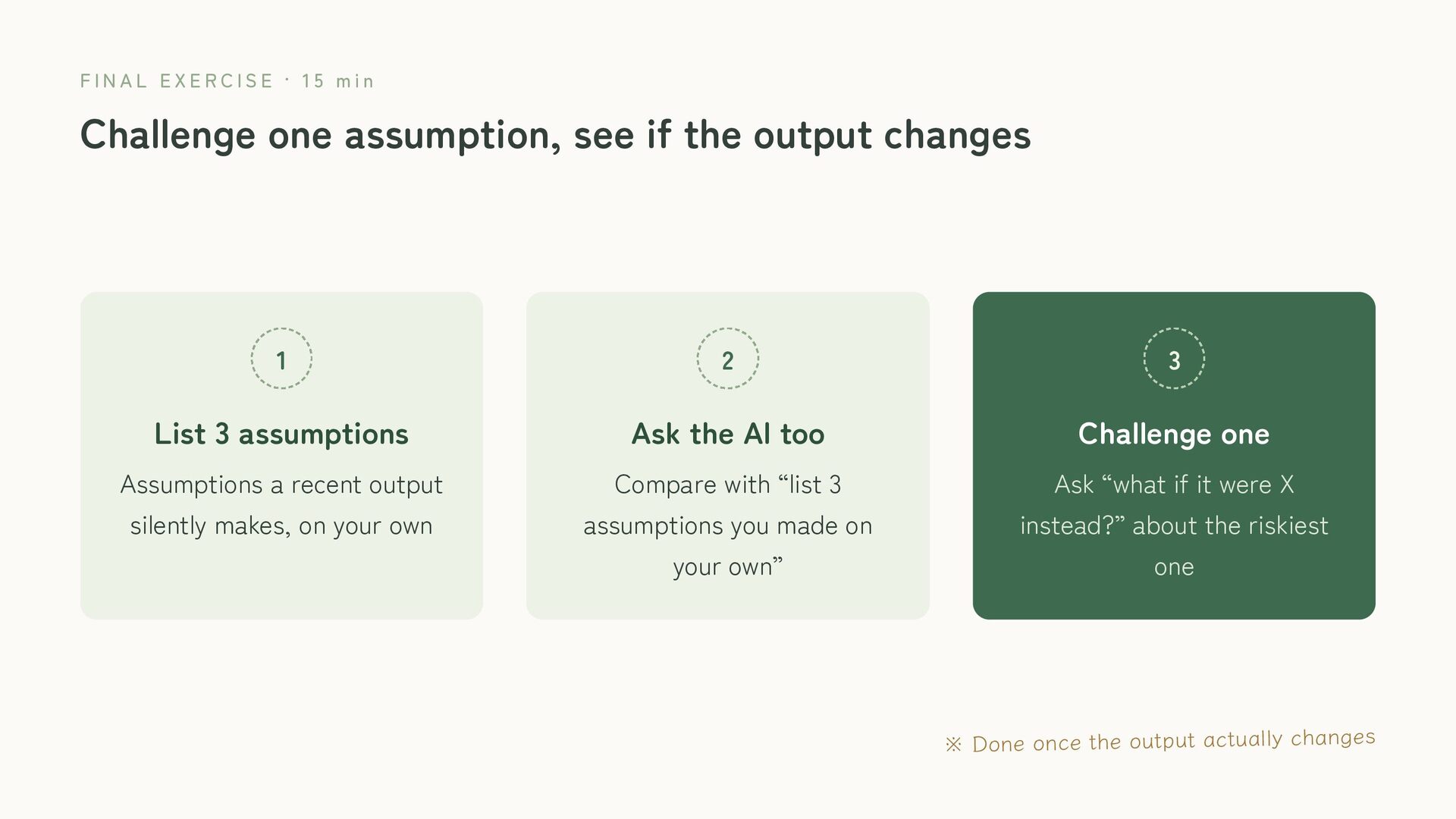
I S E · 1 5 m i n Challenge one assumption, see if the output changes 1 List 3 assumptions Assumptions a recent output silently makes, on your own 2 Ask the AI too Compare with “list 3 assumptions you made on your own” 3 Challenge one Ask “what if it were X instead?” about the riskiest one ※ Done once the output actually changes
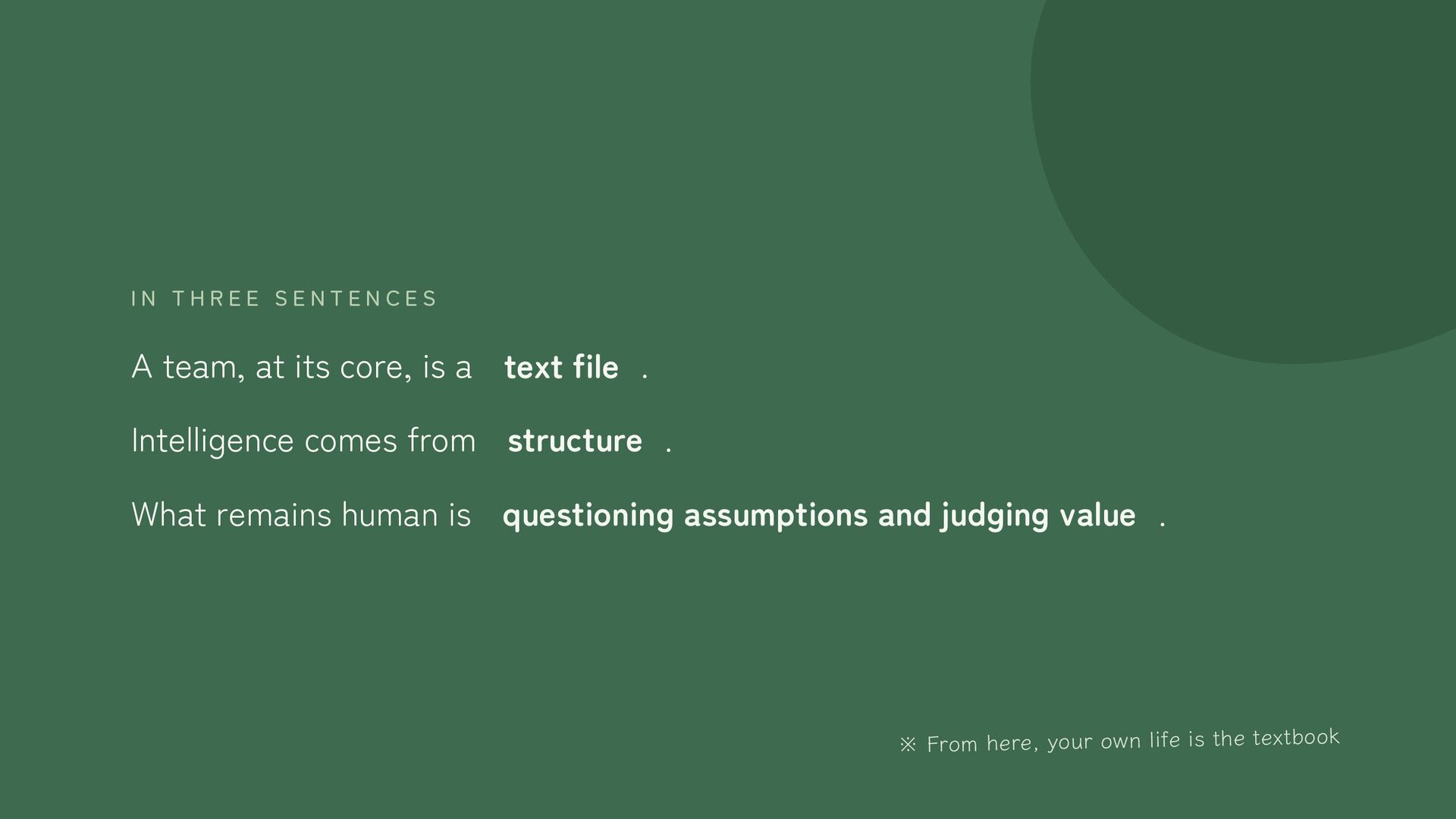
T E N C E S A team, at its core, is a text file . Intelligence comes from structure . What remains human is questioning assumptions and judging value . ※ From here, your own life is the textbook


 forest8810
 loglass2019
 tamosan01
 uemura2024
 doiko123
 superstudio
 tbpgr
tbpgr
 xinghr
 shunsuke_takeuchi
 kgmotors
 handy_official
 stanby_inc
 advalistar
 notwaldorf
 davidcarrasco
 ipullrank
 popppiees
 sferik
 tenderlove
 axbom
axbom
 charlesmeaden
 tammyeverts
 codingconduct
 rkendrick25
 soudai