Share
Embed
Using NoSQL with Yo' SQL
Supplementing your app with a slice of MongoDB. Use cases and code examples to get a feel for how to use Mongo in concert with a relational database application.
Rich Thornett
May 23, 2012
Transcript
53 slides
-
Using NoSQL with Yo’ SQL Supplementing your app with a
slice of MongoDB Rich Thornett Dribbble Thursday, June 9, 2011 -
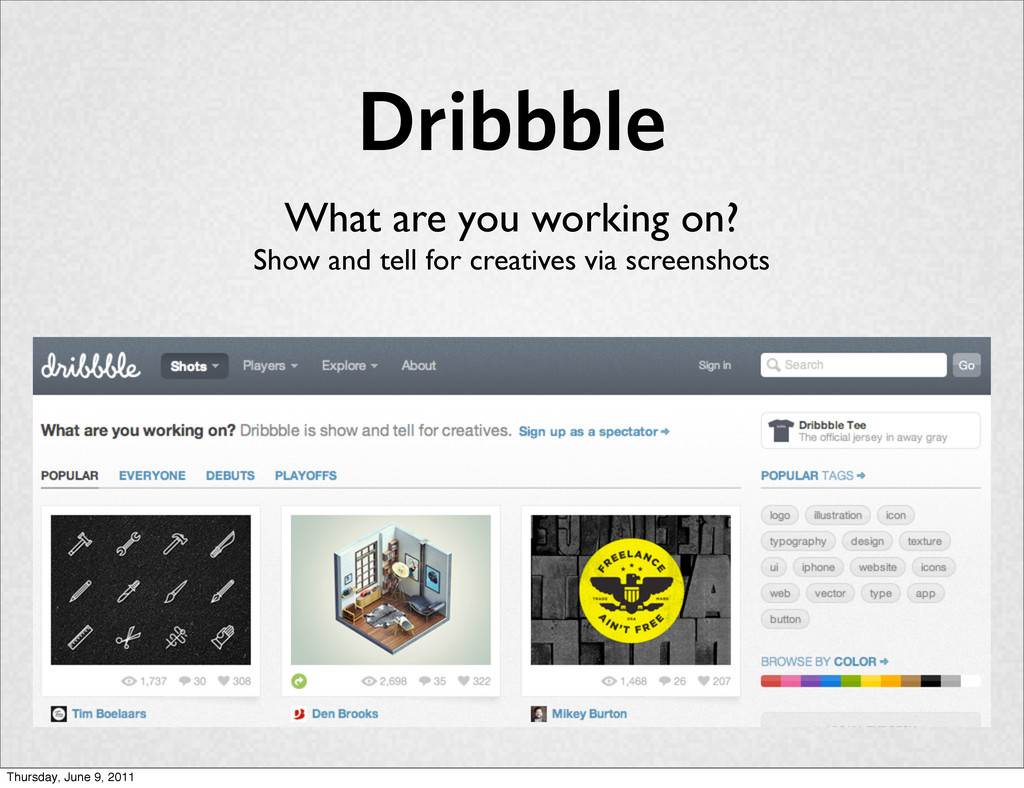
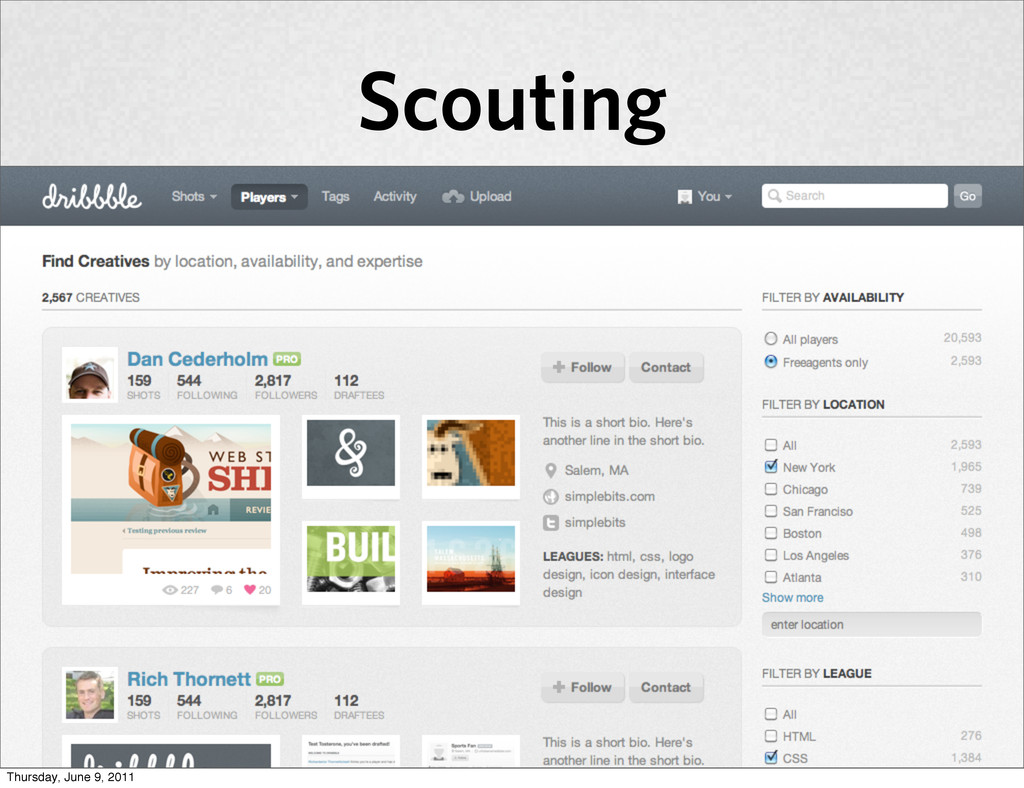
Dribbble What are you working on? Show and tell for
creatives via screenshots Thursday, June 9, 2011 -
Your Father's Webapp Dribbble is a typical web application: Ruby
on Rails + Relational Database We <3 PostgreSQL But for certain tasks ... Thursday, June 9, 2011 -
Alternative Values More flexible data structures Easier horizontal scaling log
| scale | optimize | aggregate | cache Thursday, June 9, 2011 -
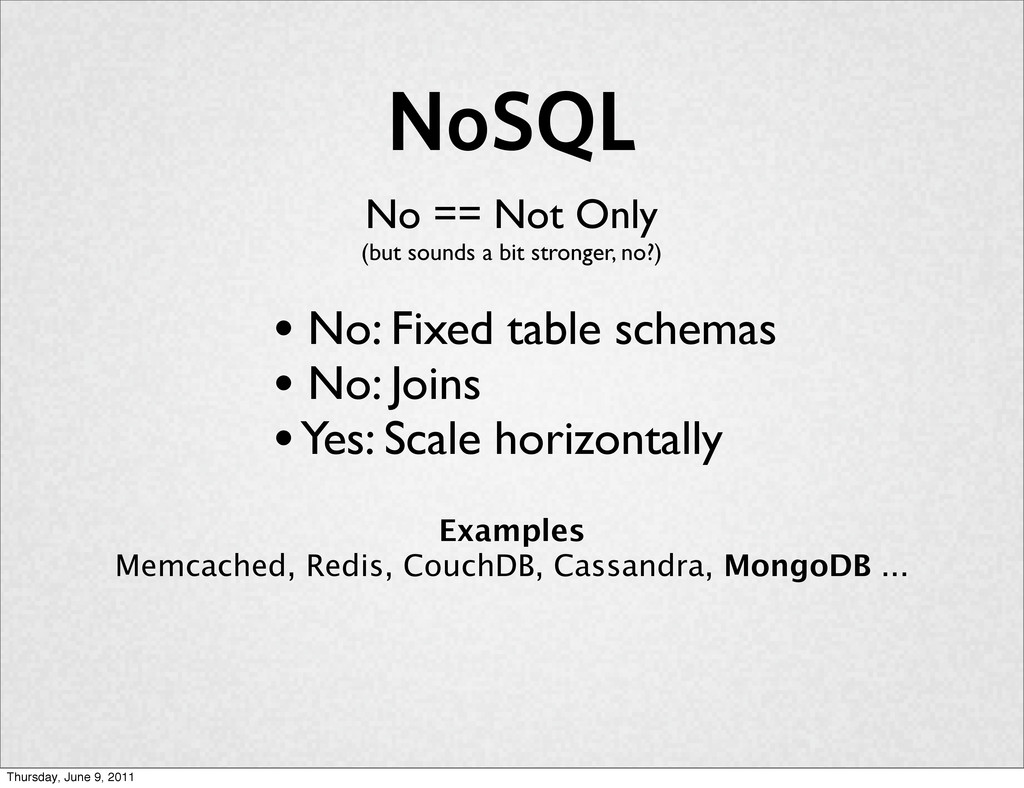
NoSQL No == Not Only (but sounds a bit stronger,
no?) • No: Fixed table schemas • No: Joins • Yes: Scale horizontally Examples Memcached, Redis, CouchDB, Cassandra, MongoDB ... Thursday, June 9, 2011 -
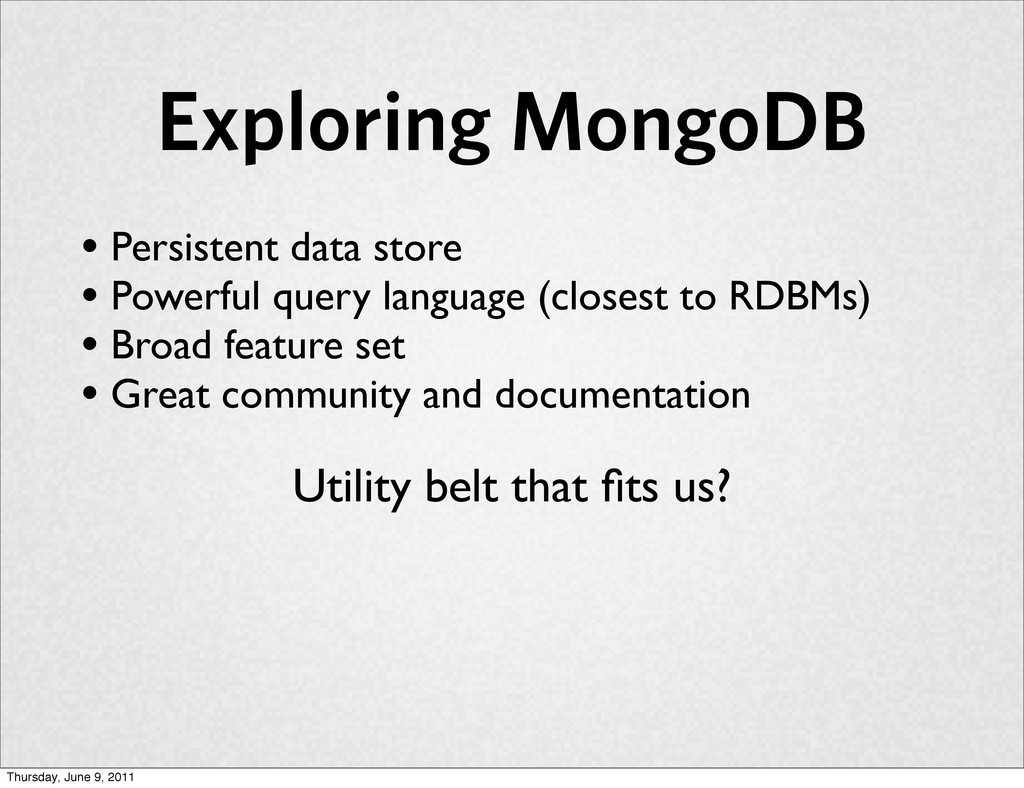
Exploring MongoDB • Persistent data store • Powerful query language
(closest to RDBMs) • Broad feature set • Great community and documentation Utility belt that fits us? Thursday, June 9, 2011 -
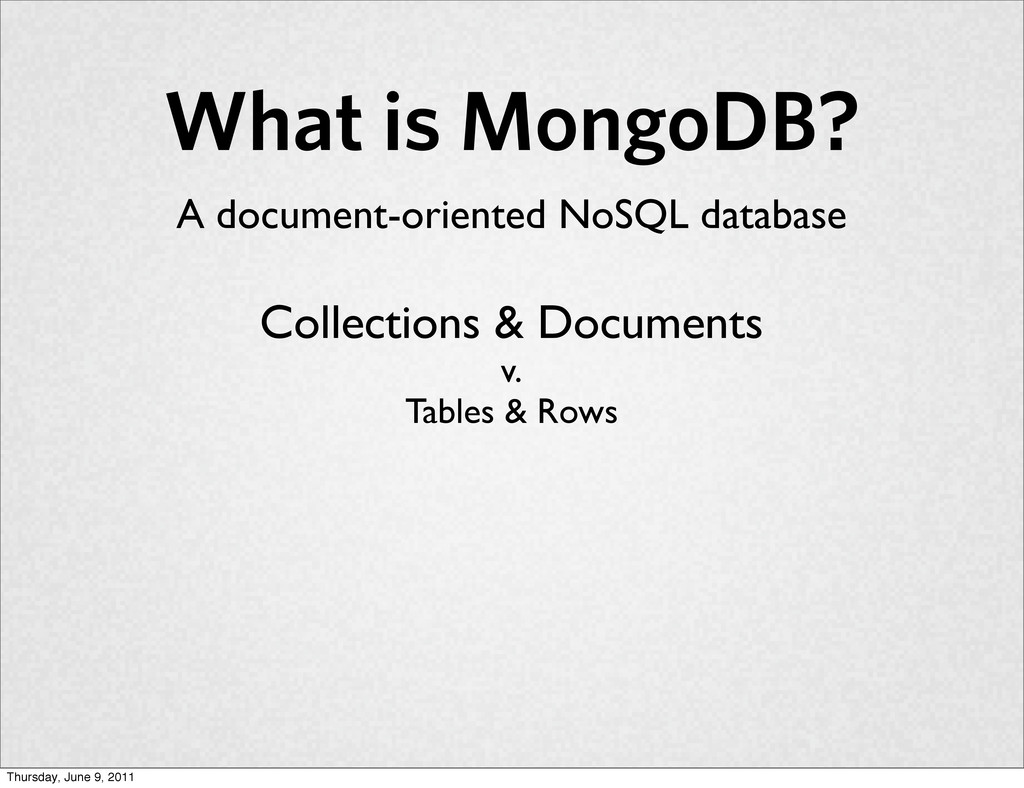
What is MongoDB? A document-oriented NoSQL database Collections & Documents
v. Tables & Rows Thursday, June 9, 2011 -
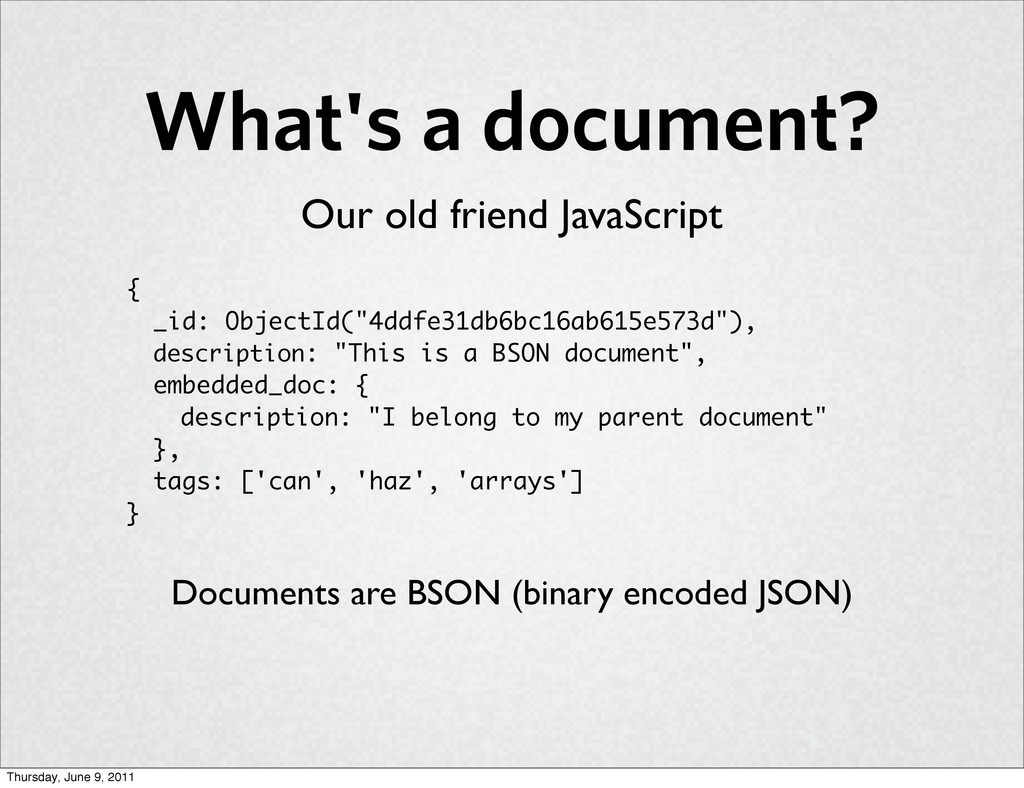
What's a document? Our old friend JavaScript { _id: ObjectId("4ddfe31db6bc16ab615e573d"),
description: "This is a BSON document", embedded_doc: { description: "I belong to my parent document" }, tags: ['can', 'haz', 'arrays'] } Documents are BSON (binary encoded JSON) Thursday, June 9, 2011 -
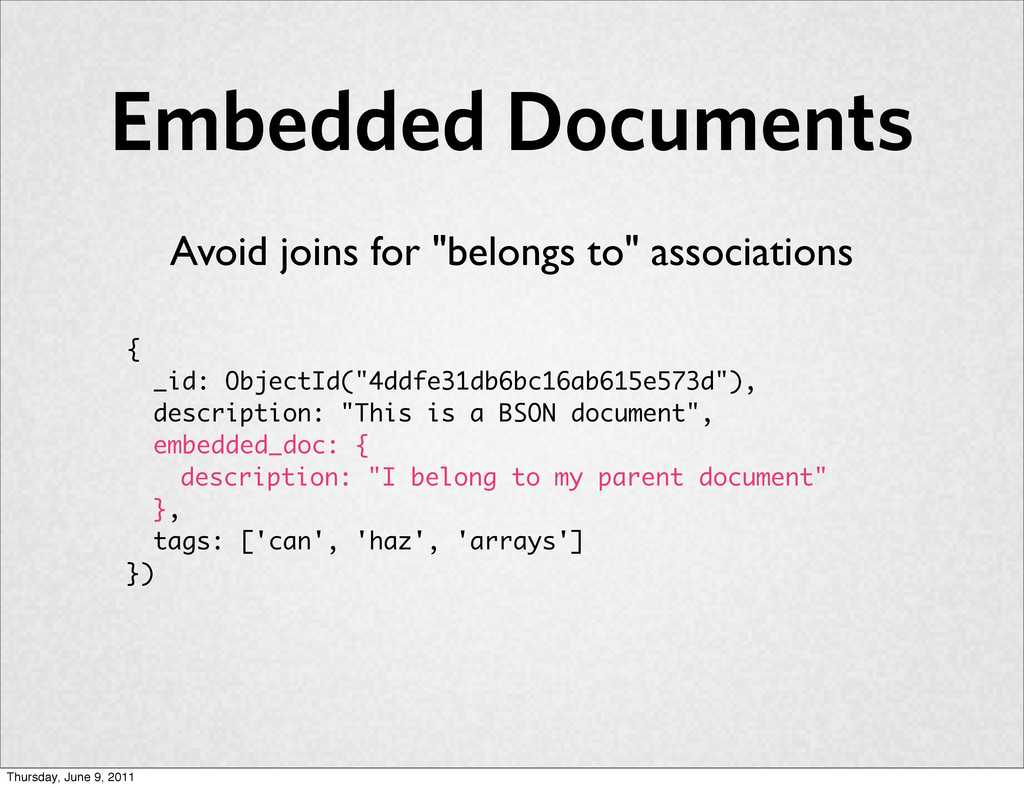
Embedded Documents Avoid joins for "belongs to" associations { _id:
ObjectId("4ddfe31db6bc16ab615e573d"), description: "This is a BSON document", embedded_doc: { description: "I belong to my parent document" }, tags: ['can', 'haz', 'arrays'] }) Thursday, June 9, 2011 -
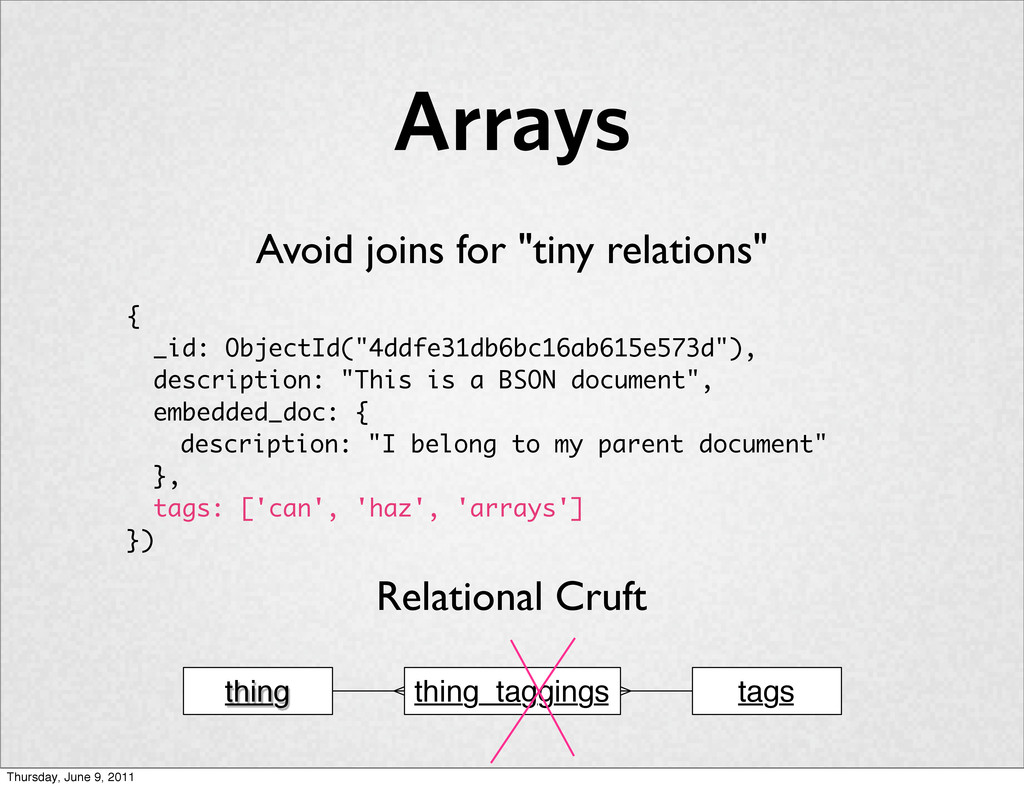
Arrays { _id: ObjectId("4ddfe31db6bc16ab615e573d"), description: "This is a BSON document",
embedded_doc: { description: "I belong to my parent document" }, tags: ['can', 'haz', 'arrays'] }) Avoid joins for "tiny relations" thing tags thing_taggings Relational Cruft Thursday, June 9, 2011 -
Googley “With MongoDB we can ... grow our data set
horizontally on a cluster of commodity hardware and do distributed (read parallel execution of) queries/updates/inserts/deletes.” --Markus Gattol http://www.markus-gattol.name/ws/mongodb.html Thursday, June 9, 2011 -
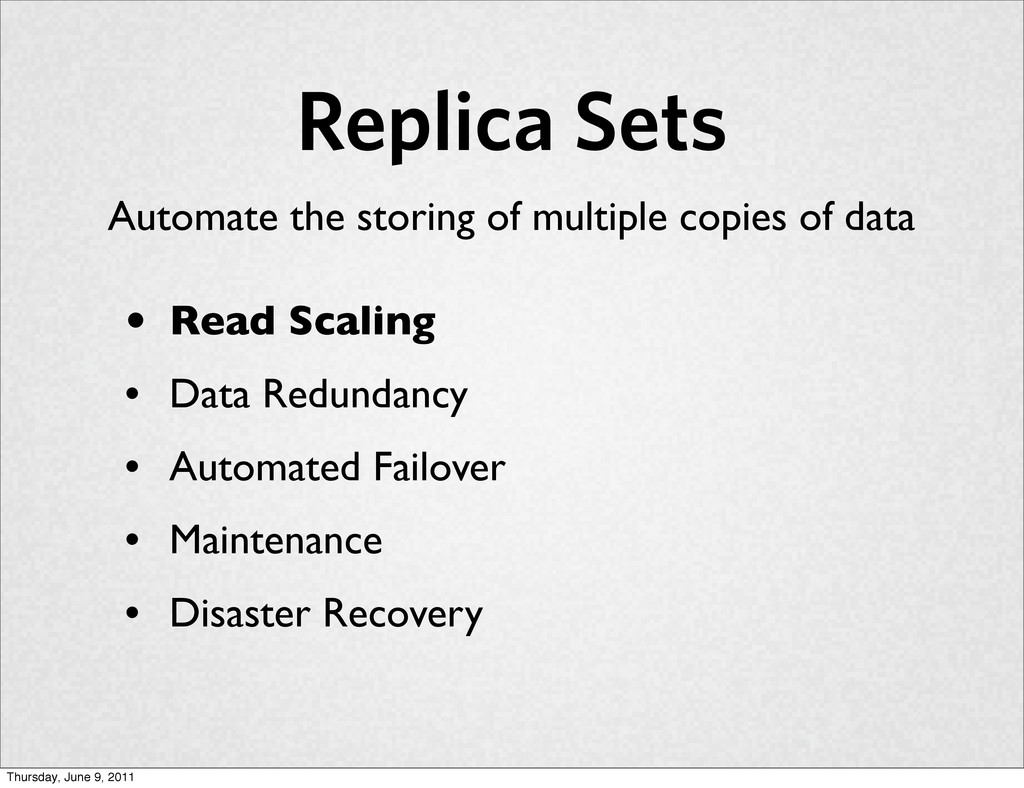
Replica Sets • Read Scaling • Data Redundancy • Automated
Failover • Maintenance • Disaster Recovery Automate the storing of multiple copies of data Thursday, June 9, 2011 -
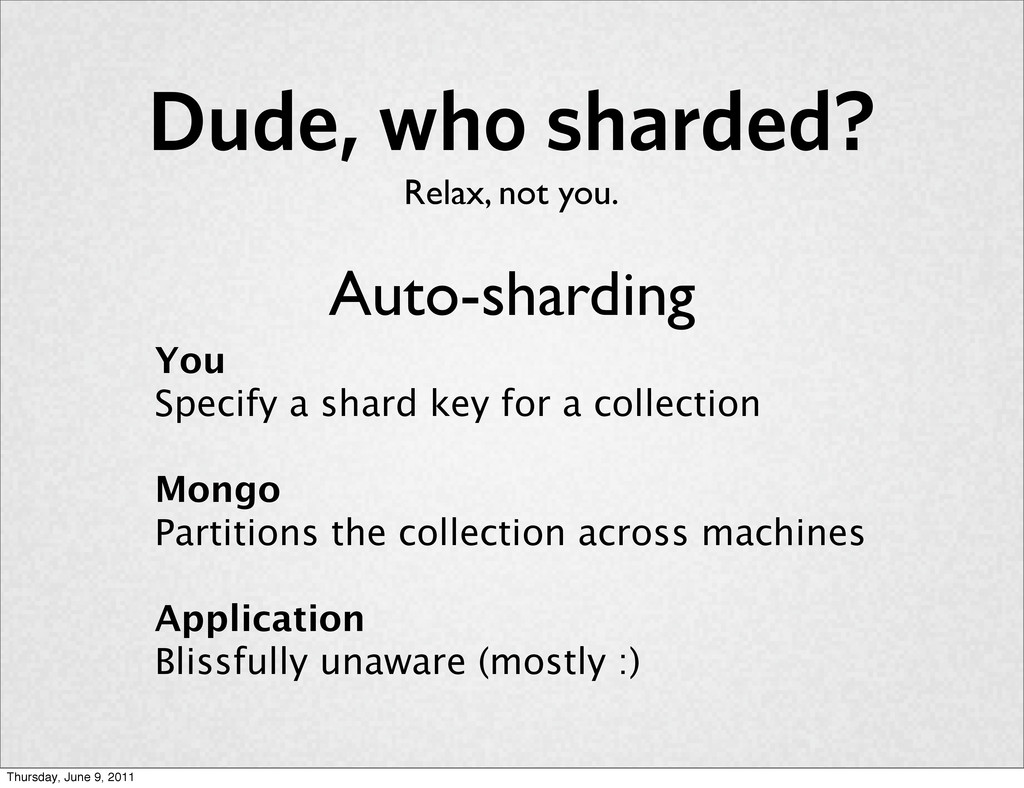
Dude, who sharded? Relax, not you. You Specify a shard
key for a collection Mongo Partitions the collection across machines Application Blissfully unaware (mostly :) Auto-sharding Thursday, June 9, 2011 -
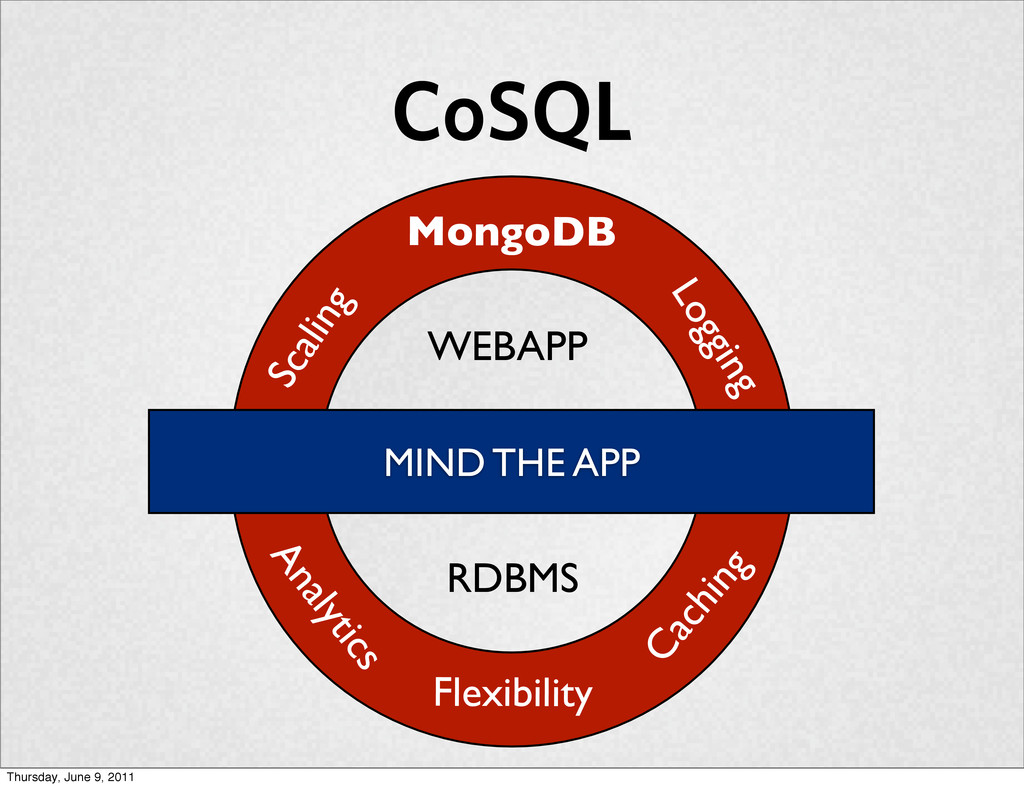
CoSQL Caching Analytics Logging Scaling Flexibility MongoDB MIND THE APP
WEBAPP RDBMS Thursday, June 9, 2011 -
Ads Let's Mongo! • Orthogonal to primary app • Few
joins • Integrity not critical Thursday, June 9, 2011 -
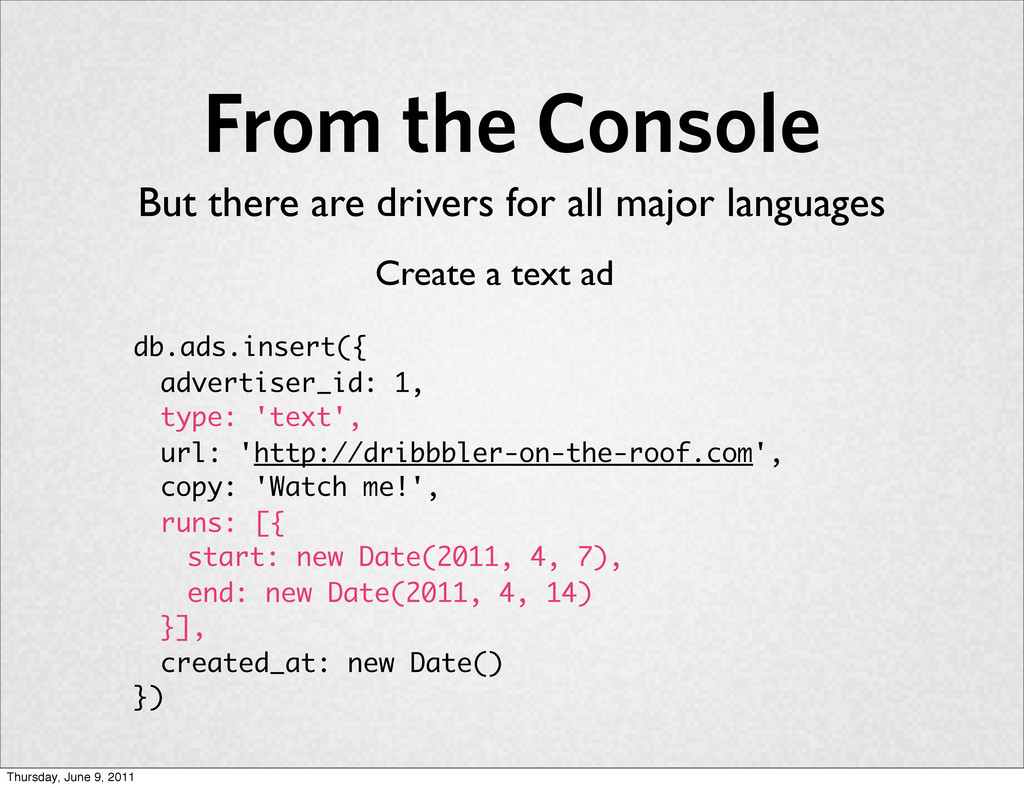
From the Console db.ads.insert({ advertiser_id: 1, type: 'text', url: 'http://dribbbler-on-the-roof.com',
copy: 'Watch me!', runs: [{ start: new Date(2011, 4, 7), end: new Date(2011, 4, 14) }], created_at: new Date() }) Create a text ad But there are drivers for all major languages Thursday, June 9, 2011 -
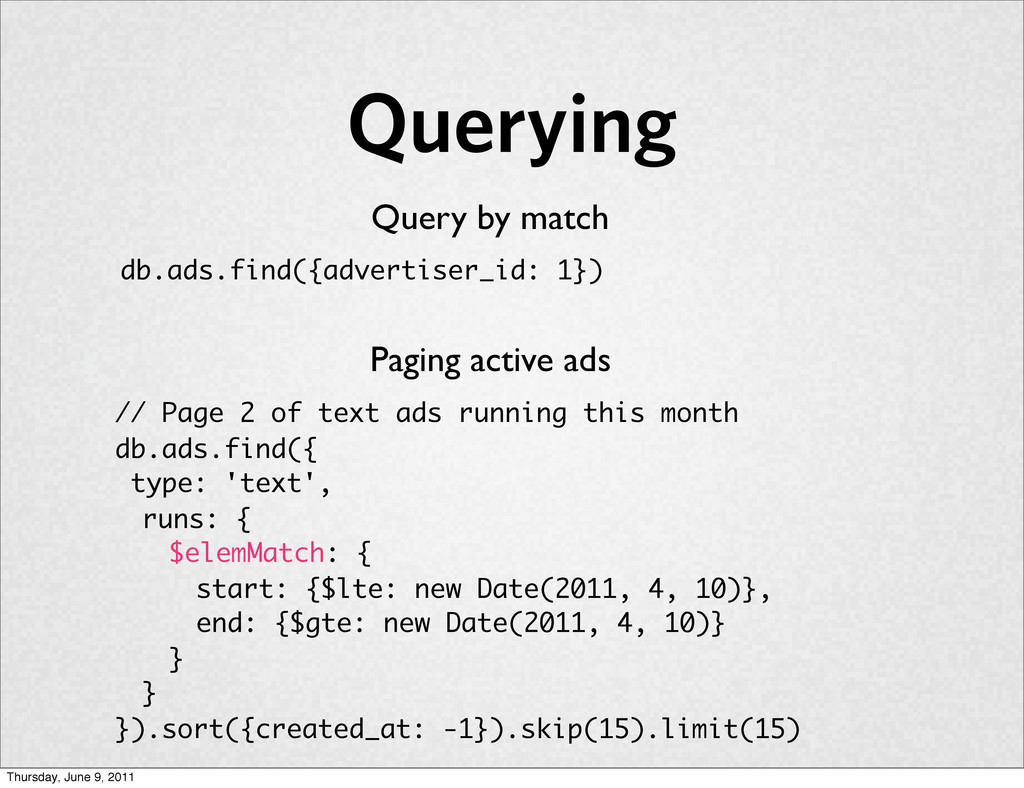
Querying Query by match db.ads.find({advertiser_id: 1}) Paging active ads //
Page 2 of text ads running this month db.ads.find({ type: 'text', runs: { $elemMatch: { start: {$lte: new Date(2011, 4, 10)}, end: {$gte: new Date(2011, 4, 10)} } } }).sort({created_at: -1}).skip(15).limit(15) Thursday, June 9, 2011 -
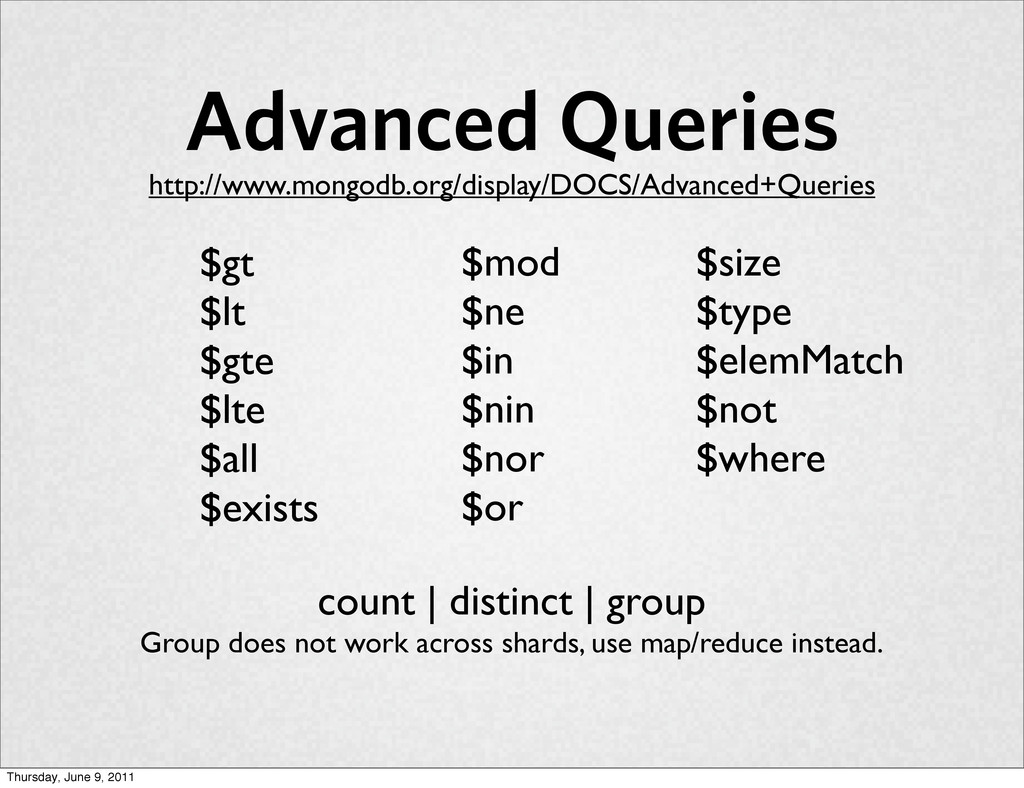
Advanced Queries $gt $lt $gte $lte $all $exists $size $type
$elemMatch $not $where $mod $ne $in $nin $nor $or http://www.mongodb.org/display/DOCS/Advanced+Queries count | distinct | group Group does not work across shards, use map/reduce instead. Thursday, June 9, 2011 -
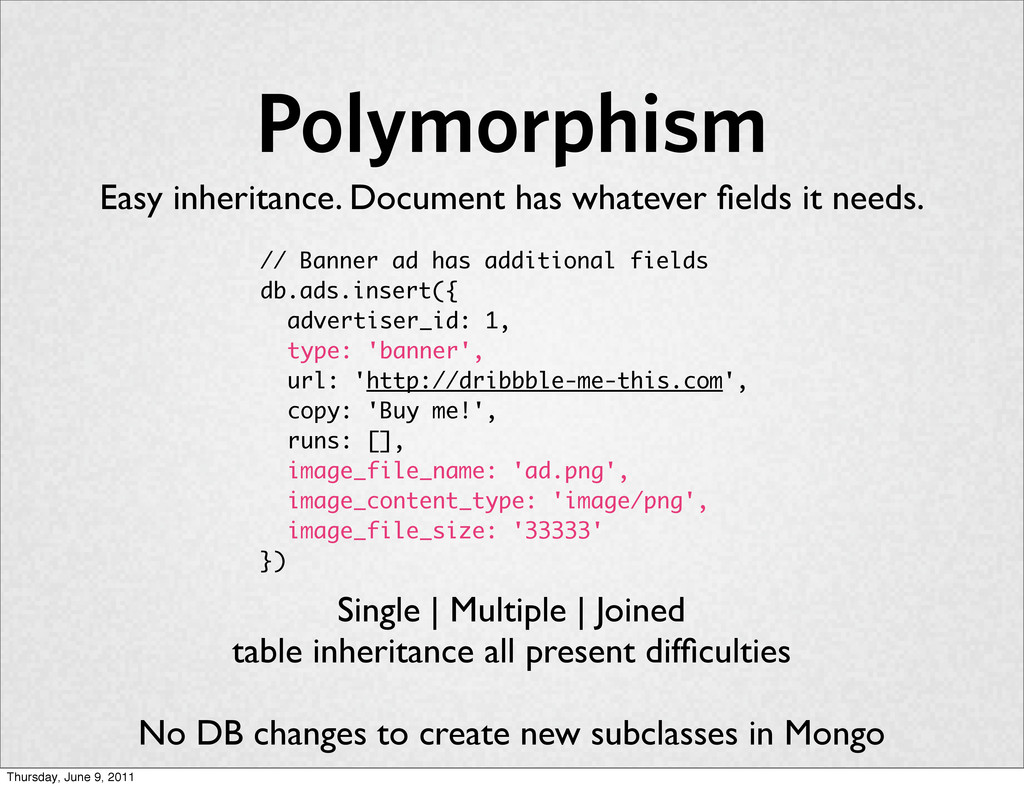
Polymorphism // Banner ad has additional fields db.ads.insert({ advertiser_id: 1,

type: 'banner', url: 'http://dribbble-me-this.com', copy: 'Buy me!', runs: [], image_file_name: 'ad.png', image_content_type: 'image/png', image_file_size: '33333' }) Easy inheritance. Document has whatever fields it needs. Single | Multiple | Joined table inheritance all present difficulties No DB changes to create new subclasses in Mongo Thursday, June 9, 2011 -
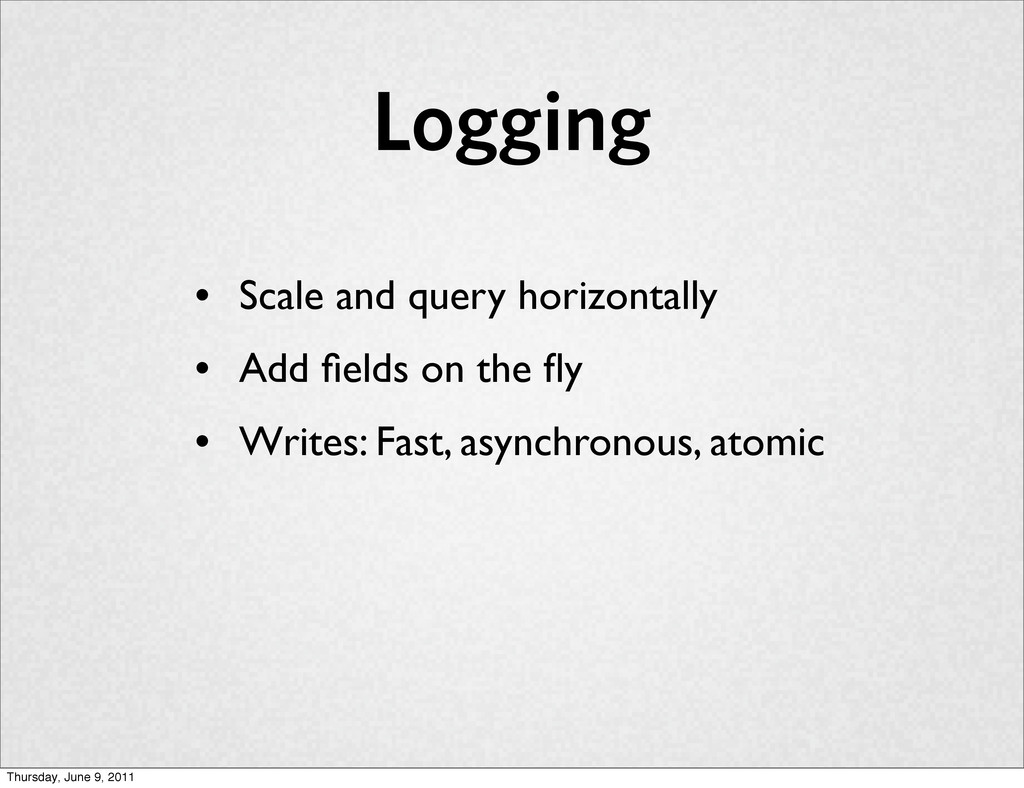
Logging • Scale and query horizontally • Add fields on
the fly • Writes: Fast, asynchronous, atomic Thursday, June 9, 2011 -
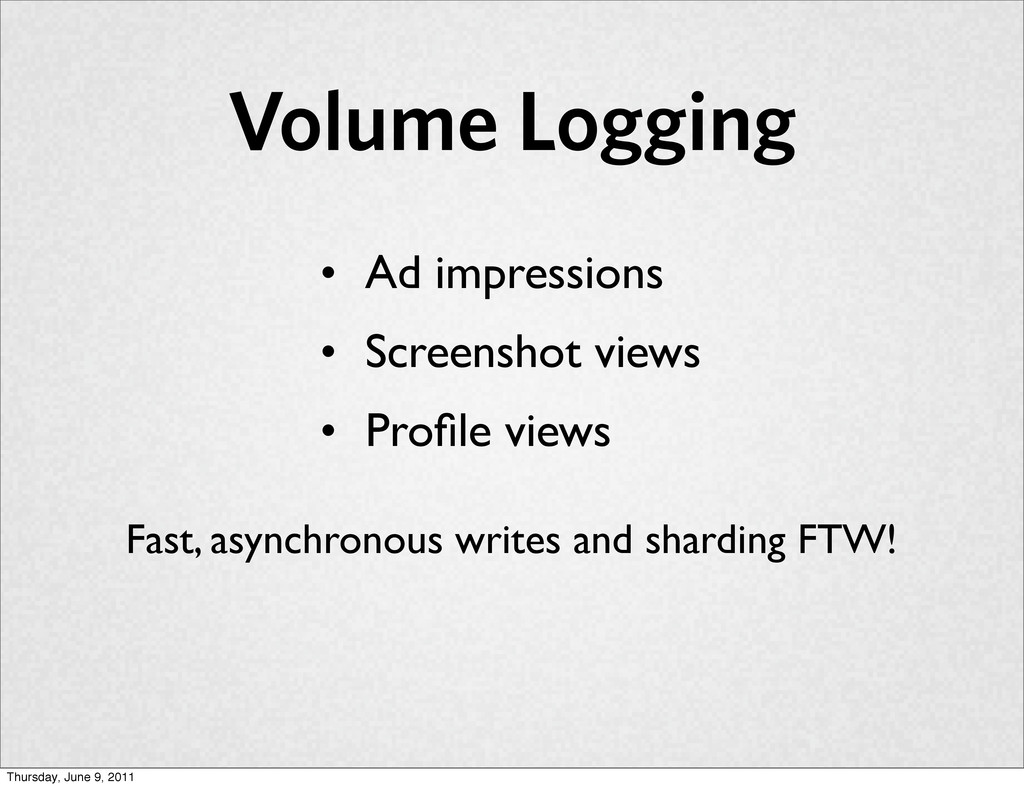
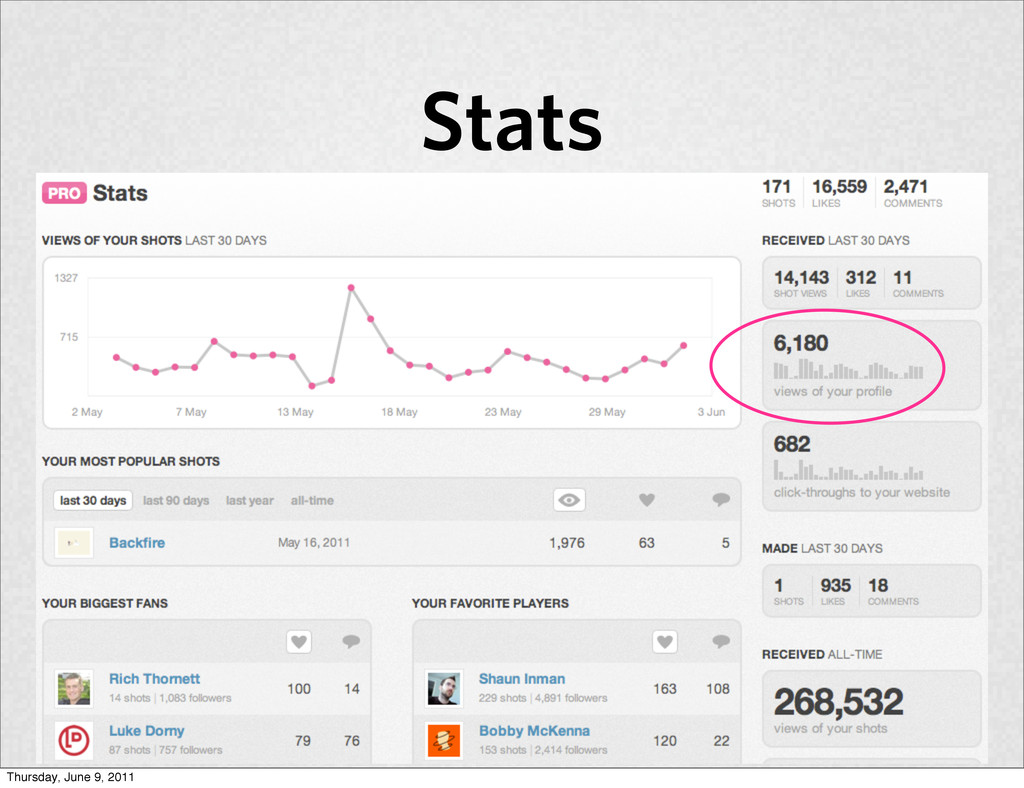
Volume Logging • Ad impressions • Screenshot views • Profile
views Fast, asynchronous writes and sharding FTW! Thursday, June 9, 2011 -
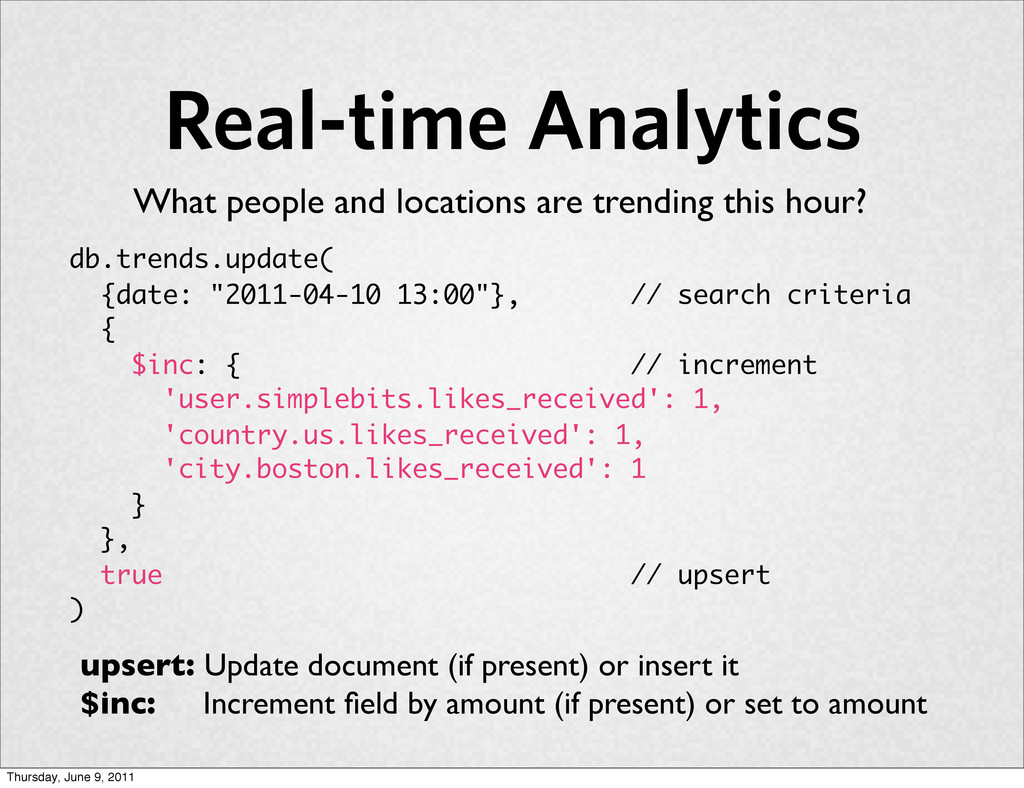
Real-time Analytics db.trends.update( {date: "2011-04-10 13:00"}, // search criteria {
$inc: { // increment 'user.simplebits.likes_received': 1, 'country.us.likes_received': 1, 'city.boston.likes_received': 1 } }, true // upsert ) What people and locations are trending this hour? upsert: Update document (if present) or insert it $inc: Increment field by amount (if present) or set to amount Thursday, June 9, 2011 -
Flex Benefits • Add/nest new fields to measure with ease
• Atomic upsert with $inc Replaces two-step, transactional find-and-update/create • Live, cached aggregation Thursday, June 9, 2011 -
db.users.insert( { name: 'Dan Cederholm', available: true, skills: ['html', 'css',
'illustration', 'icon design'] } ) Design a Designer Thursday, June 9, 2011 -
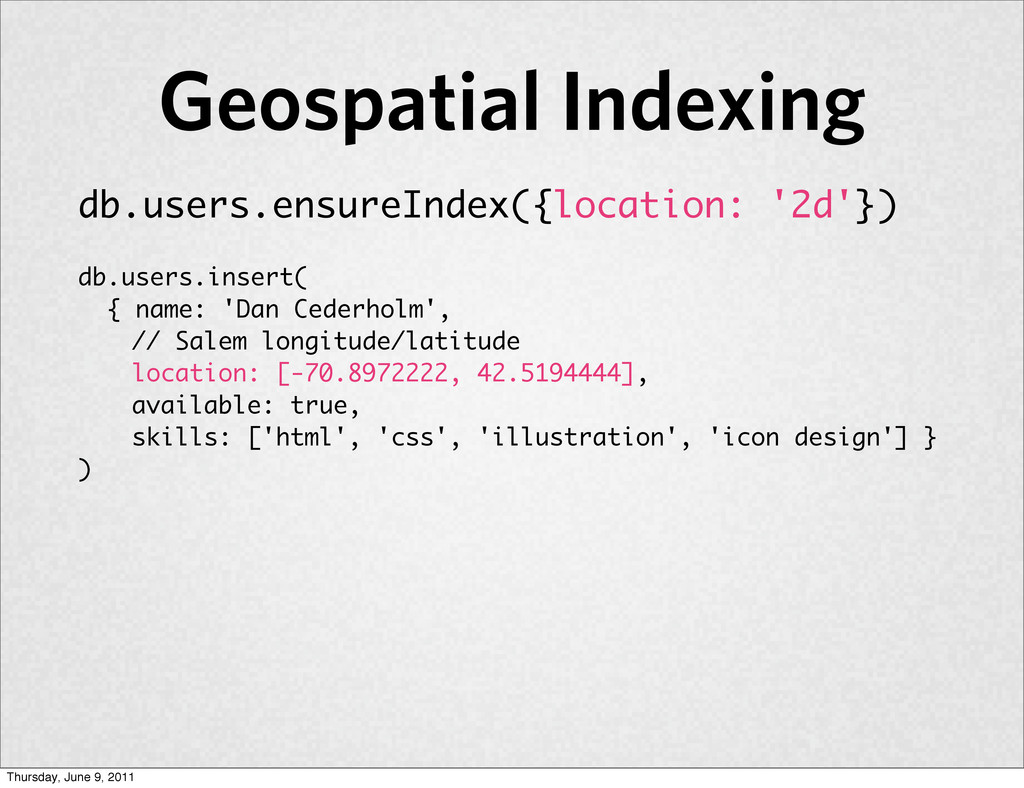
db.users.ensureIndex({location: '2d'}) db.users.insert( { name: 'Dan Cederholm', // Salem longitude/latitude
location: [-70.8972222, 42.5194444], available: true, skills: ['html', 'css', 'illustration', 'icon design'] } ) Geospatial Indexing Thursday, June 9, 2011 -
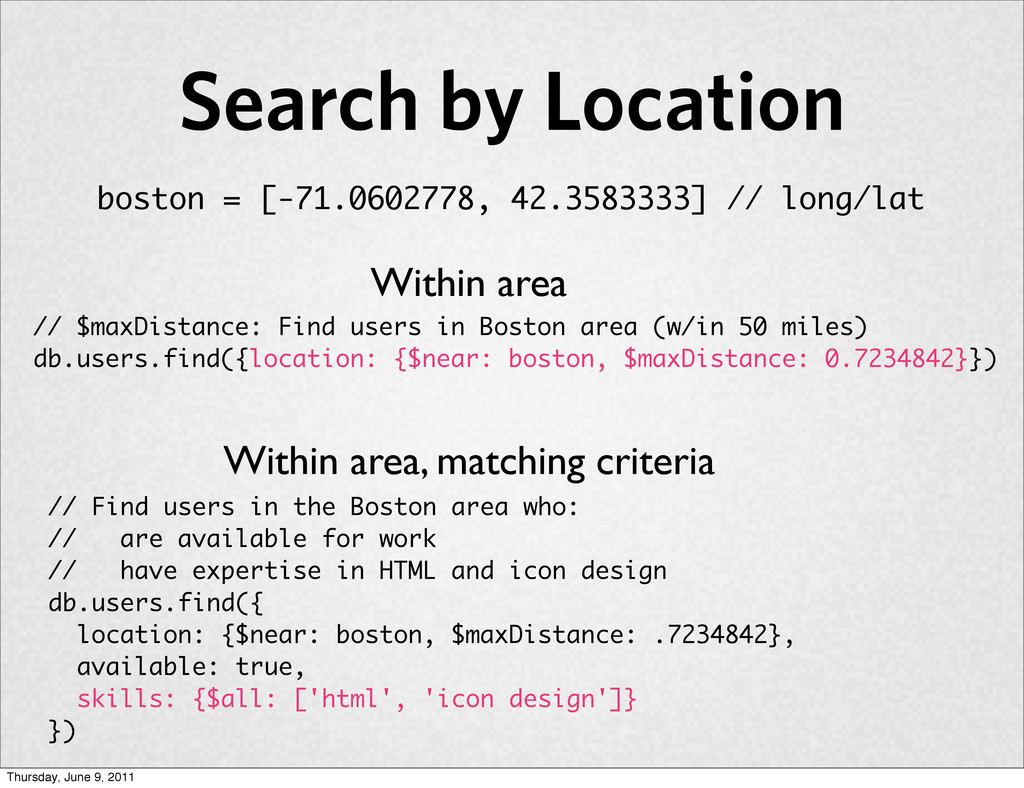
Search by Location // Find users in the Boston area
who: // are available for work // have expertise in HTML and icon design db.users.find({ location: {$near: boston, $maxDistance: .7234842}, available: true, skills: {$all: ['html', 'icon design']} }) Within area // $maxDistance: Find users in Boston area (w/in 50 miles) db.users.find({location: {$near: boston, $maxDistance: 0.7234842}}) Within area, matching criteria boston = [-71.0602778, 42.3583333] // long/lat Thursday, June 9, 2011 -
Search Power Flexible Documents + Rich Query Language + Geospatial
Indexing Thursday, June 9, 2011 -
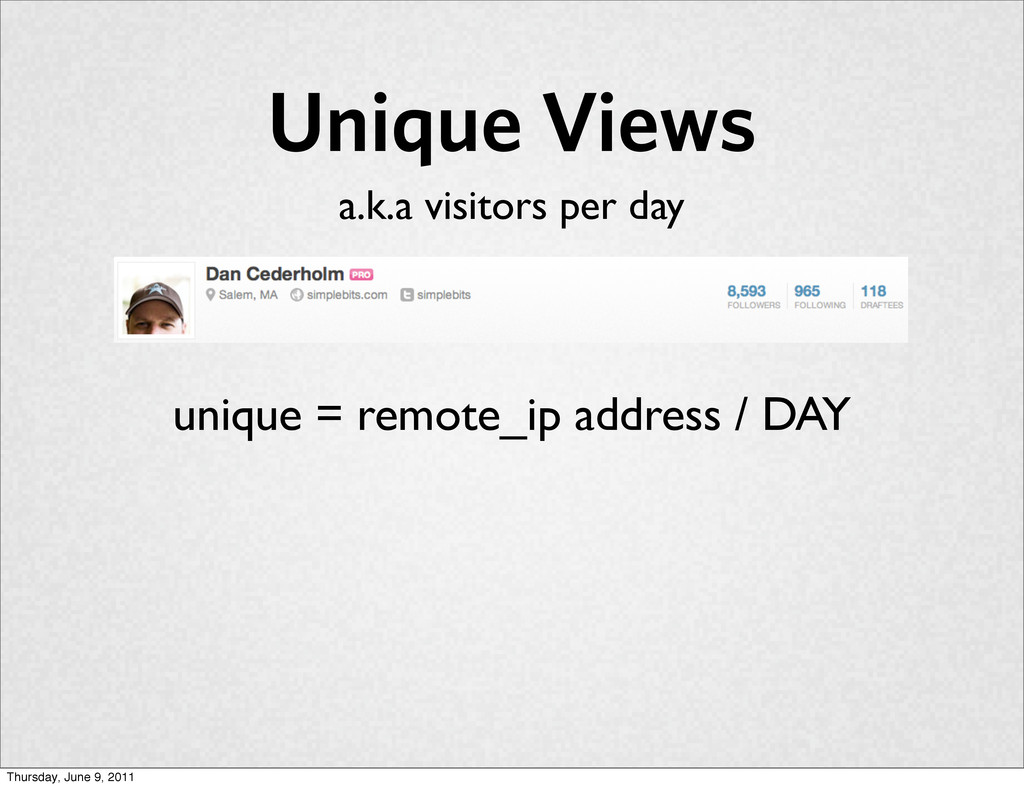
Unique Views unique = remote_ip address / DAY a.k.a visitors
per day Thursday, June 9, 2011 -
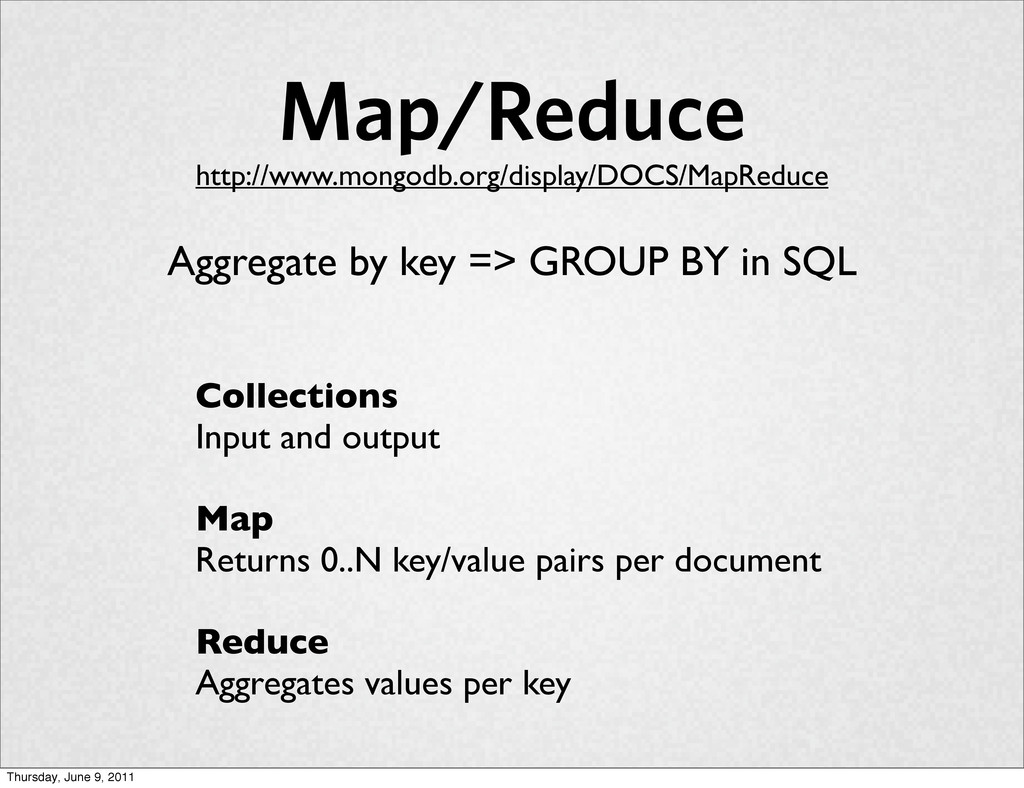
Collections Input and output Map Returns 0..N key/value pairs per
document Reduce Aggregates values per key Aggregate by key => GROUP BY in SQL Map/Reduce http://www.mongodb.org/display/DOCS/MapReduce Thursday, June 9, 2011 -
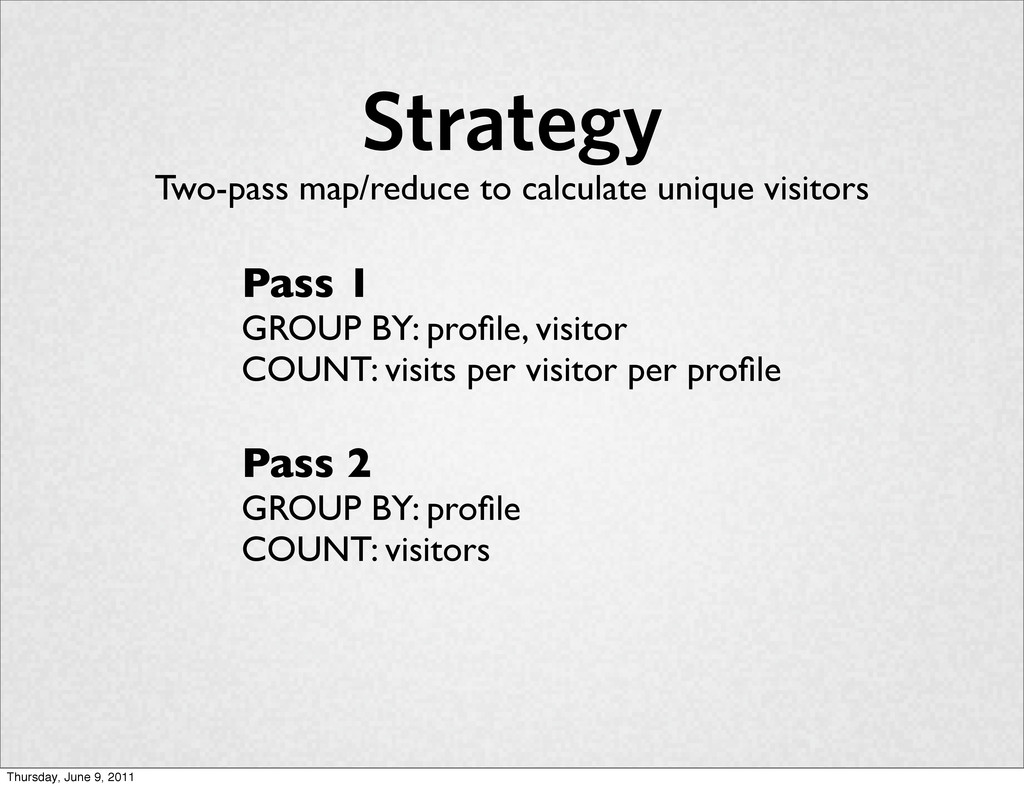
Strategy Two-pass map/reduce to calculate unique visitors Pass 1 GROUP
BY: profile, visitor COUNT: visits per visitor per profile Pass 2 GROUP BY: profile COUNT: visitors Thursday, June 9, 2011 -
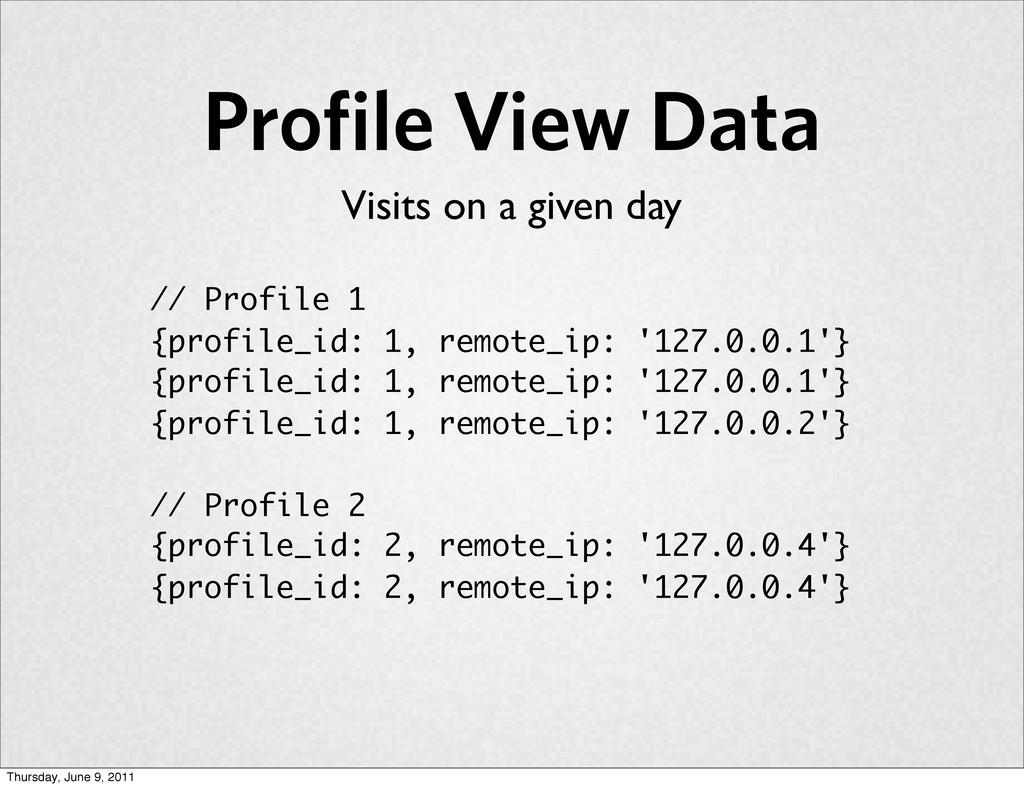
Profile View Data // Profile 1 {profile_id: 1, remote_ip: '127.0.0.1'}
{profile_id: 1, remote_ip: '127.0.0.1'} {profile_id: 1, remote_ip: '127.0.0.2'} // Profile 2 {profile_id: 2, remote_ip: '127.0.0.4'} {profile_id: 2, remote_ip: '127.0.0.4'} Visits on a given day Thursday, June 9, 2011 -
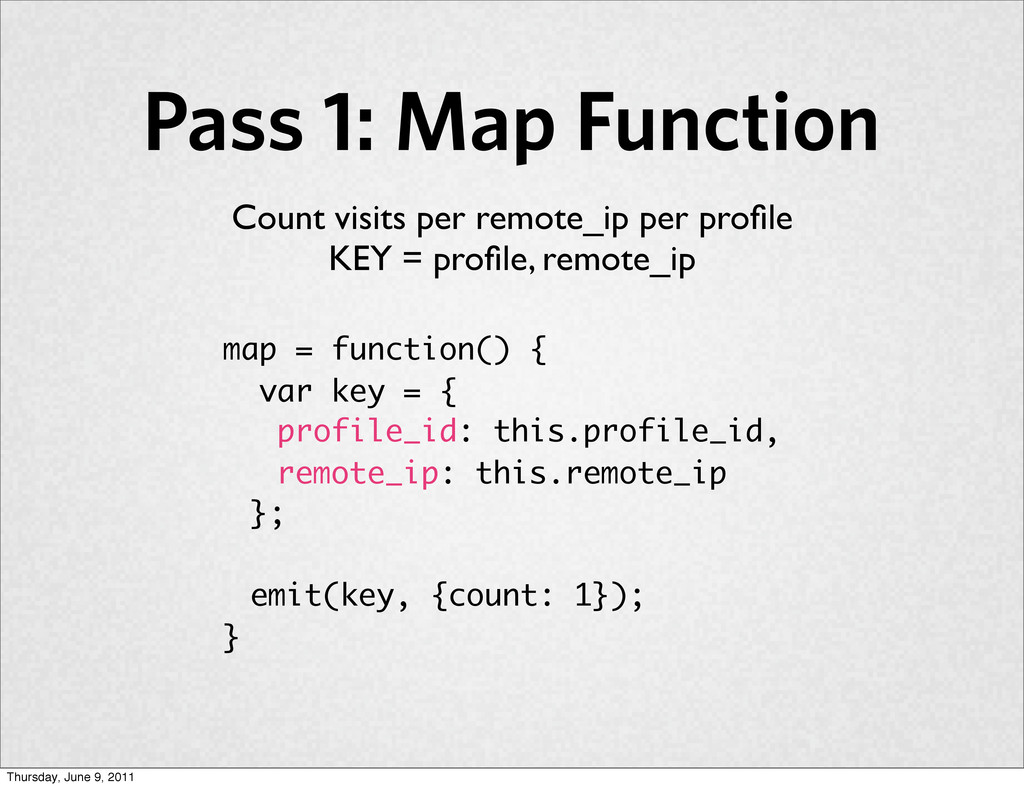
Pass 1: Map Function map = function() { var key
= { profile_id: this.profile_id, remote_ip: this.remote_ip }; emit(key, {count: 1}); } Count visits per remote_ip per profile KEY = profile, remote_ip Thursday, June 9, 2011 -
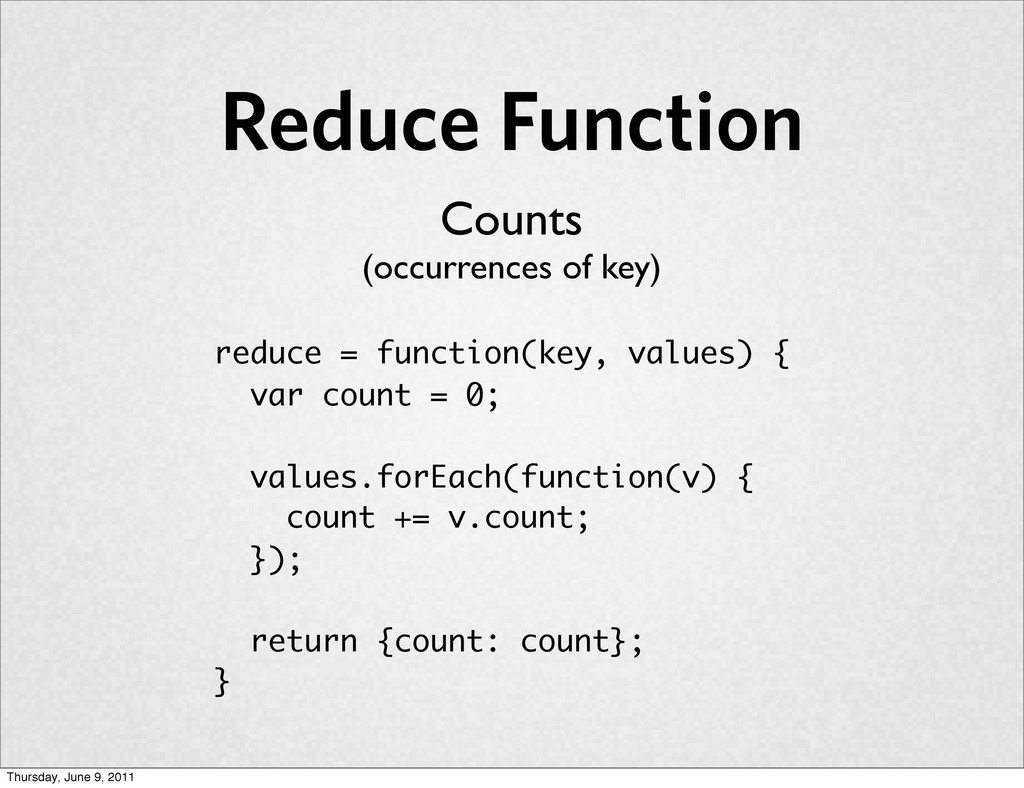
Reduce Function reduce = function(key, values) { var count =
0; values.forEach(function(v) { count += v.count; }); return {count: count}; } Counts (occurrences of key) Thursday, June 9, 2011 -
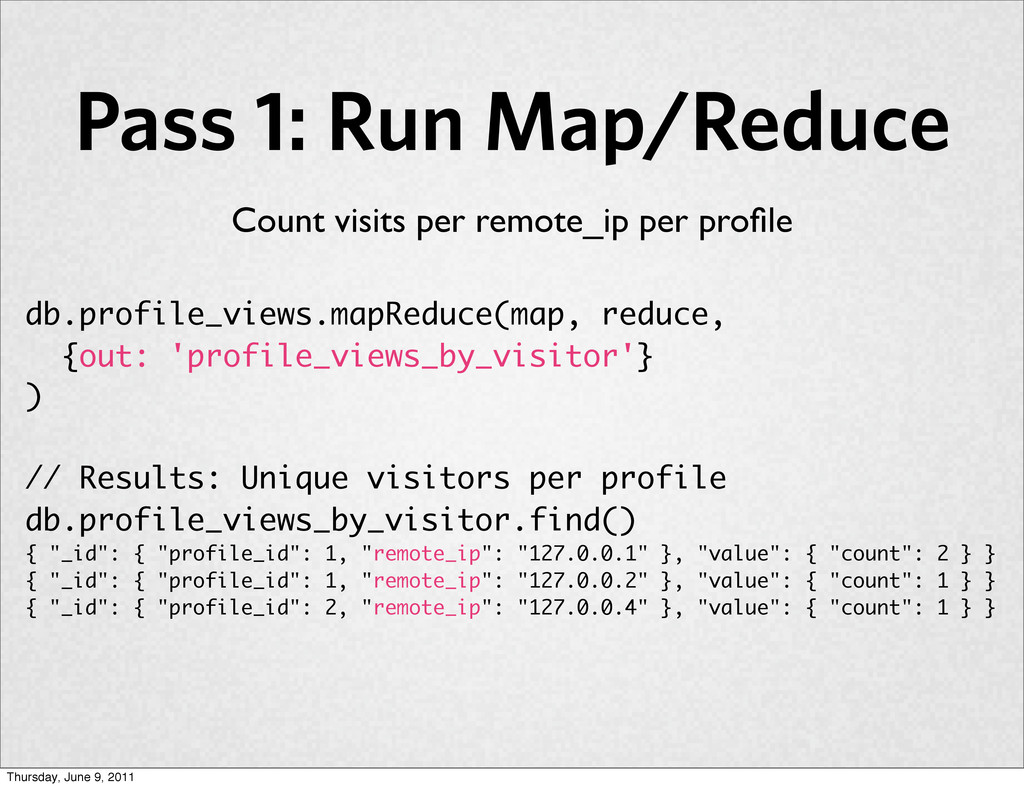
Pass 1: Run Map/Reduce db.profile_views.mapReduce(map, reduce, {out: 'profile_views_by_visitor'} ) //
Results: Unique visitors per profile db.profile_views_by_visitor.find() { "_id": { "profile_id": 1, "remote_ip": "127.0.0.1" }, "value": { "count": 2 } } { "_id": { "profile_id": 1, "remote_ip": "127.0.0.2" }, "value": { "count": 1 } } { "_id": { "profile_id": 2, "remote_ip": "127.0.0.4" }, "value": { "count": 1 } } Count visits per remote_ip per profile Thursday, June 9, 2011 -
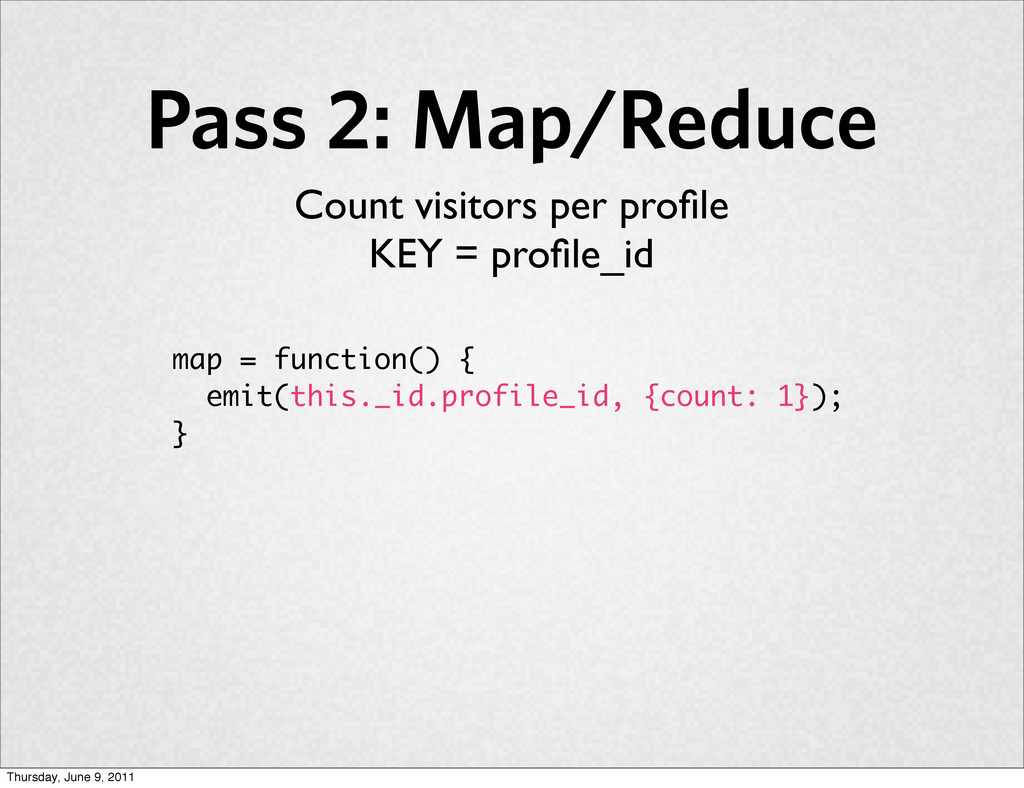
Pass 2: Map/Reduce map = function() { emit(this._id.profile_id, {count: 1});
} Count visitors per profile KEY = profile_id Thursday, June 9, 2011 -
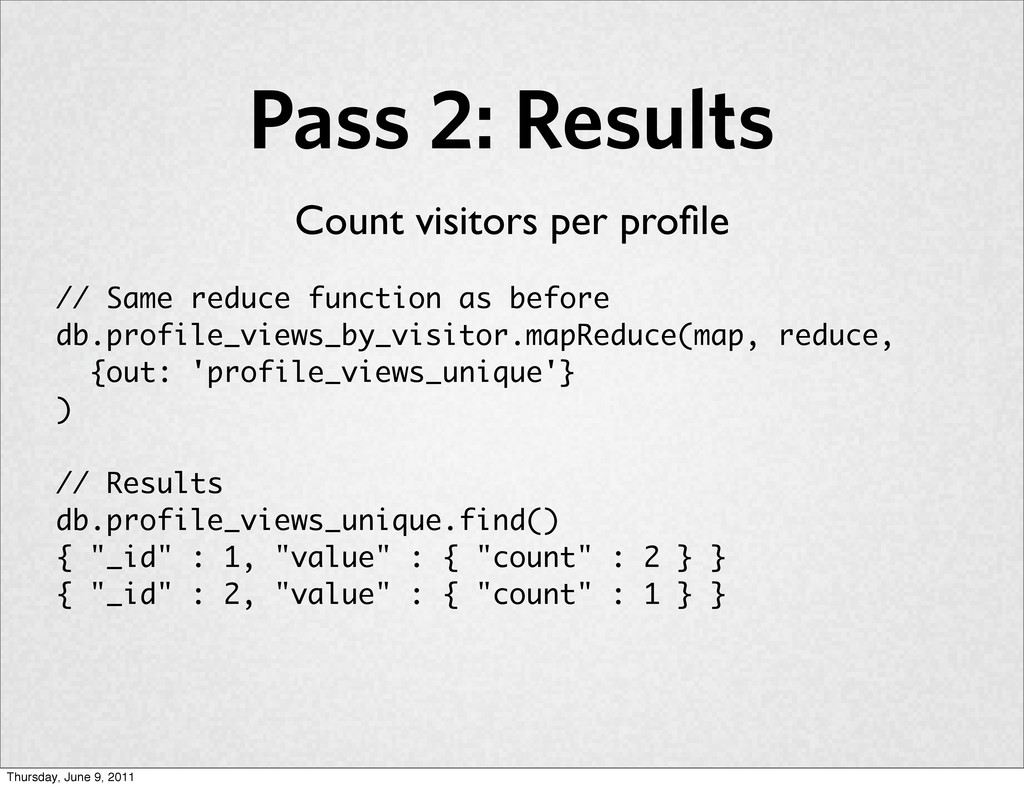
Pass 2: Results // Same reduce function as before db.profile_views_by_visitor.mapReduce(map,
reduce, {out: 'profile_views_unique'} ) // Results db.profile_views_unique.find() { "_id" : 1, "value" : { "count" : 2 } } { "_id" : 2, "value" : { "count" : 1 } } Count visitors per profile Thursday, June 9, 2011 -
Map/Deduce Large data sets, you get: • Horizontal scaling •
Parallel processing across cluster Can be clunkier than GROUP BY in SQL. But ... JavaScript functions offers flexibility/power Thursday, June 9, 2011 -
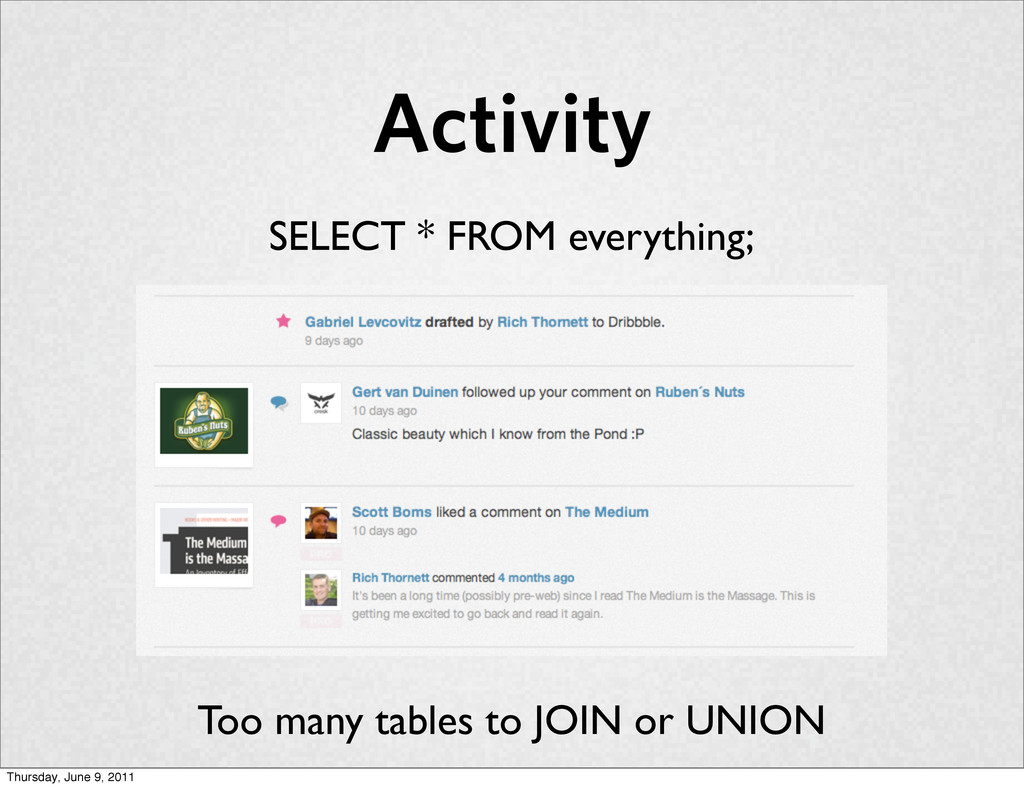
Activity SELECT * FROM everything; Too many tables to JOIN
or UNION Thursday, June 9, 2011 -
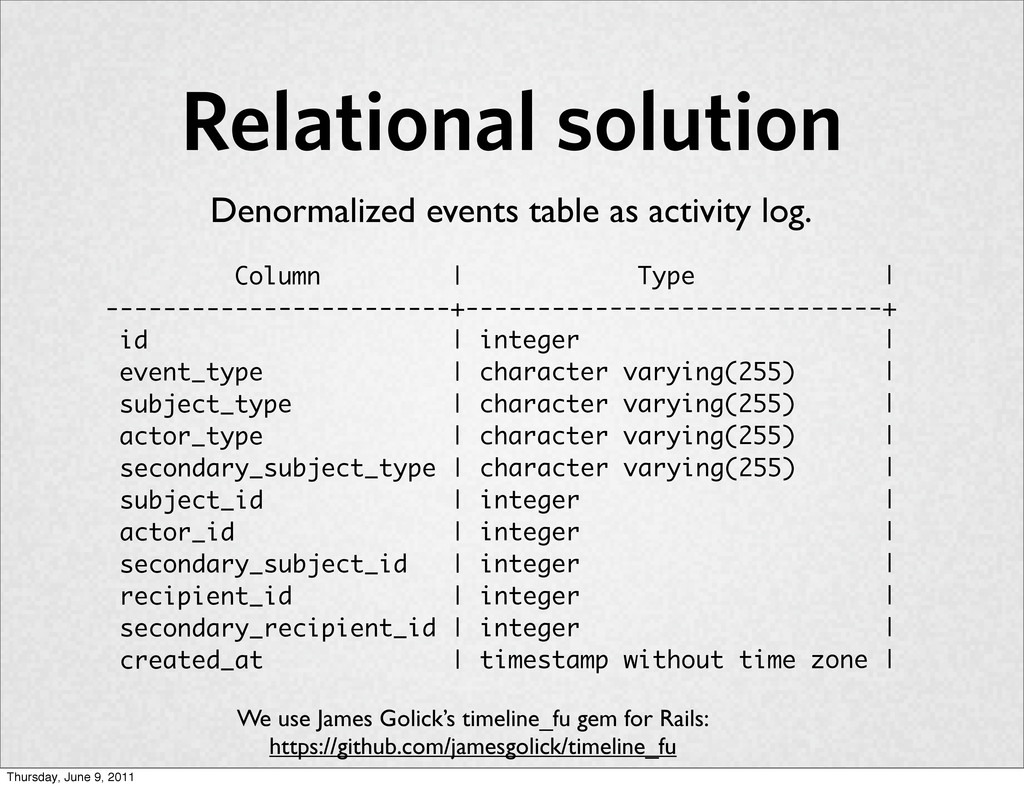
Relational solution Denormalized events table as activity log. Column |
Type | ------------------------+-----------------------------+ id | integer | event_type | character varying(255) | subject_type | character varying(255) | actor_type | character varying(255) | secondary_subject_type | character varying(255) | subject_id | integer | actor_id | integer | secondary_subject_id | integer | recipient_id | integer | secondary_recipient_id | integer | created_at | timestamp without time zone | We use James Golick’s timeline_fu gem for Rails: https://github.com/jamesgolick/timeline_fu Thursday, June 9, 2011 -
Complications Multiple recipients • Subscribe to comments for a shot
• Twitter-style @ mentions in comments Confusing names • Generic names make queries and view logic hard to follow N+1 • Each event may require several lookups to get actor, subject, etc Thursday, June 9, 2011 -
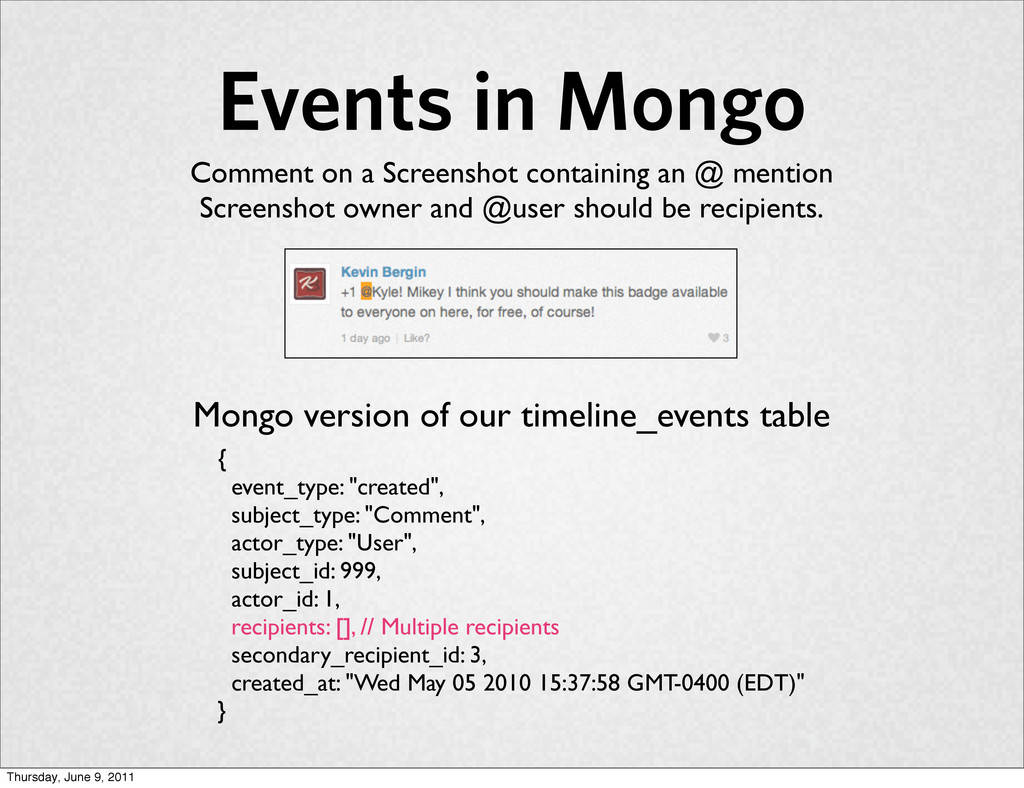
Events in Mongo { event_type: "created", subject_type: "Comment", actor_type: "User",
subject_id: 999, actor_id: 1, recipients: [], // Multiple recipients secondary_recipient_id: 3, created_at: "Wed May 05 2010 15:37:58 GMT-0400 (EDT)" } Comment on a Screenshot containing an @ mention Screenshot owner and @user should be recipients. Mongo version of our timeline_events table Thursday, June 9, 2011 -
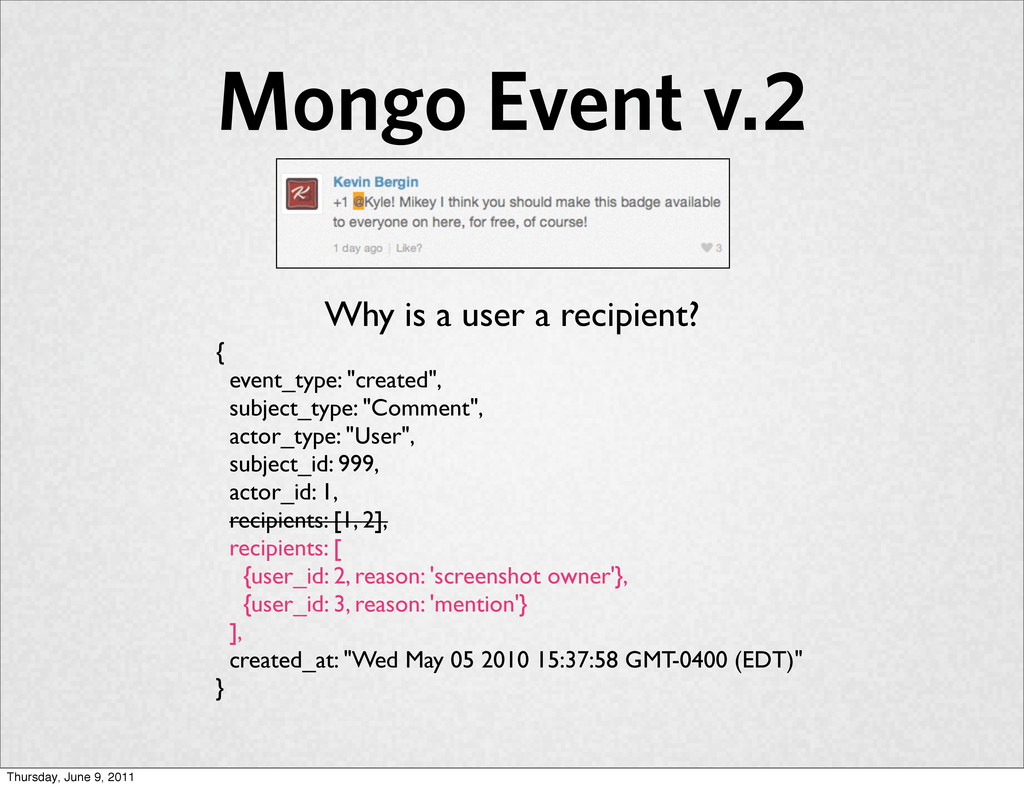
Mongo Event v.2 { event_type: "created", subject_type: "Comment", actor_type: "User",
subject_id: 999, actor_id: 1, recipients: [1, 2], recipients: [ {user_id: 2, reason: 'screenshot owner'}, {user_id: 3, reason: 'mention'} ], created_at: "Wed May 05 2010 15:37:58 GMT-0400 (EDT)" } Why is a user a recipient? Thursday, June 9, 2011 -
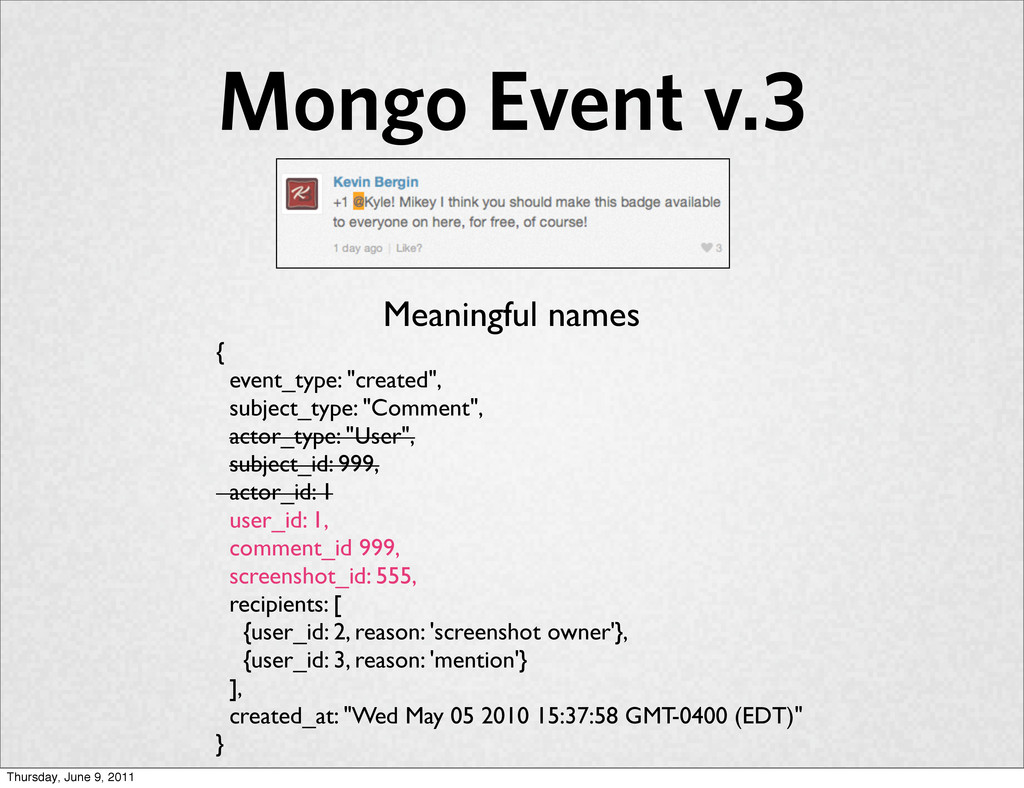
Mongo Event v.3 { event_type: "created", subject_type: "Comment", actor_type: "User",
subject_id: 999, actor_id: 1 user_id: 1, comment_id 999, screenshot_id: 555, recipients: [ {user_id: 2, reason: 'screenshot owner'}, {user_id: 3, reason: 'mention'} ], created_at: "Wed May 05 2010 15:37:58 GMT-0400 (EDT)" } Meaningful names Thursday, June 9, 2011 -
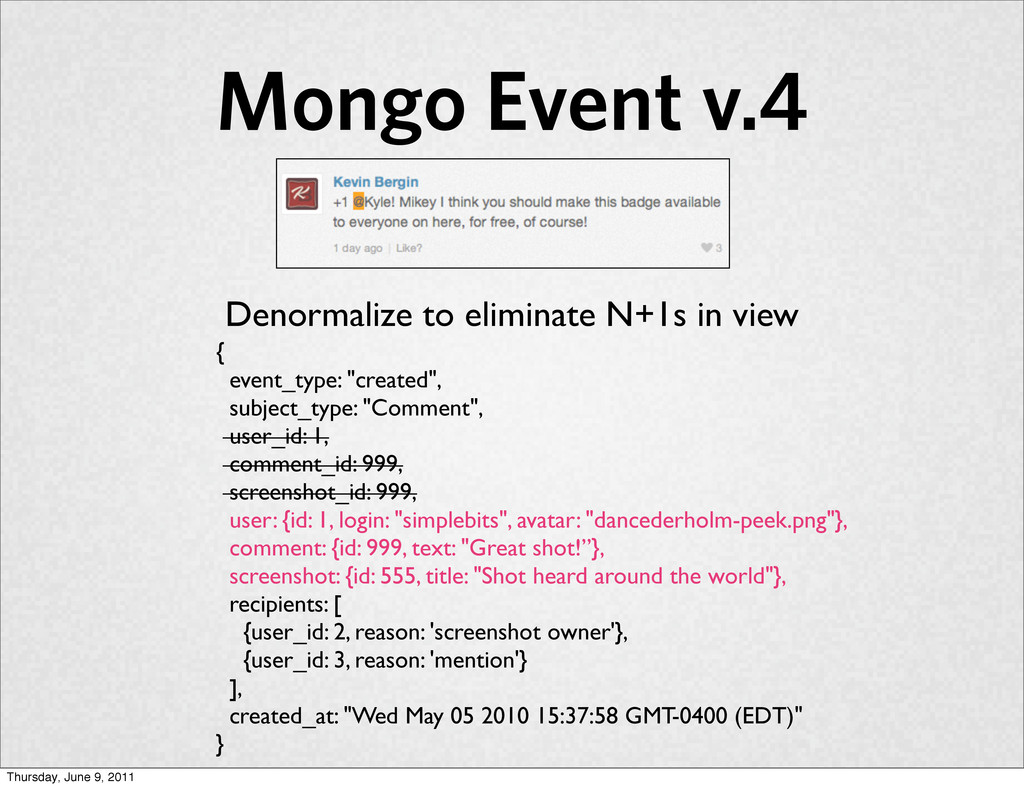
Mongo Event v.4 { event_type: "created", subject_type: "Comment", user_id: 1,
comment_id: 999, screenshot_id: 999, user: {id: 1, login: "simplebits", avatar: "dancederholm-peek.png"}, comment: {id: 999, text: "Great shot!”}, screenshot: {id: 555, title: "Shot heard around the world"}, recipients: [ {user_id: 2, reason: 'screenshot owner'}, {user_id: 3, reason: 'mention'} ], created_at: "Wed May 05 2010 15:37:58 GMT-0400 (EDT)" } Denormalize to eliminate N+1s in view Thursday, June 9, 2011 -
Denormalizing? You're giving up RDBMs benefits to optimize. Optimize your
optimizations. Document flexibility: Data structures can mirror the view Thursday, June 9, 2011 -
Caching • Grabs free memory as needed; no configured cache
size • Relies on OS to reclaim memory (LRU) http://www.mongodb.org/display/DOCS/Caching MongoDB uses memory-mapped files Thursday, June 9, 2011 -
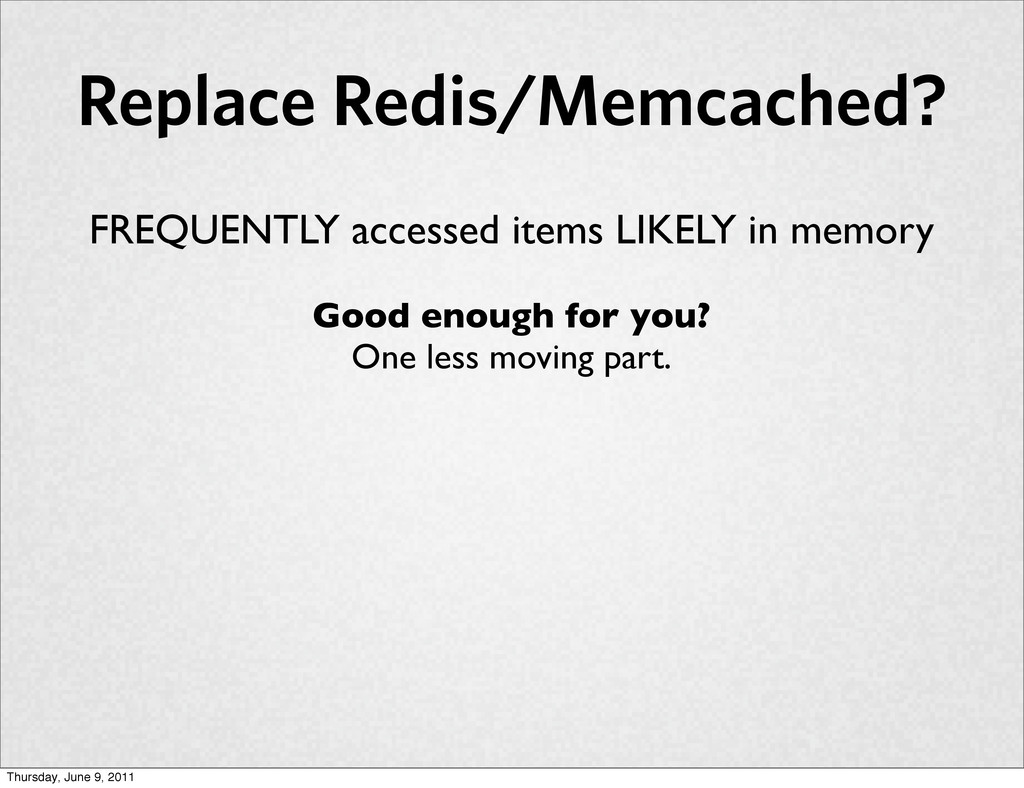
Replace Redis/Memcached? FREQUENTLY accessed items LIKELY in memory Good enough
for you? One less moving part. Thursday, June 9, 2011 -
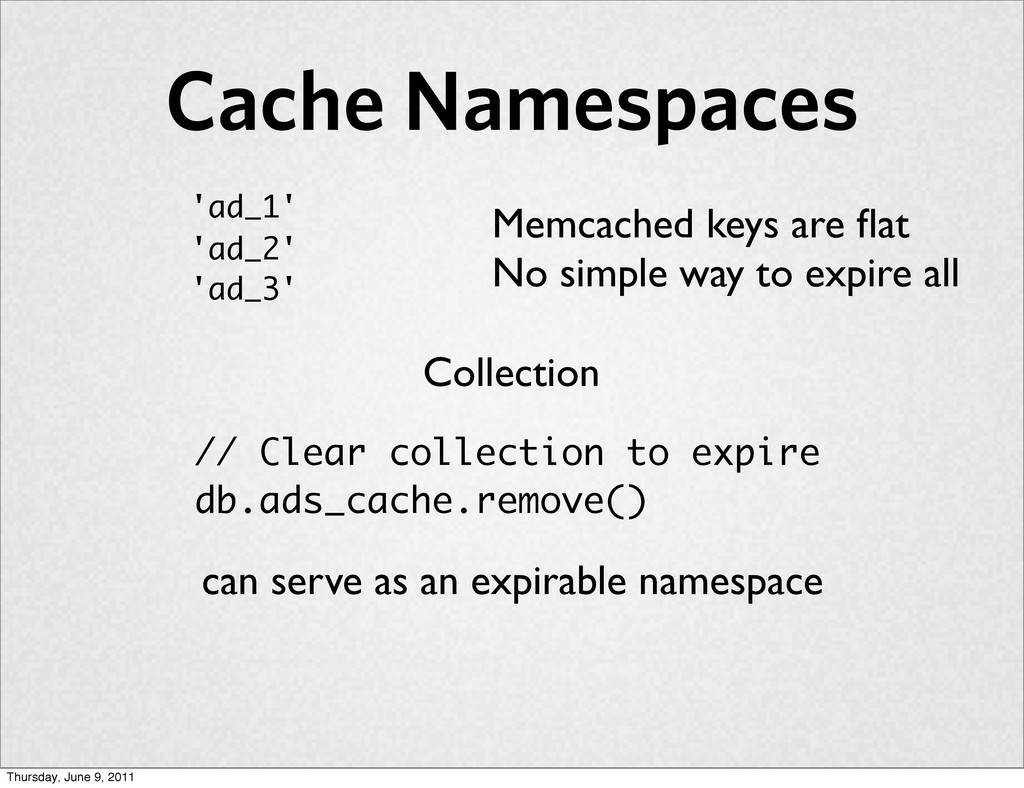
Cache Namespaces // Clear collection to expire db.ads_cache.remove() 'ad_1' 'ad_2'
'ad_3' Memcached keys are flat No simple way to expire all Collection can serve as an expirable namespace Thursday, June 9, 2011 -
Time to Mongo? Versatility? Data structure flexibility worth more than
joins? Easier horizontal scaling? http://www.mongodb.org log | scale | optimize | aggregate | cache Thursday, June 9, 2011