Share
Embed
Let's implement useless Python objects (revised)
PythonAsia 2026 at DE LA SALLE UNIVERSITY (DLSU), MALATE, MANILA
HayaoSuzuki
March 22, 2026
Transcript
30 slides
-
Let’s implement useless Python objects Hayao Suzuki PythonAsia 2026 at
DE LA SALLE UNIVERSITY, MALATE, MANILA March 21, 2026 -
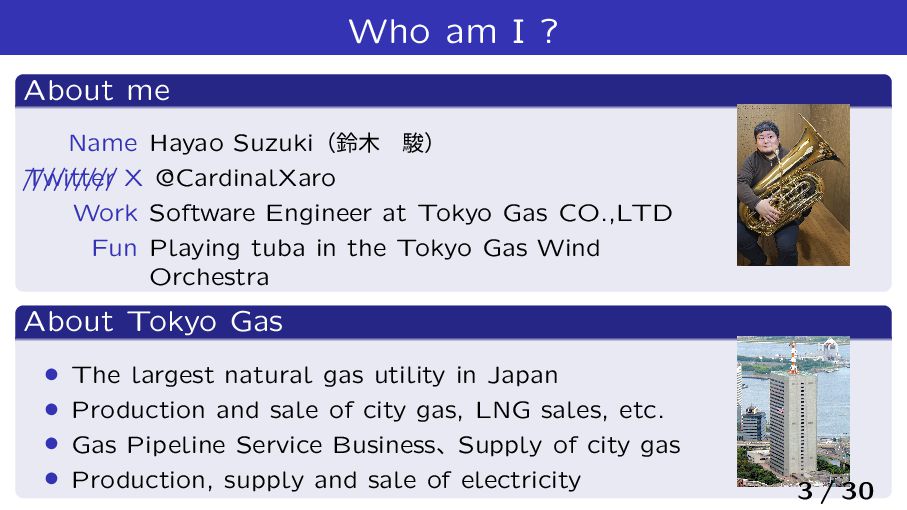
Who am I ? About me Name Hayao Suzukiʢླɹॣʣ /////////
Twitter X @CardinalXaro Work Software Engineer at Tokyo Gas CO.,LTD Fun Playing tuba in the Tokyo Gas Wind Orchestra About Tokyo Gas › The largest natural gas utility in Japan › Production and sale of city gas, LNG sales, etc. › Gas Pipeline Service BusinessɺSupply of city gas › Production, supply and sale of electricity 3 / 30 -
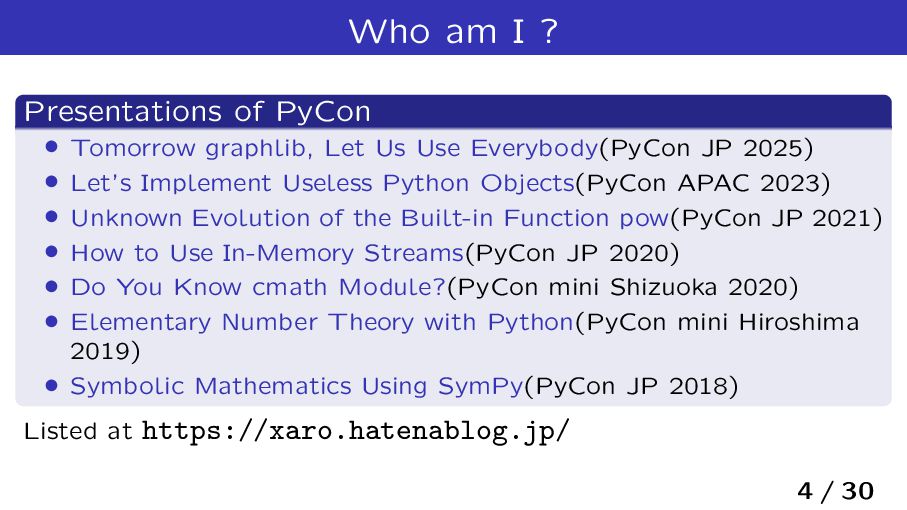
Who am I ? Presentations of PyCon › Tomorrow graphlib,
Let Us Use Everybody(PyCon JP 2025) › Let’s Implement Useless Python Objects(PyCon APAC 2023) › Unknown Evolution of the Built-in Function pow(PyCon JP 2021) › How to Use In-Memory Streams(PyCon JP 2020) › Do You Know cmath Module?(PyCon mini Shizuoka 2020) › Elementary Number Theory with Python(PyCon mini Hiroshima 2019) › Symbolic Mathematics Using SymPy(PyCon JP 2018) Listed at https://xaro.hatenablog.jp/ 4 / 30 -
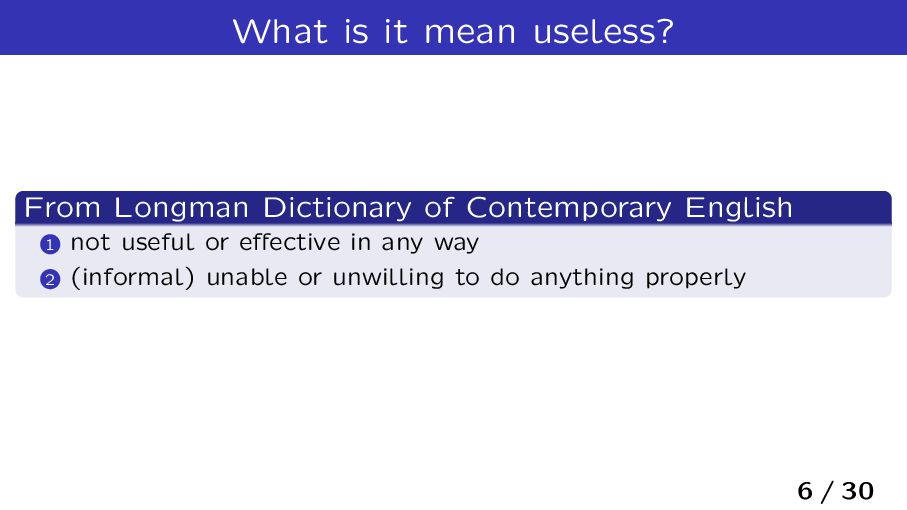
What is it mean useless? From Longman Dictionary of Contemporary
English 1 not useful or effective in any way 2 (informal) unable or unwilling to do anything properly 6 / 30 -
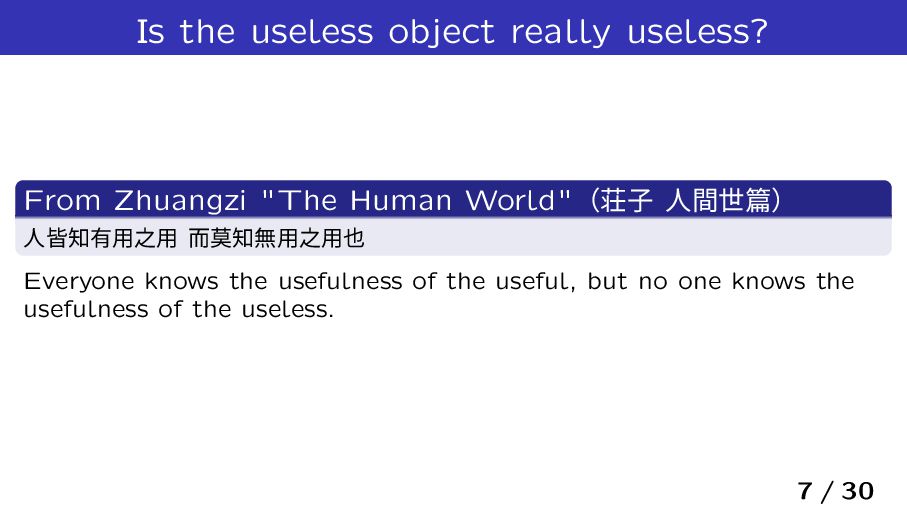
Is the useless object really useless? From Zhuangzi "The Human
World"ʢࢠ ਓؒੈรʣ ਓօ༗༻೭༻ ࣕലແ༻೭༻ Everyone knows the usefulness of the useful, but no one knows the usefulness of the useless. 7 / 30 -
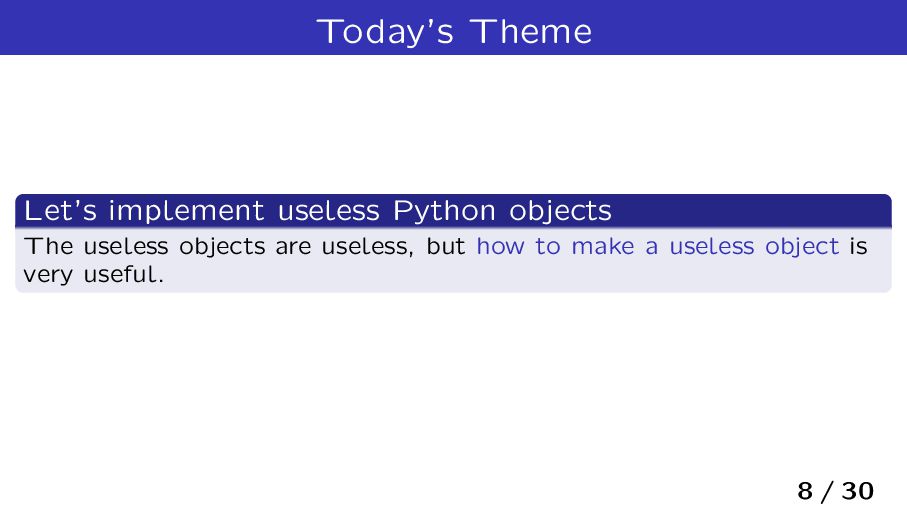
Today’s Theme Let’s implement useless Python objects The useless objects
are useless, but how to make a useless object is very useful. 8 / 30 -
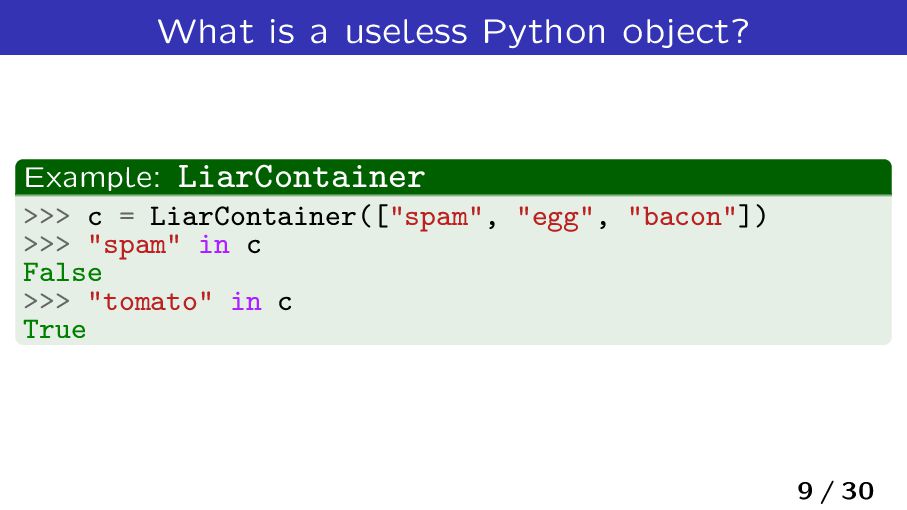
What is a useless Python object? Example: LiarContainer >>> c
= LiarContainer(["spam", "egg", "bacon"]) >>> "spam" in c False >>> "tomato" in c True 9 / 30 -
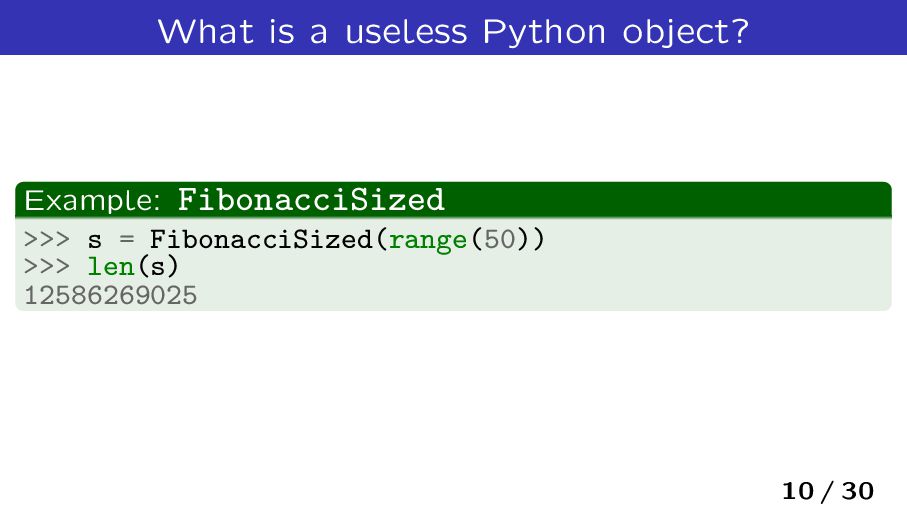
What is a useless Python object? Example: FibonacciSized >>> s
= FibonacciSized(range(50)) >>> len(s) 12586269025 10 / 30 -
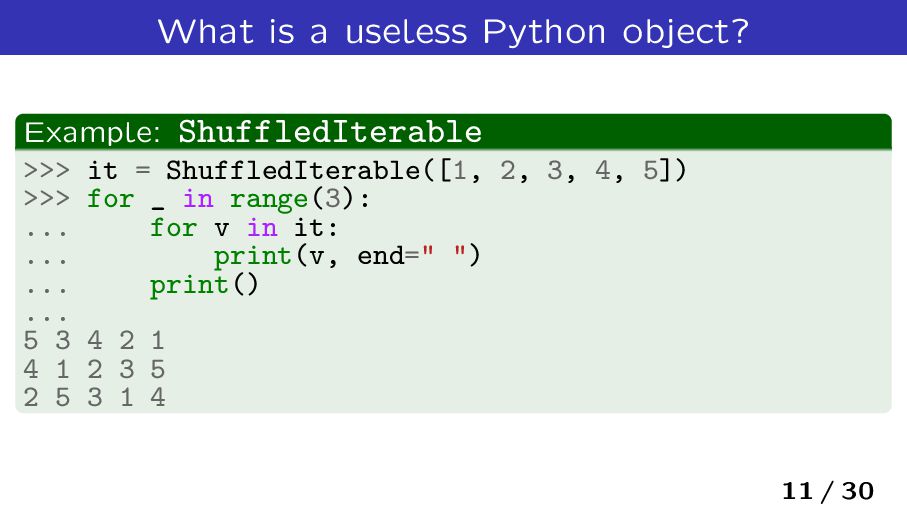
What is a useless Python object? Example: ShuffledIterable >>> it
= ShuffledIterable([1, 2, 3, 4, 5]) >>> for _ in range(3): ... for v in it: ... print(v, end=" ") ... print() ... 5 3 4 2 1 4 1 2 3 5 2 5 3 1 4 11 / 30 -
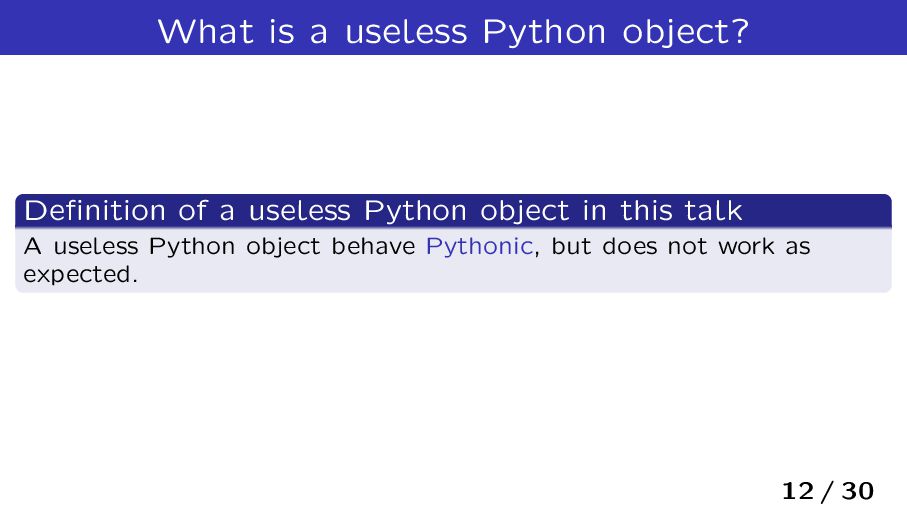
What is a useless Python object? Definition of a useless
Python object in this talk A useless Python object behave Pythonic, but does not work as expected. 12 / 30 -
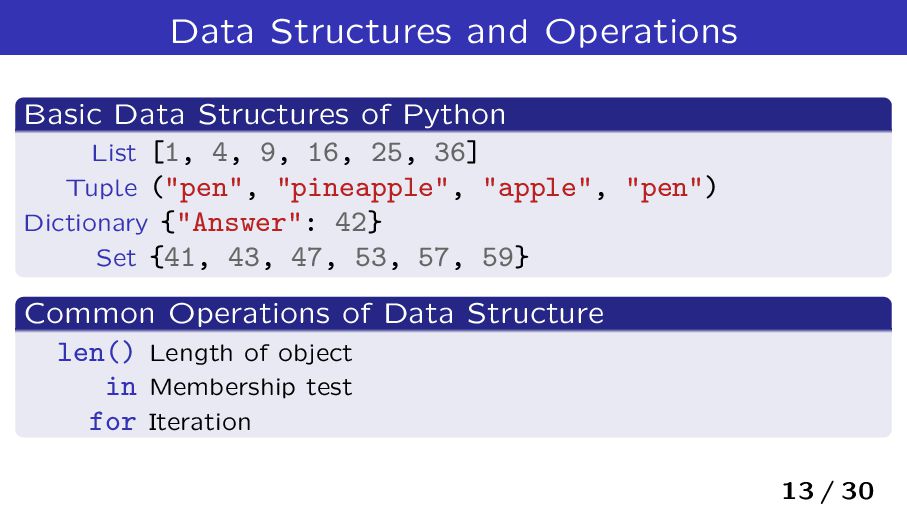
Data Structures and Operations Basic Data Structures of Python List
[1, 4, 9, 16, 25, 36] Tuple ("pen", "pineapple", "apple", "pen") Dictionary {"Answer": 42} Set {41, 43, 47, 53, 57, 59} Common Operations of Data Structure len() Length of object in Membership test for Iteration 13 / 30 -
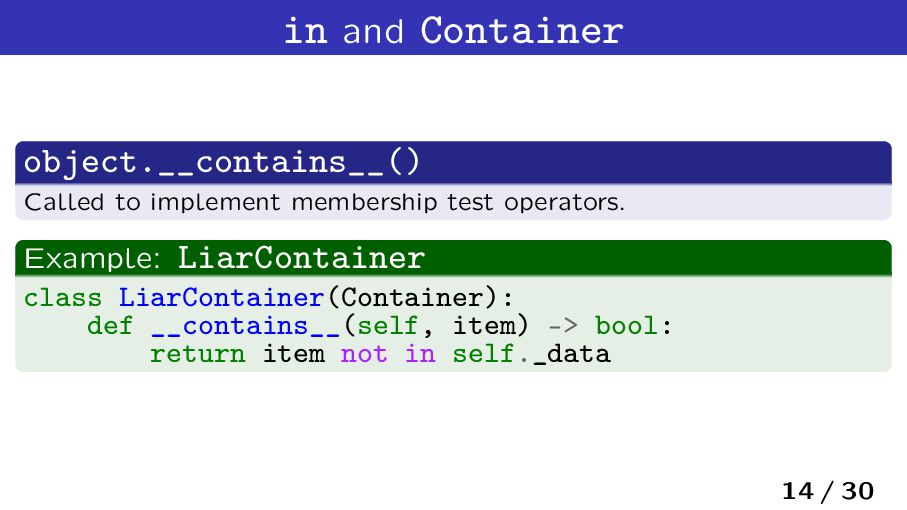
in and Container object.__contains__() Called to implement membership test operators.
Example: LiarContainer class LiarContainer(Container): def __contains__(self, item) -> bool: return item not in self._data 14 / 30 -
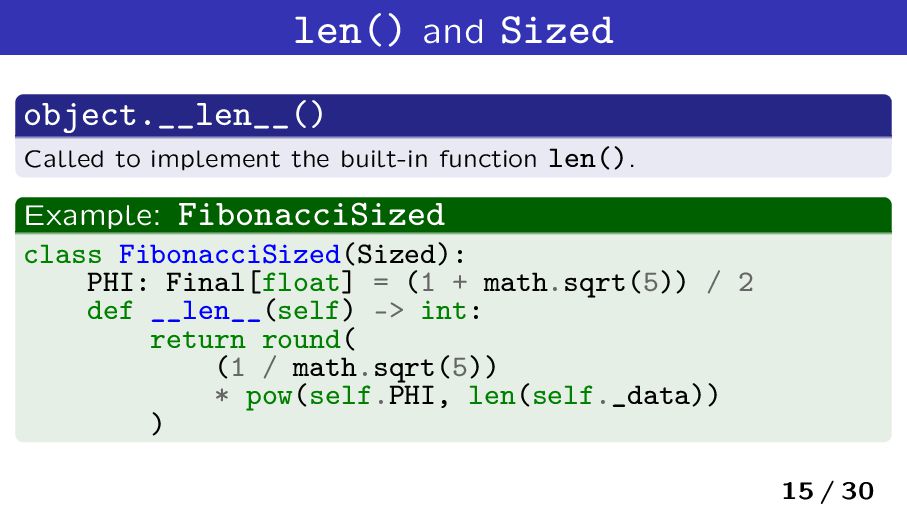
len() and Sized object.__len__() Called to implement the built-in function
len(). Example: FibonacciSized class FibonacciSized(Sized): PHI: Final[float] = (1 + math.sqrt(5)) / 2 def __len__(self) -> int: return round( (1 / math.sqrt(5)) * pow(self.PHI, len(self._data)) ) 15 / 30 -
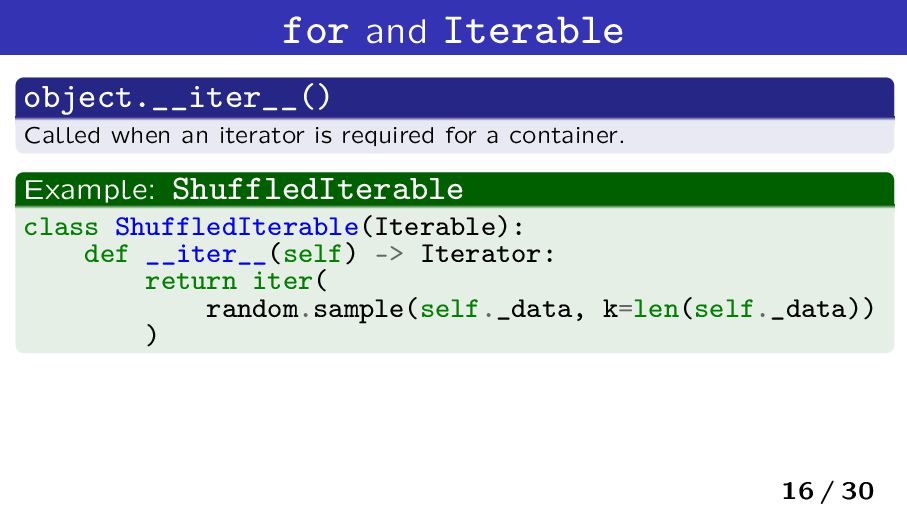
for and Iterable object.__iter__() Called when an iterator is required
for a container. Example: ShuffledIterable class ShuffledIterable(Iterable): def __iter__(self) -> Iterator: return iter( random.sample(self._data, k=len(self._data)) ) 16 / 30 -
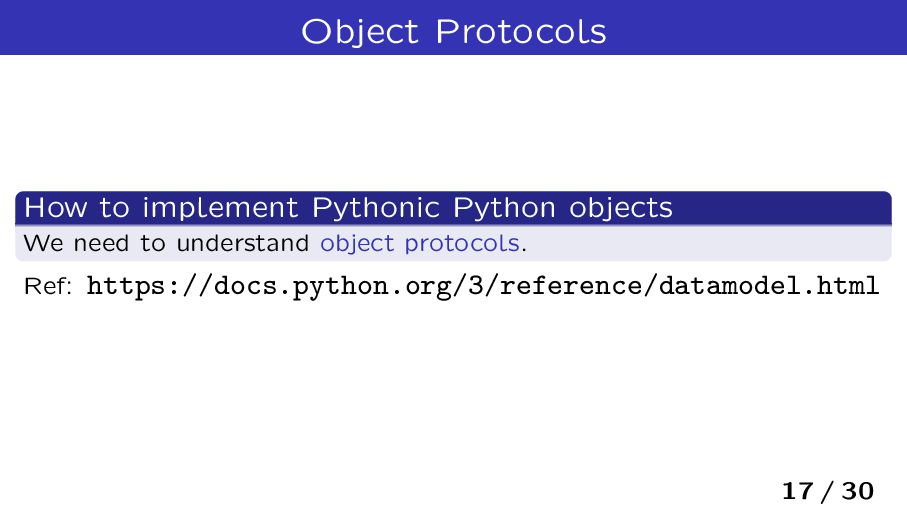
Object Protocols How to implement Pythonic Python objects We need
to understand object protocols. Ref: https://docs.python.org/3/reference/datamodel.html 17 / 30 -
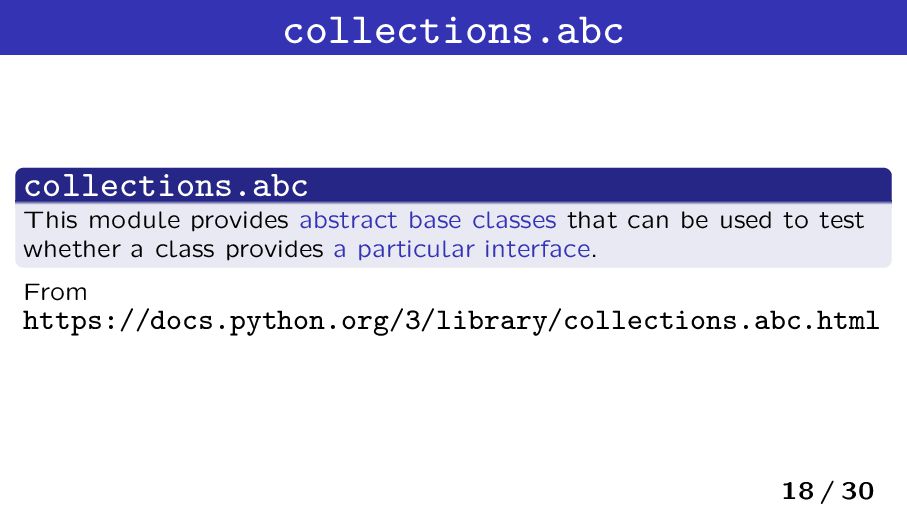
collections.abc collections.abc This module provides abstract base classes that can
be used to test whether a class provides a particular interface. From https://docs.python.org/3/library/collections.abc.html 18 / 30 -
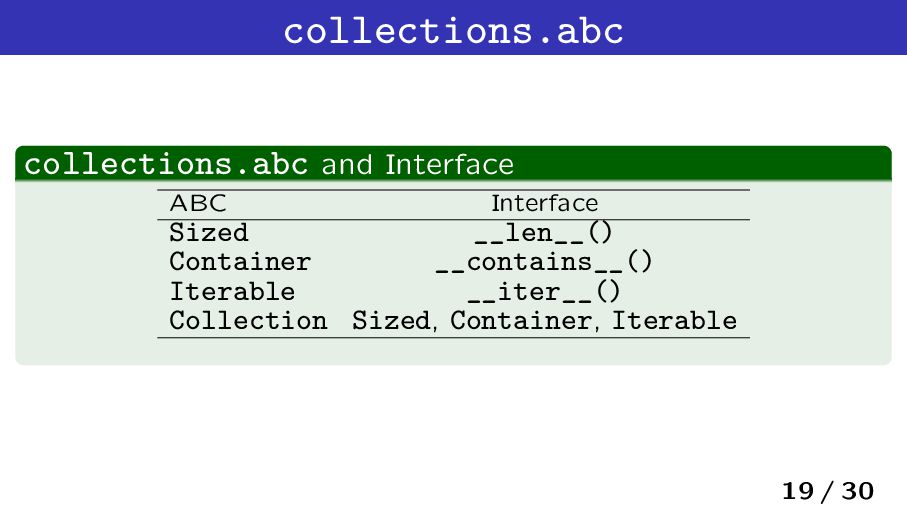
collections.abc collections.abc and Interface ABC Interface Sized __len__() Container __contains__()
Iterable __iter__() Collection Sized, Container, Iterable 19 / 30 -
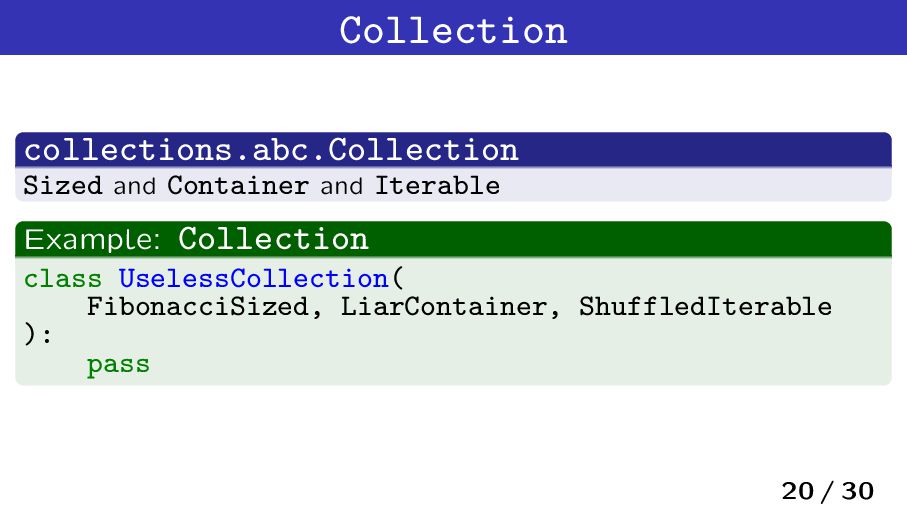
Collection collections.abc.Collection Sized and Container and Iterable Example: Collection class
UselessCollection( FibonacciSized, LiarContainer, ShuffledIterable ): pass 20 / 30 -
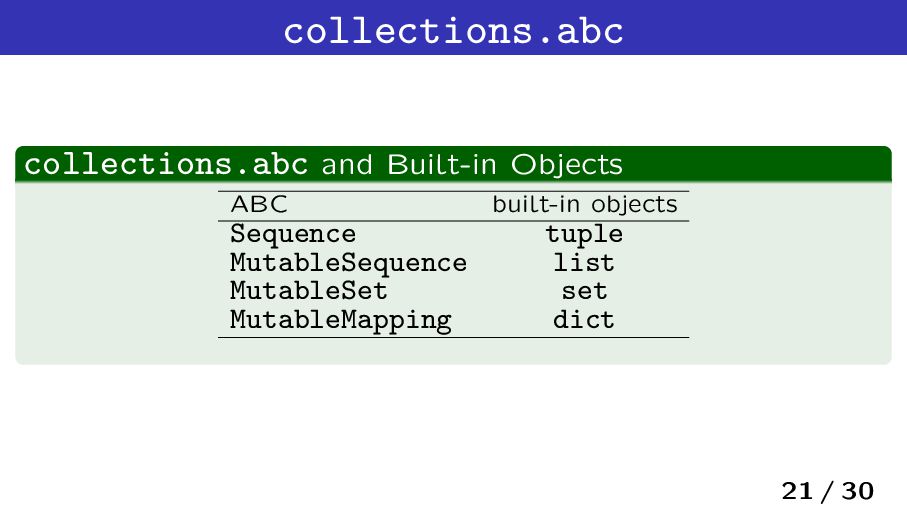
collections.abc collections.abc and Built-in Objects ABC built-in objects Sequence tuple
MutableSequence list MutableSet set MutableMapping dict 21 / 30 -
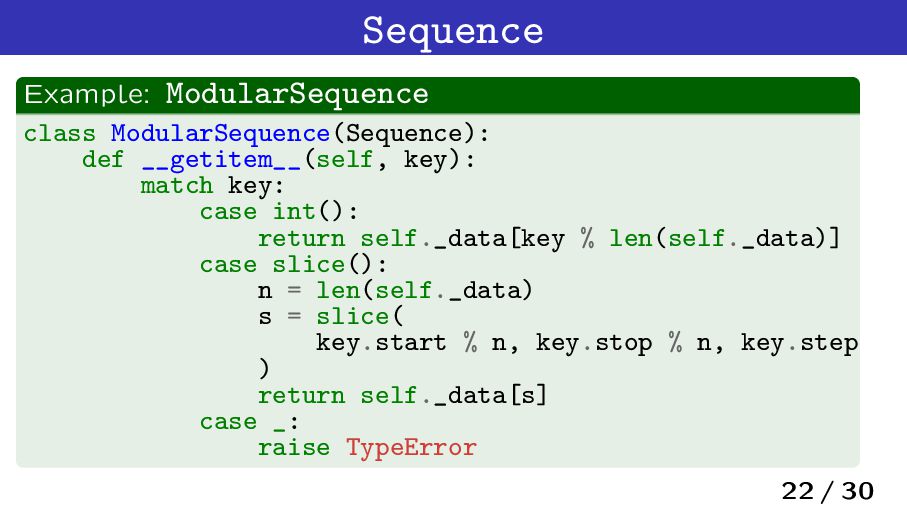
Sequence Example: ModularSequence class ModularSequence(Sequence): def __getitem__(self, key): match key:
case int(): return self._data[key % len(self._data)] case slice(): n = len(self._data) s = slice( key.start % n, key.stop % n, key.step ) return self._data[s] case _: raise TypeError 22 / 30 -
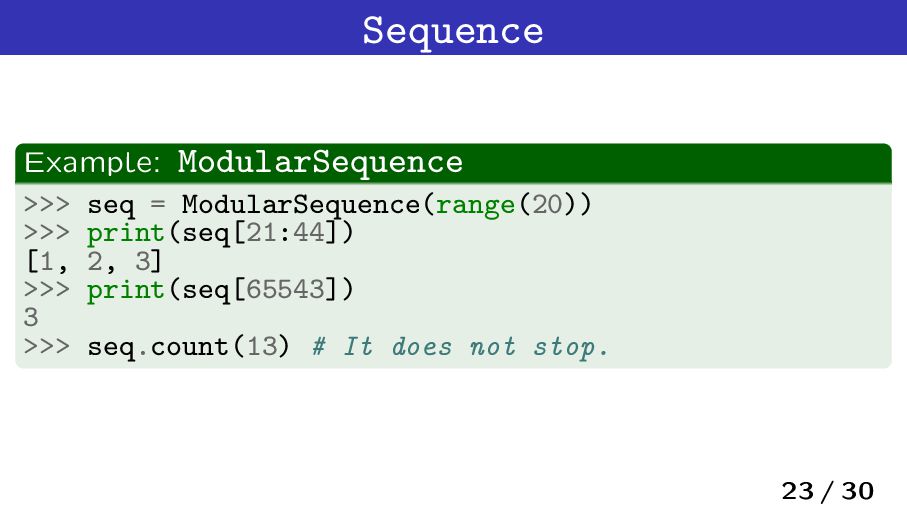
Sequence Example: ModularSequence >>> seq = ModularSequence(range(20)) >>> print(seq[21:44]) [1,
2, 3] >>> print(seq[65543]) 3 >>> seq.count(13) # It does not stop. 23 / 30 -
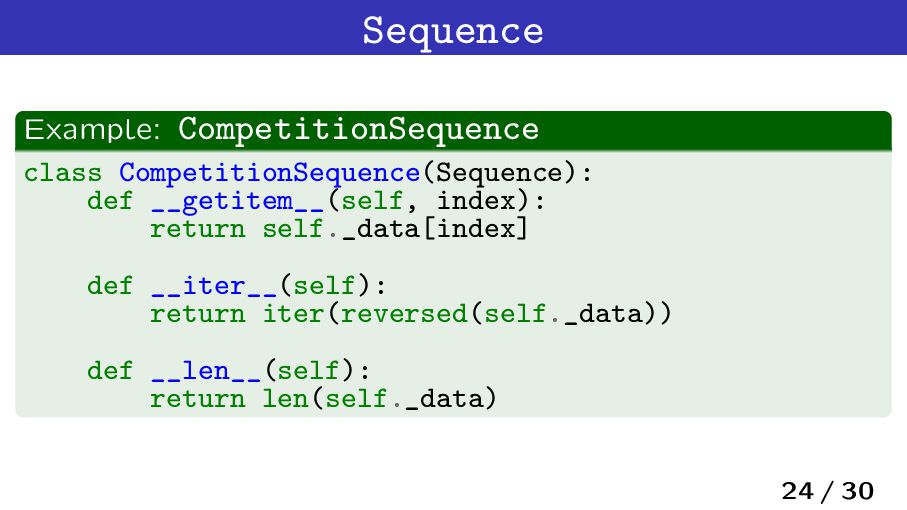
Sequence Example: CompetitionSequence class CompetitionSequence(Sequence): def __getitem__(self, index): return self._data[index]
def __iter__(self): return iter(reversed(self._data)) def __len__(self): return len(self._data) 24 / 30 -
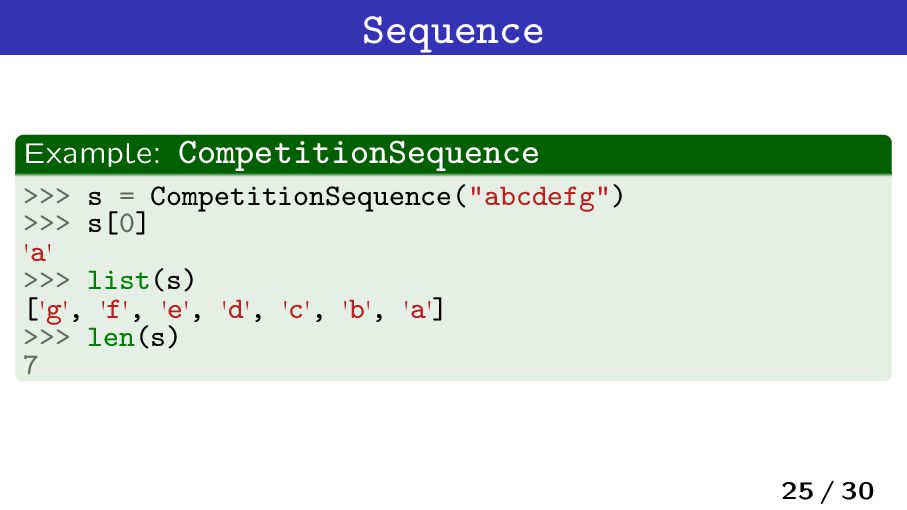
Sequence Example: CompetitionSequence >>> s = CompetitionSequence("abcdefg") >>> s[0] 'a'
>>> list(s) ['g', 'f', 'e', 'd', 'c', 'b', 'a'] >>> len(s) 7 25 / 30 -
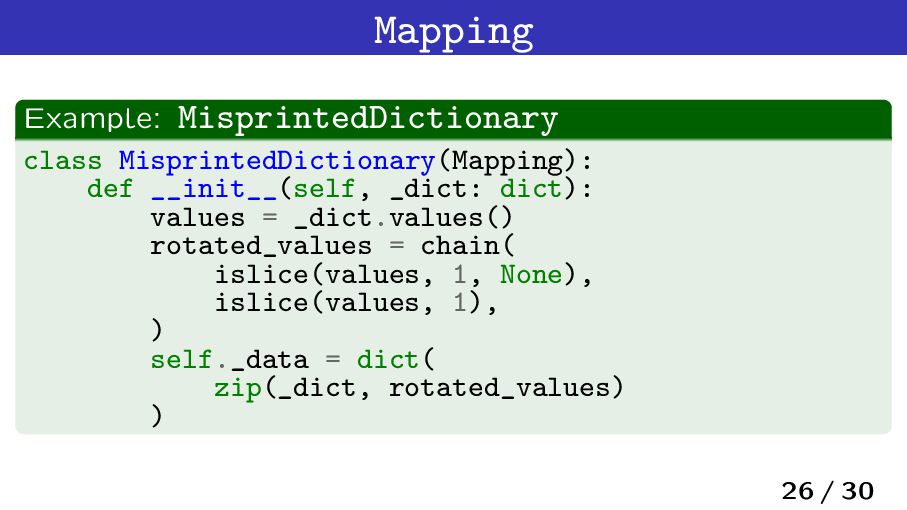
Mapping Example: MisprintedDictionary class MisprintedDictionary(Mapping): def __init__(self, _dict: dict): values
= _dict.values() rotated_values = chain( islice(values, 1, None), islice(values, 1), ) self._data = dict( zip(_dict, rotated_values) ) 26 / 30 -
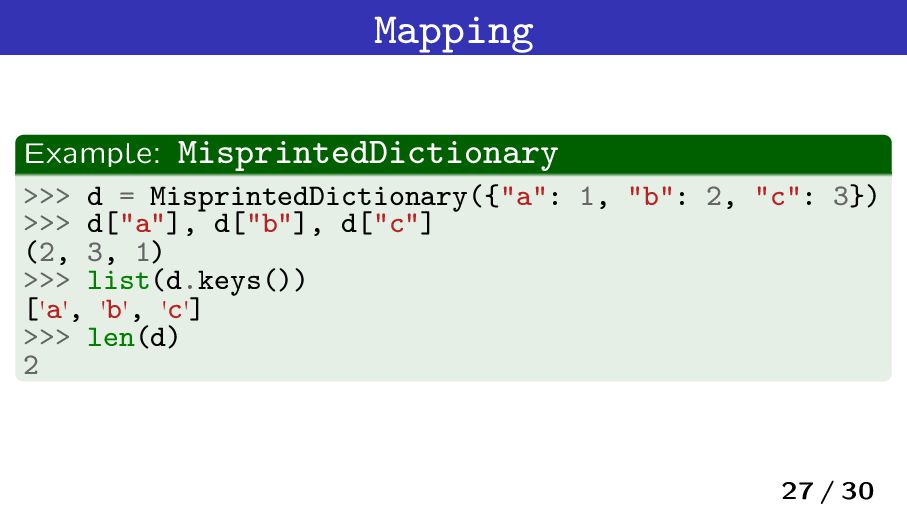
Mapping Example: MisprintedDictionary >>> d = MisprintedDictionary({"a": 1, "b": 2,
"c": 3}) >>> d["a"], d["b"], d["c"] (2, 3, 1) >>> list(d.keys()) ['a', 'b', 'c'] >>> len(d) 2 27 / 30 -
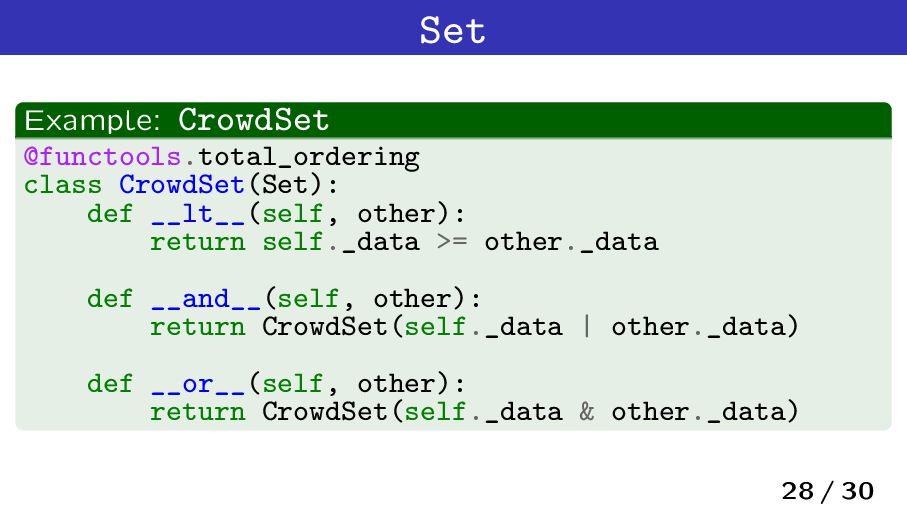
Set Example: CrowdSet @functools.total_ordering class CrowdSet(Set): def __lt__(self, other): return
self._data >= other._data def __and__(self, other): return CrowdSet(self._data | other._data) def __or__(self, other): return CrowdSet(self._data & other._data) 28 / 30 -
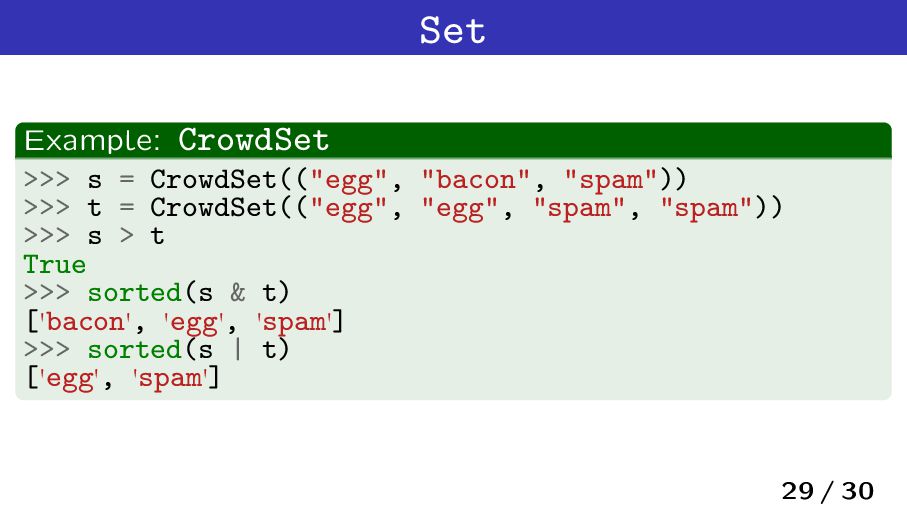
Set Example: CrowdSet >>> s = CrowdSet(("egg", "bacon", "spam")) >>>
t = CrowdSet(("egg", "egg", "spam", "spam")) >>> s > t True >>> sorted(s & t) ['bacon', 'egg', 'spam'] >>> sorted(s | t) ['egg', 'spam'] 29 / 30 -
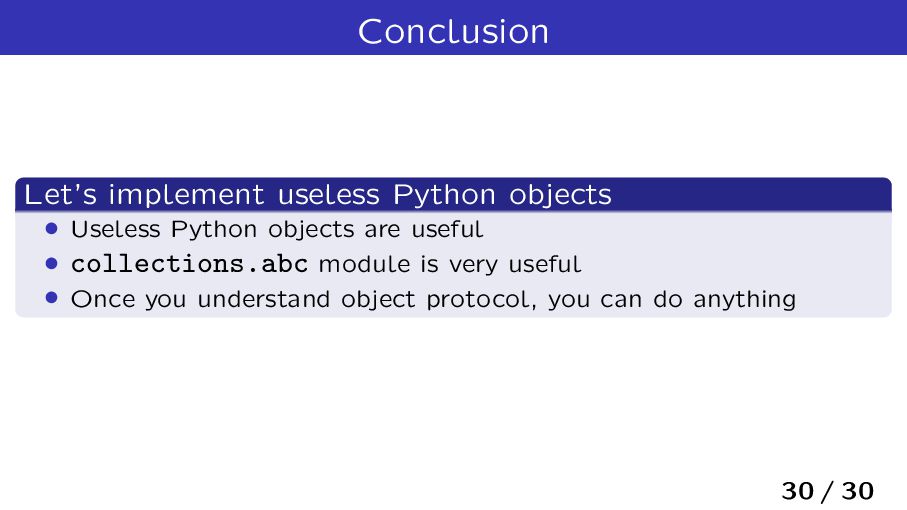
Conclusion Let’s implement useless Python objects › Useless Python objects
are useful › collections.abc module is very useful › Once you understand object protocol, you can do anything 30 / 30