Upgrade to Pro
— share decks privately, control downloads, hide ads and more …
Speaker Deck
Sign up for free
Menu
Search
Features
All features
Private URLs
Password Protection
Custom URLS
Scheduled publishing
Remove Branding
Restrict embedding
Deck Collections
Notes
Features
All features
Private URLs
Password Protection
Custom URLS
Scheduled publishing
Remove Branding
Restrict embedding
Deck Collections
Notes
Explore
Featured decks
Featured speakers
Programming
Technology
Storyboards
Explore
Featured decks
Featured speakers
Programming
Technology
Storyboards
Pricing
Search
Sign in
Sign up for free
Why Functional Programming Matters
Search
αλεx π
January 10, 2014
290
0
Share
Embed
Copy iframe code
Copy JS code
Copy link
Start on current slide
Why Functional Programming Matters
Ramblings on the subject of "why FP matters"
αλεx π
January 10, 2014
More Decks by αλεx π
See All by αλεx π
Scalable Time Series With Cassandra
ifesdjeen
1
430
Bayesian Inference is known to make machines biased
ifesdjeen
2
420
Cassandra for Data Analytics Backends
ifesdjeen
7
470
Stream Processing and Functional Programming
ifesdjeen
1
800
PolyConf 2015 - Rocking the Time Series boat with C, Haskell and ClojureScript
ifesdjeen
0
540
Clojure - A Sweetspot for Analytics
ifesdjeen
8
2.1k
Going Off Heap
ifesdjeen
3
1.9k
Always be learning
ifesdjeen
1
200
Learn Yourself Emacs For Great Good workshop slides
ifesdjeen
3
360
Featured
See All Featured
Technical Leadership for Architectural Decision Making
baasie
3
600
Navigating Team Friction
lara
192
16k
Google's AI Overviews - The New Search
badams
0
1.6k
The Limits of Empathy - UXLibs8
cassininazir
2
720
Bash Introduction
62gerente
615
220k
The browser strikes back
jonoalderson
0
1.8k
Building an army of robots
kneath
307
47k
How Fast Is Fast Enough? [PerfNow 2025]
tammyeverts
3
930
Stop Working from a Prison Cell
hatefulcrawdad
274
21k
Bootstrapping a Software Product
garrettdimon
PRO
306
120k
The Spectacular Lies of Maps
axbom
PRO
1
1.1k
Why Mistakes Are the Best Teachers: Turning Failure into a Pathway for Growth
auna
0
320
Transcript
Why FP Matters and everyone should learn more of it
None
Major Concepts
Expressions, not assignments FP encourages thinking in results of evaluation,
rather than assigning results to re-assignable variables
Example Recursive computation
(def map! (fn [f coll]! (if (empty? coll) (quote ())!
(cons (f (first coll))! (map f (next coll))))))!
Outcome Easier composition Less errors (no way to modify result
in-between calls)
How to do, not what to do FP discourages operational
reasoning, promotes algorithmical reasoning
Example Evaluation
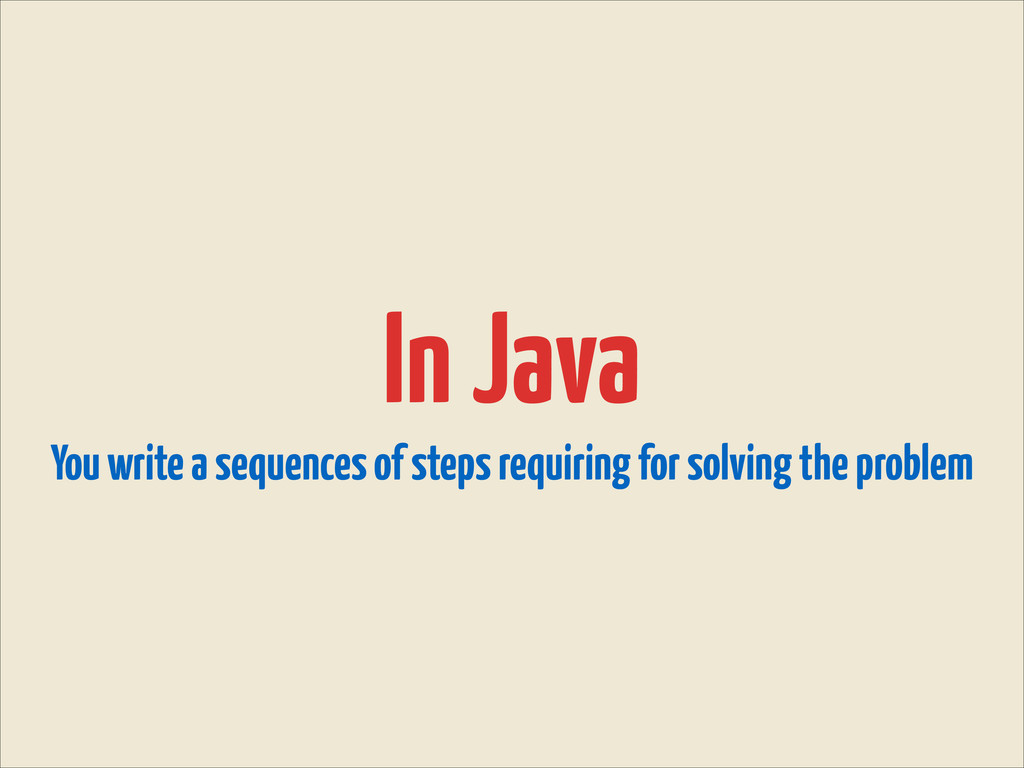
In Java You write a sequences of steps requiring for
solving the problem
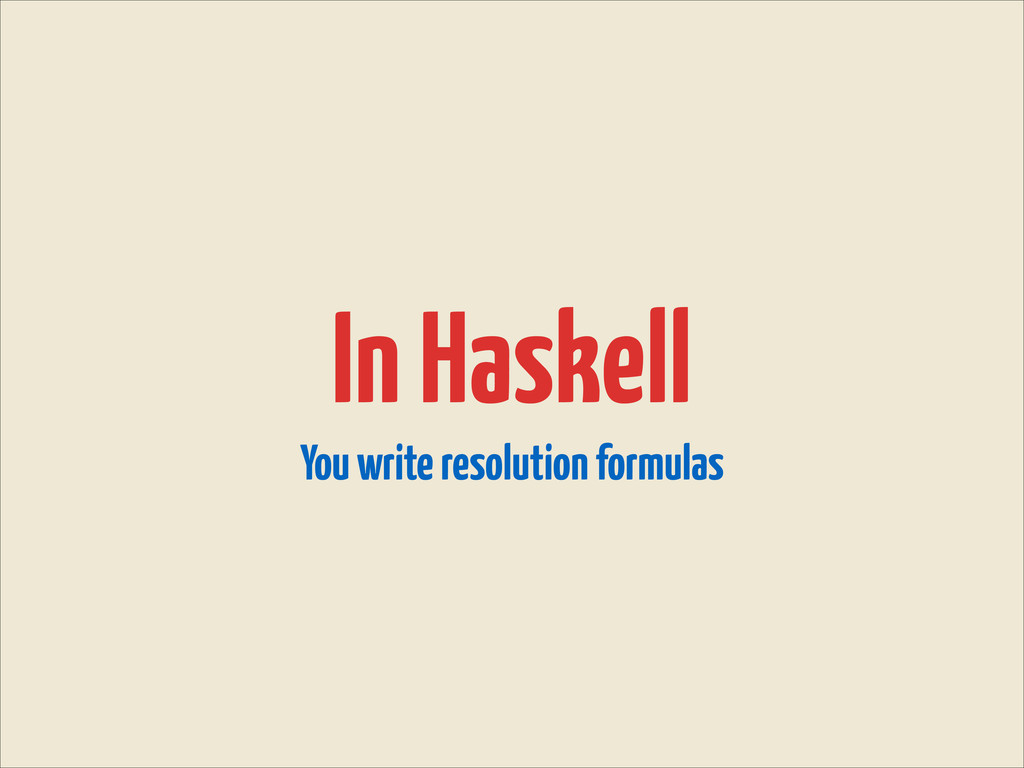
In Haskell You write resolution formulas
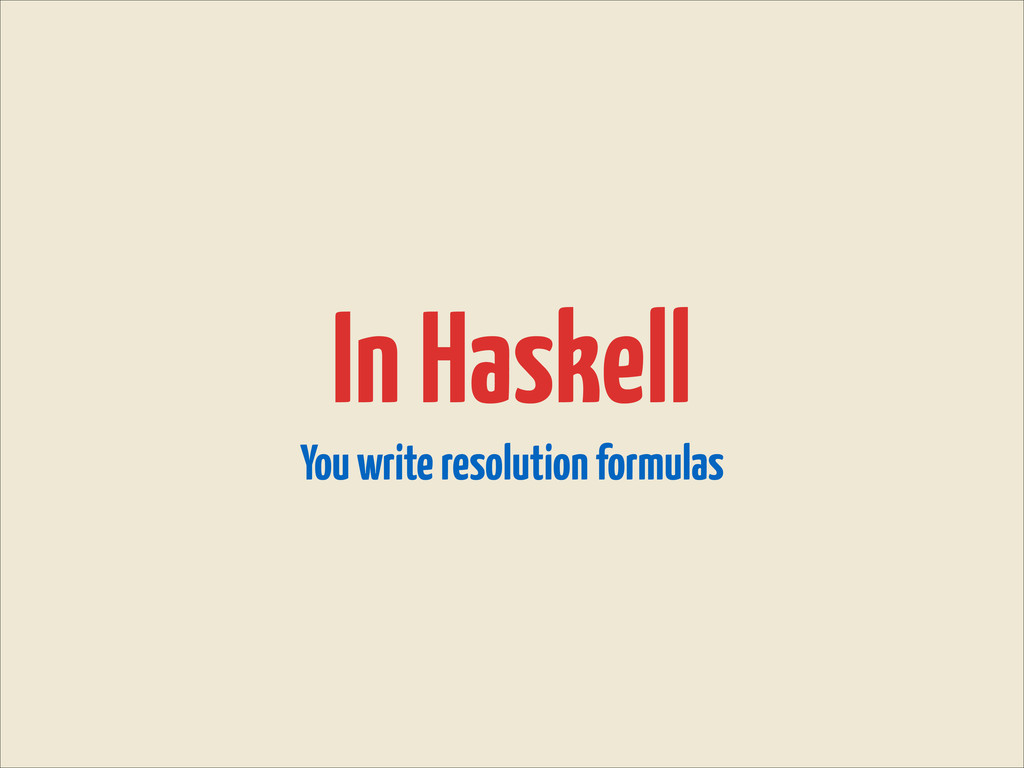
In Haskell You write resolution formulas
eval closure sym@(LispSymbol _) eval :: [LispEnvironment] -> LispExpression ->
State LispEnvironment LispExpression eval closure (LispList[(ReservedKeyword FnKeyword), LispVector bindings, form])
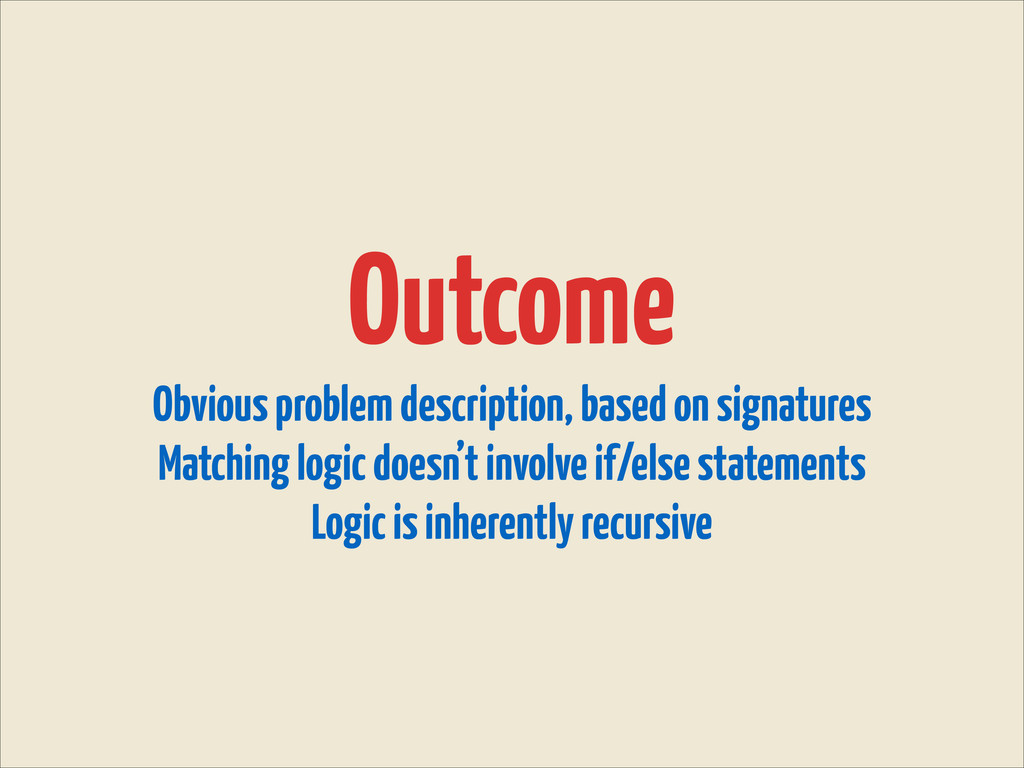
Outcome Obvious problem description, based on signatures Matching logic doesn’t
involve if/else statements Logic is inherently recursive
Function composition FP encourages function, rather than object composition
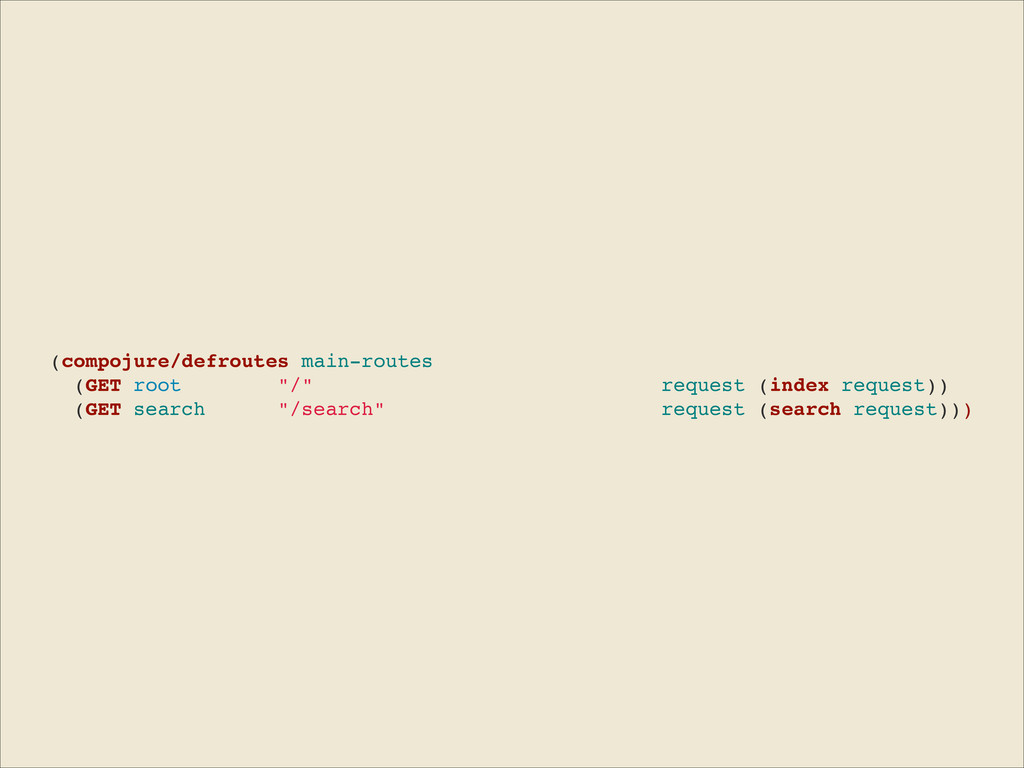
Example Routing: URL parsing + handler logic
(compojure/defroutes main-routes! (GET root "/" request (index request))! (GET search
"/search" request (search request)))
Outcome Both handlers and parsing logic is reusable Testing handlers
doesn’t involve any additional object composition
Primitives FP encourages using language primitives, such as keywords (lightweight
strings), lists, maps instead of heavy objects
Outcome Adapter logic is just a transformation Reusability increases Easier
composition
Powerful collection fns All Functional languages have amazingly powerful collection
manipulation primitives, such as filter/map/reduce, which always involves conditionals, mutable state, loops and so on.
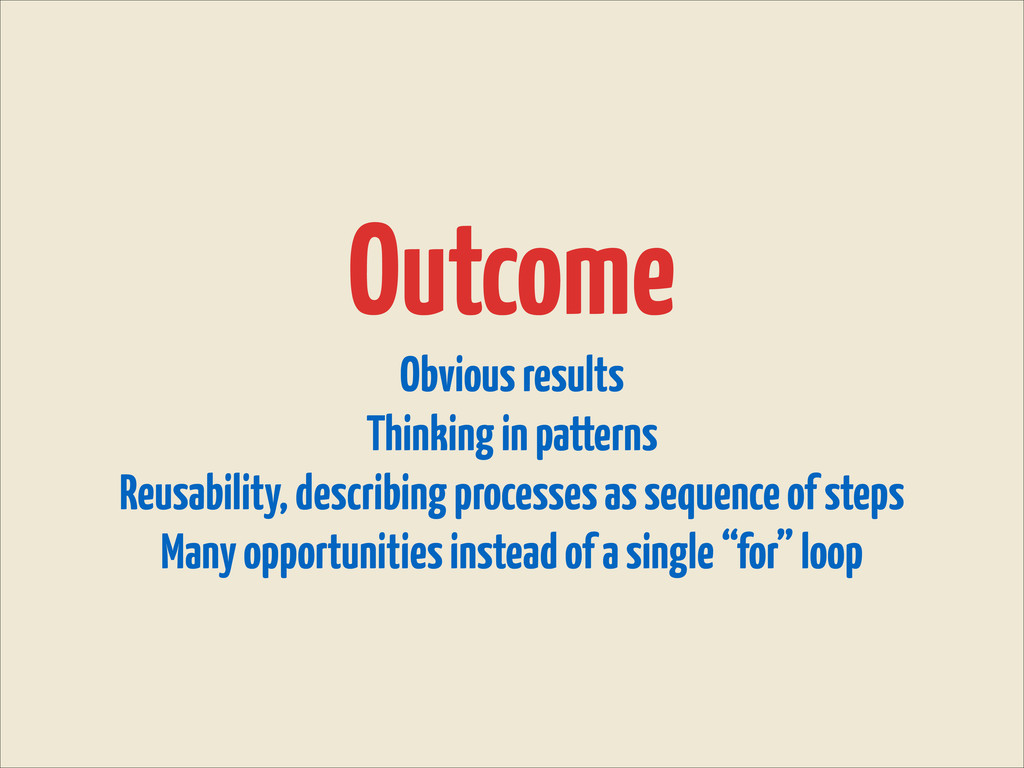
Outcome Obvious results Thinking in patterns Reusability, describing processes as
sequence of steps Many opportunities instead of a single “for” loop
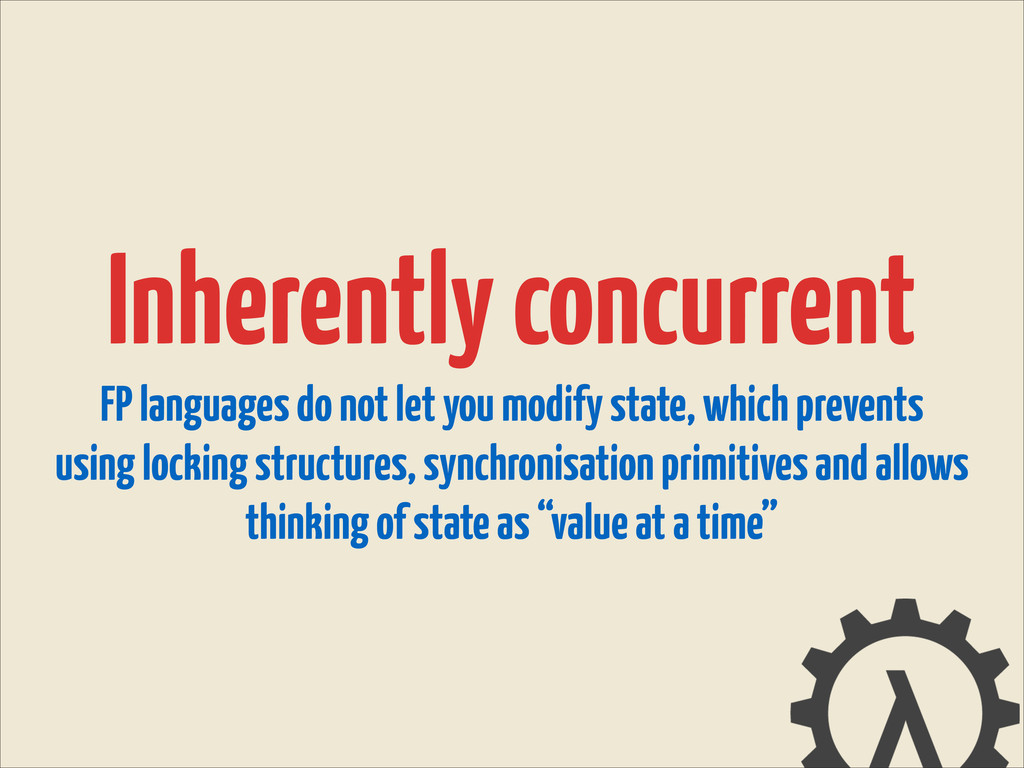
Inherently concurrent FP languages do not let you modify state,
which prevents using locking structures, synchronisation primitives and allows thinking of state as “value at a time”
Outcome Easier to scale Everything is paralellisable
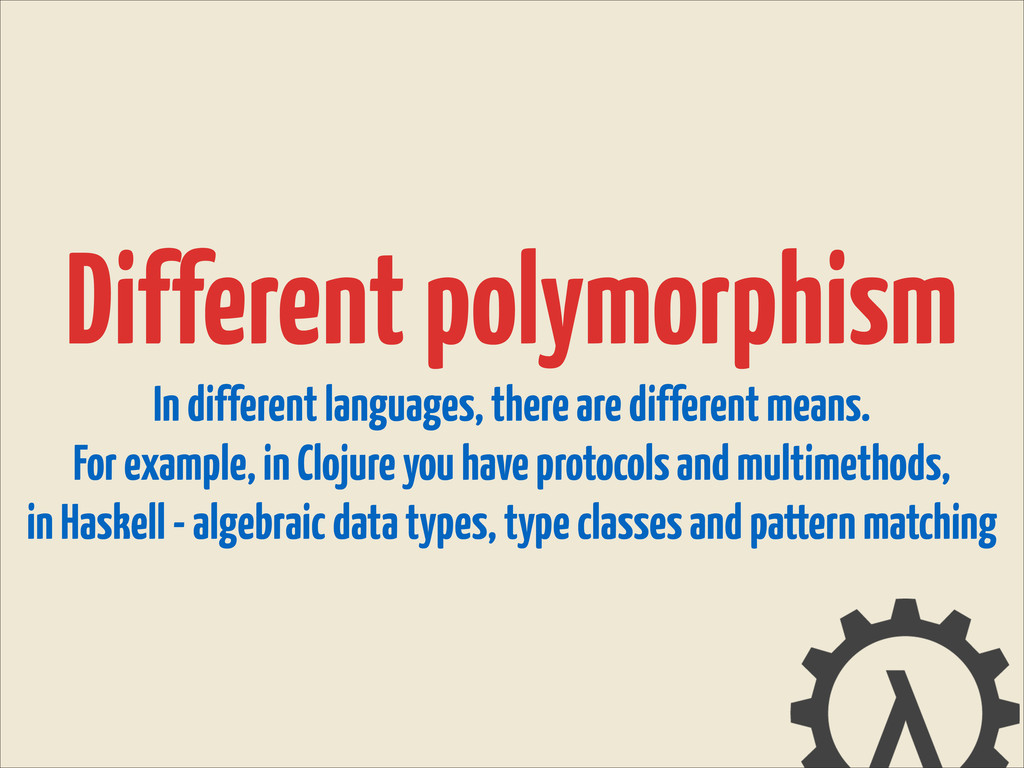
Different polymorphism In different languages, there are different means. For
example, in Clojure you have protocols and multimethods, in Haskell - algebraic data types, type classes and pattern matching
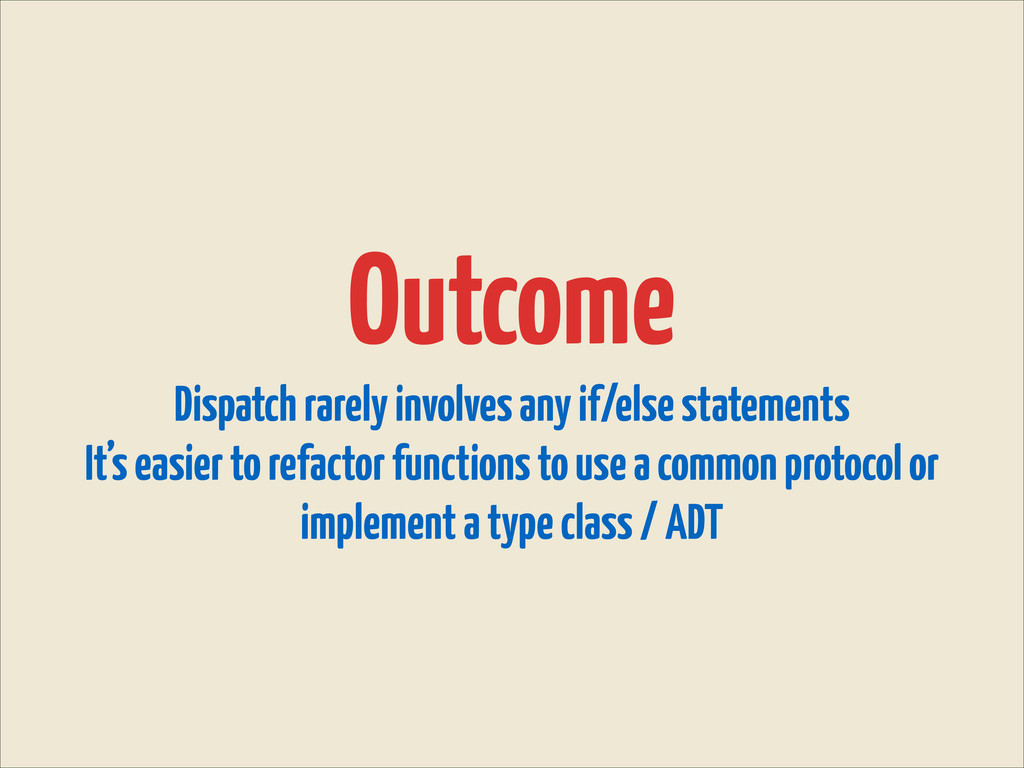
Outcome Dispatch rarely involves any if/else statements It’s easier to
refactor functions to use a common protocol or implement a type class / ADT
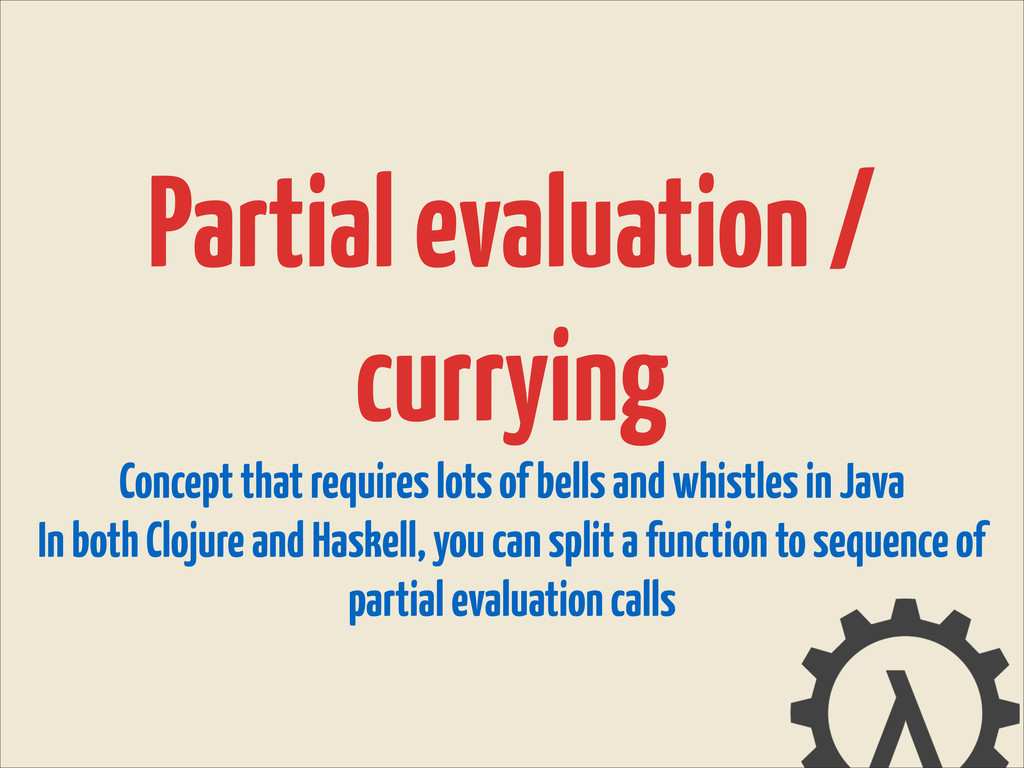
Partial evaluation / currying Concept that requires lots of bells
and whistles in Java In both Clojure and Haskell, you can split a function to sequence of partial evaluation calls
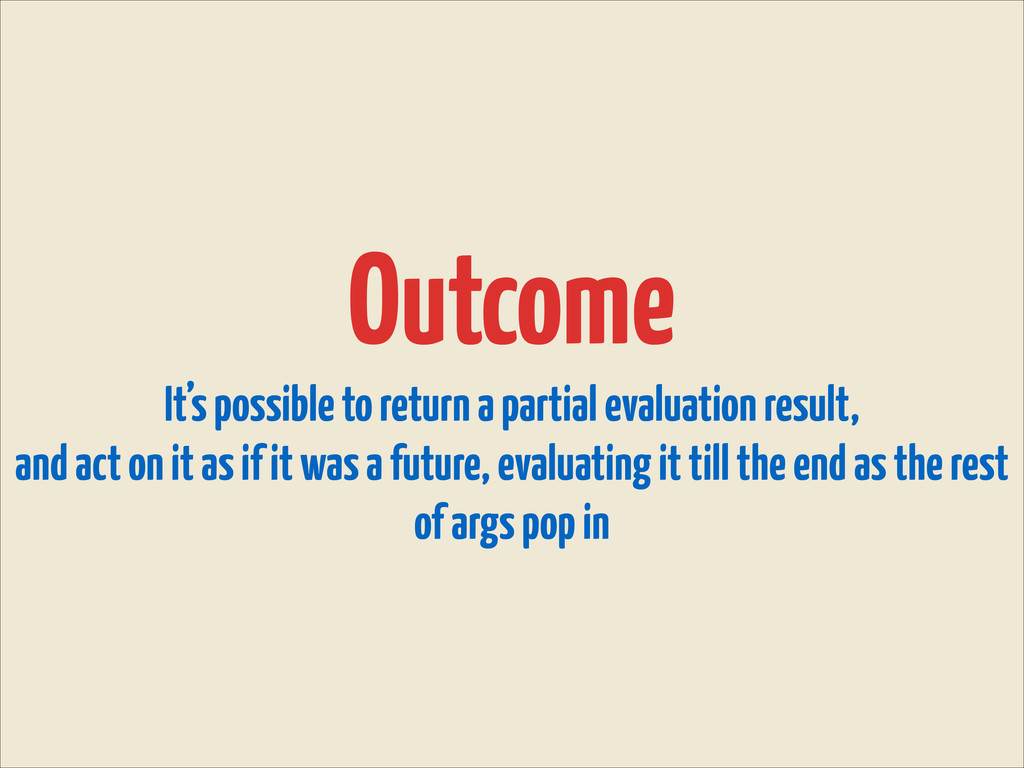
Outcome It’s possible to return a partial evaluation result, and
act on it as if it was a future, evaluating it till the end as the rest of args pop in
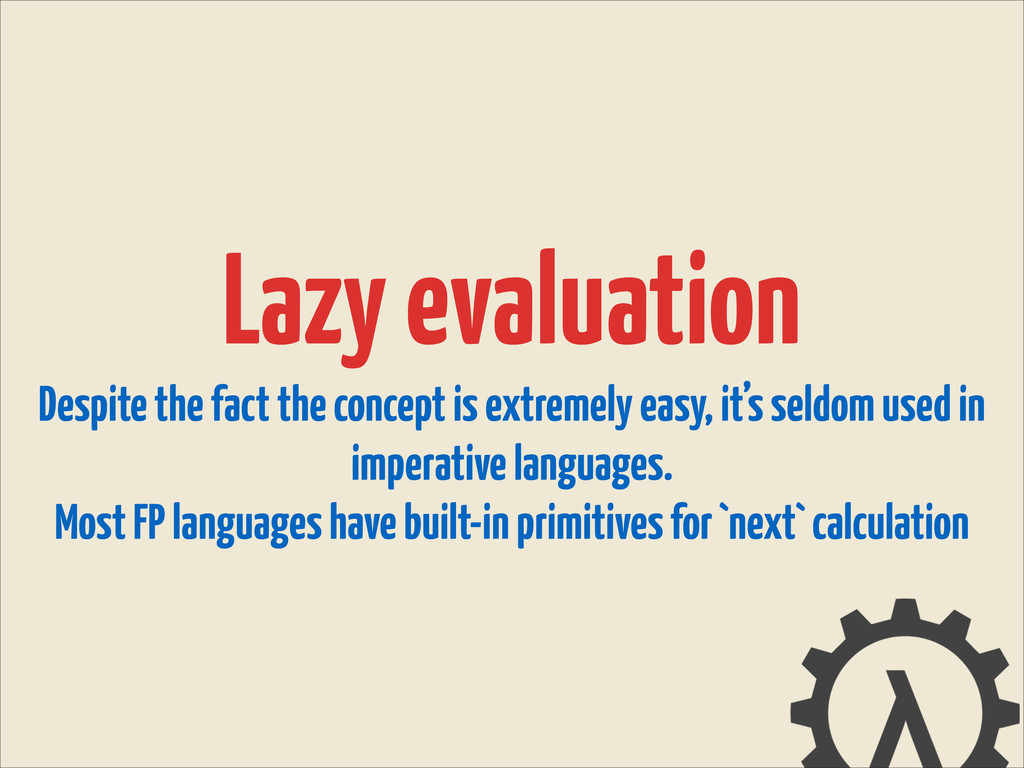
Lazy evaluation Despite the fact the concept is extremely easy,
it’s seldom used in imperative languages. Most FP languages have built-in primitives for `next` calculation
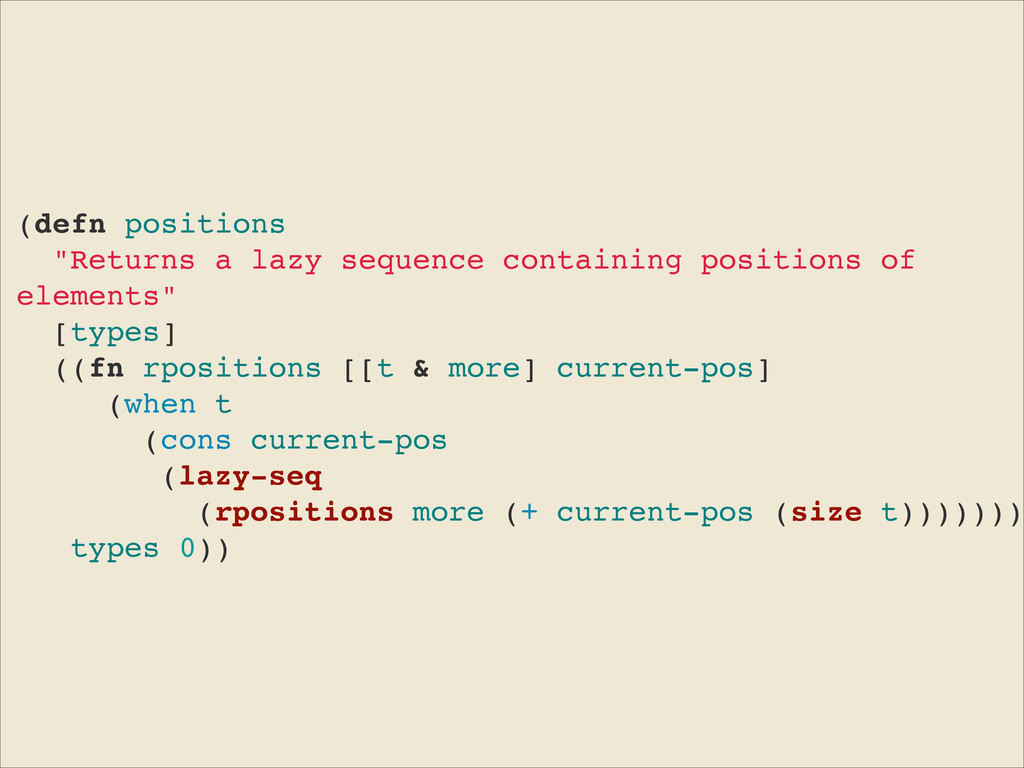
Example Byte Buffer position generation
(defn positions! "Returns a lazy sequence containing positions of elements"!
[types]! ((fn rpositions [[t & more] current-pos]! (when t! (cons current-pos ! ! ! ! ! (lazy-seq ! ! ! ! ! (rpositions more (+ current-pos (size t))))))) types 0))
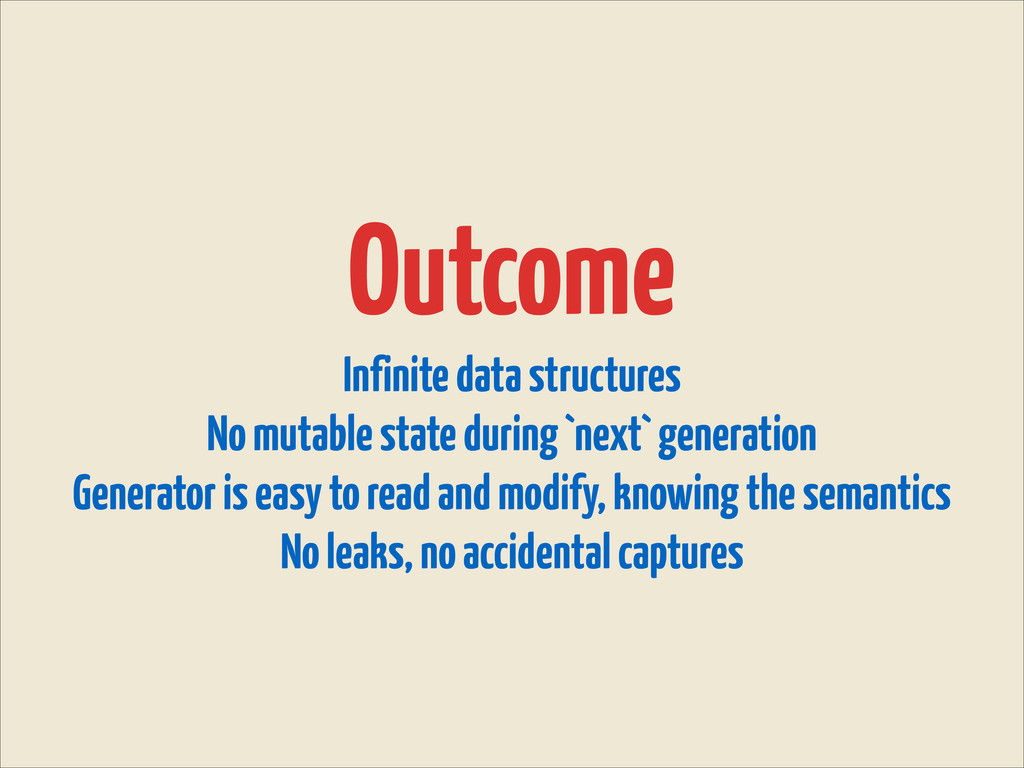
Outcome Infinite data structures No mutable state during `next` generation
Generator is easy to read and modify, knowing the semantics No leaks, no accidental captures
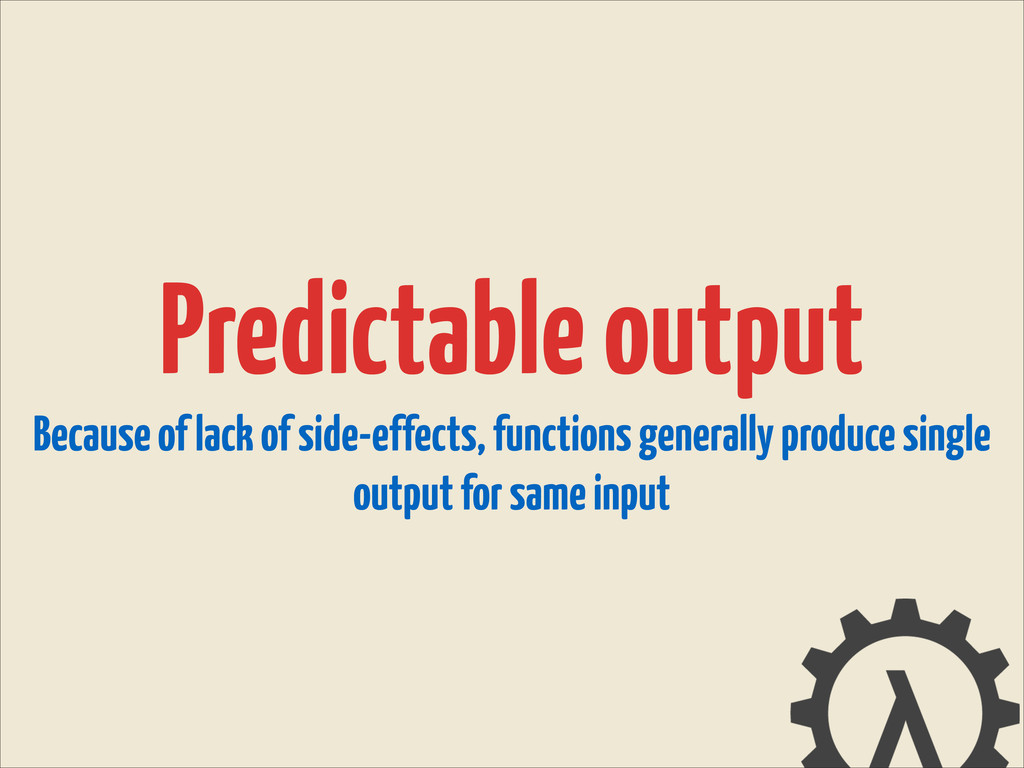
Predictable output Because of lack of side-effects, functions generally produce
single output for same input
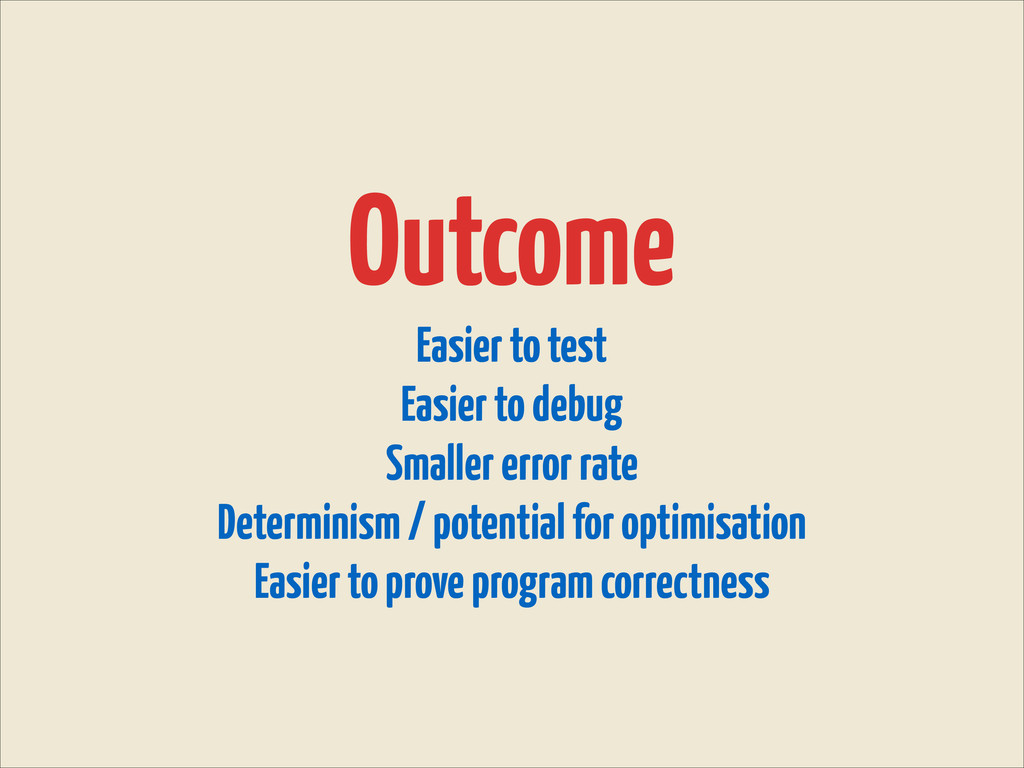
Outcome Easier to test Easier to debug Smaller error rate
Determinism / potential for optimisation Easier to prove program correctness
Why it matters for us?
Patterns In Consulting, it’s important to identify problem fast and
provide an easily explainable solution
Knowing it before them Adoption of FP languages is growing
every day. Not being able to provide services will leave us with limited business opportunities.
Rapid Prototyping FP languages allow you to express a problem
fast, with minimal effort and provide a working result quicker than imperative one
Mind Flexibility Being able to approach the problem from different
perspective never hurts
FP In Java Reactor is one of my favourite examples
of using FP paradigms even in Java 7. Java 8 and lambdas is a step forward. Being able to use them knowing the context of where they’re coming from opens up a lot of possibilities.
Reactive programming Reactive programming also grows from FP. Having a
function as a callback was used singe ages in FP.
Having more fun @ work Self-explanatory
Questions?


 ifesdjeen
 baasie
 lara
lara
 badams
 cassininazir
 62gerente
 jonoalderson
 kneath
 tammyeverts
 hatefulcrawdad
 garrettdimon
 axbom
axbom
 auna
auna

![(def map! (fn [f coll]! (if (empty? coll) (quote ())!](https://files.speakerdeck.com/presentations/07fd8ff05c0d01316a3e66af61877c6c/slide_5.jpg)
![eval closure sym@(LispSymbol _) eval :: [LispEnvironment] -> LispExpression ->](https://files.speakerdeck.com/presentations/07fd8ff05c0d01316a3e66af61877c6c/slide_12.jpg)