Upgrade to Pro
— share decks privately, control downloads, hide ads and more …
Speaker Deck
Sign up for free
Menu
Search
Features
All features
Private URLs
Password Protection
Custom URLS
Scheduled publishing
Remove Branding
Restrict embedding
Deck Collections
Notes
Features
All features
Private URLs
Password Protection
Custom URLS
Scheduled publishing
Remove Branding
Restrict embedding
Deck Collections
Notes
Explore
Featured decks
Featured speakers
Programming
Technology
Storyboards
Explore
Featured decks
Featured speakers
Programming
Technology
Storyboards
Pricing
Search
Sign in
Sign up for free
Tornado in 1 Hour (or Less)
Search
Sponsored
·
SiteGround - Reliable hosting with speed, security, and support you can count on.
→
Kārlis Lauva
December 04, 2013
Programming
210
4
Share
Embed
Copy iframe code
Copy JS code
Copy link
Start on current slide
Tornado in 1 Hour (or Less)
Tornado crash-course
Kārlis Lauva
December 04, 2013
More Decks by Kārlis Lauva
See All by Kārlis Lauva
Let's talk about PureScript
karlis
0
95
Going Full Monty with full.monty
karlis
1
120
The Transatlantic Struggle
karlis
0
93
Two Scoops of Scala
karlis
0
130
Valsts pārvaldes atvērto datu semantiskās integrācijas procesi
karlis
1
220
Other Decks in Programming
See All in Programming
R8 の設定見直しでアプリサイズ削減
andpad
0
140
速く作れる。その次は、速く確かめられる開発へ 〜AIネイティブ開発を支える、Shift Down〜 / Can build fast. Next, moving to development where we can verify fast.
rkaga
8
5.5k
JRuby: Past, Present, and Future
headius
0
220
Rでドレミ/Do-Re-Mi_with_R
florets1
0
120
FreeBSDでZabbixを動かす
kenkino
0
360
モデルのリファクタリングが難しいと思ったら、そもそも複雑だったのはビジネス仕様だった ? / is-the-business-domain-the-real-complexity
hatsu38
0
450
iOS 27でニュースアプリはどう変わる!? 〜日経電子版の新機能対応と、開発事例から〜
lynnswap
7
13k
[Rails World 2026] Durable orchestration on Rails: from continuation to workflow
palkan
1
470
Augmenting AI with the Power of Jakarta EE
ivargrimstad
0
520
Agents on Rails - Rails at Scale 2026
irinanazarova
0
330
残高管理から台帳サービスへの進化
artoy
0
140
速習iPhone Duo対応
yuukiw00w
2
960
Featured
See All Featured
Accessibility Awareness
sabderemane
1
230
The Web Performance Landscape in 2024 [PerfNow 2024]
tammyeverts
12
1.3k
Prompt Engineering for Job Search
mfonobong
0
480
Fireside Chat
paigeccino
43
4k
Java REST API Framework Comparison - PWX 2021
mraible
34
9.7k
How To Speak Unicorn (iThemes Webinar)
marktimemedia
1
590
Chrome DevTools: State of the Union 2024 - Debugging React & Beyond
addyosmani
10
1.4k
Done Done
chrislema
187
17k
Navigating the moral maze — ethical principles for Al-driven product design
skipperchong
2
600
Designing Experiences People Love
moore
143
24k
The Curious Case for Waylosing
cassininazir
1
550
From Legacy to Launchpad: Building Startup-Ready Communities
dugsong
0
350
Transcript
TORNADO IN 1 HOUR (OR LESS) Kārlis Lauva @skazhy python.lv
meetup 2013.12.04
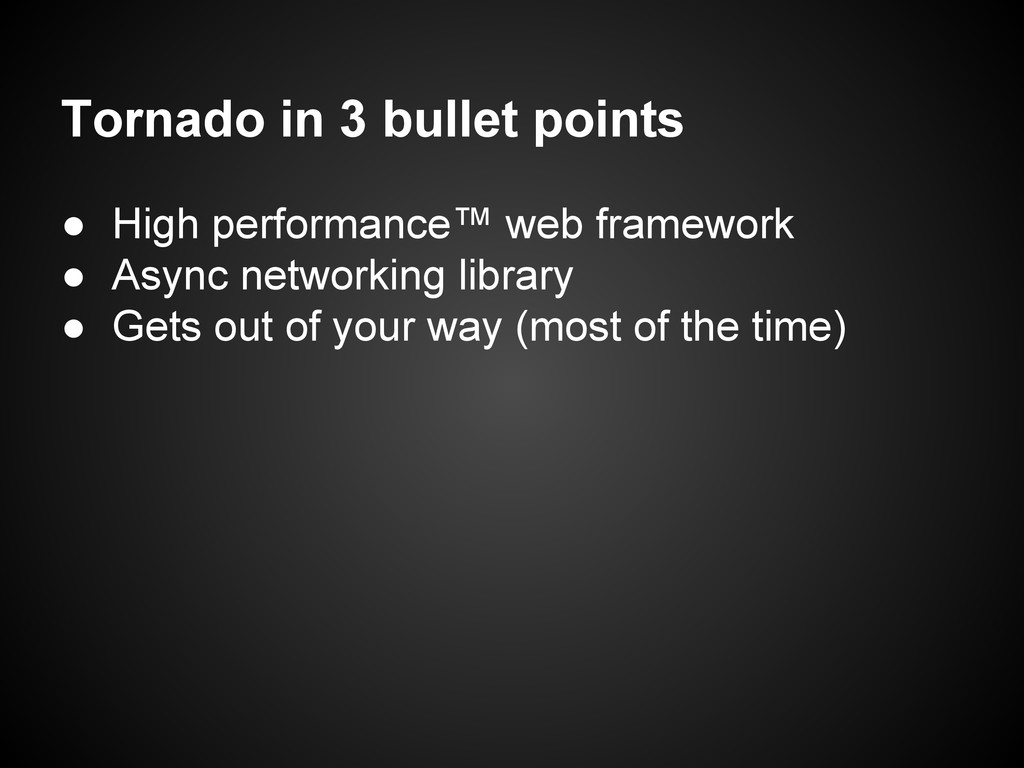
Tornado in 3 bullet points • High performance™ web framework
• Async networking library • Gets out of your way (most of the time)
Timeline • 2007.10 - FriendFeed is launched • 2009.08 -
Facebook acquires FriendFeed • 2009.09 - Tornado is open sourced • 2013.09 - Last stable release (3.1.1)
Who’s using it? …..and your company.
Installing pip install tornado pip install git+https://github.com/facebook/tornado.git
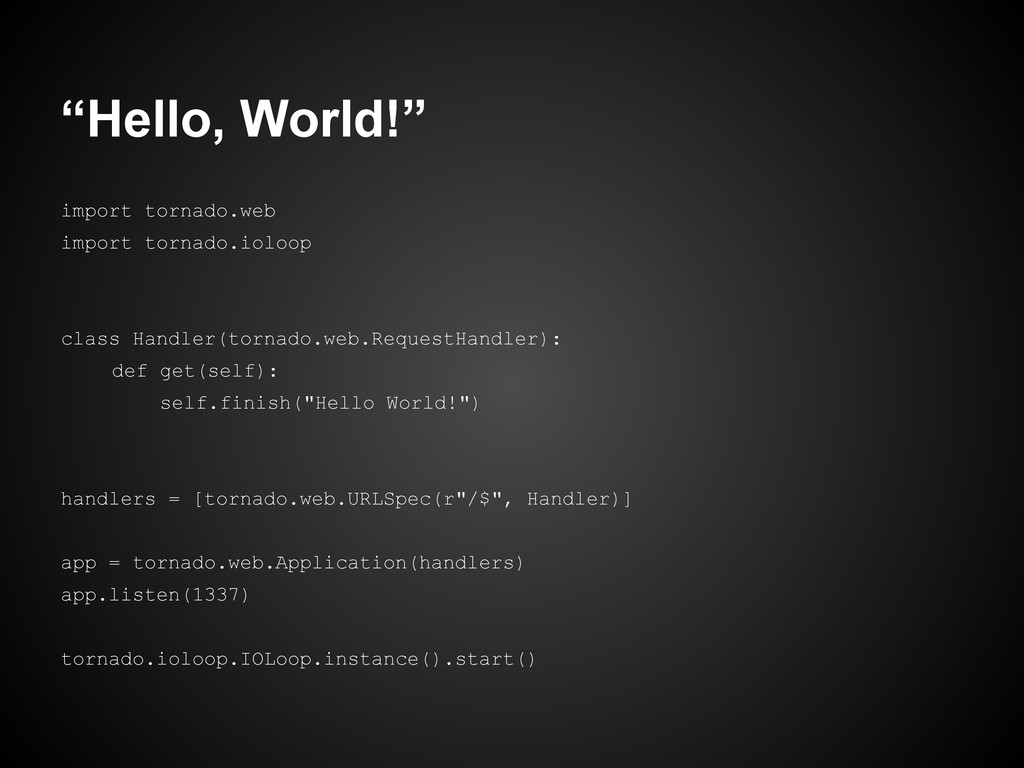
“Hello, World!” import tornado.web import tornado.ioloop class Handler(tornado.web.RequestHandler): def get(self):
self.finish("Hello World!") handlers = [tornado.web.URLSpec(r"/$", Handler)] app = tornado.web.Application(handlers) app.listen(1337) tornado.ioloop.IOLoop.instance().start()
MAIN INGREDIENTS
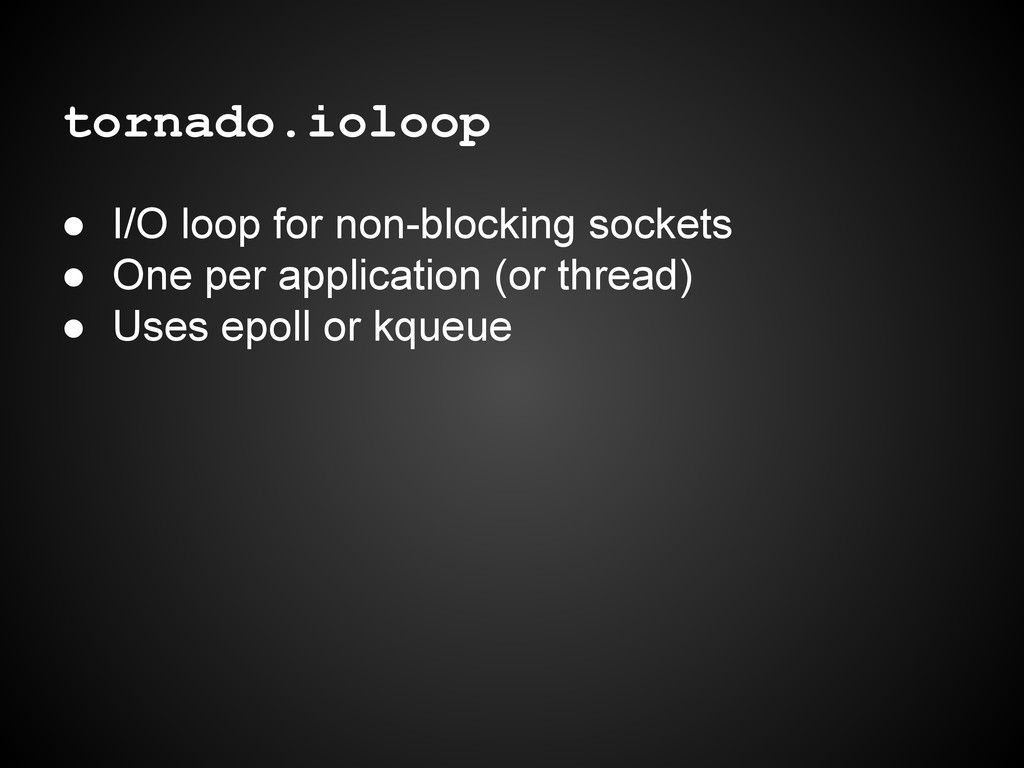
tornado.ioloop • I/O loop for non-blocking sockets • One per
application (or thread) • Uses epoll or kqueue
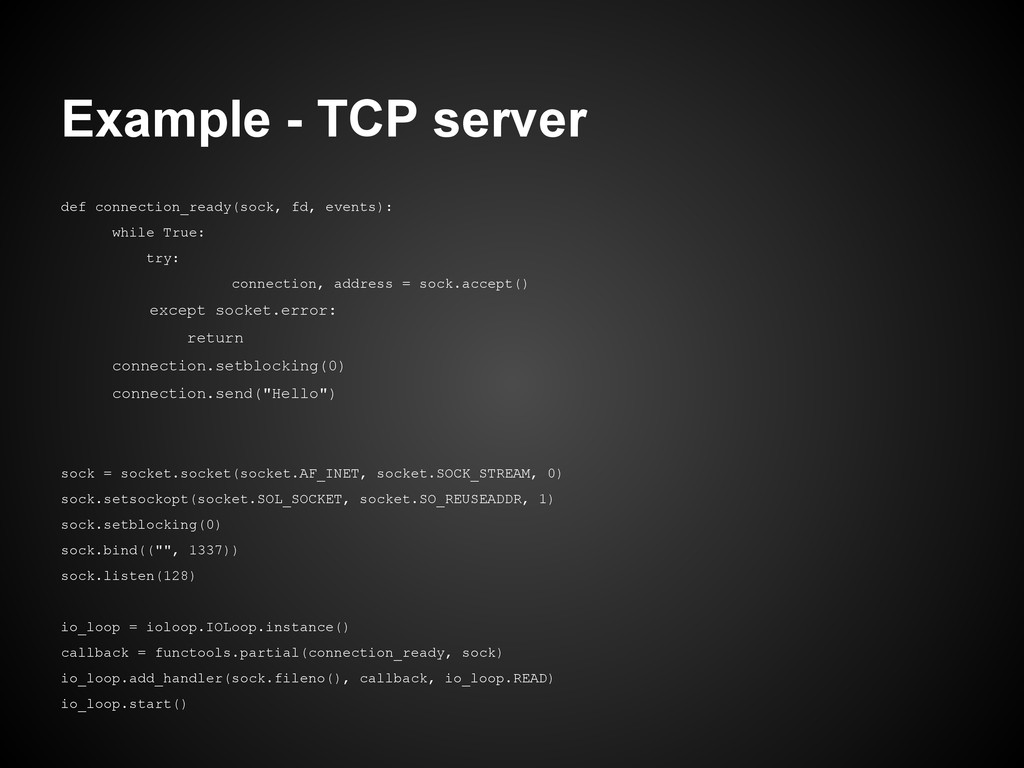
Example - TCP server def connection_ready(sock, fd, events): while True:
try: connection, address = sock.accept() except socket.error: return connection.setblocking(0) connection.send("Hello") sock = socket.socket(socket.AF_INET, socket.SOCK_STREAM, 0) sock.setsockopt(socket.SOL_SOCKET, socket.SO_REUSEADDR, 1) sock.setblocking(0) sock.bind(("", 1337)) sock.listen(128) io_loop = ioloop.IOLoop.instance() callback = functools.partial(connection_ready, sock) io_loop.add_handler(sock.fileno(), callback, io_loop.READ) io_loop.start()
tornado.httpserver • Async web server • Utilizes a singleton IOLoop
• Subclass of TCP server (duh)
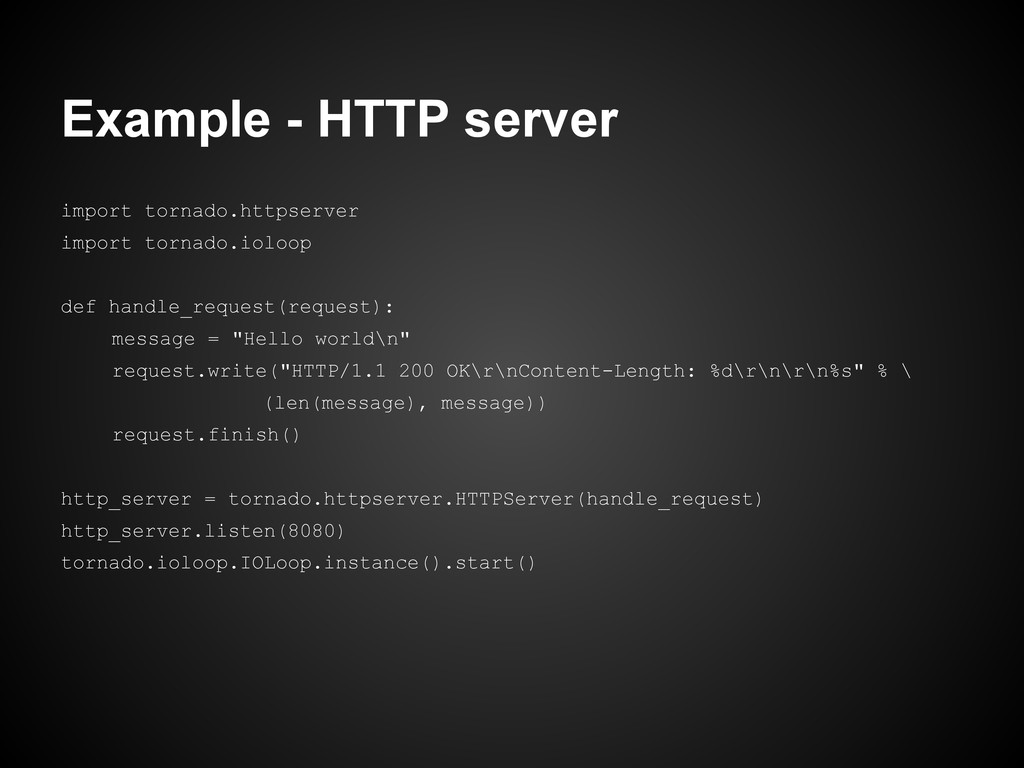
Example - HTTP server import tornado.httpserver import tornado.ioloop def handle_request(request):
message = "Hello world\n" request.write("HTTP/1.1 200 OK\r\nContent-Length: %d\r\n\r\n%s" % \ (len(message), message)) request.finish() http_server = tornado.httpserver.HTTPServer(handle_request) http_server.listen(8080) tornado.ioloop.IOLoop.instance().start()
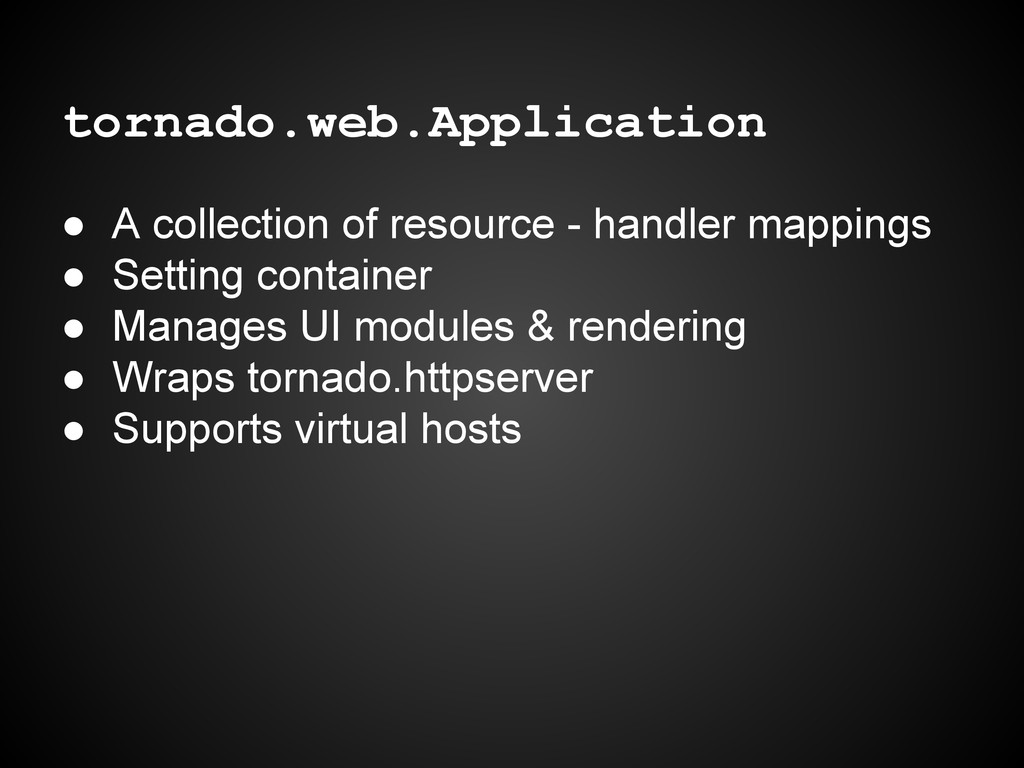
tornado.web.Application • A collection of resource - handler mappings •
Setting container • Manages UI modules & rendering • Wraps tornado.httpserver • Supports virtual hosts
tornado.web.RequestHandler • Basic building block • If method exists -
call it, else raise HTTP 405 • Not limited to “standard” verbs • Unified request preparation / finalizing methods
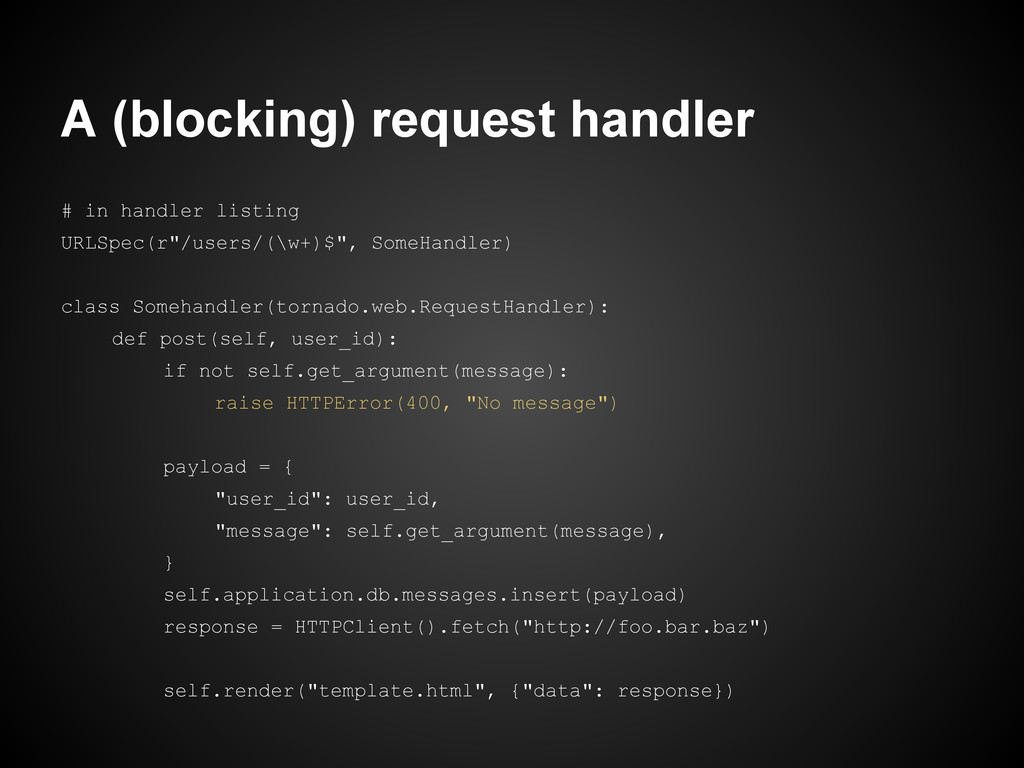
A (blocking) request handler # in handler listing URLSpec(r"/users/(\w+)$", SomeHandler)
class Somehandler(tornado.web.RequestHandler): def post(self, user_id): if not self.get_argument(message): raise HTTPError(400, "No message") payload = { "user_id": user_id, "message": self.get_argument(message), } self.application.db.messages.insert(payload) response = HTTPClient().fetch("http://foo.bar.baz") self.render("template.html", {"data": response})
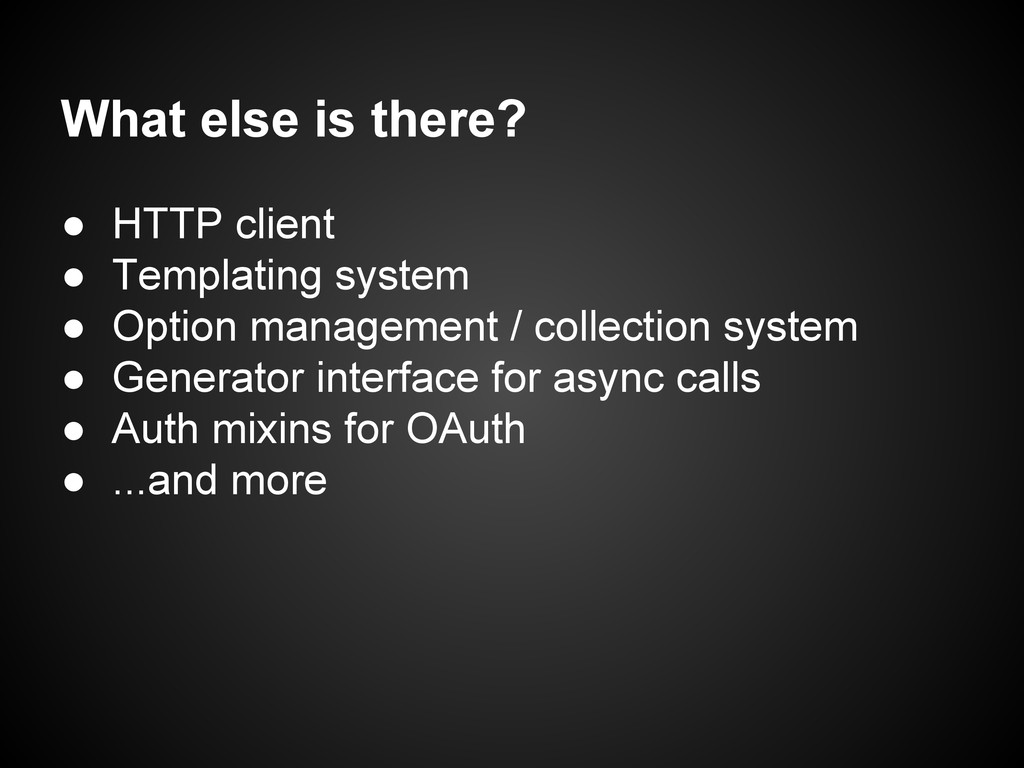
What else is there? • HTTP client • Templating system
• Option management / collection system • Generator interface for async calls • Auth mixins for OAuth • ...and more
ADDING ASYNC-SAUCE
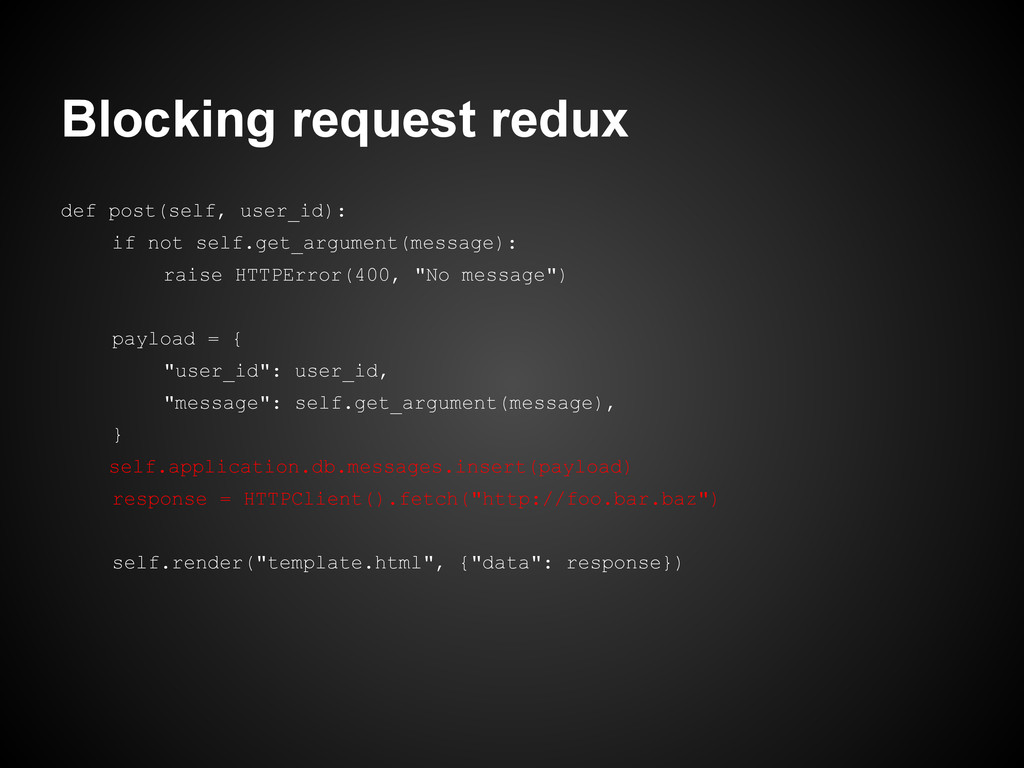
Blocking request redux def post(self, user_id): if not self.get_argument(message): raise
HTTPError(400, "No message") payload = { "user_id": user_id, "message": self.get_argument(message), } self.application.db.messages.insert(payload) response = HTTPClient().fetch("http://foo.bar.baz") self.render("template.html", {"data": response})
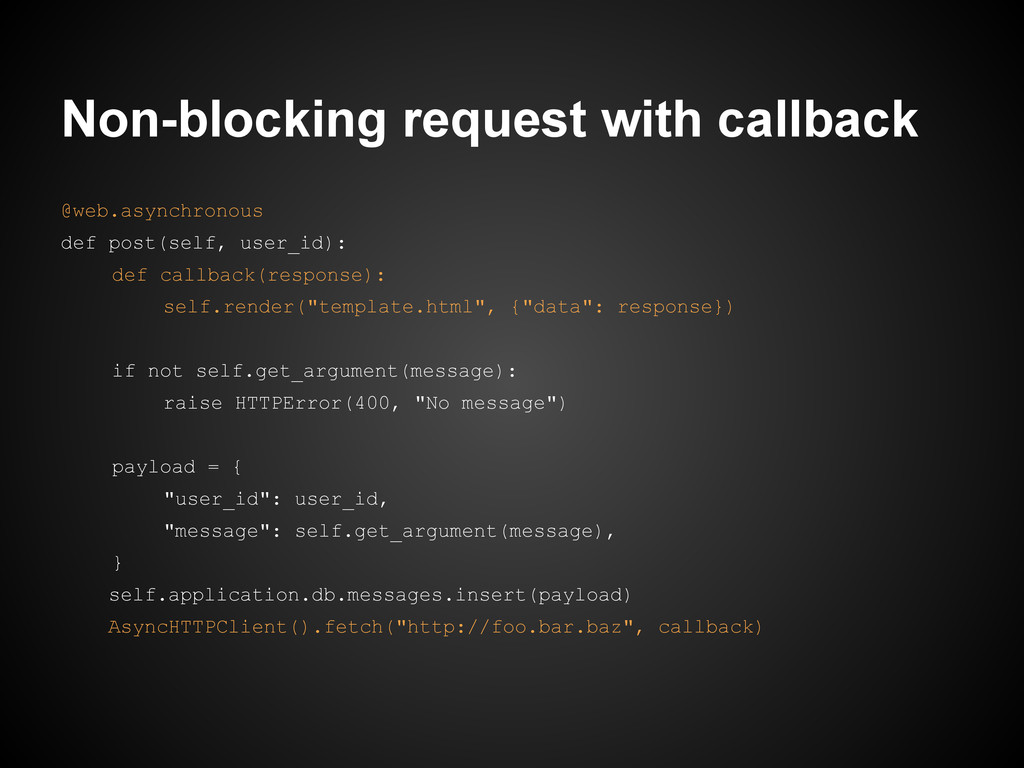
Non-blocking request with callback @web.asynchronous def post(self, user_id): def callback(response):
self.render("template.html", {"data": response}) if not self.get_argument(message): raise HTTPError(400, "No message") payload = { "user_id": user_id, "message": self.get_argument(message), } self.application.db.messages.insert(payload) AsyncHTTPClient().fetch("http://foo.bar.baz", callback)
A non-blocking request with @gen @web.asynchronous @gen.engine def post(self, user_id):
def callback(response): if not self.get_argument(message): raise HTTPError(400, "No message") payload = { "user_id": user_id, "message": self.get_argument(message), } self.application.db.messages.insert(payload) resp = yield gen.Task(AsyncHTTPClient().fetch, "http://foo.bar.baz") self.render("template.html", {"data": resp})
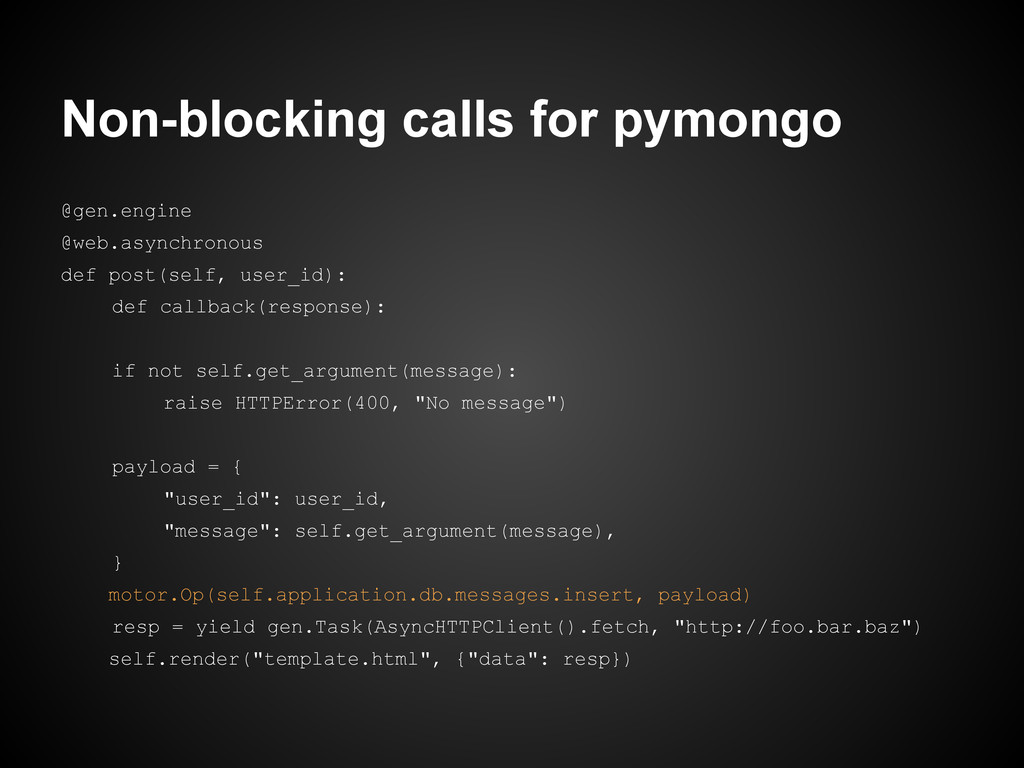
Non-blocking calls for pymongo @gen.engine @web.asynchronous def post(self, user_id): def
callback(response): if not self.get_argument(message): raise HTTPError(400, "No message") payload = { "user_id": user_id, "message": self.get_argument(message), } motor.Op(self.application.db.messages.insert, payload) resp = yield gen.Task(AsyncHTTPClient().fetch, "http://foo.bar.baz") self.render("template.html", {"data": resp})
Caveats • Always raise in main thread • Don’t forget
to add decorators • @gen.Tasks are toxic
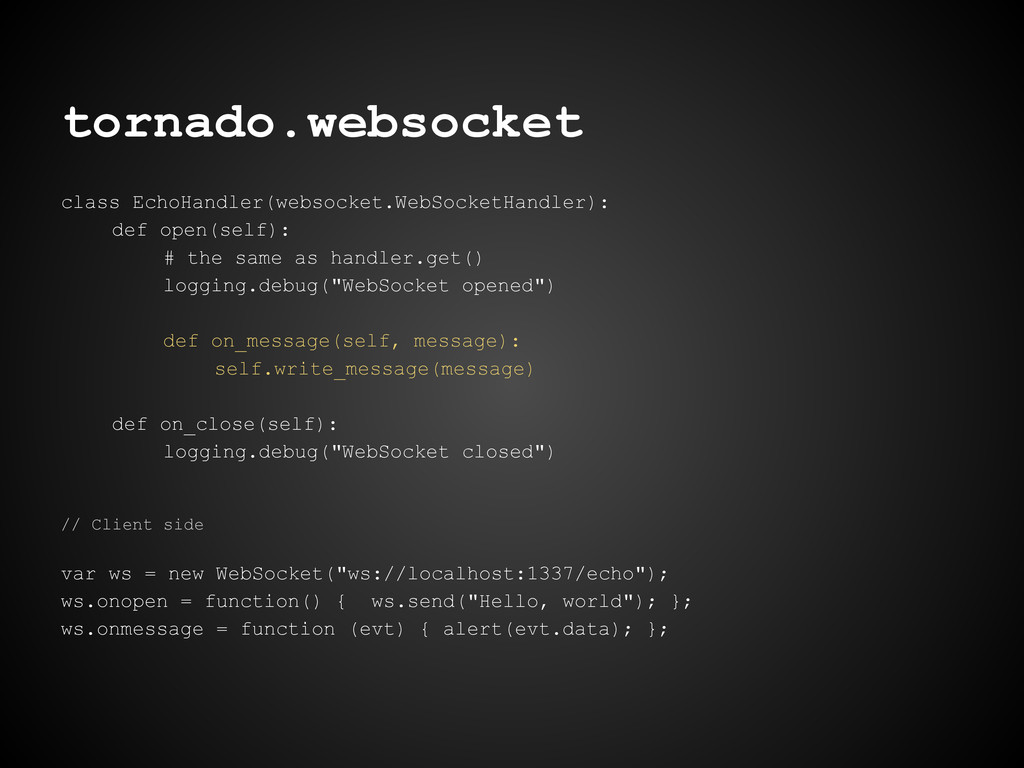
tornado.websocket class EchoHandler(websocket.WebSocketHandler): def open(self): # the same as handler.get()
logging.debug("WebSocket opened") def on_message(self, message): self.write_message(message) def on_close(self): logging.debug("WebSocket closed") // Client side var ws = new WebSocket("ws://localhost:1337/echo"); ws.onopen = function() { ws.send("Hello, world"); }; ws.onmessage = function (evt) { alert(evt.data); };
TORNADO TEMPLATING
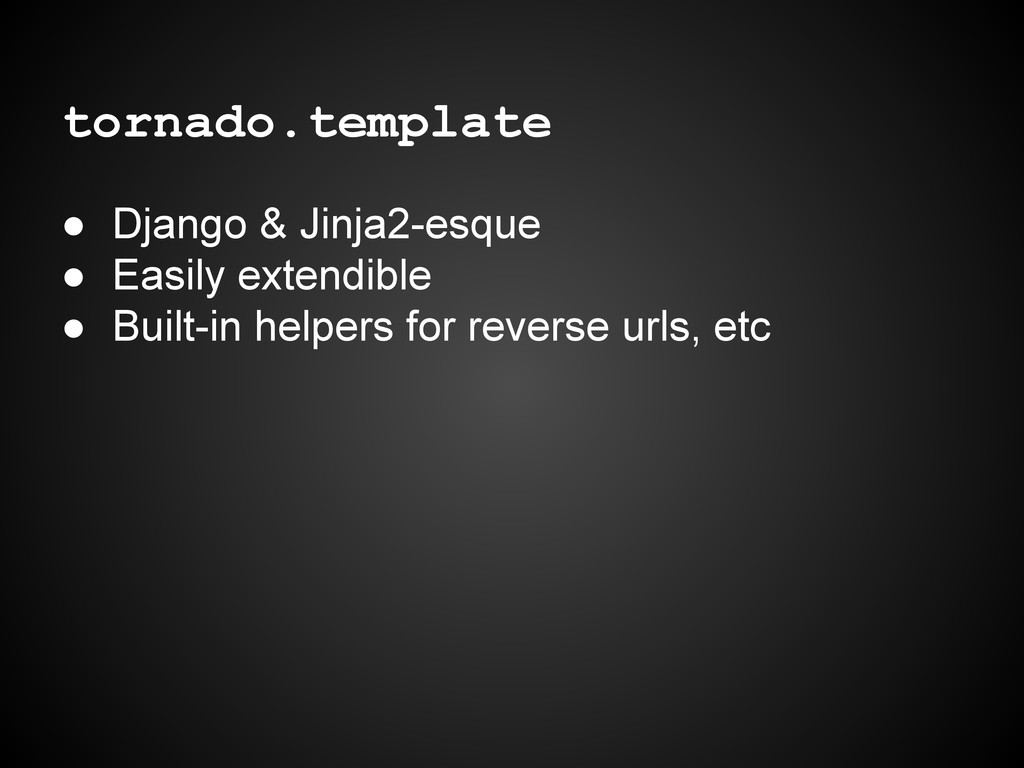
• Django & Jinja2-esque • Easily extendible • Built-in helpers
for reverse urls, etc tornado.template
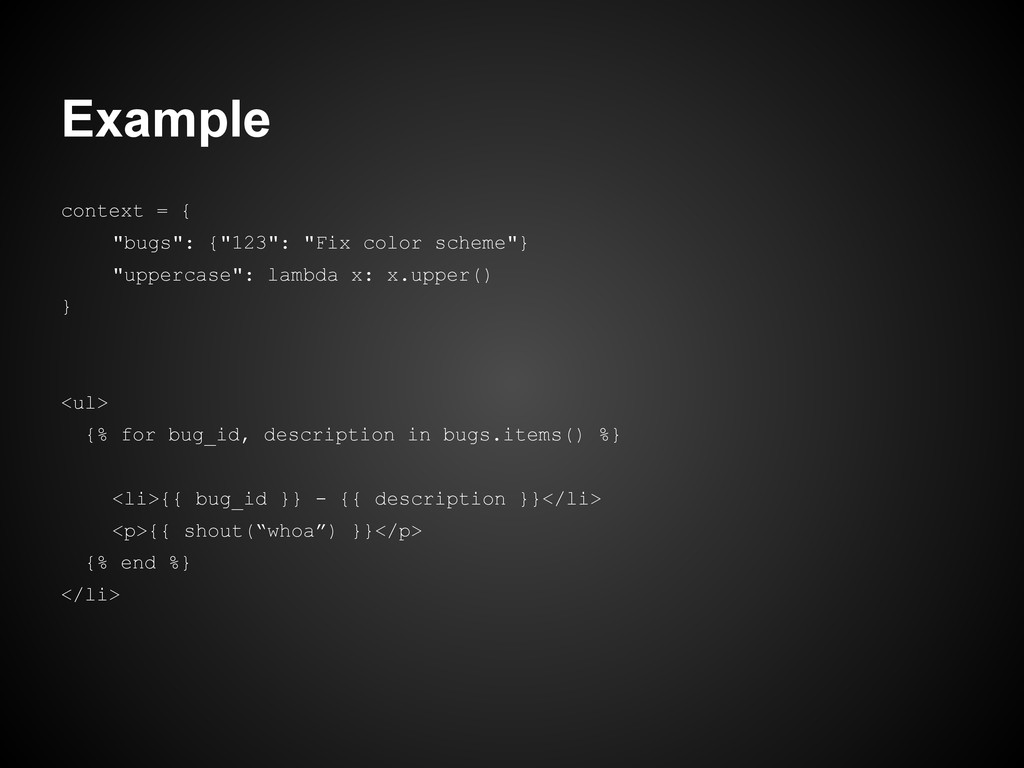
Example context = { "bugs": {"123": "Fix color scheme"} "uppercase":
lambda x: x.upper() } <ul> {% for bug_id, description in bugs.items() %} <li>{{ bug_id }} - {{ description }}</li> <p>{{ shout(“whoa”) }}</p> {% end %} </li>
TESTING + DEBUGGING
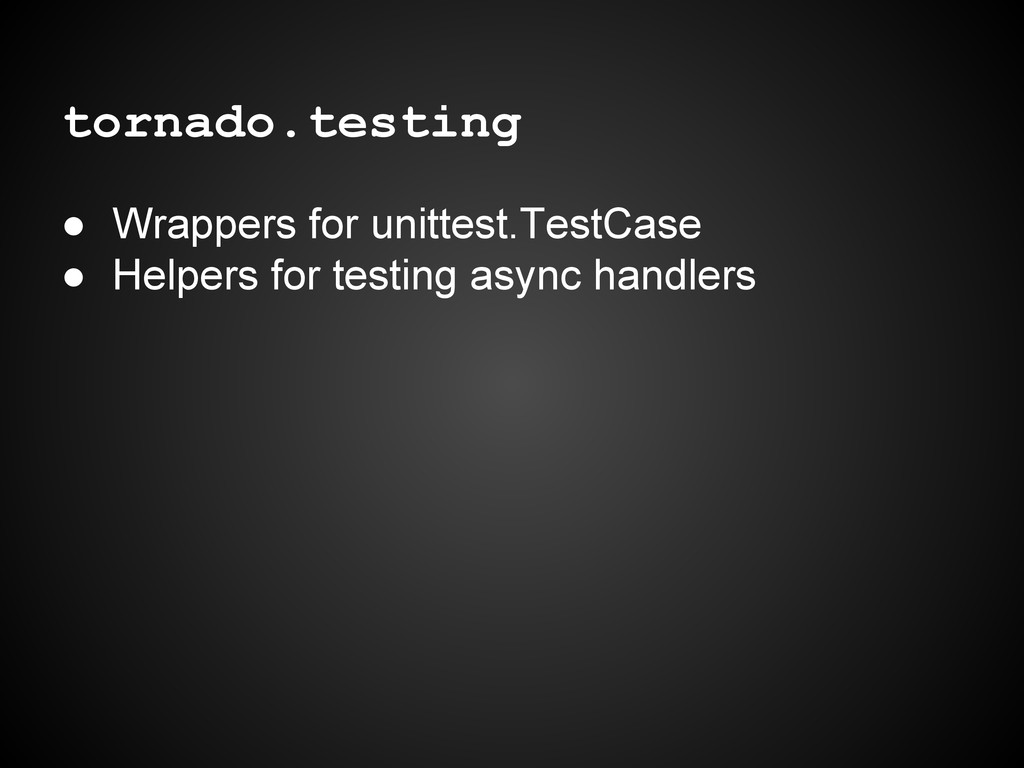
tornado.testing • Wrappers for unittest.TestCase • Helpers for testing async
handlers
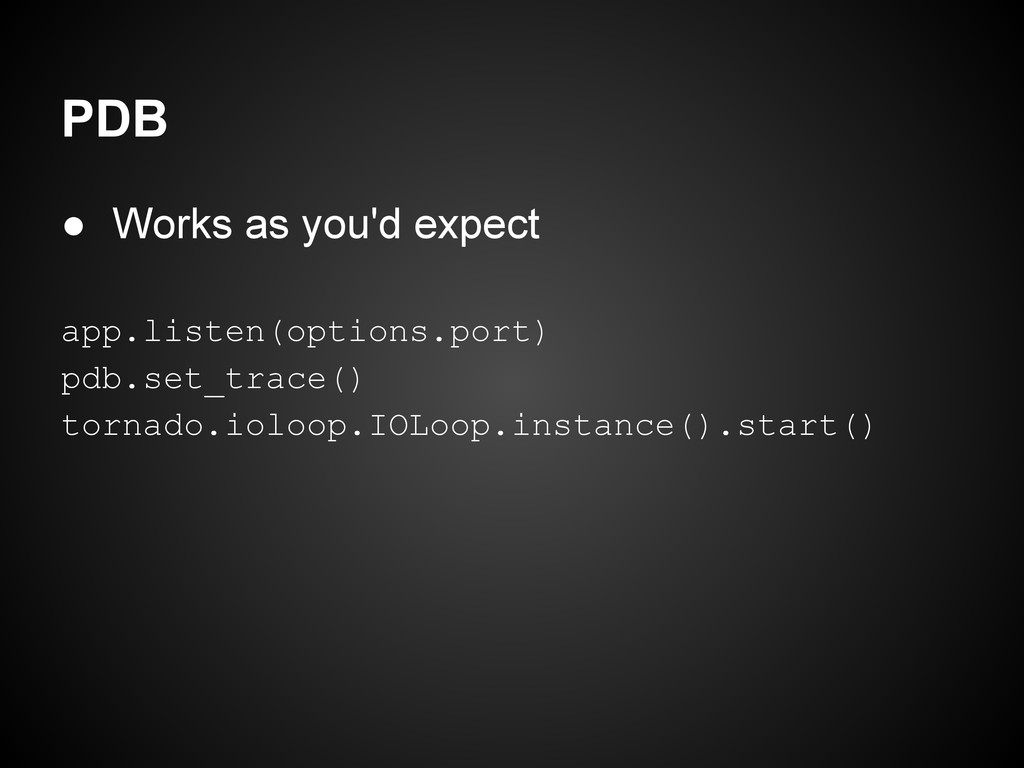
PDB • Works as you'd expect app.listen(options.port) pdb.set_trace() tornado.ioloop.IOLoop.instance().start()
REAL WORLD TORNADO
Managing instances with supervisord [program:app-8000] directory=/srv/app/ command=python server.py --port=8101 --mongodb_host=localhost:27017
user=nginx stdout_logfile=/srv/app/logs/app.8000.log [program:app-8001] directory=/srv/app/ command=python server.py --port=8001 --mongodb_host=localhost:27017 user=nginx stdout_logfile=/srv/app/logs/app.8001.log [group:webapp] programs=app-8000,app-8001
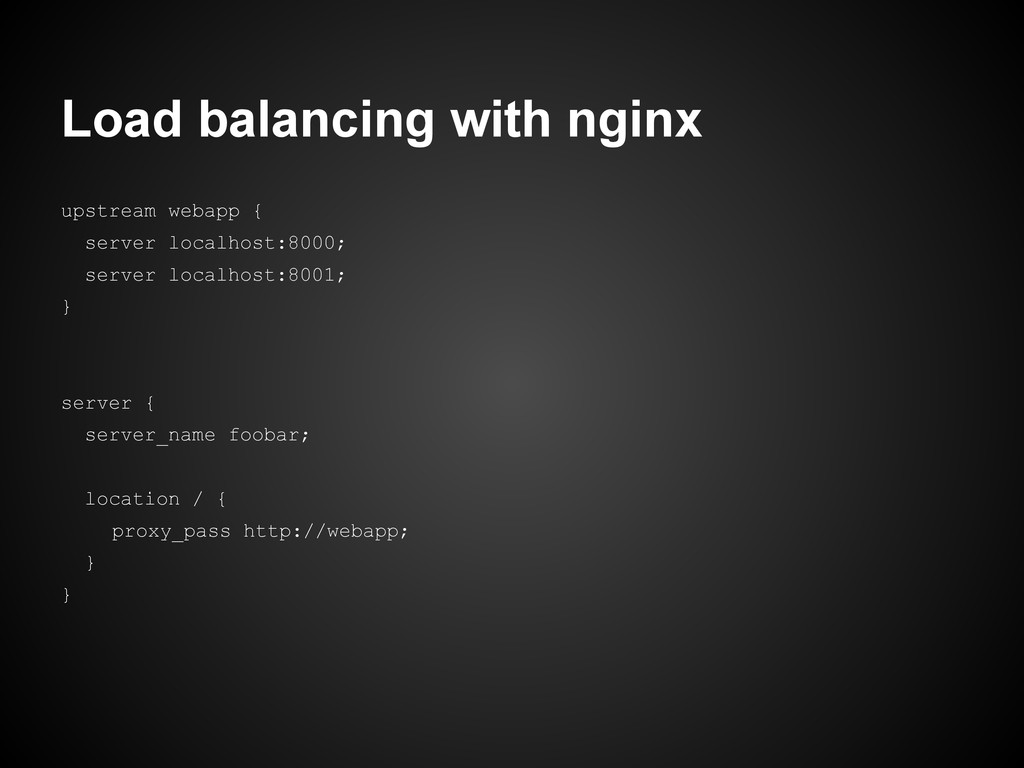
Load balancing with nginx upstream webapp { server localhost:8000; server
localhost:8001; } server { server_name foobar; location / { proxy_pass http://webapp; } }
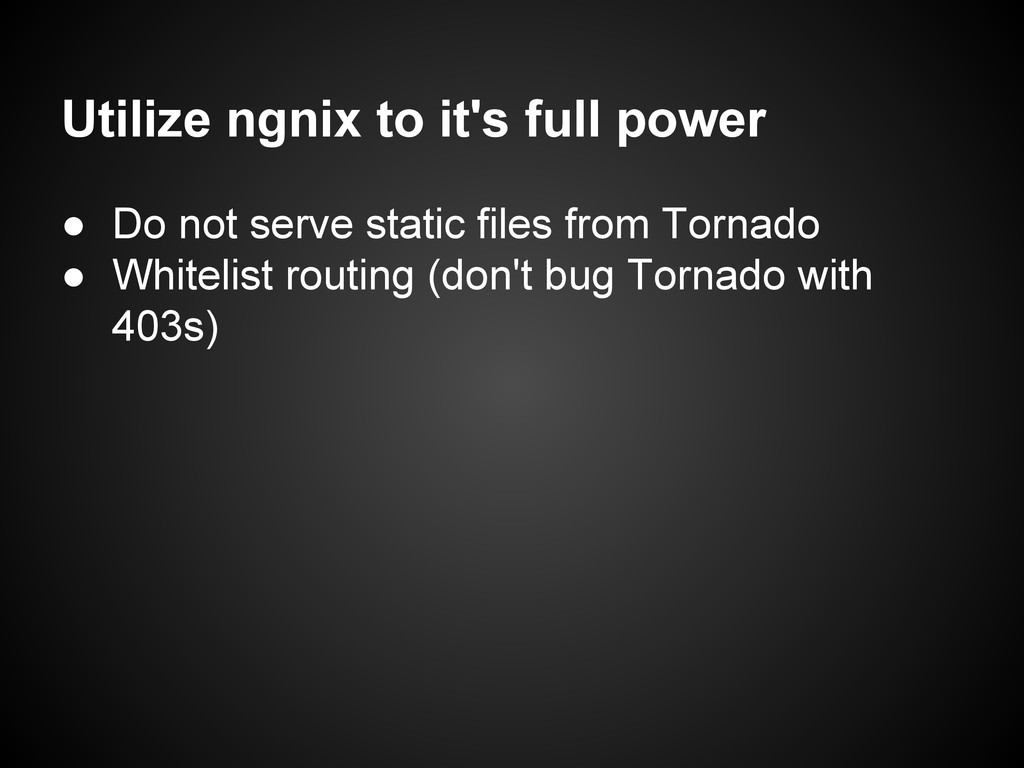
Utilize ngnix to it's full power • Do not serve
static files from Tornado • Whitelist routing (don't bug Tornado with 403s)
Load balancing while you load balance with Amazon ELB
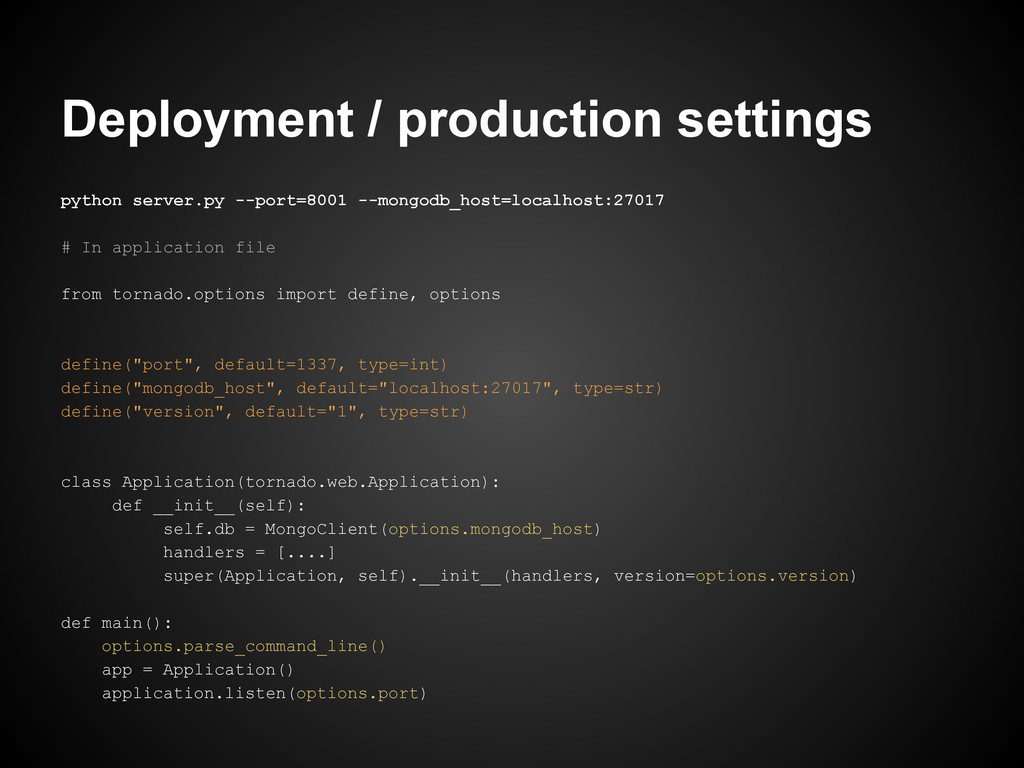
Deployment / production settings python server.py --port=8001 --mongodb_host=localhost:27017 # In
application file from tornado.options import define, options define("port", default=1337, type=int) define("mongodb_host", default="localhost:27017", type=str) define("version", default="1", type=str) class Application(tornado.web.Application): def __init__(self): self.db = MongoClient(options.mongodb_host) handlers = [....] super(Application, self).__init__(handlers, version=options.version) def main(): options.parse_command_line() app = Application() application.listen(options.port)
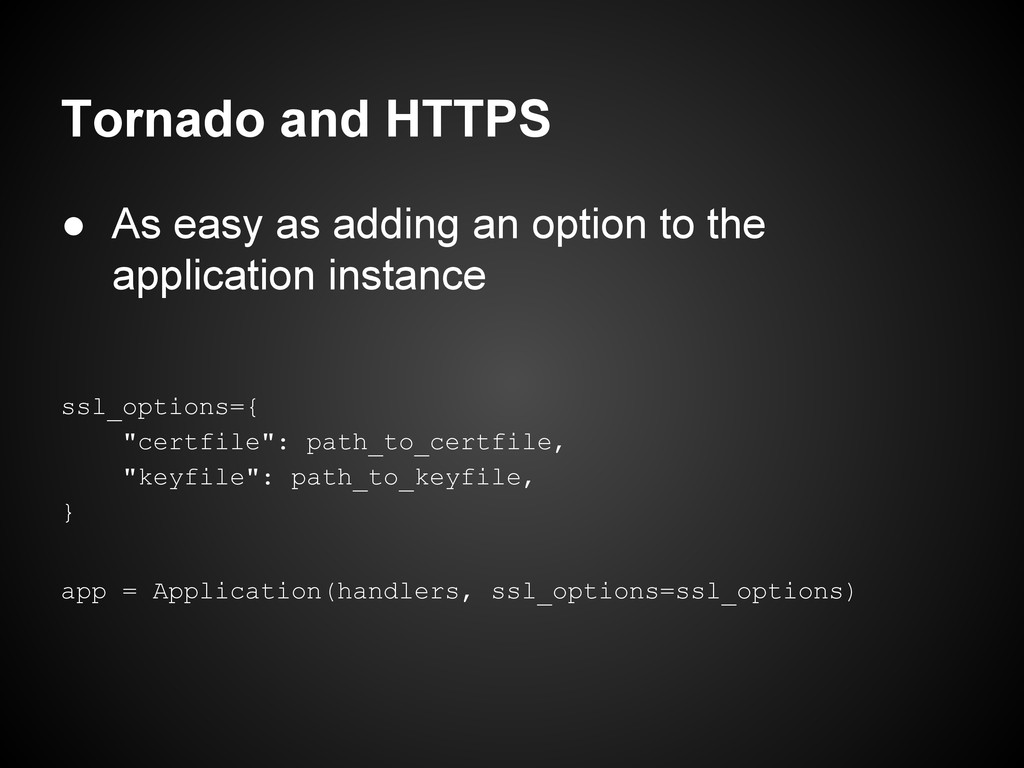
Tornado and HTTPS • As easy as adding an option
to the application instance ssl_options={ "certfile": path_to_certfile, "keyfile": path_to_keyfile, } app = Application(handlers, ssl_options=ssl_options)
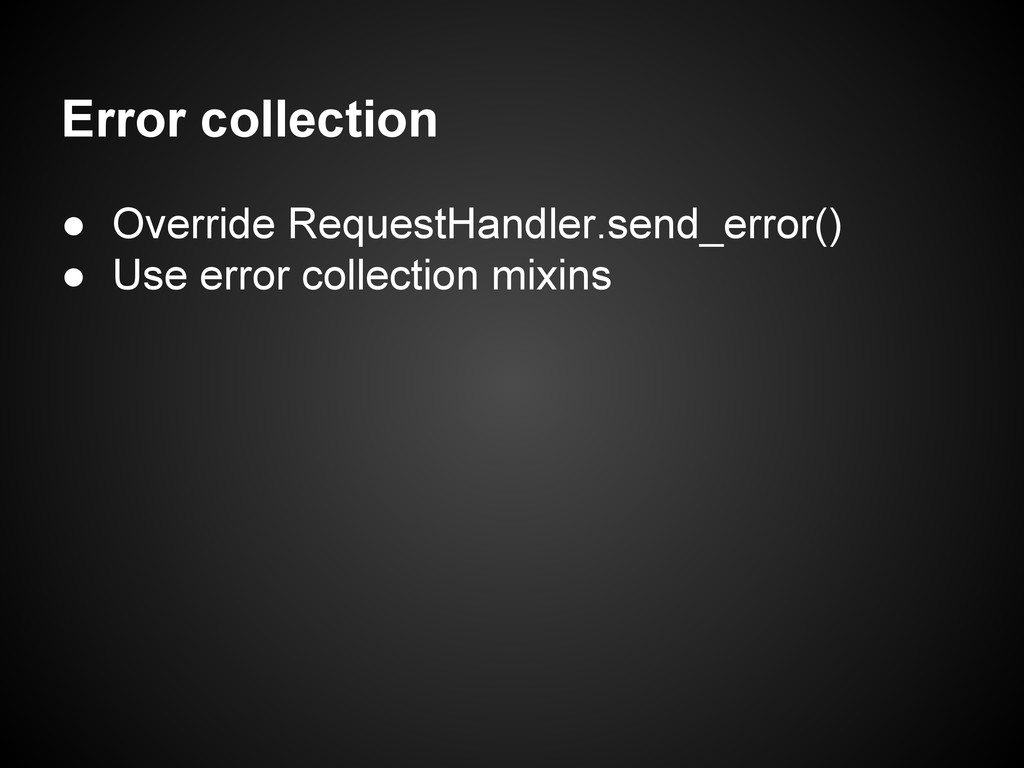
Error collection • Override RequestHandler.send_error() • Use error collection mixins
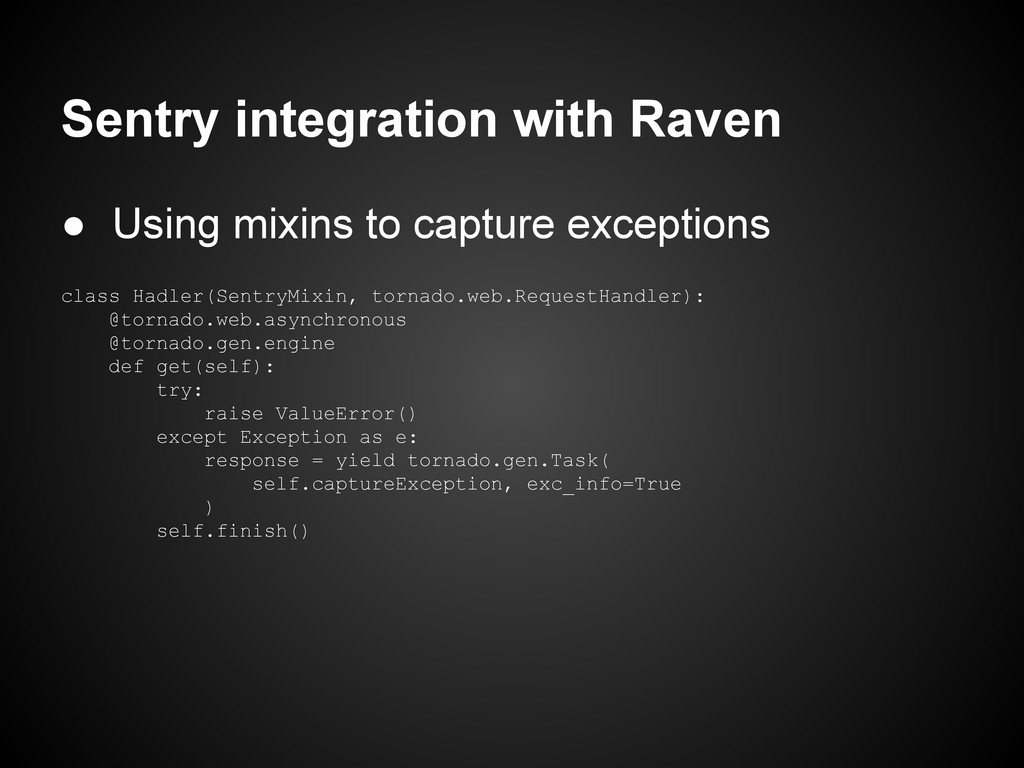
Sentry integration with Raven • Using mixins to capture exceptions
class Hadler(SentryMixin, tornado.web.RequestHandler): @tornado.web.asynchronous @tornado.gen.engine def get(self): try: raise ValueError() except Exception as e: response = yield tornado.gen.Task( self.captureException, exc_info=True ) self.finish()
Where to go next? • Read through the source •
Start building rad hacks • ??? • PROFIT!!
QUESTION TIME!

 SiteGround - Reliable hosting with speed, security, and support you can count on.


 karlis
 andpad
 rkaga
rkaga
 headius
 florets1
 kenkino
 hatsu38
 lynnswap
 palkan
 ivargrimstad
 irinanazarova
 artoy
artoy
 yuukiw00w
 sabderemane
 tammyeverts
 mfonobong
 paigeccino
 mraible
 marktimemedia
 addyosmani
 chrislema
 skipperchong
 moore
moore
 cassininazir
 dugsong









![Managing instances with supervisord [program:app-8000] directory=/srv/app/ command=python server.py --port=8101 --mongodb_host=localhost:27017](https://files.speakerdeck.com/presentations/92d0a1f03f3c013186946ace02da7969/slide_29.jpg)