in the human brain Leonardo Collado-Torres, Ph.D. Lieber Institute for Brain Development RNAseqWorkshop Montgomery College July 22, 2022 Keri Martinowich Stephanie C Hicks Lieber Institute Johns Hopkins @lcolladotor #spatialLIBD Kristen R Maynard Lieber Institute
using Visium. 2. Spatial registration of single-nucleus RNA-seq data. 3. Resources and tools for analysis of spatial transcriptomics data. 4. Using spatial transcriptomics to better understand brain disorders.
“Enrichment” model “Pairwise” model Is any layer different? Is one layer > the rest? Is layer X > layer Y? Maynard, Collado-Torres, et al, Nat Neuro, 2021
layer > the rest? Group FDR<0.05 Layer1 3033 Layer2 1562 Layer3 183 Layer4 740 Layer5 643 Layer6 379 WM 9124 Only a subset of previous layer marker genes in mouse and human showed laminar association Maynard, Collado-Torres, et al, Nat Neuro, 2021
bodies and neuropil 50um Gray matter White matter Neuron Neuropil Glial cell Mouse Brain Tissue Postmortem Human DLPFC Madhavi Tippani @MadhaviTippani Joseph L Catallini II
using Visium. 2. Spatial registration of single-nucleus RNA-seq data. 3. Resources and tools for analysis of spatial transcriptomics data. 4. Using spatial transcriptomics to better understand brain disorders.
(B) (C) Maynard, Collado-Torres, et al, Nature Neuroscience, 2021 Spatial registration of sc/snRNA-seq data snRNA-seq data from Allen Institute: manual dissection of cortical layers from middle temporal gyrus (Hodge et al, Nature, 2019) Visium
using Visium. 2. Spatial registration of single-nucleus RNA-seq data. 3. Resources and tools for analysis of spatial transcriptomics data. 4. Using spatial transcriptomics to better understand brain disorders.
using Bioconductor Righelli, Weber, Crowell, et al, Bioinformatics, 2022 DOI https://doi.org/10.1093/bioinformatics/btac299 Dario Righellli Helena L Crowell @drighelli @CrowellHL Lukas M Weber @lmwebr
the benefits too! 32 Us: 346 days Them: 271 days Total sequential (fictional): 617 days Reality (preprint to BayesSpace pub): 461 days Difference saved: 156 days Preprints: 190 days
path towards benchmarking • Fully unsupervised was initially very far from the ground truth • Truth has caveats and should be considered a guideline • Ultimately, the goal is not to fully reproduce the ground truth, but learn what helps and what doesn’t • Ground truth will evolve ;)
Graph−Based Graph−based(BC) BayesSpace BayesSpace(BC) SpaGCN Clustering Method Adjusted Rand Index You want to do this if you want cluster 1 from sample 1 to mean the same thing as cluster 1 from sample 2 Batch correction (BC) helps BayesSpace + BC was the best option we checked Abby Spangler @abspangler @Nick-Eagles (GH) Nicholas J Eagles
software can change dramatically (function and syntax) between versions - Promotes collaboration by allowing two researchers to share exact code and instantly run software without special set-up SpatialExperiment release 3.14 SpatialExperiment devel 3.15 module load tangram/1.0.2 module load cell2location/0.8a0 module load spagcn/1.2.0 @Nick-Eagles (GH) Nicholas J Eagles https://github.com/LieberInstitute/jhpce_mod_source https://github.com/LieberInstitute/jhpce_module_config
clarify functionality and report bugs - Documentation for code and author responsiveness on GitHub can be critical in successfully applying software to our data @Nick-Eagles (GH) Nicholas J Eagles
using Visium. 2. Spatial registration of single-nucleus RNA-seq data. 3. Resources and tools for analysis of spatial transcriptomics data. 4. Using spatial transcriptomics to better understand brain disorders.
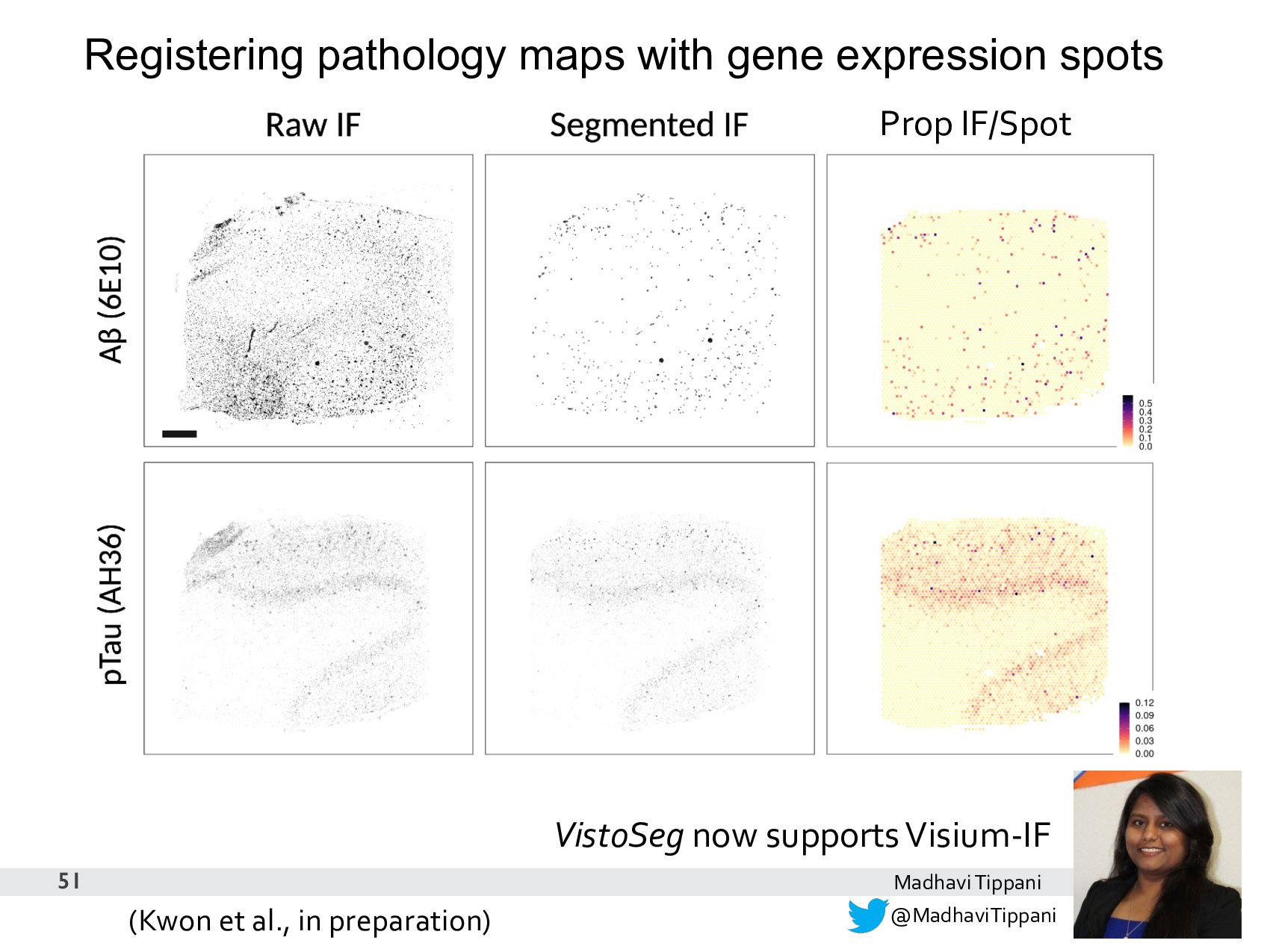
friendly • 6.5 mm2 too restrictive? Opportunity for creativity • Visium and Visium-IF have required the development of software • It’s fun to work on something where there are no answers on Google =) but also a challenge 60
prefrontal cortex using Visium technology. • Spatial registration of single-nucleus RNA-seq data to determine enrichment of cell populations in specific cortical layers. • Single nucleus and spatial transcriptomics approaches can be used to better understand molecular associations with brain disorders, including neurodevelopmental and neurodegenerative disorders. • Development of tools and resources to analyze spatial transcriptomics data.
Visium-IF AD proof-of-concept • Integration of snRNA-seq and Visium data • Visium + snRNA-seq on LC • Increasing resolution (# spots) and area (array size) • Visium HD • Leveraging rich histology/imaging data • Clustering (SpaGCN), spot deconvolution, etc. • Building educational resources • Completing Orchestrating Spatially Resolved Transcriptomics Analysis with Bioconductor (OSTA) 64
Joseph L. Catallini II Matthew N. Tran Vijay Sadashivaiah Heena Divecha Kelsey Montgomery Nick Eagles Josh Stolz Louise Huuki Rahul Bharadwaj Stephanie Page Leonardo Collado-Torres Keri Martinowich Andrew Jaffe Joel E. Kleinman Thomas M. Hyde Daniel R. Weinberger JHU Biostatistics Dept Stephanie Hicks Lukas Weber Sowmya Parthiban 10x Genomics Courtney Anderson Cedric Uytingco Stephen R. Williams Charles Bruce Jennifer Chew YifengYin Nikhil Rao Michelle Mak Guixia Yu Julianna Avalos-Gracia JHU Oncology Tissue Services (Kristen Lecksell) JHU SKCCC Flow Core (Jessica Gucwa) JHU Transcriptomics & Deep Sequencing Core (Linda Orzolek) JHU Tumor Microenvironment Core (Liz Engle) We are hiring! https://www.libd.org/careers/ @kr_maynard @lcolladotor #spatialLIBD team


 lcolladotor
 tanichu
 brainpadpr
 konakalab
 analokmaus
 ykiyota
 bonotake
 miyayou
 salt2
salt2
 institutdelelevage
 trycycle
 tagtag
 holman
 khoart
 philnash
 katarinadahlin
 codingconduct
 chriscoyier
 mayunak
 soudai
 axbom
axbom
 davetheseo
 kimpetersen
 deanohume