Intelligent Robotics and Autonomous Systems: Machine Learning Applications
Explains how machine learning enables intelligent robots and autonomous systems through object recognition, navigation, localization, robotic grasping, reinforcement learning, and practical industrial robotics case studies.
STUDIES IN MECHATRONICS Intelligent Robotics and Autonomous Systems Dr. Madhuri Mahawar Department of Mechatonics Engineering Sanjivani College of Engineering, Kopargaon
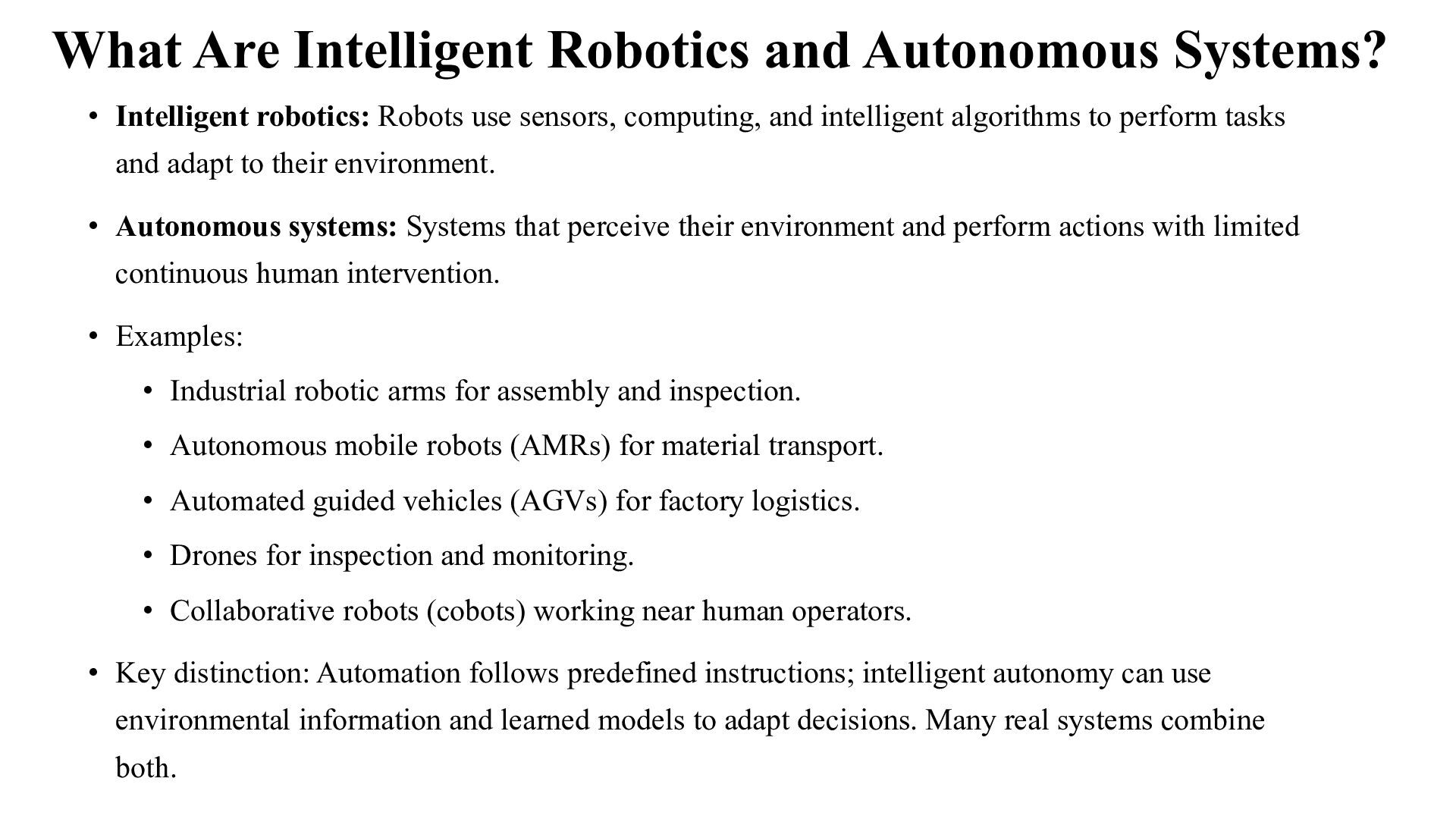
Robots use sensors, computing, and intelligent algorithms to perform tasks and adapt to their environment. • Autonomous systems: Systems that perceive their environment and perform actions with limited continuous human intervention. • Examples: • Industrial robotic arms for assembly and inspection. • Autonomous mobile robots (AMRs) for material transport. • Automated guided vehicles (AGVs) for factory logistics. • Drones for inspection and monitoring. • Collaborative robots (cobots) working near human operators. • Key distinction: Automation follows predefined instructions; intelligent autonomy can use environmental information and learned models to adapt decisions. Many real systems combine both.
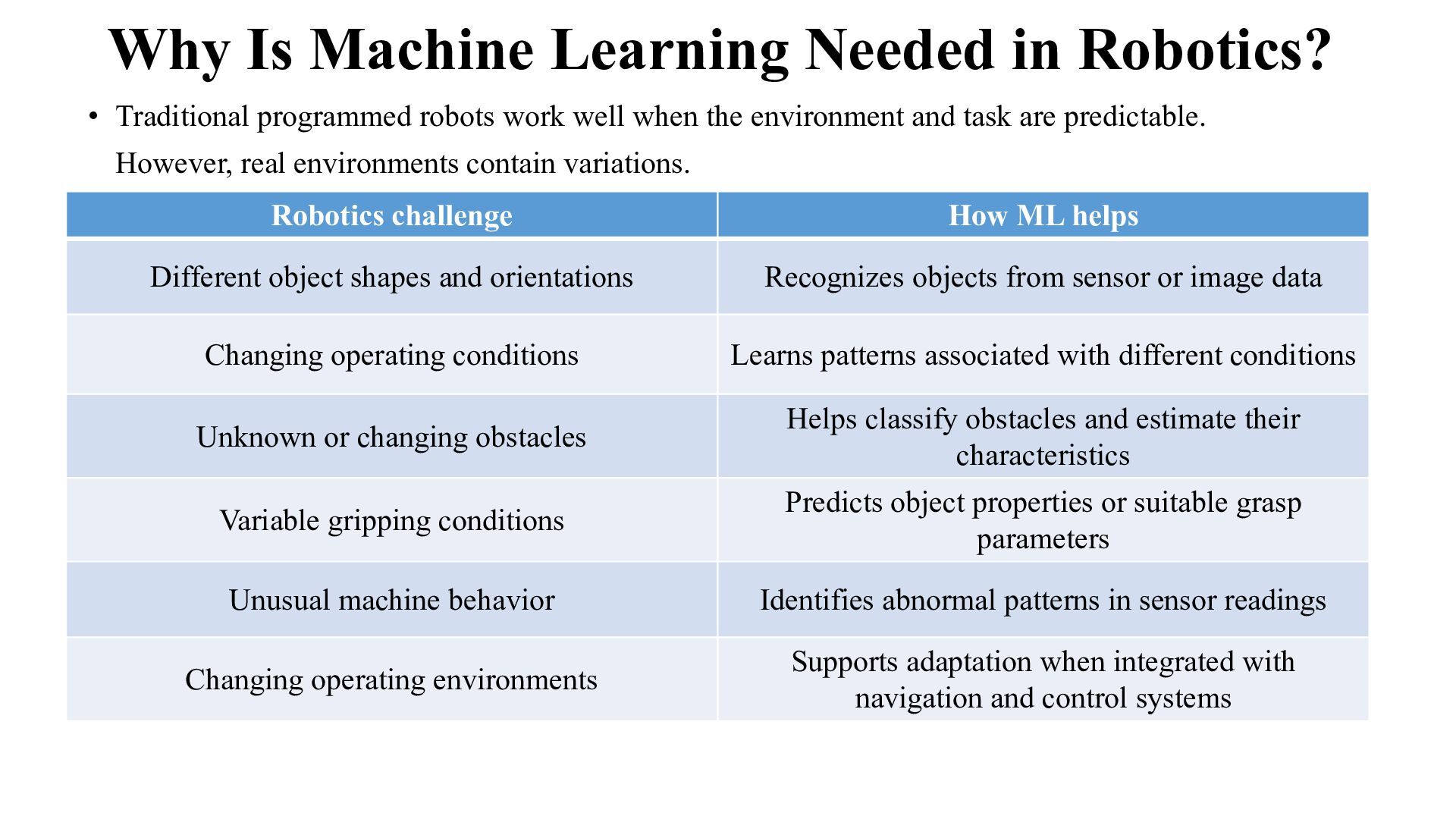
robots work well when the environment and task are predictable. However, real environments contain variations. Robotics challenge How ML helps Different object shapes and orientations Recognizes objects from sensor or image data Changing operating conditions Learns patterns associated with different conditions Unknown or changing obstacles Helps classify obstacles and estimate their characteristics Variable gripping conditions Predicts object properties or suitable grasp parameters Unusual machine behavior Identifies abnormal patterns in sensor readings Changing operating environments Supports adaptation when integrated with navigation and control systems
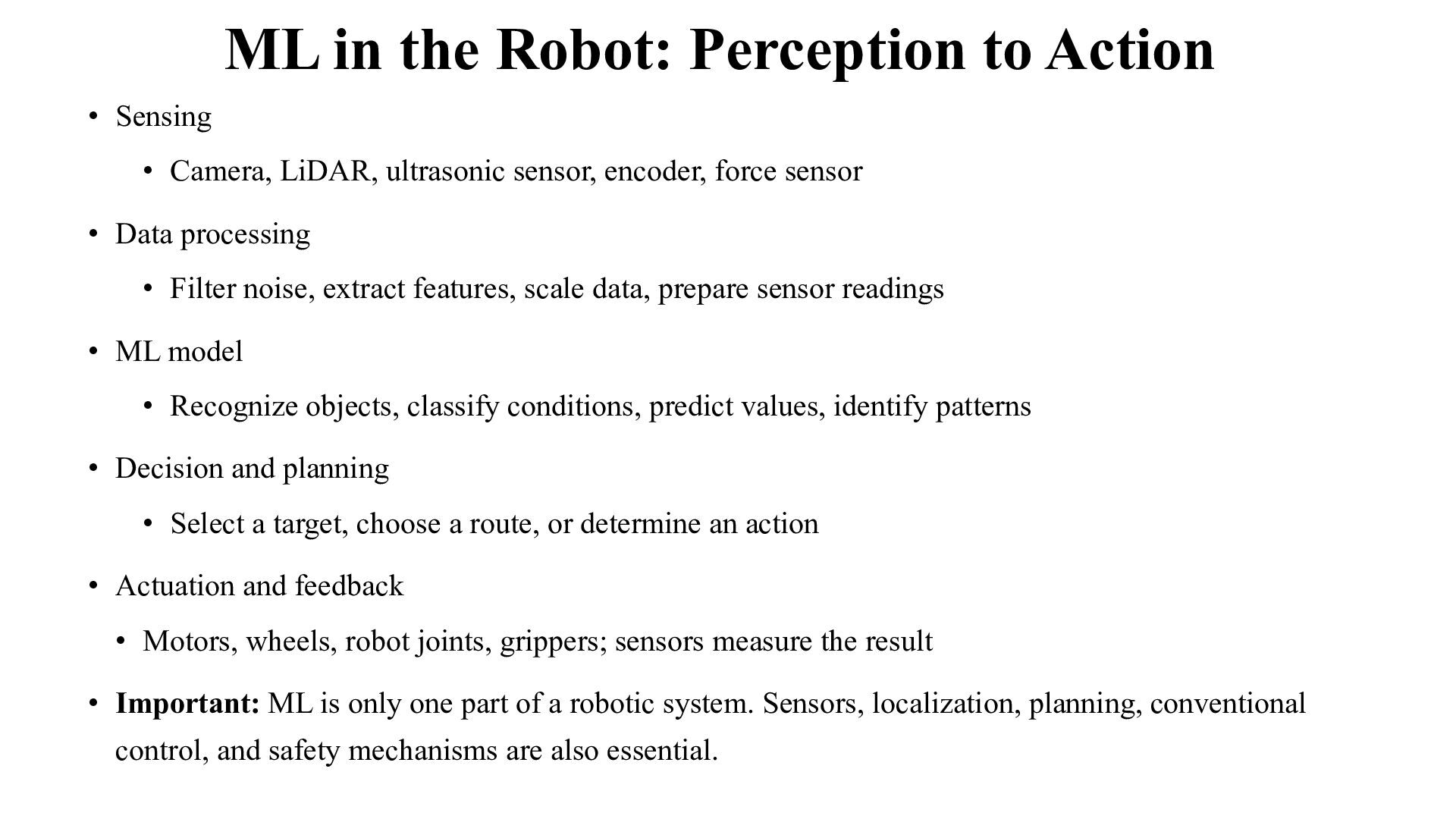
Camera, LiDAR, ultrasonic sensor, encoder, force sensor • Data processing • Filter noise, extract features, scale data, prepare sensor readings • ML model • Recognize objects, classify conditions, predict values, identify patterns • Decision and planning • Select a target, choose a route, or determine an action • Actuation and feedback • Motors, wheels, robot joints, grippers; sensors measure the result • Important: ML is only one part of a robotic system. Sensors, localization, planning, conventional control, and safety mechanisms are also essential.
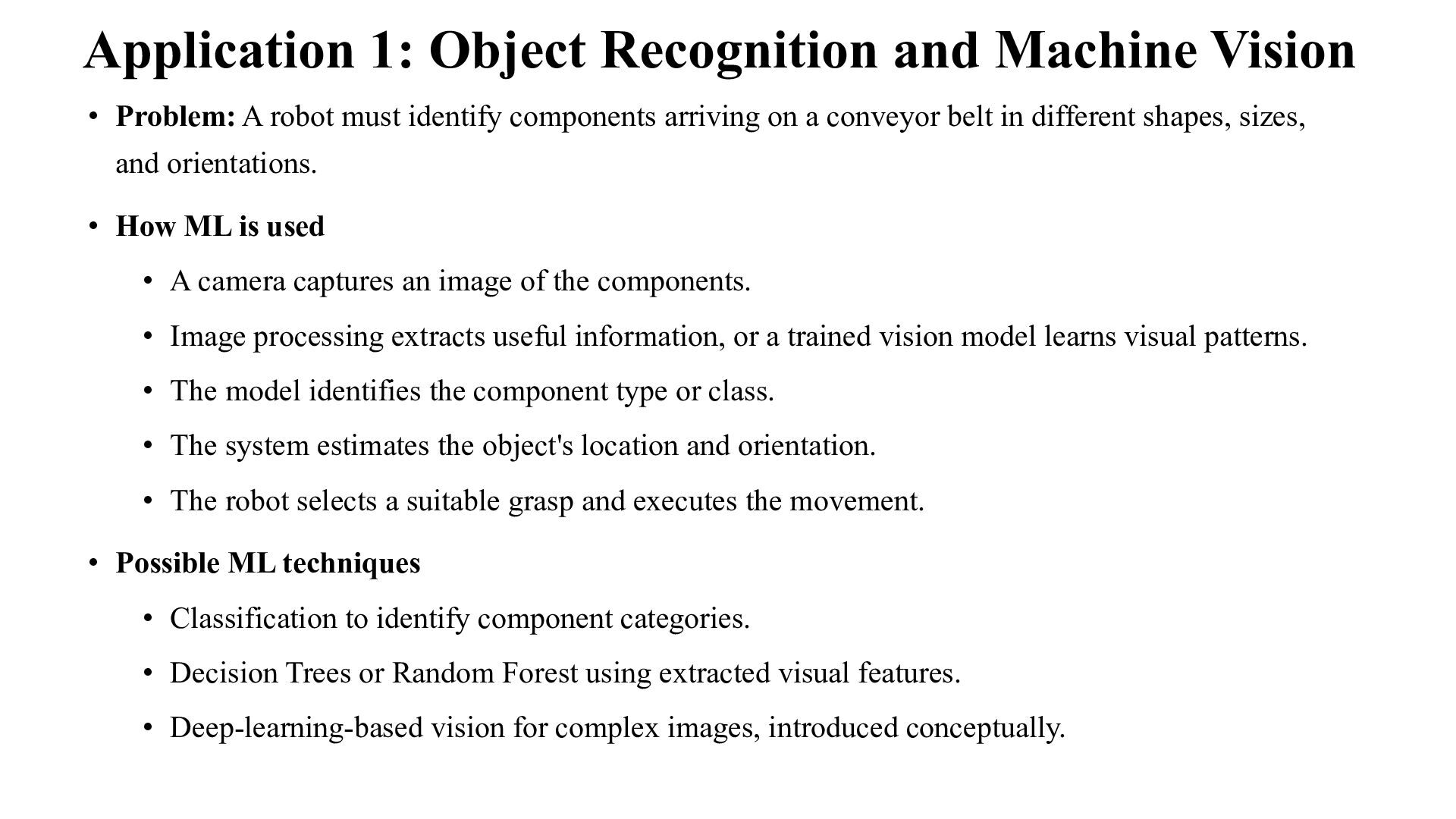
robot must identify components arriving on a conveyor belt in different shapes, sizes, and orientations. • How ML is used • A camera captures an image of the components. • Image processing extracts useful information, or a trained vision model learns visual patterns. • The model identifies the component type or class. • The system estimates the object's location and orientation. • The robot selects a suitable grasp and executes the movement. • Possible ML techniques • Classification to identify component categories. • Decision Trees or Random Forest using extracted visual features. • Deep-learning-based vision for complex images, introduced conceptually.
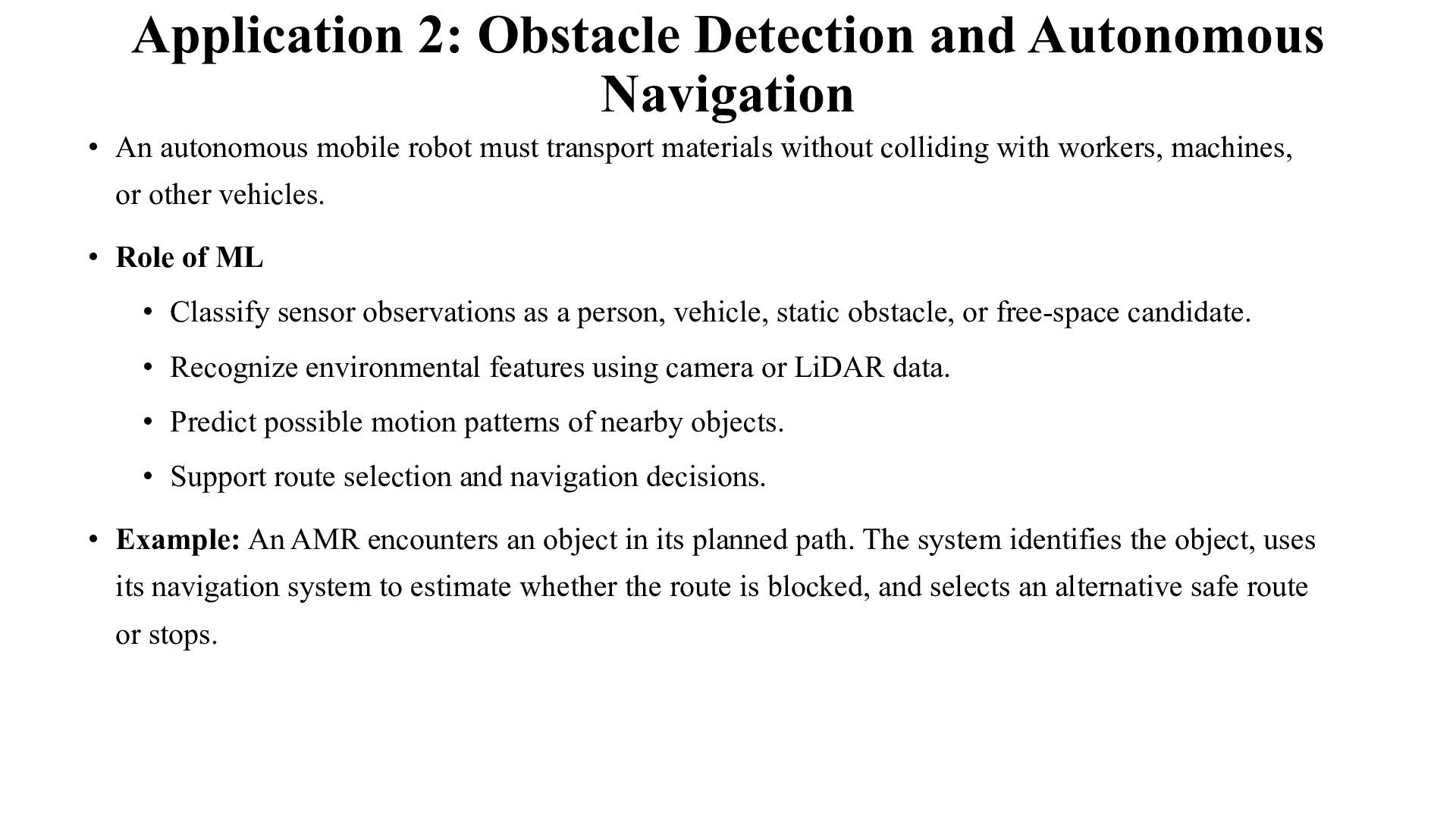
mobile robot must transport materials without colliding with workers, machines, or other vehicles. • Role of ML • Classify sensor observations as a person, vehicle, static obstacle, or free-space candidate. • Recognize environmental features using camera or LiDAR data. • Predict possible motion patterns of nearby objects. • Support route selection and navigation decisions. • Example: An AMR encounters an object in its planned path. The system identifies the object, uses its navigation system to estimate whether the route is blocked, and selects an alternative safe route or stops.
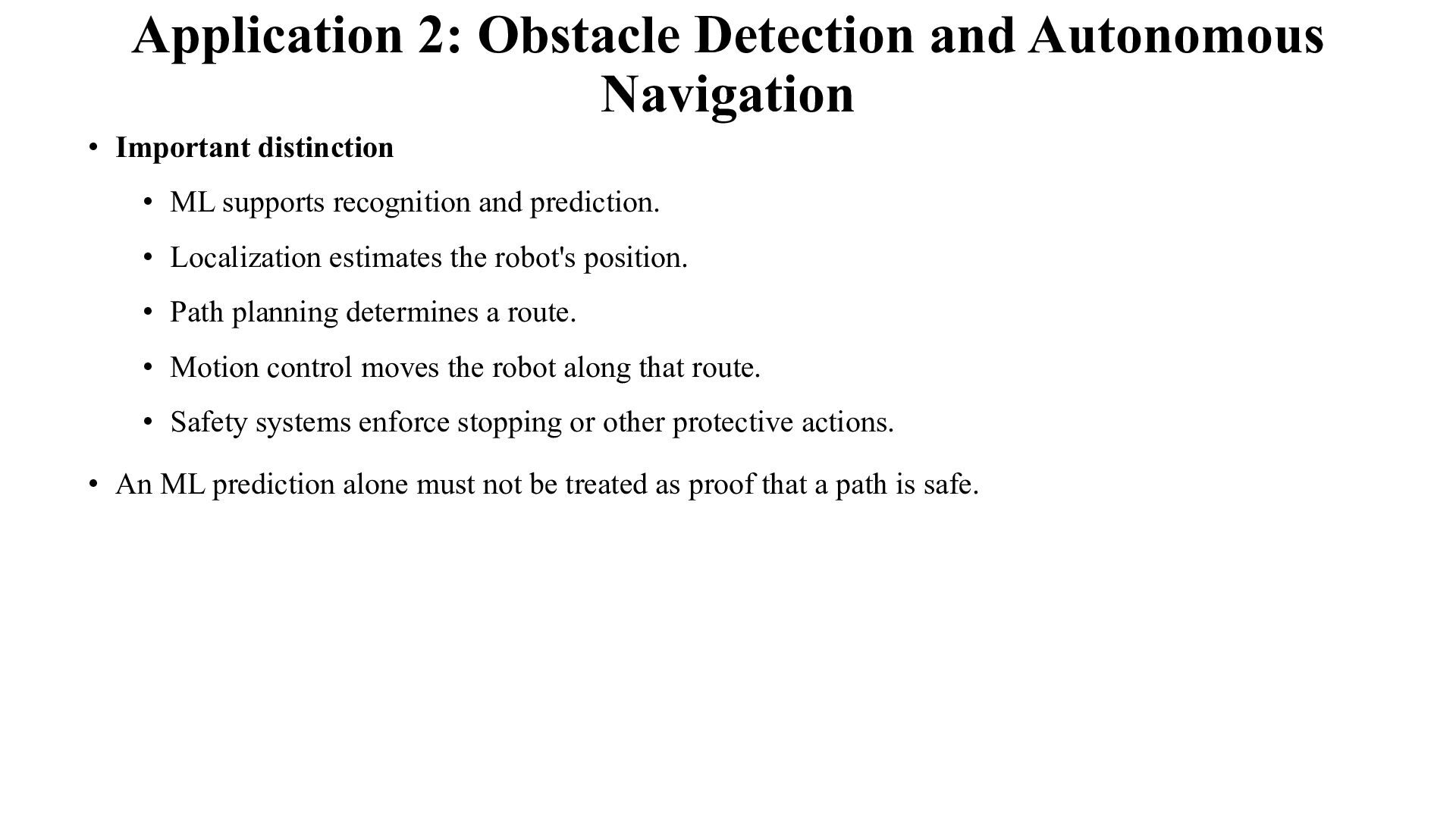
• ML supports recognition and prediction. • Localization estimates the robot's position. • Path planning determines a route. • Motion control moves the robot along that route. • Safety systems enforce stopping or other protective actions. • An ML prediction alone must not be treated as proof that a path is safe.
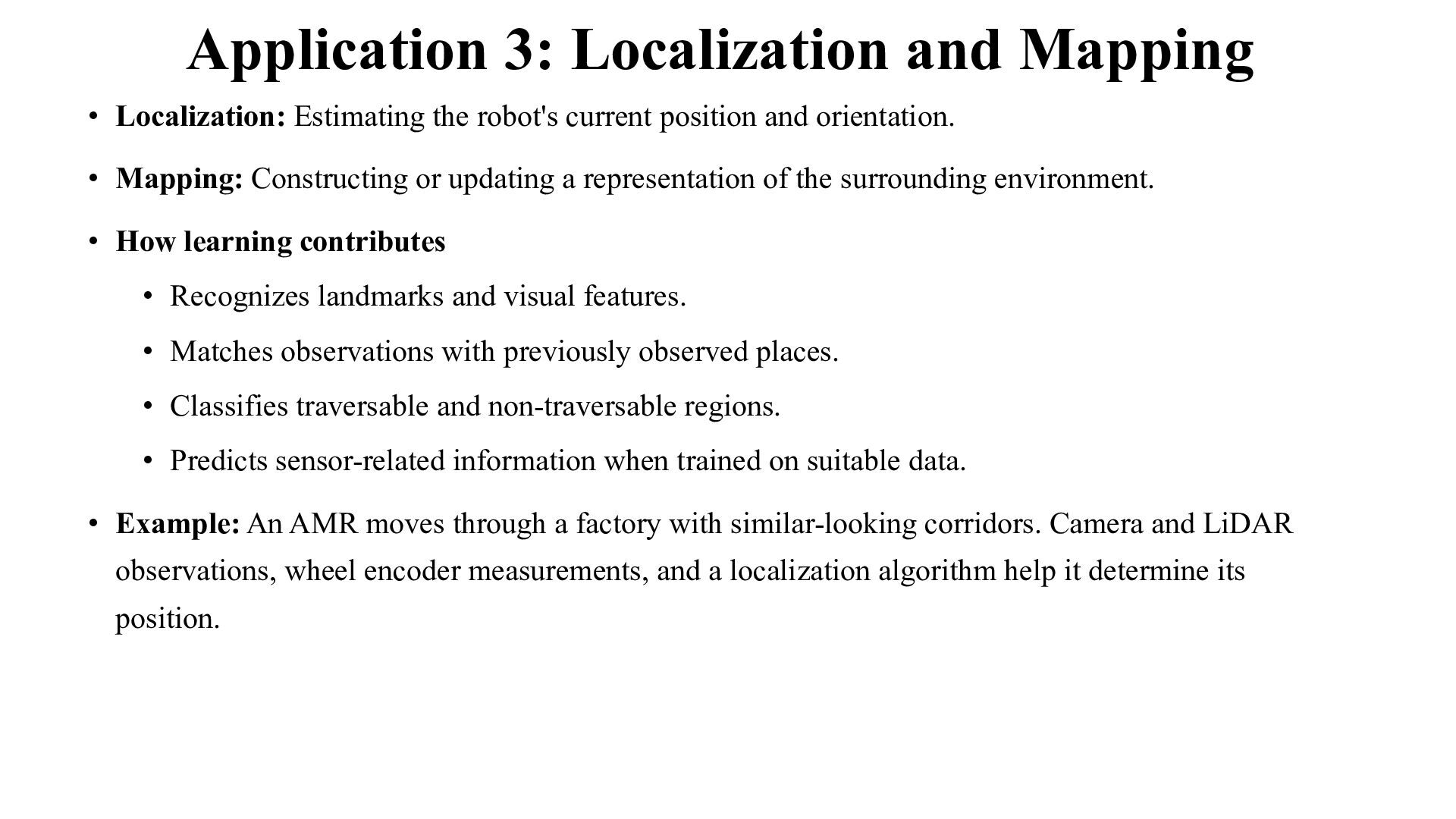
current position and orientation. • Mapping: Constructing or updating a representation of the surrounding environment. • How learning contributes • Recognizes landmarks and visual features. • Matches observations with previously observed places. • Classifies traversable and non-traversable regions. • Predicts sensor-related information when trained on suitable data. • Example: An AMR moves through a factory with similar-looking corridors. Camera and LiDAR observations, wheel encoder measurements, and a localization algorithm help it determine its position.
must pick metal components of varying sizes from a bin. • ML-based approach • Detect and classify the component. • Extract features such as estimated size, shape, and orientation. • Predict suitable grasp parameters or grasp success, using a trained model. • Plan a collision-free approach. • Execute the grasp and use force or position feedback to verify success. • Which ML Algorithms are used • Classification: identify the part type. • Regression: estimate a continuous property such as object dimensions or a grasp-related parameter. • Clustering: group similar parts when labels are unavailable. • Failure example: The model predicts a good grasp, but the component slips because the surface is oily.
shared workspaces with human operators. • How ML contributes • Recognizes tools and components. • Interprets operator gestures or commands. • Predicts task-related human movement in suitable systems. • Classifies workstation conditions. • Supports adaptive task sequencing. • Example: During assembly, a vision system identifies the component selected by the operator. The robot retrieves the matching tool or presents the next part. • Safety considerations • ML-based human detection may fail under occlusion or poor lighting. • Human intent prediction is uncertain. • Certified protective measures and safety-rated sensing/control must remain independent of unverified ML predictions where required.
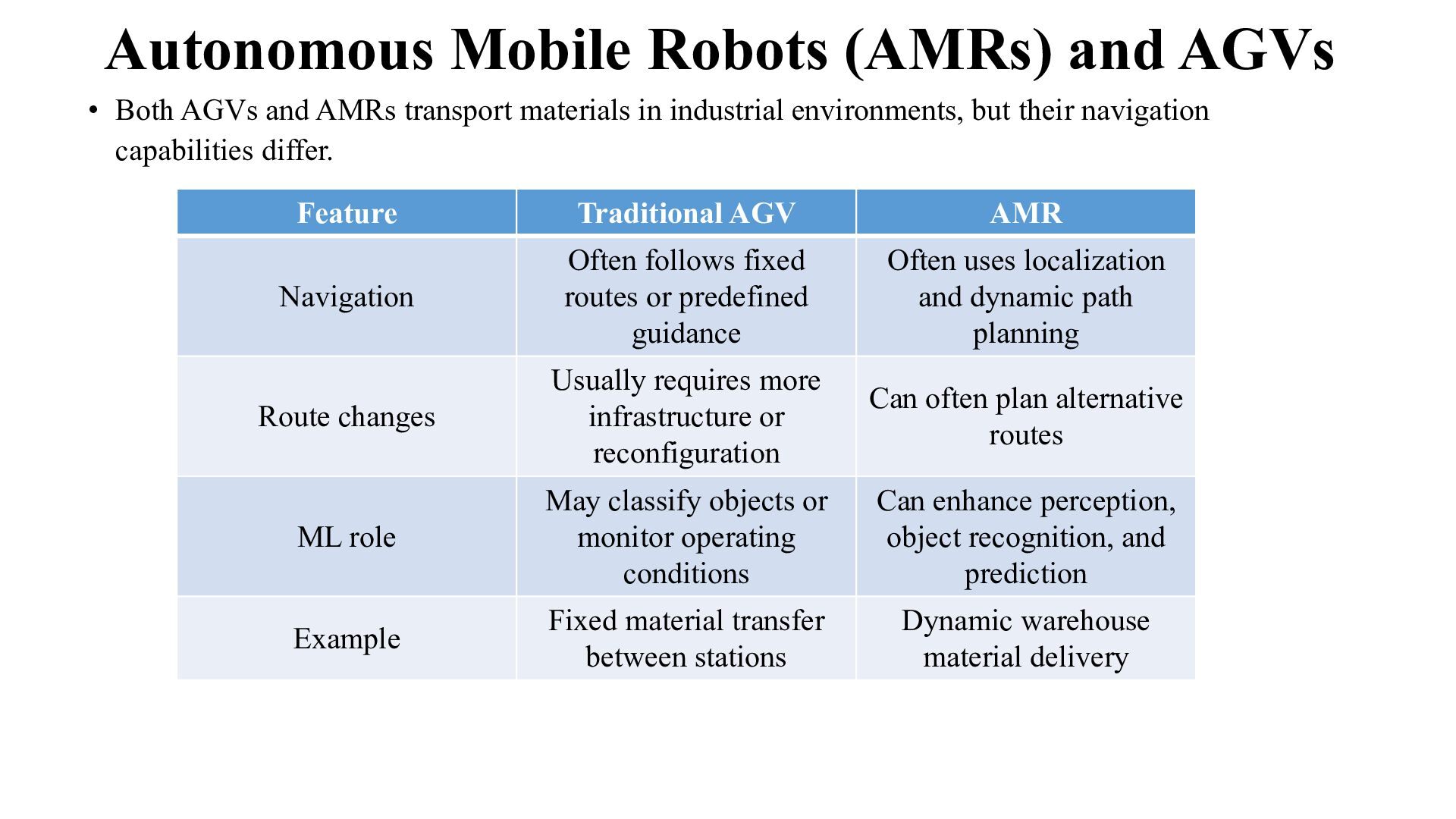
AMRs transport materials in industrial environments, but their navigation capabilities differ. Feature Traditional AGV AMR Navigation Often follows fixed routes or predefined guidance Often uses localization and dynamic path planning Route changes Usually requires more infrastructure or reconfiguration Can often plan alternative routes ML role May classify objects or monitor operating conditions Can enhance perception, object recognition, and prediction Example Fixed material transfer between stations Dynamic warehouse material delivery
in an AMR • Classification: recognize workers, vehicles, or other objects. • Regression: estimate travel time or battery consumption. • Clustering: group traffic or operating patterns. • Learned prediction: estimate the likely movement of nearby objects.
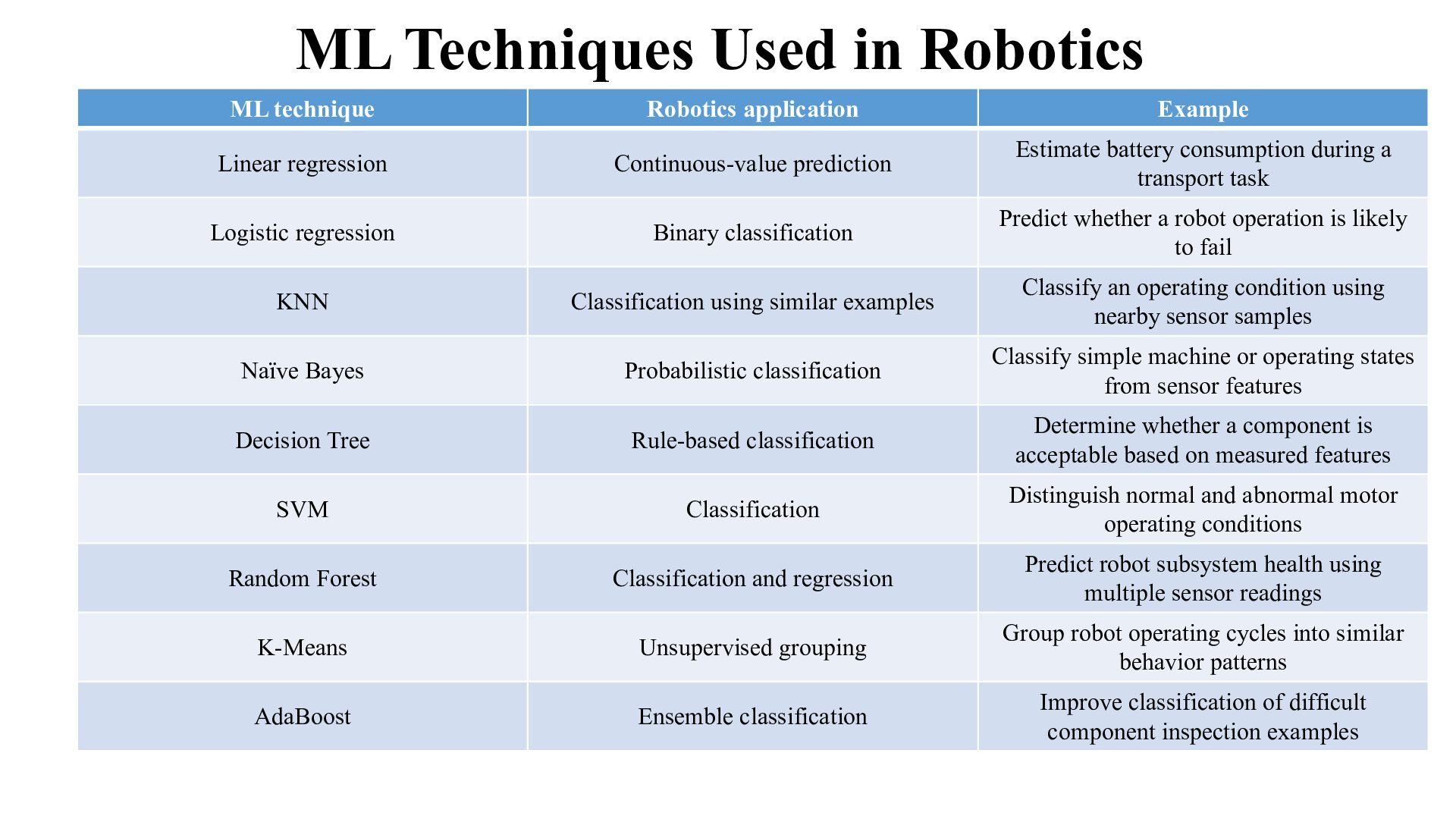
Linear regression Continuous-value prediction Estimate battery consumption during a transport task Logistic regression Binary classification Predict whether a robot operation is likely to fail KNN Classification using similar examples Classify an operating condition using nearby sensor samples Naïve Bayes Probabilistic classification Classify simple machine or operating states from sensor features Decision Tree Rule-based classification Determine whether a component is acceptable based on measured features SVM Classification Distinguish normal and abnormal motor operating conditions Random Forest Classification and regression Predict robot subsystem health using multiple sensor readings K-Means Unsupervised grouping Group robot operating cycles into similar behavior patterns AdaBoost Ensemble classification Improve classification of difficult component inspection examples
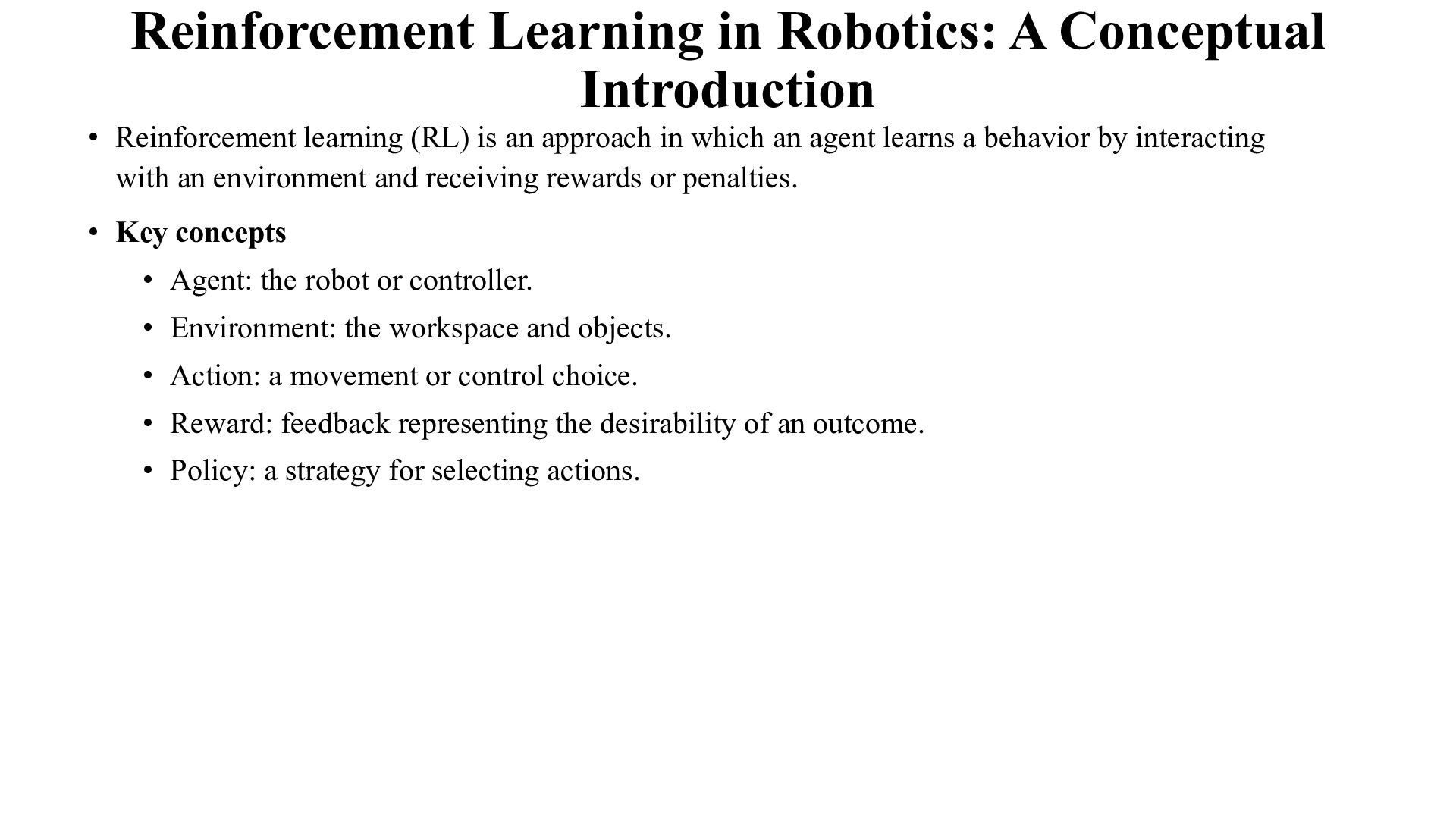
(RL) is an approach in which an agent learns a behavior by interacting with an environment and receiving rewards or penalties. • Key concepts • Agent: the robot or controller. • Environment: the workspace and objects. • Action: a movement or control choice. • Reward: feedback representing the desirability of an outcome. • Policy: a strategy for selecting actions.
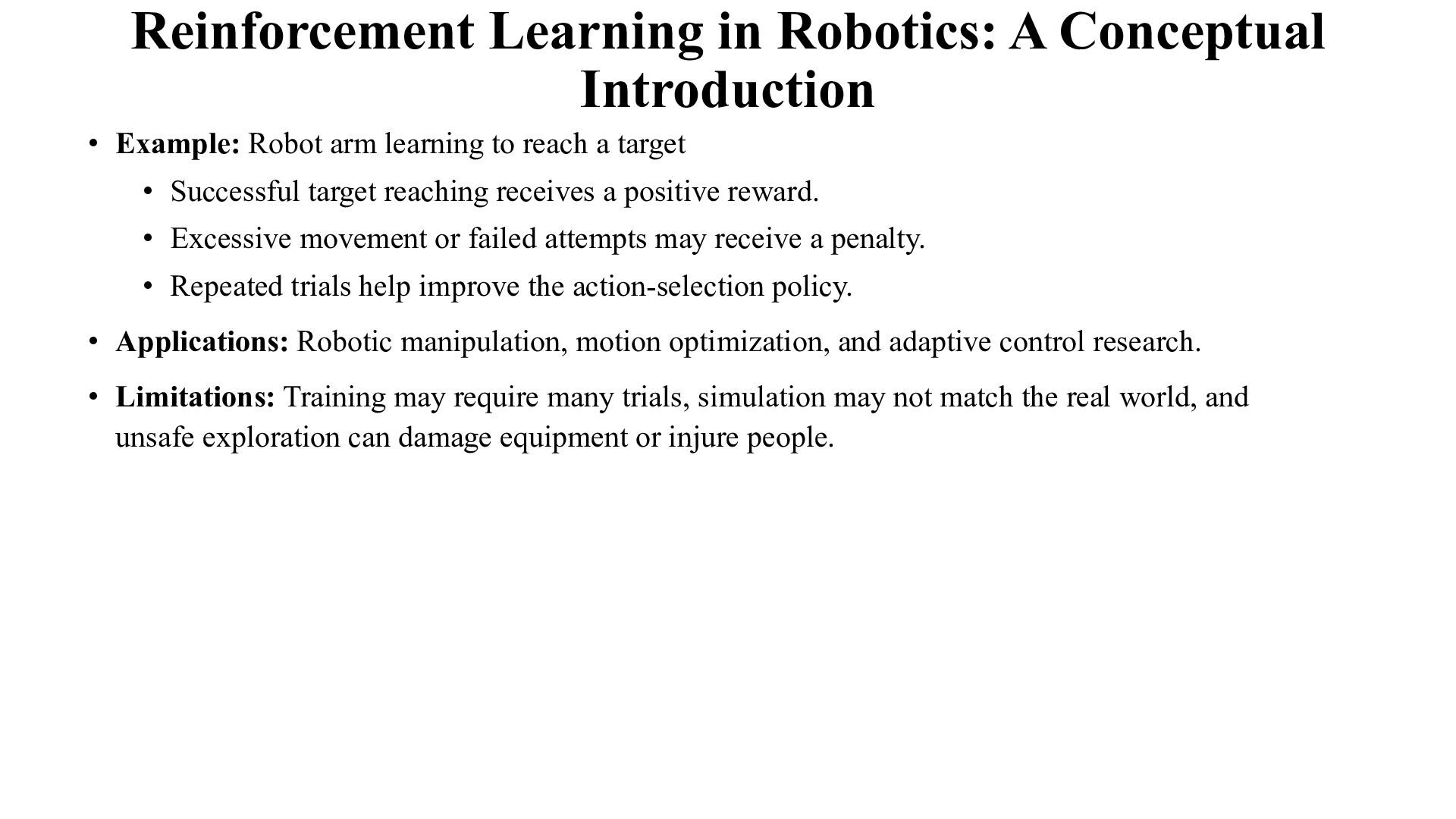
arm learning to reach a target • Successful target reaching receives a positive reward. • Excessive movement or failed attempts may receive a penalty. • Repeated trials help improve the action-selection policy. • Applications: Robotic manipulation, motion optimization, and adaptive control research. • Limitations: Training may require many trials, simulation may not match the real world, and unsafe exploration can damage equipment or injure people.
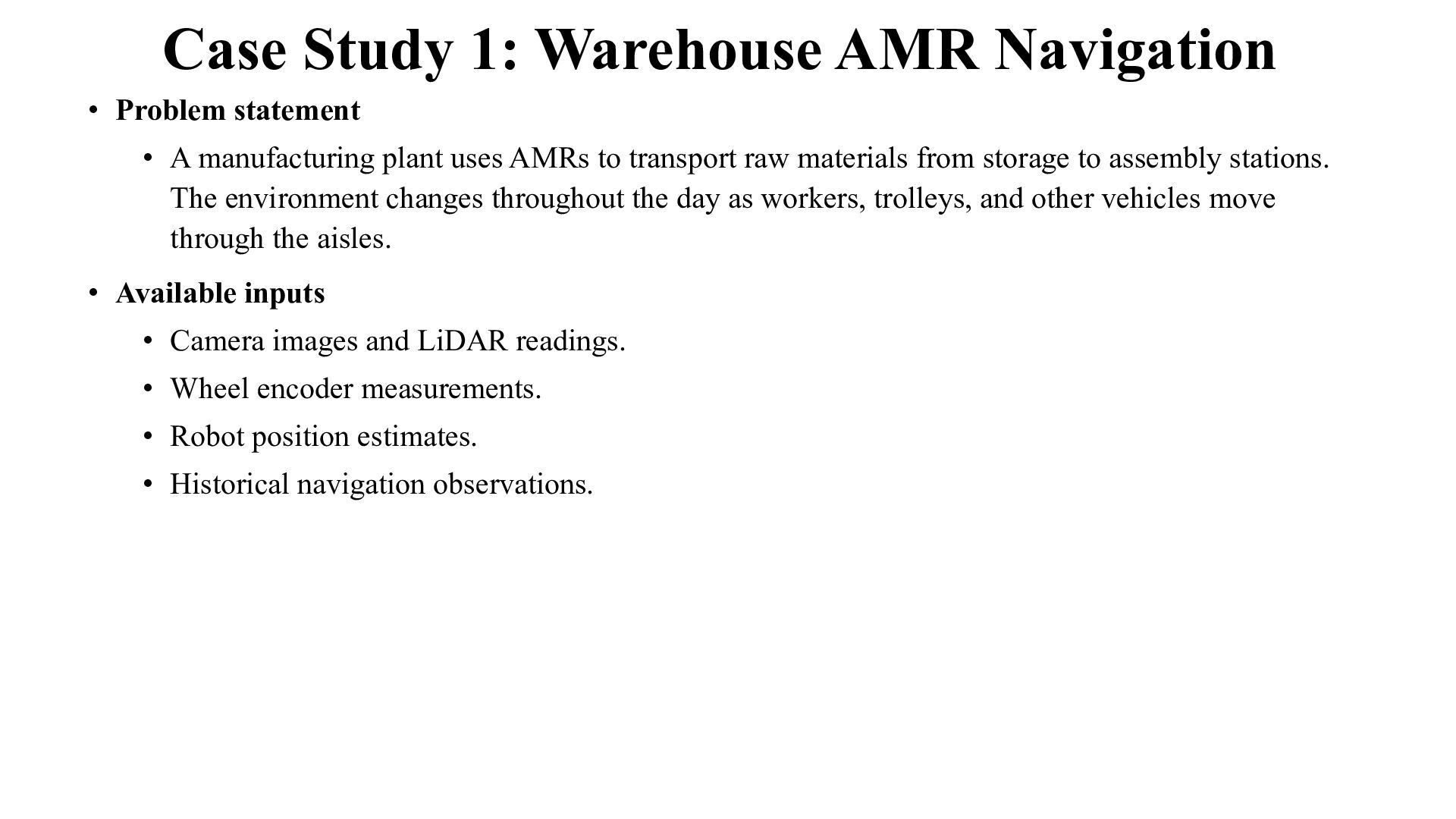
A manufacturing plant uses AMRs to transport raw materials from storage to assembly stations. The environment changes throughout the day as workers, trolleys, and other vehicles move through the aisles. • Available inputs • Camera images and LiDAR readings. • Wheel encoder measurements. • Robot position estimates. • Historical navigation observations.
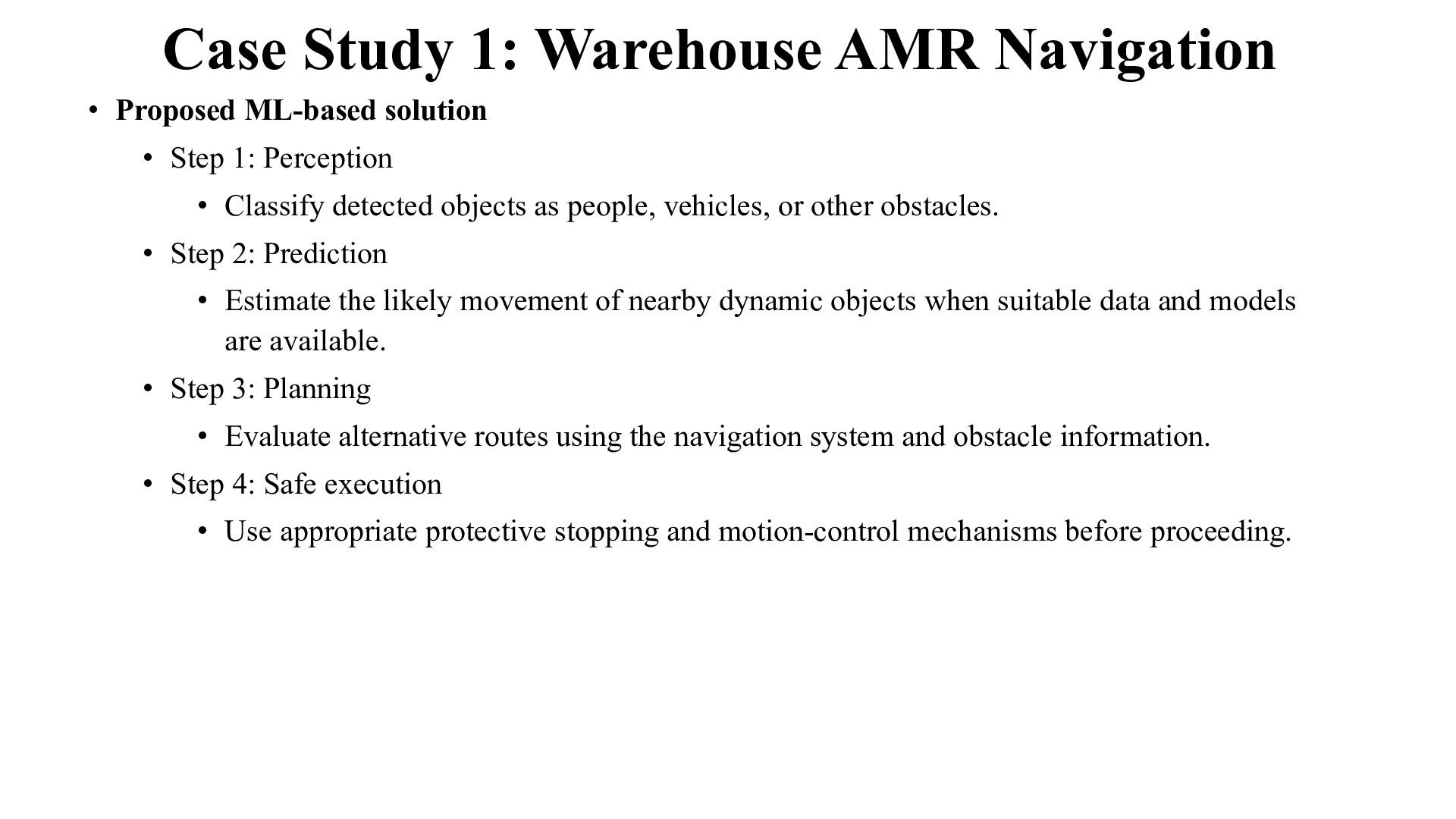
• Step 1: Perception • Classify detected objects as people, vehicles, or other obstacles. • Step 2: Prediction • Estimate the likely movement of nearby dynamic objects when suitable data and models are available. • Step 3: Planning • Evaluate alternative routes using the navigation system and obstacle information. • Step 4: Safe execution • Use appropriate protective stopping and motion-control mechanisms before proceeding.
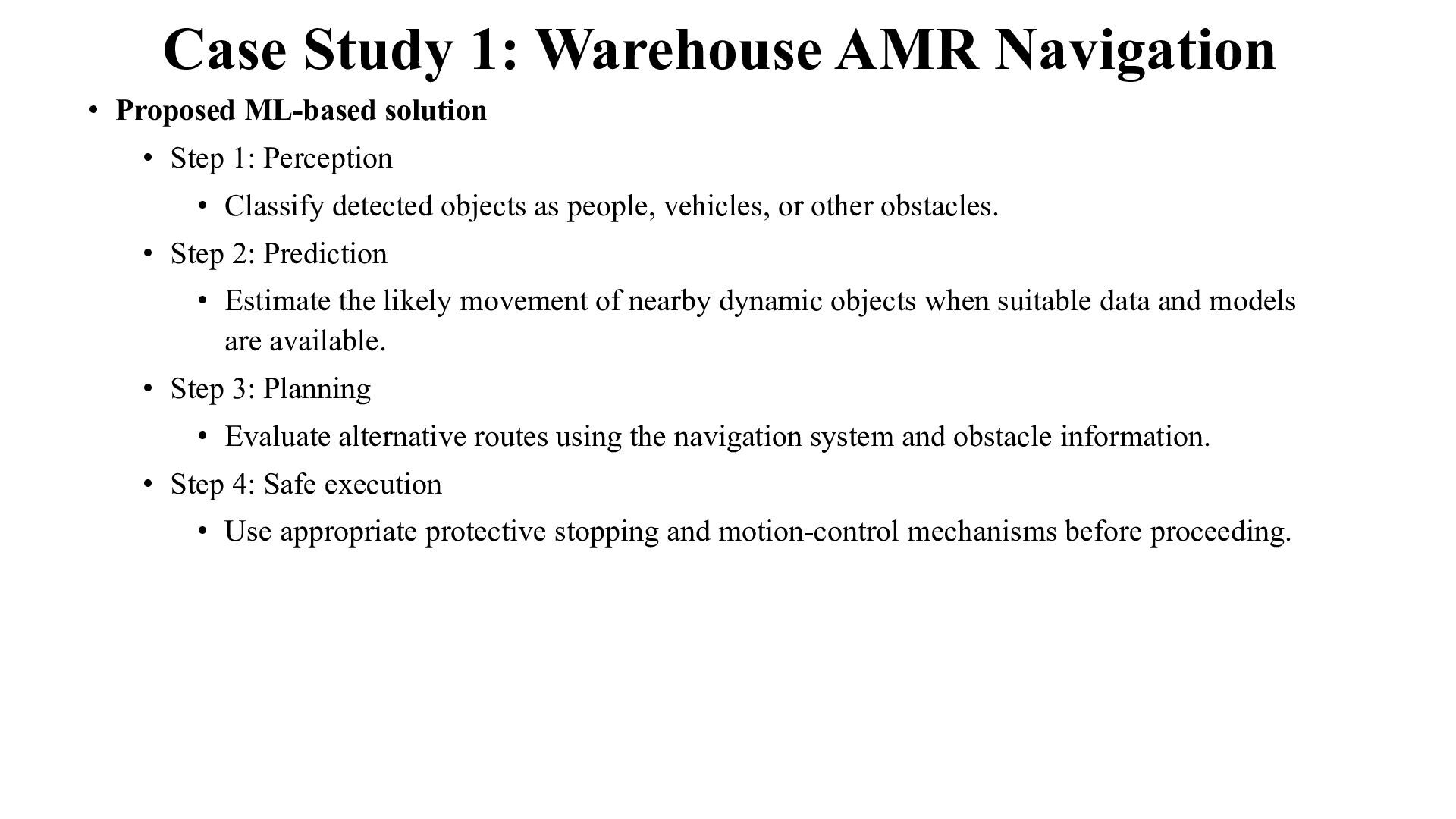
• Step 1: Perception • Classify detected objects as people, vehicles, or other obstacles. • Step 2: Prediction • Estimate the likely movement of nearby dynamic objects when suitable data and models are available. • Step 3: Planning • Evaluate alternative routes using the navigation system and obstacle information. • Step 4: Safe execution • Use appropriate protective stopping and motion-control mechanisms before proceeding.
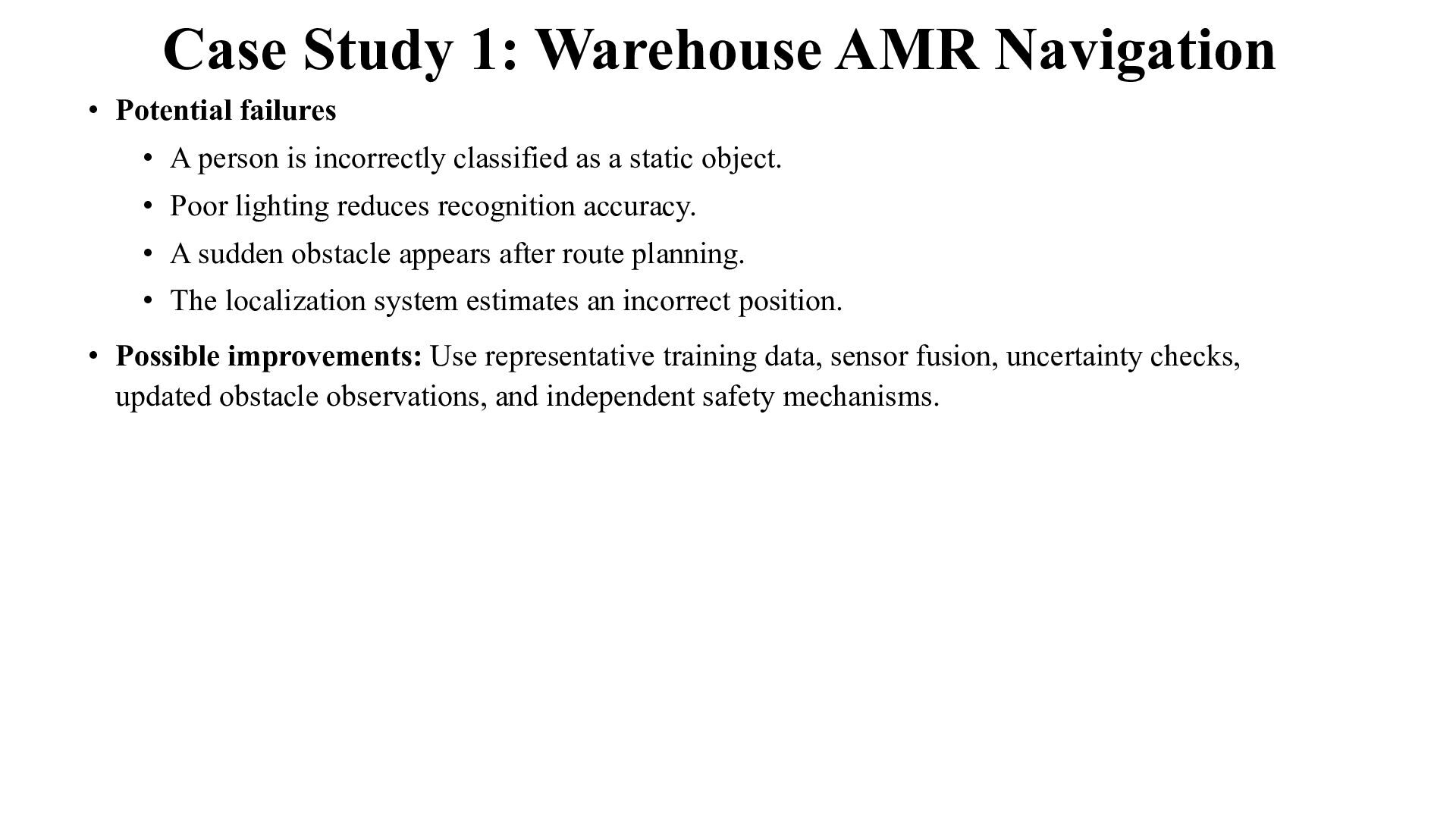
A person is incorrectly classified as a static object. • Poor lighting reduces recognition accuracy. • A sudden obstacle appears after route planning. • The localization system estimates an incorrect position. • Possible improvements: Use representative training data, sensor fusion, uncertainty checks, updated obstacle observations, and independent safety mechanisms.
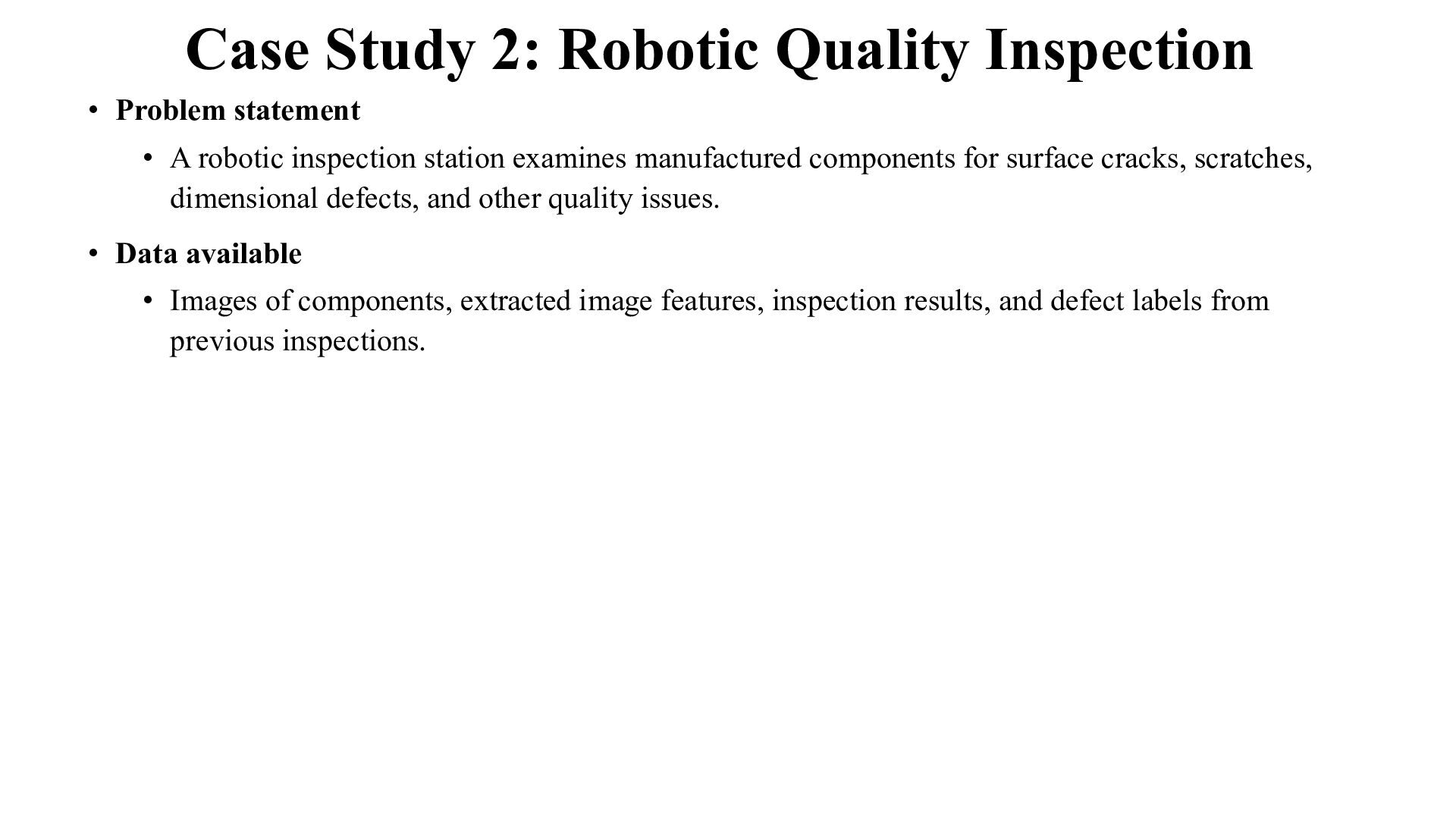
A robotic inspection station examines manufactured components for surface cracks, scratches, dimensional defects, and other quality issues. • Data available • Images of components, extracted image features, inspection results, and defect labels from previous inspections.
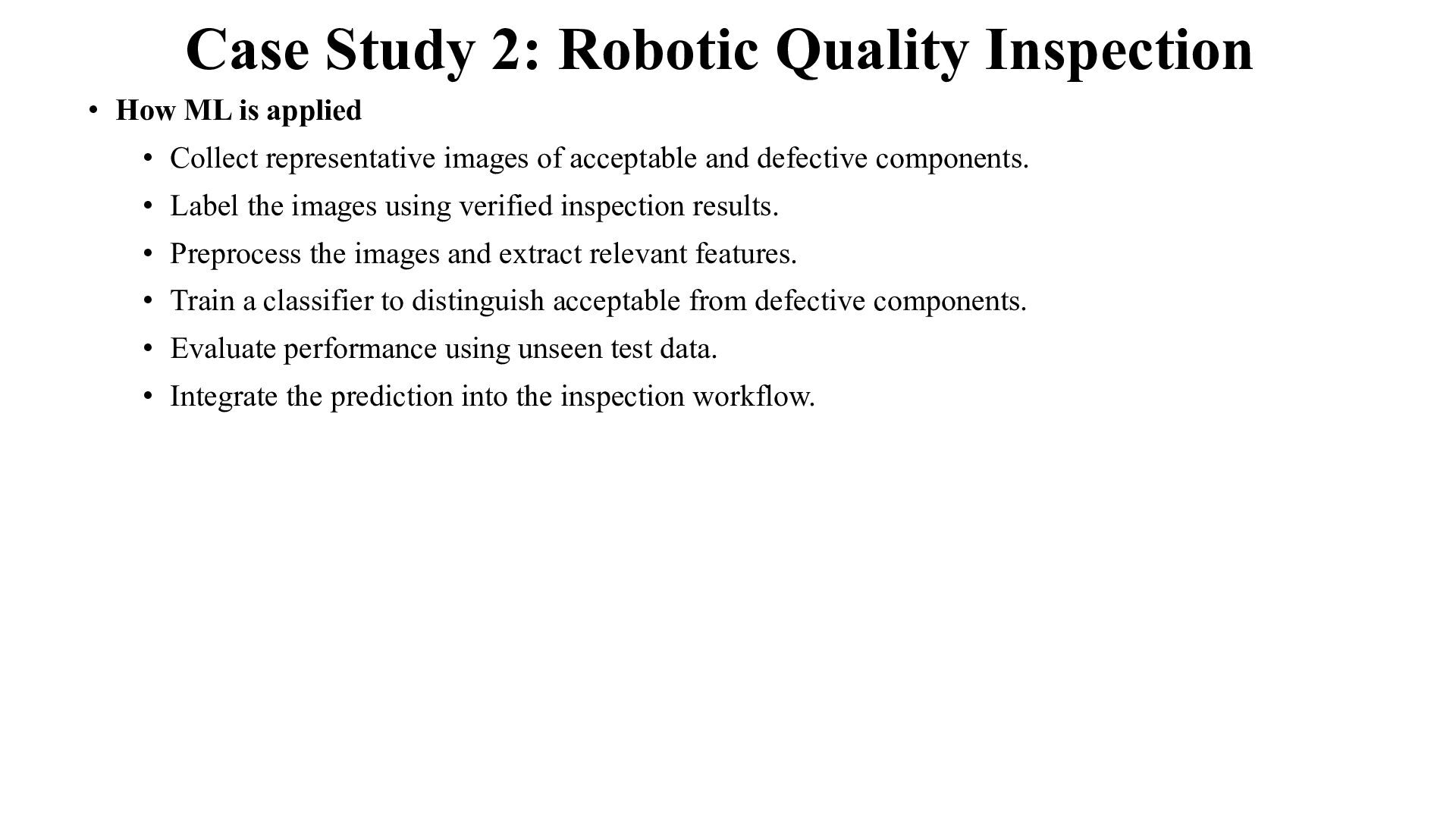
applied • Collect representative images of acceptable and defective components. • Label the images using verified inspection results. • Preprocess the images and extract relevant features. • Train a classifier to distinguish acceptable from defective components. • Evaluate performance using unseen test data. • Integrate the prediction into the inspection workflow.
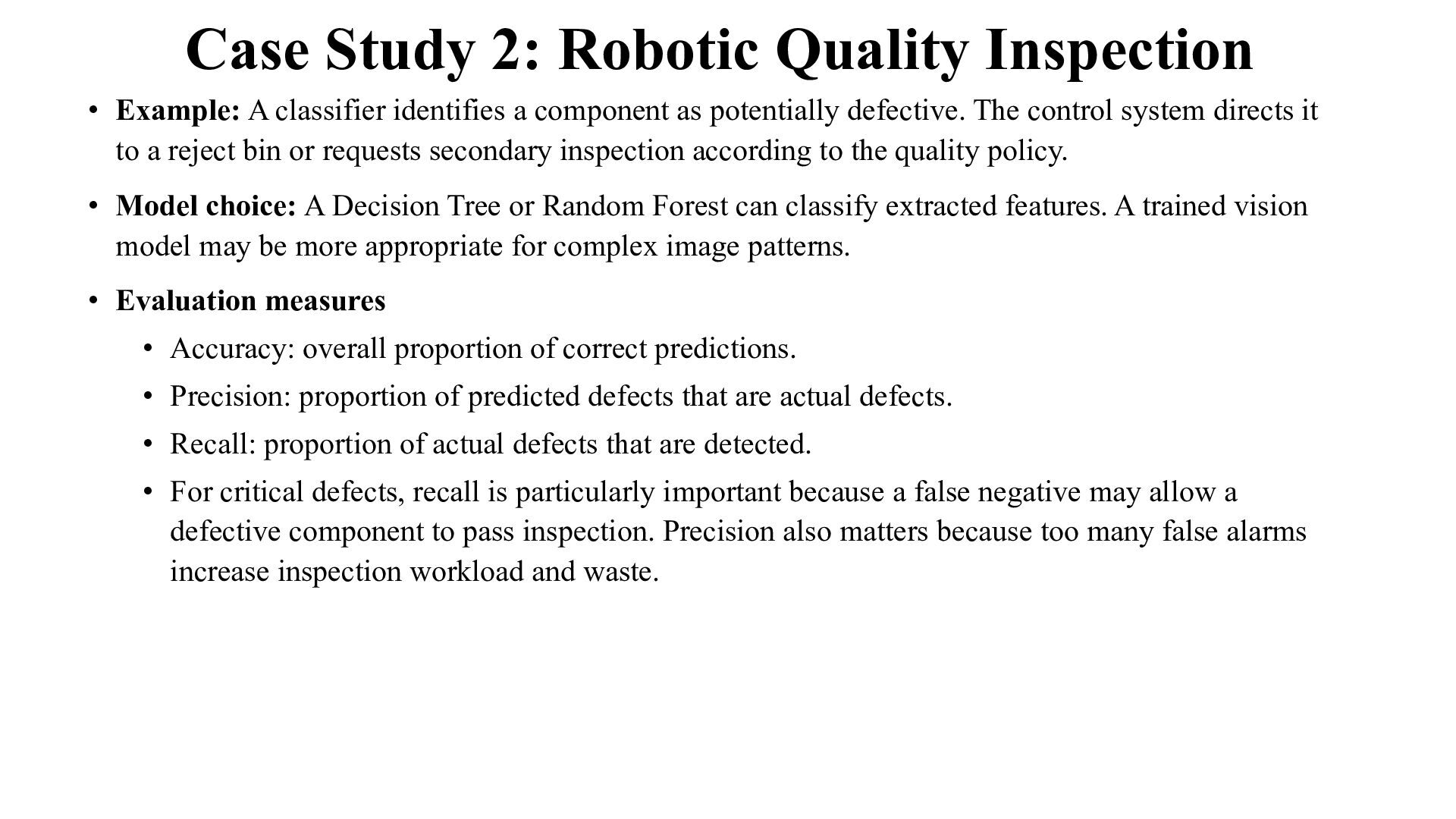
identifies a component as potentially defective. The control system directs it to a reject bin or requests secondary inspection according to the quality policy. • Model choice: A Decision Tree or Random Forest can classify extracted features. A trained vision model may be more appropriate for complex image patterns. • Evaluation measures • Accuracy: overall proportion of correct predictions. • Precision: proportion of predicted defects that are actual defects. • Recall: proportion of actual defects that are detected. • For critical defects, recall is particularly important because a false negative may allow a defective component to pass inspection. Precision also matters because too many false alarms increase inspection workload and waste.
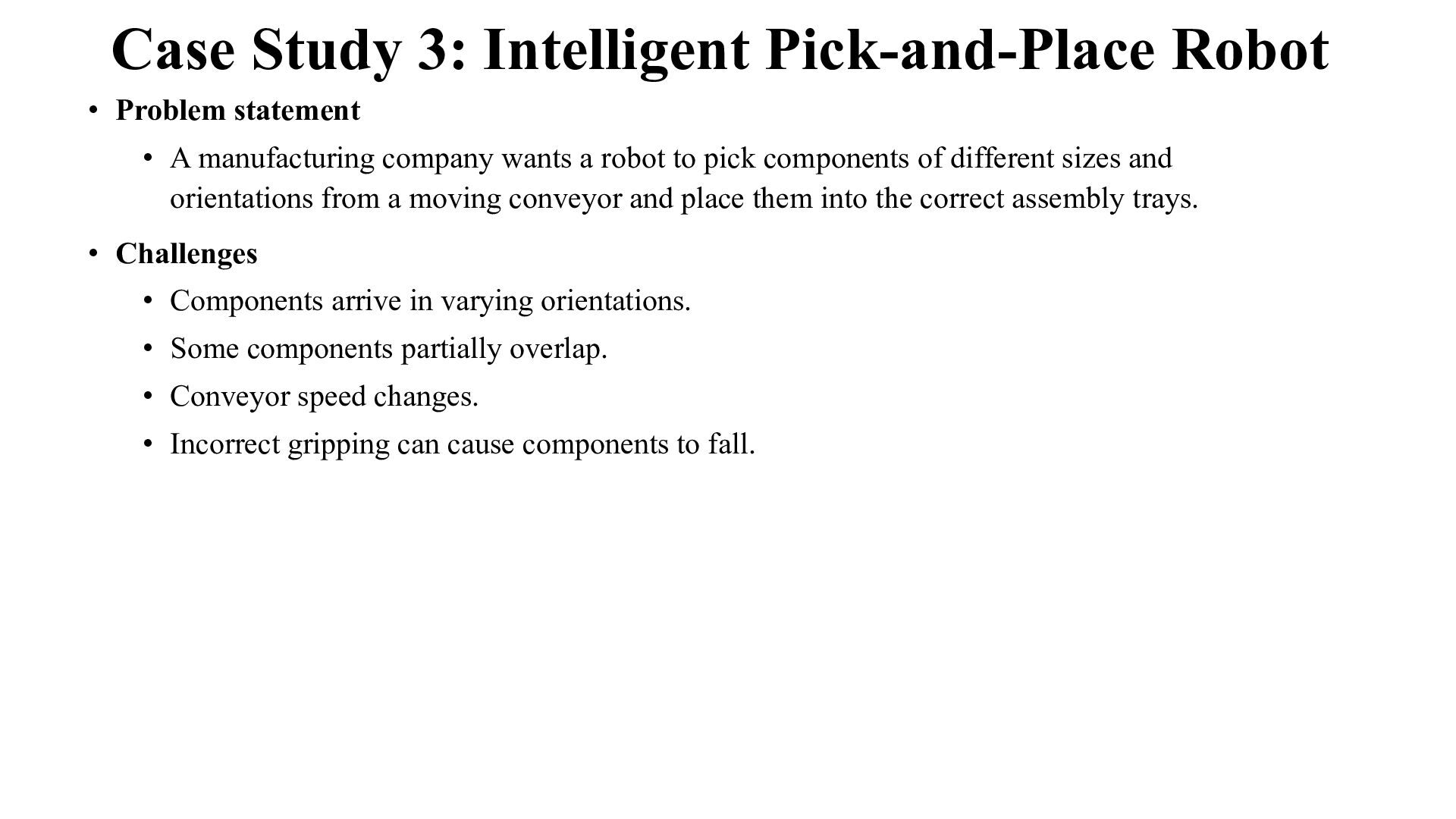
A manufacturing company wants a robot to pick components of different sizes and orientations from a moving conveyor and place them into the correct assembly trays. • Challenges • Components arrive in varying orientations. • Some components partially overlap. • Conveyor speed changes. • Incorrect gripping can cause components to fall.
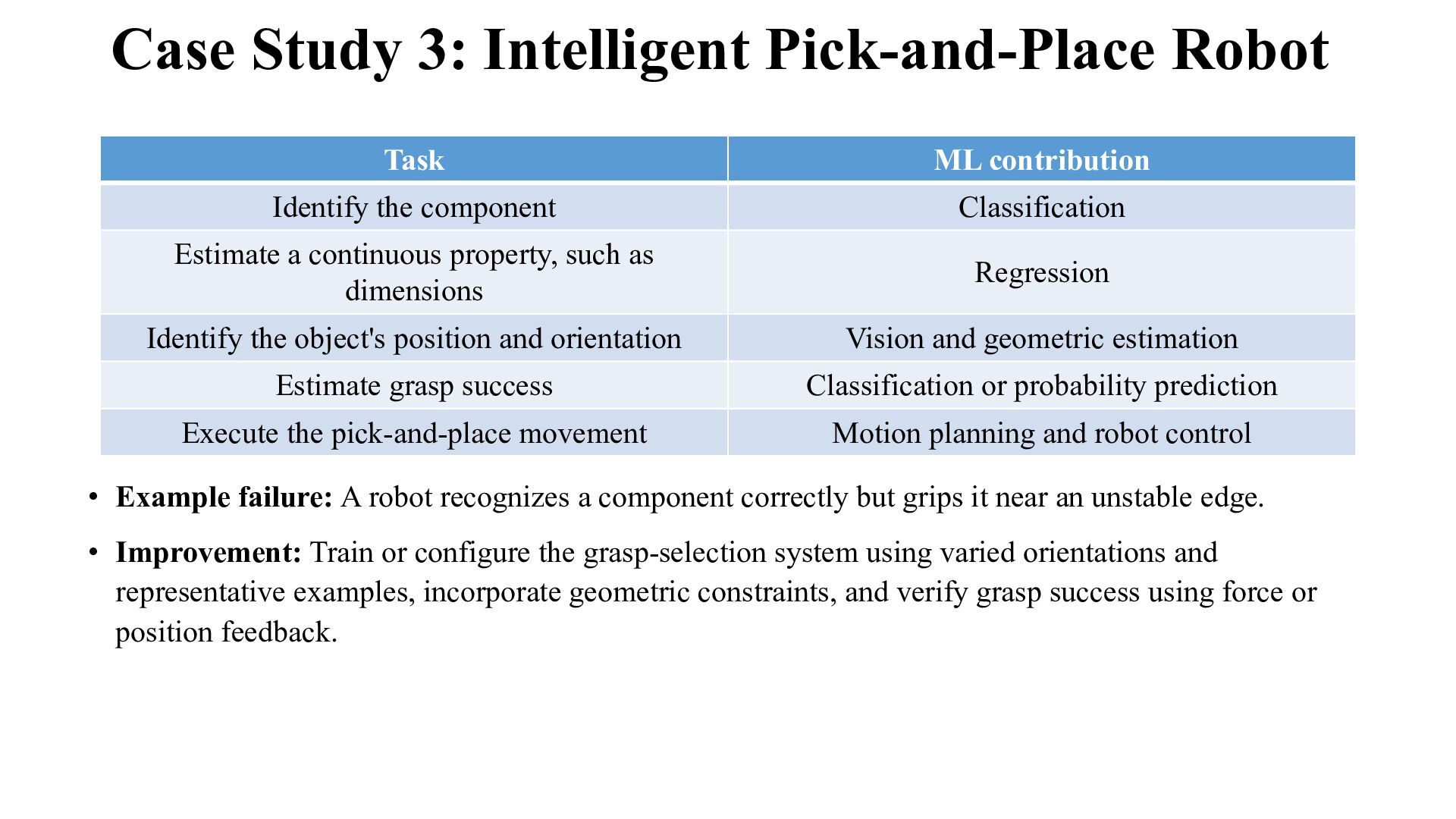
the component Classification Estimate a continuous property, such as dimensions Regression Identify the object's position and orientation Vision and geometric estimation Estimate grasp success Classification or probability prediction Execute the pick-and-place movement Motion planning and robot control • Example failure: A robot recognizes a component correctly but grips it near an unstable edge. • Improvement: Train or configure the grasp-selection system using varied orientations and representative examples, incorporate geometric constraints, and verify grasp success using force or position feedback.
statement • A drone inspects wind turbine blades or industrial structures for cracks, corrosion, and visible damage, reducing the need for workers to access difficult locations. • Challenges • Lighting and shadows can cause false detections. • Wind and vibration affect image quality. • Limited training examples can reduce reliability. • The drone must maintain safe separation from structures and people.
ML is used • Vision models identify possible cracks and damaged regions. • Classification categorizes observed surface conditions. • Regression can estimate continuous properties when suitable labeled data are available. • Clustering can group similar image features for exploratory analysis. • Navigation and control systems maintain the intended inspection trajectory. • Example workflow • Capture images → preprocess images → detect suspicious regions → classify the observed condition → record the location → generate an inspection report → request human verification where needed.
A robotic arm experiences unexpected joint failures, causing production downtime. The plant wants to identify early warning signs using sensor data. • Inputs • Motor current and temperature. • Vibration measurements. • Joint speed and torque. • Historical maintenance and failure records.
Classification: predict normal versus potentially abnormal operation. • Regression: estimate a continuous variable such as temperature or remaining useful life, if suitable labeled data are available. • Clustering: group normal operating patterns and identify unusual groups for investigation. • Example: A model detects a combination of unusually high motor current and vibration. The system flags the joint for inspection rather than declaring that failure is certain. • Important considerations • Train with data covering different loads and operating speeds. • Monitor false alarms and missed faults. • Verify alerts with diagnostic measurements. • Use maintenance rules and safety procedures alongside ML predictions.
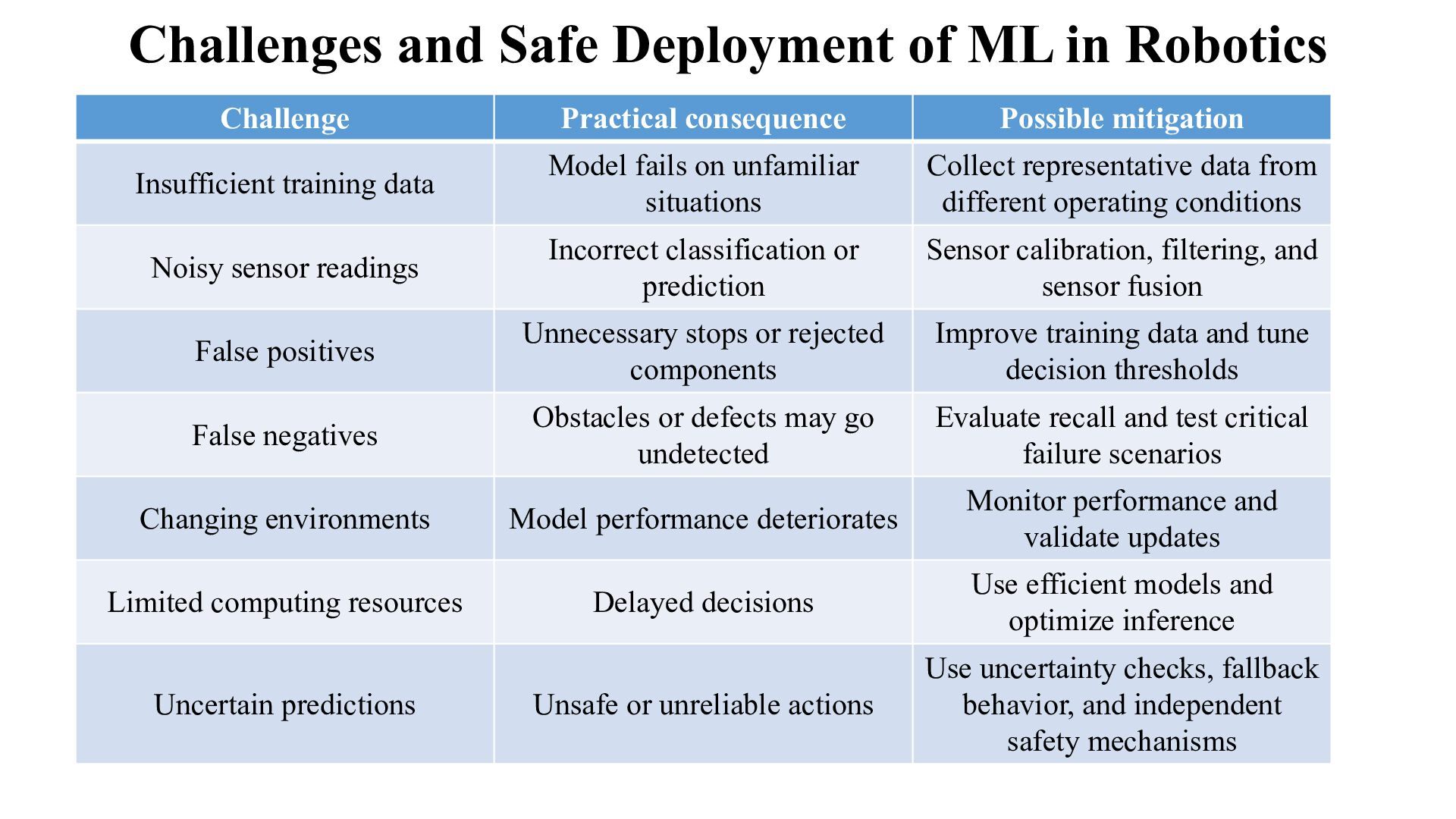
consequence Possible mitigation Insufficient training data Model fails on unfamiliar situations Collect representative data from different operating conditions Noisy sensor readings Incorrect classification or prediction Sensor calibration, filtering, and sensor fusion False positives Unnecessary stops or rejected components Improve training data and tune decision thresholds False negatives Obstacles or defects may go undetected Evaluate recall and test critical failure scenarios Changing environments Model performance deteriorates Monitor performance and validate updates Limited computing resources Delayed decisions Use efficient models and optimize inference Unsafe or unreliable actions Use uncertainty checks, fallback behavior, and independent safety mechanisms Uncertain predictions


 madhuri28
 ichiroc
 naoji_taniguchi_ksk_0827
 robintux
 pawan_pharm
 terasawat
 ainischool
 drpoonamkc
 juanmartin2026
 2720japanoke
 bvr7352
 akiraasano
 aleyda
 tonyrice
 carmenintech
 jacobian
 lauravandoore
 ianozsvald
 rkendrick25
 philnash
 tammyeverts
 shlominoach
 frankvandijk