Smart Manufacturing and Industrial Automation: ML, Digital Twins and Industry 4.0
Explores machine learning in smart factories, including predictive maintenance, automated inspection, process optimization, energy management, Industrial IoT, digital twins, and real-world Industry 4.0 case studies.
STUDIES IN MECHATRONICS Smart Manufacturing and Industrial Automation Dr. Madhuri Mahawar Department of Mechatonics Engineering Sanjivani College of Engineering, Kopargaon
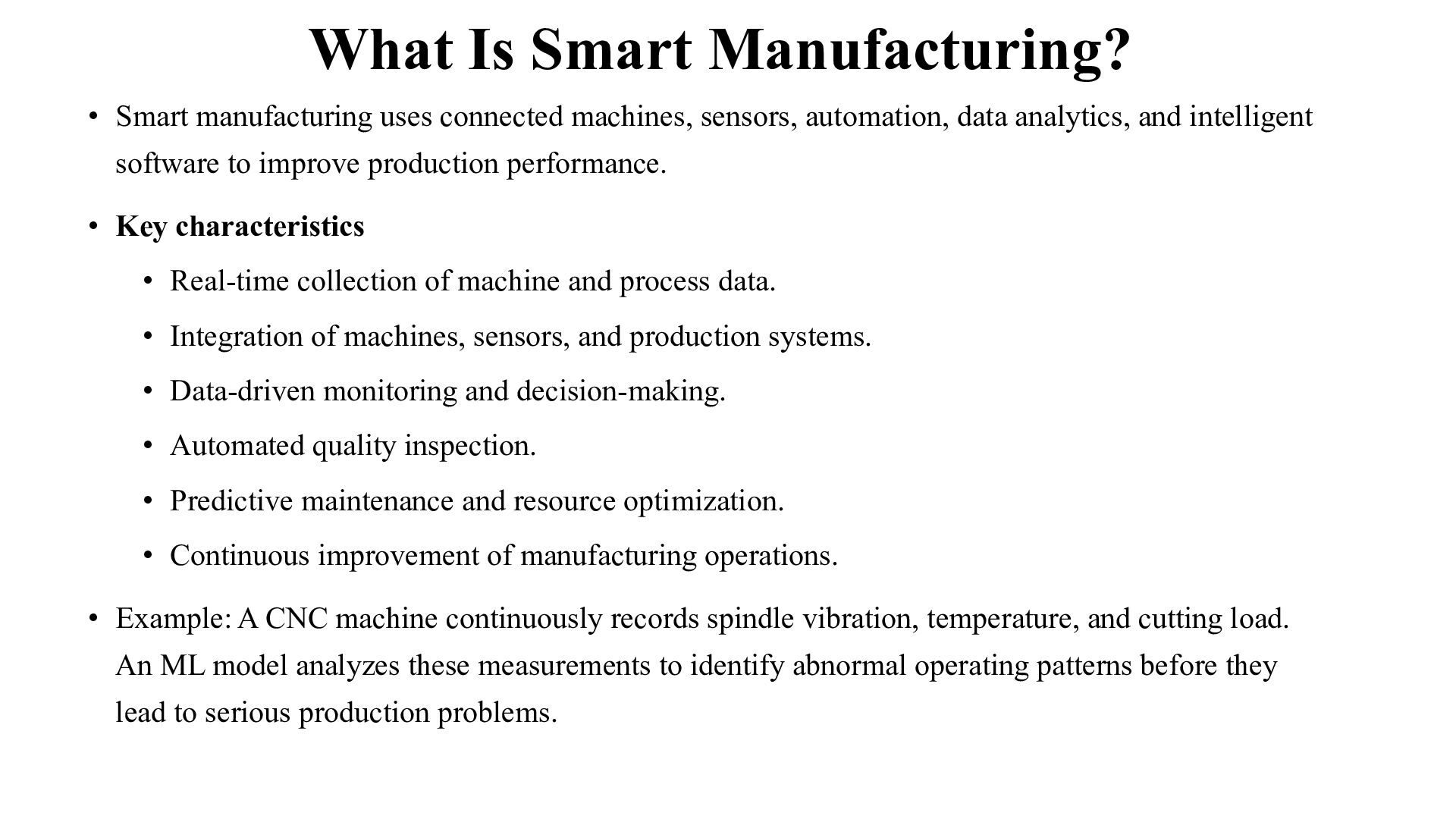
sensors, automation, data analytics, and intelligent software to improve production performance. • Key characteristics • Real-time collection of machine and process data. • Integration of machines, sensors, and production systems. • Data-driven monitoring and decision-making. • Automated quality inspection. • Predictive maintenance and resource optimization. • Continuous improvement of manufacturing operations. • Example: A CNC machine continuously records spindle vibration, temperature, and cutting load. An ML model analyzes these measurements to identify abnormal operating patterns before they lead to serious production problems.
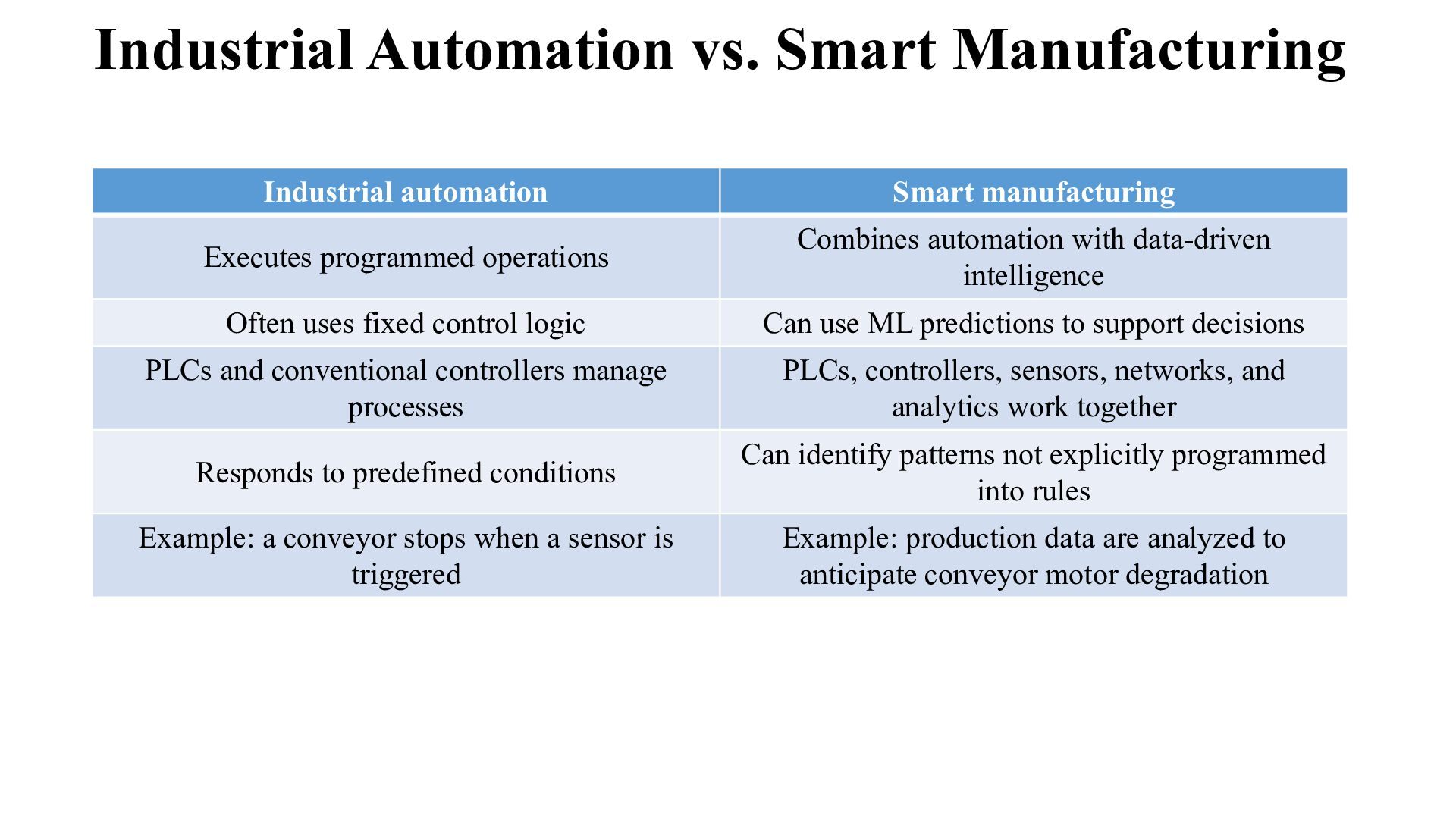
programmed operations Combines automation with data-driven intelligence Often uses fixed control logic Can use ML predictions to support decisions PLCs and conventional controllers manage processes PLCs, controllers, sensors, networks, and analytics work together Responds to predefined conditions Can identify patterns not explicitly programmed into rules Example: a conveyor stops when a sensor is triggered Example: production data are analyzed to anticipate conveyor motor degradation
production downtime and expensive repairs. • How ML is used • Collect historical and real-time sensor readings. • Extract features such as vibration level, temperature, current, and operating speed. • Train a model using historical operating and maintenance data. • Predict abnormal operation, fault categories, or remaining useful life, depending on the available labels. • Generate an alert for maintenance personnel.
healthy vs. potentially faulty. • Regression: predict a continuous value, such as remaining useful life. • Clustering: group normal operating patterns and identify unusual behavior for further investigation. • Example: A motor's vibration and temperature gradually increase. The model flags the machine for inspection so that maintenance can be planned before a major breakdown.
be slow and inconsistent when production volumes are high. • ML workflow • Capture images using an industrial camera. • Preprocess the images and extract relevant features. • Classify components as acceptable or defective. • Direct suspicious components to rejection or secondary inspection. • Monitor inspection performance using verified quality records.
Random Forest, SVM, or a deep-learning vision model. • Evaluation metrics • Precision: How many predicted defects are actually defective? • Recall: How many actual defects are detected? • Accuracy: What proportion of all predictions are correct? • For safety-critical or costly defects, a high recall may be especially important because missed defects can reach the customer. Precision also matters because excessive false alarms increase inspection costs.
depend on process parameters such as cutting speed, feed rate, temperature, pressure, and tool condition. • How ML contributes • Regression predicts surface roughness, cycle time, or energy consumption. • Classification predicts whether a product is likely to meet quality specifications. • Optimization methods use model predictions to identify promising parameter settings. • Example: A CNC machine produces components with inconsistent surface roughness. A regression model learns the relationship between cutting speed, feed rate, tool wear, and measured surface roughness. • The model estimates the expected roughness for candidate settings. Engineers select and validate suitable settings within the machine's operating limits. • Important: A predictive model estimates outcomes; it does not automatically determine the optimal setting unless an optimization procedure is also used.
observations that differ significantly from expected operating behavior. • Industrial examples • A motor draws unusually high current. • A pneumatic actuator takes longer than usual to extend. • A conveyor experiences unexpected vibration. • A robotic joint operates outside its normal sensor pattern. • How clustering can help • K-Means can group similar operating cycles using features such as current, temperature, and vibration. A cycle far from the established groups can be flagged for investigation. • However, a distant data point is not necessarily a fault. It could represent a legitimate change in operating load or a sensor problem.
consume different amounts of energy depending on load, speed, idle time, and production requirements. • ML Algorithms • Regression predicts power consumption or energy use per production cycle. • Clustering groups machines or operating cycles with similar energy patterns. • Classification identifies high-energy operating conditions. • Predictive analytics estimates demand to support production planning. • Example: An ML model predicts that a particular production schedule will result in high energy consumption because several energy-intensive machines will operate simultaneously. • The production planner can evaluate alternative schedules while preserving delivery deadlines and equipment constraints. • Performance indicators: Energy per component, peak demand, idle energy consumption, and production output.
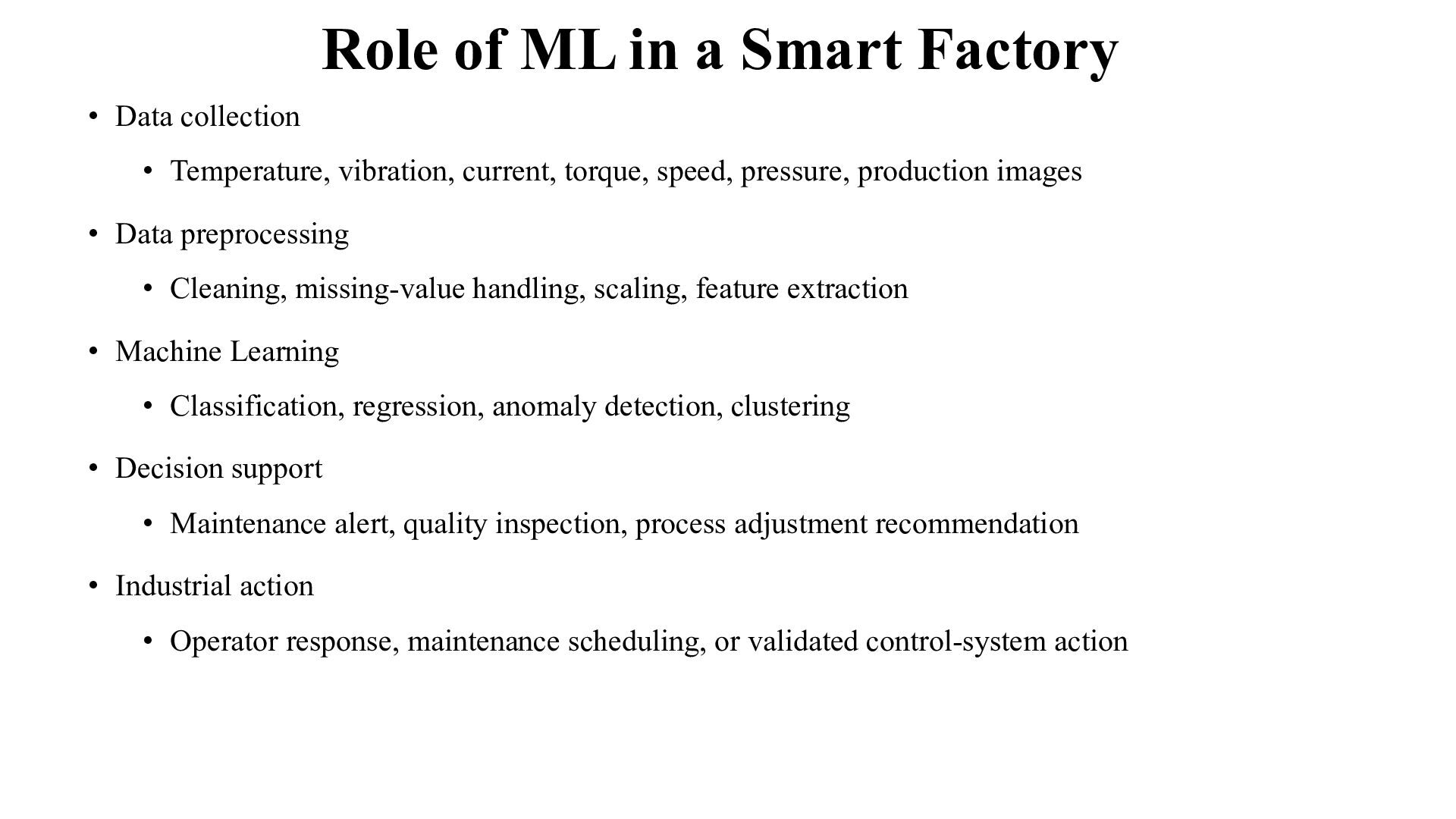
connects industrial machines, sensors, controllers, and data platforms. • Role of IIoT • Collect sensor data from machines. • Transfer measurements to local or cloud computing systems. • Enable equipment monitoring and historical data analysis. • Support ML-based prediction and decision-making. • Example architecture Machine sensors → PLC or edge gateway → industrial network → data platform → ML model → alert or validated control action. • Edge ML: Runs a model near the machine to reduce communication delays and dependence on cloud connectivity. • Cloud ML: Uses centralized computing and aggregated data for training, analysis, and monitoring across multiple machines.
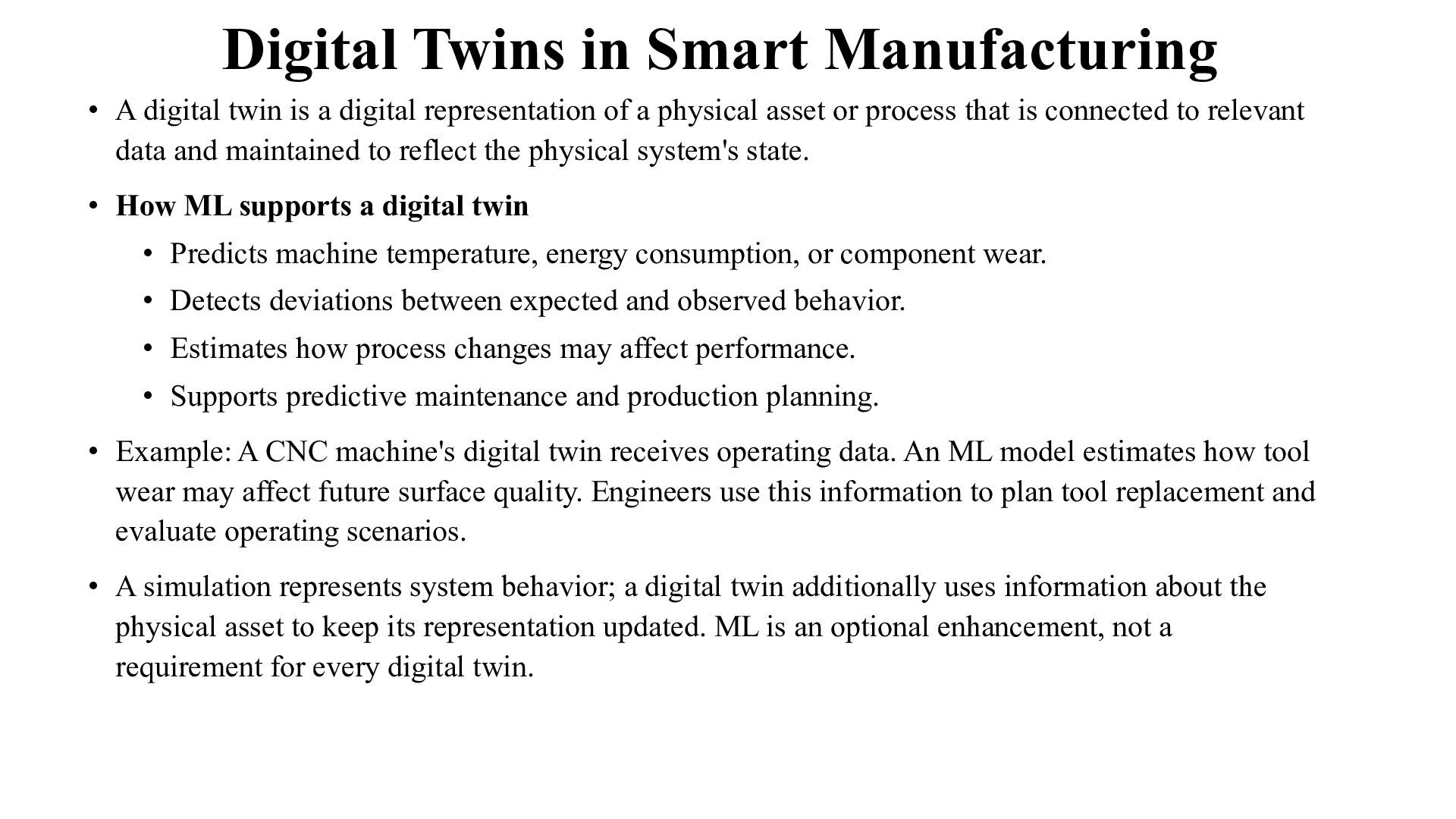
a digital representation of a physical asset or process that is connected to relevant data and maintained to reflect the physical system's state. • How ML supports a digital twin • Predicts machine temperature, energy consumption, or component wear. • Detects deviations between expected and observed behavior. • Estimates how process changes may affect performance. • Supports predictive maintenance and production planning. • Example: A CNC machine's digital twin receives operating data. An ML model estimates how tool wear may affect future surface quality. Engineers use this information to plan tool replacement and evaluate operating scenarios. • A simulation represents system behavior; a digital twin additionally uses information about the physical asset to keep its representation updated. ML is an optional enhancement, not a requirement for every digital twin.
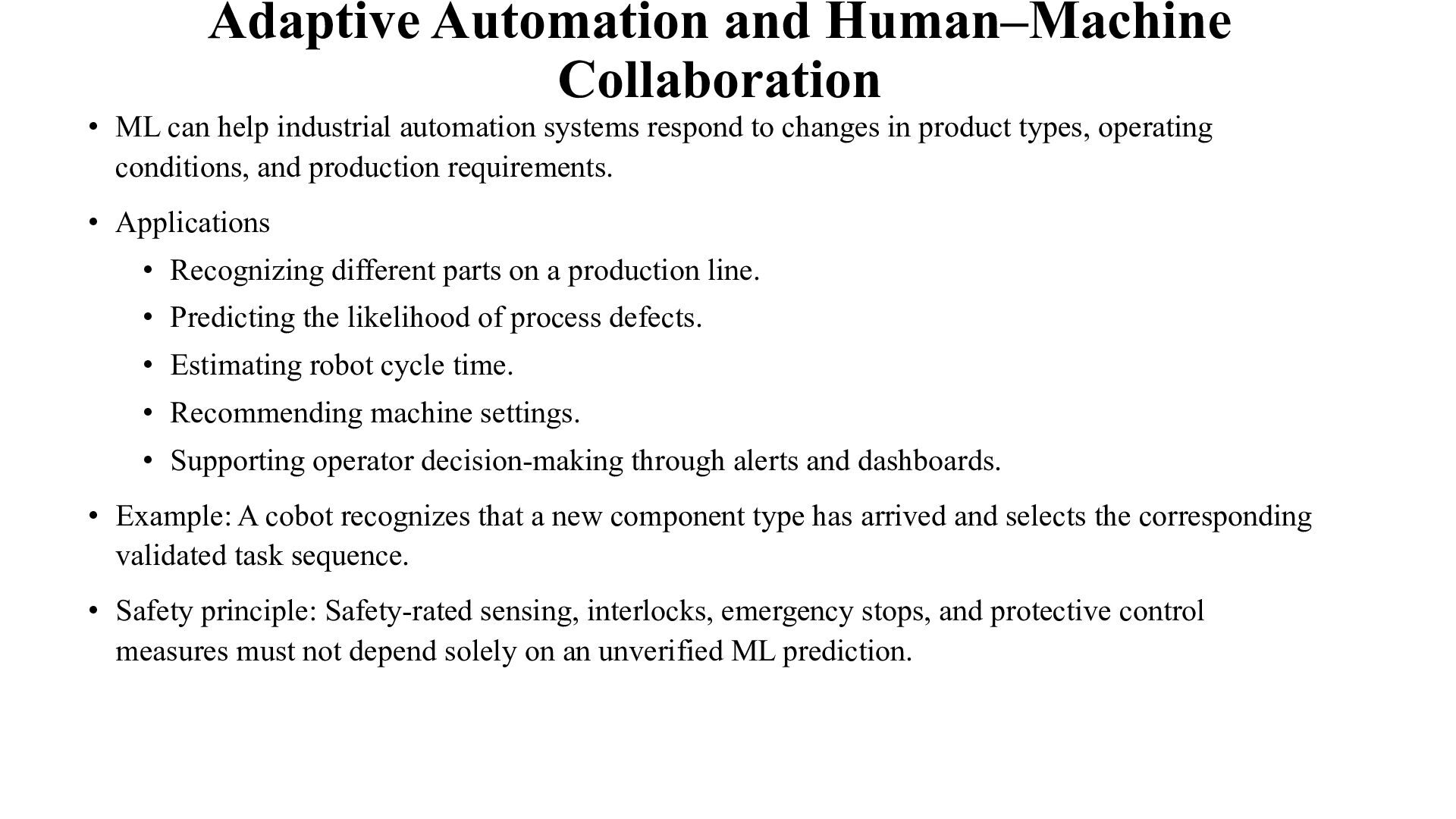
automation systems respond to changes in product types, operating conditions, and production requirements. • Applications • Recognizing different parts on a production line. • Predicting the likelihood of process defects. • Estimating robot cycle time. • Recommending machine settings. • Supporting operator decision-making through alerts and dashboards. • Example: A cobot recognizes that a new component type has arrived and selects the corresponding validated task sequence. • Safety principle: Safety-rated sensing, interlocks, emergency stops, and protective control measures must not depend solely on an unverified ML prediction.
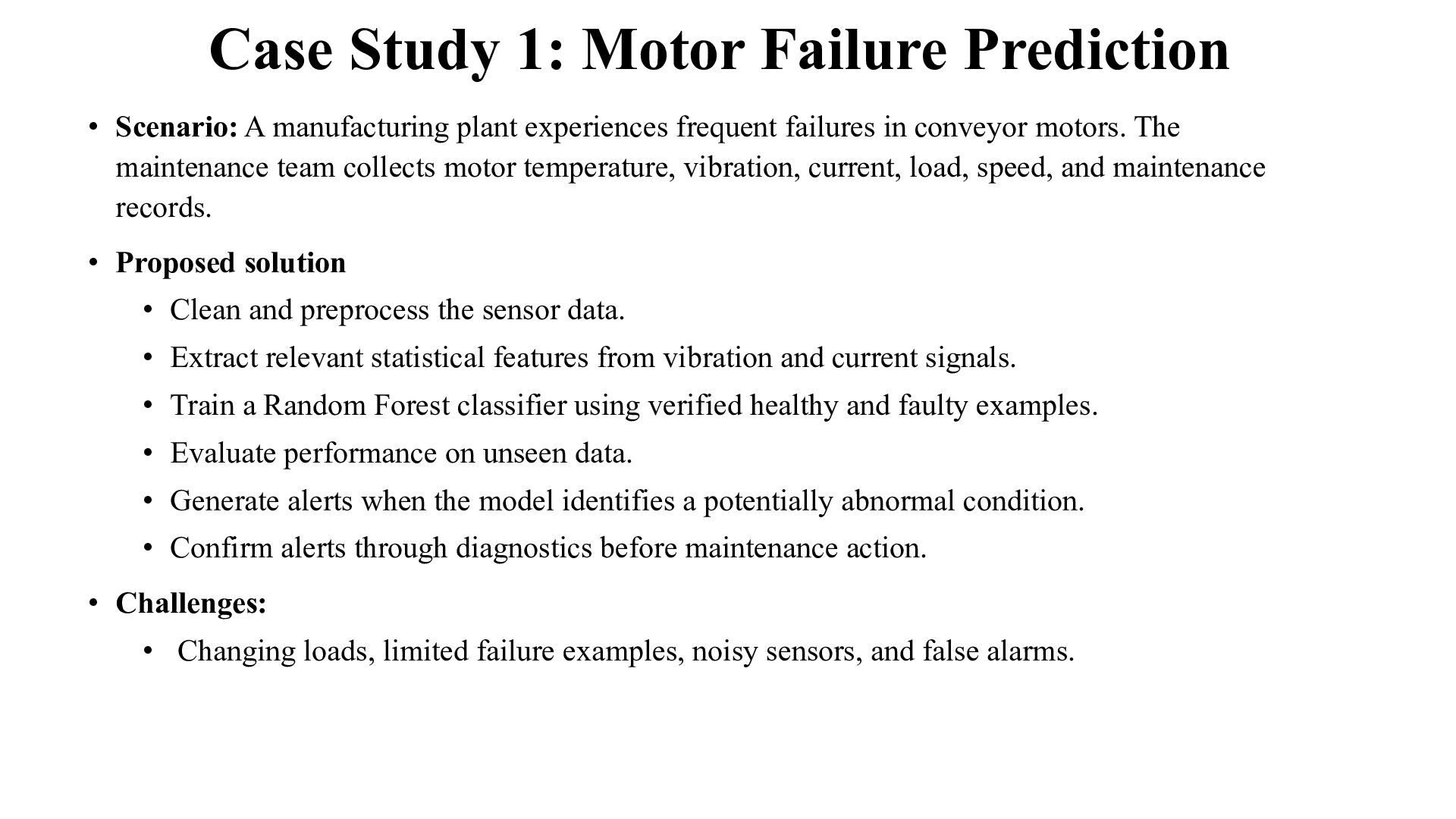
plant experiences frequent failures in conveyor motors. The maintenance team collects motor temperature, vibration, current, load, speed, and maintenance records. • Proposed solution • Clean and preprocess the sensor data. • Extract relevant statistical features from vibration and current signals. • Train a Random Forest classifier using verified healthy and faulty examples. • Evaluate performance on unseen data. • Generate alerts when the model identifies a potentially abnormal condition. • Confirm alerts through diagnostics before maintenance action. • Challenges: • Changing loads, limited failure examples, noisy sensors, and false alarms.
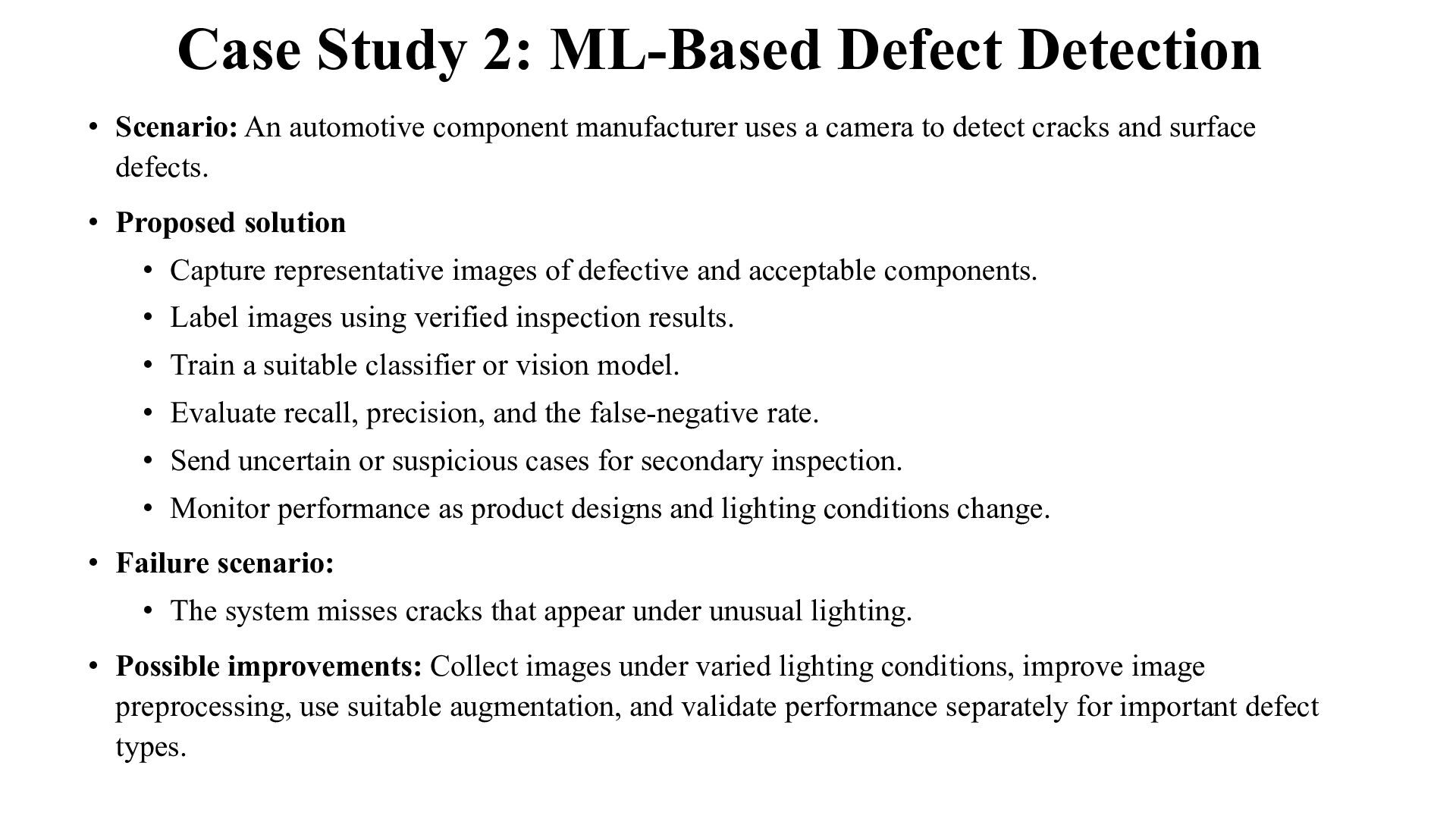
component manufacturer uses a camera to detect cracks and surface defects. • Proposed solution • Capture representative images of defective and acceptable components. • Label images using verified inspection results. • Train a suitable classifier or vision model. • Evaluate recall, precision, and the false-negative rate. • Send uncertain or suspicious cases for secondary inspection. • Monitor performance as product designs and lighting conditions change. • Failure scenario: • The system misses cracks that appear under unusual lighting. • Possible improvements: Collect images under varied lighting conditions, improve image preprocessing, use suitable augmentation, and validate performance separately for important defect types.
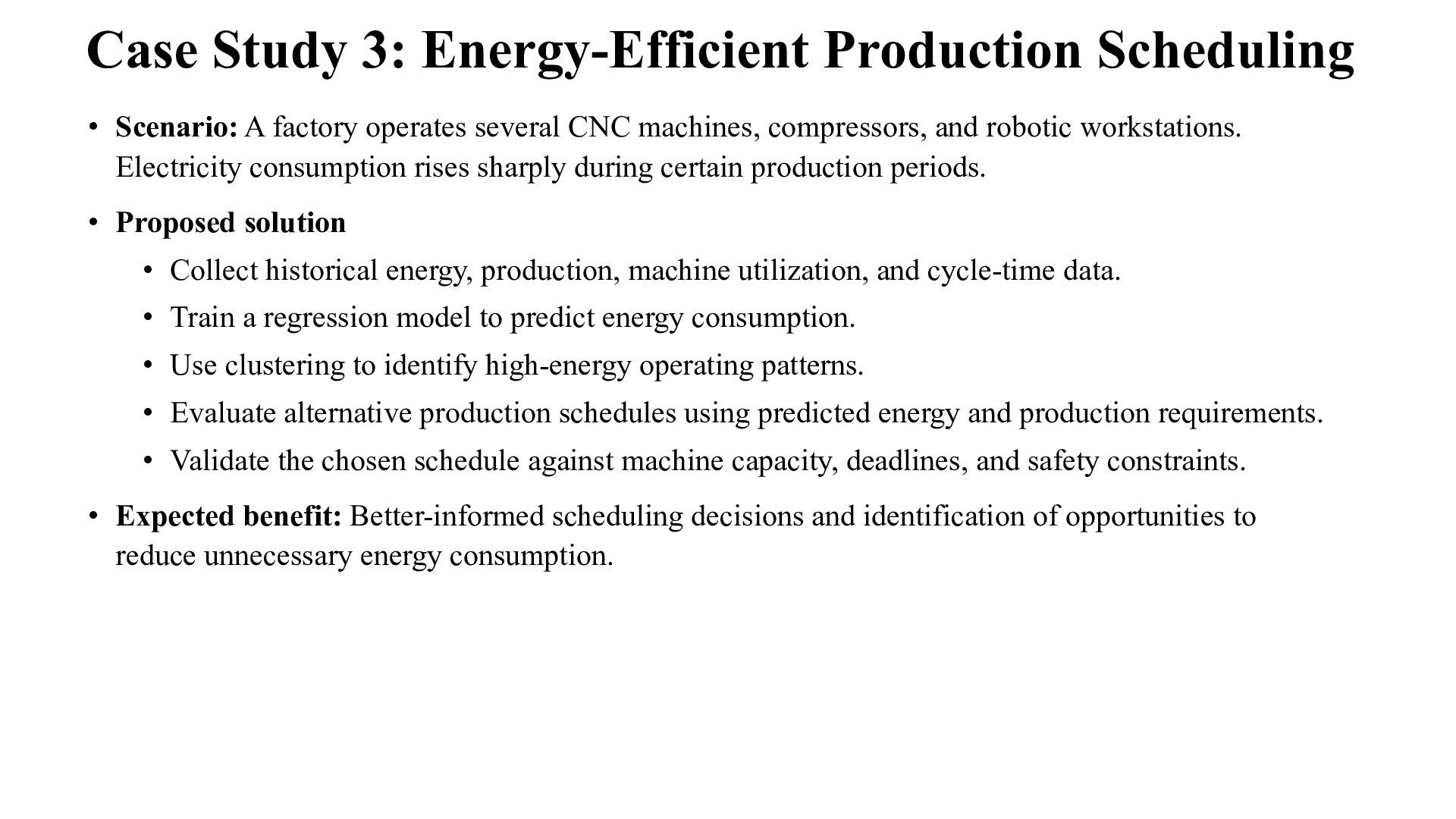
operates several CNC machines, compressors, and robotic workstations. Electricity consumption rises sharply during certain production periods. • Proposed solution • Collect historical energy, production, machine utilization, and cycle-time data. • Train a regression model to predict energy consumption. • Use clustering to identify high-energy operating patterns. • Evaluate alternative production schedules using predicted energy and production requirements. • Validate the chosen schedule against machine capacity, deadlines, and safety constraints. • Expected benefit: Better-informed scheduling decisions and identification of opportunities to reduce unnecessary energy consumption.
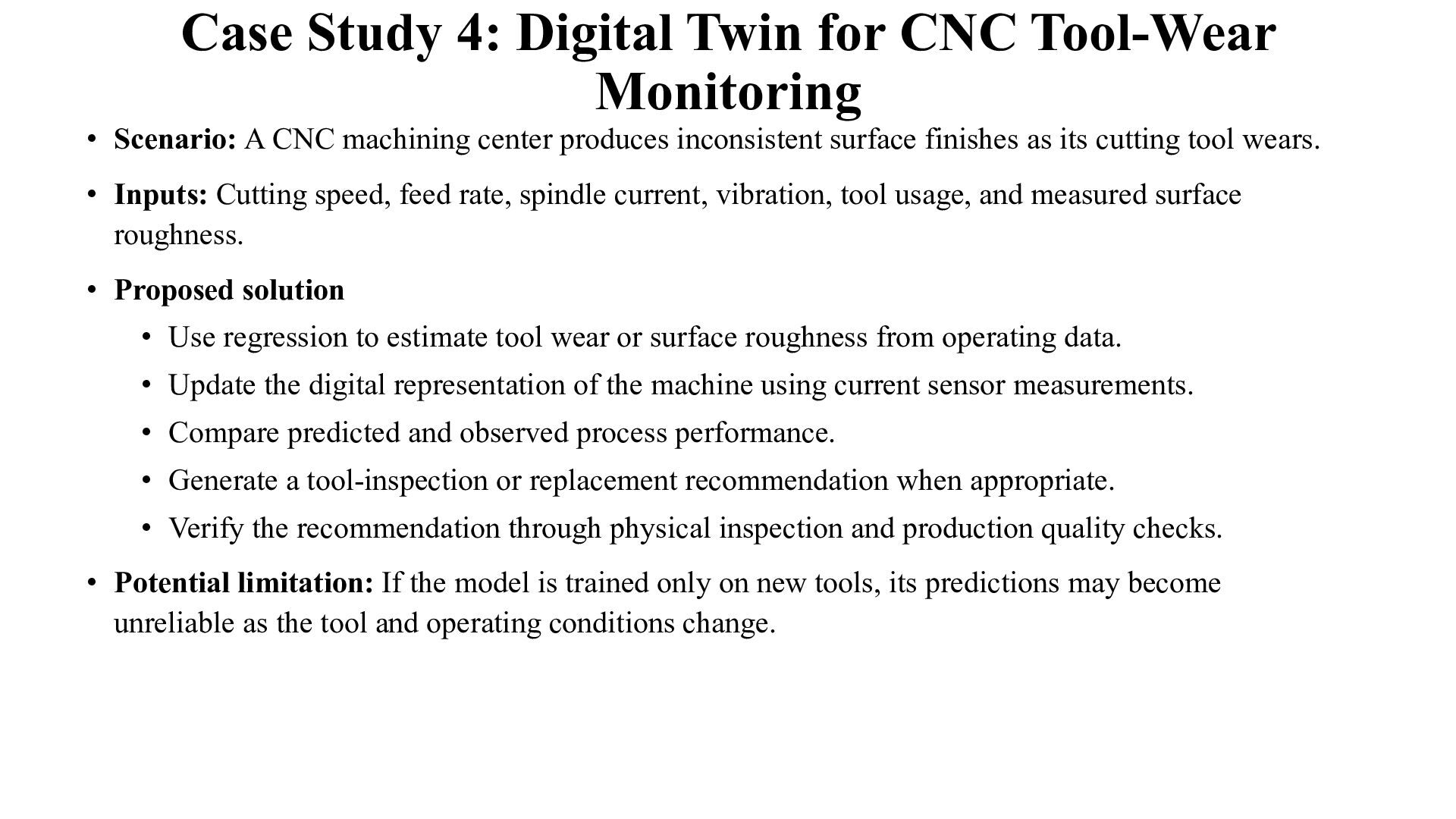
Scenario: A CNC machining center produces inconsistent surface finishes as its cutting tool wears. • Inputs: Cutting speed, feed rate, spindle current, vibration, tool usage, and measured surface roughness. • Proposed solution • Use regression to estimate tool wear or surface roughness from operating data. • Update the digital representation of the machine using current sensor measurements. • Compare predicted and observed process performance. • Generate a tool-inspection or replacement recommendation when appropriate. • Verify the recommendation through physical inspection and production quality checks. • Potential limitation: If the model is trained only on new tools, its predictions may become unreliable as the tool and operating conditions change.
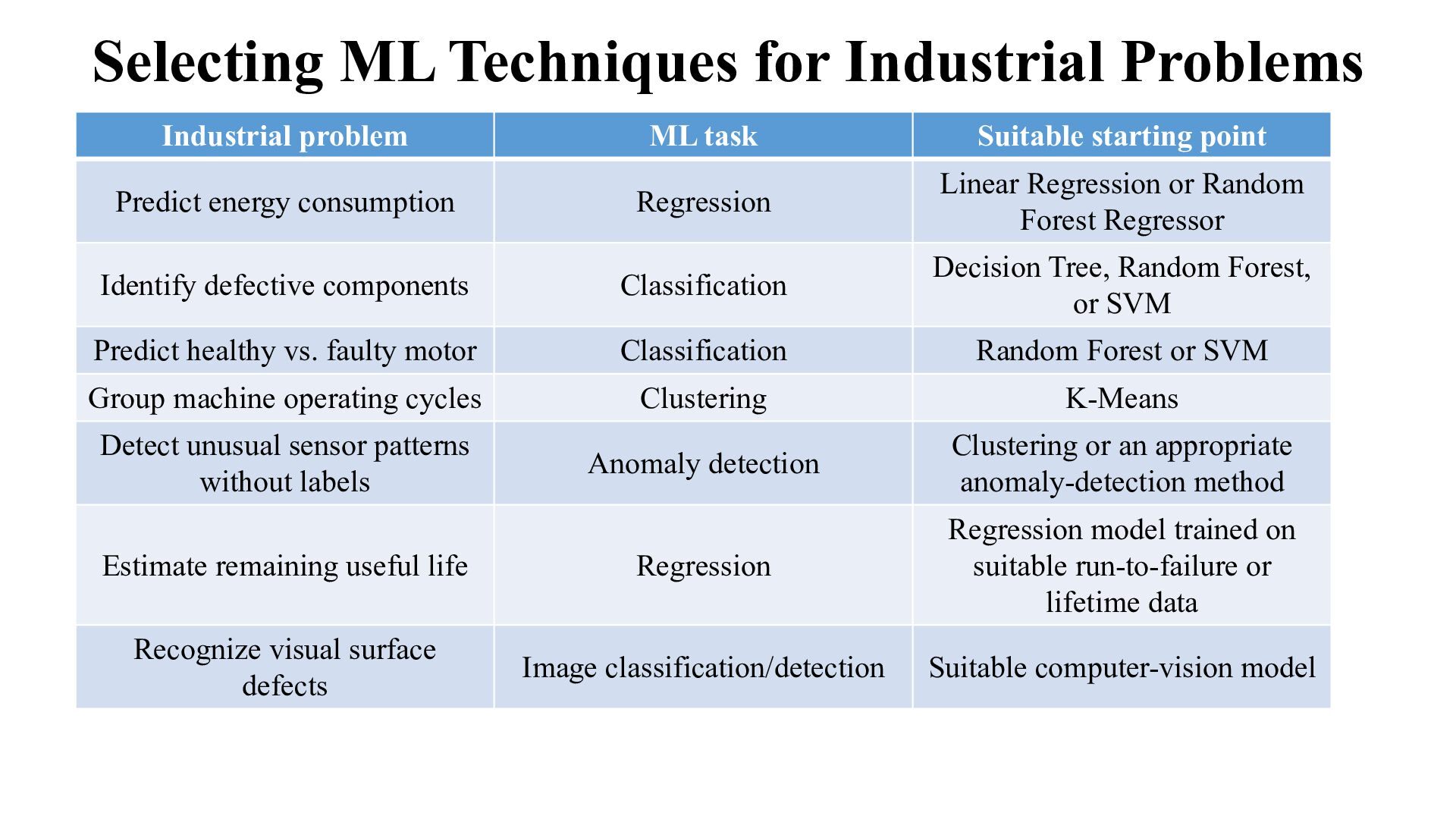
Suitable starting point Predict energy consumption Regression Linear Regression or Random Forest Regressor Identify defective components Classification Decision Tree, Random Forest, or SVM Predict healthy vs. faulty motor Classification Random Forest or SVM Group machine operating cycles Clustering K-Means Detect unusual sensor patterns without labels Anomaly detection Clustering or an appropriate anomaly-detection method Estimate remaining useful life Regression Regression model trained on suitable run-to-failure or lifetime data Recognize visual surface defects Image classification/detection Suitable computer-vision model
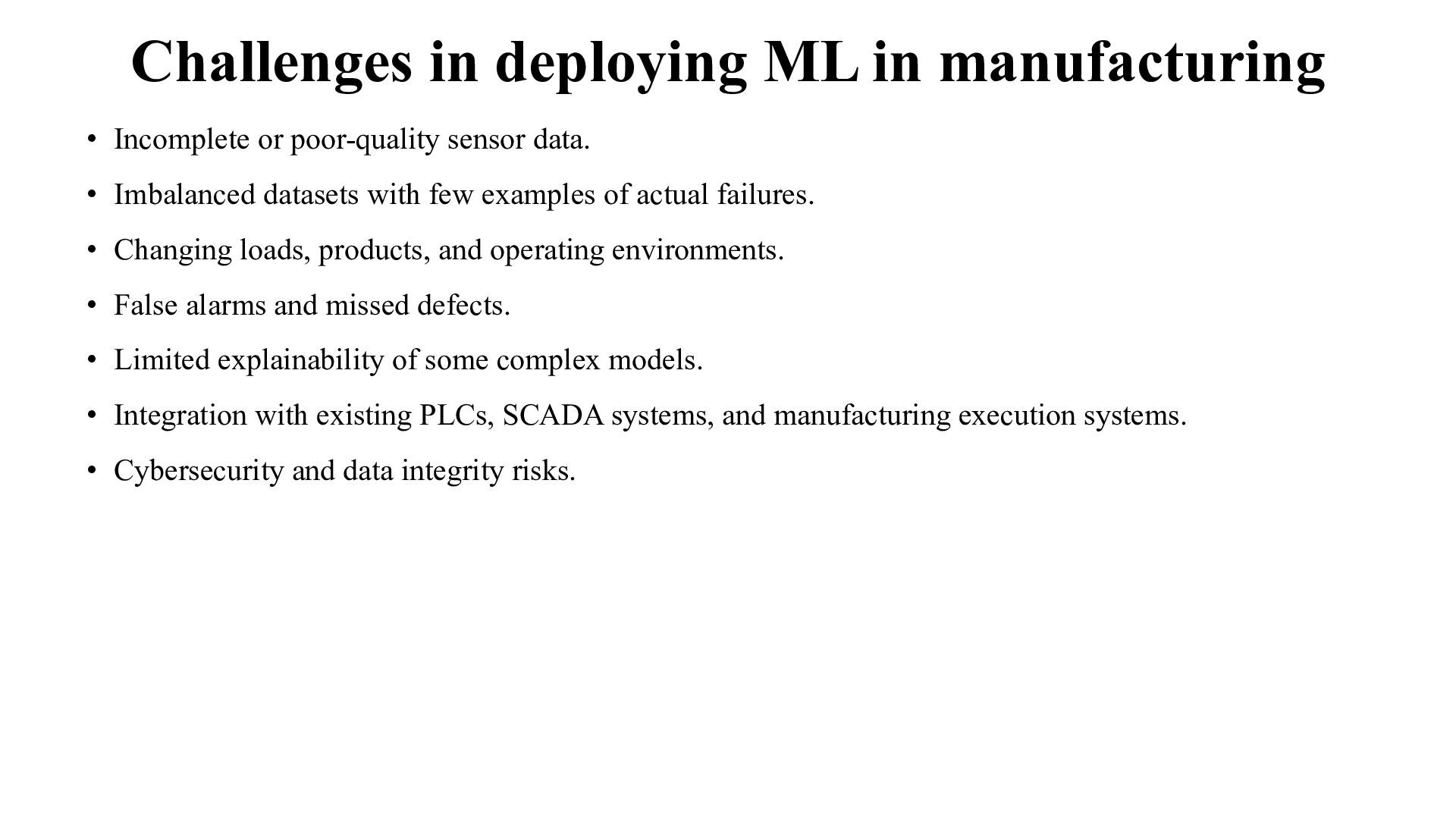
sensor data. • Imbalanced datasets with few examples of actual failures. • Changing loads, products, and operating environments. • False alarms and missed defects. • Limited explainability of some complex models. • Integration with existing PLCs, SCADA systems, and manufacturing execution systems. • Cybersecurity and data integrity risks.
digital twins of its production plants to plan and simulate manufacturing changes before implementing them physically. Its Virtual Factory initiative covers more than 30 production sites, according to a June 2025 company announcement. • Problem: Introducing a new vehicle model may require changes to assembly lines, robot movements, equipment placement, and material flow. Testing every change directly on a live production line is costly and time-consuming. • How the digital twin helps • Create a digital representation of the factory, equipment, and production layout. • Incorporate relevant engineering, logistics, and equipment data. • Simulate the proposed production changes virtually. • Check robot movement, potential collisions, and material flow. • Correct problems in the virtual environment before modifying the real factory.
contribute • Predict production bottlenecks using historical production data. • Estimate cycle times and equipment utilization. • Identify patterns associated with delays or quality problems. • Support comparison of alternative production schedules. • These ML applications are potential extensions of the digital-twin workflow, not a claim that every step in BMW's Virtual Factory uses ML. • Benefits: Earlier identification of design problems, fewer physical trials, and improved production planning.
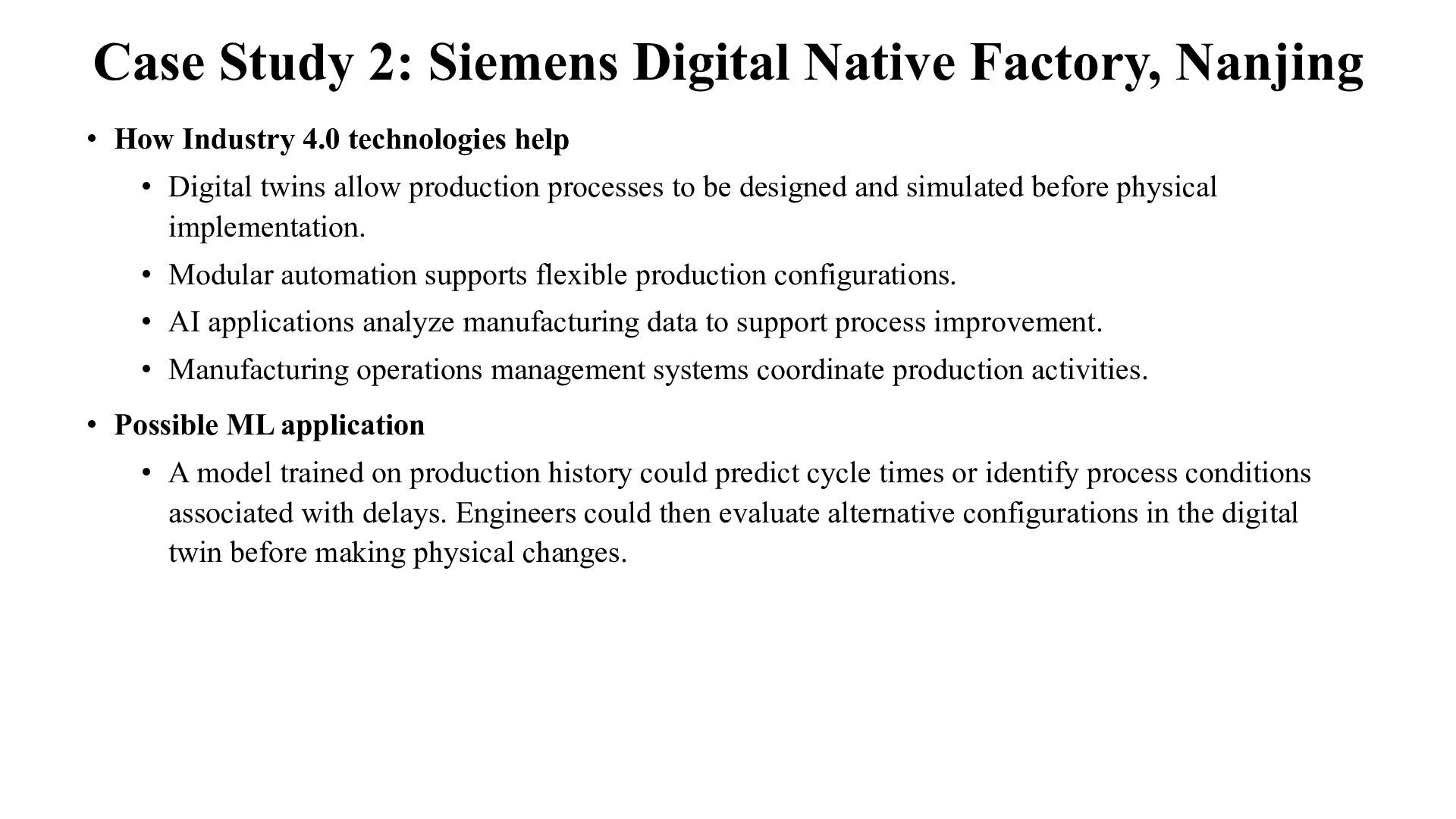
Nanjing facility uses digital planning, end-to-end digital twins, modular automation, and AI applications in manufacturing. The company reported that, compared with 2022, by 2024 its initiative had reduced lead times by 78%, shortened time-to-market by 33%, and increased productivity by 14%. These are company-reported results for the facility and initiative, not guaranteed outcomes for every factory. • Manufacturing challenge: Producing a variety of industrial control products in relatively small batches requires flexible production systems and careful coordination.
Industry 4.0 technologies help • Digital twins allow production processes to be designed and simulated before physical implementation. • Modular automation supports flexible production configurations. • AI applications analyze manufacturing data to support process improvement. • Manufacturing operations management systems coordinate production activities. • Possible ML application • A model trained on production history could predict cycle times or identify process conditions associated with delays. Engineers could then evaluate alternative configurations in the digital twin before making physical changes.
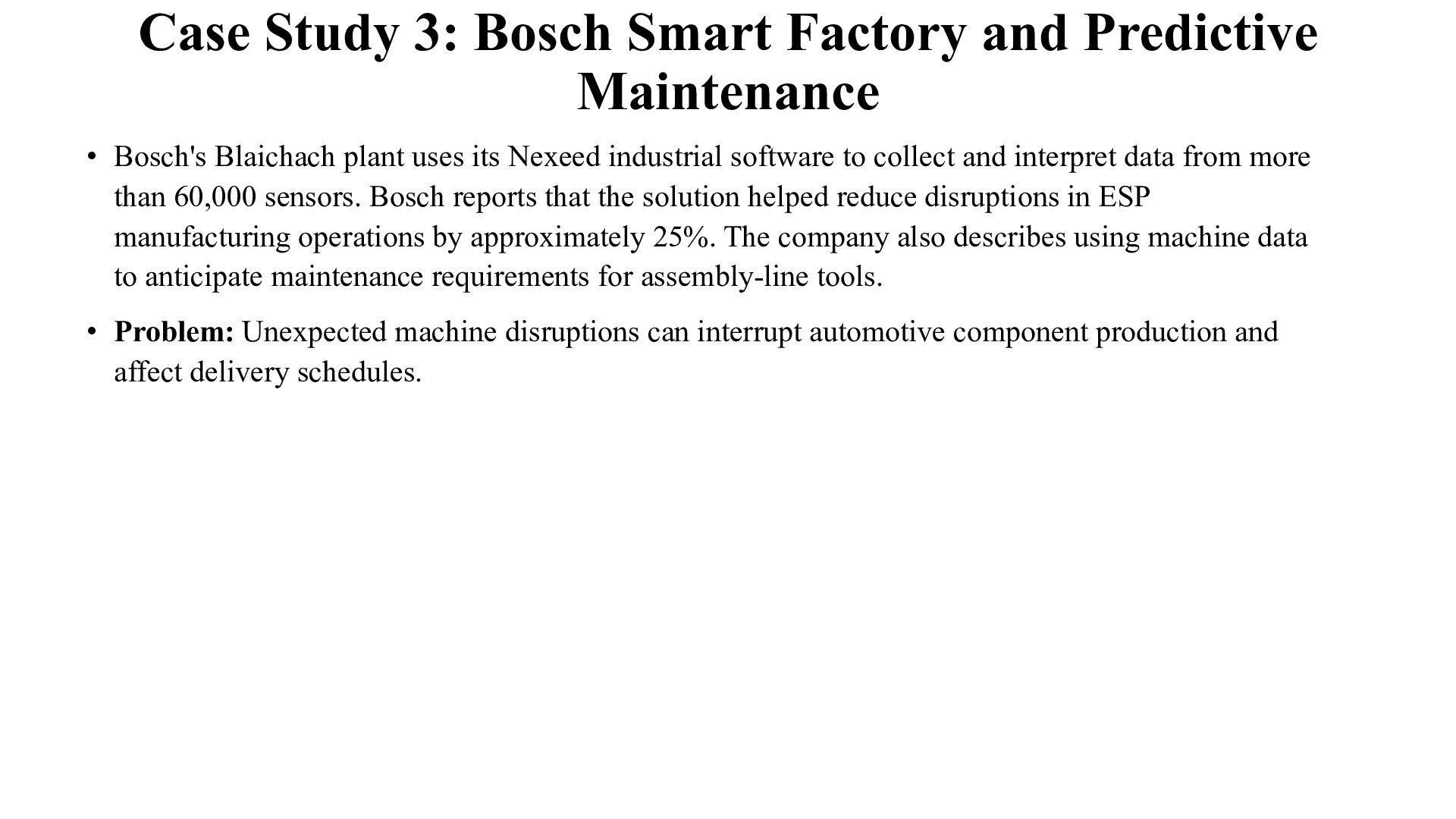
Bosch's Blaichach plant uses its Nexeed industrial software to collect and interpret data from more than 60,000 sensors. Bosch reports that the solution helped reduce disruptions in ESP manufacturing operations by approximately 25%. The company also describes using machine data to anticipate maintenance requirements for assembly-line tools. • Problem: Unexpected machine disruptions can interrupt automotive component production and affect delivery schedules.
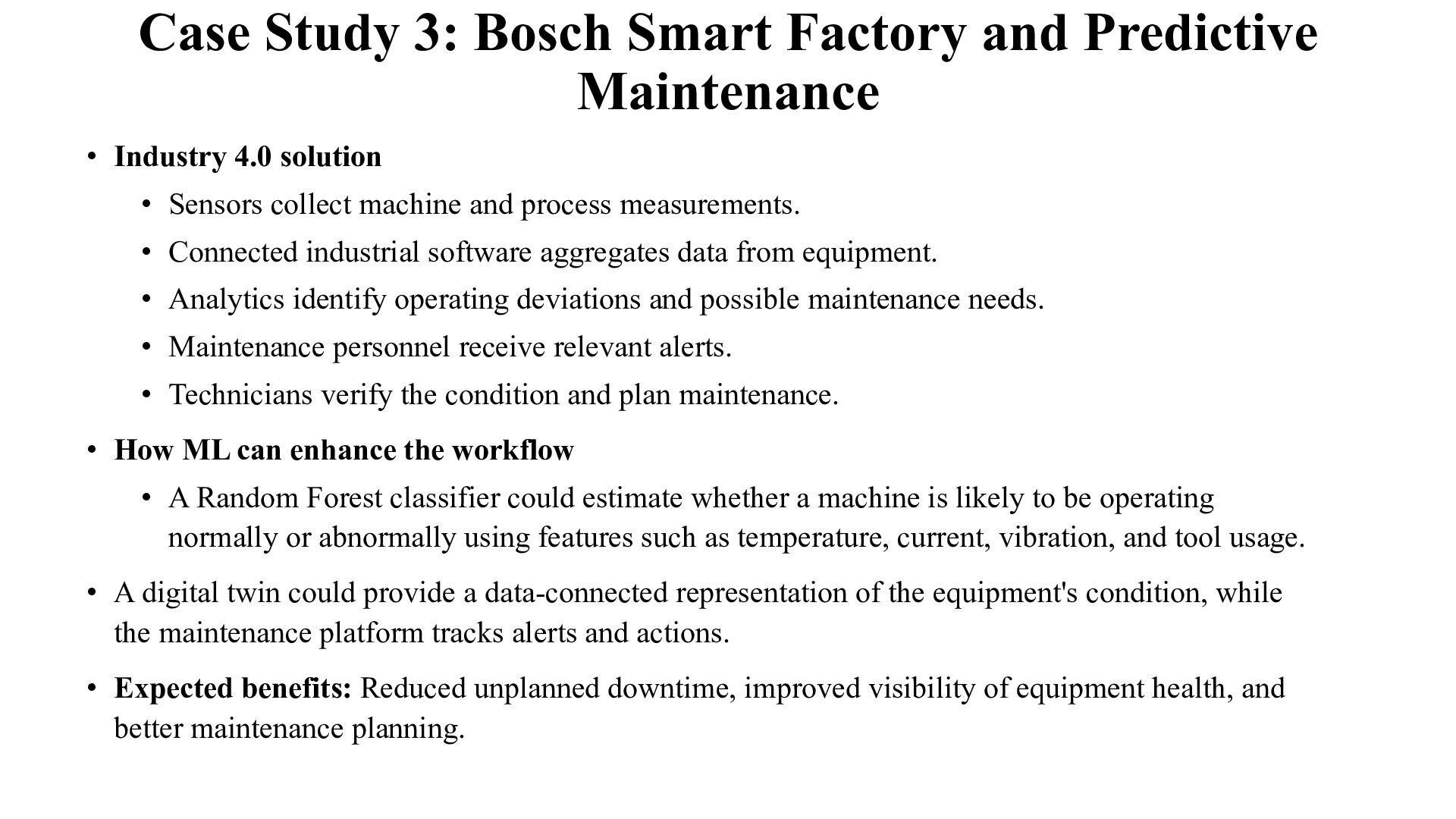
Industry 4.0 solution • Sensors collect machine and process measurements. • Connected industrial software aggregates data from equipment. • Analytics identify operating deviations and possible maintenance needs. • Maintenance personnel receive relevant alerts. • Technicians verify the condition and plan maintenance. • How ML can enhance the workflow • A Random Forest classifier could estimate whether a machine is likely to be operating normally or abnormally using features such as temperature, current, vibration, and tool usage. • A digital twin could provide a data-connected representation of the equipment's condition, while the maintenance platform tracks alerts and actions. • Expected benefits: Reduced unplanned downtime, improved visibility of equipment health, and better maintenance planning.
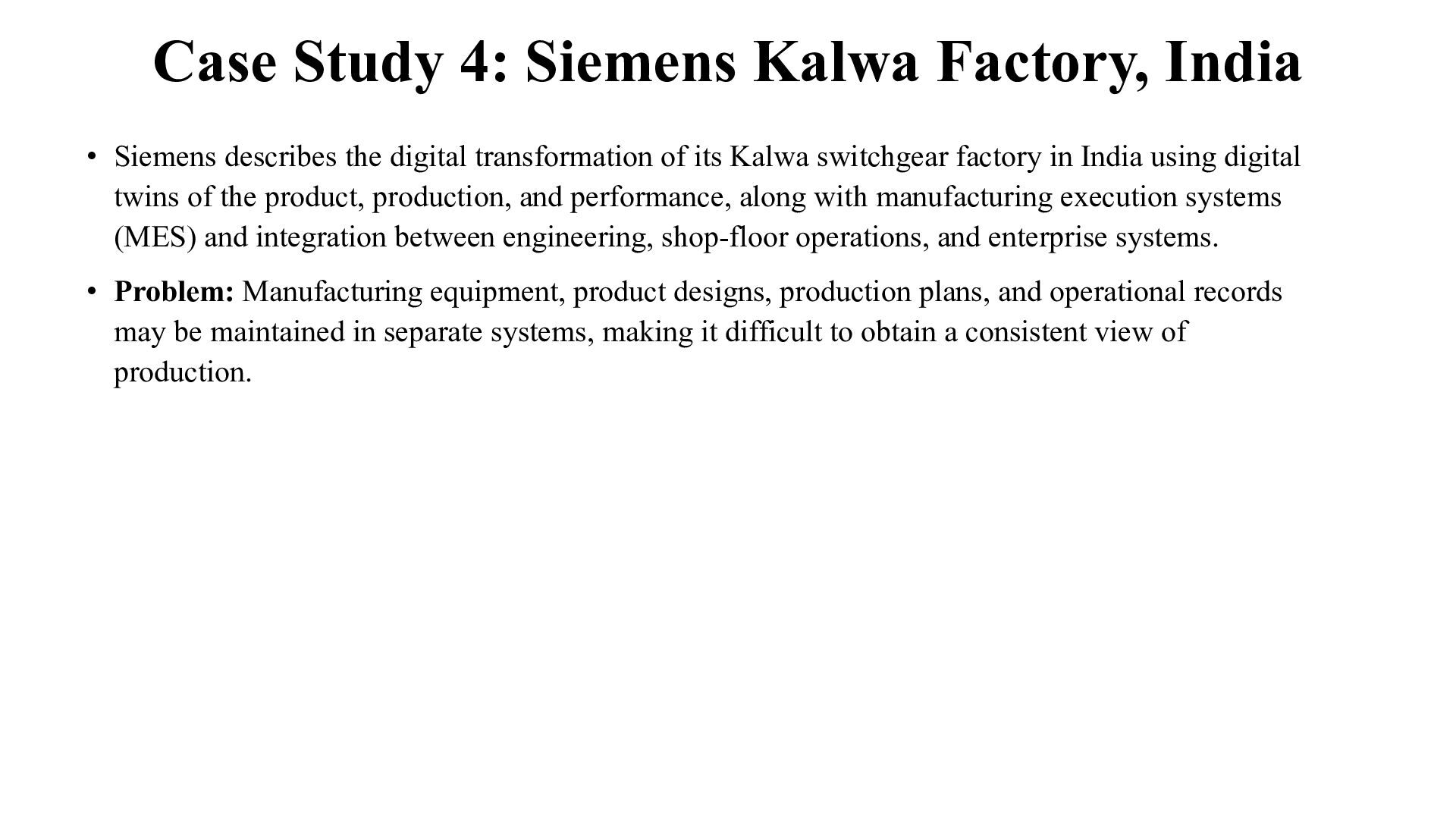
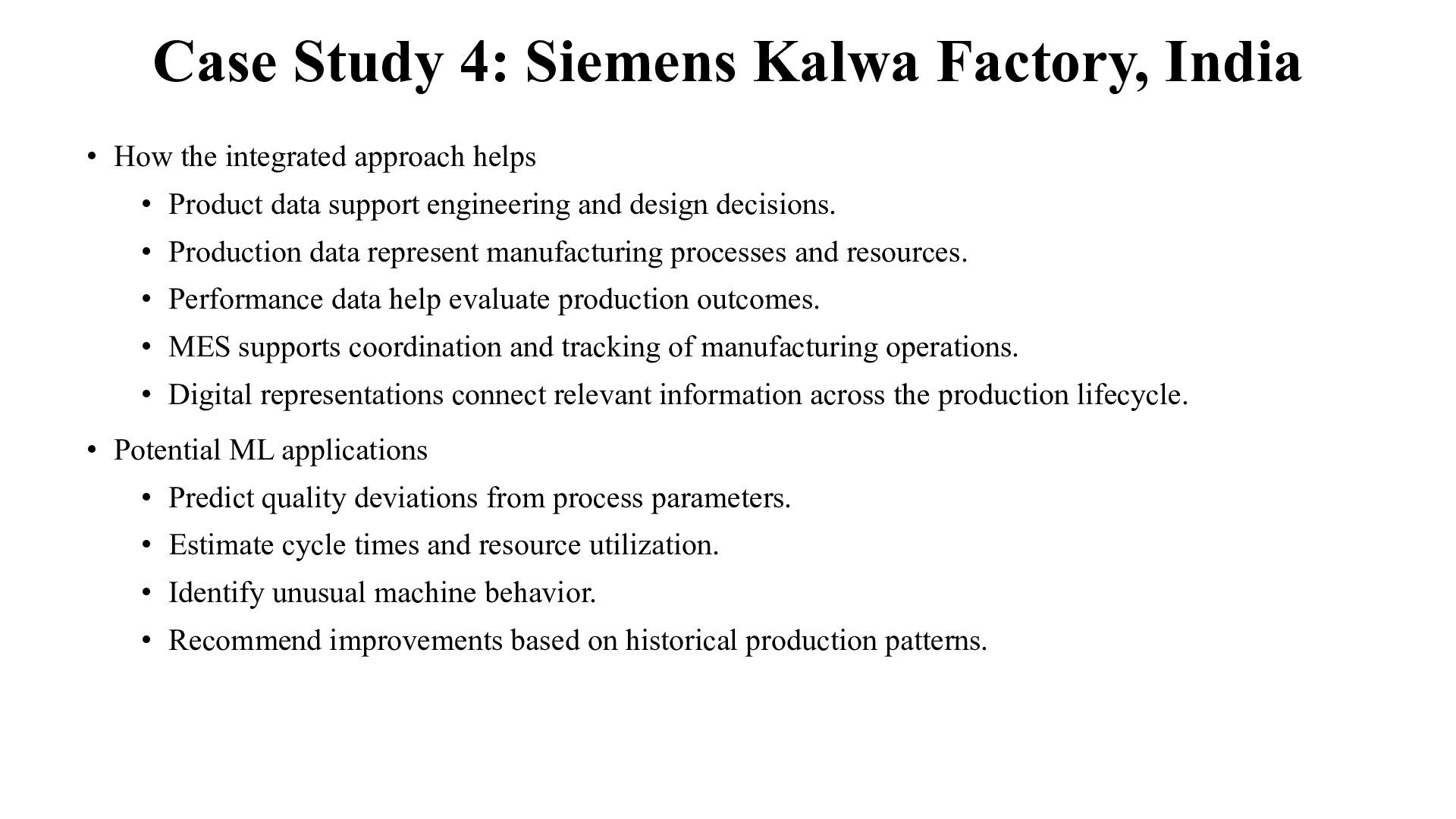
the digital transformation of its Kalwa switchgear factory in India using digital twins of the product, production, and performance, along with manufacturing execution systems (MES) and integration between engineering, shop-floor operations, and enterprise systems. • Problem: Manufacturing equipment, product designs, production plans, and operational records may be maintained in separate systems, making it difficult to obtain a consistent view of production.
integrated approach helps • Product data support engineering and design decisions. • Production data represent manufacturing processes and resources. • Performance data help evaluate production outcomes. • MES supports coordination and tracking of manufacturing operations. • Digital representations connect relevant information across the production lifecycle. • Potential ML applications • Predict quality deviations from process parameters. • Estimate cycle times and resource utilization. • Identify unusual machine behavior. • Recommend improvements based on historical production patterns.
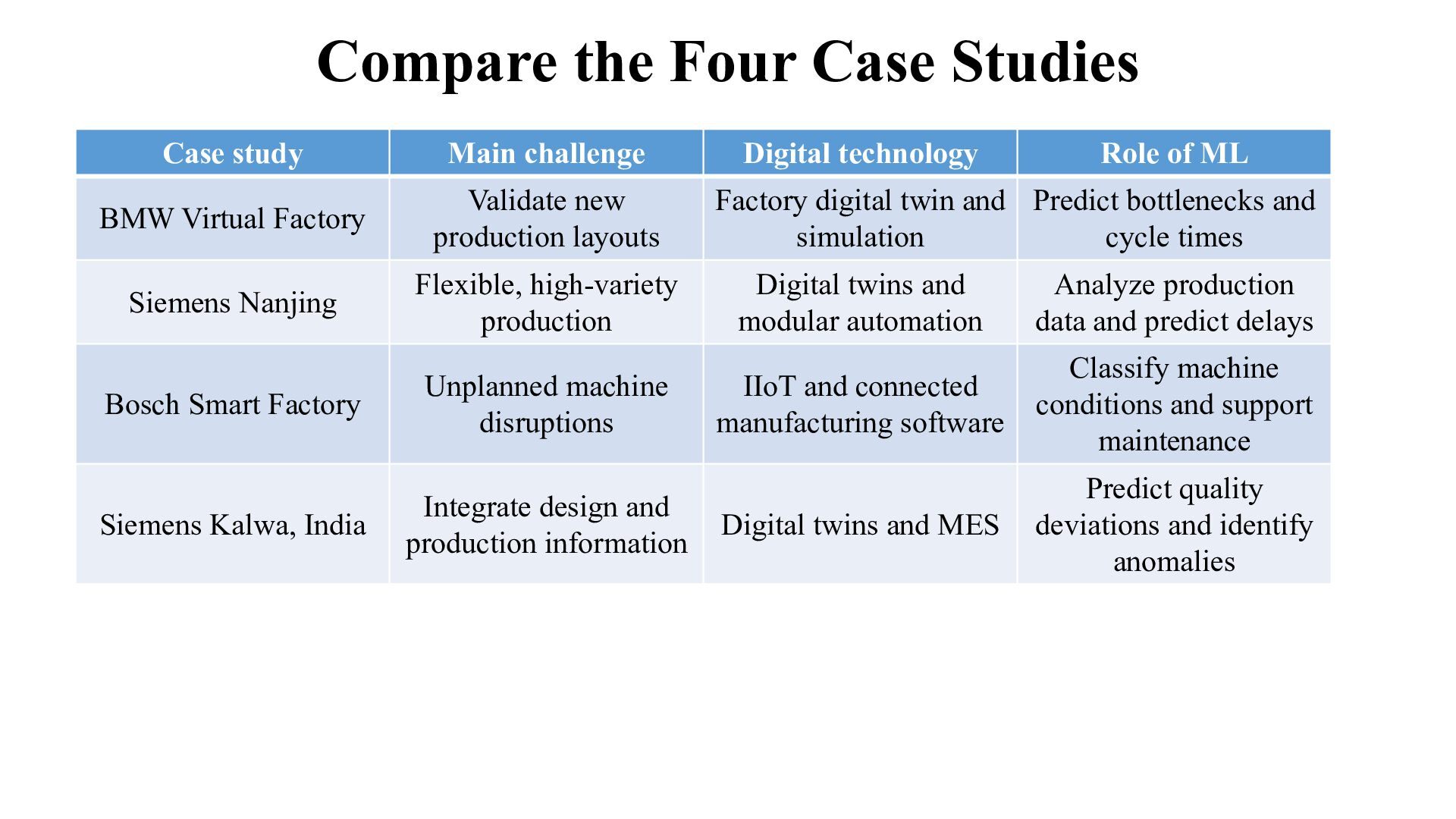
technology Role of ML BMW Virtual Factory Validate new production layouts Siemens Nanjing Flexible, high-variety production Digital twins and modular automation Analyze production data and predict delays Bosch Smart Factory Unplanned machine disruptions IIoT and connected manufacturing software Classify machine conditions and support maintenance Siemens Kalwa, India Integrate design and production information Digital twins and MES Predict quality deviations and identify anomalies Factory digital twin and Predict bottlenecks and simulation cycle times


 madhuri28
 mutomasa
 arnoknobbe
 pawan_pharm
 juanmartin2026
 cbtlibrary
 terasawat
 masakiokuda
 coderdojojapan
 uranoken
 tasusu
 stephenakadiri
 csswizardry
 bermonpainter
 mayunak
 ks91
 reverentgeek
 colly
 rakko
 addyosmani
 keithpitt
 thirion
 aleyda