Viscous damping: hull damping for moored vessel...

Viscous damping: hull damping for moored vessels, in all six degrees of freedom

MIKE 21 Mooring Analysis adds constant, linear and quadratic hull damping for each degree of freedom. Resonant motions, line loads and fender loads can now be calibrated against decay tests, model tests or measurements. Also new: fender deflection output. Pairs with Infragravity waves and Moving Vessels. Release 2027.

MIKE Powered by DHI PRO

November 26, 2026

Annual Pro sale · Save $30

Have presentations of your own?

Share with private links, password protection, and more control over your work.

Transcript

10 slides
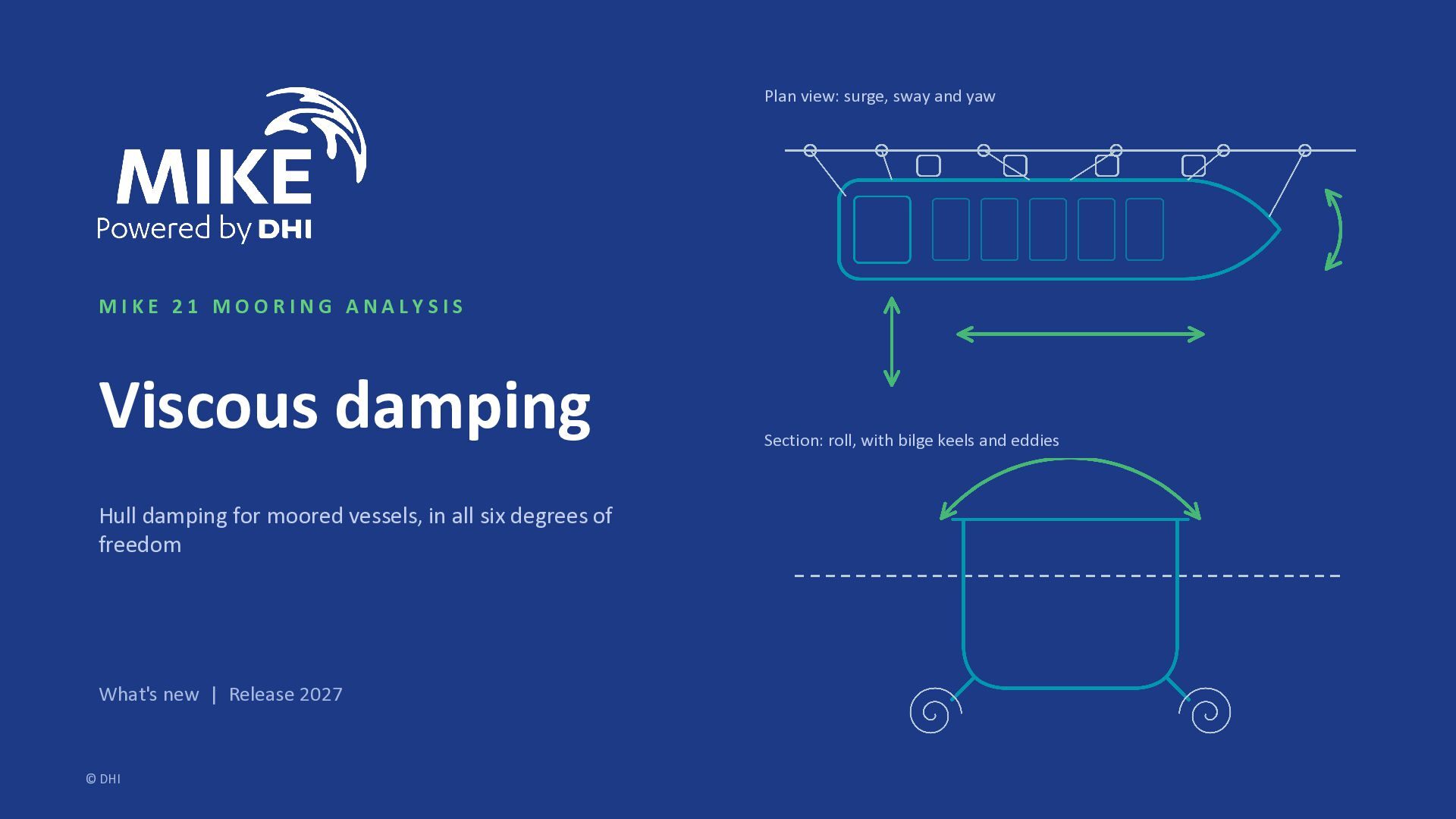
  1. Plan view: surge, sway and yaw MIKE 21 MOORING ANALYSIS

    Viscous damping Hull damping for moored vessels, in all six degrees of freedom What's new | Release 2027 © DHI Section: roll, with bilge keels and eddies
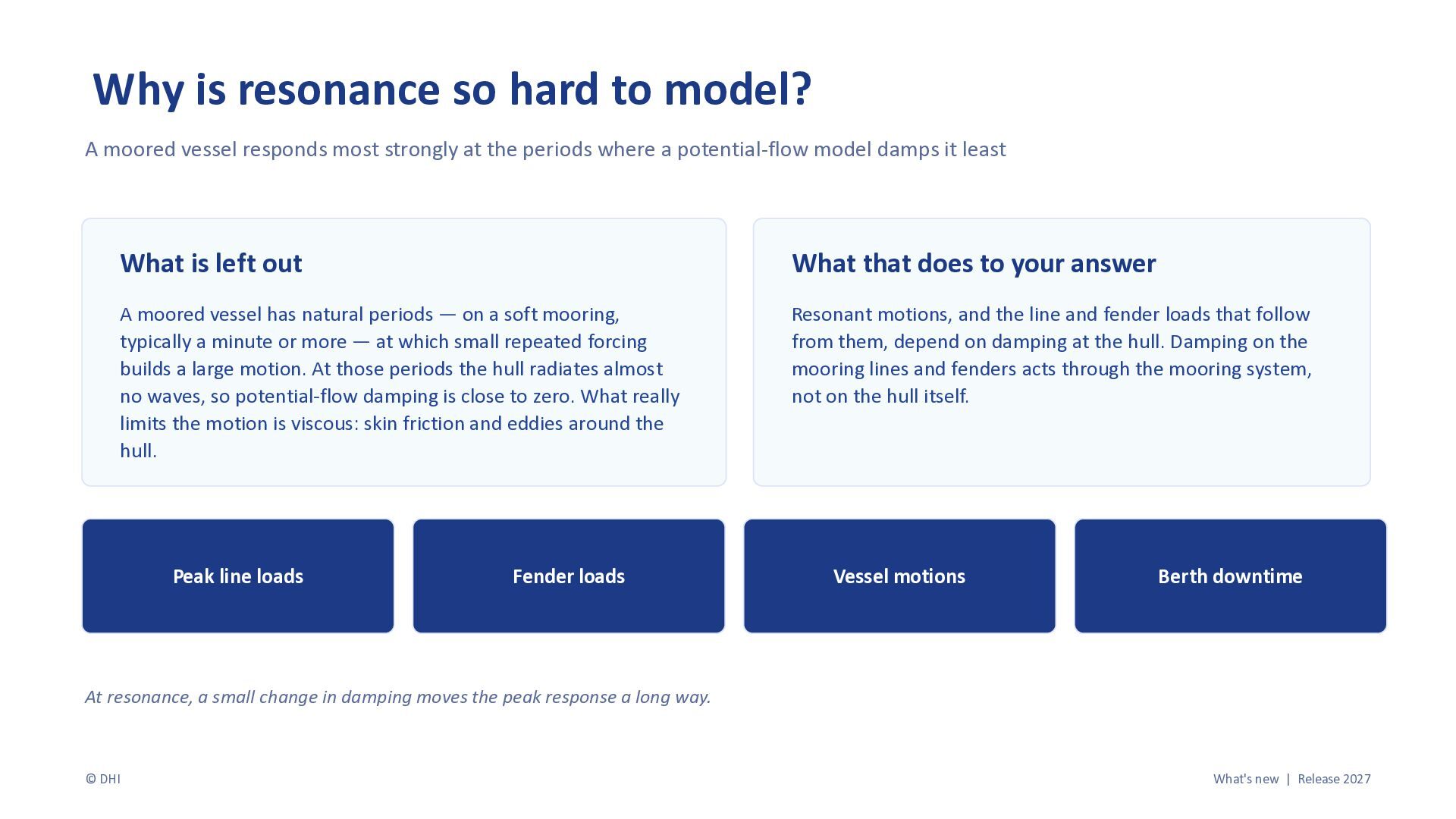
  2. Why is resonance so hard to model? A moored vessel

    responds most strongly at the periods where a potential-flow model damps it least What is left out What that does to your answer A moored vessel has natural periods — on a soft mooring, typically a minute or more — at which small repeated forcing builds a large motion. At those periods the hull radiates almost no waves, so potential-flow damping is close to zero. What really limits the motion is viscous: skin friction and eddies around the hull. Resonant motions, and the line and fender loads that follow from them, depend on damping at the hull. Damping on the mooring lines and fenders acts through the mooring system, not on the hull itself. Peak line loads Fender loads Vessel motions Berth downtime At resonance, a small change in damping moves the peak response a long way. © DHI What's new | Release 2027
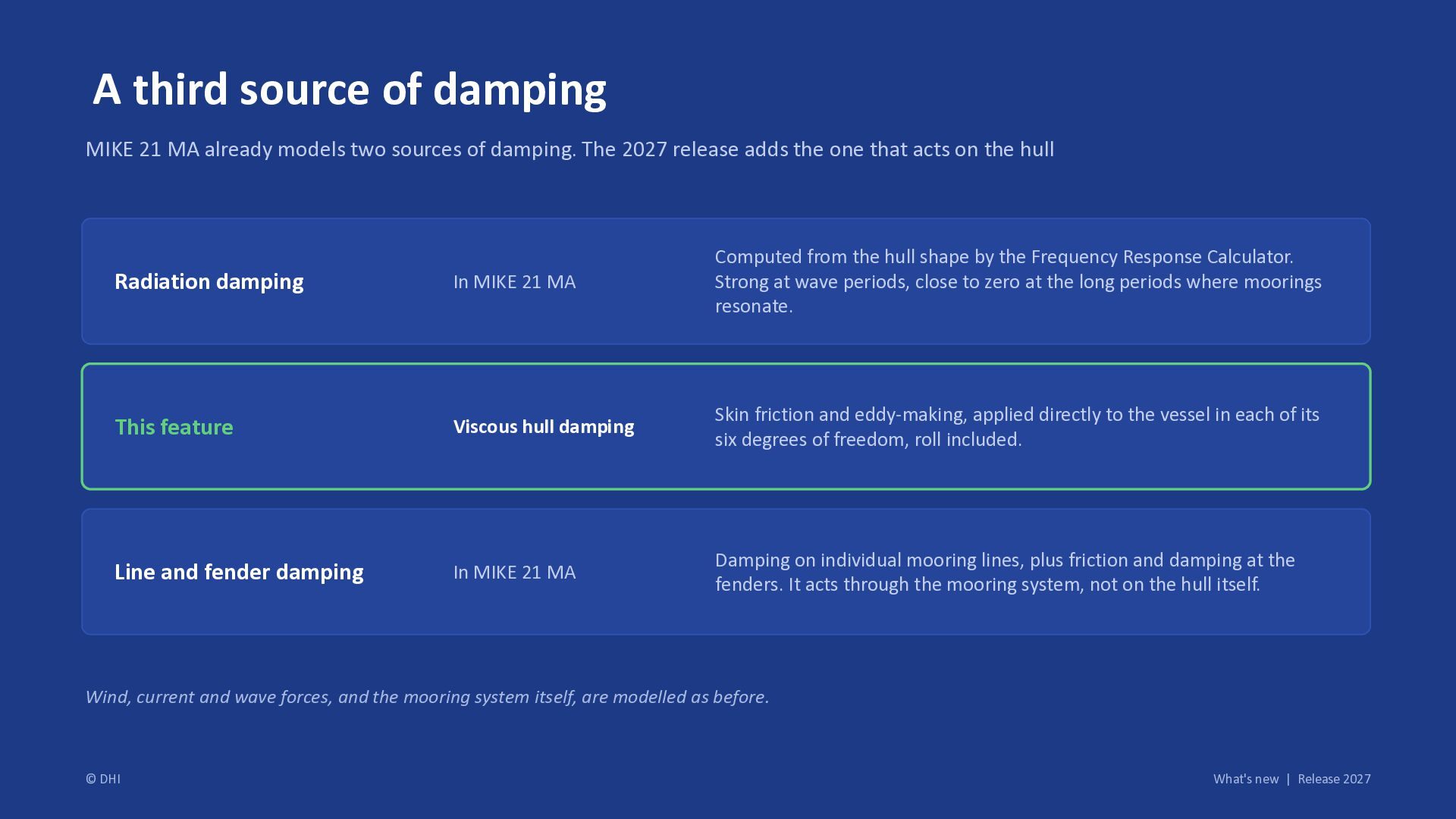
  3. A third source of damping MIKE 21 MA already models

    two sources of damping. The 2027 release adds the one that acts on the hull Radiation damping In MIKE 21 MA Computed from the hull shape by the Frequency Response Calculator. Strong at wave periods, close to zero at the long periods where moorings resonate. This feature Viscous hull damping Skin friction and eddy-making, applied directly to the vessel in each of its six degrees of freedom, roll included. Line and fender damping In MIKE 21 MA Damping on individual mooring lines, plus friction and damping at the fenders. It acts through the mooring system, not on the hull itself. Wind, current and wave forces, and the mooring system itself, are modelled as before. © DHI What's new | Release 2027
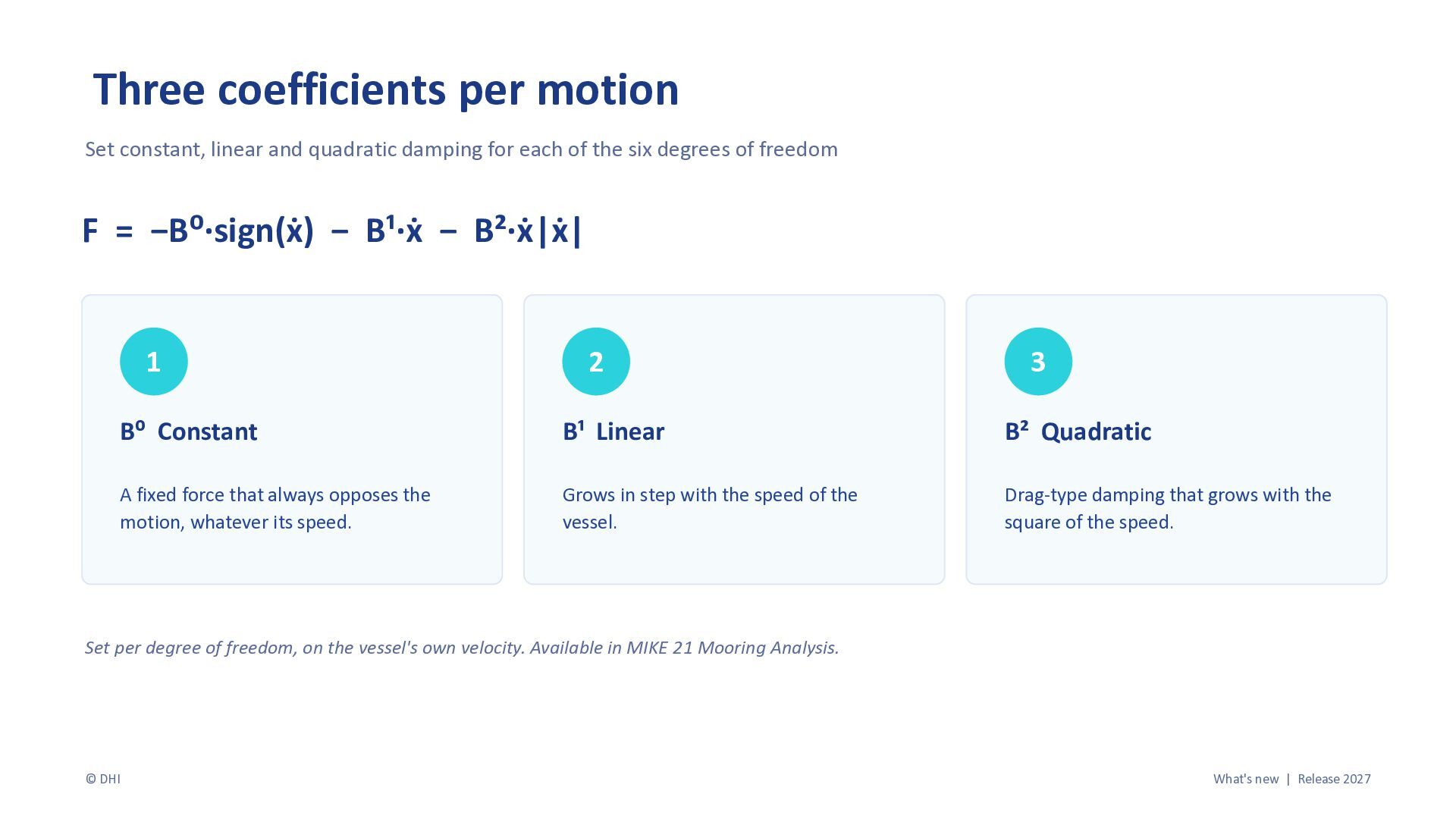
  4. Three coefficients per motion Set constant, linear and quadratic damping

    for each of the six degrees of freedom F = −B⁰·sign(ẋ) − B¹·ẋ − B²·ẋ|ẋ| 1 2 3 B⁰ Constant B¹ Linear B² Quadratic A fixed force that always opposes the motion, whatever its speed. Grows in step with the speed of the vessel. Drag-type damping that grows with the square of the speed. Set per degree of freedom, on the vessel's own velocity. Available in MIKE 21 Mooring Analysis. © DHI What's new | Release 2027
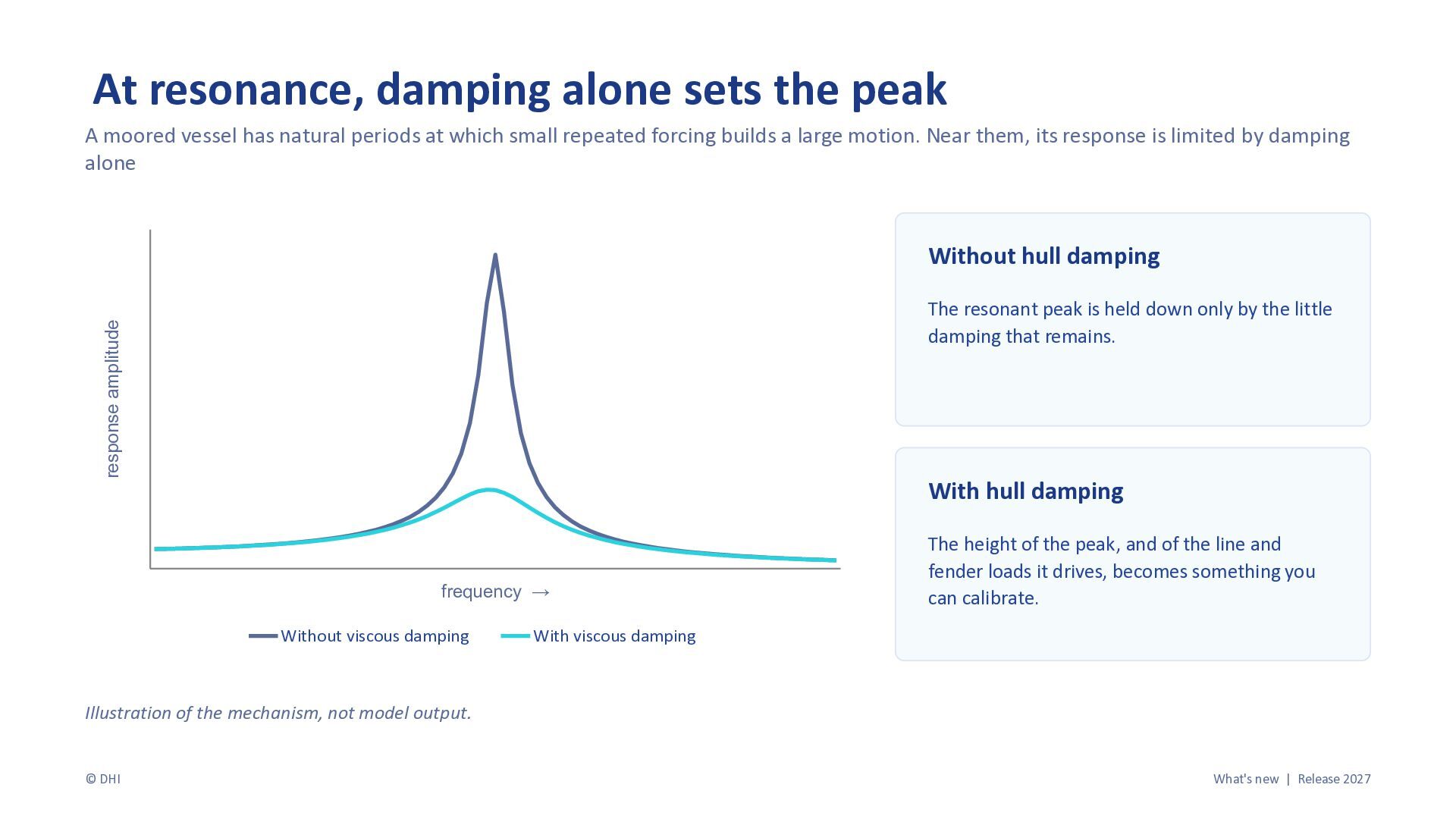
  5. At resonance, damping alone sets the peak A moored vessel

    has natural periods at which small repeated forcing builds a large motion. Near them, its response is limited by damping alone 18 Without hull damping 16 The resonant peak is held down only by the little damping that remains. response amplitude 14 12 10 8 6 With hull damping 4 2 0 frequency → Without viscous damping The height of the peak, and of the line and fender loads it drives, becomes something you can calibrate. With viscous damping Illustration of the mechanism, not model output. © DHI What's new | Release 2027
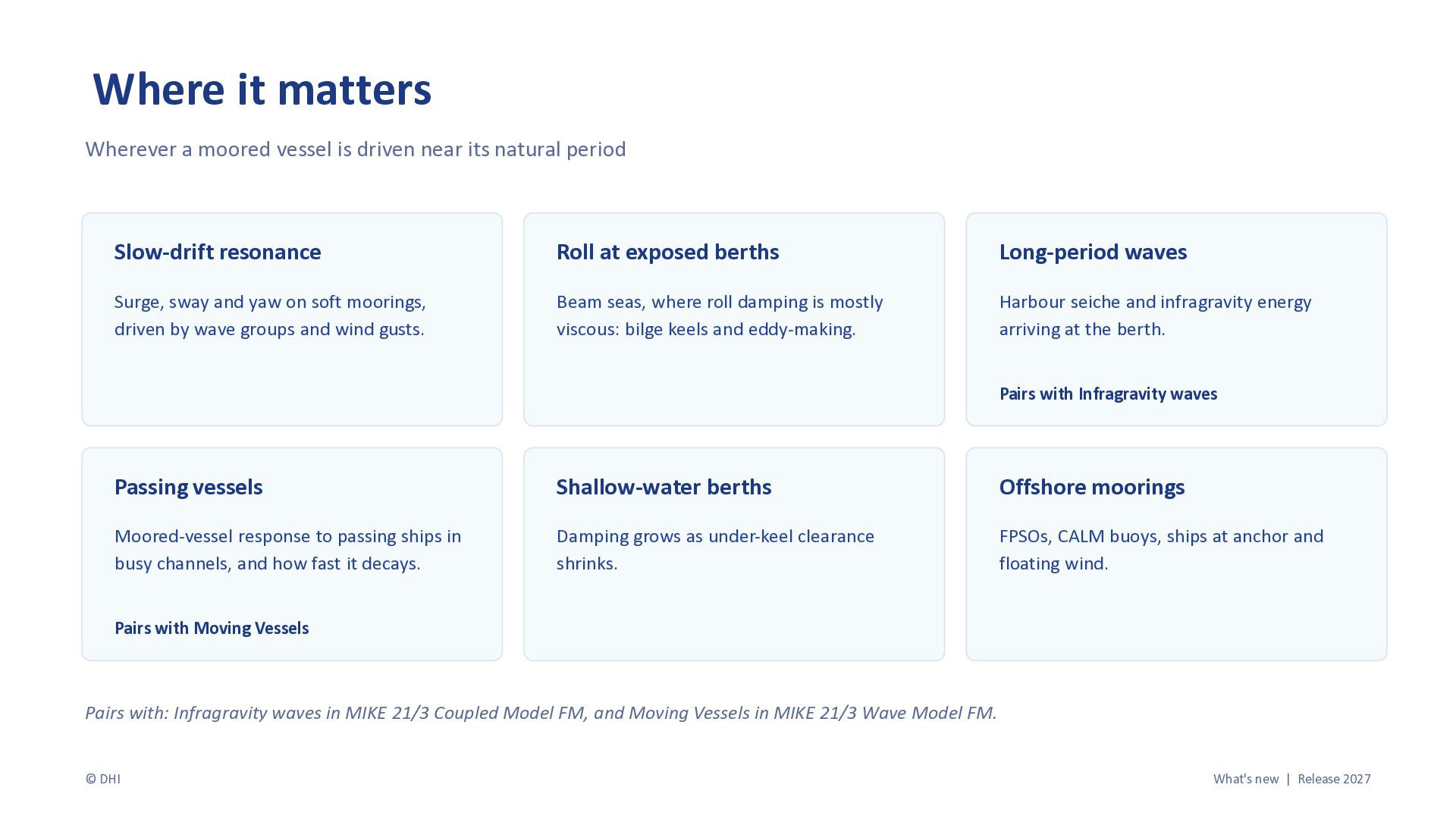
  6. Where it matters Wherever a moored vessel is driven near

    its natural period Slow-drift resonance Roll at exposed berths Long-period waves Surge, sway and yaw on soft moorings, driven by wave groups and wind gusts. Beam seas, where roll damping is mostly viscous: bilge keels and eddy-making. Harbour seiche and infragravity energy arriving at the berth. Pairs with Infragravity waves Passing vessels Shallow-water berths Offshore moorings Moored-vessel response to passing ships in busy channels, and how fast it decays. Damping grows as under-keel clearance shrinks. FPSOs, CALM buoys, ships at anchor and floating wind. Pairs with Moving Vessels Pairs with: Infragravity waves in MIKE 21/3 Coupled Model FM, and Moving Vessels in MIKE 21/3 Wave Model FM. © DHI What's new | Release 2027
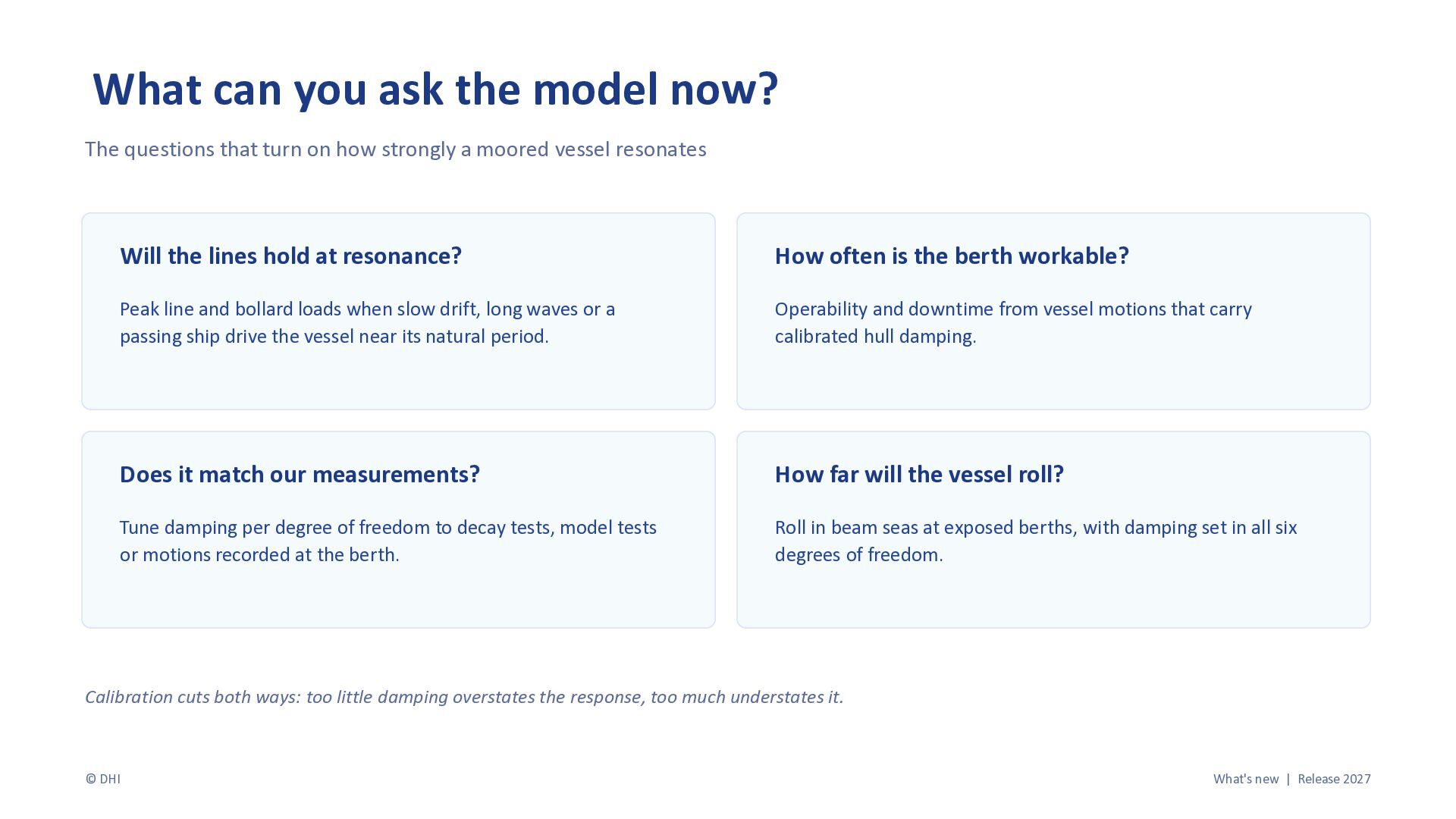
  7. What can you ask the model now? The questions that

    turn on how strongly a moored vessel resonates Will the lines hold at resonance? How often is the berth workable? Peak line and bollard loads when slow drift, long waves or a passing ship drive the vessel near its natural period. Operability and downtime from vessel motions that carry calibrated hull damping. Does it match our measurements? How far will the vessel roll? Tune damping per degree of freedom to decay tests, model tests or motions recorded at the berth. Roll in beam seas at exposed berths, with damping set in all six degrees of freedom. Calibration cuts both ways: too little damping overstates the response, too much understates it. © DHI What's new | Release 2027
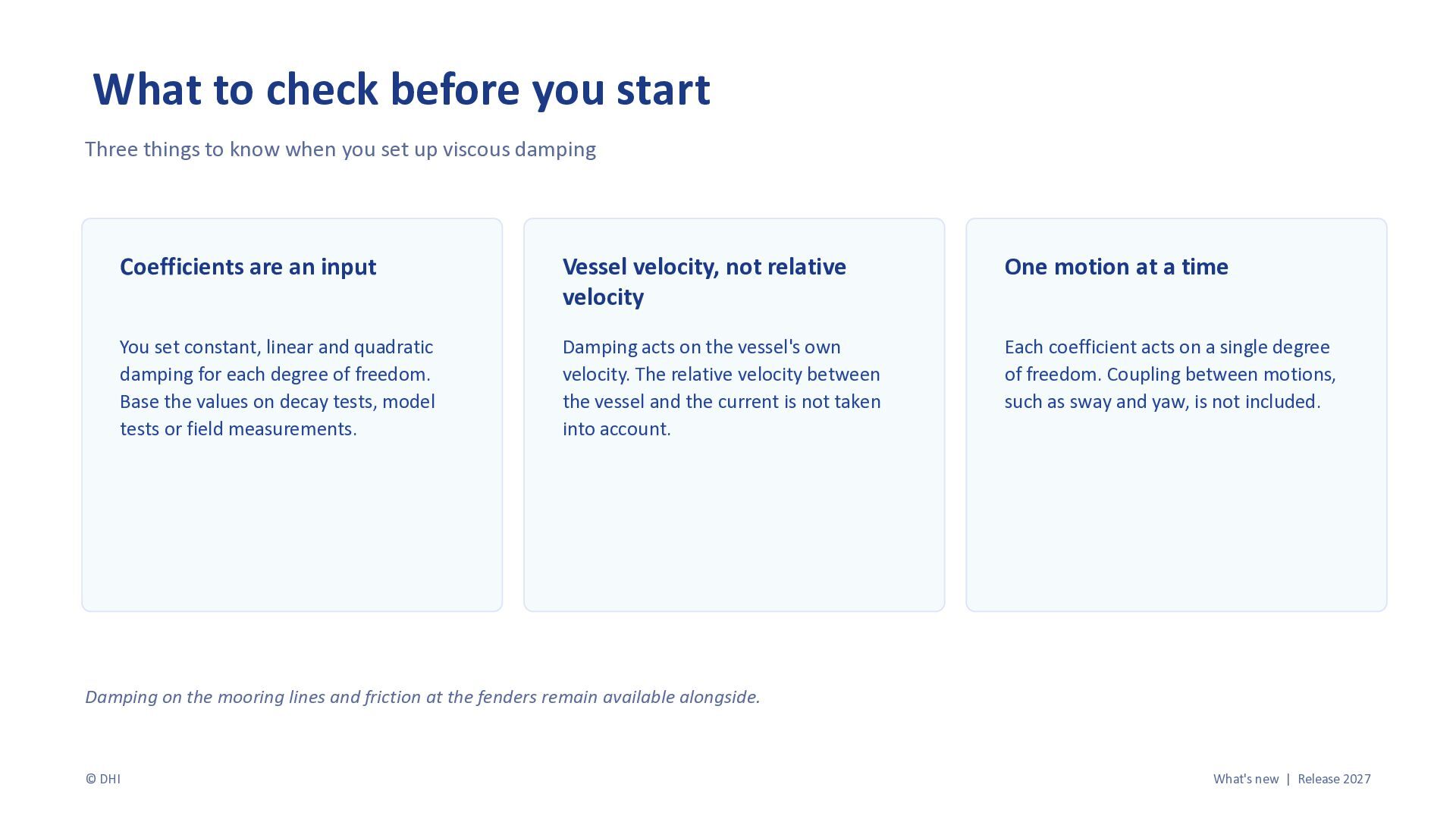
  8. What to check before you start Three things to know

    when you set up viscous damping Coefficients are an input Vessel velocity, not relative velocity One motion at a time You set constant, linear and quadratic damping for each degree of freedom. Base the values on decay tests, model tests or field measurements. Damping acts on the vessel's own velocity. The relative velocity between the vessel and the current is not taken into account. Each coefficient acts on a single degree of freedom. Coupling between motions, such as sway and yaw, is not included. Damping on the mooring lines and friction at the fenders remain available alongside. © DHI What's new | Release 2027
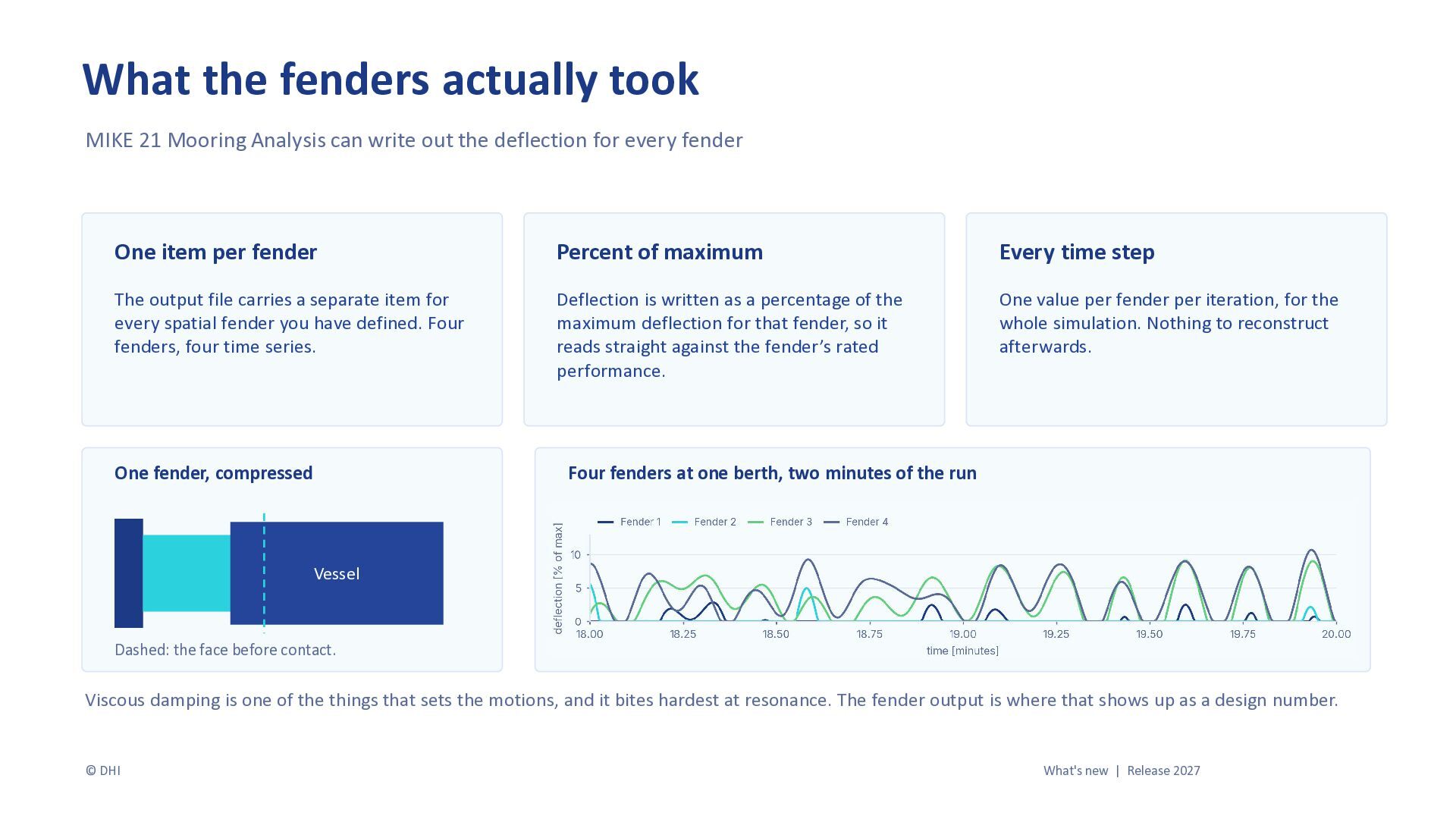
  9. What the fenders actually took MIKE 21 Mooring Analysis can

    write out the deflection for every fender One item per fender Percent of maximum Every time step The output file carries a separate item for every spatial fender you have defined. Four fenders, four time series. Deflection is written as a percentage of the maximum deflection for that fender, so it reads straight against the fender’s rated performance. One value per fender per iteration, for the whole simulation. Nothing to reconstruct afterwards. One fender, compressed Four fenders at one berth, two minutes of the run Vessel Dashed: the face before contact. Viscous damping is one of the things that sets the motions, and it bites hardest at resonance. The fender output is where that shows up as a design number. © DHI What's new | Release 2027
  10. Hull damping for moored vessels, in all six degrees of

    freedom • Constant, linear and quadratic damping, set for each degree of freedom • Calibrate against decay tests, model tests or field measurements • Resonant motions, line loads and downtime estimates MIKE 21 Mooring Analysis | Release 2027 © DHI What's new | Release 2027

More Decks by MIKE Powered by DHI

Other Decks in Science