Share
Embed
OAuth 2.0: Theory and Practice
An introduction to the theory and practice of the OAuth 2.0 Authorization Framework
Pedro Felix
November 16, 2012
Transcript
34 slides
-
whoami • Daniel Correia • Fast learner Junior Software Engineer
• Passionate about everything Web-related • Currently working with the SAPO SDB team • Pedro Félix • Teacher at ISEL – the engineering school of the Lisbon Polytechnic Institute • Independent consultant working with the SAPO SDB team 2 -
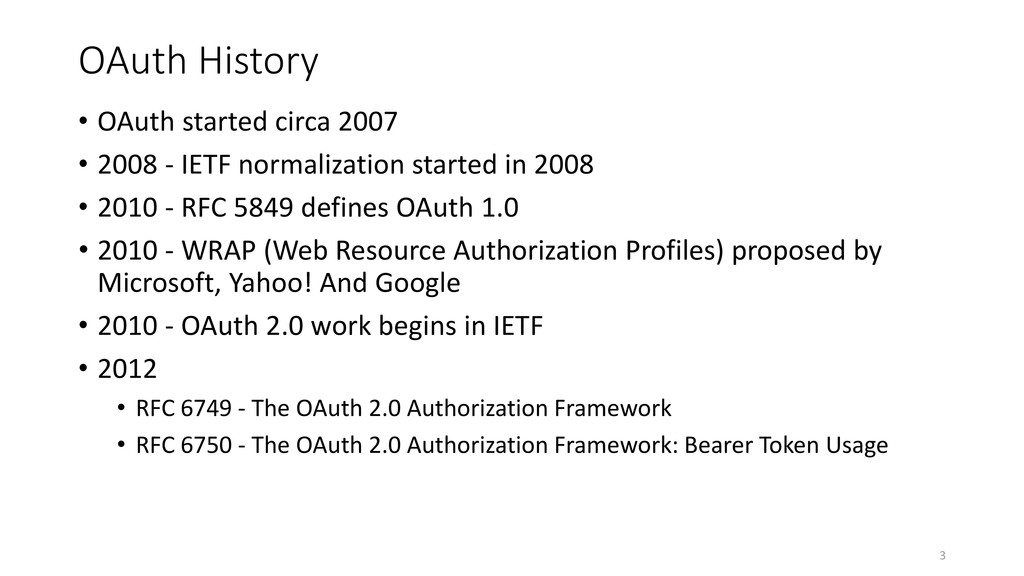
OAuth History • OAuth started circa 2007 • 2008 -
IETF normalization started in 2008 • 2010 - RFC 5849 defines OAuth 1.0 • 2010 - WRAP (Web Resource Authorization Profiles) proposed by Microsoft, Yahoo! And Google • 2010 - OAuth 2.0 work begins in IETF • 2012 • RFC 6749 - The OAuth 2.0 Authorization Framework • RFC 6750 - The OAuth 2.0 Authorization Framework: Bearer Token Usage 3 -
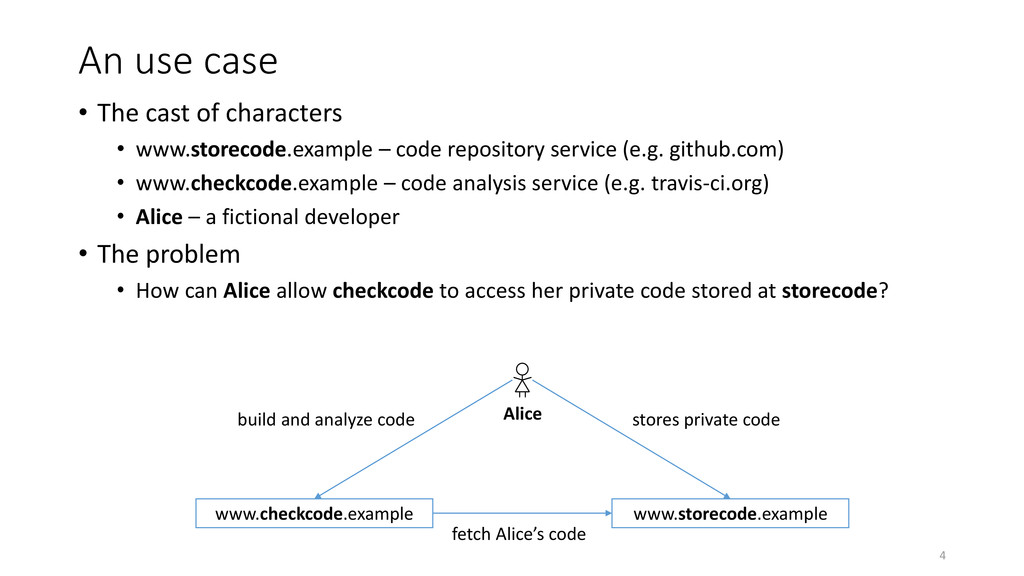
An use case • The cast of characters • www.storecode.example
– code repository service (e.g. github.com) • www.checkcode.example – code analysis service (e.g. travis-ci.org) • Alice – a fictional developer • The problem • How can Alice allow checkcode to access her private code stored at storecode? 4 www.checkcode.example www.storecode.example stores private code build and analyze code fetch Alice’s code Alice -
The password anti-pattern • A solution: Alice shares her password
with checkcode • Problems: • Unrestricted access – checkcode has all of Alice’s permissions • read and write on all code repositories, issues, wiki, ... • No easy revocation • Changing password implies revoking all other client applications • Password management • Changing password implies updating all the delegated applications 5 -
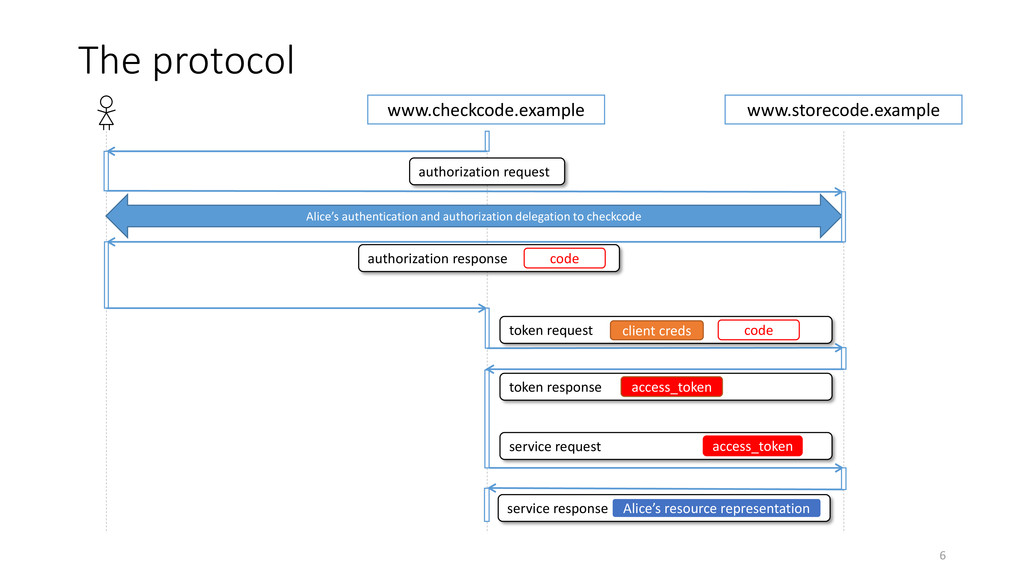
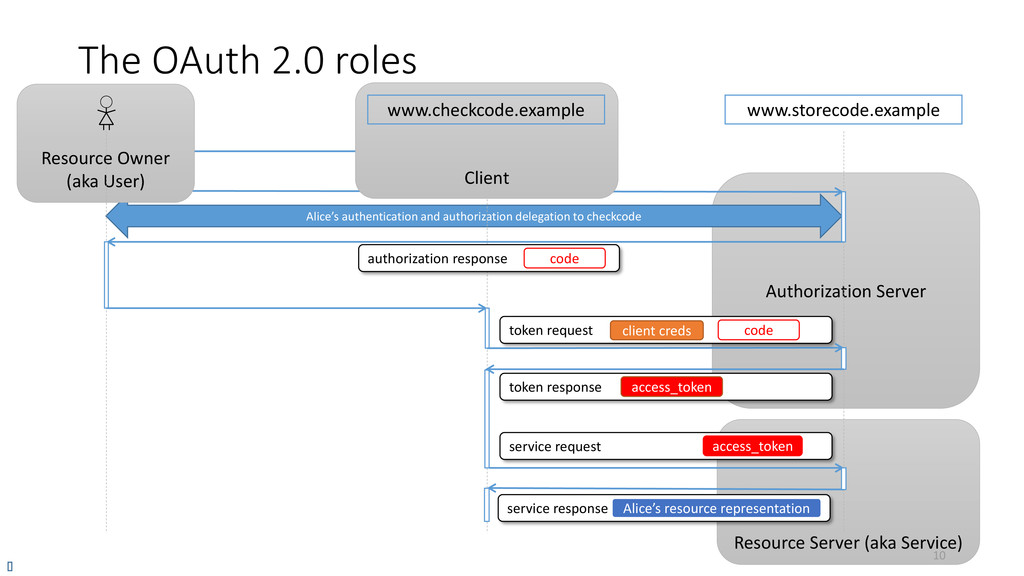
The protocol 6 Alice’s authentication and authorization delegation to checkcode
token response authorization response code authorization request service request access_token service response Alice’s resource representation access_token token request client creds code www.checkcode.example www.storecode.example -
Resource Server (aka Service) Authorization Server Alice’s authentication and authorization
delegation to checkcode Resource Owner (aka User) The OAuth 2.0 roles 10 token response authorization response code authorization request service request access_token service response Alice’s resource representation access_token token request client creds code www.storecode.example Client www.checkcode.example -
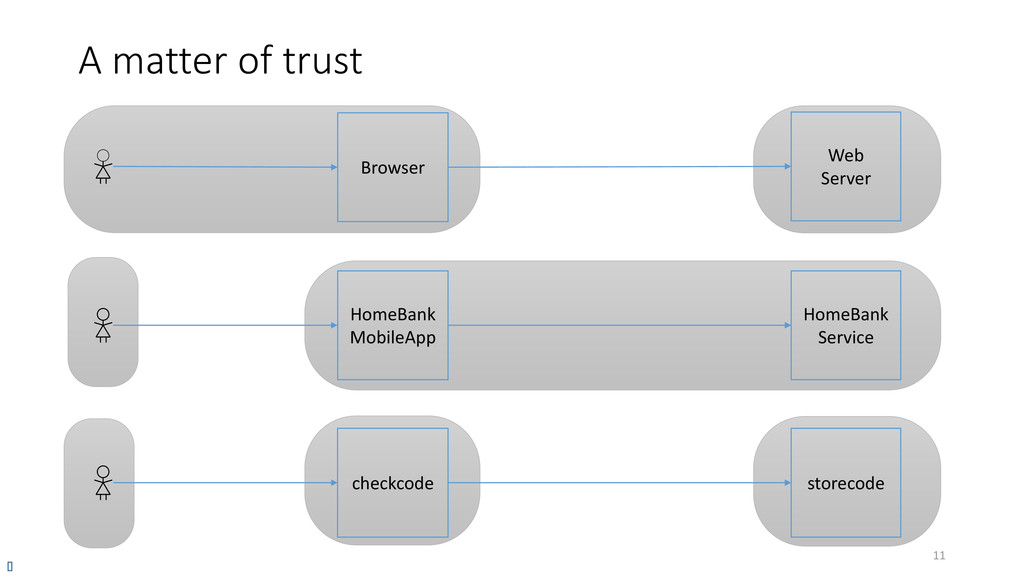
A matter of trust 11 Browser Web Server HomeBank MobileApp
HomeBank Service checkcode storecode -
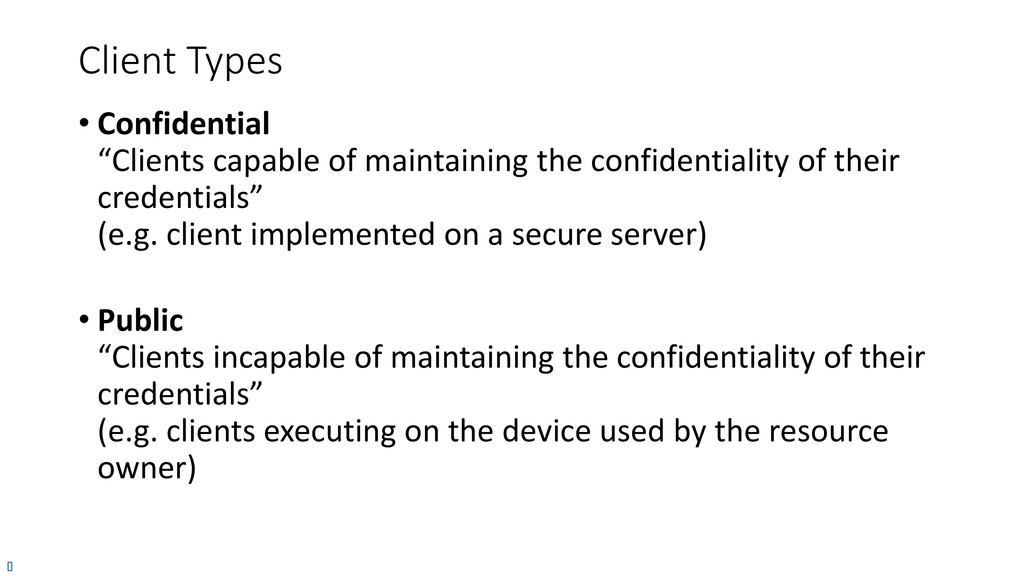
Client Types • Confidential “Clients capable of maintaining the confidentiality
of their credentials” (e.g. client implemented on a secure server) • Public “Clients incapable of maintaining the confidentiality of their credentials” (e.g. clients executing on the device used by the resource owner) -
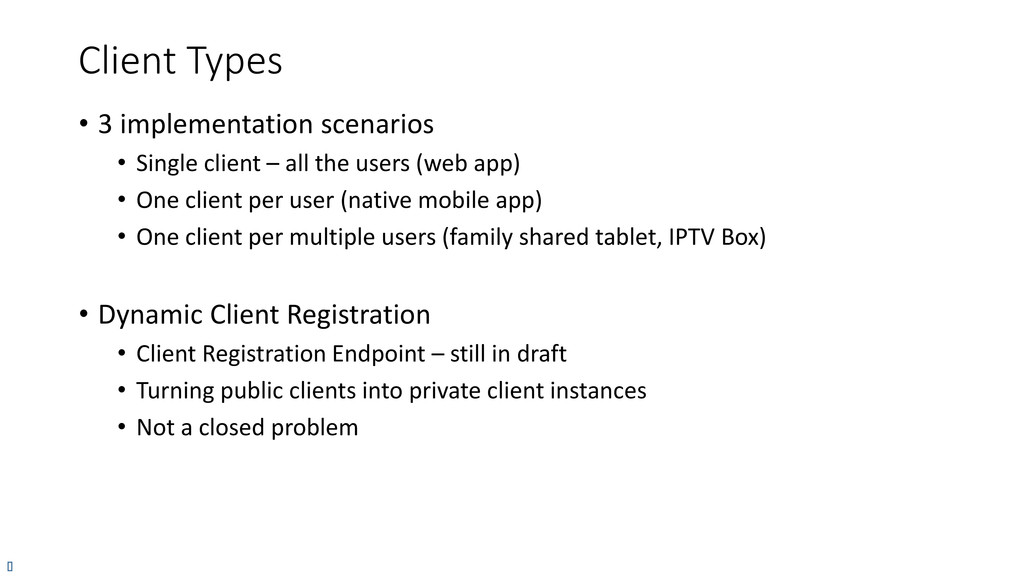
Client Types • 3 implementation scenarios • Single client –
all the users (web app) • One client per user (native mobile app) • One client per multiple users (family shared tablet, IPTV Box) • Dynamic Client Registration • Client Registration Endpoint – still in draft • Turning public clients into private client instances • Not a closed problem -
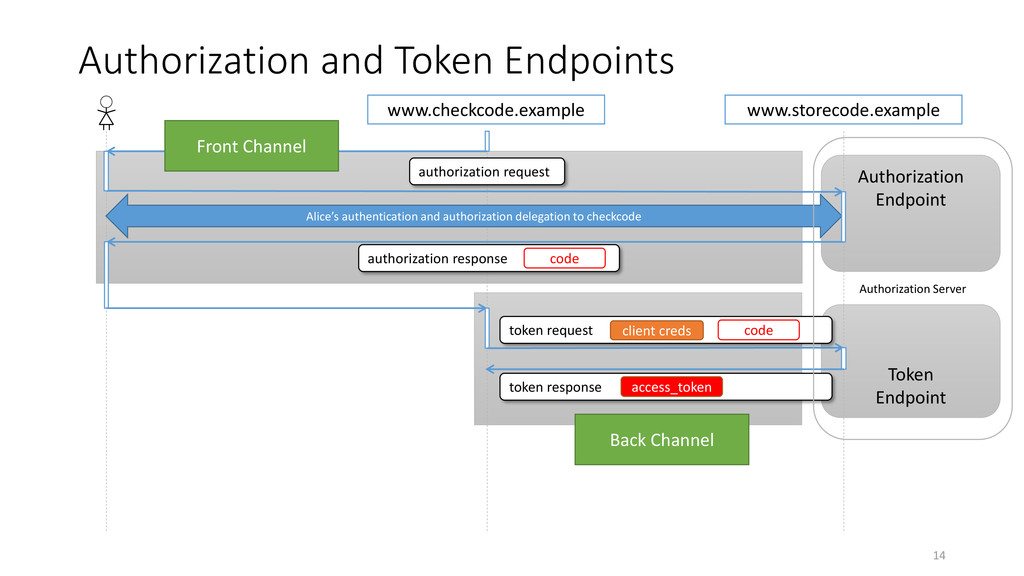
Token Endpoint Authorization Endpoint Authorization and Token Endpoints 14 Alice’s
authentication and authorization delegation to checkcode token response authorization response code authorization request access_token token request client creds code www.checkcode.example www.storecode.example Authorization Server Front Channel Back Channel -
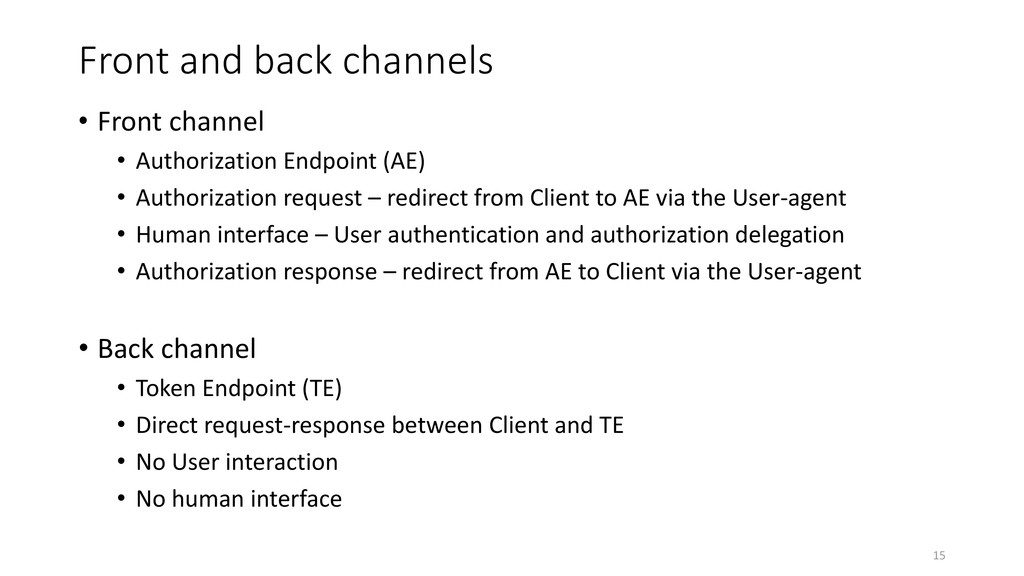
Front and back channels • Front channel • Authorization Endpoint
(AE) • Authorization request – redirect from Client to AE via the User-agent • Human interface – User authentication and authorization delegation • Authorization response – redirect from AE to Client via the User-agent • Back channel • Token Endpoint (TE) • Direct request-response between Client and TE • No User interaction • No human interface 15 -
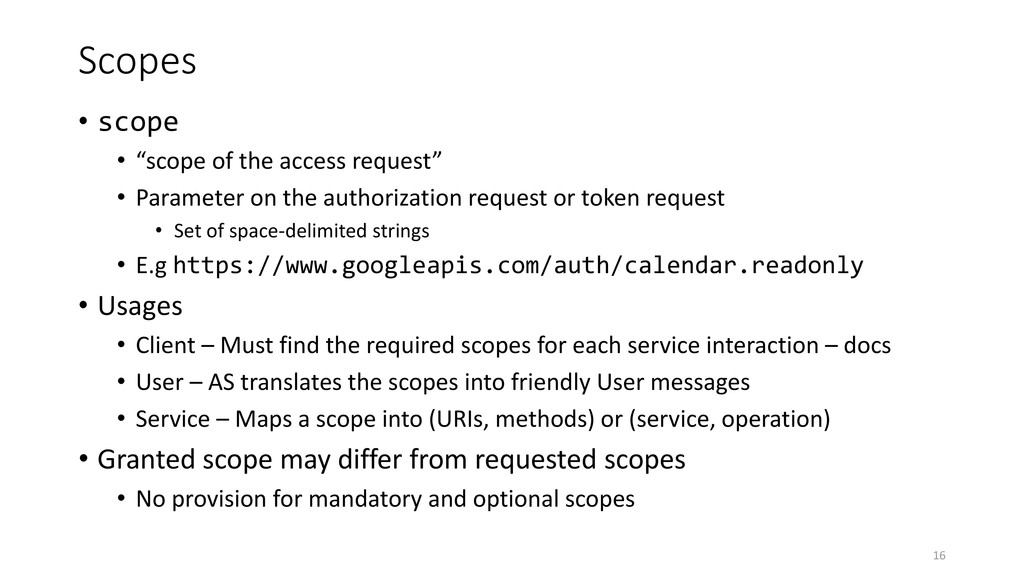
Scopes • scope • “scope of the access request” •
Parameter on the authorization request or token request • Set of space-delimited strings • E.g https://www.googleapis.com/auth/calendar.readonly • Usages • Client – Must find the required scopes for each service interaction – docs • User – AS translates the scopes into friendly User messages • Service – Maps a scope into (URIs, methods) or (service, operation) • Granted scope may differ from requested scopes • No provision for mandatory and optional scopes 16 -
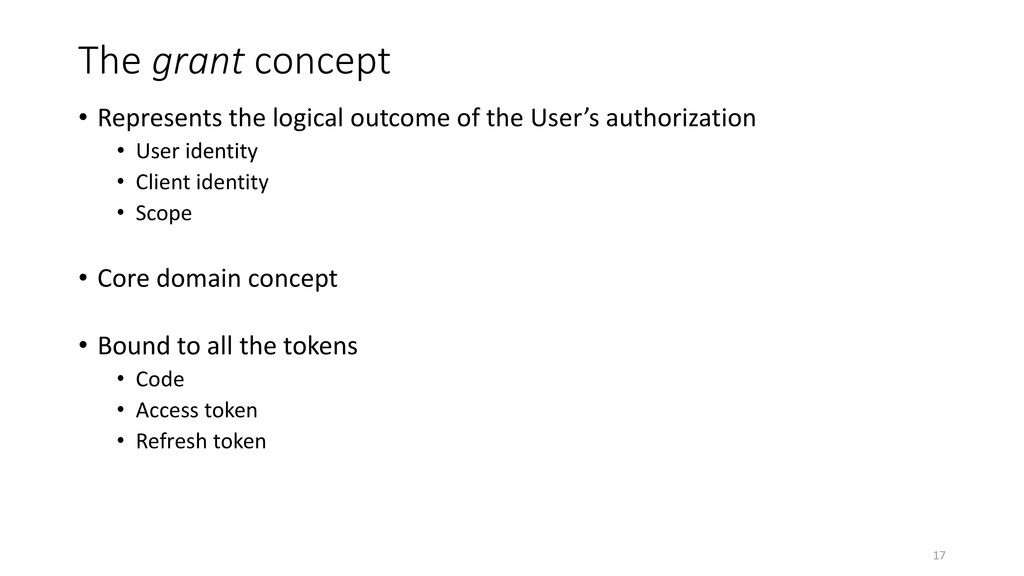
The grant concept • Represents the logical outcome of the
User’s authorization • User identity • Client identity • Scope • Core domain concept • Bound to all the tokens • Code • Access token • Refresh token 17 -
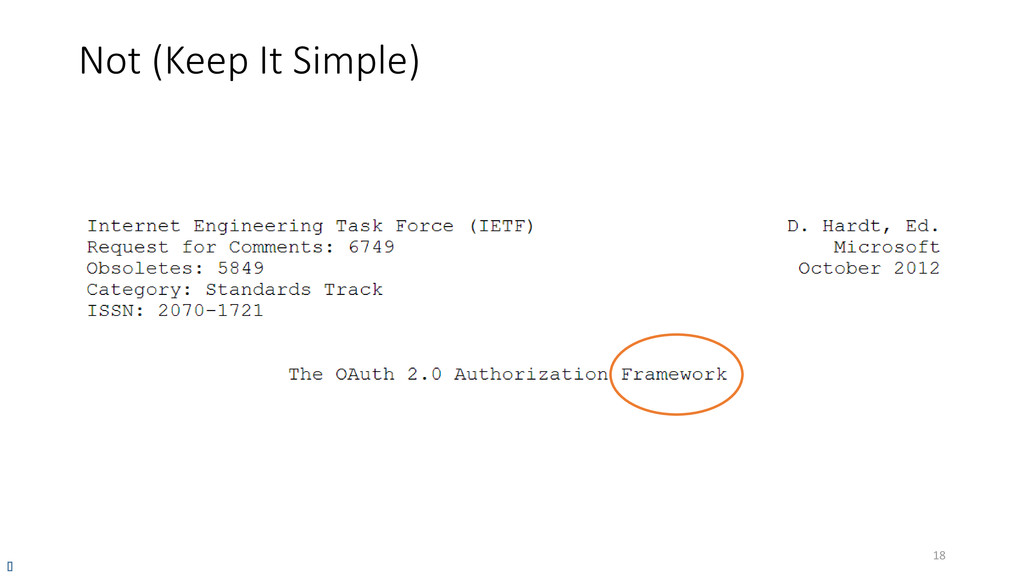
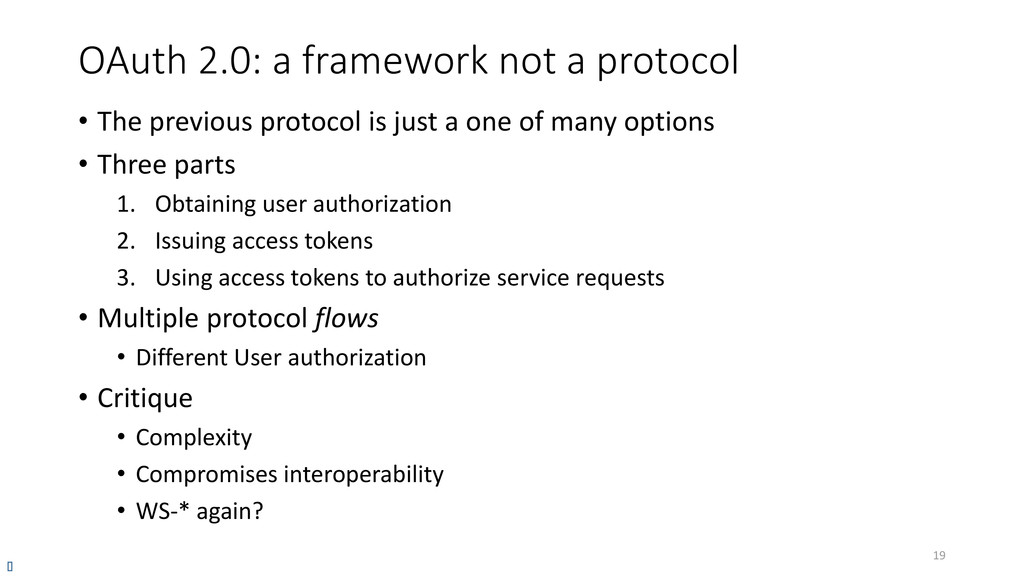
OAuth 2.0: a framework not a protocol • The previous
protocol is just a one of many options • Three parts 1. Obtaining user authorization 2. Issuing access tokens 3. Using access tokens to authorize service requests • Multiple protocol flows • Different User authorization • Critique • Complexity • Compromises interoperability • WS-* again? 19 -
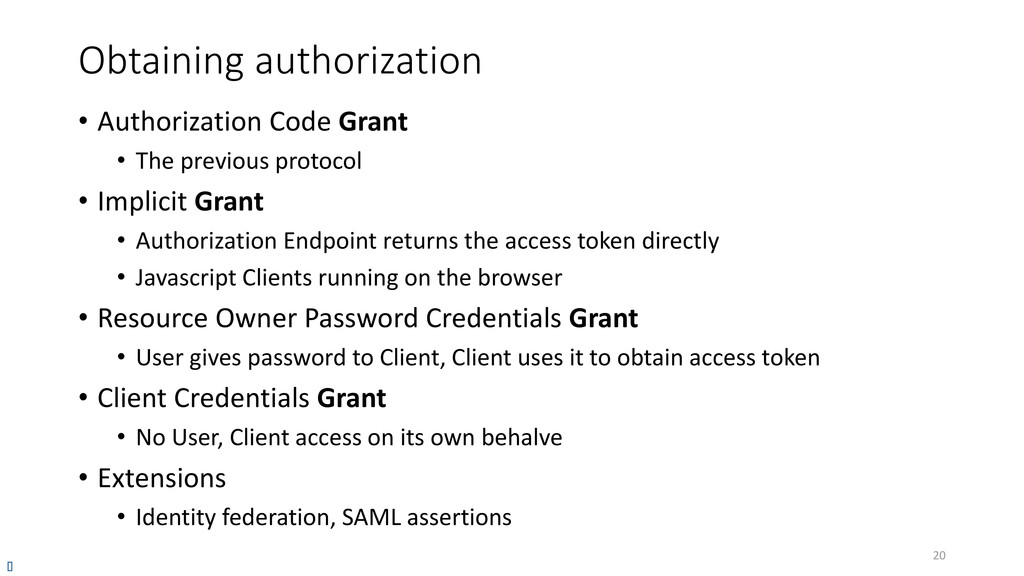
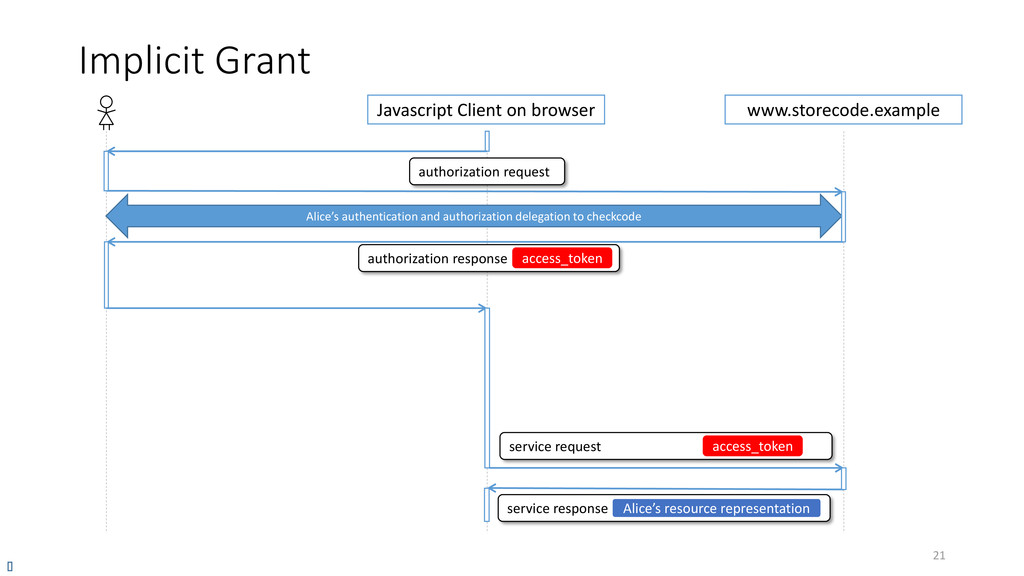
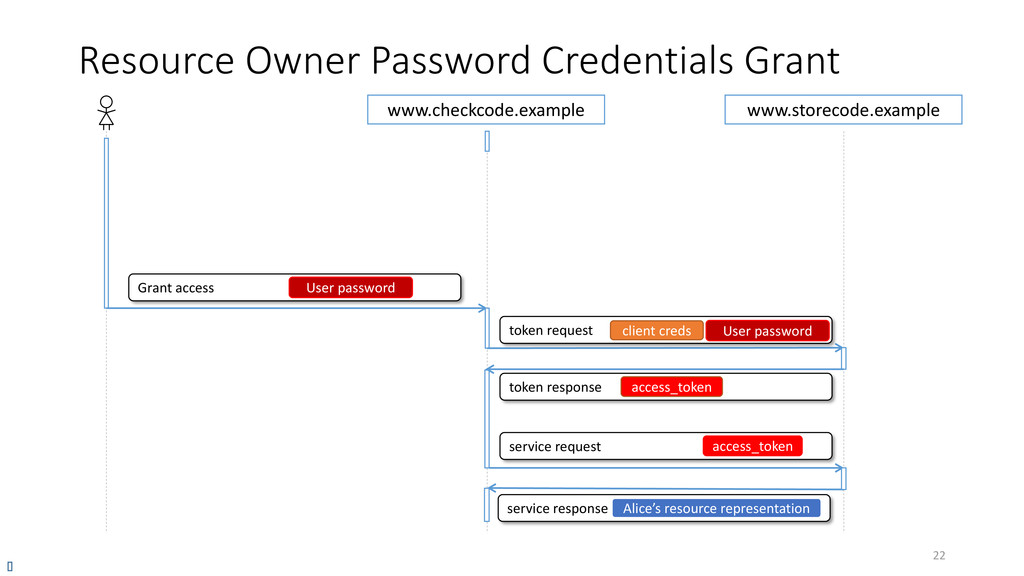
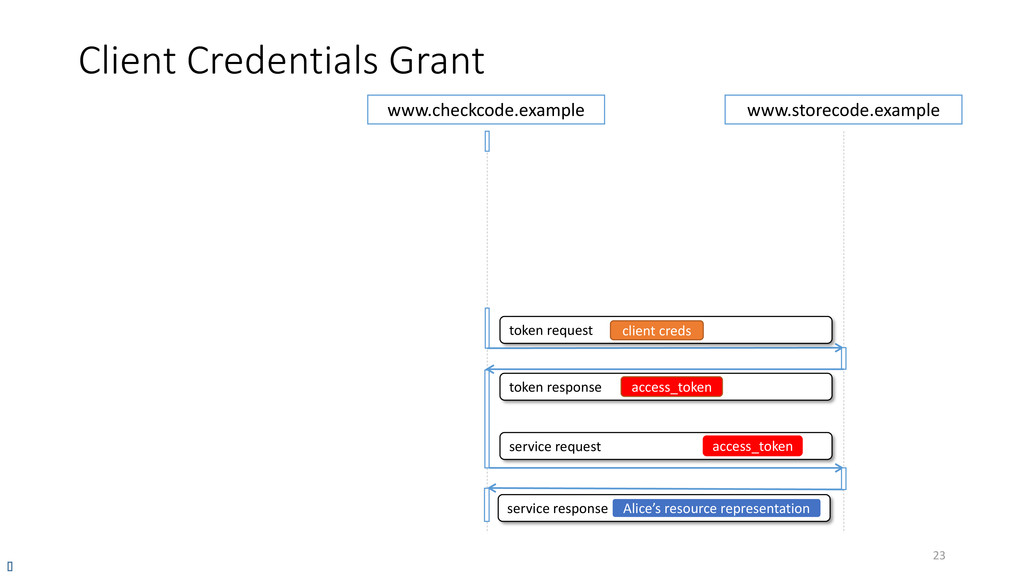
Obtaining authorization • Authorization Code Grant • The previous protocol
• Implicit Grant • Authorization Endpoint returns the access token directly • Javascript Clients running on the browser • Resource Owner Password Credentials Grant • User gives password to Client, Client uses it to obtain access token • Client Credentials Grant • No User, Client access on its own behalve • Extensions • Identity federation, SAML assertions 20 -
Implicit Grant 21 Alice’s authentication and authorization delegation to checkcode
authorization response authorization request service request service response Alice’s resource representation access_token Javascript Client on browser www.storecode.example access_token -
Resource Owner Password Credentials Grant 22 token response service request
access_token service response Alice’s resource representation access_token token request client creds www.checkcode.example www.storecode.example Grant access User password User password -
Client Credentials Grant 23 token response service request access_token service
response Alice’s resource representation access_token token request client creds www.checkcode.example www.storecode.example -
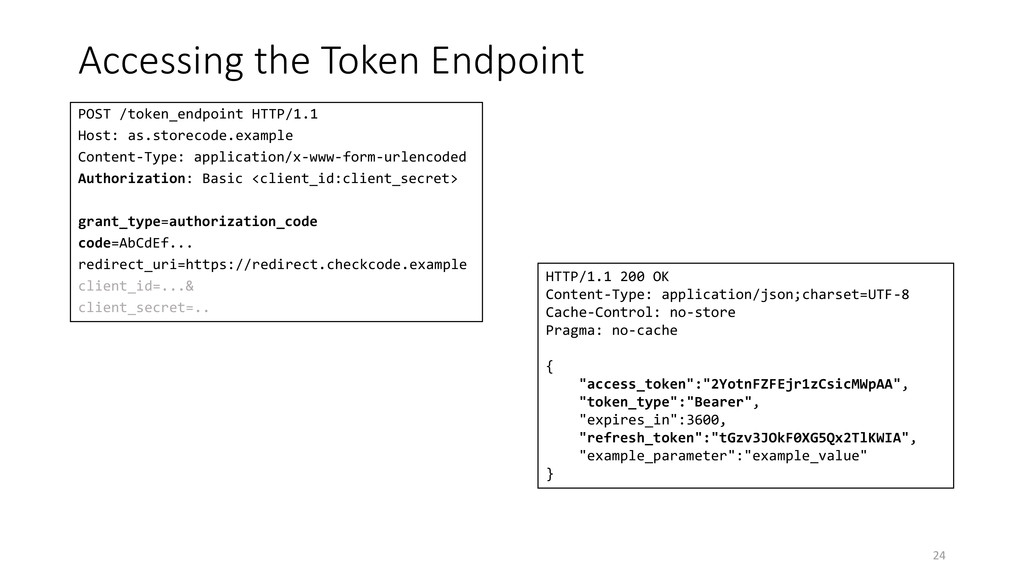
Accessing the Token Endpoint POST /token_endpoint HTTP/1.1 Host: as.storecode.example Content-Type:
application/x-www-form-urlencoded Authorization: Basic <client_id:client_secret> grant_type=authorization_code code=AbCdEf... redirect_uri=https://redirect.checkcode.example client_id=...& client_secret=.. 24 HTTP/1.1 200 OK Content-Type: application/json;charset=UTF-8 Cache-Control: no-store Pragma: no-cache { "access_token":"2YotnFZFEjr1zCsicMWpAA", "token_type":"Bearer", "expires_in":3600, "refresh_token":"tGzv3JOkF0XG5Qx2TlKWIA", "example_parameter":"example_value" } -
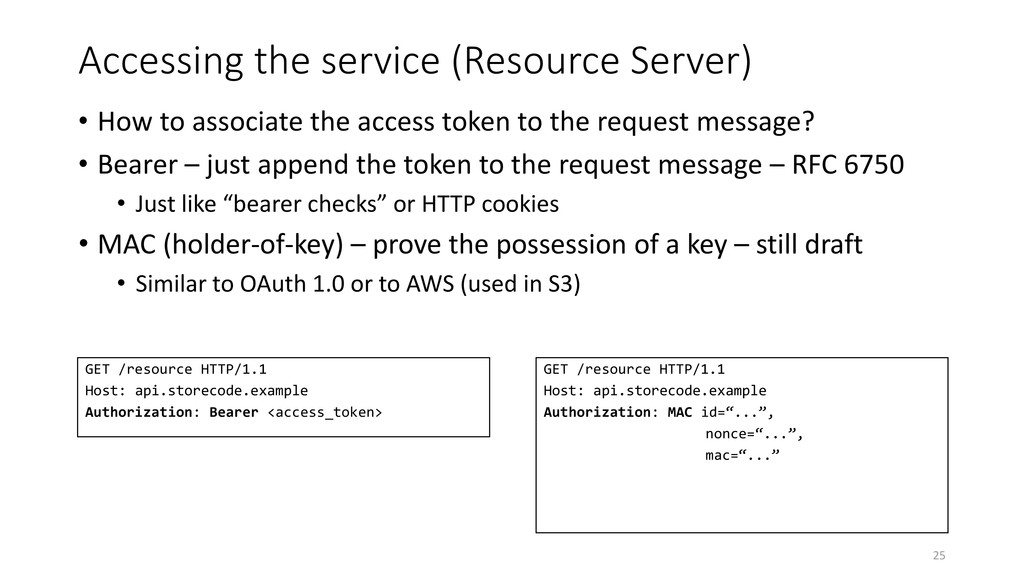
Accessing the service (Resource Server) • How to associate the
access token to the request message? • Bearer – just append the token to the request message – RFC 6750 • Just like “bearer checks” or HTTP cookies • MAC (holder-of-key) – prove the possession of a key – still draft • Similar to OAuth 1.0 or to AWS (used in S3) 25 GET /resource HTTP/1.1 Host: api.storecode.example Authorization: Bearer <access_token> GET /resource HTTP/1.1 Host: api.storecode.example Authorization: MAC id=“...”, nonce=“...”, mac=“...” -
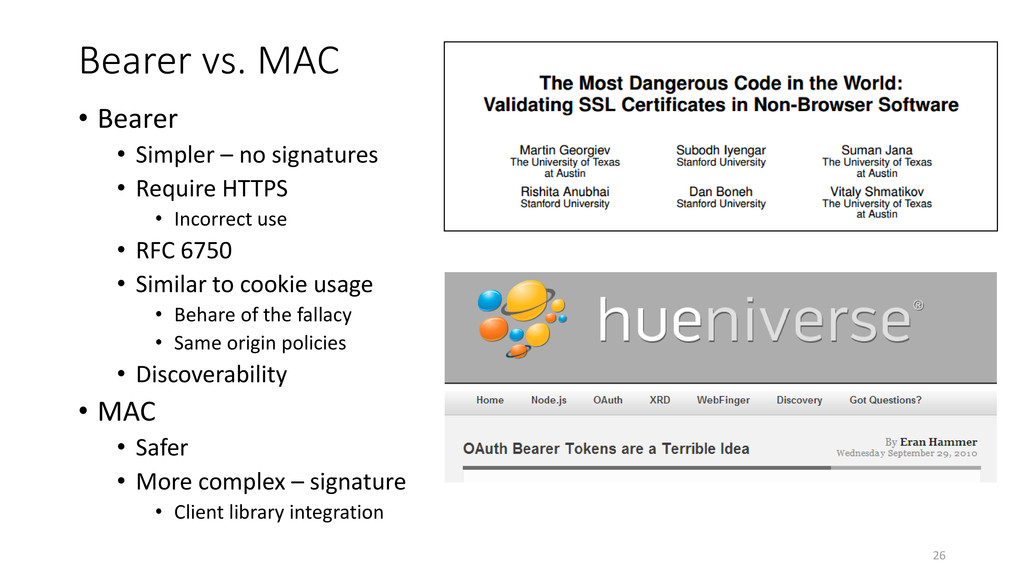
Bearer vs. MAC • Bearer • Simpler – no signatures
• Require HTTPS • Incorrect use • RFC 6750 • Similar to cookie usage • Behare of the fallacy • Same origin policies • Discoverability • MAC • Safer • More complex – signature • Client library integration 26 -
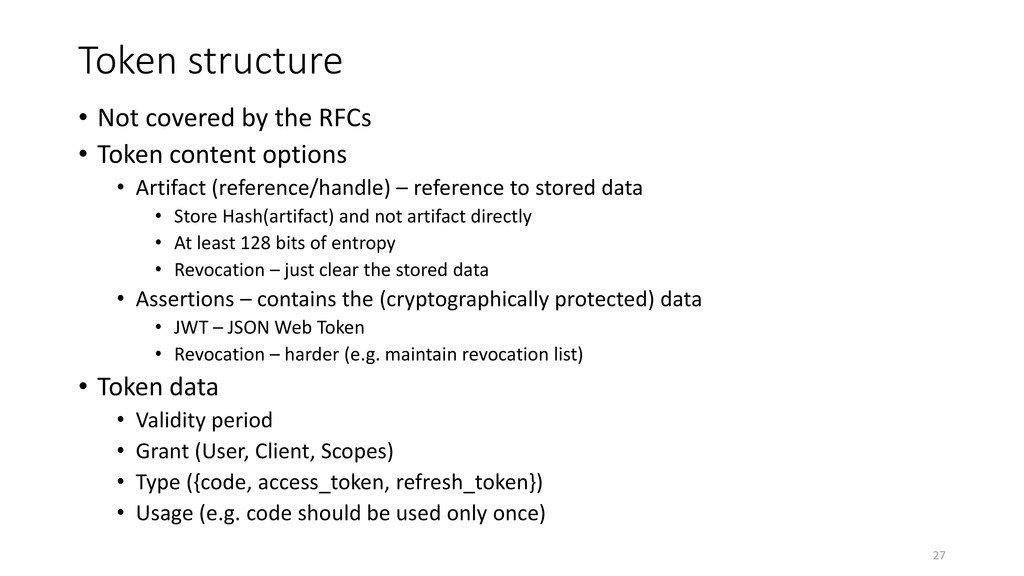
Token structure • Not covered by the RFCs • Token
content options • Artifact (reference/handle) – reference to stored data • Store Hash(artifact) and not artifact directly • At least 128 bits of entropy • Revocation – just clear the stored data • Assertions – contains the (cryptographically protected) data • JWT – JSON Web Token • Revocation – harder (e.g. maintain revocation list) • Token data • Validity period • Grant (User, Client, Scopes) • Type ({code, access_token, refresh_token}) • Usage (e.g. code should be used only once) 27 -
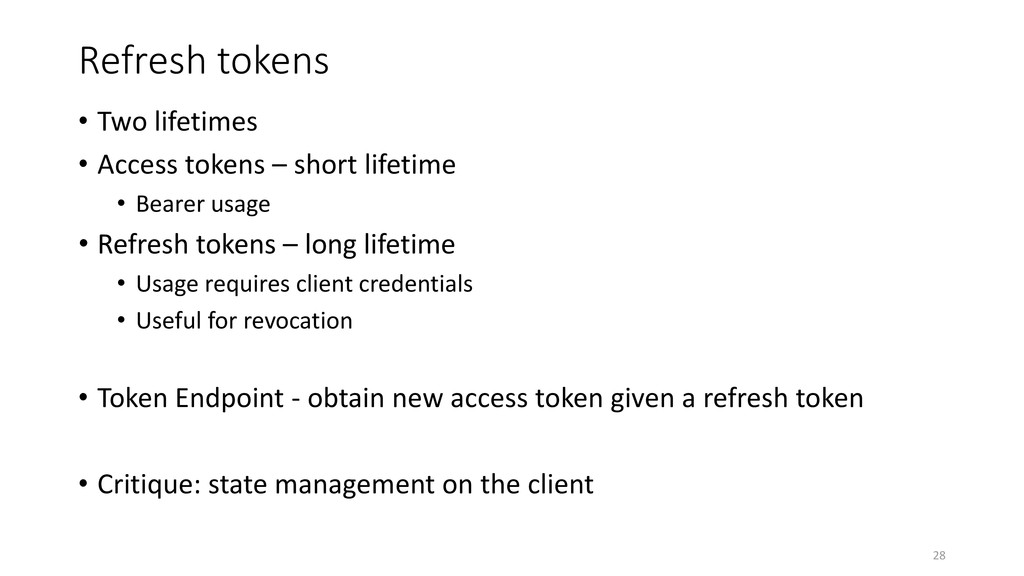
Refresh tokens • Two lifetimes • Access tokens – short
lifetime • Bearer usage • Refresh tokens – long lifetime • Usage requires client credentials • Useful for revocation • Token Endpoint - obtain new access token given a refresh token • Critique: state management on the client 28 -
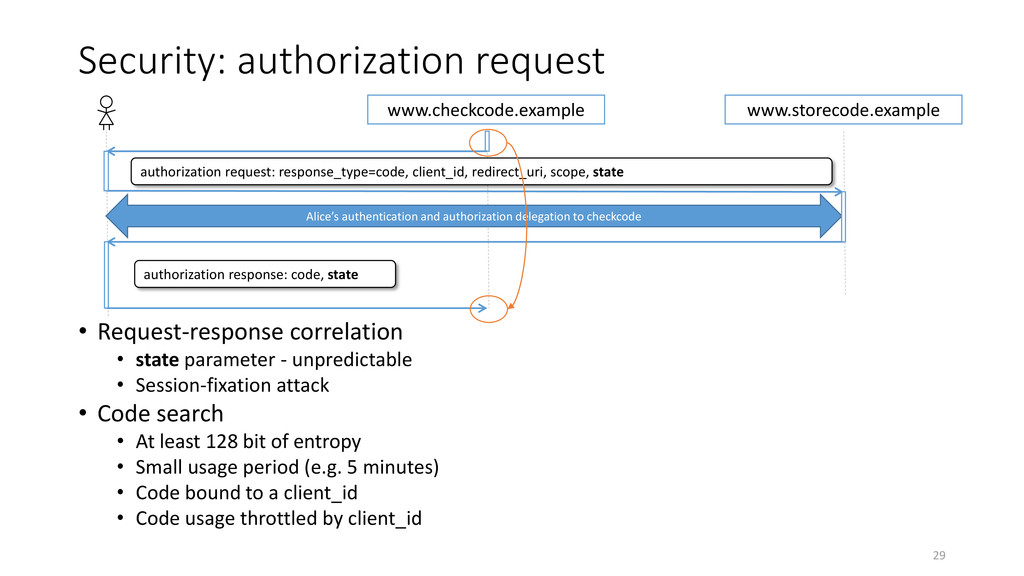
Security: authorization request • Request-response correlation • state parameter -
unpredictable • Session-fixation attack • Code search • At least 128 bit of entropy • Small usage period (e.g. 5 minutes) • Code bound to a client_id • Code usage throttled by client_id 29 Alice’s authentication and authorization delegation to checkcode authorization response: code, state authorization request: response_type=code, client_id, redirect_uri, scope, state www.checkcode.example www.storecode.example -
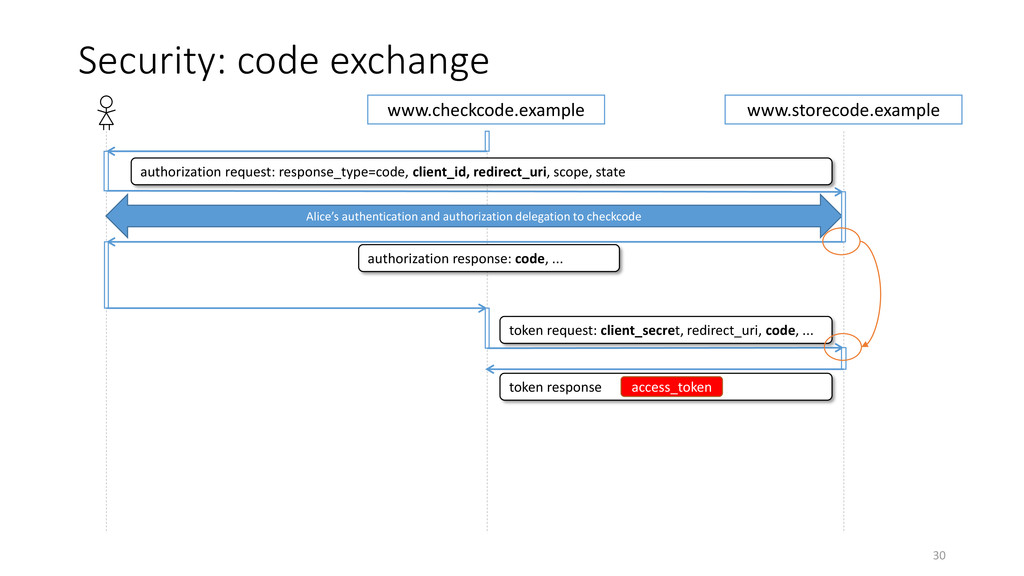
Security: code exchange 30 Alice’s authentication and authorization delegation to
checkcode token response authorization response: code, ... access_token token request: client_secret, redirect_uri, code, ... www.checkcode.example www.storecode.example authorization request: response_type=code, client_id, redirect_uri, scope, state -
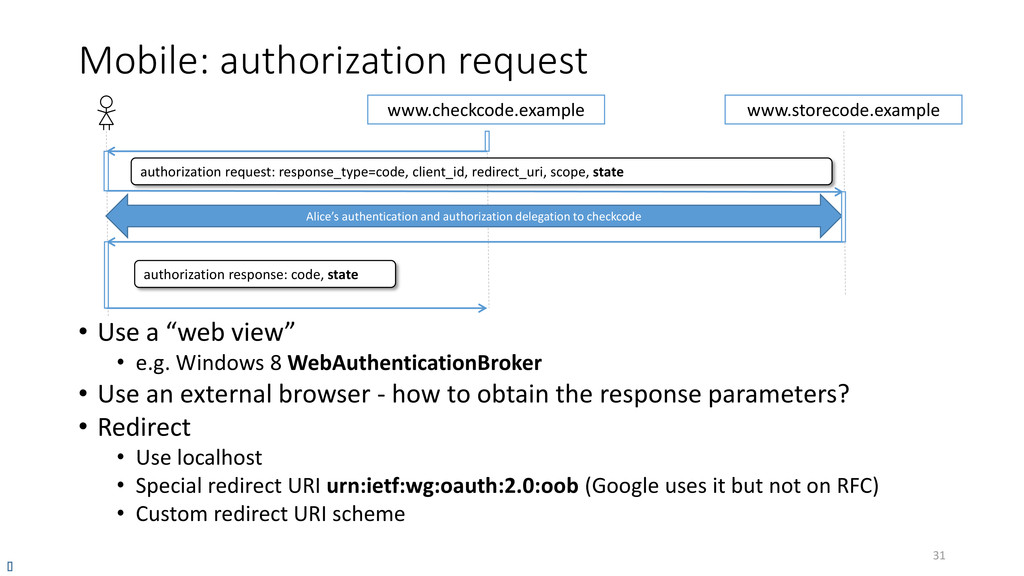
Mobile: authorization request • Use a “web view” • e.g.
Windows 8 WebAuthenticationBroker • Use an external browser - how to obtain the response parameters? • Redirect • Use localhost • Special redirect URI urn:ietf:wg:oauth:2.0:oob (Google uses it but not on RFC) • Custom redirect URI scheme 31 Alice’s authentication and authorization delegation to checkcode authorization response: code, state authorization request: response_type=code, client_id, redirect_uri, scope, state www.checkcode.example www.storecode.example -
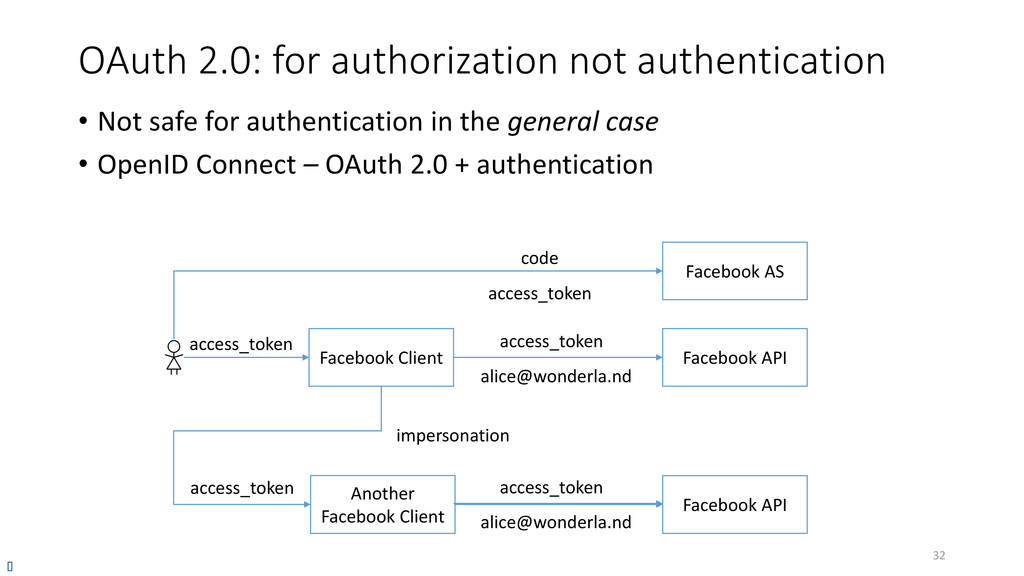
OAuth 2.0: for authorization not authentication • Not safe for
authentication in the general case • OpenID Connect – OAuth 2.0 + authentication 32 Facebook AS Facebook Client Another Facebook Client code Facebook API access_token access_token access_token [email protected] access_token Facebook API access_token [email protected] impersonation -
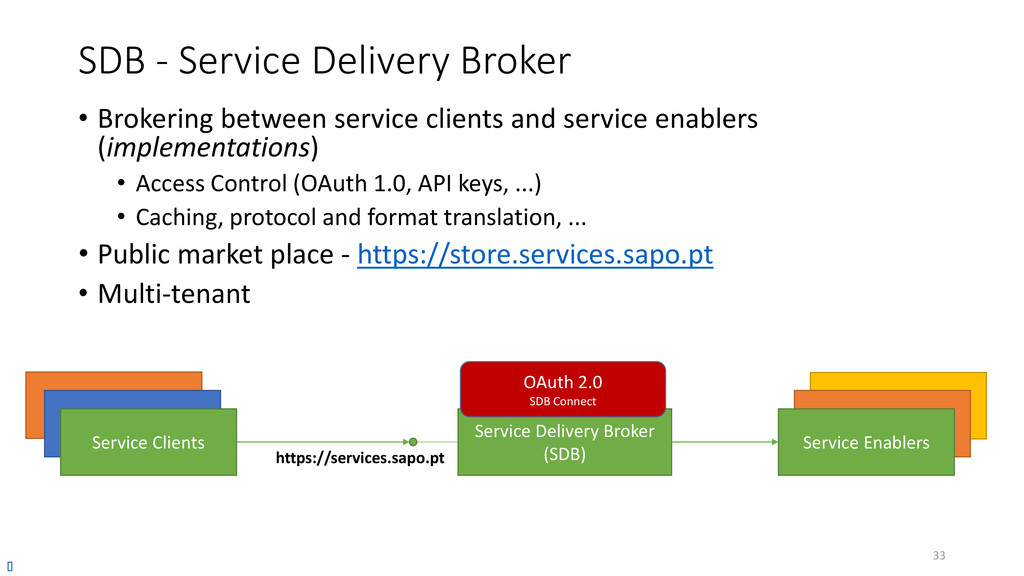
SDB - Service Delivery Broker • Brokering between service clients
and service enablers (implementations) • Access Control (OAuth 1.0, API keys, ...) • Caching, protocol and format translation, ... • Public market place - https://store.services.sapo.pt • Multi-tenant 33 Service Delivery Broker (SDB) Service Enablers Service Enablers Service Enablers Service Clients Service Clients Service Clients https://services.sapo.pt OAuth 2.0 SDB Connect -
References • IETF Web Authorization Working Group - http://datatracker.ietf.org/wg/oauth/ •
RFCs • Drafts • Eran Hammer • OAuth 2.0 and the Road to Hell - http://hueniverse.com/2012/07/oauth-2-0-and-the-road-to-hell/ • OAuth 2.0 - Looking Back and Moving On - http://vimeo.com/52882780 • John Bradley - http://www.thread-safe.com/2012/07/the-oauth-2-sky-is-not-falling.html 34