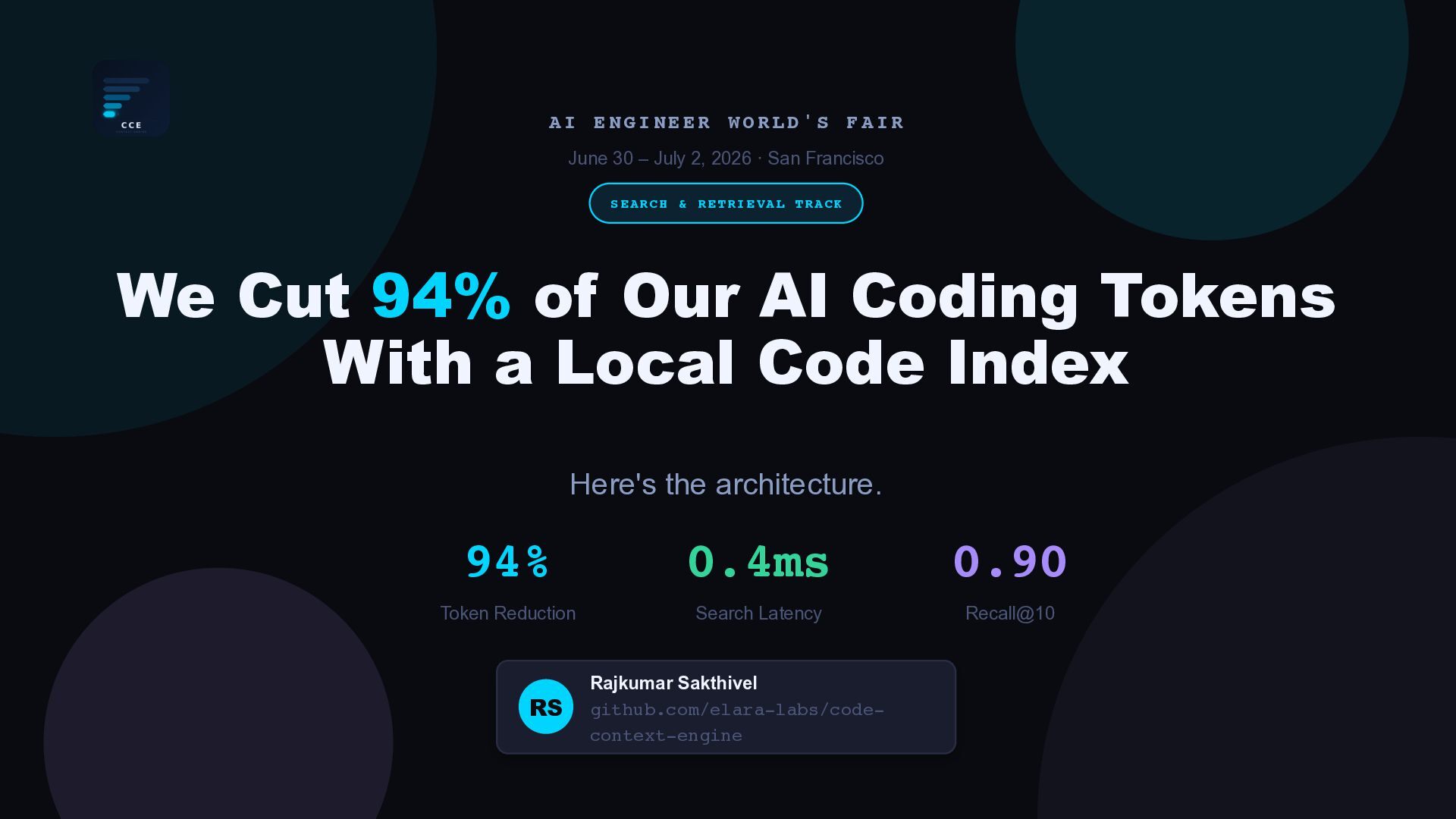
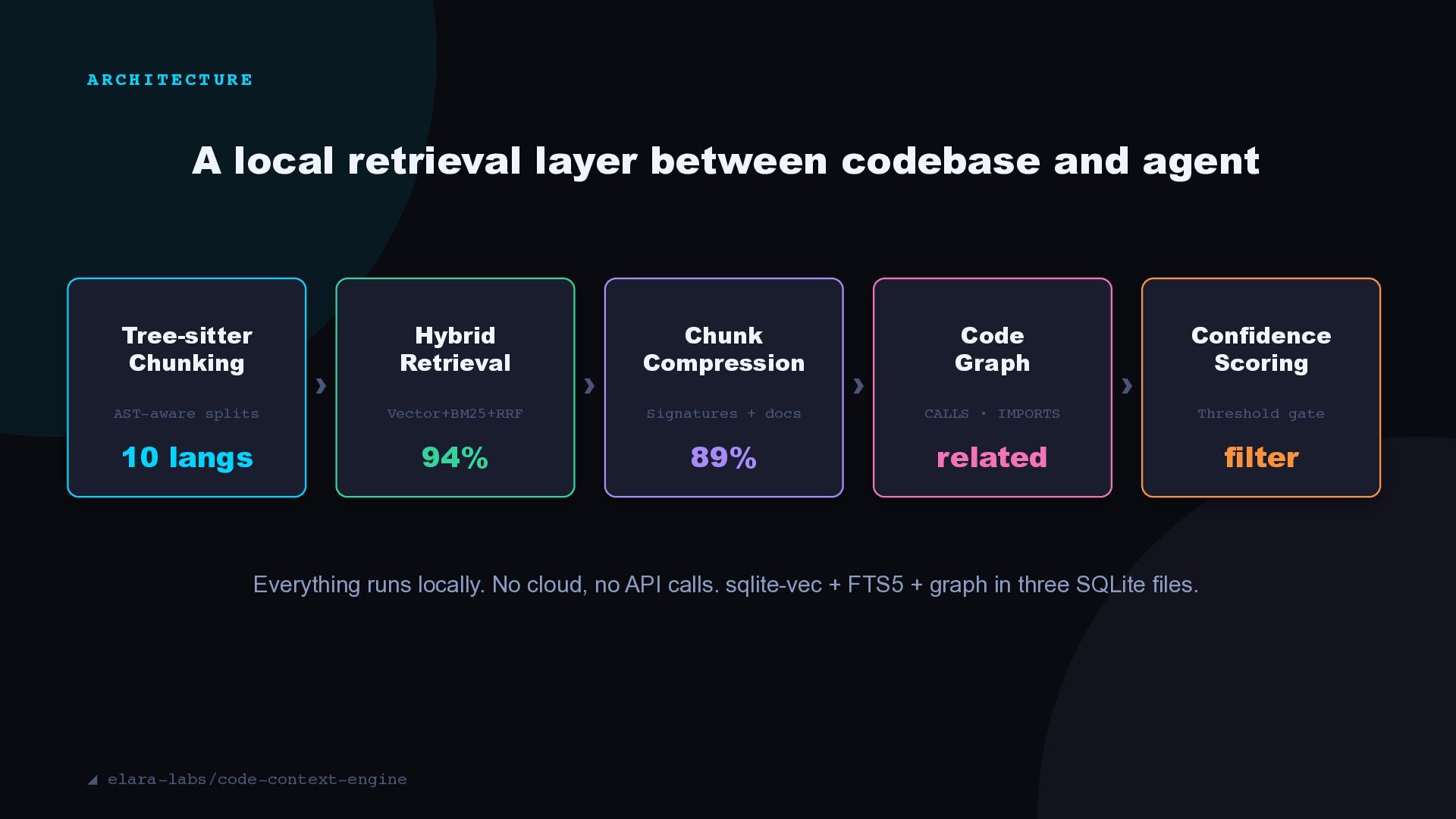
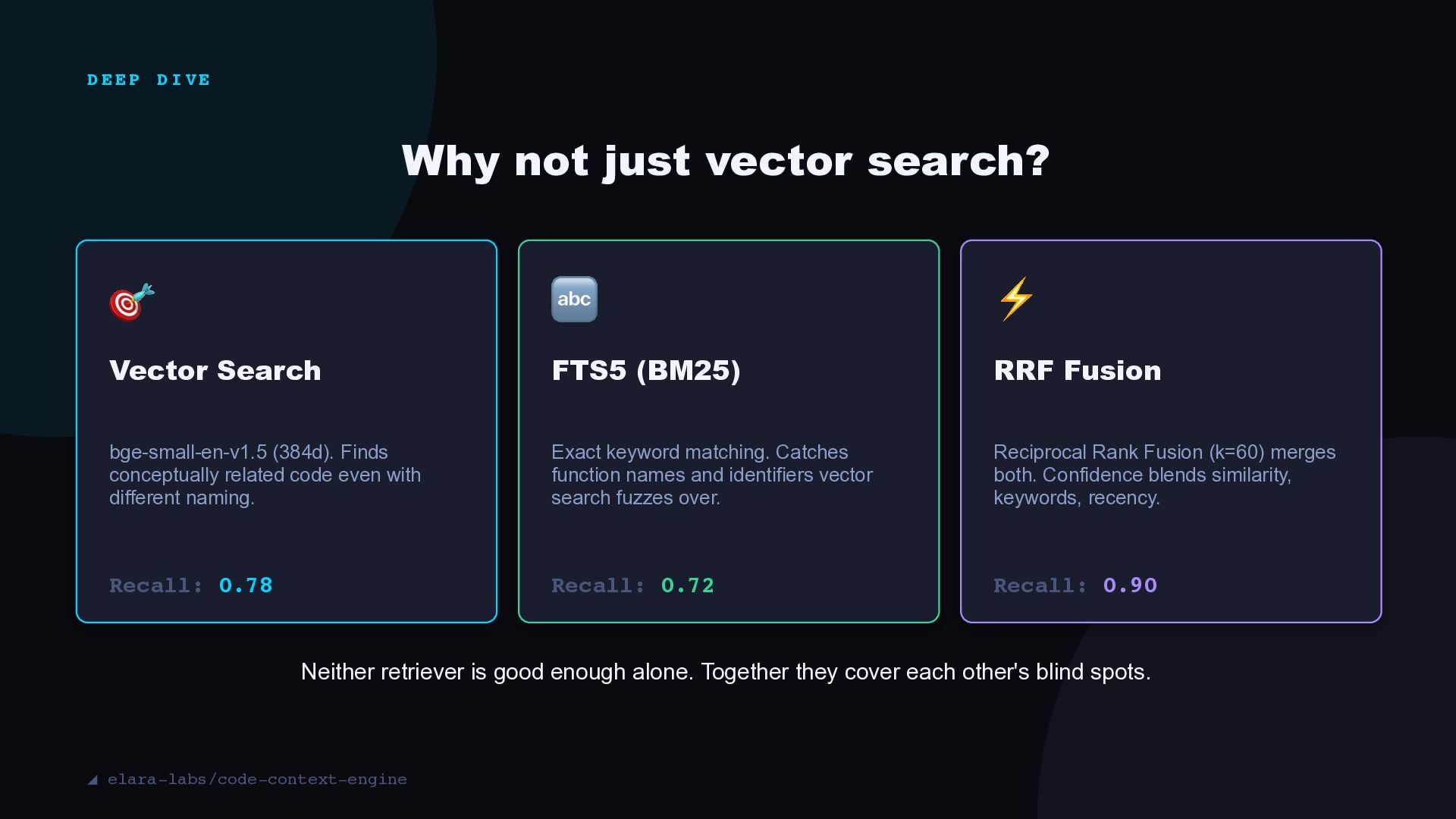
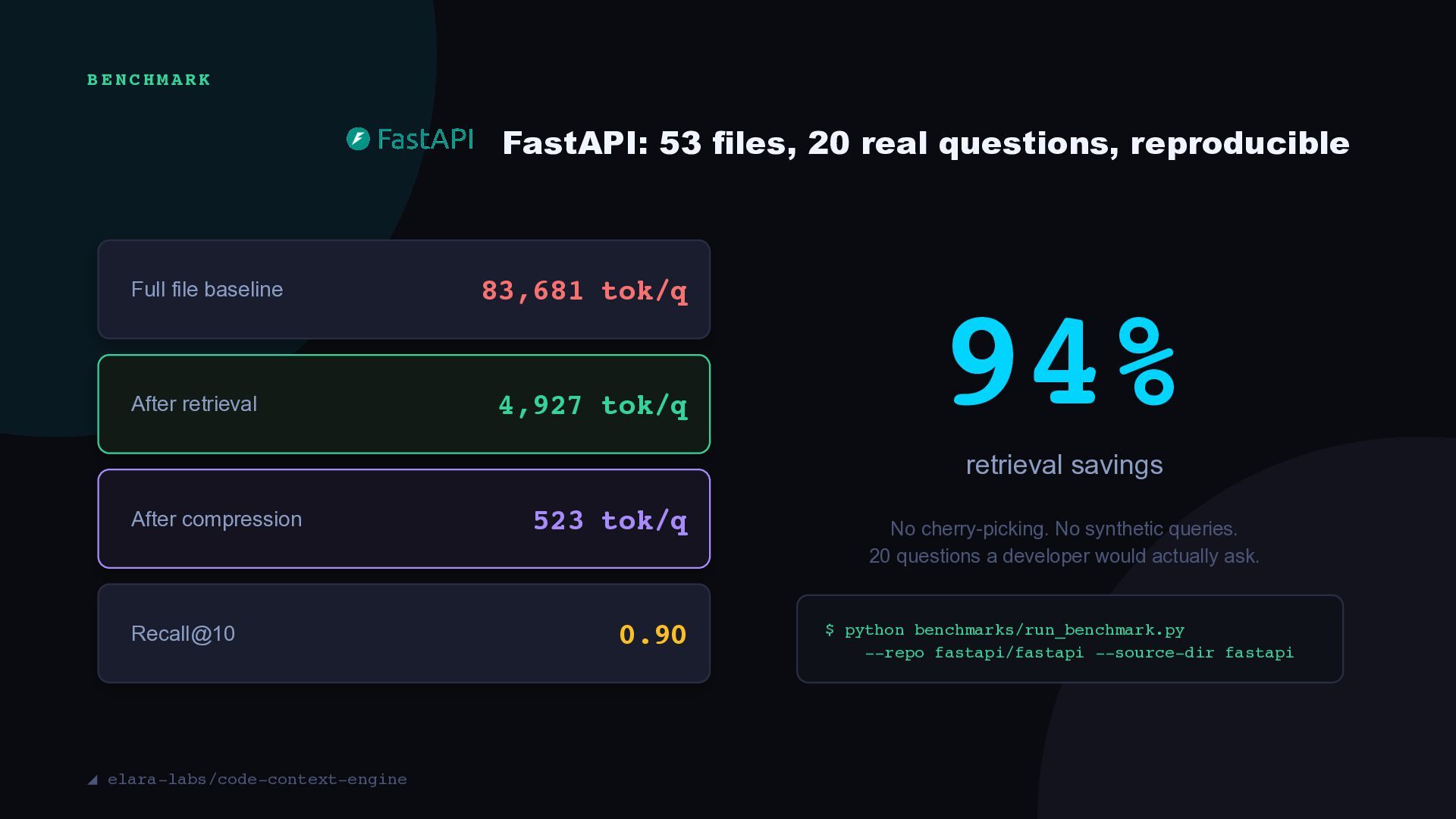
· San Francisco SEARCH & RETRIEVAL TRACK We Cut 94% of Our AI Coding Tokens With a Local Code Index Here's the architecture. 94% 0.4ms 0.90 Token Reduction Search Latency Recall@10 RS Rajkumar Sakthivel github.com/elara-labs/codecontext-engine
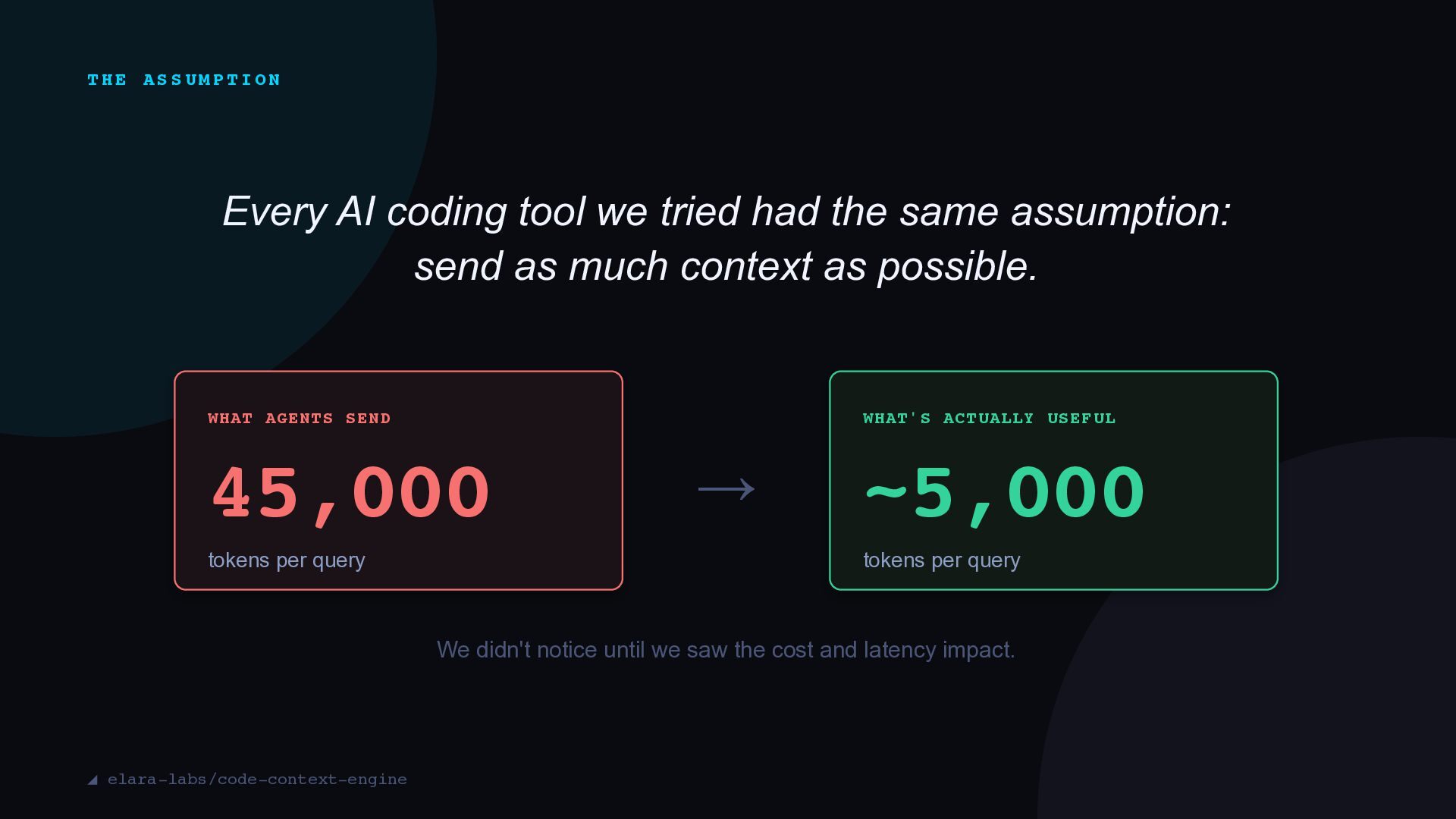
same assumption: send as much context as possible. WHAT AGENTS SEND WHAT'S ACTUALLY USEFUL 45,000 tokens per query → ~5,000 tokens per query We didn't notice until we saw the cost and latency impact. ◢ elara-labs/code-context-engine
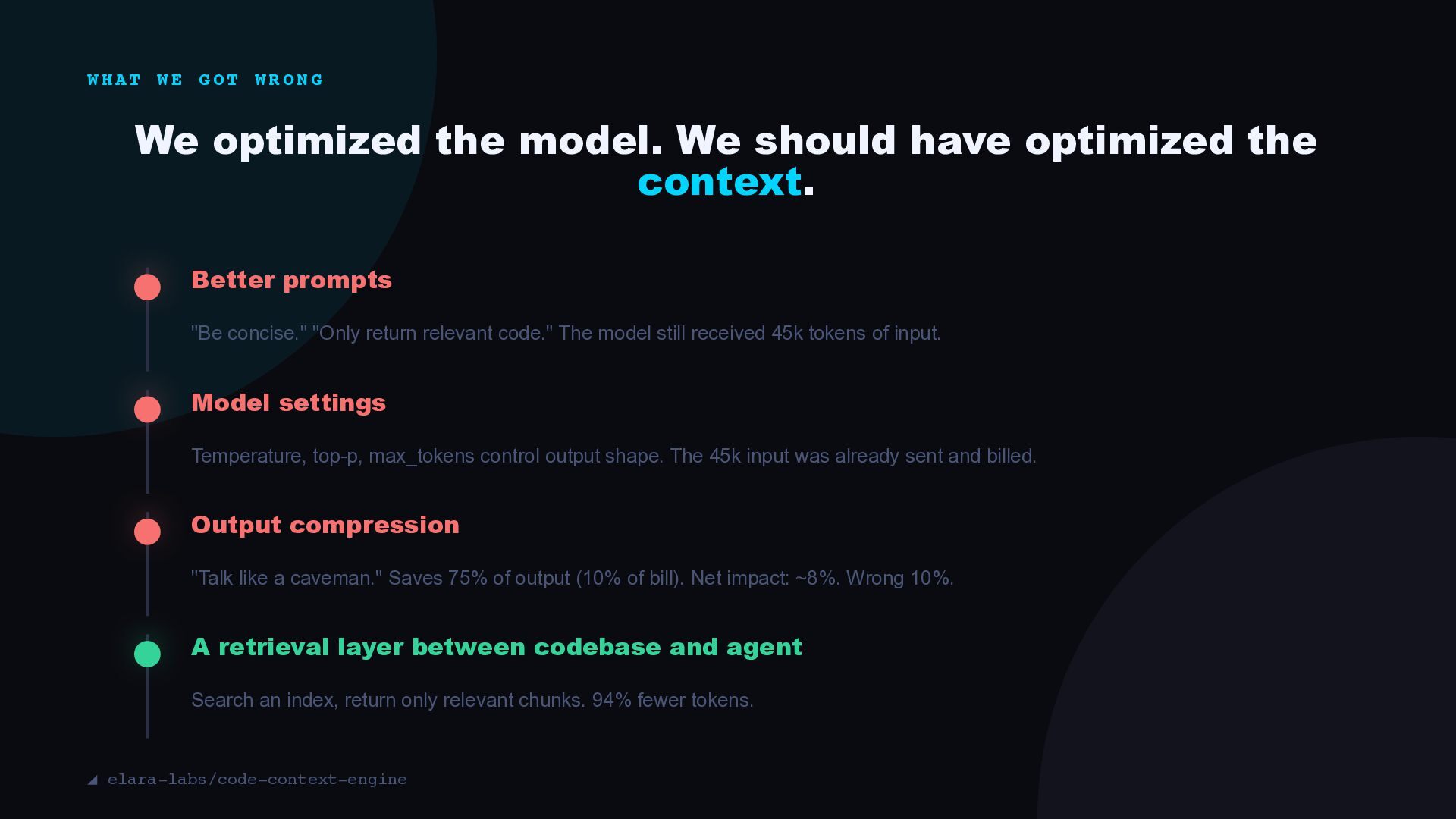
have optimized the context. Better prompts "Be concise." "Only return relevant code." The model still received 45k tokens of input. Model settings Temperature, top-p, max_tokens control output shape. The 45k input was already sent and billed. Output compression "Talk like a caveman." Saves 75% of output (10% of bill). Net impact: ~8%. Wrong 10%. A retrieval layer between codebase and agent Search an index, return only relevant chunks. 94% fewer tokens. ◢ elara-labs/code-context-engine
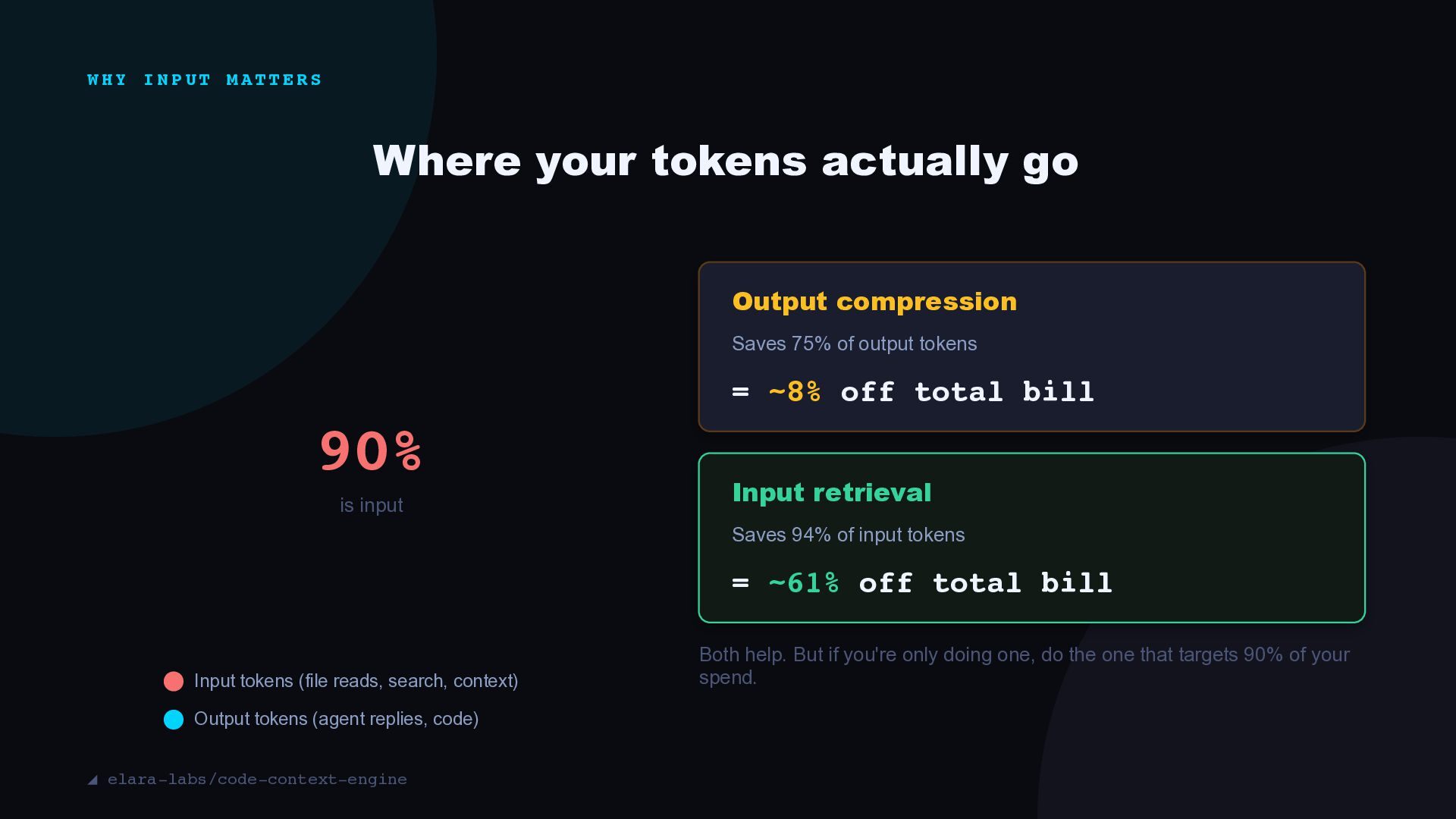
Saves 75% of output tokens = ~8% off total bill 90% is input Input retrieval Saves 94% of input tokens = ~61% off total bill Input tokens (file reads, search, context) Output tokens (agent replies, code) ◢ elara-labs/code-context-engine Both help. But if you're only doing one, do the one that targets 90% of your spend.
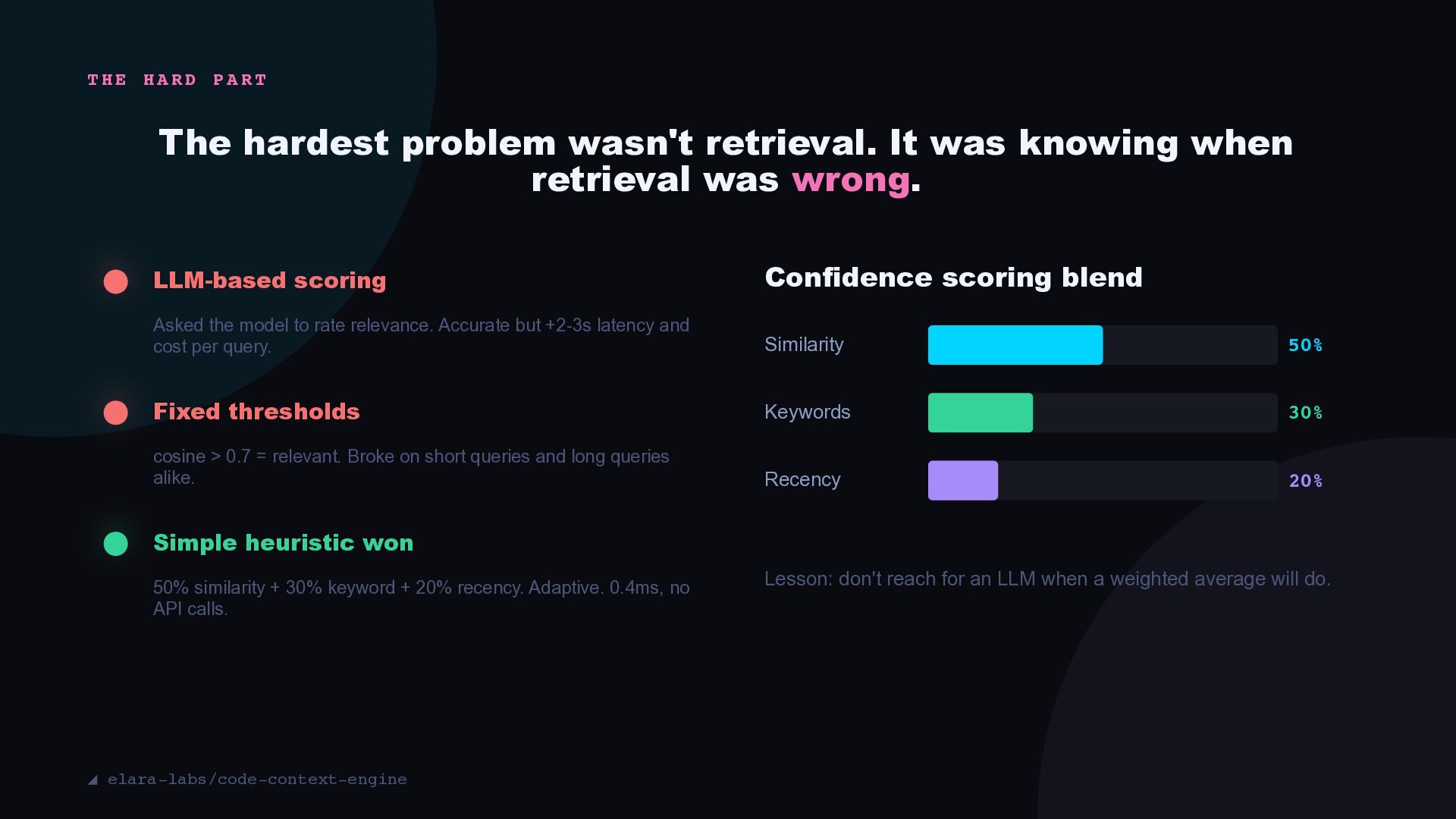
knowing when retrieval was wrong. LLM-based scoring Confidence scoring blend Asked the model to rate relevance. Accurate but +2-3s latency and cost per query. Similarity 50% Fixed thresholds Keywords 30% cosine > 0.7 = relevant. Broke on short queries and long queries alike. Recency 20% Simple heuristic won 50% similarity + 30% keyword + 20% recency. Adaptive. 0.4ms, no API calls. ◢ elara-labs/code-context-engine Lesson: don't reach for an LLM when a weighted average will do.
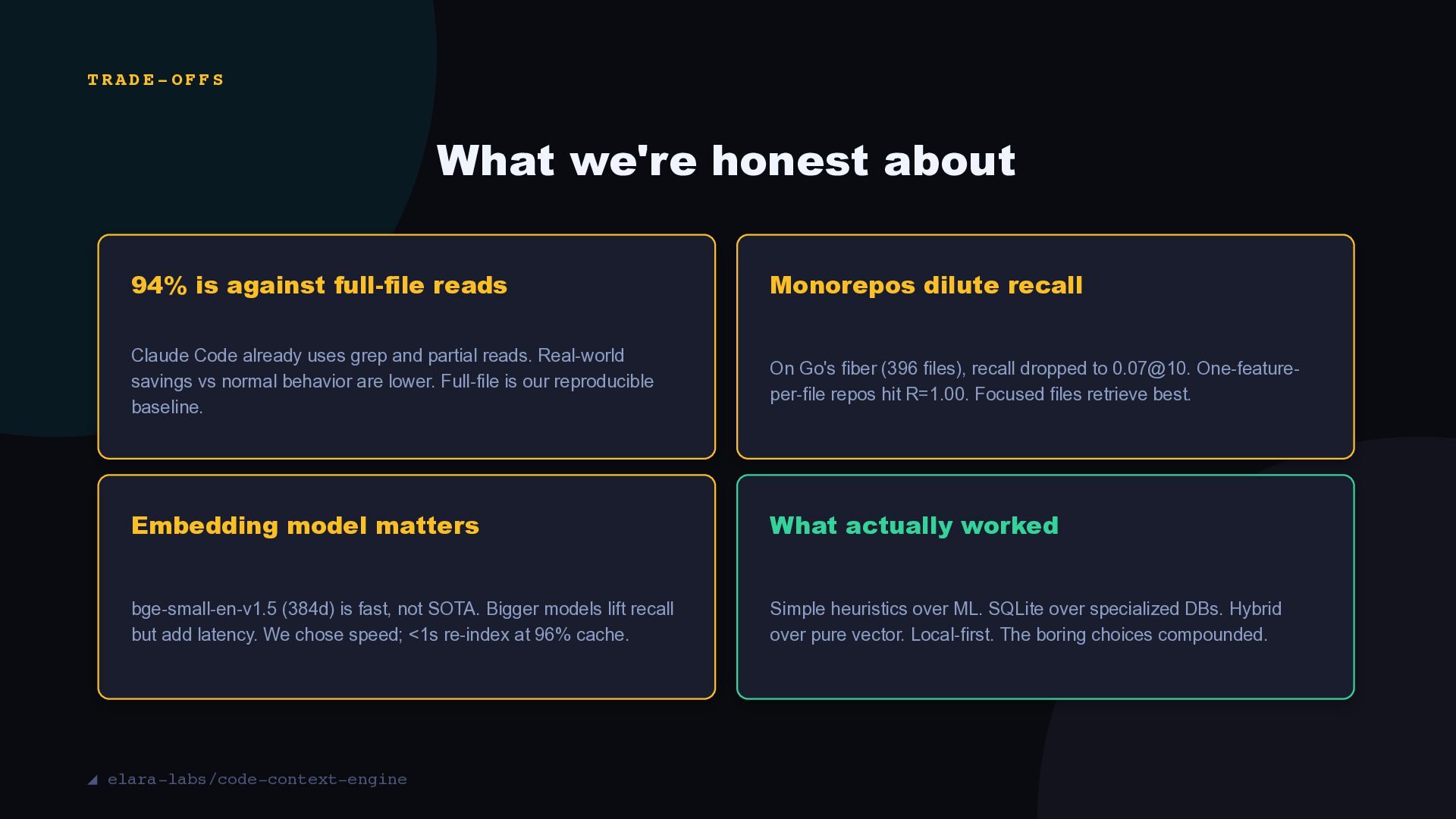
Monorepos dilute recall Claude Code already uses grep and partial reads. Real-world savings vs normal behavior are lower. Full-file is our reproducible baseline. On Go's fiber (396 files), recall dropped to 0.07@10. One-featureper-file repos hit R=1.00. Focused files retrieve best. Embedding model matters What actually worked bge-small-en-v1.5 (384d) is fast, not SOTA. Bigger models lift recall but add latency. We chose speed; <1s re-index at 96% cache. Simple heuristics over ML. SQLite over specialized DBs. Hybrid over pure vector. Local-first. The boring choices compounded. ◢ elara-labs/code-context-engine
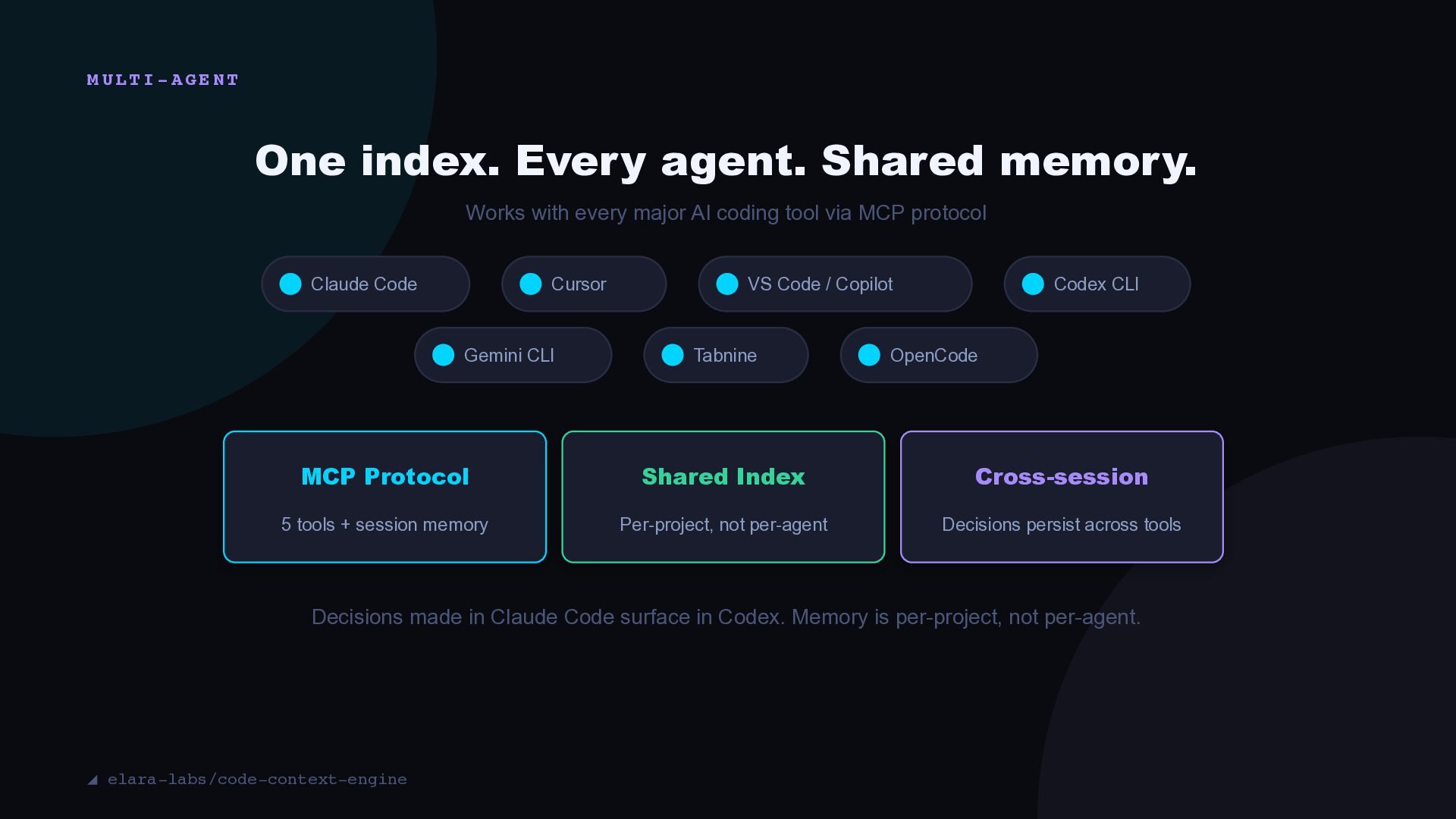
major AI coding tool via MCP protocol Claude Code Cursor Gemini CLI VS Code / Copilot Tabnine Codex CLI OpenCode MCP Protocol Shared Index Cross-session 5 tools + session memory Per-project, not per-agent Decisions persist across tools Decisions made in Claude Code surface in Codex. Memory is per-project, not per-agent. ◢ elara-labs/code-context-engine
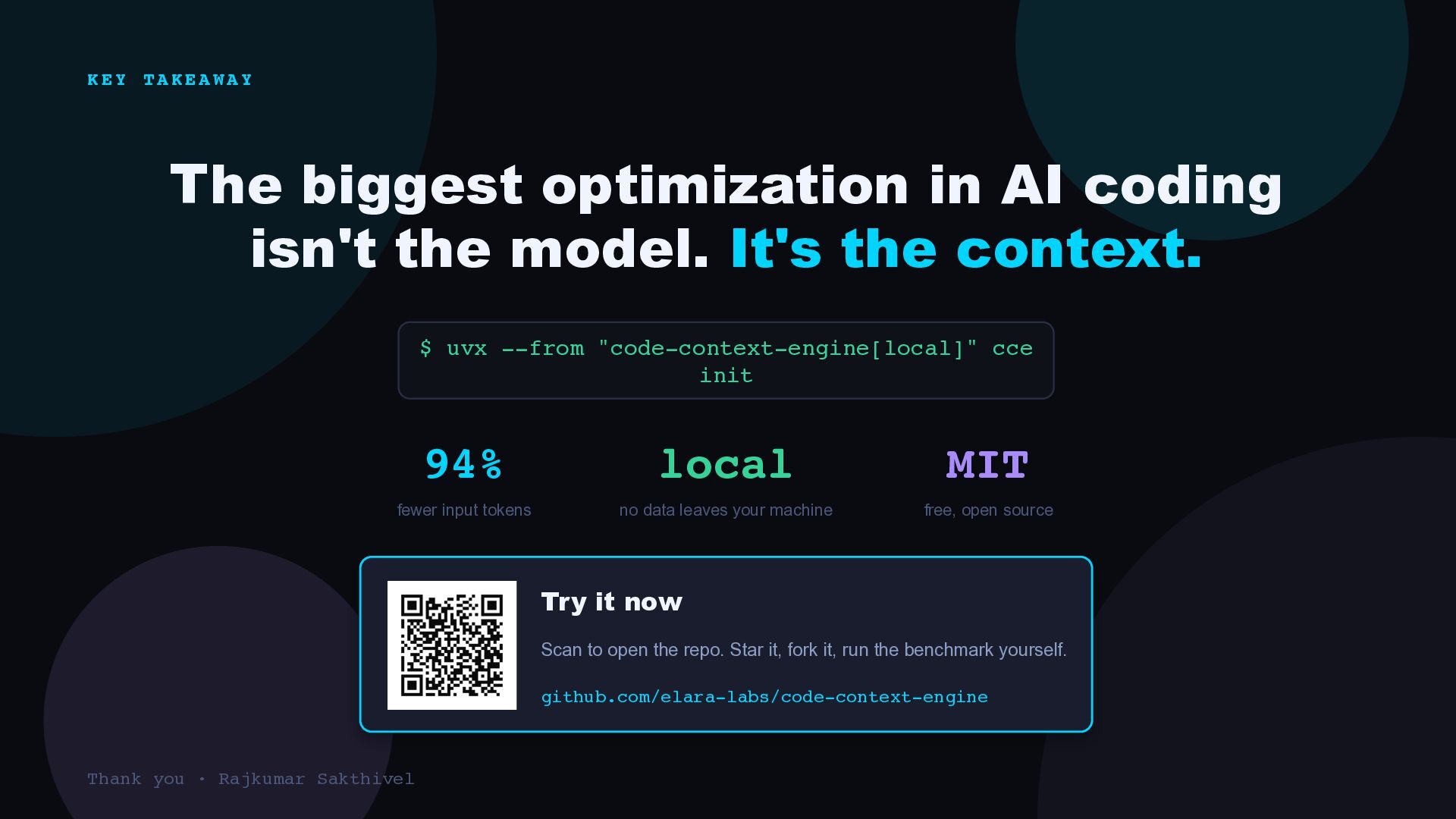
model. It's the context. $ uvx --from "code-context-engine[local]" cce init 94% local MIT fewer input tokens no data leaves your machine free, open source Try it now Scan to open the repo. Star it, fork it, run the benchmark yourself. github.com/elara-labs/code-context-engine Thank you · Rajkumar Sakthivel


 rajkumarsakthi
 4o1sobblue
 riyaamemiya
 pfn
pfn
 akitoshiga
 puhitaku
 teamlab
 yazm
yazm
 prog893
 persolserverworks
 codmoninc
 raspython3
 genda
genda
 palkan
 frankvandijk
 chriscoyier
 inesmontani
 lynnandtonic
 jnunemaker
 cassininazir
 maggiecrowley
 jacobian
 apolaine
 techseoconnect
 aleyda