Grokking HTTP (Longhorn PHP 2025)
Sponsored
·
 Your Podcast. Everywhere. Effortlessly.
Share. Educate. Inspire. Entertain. You do you. We'll handle the rest.
→
Your Podcast. Everywhere. Effortlessly.
Share. Educate. Inspire. Entertain. You do you. We'll handle the rest.
→

Share
Embed
Grokking HTTP (Longhorn PHP 2025)
Hypertext Transfer Protocol is the protocol of the web. From static HTML pages to web applications to microservices, everything we do as web developers has some relationship to this protocol. To effectively create services that use the web, we need a deeper understanding of HTTP.
This talk goes beyond a surface understanding of GET and 200 OK to explore how an deeper knowledge of HTTP can lead to more efficient web applications. We'll cover topics such as content negotiation, hypermedia, caching, and conditional requests, as well as recent developments in efforts to update HTTP.

Ben Ramsey PRO
October 23, 2025
Transcript
148 slides
-
Ben Ramsey • Longhorn PHP Conference • October 23, 2025
Grokking HTTP -
We will cover… • HTTP methods • HTTP status codes
• HTTP headers • Tools to make and inspect HTTP requests • Some interesting requests -
We will not cover… • How HTTP is sent “on
the wire” • SPDY, QUIC, HPACK, QPACK • In other words, the networking details of HTTP/1.1, HTTP/2, or HTTP/3 • These are interesting but largely abstracted from web developers -
Disclaimer • I build APIs for a living • Most
of my focus on HTTP is from the standpoint of APIs • Much of what we’ll talk about is very API-centric • Even if you don’t build or consume APIs, all web developers can bene fi t from a greater understanding of HTTP -
—Robert A. Heinlein, Stranger in a Strange Land “Grok means
to understand so thoroughly that the observer becomes a part of the observed—to merge, blend, intermarry, lose identity in group experience.” -
—Jargon File “To understand. Connotes intimate and exhaustive knowledge. When
you claim to ‘grok’ some knowledge or technique, you are asserting that you have not merely learned it in a detached instrumental way but that it has become part of you, part of your identity. For example, to say that you ‘know’ LISP is simply to assert that you can code in it if necessary—but to say you ‘grok’ LISP is to claim that you have deeply entered the world-view and spirit of the language, with the implication that it has transformed your view of programming.” -
—Damian Conway, Perl Best Practices “When you’re developing a particular
code suite over a long period of time, you eventually fi nd yourself ‘in the zone.’ In that state, you seem to have the design and the control fl ow and the data structures and the naming conventions and the modular decomposition and every other aspect of the program constantly at your mental fi ngertips. You understand the code in a profound way. It’s easy to ‘see’ problems directly and locate bugs quickly, sometimes without even quite knowing how you knew. You truly grok the source.” -
hypertext A multi-linear set of objects, building a network by
using logical links (the so-called hyperlinks) between the nodes (e.g. text or words). -
protocol A set of rules and regulations that de fi
ne how data is transmitted across a network. -
HTTP is a set of rules for transferring hypertext across
the internet. -
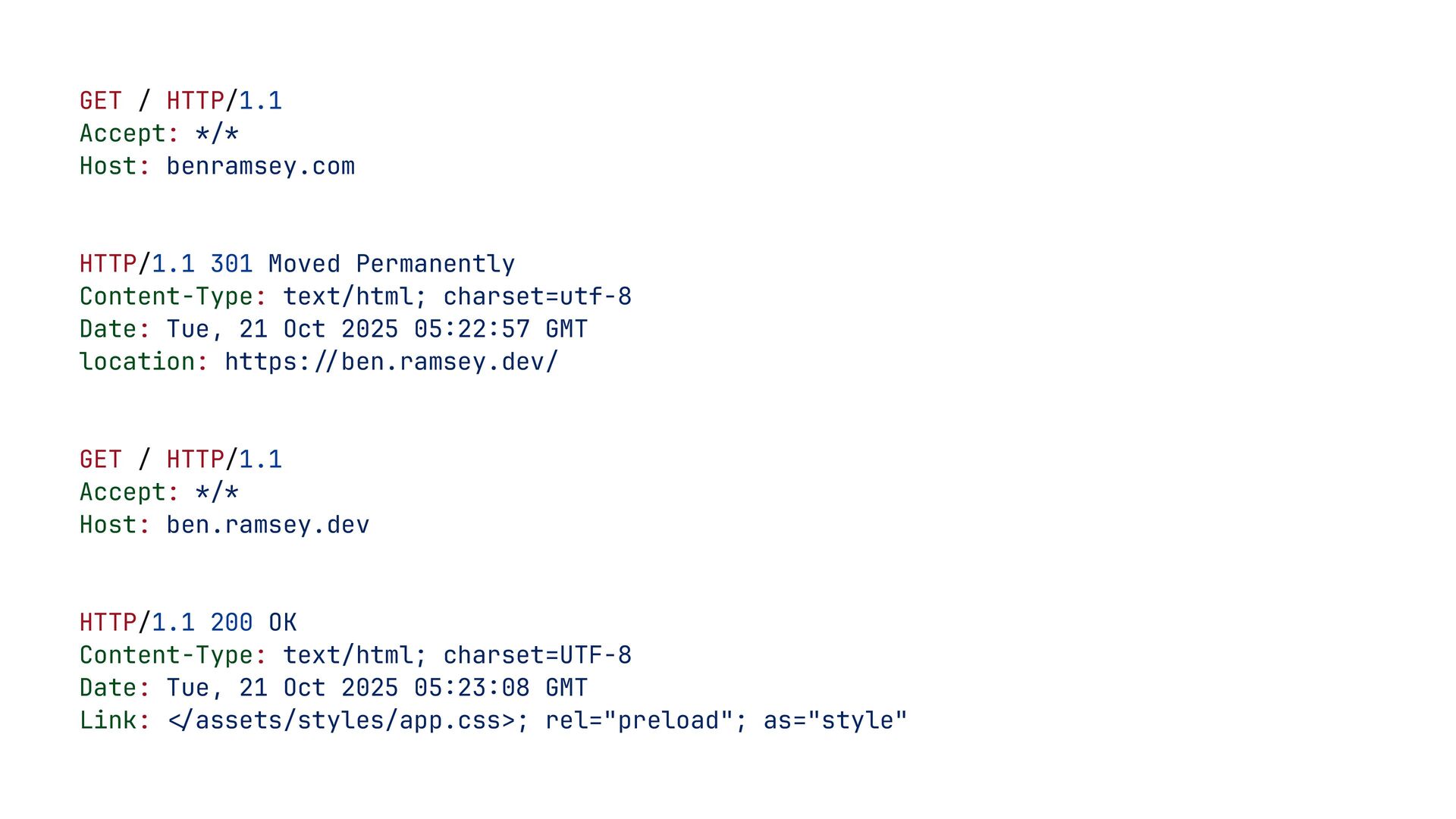
GET / HTTP/1.1 Accept: */* Host: benramsey.com HTTP/1.1 301 Moved
Permanently Content-Type: text/html; charset=utf-8 Date: Tue, 21 Oct 2025 05 : 22 : 57 GMT location: https: // ben.ramsey.dev/ GET / HTTP/1.1 Accept: */* Host: ben.ramsey.dev HTTP/1.1 200 OK Content-Type: text/html; charset=UTF-8 Date: Tue, 21 Oct 2025 05 : 23 : 08 GMT Link: </ assets/styles/app.css>; rel="preload"; as="style" -
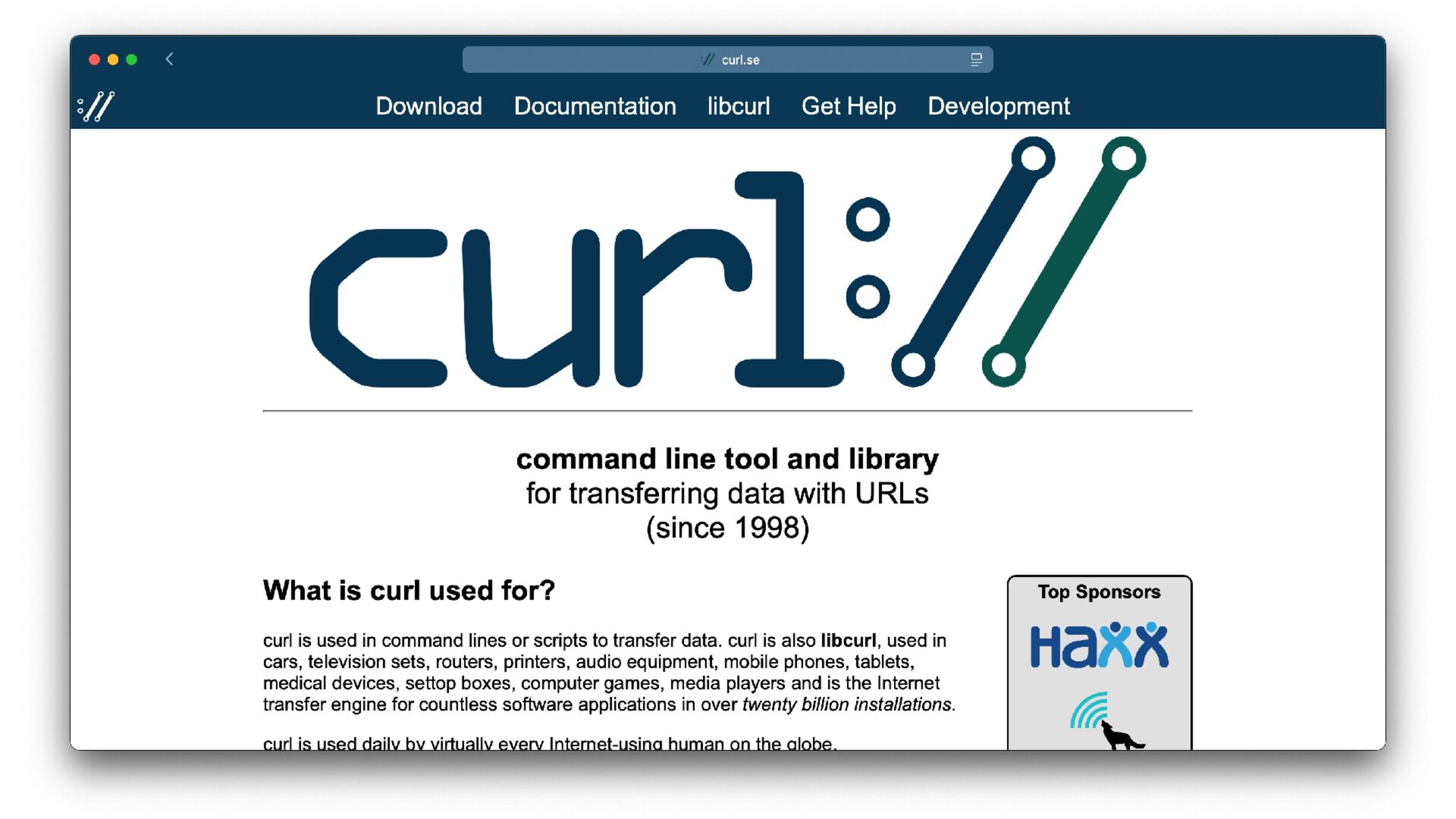
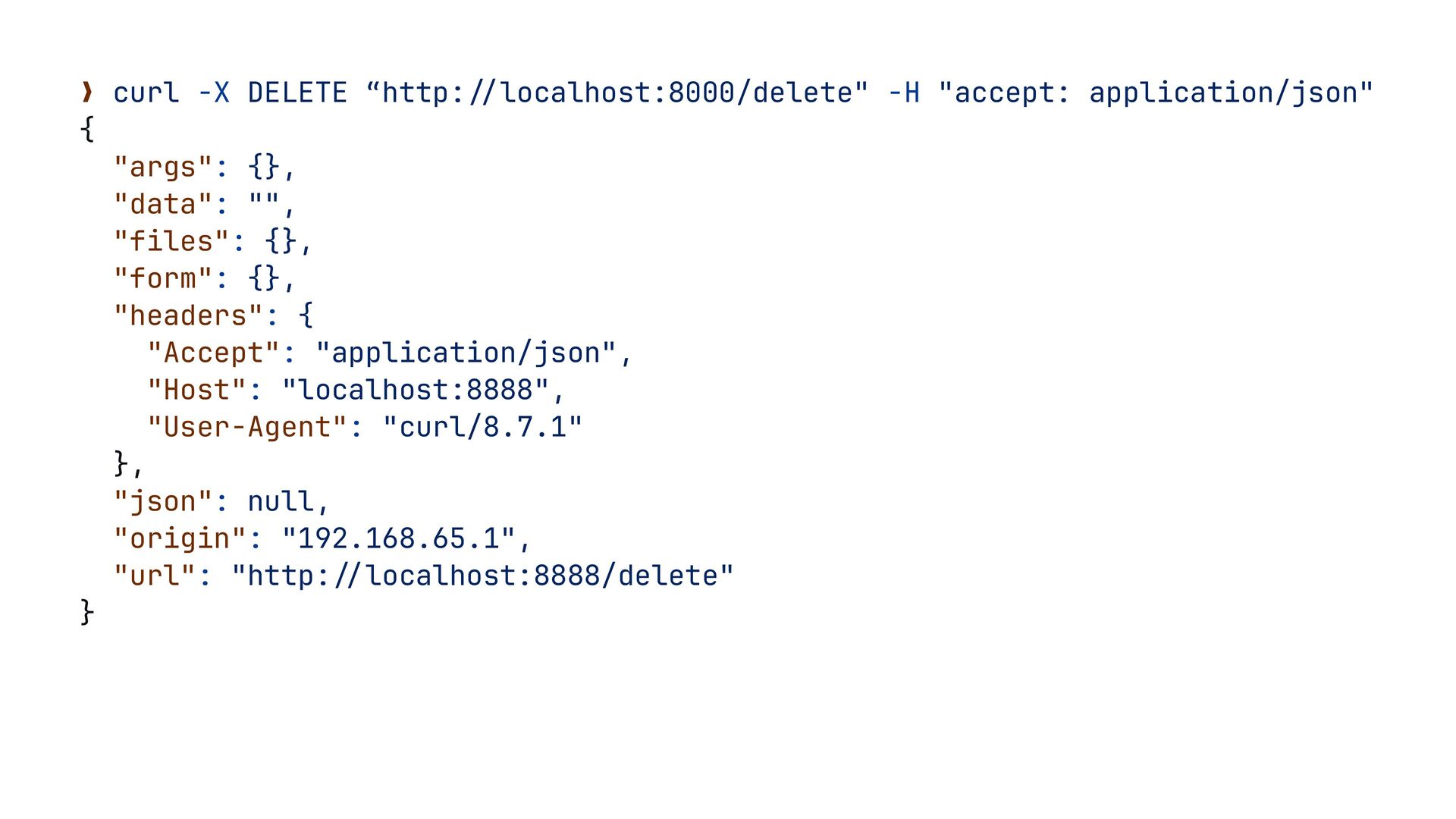
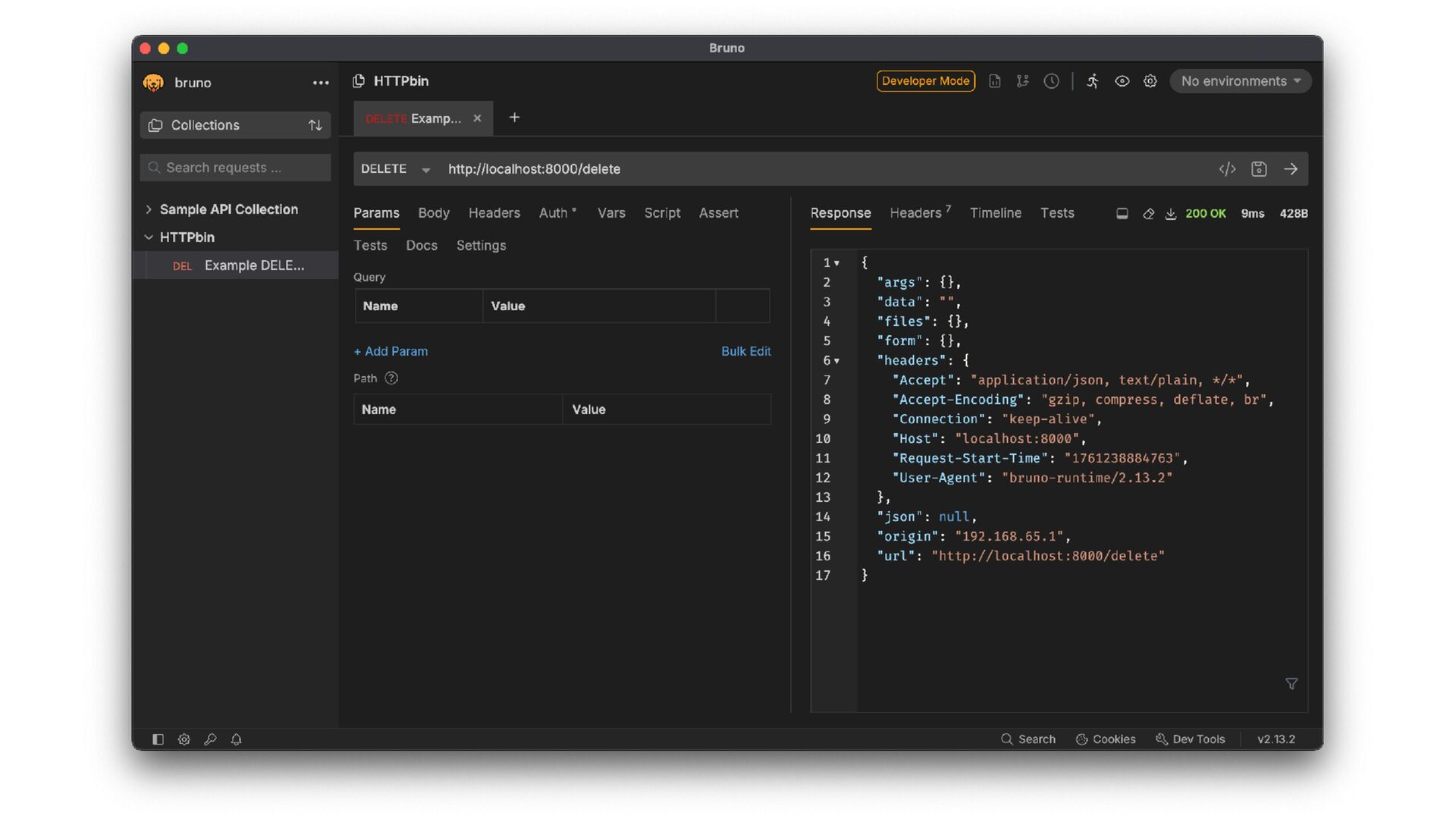
❯ curl -X DELETE “http: / / localhost:8000/delete" -H "accept:
application/json" { "args": {}, "data": "", "files": {}, "form": {}, "headers": { "Accept": "application/json", "Host": "localhost:8888", "User-Agent": "curl/8.7.1" }, "json": null, "origin": "192.168.65.1", "url": "http: // localhost:8888/delete" } -
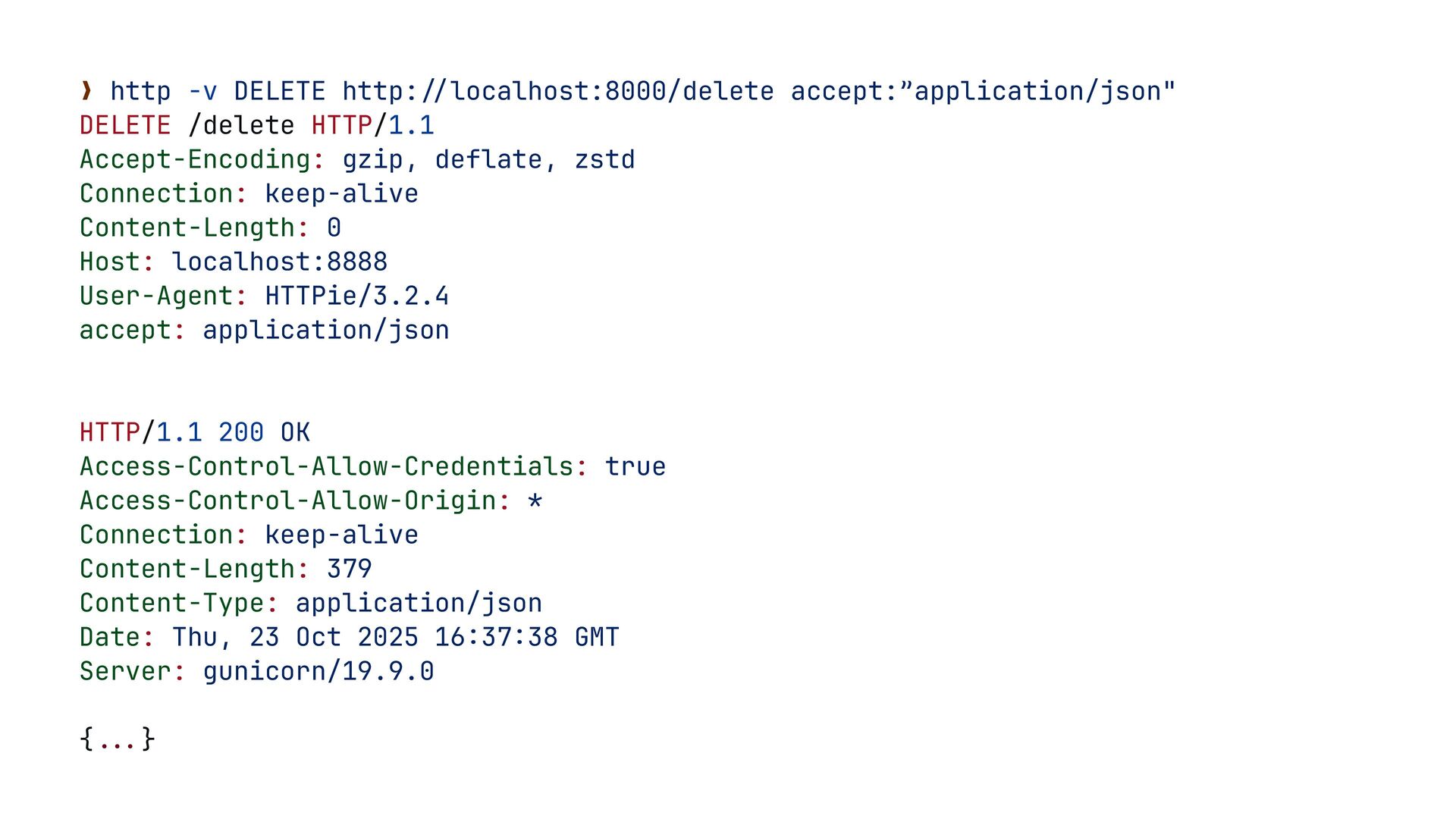
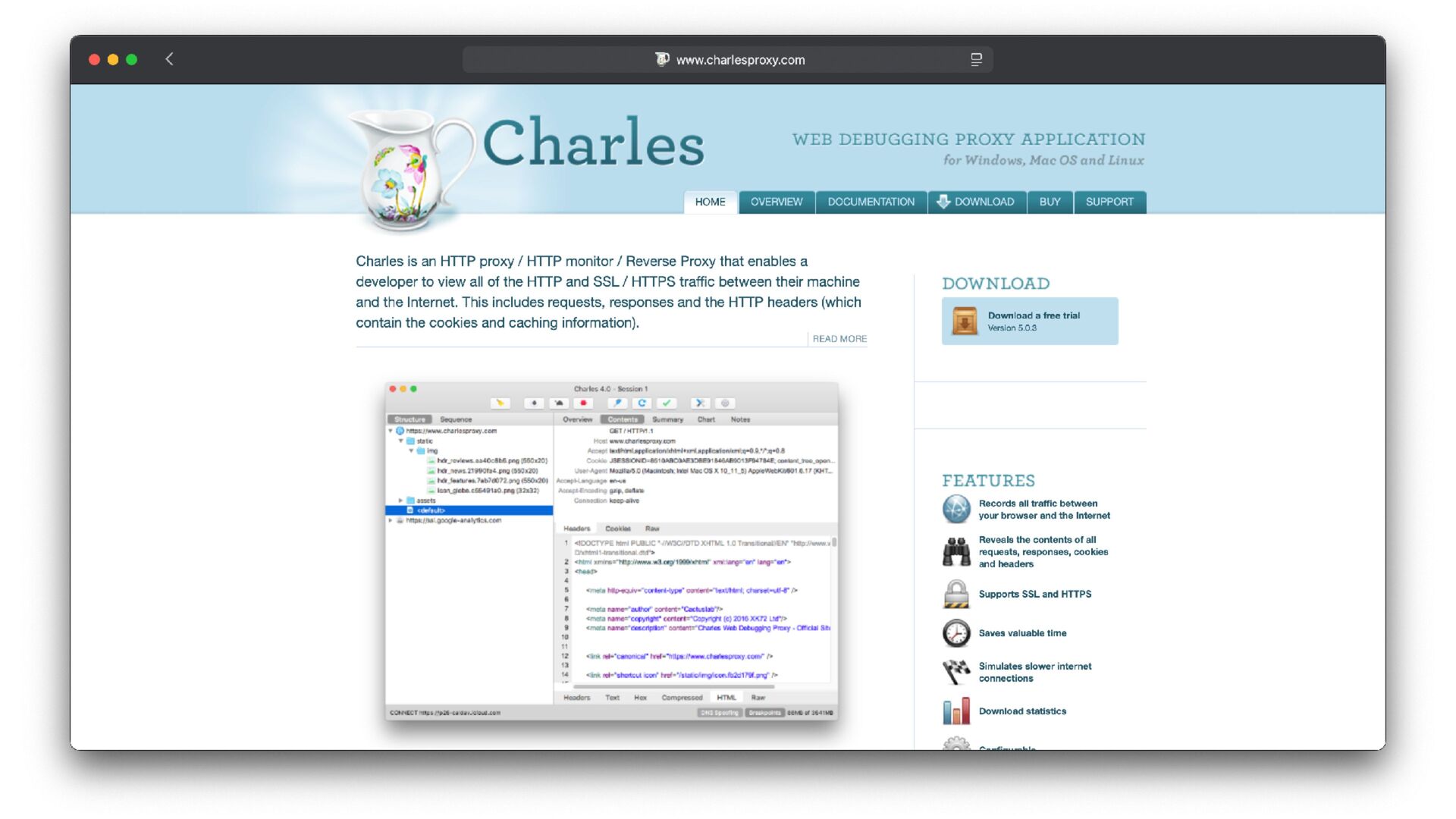
❯ http -v DELETE http: // localhost:8000/delete accept:”application/json" DELETE /delete
HTTP/1.1 Accept-Encoding: gzip, deflate, zstd Connection: keep-alive Content-Length: 0 Host: localhost:8888 User-Agent: HTTPie/3.2.4 accept: application/json HTTP/1.1 200 OK Access-Control-Allow-Credentials: true Access-Control-Allow-Origin: * Connection: keep-alive Content-Length: 379 Content-Type: application/json Date: Thu, 23 Oct 2025 16 : 37 : 38 GMT Server: gunicorn/19.9.0 { .. . } -
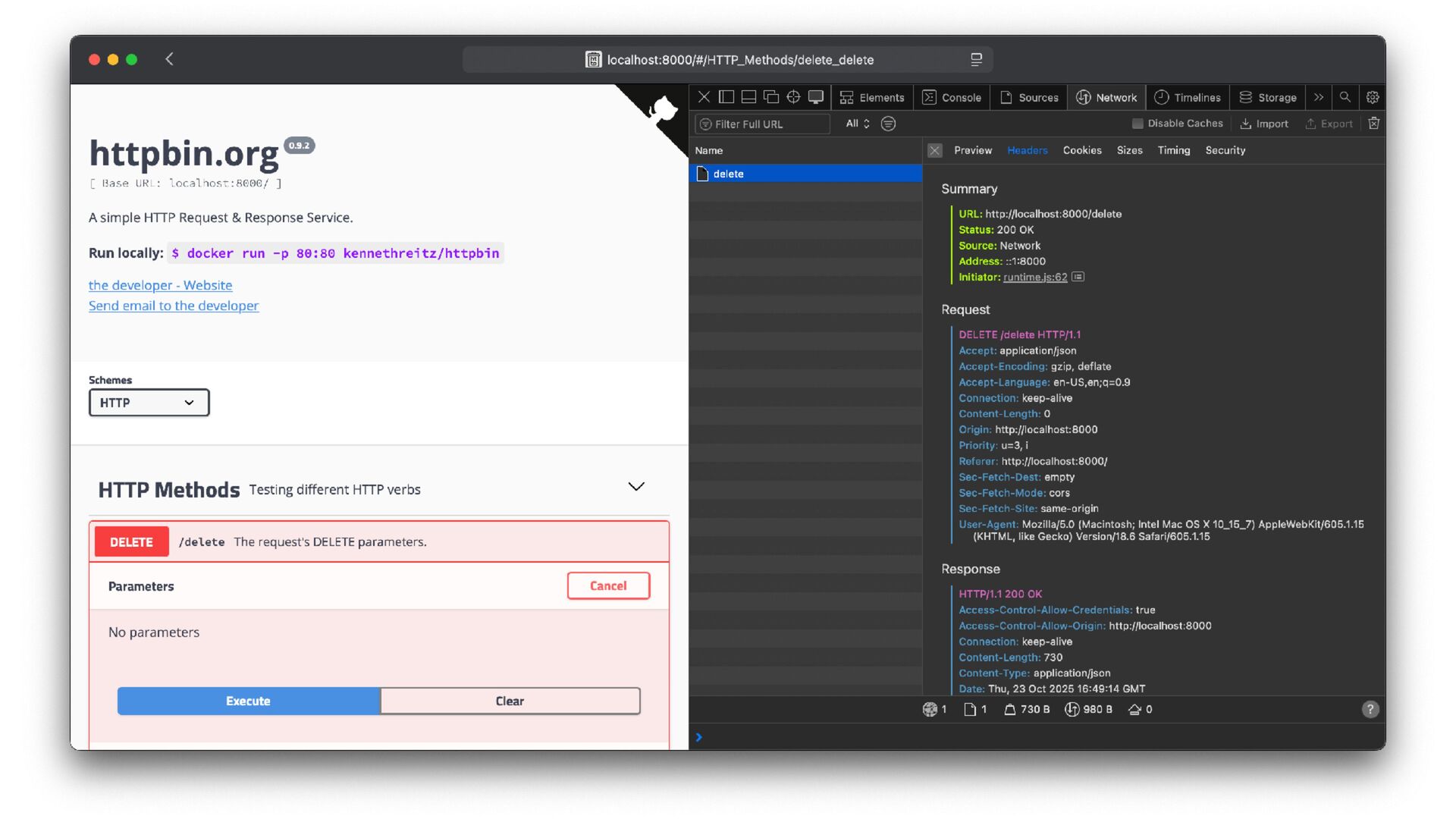
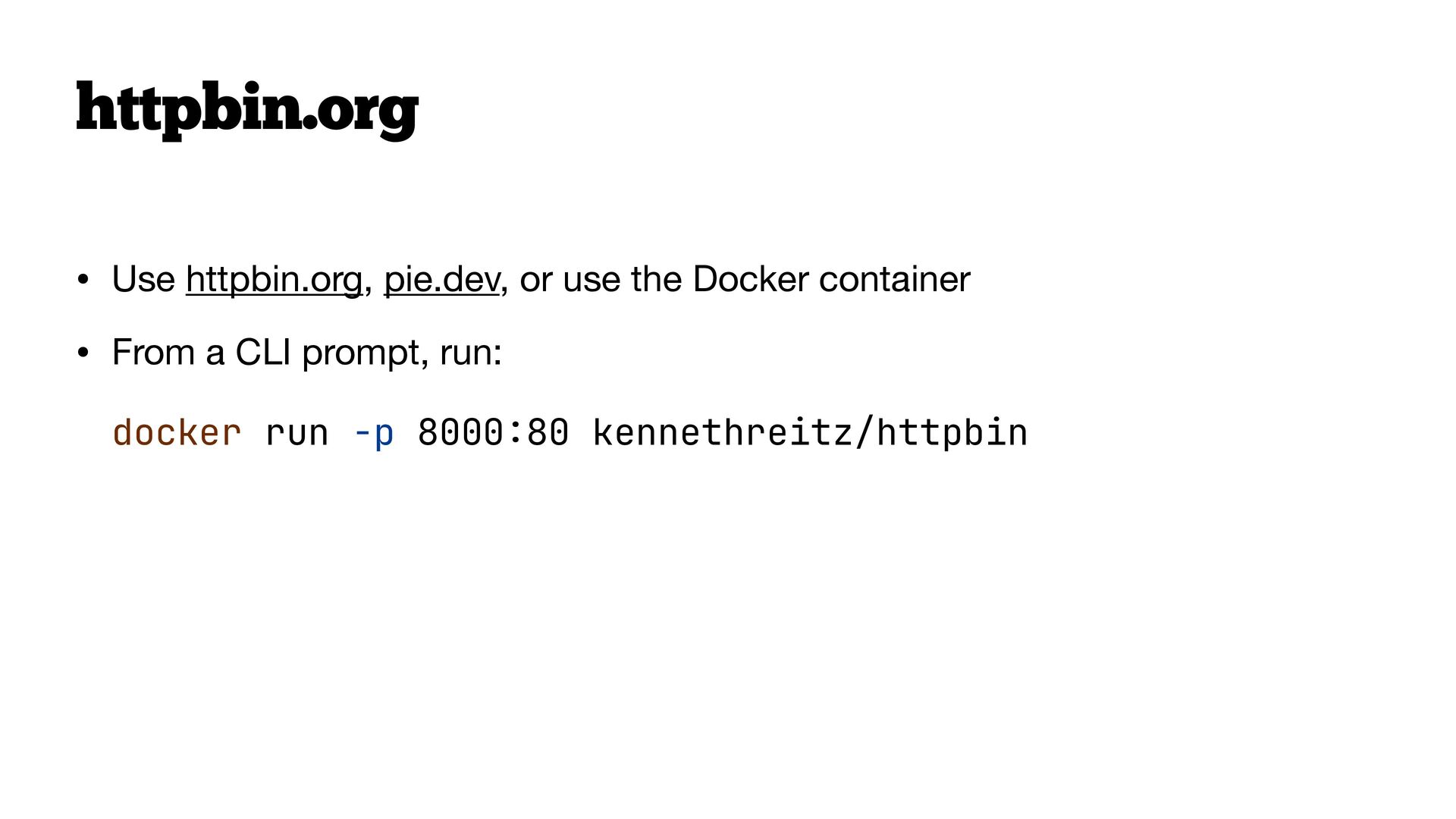
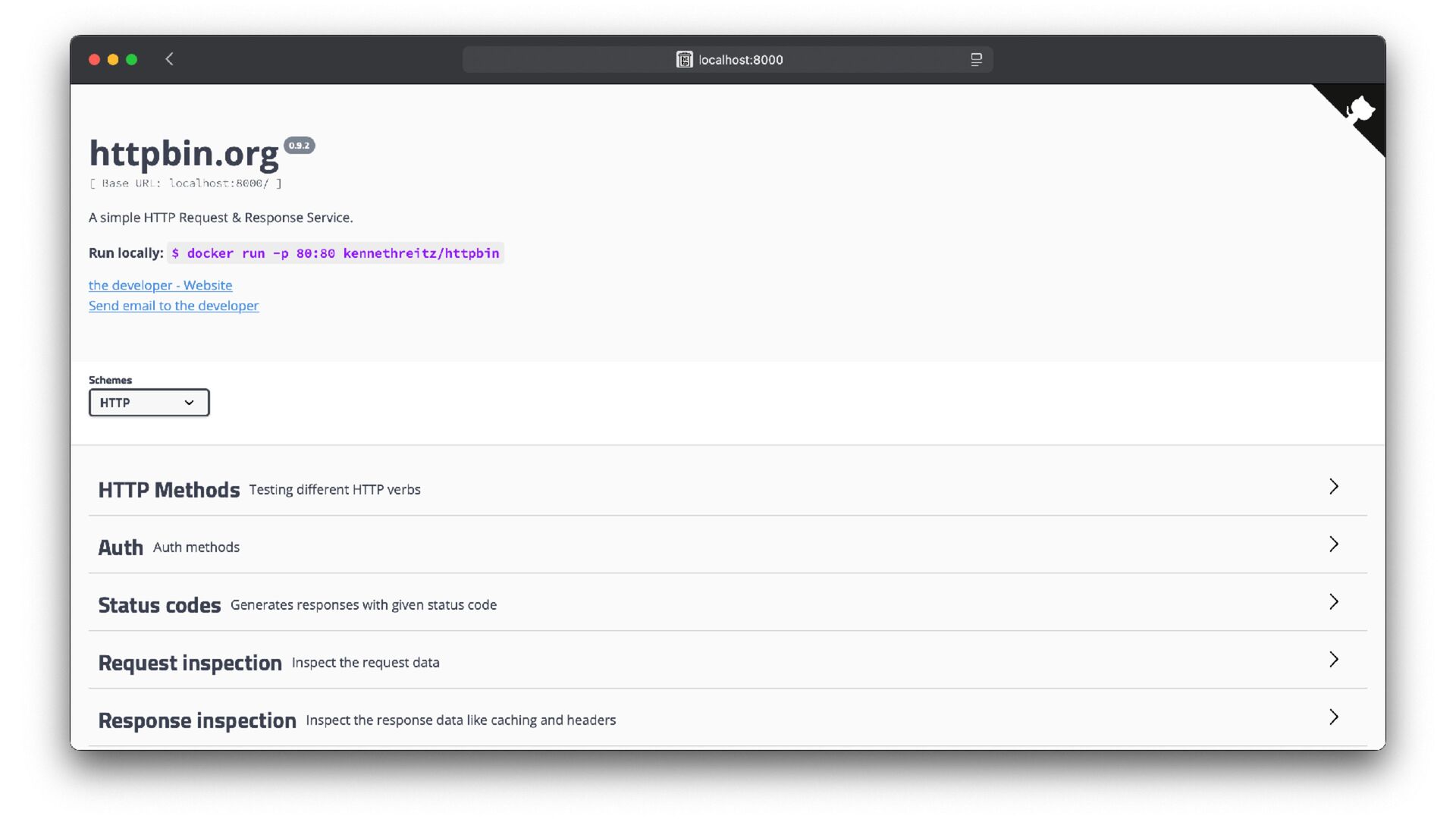
httpbin.org • Use httpbin.org, pie.dev, or use the Docker container
• From a CLI prompt, run: docker run -p 8000 : 80 kennethreitz/httpbin -
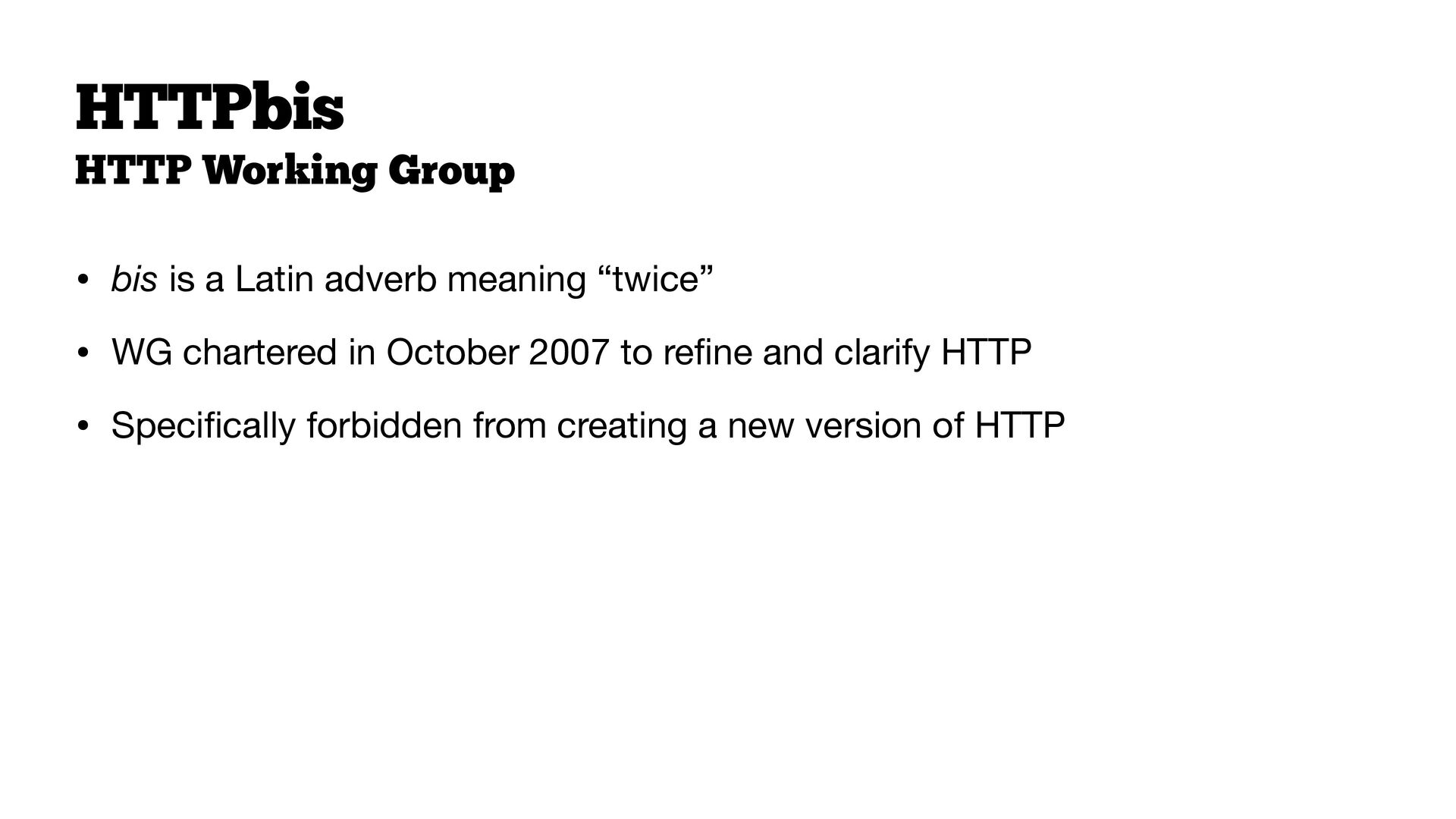
HTTPbis HTTP Working Group • bis is a Latin adverb
meaning “twice” • WG chartered in October 2007 to re fi ne and clarify HTTP • Speci fi cally forbidden from creating a new version of HTTP -
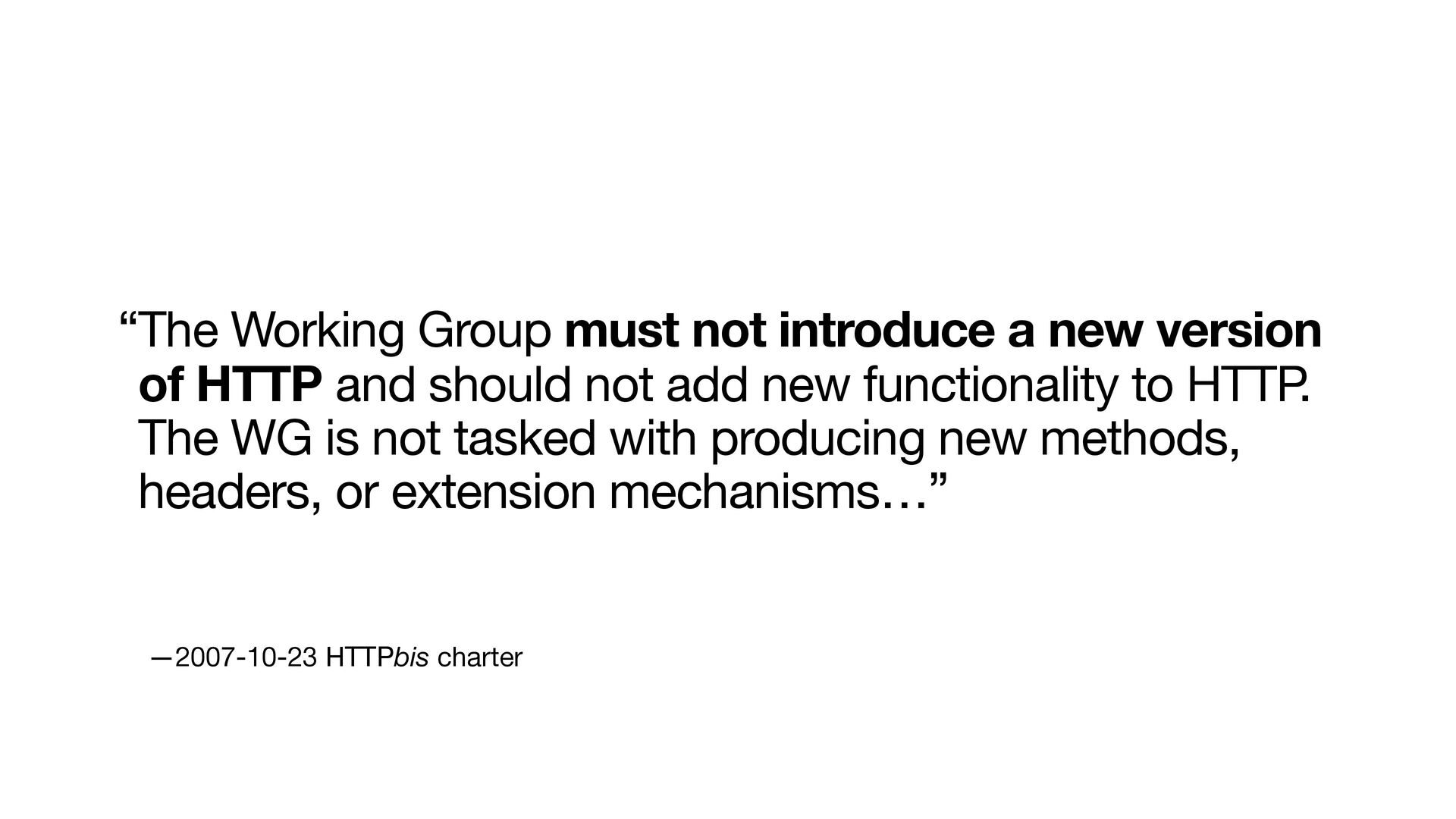
—2007-10-23 HTTPbis charter “The Working Group must not introduce a
new version of HTTP and should not add new functionality to HTTP. The WG is not tasked with producing new methods, headers, or extension mechanisms…” -
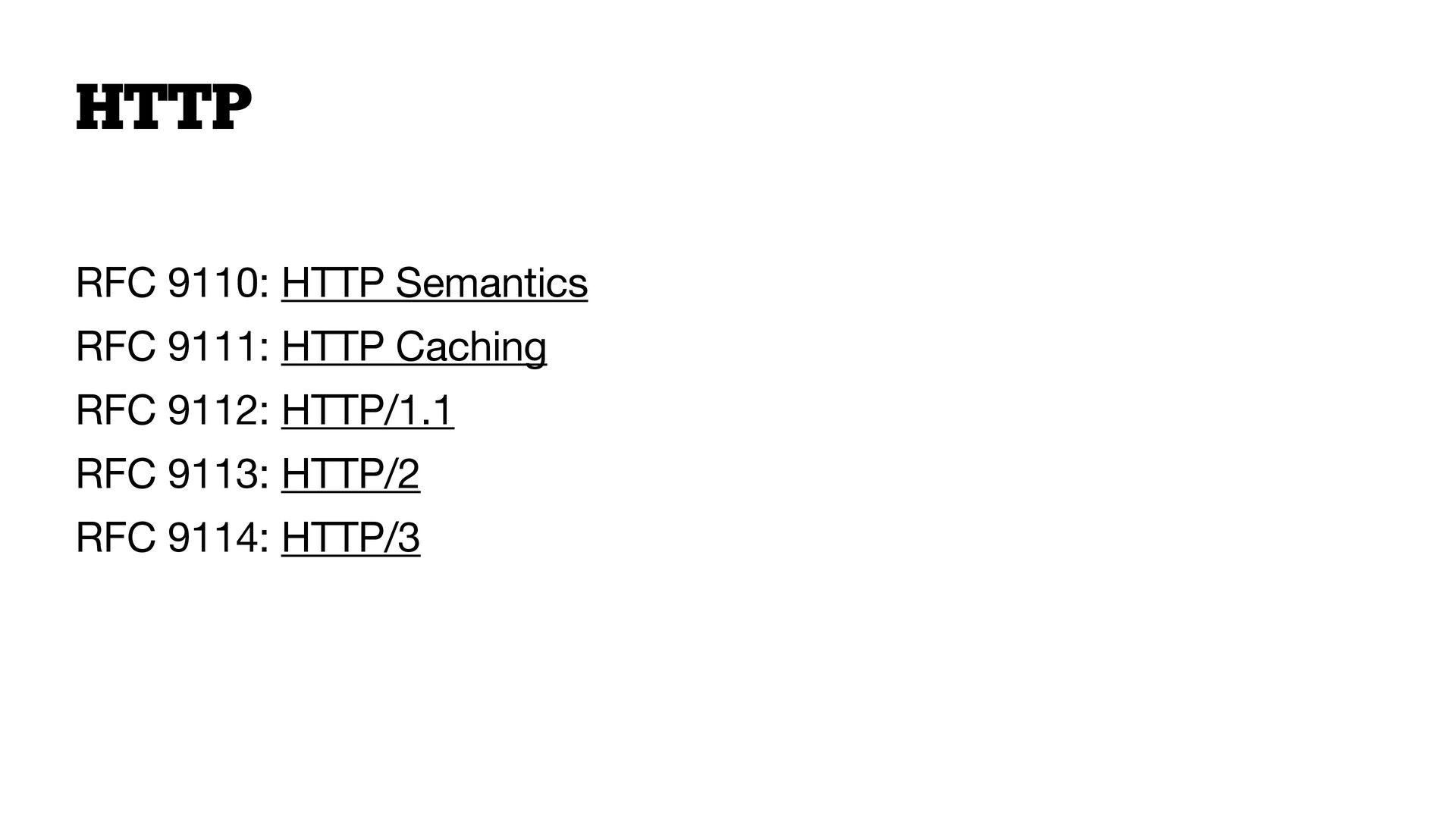
HTTP RFC 9110: HTTP Semantics RFC 9111: HTTP Caching RFC
9112: HTTP/1.1 RFC 9113: HTTP/2 RFC 9114: HTTP/3 -
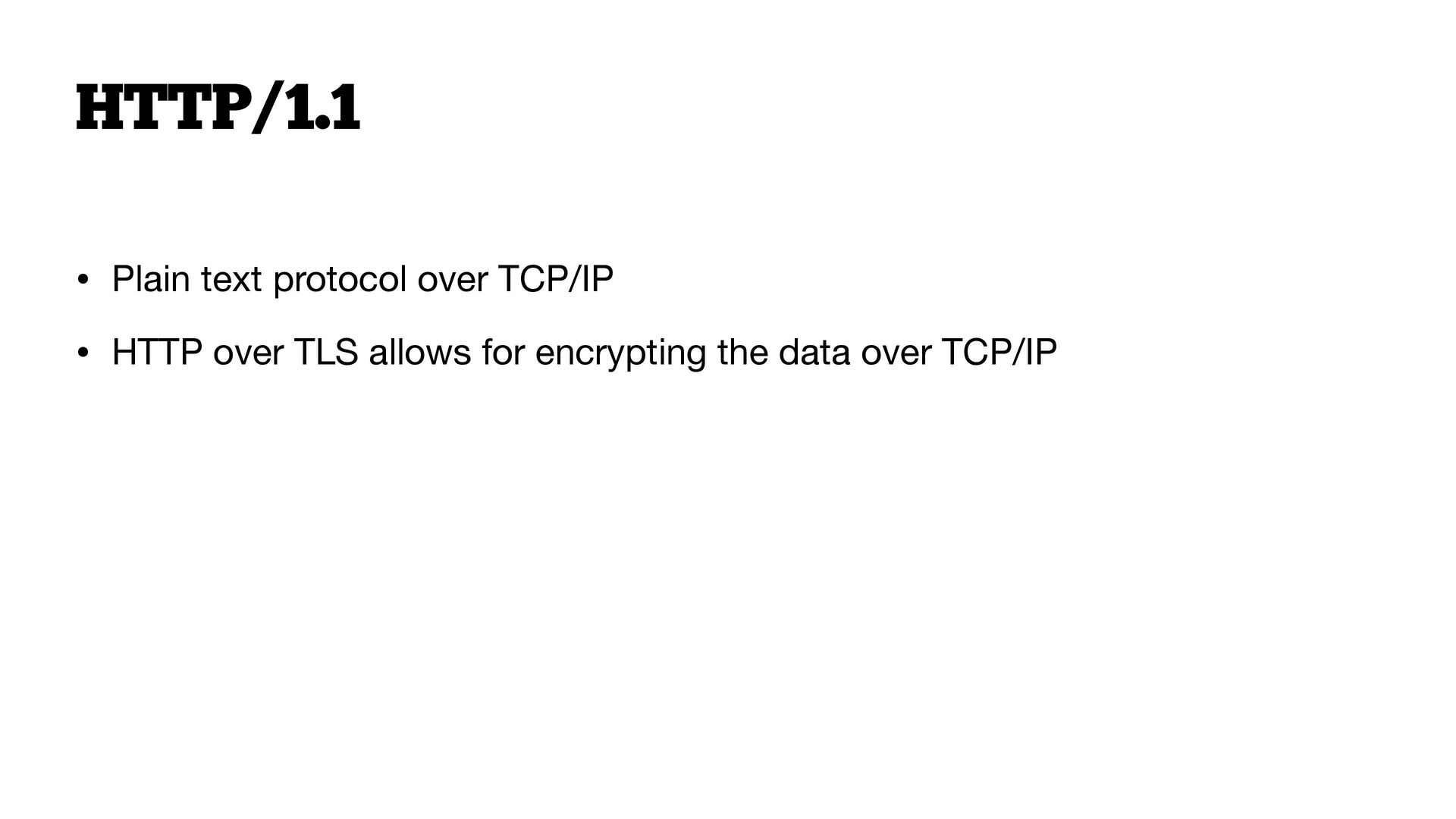
HTTP/1.1 • Plain text protocol over TCP/IP • HTTP over
TLS allows for encrypting the data over TCP/IP -
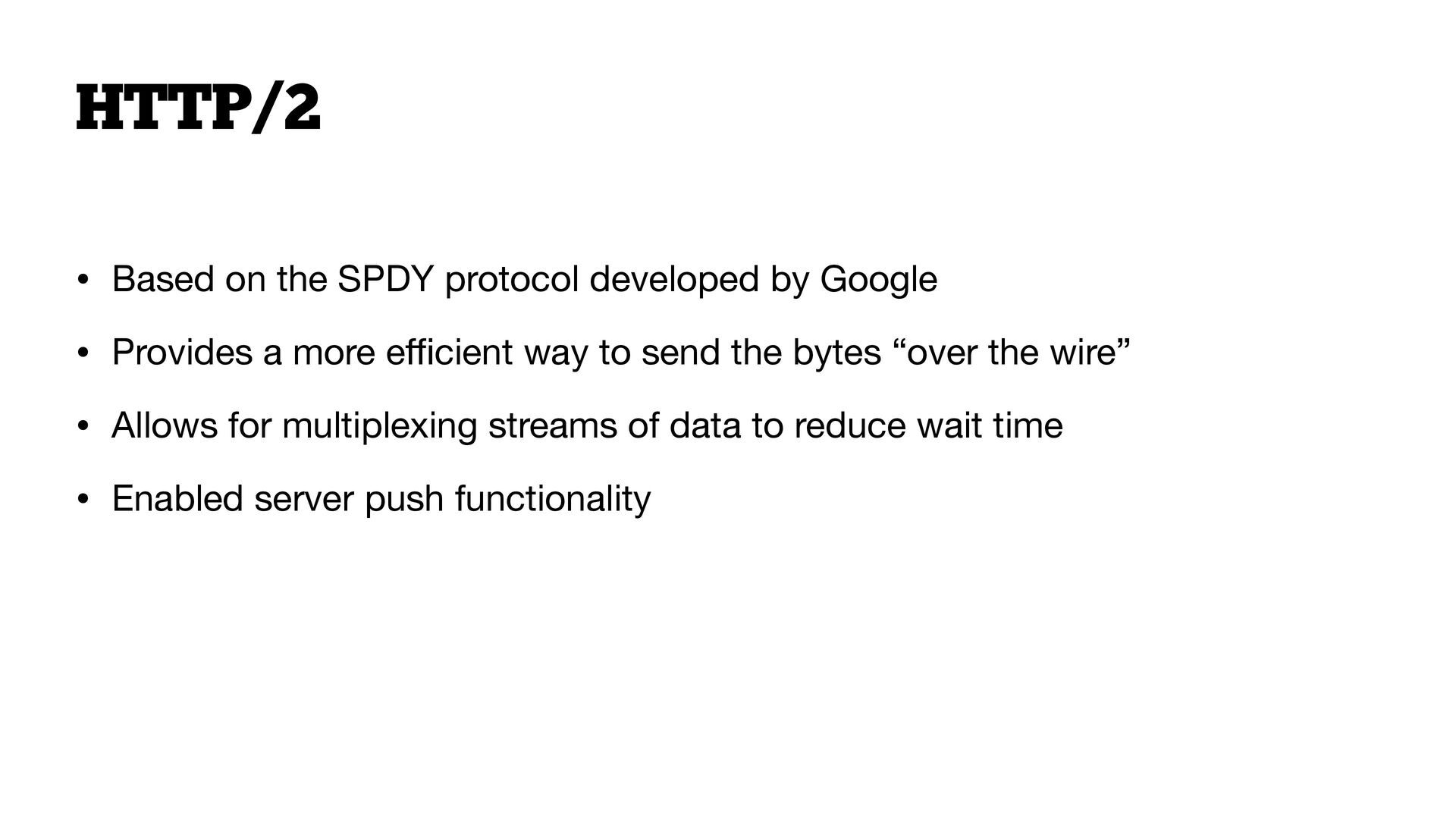
HTTP/2 • Based on the SPDY protocol developed by Google
• Provides a more e ffi cient way to send the bytes “over the wire” • Allows for multiplexing streams of data to reduce wait time • Enabled server push functionality -
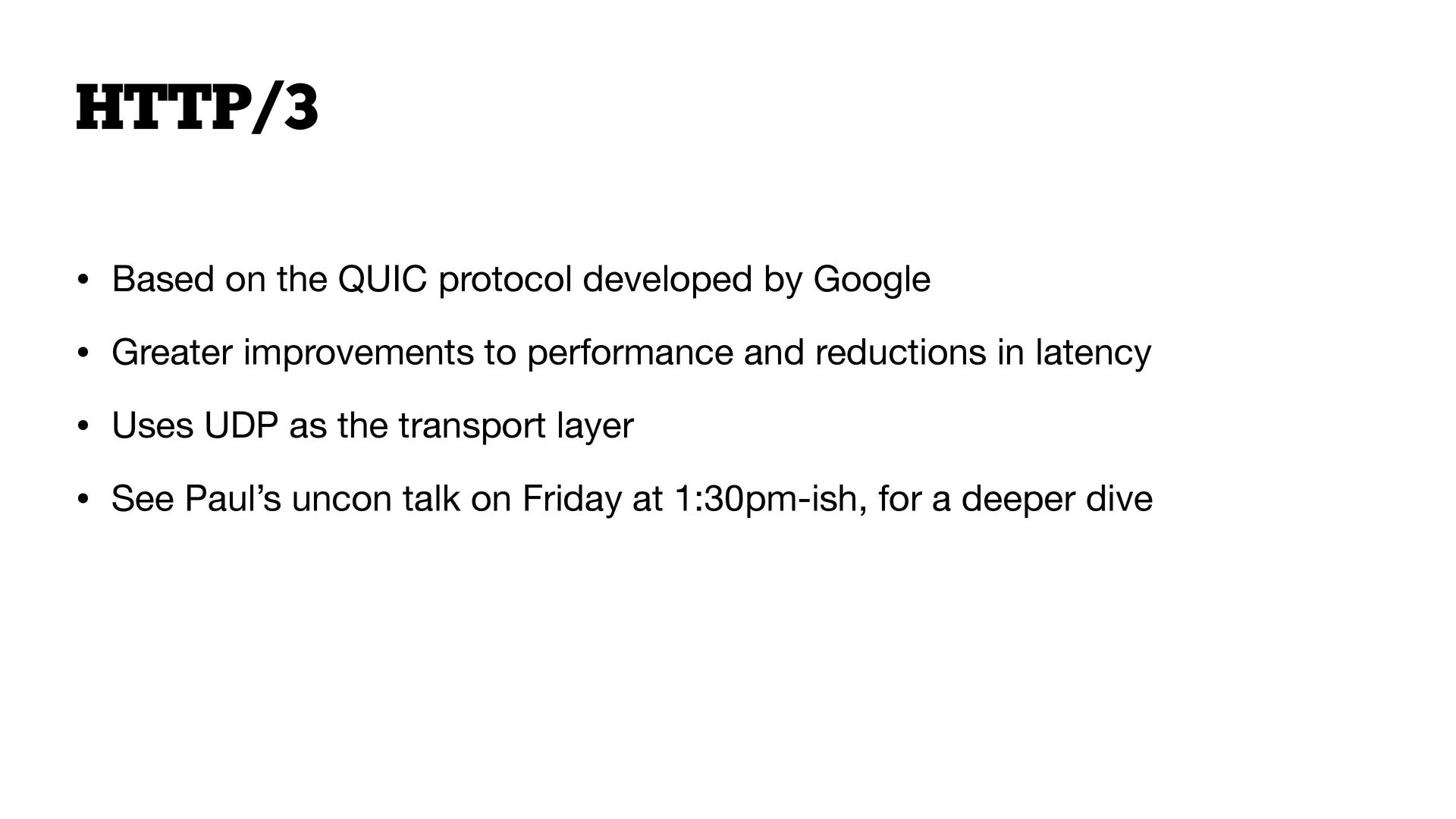
HTTP/3 • Based on the QUIC protocol developed by Google
• Greater improvements to performance and reductions in latency • Uses UDP as the transport layer • See Paul’s uncon talk on Friday at 1:30pm-ish, for a deeper dive -
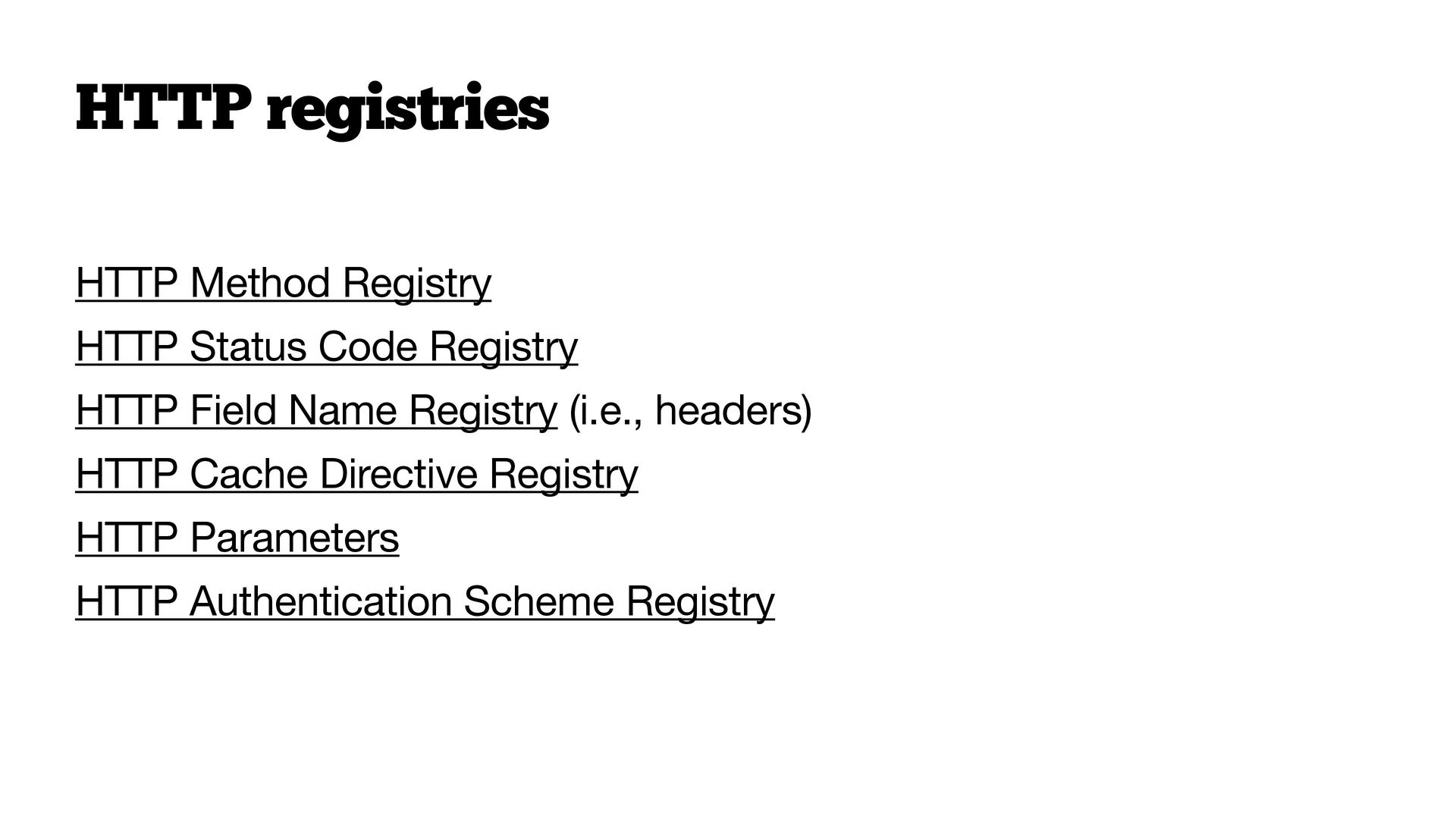
HTTP registries HTTP Method Registry HTTP Status Code Registry HTTP
Field Name Registry (i.e., headers) HTTP Cache Directive Registry HTTP Parameters HTTP Authentication Scheme Registry -
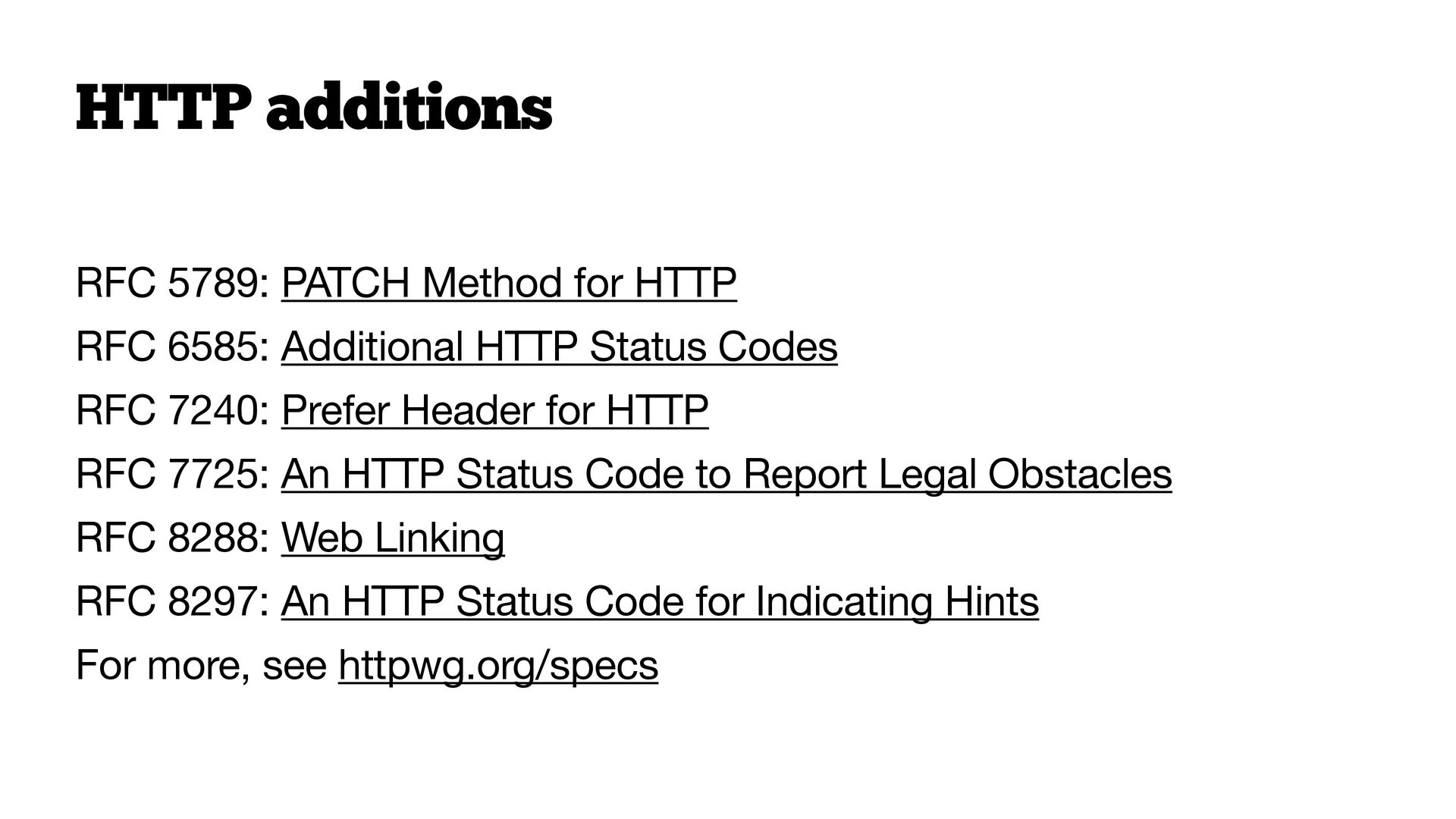
HTTP additions RFC 5789: PATCH Method for HTTP RFC 6585:
Additional HTTP Status Codes RFC 7240: Prefer Header for HTTP RFC 7725: An HTTP Status Code to Report Legal Obstacles RFC 8288: Web Linking RFC 8297: An HTTP Status Code for Indicating Hints For more, see httpwg.org/specs -
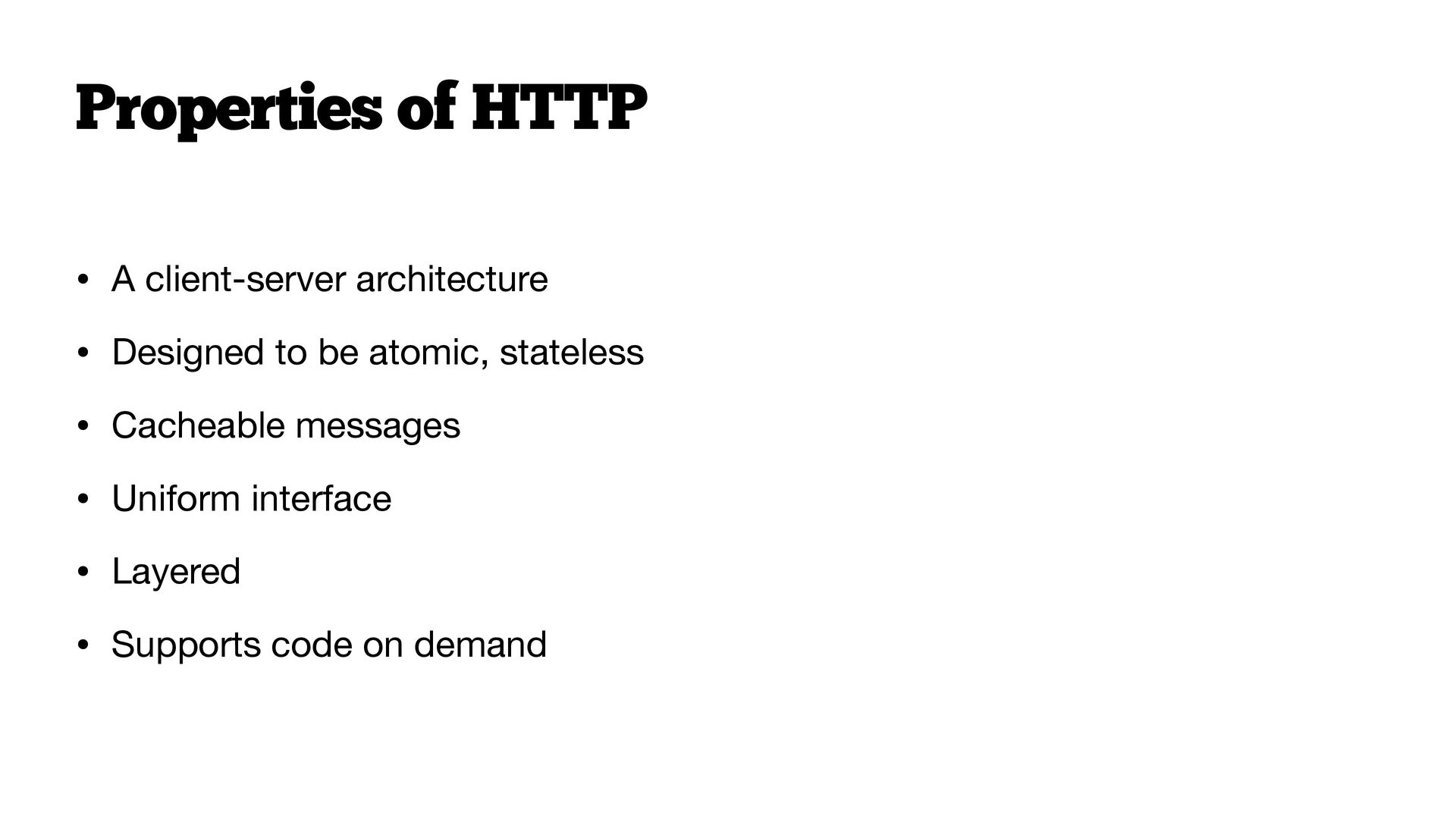
Properties of HTTP • A client-server architecture • Designed to
be atomic, stateless • Cacheable messages • Uniform interface • Layered • Supports code on demand -
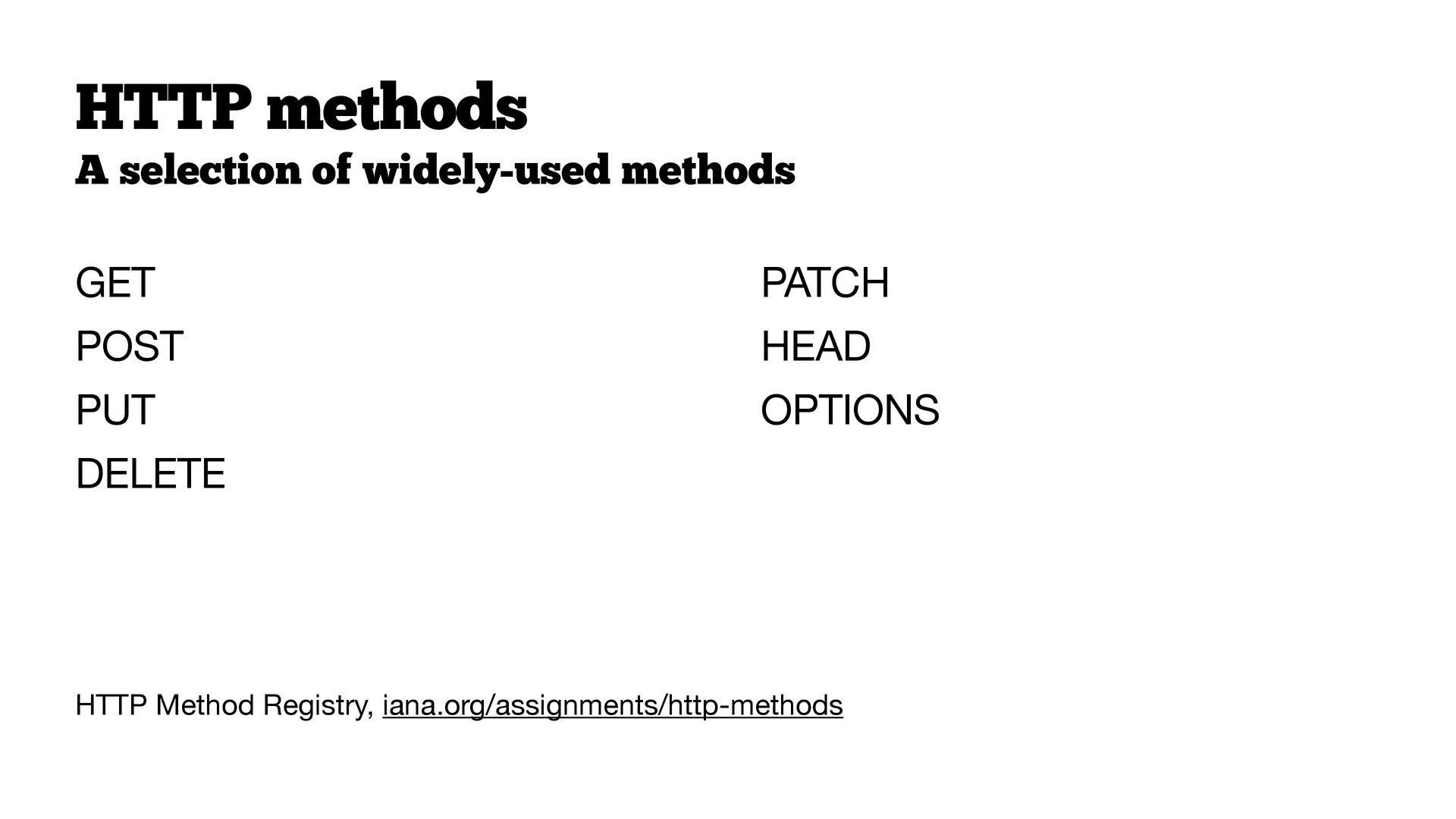
HTTP methods A selection of widely-used methods GET POST PUT
DELETE PATCH HEAD OPTIONS HTTP Method Registry, iana.org/assignments/http-methods -
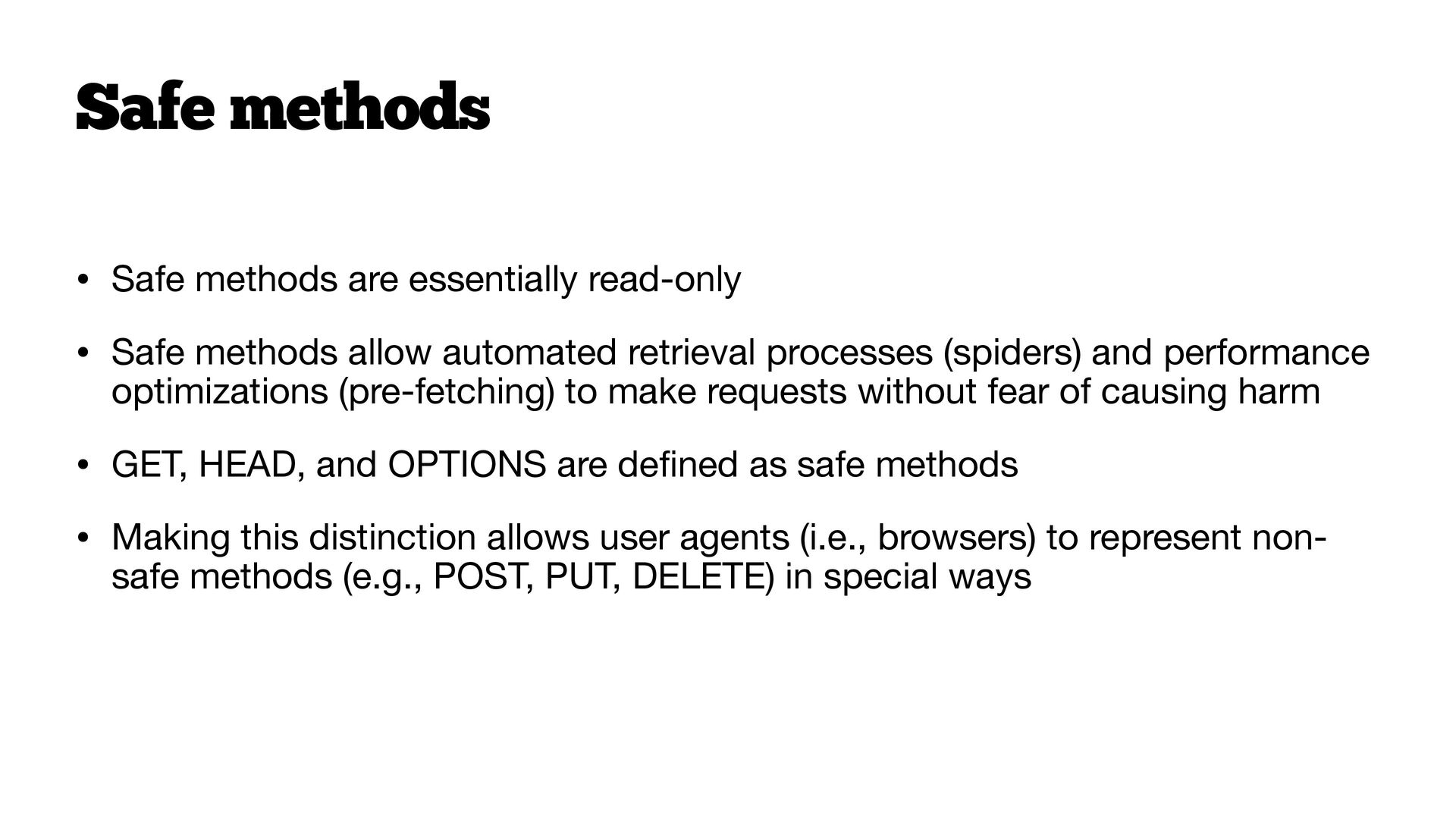
Safe methods • Safe methods are essentially read-only • Safe
methods allow automated retrieval processes (spiders) and performance optimizations (pre-fetching) to make requests without fear of causing harm • GET, HEAD, and OPTIONS are de fi ned as safe methods • Making this distinction allows user agents (i.e., browsers) to represent non- safe methods (e.g., POST, PUT, DELETE) in special ways -
—RFC 9110, 9.2.1. Safe Methods “This de fi nition of
safe methods does not prevent an implementation from including behavior that is potentially harmful, that is not entirely read-only, or that causes side e ff ects while invoking a safe method. What is important, however, is that the client did not request that additional behavior and cannot be held accountable for it.” -
Idempotence • Side e ff ects of 𝑛 > 𝟎
identical requests is the same as for a single request • Idempotent methods allow automatic retries of requests, e.g., in the case of communication failures • PUT and DELETE are idempotent • All safe methods are inherently idempotent -
—RFC 9110, 9.2.2. Idempotent Methods “A client SHOULD NOT automatically
retry a request with a non- idempotent method unless it has some means to know that the request semantics are actually idempotent, regardless of the method, or some means to detect that the original request was never applied.” -
GET • Used to retrieve information • “Transfer a current
representation of the target resource” • Safe & idempotent -
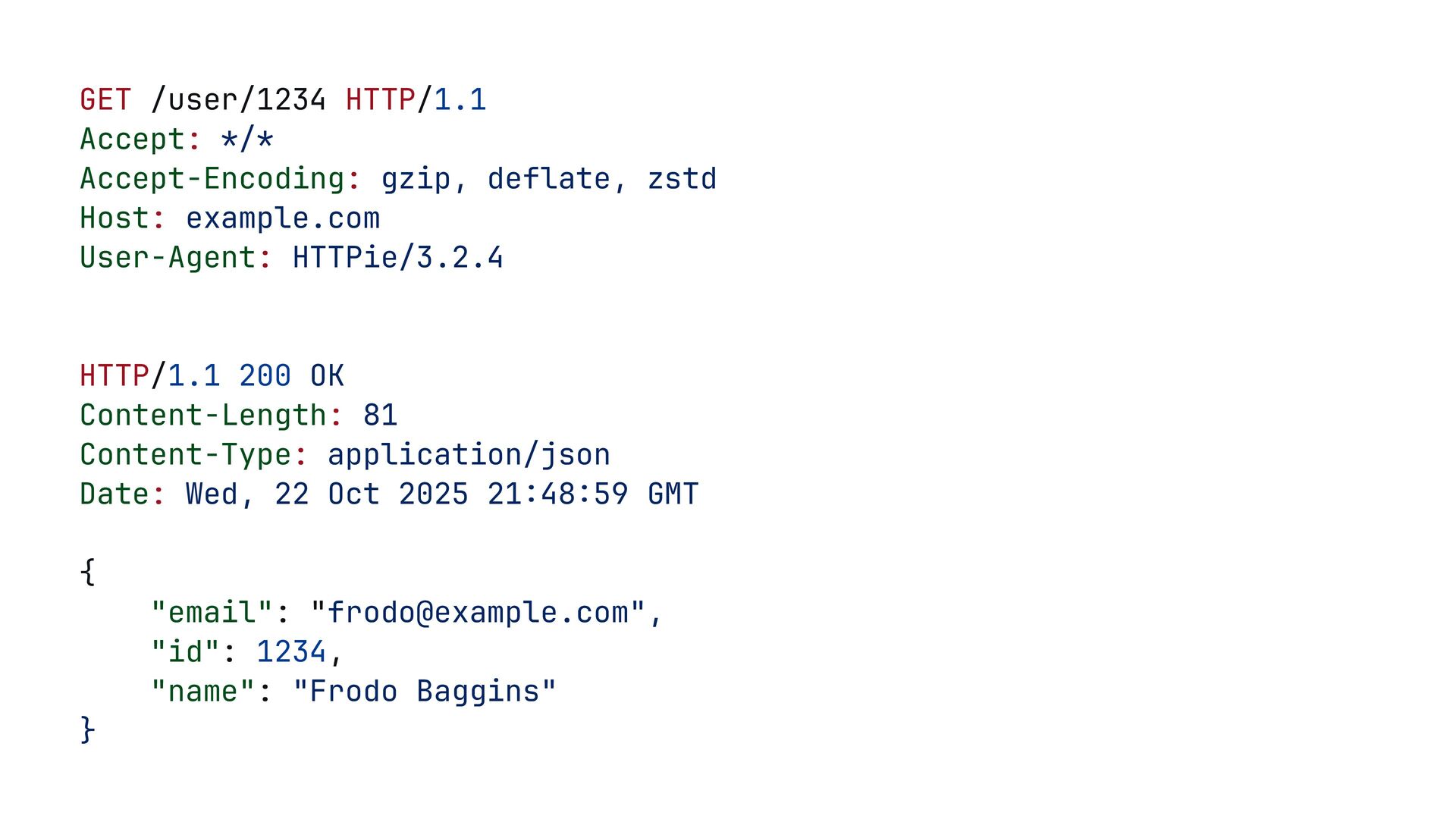
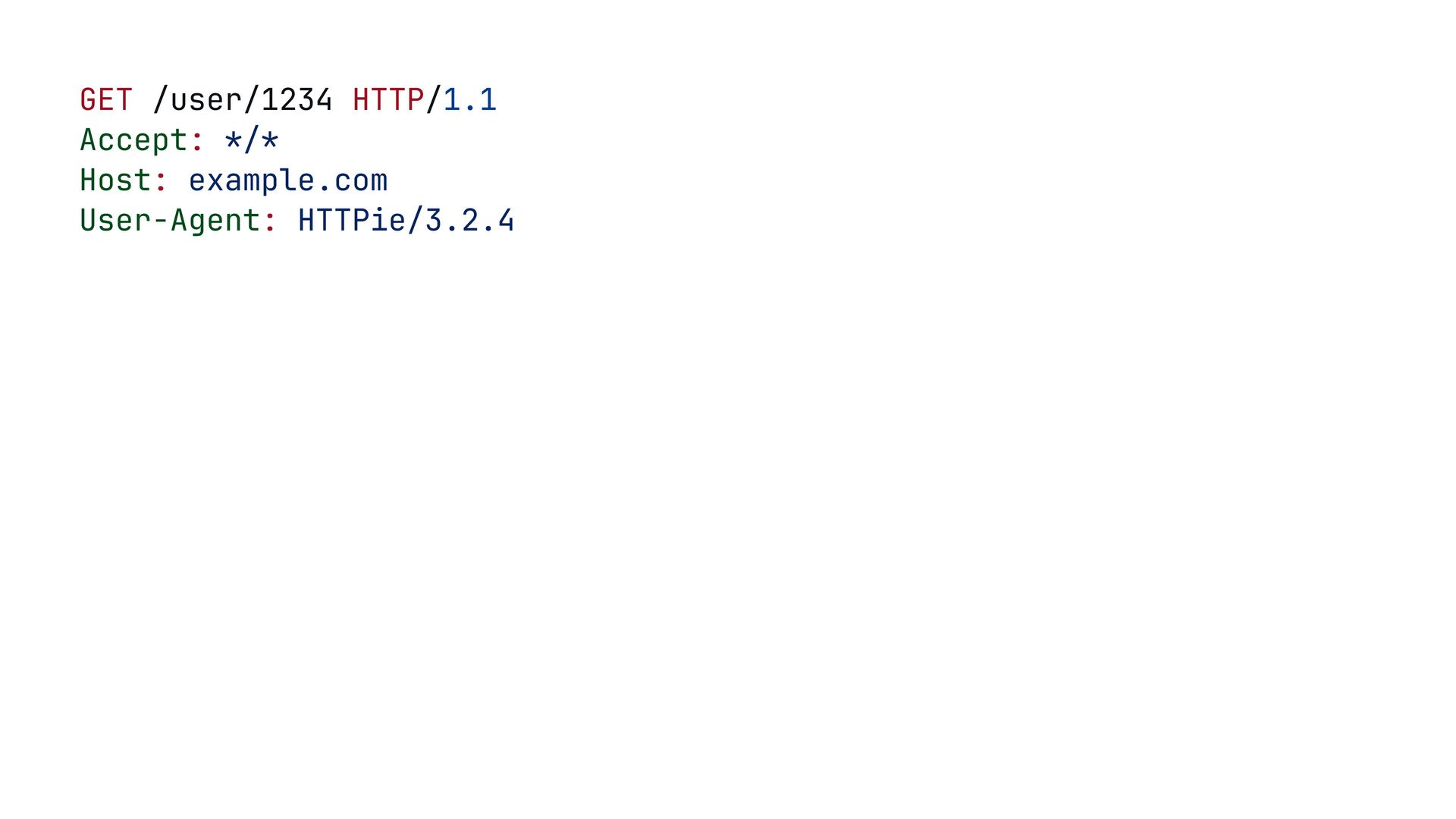
GET /user/1234 HTTP/1.1 Accept: */* Accept-Encoding: gzip, deflate, zstd Host:
example.com User-Agent: HTTPie/3.2.4 HTTP/1.1 200 OK Content-Length: 81 Content-Type: application/json Date: Wed, 22 Oct 2025 21 : 48 : 59 GMT { "email": "[email protected]", "id": 1234, "name": "Frodo Baggins" } -
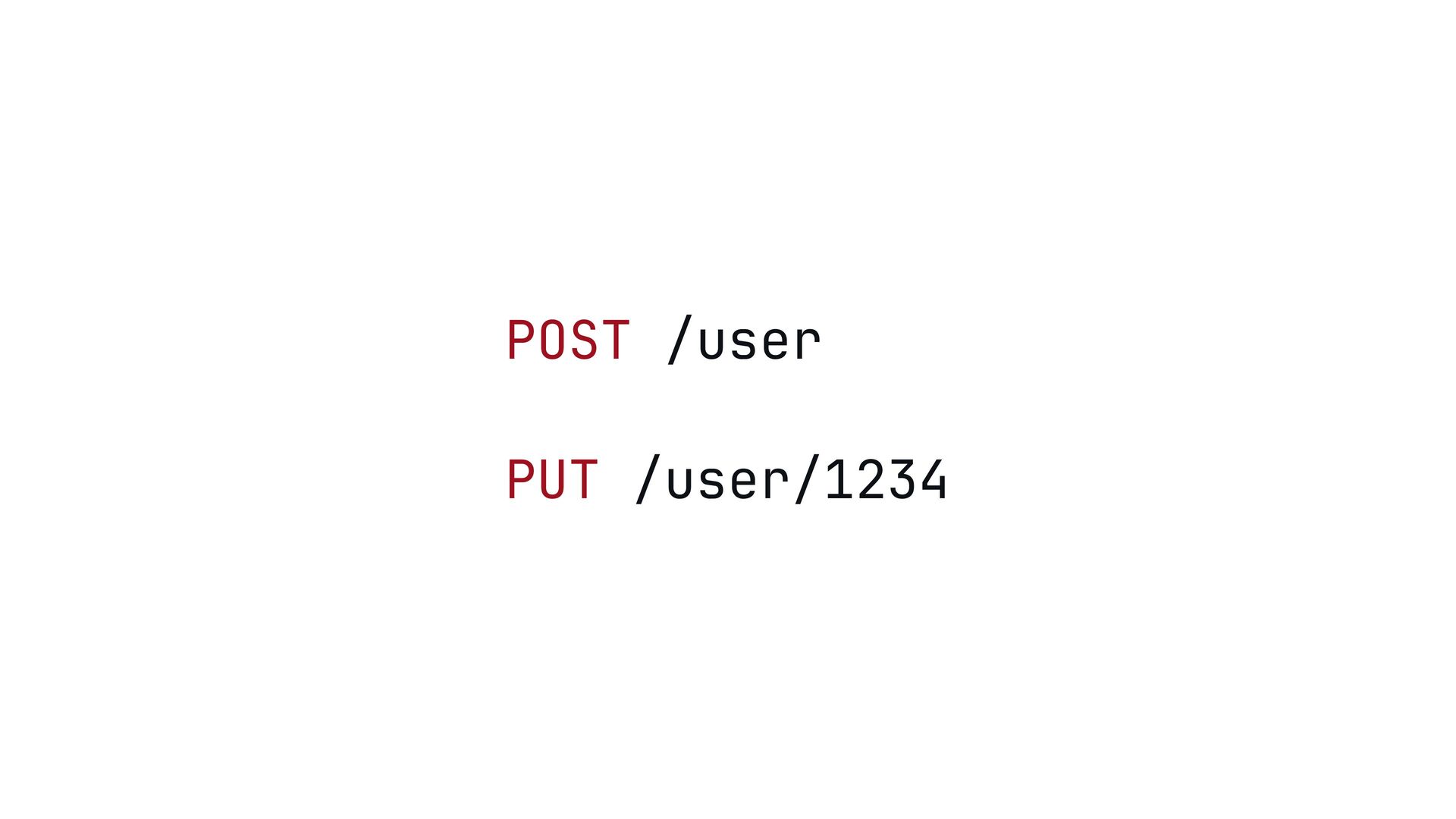
POST • “Perform resource-speci fi c processing on the request
content” • The target URL should process the the request body, according to its own rules • Could mean append, annotate, or paste after • Not safe or idempotent -
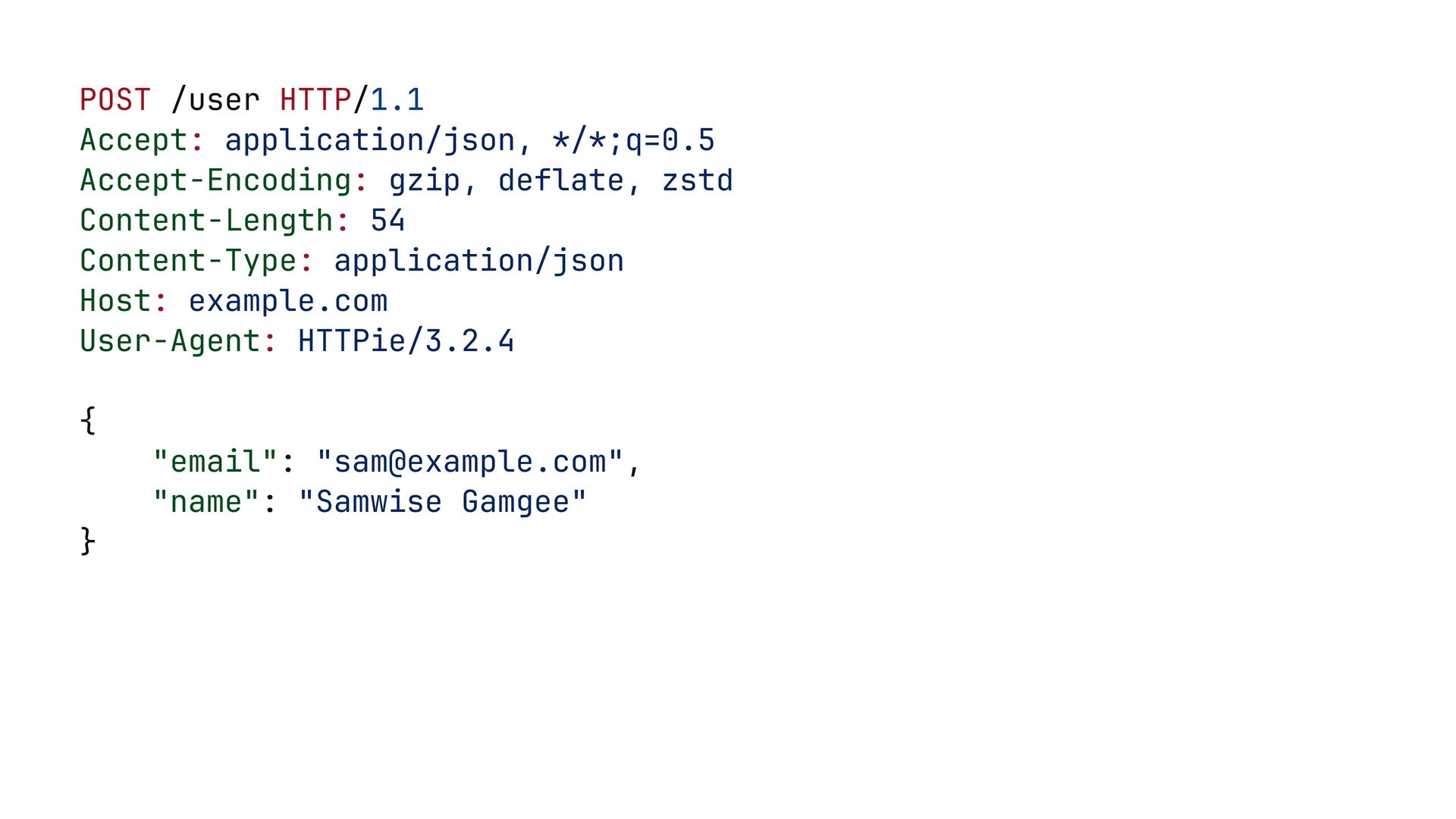
POST /user HTTP/1.1 Accept: application/json, */*;q=0.5 Accept-Encoding: gzip, deflate, zstd
Content-Length: 54 Content-Type: application/json Host: example.com User-Agent: HTTPie/3.2.4 { "email": "[email protected]", "name": "Samwise Gamgee" } -
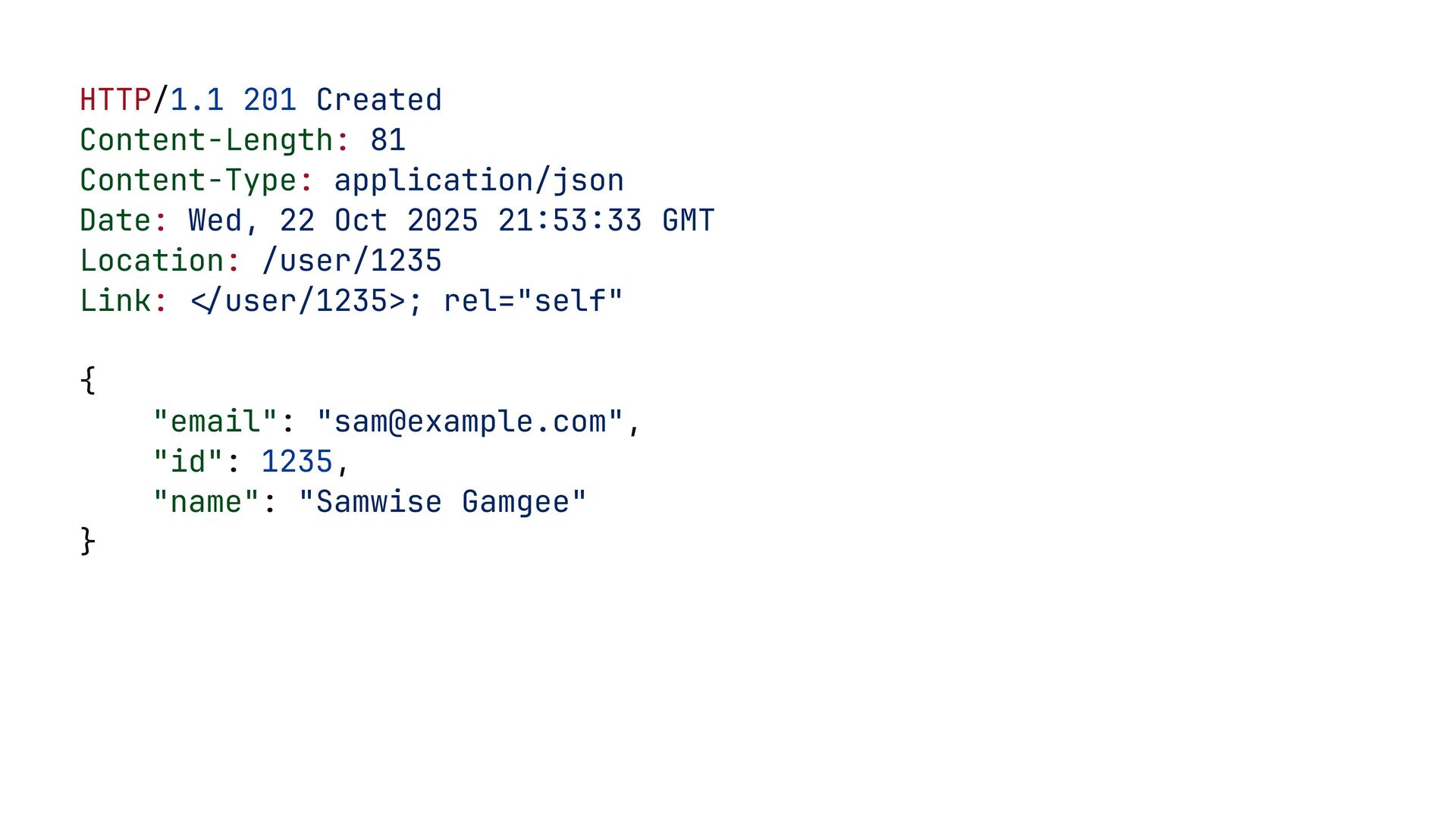
HTTP/1.1 201 Created Content-Length: 81 Content-Type: application/json Date: Wed, 22
Oct 2025 21 : 53 : 33 GMT Location: /user/1235 Link: </ user/1235>; rel="self" { "email": "[email protected]", "id": 1235, "name": "Samwise Gamgee" } -
HTTP/1.1 201 Created Content-Length: 81 Content-Type: application/json Date: Wed, 22
Oct 2025 21 : 53 : 33 GMT Location: /user/1235 Link: </ user/1235>; rel="self" { "email": "[email protected]", "id": 1235, "name": "Samwise Gamgee" } -
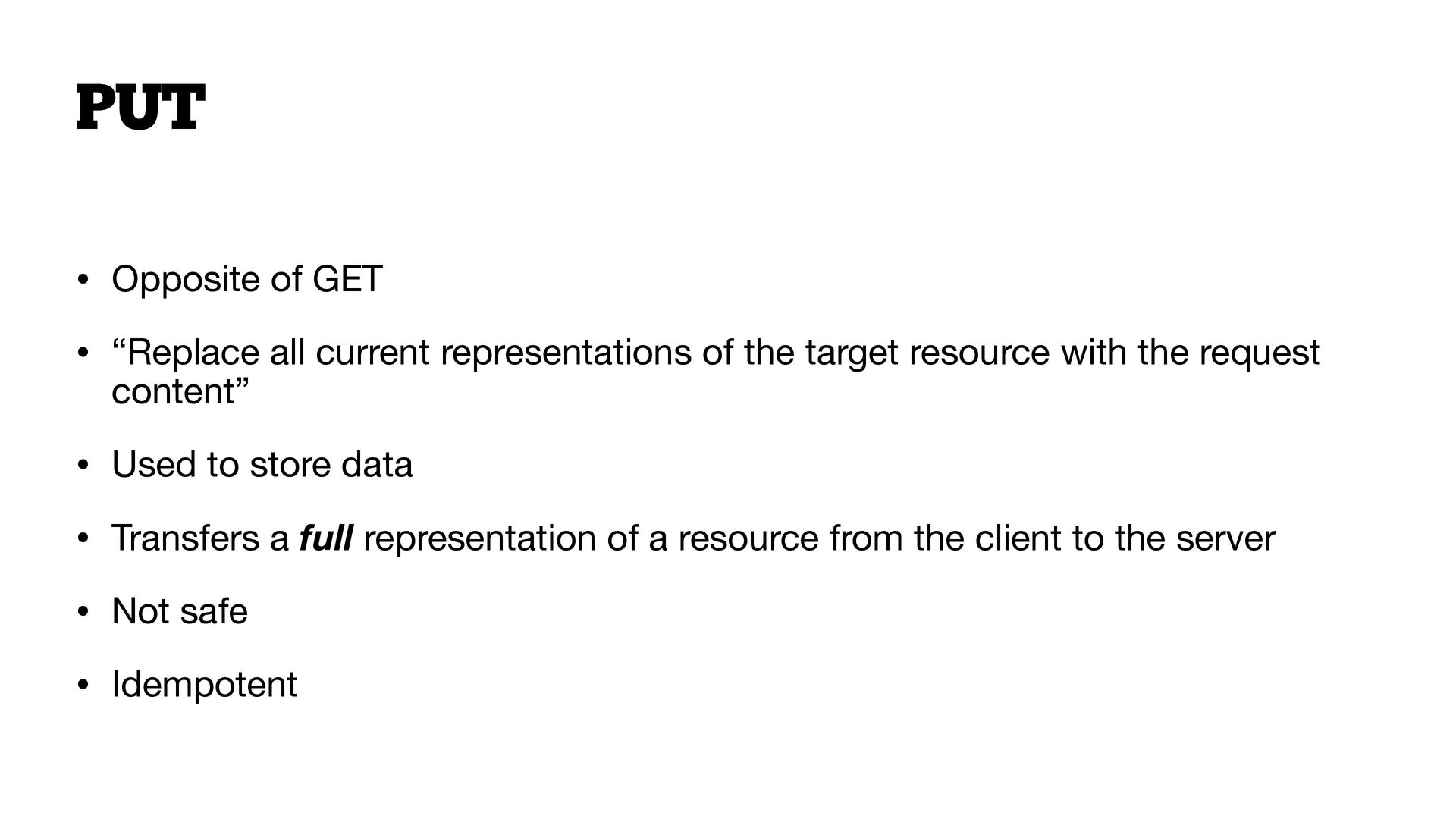
PUT • Opposite of GET • “Replace all current representations
of the target resource with the request content” • Used to store data • Transfers a full representation of a resource from the client to the server • Not safe • Idempotent -
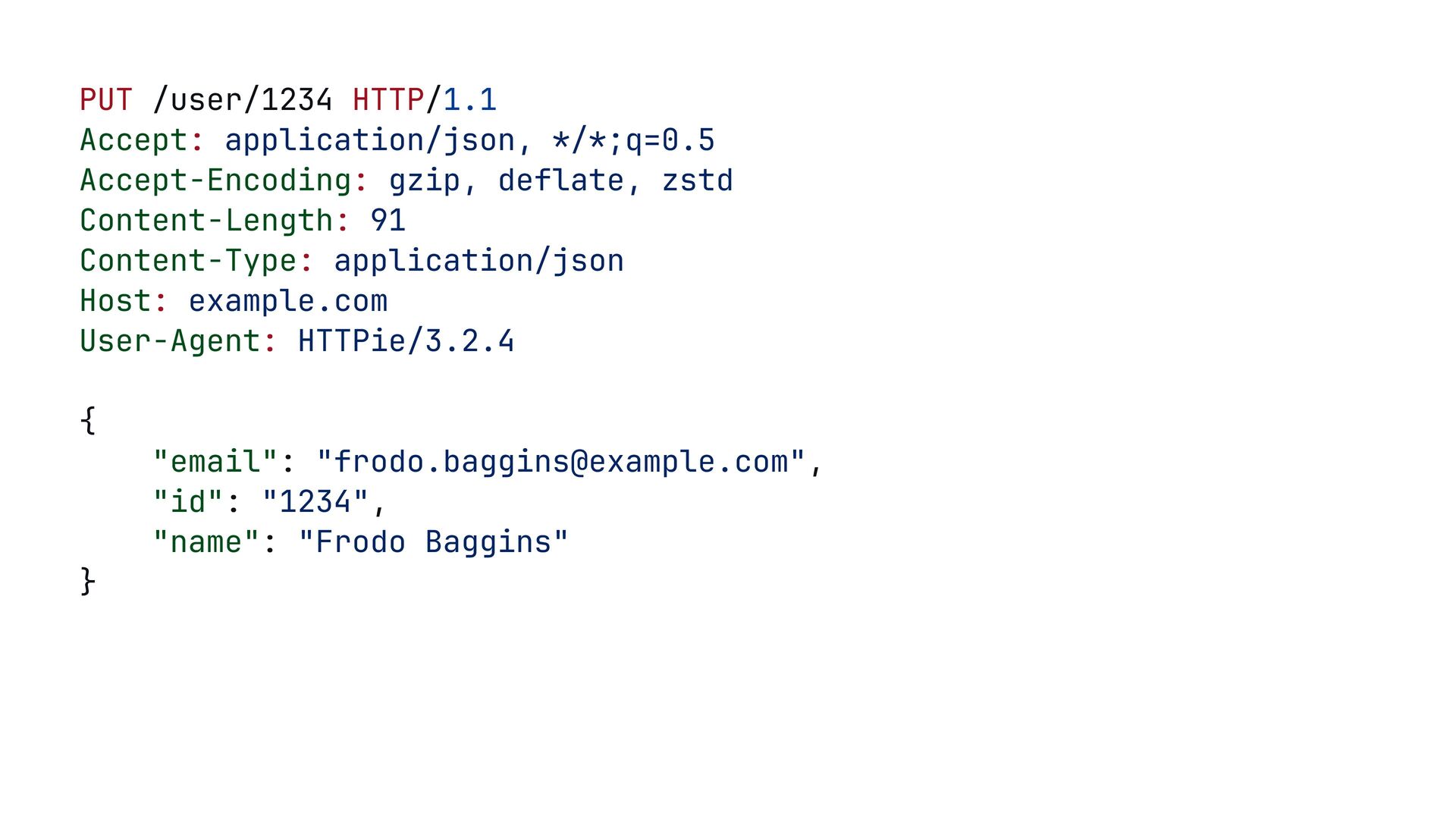
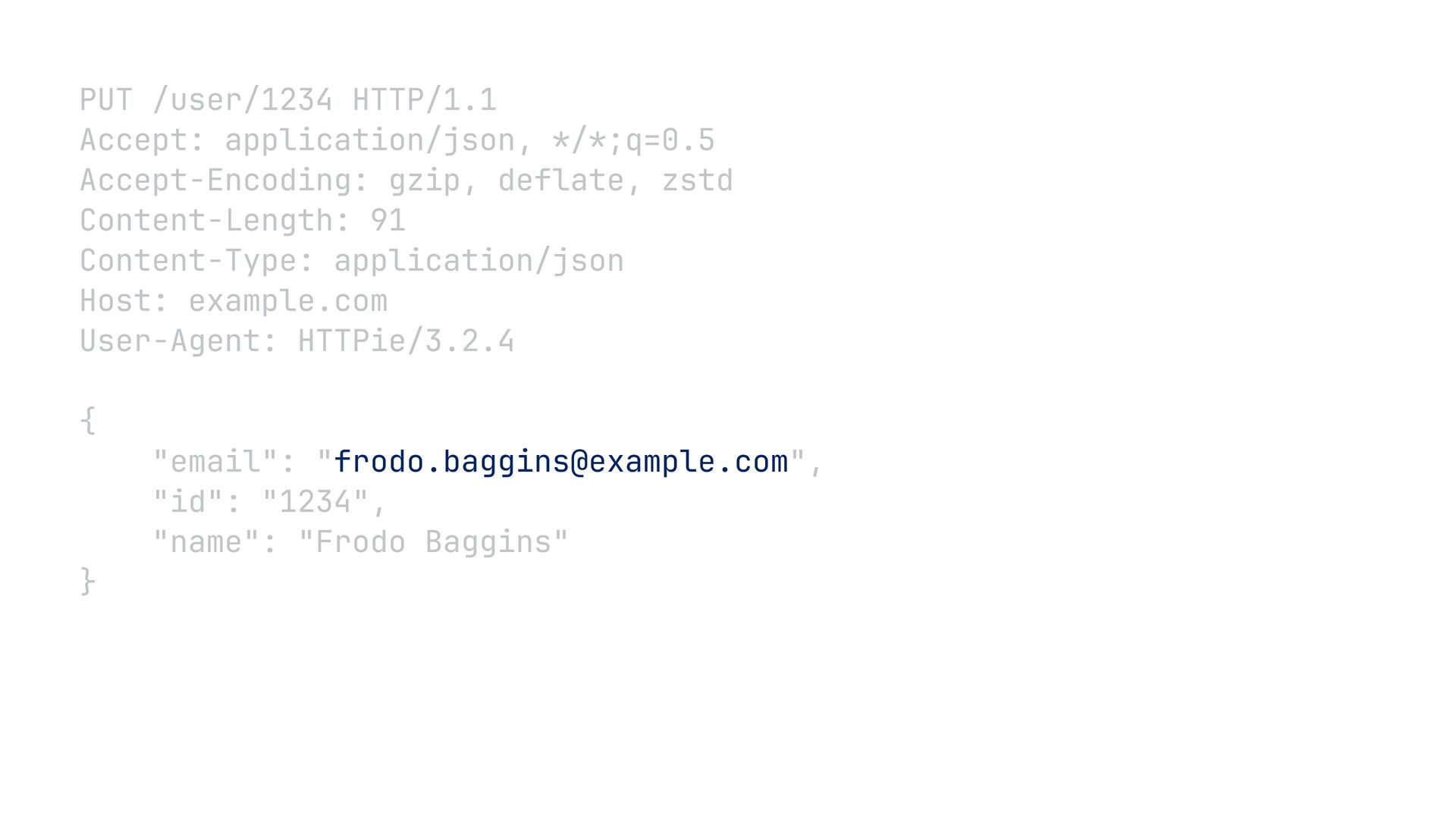
PUT /user/1234 HTTP/1.1 Accept: application/json, */*;q=0.5 Accept-Encoding: gzip, deflate, zstd
Content-Length: 91 Content-Type: application/json Host: example.com User-Agent: HTTPie/3.2.4 { "email": "[email protected]", "id": "1234", "name": "Frodo Baggins" } -
PUT /user/1234 HTTP/1.1 Accept: application/json, */*;q=0.5 Accept-Encoding: gzip, deflate, zstd
Content-Length: 91 Content-Type: application/json Host: example.com User-Agent: HTTPie/3.2.4 { "email": "[email protected]", "id": "1234", "name": "Frodo Baggins" } -
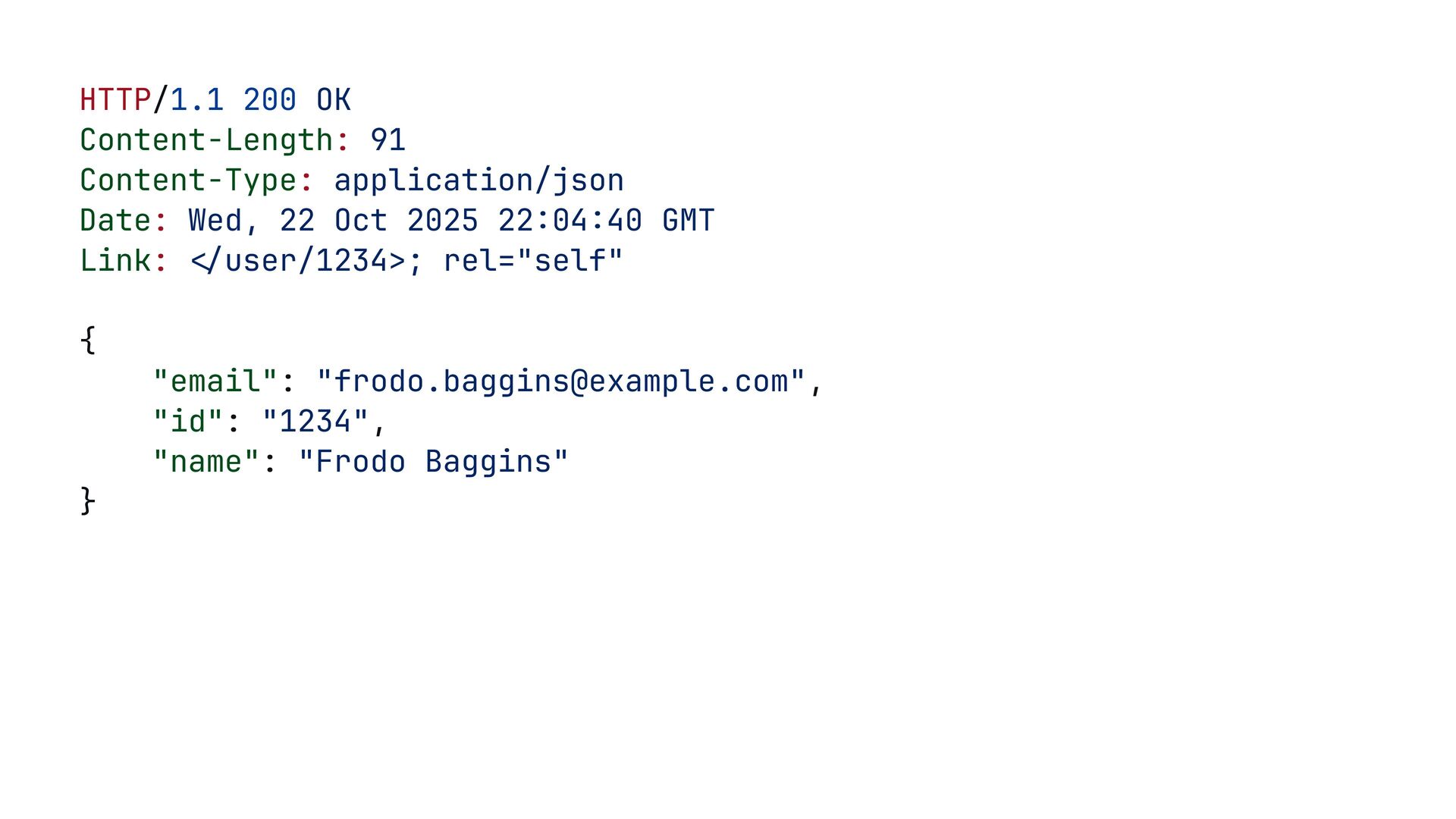
HTTP/1.1 200 OK Content-Length: 91 Content-Type: application/json Date: Wed, 22
Oct 2025 22 : 04 : 40 GMT Link: </ user/1234>; rel="self" { "email": "[email protected]", "id": "1234", "name": "Frodo Baggins" } -
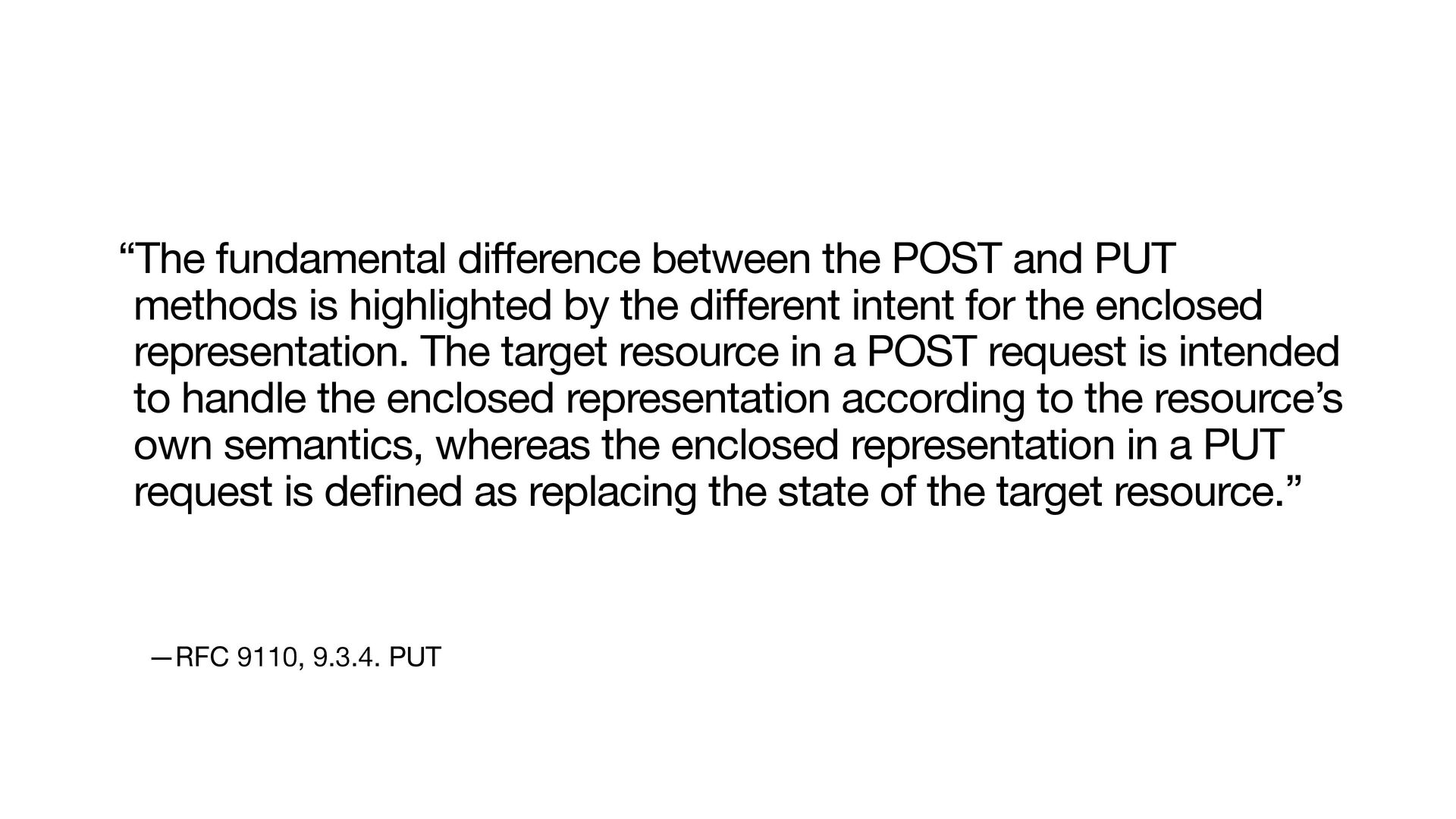
—RFC 9110, 9.3.4. PUT “The fundamental di ff erence between
the POST and PUT methods is highlighted by the di ff erent intent for the enclosed representation. The target resource in a POST request is intended to handle the enclosed representation according to the resource’s own semantics, whereas the enclosed representation in a PUT request is de fi ned as replacing the state of the target resource.” -
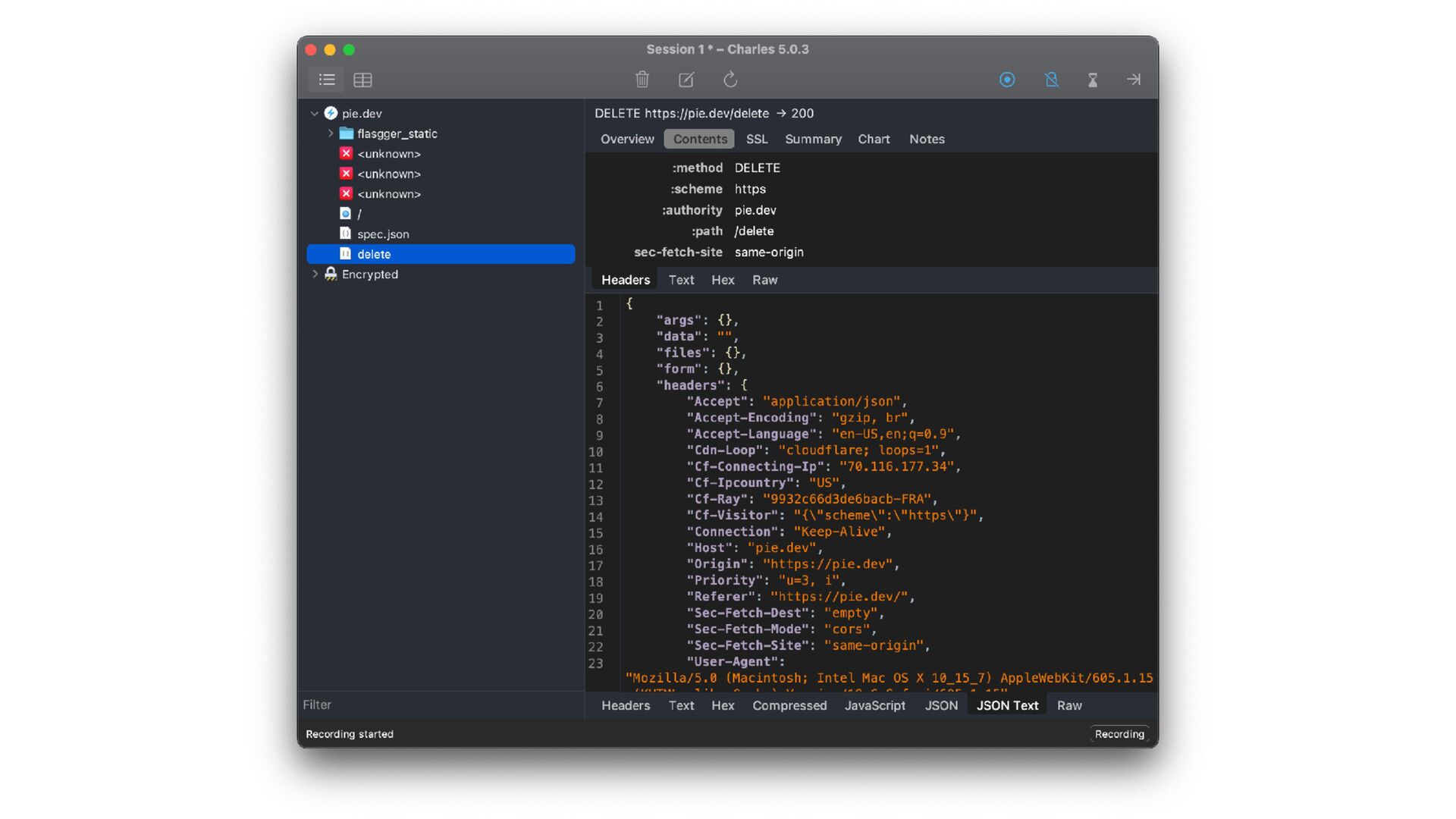
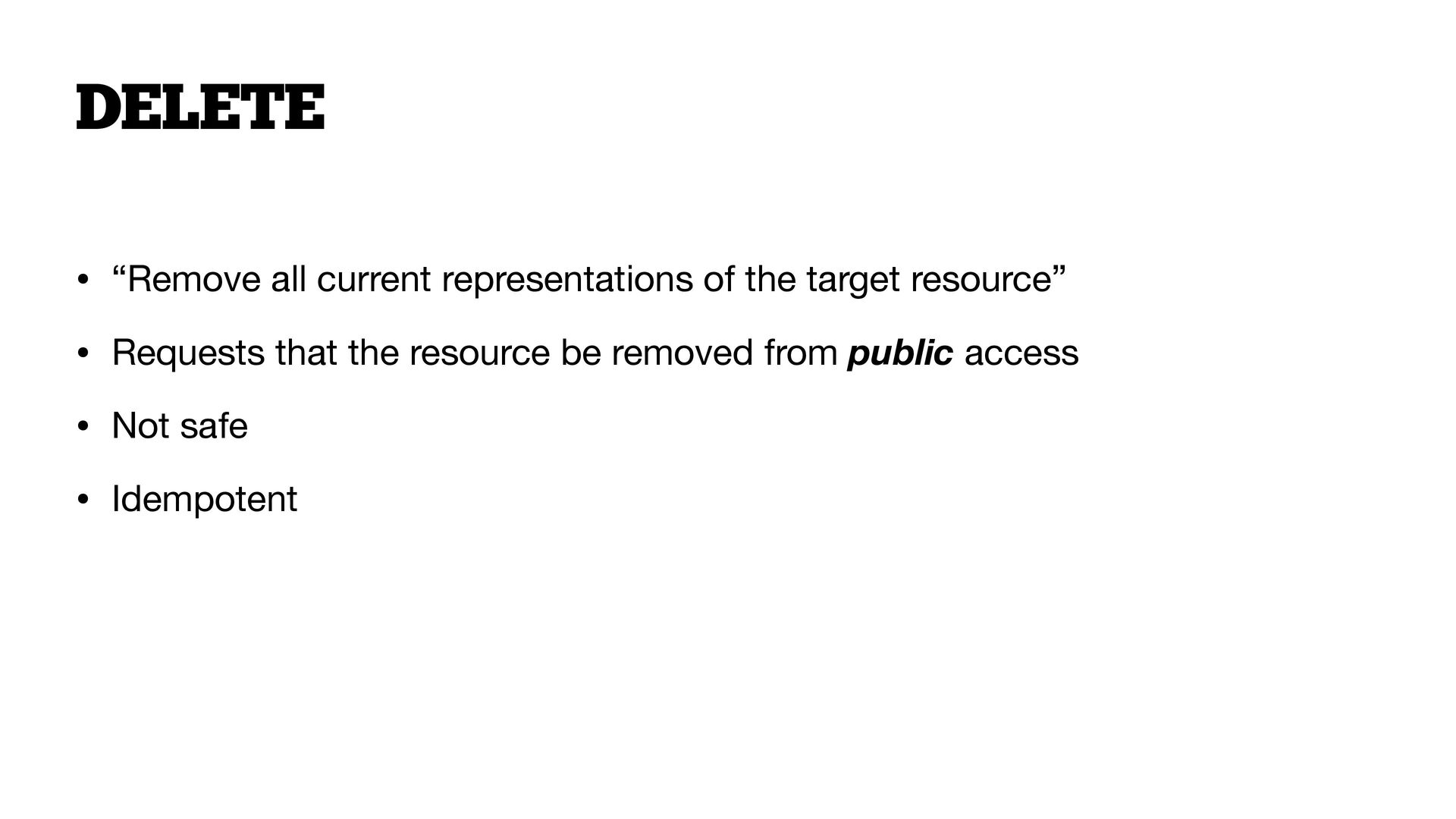
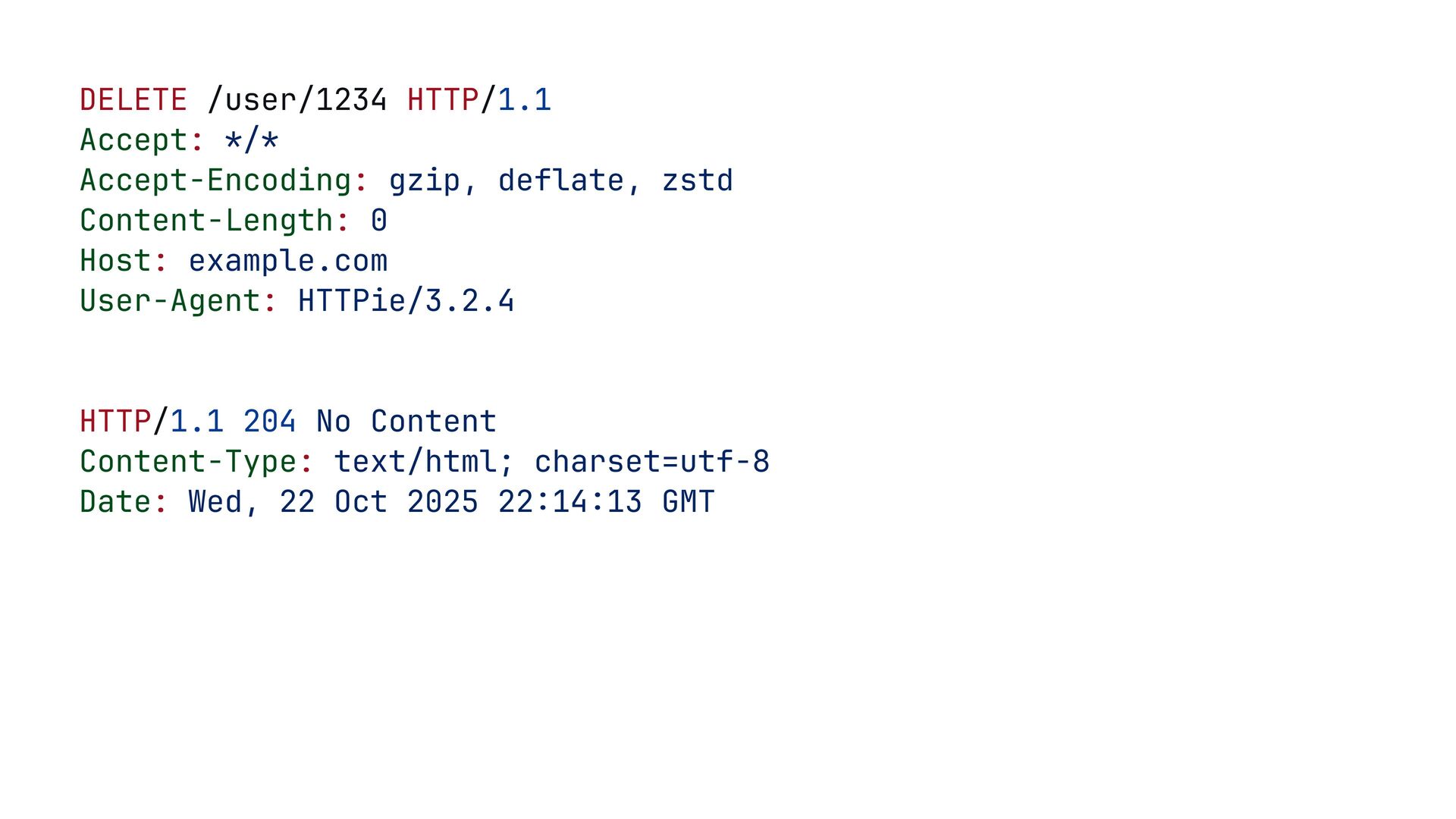
DELETE • “Remove all current representations of the target resource”
• Requests that the resource be removed from public access • Not safe • Idempotent -
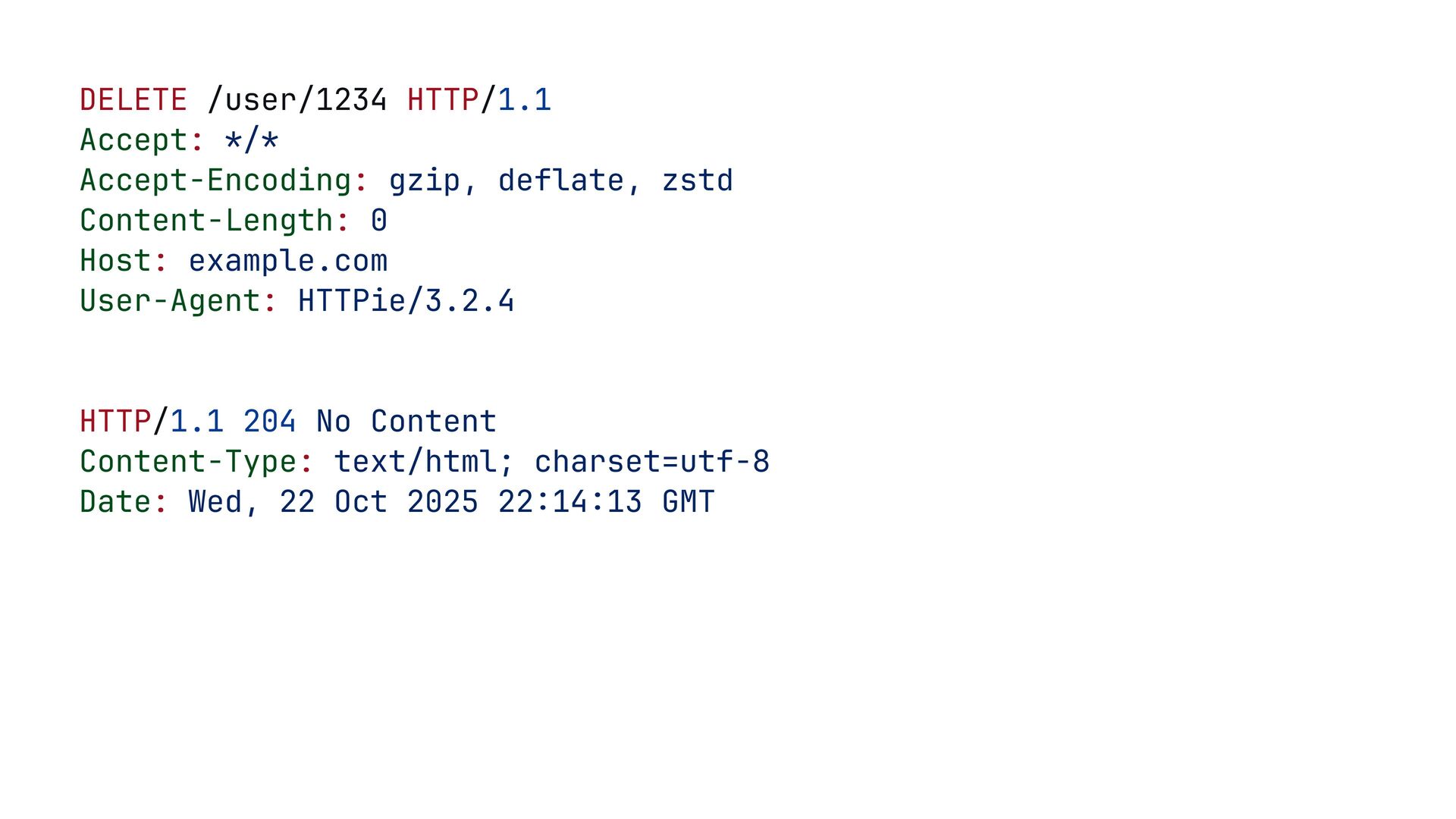
DELETE /user/1234 HTTP/1.1 Accept: */* Accept-Encoding: gzip, deflate, zstd Content-Length:
0 Host: example.com User-Agent: HTTPie/3.2.4 HTTP/1.1 204 No Content Content-Type: text/html; charset=utf-8 Date: Wed, 22 Oct 2025 22 : 14 : 13 GMT -
DELETE /user/1234 HTTP/1.1 Accept: */* Accept-Encoding: gzip, deflate, zstd Content-Length:
0 Host: example.com User-Agent: HTTPie/3.2.4 HTTP/1.1 204 No Content Content-Type: text/html; charset=utf-8 Date: Wed, 22 Oct 2025 22 : 14 : 13 GMT -
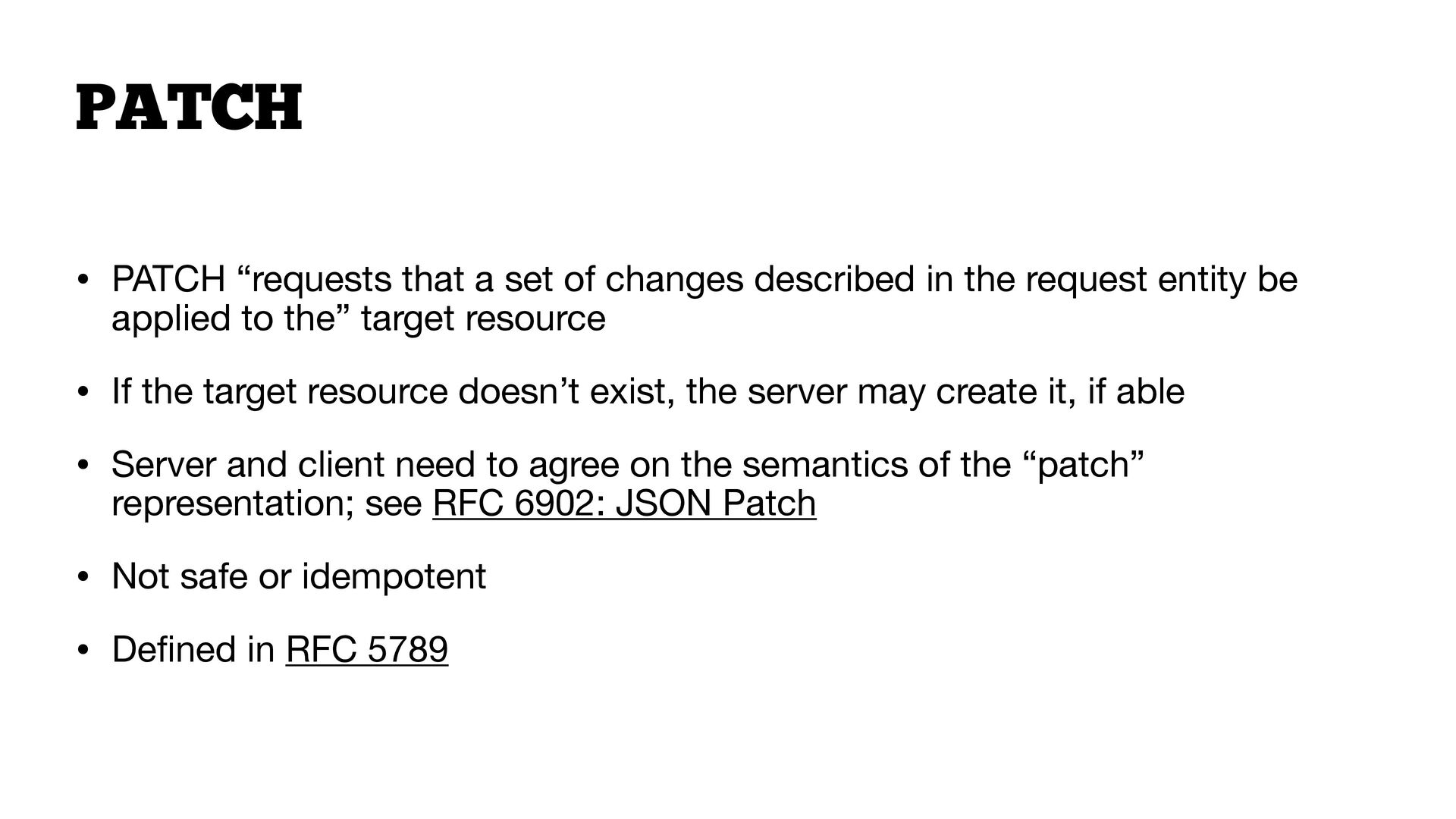
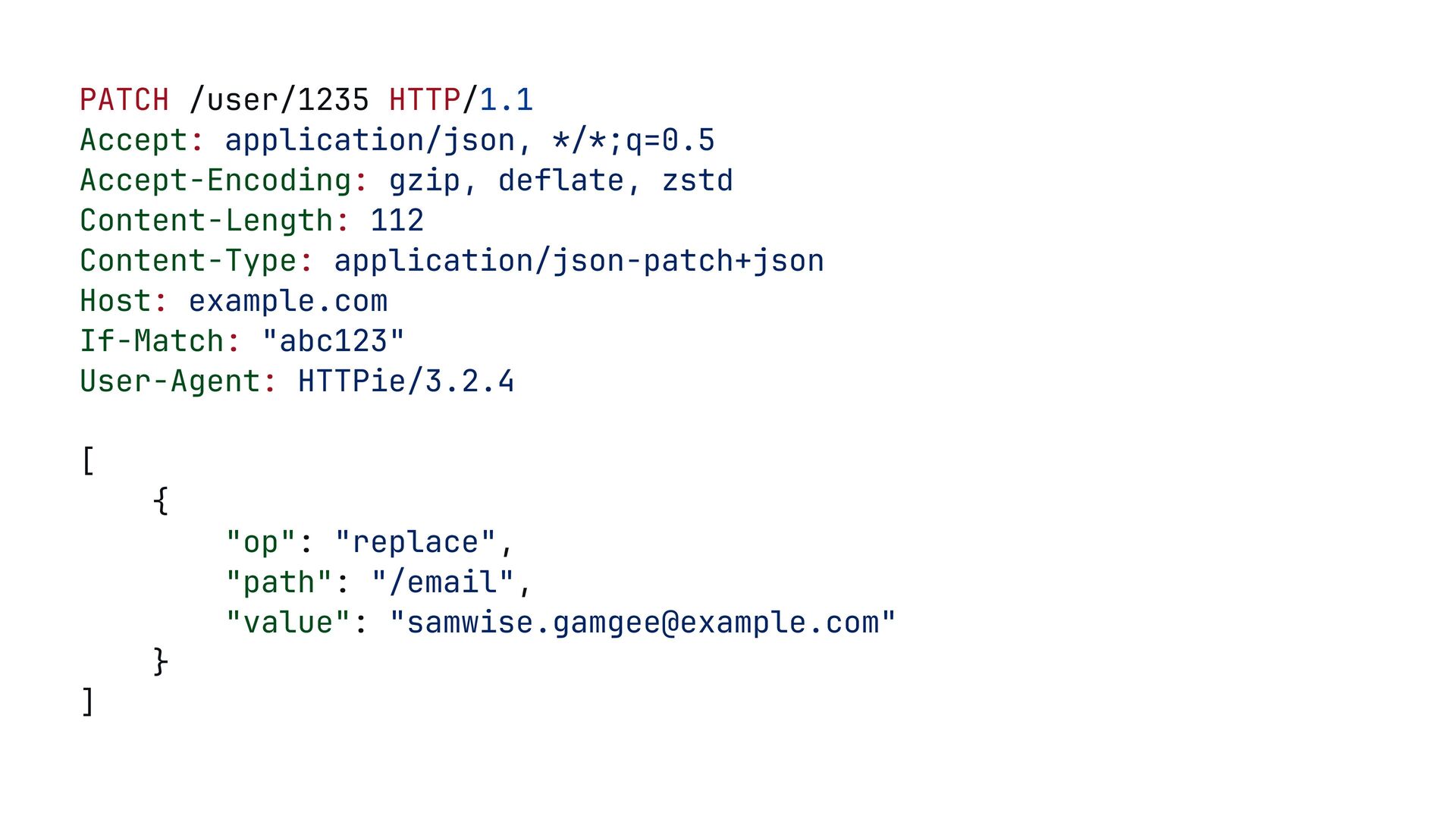
PATCH • PATCH “requests that a set of changes described
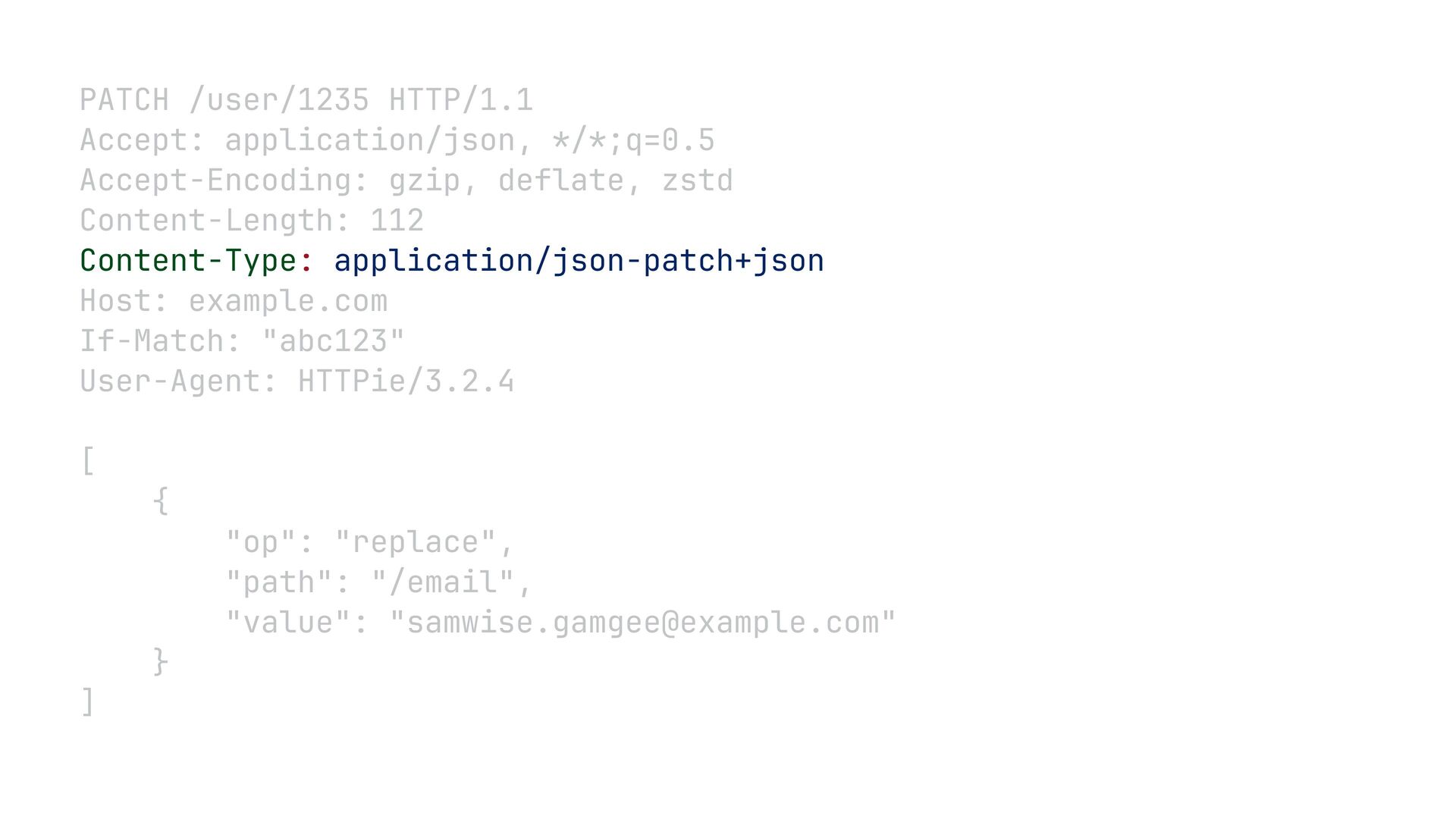
in the request entity be applied to the” target resource • If the target resource doesn’t exist, the server may create it, if able • Server and client need to agree on the semantics of the “patch” representation; see RFC 6902: JSON Patch • Not safe or idempotent • De fi ned in RFC 5789 -
PATCH /user/1235 HTTP/1.1 Accept: application/json, */*;q=0.5 Accept-Encoding: gzip, deflate, zstd
Content-Length: 112 Content-Type: application/json-patch+json Host: example.com If-Match: "abc123" User-Agent: HTTPie/3.2.4 [ { "op": "replace", "path": "/email", "value": "[email protected]" } ] -
PATCH /user/1235 HTTP/1.1 Accept: application/json, */*;q=0.5 Accept-Encoding: gzip, deflate, zstd
Content-Length: 112 Content-Type: application/json-patch+json Host: example.com If-Match: "abc123" User-Agent: HTTPie/3.2.4 [ { "op": "replace", "path": "/email", "value": "[email protected]" } ] -
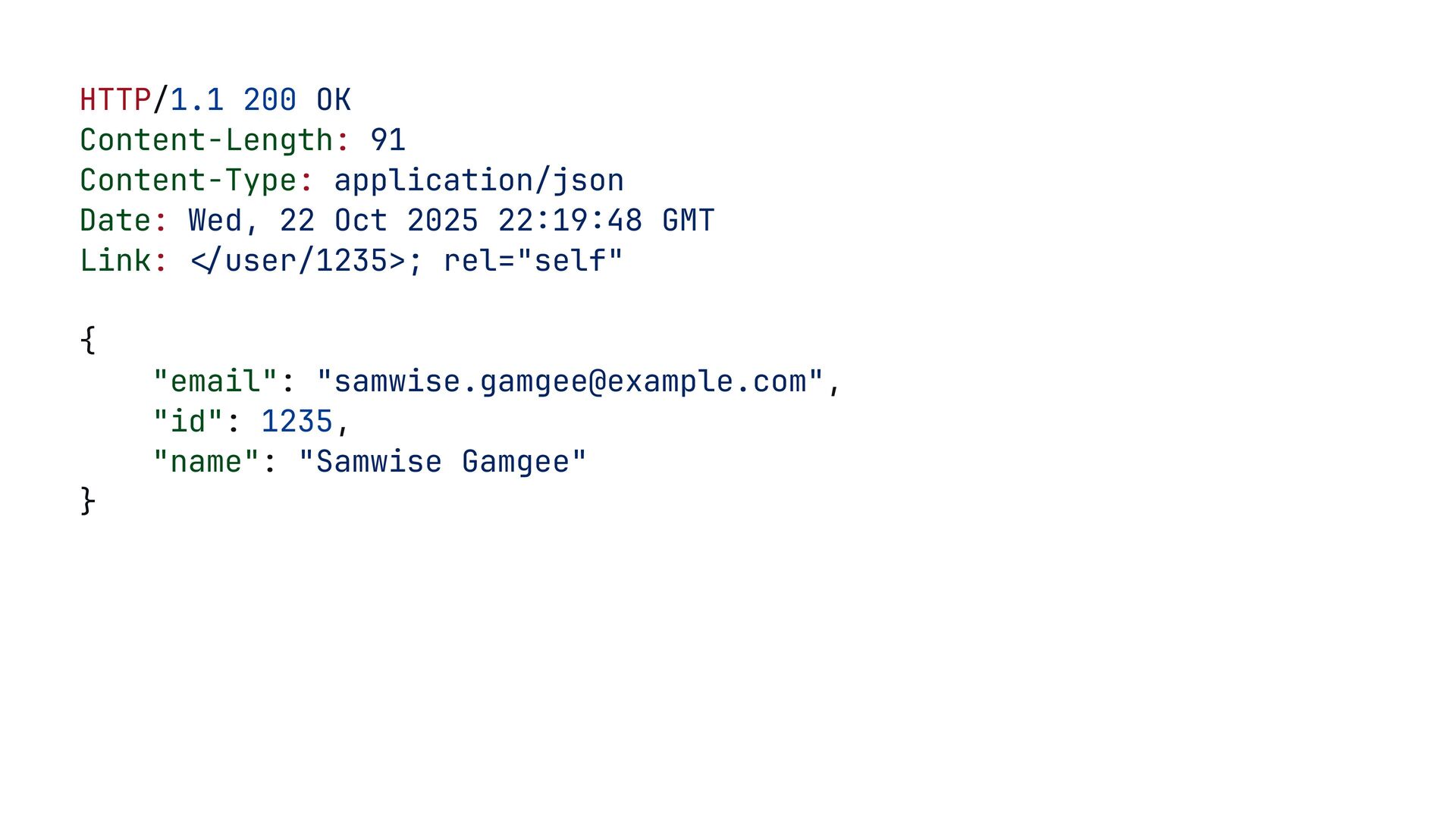
HTTP/1.1 200 OK Content-Length: 91 Content-Type: application/json Date: Wed, 22
Oct 2025 22 : 19 : 48 GMT Link: </ user/1235>; rel="self" { "email": "[email protected]", "id": 1235, "name": "Samwise Gamgee" } -
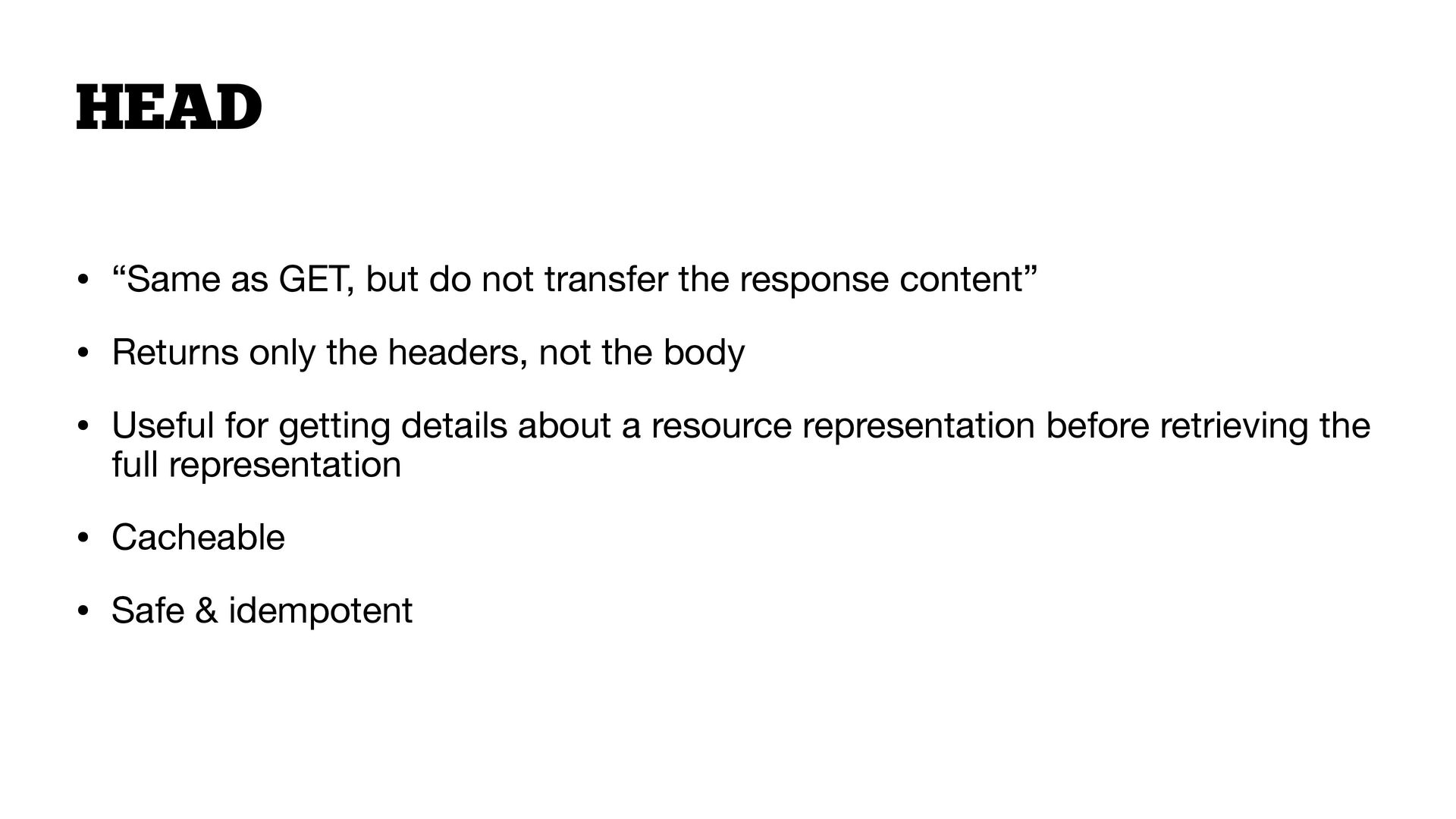
HEAD • “Same as GET, but do not transfer the
response content” • Returns only the headers, not the body • Useful for getting details about a resource representation before retrieving the full representation • Cacheable • Safe & idempotent -
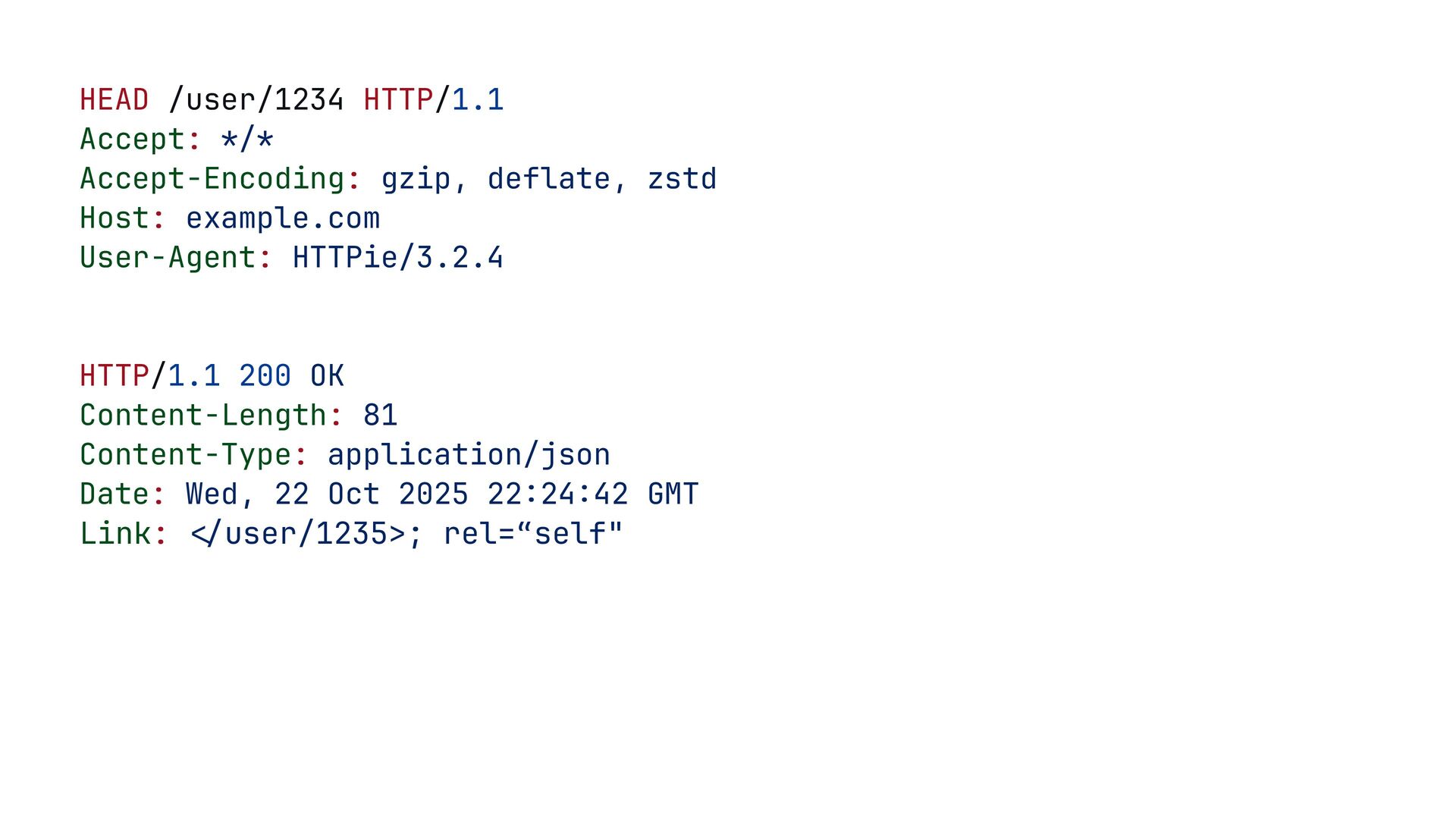
HEAD /user/1234 HTTP/1.1 Accept: */* Accept-Encoding: gzip, deflate, zstd Host:
example.com User-Agent: HTTPie/3.2.4 HTTP/1.1 200 OK Content-Length: 81 Content-Type: application/json Date: Wed, 22 Oct 2025 22 : 24 : 42 GMT Link: </ user/1235>; rel=“self" -
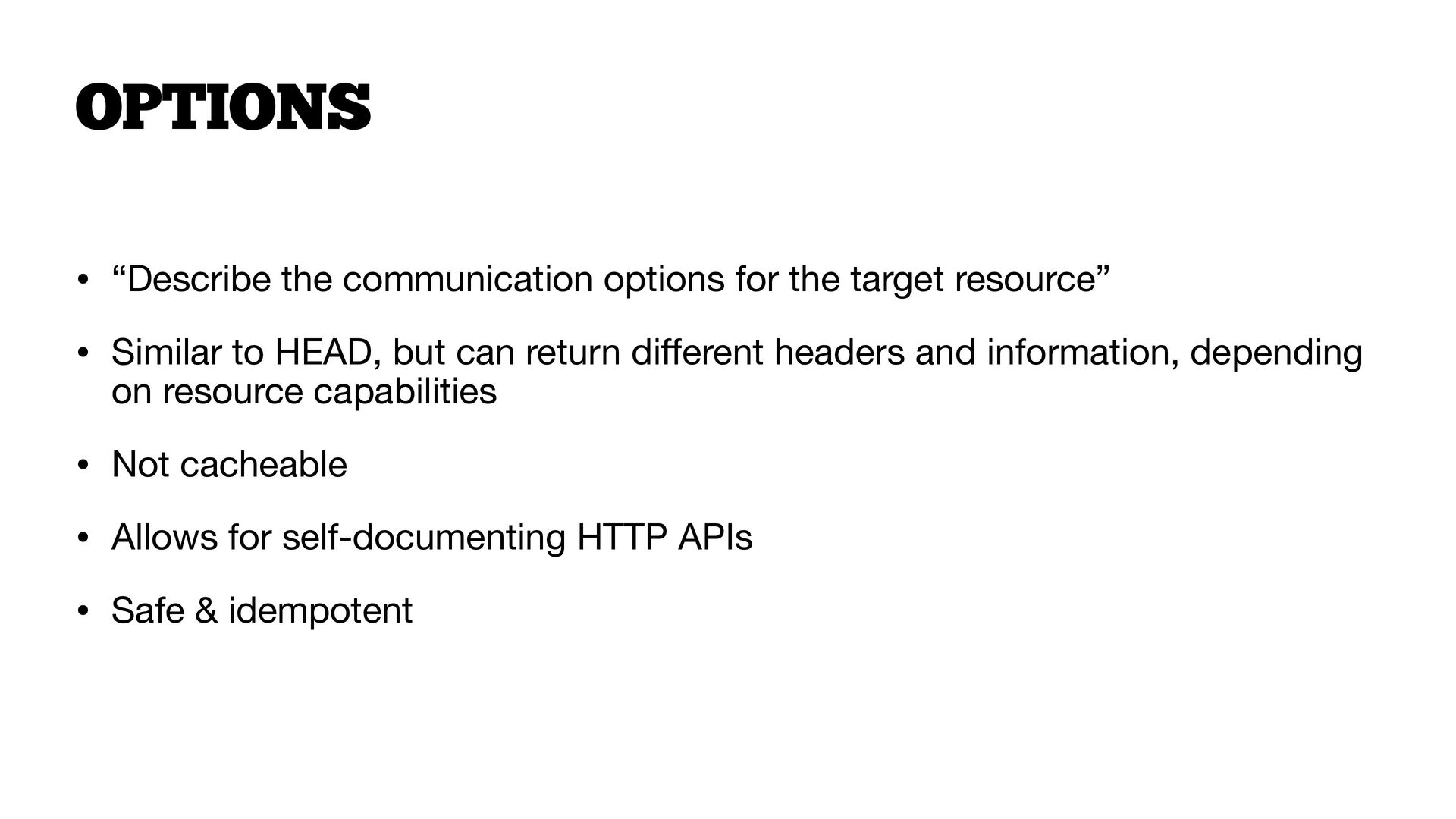
OPTIONS • “Describe the communication options for the target resource”
• Similar to HEAD, but can return di ff erent headers and information, depending on resource capabilities • Not cacheable • Allows for self-documenting HTTP APIs • Safe & idempotent -
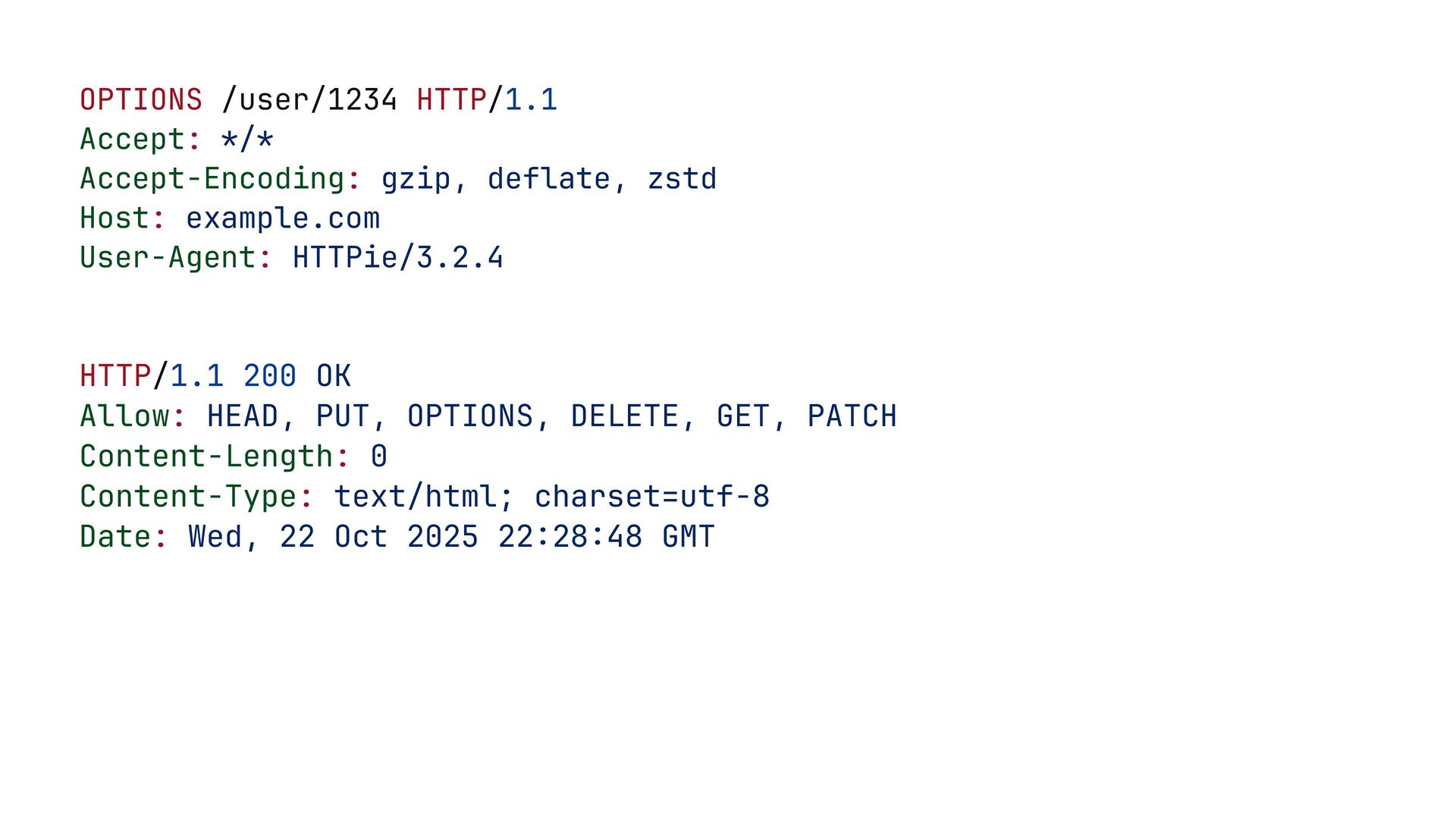
OPTIONS /user/1234 HTTP/1.1 Accept: */* Accept-Encoding: gzip, deflate, zstd Host:
example.com User-Agent: HTTPie/3.2.4 HTTP/1.1 200 OK Allow: HEAD, PUT, OPTIONS, DELETE, GET, PATCH Content-Length: 0 Content-Type: text/html; charset=utf-8 Date: Wed, 22 Oct 2025 22 : 28 : 48 GMT -
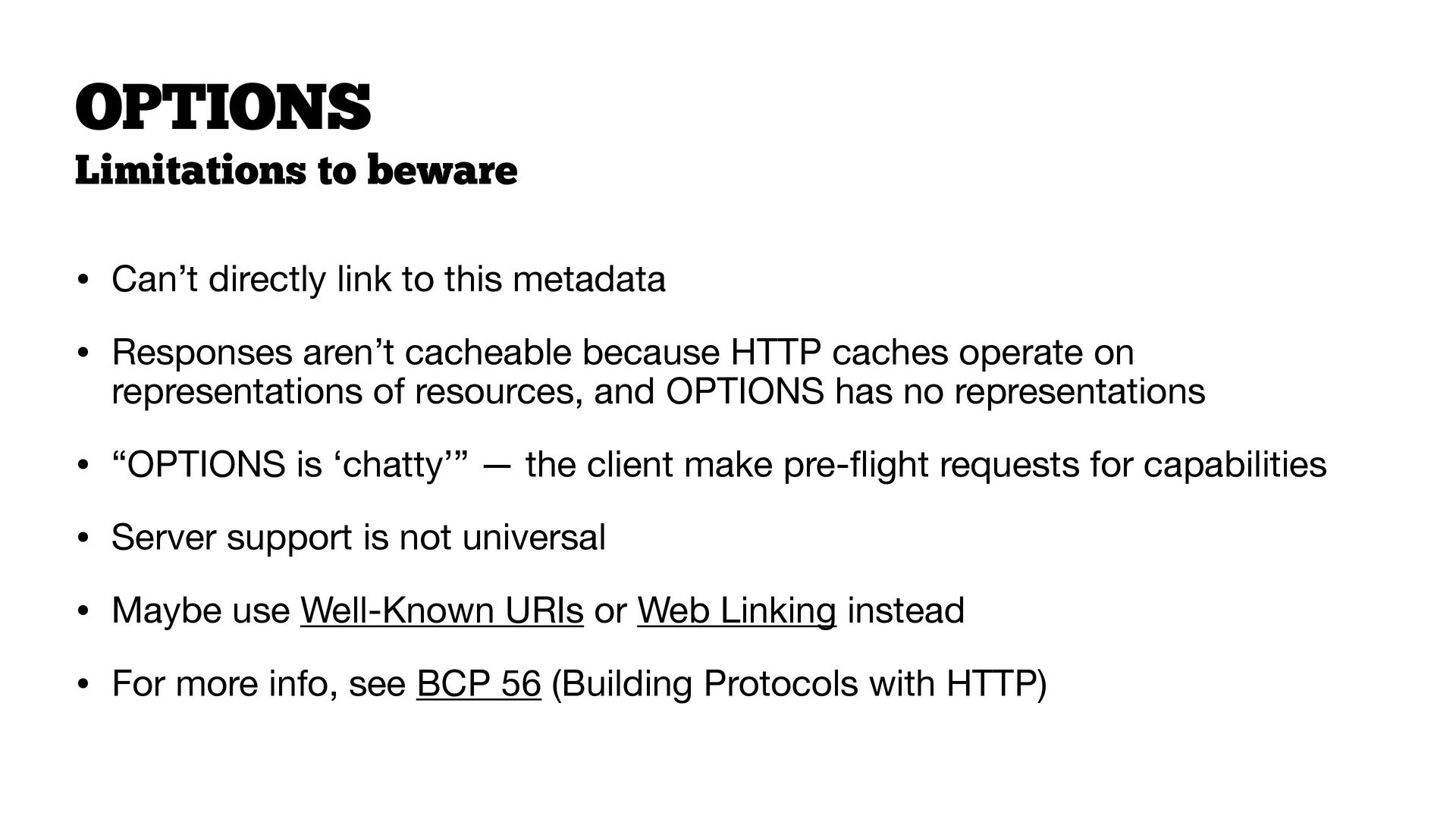
OPTIONS Limitations to beware • Can’t directly link to this
metadata • Responses aren’t cacheable because HTTP caches operate on representations of resources, and OPTIONS has no representations • “OPTIONS is ‘chatty’” — the client make pre- fl ight requests for capabilities • Server support is not universal • Maybe use Well-Known URIs or Web Linking instead • For more info, see BCP 56 (Building Protocols with HTTP) -
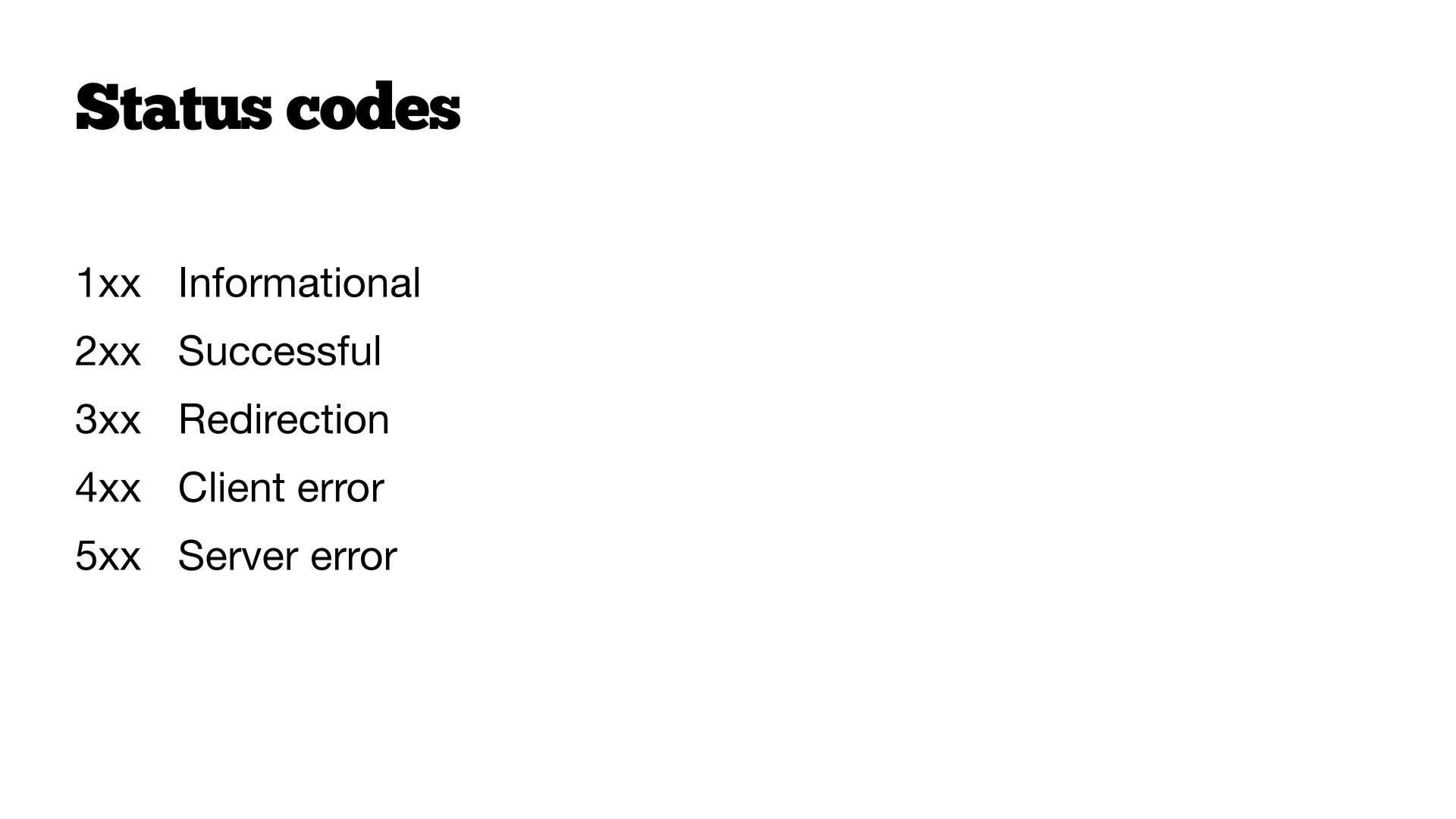
Status codes 1xx Informational 2xx Successful 3xx Redirection 4xx Client
error 5xx Server error -
200 OK • Standard success response, includes the representation of
the resource returned • Widely used, widely known -
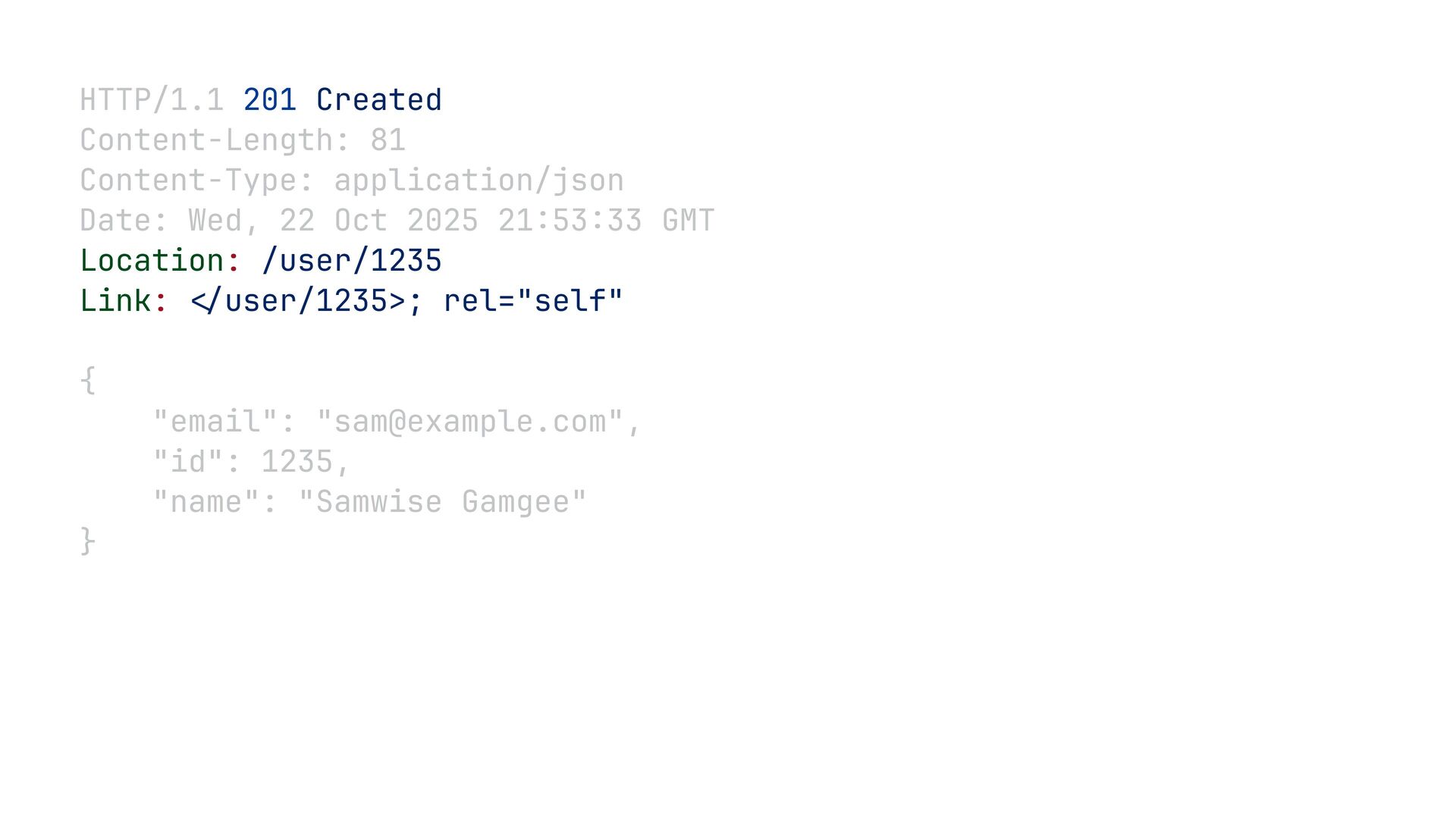
201 Created • You asked the server to create a
resource, and it created it • If it wasn’t created at the target URL, the response might include a Location header that points to the URL of the created resource -
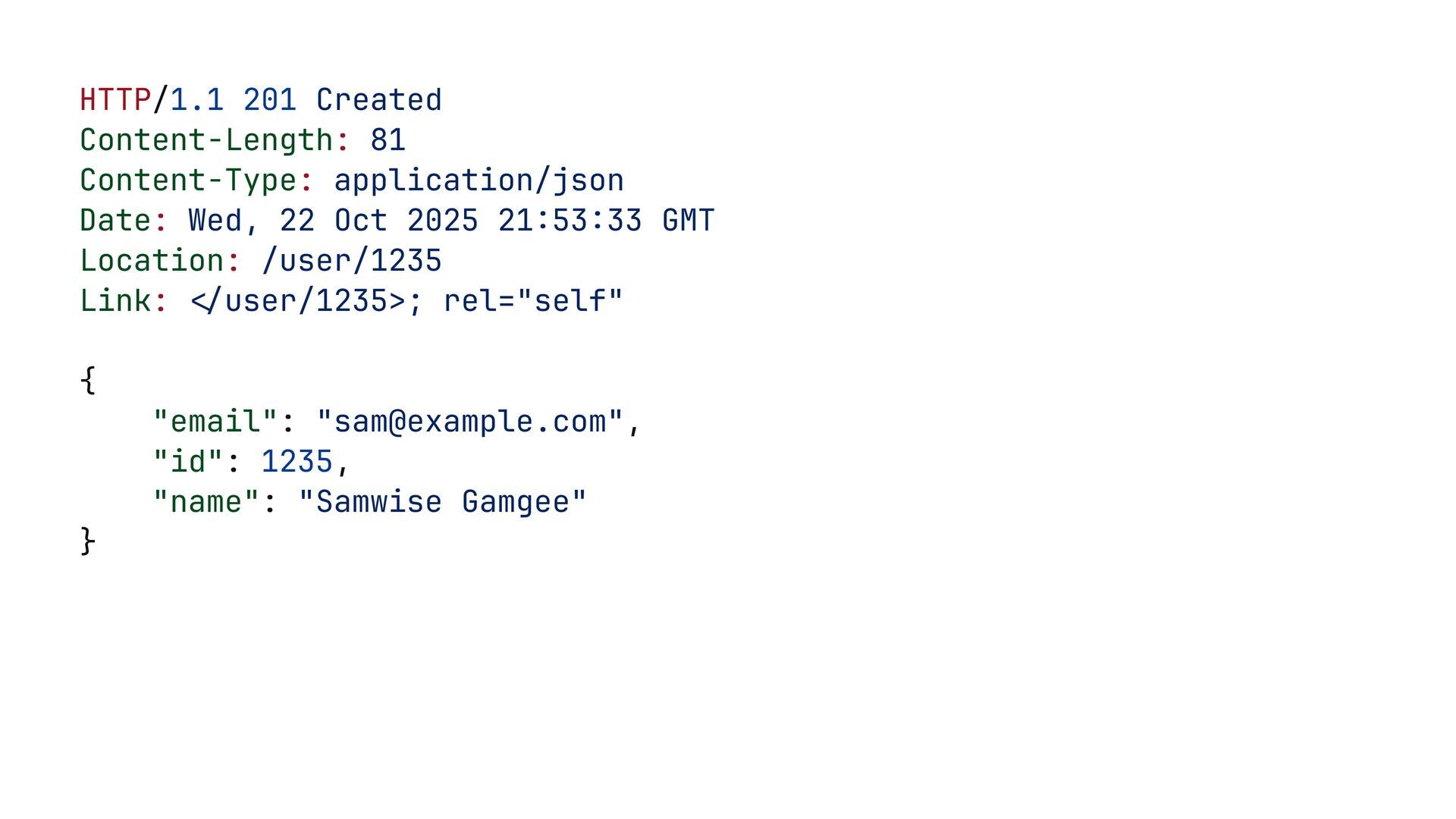
HTTP/1.1 201 Created Content-Length: 81 Content-Type: application/json Date: Wed, 22
Oct 2025 21 : 53 : 33 GMT Location: /user/1235 Link: </ user/1235>; rel="self" { "email": "[email protected]", "id": 1235, "name": "Samwise Gamgee" } -
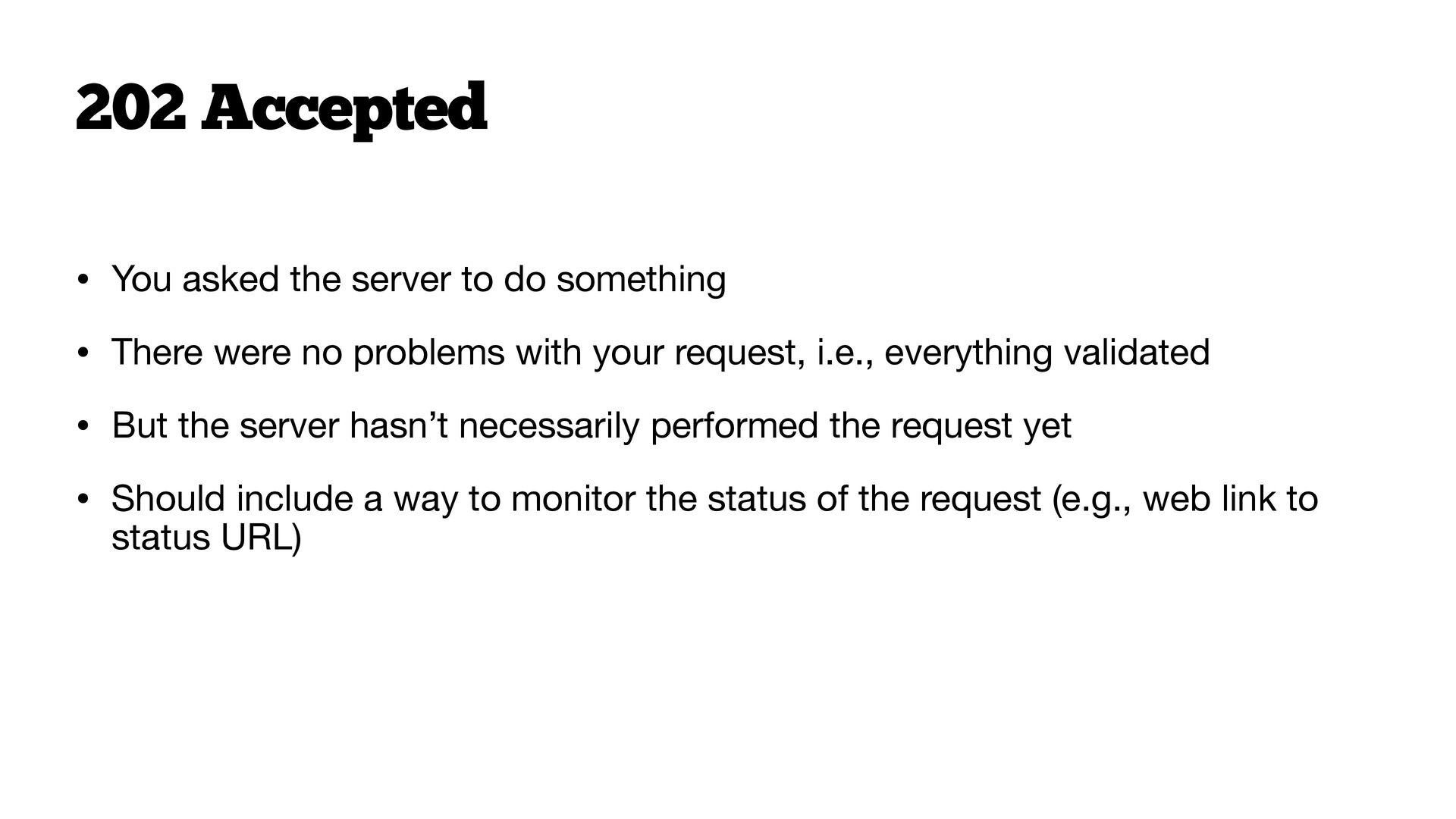
202 Accepted • You asked the server to do something
• There were no problems with your request, i.e., everything validated • But the server hasn’t necessarily performed the request yet • Should include a way to monitor the status of the request (e.g., web link to status URL) -
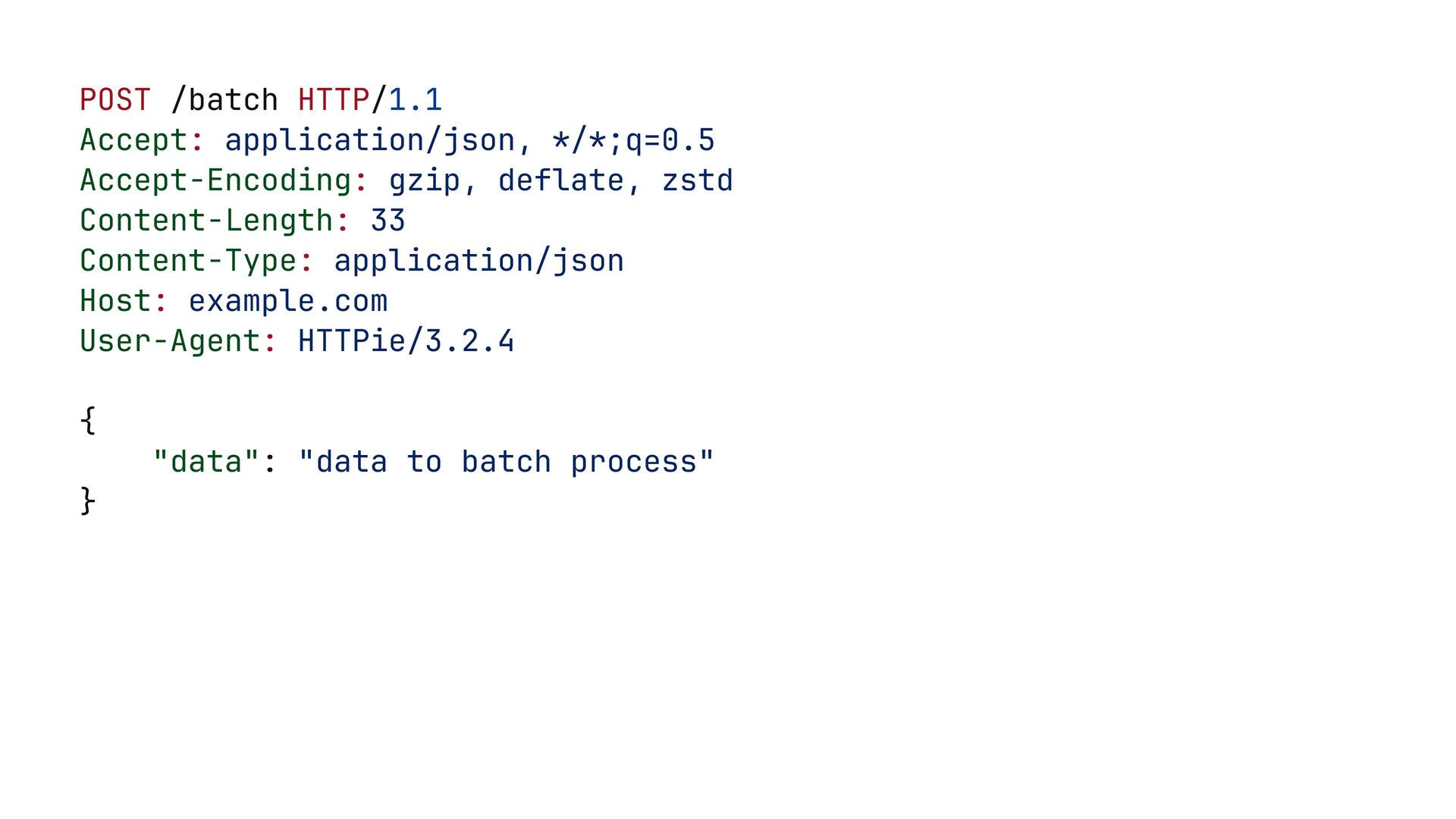
POST /batch HTTP/1.1 Accept: application/json, */*;q=0.5 Accept-Encoding: gzip, deflate, zstd
Content-Length: 33 Content-Type: application/json Host: example.com User-Agent: HTTPie/3.2.4 { "data": "data to batch process" } -
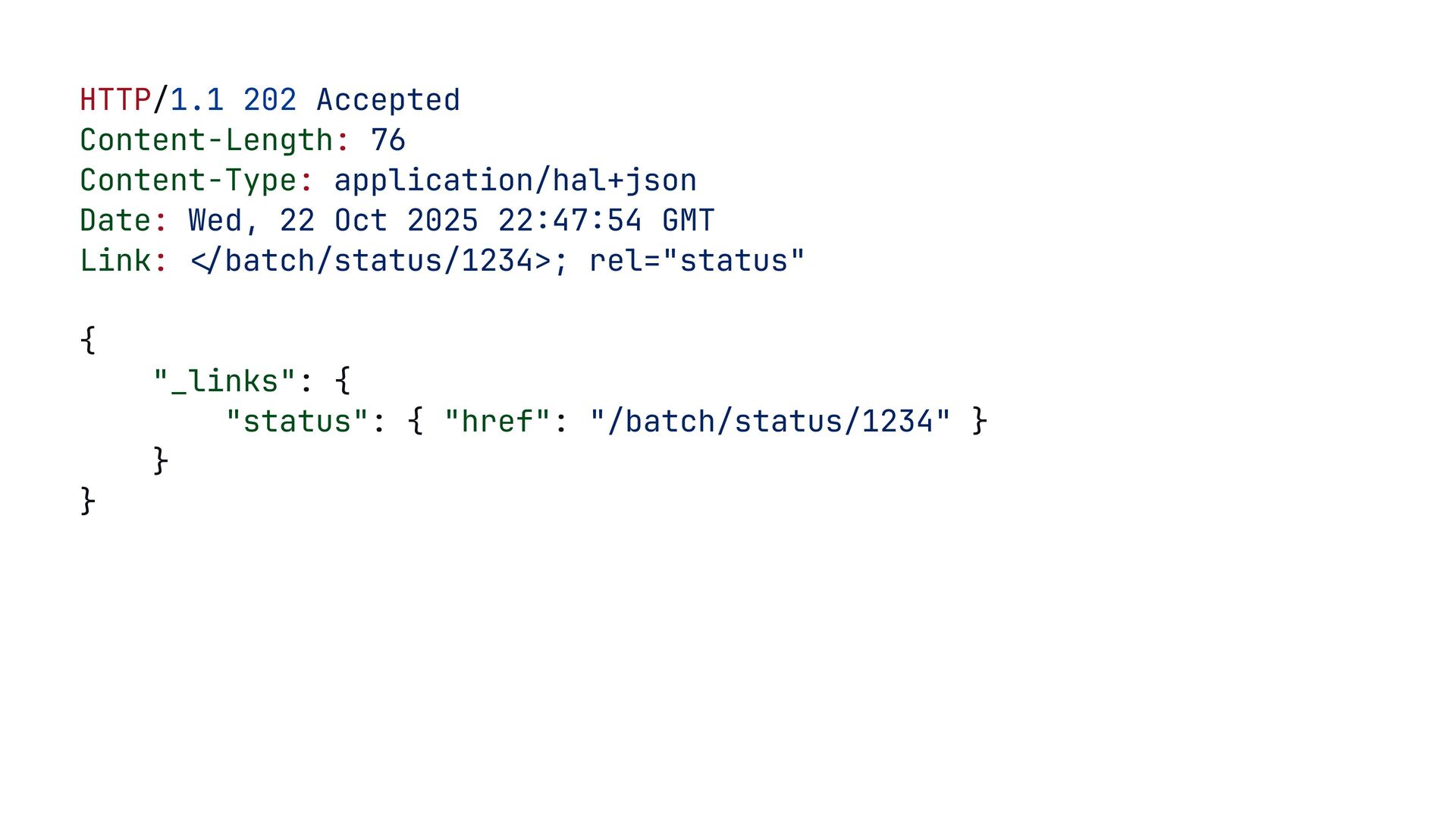
HTTP/1.1 202 Accepted Content-Length: 76 Content-Type: application/hal+json Date: Wed, 22
Oct 2025 22 : 47 : 54 GMT Link: </ batch/status/1234>; rel="status" { "_links": { "status": { "href": "/batch/status/1234" } } } -
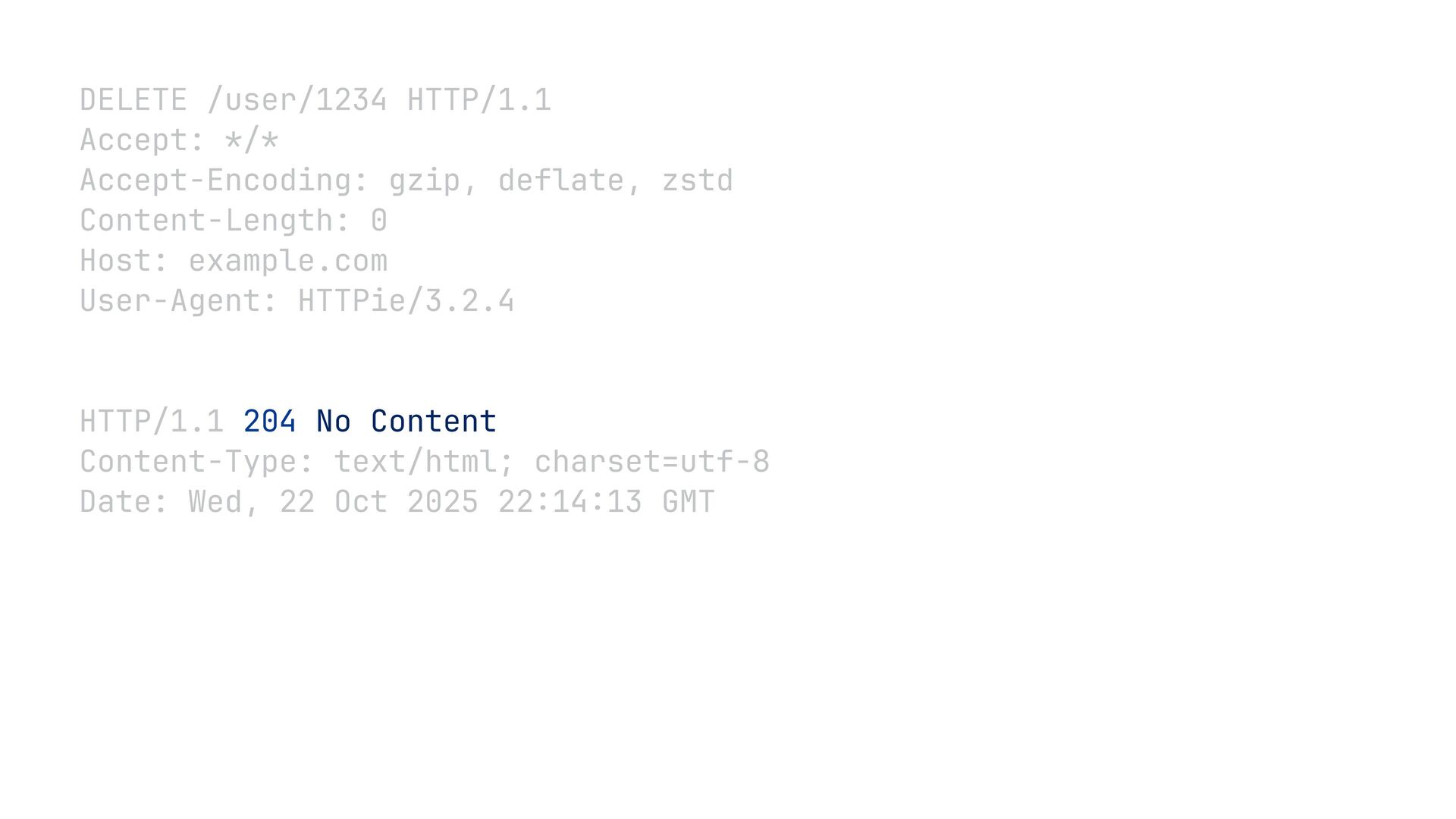
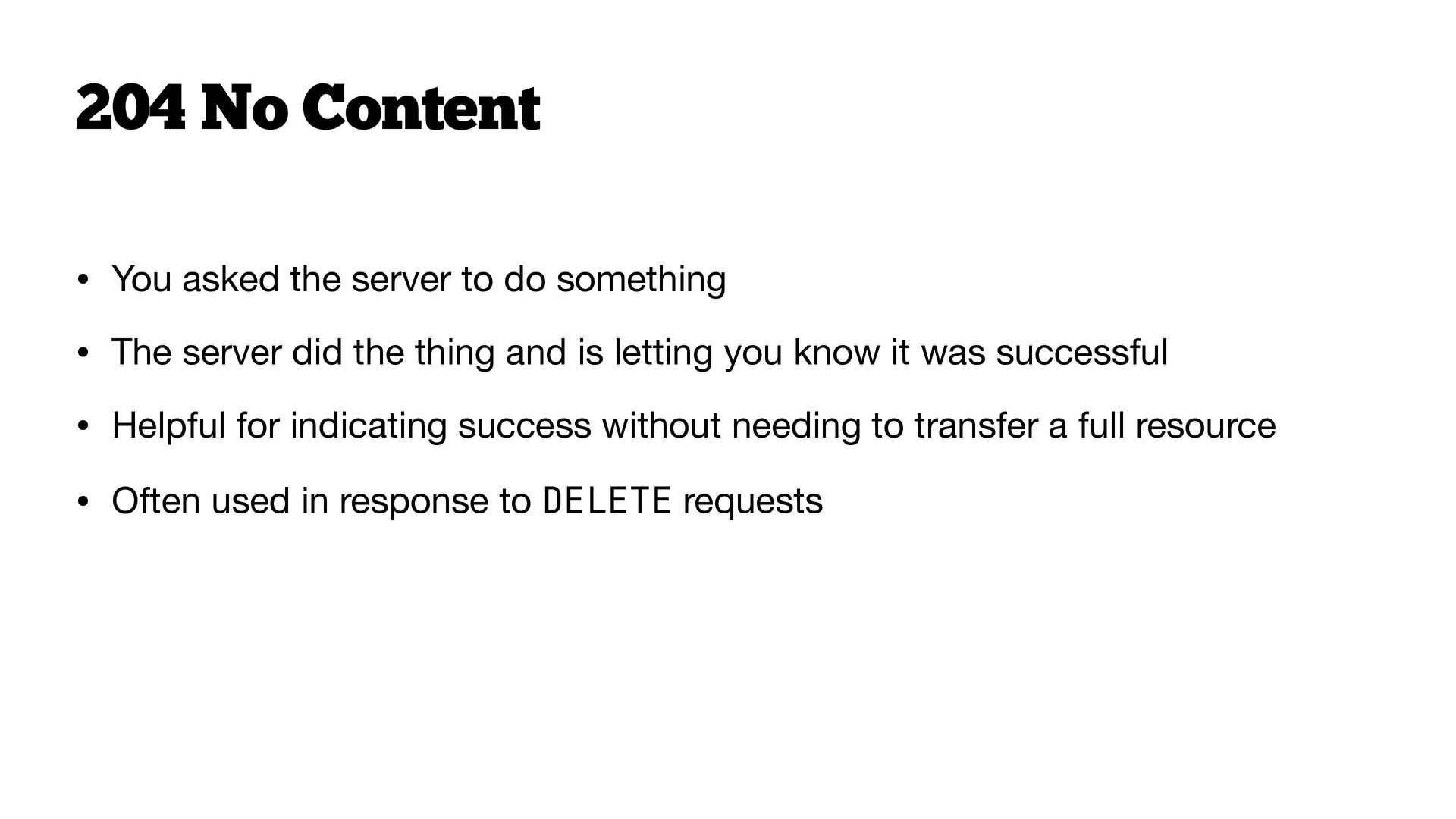
204 No Content • You asked the server to do
something • The server did the thing and is letting you know it was successful • Helpful for indicating success without needing to transfer a full resource • Often used in response to DELETE requests -
DELETE /user/1234 HTTP/1.1 Accept: */* Accept-Encoding: gzip, deflate, zstd Content-Length:
0 Host: example.com User-Agent: HTTPie/3.2.4 HTTP/1.1 204 No Content Content-Type: text/html; charset=utf-8 Date: Wed, 22 Oct 2025 22 : 14 : 13 GMT -
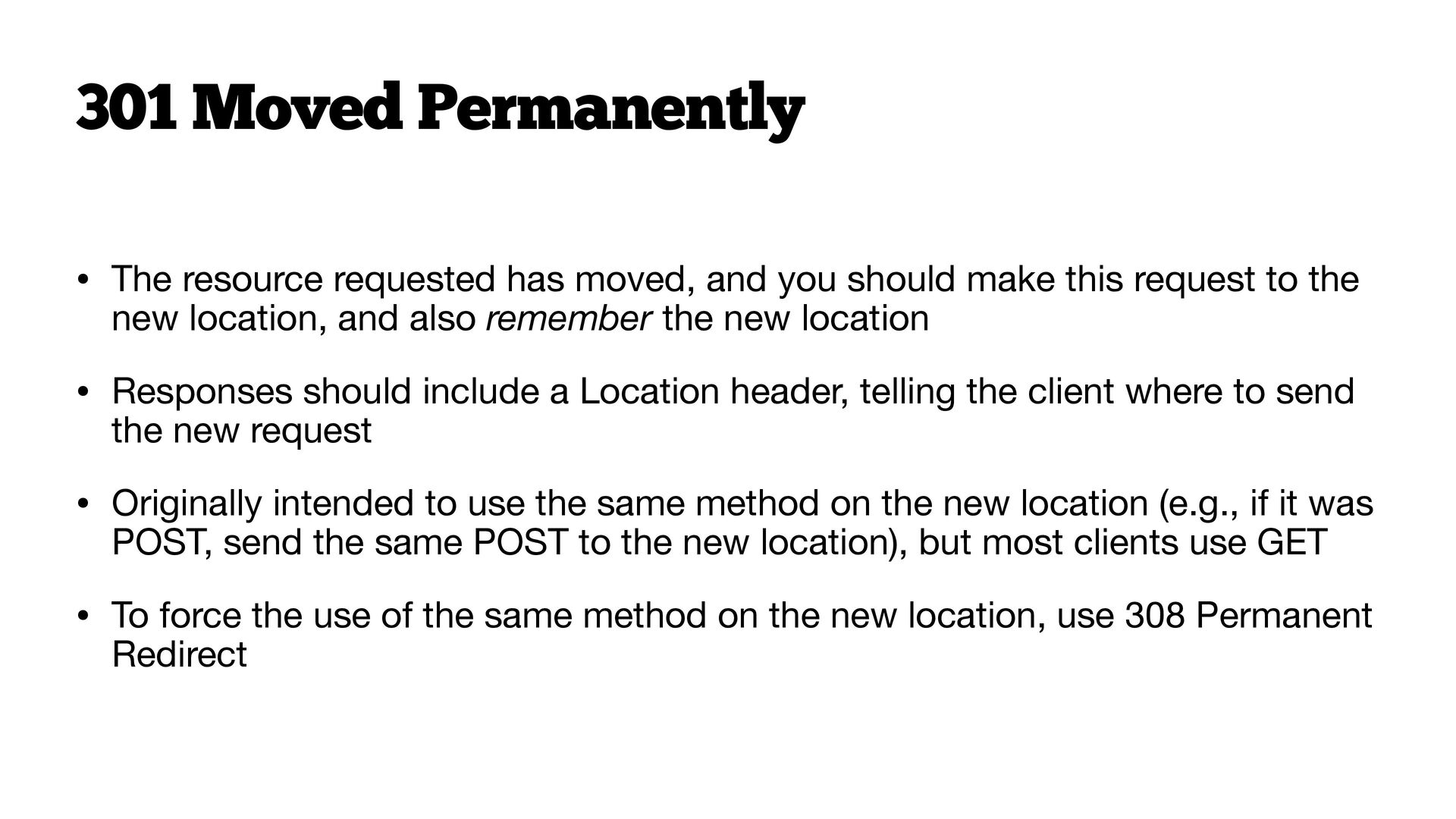
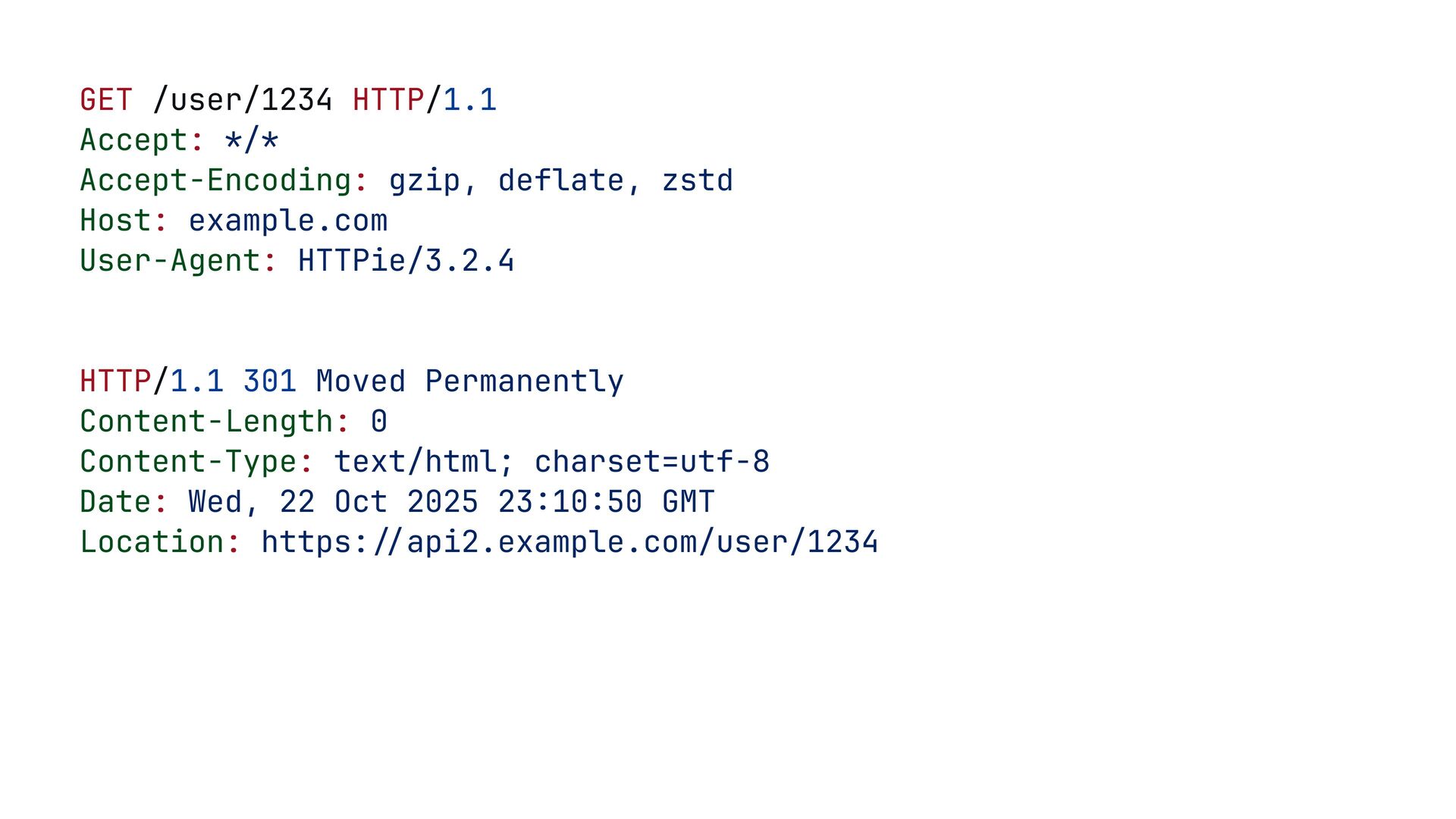
301 Moved Permanently • The resource requested has moved, and
you should make this request to the new location, and also remember the new location • Responses should include a Location header, telling the client where to send the new request • Originally intended to use the same method on the new location (e.g., if it was POST, send the same POST to the new location), but most clients use GET • To force the use of the same method on the new location, use 308 Permanent Redirect -
GET /user/1234 HTTP/1.1 Accept: */* Accept-Encoding: gzip, deflate, zstd Host:
example.com User-Agent: HTTPie/3.2.4 HTTP/1.1 301 Moved Permanently Content-Length: 0 Content-Type: text/html; charset=utf-8 Date: Wed, 22 Oct 2025 23 : 10 : 50 GMT Location: https: // api2.example.com/user/1234 -
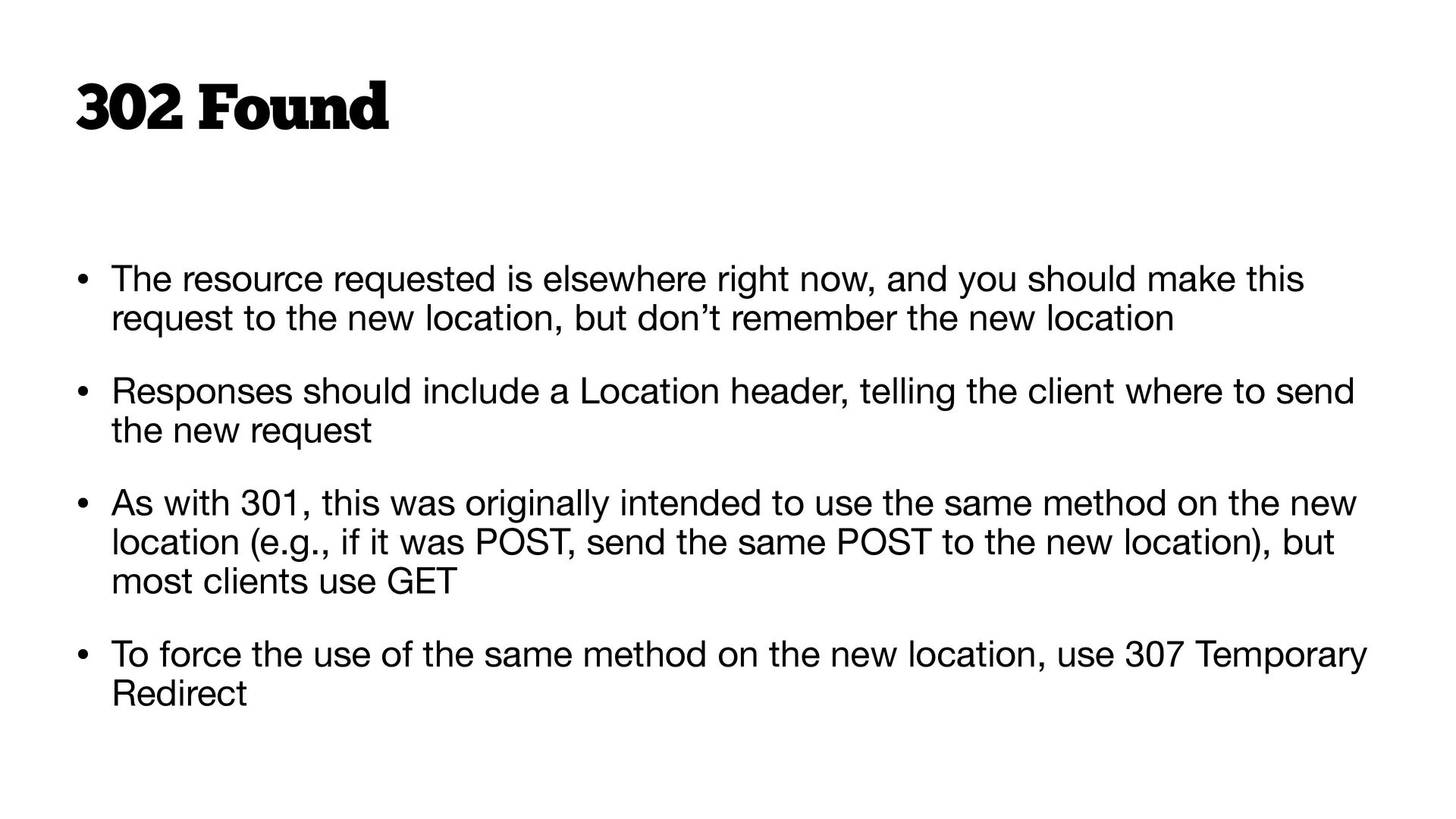
302 Found • The resource requested is elsewhere right now,
and you should make this request to the new location, but don’t remember the new location • Responses should include a Location header, telling the client where to send the new request • As with 301, this was originally intended to use the same method on the new location (e.g., if it was POST, send the same POST to the new location), but most clients use GET • To force the use of the same method on the new location, use 307 Temporary Redirect -
307 Temporary Redirect • Similar to 302, the resource requested
is elsewhere right now, and you should make this request to the new location, but don’t remember the new location • Responses should include a Location header, telling the client where to send the new request • The client must not change the method if it automatically redirects to the new location -
308 Permanent Redirect • Similar to 301, the resource requested
has moved, and you should make this request to the new location, and also remember the new location • Responses should include a Location header, telling the client where to send the new request • The client must not change the method if it automatically redirects to the new location -
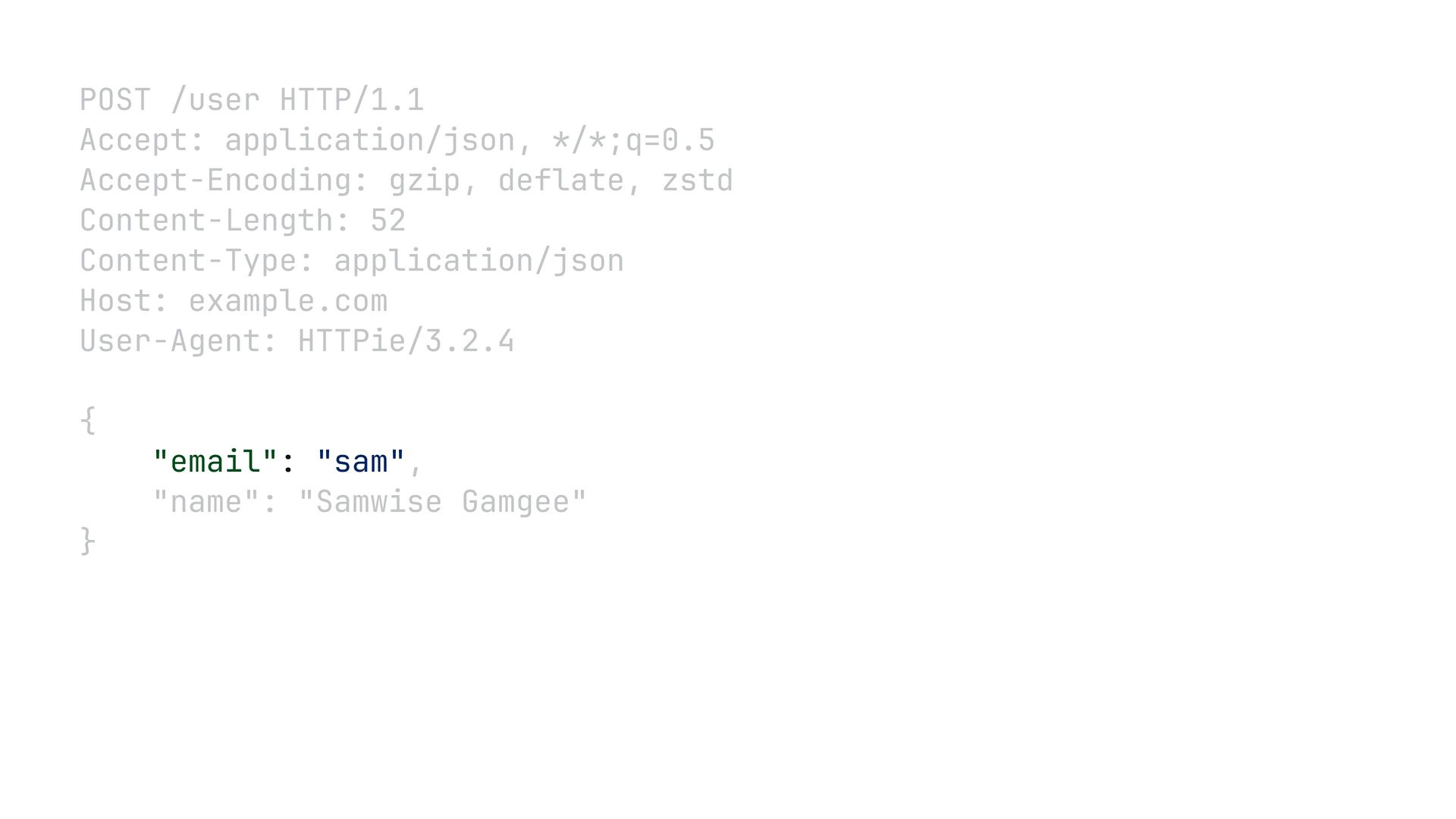
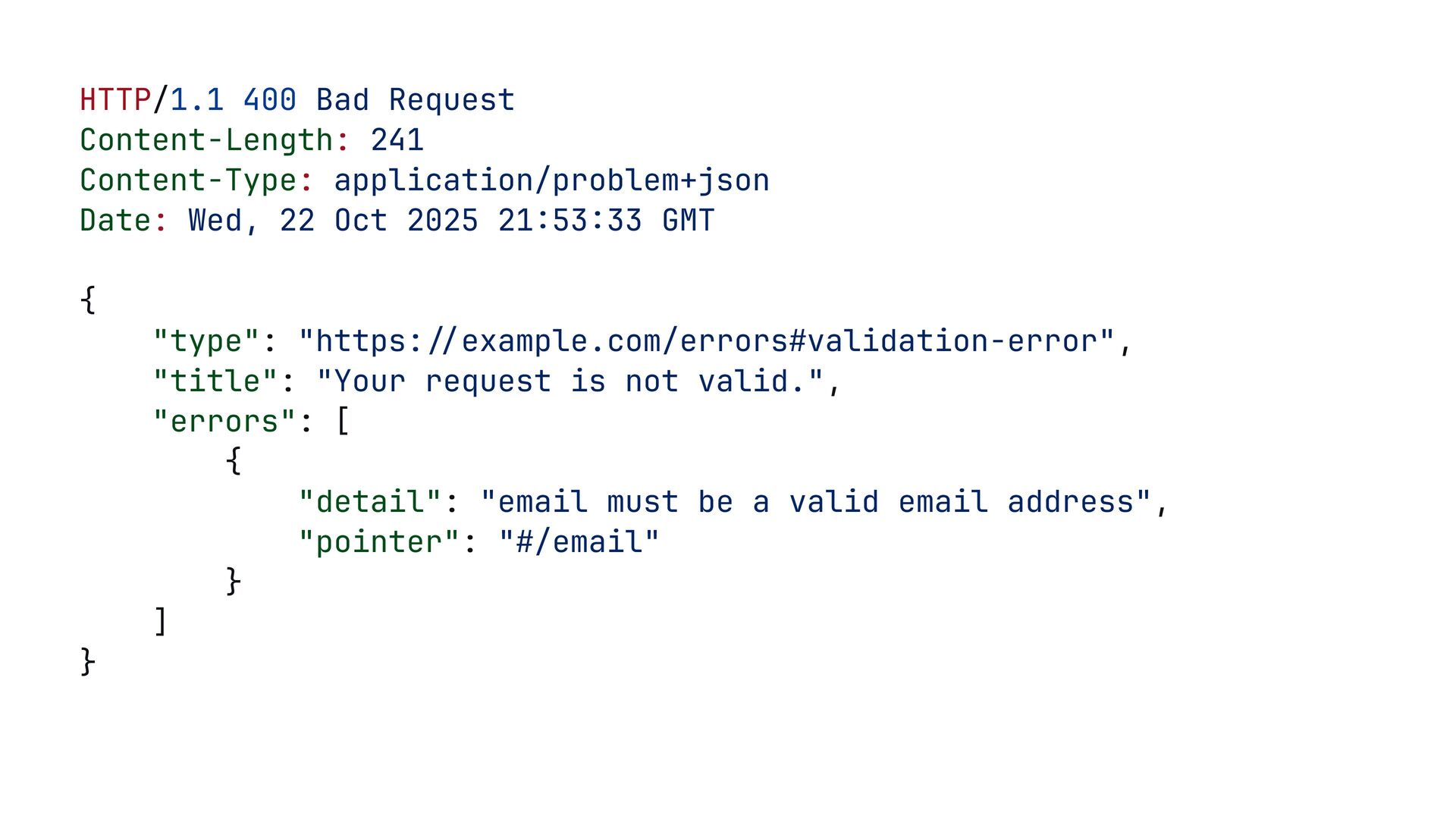
400 Bad Request • The server cannot or will not
process the request because of a client error, e.g., malformed syntax, validation failed, invalid headers, etc. • Often used as a general “failed validation” error response for APIs -
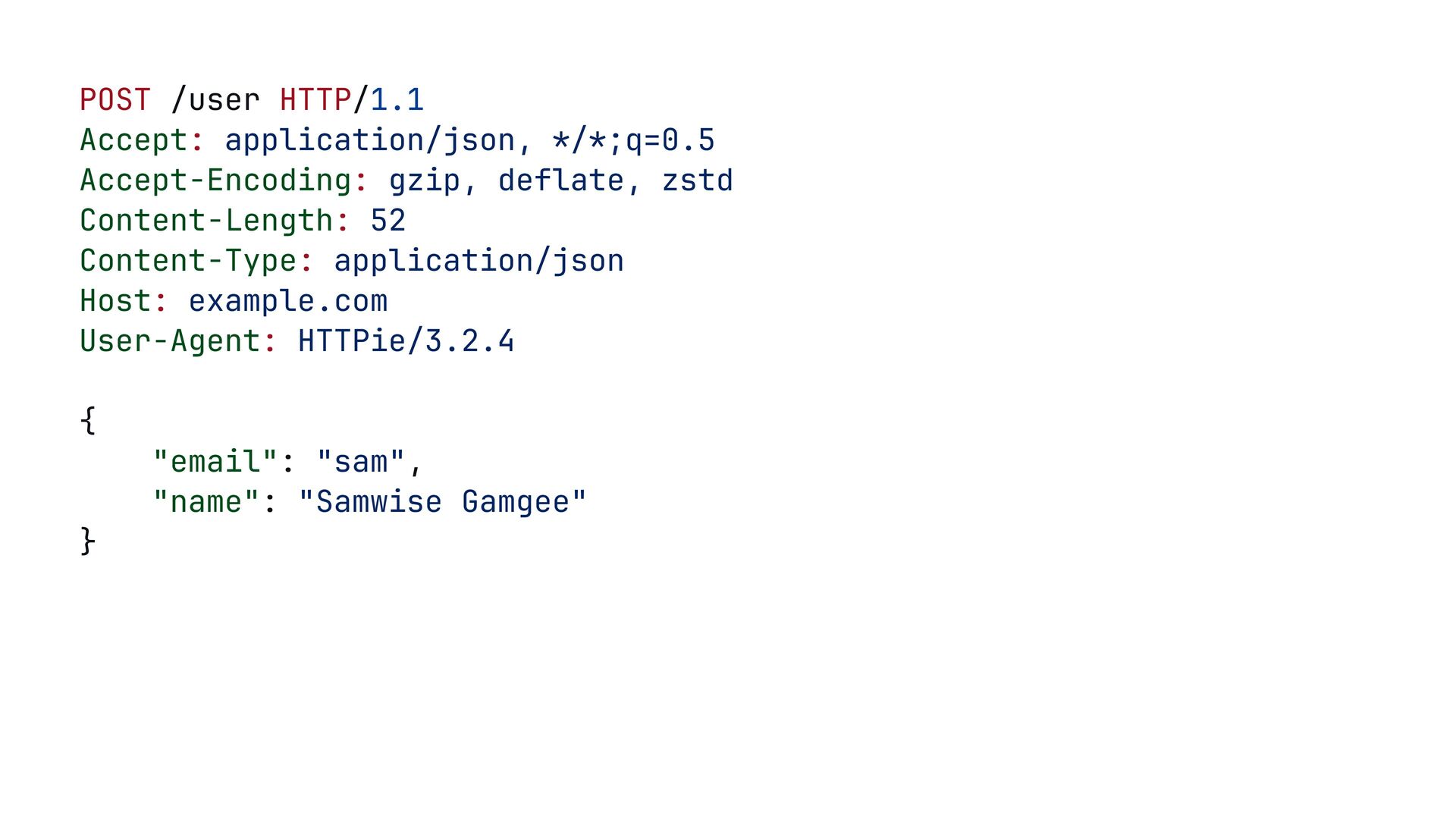
POST /user HTTP/1.1 Accept: application/json, */*;q=0.5 Accept-Encoding: gzip, deflate, zstd
Content-Length: 52 Content-Type: application/json Host: example.com User-Agent: HTTPie/3.2.4 { "email": "sam", "name": "Samwise Gamgee" } -
POST /user HTTP/1.1 Accept: application/json, */*;q=0.5 Accept-Encoding: gzip, deflate, zstd
Content-Length: 52 Content-Type: application/json Host: example.com User-Agent: HTTPie/3.2.4 { "email": "sam", "name": "Samwise Gamgee" } -
HTTP/1.1 400 Bad Request Content-Length: 241 Content-Type: application/problem+json Date: Wed,
22 Oct 2025 21 : 53 : 33 GMT { "type": "https: // example.com/errors#validation-error", "title": "Your request is not valid.", "errors": [ { "detail": "email must be a valid email address", "pointer": "#/email" } ] } -
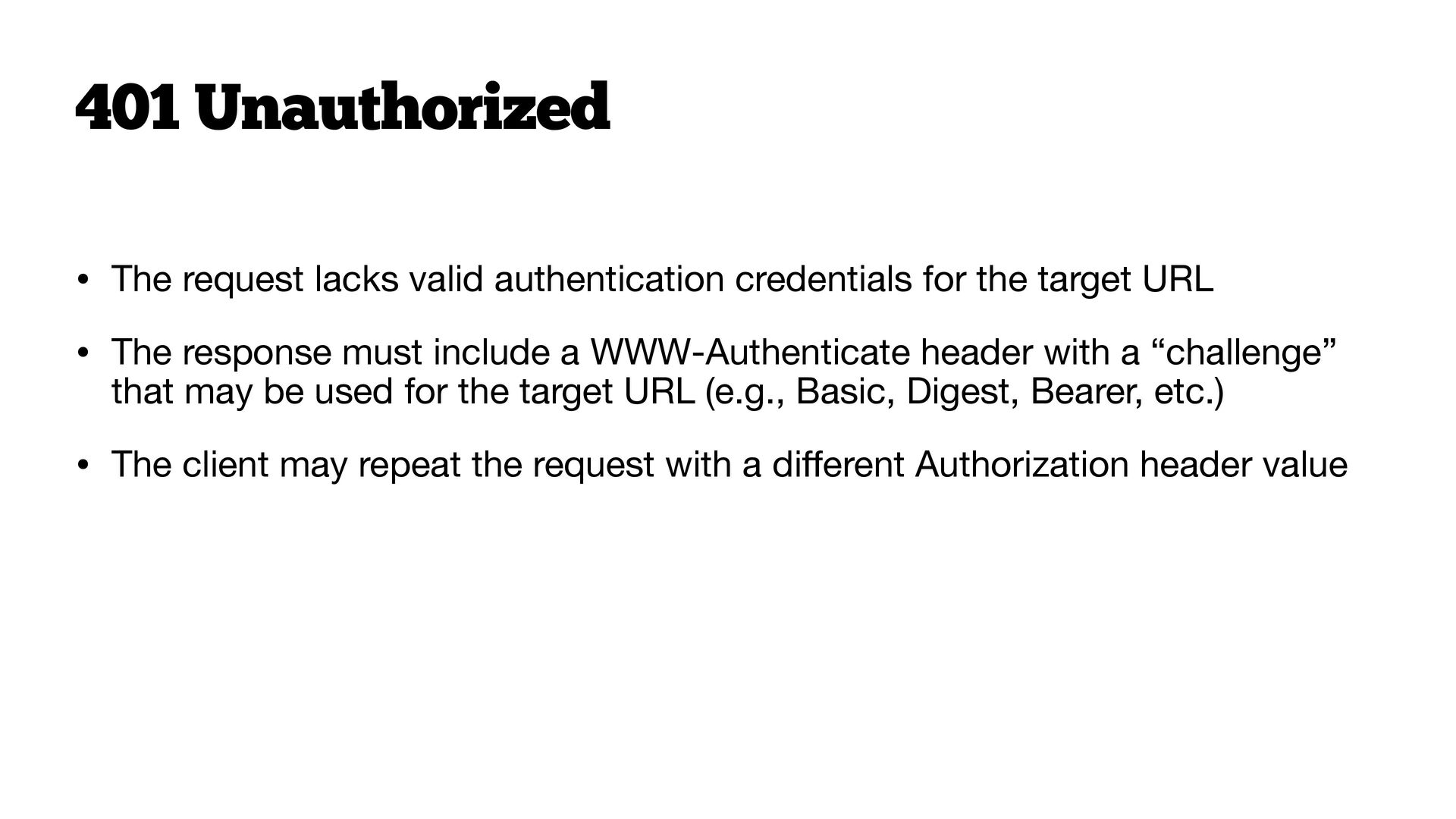
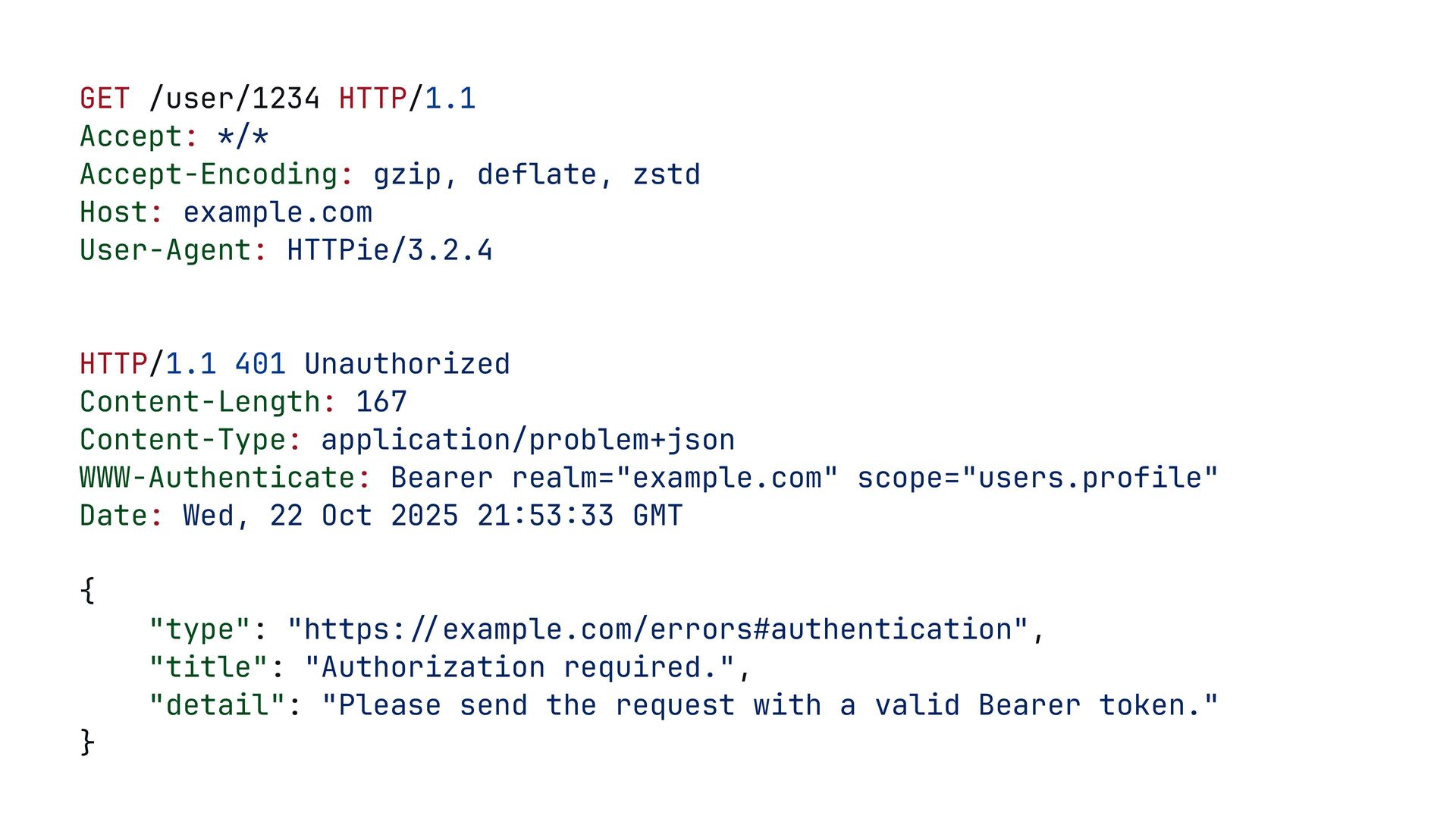
401 Unauthorized • The request lacks valid authentication credentials for
the target URL • The response must include a WWW-Authenticate header with a “challenge” that may be used for the target URL (e.g., Basic, Digest, Bearer, etc.) • The client may repeat the request with a di ff erent Authorization header value -
GET /user/1234 HTTP/1.1 Accept: */* Accept-Encoding: gzip, deflate, zstd Host:
example.com User-Agent: HTTPie/3.2.4 HTTP/1.1 401 Unauthorized Content-Length: 167 Content-Type: application/problem+json WWW-Authenticate: Bearer realm="example.com" scope="users.profile" Date: Wed, 22 Oct 2025 21 : 53 : 33 GMT { "type": "https: // example.com/errors#authentication", "title": "Authorization required.", "detail": "Please send the request with a valid Bearer token." } -
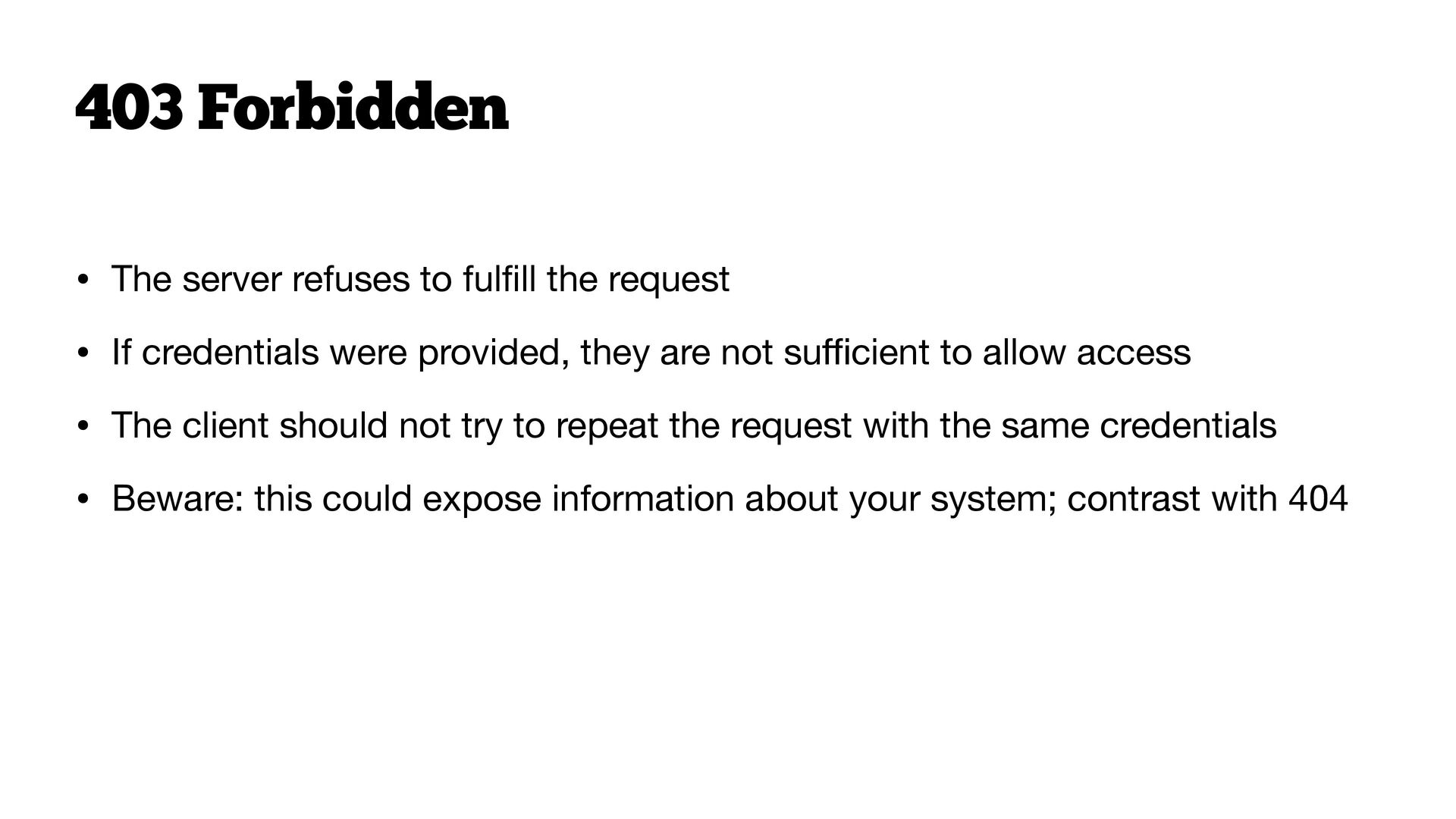
403 Forbidden • The server refuses to ful fi ll
the request • If credentials were provided, they are not su ffi cient to allow access • The client should not try to repeat the request with the same credentials • Beware: this could expose information about your system; contrast with 404 -
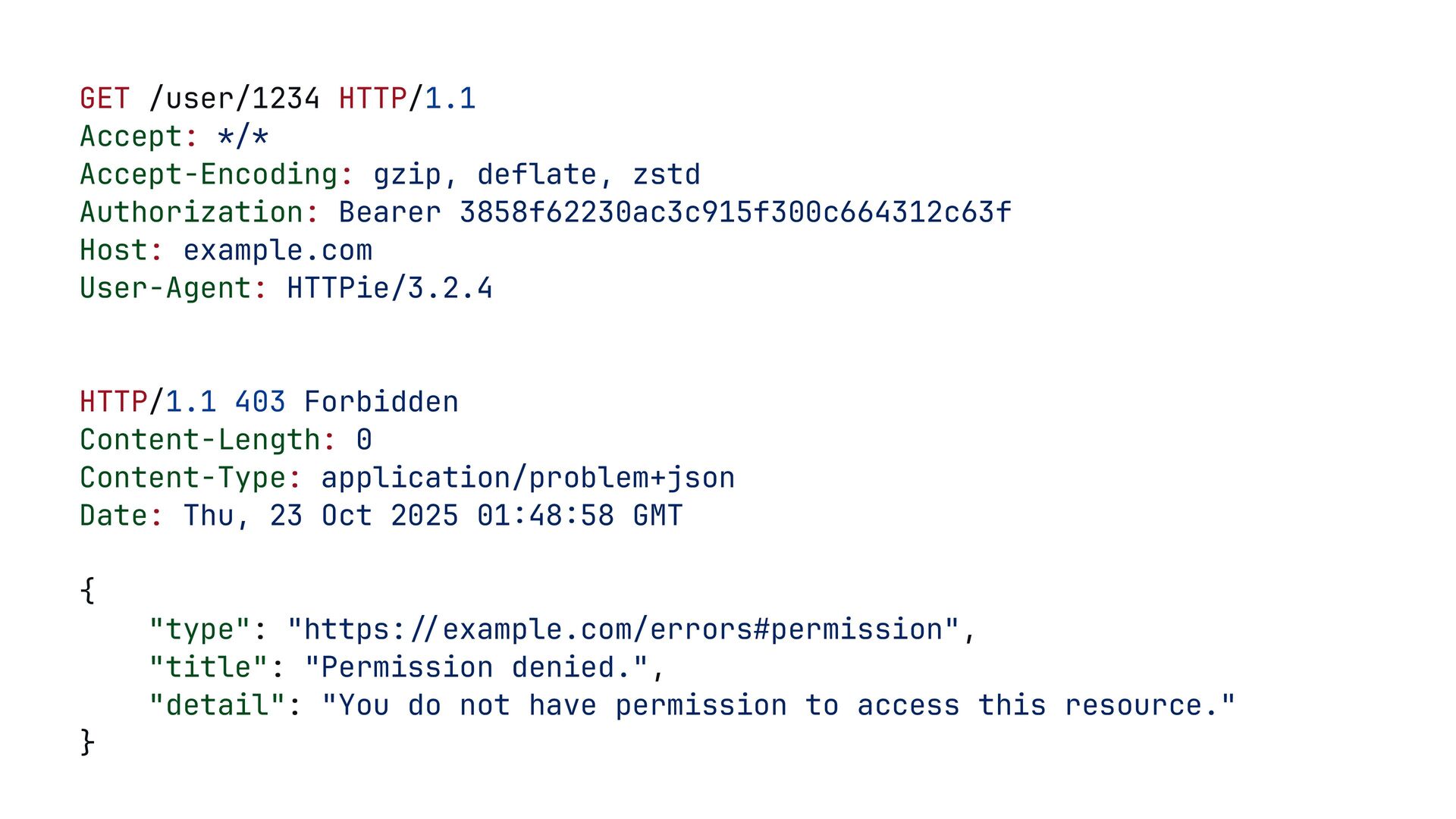
GET /user/1234 HTTP/1.1 Accept: */* Accept-Encoding: gzip, deflate, zstd Authorization:
Bearer 3858f62230ac3c915f300c664312c63f Host: example.com User-Agent: HTTPie/3.2.4 HTTP/1.1 403 Forbidden Content-Length: 0 Content-Type: application/problem+json Date: Thu, 23 Oct 2025 01 : 48 : 58 GMT { "type": "https: // example.com/errors#permission", "title": "Permission denied.", "detail": "You do not have permission to access this resource." } -
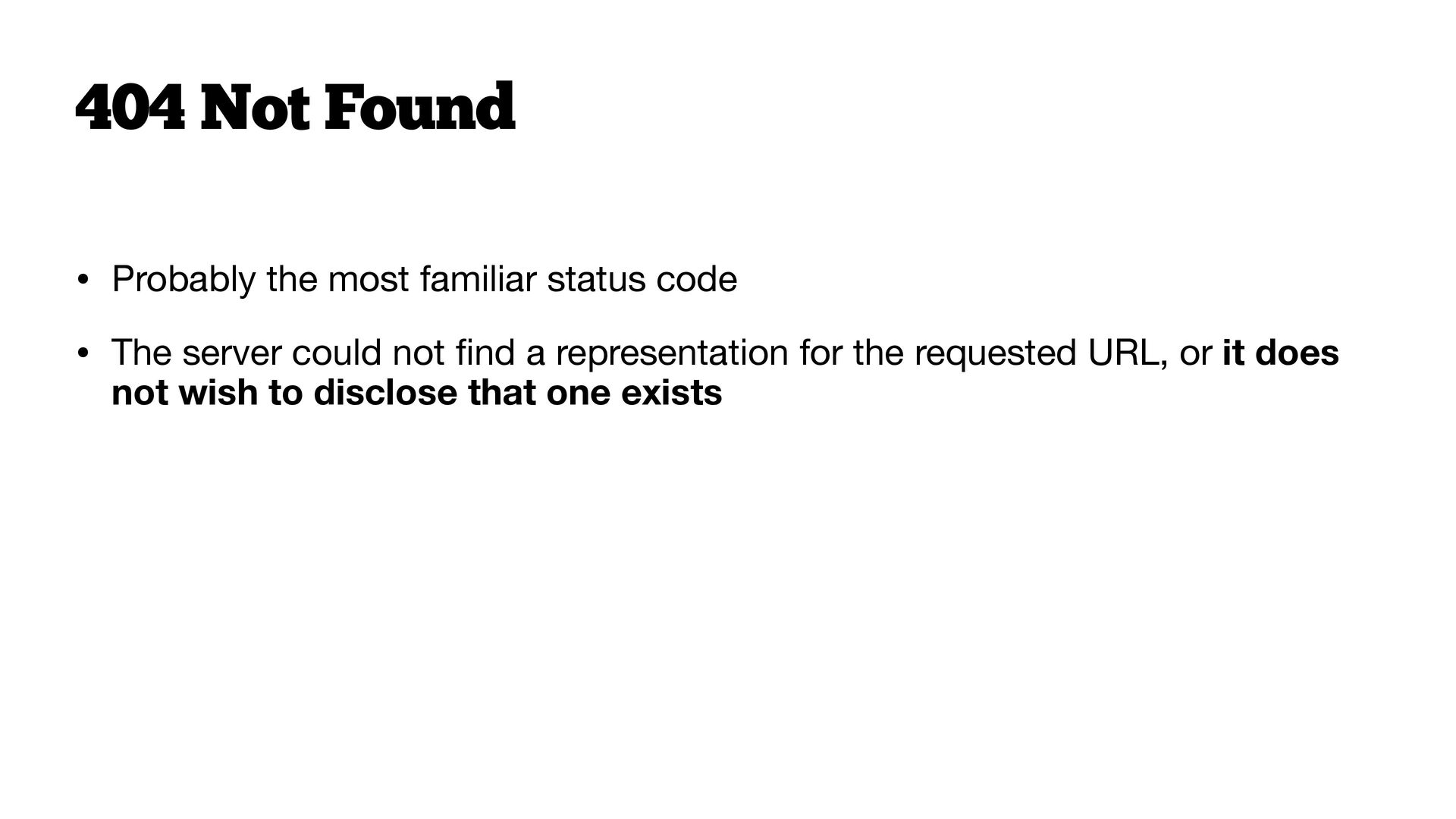
404 Not Found • Probably the most familiar status code
• The server could not fi nd a representation for the requested URL, or it does not wish to disclose that one exists -
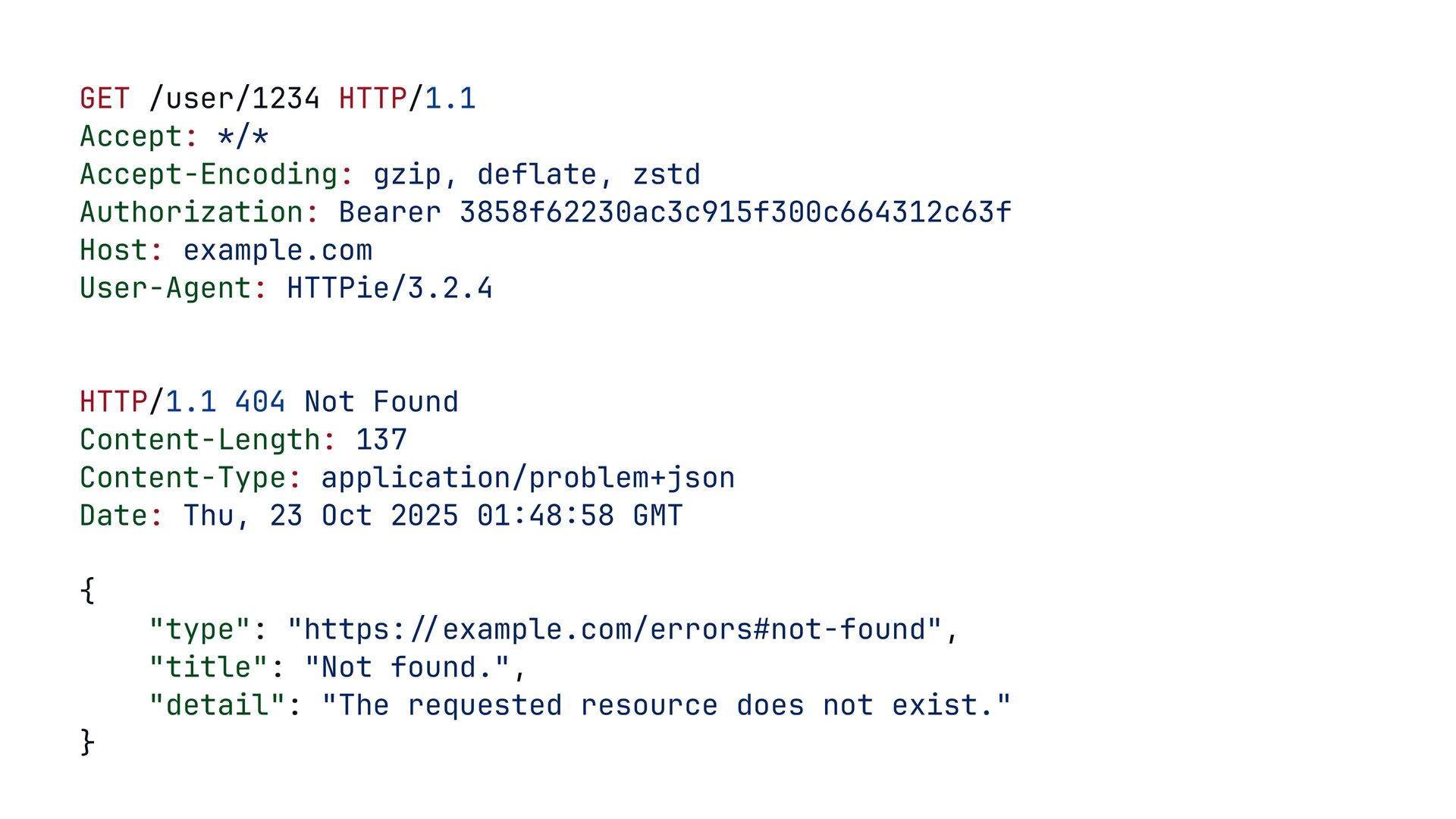
GET /user/1234 HTTP/1.1 Accept: */* Accept-Encoding: gzip, deflate, zstd Authorization:
Bearer 3858f62230ac3c915f300c664312c63f Host: example.com User-Agent: HTTPie/3.2.4 HTTP/1.1 404 Not Found Content-Length: 137 Content-Type: application/problem+json Date: Thu, 23 Oct 2025 01 : 48 : 58 GMT { "type": "https: // example.com/errors#not-found", "title": "Not found.", "detail": "The requested resource does not exist." } -
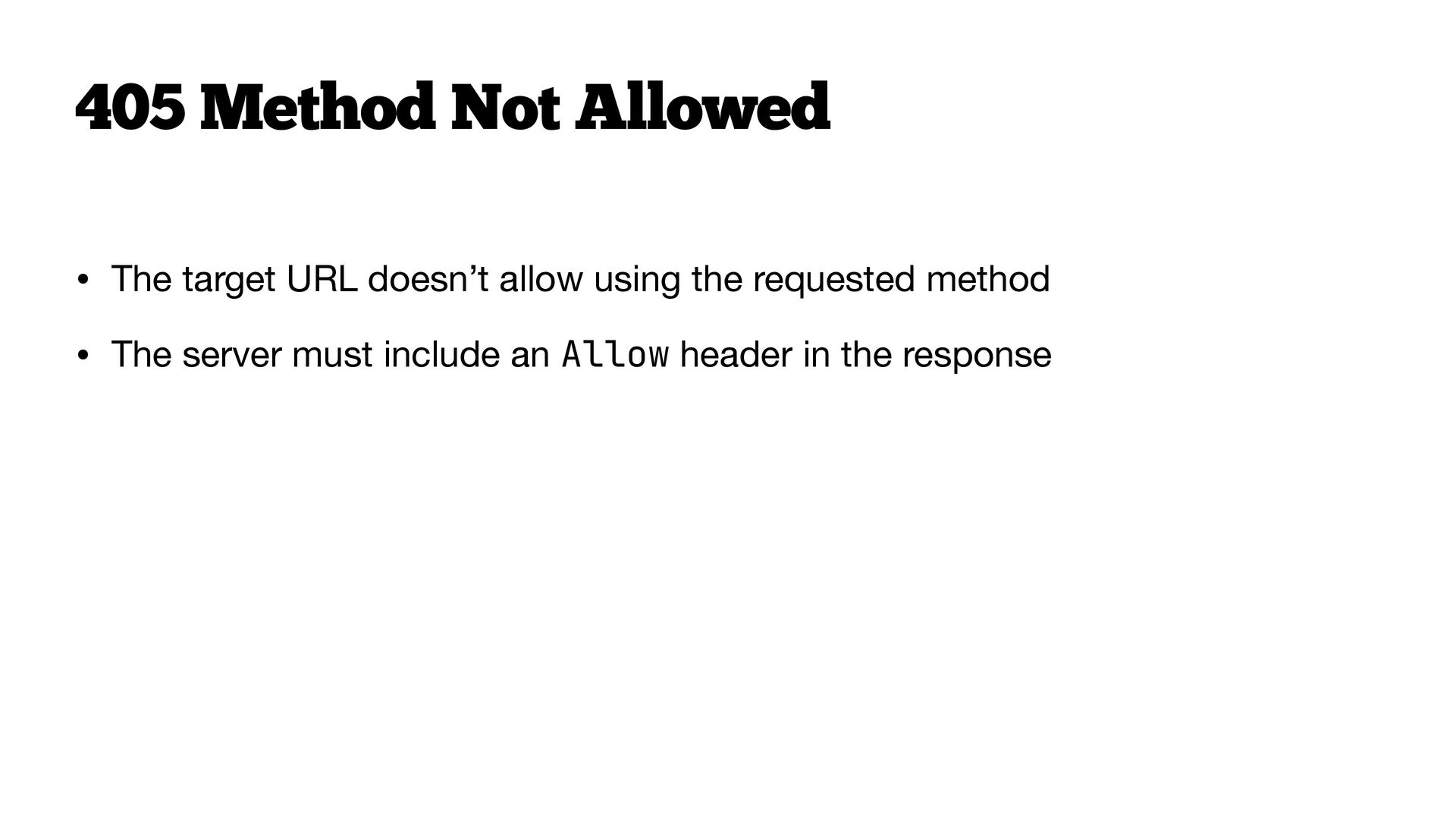
405 Method Not Allowed • The target URL doesn’t allow
using the requested method • The server must include an Allow header in the response -
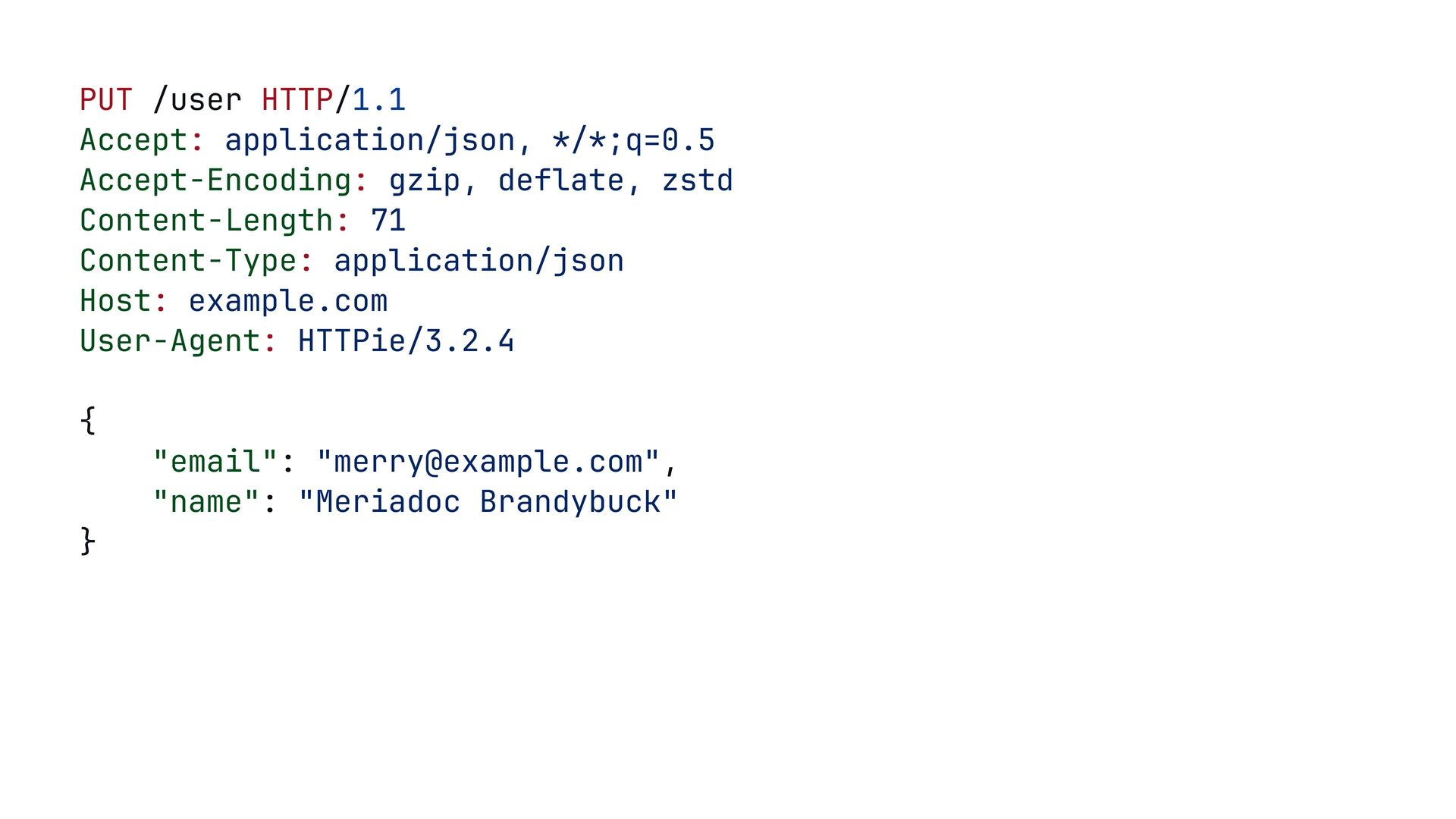
PUT /user HTTP/1.1 Accept: application/json, */*;q=0.5 Accept-Encoding: gzip, deflate, zstd
Content-Length: 71 Content-Type: application/json Host: example.com User-Agent: HTTPie/3.2.4 { "email": "[email protected]", "name": "Meriadoc Brandybuck" } -
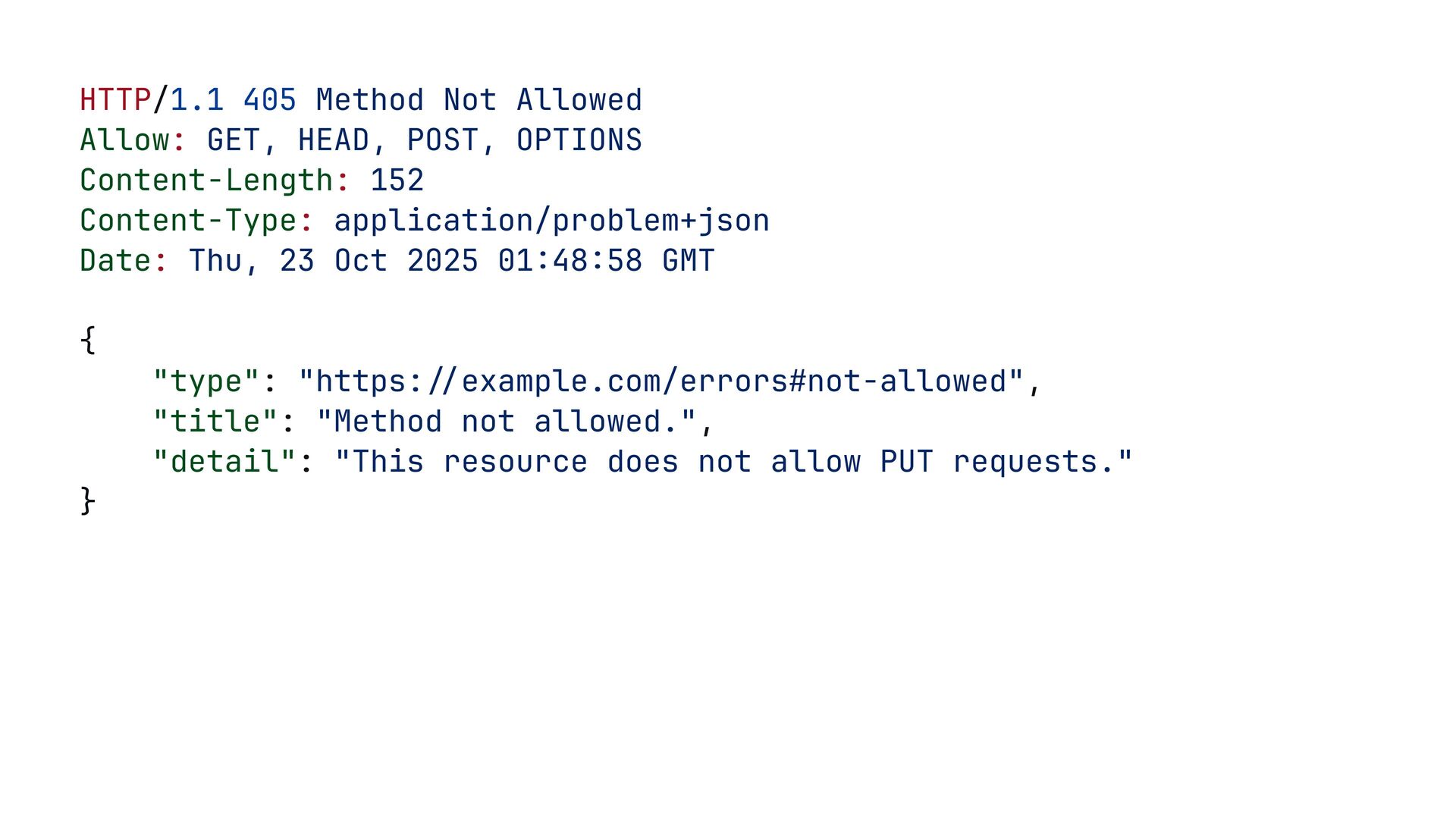
HTTP/1.1 405 Method Not Allowed Allow: GET, HEAD, POST, OPTIONS
Content-Length: 152 Content-Type: application/problem+json Date: Thu, 23 Oct 2025 01 : 48 : 58 GMT { "type": "https: // example.com/errors#not-allowed", "title": "Method not allowed.", "detail": "This resource does not allow PUT requests." } -
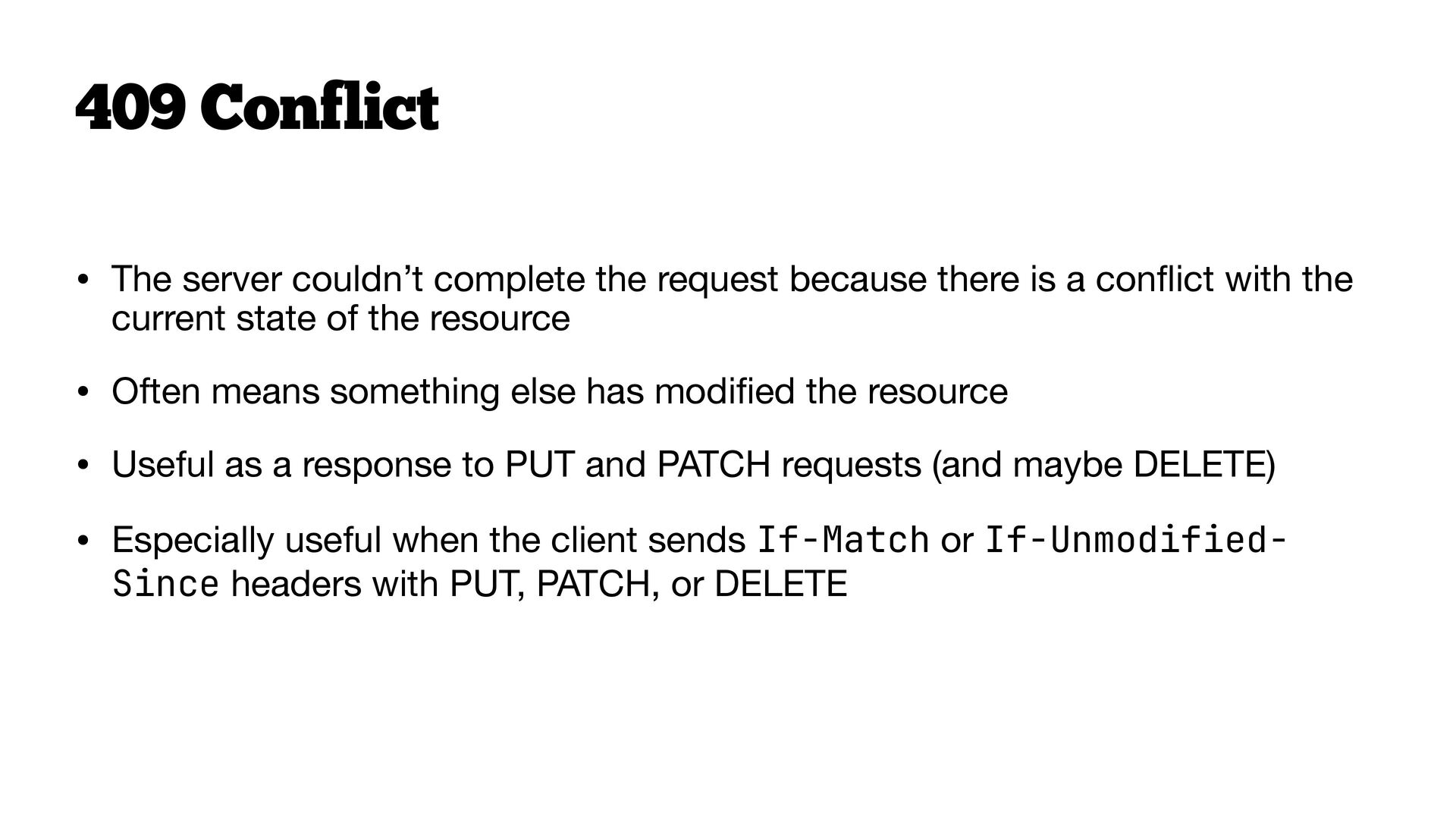
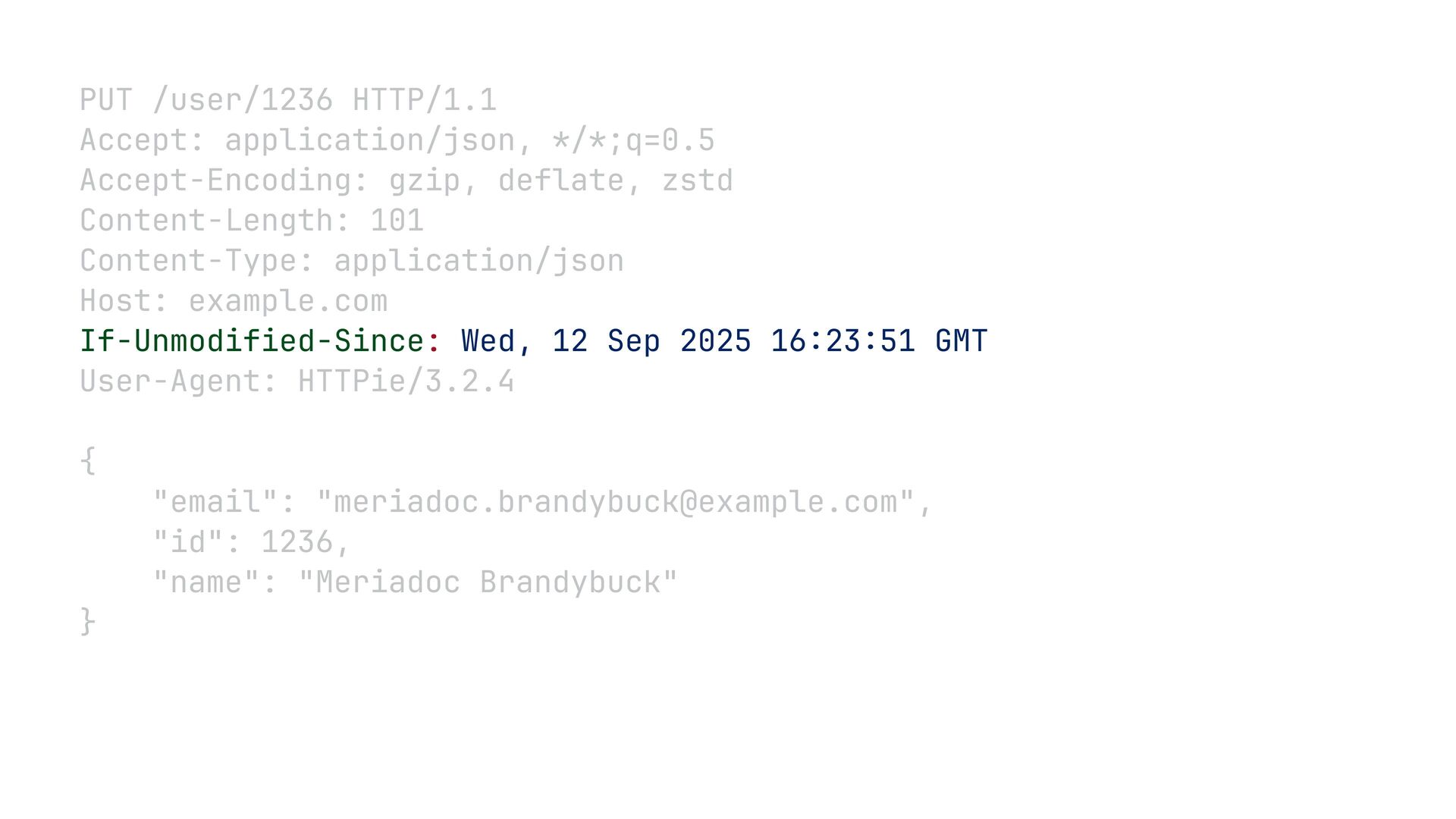
409 Conflict • The server couldn’t complete the request because
there is a con fl ict with the current state of the resource • Often means something else has modi fi ed the resource • Useful as a response to PUT and PATCH requests (and maybe DELETE) • Especially useful when the client sends If-Match or If-Unmodified- Since headers with PUT, PATCH, or DELETE -
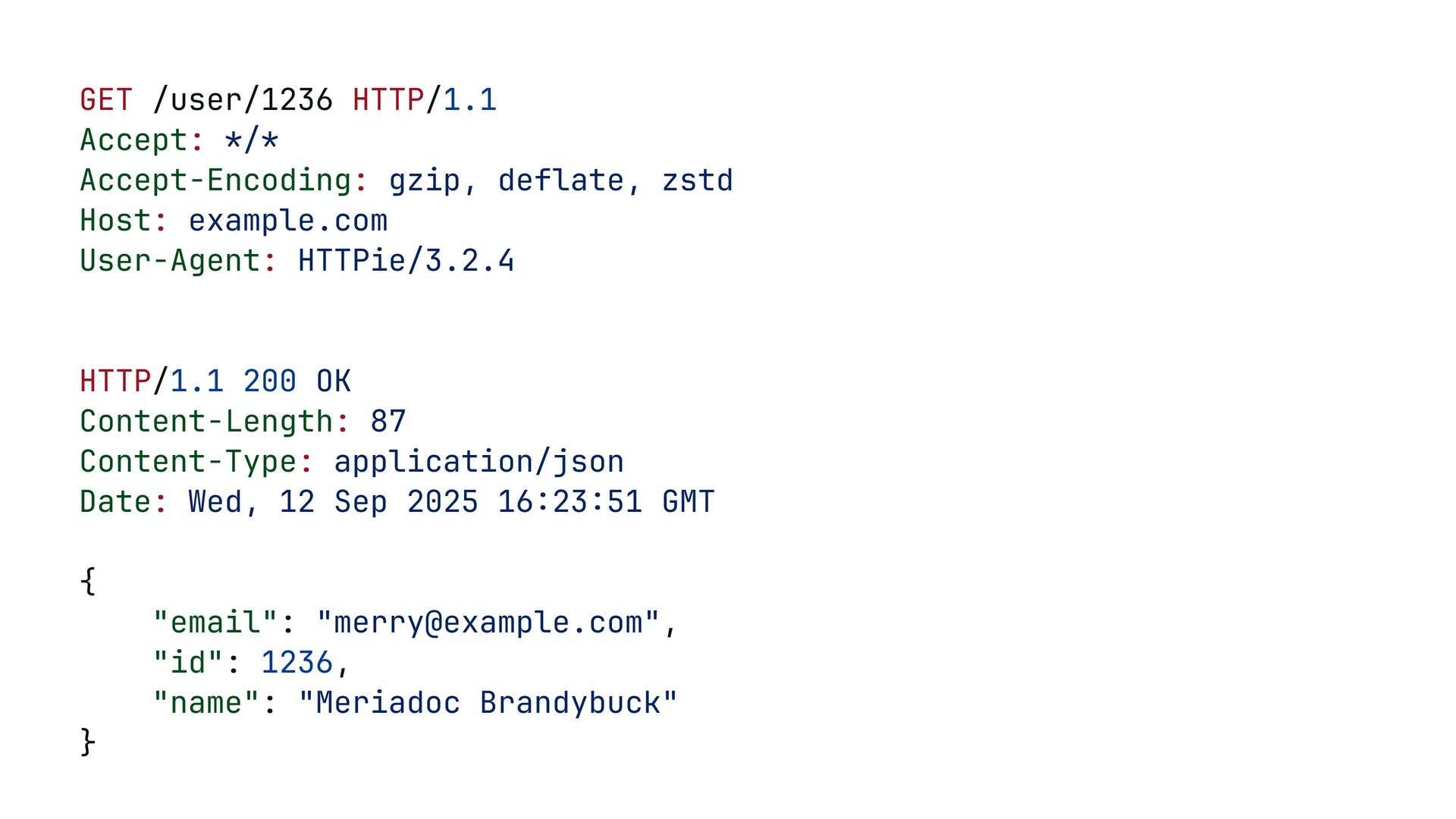
GET /user/1236 HTTP/1.1 Accept: */* Accept-Encoding: gzip, deflate, zstd Host:
example.com User-Agent: HTTPie/3.2.4 HTTP/1.1 200 OK Content-Length: 87 Content-Type: application/json Date: Wed, 12 Sep 2025 16 : 23 : 51 GMT { "email": "[email protected]", "id": 1236, "name": "Meriadoc Brandybuck" } -
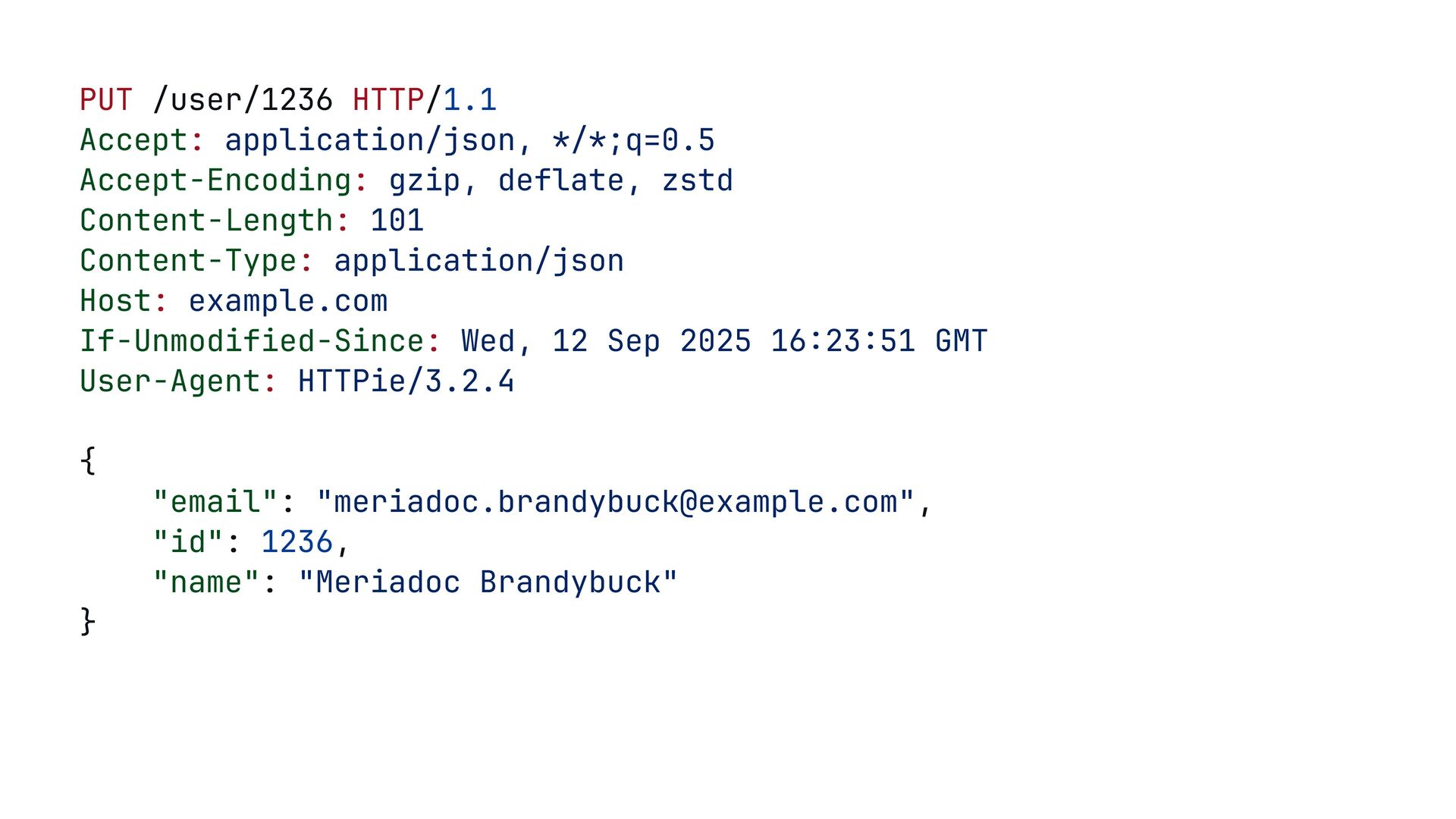
PUT /user/1236 HTTP/1.1 Accept: application/json, */*;q=0.5 Accept-Encoding: gzip, deflate, zstd
Content-Length: 101 Content-Type: application/json Host: example.com If-Unmodified-Since: Wed, 12 Sep 2025 16 : 23 : 51 GMT User-Agent: HTTPie/3.2.4 { "email": "[email protected]", "id": 1236, "name": "Meriadoc Brandybuck" } -
PUT /user/1236 HTTP/1.1 Accept: application/json, */*;q=0.5 Accept-Encoding: gzip, deflate, zstd
Content-Length: 101 Content-Type: application/json Host: example.com If-Unmodified-Since: Wed, 12 Sep 2025 16 : 23 : 51 GMT User-Agent: HTTPie/3.2.4 { "email": "[email protected]", "id": 1236, "name": "Meriadoc Brandybuck" } -
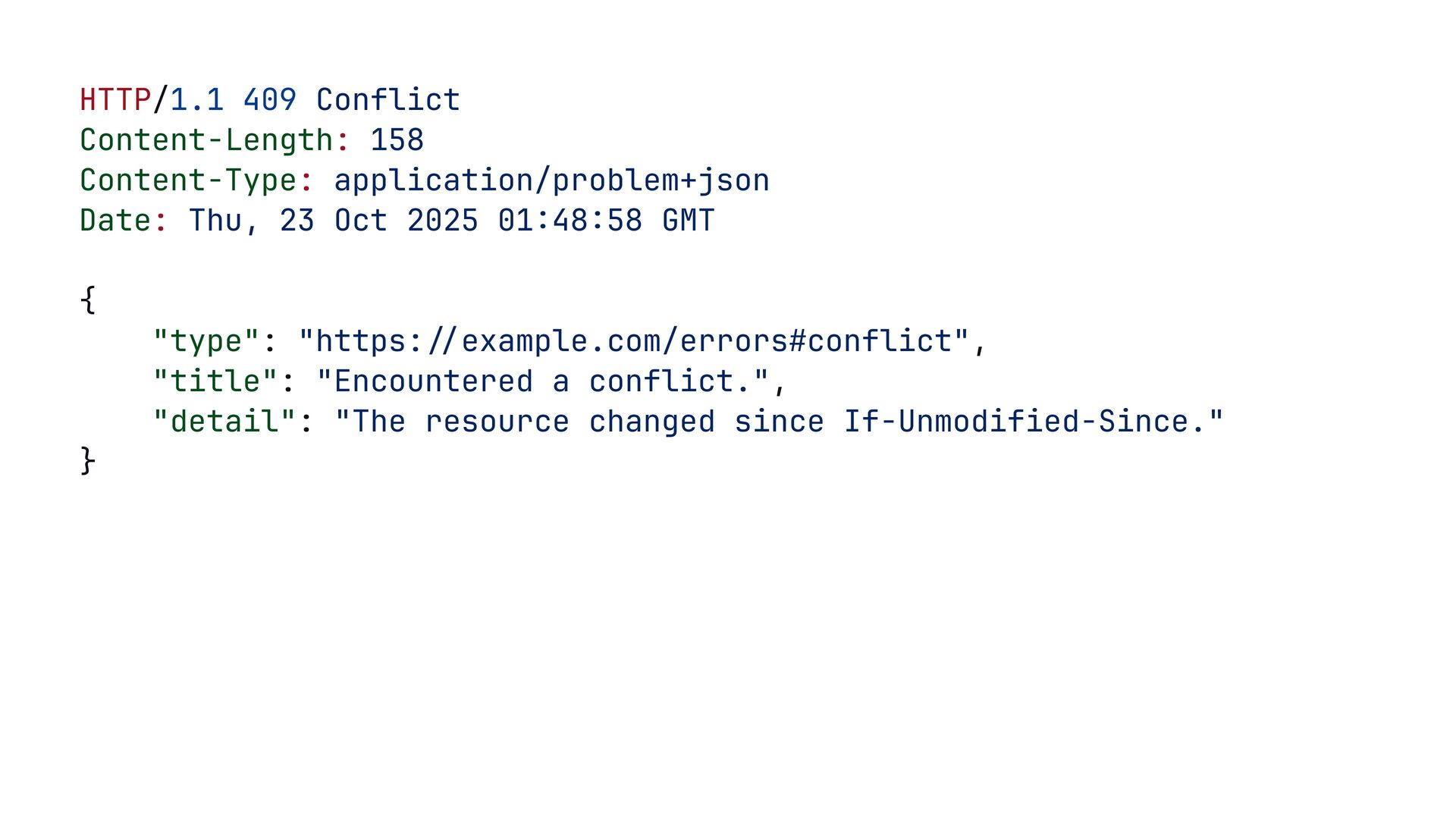
HTTP/1.1 409 Conflict Content-Length: 158 Content-Type: application/problem+json Date: Thu, 23
Oct 2025 01 : 48 : 58 GMT { "type": "https: // example.com/errors#conflict", "title": "Encountered a conflict.", "detail": "The resource changed since If-Unmodified-Since." } -
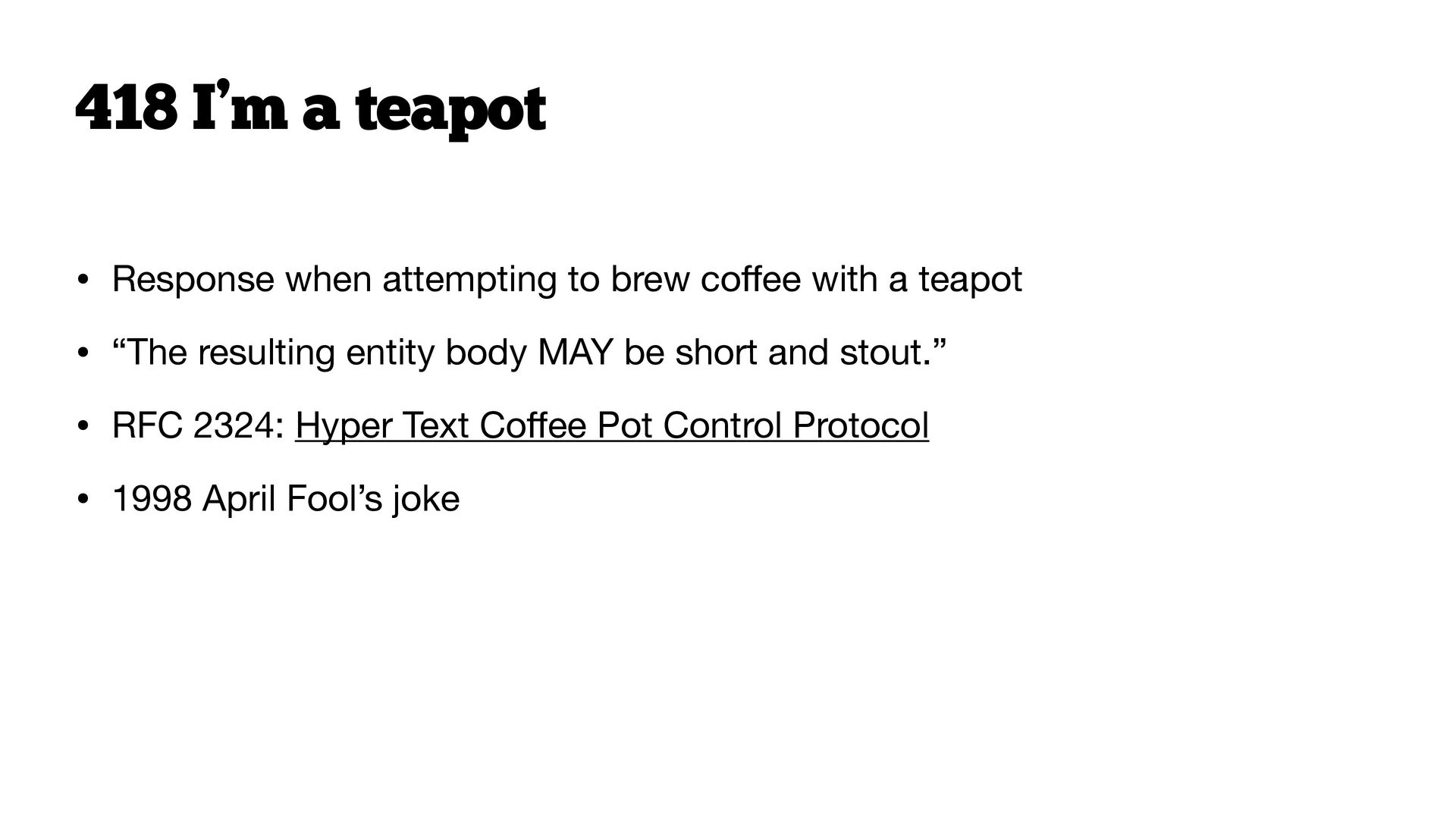
418 I’m a teapot • Response when attempting to brew
co ff ee with a teapot • “The resulting entity body MAY be short and stout.” • RFC 2324: Hyper Text Co ff ee Pot Control Protocol • 1998 April Fool’s joke -
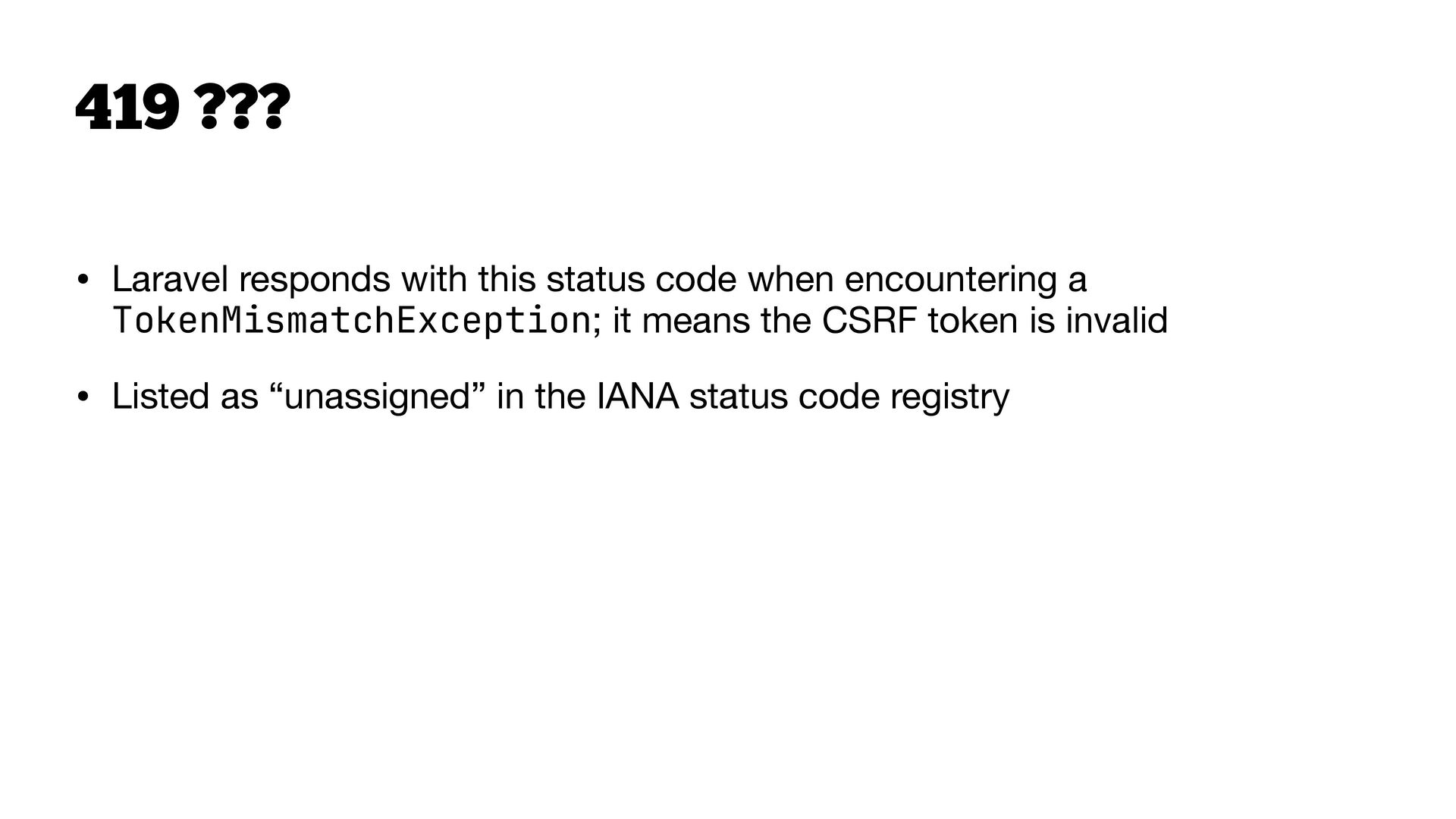
419 ??? • Laravel responds with this status code when
encountering a TokenMismatchException; it means the CSRF token is invalid • Listed as “unassigned” in the IANA status code registry -
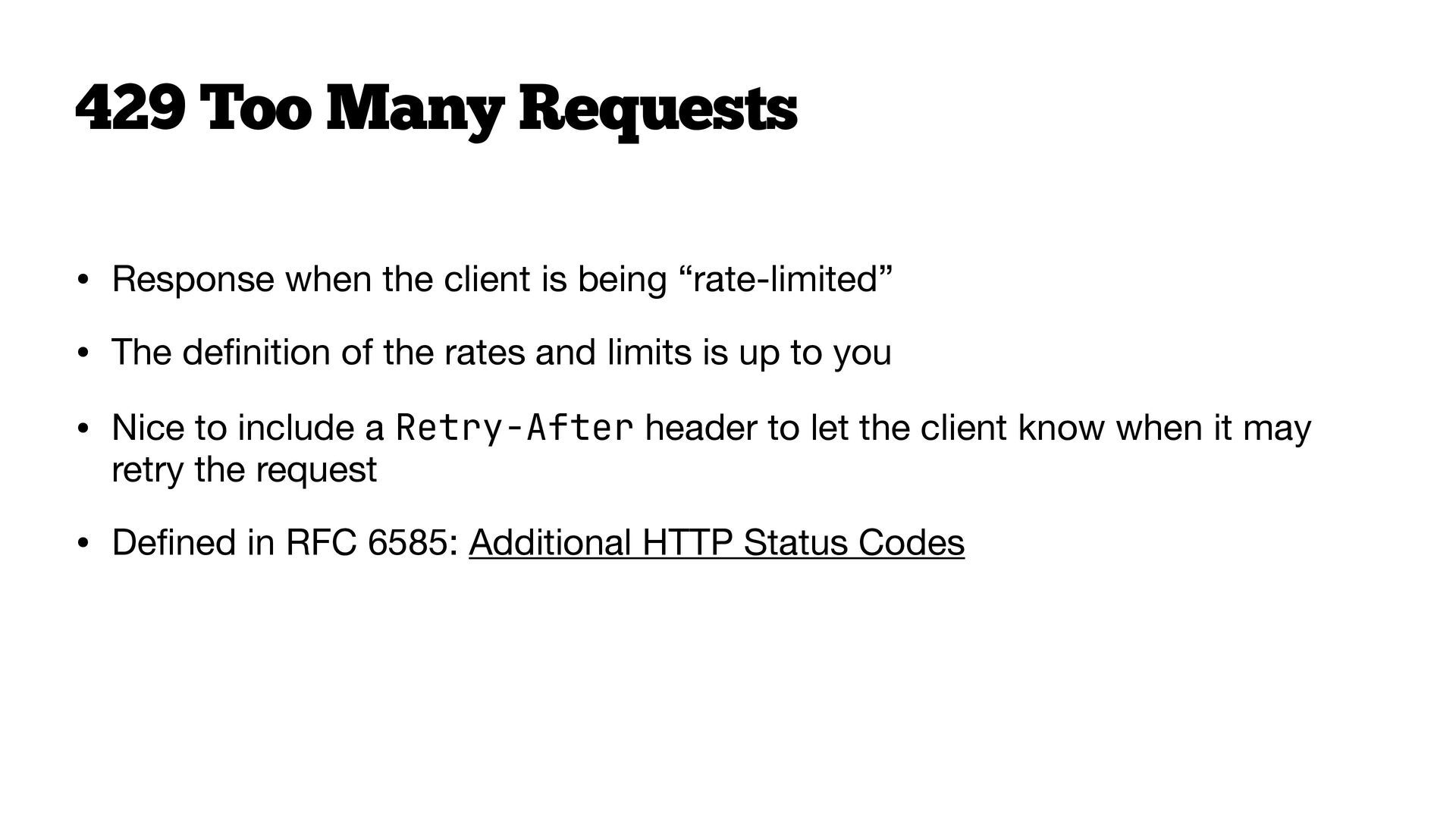
429 Too Many Requests • Response when the client is
being “rate-limited” • The de fi nition of the rates and limits is up to you • Nice to include a Retry-After header to let the client know when it may retry the request • De fi ned in RFC 6585: Additional HTTP Status Codes -
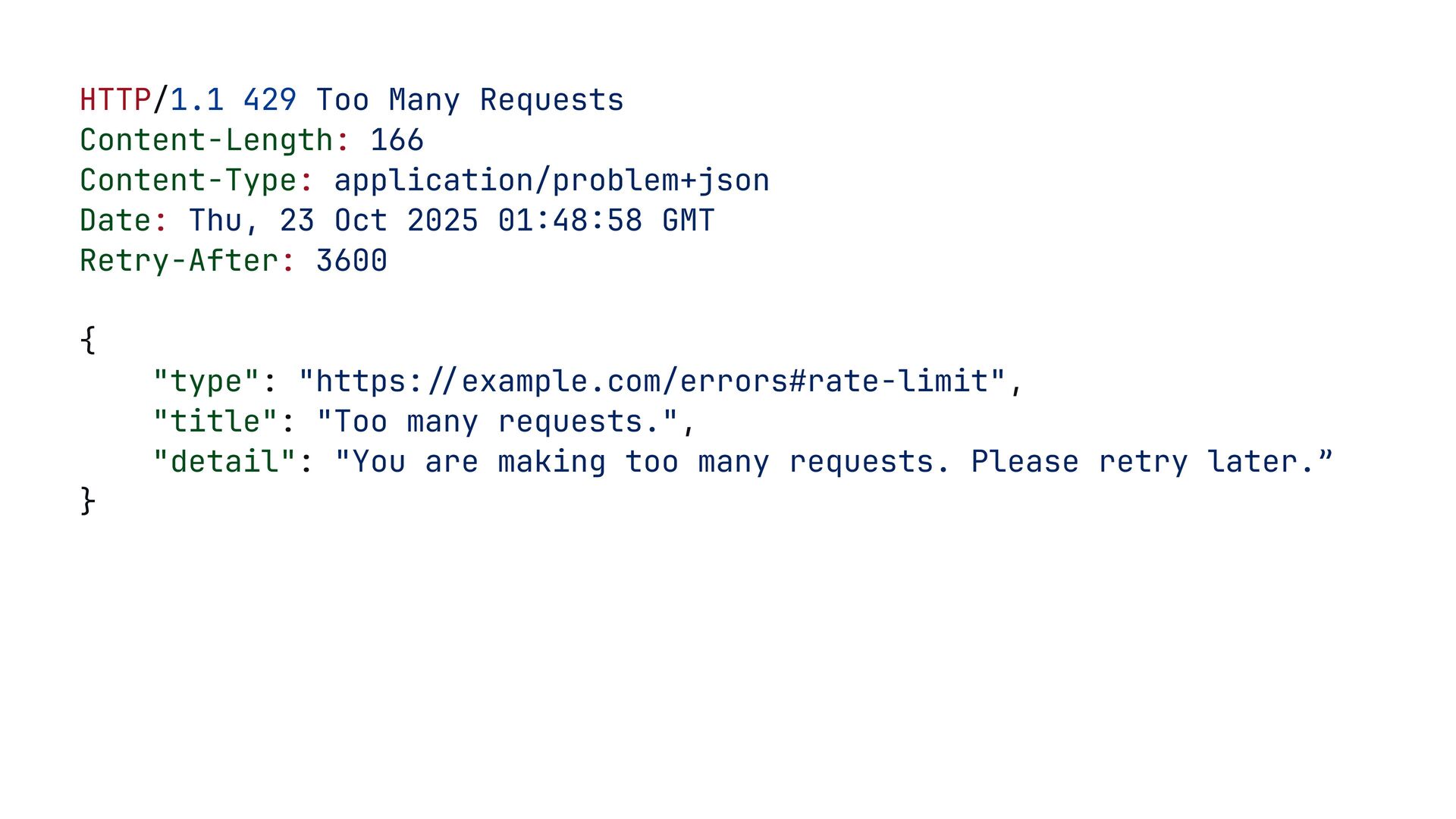
HTTP/1.1 429 Too Many Requests Content-Length: 166 Content-Type: application/problem+json Date:
Thu, 23 Oct 2025 01 : 48 : 58 GMT Retry-After: 3600 { "type": "https: // example.com/errors#rate-limit", "title": "Too many requests.", "detail": "You are making too many requests. Please retry later.” } -
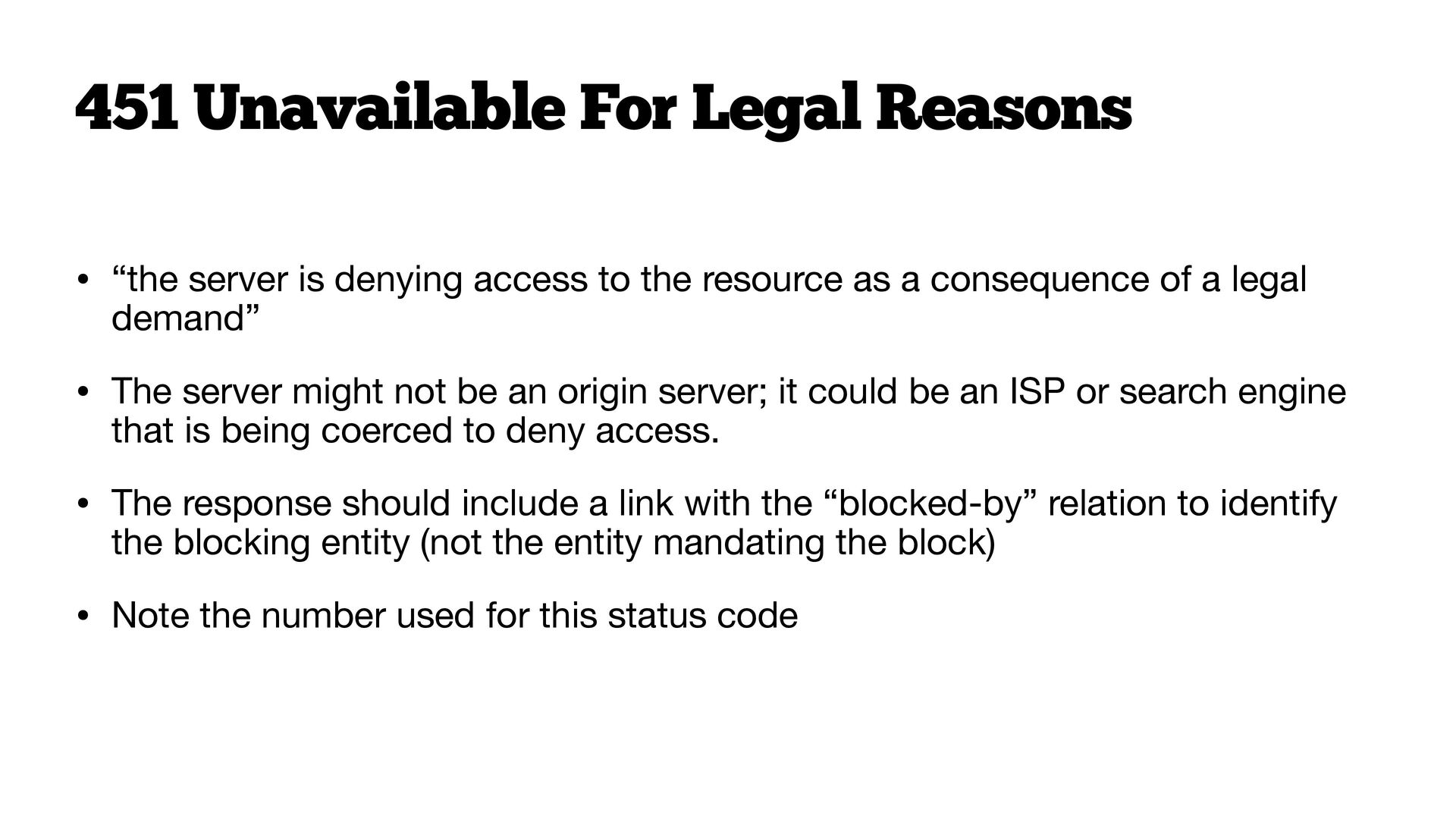
451 Unavailable For Legal Reasons • “the server is denying
access to the resource as a consequence of a legal demand” • The server might not be an origin server; it could be an ISP or search engine that is being coerced to deny access. • The response should include a link with the “blocked-by” relation to identify the blocking entity (not the entity mandating the block) • Note the number used for this status code -
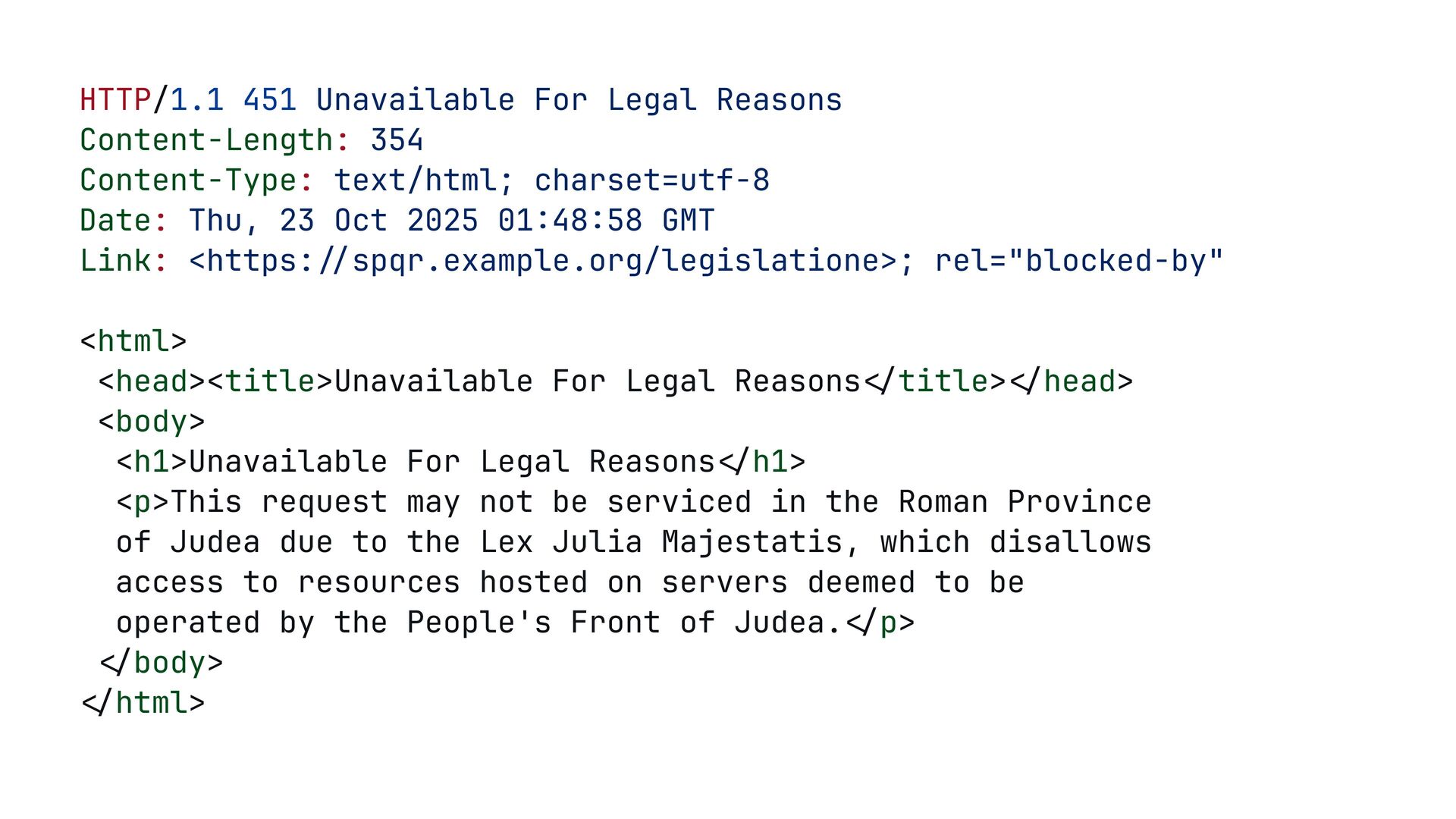
HTTP/1.1 451 Unavailable For Legal Reasons Content-Length: 354 Content-Type: text/html;
charset=utf-8 Date: Thu, 23 Oct 2025 01 : 48 : 58 GMT Link: <https: // spqr.example.org/legislatione>; rel="blocked-by" <html> <head><title>Unavailable For Legal Reasons </ title> </ head> <body> <h1>Unavailable For Legal Reasons </ h1> <p>This request may not be serviced in the Roman Province of Judea due to the Lex Julia Majestatis, which disallows access to resources hosted on servers deemed to be operated by the People's Front of Judea. </ p> </ body> </ html> -
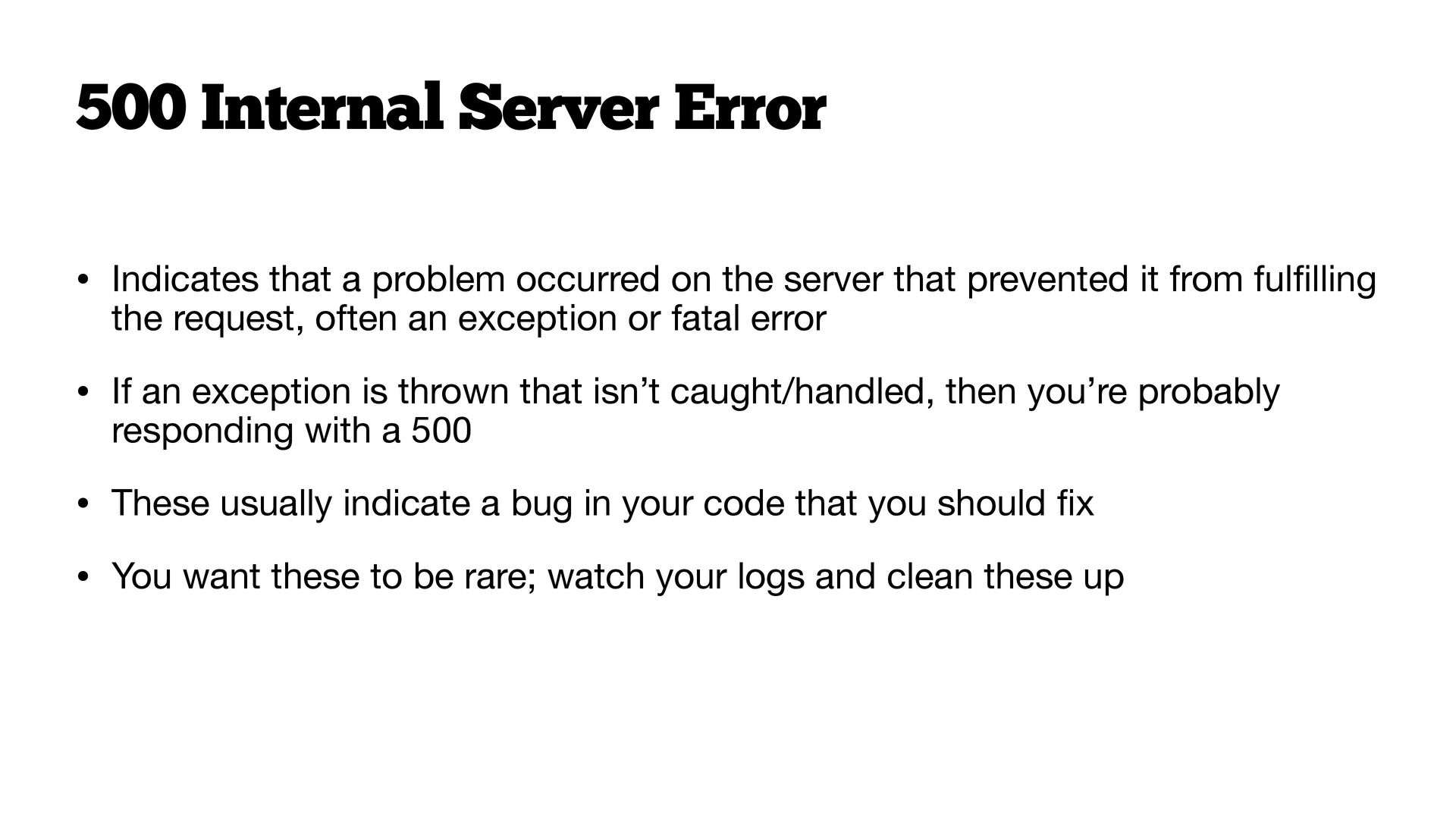
500 Internal Server Error • Indicates that a problem occurred
on the server that prevented it from ful fi lling the request, often an exception or fatal error • If an exception is thrown that isn’t caught/handled, then you’re probably responding with a 500 • These usually indicate a bug in your code that you should fi x • You want these to be rare; watch your logs and clean these up -
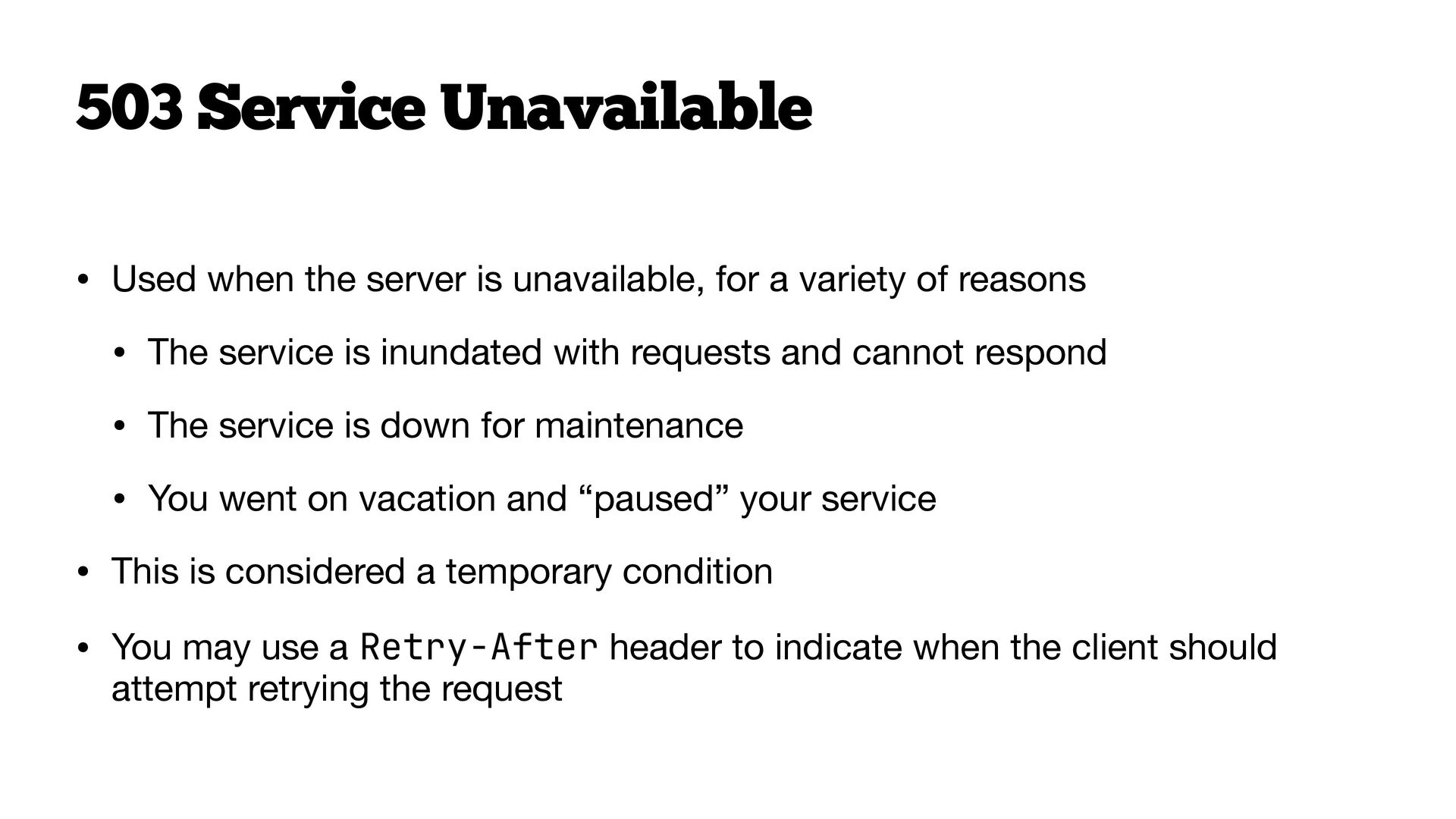
503 Service Unavailable • Used when the server is unavailable,
for a variety of reasons • The service is inundated with requests and cannot respond • The service is down for maintenance • You went on vacation and “paused” your service • This is considered a temporary condition • You may use a Retry-After header to indicate when the client should attempt retrying the request -
Advanced topics • Content negotiation • Caching • Conditional requests
• Range requests • Web linking • Server push -
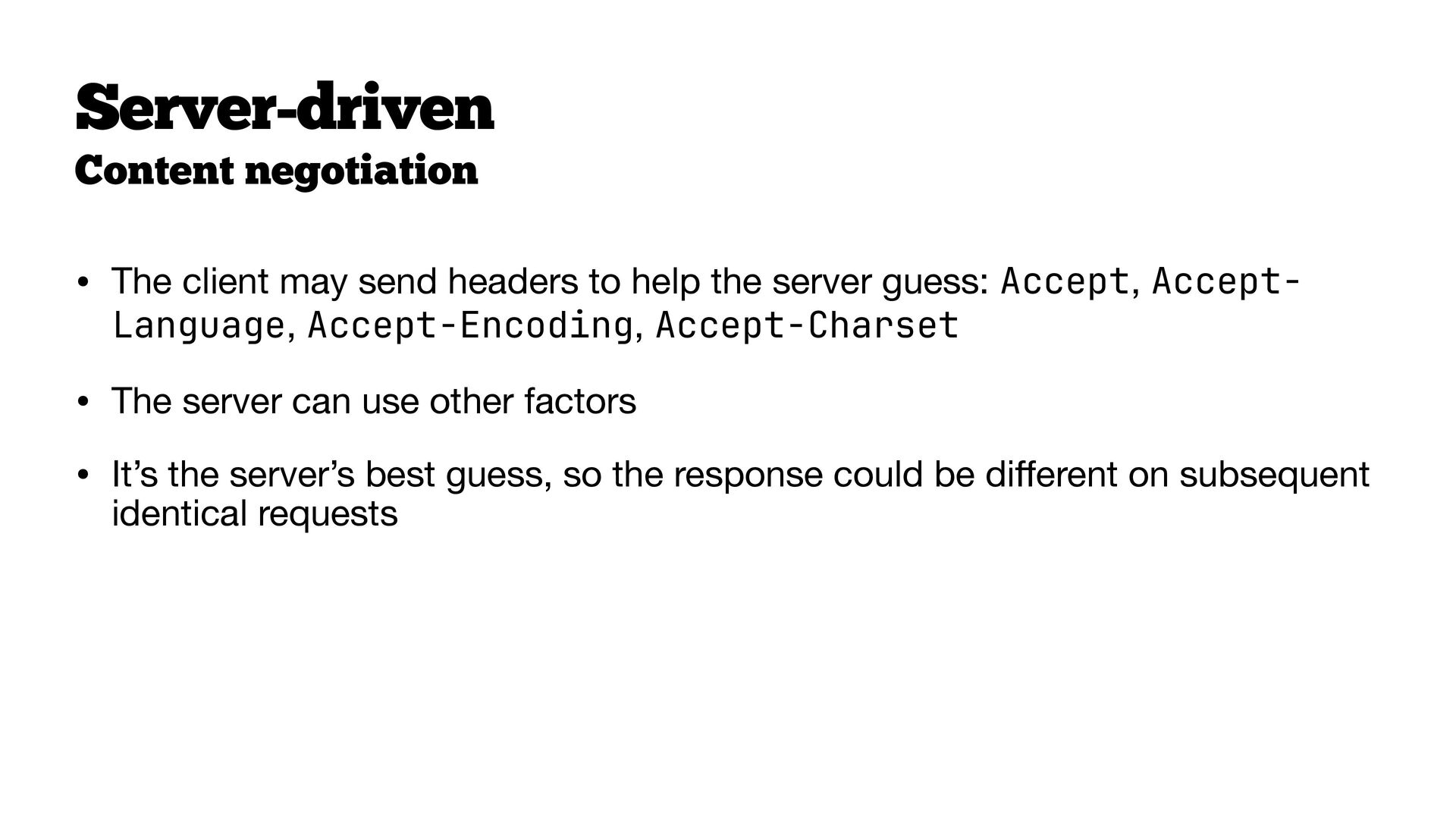
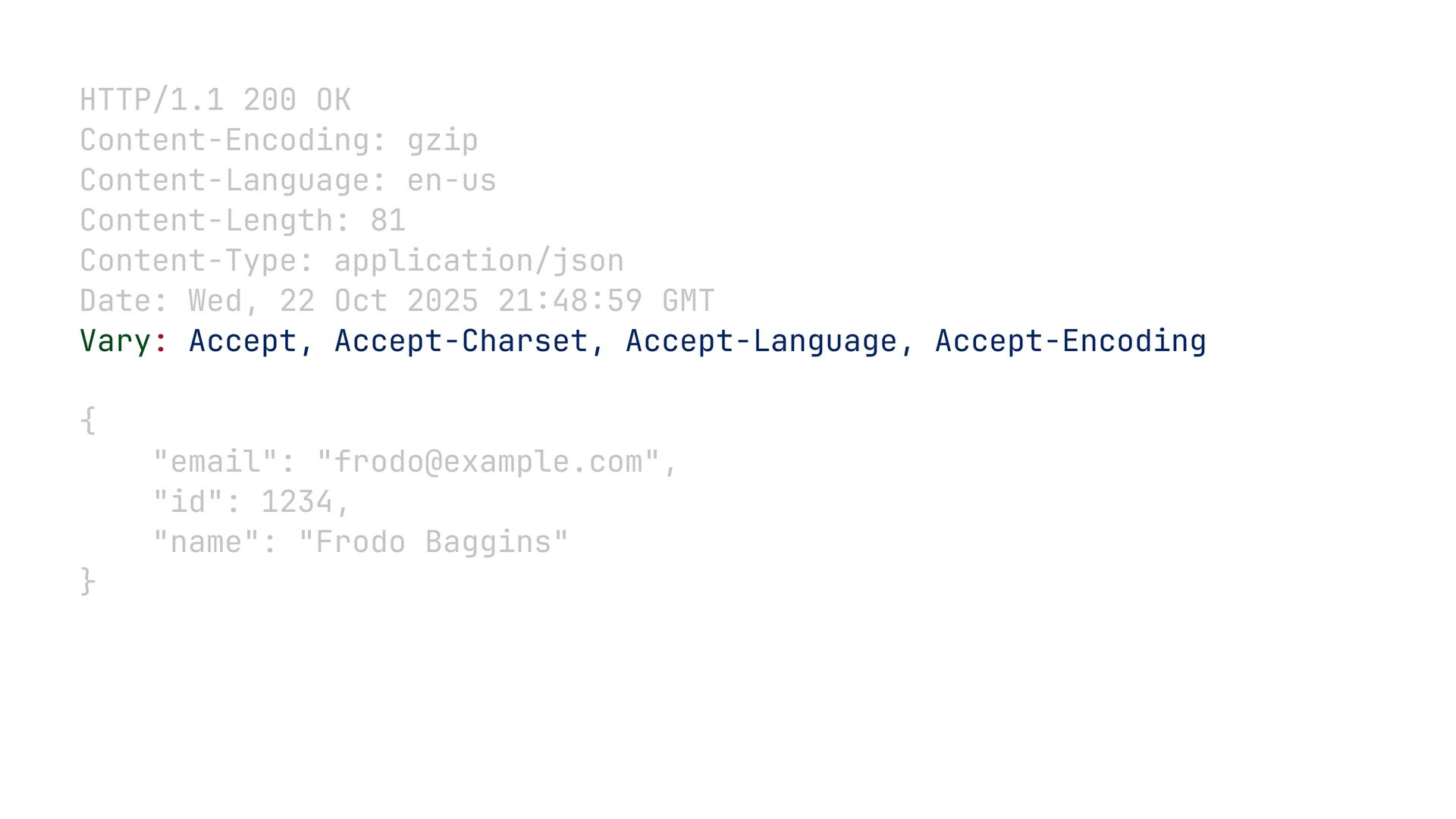
Server-driven Content negotiation • The client may send headers to
help the server guess: Accept, Accept- Language, Accept-Encoding, Accept-Charset • The server can use other factors • It’s the server’s best guess, so the response could be di ff erent on subsequent identical requests -
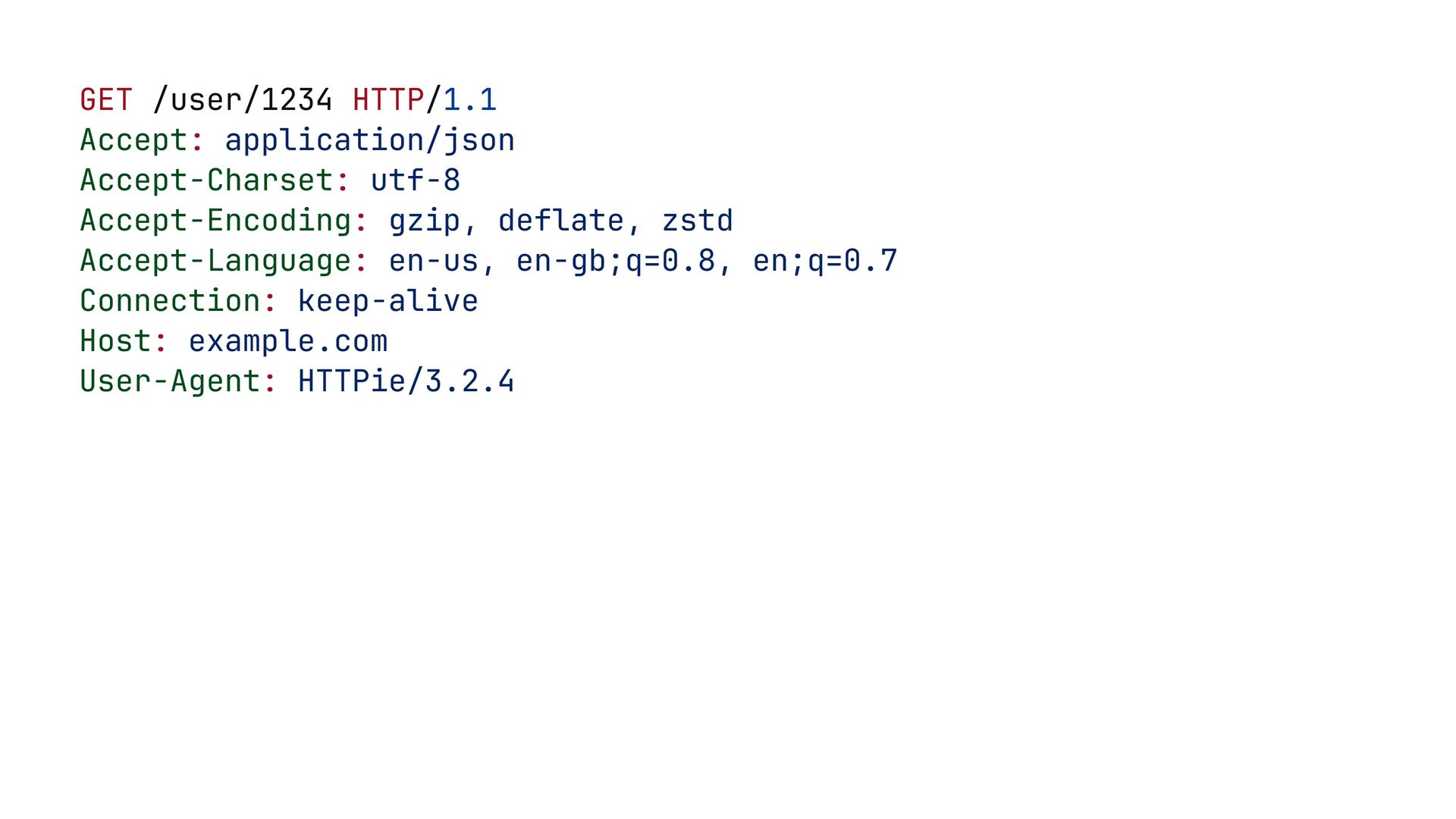
GET /user/1234 HTTP/1.1 Accept: application/json Accept-Charset: utf-8 Accept-Encoding: gzip, deflate,
zstd Accept-Language: en-us, en-gb;q=0.8, en;q=0.7 Connection: keep-alive Host: example.com User-Agent: HTTPie/3.2.4 -
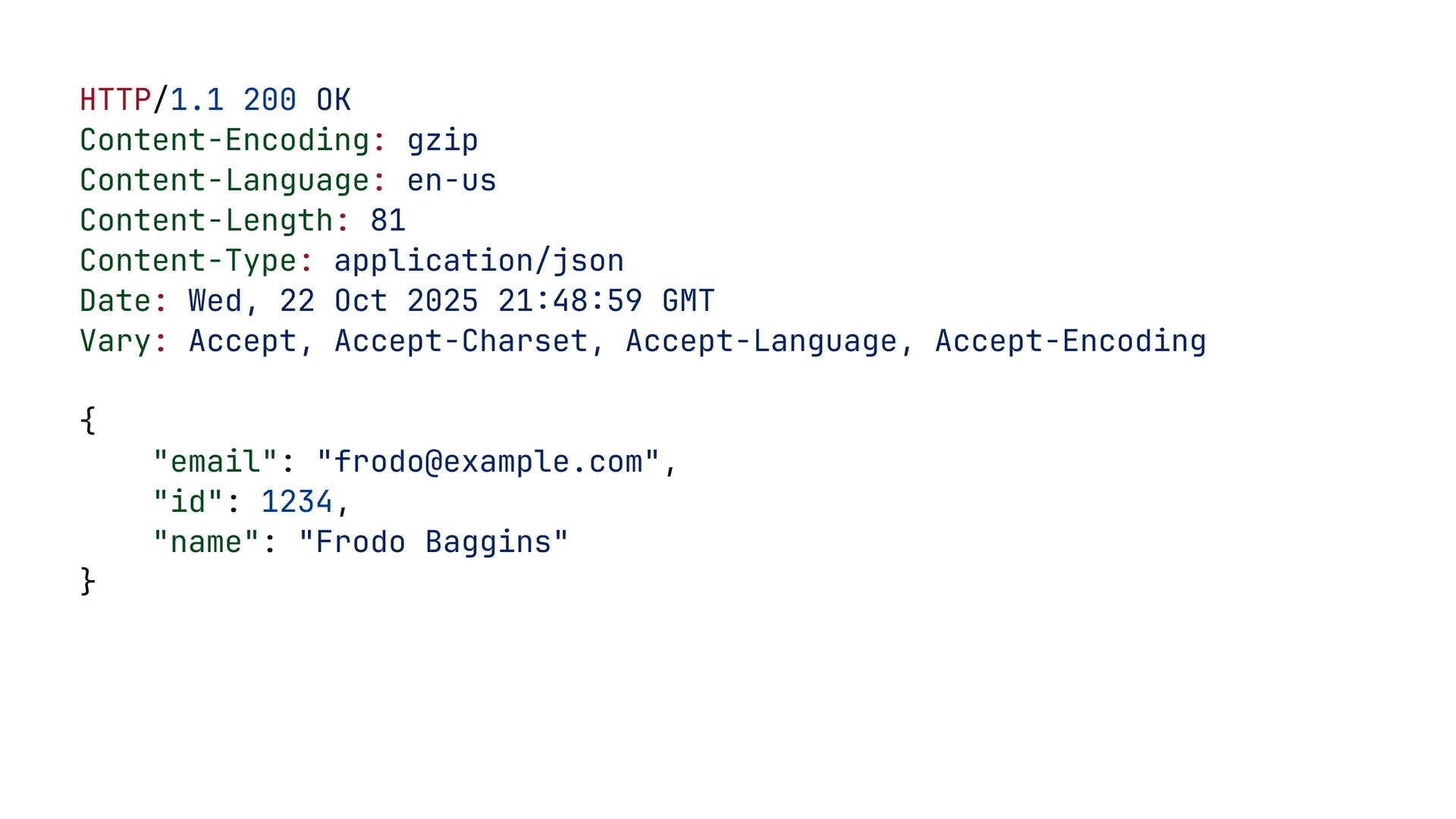
HTTP/1.1 200 OK Content-Encoding: gzip Content-Language: en-us Content-Length: 81 Content-Type:
application/json Date: Wed, 22 Oct 2025 21 : 48 : 59 GMT Vary: Accept, Accept-Charset, Accept-Language, Accept-Encoding { "email": "[email protected]", "id": 1234, "name": "Frodo Baggins" } -
HTTP/1.1 200 OK Content-Encoding: gzip Content-Language: en-us Content-Length: 81 Content-Type:
application/json Date: Wed, 22 Oct 2025 21 : 48 : 59 GMT Vary: Accept, Accept-Charset, Accept-Language, Accept-Encoding { "email": "[email protected]", "id": 1234, "name": "Frodo Baggins" } -
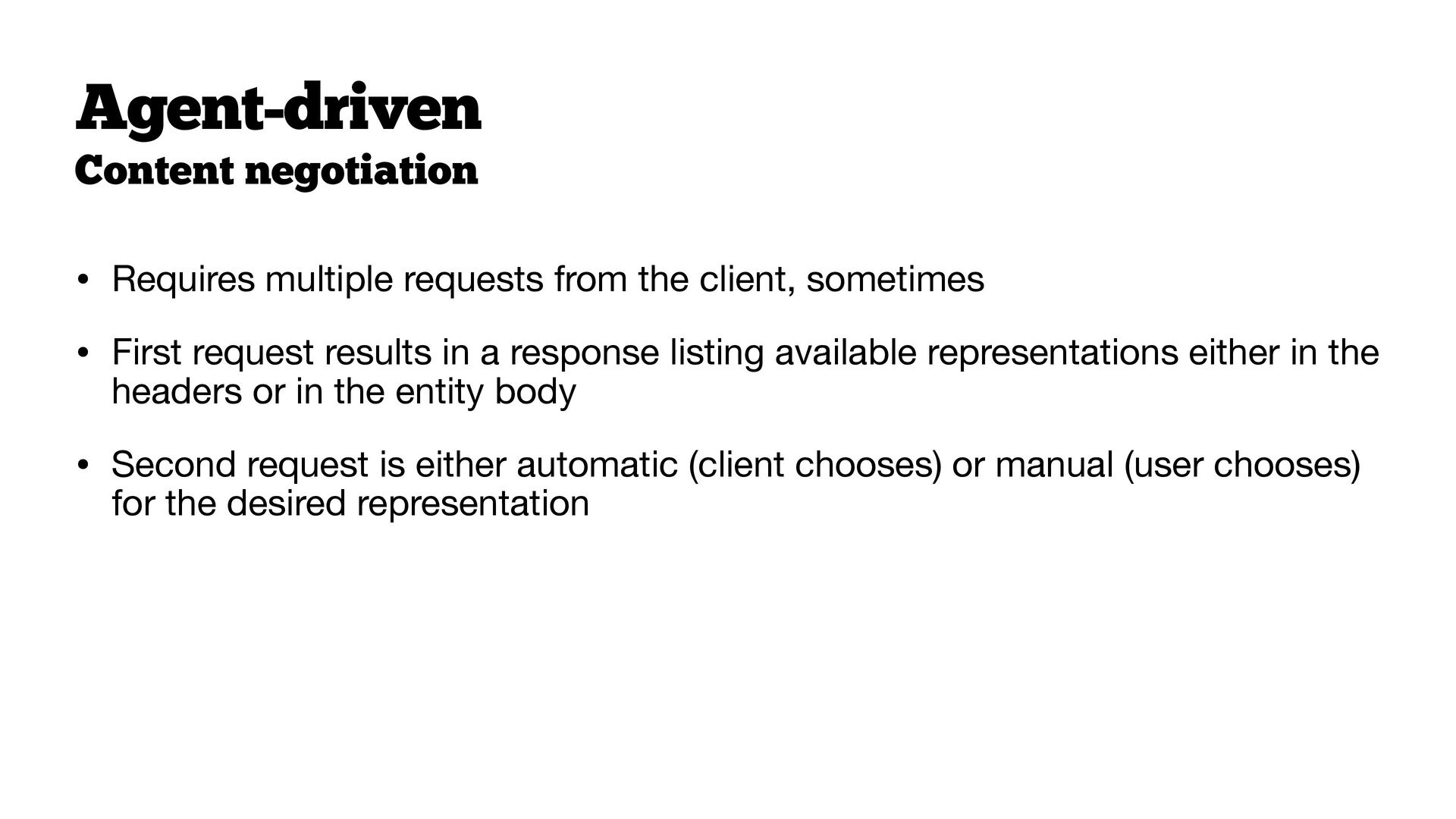
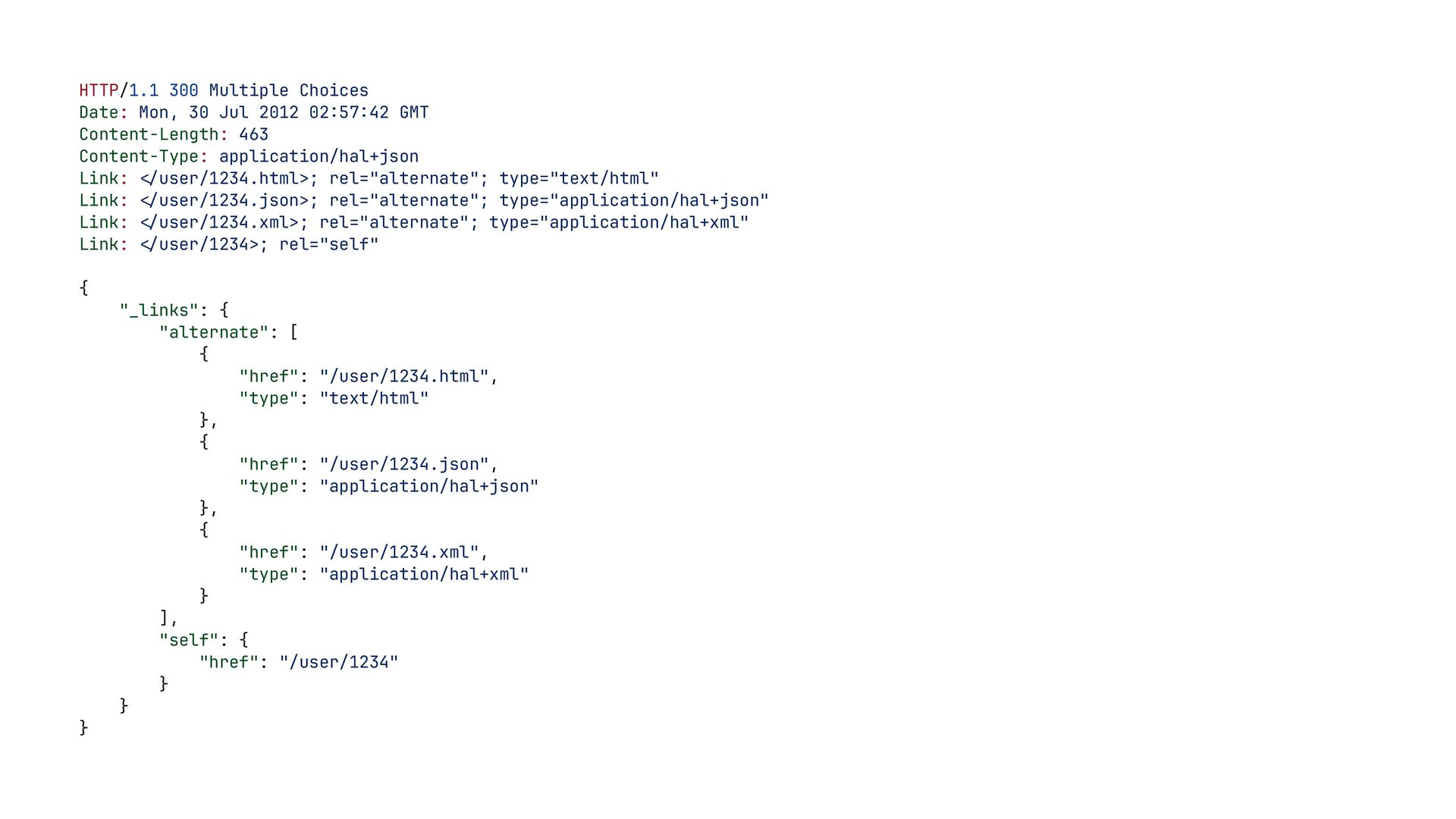
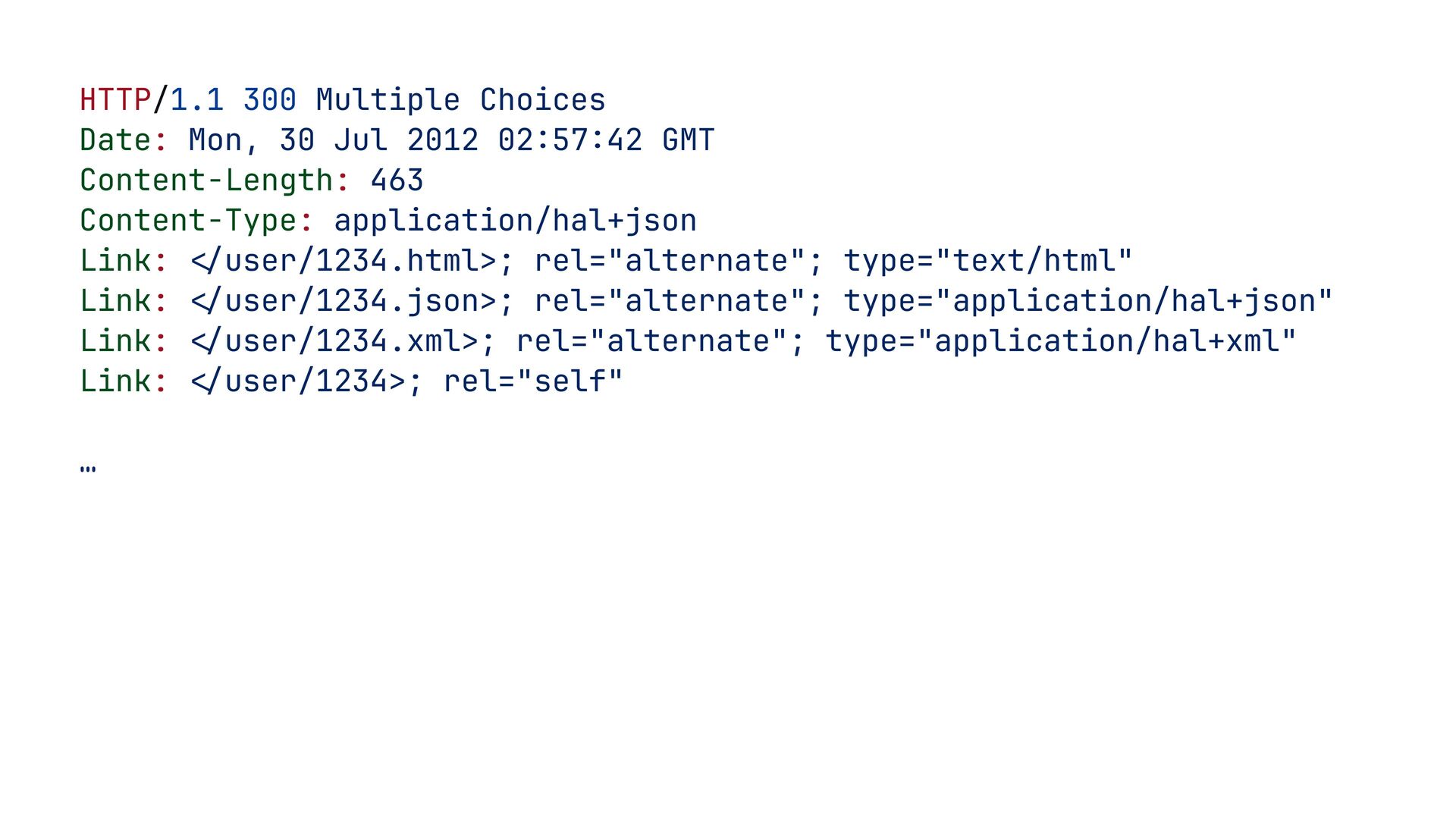
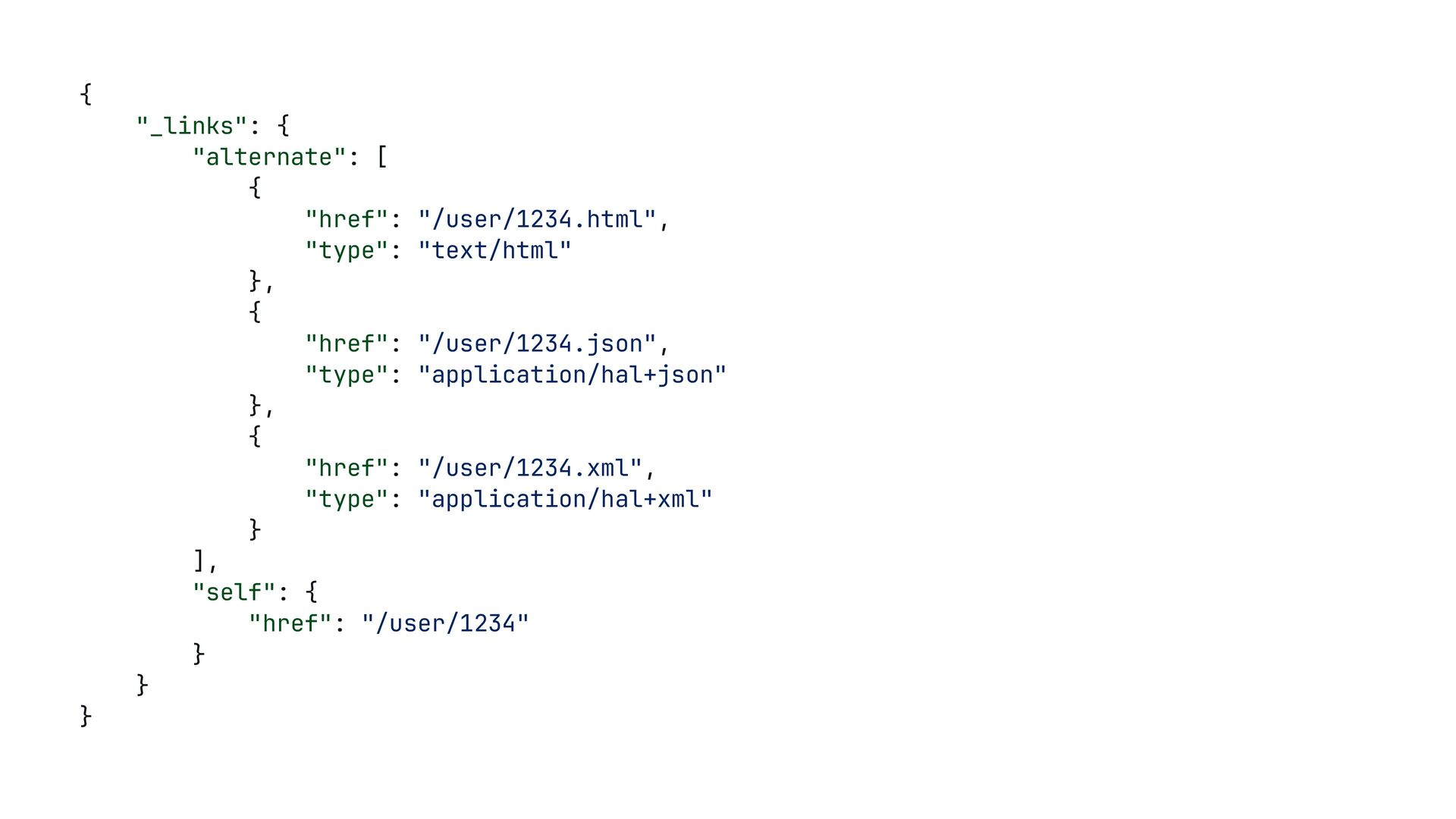
Agent-driven Content negotiation • Requires multiple requests from the client,
sometimes • First request results in a response listing available representations either in the headers or in the entity body • Second request is either automatic (client chooses) or manual (user chooses) for the desired representation -
HTTP/1.1 300 Multiple Choices Date: Mon, 30 Jul 2012 02
: 57 : 42 GMT Content-Length: 463 Content-Type: application/hal+json Link: </ user/1234.html>; rel="alternate"; type="text/html" Link: </ user/1234.json>; rel="alternate"; type="application/hal+json" Link: </ user/1234.xml>; rel="alternate"; type="application/hal+xml" Link: </ user/1234>; rel="self" { "_links": { "alternate": [ { "href": "/user/1234.html", "type": "text/html" }, { "href": "/user/1234.json", "type": "application/hal+json" }, { "href": "/user/1234.xml", "type": "application/hal+xml" } ], "self": { "href": "/user/1234" } } } -
HTTP/1.1 300 Multiple Choices Date: Mon, 30 Jul 2012 02
: 57 : 42 GMT Content-Length: 463 Content-Type: application/hal+json Link: </ user/1234.html>; rel="alternate"; type="text/html" Link: </ user/1234.json>; rel="alternate"; type="application/hal+json" Link: </ user/1234.xml>; rel="alternate"; type="application/hal+xml" Link: </ user/1234>; rel="self" … -
{ "_links": { "alternate": [ { "href": "/user/1234.html", "type": "text/html"
}, { "href": "/user/1234.json", "type": "application/hal+json" }, { "href": "/user/1234.xml", "type": "application/hal+xml" } ], "self": { "href": "/user/1234" } } } -
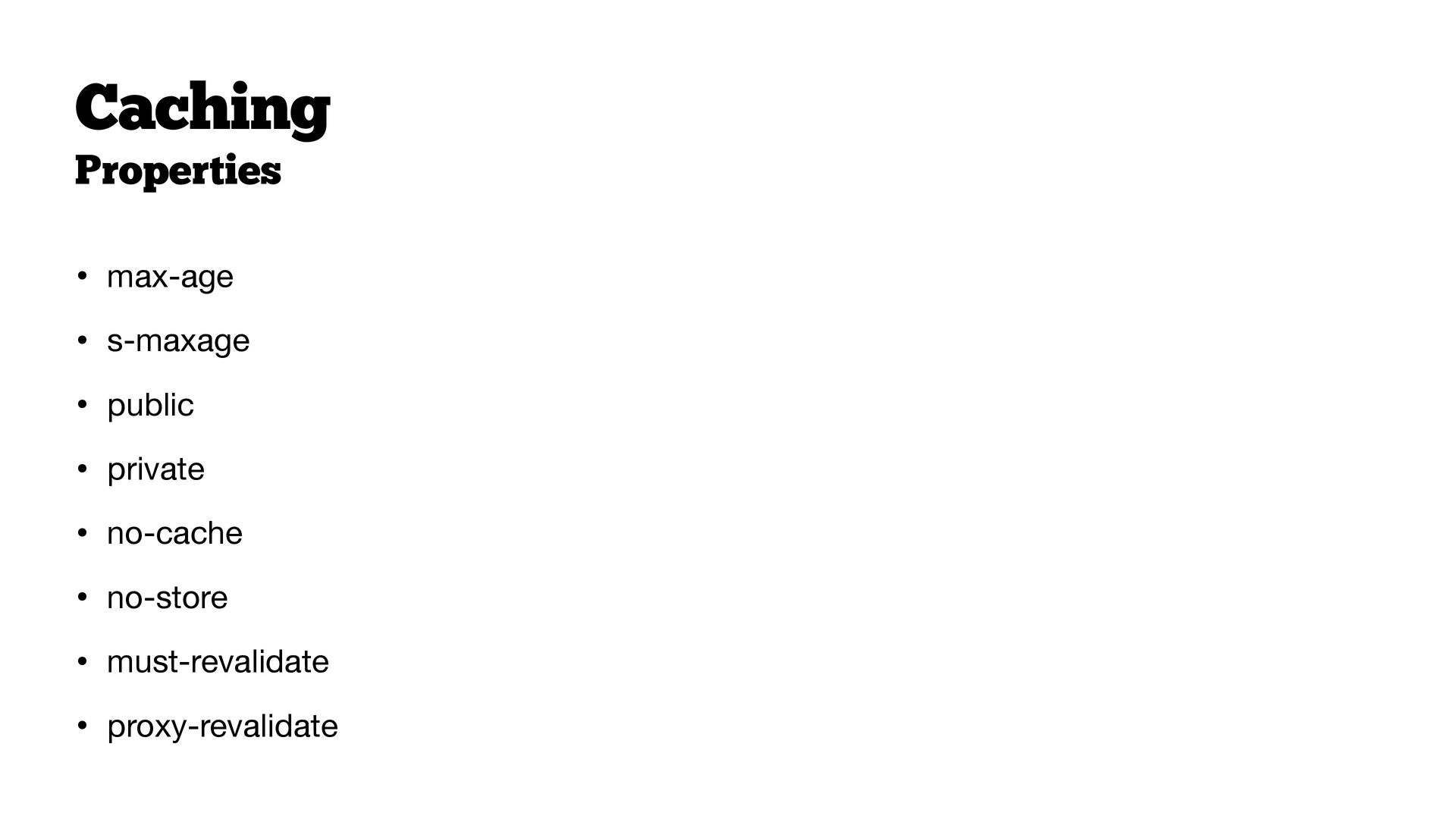
Caching Properties • max-age • s-maxage • public • private
• no-cache • no-store • must-revalidate • proxy-revalidate -
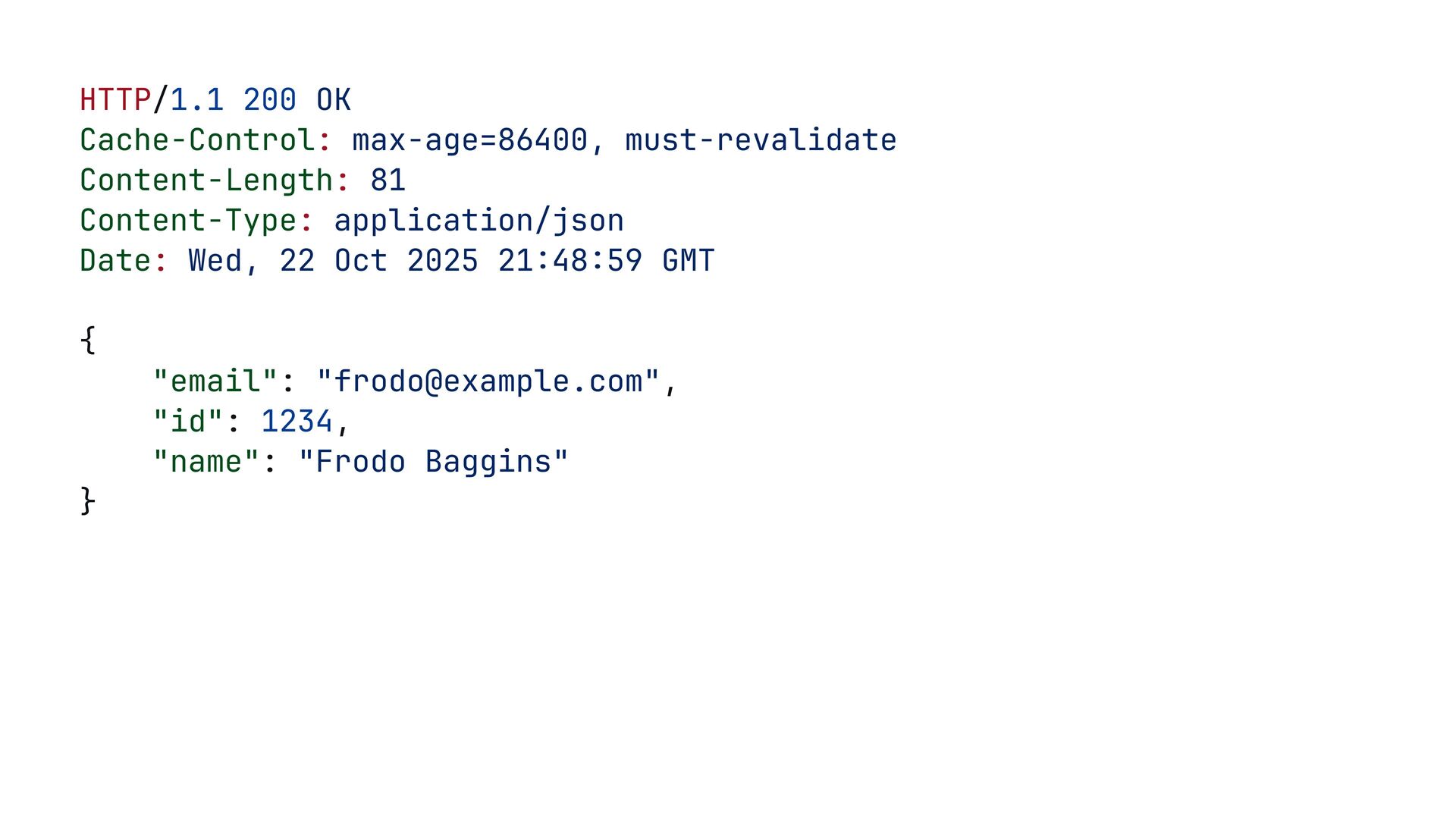
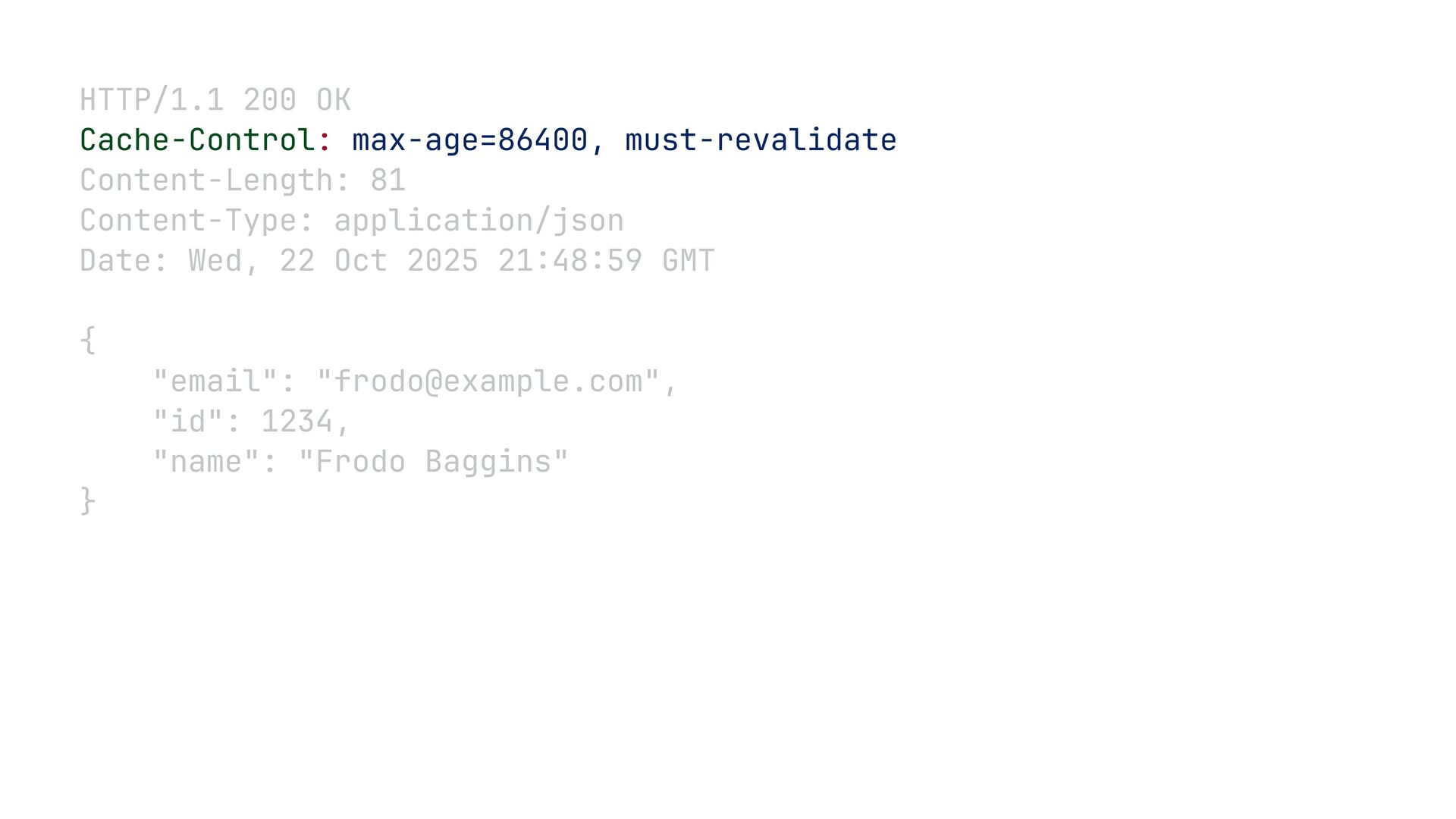
HTTP/1.1 200 OK Cache-Control: max-age=86400, must-revalidate Content-Length: 81 Content-Type: application/json
Date: Wed, 22 Oct 2025 21 : 48 : 59 GMT { "email": "[email protected]", "id": 1234, "name": "Frodo Baggins" } -
HTTP/1.1 200 OK Cache-Control: max-age=86400, must-revalidate Content-Length: 81 Content-Type: application/json
Date: Wed, 22 Oct 2025 21 : 48 : 59 GMT { "email": "[email protected]", "id": 1234, "name": "Frodo Baggins" } -
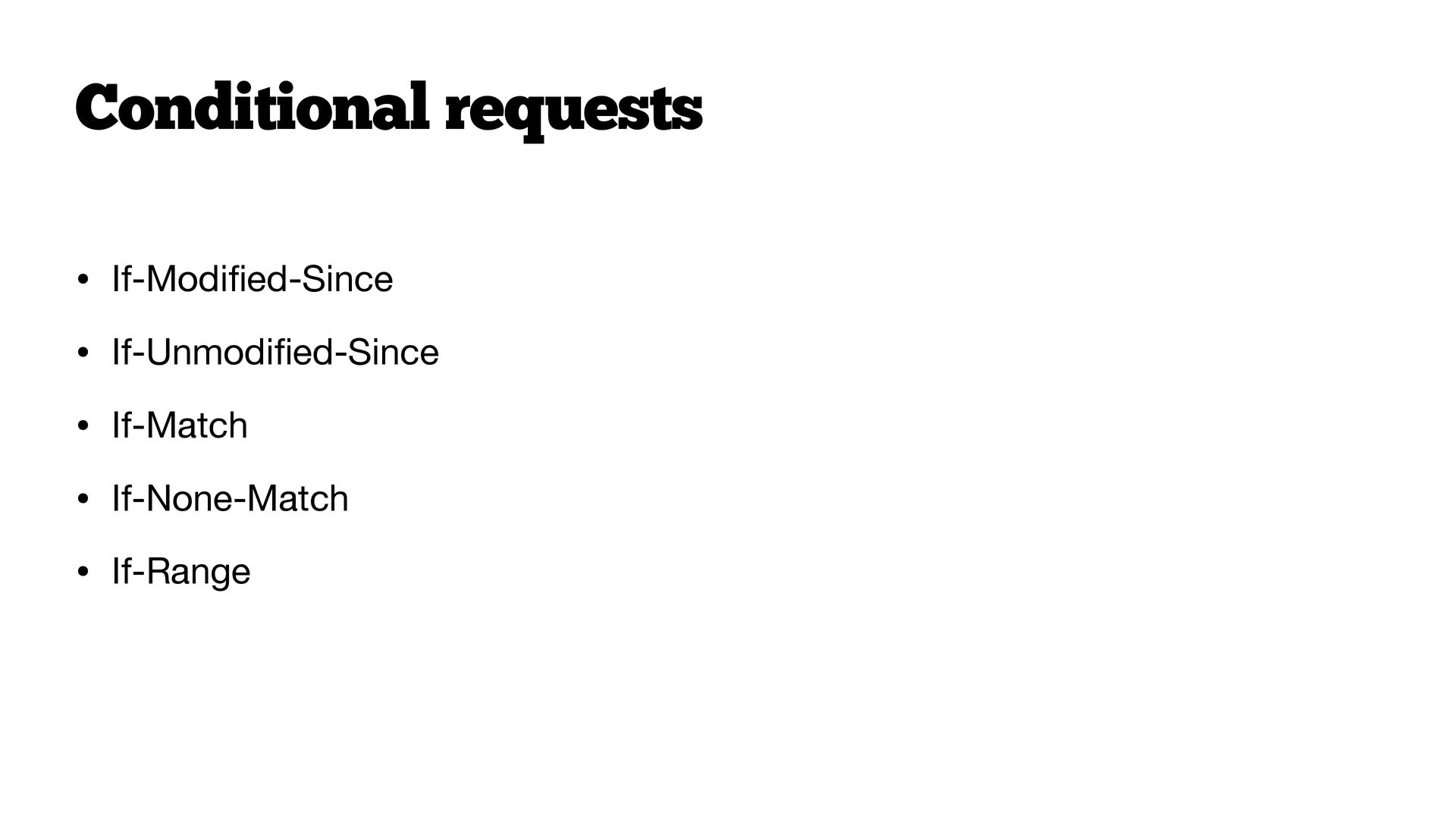
Conditional requests • If-Modi fi ed-Since • If-Unmodi fi ed-Since
• If-Match • If-None-Match • If-Range -
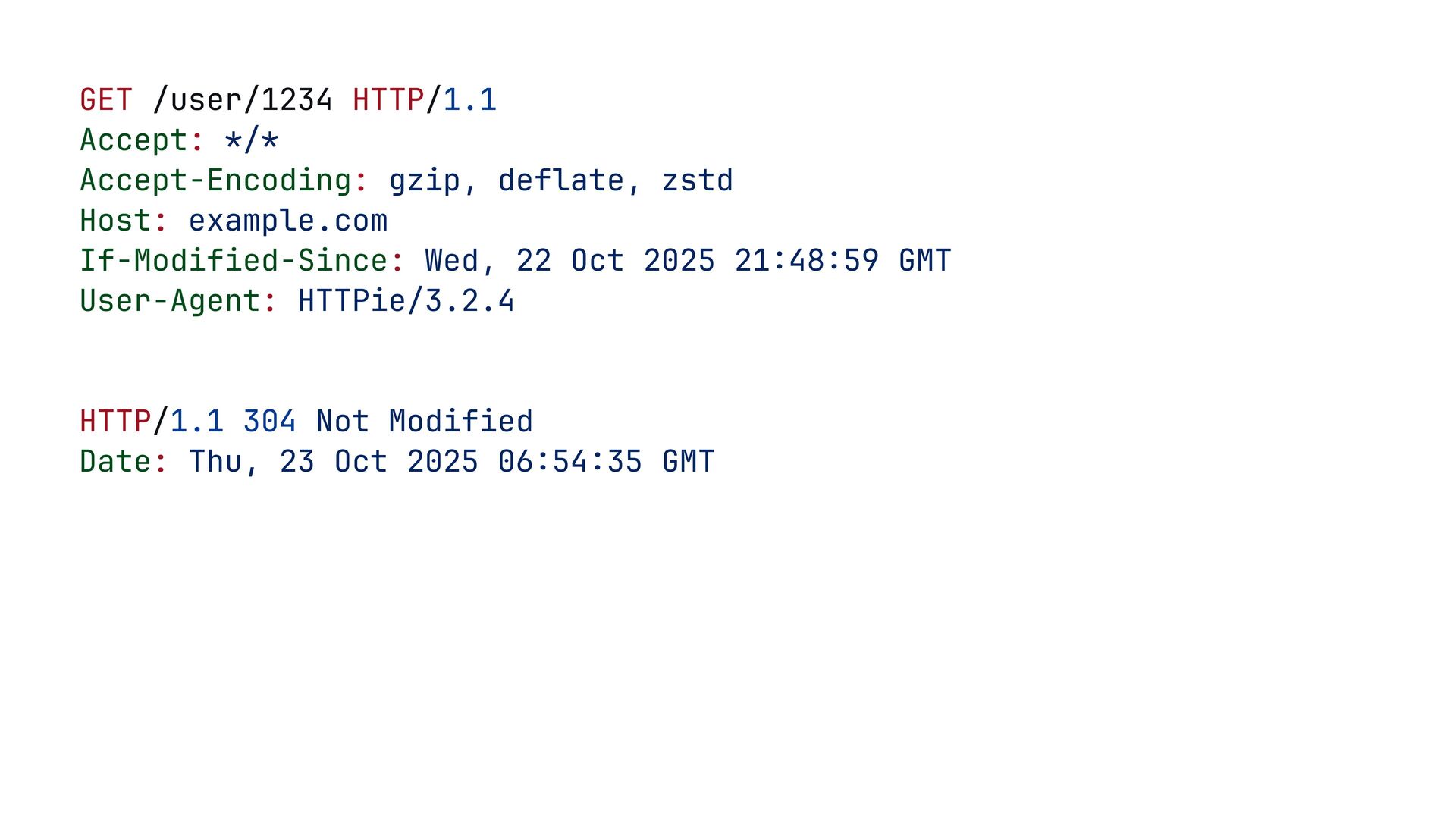
GET /user/1234 HTTP/1.1 Accept: */* Accept-Encoding: gzip, deflate, zstd Host:
example.com If-Modified-Since: Wed, 22 Oct 2025 21 : 48 : 59 GMT User-Agent: HTTPie/3.2.4 HTTP/1.1 304 Not Modified Date: Thu, 23 Oct 2025 06 : 54 : 35 GMT -
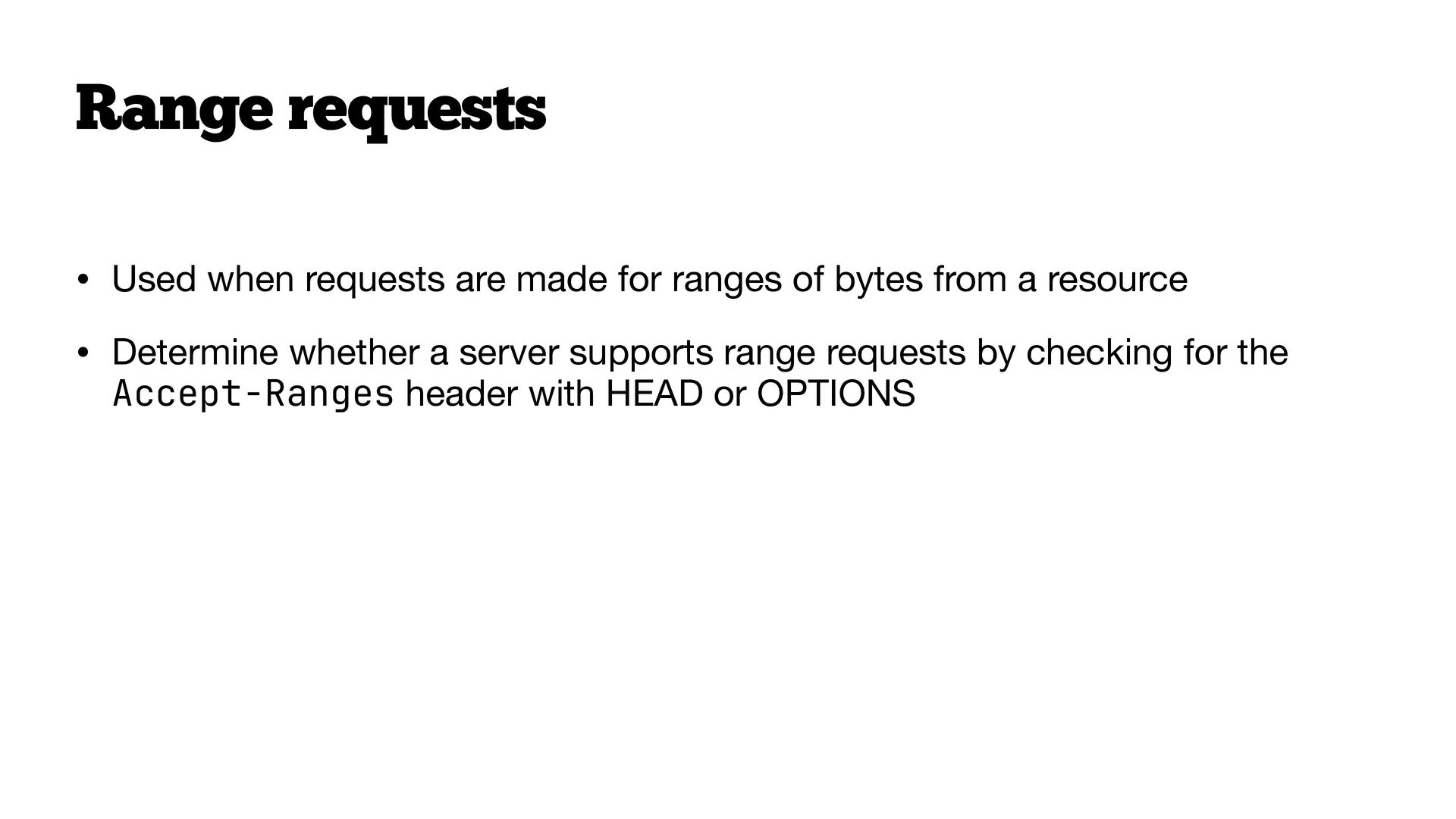
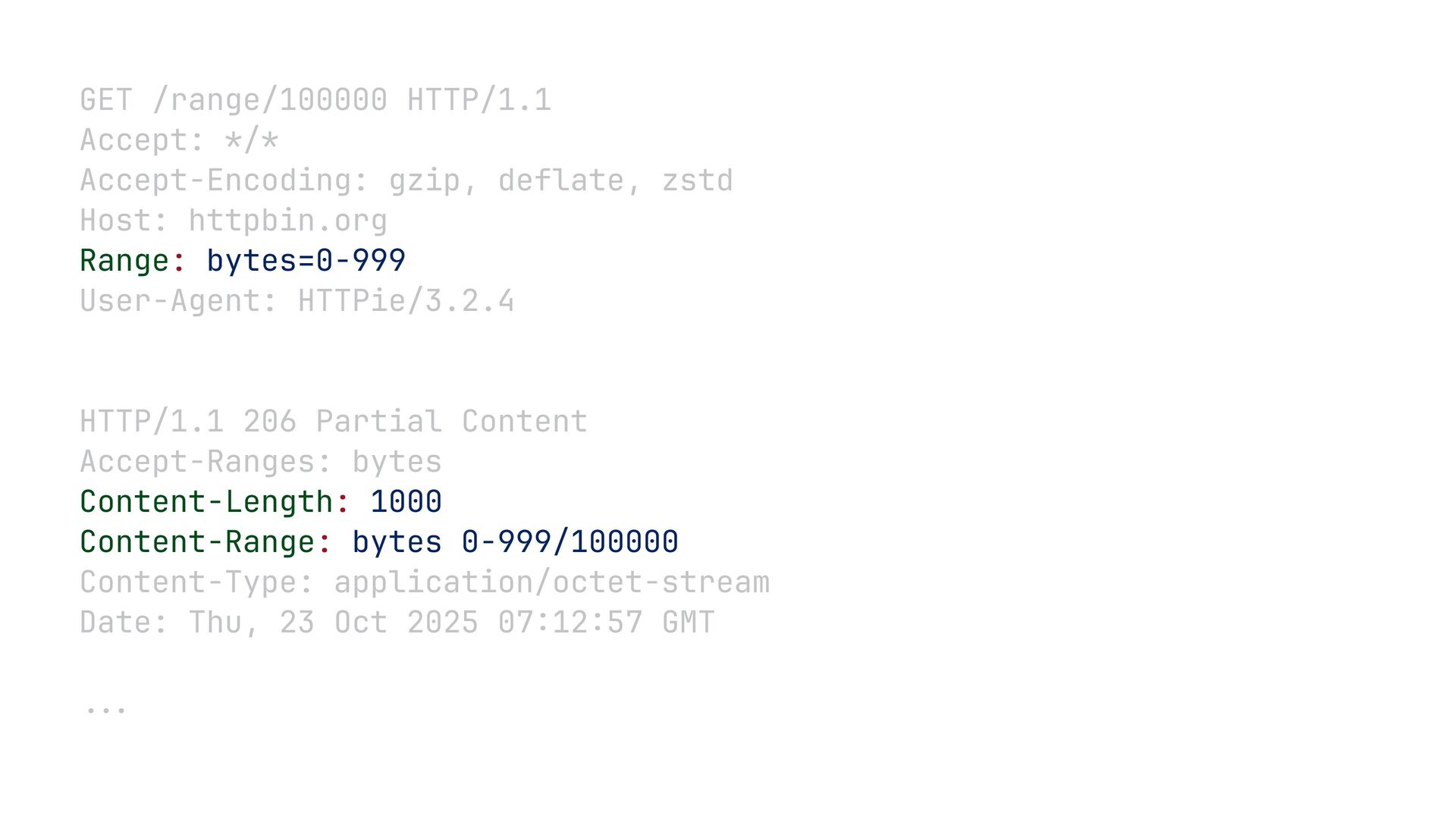
Range requests • Used when requests are made for ranges
of bytes from a resource • Determine whether a server supports range requests by checking for the Accept-Ranges header with HEAD or OPTIONS -
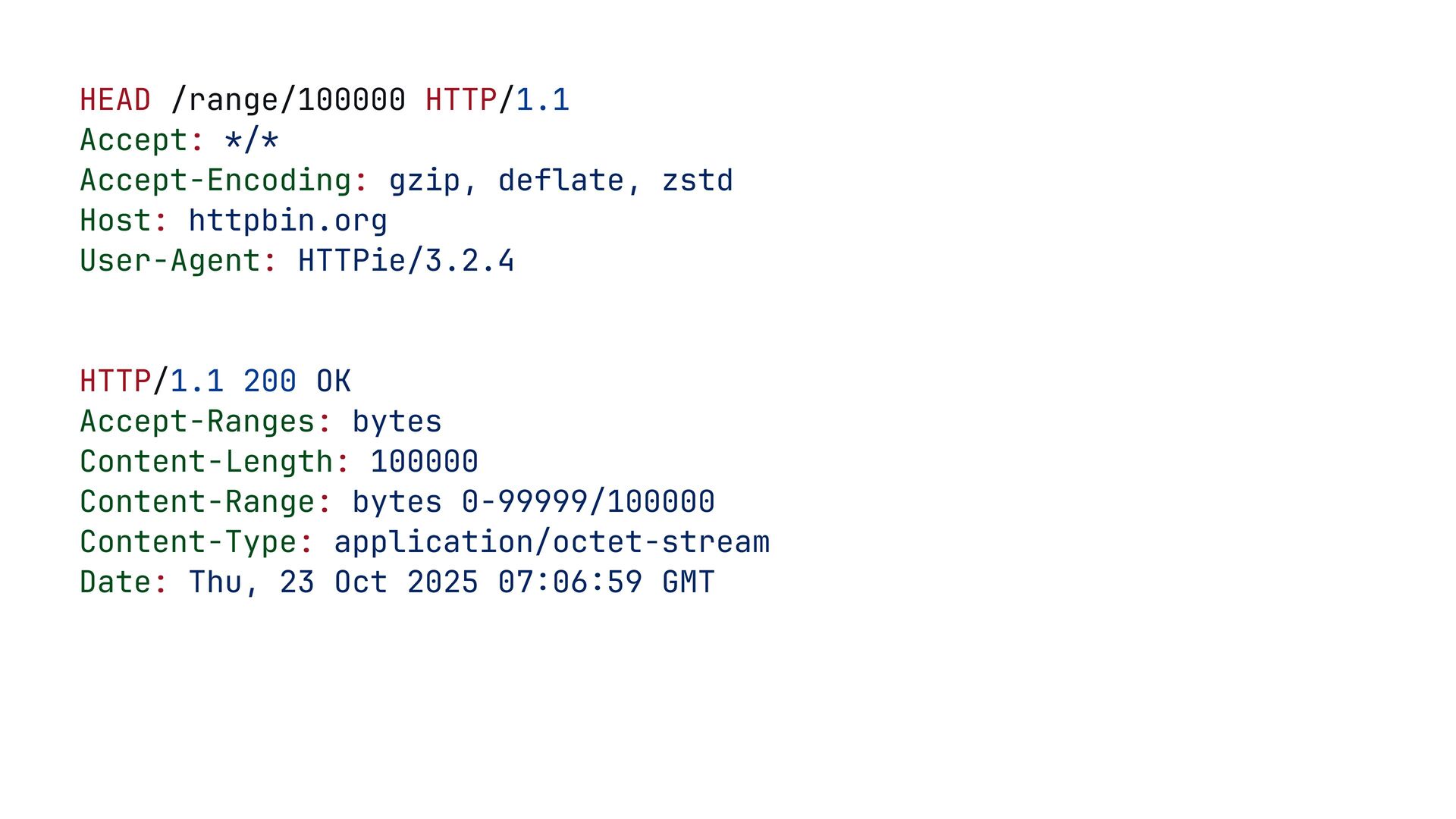
HEAD /range/100000 HTTP/1.1 Accept: */* Accept-Encoding: gzip, deflate, zstd Host:
httpbin.org User-Agent: HTTPie/3.2.4 HTTP/1.1 200 OK Accept-Ranges: bytes Content-Length: 100000 Content-Range: bytes 0-99999/100000 Content-Type: application/octet-stream Date: Thu, 23 Oct 2025 07 : 06 : 59 GMT -
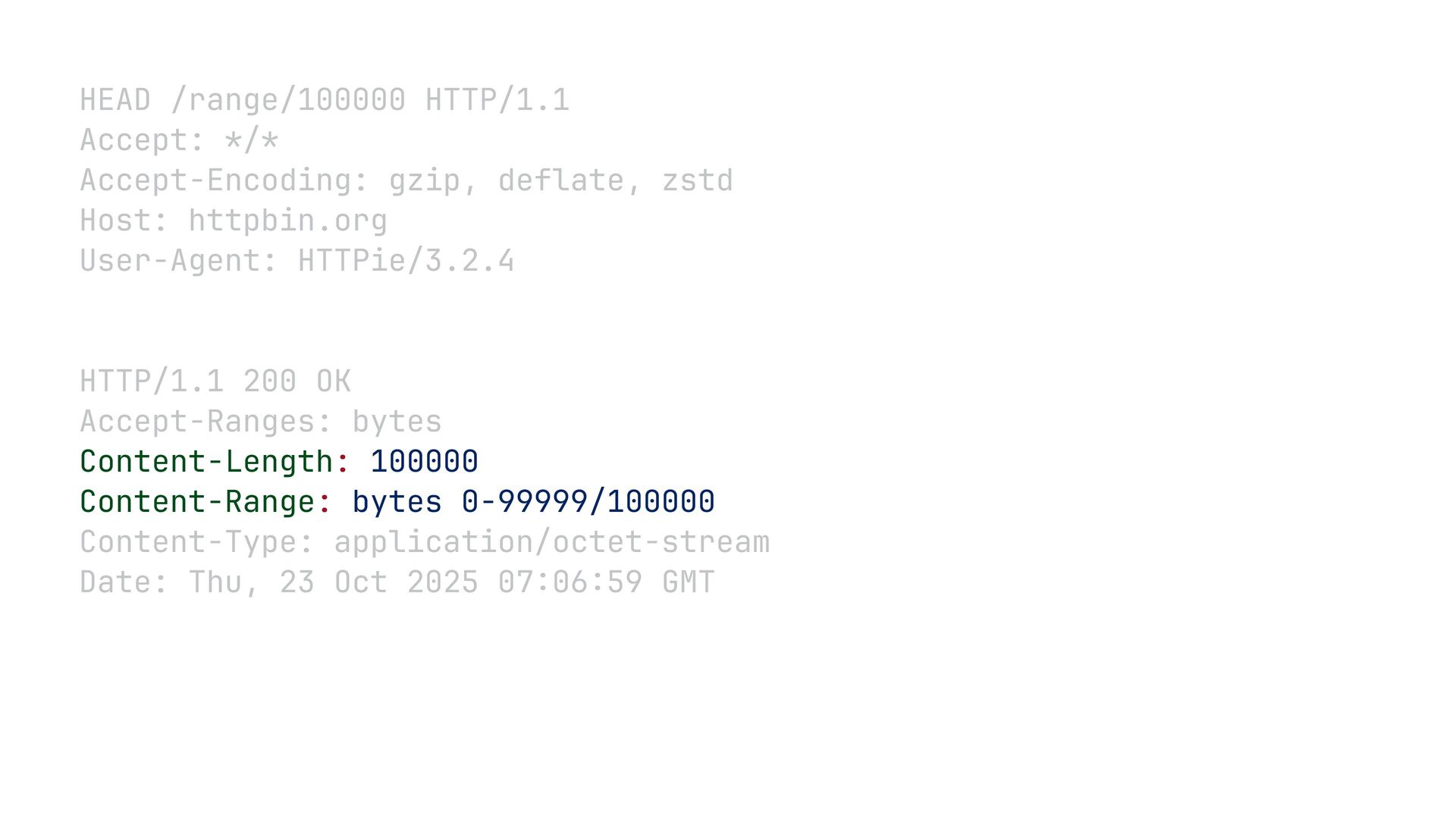
HEAD /range/100000 HTTP/1.1 Accept: */* Accept-Encoding: gzip, deflate, zstd Host:
httpbin.org User-Agent: HTTPie/3.2.4 HTTP/1.1 200 OK Accept-Ranges: bytes Content-Length: 100000 Content-Range: bytes 0-99999/100000 Content-Type: application/octet-stream Date: Thu, 23 Oct 2025 07 : 06 : 59 GMT -
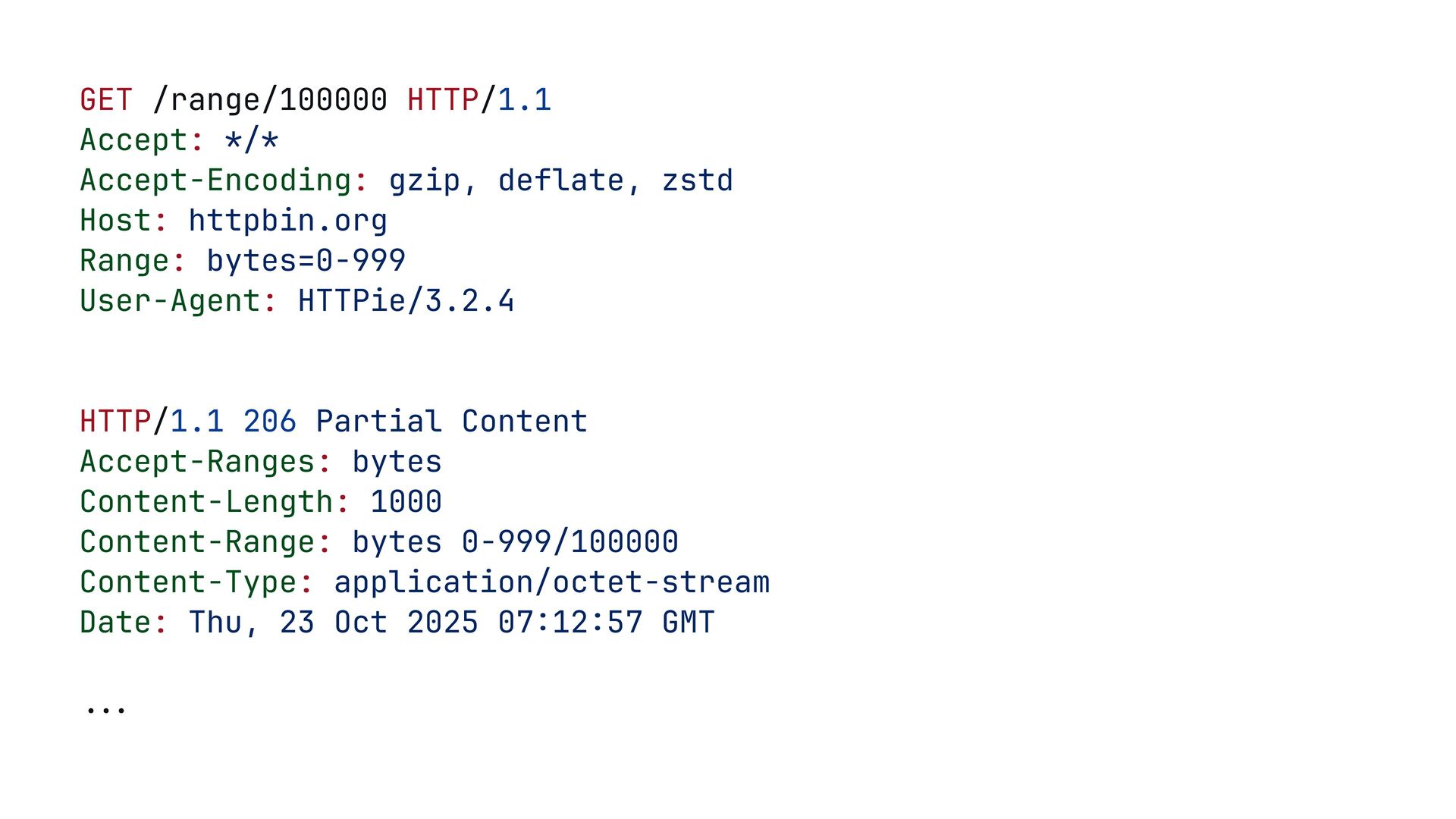
GET /range/100000 HTTP/1.1 Accept: */* Accept-Encoding: gzip, deflate, zstd Host:
httpbin.org Range: bytes=0-999 User-Agent: HTTPie/3.2.4 HTTP/1.1 206 Partial Content Accept-Ranges: bytes Content-Length: 1000 Content-Range: bytes 0-999/100000 Content-Type: application/octet-stream Date: Thu, 23 Oct 2025 07 : 12 : 57 GMT ... -
GET /range/100000 HTTP/1.1 Accept: */* Accept-Encoding: gzip, deflate, zstd Host:
httpbin.org Range: bytes=0-999 User-Agent: HTTPie/3.2.4 HTTP/1.1 206 Partial Content Accept-Ranges: bytes Content-Length: 1000 Content-Range: bytes 0-999/100000 Content-Type: application/octet-stream Date: Thu, 23 Oct 2025 07 : 12 : 57 GMT ... -
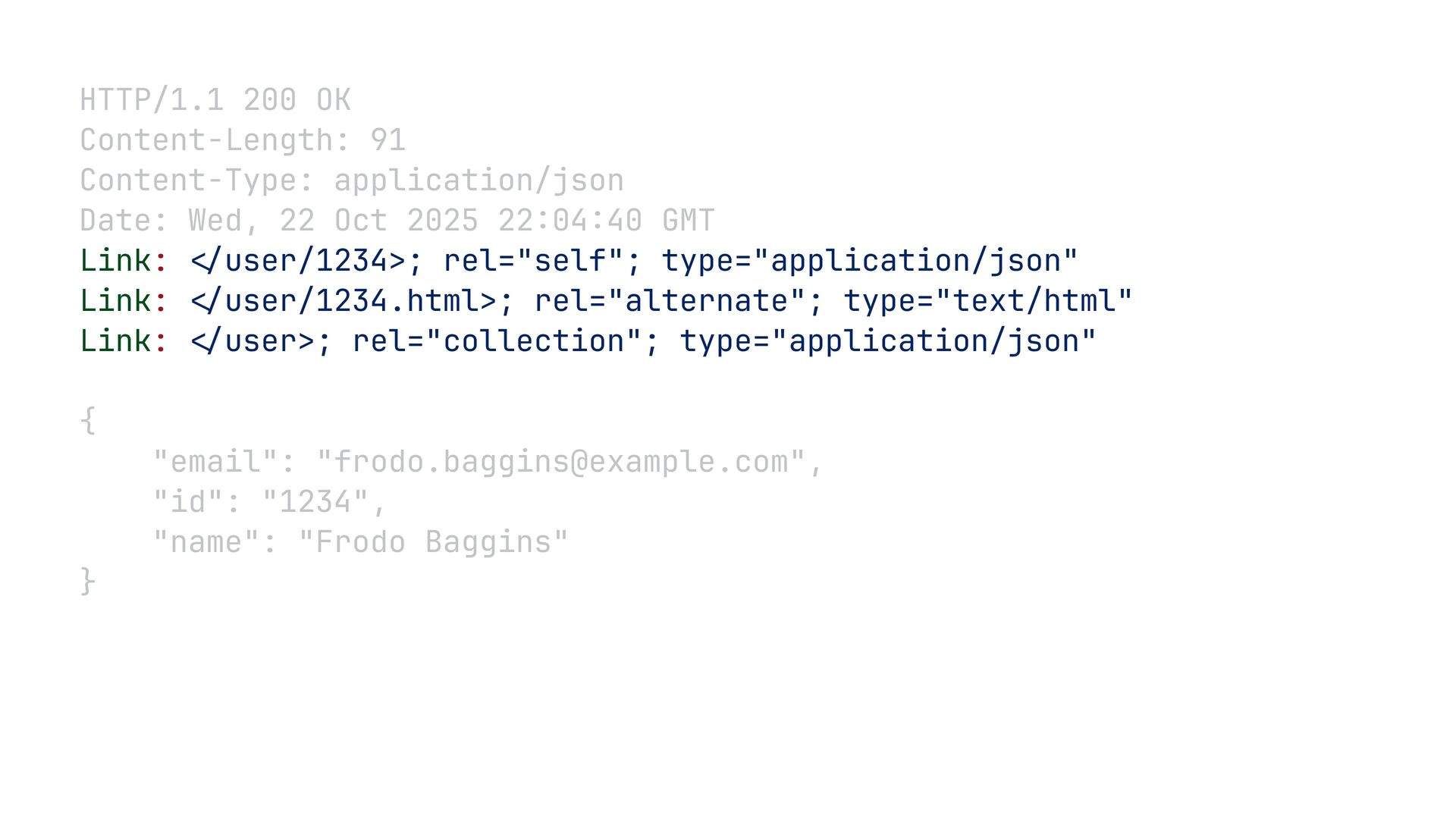
Web linking • De fi ned a framework for typed
links not speci fi c to an application, and introduced the Link header • We’ve already seen many examples • You should use this! • RFC 8288: Web Linking • Link Relations registry -
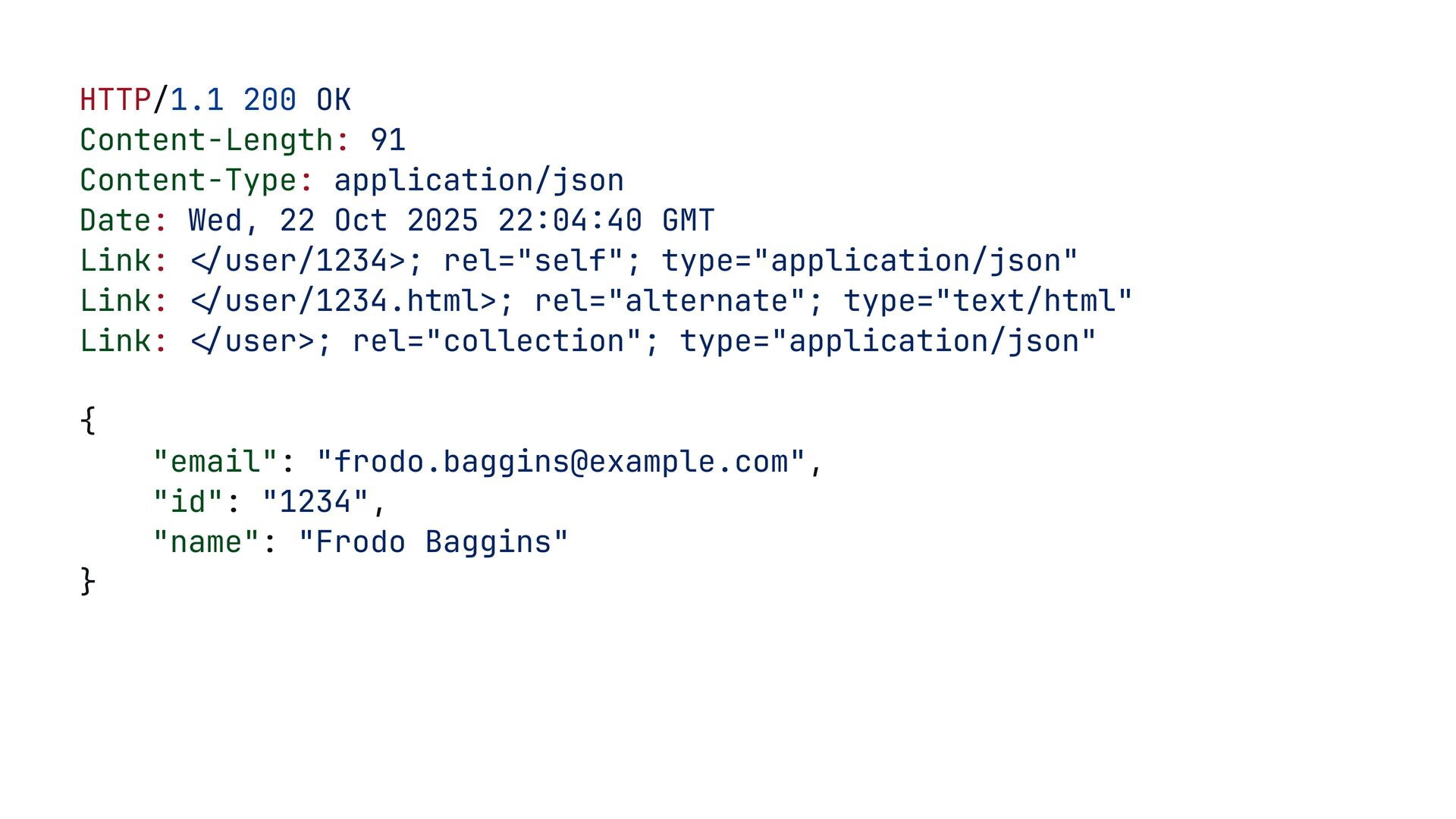
HTTP/1.1 200 OK Content-Length: 91 Content-Type: application/json Date: Wed, 22
Oct 2025 22 : 04 : 40 GMT Link: </ user/1234>; rel="self"; type="application/json" Link: </ user/1234.html>; rel="alternate"; type="text/html" Link: </ user>; rel="collection"; type="application/json" { "email": "[email protected]", "id": "1234", "name": "Frodo Baggins" } -
HTTP/1.1 200 OK Content-Length: 91 Content-Type: application/json Date: Wed, 22
Oct 2025 22 : 04 : 40 GMT Link: </ user/1234>; rel="self"; type="application/json" Link: </ user/1234.html>; rel="alternate"; type="text/html" Link: </ user>; rel="collection"; type="application/json" { "email": "[email protected]", "id": "1234", "name": "Frodo Baggins" } -
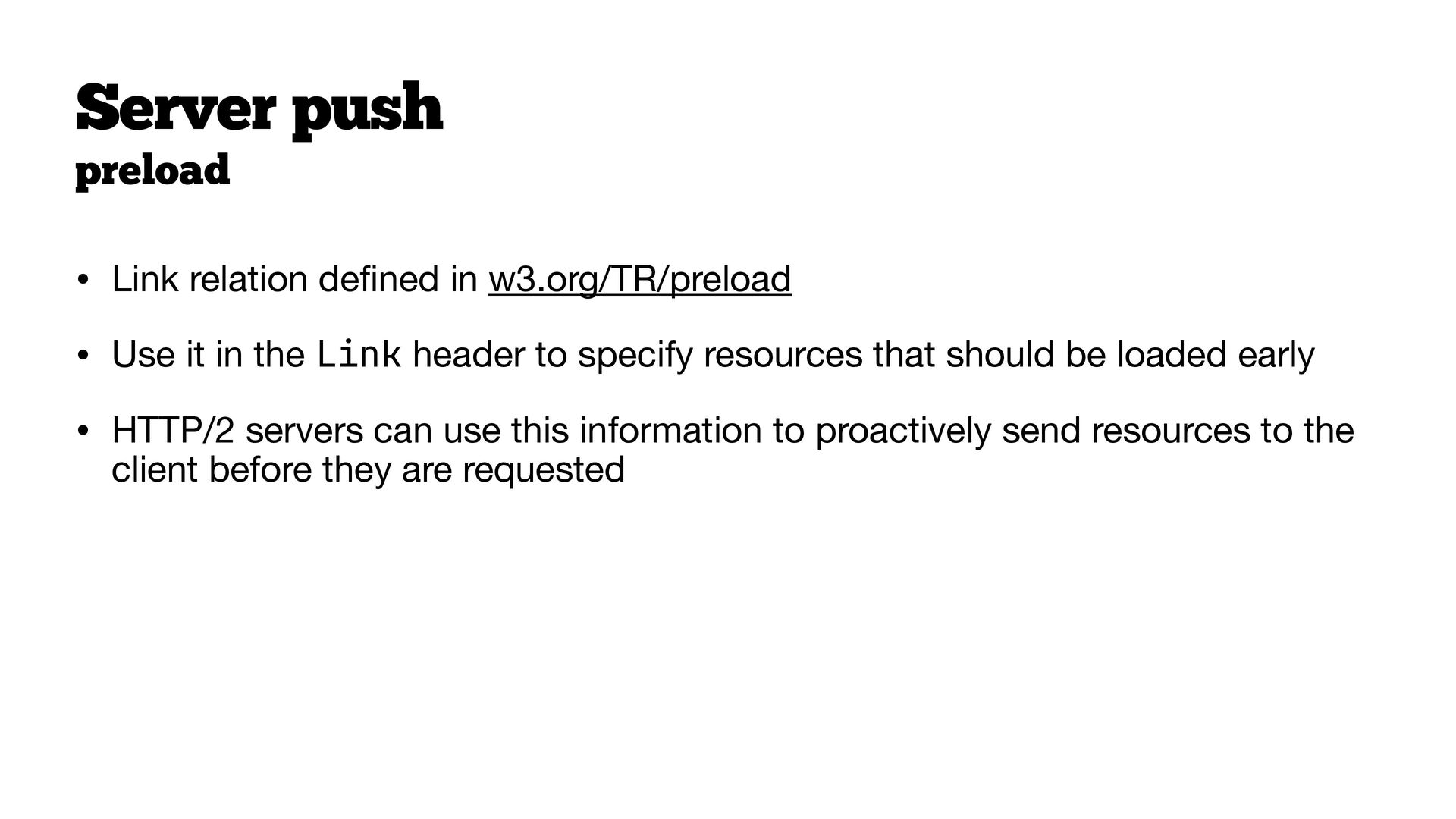
Server push preload • Link relation de fi ned in
w3.org/TR/preload • Use it in the Link header to specify resources that should be loaded early • HTTP/2 servers can use this information to proactively send resources to the client before they are requested -
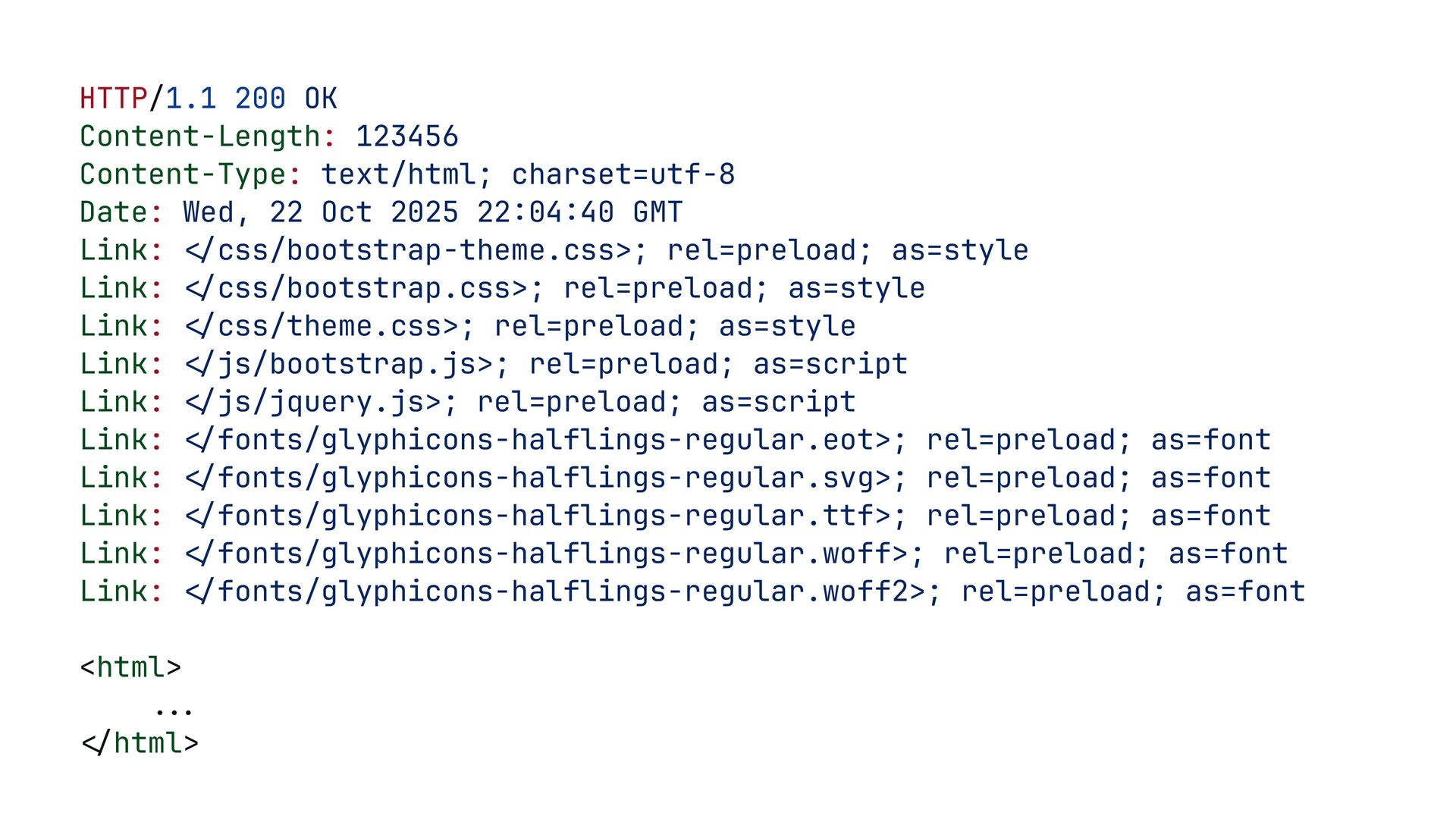
HTTP/1.1 200 OK Content-Length: 123456 Content-Type: text/html; charset=utf-8 Date: Wed,
22 Oct 2025 22 : 04 : 40 GMT Link: < / css/bootstrap-theme.css>; rel=preload; as=style Link: < / css/bootstrap.css>; rel=preload; as=style Link: < / css/theme.css>; rel=preload; as=style Link: < / js/bootstrap.js>; rel=preload; as=script Link: < / js/jquery.js>; rel=preload; as=script Link: < / fonts/glyphicons-halflings-regular.eot>; rel=preload; as=font Link: < / fonts/glyphicons-halflings-regular.svg>; rel=preload; as=font Link: < / fonts/glyphicons-halflings-regular.ttf>; rel=preload; as=font Link: < / fonts/glyphicons-halflings-regular.woff>; rel=preload; as=font Link: < / fonts/glyphicons-halflings-regular.woff2>; rel=preload; as=font <html> ... </ html> -
Thank you! Keep in touch
ben.ramsey.dev phpc.social/@ramsey github.com/ramsey speakerdeck.com/ramsey www.linkedin.com/in/benramsey [email protected]
 ramsey
 l2hyunwoo
 3saito
 mitohato14
 dalinaum
 akihisaikeda
 raeminkang
 nakamizu
 hasutosasaki
 meihei3
 aoshi
 takahirosunaga
 axbom
 pwiseman
 twada
 tmiket
 coloredviolet
 badams
 tammielis
 baasie
 rkendrick25
 sabderemane
 colly
 uxyall