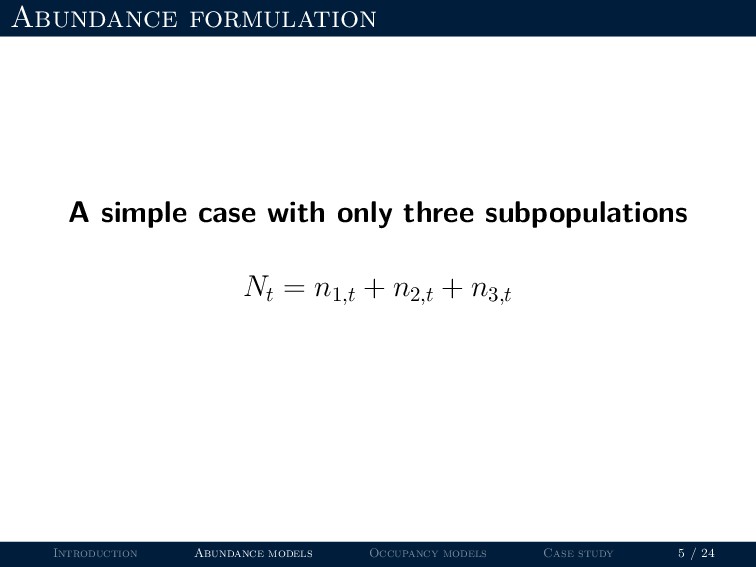
dispersal Properties • Subpopulations occur in discrete habitat patches • The landscape “matrix” is not suitable for reproduction Introduction Abundance models Occupancy models Case study 2 / 24
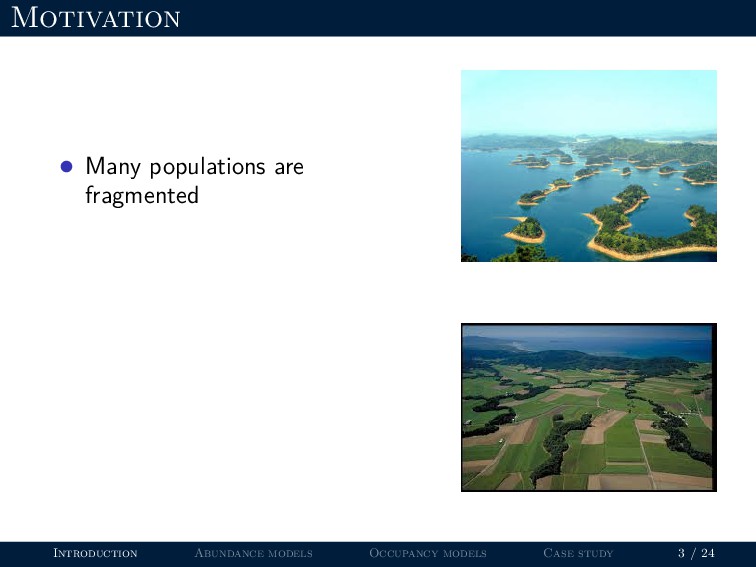
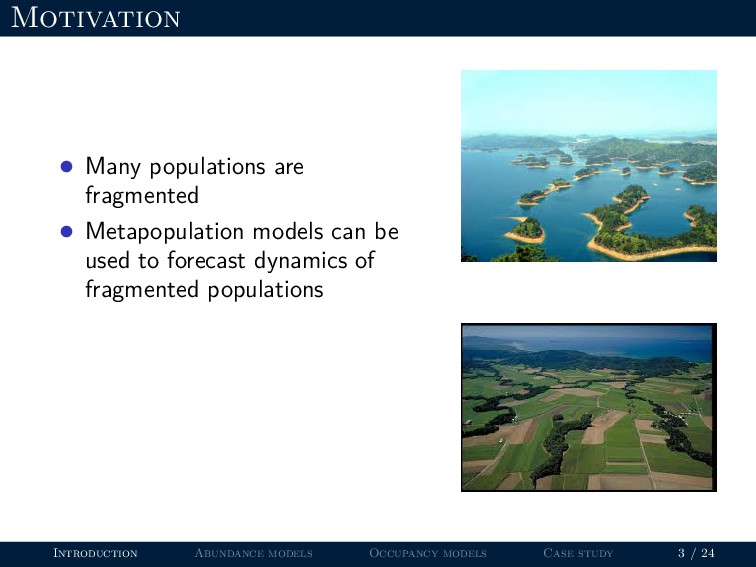
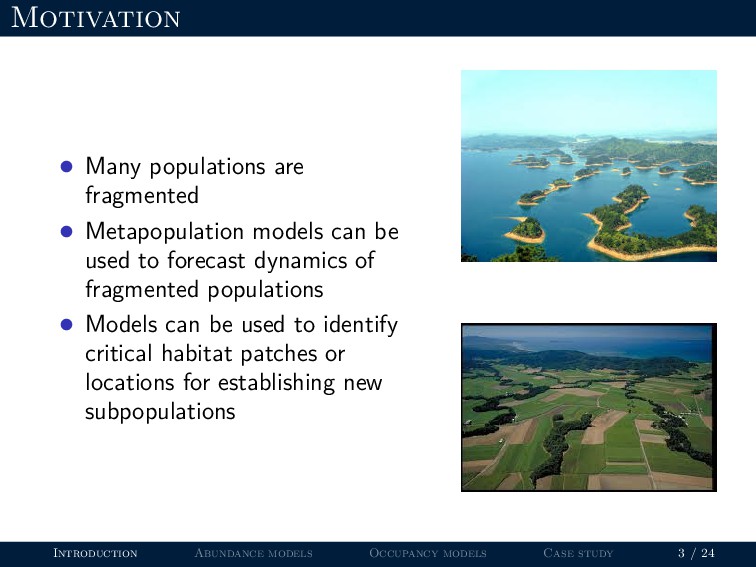
be used to forecast dynamics of fragmented populations • Models can be used to identify critical habitat patches or locations for establishing new subpopulations Introduction Abundance models Occupancy models Case study 3 / 24
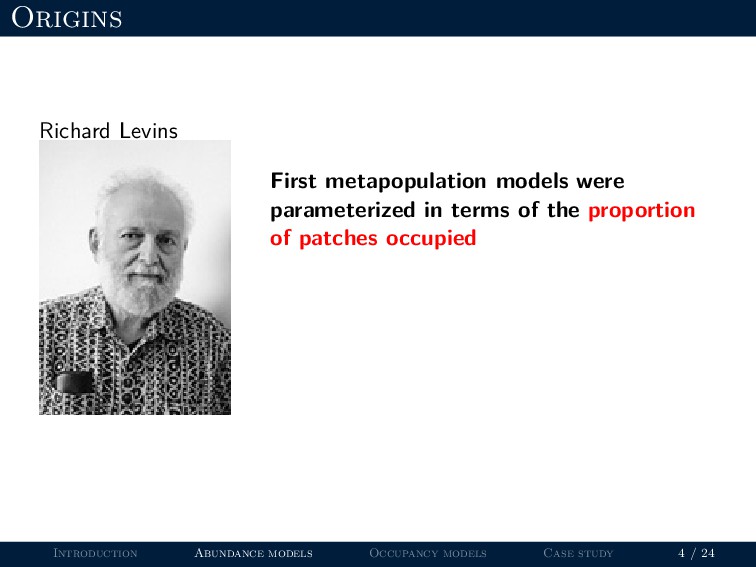
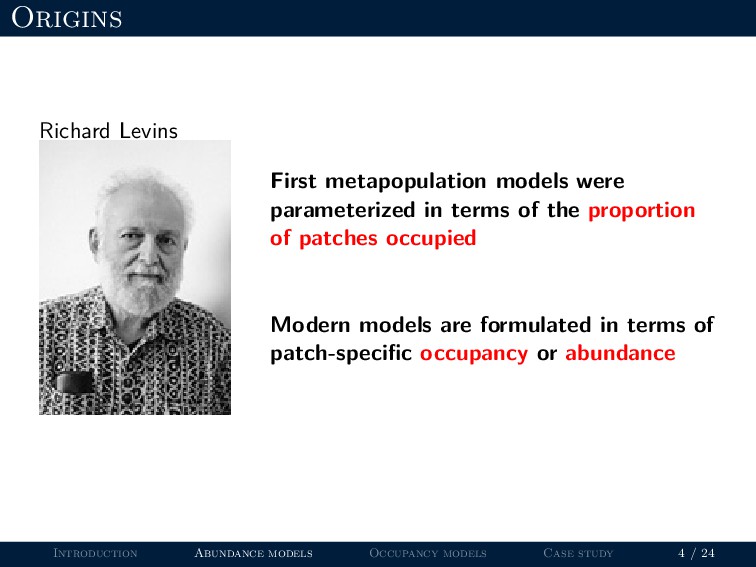
of the proportion of patches occupied Modern models are formulated in terms of patch-specific occupancy or abundance Introduction Abundance models Occupancy models Case study 4 / 24
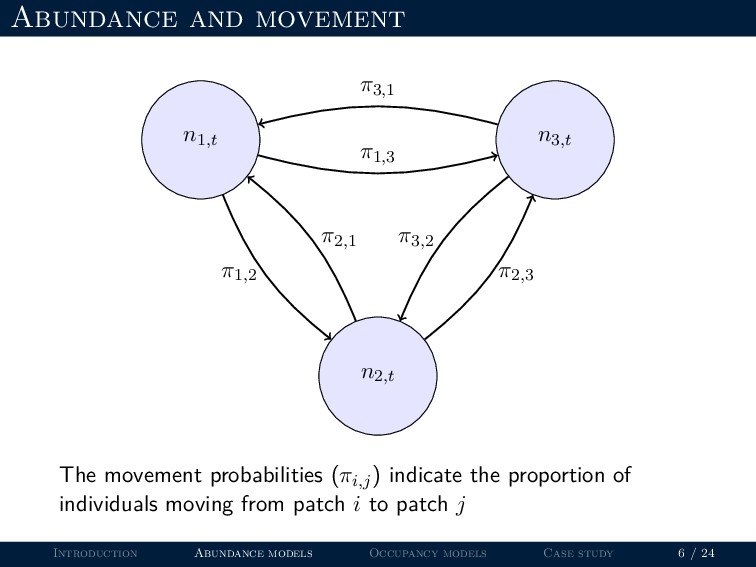
π2,3 π3,2 The movement probabilities (πi,j) indicate the proportion of individuals moving from patch i to patch j Introduction Abundance models Occupancy models Case study 6 / 24
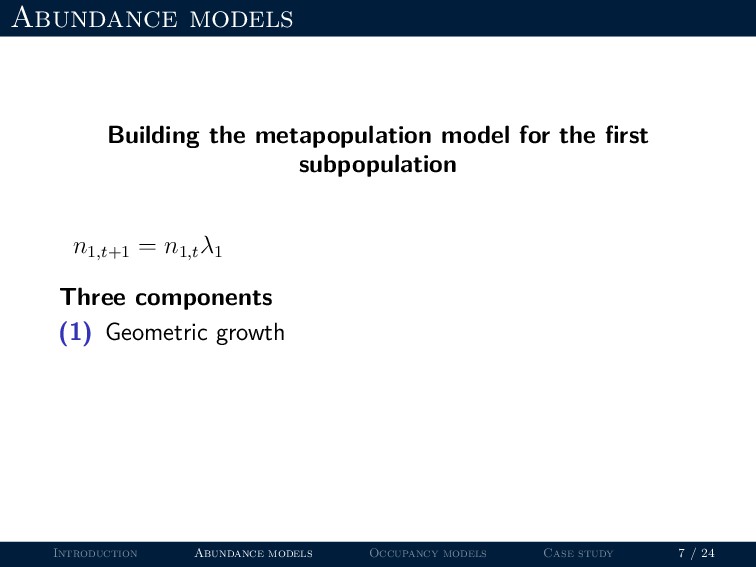
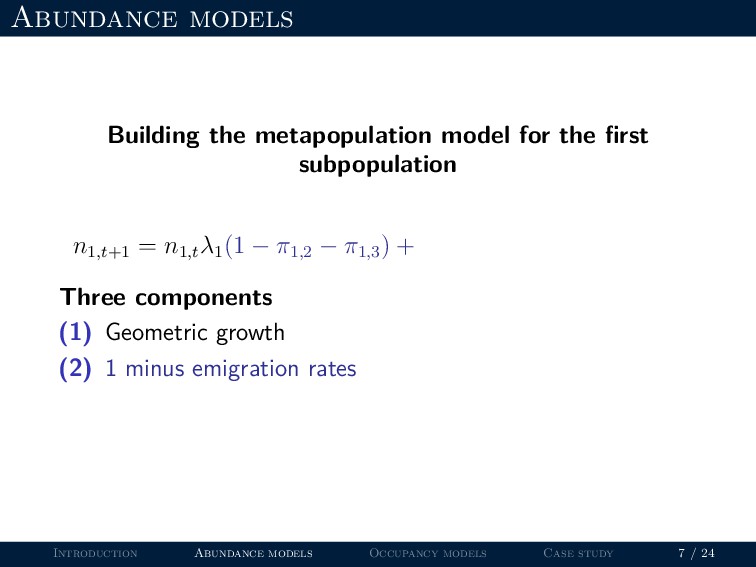
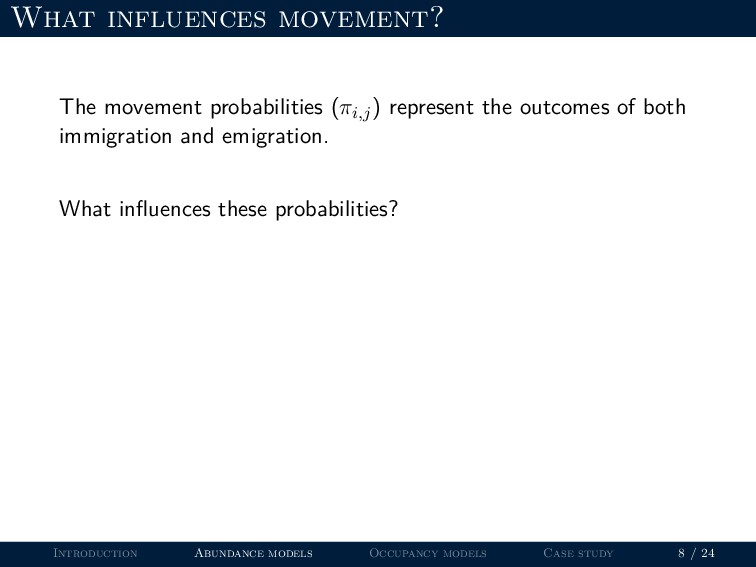
of both immigration and emigration. What influences these probabilities? Examples • Habitat quality in the patch of origin • Habitat quality in the landscape between origin and destination patches • Habitat quality in the destination patch • Distance between patches Introduction Abundance models Occupancy models Case study 8 / 24
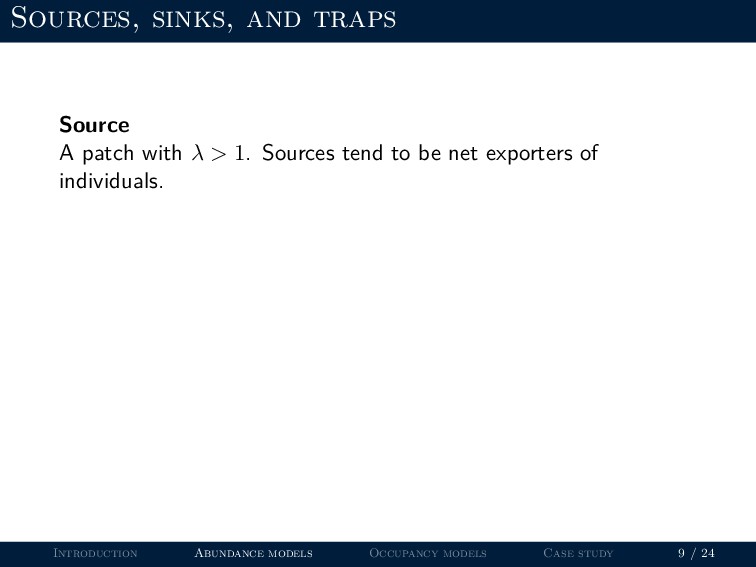
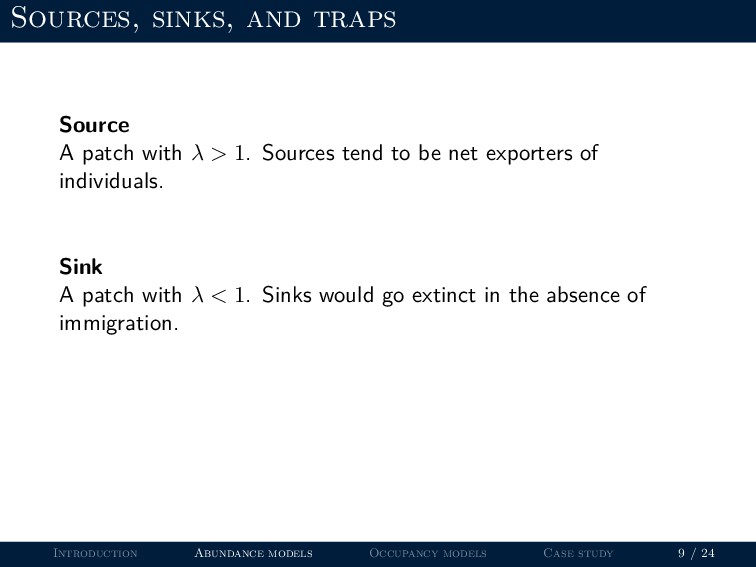
1. Sources tend to be net exporters of individuals. Sink A patch with λ < 1. Sinks would go extinct in the absence of immigration. Introduction Abundance models Occupancy models Case study 9 / 24
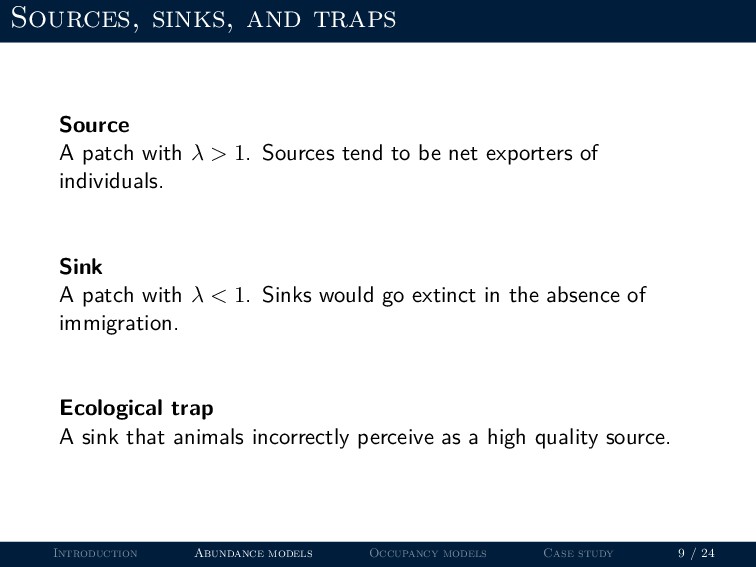
1. Sources tend to be net exporters of individuals. Sink A patch with λ < 1. Sinks would go extinct in the absence of immigration. Ecological trap A sink that animals incorrectly perceive as a high quality source. Introduction Abundance models Occupancy models Case study 9 / 24
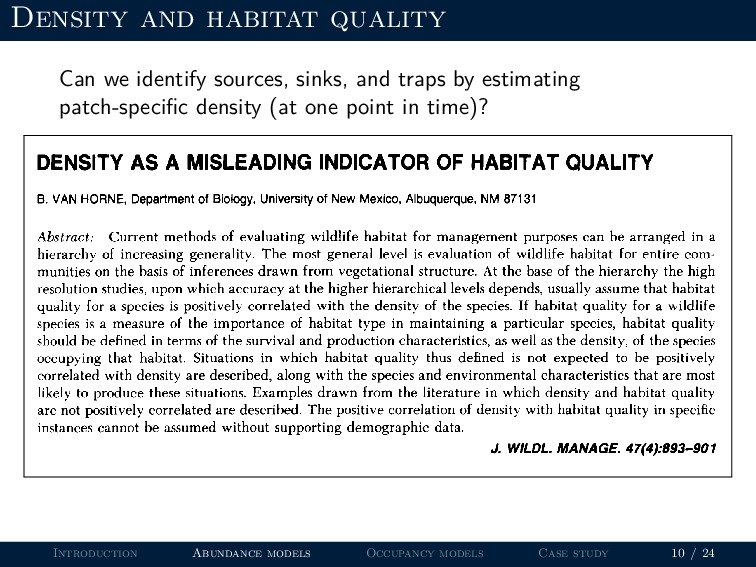
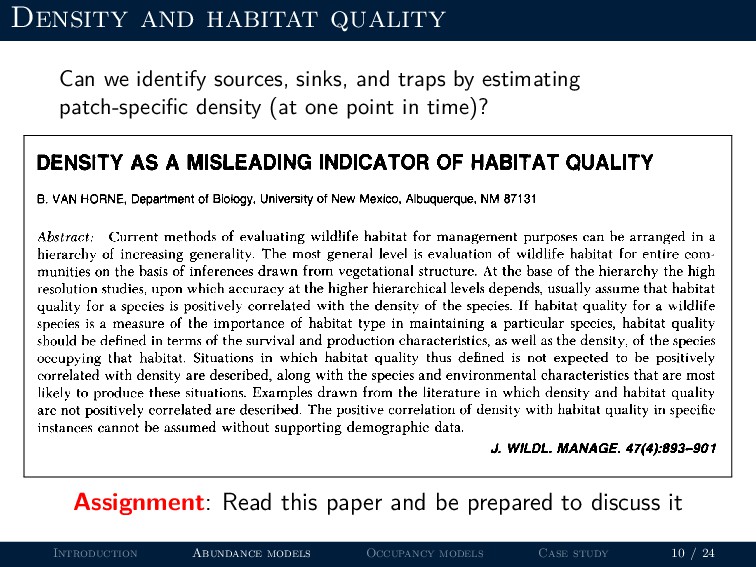
traps by estimating patch-specific density (at one point in time)? Assignment: Read this paper and be prepared to discuss it Introduction Abundance models Occupancy models Case study 10 / 24
the probability that a patch will be occupied? • What is the probability that an empty patch will be colonized? Introduction Abundance models Occupancy models Case study 12 / 24
the probability that a patch will be occupied? • What is the probability that an empty patch will be colonized? • What is the probability that a subpopulation will go locally extinct? Introduction Abundance models Occupancy models Case study 12 / 24
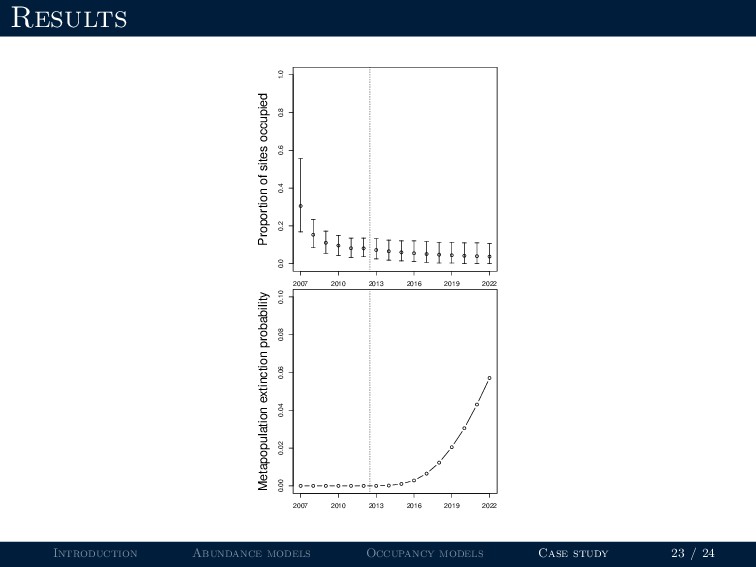
the probability that a patch will be occupied? • What is the probability that an empty patch will be colonized? • What is the probability that a subpopulation will go locally extinct? • What is the probability that the entire metapopulation will go extinct? Introduction Abundance models Occupancy models Case study 12 / 24
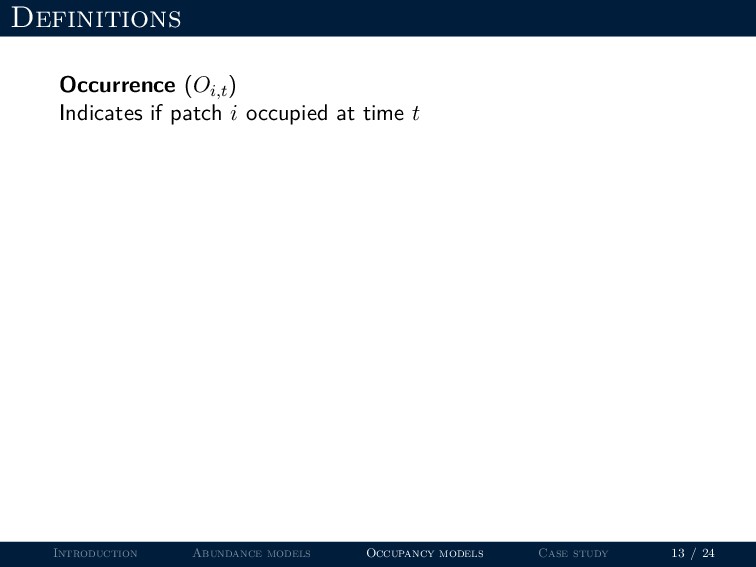
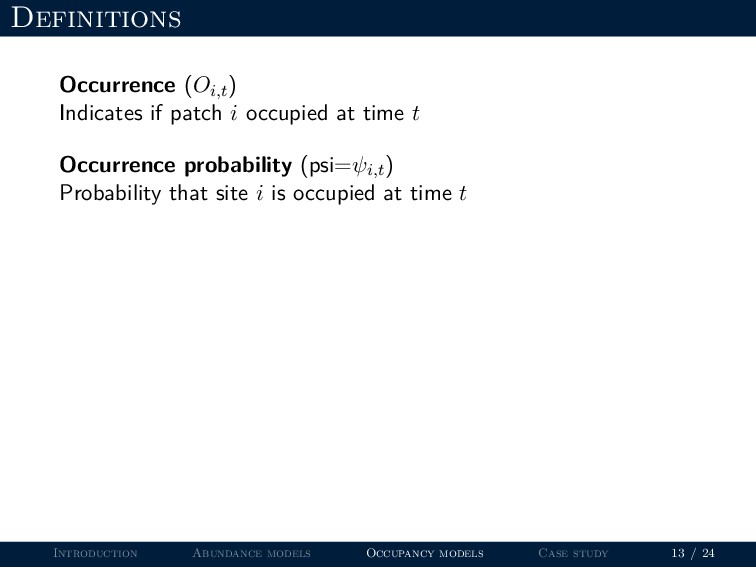
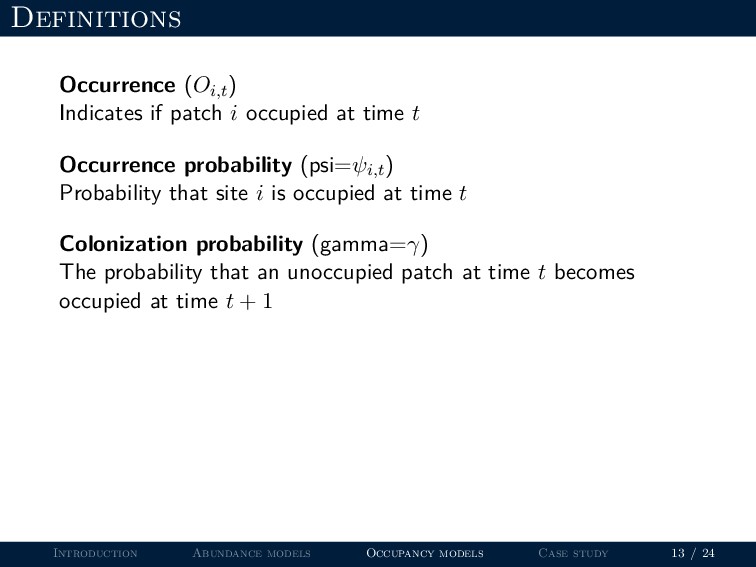
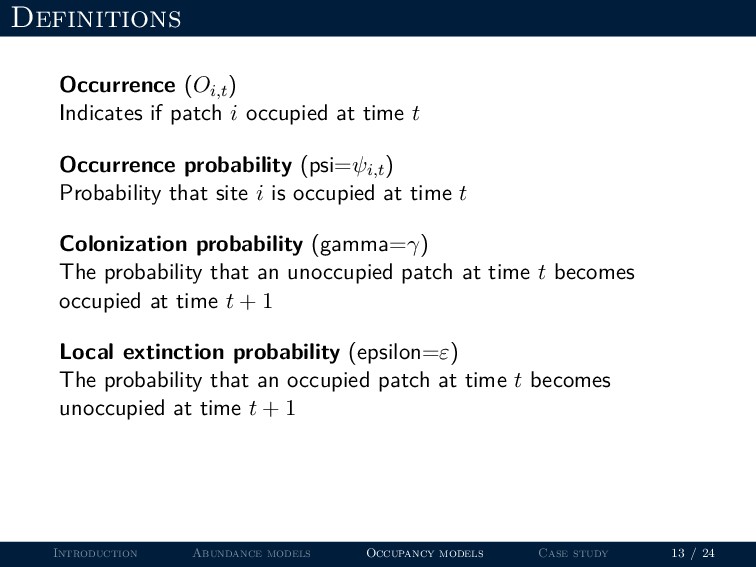
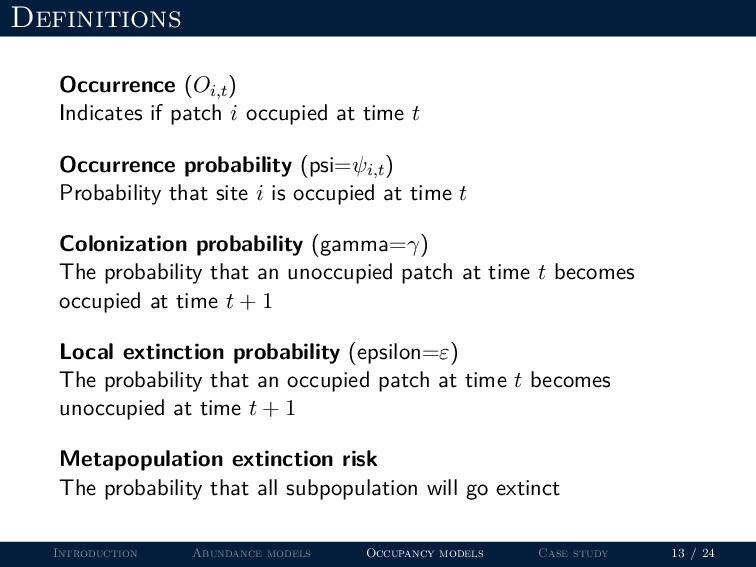
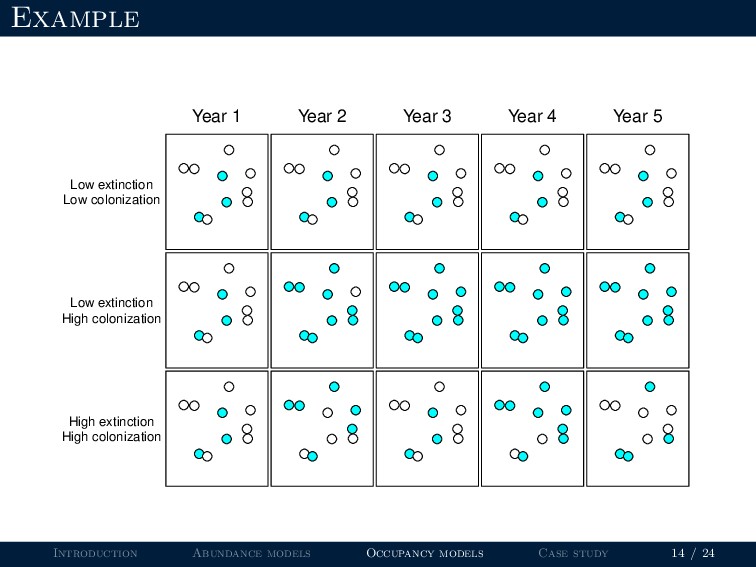
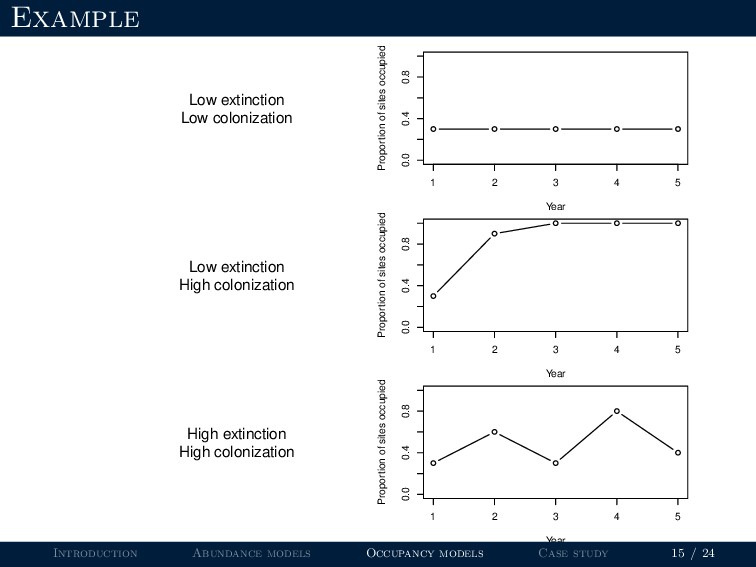
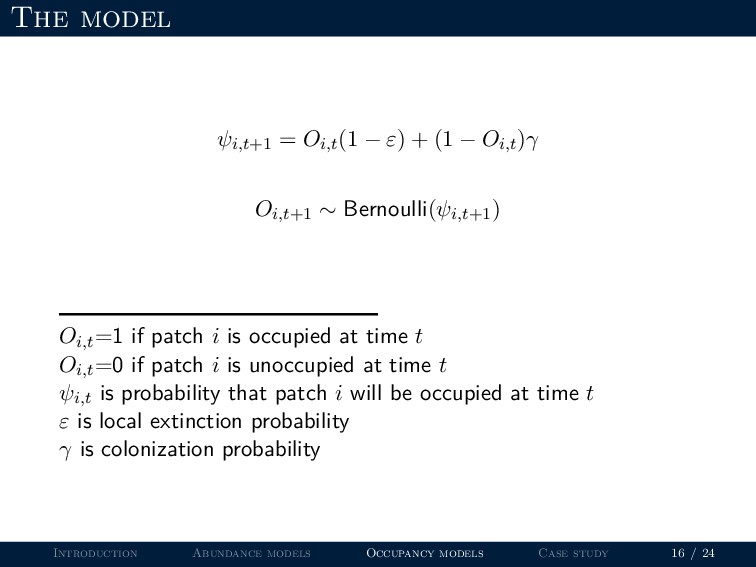
t Occurrence probability (psi=ψi,t) Probability that site i is occupied at time t Colonization probability (gamma=γ) The probability that an unoccupied patch at time t becomes occupied at time t + 1 Introduction Abundance models Occupancy models Case study 13 / 24
t Occurrence probability (psi=ψi,t) Probability that site i is occupied at time t Colonization probability (gamma=γ) The probability that an unoccupied patch at time t becomes occupied at time t + 1 Local extinction probability (epsilon=ε) The probability that an occupied patch at time t becomes unoccupied at time t + 1 Introduction Abundance models Occupancy models Case study 13 / 24
t Occurrence probability (psi=ψi,t) Probability that site i is occupied at time t Colonization probability (gamma=γ) The probability that an unoccupied patch at time t becomes occupied at time t + 1 Local extinction probability (epsilon=ε) The probability that an occupied patch at time t becomes unoccupied at time t + 1 Metapopulation extinction risk The probability that all subpopulation will go extinct Introduction Abundance models Occupancy models Case study 13 / 24
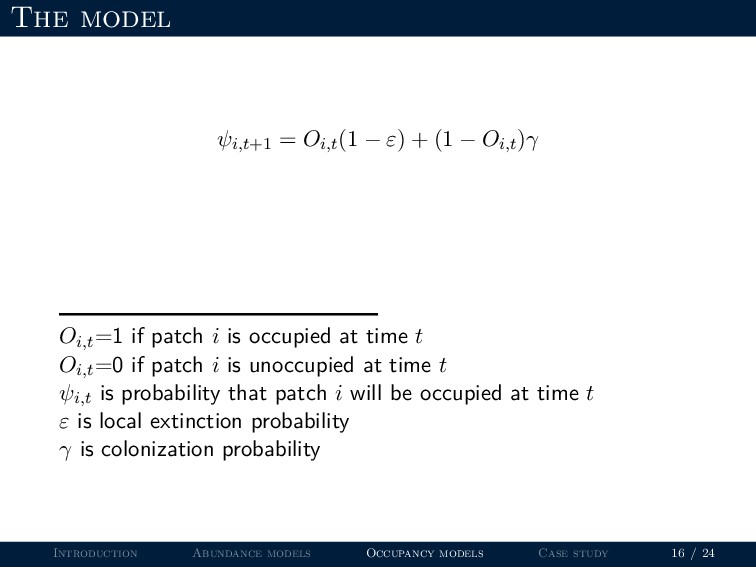
Oi,t)γ Oi,t=1 if patch i is occupied at time t Oi,t=0 if patch i is unoccupied at time t ψi,t is probability that patch i will be occupied at time t ε is local extinction probability γ is colonization probability Introduction Abundance models Occupancy models Case study 16 / 24
Oi,t)γ Oi,t+1 ∼ Bernoulli(ψi,t+1) Oi,t=1 if patch i is occupied at time t Oi,t=0 if patch i is unoccupied at time t ψi,t is probability that patch i will be occupied at time t ε is local extinction probability γ is colonization probability Introduction Abundance models Occupancy models Case study 16 / 24
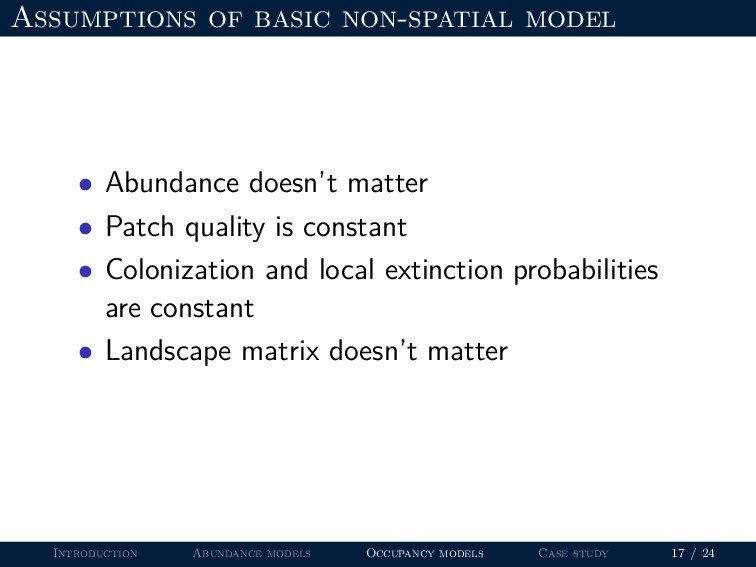
Patch quality is constant • Colonization and local extinction probabilities are constant • Landscape matrix doesn’t matter Introduction Abundance models Occupancy models Case study 17 / 24
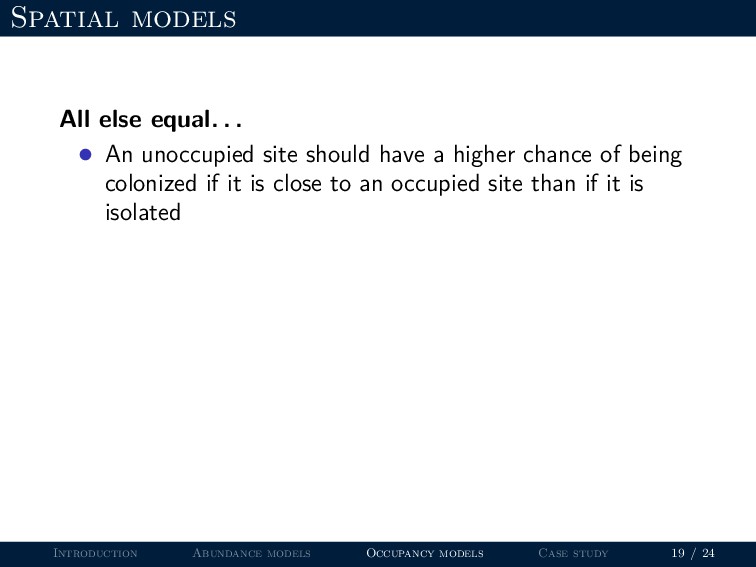
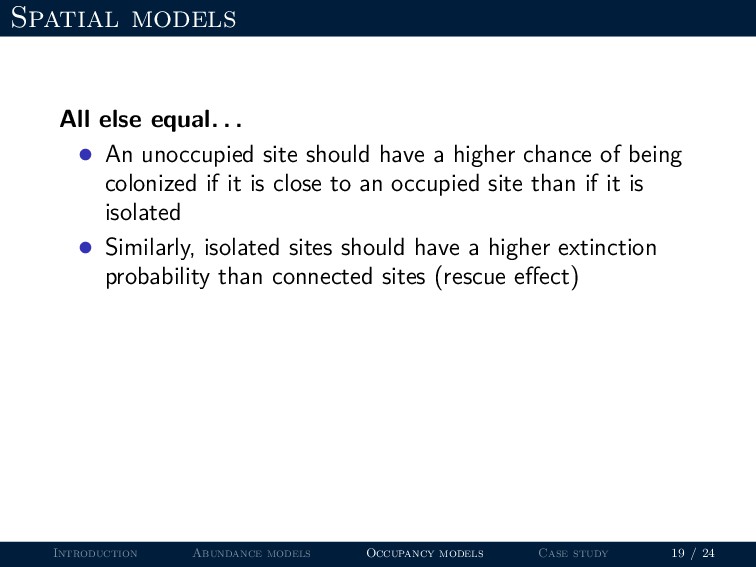
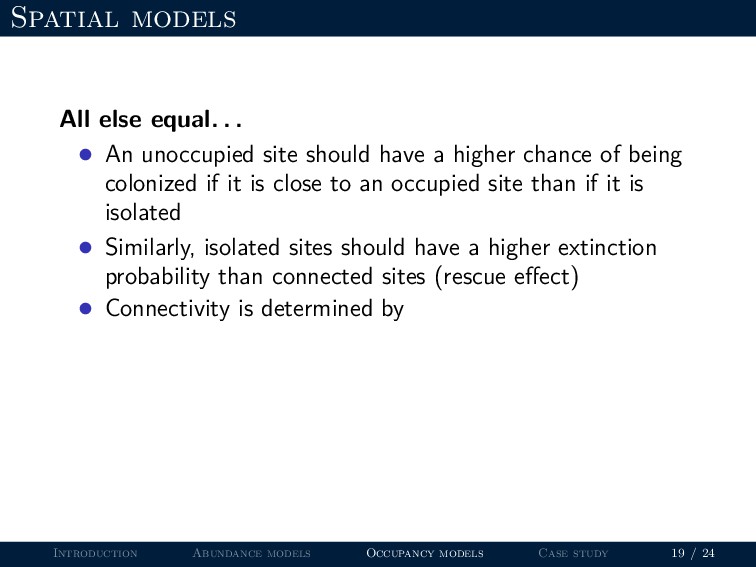
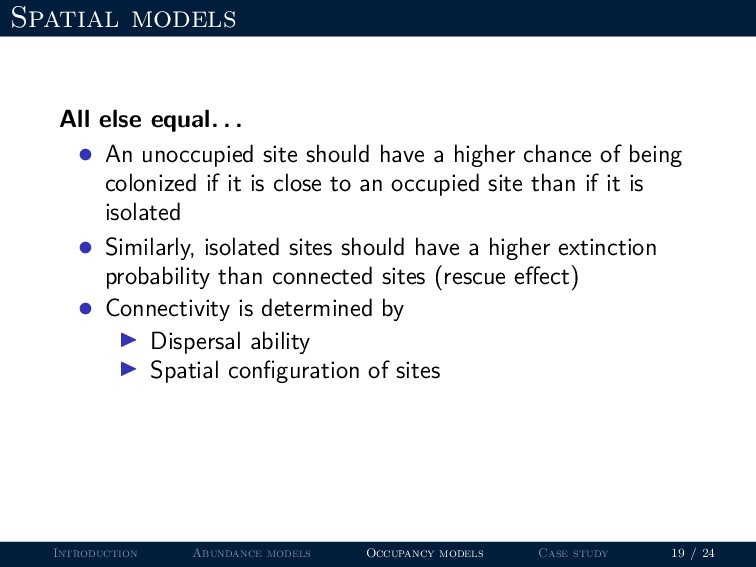
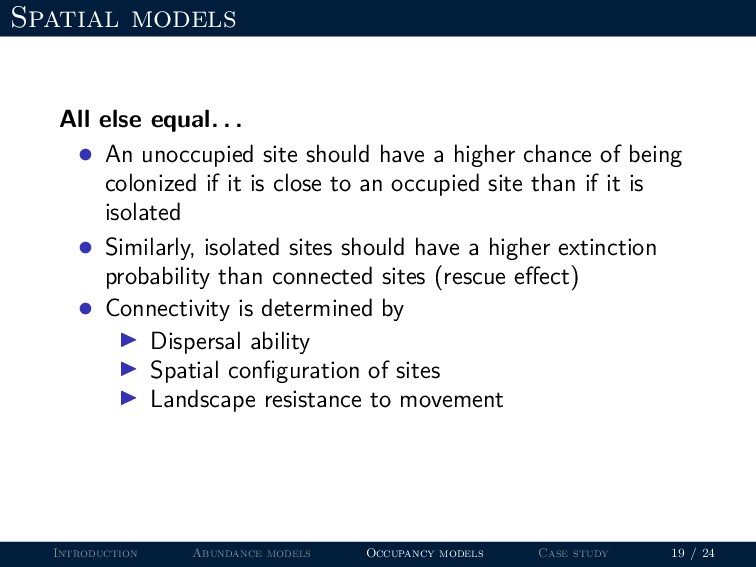
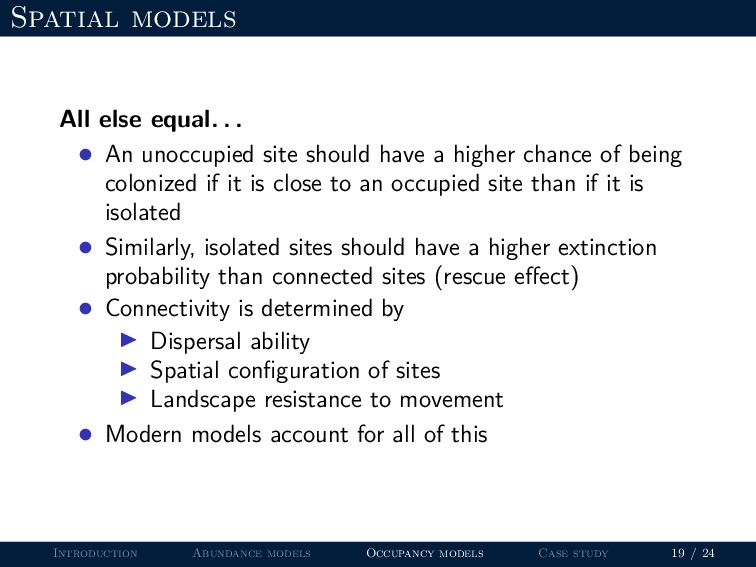
site should have a higher chance of being colonized if it is close to an occupied site than if it is isolated Introduction Abundance models Occupancy models Case study 19 / 24
site should have a higher chance of being colonized if it is close to an occupied site than if it is isolated • Similarly, isolated sites should have a higher extinction probability than connected sites (rescue effect) Introduction Abundance models Occupancy models Case study 19 / 24
site should have a higher chance of being colonized if it is close to an occupied site than if it is isolated • Similarly, isolated sites should have a higher extinction probability than connected sites (rescue effect) • Connectivity is determined by Introduction Abundance models Occupancy models Case study 19 / 24
site should have a higher chance of being colonized if it is close to an occupied site than if it is isolated • Similarly, isolated sites should have a higher extinction probability than connected sites (rescue effect) • Connectivity is determined by Dispersal ability Introduction Abundance models Occupancy models Case study 19 / 24
site should have a higher chance of being colonized if it is close to an occupied site than if it is isolated • Similarly, isolated sites should have a higher extinction probability than connected sites (rescue effect) • Connectivity is determined by Dispersal ability Spatial configuration of sites Introduction Abundance models Occupancy models Case study 19 / 24
site should have a higher chance of being colonized if it is close to an occupied site than if it is isolated • Similarly, isolated sites should have a higher extinction probability than connected sites (rescue effect) • Connectivity is determined by Dispersal ability Spatial configuration of sites Landscape resistance to movement Introduction Abundance models Occupancy models Case study 19 / 24
site should have a higher chance of being colonized if it is close to an occupied site than if it is isolated • Similarly, isolated sites should have a higher extinction probability than connected sites (rescue effect) • Connectivity is determined by Dispersal ability Spatial configuration of sites Landscape resistance to movement • Modern models account for all of this Introduction Abundance models Occupancy models Case study 19 / 24
of fragmented populations Model can be formulated in terms of patch-level abundance and/or occupancy Modern models are stochastic and spatially explicit Introduction Abundance models Occupancy models Case study 24 / 24


 rbchan
 territorium
 okana2ki
 yatabe
 sciencetokyo
 aokiplayer
 soudai
 cbtlibrary
 aecrp
aecrp
 ichimichi
 akiraasano
 terasawat
 nikkihalliwell
 morganepeng
 jdejongh
 madoxten
 szymonslowik
 sferik
 dougneiner
 axbom
axbom
 codingconduct
 colly
colly
 quramy
 bluesmoon