dynamics and competitive interactions • As usual, these models were developed as continuous-time models • We will focus on discrete-time versions (t = 1, 2, . . .) Introduction Predator-Prey Competition 2 / 14
dynamics and competitive interactions • As usual, these models were developed as continuous-time models • We will focus on discrete-time versions (t = 1, 2, . . .) • We will ignore potential extensions with stochasticity, age structure, spatial structure, etc. . . Introduction Predator-Prey Competition 2 / 14
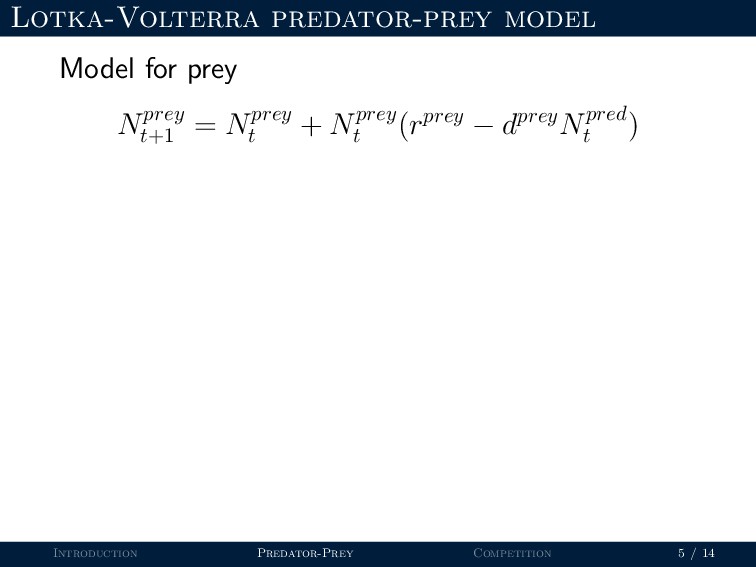
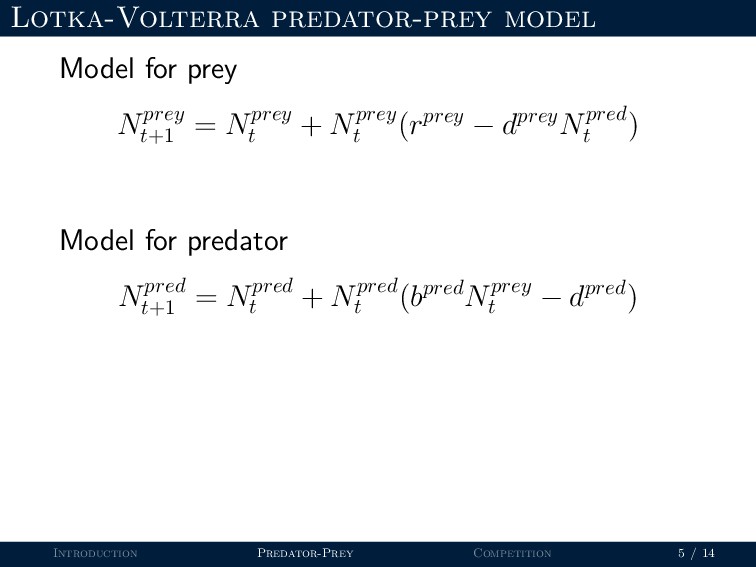
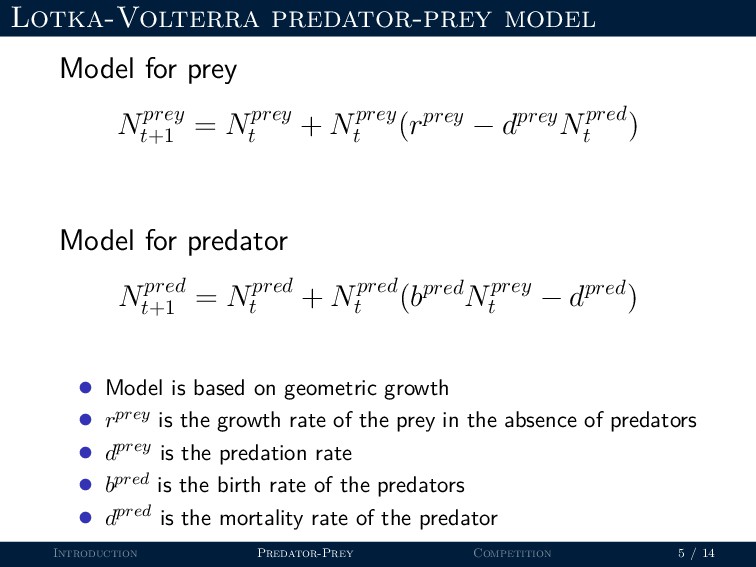
t + Nprey t (rprey − dpreyNpred t ) Model for predator Npred t+1 = Npred t + Npred t (bpredNprey t − dpred) Introduction Predator-Prey Competition 5 / 14
t + Nprey t (rprey − dpreyNpred t ) Model for predator Npred t+1 = Npred t + Npred t (bpredNprey t − dpred) • Model is based on geometric growth • rprey is the growth rate of the prey in the absence of predators • dprey is the predation rate • bpred is the birth rate of the predators • dpred is the mortality rate of the predator Introduction Predator-Prey Competition 5 / 14
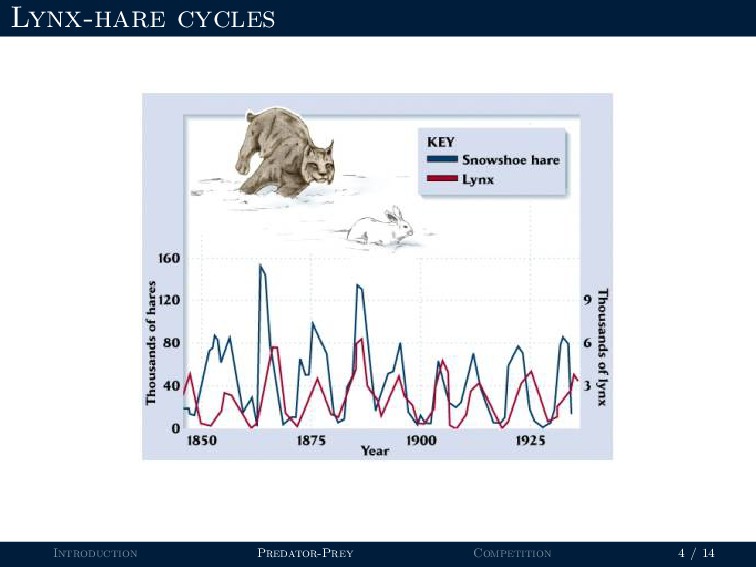
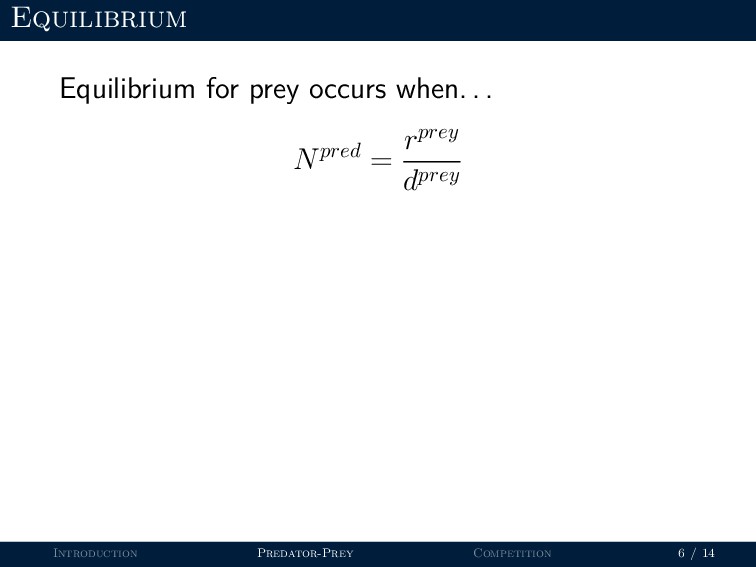
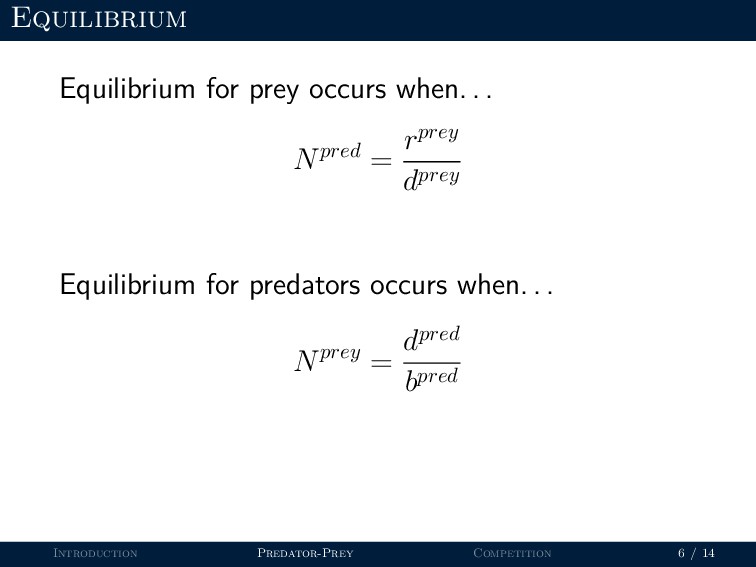
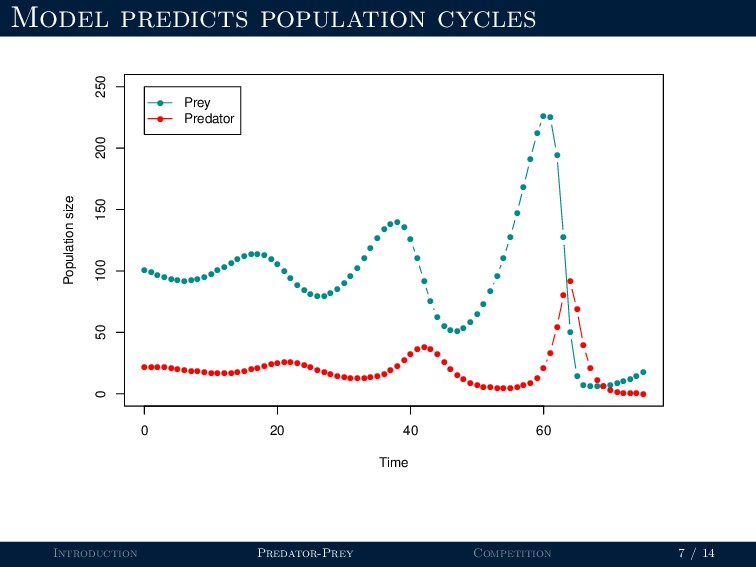
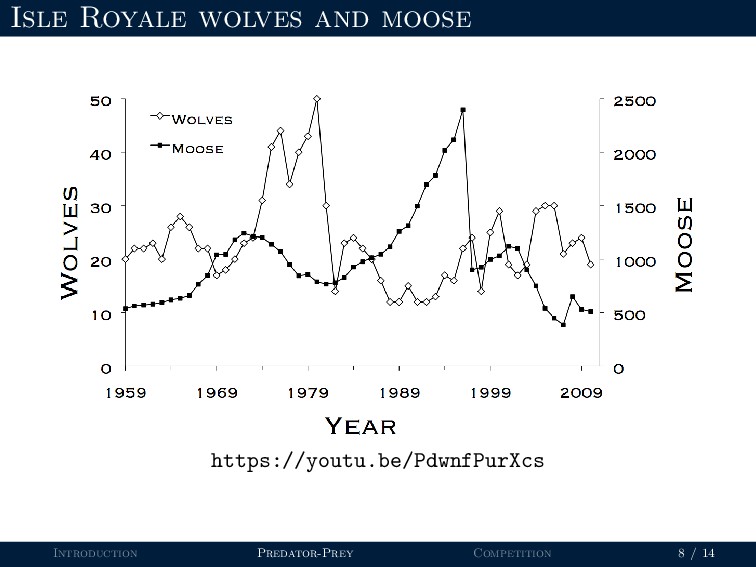
rprey dprey Equilibrium for predators occurs when. . . Nprey = dpred bpred However, it is rare that both equilibrium conditions will be met at the same time, and so the populations will cycle. Introduction Predator-Prey Competition 6 / 14
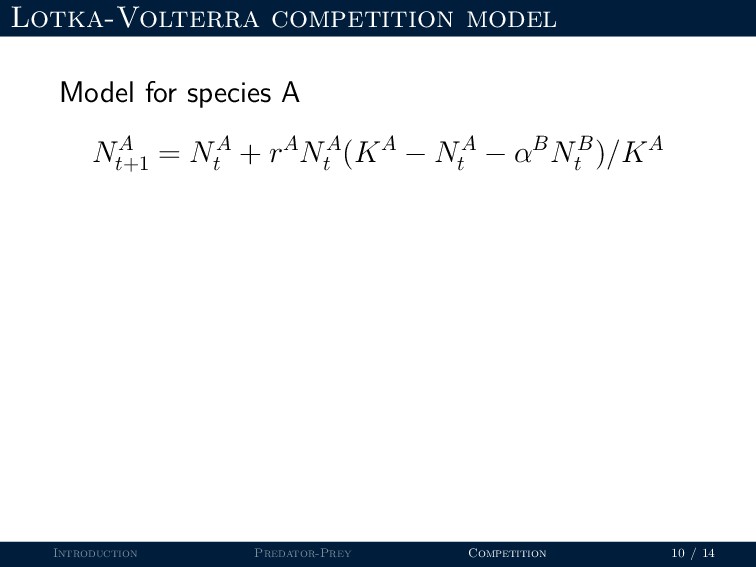
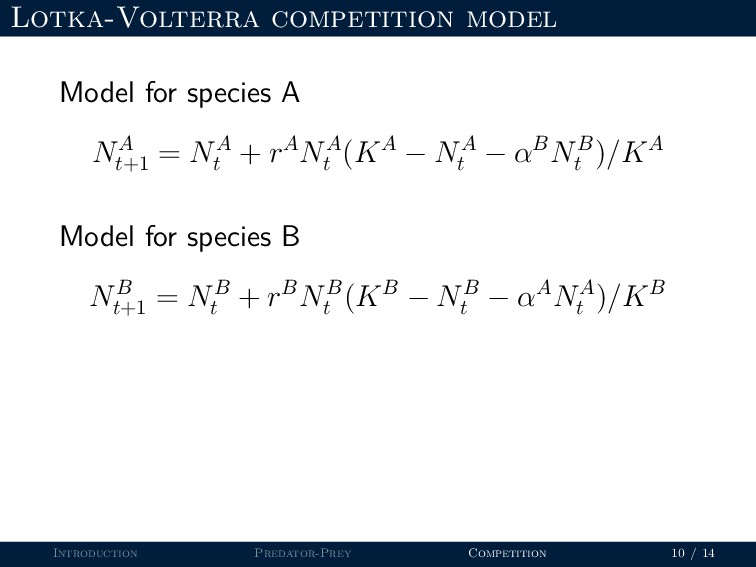
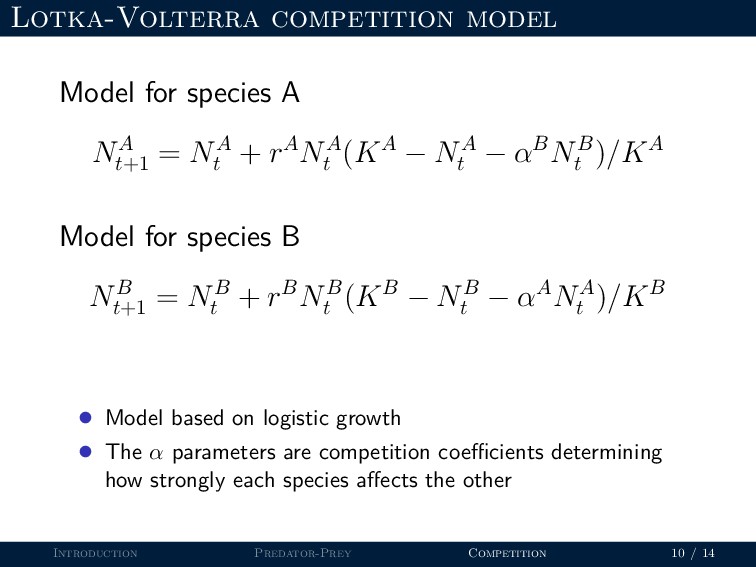
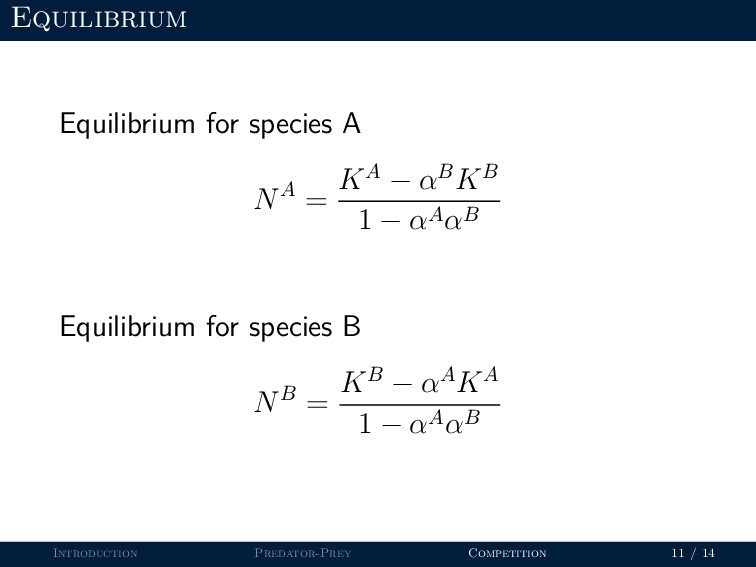
NA t + rANA t (KA − NA t − αBNB t )/KA Model for species B NB t+1 = NB t + rBNB t (KB − NB t − αANA t )/KB Introduction Predator-Prey Competition 10 / 14
NA t + rANA t (KA − NA t − αBNB t )/KA Model for species B NB t+1 = NB t + rBNB t (KB − NB t − αANA t )/KB • Model based on logistic growth • The α parameters are competition coefficients determining how strongly each species affects the other Introduction Predator-Prey Competition 10 / 14
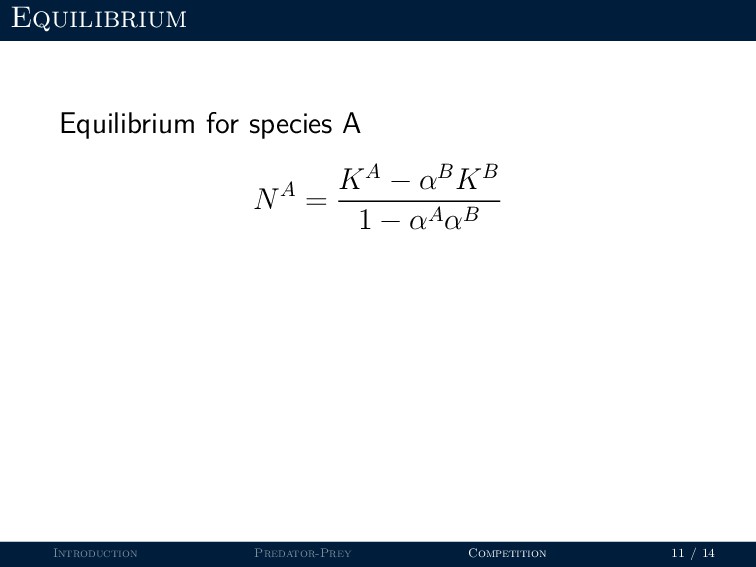
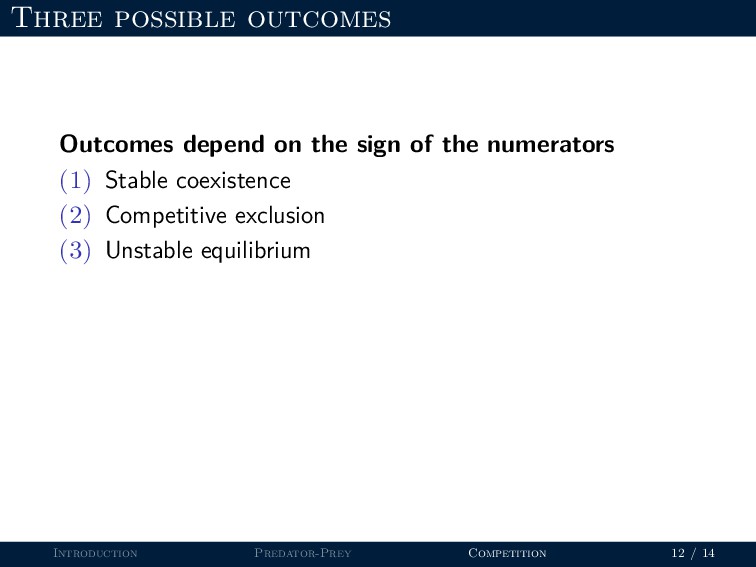
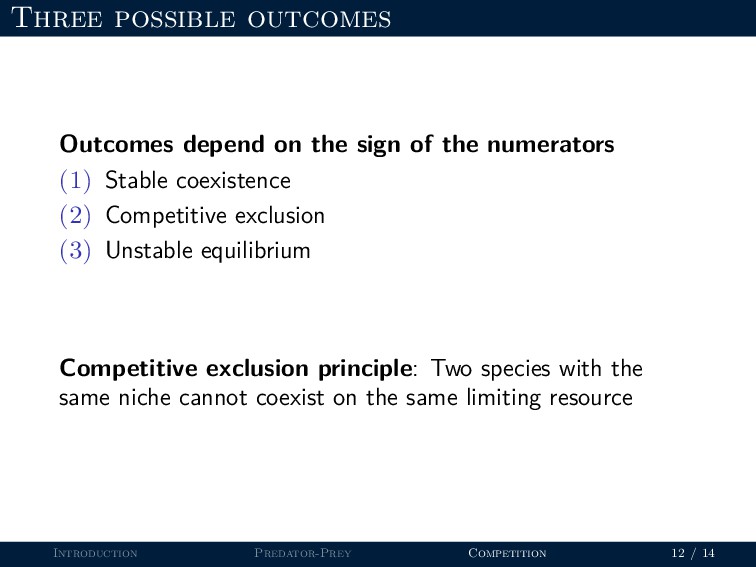
numerators (1) Stable coexistence (2) Competitive exclusion (3) Unstable equilibrium Competitive exclusion principle: Two species with the same niche cannot coexist on the same limiting resource Introduction Predator-Prey Competition 12 / 14
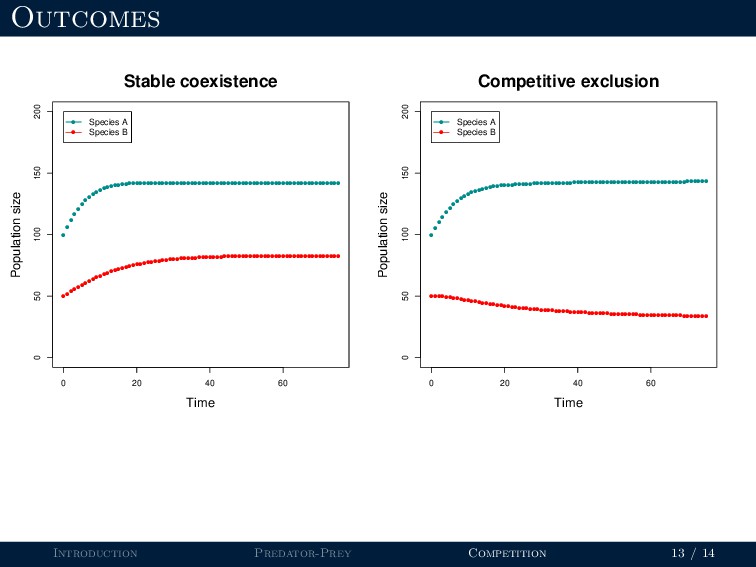
0 20 40 60 0 50 100 150 200 Stable coexistence Time Population size qqqqqqqqqqqqqqqqqqqqqqqqqqqqqqqqqqqqqqqqqqqqqqqqqqqqqqqqqqqqqqqqqqqqqqqqqqqq q q Species A Species B q q q q q q q q qqqqqqqqqqqqqqqqqqqqqqqqqqqqqqqqqqqqqqqqqqqqqqqqqqqqqqqqqqqqqqqqqqqq 0 20 40 60 0 50 100 150 200 Competitive exclusion Time Population size qqqqqqqqqqqqqqqqqqqqqqqqqqqqqqqqqqqqqqqqqqqqqqqqqqqqqqqqqqqqqqqqqqqqqqqqqqqq q q Species A Species B Introduction Predator-Prey Competition 13 / 14
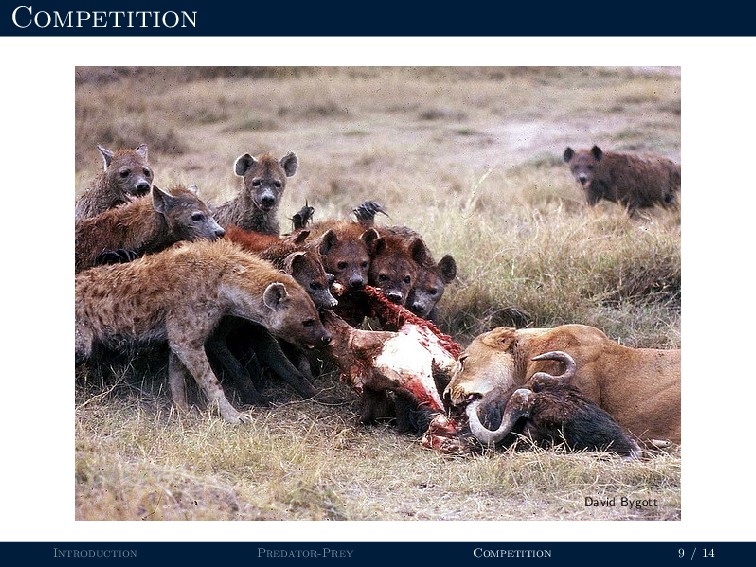
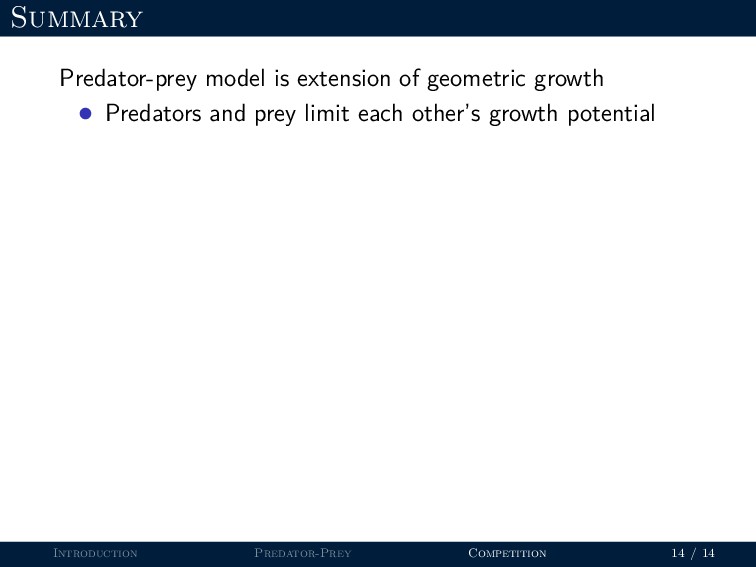
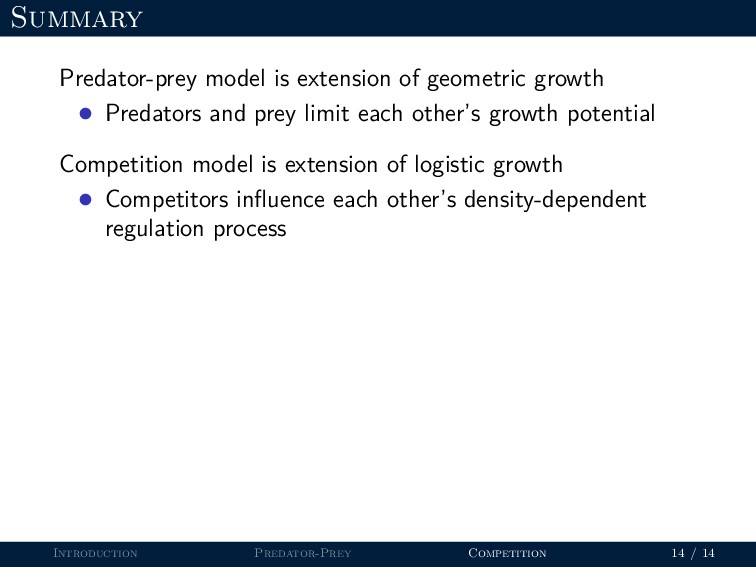
and prey limit each other’s growth potential Competition model is extension of logistic growth • Competitors influence each other’s density-dependent regulation process Introduction Predator-Prey Competition 14 / 14
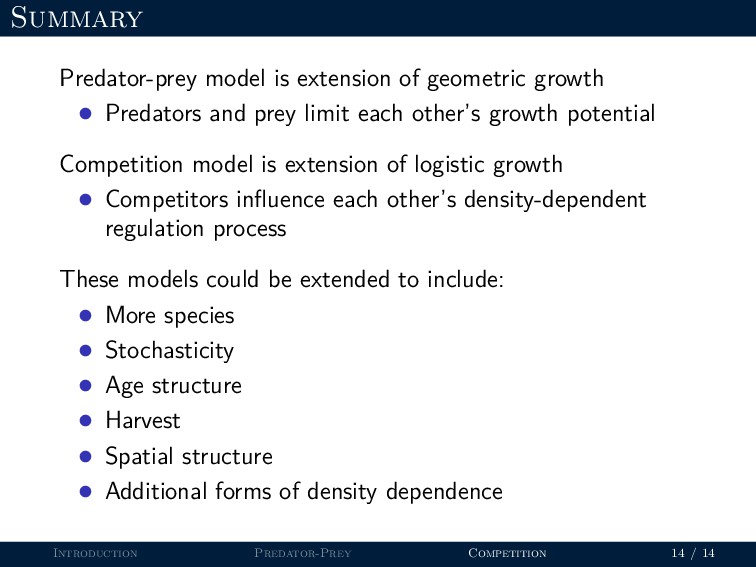
and prey limit each other’s growth potential Competition model is extension of logistic growth • Competitors influence each other’s density-dependent regulation process These models could be extended to include: • More species • Stochasticity • Age structure • Harvest • Spatial structure • Additional forms of density dependence Introduction Predator-Prey Competition 14 / 14


 rbchan
 mariooc
 sciencetokyo
 juanmartin2026
 aokiplayer
 georgeorge
 pawan_pharm
 robintux
 stevekinney
 yatabe
 denniskardys
 oripsolob
 uxyall
 retrage
 aleyda
 reverentgeek
 szymonslowik
 tammyeverts
 kneath
 stuffmc
 ammeep