TechTown - Creating Composable Callables in Con...

Share
Embed
TechTown - Creating Composable Callables in Contemporary C++
C++ took a huge step in the direction of composability when Ranges were introduced in C++20. C++23 improved it, and C++26 looks to improve it even more. However, function objects, sometimes referred to as Niebloids, after Eric Niebler who pioneered their use in the Ranges library, are still few and rarely composable. With function objects we can send functions, and even complete overload sets, as arguments to other functions, return them, and combine them.
I will show you compositions I want, how to write them and with gradual scope creep end up with a very powerful set of utilities that are easy to use and require surprisingly little code when using recent additions to the C++ language.

Björn Fahller
September 23, 2026
Transcript
186 slides
-
Creating Composable Callables in Contemporary C++ or How I nerd
sniped myself with a lightning talk https://www.youtube.com/watch?v=XKVyoWvPCCw Björn Fahller -
The goal auto i = find_if(values, &S::name | equal_to("foo")); sort(values,
transform_args(&S::num, less_than)); -
The goal auto i = find_if(values, &S::name | equal_to("foo")); sort(values,
transform_args(&S::num, less_than)); std::vector<int> producer(); sort(producer(), greater_than); -
The goal auto i = find_if(values, &S::name | equal_to("foo")); sort(values,
transform_args(&S::num, less_than)); std::vector<int> producer(); sort(producer(), greater_than); find_if(values, &S::name | equal_to("foo")); -
A small example bool all_are_small(std::span<const int> numbers) { return std::ranges::all_of(numbers,
[](int x){return x < 10;}); } Creating Composable Callables in Contemporary C++ NDC{TechTown} 2026 © Björn Fahller @[email protected] 10/186 -
A small example bool all_are_small(std::span<const int> numbers) { return std::ranges::all_of(numbers,
[](int x){return x < 10;}); } Creating Composable Callables in Contemporary C++ NDC{TechTown} 2026 © Björn Fahller @[email protected] 11/186 -
A small example Let’s make a function for this comparison
bool all_are_small(std::span<const int> numbers) { return std::ranges::all_of(numbers, [](int x){return x < 10;}); } Creating Composable Callables in Contemporary C++ NDC{TechTown} 2026 © Björn Fahller @[email protected] 12/186 -
A small example constexpr auto less_than(auto rh) { return [rh](auto
lh){return lh < rh;}; } bool all_are_small(std::span<const int> numbers) { return std::ranges::all_of(numbers, [](int x){return x < 10;}); } Creating Composable Callables in Contemporary C++ NDC{TechTown} 2026 © Björn Fahller @[email protected] 13/186 -
A small example constexpr auto less_than(auto rh) { return [rh](auto
lh){return lh < rh;}; } bool all_are_small(std::span<const int> numbers) { return std::ranges::all_of(numbers, [](int x){return x < 10;}); } Creating Composable Callables in Contemporary C++ NDC{TechTown} 2026 © Björn Fahller @[email protected] 14/186 -
A small example constexpr auto less_than(auto rh) { return [rh](auto
lh){return lh < rh;}; } Return a lambda which binds the argument used on the right hand side bool all_are_small(std::span<const int> numbers) { return std::ranges::all_of(numbers, [](int x){return x < 10;}); } Creating Composable Callables in Contemporary C++ NDC{TechTown} 2026 © Björn Fahller @[email protected] 15/186 -
A small example constexpr auto less_than(auto rh) { return [rh](auto
lh){return lh < rh;}; } bool all_are_small(std::span<const int> numbers) { return std::ranges::all_of(numbers, less_than(10)); } Creating Composable Callables in Contemporary C++ NDC{TechTown} 2026 © Björn Fahller @[email protected] 16/186 -
A small example constexpr auto less_than(auto rh) { return [rh](auto
lh){return lh < rh;}; } bool all_are_small(std::span<const int> numbers) { return std::ranges::all_of(numbers, less_than(10)); } https://godbolt.org/z/415qhrbPa Creating Composable Callables in Contemporary C++ NDC{TechTown} 2026 © Björn Fahller @[email protected] 17/186 -
A first generalization constexpr auto less_than(auto rh) { return [rh](auto
lh){return lh < rh;}; } This has a name in the numbers) standard library. It is std::less<> bool all_are_small(std::span<const int> { return std::ranges::all_of(numbers, less_than(10)); } Creating Composable Callables in Contemporary C++ NDC{TechTown} 2026 © Björn Fahller @[email protected] 18/186 -
A first generalization constexpr auto less_than(auto rh) { return [rh](auto
lh){return lh < rh;}; [f,bound](auto arg) { } return f(arg, bound); }; bool all_are_small(std::span<const int> numbers) { return std::ranges::all_of(numbers, less_than(10)); } Creating Composable Callables in Contemporary C++ NDC{TechTown} 2026 © Björn Fahller @[email protected] 19/186 -
A first generalization Given a function and a bound argument
constexpr auto less_than(auto rh) { return [rh](auto lh){return lh < rh;}; [f,bound](auto arg) { } return f(arg, bound); }; bool all_are_small(std::span<const int> numbers) { return std::ranges::all_of(numbers, less_than(10)); } Creating Composable Callables in Contemporary C++ NDC{TechTown} 2026 © Björn Fahller @[email protected] 20/186 -
A first generalization constexpr auto less_than(auto rh) { return [rh](auto
lh){return lh < rh;}; [f,bound](auto arg) { } return f(arg, bound); }; bool all_are_small(std::span<const int> numbers) Call the function with the { left hand side argument return std::ranges::all_of(numbers, and the bound right hand less_than(10)); side argument } Creating Composable Callables in Contemporary C++ NDC{TechTown} 2026 © Björn Fahller @[email protected] 21/186 -
A first generalization constexpr auto less_than(auto rh) { [f](auto rh)
{ return [rh](auto lh){return lh < lh) rh;}; return [f,rh](auto { } return f(lh, rh); }; bool all_are_small(std::span<const int> numbers) }; { return std::ranges::all_of(numbers, less_than(10)); } Creating Composable Callables in Contemporary C++ NDC{TechTown} 2026 © Björn Fahller @[email protected] 22/186 -
A first generalization Given a bound function constexpr auto less_than(auto
rh) { [f](auto rh) { return [rh](auto lh){return lh < lh) rh;}; return [f,rh](auto { } return f(lh, rh); }; bool all_are_small(std::span<const int> numbers) }; { return std::ranges::all_of(numbers, less_than(10)); } Creating Composable Callables in Contemporary C++ NDC{TechTown} 2026 © Björn Fahller @[email protected] 23/186 -
A first generalization constexpr auto less_than(auto rh) { [f](auto rh)
{ return [rh](auto lh){return lh < lh) rh;}; return [f,rh](auto { } return f(lh, rh); }; bool all_are_small(std::span<const int> numbers) }; { Return the lambda that return binds thestd::ranges::all_of(numbers, right hand side argument as well as the less_than(10)); function } Creating Composable Callables in Contemporary C++ NDC{TechTown} 2026 © Björn Fahller @[email protected] 24/186 -
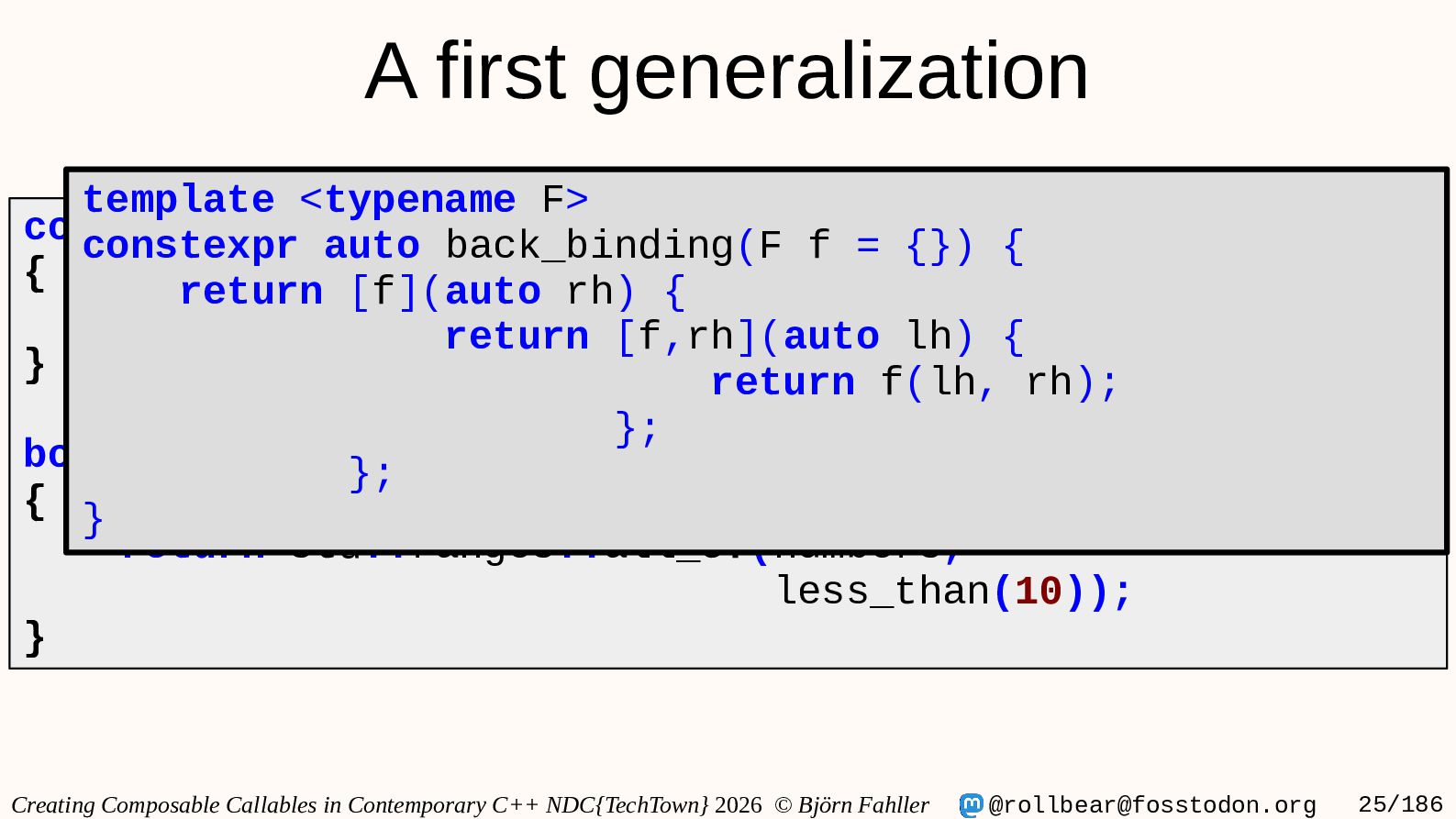
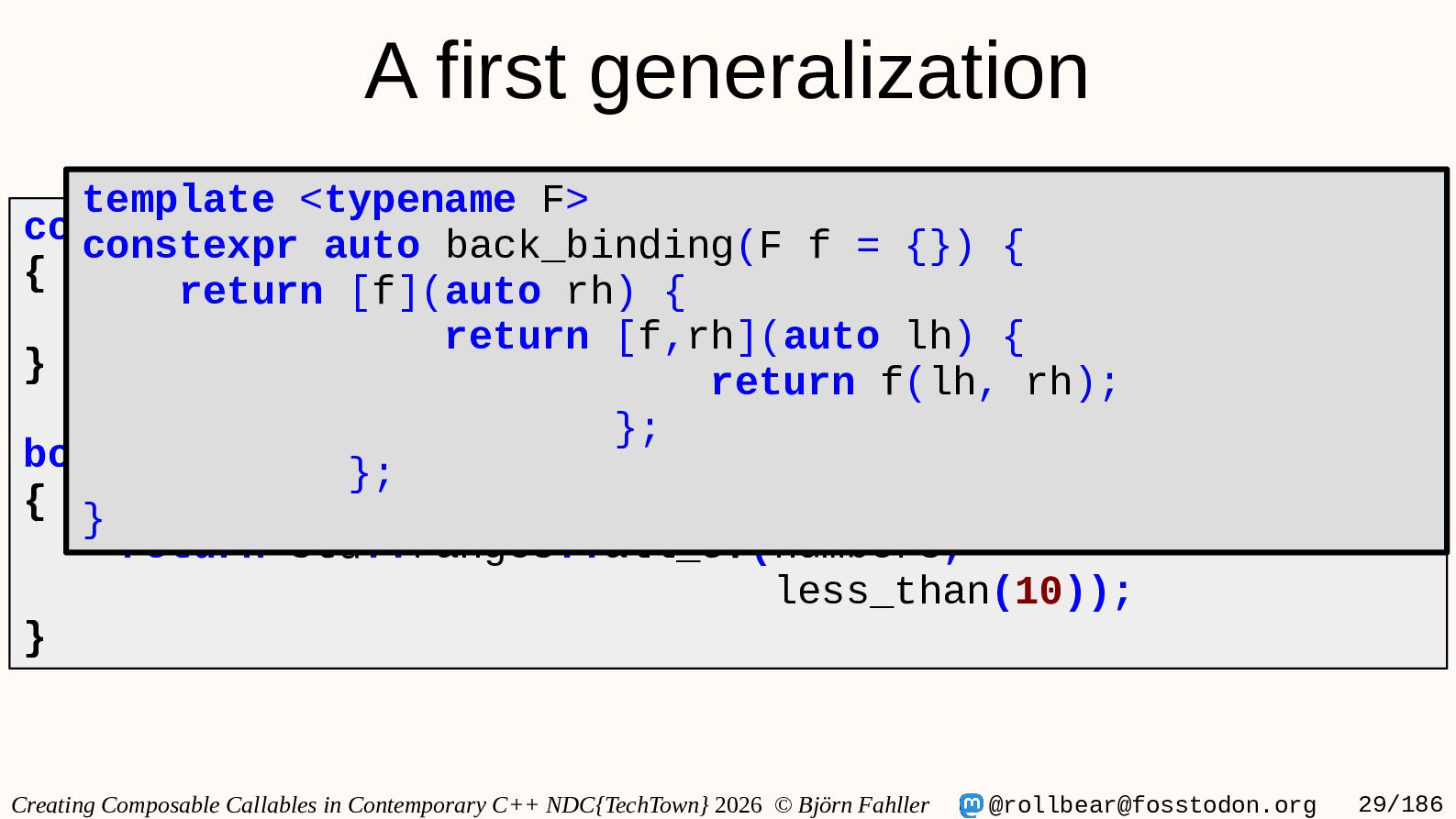
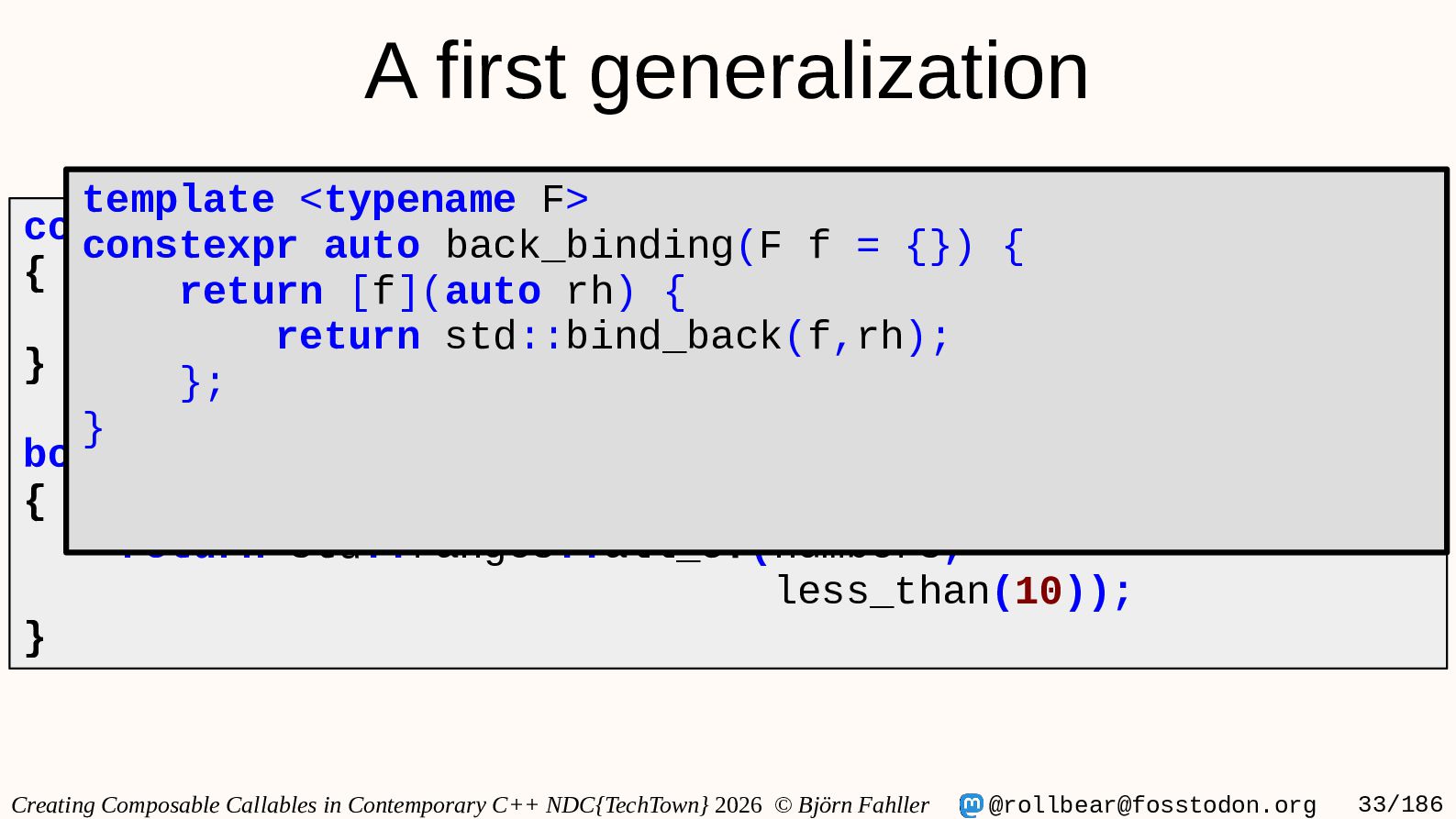
A first generalization template <typename F> constexpr auto less_than(auto rh)f
= {}) { constexpr auto back_binding(F { return [f](auto rh) { return [rh](auto lh){return lh < lh) rh;}; return [f,rh](auto { } return f(lh, rh); }; bool all_are_small(std::span<const int> numbers) }; { } return std::ranges::all_of(numbers, less_than(10)); } Creating Composable Callables in Contemporary C++ NDC{TechTown} 2026 © Björn Fahller @[email protected] 25/186 -
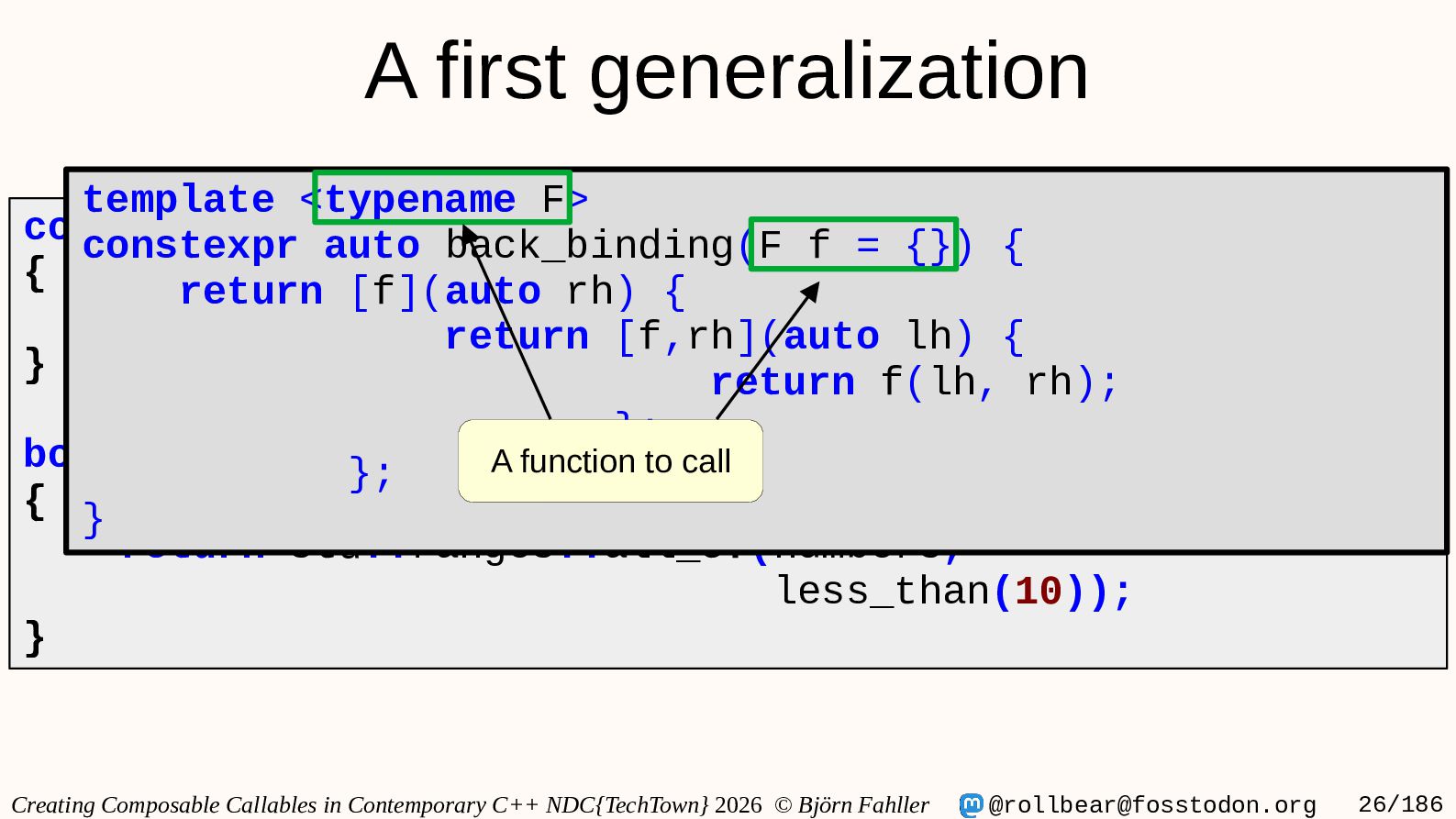
A first generalization template <typename F> constexpr auto less_than(auto rh)f
= {}) { constexpr auto back_binding(F { return [f](auto rh) { return [rh](auto lh){return lh < lh) rh;}; return [f,rh](auto { } return f(lh, rh); }; bool all_are_small(std::span<const int> numbers) A function to call }; { } return std::ranges::all_of(numbers, less_than(10)); } Creating Composable Callables in Contemporary C++ NDC{TechTown} 2026 © Björn Fahller @[email protected] 26/186 -
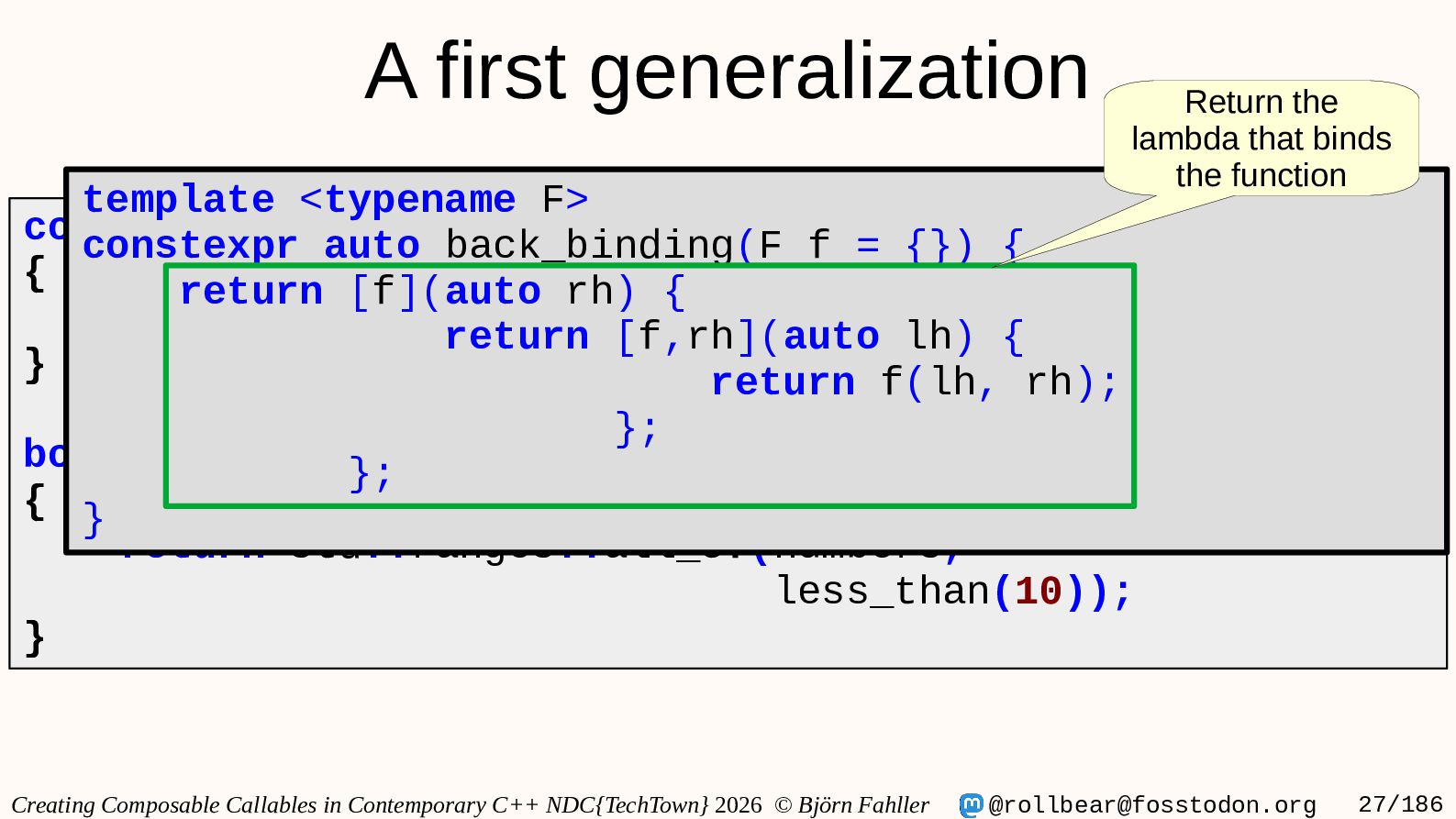
A first generalization Return the lambda that binds the function
template <typename F> constexpr auto less_than(auto rh)f = {}) { constexpr auto back_binding(F { return [f](auto rh) { return [rh](auto lh){return lh < lh) rh;}; return [f,rh](auto { } return f(lh, rh); }; bool all_are_small(std::span<const int> numbers) }; { } return std::ranges::all_of(numbers, less_than(10)); } Creating Composable Callables in Contemporary C++ NDC{TechTown} 2026 © Björn Fahller @[email protected] 27/186 -
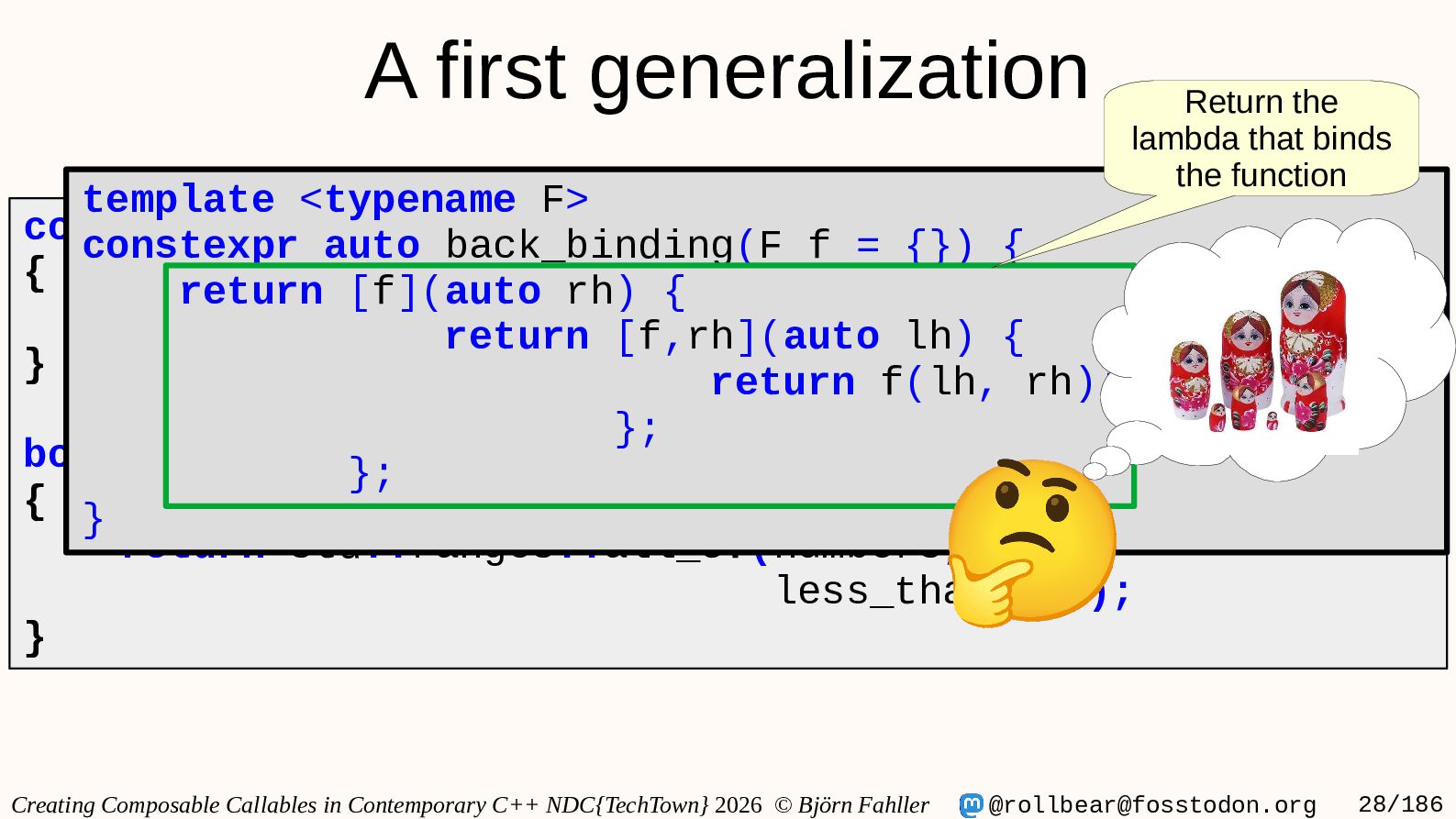
A first generalization Return the lambda that binds the function
template <typename F> constexpr auto less_than(auto rh)f = {}) { constexpr auto back_binding(F { return [f](auto rh) { return [rh](auto lh){return lh < lh) rh;}; return [f,rh](auto { } return f(lh, rh); }; bool all_are_small(std::span<const int> numbers) }; { } return std::ranges::all_of(numbers, less_than(10)); } Creating Composable Callables in Contemporary C++ NDC{TechTown} 2026 © Björn Fahller @[email protected] 28/186 -
A first generalization template <typename F> constexpr auto less_than(auto rh)f
= {}) { constexpr auto back_binding(F { return [f](auto rh) { return [rh](auto lh){return lh < lh) rh;}; return [f,rh](auto { } return f(lh, rh); }; bool all_are_small(std::span<const int> numbers) }; { } return std::ranges::all_of(numbers, less_than(10)); } Creating Composable Callables in Contemporary C++ NDC{TechTown} 2026 © Björn Fahller @[email protected] 29/186 -
A first generalization template <typename F> constexpr auto less_than(auto rh)f
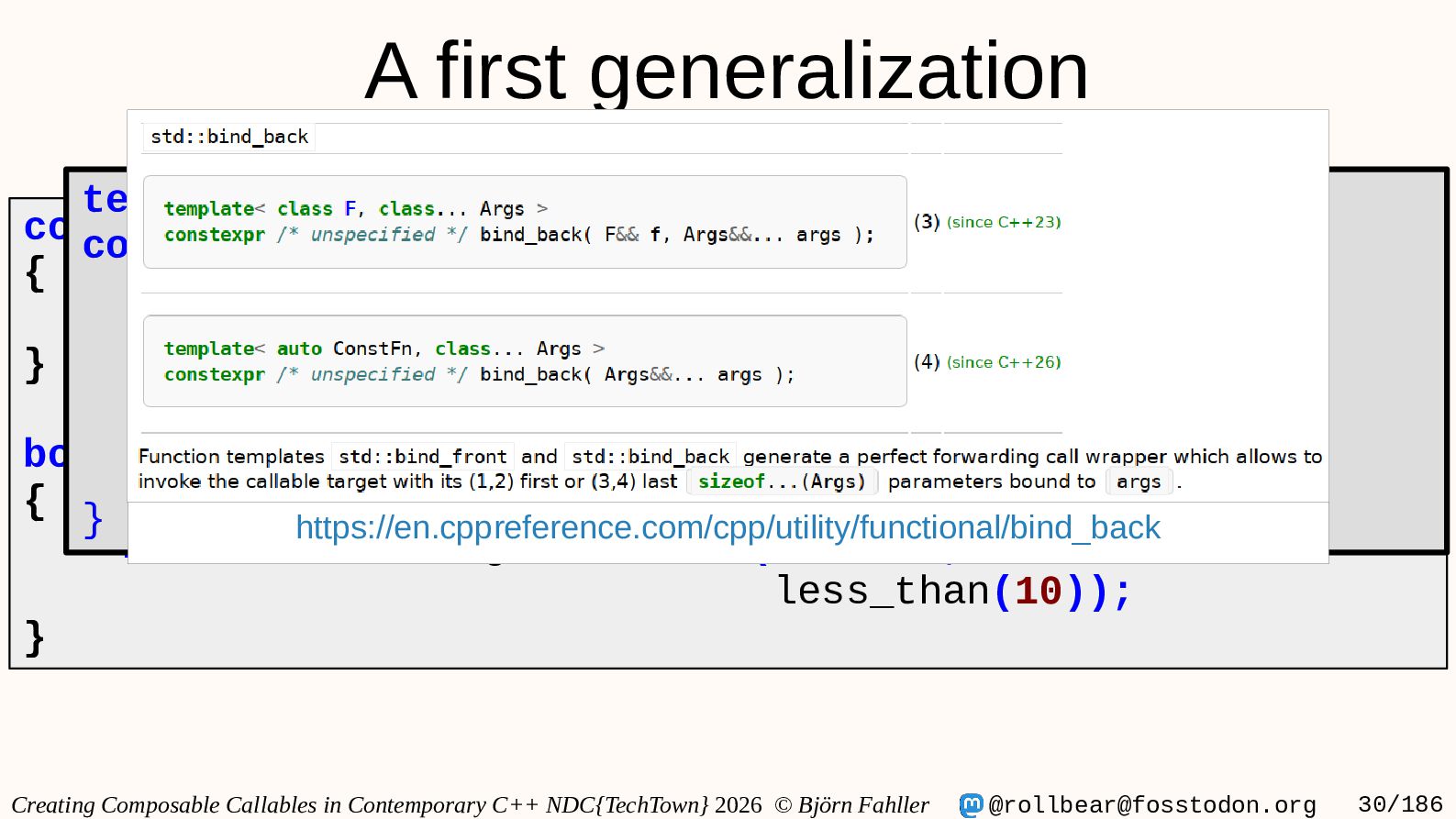
= {}) { constexpr auto back_binding(F { return [f](auto rh) { return [rh](auto lh){return lh < lh) rh;}; return [f,rh](auto { } return f(lh, rh); }; bool all_are_small(std::span<const int> numbers) }; { } https://en.cppreference.com/cpp/utility/functional/bind_back return std::ranges::all_of(numbers, less_than(10)); } Creating Composable Callables in Contemporary C++ NDC{TechTown} 2026 © Björn Fahller @[email protected] 30/186 -
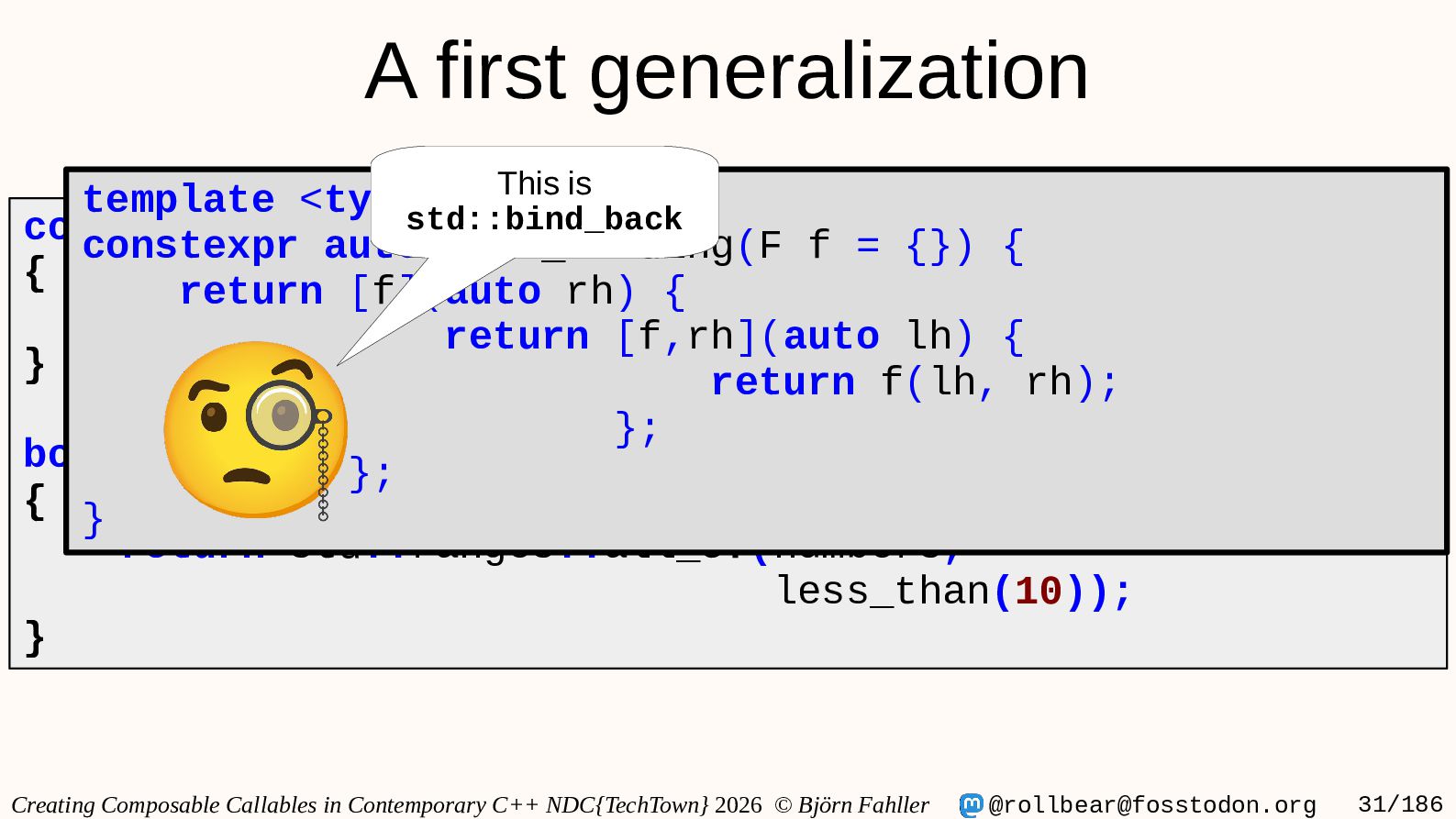
A first generalization This is template <typename F> std::bind_back constexpr
auto less_than(auto rh)f = {}) { constexpr auto back_binding(F { return [f](auto rh) { return [rh](auto lh){return lh < lh) rh;}; return [f,rh](auto { } return f(lh, rh); }; bool all_are_small(std::span<const int> numbers) }; { } return std::ranges::all_of(numbers, less_than(10)); } Creating Composable Callables in Contemporary C++ NDC{TechTown} 2026 © Björn Fahller @[email protected] 31/186 -
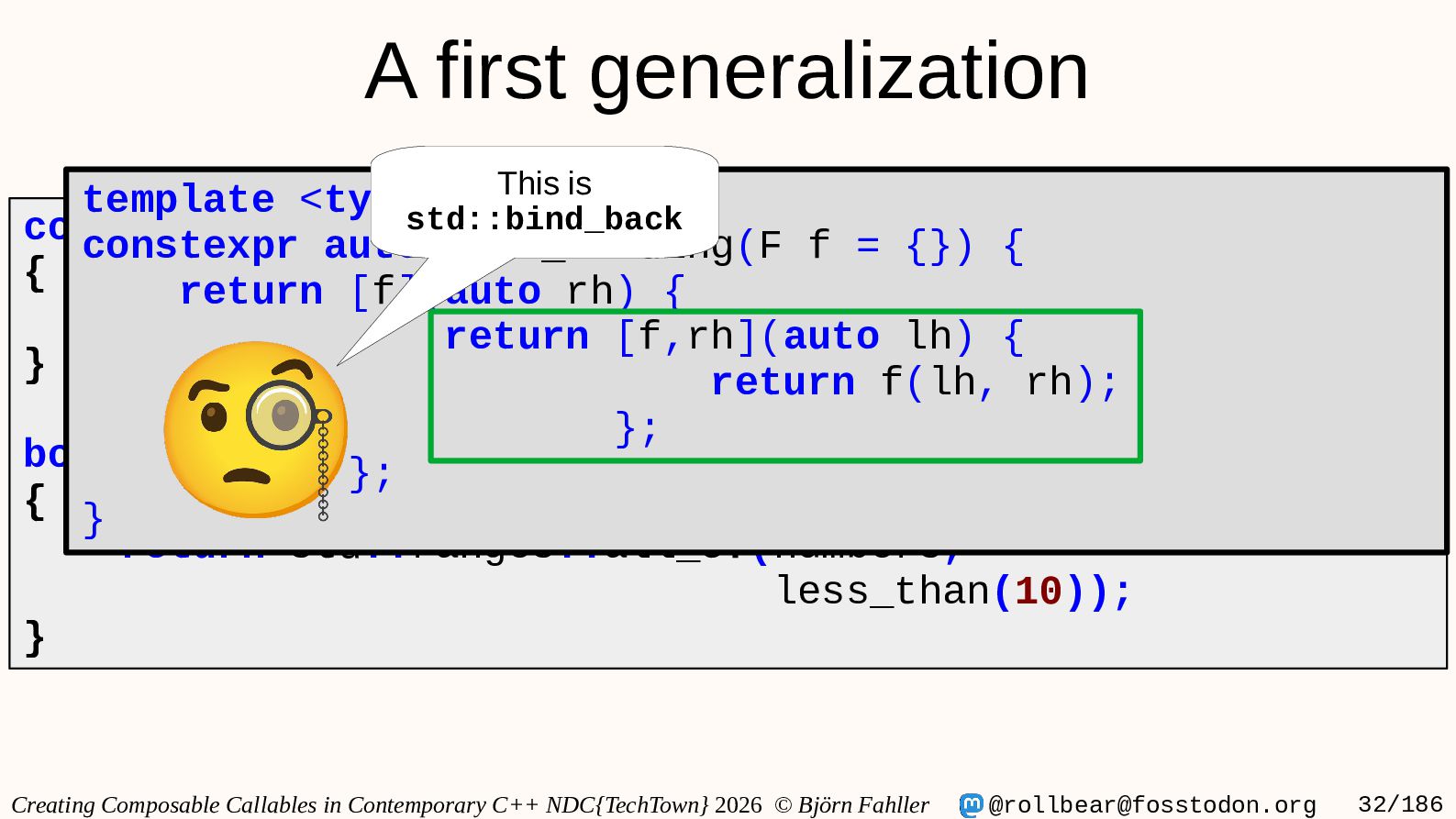
A first generalization This is template <typename F> std::bind_back constexpr
auto less_than(auto rh)f = {}) { constexpr auto back_binding(F { return [f](auto rh) { return [rh](auto lh){return lh < lh) rh;}; return [f,rh](auto { } return f(lh, rh); }; bool all_are_small(std::span<const int> numbers) }; { } return std::ranges::all_of(numbers, less_than(10)); } Creating Composable Callables in Contemporary C++ NDC{TechTown} 2026 © Björn Fahller @[email protected] 32/186 -
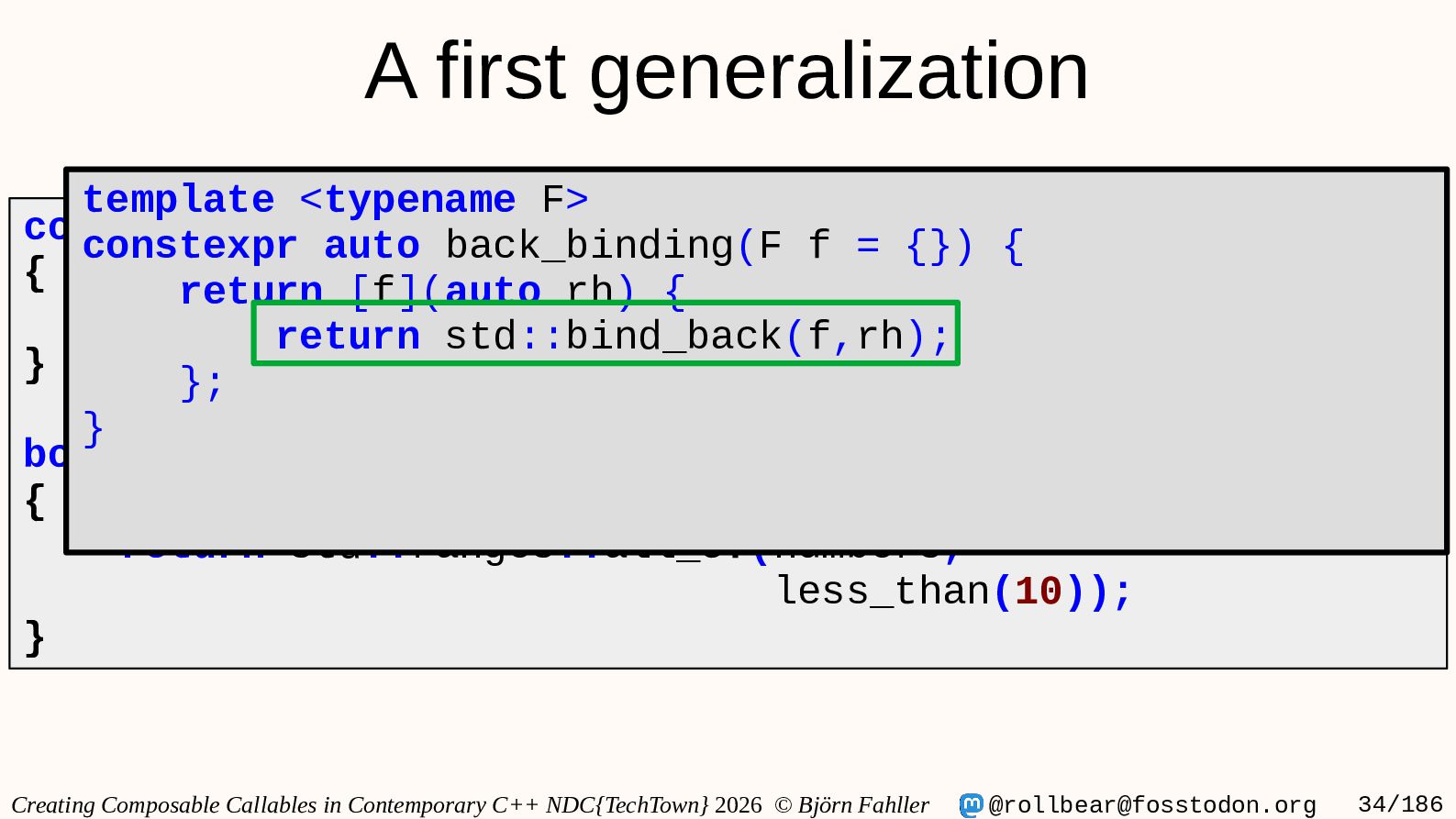
A first generalization template <typename F> constexpr auto less_than(auto rh)f
= {}) { constexpr auto back_binding(F { return [f](auto rh) { return return [rh](auto lh){return lh < rh;}; std::bind_back(f,rh); } }; } bool all_are_small(std::span<const int> numbers) { return std::ranges::all_of(numbers, less_than(10)); } Creating Composable Callables in Contemporary C++ NDC{TechTown} 2026 © Björn Fahller @[email protected] 33/186 -
A first generalization template <typename F> constexpr auto less_than(auto rh)f
= {}) { constexpr auto back_binding(F { return [f](auto rh) { return return [rh](auto lh){return lh < rh;}; std::bind_back(f,rh); } }; } bool all_are_small(std::span<const int> numbers) { return std::ranges::all_of(numbers, less_than(10)); } Creating Composable Callables in Contemporary C++ NDC{TechTown} 2026 © Björn Fahller @[email protected] 34/186 -
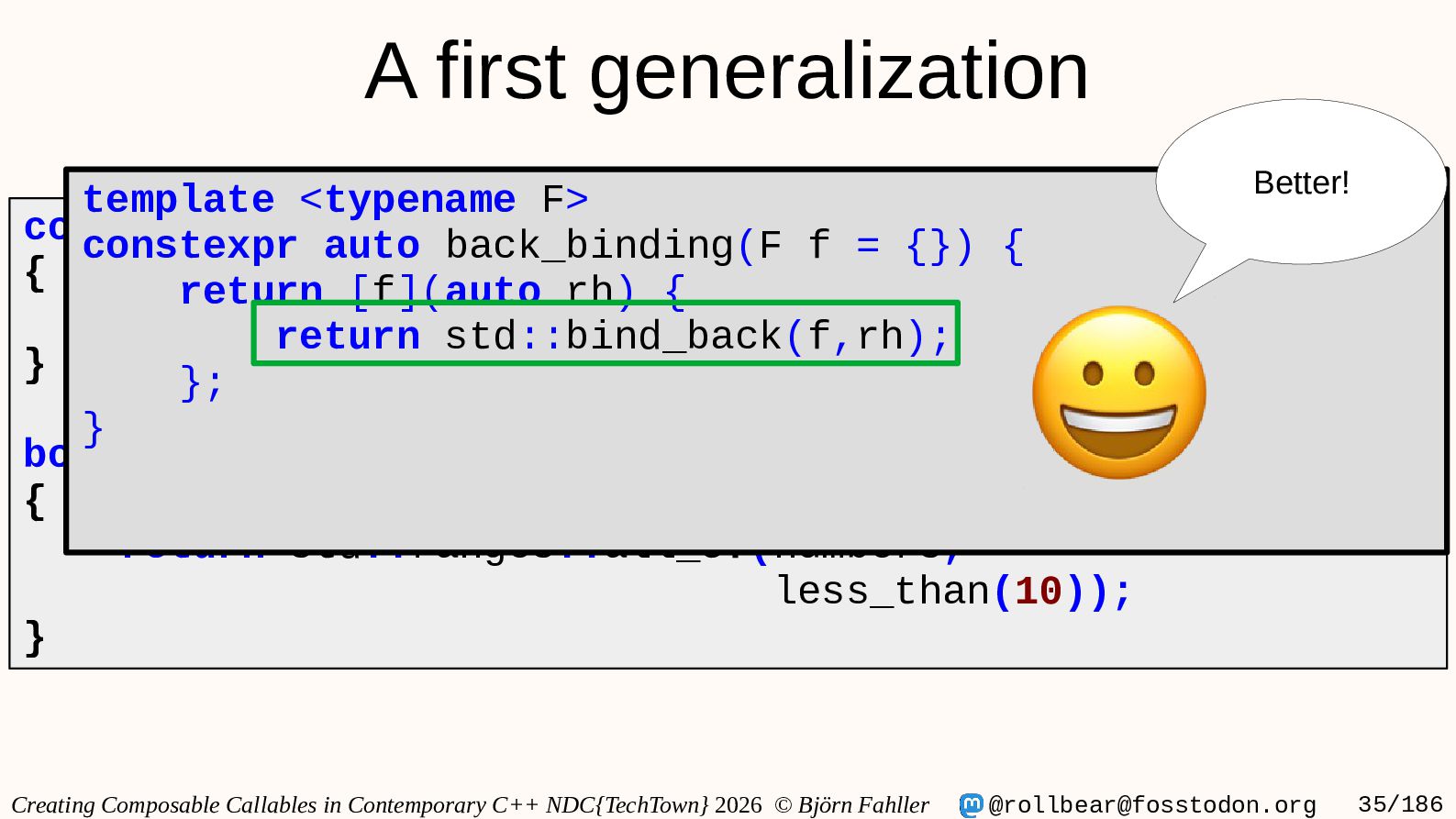
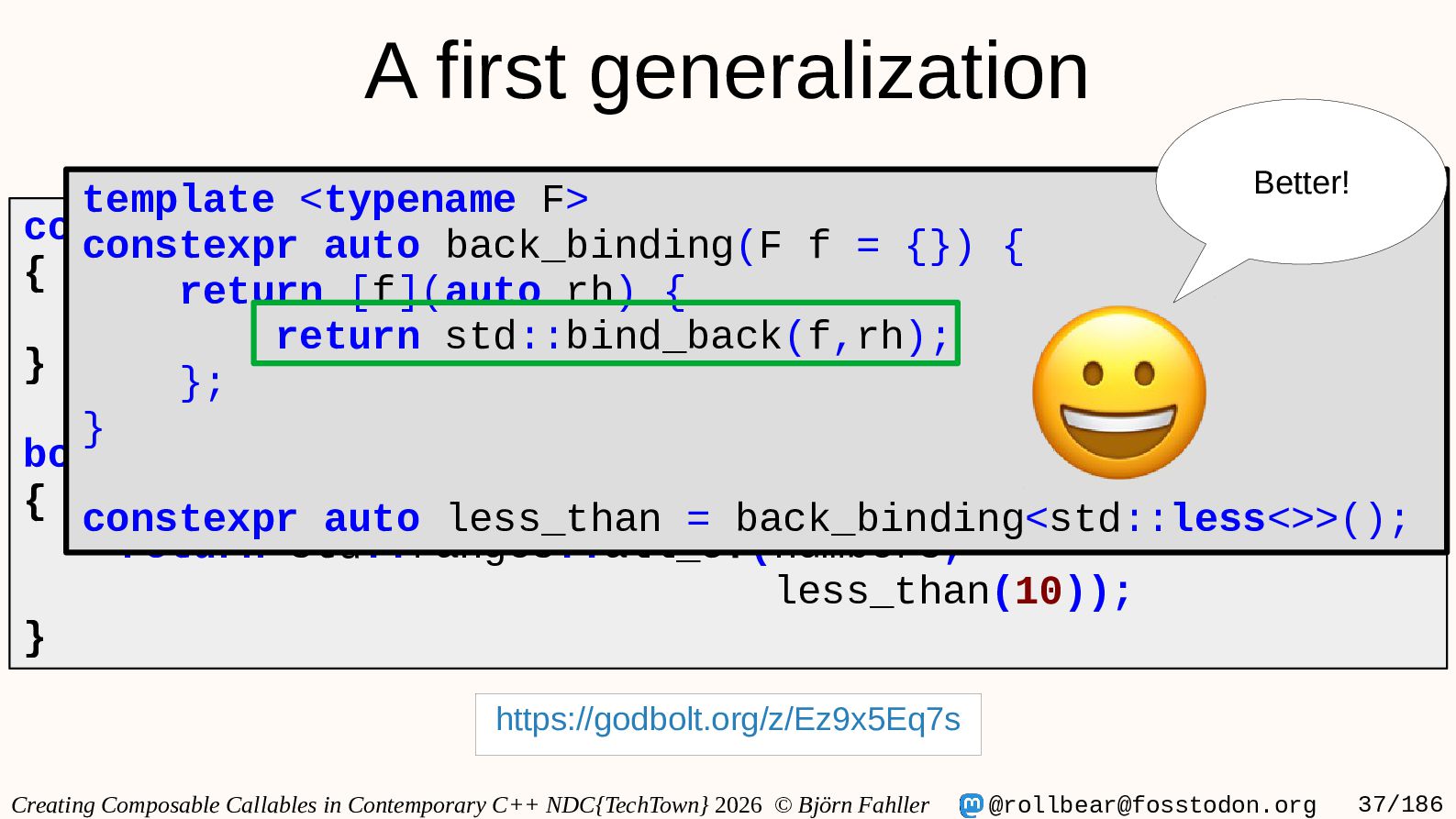
A first generalization template <typename F> constexpr auto less_than(auto rh)f
= {}) { constexpr auto back_binding(F { return [f](auto rh) { return return [rh](auto lh){return lh < rh;}; std::bind_back(f,rh); } }; } bool all_are_small(std::span<const int> numbers) { return std::ranges::all_of(numbers, less_than(10)); } Creating Composable Callables in Contemporary C++ NDC{TechTown} 2026 © Björn Fahller Better! @[email protected] 35/186 -
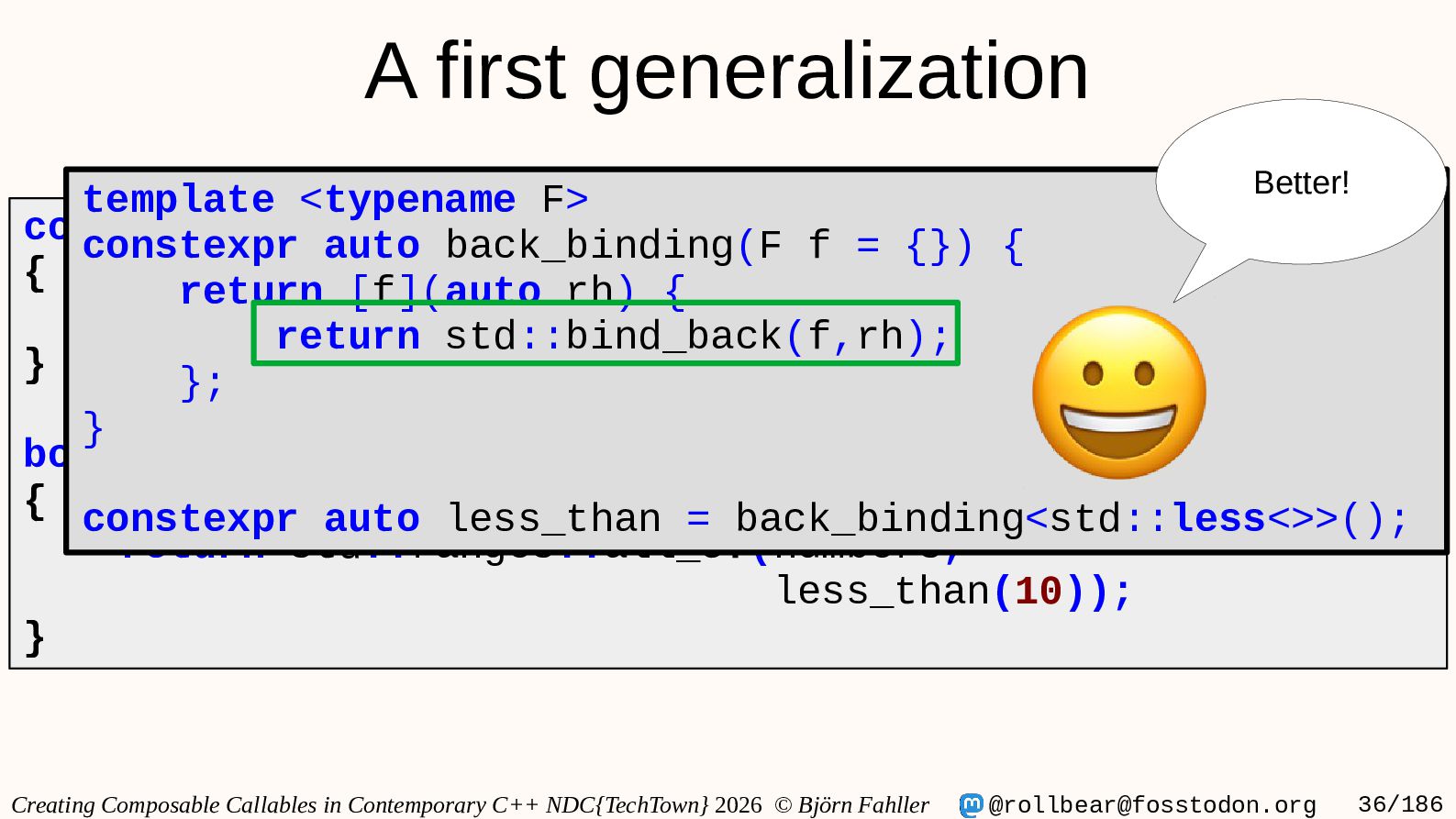
A first generalization Better! template <typename F> constexpr auto less_than(auto
rh)f = {}) { constexpr auto back_binding(F { return [f](auto rh) { return return [rh](auto lh){return lh < rh;}; std::bind_back(f,rh); } }; } bool all_are_small(std::span<const int> numbers) { constexpr auto less_than = back_binding<std::less<>>(); return std::ranges::all_of(numbers, less_than(10)); } Creating Composable Callables in Contemporary C++ NDC{TechTown} 2026 © Björn Fahller @[email protected] 36/186 -
A first generalization Better! template <typename F> constexpr auto less_than(auto
rh)f = {}) { constexpr auto back_binding(F { return [f](auto rh) { return return [rh](auto lh){return lh < rh;}; std::bind_back(f,rh); } }; } bool all_are_small(std::span<const int> numbers) { constexpr auto less_than = back_binding<std::less<>>(); return std::ranges::all_of(numbers, less_than(10)); } https://godbolt.org/z/Ez9x5Eq7s Creating Composable Callables in Contemporary C++ NDC{TechTown} 2026 © Björn Fahller @[email protected] 37/186 -
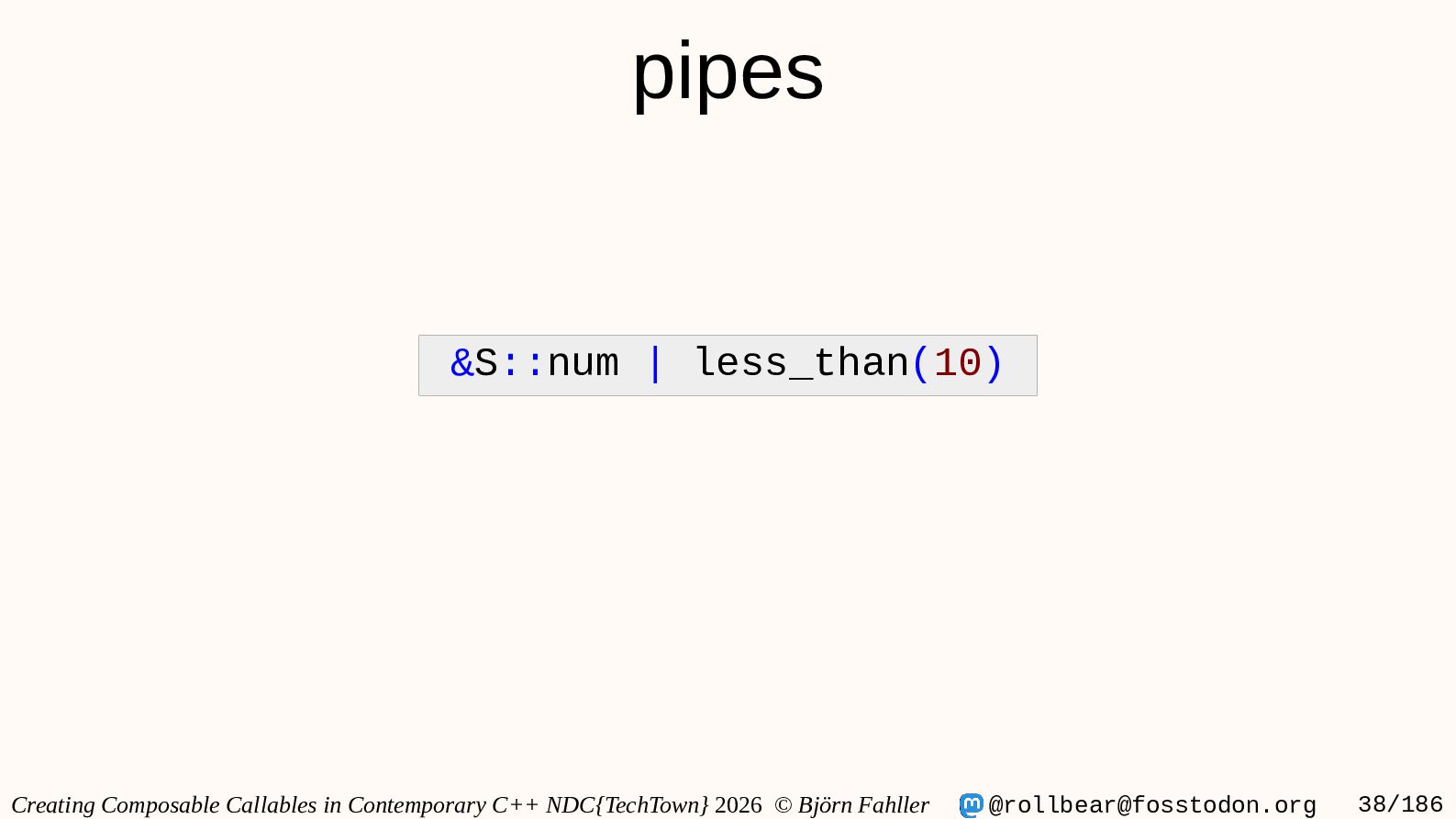
pipes &S::num | less_than(10) Creating Composable Callables in Contemporary C++
NDC{TechTown} 2026 © Björn Fahller @[email protected] 38/186 -
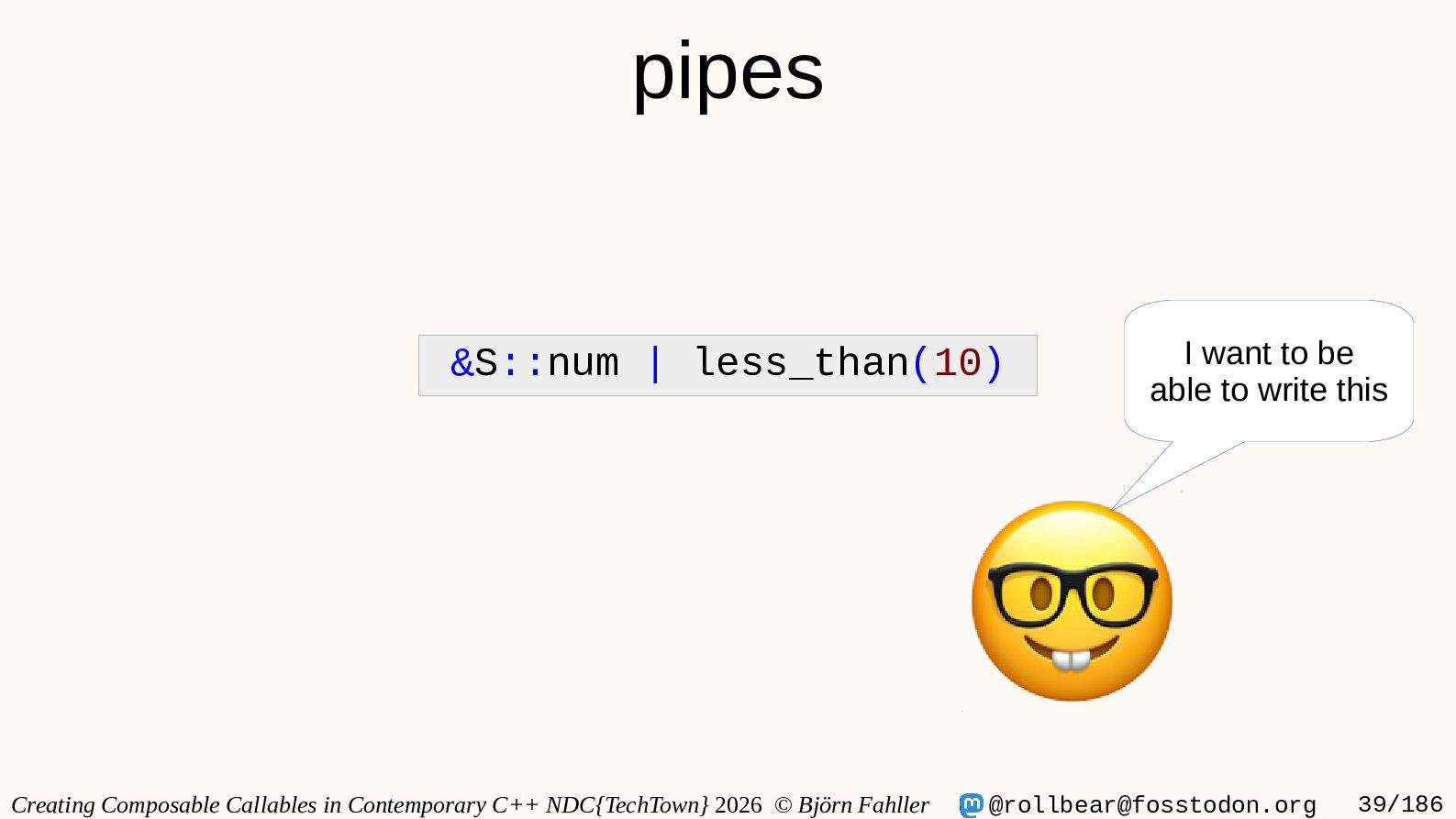
pipes &S::num | less_than(10) Creating Composable Callables in Contemporary C++
NDC{TechTown} 2026 © Björn Fahller I want to be able to write this @[email protected] 39/186 -
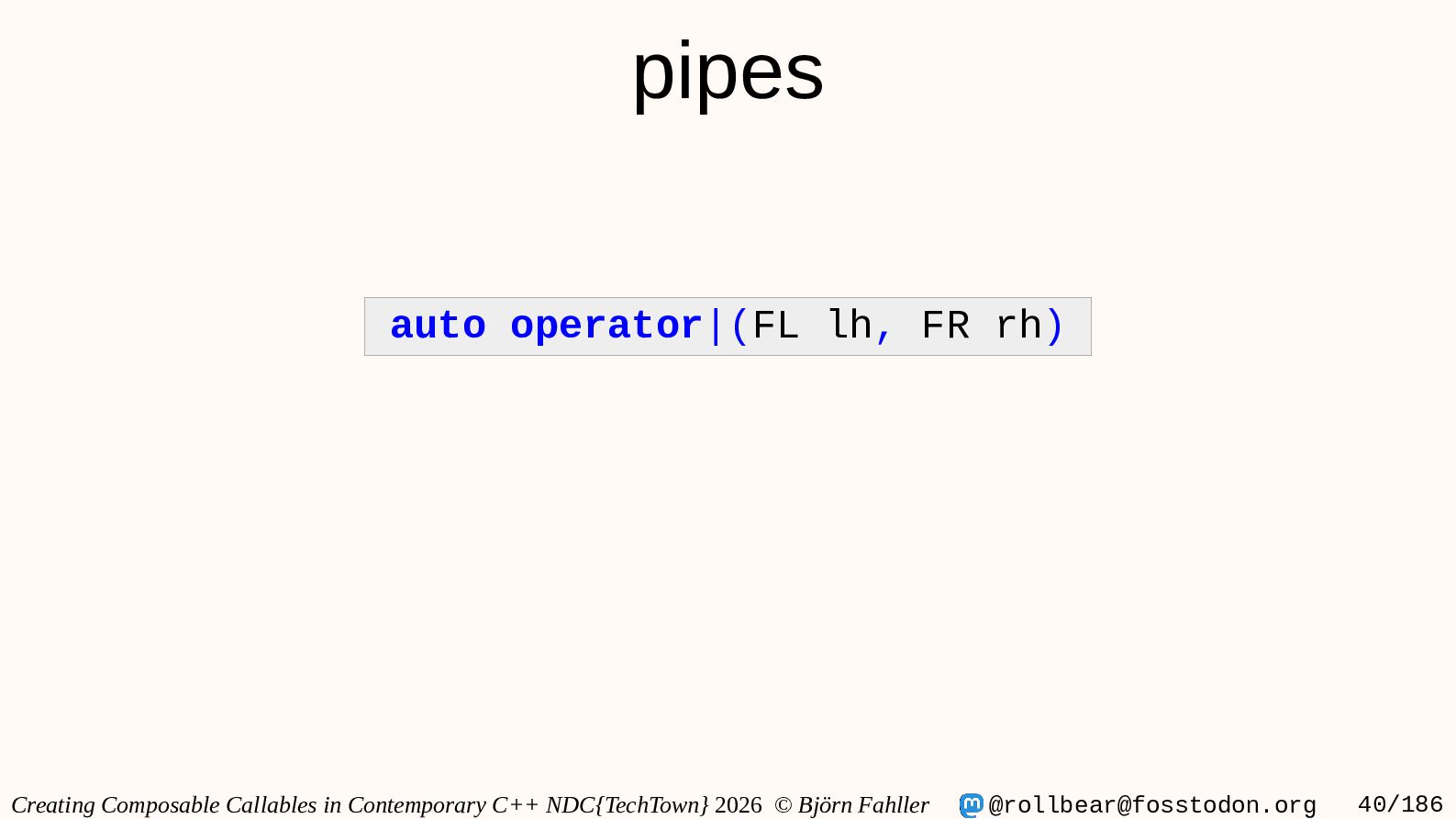
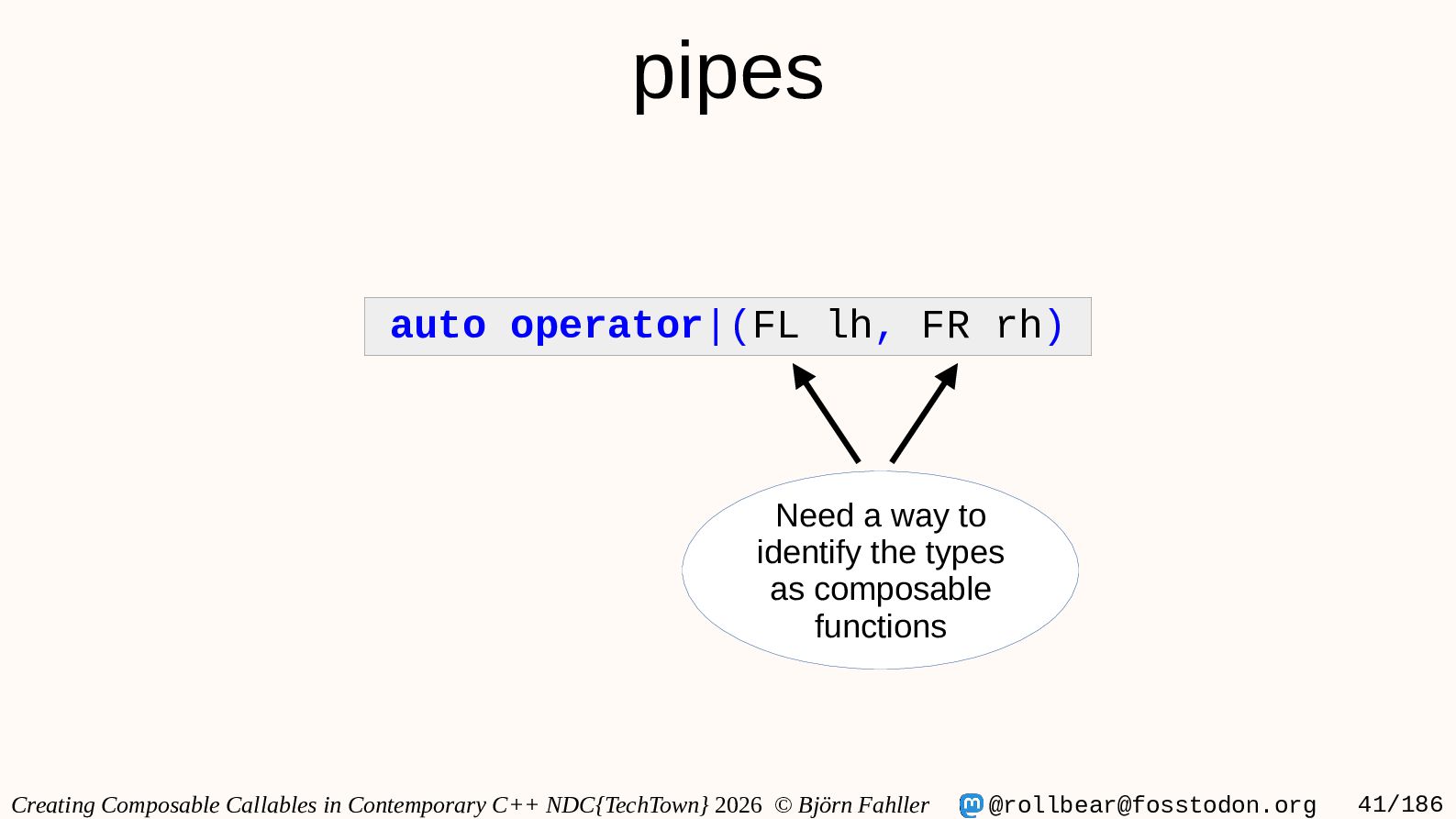
pipes auto operator|(FL lh, FR rh) Creating Composable Callables in
Contemporary C++ NDC{TechTown} 2026 © Björn Fahller @[email protected] 40/186 -
pipes auto operator|(FL lh, FR rh) Need a way to
identify the types as composable functions Creating Composable Callables in Contemporary C++ NDC{TechTown} 2026 © Björn Fahller @[email protected] 41/186 -
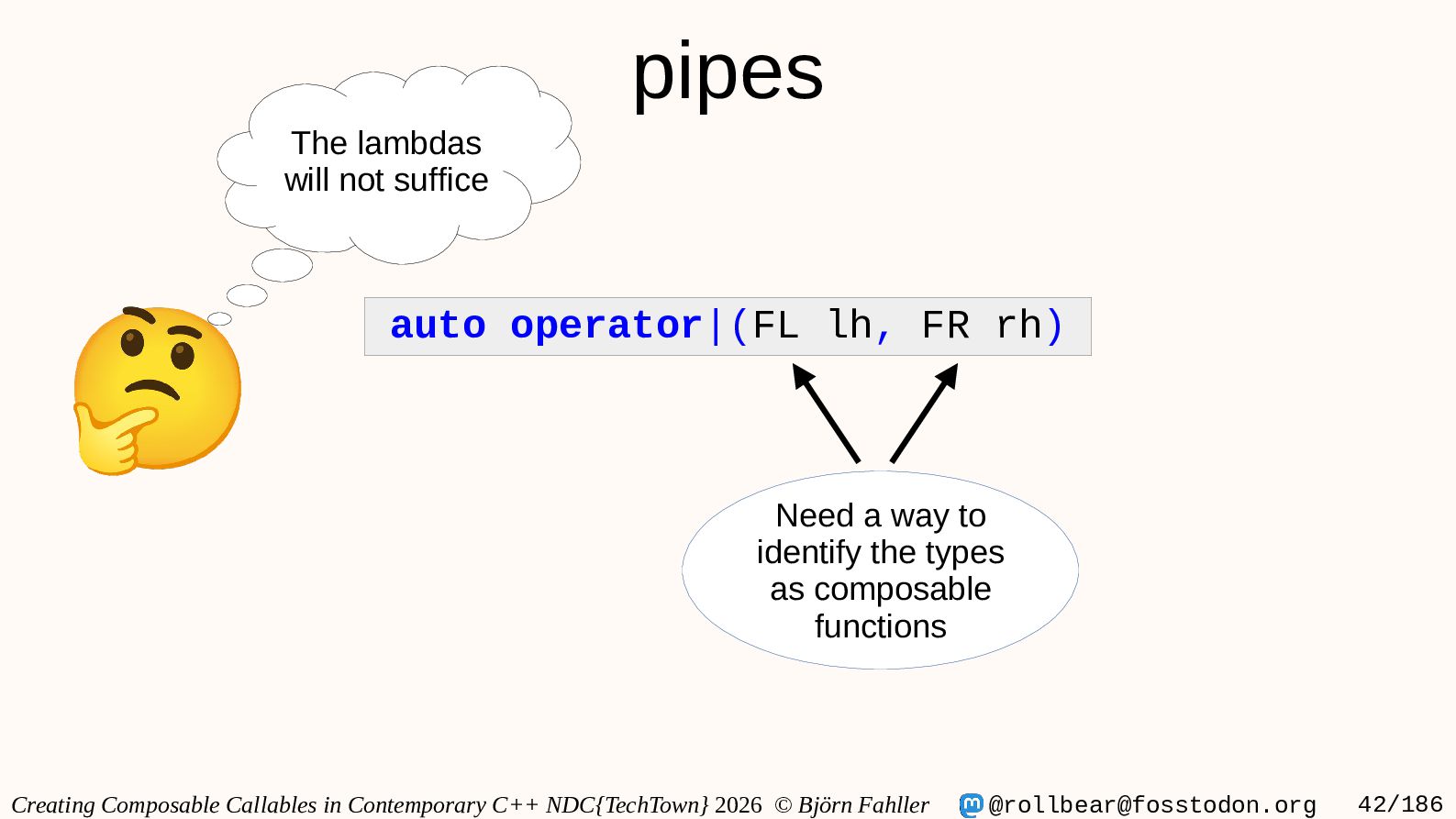
pipes The lambdas will not suffice auto operator|(FL lh, FR
rh) Need a way to identify the types as composable functions Creating Composable Callables in Contemporary C++ NDC{TechTown} 2026 © Björn Fahller @[email protected] 42/186 -
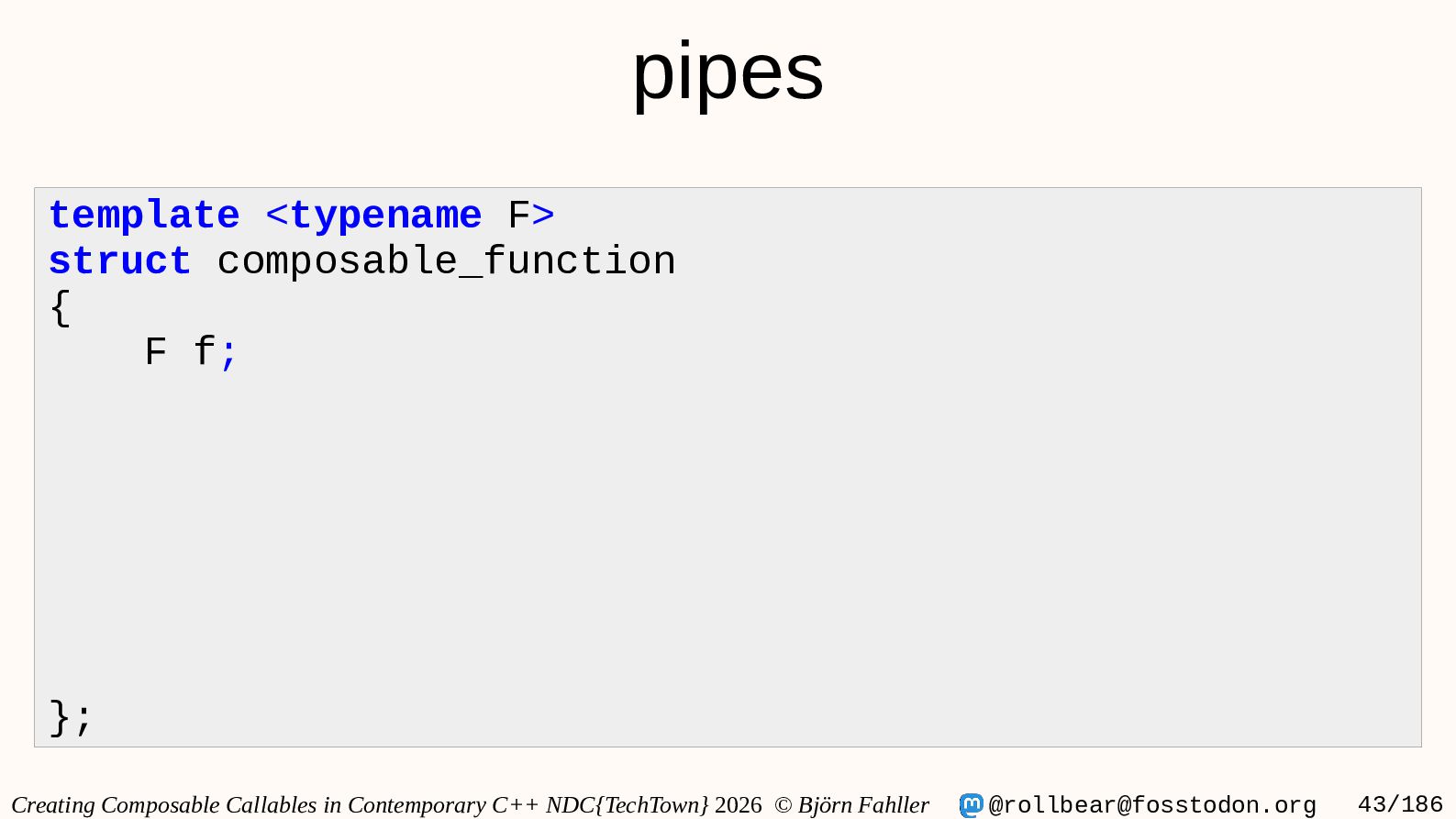
pipes template <typename F> struct composable_function { F f; };
Creating Composable Callables in Contemporary C++ NDC{TechTown} 2026 © Björn Fahller @[email protected] 43/186 -
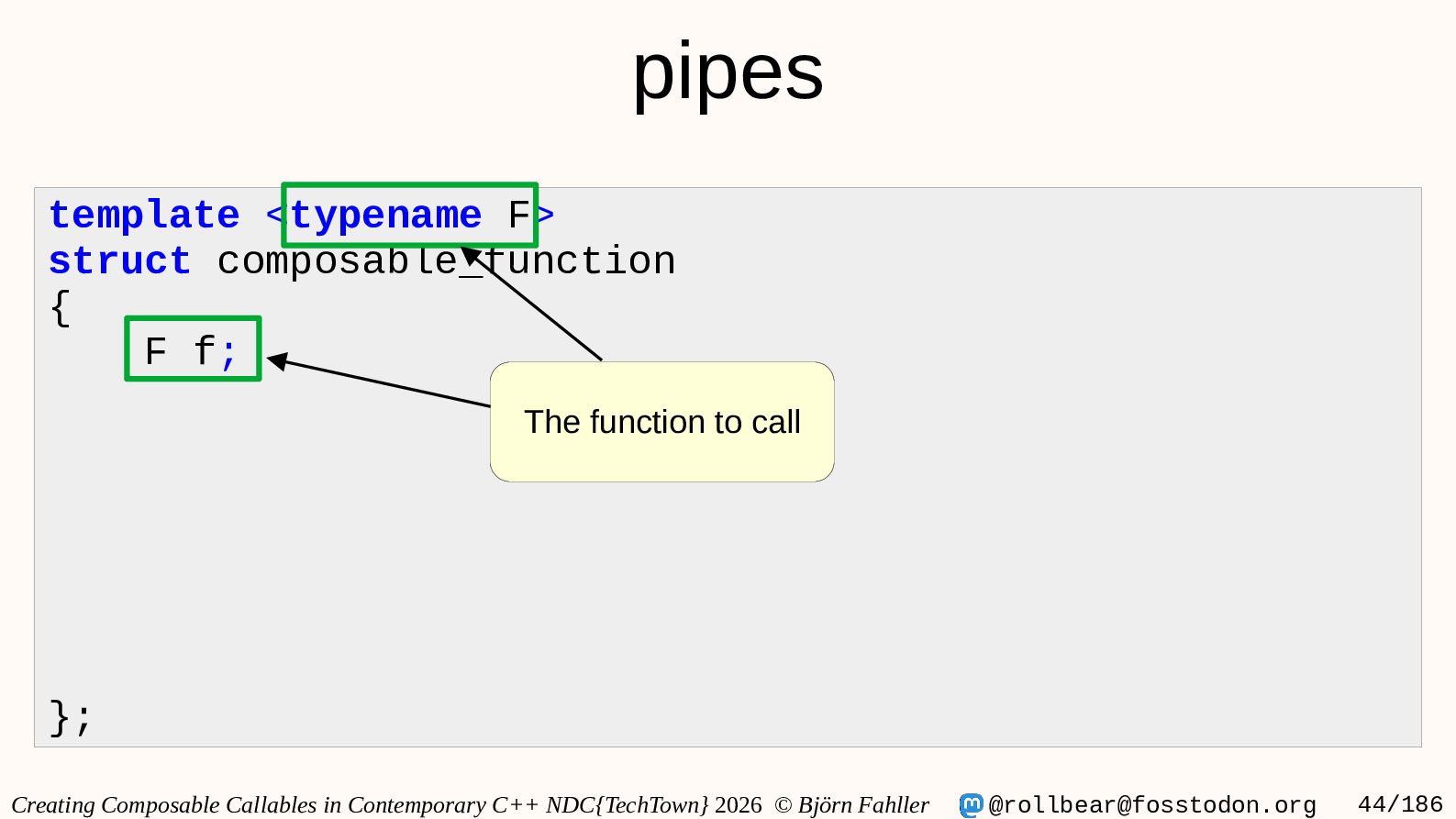
pipes template <typename F> struct composable_function { F f; The
function to call }; Creating Composable Callables in Contemporary C++ NDC{TechTown} 2026 © Björn Fahller @[email protected] 44/186 -
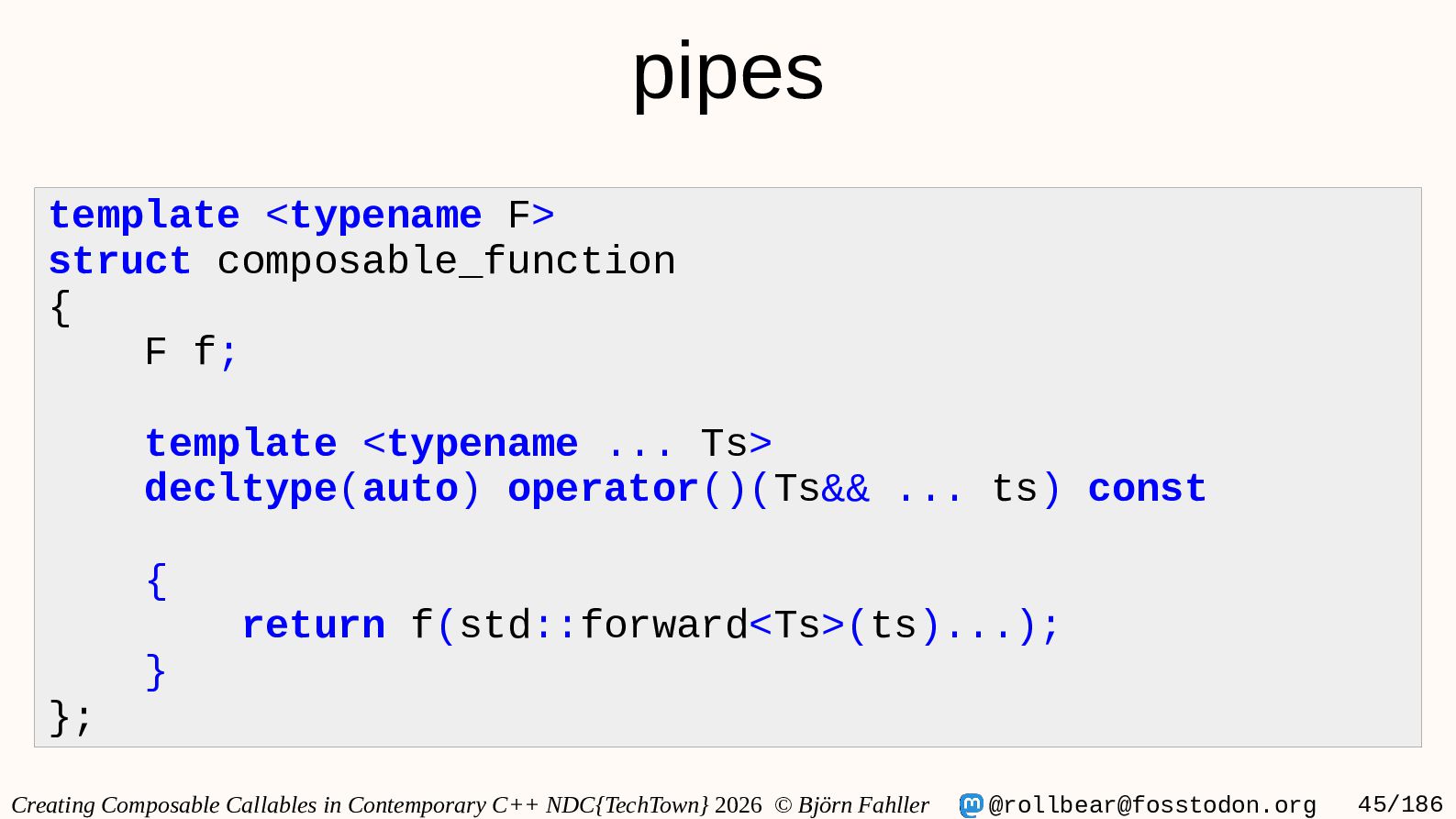
pipes template <typename F> struct composable_function { F f; template
<typename ... Ts> decltype(auto) operator()(Ts&& ... ts) const { }; } return f(std::forward<Ts>(ts)...); Creating Composable Callables in Contemporary C++ NDC{TechTown} 2026 © Björn Fahller @[email protected] 45/186 -
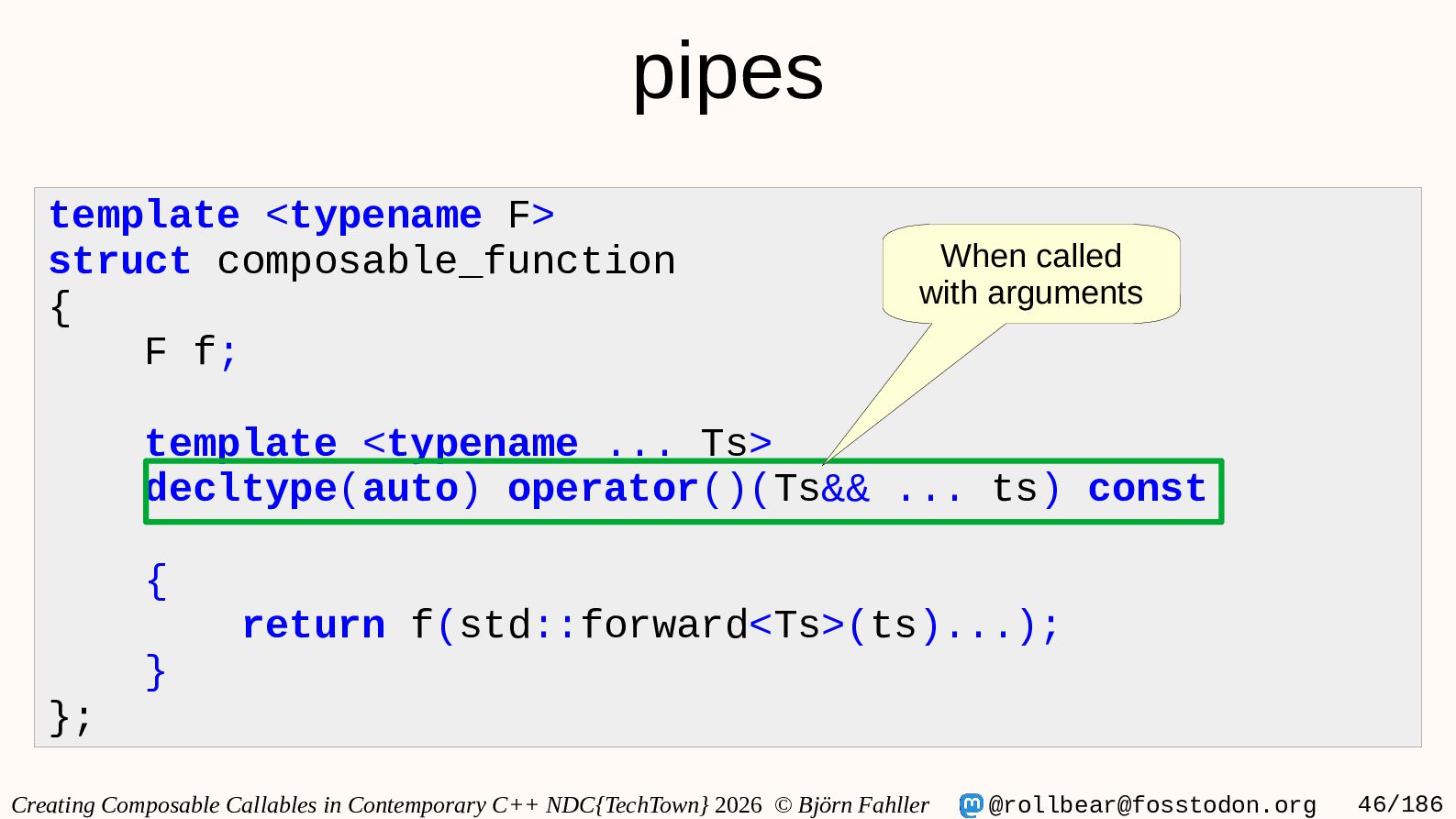
pipes template <typename F> struct composable_function { F f; When
called with arguments template <typename ... Ts> decltype(auto) operator()(Ts&& ... ts) const { }; } return f(std::forward<Ts>(ts)...); Creating Composable Callables in Contemporary C++ NDC{TechTown} 2026 © Björn Fahller @[email protected] 46/186 -
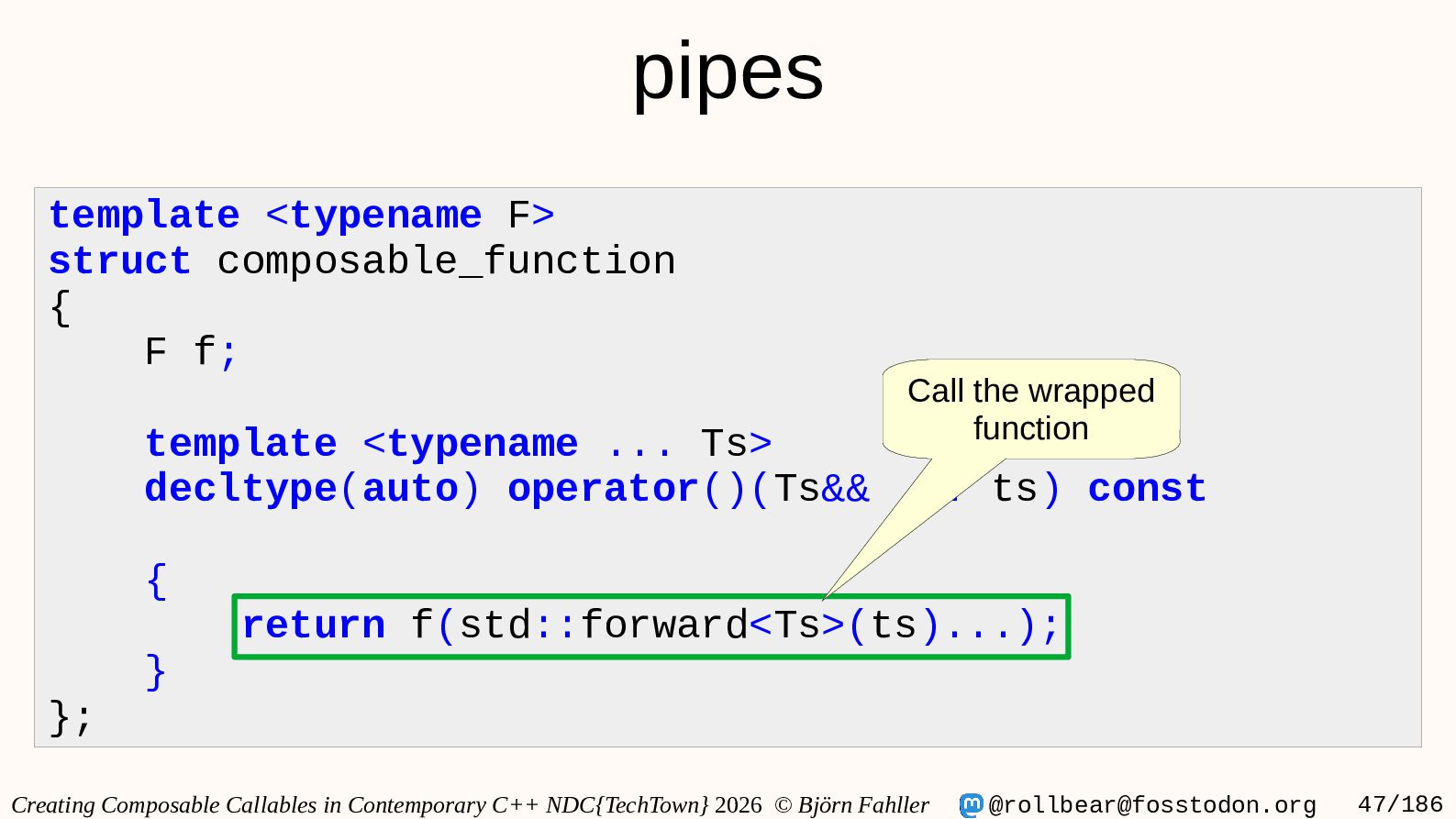
pipes template <typename F> struct composable_function { F f; Call
the wrapped function template <typename ... Ts> decltype(auto) operator()(Ts&& ... ts) const { }; } return f(std::forward<Ts>(ts)...); Creating Composable Callables in Contemporary C++ NDC{TechTown} 2026 © Björn Fahller @[email protected] 47/186 -
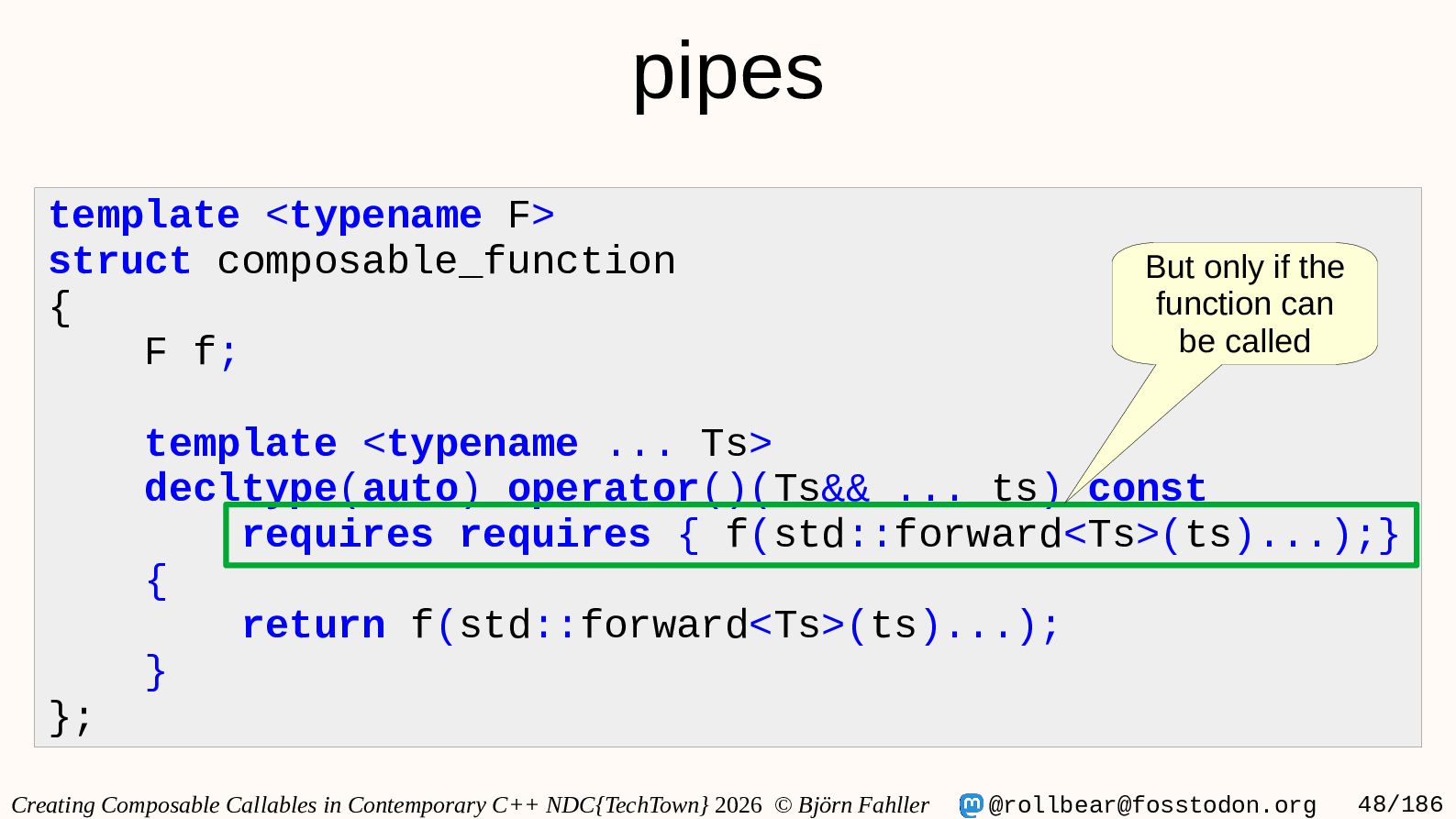
pipes template <typename F> struct composable_function { F f; };
But only if the function can be called template <typename ... Ts> decltype(auto) operator()(Ts&& ... ts) const requires requires { f(std::forward<Ts>(ts)...);} { return f(std::forward<Ts>(ts)...); } Creating Composable Callables in Contemporary C++ NDC{TechTown} 2026 © Björn Fahller @[email protected] 48/186 -
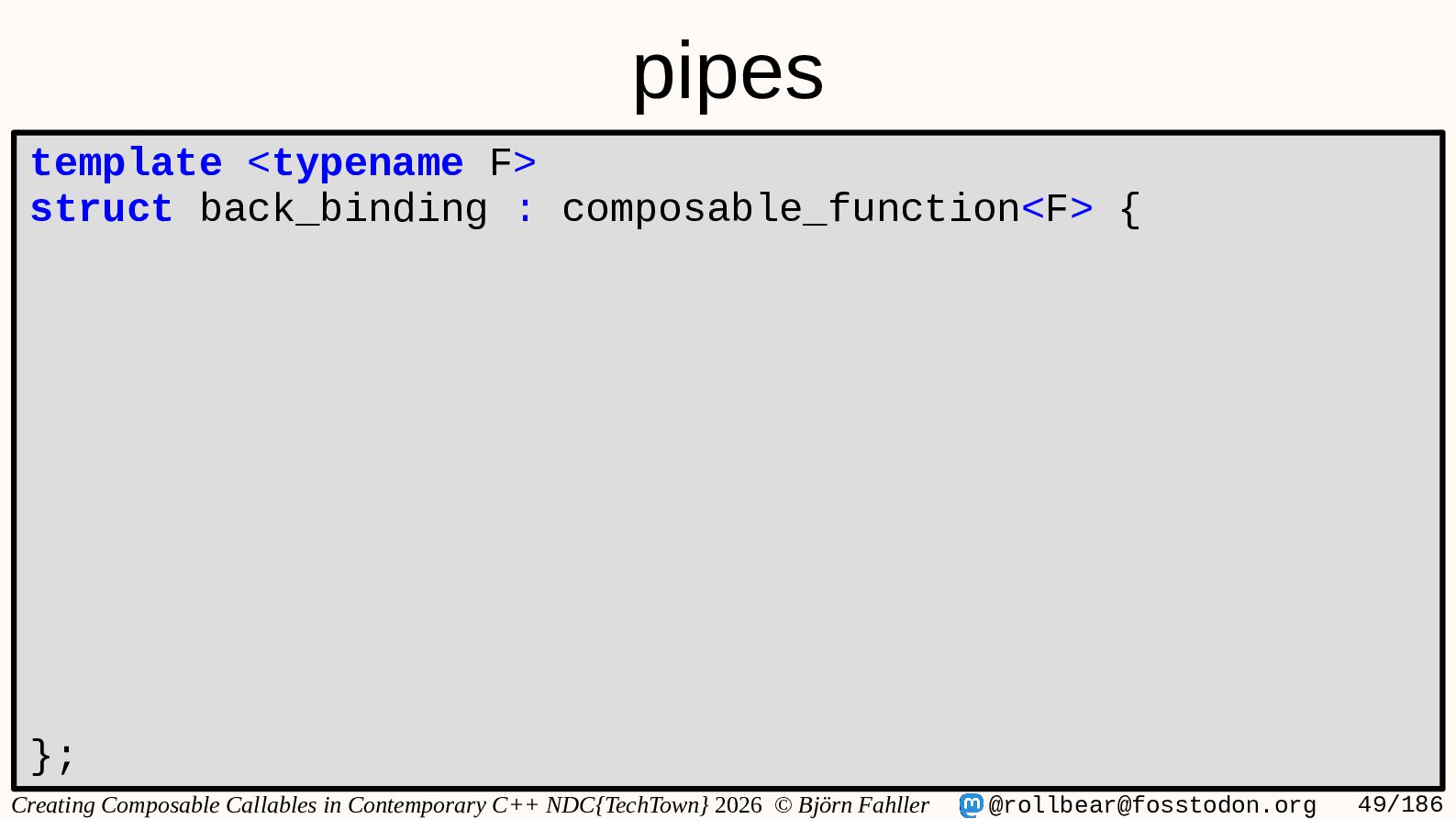
pipes template <typename F> struct back_binding : composable_function<F> { template
<typename F> struct composable_function { F f; }; }; template <typename ... Ts> decltype(auto) operator()(Ts&& ... ts) const requires requires { f(std::forward<Ts>(ts)...);} { return f(std::forward<Ts>(ts)...); } Creating Composable Callables in Contemporary C++ NDC{TechTown} 2026 © Björn Fahller @[email protected] 49/186 -
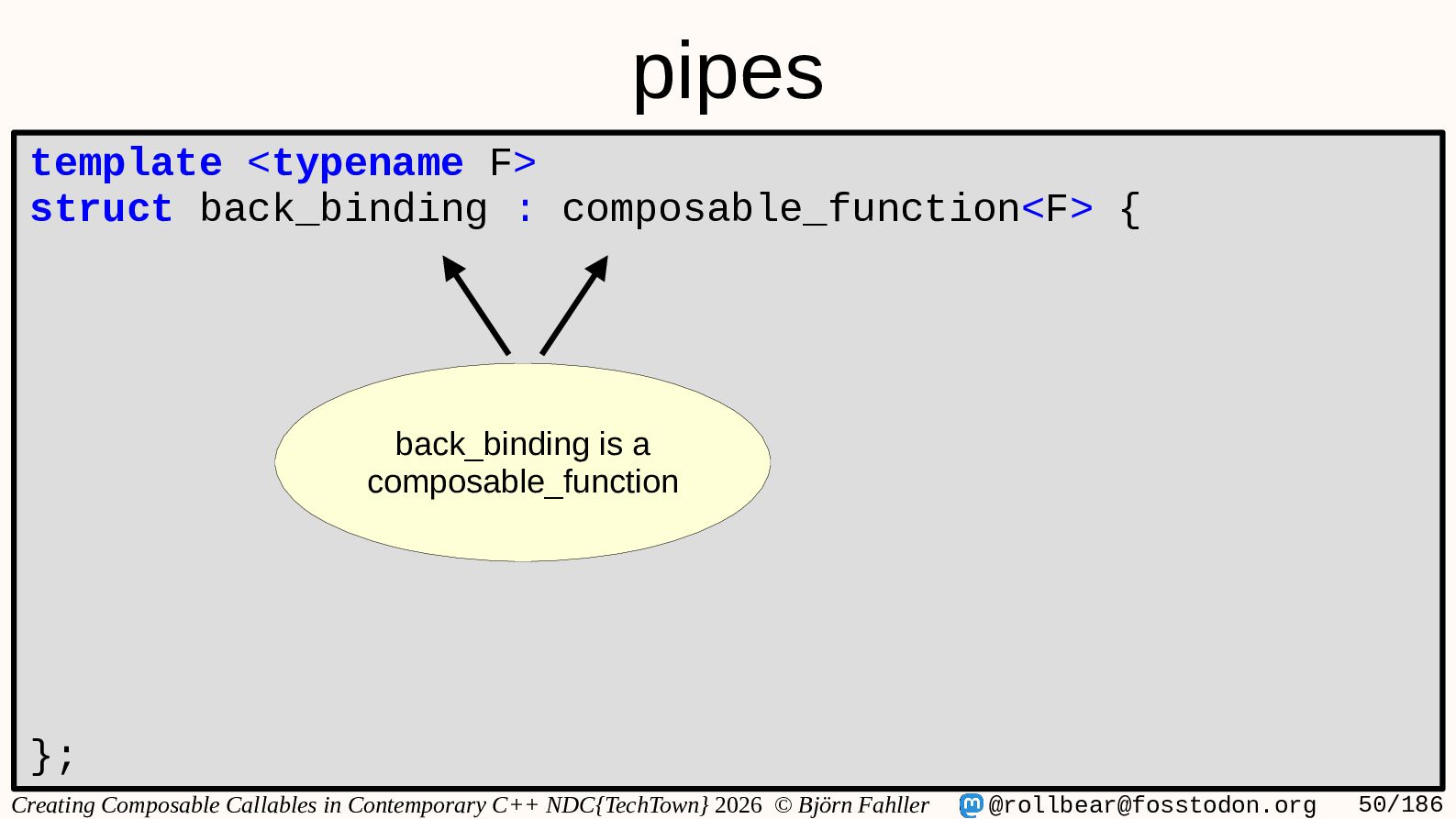
pipes template <typename F> struct back_binding : composable_function<F> { template
<typename F> struct composable_function { F f; }; }; back_binding is a template <typename ... Ts> composable_function decltype(auto) operator()(Ts&& ... ts) const requires requires { f(std::forward<Ts>(ts)...);} { return f(std::forward<Ts>(ts)...); } Creating Composable Callables in Contemporary C++ NDC{TechTown} 2026 © Björn Fahller @[email protected] 50/186 -
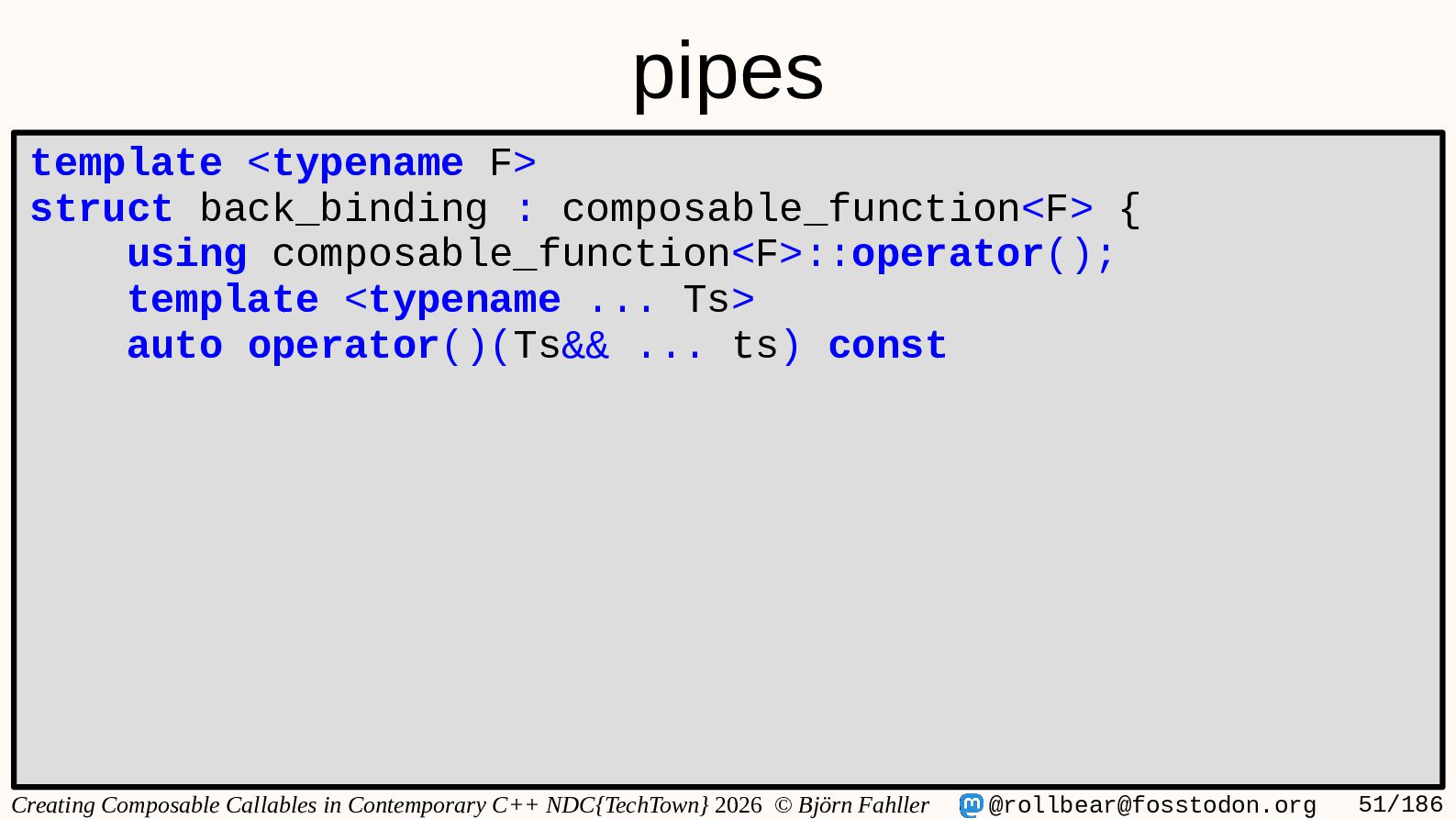
pipes template <typename F> struct back_binding : composable_function<F> { template
<typename F> using composable_function<F>::operator(); struct composable_function { template <typename ... Ts> auto F f; operator()(Ts&& ... ts) const }; template <typename ... Ts> decltype(auto) operator()(Ts&& ... ts) const requires requires { f(std::forward<Ts>(ts)...);} { return f(std::forward<Ts>(ts)...); } Creating Composable Callables in Contemporary C++ NDC{TechTown} 2026 © Björn Fahller @[email protected] 51/186 -
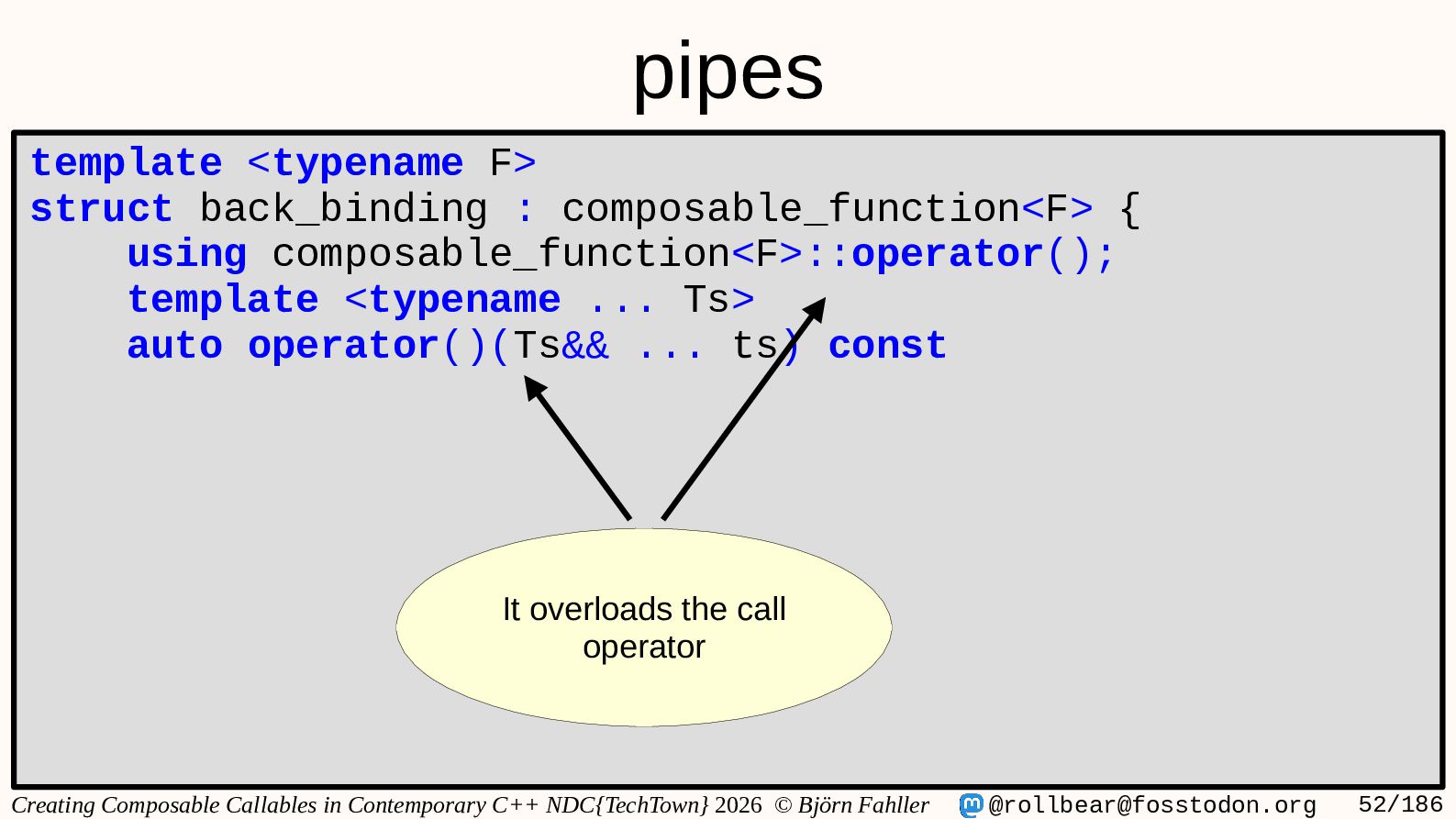
pipes template <typename F> struct back_binding : composable_function<F> { template
<typename F> using composable_function<F>::operator(); struct composable_function { template <typename ... Ts> auto F f; operator()(Ts&& ... ts) const }; template <typename ... Ts> decltype(auto) operator()(Ts&& ... ts) const requires requires { f(std::forward<Ts>(ts)...);} { It overloads the call return f(std::forward<Ts>(ts)...); operator } Creating Composable Callables in Contemporary C++ NDC{TechTown} 2026 © Björn Fahller @[email protected] 52/186 -
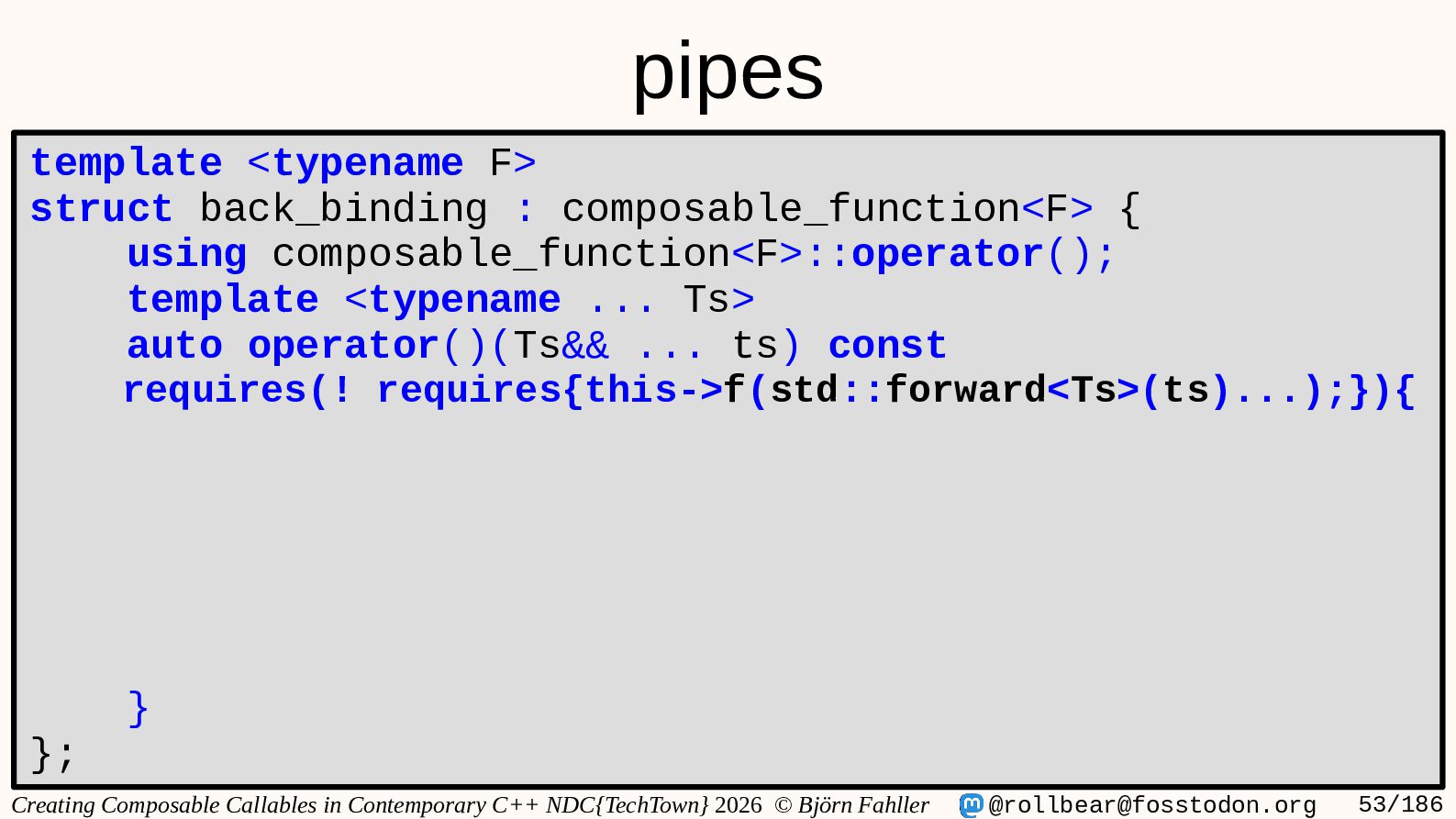
pipes template <typename F> struct back_binding : composable_function<F> { template
<typename F> using composable_function<F>::operator(); struct composable_function { template <typename ... Ts> auto F f; operator()(Ts&& ... ts) const requires(! requires{this->f(std::forward<Ts>(ts)...);}){ template <typename ... Ts> decltype(auto) operator()(Ts&& ... ts) const requires requires { f(std::forward<Ts>(ts)...);} { return f(std::forward<Ts>(ts)...); } }; } }; Creating Composable Callables in Contemporary C++ NDC{TechTown} 2026 © Björn Fahller @[email protected] 53/186 -
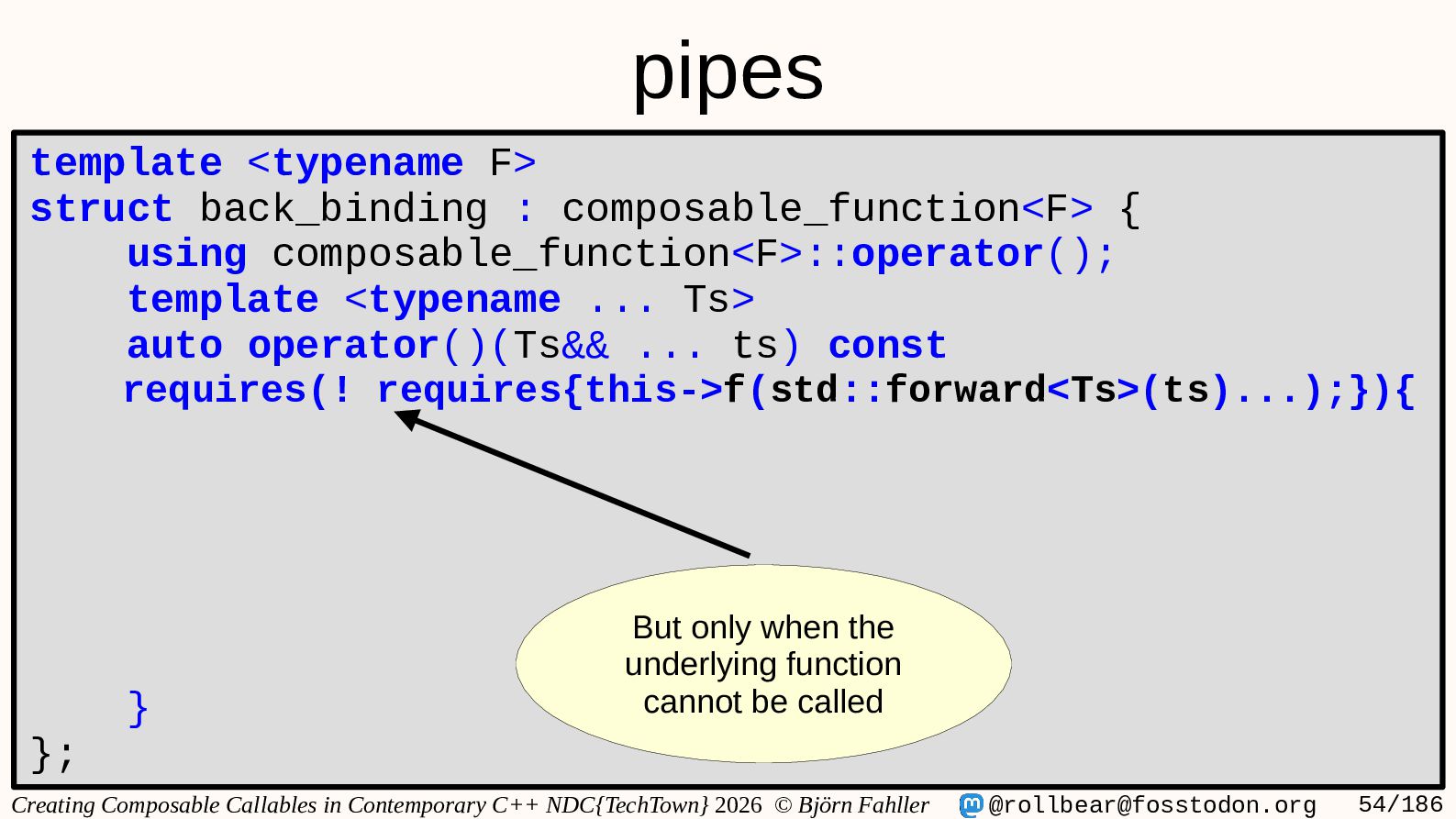
pipes template <typename F> struct back_binding : composable_function<F> { template
<typename F> using composable_function<F>::operator(); struct composable_function { template <typename ... Ts> auto F f; operator()(Ts&& ... ts) const requires(! requires{this->f(std::forward<Ts>(ts)...);}){ template <typename ... Ts> decltype(auto) operator()(Ts&& ... ts) const requires requires { f(std::forward<Ts>(ts)...);} { return f(std::forward<Ts>(ts)...); But only when the underlying function } cannot be called }; } }; Creating Composable Callables in Contemporary C++ NDC{TechTown} 2026 © Björn Fahller @[email protected] 54/186 -
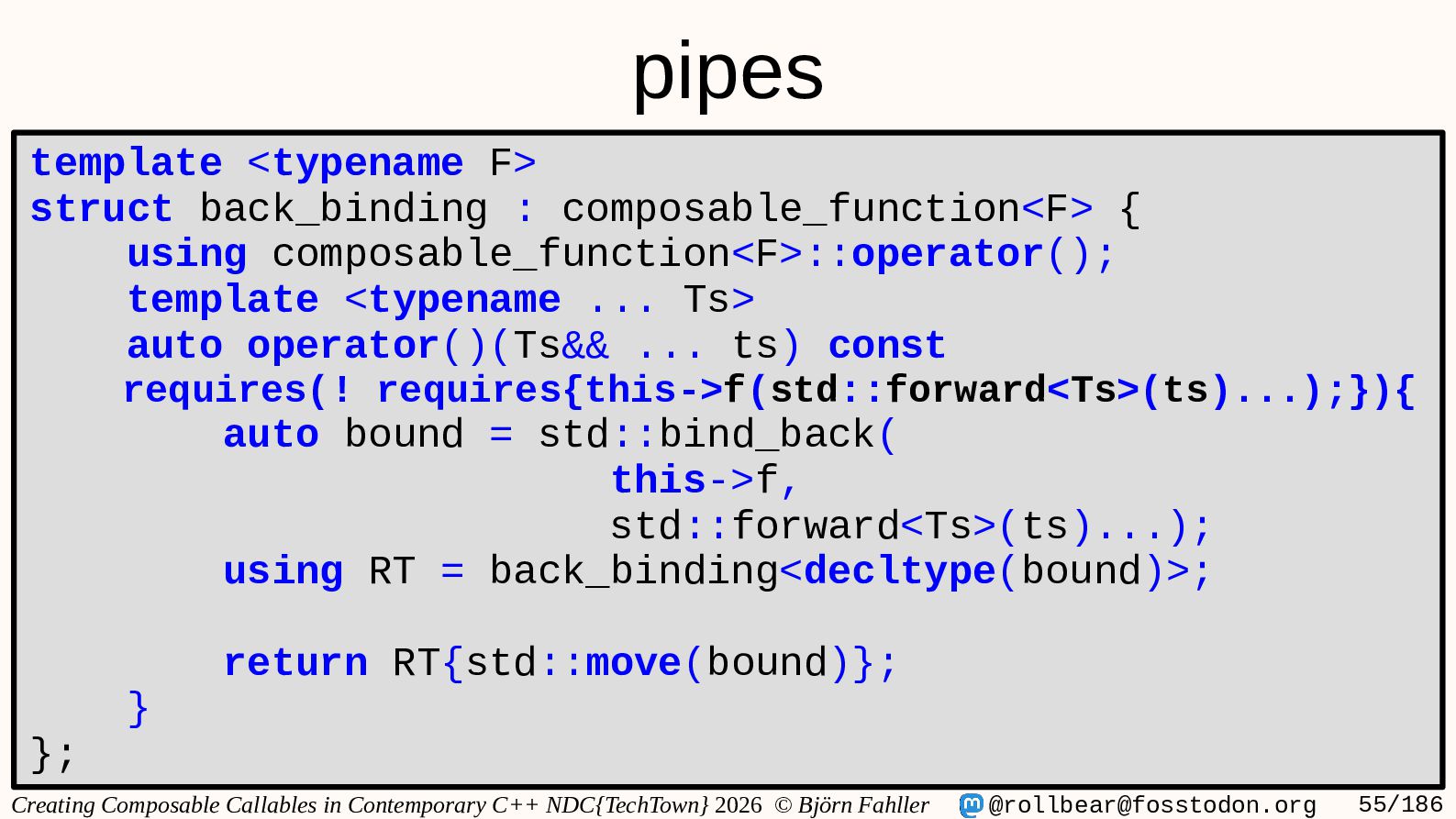
pipes template <typename F> struct back_binding : composable_function<F> { template
<typename F> using composable_function<F>::operator(); struct composable_function { template <typename ... Ts> auto F f; operator()(Ts&& ... ts) const requires(! requires{this->f(std::forward<Ts>(ts)...);}){ auto bound = std::bind_back( template <typename ... Ts> this->f, decltype(auto) operator()(Ts&& ... ts) const std::forward<Ts>(ts)...); requires requires { f(std::forward<Ts>(ts)...);} { using RT = back_binding<decltype(bound)>; return f(std::forward<Ts>(ts)...); } return RT{std::move(bound)}; }; } }; Creating Composable Callables in Contemporary C++ NDC{TechTown} 2026 © Björn Fahller @[email protected] 55/186 -
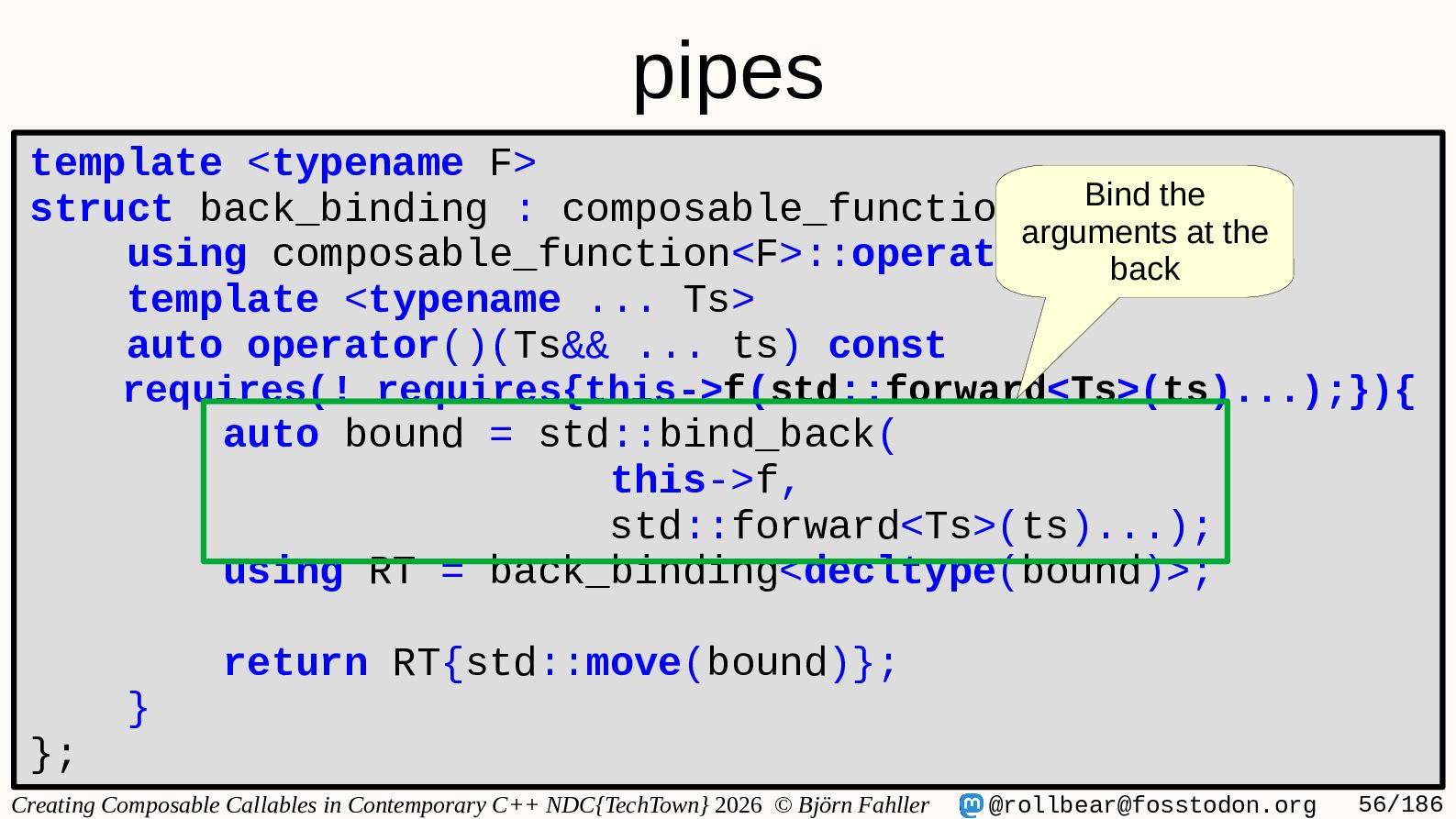
pipes template <typename F> struct back_binding : composable_function<F>Bind { the
template <typename F> arguments at the using composable_function<F>::operator(); struct composable_function back { template <typename ... Ts> auto F f; operator()(Ts&& ... ts) const requires(! requires{this->f(std::forward<Ts>(ts)...);}){ auto bound = std::bind_back( template <typename ... Ts> this->f, decltype(auto) operator()(Ts&& ... ts) const std::forward<Ts>(ts)...); requires requires { f(std::forward<Ts>(ts)...);} { using RT = back_binding<decltype(bound)>; return f(std::forward<Ts>(ts)...); } return RT{std::move(bound)}; }; } }; Creating Composable Callables in Contemporary C++ NDC{TechTown} 2026 © Björn Fahller @[email protected] 56/186 -
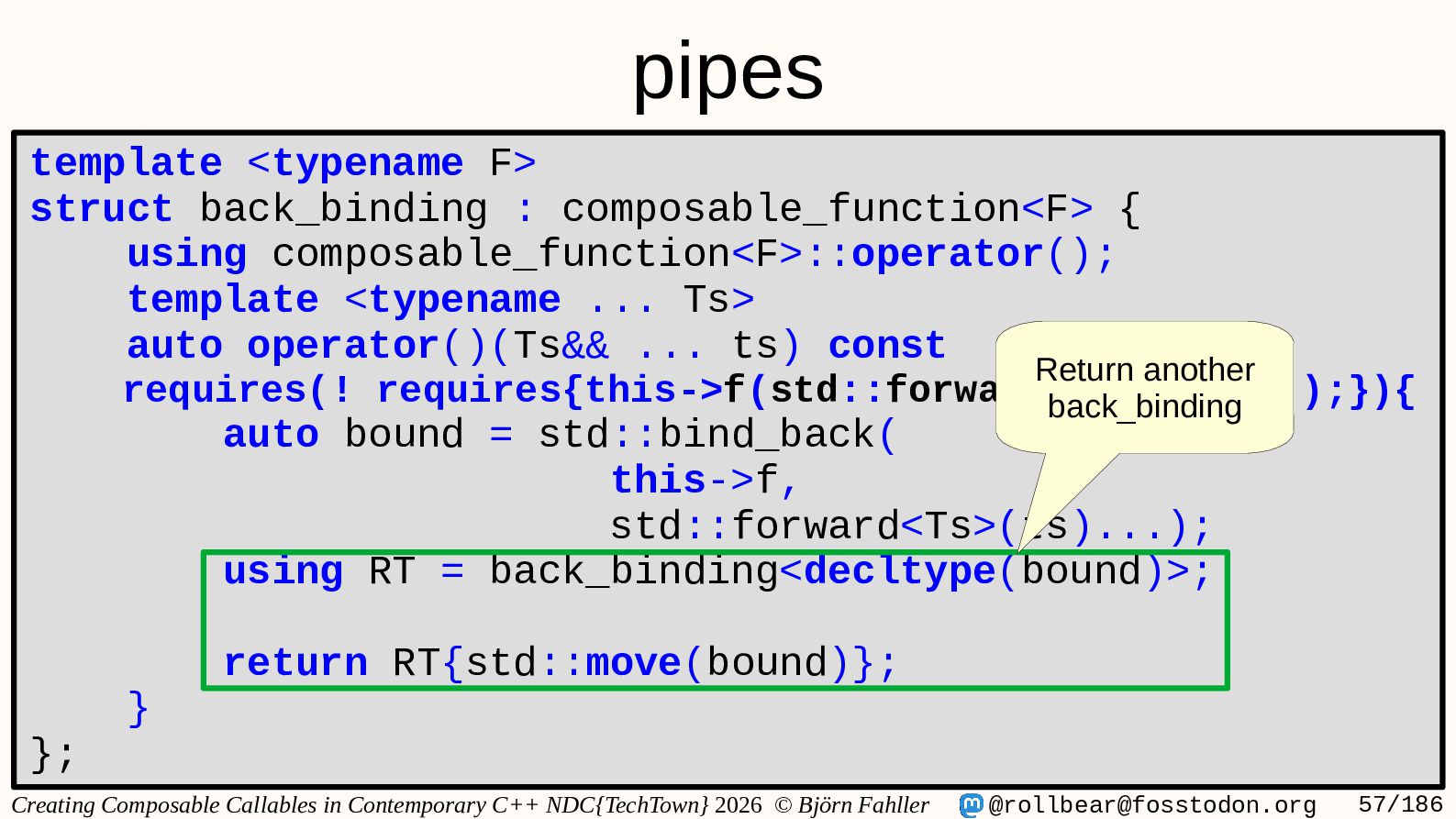
pipes template <typename F> struct back_binding : composable_function<F> { template
<typename F> using composable_function<F>::operator(); struct composable_function { template <typename ... Ts> auto F f; operator()(Ts&& ... ts) const Return another requires(! requires{this->f(std::forward<Ts>(ts)...);}){ back_binding auto bound = std::bind_back( template <typename ... Ts> this->f, decltype(auto) operator()(Ts&& ... ts) const std::forward<Ts>(ts)...); requires requires { f(std::forward<Ts>(ts)...);} { using RT = back_binding<decltype(bound)>; return f(std::forward<Ts>(ts)...); } return RT{std::move(bound)}; }; } }; Creating Composable Callables in Contemporary C++ NDC{TechTown} 2026 © Björn Fahller @[email protected] 57/186 -
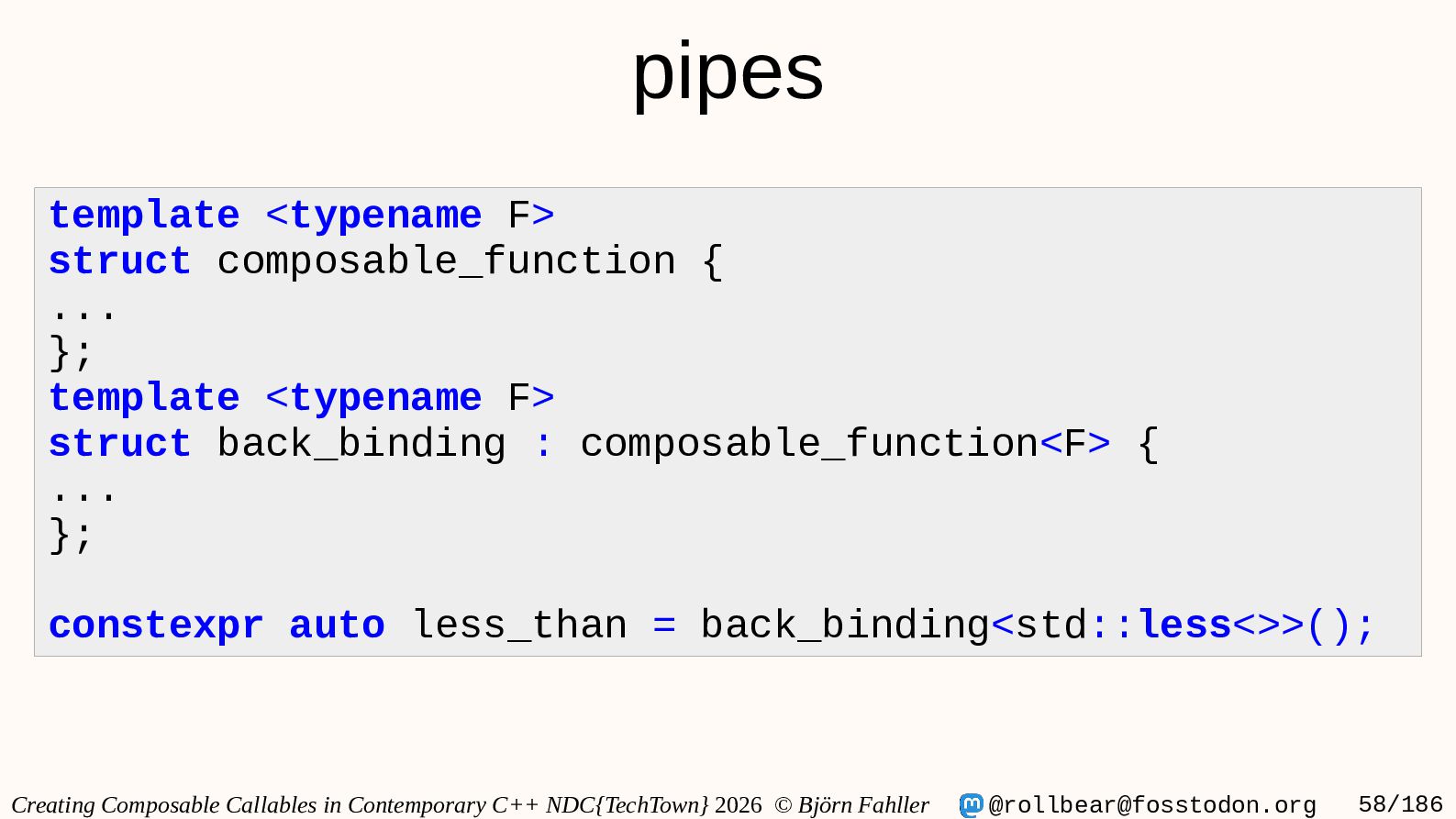
pipes template <typename F> struct composable_function { ... }; template
<typename F> struct back_binding : composable_function<F> { ... }; constexpr auto less_than = back_binding<std::less<>>(); Creating Composable Callables in Contemporary C++ NDC{TechTown} 2026 © Björn Fahller @[email protected] 58/186 -
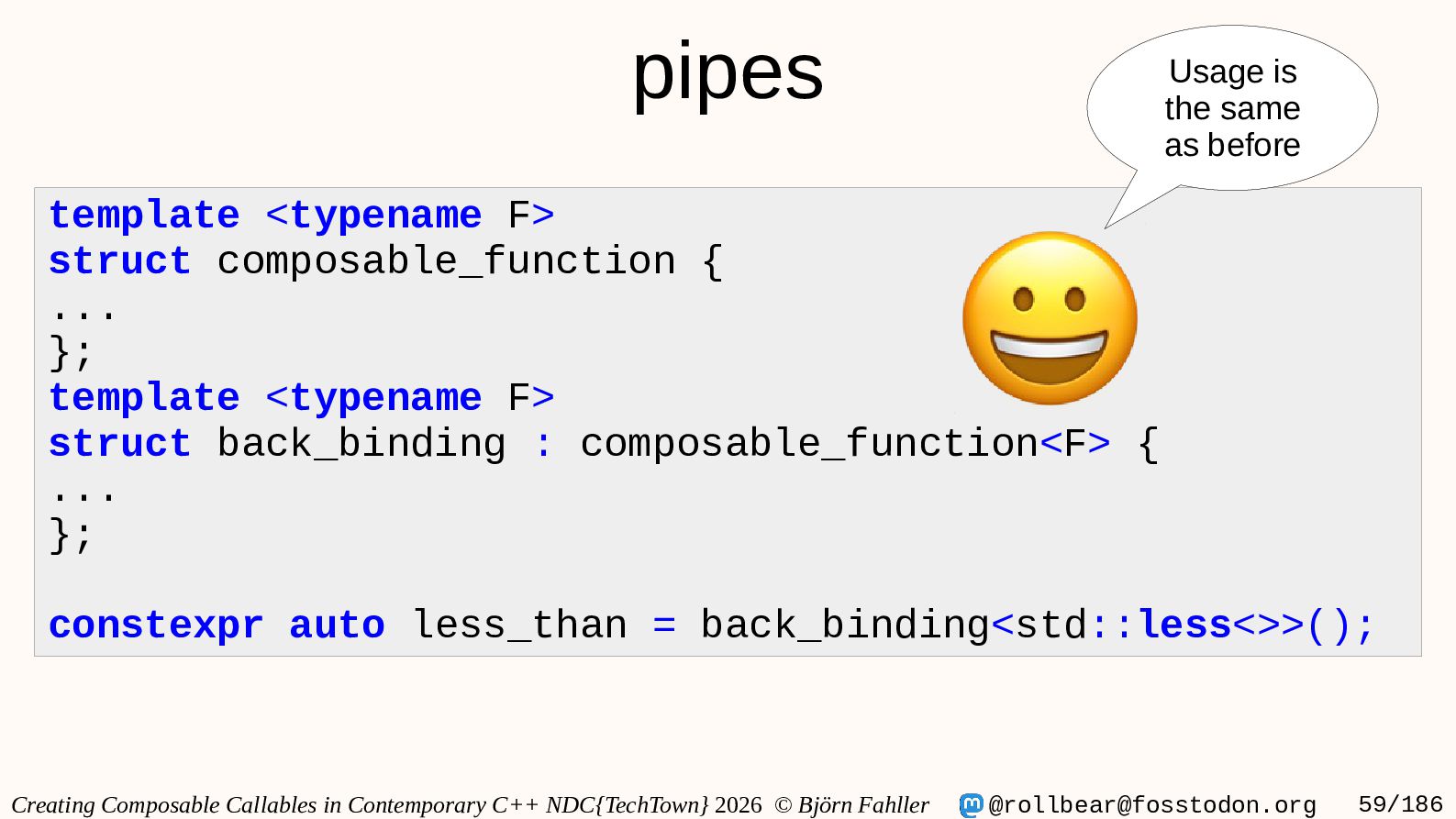
pipes Usage is the same as before template <typename F>
struct composable_function { ... }; template <typename F> struct back_binding : composable_function<F> { ... }; constexpr auto less_than = back_binding<std::less<>>(); Creating Composable Callables in Contemporary C++ NDC{TechTown} 2026 © Björn Fahller @[email protected] 59/186 -
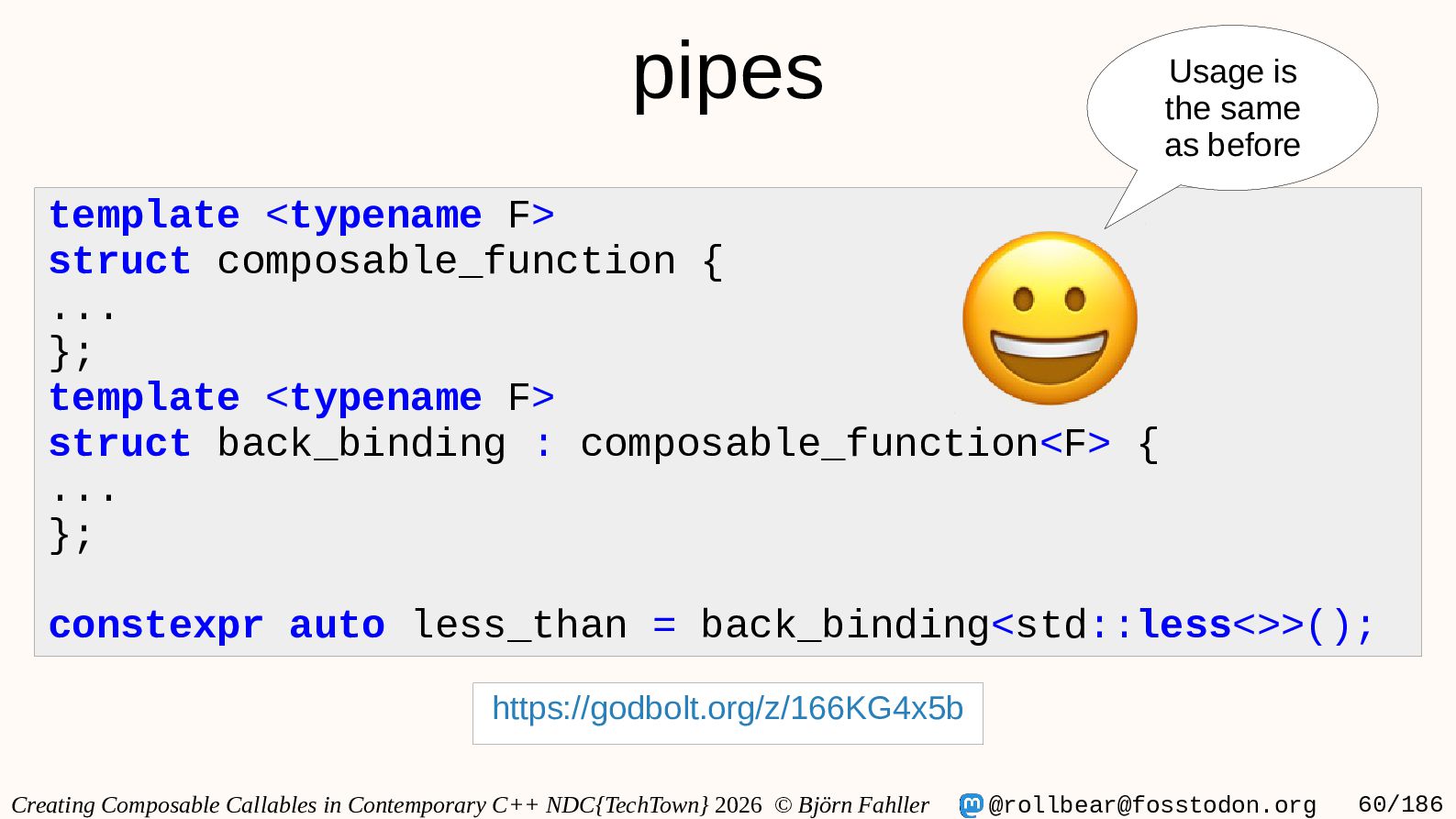
pipes Usage is the same as before template <typename F>
struct composable_function { ... }; template <typename F> struct back_binding : composable_function<F> { ... }; constexpr auto less_than = back_binding<std::less<>>(); https://godbolt.org/z/166KG4x5b Creating Composable Callables in Contemporary C++ NDC{TechTown} 2026 © Björn Fahller @[email protected] 60/186 -
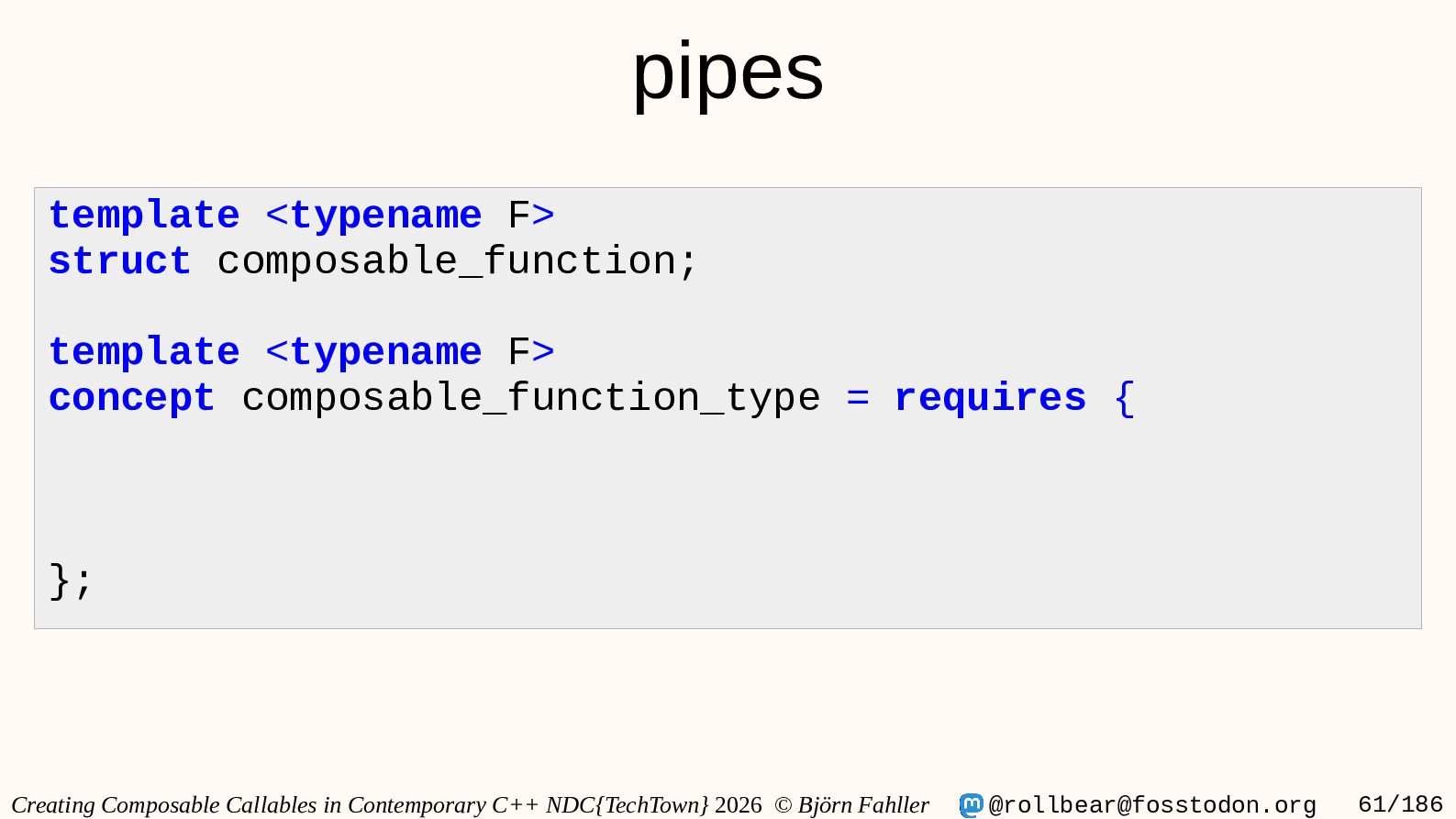
pipes template <typename F> struct composable_function; template <typename F> concept
composable_function_type = requires { }; Creating Composable Callables in Contemporary C++ NDC{TechTown} 2026 © Björn Fahller @[email protected] 61/186 -
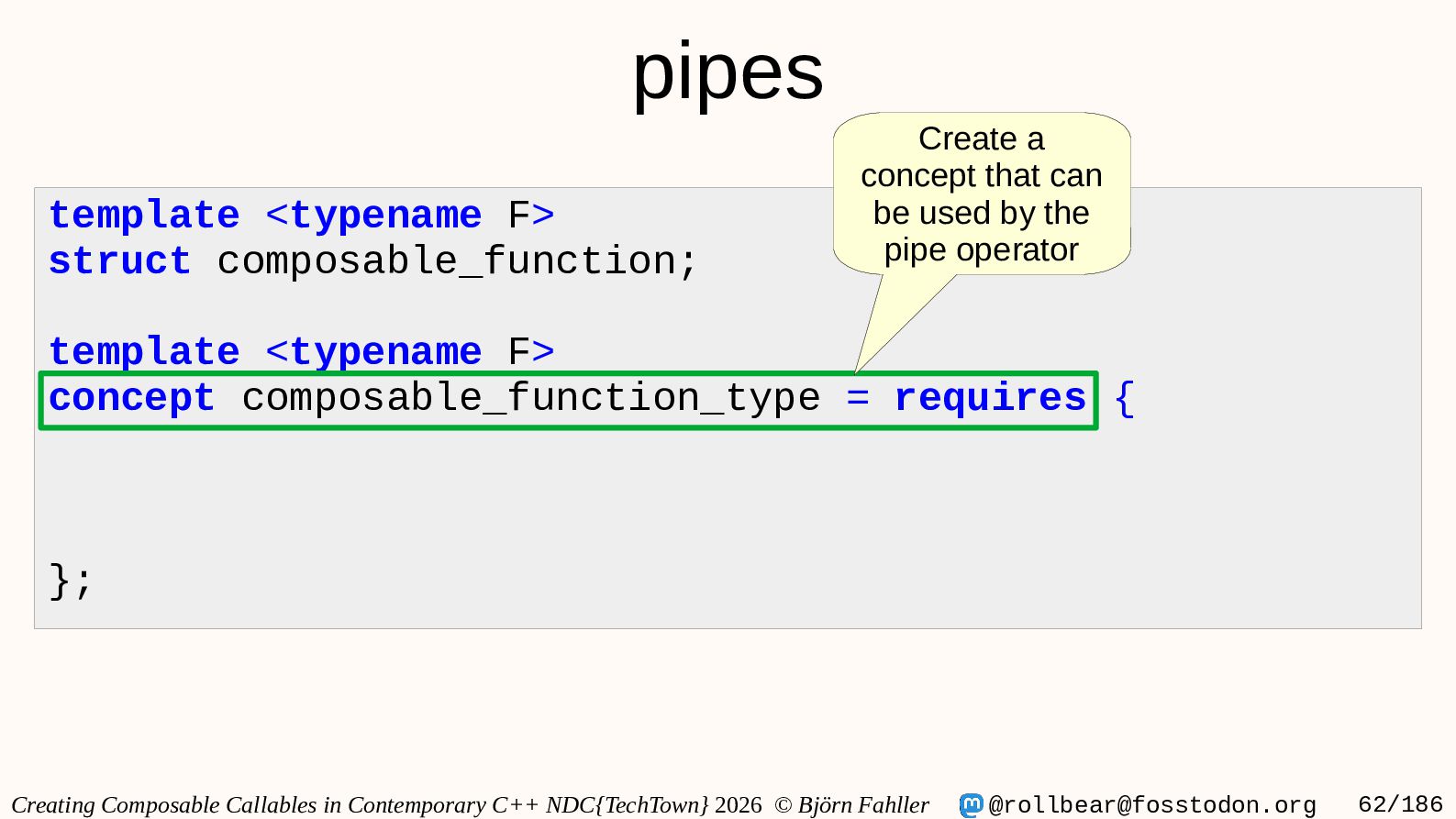
pipes template <typename F> struct composable_function; Create a concept that
can be used by the pipe operator template <typename F> concept composable_function_type = requires { }; Creating Composable Callables in Contemporary C++ NDC{TechTown} 2026 © Björn Fahller @[email protected] 62/186 -
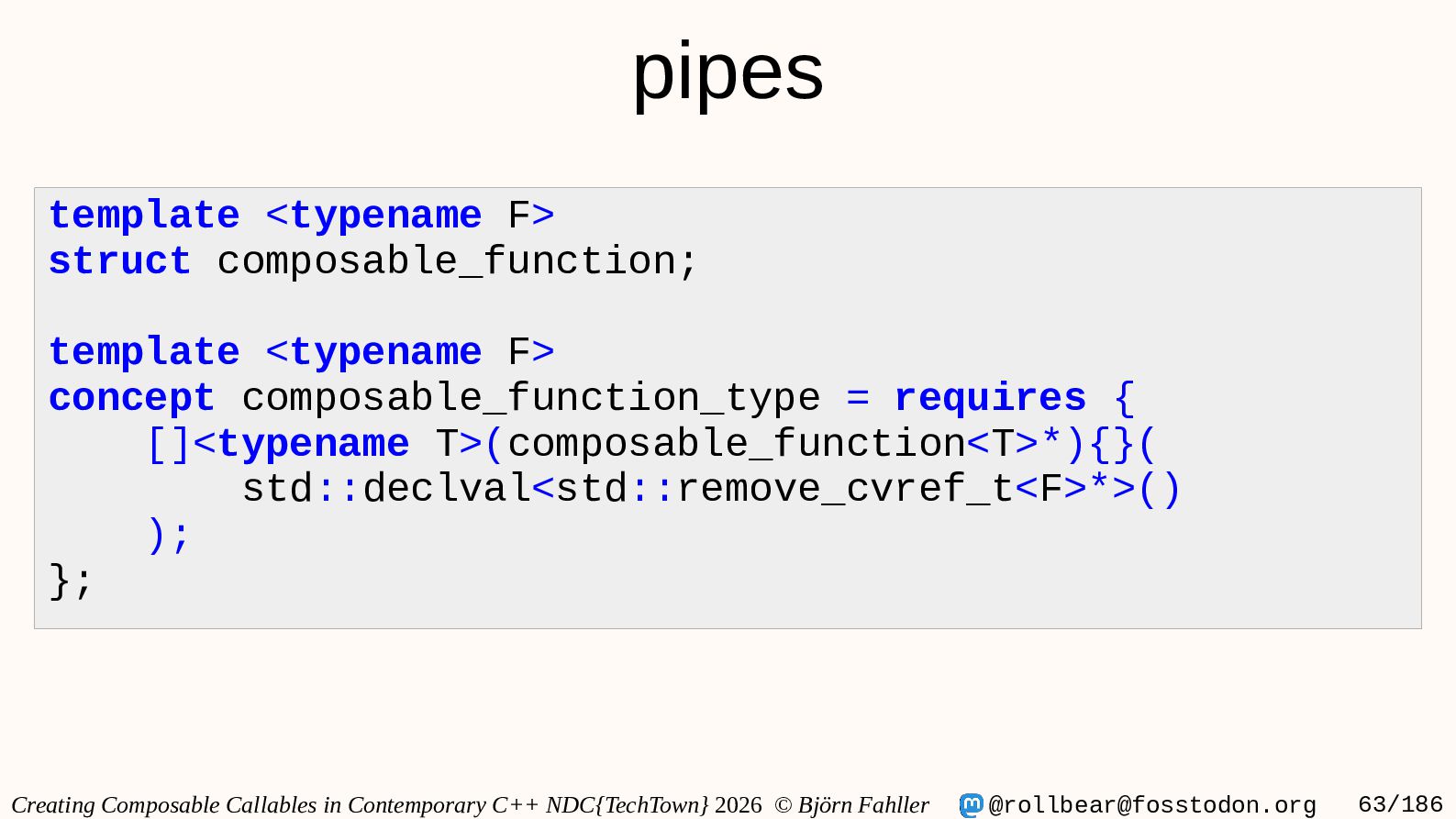
pipes template <typename F> struct composable_function; template <typename F> concept
composable_function_type = requires { []<typename T>(composable_function<T>*){}( std::declval<std::remove_cvref_t<F>*>() ); }; Creating Composable Callables in Contemporary C++ NDC{TechTown} 2026 © Björn Fahller @[email protected] 63/186 -
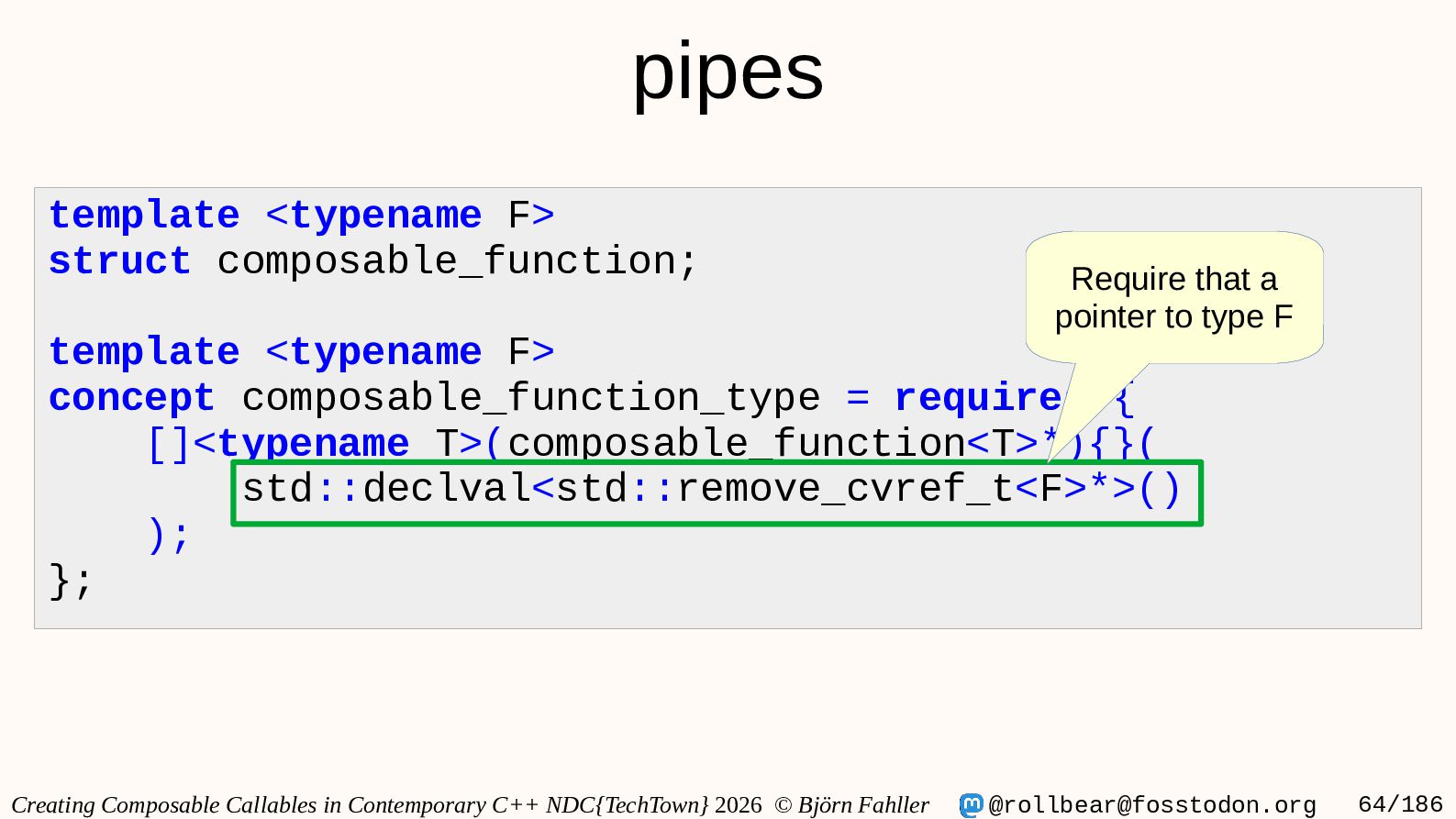
pipes template <typename F> struct composable_function; Require that a pointer
to type F template <typename F> concept composable_function_type = requires { []<typename T>(composable_function<T>*){}( std::declval<std::remove_cvref_t<F>*>() ); }; Creating Composable Callables in Contemporary C++ NDC{TechTown} 2026 © Björn Fahller @[email protected] 64/186 -
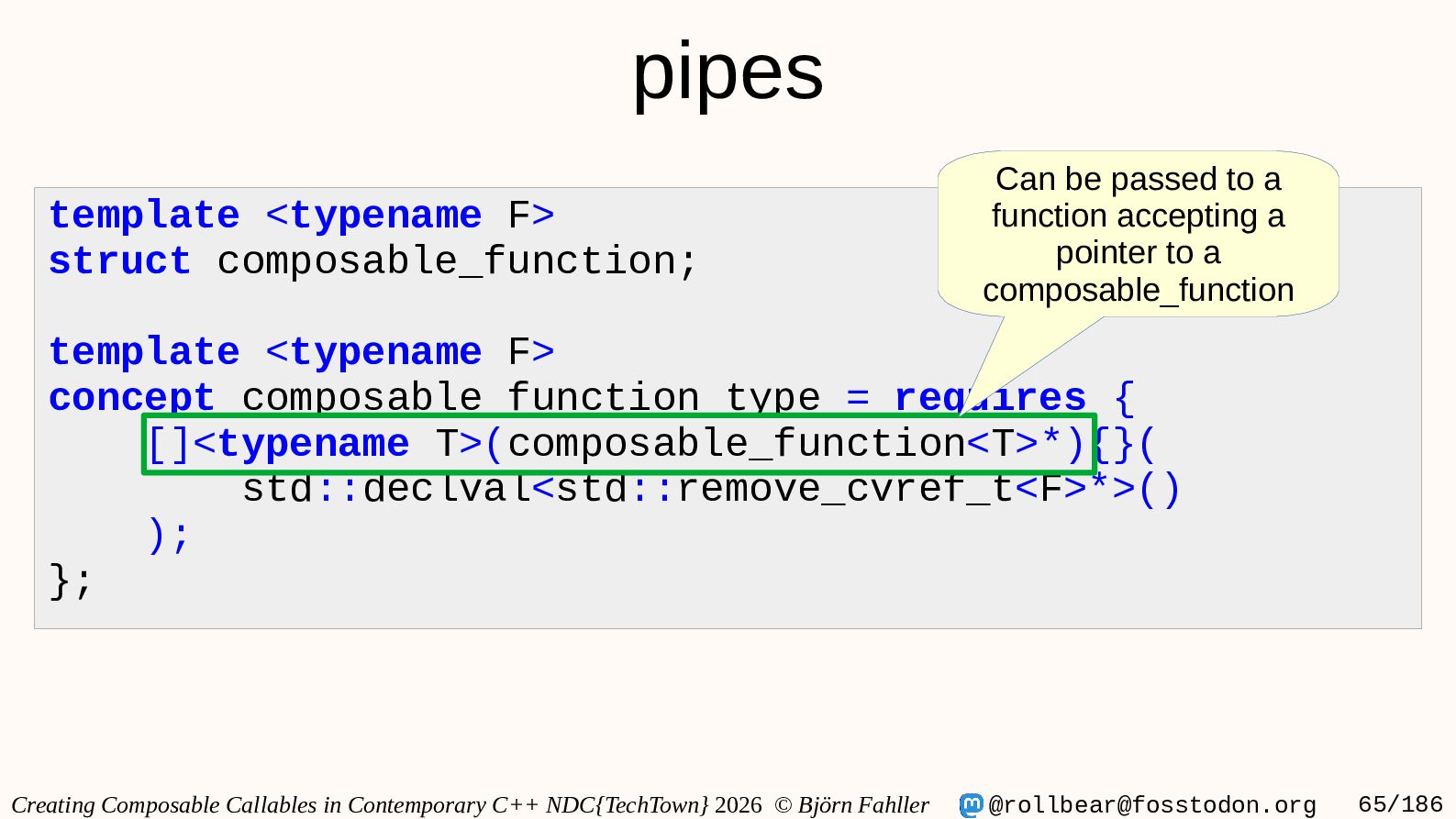
pipes template <typename F> struct composable_function; Can be passed to
a function accepting a pointer to a composable_function template <typename F> concept composable_function_type = requires { []<typename T>(composable_function<T>*){}( std::declval<std::remove_cvref_t<F>*>() ); }; Creating Composable Callables in Contemporary C++ NDC{TechTown} 2026 © Björn Fahller @[email protected] 65/186 -
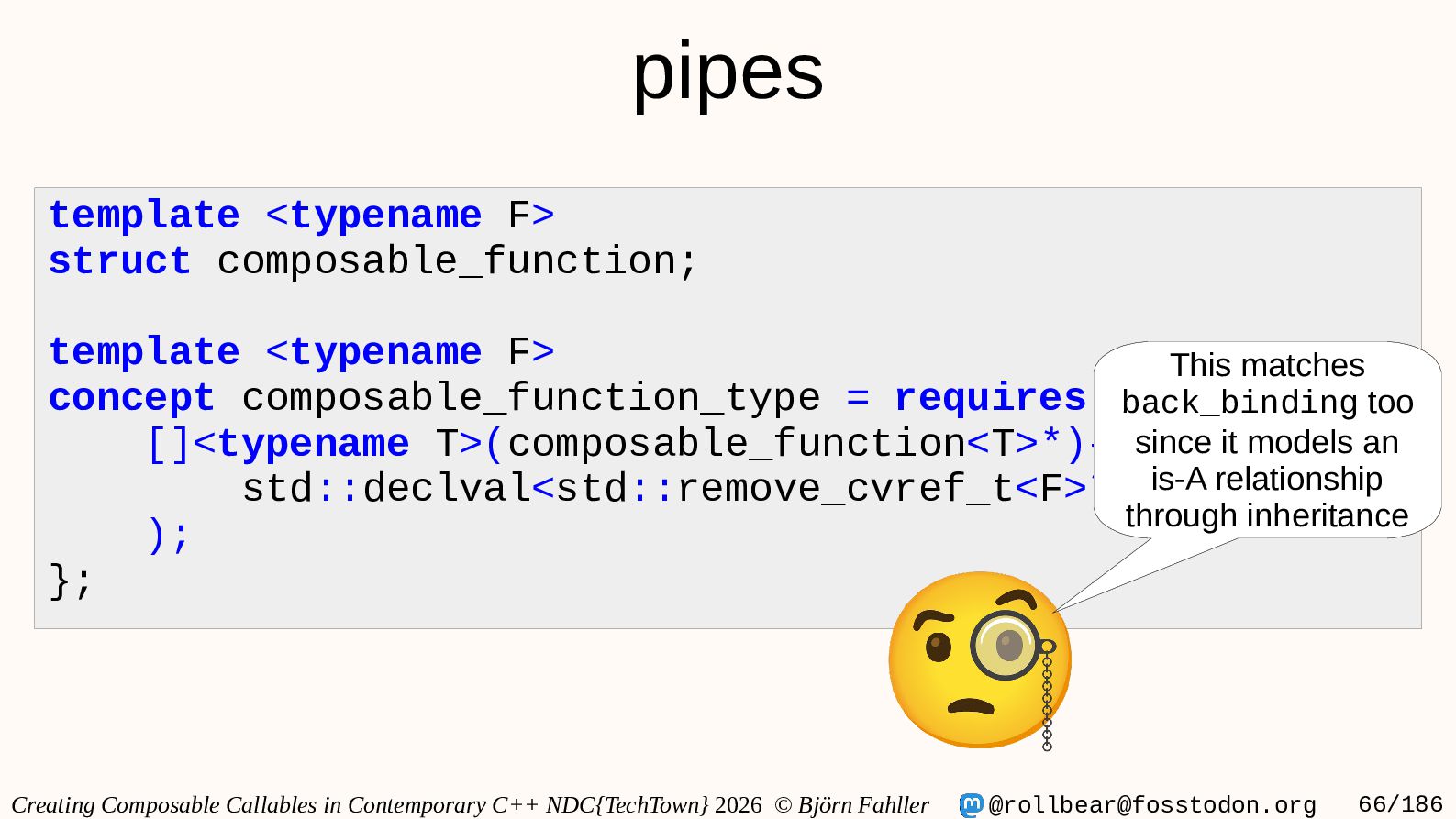
pipes template <typename F> struct composable_function; template <typename F> This
matches concept composable_function_type = requires {back_binding too since it models an []<typename T>(composable_function<T>*){}( is-A relationship std::declval<std::remove_cvref_t<F>*>() through inheritance ); }; Creating Composable Callables in Contemporary C++ NDC{TechTown} 2026 © Björn Fahller @[email protected] 66/186 -
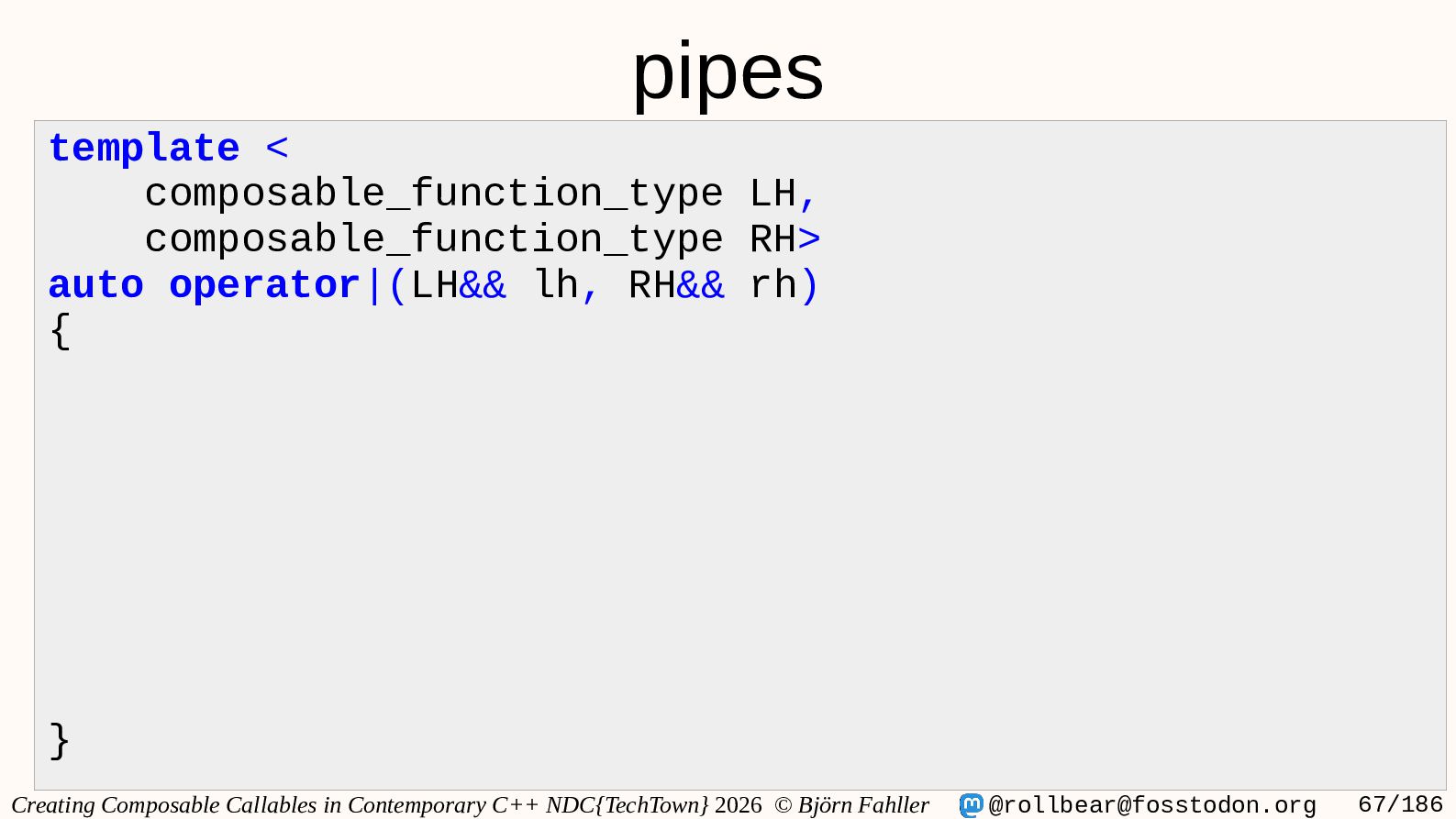
pipes template < composable_function_type LH, composable_function_type RH> auto operator|(LH&& lh,
RH&& rh) { } Creating Composable Callables in Contemporary C++ NDC{TechTown} 2026 © Björn Fahller @[email protected] 67/186 -
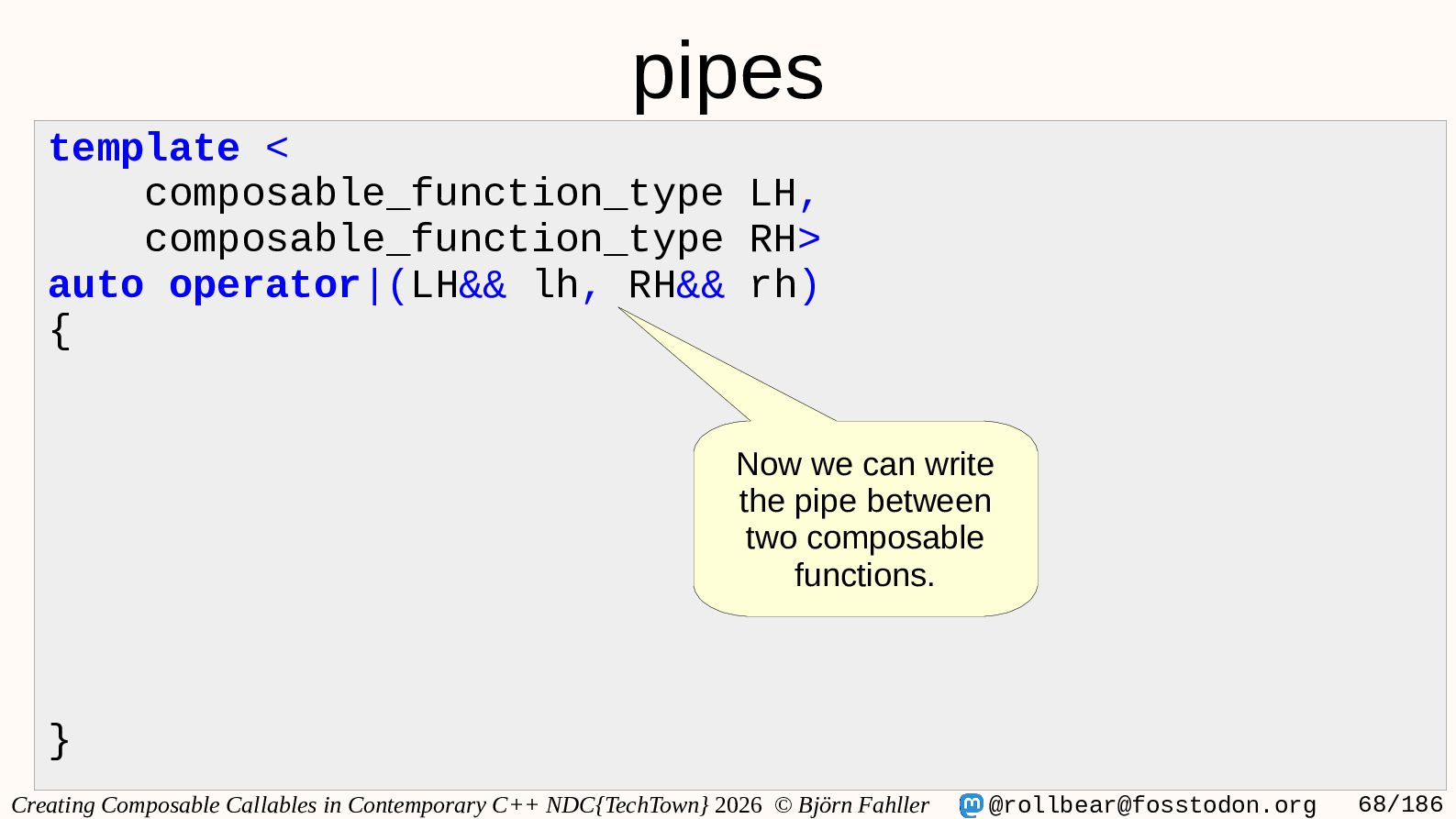
pipes template < composable_function_type LH, composable_function_type RH> auto operator|(LH&& lh,
RH&& rh) { Now we can write the pipe between two composable functions. } Creating Composable Callables in Contemporary C++ NDC{TechTown} 2026 © Björn Fahller @[email protected] 68/186 -
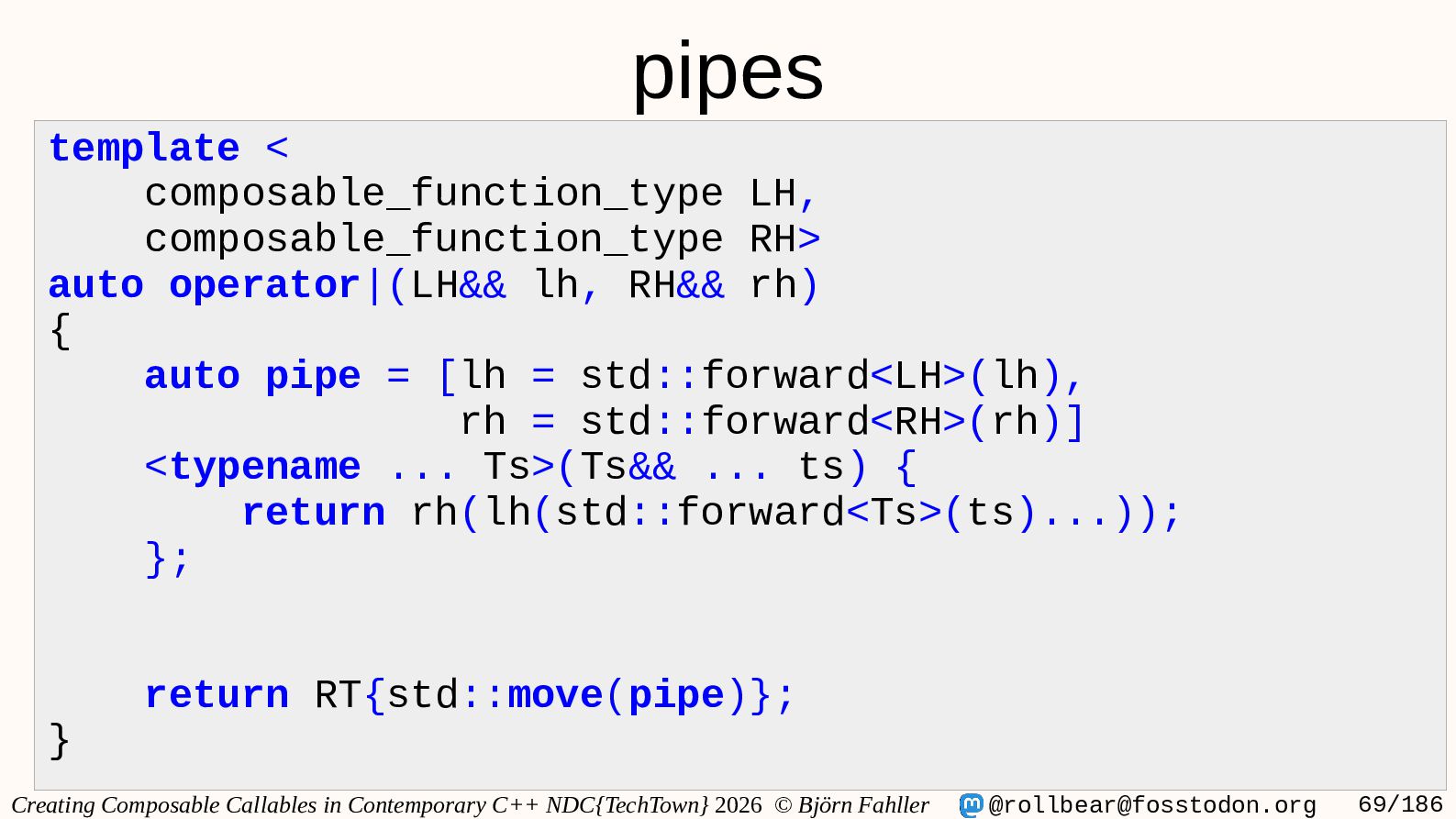
pipes template < composable_function_type LH, composable_function_type RH> auto operator|(LH&& lh,
RH&& rh) { auto pipe = [lh = std::forward<LH>(lh), rh = std::forward<RH>(rh)] <typename ... Ts>(Ts&& ... ts) { return rh(lh(std::forward<Ts>(ts)...)); }; } return RT{std::move(pipe)}; Creating Composable Callables in Contemporary C++ NDC{TechTown} 2026 © Björn Fahller @[email protected] 69/186 -
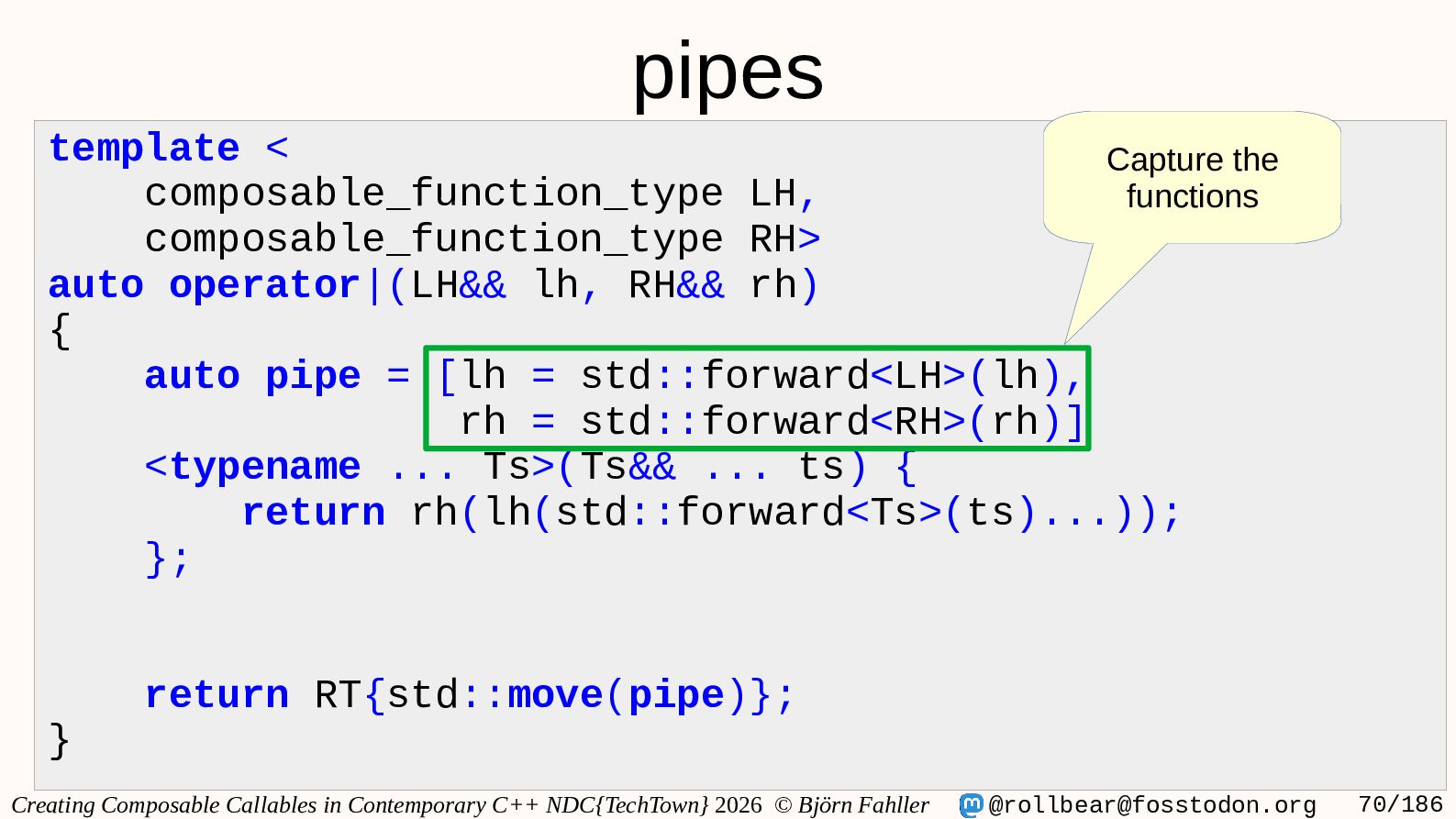
pipes template < Capture the composable_function_type LH, functions composable_function_type RH>
auto operator|(LH&& lh, RH&& rh) { auto pipe = [lh = std::forward<LH>(lh), rh = std::forward<RH>(rh)] <typename ... Ts>(Ts&& ... ts) { return rh(lh(std::forward<Ts>(ts)...)); }; } return RT{std::move(pipe)}; Creating Composable Callables in Contemporary C++ NDC{TechTown} 2026 © Björn Fahller @[email protected] 70/186 -
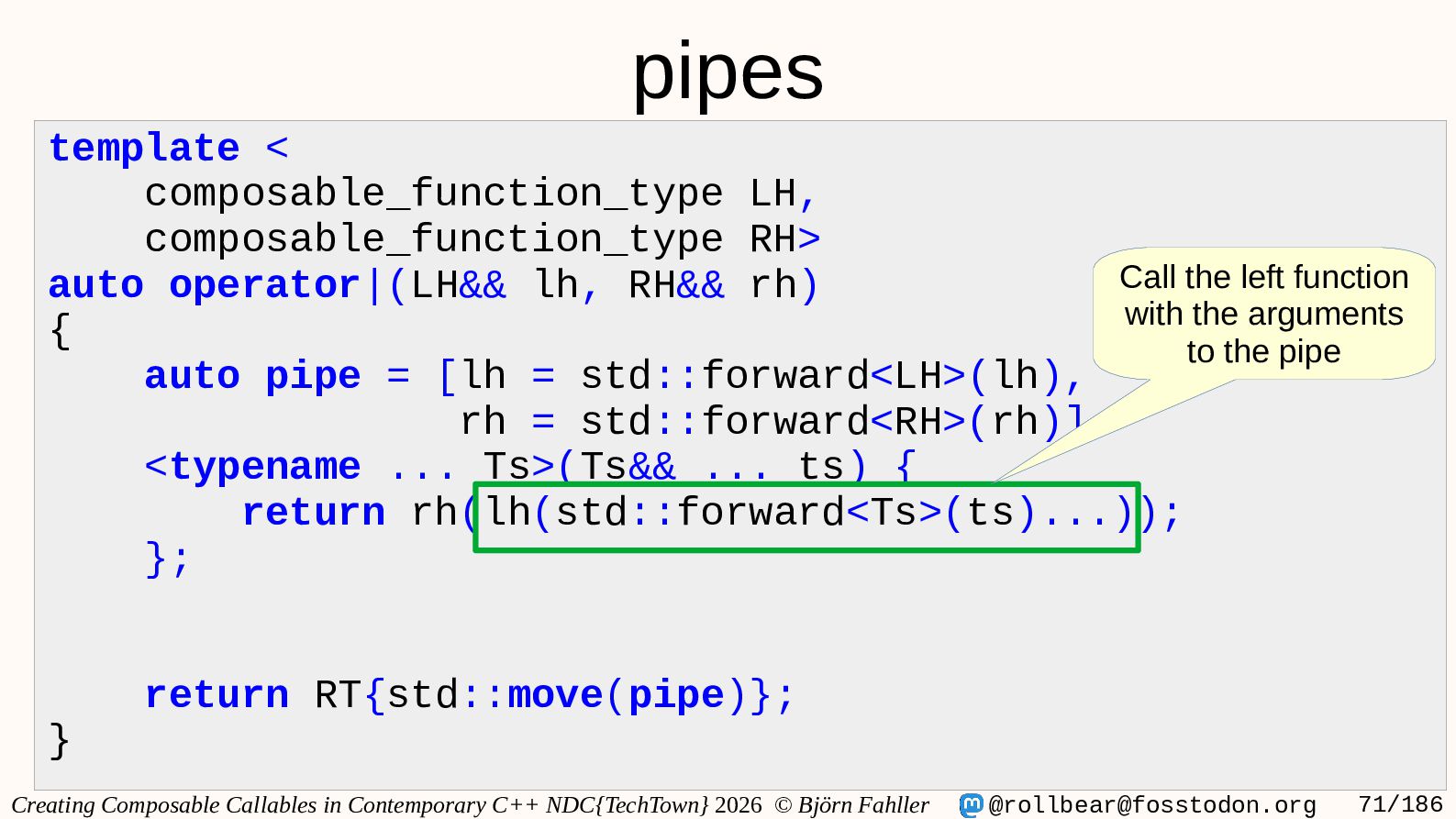
pipes template < composable_function_type LH, composable_function_type RH> Call the left
function auto operator|(LH&& lh, RH&& rh) with the arguments { to the pipe auto pipe = [lh = std::forward<LH>(lh), rh = std::forward<RH>(rh)] <typename ... Ts>(Ts&& ... ts) { return rh(lh(std::forward<Ts>(ts)...)); }; } return RT{std::move(pipe)}; Creating Composable Callables in Contemporary C++ NDC{TechTown} 2026 © Björn Fahller @[email protected] 71/186 -
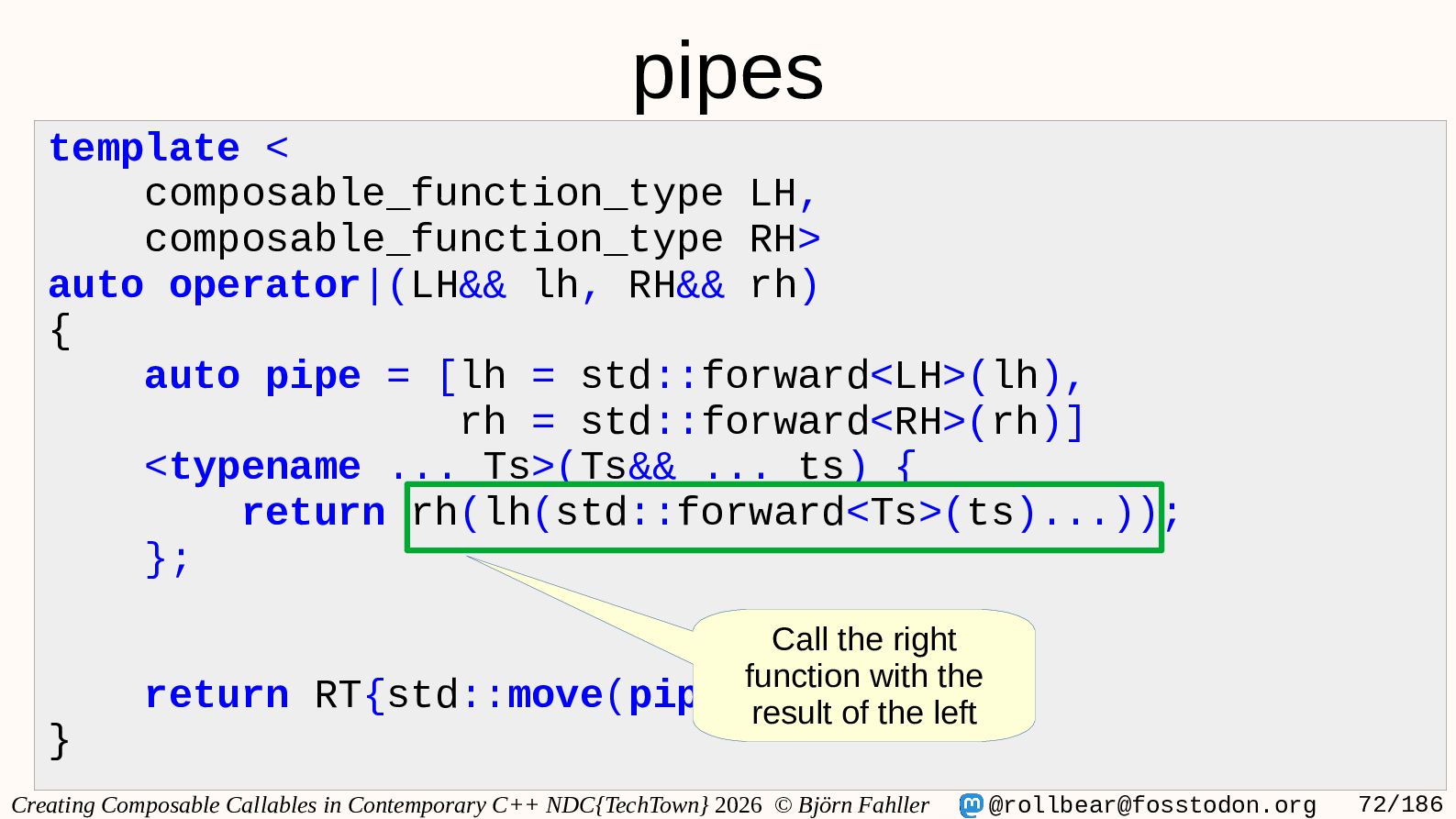
pipes template < composable_function_type LH, composable_function_type RH> auto operator|(LH&& lh,
RH&& rh) { auto pipe = [lh = std::forward<LH>(lh), rh = std::forward<RH>(rh)] <typename ... Ts>(Ts&& ... ts) { return rh(lh(std::forward<Ts>(ts)...)); }; } return Call the right function with the RT{std::move(pipe)}; result of the left Creating Composable Callables in Contemporary C++ NDC{TechTown} 2026 © Björn Fahller @[email protected] 72/186 -
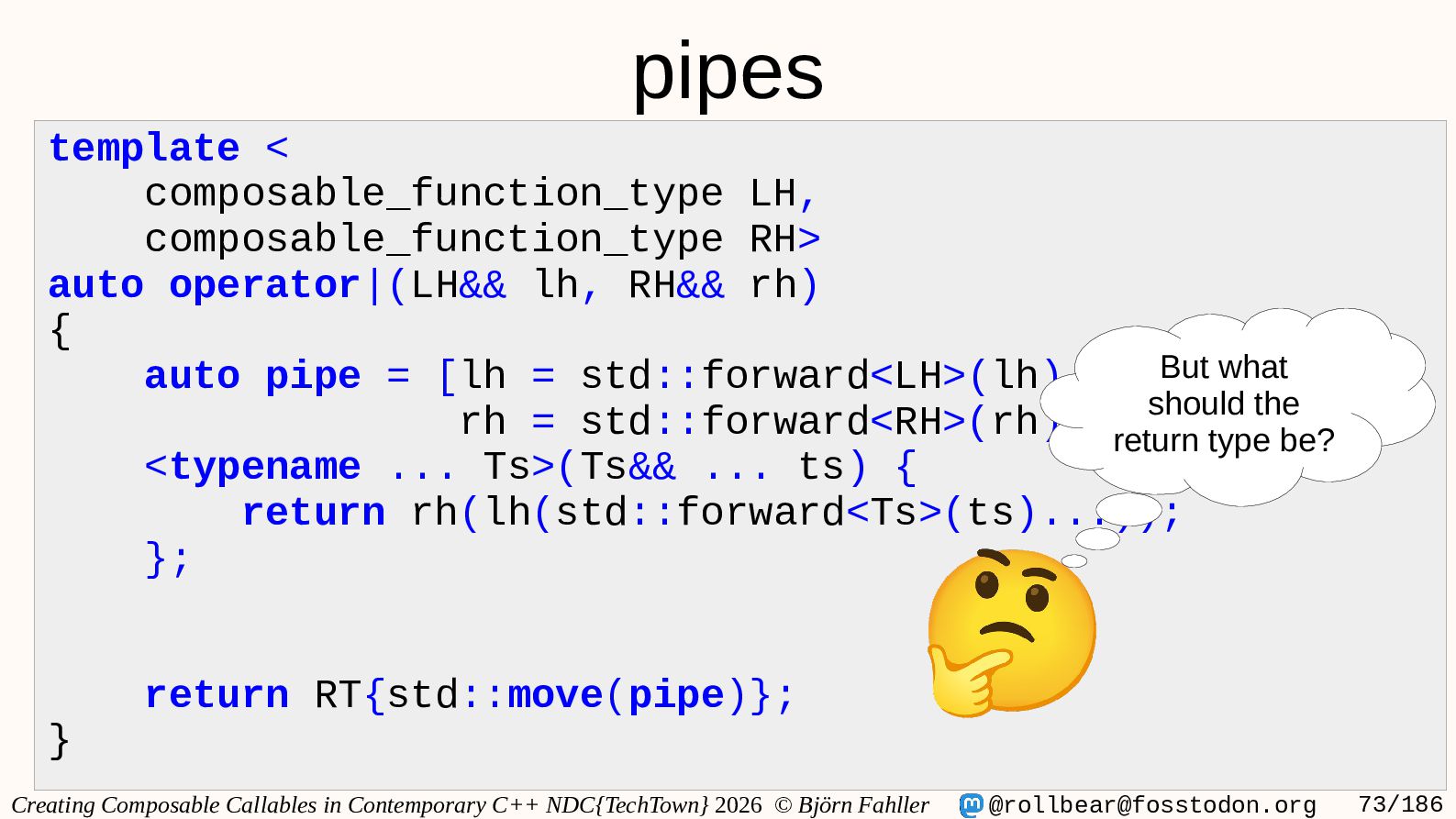
pipes template < composable_function_type LH, composable_function_type RH> auto operator|(LH&& lh,
RH&& rh) { But what auto pipe = [lh = std::forward<LH>(lh), should the rh = std::forward<RH>(rh)] return type be? <typename ... Ts>(Ts&& ... ts) { return rh(lh(std::forward<Ts>(ts)...)); }; } return RT{std::move(pipe)}; Creating Composable Callables in Contemporary C++ NDC{TechTown} 2026 © Björn Fahller @[email protected] 73/186 -
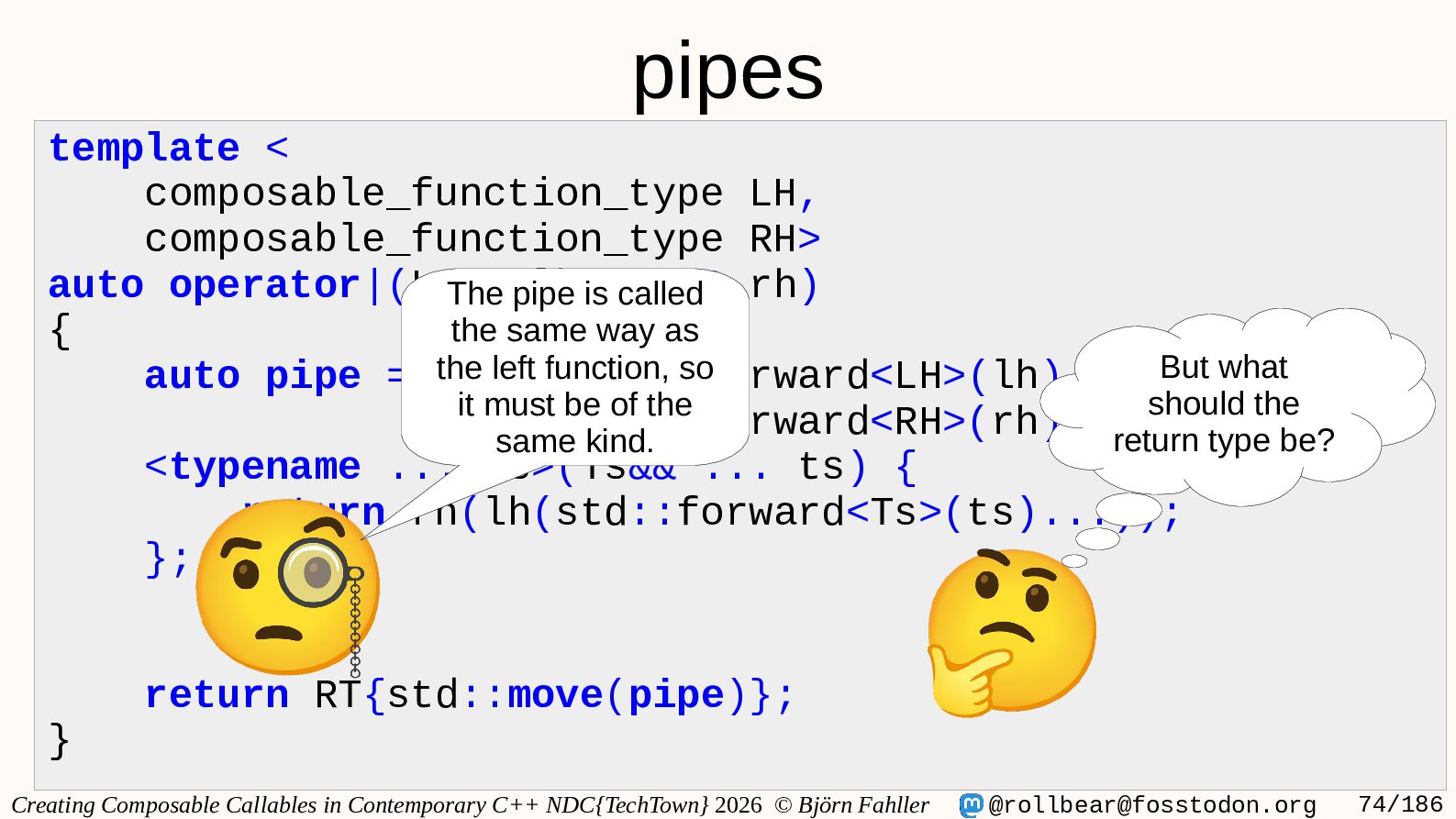
pipes template < composable_function_type LH, composable_function_type RH> auto operator|(LH&& lh,is
called RH&& rh) The pipe the same way as { But what the left=function, so auto pipe = [lh std::forward<LH>(lh), should the it must be of the rhsame = std::forward<RH>(rh)] return type be? kind. <typename ... Ts>(Ts&& ... ts) { return rh(lh(std::forward<Ts>(ts)...)); }; } return RT{std::move(pipe)}; Creating Composable Callables in Contemporary C++ NDC{TechTown} 2026 © Björn Fahller @[email protected] 74/186 -
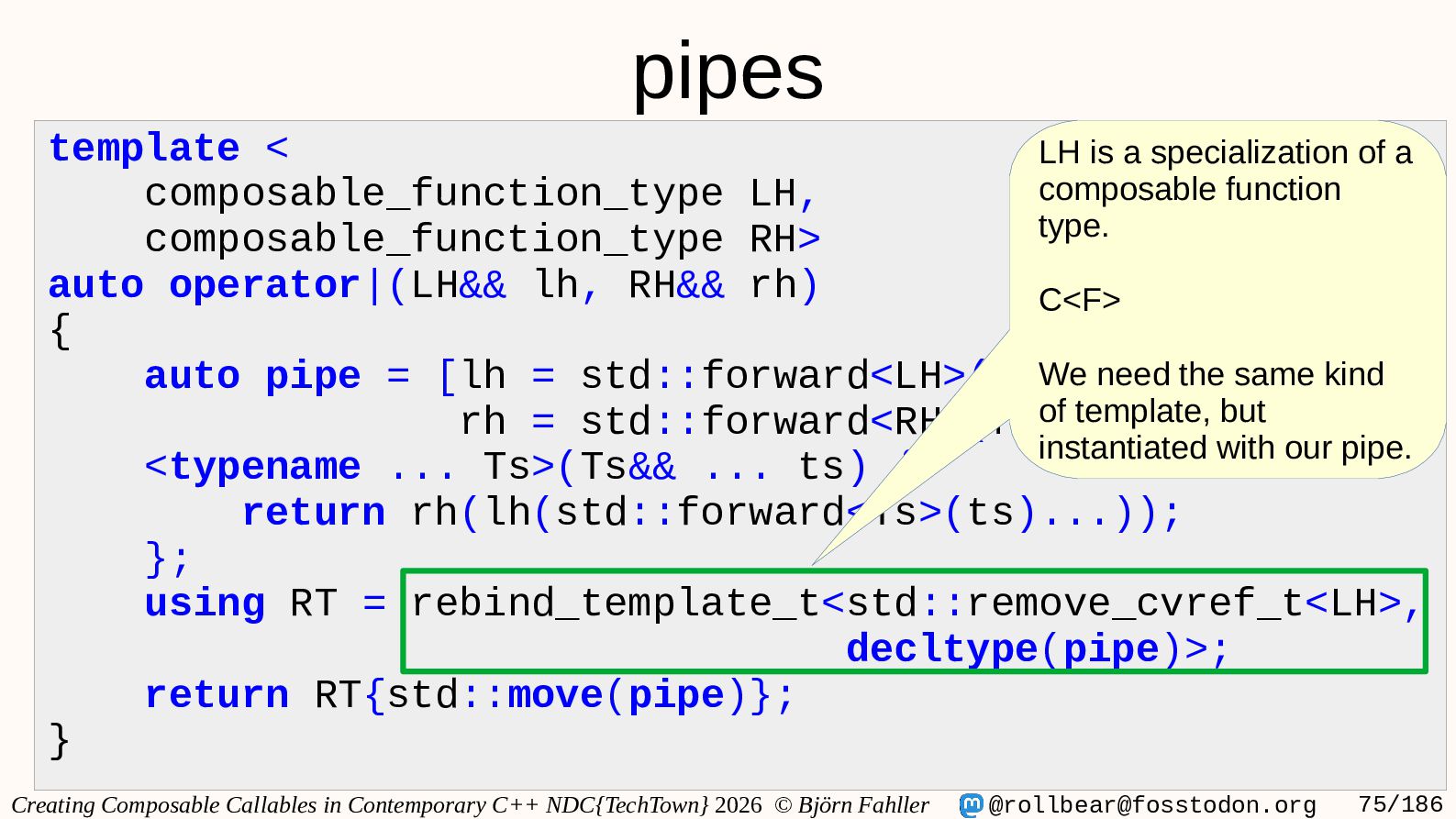
pipes template < LH is a specialization of a composable
function composable_function_type LH, type. composable_function_type RH> auto operator|(LH&& lh, RH&& rh) C<F> { We need the same kind auto pipe = [lh = std::forward<LH>(lh).f, of template, but rh = std::forward<RH>(rh).f] instantiated with our pipe. <typename ... Ts>(Ts&& ... ts) { return rh(lh(std::forward<Ts>(ts)...)); }; using RT = rebind_template_t<std::remove_cvref_t<LH>, decltype(pipe)>; return RT{std::move(pipe)}; } Creating Composable Callables in Contemporary C++ NDC{TechTown} 2026 © Björn Fahller @[email protected] 75/186 -
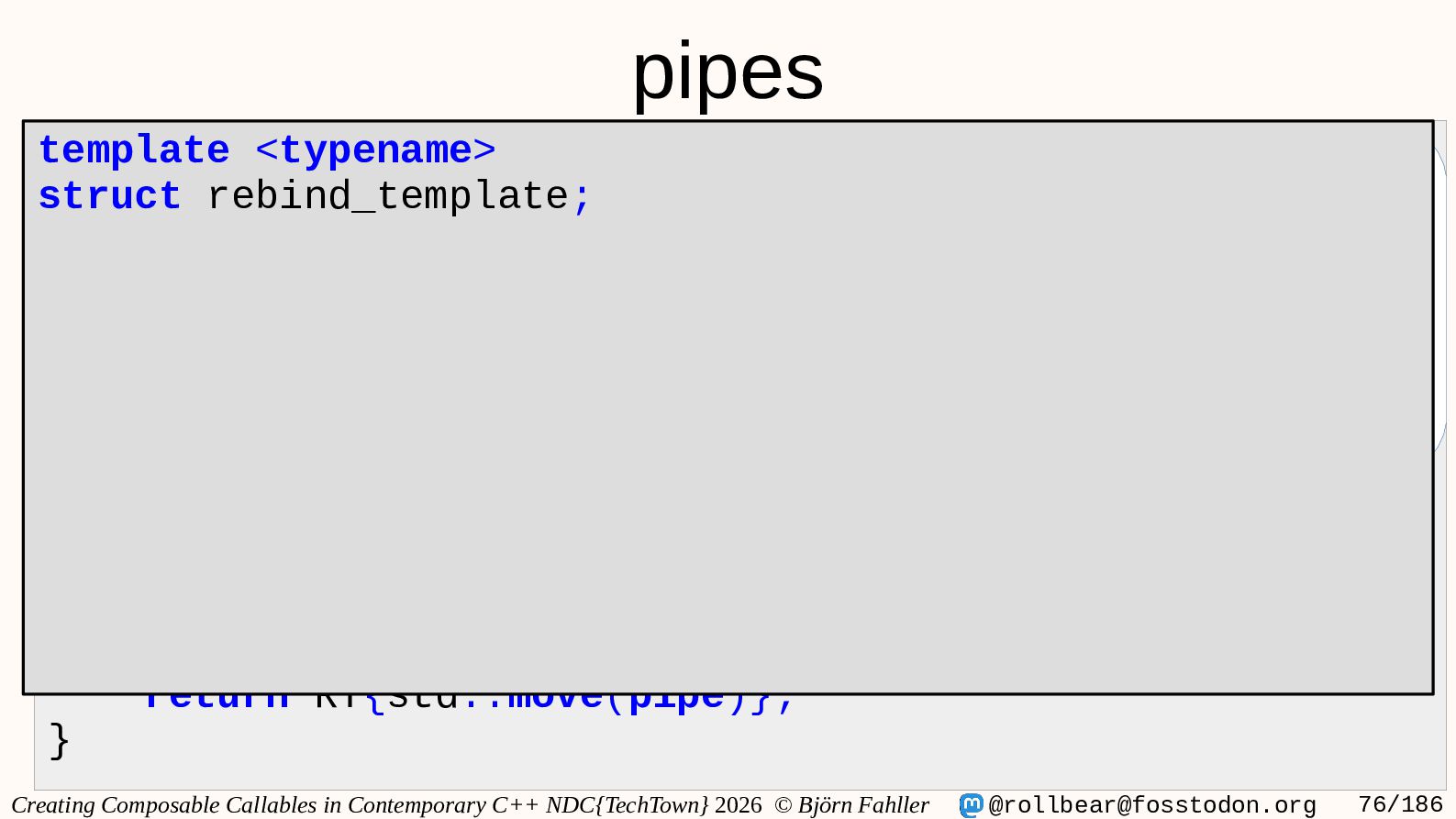
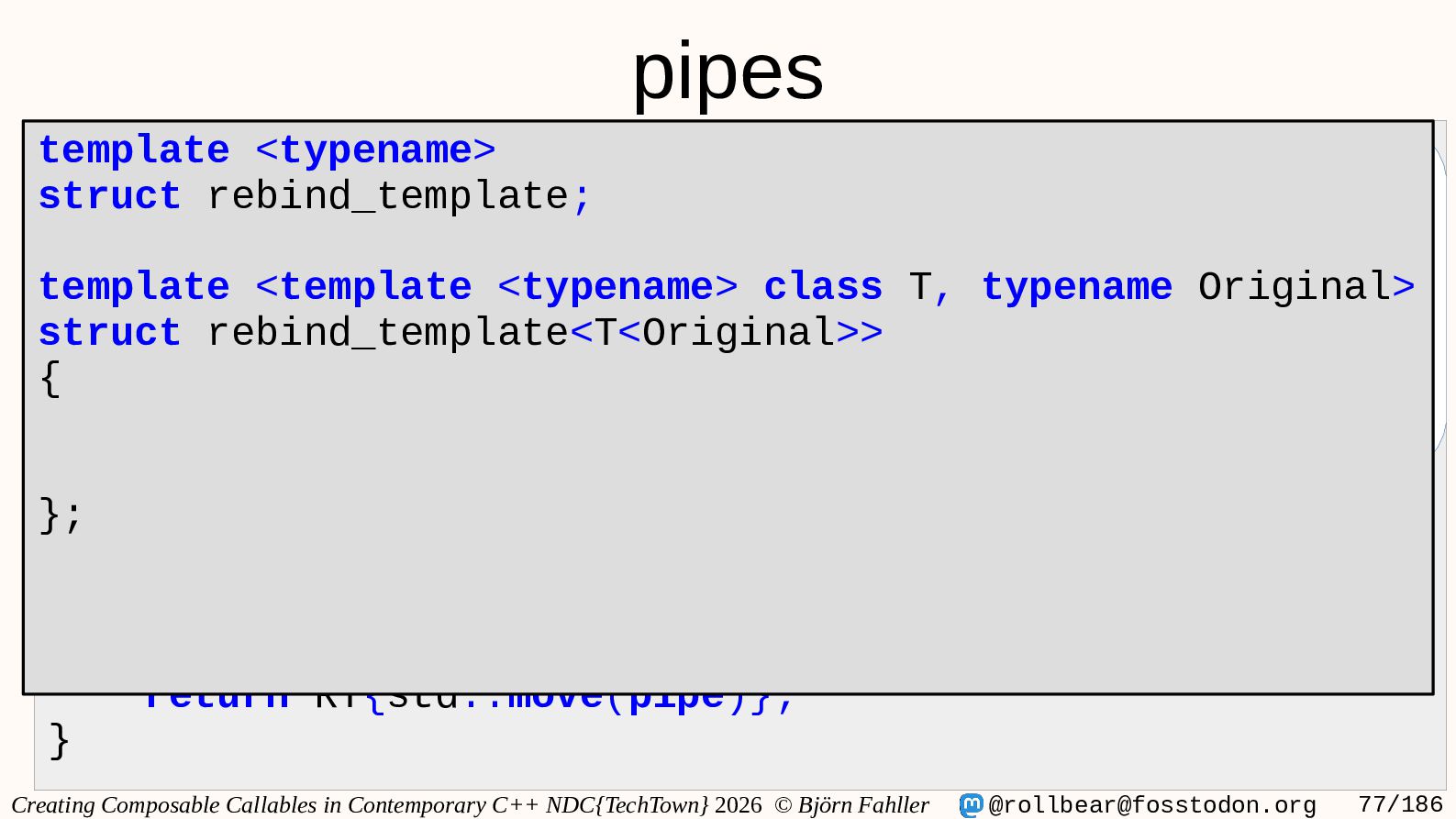
pipes template <typename> < template LH is a specialization of
a composable function composable_function_type LH, struct rebind_template; type. composable_function_type RH> auto operator|(LH&& lh, RH&& rh) C<F> { We need the same kind auto pipe = [lh = std::forward<LH>(lh).f, of template, but rh = std::forward<RH>(rh).f] instantiated with our pipe. <typename ... Ts>(Ts&& ... ts) { return rh(lh(std::forward<Ts>(ts)...)); }; using RT = rebind_template_t<std::remove_cvref_t<LH>, decltype(pipe)>; return RT{std::move(pipe)}; } Creating Composable Callables in Contemporary C++ NDC{TechTown} 2026 © Björn Fahller @[email protected] 76/186 -
pipes template <typename> < template LH is a specialization of
a composable function composable_function_type LH, struct rebind_template; type. composable_function_type RH> auto operator|(LH&& lh, RH&& rh) template <template <typename> class T, typename Original> C<F> { struct rebind_template<T<Original>> We need the same kind auto pipe = [lh = std::forward<LH>(lh).f, { of template, but rh = std::forward<RH>(rh).f] instantiated with our pipe. <typename ... Ts>(Ts&& ... ts) { return rh(lh(std::forward<Ts>(ts)...)); }; }; using RT = rebind_template_t<std::remove_cvref_t<LH>, decltype(pipe)>; return RT{std::move(pipe)}; } Creating Composable Callables in Contemporary C++ NDC{TechTown} 2026 © Björn Fahller @[email protected] 77/186 -
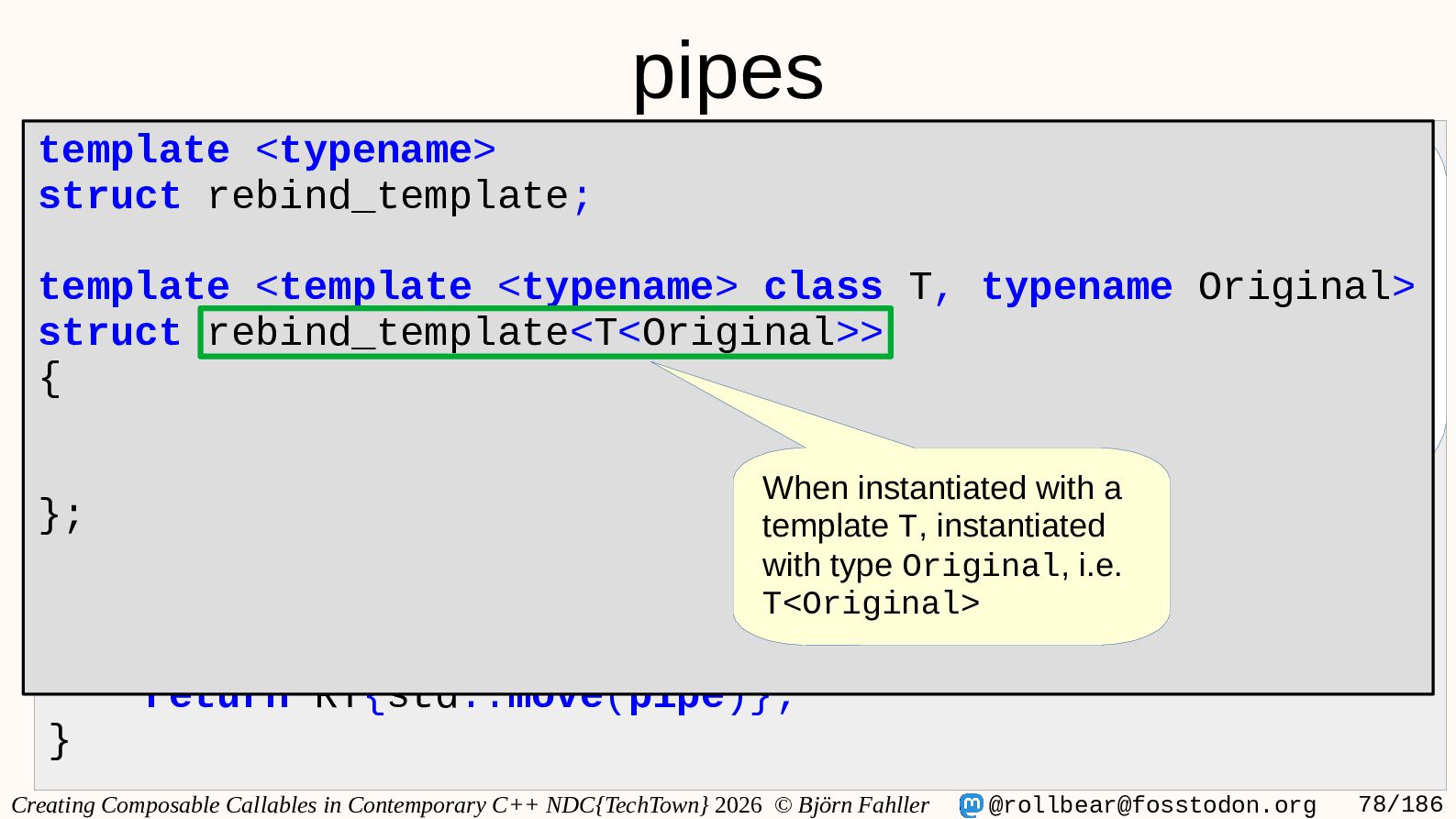
pipes template <typename> < template LH is a specialization of
a composable function composable_function_type LH, struct rebind_template; type. composable_function_type RH> auto operator|(LH&& lh, RH&& rh) template <template <typename> class T, typename Original> C<F> { struct rebind_template<T<Original>> We need the same kind auto pipe = [lh = std::forward<LH>(lh).f, { of template, but rh = std::forward<RH>(rh).f] instantiated with our pipe. <typename ... Ts>(Ts&& ... ts) { When instantiated with a return rh(lh(std::forward<Ts>(ts)...)); }; template T, instantiated }; with type Original, i.e. T<Original> using RT = rebind_template_t<std::remove_cvref_t<LH>, decltype(pipe)>; return RT{std::move(pipe)}; } Creating Composable Callables in Contemporary C++ NDC{TechTown} 2026 © Björn Fahller @[email protected] 78/186 -
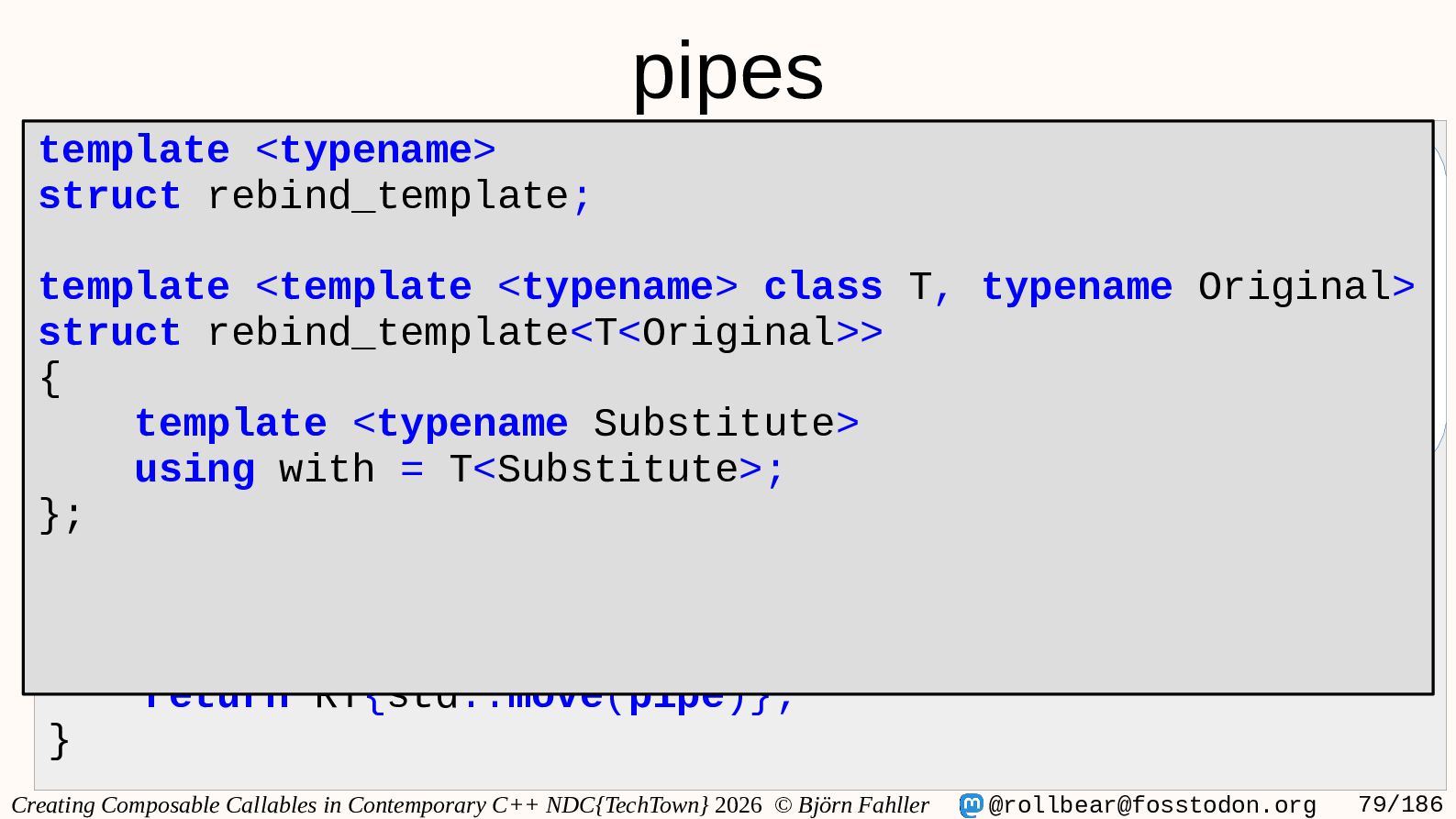
pipes template <typename> < template LH is a specialization of
a composable function composable_function_type LH, struct rebind_template; type. composable_function_type RH> auto operator|(LH&& lh, RH&& rh) template <template <typename> class T, typename Original> C<F> { struct rebind_template<T<Original>> We need the same kind auto pipe = [lh = std::forward<LH>(lh).f, { of template, but rh = std::forward<RH>(rh).f] template <typename Substitute> instantiated with our pipe. <typename Ts>(Ts&& ... ts) { using with ... = T<Substitute>; return rh(lh(std::forward<Ts>(ts)...)); }; }; using RT = rebind_template_t<std::remove_cvref_t<LH>, decltype(pipe)>; return RT{std::move(pipe)}; } Creating Composable Callables in Contemporary C++ NDC{TechTown} 2026 © Björn Fahller @[email protected] 79/186 -
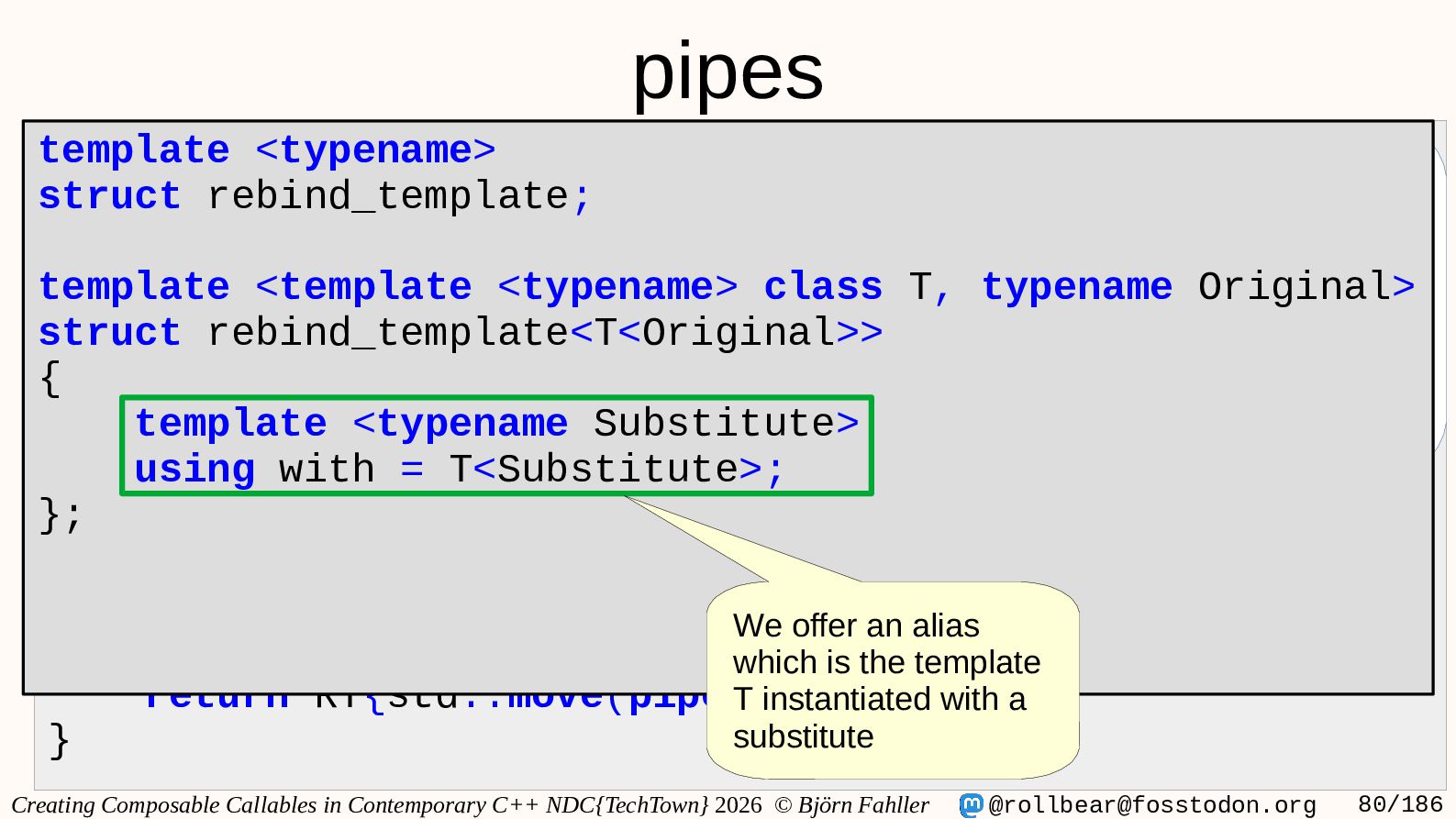
pipes template <typename> < template LH is a specialization of
a composable function composable_function_type LH, struct rebind_template; type. composable_function_type RH> auto operator|(LH&& lh, RH&& rh) template <template <typename> class T, typename Original> C<F> { struct rebind_template<T<Original>> We need the same kind auto pipe = [lh = std::forward<LH>(lh).f, { of template, but rh = std::forward<RH>(rh).f] template <typename Substitute> instantiated with our pipe. <typename Ts>(Ts&& ... ts) { using with ... = T<Substitute>; return rh(lh(std::forward<Ts>(ts)...)); }; }; using RT = rebind_template_t<std::remove_cvref_t<LH>, We offer an alias which isdecltype(pipe)>; the template return RT{std::move(pipe)}; T instantiated with a substitute } Creating Composable Callables in Contemporary C++ NDC{TechTown} 2026 © Björn Fahller @[email protected] 80/186 -
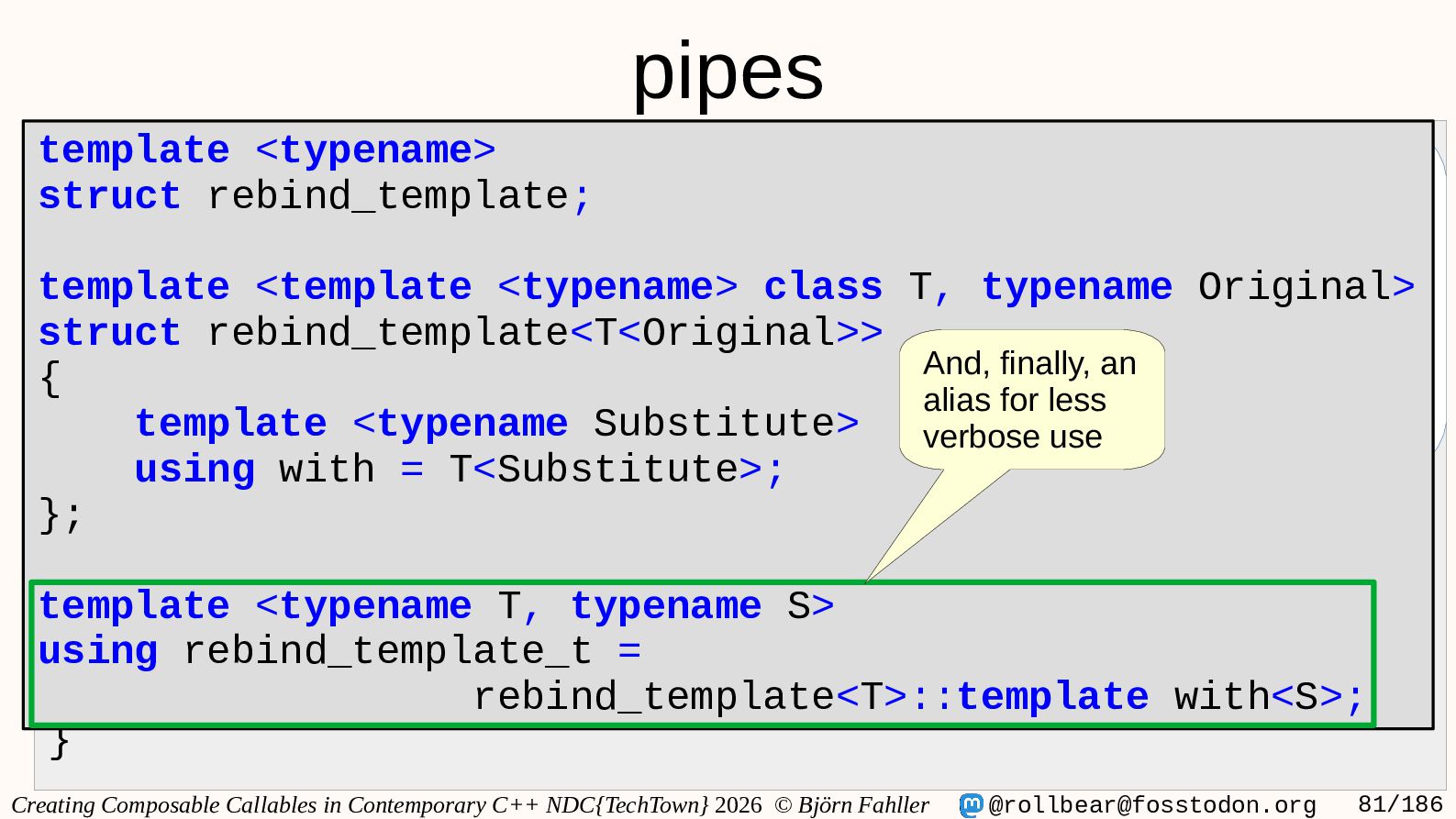
pipes template <typename> < template LH is a specialization of
a composable function composable_function_type LH, struct rebind_template; type. composable_function_type RH> auto operator|(LH&& lh, RH&& rh) template <template <typename> class T, typename Original> C<F> { struct rebind_template<T<Original>> And, finally, an the same kind We need auto pipe = [lh = std::forward<LH>(lh).f, { alias forof less template, but rh = std::forward<RH>(rh).f] template <typename Substitute> verboseinstantiated use with our pipe. <typename Ts>(Ts&& ... ts) { using with ... = T<Substitute>; return rh(lh(std::forward<Ts>(ts)...)); }; }; using<typename RT = rebind_template_t<std::remove_cvref_t<LH>, template T, typename S> decltype(pipe)>; using rebind_template_t = return RT{std::move(pipe)}; rebind_template<T>::template with<S>; } Creating Composable Callables in Contemporary C++ NDC{TechTown} 2026 © Björn Fahller @[email protected] 81/186 -
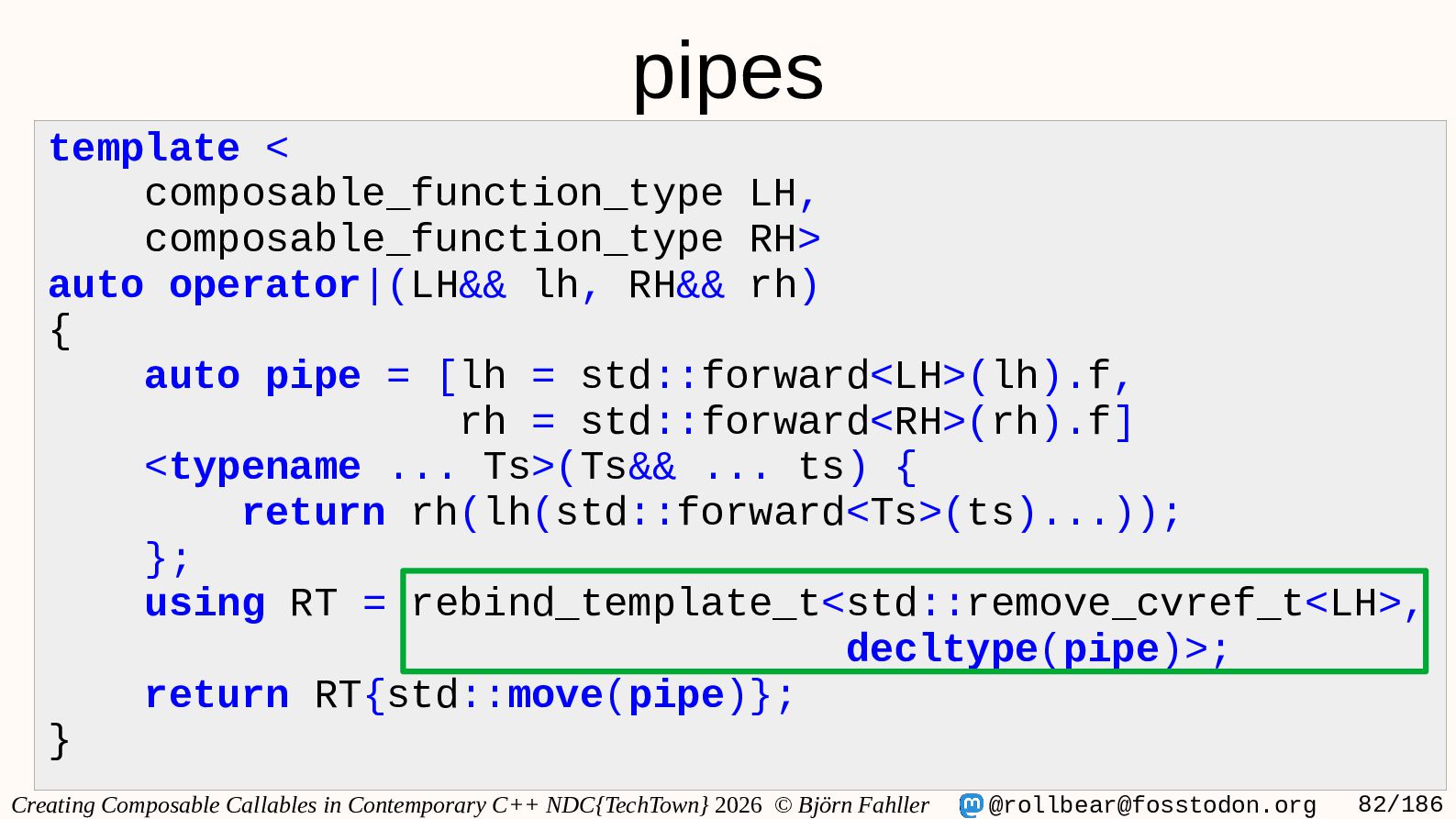
pipes template < composable_function_type LH, composable_function_type RH> auto operator|(LH&& lh,
RH&& rh) { auto pipe = [lh = std::forward<LH>(lh).f, rh = std::forward<RH>(rh).f] <typename ... Ts>(Ts&& ... ts) { return rh(lh(std::forward<Ts>(ts)...)); }; using RT = rebind_template_t<std::remove_cvref_t<LH>, decltype(pipe)>; return RT{std::move(pipe)}; } Creating Composable Callables in Contemporary C++ NDC{TechTown} 2026 © Björn Fahller @[email protected] 82/186 -
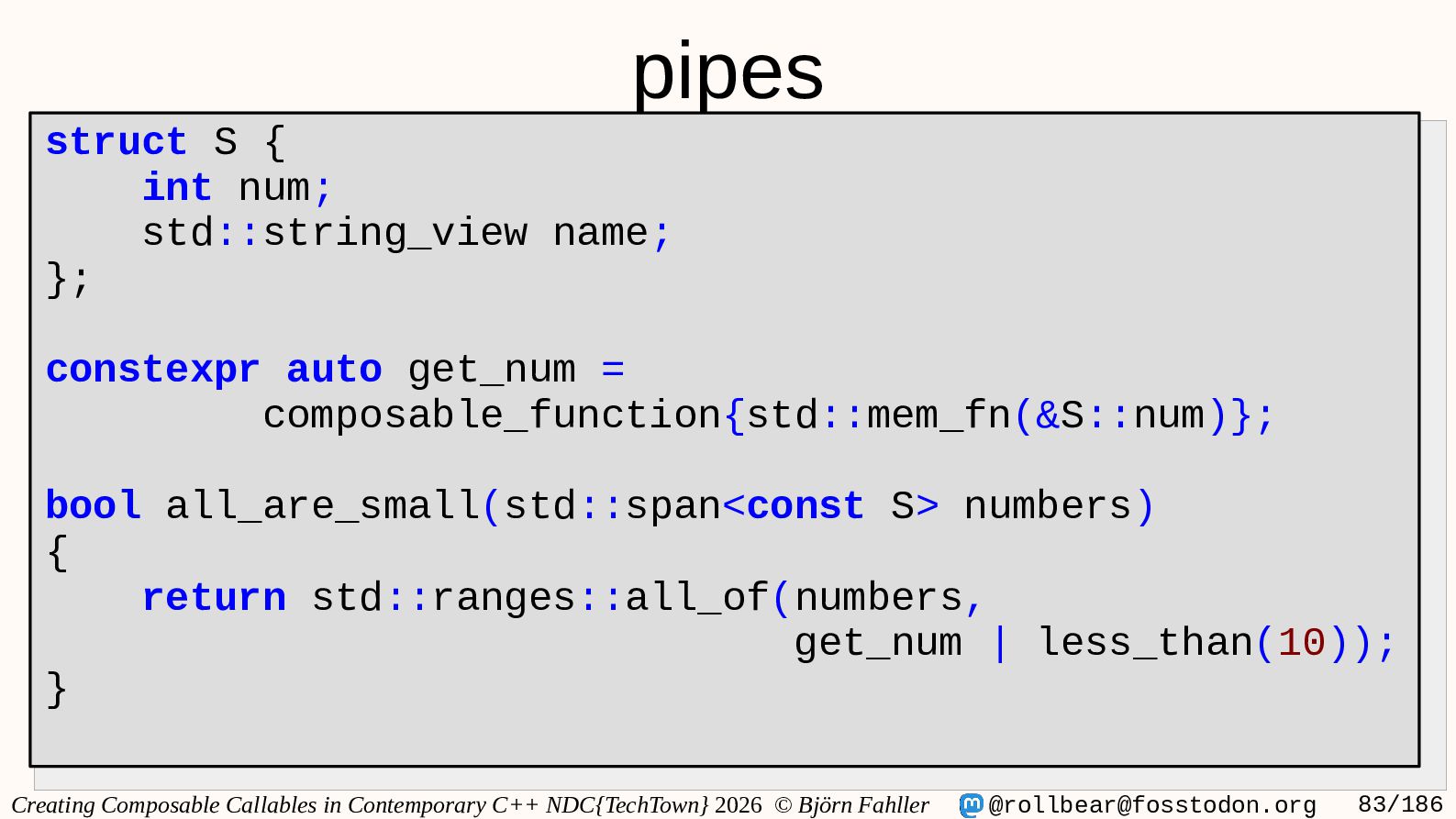
pipes struct S { template < int num; composable_function_type LH,
std::string_view name; composable_function_type RH> }; auto operator|(LH&& lh, RH&& rh) { constexpr auto =get_num = auto pipe [lh = std::forward<LH>(lh).f, composable_function{std::mem_fn(&S::num)}; rh = std::forward<RH>(rh).f] <typename ... Ts>(Ts&& ... ts) { bool all_are_small(std::span<const S> numbers) return rh(lh(std::forward<Ts>(ts)...)); { }; return std::ranges::all_of(numbers, using RT = rebind_template_t<std::remove_cvref_t<LH>, get_num | less_than(10)); decltype(pipe)>; } return RT{std::move(pipe)}; } Creating Composable Callables in Contemporary C++ NDC{TechTown} 2026 © Björn Fahller @[email protected] 83/186 -
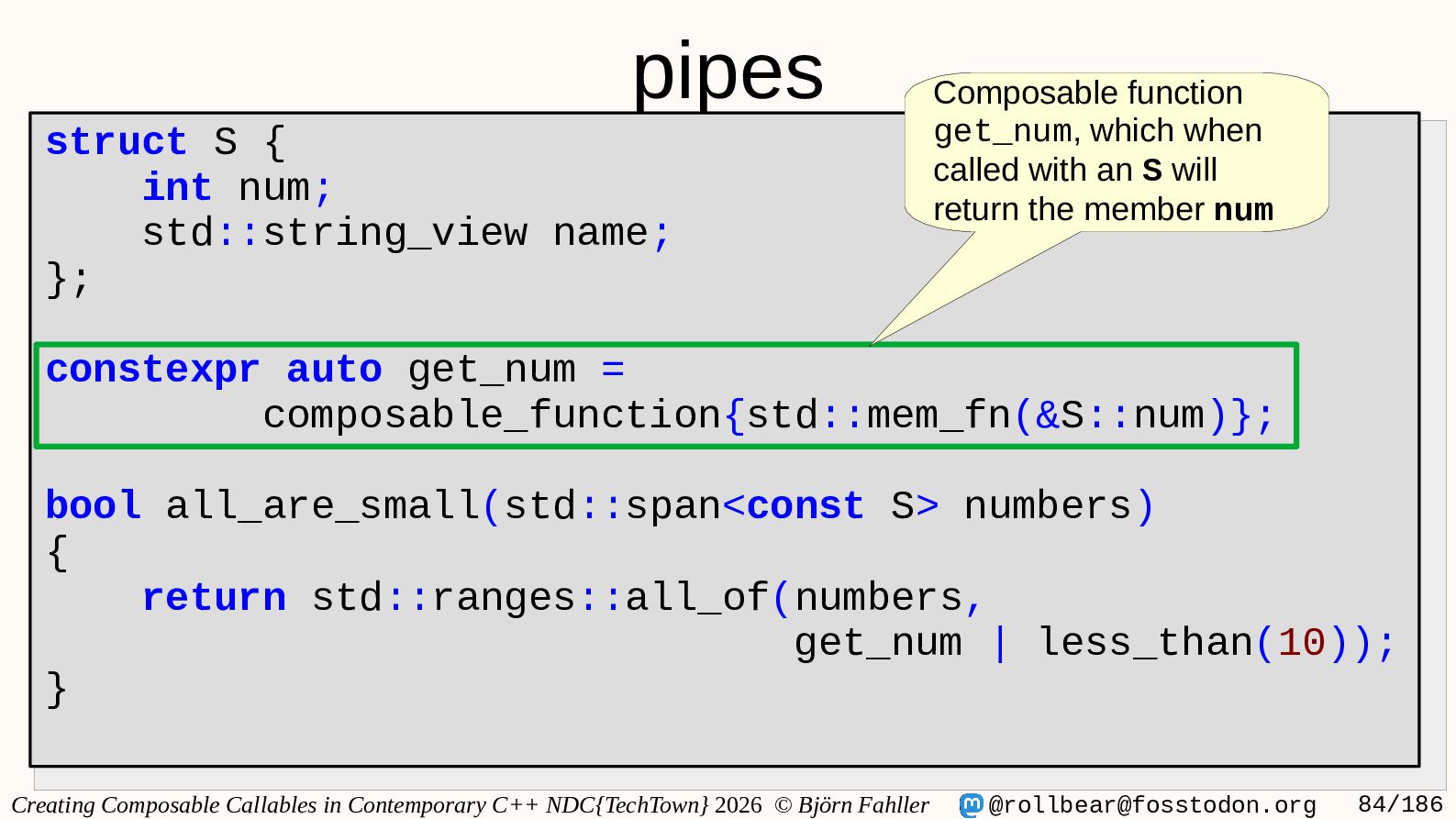
pipes Composable function get_num, which when called with an S
will return the member num struct S { template < int num; composable_function_type LH, std::string_view name; composable_function_type RH> }; auto operator|(LH&& lh, RH&& rh) { constexpr auto =get_num = auto pipe [lh = std::forward<LH>(lh).f, composable_function{std::mem_fn(&S::num)}; rh = std::forward<RH>(rh).f] <typename ... Ts>(Ts&& ... ts) { bool all_are_small(std::span<const S> numbers) return rh(lh(std::forward<Ts>(ts)...)); { }; return std::ranges::all_of(numbers, using RT = rebind_template_t<std::remove_cvref_t<LH>, get_num | less_than(10)); decltype(pipe)>; } return RT{std::move(pipe)}; } Creating Composable Callables in Contemporary C++ NDC{TechTown} 2026 © Björn Fahller @[email protected] 84/186 -
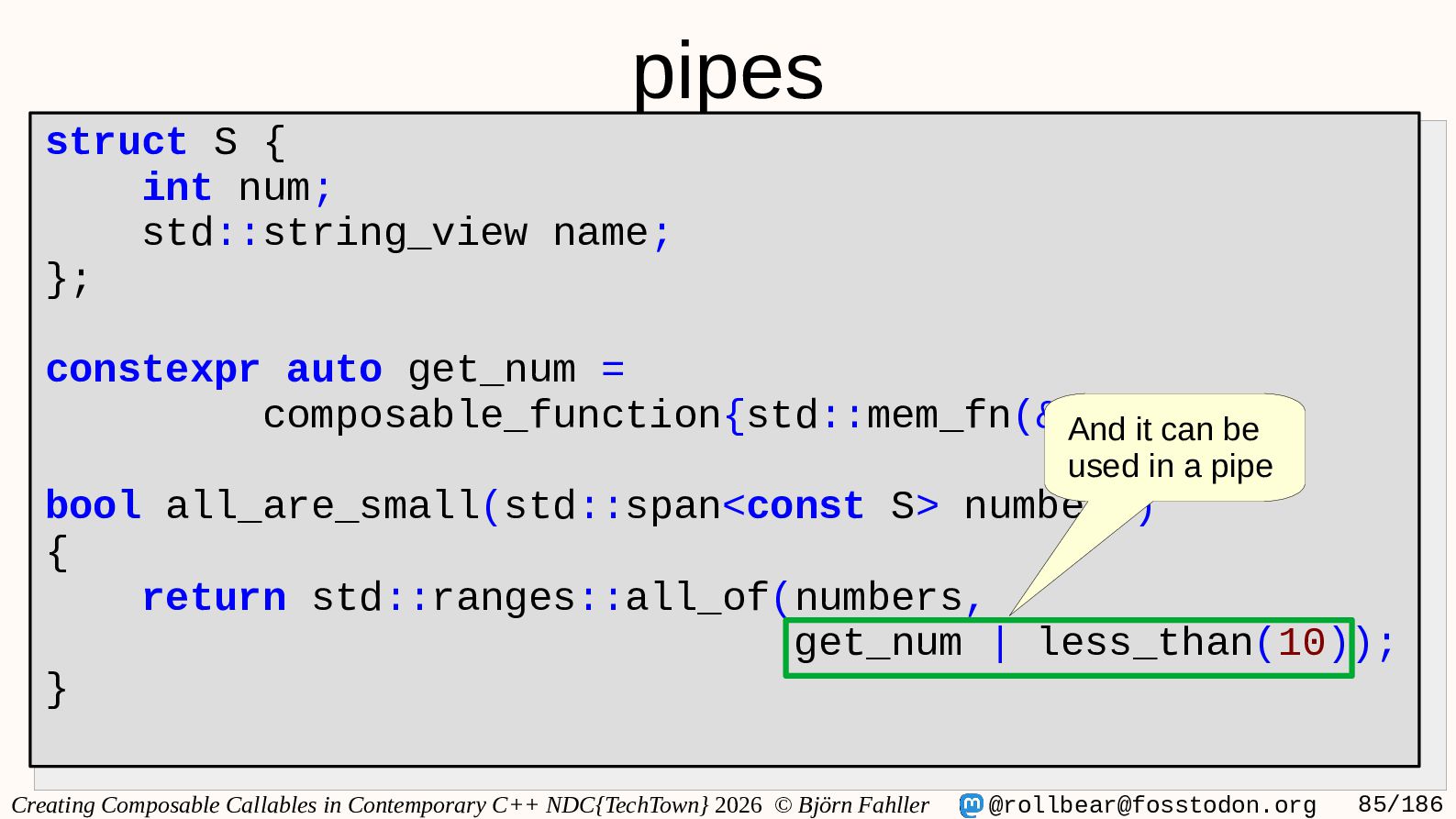
pipes struct S { template < int num; composable_function_type LH,
std::string_view name; composable_function_type RH> }; auto operator|(LH&& lh, RH&& rh) { constexpr auto =get_num = auto pipe [lh = std::forward<LH>(lh).f, composable_function{std::mem_fn(&S::num)}; rh = std::forward<RH>(rh).f] And it can be used in a pipe <typename ... Ts>(Ts&& ... ts) { bool all_are_small(std::span<const S> numbers) return rh(lh(std::forward<Ts>(ts)...)); { }; return std::ranges::all_of(numbers, using RT = rebind_template_t<std::remove_cvref_t<LH>, get_num | less_than(10)); decltype(pipe)>; } return RT{std::move(pipe)}; } Creating Composable Callables in Contemporary C++ NDC{TechTown} 2026 © Björn Fahller @[email protected] 85/186 -
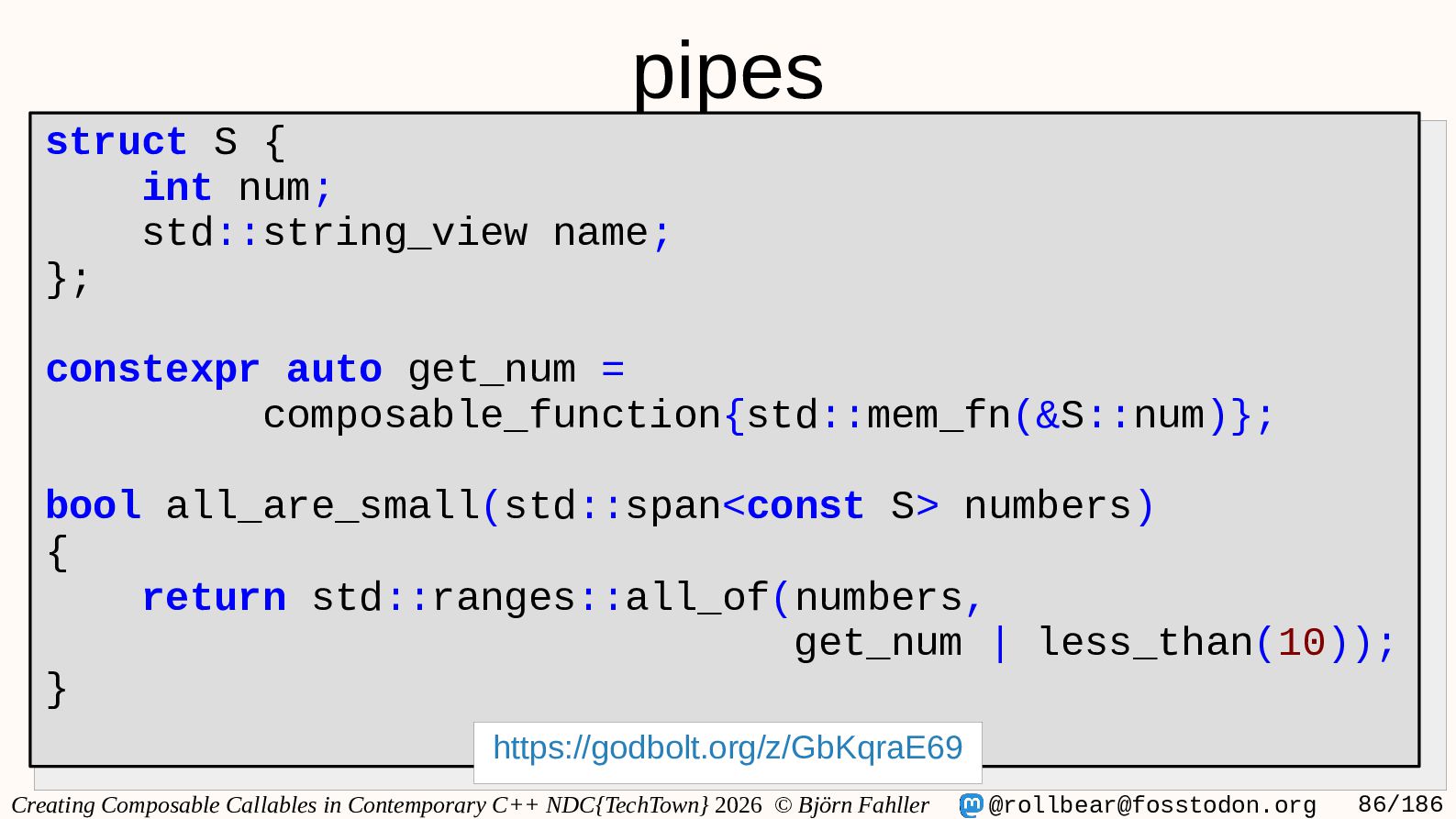
pipes struct S { template < int num; composable_function_type LH,
std::string_view name; composable_function_type RH> }; auto operator|(LH&& lh, RH&& rh) { constexpr auto =get_num = auto pipe [lh = std::forward<LH>(lh).f, composable_function{std::mem_fn(&S::num)}; rh = std::forward<RH>(rh).f] <typename ... Ts>(Ts&& ... ts) { bool all_are_small(std::span<const S> numbers) return rh(lh(std::forward<Ts>(ts)...)); { }; return std::ranges::all_of(numbers, using RT = rebind_template_t<std::remove_cvref_t<LH>, get_num | less_than(10)); decltype(pipe)>; } return RT{std::move(pipe)}; } https://godbolt.org/z/GbKqraE69 Creating Composable Callables in Contemporary C++ NDC{TechTown} 2026 © Björn Fahller @[email protected] 86/186 -
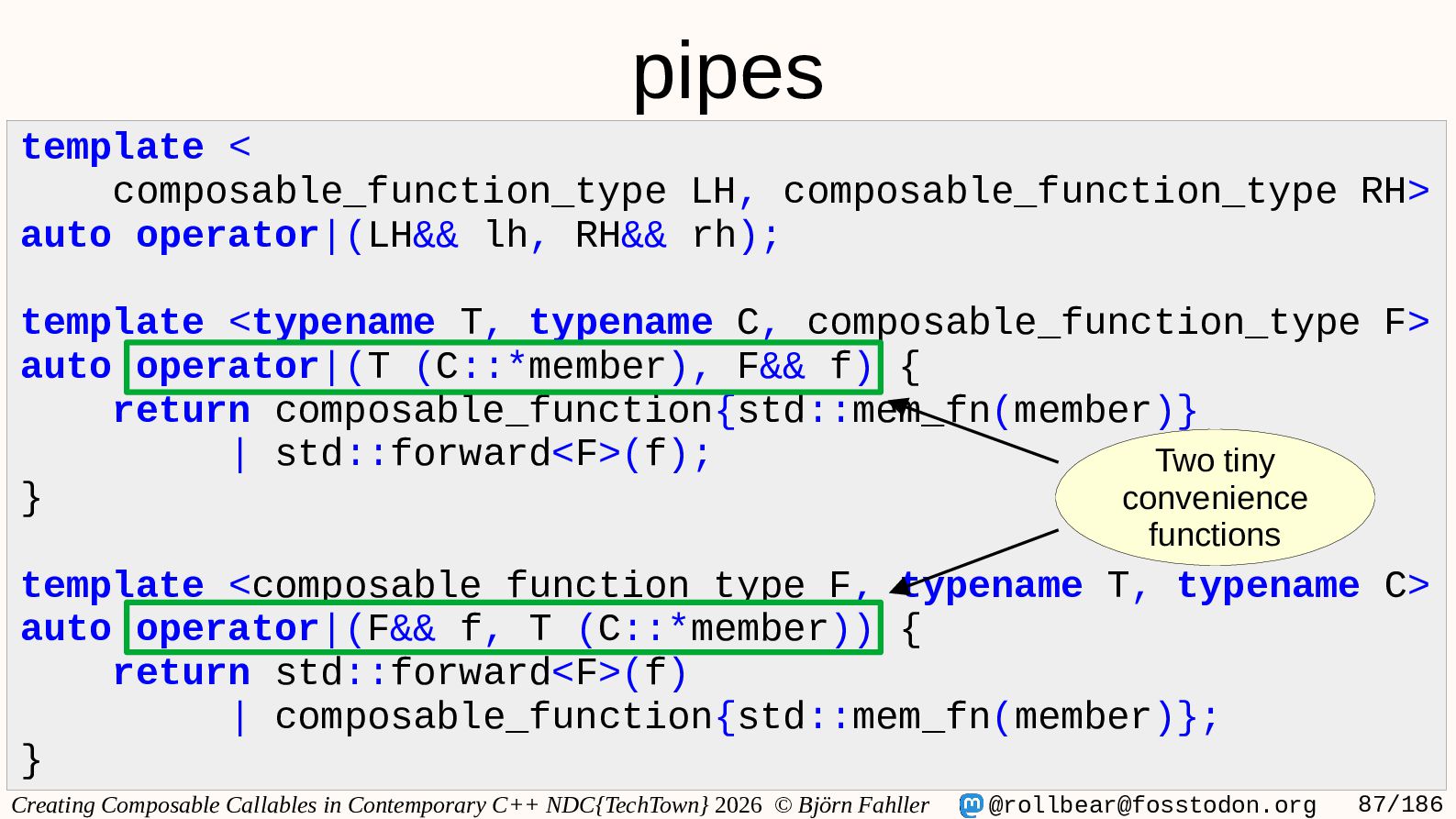
pipes template < composable_function_type LH, composable_function_type RH> auto operator|(LH&& lh,
RH&& rh); template <typename T, typename C, composable_function_type F> auto operator|(T (C::*member), F&& f) { return composable_function{std::mem_fn(member)} | std::forward<F>(f); Two tiny convenience } functions template <composable_function_type F, typename T, typename C> auto operator|(F&& f, T (C::*member)) { return std::forward<F>(f) | composable_function{std::mem_fn(member)}; } Creating Composable Callables in Contemporary C++ NDC{TechTown} 2026 © Björn Fahller @[email protected] 87/186 -
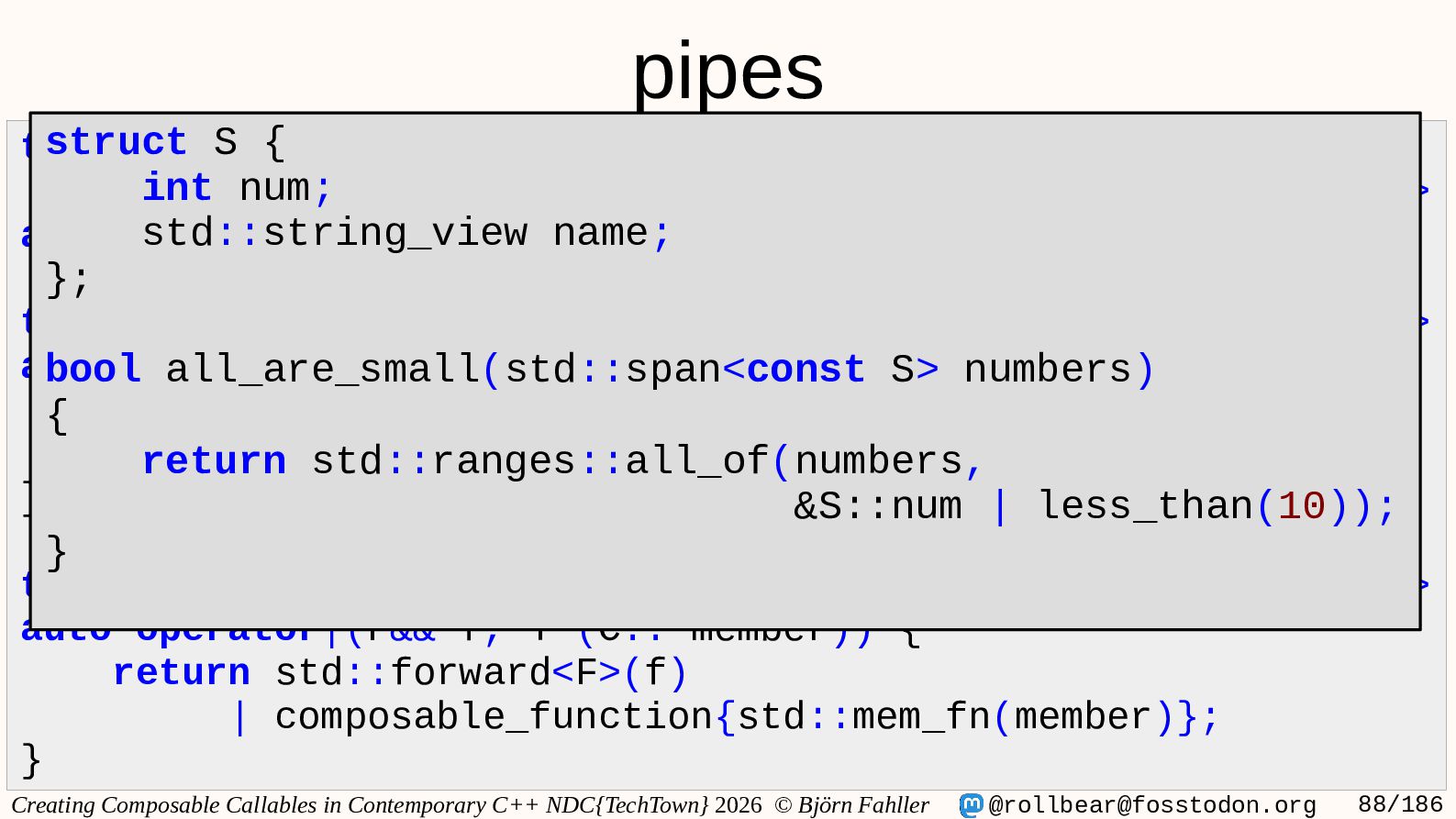
pipes struct S< { template int num; composable_function_type LH, composable_function_type
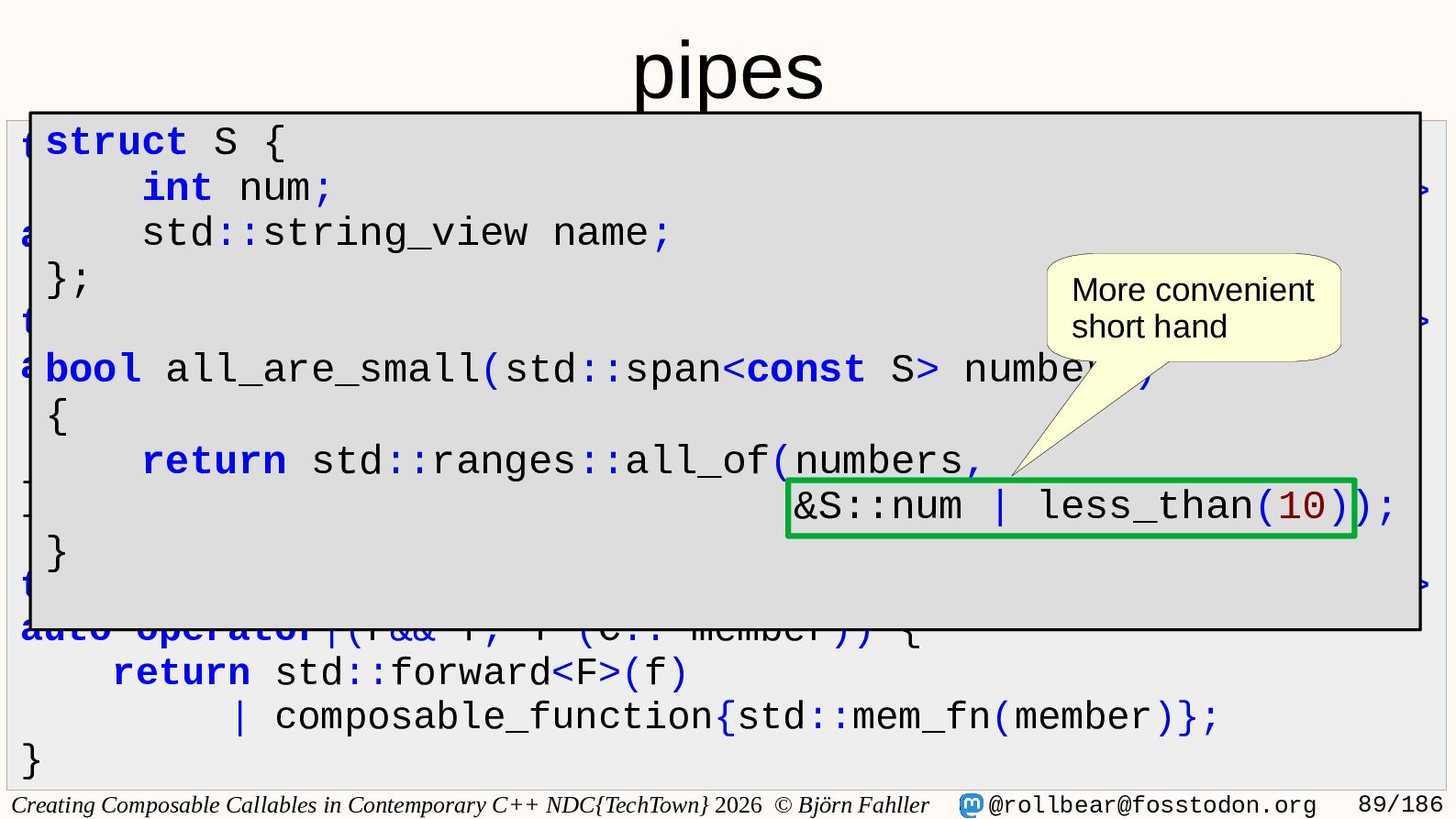
RH> std::string_view auto operator|(LH&& lh,name; RH&& rh); }; template <typename T, typename C, composable_function_type F> auto (C::*member), F&& f) S> { numbers) booloperator|(T all_are_small(std::span<const { return composable_function{std::mem_fn(member)} | std::forward<F>(f); return std::ranges::all_of(numbers, } &S::num | less_than(10)); } template <composable_function_type F, typename T, typename C> auto operator|(F&& f, T (C::*member)) { return std::forward<F>(f) | composable_function{std::mem_fn(member)}; } Creating Composable Callables in Contemporary C++ NDC{TechTown} 2026 © Björn Fahller @[email protected] 88/186 -
pipes struct S< { template int num; composable_function_type LH, composable_function_type
RH> std::string_view auto operator|(LH&& lh,name; RH&& rh); }; More convenient template <typename T, typename C, composable_function_type F> short hand auto (C::*member), F&& f) S> { numbers) booloperator|(T all_are_small(std::span<const { return composable_function{std::mem_fn(member)} | std::forward<F>(f); return std::ranges::all_of(numbers, } &S::num | less_than(10)); } template <composable_function_type F, typename T, typename C> auto operator|(F&& f, T (C::*member)) { return std::forward<F>(f) | composable_function{std::mem_fn(member)}; } Creating Composable Callables in Contemporary C++ NDC{TechTown} 2026 © Björn Fahller @[email protected] 89/186 -
pipes struct S< { template int num; composable_function_type LH, composable_function_type
RH> std::string_view auto operator|(LH&& lh,name; RH&& rh); }; template <typename T, typename C, composable_function_type F> auto (C::*member), F&& f) S> { numbers) booloperator|(T all_are_small(std::span<const { return composable_function{std::mem_fn(member)} | std::forward<F>(f); return std::ranges::all_of(numbers, } &S::num | less_than(10)); } template <composable_function_type F, typename T, typename C> auto operator|(F&& f, T (C::*member)) { return std::forward<F>(f) | composable_function{std::mem_fn(member)}; } Creating Composable Callables in Contemporary C++ NDC{TechTown} 2026 © Björn Fahller @[email protected] 90/186 -
transform_args How do I, e.g., sort on a member? Creating
Composable Callables in Contemporary C++ NDC{TechTown} 2026 © Björn Fahller @[email protected] 91/186 -
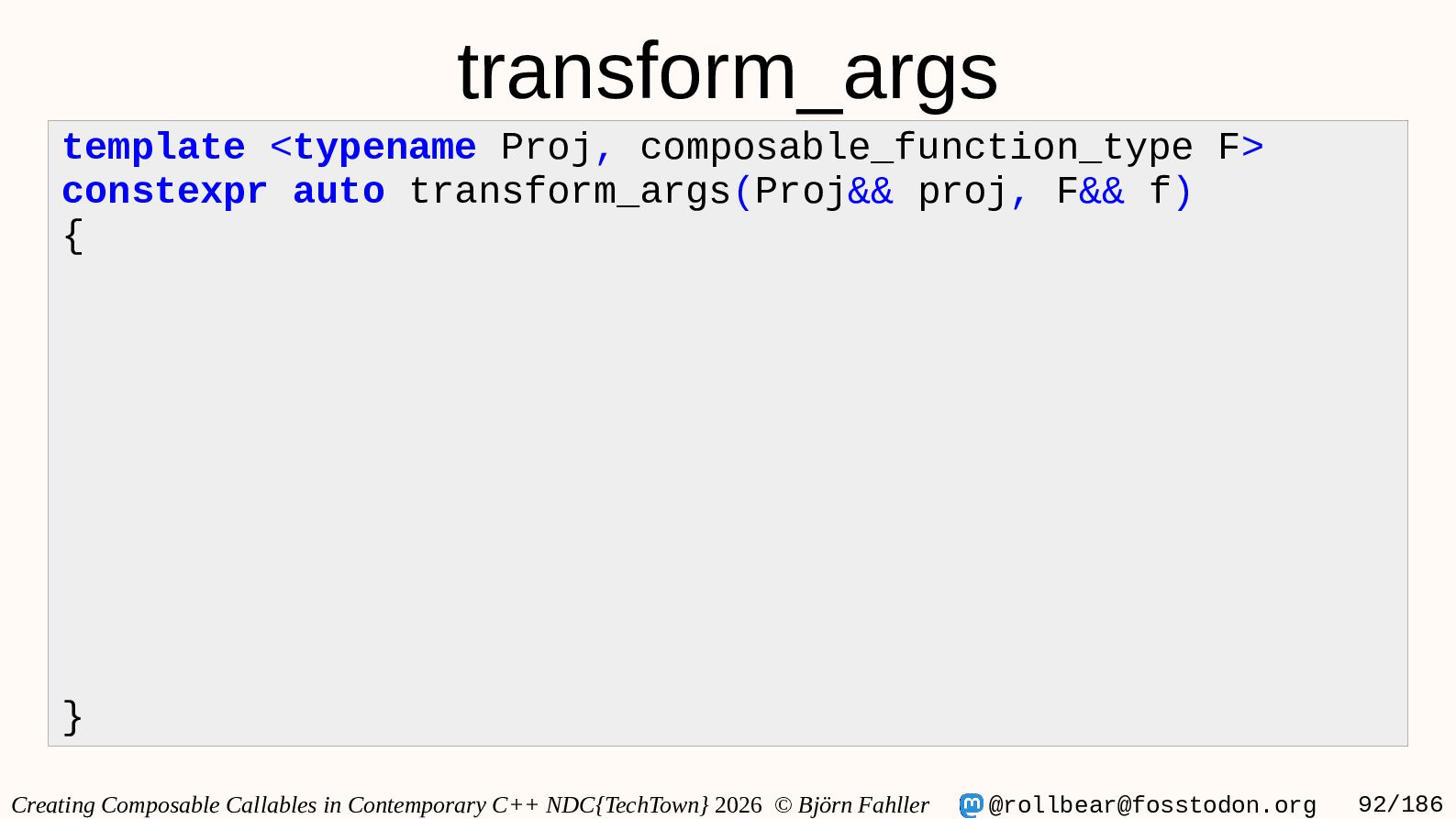
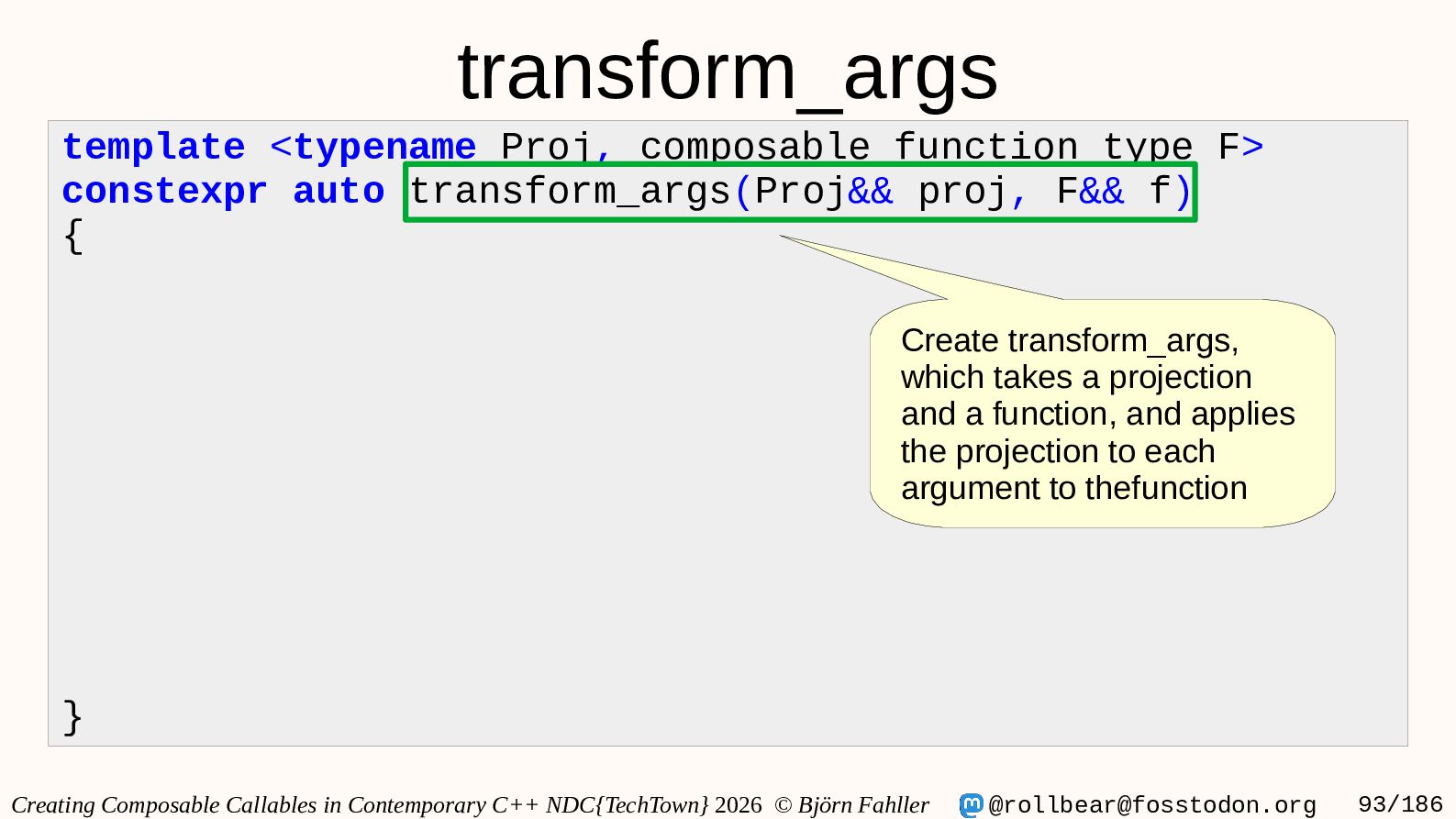
transform_args template <typename Proj, composable_function_type F> constexpr auto transform_args(Proj&& proj,
F&& f) { } Creating Composable Callables in Contemporary C++ NDC{TechTown} 2026 © Björn Fahller @[email protected] 92/186 -
transform_args template <typename Proj, composable_function_type F> constexpr auto transform_args(Proj&& proj,
F&& f) { Create transform_args, which takes a projection and a function, and applies the projection to each argument to thefunction } Creating Composable Callables in Contemporary C++ NDC{TechTown} 2026 © Björn Fahller @[email protected] 93/186 -
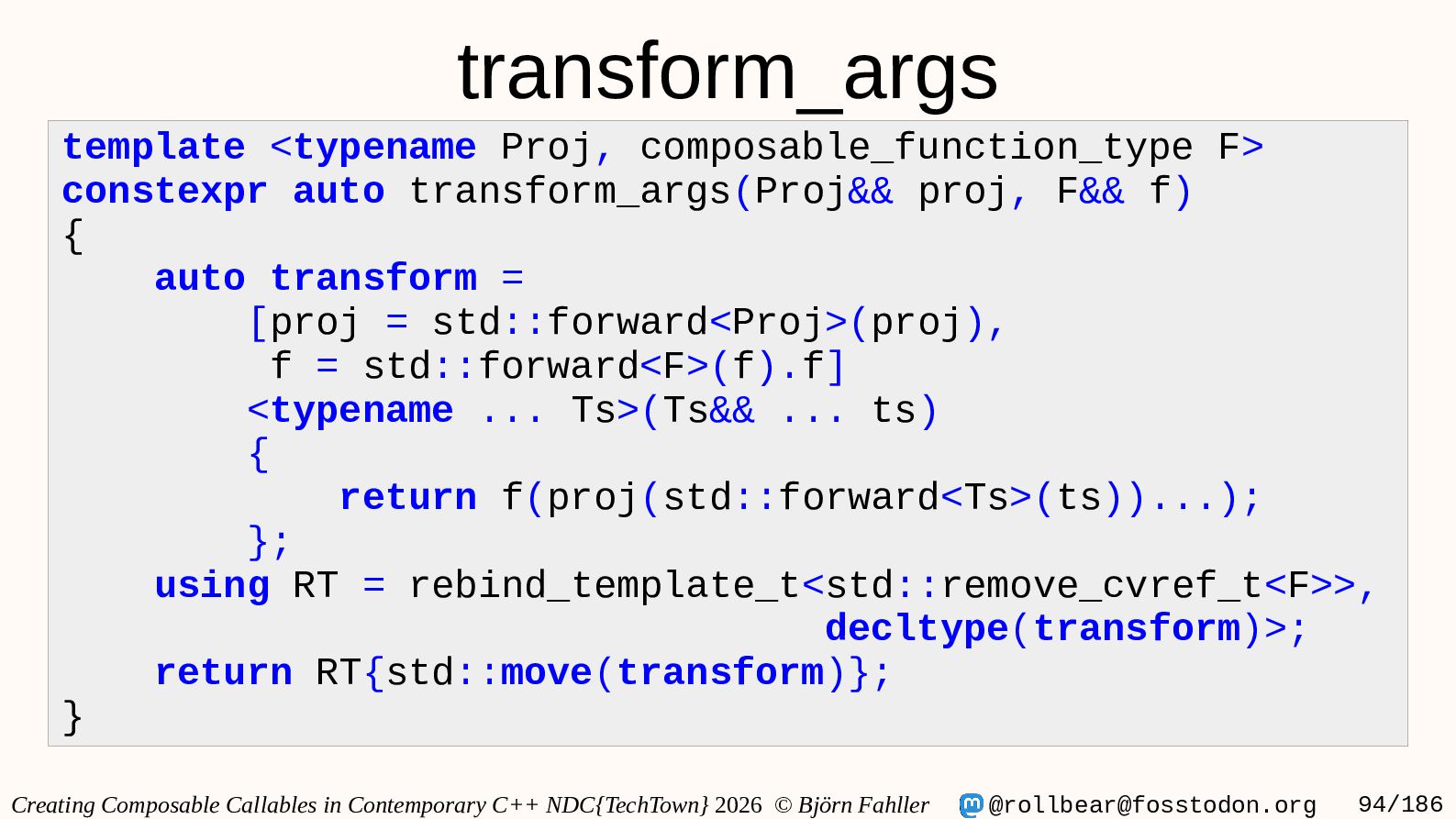
transform_args template <typename Proj, composable_function_type F> constexpr auto transform_args(Proj&& proj,
F&& f) { auto transform = [proj = std::forward<Proj>(proj), f = std::forward<F>(f).f] <typename ... Ts>(Ts&& ... ts) { return f(proj(std::forward<Ts>(ts))...); }; using RT = rebind_template_t<std::remove_cvref_t<F>>, decltype(transform)>; return RT{std::move(transform)}; } Creating Composable Callables in Contemporary C++ NDC{TechTown} 2026 © Björn Fahller @[email protected] 94/186 -
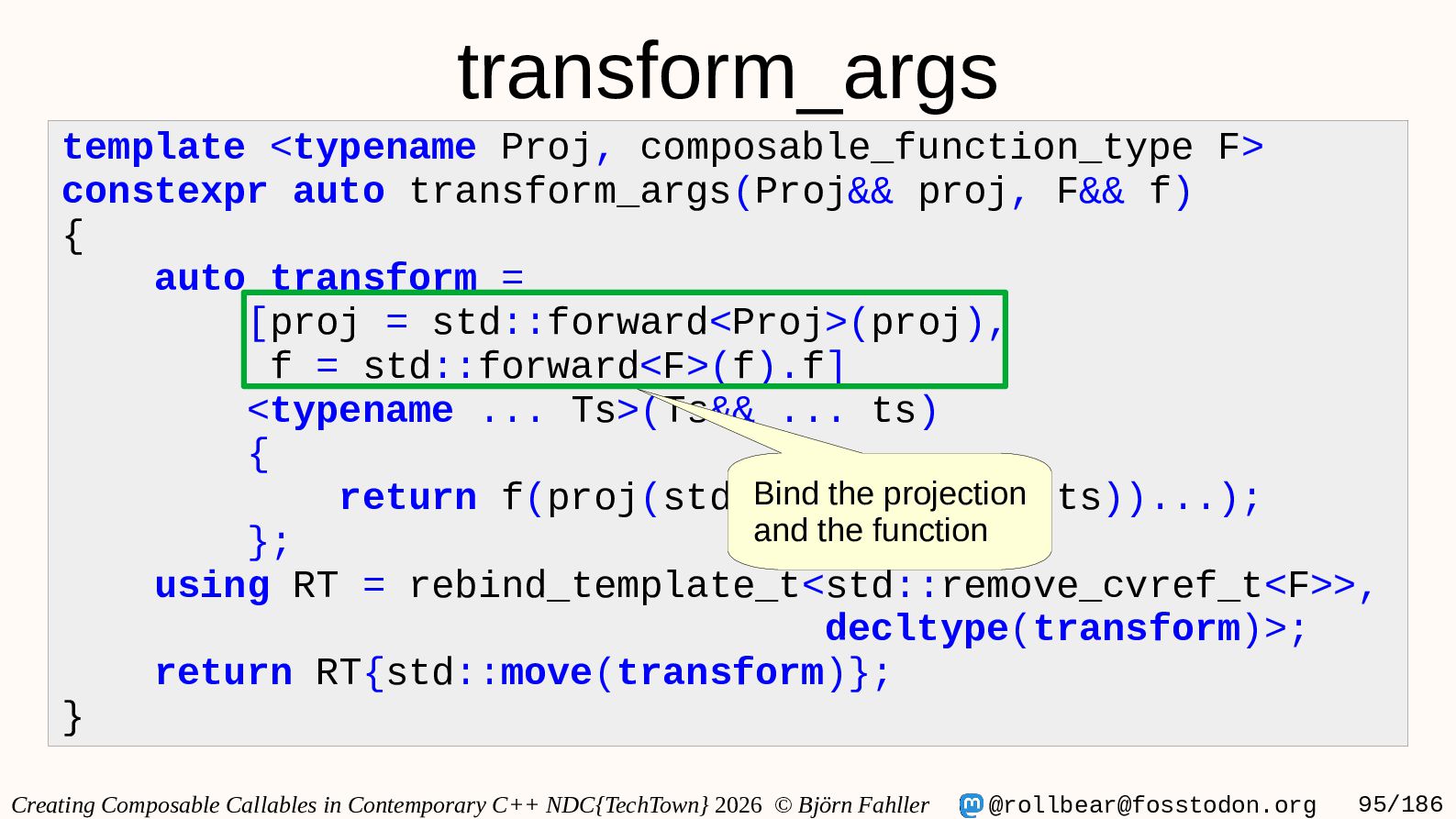
transform_args template <typename Proj, composable_function_type F> constexpr auto transform_args(Proj&& proj,
F&& f) { auto transform = [proj = std::forward<Proj>(proj), f = std::forward<F>(f).f] <typename ... Ts>(Ts&& ... ts) { Bind the projection return f(proj(std::forward<Ts>(ts))...); and the function }; using RT = rebind_template_t<std::remove_cvref_t<F>>, decltype(transform)>; return RT{std::move(transform)}; } Creating Composable Callables in Contemporary C++ NDC{TechTown} 2026 © Björn Fahller @[email protected] 95/186 -
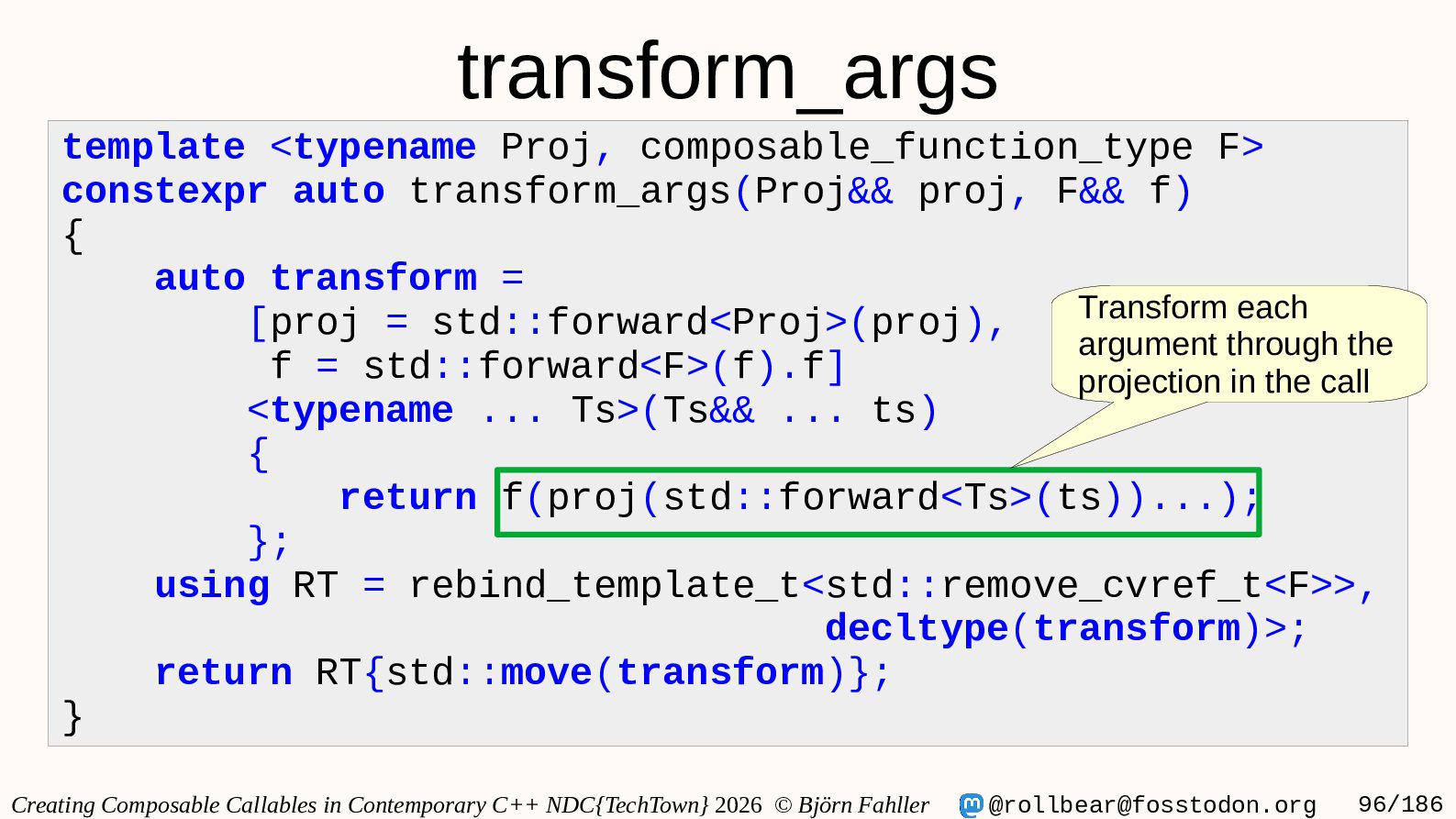
transform_args template <typename Proj, composable_function_type F> constexpr auto transform_args(Proj&& proj,
F&& f) { auto transform = Transform each [proj = std::forward<Proj>(proj), argument through the f = std::forward<F>(f).f] projection in the call <typename ... Ts>(Ts&& ... ts) { return f(proj(std::forward<Ts>(ts))...); }; using RT = rebind_template_t<std::remove_cvref_t<F>>, decltype(transform)>; return RT{std::move(transform)}; } Creating Composable Callables in Contemporary C++ NDC{TechTown} 2026 © Björn Fahller @[email protected] 96/186 -
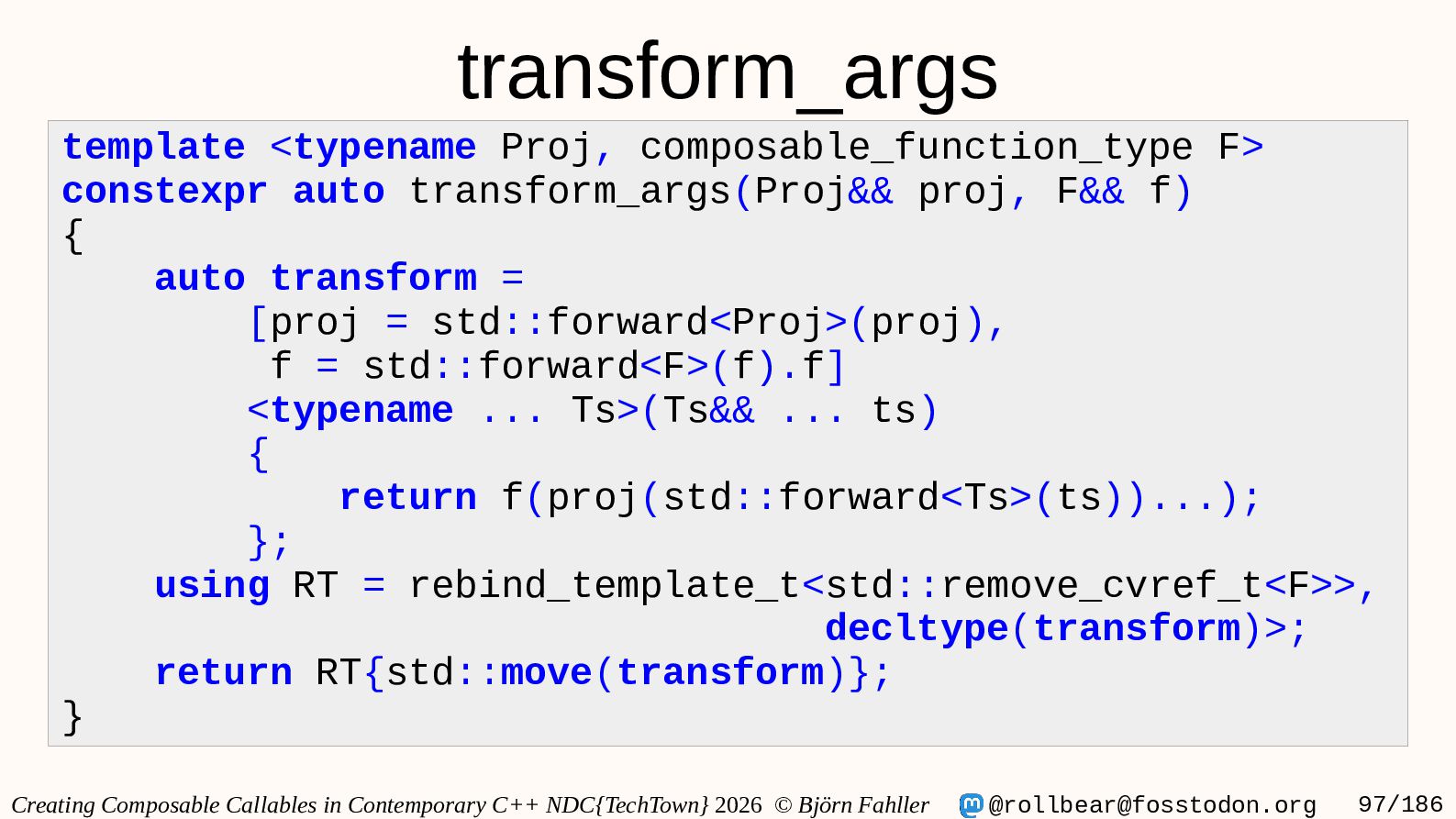
transform_args template <typename Proj, composable_function_type F> constexpr auto transform_args(Proj&& proj,
F&& f) { auto transform = [proj = std::forward<Proj>(proj), f = std::forward<F>(f).f] <typename ... Ts>(Ts&& ... ts) { return f(proj(std::forward<Ts>(ts))...); }; using RT = rebind_template_t<std::remove_cvref_t<F>>, decltype(transform)>; return RT{std::move(transform)}; } Creating Composable Callables in Contemporary C++ NDC{TechTown} 2026 © Björn Fahller @[email protected] 97/186 -
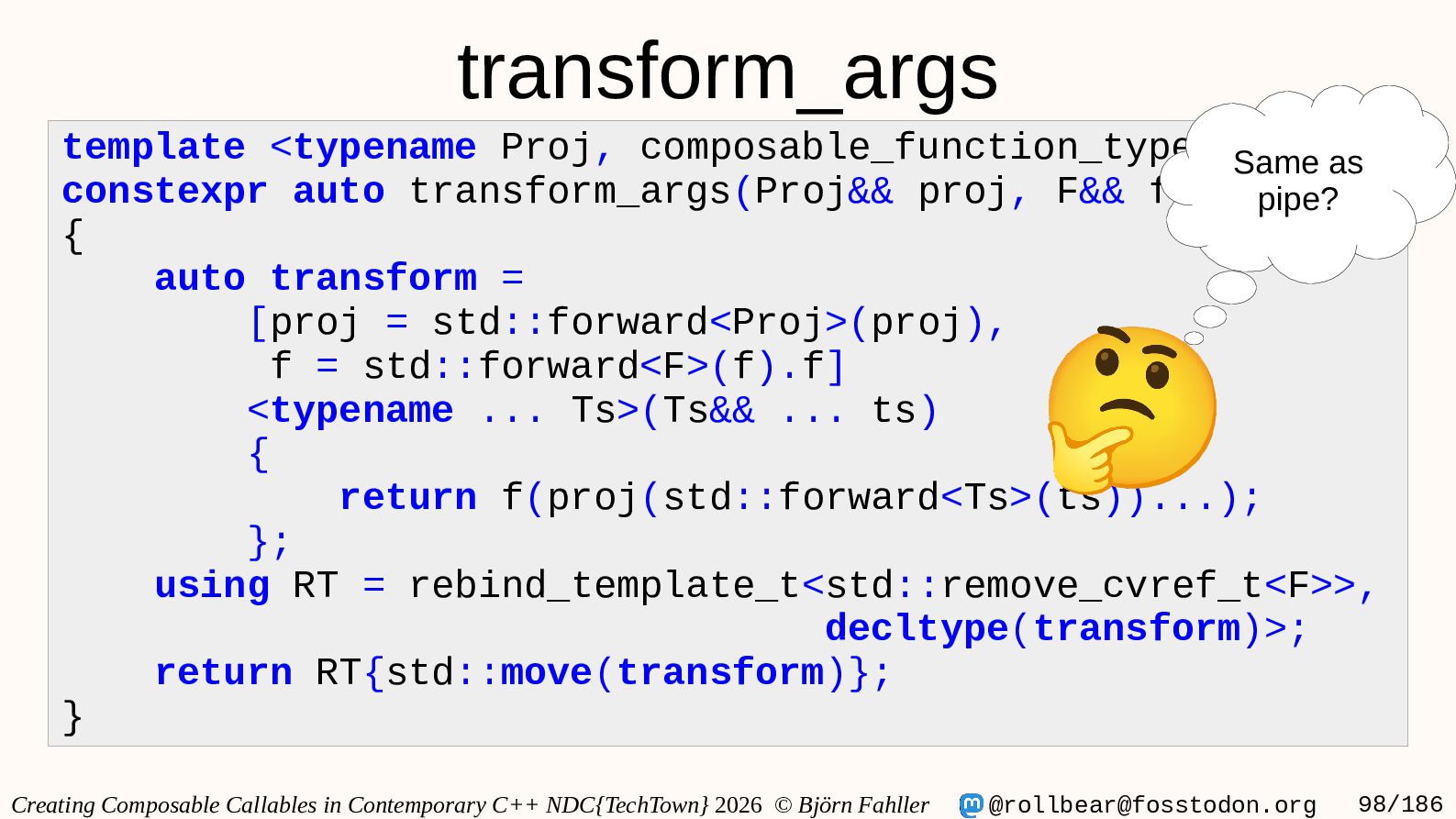
transform_args template <typename Proj, composable_function_type F> Same as constexpr auto
transform_args(Proj&& proj, F&& f) pipe? { auto transform = [proj = std::forward<Proj>(proj), f = std::forward<F>(f).f] <typename ... Ts>(Ts&& ... ts) { return f(proj(std::forward<Ts>(ts))...); }; using RT = rebind_template_t<std::remove_cvref_t<F>>, decltype(transform)>; return RT{std::move(transform)}; } Creating Composable Callables in Contemporary C++ NDC{TechTown} 2026 © Björn Fahller @[email protected] 98/186 -
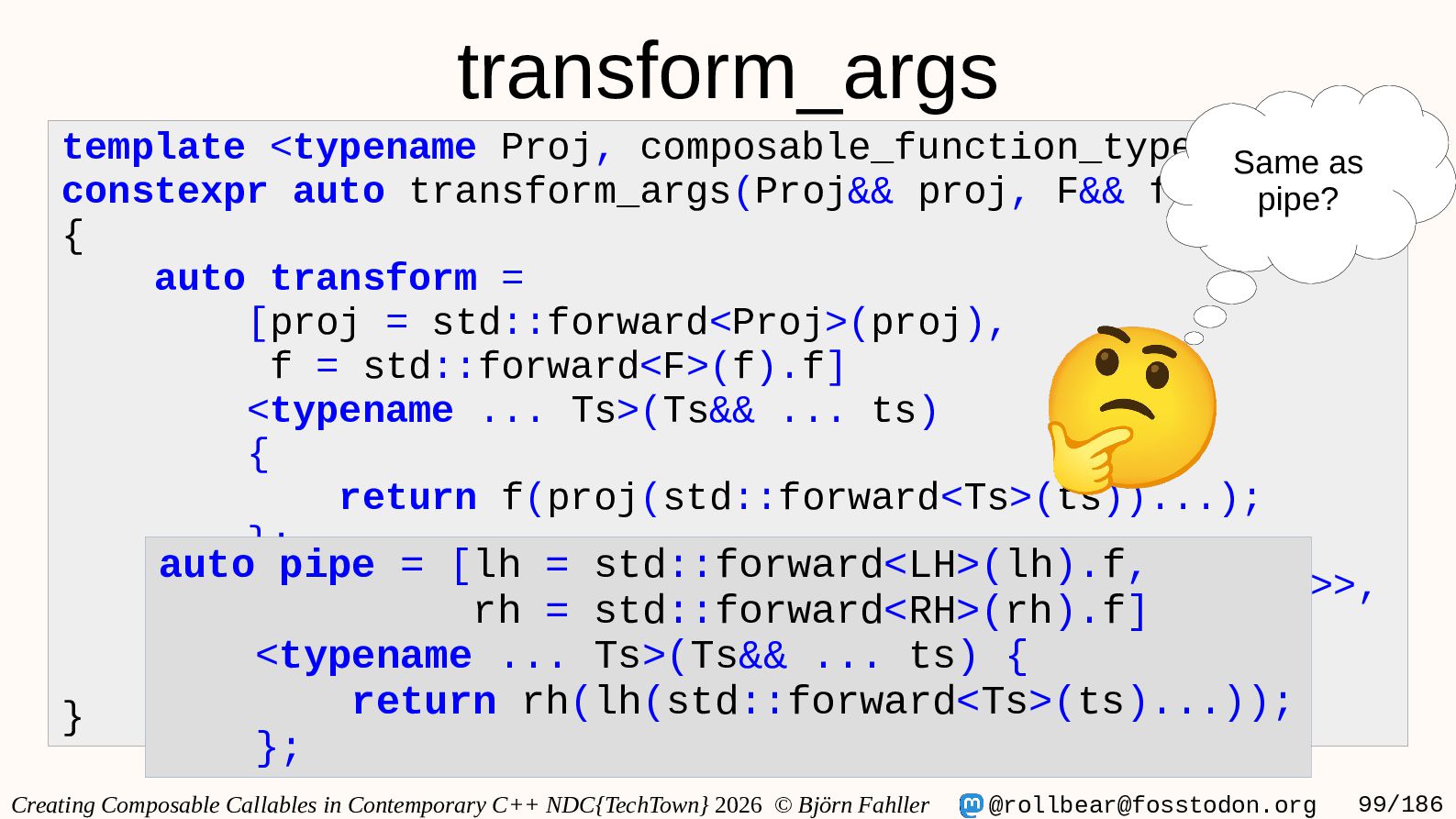
transform_args template <typename Proj, composable_function_type F> Same as constexpr auto
transform_args(Proj&& proj, F&& f) pipe? { auto transform = [proj = std::forward<Proj>(proj), f = std::forward<F>(f).f] <typename ... Ts>(Ts&& ... ts) { return f(proj(std::forward<Ts>(ts))...); }; auto pipe = [lh = std::forward<LH>(lh).f, using RT = rebind_template_t<std::remove_cvref_t<F>>, rh = std::forward<RH>(rh).f] decltype(transform)>; <typename ... Ts>(Ts&& ... ts) { return RT{std::move(transform)}; return rh(lh(std::forward<Ts>(ts)...)); } }; Creating Composable Callables in Contemporary C++ NDC{TechTown} 2026 © Björn Fahller @[email protected] 99/186 -
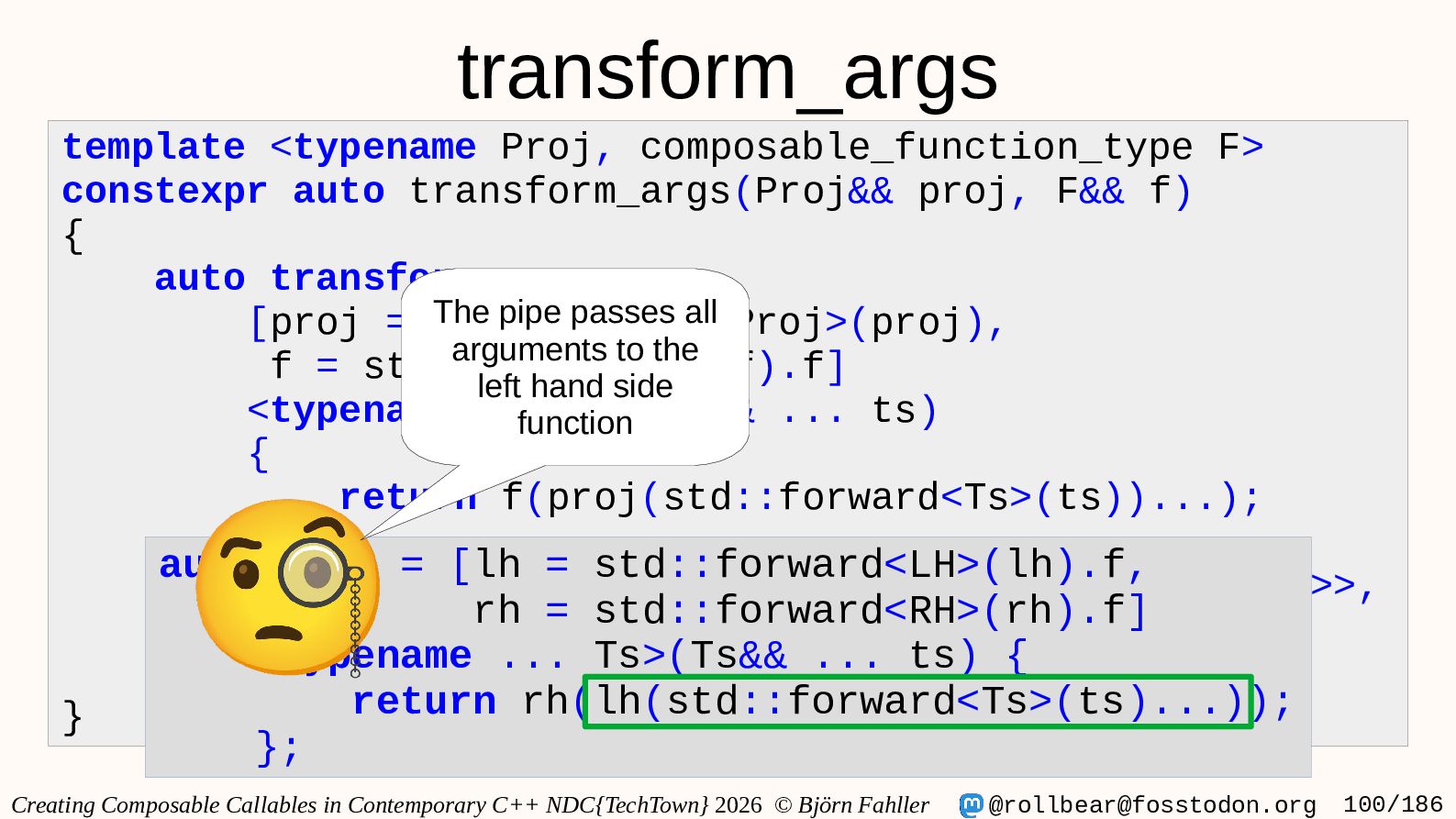
transform_args template <typename Proj, composable_function_type F> constexpr auto transform_args(Proj&& proj,
F&& f) { auto transform = The pipe passes all [proj = std::forward<Proj>(proj), arguments to the f = std::forward<F>(f).f] left hand side <typename ... Ts>(Ts&& ... ts) function { return f(proj(std::forward<Ts>(ts))...); }; auto pipe = [lh = std::forward<LH>(lh).f, using RT = rebind_template_t<std::remove_cvref_t<F>>, rh = std::forward<RH>(rh).f] decltype(transform)>; <typename ... Ts>(Ts&& ... ts) { return RT{std::move(transform)}; return rh(lh(std::forward<Ts>(ts)...)); } }; Creating Composable Callables in Contemporary C++ NDC{TechTown} 2026 © Björn Fahller @[email protected] 100/186 -
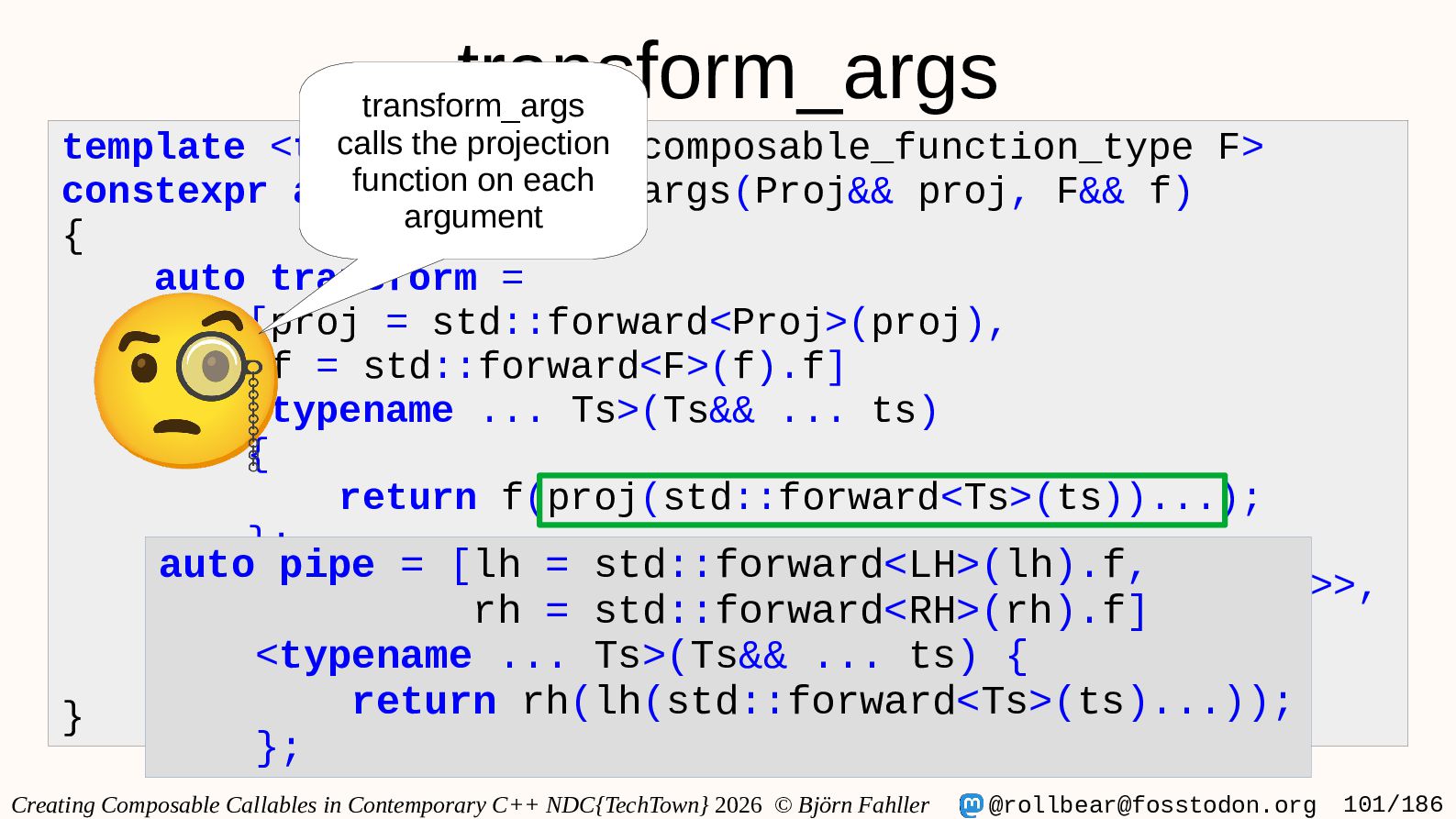
transform_args transform_args calls the projection template <typename Proj, composable_function_type F>
function on each constexpr auto transform_args(Proj&& proj, F&& f) argument { } auto transform = [proj = std::forward<Proj>(proj), f = std::forward<F>(f).f] <typename ... Ts>(Ts&& ... ts) { return f(proj(std::forward<Ts>(ts))...); }; auto pipe = [lh = std::forward<LH>(lh).f, using RT = rebind_template_t<std::remove_cvref_t<F>>, rh = std::forward<RH>(rh).f] decltype(transform)>; <typename ... Ts>(Ts&& ... ts) { return RT{std::move(transform)}; return rh(lh(std::forward<Ts>(ts)...)); }; Creating Composable Callables in Contemporary C++ NDC{TechTown} 2026 © Björn Fahller @[email protected] 101/186 -
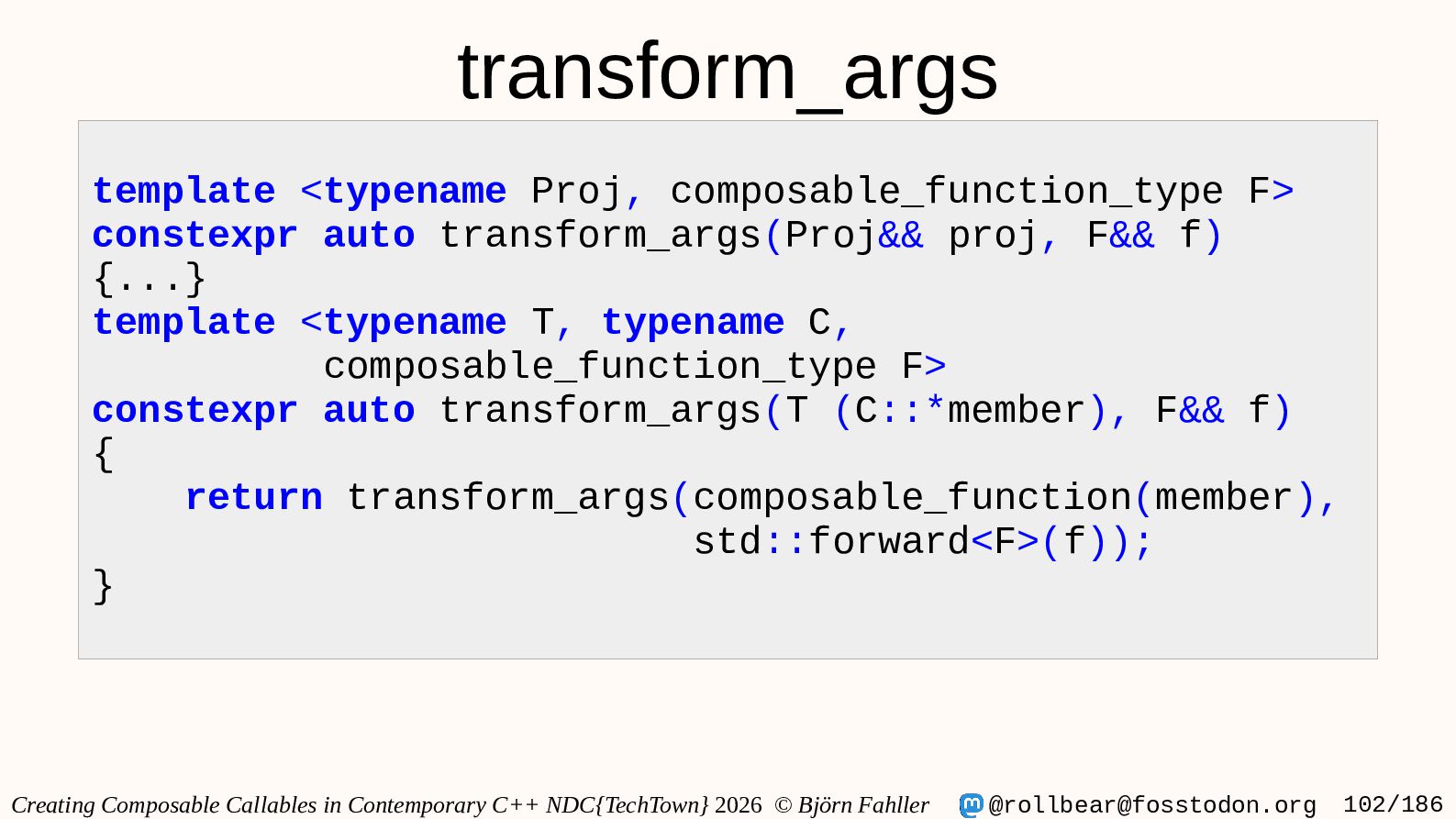
transform_args template <typename Proj, composable_function_type F> constexpr auto transform_args(Proj&& proj,
F&& f) {...} template <typename T, typename C, composable_function_type F> constexpr auto transform_args(T (C::*member), F&& f) { return transform_args(composable_function(member), std::forward<F>(f)); } Creating Composable Callables in Contemporary C++ NDC{TechTown} 2026 © Björn Fahller @[email protected] 102/186 -
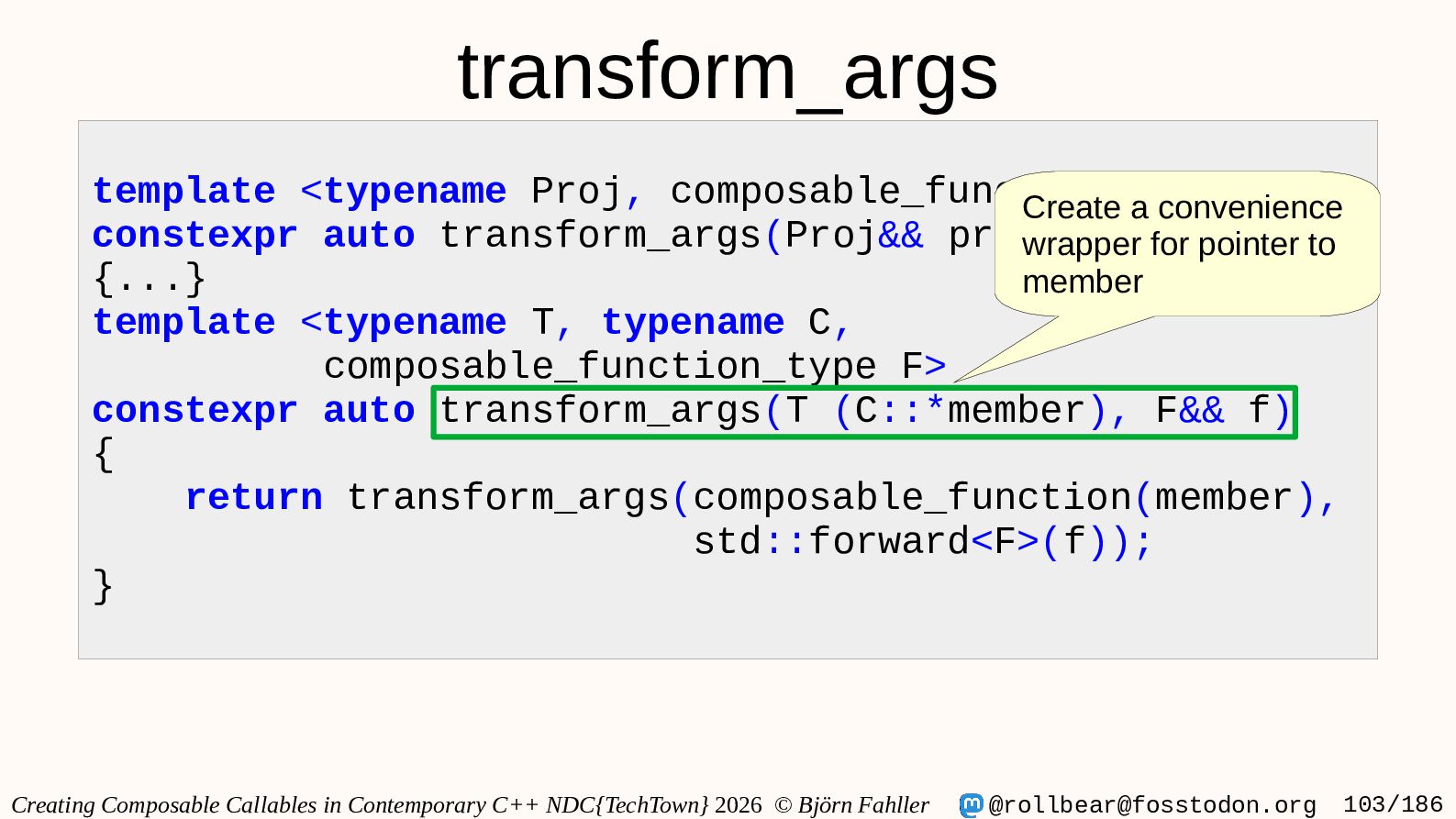
transform_args template <typename Proj, composable_function_type F> Create a convenience constexpr
auto transform_args(Proj&& proj, F&&forf) wrapper pointer to {...} member template <typename T, typename C, composable_function_type F> constexpr auto transform_args(T (C::*member), F&& f) { return transform_args(composable_function(member), std::forward<F>(f)); } Creating Composable Callables in Contemporary C++ NDC{TechTown} 2026 © Björn Fahller @[email protected] 103/186 -
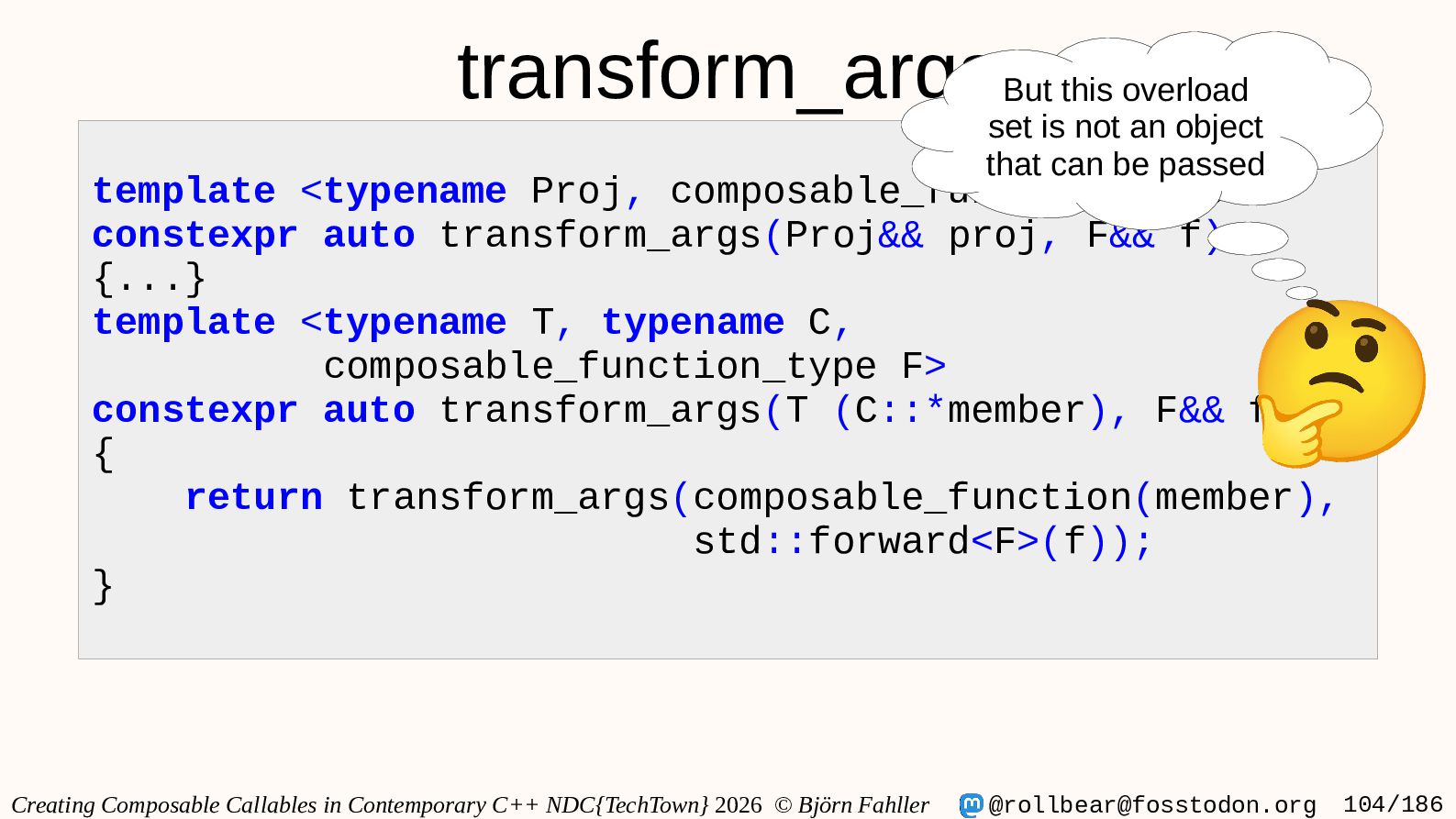
transform_argssetButisthisnotoverload an object that can be passed template <typename Proj,
composable_function_type F> constexpr auto transform_args(Proj&& proj, F&& f) {...} template <typename T, typename C, composable_function_type F> constexpr auto transform_args(T (C::*member), F&& f) { return transform_args(composable_function(member), std::forward<F>(f)); } Creating Composable Callables in Contemporary C++ NDC{TechTown} 2026 © Björn Fahller @[email protected] 104/186 -
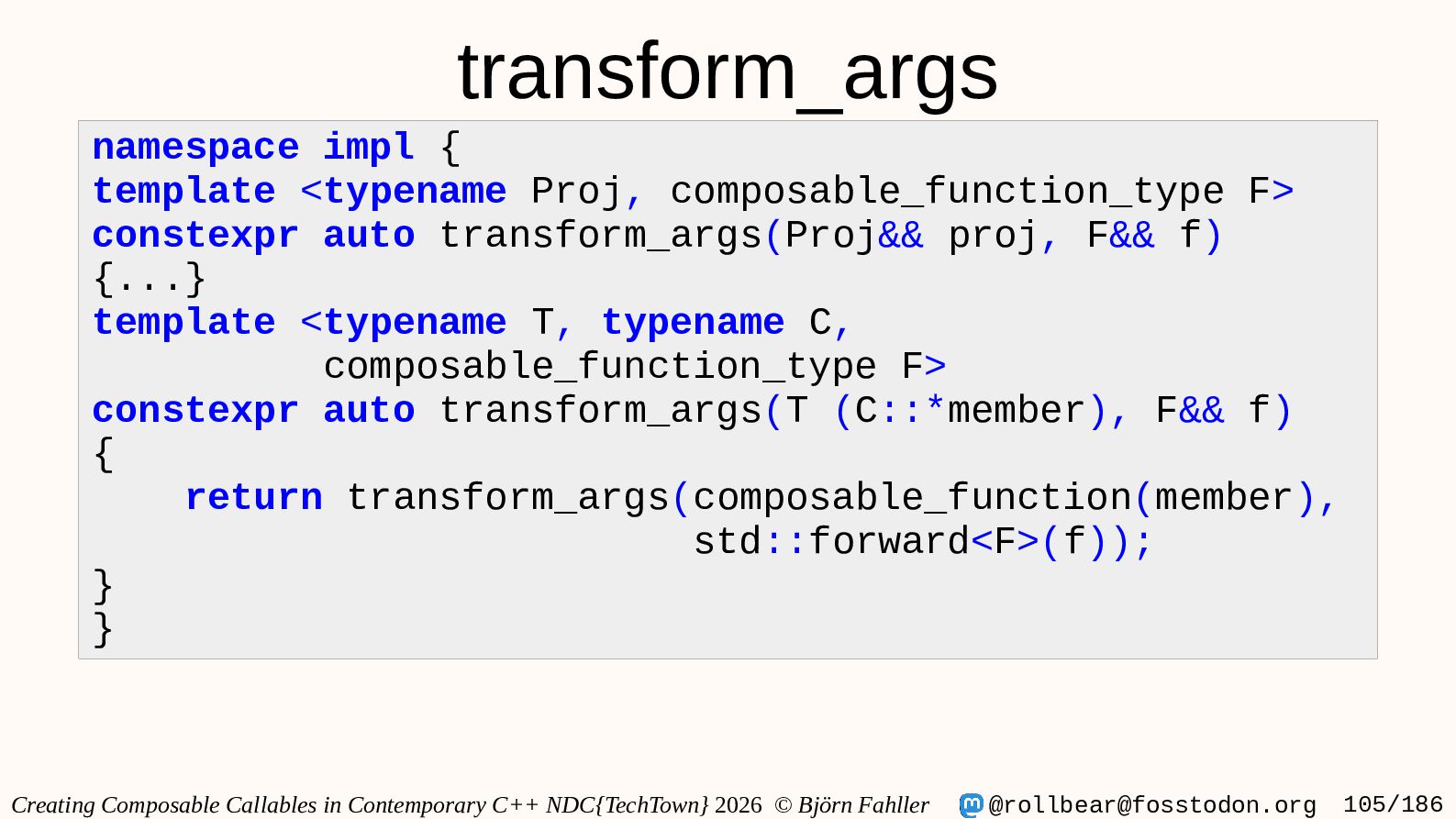
transform_args namespace impl { template <typename Proj, composable_function_type F> constexpr
auto transform_args(Proj&& proj, F&& f) {...} template <typename T, typename C, composable_function_type F> constexpr auto transform_args(T (C::*member), F&& f) { return transform_args(composable_function(member), std::forward<F>(f)); } } Creating Composable Callables in Contemporary C++ NDC{TechTown} 2026 © Björn Fahller @[email protected] 105/186 -
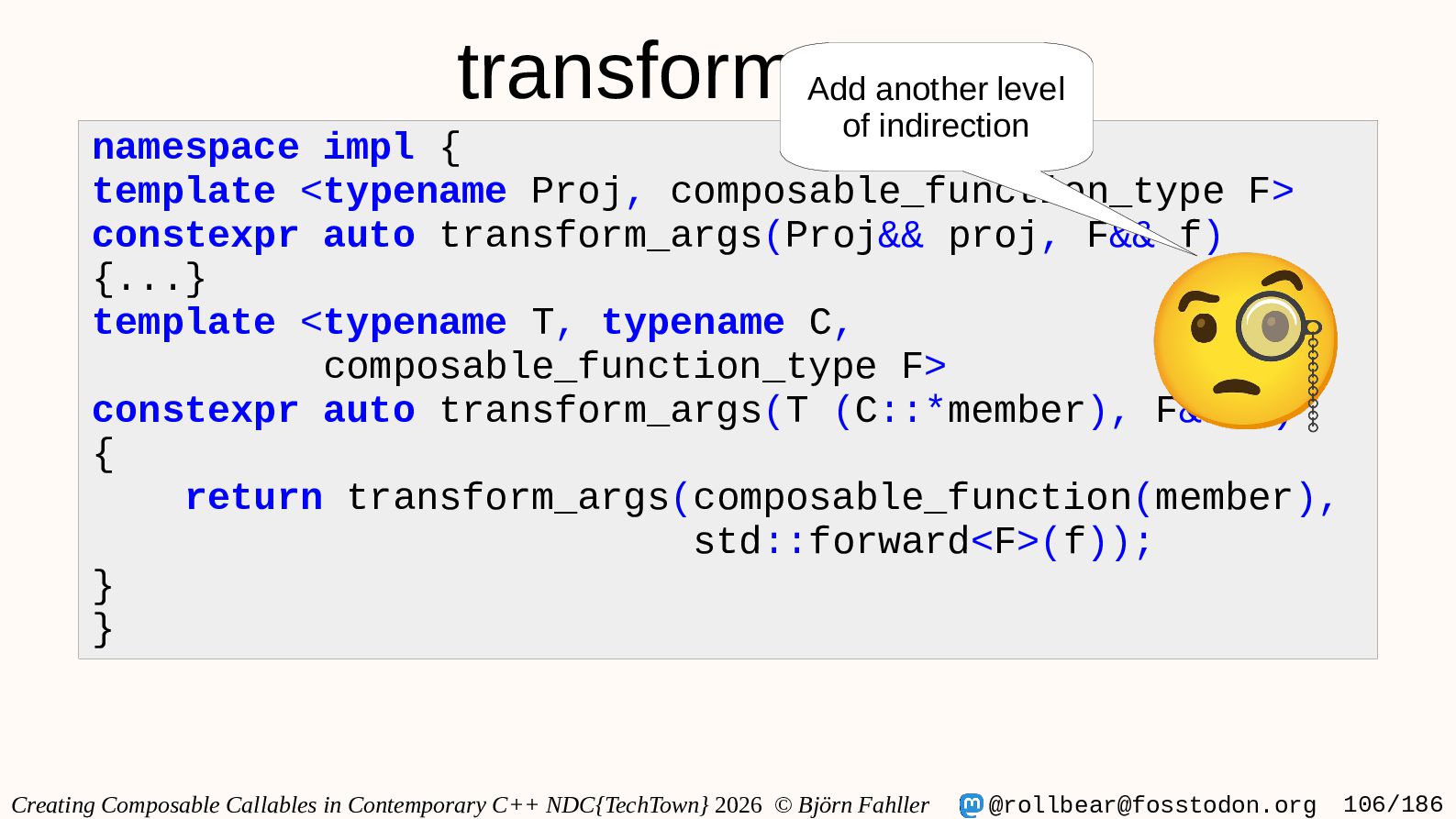
transform_args Add another level of indirection namespace impl { template
<typename Proj, composable_function_type F> constexpr auto transform_args(Proj&& proj, F&& f) {...} template <typename T, typename C, composable_function_type F> constexpr auto transform_args(T (C::*member), F&& f) { return transform_args(composable_function(member), std::forward<F>(f)); } } Creating Composable Callables in Contemporary C++ NDC{TechTown} 2026 © Björn Fahller @[email protected] 106/186 -
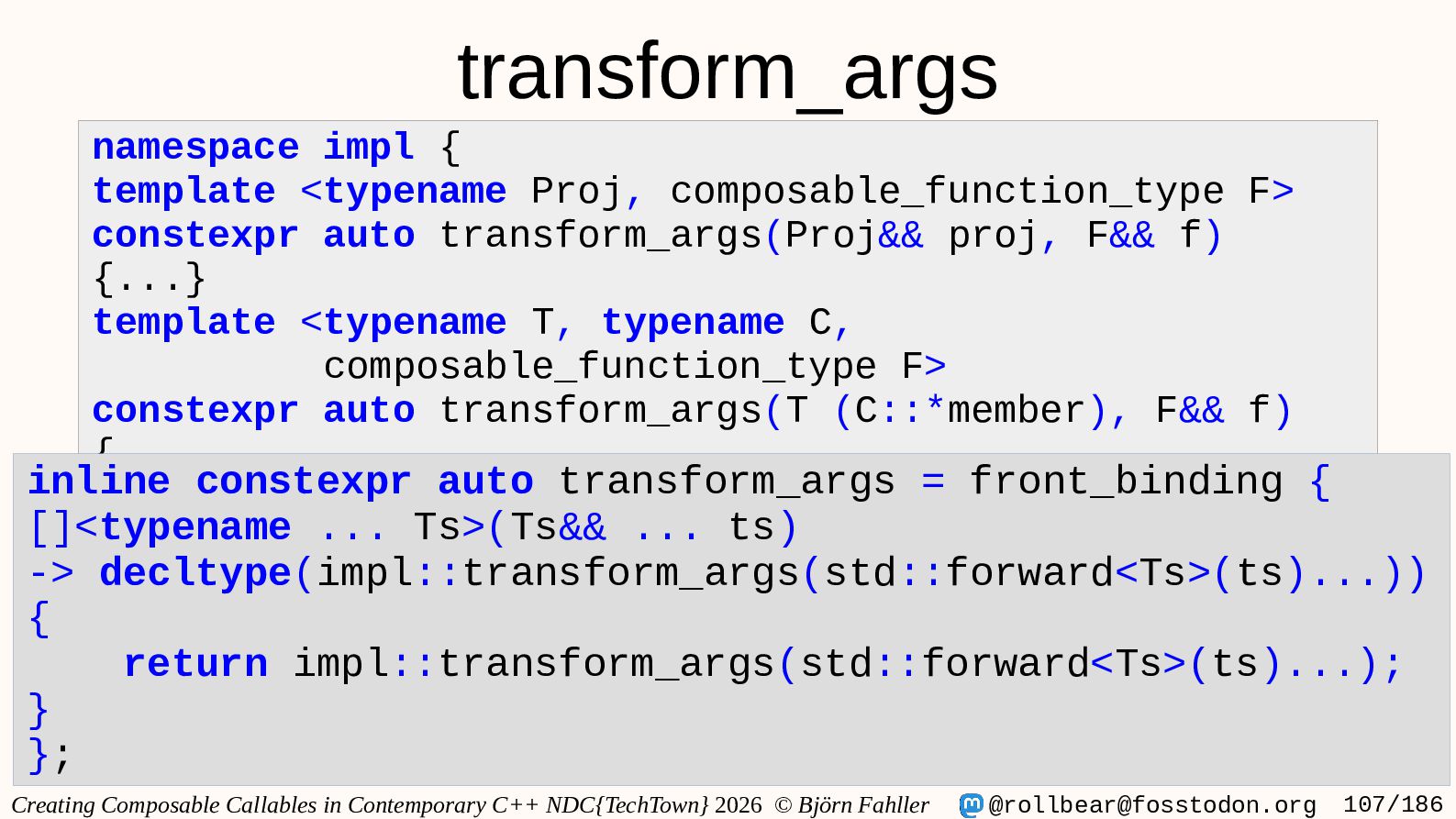
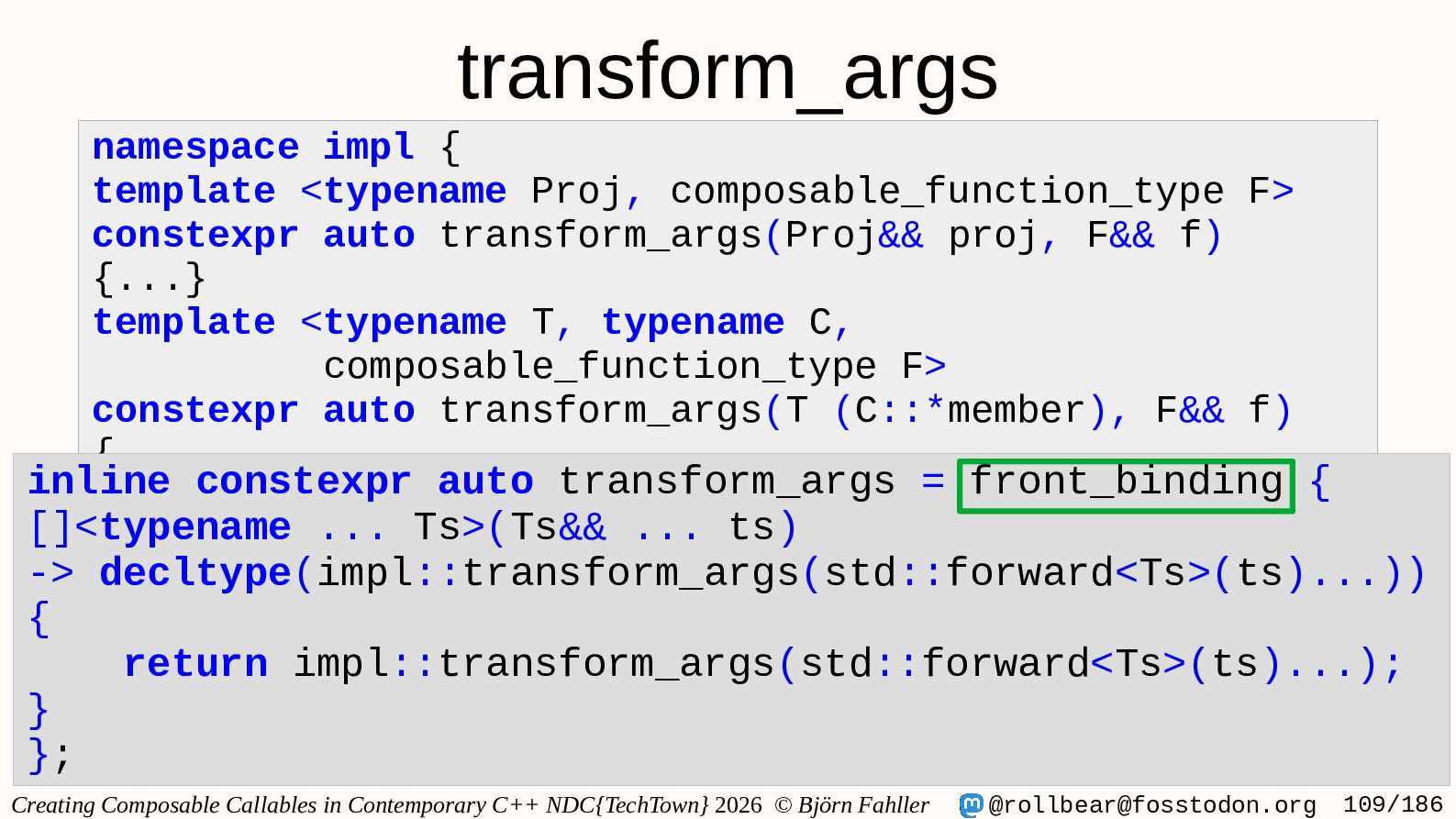
transform_args namespace impl { template <typename Proj, composable_function_type F> constexpr
auto transform_args(Proj&& proj, F&& f) {...} template <typename T, typename C, composable_function_type F> constexpr auto transform_args(T (C::*member), F&& f) { inline return constexpr auto transform_args = front_binding { transform_args(composable_function(member), []<typename ... Ts>(Ts&& ...std::forward<F>(f)); ts) -> }decltype(impl::transform_args(std::forward<Ts>(ts)...)) { } return impl::transform_args(std::forward<Ts>(ts)...); } }; Creating Composable Callables in Contemporary C++ NDC{TechTown} 2026 © Björn Fahller @[email protected] 107/186 -
transform_args namespace impl { template <typename Proj, composable_function_type F> constexpr
auto transform_args(Proj&& proj, F&& f) {...} template <typename T, typename C, composable_function_type F> constexpr auto transform_args(T (C::*member), F&& f) { inline return constexpr auto transform_args = front_binding { transform_args(composable_function(member), []<typename ... Ts>(Ts&& ...std::forward<F>(f)); ts) -> }decltype(impl::transform_args(std::forward<Ts>(ts)...)) { } return impl::transform_args(std::forward<Ts>(ts)...); } }; Creating Composable Callables in Contemporary C++ NDC{TechTown} 2026 © Björn Fahller @[email protected] 108/186 -
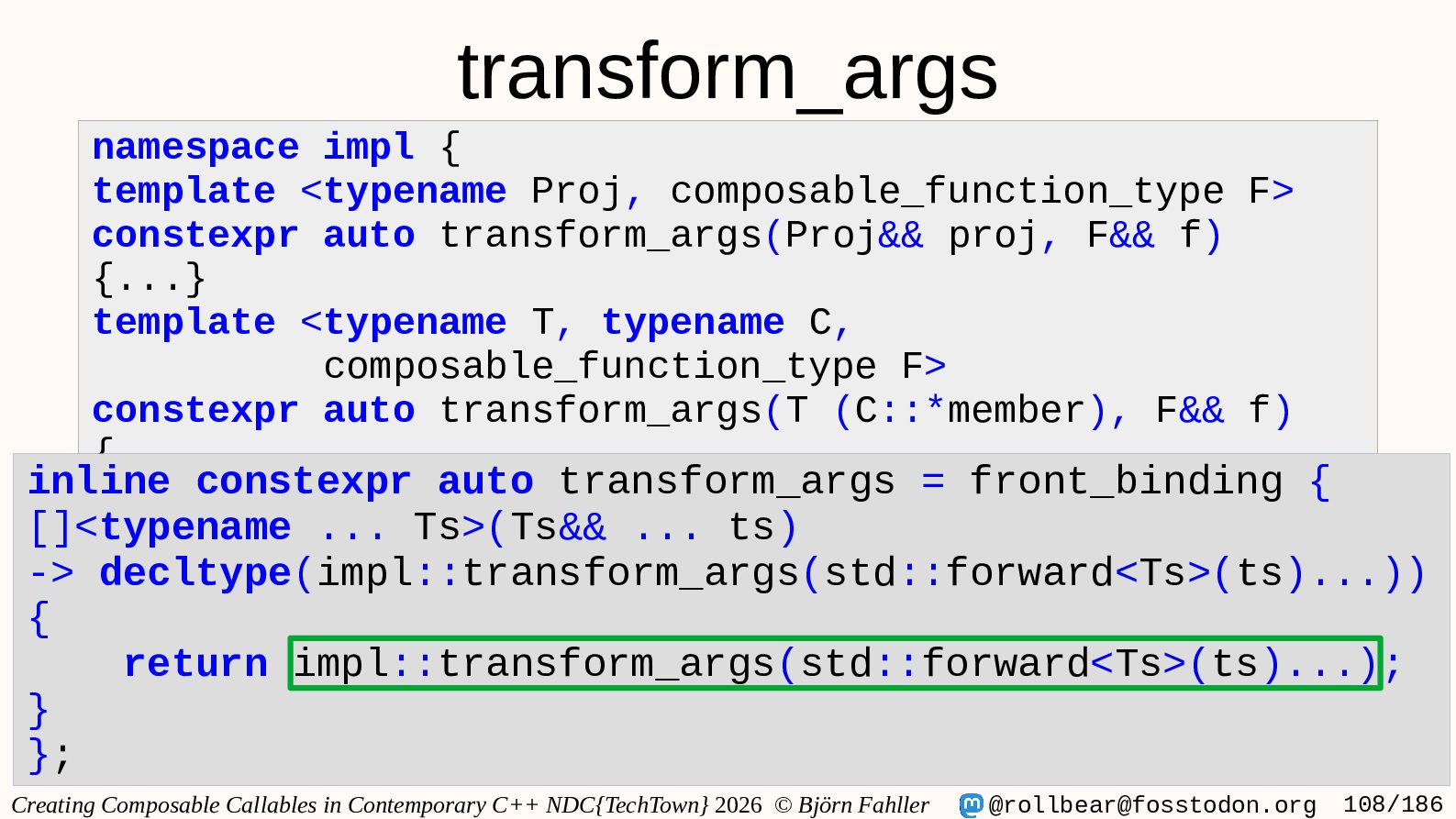
transform_args namespace impl { template <typename Proj, composable_function_type F> constexpr
auto transform_args(Proj&& proj, F&& f) {...} template <typename T, typename C, composable_function_type F> constexpr auto transform_args(T (C::*member), F&& f) { inline return constexpr auto transform_args = front_binding { transform_args(composable_function(member), []<typename ... Ts>(Ts&& ...std::forward<F>(f)); ts) -> }decltype(impl::transform_args(std::forward<Ts>(ts)...)) { } return impl::transform_args(std::forward<Ts>(ts)...); } }; Creating Composable Callables in Contemporary C++ NDC{TechTown} 2026 © Björn Fahller @[email protected] 109/186 -
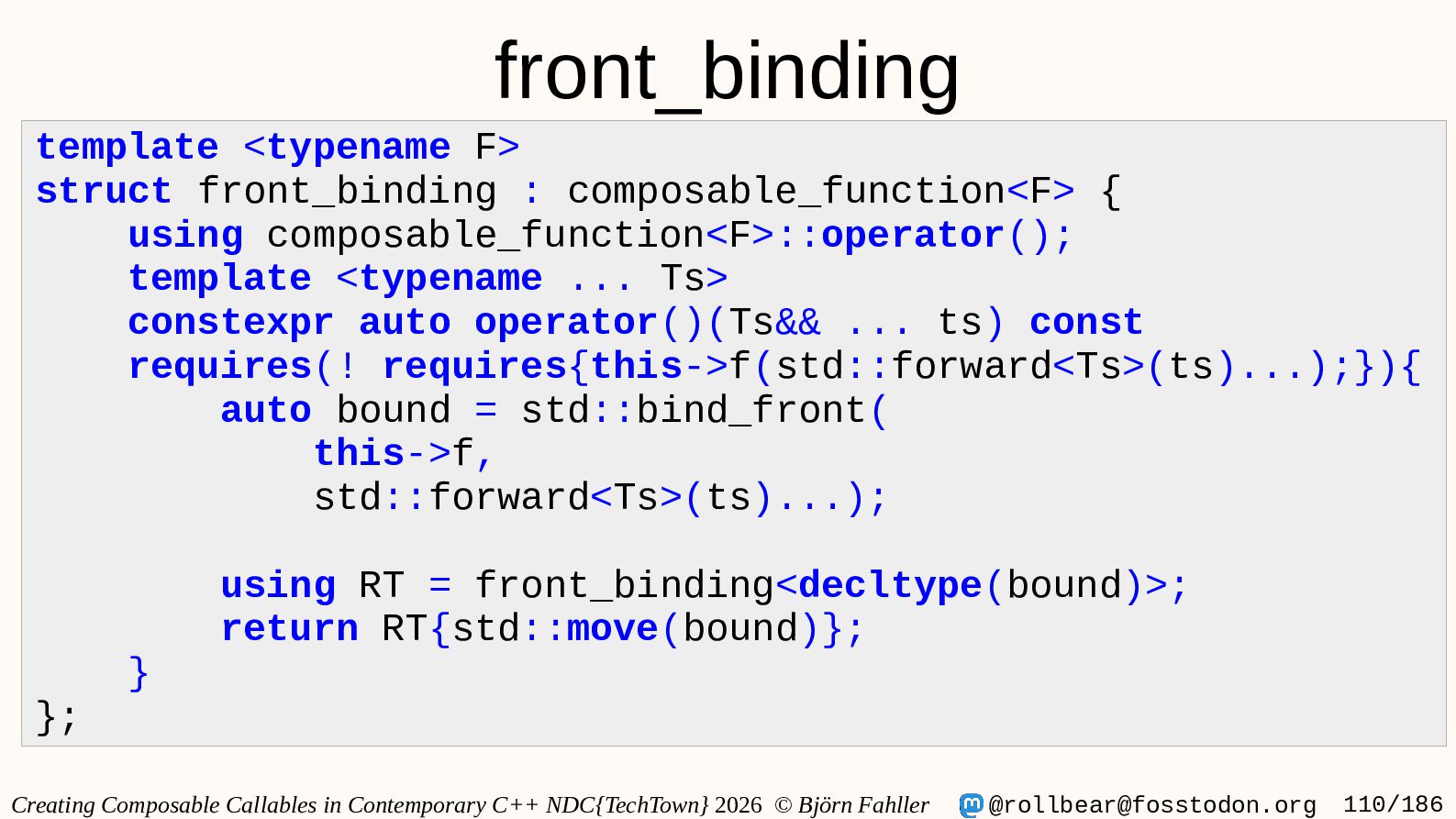
front_binding template <typename F> struct front_binding : composable_function<F> { using
composable_function<F>::operator(); template <typename ... Ts> constexpr auto operator()(Ts&& ... ts) const requires(! requires{this->f(std::forward<Ts>(ts)...);}){ auto bound = std::bind_front( this->f, std::forward<Ts>(ts)...); using RT = front_binding<decltype(bound)>; return RT{std::move(bound)}; } }; Creating Composable Callables in Contemporary C++ NDC{TechTown} 2026 © Björn Fahller @[email protected] 110/186 -
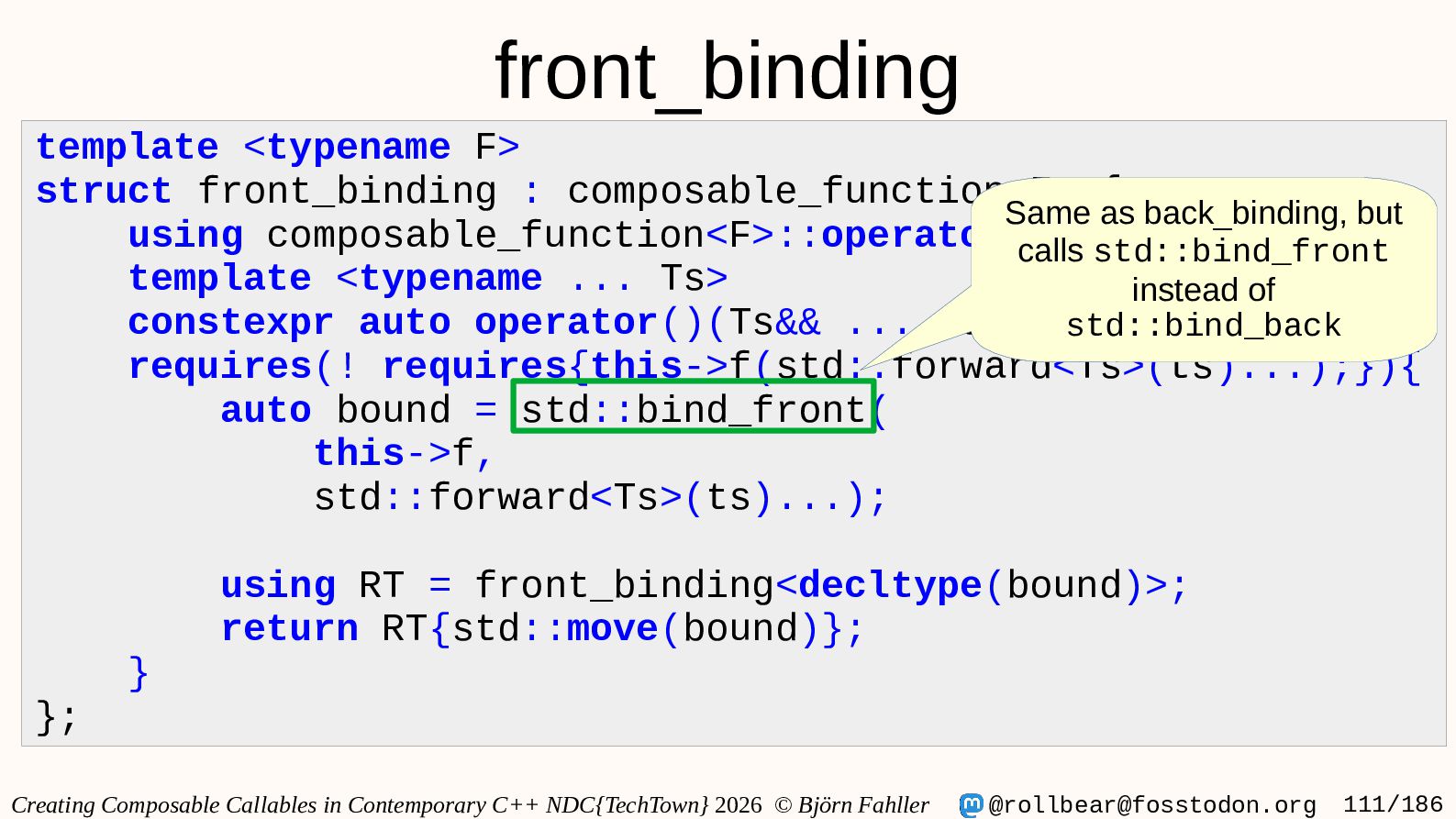
front_binding template <typename F> struct front_binding : composable_function<F> { Same
as back_binding, but using composable_function<F>::operator(); calls std::bind_front template <typename ... Ts> instead of constexpr auto operator()(Ts&& ... ts) const std::bind_back requires(! requires{this->f(std::forward<Ts>(ts)...);}){ auto bound = std::bind_front( this->f, std::forward<Ts>(ts)...); using RT = front_binding<decltype(bound)>; return RT{std::move(bound)}; } }; Creating Composable Callables in Contemporary C++ NDC{TechTown} 2026 © Björn Fahller @[email protected] 111/186 -
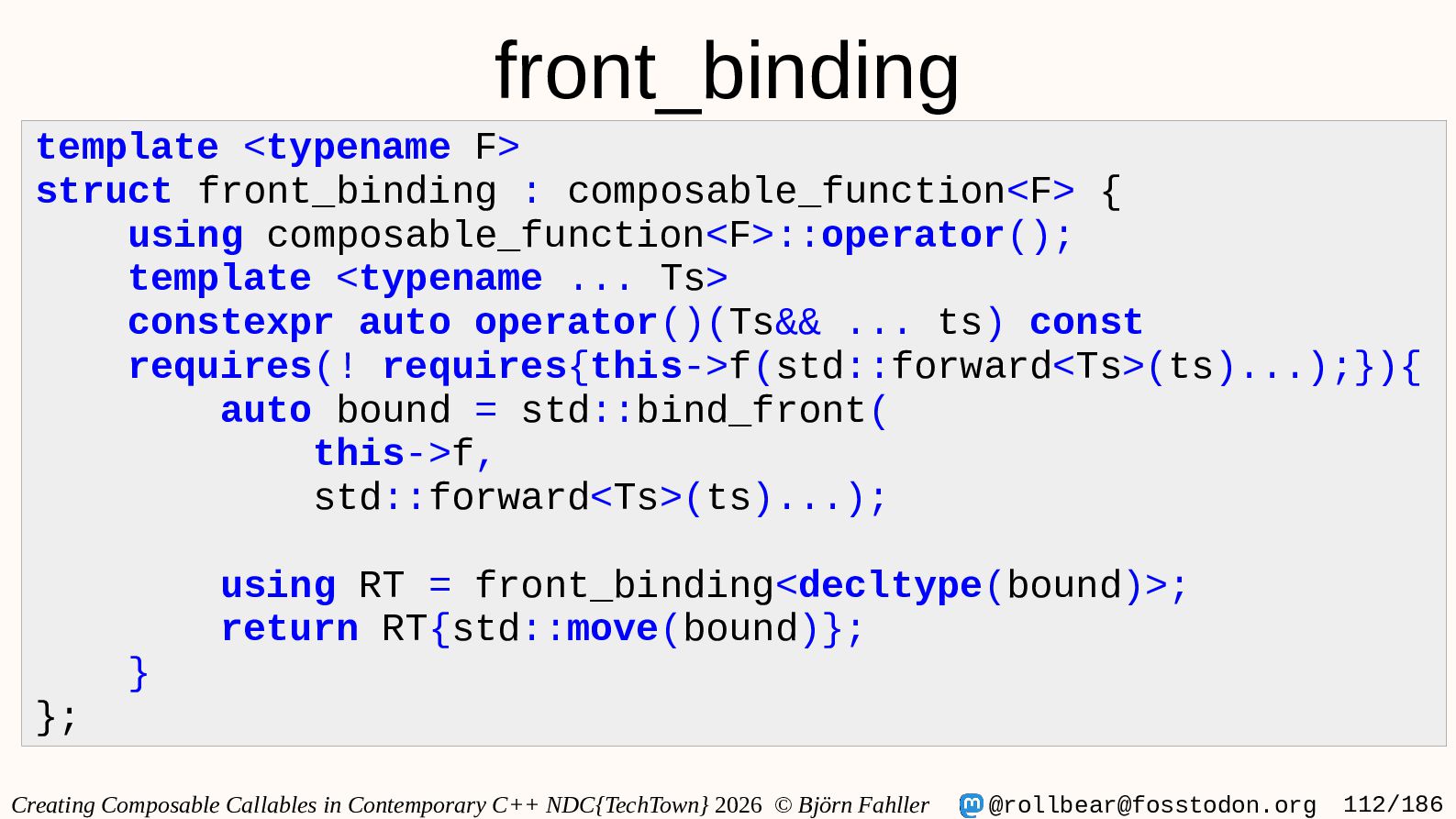
front_binding template <typename F> struct front_binding : composable_function<F> { using
composable_function<F>::operator(); template <typename ... Ts> constexpr auto operator()(Ts&& ... ts) const requires(! requires{this->f(std::forward<Ts>(ts)...);}){ auto bound = std::bind_front( this->f, std::forward<Ts>(ts)...); using RT = front_binding<decltype(bound)>; return RT{std::move(bound)}; } }; Creating Composable Callables in Contemporary C++ NDC{TechTown} 2026 © Björn Fahller @[email protected] 112/186 -
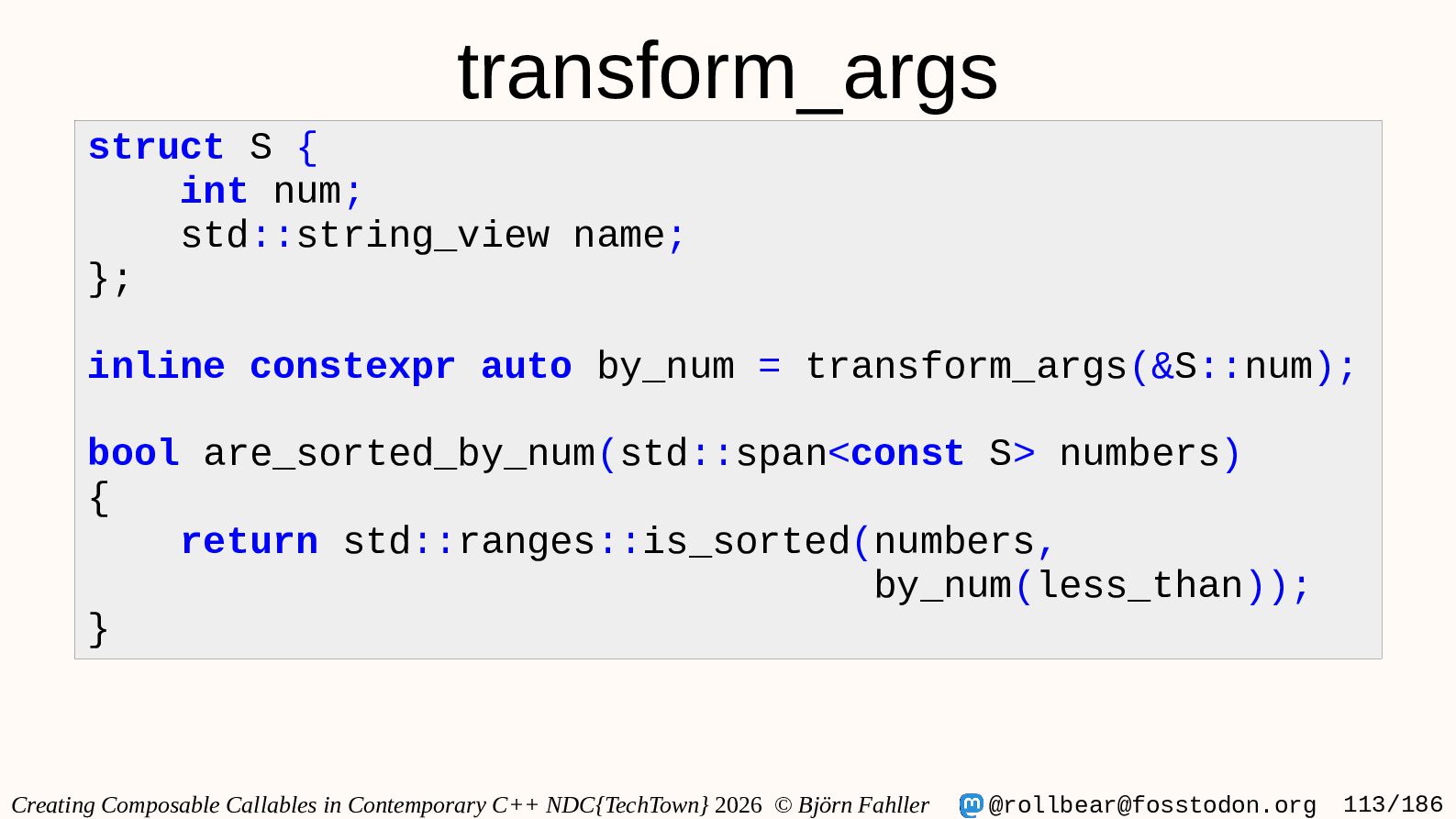
transform_args struct S { int num; std::string_view name; }; inline
constexpr auto by_num = transform_args(&S::num); bool are_sorted_by_num(std::span<const S> numbers) { return std::ranges::is_sorted(numbers, by_num(less_than)); } Creating Composable Callables in Contemporary C++ NDC{TechTown} 2026 © Björn Fahller @[email protected] 113/186 -
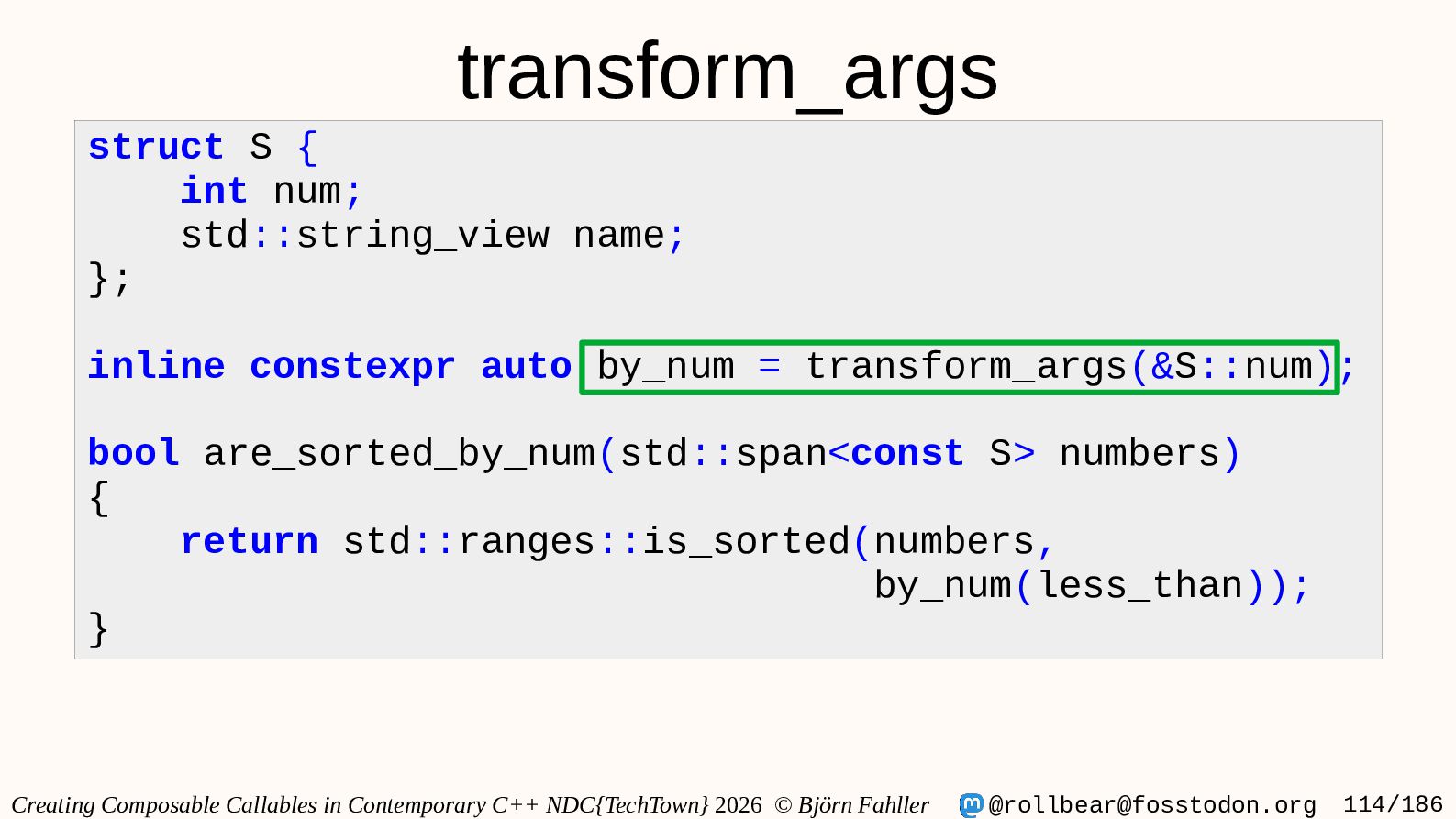
transform_args struct S { int num; std::string_view name; }; inline
constexpr auto by_num = transform_args(&S::num); bool are_sorted_by_num(std::span<const S> numbers) { return std::ranges::is_sorted(numbers, by_num(less_than)); } Creating Composable Callables in Contemporary C++ NDC{TechTown} 2026 © Björn Fahller @[email protected] 114/186 -
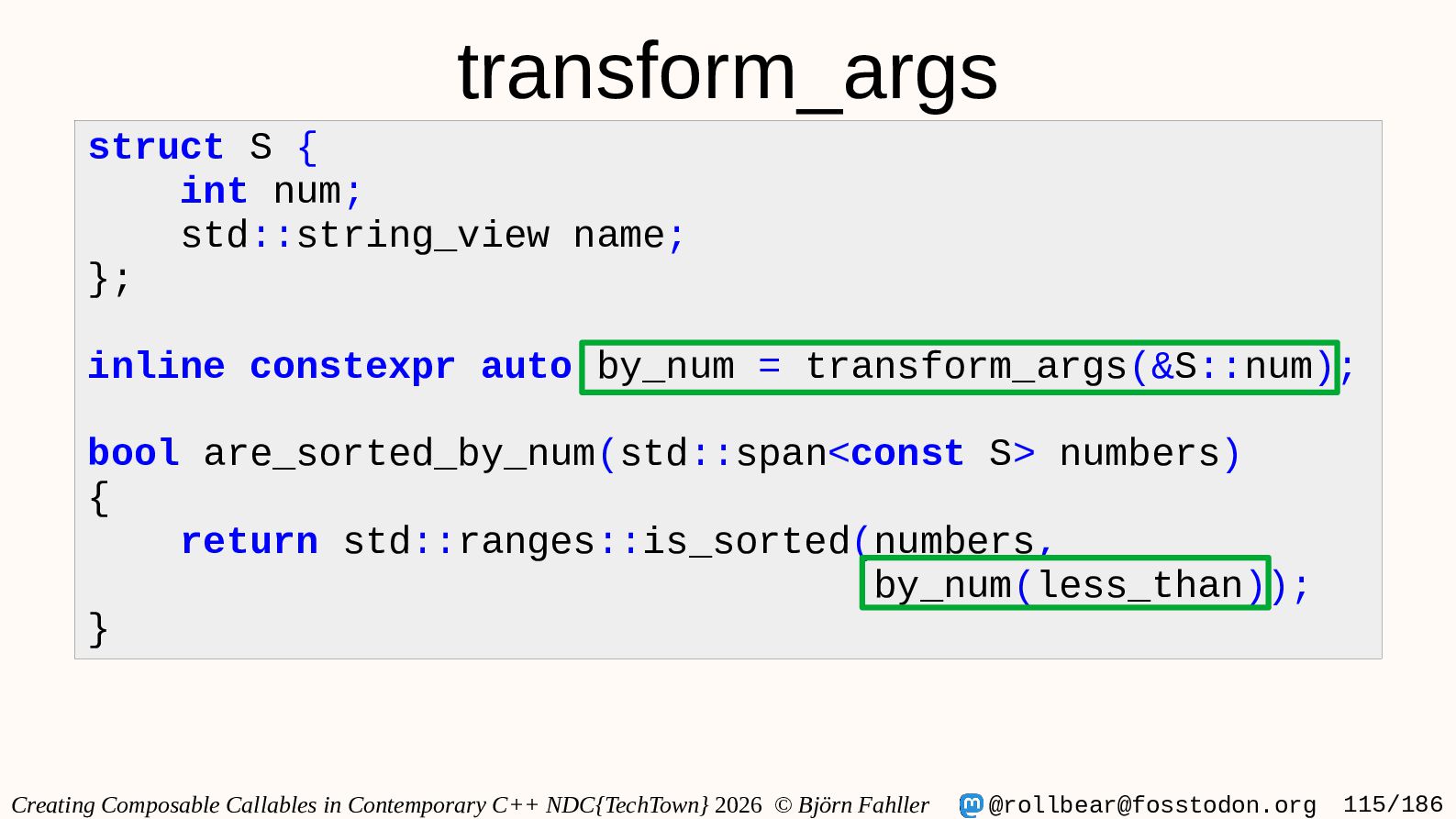
transform_args struct S { int num; std::string_view name; }; inline
constexpr auto by_num = transform_args(&S::num); bool are_sorted_by_num(std::span<const S> numbers) { return std::ranges::is_sorted(numbers, by_num(less_than)); } Creating Composable Callables in Contemporary C++ NDC{TechTown} 2026 © Björn Fahller @[email protected] 115/186 -
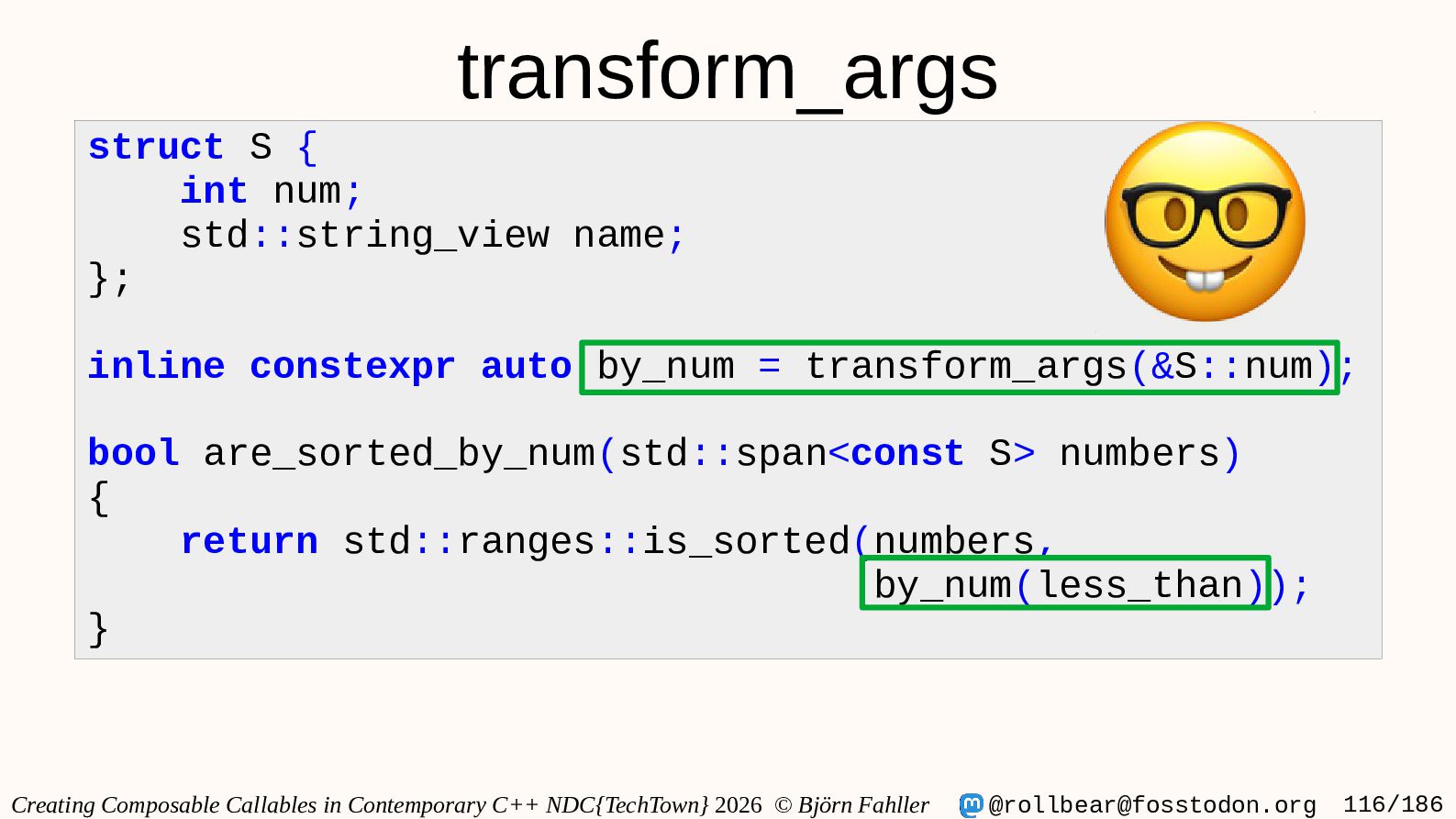
transform_args struct S { int num; std::string_view name; }; inline
constexpr auto by_num = transform_args(&S::num); bool are_sorted_by_num(std::span<const S> numbers) { return std::ranges::is_sorted(numbers, by_num(less_than)); } Creating Composable Callables in Contemporary C++ NDC{TechTown} 2026 © Björn Fahller @[email protected] 116/186 -
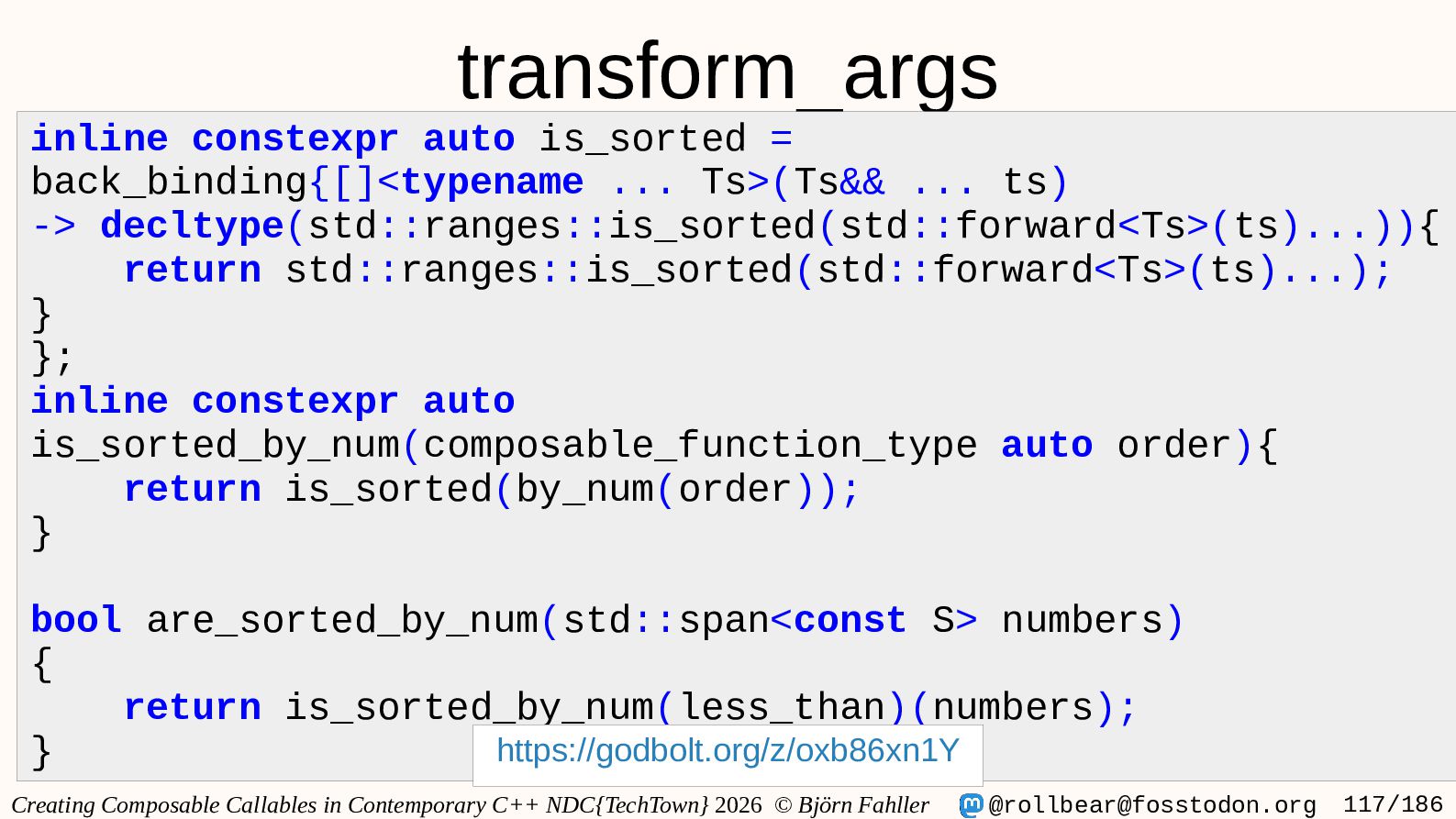
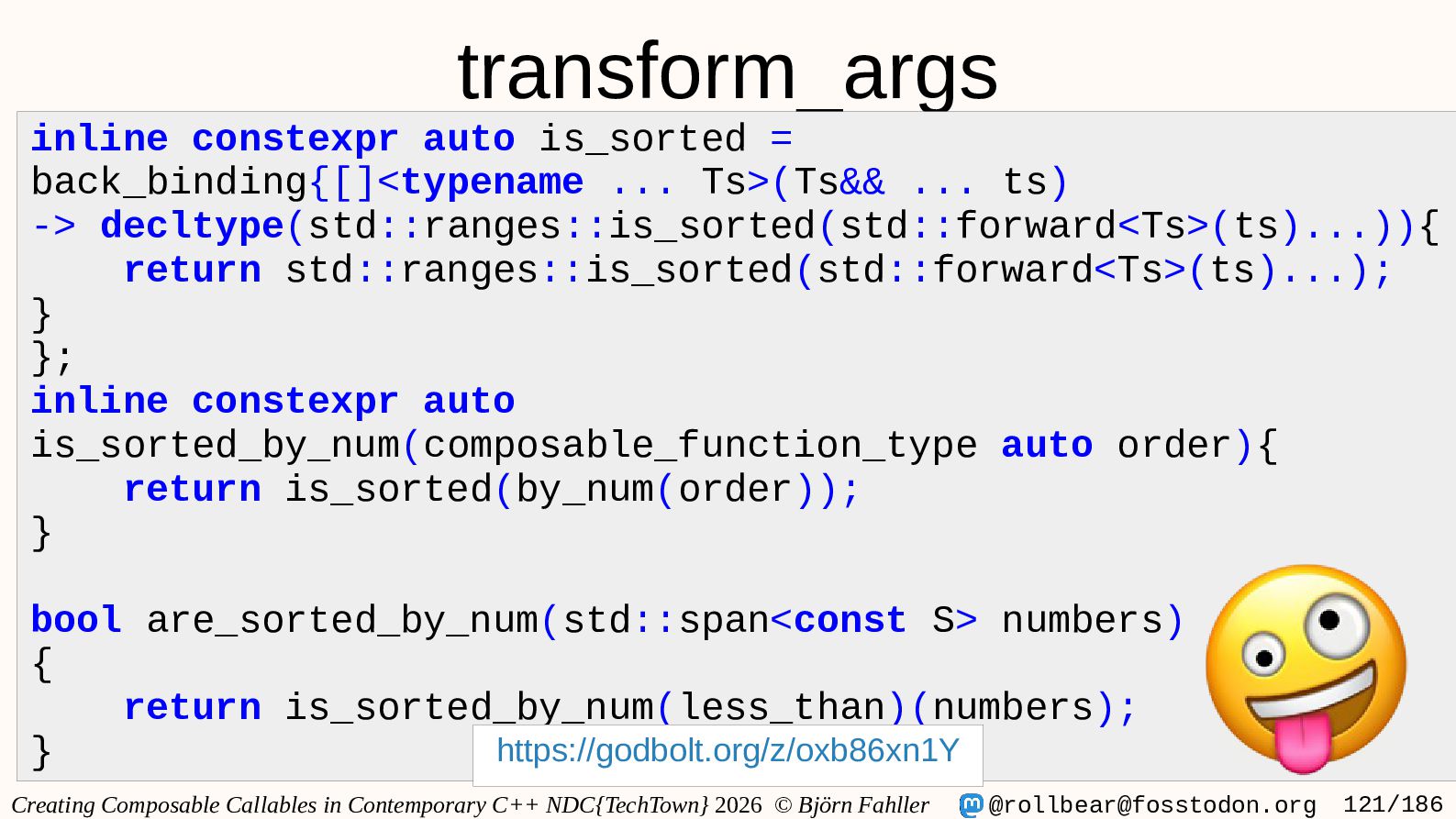
transform_args inline constexpr auto is_sorted = back_binding{[]<typename ... Ts>(Ts&& ...
ts) -> decltype(std::ranges::is_sorted(std::forward<Ts>(ts)...)){ return std::ranges::is_sorted(std::forward<Ts>(ts)...); } }; inline constexpr auto is_sorted_by_num(composable_function_type auto order){ return is_sorted(by_num(order)); } bool are_sorted_by_num(std::span<const S> numbers) { return is_sorted_by_num(less_than)(numbers); https://godbolt.org/z/oxb86xn1Y } Creating Composable Callables in Contemporary C++ NDC{TechTown} 2026 © Björn Fahller @[email protected] 117/186 -
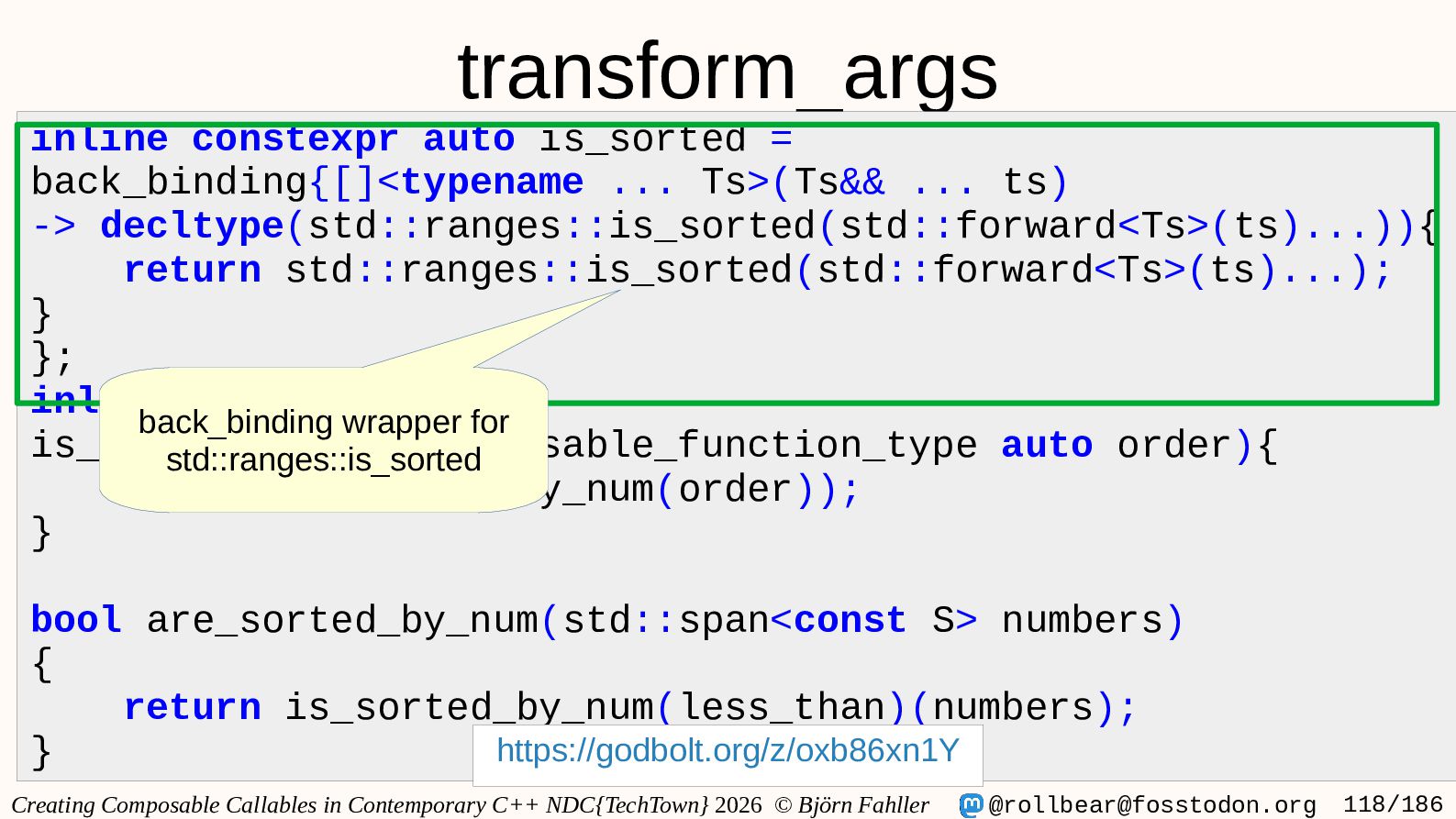
transform_args inline constexpr auto is_sorted = back_binding{[]<typename ... Ts>(Ts&& ...
ts) -> decltype(std::ranges::is_sorted(std::forward<Ts>(ts)...)){ return std::ranges::is_sorted(std::forward<Ts>(ts)...); } }; inline constexpr auto back_binding wrapper for is_sorted_by_num(composable_function_type auto order){ std::ranges::is_sorted return is_sorted(by_num(order)); } bool are_sorted_by_num(std::span<const S> numbers) { return is_sorted_by_num(less_than)(numbers); https://godbolt.org/z/oxb86xn1Y } Creating Composable Callables in Contemporary C++ NDC{TechTown} 2026 © Björn Fahller @[email protected] 118/186 -
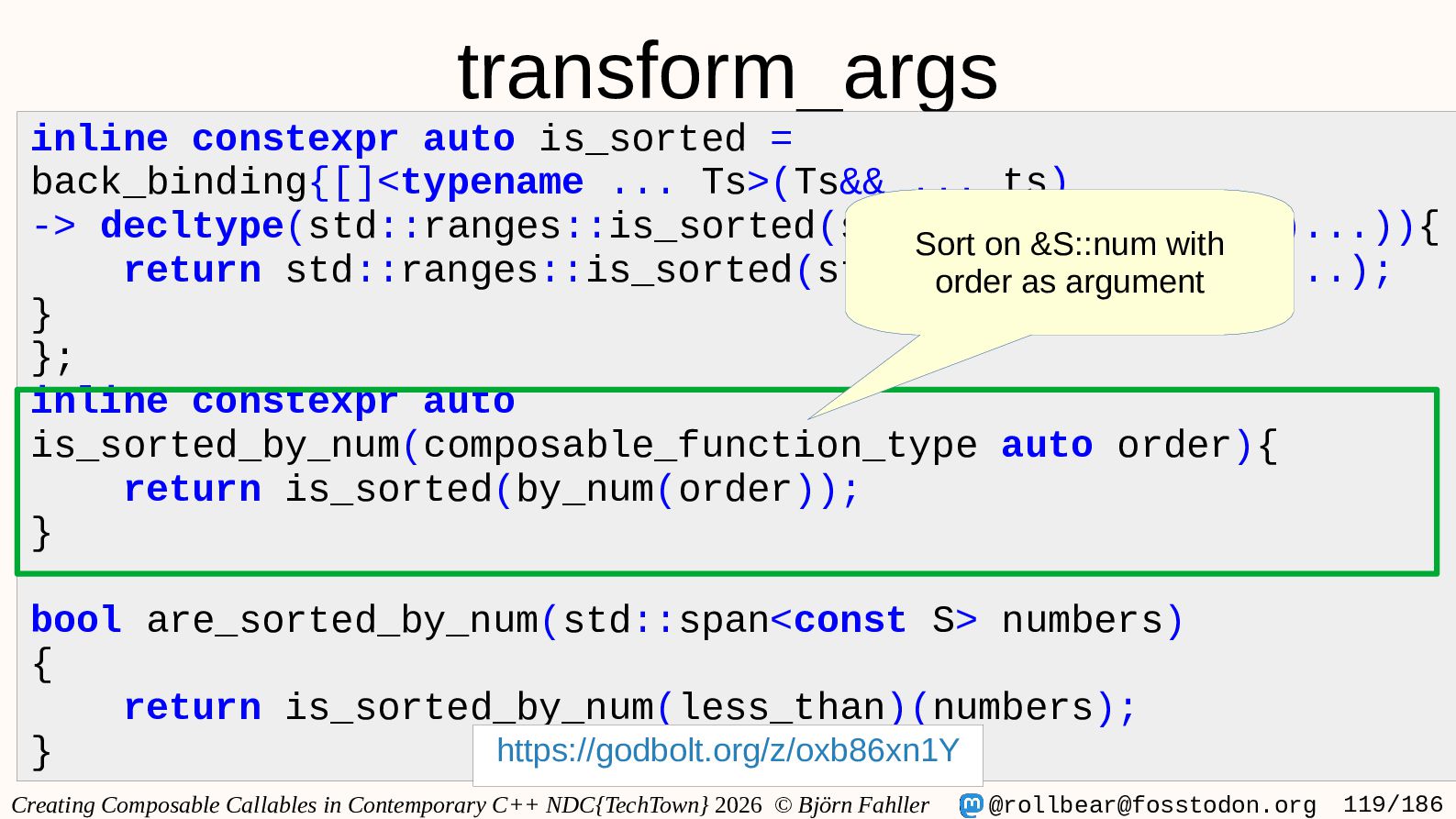
transform_args inline constexpr auto is_sorted = back_binding{[]<typename ... Ts>(Ts&& ...
ts) -> decltype(std::ranges::is_sorted(std::forward<Ts>(ts)...)){ Sort on &S::num with return std::ranges::is_sorted(std::forward<Ts>(ts)...); order as argument } }; inline constexpr auto is_sorted_by_num(composable_function_type auto order){ return is_sorted(by_num(order)); } bool are_sorted_by_num(std::span<const S> numbers) { return is_sorted_by_num(less_than)(numbers); https://godbolt.org/z/oxb86xn1Y } Creating Composable Callables in Contemporary C++ NDC{TechTown} 2026 © Björn Fahller @[email protected] 119/186 -
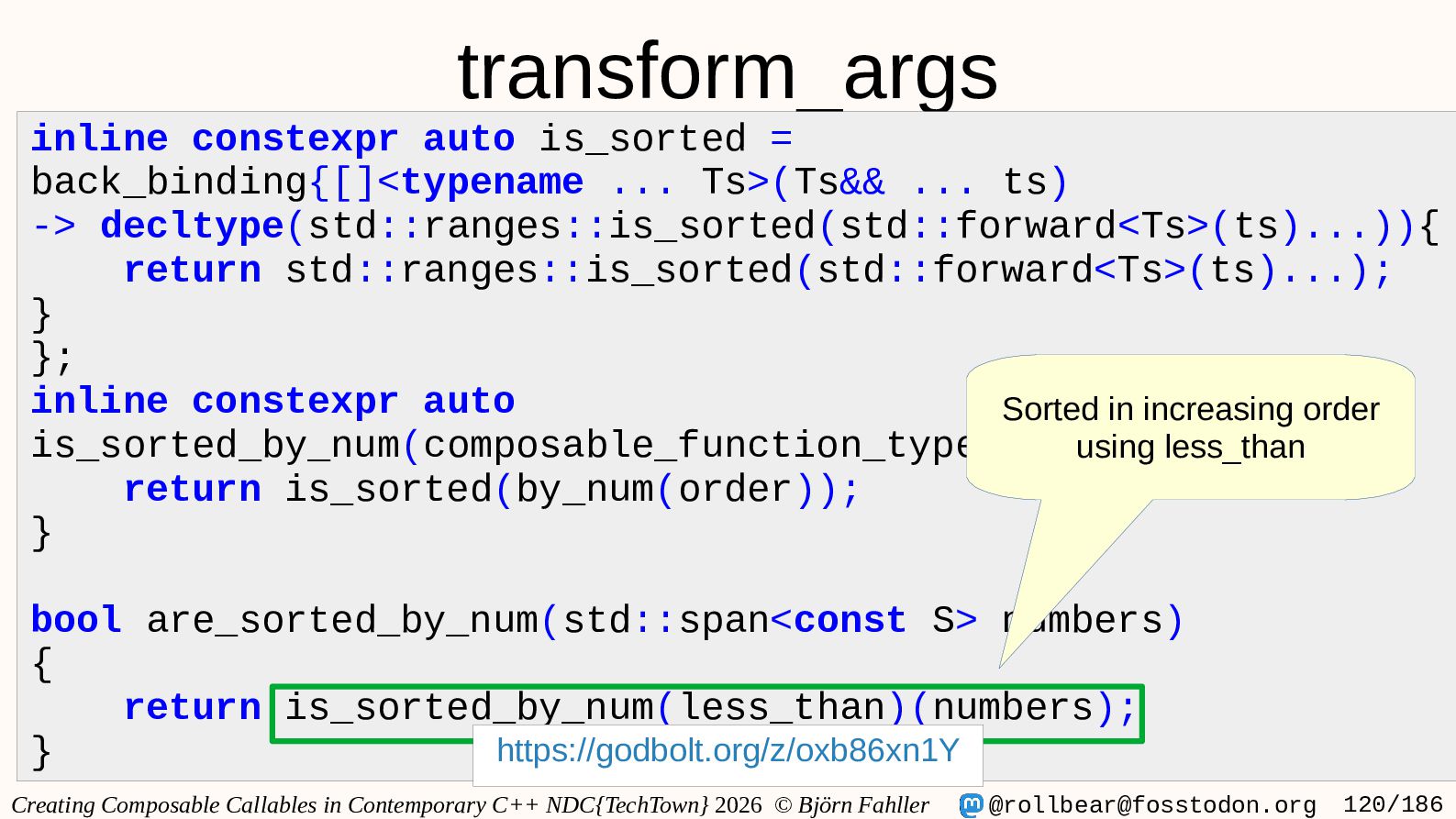
transform_args inline constexpr auto is_sorted = back_binding{[]<typename ... Ts>(Ts&& ...
ts) -> decltype(std::ranges::is_sorted(std::forward<Ts>(ts)...)){ return std::ranges::is_sorted(std::forward<Ts>(ts)...); } }; inline constexpr auto Sorted in increasing order is_sorted_by_num(composable_function_type autousing order){ less_than return is_sorted(by_num(order)); } bool are_sorted_by_num(std::span<const S> numbers) { return is_sorted_by_num(less_than)(numbers); https://godbolt.org/z/oxb86xn1Y } Creating Composable Callables in Contemporary C++ NDC{TechTown} 2026 © Björn Fahller @[email protected] 120/186 -
transform_args inline constexpr auto is_sorted = back_binding{[]<typename ... Ts>(Ts&& ...
ts) -> decltype(std::ranges::is_sorted(std::forward<Ts>(ts)...)){ return std::ranges::is_sorted(std::forward<Ts>(ts)...); } }; inline constexpr auto is_sorted_by_num(composable_function_type auto order){ return is_sorted(by_num(order)); } bool are_sorted_by_num(std::span<const S> numbers) { return is_sorted_by_num(less_than)(numbers); https://godbolt.org/z/oxb86xn1Y } Creating Composable Callables in Contemporary C++ NDC{TechTown} 2026 © Björn Fahller @[email protected] 121/186 -
perfect(er) forwarding What if I want to bind something that
is not copyable? Creating Composable Callables in Contemporary C++ NDC{TechTown} 2026 © Björn Fahller @[email protected] 122/186 -
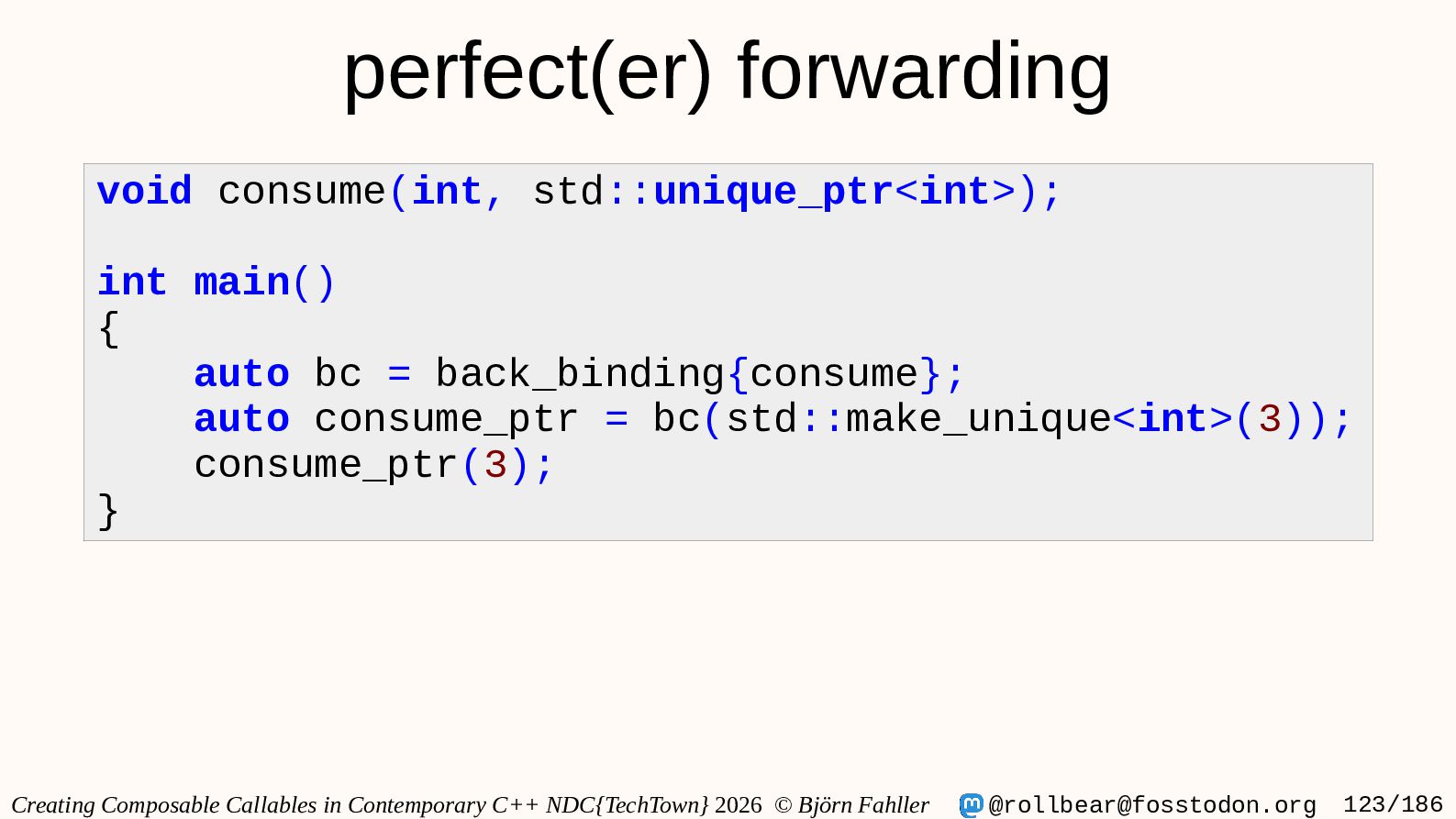
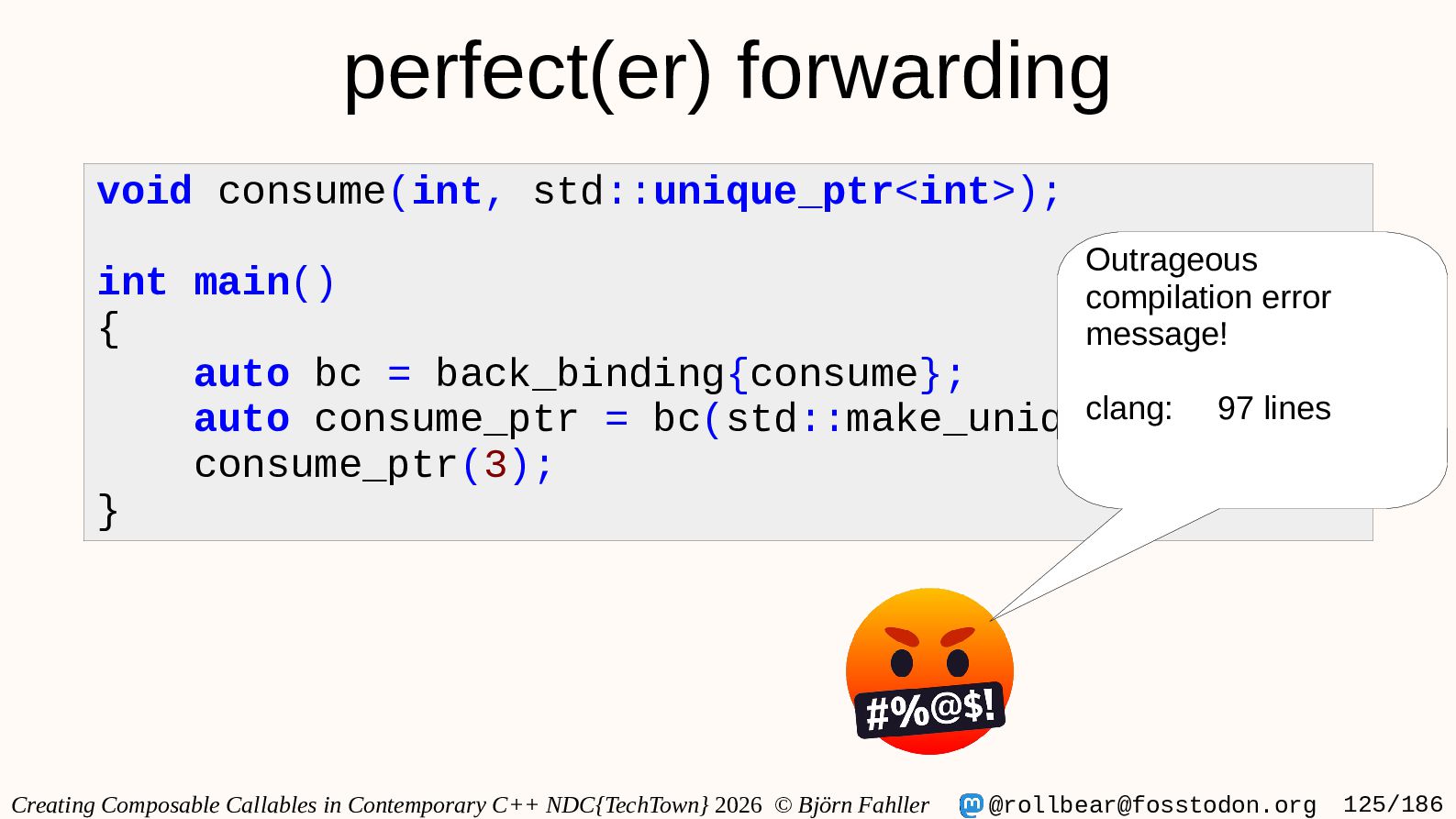
perfect(er) forwarding void consume(int, std::unique_ptr<int>); int main() { auto bc
= back_binding{consume}; auto consume_ptr = bc(std::make_unique<int>(3)); consume_ptr(3); } Creating Composable Callables in Contemporary C++ NDC{TechTown} 2026 © Björn Fahller @[email protected] 123/186 -
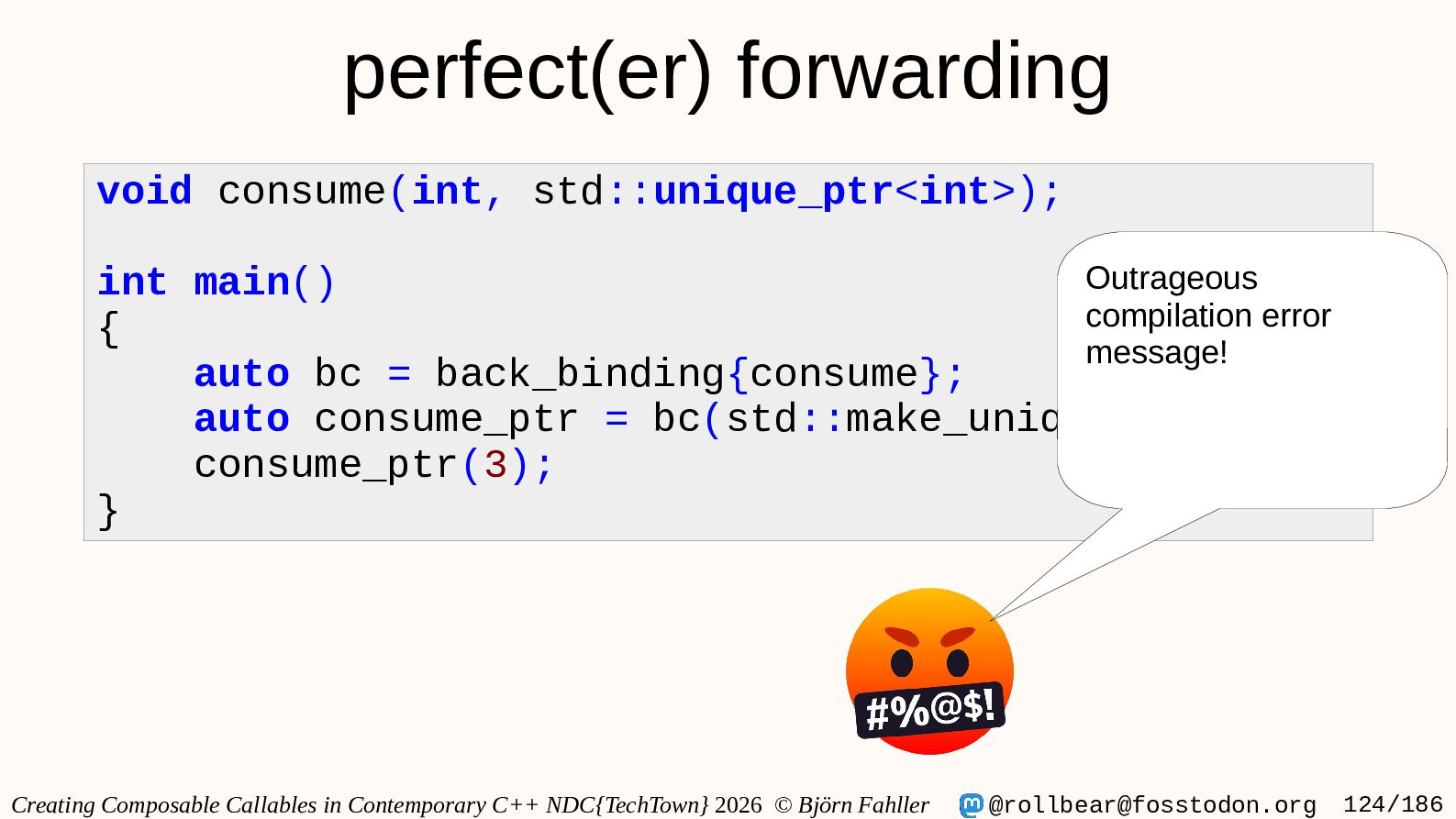
perfect(er) forwarding void consume(int, std::unique_ptr<int>); Outrageous int main() compilation error
{ message! auto bc = back_binding{consume}; auto consume_ptr = bc(std::make_unique<int>(3)); consume_ptr(3); } Creating Composable Callables in Contemporary C++ NDC{TechTown} 2026 © Björn Fahller @[email protected] 124/186 -
perfect(er) forwarding void consume(int, std::unique_ptr<int>); Outrageous compilation error message! int
main() { auto bc = back_binding{consume}; clang: 97 lines auto consume_ptr = bc(std::make_unique<int>(3)); consume_ptr(3); } Creating Composable Callables in Contemporary C++ NDC{TechTown} 2026 © Björn Fahller @[email protected] 125/186 -
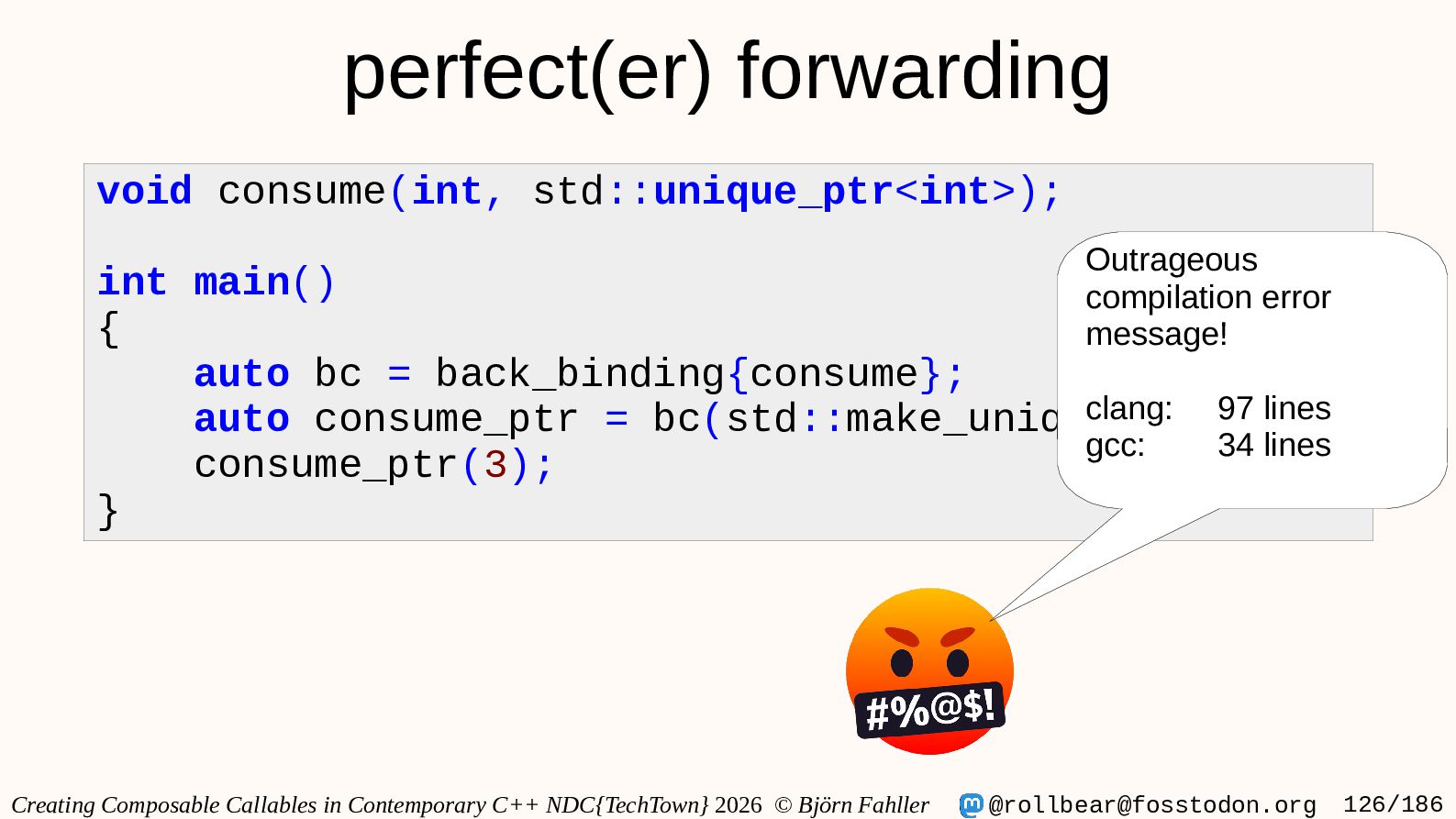
perfect(er) forwarding void consume(int, std::unique_ptr<int>); Outrageous compilation error message! int
main() { auto bc = back_binding{consume}; clang: 97 lines auto consume_ptr = bc(std::make_unique<int>(3)); gcc: 34 lines consume_ptr(3); } Creating Composable Callables in Contemporary C++ NDC{TechTown} 2026 © Björn Fahller @[email protected] 126/186 -
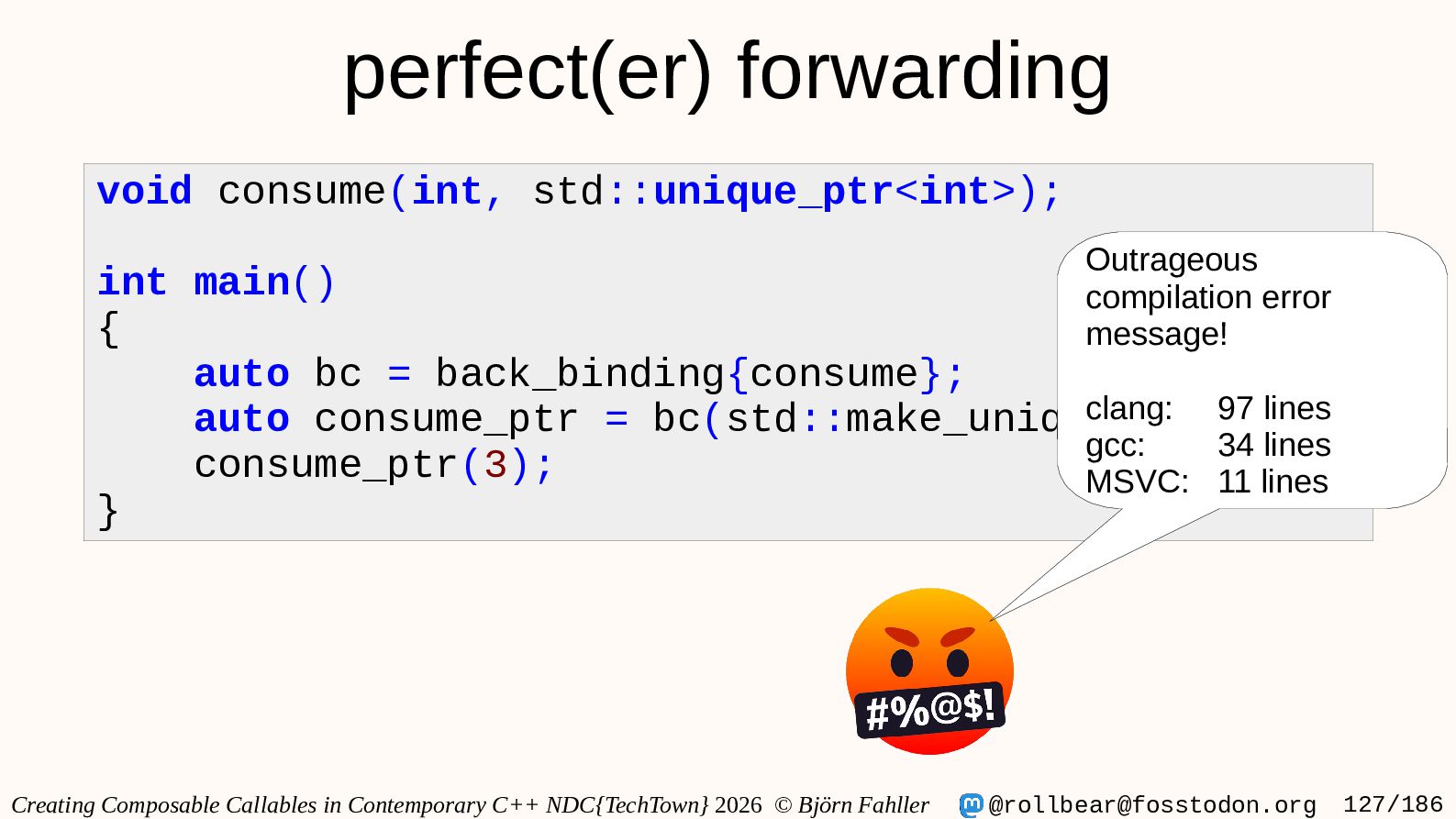
perfect(er) forwarding void consume(int, std::unique_ptr<int>); Outrageous compilation error message! int
main() { auto bc = back_binding{consume}; clang: 97 lines auto consume_ptr = bc(std::make_unique<int>(3)); gcc: 34 lines consume_ptr(3); MSVC: 11 lines } Creating Composable Callables in Contemporary C++ NDC{TechTown} 2026 © Björn Fahller @[email protected] 127/186 -
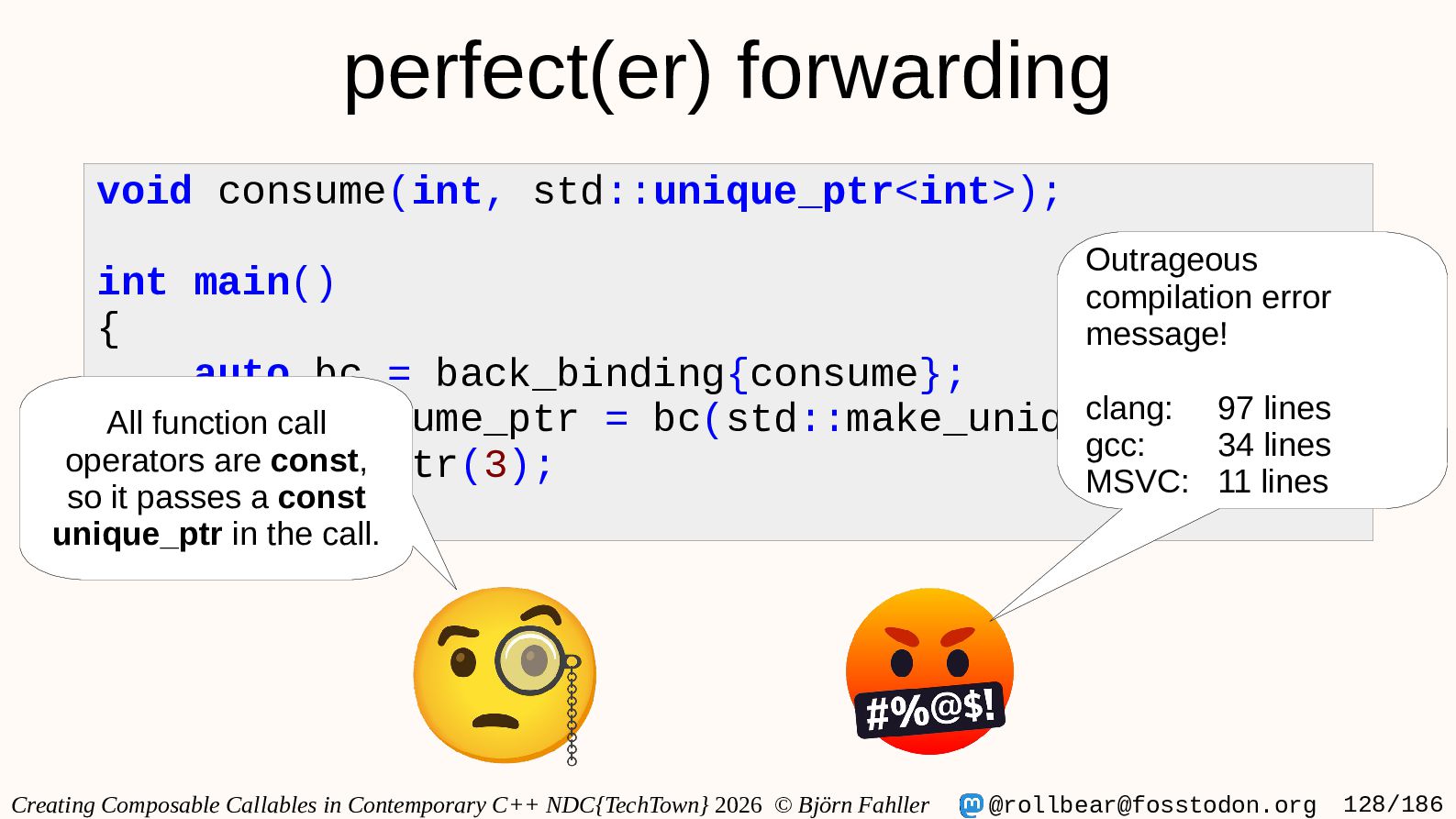
perfect(er) forwarding void consume(int, std::unique_ptr<int>); Outrageous compilation error message! int
main() { auto bc = back_binding{consume}; clang: 97 lines autocallconsume_ptr = bc(std::make_unique<int>(3)); All function gcc: 34 lines operatorsconsume_ptr(3); are const, MSVC: 11 lines so}it passes a const unique_ptr in the call. Creating Composable Callables in Contemporary C++ NDC{TechTown} 2026 © Björn Fahller @[email protected] 128/186 -
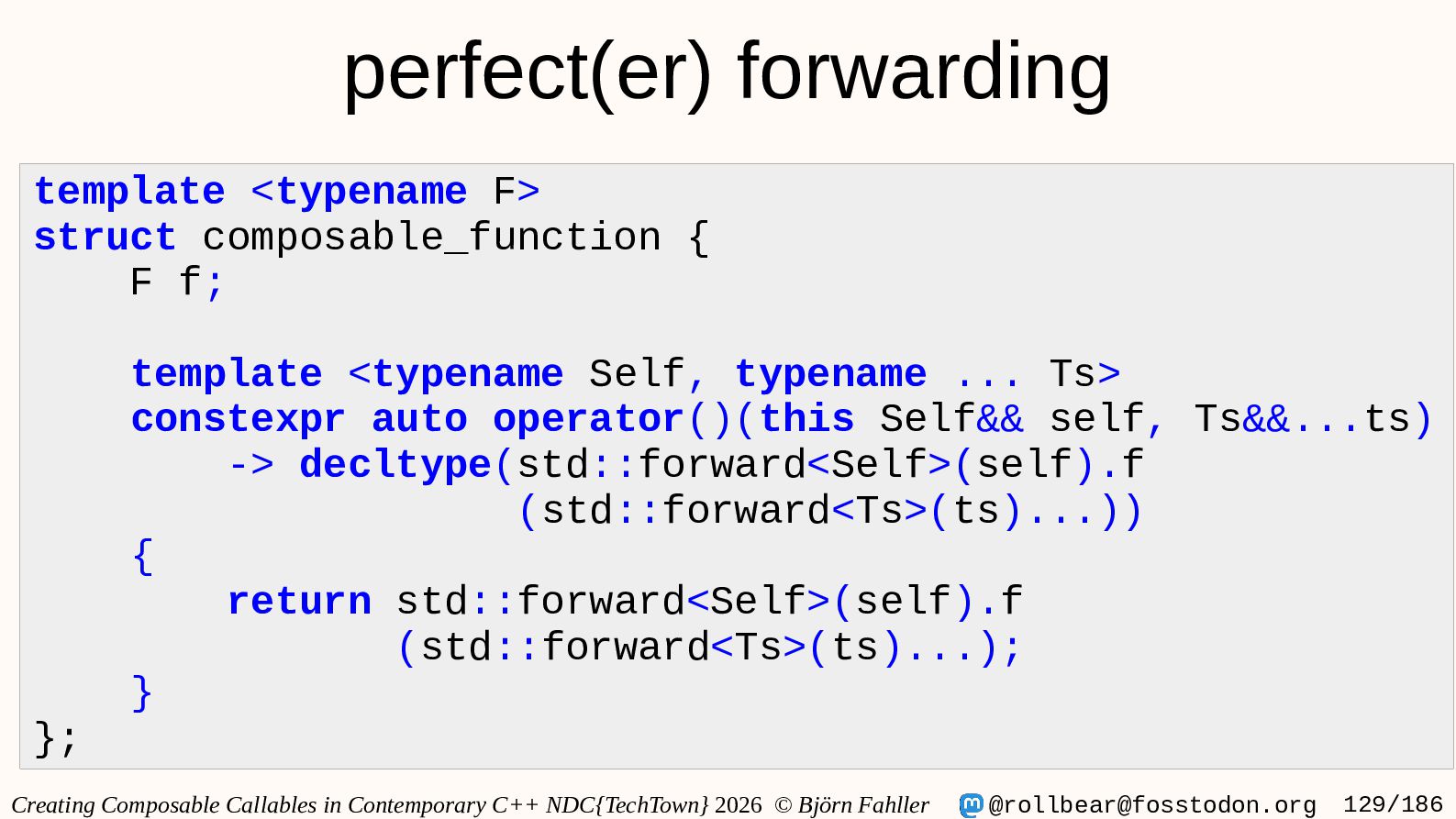
perfect(er) forwarding template <typename F> struct composable_function { F f;
}; template <typename Self, typename ... Ts> constexpr auto operator()(this Self&& self, Ts&&...ts) -> decltype(std::forward<Self>(self).f (std::forward<Ts>(ts)...)) { return std::forward<Self>(self).f (std::forward<Ts>(ts)...); https://godbolt.org/z/1qGaEvjM6 } Creating Composable Callables in Contemporary C++ NDC{TechTown} 2026 © Björn Fahller @[email protected] 129/186 -
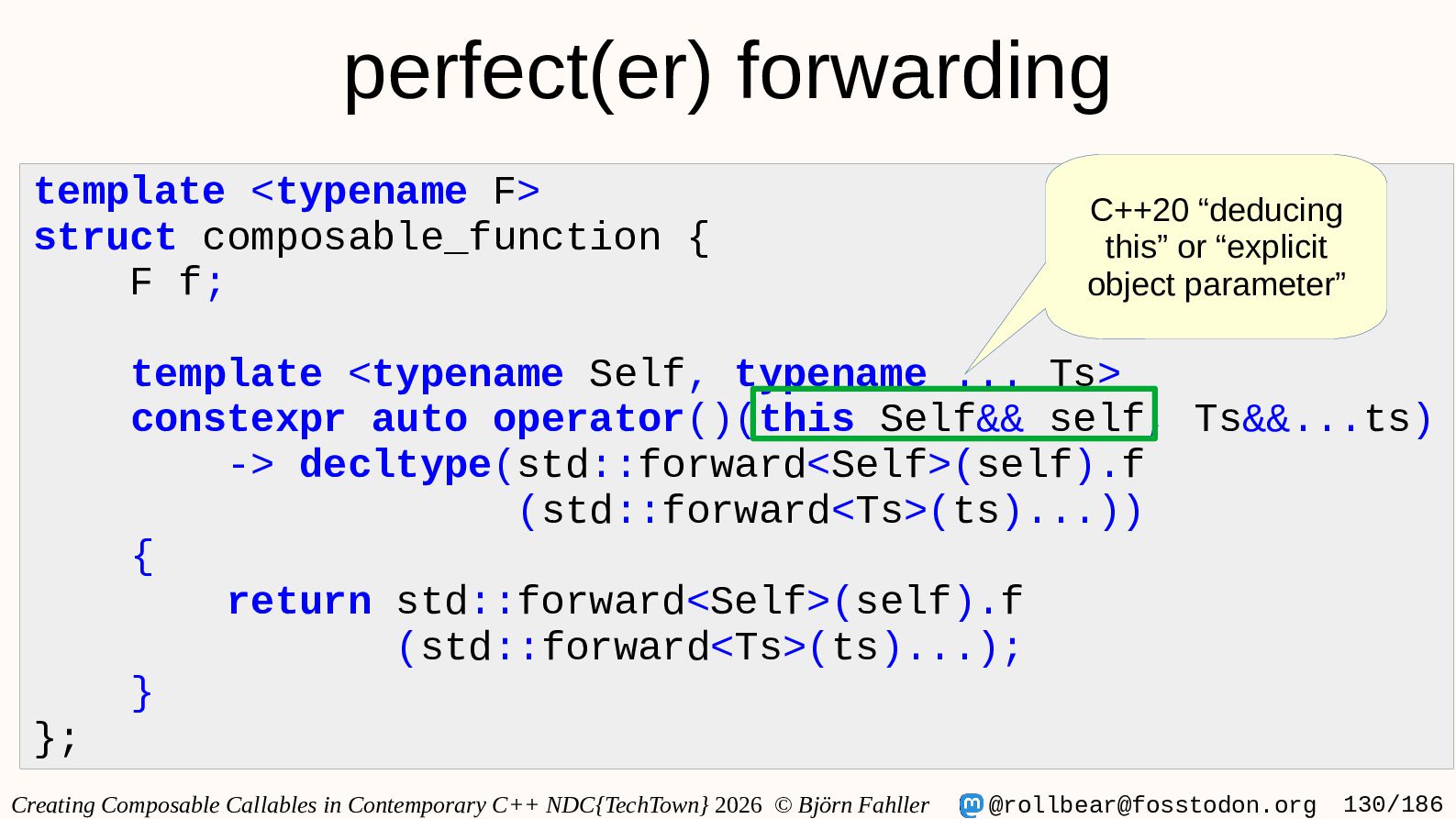
perfect(er) forwarding template <typename F> struct composable_function { F f;
}; C++20 “deducing this” or “explicit object parameter” template <typename Self, typename ... Ts> constexpr auto operator()(this Self&& self, Ts&&...ts) -> decltype(std::forward<Self>(self).f (std::forward<Ts>(ts)...)) { return std::forward<Self>(self).f (std::forward<Ts>(ts)...); https://godbolt.org/z/1qGaEvjM6 } Creating Composable Callables in Contemporary C++ NDC{TechTown} 2026 © Björn Fahller @[email protected] 130/186 -
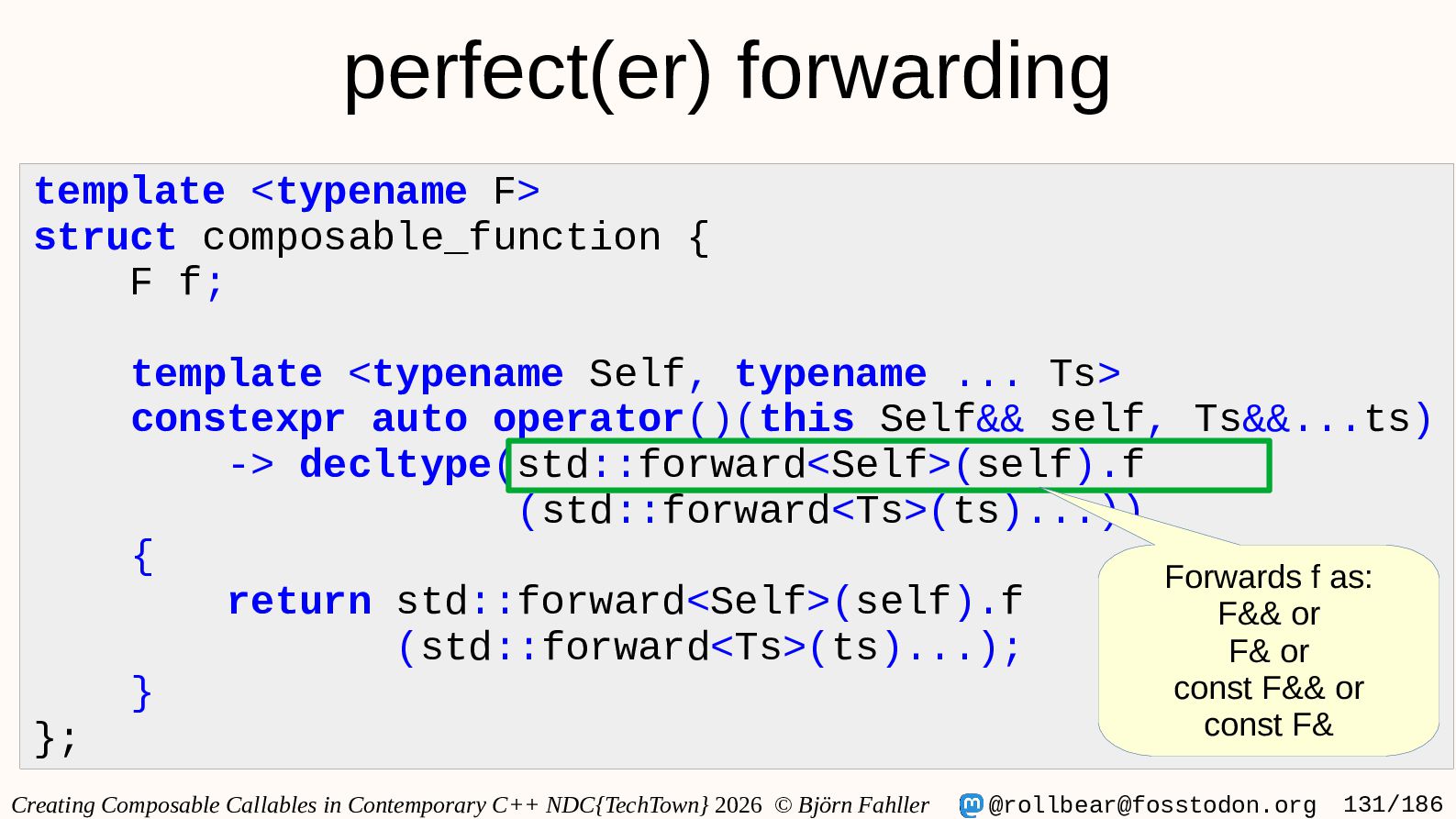
perfect(er) forwarding template <typename F> struct composable_function { F f;
}; template <typename Self, typename ... Ts> constexpr auto operator()(this Self&& self, Ts&&...ts) -> decltype(std::forward<Self>(self).f (std::forward<Ts>(ts)...)) { Forwards f as: return std::forward<Self>(self).f F&& or (std::forward<Ts>(ts)...); F& or const F&& or https://godbolt.org/z/1qGaEvjM6 } Creating Composable Callables in Contemporary C++ NDC{TechTown} 2026 © Björn Fahller const F& @[email protected] 131/186 -
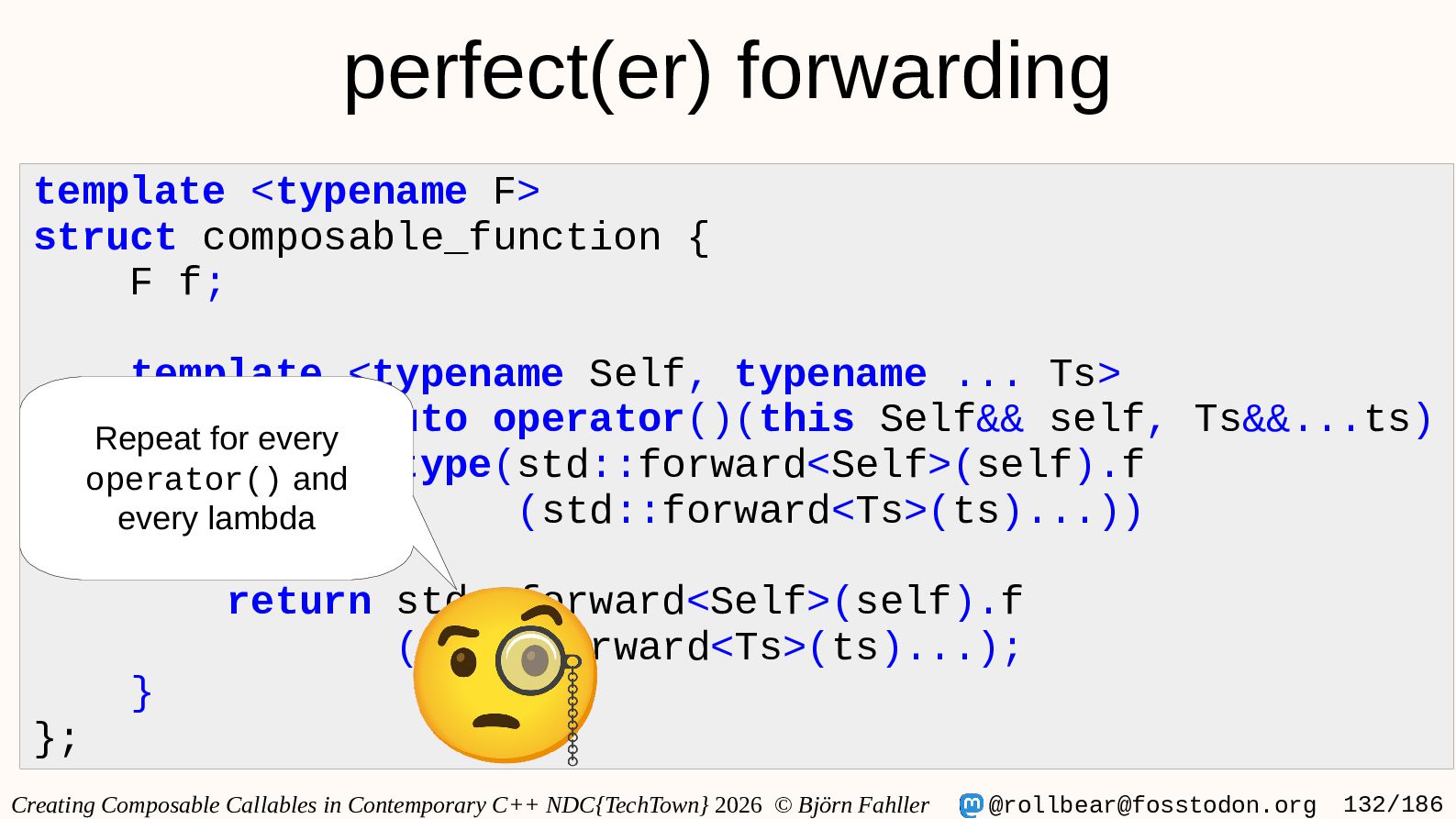
perfect(er) forwarding template <typename F> struct composable_function { F f;
}; template <typename Self, typename ... Ts> constexpr auto operator()(this Self&& self, Ts&&...ts) Repeat for every -> and decltype(std::forward<Self>(self).f operator() (std::forward<Ts>(ts)...)) every lambda { return std::forward<Self>(self).f (std::forward<Ts>(ts)...); https://godbolt.org/z/1qGaEvjM6 } Creating Composable Callables in Contemporary C++ NDC{TechTown} 2026 © Björn Fahller @[email protected] 132/186 -
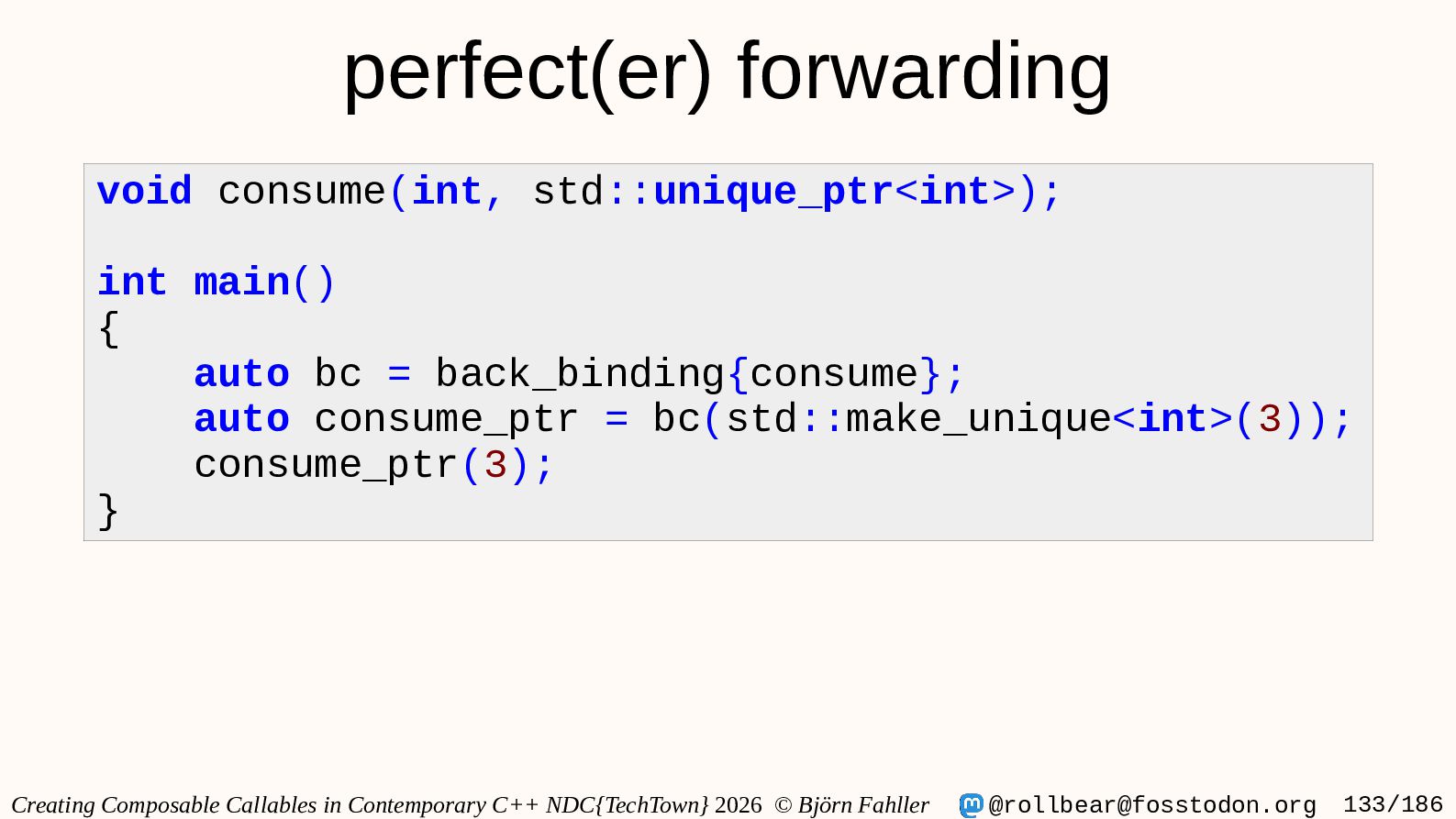
perfect(er) forwarding void consume(int, std::unique_ptr<int>); int main() { auto bc
= back_binding{consume}; auto consume_ptr = bc(std::make_unique<int>(3)); consume_ptr(3); } Creating Composable Callables in Contemporary C++ NDC{TechTown} 2026 © Björn Fahller @[email protected] 133/186 -
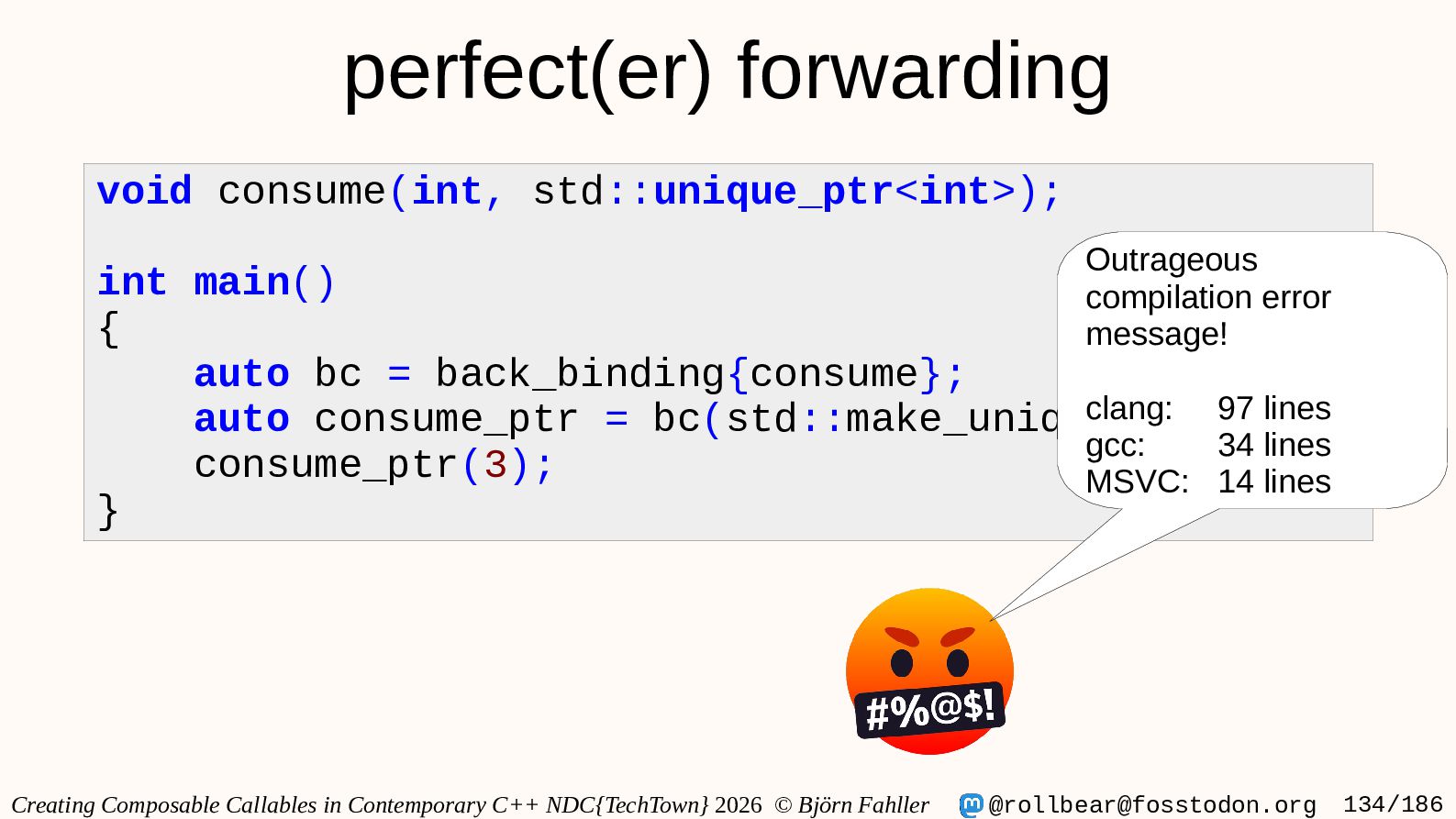
perfect(er) forwarding void consume(int, std::unique_ptr<int>); Outrageous compilation error message! int
main() { auto bc = back_binding{consume}; clang: 97 lines auto consume_ptr = bc(std::make_unique<int>(3)); gcc: 34 lines consume_ptr(3); MSVC: 14 lines } Creating Composable Callables in Contemporary C++ NDC{TechTown} 2026 © Björn Fahller @[email protected] 134/186 -
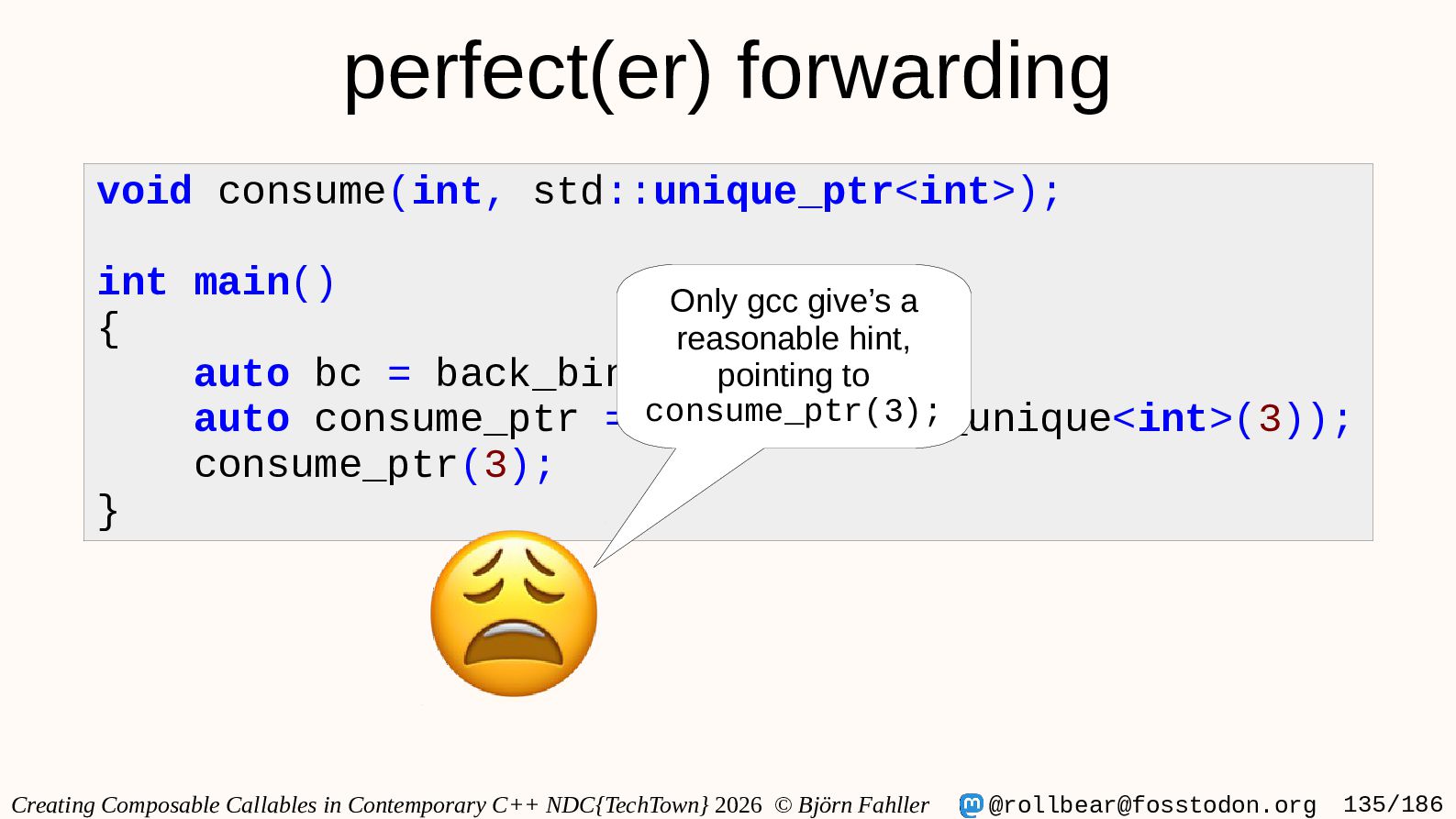
perfect(er) forwarding void consume(int, std::unique_ptr<int>); int main() Only gcc give’s
a { reasonable hint, auto bc = back_binding{consume}; pointing to auto consume_ptr = consume_ptr(3); bc(std::make_unique<int>(3)); consume_ptr(3); } Creating Composable Callables in Contemporary C++ NDC{TechTown} 2026 © Björn Fahller @[email protected] 135/186 -
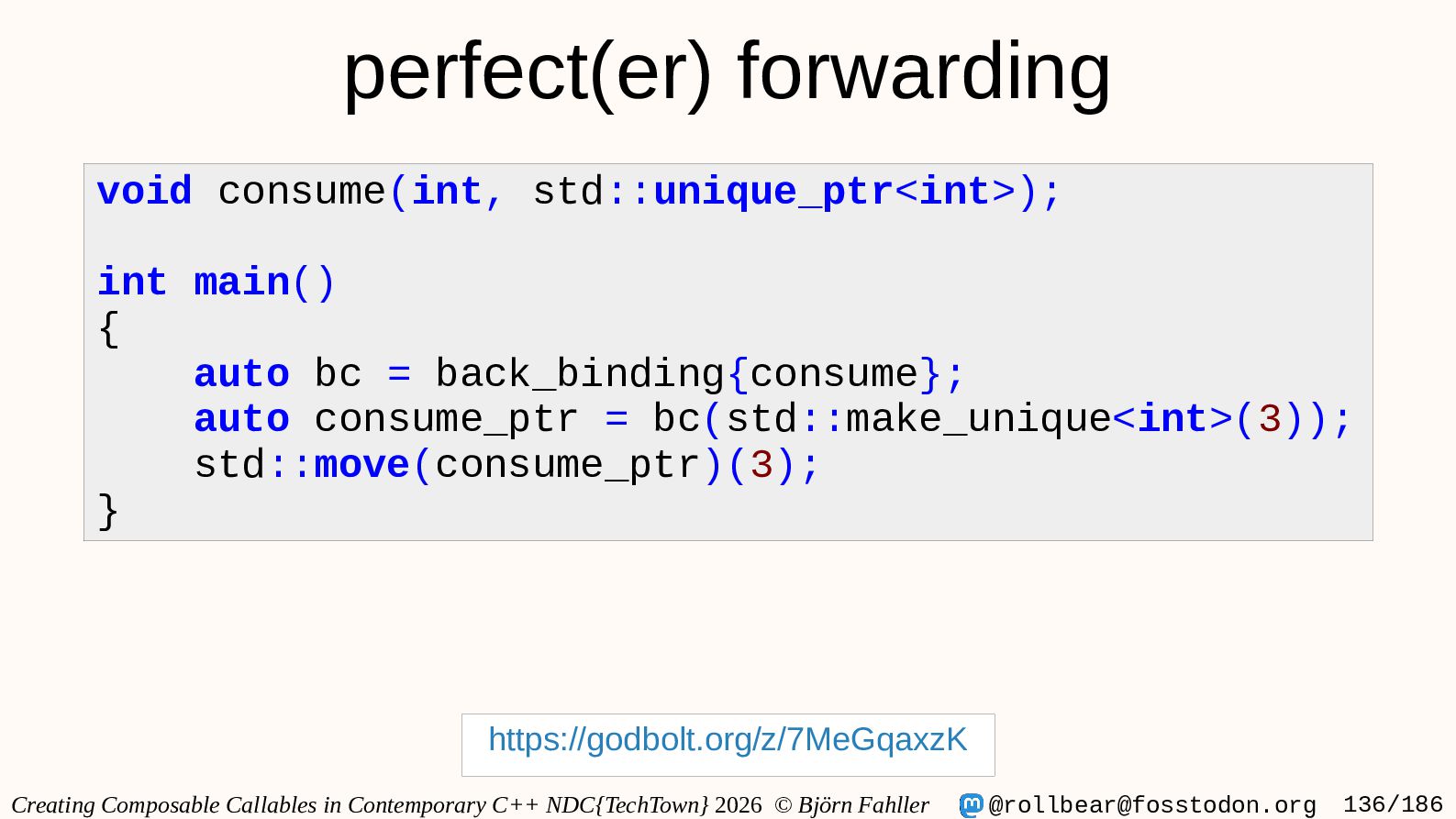
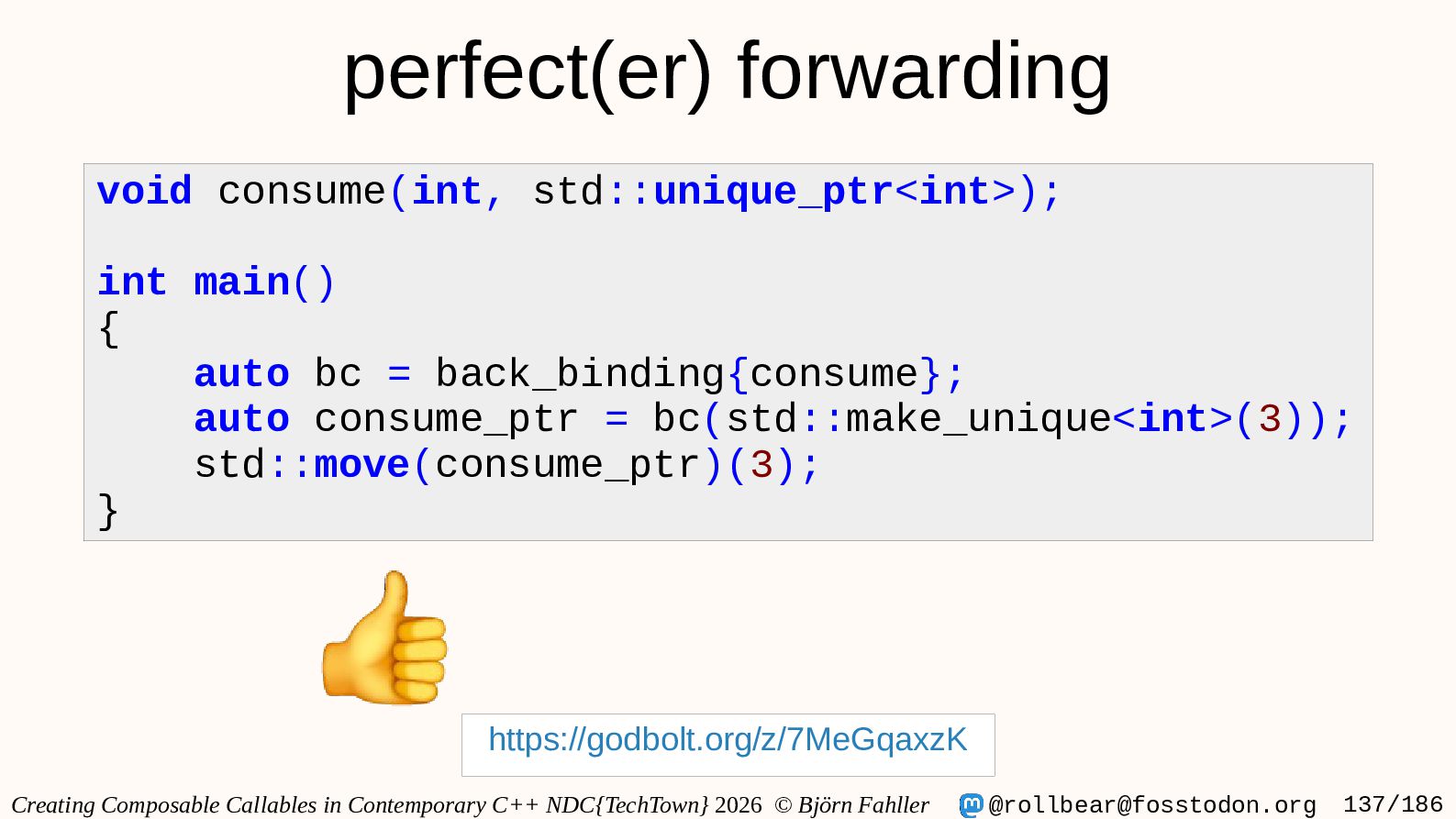
perfect(er) forwarding void consume(int, std::unique_ptr<int>); int main() { auto bc
= back_binding{consume}; auto consume_ptr = bc(std::make_unique<int>(3)); std::move(consume_ptr)(3); } https://godbolt.org/z/7MeGqaxzK Creating Composable Callables in Contemporary C++ NDC{TechTown} 2026 © Björn Fahller @[email protected] 136/186 -
perfect(er) forwarding void consume(int, std::unique_ptr<int>); int main() { auto bc
= back_binding{consume}; auto consume_ptr = bc(std::make_unique<int>(3)); std::move(consume_ptr)(3); } https://godbolt.org/z/7MeGqaxzK Creating Composable Callables in Contemporary C++ NDC{TechTown} 2026 © Björn Fahller @[email protected] 137/186 -
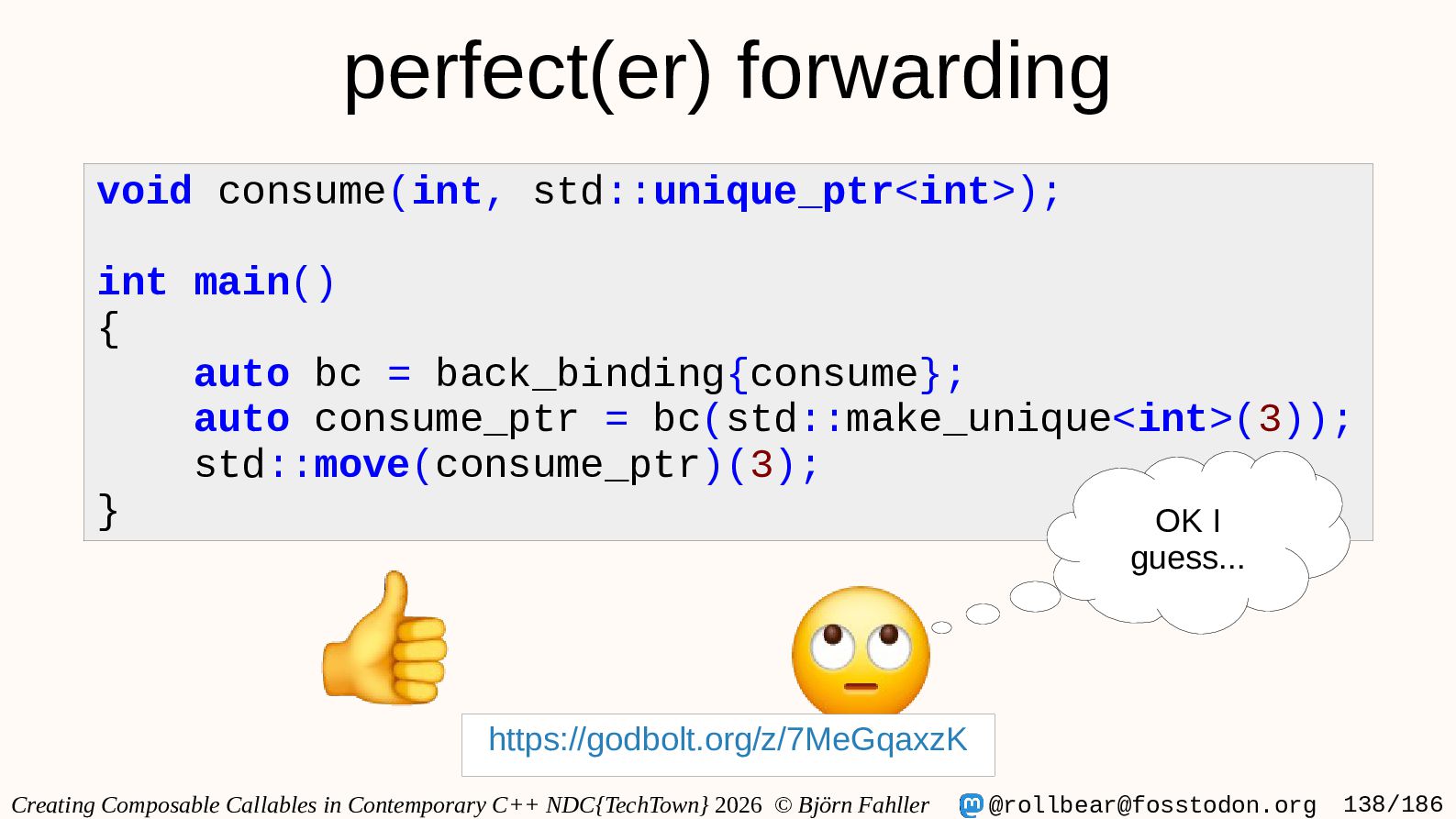
perfect(er) forwarding void consume(int, std::unique_ptr<int>); int main() { auto bc
= back_binding{consume}; auto consume_ptr = bc(std::make_unique<int>(3)); std::move(consume_ptr)(3); } OK I guess... https://godbolt.org/z/7MeGqaxzK Creating Composable Callables in Contemporary C++ NDC{TechTown} 2026 © Björn Fahller @[email protected] 138/186 -
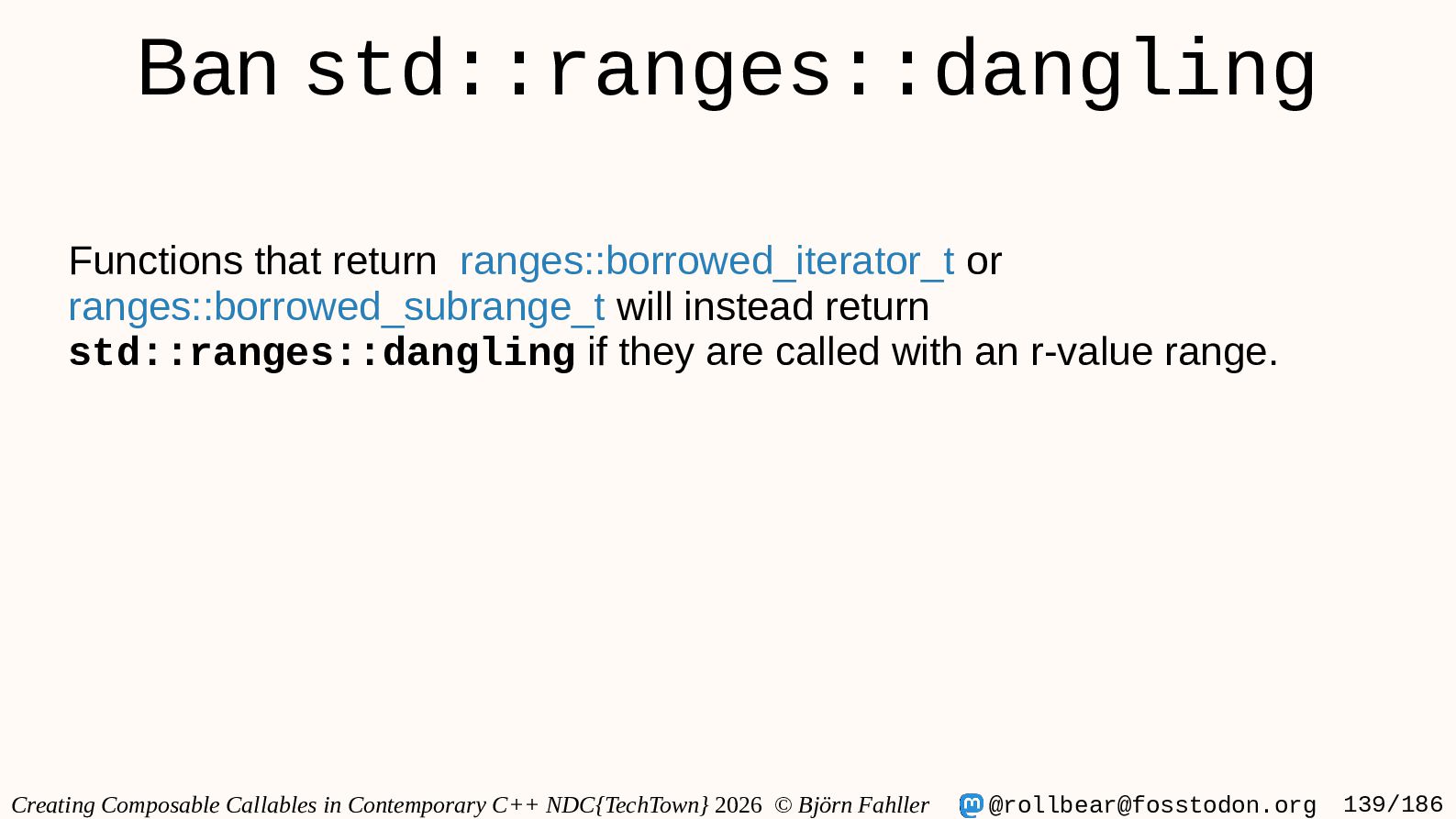
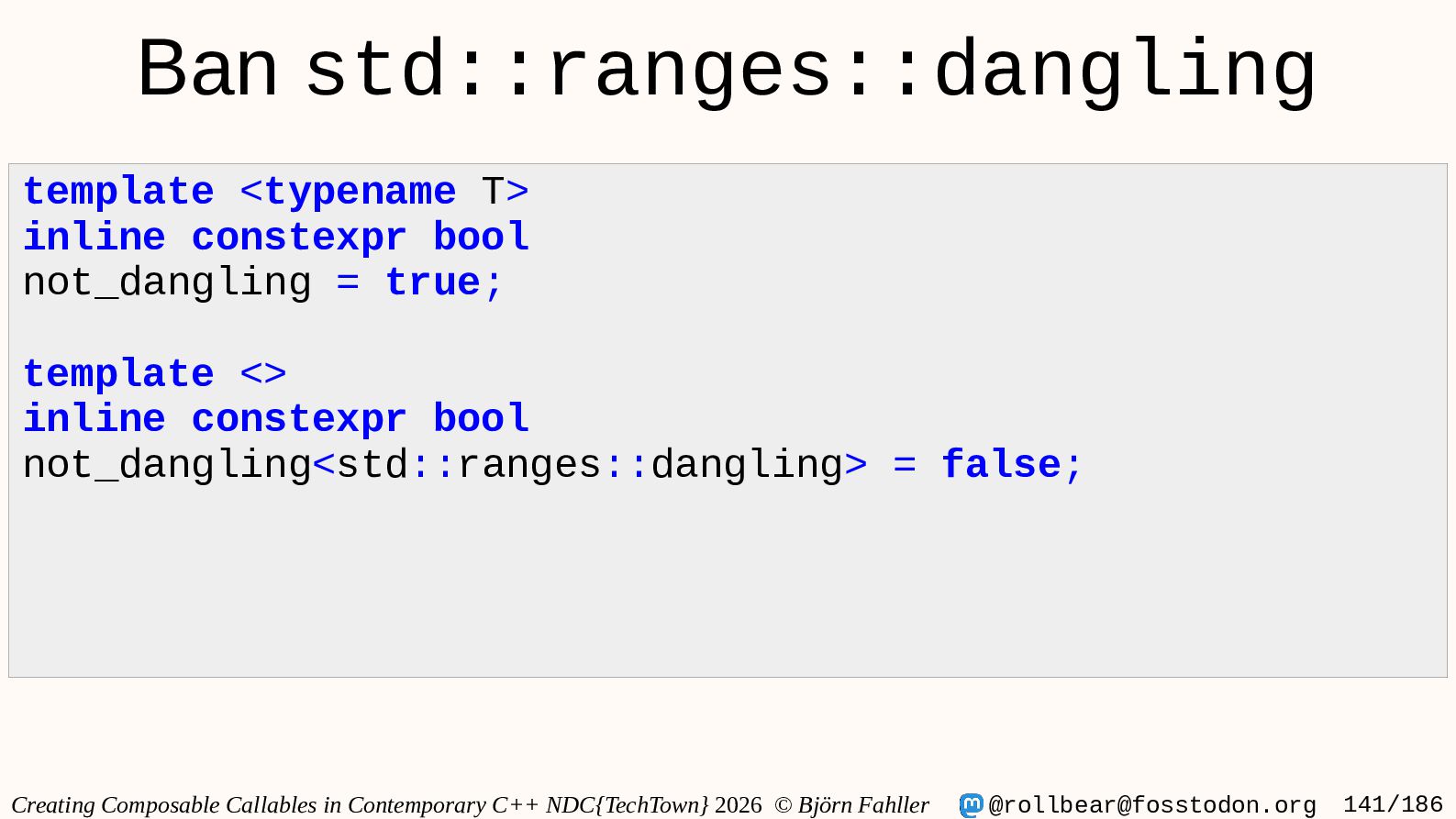
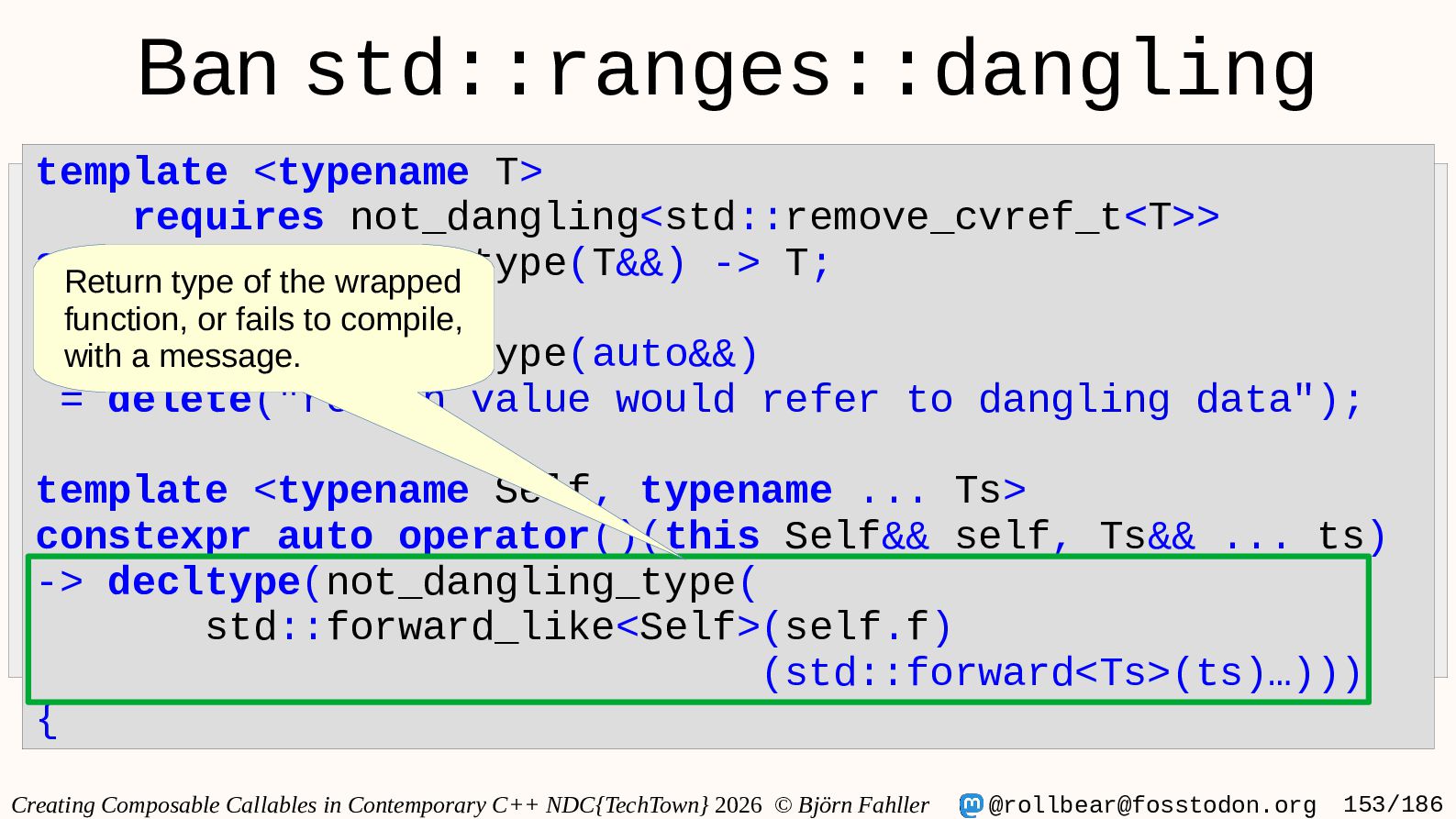
Ban std::ranges::dangling Functions that return ranges::borrowed_iterator_t or ranges::borrowed_subrange_t will instead
return std::ranges::dangling if they are called with an r-value range. Creating Composable Callables in Contemporary C++ NDC{TechTown} 2026 © Björn Fahller @[email protected] 139/186 -
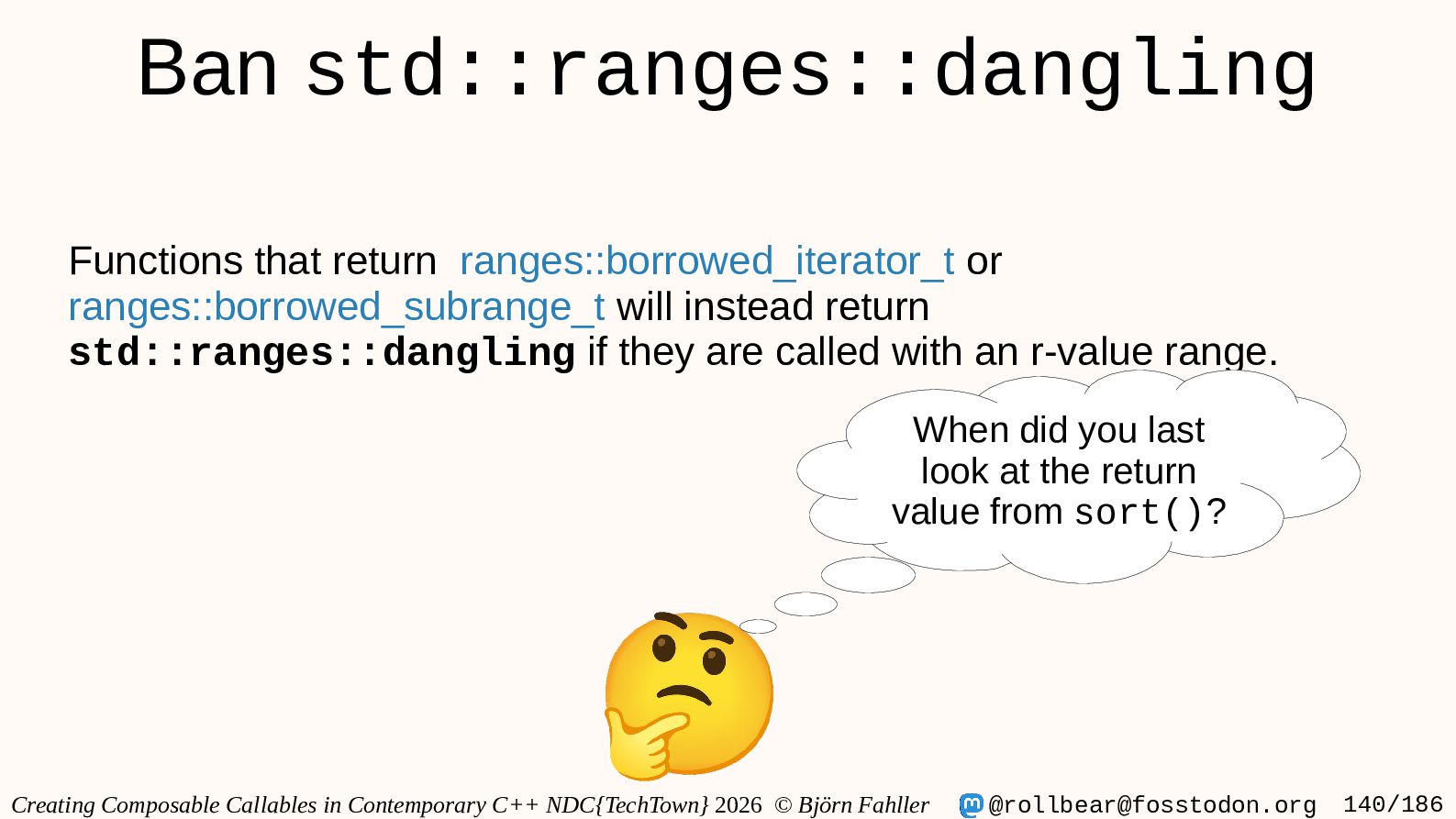
Ban std::ranges::dangling Functions that return ranges::borrowed_iterator_t or ranges::borrowed_subrange_t will instead
return std::ranges::dangling if they are called with an r-value range. When did you last look at the return value from sort()? Creating Composable Callables in Contemporary C++ NDC{TechTown} 2026 © Björn Fahller @[email protected] 140/186 -
Ban std::ranges::dangling template <typename T> inline constexpr bool not_dangling =
true; template <> inline constexpr bool not_dangling<std::ranges::dangling> = false; Creating Composable Callables in Contemporary C++ NDC{TechTown} 2026 © Björn Fahller @[email protected] 141/186 -
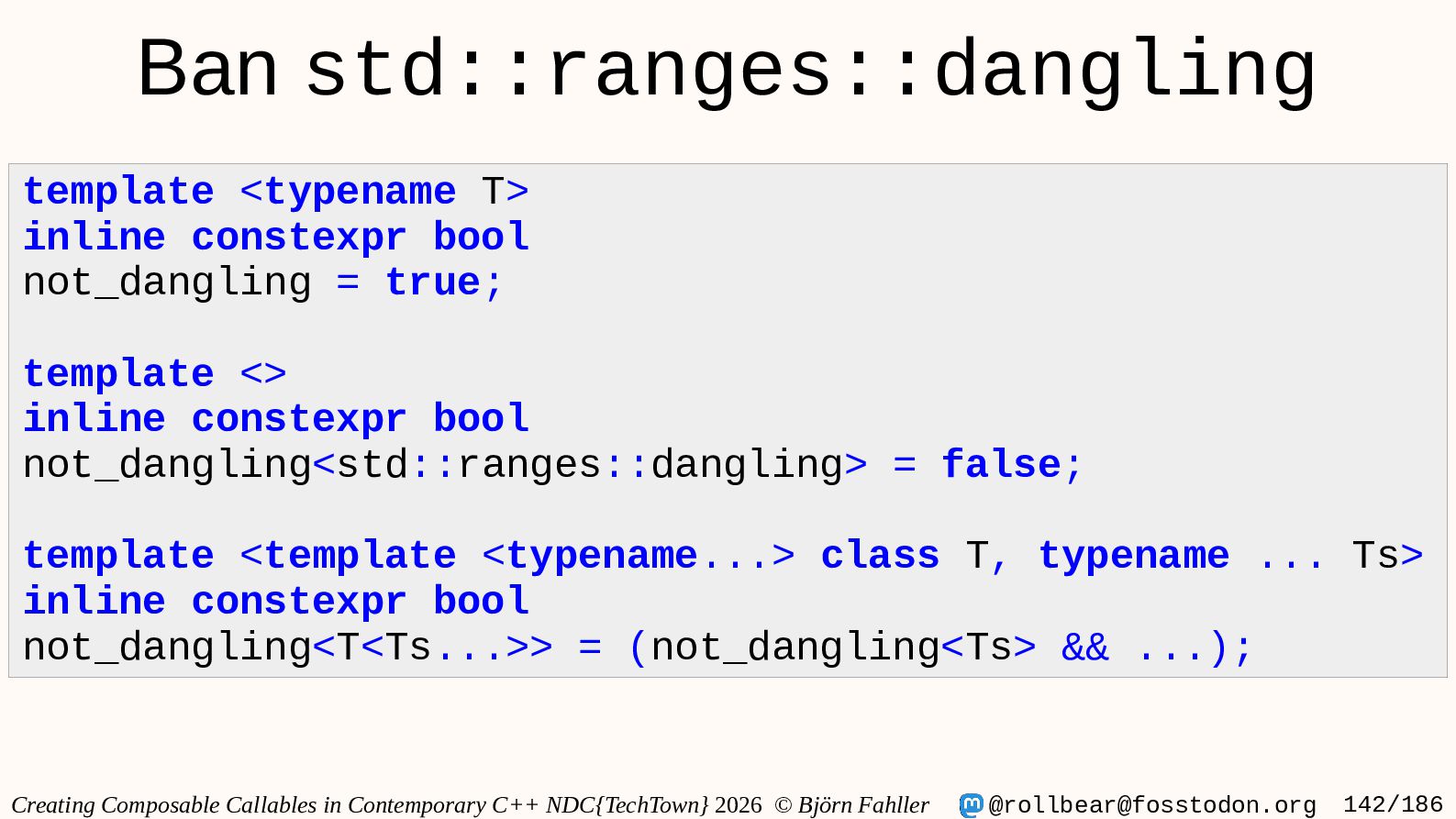
Ban std::ranges::dangling template <typename T> inline constexpr bool not_dangling =
true; template <> inline constexpr bool not_dangling<std::ranges::dangling> = false; template <template <typename...> class T, typename ... Ts> inline constexpr bool not_dangling<T<Ts...>> = (not_dangling<Ts> && ...); Creating Composable Callables in Contemporary C++ NDC{TechTown} 2026 © Björn Fahller @[email protected] 142/186 -
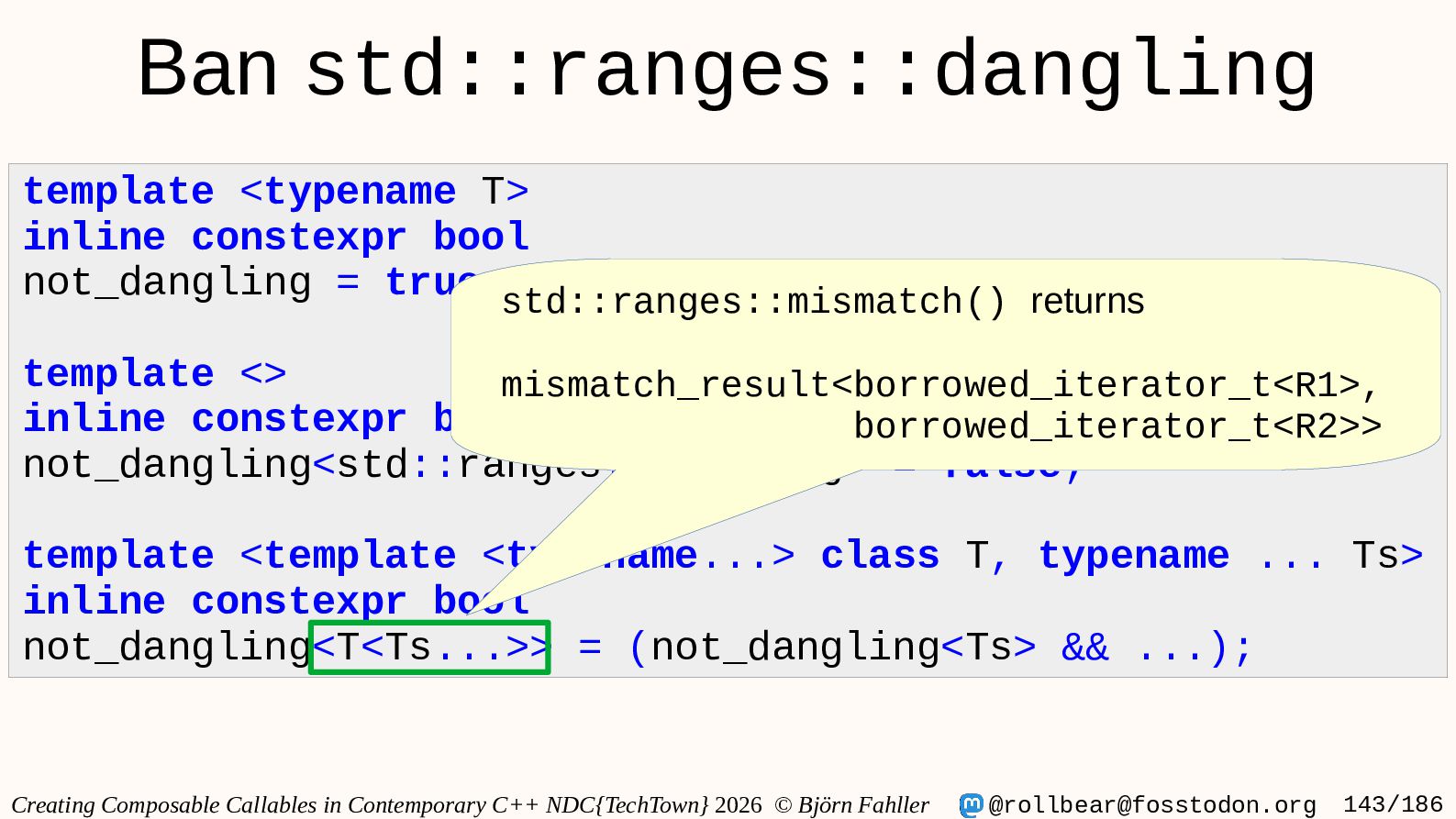
Ban std::ranges::dangling template <typename T> inline constexpr bool not_dangling =
true;std::ranges::mismatch() returns template <> mismatch_result<borrowed_iterator_t<R1>, inline constexpr bool borrowed_iterator_t<R2>> not_dangling<std::ranges::dangling> = false; template <template <typename...> class T, typename ... Ts> inline constexpr bool not_dangling<T<Ts...>> = (not_dangling<Ts> && ...); Creating Composable Callables in Contemporary C++ NDC{TechTown} 2026 © Björn Fahller @[email protected] 143/186 -
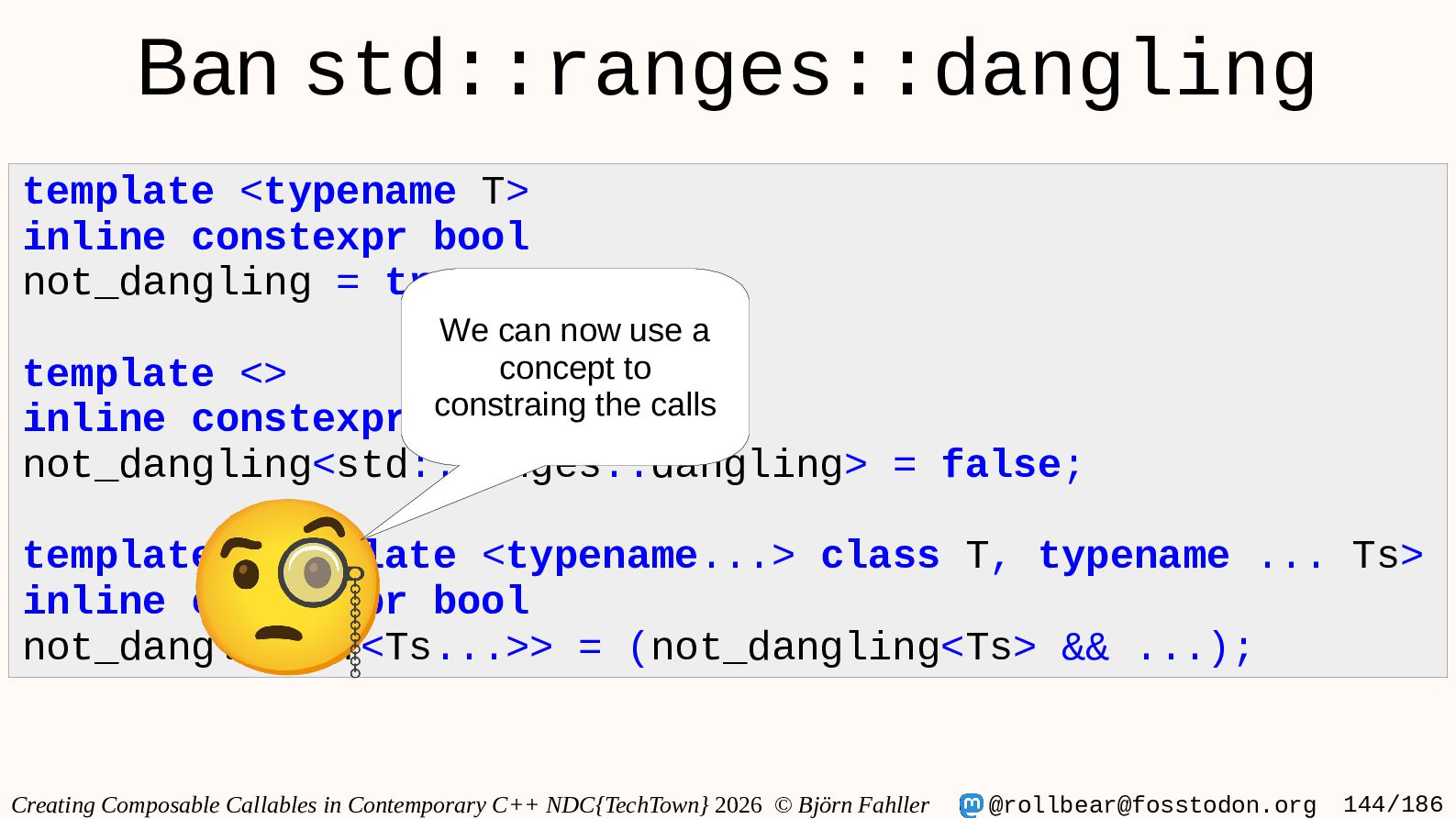
Ban std::ranges::dangling template <typename T> inline constexpr bool not_dangling =
true; We can now use a concept to constraing the calls bool template <> inline constexpr not_dangling<std::ranges::dangling> = false; template <template <typename...> class T, typename ... Ts> inline constexpr bool not_dangling<T<Ts...>> = (not_dangling<Ts> && ...); Creating Composable Callables in Contemporary C++ NDC{TechTown} 2026 © Björn Fahller @[email protected] 144/186 -
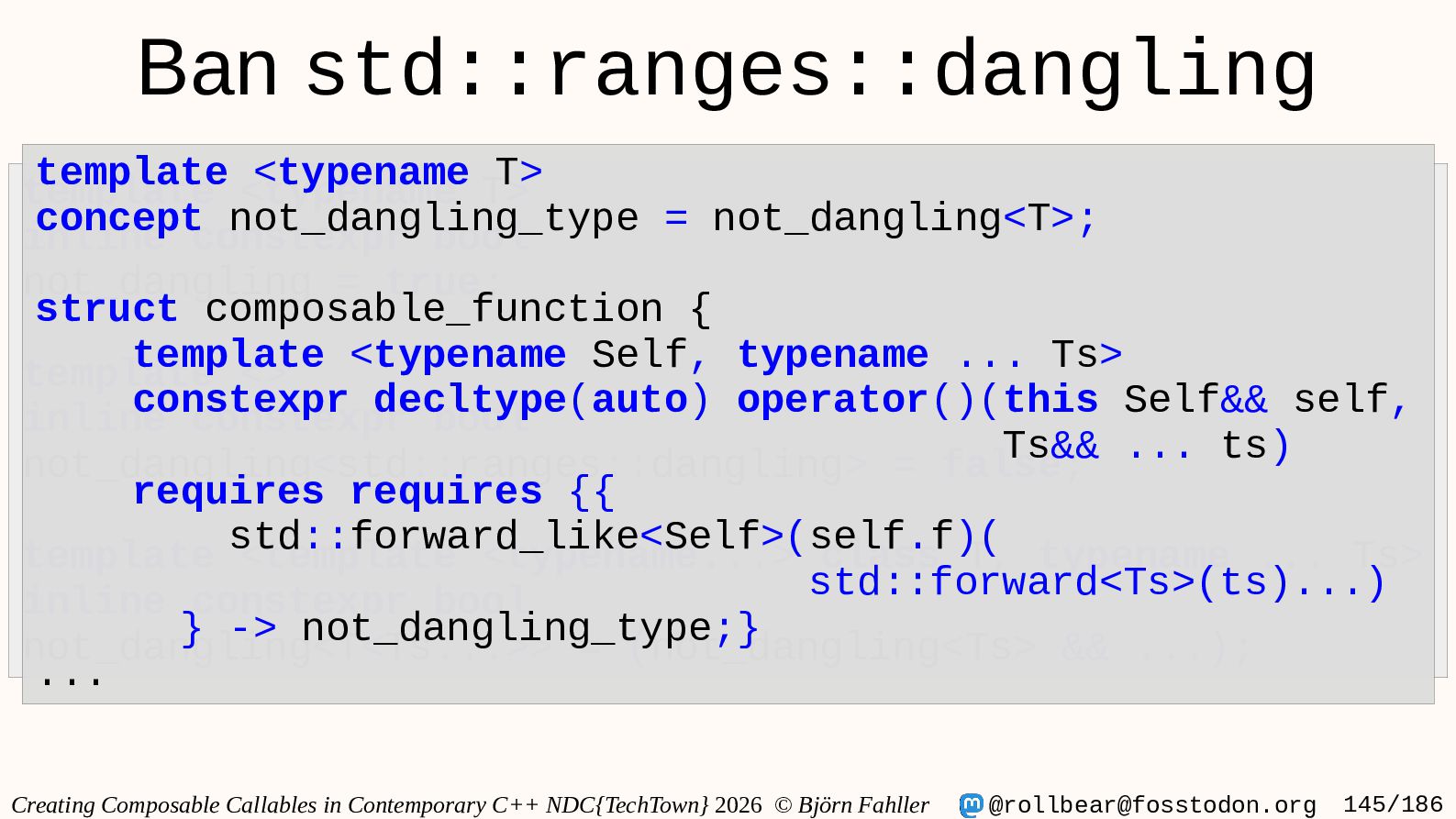
Ban std::ranges::dangling template <typename <typename T> T> template conceptconstexpr not_dangling_type
= not_dangling<T>; inline bool not_dangling = true; struct composable_function { template <typename Self, typename ... Ts> template <> constexpr decltype(auto) operator()(this Self&& self, inline constexpr bool Ts&& ... ts) not_dangling<std::ranges::dangling> = false; requires requires {{ template std::forward_like<Self>(self.f)( <template <typename...> class T, typename ... Ts> std::forward<Ts>(ts)...) inline constexpr bool } -> not_dangling_type;} not_dangling<T<Ts...>> = (not_dangling<Ts> && ...); ... Creating Composable Callables in Contemporary C++ NDC{TechTown} 2026 © Björn Fahller @[email protected] 145/186 -
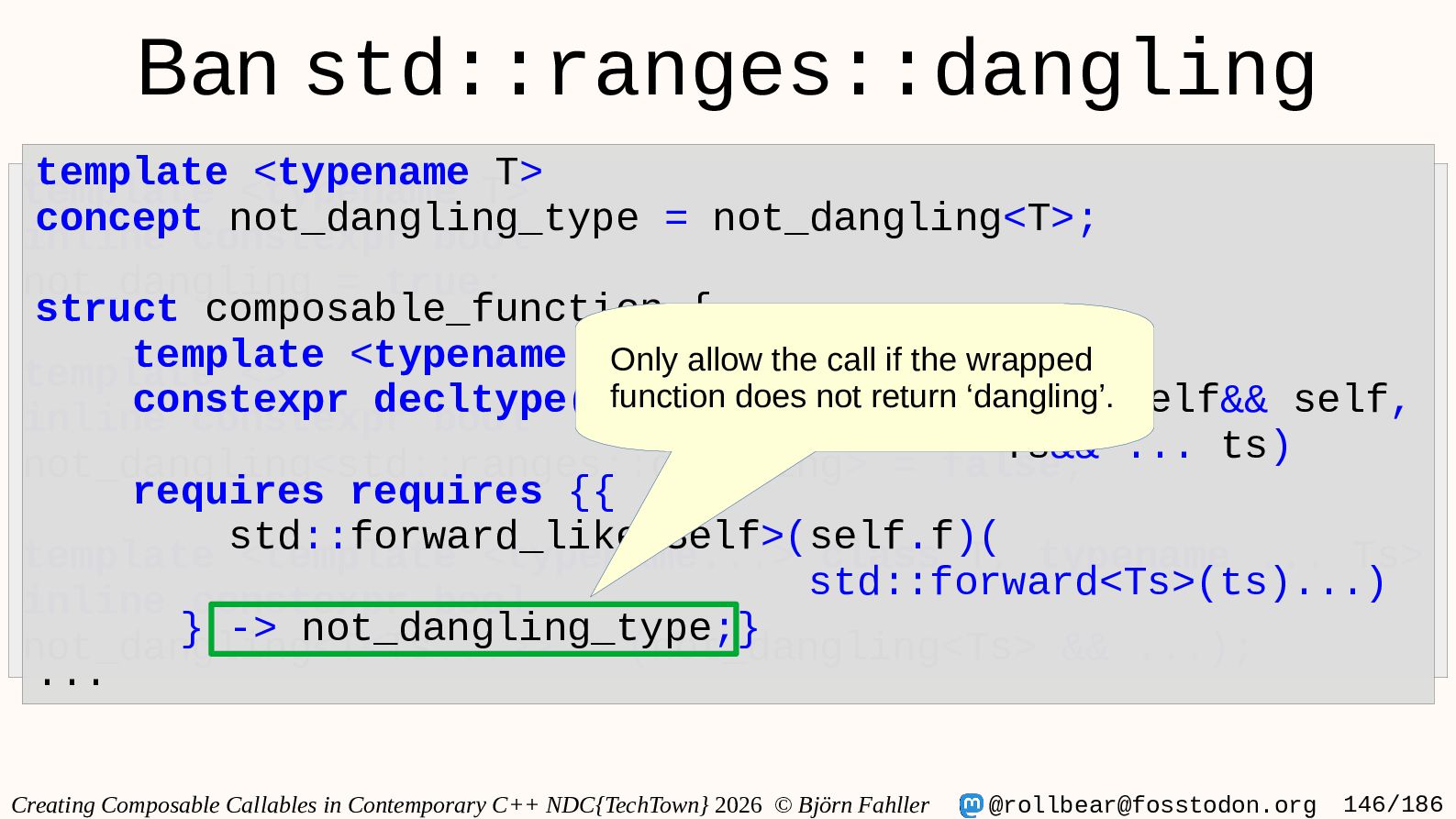
Ban std::ranges::dangling template <typename <typename T> T> template conceptconstexpr not_dangling_type
= not_dangling<T>; inline bool not_dangling = true; struct composable_function { template <typename Self, typename Ts> Only allow the call if the... wrapped template <> function does not return ‘dangling’. Self&& self, constexpr decltype(auto) operator()(this inline constexpr bool Ts&& ... ts) not_dangling<std::ranges::dangling> = false; requires requires {{ template std::forward_like<Self>(self.f)( <template <typename...> class T, typename ... Ts> std::forward<Ts>(ts)...) inline constexpr bool } -> not_dangling_type;} not_dangling<T<Ts...>> = (not_dangling<Ts> && ...); ... Creating Composable Callables in Contemporary C++ NDC{TechTown} 2026 © Björn Fahller @[email protected] 146/186 -
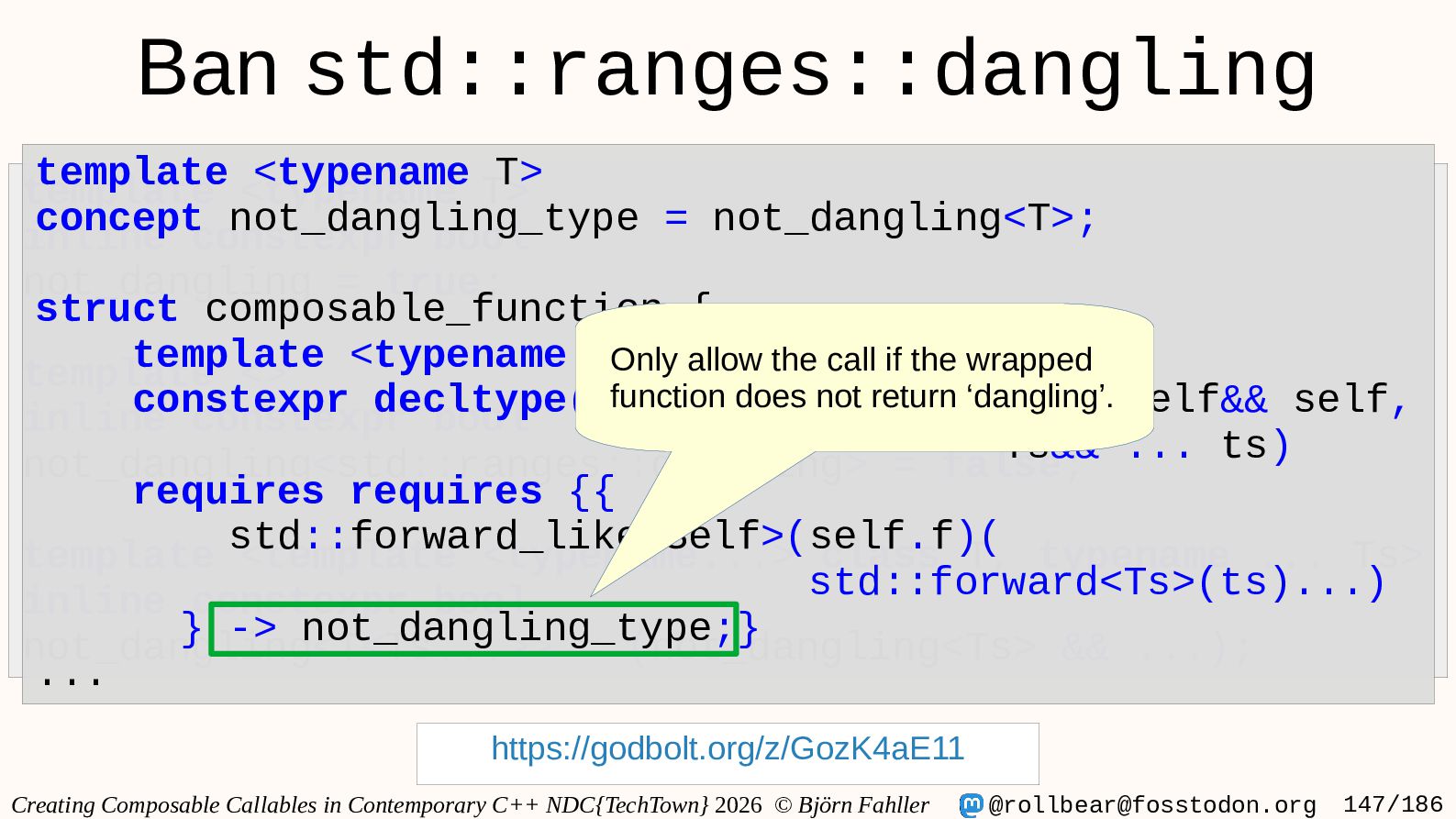
Ban std::ranges::dangling template <typename <typename T> T> template conceptconstexpr not_dangling_type
= not_dangling<T>; inline bool not_dangling = true; struct composable_function { template <typename Self, typename Ts> Only allow the call if the... wrapped template <> function does not return ‘dangling’. Self&& self, constexpr decltype(auto) operator()(this inline constexpr bool Ts&& ... ts) not_dangling<std::ranges::dangling> = false; requires requires {{ template std::forward_like<Self>(self.f)( <template <typename...> class T, typename ... Ts> std::forward<Ts>(ts)...) inline constexpr bool } -> not_dangling_type;} not_dangling<T<Ts...>> = (not_dangling<Ts> && ...); ... https://godbolt.org/z/GozK4aE11 Creating Composable Callables in Contemporary C++ NDC{TechTown} 2026 © Björn Fahller @[email protected] 147/186 -
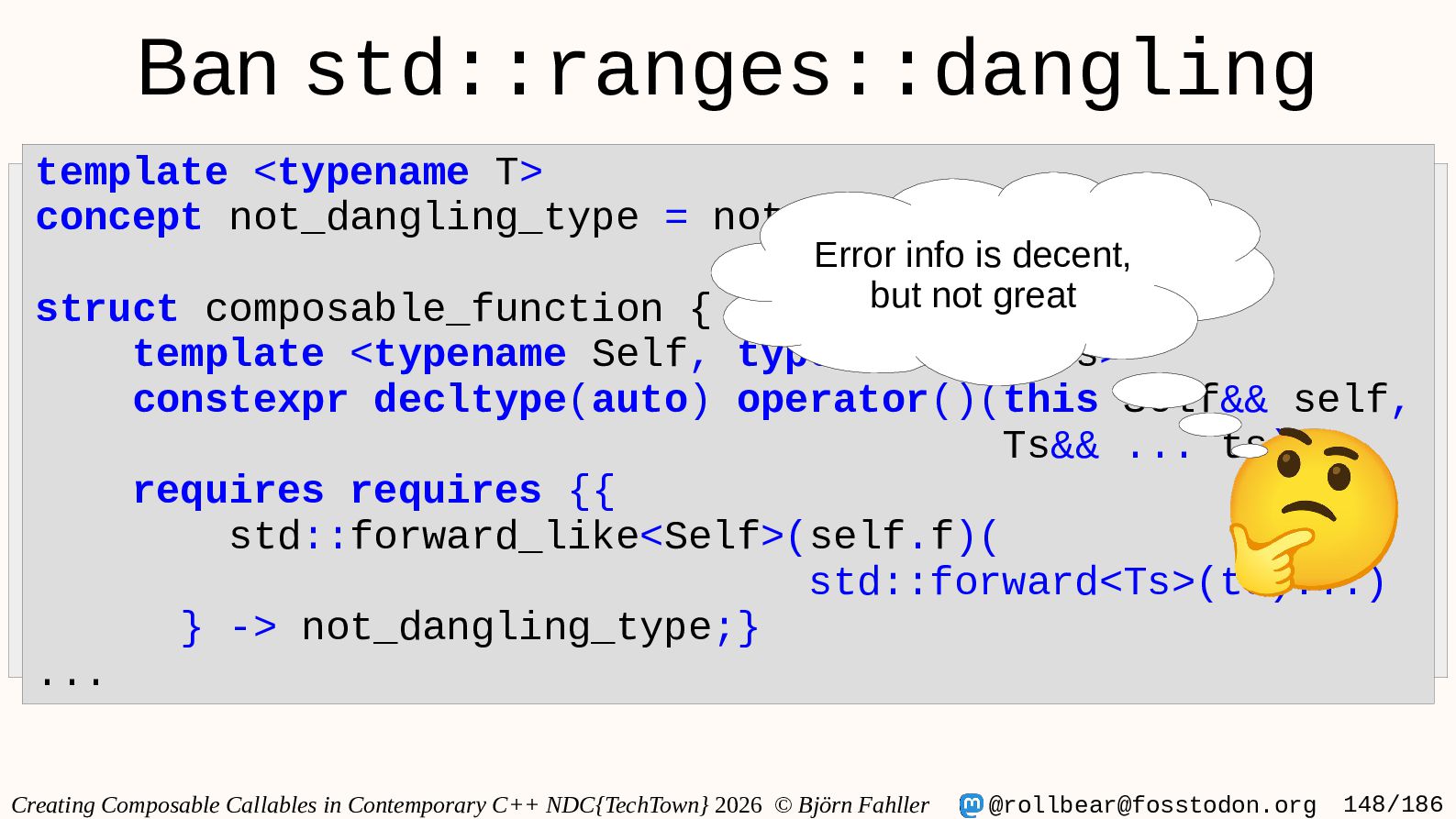
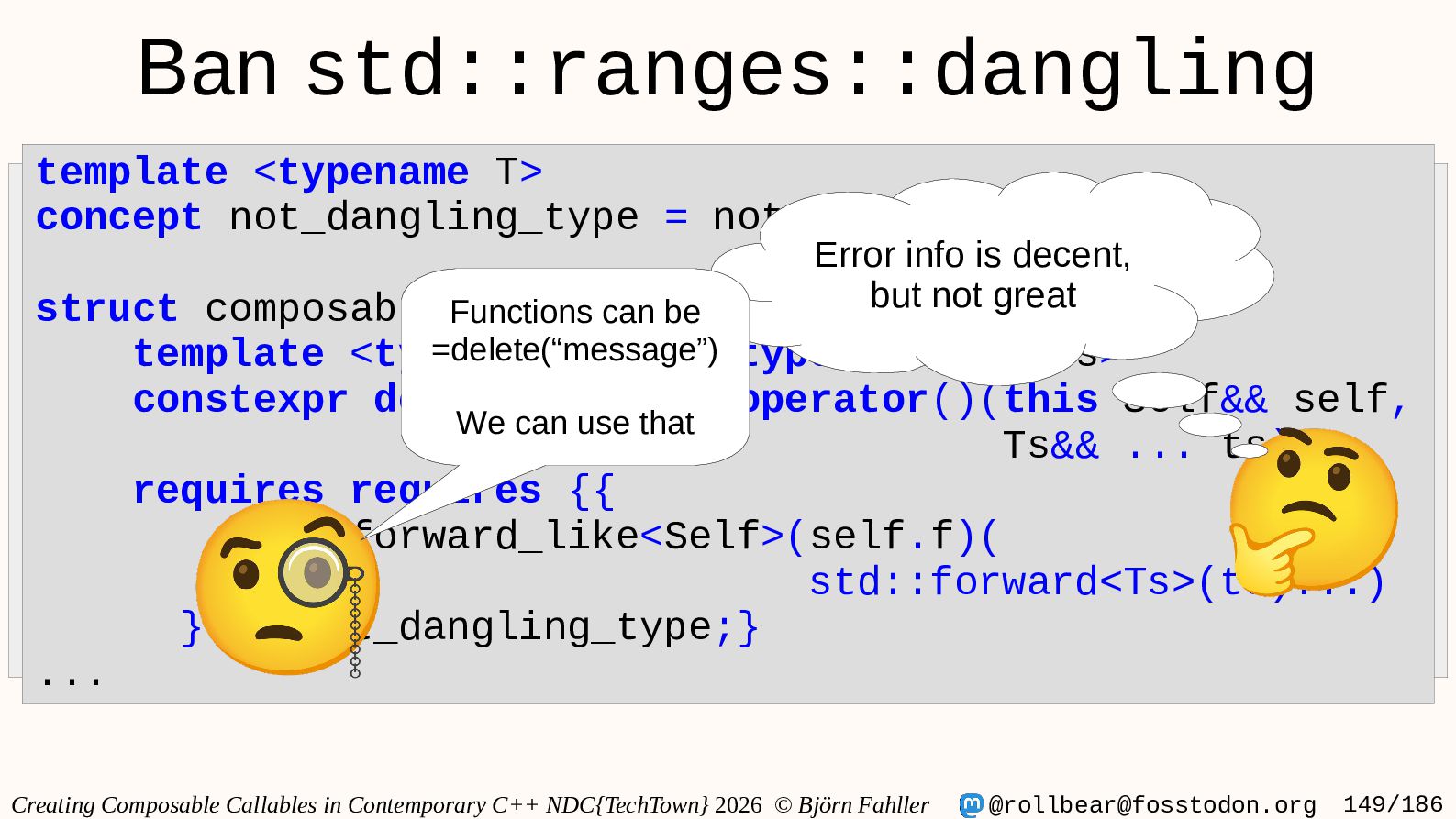
Ban std::ranges::dangling template <typename <typename T> T> template conceptconstexpr not_dangling_type
= not_dangling<T>; inline bool Error info is decent, not_dangling = true; but not great struct composable_function { template <typename Self, typename ... Ts> template <> constexpr decltype(auto) operator()(this Self&& self, inline constexpr bool Ts&& ... ts) not_dangling<std::ranges::dangling> = false; requires requires {{ template std::forward_like<Self>(self.f)( <template <typename...> class T, typename ... Ts> std::forward<Ts>(ts)...) inline constexpr bool } -> not_dangling_type;} not_dangling<T<Ts...>> = (not_dangling<Ts> && ...); ... Creating Composable Callables in Contemporary C++ NDC{TechTown} 2026 © Björn Fahller @[email protected] 148/186 -
Ban std::ranges::dangling template <typename <typename T> T> template conceptconstexpr not_dangling_type
= not_dangling<T>; inline bool Error info is decent, not_dangling = true; but not great struct composable_function Functions can be{ =delete(“message”) template <typename Self, typename ... Ts> template <> constexpr decltype(auto) operator()(this Self&& self, inline constexpr bool We can use that Ts&& ... ts) not_dangling<std::ranges::dangling> = false; requires requires {{ template std::forward_like<Self>(self.f)( <template <typename...> class T, typename ... Ts> std::forward<Ts>(ts)...) inline constexpr bool } -> not_dangling_type;} not_dangling<T<Ts...>> = (not_dangling<Ts> && ...); ... Creating Composable Callables in Contemporary C++ NDC{TechTown} 2026 © Björn Fahller @[email protected] 149/186 -
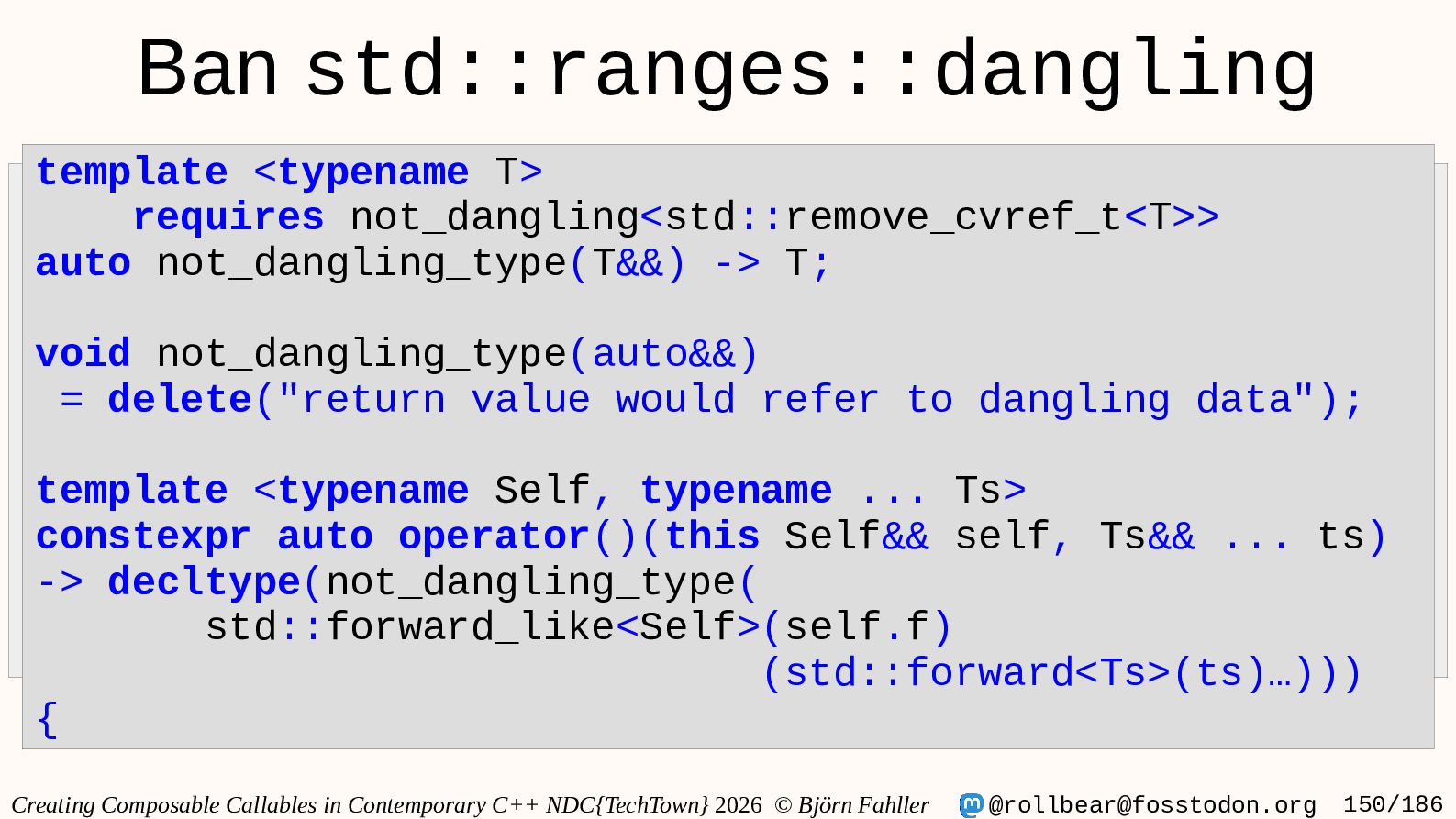
Ban std::ranges::dangling template <typename <typename T> T> template requires not_dangling<std::remove_cvref_t<T>>
inline constexpr bool auto not_dangling_type(T&&) -> T; not_dangling = true; void not_dangling_type(auto&&) template <> = delete("return value would refer to dangling data"); inline constexpr bool not_dangling<std::ranges::dangling> = false; template <typename Self, typename ... Ts> constexpr<template auto operator()(this Ts&& ... template <typename...>Self&& class self, T, typename ...ts) Ts> -> decltype(not_dangling_type( inline constexpr bool std::forward_like<Self>(self.f) not_dangling<T<Ts...>> = (not_dangling<Ts> && ...); (std::forward<Ts>(ts)…))) { Creating Composable Callables in Contemporary C++ NDC{TechTown} 2026 © Björn Fahller @[email protected] 150/186 -
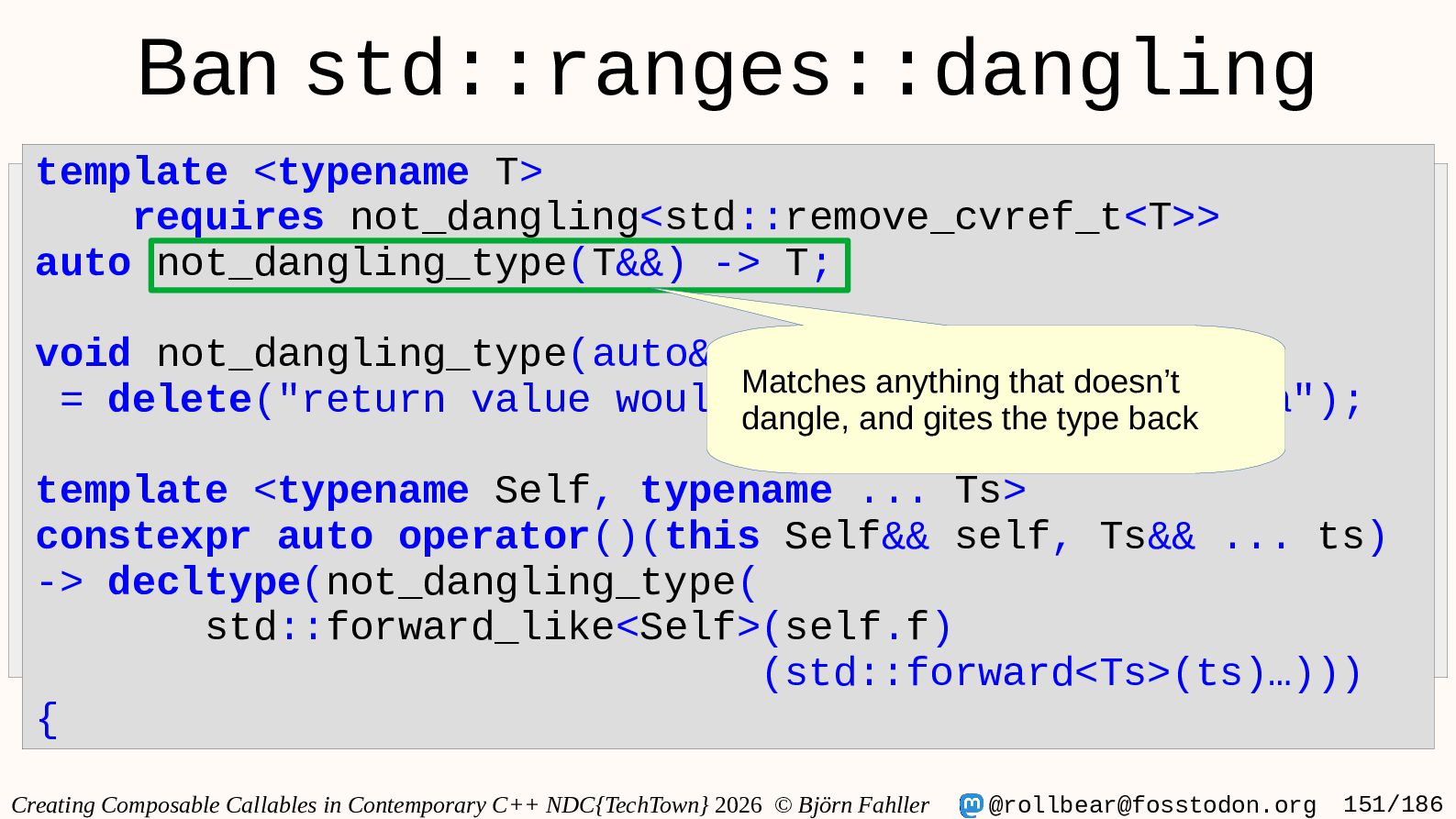
Ban std::ranges::dangling template <typename <typename T> T> template requires not_dangling<std::remove_cvref_t<T>>
inline constexpr bool auto not_dangling_type(T&&) -> T; not_dangling = true; void not_dangling_type(auto&&) template <> Matches anything that doesn’t = delete("return value would refer to dangling data"); dangle, and gites the type back inline constexpr bool not_dangling<std::ranges::dangling> = false; template <typename Self, typename ... Ts> constexpr<template auto operator()(this Ts&& ... template <typename...>Self&& class self, T, typename ...ts) Ts> -> decltype(not_dangling_type( inline constexpr bool std::forward_like<Self>(self.f) not_dangling<T<Ts...>> = (not_dangling<Ts> && ...); (std::forward<Ts>(ts)…))) { Creating Composable Callables in Contemporary C++ NDC{TechTown} 2026 © Björn Fahller @[email protected] 151/186 -
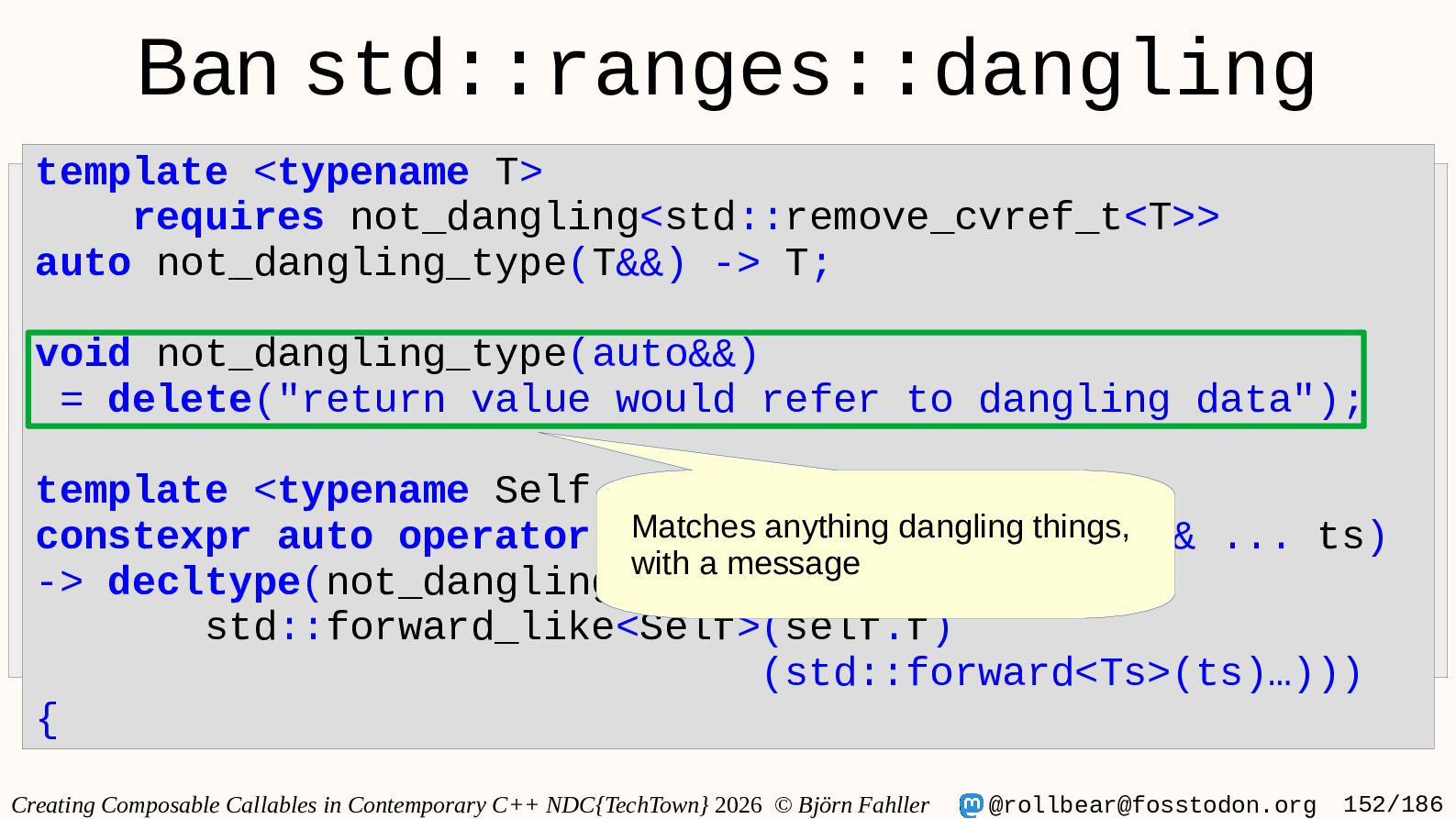
Ban std::ranges::dangling template <typename <typename T> T> template requires not_dangling<std::remove_cvref_t<T>>
inline constexpr bool auto not_dangling_type(T&&) -> T; not_dangling = true; void not_dangling_type(auto&&) template <> = delete("return value would refer to dangling data"); inline constexpr bool not_dangling<std::ranges::dangling> = false; template <typename Self, typename ... Ts> Matches anything dangling things, constexpr auto operator()(this Self&& self, Ts&& ... ts) template <template <typename...> class T, typename ... Ts> with a message -> decltype(not_dangling_type( inline constexpr bool std::forward_like<Self>(self.f) not_dangling<T<Ts...>> = (not_dangling<Ts> && ...); (std::forward<Ts>(ts)…))) { Creating Composable Callables in Contemporary C++ NDC{TechTown} 2026 © Björn Fahller @[email protected] 152/186 -
Ban std::ranges::dangling template <typename <typename T> T> template requires not_dangling<std::remove_cvref_t<T>>
inline constexpr bool auto not_dangling_type(T&&) -> T; Return type of the wrapped not_dangling = true; function, or fails to compile, void with a not_dangling_type(auto&&) message. template <> = delete("return value would refer to dangling data"); inline constexpr bool not_dangling<std::ranges::dangling> = false; template <typename Self, typename ... Ts> constexpr<template auto operator()(this Ts&& ... template <typename...>Self&& class self, T, typename ...ts) Ts> -> decltype(not_dangling_type( inline constexpr bool std::forward_like<Self>(self.f) not_dangling<T<Ts...>> = (not_dangling<Ts> && ...); (std::forward<Ts>(ts)…))) { Creating Composable Callables in Contemporary C++ NDC{TechTown} 2026 © Björn Fahller @[email protected] 153/186 -
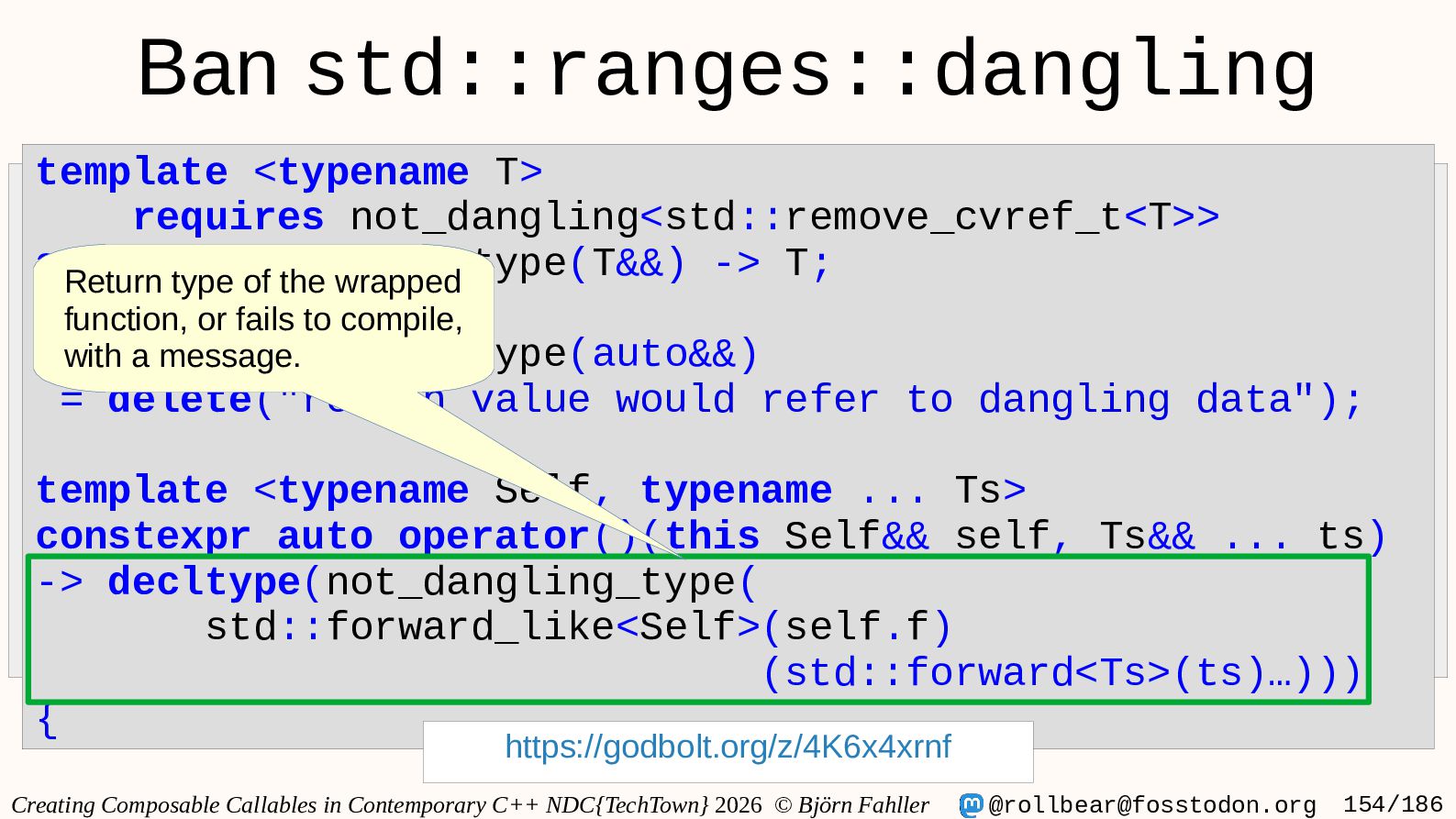
Ban std::ranges::dangling template <typename <typename T> T> template requires not_dangling<std::remove_cvref_t<T>>
inline constexpr bool auto not_dangling_type(T&&) -> T; Return type of the wrapped not_dangling = true; function, or fails to compile, void with a not_dangling_type(auto&&) message. template <> = delete("return value would refer to dangling data"); inline constexpr bool not_dangling<std::ranges::dangling> = false; template <typename Self, typename ... Ts> constexpr<template auto operator()(this Ts&& ... template <typename...>Self&& class self, T, typename ...ts) Ts> -> decltype(not_dangling_type( inline constexpr bool std::forward_like<Self>(self.f) not_dangling<T<Ts...>> = (not_dangling<Ts> && ...); (std::forward<Ts>(ts)…))) { https://godbolt.org/z/4K6x4xrnf Creating Composable Callables in Contemporary C++ NDC{TechTown} 2026 © Björn Fahller @[email protected] 154/186 -
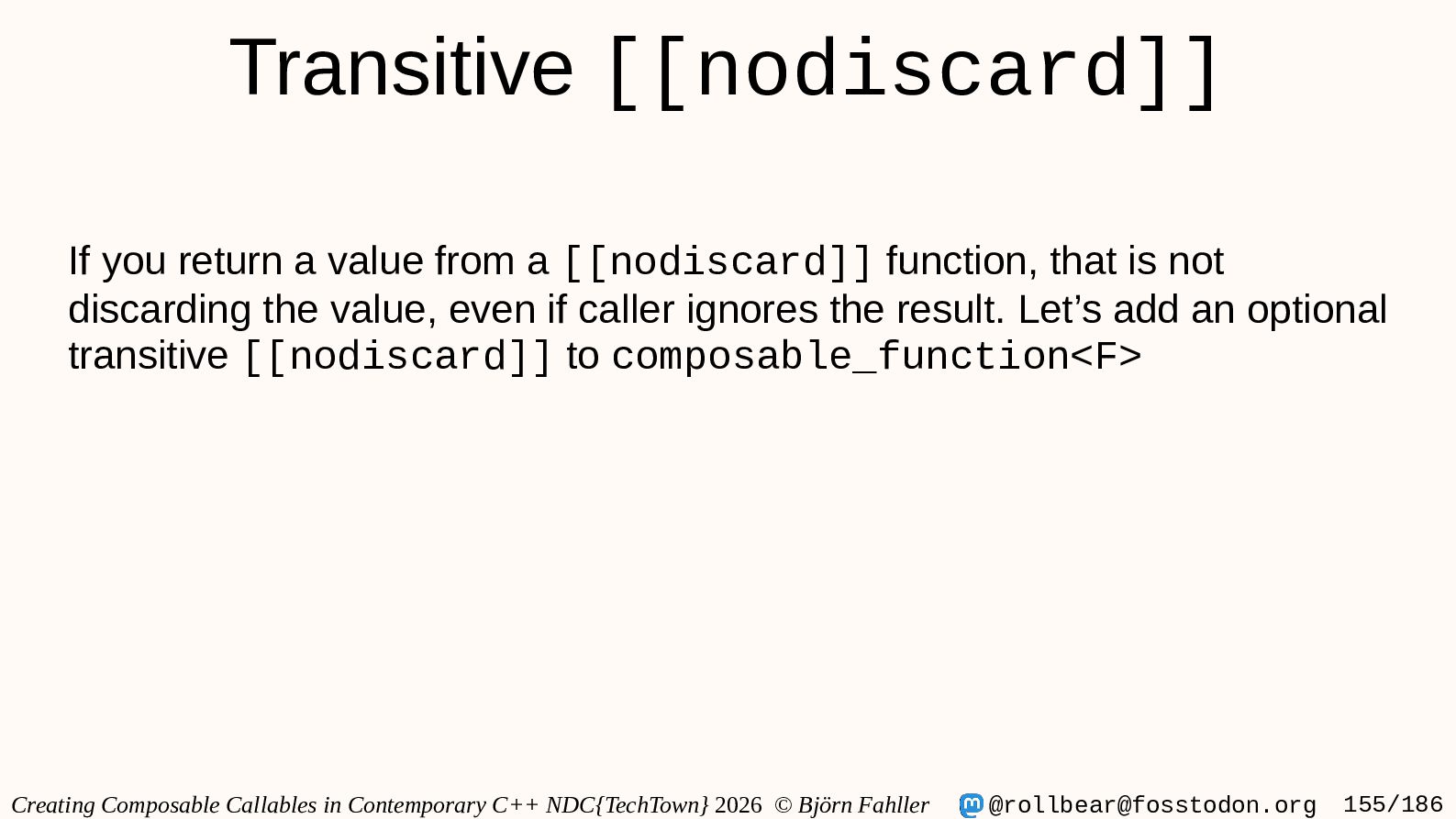
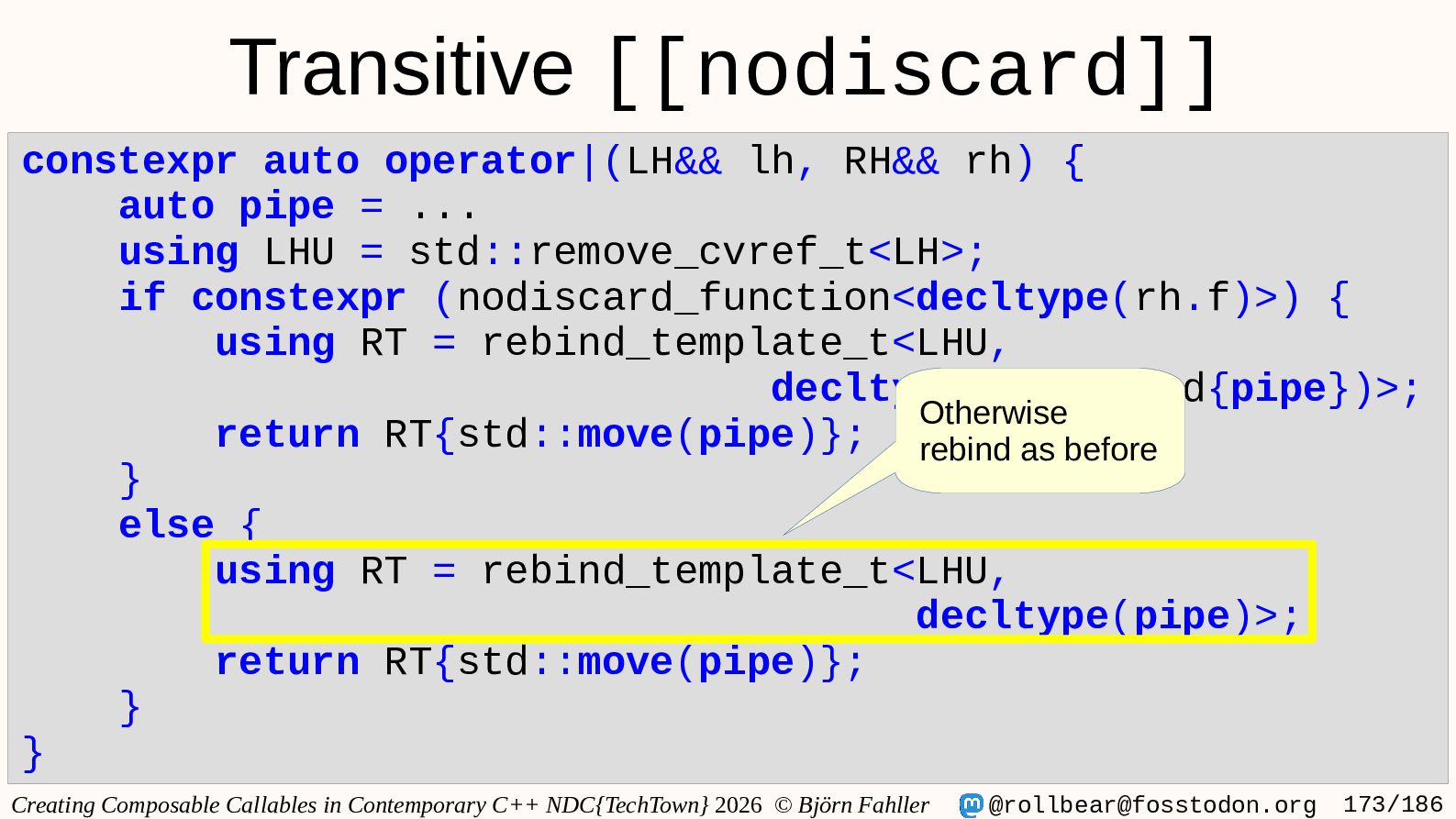
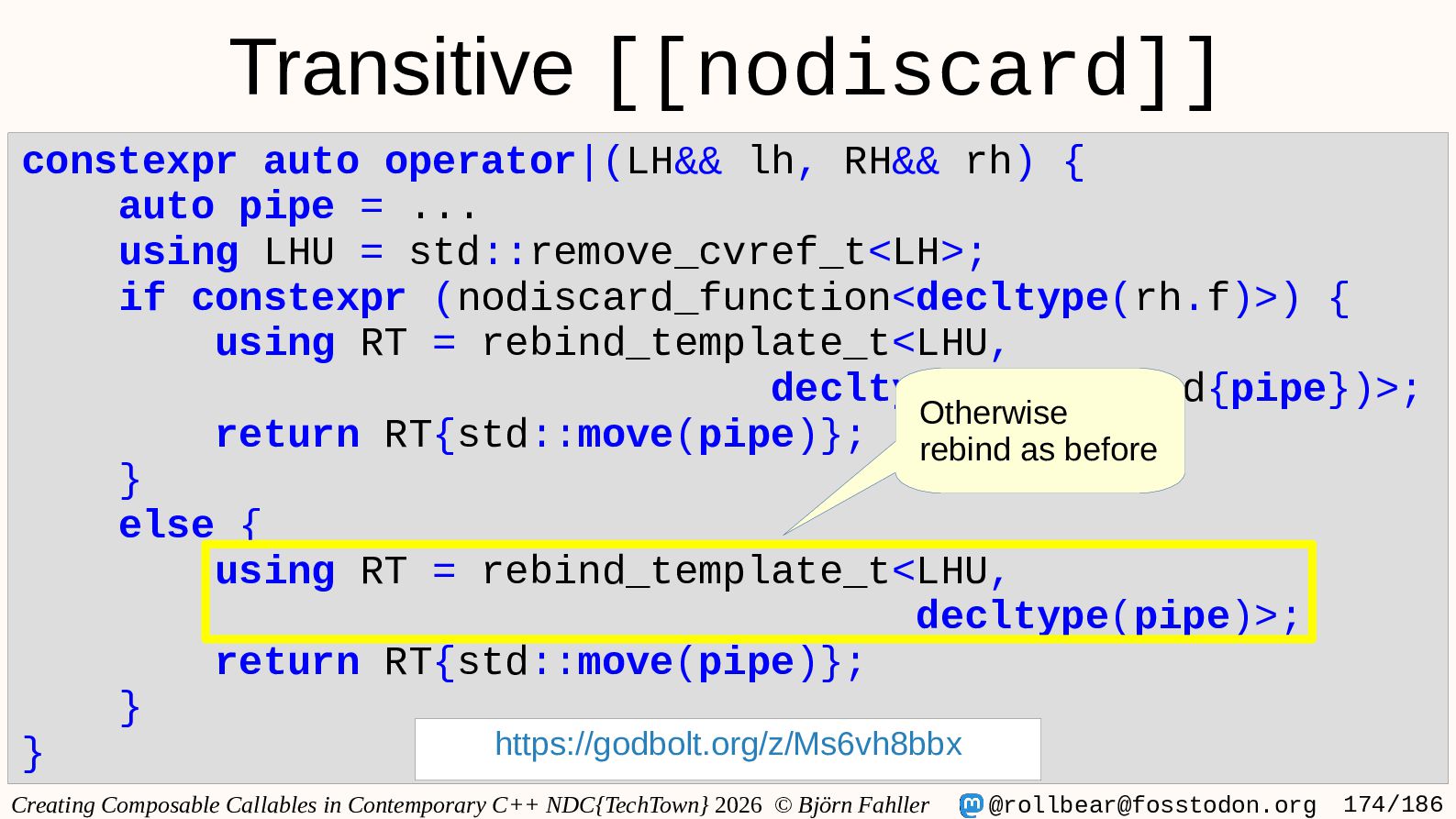
Transitive [[nodiscard]] If you return a value from a [[nodiscard]]
function, that is not discarding the value, even if caller ignores the result. Let’s add an optional transitive [[nodiscard]] to composable_function<F> Creating Composable Callables in Contemporary C++ NDC{TechTown} 2026 © Björn Fahller @[email protected] 155/186 -
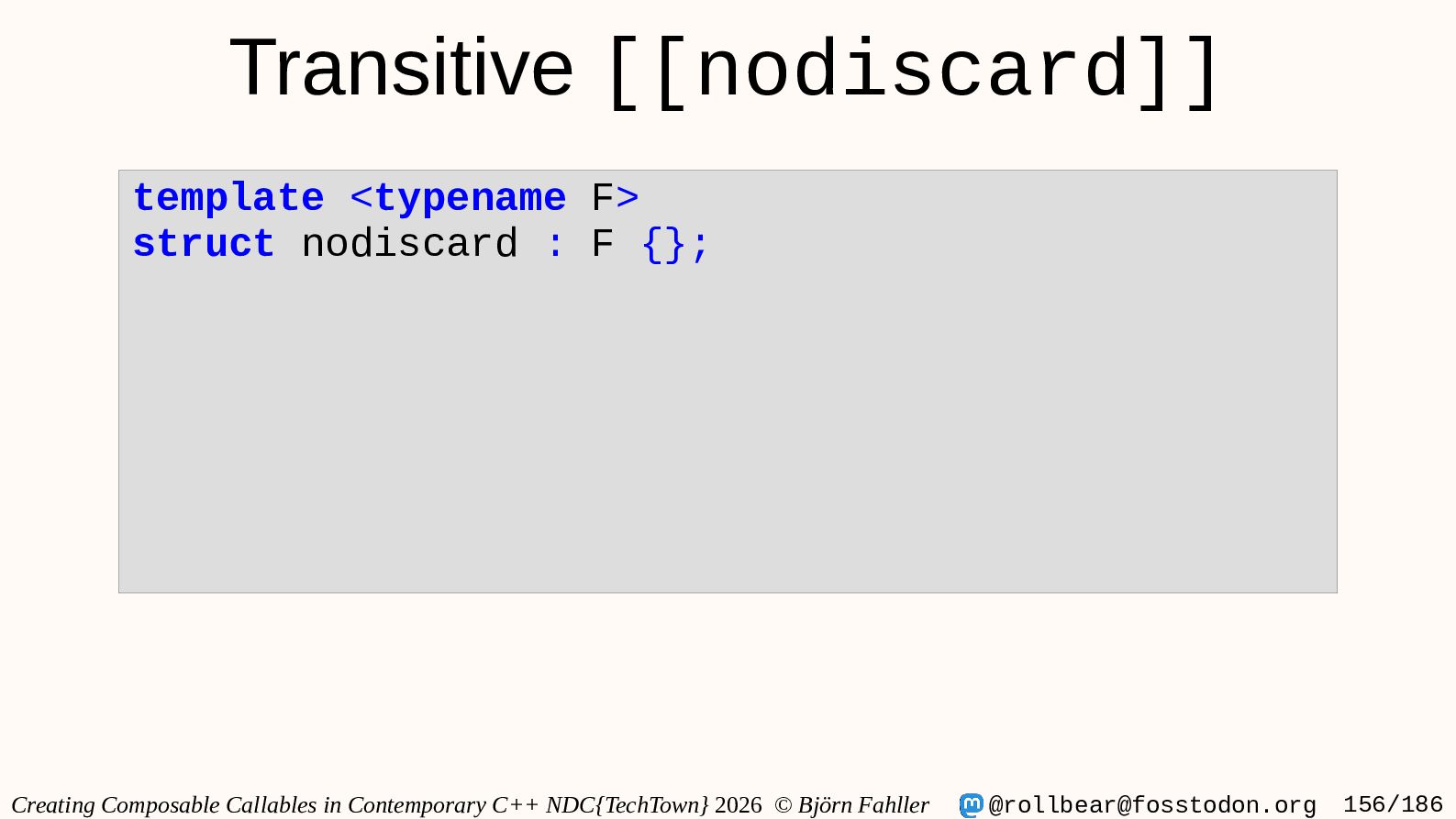
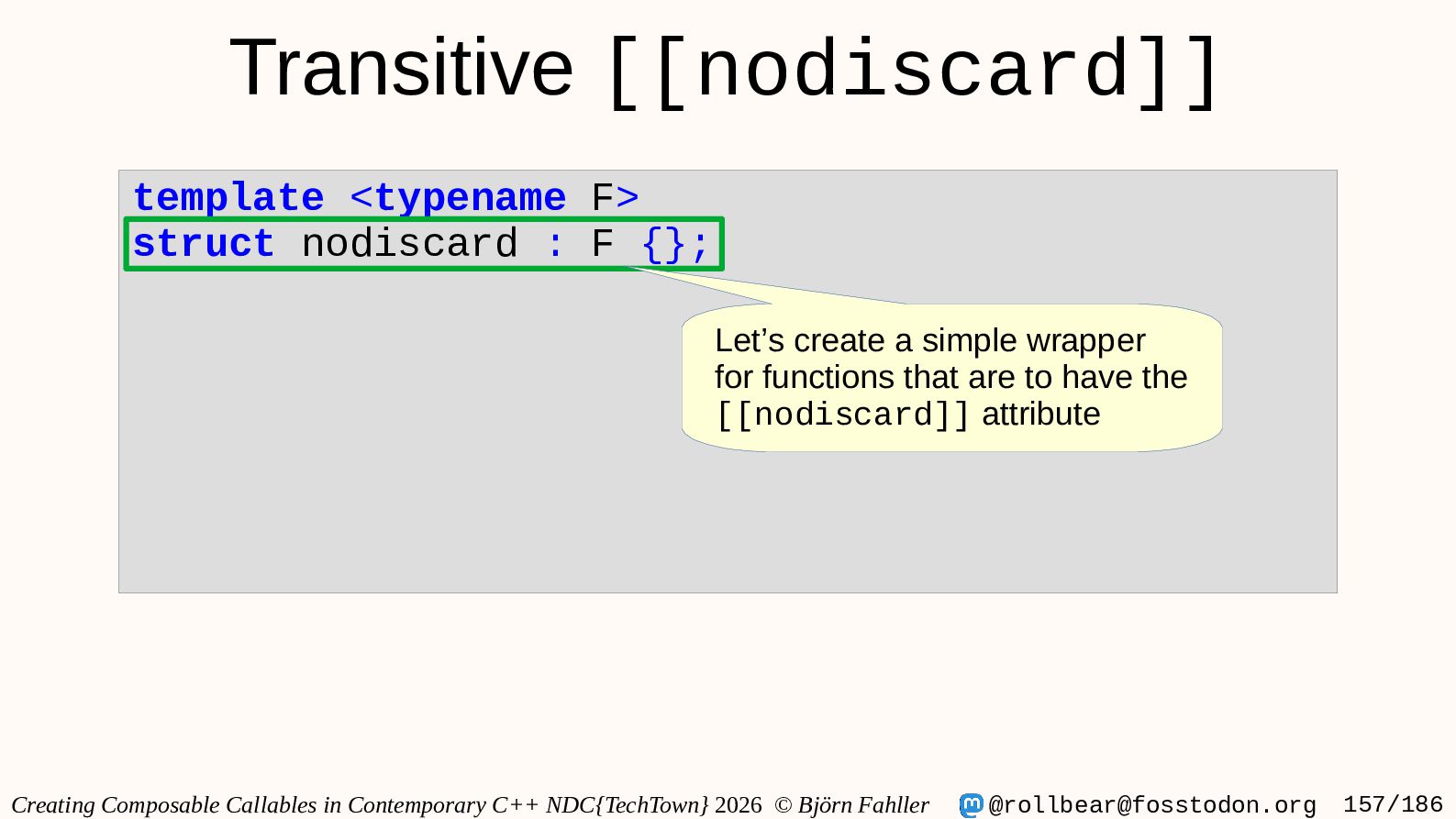
Transitive [[nodiscard]] template <typename F> struct nodiscard : F {};
Creating Composable Callables in Contemporary C++ NDC{TechTown} 2026 © Björn Fahller @[email protected] 156/186 -
Transitive [[nodiscard]] template <typename F> struct nodiscard : F {};
Let’s create a simple wrapper for functions that are to have the [[nodiscard]] attribute Creating Composable Callables in Contemporary C++ NDC{TechTown} 2026 © Björn Fahller @[email protected] 157/186 -
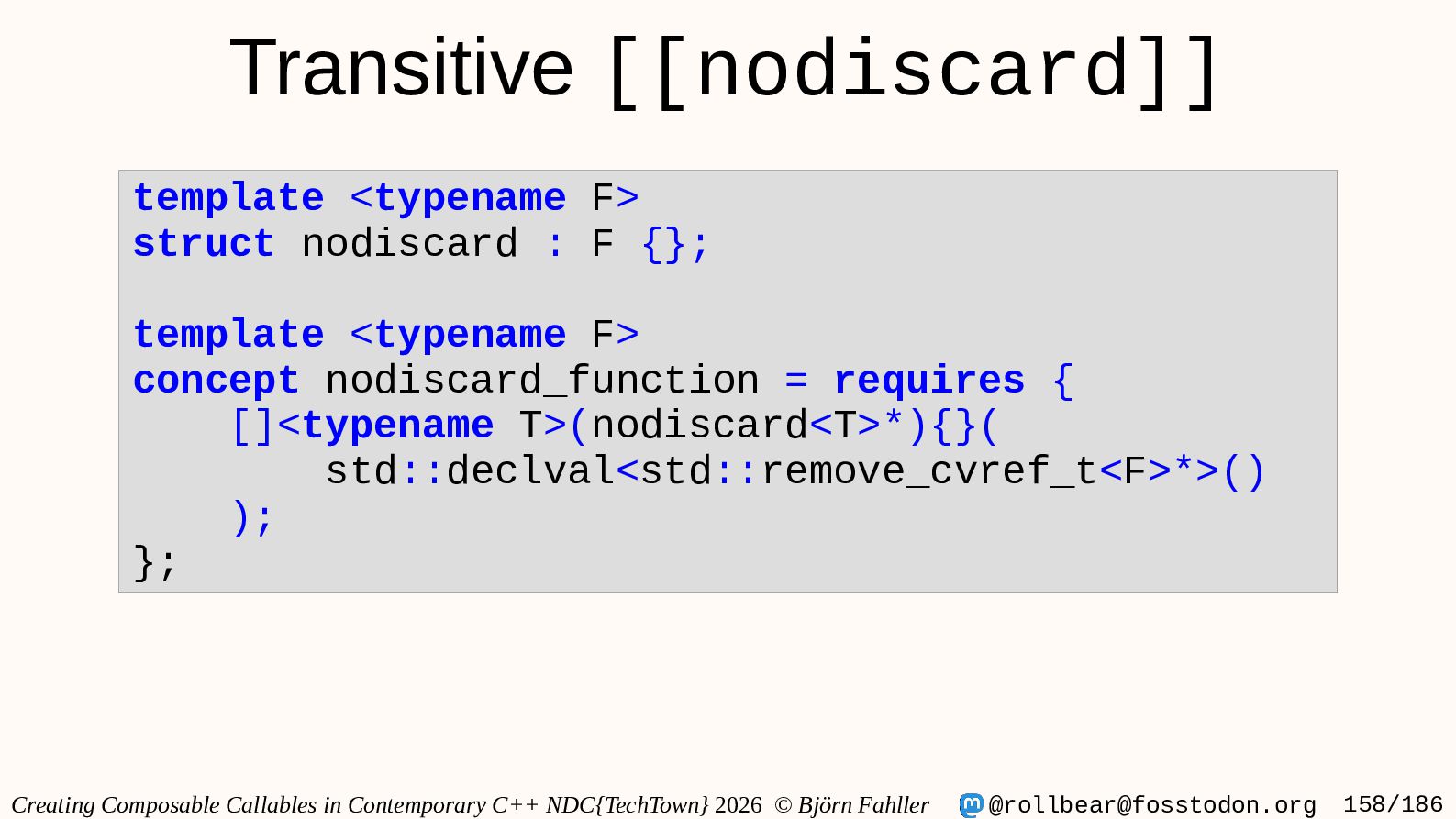
Transitive [[nodiscard]] template <typename F> struct nodiscard : F {};
template <typename F> concept nodiscard_function = requires { []<typename T>(nodiscard<T>*){}( std::declval<std::remove_cvref_t<F>*>() ); }; Creating Composable Callables in Contemporary C++ NDC{TechTown} 2026 © Björn Fahller @[email protected] 158/186 -
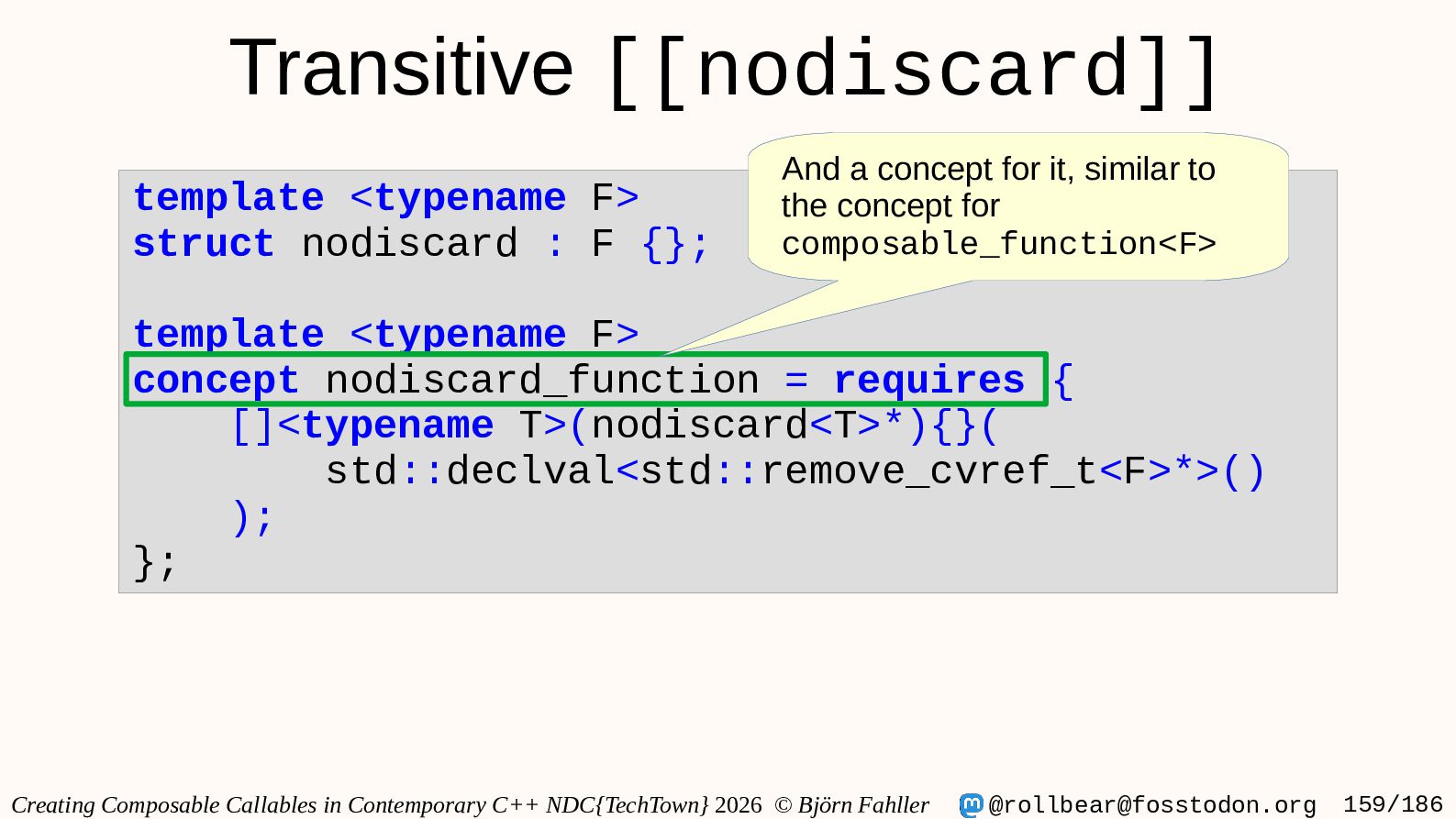
Transitive [[nodiscard]] template <typename F> struct nodiscard : F {};
And a concept for it, similar to the concept for composable_function<F> template <typename F> concept nodiscard_function = requires { []<typename T>(nodiscard<T>*){}( std::declval<std::remove_cvref_t<F>*>() ); }; Creating Composable Callables in Contemporary C++ NDC{TechTown} 2026 © Björn Fahller @[email protected] 159/186 -
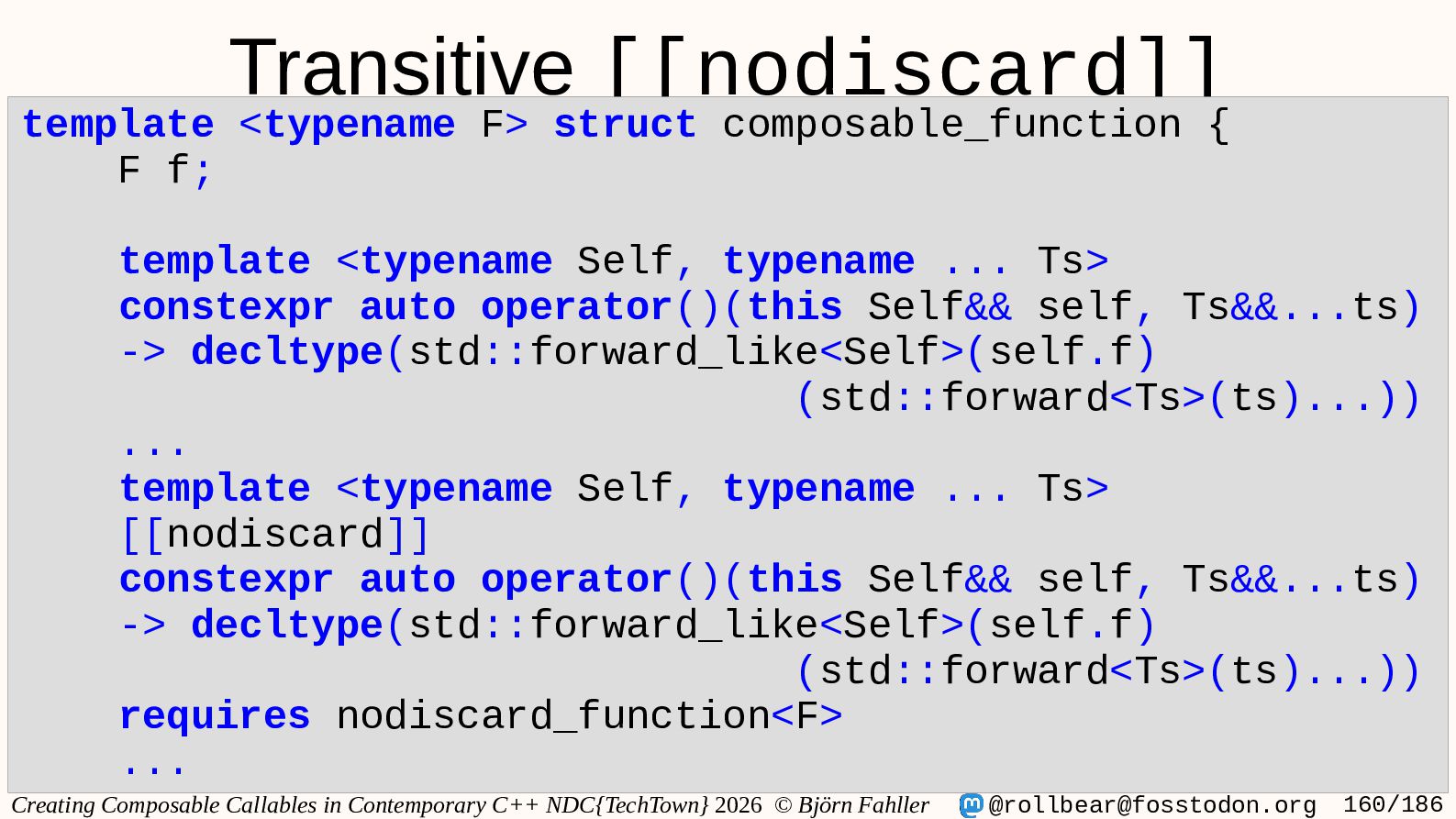
Transitive [[nodiscard]] template <typename F> struct composable_function { F f;
template <typename Self, typename ... Ts> constexpr auto operator()(this Self&& self, Ts&&...ts) -> decltype(std::forward_like<Self>(self.f) (std::forward<Ts>(ts)...)) ... template <typename Self, typename ... Ts> [[nodiscard]] constexpr auto operator()(this Self&& self, Ts&&...ts) -> decltype(std::forward_like<Self>(self.f) (std::forward<Ts>(ts)...)) requires nodiscard_function<F> ... Creating Composable Callables in Contemporary C++ NDC{TechTown} 2026 © Björn Fahller @[email protected] 160/186 -
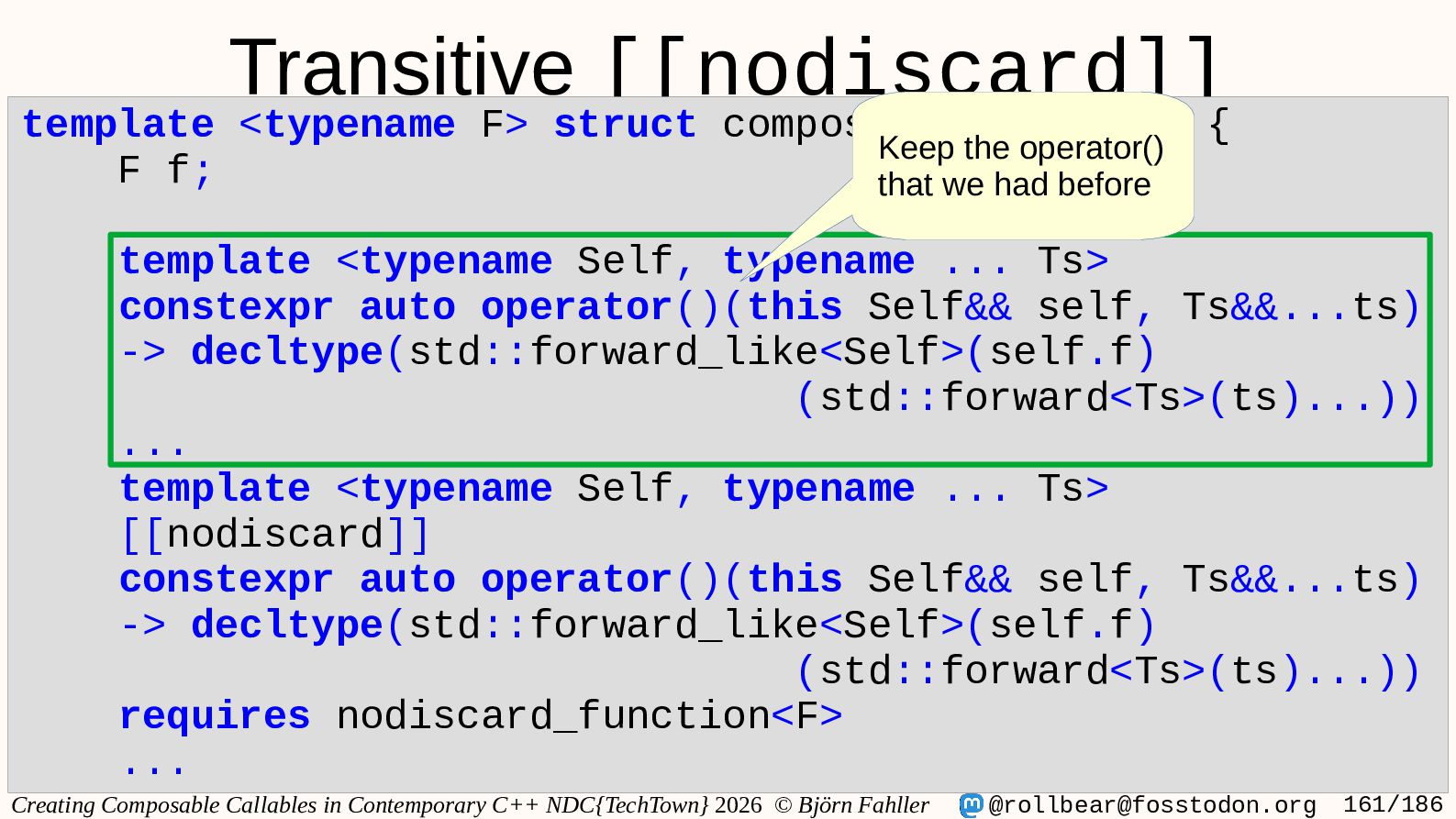
Transitive [[nodiscard]] template <typename F> struct composable_function { Keep the
operator() F f; that we had before template <typename Self, typename ... Ts> constexpr auto operator()(this Self&& self, Ts&&...ts) -> decltype(std::forward_like<Self>(self.f) (std::forward<Ts>(ts)...)) ... template <typename Self, typename ... Ts> [[nodiscard]] constexpr auto operator()(this Self&& self, Ts&&...ts) -> decltype(std::forward_like<Self>(self.f) (std::forward<Ts>(ts)...)) requires nodiscard_function<F> ... Creating Composable Callables in Contemporary C++ NDC{TechTown} 2026 © Björn Fahller @[email protected] 161/186 -
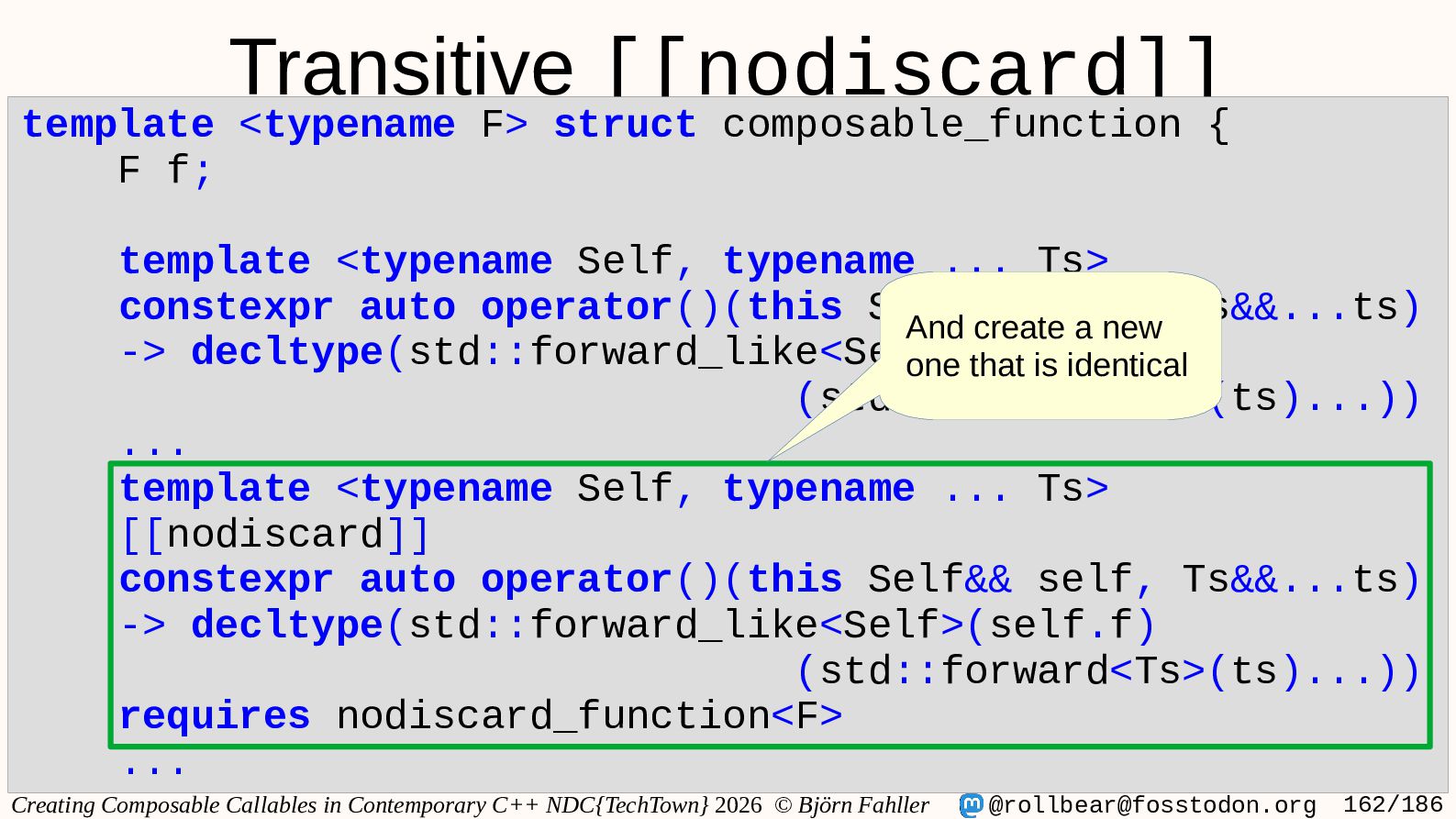
Transitive [[nodiscard]] template <typename F> struct composable_function { F f;
template <typename Self, typename ... Ts> constexpr auto operator()(this Self&& self, Ts&&...ts) And create a new -> decltype(std::forward_like<Self>(self.f) one that is identical (std::forward<Ts>(ts)...)) ... template <typename Self, typename ... Ts> [[nodiscard]] constexpr auto operator()(this Self&& self, Ts&&...ts) -> decltype(std::forward_like<Self>(self.f) (std::forward<Ts>(ts)...)) requires nodiscard_function<F> ... Creating Composable Callables in Contemporary C++ NDC{TechTown} 2026 © Björn Fahller @[email protected] 162/186 -
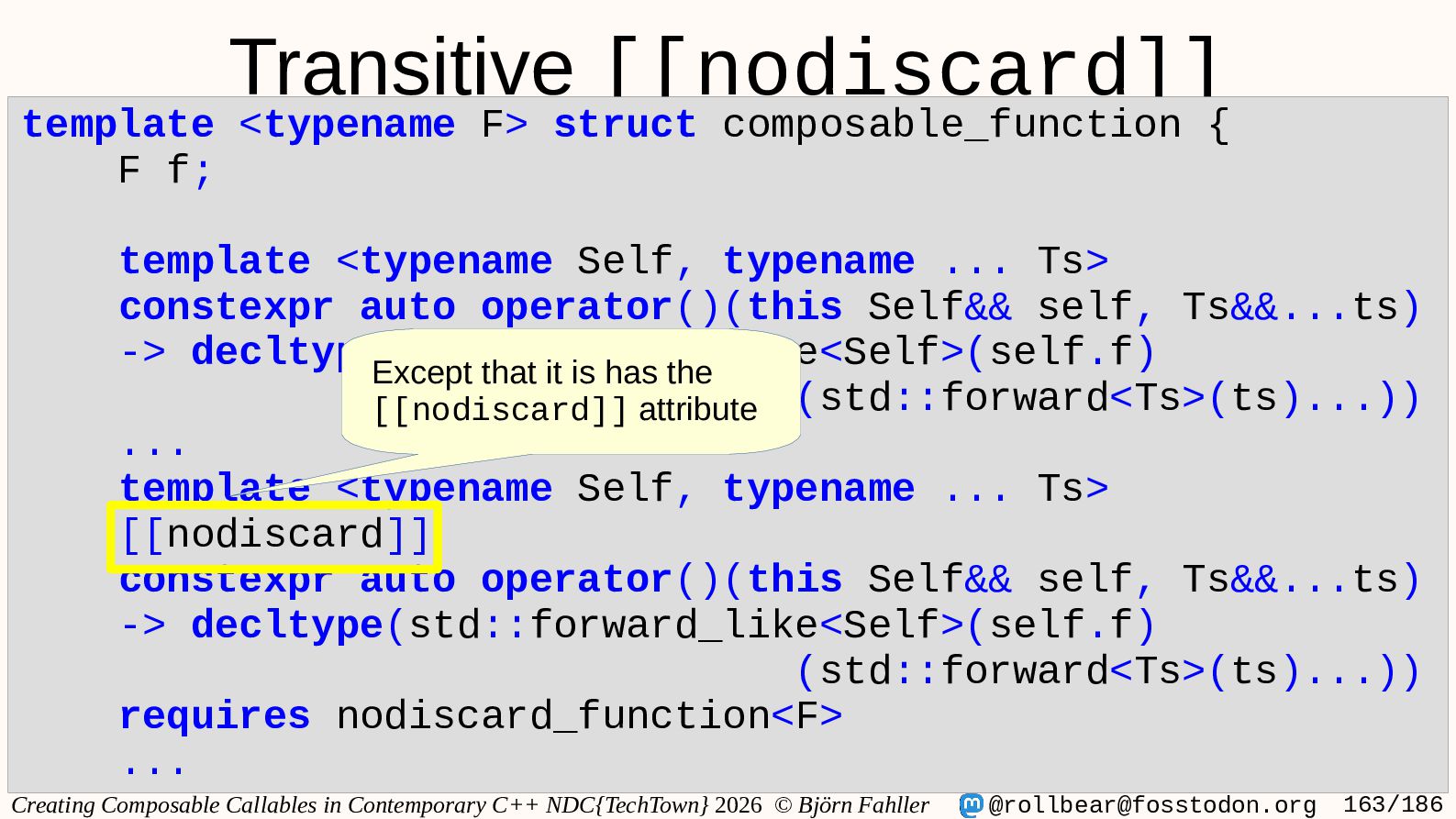
Transitive [[nodiscard]] template <typename F> struct composable_function { F f;
template <typename Self, typename ... Ts> constexpr auto operator()(this Self&& self, Ts&&...ts) -> decltype(std::forward_like<Self>(self.f) Except that it is has the [[nodiscard]] attribute (std::forward<Ts>(ts)...)) ... template <typename Self, typename ... Ts> [[nodiscard]] constexpr auto operator()(this Self&& self, Ts&&...ts) -> decltype(std::forward_like<Self>(self.f) (std::forward<Ts>(ts)...)) requires nodiscard_function<F> ... Creating Composable Callables in Contemporary C++ NDC{TechTown} 2026 © Björn Fahller @[email protected] 163/186 -
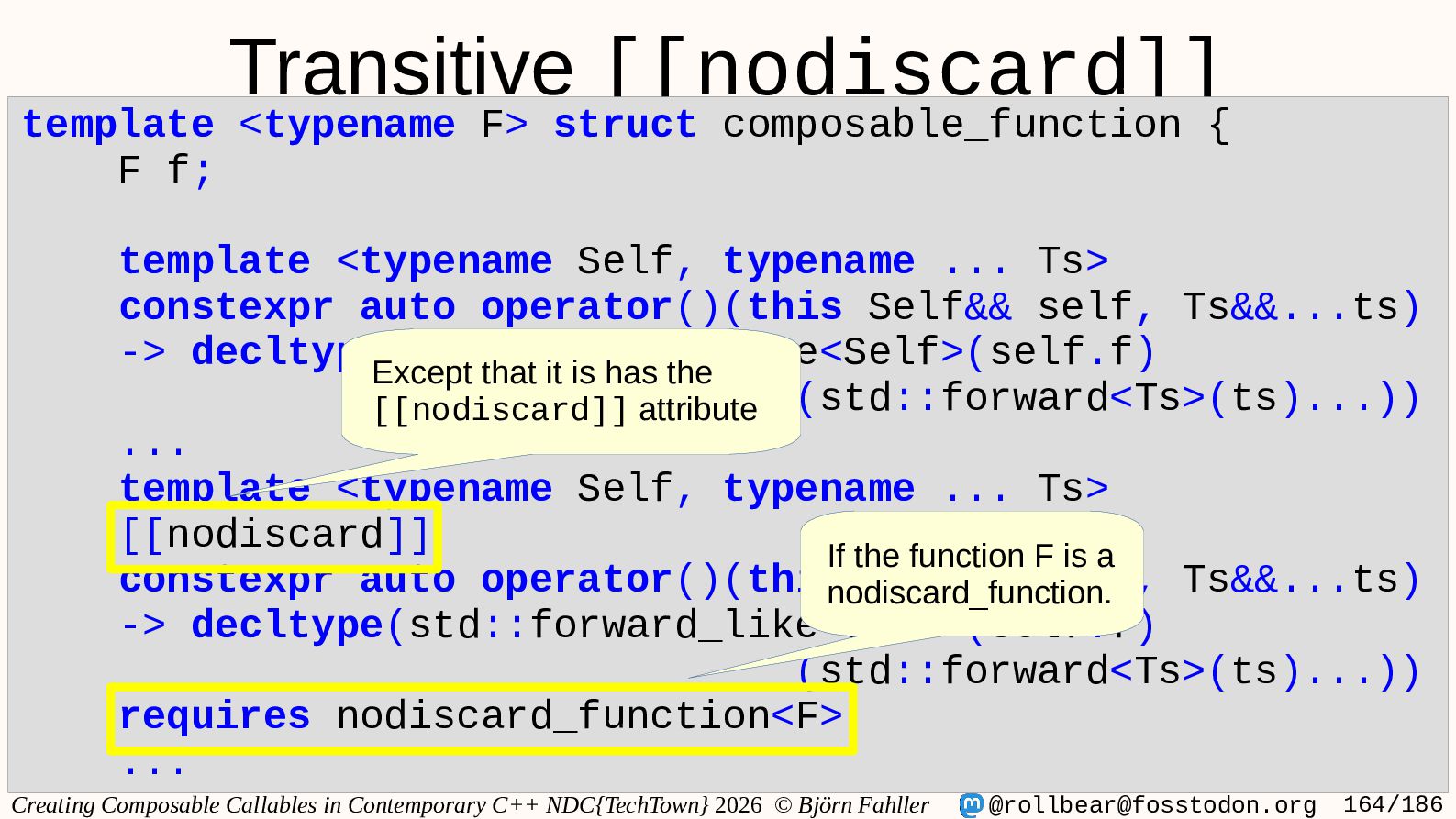
Transitive [[nodiscard]] template <typename F> struct composable_function { F f;
template <typename Self, typename ... Ts> constexpr auto operator()(this Self&& self, Ts&&...ts) -> decltype(std::forward_like<Self>(self.f) Except that it is has the [[nodiscard]] attribute (std::forward<Ts>(ts)...)) ... template <typename Self, typename ... Ts> [[nodiscard]] If the function F is a constexpr auto operator()(thisnodiscard_function. Self&& self, Ts&&...ts) -> decltype(std::forward_like<Self>(self.f) (std::forward<Ts>(ts)...)) requires nodiscard_function<F> ... Creating Composable Callables in Contemporary C++ NDC{TechTown} 2026 © Björn Fahller @[email protected] 164/186 -
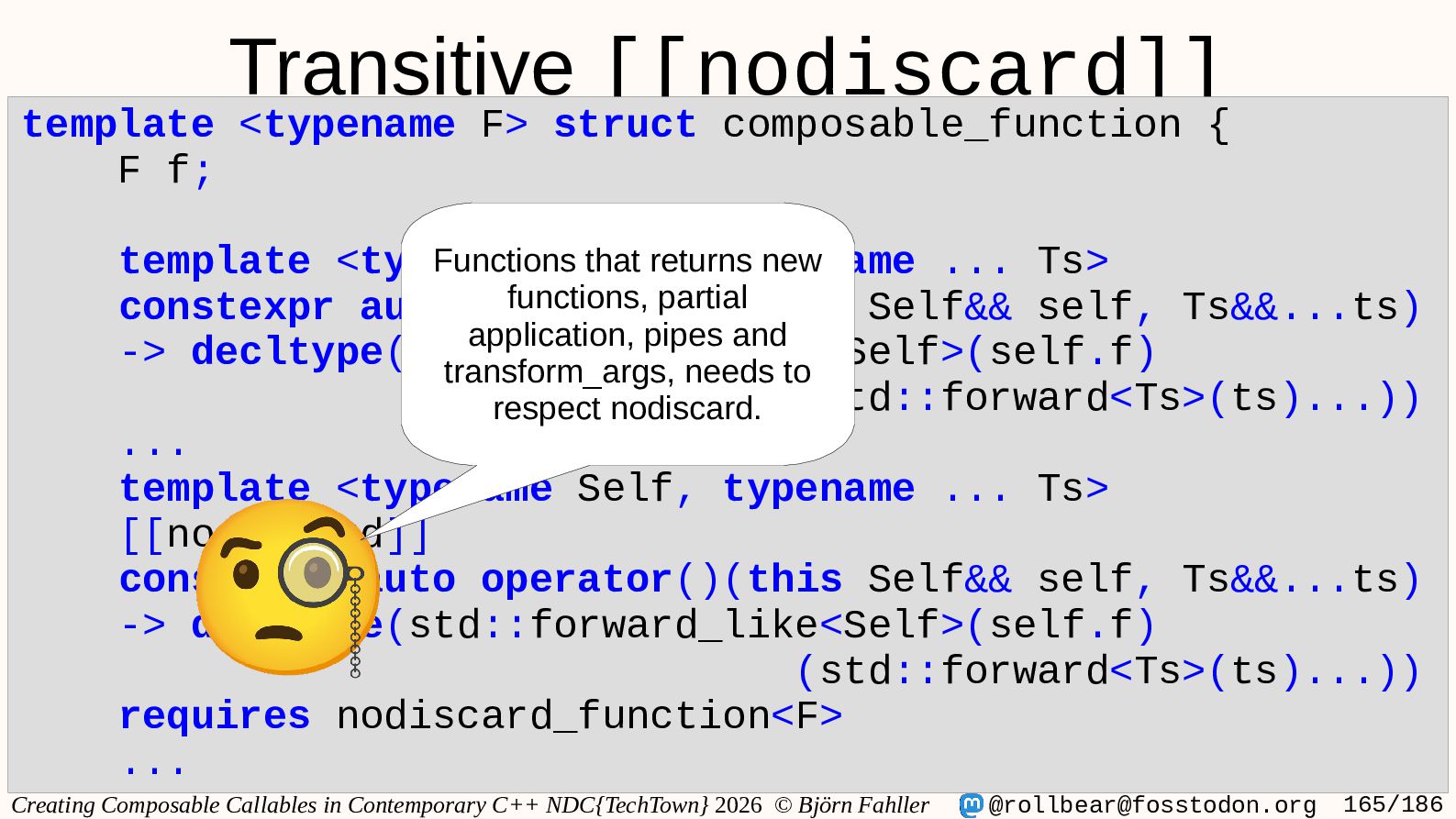
Transitive [[nodiscard]] template <typename F> struct composable_function { F f;
FunctionsSelf, that returns new template <typename typename ... Ts> functions, partial constexpr auto operator()(this Self&& self, Ts&&...ts) application, pipes and -> decltype(std::forward_like<Self>(self.f) transform_args, needs to respect nodiscard. (std::forward<Ts>(ts)...)) ... template <typename Self, typename ... Ts> [[nodiscard]] constexpr auto operator()(this Self&& self, Ts&&...ts) -> decltype(std::forward_like<Self>(self.f) (std::forward<Ts>(ts)...)) requires nodiscard_function<F> ... Creating Composable Callables in Contemporary C++ NDC{TechTown} 2026 © Björn Fahller @[email protected] 165/186 -
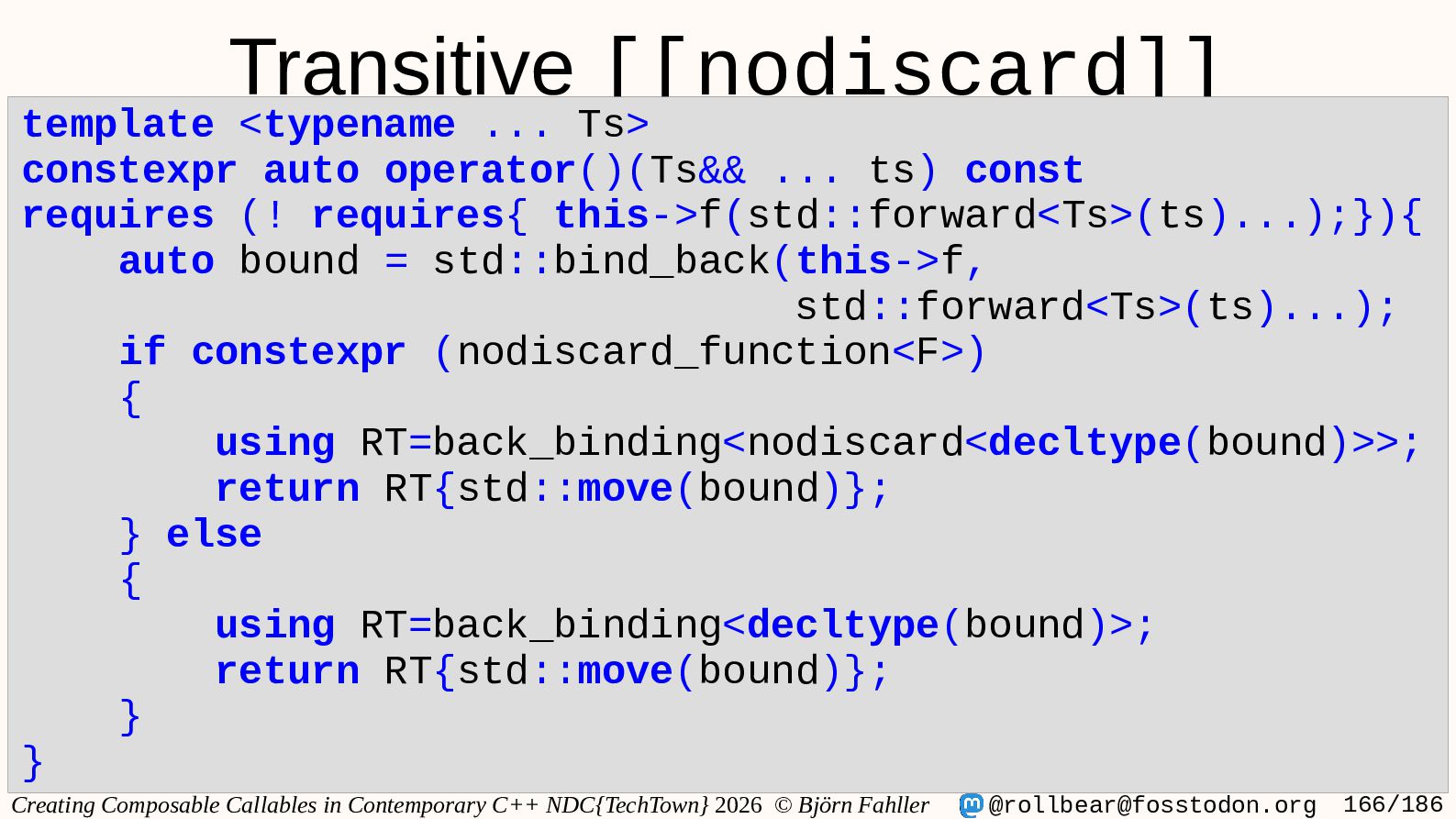
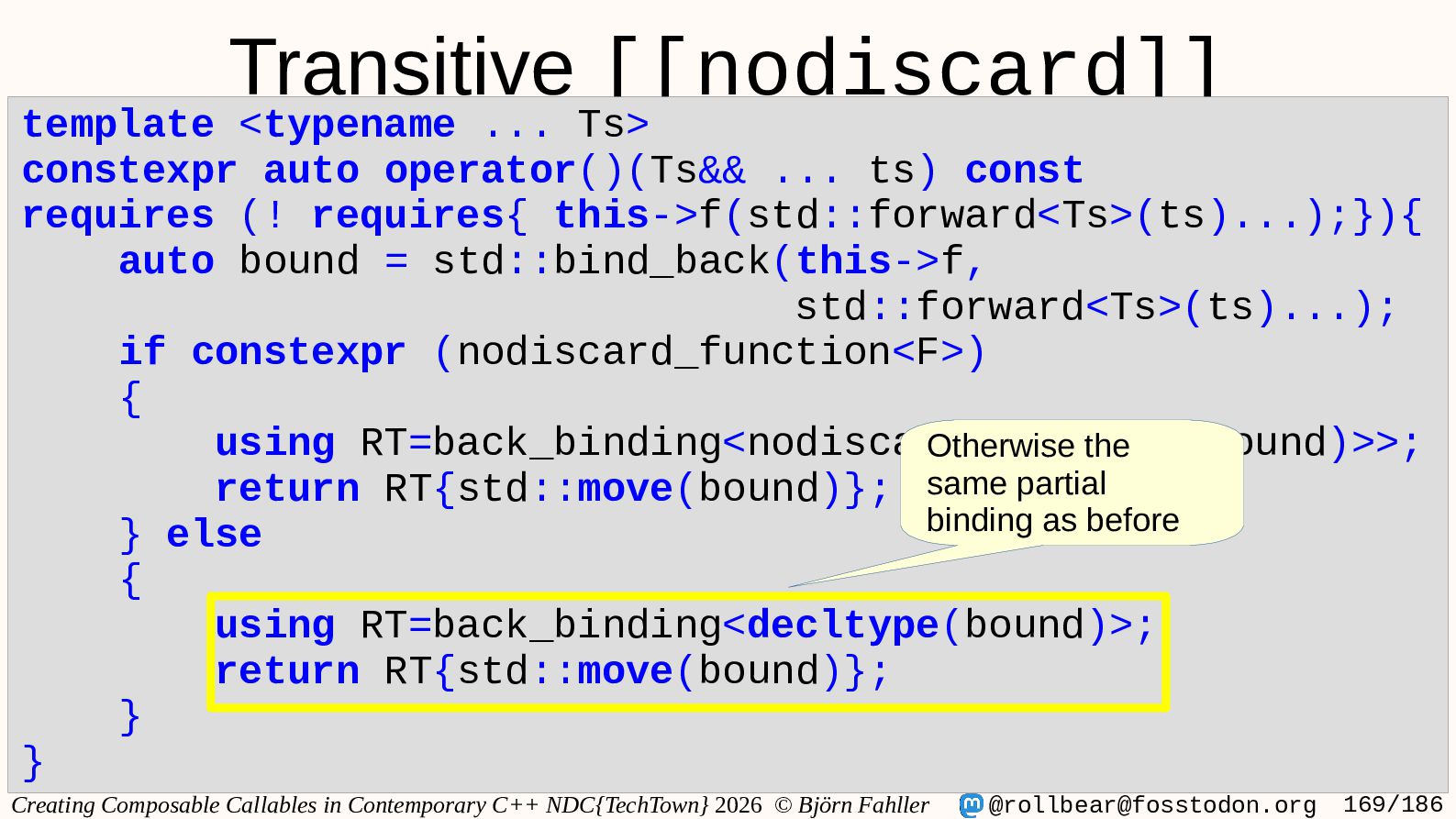
Transitive [[nodiscard]] template <typename ... Ts> constexpr auto operator()(Ts&& ...
ts) const requires (! requires{ this->f(std::forward<Ts>(ts)...);}){ auto bound = std::bind_back(this->f, std::forward<Ts>(ts)...); if constexpr (nodiscard_function<F>) { using RT=back_binding<nodiscard<decltype(bound)>>; return RT{std::move(bound)}; } else { using RT=back_binding<decltype(bound)>; return RT{std::move(bound)}; } } Creating Composable Callables in Contemporary C++ NDC{TechTown} 2026 © Björn Fahller @[email protected] 166/186 -
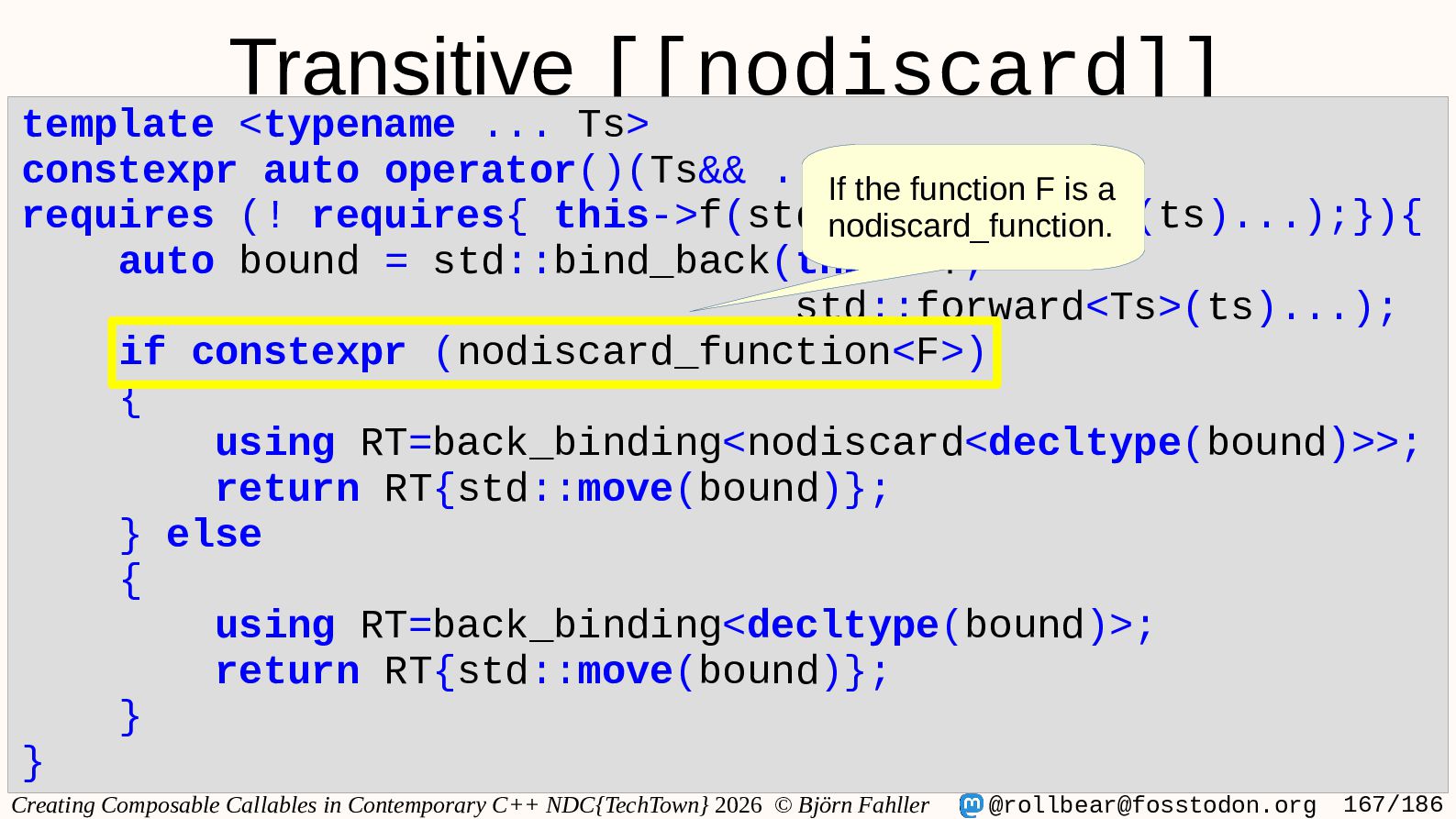
Transitive [[nodiscard]] template <typename ... Ts> constexpr auto operator()(Ts&& ...If
the ts) const function F is a requires (! requires{ this->f(std::forward<Ts>(ts)...);}){ nodiscard_function. auto bound = std::bind_back(this->f, std::forward<Ts>(ts)...); if constexpr (nodiscard_function<F>) { using RT=back_binding<nodiscard<decltype(bound)>>; return RT{std::move(bound)}; } else { using RT=back_binding<decltype(bound)>; return RT{std::move(bound)}; } } Creating Composable Callables in Contemporary C++ NDC{TechTown} 2026 © Björn Fahller @[email protected] 167/186 -
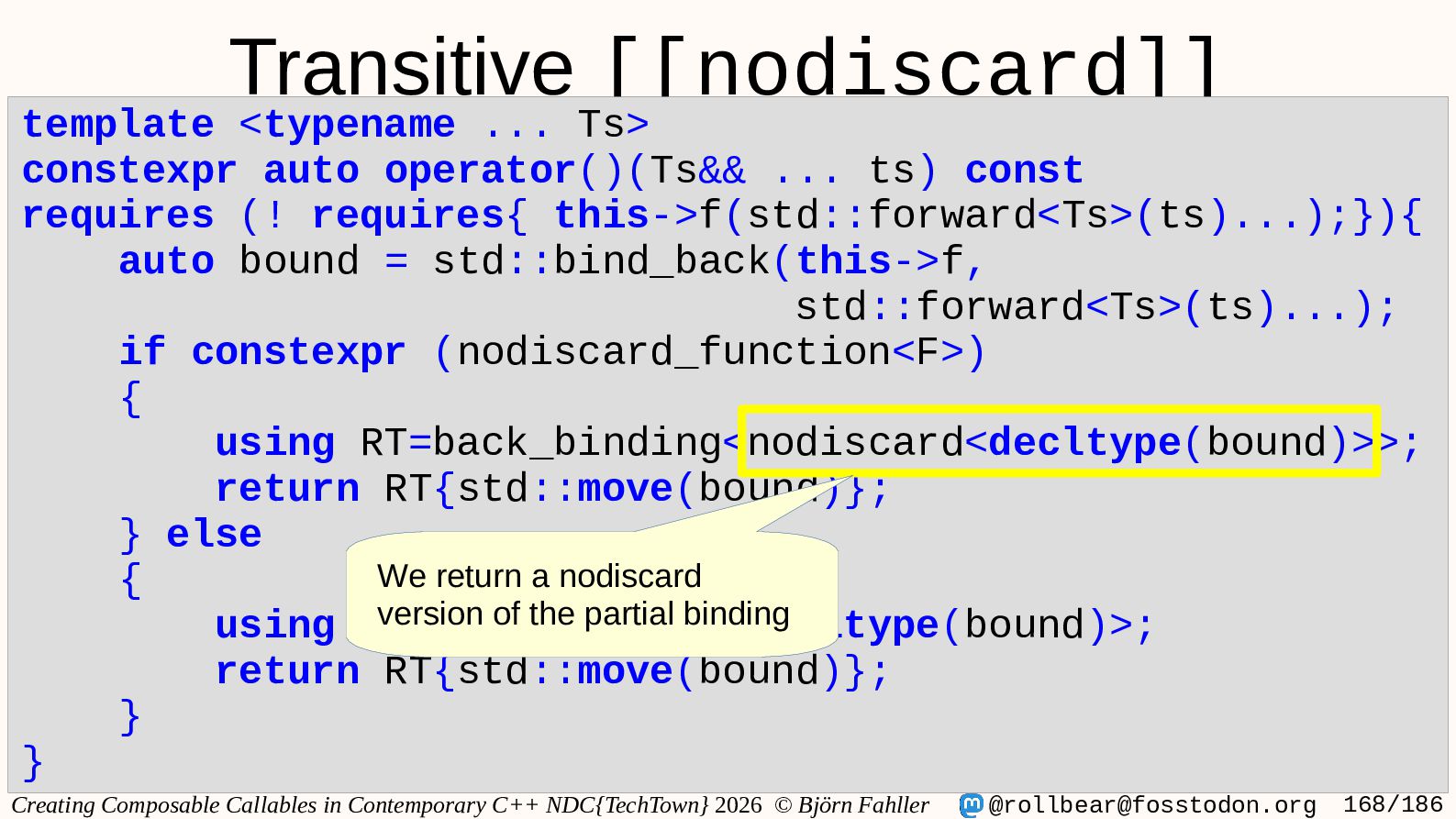
Transitive [[nodiscard]] template <typename ... Ts> constexpr auto operator()(Ts&& ...
ts) const requires (! requires{ this->f(std::forward<Ts>(ts)...);}){ auto bound = std::bind_back(this->f, std::forward<Ts>(ts)...); if constexpr (nodiscard_function<F>) { using RT=back_binding<nodiscard<decltype(bound)>>; return RT{std::move(bound)}; } else We return a nodiscard { version of the partial binding using RT=back_binding<decltype(bound)>; return RT{std::move(bound)}; } } Creating Composable Callables in Contemporary C++ NDC{TechTown} 2026 © Björn Fahller @[email protected] 168/186 -
Transitive [[nodiscard]] template <typename ... Ts> constexpr auto operator()(Ts&& ...
ts) const requires (! requires{ this->f(std::forward<Ts>(ts)...);}){ auto bound = std::bind_back(this->f, std::forward<Ts>(ts)...); if constexpr (nodiscard_function<F>) { using RT=back_binding<nodiscard<decltype(bound)>>; Otherwise the return RT{std::move(bound)}; same partial binding as before } else { using RT=back_binding<decltype(bound)>; return RT{std::move(bound)}; } } Creating Composable Callables in Contemporary C++ NDC{TechTown} 2026 © Björn Fahller @[email protected] 169/186 -
Transitive [[nodiscard]] constexpr auto operator|(LH&& lh, RH&& rh) { auto
pipe = ... using LHU = std::remove_cvref_t<LH>; if constexpr (nodiscard_function<decltype(rh.f)>) { using RT = rebind_template_t<LHU, decltype(nodiscard{pipe})>; return RT{std::move(pipe)}; } else { using RT = rebind_template_t<LHU, decltype(pipe)>; return RT{std::move(pipe)}; } } Creating Composable Callables in Contemporary C++ NDC{TechTown} 2026 © Björn Fahller @[email protected] 170/186 -
Transitive [[nodiscard]] constexpr auto operator|(LH&& lh, RH&& rh) { auto
pipe = ... using LHU = std::remove_cvref_t<LH>; if constexpr (nodiscard_function<decltype(rh.f)>) { using RT = rebind_template_t<LHU, decltype(nodiscard{pipe})>; return RT{std::move(pipe)}; If the function on the right } hand side of the pipe is a nodiscard_function else { using RT = rebind_template_t<LHU, decltype(pipe)>; return RT{std::move(pipe)}; } } Creating Composable Callables in Contemporary C++ NDC{TechTown} 2026 © Björn Fahller @[email protected] 171/186 -
Transitive [[nodiscard]] Then the return type is the RH&& rh)
{ constexpr auto operator|(LH&& lh, same kind as the LH, auto pipe = ... rebound with a nodiscard using LHU = std::remove_cvref_t<LH>; version of the pipe if constexpr (nodiscard_function<decltype(rh.f)>) { using RT = rebind_template_t<LHU, decltype(nodiscard{pipe})>; return RT{std::move(pipe)}; } else { using RT = rebind_template_t<LHU, decltype(pipe)>; return RT{std::move(pipe)}; } } Creating Composable Callables in Contemporary C++ NDC{TechTown} 2026 © Björn Fahller @[email protected] 172/186 -
Transitive [[nodiscard]] constexpr auto operator|(LH&& lh, RH&& rh) { auto
pipe = ... using LHU = std::remove_cvref_t<LH>; if constexpr (nodiscard_function<decltype(rh.f)>) { using RT = rebind_template_t<LHU, decltype(nodiscard{pipe})>; Otherwise return RT{std::move(pipe)}; rebind as before } else { using RT = rebind_template_t<LHU, decltype(pipe)>; return RT{std::move(pipe)}; } } Creating Composable Callables in Contemporary C++ NDC{TechTown} 2026 © Björn Fahller @[email protected] 173/186 -
Transitive [[nodiscard]] constexpr auto operator|(LH&& lh, RH&& rh) { auto
pipe = ... using LHU = std::remove_cvref_t<LH>; if constexpr (nodiscard_function<decltype(rh.f)>) { using RT = rebind_template_t<LHU, decltype(nodiscard{pipe})>; Otherwise return RT{std::move(pipe)}; rebind as before } else { using RT = rebind_template_t<LHU, decltype(pipe)>; return RT{std::move(pipe)}; } https://godbolt.org/z/Ms6vh8bbx } Creating Composable Callables in Contemporary C++ NDC{TechTown} 2026 © Björn Fahller @[email protected] 174/186 -
Observations • Functional composition is powerful Creating Composable Callables in
Contemporary C++ NDC{TechTown} 2026 © Björn Fahller @[email protected] 176/186 -
Observations • Functional composition is powerful – It can be
abused to the detriment of readability Creating Composable Callables in Contemporary C++ NDC{TechTown} 2026 © Björn Fahller @[email protected] 177/186 -
Observations • Functional composition is powerful – It can be
abused to the detriment of readability – It can be used to improve expressive power and readability Creating Composable Callables in Contemporary C++ NDC{TechTown} 2026 © Björn Fahller @[email protected] 178/186 -
Observations • • Functional composition is powerful – It can
be abused to the detriment of readability – It can be used to improve expressive power and readability Error messages are horrendous Creating Composable Callables in Contemporary C++ NDC{TechTown} 2026 © Björn Fahller @[email protected] 179/186 -
Observations • • Functional composition is powerful – It can
be abused to the detriment of readability – It can be used to improve expressive power and readability • Compilers are awesome! Error messages are horrendous Creating Composable Callables in Contemporary C++ NDC{TechTown} 2026 © Björn Fahller @[email protected] 180/186 -
Observations • • Functional composition is powerful – It can
be abused to the detriment of readability – It can be used to improve expressive power and readability • • Compilers are awesome! The code size is surprisingly small Error messages are horrendous Creating Composable Callables in Contemporary C++ NDC{TechTown} 2026 © Björn Fahller @[email protected] 181/186 -
Observations • Functional composition is powerful – – • It
can be abused to the detriment of readability It can be used to improve expressive power and readability • • • Compilers are awesome! The code size is surprisingly small It is not always obvious that a function should be back_binding or front_binding Error messages are horrendous Creating Composable Callables in Contemporary C++ NDC{TechTown} 2026 © Björn Fahller @[email protected] 182/186 -
Observations • Functional composition is powerful – – • It
can be abused to the detriment of readability It can be used to improve expressive power and readability Error messages are horrendous • • • Compilers are awesome! The code size is surprisingly small It is not always obvious that a function should be back_binding or front_binding – Named arguments could solve this Creating Composable Callables in Contemporary C++ NDC{TechTown} 2026 © Björn Fahller @[email protected] 183/186 -
Observations • Functional composition is powerful – – • It
can be abused to the detriment of readability • Compilers are awesome! • The code size is surprisingly small • It is not always obvious that a function should be back_binding or front_binding – Named arguments could solve this • Reflection does not seem to offer help It can be used to improve expressive power and readability Error messages are horrendous Creating Composable Callables in Contemporary C++ NDC{TechTown} 2026 © Björn Fahller @[email protected] 184/186 -
Creating Composable Callables in Contemporary C++ [email protected] @rollbear.bsky.social @[email protected] @rollbear
Creating Composable Callables in Contemporary C++ NDC{TechTown} 2026 © Björn Fahller @[email protected] 185/186 -
Creating Composable Callables in Contemporary C++ Furthermore - I think
it is important that you understand your code [email protected] @rollbear.bsky.social @[email protected] @rollbear Creating Composable Callables in Contemporary C++ NDC{TechTown} 2026 © Björn Fahller @[email protected] 186/186
 rollbear
 ktombow
 nakamizu
 shogogg
 nnaka2992
 steliosf
 shoheimitani
 shivamsaraswat
 sodainc
 kazuki1023
 rkaga
 yosuke_furukawa
 kasacchiful
 stephenakadiri
 bermonpainter
 garrettdimon
 maggiecrowley
 jonoalderson
 greggifford
 frankvandijk
 orderedlist
 chrisshort
 oripsolob
 brad_frost
 aleyda

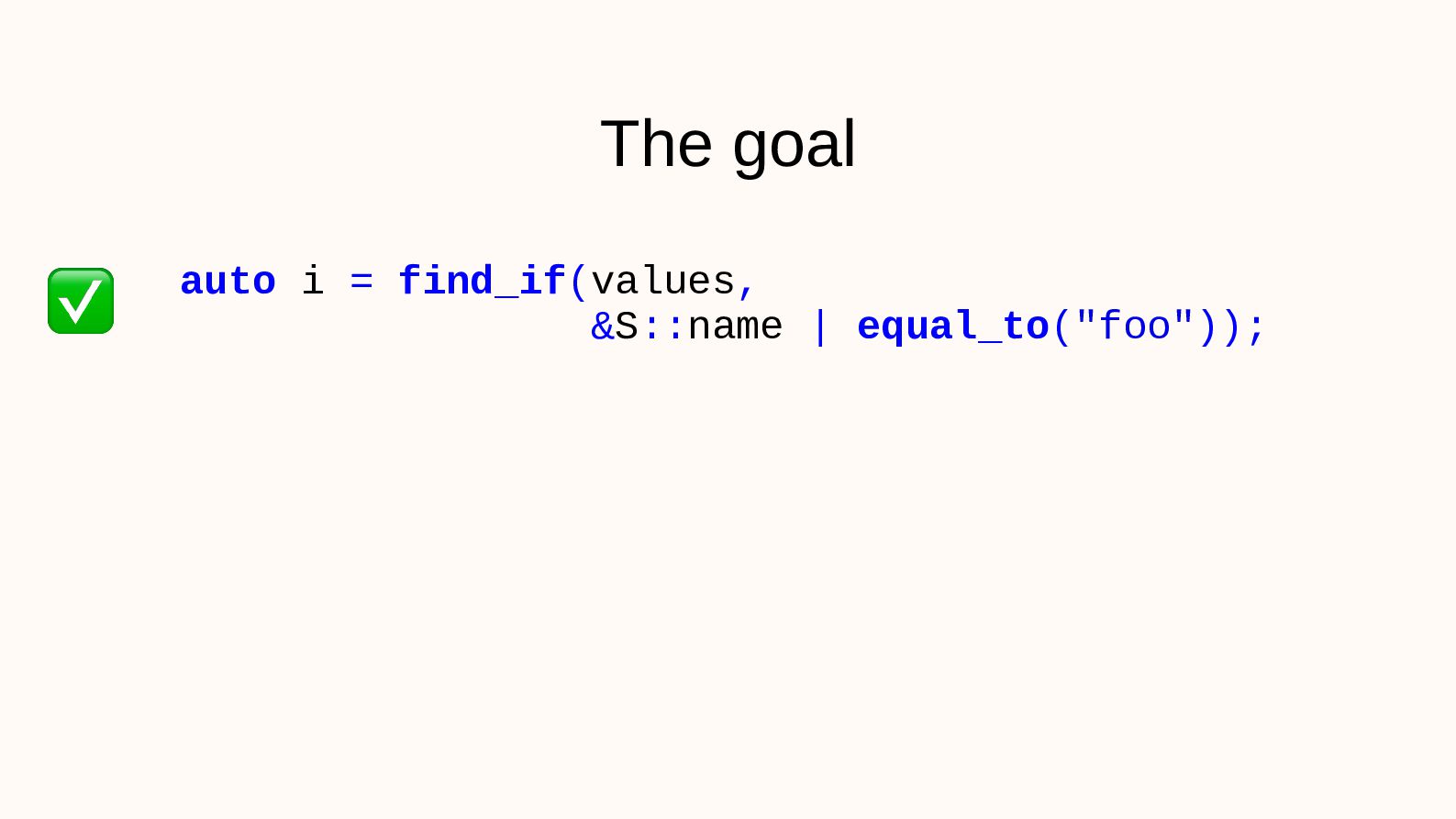
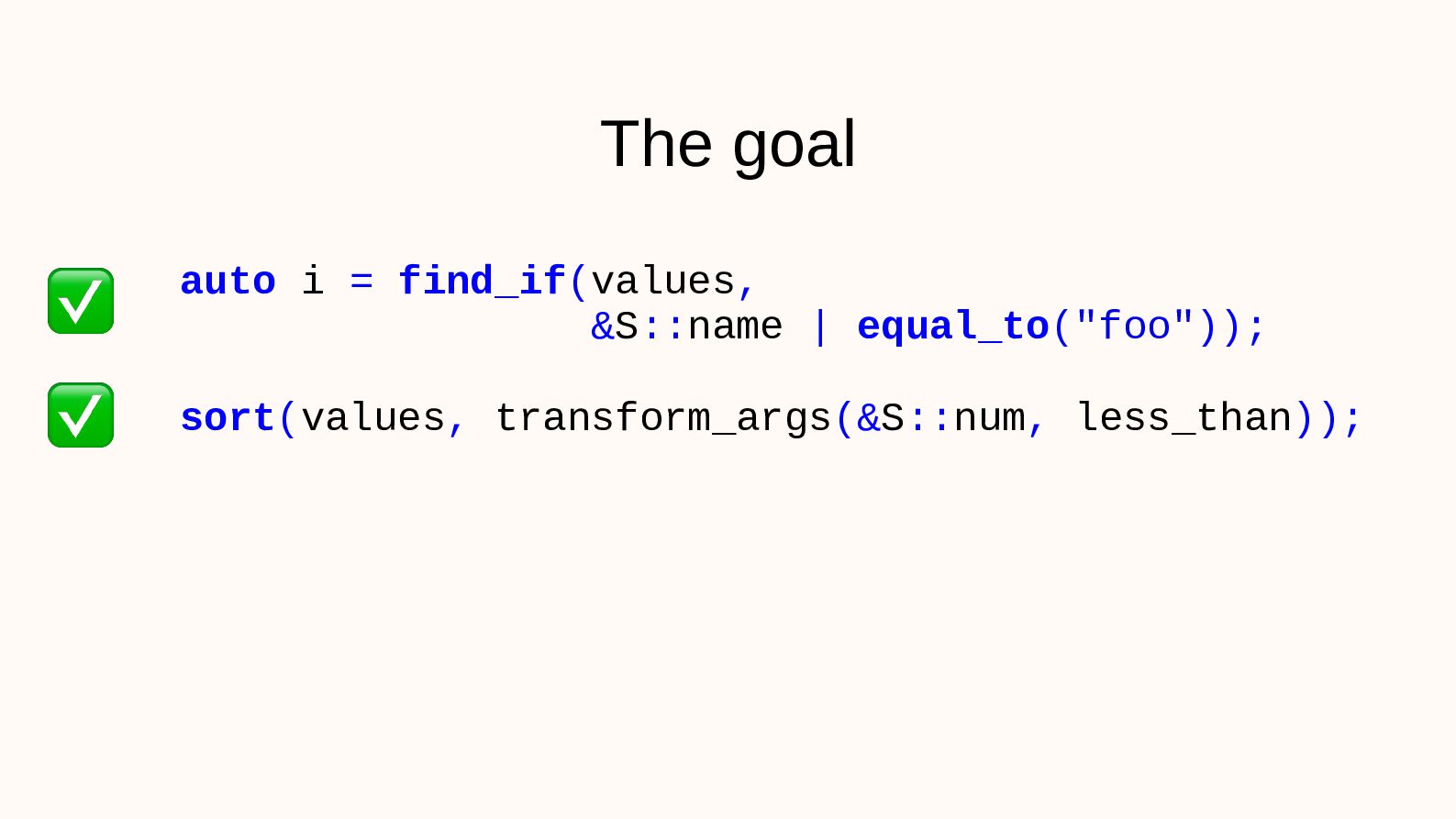
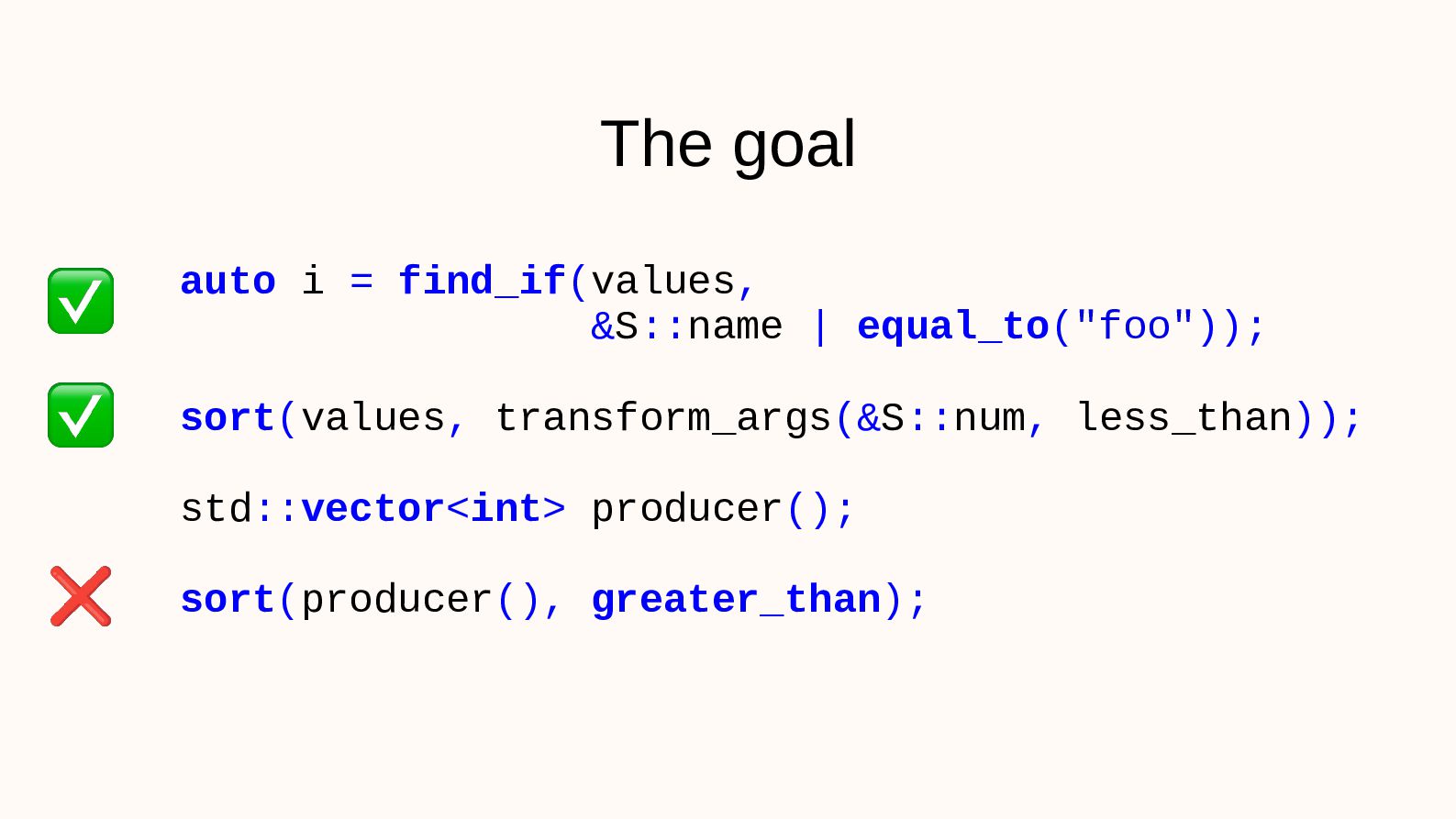
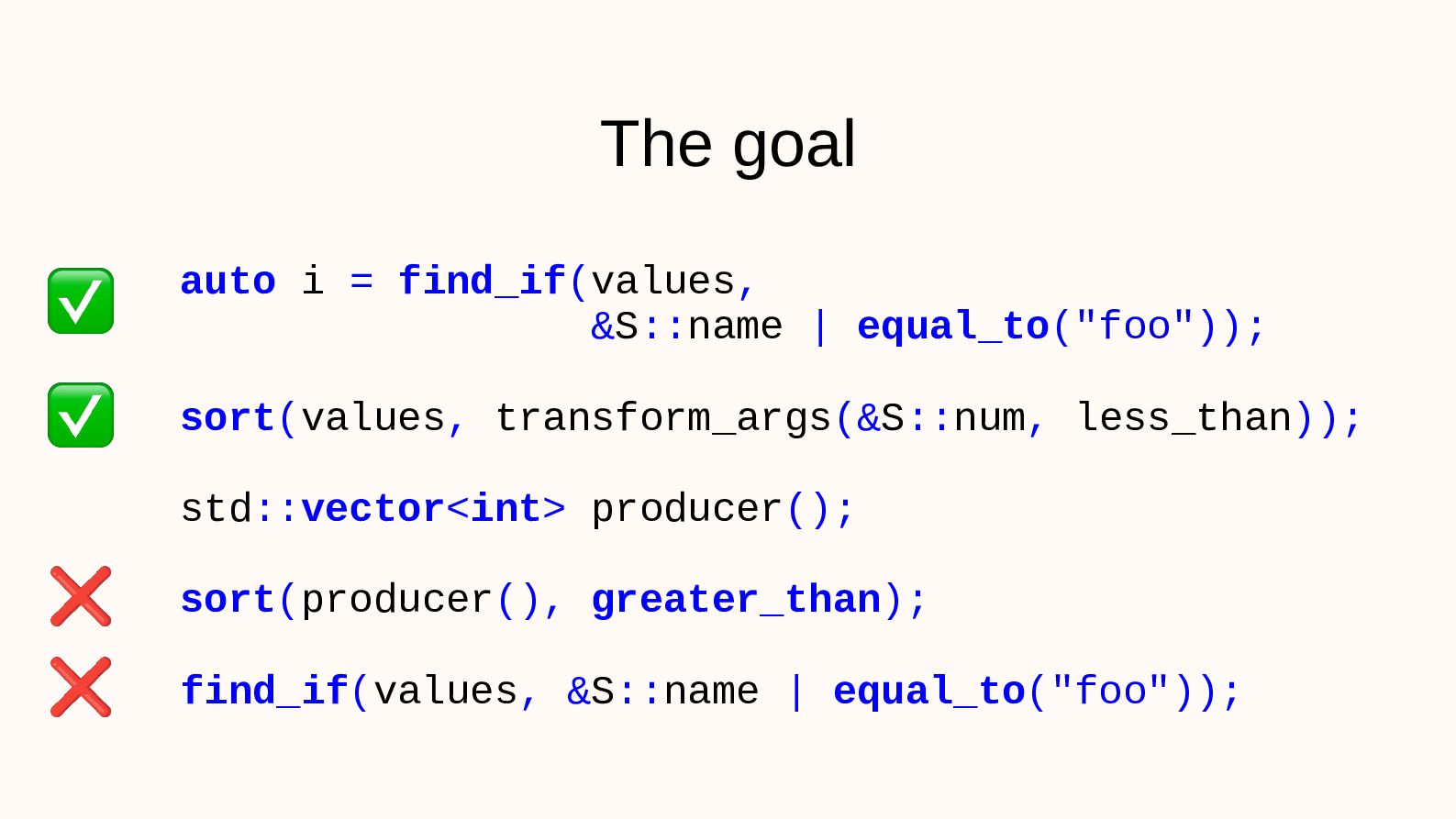



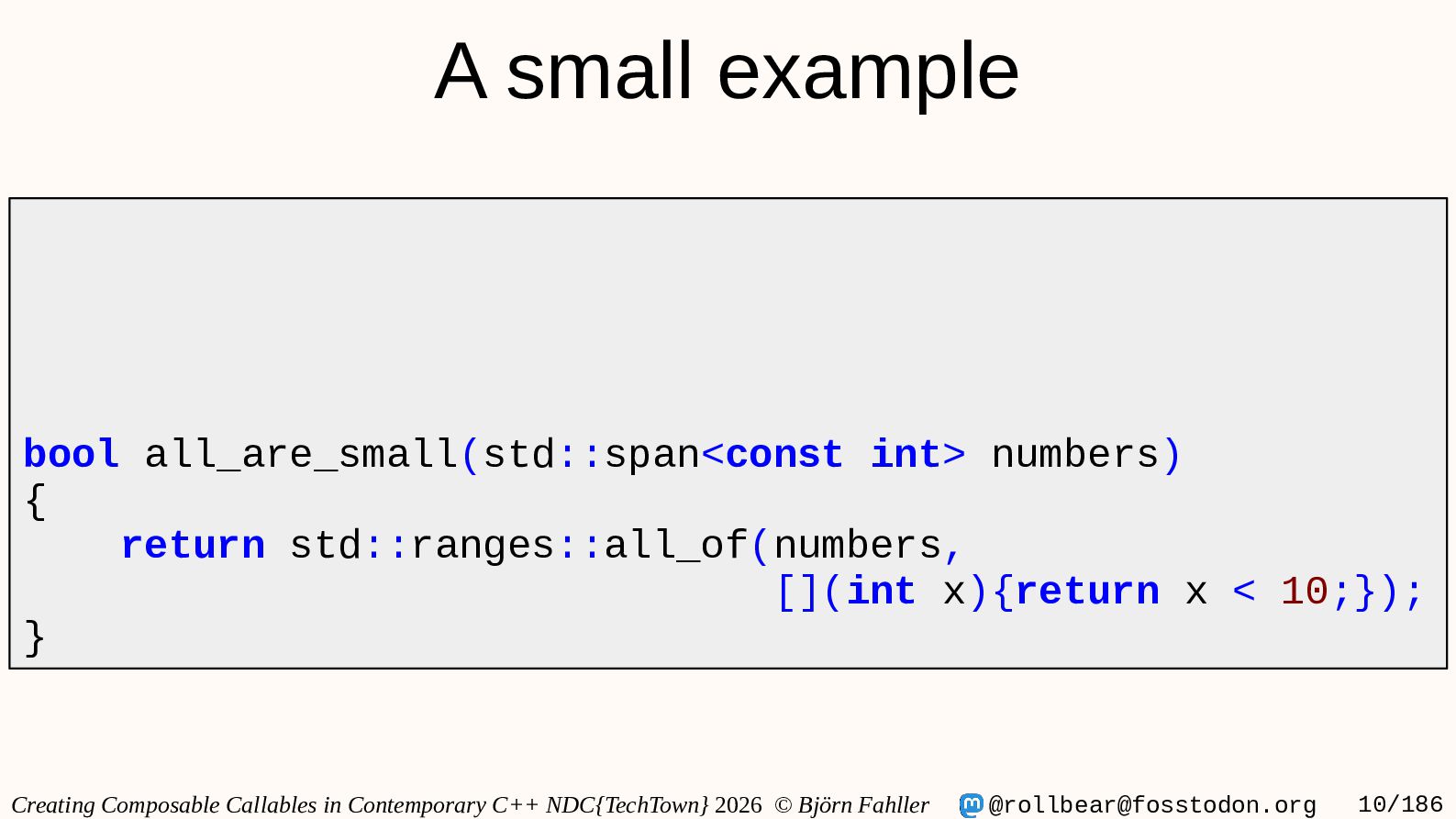
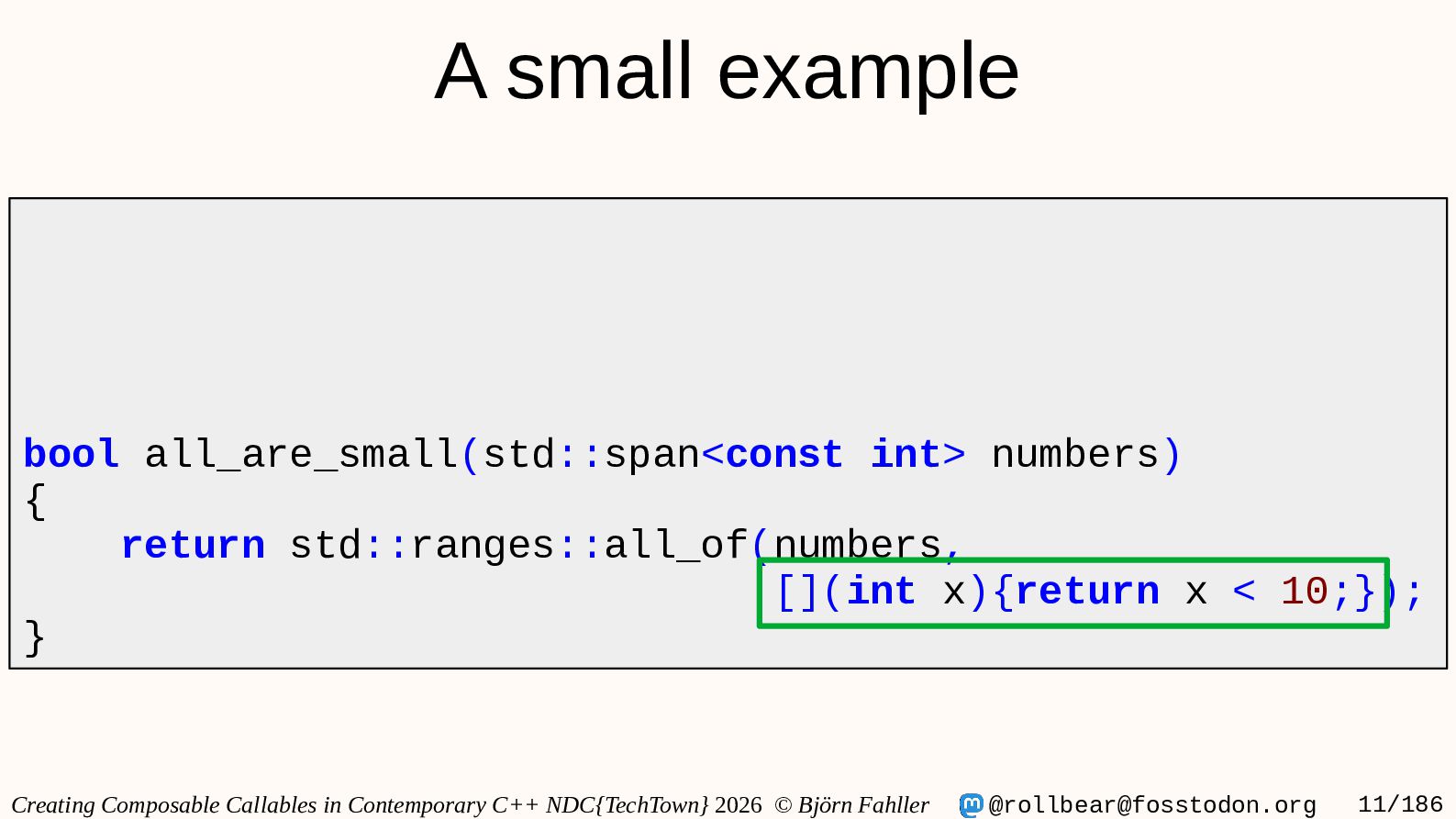
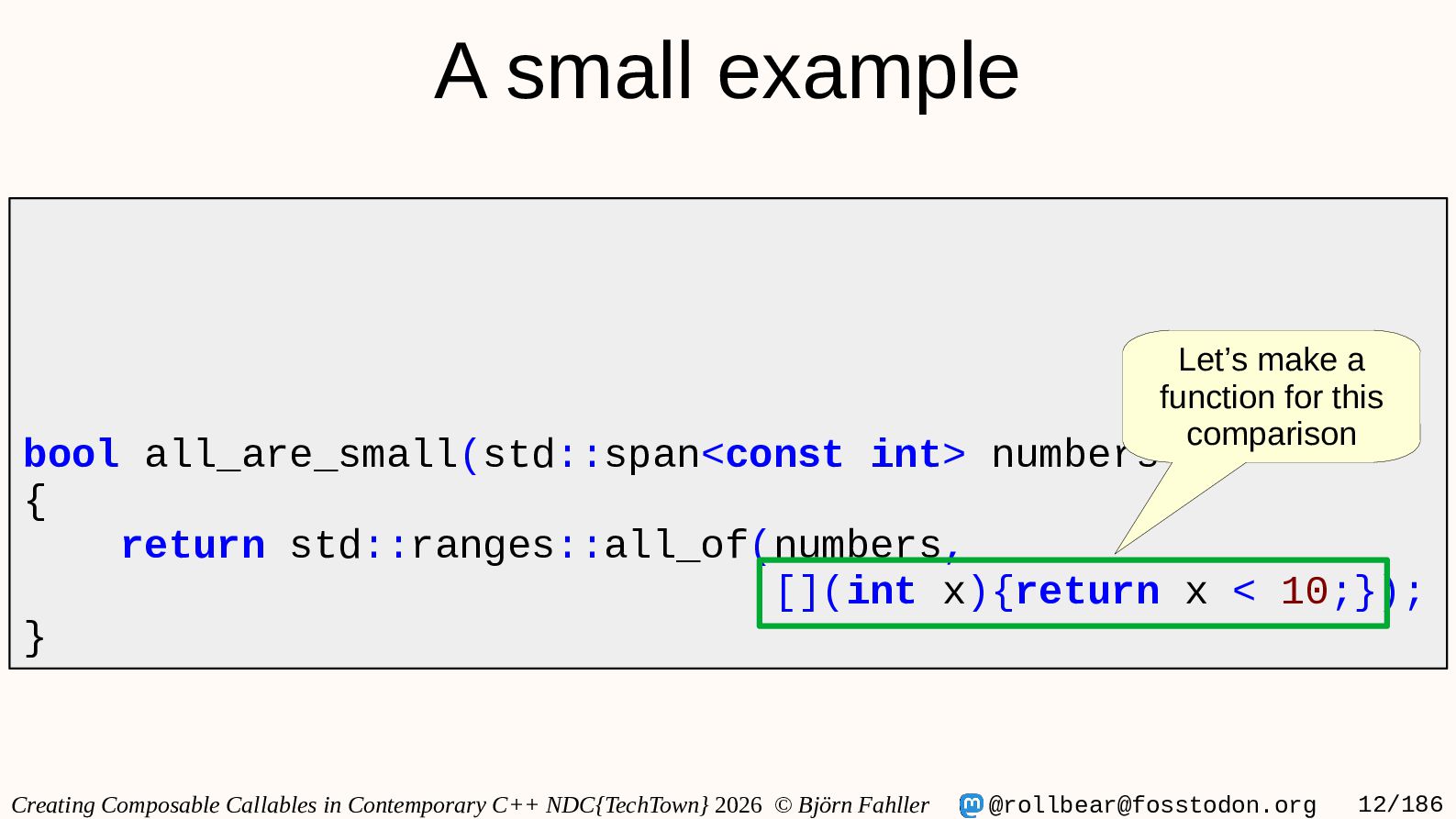


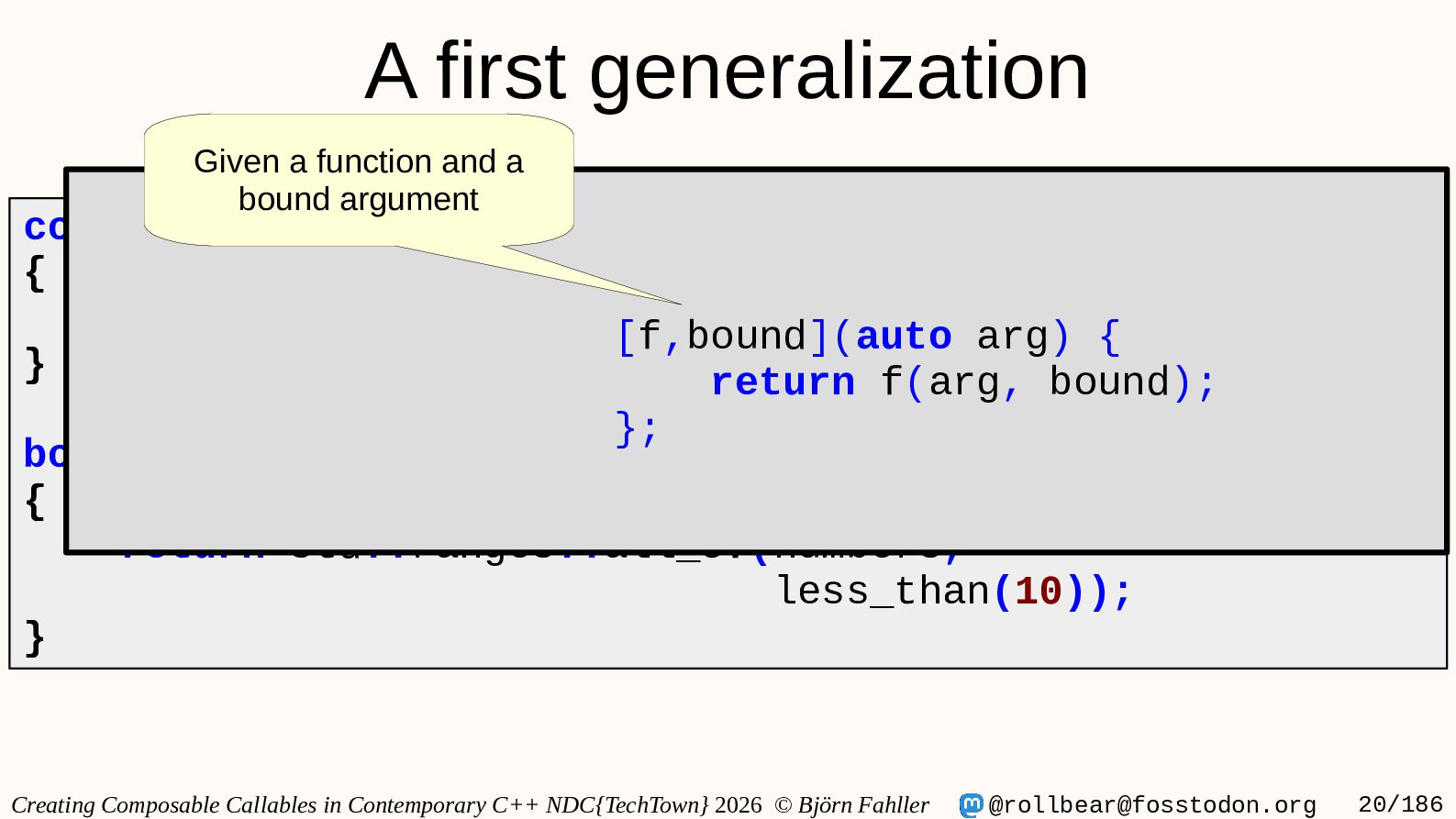

](https://files.speakerdeck.com/presentations/6463d091c7d7453d800422407bcb5b32/slide_21.jpg)
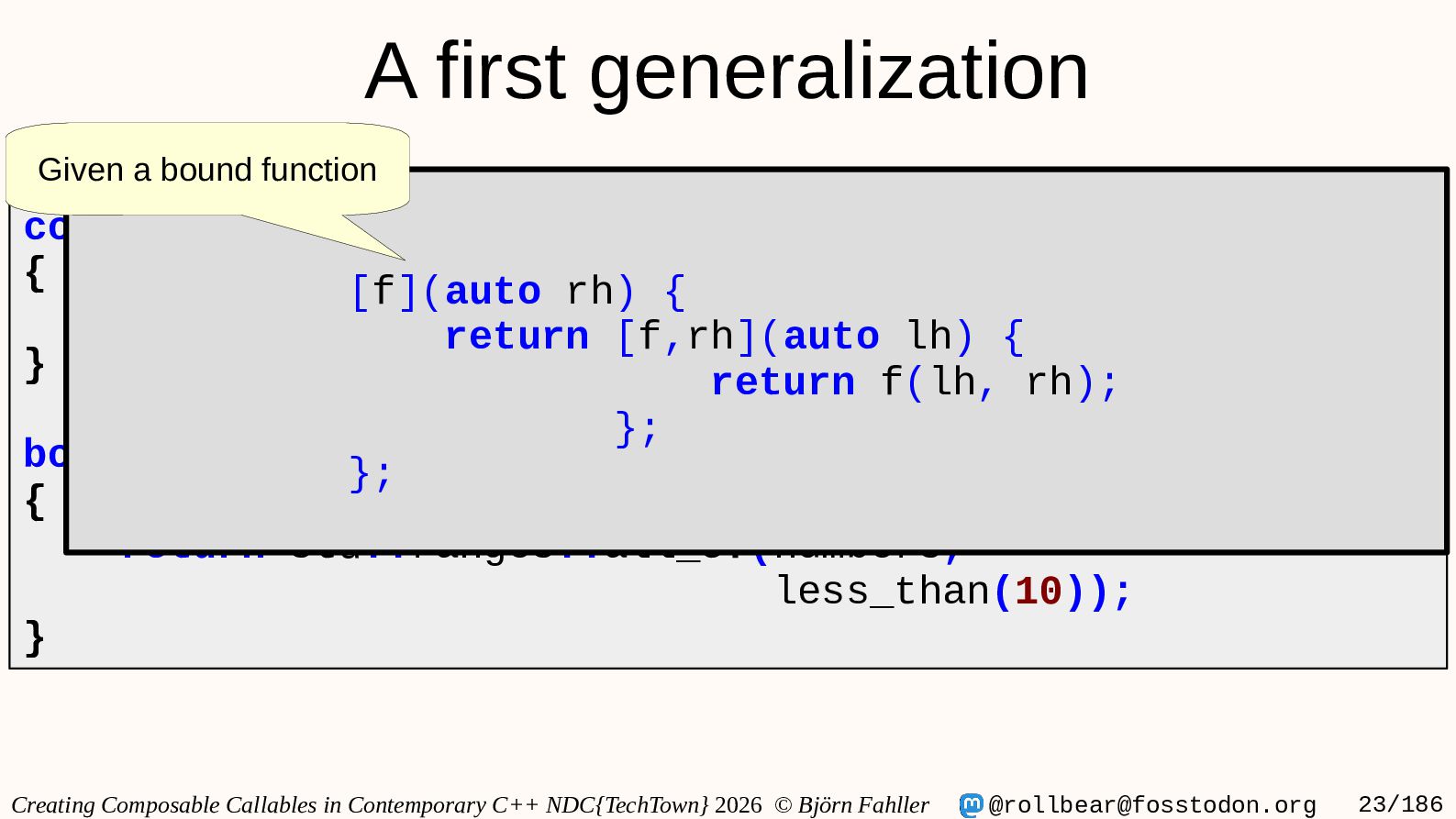
](https://files.speakerdeck.com/presentations/6463d091c7d7453d800422407bcb5b32/slide_23.jpg)