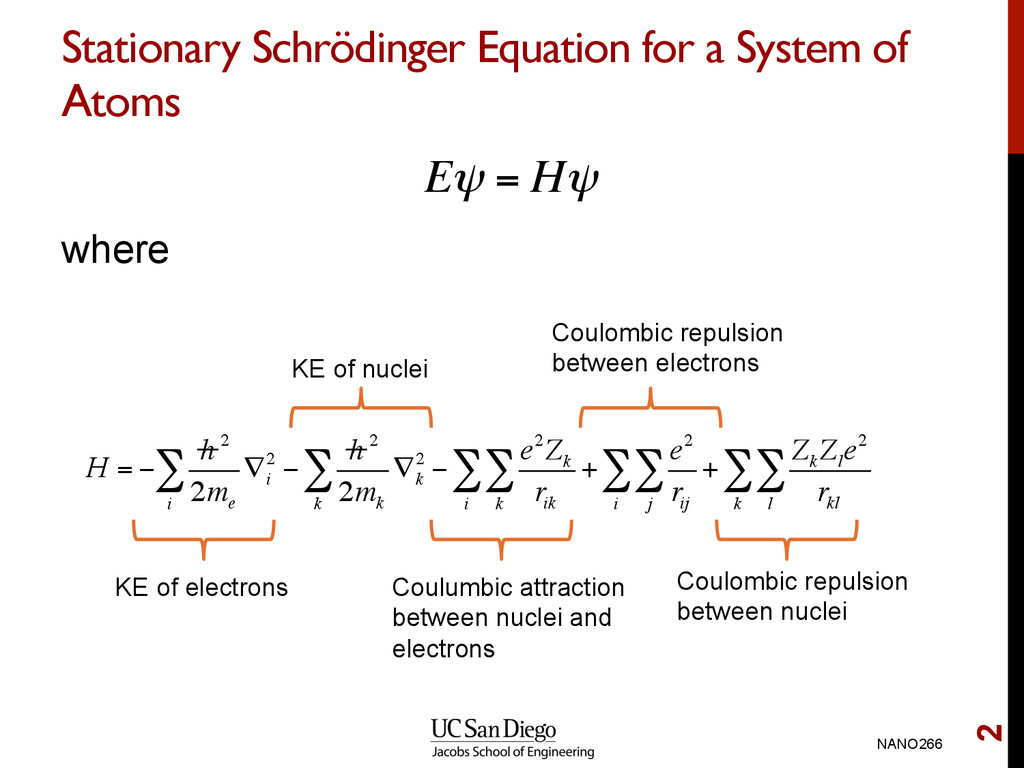
2 Eψ = Hψ H = − h 2 2m e ∇i 2 i ∑ − h 2 2m k ∇k 2 − e2Z k r ik k ∑ i ∑ + e2 r ij j ∑ i ∑ k ∑ + Z k Z l e2 r kl l ∑ k ∑ KE of electrons KE of nuclei Coulumbic attraction between nuclei and electrons Coulombic repulsion between electrons Coulombic repulsion between nuclei
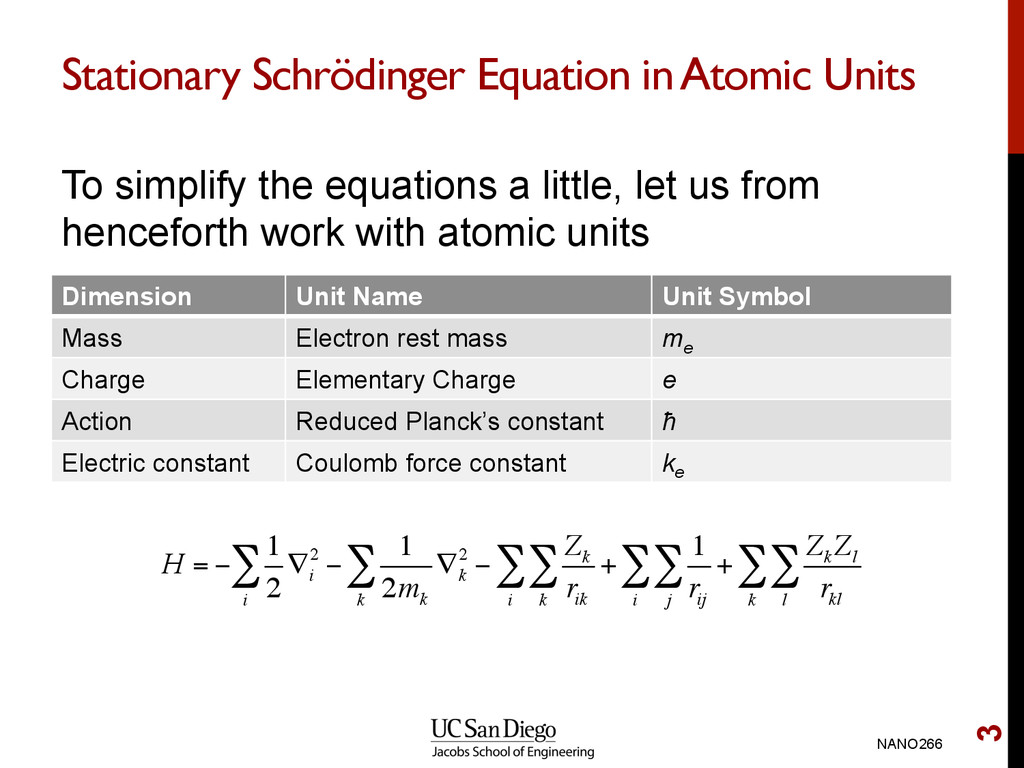
a little, let us from henceforth work with atomic units NANO266 3 Dimension Unit Name Unit Symbol Mass Electron rest mass me Charge Elementary Charge e Action Reduced Planck’s constant ħ Electric constant Coulomb force constant ke H = − 1 2 ∇i 2 i ∑ − 1 2m k ∇k 2 − Z k r ik k ∑ i ∑ + 1 r ij j ∑ i ∑ k ∑ + Z k Z l r kl l ∑ k ∑
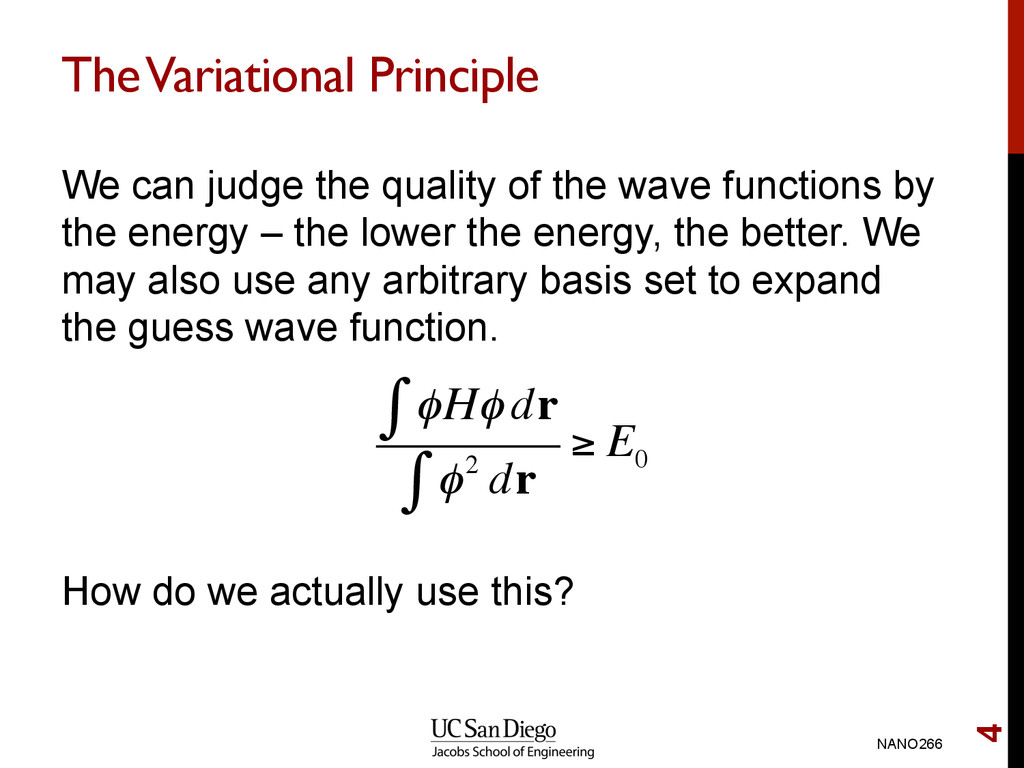
wave functions by the energy – the lower the energy, the better. We may also use any arbitrary basis set to expand the guess wave function. How do we actually use this? NANO266 4 φHφ dr ∫ φ2 dr ∫ ≥ E 0
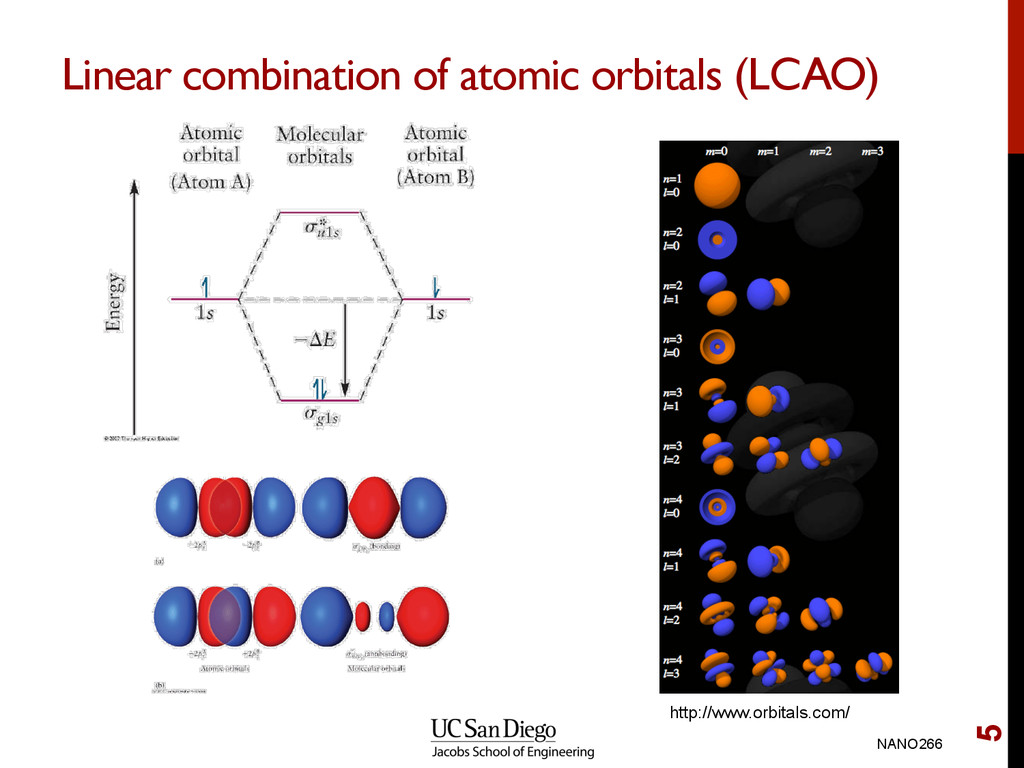
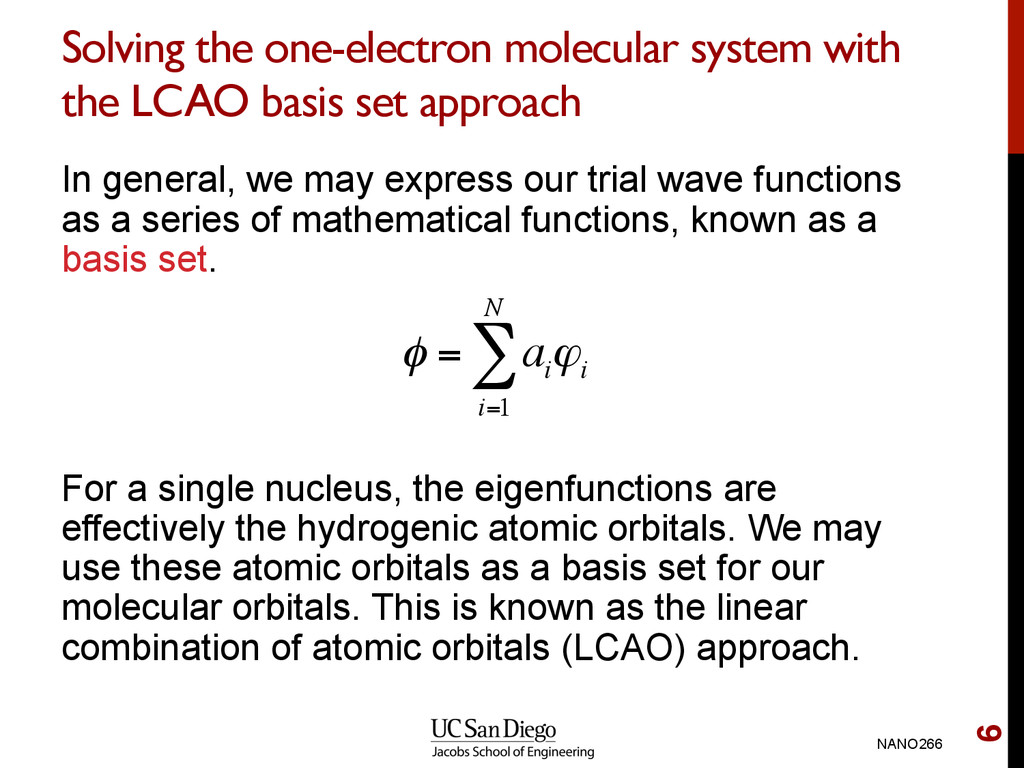
approach In general, we may express our trial wave functions as a series of mathematical functions, known as a basis set. For a single nucleus, the eigenfunctions are effectively the hydrogenic atomic orbitals. We may use these atomic orbitals as a basis set for our molecular orbitals. This is known as the linear combination of atomic orbitals (LCAO) approach. NANO266 6 φ = a i ϕi i=1 N ∑
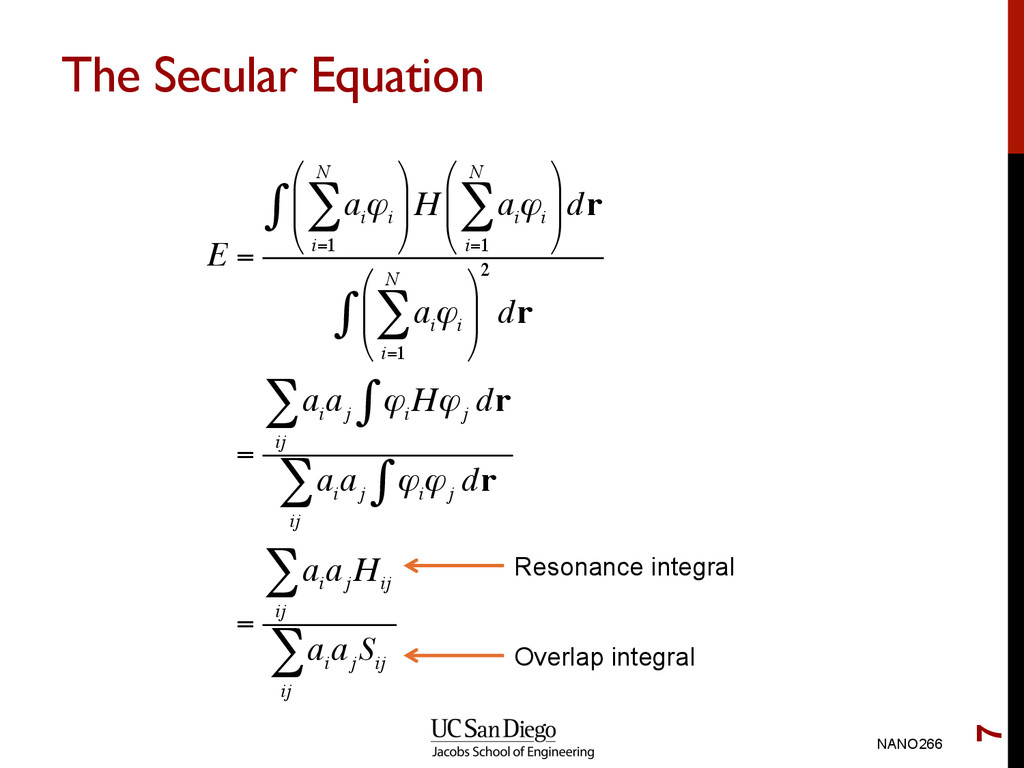
i=1 N ∑ " # $ % & 'H a i ϕi i=1 N ∑ " # $ % & 'dr ∫ a i ϕi i=1 N ∑ " # $ % & ' 2 dr ∫ = a i a j ϕi Hϕj dr ∫ ij ∑ a i a j ϕi ϕj dr ∫ ij ∑ = a i a j H ij ij ∑ a i a j S ij ij ∑ Resonance integral Overlap integral
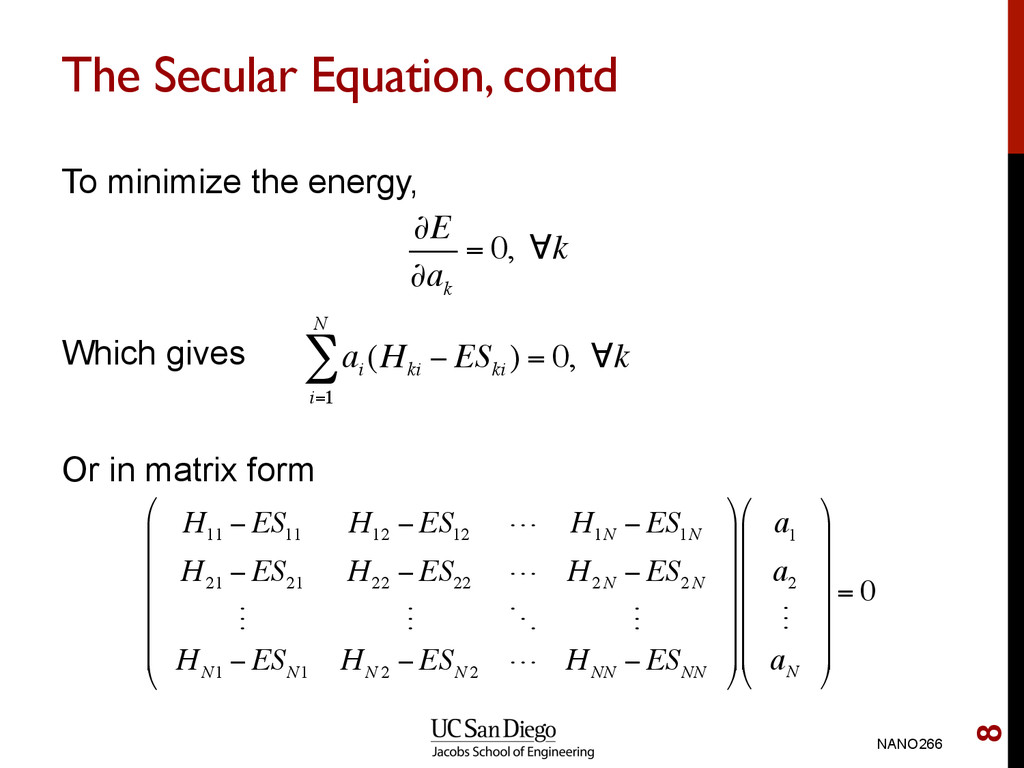
Or in matrix form NANO266 8 ∂E ∂a k = 0, ∀k a i (H ki − ES ki ) i=1 N ∑ = 0, ∀k H 11 − ES 11 H 12 − ES 12 ! H 1N − ES 1N H 21 − ES 21 H 22 − ES 22 ! H 2N − ES 2N " " # " H N1 − ES N1 H N 2 − ES N 2 ! H NN − ES NN " # $ $ $ $ $ % & ' ' ' ' ' a 1 a 2 " a N " # $ $ $ $ $ % & ' ' ' ' ' = 0
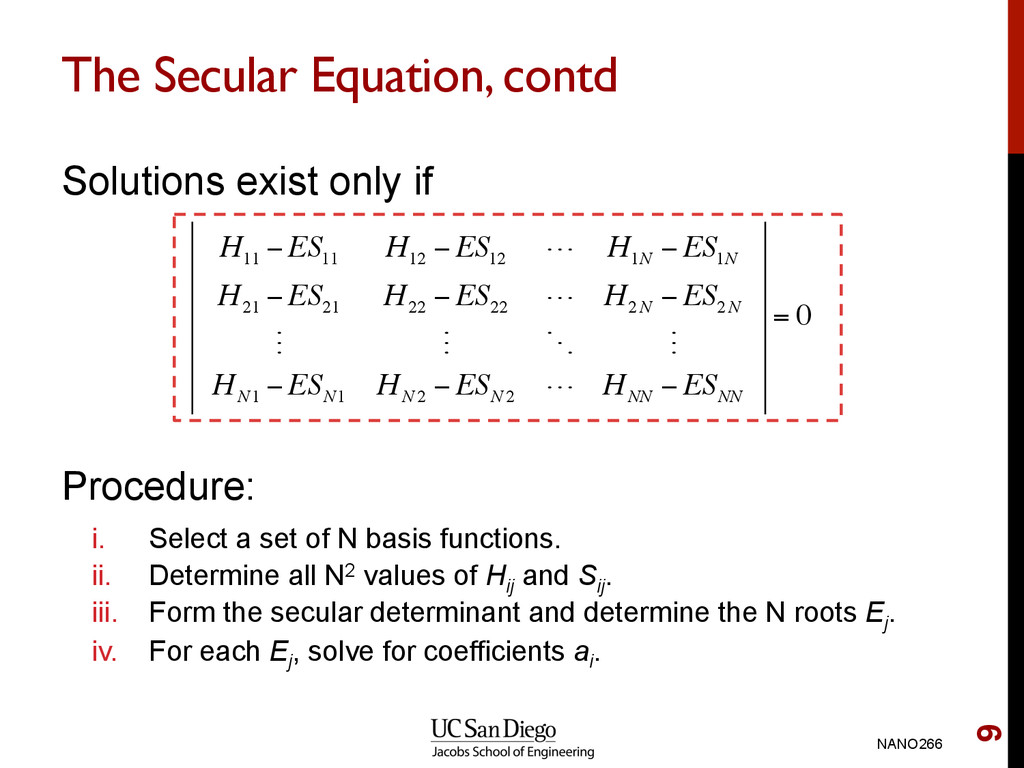
Select a set of N basis functions. ii. Determine all N2 values of Hij and Sij . iii. Form the secular determinant and determine the N roots Ej . iv. For each Ej , solve for coefficients ai . NANO266 9 H 11 − ES 11 H 12 − ES 12 ! H 1N − ES 1N H 21 − ES 21 H 22 − ES 22 ! H 2N − ES 2N " " # " H N1 − ES N1 H N 2 − ES N 2 ! H NN − ES NN = 0
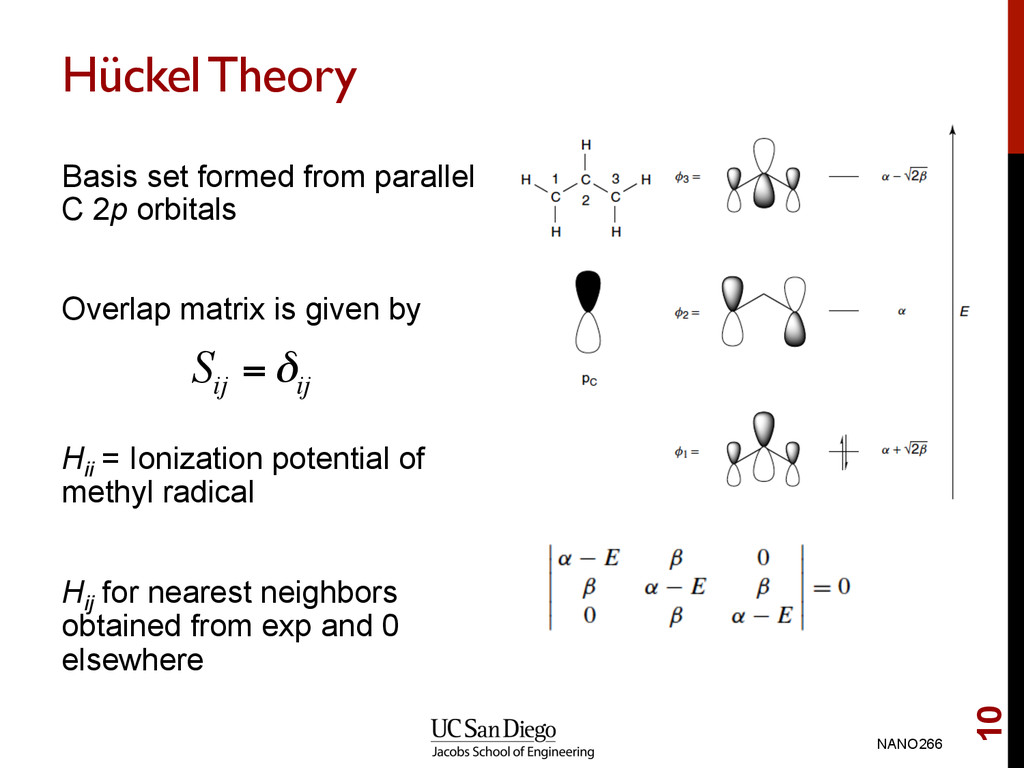
Overlap matrix is given by Hii = Ionization potential of methyl radical Hij for nearest neighbors obtained from exp and 0 elsewhere NANO266 10 S ij =δij
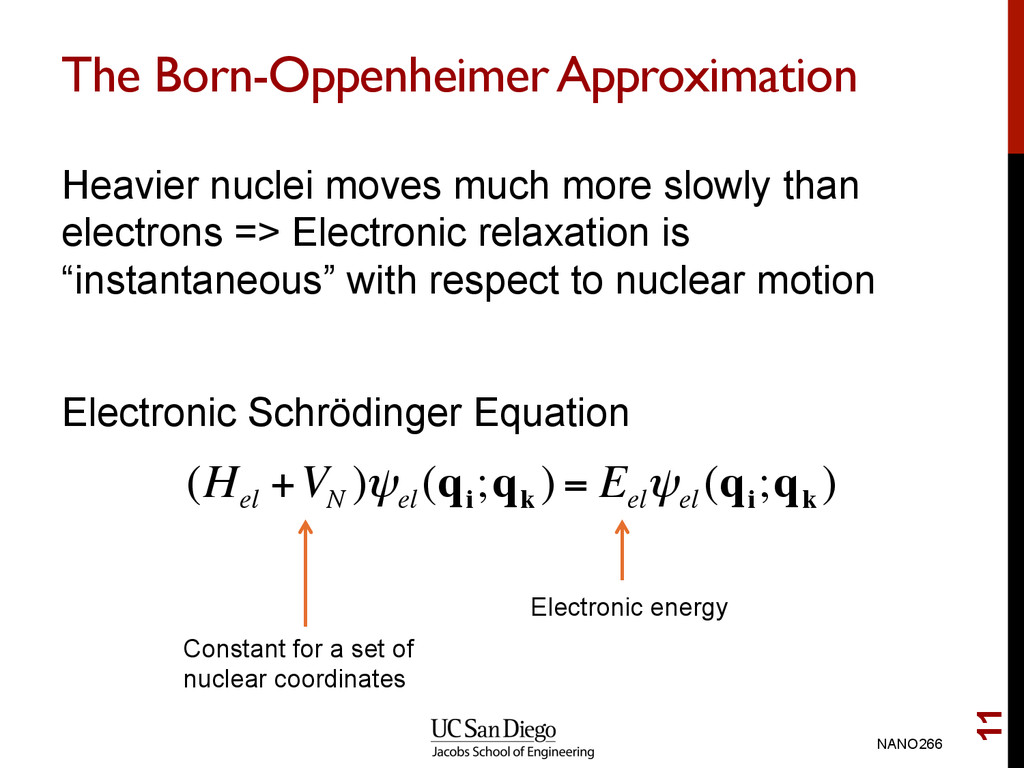
electrons => Electronic relaxation is “instantaneous” with respect to nuclear motion Electronic Schrödinger Equation NANO266 11 (H el +V N )ψel (q i ;q k ) = E el ψel (q i ;q k ) Electronic energy Constant for a set of nuclear coordinates
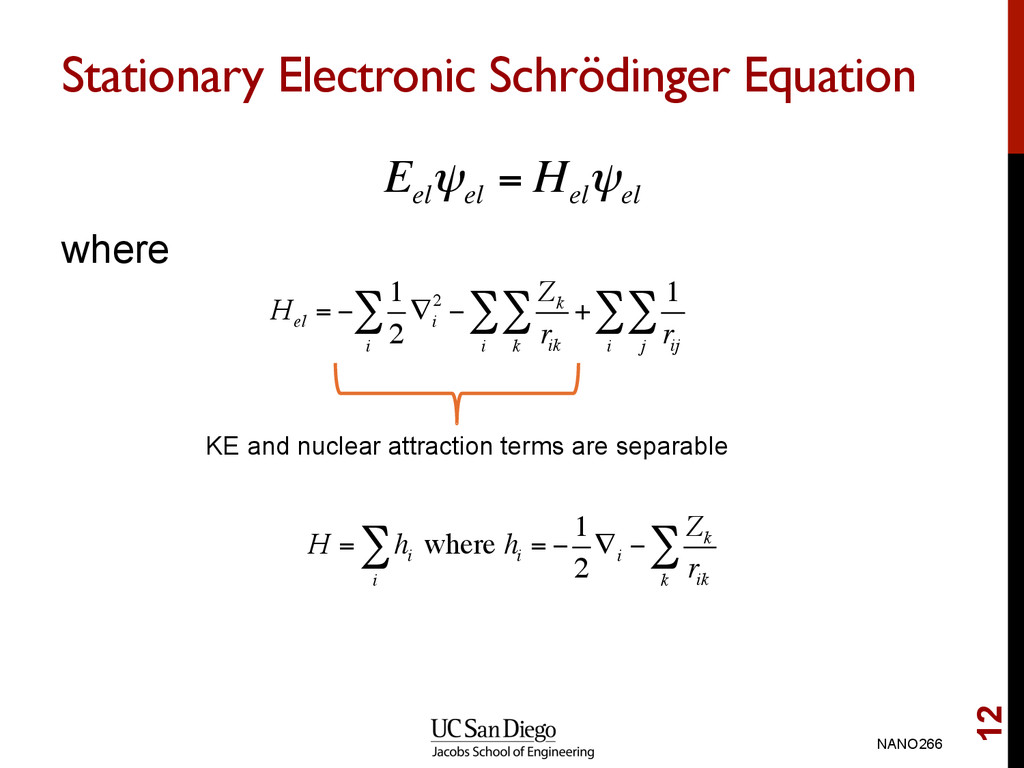
= H el ψel H el = − 1 2 ∇i 2 i ∑ − Z k r ik k ∑ i ∑ + 1 r ij j ∑ i ∑ KE and nuclear attraction terms are separable H = h i i ∑ where h i = − 1 2 ∇i − Z k r ik k ∑
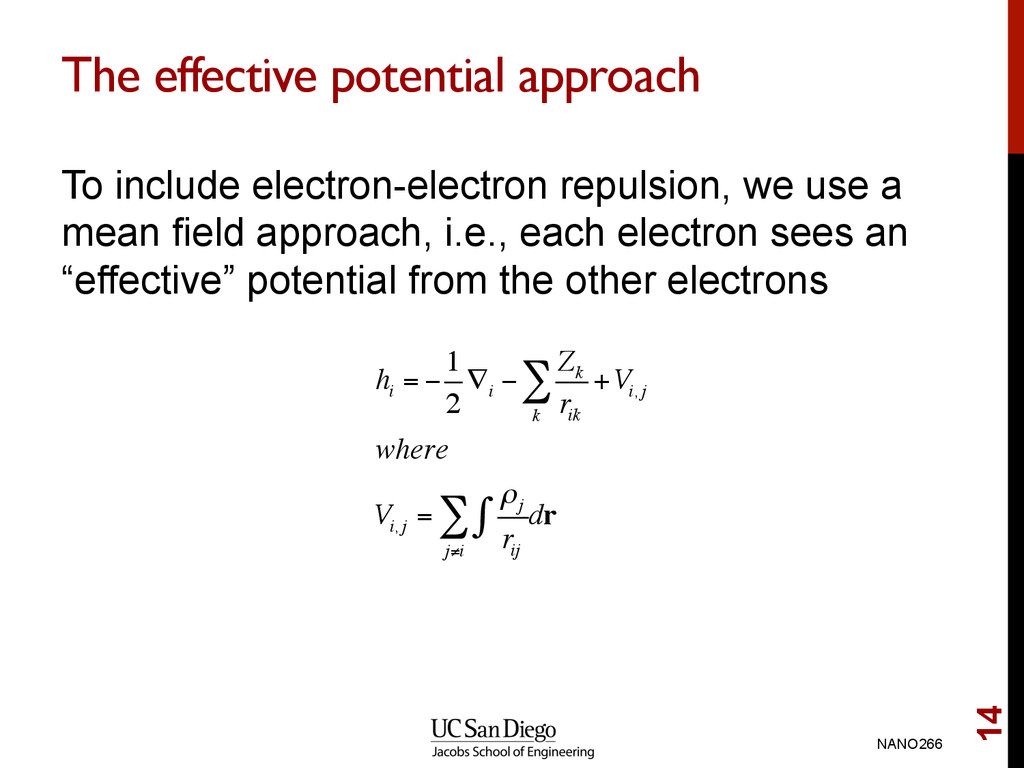
a mean field approach, i.e., each electron sees an “effective” potential from the other electrons NANO266 14 h i = − 1 2 ∇i − Z k r ik k ∑ +V i, j where V i, j = ρj r ij ∫ j≠i ∑ dr
one- electron operations hi Solve for new ψ h i ψi =εi ψi Iterate until energy eigenvalues converge to a desired level of accuracy E = εi i ∑ − 1 2 ψi 2 ψj 2 r ij dr i dr j ∫∫ What’s the purpose of this term?
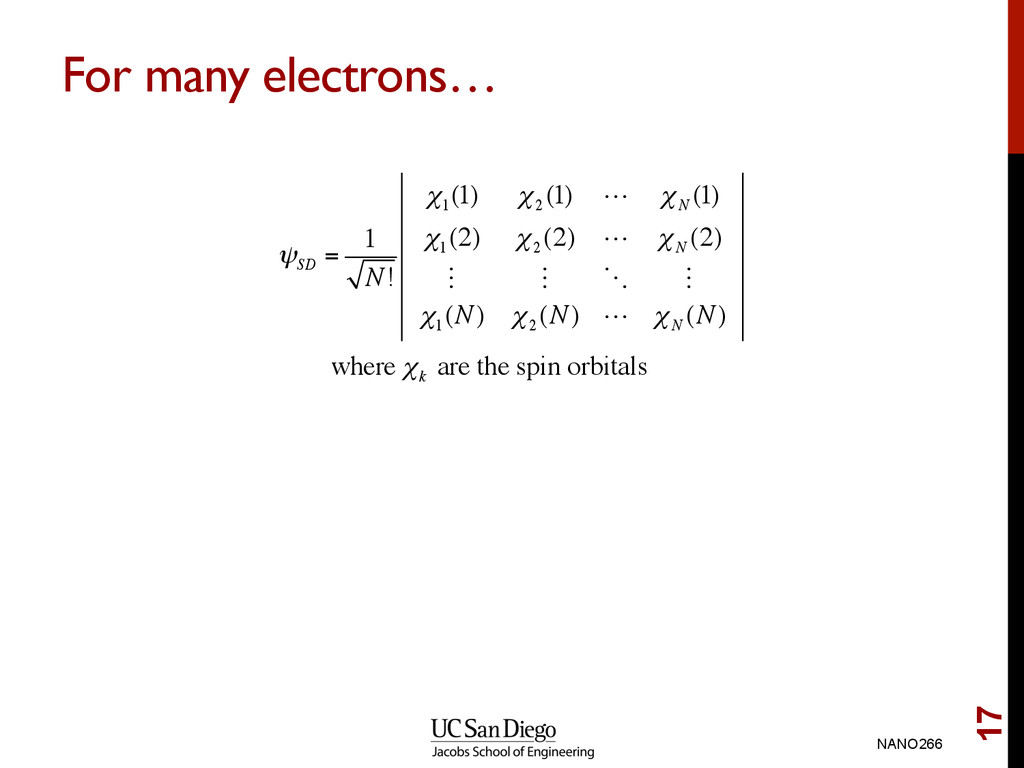
½ particles) cannot occupy the same quantum state simultaneously è Wave function has to be anti-symmetric For two electron system, we have NANO266 16 ψSD = 1 2 ψa (1)α(1)ψb (2)α(2)−ψa (2)α(2)ψb (1)α(1) [ ] = 1 2 ψa (1)α(1) ψb (1)α(1) ψa (2)α(2) ψb (2)α(2) where α is the electron spin eigenfunction Slater determinant
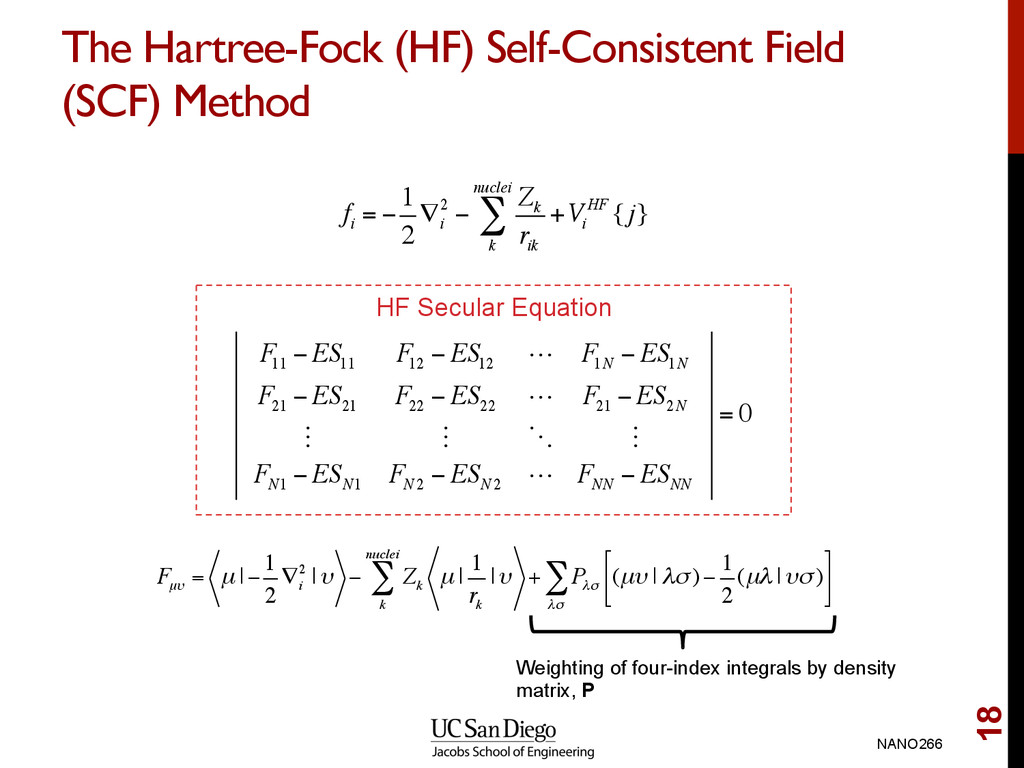
i = − 1 2 ∇i 2 − Z k r ik +V i HF {j} k nuclei ∑ F 11 − ES 11 F 12 − ES 12 ! F 1N − ES 1N F 21 − ES 21 F 22 − ES 22 ! F 21 − ES 2N " " # " F N1 − ES N1 F N 2 − ES N 2 ! F NN − ES NN = 0 HF Secular Equation F µυ = µ |− 1 2 ∇i 2 |υ − Z k µ | 1 r k |υ + P λσ λσ ∑ (µυ | λσ )− 1 2 (µλ |υσ ) $ % & ' ( ) k nuclei ∑ Weighting of four-index integrals by density matrix, P
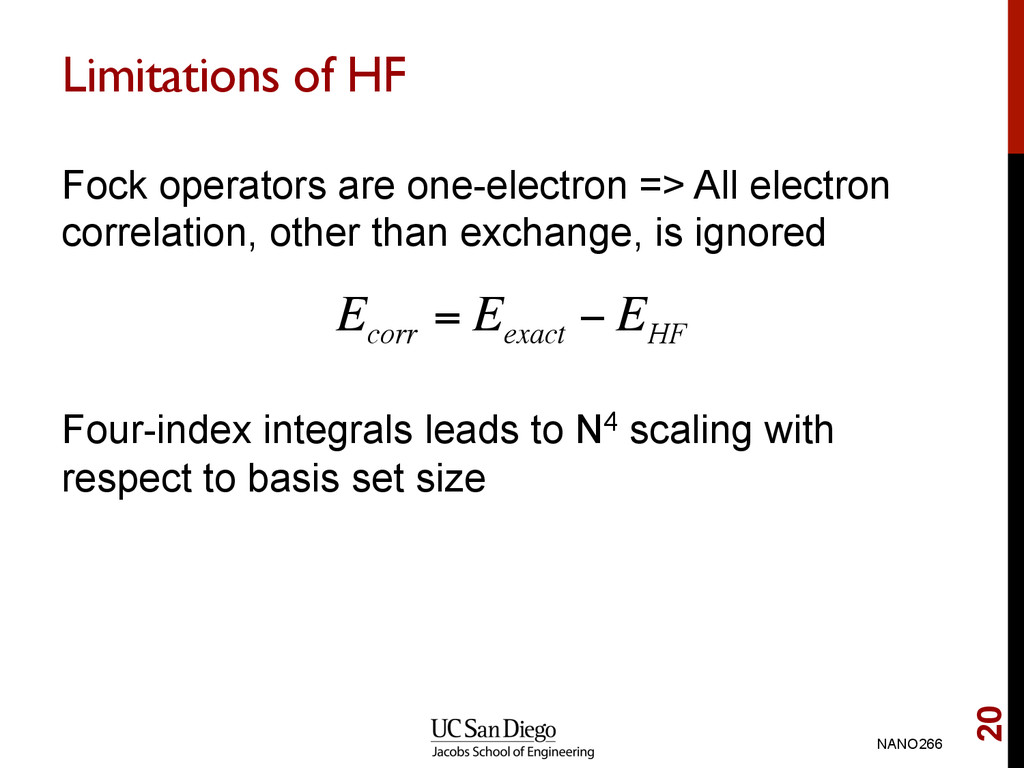
correlation, other than exchange, is ignored Four-index integrals leads to N4 scaling with respect to basis set size NANO266 20 E corr = E exact − E HF
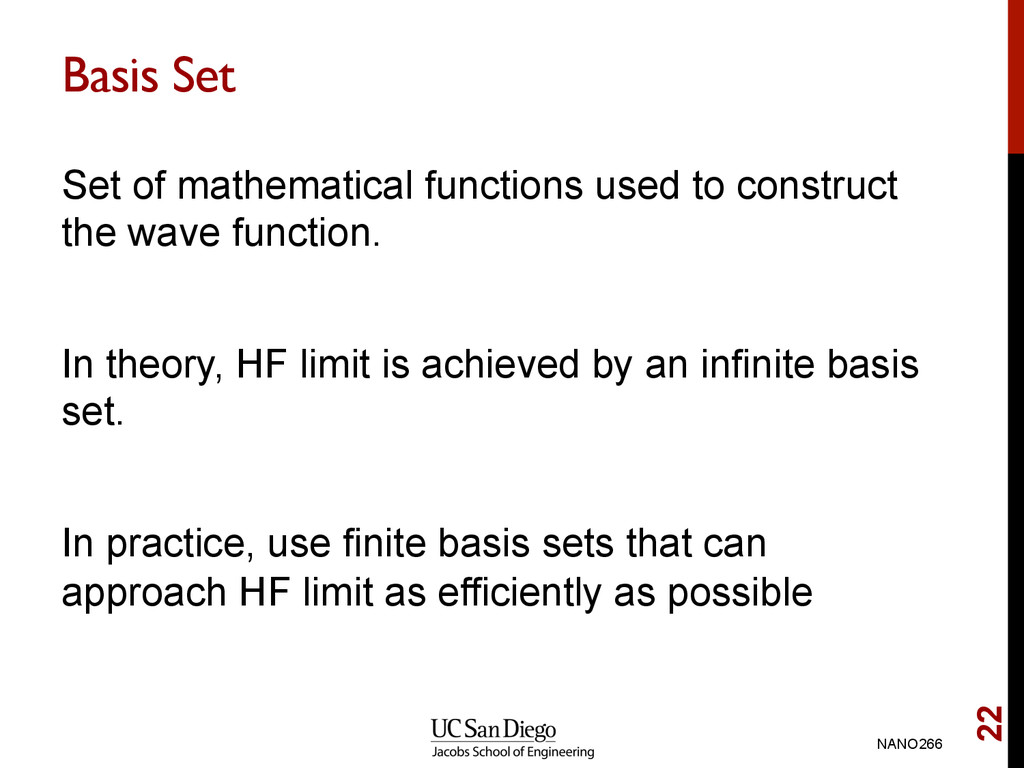
wave function. In theory, HF limit is achieved by an infinite basis set. In practice, use finite basis sets that can approach HF limit as efficiently as possible NANO266 22
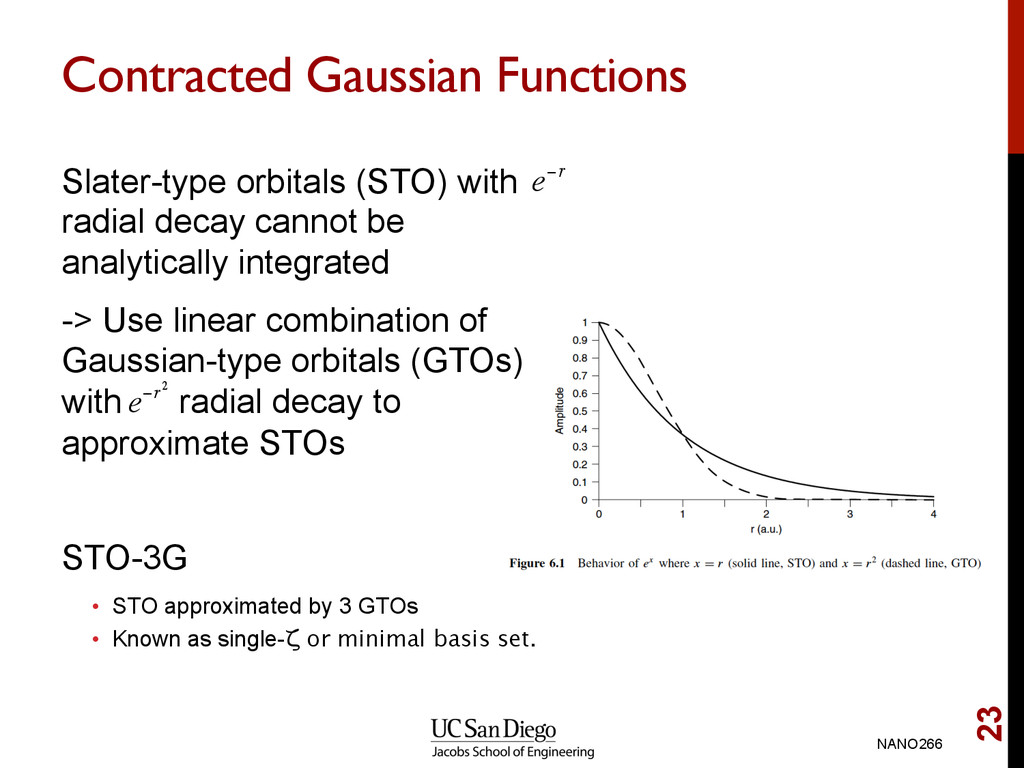
be analytically integrated -> Use linear combination of Gaussian-type orbitals (GTOs) with radial decay to approximate STOs STO-3G • STO approximated by 3 GTOs • Known as single-ζ or minimal basis set. NANO266 23 e−r2 e−r
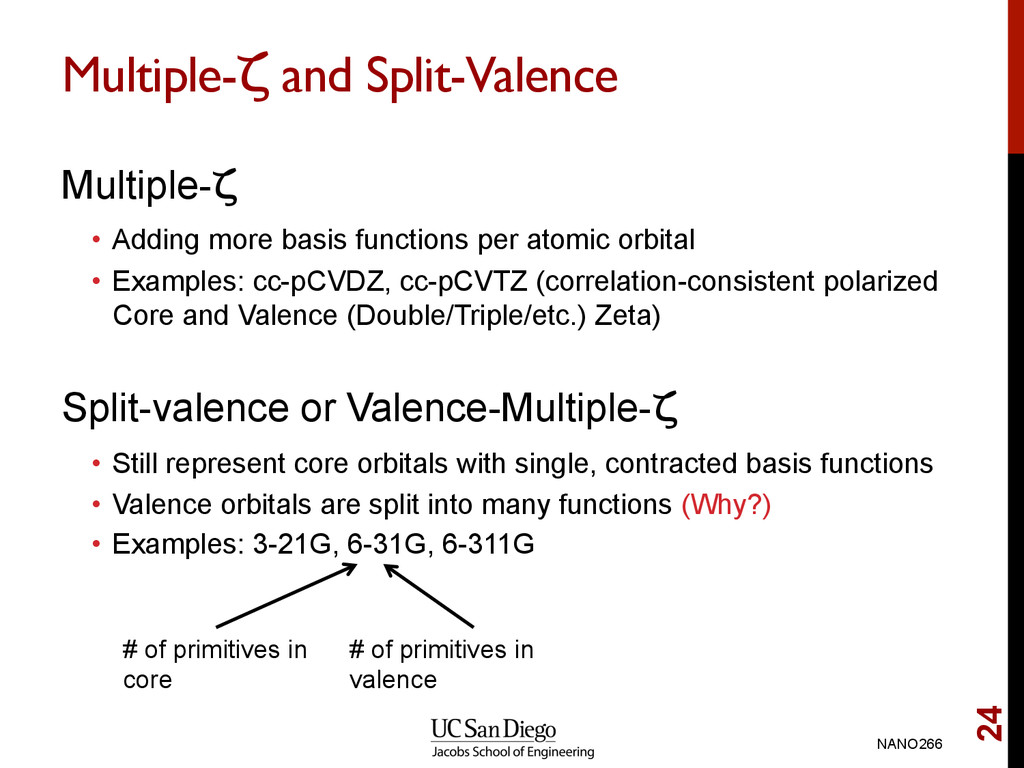
atomic orbital • Examples: cc-pCVDZ, cc-pCVTZ (correlation-consistent polarized Core and Valence (Double/Triple/etc.) Zeta) Split-valence or Valence-Multiple-ζ • Still represent core orbitals with single, contracted basis functions • Valence orbitals are split into many functions (Why?) • Examples: 3-21G, 6-31G, 6-311G NANO266 24 # of primitives in core # of primitives in valence
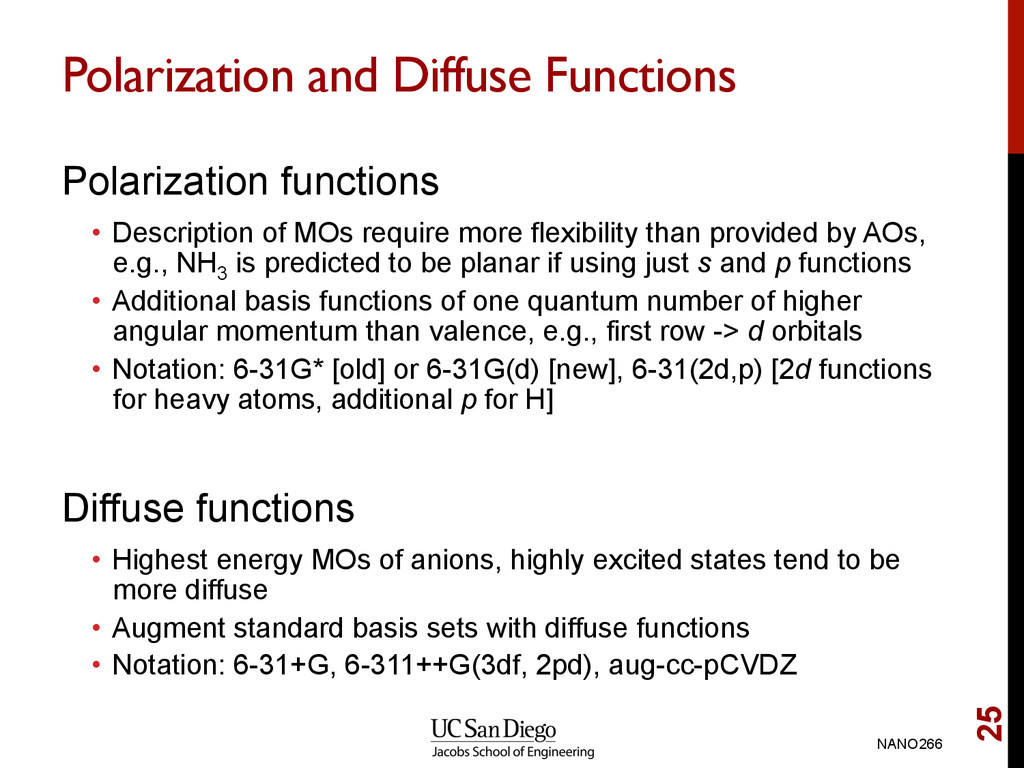
require more flexibility than provided by AOs, e.g., NH3 is predicted to be planar if using just s and p functions • Additional basis functions of one quantum number of higher angular momentum than valence, e.g., first row -> d orbitals • Notation: 6-31G* [old] or 6-31G(d) [new], 6-31(2d,p) [2d functions for heavy atoms, additional p for H] Diffuse functions • Highest energy MOs of anions, highly excited states tend to be more diffuse • Augment standard basis sets with diffuse functions • Notation: 6-31+G, 6-311++G(3df, 2pd), aug-cc-pCVDZ NANO266 25
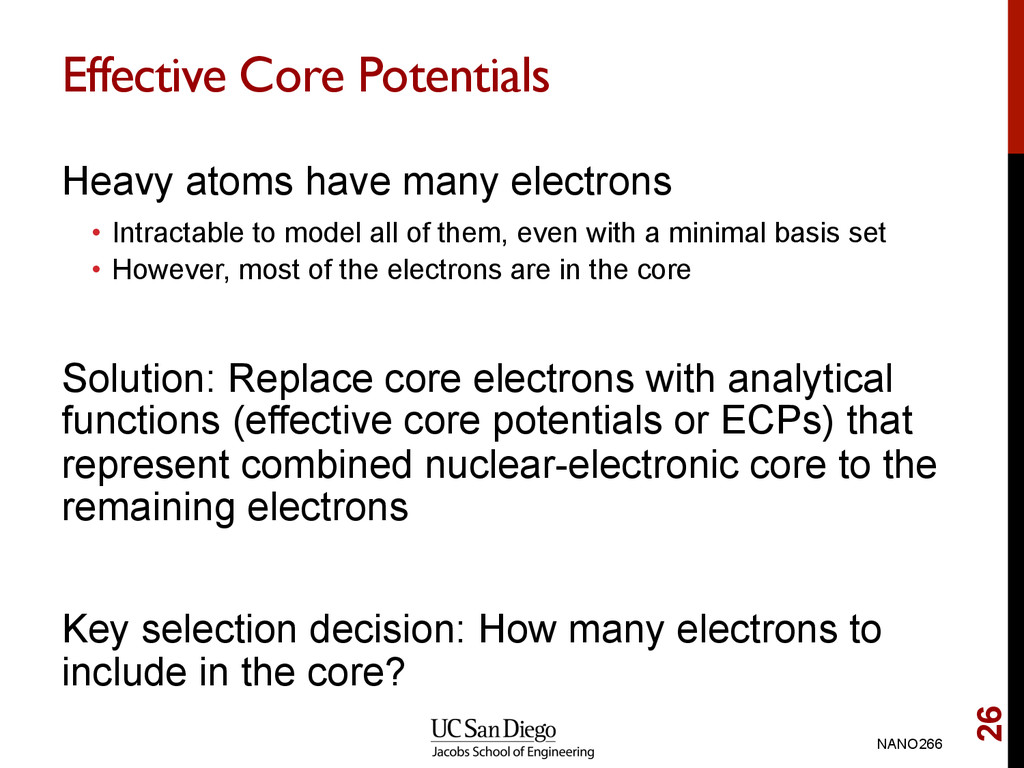
to model all of them, even with a minimal basis set • However, most of the electrons are in the core Solution: Replace core electrons with analytical functions (effective core potentials or ECPs) that represent combined nuclear-electronic core to the remaining electrons Key selection decision: How many electrons to include in the core? NANO266 26
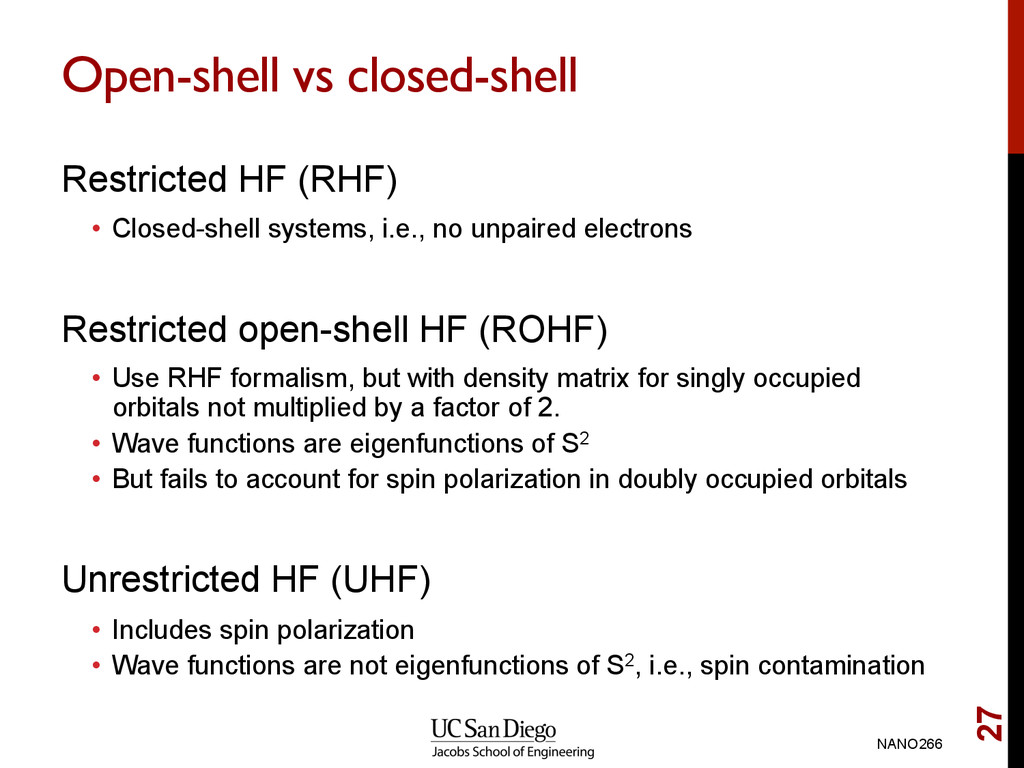
no unpaired electrons Restricted open-shell HF (ROHF) • Use RHF formalism, but with density matrix for singly occupied orbitals not multiplied by a factor of 2. • Wave functions are eigenfunctions of S2 • But fails to account for spin polarization in doubly occupied orbitals Unrestricted HF (UHF) • Includes spin polarization • Wave functions are not eigenfunctions of S2, i.e., spin contamination NANO266 27
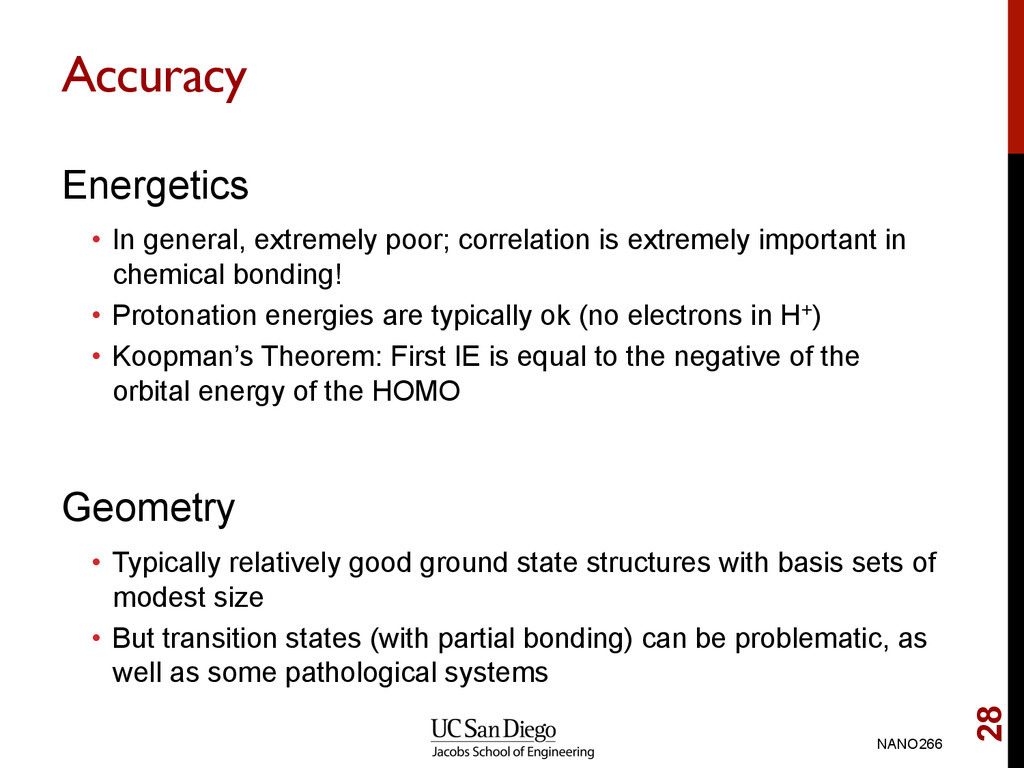
important in chemical bonding! • Protonation energies are typically ok (no electrons in H+) • Koopman’s Theorem: First IE is equal to the negative of the orbital energy of the HOMO Geometry • Typically relatively good ground state structures with basis sets of modest size • But transition states (with partial bonding) can be problematic, as well as some pathological systems NANO266 28
achieved through: • Symmetry • Estimating upper bounds to four-index integrals • Fast multipole and linear exchange integral computations For practical geometry optimizations, frequently helps to first compute geometry with a smaller basis set to provide a better initial geometry and a guess for the Hessian matrix. NANO266 29


 shyuep
 yatabe
 kenichiota0711
 juanmartin2026
 aokiplayer
 3l4l5
3l4l5
 akiraasano
 bvr7352
 matshogo
 mariooc
 rkendrick25
 ipullrank
 3n
3n
 marcelosomers
 lauravandoore
 aarron
.jpg) cargoodrich
cargoodrich
 lara
lara
 kneath
 ryanjones
 letsgokoyo
 stephenakadiri