Share
Embed
Spatial Active Noise Control Based on Sound Field Interpolation Incorporating Physical Constraints
Keynote speech at IN-NOVA Days 2026
NII S. Koyama's Lab
April 29, 2026
Transcript
30 slides
-
Spatial Active Noise Control Based on Sound Field Interpolation Incorporating
Physical Constraints Shoichi Koyama National Institute of Informatics, Japan -
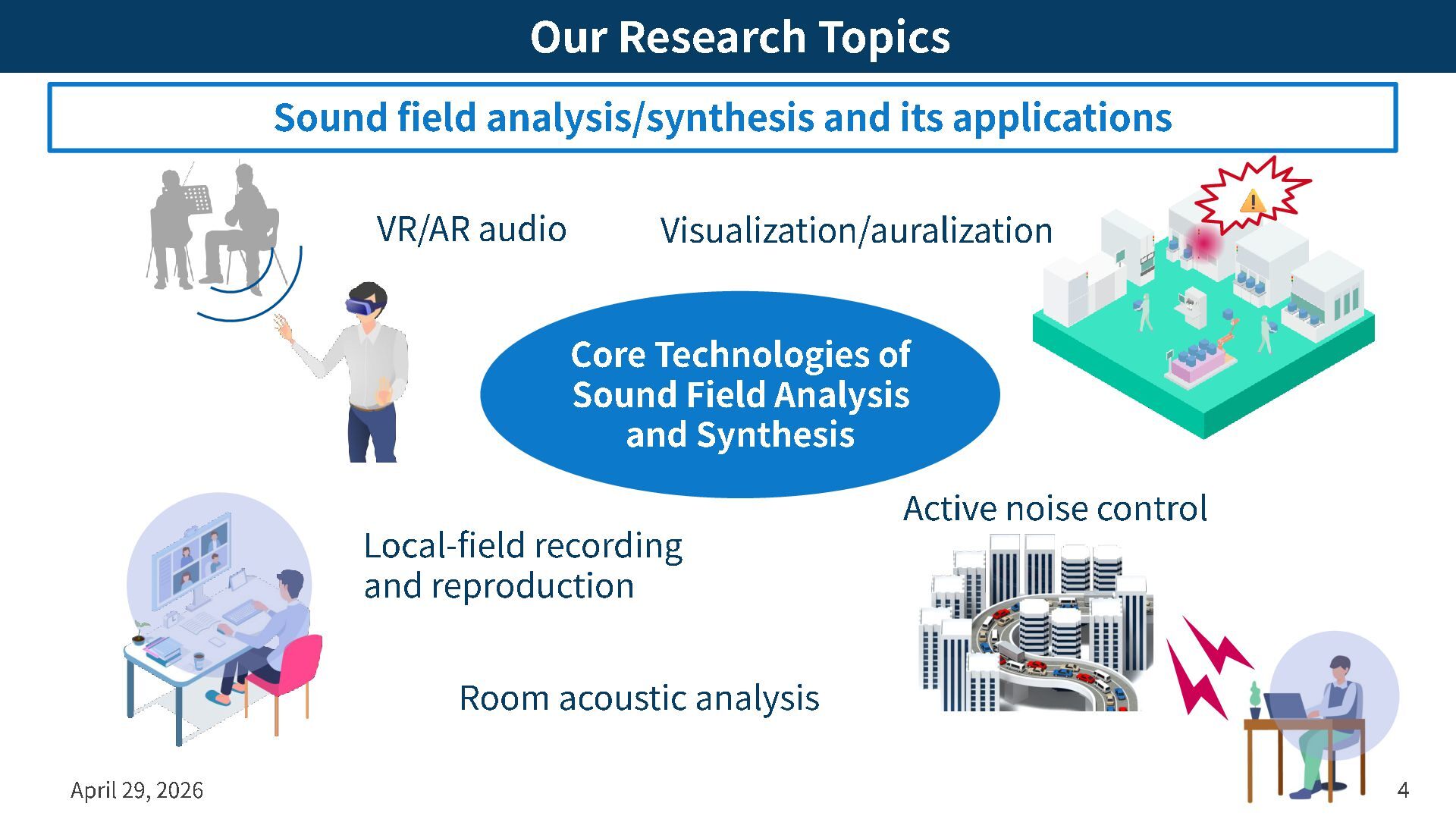
April 29, 2026 4 VR/AR audio Active noise control Local
-field recording and reproduction Visualization/auralization Room acoustic analysis Our Research Topics Sound field analysis/synthesis and its applications Core Technologies of Sound Field Analysis and Synthesis -
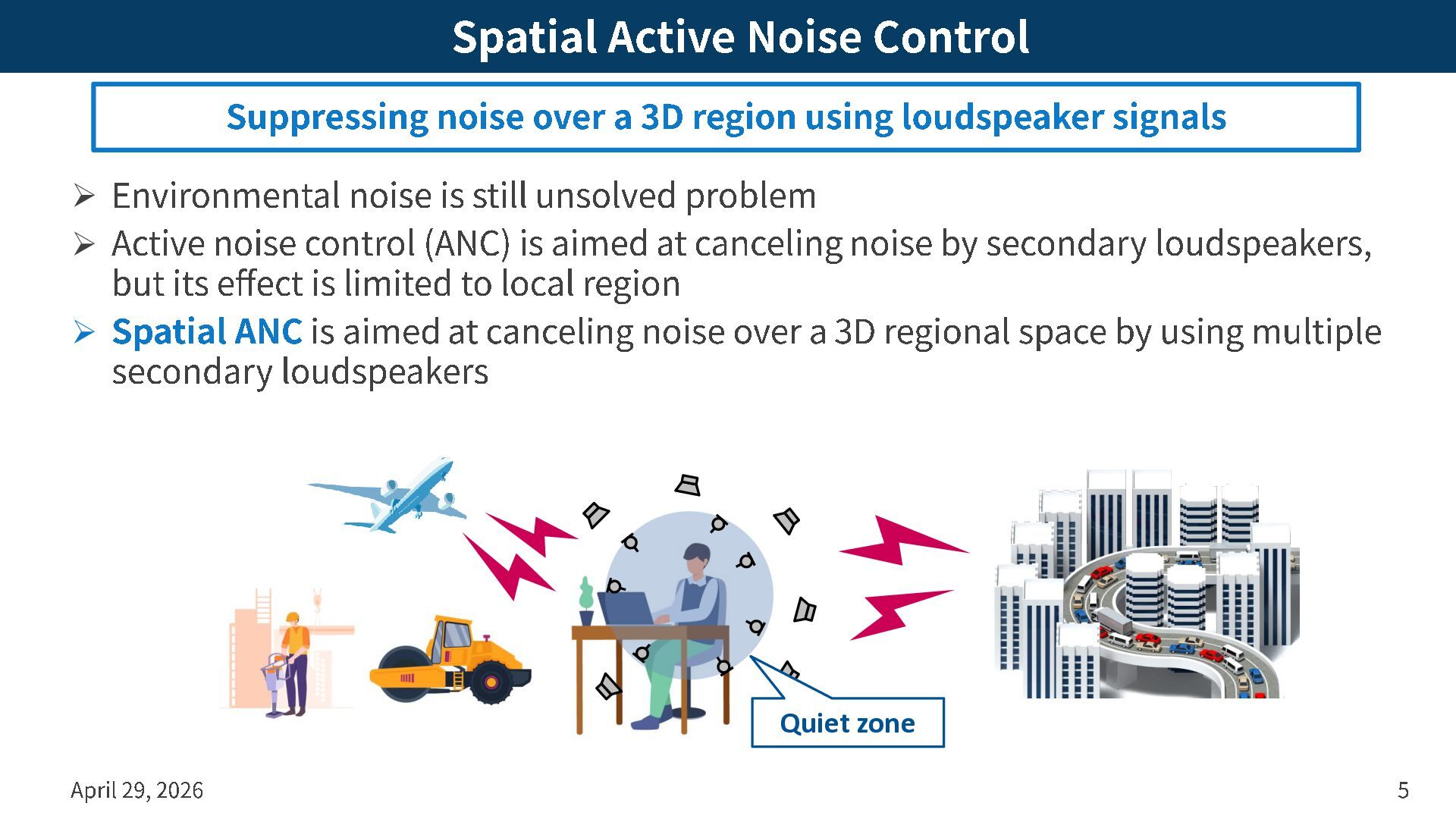
Spatial Active Noise Control ➢ Environmental noise is still unsolved
problem ➢ Active noise control (ANC) is aimed at canceling noise by secondary loudspeakers, but its effect is limited to local region ➢ Spatial ANC is aimed at canceling noise over a 3D regional space by using multiple secondary loudspeakers April 29, 2026 5 Suppressing noise over a 3D region using loudspeaker signals Quiet zone -
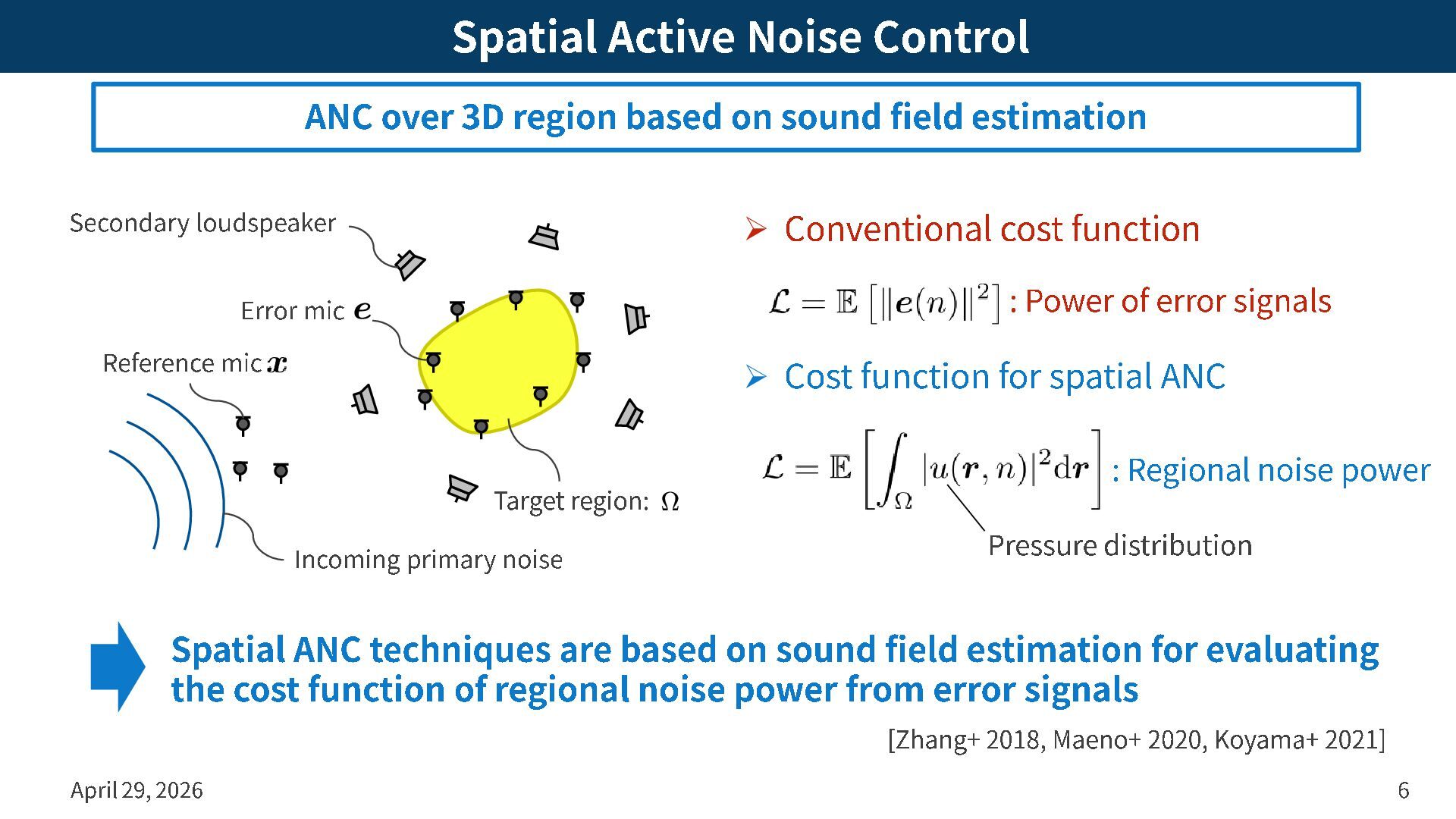
Spatial Active Noise Control April 29, 2026 6 ANC over
3D region based on sound field estimation ➢ Conventional cost function ➢ Cost function for spatial ANC : Power of error signals : Regional noise power Error mic Secondary loudspeaker Incoming primary noise Reference mic Target region: Spatial ANC techniques are based on sound field estimation for evaluating the cost function of regional noise power from error signals [Zhang+ 2018, Maeno+ 2020, Koyama+ 2021] Pressure distribution -
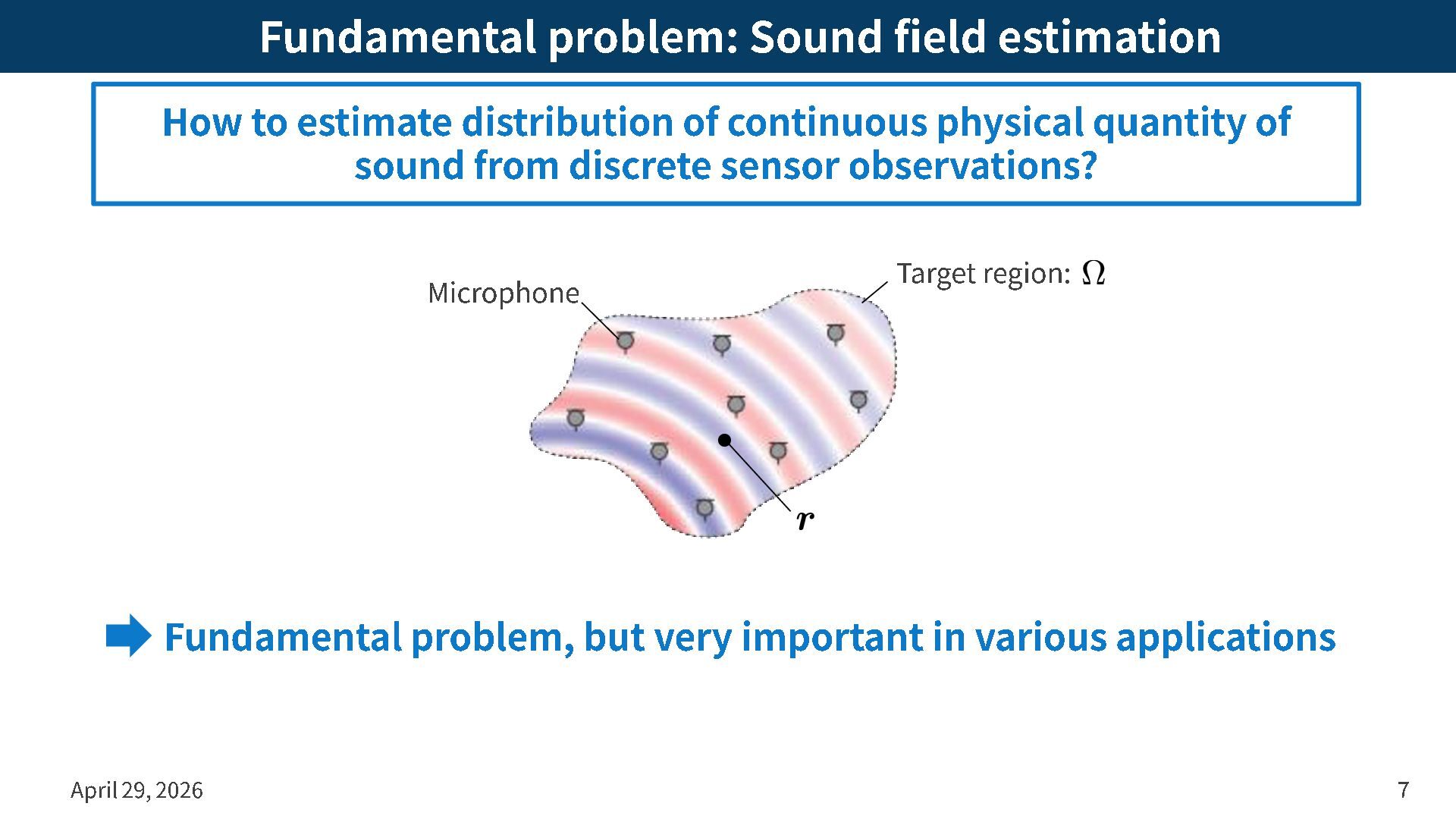
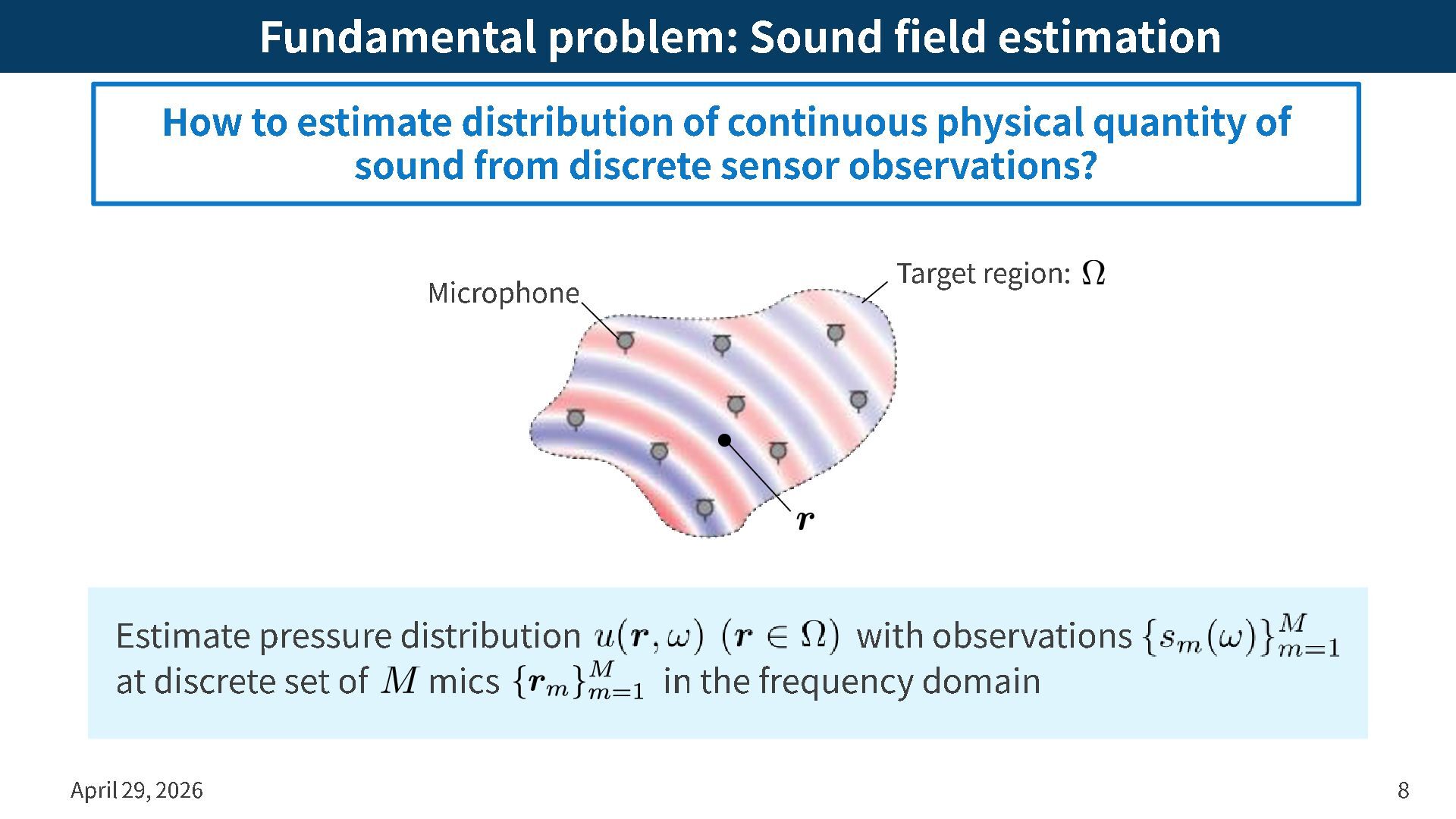
Fundamental problem: Sound field estimation April 29, 2026 7 How
to estimate distribution of continuous physical quantity of sound from discrete sensor observations? Target region: Microphone Fundamental problem, but very important in various applications -
Fundamental problem: Sound field estimation April 29, 2026 8 How
to estimate distribution of continuous physical quantity of sound from discrete sensor observations? Estimate pressure distribution with observations at discrete set of mics in the frequency domain Target region: Microphone -
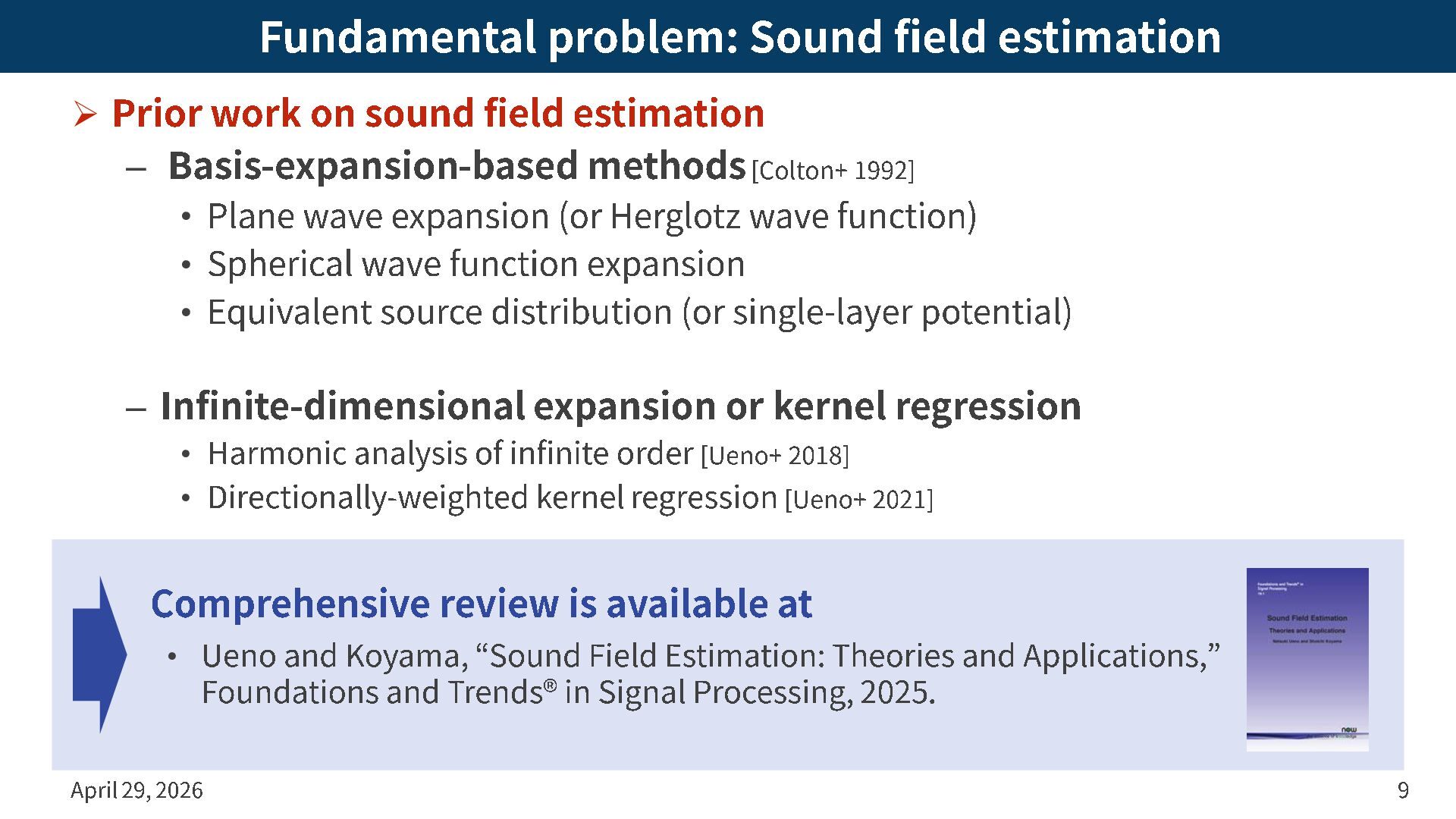
Fundamental problem: Sound field estimation ➢ Prior work on sound
field estimation – Basis -expansion -based methods [Colton+ 1992] • Plane wave expansion (or Herglotz wave function) • Spherical wave function expansion • Equivalent source distribution (or single -layer potential) – Infinite -dimensional expansion or kernel regression • Harmonic analysis of infinite order [Ueno+ 2018] • Directionally -weighted kernel regression [Ueno+ 2021] April 29, 2026 9 Comprehensive review is available at • Ueno and Koyama, “Sound Field Estimation: Theories and Applications, ” Foundations and Trends ®️ in Signal Processing, 2025 . -
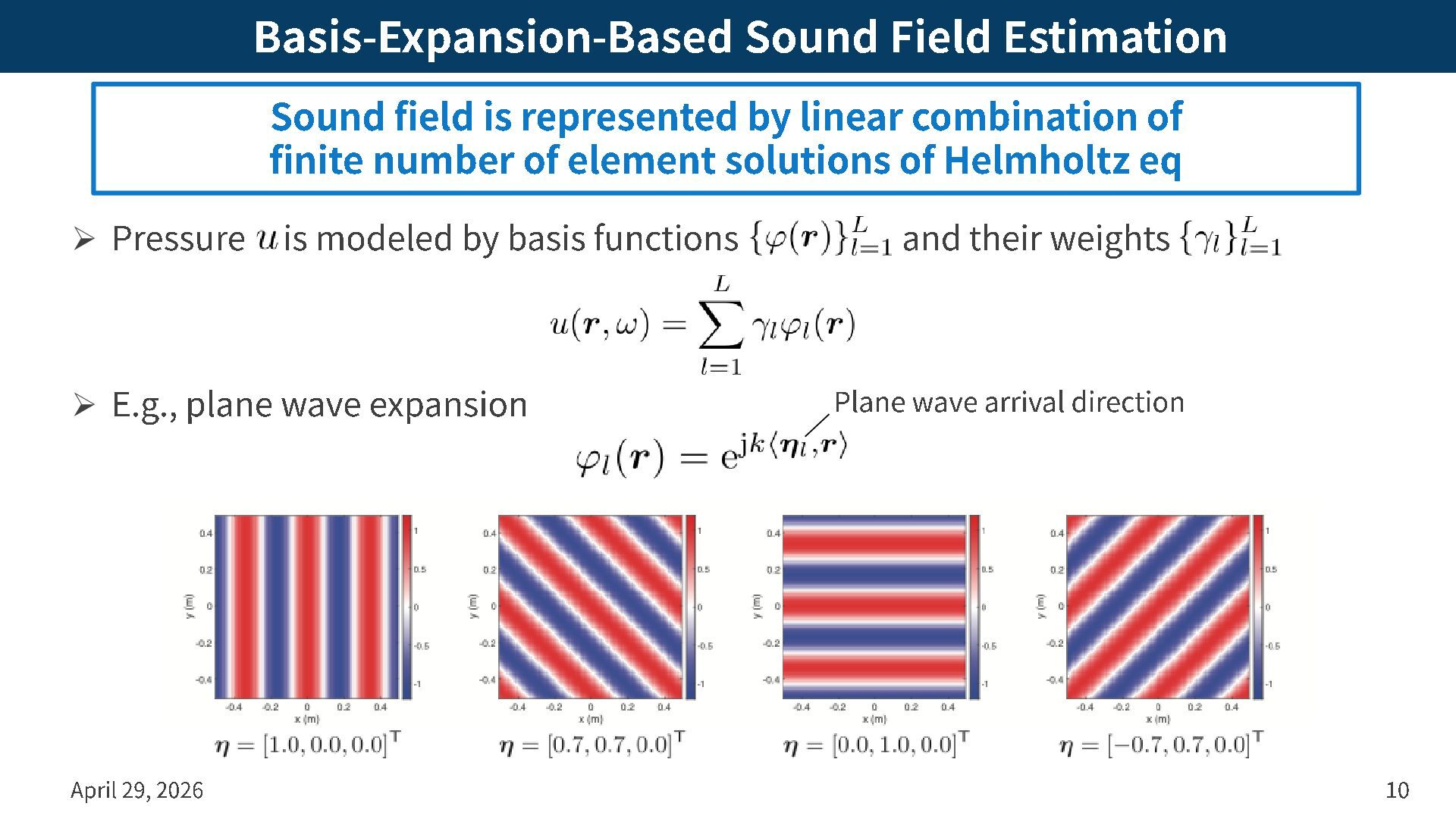
Basis -Expansion -Based Sound Field Estimation ➢ Pressure is modeled
by basis functions and their weights ➢ E.g., plane wave expansion April 29, 2026 10 Sound field is represented by linear combination of finite number of element solutions of Helmholtz eq Plane wave arrival direction -
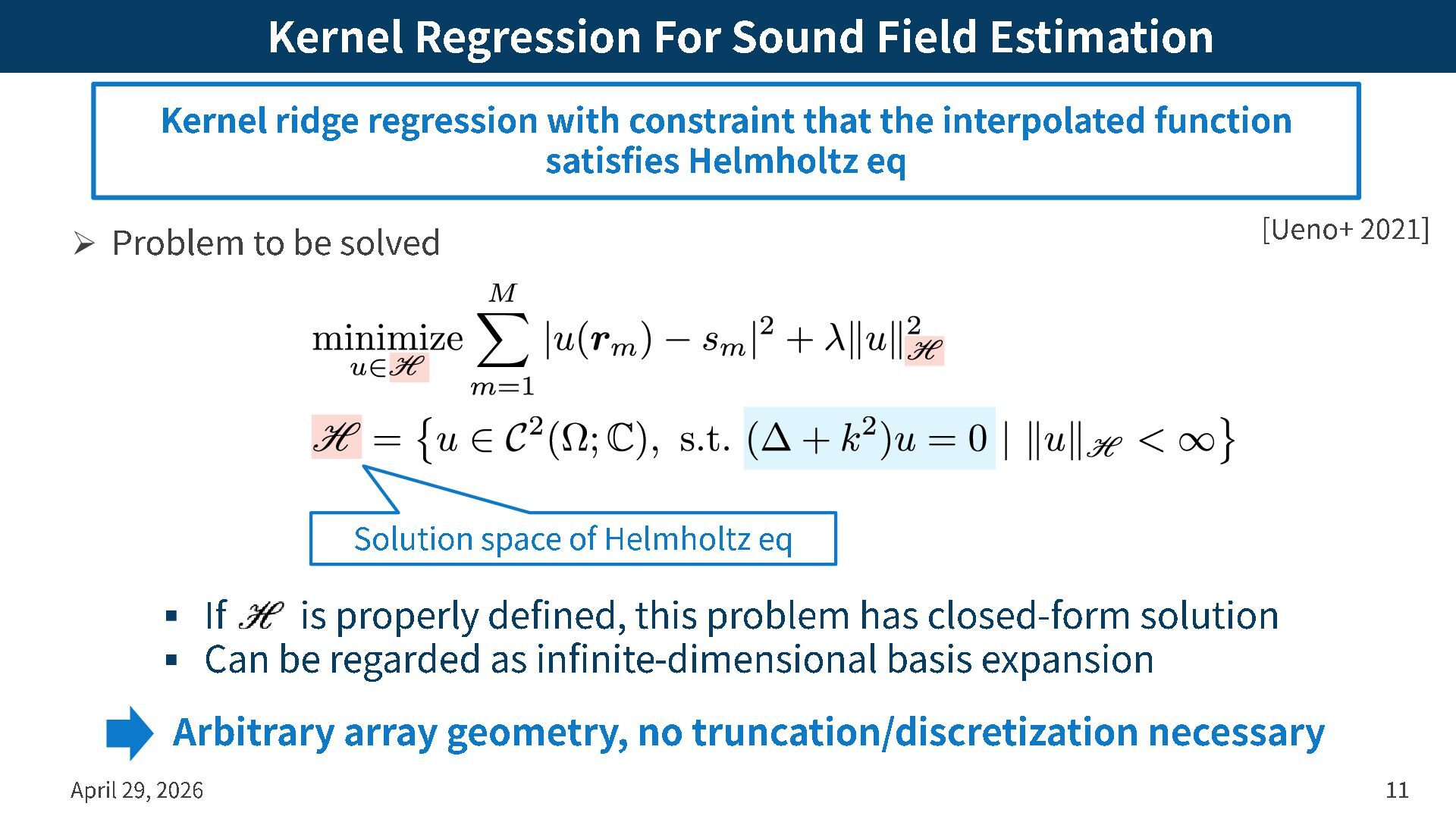
Kernel Regression For Sound Field Estimation ➢ Problem to be
solved April 29, 2026 11 Kernel ridge regression with constraint that the interpolated function satisfies Helmholtz eq [Ueno+ 2021] Arbitrary array geometry, no truncation/discretization necessary ▪ If is properly defined, this problem has closed -form solution ▪ Can be regarded as infinite -dimensional basis expansion Solution space of Helmholtz eq -
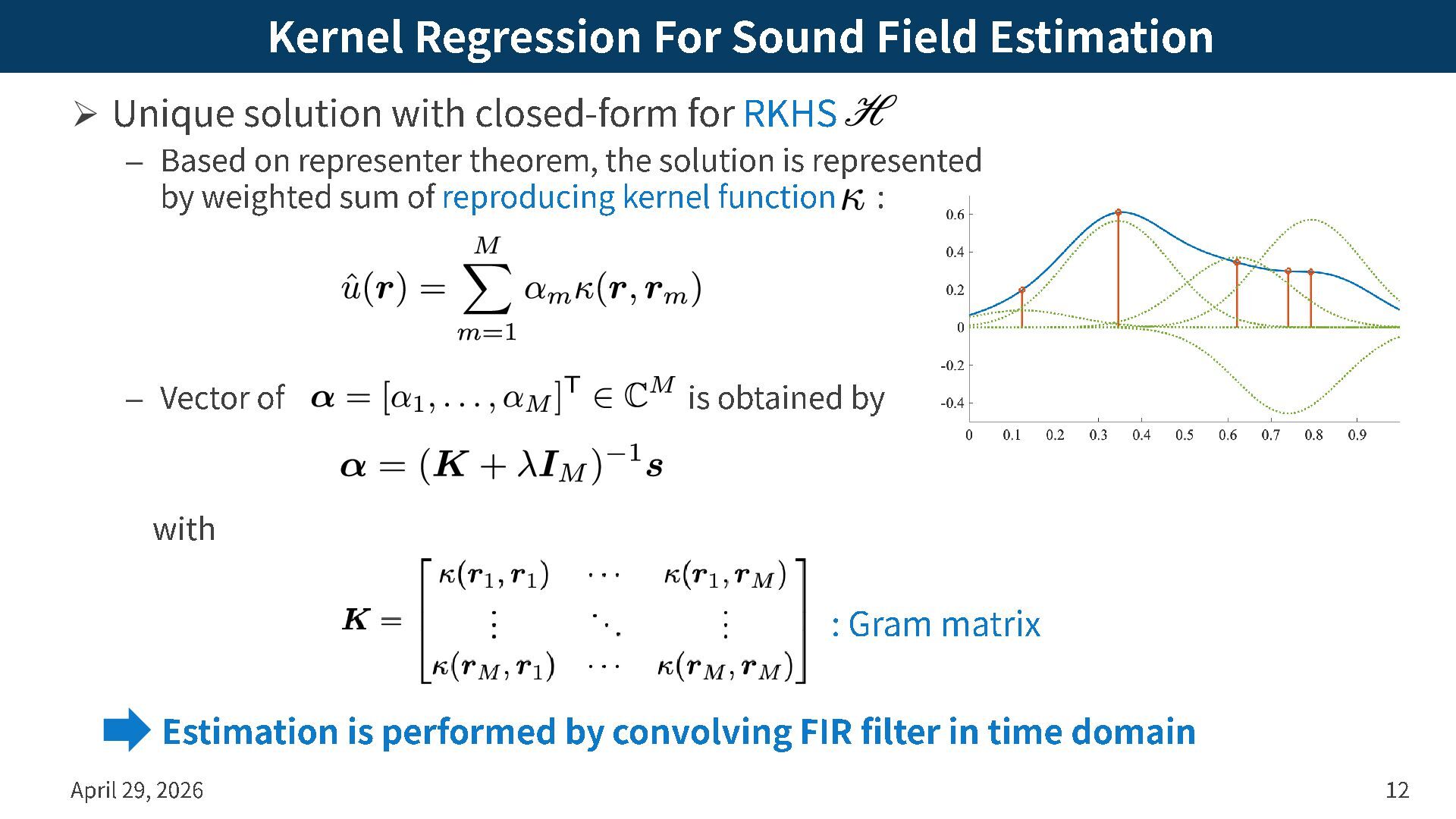
Kernel Regression For Sound Field Estimation ➢ Unique solution with
closed -form for RKHS – Based on representer theorem , the solution is represented by weighted sum of reproducing kernel function : – Vector of is obtained by with April 29, 2026 12 Estimation is performed by convolving FIR filter in time domain : Gram matrix -
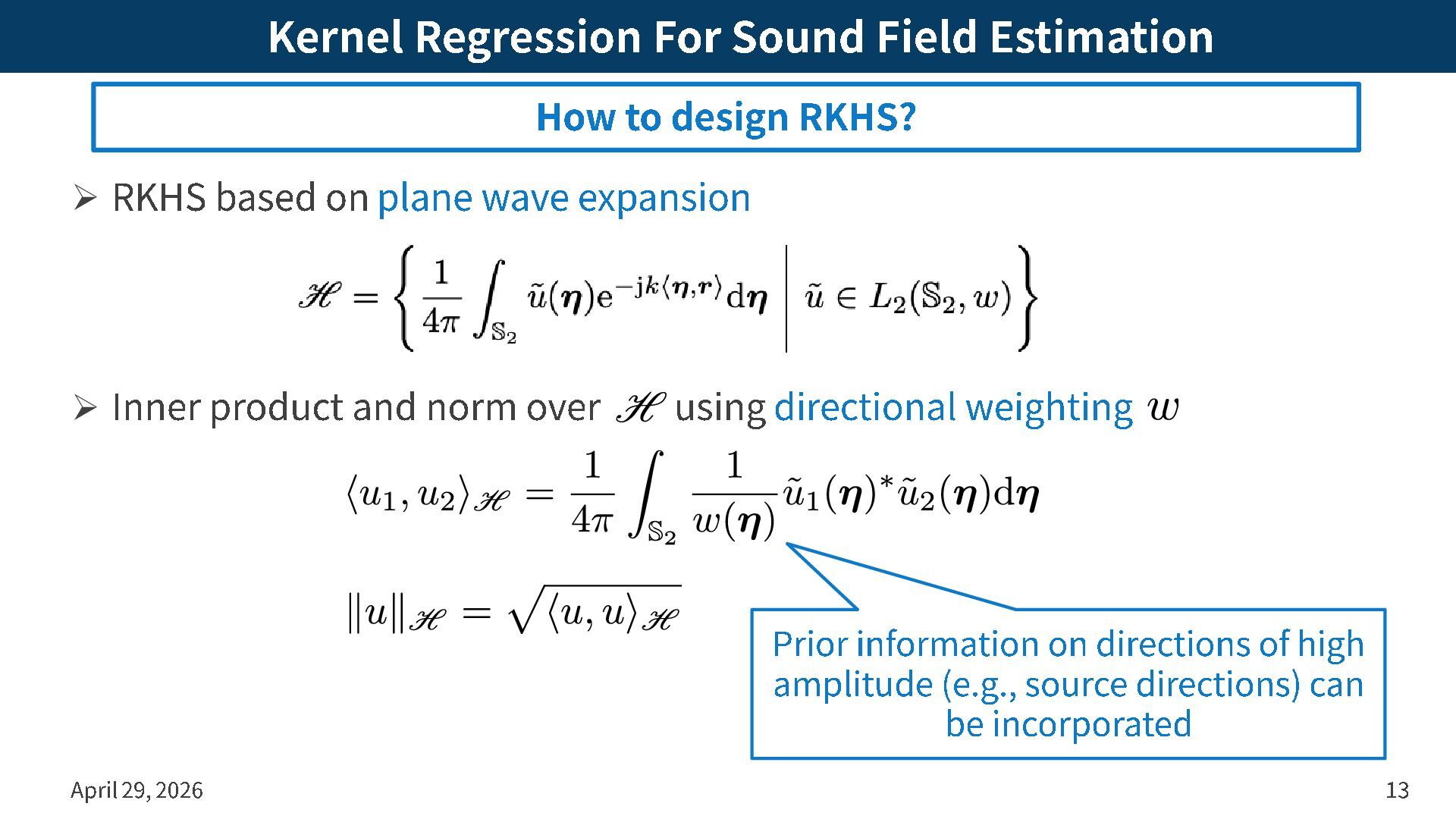
Kernel Regression For Sound Field Estimation ➢ RKHS based on
plane wave expansion ➢ Inner product and norm over using directional weighting April 29, 2026 13 How to design RKHS? Prior information on directions of high amplitude (e.g., source directions) can be incorporated -
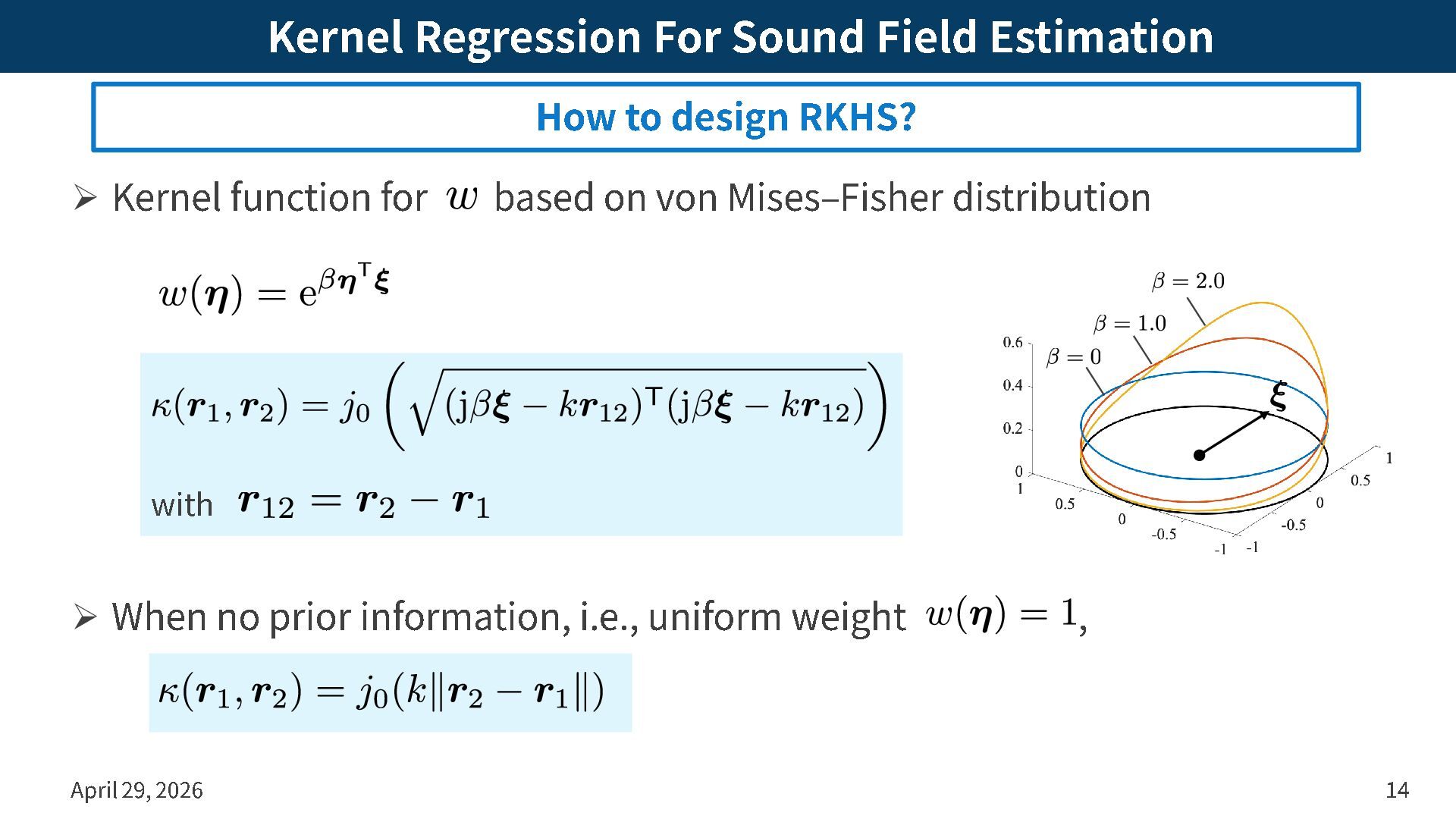
Kernel Regression For Sound Field Estimation ➢ Kernel function for
based on von Mises –Fisher distribution ➢ When no prior information, i.e., uniform weight , April 29, 2026 14 How to design RKHS? with -
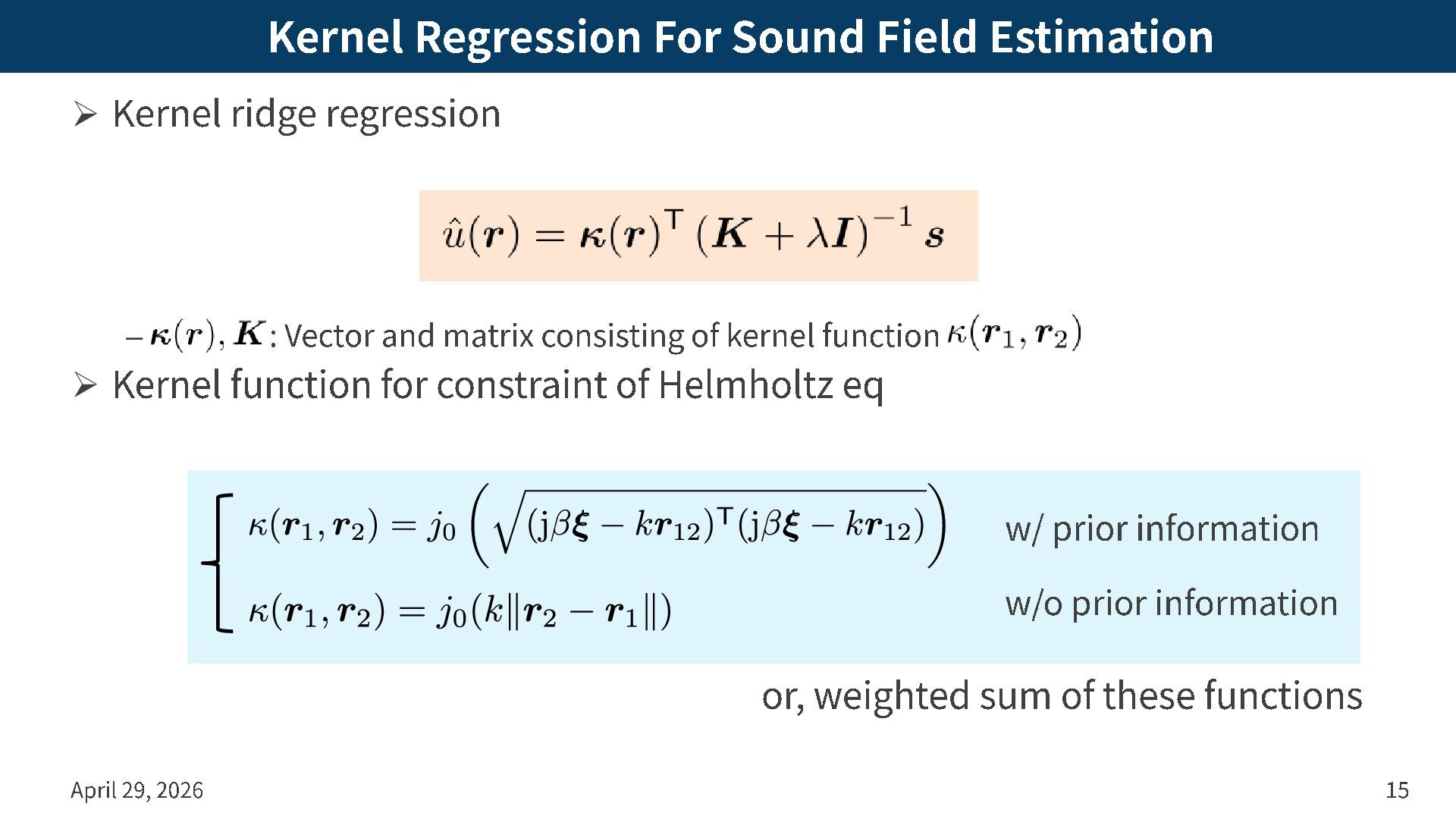
Kernel Regression For Sound Field Estimation ➢ Kernel ridge regression
– : Vector and matrix consisting of kernel function ➢ Kernel function for constraint of Helmholtz eq April 29, 2026 15 w/ prior information w/o prior information or, weighted sum of these functions -
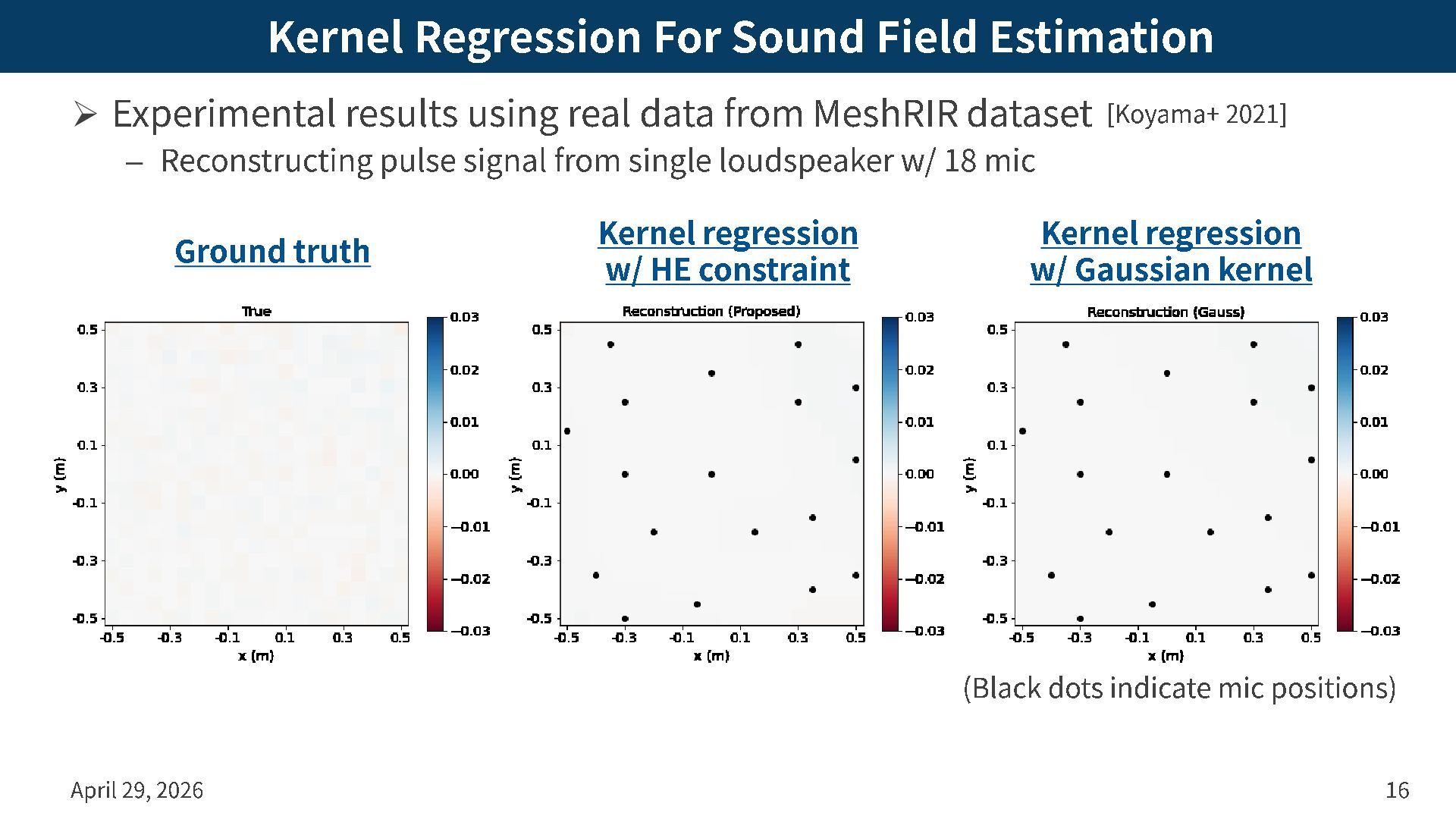
Kernel Regression For Sound Field Estimation ➢ Experimental results using
real data from MeshRIR dataset – Reconstructing pulse signal from single loudspeaker w/ 18 mic April 29, 2026 16 Ground truth Kernel regression w/ HE constraint Kernel regression w/ Gaussian kernel (Black dots indicate mic positions) [Koyama+ 2021] -
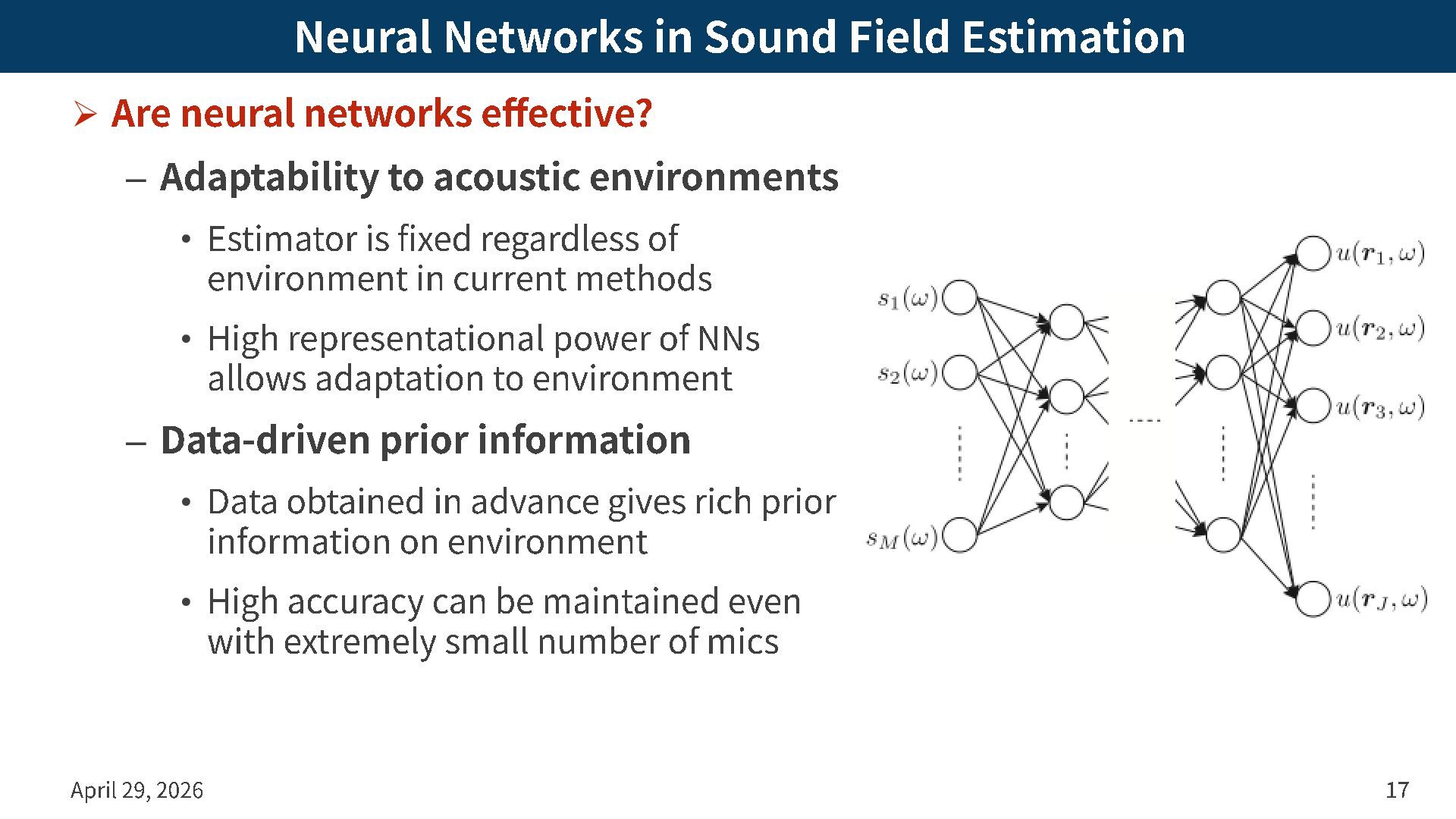
Neural Networks in Sound Field Estimation ➢ Are neural networks
effective? – Adaptability to acoustic environments • Estimator is fixed regardless of environment in current methods • High representational power of NNs allows adaptation to environment – Data -driven prior information • Data obtained in advance gives rich prior information on environment • High accuracy can be maintained even with extremely small number of mics April 29, 2026 17 -
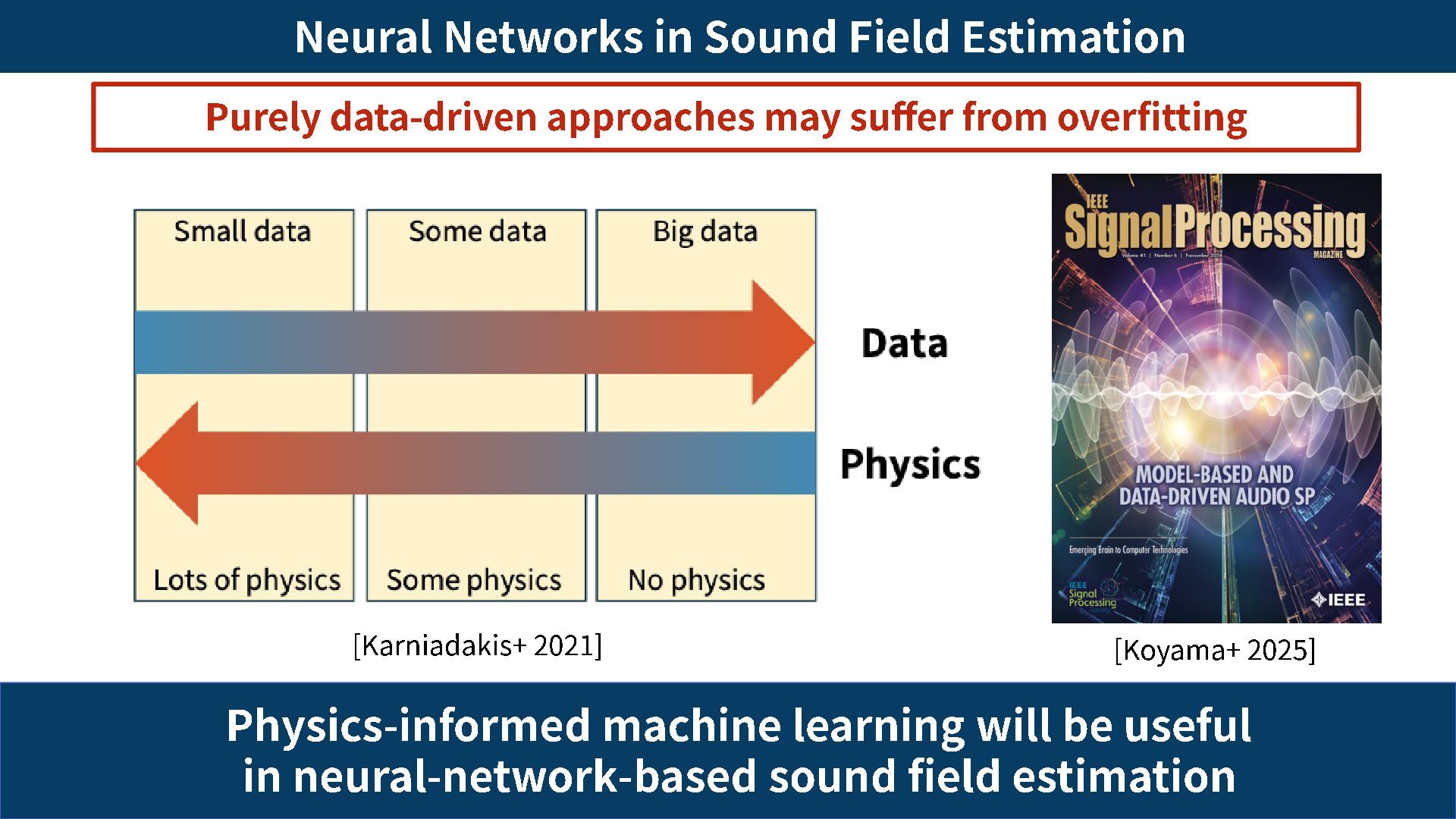
Neural Networks in Sound Field Estimation April 29, 2026 18
Purely data -driven approaches may suffer from overfitting [Karniadakis+ 2021] [Koyama+ 2025] Physics -informed machine learning will be useful in neural -network -based sound field estimation -
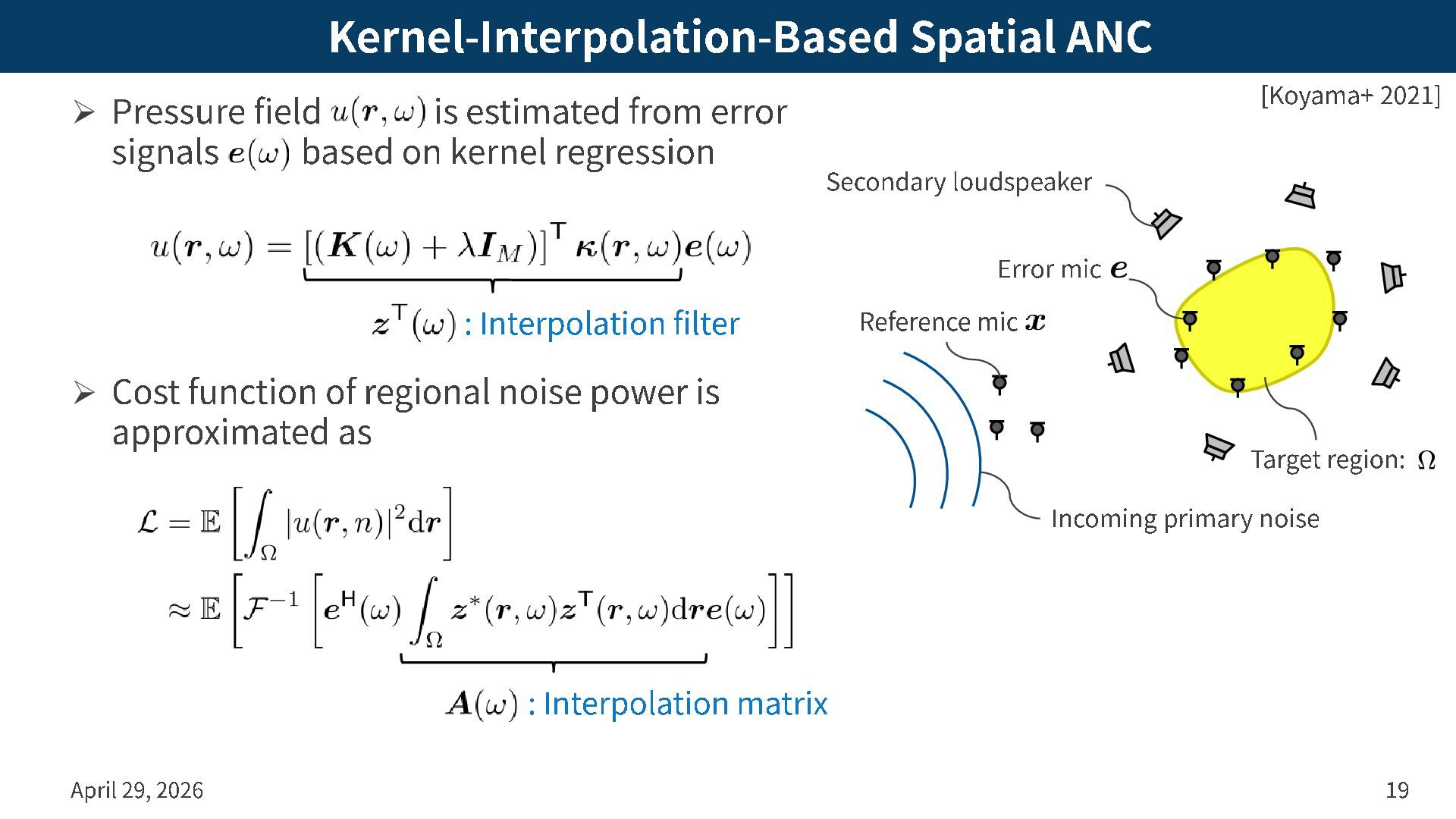
Kernel -Interpolation -Based Spatial ANC ➢ Pressure field is estimated
from error signals based on kernel regression ➢ Cost function of regional noise power is approximated as April 29, 2026 19 : Interpolation filter : Interpolation matrix [Koyama+ 2021] Error mic Secondary loudspeaker Incoming primary noise Reference mic Target region: -
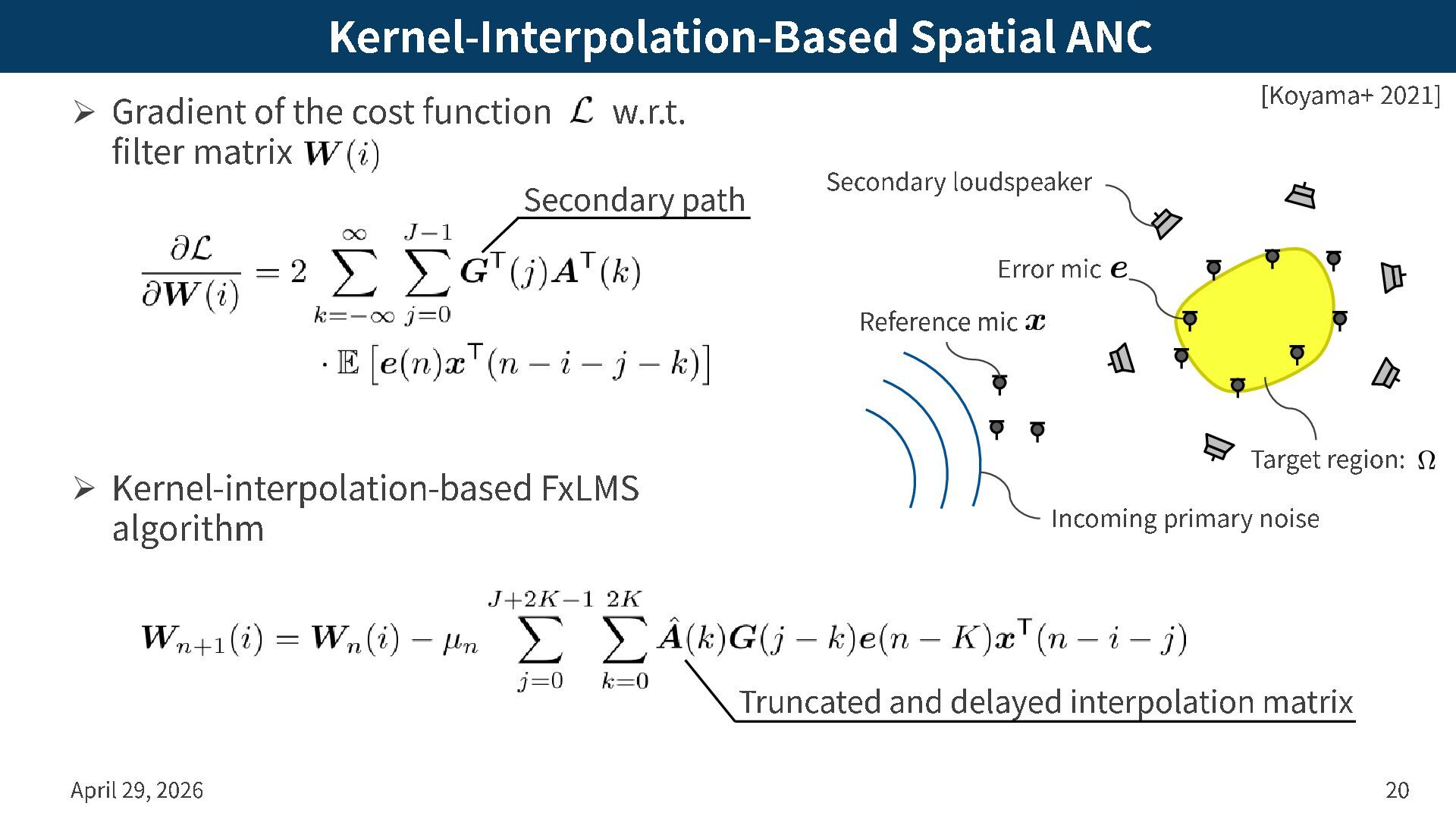
Kernel -Interpolation -Based Spatial ANC ➢ Gradient of the cost
function w.r.t. filter matrix ➢ Kernel -interpolation -based FxLMS algorithm April 29, 2026 20 Error mic Secondary loudspeaker Incoming primary noise Reference mic Target region: Secondary path Truncated and delayed interpolation matrix [Koyama+ 2021] -
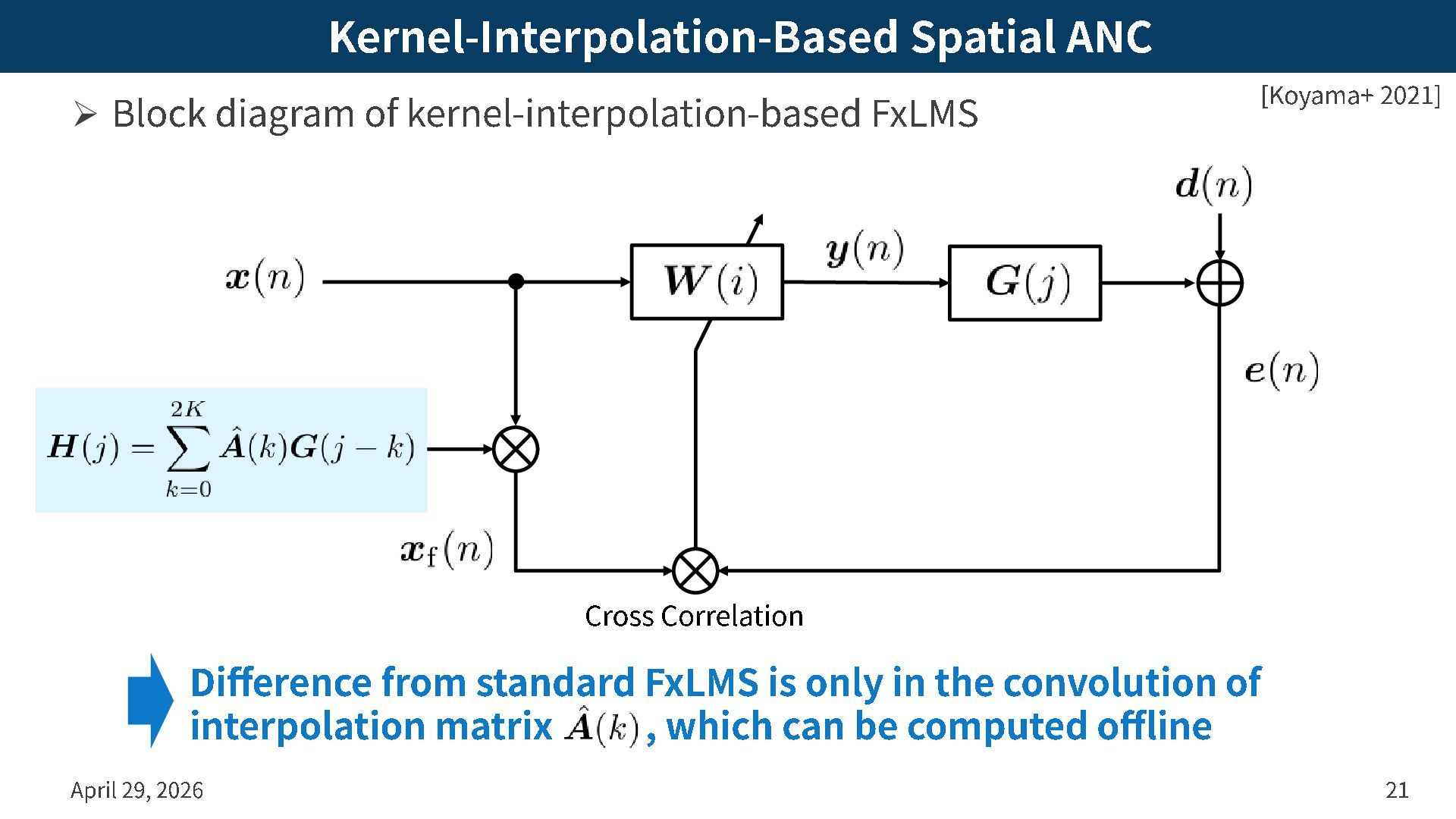
Kernel -Interpolation -Based Spatial ANC ➢ Block diagram of kernel
-interpolation -based FxLMS April 29, 2026 21 [Koyama+ 2021] Difference from standard FxLMS is only in the convolution of interpolation matrix , which can be computed offline Cross Correlation -
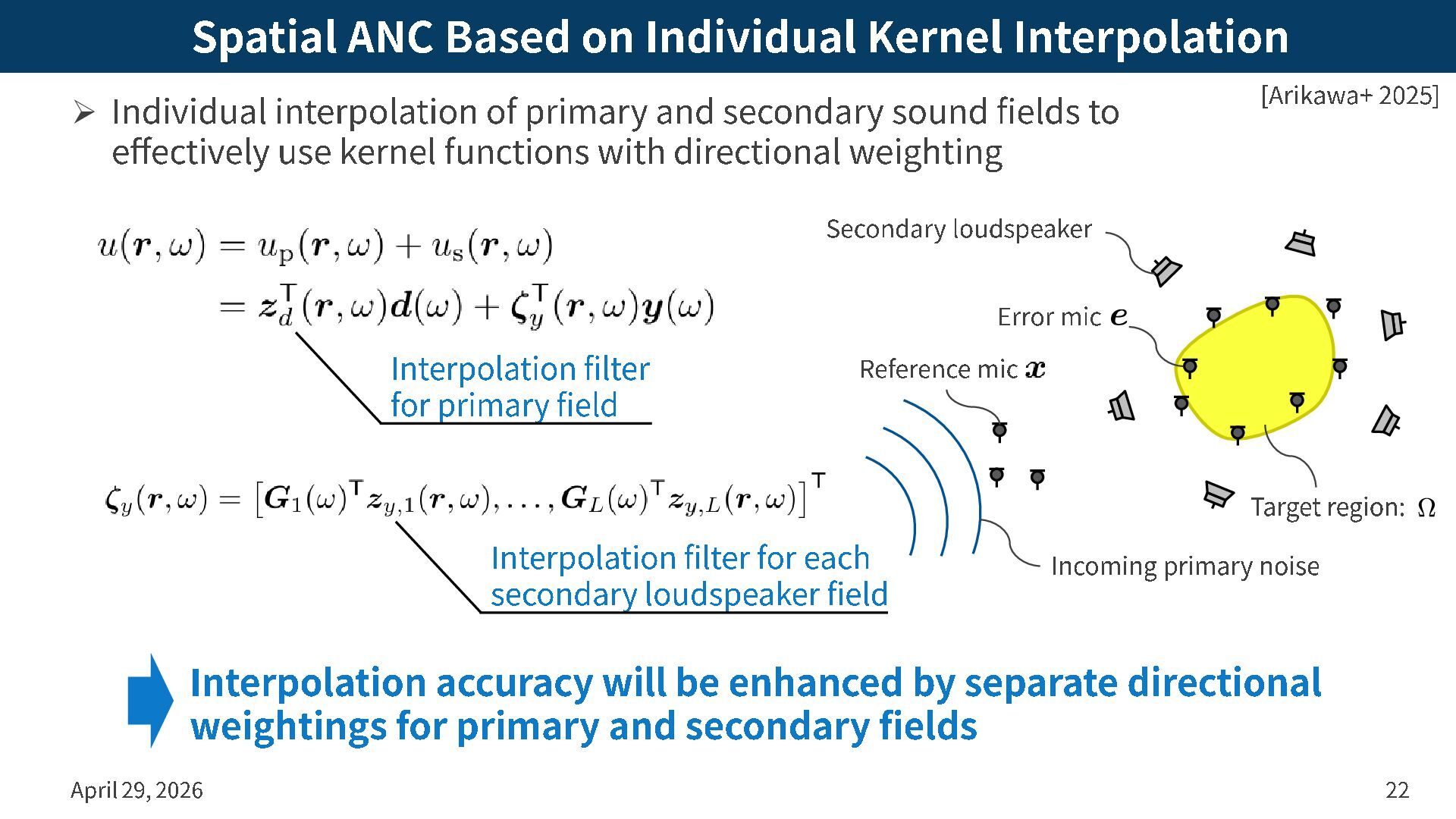
Spatial ANC Based on Individual Kernel Interpolation ➢ Individual interpolation
of primary and secondary sound fields to effectively use kernel functions with directional weighting April 29, 2026 22 [Arikawa+ 2025 ] Error mic Secondary loudspeaker Incoming primary noise Reference mic Target region: Interpolation accuracy will be enhanced by separate directional weightings for primary and secondary fields Interpolation filter for primary field Interpolation filter for each secondary loudspeaker field -
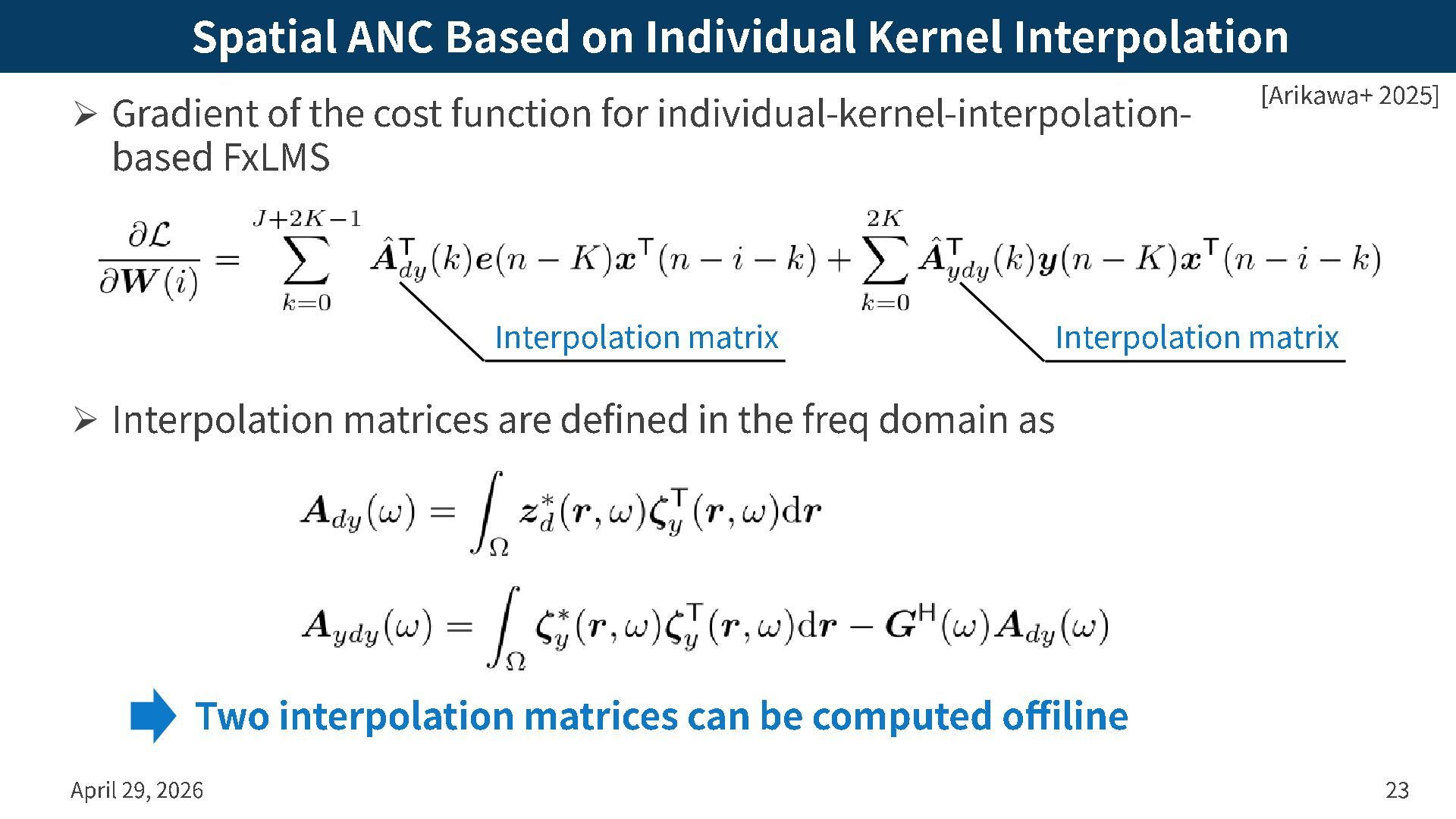
Spatial ANC Based on Individual Kernel Interpolation ➢ Gradient of
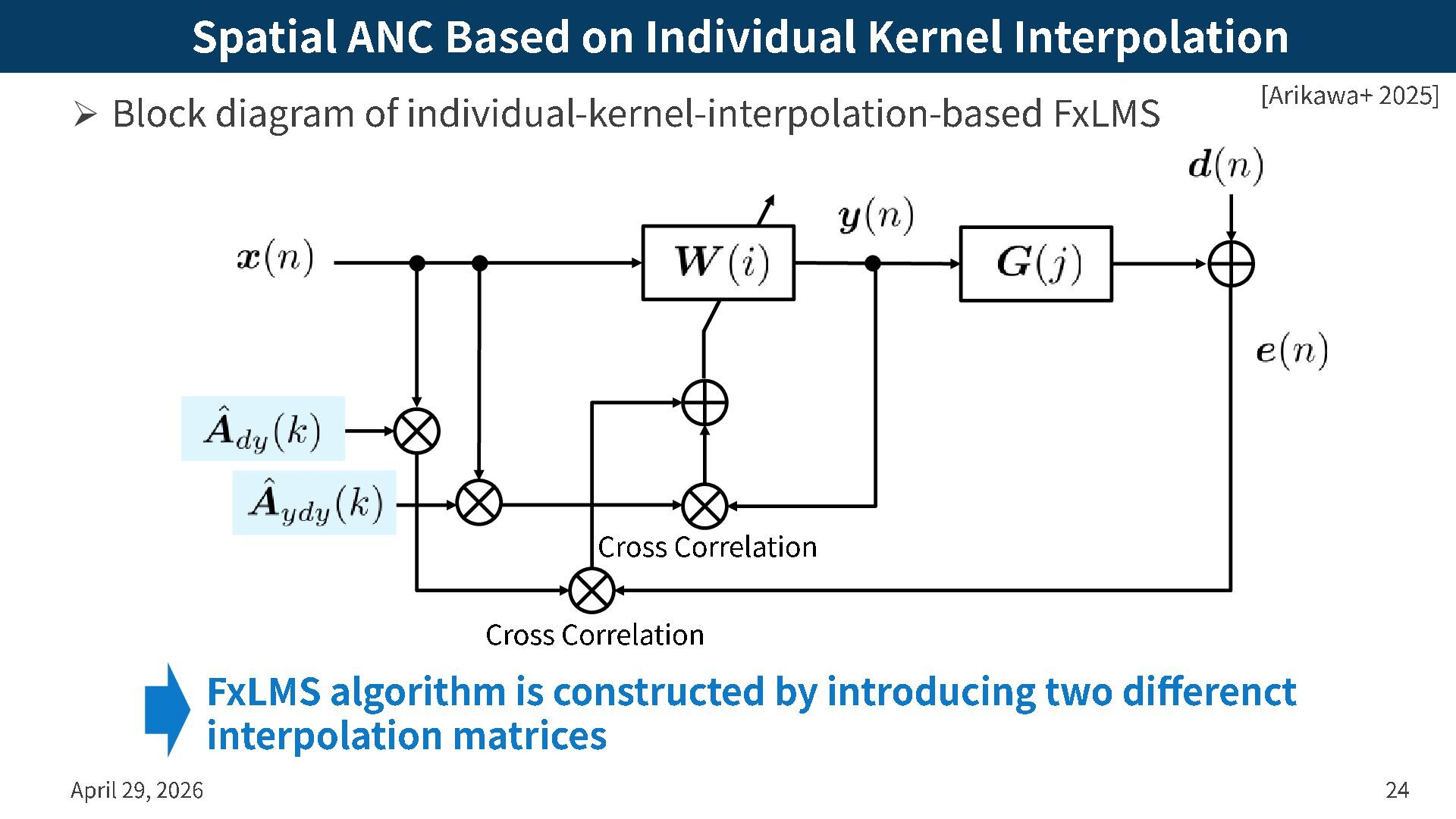
the cost function for individual -kernel -interpolation - based FxLMS ➢ Interpolation matrices are defined in the freq domain as April 29, 2026 23 [Arikawa+ 2025 ] Interpolation matrix Interpolation matrix Two interpolation matrices can be computed offiline -
Spatial ANC Based on Individual Kernel Interpolation ➢ Block diagram
of individual -kernel -interpolation -based FxLMS April 29, 2026 24 FxLMS algorithm is constructed by introducing two differenct interpolation matrices [Arikawa+ 2025 ] Cross Correlation Cross Correlation -
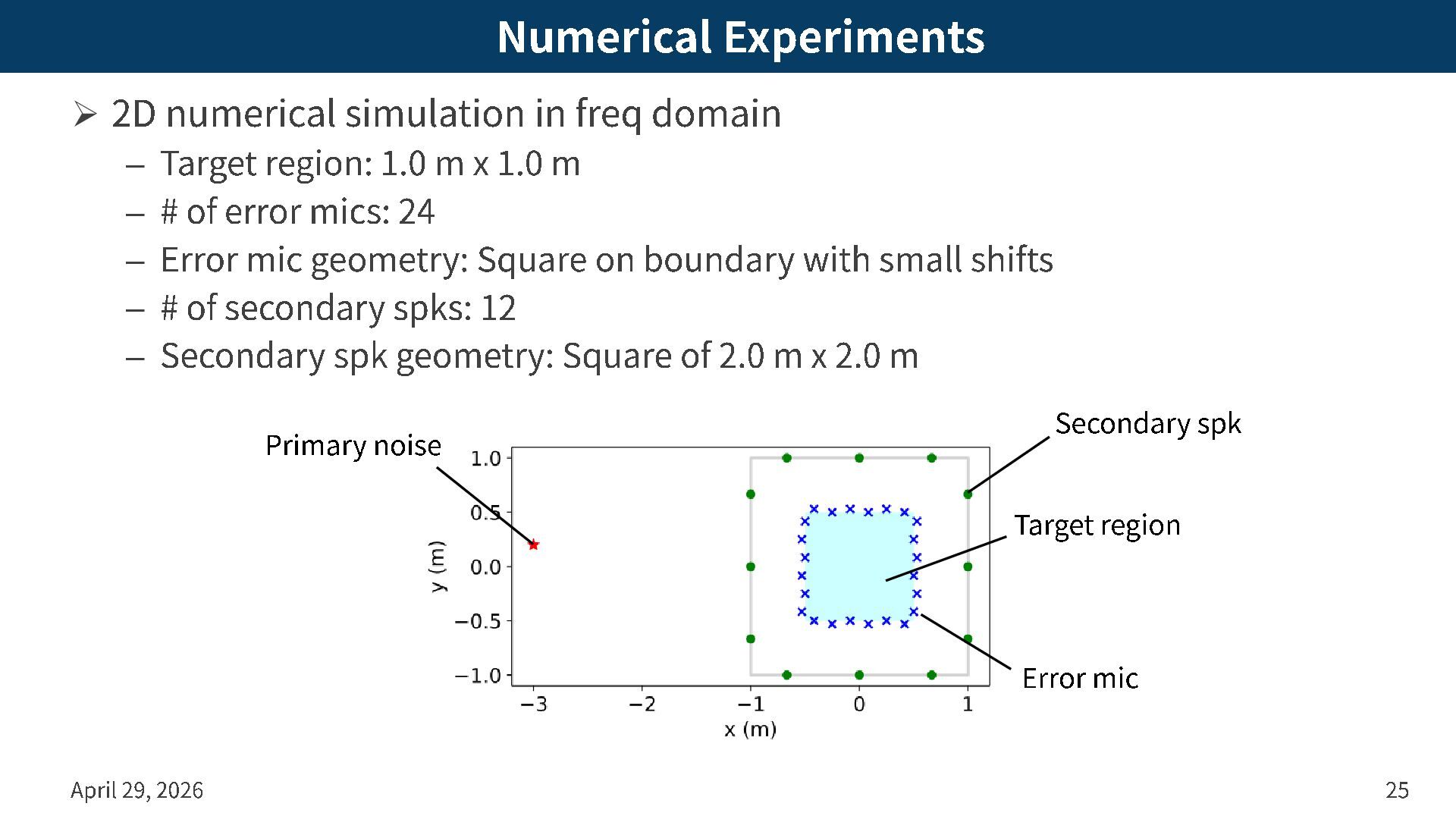
Numerical Experiments ➢ 2D numerical simulation in freq domain –
Target region: 1.0 m x 1.0 m – # of error mics: 24 – Error mic geometry: Square on boundary with small shifts – # of secondary spks: 12 – Secondary spk geometry: Square of 2.0 m x 2.0 m April 29, 2026 25 Primary noise Secondary spk Error mic Target region -
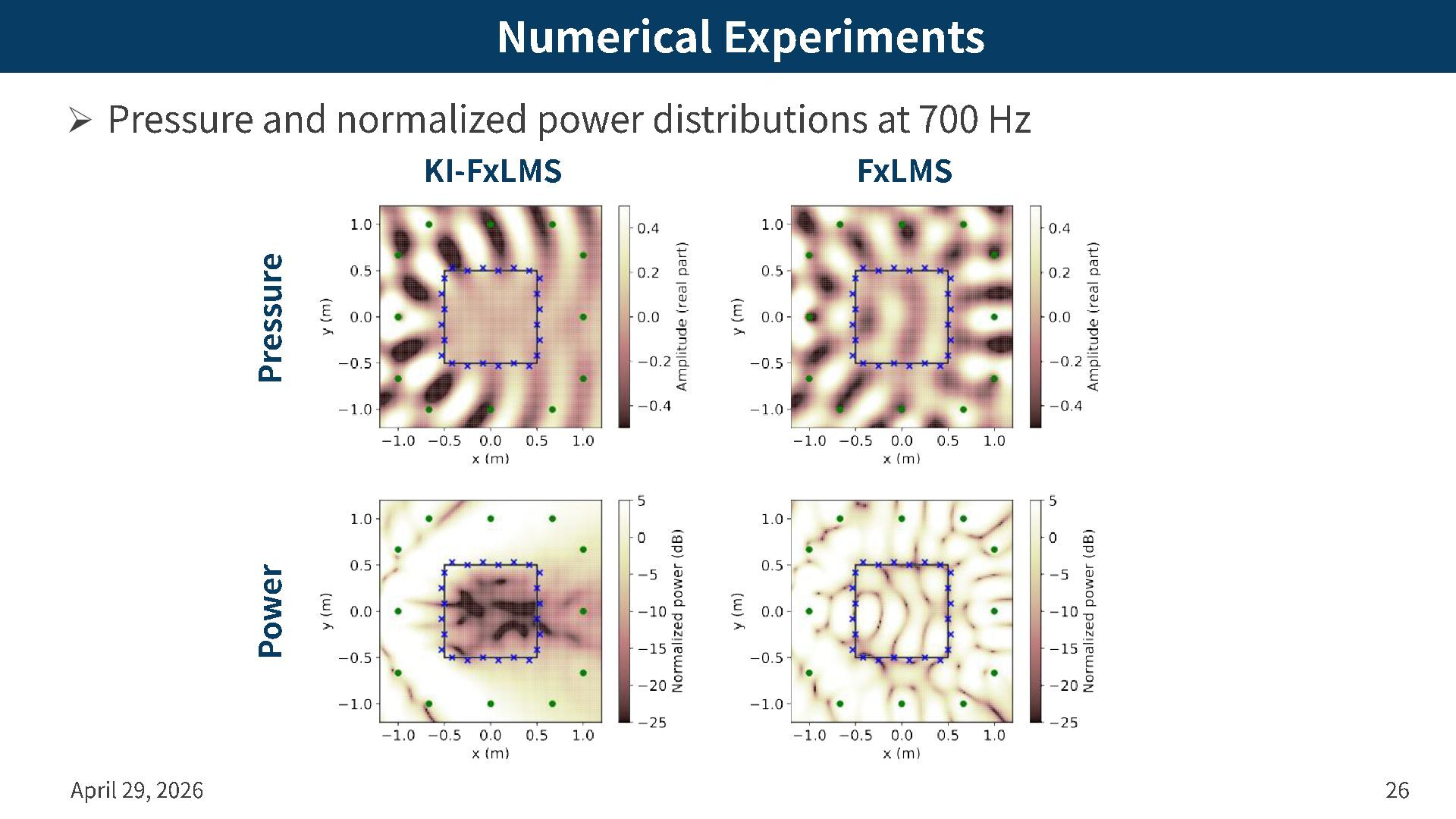
Numerical Experiments ➢ Pressure and normalized power distributions at 700
Hz April 29, 2026 26 KI -FxLMS FxLMS Pressure Power -
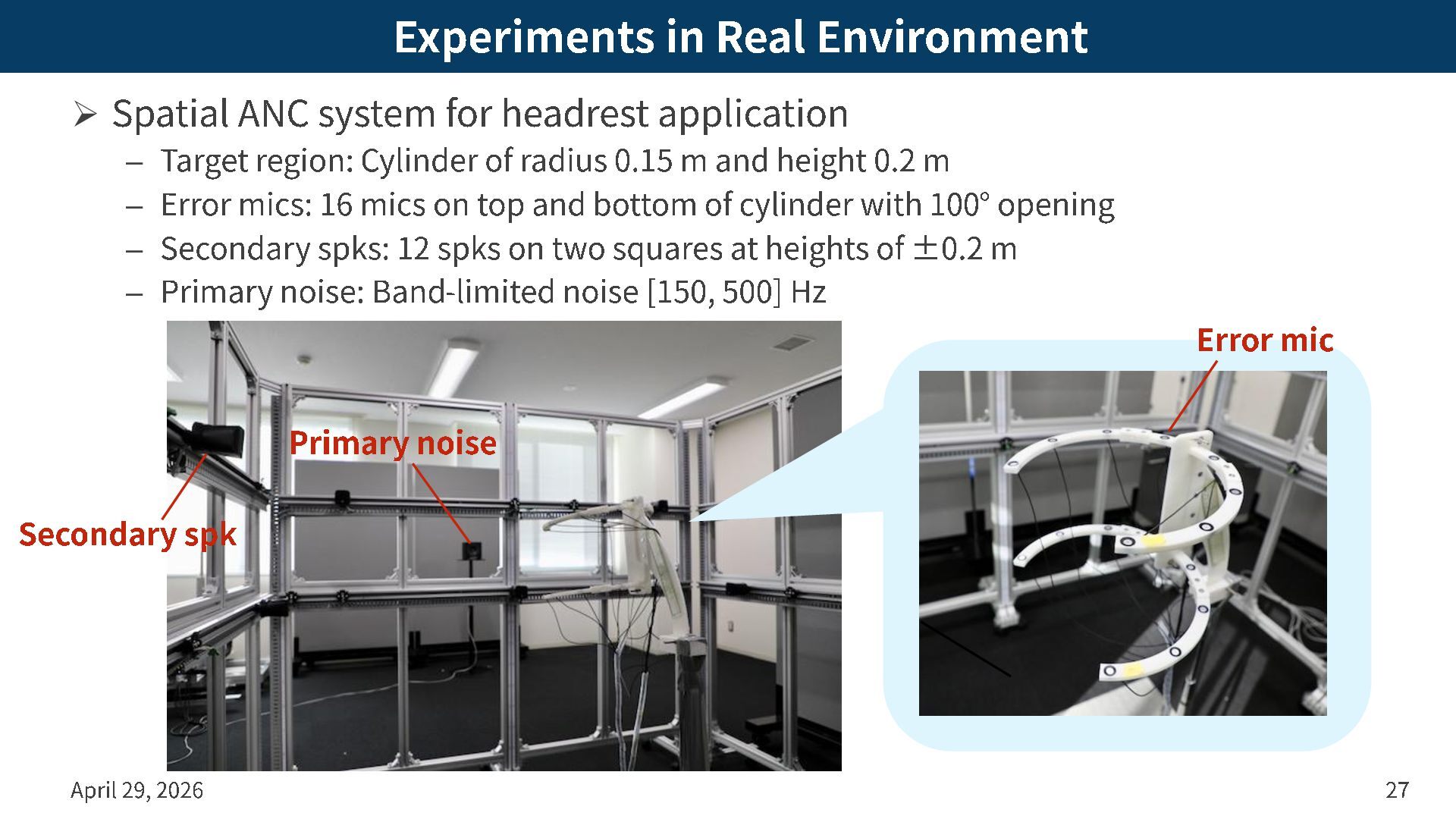
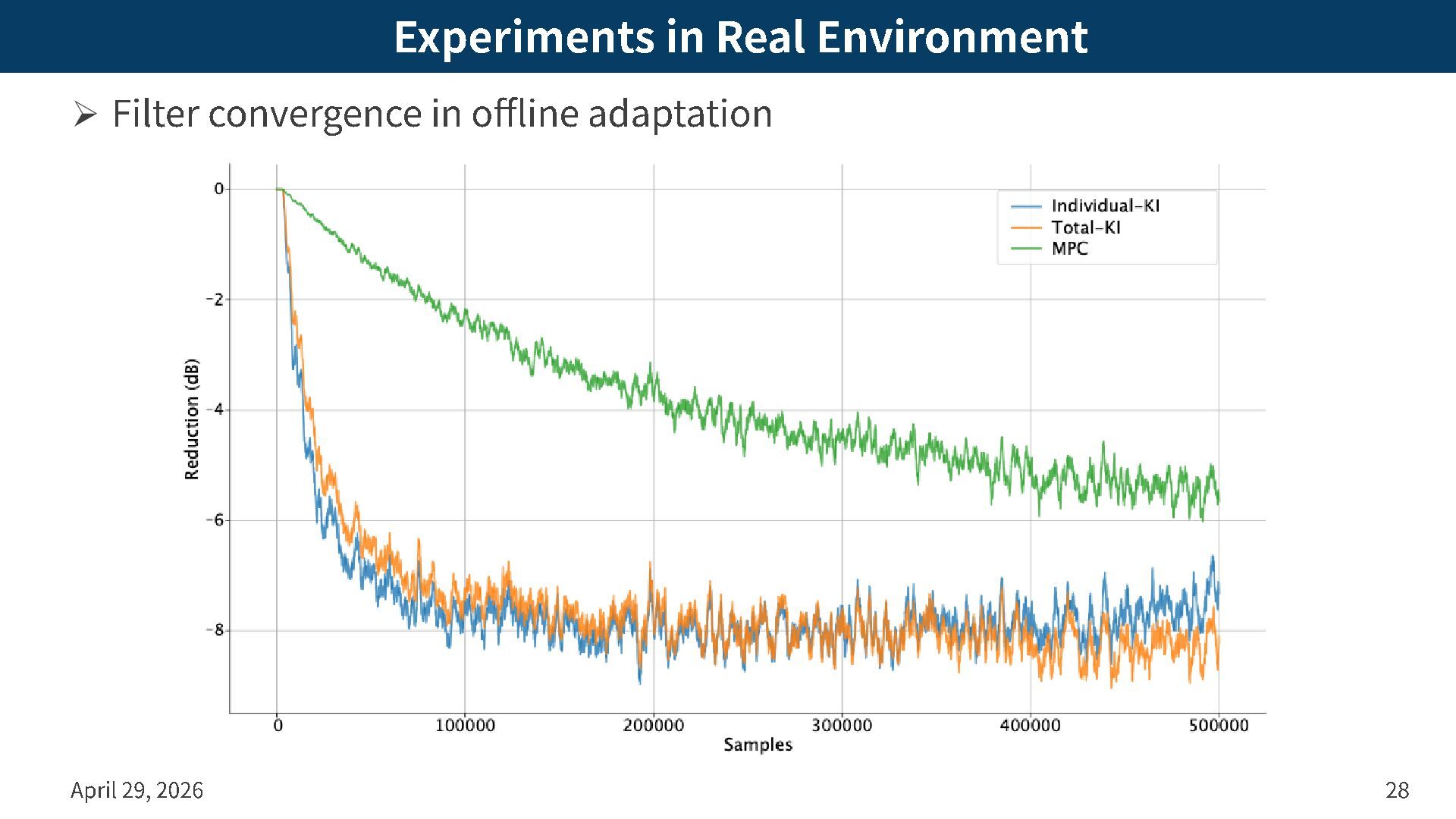
Experiments in Real Environment ➢ Spatial ANC system for headrest
application – Target region: Cylinder of radius 0.15 m and height 0.2 m – Error mics: 16 mics on top and bottom of cylinder with 100 ° opening – Secondary spks: 12 spks on two squares at heights of ± 0.2 m – Primary noise: Band -limited noise [150, 500] Hz April 29, 2026 27 Primary noise Secondary spk Error mic -
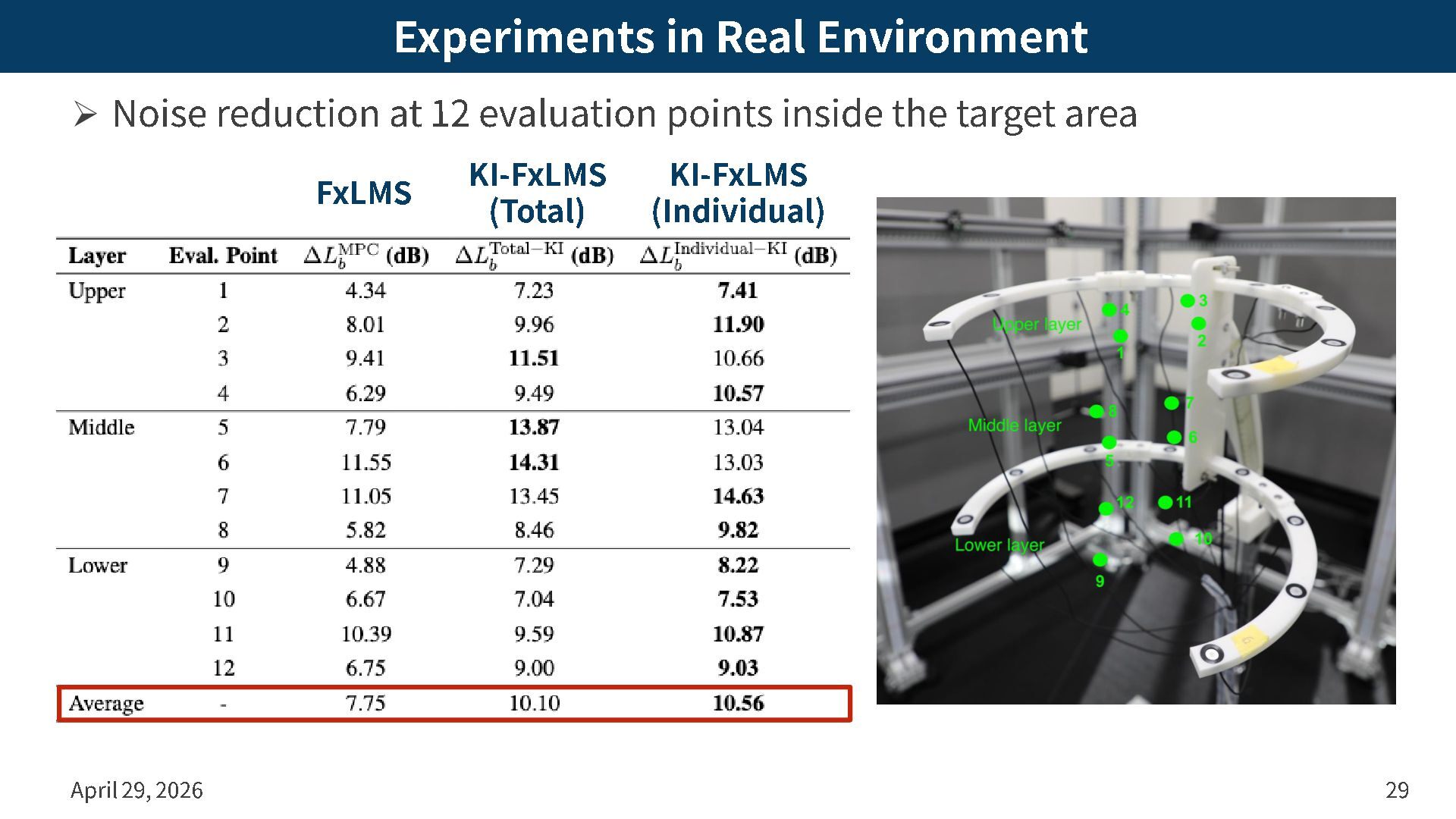
Experiments in Real Environment ➢ Noise reduction at 12 evaluation
points inside the target area April 29, 2026 29 FxLMS KI -FxLMS (Total) KI -FxLMS (Individual) -
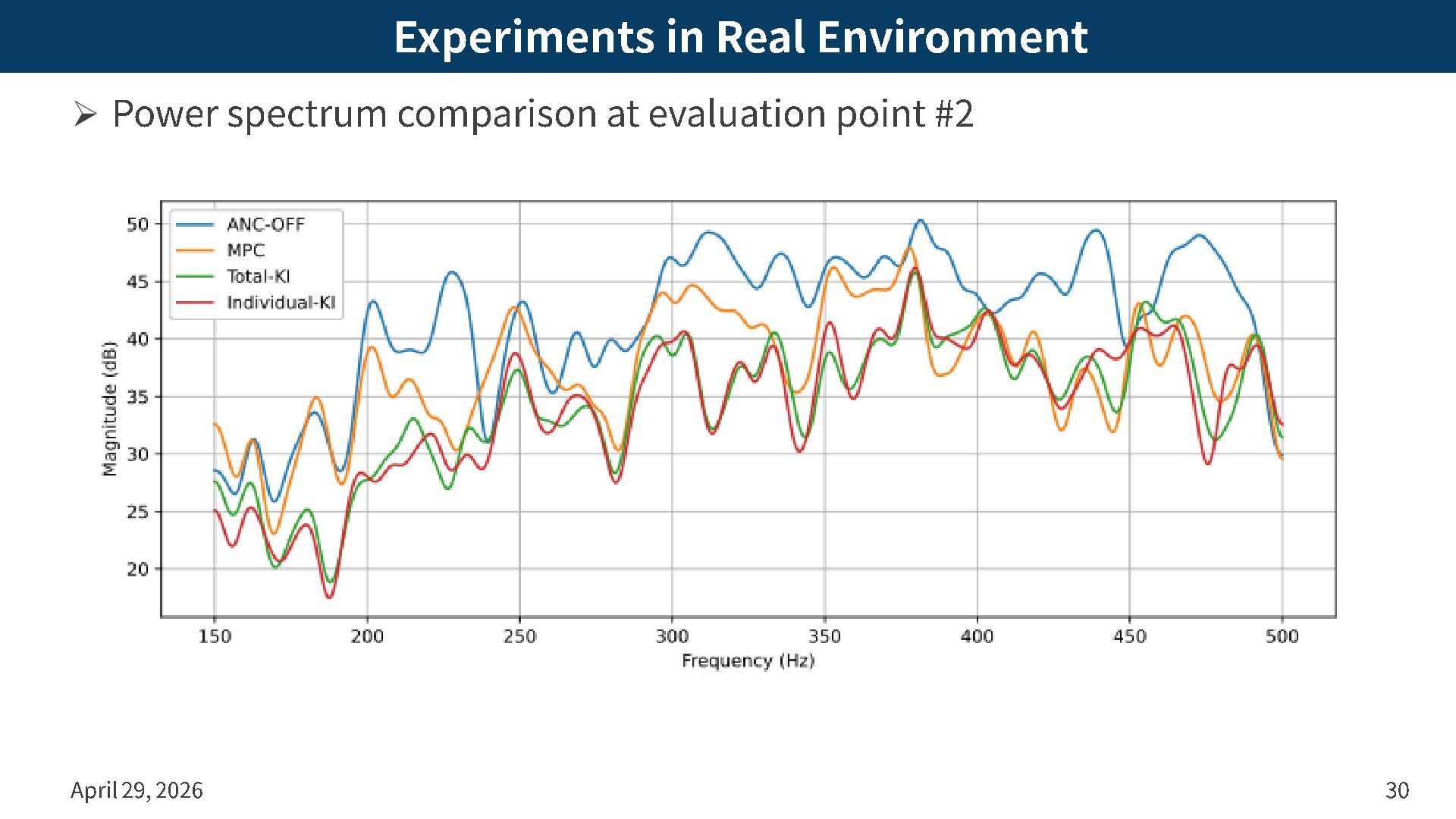
Experiments in Real Environment ➢ Power spectrum comparison at evaluation
point #2 April 29, 2026 30 -
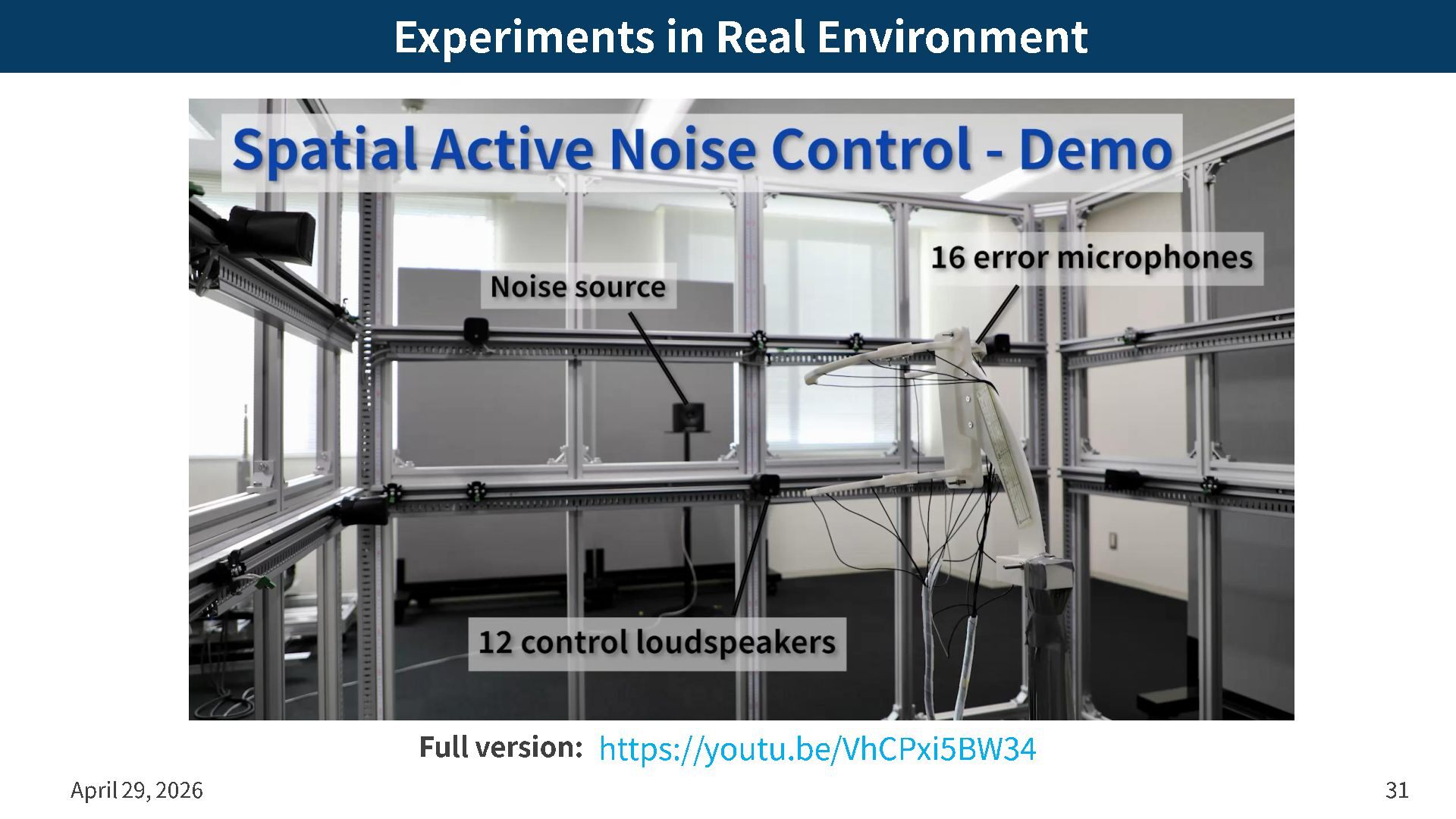
Experiments in Real Environment April 29, 2026 31 https:// youtu.be
/VhCPxi5BW34 Full version: -
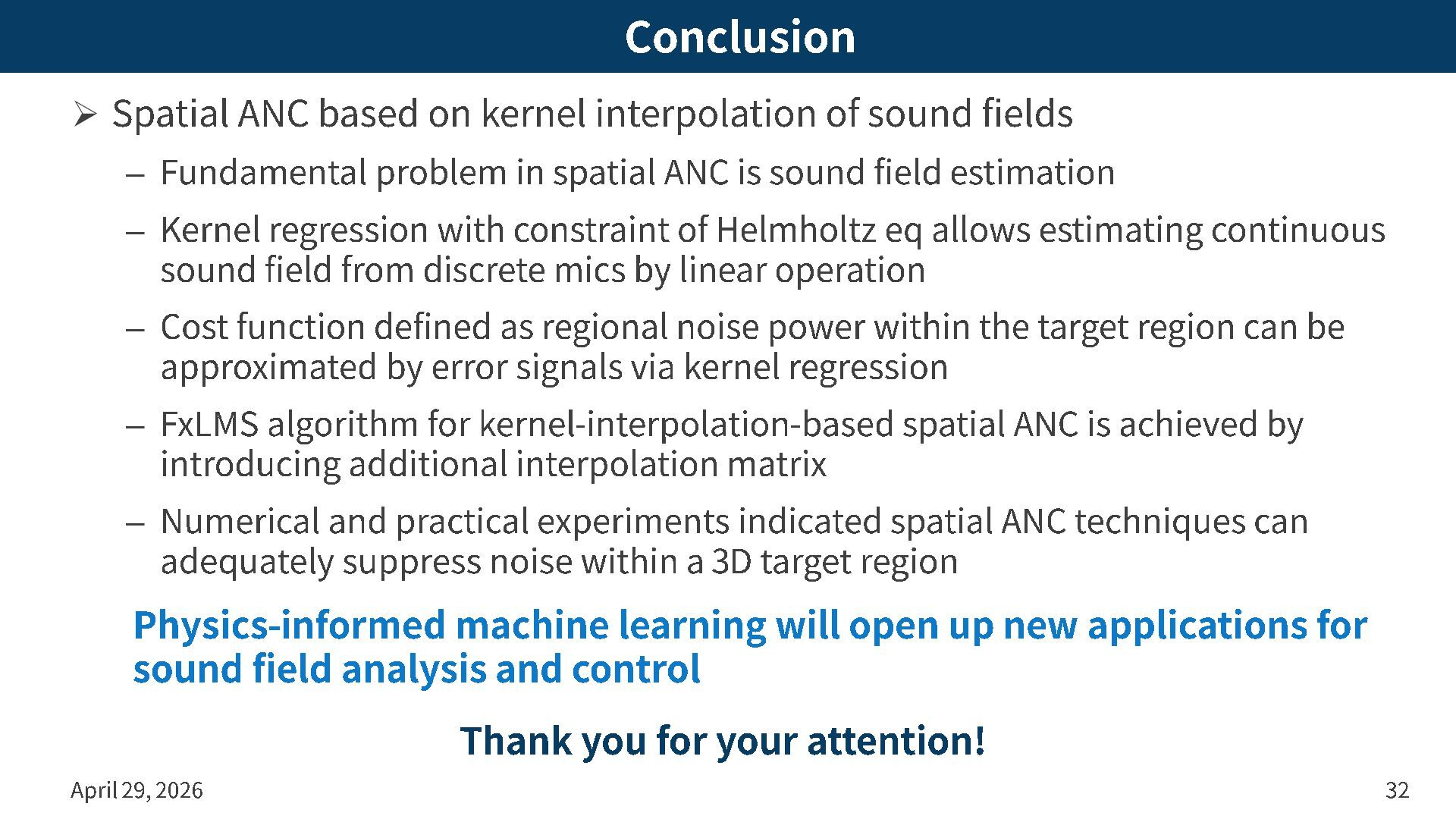
Conclusion ➢ Spatial ANC based on kernel interpolation of sound
fields – Fundamental problem in spatial ANC is sound field estimation – Kernel regression with constraint of Helmholtz eq allows estimating continuous sound field from discrete mics by linear operation – Cost function defined as regional noise power within the target region can be approximated by error signals via kernel regression – FxLMS algorithm for kernel -interpolation -based spatial ANC is achieved by introducing additional interpolation matrix – Numerical and practical experiments indicated spatial ANC techniques can adequately suppress noise within a 3D target region April 29, 2026 32 Physics -informed machine learning will open up new applications for sound field analysis and control Thank you for your attention!