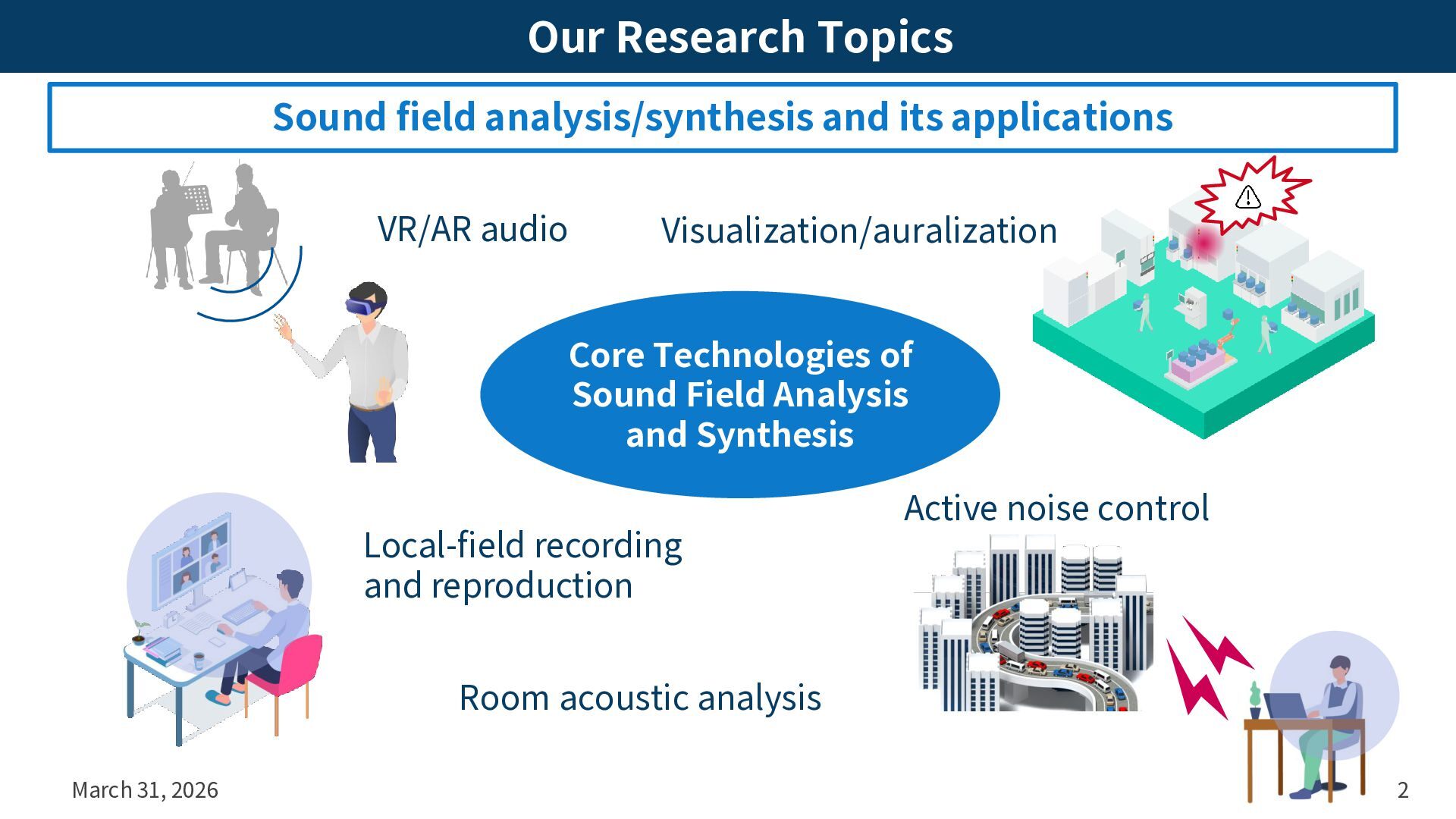
and Synthesis VR/AR audio Active noise control Local-field recording and reproduction Visualization/auralization Room acoustic analysis Our Research Topics Sound field analysis/synthesis and its applications
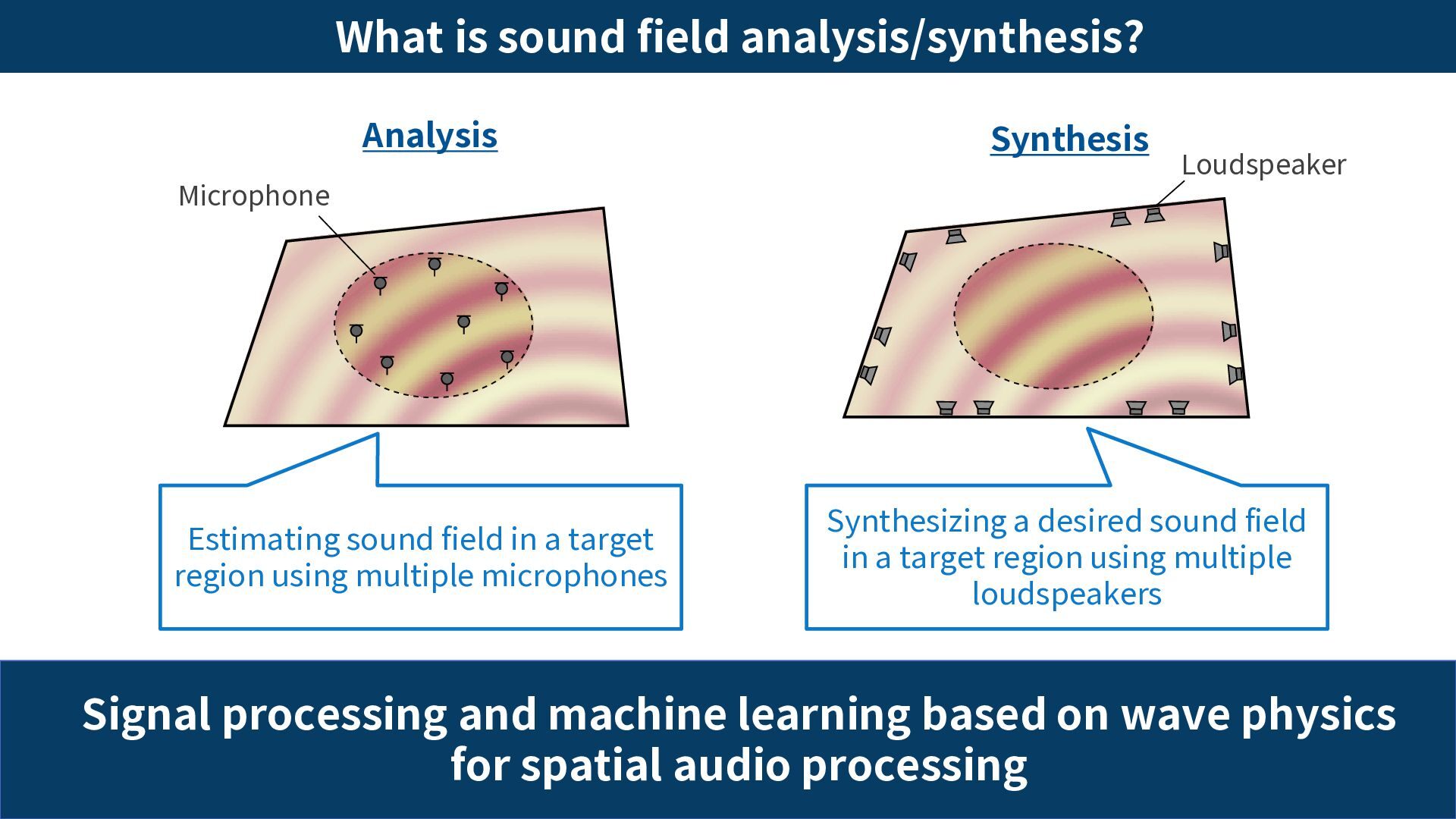
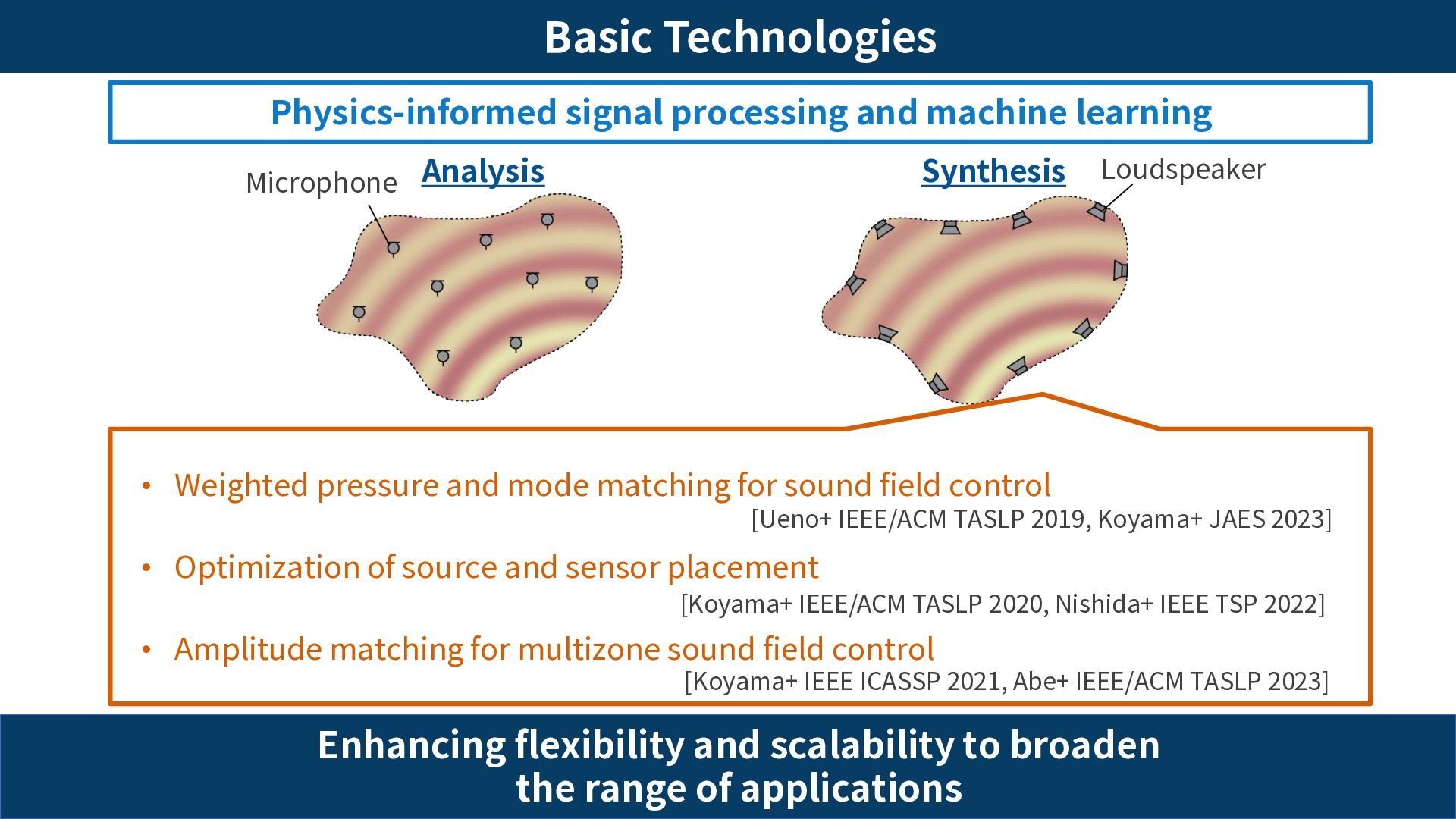
sound field in a target region using multiple microphones Synthesizing a desired sound field in a target region using multiple loudspeakers Signal processing and machine learning based on wave physics for spatial audio processing Analysis Synthesis Microphone Loudspeaker
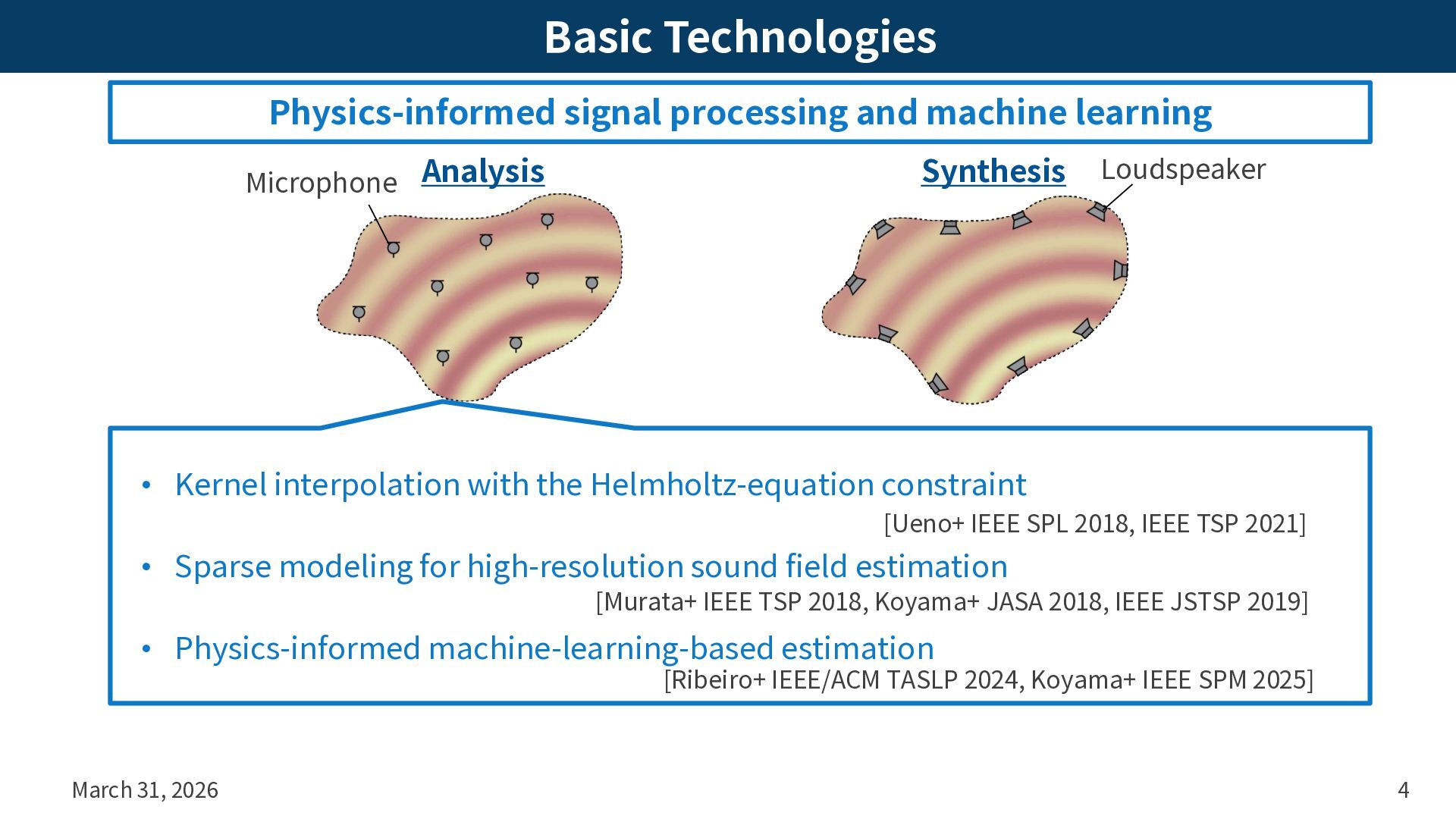
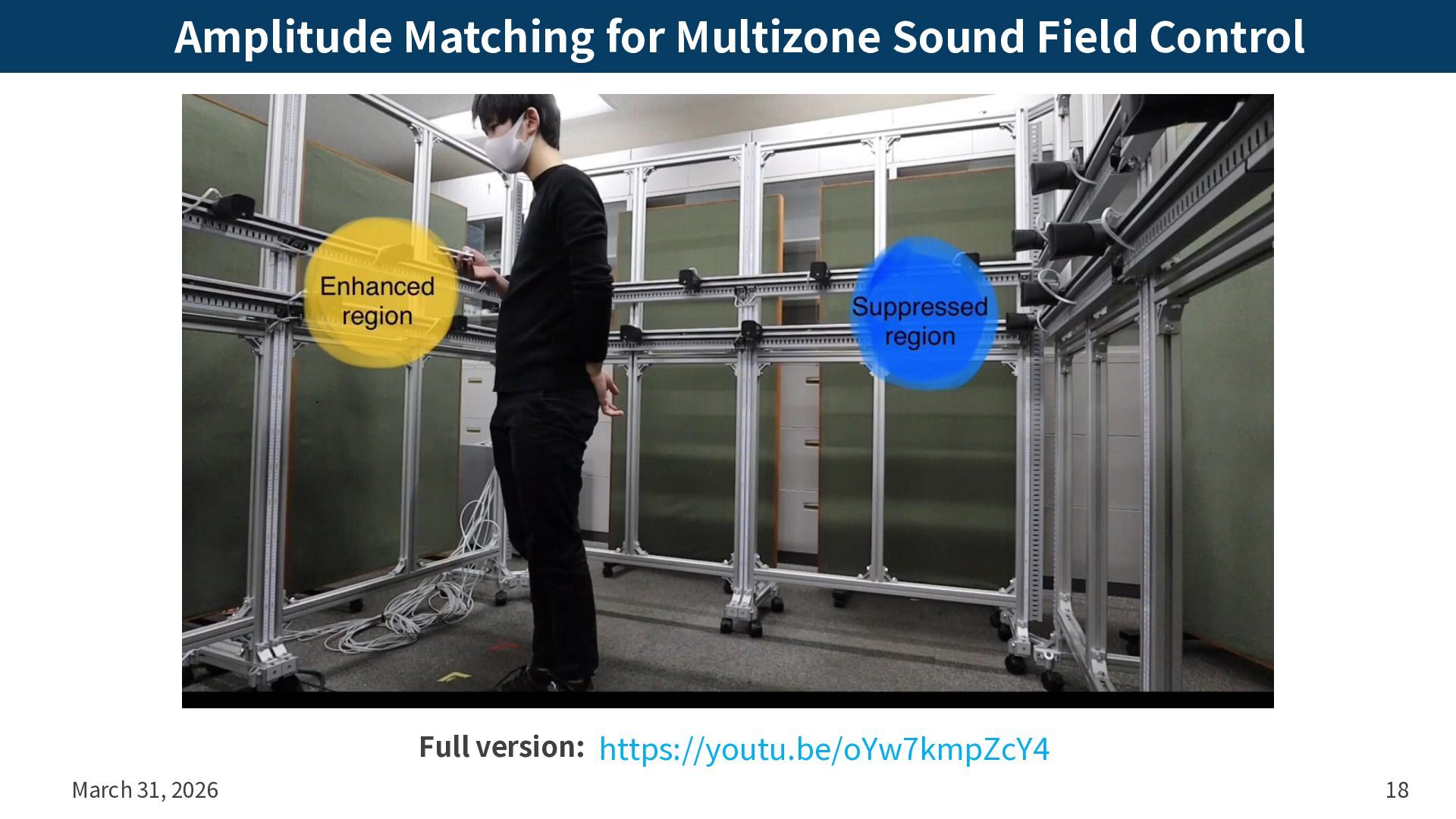
• Weighted pressure and mode matching for sound field control • Optimization of source and sensor placement • Amplitude matching for multizone sound field control [Ueno+ IEEE/ACM TASLP 2019, Koyama+ JAES 2023] [Koyama+ IEEE/ACM TASLP 2020, Nishida+ IEEE TSP 2022] [Koyama+ IEEE ICASSP 2021, Abe+ IEEE/ACM TASLP 2023] Enhancing flexibility and scalability to broaden the range of applications Physics-informed signal processing and machine learning
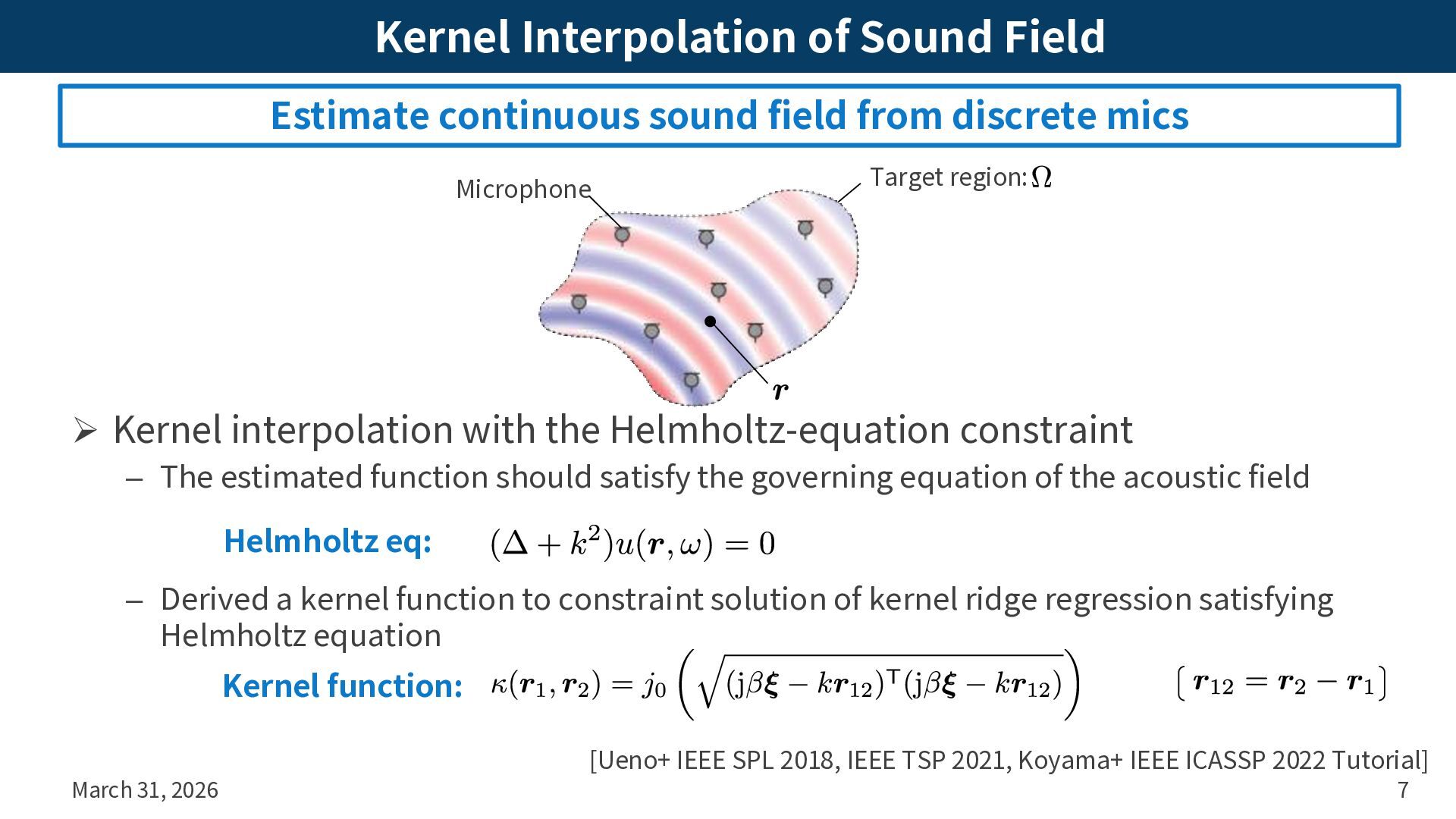
Helmholtz-equation constraint – The estimated function should satisfy the governing equation of the acoustic field – Derived a kernel function to constraint solution of kernel ridge regression satisfying Helmholtz equation March 31, 2026 7 Estimate continuous sound field from discrete mics [Ueno+ IEEE SPL 2018, IEEE TSP 2021, Koyama+ IEEE ICASSP 2022 Tutorial] Kernel function: Helmholtz eq: Microphone Target region:
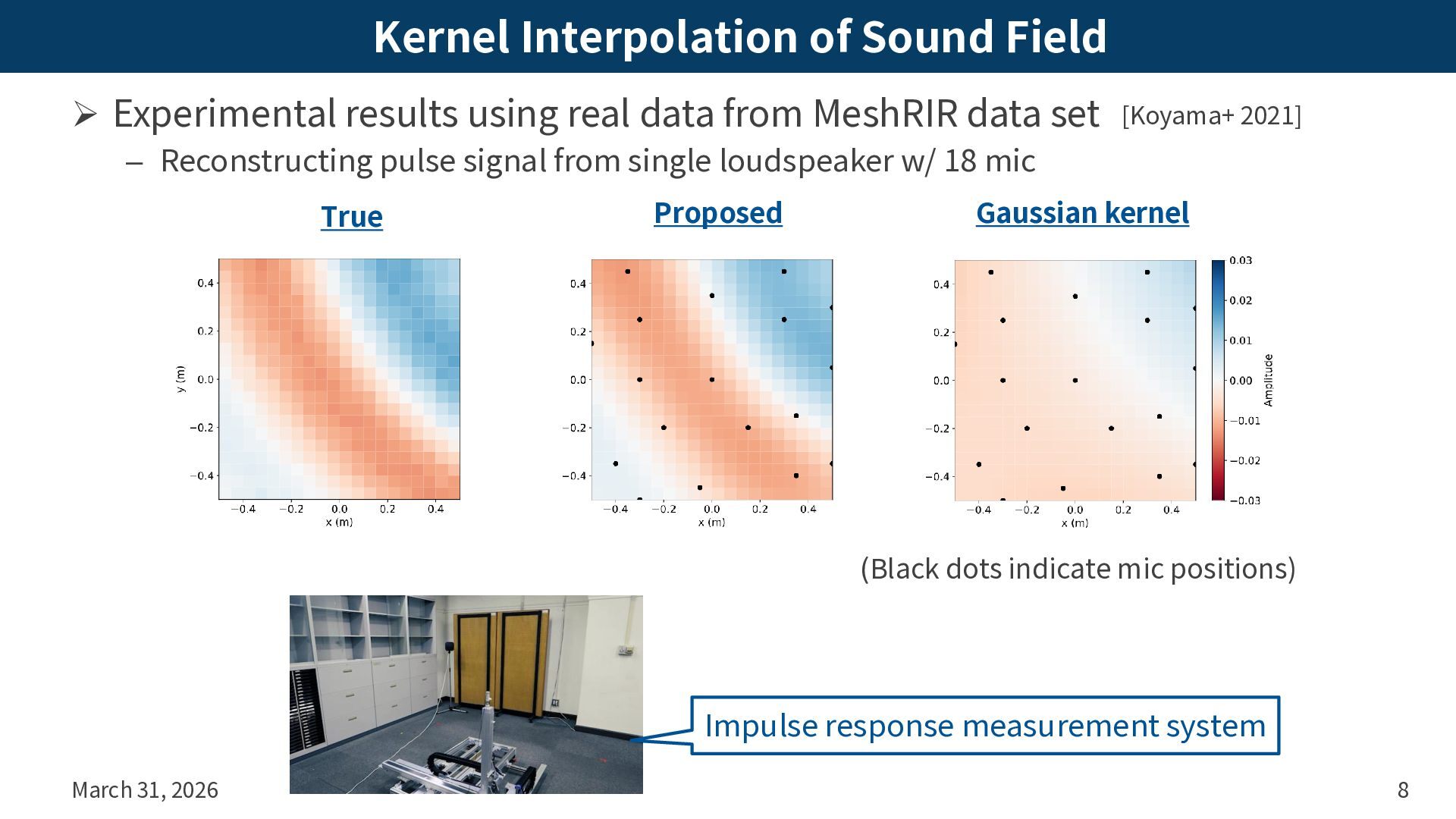
data from MeshRIR data set – Reconstructing pulse signal from single loudspeaker w/ 18 mic March 31, 2026 8 True Proposed Gaussian kernel (Black dots indicate mic positions) Impulse response measurement system [Koyama+ 2021]
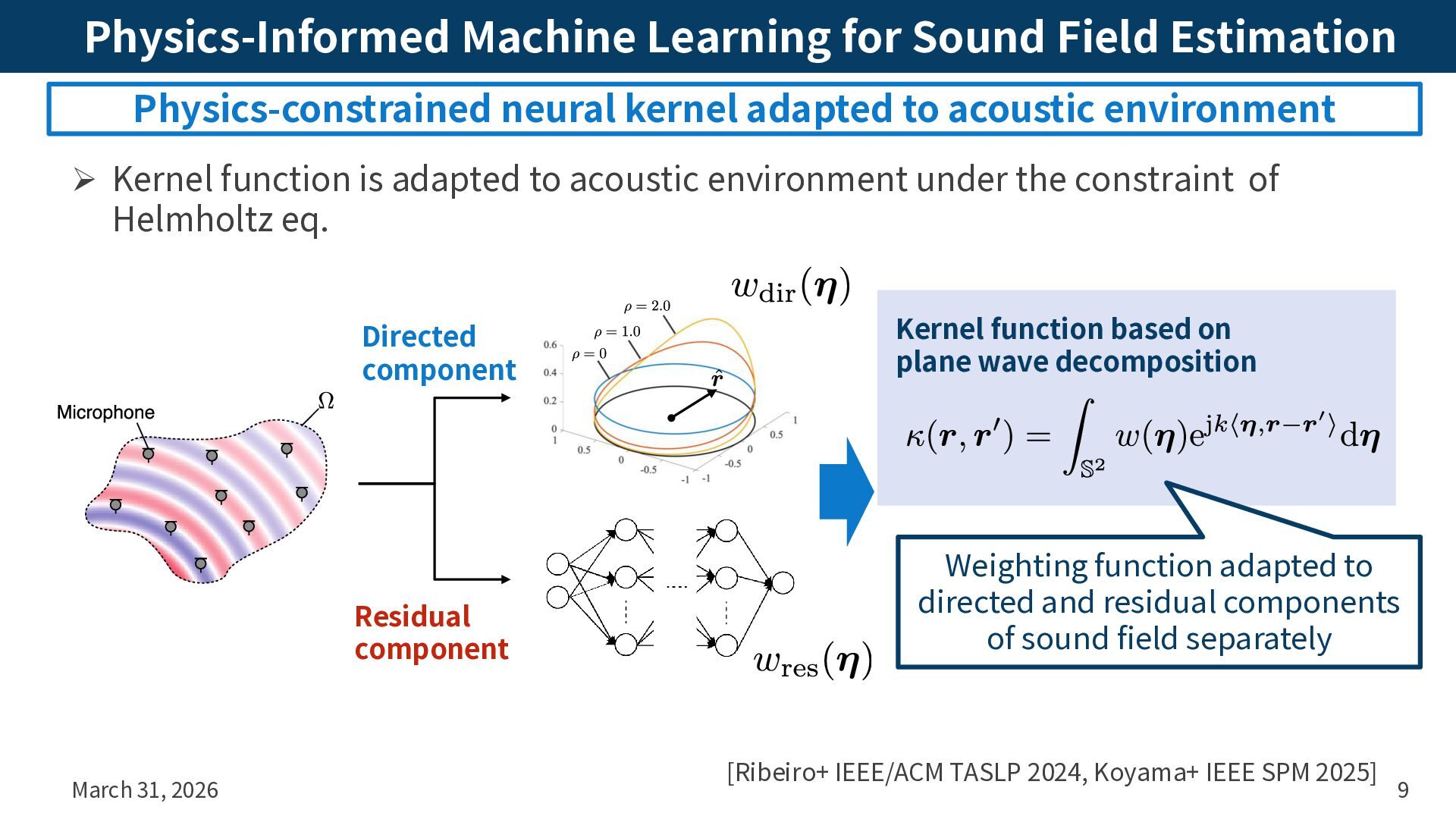
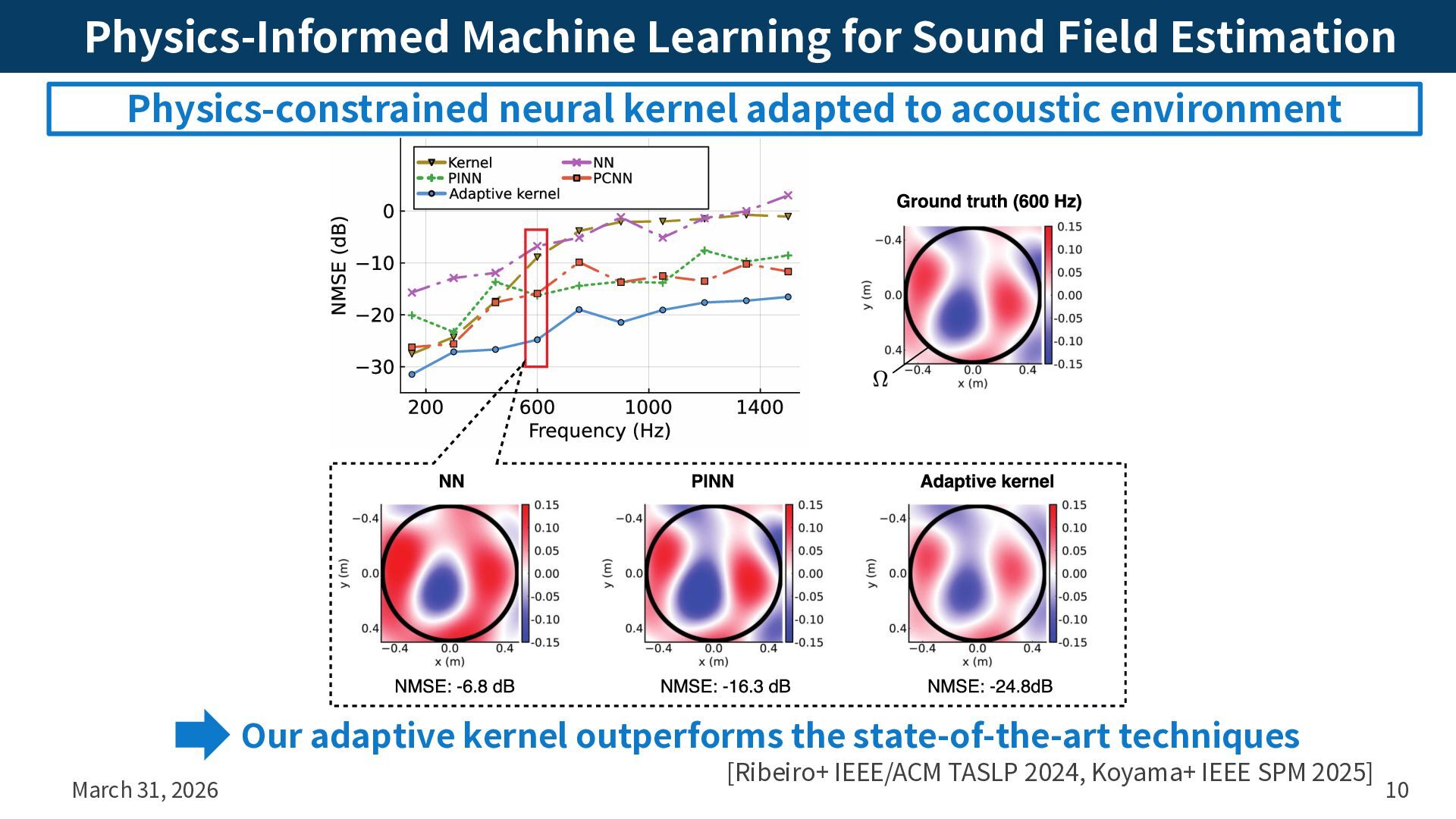
is adapted to acoustic environment under the constraint of Helmholtz eq. March 31, 2026 9 Physics-constrained neural kernel adapted to acoustic environment Directed component Residual component Weighting function adapted to directed and residual components of sound field separately [Ribeiro+ IEEE/ACM TASLP 2024, Koyama+ IEEE SPM 2025] Kernel function based on plane wave decomposition
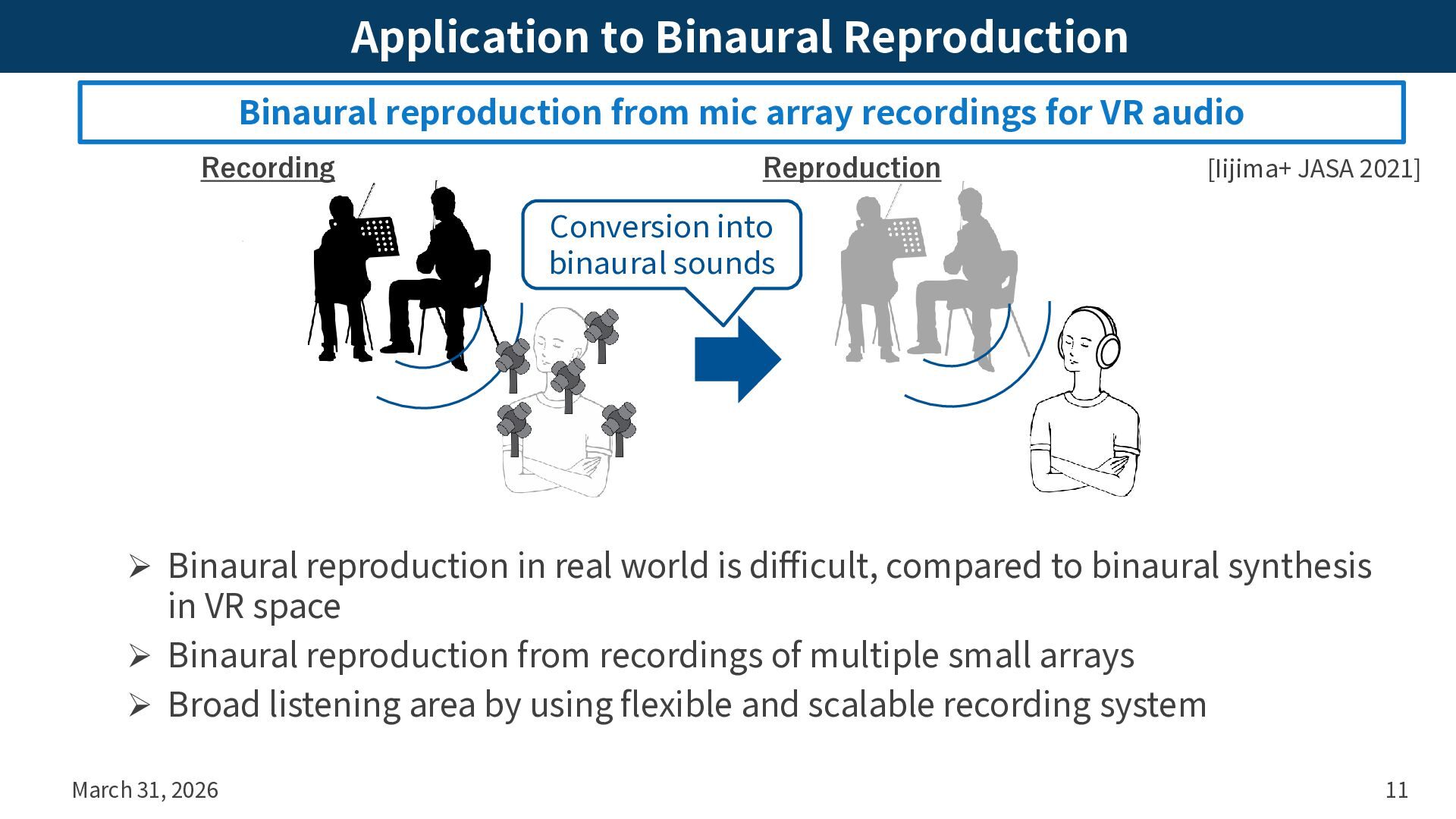
binaural sounds ➢ Binaural reproduction in real world is difficult, compared to binaural synthesis in VR space ➢ Binaural reproduction from recordings of multiple small arrays ➢ Broad listening area by using flexible and scalable recording system Binaural reproduction from mic array recordings for VR audio Recording Reproduction [Iijima+ JASA 2021]
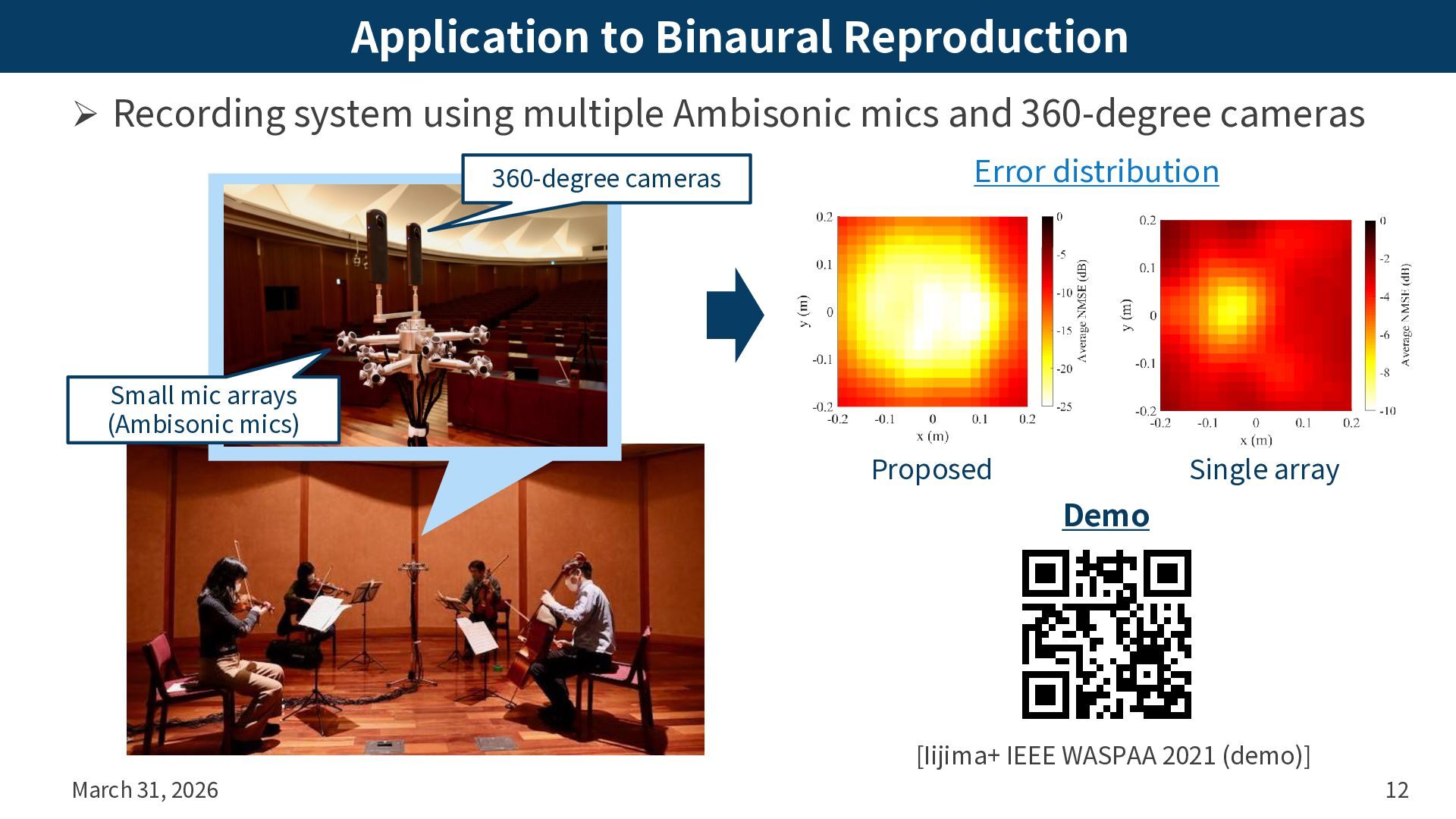
mics and 360-degree cameras March 31, 2026 12 Small mic arrays (Ambisonic mics) 360-degree cameras Demo Proposed Single array [Iijima+ IEEE WASPAA 2021 (demo)] Error distribution
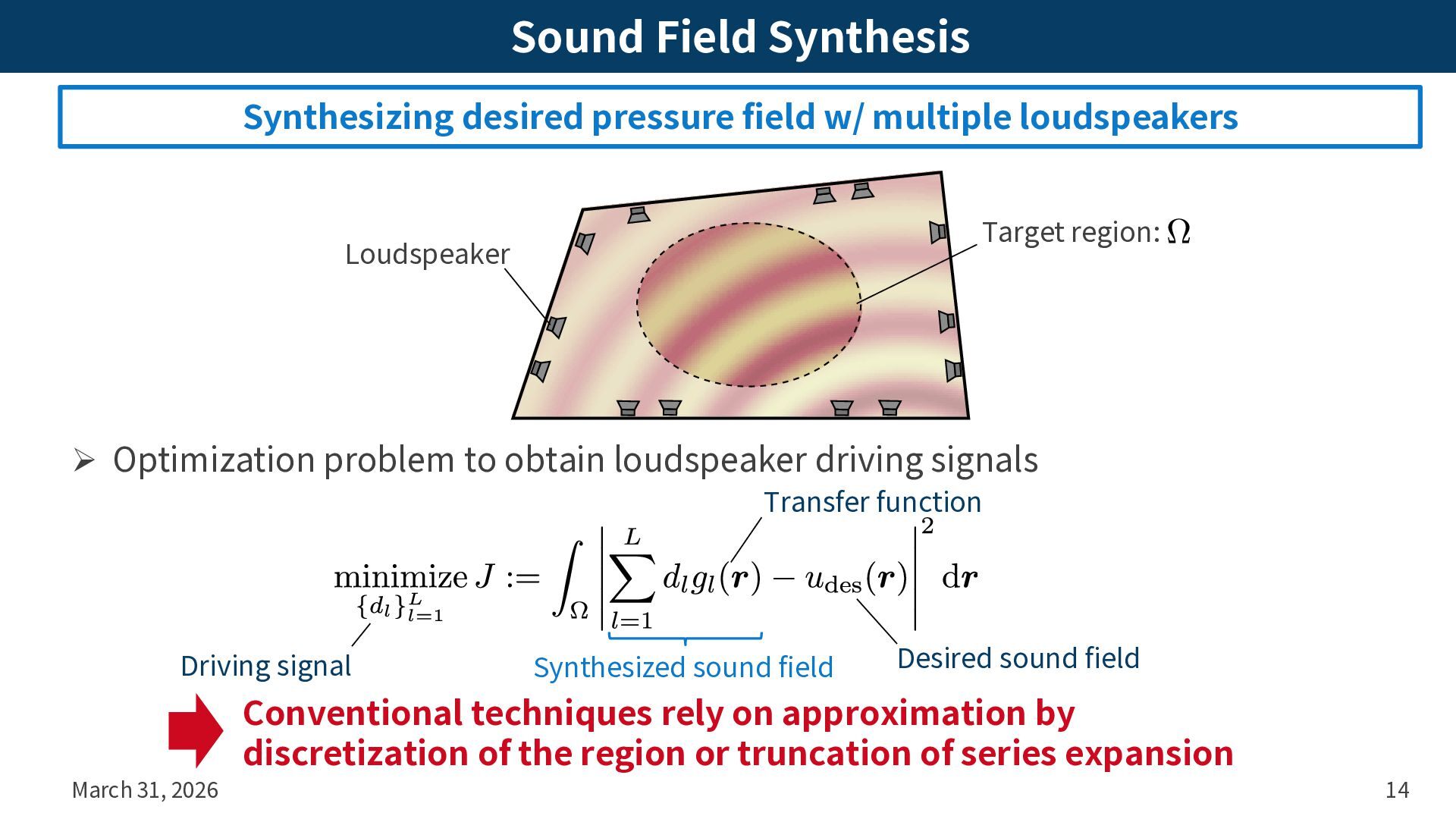
signals March 31, 2026 14 Synthesizing desired pressure field w/ multiple loudspeakers Loudspeaker Target region: Synthesized sound field Desired sound field Conventional techniques rely on approximation by discretization of the region or truncation of series expansion Driving signal Transfer function
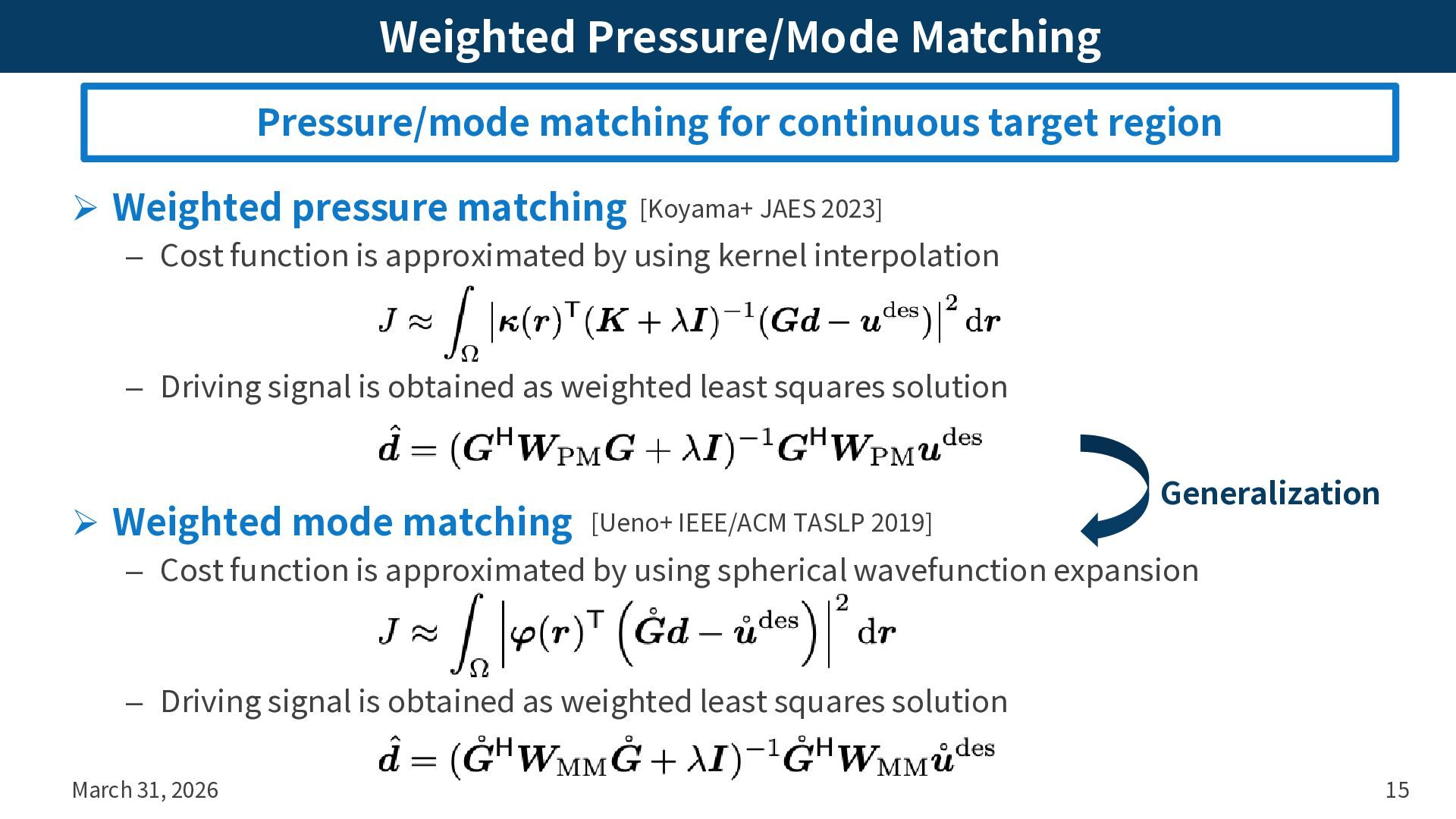
is approximated by using kernel interpolation – Driving signal is obtained as weighted least squares solution ➢ Weighted mode matching – Cost function is approximated by using spherical wavefunction expansion – Driving signal is obtained as weighted least squares solution March 31, 2026 15 Pressure/mode matching for continuous target region [Koyama+ JAES 2023] [Ueno+ IEEE/ACM TASLP 2019] Generalization
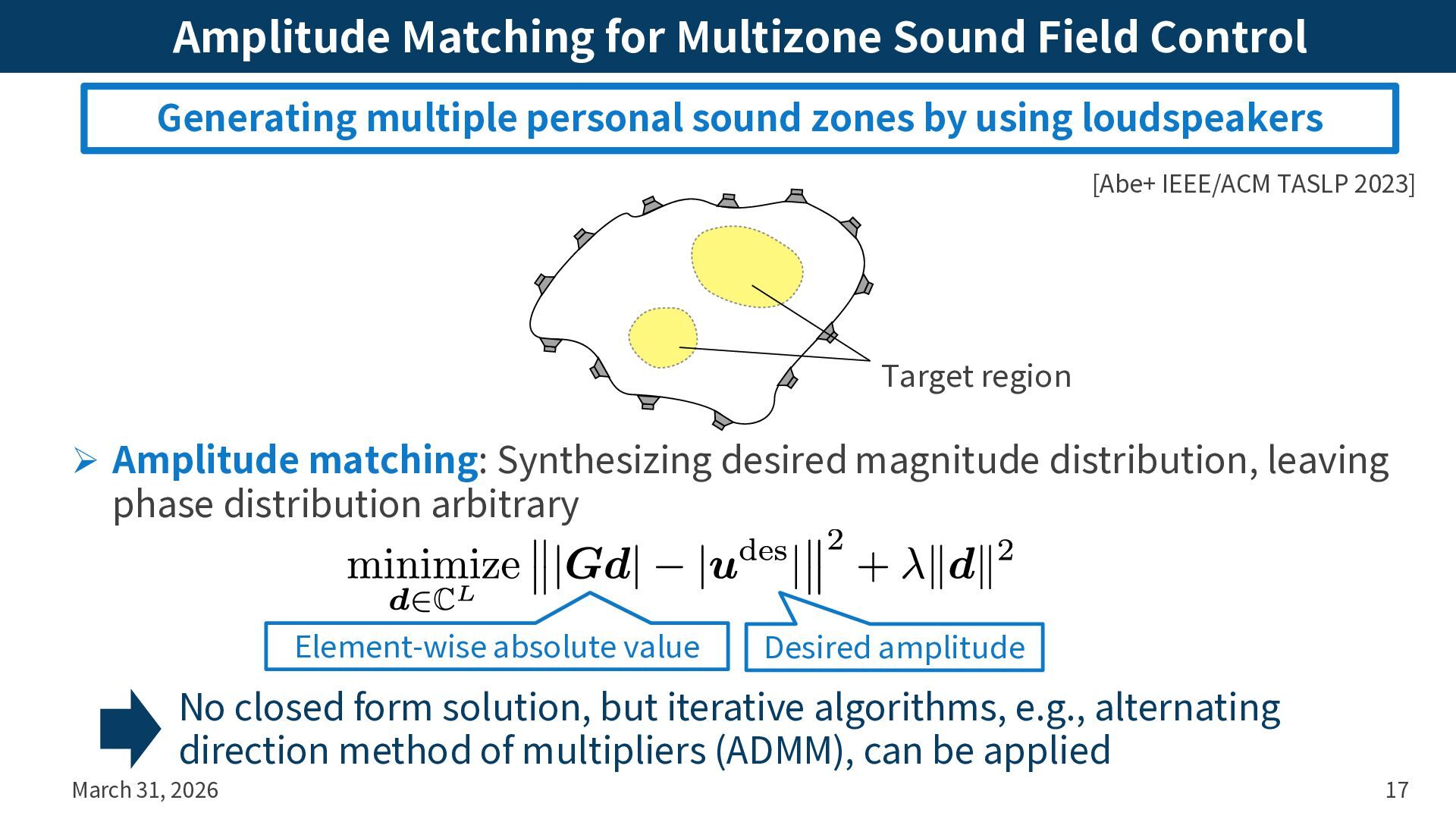
Synthesizing desired magnitude distribution, leaving phase distribution arbitrary March 31, 2026 17 Target region Generating multiple personal sound zones by using loudspeakers Desired amplitude No closed form solution, but iterative algorithms, e.g., alternating direction method of multipliers (ADMM), can be applied Element-wise absolute value [Abe+ IEEE/ACM TASLP 2023]
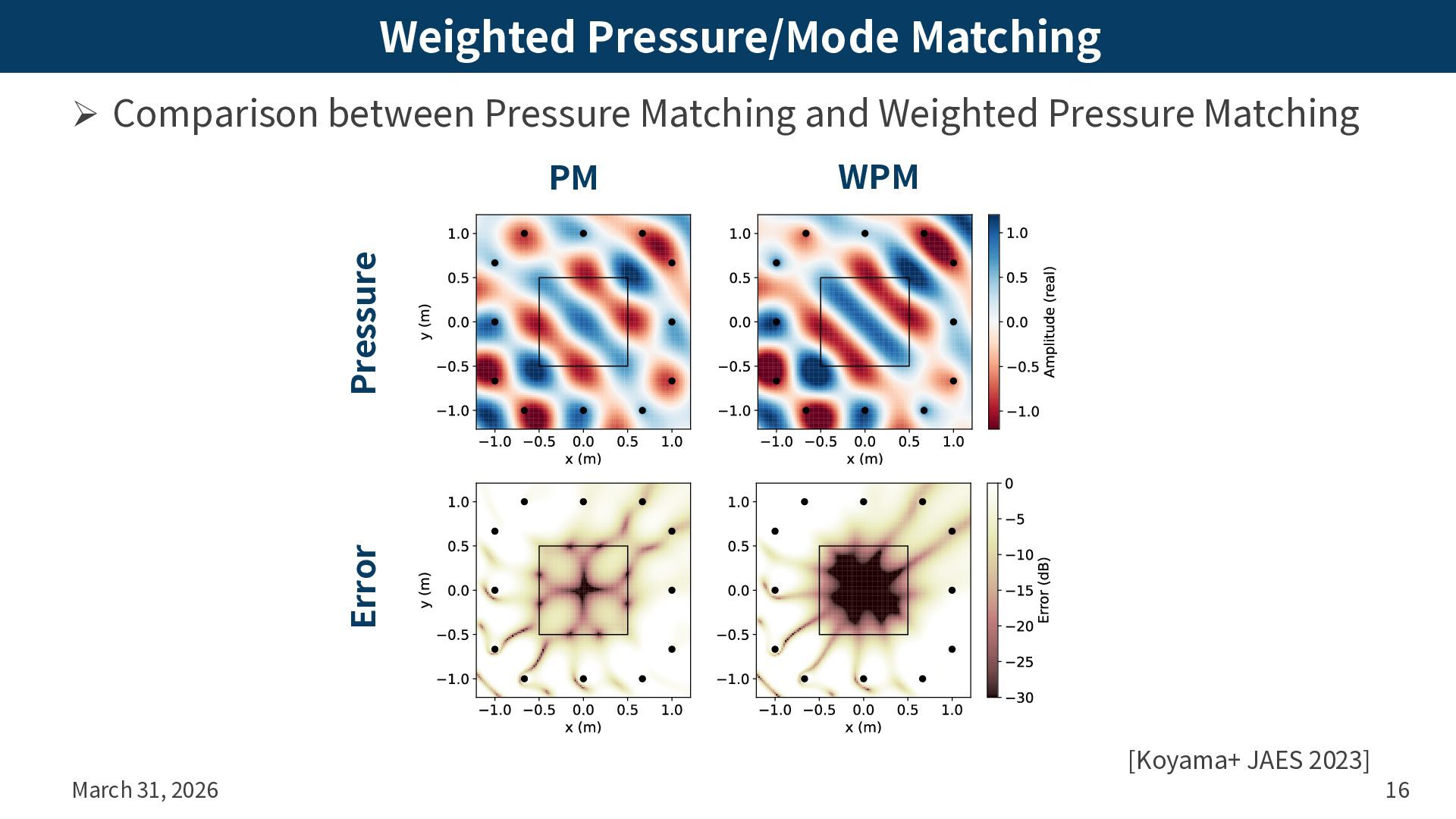
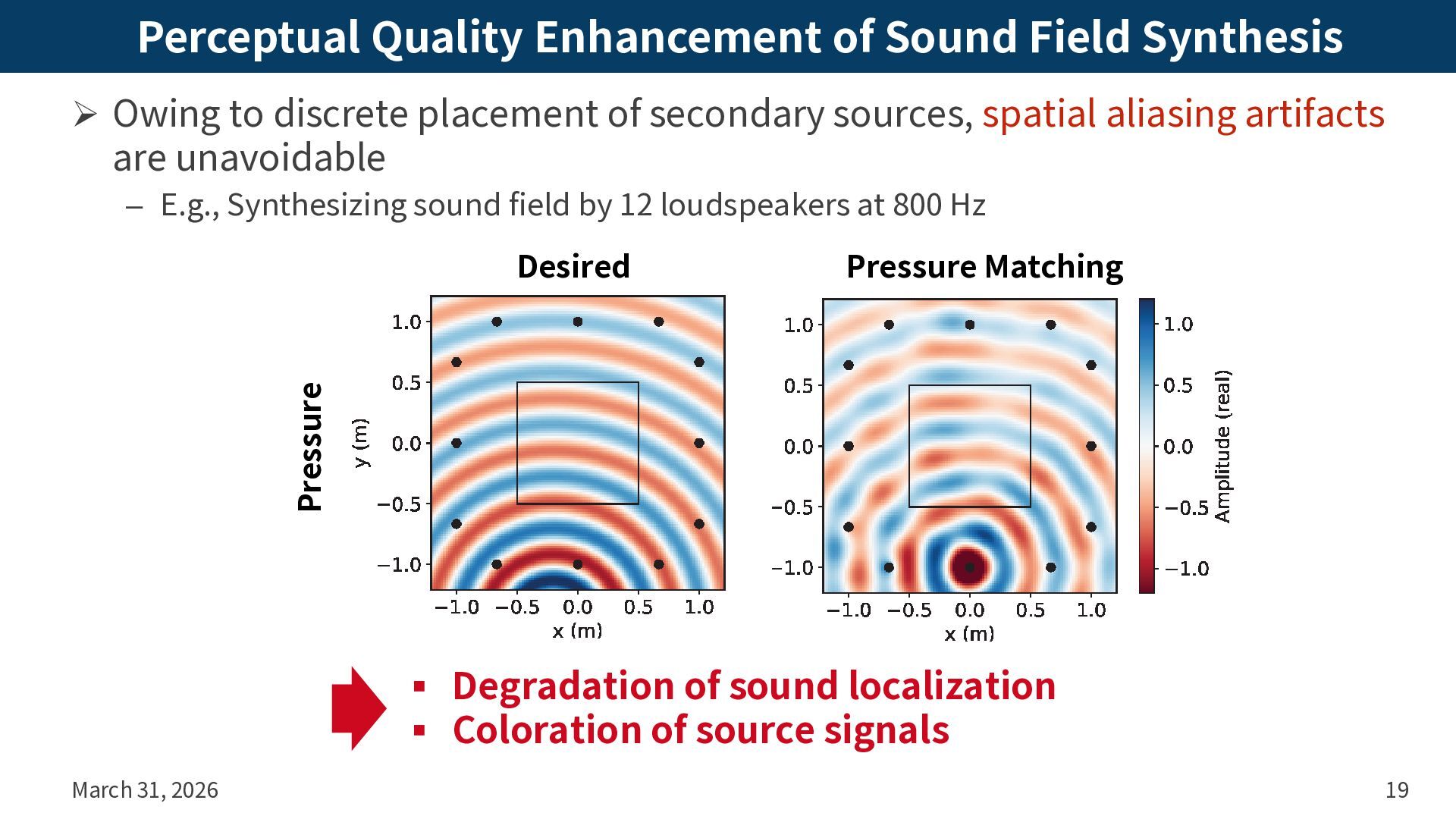
discrete placement of secondary sources, spatial aliasing artifacts are unavoidable – E.g., Synthesizing sound field by 12 loudspeakers at 800 Hz March 31, 2026 19 Desired Pressure Matching Pressure ▪ Degradation of sound localization ▪ Coloration of source signals
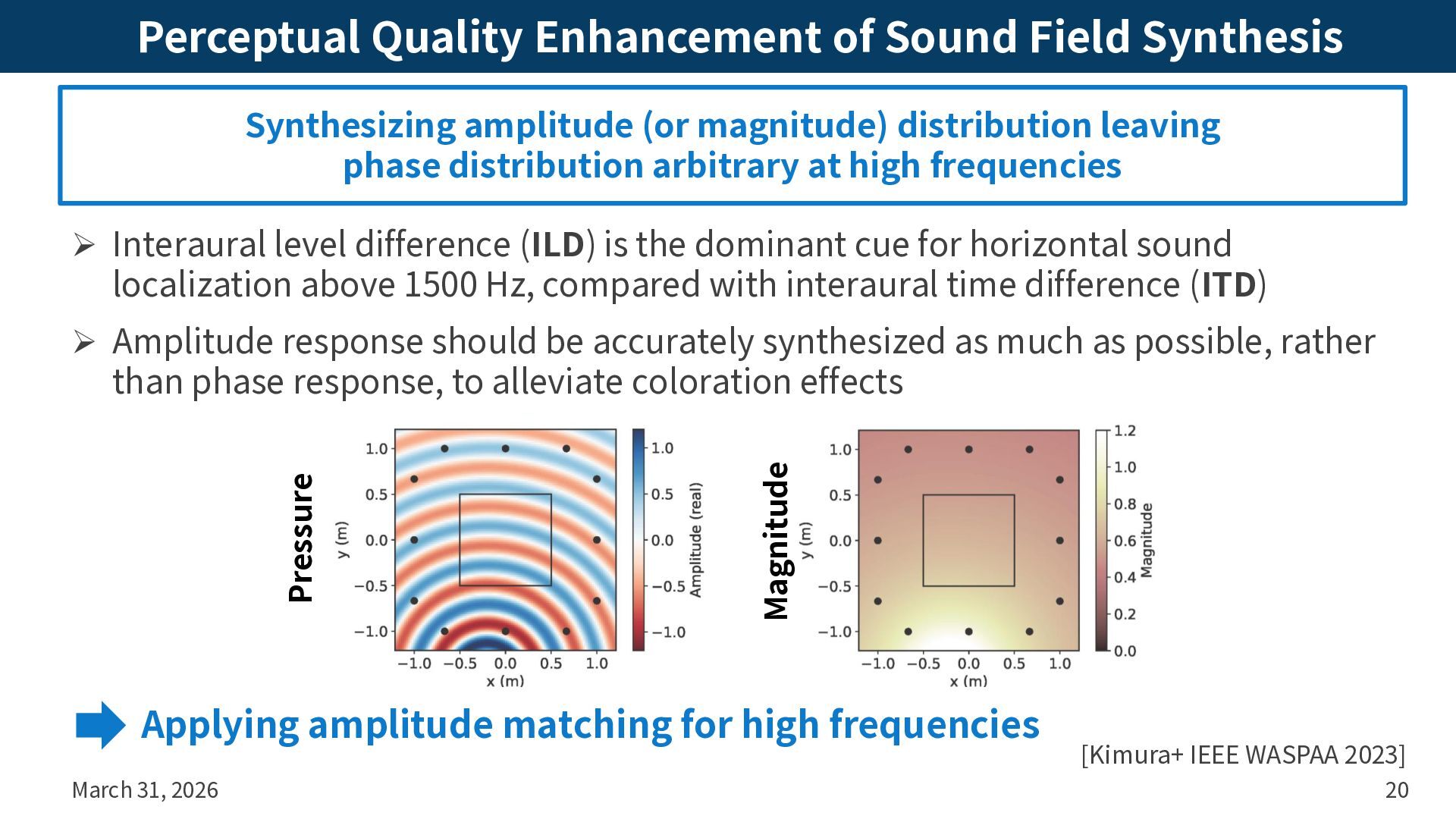
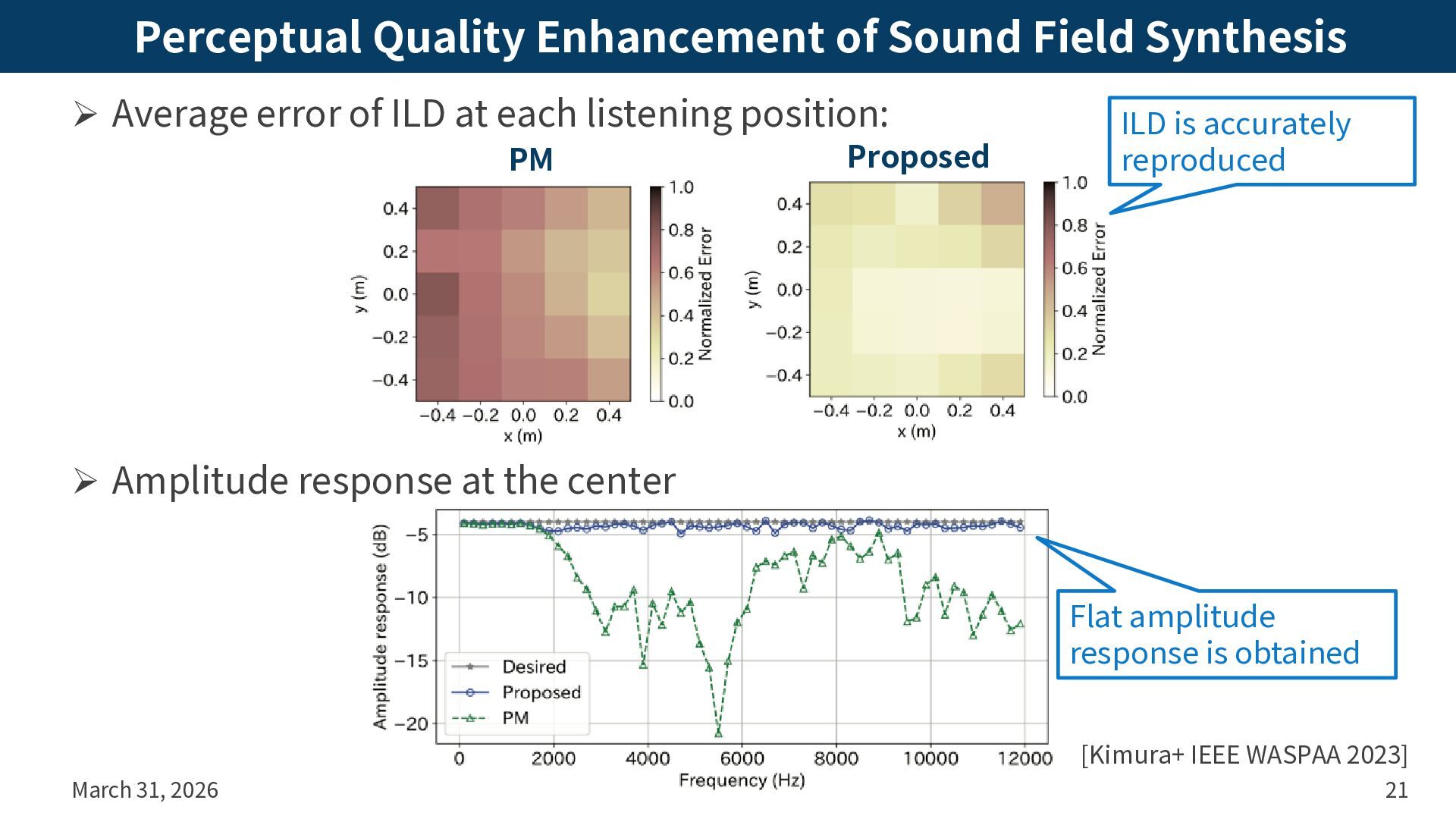
difference (ILD) is the dominant cue for horizontal sound localization above 1500 Hz, compared with interaural time difference (ITD) ➢ Amplitude response should be accurately synthesized as much as possible, rather than phase response, to alleviate coloration effects March 31, 2026 20 Synthesizing amplitude (or magnitude) distribution leaving phase distribution arbitrary at high frequencies Applying amplitude matching for high frequencies Pressure Magnitude [Kimura+ IEEE WASPAA 2023]
of ILD at each listening position: ➢ Amplitude response at the center March 31, 2026 21 PM Proposed ILD is accurately reproduced Flat amplitude response is obtained [Kimura+ IEEE WASPAA 2023]
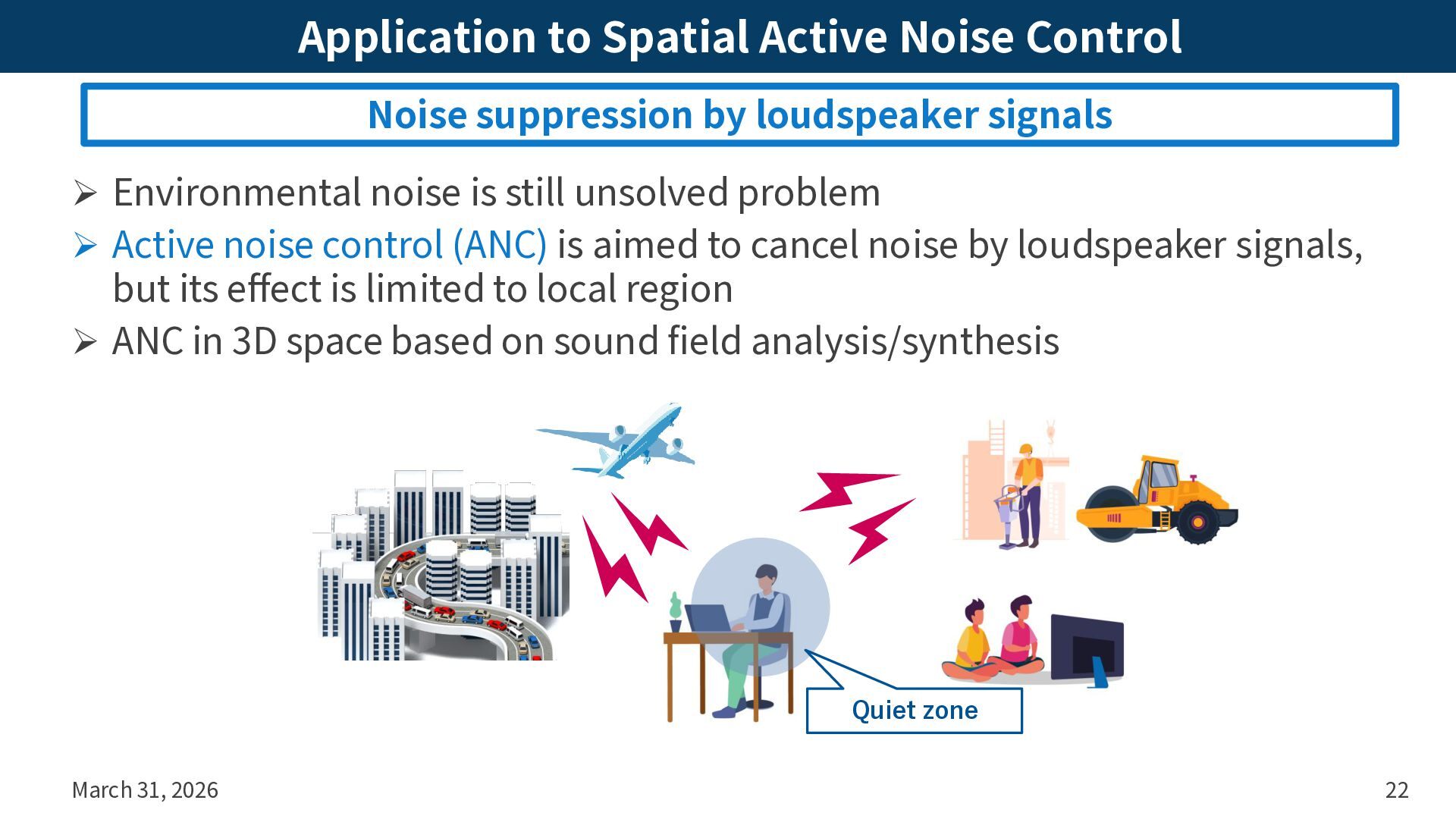
still unsolved problem ➢ Active noise control (ANC) is aimed to cancel noise by loudspeaker signals, but its effect is limited to local region ➢ ANC in 3D space based on sound field analysis/synthesis March 31, 2026 22 Noise suppression by loudspeaker signals Quiet zone
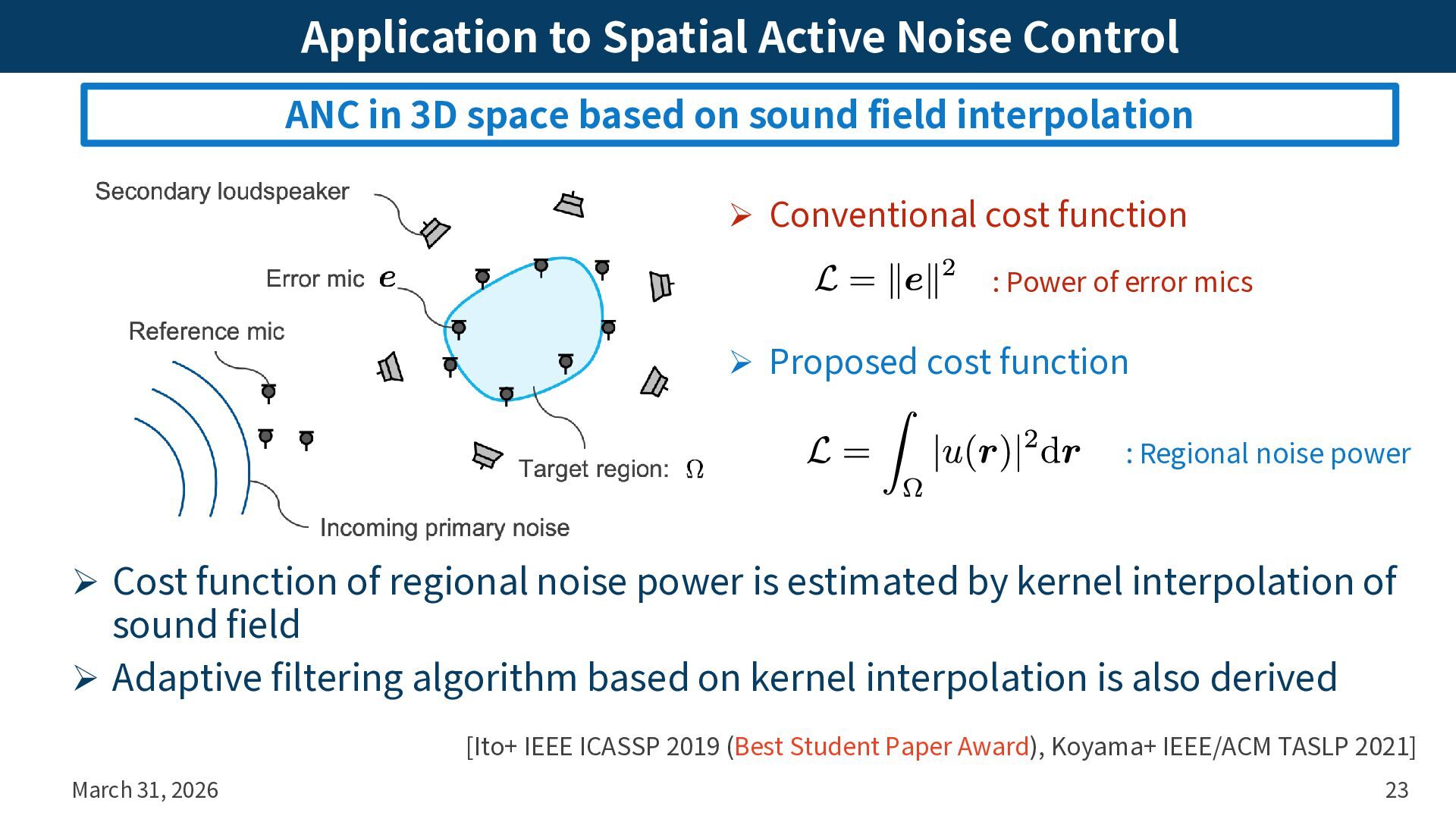
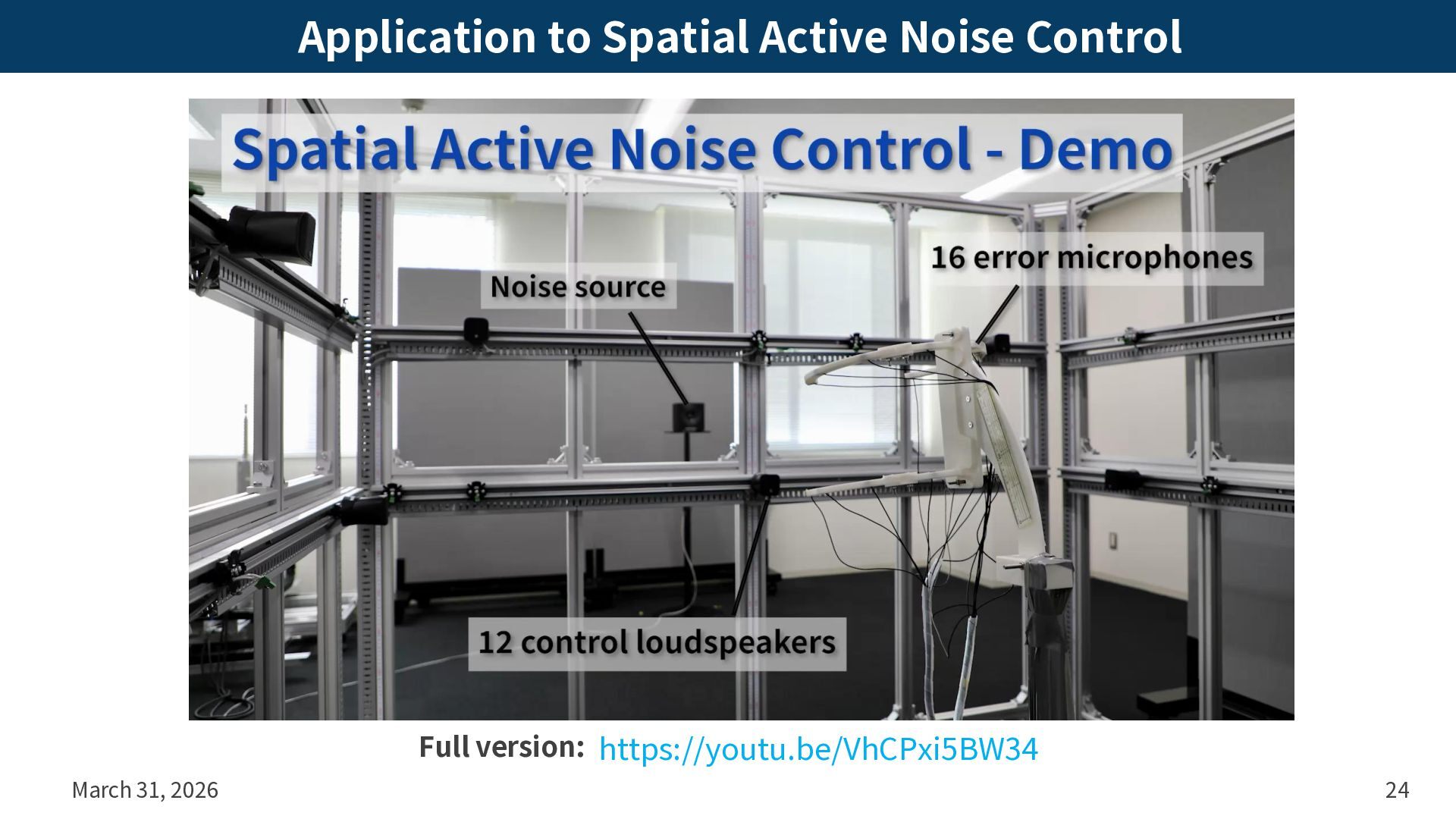
regional noise power is estimated by kernel interpolation of sound field ➢ Adaptive filtering algorithm based on kernel interpolation is also derived March 31, 2026 23 ANC in 3D space based on sound field interpolation ➢ Conventional cost function ➢ Proposed cost function : Power of error mics : Regional noise power [Ito+ IEEE ICASSP 2019 (Best Student Paper Award), Koyama+ IEEE/ACM TASLP 2021]
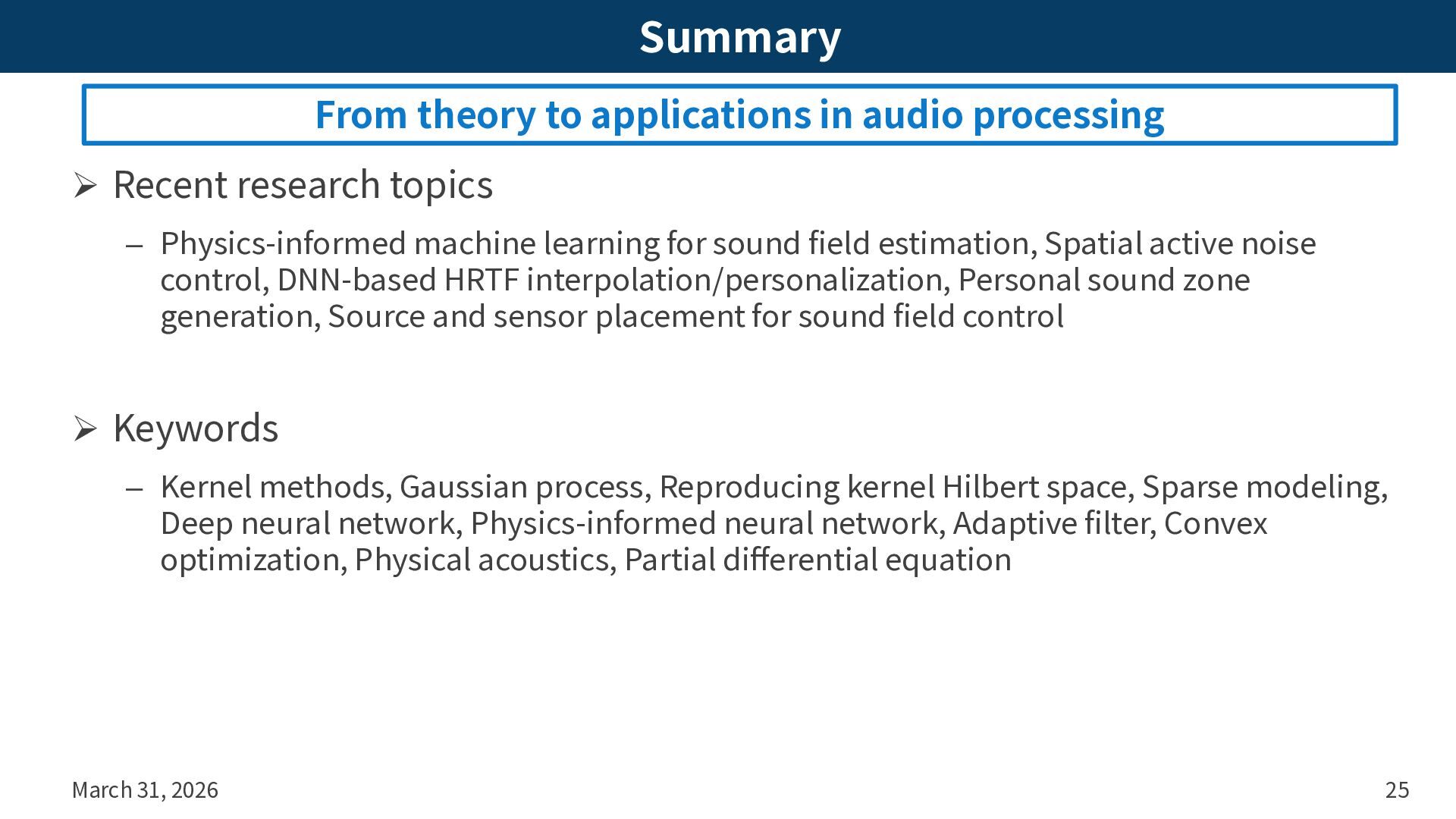
sound field estimation, Spatial active noise control, DNN-based HRTF interpolation/personalization, Personal sound zone generation, Source and sensor placement for sound field control ➢ Keywords – Kernel methods, Gaussian process, Reproducing kernel Hilbert space, Sparse modeling, Deep neural network, Physics-informed neural network, Adaptive filter, Convex optimization, Physical acoustics, Partial differential equation March 31, 2026 25 From theory to applications in audio processing


 skoyamalab
 hellosct1
 mickey_0226
 institutdelelevage
 takasehideki
 nzw0301
 koide3
 de9uch1
 hisaokatsumi
 dk999
dk999
 wataruuuuu
 codingconduct
 michielstock
 tomoyanonymous
 sarafernandez
 reverentgeek
 katarinadahlin
 aleyda
 frankvandijk
 akademiya2063
 afnizarnur
 soudai
 thoeni