Share
Embed
New Type Inference and Related Language Features
The talk @KotlinConf 2018.
Svetlana Isakova
October 04, 2018
Transcript
84 slides
-
Experimental features Our goal: to let new features be tried
by early adopters as soon as possible -
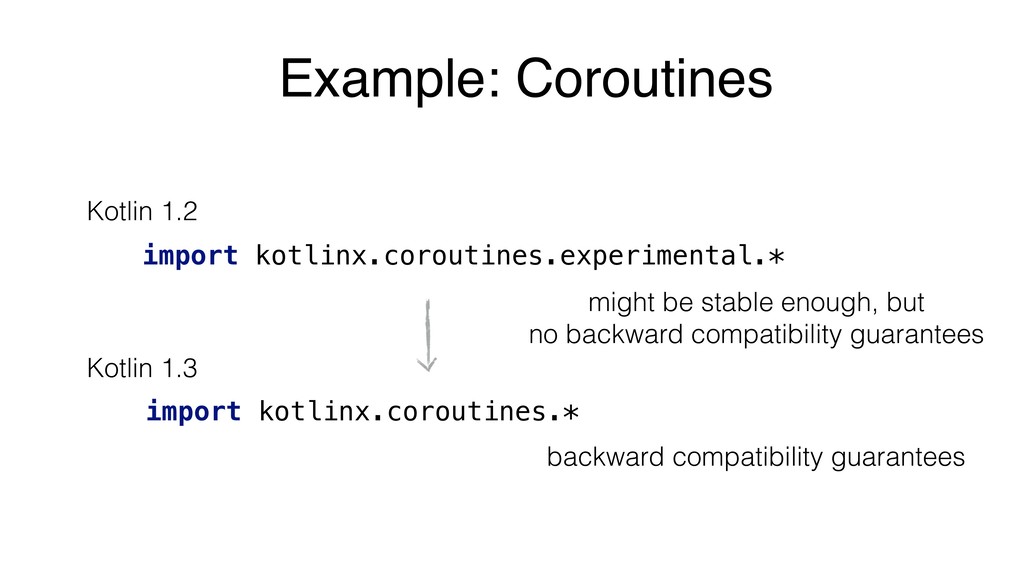
import kotlinx.coroutines.experimental.* import kotlinx.coroutines.* Example: Coroutines Kotlin 1.3 Kotlin 1.2
might be stable enough, but no backward compatibility guarantees backward compatibility guarantees -
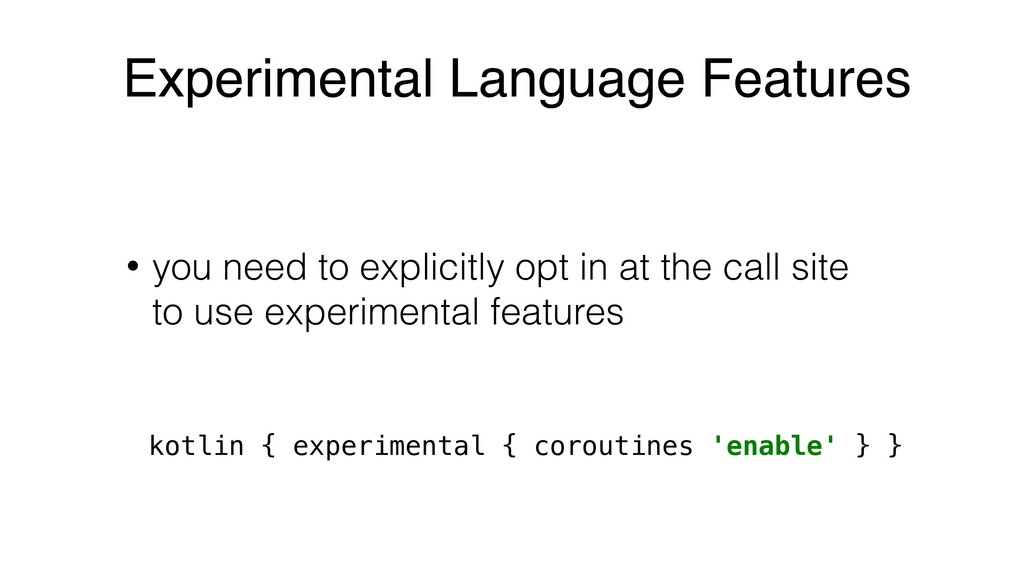
Experimental Language Features • you need to explicitly opt in
at the call site to use experimental features kotlin { experimental { coroutines 'enable' } } -
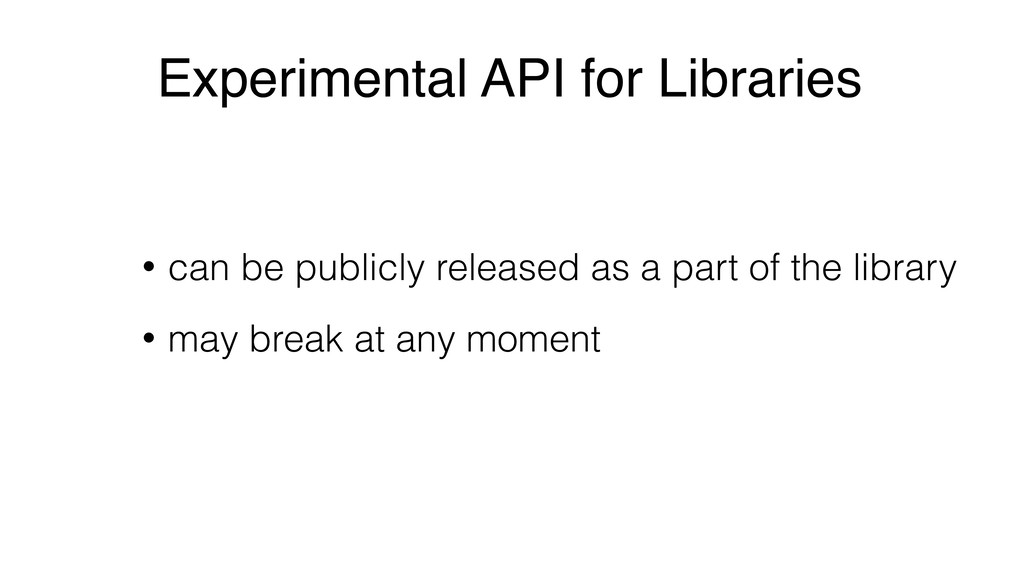
Experimental API for Libraries • can be publicly released as
a part of the library • may break at any moment -
@ShinyNewAPI class Foo { ... } Experimental API @Experimental annotation
class ShinyNewAPI You can mark your shiny new class or function as experimental -
inline fun <R> run(block: () -> R): R = block()
Changes in standard library -
inline fun <R> run(block: () -> R): R = block()
inline fun <R> run(block: () -> R): R { contract { callsInPlace(block, InvocationKind.EXACTLY_ONCE) } return block() } Changes in standard library -
Changes in standard library inline fun <R> run(block: () ->
R): R { contract { callsInPlace(block, InvocationKind.EXACTLY_ONCE) } return block() } inline fun <R> run(block: () -> R): R = block() -
We know something about run, which the compiler doesn’t val
answer: Int run { answer = 42 } println(answer) -
We know something about run, which the compiler doesn’t val
answer: Int run { answer = 42 } println(answer) Compiler error: Captured values initialization is forbidden due to possible reassignment -
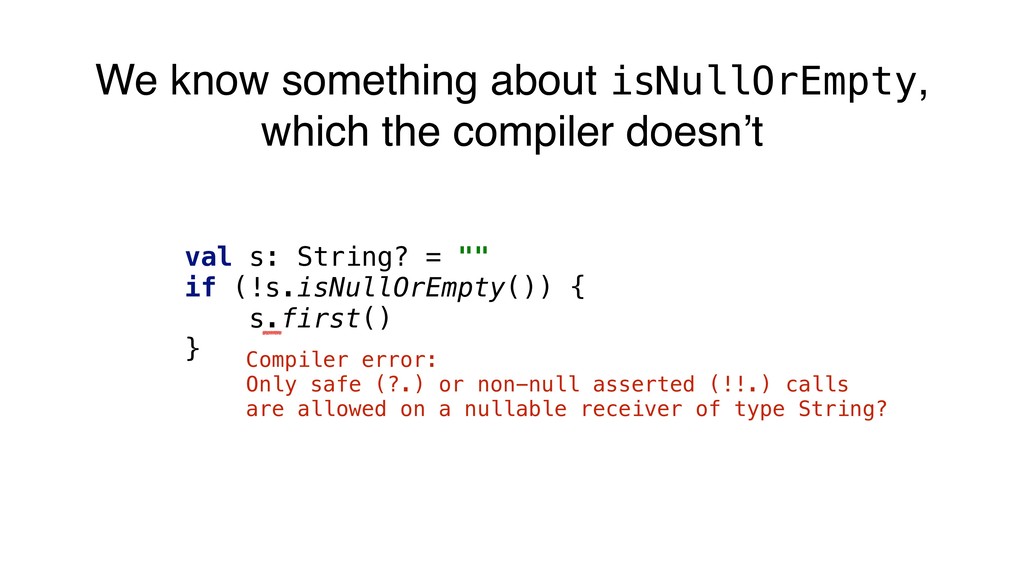
val s: String? = "" if (!s.isNullOrEmpty()) { s.first() }
We know something about isNullOrEmpty, which the compiler doesn’t -
val s: String? = "" if (!s.isNullOrEmpty()) { s.first() }
Compiler error: Only safe (?.) or non-null asserted (!!.) calls are allowed on a nullable receiver of type String? We know something about isNullOrEmpty, which the compiler doesn’t -
Kotlin Contracts …allow to share extra information about code semantics
with the compiler -
Variable initialization inside run val answer: Int run { answer
= 42 } println(answer) -
Variable initialization inside run val answer: Int run { answer
= 42 } println(answer) ✓ -
val s: String? = "" if (!s.isNullOrEmpty()) { s.first() }
Making smart casts even smarter -
val s: String? = "" if (!s.isNullOrEmpty()) { s.first() }
Making smart casts even smarter ✓ -
inline fun <R> run(block: () -> R): R { contract
{ callsInPlace(block, InvocationKind.EXACTLY_ONCE) } return block() } Contract: block lambda will be always called once -
Contract for calling inlined lambda in-place run, let, with, apply,
also takeIf, takeUnless, synchronized -
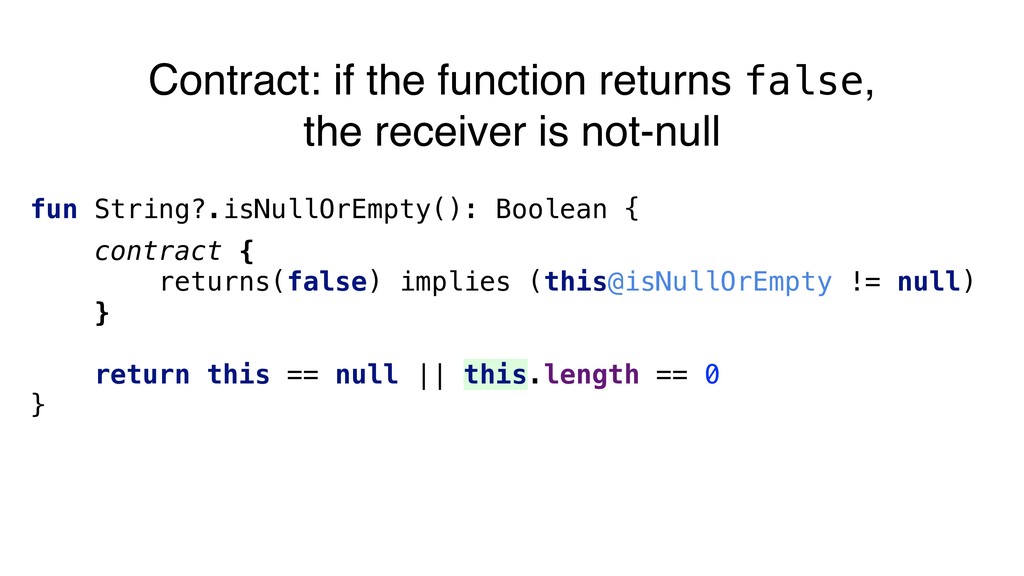
fun String?.isNullOrEmpty(): Boolean { contract { returns(false) implies (this@isNullOrEmpty !=
null) } return this == null || this.length == 0 } Contract: if the function returns false, the receiver is not-null -
fun String?.isNullOrEmpty(): Boolean { contract { returns(false) implies (this@isNullOrEmpty !=
null) } return this == null || this.length == 0 } Contract: if the function returns false, the receiver is not-null val s: String? = "" if (!s.isNullOrEmpty()) { s.first() } ✓ -
fun String?.isNullOrEmpty(): Boolean { contract { returns(false) implies (this@isNullOrEmpty !=
null) } return this == null || this.length == 0 } Contract: if the function returns false, the receiver is not-null -
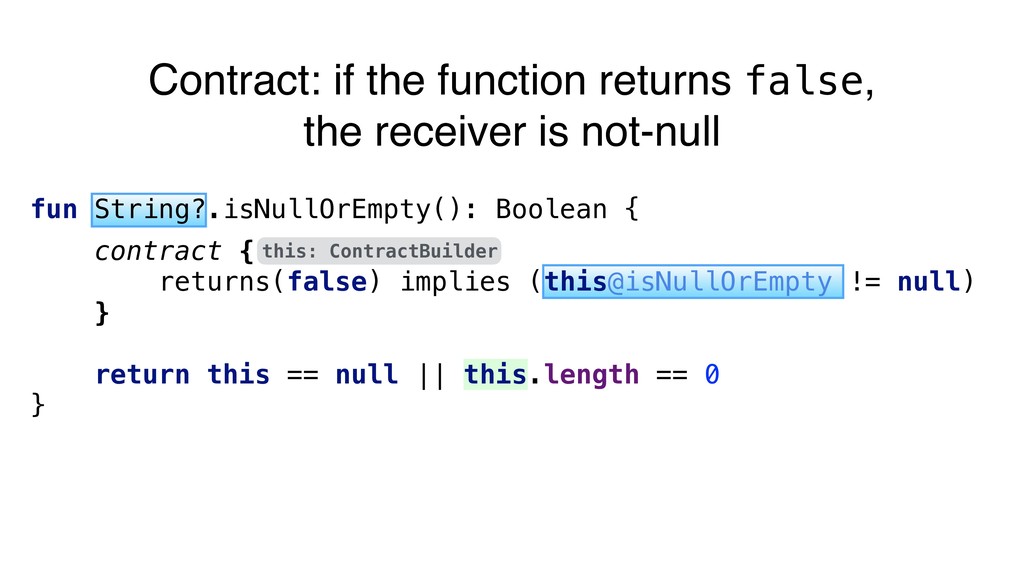
this: ContractBuilder fun String?.isNullOrEmpty(): Boolean { contract { returns(false) implies
(this@isNullOrEmpty != null) } return this == null || this.length == 0 } Contract: if the function returns false, the receiver is not-null -
Contract: if the function returns a given value, a condition
is satisfied isNullOrEmpty, isNullOrBlank kotlin.test: assertTrue, assertFalse, assertNotNull check, checkNotNull, require, requireNotNull -
Kotlin Contract extra information by developer & compiler uses this
information for code analysis experimental -
Kotlin Contract extra information by developer & compiler uses this
information for code analysis & checking that the information is correct at compile time or runtime to be supported -
Why can’t compiler just implicitly infer such information? Because then
such implicitly inferred information: - can be implicitly changed - can implicitly break code depending on it -
Why can’t compiler just implicitly infer such information? Because then
such implicitly inferred information: - can be implicitly changed - can implicitly break code depending on it Contract = explicit statement about function behaviour -
Using contracts for your own functions fun assertNotNull(actual: Any?, message:
String? = null) { if (actual == null) { throw AssertionError( message ?: "Value must not be null" ) } } fun testInput(input: String?) { assertNotNull(input) assertTrue(input!!.any { it.isDigit() }) } -
Using contracts for your own functions fun assertNotNull(actual: Any?, message:
String? = null) { if (actual == null) { throw AssertionError( message ?: "Value must not be null" ) } } fun testInput(input: String?) { assertNotNull(input) assertTrue(input!!.any { it.isDigit() }) } -
Using contracts for your own functions fun assertNotNull(actual: Any?, message:
String? = null) { contract { returns() implies (actual != null) } if (actual == null) { throw AssertionError( message ?: "Value must not be null" ) } } fun testInput(input: String?) { assertNotNull(input) assertTrue(input.all { it.isDigit() }) } -
Experimental Using contracts for your own functions fun assertNotNull(actual: Any?,
message: String? = null) { contract { returns() implies (actual != null) } if (actual == null) { throw AssertionError( message ?: "Value must not be null" ) } } fun testInput(input: String?) { assertNotNull(input) assertTrue(input.all { it.isDigit() }) } -
• handy functions (run, isEmptyOrNull) are even more useful •
contract DSL will change • you can go and try it out Contracts: Summary -
New type inference better and more powerful type inference new
features are supported -
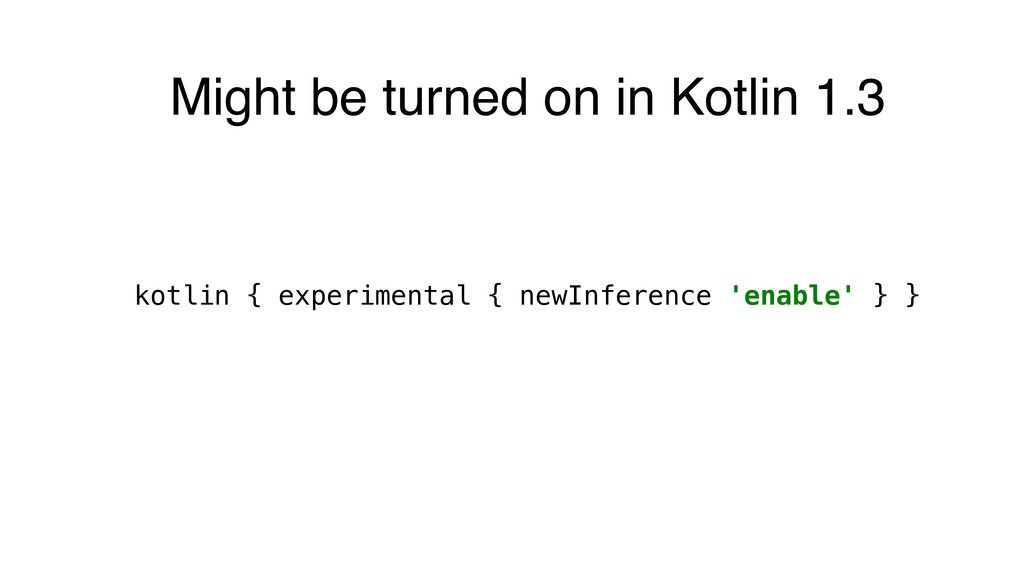
kotlin { experimental { newInference 'enable' } } Might be
turned on in Kotlin 1.3 -
Kotlin libraries • Libraries should specify return types for public
API • Overloaded functions must do the same thing -
Kotlin libraries • Libraries should specify return types for public
API • Overloaded functions must do the same thing turn on an IDE inspection “Public API declaration has implicit return type” -
New type inference • SAM conversions for Kotlin functions •
better inference for builders • better inference for call chains • better inference for intersection types -
fun handleInput(handler: Action<String>) { ... } SAM conversions for Kotlin
functions public interface Action<T> { void execute(T target); } -
fun handleInput(handler: Action<String>) { ... } SAM conversions for Kotlin
functions public interface Action<T> { void execute(T target); } You can pass a lambda as an argument when a Java SAM-interface is expected: handleInput { println(it) } -
Support for several SAM arguments Old inference: observable.zipWith(anotherObservable, BiFunction {
x, y -> x + y }) class Observable { public final Observable zipWith( ObservableSource other, BiFunction zipper) {…} } SAM interfaces -
Support for several SAM arguments Old inference: observable.zipWith(anotherObservable, BiFunction {
x, y -> x + y }) observable.zipWith(anotherObservable) { x, y -> x + y } New inference: -
Support for several SAM arguments Old inference: observable.zipWith(anotherObservable, BiFunction {
x, y -> x + y }) observable.zipWith(anotherObservable) { x, y -> x + y } New inference: ✓ -
Inference for sequence val seq = sequence { yield(42) }
: Sequence<Int> -
Inference for regular lambdas people.map { person -> println("Processed: ${person.name}")
person.age } Result type may depend on lambda return type -
Inference for regular lambdas people.map { person -> println("Processed: ${person.name}")
person.age } Int Result type may depend on lambda return type -
Inference for regular lambdas people.map { person -> println("Processed: ${person.name}")
person.age } List<Int> Int Result type may depend on lambda return type -
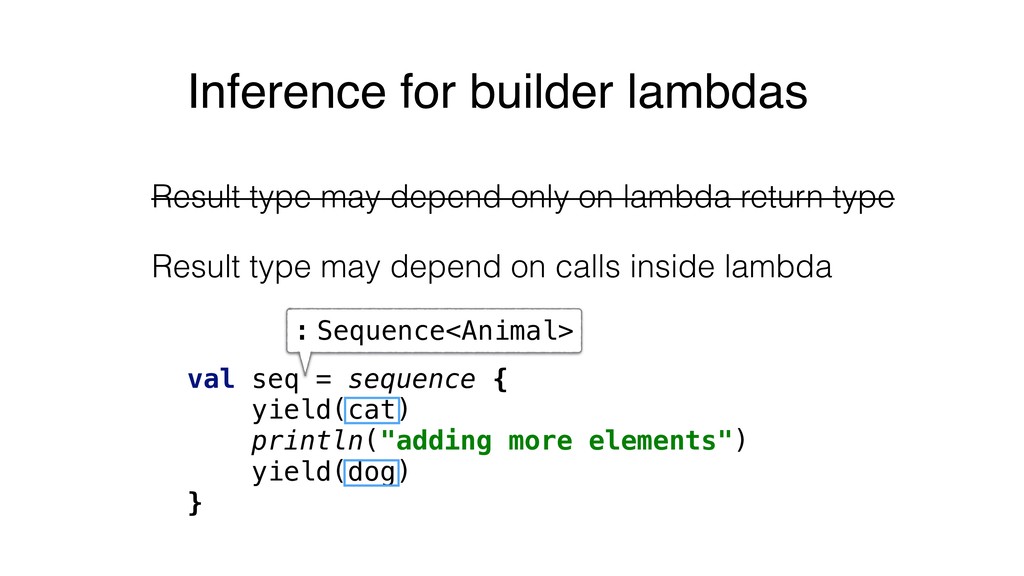
Inference for builder lambdas val seq = sequence { yield(cat)
println("adding more elements") yield(dog) } Result type may depend only on lambda return type Result type may depend on calls inside lambda -
Inference for builder lambdas val seq = sequence { yield(cat)
println("adding more elements") yield(dog) } Result type may depend only on lambda return type Result type may depend on calls inside lambda : Sequence<Animal> -
Builder inference automatically works for sequence in 1.3 opt in
to use that for your functions -
Using @BuilderInference for your function fun <T> buildList( @BuilderInference init:
MutableList<T>.() -> Unit ): List<T> { return mutableListOf<T>().apply(init) } val list = buildList { add(cat) add(dog) } : List<Animal> Experimental -
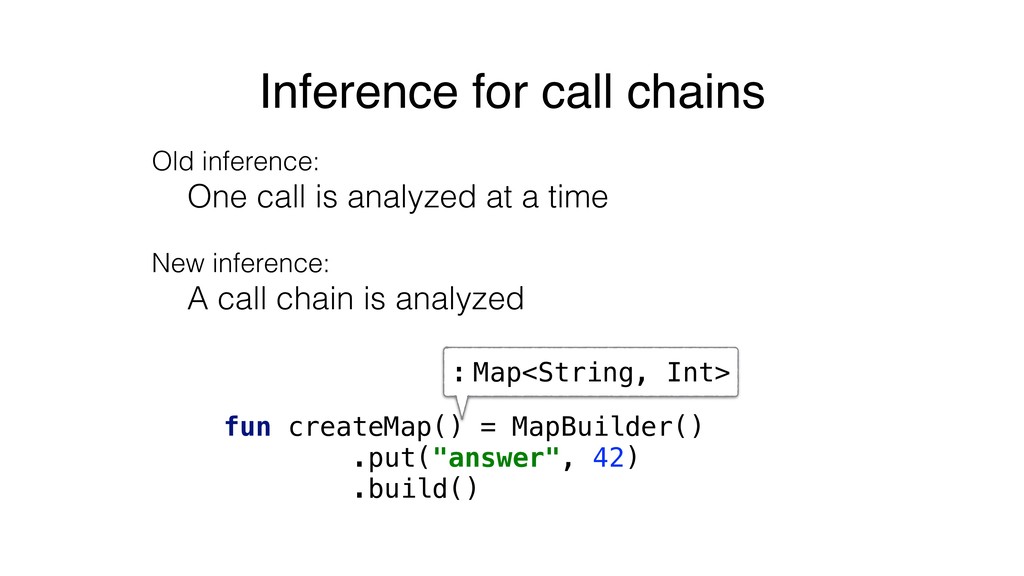
Inference for call chains fun createMap() = MapBuilder() .put("answer", 42)
.build() Old inference: One call is analyzed at a time New inference: A call chain is analyzed -
Inference for call chains fun createMap() = MapBuilder() .put("answer", 42)
.build() : Map<String, Int> Old inference: One call is analyzed at a time New inference: A call chain is analyzed -
Better inference for intersection types interface Drownable interface Throwable fun
<T> throwIntoRiver(thing: T) where T : Drownable, T : Throwable { println("Bye, $thing") } -
Better inference for intersection types interface Drownable interface Throwable fun
<T> throwIntoRiver(thing: T) where T : Drownable, T : Throwable { println("Bye, $thing") } if (something is Drownable && something is Throwable) { throwIntoRiver(something) } -
Drownable & Throwable Better inference for intersection types interface Drownable
interface Throwable fun <T> throwIntoRiver(thing: T) where T : Drownable, T : Throwable { println("Bye, $thing") } if (something is Drownable && something is Throwable) { throwIntoRiver(something) } -
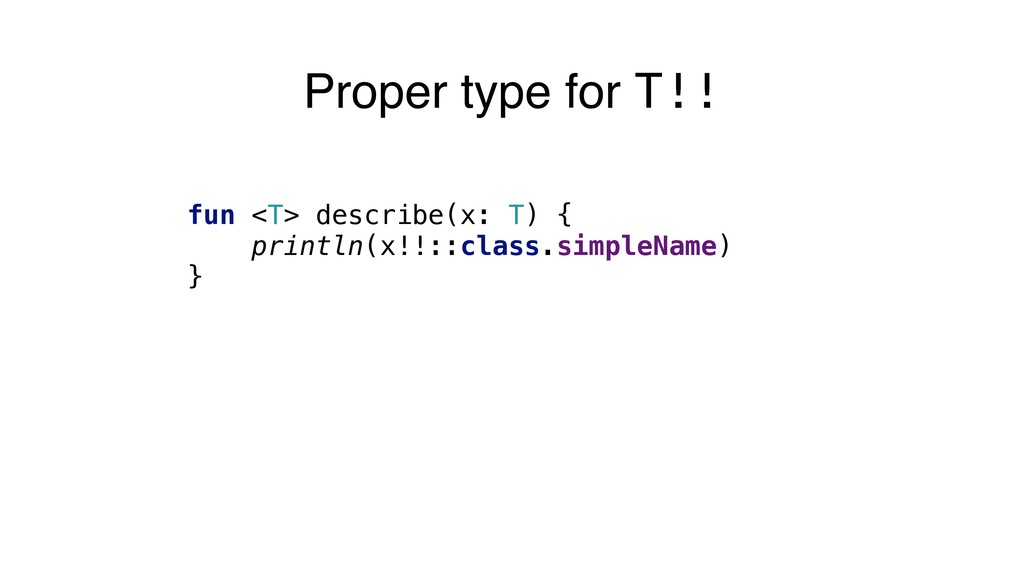
Proper type for T!! fun <T> describe(x: T) { println(x!!::class.simpleName)
} T!! T!! fun <T> describe(x: T) { if (x != null) { println(x::class.simpleName) } } -
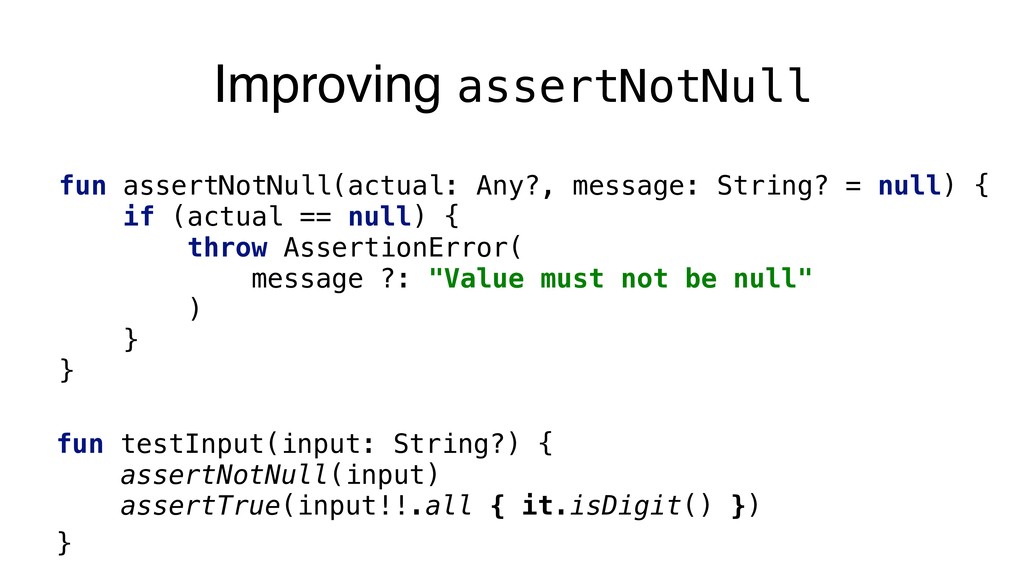
Improving assertNotNull fun assertNotNull(actual: Any?, message: String? = null) {
if (actual == null) { throw AssertionError( message ?: "Value must not be null" ) } } fun testInput(input: String?) { assertNotNull(input) assertTrue(input!!.all { it.isDigit() }) } -
fun testInput(input: String?) { assertTrue(assertNotNull(input).all { it.isDigit() }) } Improving
assertNotNull: return asserted value -
fun <T : Any> assertNotNull( actual: T?, message: String? =
null ): T { if (actual == null) { throw AssertionError( message ?: "Value must not be null" ) } return actual } fun testInput(input: String?) { assertTrue(assertNotNull(input).all { it.isDigit() }) } Improving assertNotNull: return asserted value -
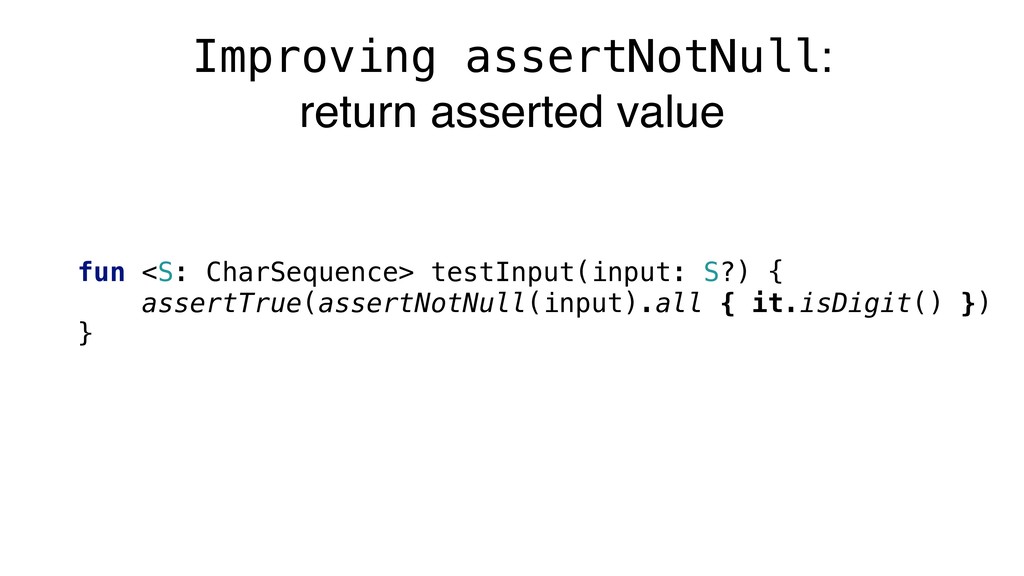
Improving assertNotNull: return asserted value fun <S: CharSequence> testInput(input: S?)
{ assertTrue(assertNotNull(input).all { it.isDigit() }) } -
Improving assertNotNull: return asserted value fun <S: CharSequence> testInput(input: S?)
{ assertTrue(assertNotNull(input).all { it.isDigit() }) } S!! S!! = S & Any -
New type inference: summary • new features are supported •
will be used by default in the future • you can go and try it out