RiceShift — NASA-Powered Rotation Advisor for C...

RiceShift — NASA-Powered Rotation Advisor for California Rice Farms | NASA Space Apps Challenge 2026
RiceShift is a decision-support prototype developed by Team Hachi for the NASA Space Apps Challenge 2026 challenge, “Field Shift: Adapting Farms with NASA Data.”
The project explores how NASA Earth observations can contribute measurable evidence to crop-rotation decisions for rice farms in California’s Sacramento Valley.
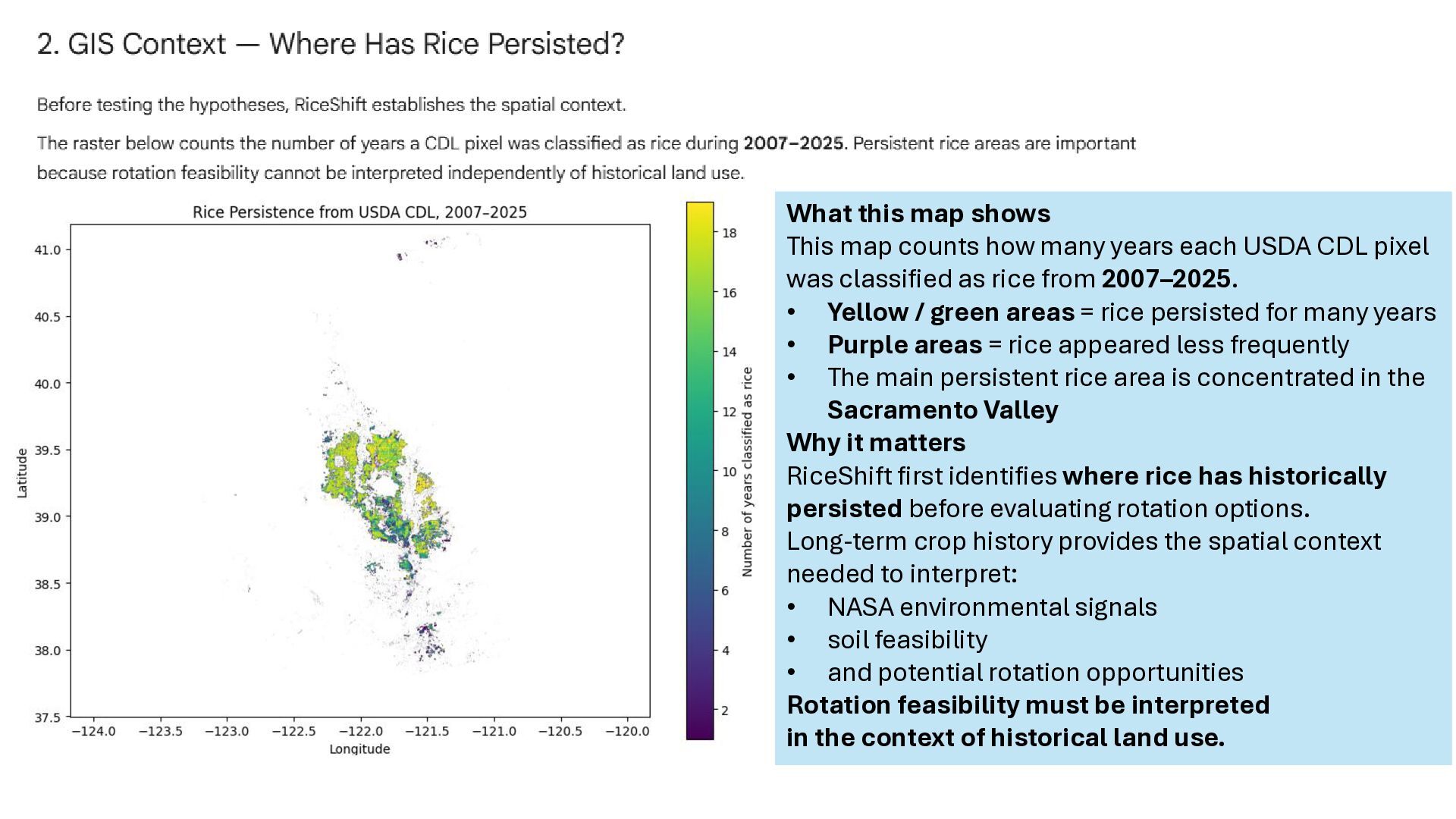
RiceShift combines NASA MODIS and SMAP observations with USDA Cropland Data Layer (CDL), USDA NASS agricultural statistics, USDA NRCS SSURGO soil information, published UC Davis / UC ANR agronomic research, regional agricultural statistics, and economic and policy context.
The prototype evaluates three candidate management strategies:
• Continuous Rice
• Rice → Winter Vetch → Rice
• Rice → Winter Cover Crop Mix → Rice
The analysis tests whether winter represents a distinct environmental management window, whether NASA environmental indicators are associated with agricultural outcomes, and whether those indicators provide useful predictive information. It then combines these findings with long-term crop history, soil feasibility, published cover-crop experiments, nitrogen-management evidence, and economic considerations.
Key findings include:
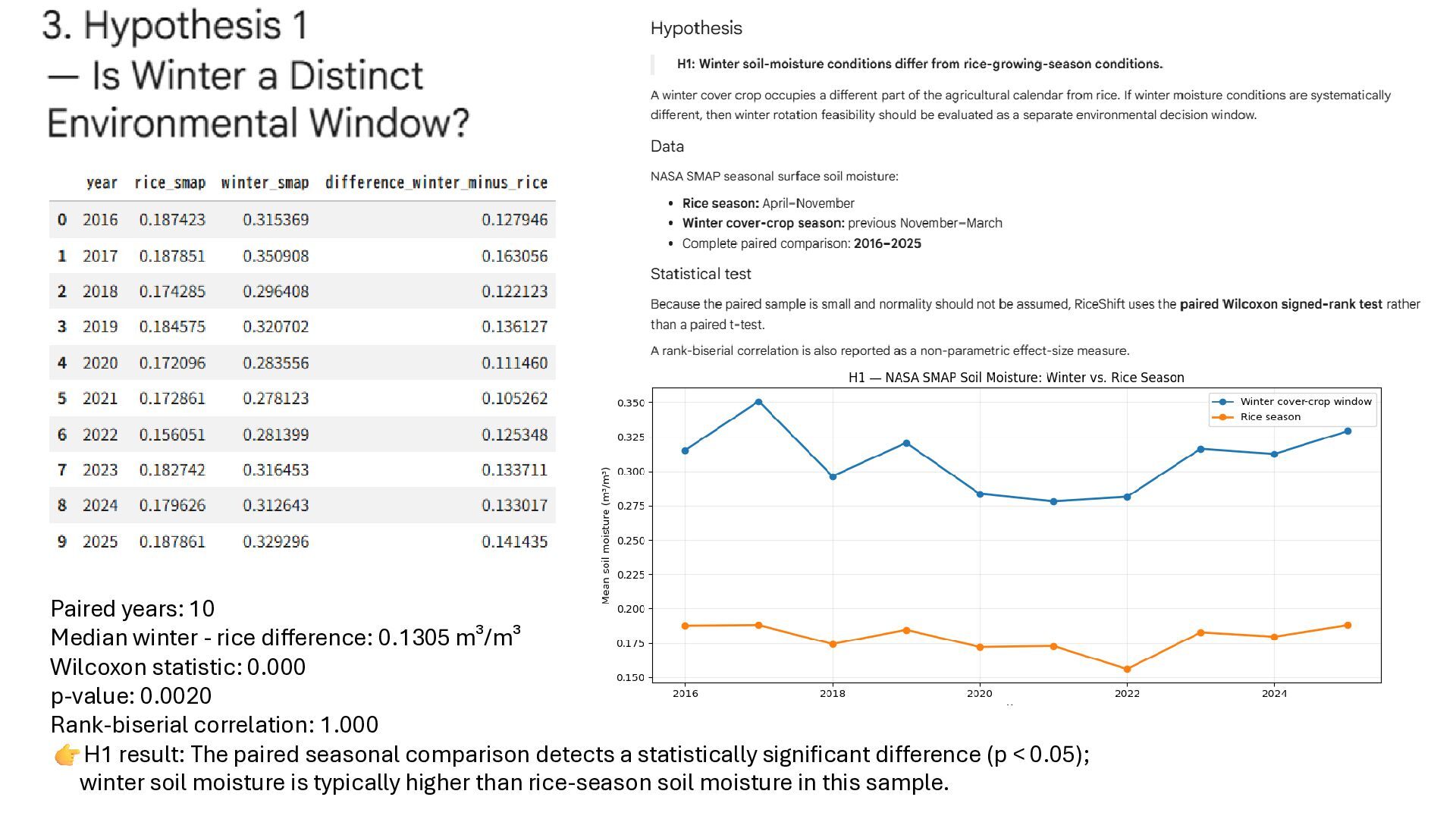
• NASA SMAP showed a clear seasonal separation between winter and the rice-growing season.
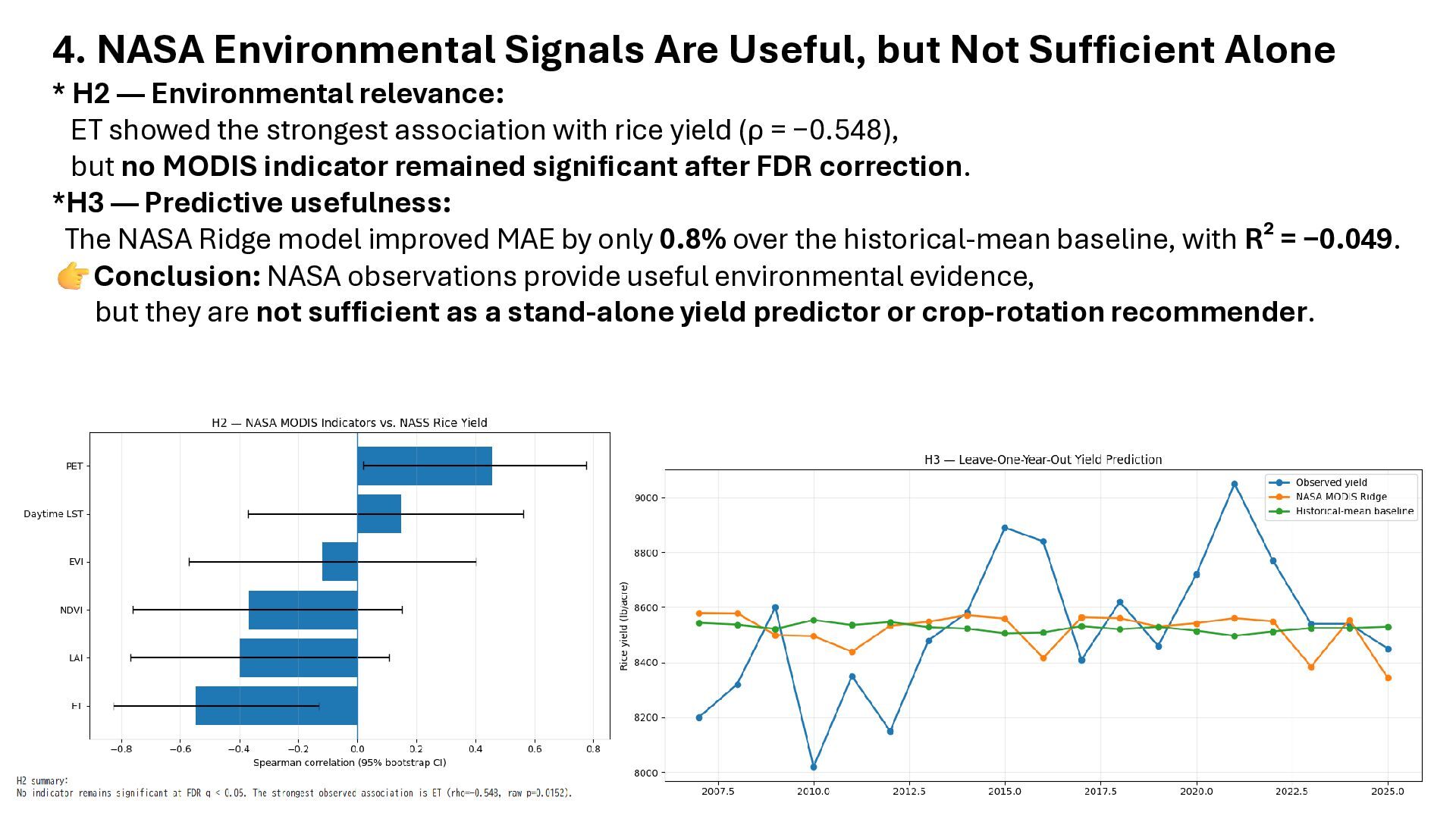
• NASA MODIS indicators provided environmental signals, but were not sufficient as a stand-alone yield-prediction or crop-selection model.
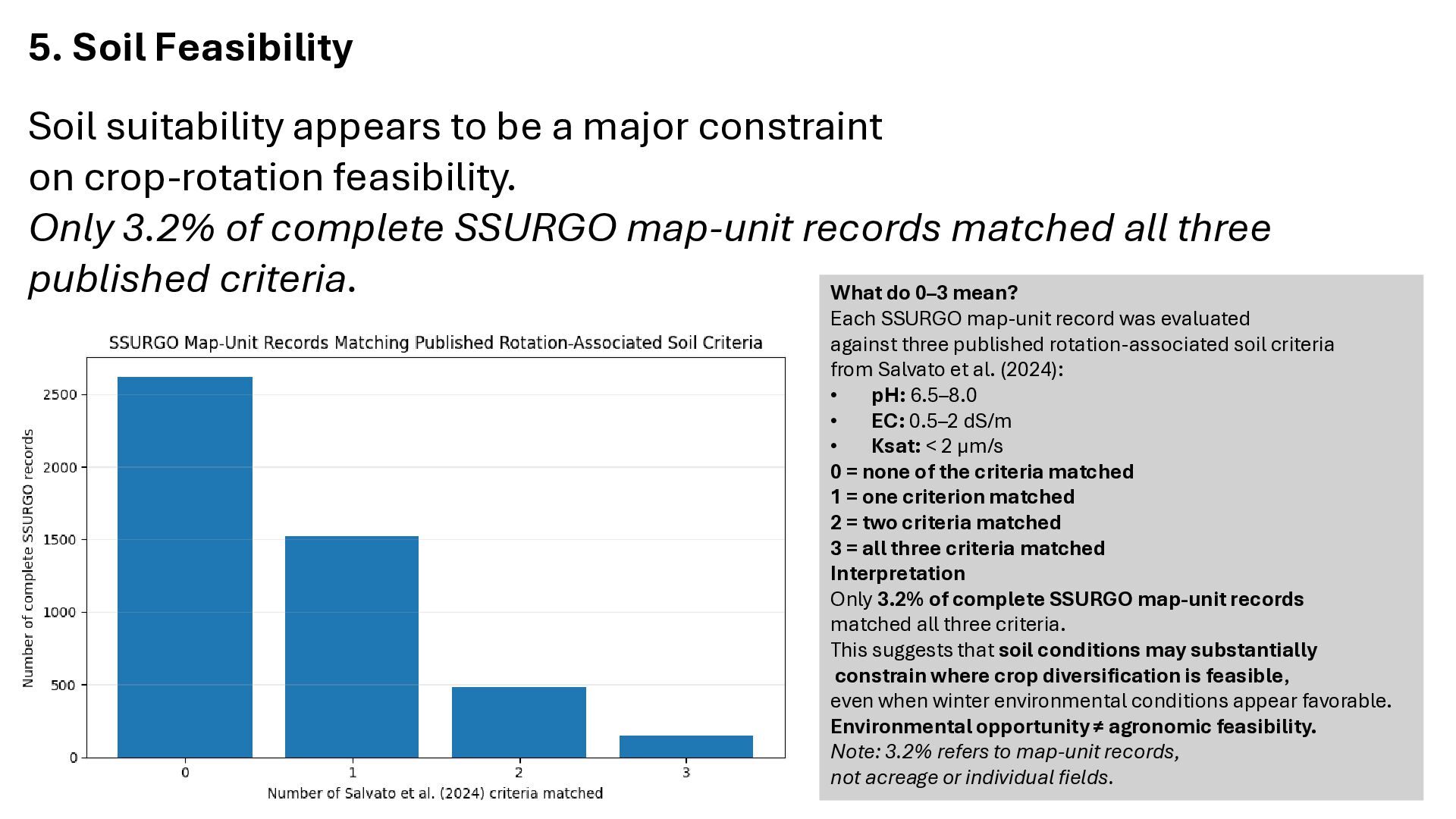
• SSURGO soil characteristics showed that agronomic feasibility can substantially constrain where crop diversification is appropriate.
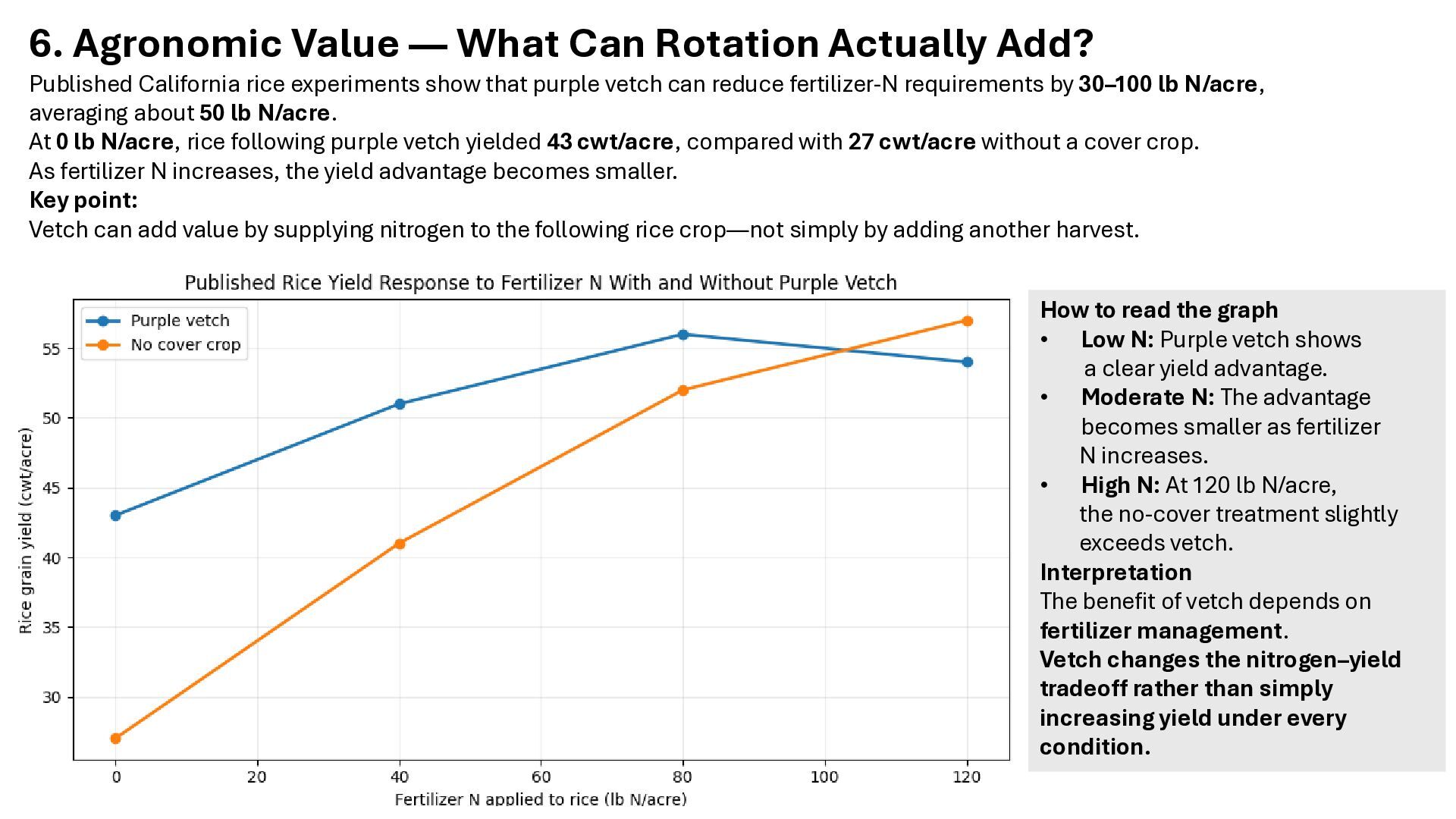
• Published California experiments show that winter vetch can reduce fertilizer-N requirements and alter the nitrogen–yield relationship of the following rice crop.
• Regional agricultural statistics demonstrate the substantial economic importance of rice production in the Sacramento Valley.
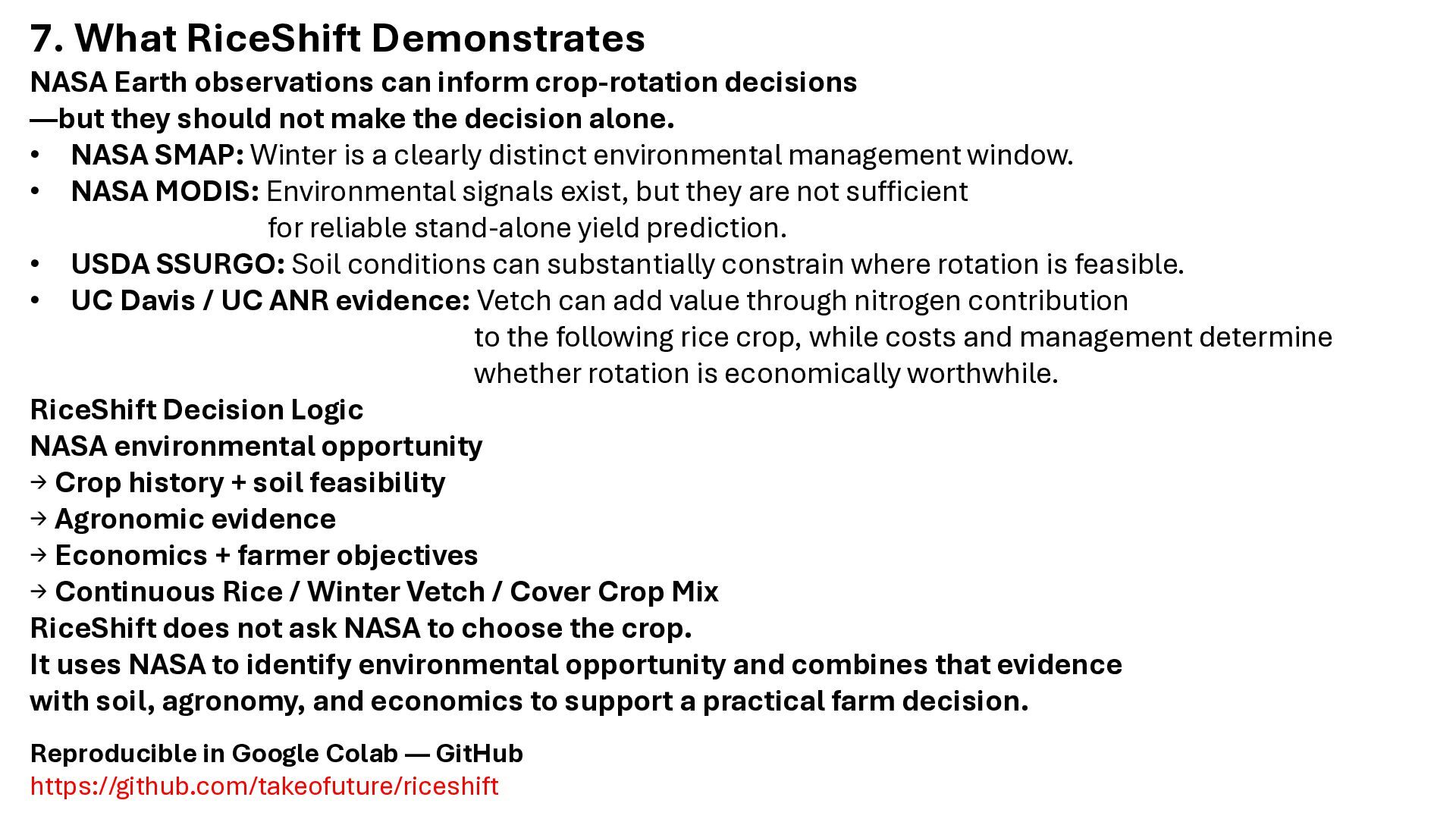
RiceShift therefore does not ask NASA data to directly select a crop. Instead, it uses NASA observations to identify environmental opportunity, crop history and soil information to test feasibility, and agronomic and economic evidence to support the final farm-management decision.
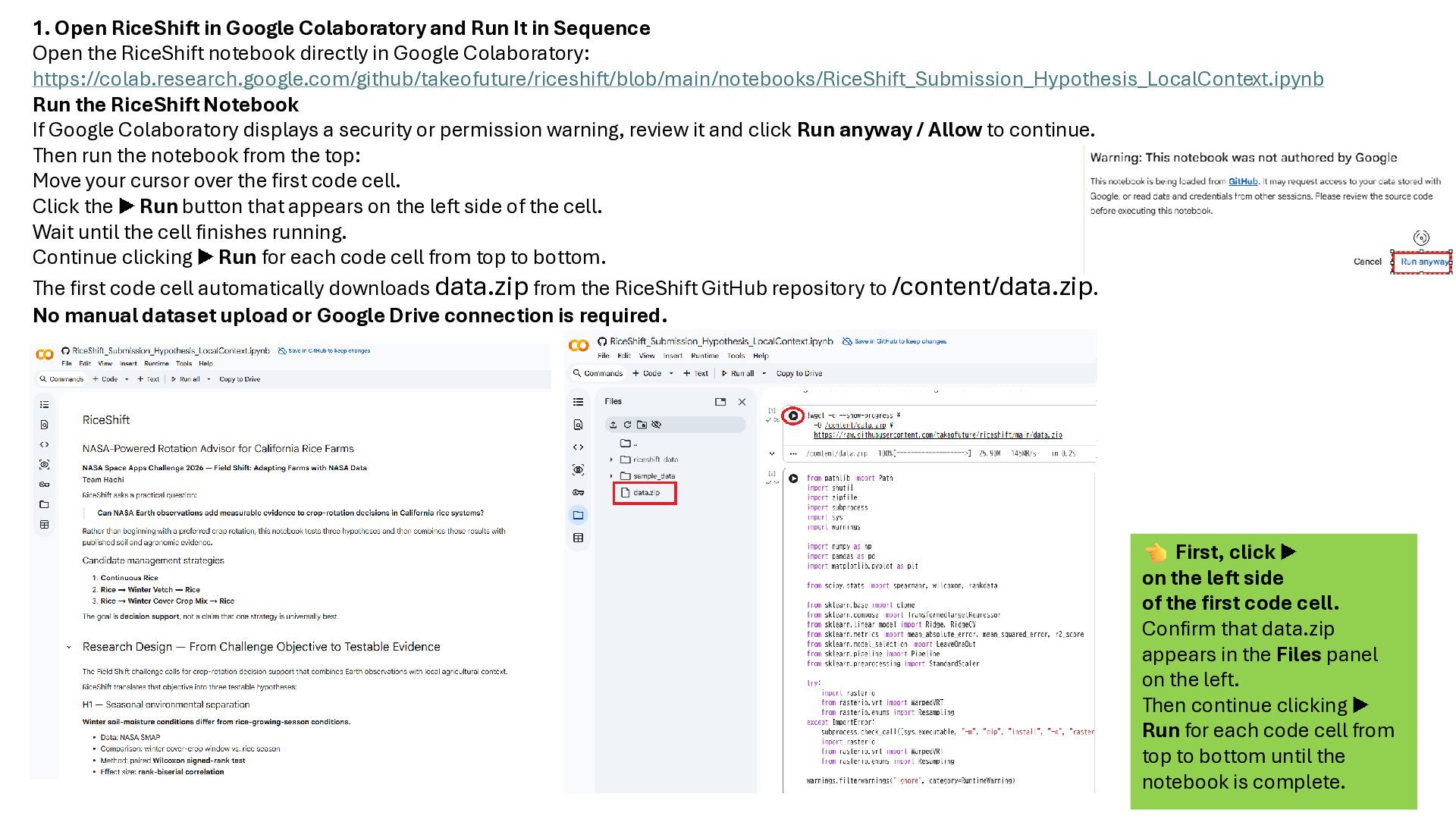
The demonstration is fully reproducible in Google Colaboratory using the public RiceShift GitHub repository.
GitHub:
https://github.com/takeofuture/riceshift
Team Hachi
NASA Space Apps Challenge 2026
Field Shift: Adapting Farms with NASA Data

 takeofuture
 ishiirikie
 gkazunii
 institutdelelevage
 taniai
 takehaya
 shunk031
 stktu
 shiell
 satai
 takaomurakami
 kzmssk
 twada
 apolaine
 addyosmani
 tammyeverts
 aleyda
 denniskardys
 retrage
 katiecoart
 rkaga
 baasie
 honnibal
 akademiya2063