Upgrade to Pro — share decks privately, control downloads, hide ads and more …

How Yahoo Finance Android scales (AnDevCon 2017...

How Yahoo Finance Android scales (AnDevCon 2017, DC)

I spoke about the various techniques we employ around understanding our users, planning, CI/CD, experimentation, coding, culture and performance to deliver high quality software to our users at AnDevCon 2017 Washington DC.

Vikram Bodicherla

July 18, 2017

Transcript

117 slides
  1. • Be ready to pivot • Spend only as much

    effort as you need for the given iteration
  2. Agenda • What does a good feature definition look like?

    • Practicing good scrum • CD all the way • Culture for winning • Architect for awesomeness
  3. Meet John • Joined last minute because a friend dropped

    out • Knows nothing about football. Probably cares even less. • Drafts Roberto Aguayo in the 2nd round because Tom told him he’s good (screw Tom) • 12% of fantasy football players. Over 60% are in their first season
  4. Building personas • Important attributes of your users • Personas

    define the user at the center of the cluster • Focusing on fewer personas help create focus • Cluster as a means to explanation
  5. Know when you have succeeded • You need to know

    where the goal post is • Vanity metrics – DAUs/Downloads etc. won’t tell you how your feature is doing • Clarity metrics – engagement of the feature – how your feature is doing • http://firstround.com/review/im-sorry-but-those-are-vanity-metrics/
  6. Data, not opinions • Wrong decisions invalidated quickly > no

    decisions • Ward off HiPPO attacks • An experiment should have • a hypothesis • an owner • a deadline
  7. Plan • Get a sense of time, scale and complexity

    • Identify blockers and dependencies • Establish owners • Aids distribution and parallelization of work
  8. Many ways to plan • Waterfall • rigorous planning •

    sequential • Agile • working software • people-centric • iterative, not change-averse • Read the agile manifesto (http://agilemanifesto.org)
  9. What’s a good scrum story? • A part of a

    feature that adds user value • A feature is a collection of stories Ex: add stock to watchlist by tapping on star • User story: Value is perceivable to the user • Engineering story: Value not directly perceivable to the user
  10. What’s a good scrum story? Story: A user should be

    able to add a stock to their watchlist by tapping on the star on a quote page Acceptance criterion • If a stock is not in the watchlist, tapping should add it • If a stock is in the watchlist, tapping should remove it • Add the following analytics event for star tap • Add the necessary Material-design compliant animations
  11. Grooming • Familiarize yourself with the backlog • Ensure stories

    are clear • Point using poker • Ensure >1 sprint’s worth stories are available
  12. Grooming Best practices • User stories with reasonable detail •

    Stories have acceptance criterion • Planning poker to point • More stories, the better • Timebox at 1 hour Anti-patterns • Rushing to story point • Writing stories in the meeting • “I know we don’t have all details, but let’s point it anyways”
  13. Sprint planning Best practices • Tasks < 1 day •

    Have a goal for the sprint • Plan to release at end of sprint • Discuss so product/design/UX can get out of the room first Anti-patterns • Team struggles to identify tasks • Tasks > 1 day • Discussions around what a story means
  14. Standups • Ensure team on track • Share impediments to

    blockers • This is NOT a status updates/knowledge sharing meeting
  15. Standups Best practices • Everyone updates stories prior • Be

    explicit – what’s done, what’s coming up, blockers • Parking lot for long discussions • Agree on defn. of ‘Done’ • Focus of accomplishing everything Anti-patterns • Debate product functionalities • Doing involved demos • Providing a lot of detail • Trying to resolve issues/blockers • Standups > 10 min • “This story is done, except for code review and testing”
  16. Standups Best practices • Everyone updates stories prior • Be

    explicit – what’s done, what’s coming up, blockers • Parking lot for long discussions • Agree on defn. of ‘Done’ • Focus of accomplishing everything Anti-patterns • The big boss needs some clarifications
  17. Scrum • Grooming • Sprint planning • Standup • Demo

    • Retrospective • Wins • Improvments
  18. Demos and retrospective • Demo all stories that are done

    • Celebrate wins • Updates on experiments • What can be better?
  19. Demo and retrospective Best practices • 2 action items for

    what should change • Demo only fully complete stories; no partial credit • Prepare upfront – projector, emulators, building your code Anti-patterns • The “What didn’t go well” list repeats i.e. no follow through • The team obsesses over the negatives • “This is not complete, but let me show what I’ve done”
  20. Demo and retrospective Best practices • 2 action items for

    what should change • Demo only fully complete stories; no partial credit • Prepare upfront – projector, emulators, building your code Anti-patterns • Wasting time setting up for the demo
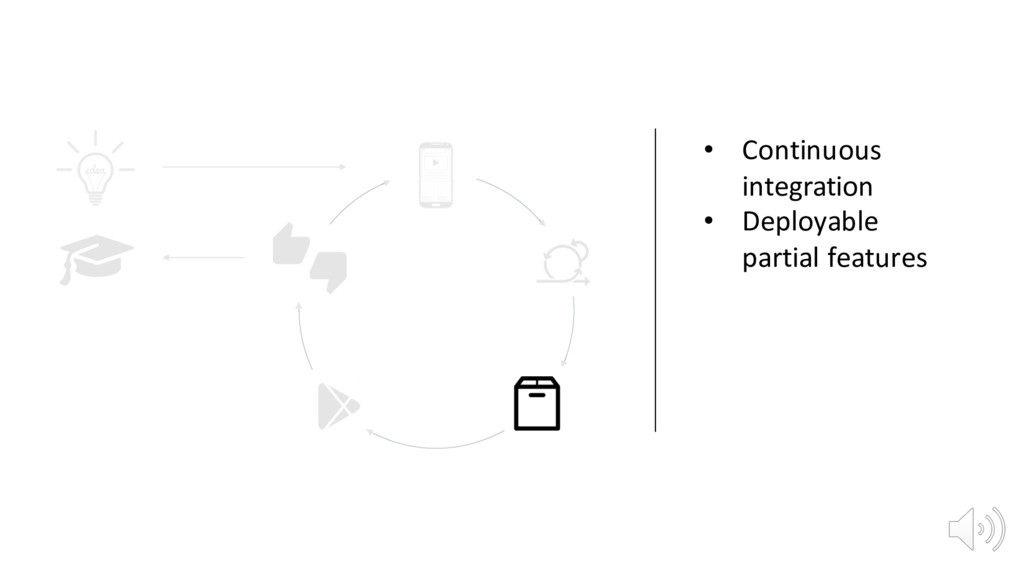
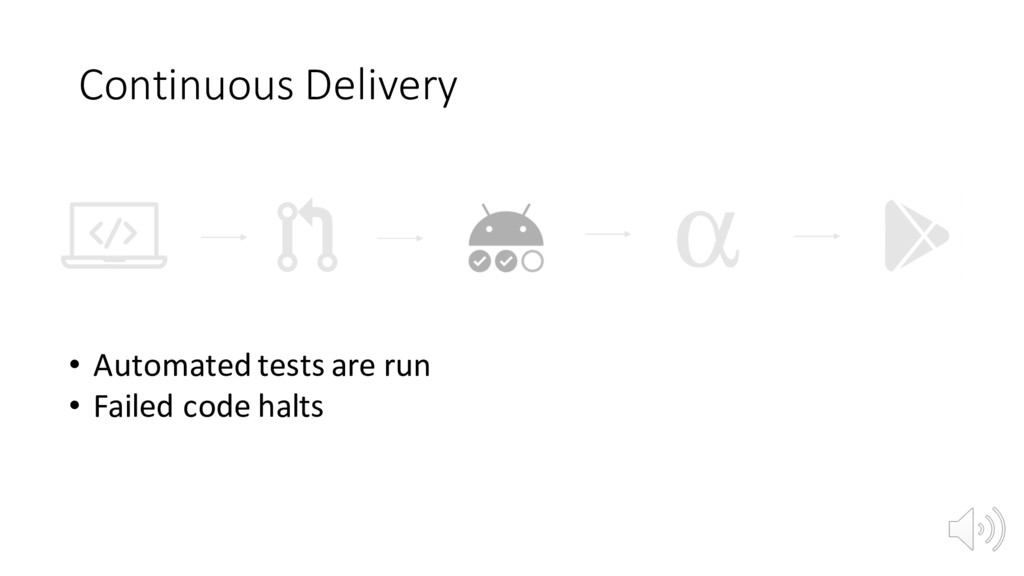
  21. Continuous Delivery is • Minimizing time between “code complete” →

    “deployable” • deployable ≠ deploy • Based on a solid Continuous Integration (CI) pipeline
  22. Continuous Delivery is • Deploying right away • will get

    us instant feedback • you won’t accumulate debt • Not the best thing for your users • Find your sweet spot
  23. Continuous Delivery • Code is deployed to a pre-production user

    base • Internal users • Playstore alpha/beta testing
  24. Merging code • Reviewing code is very important • You

    don’t want your developer performing tasks that can be outsourced • Find the ‘best’ reviewer – facebook/mention-bot
  25. Merging code • Android test results • Make sure you

    run tests across all your variants! • CodeCov (http://codecov.io) • Ensure code coverage stays up to bar
  26. Merging code • Danger (http://danger.systems) • Automate your code review

    chores • Keep PRs to <500 lines • Good descriptive messages/ticker number for your history
  27. # Ensure a descriptive PR body if (github.pr_body == nil

    || github.pr_body.length < 25) warn(’PR message not descriptive enough (should be >25 chars)') end
  28. Merging code • Appetize (http://appetize.io) • Emulator in an iframe

    on the pull request • Removes the need to compile and install
  29. APK storage and deployment • Use an artifact repository •

    Publish artifacts from either every commit/nightly builds • Bitnami has an AWS image for Artifactory • Automate your playstore updates • fastlane/fastlane provides excellent tools to automate screenshot capture and APK publishing
  30. Team rules of engagement • Not how a result is

    to be achieved, but will indicate what is acceptable and what is not • Setting expectations upfront
  31. Team rules of engagement Own and drive plan Ex: Always

    Communicate the deviations/compromises. Never be in a state where someone learns about something, especially bad, from someone else or by chance
  32. Team rules of engagement Maintain high quality product Ex: Proactively

    address app quality issues. Ex: if there’s an outage, check, triage, announce and work towards resolving it
  33. Team rules of engagement Be a great team player Ex:

    if you are coming in late, let people know and mark it on your calendar; if you need to run an errand, mark it on your calendar
  34. Goals • Build a new search experience to increase engagement

    by 10% • Increase ad revenue by showing more ads by 3%
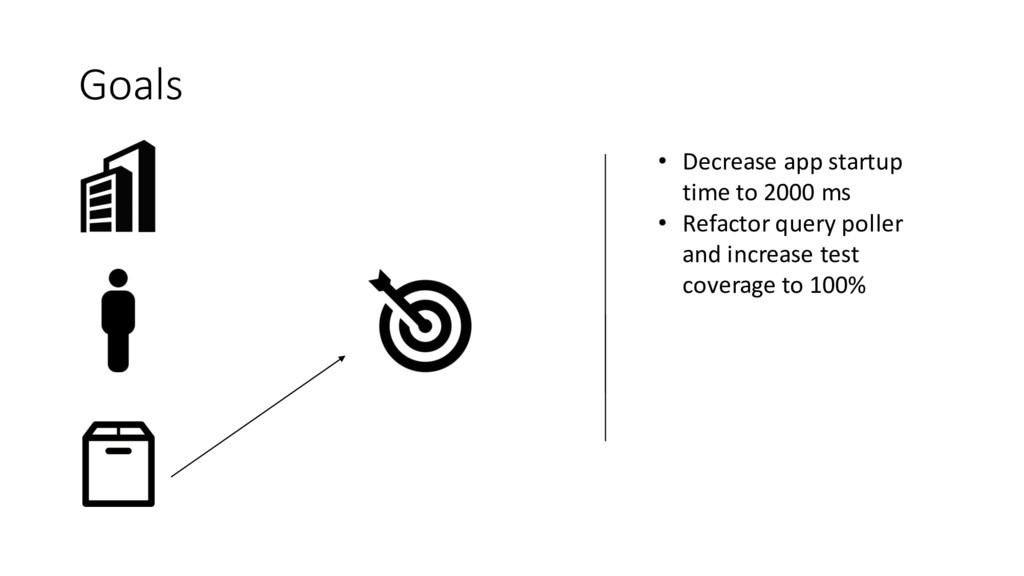
  35. Goals • Decrease app startup time to 2000 ms •

    Refactor query poller and increase test coverage to 100%
  36. Objectives and Key Results • Objective: Increase ad revenue by

    showing more ads by 3% • Key results • Identify slots for ad placement • Devise ad unit to place at each ad slot • Implement the top ad placements to achieve expected revenue increase • Deploy experience to beta users and compute run rate over 1 month Target 70%
  37. Meeting etiquette • Everyone needs to derive value • It’s

    OK to reject meeting invites • Enter with an agenda and goals, step out with action items • Start and end on time
  38. Code is a liability • Value = user revenue; cost

    = code • Writing, changing and reading code is expensive • Some components stabilize, some don’t • Building on bad code goes into a death spiral Stabilize or kill!
  39. yahoo-finance ~ 5 months angular ~ 4 months kubernetes~ 5

    months httpd ~ 5.4 years git ~ 6 years linux ~ 6.6 years Rapidly evolving components Stable components https://erikbern.com/2016/12/05/the-half-life-of-code.html
  40. Component design considerations • Investing time in stabilizing • Write

    clean, replaceable components • Capture history & knowledge
  41. Architecture Documentation Records (ADRs) • Capture significant architectural decisions and

    the whys • Each significant component has a ADR file in git Ex: adrs/database.MD • Capture the what and the why of the change
  42. Do you really need • Fragments over Activityes? • That

    fancy DI framework? • Annotation with JSON parser? • Optimize what matters • Do not prematurely optimize
  43. Prefer robustness over simplicity public class Application { public void
    onCreate() { WeatherSDK.initialize(true, "Washington DC"); } }
  44. Prefer robustness over simplicity public class Application { public void

    onCreate() { WeatherSDK sdk = new WeatherSDK(); sdk.cacheWeather(true); sdk.trackWeather("Washington DC"); } }
  45. Provide a way to accept shared resources public class Application

    { public void onCreate() { WeatherSDK sdk = new WeatherSDK.Builder() .withOkHttpClient(okHttpClient).build(); sdk.trackWeather("Washington DC"); } }
  46. All AsyncTasks share a single thread pool private static final

    int CORE_POOL_SIZE = Math.max(2, Math.min(CPU_COUNT - 1, 4)); private static final int MAXIMUM_POOL_SIZE = CPU_COUNT * 2 + 1;
  47. Actively report errors and crashes back FlurryAgent.onError("API_Resp", "FetchWeatherCallMissingKey: " +

    key, null); FlurryAgent.onError("GenCrash", "ConvertFtoCFor:" + city, exception); FlurryAgent.onError(”CacheFail", ”LoadFailed:" + key, null);
  48. Have feature flags ready Always have a local feature flag

    buildTypes { debug { buildConfigField ”boolean", "ENABLE_AWESOME_FEATURE_1", "true" } release { buildConfigField ”boolean", "ENABLE_AWESOME_FEATURE_1", "false" } }
  49. Have feature flags ready Always have a local feature flag

    buildTypes { debug { buildConfigField ”boolean", "ENABLE_AWESOME_FEATURE_1", "true" } release { buildConfigField ”boolean", "ENABLE_AWESOME_FEATURE_1", "false" } }
  50. Have feature flags ready And a remote feature flag while

    a feature stabilizes GET /features?versionCode=3.8.0&flavor=android { "ENABLE_AWESOME_FEATURE_1": false }
  51. Have feature flags ready And a remote feature flag while

    a feature stabilizes GET /features?versionCode=3.8.0&flavor=android { "ENABLE_AWESOME_FEATURE_1": false }
  52. Feature flags and experiments Don’t hesitate to duplicate code for

    experiments if (isFeatureEnabled(FeatureManager.Feature.SEARCH_IMPROVEMENTS)) { searchPresenter = new SearchPresenter(); } else { searchPresenter = new OldSearchPresenter(); }
  53. Performance • Memory usage and leaks • Use leakcanary •

    Make a habit of looking at MAT regularly • Buttery smooth performance • Keep an eye on Android vitals • Find The road to 60 FPS by Jason Sendros
  54. Performance - Startup time • Optimize data management • Prefetch

    and preload • Try to avoid data joins for your initial layout • Optimize code • Lots of knowledge on the Internet • Optimize your UX • Optimize your UX to enable faster startup • Consider using nimbledroid
  55. What next? • Give yourself a couple of quarters •

    Capture what you want to change in goals • Any change you want needs mindset shift, so get people buy-in • These are guidelines – don’t aim for 100% If you want to help Yahoo Finance get there, come talk to me!

More Decks by Vikram Bodicherla

Other Decks in Technology