Data-centric Metaprogramming - Scala Days 2016
Sponsored
·
 SiteGround - Reliable hosting with speed, security, and support you can count on.
→
SiteGround - Reliable hosting with speed, security, and support you can count on.
→

Share
Embed
Data-centric Metaprogramming - Scala Days 2016
Presentation at Scala Days 2016

Vlad Ureche
June 16, 2016
Transcript
180 slides
-
Object Composition class Vector[T] { … } The Vector collection
in the Scala library -
Object Composition class Employee(...) ID NAME SALARY class Vector[T] {
… } The Vector collection in the Scala library -
Object Composition class Employee(...) ID NAME SALARY class Vector[T] {
… } The Vector collection in the Scala library Corresponds to a table row -
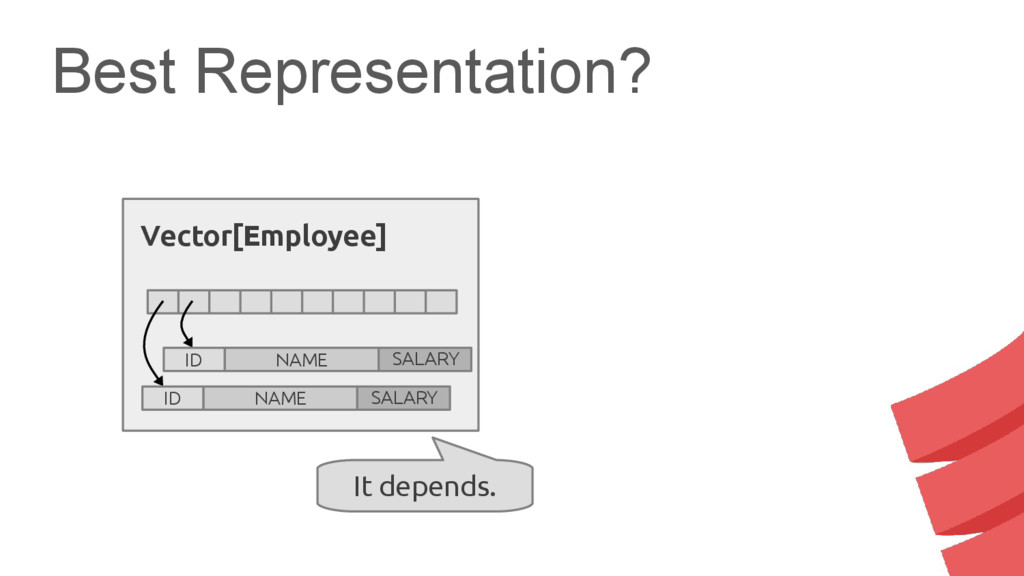
Object Composition class Employee(...) ID NAME SALARY Vector[Employee] ID NAME
SALARY ID NAME SALARY class Vector[T] { … } -
Object Composition class Employee(...) ID NAME SALARY Vector[Employee] ID NAME
SALARY ID NAME SALARY class Vector[T] { … } Traversal requires dereferencing a pointer for each employee. -
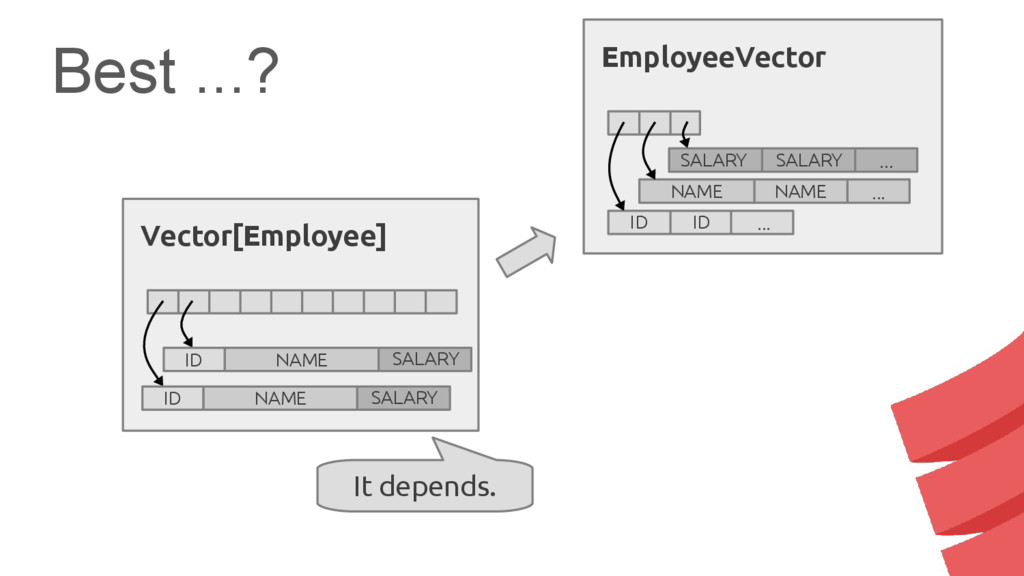
A Better Representation NAME ... NAME EmployeeVector ID ID ...
... SALARY SALARY Vector[Employee] ID NAME SALARY ID NAME SALARY -
A Better Representation • more efficient heap usage • faster
iteration NAME ... NAME EmployeeVector ID ID ... ... SALARY SALARY Vector[Employee] ID NAME SALARY ID NAME SALARY -
The Problem • Vector[T] is unaware of Employee – Which
makes Vector[Employee] suboptimal -
The Problem • Vector[T] is unaware of Employee – Which
makes Vector[Employee] suboptimal • Not limited to Vector, other constructs also affected -
The Problem • Vector[T] is unaware of Employee – Which
makes Vector[Employee] suboptimal • Not limited to Vector, other constructs also affected – Generics (including all collections) -
The Problem • Vector[T] is unaware of Employee – Which
makes Vector[Employee] suboptimal • Not limited to Vector, other constructs also affected – Generics (including all collections) and Functions -
The Problem • Vector[T] is unaware of Employee – Which
makes Vector[Employee] suboptimal • Not limited to Vector, other constructs also affected – Generics (including all collections) and Functions • We know better representations -
The Problem • Vector[T] is unaware of Employee – Which
makes Vector[Employee] suboptimal • Not limited to Vector, other constructs also affected – Generics (including all collections) and Functions • We know better representations – Manual changes don't scale -
The Problem • Vector[T] is unaware of Employee – Which
makes Vector[Employee] suboptimal • Not limited to Vector, other constructs also affected – Generics (including all collections) and Functions • We know better representations – Manual changes don't scale – The compiler should do that -
Current Optimizers What about the Scala.js optimizer? What about the
Dotty Linker? Scala Native? -
Current Optimizers • They do a great job What about
the Scala.js optimizer? What about the Dotty Linker? Scala Native? -
Current Optimizers • They do a great job – But
have to respect semantics What about the Scala.js optimizer? What about the Dotty Linker? Scala Native? -
Current Optimizers • They do a great job – But
have to respect semantics – Support every corner case What about the Scala.js optimizer? What about the Dotty Linker? Scala Native? -
Current Optimizers • They do a great job – But
have to respect semantics – Support every corner case – Have to be conservative :( What about the Scala.js optimizer? What about the Dotty Linker? Scala Native? -
Current Optimizers • They do a great job – But
have to respect semantics – Support every corner case – Have to be conservative :( • Programmers have control What about the Scala.js optimizer? What about the Dotty Linker? Scala Native? -
Current Optimizers • They do a great job – But
have to respect semantics – Support every corner case – Have to be conservative :( • Programmers have control – What/When/How is accessed What about the Scala.js optimizer? What about the Dotty Linker? Scala Native? -
Current Optimizers • They do a great job – But
have to respect semantics – Support every corner case – Have to be conservative :( • Programmers have control – What/When/How is accessed – Can break semantics (speculate) What about the Scala.js optimizer? What about the Dotty Linker? Scala Native? -
Current Optimizers • They do a great job – But
have to respect semantics – Support every corner case – Have to be conservative :( • Programmers have control – What/When/How is accessed – Can break semantics (speculate) What about the Scala.js optimizer? What about the Dotty Linker? Scala Native? Challenge: No means of telling the compiler what/when to speculate -
Data-Centric Metaprogramming • compiler plug-in that allows • Tuning data
representation • Website: scala-ildl.org -
Transformation Definition Application • can't be automated • based on
experience • based on speculation • one-time effort -
Transformation programmer Definition Application • can't be automated • based
on experience • based on speculation • one-time effort -
Transformation programmer Definition Application • can't be automated • based
on experience • based on speculation • one-time effort • repetitive and complex • affects code readability • is verbose • is error-prone -
Transformation programmer Definition Application • can't be automated • based
on experience • based on speculation • one-time effort • repetitive and complex • affects code readability • is verbose • is error-prone compiler (automated) -
Transformation programmer Definition Application • can't be automated • based
on experience • based on speculation • one-time effort • repetitive and complex • affects code readability • is verbose • is error-prone compiler (automated) -
Data-Centric Metaprogramming object VectorOfEmployeeOpt extends Transformation { type Target =
Vector[Employee] type Result = EmployeeVector def toResult(t: Target): Result = ... def toTarget(t: Result): Target = ... def bypass_length: Int = ... def bypass_apply(i: Int): Employee = ... def bypass_update(i: Int, v: Employee) = ... def bypass_toString: String = ... ... } -
object VectorOfEmployeeOpt extends Transformation { type Target = Vector[Employee] type
Result = EmployeeVector def toResult(t: Target): Result = ... def toTarget(t: Result): Target = ... def bypass_length: Int = ... def bypass_apply(i: Int): Employee = ... def bypass_update(i: Int, v: Employee) = ... def bypass_toString: String = ... ... } Data-Centric Metaprogramming What to transform? What to transform to? -
object VectorOfEmployeeOpt extends Transformation { type Target = Vector[Employee] type
Result = EmployeeVector def toResult(t: Target): Result = ... def toTarget(t: Result): Target = ... def bypass_length: Int = ... def bypass_apply(i: Int): Employee = ... def bypass_update(i: Int, v: Employee) = ... def bypass_toString: String = ... ... } Data-Centric Metaprogramming How to transform? -
Data-Centric Metaprogramming object VectorOfEmployeeOpt extends Transformation { type Target =
Vector[Employee] type Result = EmployeeVector def toResult(t: Target): Result = ... def toTarget(t: Result): Target = ... def bypass_length: Int = ... def bypass_apply(i: Int): Employee = ... def bypass_update(i: Int, v: Employee) = ... def bypass_toString: String = ... ... } How to run methods on the updated representation? -
Transformation programmer Definition Application • can't be automated • based
on experience • based on speculation • one-time effort • repetitive and complex • affects code readability • is verbose • is error-prone compiler (automated) -
Transformation programmer Definition Application • can't be automated • based
on experience • based on speculation • one-time effort • repetitive and complex • affects code readability • is verbose • is error-prone compiler (automated) -
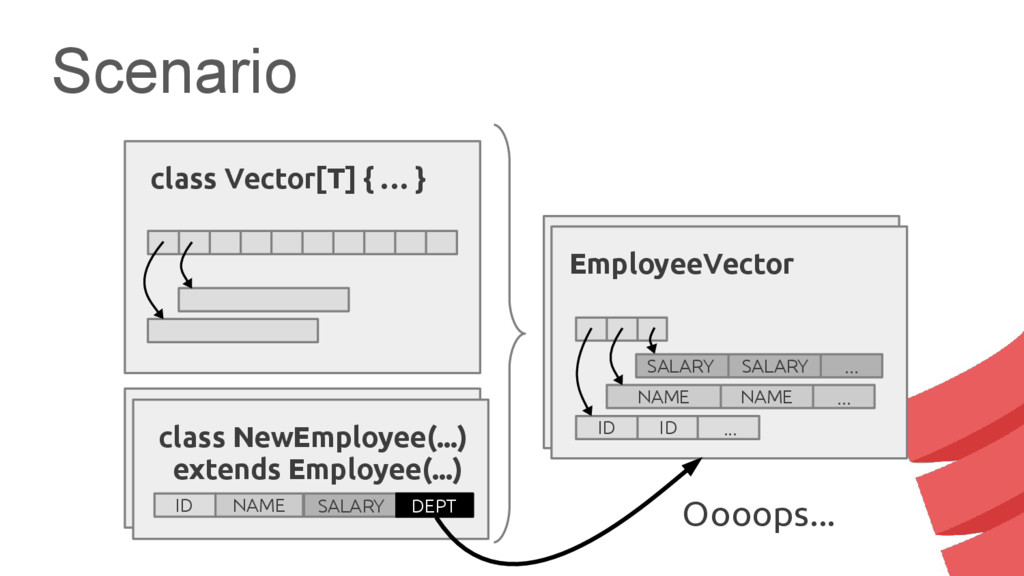
Scenario class Employee(...) ID NAME SALARY Vector[Employee] ID NAME SALARY
ID NAME SALARY class Vector[T] { … } -
Scenario class Employee(...) ID NAME SALARY Vector[Employee] ID NAME SALARY
ID NAME SALARY class Vector[T] { … } NAME ... NAME EmployeeVector ID ID ... ... SALARY SALARY -
Scenario class Employee(...) ID NAME SALARY Vector[Employee] ID NAME SALARY
ID NAME SALARY class Vector[T] { … } NAME ... NAME EmployeeVector ID ID ... ... SALARY SALARY class NewEmployee(...) extends Employee(...) ID NAME SALARY DEPT -
Scenario class Employee(...) ID NAME SALARY Vector[Employee] ID NAME SALARY
ID NAME SALARY class Vector[T] { … } NAME ... NAME EmployeeVector ID ID ... ... SALARY SALARY class NewEmployee(...) extends Employee(...) ID NAME SALARY DEPT -
Scenario class Employee(...) ID NAME SALARY Vector[Employee] ID NAME SALARY
ID NAME SALARY class Vector[T] { … } NAME ... NAME EmployeeVector ID ID ... ... SALARY SALARY class NewEmployee(...) extends Employee(...) ID NAME SALARY DEPT Oooops... -
Open World Assumption • Globally anything can happen • Locally
you have full control: – Make class Employee final or – Limit the transformation to code that uses Employee -
Open World Assumption • Globally anything can happen • Locally
you have full control: – Make class Employee final or – Limit the transformation to code that uses Employee How? -
Open World Assumption • Globally anything can happen • Locally
you have full control: – Make class Employee final or – Limit the transformation to code that uses Employee How? Using Scopes! -
Scopes transform(VectorOfEmployeeOpt) { def indexSalary(employees: Vector[Employee], by: Float): Vector[Employee] =
for (employee ← employees) yield employee.copy( salary = (1 + by) * employee.salary ) -
Scopes transform(VectorOfEmployeeOpt) { def indexSalary(employees: Vector[Employee], by: Float): Vector[Employee] =
for (employee ← employees) yield employee.copy( salary = (1 + by) * employee.salary ) } -
Scopes transform(VectorOfEmployeeOpt) { def indexSalary(employees: Vector[Employee], by: Float): Vector[Employee] =
for (employee ← employees) yield employee.copy( salary = (1 + by) * employee.salary ) } Now the method operates on the EmployeeVector representation. -
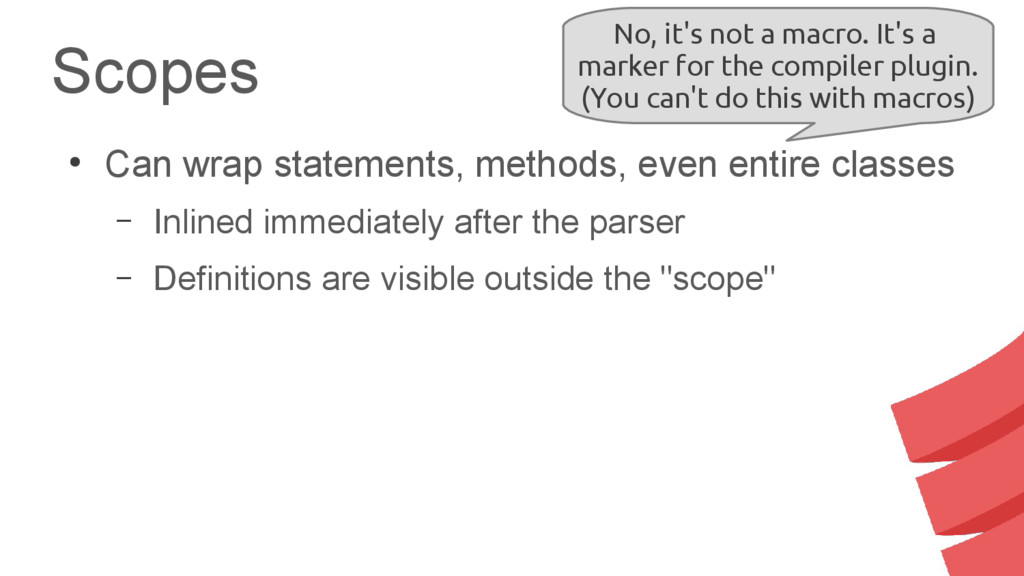
Scopes • Can wrap statements, methods, even entire classes –
Inlined immediately after the parser – Definitions are visible outside the "scope" -
Scopes • Can wrap statements, methods, even entire classes –
Inlined immediately after the parser – Definitions are visible outside the "scope" No, it's not a macro. It's a marker for the compiler plugin. (You can't do this with macros) -
Scopes • Can wrap statements, methods, even entire classes –
Inlined immediately after the parser – Definitions are visible outside the "scope" -
Scopes • Can wrap statements, methods, even entire classes –
Inlined immediately after the parser – Definitions are visible outside the "scope" • Mark locally closed parts of the code – Incoming/outgoing values go through conversions – You can reject unexpected values -
Best ...? NAME ... NAME EmployeeVector ID ID ... ...
SALARY SALARY It depends. Vector[Employee] ID NAME SALARY ID NAME SALARY -
Best ...? Compact binary repr. <compact binary blob> NAME ...
NAME EmployeeVector ID ID ... ... SALARY SALARY It depends. Vector[Employee] ID NAME SALARY ID NAME SALARY -
Best ...? EmployeeJSON { id: 123, name: “John Doe” salary:
100 } Compact binary repr. <compact binary blob> NAME ... NAME EmployeeVector ID ID ... ... SALARY SALARY It depends. Vector[Employee] ID NAME SALARY ID NAME SALARY -
Scopes allow mixing data representations transform(VectorOfEmployeeOpt) { def indexSalary(employees: Vector[Employee],
by: Float): Vector[Employee] = for (employee ← employees) yield employee.copy( salary = (1 + by) * employee.salary ) } -
Scopes transform(VectorOfEmployeeOpt) { def indexSalary(employees: Vector[Employee], by: Float): Vector[Employee] =
for (employee ← employees) yield employee.copy( salary = (1 + by) * employee.salary ) } Operating on the EmployeeVector representation. -
Scopes transform(VectorOfEmployeeCompact) { def indexSalary(employees: Vector[Employee], by: Float): Vector[Employee] =
for (employee ← employees) yield employee.copy( salary = (1 + by) * employee.salary ) } Operating on the compact binary representation. -
Scopes transform(VectorOfEmployeeJSON) { def indexSalary(employees: Vector[Employee], by: Float): Vector[Employee] =
for (employee ← employees) yield employee.copy( salary = (1 + by) * employee.salary ) } Operating on the JSON-based representation. -
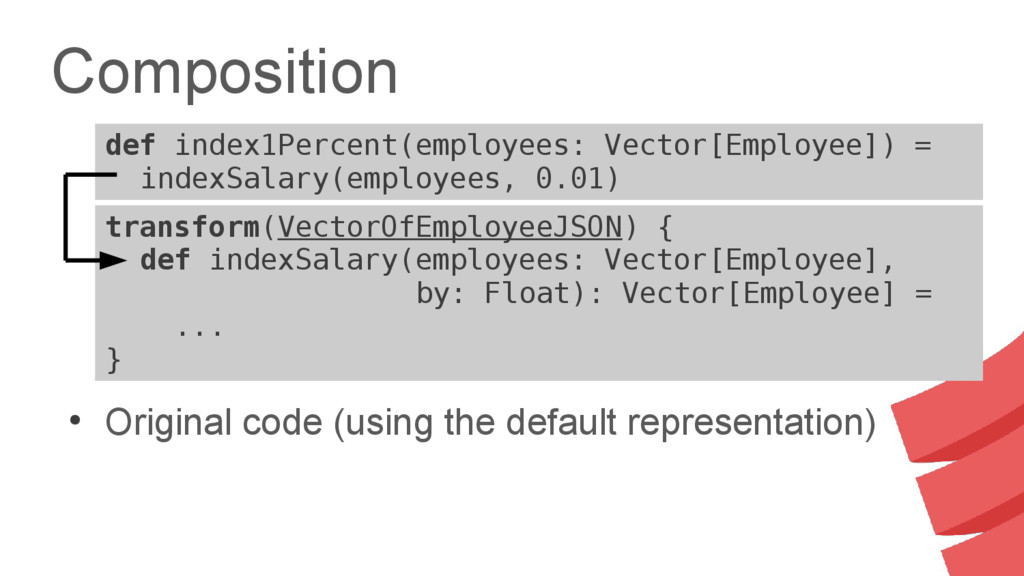
Composition def index1Percent(employees: Vector[Employee]) = indexSalary(employees, 0.01) transform(VectorOfEmployeeJSON) { def
indexSalary(employees: Vector[Employee], by: Float): Vector[Employee] = ... } -
Composition def index1Percent(employees: Vector[Employee]) = indexSalary(employees, 0.01) transform(VectorOfEmployeeJSON) { def
indexSalary(employees: Vector[Employee], by: Float): Vector[Employee] = ... } -
Composition def index1Percent(employees: Vector[Employee]) = indexSalary(employees, 0.01) transform(VectorOfEmployeeJSON) { def
indexSalary(employees: Vector[Employee], by: Float): Vector[Employee] = ... } • Original code (using the default representation) -
Composition def index1Percent(employees: Vector[Employee]) = indexSalary(employees, 0.01) transform(VectorOfEmployeeJSON) { def
indexSalary(employees: Vector[Employee], by: Float): Vector[Employee] = ... } • Original code (using the default representation) • Transformed code (using a different representation) -
Composition def index1Percent(employees: Vector[Employee]) = indexSalary(employees, 0.01) transform(VectorOfEmployeeJSON) { def
indexSalary(employees: Vector[Employee], by: Float): Vector[Employee] = ... } • Original code (using the default representation) • Transformed code (using a different representation) • Calls between them -
Composition def index1Percent(employees: Vector[Employee]) = indexSalary(employees, 0.01) transform(VectorOfEmployeeJSON) { def
indexSalary(employees: Vector[Employee], by: Float): Vector[Employee] = ... } • Original code (using the default representation) • Transformed code (using a different representation) • Calls between them ??? -
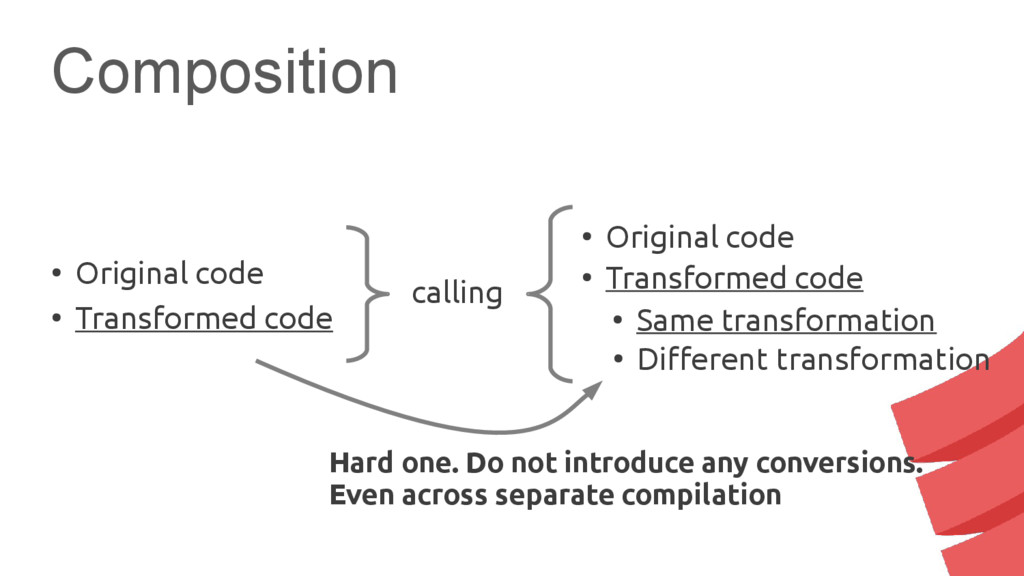
Composition calling • Original code • Transformed code • Original
code • Transformed code • Same transformation • Different transformation -
Composition calling • Original code • Transformed code • Original
code • Transformed code • Same transformation • Different transformation -
Composition calling • Original code • Transformed code • Original
code • Transformed code • Same transformation • Different transformation Easy one. Do nothing -
Composition calling • Original code • Transformed code • Original
code • Transformed code • Same transformation • Different transformation -
Composition calling • Original code • Transformed code • Original
code • Transformed code • Same transformation • Different transformation -
Composition calling • Original code • Transformed code • Original
code • Transformed code • Same transformation • Different transformation -
Composition calling • Original code • Transformed code • Original
code • Transformed code • Same transformation • Different transformation Automatically introduce conversions between values in the two representations e.g. EmployeeVector Vector[Employee] or back → -
Composition calling • Original code • Transformed code • Original
code • Transformed code • Same transformation • Different transformation -
Composition calling • Original code • Transformed code • Original
code • Transformed code • Same transformation • Different transformation -
Composition calling • Original code • Transformed code • Original
code • Transformed code • Same transformation • Different transformation -
Composition calling • Original code • Transformed code • Original
code • Transformed code • Same transformation • Different transformation Hard one. Do not introduce any conversions. Even across separate compilation -
Composition calling • Original code • Transformed code • Original
code • Transformed code • Same transformation • Different transformation -
Composition calling • Original code • Transformed code • Original
code • Transformed code • Same transformation • Different transformation Hard one. Automatically introduce double conversions (and warn the programmer) e.g. EmployeeVector Vector[Employee] CompactEmpVector → → -
Composition calling • Original code • Transformed code • Original
code • Transformed code • Same transformation • Different transformation -
Composition calling overriding • Original code • Transformed code •
Original code • Transformed code • Same transformation • Different transformation -
Scopes trait Printer[T] { def print(elements: Vector[T]): Unit } class
EmployeePrinter extends Printer[Employee] { def print(elements: Vector[Employee]) = ... } -
trait Printer[T] { def print(elements: Vector[T]): Unit } class EmployeePrinter
extends Printer[Employee] { def print(elements: Vector[Employee]) = ... } Scopes Method print in the class implements method print in the trait -
Scopes trait Printer[T] { def print(elements: Vector[T]): Unit } class
EmployeePrinter extends Printer[Employee] { def print(elements: Vector[Employee]) = ... } -
Scopes trait Printer[T] { def print(elements: Vector[T]): Unit } transform(VectorOfEmployeeOpt)
{ class EmployeePrinter extends Printer[Employee] { def print(elements: Vector[Employee]) = ... } } -
Scopes trait Printer[T] { def print(elements: Vector[T]): Unit } transform(VectorOfEmployeeOpt)
{ class EmployeePrinter extends Printer[Employee] { def print(elements: Vector[Employee]) = ... } } The signature of method print changes according to the transformation → it no longer implements the trait -
Scopes trait Printer[T] { def print(elements: Vector[T]): Unit } transform(VectorOfEmployeeOpt)
{ class EmployeePrinter extends Printer[Employee] { def print(elements: Vector[Employee]) = ... } } The signature of method print changes according to the transformation → it no longer implements the trait Taken care by the compiler for you! -
Column-oriented Storage NAME ... NAME EmployeeVector ID ID ... ...
SALARY SALARY Vector[Employee] ID NAME SALARY ID NAME SALARY -
Column-oriented Storage NAME ... NAME EmployeeVector ID ID ... ...
SALARY SALARY Vector[Employee] ID NAME SALARY ID NAME SALARY iteration is 5x faster -
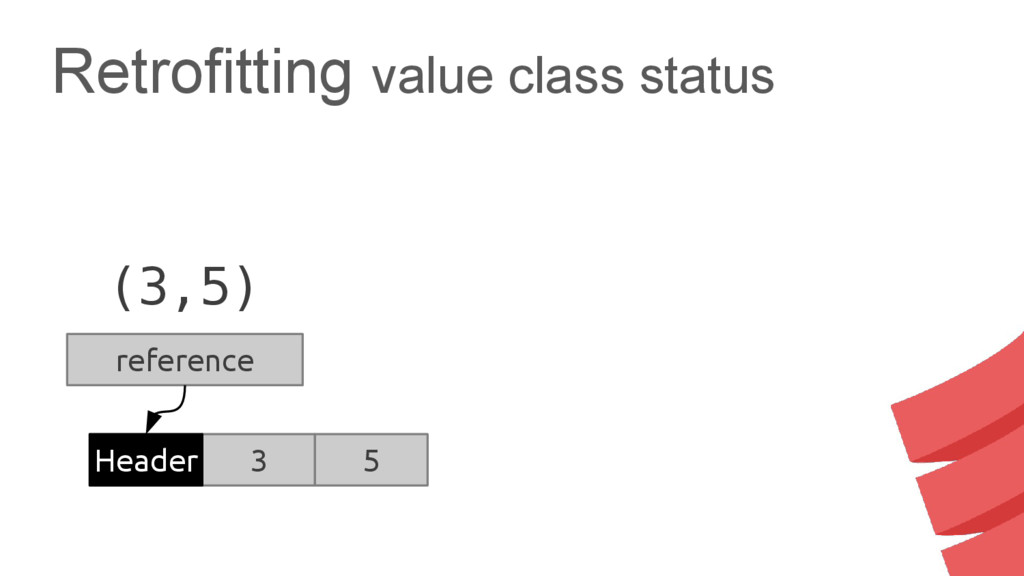
Retrofitting value class status Tuples in Scala are specialized but
are still objects (not value classes) = not as optimized as they could be (3,5) 3 5 Header reference -
Retrofitting value class status 0l + 3 << 32 +
5 (3,5) Tuples in Scala are specialized but are still objects (not value classes) = not as optimized as they could be (3,5) 3 5 Header reference -
Retrofitting value class status 0l + 3 << 32 +
5 (3,5) Tuples in Scala are specialized but are still objects (not value classes) = not as optimized as they could be (3,5) 3 5 Header reference 14x faster, lower heap requirements -
Deforestation List(1,2,3).map(_ + 1).map(_ * 2).sum List(2,3,4) List(4,6,8) 18 transform(ListDeforestation)
{ List(1,2,3).map(_ + 1).map(_ * 2).sum } -
Deforestation List(1,2,3).map(_ + 1).map(_ * 2).sum List(2,3,4) List(4,6,8) 18 transform(ListDeforestation)
{ List(1,2,3).map(_ + 1).map(_ * 2).sum } accumulate function -
Deforestation List(1,2,3).map(_ + 1).map(_ * 2).sum List(2,3,4) List(4,6,8) 18 transform(ListDeforestation)
{ List(1,2,3).map(_ + 1).map(_ * 2).sum } accumulate function accumulate function -
Deforestation List(1,2,3).map(_ + 1).map(_ * 2).sum List(2,3,4) List(4,6,8) 18 transform(ListDeforestation)
{ List(1,2,3).map(_ + 1).map(_ * 2).sum } accumulate function accumulate function compute: 18 -
Deforestation List(1,2,3).map(_ + 1).map(_ * 2).sum List(2,3,4) List(4,6,8) 18 transform(ListDeforestation)
{ List(1,2,3).map(_ + 1).map(_ * 2).sum } accumulate function accumulate function compute: 18 6x faster -
Research ahead* ! * This may not make it into
a product. But you can play with it nevertheless. -
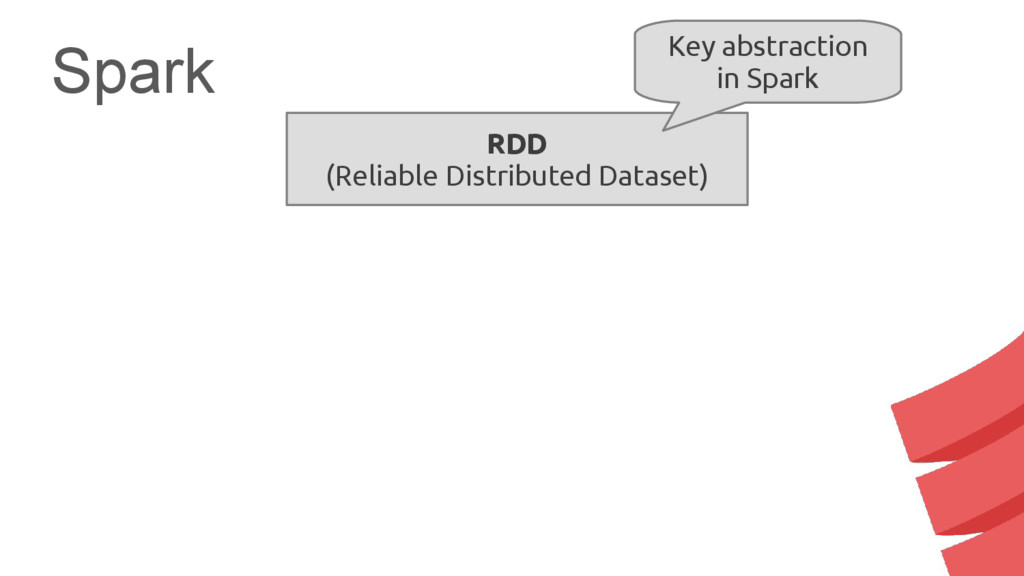
Spark RDD (Reliable Distributed Dataset) Primary Data (e.g. CSV file)
Primary Data (e.g. CSV file) Derived Data (e.g. primary.map(f)) Primary Data (e.g. CSV file) -
Spark RDD (Reliable Distributed Dataset) Primary Data (e.g. CSV file)
Primary Data (e.g. CSV file) Derived Data (e.g. primary.map(f)) Primary Data (e.g. CSV file) How does mapping work? -
Mapping an RDD serialized data encoded data X Y user
function f decode -
Mapping an RDD serialized data encoded data X Y encoded
data user function f decode encode -
Mapping an RDD serialized data encoded data X Y encoded
data user function f decode encode Allocate object Allocate object -
Mapping an RDD serialized data encoded data X Y encoded
data user function f decode encode Allocate object Allocate object -
Mapping an RDD serialized data encoded data X Y encoded
data user function f decode encode -
Mapping an RDD serialized data encoded data X Y encoded
data user function f decode encode Modified user function (automatically derived by the compiler) -
Mapping an RDD serialized data encoded data encoded data Modified
user function (automatically derived by the compiler) -
Mapping an RDD serialized data encoded data encoded data Modified
user function (automatically derived by the compiler) Nowhere near as simple as it looks -
Challenge: Transformation not possible • Example: Calling outside (untransformed) method
• Solution: Issue compiler warnings -
Challenge: Transformation not possible • Example: Calling outside (untransformed) method
• Solution: Issue compiler warnings – Explain why it's not possible: due to the method call -
Challenge: Transformation not possible • Example: Calling outside (untransformed) method
• Solution: Issue compiler warnings – Explain why it's not possible: due to the method call – Suggest how to fix it: enclose the method in a scope -
Challenge: Transformation not possible • Example: Calling outside (untransformed) method
• Solution: Issue compiler warnings – Explain why it's not possible: due to the method call – Suggest how to fix it: enclose the method in a scope • Reuse the machinery in miniboxing scala-miniboxing.org -
Challenge: Internal API • Spark internals rely on Iterator[T] –
Requires materializing values – Needs to be replaced throughout the code base – By rather complex buffers -
Challenge: Internal API • Spark internals rely on Iterator[T] –
Requires materializing values – Needs to be replaced throughout the code base – By rather complex buffers • Solution: Extensive refactoring/rewrite -
Prototype Hack • Modified version of Spark core – RDD
data representation is configurable -
Prototype Hack • Modified version of Spark core – RDD
data representation is configurable • It's very limited: – Custom data repr. only in map, filter and flatMap – Otherwise we revert to costly objects – Large parts of the automation still need to be done -
Prototype Hack sc.parallelize(/* 1 million */ records). map(x => ...).
filter(x => ...). collect() -
sc.parallelize(/* 1 million */ records). map(x => ...). filter(x =>
...). collect() Prototype Hack More details in my talk at Spark Summit EU 2015 -
Conclusion • Object-oriented composition → inefficient representation • Solution: data-centric
metaprogramming – Use the best representation for your data! -
Conclusion • Object-oriented composition → inefficient representation • Solution: data-centric
metaprogramming – Use the best representation for your data! – Is it possible? Yes. -
Conclusion • Object-oriented composition → inefficient representation • Solution: data-centric
metaprogramming – Use the best representation for your data! – Is it possible? Yes. – Is it easy? Not really. -
Conclusion • Object-oriented composition → inefficient representation • Solution: data-centric
metaprogramming – Use the best representation for your data! – Is it possible? Yes. – Is it easy? Not really. – Is it worth it? You tell me! -
Deforestation and Language Semantics • Notice that we changed language
semantics: – Before: collections were eager – After: collections are lazy – This can lead to effects reordering -
Deforestation and Language Semantics • Such transformations are only acceptable
with programmer consent – JIT compilers/staged DSLs can't change semantics – metaprogramming (macros) can, but it should be documented/opt-in -
Code Generation • Also known as – Deep Embedding –
Multi-Stage Programming • Awesome speedups, but restricted to small DSLs • SparkSQL uses code gen to improve performance – By 2-4x over Spark -
Low-level Optimizers • Java JIT Compiler – Access to the
low-level code – Can assume a (local) closed world – Can speculate based on profiles -
Low-level Optimizers • Java JIT Compiler – Access to the
low-level code – Can assume a (local) closed world – Can speculate based on profiles • Best optimizations break semantics – You can't do this in the JIT compiler! – Only the programmer can decide to break semantics -
Scala Macros • Many optimizations can be done with macros
– :) Lots of power – :( Lots of responsibility • Scala compiler invariants • Object-oriented model • Modularity -
Scala Macros • Many optimizations can be done with macros
– :) Lots of power – :( Lots of responsibility • Scala compiler invariants • Object-oriented model • Modularity • Can we restrict macros so they're safer? – Data-centric metaprogramming
 vladureche
 simas
 hakkadaikon
 barnbarn
 akihisaikeda
 nokonoko1203
 umigishiaoi
 jame2408
 yuta_onishi_97
 sodainc
 ochtum
 takahirosunaga
 dougneiner
 quramy
 tessaabrams
 smashingmag
 jonoalderson
 marcoroth
 cassininazir
 seathinner
 philnash
 kevinliebholz
 notwaldorf
 destraynor