Miniboxing Library - Scala.world
Sponsored
·
 Your Podcast. Everywhere. Effortlessly.
Share. Educate. Inspire. Entertain. You do you. We'll handle the rest.
→
Your Podcast. Everywhere. Effortlessly.
Share. Educate. Inspire. Entertain. You do you. We'll handle the rest.
→

Share
Embed

Transcript
136 slides
-
scala-miniboxing.org @miniboxing 12th of September 2016 scala.world Penrith, UK The
Story of a Parallel Scala Library -
scala-miniboxing.org @miniboxing The Story of a Parallel Scala Library The
constructs used by miniboxing to optimize your code 12th of September 2016 scala.world Penrith, UK -
scala-miniboxing.org @miniboxing Miniboxing Miniboxing • Compiler transformation • Improves performance
of generics – When instantiated by primitive types -
scala-miniboxing.org @miniboxing Miniboxing Miniboxing • Compiler transformation • Improves performance
of generics – When instantiated by primitive types • Introduces optimized constructs – Automatically – Or with programmer help -
scala-miniboxing.org @miniboxing Miniboxing Miniboxing • Compiler transformation • Improves performance
of generics – When instantiated by primitive types • Introduces optimized constructs – Automatically – Or with programmer help -
scala-miniboxing.org @miniboxing Motivation Motivation • We build cool new constructs
and paradigms for { conn getConnection \/> "Could not connect" ← ids conn.get("id") \/> "Coult not get ids" ← } yield user -
scala-miniboxing.org @miniboxing Motivation Motivation • We build cool new constructs
and paradigms • But some constructs are deeply integrated • Functions • Tuples • Arrays • Ordering • Numeric for { conn getConnection \/> "Could not connect" ← ids conn.get("id") \/> "Coult not get ids" ← } yield user -
scala-miniboxing.org @miniboxing Motivation Motivation val x = (x: Int) =>
x Function syntax is sugar for anonymous classes extending FunctionX traits (or for Java8 lambdas) -
scala-miniboxing.org @miniboxing Motivation Motivation val x = (x: Int) =>
x Extending Function1 behavior? Sure, add an implicit. Function syntax is sugar for anonymous classes extending FunctionX traits (or for Java8 lambdas) -
scala-miniboxing.org @miniboxing Motivation Motivation val x = (x: Int) =>
x Extending Function1 behavior? Sure, add an implicit. Changing behavior (e.g. PartialFunction)? This is what we'll talk about today. Function syntax is sugar for anonymous classes extending FunctionX traits (or for Java8 lambdas) -
scala-miniboxing.org @miniboxing Extending vs Changing Behavior Extending vs Changing Behavior
Adding a new method to the trait/class -
scala-miniboxing.org @miniboxing Extending vs Changing Behavior Extending vs Changing Behavior
Adding a new method to the trait/class Making it conform to an interface -
scala-miniboxing.org @miniboxing Extending vs Changing Behavior Extending vs Changing Behavior
Adding a new method to the trait/class Making it conform to an interface Changing a method's signature -
scala-miniboxing.org @miniboxing Extending vs Changing Behavior Extending vs Changing Behavior
Adding a new method to the trait/class Making it conform to an interface Changing a method's signature Updating the body of a method -
scala-miniboxing.org @miniboxing Extending vs Changing Behavior Extending vs Changing Behavior
Adding a new method to the trait/class Making it conform to an interface Changing a method's signature Updating the body of a method Changing the fields of a class -
scala-miniboxing.org @miniboxing Extending vs Changing Behavior Extending vs Changing Behavior
Adding a new method to the trait/class Making it conform to an interface Changing a method's signature Updating the body of a method Changing the fields of a class Extending behavior Changing behavior -
scala-miniboxing.org @miniboxing Extending vs Changing Behavior Extending vs Changing Behavior
Why would you need that? Adding a new method to the trait/class Making it conform to an interface Changing a method's signature Updating the body of a method Changing the fields of a class Extending behavior Changing behavior -
scala-miniboxing.org @miniboxing Functions Transformation Experiment Conclusion Miniboxing Data Representation Mixing
Representations Library Interoperation -
scala-miniboxing.org @miniboxing Functions Transformation Experiment Conclusion Miniboxing Data Representation Mixing
Representations Library Interoperation -
scala-miniboxing.org @miniboxing Erased Generics Erased Generics def identity[T](t: T): T
= t def identity(t: Object): Object = t scalac / javac -
scala-miniboxing.org @miniboxing Erased Generics Erased Generics identity(5) identity(java.lang.Integer.valueOf(5)) scalac /
javac boxed data representation -
scala-miniboxing.org @miniboxing Erased Generics Erased Generics java.lang.Integer.valueOf(5) boxing is not
great ... boxing is not great ... inflates heap requirements produces garbage value is accessed indirectly (slow) breaks locality guarantees -
scala-miniboxing.org @miniboxing Specialization Specialization def identity[T](t: T): T = t
def identity(t: Object): Object = t specialization def identity_Z(t: bool): bool = t -
scala-miniboxing.org @miniboxing Specialization Specialization def identity[T](t: T): T = t
def identity(t: Object): Object = t specialization def identity_Z(t: bool): bool = t def identity_C(t: char): char = t -
scala-miniboxing.org @miniboxing Specialization Specialization def identity[T](t: T): T = t
def identity(t: Object): Object = t specialization def identity_Z(t: bool): bool = t def identity_C(t: char): char = t … (7 other variants) -
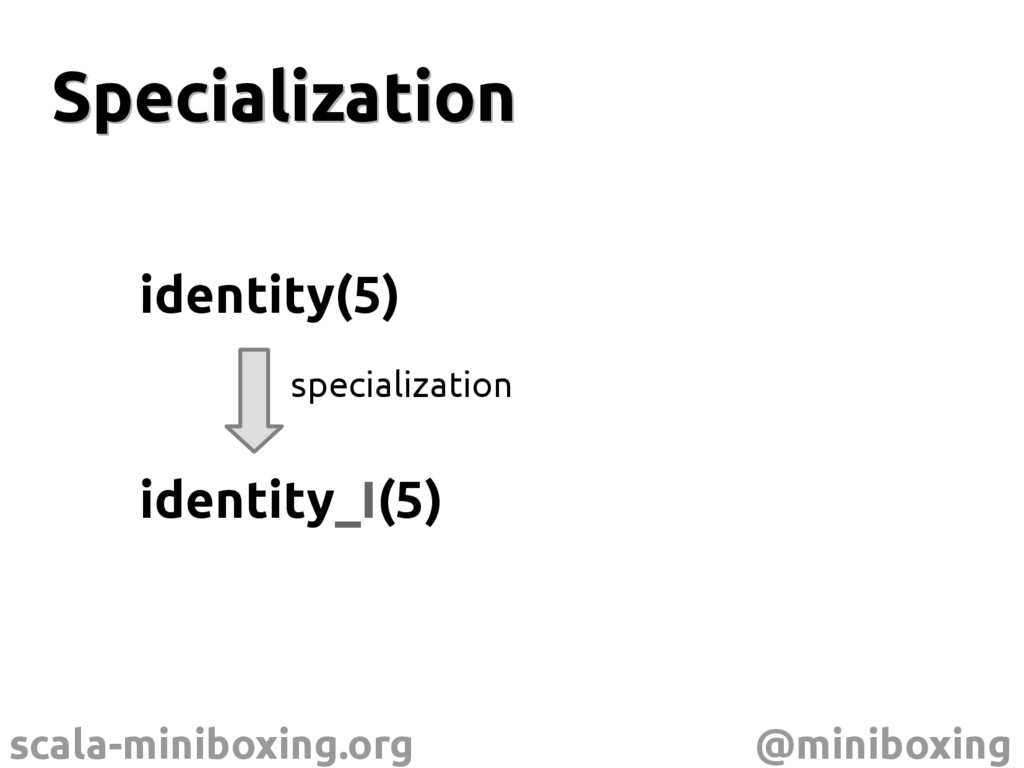
scala-miniboxing.org @miniboxing Specialization Specialization identity(5) identity_I(5) specialization No boxing, it
automatically calls the specialized variant for integers -
scala-miniboxing.org @miniboxing Specialization Specialization def tupled[T1, T2](t1: T1, t2: T2)
... // 100 methods (102) specialization -
scala-miniboxing.org @miniboxing Specialization Specialization def tupled[T1, T2](t1: T1, t2: T2)
... // 100 methods (102) specialization Can we do better? -
scala-miniboxing.org @miniboxing The idea behind The idea behind ... LONG
DOUBLE INT FLOAT SHORT ... LONG DOUBLE INT FLOAT SHORT a long integer miniboxing miniboxing -
scala-miniboxing.org @miniboxing Miniboxing Miniboxing def identity[T](t: T): T = t
def identity(t: Object): Object = t miniboxing def identity_M(..., t: long): long = t -
scala-miniboxing.org @miniboxing Miniboxing Miniboxing def identity[T](t: T): T = t
def identity(t: Object): Object = t miniboxing def identity_M(..., t: long): long = t long encodes all primitive types -
scala-miniboxing.org @miniboxing Miniboxing Miniboxing def identity[T](t: T): T = t
def identity(t: Object): Object = t miniboxing def identity_M(..., t: long): long = t Only 2n variants long encodes all primitive types -
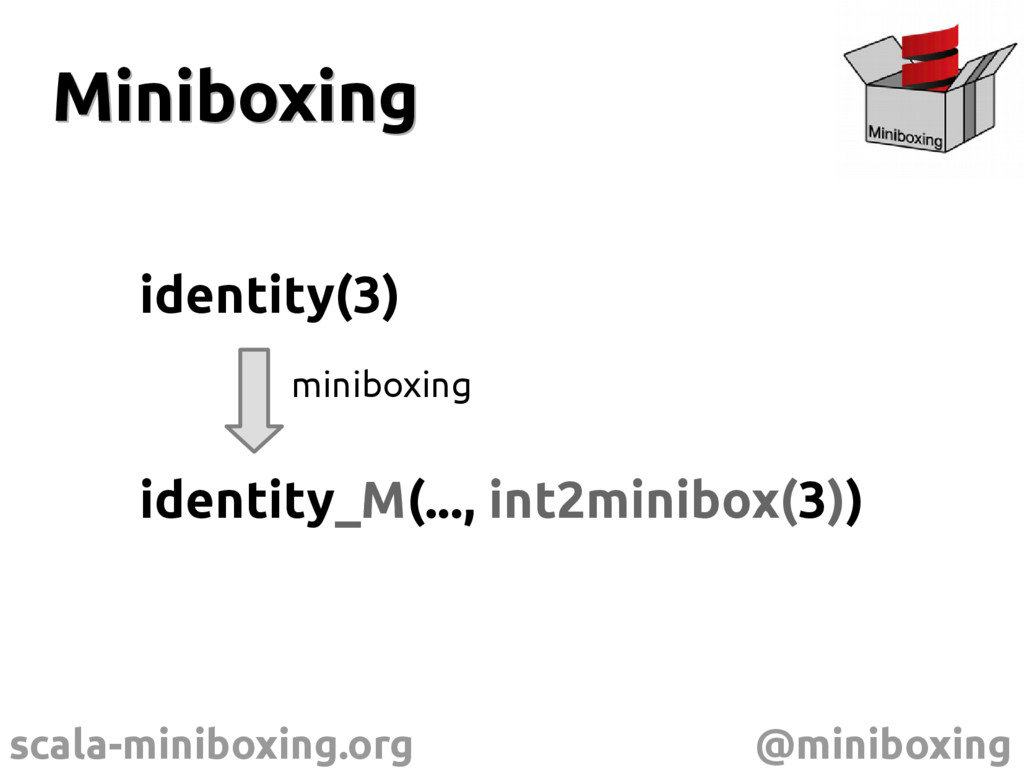
scala-miniboxing.org @miniboxing Miniboxing Miniboxing identity(3) identity_M(..., int2minibox(3)) miniboxing The miniboxed
variant of identity Unlike boxing, these conversions do not affect performance -
scala-miniboxing.org @miniboxing Functions Transformation Experiment Conclusion Miniboxing Data Representation Mixing
Representations Library Interoperation -
scala-miniboxing.org @miniboxing Functions Transformation Experiment Conclusion Miniboxing Data Representation Mixing
Representations Library Interoperation -
scala-miniboxing.org @miniboxing Call Graph Call Graph def foo[T](t: T): T
= bar(t) def bar[T](t: T): T = baz(t) def baz[T](t: T): T = t call graph -
scala-miniboxing.org @miniboxing Miniboxed Call Graph Miniboxed Call Graph def foo[@miniboxed
T](t: T): T = bar(t) def bar[@miniboxed T](t: T): T = baz(t) def baz[@miniboxed T](t: T): T = t miniboxing -
scala-miniboxing.org @miniboxing Miniboxed Call Graph Miniboxed Call Graph def foo(...):
... = bar(...) def foo_M(...): ... = bar_M(...) def bar(...): ... = baz(...) def bar_M(...): ... = baz_M(...) def baz(...): ... = t def baz_M(...): ... = t -
scala-miniboxing.org @miniboxing Miniboxed Call Graph Miniboxed Call Graph foo foo_M
bar bar_M baz baz_M Data is passed in the miniboxed encoding no boxing necessary! -
scala-miniboxing.org @miniboxing Suboptimal Call Graph Suboptimal Call Graph def foo[@miniboxed
T](t: T): T = bar(t) def bar[@miniboxed T](t: T): T = baz(t) def baz[@miniboxed T](t: T): T = t miniboxing -
scala-miniboxing.org @miniboxing Suboptimal Call Graph Suboptimal Call Graph foo foo_M
bar baz baz_M no bar_M to call box → -
scala-miniboxing.org @miniboxing Suboptimal Call Graph Suboptimal Call Graph foo foo_M
bar baz baz_M no bar_M to call box → -
scala-miniboxing.org @miniboxing Suboptimal Call Graph Suboptimal Call Graph foo foo_M
bar baz baz_M no bar_M to call box → -
scala-miniboxing.org @miniboxing Suboptimal Call Graph Suboptimal Call Graph foo foo_M
bar baz baz_M no bar_M to call box → not enough info to return to the optimized trace -
scala-miniboxing.org @miniboxing Suboptimal Call Graph Suboptimal Call Graph scala> object
Test { | def foo[@miniboxed T](t: T): T = bar(t) | def bar[ T](t: T): T = baz(t) | def baz[@miniboxed T](t: T): T = t | } <console>:10: warning: The method Test.bar would benefit from miniboxing type parameter T, since it is instantiated by miniboxed type parameter T of method foo: def foo[@miniboxed T](t: T): T = bar(t) ^ <console>:11: warning: The following code could benefit from miniboxing specialization if the type parameter T of method bar would be marked as "@miniboxed T": def bar[T](t: T): T = baz(t) ^ defined object Test -
scala-miniboxing.org @miniboxing Functions Transformation Experiment Conclusion Miniboxing Data Representation Mixing
Representations Library Interoperation -
scala-miniboxing.org @miniboxing Functions Transformation Experiment Conclusion Miniboxing Data Representation Mixing
Representations Library Interoperation -
scala-miniboxing.org @miniboxing Library Interoperation Library Interoperation scala> def identityFun[T] =
(t: T) => t defined method identityFun -
scala-miniboxing.org @miniboxing Library Interoperation Library Interoperation scala> def identityFun[T] =
(t: T) => t defined method identityFun scala> identityFun(3) <console>:11: warning: The method identityFun would benefit from miniboxing type parameter T, since it is instantiated by a primitive type. identityFun(3) ^ res1: Int = 3 -
scala-miniboxing.org @miniboxing scala> def identityFun[@miniboxed T] = (t: T) =>
t Library Interoperation Library Interoperation -
scala-miniboxing.org @miniboxing scala> def identityFun[@miniboxed T] = (t: T) =>
t <console>:12: warning: The type parameter T1 of trait scala.Function1 is specialized but to interoperate efficiently with miniboxing, it would have to be miniboxed. def identityFun[@miniboxed T] = (t: T) => t ^ <console>:12: warning: The type parameter R of trait scala.Function1 is specialized but to interoperate efficiently with miniboxing, it would have to be miniboxed. def identityFun[@miniboxed T] = (t: T) => t ^ defined method identityFun Library Interoperation Library Interoperation -
scala-miniboxing.org @miniboxing scala> def identityFun[@miniboxed T] = (t: T) =>
t <console>:12: warning: The type parameter T1 of trait scala.Function1 is specialized but to interoperate efficiently with miniboxing, it would have to be miniboxed. def identityFun[@miniboxed T] = (t: T) => t ^ <console>:12: warning: The type parameter R of trait scala.Function1 is specialized but to interoperate efficiently with miniboxing, it would have to be miniboxed. def identityFun[@miniboxed T] = (t: T) => t ^ defined method identityFun Library Interoperation Library Interoperation Not actionable -
scala-miniboxing.org @miniboxing scala> def identityFun[@miniboxed T] = (t: T) =>
t <console>:12: warning: The type parameter T1 of trait scala.Function1 is specialized but to interoperate efficiently with miniboxing, it would have to be miniboxed. def identityFun[@miniboxed T] = (t: T) => t ^ <console>:12: warning: The type parameter R of trait scala.Function1 is specialized but to interoperate efficiently with miniboxing, it would have to be miniboxed. def identityFun[@miniboxed T] = (t: T) => t ^ defined method identityFun Library Interoperation Library Interoperation Not actionable Need to fix it -
scala-miniboxing.org @miniboxing Library Interoperation Library Interoperation • Multiple such constructs
– Functions automatic, most interesting → – Arrays need user intervention, warnings → – Tuples automatic → – Numeric automatic, but I was lazy → -
scala-miniboxing.org @miniboxing Functions Transformation Experiment Conclusion Miniboxing Data Representation Mixing
Representations Library Interoperation -
scala-miniboxing.org @miniboxing MbFunctionX MbFunctionX • Miniboxed replacement for FunctionX •
Assumptions – Function created once – Called multiple times optimize for calling → overhead -
scala-miniboxing.org @miniboxing MbFunctionX MbFunctionX • Miniboxed replacement for FunctionX •
Assumptions – Function created once – Called multiple times optimize for calling → overhead Let's see how we transform -
scala-miniboxing.org @miniboxing MbFunctionX MbFunctionX • Three approaches – trait Function0[@miniboxed
@specialized R] • Incompatible transformations, won't fly – Call-site adaptation (implicit + value class) • call overhead – Replace FunctionX body • no call overhead -
scala-miniboxing.org @miniboxing Library Interoperation Library Interoperation scala> def identityFun[@miniboxed T]
= (t: T) => t defined method identityFun -
scala-miniboxing.org @miniboxing Library Interoperation Library Interoperation scala> def identityFun[@miniboxed T]
= (t: T) => t defined method identityFun def identityFun[@miniboxed T]: MbFunction1[T, T] = ... -
scala-miniboxing.org @miniboxing Library Interoperation Library Interoperation scala> def identityFun[@miniboxed T]
= (t: T) => t defined method identityFun def identityFun[@miniboxed T]: MbFunction1[T, T] = ... Once this is done, miniboxing does its magic -
scala-miniboxing.org @miniboxing Library Interoperation Library Interoperation scala> def identityFun[@miniboxed T]
= (t: T) => t defined method identityFun def identityFun[@miniboxed T]: MbFunction1[T, T] = ... Once this is done, miniboxing does its magic def identityFun[T]: MbFunction1[T, T] = { class $anon extends MbFunction1_L[T, T] { def apply(t: T) = t } new $anon() } def identityFun_M[Tsp](...): MbFunction1[T, T] = { class $anon extends MbFunction1_M[T, T](...) { def apply_M(..., t: T) = t } new $anon() } -
scala-miniboxing.org @miniboxing Library Interoperation Library Interoperation • Multiple such constructs
– Functions automatic, most interesting → – Arrays need user intervention, warnings → – Tuples automatic → – Numeric automatic, but I was lazy → -
scala-miniboxing.org @miniboxing Extending vs Changing Behavior Extending vs Changing Behavior
Adding a new method to the trait/class Making it conform to an interface Changing a method's signature Updating the body of a method Changing the fields of a class Extending behavior Changing behavior -
scala-miniboxing.org @miniboxing Extending vs Changing Behavior Extending vs Changing Behavior
Adding a new method to the trait/class Making it conform to an interface Changing a method's signature Updating the body of a method Changing the fields of a class Extending behavior Changing behavior Completely replacing a library class -
scala-miniboxing.org @miniboxing Dependencies Dependencies Your library Scala stdlib Other library
Other library dependencies -
scala-miniboxing.org @miniboxing Dependencies Dependencies Your library Scala stdlib Other library
Other library dependencies -
scala-miniboxing.org @miniboxing Dependencies Dependencies Your library Scala stdlib Other library
Other library dependencies Each library is free to use its desired FunctionX version -
scala-miniboxing.org @miniboxing Dependencies Dependencies Your library Scala stdlib Other library
Other library dependencies Each library is free to use its desired FunctionX version Talk to each in its own "language" -
scala-miniboxing.org @miniboxing Dependencies Dependencies Your library Scala stdlib Other library
Other library dependencies Each library is free to use its desired FunctionX version Talk to each in its own "language" Have to track of the transformations -
scala-miniboxing.org @miniboxing Marking Changes Marking Changes Source Signatures Bytecode Source
Signatures Bytecode Source Signatures Bytecode JVM scalac scalac scalac -
scala-miniboxing.org @miniboxing Marking Changes Marking Changes Source Signatures Bytecode Source
Signatures Bytecode Source Signatures Bytecode JVM scalac scalac scalac -
scala-miniboxing.org @miniboxing Marking Changes Marking Changes Source Signatures Bytecode Source
Signatures Bytecode Source Signatures Bytecode JVM scalac scalac scalac -
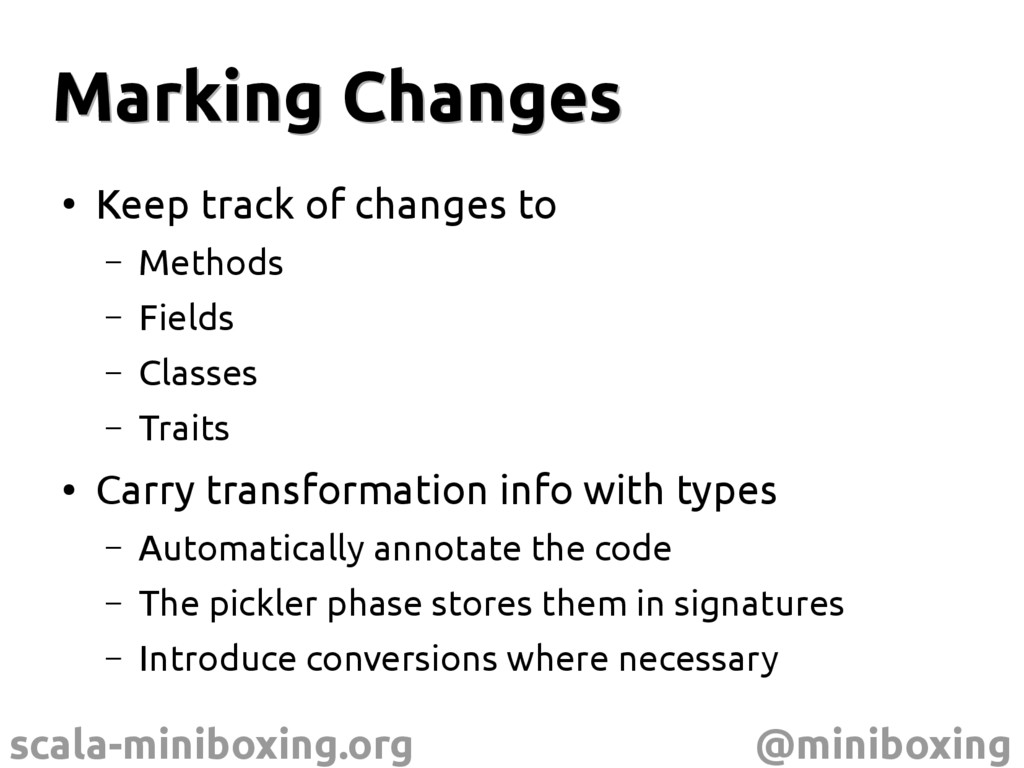
scala-miniboxing.org @miniboxing Marking Changes Marking Changes • Keep track of
changes to – Methods – Fields – Classes – Traits • Carry transformation info with types – Automatically annotate the code – The pickler phase stores them in signatures – Introduce conversions where necessary -
scala-miniboxing.org @miniboxing Marking Changes Marking Changes def identityFun[@miniboxed T] =
(t: T) => t def identityFun[@miniboxed T]: Function1[T, T] = (t: T) => t typer interop-inject -
scala-miniboxing.org @miniboxing Marking Changes Marking Changes def identityFun[@miniboxed T] =
(t: T) => t def identityFun[@miniboxed T]: Function1[T, T] = (t: T) => t typer interop-inject @... def identityFun[@miniboxed T]: Function1[T, T] @mbFun = (t: T) => t pickler -
scala-miniboxing.org @miniboxing Marking Changes Marking Changes def identityFun[@miniboxed T] =
(t: T) => t def identityFun[@miniboxed T]: Function1[T, T] = (t: T) => t typer interop-inject @... def identityFun[@miniboxed T]: Function1[T, T] @mbFun = (t: T) => t Future compilation runs are aware of the change pickler -
scala-miniboxing.org @miniboxing Conversions Conversions • What do to if –
We have an MbFunction1 and – Callee expects Function1? • Conversions – Between the two cases – Functions defined in miniboxed code • Miniboxing-friendly and specialization-friendly – Functions defined in non-miniboxed code • Specialization-friendly • Need conversion Miniboxing friendly → -
scala-miniboxing.org @miniboxing Conversions Conversions def identityFun[@miniboxed T] = Predef.identity def
identityFun[@miniboxed T]: Function1[T, T] = Predef.identity[T] // : Function1[T, T] from classpath typer interop-inject -
scala-miniboxing.org @miniboxing Conversions Conversions def identityFun[@miniboxed T] = Predef.identity def
identityFun[@miniboxed T]: Function1[T, T] = Predef.identity[T] // : Function1[T, T] from classpath typer interop-inject @... def identityFun[@miniboxed T]: Function1[T, T] @mbFun = Predef.identity[T] // : Function1[T, T] no annotation interop-coerce -
scala-miniboxing.org @miniboxing @... def identityFun[@miniboxed T]: Function1[T, T] @mbFun =
toMbFun(Predef.identity[T]) // : Function1[T, T] @mbFun Conversions Conversions def identityFun[@miniboxed T] = Predef.identity def identityFun[@miniboxed T]: Function1[T, T] = Predef.identity[T] // : Function1[T, T] from classpath typer interop-inject @... def identityFun[@miniboxed T]: Function1[T, T] @mbFun = Predef.identity[T] // : Function1[T, T] no annotation interop-coerce -
scala-miniboxing.org @miniboxing Conversions Conversions Conversions are introduced based on types
See scala-miniboxing.org/ldl for details -
scala-miniboxing.org @miniboxing Reverse Dependencies Reverse Dependencies Your library Scala stdlib
Other library Other library dependencies -
scala-miniboxing.org @miniboxing Reverse Dependencies Reverse Dependencies Your library Scala stdlib
Other library Other library Other lib 1 Other lib 2 Other lib 3 dependencies reverse dependencies -
scala-miniboxing.org @miniboxing Reverse Dependencies Reverse Dependencies Your library Scala stdlib
Other library Other library Other lib 1 Other lib 2 Other lib 3 dependencies reverse dependencies -
scala-miniboxing.org @miniboxing Reverse Dependencies Reverse Dependencies Your library Scala stdlib
Other library Other library Other lib 1 Other lib 2 Other lib 3 dependencies reverse dependencies Libraries not compiled with the miniboxing plugin are not aware of the transformation → incorrect bytecode -
scala-miniboxing.org @miniboxing Reverse Dependencies Reverse Dependencies $ scala Welcome to
Scala version 2.11.7 (Java HotSpot(TM) 64-Bit Server VM, Java 1.8.0_101). Type in expressions to have them evaluated. Type :help for more information. scala> Test.identityFun(2) <console>:11: error: This method was compiled with the miniboxing plugin and can only be called by code also compiled with the miniboxing plugin (see scala-miniboxing.org/compatibility) [mbox=0.4-M8,scala=2.11.7] Test.identityFun(2) ^ -
scala-miniboxing.org @miniboxing Reverse Dependencies Reverse Dependencies def identityFun[@miniboxed T] =
(t: T) => t def identityFun[@miniboxed T]: Function1[T, T] = (t: T) => t typer interop-inject @compileTimeOnly(...) def identityFun[@miniboxed T]: Function1[T, T] @mbFun = (t: T) => t pickler -
scala-miniboxing.org @miniboxing Reverse Dependencies Reverse Dependencies def identityFun[@miniboxed T] =
(t: T) => t def identityFun[@miniboxed T]: Function1[T, T] = (t: T) => t typer interop-inject @compileTimeOnly(...) def identityFun[@miniboxed T]: Function1[T, T] @mbFun = (t: T) => t Built into the Scala stdlib and recognized by scalac (checked by refchecks) pickler -
scala-miniboxing.org @miniboxing Reverse Dependencies Reverse Dependencies miniboxing introduces annotation here
... and removes it just before refchecks -
scala-miniboxing.org @miniboxing Object Model Object Model trait IdentityFun { def
identityFun[T]: T => T // = Function1 [T, T] } -
scala-miniboxing.org @miniboxing Object Model Object Model trait IdentityFun { def
identityFun[T]: T => T // = Function1 [T, T] } object MbIdentityFun extends IdentityFun { def identityFun[@miniboxed T]: T => T = (t: T) => t } -
scala-miniboxing.org @miniboxing Object Model Object Model trait IdentityFun { def
identityFun[T]: T => T // = Function1 [T, T] } object MbIdentityFun extends IdentityFun { def identityFun[@miniboxed T]: T => T = (t: T) => t } scala> MbIdentityFun.identityFun(2) <console>:11: error: ... scala> val id: IdentityFun = MbIdentityFun id: IdentityFun = MbIdentityFun$@23223dd8 scala> id.identityFun(3) res1: Int = 3 -
scala-miniboxing.org @miniboxing Object Model Object Model trait IdentityFun { def
identityFun[T]: T => T // = Function1 [T, T] } object MbIdentityFun extends IdentityFun { def identityFun[@miniboxed T]: T => T = (t: T) => t } scala> MbIdentityFun.identityFun(2) <console>:11: error: ... scala> val id: IdentityFun = MbIdentityFun id: IdentityFun = MbIdentityFun$@23223dd8 scala> id.identityFun(3) res1: Int = 3 You can "hide" miniboxed code behind an interface -
scala-miniboxing.org @miniboxing Object Model Object Model • Allows "hiding" miniboxed
code – Under an erased interface (example) – Under a specialized interface • Pro: no dependency on the plugin downstream • Cons: have to write some glue code -
scala-miniboxing.org @miniboxing RRBVector Experiment RRBVector Experiment • RRBVector is an
immutable vector data structure – With constant-time split and merge (for parallel ops) • Idea by Phil Bagwell and Tiark Rompf • Implementation by Nicolas Stucki – 4 developer-weeks of work – Hand-tuned for maximum performance – Scaling almost linearly with the number of cores – Summing a vector is 2x as slow as summing an array • Presented at ICFP '15 -
scala-miniboxing.org @miniboxing RRBVector Experiment RRBVector Experiment • Questions: – How
difficult is it to specialize RRBVector with miniboxing? – What are the speedups obtained by miniboxing? • Preparation: – Copied the Scala stdlib suppor necessary for RRBVector (3k LOC) – Eliminated the parallel execution support (3k 2k LOC) → – Prepared benchmarks • Subject: Milos Stojanovic – Master student working in the lab – Experienced with miniboxing – Never saw the RRBVector code base before -
scala-miniboxing.org @miniboxing RRBVector Experiment RRBVector Experiment • It took 30
minutes to optimize the code base by following the miniboxing warnings → 0.3% of the development time Benchmark Microbenchmarks (5M elements) Macrobenchmark Builder map fold reverse* Least squares linear regression (5M points) Erased (seconds) 43.2 103.0 94.1 31.4 4864.6 Miniboxed (seconds) 22.9 60.4 42.1 35.3 1818.1 Speedup (ratio) 1.88x 1.71x 2.24x 0.89x 2.68x * reversing a vector does not perform any operations that could benefit from miniboxing. -
scala-miniboxing.org @miniboxing RRBVector Experiment RRBVector Experiment • Used library features
– MbFunction – MbArray – Tuples – Numeric – Ordering -
scala-miniboxing.org @miniboxing RRBVector Experiment RRBVector Experiment • Used library features
– MbFunction – MbArray – Tuples – Numeric – Ordering Impossible to cover today -
scala-miniboxing.org @miniboxing Miniboxed Library Miniboxed Library • Replaces deeply integrated
Scala constructs – Preserve the syntactic sugar – No source code changes • Scalac/miniboxing does a lot of the work • Use cases – Miniboxing: performance – <your use case here> -
scala-miniboxing.org @miniboxing scala-miniboxing.org Special thanks: Alexandru Nedelcu Milos Stojanovic Romain
Beguet Nicolas Stucki Scala team @ EPFL
 vladureche
 3saito
 har1101
 kosukesaigusa
 vivion
 bicstone
 kitano_yuichi
 ktombow
 kinakomoti321
 kazuki1023
 jame2408
 umigishiaoi
 seyfoyun
 andyhume
 ivargrimstad
 morganepeng
 eileencodes
 aleyda
 nonsquared
 jmmastey
 helmedeiros
 chikuwait
 danielanewman
 skipperchong
 scottboms


: T](https://files.speakerdeck.com/presentations/b23ef4115d694dd485aa66c3e2fcde0d/slide_23.jpg)


: T = t](https://files.speakerdeck.com/presentations/b23ef4115d694dd485aa66c3e2fcde0d/slide_27.jpg)
: T = t](https://files.speakerdeck.com/presentations/b23ef4115d694dd485aa66c3e2fcde0d/slide_28.jpg)
: T = t](https://files.speakerdeck.com/presentations/b23ef4115d694dd485aa66c3e2fcde0d/slide_29.jpg)

](https://files.speakerdeck.com/presentations/b23ef4115d694dd485aa66c3e2fcde0d/slide_32.jpg)
](https://files.speakerdeck.com/presentations/b23ef4115d694dd485aa66c3e2fcde0d/slide_33.jpg)

: T = t](https://files.speakerdeck.com/presentations/b23ef4115d694dd485aa66c3e2fcde0d/slide_35.jpg)
: T = t](https://files.speakerdeck.com/presentations/b23ef4115d694dd485aa66c3e2fcde0d/slide_36.jpg)
: T = t](https://files.speakerdeck.com/presentations/b23ef4115d694dd485aa66c3e2fcde0d/slide_37.jpg)


: T](https://files.speakerdeck.com/presentations/b23ef4115d694dd485aa66c3e2fcde0d/slide_43.jpg)