Share
Embed
Data-centric Metaprogramming @ VMM 2015
The data-centric metaprogramming presentation at the VMM '15 (Virtual Machine Meetup), Zurich, Switzerland. Website: http://vmmeetup.github.io/2015/
Project website: http://scala-ildl.org

Vlad Ureche
September 11, 2015
Transcript
141 slides
-
scala-ildl.org 11th of September 2015 Virtual Machines Meetup Zürich, Switzerland
Data-centric Metaprogramming -
scala-ildl.org Vlad URECHE PhD student in the Scala Team @
EPFL Working on program transformations focusing on data representation. Miniboxing guy. Scala compiler geek. @ @VladUreche @VladUreche [email protected] -
scala-ildl.org Data-centric Metaprogramming Joint work with • Martin Odersky •
Aggelos Biboudis • Yannis Smaragdakis -
scala-ildl.org Object Composition Object Composition class Vector[T] { … }
The Vector collection in the Scala library -
scala-ildl.org Object Composition Object Composition class Employee(...) ID NAME SALARY
class Vector[T] { … } The Vector collection in the Scala library -
scala-ildl.org Object Composition Object Composition class Employee(...) ID NAME SALARY
Auto-generated, corresponds to a table row class Vector[T] { … } The Vector collection in the Scala library -
scala-ildl.org Object Composition Object Composition class Vector[T] { … }
class Employee(...) ID NAME SALARY -
scala-ildl.org Object Composition Object Composition class Vector[T] { … }
class Employee(...) ID NAME SALARY -
scala-ildl.org Object Composition Object Composition class Employee(...) ID NAME SALARY
Vector[Employee] ID NAME SALARY ID NAME SALARY class Vector[T] { … } -
scala-ildl.org Object Composition Object Composition class Employee(...) ID NAME SALARY
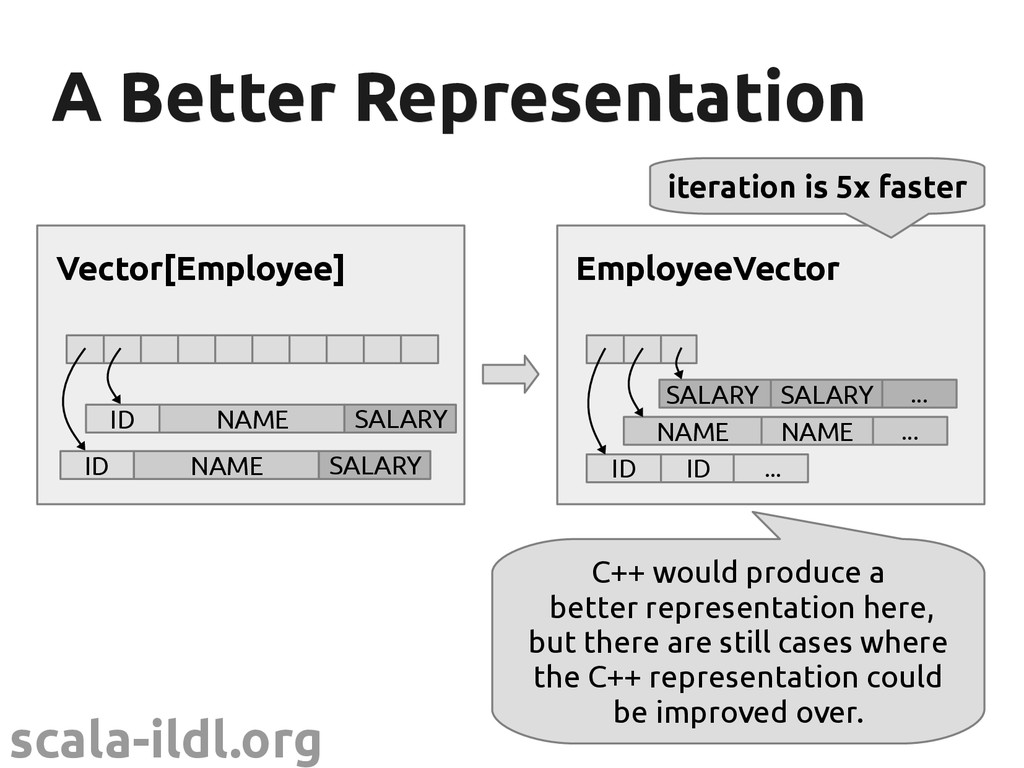
Vector[Employee] ID NAME SALARY ID NAME SALARY class Vector[T] { … } Traversal requires dereferencing a pointer for each employee. -
scala-ildl.org A Better Representation A Better Representation Vector[Employee] ID NAME
SALARY ID NAME SALARY -
scala-ildl.org A Better Representation A Better Representation NAME ... NAME
EmployeeVector ID ID ... ... SALARY SALARY Vector[Employee] ID NAME SALARY ID NAME SALARY -
scala-ildl.org A Better Representation A Better Representation NAME ... NAME
EmployeeVector ID ID ... ... SALARY SALARY Vector[Employee] ID NAME SALARY ID NAME SALARY iteration is 5x faster -
scala-ildl.org A Better Representation A Better Representation NAME ... NAME
EmployeeVector ID ID ... ... SALARY SALARY Vector[Employee] ID NAME SALARY ID NAME SALARY iteration is 5x faster C++ would produce a better representation here, but there are still cases where the C++ representation could be improved over. -
scala-ildl.org A Better Representation A Better Representation • In isolation
Vector[T] and Employee are optimal -
scala-ildl.org A Better Representation A Better Representation • In isolation
Vector[T] and Employee are optimal • Together, Vector[Employee] can be optimized -
scala-ildl.org A Better Representation A Better Representation • In isolation
Vector[T] and Employee are optimal • Together, Vector[Employee] can be optimized Challenge: No means of communicating this to the compiler -
scala-ildl.org A Better Representation A Better Representation • In isolation
Vector[T] and Employee are optimal • Together, Vector[Employee] can be optimized Challenge: No means of communicating this to the compiler You may disagree. We'll have a related work section later. -
scala-ildl.org • Transforming the code by hand – Makes maintenance
difficult – Changes are not contained -
scala-ildl.org • Transforming the code by hand – Makes maintenance
difficult – Changes are not contained Can we automate this? -
scala-ildl.org Transformation Transformation Definition Application • can't be automated •
based on experience • based on speculation • one-time effort -
scala-ildl.org Transformation Transformation Definition Application • can't be automated •
based on experience • based on speculation • one-time effort programmer -
scala-ildl.org Transformation Transformation Definition Application • can't be automated •
based on experience • based on speculation • one-time effort • repetitive and simple • affects code readability • is verbose • is error-prone programmer -
scala-ildl.org Transformation Transformation programmer Definition Application • can't be automated
• based on experience • based on speculation • one-time effort • repetitive and simple • affects code readability • is verbose • is error-prone compiler (automated) -
scala-ildl.org Transformation Transformation programmer Definition Application • can't be automated
• based on experience • based on speculation • one-time effort • repetitive and simple • affects code readability • is verbose • is error-prone compiler (automated) -
scala-ildl.org Data-centric Metaprogramming Data-centric Metaprogramming object VectorOfEmployeeOpt extends Transformation {
... } An object that describes a Transformation. -
scala-ildl.org Data-centric Metaprogramming Data-centric Metaprogramming object VectorOfEmployeeOpt extends Transformation {
... } An object that describes a Transformation. A marker trait for transformations. -
scala-ildl.org Data-centric Metaprogramming Data-centric Metaprogramming object VectorOfEmployeeOpt extends Transformation {
... } What does the compiler need to know? -
scala-ildl.org Data-centric Metaprogramming Data-centric Metaprogramming object VectorOfEmployeeOpt extends Transformation {
... } What does the compiler need to know? The target of the transformation and its representation. -
scala-ildl.org Data-centric Metaprogramming Data-centric Metaprogramming object VectorOfEmployeeOpt extends Transformation {
type Target = Vector[Employee] type Result = EmployeeVector ... } -
scala-ildl.org Data-centric Metaprogramming Data-centric Metaprogramming object VectorOfEmployeeOpt extends Transformation {
type Target = Vector[Employee] type Result = EmployeeVector ... } The transformation is type-driven we indicate → the type of the target and of the representation. -
scala-ildl.org Data-centric Metaprogramming Data-centric Metaprogramming object VectorOfEmployeeOpt extends Transformation {
type Target = Vector[Employee] type Result = EmployeeVector ... } The transformation is type-driven we indicate → the type of the target and of the representation. The improved representation is defined in the host language. -
scala-ildl.org Data-centric Metaprogramming Data-centric Metaprogramming object VectorOfEmployeeOpt extends Transformation {
type Target = Vector[Employee] type Result = EmployeeVector ... } -
scala-ildl.org Data-centric Metaprogramming Data-centric Metaprogramming object VectorOfEmployeeOpt extends Transformation {
type Target = Vector[Employee] type Result = EmployeeVector ... } How to transform Vector[Employee] into an EmployeeVector? -
scala-ildl.org Data-centric Metaprogramming Data-centric Metaprogramming object VectorOfEmployeeOpt extends Transformation {
type Target = Vector[Employee] type Result = EmployeeVector def toResult(t: Target): Result = ... def toTarget(t: Result): Target = ... ... } -
scala-ildl.org Data-centric Metaprogramming Data-centric Metaprogramming object VectorOfEmployeeOpt extends Transformation {
type Target = Vector[Employee] type Result = EmployeeVector def toResult(t: Target): Result = ... def toTarget(t: Result): Target = ... ... } Conversions to/from Vector[Employee] that consume/produce a EmployeeVector? -
scala-ildl.org Data-centric Metaprogramming Data-centric Metaprogramming object VectorOfEmployeeOpt extends Transformation {
type Target = Vector[Employee] type Result = EmployeeVector def toResult(t: Target): Result = ... def toTarget(t: Result): Target = ... ... } -
scala-ildl.org Data-centric Metaprogramming Data-centric Metaprogramming object VectorOfEmployeeOpt extends Transformation {
type Target = Vector[Employee] type Result = EmployeeVector def toResult(t: Target): Result = ... def toTarget(t: Result): Target = ... ... } So far so good, but how to execute Vector[Employee] operations on EmployeeVector? -
scala-ildl.org Data-centric Metaprogramming Data-centric Metaprogramming object VectorOfEmployeeOpt extends Transformation {
type Target = Vector[Employee] type Result = EmployeeVector def toResult(t: Target): Result = ... def toTarget(t: Result): Target = ... def bypass_length: Int = ... def bypass_apply(i: Int): Employee = ... def bypass_update(i: Int, v: Employee) = ... def bypass_toString: String = ... ... } -
scala-ildl.org Data-centric Metaprogramming Data-centric Metaprogramming programmer Definition Application • can't
be automated • based on experience • based on speculation • one-time effort • repetitive and simple • affects code readability • is verbose • is error-prone compiler (automated) -
scala-ildl.org Transformation Transformation programmer Definition Application • can't be automated
• based on experience • based on speculation • one-time effort • repetitive and simple • affects code readability • is verbose • is error-prone compiler (automated) -
scala-ildl.org Transformation Transformation programmer Definition Application • can't be automated
• based on experience • based on speculation • one-time effort • repetitive and simple • affects code readability • is verbose • is error-prone compiler (automated) In the paper -
scala-ildl.org Motivation Transformation Applications Challenges Conclusion Related Work Open-world Best
Represenation? Composition -
scala-ildl.org Motivation Transformation Applications Challenges Conclusion Related Work Open-world Best
Represenation? Composition -
scala-ildl.org Open World Assumption Open World Assumption class Vector[T] {
… } class Employee(...) ID NAME SALARY -
scala-ildl.org Open World Assumption Open World Assumption class Vector[T] {
… } class Employee(...) ID NAME SALARY -
scala-ildl.org Open World Assumption Open World Assumption class Employee(...) ID
NAME SALARY Vector[Employee] ID NAME SALARY ID NAME SALARY class Vector[T] { … } -
scala-ildl.org Open World Assumption Open World Assumption class Employee(...) ID
NAME SALARY Vector[Employee] ID NAME SALARY ID NAME SALARY class Vector[T] { … } NAME ... NAME EmployeeVector ID ID ... ... SALARY SALARY -
scala-ildl.org Open World Assumption Open World Assumption class Employee(...) ID
NAME SALARY Vector[Employee] ID NAME SALARY ID NAME SALARY class Vector[T] { … } NAME ... NAME EmployeeVector ID ID ... ... SALARY SALARY class NewEmployee(...) extends Employee(...) ID NAME SALARY DEPT -
scala-ildl.org Open World Assumption Open World Assumption class Employee(...) ID
NAME SALARY Vector[Employee] ID NAME SALARY ID NAME SALARY class Vector[T] { … } NAME ... NAME EmployeeVector ID ID ... ... SALARY SALARY class NewEmployee(...) extends Employee(...) ID NAME SALARY DEPT Oooops... -
scala-ildl.org Open World Assumption Open World Assumption • Globally anything
can happen • Locally the programmer has full control: – Knows the values that will be used – Can reject non-conforming values -
scala-ildl.org Open World Assumption Open World Assumption • Globally anything
can happen • Locally the programmer has full control: – Knows the values that will be used – Can reject non-conforming values How to use this information? -
scala-ildl.org Open World Assumption Open World Assumption • Globally anything
can happen • Locally the programmer has full control: – Knows the values that will be used – Can reject non-conforming values How to use this information? Scopes -
scala-ildl.org Scopes Scopes def indexSalary(employees: Vector[Employee], by: Float): Vector[Employee] =
for (employee ← employees) yield employee.copy( salary = (1 + by) * employee.salary ) -
scala-ildl.org Scopes Scopes def indexSalary(employees: Vector[Employee], by: Float): Vector[Employee] =
for (employee ← employees) yield employee.copy( salary = (1 + by) * employee.salary ) Method operating on Scala collections (familiar to programmers) -
scala-ildl.org Scopes Scopes def indexSalary(employees: Vector[Employee], by: Float): Vector[Employee] =
for (employee ← employees) yield employee.copy( salary = (1 + by) * employee.salary ) -
scala-ildl.org Scopes Scopes transform(VectorOfEmployeeOpt) { def indexSalary(employees: Vector[Employee], by: Float):
Vector[Employee] = for (employee ← employees) yield employee.copy( salary = (1 + by) * employee.salary ) } -
scala-ildl.org Scopes Scopes transform(VectorOfEmployeeOpt) { def indexSalary(employees: Vector[Employee], by: Float):
Vector[Employee] = for (employee ← employees) yield employee.copy( salary = (1 + by) * employee.salary ) } Now the method operates on the EmployeeVector representation. -
scala-ildl.org Scopes Scopes transform(VectorOfEmployeeOpt) { def indexSalary(employees: Vector[Employee], by: Float):
Vector[Employee] = for (employee ← employees) yield employee.copy( salary = (1 + by) * employee.salary ) } Now the method operates on the EmployeeVector representation. Programmers can freely choose which parts of their code to transform. -
scala-ildl.org Scopes Scopes • Can wrap statements, methods even entire
classes – Inlined immediately after the parser – Definitions are visible outside the "scope" -
scala-ildl.org Scopes Scopes • Can wrap statements, methods even entire
classes – Inlined immediately after the parser – Definitions are visible outside the "scope" • Locally closed world – Incoming/outgoing values go through conversions – Programmer can reject unexpected values -
scala-ildl.org Motivation Transformation Applications Challenges Conclusion Related Work Open-world Best
Represenation? Composition -
scala-ildl.org Best ...? Best ...? NAME ... NAME EmployeeVector ID
ID ... ... SALARY SALARY Vector[Employee] ID NAME SALARY ID NAME SALARY -
scala-ildl.org Best ...? Best ...? NAME ... NAME EmployeeVector ID
ID ... ... SALARY SALARY Vector[Employee] ID NAME SALARY ID NAME SALARY CompactVector <compressed binary blob> -
scala-ildl.org Best ...? Best ...? NAME ... NAME EmployeeVector ID
ID ... ... SALARY SALARY Vector[Employee] ID NAME SALARY ID NAME SALARY EmployeeJSON { id: 123, name: “John Doe” salary: 100 } CompactVector <compressed binary blob> -
scala-ildl.org Best ...? Best ...? NAME ... NAME EmployeeVector ID
ID ... ... SALARY SALARY Vector[Employee] ID NAME SALARY ID NAME SALARY EmployeeJSON { id: 123, name: “John Doe” salary: 100 } CompactVector <compressed binary blob> Scopes! -
scala-ildl.org Scopes Scopes transform(VectorOfEmployeeOpt) { def indexSalary(employees: Vector[Employee], by: Float):
Vector[Employee] = for (employee ← employees) yield employee.copy( salary = (1 + by) * employee.salary ) } -
scala-ildl.org Scopes Scopes transform(VectorOfEmployeeOpt) { def indexSalary(employees: Vector[Employee], by: Float):
Vector[Employee] = for (employee ← employees) yield employee.copy( salary = (1 + by) * employee.salary ) } Method operating on column-based storage -
scala-ildl.org Scopes Scopes transform(VectorOfEmployeeBinary) { def indexSalary(employees: Vector[Employee], by: Float):
Vector[Employee] = for (employee ← employees) yield employee.copy( salary = (1 + by) * employee.salary ) } Method operating on binary data -
scala-ildl.org Scopes Scopes transform(VectorOfEmployeeJSON) { def indexSalary(employees: Vector[Employee], by: Float):
Vector[Employee] = for (employee ← employees) yield employee.copy( salary = (1 + by) * employee.salary ) } Method operating on JSON data -
scala-ildl.org Motivation Transformation Applications Challenges Conclusion Related Work Open-world Best
Represenation? Composition -
scala-ildl.org Scope Composition Scope Composition • Code can be –
Left untransformed (using the original repr.) – Transformed using different representations -
scala-ildl.org Scope Composition Scope Composition calling • Original code •
Transformed code • Original code • Transformed code • Same transformation • Different transformation • Code can be – Left untransformed (using the original repr.) – Transformed using different representations -
scala-ildl.org Scope Composition Scope Composition calling • Original code •
Transformed code • Original code • Transformed code • Same transformation • Different transformation • Code can be – Left untransformed (using the original repr.) – Transformed using different representations -
scala-ildl.org Scope Composition Scope Composition calling • Original code •
Transformed code • Original code • Transformed code • Same transformation • Different transformation • Code can be – Left untransformed (using the original repr.) – Transformed using different representations Coercions -
scala-ildl.org Scope Composition Scope Composition calling • Original code •
Transformed code • Original code • Transformed code • Same transformation • Different transformation • Code can be – Left untransformed (using the original repr.) – Transformed using different representations Coercions -
scala-ildl.org Scope Composition Scope Composition calling • Original code •
Transformed code • Original code • Transformed code • Same transformation • Different transformation • Code can be – Left untransformed (using the original repr.) – Transformed using different representations -
scala-ildl.org Scope Composition Scope Composition calling • Original code •
Transformed code • Original code • Transformed code • Same transformation • Different transformation • Code can be – Left untransformed (using the original repr.) – Transformed using different representations -
scala-ildl.org Scope Composition Scope Composition calling • Original code •
Transformed code • Original code • Transformed code • Same transformation • Different transformation • Code can be – Left untransformed (using the original repr.) – Transformed using different representations No coercions -
scala-ildl.org Scope Composition Scope Composition calling • Original code •
Transformed code • Original code • Transformed code • Same transformation • Different transformation • Code can be – Left untransformed (using the original repr.) – Transformed using different representations No coercions Even across separate compilation -
scala-ildl.org Scope Composition Scope Composition calling • Original code •
Transformed code • Original code • Transformed code • Same transformation • Different transformation • Code can be – Left untransformed (using the original repr.) – Transformed using different representations -
scala-ildl.org Scope Composition Scope Composition calling • Original code •
Transformed code • Original code • Transformed code • Same transformation • Different transformation • Code can be – Left untransformed (using the original repr.) – Transformed using different representations -
scala-ildl.org Scope Composition Scope Composition calling • Original code •
Transformed code • Original code • Transformed code • Same transformation • Different transformation • Code can be – Left untransformed (using the original repr.) – Transformed using different representations Two coercions Repr1 Target Repr2 → → -
scala-ildl.org Scope Composition Scope Composition calling • Original code •
Transformed code • Original code • Transformed code • Same transformation • Different transformation • Code can be – Left untransformed (using the original repr.) – Transformed using different representations -
scala-ildl.org Scope Composition Scope Composition calling overriding • Original code
• Transformed code • Original code • Transformed code • Same transformation • Different transformation • Code can be – Left untransformed (using the original repr.) – Transformed using different representations -
scala-ildl.org Scope Composition Scope Composition calling overriding • Original code
• Transformed code • Original code • Transformed code • Same transformation • Different transformation • Code can be – Left untransformed (using the original repr.) – Transformed using different representations The transformation has to preserve the object model. -
scala-ildl.org Scope Composition Scope Composition calling overriding • Original code
• Transformed code • Original code • Transformed code • Same transformation • Different transformation • Code can be – Left untransformed (using the original repr.) – Transformed using different representations The transformation has to preserve the object model. Handled automatically by the ildl transformation! -
scala-ildl.org Motivation Transformation Applications Challenges Conclusion Related Work Open-world Best
Represenation? Composition -
scala-ildl.org Array of Stuct Array of Stuct (Column-oriented) (Column-oriented) NAME
... NAME EmployeeVector ID ID ... ... SALARY SALARY Vector[Employee] ID NAME SALARY ID NAME SALARY -
scala-ildl.org Array of Stuct Array of Stuct (Column-oriented) (Column-oriented) NAME
... NAME EmployeeVector ID ID ... ... SALARY SALARY Vector[Employee] ID NAME SALARY ID NAME SALARY 5x faster -
scala-ildl.org Specialization Specialization and stack allocation and stack allocation 3
5 (3,5) Tuples in Scala are generic so they need to use pointers and objects -
scala-ildl.org Specialization Specialization and stack allocation and stack allocation 3
5 3 5 (3,5) (3,5) Tuples in Scala are generic so they need to use pointers and objects + stack allocation -
scala-ildl.org + stack allocation Specialization Specialization and stack allocation and
stack allocation 14x faster reduced memory footprint 3 5 3 5 (3,5) (3,5) Tuples in Scala are generic so they need to use pointers and objects -
scala-ildl.org Deforestation Deforestation List(1,2,3).map(_ + 1).map(_ * 2).sum List(2,3,4) List(4,6,8)
18 transform(ListDeforestation) { List(1,2,3).map(_ + 1).map(_ * 2).sum } -
scala-ildl.org Deforestation Deforestation List(1,2,3).map(_ + 1).map(_ * 2).sum List(2,3,4) List(4,6,8)
18 transform(ListDeforestation) { List(1,2,3).map(_ + 1).map(_ * 2).sum } accumulate function -
scala-ildl.org Deforestation Deforestation List(1,2,3).map(_ + 1).map(_ * 2).sum List(2,3,4) List(4,6,8)
18 transform(ListDeforestation) { List(1,2,3).map(_ + 1).map(_ * 2).sum } accumulate function accumulate function -
scala-ildl.org Deforestation Deforestation List(1,2,3).map(_ + 1).map(_ * 2).sum List(2,3,4) List(4,6,8)
18 transform(ListDeforestation) { List(1,2,3).map(_ + 1).map(_ * 2).sum } accumulate function accumulate function compute: 18 -
scala-ildl.org Deforestation Deforestation List(1,2,3).map(_ + 1).map(_ * 2).sum List(2,3,4) List(4,6,8)
18 transform(ListDeforestation) { List(1,2,3).map(_ + 1).map(_ * 2).sum } accumulate function accumulate function compute: 18 6x faster -
scala-ildl.org Motivation Transformation Applications Challenges Conclusion Related Work Open-world Best
Represenation? Composition -
scala-ildl.org Multi-Stage Programming Multi-Stage Programming • Multi-Stage Programming – “Abstraction
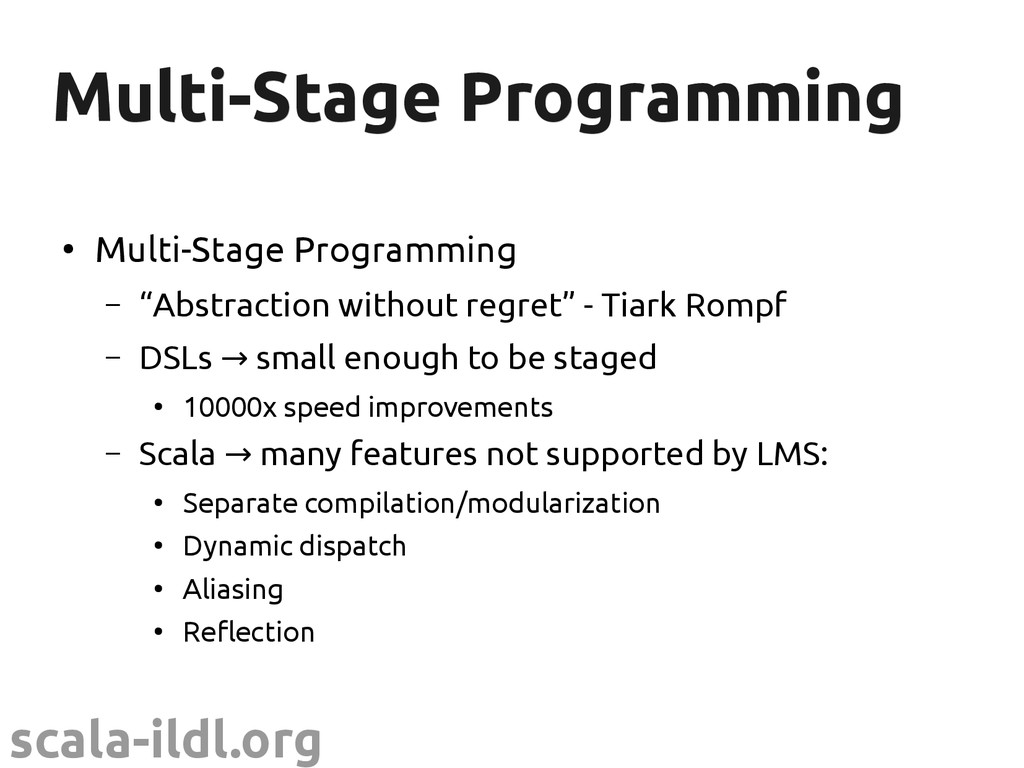
without regret” - Tiark Rompf – DSLs small enough to be staged → • 10000x speed improvements -
scala-ildl.org Multi-Stage Programming Multi-Stage Programming • Multi-Stage Programming – “Abstraction
without regret” - Tiark Rompf – DSLs small enough to be staged → • 10000x speed improvements – Scala many features not supported by LMS: → • Separate compilation/modularization • Dynamic dispatch • Aliasing • Reflection -
scala-ildl.org Multi-Stage Programming Multi-Stage Programming • Multi-Stage Programming – “Abstraction
without regret” - Tiark Rompf – DSLs small enough to be staged → • 10000x speed improvements – Scala many features not supported by LMS: → • Separate compilation/modularization • Dynamic dispatch • Aliasing • Reflection If we add support, we lose the ability to optimize code :( -
scala-ildl.org Low-level Optimizers Low-level Optimizers • JIT optimizers with virtual
machine support – Access to the low-level code – Can assume a (local) closed world – Can speculate based on profiles – On the critical path – limited analysis -
scala-ildl.org Low-level Optimizers Low-level Optimizers • JIT optimizers with virtual
machine support – Access to the low-level code – Can assume a (local) closed world – Can speculate based on profiles – On the critical path – limited analysis – Biggest opportunities are high-level - O(n2) O(n) → • Incoming code is low-level • Rarely possible to recover opportunities -
scala-ildl.org Low-level Optimizers Low-level Optimizers • JIT optimizers with virtual
machine support – Access to the low-level code – Can assume a (local) closed world – Can speculate based on profiles – On the critical path – limited analysis – Biggest opportunities are high-level - O(n2) O(n) → • Incoming code is low-level • Rarely possible to recover opportunities Typical solution: Metaprogramming -
scala-ildl.org Metaprogramming Metaprogramming • Not your grandpa's C preprocessor def
optimize(tree: AST): AST = { ... } -
scala-ildl.org Metaprogramming Metaprogramming • Not your grandpa's C preprocessor •
Full-fledged program transformers – :) Lots of power def optimize(tree: AST): AST = { ... } -
scala-ildl.org Metaprogramming Metaprogramming • Not your grandpa's C preprocessor •
Full-fledged program transformers – :) Lots of power – :( Lots of responsibility def optimize(tree: AST): AST = { ... } -
scala-ildl.org Metaprogramming Metaprogramming • Not your grandpa's C preprocessor •
Full-fledged program transformers – :) Lots of power – :( Lots of responsibility • Compiler invariants • Object-oriented model • Modularity def optimize(tree: AST): AST = { ... } -
scala-ildl.org Metaprogramming Metaprogramming • Not your grandpa's C preprocessor •
Full-fledged program transformers – :) Lots of power – :( Lots of responsibility • Compiler invariants • Object-oriented model • Modularity def optimize(tree: AST): AST = { ... } Can we make metaprogramming “high-level”? -
scala-ildl.org Motivation Transformation Applications Challenges Conclusion Related Work Open-world Best
Represenation? Composition -
scala-ildl.org Conclusion Conclusion • Object-oriented composition inefcient representation → •
Solution: data-centric metaprogramming – Splitting the responsibility: • Defining the Transformation programmer → • Applying the Transformation compiler → – Scopes • Adapt the data representation to the operation • Allow speculating properties of the scope • We've just begun to scratch the surface – Many interesting research questions lie ahead -
scala-ildl.org Conclusion Conclusion • Object-oriented composition inefcient representation → •
Solution: data-centric metaprogramming – Splitting the responsibility: • Defining the Transformation programmer → • Applying the Transformation compiler → – Scopes • Adapt the data representation to the operation • Allow speculating properties of the scope • We've just begun to scratch the surface – Many interesting research questions lie ahead
 vladureche
 raeminkang
 cclai999
 giljongyu
 ryunen344
 richargh
 yuta_onishi_97
 seyfoyun
 vivion
 ostk0069
 onozaty
 simas
 koukimiura
 wjessup
 khoart
 akihiro_kokubo
 aleyda
 csswizardry
 tanoku
 reverentgeek
 codingconduct
 lemiorhan
 szymonslowik
 tamaranovitovic
 lfama