Upgrade to Pro
— share decks privately, control downloads, hide ads and more …
Speaker Deck
Sign up for free
Menu
Search
Features
All features
Private URLs
Password Protection
Custom URLS
Scheduled publishing
Remove Branding
Restrict embedding
Deck Collections
Notes
Features
All features
Private URLs
Password Protection
Custom URLS
Scheduled publishing
Remove Branding
Restrict embedding
Deck Collections
Notes
Explore
Featured decks
Featured speakers
Programming
Technology
Storyboards
Explore
Featured decks
Featured speakers
Programming
Technology
Storyboards
Pricing
Search
Sign in
Sign up for free
Hipster Tech, Cargo Culting, and you being of n...
Search
Sebastian von Conrad
December 13, 2015
Programming
170
1
Share
Embed
Copy iframe code
Copy JS code
Copy link
Start on current slide
Hipster Tech, Cargo Culting, and you being of no use (to me)
I gave this talk at Railscamp 18 in Canberra, 11th–14th of December 2015.
Sebastian von Conrad
December 13, 2015
More Decks by Sebastian von Conrad
See All by Sebastian von Conrad
The Influential Architect
vonconrad
0
150
An In-Depth Look at Event Sourcing with CQRS
vonconrad
2
1.6k
Handwaving about Dependencies
vonconrad
0
280
Event Sourcing, or Why ActiveRecord Must Die
vonconrad
8
2.3k
Reporting and the First Law of Holes
vonconrad
2
360
Other Decks in Programming
See All in Programming
TiDB Cloudのカスタムコントローラーによるオートスケール対応
takaidohigasi
0
120
20260914 AIエージェント時代のPlatform Engineering LLM基盤とプロダクトの責務境界線
kanfab1
6
2k
Vibes Containers 〜AIで変わるコンテナ設計と運用〜
tkikuc
3
550
Java 27新機能 / Java 27 new features
kishida
2
140
Starting & Sustaining Code-Based E2E Testing for Non-Coding QA Teams( #jasstniigata )
teyamagu
PRO
1
240
Heart of Swift Concurrency
koher
0
770
XHTMLが残したもの
yosuke_furukawa
PRO
2
800
Streamlitで実現する自然言語データアプリ開発
ayumu_yamaguchi
0
280
Vue Fes Japan 2026 タイムテーブル徹底解説
448jp
0
170
AIエージェント時代のコードレビューを設計する
nogu66
6
2.7k
【高い買い物LT会】初任給で話題の国産フィジカルAIを買った話
akagami
PRO
0
160
thread_parallel_with_free-threaded_Python_and_NumPy.pdf
riku_sakamoto
0
330
Featured
See All Featured
Distributed Sagas: A Protocol for Coordinating Microservices
caitiem20
333
23k
Applied NLP in the Age of Generative AI
inesmontani
PRO
4
2.5k
[RailsConf 2023 Opening Keynote] The Magic of Rails
eileencodes
31
10k
Chasing Engaging Ingredients in Design
codingconduct
0
310
What's in a price? How to price your products and services
michaelherold
247
13k
Jamie Indigo - Trashchat’s Guide to Black Boxes: Technical SEO Tactics for LLMs
techseoconnect
PRO
0
670
So, you think you're a good person
axbom
PRO
2
2.2k
Mobile First: as difficult as doing things right
swwweet
225
10k
Ten Tips & Tricks for a 🌱 transition
stuffmc
1
230
Navigating Team Friction
lara
192
16k
Testing 201, or: Great Expectations
jmmastey
46
8.3k
Learning to Love Humans: Emotional Interface Design
aarron
275
41k
Transcript
Hipster Tech, Cargo Culting, and you being of no use
(to me).
Sebastian von Conrad @vonconrad
None
None
None
None
None
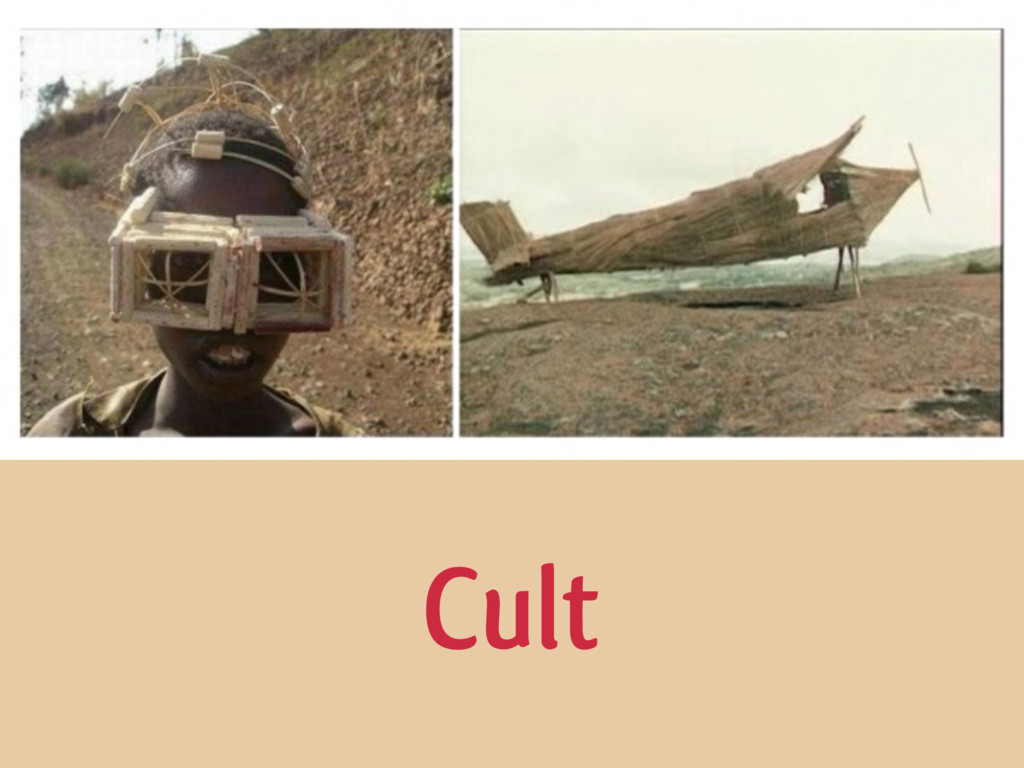
Cargo
Cult
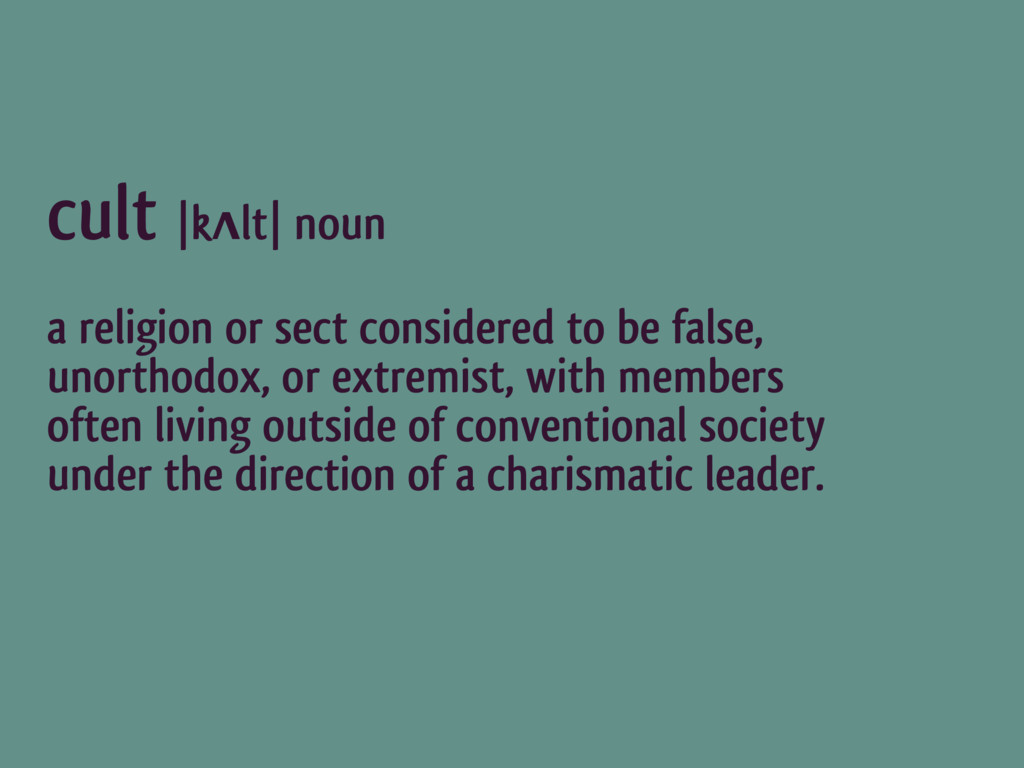
cult |kʌlt| noun a religion or sect considered to be
false, unorthodox, or extremist, with members often living outside of conventional society under the direction of a charismatic leader.
cult |kʌlt| noun a religion or sect considered to be
false, unorthodox, or extremist, with members often living outside of conventional society under the direction of a charismatic leader.
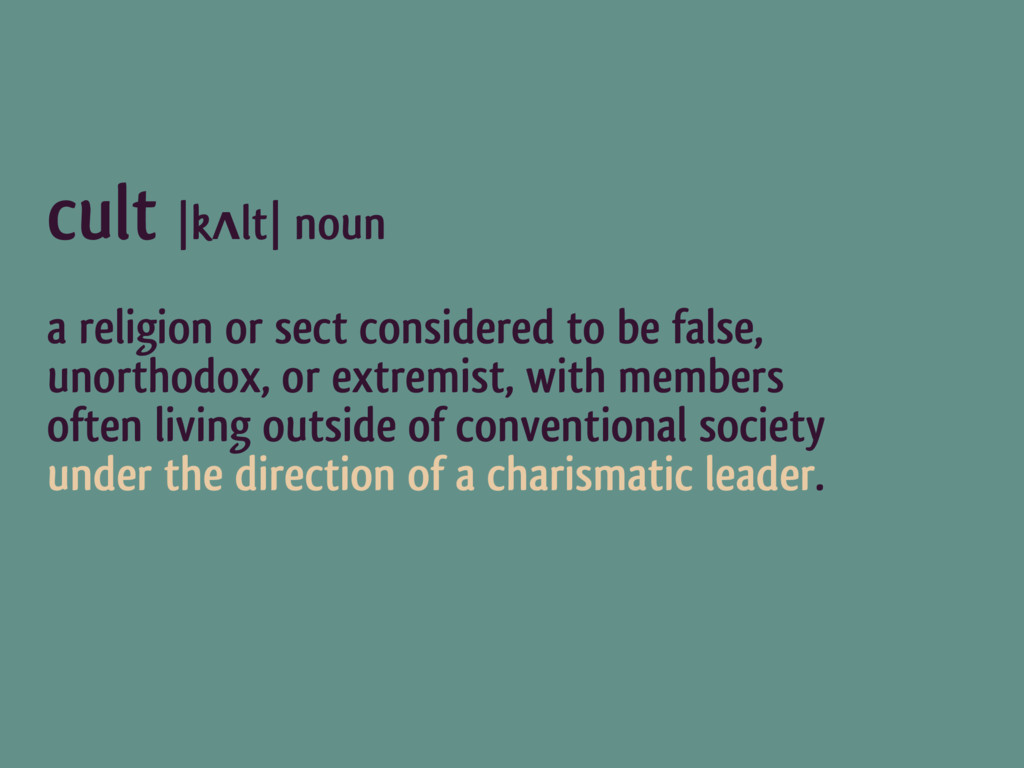
cult |kʌlt| noun a religion or sect considered to be
false, unorthodox, or extremist, with members often living outside of conventional society under the direction of a charismatic leader.
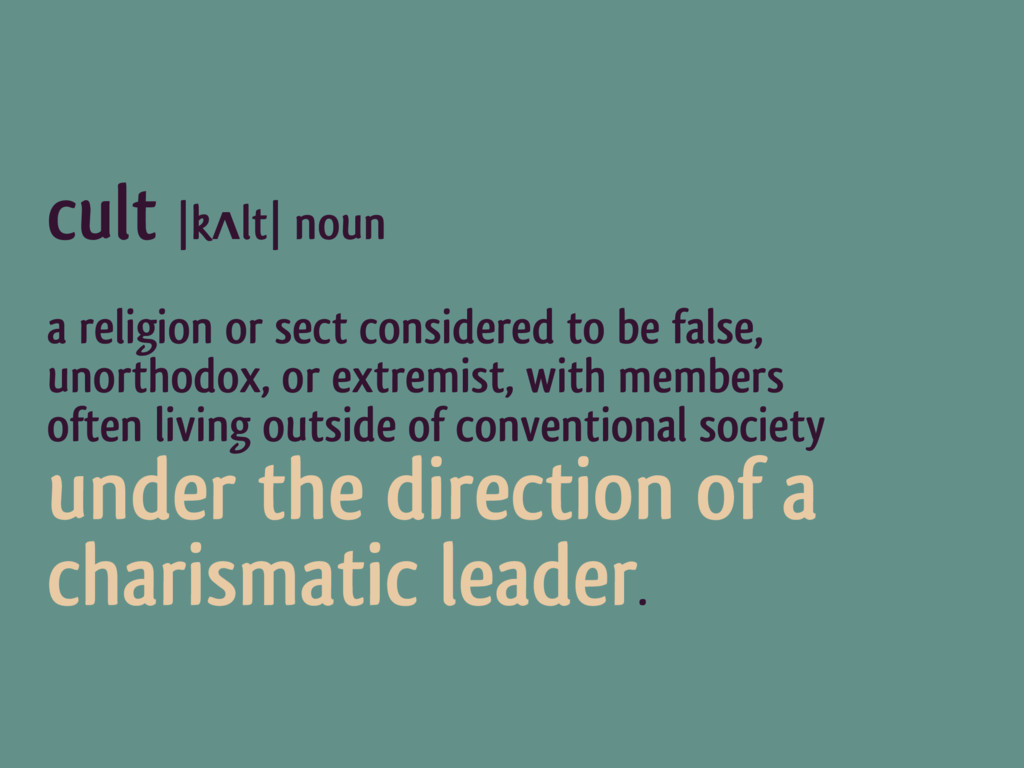
under the direction of a charismatic leader
None
Rails is the best and worst thing that happened to
Ruby.
Let me explain...
Rails propelled the popularity of Ruby...
...but Rails itself was too popular.
We all want to build web apps quickly.
And Rails seemed like a good way to build web
apps quickly.
Build web apps quickly Cargo
Cult Rails
But while Rails allows rapid development, what about maintainability?
History has proven this to be (generally) false.
RubyConf AU 2015 (aka SOA Conf)
People who have worked with 5+ years Rails apps have
seen some shit.
Maintainable web apps Cargo
Cult? Service-Oriented Architecture
(I happen to agree with them but that’s not the
point.)
So, should we just stop using Rails?
It’s not quite that simple.
I would still use Rails.
Mostly because I have no choice.
It’s (close to) impossible to find Ruby devs who don’t
do Rails.
In many cases, Rails is all of the Ruby developers
know.
Rails’ toolset has become the toolset of Ruby developers.
This talk is actually all about Tools.
(Sorry for the link bait.)
(#sorrynotsorry)
Context.
In preparing this talk, 3 things collided in my head.
1.
I got a new job.
None
Architecture Grand Master High Guild Wizard Poobah* * or some
combination thereof.
Envato has 75 devs.
My job is improving: - Software architecture - Software modeling
- Software design
Rails’ tools. MVC.
ActiveRecord Must die.
ActionView Too weak an interface.
ActionController Roda is (already) better.
ActionMailer Use literally anything else.
ActiveSupport Monkey-patches everything.
Turbolinks Abomination.
Concerns Congratulations! You just made it easier to violate SRP.
Asset Pipeline “Terrible.” - Tim Lucas
Model, View, Controller. Ranges from to .
Envato has 75 Rails devs.
None
Actually, that’s not quite right.
We have a bit of everything in production.
Rails, non-Rails Ruby, Node.js, Elixir, Go, MySQL, PostgreSQL, MongoDB, Redis,
Memcache, ElasticSearch, Sphinx.
I cannot control this language proliferation. Nor do I intend
to try.
Still, my job is improving: - Software architecture - Software
modeling - Software design
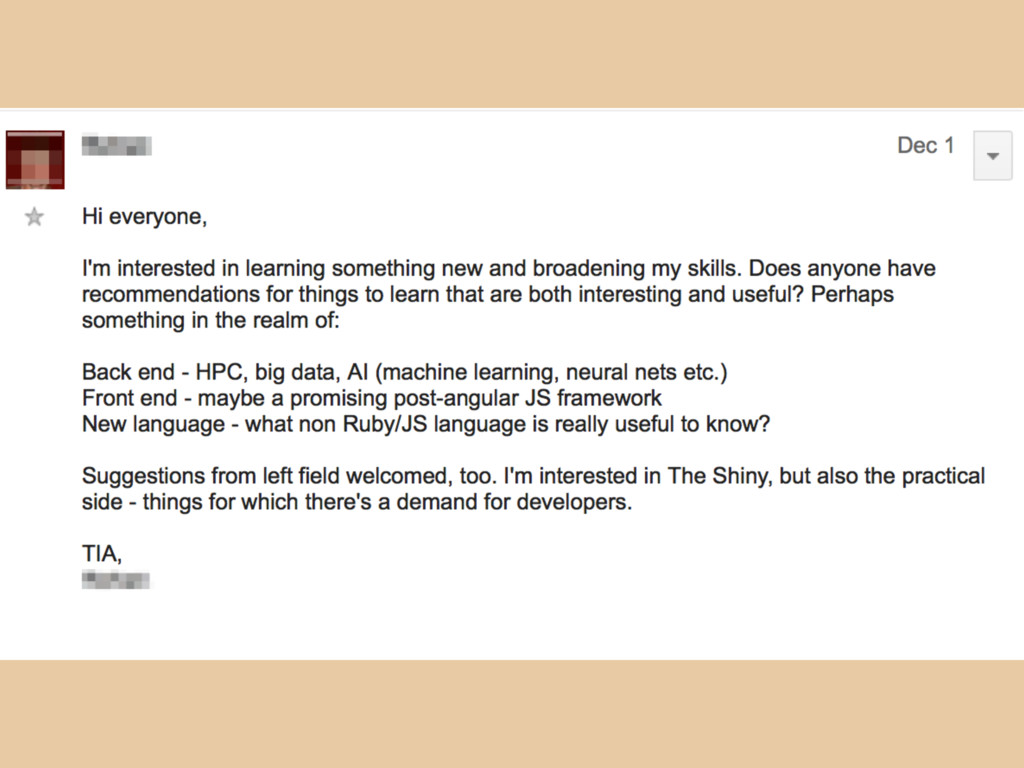
How do software developers get better?
Be a better software developer Cargo
2.
I talked to someone who wouldn’t apply for a job.
Why? No Ruby experience.
Lots of solid OO experience.
Do I actually care? No.
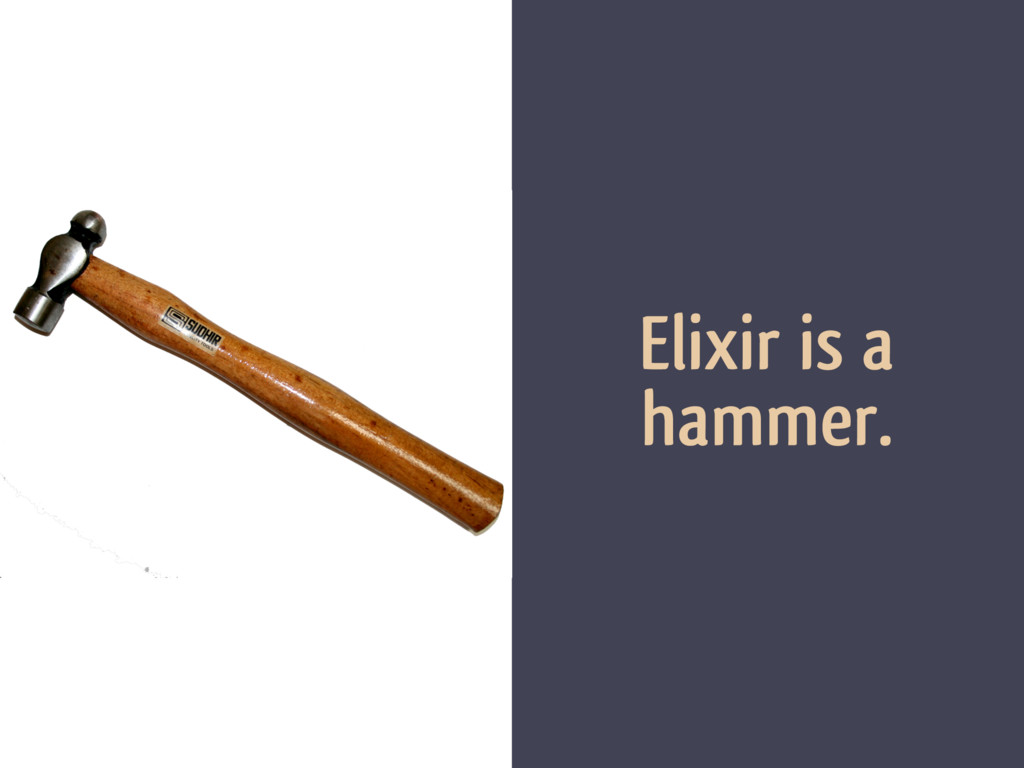
Rails is a hammer.
If the person has other tools, they are still very
valuable.
In fact, not knowing Rails can be a benefit.
Diversity of experiences and opinions lead to better outcomes.
Be a better software developer Cargo
Cult Mastery of a single language and/or framework
3.
None
None
None
None
None
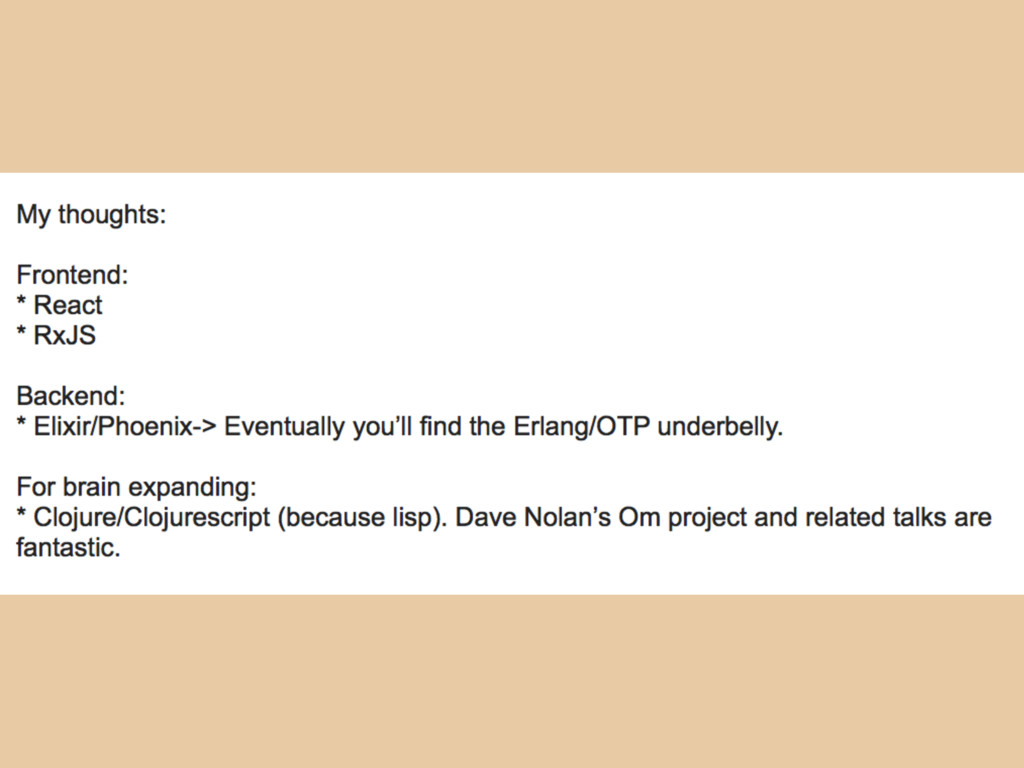
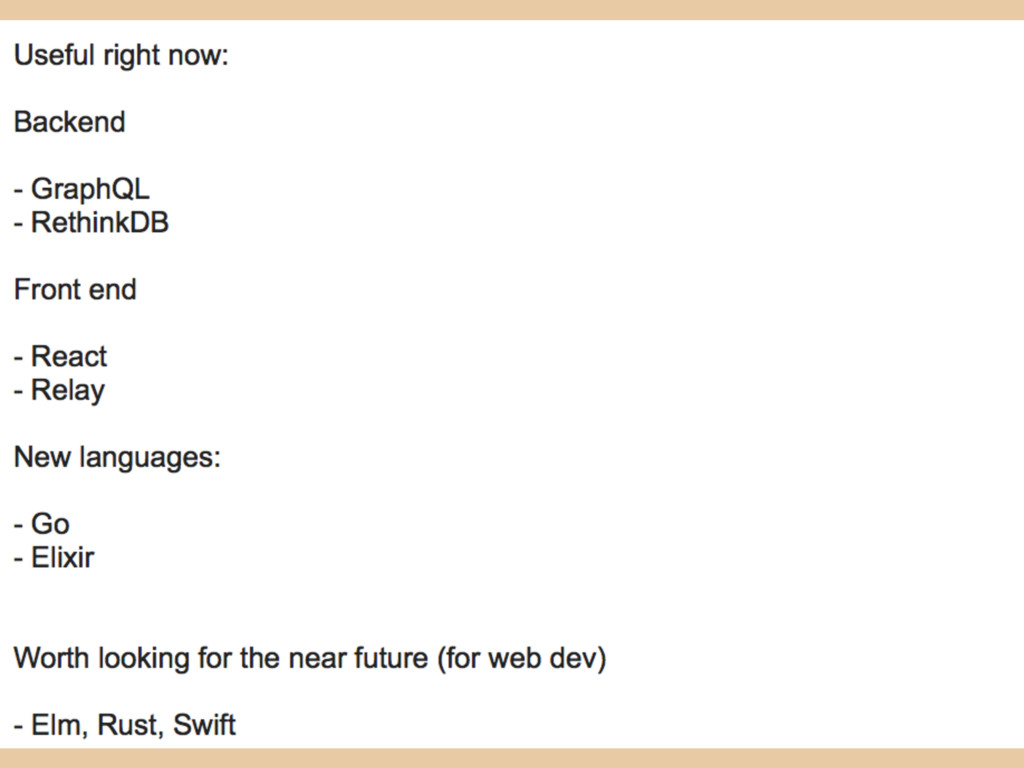
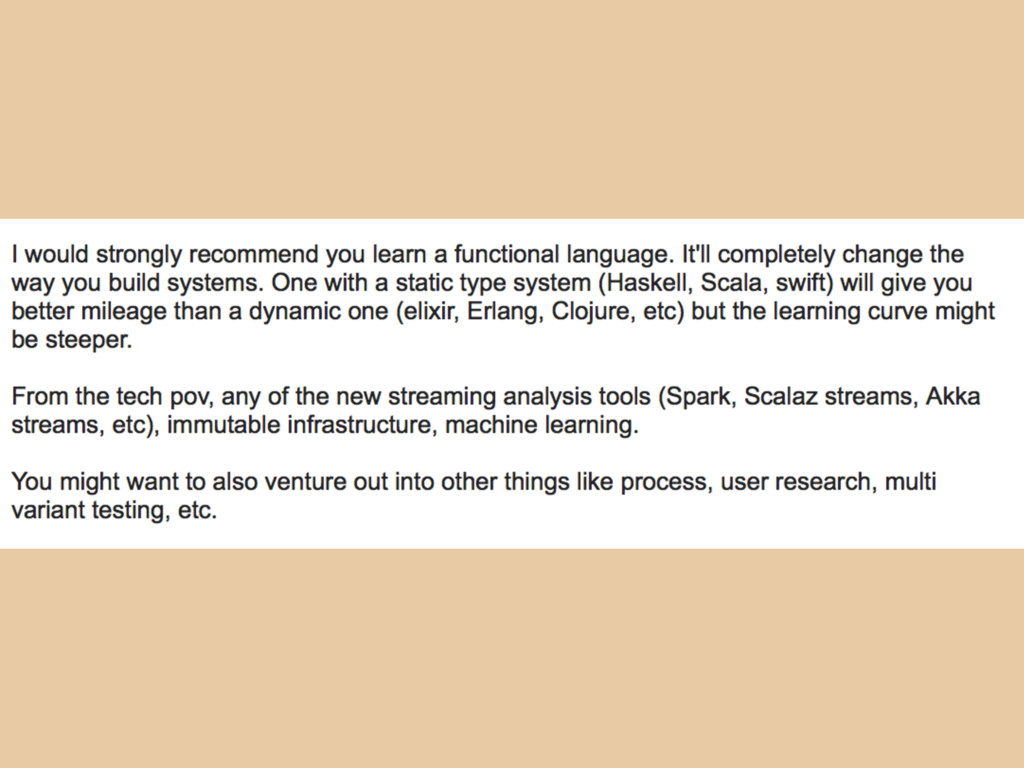
I fundamentally disagree. (But I wasn’t looking for a shitfight.)
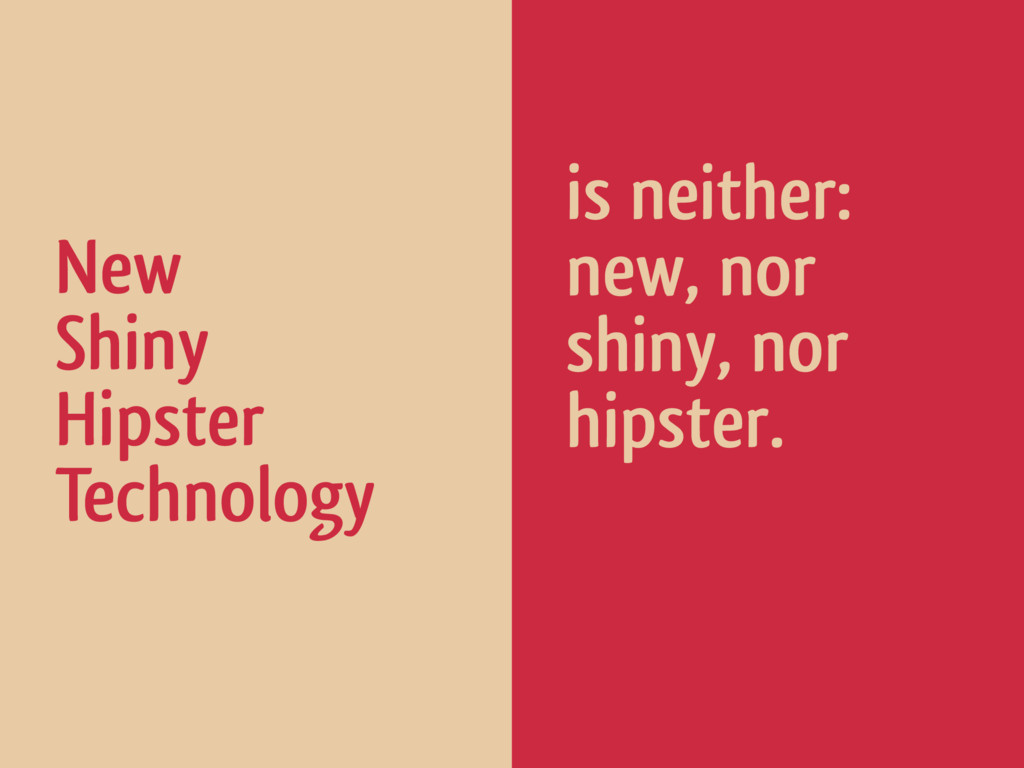
is neither: new, nor shiny, nor hipster. New Shiny Hipster
Technology
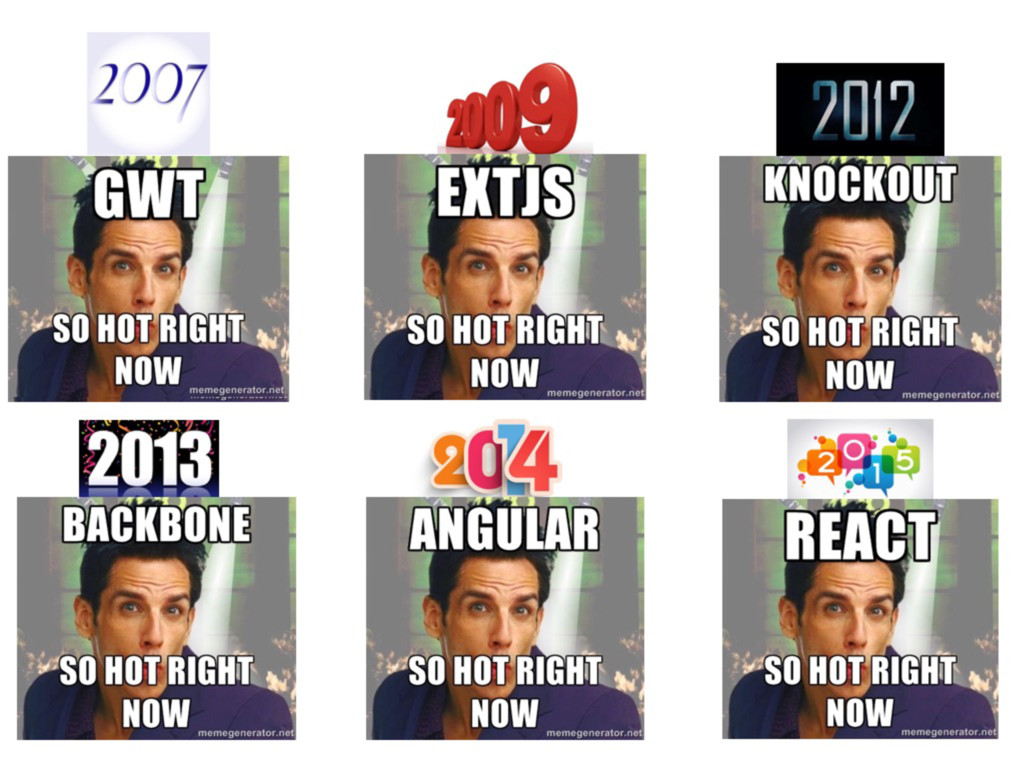
It might seem that way, but most are reinventions of
the wheel.
Examples!
Node.js
NoSQL
React
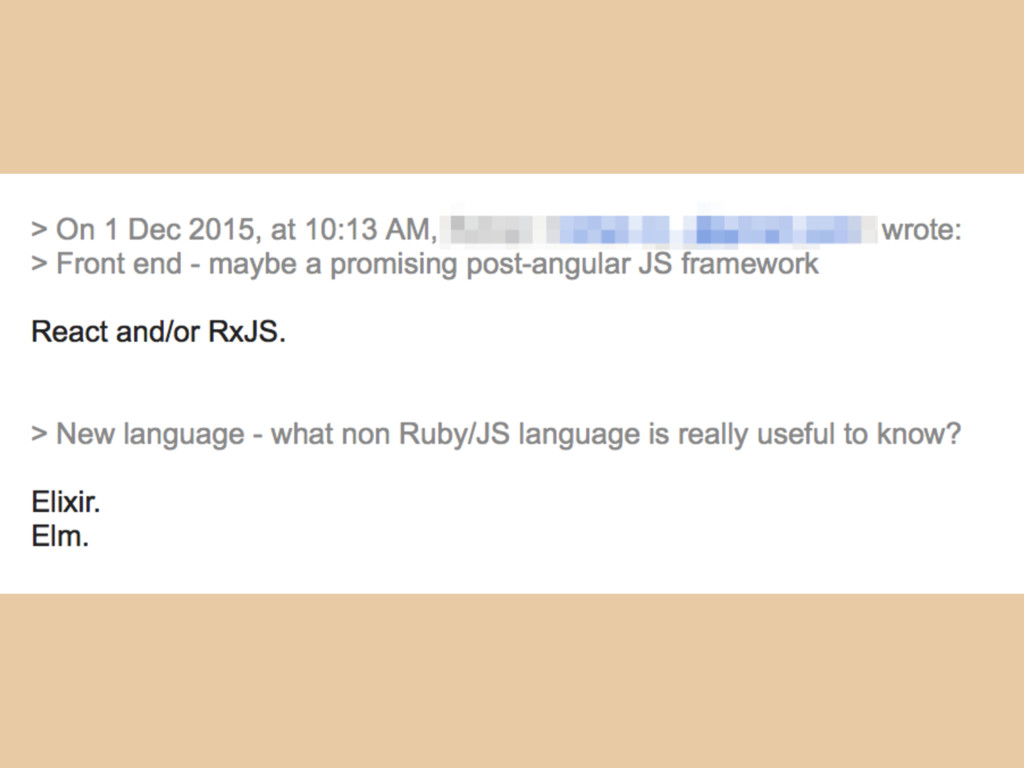
Elixir/Go/Swift
(Our Rails “hacks” aren’t new either.)
But perhaps more importantly…
Elixir is a hammer.
Go is a hammer.
None
React is a… ?
None
Seriously, though, who would have thought it would be the
JS community who would get excited about immutability?
But I digress…
Be a better software developer Cargo
Cult Learn new languages and/or frameworks
Now, this feels like a catch-22.
Be a better software developer Cargo
Cult Mastery of a single language and/or framework
Cult Learn new languages and/or frameworks
The thing with languages…
…it’s hard to use more than one at a time.
Elixir won’t do you much good if I need to
drop you into a Rails monolith.
Kind of like hammers. They might be somewhat different, but
you typically only need one.
If all you have is hammers in your tool belt,
then you are of no use to me.
Diversify your toolset.
No tool, no matter how great, is right for every
occasion.
Accumulate more, and learn when to apply each one.
None
Learn patterns that translate.
Patterns are language agnostic and can be applied in different
situations with different tech.
Languages/frameworks can be be a way to learn patterns.
But you don’t have to.
Learn new languages and frameworks because of the patterns they
employ. (Not because they’re the New Shiny.)
Be explicit about what those patterns are.
If you can't extrapolate the pattern(s), it's not a useful
tool.
Because you can’t use it independently to the language/ framework
you learnt it from.
(Now, I have a list.)
Rather than New Shiny Hipster Tech, I want you to
learn about: I’ll tweet out a link to all of them later.
OLID
(SOLID without the S.)
(Not that S isn’t important.)
OLID: Open/closed principle.
Poor fella is very misunderstood.
Can’t modify existing code, only extend it.
Code that doesn’t have to be changed every time our
requirements change.
OLID: Liskov substitution principle.
OLID: Interface segregation.
Small, isolated interfaces.
High cohesion/low coupling.
(Law of Demeter.)
(Postel’s Law.)
OLID: Dependency inversion.
Depend on things that are of the same, or higher
level, of abstraction.
Inversion != Injection.
Dependency injection is about how to acquire dependencies.
Dependency inversion is about what should depend on what.
(By all means, learn about Dependency Injection as well.)
Separation of Concerns.
Not the same as ActiveSupport::Concern.
Modularity via encapsulation.
Interface design.
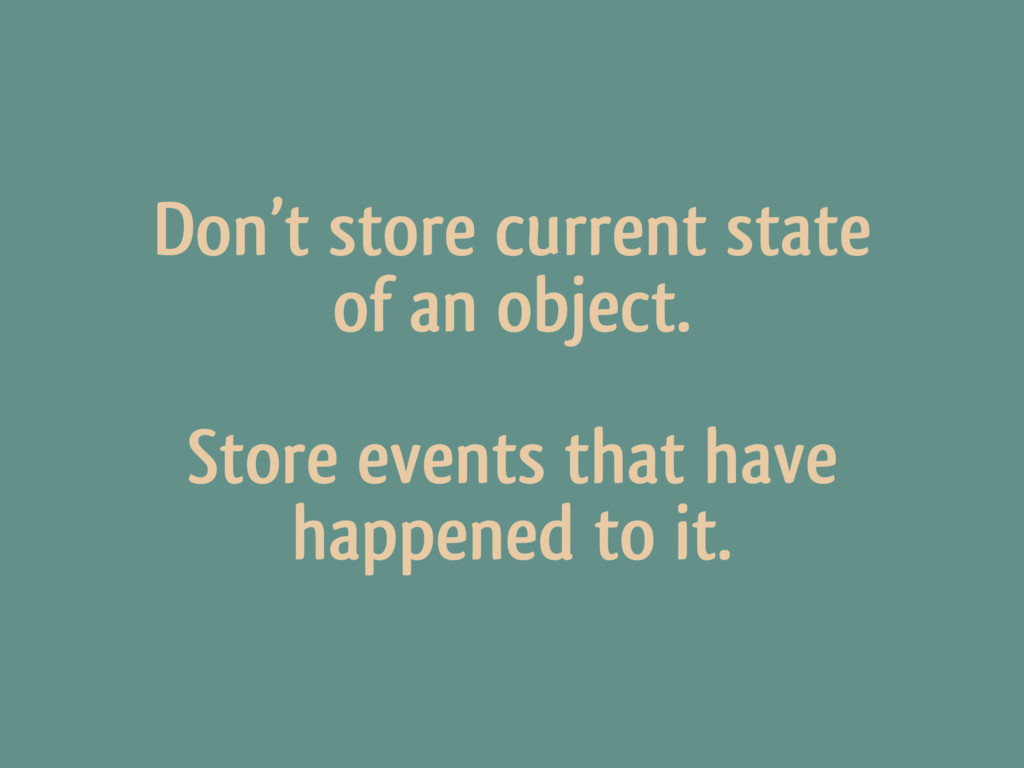
Event sourcing.
Don’t store current state of an object. Store events that
have happened to it.
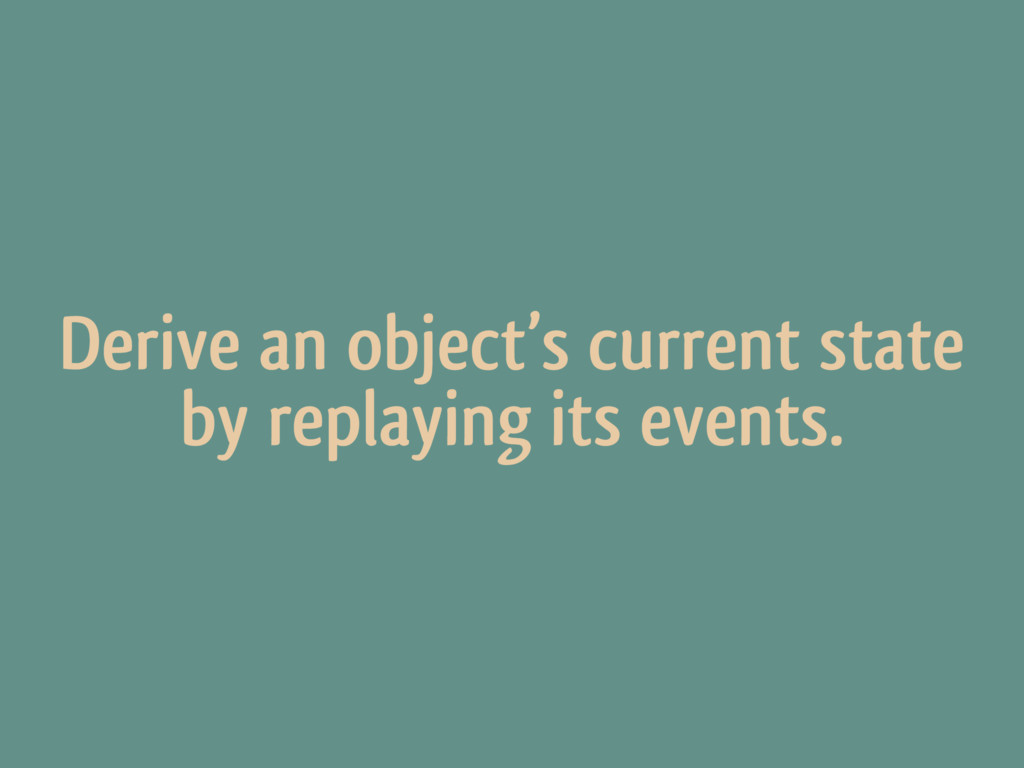
Derive an object’s current state by replaying its events.
(I’m talking about this at RubyConf.)
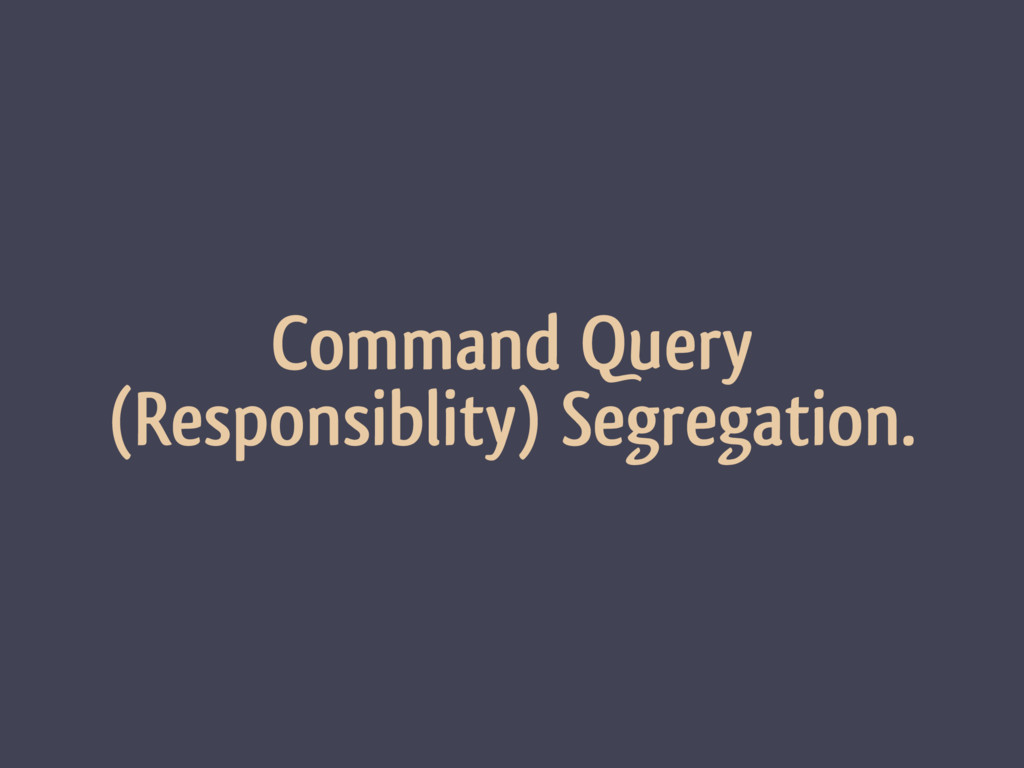
CQS. CQRS.
Command Query (Responsiblity) Segregation.
CQS: A method can either mutate state or return state.
Never both.
CQRS: A class can either mutate state or return state.
Never both.
Immutable data structures.
Gateway to concurrency.
Now, immutable data structures in the application layer is nice
and all…
…but not as awesome as an immutable, append-only persistence layer.
(You can do this with any database, don’t have to
hipster around with Datomic.)
Functional vs. Object-oriented.
Only exception that I’ll make.
But you don’t actually have to learn a new language
to do functional programming.
Functional Ruby. It’s a thing.
Service-Oriented Architecture.
Ewww, Microservices.
Not always, but sometimes. Form your own opinion.
Asynchronous communication by default.
Pseudo-synchronous.
Message-oriented middleware (message buses).
Idempotent operations.
Exactly once. At most once or At least once.
Do stuff with data.
Data warehousing. Star schemas.
MapReduce.
And, you know, the actual “patterns.”
Read the “Gang of Four” book. (I know it’s old.)
Reactor pattern.
Strategy pattern.
Memento pattern.
Factory pattern.
Adapter pattern.
Observer pattern.
At this point I’m just throwing words at you.
My point is: all of these are language agnostic.
They can be just as fun and interesting as the
New Shiny Hipster Tech.
And they’re more useful.
Learning and understanding these will allow you to consider more
than one solution to a problem.
If you can only think of one way to solve
a problem, the only way you can succeed is by luck.
Luck is not a strategy.
If you have options, you increase your chance of success.
Be a better software developer Cargo
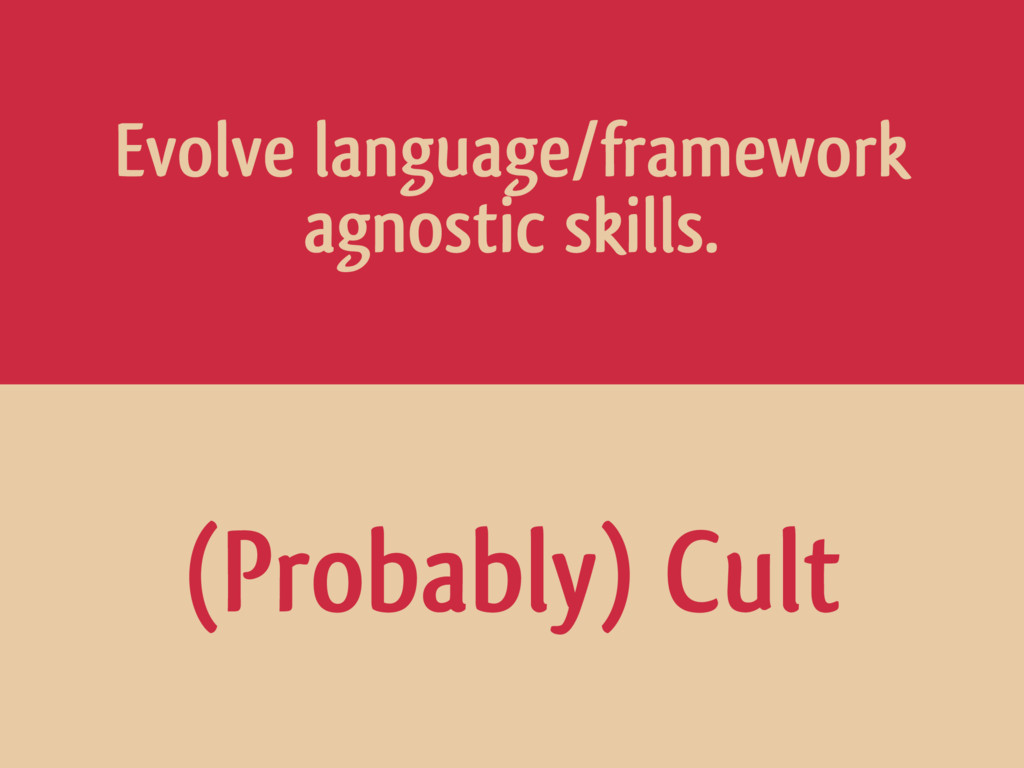
(Probably) Cult Evolve language/framework agnostic skills.
Languages, frameworks, and all the shiny hipster tech will come
and go.
Wouldn’t you rather bet on adding more generic software development
tools?
I would, and I am.
Thank you. Questions? Please follow me on the Twitter: @vonconrad


 vonconrad
 takaidohigasi
 kanfab1
 tkikuc
 kishida
 teyamagu
 koher
koher
 yosuke_furukawa
 ayumu_yamaguchi
 448jp
448jp
 nogu66
 akagami
 riku_sakamoto
 caitiem20
 inesmontani
 eileencodes
 codingconduct
 michaelherold
 techseoconnect
 axbom
axbom
 swwweet
 stuffmc
 lara
lara
 jmmastey
 aarron