Share
Embed
Apresentando Rust, Linguagem de Programação da Mozilla
weder96
September 25, 2024
Transcript
50 slides
-
Apresentando Rust, Linguagem de Programação da Mozilla WEDER MARIANO DE
SOUSA PHILIPE ALEXANDRE COSTA -
Syntax "A segurança do Huskell, a concorrencia do Erlang e
a velocidade de C++" -
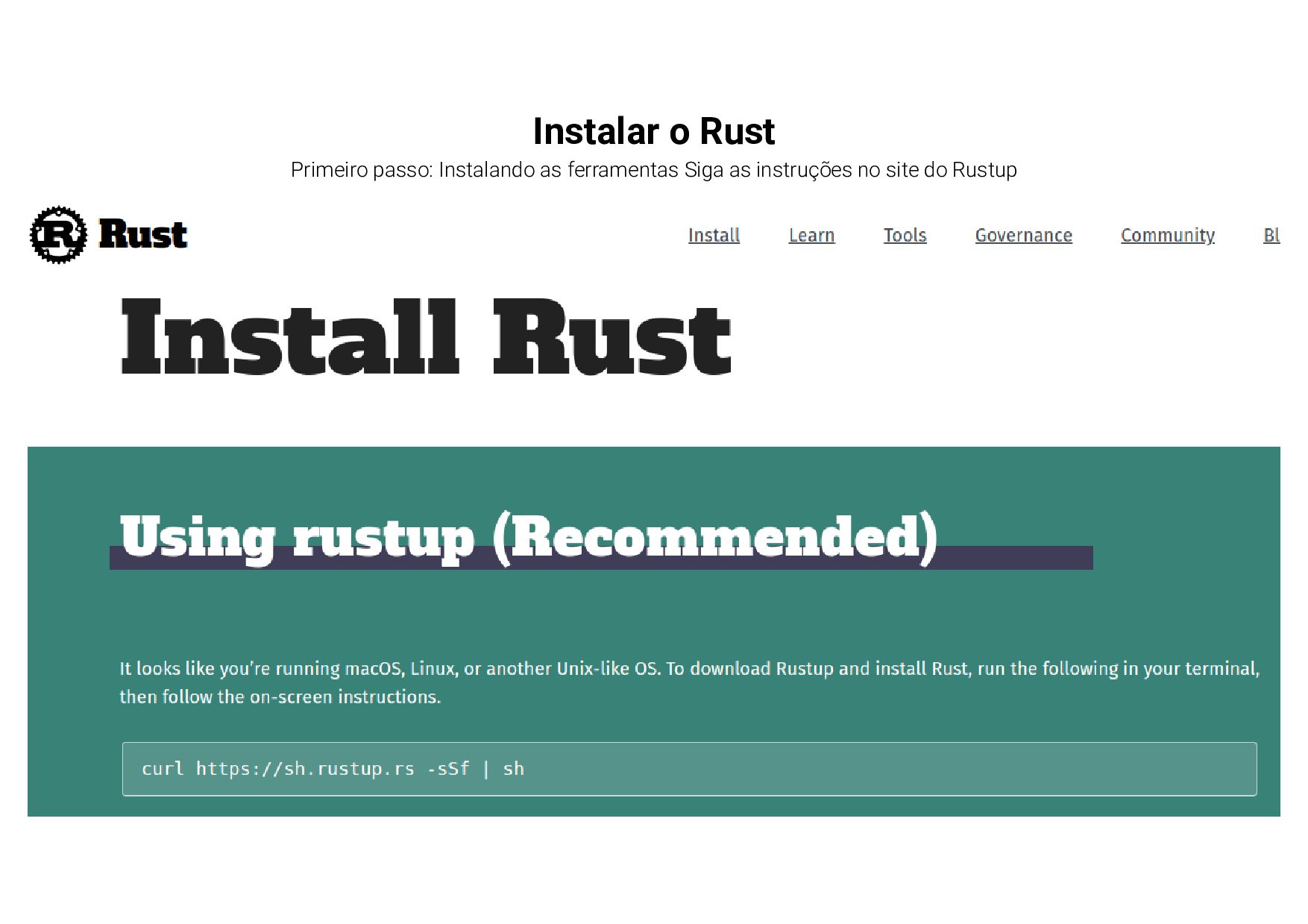
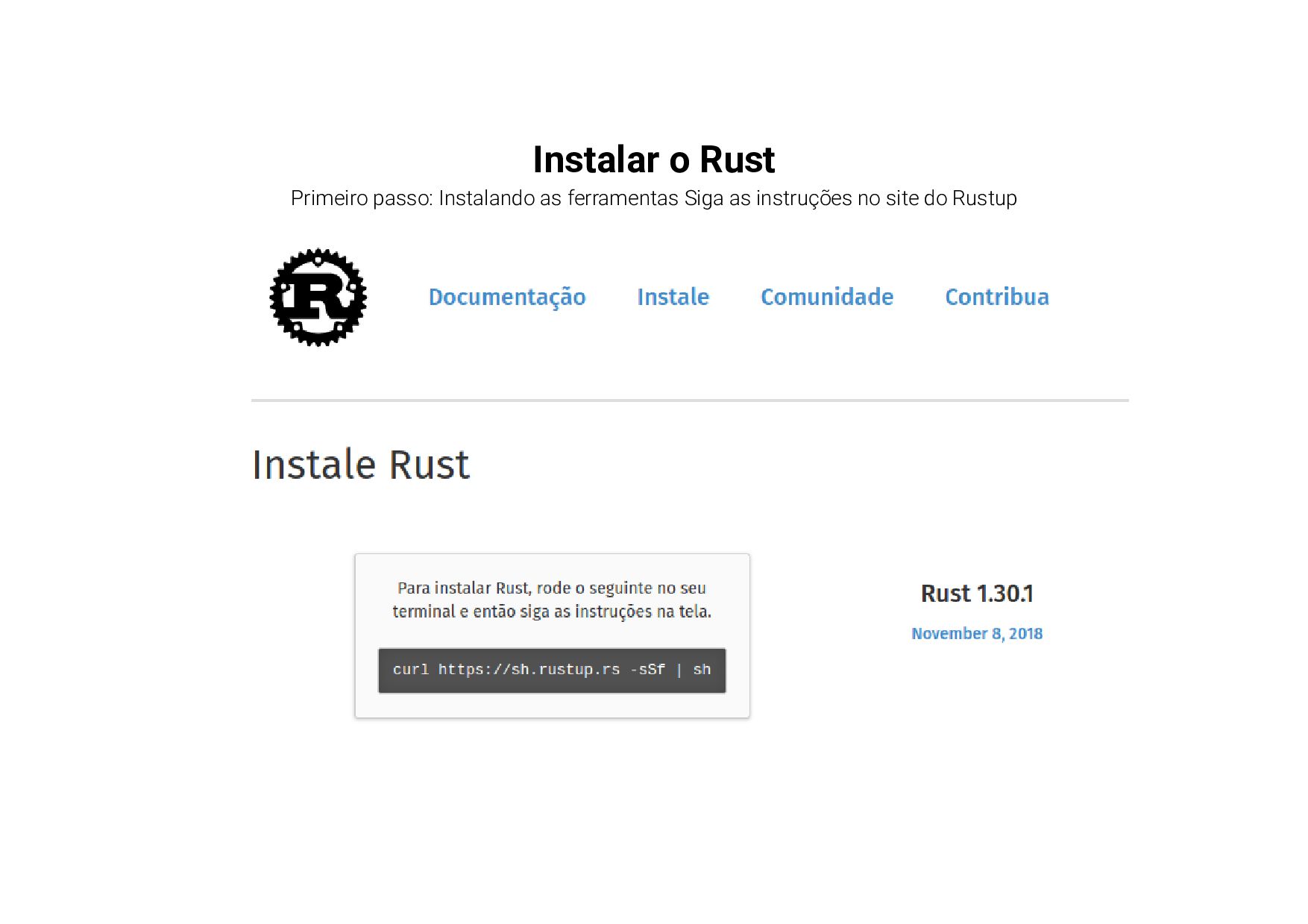
Instalar o Rust Primeiro passo: Instalando as ferramentas Siga as
instruções no site do Rustup -
Instalar o Rust Primeiro passo: Instalando as ferramentas Siga as
instruções no site do Rustup -
Instalar o Rust Esse é o gerenciador de versões do
Rust Vai instalar todas as ferramentas Suporta Linux, Mac e Windows Ajuda a manter tudo atualizado -
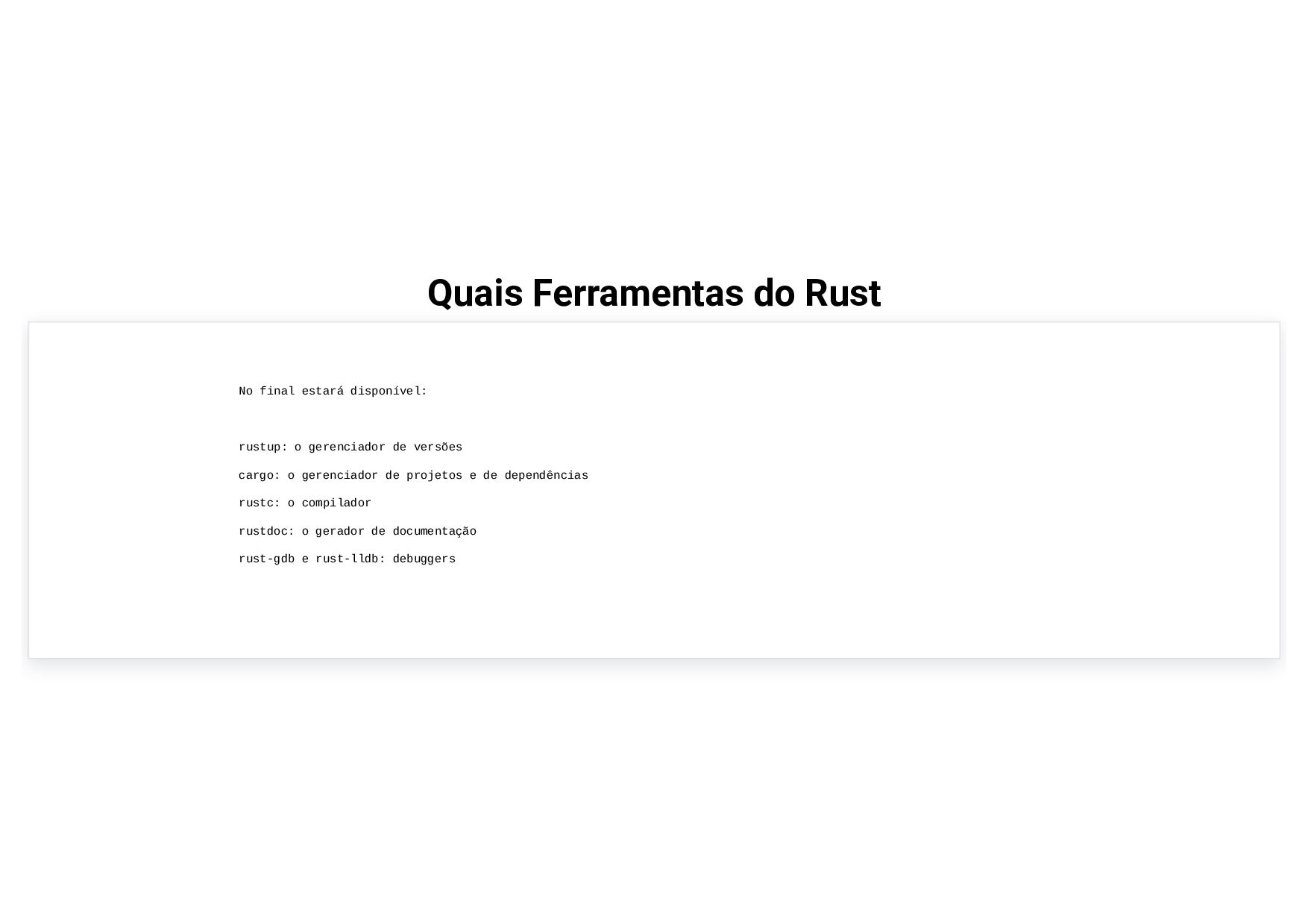
Quais Ferramentas do Rust No final estará disponível: rustup: o
gerenciador de versões cargo: o gerenciador de projetos e de dependências rustc: o compilador rustdoc: o gerador de documentação rust-gdb e rust-lldb: debuggers -
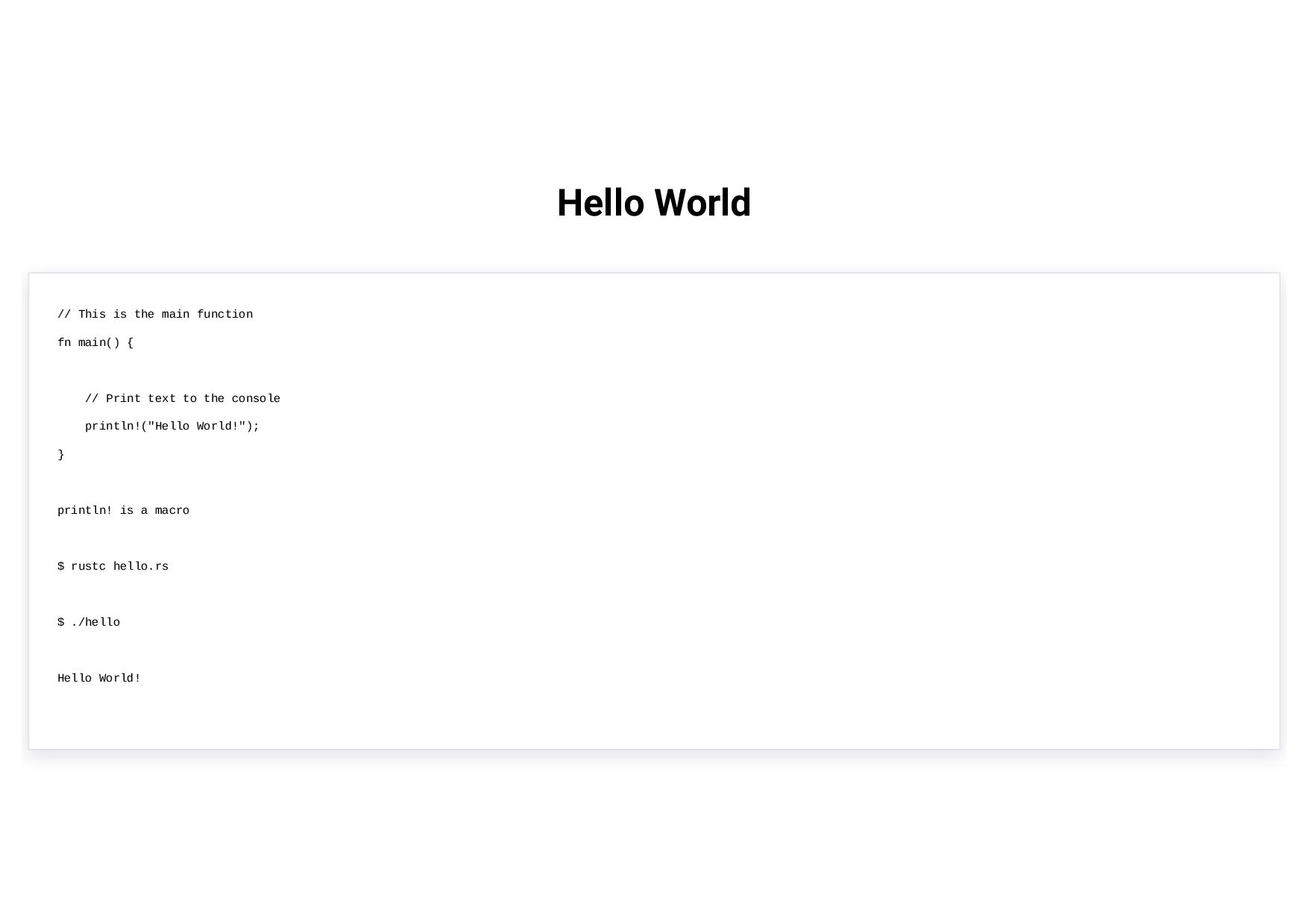
Hello World // This is the main function fn main()
{ // Print text to the console println!("Hello World!"); } println! is a macro $ rustc hello.rs $ ./hello Hello World! -
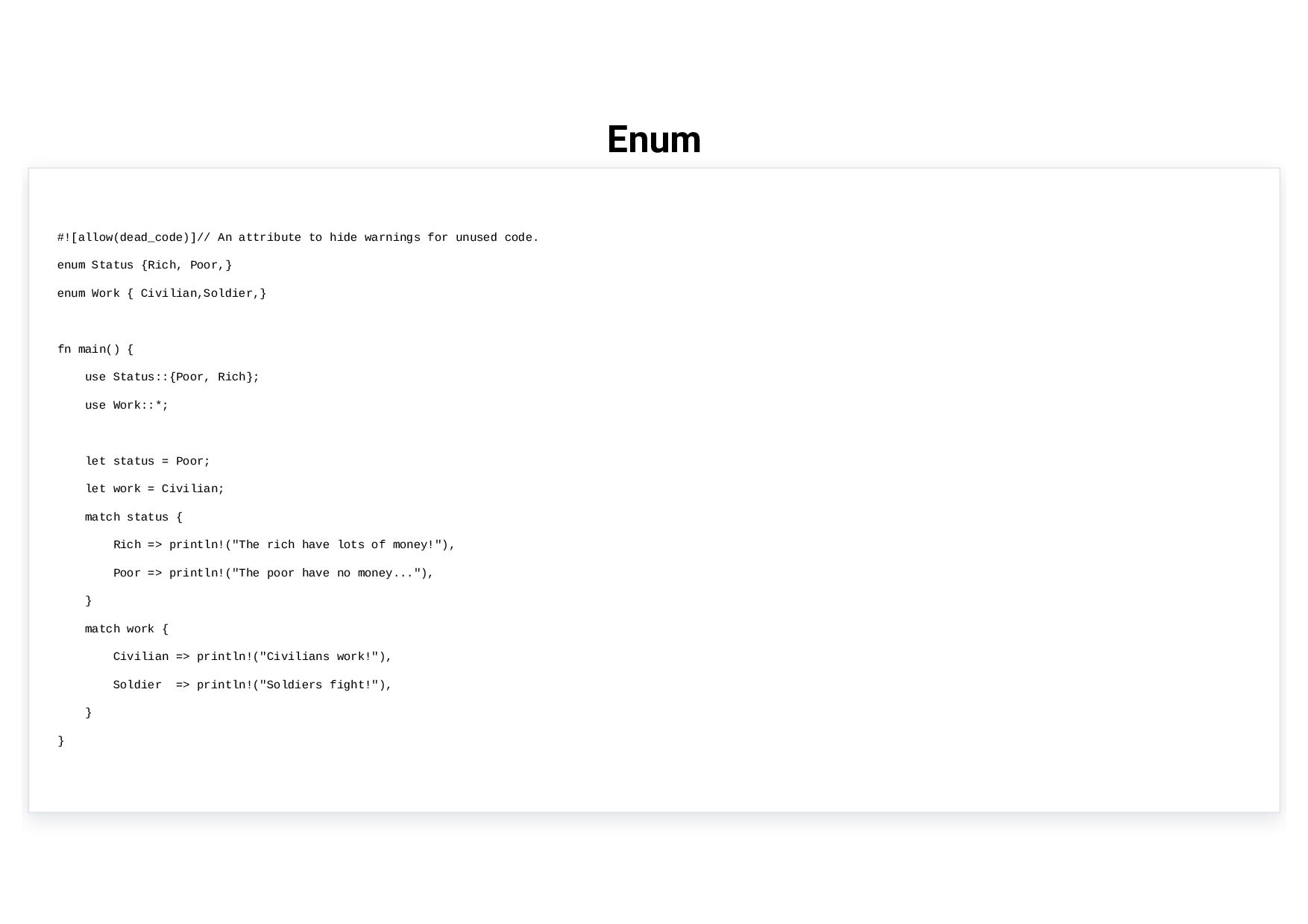
Enum #![allow(dead_code)]// An attribute to hide warnings for unused code.
enum Status {Rich, Poor,} enum Work { Civilian,Soldier,} fn main() { use Status::{Poor, Rich}; use Work::*; let status = Poor; let work = Civilian; match status { Rich => println!("The rich have lots of money!"), Poor => println!("The poor have no money..."), } match work { Civilian => println!("Civilians work!"), Soldier => println!("Soldiers fight!"), } } -
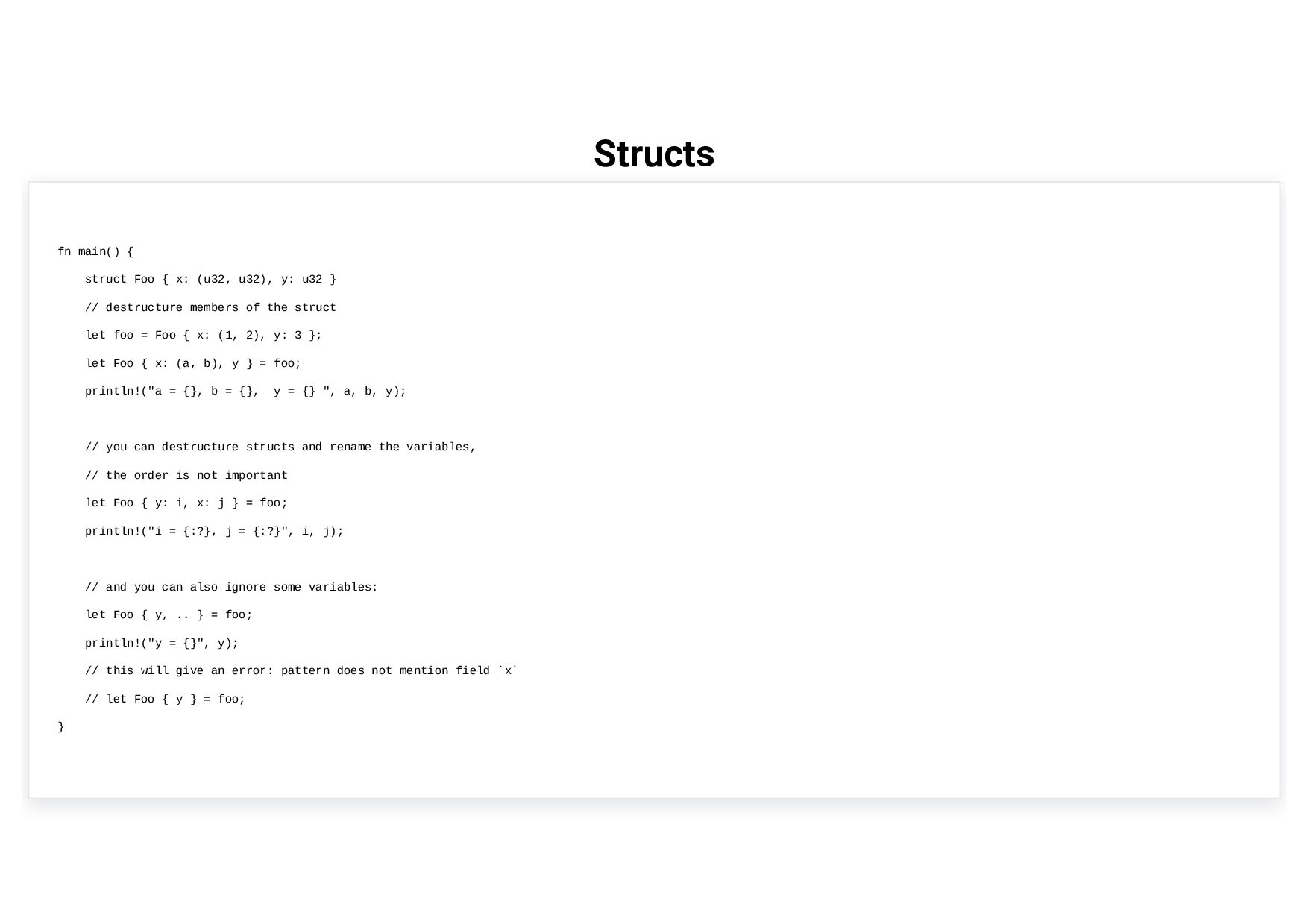
Structs fn main() { struct Foo { x: (u32, u32),
y: u32 } // destructure members of the struct let foo = Foo { x: (1, 2), y: 3 }; let Foo { x: (a, b), y } = foo; println!("a = {}, b = {}, y = {} ", a, b, y); // you can destructure structs and rename the variables, // the order is not important let Foo { y: i, x: j } = foo; println!("i = {:?}, j = {:?}", i, j); // and you can also ignore some variables: let Foo { y, .. } = foo; println!("y = {}", y); // this will give an error: pattern does not mention field `x` // let Foo { y } = foo; } -
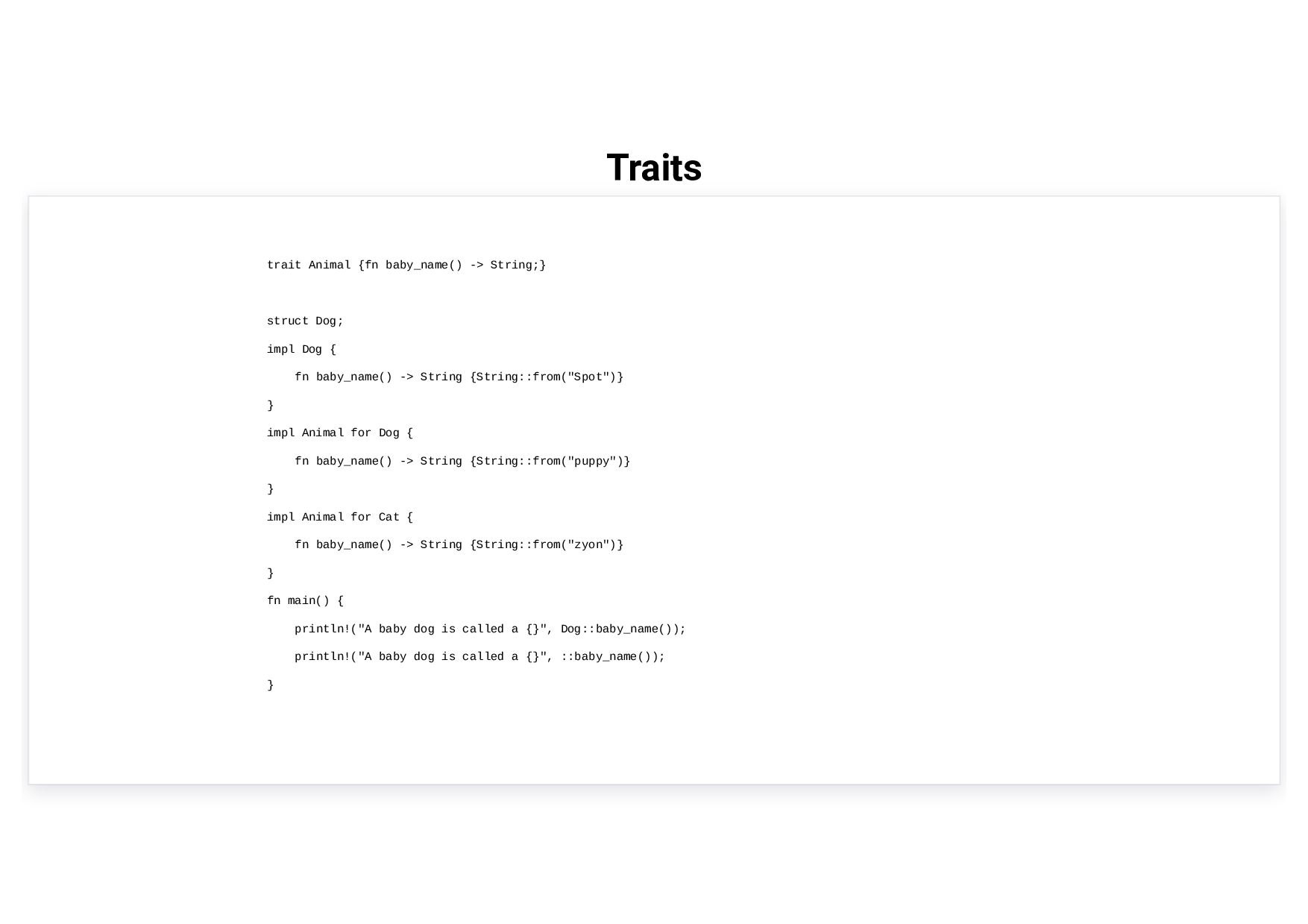
Traits trait Animal {fn baby_name() -> String;} struct Dog; impl
Dog { fn baby_name() -> String {String::from("Spot")} } impl Animal for Dog { fn baby_name() -> String {String::from("puppy")} } impl Animal for Cat { fn baby_name() -> String {String::from("zyon")} } fn main() { println!("A baby dog is called a {}", Dog::baby_name()); println!("A baby dog is called a {}", ::baby_name()); } -
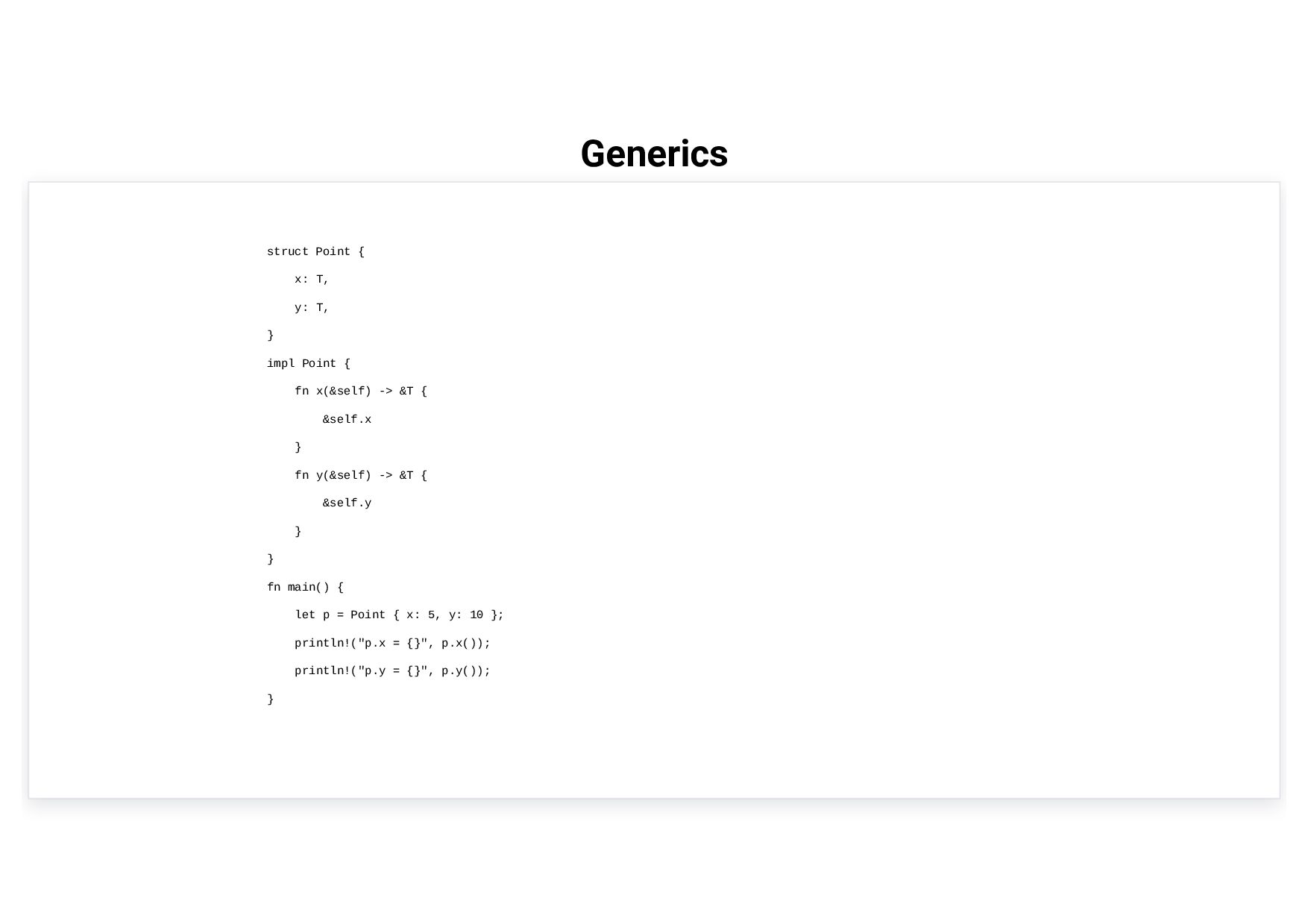
Generics struct Point { x: T, y: T, } impl
Point { fn x(&self) -> &T { &self.x } fn y(&self) -> &T { &self.y } } fn main() { let p = Point { x: 5, y: 10 }; println!("p.x = {}", p.x()); println!("p.y = {}", p.y()); } -
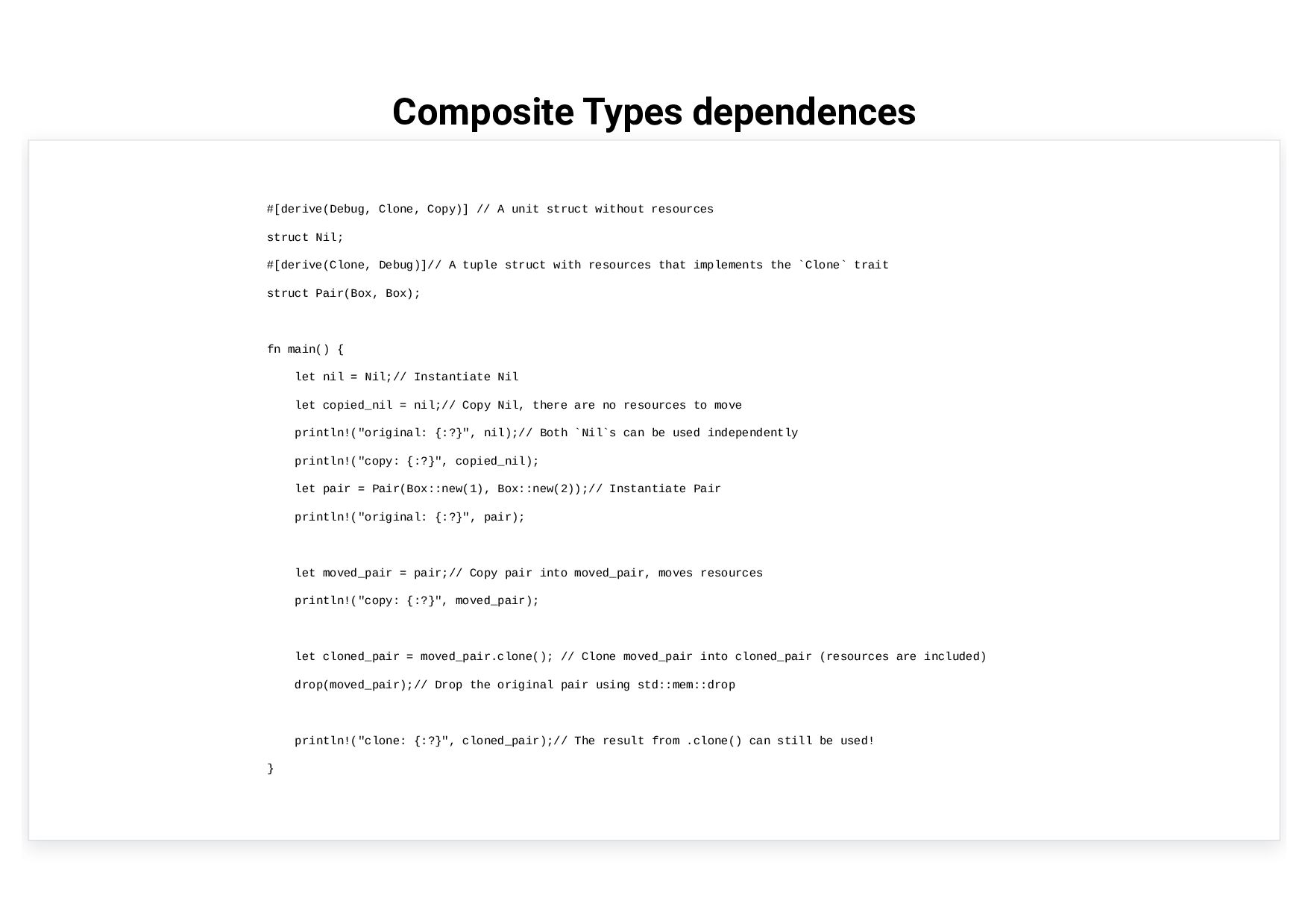
Composite Types dependences #[derive(Debug, Clone, Copy)] // A unit struct
without resources struct Nil; #[derive(Clone, Debug)]// A tuple struct with resources that implements the `Clone` trait struct Pair(Box, Box); fn main() { let nil = Nil;// Instantiate Nil let copied_nil = nil;// Copy Nil, there are no resources to move println!("original: {:?}", nil);// Both `Nil`s can be used independently println!("copy: {:?}", copied_nil); let pair = Pair(Box::new(1), Box::new(2));// Instantiate Pair println!("original: {:?}", pair); let moved_pair = pair;// Copy pair into moved_pair, moves resources println!("copy: {:?}", moved_pair); let cloned_pair = moved_pair.clone(); // Clone moved_pair into cloned_pair (resources are included) drop(moved_pair);// Drop the original pair using std::mem::drop println!("clone: {:?}", cloned_pair);// The result from .clone() can still be used! } -
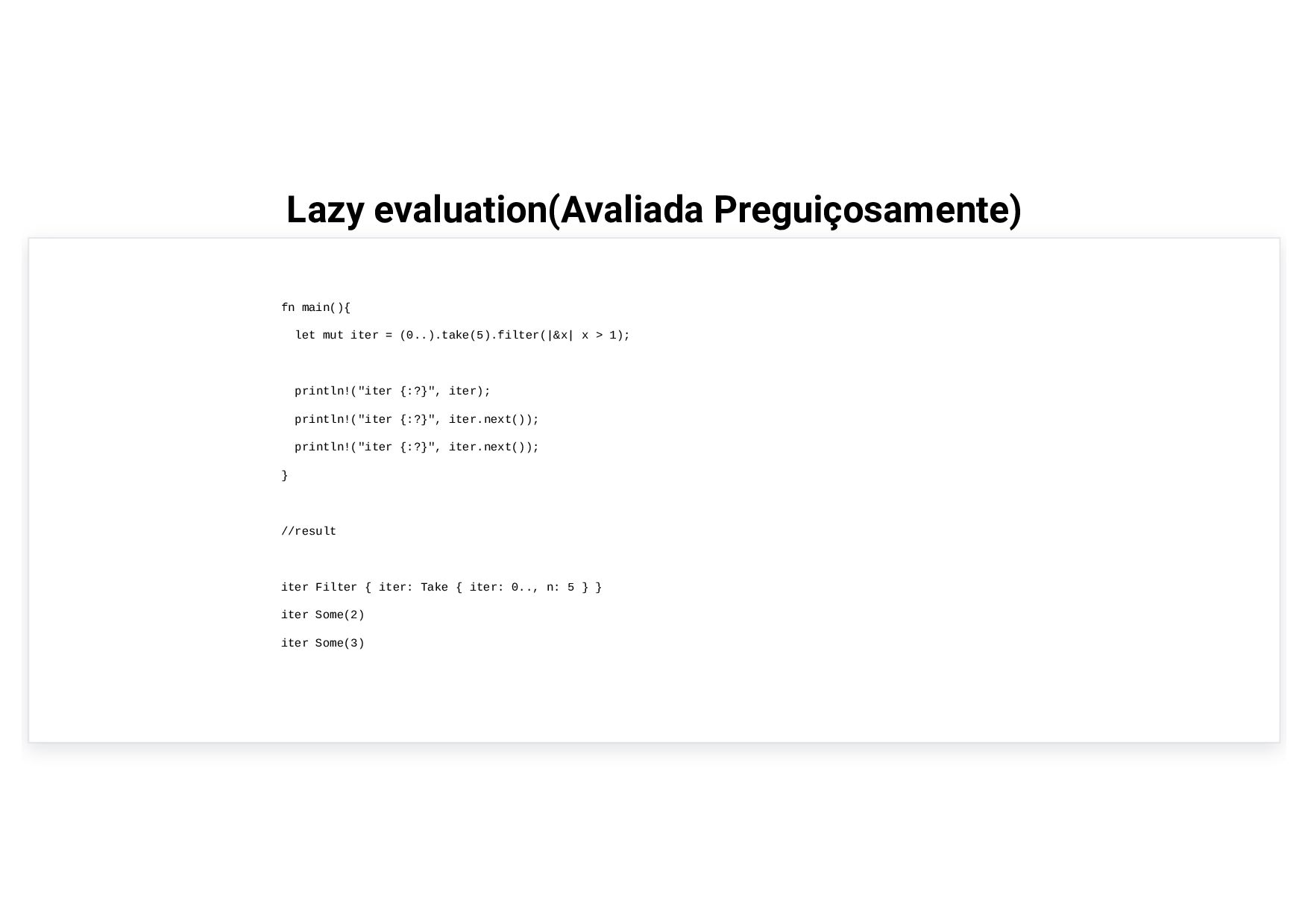
Lazy evaluation(Avaliada Preguiçosamente) fn main(){ let mut iter = (0..).take(5).filter(|&x|
x > 1); println!("iter {:?}", iter); println!("iter {:?}", iter.next()); println!("iter {:?}", iter.next()); } //result iter Filter { iter: Take { iter: 0.., n: 5 } } iter Some(2) iter Some(3) -
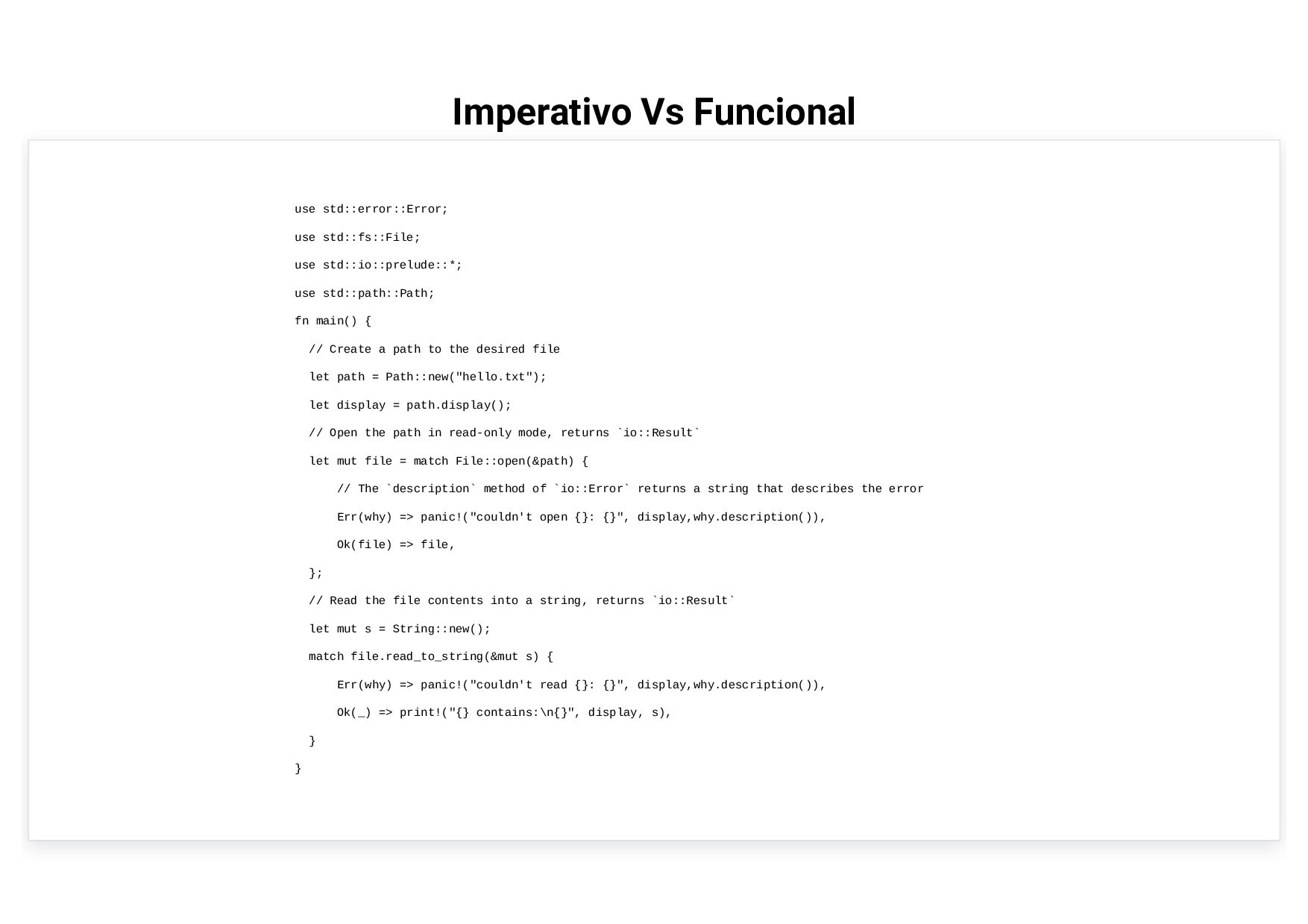
Imperativo Vs Funcional use std::error::Error; use std::fs::File; use std::io::prelude::*; use
std::path::Path; fn main() { // Create a path to the desired file let path = Path::new("hello.txt"); let display = path.display(); // Open the path in read-only mode, returns `io::Result` let mut file = match File::open(&path) { // The `description` method of `io::Error` returns a string that describes the error Err(why) => panic!("couldn't open {}: {}", display,why.description()), Ok(file) => file, }; // Read the file contents into a string, returns `io::Result` let mut s = String::new(); match file.read_to_string(&mut s) { Err(why) => panic!("couldn't read {}: {}", display,why.description()), Ok(_) => print!("{} contains:\n{}", display, s), } } -
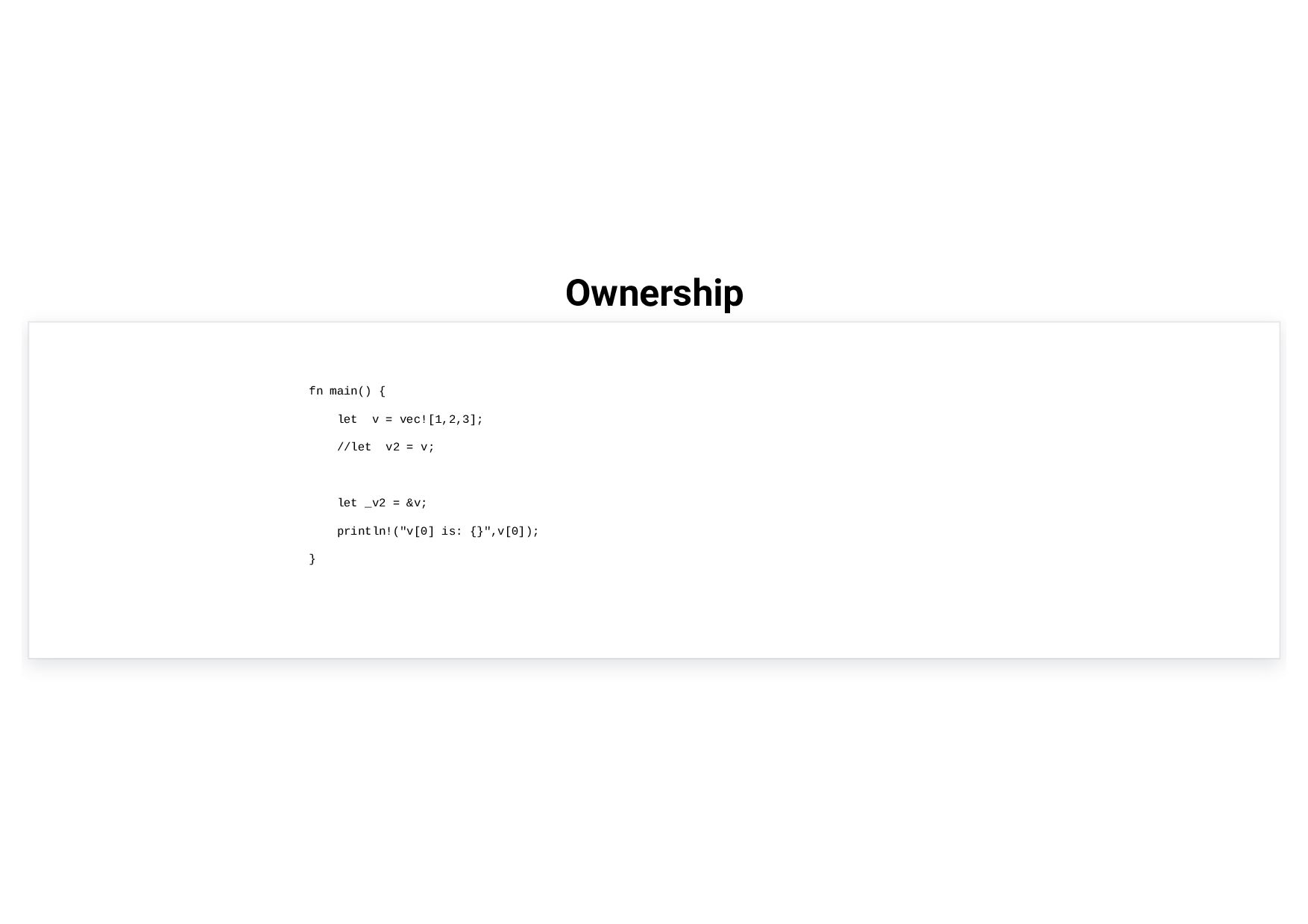
Ownership fn main() { let v = vec![1,2,3]; //let v2
= v; let _v2 = &v; println!("v[0] is: {}",v[0]); } -
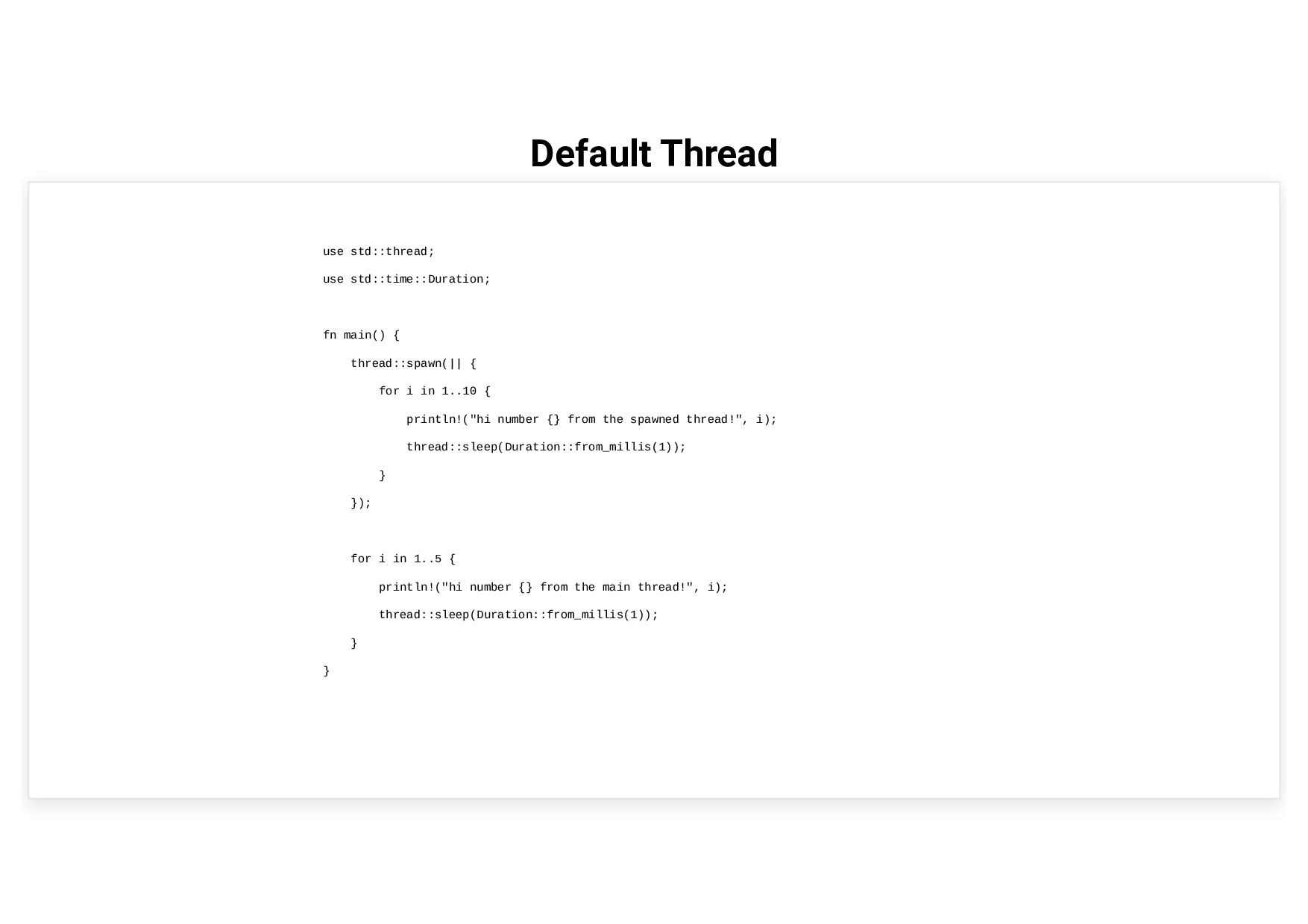
Default Thread use std::thread; use std::time::Duration; fn main() { thread::spawn(||
{ for i in 1..10 { println!("hi number {} from the spawned thread!", i); thread::sleep(Duration::from_millis(1)); } }); for i in 1..5 { println!("hi number {} from the main thread!", i); thread::sleep(Duration::from_millis(1)); } } -
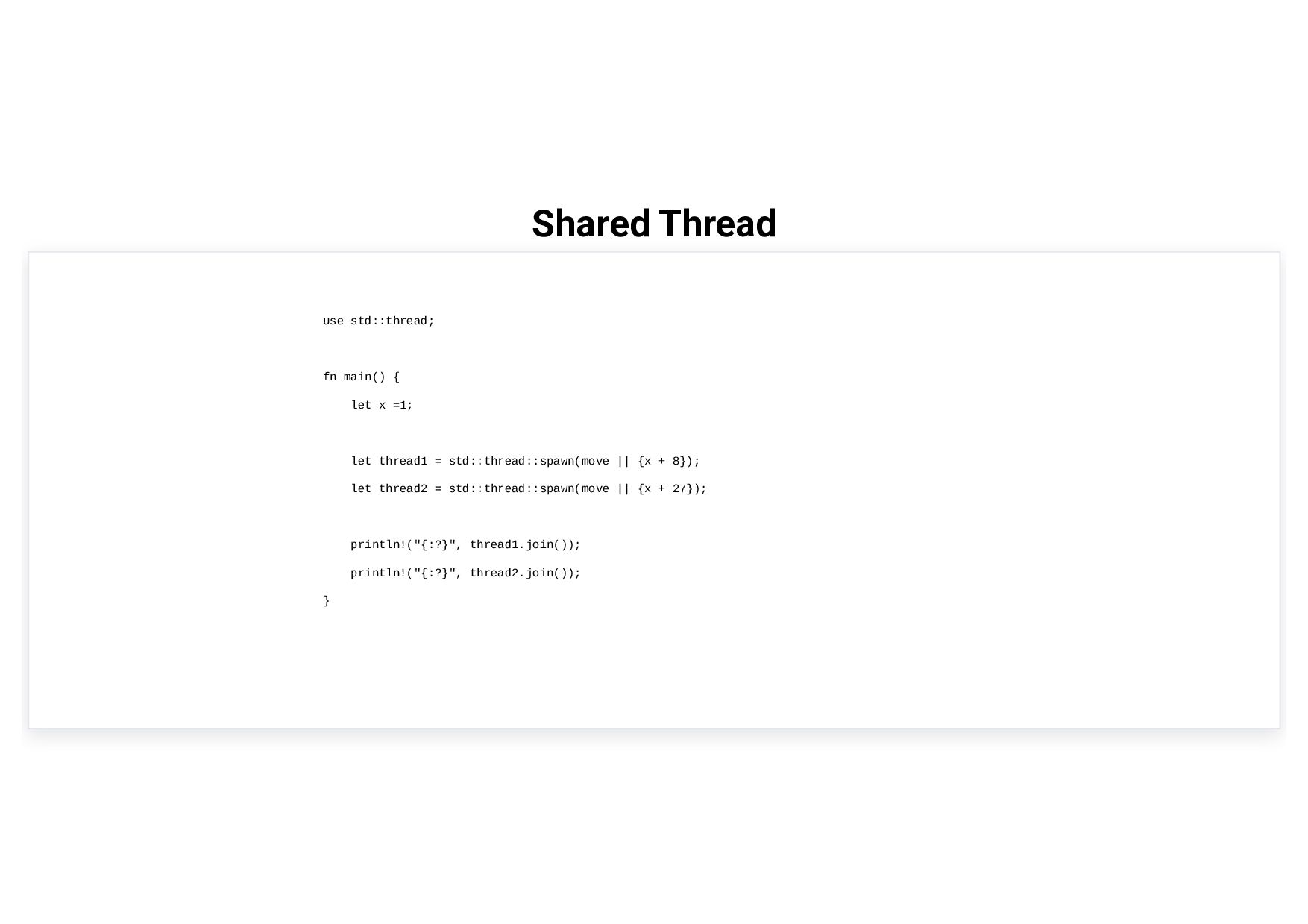
Shared Thread use std::thread; fn main() { let x =1;
let thread1 = std::thread::spawn(move || {x + 8}); let thread2 = std::thread::spawn(move || {x + 27}); println!("{:?}", thread1.join()); println!("{:?}", thread2.join()); } -
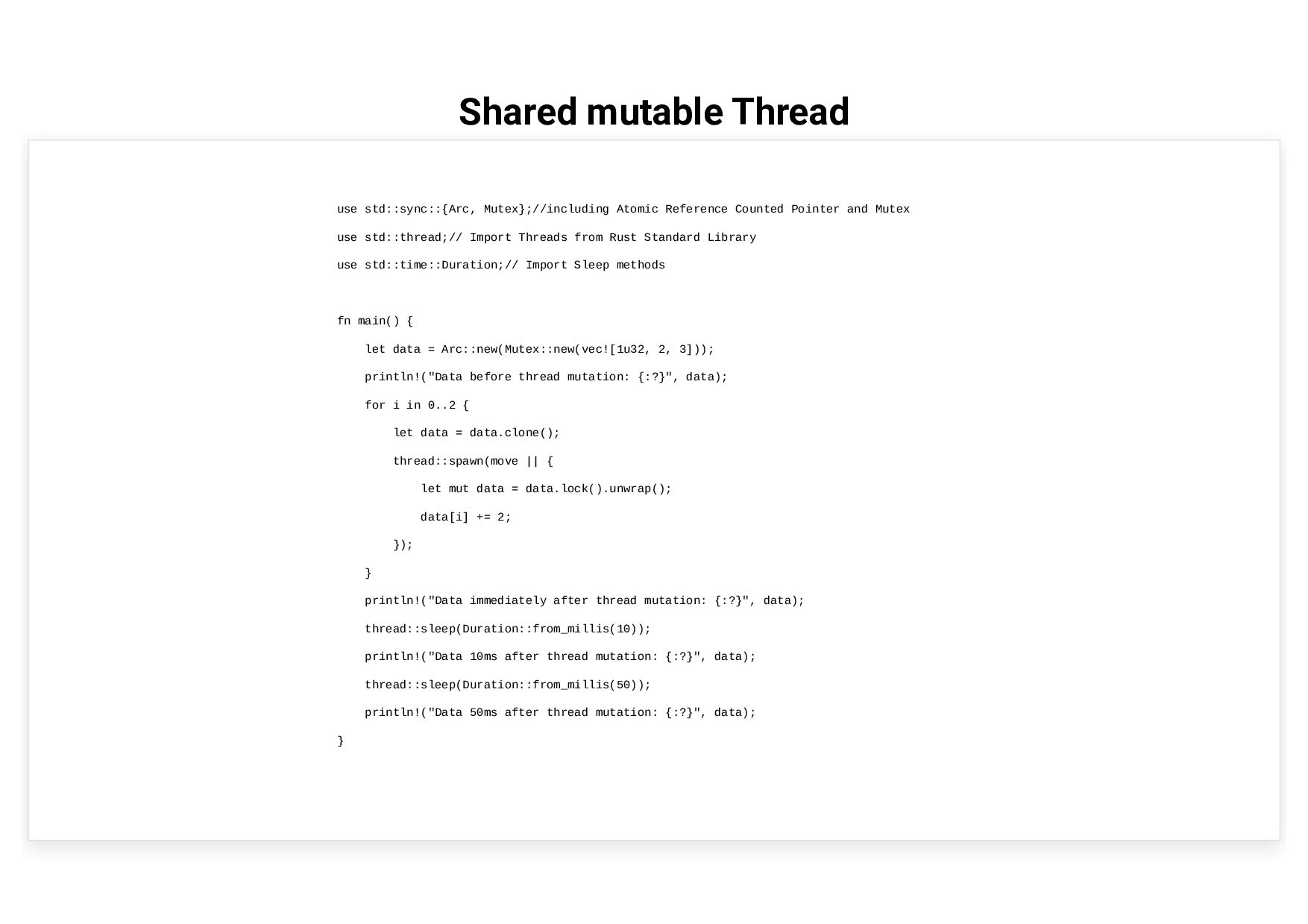
Shared mutable Thread use std::sync::{Arc, Mutex};//including Atomic Reference Counted Pointer
and Mutex use std::thread;// Import Threads from Rust Standard Library use std::time::Duration;// Import Sleep methods fn main() { let data = Arc::new(Mutex::new(vec![1u32, 2, 3])); println!("Data before thread mutation: {:?}", data); for i in 0..2 { let data = data.clone(); thread::spawn(move || { let mut data = data.lock().unwrap(); data[i] += 2; }); } println!("Data immediately after thread mutation: {:?}", data); thread::sleep(Duration::from_millis(10)); println!("Data 10ms after thread mutation: {:?}", data); thread::sleep(Duration::from_millis(50)); println!("Data 50ms after thread mutation: {:?}", data); } -
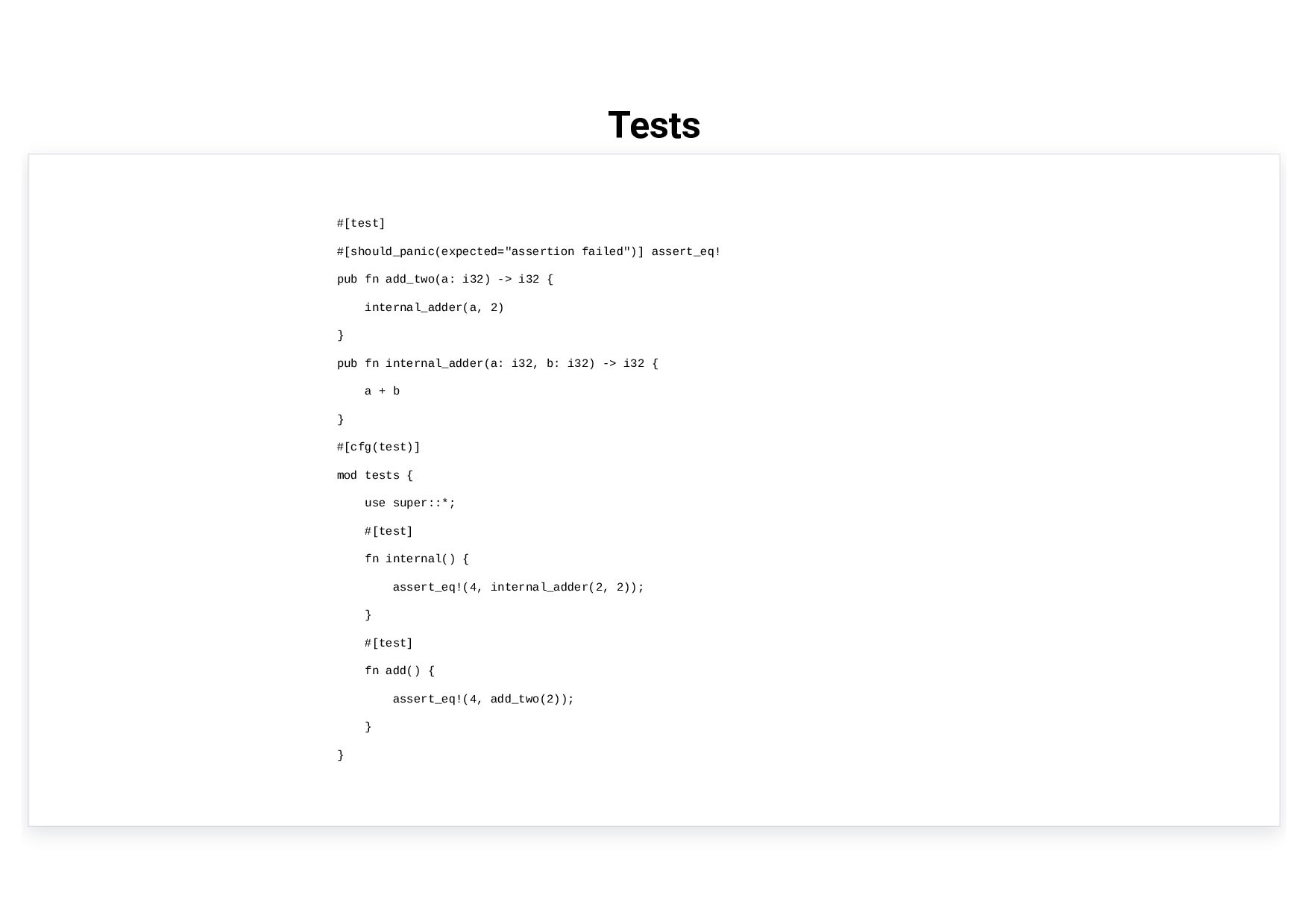
Tests #[test] #[should_panic(expected="assertion failed")] assert_eq! pub fn add_two(a: i32) ->
i32 { internal_adder(a, 2) } pub fn internal_adder(a: i32, b: i32) -> i32 { a + b } #[cfg(test)] mod tests { use super::*; #[test] fn internal() { assert_eq!(4, internal_adder(2, 2)); } #[test] fn add() { assert_eq!(4, add_two(2)); } } -
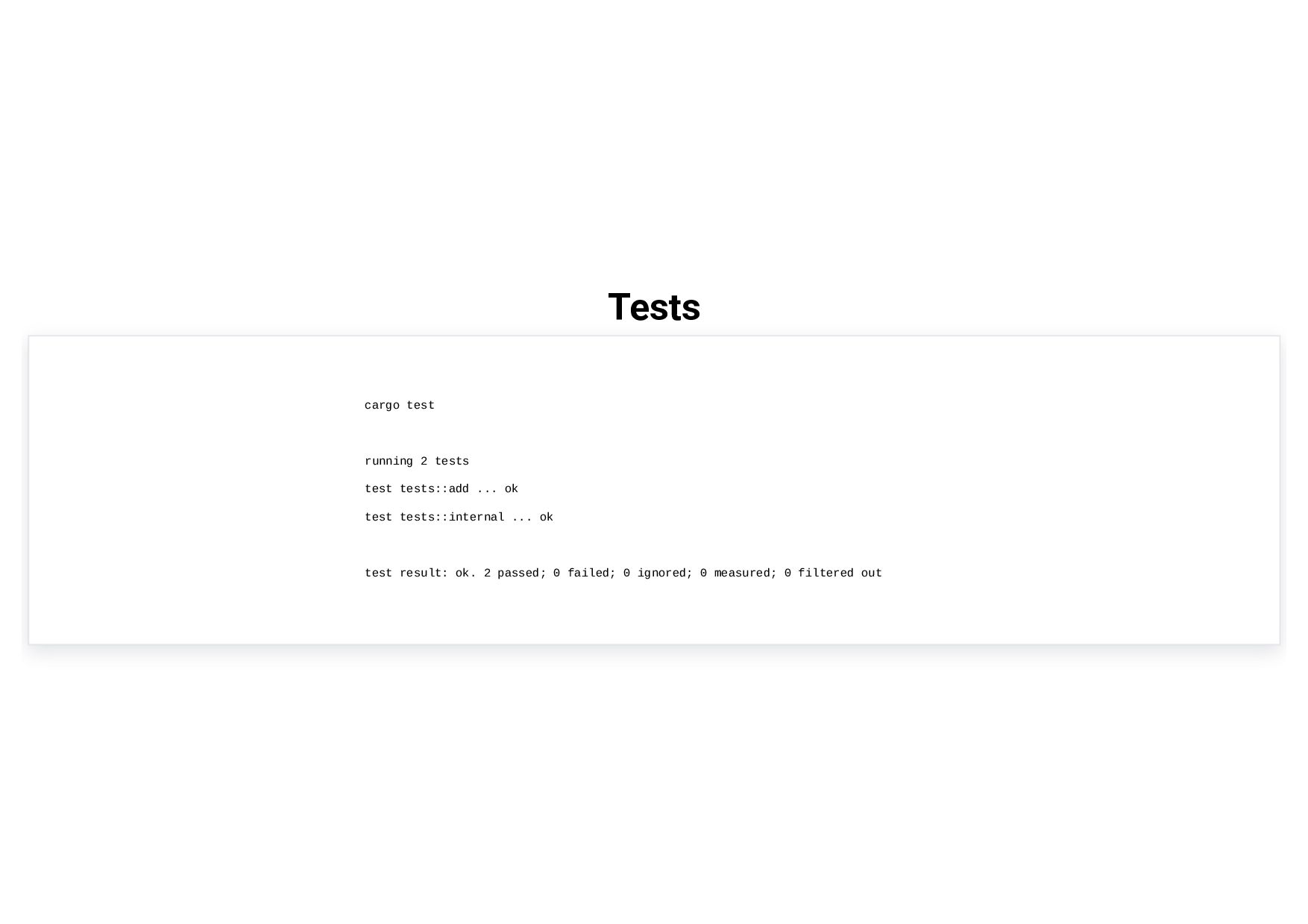
Tests cargo test running 2 tests test tests::add ... ok
test tests::internal ... ok test result: ok. 2 passed; 0 failed; 0 ignored; 0 measured; 0 filtered out -
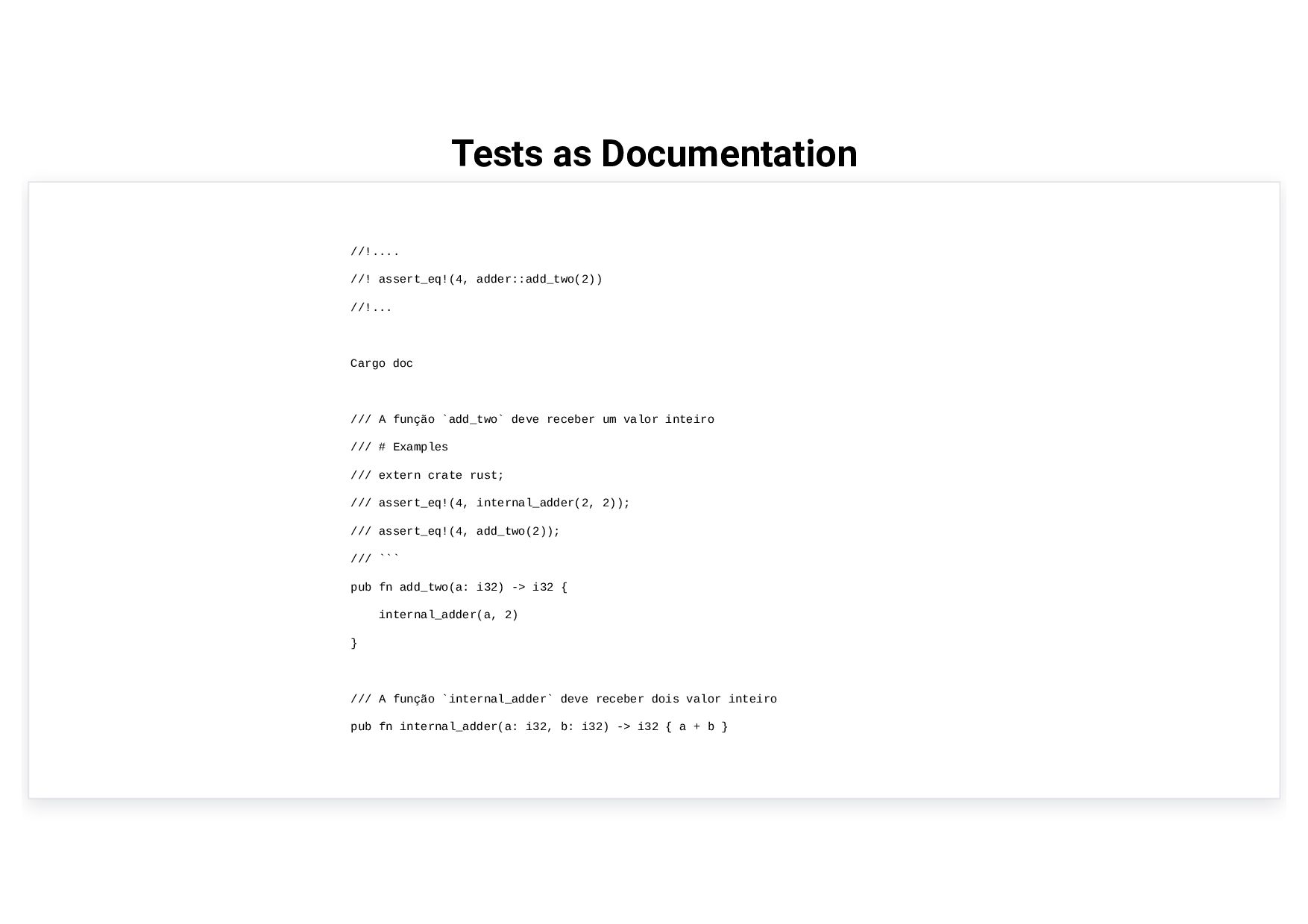
Tests as Documentation //!.... //! assert_eq!(4, adder::add_two(2)) //!... Cargo doc
/// A função `add_two` deve receber um valor inteiro /// # Examples /// extern crate rust; /// assert_eq!(4, internal_adder(2, 2)); /// assert_eq!(4, add_two(2)); /// ``` pub fn add_two(a: i32) -> i32 { internal_adder(a, 2) } /// A função `internal_adder` deve receber dois valor inteiro pub fn internal_adder(a: i32, b: i32) -> i32 { a + b } -
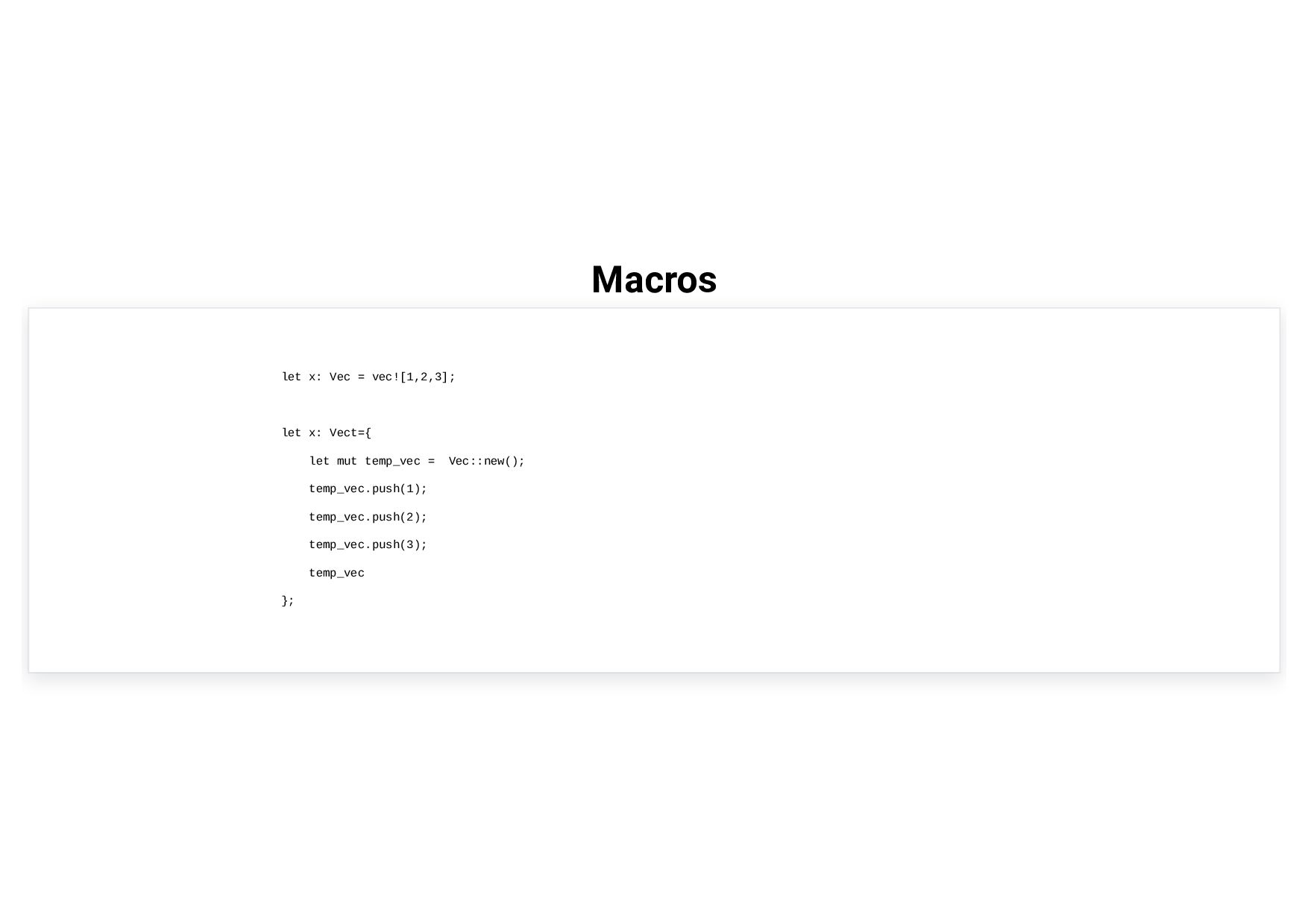
Macros let x: Vec = vec![1,2,3]; let x: Vect={ let
mut temp_vec = Vec::new(); temp_vec.push(1); temp_vec.push(2); temp_vec.push(3); temp_vec }; -
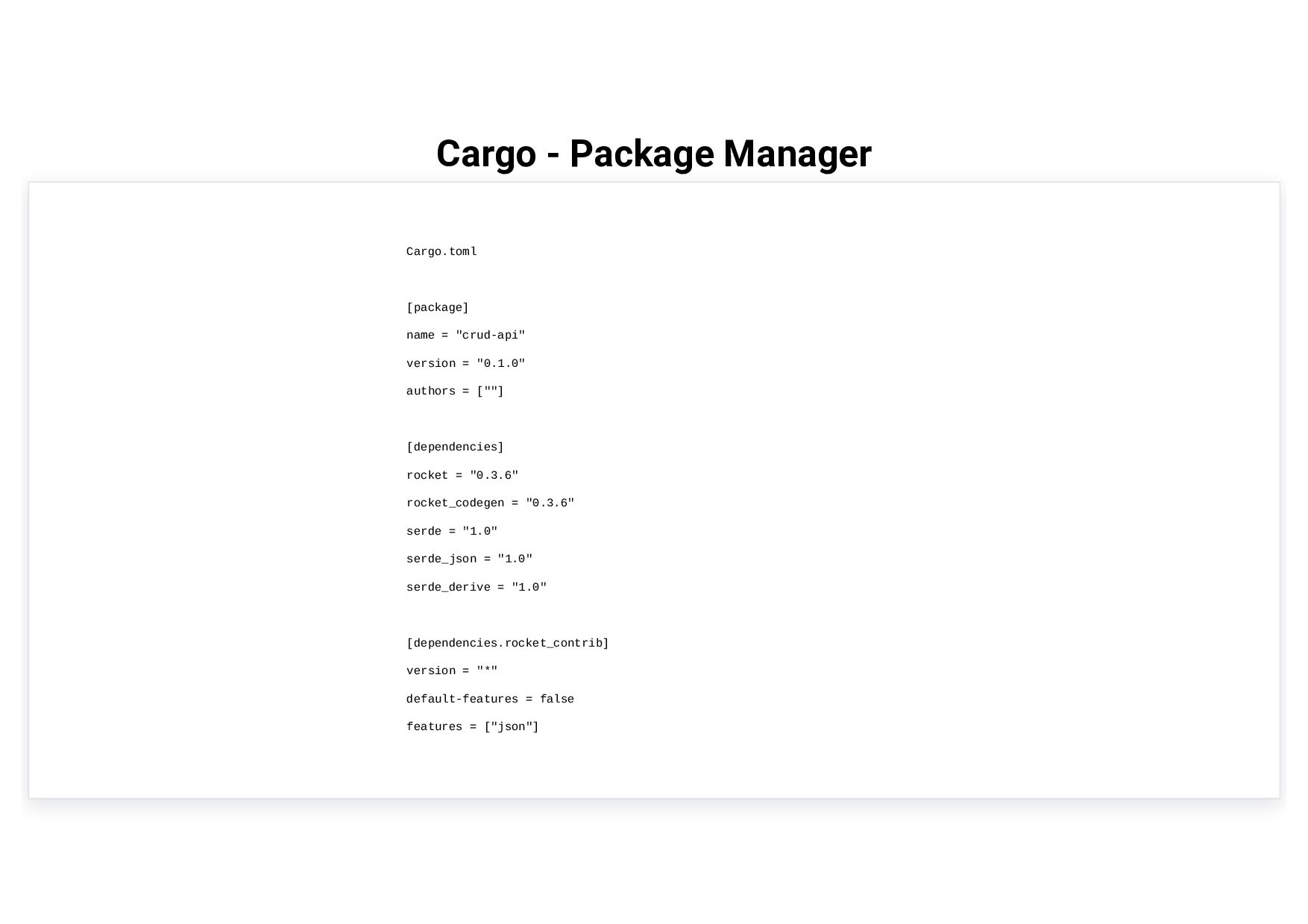
Cargo - Package Manager Cargo.toml [package] name = "crud-api" version
= "0.1.0" authors = [""] [dependencies] rocket = "0.3.6" rocket_codegen = "0.3.6" serde = "1.0" serde_json = "1.0" serde_derive = "1.0" [dependencies.rocket_contrib] version = "*" default-features = false features = ["json"] -
Libs For Outer Languages Helix - Ruby Neon - NodeJs
RustCPython - Python -
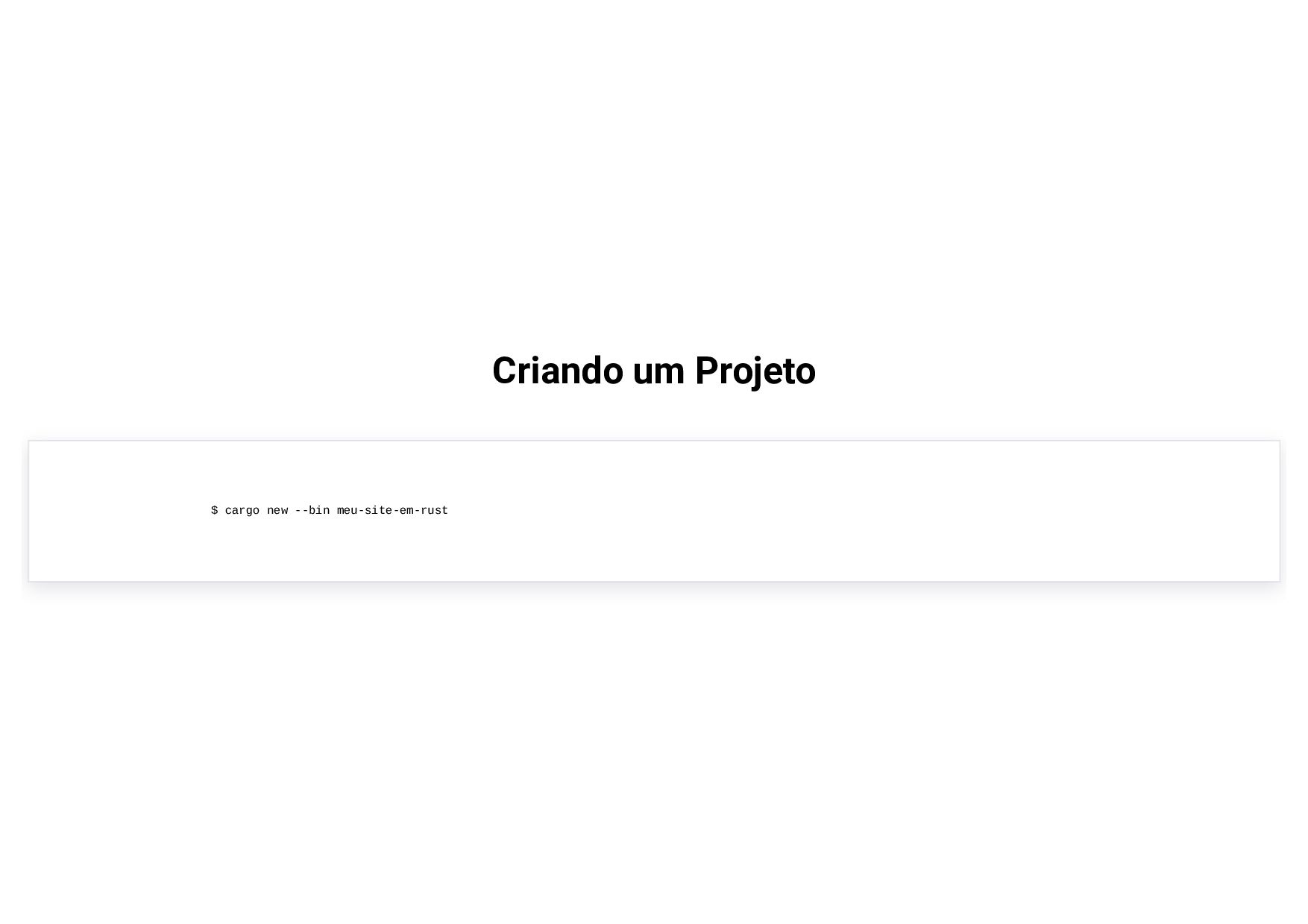
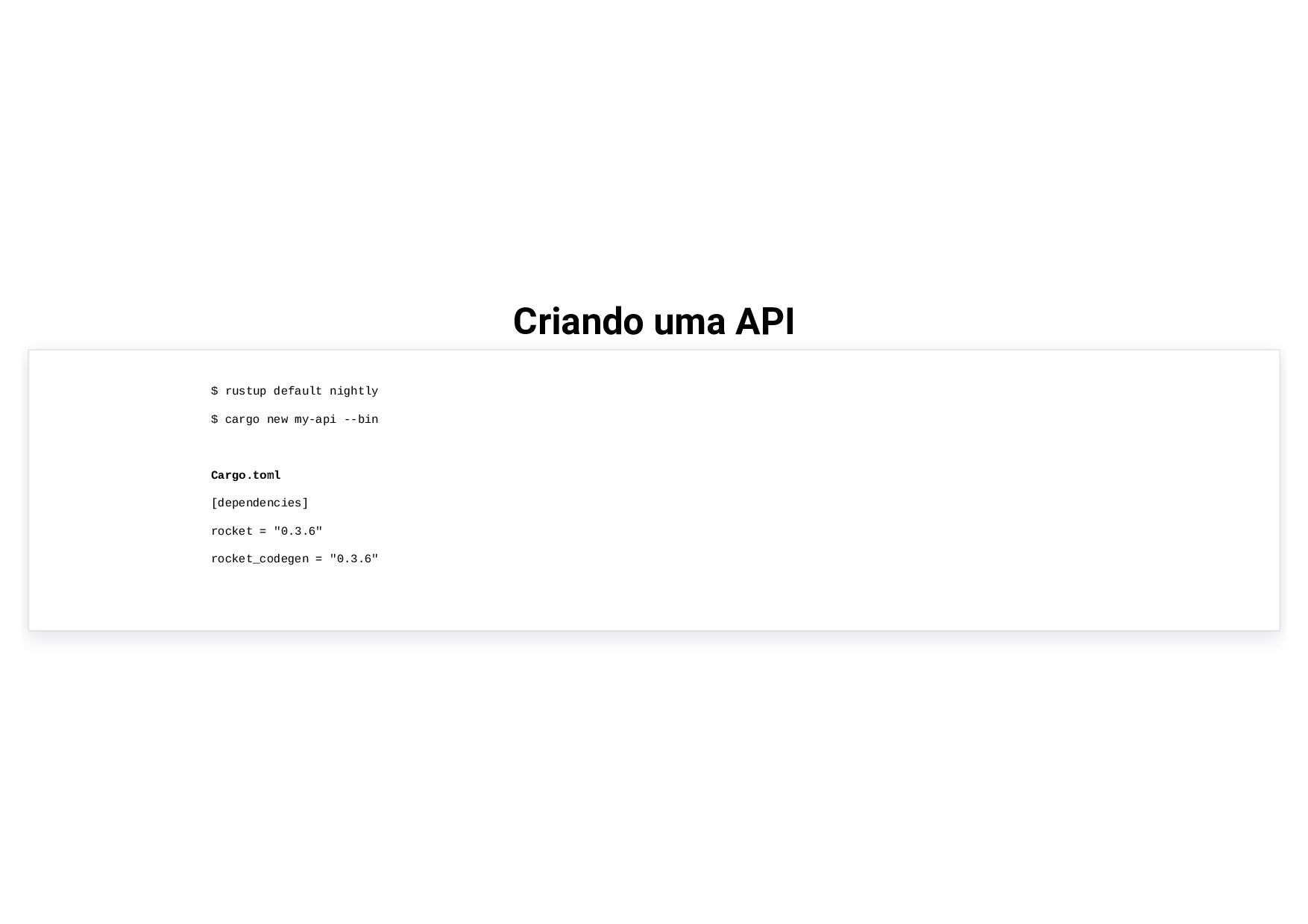
Criando uma API $ rustup default nightly $ cargo new
my-api --bin Cargo.toml [dependencies] rocket = "0.3.6" rocket_codegen = "0.3.6" -
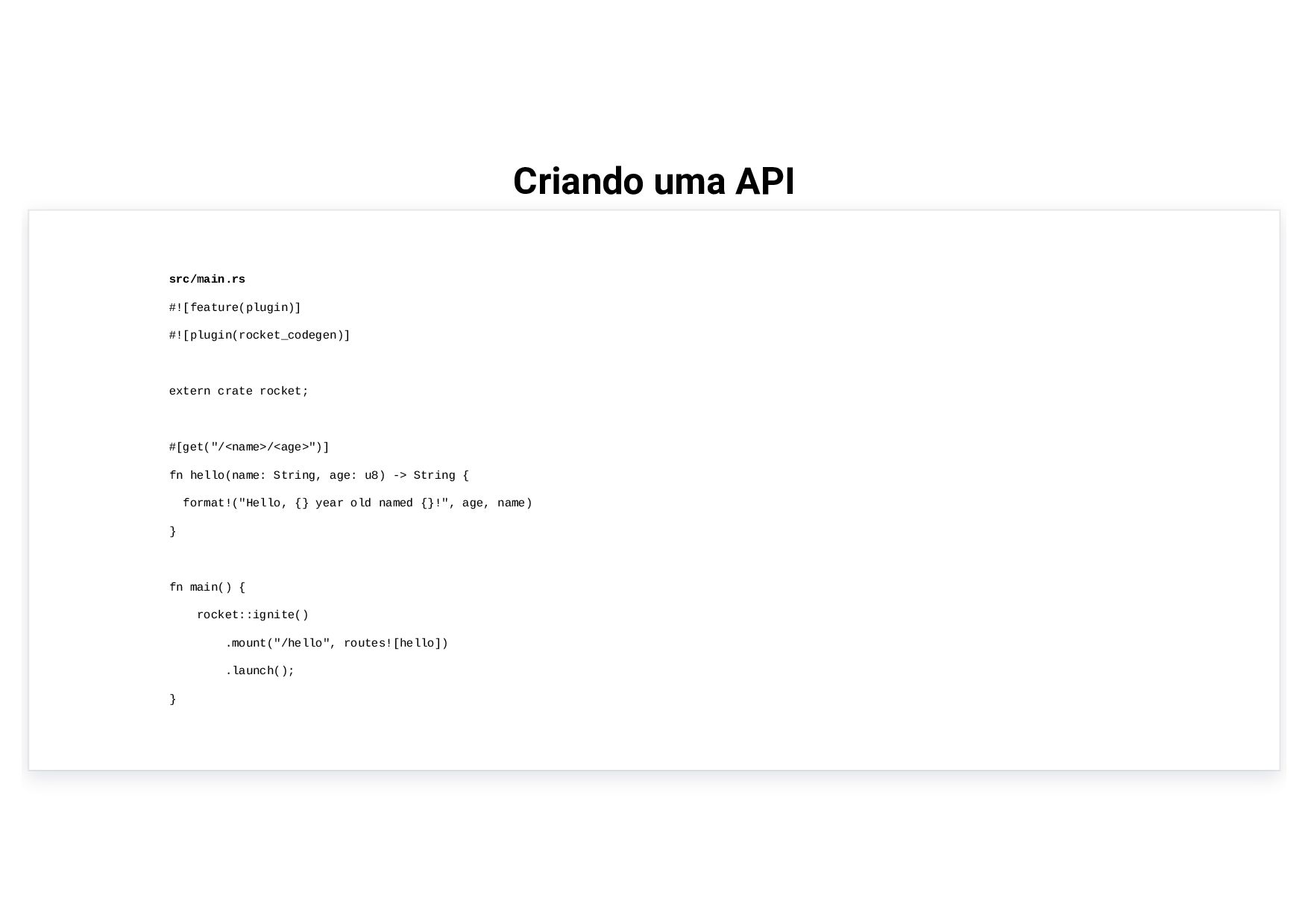
Criando uma API src/main.rs #![feature(plugin)] #![plugin(rocket_codegen)] extern crate rocket; #[get("/<name>/<age>")]
fn hello(name: String, age: u8) -> String { format!("Hello, {} year old named {}!", age, name) } fn main() { rocket::ignite() .mount("/hello", routes![hello]) .launch(); } -
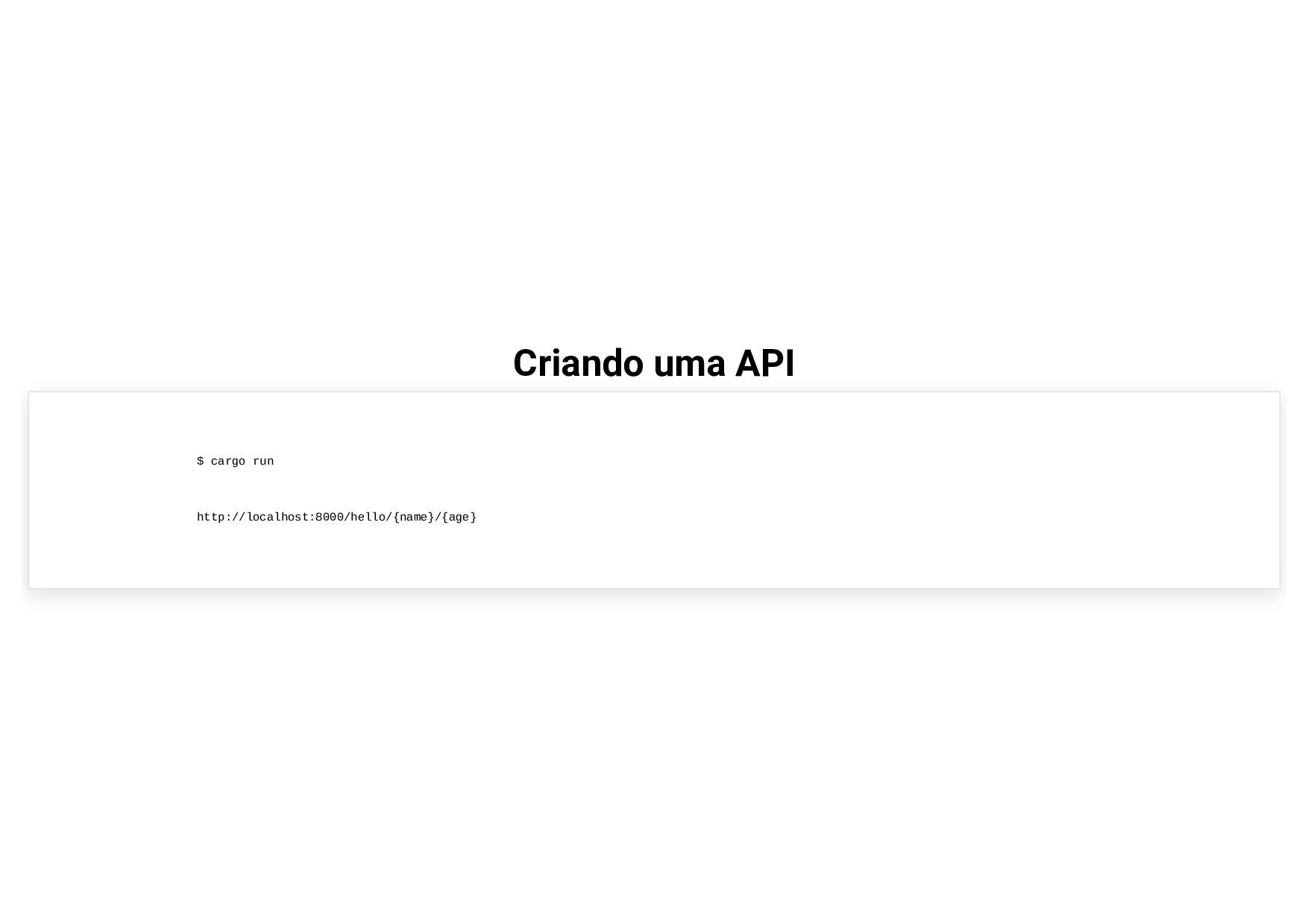
Criando um Executável Agora podemos criar o nosso executável $
cargo build --release