Share
Embed
Transcript
91 slides
-
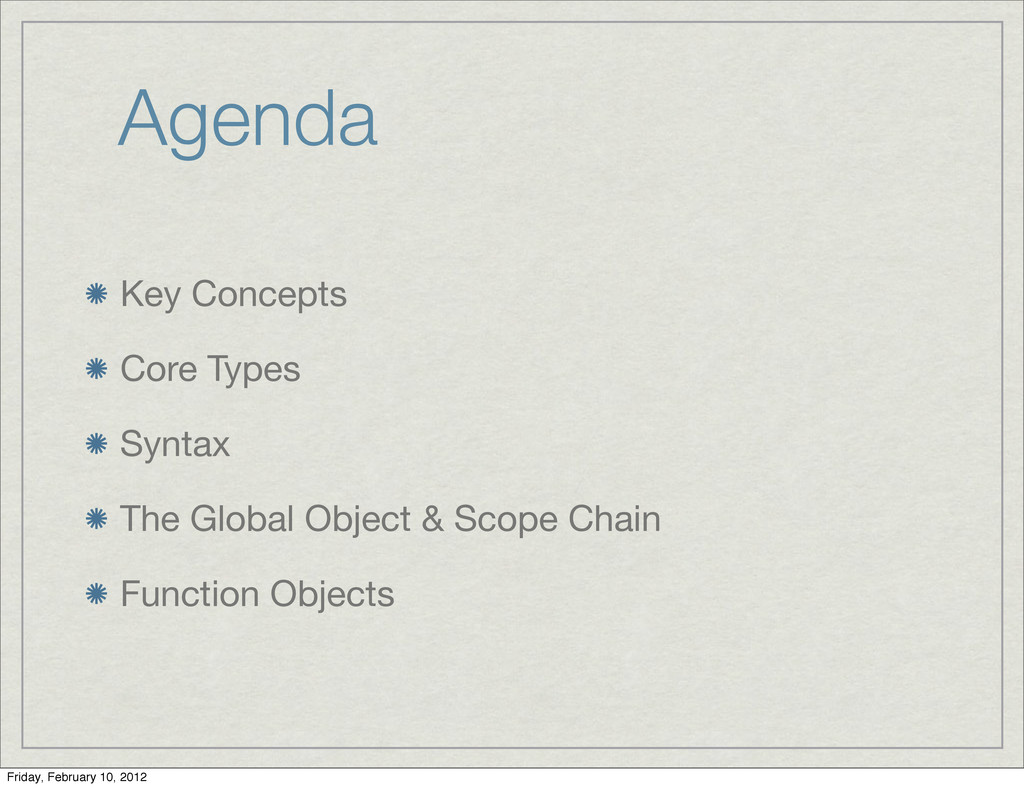
Agenda Key Concepts Core Types Syntax The Global Object &
Scope Chain Function Objects Friday, February 10, 2012 -
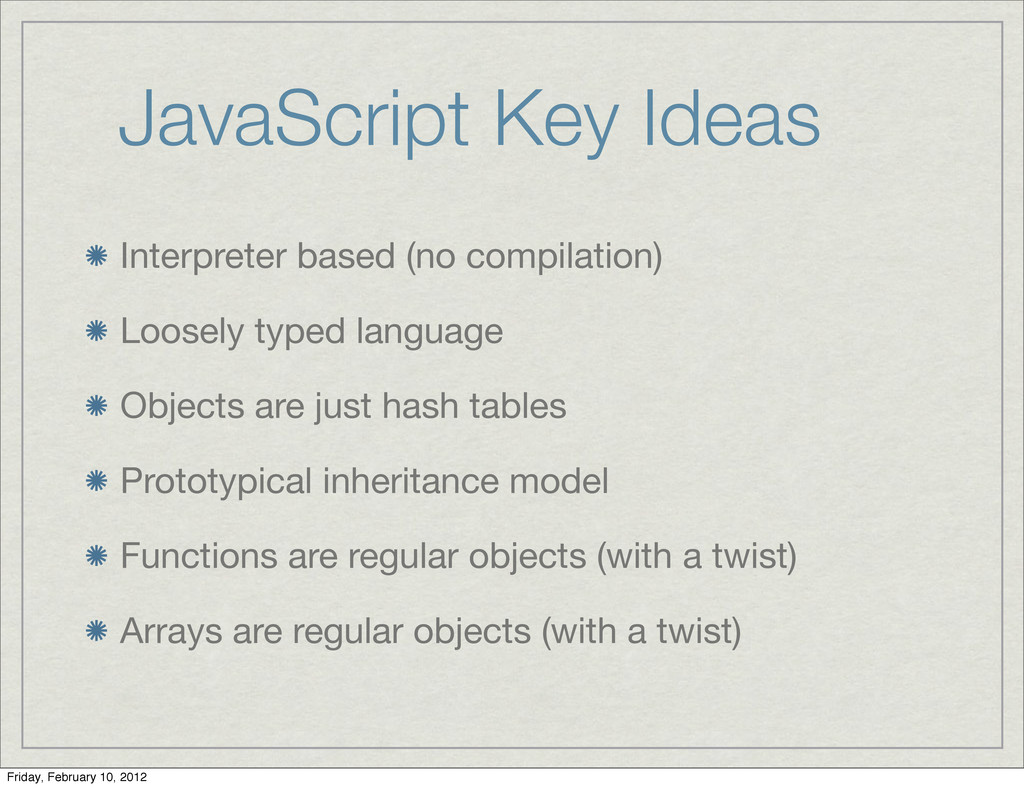
JavaScript Key Ideas Interpreter based (no compilation) Loosely typed language
Objects are just hash tables Prototypical inheritance model Functions are regular objects (with a twist) Arrays are regular objects (with a twist) Friday, February 10, 2012 -
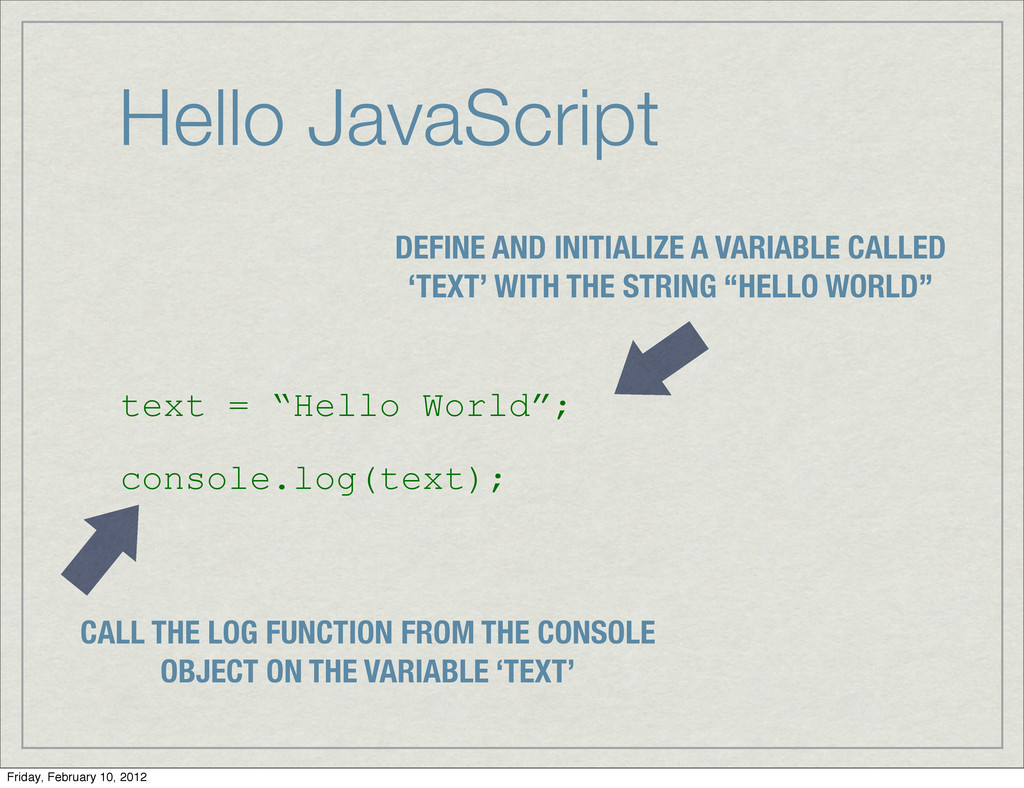
Hello JavaScript text = “Hello World”; console.log(text); DEFINE AND INITIALIZE
A VARIABLE CALLED ‘TEXT’ WITH THE STRING “HELLO WORLD” CALL THE LOG FUNCTION FROM THE CONSOLE OBJECT ON THE VARIABLE ‘TEXT’ Friday, February 10, 2012 -
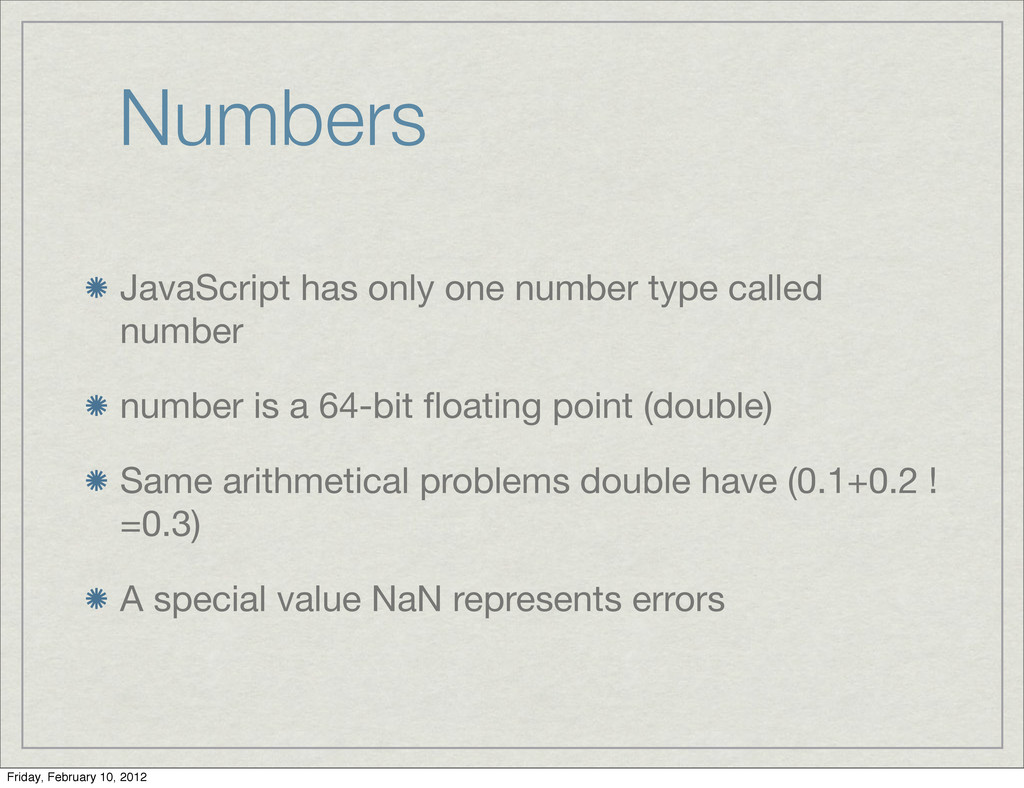
Numbers JavaScript has only one number type called number number
is a 64-bit floating point (double) Same arithmetical problems double have (0.1+0.2 ! =0.3) A special value NaN represents errors Friday, February 10, 2012 -
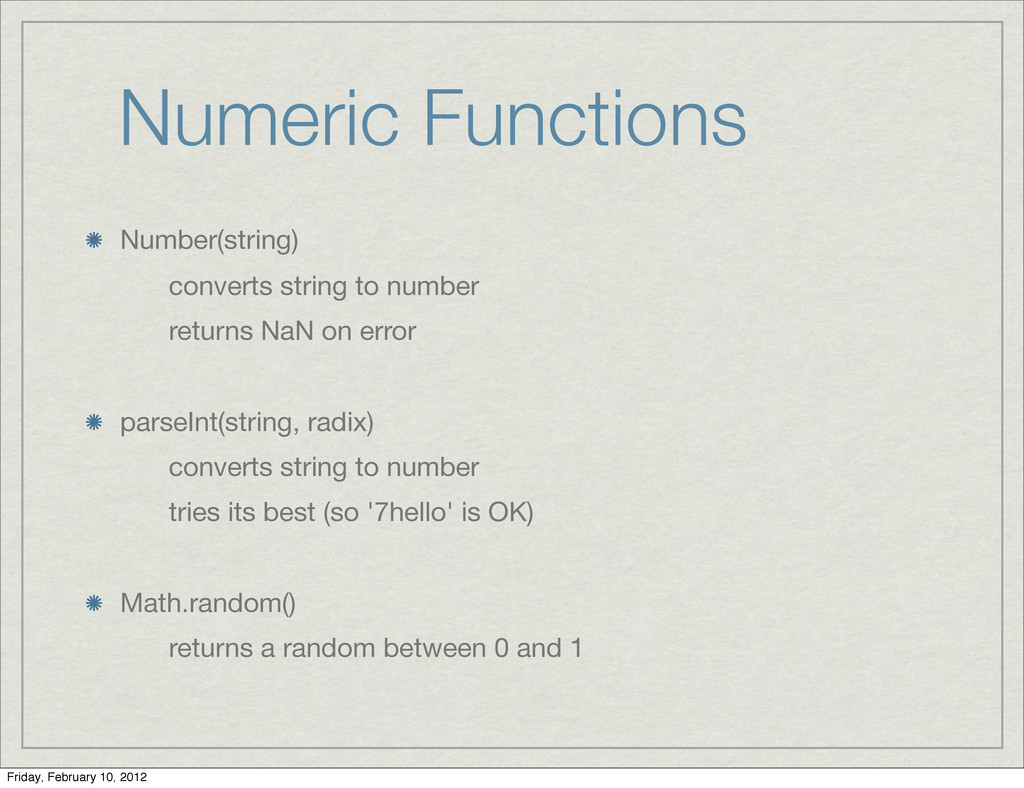
Numeric Functions Number(string) converts string to number returns NaN on
error parseInt(string, radix) converts string to number tries its best (so '7hello' is OK) Math.random() returns a random between 0 and 1 Friday, February 10, 2012 -
Numeric Functions x = 3; y = Number(7); z =
Number(‘9’); console.log(x + y + z); Friday, February 10, 2012 -
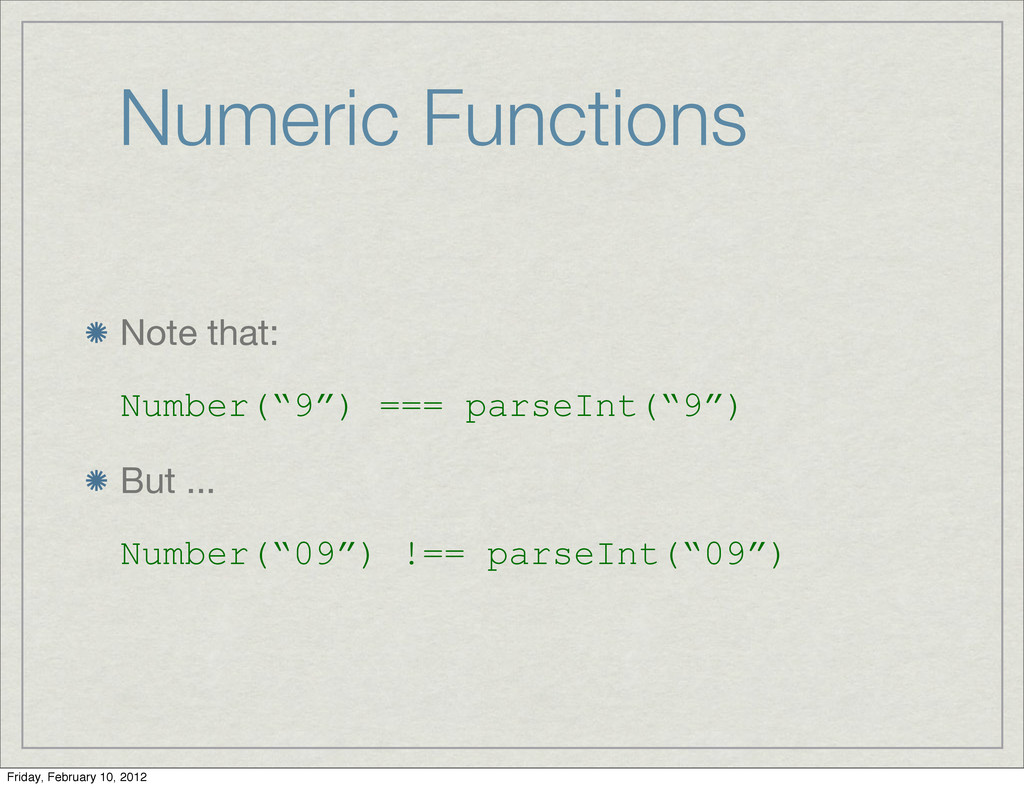
Numeric Functions Note that: Number(“9”) === parseInt(“9”) But ... Number(“09”)
!== parseInt(“09”) Friday, February 10, 2012 -
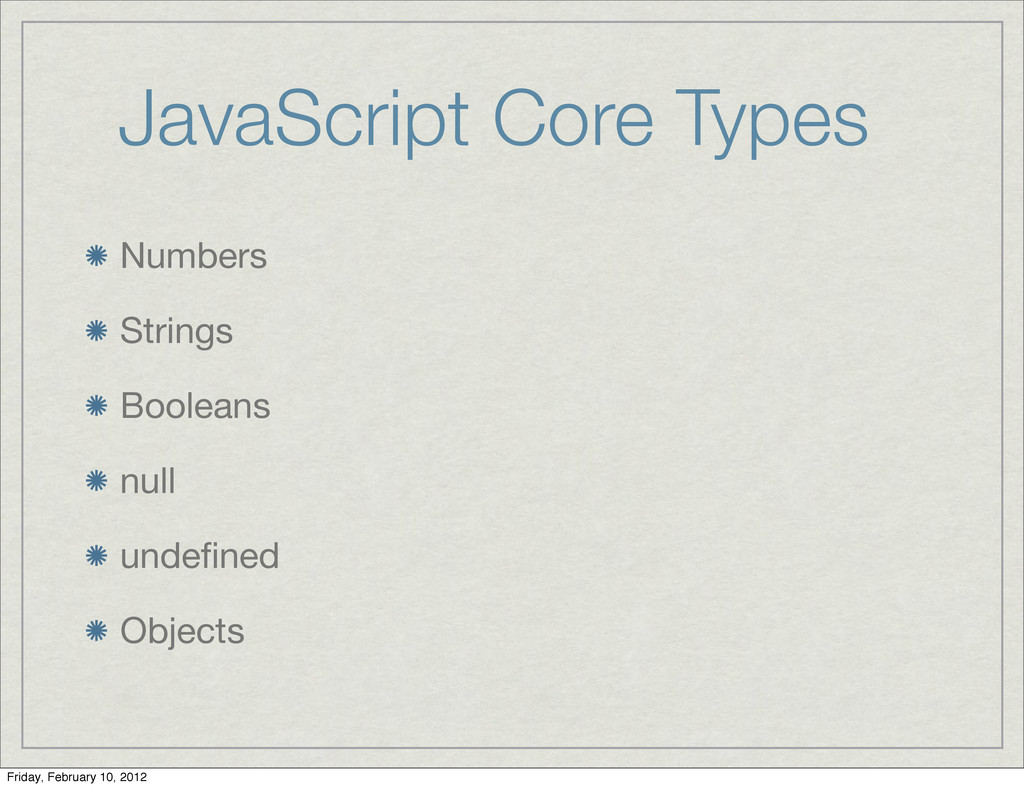
Q & A Numbers Strings Booleans null undefined Objects Friday,
February 10, 2012 -
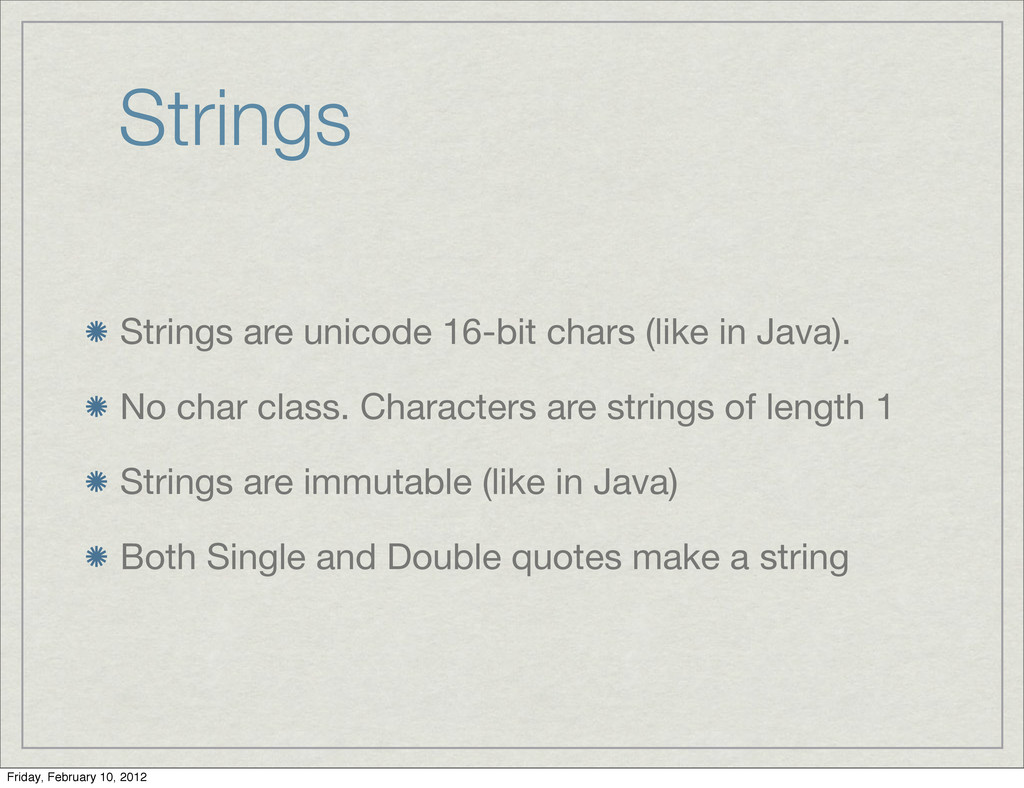
Strings Strings are unicode 16-bit chars (like in Java). No
char class. Characters are strings of length 1 Strings are immutable (like in Java) Both Single and Double quotes make a string Friday, February 10, 2012 -
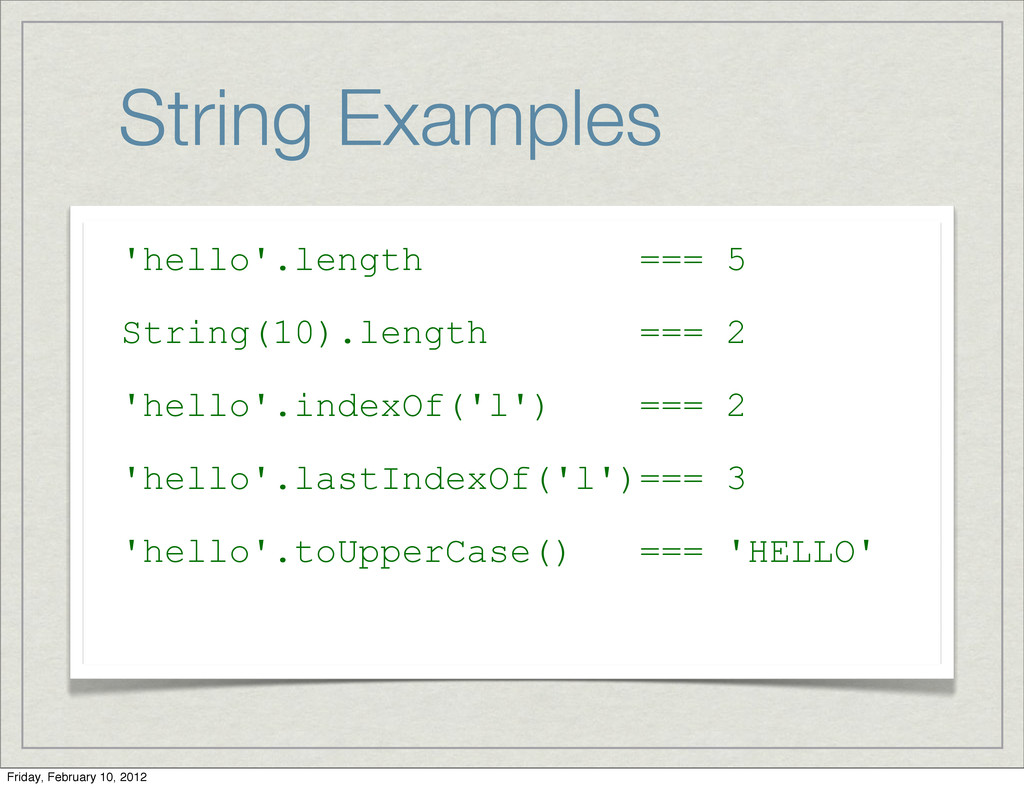
String Examples 'hello'.length === 5 String(10).length === 2 'hello'.indexOf('l') ===
2 'hello'.lastIndexOf('l')=== 3 'hello'.toUpperCase() === 'HELLO' Friday, February 10, 2012 -
Q & A Numbers Strings Booleans null undefined Objects Friday,
February 10, 2012 -
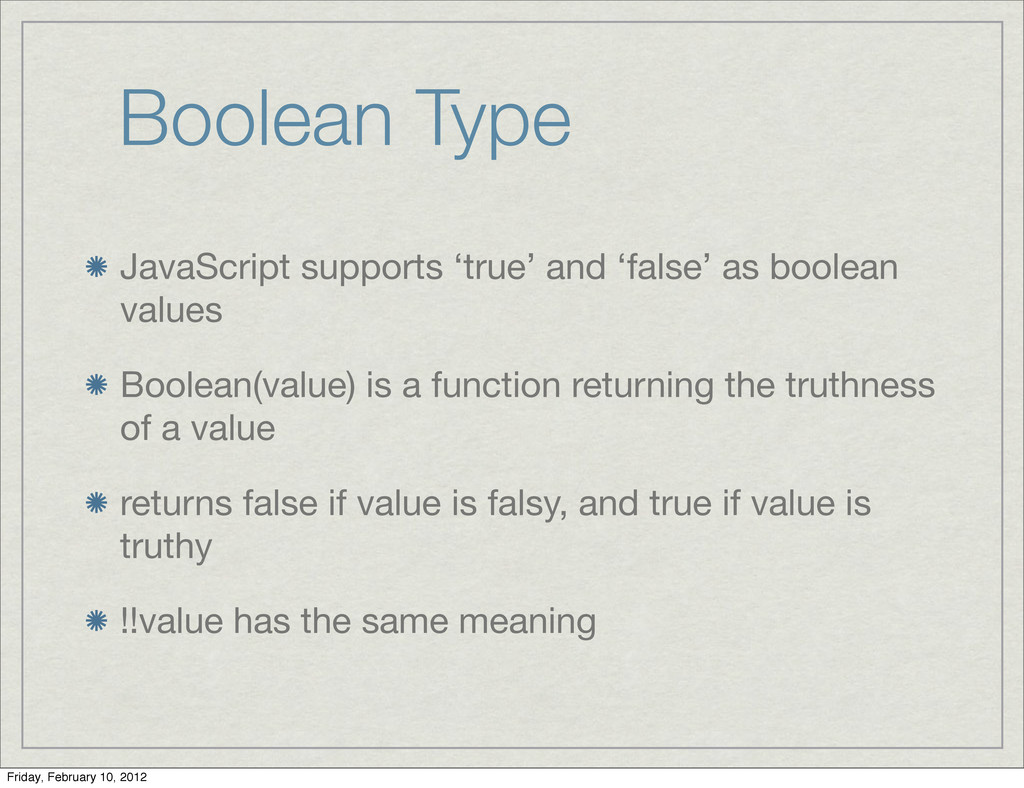
Boolean Type JavaScript supports ‘true’ and ‘false’ as boolean values
Boolean(value) is a function returning the truthness of a value returns false if value is falsy, and true if value is truthy !!value has the same meaning Friday, February 10, 2012 -
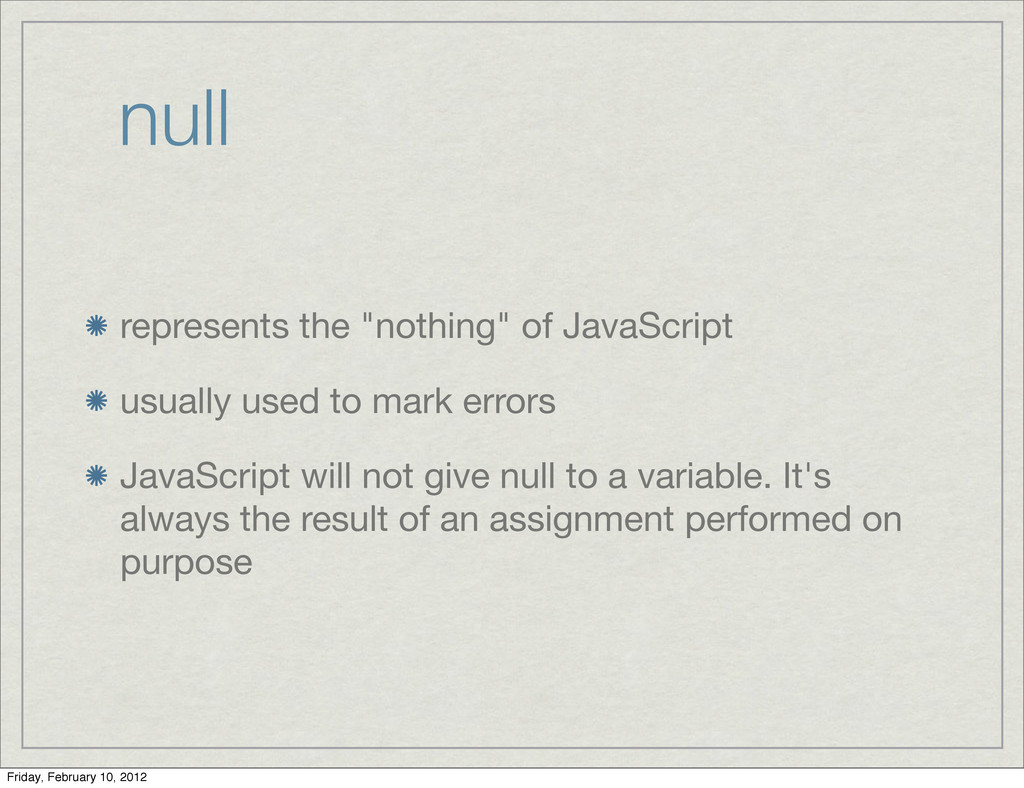
null represents the "nothing" of JavaScript usually used to mark
errors JavaScript will not give null to a variable. It's always the result of an assignment performed on purpose Friday, February 10, 2012 -
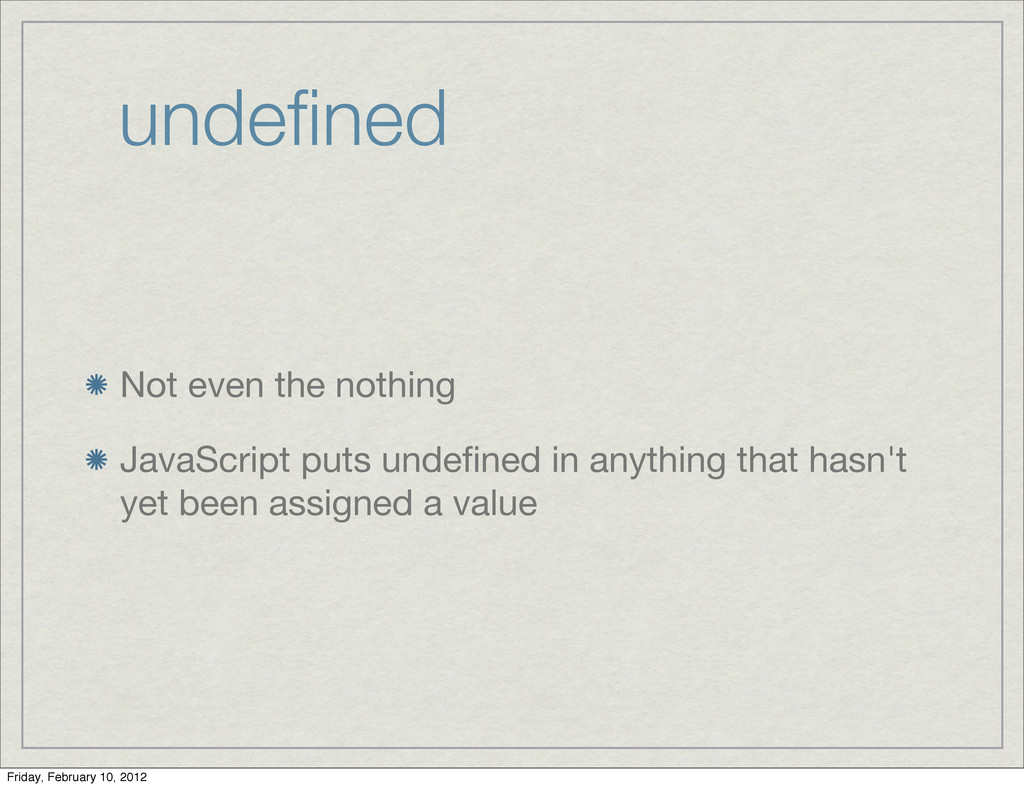
undefined Not even the nothing JavaScript puts undefined in anything
that hasn't yet been assigned a value Friday, February 10, 2012 -
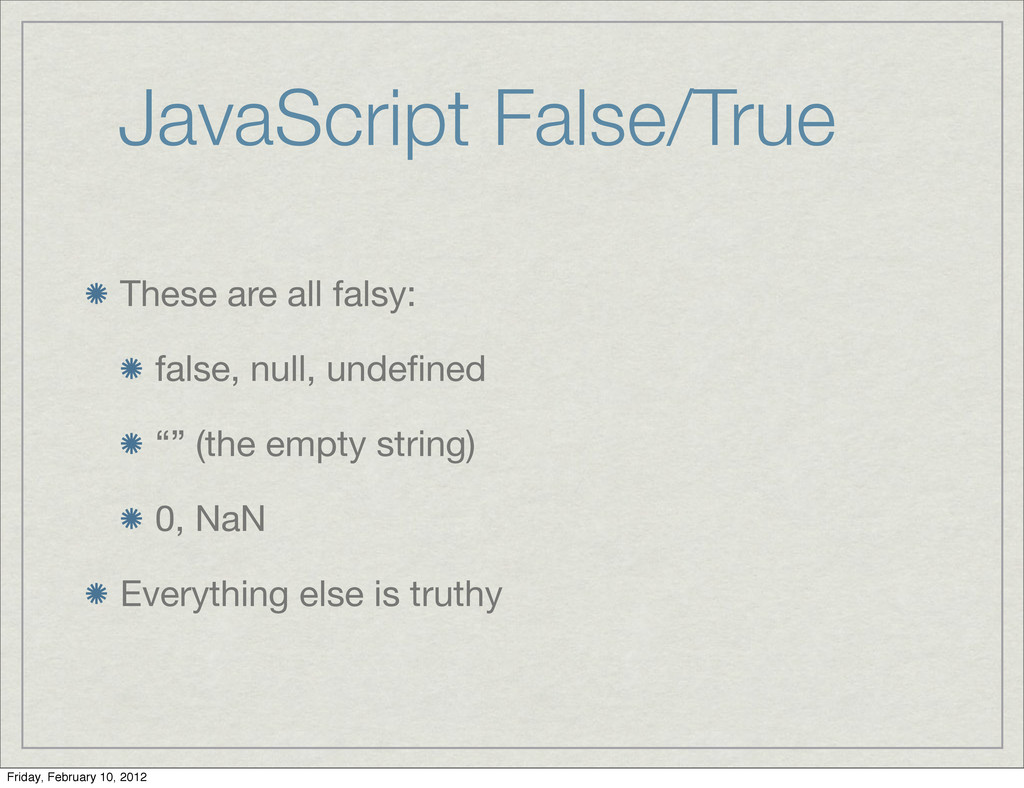
JavaScript False/True These are all falsy: false, null, undefined “”
(the empty string) 0, NaN Everything else is truthy Friday, February 10, 2012 -
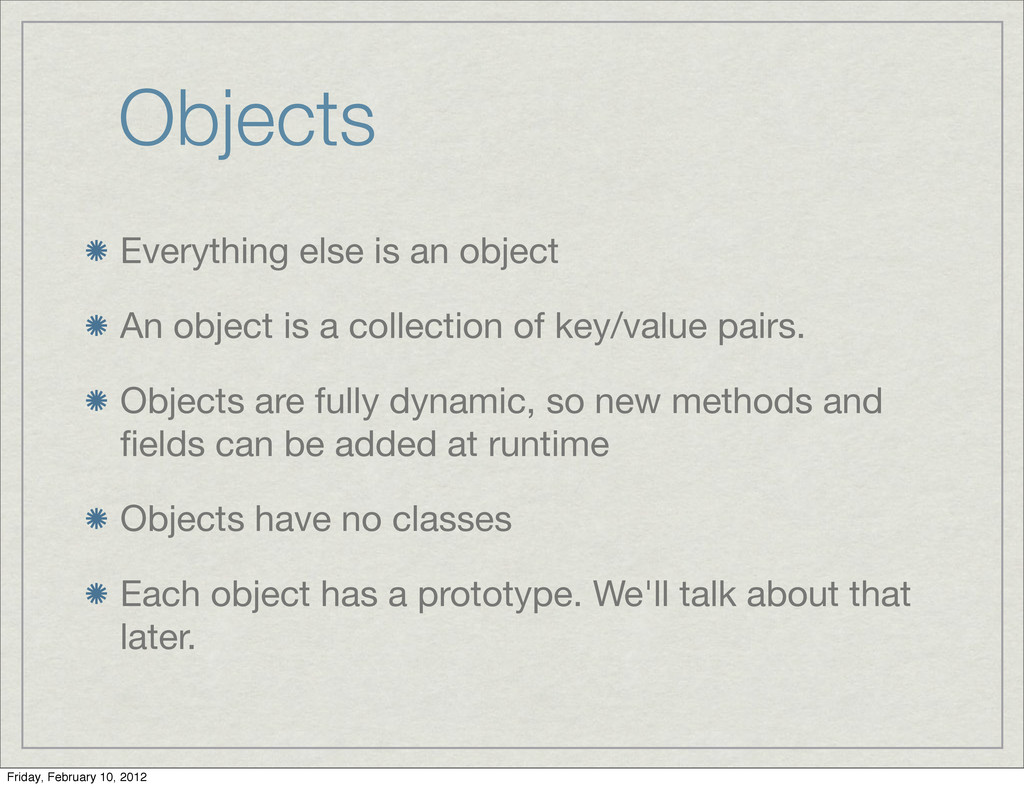
Objects Everything else is an object An object is a
collection of key/value pairs. Objects are fully dynamic, so new methods and fields can be added at runtime Objects have no classes Each object has a prototype. We'll talk about that later. Friday, February 10, 2012 -
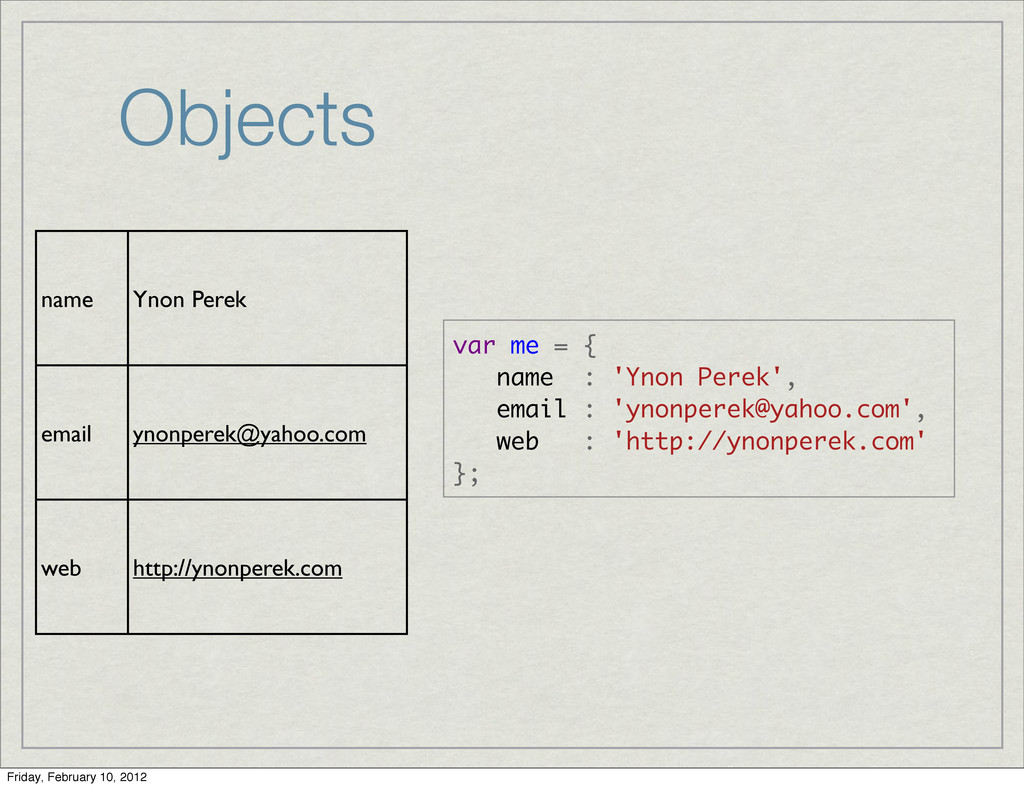
Objects var me = { name : 'Ynon Perek', email
: '[email protected]', web : 'http://ynonperek.com' }; name Ynon Perek email [email protected] web http://ynonperek.com Friday, February 10, 2012 -
Q & A Numbers Strings Booleans null undefined Objects Friday,
February 10, 2012 -
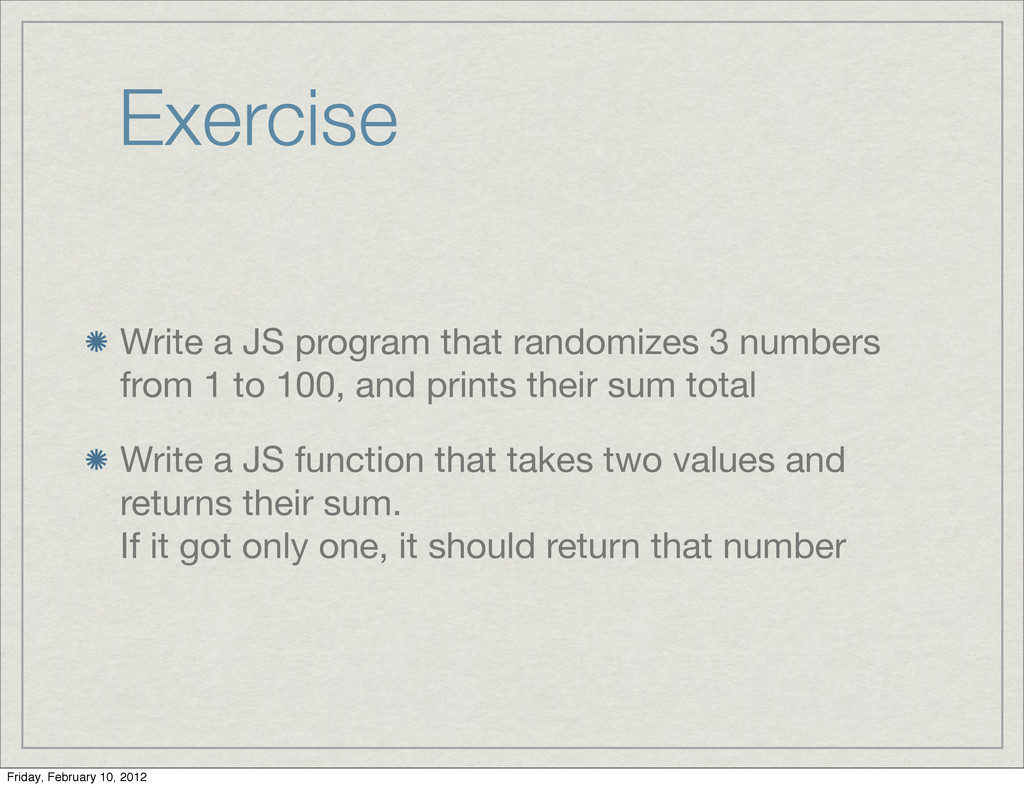
Exercise Write a JS program that randomizes 3 numbers from
1 to 100, and prints their sum total Write a JS function that takes two values and returns their sum. If it got only one, it should return that number Friday, February 10, 2012 -
JavaScript Syntax Identifiers Reserved Words Comments Loops and Branches Functions
Objects & Arrays Friday, February 10, 2012 -
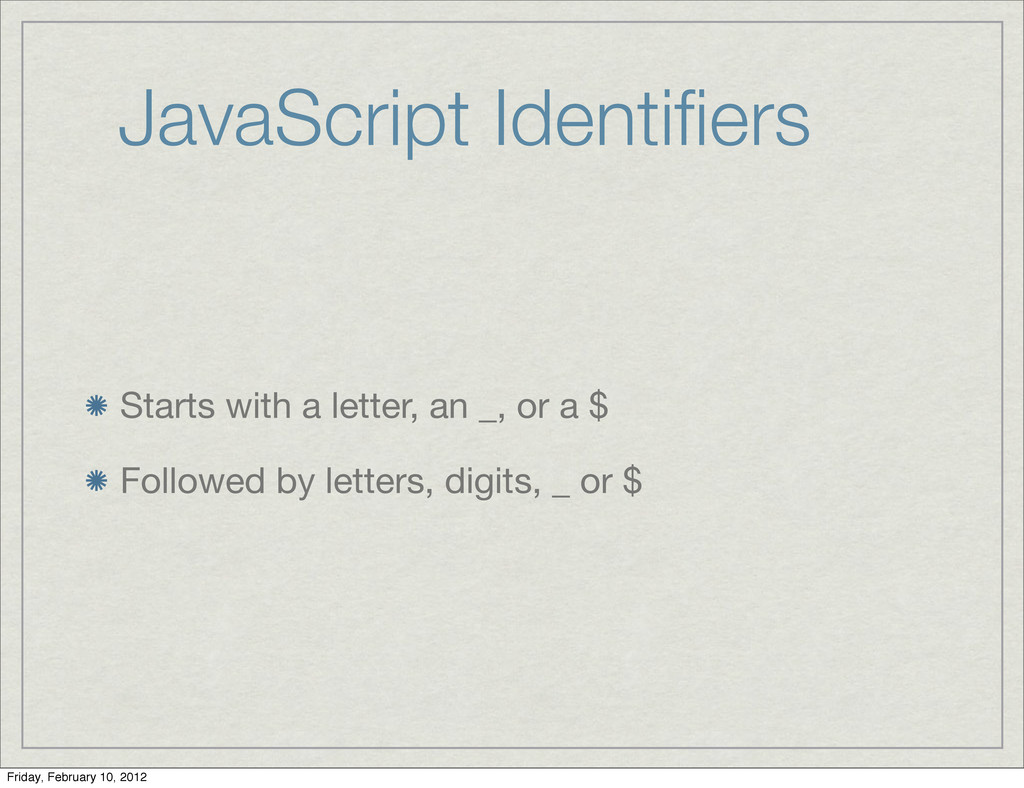
JavaScript Identifiers Starts with a letter, an _, or a
$ Followed by letters, digits, _ or $ Friday, February 10, 2012 -
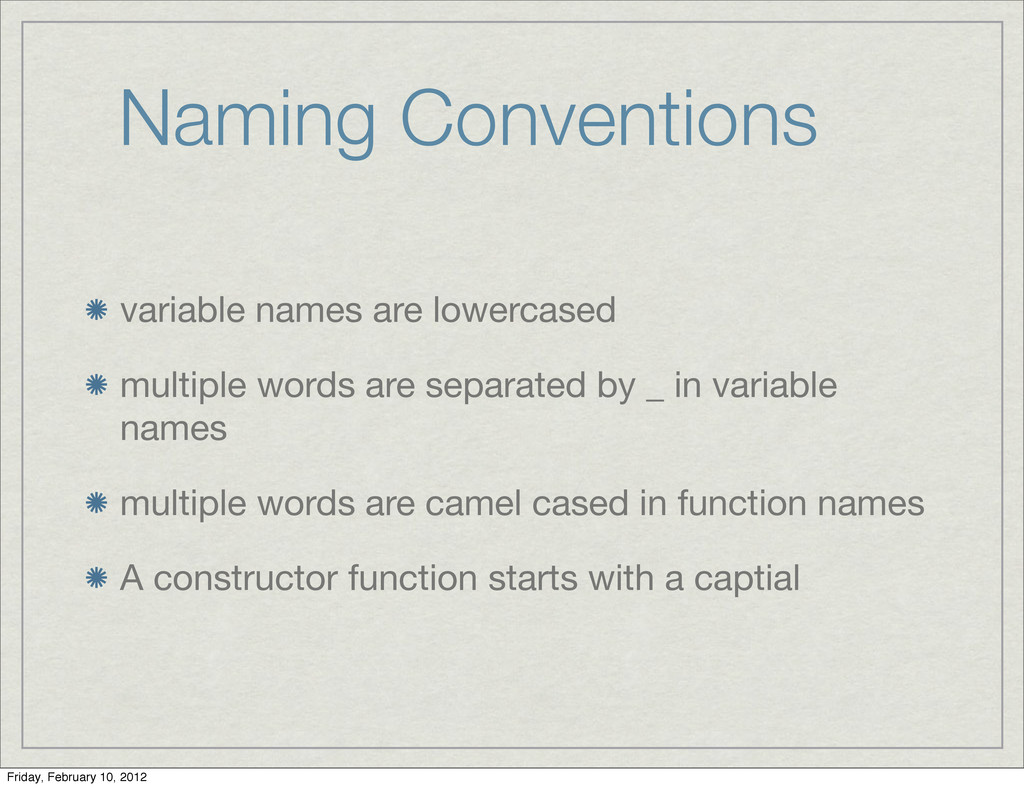
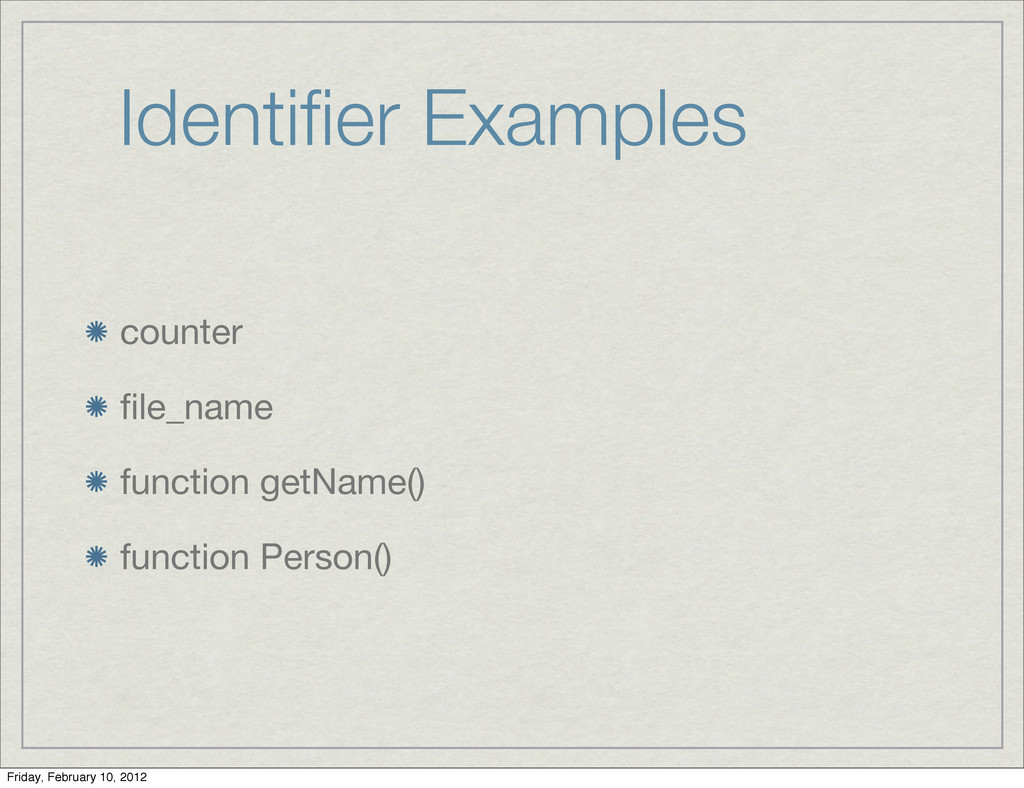
Naming Conventions variable names are lowercased multiple words are separated
by _ in variable names multiple words are camel cased in function names A constructor function starts with a captial Friday, February 10, 2012 -
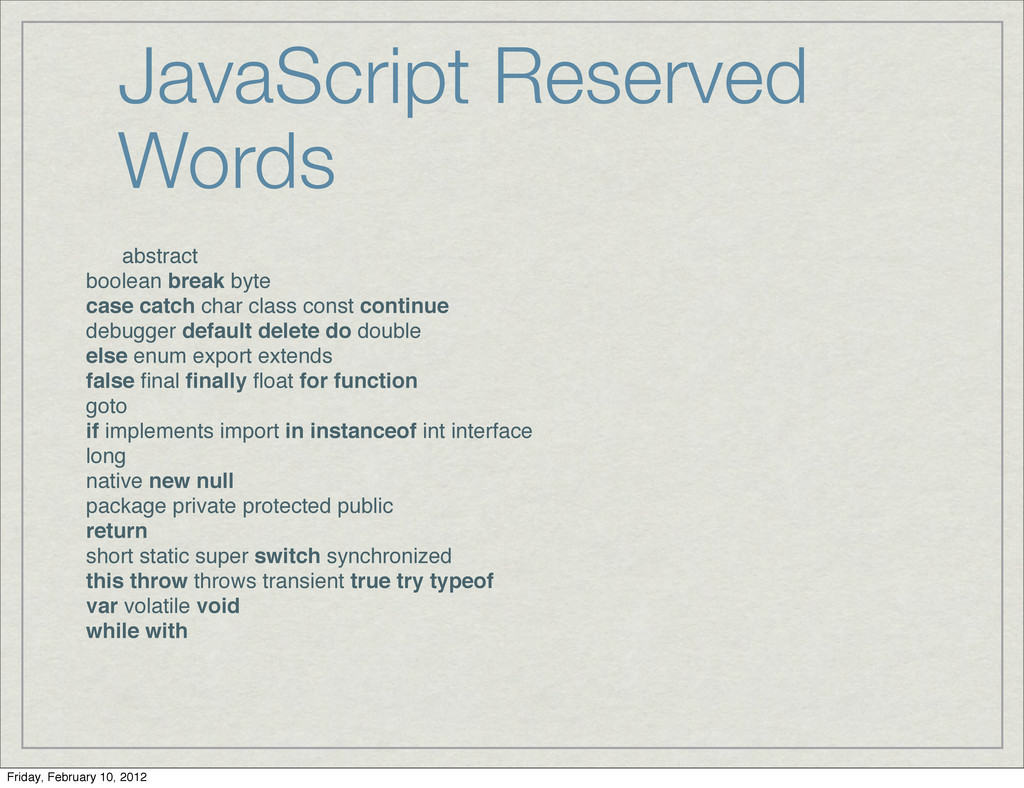
JavaScript Reserved Words abstract boolean break byte case catch char
class const continue debugger default delete do double else enum export extends false final finally float for function goto if implements import in instanceof int interface long native new null package private protected public return short static super switch synchronized this throw throws transient true try typeof var volatile void while with Friday, February 10, 2012 -
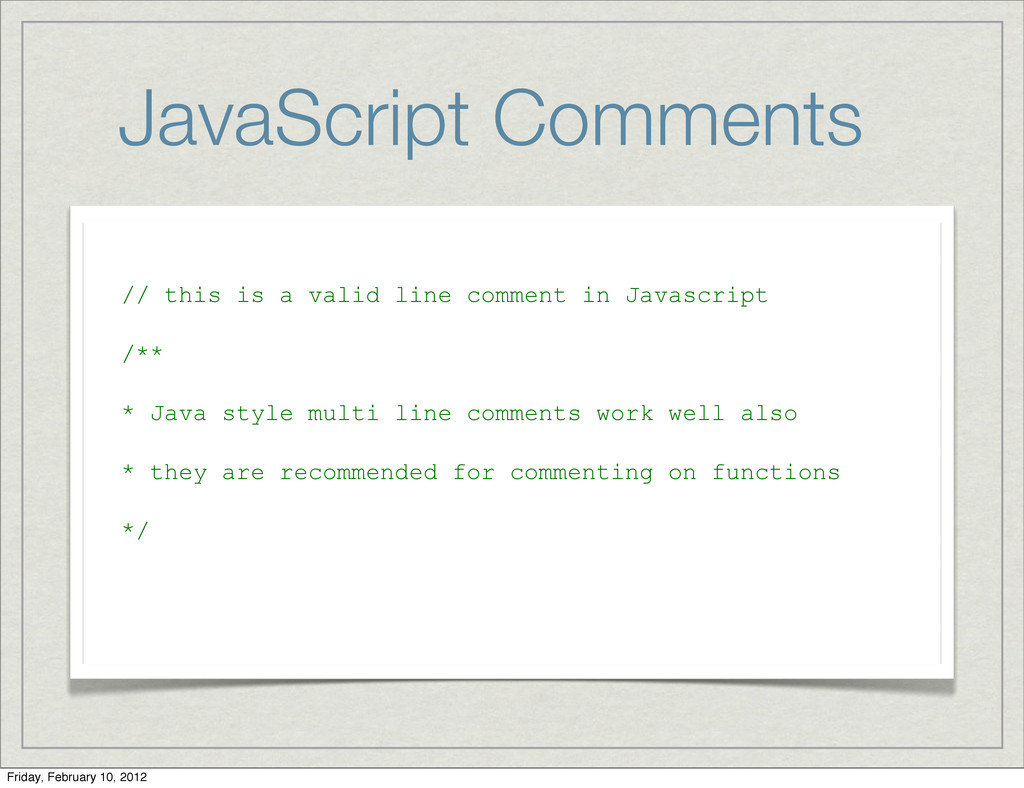
JavaScript Comments // this is a valid line comment in
Javascript /** * Java style multi line comments work well also * they are recommended for commenting on functions */ Friday, February 10, 2012 -
Syntax Q & A Identifiers Reserved Words Comments Loops and
Branches Functions Objects & Arrays Friday, February 10, 2012 -
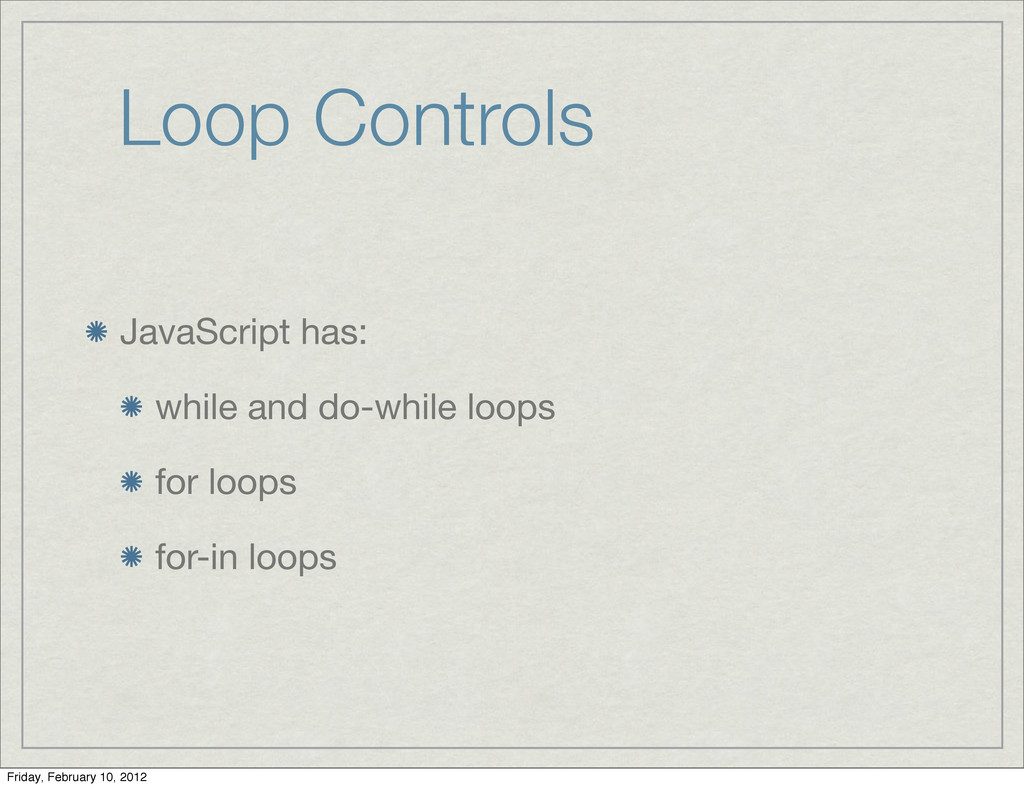
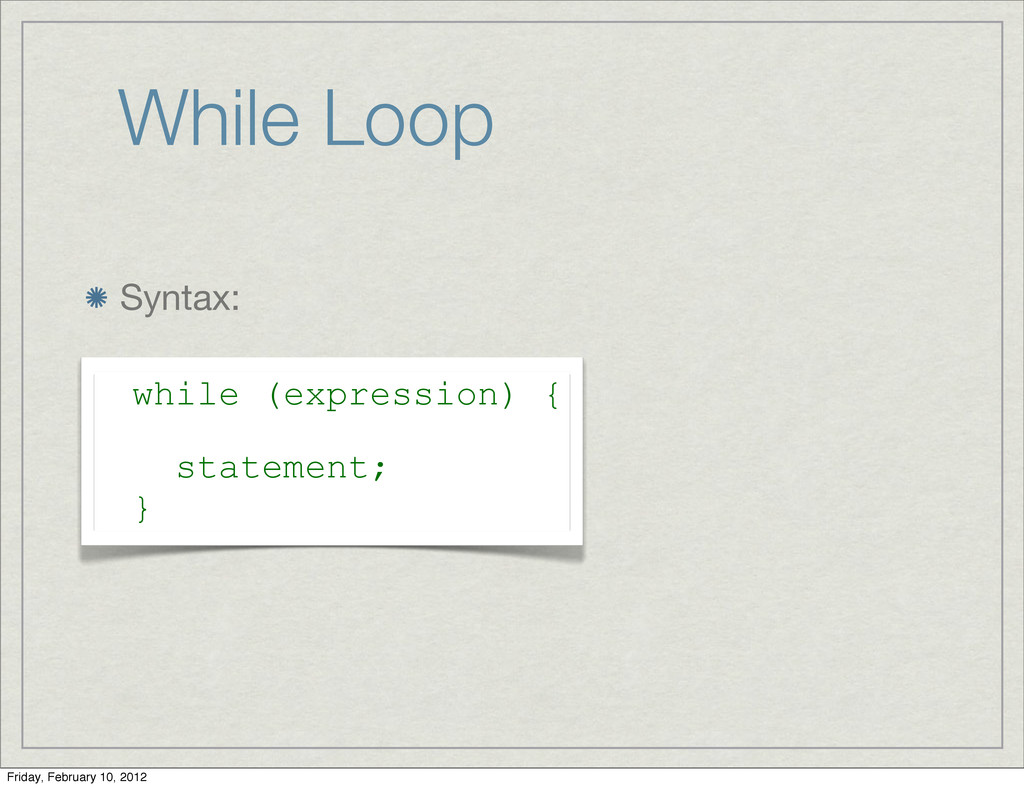
Loop Controls JavaScript has: while and do-while loops for loops
for-in loops Friday, February 10, 2012 -
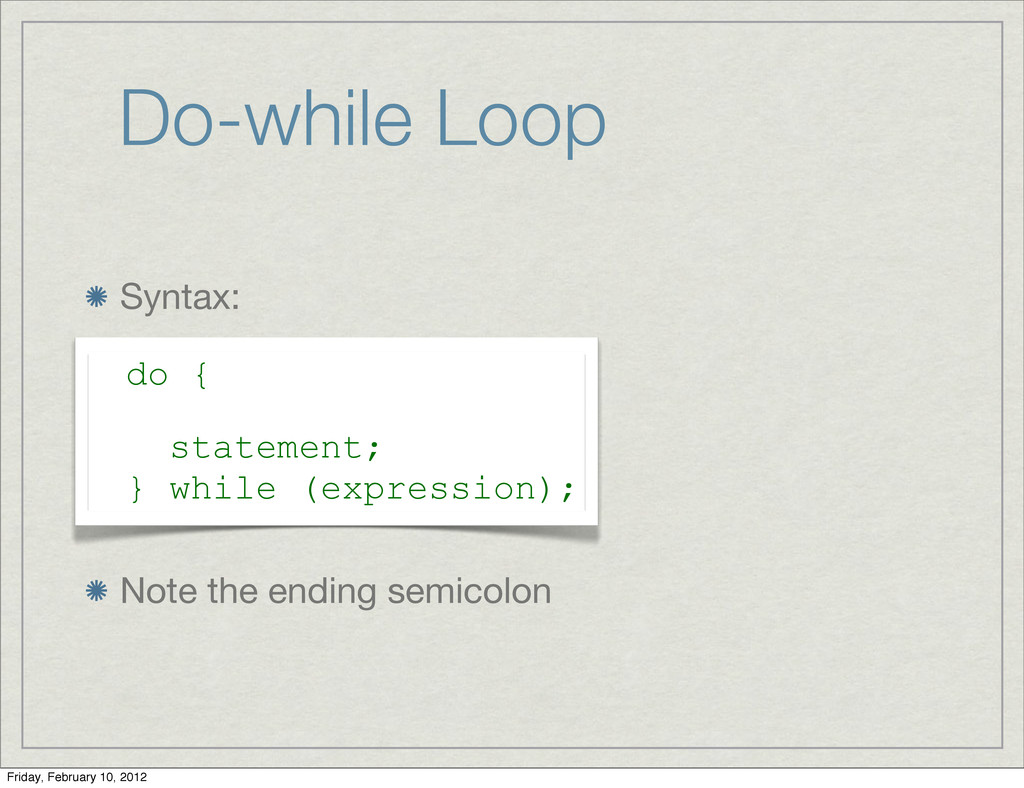
Do-while Loop Syntax: Note the ending semicolon do { statement;
} while (expression); Friday, February 10, 2012 -
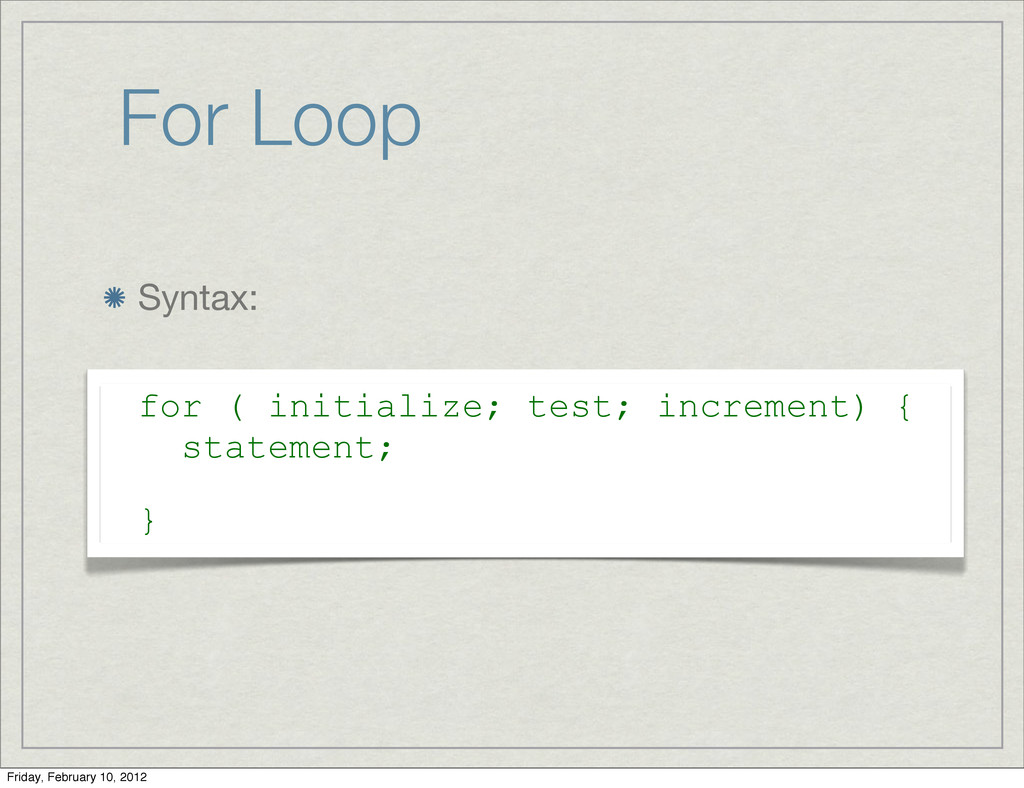
For Loop Syntax: for ( initialize; test; increment) { statement;
} Friday, February 10, 2012 -
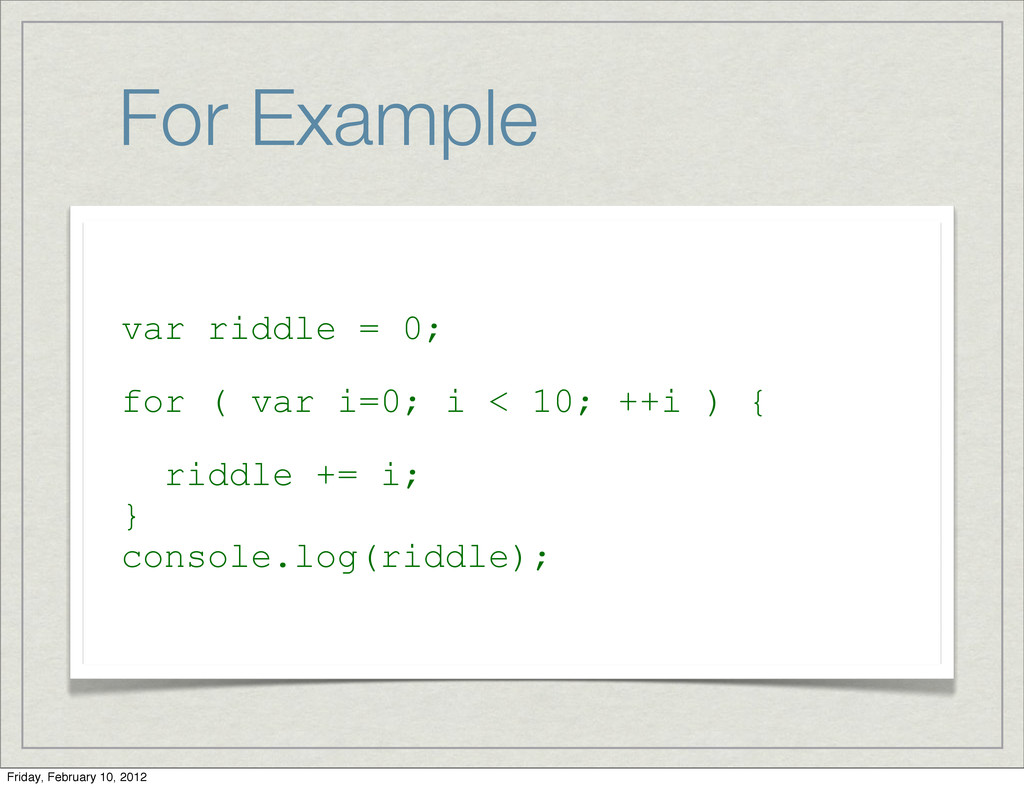
For Example var riddle = 0; for ( var i=0;
i < 10; ++i ) { riddle += i; } console.log(riddle); Friday, February 10, 2012 -
For-in loop allows iterating through all the properties of an
object Be careful with this one - it yields wrong results when combined with inheritance Friday, February 10, 2012 -
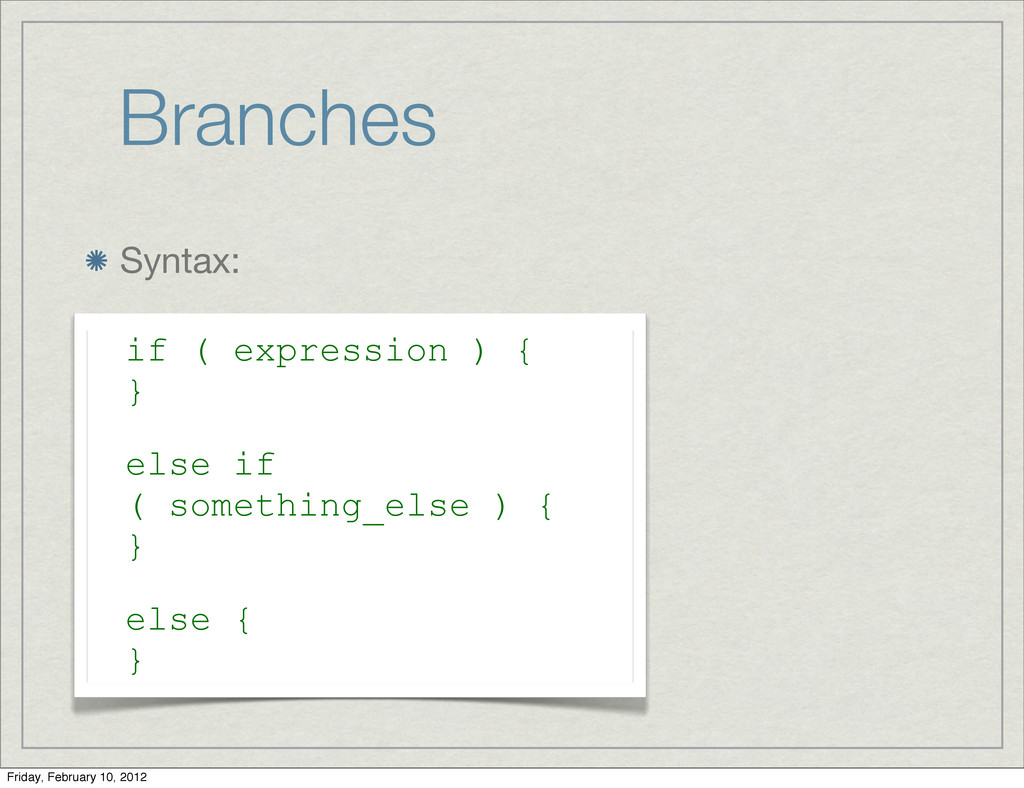
Branches Syntax: if ( expression ) { } else if
( something_else ) { } else { } Friday, February 10, 2012 -
Exercise Write a JS that randomizes 3 number and prints
the largest one Write a JS that prints the square-sum of all the numbers divisible by 7 in range 1..100 (1^2 + 7^2 + 14^2 + ...) Friday, February 10, 2012 -
Syntax Q & A Identifiers Reserved Words Comments Loops and
Branches Functions Objects & Arrays Friday, February 10, 2012 -
Functions & Scope Outside all functions, variables have the “global”
scope. This means a variable defined outside all functions is accessible from everywhere in the application Friday, February 10, 2012 -
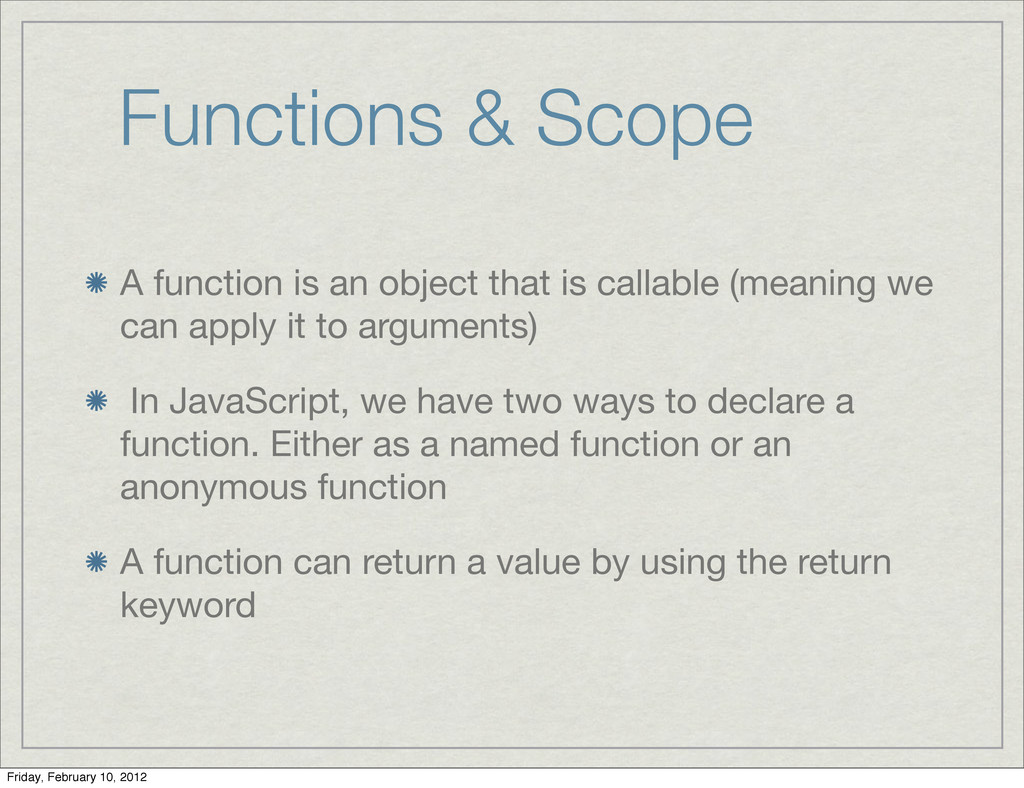
Functions & Scope A function is an object that is
callable (meaning we can apply it to arguments) In JavaScript, we have two ways to declare a function. Either as a named function or an anonymous function A function can return a value by using the return keyword Friday, February 10, 2012 -
Functions & Scope Inside a function, a variable can be
scoped with the keyword var Using strict mode, all variables must be defined var This helps prevent bugs because we are less likely to mess with outside code Friday, February 10, 2012 -
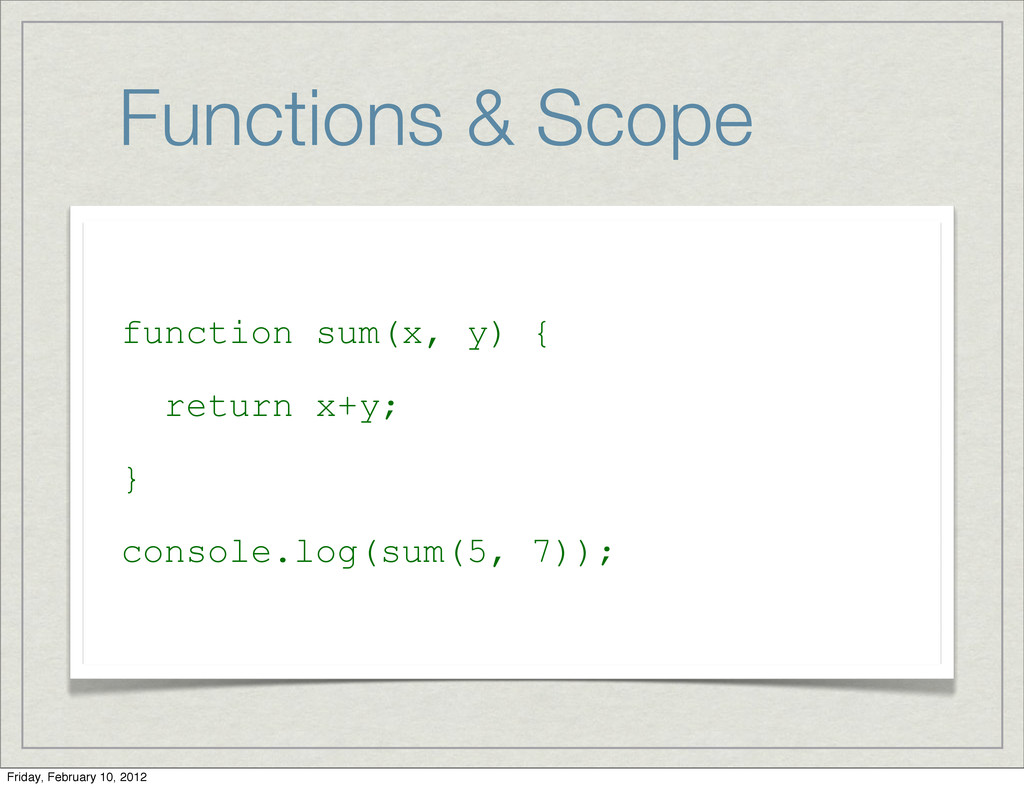
Functions & Scope function sum(x, y) { return x+y; }
console.log(sum(5, 7)); Friday, February 10, 2012 -
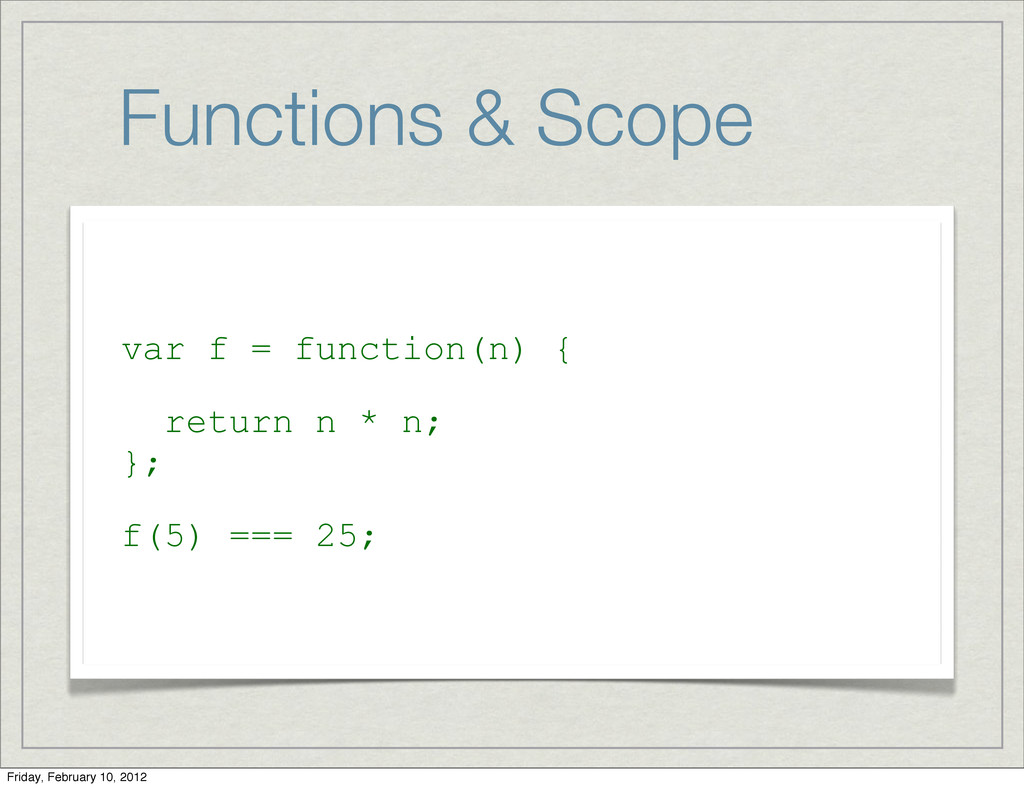
Functions & Scope var f = function(n) { return n
* n; }; f(5) === 25; Friday, February 10, 2012 -
Functions & Scope Best Practices: Write all code inside a
function block Use only one var statement at the beginning of that function Friday, February 10, 2012 -
Functions & Scope A function definition can appear “inside” another
function This is called a “closure”, and then the inner function has access to all variables defined by the outer “closing” function It also keeps all variables alive Friday, February 10, 2012 -
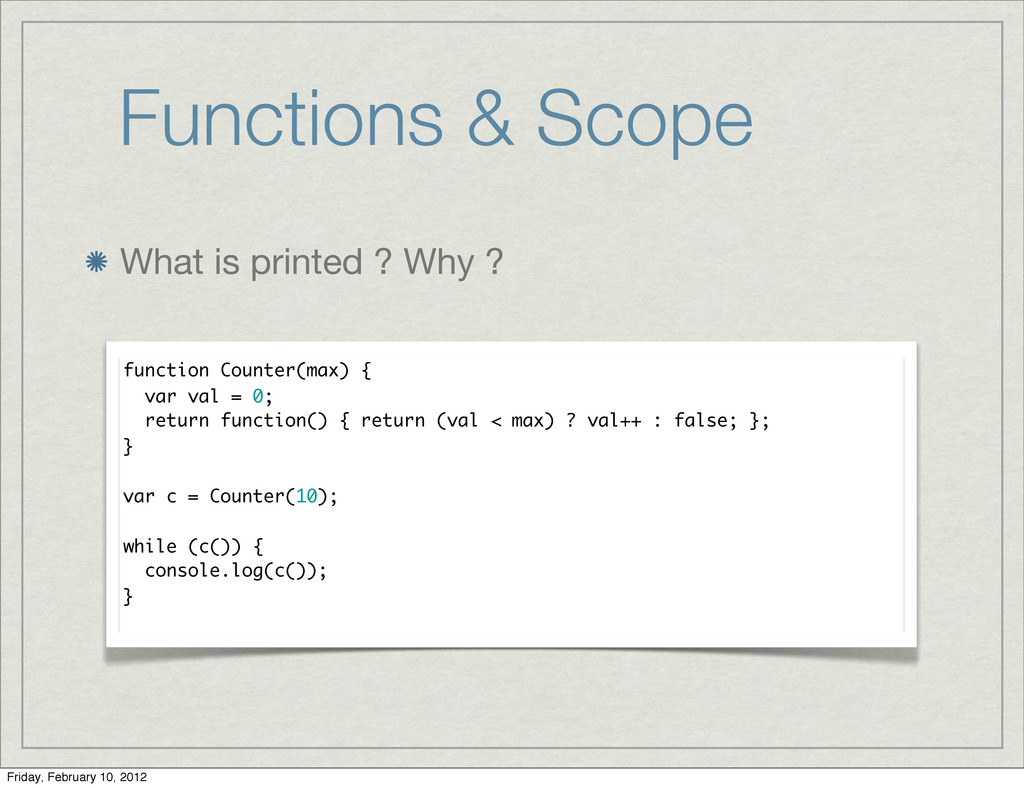
Functions & Scope What is printed ? Why ? function
Counter(max) { var val = 0; return function() { return (val < max) ? val++ : false; }; } var c = Counter(10); while (c()) { console.log(c()); } Friday, February 10, 2012 -
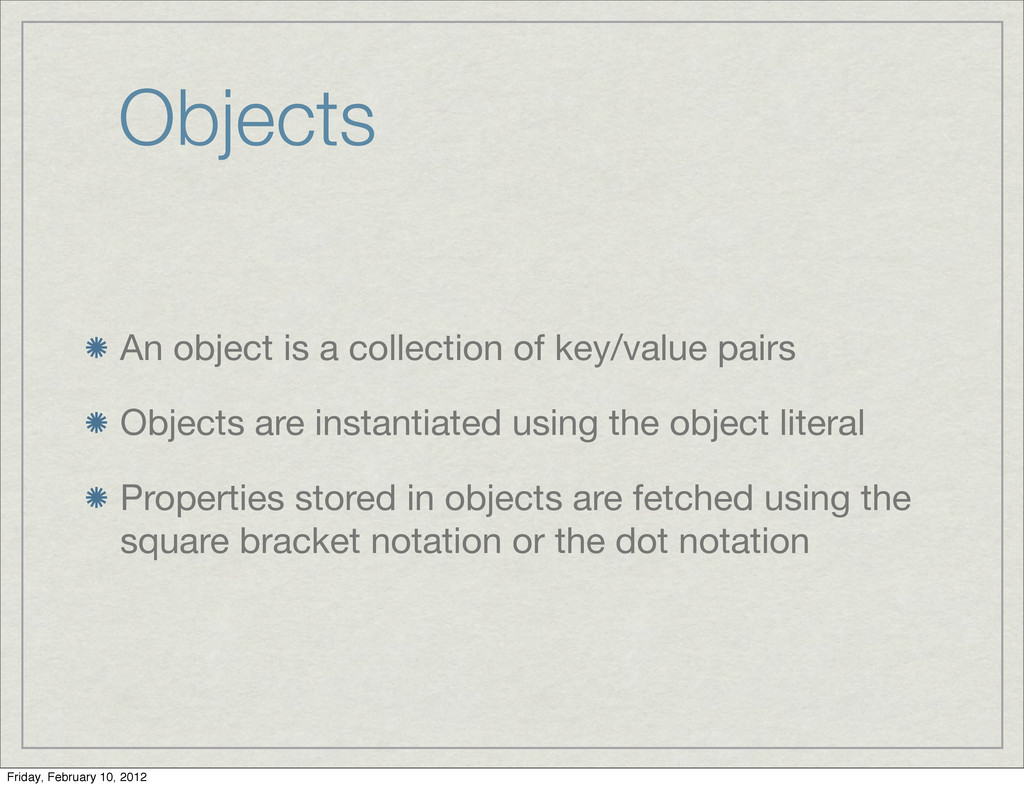
Objects An object is a collection of key/value pairs Objects
are instantiated using the object literal Properties stored in objects are fetched using the square bracket notation or the dot notation Friday, February 10, 2012 -
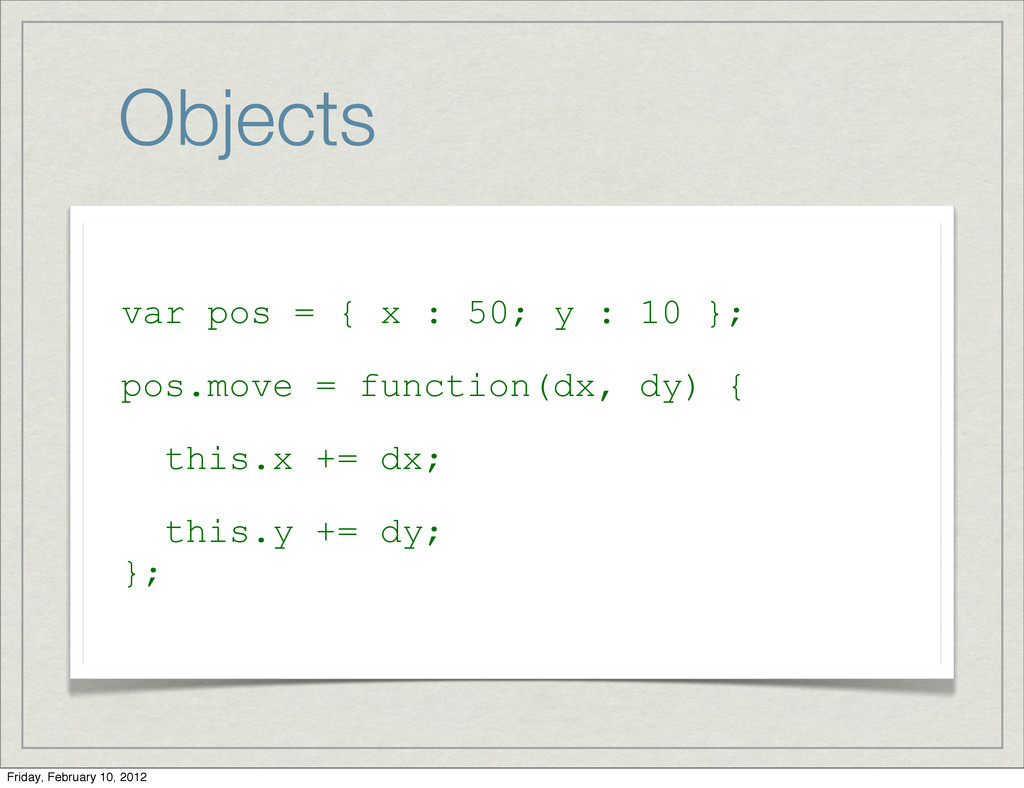
Objects var pos = { x : 50; y :
10 }; pos.move = function(dx, dy) { this.x += dx; this.y += dy; }; Friday, February 10, 2012 -
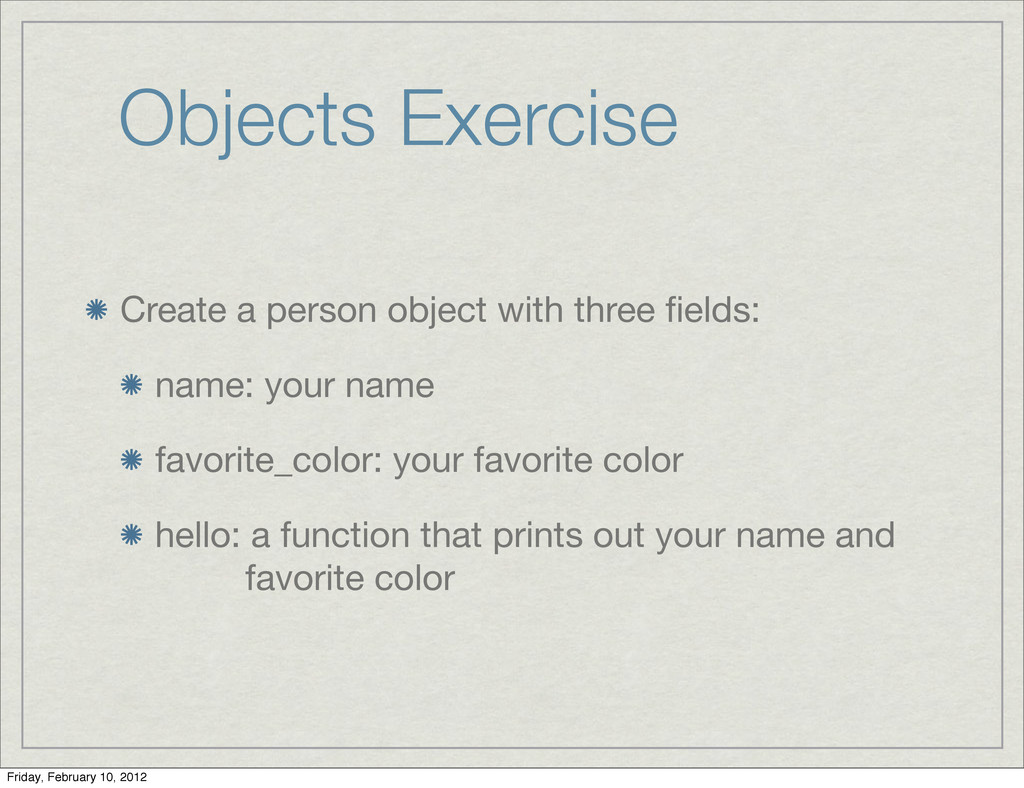
Objects Exercise Create a person object with three fields: name:
your name favorite_color: your favorite color hello: a function that prints out your name and favorite color Friday, February 10, 2012 -
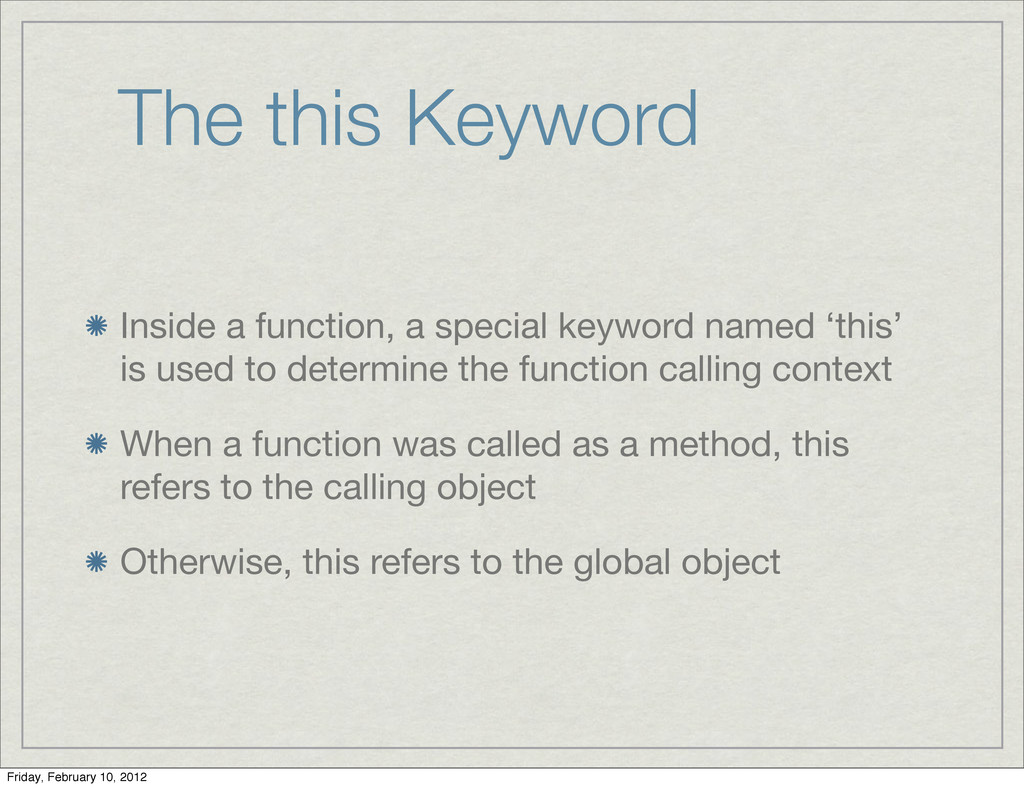
The this Keyword Inside a function, a special keyword named
‘this’ is used to determine the function calling context When a function was called as a method, this refers to the calling object Otherwise, this refers to the global object Friday, February 10, 2012 -
Arrays Arrays represent ordered data in JavaScript Arrays are normal
objects, so they can have attributes other than their indexes Arrays have some array related functions we can use Friday, February 10, 2012 -
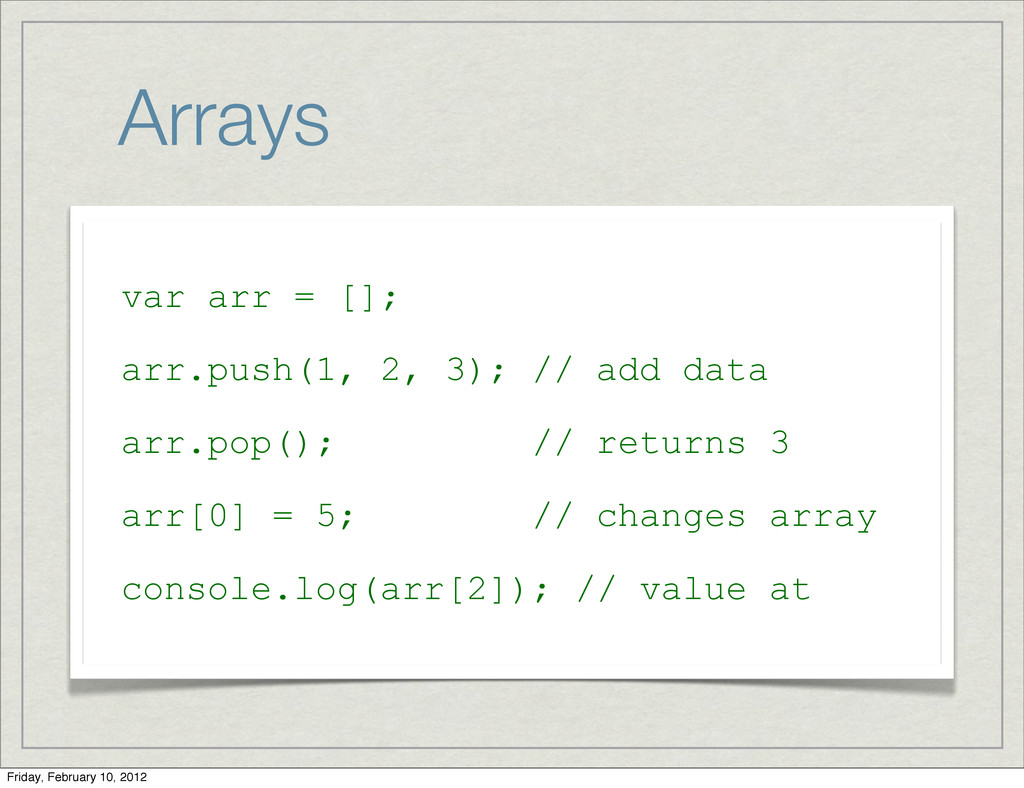
Arrays var arr = []; arr.push(1, 2, 3); // add
data arr.pop(); // returns 3 arr[0] = 5; // changes array console.log(arr[2]); // value at Friday, February 10, 2012 -
Syntax Q & A Identifiers Reserved Words Comments Loops and
Branches Functions Objects & Arrays Friday, February 10, 2012 -
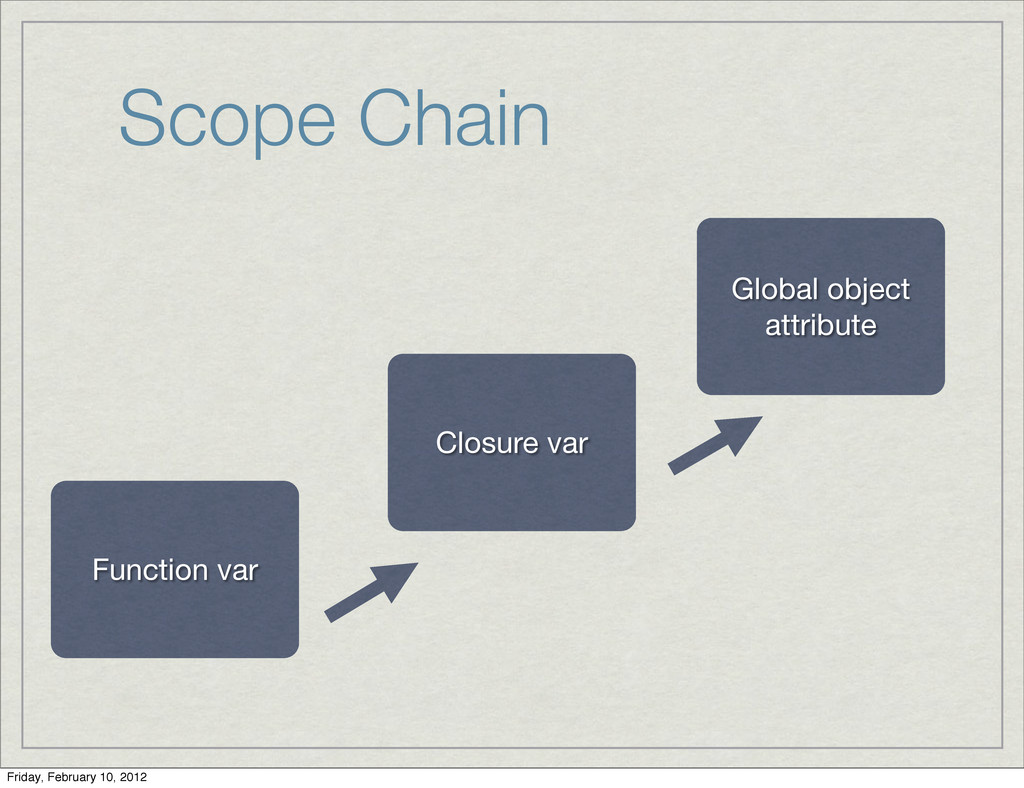
Scope Chain Function var Closure var Global object attribute Friday,
February 10, 2012 -
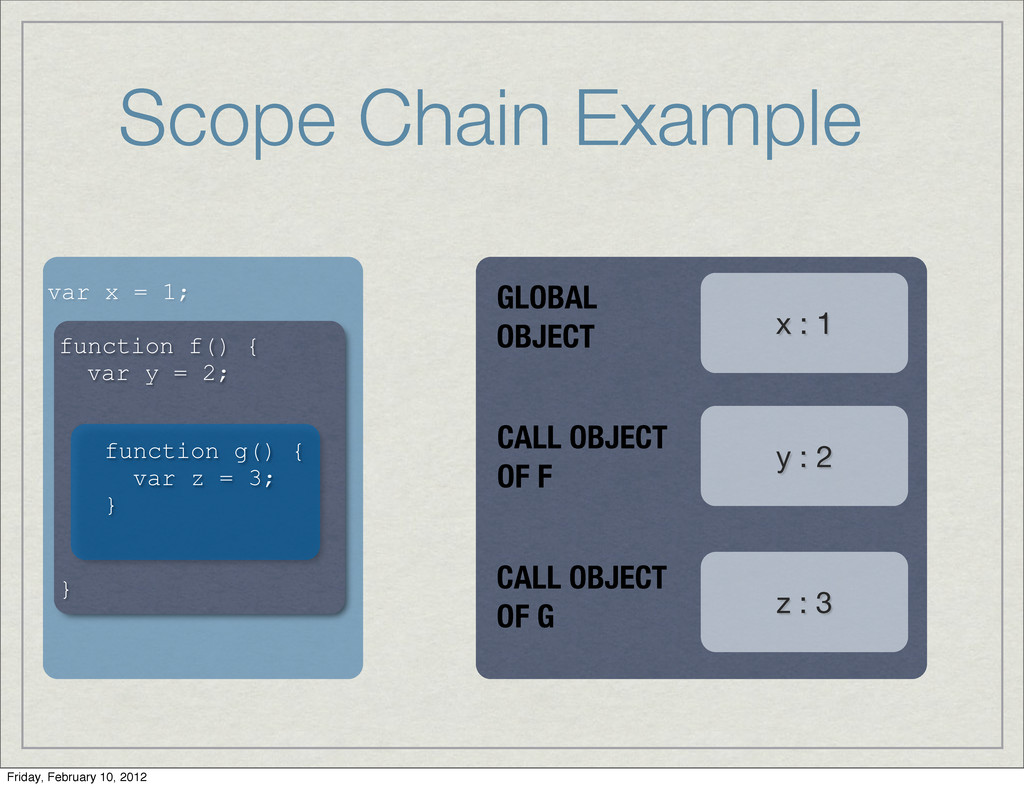
Scope Chain Example var x = 1; function f() {
var y = 2; } function g() { var z = 3; } z : 3 y : 2 x : 1 CALL OBJECT OF G CALL OBJECT OF F GLOBAL OBJECT Friday, February 10, 2012 -
Function Scope The smallest scope in JS is the function
scope A var inside a function creates an entry in the call object All entries in the call object are created when a function is called Friday, February 10, 2012 -
Global Scope In addition to function scopes, JavaScript has a
global object that keeps all variables declared outside all scopes Use of this global scope should be kept to a minimum Friday, February 10, 2012 -
Scope Tips Wrap all code inside a function Use one
var statement in the beginning of each function When global scope is required, create a private namespace on the global object Friday, February 10, 2012 -
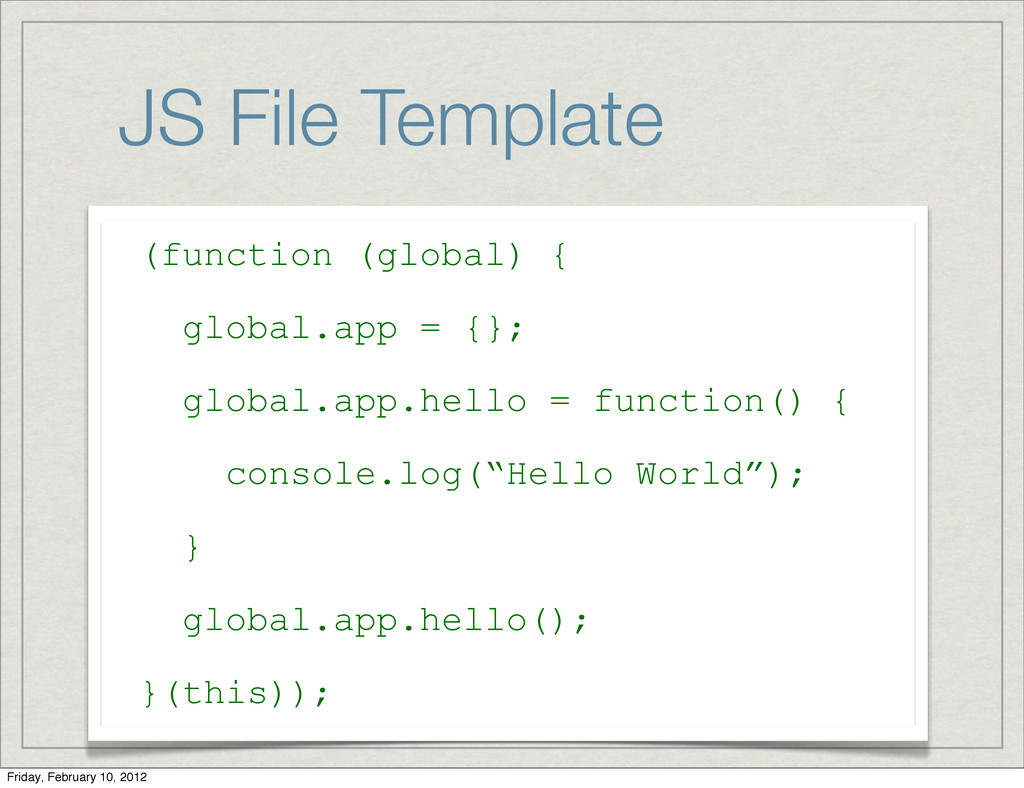
JS File Template (function (global) { global.app = {}; global.app.hello
= function() { console.log(“Hello World”); } global.app.hello(); }(this)); Friday, February 10, 2012 -
Q & A Key Concepts Core Types Syntax The Global
Object & Scope Chain Function Objects Friday, February 10, 2012 -
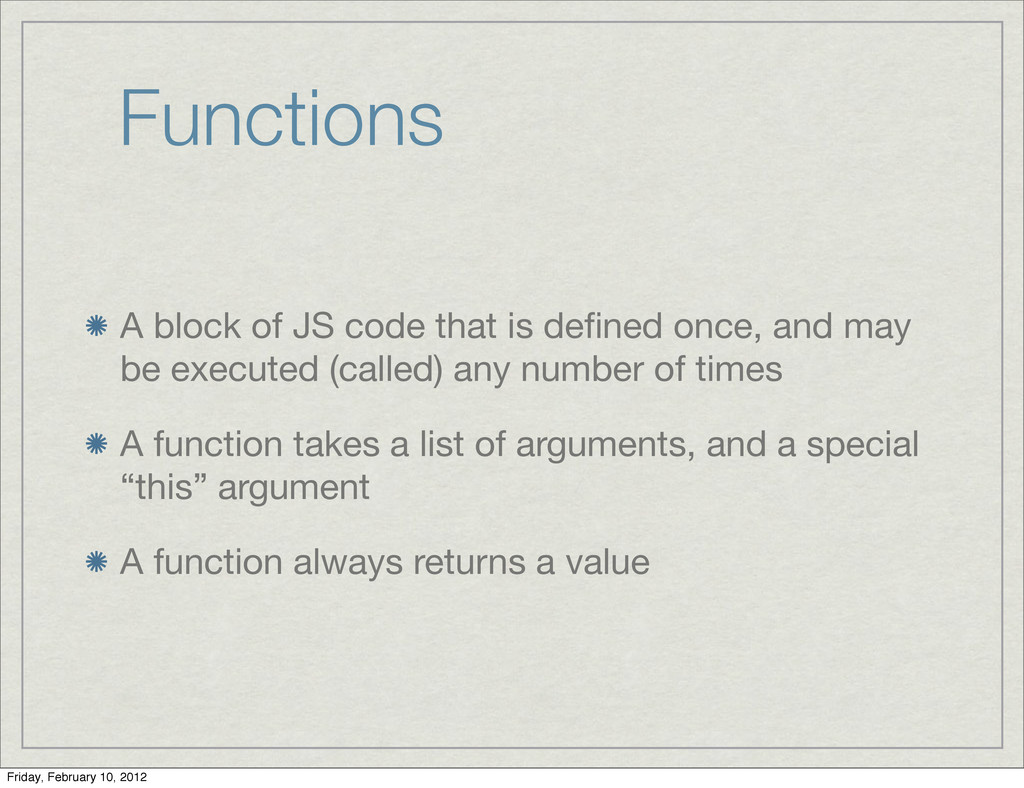
Functions A block of JS code that is defined once,
and may be executed (called) any number of times A function takes a list of arguments, and a special “this” argument A function always returns a value Friday, February 10, 2012 -
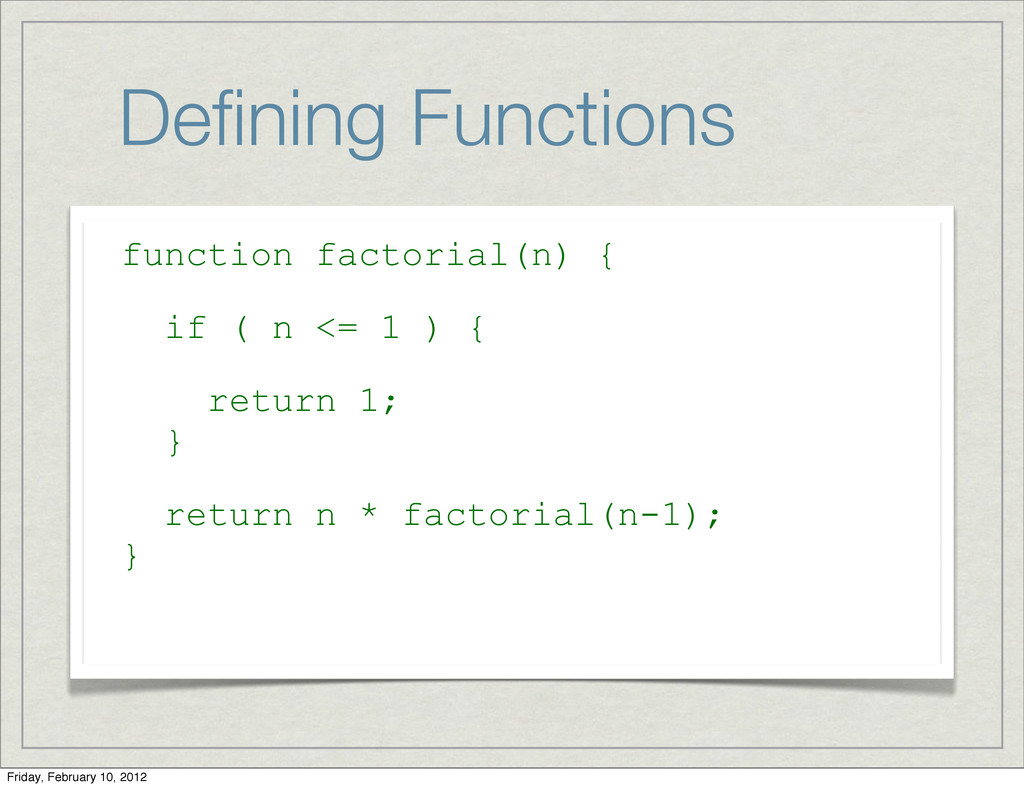
Defining Functions function factorial(n) { if ( n <= 1
) { return 1; } return n * factorial(n-1); } Friday, February 10, 2012 -
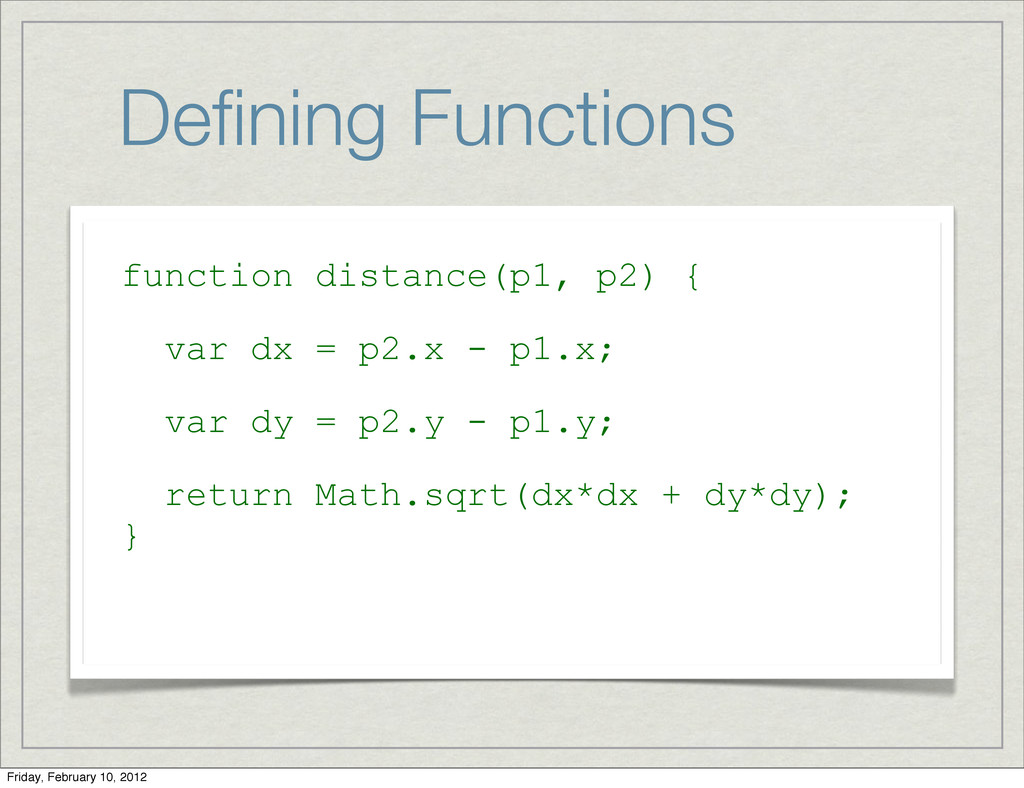
Defining Functions function distance(p1, p2) { var dx = p2.x
- p1.x; var dy = p2.y - p1.y; return Math.sqrt(dx*dx + dy*dy); } Friday, February 10, 2012 -
Invoking Functions Once a function is declared, it can be
invoked by using the () operator on the function name or variable. Inside the (), specify any number of arguments that will be passed to the function. Does not have to be the same as in the declaration Friday, February 10, 2012 -
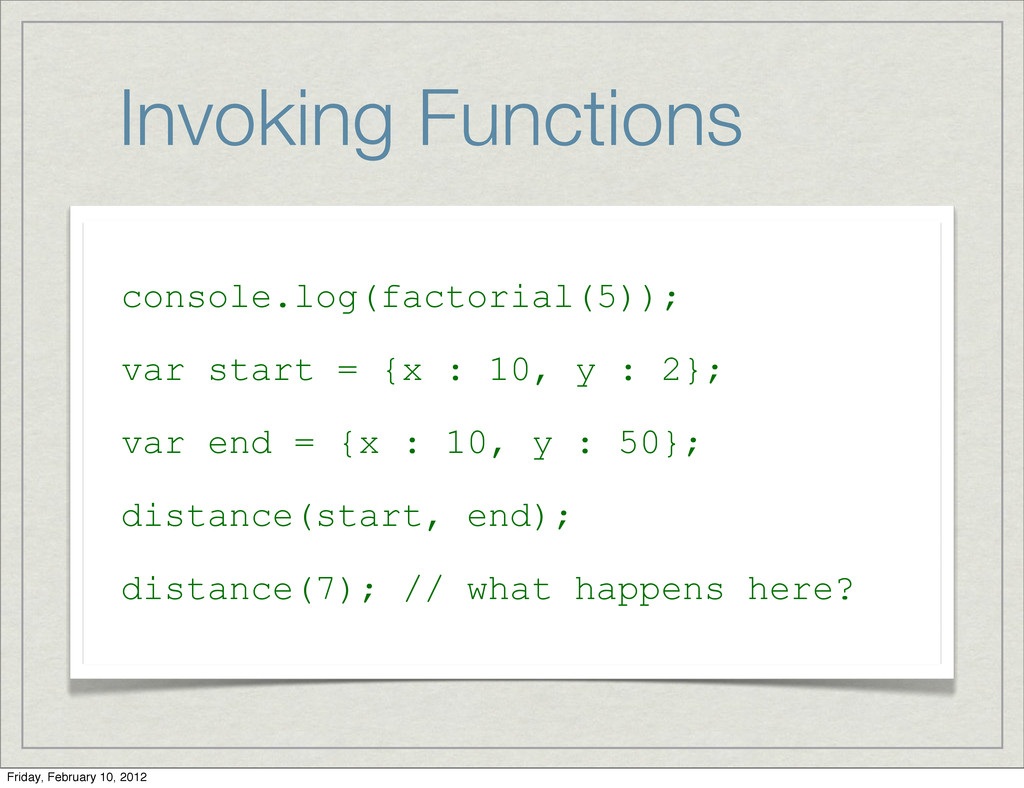
Invoking Functions console.log(factorial(5)); var start = {x : 10, y
: 2}; var end = {x : 10, y : 50}; distance(start, end); distance(7); // what happens here? Friday, February 10, 2012 -
Invoking Functions All arguments specified in the function declaration that
were not passed in the invocation are assigned ‘undefined’ Friday, February 10, 2012 -
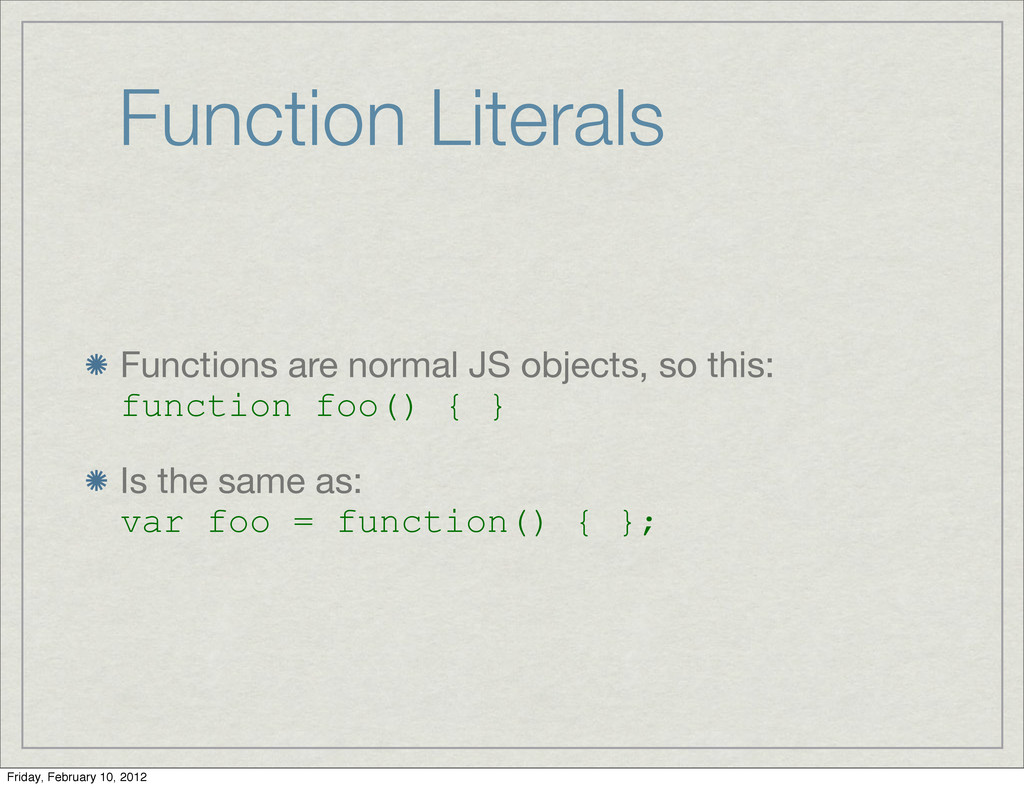
Function Literals Functions are normal JS objects, so this: function
foo() { } Is the same as: var foo = function() { }; Friday, February 10, 2012 -
Function Objects Treating functions as variables can clarify the two:
Function Scope Passing Functions As Arguments Friday, February 10, 2012 -
Function Scope A function is scoped at the nearest closing
scope (closure) or the global object It is best to avoid using global object scope Friday, February 10, 2012 -
Passing Functions As Arguments A function can be passed as
an argument to another function - just like normal JS objects Use the normal () operator on the variable to execute Friday, February 10, 2012 -
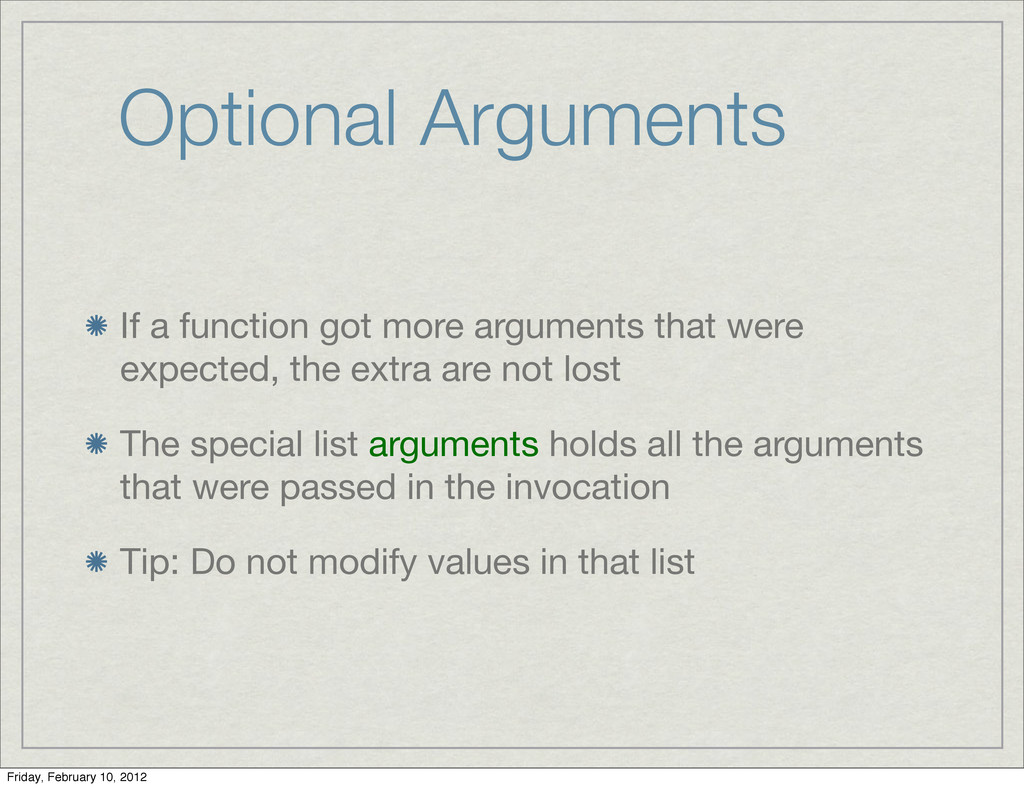
Optional Arguments If a function got more arguments that were
expected, the extra are not lost The special list arguments holds all the arguments that were passed in the invocation Tip: Do not modify values in that list Friday, February 10, 2012 -
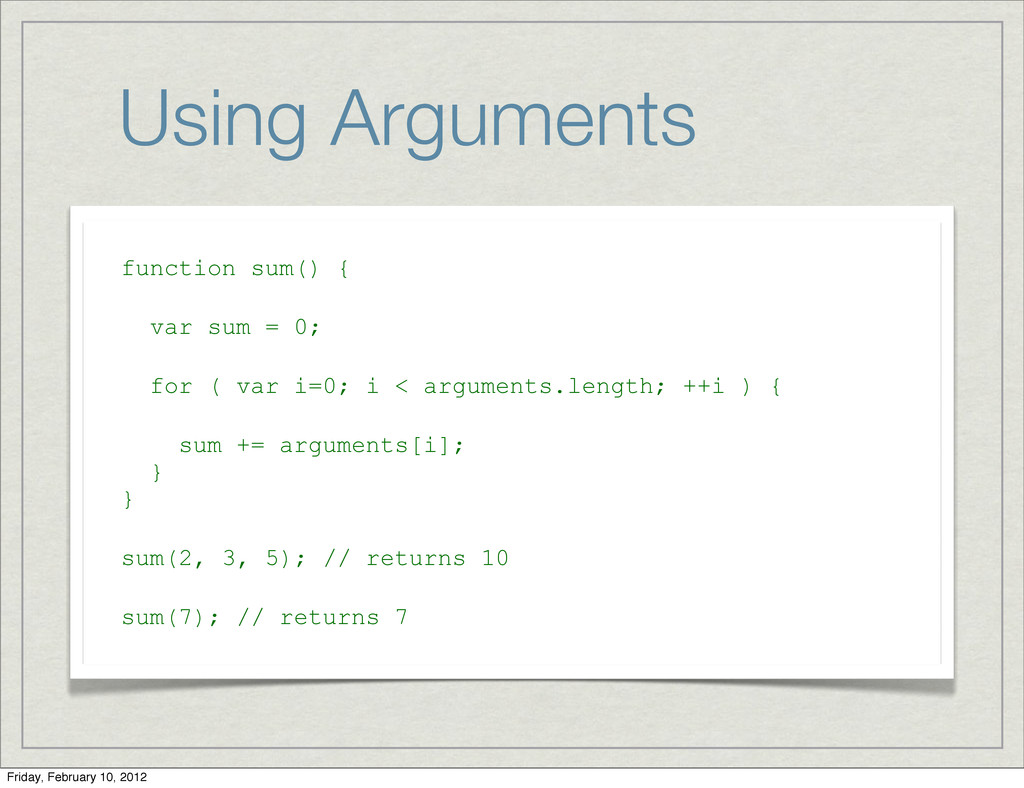
Using Arguments function sum() { var sum = 0; for
( var i=0; i < arguments.length; ++i ) { sum += arguments[i]; } } sum(2, 3, 5); // returns 10 sum(7); // returns 7 Friday, February 10, 2012 -
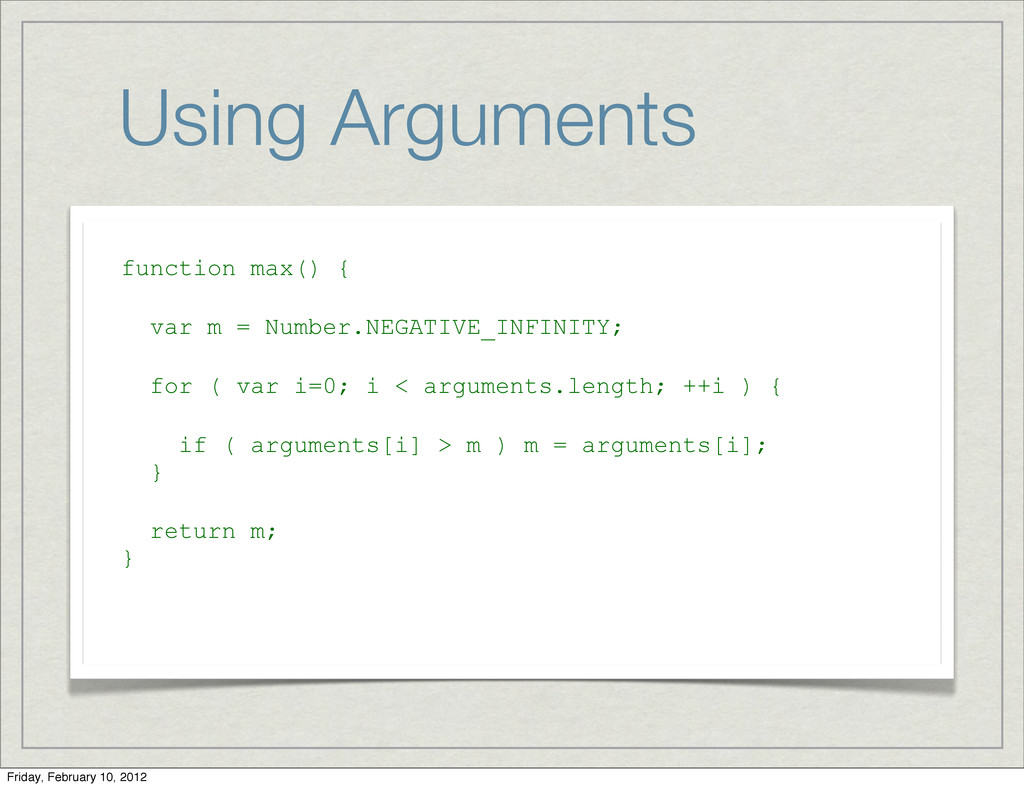
Using Arguments function max() { var m = Number.NEGATIVE_INFINITY; for
( var i=0; i < arguments.length; ++i ) { if ( arguments[i] > m ) m = arguments[i]; } return m; } Friday, February 10, 2012 -
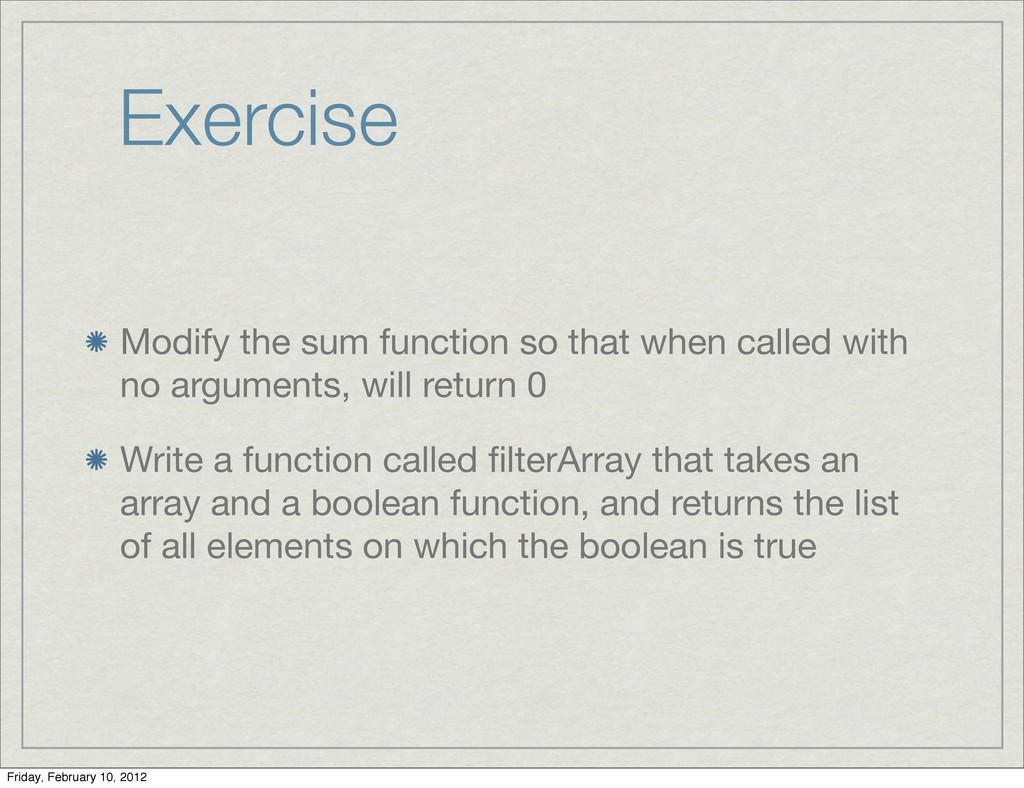
Exercise Modify the sum function so that when called with
no arguments, will return 0 Write a function called filterArray that takes an array and a boolean function, and returns the list of all elements on which the boolean is true Friday, February 10, 2012 -
DOM Scripting Using JS To Manipulate the web page http://www.flickr.com/photos/jram23/3088840966/
Friday, February 10, 2012 -
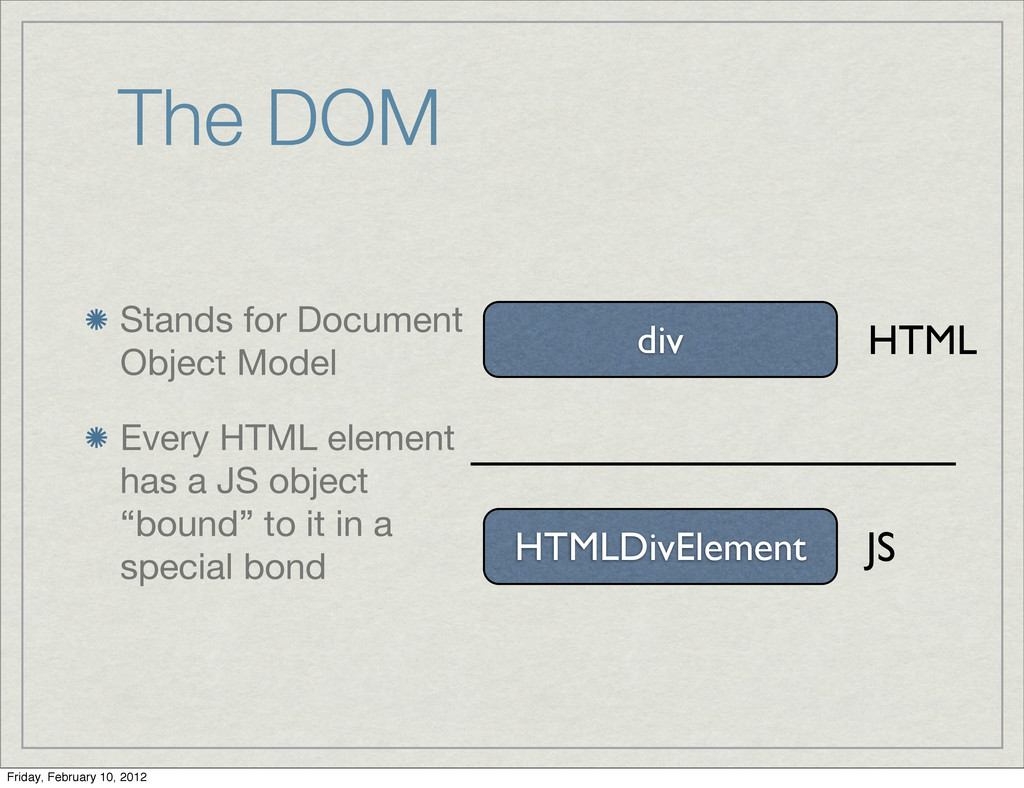
The DOM Stands for Document Object Model Every HTML element
has a JS object “bound” to it in a special bond HTMLDivElement HTML div JS Friday, February 10, 2012 -
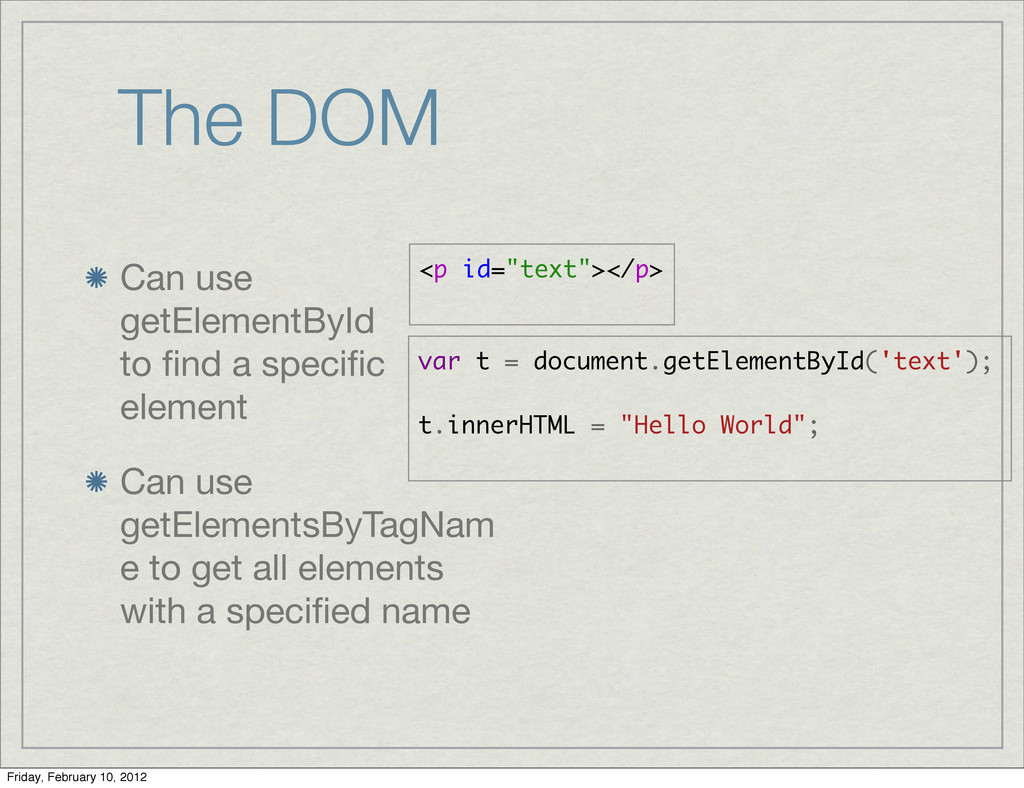
The DOM Can use getElementById to find a specific element
Can use getElementsByTagNam e to get all elements with a specified name <p id="text"></p> var t = document.getElementById('text'); t.innerHTML = "Hello World"; Friday, February 10, 2012 -
DOM Agenda jQuery Introduction Handling Events Writing a simple web
app Friday, February 10, 2012 -
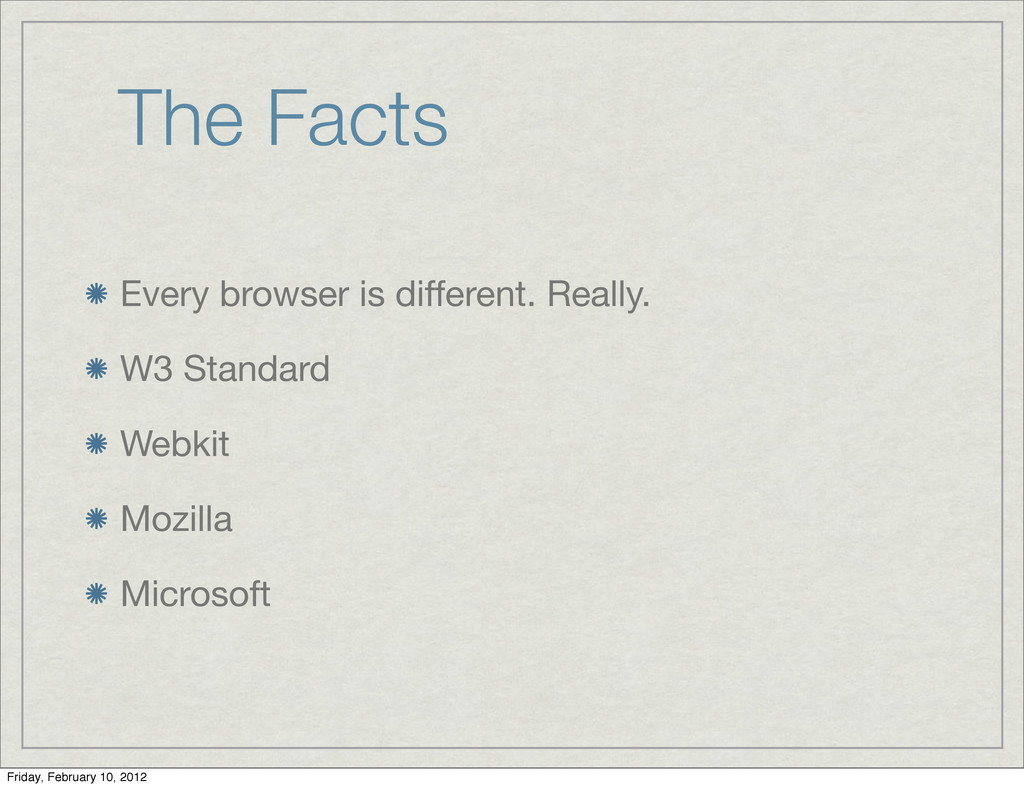
The Facts Every browser is different. Really. W3 Standard Webkit
Mozilla Microsoft Friday, February 10, 2012 -
Ajax Libraries Developer tools that wrap common functionality and create
a standard Many options to choose from. We’ll use jQuery Friday, February 10, 2012 -
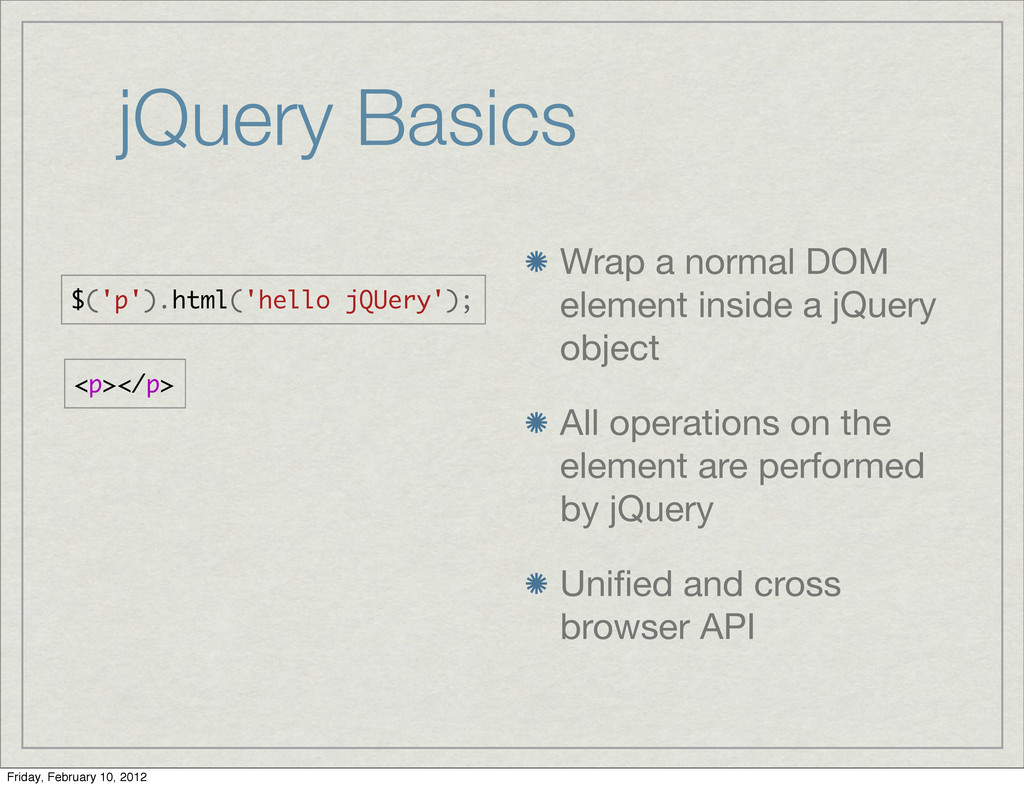
jQuery Basics Wrap a normal DOM element inside a jQuery
object All operations on the element are performed by jQuery Unified and cross browser API <p></p> $('p').html('hello jQUery'); Friday, February 10, 2012 -
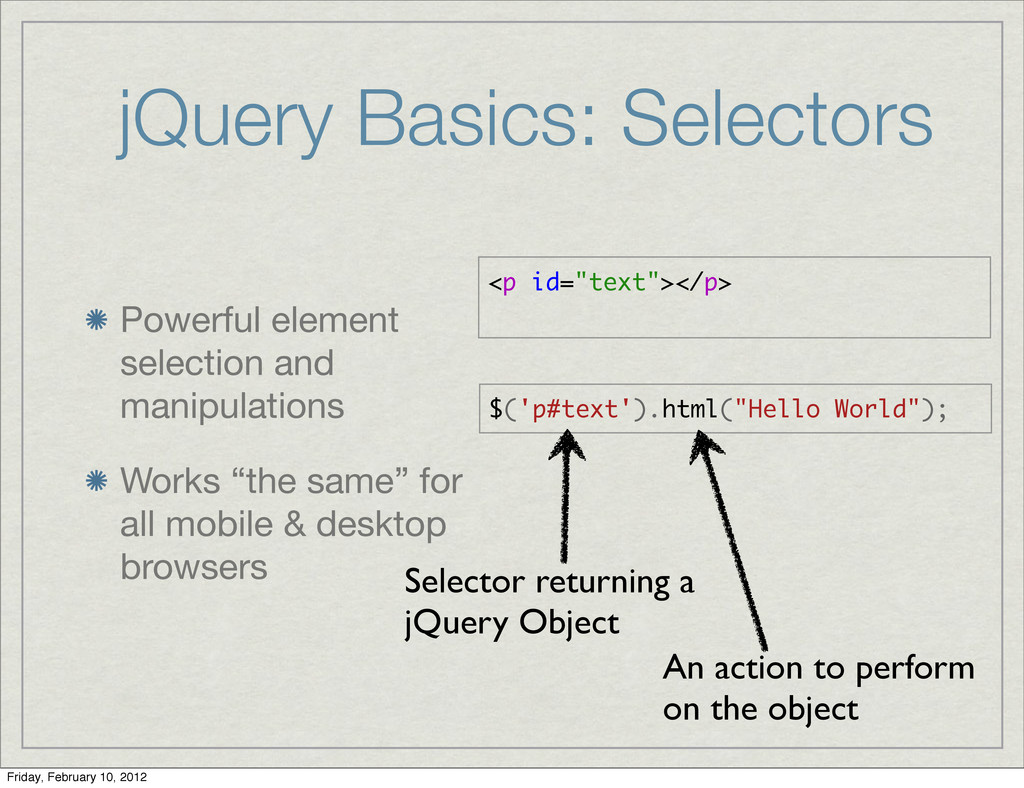
jQuery Basics: Selectors Powerful element selection and manipulations Works “the
same” for all mobile & desktop browsers <p id="text"></p> $('p#text').html("Hello World"); Selector returning a jQuery Object An action to perform on the object Friday, February 10, 2012 -
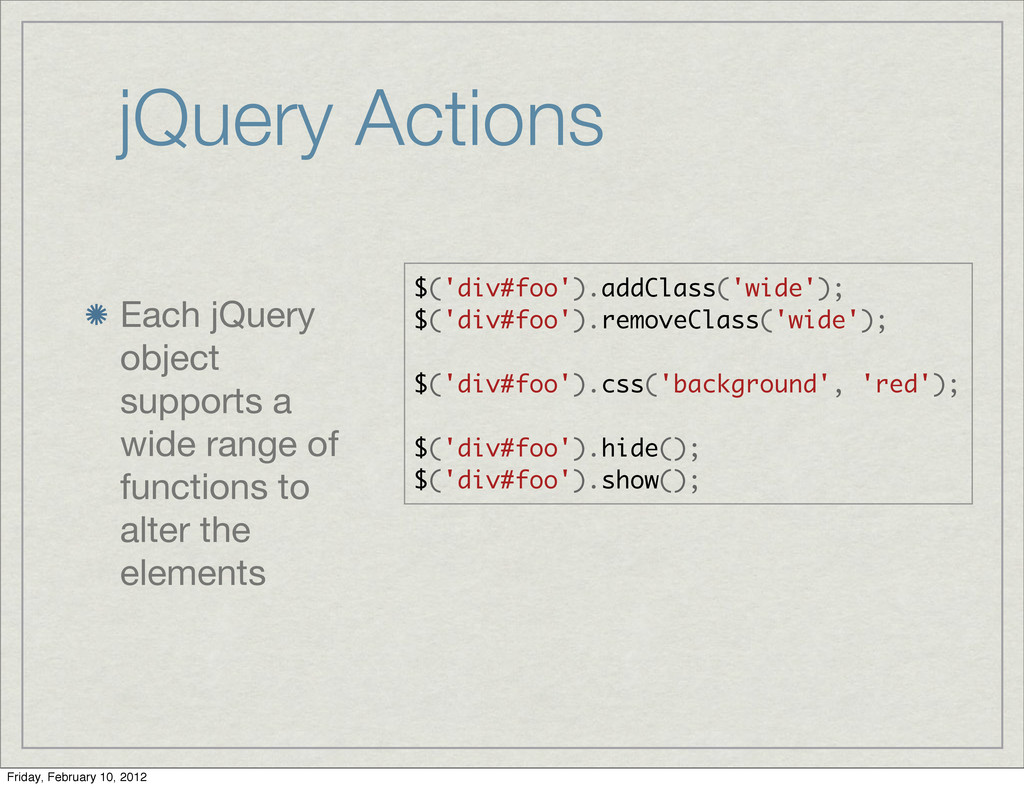
jQuery Actions Each jQuery object supports a wide range of
functions to alter the elements $('div#foo').addClass('wide'); $('div#foo').removeClass('wide'); $('div#foo').css('background', 'red'); $('div#foo').hide(); $('div#foo').show(); Friday, February 10, 2012 -
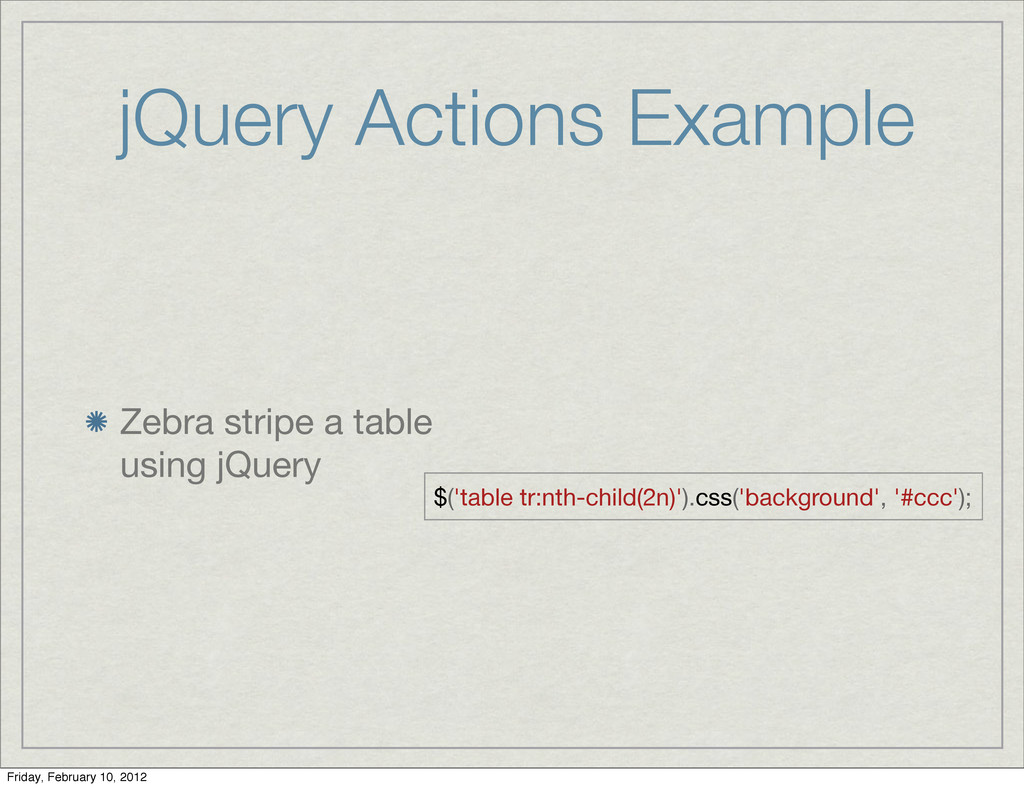
jQuery Actions Example Zebra stripe a table using jQuery $('table
tr:nth-child(2n)').css('background', '#ccc'); Friday, February 10, 2012 -
jQuery Events Define what to do when something happens in
jQuery, “bind” a function to an event After the bind, every time the the event happens your callback is called, with the object as the “this” argument Friday, February 10, 2012 -
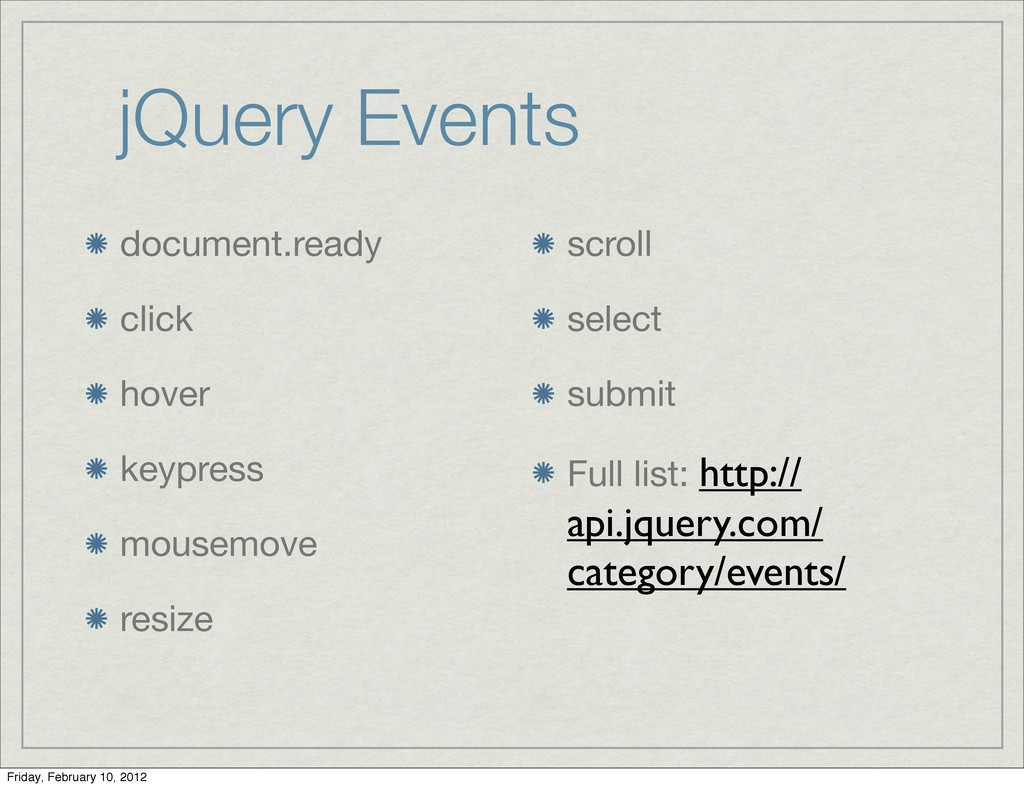
jQuery Events document.ready click hover keypress mousemove resize scroll select
submit Full list: http:// api.jquery.com/ category/events/ Friday, February 10, 2012 -
jQuery Demo Build a red spotter game Game should present
the user with 4 colored squares, only one is red User should click on the red square Friday, February 10, 2012 -
jQuery API Other useful methods: attr - change an attribute
value css - change a style attribute html - change innerHTML content data - store arbitrary data inside an element Friday, February 10, 2012 -
jQuery Lab Write a web application that splits the screen
into four sections. Each click on a section should display a sentence inside the clicked section Write a web app to convert time units. User should enter time in seconds, minutes or hours, and convert to all the others Use HTML5 Boilerplate and jQuery Friday, February 10, 2012